 @Purebeauty
more from that month
@Purebeauty
more from that month
Red cabbage - benefits and how I store it
Good morning dear virtual friends. How are you today? Are you healthy? Today I will introduce you benefits of red cabbage. So,lets start..... Did you know that ... - **Red cabbage** is much healthier than ordinary white cabbage, as it contains a lot of vitamins A, C and K. - **red cabbage** is one of the foods containing the most vitamin C, - the red-purple color is given to it by anthocyanins, which are known to be powerful antioxidants, - **Red cabbage** contains as much as 10 times more vitamin A than ordinary cabbage. Vitamin A, however, is very important for healthy vision. - **Red cabbage** is also one of the vegetables that contains the most iron and thus has a beneficial effect on anemia, - due to its high content of vitamin K, **red cabbage** helps to reduce the risk of osteoporosis, - **Red cabbage** is also one of the best anti-cancer foods due to its strong antioxidant content, as confirmed by many scientific studies, - and last but not least, **red cabbage** is a good source of fiber that takes care of the health of our digestive system, especially the intestines. It is highly recommended to eat sauerkraut because it is a real treasure trove of probiotics that take care of the balance of our intestinal flora. The acidification process is very simple and you can easily do it yourself.
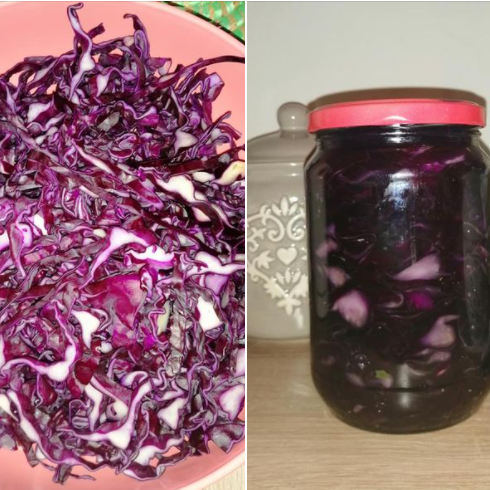
I experimented with pickling red cabbage in jars. Try it yourself, it pays off. Because, as you know, a healthy gut also means a healthy immune system. **Acidification in jars** Cabbage can also be pickled in (glass) jars. The vegetables are first carefully cleaned, peeled and grated into noodles. In a large bowl, salt it in layers. Use 1 to 2 percent salt depending on the amount of beets or cabbage. If desired, you can also add a few grains of pepper, anise, cumin or bay leaf. The salted cabbage or turnip is then mixed well with your hands, covered and left to stand for 2 hours to release the liquid. Vegetables then very tightly stuff into jars and press well several times in between. Partially cover the jars and place in a dark place. This allows gas exchange to take place. After a few days, they are then tightly screwed or closed and in 3 to 4 weeks we can prepare delicious dishes from home-made sauerkraut. When all the cabbage is in the bowl, cover it with the stored remains of partially Thank you for reading my article.

I send you much love and hugs.@Purebeauty.







23 comments
I love red cabbage, I recently made a salad. But it is also much more expensive than ordinary cabbage.
I love red cabbage too,also green cabbage.But you are right.It is much better then green cabbage.
I don't eat pickles often. Cabbage is one of my favorite vegetables. I especially like the cabbage salad with my meals. Cabbage and cauliflower are very beneficial for the digestive system. I am sure that pickle lovers will love your homemade sauerkraut recipe.
I love cabbage in salad too.I make it with beans.Actually,I make a lot different foods from cabbage.My family like tasty of this vegetable.
I was just watching a television show last night that introduced grilling cabbage. They grilled green, but I would think you could with red too! I don't purchase cabbage often, but I may do it a little more.
Try it.I think it would be delicious.
I think I will. :-)
I like cabbage salads. But I never do it like that. I will have to test your recipe.
try it dear,it is delicious.
Thank you for upvote dear
Red cabbage and as I like, I mostly use it for salads and mixed it: grated white and red cabbage, carrots, apples.
We can use cabbage in many ways.Food iis tasty when is made with cabbage.
Your article reminded me of when I experimented with fermenting red salsa. It's denitely a process! I did enjoy the acidic-salty flavor though. Is there a flavor difference between the red cabbage and the green?
Yes it is a flavor difference between the red and grenn,white cabbage.Red is much more tasty.
@elana Thank you for your upvote dear.
@Swca.ch Thank you for your tip.
There is no red cabbage in our market mostly the green ones. But I'd like to try it too sounds delicious.
We have both.Red and green.Try to find it somewhere in stores.
Yes maybe in the mall there is. Thank you.😇
Salads made with red cabbage have always ranked at the top of my diet. Now that you reveal that sauerkraut can be created from this instructs me to revisit this dish.
> Salads made with red cabbage have always ranked at the top of my diet. Now that you reveal that sauerkraut can be created from this instructs me to revisit this dish. Yes,I recommended you that you acidification in jars.You will see how delicious is made like salad.Thank you for your tip.
I love red cabbage. Peppers and cabbage are known to have the most vitamin C. Well done for the article.
Yes dear,cabbage has a lot vitamin C.So,it is good to eat in winter time.