Medicine, Modern Superstition & Flawed Paradigms
All around the world, although more in less developed countries than in the industrialised West, I have faced what must be the most widely spread superstition of our times: the belief that a doctor is a magician who can always administer a tablet or injection to cure any ailment. It's even worse than that; magical properties are attributed to the medical drug itself. The mere existence of a medicine, any medicine, must help. I have met sick people who screamed in agony and just wanted medicine, any medicine, because “medicine” will help.
It is almost impossible for such people to understand the paradigm of ***Felo-de-se***, how degenerative disease is a slow suicide, for which they have the full responsibility themselves. In their opinion, they should be able to live in any way that pleases them, then a medicine should repair the damage they have done. To take responsibility for the way they live is a totally alien concept to them. They want medicines and they use them for everything, even small ailments that need no treatment at all. This is indeed superstition, an exaggerated belief in the power of medicines. https://read.cash/@Mictorrani/suicide-is-not-painless-50c9969b
Once a man with symptoms of several degenerative conditions asked me for help. I explained to him that he must stop eating meat and – above all – stop consuming the large quantities of refined sugar which constitutes a significant part of the intake of energy in his country. If he did that, and a number of other things, it would be possible to reverse his ailments. Otherwise he would surely die within a few years.
His face became very troubled, and he said, almost screamed “***IS THERE NO THERAPY*** [medicine]?”
“*No*”, I said. “*I can give you a medicine that cheats your mind so you believe your pain or other symptoms are gone, but that's all. The medicine just disrupts normal nervous function, the signal systems of your body. The ailments are still there, but you cannot feel them. You are not better, although you'll believe you are better, and then you will continue to make your condition gradually worse until you die. But if you really want to become better, you must change the way you live. There is no shortcut!*”
He looked confused. ”*But meat!*”, he exclaimed, “*I want to be strong, like a buffalo. Then I* ***must*** *eat buffalo meat.*”
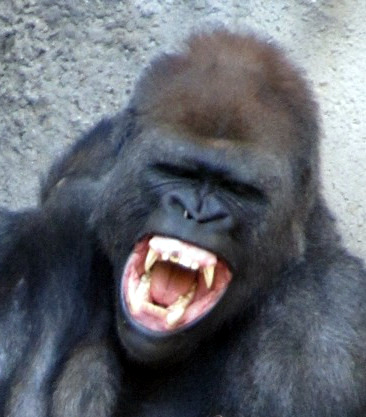
“*What sort of reasoning is that? If you admire a man for his abilities and you want to obtain them, do you desire to eat him? Certainly not. You study how he is living and imitate that. That is the only way you can try to develop his abilities for yourself. If you want to become strong as a buffalo, you must eat – not the buffalo - but what the buffalo eats.*” Here I made a gesture towards a large green field by which we were sitting, while I continued, “*And don't say that you need meat to build muscles. Just look at our very close relative, the gorilla. What does a gorilla eat?”*
Suddenly he said, “*You are a strange doctor. I want you to cure me, but you just tell me what I should do. Why don't you do something, why don't you give me medicine?”*
“*But I* ***am*** *doing something. I am teaching you how you can cure yourself.”*
“*I don't want to cure myself. You are the doctor, I want* ***you*** *to cure me!”*
This is another troublesome paradigm, kept alive by doctors and patients alike.
For most people, healthcare is a passive activity. Once something is wrong, you expect a doctor to fix you. Then you should not have to think or do anything more about it, except maybe taking a prescribed drug.
This attitude is cultivated within the medical profession, which enjoys shrouding itself in unreachable mystery, as a wielder of knowledge and ability which is far above the reach of common humans.
If your doctor has this attitude; making him the active part, reducing you to a mere working object, a passive receiver of his favours; drop him! That approach is dangerous.
The first and foremost point you must realise is that the ultimate responsibility for your health is yours, only yours!
The relationship between doctor and patient should be one of mutual co-operation, not one of active and passive party. But even if he has the specialist knowledge and the experience, you are the one to cure yourself. It is what you do that counts.
In most cases the doctor will just care for your short term health, so he is focused on symptoms. Mostly it rests entirely with yourself to track and treat the root cause. If you are lucky enough to have a good doctor, he can help you, but basically it is your doing.
Ultimately, you are the one being in control of your health. It rests with you to understand it, and to care for it or abuse it. It is literally a matter of life and death. Your life and your death!
I have said this before, but it deserves to be repeated: Never forget that preventing is better than curing!
In ancient China they were aware of the importance of prevention. Actually, it was the main task of the physicians. As long as a patient was in good health, he (the physician) was paid. But if the patient got ill, payment stopped until health was restored. Meanwhile a sign was affixed outside the physician's door to warn people that he had a patient that was ill.
Maybe this attitude would be needed in our time! After all, would it not be more reasonable with a system paying success, than one paying failure?
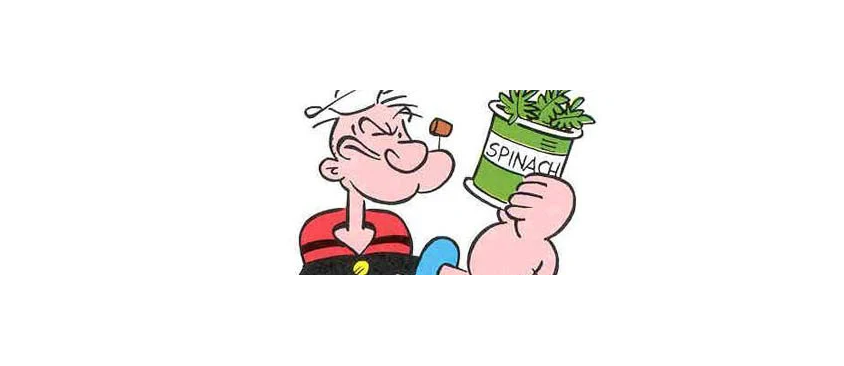
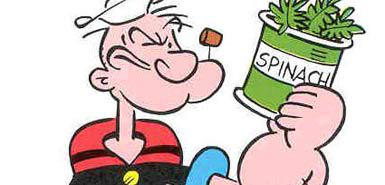
Incidentally, speaking about eating as a buffalo or a gorilla: Popeye was right; it has been proved that spinach stimulates the formation of muscular tissue. Indeed, most, if not all green leaves do so.
(The image of Popeye is in the Public Domain or used under “fair use rights”, depending on jurisdiction.)
Appendix: Note on Popeye and Spinach
Popeye is a cartoon character, turning up for the first time in January 1927, who gets superhuman strength by eating spinach.
Why did Popeye's creator, Segar, choose spinach for his character? He cannot have been aware of scientific results which are still today quite new. Yet he did hardly choose it without any reason.
It has repeatedly been claimed that it was because of its content of iron, although that seems to be a mistake. At least one serious study of the reason has been made, and it indicates that the story about iron is false, and that Segar chose spinach for its content of vitamin A.
(This article is based on material previously published in Meriondho Leo.)
Related articles:
Suicide is not Painless https://read.cash/@Mictorrani/suicide-is-not-painless-50c9969b
Deceptive Symptoms - A True Story https://read.cash/@Mictorrani/deceptive-symptoms-a-true-story-4875976e
Either Health Freedom or Slavery - A Little of Each is not Possible https://read.cash/@Mictorrani/either-health-freedom-or-slavery-a-little-of-each-is-not-possible-ed726fc2
Copyright © 2015 , 2021 Meleonymica/Mictorrani. All Rights Reserved.
All my articles on health & medicine can be found here. https://read.cash/@Mictorrani/index-over-my-articles-at-read-cash-5f7c1e34#health-amp-medicine-for-covid-19-see-covid-19
You find all my writings on Read.Cash, sorted by topic, here. https://read.cash/@Mictorrani/index-over-my-articles-at-read-cash-5f7c1e34
Also, please join my community: *The Mechanisms of Health (d52e)**.* https://read.cash/c/the-mechanisms-of-health-d52e
My 3 most recent articles:
Another Three Spices: Aphrodite's Birth, Smoke & King Minos' Daughter https://read.cash/@Mictorrani/another-three-spices-aphrodites-birth-smoke-king-minos-daughter-8d15a193
More Spices: Cinnamon, Nutmeg, Clove & Pepper https://read.cash/@Mictorrani/more-spices-cinnamon-nutmeg-clove-pepper-1f18e180
How I Discovered Science Fiction: A Green Brain & Dune https://read.cash/@Mictorrani/how-i-discovered-science-fiction-a-green-brain-dune-29a4c492
Another Three Spices: Aphrodite's Birth, Smoke & King Minos' Daughter
This time we will take a look at the three spices rosemary, thyme, and coriander. The title of this article might be confusing, but there is a story behind it.
For a time in the past, I created monthly quizzes for a magazine, and one time the question was “Which three spices am I thinking of if I say Aphrodite's birth; smoke; and Ariadne, the daughter of king Minos of Crete?”
The correct answer is: Rosemary, Thyme, and Coriander; it will soon be clear why.
Rosemary, Spice Hallowed to Aphrodite
Rosemary was once hallowed to Aphrodite, the foamborn, so named because she was said to have sprung from the foam of the sea, [***aphros***, foam]. Thus the plant was named rosemary, from Latin ***ros,*** dew, and ***marinus***, sea.
***Rosmarinus officinalis*** is a plant of the mint family, whose leaves yield an essential oil, use in making perfumes, as medicine and as a spice. Traditionally rosemary is the symbol of remembrance and constancy.
It is often said that rosemary improves the memory. There might be some truth in that; it contains a substance which stimulates activity in certain areas of the brain. This is still insufficiently studied though. Given that this herb is also a good (moderately strong) antioxidant, there is good reason to assume it does prevent age-related breakdown of some categories of brain cells.
Rosemary stimulates circulation and the immune system (the latter especially in combination with bee propolis), and it relaxes muscular tension. In addition to that it improves the assimilation of other nutrients.
The old legend about Aphrodite's birth can be found in Hesiod's Theogony (8th century BC). Homer, however, relates another legend, where Aphrodite is the daughter of Zeus and Dione. Plato claimed that there were two Aphrodite. But the one we discuss now is the foamborn, so we keep to Hesiod.
Uranus (Ouranos) dislikes his offspring, the Titans, and imprisons some of them. Thereby he causes enmity between the youngest, Cronus (Kronos), and himself. With a flint knife Cronus manages to cut off Uranos members (genitals) and hurls them into the Mediterranean. From them, Aphrodite was born. Hesiod describes it thus:
*But the members themselves, when Kronos*
*had lopped them with the flint,*
*he threw from the mainland*
*into the great wash of the sea water*
*and they drifted a great while*
*on the open sea, and there spread*
*a circle of white foam*
*from the immortal flesh, and in it*
*grew a girl, whose course first took her*
*to holy Kythera,*
*and from there she afterward made her way*
*to sea-washed Cyprus*
*and stepped ashore, a modest lovely Goddess,*
*and about her*
*light and slender feet the grass grew,*
*and the gods call her*
*Aphrodite, and men do too,*
*and the aphro-foam-born*
*goddess, and garlanded Kytheraia,*
*because from the seafoam*
*she grew, and Kytheria because she had gone*
*to Kythera,*
*and Kyprogeneia, because she came forth*
*from wave-washed Cyprus,*
*and Philimmedea, because she appeared*
*from medea, members.*
[Translation by Richmond Lattimore, in Great Classical Myths, ed. F.R.B. Godolphin, Random House, 1964.]
Thyme
Thyme is any of the plants of the genus Thymus, with white, pink or red flowers and fragrant leaves.
The word "thyme" comes from Latin ***thymus*** and further from Greek ***thymos***. It could be related to a word meaning "spirit" or "smoke". Another theory links the word to Ancient Egyptian ***tham***, a plant used in embalming.
***Thymus vulgaris*** gives the spice, thyme, and by distillation, thyme oil. The latter contains thymol (can also be produced synthetically), which can be used in medicine for disinfection - working against bacteria and fungi. It also contains carvacrol, which can be used as an antiseptic and an anaesthetic [painkiller].
Thyme can be used against cramps, to stimulate the appetite, and for disinfection. Chewing thyme 2-3 days is excellent against an inflamed gum.
Whether it is used to season food or for medical purposes, it should not be used too much, too regularly, or too long. Due to its high content of the element Lithium, which strongly affects the thyroid gland, regular long-term use can generate goitre.
A few days of use for a gum inflammation are harmless, and occasional seasoning of food with thyme is probably beneficial.
Sometimes thyme is given in cases of Lithium deficiency, indicated by certain thyroid problems, but that must be handled with knowledge and sound judgement, not in self-medication.
Coriander
Coriander is one of the many spices and herbs whose name might confuse international readers. This text refers to ***Coriandrum sativum***, whose leaves are sometimes called C***ilantro.*** Mexican (or long) coriander *(****Eryngium foetidum****),* Vietnamese coriander *(****Persicaria odorata****),* and Bolivian coriander *(****Porophyllum ruderale****)* are names of three separate herbs. I have added a few comments of these three at the end of the section.
Coriandrum Sativum
The word ***coriander*** is derived from an old Mycenaean word, *k****o-ri-ja-da-na****,* the same as the name of Minos' daughter, later called Ariadne. ***Cilantro*** is Spanish for coriander, but is usually used only in reference to the leaves. Both dried leaves and dried fruits, commonly referred to as seeds, are used for cooking. In South East Asia, the roots are used as well.
Archaeological evidence indicates that coriander has been cultivated since at least the Early Bronze Age - and it was well spread in the great ancient cultures around the Mediterranean.
The medical effects of coriander are numerous. Scientific studies with rats show antioxidative effects, lowering of bad blood fats, insuline-like activity, preventing deposition of Lead, and antimicrobal effects. In traditional and alternative medicine, it is used against flatulence and to aid digestion.
Mexican Coriander
***Eryngium foetidum***, has a stronger taste than Cilantro, and is used for seasoning in the Caribbean and parts of South East Asia. Traditionally it has been used against a large number of ailments, most notably epilepsy. Scientific studies have confirmed its anti-convulsant properties.
Vietnamese Coriander
***Persicaria odorata***, sometimes referred to as Vietnamese mint, although it is as little related to the mint family as to coriander, is used for seasoning in South East Asia, and is especially typical for Vietnamese food. Tradition holds that it represses sexual desire, and it is used for that purpose by monks bound to celibacy.
Bolivan Coriander
***Porophyllum ruderale***, or papalo, is a herb used for seasoning food, not at least in salsa, in parts of Latin America. (I have not been able to find any scientific studies of its health properties.)
This article is based on material previously published in TMA/Meriondho Leo and in my e-book “Spices & Herbs”, 2018.)
Related articles:
The King & Queen of Spices: Turmeric & Ginger https://read.cash/@Mictorrani/the-king-queen-of-spices-turmeric-ginger-d697e39f
Spices & Health: Cumin, Anise, Star Anise, and Fennel https://read.cash/@Mictorrani/spices-health-cumin-anise-star-anise-and-fennel-00c1196d
Fenugreek, Lactation & Male Libido https://read.cash/@Mictorrani/fenugreek-lactation-male-libido-eb592497
The Three Most Expensive Spices https://read.cash/@Mictorrani/the-three-most-expensive-spices-24717e1d
More Spices: Cinnamon, Nutmeg, Clove & Pepper https://read.cash/@Mictorrani/more-spices-cinnamon-nutmeg-clove-pepper-1f18e180
Copyright © 2005-2008, 2018, 2021 Meleonymica/Mictorrani. All Rights Reserved.
(The lead image shows rosemary. Photo by Hans Braxmeier/Pixabay, CC0/Public Domain.)
Here you find my articles related to spices & herbs, and to health & medicine. https://read.cash/@Mictorrani/index-over-my-articles-at-read-cash-5f7c1e34#spices-amp-herbs https://read.cash/@Mictorrani/index-over-my-articles-at-read-cash-5f7c1e34#health-amp-medicine-for-covid-19-see-covid-19
Interested in health & medicine, join my community "The Mechanisms of Health (d52e)" https://read.cash/c/the-mechanisms-of-health-d52e
You find all my writings on Read.Cash, sorted by topic, here. https://read.cash/@Mictorrani/index-over-my-articles-at-read-cash-5f7c1e34
*My 3 most recent articles:*
*More Spices: Cinnamon, Nutmeg, Clove & Pepper* https://read.cash/@Mictorrani/more-spices-cinnamon-nutmeg-clove-pepper-1f18e180
*How I Discovered Science Fiction: A Green Brain & Dune* https://read.cash/@Mictorrani/how-i-discovered-science-fiction-a-green-brain-dune-29a4c492
*The Three Most Expensive Spices* https://read.cash/@Mictorrani/the-three-most-expensive-spices-24717e1d

More Spices: Cinnamon, Nutmeg, Clove & Pepper
In this article we will look at some unrelated spices - Cinnamon, Nutmeg, Clove & Pepper – and their medicinal effects.
Cinnamon
(***Cinnamomum Zeylanicum Bl***. and other species of ***Cinnamomum***)
There are many sorts of Cinnamomum and cinnamon oil is prepared from several of them. But the main source for the genuine spice, cinnamon, is the dried inner bark of Cinnamomum zeylanicum. (However see about ***cassia*** below.)
Traditionally this spice has been used against pain related to menstruation - and the oil can be used as an antiseptic. The spice has a pronounced effect against bacteria-caused stomach ailments - also as a prevention.
Interestingly, cinnamon has the same blood sugar regulating effect as turmeric. Taking cinnamon with each meal can prevent diabetes and some diabetics can reduce or eliminate medication by taking up to one tablespoon of cinnamon after each meal. https://read.cash/@Mictorrani/the-king-queen-of-spices-turmeric-ginger-d697e39f
***WARNING!*** *If you are a diabetic and want to experiment with this, do so only under supervision of your physician! If your need for medication is suddenly reduced while your intake is unchanged - it would be too high, and that can lead to a life threatening condition.*
Healthy people can use cinnamon to lower the risk of developing diabetes. Since it is regulating blood sugar, it is not a bad idea to eat some cinnamon in connection with sugar or other quickly blood sugar raising foodstuffs.
Cinnamon is relatively safe. There are people that have used up to three tablespoons per day for many years without any negative side-effects.
The fear of ***coumarin***, a compound in cinnamon with potential negative impact on liver health, is exaggerated. You would have to eat a very high amount cinnamon to reach a level where you risk damage. It is not realistically possible to eat that much.
But beware of ***Cassia***! It contains much more coumarin. While the risk of liver damage is negligible with genuine cinnamon, it's very real with cassia.
Cinnamon from cassia bark is different from genuine cinnamon (from the genuine Cinnamon tree). In North America, what's sold as ***Cinnamon*** is usually ***Cassia***, while in Europe, ***Cinnamon*** comes from the ***Cinnamon tree***.
Cassia is also called Chinese cinnamon; the tree originates from China. The spice is rougher and contains less essential oil. It's a product of lower quality than genuine cinnamon. Because of its coumarin level, I advise against eating cassia at all.
Nutmeg
From ***nut***, and Latin ***muscus***, meaning musk.
Nutmeg is the hard, aromatic kernel of the seed of ***Myristica fragrans***, or ***moschata***, a tree that grows in the East Indies and has been introduced to Sumatra, India, the West Indies and Brazil.
Nutmeg is grown and used as a spice.
Medically it is a fairly strong antioxidant, and it stimulates blood circulation and digestion.
Nutmeg contains myristicin and elemicin, which, in high doses, can generate hallucinations. They can also cause nausea, headache and heart problems.
Occasional use of nutmeg as a spice is beneficial for the health, and in no way harmful. I would advise against exaggerated consumption though.
Clove
Latin ***clavus***, a nail, due to its shape.
Cloves are the dried flower buds of ***Caryophyllus aromaticus***, a tree, originally from the Molucca islands (a part of present day Indonesia). Their use in China is documented from 266 BC, and in Egypt from Pharaonic time. During the 4th century, they existed in Europe as a spice of extreme luxury.
For a long time it was believed that cloves came from the island of Java. Marco Polo stated that, and before him Ibn Khurdadbah, around 870 AD. But Niccolo Conti established in the 15th century that they came to Java from the Molucca islands.
Control of the Molucca islands was the same as control over the trade with cloves and nutmeg. It was not until 1770 that the French successfully cultivated clove trees on Mauritius, from where production spread to many tropical areas.
By distillation, cloves give an essential oil whose main component is eugenol. It is used within dentistry for disinfection. It is also one source material for synthetic vanillin. https://read.cash/@Mictorrani/the-three-most-expensive-spices-24717e1d
Cloves are used as a spice - and in the tobacco industry, for flavouring.
They are quite a strong antioxidant and drive out certain parasites. Chewed, they can help keep the gum in a good condition. It's a good habit to chew a few pieces of cloves every day.
The only warning is that they are strong, and too much of them can cause gastric irritation.
Pepper
Pepper is a word derived from Sanskrit, ***pippala***, which is used for several spices. We will take a look at the genuses ***Piper*** respective ***Capsicum***.
Piper
The plant ***Piper nigrum*** gives us three important peppers.
Black pepper: the dried drupes, harvested before they are completely ripe.
White pepper: the ripe drupes; they are dried and their skin is removed.
Green pepper: unripe drupes, dried (nowadays mostly vacuum dried).
All these contain strong antioxidants, they stimulate glandular function, drive out some parasites, stimulate digestion and prevent intestinal fermentation and rotting.
No toxicity is known, but they are very strong, especially black and white pepper, and can cause gastric irritation if you take too much.
Black pepper, the black gold of Kerala [a part of India where they grow it] deserves special attention. First because it has a pronounced anti-diabetes effect, which is possibly due to its very high content of the mineral chromium. Second, because combined with turmeric it increases the turmeric's cancer-fighting power by 2000 times!
Capsicum
The word stems from Latin ***capsa***, box. The fruit are hollow. The Spanish found these peppers in the Americas. There is no botanical relation between Piper and Capsicum.
This is a genus of subshrubby plants of the nightshade family. Many species are cultivated for their fruit, which contains capsaicin (also found in the seed). Moreover it contains beta-carotene, lycopene, bioflavonoids, vitamin C, silica, and small amounts of certain B-vitamins and vitamin E.
They are strong antioxidants, stimulate digestion and prevent intestinal fermentation and decay. Internally they cleanse the blood vessels, and stimulate circulation and respiration. They prevent macular degeneration and cataract, and probably cancer. Capsicum has an anti-rheumatic effect and applied on the skin it reduces pain.
Red peppers have also been prescribed against malaria, typhus, and cholera. In South America some Indians claim that they improve vision.
Cayenne pepper is made of the ground pods of various species, especially ***Capsicum fastigiatum***. It is the ultimate detoxifier. A teaspoon in a glass of pressed lemon, or diluted apple cider vinegar, flushes toxins out from the body. Done daily during a cancer treatment, it can make the difference between success and failure.
Chilli is the dried pod of Capsicum annuum, so-called red pepper. Other fruit of this family are paprika, pepperoni, etc.
As spices these red peppers are very hot. There is a scale for measuring the hotness (pungency), it is called Scoville. Sweet pepper with no capsaicin has zero SHU (Scoville Heat Units), ordinary Cayenne pepper is 30,000-50,000 SHU, while the strongest peppers, like Indian ***naga jolokia*** is rated at more than 1,000,000 SHU. Chemically pure capsaicin is rated at 16 million SHU, and the strongest chemical known in this respect, resiniferatoxin, is rated at 108,800 millions SHU.
(This article is based on material previously published in TMA/Meriondho Leo and in my e-book “Spices & Herbs”, 2018.)
Related articles:
The King & Queen of Spices: Turmeric & Ginger https://read.cash/@Mictorrani/the-king-queen-of-spices-turmeric-ginger-d697e39f
Spices & Health: Cumin, Anise, Star Anise, and Fennel https://read.cash/@Mictorrani/spices-health-cumin-anise-star-anise-and-fennel-00c1196d
Fenugreek, Lactation & Male Libido https://read.cash/@Mictorrani/fenugreek-lactation-male-libido-eb592497
The Three Most Expensive Spices https://read.cash/@Mictorrani/the-three-most-expensive-spices-24717e1d
Copyright © 2005-2008, 2018, 2021 Meleonymica/Mictorrani. All Rights Reserved.
(The lead image shows cinnamon. Photo by Uwe Baumann/Pixabay, CC0/Public Domain.)
Here you find my articles related to spices & herbs, and to health & medicine. https://read.cash/@Mictorrani/index-over-my-articles-at-read-cash-5f7c1e34#spices-amp-herbs https://read.cash/@Mictorrani/index-over-my-articles-at-read-cash-5f7c1e34#health-amp-medicine-for-covid-19-see-covid-19
Interested in health & medicine, join my community "The Mechanisms of Health (d52e)" https://read.cash/c/the-mechanisms-of-health-d52e
You find all my writings on Read.Cash, sorted by topic, here. https://read.cash/@Mictorrani/index-over-my-articles-at-read-cash-5f7c1e34
*My 3 most recent articles:*
*How I Discovered Science Fiction: A Green Brain & Dune* https://read.cash/@Mictorrani/how-i-discovered-science-fiction-a-green-brain-dune-29a4c492
*The Three Most Expensive Spices* https://read.cash/@Mictorrani/the-three-most-expensive-spices-24717e1d
*Fenugreek, Lactation & Male Libido* https://read.cash/@Mictorrani/fenugreek-lactation-male-libido-eb592497

How I Discovered Science Fiction: A Green Brain & Dune
One of the most interesting and innovative genres of literature from the last 70 or so years, is so-called speculative fiction. Two of its main branches are Fantasy & Science Fiction. While fiction being speculative has existed at least from old Athens in the 5th century BC, the modern use of the term, ”speculative fiction”, can be traced back to 1947, when author Robert A. Heinlein used it in ”The Saturday Evening Post”. He, however, used it to denote science fiction and claimed that it did not include fantasy. In the 2000s it has become a wider concept, including many subgenres, of which the dominant ones are Science Fiction, Fantasy and Horror. We will not discuss Fantasy or Horror this time, but focus on my first encounter with Science Fiction.
In Learning Languages - How I do, I described how, at an early age, I learned to read. After that I have continued reading copiously. My first meeting with science fiction literature, however, was, as so much else in life, a coincidence. In a shop for used books, I suddenly stood looking at a cover with a skull on it. It had a greenish colour and it looked both interesting and disgusting. The title was ”The Green Brain” and the author was Frank Herbert, at the time a name with which I was not acquainted. I bought the book and read it the same night. While it did not make me all that excited, its speculative nature was something (to me) new. While, today, I hesitate to call ”The Green Brain” science fiction, it made me curious on the author, Frank Herbert; I wanted to read more by him. The book I found was ”Dune”. This was science fiction indeed and it opened a new literature for me. I had seen some cheap and quite primitive black & white science fiction films before, and they did not leave any lasting impression, but ”Dune” was the first real science fiction novel I did read. https://read.cash/@Mictorrani/learning-languages-how-i-do-a576f6c9
Now, decades later, I have read much science fiction. All the classics and more than that. Yet, I claim, ”Dune” is the best of them all. I might be biased by that it was via ”Dune” I discovered science fiction, but I don't think it is only that; I am not alone in the opinion that ”Dune” is the best or one of the best science fiction novels ever written.
”Dune” came to get many sequels, and it became a series. While quality at the end is falling somewhat, I certainly recommend the reading of the full series:
***Dune***, 1965.
***Dune Messiah***, 1969.
***Children of Dune***, 1976.
***God Emperor of Dune***, 1981.
***Heretics of Dune***, 1984.
***Chapterhouse: Dune***, 1985.
Frank Herbert, who died in 1986, wrote much more than this, and all of it is worth reading, but ”Dune” remains his masterpiece.
The series is full of philosophy and, although it takes place in a future with much more advanced technology than ours, Frank Herbert never focus on technology in the way of Asimov or Clarke – his focus is more on human nature, psychology, thinking and ecology. I will illustrate that with a selection of quotes:
About power:
“*All governments suffer a recurring problem: Power attracts pathological personalities. It is not that power corrupts but that it is magnetic to the corruptible. Such people have a tendency to become drunk on violence, a condition to which they are quickly addicted.”*
(Frank Herbert, Chapterhouse: Dune)
“*The undeserving maintain power by promoting hysteria.”*
(Frank Herbert, “God Emperor of Dune”)
“*Belief can be manipulated. Only knowledge is dangerous.“*
(Frank Herbert, “Dune Messiah”)
“*Politics: the art of appearing candid and completely open while concealing as much as possible.“*
(Frank Herbert, “Chapterhouse: Dune”)
“*When I am weaker than you, I ask you for freedom because that is according to your principles; when I am stronger than you, I take away your freedom because that is according to my principles.“*
(Frank Herbert, “Children of Dune”)
“*Small souls who seek power over others first destroy the faith those others might have in themselves.“*
(Frank Herbert, “God Emperor Of Dune”)
“*Once men turned their thinking over to machines in the hope that this would set them free. But that only permitted other men with machines to enslave them.“*
(Frank Herbert, “Dune”)
About life:
“*The mystery of life isn't a problem to solve, but a reality to experience.“*
(Frank Herbert, “Dune” )
“*If you live in bad faith, lies will appear to you like the truth.“*
(Frank Herbert, “God Emperor of Dune”)
“*Seek freedom and become captive of your desires. Seek discipline and find your liberty.”*
(Frank Herbert, “Chapterhouse: Dune”)
On knowledge, etc...:
“*Every judgment teeters on the brink of error. To claim absolute knowledge is to become monstrous. Knowledge is an unending adventure at the edge of uncertainty.”*
(Frank Herbert, “Children of Dune”)
“*Never attempt to reason with people who know they are right!“*
(Frank Herbert, “God Emperor of Dune”)
“*The beginning of knowledge is the discovery of something we do not understand.“*
(Frank Herbert, “God Emperor of Dune”)
“*Deep in the human unconscious is a pervasive need for a logical universe that makes sense. But the real universe is always one step beyond logic.“*
(Frank Herbert, “Dune”)
“*Do actions agree with words? There's your measure of reliability. Never confine yourself to the words.“*
(Frank Herbert, “Chapterhouse: Dune”)
“*Silence is often the best thing to say.“*
(Frank Herbert, “Chapterhouse: Dune”)
On fear:
*I must not fear. Fear is the mind-killer. Fear is the little-death that brings total obliteration. I will face my fear. I will permit it to pass over me and through me. And when it has gone past I will turn the inner eye to see its path. Where the fear has gone there will be nothing. Only I will remain.*
(Frank Herbert, Dune)
The last quote (below), is not from the ”Dune series”, but from the ”Introduction to *New World or No World,* 1970”, which highlights Frank Herbert's viewpoint on ecology:
“*There are no uncharted isles here where we can run away to sunshine and sparkling white beaches. We have just this one world, and on these pages we're beginning to get a feeling for the gigantic physical project confronting us. Our awakening is touched with dismay; we must come to terms with this world or it will terminate us. When we speak of defending the environment, we are speaking of defending our own lives.”*
Melange
***Melange*** is a fictive spice, or drug, central in the ***Dune*** Series. Indeed, the whole civilisation in the series is based on that. It extends life and consciousness, and creates in some humans a level of prescience which is needed for interstellar travelling. The control of Melange is so crucial that it causes war, because “*The one who controls the spice, controls the universe.*”
According to Paul Stamets, Frank Herbert was inspired by fungi and magic mushrooms, not least those of the genus ***Psilocybe***, many species of which contain the psychoactive substances ***psilocin,*** ***psilocybin,*** and some also ***baeocystin*** and ***norbaeocystin.*** Some species of Psilocybe are characterised by blueing, a result of oxidation of psilocin that takes place when the fruit body is injured. This blueing should, according to Paul Stamets, have inspired Frank Herbert to the colour of the eyes of the users of Melange.
Literature by Paul Stamets;
***Mycelium Running***, 2005.
***Psilocybin Mushrooms of the World: An Identification Guide***, 2009.
Copyright © 2021 Meleonymica/Mictorrani. All Rights Reserved.
(The lead image is by Reimund Bertrams/Pixabay, CC0/Public Domain. It serves as an illustration only and has no direct connection to "Dune".)
Here you find my articles related to literature. https://read.cash/@Mictorrani/index-over-my-articles-at-read-cash-5f7c1e34#literature-amp-history-of-literature
Please join my community “*Mind, Perception & Thought (c7a5)**”*. https://read.cash/c/mind-perception-thought-c7a5
You find all my writings on Read.Cash, sorted by topic, here. https://read.cash/@Mictorrani/index-over-my-articles-at-read-cash-5f7c1e34
My 3 most recent articles:
The Three Most Expensive Spices https://read.cash/@Mictorrani/the-three-most-expensive-spices-24717e1d
Fenugreek, Lactation & Male Libido https://read.cash/@Mictorrani/fenugreek-lactation-male-libido-eb592497
Spices & Health: Cumin, Anise, Star Anise, and Fennel https://read.cash/@Mictorrani/spices-health-cumin-anise-star-anise-and-fennel-00c1196d

The Three Most Expensive Spices
*The three most expensive spices are saffron, genuine vanilla, and cardamom. Let's take a look at their medical effects.*
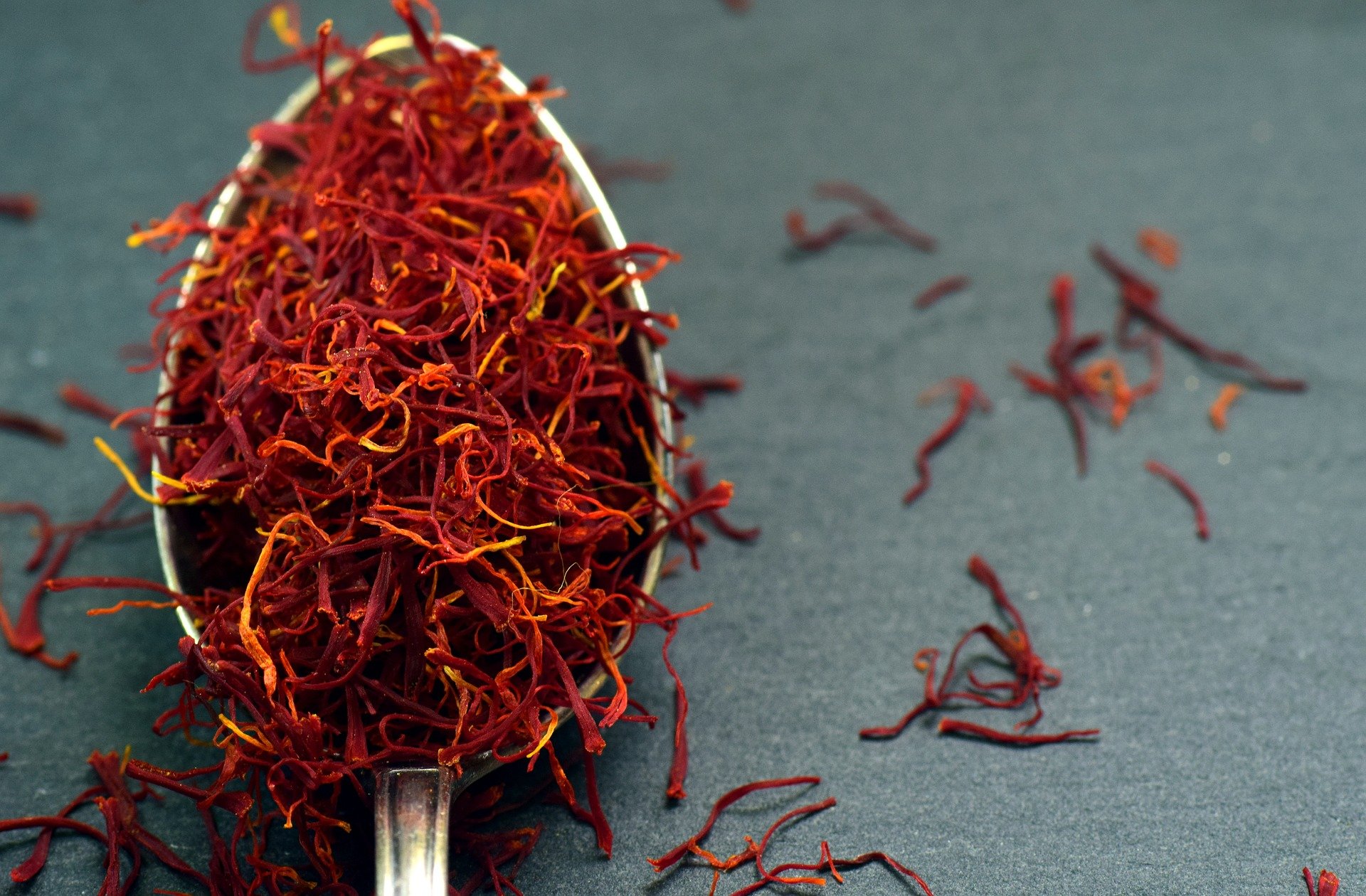
Saffron
From old French ***safran***, originally from Arabic ***za'faran***.
***Crocus sativus***, a low ornamental plant, which has crocus-like purple-coloured flowers, provides saffron.
The dried, orange coloured stigmas of the flowers are (and have been), used as a dye, for seasoning and in medicine.
Saffron is mentioned by Homer in the Iliad, and its use can be traced back to the Assyrian culture (7th century BC), and even farther back to the Sumerian. For a long time it was used primarily as a medicine (for a multitude of disorders, but mainly to increase menstruation, or as a sedative), or as an expensive dye. The ladies of nobility of the Antiquity often wore yellow robes, dyed with saffron. Its most common contemporary use is as a spice, in bread, or for the colouring of rice, etc.
Saffron is the most expensive of all spices. It takes about 150000 flowers to give one kg of the stuff! (The information on the amount required varies considerably from source to source.)
As a spice it should be enjoyed sparingly. 10g is a lethal dose for an adult human.
Saffron contains several medically active carotenoids: alpha- and beta-carotene, zeaxanthin and lycopene.
Taste and aroma are caused by safronal and pirocrocin, both formed by the breakdown of zeaxanthin.
The colouring matter is called crocin, another carotenoid, which can also be obtained from the Gardenia grandiflorus of China.
A composite plant, ***Carthamus tinctorius***, cultivated mainly in China, India, Egypt, Mexico, the United States, Ethiopia, Kazakhstan, and in the South of Europe, safflower, is sometimes called "false saffron". Its large orange flowers are dried and used as a drug and as dye, yellow or red. Previously used to dye textiles and alcoholic beverages, and to make false saffron. It is sometimes called "bastard saffron". During the last decades, along with the development of synthetic colours, it is and has been cultivated mainly for the production of safflower oil.
Safflower oil can be used in painting, to replace linseed oil (which is the common in ordinary oil painting), because it lacks the linseed oil's tendency to tone the colours yellowish.
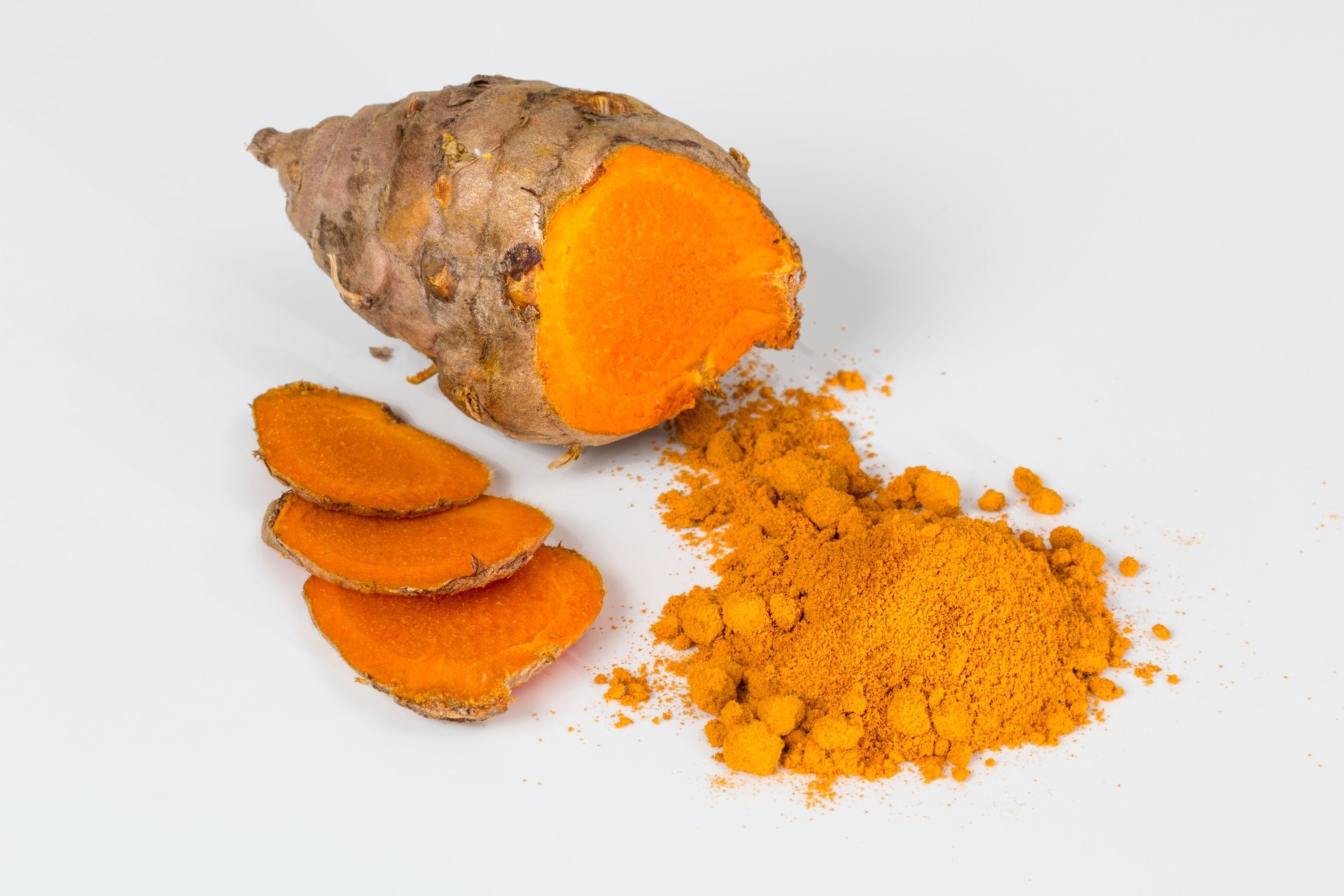
Turmeric, too, is sometimes used as false saffron. If you find cheap saffron in subtropical or tropical countries, it almost certainly is either safflower or turmeric. https://read.cash/@Mictorrani/the-king-queen-of-spices-turmeric-ginger-d697e39f
Vanilla
Genuine vanilla is the world's most expensive spice after saffron. It's made from the seed pods of ***Vanilla planifolia*** (or ***fragrans***), ***Vanilla pompona*** and ***Vanilla tahitensis*** – all of them stemming from a Mexican orchid.
The word vanilla is derived from Spanish ***vaina***, which means “little pod”.
Due to the high price of vanilla, synthetic vanillin is increasingly used, and has been estimated to cover 95% of industrial use of vanilla flavour. Synthetic flavour can be made from different compounds, nowadays mostly from guaiacol or lignin, and is used in food, perfumes, cigarettes, etc. It is artificial and has no medical use; it will not further interest us here.
Also beware of vanilla that is adulterated with tonka bean powder. Tonka beans taste similar to vanilla, but contain a high level of coumarin, a compound that might damage the liver.
Healthwise, genuine vanilla has powerful properties. It contains antioxidants, reduces inflammation, can improve digestion and reduce nausea. Studies indicate that it can cure cases of male impotence. It is also a mild antidepressant and reduces stress.
Vanilla strongly affects the brain by increasing cognitive performance. The mechanism is linked to its anti-inflammatory properties, but further explanation of that is beyond the scope of this article.
Further, vanilla has a powerful anti-fungal effect. This, however, along with many other health benefits, is completely destroyed by heating. And dried beans often have a trace of mould – which means they contain mycotoxins (toxins generated by fungi, such as mould). No need to state the obvious: the presence of mould makes the beans severely harmful. Mycotoxins should be avoided at any cost.
To sum it up: Vanilla is good for you, but only if it has never been heated and if it contains no mould.
Cardamom
Cardamom is also of the family ***Zingiberaceae*** and related to ginger and turmeric. There are two genera, Elattaria (green cardamom, or only cardamom) and Amomum (black cardamom, Bengal cardamom). Both are native to the Himalaya region. https://read.cash/@Mictorrani/the-king-queen-of-spices-turmeric-ginger-d697e39f
The word “cardamom” originates from Mycenaean ***ka-da-mi-ja***. “Amomum” is probably derived from Aramaic ***hemama***, while “Elattaria” is derived from Sanskrit, possibly leading back to a Dravidian root, ***el***.
Both forms are used as spices. Medically Amomum is a part of traditional medicine of China and India, mainly for stomach-related problems.
Green cardamom is used against infection in teeth, gums, and throat, digestive disorders and certain respiratory problems. Sometimes also for detoxification and especially for cleansing of the kidneys and bladder.
Studies on animals show anti-tumorous properties.
Cardamom increases the speed with which digesting food is passing through the intestine. This is important. Food retained in the intestines is a contributory cause of numerous health problems.
It has positive effects on the blood, where it prevents clotting.
Finally, it is traditionally used as an aphrodisiac, especially against impotence.
(This article is based on material previously published in TMA/Meriondho Leo and in my e-book “Spices & Herbs”, 2018.)
Related articles:
The King & Queen of Spices: Turmeric & Ginger https://read.cash/@Mictorrani/the-king-queen-of-spices-turmeric-ginger-d697e39f
Spices & Health: Cumin, Anise, Star Anise, and Fennel https://read.cash/@Mictorrani/spices-health-cumin-anise-star-anise-and-fennel-00c1196d
Fenugreek, Lactation & Male Libido https://read.cash/@Mictorrani/fenugreek-lactation-male-libido-eb592497
Copyright © 2005-2008, 2018, 2021 Meleonymica/Mictorrani. All Rights Reserved.
Here you find my articles related to spices & herbs, and to health & medicine. https://read.cash/@Mictorrani/index-over-my-articles-at-read-cash-5f7c1e34#spices-amp-herbs https://read.cash/@Mictorrani/index-over-my-articles-at-read-cash-5f7c1e34#health-amp-medicine-for-covid-19-see-covid-19
Interested in health & medicine, join my community "The Mechanisms of Health (d52e)" https://read.cash/c/the-mechanisms-of-health-d52e
You find all my writings on Read.Cash, sorted by topic, here. https://read.cash/@Mictorrani/index-over-my-articles-at-read-cash-5f7c1e34
My 3 most recent articles:
Fenugreek, Lactation & Male Libido https://read.cash/@Mictorrani/fenugreek-lactation-male-libido-eb592497
Spices & Health: Cumin, Anise, Star Anise, and Fennel https://read.cash/@Mictorrani/spices-health-cumin-anise-star-anise-and-fennel-00c1196d
Tusks & Ivory https://read.cash/@Mictorrani/tusks-ivory-dfe625f7
Fenugreek, Lactation & Male Libido
Fenugreek (***Trigonella foenum-graecum***) has been used for millennia. Seeds have been found in tombs from Old Egypt and in Mesopotamia, the latter dated to about 4000 BC.
The word “fenugreek”, means Greek hay, just as Latin ***foenum-graecum***, which refers to its use as fodder, common amongst Greeks and Romans of Antiquity. Charlemagne introduced this use to his lands north of the Alps by a decree, ***Capitulare***, in 812.
All parts of the plant are edible. Fenugreek is used for flavouring, as a spice, and for medicinal purposes - especially in India, Middle East and Near East.
Sprouted seeds make an excellent and very nutritious vegetable.
In Old Egypt, fenugreek was called ***itasin***, according to Dioskorides' ***Materia Medica.*** So far no hieroglyph for this herb has been found. But the Egyptians used leaves as a vegetable, and the seeds as medicine and in the embalming process.
In Arabic, fenugreek is called [**حلبة**] ***helba.*** A beverage brewed on fenugreek seeds, whole or ground, which is still common in Egypt and some countries in its vicinity, is a good anti-diabetic, pleasant to the stomach and beneficial for digestion. Its most common use, however, is to increase milk production in nursing mothers. Making it of ground seeds is most efficient.
Interestingly, the Yemenite Jews, who were unaffected by the Babylonian exile and for that reason retained the old traditions unbroken, assign a ritual importance to fenugreek seeds.
In India, the ground seeds are an important ingredient of curry, and the leaves are used as a vegetable. Fenugreek is also a part of Ayurvedic medicine.
The medical properties of the seeds are interesting. Scientific studies have shown that they improve glucose tolerance and reduce serum glucose, thus reducing many of the symptoms of diabetes (type 1 and 2); in nursing mothers, they promote milk production and have proved to increase male libido. They also contain a substance, palmitoylethanolamide, which is anti-inflammatory.
Traditionally they are also used against digestive problems, cardiovascular disease, high levels of cholesterol and triglycerides, cancer, tuberculosis, respiratory problems, kidney ailments, and beriberi. Also externally to treat various forms of eczema and other skin problems.
But if fenugreek increases the amount of milk of nursing mothers. Doesn't it somehow influence sex hormones, making it unsuitable for men?
This a good and well justified question.
The milk production is determined by the presence of a hormone, ***prolactin***, which in some sense can be considered a female sex hormone. Increased levels of prolactin in men have been associated with sexual dysfunctions, obesity, prostate ailments, cancer, diabetes, and other conditions normally affected by female sex hormones.
Prolactin most certainly is not associated with increased male libido.
In a striking contradiction, fenugreek increases the milk production of a nursing mother and male libido. An interesting question then is, does it really increase the amount of prolactin?
Results of studies have not been entirely consistent, but it looks like it does not affect the prolactin level, and that is entirely logical if it stimulates male libido. But what then is driving up the milk production?
I have no answer to that.
Some scientists claim that it doesn't increase lactation, and there are studies confirming that. However, there are other studies showing a clear increase.
While its influence on milk production perhaps can be questioned, the effect on male libido cannot – and then the original question has turned into its opposite: is fenugreek suitable for women?
On the other hand – it is possible that a substance generally stimulates hormone production without altering its natural balance. (B3 in the form of nicotinic acid is an example of such a substance.) If that is true, a nursing mother would get more prolactin, while a man would get more of a male hormone.
As for fenugreek, it is unclear what it does and how, but I think anecdotal evidence here is quite conclusive: fenugreek has a number of sex-related effects but there is no indication of its benefits would being limited in terms of gender.
***WARNINGS! Fenugreek should be avoided during pregnancy, since it is possible that it can have some abortive effect. It should also be avoided by those having hormone-related cancers. People with diabetes should consult their physician before taking fenugreek, since it can interfere with anti-diabetic drugs.***
(This article is based on material previously published in TMA/Meriondho Leo and in my e-book “Spices & Herbs”, 2018.)
Related articles:
The King & Queen of Spices: Turmeric & Ginger https://read.cash/@Mictorrani/the-king-queen-of-spices-turmeric-ginger-d697e39f
Spices & Health: Cumin, Anise, Star Anise, and Fennel https://read.cash/@Mictorrani/spices-health-cumin-anise-star-anise-and-fennel-00c1196d
Copyright © 2005-2008, 2018, 2021 Meleonymica/Mictorrani. All Rights Reserved.
Here you find my articles related to spices & herbs, and to health & medicine. https://read.cash/@Mictorrani/index-over-my-articles-at-read-cash-5f7c1e34#spices-amp-herbs https://read.cash/@Mictorrani/index-over-my-articles-at-read-cash-5f7c1e34#health-amp-medicine-for-covid-19-see-covid-19
Interested in health & medicine, join my community "The Mechanisms of Health (d52e)" https://read.cash/c/the-mechanisms-of-health-d52e
You find all my writings on Read.Cash, sorted by topic, here. https://read.cash/@Mictorrani/index-over-my-articles-at-read-cash-5f7c1e34
My 3 most recent articles:
Spices & Health: Cumin, Anise, Star Anise, and Fennel https://read.cash/@Mictorrani/spices-health-cumin-anise-star-anise-and-fennel-00c1196d
Tusks & Ivory https://read.cash/@Mictorrani/tusks-ivory-dfe625f7
Retrospection 4 (Dinosaurs, Reptiles, Dragons) https://read.cash/@Mictorrani/retrospection-4-0c1add0e

Spices & Health: Cumin, Anise, Star Anise, and Fennel
Almost everything with a strong taste or smell, or a strong colour, contains biologically very active substances. Mostly they are either very healthy, or they are poisonous - or both. What is poisonous in large amounts can be beneficial in a small dose.
To utilise the medical properties of spices to their full extent, they are to be used unheated. Generally it is better to spice food at the table, not while cooking. Many spices can also be taken as powder in beverages. In some instances the active substances are best assimilated if taken with some fat.
A few spices ought to be avoided totally, most notably ***caraway*** (C***arum carvi***), but most common ones can be used daily, as a dietary supplement. They contain many known and possibly some unknown substances and are clearly beneficial for the health. Many spices are useful as medicine and have been used as such within the Ayurvedic tradition for thousands of years.
Names of spices are confusing, to say the least. Many unrelated spices have been or are called ***pepper***, and depending on where in the world you are, things like ***cumin***, ***coriander***, ***cinnamon***, or even ***celery*** may name totally different things than what you are used to at home. It is impossible for me to include all such diverse information without making the texts utterly confusing. That's why the Latin names are important. If you want to find the name of a spice in your local language, the safest way to get it right is to start with the ***Latin term*** and search for a relevant translation. Then you can be 100% sure to get the right spice.
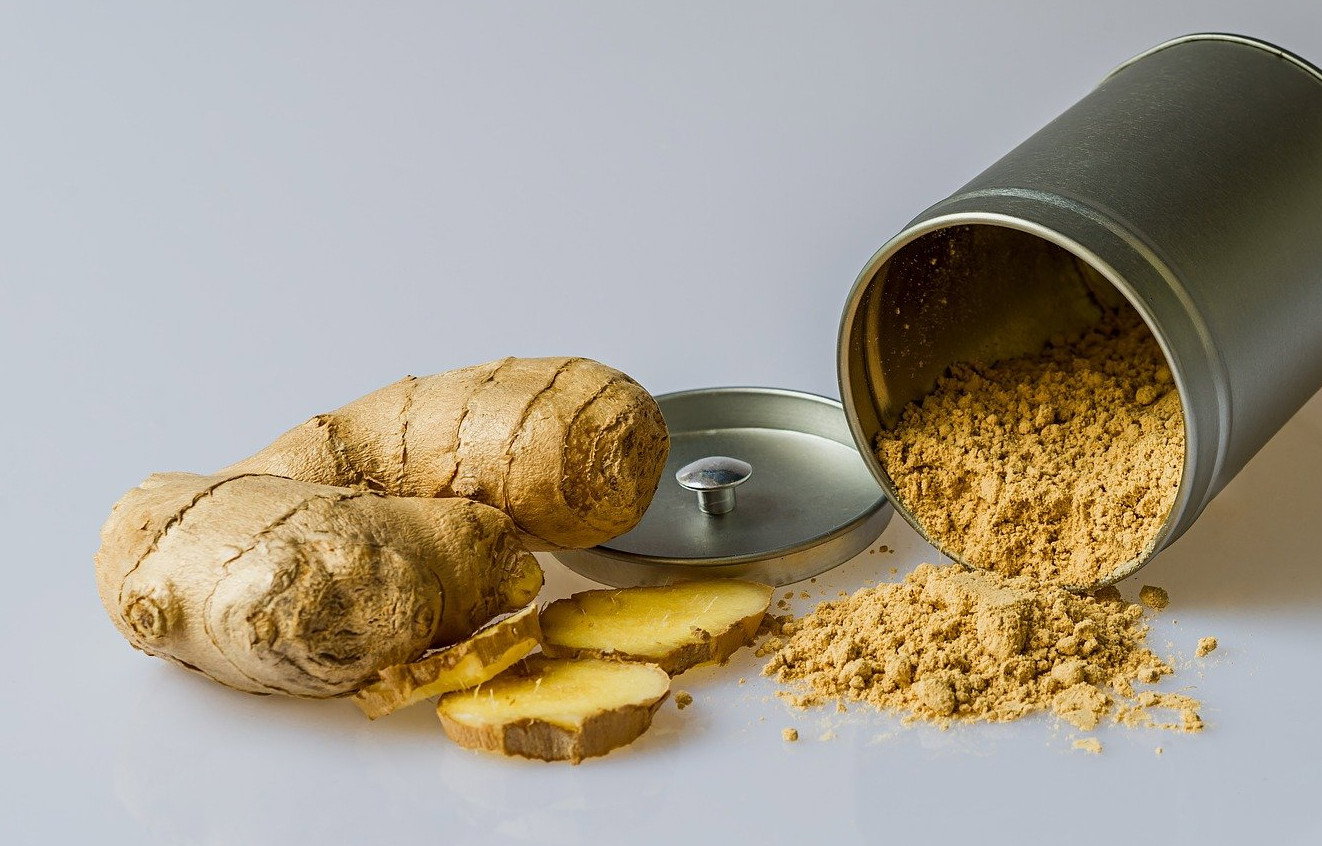
I have previously written about turmeric and ginger, this time we will look at cumin, anise, star anise, and fennel.
Cumin
Cumin is a name that can denote different seeds, used for flavouring or in medicine.
***Cuminum cymium*** - related to carrot - was already in use during Antiquity. Seeds have been found in Egyptian tombs.
In Greek medicine, it was used against fever, and ailments of liver or lungs. Later it has been used mainly to stimulate digestion or increase menstruation.
Now it is widely used as a spice, mainly in bread, cheese and some alcoholic beverages.
***Carum carvi*** - Caraway, or Persian cumin, is another "cumin", in some places replacing Cuminum cymium as a spice - mainly in bread and cheese. Carum carvi contains a special liver toxin, which might harm the liver if consumption is large or very regular. It should not be used regularly or in too large amounts.
Black Cumin - ***Nigella sativa***, sometimes called "hell seeds" - is sometimes used in bread, but has also been used medically for thousands of years. It has proved to stimulate immunity, normalise blood pressure, and stimulate bile secretion.
Sweet cumin - ***Pimpinella anisum***, commonly called Anise. (See next section.)
Anise & Star Anise
There are two spices, one has its origin in Egypt or the area around, the other in China. They share a substance giving a characteristic smell and taste, which also has medical effects. It is a phytoestrogen, a hormone-like compound. Although botanically unrelated, these two spices are called the same thing, except that to the Chinese variant there is added a celestial reference.
The Chinese variety also contains another substance strongly coveted by the medical drug industry. Even though this compound can now be made artificially, most of the industrial need is still filled by the natural source.
I'm talking about anise (***Pimpinella anisum***) and star anise (***Illicium anisatum***). Both contain anethole, a phytoestrogen also occurring in fennel. That is what gives them their specific flavour and aroma.
In medicine anise is or has been used for coughs, against flatulence, to stimulate digestion, for menstrual problems - and in Egypt as tea to increase the milk production of mothers. As a spice it is mainly used for confectioneries, bread, and in a large number of alcoholic beverages.
There is a peculiar word in English, ***louche***, meaning sordid, of dubious morals. Originally it stems from Latin ***luscus***, blind on one eye. Louche is also "The ouzo effect", which is that ouzo and some other beverages containing anise are getting cloudy, or "milky", when water is added to them. The reason? Presence of anethole.
Star anise, in Chinese **八角**, bājiǎo [eight horn], has similar uses as a spice, and in traditional Chinese medicine it is used against cold stagnation in the middle jiao. But star anise does not only contain anethole, there is another compound, shikimic acid, which is strongly anti-microbial. It is also a pain-killer and an antioxidant. This substance is the major ingredient of the medicine Tamiflu, which is antiviral and got much publicity in connection with the swine flu some years ago. It's a neuraminidase inhibitor. Roughly it prevents replication of the virus by stopping its ability to budding (A form of asexual reproduction).
Shikimic acid is found in many organisms, mostly in a very low concentration. Star anise is the industrial source of it.
Fennel
Fennel (***Foeniculum vulgare***) is a perennial herb with strongly flavoured leaves and fruit (seeds), and in some cultivated varieties also an inflated leaf base, a bulb. Its taste resembles that of anise. It is caused by anethole, which is found also in anise and star anise.
The word fennel ultimately stems from Latin ***foeniculum***. An interesting fact is that the Greeks called it ***marathon***. The place for the famous battle was a field where fennel grew – that's what the name implies.
Due to its content of anethole, fennel has many medical properties it shares with anise (see above). In addition to that, roots and seeds have been associated with the eyes, and is said to improve eye-sight.
The fact that fennel is a source of phytoestrogens, compounds imitating female sex hormones, makes me hesitate to use or recommend it. At least for males, the wisest course might be to refrain from regular consumption.
(This article is based on material previously published in TMA/Meriondho Leo and in my e-book “Spices & Herbs”, 2018.)
Related article: The King & Queen of Spices: Turmeric & Ginger https://read.cash/@Mictorrani/the-king-queen-of-spices-turmeric-ginger-d697e39f
Copyright © 2005-2008, 2018, 2021 Meleonymica/Mictorrani. All Rights Reserved.
Here you find my articles related to health & medicine. https://read.cash/@Mictorrani/index-over-my-articles-at-read-cash-5f7c1e34#health-amp-medicine-for-covid-19-see-covid-19
Interested in health & medicine, join my community "The Mechanisms of Health (d52e)" https://read.cash/c/the-mechanisms-of-health-d52e
You find all my writings on Read.Cash, sorted by topic, here. https://read.cash/@Mictorrani/index-over-my-articles-at-read-cash-5f7c1e34
My 3 most recent articles:
Tusks & Ivory https://read.cash/@Mictorrani/tusks-ivory-dfe625f7
Retrospection 4 (Dinosaurs, Reptiles, Dragons) https://read.cash/@Mictorrani/retrospection-4-0c1add0e
Supplement to Teeth: Etymology & Glossary https://read.cash/@Mictorrani/supplement-to-teeth-etymology-glossary-d83241c4

Tusks & Ivory
*"Out of a dog's mouth will never come ivory tusks."*
(Chinese proverb)
I. Tusks & Ivory: the Material
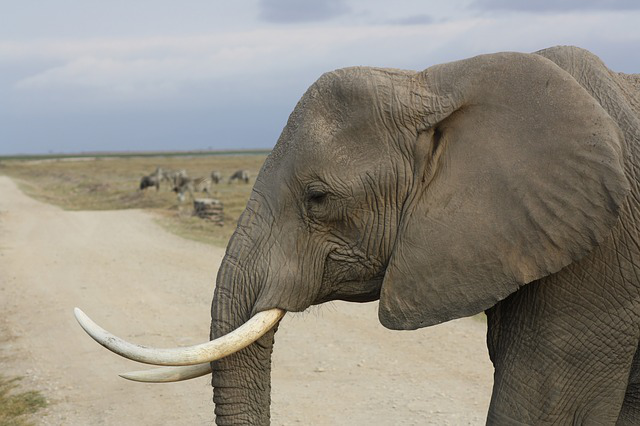
Tusks are teeth of certain mammals, canines or incisors, growing out through the mouth and protruding considerably from the mouth and face. For elephants and narwhals tusks are incisors, for walruses and various boars they are canines. They are used as weapons, tools, and for demonstration of dominance.
Elephant tusks give ivory, an exclusive material which was so highly priced that it almost made elephants extinct in Africa. Now trade is extensively forbidden or restricted, but unfortunately a black market exists and flourishes. India and China are major centres for this illegal trading. The African centre for this dubious trade is Egypt, where genuine ivory can occasionally be found in the Cairo bazaar "Khan el-Khalili" along with any amount of counterfeiting. Note, however, that genuine ivory is illegally obtained, often from Sudan, and crossing of any border with it, even if purchased in good faith, might be illegal.
Other mammals also provide ivory, for example hippopotamus, walrus, and mammoth. Mammoths are extinct, but trade with their ivory is not forbidden. Still it is a waste to use remnants of valuable fossils for this purpose.
Ivory consists of dentine, the same material that forms the layer beneath the enamel of all mammal teeth. Still there are small structural differences between ivory derived from different species. For an expert, it is quite possible to tell the sort of ivory he is holding in his hand.
Elephant ivory consists of collagen, proteins, and hydroxyapatite, with an amorphous crystalline structure.
Other materials are sometimes used to imitate ivory: horn, bone, the inner seed of the ivory palm - and, especially, plastics.
You can tell if ivory is genuine by examining it under UV-light. As opposed to imitations, real ivory will fluoresce and look bright. It will also be a little grainy in an irregular way. Plastic imitations, especially, are too smooth and too regular in the often added grain structure. You may need a magnifying glass or a jewelers loupe in order to inspect this. Remember that ivory is material from a tooth, it must look and feel like that.
Plastic "ivories" are known as "faux ivories".
II. History & Use
Historically, trading with ivory goes back as far as old Egypt (oldest findings: 4500 BC), India and China. King Solomon (10th century BC) bought it from India, and Persian rulers used it at least as early as the 6th century BC. Greeks and Romans loved it, and so did Byzantines.
The best ivory carvers probably existed and exist in India and China. As a noble craft it is mentioned already in the Vedic tradition, and there are several Indian centres of this art.
In Japan there is an artistically exquisite tradition of carving small objects, "netsuke", whose purpose is to act as toggles for hanging things from the sash of a kimono [Japanese: "obi"]. Traditional Japanese garments had or have no pockets, so the wearer had to hang small containers or pouches [sagemono] in cords from the sash. "Netsuke" can be made of ivory or of wood.
For what else has ivory been used? Artworks, inlays and relief decorations, jewelry, and any number of small objects: combs, elaborate boxes, chesspieces, signature seals (as Chinese and East Asian signature chops), piano keys, dice, and much more. And it is airtight, a property due to which it could be used for specific purposes in making small airtight vessels or opium pipes. In India there is a special tradition of using ivory for statues of deities and other religious objects, and ivory Buddhas have been made throughout the whole of East Asia.
“*All the gods sculpted of wood or ivory can’t say a word. I know, I have been crying out to them.”*
(Kabir, 15th century, Indian Philosopher)
Ground ivory is sometimes used as a medicine, especially in TCM [Traditional Chinese Medicine]. Aphrodisiacal effects are attributed to it. Ivory might work as a mineral supplement, a very expensive one; other health claims are scientifically unsubstantiated.
Another use is the production of colour pigment. While "ivory" often refers to a whitish, pale hue, as of human skin, the pigment made from it is black. But strictly, the source of "ivory black" was and is not often ivory, but bone. The black pigment is a result of charred animal bone. That means that bone is heated to drive out the hydrogen and oxygen, it is subject to incomplete combustion. The resulting bone char is black.
When real ivory is used instead of bone, the result is ivory char, and the black resulting from that is much deeper and of superior brilliancy. It is expensive, however, and today it is rarely used.
The French language has two different terms here, "noir d'ivoire" and "noir de carbone", so do Spanish and Portuguese. Italian has even three: "carbone di ossa", "nero animale", "nero d'avorio". It can be interesting to note the term "avorio" [ivory], which most people know in connection with "avorio rice".
The pale, whitish hue of natural ivory is the ideal colour of female skin in Japanese and Chinese cultures. To achieve it, many soaps and other skin-products contain bleaches, often extremely toxic.
III. Etymology
The word "tusk" probably stems from the same original root as the word "tooth", but this is merely guesswork. Strictly, its origin is uncertain.
The word "ivory" stems from Old French "yvoire" or "ivurie"; Latin "ebur"; further from the Old Egyptian word for elephant: "ab"; which gave "abu", "abw" or "ebu". [The letters "b" and "v" are phonetically related, a change between them is not unnatural.]
Another suggestion is that Latin "ebor" ultimately stems from Sanskrit "ibhas" [elephant].
A third theory is that the origin of "ebor" is Syrian "hivar", a word for ivory referring to its whiteness.
In old Hebrew, ivory is "shen" or "shenhab", the latter being a combination of "shen" [tooth] and Egyptian "ab" [elephant].
In modern German, we meet the elephant again, ivory is called "Elfenbein" [elephant bone]. And in most languages the word refers either to elephant bone, or elephant tooth. Medieval and modern Arabic call it "nab-al-fil" [tooth of elephant] or as an interesting exception from the elephant connection: "'Aj" from "'Awj" [bend, curve], which must have to do with the shape of a tusk.
From Arabic "nab-al-fil" stems (probably) Spanish "marfil".
IV. Ivory Tower
"Ivory tower" [exaggerated aloofness] is a concept first invented in French (1837), where it was used by Charles-Augustin Sainte-Beuve about Alfred de Vigny in "Pensées d'Août, a M. Villemain":
“*Et Vigny, plus secret, Comme en sa tour d'ivoire, avant midi rentrait.”*
In English, the earliest known use was in 1911, in "H. L. Bergson's Laughter" by Frederick Rothwell and Cloudesley Shovell Henry Brereton:
“*Each member must be ever attentive to his social surroundings - he must avoid shutting himself up in his own peculiar character as a philosopher in his ivory tower.”*
There is an earlier use, in the Bible, but the meaning here is different.
“*Thy neck is as a tower of ivory; thine eyes like the fishpools in Heshbon, by the gate of Bathrabbim: thy nose is as the tower of Lebanon which looketh toward Damascus.”*
(Song of Solomon 7:4, King James Version)
Here the ivory tower is a symbol of purity. It has also been used about Virgin Mary.
In Italian it's called "torre d'avorio", in German "Elfenbeinturm", in Spanish "torre de marfil". But an equivalent expression in e.g. Chinese is lacking. This concept is firmly rooted in a specific cultural background.
V. Gates of Horn and Ivory
*"Our dreams are a second life. I have never been able to penetrate without a shudder those ivory or horned gates which separate us from the invisible world."*
(Gerard de Nerval)
The old Greeks made a distinction between the horned gates and the ivory gates. They said that false dreams arrived through the ivory gates; their word for ivory resembled that for "deceive". In the same manner true dreams arrived through the horned gates; their word for horn resembled that for “fulfil”.
This concept first appears in Homer's "The Odyssey", subsequently to be imitated by Vergil in "The Aeneid":
“*Two gates the silent house of Sleep adorn;*
*Of polish'd ivory this, that of transparent horn:*
*True visions thro' transparent horn arise;*
*Thro' polish'd ivory pass deluding lies.*
*Of various things discoursing as he pass'd,*
*Anchises hither bends his steps at last.*
*Then, thro' the gate of iv'ry, he dismiss'd*
*His valiant offspring and divining guest.”*
(Translation by John Dryden; in the public domain)
It later occurs in works of e.g. Edmund Spenser, T.S. Eliot, and H.P. Lovecraft, and has become an established metaphor in western intellectual tradition.
Epilogue: A Personal Comment
While I am fully able to enjoy and appreciate the craftsmanship and the artistry of ivory carvings, and the lustre of this exquisite material, that does not justify the taking of lives. Killing elephants or other animals to access their ivory is, in my opinion, unacceptable. Although almost globally banned, ivory trade flourishes and poaching still threatens the elephant populations of both Africa and India. This is not a matter of law but one of ethics and responsibility.
What would you feel if elephants with advanced weaponry came hunting humans, perhaps members of your own family, killing them in large numbers to take their teeth, leaving the rest to rot somewhere?
Reversing the perspective can sometimes provoke fresh thoughts and new insights.
Copyright © 2010, 2018, 2021 Meleonymica/Mictorrani. All Rights Reserved.
Here you can find my articles about Teeth. https://read.cash/@Mictorrani/index-over-my-articles-at-read-cash-5f7c1e34#teeth
Interested in nature & natural science, join my community *Natural Science (1c4e)**.* https://read.cash/c/natural-science-1c4e
You find all my writings on Read.Cash, sorted by topic, here. https://read.cash/@Mictorrani/index-over-my-articles-at-read-cash-5f7c1e34
My 3 most recent articles:
Retrospection 4 https://read.cash/@Mictorrani/retrospection-4-0c1add0e
Supplement to Teeth: Etymology & Glossary https://read.cash/@Mictorrani/supplement-to-teeth-etymology-glossary-d83241c4
The King & Queen of Spices: Turmeric & Ginger https://read.cash/@Mictorrani/the-king-queen-of-spices-turmeric-ginger-d697e39f
Retrospection 4
In this retrospection, we will look at dinosaurs, reptiles, dragons and to some extent birds - a number of seemingly related topics, which are not necessarily as related as they seem.
In my first period at read.cash (which ended in August 2020), I wrote two articles about palaeontology (the study of extinct life), particularly about dinosaurs.
One was "How Can We Know Anything About Dinosaurs?”, in which I explain how we can draw (quite many) conclusions from the few traces they have left on earth. https://read.cash/@Mictorrani/how-can-we-know-anything-about-dinosaurs-9e286d64
As I have once described somewhere else, this is a fascinating problem, an intellectual challenge similar to that of archaeology, history in general - and forensic medicine & a criminal investigation: how to draw conclusions about the past from a number of - often seemingly insufficient - clues. There are differences between these disciplines, of course, but the way to think is the same, and to some extent the same or related methods can be used.
The other article was “To Revive an Extinct Dinosaur - Is it at all Possible?“ https://read.cash/@Mictorrani/to-revive-an-extinct-dinosaur-is-it-at-all-possible-c37386b9
Since birds are descendants of dinosaurs and carry their genetic material, it is theoretically possible to breed chicken and step by step activate dormant dinosaur genes until we reach a dinosaur. This is called atavism activation. There are people making such experiments, although the viability of this method is still only theoretical.
However interesting it might be from scientific point of view, one can ask if this research is ethically justified. How would it be for a dinosaur in our present world? A life in captivity?
Or imagine that several individuals would be created; a group of theropoda dinosaurs that would breed independently! What would be the consequences of the introduction of a species that is alien to our contemporary environment? At that a theropod dinosaur, a close relative to the infamous Tyrannosaurus Rex.
A dinosaur also has the main role in "The Most Powerful Eyes", since Tyrannosaurus Rex might very well have had the most powerful eyes among terrestrial animals ever. https://read.cash/@Mictorrani/the-most-powerful-eyes-9dc49a42
My own interest in palaeontology started in 1986, when Robert T. Bakker published: ***Dinosaur Heresies.*** It strongly stimulated my interest in palaeontology, a science I have been following closely since then. Bakker suggested a completely new picture of dinosaurs and the evidence he presented was very convincing. Later discoveries have corroborated several of his ideas, which are now firmly established in mainstream palaeontology. It is beyond the scope of this article to discuss details of this, we will just linger on one conclusion: that ***birds are surviving dinosaurs!*** Indeed, on the current level of knowledge, it is established that birds descend from a group of Saurischian dinosaurs, called Theropoda, a group containing, among others, the well-known Tyrannosaurus Rex. Birds (Aves) are a still surviving branch of Dinosauria!
Palaeontology is a fascinating subject to which I might very well return in future articles.
So, what about reptiles? Well, dinosaurs where not reptiles. Despite their name (dinosaur means lizard-like), they were not lizards. I have, however, written a few articles about reptiles as well.
First we have crocodiles, in connection with Egypt:
"The Sacred Crocodiles of Egypt" and "The Crocodile, a Symbol of Egypt?". I wrote about them in "Retrospection 2". https://read.cash/@Mictorrani/the-sacred-crocodiles-of-egypt-635185a8 https://read.cash/@Mictorrani/the-crocodile-a-symbol-of-egypt-6330b5af https://read.cash/@Mictorrani/retrospection-2-a54911f7
Then, in March 2021, I published a series about serpents & snakes:
1. From the Sacred Cobras of Egypt to Quezalcoatl: Serpents & Snakes in Mythology https://read.cash/@Mictorrani/from-the-sacred-cobras-of-egypt-to-quezalcoatl-serpents-snakes-in-mythology-fc2039be
2. Snakes in Astrology & Heraldry https://read.cash/@Mictorrani/snakes-in-astrology-heraldry-505ccf47
3. Snakes in Real Life https://read.cash/@Mictorrani/snakes-in-real-life-ab69ef51
The first article deals mainly with snakes in mythology - while, in the second, I bring up some snakes in symbology.
In the third article, I discuss real snakes: evolution, physiology, perception, venom, etc.
Now we come to dragons. But what is a dragon? Well, as far as we know today, they are neither dinosaurs nor reptiles, and entirely animals of imagination. The peculiar thing is that they occur over the whole world: practically all old cultures had their imaginary dragons - even if there were differences. Are they based on something that really existed in a distant past? Or is it a cultural idea, born in one single place and spread from there? Or is it just converging imagination?
I suppose we will never know. Meanwhile dragons continue to live in imagination. And they are not only something from the past; they are highly alive also in contemporary popular culture, especially in fantasy (art, literature and film). Just remember Game of Thrones or Anne McCaffrey's books!
My first article here related to dragons was "Mar Girgis - St. George & the Dragon", from 14 July 2020, where we follow the archetypal dragon slayer from Egypt to Scandinavia, and back to Egypt again. https://read.cash/@Mictorrani/mar-girgis-st-george-the-dragon-45e518c6
Then, two days later, I published "Greedy Old Men, Dragons & Leaping Through the Dragon's Gate". There I discuss the Germanic dragon, as well as dragons in Japan, China and Bhutan. https://read.cash/@Mictorrani/greedy-old-men-dragons-leaping-through-the-dragons-gate-58847df1
In a series about flags and symbols, I wrote one article about “Flags with Dragons“. https://read.cash/@Mictorrani/flags-with-dragons-69fd9787
Then finally, quite recently, I published "Animal Teeth, Sabre-Toothed Tigers & Dragon's Teeth", where we have the section “Dragon's Teeth”. https://read.cash/@Mictorrani/animal-teeth-sabre-toothed-tigers-dragons-teeth-3ee1c91e#dragon039s-teeth
Copyright © 2021 Meleonymica/Mictorrani. All Rights Reserved.
My index has sections for Palaeontology & Evolution, Serpents & Snakes, and Dragons. https://read.cash/@Mictorrani/index-over-my-articles-at-read-cash-5f7c1e34#palaeontology-amp-evolution https://read.cash/@Mictorrani/index-over-my-articles-at-read-cash-5f7c1e34#serpents-amp-snakes https://read.cash/@Mictorrani/index-over-my-articles-at-read-cash-5f7c1e34#dragons
My series “Retrospection” is primarily created for new readers of mine, as a manual into my production at this platform so far - but it can be read by anyone who wants to explore my articles topic by topic, rather than doing so in chronological order. https://read.cash/@Mictorrani/index-over-my-articles-at-read-cash-5f7c1e34#retrospection
You find all my writings on Read.Cash, sorted by topic, here. https://read.cash/@Mictorrani/index-over-my-articles-at-read-cash-5f7c1e34
Supplement to Teeth: Etymology & Glossary
*When I had finalised the articles of the series about teeth, human and animal, I realised that a glossary would be needed. So here it is, along with a brief comment on etymology. I might add to the glossary later, if there is need for that.*
This is a supplement to the series:
1. Dentistry - A Modern Luxury? Why Do We Need It? https://read.cash/@Mictorrani/dentistry-a-modern-luxury-why-do-we-need-it-357f88b3
2. Preserve Your Teeth: Nutrients & Other Beneficial Substances https://read.cash/@Mictorrani/preserve-your-teeth-nutrients-other-beneficial-substances-33b92d13
3. Take Care of Your Teeth: Hygiene, Prevention & Reparation of Damage https://read.cash/@Mictorrani/take-care-of-your-teeth-hygiene-prevention-reparation-of-damage-e4fa8291
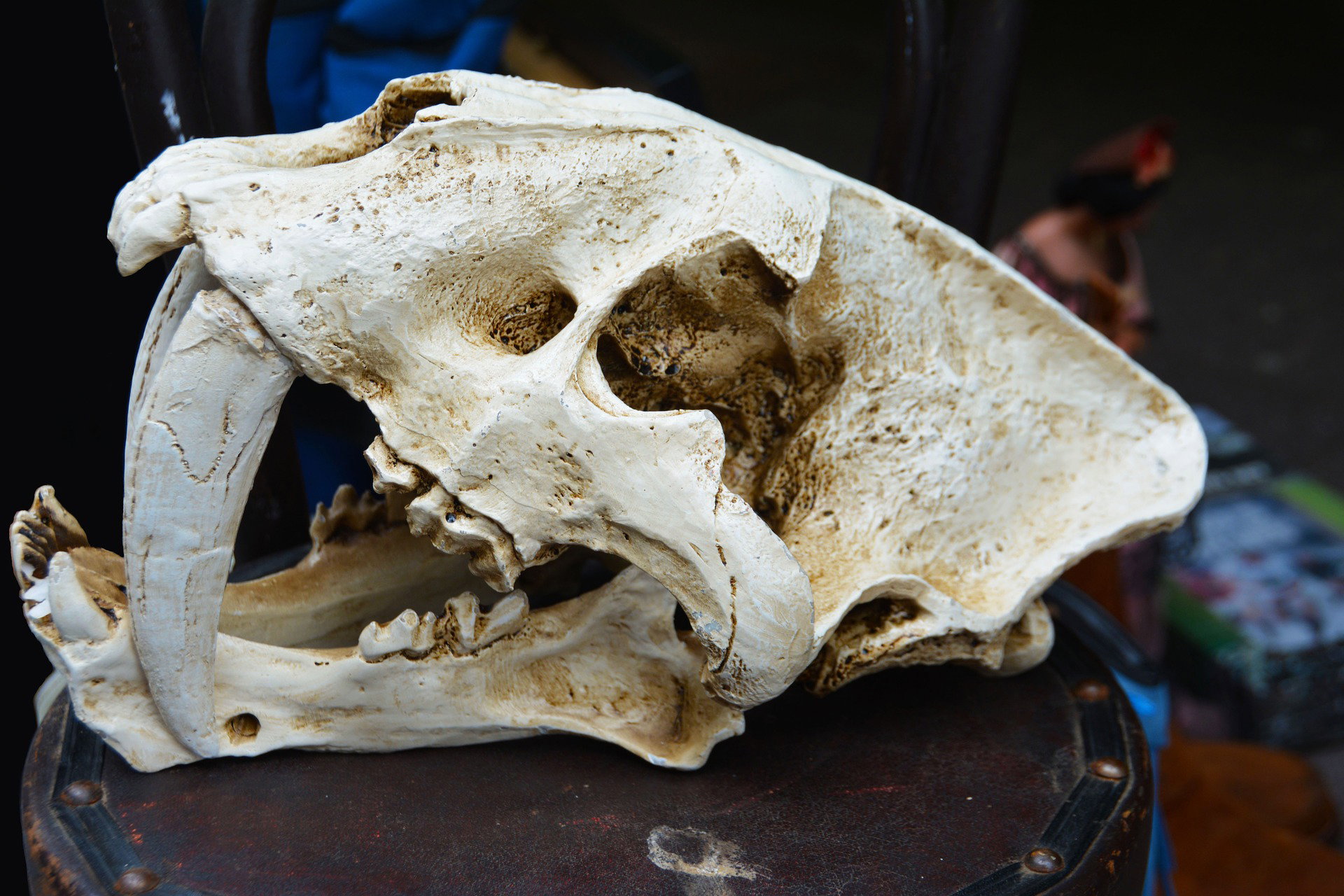
4. Animal Teeth, Sabre-Toothed Tigers & Dragon's Teeth https://read.cash/@Mictorrani/animal-teeth-sabre-toothed-tigers-dragons-teeth-3ee1c91e
Etymology
The etymology of "tooth" can be brought back to Sanskrit "dant". That led to Greek "odont" (used as a prefix as "odont-", e.g. "odontology"), Latin "dens" (used as a prefix as "dent-", as in "dentistry"), and to the word for "tooth" in most modern European languages.
"Odont" suggests a vowel that otherwise might have been lost. That would make Sanskrit "adant" (eater), or "ad" (eat), and lead to Latin "edere" - the same root as English "edible" and "eat", German "essen", Icelandic "eta".
A not too surprising etymological connection between teeth and eating!
Glossary
*Some terms that occur in the text of the articles, and some that do not, but are still pertinent to the subject.*
***baleen*** - A keratin structure with certain whales, instead of teeth, whose purpose is to filter out edible material, plankton and krill, from the water.
***birch sugar*** - Another name of xylitol.
***bunodont*** - Having a rounded cusp.
***canine teeth*** - "Corner teeth", used to hold a prey, or as weapons in a fight. ALSO as visual symbols in a competition of dominance .
***carnassials*** - Teeth of carnivores for the purpose of slicing meat and crushing bones.
***carnivore*** - Meat eater, an animal that only eats animal food; for example cats, big and small.
***Creodonta*** - An order of mammals. Extinct.
***dental*** - Related to teeth. See also "Etymology" above.
***dentition*** - How teeth are arranged in an animal.
***Feliformia*** - A suborder within Carnivora. The word means "cat-like" or "of the form of a cat". It includes, of course, all cats, but also hyenas, viverrids, and other families - some extinct. [The only other sub-order of Carnivora is Caniformia, "of the form of a dog".]
***fluoride*** - Strengthens the dental enamel. If ingested, inorganic fluoride inhibits certain important enzymes and can accelerate ageing. Use it to rinse your mouth, but do not swallow it.
***forensic odontology*** - The identification of individuals on the basis of teeth or bite marks. A branch combining criminology and medicine. Odontology mainly deals with human teeth, but essentially the same techniques can be used in paleontology.
***gizzard*** - A digestive organ found in birds, some fish and reptiles, and in certain invertebrates. A muscular pouch, sometimes with grit or stones, serving as a mill in the digestive process.
***herbivores*** - plant eater, an animal eating only plants; for example all ruminators.
***incisor*** - A tooth for the purpose of gnawing or cutting.
***invertebrates*** - Animals which are not vertebrates. See vertebrates below.
***Marsupalia*** - A subclass of the mammals. The word is derived from Latin "marsupium", pouch. This subclass includes for instance kangaroo, wombat, opossum, and koala.
***mandible*** - The lower jawbone, the strongest bone of the face.
***mandibular*** - Pertaining to the mandible. See mandible.
***maxilla*** - The upper jawbone.
***maxillary*** - Pertaining to the maxilla. See maxilla.
***molars*** - The grinding teeth of many mammals. The word is derived from Latin "mola", millstone. Humans have three molars in each quadrant, totally twelve.
***Mysticeti*** - Baleen whales; for example the blue whale.
***Nimravidae*** - Extinct family of the suborder Feliformia. Can also be called "false sabre-toothed cats". Extant about 37-7 million years ago.
***Odontoceti*** - Toothed whales; for example dolphins and porpoises.
***Odontognathae*** - Toothed birds. Extinct. Superorder of the subclass Neomithes.
***odontology*** - The study of teeth, their anatomy, structure and diseases.
***omnivores*** - Animals eating food from both the animal and the plant kingdom; for example bears.
***palaeontology*** - The study of prehistoric life.
***taxonomist*** - Someone working with taxonomy.
***taxonomy*** - The science of classification of organisms. (The word can be used for other classifications as well.)
***thelodonts*** - A group of fish or fish-like, jawless vertebrates with tooth-like scales, which lived about 430-370 million years ago.
***vertebrates*** - Animals with a backbone, a spinal column. Traditionally they are divided into classes: fish, amphibians, reptiles, birds, and mammals. Fish are sometimes divided into three separate classes (jawless, cartilaginous, bony), but that is of no importance in this context. Classification is never final anyway. Deviations exist, and there can be good reasons for that.
***xylitol*** - A sugar alcohol and sweetener good for the teeth. It is alkalising and has a normalising effect on the microbe flora.
Copyright © 2010, 2018, 2021 Meleonymica/Mictorrani. All Rights Reserved.
Here you can find my articles about Teeth, about Health & Medicine, and about Palaeontology. https://read.cash/@Mictorrani/index-over-my-articles-at-read-cash-5f7c1e34#teeth https://read.cash/@Mictorrani/index-over-my-articles-at-read-cash-5f7c1e34#health-amp-medicine-for-covid-19-see-covid-19 https://read.cash/@Mictorrani/index-over-my-articles-at-read-cash-5f7c1e34#palaeontology-amp-evolution
You find all my writings on Read.Cash, sorted by topic, here. https://read.cash/@Mictorrani/index-over-my-articles-at-read-cash-5f7c1e34
Also, please join my community: *The Mechanisms of Health (d52e)**.* https://read.cash/c/the-mechanisms-of-health-d52e

The King & Queen of Spices: Turmeric & Ginger
Turmeric is the root of ***Curcuma longa***, growing in the East Indies. It is used as a spice, alone or as the main ingredient in curry; as a medicine, especially against liver diseases; as dye, to colour silk, wool, etc.; and to produce turmeric paper, which is paper impregnated with turmeric and used as a test of the alkalis (turning it brown) and for boric acid (turning it reddish).
The yellow pigment is curcumin, and it is responsible for most of the medical effects of turmeric.
In Indonesia they make a drug, ***temoelawak*** (temulawak), from ***Curcuma zanthorrhiza***, which is a close relative to C. longa (the common turmeric). Its medical effects are rather the same, although much stronger.
Turmeric has many interesting medical properties and can be used both preventively and as a cure against disease. The effect of regular use is considerable.
It protects, strengthens and stimulates the liver, which is one of the central organs of the body and one of the most complex. Some sort of liver dysfunction is often involved in the prelude to different serious diseases, such as cancer.
Turmeric is a strong antioxidant, which may explain some, but not all of its effects.
The anti-cancer effect is striking. Apart from being effective preventively, it ought to be included in, or added to every cancer cure. Curcumin reaches the cell membranes and protects them, which might be the main reason why turmeric so strongly protects against cancer.
It can normalise the blood sugar level. There are diabetics who were able to cease insulin treatment by taking one teaspoon of turmeric (or cinnamon, which has the same effect) before each meal. I would not say that this works for all diabetics, but it certainly has a generally strong preventive effect.
If you have diabetes and want to try this, do not experiment on your own! You must consult your physician! If your need for insulin is suddenly drastically reduced, your medication must be adjusted accordingly, otherwise it may become a life threatening condition.
Turmeric stimulates the immune system, which is generally important for health and the ability to combat disease; and it has cholesterol lowering properties; it stimulates lubrication of joints, and makes the body release natural cortisone. It is anti-inflammatory, and studies indicate that it might protect against or combat Alzheimer's disease, and perhaps even HIV.
How much to take? If you are healthy, 1ml, 1-2 times per day can be suitable for preventive and stimulating purposes. (1 teaspoon is approximately 5ml)
If you are ill, especially if you have cancer or liver disease, you can take 1-3 teaspoons per day, divided into 3-4 doses.
Never take more than one teaspoon per dose and do not take more than one teaspoon per day for more than one month at a time. The effects of higher doses have not been studied sufficiently.
Turmeric should be taken with some fat in order to be properly absorbed, and if it is ingested together with black pepper, its cancer-fighting power increases incredibly, up to 2000 times!
As a spice, to flavour food, turmeric is typically used in India, where it is one of the components of curry - but its use is spreading. It is also used to dye fabrics and as food colouring.
Incidentally, turmeric leaves are an aromatic spice in themselves. While not commonly used, they are not poisonous and they provide a specific and characteristic flavour.
If turmeric is the king of spices, ginger certainly is the queen.
***Zingiber officinale***, ginger, is one of the globally widest-spread spices, second only to pepper. In India and China is has been used to flavour foods and as a medicine for thousands of years. During European antiquity it was brought by sea to Greece and Rome. Later the Spanish took it to Jamaica and other islands in the West Indies, to cultivate it there. Today it is produced commercially in such diverse places as Japan, Nigeria, India and Jamaica.
Ginger is reproduced by planting pieces of the rootstalks (similar to potatoes). These rootstalks are in fact the ginger you can buy, fresh or dried and pulverised - to use as a spice or a medicine. Being a close relative to turmeric, it is quite as strong an antioxidant.
It very strongly stimulates the blood circulation in the body below the waist (intestines, urinary and sexual organs), with a special effect on gynaecological ailments.
In the stomach it stimulates secretion of digestive juices, thus strengthening the digestion of foods, balances the micro-organisms there and cleanses out many undesirable parasites.
Ginger is a vasodilator, i.e. it causes dilatation (expansion) of the blood vessels, especially in the skin. In a hot climate that increases sweating and ultimately it assists in cooling down the skin. It is also considered to be a general cleanser of the blood vessels.
For prevention and stimulation, ca 1 ml per day can be a suitable dose. For special ailments 2-3 teaspoons per day have been taken for years without any noticeable negative side-effect.
This article is based on material previously published in TMA/Meriondho Leo and in my e-book “Spices & Herbs”, 2018.)
Copyright © 2005, 2018, 2020 Meleonymica/Mictorrani. All Rights Reserved.
Here you find my articles related to health & medicine. https://read.cash/@Mictorrani/index-over-my-articles-at-read-cash-5f7c1e34#health-amp-medicine-for-covid-19-see-covid-19
Interested in health & medicine, join my community "The Mechanisms of Health (d52e)" https://read.cash/c/the-mechanisms-of-health-d52e
You find all my writings on Read.Cash, sorted by topic, here. https://read.cash/@Mictorrani/index-over-my-articles-at-read-cash-5f7c1e34
The Kreutzer Sonata: How Art Inspires to Art, which Inspires to Art...
One of the greatest classical composers created a violin sonata, which was dedicated to a French violinist, after whom it has been named. Actually, it was first dedicated to another violinist, but the composer changed the dedication after one performance.
A famous author, as great within world literature as the composer is in music, wrote a story with the same name.
What name?
Beethoven composed the ***Kreutzer Sonata*** (Violin Sonata No. 9 in A major, Op. 47); and Leo Tolstoy so named one of his short stories: ***Kreitzerova Sonata***, 1889. Beethoven's sonata has a prominent position in the story.
The French violinist was Rodolphe Kreutzer, and this is Beethoven's dedication (1805): *"Composta e dedicata al suo amico R. Kreutzer."*
Kreutzer never played the sonata, at least not in public, he considered it as unplayable, and he claimed that Beethoven did not understand the violin.
The first performance of this piece was in 1803, and then it was played by George Bridgetower, an eminent English violinist, and the first dedication was to him. As a consequence of a personal matter, Beethoven was enraged by a remark Bridgetower had made about a woman he (Beethoven) knew; the dedication was changed, and the choice of Kreutzer seems to have been just a matter of insulting Bridgetower by honouring one of his worst competitors.
So, this sonata, one of the really great works of western music, came to be associated with a man who did not deserve it, a violinist who did not even take the pain to play the piece his name is forever associated with.
How about Bridgetower? How was his life affected? He died in poverty, in London, forgotten by everyone.
Tolstoy undoubtedly belongs to the topmost layer of world literature, but his religious or moral brooding brought him to a state where his sanity can be questioned. That does not diminish him as an author, there is a spark of insanity in every genius, but he must have been a very difficult person to deal with in real life, especially in his old days.
Kreitzerova Sonata reflects his moral brooding, and is a study in fanatic jealousy, and about the connection between sex, marriage and religion. In an epilogue, written in 1890, Tolstoy explains his message, and distances himself from much of human nature, seeing it with contempt - or with pity, more reflecting his own religious perspective.
G. K. Chesterton wrote in Illustrated London News in 1908:
*"Tolstoy is not content with pitying humanity for its pains: such as poverty and prisons. He also pities humanity for its pleasures, such as music and patriotism. He weeps at the thought of hatred; but in The Kreutzer Sonata he weeps almost as much at the thought of love. He and all the humanitarians pity the joys of men."*
Then he says, as speaking direct to Tolstoy:
*"What you dislike is being a man. You are at least next door to hating humanity, for you pity humanity because it is human."*
***Life inspires art, but so does art.*** What I mean is that a work of art can inspire another artist to another work of art, and it can go on in several steps. The ***Kreutzer Sonata*** serves as a good illustrative example.
Beethoven's work inspired Tolstoy; the sonata has a prominent place in the story, and Tolstoy used it as a title of his novella. His novella, in turn, has been used as a theme in several films and theatre plays, even a ballet. That, however, might be seen as various interpretations rather than new, independent works of art.
However, let's take this a step further; Tolstoy's story inspired Czech composer Leoš Janáček to his String Quartet No. 1 (1923), which is informally called the Kreutzer Sonata. It also inspired him to a Piano Trio.
It is quite interesting how music inspired to literature, which, in turn, inspired to music. But we are not limited to these 2 forms of art. In 1901, René-Xavier Prinet made a painting, Kreutzer Sonata, with a scene from Tolstoy's story. (Image below. Public Domain.)
Incidentally, it is hard to find any artist who has inspired so many other artists as Beethoven, also outside his specific artistic field (music). Both he, as a person (or the myth about him as a person), and his music, seem especially appealing to authors. But that is a topic for another time and another article.
Copyright © 2021 Meleonymica/Mictorrani. All Rights Reserved.
Here you can find my articles about History, Literature, Art and about Music. https://read.cash/@Mictorrani/index-over-my-articles-at-read-cash-5f7c1e34#history https://read.cash/@Mictorrani/index-over-my-articles-at-read-cash-5f7c1e34#literature-amp-history-of-literature https://read.cash/@Mictorrani/index-over-my-articles-at-read-cash-5f7c1e34#art https://read.cash/@Mictorrani/index-over-my-articles-at-read-cash-5f7c1e34#music-amp-history-of-music
Interested in history, legends and myths, join my community History, Myths, Legends & Mysteries (be45). https://read.cash/c/history-myths-legends-mysteries-be45
You find all my writings on Read.Cash, sorted by topic, here. https://read.cash/@Mictorrani/index-over-my-articles-at-read-cash-5f7c1e34
Resources:
Beethoven's Violin Sonata No. 9 in A major, Op. 47, the Kreutzer Sonata:
https://www.youtube.com/watch?v=COGcCBJAC6I
Tolstoy's Kreutzer Sonata, as audiobook:
https://www.youtube.com/watch?v=-860B1zH0eM
The Kreutzer Sonata and Other Stories by Leo Tolstoy, as ebook:
https://gutenberg.org/ebooks/689
Leoš Janáček, String Quartet No. 1 "Kreutzer Sonata":
https://www.youtube.com/watch?v=0TNeUJYiAoo

Retrospection 3
In this retrospection we will discuss Quotes, Sayings and Proverbs. I have written a number of posts with small collections of these, but I also quote amply in my other articles. One reader, @wakeupkitty, once asked from where I got the quotes, my answer now is the same as then: *“I make notes of interesting lines I read, and since I read copiously, and have done since childhood, I have thousands of quotes in small notebooks.“* https://read.cash/@Mictorrani/horror-quotes-79e04800#comment-8d089d41
My first post here dealing exclusively with this subject was "Make a Distinction Between Quotes & Proverbs, and Attribute Properly". I came to write it in response to that quite many members here were using quotes and proverbs carelessly and sometimes without proper attribution. Not always by lack of care, but often by obvious ignorance. Many of those members wanted to handle things in a professional way, but simply lacked the knowledge. https://read.cash/@Mictorrani/make-a-distinction-between-quotes-proverbs-and-attribute-properly-3d60ac3c
I think this was a worse problem back then than it is now. A large number of members lacked good knowledge in as well English as editing. Even if they had something to say, they could not shape it to a good article although most of them wanted to write well. It made me many times considering to write about how to write, but I never came to that. How to write and attribute proverbs and quotes was the first; the only other article I ever posted in that or any related matter is "What You Need to Know about Copyright". The latter is an attempt to explain an often misunderstood concept in an easy-to-understand way, without leaving loose threads. Every author needs to understand copyright properly. https://read.cash/@Mictorrani/what-you-need-to-know-about-copyright-a3462799
Anyway, back to proverbs & quotes. These are the collections so far. From my first period at read.cash (ending August 2020):
Proverbs – Some Favourites https://read.cash/@Mictorrani/proverbs-some-favourites-011ede10
Some Favourite Quotes https://read.cash/@Mictorrani/some-favourite-quotes-74e09ee3
With a Touch of Humour - More Quotes https://read.cash/@Mictorrani/with-a-touch-of-humour-more-quotes-fd81e97f
Horror Quotes https://read.cash/@Mictorrani/horror-quotes-79e04800
From my second period (starting December 2020):
Tongue Twisters, which is an article not strictly being about proverbs or quotes. Most people have encountered games with words, such as “She sells sea shells by the sea shore.“ They are called tongue twisters and even if they can be fun, their real purpose is to train speech. https://read.cash/@Mictorrani/tongue-twisters-d947c518
Antibigbrotherism Quotes – and about Creating a New Word, in which, apart from the quotes, I coin the word “antibigbrotherism”, and claim that “as an author, I use my right to be creative with the language”. https://read.cash/@Mictorrani/antibigbrotherism-quotes-and-about-creating-a-new-word-f023a8f7
There is a story behind my point of view there, a story I did not relate in that article. It goes back to something that happened roughly 40 years ago.
I was a young aspiring author, and my first novel in English happened to be read by a very famous English author, then already an old lady. She wrote to me, it was snailmail in those days, and said she liked my book very much - but that she wanted to give me some constructive criticism, some suggestions of improvement. Then followed a long list of suggested changes, with detailed analysis of how I built my sentences and stories.
Initially flattered by the attention from this heavy-weight representative of English literature, the long list of suggested corrections humbled me. My second thought was that “How can she say my book is good when she finds so many weaknesses in it?” I lost my desire to write and put everything away... for a week. Then I decided to go through all these comments, make the changes and see how it would become.
It became very much better! I realised that she was right and that this was experience talking; I had been given the opportunity to learn from a master!
This was the beginning of a peculiar friendship, which lasted until her death a few years later. During these years, she did proofread everything I wrote in English and we discussed almost every sentence in detail. It gave me an insight into writership, and especially writing in English, I would never otherwise have got. It is worth noting, that all this contact took place via snailmail only. We never met in person.
So what has this to do with creating new words?
Once I did send her a manuscript with a word in it, about which I wrote in a note that “I don't know whether this word exists in English”.
Her reply was swift: “Now it does!”
I was not really sure what she did mean, so I requested clarification. She wrote: “It didn't exist, but now it does. You have created it. As an author, it is your indisputable right to be creative with the language. As long as a word suits the English pattern of grammar and pronunciation, and is well understood without extra explanations, feel free to use it. If it doesn't exist before, that is no problem; there is a first time for everything, also for words.”
Crypto Quotes + Comments. In this article, apart from regular quotes, I also relate parts of an article I wrote about digital money in 2005, some years before Bitcoin turned up. https://read.cash/@Mictorrani/crypto-quotes-comments-0acda416
Nietzsche: Selected Quotes & Brief Comments. This article requires no further explanation. The title says it all. https://read.cash/@Mictorrani/nietzsche-selected-quotes-brief-comments-48384f44
Finally, for those of you who have asked how many articles I have published at read.cash. *"Retrospection 3" is article number 256*.
Except for "What You Need to Know about Copyright", all articles mentioned here can be found under Quotes, Proverbs, Sayings in my index. https://read.cash/@Mictorrani/what-you-need-to-know-about-copyright-a3462799 https://read.cash/@Mictorrani/index-over-my-articles-at-read-cash-5f7c1e34#quotes-proverbs-sayings
My series “Retrospection” is primarily created for new readers of mine, as a manual into my production at this platform so far - but it can be read by anyone who wants to explore my articles topic by topic, rather than doing so in chronological order. https://read.cash/@Mictorrani/index-over-my-articles-at-read-cash-5f7c1e34#retrospection
Copyright © 2021 Meleonymica/Mictorrani. All Rights Reserved.
You find all my writings on Read.Cash, sorted by topic, here. https://read.cash/@Mictorrani/index-over-my-articles-at-read-cash-5f7c1e34
Not Only Beta-Carotene: Carotenoids (Carotenes & Xanthophylls)
Carotenoids are a class of fat-soluble pigments found primarily in plants, algae and photosynthetic bacteria, where they play a role in the photosynthetic process. They can occur in non-photosynthetic bacteria and fungi as well. One of their functions in plants is to protect them against oxidation. Many of the yellow-orange-red colours of fruits, flowers and plant leaves are caused by carotenoids.
The aroma of many flowers and fruits (as rose, tobacco, grape) is due to chemical breakdown of carotenoids. In the perfume industry, such compounds are widely used.
Technically there is a difference between so-called hydrocarbon carotenoids, which are called ***carotenes –*** they do not contain oxygen***;*** and oxygenated derivatives of the same hydrocarbons, which are known as ***xanthophylls –*** they do contain oxygen.
Xanthophylls are the most common source of yellow in leaves. They are always there, although masked by the green chlorophyll, and become visible only when the chlorophyll has been degraded. They have the ability to absorb certain wavelengths of the light that the chlorophyll cannot absorb. There they protect the plant from sun-related damage, and they absorb blue light for the photosynthesis.
Some animals get red to yellow colours by carotenoids. Contrary to most other pigments they have, they cannot produce carotenoids themselves, but need to obtain them through their diet. If they ingest the wrong food, they lose the colour. Birds in captivity, for instance, can lose the colour of their beak; or, as with flamingoes, the colour of their feathers.
Bound to a protein, carotenoids can give green or blue colours - as with the lobster.
The skin of humans who eat a lot of carotene can develop an orange tone. This is a harmless condition; possibly it increases protection against sun-related damage (oxidation).
Carotenoids have a number of health promoting qualities. Several carotenes - most notably beta carotene, alpha carotene, gamma carotene and beta-cryptoxanthin - can serve as pro-vitamin A. That means that enzymes and intestinal bacteria can convert some of them to vitamin A, while the rest enters the blood without that conversion. The vitamin A is then stored in the liver. But note that the intestinal microflora must be well maintained for this to work. Otherwise there will be no conversion and no vitamin A. https://read.cash/@Mictorrani/the-bodys-inner-outer-surface-and-its-inhabitants-109dfc8b
The *macula lutea* of the eye; and the *corpus luteum*, a structure in the ovary of mammals [related to hormones and reproduction] contain carotenoids which give them their colour and have important protecting functions.
Another detail to remember is that carotenoids are fat-soluble, so you must take them together with some fat. Otherwise you will not absorb them.
Some of the most important carotenoids are:
***Beta-carotene***; in carrots, spinach, peaches, apricots, most green or orange coloured fruits and vegetables; it is the typical provitamin A.
***Alpha-carotene***; in carrots, pumpkin, tomatoes, green beans, sweet potatoes, squash, broccoli, kale, cantaloupe, Brussels sprouts, kiwi, spinach, mangoes, squash, and spinach, and red and yellow peppers. Has provitamin A potential.
***Gamma-carotene***; has provitamin A potential.
***Cryptoxanthin***; in papaya, oranges, tangerines, peaches, nectarines, corn and watermelon; like most carotenoids it is related to protection against age-related disease, and against eye degeneration. Has provitamin A potential.
***Lycopene***; in tomatoes and rose hips; has shown to have a strong preventive effect against prostate enlargement, possibly curing as well.
***Canthaxanthin***: clinically proved to retard growth of cancer. This is the carotenoid that gives flamingos their pink colour. They get it from shellfish in their diet. It can be found in certain mushrooms as well. As a supplement, some people take it to get artificial tan, to get a bronze-coloured skin.
***Neoxanthin***: clinically proved to inhibit tumour growth.
***Lutein*** and ***zeaxanthin***; see previous article Lutein & Zeaxanthin: Nutrients that Protect Your Eyes from Ageing, in which I discuss these two carotenoids in detail. https://read.cash/@Mictorrani/lutein-zeaxanthin-nutrients-that-protect-your-eyes-from-ageing-9a87f2a3
***Astaxanthin***, in salmon and other seafoods, is another naturally occurring xanthophyll with potent antioxidant properties. Successful results have been reported in the treatment of arthritis.
***Capsanthin*** and ***capsorubin***, the red of paprika (Capsicum annuum) and other capsicum species. Capsanthin is an antioxidant and has proven anti-tumour effects.
***Taraxanthin***, giving the dandelion (Taraxacum officinale) its yellow colour. A good antioxidant.
Beta-Carotene & Smokers
***A warning.*** Danger with high dose beta-carotene, in itself a strong anti-oxidant, has been indicated for heavy smokers and drinkers, who can get an increased cancer risk by it. This is not yet properly understood, but it might have to do with breakdown products.
**What we know:**
- Beta carotene is an antioxidant and it has shown to reduce the risk for several forms of cancer.
- A few studies have shown that beta carotene supplementation can increase the lung cancer risk for smokers and heavy drinkers. Although there are always theories circulating, the mechanism behind this is not yet understood.
- Nothing indicates that beta carotene would increase the cancer risk for non-smokers and non-drinkers.
**My opinion:**
High dose supplementation of only one or a few nutrients is always risky. Nutrients are interacting with one another, protecting and supporting each other. Beta carotene does never occur isolated in nature, but is mixed with other carotenoids and non-carotenoid nutrients.
I suggest that supplementation should always contain many carotenoids, as well as other nutrients. A multivitamin with a moderate amount of beta carotene (but lacking other carotenoids) should be safe too. If you are a smoker, you might prefer to avoid the latter though; until the mechanism behind the results of these studies is properly understood.
There is no reason to fear natural carotene sources, such as carrot juice. There the beta carotene occurs in its real environment, combined with other nutrients in a natural way; and the dose will never grow as high as it might with supplementation.
(The article is based on material previously published in Meriondho Leo, and in my e-book “Nutrients & Dietary Supplements”, 2019.)
Previous articles on nutrients & supplements:
Oxygen: Life & Death – A Balanced View on Antioxidants https://read.cash/@Mictorrani/oxygen-life-death-a-balanced-view-on-antioxidants-b688ba60
Understanding Dietary Fats Part 1 (of 2) https://read.cash/@Mictorrani/understanding-dietary-fats-part-1-of-2-e8b4f70d
Understanding Dietary Fats Part 2 (of 2) https://read.cash/@Mictorrani/understanding-dietary-fats-part-2-of-2-873ba37f
Why Dietary Supplements are Needed https://read.cash/@Mictorrani/why-dietary-supplements-are-needed-d70e789c
Supplements, Getting Them Right: Some Points to Consider https://read.cash/@Mictorrani/supplements-getting-them-right-some-points-to-consider-b4d57960
The Importance of Dietary Solvents https://read.cash/@Mictorrani/the-importance-of-dietary-solvents-42f2e000
Cyanophobia https://read.cash/@Mictorrani/cyanophobia-d2cfe961
Co-Enzyme Q10 & Carnitine https://read.cash/@Mictorrani/co-enzyme-q10-carnitine-42291565
Salicylic Acid: Is Aspirin a Vitamin? https://read.cash/@Mictorrani/salicylic-acid-is-aspirin-a-vitamin-61990a03
Lutein & Zeaxanthin: Nutrients that Protect Your Eyes from Ageing https://read.cash/@Mictorrani/lutein-zeaxanthin-nutrients-that-protect-your-eyes-from-ageing-9a87f2a3
Copyright © 2008, 2013, 2019, 2021 Meleonymica/Mictorrani. All Rights Reserved.
*Here you find my articles related to* *nutrients & supplements (vitamins, minerals, etc.)* *and here about* *health & medicine**.* https://read.cash/@Mictorrani/index-over-my-articles-at-read-cash-5f7c1e34#vitaminsmineralsnutrients https://read.cash/@Mictorrani/index-over-my-articles-at-read-cash-5f7c1e34#health-amp-medicine-for-covid-19-see-covid-19
Interested in health & medicine, join my community "The Mechanisms of Health (d52e)" https://read.cash/c/the-mechanisms-of-health-d52e
You find all my writings on Read.Cash, sorted by topic, here. https://read.cash/@Mictorrani/index-over-my-articles-at-read-cash-5f7c1e34
Nietzsche: Selected Quotes & Brief Comments
Friedrich Nietzsche, 1844-1900, a long time with his reputation soiled by a supposed connection to Nazism, was in reality one of the most important Western thinkers of the second millennium. Hitler appropriated Nietzsche posthumously, but Nietzsche himself would have shuddered at Hitler's nationalism, collectivism and glorification of The Reich. He hated the State and all its manifestations. Indeed, he hated all institutions; also including Christianity and “the Church”.
*“I cannot believe in a God who wants to be praised all the time.”*
*“Is man one of God's blunders? Or is God one of man's blunders?”*
One of Nietzsche's greatnesses is reflected in his perception of man, in his ability to see trough false idealism and see the human nature as it really is.
*“The world itself is the will to power - and nothing else! And you yourself are the will to power - and nothing else!”*
*“All things are subject to interpretation whichever interpretation prevails at a given time is a function of power and not truth.”*
*“Amor Fati – “Love Your Fate”, which is in fact your life.”*
*“Great intellects are skeptical.”*
This I previously quoted when writing about antiterrorist measures. I think the so-called “War on Terror” is a good example of that Nietzsche was right. https://read.cash/@Mictorrani/antiterrorism-fight-a-monster-and-become-a-worse-monster-0ddb2f4d
*“He who fights with monsters might take care lest he thereby becomes a monster. And if you gaze for long into an abyss, the abyss gazes also into you.”*
He felt contempt for collectivism in all forms.
*“You have your way. I have my way. As for the right way, the correct way, and the only way, it does not exist.”*
Creativity as a process:
*“Out of damp and gloomy days, out of solitude, out of loveless words directed at us, conclusions grow up in us like fungus: one morning they are there, we know not how, and they gaze upon us, morose and grey. Woe to the thinker who is not the gardener but only the soil of the plants that grow in him.”*
Obviously, Nietzsche had high thoughts about the benefits of walking. https://read.cash/@Mictorrani/benefits-of-walking-beyond-those-of-walking-as-a-physical-exercise-5babc9b5
*“All truly great thoughts are conceived while walking.“*
Nietzsche about love. Madness or reason?
*“There is always some madness in love. But there is also always some reason in madness.”*
*“This is what is hardest: to close the open hand because one loves.”*
Self-deception?
*“'I have done that', says my memory. 'I cannot have done that' -- says my pride, and remains adamant. At last - memory yields.”*
Small things can have huge consequences, a coincidental factor can change one's life. https://read.cash/@Mictorrani/deceptive-symptoms-a-true-story-4875976e
*“A thought, even a possibility, can shatter and transform us.”*
Lies have consequences:
*“I'm not upset that you lied to me, I'm upset that from now on I can't believe you.”*
Two examples of the importance of contrast. https://read.cash/@Mictorrani/the-importance-of-contrast-37e75f60
*“You must have chaos within you to give birth to a dancing star.”*
*“He who cannot lie does not know what the truth is.”*
Nietzsche was not only one of the greatest philosophers, he was also one of the greatest authors. His mastery of German is second to none and his brilliant literary ability makes it a pleasure to quote him. Whatever he says, it is hard to find a better way to say it.
*“That which needs to be proved cannot be worth much.”*
*“He who has a why can endure any how”*
*“One ought to hold on to one's heart; for if one lets it go, one soon loses control of the head too.”*
As the title says, this article is just a compilation of some Nietzsche quotes, with comments, to trigger an interest in this important thinker; it is not a presentation of Nietzsche's philosophy, which is far more extensive than this little compilation indicates. I have not even mentioned important concepts such as “Übermensch”, “Slave revolt in morals” or “Apollonian and Dionysian“.
For interested readers, I suggest you read Nietzsche's own works. Some of the most important are:
Die Geburt der Tragödie [The Birth of Tragedy], 1872.
Also sprach Zarathustra [Thus Spoke Zarathustra], 1883-1885.
Jenseits von Gut und Böse [Beyond Good and Evil], 1886.
Zur Genealogie der Moral [On the Genealogy of Morality], 1887.
Ecce Homo, 1888.
Nietzsche is hard to translate well. There is such a precision in his German, that translations can be misleading. No doubt, the best ones to English are those by Walter Kaufmann.
Related articles:
Antiterrorism: Fight a Monster and Become a Worse Monster https://read.cash/@Mictorrani/antiterrorism-fight-a-monster-and-become-a-worse-monster-0ddb2f4d
The Importance of Contrast https://read.cash/@Mictorrani/the-importance-of-contrast-37e75f60
Benefits of Walking - Beyond Those of Walking as a Physical Exercise https://read.cash/@Mictorrani/benefits-of-walking-beyond-those-of-walking-as-a-physical-exercise-5babc9b5
Deceptive Symptoms - A True Story https://read.cash/@Mictorrani/deceptive-symptoms-a-true-story-4875976e
Copyright © 2021 Meleonymica/Mictorrani. All Rights Reserved.
You find my writitngs about Quotes, Proverbs, and Sayings here. https://read.cash/@Mictorrani/index-over-my-articles-at-read-cash-5f7c1e34#quotes-proverbs-sayings
You find all my writings on Read.Cash, sorted by topic, here. https://read.cash/@Mictorrani/index-over-my-articles-at-read-cash-5f7c1e34
Animal Teeth, Sabre-Toothed Tigers & Dragon's Teeth
In palaeontology, the study of prehistoric life, teeth provide a lot of information. They reveal information about the animal's diet, its age, and perhaps even its nutritional status. Of course that goes for contemporary animals too.
Carnivores (meat-eaters), past and present, do not normally chew their food. Their digestion is purely chemical. Their teeth are for sawing or cutting off pieces and slices they can swallow whole: "incisors".
Some carnivorous mammals have "carnassials", too, teeth made for certain chewing, mainly used for slicing meat and crushing bones (watch a dog eating a bone). Domestic animals which are given unsuitable food can also use them for more common chewing. If you give a dog or a cat dried food balls, you will see how they do this.
The canine teeth (corner teeth) are for hunting - to hold and kill the prey - and for fighting. Possibly also for visual demonstration of fighting ability; a threat. They are named "canine" (doglike), because these teeth are a striking part of a dog's appearance.
Herbivores (plant-eaters) have teeth with flat crowns intended for grinding: "molars". The food must be mechanically treated in the mouth before it can be chemically digested.
Some of them have incisors for cutting plants, but some are doing that with their "lips".
Omnivores (all-eaters) tend to have less specialised, "bunodont" teeth, a set up suitable for crushing as well as grinding.
The classification of humans teeth is a matter of dispute. The dominant teeth are molars, clearly identifying us as herbivores. But what about our canines? We have corner teeth. Sometimes they are used as evidence of our having been omnivores. That is nonsense. Gorillas, in my opinion the animals resembling us the most (although genetically chimpanzees are an infinitesimally bit closer), have canines too, and they have larger canines than we do (and so have chimpanzees). They are not strictly vegetarians, but the animal food they occasionally ingest consists of termites and ants, nothing more than that. So, in my opinion, our very small canines must have some other function, possibly related to hierarchy in the herd, but not in any way supporting the idea of meat as a natural part of our diet. They are too small to use for killing or holding a prey anyway. Our teeth mark us as mainly herbivores, with eggs and insects as a possible animal addition.
Whales come in two forms: Toothed whales (Odontoceti), and Baleen whales (Mysticeti). The toothed ones are mammal predators and their teeth reflect that. The baleen whales, however, are different.
Baleen hang down from the jaw and are used to filter out plankton and krill. They are of the same material as nails, hair, scales, etc.: keratin. They never stop growing. Strictly they are no teeth, but something these whales have instead of teeth. Some findings suggest that early baleen whales did have teeth too
Mammals cannot normally replace a lost tooth, while many other orders of animals can - many species of fish and reptiles, for example. Indeed, old mammals often die because their teeth are worn down so they can no longer eat. Rodents are the exception, however. They cannot replace a lost tooth, but an existing one will not be worn out - it continues to grow during their whole lifetime.
Birds are different, they can eat anything without teeth. [Birds with teeth have existed: Odontognathae, which lived 150 million years ago.] This is because they have nature's most effective digestive system; they have a crop and a gizzard, so they are only limited by the size of their food. They cannot eat anything too large to swallow, and if they want to rip off pieces of meat, they have nothing but their beak and claws.
Some fish, crocodiles, and most invertebrates also have gizzards. Obviously, so did many species of dinosaurs.
I described in Snakes in Real Life, that: https://read.cash/@Mictorrani/snakes-in-real-life-ab69ef51
*"Snakes, if classified by dentition, come in three types: constrictor, groove fanged, and hollow fanged.*
*All non-poisonous snakes have constrictor dentition and their teeth are like small hooks. Fanged snakes have two fangs and fewer teeth than the constrictor type. The fangs serve to transport venom from the gland that produces it, into the prey that is bitten. For the flow, they either have a groove or are hollowed, more like a needle."*
Frogs are often said to lack teeth, but that is not entirely correct. They have "maxillary teeth", set in the upper jaw. Some of them have vomerine teeth which are very small palatal teeth. Frogs do not cut or chew, their concern is for holding a prey while swallowing it. Toads, however, are lacking teeth altogether.
Originally, teeth were probably scales. About 430-370 million years ago, there were fish with an external skeleton (exoskeleton), consisting of scales containing dentine, even with an enamel-like surface. These were the thelodonti. Very little is known about them, but findings of their scales suggest how teeth began. How they came to end up in the mouth, however, is a question still unanswered.
Insects do not have teeth as we understand them here, but most of them have mandibles whose function is both holding and cutting - and to serve as weapons. They are not strictly teeth, but rather legs which have been modified to fill this function.
There are other mouthparts amongst the insects, but they have no relevance in a discussion about teeth.
Arachnids (e.g. spiders, scorpions, ticks) and some other animals have chelicerae, another form of mouthparts, with fangs. In some cases they are hollow, with a channel for venom injection. But this is not a matter of teeth either.
Most people are familiar with the concept of a "sabre-toothed tiger" or "sabre-toothed cats", but sabre-toothed mammals have shown more than once throughout the ages: amongst Marsupalia, Creodonta, Nimravidae, and Feliformia. All were cat-like, but only a few were genuine cats. The sabre-teeth are connected to carnivores and hunting, but exactly how they were used is still a matter of dispute. Were they used to hold their prey or to kill it?
The classification of prehistoric animals is in a certain flux. New discoveries can change it at any time, and taxonomists rarely agree about very much.
Dragon's Teeth
You have probably heard the phrase "to sow dragon's teeth"; but do you know the background? The story about Jason and the Golden Fleece is the one best known, but it did not begin there.
In Greek and Phoenician legend, Cadmus was a prince of Tyre. His father was king Agenor. Cadmus founded Thebe, and Herodotus claimed that he invented the Phoenician alphabet, from which the Greek was developed. His siblings were Phoenix, Cilix, and Europa. The latter has given Europe its name.
There are many stories about Cadmus and some interesting theories about his identity, but that is beyond the scope of this article. The only aspect we are interested here is his role in the story about the dragon's teeth.
Cadmus was an early dragon slayer, perhaps a prototype for St. George and other killers of dragons in western legend. The teeth of the dragon he slew were - as instructed by Athena - sown into the ground. Warriors sprang up from them and began to kill one another in fight over a stone Cadmus had thrown amongst them. Five of these "Spartoi" survived and became the founders of the highest nobility of Thebe. A few teeth remained unsown, however, and they turn up in the story about Jason.
Aeëtes of Colchis, who, according to some sources, was son of Helios, was visited by Jason who wanted his Golden Fleece. He would get it, Aeëtes said, if he could fulfil a number of tasks. One of them was to sow the remaining dragon's teeth. Jason did, the warriors sprang up from the ground. Aeëtes, of course, had expected them to kill Jason. He, however, threw a rock amongst them and confused them so they killed one another.
So, dragon's teeth sown as seeds brought warriors, surprisingly easy to cheat into killing one another!
Read the whole series:
1. Dentistry - A Modern Luxury? Why Do We Need It? https://read.cash/@Mictorrani/dentistry-a-modern-luxury-why-do-we-need-it-357f88b3
2. Preserve Your Teeth: Nutrients & Other Beneficial Substances https://read.cash/@Mictorrani/preserve-your-teeth-nutrients-other-beneficial-substances-33b92d13
3. Take Care of Your Teeth: Hygiene, Prevention & Reparation of Damage https://read.cash/@Mictorrani/take-care-of-your-teeth-hygiene-prevention-reparation-of-damage-e4fa8291
4. Animal Teeth, Sabre-Toothed Tigers & Dragon's Teeth https://read.cash/@Mictorrani/animal-teeth-sabre-toothed-tigers-dragons-teeth-3ee1c91e
5. Supplement to Teeth: Etymology & Glossary https://read.cash/@Mictorrani/supplement-to-teeth-etymology-glossary-d83241c4
Copyright © 2010, 2015, 2018, 2021 Meleonymica/Mictorrani. All Rights Reserved.
Here you can find my articles about Teeth, Dragons, and about Palaeontology. https://read.cash/@Mictorrani/index-over-my-articles-at-read-cash-5f7c1e34#teeth https://read.cash/@Mictorrani/index-over-my-articles-at-read-cash-5f7c1e34#dragons https://read.cash/@Mictorrani/index-over-my-articles-at-read-cash-5f7c1e34#palaeontology-amp-evolution
Interested in nature & natural science, join my community *Natural Science (1c4e)**.* https://read.cash/c/natural-science-1c4e
You find all my writings on Read.Cash, sorted by topic, here. https://read.cash/@Mictorrani/index-over-my-articles-at-read-cash-5f7c1e34
Practising Art: The Art of Seeing & Beyond Mere Seeing
By drawing and painting I'm learning ***the art of seeing***. Not only to get a vague idea of what's around me, but really seeing. I can explore the visual reality and my visual imagination: the outer world, and the inner. This is a creative activity for my own sake, with no concern for the presence of a viewer. Whether I create immortal art or not is irrelevant. If I do, fine, but it is just a side-effect; that's not the aspect I'm interested in. Whether anyone ever sees these works is also irrelevant. Even the works themselves are irrelevant. The important creation is not born on a paper or a canvas, but it is immaterial, it takes place in my own mind.
Painting and drawing can also be an excellent way to train the correlation between eye and hand. Almost everyone can learn writing. The step to drawing is not as insurmountable as most people believe.
The barrier is the brain and its preconceptions. You cannot draw a hand because you have a preconception of how a hand should look; you do not draw what you see. It is the same with painting. Why do children paint water blue and sun yellow or orange? Not to mention how they paint human skin. It is not because it looks like that; water is hardly ever blue, sun is not orange (except on rare occasions), and human skin is neither pink nor orange. They do not paint what they see; they paint how they think something should look. That generates stereotyped pictures and colours, based on convention rather than observation. It is not realistic art; it is a form of symbolism.
Artistically, there is nothing wrong with symbolism or other abstractions when they are created deliberately, but when attempted realism results in semi-abstract pseudo-symbolism, it must be seen as a failure. Almost without exception, children want to create realistic pictures, but in general, they cannot.
The brain has its own idiosyncrasies. One is that our vision has a sense of up and down. Or let's say that the brain interprets an image after preconceptions of up and down. Especially faces. We can recognise thousands of faces, but not if they are upside down. That makes it possible for us to deceive the brain.
If you take a picture of a face and try to draw a copy of it, you will probably fail (unless you are a trained artist), because of your preconceptions of how a face should look. But turn it upside down, and try to draw a copy of it (also upside down). When you have finished it, turn it around a look at it. Much better! But why? Because you had no preconceptions of how an upside-down face should look, you drew what you saw! Or try this with other things than faces.
This difference has to do with the bicamerality of the brain, its being divided into two hemispheres. By changing the perspective beyond what we have "rational" preconceptions about, we shift the major activity from one hemisphere to the other.
Another way to draw better by deceiving the brain into forgetting its own preconceptions is not to draw an object, but the space outside the object. One might say that you draw the negative shapes. Then you force your concentration and your consciousness away from the object and occupy your mind with what you see instead. When the shapes around the object are correctly drawn, the object itself appears.
It is not trivial to see what you see instead of what you believe you should see. Preconceptions are a powerful force. Some people say “I believe only what I can see.” This is based on a lack of understanding of as well vision as the human mind. Unless you have deliberately trained your mind for this, you would see what you believe, not the other way around. What I would call ***the art of seeing***, is to be able to “switch off” the preconceptions and really see. Only perception, no preconception.
Indeed, ***the Art of Seeing*** is related to realistic pictorial art. Yet, for an artist, that is just a first step. ***First you must see, then, after that, you must try to learn to see beyond mere seeing.*** Depicting art is not only about making realistic depictions of reality, even though every artist must learn that first, before he or she can take the next step. You must be able to see before you can see beyond seeing, before you can see through the surface and observe the true essence of the object instead of only the surface of the object itself. Good depicting art exposes this essence. (I'm not saying that most depicting art is good art; that is an entirely different question which we will not discuss now.)
Pablo Picasso understood this. He expressed that very clearly when he said: *“If I paint a wild horse, you might not see the horse, but surely you will see the wildness!*”
Here he talks about completely eliminating the recognisable surface, the visual reality, in order to depict the essence ***only***! That is to make a visual representation of something that has a non-visual nature. This requires an equally qualified spectator, otherwise this wildness will just look as nonsense. It also makes this sort of art difficult to understand; many among the audience, due to their own limitations, think it is indeed nonsense. ***Everything looks as nonsense to the one who doesn't understand it.*** Few people have even learned the first step, to really see, so how would they be able to see beyond that? However, to practise art might be a way to develop that ability.
(The article is based on material previously published in Meriondho Leo, and in my e-book “From Vision to Visual Music”, 2017.)
Related article:
Art as Visual Music & The Importance of Form. https://read.cash/@Mictorrani/art-as-visual-music-the-importance-of-form-a040976f
*Copyright © 2014, 2017, 2021 Meleonymica/Mictorrani. All Rights Reserved.*
*Here you can find my articles about* *Art**, and about* *Eyes & Vision**.* https://read.cash/@Mictorrani/index-over-my-articles-at-read-cash-5f7c1e34#art https://read.cash/@Mictorrani/index-over-my-articles-at-read-cash-5f7c1e34#eyes-light-vision-blindness
Please join my community “*Mind, Perception & Thought (c7a5)**”*. https://read.cash/c/mind-perception-thought-c7a5
*You find all my writings on Read.Cash, sorted by topic,* *here**.* https://read.cash/@Mictorrani/index-over-my-articles-at-read-cash-5f7c1e34
Art as Visual Music & The Importance of Form
Art
During history, pictorial art has had different functions and served different purposes: decoration, education, mnemotechnical tool (support of memory), etc. Its earliest use, however, most probably was for symbols, and there is not much doubt that the oldest symbols served the oldest lore, magic.
I am bold enough to claim that symbology is still the most important part of art. Not necessarily quantitatively, but as the part reaching the deepest into our minds. If we develop it to its extreme, we land in a form of mathematics, or at least something analogous to mathematics.
Its complementary visual opposite is abstract art (also taken to its extreme), an art without a meaning. Instead it shares the basis with music: it is entirely sensual. Harmony, contrast, counterpoint, colour – a dynamic balance that speaks to the senses without intellectual processing.
Absorbing abstract art is hard, much harder than enjoying music. Still they are much the same, only for different senses. The reason for this is found within ourselves. Our brain is geared to find recognisable objects in every visual impression. It tries to find a face, a human body, a hand, a claw, or any object it can define. It tends to find a picture more agreeable when it shows ***something***. If it cannot find anything, it loses interest and judges it as nonsense. There is no such compulsion when it comes to hearing. I have never heard of anyone trying to find recognisable everyday sounds in music in order to find it enjoyable.
To be able to enjoy an abstract painting as a form of visual music, to experience its harmony and balance; its movement, proportion, depth, shape and colour sensually, it is necessary to train away the compulsion to intellectualise it or to distinguish something recognisable in it. That is easy for some people, hard for others, and for a few it is impossible. But only very, very few individuals have this ability instinctively.
Why would sight and hearing differ in this respect? Obviously sight is closer to the intellect, and then it reflects the intellect's undue dominance in another way as well. Of the brain areas used for processing of sensory information, 80-90% are used for sight.
It is worth mentioning that most so-called abstract art is not more than semi-abstract. That is, it depicts ***something***, although to various degrees deliberately abstracted. This art requires intellectual processing, it is not entirely sensual and is therefore irrelevant for this discussion. I here refer only to totally abstract art.
Even in a totally abstract picture, the individual spectator might find recognisable objects, people or beings. That is an interesting phenomenon illustrating the almost boundless imagination the brain possesses when it comes to finding meaning, even where no meaning exists.
Form
One of the most interesting aspects of creative art, or other creative activity, is how to generate variation within a limited framework. The most refined forms of art are those which have very limiting canon; that is, those with predefined rules strictly binding them. That requires more of the creator than if everything is free and allowed. Examples are, for instance, the musical art of composing fugues, a very strictly bound form; the pictorial art of traditional heraldry, bound by canonical rules; playing chess, or by all means all mathematical games; and metric poetry. All of them have their greatness in variation within a tight framework of pre-set rules. To some extent even sports can be included. What would remain of football or tennis if they weren't bound by rules? Art, perhaps all human activity, loses its quality if totally unregulated, if it has no closed framework within which to operate. This framework can be very detailed or vague and general, it can be defined by others or by yourself - but a framework you need, otherwise everything becomes nonsense.
“*All songs must end before we can know them. Without borders on a thing it cannot be comprehended as a whole.”*
(O.S.Card, Songmaster)
*The most important thing about art is the frame, because without frame it's just, "What's that shit on the wall?"*
(Frank Zappa)
Such nonsense is not nature's nonsense, but the nonsense of our mind. The compulsion of finding or creating order by regulation is a property of the brain. We need a frame around a picture to enclose it and set boundaries, but boundaries exist ***only in our mind***, they bear witness of ***our*** limitation, not the limitation of reality.
(The article is based on material previously published in Meriondho Leo, and in my e-book “From Vision to Visual Music”, 2017.)
This article is part 2 of 2. Part 1 is Symbols & Their Opposite: Mathematics & Music https://read.cash/@Mictorrani/symbols-their-opposite-mathematics-music-94a7a931
Related article:
Brain & Horror Vacui (Fear of the void) https://read.cash/@Mictorrani/brain-horror-vacui-fear-of-the-void-ae876896
*Copyright © 2013, 2017, 2021 Meleonymica/Mictorrani. All Rights Reserved.*
*Here you can find my articles about* *Art**,* *Symbols**,* *Eyes & Vision**. and about* *Philosophy**.* https://read.cash/@Mictorrani/index-over-my-articles-at-read-cash-5f7c1e34#art https://read.cash/@Mictorrani/index-over-my-articles-at-read-cash-5f7c1e34#symbols https://read.cash/@Mictorrani/index-over-my-articles-at-read-cash-5f7c1e34#eyes-light-vision-blindness https://read.cash/@Mictorrani/index-over-my-articles-at-read-cash-5f7c1e34#philosophy
Please join my community “*Mind, Perception & Thought (c7a5)**”*. https://read.cash/c/mind-perception-thought-c7a5
*You find all my writings on Read.Cash, sorted by topic,* *here**.* https://read.cash/@Mictorrani/index-over-my-articles-at-read-cash-5f7c1e34
Symbols & Their Opposite: Mathematics & Music
Symbols are important. They do not only convey signals whose meaning is understood by those taught of them; some symbols go deeper than that, their understanding being universal, an inherent part of our psyche as a species, of our genetically based mental organisation.
All of us deal with symbols all the time, whether we are aware of it or not. Words are symbols for what they mean, letters are symbols for sounds, and figures are symbols for numbers. We have traffic signs when we drive, and we have icons when using computers. A gesture is a symbol, and so is most art.
Music is different. Notes are symbols, but performed music has a reality of its own; we do not really need to understand a symbolism to experience its essence. It is in a strict meaning a completely sensual art, it requires no intellectual processing.
Its complementary opposite is pure mathematics, an art dealing only with symbols. A purely intellectual art that is so pure that the symbols are disconnected from a real meaning for a totally abstract one. The *formal system* that evolves by the interaction of these abstract symbols exists in its own right, completely separate from physical reality.
“*Guided only by their feeling for symmetry, simplicity, and generality, and an indefinable sense of the fitness of things, creative mathematicians now, as in the past, are inspired by the art of mathematics rather than by any prospect of ultimate usefulness.“*
Eric Temple Bell (1883-1960)
Music and mathematics are essentially the same; opposites and the same, as two sides of one coin. ***Mathematics is the intellectual expression of music; music is the sensual expression of mathematics.*** Both are based on balance and harmony and the use of contrast, as well as on the creation and release of tensions caused by the use of controlled imbalance and disharmony. To take examples entirely from the western classical epoch, this is illustrated by the binomial theorem and Laplace operators as well as Beethoven's piano sonatas and Bach's fugues; by as well abstract algebra and topology, as the Brandenburg concertos and Palestrina's vocal polyphony.
(This holds for all music and mathematics, irrespective of time and place. Yet I want to put some attention to the western classical mathematics and music (in the widest possible sense of the word “classical”), because in my opinion they constitute the peak of western civilisation, perhaps its only achievements of lasting value. I'm convinced that millennia in the future, when our time is forgotten and the western culture is long dead and gone, these two, but nothing more, will be remembered of it. That is, if there will still be humans to remember anything.)
Many thinkers during millennia have held music and mathematics as reflections of the order of cosmos, universe, reality, or the divine. I would say that we can never know that. We know only one thing: they reflect something ***within the human mind*** and how the ***human mind perceives*** order in cosmos, universe, reality or the divine. Perhaps the beautiful music we hear is just noise, and the beauty just a function of our ear or mental organisation. Perhaps the spider in the corner of my room hears another music, another beauty from another cosmos, a cosmos that doesn't exist in my reality, and where the square of the hypotenuse is not equal to the sum of the squares of the other two sides.
Incidentally, this sentence might raise the question whether spiders actually hear. It is not important for this context, just assume they do. The meaning of what I say is clear anyway. Consider that as ***poetic licence***. Otherwise the question is interesting. Far from everything is known or understood about spiders' senses or nervous system, but they do have a sort of hearing. ***Trichobothria*** on their body, fine hairs, are very sensitive to air movements, and the latest research suggests that they operate similar to microphones.
“*...indeed what reason may not go to Schoole to the wisdome of Bees, Aunts, and Spiders? what wise hand teacheth them to doe what reason cannot teach us? ruder heads stand amazed at those prodigious pieces of nature, Whales, Elephants, Dromidaries and Camels; these I confesse, are the Colossus and Majestick pieces of her hand; but in these narrow Engines there is more curious Mathematicks, and the civilitie of these little Citizens more neatly sets forth the wisedome of their Maker.”*
(Sir Thomas Browne, 1605-1682, according to: J. R. Newman (ed.) “The World of Mathematics”, New York: Simon and Schuster, 1956, p. 1001.)
(The article is based on material previously published in Meriondho Leo, and in my e-book “From Vision to Visual Music”, 2017.)
This article is part 1 of 2. Part 2 is Art as Visual Music & The Importance of Form. https://read.cash/@Mictorrani/art-as-visual-music-the-importance-of-form-a040976f
Related articles:
Chapter IV of “What's Special with Number 7?” https://read.cash/@Mictorrani/whats-special-with-number-7-47e6a9cd#iv
*Copyright © 2013, 2017, 2021 Meleonymica/Mictorrani. All Rights Reserved.*
*Here you can find my articles about* *Numbers**,* *Symbols**, and about* *Philosophy**.* https://read.cash/@Mictorrani/index-over-my-articles-at-read-cash-5f7c1e34#numbers https://read.cash/@Mictorrani/index-over-my-articles-at-read-cash-5f7c1e34#symbols https://read.cash/@Mictorrani/index-over-my-articles-at-read-cash-5f7c1e34#philosophy
Please join my community “*Mind, Perception & Thought (c7a5)**”*. https://read.cash/c/mind-perception-thought-c7a5
*You find all my writings on Read.Cash, sorted by topic,* *here**.* https://read.cash/@Mictorrani/index-over-my-articles-at-read-cash-5f7c1e34

Retrospection 2
*In* *Retrospection 1**, I explained why I am writing this series, and I brought up my old topic, Japanology. This time we will look at another large topic in my production here,* ***Egyptology*** *- and on my series about* ***coffee****.* https://read.cash/@Mictorrani/retrospection-1-a78bc572
Egyptology
The first article in my series about Egypt was "The Sacred Crocodiles of Egypt". After that I built further on the theme of crocodiles and Egypt, which brought us via the crocodile god, Sobek, to the old city Crocodilopolis and Lake Moeris, with its enormous treasure.
The Sacred Crocodiles of Egypt https://read.cash/@Mictorrani/the-sacred-crocodiles-of-egypt-635185a8
The Treasure Of Lake Qaroun https://read.cash/@Mictorrani/the-treasure-of-lake-qaroun-78f49fde
(Image above: Nile Crocodile. Public Domain.)
It also led to the second peak of crocodile cult in Egypt, during the Ptolemaic dynasty - and finally to Cleopatra, the last of the Ptolemaic rulers. "Cleopatra - The Serpent of the Nile?" might very well be my major hit on this platform. It attracted a lot of attention.
Cleopatra - The Serpent of the Nile? https://read.cash/@Mictorrani/cleopatra-the-serpent-of-the-nile-4ed7b679
The Crocodile, a Symbol of Egypt? https://read.cash/@Mictorrani/the-crocodile-a-symbol-of-egypt-6330b5af
The Ptolemaic Dynasty in Egypt https://read.cash/@Mictorrani/the-ptolemaic-dynasty-in-egypt-15504763
Another article which attracted much attention was Egyptian Mummies & Mummification, in which I described the mummification process, as far as it is known. https://read.cash/@Mictorrani/egyptian-mummies-mummification-27386004
I published further articles about old Egypt, such as:
The Dog Star & The Dog Days, which explains the design of he Egypitan calendar. https://read.cash/@Mictorrani/the-dog-star-the-dog-days-sirius-the-egyptian-calendar-3792593b
Anubis, the most well recognised god of old Egypt. https://read.cash/@Mictorrani/anubis-5f61c583
Other Dog-like Deities of Egypt https://read.cash/@Mictorrani/other-dog-like-deities-of-egypt-wepwawet-khentymentiu-sothis-a9d85827
This was during my first period here. When I returned in December 2020, I continued writing about Egypt, but this time my focus was on its Islamic history, rather than Ancient Egypt. The reason was that that period of Egypt's history is generally less known, since people tend to be interested mainly in its ancient history. Yet even the Islamic period brings a rich history, from the arrival of Islam, through Fatimids, Ayyubids, Mamluks, Ottomans and till Muhammad Ali's dynasty. Examples:
The Fatimids of Egypt, The Only Shi'ite Caliphate in History https://read.cash/@Mictorrani/the-fatimids-of-egypt-the-only-shiite-caliphate-in-history-245d7017
Saladin & The Ayyubid Dynasty - Saladin's Eagle, and Saladin's Citadel https://read.cash/@Mictorrani/saladin-the-ayyubid-dynasty-saladins-eagle-and-saladins-citadel-ee86c467
The Egyptian Mamluks, Shajar al-Durr & Baibars https://read.cash/@Mictorrani/the-egyptian-mamluks-shajar-al-durr-baibars-5ab90240
Ottoman Egypt, Muhammad Ali & his Dynasty https://read.cash/@Mictorrani/ottoman-egypt-muhammad-ali-his-dynasty-47d91b16
The response here to that material was limited (to say the least), far from the enthusiasm meeting me with the first period's articles. At that point I did as with my articles about Japan, I put the topic on ice for a while. If at some time I'll revive it, I'll probably return the focus to old Egypt.
However, it didn't mean that Egypt disappeared completely from my articles. It has a way to be involved indirectly. The truth is that Egypt has been involved in so much history, that it often turns up even when it doesn't have the main role. Thus you can find many of my more recent articles also having a connection to Egypt. Examples are:
From the Sacred Cobras of Egypt to Quezalcoatl: Serpents & Snakes in Mythology, which deals with snakes from mythology in general – but where Egyptian mythology, with is cobras, plays one of the major roles. https://read.cash/@Mictorrani/from-the-sacred-cobras-of-egypt-to-quezalcoatl-serpents-snakes-in-mythology-fc2039be
Aleisteir Crowley & Egypt: The Stele of Revealing & The Book of the Law, about one of Aleisteir Crowley's major books, “The Book of the Law”, which was created in Egypt. https://read.cash/@Mictorrani/aleisteir-crowley-egypt-the-stele-of-revealing-the-book-of-the-law-1e4b3b16
Egyptomania & Horror Literature. This is about “Egyptomania”, once a trend in literature and other forms of art. https://read.cash/@Mictorrani/egyptomania-horror-literature-cc49c8bc
The Eye As A Metaphysical Symbol. Does it all go back to the Eye of Horus/Eye of Ra? https://read.cash/@Mictorrani/the-eye-as-a-metaphysical-symbol-cbe19c0a
About Zodiacs & Astrology (Egyptian, Babylonian, Indian, Chinese) https://read.cash/@Mictorrani/about-zodiacs-astrology-egyptian-babylonian-indian-chinese-41e79317
The links above are not an exhaustive list of my articles about Egypt. For a complete list, see Egyptology in my index. https://read.cash/@Mictorrani/index-over-my-articles-at-read-cash-5f7c1e34#egyptology
Coffee
Now and then, actually quite often, I see articles here about coffee, obviously an interesting subject for many members. So, I want to bring up my own series on coffee, published 19-22 May 2020. It consists of four articles and deals mainly with the history of coffee and its medical effects.
1. What Coffee does to You, about coffee and health. https://read.cash/@Mictorrani/what-coffee-does-to-you-4055074f
2. Coffee - Plants & the Function of Caffeine https://read.cash/@Mictorrani/coffee-plants-the-function-of-caffeine-cb4ac1b6
3. History of Coffee https://read.cash/@Mictorrani/history-of-coffee-c55d8bab
4. Do You Drink Much Coffee - I Bet You Can't Beat These Enthusiasts https://read.cash/@Mictorrani/do-you-drink-much-coffee-i-bet-you-cant-beat-these-enthusiasts-a08ed1ef
The last of the four articles relates some historical anecdotes, involving great coffee drinkers from history, such as German Philosopher Immanuel Kant, French Emperor Napoleon I, German composer J. S. Bach, and French author Honoré de Balzac. It must be seen as another one of my greatest hits from the first period here.
For a time I had a read.cash community dedicated to coffee, but I removed it when the rules for communities changed. They later changed back again; the community could have remained, but I never bothered to re-create it. My series remains available though. You can find the full series here - or the separate articles via the links above. https://read.cash/@Mictorrani/index-over-my-articles-at-read-cash-5f7c1e34#coffee-health-amp-history
Now the question arises: is there any connection between today's two themes, Egypt and coffee?
Yes, there is. Egypt has a central position in the history of coffee; it is likely that it was the second country where one was drinking coffee (after Yemen), and maybe coffee drinking spread from there. Yet, it is quite amazing how little coffee means in today's Egypt, where black tea is the most common beverage and contemporary coffee culture is Turkish.
Finally, people have asked me if I like coffee myself.
Yes, indeed I do. But I like coffee that is pure coffee; no sugar, no milk, no additives whatsoever. I like it dark roasted and black.
*"No one can understand the truth until he drinks of coffee's frothy goodness."*
(Sheik Abd-al-Kadir)
Here you find my series “Retrospection”. https://read.cash/@Mictorrani/index-over-my-articles-at-read-cash-5f7c1e34#retrospection
Copyright © 2021 Meleonymica/Mictorrani. All Rights Reserved.
You find all my writings on Read.Cash, sorted by topic, here. https://read.cash/@Mictorrani/index-over-my-articles-at-read-cash-5f7c1e34
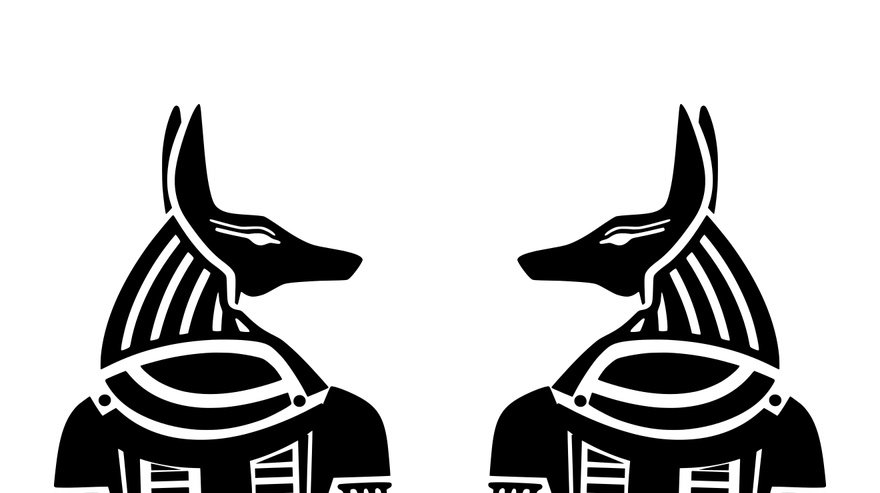

About Zodiacs & Astrology (Egyptian, Babylonian, Indian, Chinese)
I. The Zodiac
The Zodiac probably provides the first "months" of history, at least the oldest still known, although they are not based on the moon. The trail leads via Babylonia and back to Sumer, one of the two oldest civilisations known. Many call them "the oldest", but in my opinion Egypt is another strong candidate. It is also clear that the knowledge of astronomy and astrology, which were one and the same subject in the past, was much more advanced in Egypt than what is commonly believed.
Original Egyptian astrology, however, was "Decanic", which is an entirely different system than the Babylonian. Although the Egyptians must have known of the Babylonian/Sumerian tradition, they first came to merge into "horoscopic" astrology in Ptolemaic Alexandria, which is quite late in history. The Greeks are sometimes given the honour of having added the concept of birth horoscope, where the position of celestial bodies at birth determined an individual's destiny. I doubt that, however, since, contrary to the commonly held view, the Greeks were not intellectually creative at all. They obtained their knowledge from different sources and transferred it for posterity. If they were at all involved in the development of this "new" astrology, they had certainly snatched it somewhere else. This Alexandrian "horoscopic astrology", however, spread across the West and the Middle East. (The common derivation of the word "horoscope", a term not in general use until the Middle Ages, means "hour watch". Another explanation frequently suggested is that the first part is derived from "Horus"; the zodiacal signs were "the watchers of Horus".)
Ptolemy (in Arabian tradition called Batlaymus), approx. 90–168 AD, played a central role here and might be the reason for the idea that the Greeks invented the birth horoscope. He wrote in Greek, which was the international language of his time, and he was a Roman citizen. Although it is often taken for granted that he was a Greek, his ethnicity is something of an enigma. Much indicates that he was from southern Egypt, and thus a genuine Egyptian. Yet, in the end it is still unclear how much he personally contributed, and to what extent he was just a compiler.
In Egypt, the Dandarah Zodiac has been found in the Hathor Temple at Dandarah. It is circular, which is uncommon for old Egyptian zodiacs, and it may be the form on which later systems of astrology and astronomy were based. Its age is not all that impressive, it is now commonly suggested to be from approximately 50 BC. (This relief can be seen at the Louvre in Paris.) Strictly, it is more like a map of stars than a zodiac, and in many ways it resembles Babylonian more than Egyptian tradition. I suspect it to be an "Egyptianised" version of a Babylonian star map. This does not mean that genuinely Egyptian zodiacs did not exist, but only that we have no knowledge of it. As far as we know, our Zodiac today is descended from the Babylonian, but the Dandarah Zodiac might have been an intermediary. If there were an early cross-fertilisation between Egyptian and Babylonian-Sumerian traditions is impossible to say, but it is probable. Contacts between the old civilisations were quite intense. It is likely that the Egyptians knew about the Zodiac much earlier. If they did not use it, they probably did not need it. But they certainly knew about its constellations. However, there are Egyptian "zodiacs" more recent than the Dandarah Zodiac, which display other signs. This raises the question whether there were earlier zodiacs in Egypt, which have yet to be discovered.
The age of the Zodiac as we know it today is not easy to establish. Attempts have been made, albeit none of them convincing. Names of the constellations can possibly give us a clue if we simulate changes of the sky throughout the ages. We would need to find a pattern where constellations resemble the zodiacal figures at least to some extent. Such a simulation could be done with a computer. On the other hand, we do not know if the constellations have ever looked as we assume from their names, or if the perspective is even terrestrial. Advocates of ancient-astronauts theories might very well suggest that the Ram, Bull, Twins, Crab, Lion, Virgin, Scales, Scorpion, Archer, Sea-Goat, Water Bearer, and Fish were once seen from an extraterrestrial perspective. Or perhaps we've got it all wrong?
I consider it likely that the constellations have never had a logical connection between appearance and denotation, but that some deeper symbolism, lost for humanity early in history, was the basis for their naming; a symbolism based on a mind-set totally alien to us today. I am not saying that the mystery cannot be penetrated, but I think that doing so requires an approach free from all forms of prejudice.
This, of course, not only holds for the constellations of the Zodiac, but also for several others whose names go back into the dawn of history; such as Ursus Major (The Great Bear), and Canis Major (The Great Dog). Or perhaps it is more appropriate to say that the meanings of names have remained intact throughout history and through several steps of translation.
This is the present Zodiac as most of us know it. The dates are given according to the Ptolemaic Tropical Zodiac, the one commonly referred to. In English, the Zodiacal constellations are known by their Latin names.
1. Aries, 20 March – 20 April
2. Taurus, 20 April – 21 May
3. Gemini, 21 May – 21 June
4. Cancer, 21 June – 22 July
5. Leo, 22 July – 23 August
6. Virgo, 23 August – 23 September
7. Libra, 23 September – 23 October
8. Scorpio, 23 October – 22 November
9. Sagittarius, 22 November – 22 December
10. Capricorn, 22 December – 20 January
11. Aquarius, 20 January – 18 February
12. Pisces, 18 February – 20 March
There is a 13th constellation of the Zodiac, Serpentarius, or Ophiuchus, the "Serpent-holder". However it is not used in astrology and therefore less known.
Indian (Jyotish, Vedic) and also some Western astrologers work with a Sidereal Zodiac. It contains the same signs, but the dates are different. Simply put, tropical astrology places Earth in relation to the solar system while sidereal places it in relation to the visible stars. It is a difference in perspective.
Indian astrology is complicated and very scientific. Based on Vedic sources, it is also influenced by the Egyptian-Babylonian tradition, yet not to an extent which would remove its specific Indian character.
The 12 animals below, constitute the Chinese Zodiac. They are of profound importance for the Chinese calendar and astrology, while it has nothing to do with astronomy. (In the case of astronomy, the zodiacal area is covered by 28 "Mansions", a concept based on traditional Chinese constellations being different; they have grouped the stars in a different way. But that is beyond the scope of this essay.)
The Chinese Zodiac consists of:
1. zi (rat)
2. chou (ox)
3. yin (tiger)
4. mao (hare, rabbit)
5. chen (dragon)
6. si (snake)
7. wu (horse)
8. wei (sheep)
9. shen (monkey)
10. you (rooster)
11. xu (dog)
12. hai (pig)
One sign for each Chinese Lunar year during a 12-year cycle.
This is made to a 60-year cycle, by combining the animals' "earthly branches" with 10 "celestial terms" according to certain principles.
Astrology, however, also knows inner animals, at a monthly rotational cycle, just as the common "western" zodiac. In addition to that, there are "secret animals", the same cycle repeated on a "shichen" basis (increments of 2 hours, dividing a day in 12 parts). So what you are is determined by the year, the month, and the "shichen" you were born in. Thus you might be, for instance, a Tiger, but internally a Dog, and secretly a Snake. Likewise, the days can be represented by the animals, then in a 60-day cycle. Astrology also pays attention to yin and yang and other concepts of Chinese philosophy, such as the five elements earth, water, metal, wood, and fire.
There is a special calendric addition for agricultural use called the "solar terms" [jieqi]. They are not based on lunar months, but on 24 yearly periods, "solar terms", with one of the zodiacal animals representing each pair of "terms". These are markers which compensate for the calendar's otherwise missing correlation with the solar year and agricultural seasons.
The origin of Chinese astrology is lost in the mists of history. Whether it was in any way influenced by alien systems is hard to say. The Indian system seems to be the most likely, but it is not apparent. However, influences from the other direction, from China to India, have taken place.
Except for features shared by all lunisolar calendars, the Chinese one stands apart; and the Zodiac too is different in at least one major point: it is not based on constellations. The Korean, Japanese, Vietnamese, and Thai Zodiacs are essentially the same as the Chinese, with just minor differences. Huns and other genuine Turk-peoples also based their zodiac and calendar on the Chinese.
It seems as if the Chinese developed their own system, completely separate from the Egyptian-Babylonian. The Indian system is hard to place here, but it is possible that we should talk about an Egyptian-Babylonian-Indian and a Chinese system, or we might consider the Indian one separately. The Chinese system, however, spread in the area surrounding China, and with the many waves of migrating Turks (of which the Huns were the first) when they were driven westwards from the Chinese vicinity. It has been used as far west as in parts of Eastern Europe.
II. Alchemy & Symbolism
In Alchemy, Mysticism, Symbolism, and Folklore, the Zodiac is linked to concepts of the number twelve, and it is related to number magic. Israel's twelve tribes were sometimes seen as the earthly manifestation of the Zodiac. Sumerians, Babylonians, Egyptians, Greeks, Romans, Germanic peoples, Hindus, they have all had twelve great gods in their pantheon. Christianity has twelve Apostles.
In Alchemy, the Zodiac's twelve divisions represented twelve stages in the process of something, material or spiritual, to reach its fulfilment.
The Zodiac was also considered as *"the wheel of anxiety"*; according to Jakob Bhöme (1575-1624), "*elemental wheel of anguish"*, lit by Vulcan, or *"wheel of anxiety of outward nature".* The Dualistic Gnostics called it *"the dark circle of twelve vices"*.
Another great wheel was based on how the moon (as opposed to the sun) passed through the Zodiac.
*"As the moon passes through the whole of the zodiac in twenty-eight days, the most ancient astrologers assumed that there were twenty-eight stages [...] Within these twenty-eight stages lie many of the secrets of the ancients, miraculously affecting all things beneath the moon."*
(Heinrich Cornelius Agrippa von Nettesheim, 1486–1535; De occulta philosophia, 1510)
William Butler Yeats (1865–1939) also used a wheel to illustrate his ideas, one of twenty-eight spokes.
*"This wheel is every completed movement of thought or life, twenty-eight incarnations, a single incarnation, a single judgement or act of thought."* (A Vision, 1925)
*(This article is based on material previously published in Meriondho Leo, and in my e-book “Numericon”, 2019.)*
Related articles:
The Dog Star & The Dog Days, about Sirius & the Old Egyptian Calendar. https://read.cash/@Mictorrani/the-dog-star-the-dog-days-sirius-the-egyptian-calendar-3792593b
Snakes in Astrology & Heraldry https://read.cash/@Mictorrani/snakes-in-astrology-heraldry-505ccf47
Zodiac, Month, Year: Some Scientific Elementa https://read.cash/@Mictorrani/zodiac-month-year-some-scientific-elementa-1ba8efbb
*Copyright © 2011, 2019, 2021 Meleonymica/Mictorrani. All Rights Reserved.*
All my articles about history can be found here, and about calendars & time here. https://read.cash/@Mictorrani/index-over-my-articles-at-read-cash-5f7c1e34#history https://read.cash/@Mictorrani/index-over-my-articles-at-read-cash-5f7c1e34#calendars-amp-time
You find all my writings on Read.Cash, sorted by topic, here. https://read.cash/@Mictorrani/index-over-my-articles-at-read-cash-5f7c1e34
*If you are interested in History, join my community* *History, Myths, Legends & Mysteries (be45)**.* https://read.cash/c/history-myths-legends-mysteries-be45

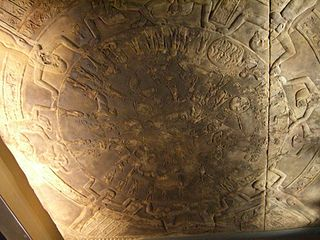
Retrospection 1
The last few weeks I have seen some retrospective articles; that is, posts where the author in one way or another says something about their time on this platform, what it has meant to them, which have been their greatest successes, and so on... At first it occurred to me as an author lacking something to write about, someone who desperately grabbed for a new topic – but after a while I saw a value in these posts. They could be an encouragement to newbies, they also introduced old material to new readers, and, considering how this platform has evolved, that could definitely be meaningful, as well for the author as for interested readers.
First we must realise that the production here is large and has been going on for a long time now. The total numbers of articles posted on read.cash is large and beyond anyone to read. You read a few, you discard a few, but most of them you don't even know that they are here. In fact, most of us almost never read an old article here, or know that it exists if we not either read it when it was new or got some sort of reference to it.
Without doubt, many of those old articles are good and well worth reading.
I belong to the veterans here by now. I came in March 2020, and there were about 1500 members. Now, exactly when I am writing this on 6 July 2021, the membership is 67856. Most new members, even if they would read my present posts, have no or very little idea about my previous production here. Still, if you like what I write now, you probably would like much of what I wrote before.
I have tried to provide the means for interested readers to explore my whole production here. For that purpose, I created an index over my articles at read.cash. While the total number of my articles has grown (presently close to 250), even the index feels insufficient - but it is still a way to find my articles based on topic. https://read.cash/@Mictorrani/index-over-my-articles-at-read-cash-5f7c1e34
I also think that retrospective posts can fill a function, helping newer members to find their way to old material they would like. So, since I am posting texts about a large number of different topics, some of which are coming and going, I decided to create a few retrospective posts to introduce new members and other readers to material that they may have missed. I don't know how long this series will become, it depends to some extend on how it is received - but I am not going to overdo it, and it will be a while between the parts.
As for what has been most successful, I cannot really compare that. My time on this platform is divided into two periods; the first was March-August 2020, the second was December 2020-present. During the first period there was no Random Rewarder, and tips were mostly insignificant. An article could be in several communities at the same time; views, comments and thumbs up were counted per community and not summed up anywhere. It is close to impossible to sum up the results for a fair comparison.
If you already belong to my readers, you know that my topics are quite diverse. I'm sure there are readers liking some of my topics, but not others. That is natural. People are different and take interest in different things.
(The image above is an example of Ukiyo-e: Bijin on veranda, by Harunobu, one of the greatest masters of Japanese Art. The one below shows a detail from a painting, "*Tengu and a Buddhist Monk",* by ***Kawanabe Kyōsai*** )
After this long preamble, let's start with the real retrospection. I will bring up a topic that caused a lot of positive attention during my first period here; Japanese Art and Cultural History. Starting with Satoshi & Sharaku , where I introduced one of the most mysterious artists in the history of art, Sharaku, by comparing him with the equally elusive Satoshi Nakamoto, the subject of Japanese art was opened. I posted another 18 articles, most of them dedicated to the sub-genres and great names of a unique Japanese style, called ukiyo-e. I also went into other subjects of Japanese history, folklore and culture, such as: https://read.cash/@Mictorrani/satoshi-sharaku-103177b2
Chushingura – The 47 Ronin https://read.cash/@Mictorrani/chushingura-the-47-ronin-c28548ca
Seppuku - Ritual Suicide https://read.cash/@Mictorrani/seppuku-ritual-suicide-af10d898
Emperor & Shogun, The Edo Period and Ukiyo-e https://read.cash/@Mictorrani/emperor-shogun-the-edo-period-and-ukiyo-e-69239b66
Crows, Ravens & Tengu https://read.cash/@Mictorrani/crows-ravens-tengu-d4fffba1
When Namazu Whips His Tail, Earth is Shaking. https://read.cash/@Mictorrani/when-namazu-whips-his-tail-earth-is-shaking-1ef33ac6
After my 4 months absence from read.cash, the system had changed, the Random Rewarder was in place, and the membership had reached over 40000. I had planned to continue writing about Japanese art and culture now and then, it was one of my established topics. Yet it took a while before I tried to re-introduce it; In March 2021, I published Kachō-e: Flora & Fauna in Japanese Art, about one of the sub-genres of ukiyo-e. There was practically no response at all, so I decided to put that subject on ice until further notice. https://read.cash/@Mictorrani/kacho-e-flora-fauna-in-japanese-art-d74e8871
You can find the full list of these articles in my Index/Japanology. https://read.cash/@Mictorrani/index-over-my-articles-at-read-cash-5f7c1e34#japanology
**I'd like to hear if there is any interest in a re-introduction of this topic. Please, leave your comment!**
Copyright © 2021 Meleonymica/Mictorrani. All Rights Reserved.
You find all my writings on Read.Cash, sorted by topic, here. https://read.cash/@Mictorrani/index-over-my-articles-at-read-cash-5f7c1e34
Milk, Life or Death?
The general public and the public society at large tend to think of milk as unquestionably healthy food; a belief which is not based on knowledge, but on propaganda. The dairy industry is commercially important - too important to be allowed to be challenged in a serious way.
Within certain circles, however, dairy products are controversial. Milk, especially industrial milk, is questioned for a number of reasons. We will look at some of them here.
In this text "milk" means cow's milk, unless otherwise is stated.
*"My illness is due to my doctor's insistence that I drink milk, a whitish fluid they force down helpless babies."*
(W. C. Fields)
Natural & Industrial Milk
Natural milk, milk from the cow, just as it is, is a much more natural substance than industrial milk - and it certainly makes better (or less harmful) food. That is, were it not for the infection risk. Yet industrial milk is what is available to most of you, and that is what we will mainly concern ourselves with here.
Industrial milk is characterised by:
1. Separation and Standardisation. Skim milk and cream (fat) are separated from each other, then a certain amount of fat is returned to the milk, to give it a pre-defined fat percentage.
2. Pasteurisation. The milk is heated and then chilled again. This kills disease-causing bacteria. Non-pasteurised milk can carry infection, and it once was a major source of tuberculosis.
Unfortunately pasteurisation kills the natural enzymes too, which makes the nutrients harder to utilise. With time, natural milk turns sour, pasteurised milk is rotting.
3. Homogenisation. The fat is divided into particles, small enough to prevent the cream from separating. This also makes the milk appear fatter than it is.
A professor Oster has a theory, which is not unquestioned. He means that homogenisation is contributing to atherosclerosis. On the outside of the fat particles there is an enzyme, XO. For non-homogenised milk, XO breaks down by digestion; when it is homogenised, however, the particles are so small that they reach the blood as they are. There XO harms the vessels, and cholesterol is deposited to repair the damage.
Allergy
Milk is the most common allergen. If you are allergic, there is 50-80% probability that you react to milk. The reaction can be caused by the protein, or some other constituent.
Lactose Intolerance
This is a problem I have discussed in detail in a previous article, Lactose Intolerance, Vandals & Germanic Migration. https://read.cash/@Mictorrani/lactose-intolerance-vandals-germanic-migration-77ca4460
Prostaglandins & Immune System
Milk inhibits the transformation of essential fatty acids to prostaglandins. This affects the immune system negatively, and probably everything else too. Prostaglandins are involved in all biological processes of our body, also mental ones.
Milk as a Source of Protein
In theory, milk is a good source of protein; in reality, it is questionable if protein from industrial milk can be properly utilised. There is the problem with pasteurisation and the death of enzymes, but another question is related to fat.
Protein-rich natural foodstuffs are rich in fat too. It is a matter of doubt whether the protein can be utilised if it is not accompanied by the related amount of fat. If it cannot, skim milk and standard milk are both bad protein sources; and if protein enters the body without being properly utilised, it strains and harms it.
Milk as a source of Calcium
There is a good deal of high quality minerals in milk, and it is commonly held as an important source of calcium. But there is a problem associated with what it does not contain: a sufficient amount of magnesium.
To be properly utilised by the body, calcium must be accompanied by the right amount of magnesium; otherwise it is deposited into various tissues, where it blocks normal functions. Unfortunately, milk does not contain more than a small fraction of the magnesium it would need to uphold a good calcium-magnesium balance. Unless that is corrected by a magnesium supplement, milk is a close to worthless - or even dangerous - source of calcium.
Mucus
Milk forms mucus, and mucus in the body blocks various functions and stimulates the growth of fungi. It has to be cleansed out somehow, otherwise it leads to disease, including cancer. A regular use of milk makes mucus accumulate uncontrollably.
Curdling
In the stomach, milk curdles and envelops its (the stomach's) other contents, thus preventing the digestive juices from reaching the material and fulfilling their task. This leads to indigestion. (If you vomit up milk, it comes as pieces, as cheese!)
Sour Milk - Fermented Milk
Fermentation of milk gives a number of valuable products, by which the most well-known is yoghurt. Which type of sour milk you get is determined by which type of micro-organism you use for the fermentation.
The fermentation produces lactic acid, which is good for the intestinal microflora, and it breaks down various nutrients so they are more easily digested. Sour milk does not rot, and it does not coagulate (curdle) in the stomach. If you throw up sour milk, it comes as liquid - if you throw up ordinary milk, it comes as coagulated pieces (cheese). https://read.cash/@Mictorrani/the-bodys-inner-outer-surface-and-its-inhabitants-109dfc8b
To be truly beneficial, sour milk must contain living lactobacilli or lactococci. Consequently it must be pasteurised before the fermentation, not after.
According to the current level of knowledge, the most beneficial sour milk is made by the use of Lactobacillus acidophilus.
Cheese
Cheese is made from curd, coagulated by rennet and separated from the whey. Pure curd cheese, or cottage cheese, is made by sour milk, and it contributes to a sound intestinal microflora. Otherwise cheese is too rich in (saturated) fat and protein to be used more than occasionally.
Whey can be used to make a cheese-like product called whey-cheese. Its nutritional value is superior to ordinary cheese.
Whey
Whey, the serum of milk, is the watery liquid that remains after cheesemaking. It is very nutritious, but contains very little energy (calories). Fat, protein, and most of the excess calcium are gone (they are in the cheese), most of the other nutrients are found in the whey. (Note: whey contains all the lactose.)
Under certain circumstances, whey can be pure superfood, with healing, cleansing and regulating qualities. Concentrated, fermented whey can be applied externally against various forms of dysbacteria, fungi, eczema, etc.
Ingested it normalises the microflora, stimulates digestion, combats cancer, regulates the pancreas (combatting diabetes), and much more.
Butter
Butter is made by churning the fatty part of milk. It is extremely high in saturated fat.
The liquid that remains when butter has been extracted, is called buttermilk. Some people appreciate that as a refreshing beverage.
If for some reason you need solid fat - as in certain baking, or for confectionery - butter is a better choice than any form of margarine. Even if its level of saturated fat is extreme, it is still something that can be neutralised, because butter is a relatively natural substance. Margarine is an entirely artificial product and all its bad effects cannot be neutralised or repaired. Otherwise, coconut fat is the superior solid fat, and the best fat for cooking and frying. (For more on fats, see Understanding Dietary Fats Part 1 (of 2) & Understanding Dietary Fats Part 2 (of 2).) https://read.cash/@Mictorrani/understanding-dietary-fats-part-1-of-2-e8b4f70d https://read.cash/@Mictorrani/understanding-dietary-fats-part-2-of-2-873ba37f
Mother's Milk, Breastfeeding & Nerve Connections
All mammals lactate; the mothers produce milk to sustain their babies. The composition of the milk is unique for each species. Getting milk from another species than its own can kill a infant mammal, who is made to digest the milk from its own sort only.
This goes for humans too. Unless there is no other possible choice, a baby should never be given cow's milk. The real mother's milk is indispensable for the child's future health, while cow's milk could harm it. (For instance: Substituting mother's milk for cow's milk increases the risk for the child to develop asthma.)
Some studies suggest that even the mother's consumption of cow's milk during lactation might harm the breast-fed child. It will become more disposed to colic.
Actually, breastfeeding is important for the mother too, whose womb will not otherwise recover fully after pregnancy and childbirth.
Various parts of the body are connected via nerve channels, and there is such a connection between the breasts and the female sexual organs. When the breasts are stimulated, there are muscular constrictions in the female sexual region. This is why the breasts are so erogenous, the constrictions cause pleasure. And in the other direction, the nervous channel explains why there can be pain and tension in the breasts during menstruation or ovulation.
The stimulation of the breasts during breastfeeding is part of the restoration of woman after childbirth. In the same manner it causes constrictions, for the purpose of restoring normal size and elasticity in the sexual area.
As a short digression: Another very erogenous area of the female body is the upper lip, which is connected to clitoris by a subtle nerve channel. In Indian tradition it is called the Wisdom Conch-like Nerve.
In Old India, gold-dust and honey were sometimes applied to the upper lip of a baby girl, to ensure that she would grow sensual and beautiful.
Just to mention one more nerve connection, there is one between feet and kidneys. If your feet are cold, the kidneys will be too. Since the latter are sensitive to cold, keeping the feet warm is important for your kidney health.
Conclusion
As we have seen above, there are many reasons to call into question whether cow's milk is suitable food for humans.
My opinion is that it is not; it is food for babies, and only babies of the same species: cow's milk is for calves.
If you want to use milk, sour (fermented) milk is the best choice. On the whole, the products derived from milk, used sparingly and with common sense, are far less harmful than the milk itself.
Related articles:
Lactose Intolerance, Vandals & Germanic Migration https://read.cash/@Mictorrani/lactose-intolerance-vandals-germanic-migration-77ca4460
Understanding Dietary Fats Part 1 (of 2) https://read.cash/@Mictorrani/understanding-dietary-fats-part-1-of-2-e8b4f70d
Understanding Dietary Fats Part 2 (of 2) https://read.cash/@Mictorrani/understanding-dietary-fats-part-2-of-2-873ba37f
The Body's Inner & Outer Surface (and its inhabitants) https://read.cash/@Mictorrani/the-bodys-inner-outer-surface-and-its-inhabitants-109dfc8b
Copyright © 2008, 2018, 2021 Meleonymica/Mictorrani. All Rights Reserved.
All my articles on health & medicine can be found here. https://read.cash/@Mictorrani/index-over-my-articles-at-read-cash-5f7c1e34#health-amp-medicine-for-covid-19-see-covid-19
You find all my writings on Read.Cash, sorted by topic, here. https://read.cash/@Mictorrani/index-over-my-articles-at-read-cash-5f7c1e34
Also, please join my community: *The Mechanisms of Health (d52e)**.* https://read.cash/c/the-mechanisms-of-health-d52e
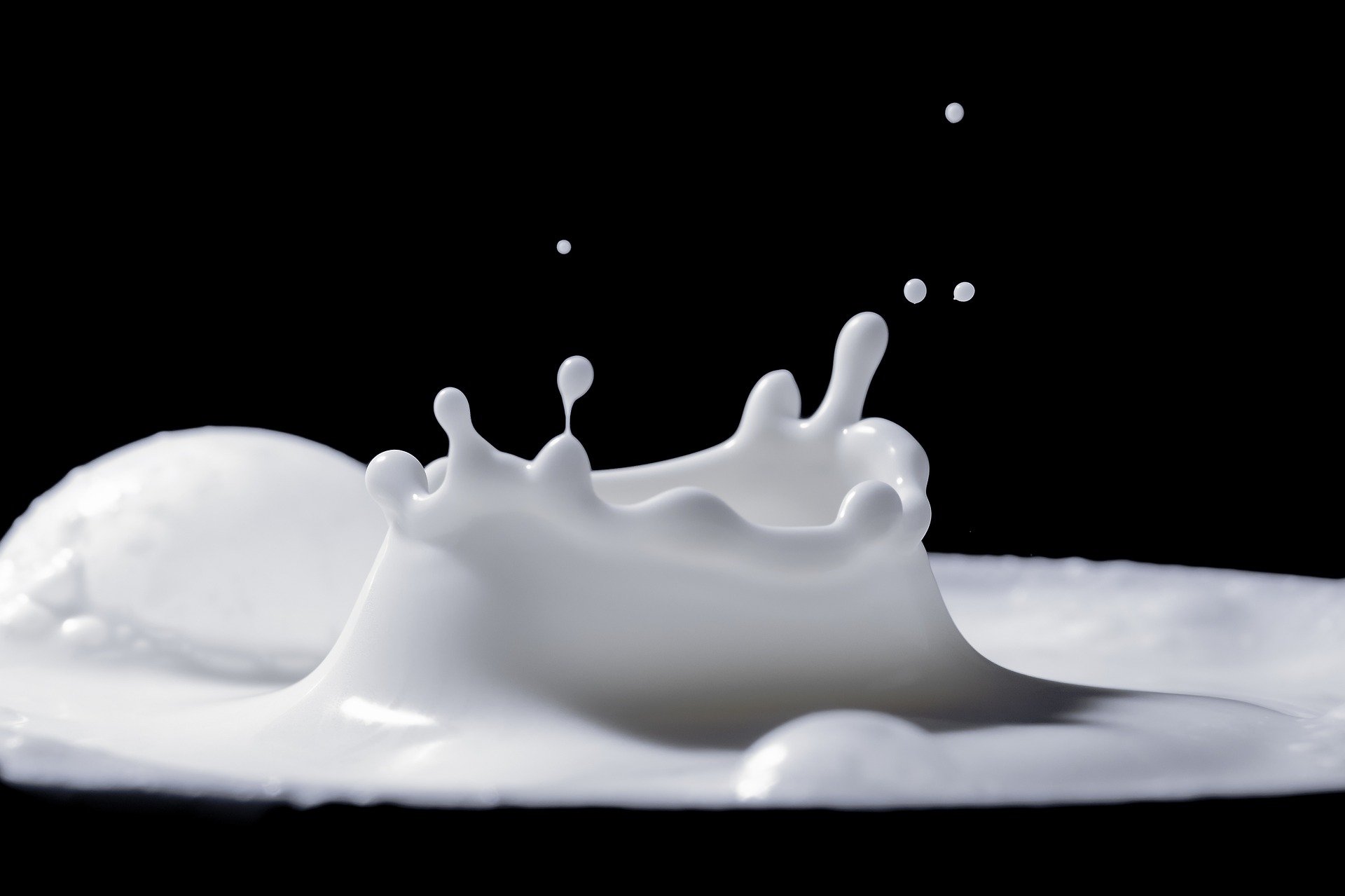
Why “Donald Duck” is Bad: Assimilation, Alliteration & How to Create a Name
Whether you are an author, inventing names for the characters of your next novel - or you are a future parent, considering names for your yet unborn children – you should be aware of assimilation and alliteration, and what they do to a name.
A lot of people are fond of alliteration, and it is fine, as long as it is not exaggerated. Ending up with 10 children, all with names beginning with the same consonant might look ridiculous. And watch out, alliteration of given and surname, can look as the name of a cartoon or fairy tale character.
Alliterating words **start with the same consonant**. Woody Woodpecker, Mickey Mouse, Peter Pan, and Donald Duck are examples of names based on alliteration. So far, these are fine. However, Donald Duck is an awfully badly created name, because the end-d of Donald clashes with the initial D of Duck, something that should be avoided. The end of one word and the beginning of the next should be distinctly different, not to be given any possibility to join into one sound.
In the end you must let the ear be the judge - and the eye, if you want a correspondence between spelling and pronunciation, and such a correspondence is often practical. Just imagine someone saying his name is "Jonnash." What did he really say? John Nash? John Ash? Or even Joe Nash? It is clear that the collision of "n" in John Nash is undesirable, but to see the problem with John Ash, or Joe Nash, a little more thinking is needed.
In the same way it can be best to avoid collision of letters/sounds being the soft and hard versions of the same sound; like g-k, k-g, d-t, t-d, b-p, p-b, and perhaps v-f, f-v. The soft sound tends to disappear, as when Arnold Tanner is pronounced "Arnoltanner."
Colliding vowels must be considered on a case to case basis, but one should use them sparingly, if at all. On the whole, sounds that are too similar should not be following immediately after one another (unless you aim at very special effects).
It is possible to go very far in analysis, discussing every possible combination of sounds, the distribution of hard and soft vowels, etc... but unless you are a poet with very high requirements on musical quality and precision in your language, that would be to overdo it.
It can be worth the while, however, to take a look at assimilation and the labials.
When a sound tends to become like a contiguous sound in articulation, it is called assimilation. An example is "cupboard," were the "p" in pronunciation becomes a "b" (is assimilated to b). The labials, sounds formed with the lips closed (m, b, and p), are often involved in this.
The most volatile sound is "n," which, often, if followed by a labial, changes toward the sound of "m." Sometimes this change is so clear that it affects spelling. We can see that in many words of Latin origin, where prefixes in- (negation) and in- (opposite to ex-) in front of a labial change to im-. Some examples: immortal, immaterial, impossible, import, imbalance. Similarly en- can change to em-, as in embalm, employ.
(Interestingly, the prefix in- changes to ir- in front of "r" and in front of "l" it changes to il-. Examples: irrational, irresolute, illegal, illicit.
Assimilation is a general phonetic principle, not in any way limited to Western or Indo-European languages. In Japanese, just to take one example, the word for newspaper is a combination of two characters, giving "shinbun," which is a correct transliteration. But sometimes one can see it written as "shimbun," a form more resembling pronunciation, which is affected by assimilation of n to m.
Another example can be taken from Arabic and my recent article Transcription & Transliteration: Some Thoughts on Written Language & Foreign Names, where I wrote: https://read.cash/@Mictorrani/transcription-transliteration-some-thoughts-on-written-language-foreign-names-6ccc434f
“[...] we can take the Arabic article "al"; when it is followed by certain consonants, its pronunciation is adapted accordingly - but not the Arabic writing. So if we transliterate (keep to the spelling), we get e.g. al-Rahman, al-Din, and al-Zahir. If we transcribe (express the pronunciation), we get ar-Rahman, ad-Din, and az-Zahir.”
The transcribed forms (pronunciation), are also examples of assimilation.
If we return to the original question, about creating a name; there is good reason to be aware of the phenomenon of assimilation. I think such combinations should be avoided, but that is a matter of taste.
Finally, it should be noted that a correspondence between pronunciation and spelling is not always desired. Spelling is for the eye and it is sometimes adjusted for purely ornamental reasons, especially in the case of names.
Copyright © 2021 Meleonymica/Mictorrani. All Rights Reserved.
Here you find my articles related to words & language. https://read.cash/@Mictorrani/index-over-my-articles-at-read-cash-5f7c1e34#words-amp-language
For more on words & language, join The Power of Words (4be2). https://read.cash/c/the-power-of-words-4be2
You find all my writings on Read.Cash, sorted by topic, here. https://read.cash/@Mictorrani/index-over-my-articles-at-read-cash-5f7c1e34
Phonetic Script & How Books of Religion Shape Languages
I. Alphabetic or Non-Alphabetic
When I call a language "alphabetic, I refer to a language whose script is based on speech sounds. We could call it “phonetic” instead. That is, when the writing expresses the speech, not the meaning. A non-alphabetic language uses some sort of pictography/ideography. The pictographs/ideographs represent things, concepts or ideas as they are, without paying attention to sound or the pronunciation of words.
Since most non-alphabetic systems have been developing in the direction of alphabetism or are completely replaced by alphabetic writing, non-alphabetic writing is often considered as primitive. For advanced non-alphabetic systems, I have to disagree. I have spent a lot of time and attention studying the connection between language and brain, especially brain evolution, and I maintain that the development of alphabetism can be associated with a decline in brain capacity. (I might elaborate more on that on another occasion.)
Everything that is comfortable makes us weaker. Alphabetic writing is comfortable, because its relation to spoken language makes it easier to learn. Yet it is a strange and roundabout way to make a visible representation of sound that represents meaning, instead of a direct visible representation of meaning.
Advanced non-alphabetic writing is much more difficult to learn. The "characters" tend to be numerous, and there is no help from the spoken language. Once learned, however, it is more economical; it conveys more meaning per sign (and more meaning per bit of information passing through consciousness); it saves the reader one step of transformation. It goes from visible sign to meaning, without paying attention to words or their pronunciation. https://read.cash/@Mictorrani/bandwidth-of-brain-and-consciousness-2207fe01
II. Phonemes
An alphabetic language is supposed to be entirely phonetic. That is, letters represent sounds, and pronunciation is expected to be in accordance with spelling. This might have been true in the beginning, but pronunciation is normally changing faster than spelling - so the gap constantly widens. (The picture is further complicated by the adoption of words from foreign languages.)
It is unclear if it will remain so when most people can read and write, compared to the past, when all people could speak but very few were literate. There is a trend today that written language increasingly influences the spoken – that's historically a new situation. Written language was mainly a way to put down speech. Today written language has a life of its own, and we may find that spoken language becomes merely a way to pronounce text. Then the pronunciation will not so easily deviate from the spelling as it has previously done - and it will not force changes.
Even if it it will not go that far, and it probably won't, perhaps one can expect languages to change more slowly in the future – especially if the current trend of increased literacy continues.
However, it is not entirely new that written language affects the spoken, or how whole languages evolve. See “Section III” below about the influence of the Qur'an and the Bible.
Another problem is that many languages are written with letters from an originally alien alphabet. The Latin one, for instance, is used for a large number of very different languages, whose sounds cannot satisfactorily be expressed by the limited set of letters it contains. In some instances it has been adapted; extra letters have been introduced and diacritical marks are frequently used. The result is far from perfect.
For instance: Latin letters are not only used for many European languages, but also some very distant ones, for instance Vietnamese and Malayan languages. While Bahasa Indonesia and its sibling Bahasa Malaysia are phonetically simple and can be rather well expressed with Latin letters, it is entirely different with Vietnamese.
For a language to be genuinely phonetic, one would have to use characters based on phonemes. A phoneme is the smallest phonetic unit of a defined language that conveys a distinctive meaning. Speech sounds are broken down into their smallest units, and each unit is represented by a letter. One sound for one letter, one letter for one sound. There may never be two (or more) letters for the same sound, or two (or more) sounds for the same letter (like "i" in English "fit" and "first").
Of course there may be no mute letters, like "k" in English "knight", or "e" in "approve."
Most specifically, no single sound may be expressed by a combination of letters; like "th" or "ch" in English, "ch" or "sch" in German, or "eau" in French.
III. The Influence from Books of Religion
Books of religion have played an important role in shaping and preserving languages, and sometimes in dividing a language into two or more distinctly different ones.
One example is Arabic, where Qur'anic Arabic definitely influences as well written as spoken Arabic - despite its many different dialects - and perhaps it has preserved Arabic as a language (it might very well have disappeared otherwise). Even today, when diverging Arabic dialects approaches to be different languages, the Qur'anic Arabic knits it together and holds back a total divergence, which otherwise most likely would have occurred already. (As it has with Latin. Compare how it branched into Italian, Spanish, Romanian, Portuguese, etc.)
An example going in the other direction, where a book of religion has caused a divergence in language, is Old Norse, where in the past the essentially same language was spoken from Iceland in the West, over Norway and Denmark to Sweden in the East. It was probably hard for someone from one end of this area to understand someone from the other end, because dialects were strong, but they were varying gradually, floating over the area; it was impossible to find borderlines. However, during the Reformation in the 1500s, the Danish king and the Swedish king both decided to have the Bible translated to the local language. They used different translators who based it on different dialects and the results were quite different. Thus were born Danish and Swedish as distinct and separate languages, and the language in respective Bibles became normative for these national languages. Subsequently divergence has continued.
Apart from Danish and Swedish, the area today has also Icelandic and Norwegian defined as distinct and separate languages, although the language situation in Norway is complicated (which we do not need to concern ourselves with here and now).
Perhaps Bible translations affected writing more than speaking, since they also set a standard for the spelling, which had not existed before that, including some peculiarities. The most striking one is the spelling of the Swedish word “och” which is pronounced “ock” and means “and”. This spelling is totally alien to Swedish otherwise (the natural spelling would have been “ock”), but it was introduced by the very first Swedish Bible translators and remains to this day.
Copyright © 2008, 2020, 2021 Meleonymica/Mictorrani. All Rights Reserved.
Related articles:
Words are Power - But only if you Have Something to Say https://read.cash/@Mictorrani/words-are-power-but-only-if-you-have-something-to-say-dd4dca45
Words, Consciousness & Beyond https://read.cash/@Mictorrani/words-consciousness-beyond-f32317bc
Bandwidth Of Brain and Consciousness https://read.cash/@Mictorrani/bandwidth-of-brain-and-consciousness-2207fe01
Transcription & Transliteration: Some Thoughts on Written Language & Foreign Names https://read.cash/@Mictorrani/transcription-transliteration-some-thoughts-on-written-language-foreign-names-6ccc434f
Here you find my articles related to words & language. https://read.cash/@Mictorrani/index-over-my-articles-at-read-cash-5f7c1e34#words-amp-language
For more on words & language, join The Power of Words (4be2). https://read.cash/c/the-power-of-words-4be2
You find all my writings on Read.Cash, sorted by topic, here. https://read.cash/@Mictorrani/index-over-my-articles-at-read-cash-5f7c1e34

Transcription & Transliteration: Some Thoughts on Written Language & Foreign Names
Generally proper names are problematic. Ideally, they should never be changed from their original form; after all, a name is a name, as such it cannot be changed. If someone's name is Enrique, it is Enrique, and not Henry or Heinrich.
The same applies to names of places, which are sometimes absurdly different from the original. Deutschland, for instance, is called Germany in English - extremely unsuitable from a purist point-of-view. (Read more about that in “Germanic & Celtic”.) https://read.cash/@Mictorrani/germanic-celtic-13402f5d
Tradition, however, has given different names to persons and places in different languages. Sometimes the nature of language itself - different sounds and sound values of letters and combinations of letters - makes changes practical. To ignore that and always keep original forms would be impractical and alienate the readership.
Changes from one alphabet to another are even more problematic. Different approaches are possible. Roughly, one can either transcript or transliterate.
In a ***transcription***, one tries to describe the sound of one language with the script of another. This is based on pronunciation.
In a ***transliteration***, one exchanges letters for letters. A transliteration can always be reversed, so the original spelling can be derived from the transliterated one. It is based on spelling.
As a simple example, we can take the Arabic article "al"; when it is followed by certain consonants, its pronunciation is adapted accordingly - but not the Arabic writing. So if we transliterate (keep to the spelling), we get e.g. al-Rahman, al-Din, and al-Zahir. If we transcribe (express the pronunciation), we get ar-Rahman, ad-Din, and az-Zahir.
Of course transcriptions are equally affected by the target language as well. After all, different letters and combinations of letters have different sound values in different languages - even when they use the same alphabet. A good example is how Russian names are written in European languages. The author the English call Chekhov, is called Tschechoff (or Tschechov) in German.
Japanese, an only partly alphabetic language, has a very good system for "Romanisation," that is, writing Japanese with Latin (Roman) letters. It is called Hyojunshiki (standard system), an adaption of the earlier Hepburn system. (In my opinion, Hyojunshiki is the only really clear and consistent transcription system in use anywhere. But it can be so only because Japanese is so phonetically simple.) It is not hard to express Japanese with the use of Latin letters.
In the other direction, however, it is complicated. Foreign names are written with "Katakana", one of two syllabic alphabets, but there is really no way to write anything that cannot be pronounced with the very primitive Japanese phonetics. So, alien words are adjusted accordingly.
Chinese is non-alphabetic, and its "tone pitches" make alphabetic representation difficult. I would say that a perfect system is impossible to achieve. It must be a matter of transcription, not transliteration. Several systems exist. Wide-Giles, created by Thomas Wade in the 19th century, was long the most widely used system, and it still holds a strong position. In 1958, however, the People's Republic of China adopted Pinyin (or Hanyu Pinyin) as a standard, and it is the ISO standard since 1982.
A number of systems have been created and used in Taiwan. The present government standard is Tongyong Pinyin.
In addition to this, "Romanisation" of Chinese names can be different, depending on which dialect it is based on.
All this can be confusing, since the same Chinese name can appear in Western texts in many very different forms. It is likely that Hanyu Pinyin will become the standard in practice too, but it will take time. Most people still think of Beijing as Peking, or Guangzhou as Canton.
Arabic names in Latin-alphabet texts are often in total confusion. Although one can transliterate, it is more useful with a transcription, and there just is no standard for that at all – and therefore no consistency. The sounds of the Arabic language cannot satisfactorily be expressed with the Latin alphabet. The worst are transcriptions made by the Arabic-speaking themselves; they often lack a clear target language and use Latin letters inconsistently, sometimes within one and the same sentence.
T.E. Lawrence (Lawrence of Arabia), wrote:
*"There are some 'scientific systems' of transliteration, helpful to people who know enough Arabic not to need helping, but a wash-out for the world. I spell my names anyhow, to show what rot the systems are."*
Copyright © 2008, 2020, 2021 Meleonymica/Mictorrani. All Rights Reserved.
Related articles:
Germanic & Celtic https://read.cash/@Mictorrani/germanic-celtic-13402f5d
Names in the Ptolemaic Dynasty, Their Meaning & How to Write Them in English https://read.cash/@Mictorrani/names-in-the-ptolemaic-dynasty-their-meaning-how-to-write-them-in-original-and-in-english-fa9129e6
Here you find my articles related to words & language. https://read.cash/@Mictorrani/index-over-my-articles-at-read-cash-5f7c1e34#words-amp-language
For more on words & language, join The Power of Words (4be2). https://read.cash/c/the-power-of-words-4be2
You find all my writings on Read.Cash, sorted by topic, here. https://read.cash/@Mictorrani/index-over-my-articles-at-read-cash-5f7c1e34
The Knights of Malta: Legitimate or Not?
*SMOM,* ***The Sovereign Military Order Of Malta****, is sometimes claimed to be the smallest state in the world. They don't own any territory except an estate at Via Condotti 68 in Rome. It is no national territory, but an extraterritorial one, with its own jurisdiction.*
*Interestingly, it can be questioned whether this order is the real Order of Malta, with a tradition stretching almost a thousand years back. The present day form of the order was created by the Pope in 1879.*
*We will take a look at its history.*
Origin & History
Pilgrimages to Jerusalem increased during the 11th century. A group of merchants from Amalfi, in Italy, bought a piece of land from the Caliph - near the Church of the Resurrection - where they built two hospitals for the reception of pilgrims. There was one for males and one for females. The one for males was dedicated to St.John, and the men who worked with it came to be called "Hospitallers of St. John." This "Order" was then headed by Gerard de Martigues, titled "Guardian of the Poor." In 1113 the pope, Paschal II, recognised the Order. This did not in any way put it "under" the pope, or within his jurisdiction. The recognition was that of another sovereign body, just as when two states recognise each other today. This is an important fact in the discussion of legitimacy below.
We don't need to concern ourselves with details of the Order's early history, suffice it to say that it quite soon changed to a military society, in an imitation of (and in opposition to) the Knights Templar. The transformation came when Amalric, then king of the short-lived crusader-created kingdom of Jerusalem, wanted to invade Egypt; an invasion that would be in violation of existing treaties. The Master of the Temple (the head of the Knights Templar) declined participation, with reference to the treaties which he refused to violate. Then Amalric turned to his friend, Gilbert d'Assalit - the Guardian of the Poor, head of the Hospitallers of St.John. Together they decided to try to transform the Order of St.John into a military organisation, for the purpose of pursuing the invasion.
So they did, and the invasion took place in 1168. After initial success, the expedition turned to total defeat. The Knights Hospitallers fled from Egypt. At this stage the Order was deeply in debt, and Gilbert d'Assalit fled from his office, but was later caught and drowned in the English Channel. Everything was a failure, but the Hospitallers remained a mainly military organisation, and their head was subsequently called "Master" - another imitation of the Knights Templar.
The Order's headquarters changed throughout the years. After Jerusalem it was Margot, and Acre, later Cyprus, then Rhodes - which latter they lost to the Turkish Sultan in 1522. In 1530 the Holy Roman Emperor, Charles V, gave them Malta, from which their popular and never official name, Knights of Malta, derives.
In 1798, Napoleon took Malta, and the Knights had to leave. After Napoleon's defeat, the British stole it - in violation of existing agreements, and they kept it till 1964. After Napoleon, the knights never returned.
In 1797, the then Grand Master asked the Tsar of Russia to become the "Protector of the Order", which he accepted. The Tsar became Grand Master, a position which was held by subsequent Tsars till the end of the Russian Empire in 1917. Technically (but not in practice), it could be said that this position rests with subsequent heads of the Romanov family still today.
Legitimacy
A body corporate (like an order) can be divided into branches, and such branches can break free and become independent. Under certain circumstances (not always), such independent organisations can keep legitimacy, so that there are more than one (even many) legitimate heirs to one single historical organisation.
On the other hand, an organisation set up to "revive" an old one, or to rival an existing one, is not necessarily legitimate. Indeed, even if it can happen, it is rarely so.
This sort of legitimacy is a difficult historical (and sometimes legal) problem, and real consensus is rare. Thus many rivalling claims to be the legitimate continuation of an historical institution or organisation are more rule than exception.
The Order of St.John is not without its share of claimants and confusion. There are many organisations and branches claiming to be the genuine thing. I will not try to evaluate their various claims of legitimacy here. No doubt, the organisation described above is the main line. The Russian period has caused some dispute, but it was based on a treaty of 15th January 1797, between the Order and "The Tsar of all Russia", two sovereign powers. There is no basis for doubt in the legitimacy of this.
The Papal Order, however, is possibly illegitimate. Pope Pius VII tried to order the Hospitallers to Rome (when they were firmly settled in St.Petersburg), and he wanted himself to become Grand Master. The Hospitallers refused, and then the Pope set up a rival organisation (claiming it to be the legitimate Order of St.John) in September 1801. Since then this order has existed, and in 1879 it was changed to its present form. It is now known as Sovrano Ordine di Malta, or S.M.O.M. (Sovereign Military Order of Malta).
The Pope could set up an order with this name, and it would be legal and legitimate. But when he claims that it is the legitimate continuation of the historical Order of St.John - then it is possibly a fraud. The Pope has no jurisdiction over the historical order and has no legitimate right to take control of it, or to replace it by his own creation. Indeed, there is a document confirming this, a document whose validity the Pope (especially) cannot reasonably dispute; namely a Papal Bull, Pastoralium Nobis, of 10th June 1799, where Pius VI formally agrees and accepts that the Order of St.John is outside of Papal jurisdiction.
So is today's Order of Malta the original order or is it not? I will not try to determine if it is the real thing, facts speak for themselves. Leave that historical dispute to the experts, hardly anyone else is interested in it. Justified or not, today the papal order has got an almost universal recognition due to the authority of the Papal office.
Appendix: Who was St. John?
Almost all sources state that the Hospitallers' patron is John the Baptist, who would be St.John of Jerusalem. There are older sources, however, which claim that initially it was a different St. John. According to William of Tyre (ca.1130–1185), the original patron was St. John the Eleemosynary, a canonised patriarch of Alexandria. Obviously he was later deserted for John the Baptist.
(This article is based on material previously published in TMA/Meriondho Leo.)
Copyright © 2007, 2012, 2021 Meleonymica/Mictorrani. All Rights Reserved.
Read also my series on the Knights Templar:
The Order of the Temple - The Knights Templar https://read.cash/@Mictorrani/the-order-of-the-temple-the-knights-templar-3c312d7f
The Mysteries of the Knights Templar https://read.cash/@Mictorrani/the-mysteries-of-the-knights-templar-f5c8bf07
Symbols of the Knights Templar & Templars in Fiction: Literature and Film https://read.cash/@Mictorrani/symbols-of-the-knights-templar-templars-in-fiction-literature-and-film-f8a544f5
The Knights Templar & The Circular Number Nine https://read.cash/@Mictorrani/the-knights-templar-the-circular-number-nine-5739ad8c
The Knights Templar & Papal Infallibility https://read.cash/@Mictorrani/the-knights-templar-papal-infallibility-23c22641
Here you can find my articles about History. https://read.cash/@Mictorrani/index-over-my-articles-at-read-cash-5f7c1e34#history
Interested in history, legends and myths, join my community History, Myths, Legends & Mysteries (be45). https://read.cash/c/history-myths-legends-mysteries-be45
You find all my writings on Read.Cash, sorted by topic, here. https://read.cash/@Mictorrani/index-over-my-articles-at-read-cash-5f7c1e34
The Two Michelangeli – Two of the Greatest Artists of European Art History
I. Michelangelo Merisi Da Caravaggio: Caravaggio
The year 2010, it was 400 years since the death of Michelangelo Merisi da Caravaggio (29 September 1571 – ? July 1610), commonly called just "Caravaggio", one of the greatest painters of his time. (Do not confuse him him with Michelangelo Buonarroti, another Renaissance artist, mostly referred to only as "Michelangelo". He will also be discussed below)
Caravaggio was the son of Fermo Merisi and Lucia Aratori. He was born in Milan, but got his "name" by a place in Lombardy, Caravaggio, to which his family moved during a plague in Milan. He later came to Rome, where he, for a time, was a fashionable painter, although controversial as well; he was considered vulgar. His lifestyle was too detestable, however, and he had frequent encounters with the police and the courts. When finally he had murdered a certain Ranuccio Tomassoni, he had to flee. Under the protection of the family Colonna, he settled down a short time in Naples, where he created some of his masterworks. Then he left for Malta, which then was the possession of the Knights of St. John (Knights of Malta). His lifestyle again led to trouble, and he was imprisoned. He escaped to Sicily and later returned to the Italian mainland. When and where he really died is a matter of some dispute.
(Image below: Caravaggio: *The Calling of Saint Matthew*, 1600. Public Domain.)
Very likely a disgusting personality, Caravaggio is one of the great Italian painters, and his influence on subsequent art is considerable. He completed the Chiaroscuro and is one of the most important inspirational sources of Baroque painting. Watching the works of Velázquez, Rembrandt, or Rubens, Caravaggio's influence is apparent. The same can be said about even later painters, as Delacroix or Manet, and much of modern art as well.
Chiaroscuro is the use of contrast between light and dark, between shadow and highlight. It did not begin with Caravaggio, but he fulfilled it as a stylistic method and combined it with acute realism. Otherwise it existed in Italian and Byzantine art, and before that in old Greece. Apollodoros (5th century BC) used "skiagraphica", a way to apply shading to create an illusion of three dimensions on a flat surface.
Caravaggio also was peculiar in that he seems to have been painting without making preparatory sketches. Everyone who paints knows how hard it is to make a composition and establish proportions without sketches. Moreover, x-ray photos show that he painted complex figures immediately, without making any changes or corrections. The only help he had was a number of "incisions", which are unique for Caravaggio. Art critic Longhi says that they were there *"to indicate certain relationships in distance between the most important volumes so that in each session in a particular light the painter could recapture the correct posture of the models."* Ramon van de Werken, however, in "Caravaggio's Incisions" [De Incisies van Caravaggio, Praktikabel, July 1992], suggests that he used a camera obscura, an optical instrument making it possible to project a real life composition on a canvas. The incisions would then be made to mark the various figures' position in the composition, so he could paint them one by one. Van de Werken implies that the few outlines provided by the incisions are not enough to make it possible for an artist to paint perfectly proportioned figures in a composition in any other way. He might very well be right.
II. Michelangelo Di Lodovico Buonarroti Simoni: Michelangelo
*"In the room the women come and go*
*Talking of Michelangelo."*
(T.S.Eliot)
When we talk about Michelangelo, we do not mean Caravaggio, but Michelangelo Buonarroti (1475-1564), possibly the most important artist of the West during the last 1000 years. Born in Florence or in nearby Caprese, he grew up in the Florentine environment. Later he came to Bologna and Rome. His life after that circled around Florence and Rome, and the powerful family Medici. Political turmoil, in which Michelangelo sometimes took part, and the favour of suitable patrons, were factors to reckon with during the Italian Renaissance. An uncompromising nature and a genius recognised already by his contemporaries made him respected also by those who did not like him as a person. In the end, no one could deny his artistic qualities, and he was called "Il Divino".
Without doubt, Michelangelo is the greatest sculptor of European history, perhaps the most important painter too. In addition to that, he was a great architect and a very good poet. He was also the first artist who strictly distinguished between fine arts and crafts, yet he never refrained from crossing the borderline himself when it suited him.
His attitude to sculpture is one I feel much related to, at least in practice. He said:
*"Every block of stone has a statue inside it and it is the task of the sculptor to discover it."* Or:
*"The best artist has that thought alone*
*Which is contained within the marble shell;*
*The sculptor's hand can only break the spell*
*To free the figures slumbering in the stone."*
To me, this means working with nature, that art already exists in it; something which, in Michelangelo's own words, is merely "discovered" by the artist. But he found nature an enemy, something he had always to struggle against. This dangerous perspective which has brought so much destruction to the world does in no way diminish his achievements as a sculptor. No doubt he saw the surrounding stone as nature, imprisoning the work of art that he had to release by force.
(Below Michelangelo: Statue of Saint Paul in the Cathedral of Siena. Photo Евгений Пивоваров, released to Public Domain.)
Some of Michelangelo's most well-known works are the sculptures Pietà (1499, Basilica di San Pietro, Vatican) and David (1501-1504, now in the Galleria dell'Accademia, Florence); the paintings of the ceiling of the Sistine chapel in Rome (1508-1512, Cappella Sistina, Vatican), a huge and impressing work; the incomplete basilica of San Lorenzo; and the Last Judgment, a fresco on the wall behind the altar of the Sistine chapel (1537-1541, Cappella Sistina, Vatican), made almost 30 years after the painting of the ceiling.
*"The greater danger for most of us lies not in setting our aim too high and falling short; but in setting our aim too low, and achieving our mark."*
*"Genius is eternal patience."*
*"Trifles make perfection, and perfection is no trifle."*
*"I hope that I may always desire more than I can accomplish."*
*"Beauty is the purgation of superfluities."*
*(Michelangelo Buonarroti, 1475-1564)*
Michelangelo's influence on subsequent art cannot be overestimated. It led to Mannerism, the style which served as a bridge between Italian High Renaissance and Baroque, with artists such as Bronzino, Parmigianino, Volterra, Allori, Fiorentino, Pontormo, Tintoretto; and above all: El Greco. His lifestyle and attitude also contributed to the myth about the artist, the hard-working lonely genius, a superman with divine ability to create - a myth culminating in the 19th century.
(This article is based on material previously published in Meriondho Leo and in my e-book “The Promethean Fire”, 2018.)
Copyright © 2010, 2018, 2021 Meleonymica/Mictorrani. All Rights Reserved.
(Lead image: left, Michelangelo Buonarotti, detail from painting by Daniele da Volterra, about 1545; right, Caravaggio, portrait by Ottavio Leoni, about 1621. Both in the Public Domain.)
Here you can find my articles about History, and here are my articles about Art. https://read.cash/@Mictorrani/index-over-my-articles-at-read-cash-5f7c1e34#history https://read.cash/@Mictorrani/index-over-my-articles-at-read-cash-5f7c1e34#art
Interested in history, legends and myths, join my community History, Myths, Legends & Mysteries (be45). https://read.cash/c/history-myths-legends-mysteries-be45
You find all my writings on Read.Cash, sorted by topic, here. https://read.cash/@Mictorrani/index-over-my-articles-at-read-cash-5f7c1e34
The Body's Inner & Outer Surface (and its inhabitants)
I. The Surfaces
The human body has surfaces that are exposed to external material and organisms, which are not a part of your body, but rather touching or existing on a surface of it. Mainly this is the outside, the skin; and the inside, the channel stretching from mouth to anus like the inside of a pipe. To this can be added surfaces of the respiratory organs and the mucous membranes of the body openings.
Everything entering your body, into the blood and the cells, everything becoming a real part of you, has to pass through one of these surfaces; and with a few exceptions, so will most of what is passing out as well.
Let us exemplify with eating. You put food in your mouth, and you swallow. Still this stuff is not a part of you; it is just inside the "pipe". Some of it will just pass through, and out again with the faeces. To become a part of you, it has to be assimilated by the intestinal surface. From there it reaches the blood and various cells of your body. There is a movement of substances in the other direction too, of waste and toxins through the intestinal surface and out (although detoxification takes other routes as well).
The skin and the other surfaces also exchange substances, but in a less obvious and visible way. However, not less important.
II. The Inhabitants
If you look at yourself as a pipe, a very useful illustration, your inner and your outer surface are the home of billions of microorganisms; bacteria, fungi, etc. They are creeping and crawling everywhere. The number of organisms living only on your intestinal surface is higher than the number of cells in your whole body!
Disgusting? Not at all. You need them there. In fact, they are a precondition for your survival. They help you with your digestion, with the production of certain nutrients, and they contribute to the protection against harmful, "bad" organisms. In return you provide a pleasant environment for them, so they can live their lives as they are meant to.
In order to maintain good health, it is essential that all the needed organisms are present in the right place, in the right number and in the correct proportions to one another. If the balance between them is disturbed, your health is instantly negatively affected.
Unfortunately there are many ways for us to disturb, or even destroy their environment, and when we do, things soon begin to happen. What it is that happens, depends on the circumstances, how the environment has been changed. One (or a group of) organism(s) can become totally extinct, while others grow too populous; or the relative balance between existing organisms can be disturbed, too little of one sort, too much of another. Functions covered by the reduced bacteria will not be properly managed, and those covered by the more populous ones can be managed too much. Imbalance can also open up yourself to completely new, intruding and alien organisms, most likely harming you.
Bacterial imbalance can affect your health in a large number of ways, from the relatively harmless - such as getting a bad smell, often associated with sweat - to contributing to serious or even mortal disease, like an ulcer or cancer. We cannot discuss all this at present, so we may take a small selection.
III. Antibiotics
Chemical antibiotics kill a lot of bacteria (too well), destroy the balance of microorganisms and especially they allow fungi to expand. Unfortunately antibiotics are used far too much, and when you are recommended to eat yoghurt to balance your intestinal flora after a treatment, it is sadly insufficient. More or less everyone, who has ever taken antibiotics, has at least some remaining imbalance and some undue dominance of fungi. Toxins produced by fungi, are among the most powerful carcinogens known. [Carcinogen: a substance that can cause cancer.]
IV. Sweat
To almost all "modern" people, imbalance of the skin's micro world manifests itself as a bad smell, commonly but incorrectly attributed to sweat.
Sweat is a liquid without any smell. What smells are substances produced by bacteria. If the skin's micro world were properly in balance, these bacteria would not be there in such amounts, and you would not smell.
This imbalance is often self-caused, mainly by the use of alkaline soap, shampoo, deodorant... and other hygiene products. To keep your skin a pleasant environment for the bacteria you want there, it must be kept slightly acidic. Most people are doing the opposite. The more bad smell, the more they wash with alkaline soap, etc., and the more alkaline the skin becomes, the faster the bad smell returns, and the stronger each time. By making the skin alkaline again and again, you make your skin more and more habitable for the bacteria you do not want there.
Organic acids are excellent against bad smell. They gradually restore a proper environment, allowing the "good" organisms to return and be restored, while the smell-causing ones diminish.
Apple cider vinegar (diluted), ascorbic acid, citric acid, or a product with natural lactic acid, can be used locally on the skin to normalise the environment, and they are all good against "sweat smell". But do not use acids too strongly, use your sound judgement.
Olive oil is another substance that can contribute to restoring the proper balance on the skin.
When you use soap, try to use one with a low pH (acidic) and/or restore the acidity of the skin (or hair) after washing it, by the application of an weak organic acid.
Skin fungi and many other skin ailments often disappear or at least improve by these steps.
If you get the smell of sweat in clothes, the bad bacteria will not disappear unless you wash in close to boiling water or dry the laundry in the sun. Instead they will remain and start to reproduce and form smelling compounds again as soon as the clothes get warm by the body wearing them. This is often the case with dry-cleaned clothes – and also with clothes made of synthetic materials, since they cannot be washed in too hot water.
V. Gastric Ulcer
It took a very long time before it was discovered that the main reason for gastric ulcer is a bacteria, helicobacter pylori. Before that, it was not uncommon for it to be blamed on "too strong (acidic) gastric juice".
If you already have an ulcer, then your natural gastric juice can be sufficient to cause further harm, but for a healthy person a strong gastric juice is an advantage, and often associated with a long life. It can be a problem to have a too weak gastric juice, however, since the result of that would be insufficient digestion and nutritional deficiencies.
Helicobacter pylori would not be able to grow populous enough to cause any harm if the local bacteria were in order. That is, if the environment was proper. When you get an ulcer, this environment has been destroyed. But how can it be destroyed? What you eat and drink is crucial.
It is known that smoking affects it, and alcohol as well. Beer or wine is probably harmless, but anything stronger than that kills off bacteria, the ones you want there too. A quickly gulped whisky, gin or similar is totally devastating. Not if it happens once in a while, but if it is habitual.
Another factor is eating too hot food, or worse, to drink too hot beverages. A cup of HOT coffee, "thrown" into the mouth and swallowed quickly is a catastrophe for the stomach. It kills off friendly bacteria and it harms the mucous membrane.
Refined sugar could be a factor, since it badly harms mucous membranes. From this perspective, drinking beverages containing it is worse than eating it, since a liquid will always quickly and effectively spread out over a whole surface. But here again, once in a while is not dangerous, only if it is habitual and regular.
If you already have a gastric ulcer, or catarrh, an old method that seems to help almost everyone trying it, is to drink juice of common cabbage. Also very difficult cases have been totally cured by this, especially if combined with fasting. A warning here though, a person with a gastric ulcer should never fast, unless being under the supervision of a competent physician. If it is handled wrongly, it can cause more harm instead of curing you. Yet nothing stops you from drinking cabbage juice, or eating (raw) cabbage, on your own. That can safely be done also in combination with other treatments or as prevention.
VI. Intestines
Intestinal bacteria are important for proper nutrition, since they are deeply involved in important bio-chemical processes. For example, they are expected to produce certain nutrients, notably vitamins, like the B-vitamins PABA and Biotin, or to make A-vitamin from beta-carotene, and much, much more. This is a complex and sophisticated biochemical laboratory. If it is not in proper order, the whole body will be affected. Deficiencies will develop and toxins will be produced and further spread in the body, with degenerative disease as a consequence. It is justified to say that death often starts there.
There are special problems related to the intestinal area. Examples are constipation; formations of plaque on the surface, a layer of waste that serves as a hindrance to normal function; tendencies for rotting, which includes certain "bad" bacteria, which are producing extremely harmful toxins, and much more. https://read.cash/@Mictorrani/constipation-very-common-and-much-more-dangerous-than-people-tend-to-believe-eb0980ba
VII. How to Affect the Inner Surface - Some General Guidelines
Keep a sound diet. Eat a lot of fresh fruits and vegetables, a minimum of animal food (which causes intestinal rotting), a lot of fibre. Avoid smoking, alcoholic beverages stronger than wine, and avoid eating or drinking too hot stuff.
As always, I mean the habitual diet. Deviations once in a while will not affect your health at all.
If possible, avoid chemical antibiotics. They should be used only sparingly, and only as a life-saving measure, or in other very, very serious cases. Afterwards, try to restore your micro-balance. It will not happen by itself. https://read.cash/@Mictorrani/antibiotics-side-effects-of-antibiotics-78ff114f
VIII. Things That Can Help You Restore a Proper Micro-Balance
This list is in no way exhaustive:
Lactobacilli, and fermented products with natural lactic acid (yoghurt, sauerkraut, etc.. Yoghurt and other similar products should contain living lactobacilli. If they are pasteurised, that should have been done before the fermentation. Most products on the market do not meet this criterion.
Apple cider vinegar, vitamin B complex, vitamin C (ascorbic acid), citric acid, olive oil, all sorts of raw onions, and above everything, garlic.
For vitamin B complex, I recommend Brewer's yeast. It is real superfood, containing (all) B-vitamins, many minerals and nucleic acids, all in perfect proportions for maximal synergism.
For Jerusalem artichoke and psyllium, see appendices.
Appendix I. Jerusalem Artichoke
Jerusalem artichoke is a tuber of Helianthus tuberosus, a species of sunflower. It has nothing to do with Jerusalem and it is no artichoke! "Jerusalem" seems to be a corruption of Italian "girasole", meaning sunflower. The word "artichoke" derives from the Arabic "al-khurshuf", which means thistle. In reality the origin of the Jerusalem artichoke is North America, where it was staple food for the Indians.
Healthwise this is a most interesting foodstuff. We have discussed the immense importance of having a well-balanced microflora. Jerusalem artichoke is the most effective means of restoring and keeping the intestinal microflora in good shape! It feeds the intestinal bacteria we want there.
This is mainly due to the content of "inulin" (do not confuse with "insulin", they are unrelated). Inulin is a starch that is not absorbed by the body (at least not in any significant amount), and thereby not affecting the blood sugar; so Jerusalem artichokes are sometimes recommended to diabetics, especially as a substitute for potatoes.
Appendix II. Fleawort
Fleawort, or Plantago psyllium L., grows on meagre soil in India and around the Mediterranean. The seeds resemble fleas (Greek. psullos), from which the names "fleawort" and "psyllium" are derived.
The husks contain a slime that expands in water. It is very slippery and excellent against constipation. Moreover, it protects and regenerates the intestinal mucous membranes, and it helps to keep the intestinal microflora in good order.
Put 3-4 teaspoons of psyllium seeds in a glass of water and let it stand over the night. In the morning, drink the whole content of the glass, both slime and seeds. If it is too "thick", you can add some more water first.
Alternatively, it can be mixed in food (after a night of swelling), but the seeds can be so hard as to harm the teeth if you bite on them, so it is better to "drink" it.
Taking more, or more often, is not dangerous.
(This article is based on material previously published in Meriondho Leo/TMA and in my e-book “Paradigms of Health”, 2019.)
Related articles:
Constipation, Very Common and Much More Dangerous than People Tend to Believe https://read.cash/@Mictorrani/constipation-very-common-and-much-more-dangerous-than-people-tend-to-believe-eb0980ba
Antibiotics & Side-Effects of Antibiotics https://read.cash/@Mictorrani/antibiotics-side-effects-of-antibiotics-78ff114f
Copyright © 2006, 2019 , 2021 Meleonymica/Mictorrani. All Rights Reserved.
All my articles on health & medicine can be found here. https://read.cash/@Mictorrani/index-over-my-articles-at-read-cash-5f7c1e34#health-amp-medicine-for-covid-19-see-covid-19
You find all my writings on Read.Cash, sorted by topic, here. https://read.cash/@Mictorrani/index-over-my-articles-at-read-cash-5f7c1e34
Also, please join my community: *The Mechanisms of Health (d52e)**.* https://read.cash/c/the-mechanisms-of-health-d52e
Salicylic Acid: Is Aspirin a Vitamin?
Salicylic acid is best known as an ingredient of Aspirin, but it is a phytohormone, a plant hormone, involved in photosynthesis and many other biochemical processes of plants, not at least their immune system.
Considering this as a vitamin is not mainstream, to put it mildly, but a small group of people do refer to salicylic acid as ***Vitamin S.*** For the moment I want to remain impartial regarding the technical question whether or not this is a vitamin, but I tend to see it as an essential substance, a nutrient we need. This is an opinion that gradually gains recognition as knowledge advances.
The known effects on humans are numerous, the most important being that
- it is anti-infammatory, and inflammatory processes are involved in most serious illness - even cancer often starts as an inflammation.
- it is anti-cancerous. It blocks certain processes in tumour growth.
- it is anti-diabetic.
- it probably (not yet conclusively proved) prevents Alzheimer's disease.
Some of this has to do with its effects on prostaglandins, which are substances that are involved in all processes of the body. That is also a danger of a moderate overdose, you don't want to block the whole prostaglandin synthesis, then you'll block too many processes. A strong overdose might lead to intoxication and several serious side-effects, but that goes for everything - absolutely everything, even water.
Salicylic acid also prevents blood clogging. More than that, it prevents the formation of plaque in certain nervous cells of the brain. That plaque consists mainly of oxidation residue and is involved in the brain's process of ageing.
Salicylic acid as a supplement should not be used at all during pregnancy. There is a small risk that its anti-tumorous power could block the growth of the foetus during one stage of the pregnancy - and there is evidence of its interfering in other ways as well.
Neither should it be taken by people with a pathologically increased risk of bleeding, since it makes the blood thinner and coagulation less efficient. In practice it means that if you start bleeding, it is harder to stop it. This effect is not strong enough to be a any problem for a healthy individual, but can be so in extreme cases, where illness, medication or vitamin deficiency has caused a situation where the tendency to bleed is strongly increased. Otherwise this is a good property which reduces the risk of cardiovascular and circulatory disease.
If you take (acetyl) salicylic acid as a part of your vitamin or supplement regimen, you should keep the dose low. Normally, Aspirin and other medicines containing salicylic acid come in 500 gram tablets. At disease, 1-2 such tablets can be taken 1-3 times per day. As a supplement for healthy individuals, however, a suitable dose is about 1mg per kg body weight each day. There is room for a considerable margin of error there: a good policy for a normally sized adult is to buy 500mg tablets and break each tablet in 5-8 pieces, and take one piece every day.
Unless you treat a specific disease, never take more than 100mg per day. While giving no additional benefit, a higher regular intake would increase the risk for harmful side-effects and unduly acidify the body. More is not better. https://read.cash/@Mictorrani/acidity-acidification-part-1-degenerative-disease-db0298a2
In nature, all photosynthetic plants contain some level of salicylic acid. Relatively good sources of natural salicylic acid are fruit and vegetables, especially when unripe. Some herbs and spices contain significant amounts, but the original source of this compound is the bark of the willow tree (Salix), which was used medically against fever and pain already by the Sumerians.
Salicylic acid is also used externally, mainly against acne, but against many other skin ailments as well, and it occurs in many skin care products. It normalises the process of desquamation, which is the process of skin cells being sloughed away and replaced with new cells. In plain language, salicylic acid helps removing dead skin cells and cellular debris.
It has been discovered that zinc deficiency in combination with the intake of salicylic acid can lead to loss of hearing. In studies with rats, such induced hearing loss has been reverted by giving extra zinc. Hearing was fully restored.
An interesting parenthesis here is that salicylic acid promotes rooting and many other processes in plants. This can be favourably utilised in horticulture. There are people who put some Aspirin in the water before watering their plants. To my knowledge, the result of this practice has not been scientifically studied, but there is ample anecdotal evidence supporting it and theoretically it makes sense.
Cats & Animal Tests
If you give salicylic acid to a cat, it risk to die.
Some people have found this fact astonishing. Given what we know about salicylic acid, however, I'm not surprised. I would go a step further and say that if I didn't know it, I would still expect a cat to die by a dose of salicylic acid, or at least to become very, very ill.
Why?
Because salicylic acid is a very potent plant hormone, and cats are carnivores, their digestive and metabolic system cannot handle nutrients from the plant kingdom. And this specific nutrient in concentration functions on a very fundamental biochemical level. (Yet salicylic acid is sometimes given to cats in veterinary medicine, and they may tolerate it if the dose is very low. I would say it is a bad choice though.)
For the same reason it is dangerous to draw conclusions about humans based on medical tests on cats. It works better with rats, whose metabolic system is more similar to ours. They are also more closely related to us. Primates and rodents are genetically cousins, while cats belong to a completely different line. Yet, even results of studies on rats cannot always be applied to humans.
***Warning: Note that salicylic acid interacts with certain medicines. If you are on medication, please consult a competent professional before taking salicylic acid at the same time.***
(This article is based on material previously published in Meriondho Leo and in my e-book “Nutrients & Dietary Supplements”, 2019.)
Copyright © 2014, 2019, 2021 Meleonymica/Mictorrani. All Rights Reserved.
*Here you find my articles related to* *nutrients & supplements (vitamins, minerals, etc.)* *and here about* *health & medicine**.* https://read.cash/@Mictorrani/index-over-my-articles-at-read-cash-5f7c1e34#vitaminsmineralsnutrients https://read.cash/@Mictorrani/index-over-my-articles-at-read-cash-5f7c1e34#health-amp-medicine-for-covid-19-see-covid-19
You find all my writings on Read.Cash, sorted by topic, here. https://read.cash/@Mictorrani/index-over-my-articles-at-read-cash-5f7c1e34
Also, please join my community: *The Mechanisms of Health (d52e)**.* https://read.cash/c/the-mechanisms-of-health-d52e

 @Mictorrani