A Focus on the Bitcoin Cash Ecosystem: 05 Read.Cash
https://www.youtube.com/watch?v=vGg4aENh5dc
Read.Cash is an online publishing platform that allows content providers to earn tips from their readers, exclusively using Bitcoin Cash.
After registering, users are able to use a non-custodial web wallet within the platform to send and receive payments through Bitcoin Cash, directly to each other.
Authors can utilise Bitcoin Cash to boost their work and increase the exposure of their articles, whilst readers can also comment on articles and earn tips through their comments.
There is also a sponsorship opportunity, where successful content creators can earn revenue from partners who wish to gain visibility on all of the author's work.
Since launching in 2020, Read.Cash now has registered over 90,000 users and authors have collectively earned over $800,000 in Bitcoin Cash! General Protocols has also contributed over 30 articles, discussing latest Bitcoin Cash developments and our own projects.
**Want to learn more? Follow these links:**
Read.Cash explanation and overview
How sponsorship works on Read.Cash
General Protocols' Read.Cash articles https://read.cash https://read.cash/@scottcbusiness/readcash-explanation-overview-1f46741b https://read.cash/@scottcbusiness/how-sponsorships-work-on-readcash-2aed0286 https://read.cash/@GeneralProtocols
****General Protocols Blog****
This article forms part of the **General Protocols Blog**, a collection of cross-platform links showcasing our team's community activity, Bitcoin Cash projects, UTXO development, and general crypto musings. https://blog.generalprotocols.com/

AnyHedge Extension: Leverage on Both Sides
Author: Mathieu Geukens https://twitter.com/GeukensMathieu
Intro
At General Protocols we continue to innovate to enable Decentralized Finance on Bitcoin Cash. With the alpha of the AnyHedge Whitelabel and the release of BCH Bull around the corner, there is much to look forward to! Meanwhile we have continued to search for ways we can extend the possibilities of the AnyHedge contract. With this blog post we want to reveal something we have been working on: a two-sided leverage AnyHedge contract! https://generalprotocols.com/ https://twitter.com/GeneralProtocol/status/1570788731409567744 https://en.wikipedia.org/wiki/White-label_product https://twitter.com/BCH_BULL/
Motivation
AnyHedge allows for one party (the hedge) to stabilize the value of his BCH in the contract against an external asset and for another party (the long) to take on extra volatility risk against this external asset. This means that currently the long side is far more flexible as it allows for any leverage multiplier whereas the hedge only allows to stabilize the value of the contract against an external asset. A clear next step for extending the AnyHedge contract is to enable leveraged shorts. Both speculators and risk-averse users benefit from having the possibility to short with leverage. For speculators this would mean they have the ability to profit in USD from USD/BCH price going down. With only hedging contracts they don't have this option because the contract always returns the same amount of USD by design. For risk-averse users such as merchants, using a leveraged short can be a way to be fully hedged without locking the full amount of money in a contract.
For example, if a merchant goes 2x short with half of their BCH they are still fully protected against volatility but also have funds remaining to cover any unexpected expenses. In other words, leveraged shorts can also be used to hedge against price volatility. There are other tradeoffs in risk that are described in more detail below.
The two-sided leverage extension to the contract is possible because of the May 2022 BCH network upgrade, which introduced native introspection and 64-bit integers. This upgrade allowed for a more efficient AnyHedge contract which has plenty of room left before running into BCH protocol limits. This in turn allows to add additional features and functionality to the contract! https://read.cash/@GeneralProtocols/anyhedge-case-study-the-positive-impact-of-native-introspection-and-better-math-9cfdb236
Intuition
Shorting is a method to earn from a declining price. For a 1x short the return is proportional: for each percentage the price declines the short earns a percent on its position. A leveraged short means having a position which earns disproportionately for each percentage decrease in the price and of course also disproportionately loses with each percentage increase in price.
Hedging means holding an asset and shorting this asset so that the effect cancels out and your net price exposure is zero. The point of importance is that your position in the asset is equal to your short position times the leverage of the short position. This means you can hedge 1 BCH by opening 1x short position for 1 BCH or a 2x short position for 0.5 BCH or a 3x short with 0.333 BCH and so forth.
When used correctly, using leveraged shorts can result in higher capital efficiency for a given hedging strategy, at the cost of being exposed to contract liquidation and re-negotiation on the upside. This is why enabling leveraged shorts in AnyHedge is a useful for both speculators and hedgers alike!
Financial aspect
In the AnyHedge contract, the leverage of the long can be seen as a derivative concept from the ratio of funds in the initialization transaction. The leverage of the long and the low liquidation price-point are each other's inverse: a 2x long contract protects the hedge against a 50% price drop, a 3x long protects against a 33% price drop, a 4x long against a 25% drop and so on. The AnyHedge contract does not inherently have a high liquidation price as the hedge is always able to pay the long no matter what percentage price increase.
The two-sided-leverage contract, does have a high liquidation price when choosing a leveraged short (> 1x). For a 2x short the high liquidation price is at a 100% price increase, for a 3x short it is at a 50% increase and for a 4x short it is at a 33% increase. Any leverage long can be combined with any leverage short. The ratio of the short input amount and the long input amount just has to be chosen carefully.
An important implication of this is that a service such as BCH Bull could operate on less capital by instead of matching 5x longs with 1x shorts (where the short needs to lock 4x the amount of the input), it could match a 5x long with a 4x short then the capital locked in the short side of the contract would be equivalent to the long side. In other words, the long contract can be offered by only locking up a fourth of the capital of before, with the tradeoff that now there is a high liquidation at +33% for the contract.
Payout graphs - AnyHedge
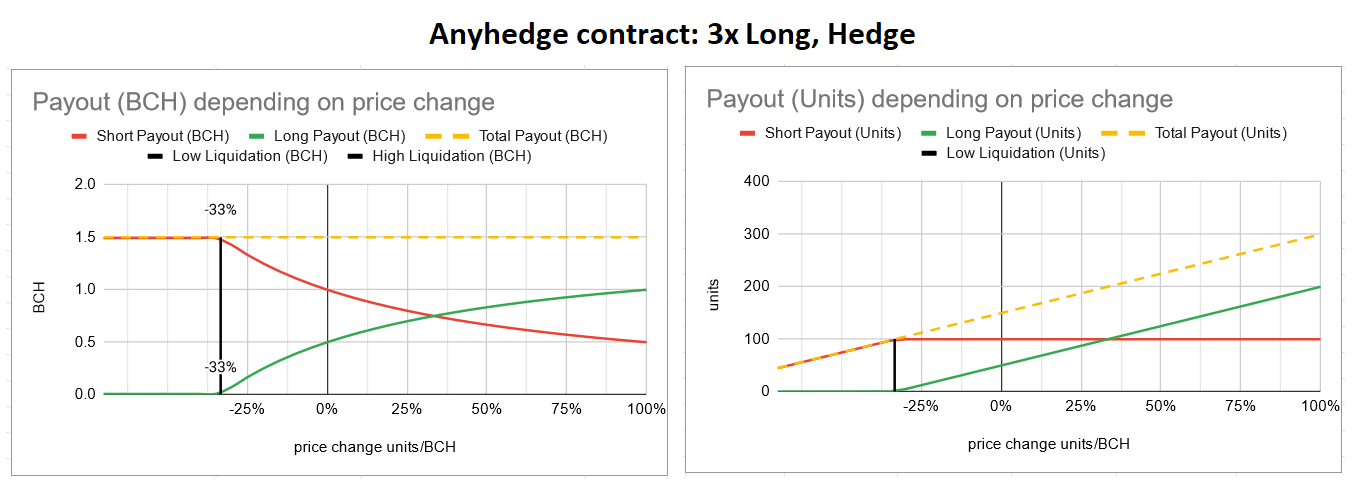
The payout graphs (in BCH and in Unit values) of a standard AnyHedge contract with a 3x long look the following way:
On the right graph, the payout for the short in Units is stable regardless of the price change - this is the exact goal of the AnyHedge contract! You can also see on the right graph that the red line and the yellow line have the same slope - they will never intersect and hence there is no high liquidation price point! The low liquidation price point is at -33% which is the inverse of the long leverage as mentioned earlier.
Payout graphs - AnyHedge Two-Sided-Leverage
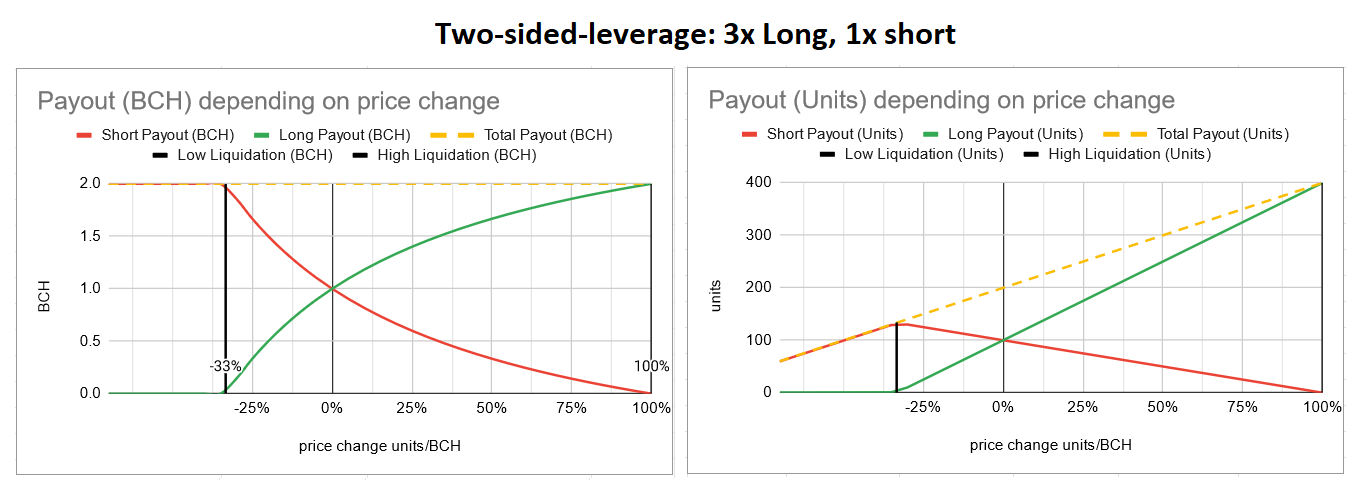
The payout graphs (in BCH and in Unit values) of a two-sided-leverage contract with a 3x long and a 2x short look like this:
Here the payout for the short is not stable in Units but instead decreasing with price. The slope of the red line is also steeper than the slope of the yellow line on the graph on the right so the high liquidation point is when the two intersect. Here that is at a 100% price increase. The low liquidation point is still the same because the leverage on the long side did not change.
The input of the Short is 1 BCH in both cases but the long side is not equivalent in both cases - the long put in 0.5 BCH in the AnyHedge contract and 1 BCH in the two-sided-leverage contract. This illustrates that twice the amount of BCH in longs can be facilitated with the same amount of BCH on the short side but with twice the leverage.
Upgraded Contract
The two-sided leverage contract was demonstrated to work with a testnet3 transaction on Sept 22nd. The testnet transaction is a 3x short and uses the General Protocols USD/BCH price-oracle. You can see the transaction details on a testnet block explorer, for example that it was 651 bytes in size. http://testnet.imaginary.cash/tx/6bde6a123b17b6bf7e32a6d3ecd4918e282581135535a1cc58c3a1ed8df422c6
The updated contract is 122 opcodes in size, coming from AnyHedge's 109 opcodes, that's an increase of 13 opcodes (~12%). This is because the contract is more general and hence requires more parameters and more involved mathematics. The payout for the short is calculated in the following way
int calculatedPayoutShort = shortInputSats
+ (shortInputSats * numeratorLeverageShort * (startingPrice - clampedPrice))
/ (clampedPrice * denominatorLeverageShort);
int shortSats = max(DUST, calculatedPayoutShort);
The upgraded contract is still in the prototype-stage of development, so it will be a while before the functionality is usable in end-user products but nonetheless we are happy to share our progress so far!
****General Protocols Blog****
This article forms part of the **General Protocols Blog**, a collection of cross-platform links showcasing our team's community activity, Bitcoin Cash projects, UTXO development, and general crypto musings. https://blog.generalprotocols.com/
BCH BULL set to launch in October 2022 - a new era of decentralised, on-chain cryptocurrency trading
The BCH BULL is a groundbreaking, non-custodial and permissionless web application on the Bitcoin Cash blockchain, allowing investors to long or hedge BCH against a number of tradeable assets, including USD, BTC, ETH, and Gold.
Utilising the AnyHedge protocol (built by General Protocols), BCH BULL will allow users to instantly create up to 10x leverage smart contracts directly with their own wallets without the need for any sign-up. On the other side of the contract, those users wishing to stabilise their purchasing power will also be able to create hedging positions against those same assets, thus providing a trustless and novel crypto stability solution, essential for risk-averse users such as merchants, miners, and other businesses operating with cryptocurrency.
Smart contracts utilising the UTXO properties of the Bitcoin Cash blockchain also offer a number of additional advantages, including being able to handle high volumes with low fees, whilst all contracts are stateless and remain independent of each other, thus improving privacy and reducing any systemic security risk.
AnyHedge, the protocol underpinning this service, has recently started public alpha testing and has already seamlessly created over 100 on-chain contracts, all executed perfectly, with a 24-hour volume of over 100 BCH. Alpha testing of AnyHedge is set to continue until 28th September 2022, with General Protocols announcing the launch date of BCH BULL will be in October 2022.
Further information about the AnyHedge and the BCH BULL application can be found through General Protocols' Twitter (**https://twitter.com/GeneralProtocol**) and Telegram (**https://t.me/generalprotocols**) pages. The AnyHedge Alpha testing is live and available to test here: **https://alpha.anyhedge.com/**

A Focus on the Bitcoin Cash Ecosystem: 04 Flipstarter
https://www.youtube.com/watch?v=NHxb5m7-DLk
Flipstarter is an open-source crowdfunding tool built on Bitcoin Cash.
Created in 2020, the tool works in a trustless, non-custodian manner to allow any fundraiser to create a campaign, and begin crowdfunding permissionlessly. https://flipstarter.cash
Being non-custodial, there are no third parties controlling the funds at any stage during the campaign. This allows those pledging money (donors) to make commitments to fund the campaign whilst retaining control of the funds until the campaign target is reached. The fundraiser sets the campaign goal, and once enough pledges are obtained to reach the goal, the funds are transferred to the fundraiser seamlessly in Bitcoin Cash without the need for further action from the donors. This is in contrast to other popular fiat-based crowdfunding sites that have stricter terms and conditions imposed.
Since Flipstarter began, it has launched hundreds of projects and campaigns, ranging from non-profit organizations to large-scale Bitcoin Cash development projects. To date, Flipstarter has raised over 12500Bch (approximately $5 million USD in value at the time of fundraising) for projects all over the world.
**Want to learn more? Follow these links:**
Official Flipstarter website
Flipstarter campaigns
Flipstarter origin story
Flipstarter Telegram group
Flipstarter Twitter https://www.nationalreview.com/news/gofundme-blocks-10-million-in-donations-to-canadian-trucker-convoy/ https://flipstarter.one.surgery https://bchn.flipstarter.cash/ https://flipstarter.cash https://flipstarters.bitcoincash.network/#/ https://read.cash/@emergent_reasons/the-flipstarter-origin-story-76d763f6 https://t.me/flipstarter https://twitter.com/flipstartercash
****General Protocols Blog****
This article forms part of the **General Protocols Blog**, a collection of cross-platform links showcasing our team's community activity, Bitcoin Cash projects, UTXO development, and general crypto musings. https://blog.generalprotocols.com/

General Protocols Sponsorship for Q3 2022
https://vimeo.com/725570214
In Q3 2022, General Protocols will support a number of on-going projects within the Bitcoin Cash community. We have a strong commitment to scale our sponsorships as revenue grows. In the future, we will evaluate further sponsorship opportunities for other worthwhile projects in the expanding Bitcoin Cash ecosystem.
Here are the projects we are supporting in Q3 2022:
Libauth: *An ultra-lightweight JavaScript library for Bitcoin, Bitcoin Cash, and Bitauth applications.*
Electron Cash: *A Bitcoin Cash Simplified Payment Verification Wallet*
cculianu/Fulcrum: *A fast & nimble SPV server for Bitcoin Cash & Bitcoin BTC.*
CashScript: *CashScript is a high-level programming language for smart contracts on Bitcoin Cash.*
BCHN: *A professional, miner-friendly node that solves practical problems for Bitcoin Cash.*
bchd/meep: *Meep is a command line Bitcoin Cash script debugger.* https://github.com/bitauth/libauth https://electroncash.org/ https://github.com/cculianu/Fulcrum https://cashscript.org/ https://bitcoincashnode.org/en/ https://github.com/gcash/meep
****General Protocols Blog****
This article forms part of the **General Protocols Blog**, a collection of cross-platform links showcasing our team's community activity, Bitcoin Cash projects, UTXO development, and general crypto musings. https://blog.generalprotocols.com/

A Focus on the Bitcoin Cash Ecosystem: 03 Bitcoin Cash Node (BCHN)
https://www.youtube.com/watch?v=khH6iXyIU00
**What is a node?**
A cryptocurrency ecosystem consists of nodes, miners, and clients (be it exchanges, applications, or end-users). Nodes fulfill a very important role within this ecosystem.
A node is a computer running software that follows a common set of network rules, connecting and exchanging information with other computers which share the rules. Together, they host and synchronise entire copies of the blockchain. Nodes are essential for keeping a cryptocurrency network running and allowing miners to create blocks with the transactions stored in the node.
**What is Bitcoin Cash Node?**
Bitcoin Cash Node (BCHN), created in 2020 is a node with open source code, dedicated specifically to the Bitcoin Cash network. It is a professional and reliable node, practical for both miners and other clients. Furthermore, through the ASERT upgrade, BCHN produces blocks at more reliable intervals.
A lead maintainer and community of senior developers not only maintain the node but also participate in research and development of the Bitcoin Cash network.
**What other nodes are within the BCH ecosystem?**
The BCH ecosystem uniquely recognizes and encourages the development of multiple node implementations. Here are some of the other nodes that increase decentralization of the network and meet specific client needs:
BCHD
Bitcoin Verde
Bitcoin Unlimited
Flowee the Hub
Knuth
**Want to learn more? Follow these links:**
Documentation for BCHN
Blockchain: What are nodes and masternodes?
https://bitcoincashnode.org/ https://upgradespecs.bitcoincashnode.org/2020-11-15-asert/ https://bchd.cash/ https://bitcoinverde.org/ https://bitcoinunlimited.info/ https://flowee.org/hub/ https://kth.cash/ https://docs.bitcoincashnode.org/ https://medium.com/coinmonks/blockchain-what-is-a-node-or-masternode-and-what-does-it-do-4d9a4200938f
A Focus on the Bitcoin Cash Ecosystem: 02 Electron Cash
https://www.youtube.com/watch?v=VLRcrZ5oC8Y
**What is Electron Cash?**
Electron Cash is a free, powerful, feature-rich, and open-source Bitcoin Cash wallet.
**What are the features that make it special?** https://electroncash.org
***Privacy***
Electron Cash integrates CashFushion to maximise the privacy of transactions. https://cashfusion.org
***Multi-signature support***
Spending from Electron Cash can be limited to requiring multiple signatures, thus protecting the wallet from abuse if additional protection is needed.
***Cryptographic messaging and signatures***
Through the wallet, users can send messages privately and securely through cryptographic methods, as well as use this for authentic signatures.
***Human-readable account names***
Electron Cash supports Cash Accounts, allowing for human-readable account names that are easy to share in conversation.
***Import and export records***
The ability to import and export transaction records facilitates financial records and accounting, particularly helpful for tax purposes.
***Decentralized servers***
*Electron Cash servers are decentralized and redundant. The wallet is never down.*
***Desktop and mobile versions***
Electron Cash has desktop versions for Windows, OSX, and Linux, as well as Android and iOS versions for mobile.
***Supports all major hardware wallets***
Make full use of hardware wallets such as Ledger and Trezor without connecting to proprietary services.
***Integrates plugins and smart contracts***
Electron Cash works with applications such as Flipstarter, and smart contracts for timed transfers, last will, and recurring payments.
**Want to learn more? Check out the links and tutorials below:**
Download Electron Cash: https://electroncash.org/
YouTube Tutorials:
1. Introduction
2. Creating a Standard Wallet
3. The History Tab
4. Sending and Receiving
5. Cold Storage Wallets
6. Recovering a Wallet, Creating a Watch Only Wallet
7. Creating a Hardware Wallet
8. The Tools Menu
9. Creating a Multi-Signature Wallet
10. Messaging
11. Preferences
12. Wallet Drop-Down and Contacts
13. CashShuffle https://www.cashaccount.info/ https://flipstarter.cash https://github.com/KarolTrzeszczkowski/Inter-Wallet-Transfer-EC-plugin https://github.com/KarolTrzeszczkowski/Electron-Cash-Last-Will-Plugin https://github.com/KarolTrzeszczkowski/Mecenas-recurring-payment-EC-plugin https://www.youtube.com/watch?v=iQ8BXrzAwDQ https://www.youtube.com/watch?v=gnN6OciOM6w https://www.youtube.com/watch?v=spkEet_CC3E https://www.youtube.com/watch?v=oQCllJjH4yk https://www.youtube.com/watch?v=GjYjCcPXI_4 https://www.youtube.com/watch?v=gQrv__rUMIE https://www.youtube.com/watch?v=V7r1veDM2RQ https://www.youtube.com/watch?v=pINiDeTNdzs https://www.youtube.com/watch?v=kOc0uclioGM https://www.youtube.com/watch?v=l847D7SQVD4 https://www.youtube.com/watch?v=O1O0-BN-aDA https://www.youtube.com/watch?v=fGhuBWdXjmQ https://www.youtube.com/watch?v=IJlAas387SE
****General Protocols Blog****
This article forms part of the **General Protocols Blog**, a collection of cross-platform links showcasing our team's community activity, Bitcoin Cash projects, UTXO development, and general crypto musings. https://blog.generalprotocols.com/

General Protocols Sponsorship for Q2 2022
https://vimeo.com/695122945
In Q2 2022, General Protocols will continue to support the projects from Q1 2022. We have a strong commitment to scale our sponsorships as revenue grows. In the future, we will evaluate further sponsorship opportunities for other worthwhile projects in our expanding Bitcoin Cash ecosystem.
Here are the projects we are supporting in Q2 2022:
Spedn: *Spedn is a high level smart contracts language for Bitcoin Cash. It is designed for explicitness and safety*
Libauth: *An ultra-lightweight JavaScript library for Bitcoin, Bitcoin Cash, and Bitauth applications.*
Electron Cash: *A Bitcoin Cash Simplified Payment Verification Wallet*
cculianu/Fulcrum: *A fast & nimble SPV server for Bitcoin Cash & Bitcoin BTC.*
CashScript: *CashScript is a high-level programming language for smart contracts on Bitcoin Cash.*
BCHN: *A professional, miner-friendly node that solves practical problems for Bitcoin Cash.*
bchd/meep: *Meep is a command line Bitcoin Cash script debugger.* https://read.cash/@GeneralProtocols/general-protocols-sponsorship-for-q1-2022-ec4d48c4 https://bitbucket.org/o-studio/spedn/src/develop/ https://github.com/bitauth/libauth https://electroncash.org/ https://github.com/cculianu/Fulcrum https://cashscript.org/ https://bitcoincashnode.org/en/ https://github.com/gcash/meep
****General Protocols Blog****
This article forms part of the **General Protocols Blog**, a collection of cross-platform links showcasing our team's community activity, Bitcoin Cash projects, UTXO development, and general crypto musings. https://blog.generalprotocols.com/

A Focus on the Bitcoin Cash Ecosystem: 01 CashScript
https://www.youtube.com/watch?v=f8H6LDnY6t4
**What is CashScript?**
CashScript is a high-level programming language for smart contracts on Bitcoin Cash. Bitcoin Cash transactions run on a virtual machine called Bitcoin Cash Script. Unfortunately, writing bytecode for this virtual machine is difficult and error-prone. However, CashScript offers a strong abstraction for writing Bitcoin Cash smart contracts, improving developer experience and reliability of contracts.
Its syntax is based on Ethereum's smart contract language Solidity, but its functionality is very different since smart contracts on Bitcoin Cash differ greatly from smart contracts on Ethereum.
**What is the potential for smart contracts on BCH?**
Smart contracts on Bitcoin Cash are stateless and UTXO-based. This model allows transactions to be verified independently and efficiently. Because there is no state that can impact the execution of these smart contracts, the results are deterministic and predictable.
Because of Bitcoin Cash' UTXO-based model, each contract is fully independent and isolated from each other. This limits systemic risk and makes contract upgrades much simpler. Furthermore, Bitcoin Cash contracts use P2SH, preserving the privacy of participants.
**DeFi on Bitcoin Cash using CashScript**
Most DeFi applications are currently running on top of Ethereum. Bitcoin Cash contracts use a different and functionally more limited paradigm. But with techniques such as covenants, state simulation and trust-minimised price oracles, DeFi is very much possible on Bitcoin Cash.
**Want to learn more? Check out the links below including the playround to test out your new CashScripts!**
Website: https://cashscript.org/
Documentation: https://cashscript.org/docs/basics/about/
Git: https://github.com/Bitcoin-com/cashscript
Playground: https://playground.cashscript.org/
YouTube CashScript tutorials: https://www.youtube.com/channel/UCiwS6FM9_JHomdgL2xXjrVQ
Further reading: https://kalis.me/smart-contracts-eth-btc-bch/
****General Protocols Blog****
This article forms part of the **General Protocols Blog**, a collection of cross-platform links showcasing our team's community activity, Bitcoin Cash projects, UTXO development, and general crypto musings. https://blog.generalprotocols.com/

General Protocols' Bitcoin Cash Strategy: An Update
About half a year ago, we wrote A Peer-to-Peer Cash Strategy. In that document, we laid out our plans to develop tools for the Bitcoin Cash ecosystem, coupling the need for value stability in mass-adoption, the need for decentralized speculation, and the need for better tools in general. https://read.cash/@GeneralProtocols/a-peer-to-peer-cash-strategy-for-general-protocols-eebcec51 https://bch.info/en/
A lot has happened since then. SmartBCH, an Ethereum Virtual Machine (EVM) based sidechain built on BCH, is now growing at a breakneck pace, offering numerous smart contract features readily portable from some of the largest ecosystems out there. We at General Protocols have observed the development closely, and even built parts of its infrastructure by developing a well-known bridging service, hop.cash. https://smartbch.org/ https://generalprotocols.com/ https://hop.cash
Even with all the excitement surrounding SmartBCH, we remain committed to pushing for success on mainchain BCH. Here is why.
Permissionless Electronic Cash
General Protocols is a company founded, funded and staffed by lovers of permissionless money. Building a successful permissionless money is not an easy job:
It must remain accessible and affordable to everyone on the planet;
It must eventually fill all the usecases we expect money to fill, and perhaps facilitate new ones not imagined before;
It must not have any single points of failure whether technical, economic or development;
It must have the necessary qualities for a currency to thrive in some capacity, such as fungibility, privacy, stability and liquidity.
We have supported many efforts throughout the BCH ecosystem that contribute to these, and our own AnyHedge smart contract setup seeks to make various Bitcoin Cash usecases in commerce easier by marrying speculation and stability. https://anyhedge.com/
The Role of SmartBCH
SmartBCH, the first sidechain on BCH, shares with the mainchain in its ambition for massive scaling, while differing in many other ways. It is account-based instead of UTXO-based, the language emphasizes Turing-completeness instead of performance, its consensus is partially stake based and subject to elections instead of pure proof-of-work. Most importantly, it allows access to a wealth of existing tools and developers that would be difficult to replicate on a relatively unfamiliar platform. We see this difference as a strength. BCH will thrive as a form of money moving between both chains with increasing frequency, flowing to where its usecases fit best, accruing value to holders, users and businesses alike.
The Mainchain Strategy
While it has generated a lot of excitement, we believe SmartBCH complements instead of replaces mainchain BCH's role in becoming permissionless money. Mainchain remains superior, in our opinion, in terms of scalable architecture that serves everyone, as well as privacy, decentralized development and cash-like usecases that are all vital for our mission as a company. In terms of application development though, mainchain is indeed in a far less mature state than the EVM world. We intend to change that, and we will blaze the trail with tools for people to use.
Our Near-term Strategy: Facilitating Businesses on BCH
One thing we realized running General Protocols over the years is the difficulty of running a business, or indeed any organization at all, on cryptocurrency. We cannot have a permissionless economy without an increasing number of organizations and businesses conducting business in the new monetary system.
Yet any organization wishing to operate on crypto faces many hurdles. Not only are monetary properties such as volatility and liquidity hurting their operations, they also lack many of the essential, mature services enjoyed by the fiat world such as accounting, easy exchange, and smooth, intuitive UI in accessing a variety of tools. Where these tools are available, they often come in custodial, privacy-destroying and often shockingly censorable forms.
At General Protocols, we believe things do not have to remain this way. Starting with BCH Bull and going beyond, we will develop more products that promote organization and business in a permissionless way. These tools may be more difficult to build than their custodial counterparts, but we believe the permissionless aspect will increasingly add value for users, as well as contribute to our competitiveness as a company. https://bchbull.com/
Support for BCH Development
As our strategy continues to be centered around proof-of-work, UTXO-based mainchain BCH, we look forward to a number of important consensus developments that can greatly enhance BCH's scripting and scaling properties. Native Introspection and 64-bit integer operations, slated to activate this May, already provide great value to our upcoming products as well as many other projects such as SmartBCH's SHA-Gate and Mathieu's smart contract version of the Flipstarter assurance contract. We currently watch with great interest some CHIPs aiming for 2023 activation that bring further important enhancements, and will support many of their efforts as they make their way through the CHIP process. https://gitlab.com/GeneralProtocols/research/chips/-/blob/master/CHIP-2021-02-Add-Native-Introspection-Opcodes.md https://gitlab.com/GeneralProtocols/research/chips/-/blob/master/CHIP-2021-02-Bigger-Script-Integers.md https://bch.info/upgrade https://github.com/mr-zwets/p2shAssuranceContract https://bch.info/en/chips
Here's to a great 2022 for BCH!
****General Protocols Blog****
This article forms part of the **General Protocols Blog**, a collection of cross-platform links showcasing our team's community activity, Bitcoin Cash projects, UTXO development, and general crypto musings. https://blog.generalprotocols.com/

General Protocols Sponsorship for Q1 2022
As part of our ecosystem sustainability commitment, General Protocols sponsor projects we depend on.In Q1 2022, we are proudly supporting:
bchd/meep: Meep is a command line Bitcoin Cash script debugger
BCHN: A professional, miner-friendly node that solves practical problems for Bitcoin Cash.
CashScript: CashScript is a high-level programming language for smart contracts on Bitcoin Cash.
cculianu/Fulcrum: A fast & nimble SPV server for Bitcoin Cash & Bitcoin BTC.
Electron Cash: A Bitcoin Cash Simplified Payment Verification Wallet
Libauth: An ultra-lightweight JavaScript library for Bitcoin, Bitcoin Cash, and Bitauth applications.
Spedn: Spedn is a high level smart contracts language for Bitcoin Cash. It is designed for explicitness and safety
****General Protocols Blog****
This article forms part of the **General Protocols Blog**, a collection of cross-platform links showcasing our team's community activity, Bitcoin Cash projects, UTXO development, and general crypto musings. https://github.com/gcash/meep https://bitcoincashnode.org/en/ https://cashscript.org/ https://github.com/cculianu/Fulcrum https://electroncash.org/ https://github.com/bitauth/libauth https://bitbucket.org/o-studio/spedn/src/develop/ https://blog.generalprotocols.com/

AnyHedge Case Study: The Positive Impact of Native Introspection and Better Math
As discussed recently on BCH Network Discussions, scripting for Bitcoin Cash is likely to improve in the next network upgrade with native introspection and better math. Let's use the AnyHedge smart contract to see how these upgrades can increase the utility and value of BCH. https://www.youtube.com/watch?v=e1l_7rpaUL4 https://gitlab.com/GeneralProtocols/research/chips/-/blob/master/CHIP-2021-02-Add-Native-Introspection-Opcodes.md https://gitlab.com/GeneralProtocols/research/chips/-/blob/master/CHIP-2021-02-Bigger-Script-Integers.md https://anyhedge.com
Past Trade-Offs
The basic design of the AnyHedge contract is very simple - just a handful of calculations. In 2019, using @pein 's accessible description of BCH smart contracts and Spedn compiler, we wrote the first pseudo-code of the contract in about an hour, and converted it to a real contract in about a day. The result looked good, but as we have written before in "What kind of limits does BCH scripting have?", scripting limitations made the simple version of the contract behave badly in terms of precision and how much value the contract could handle. Additionally, the contract code was large and complex due to the covenant technique that enables meaningful smart contracts. https://read.cash/@pein/bch-covenants-with-spedn-c1170a02 https://spedn.readthedocs.io/en/latest/ https://read.cash/@GeneralProtocols/raising-the-bar-on-bitcoin-cash-upgrades-ae04238f#appendix-what-kind-of-limits-does-bch-scripting-have
We made some painful trade-offs, switched to the CashScript compiler and ended up with reasonable precision and larger values at the expense of greatly increased complexity that you can read about in the contract, increased size that led to fewer features, and complex contract boundaries that we analyzed at great length. https://cashscript.org/ https://gitlab.com/GeneralProtocols/anyhedge/contracts/-/blob/development/contracts/v0.11/contract.cash#L166 https://read.cash/@GeneralProtocols/anyhedge-safe-boundaries-for-contracts-c1934825
The small section of the AnyHedge contract in the image gives a sense of the complexity needed to make AnyHedge functional given the contract limitations.
Regarding covenant technique, the CashScript compiler does a great job of handling it, but all the size and complexity is still there in the final low level code.
The combination of contract complexity and covenant technique used up all the space available in scripting limits, forcing us to put aside ideas such as tradeable contracts which required more code and data.
Let's look at what happens if we get the network upgrades.
Native Introspection - Safe, Efficient, Fun for Builders
Transaction Introspection, whether native or not, allows us to inspect the details of the current transaction within a script. This technique is the heart of BCH smart contracts. Picking out one specific example of how the change from Non-Native to Native Introspection affects AnyHedge, we will focus on the one-input rule. Detailed technical changes made possible for the AnyHedge contract are here. https://gitlab.com/GeneralProtocols/anyhedge/contracts/-/merge_requests/11/diffs
Ensuring that the entire payout of a contract comes from exactly one input is an important design decision for AnyHedge. It enforces the best practice of funding a contract in a single transaction instead of the risky prospect of the two parties funding a contract separately. It also removes exploit possibilities involved with handling multiple inputs.
The idea is simple, and with Native Introspection, the high level code is equally simple:
# With Native Introspection
# Directly confirm that there is exactly one input
require(tx.inputs.length == 1)
With the current scripting system using non-native introspection, it only takes about two lines of high level code to get the same result, but there is a large amount of complexity and inefficiency hiding behind it:
# Without Native Introspection
# First, perform the technique that enables non-native introspection.
# This is actually handled internally by CashScript but shown
# as pseudo-code for the purposes of this article.
require(checkSig(signature, publicKey))
require(checkDataSig(signature, preimage, publicKey))
# Indirectly confirm that there is exactly one input
require(tx.hashPrevouts == hash256(tx.outpoint))
Explanation below:
***Warning***: Without native introspection, we need to use the non-native introspection technique. A full explanation would take a lot of space, but we have tried to include just enough to make it clear how much work and complexity is involved. You can just scan the description if you would like to go on with the rest of the article.
Before thinking about the details of ***what*** information we want to introspect in the transaction data, we need access to the transaction data itself. In current scripting, there is no direct access to general transaction data except through one point - the signature of the current input, and this is quite indirect access. The first step is to do the standard confirmation that the user-provided signature (generated by your wallet) matches the internal data available to the validating node. Note that we don't provide the data because the validating node is comparing against its internal representation of the transaction:
`require(checkSig(signature, publicKey))`
Now we have a critical piece of information - that the signature is based on data that exactly matches the inaccessible transaction data.
That allows us to do the second step of the non-native introspection technique - confirm that the same signature matches the data that ***we*** provide to the script. We have called our data "preimage" in line with the naming used for the same data that is internal to the validating node:
`require(checkDataSig(signature, preimage, publicKey))`
We have convinced the script that it has a piece of data from the user that exactly matches the actual data of this transaction. Only now, we can move on to the introspection part.
Unfortunately, the introspection part is also complex. We have the preimage but it is not a convenient data construct. It is just a blob of data. There is a significant part of the code not shown that cuts the preimage data up into smaller pieces in order to get just the parts that we need. This process is very risky for non-expert programmers as it opens up vectors for attack with maliciously constructed preimage data.
We will move on and assume that we have extracted two key pieces of information from the user-provided preimage. This last step is the third puzzle that we need to solve on the way to our goal - confirm that the transaction has exactly one input:
`hashPrevouts` is the hash of ***all inputs*** in this transaction. That is the only piece of information available about the inputs. It is only a hash so we can't check anything directly about the contents. We will have to reconstruct the actual contents ourselves and confirm that the hash of the actual contents matches this value.
`outpoint` which confusingly is the ***current input*** that the script is handling (scripts handle one input at a time).
Finally we can confirm that the the hash of all inputs (the only information available about all inputs) is equal to the hash of the current input:
`require(tx.hashPrevouts == hash256(tx.outpoint))`
(End of technical section)
After all of that, we have finally confirmed that the two hashed values are indeed equal. In other words, we confirmed that this one input is equal to all transaction inputs. In other words, we confirmed that there is exactly one input.
To reinforce the point, here again is the same result using Native Introspection where the script is allowed access to the data instead of going through an elaborate process:
// With Native Introspection
require(tx.inputs.length == 1)
**Safe**: The low level code, whether created by a scripting wizard or a compiler, is much less complex, with less attack surface for exploits.
**Efficient**: For the network, the transaction itself is smaller and nodes can execute the contract faster, using significantly less resources. Especially, native introspection reduces signature and hashing operations which are by far the most expensive things a script can do.
It is important to note that above we described the changes involved with a single line of code. *****There are more changes in the AnyHedge contract, and the reduction in complexity is similar for every one of them********.***
**Fun for Builders**: Native Introspection removes a lot of concern and worry from the app building process, making it more fun and attractive to developers and entrepreneurs.
Big Numbers - Safe, Precise, Fun for Builders
Bigger numbers is the main part of the proposed math upgrade for BCH scripting. In straightforward terms, scripts currently are limited to 32 bit numbers. The upgrade allows 64 bit numbers. Detailed technical changes made possible for the AnyHedge contract are here. https://gitlab.com/GeneralProtocols/anyhedge/contracts/-/merge_requests/12/diffs
To provide an example of why this is important, consider the size of numbers when dealing with Satoshis (all value numbers in transactions are Satoshis):
// Biggest positive 32 bit number = (2^31)-1
2,147,483,647
// Size of 1 BCH in Satoshis = 10^8
100,000,000
// Biggest positive 64 bit number = (2^63)-1
9,223,372,036,854,775,807
You can see that the 32-bit number and 1 BCH are very close in size. The result is that even the most simple calculations cannot deal with more than 21 BCH directly. With the still basic calculations that AnyHedge needs to do, the amounts that a script can handle directly are much much smaller. Without deriving all the details, an AnyHedge contract would only be able to handle a $0.21 cent contract.
Not only size, but also precision of calculations is a critical issue in scripts because there is no such thing as decimal places. Everything is done in terms of whole numbers. In other words, 3/4 is not equal to 0.75. It is equal to zero with a remainder of 3.
Explaining the size and precision issues in detail would take many pages of discussion. As a proxy for that, if you are interested you can read the following:
Discussion of size issues in the comments of the contract code https://gitlab.com/GeneralProtocols/anyhedge/contracts/-/blob/development/contracts/v0.11/contract.cash#L166
Discussion of size issues also including precision issues in the AnyHedge analysis done by Licho. https://anyhedge.com/downloads/AnyHedge%20Numerical%20Analysis.pdf https://twitter.com/KTrzeszczkowski
**Safe, Precise, Fun for Builders**: Most of the issues involved in complexity, size and precision simply go away with the scale of 64 bit numbers. In other words, it will be harder for a smart contract developer to make mistakes. With AnyHedge specifically, the contract will be able to handle a much larger range of values. For example with USD it will handle contracts from cents to billions of dollars, and the calculations will be precise across the range. Again, it can't be emphasized enough that app development becomes more accessible and engaging by removing the sharp edges.
Multiplication - Wait, We Didn't Have Multiplication?
Bitcoin has not had multiplication since 2010 when a chainsplit-causing bug was found with the "left shift" operator. When removing that operator, a long list of other operators were also removed, including multiplication. https://github.com/bitcoin/bitcoin/commit/4bd188c4383d6e614e18f79dc337fbabe8464c82#diff-27496895958ca30c47bbb873299a2ad7a7ea1003a9faa96b317250e3b7aa1fefR104
In addition to Big Numbers, the math upgrade also brings back the multiplication operator. Detailed technical changes made possible for the AnyHedge contract are here. https://gitlab.com/GeneralProtocols/anyhedge/contracts/-/merge_requests/13/diffs
Regarding effects on AnyHedge, the current AnyHedge contract uses pre-multiplied numbers which are then divided in the contract as a kind of fake multiplication. Switching from division-as-fake-multiplication to actual multiplication, AnyHedge behavior mostly stays the same on the surface. However the precision improves significantly due to a subtle issue involving how prices are represented. For example with USD, currently prices are represented as Cents per BCH. With multiplication, we get better precision of Satoshis per Cent.
By the Numbers
When CashScript has upgraded to work on testnet with the introspection and math upgrades, we will update this article or publish a new one that measures in detail what the efficiency gains are and show more definitively how much simpler the final low level code will be.
Easier to write UTXO contracts for #everyone, not just us
We hope that the examples above convinced you about the improvements in complexity, size and safety that the upcoming upgrade brings. Importantly, this is much more than just us or our contracts: developers who spend less time worrying about complex bugs, who have more space to work with, and generally have an easier time writing contracts are happy developers. Expect to see more diverse apps using smart contracts on the BCH main chain.
"Yes" to Native Introspection and Better Math
Ten months ago, General Protocols made and published a painful decision not to support the above improvements for BCH Network in the 2021 May upgrade ("Raising the Bar on Bitcoin Cash Upgrades"). We thought that prioritizing the stability of the network and establishment of the CHIP process were more important steps toward long term success. Now that the CHIP process is becoming more accepted as a replacement for central decision making, General Protocols very much looks forward to these improvements that will be useful not only AnyHedge, but all BCH smart contracts. https://read.cash/@GeneralProtocols/raising-the-bar-on-bitcoin-cash-upgrades-ae04238f https://gitlab.com/im_uname/cash-improvement-proposals/-/blob/master/CHIPs.md https://bch.info/en/chips
****General Protocols Blog****
This article forms part of the **General Protocols Blog**, a collection of cross-platform links showcasing our team's community activity, Bitcoin Cash projects, UTXO development, and general crypto musings. https://blog.generalprotocols.com/
https://blog.generalprotocols.com
AnyHedge Version 2.0 Coming Soon
General Protocols will soon be releasing an upgrade to its AnyHedge protocol.
Version 1.0 Successes
After releasing the beta version over one year ago, and then version 1.0 at the end of 2020, the AnyHedge protocol has successfully: https://read.cash/@GeneralProtocols/anyhedge-beta-is-live-0b4e9379 https://read.cash/@GeneralProtocols/general-protocols-launches-production-oracle-a8b62709
Settled **7,456 contracts**
Handled **23,162 BCH** with zero BCH lost ($15,220,000 USD at the time of contracts)
Published **500,000 prices messages** across a period of 45,000 blocks
The version 1 infrastructure is now deprecated and will be phased out with the release of version 2.0.
Version 2.0 Upgrade
Version 2.0 will make the user experience better with the following upgrades:
Contract maturity is now centered around timestamps rather than blocks. This required some surprisingly interesting technical and specification changes, and the end result makes contract timing much more predictable and precise.
Along with the infrastructure changes, version 2.0 will come with an all-in-one white label solution that allows anyone to operate an AnyHedge stability/speculation platform.
Other upgrades which you can follow in the open source history. https://gitlab.com/generalprotocols/anyhedge/
****General Protocols Blog****
This article forms part of the **General Protocols Blog**, a collection of cross-platform links showcasing our team's community activity, Bitcoin Cash projects, UTXO development, and general crypto musings. https://blog.generalprotocols.com/
https://blog.generalprotocols.com
Stability Solutions: An Overview
Defined broadly, stablecoins are any fungible, transferable tokens that are closer to major fiat currencies in terms of price stability, than to cryptocurrencies which can fluctuate greatly in value on a day-to-day basis. While cryptocurrency speculation is driven in no small part by price volatility, wild swings in price have worked against their adoption as both units of account and mediums of exchange.
A merchant who wishes to take advantage of cryptocurrency's desirable properties yet minimize exchange risk in the process has several options available to them which we will explore here.
Keep the Coins
The most straightforward approach for a merchant is to not exchange the cryptocurrency they received whatsoever, treating it as any other monetary instrument, spending it on expenses or distributing it to investors. This approach takes advantage of the original design of most established cryptocurrencies, allowing for the permissionlessness, simplicity and noncustodial security promised. Despite the numerous advantages to simply keeping and using all received crypto, not every business can afford to stomach the accompanying volatility. This practice is therefore typically limited to cryptocurrency-related businesses, businesses where permissionlessness and privacy command enough premium to overcome volatility, or businesses that can afford to keep enough liquidity as buffer relative to their crypto volume.
Adoption of the simple "keep the coins" practice greatly lowers development complexity, and is the default for a number of payment processing services.
Examples: Bitcoin Cash Register, Coinbase Commerce, Coinpayments.net https://www.bitcoin.com/bitcoin-cash-register https://commerce.coinbase.com/
Exchange to Fiat
An option that has been with the cryptocurrency scene since the beginning, a direct exchange to fiat currencies such as the US dollar effectively turns the transaction into a fiat payment with extra cryptocurrency steps. As effective as the local fiat of the merchant, it cancels out many of the advantages of using crypto, often leading to a worse experience for merchants than straight fiat transactions.
While exchanging to fiat greatly increases regulatory burden and complexity, companies that have successfully gained a toehold providing the service can be quite profitable with a reasonably deep moat against competitors.
Example: BitPay, GoCrypto https://bitpay.com/ https://elly.com/crypto
Custodial Stablecoins
Very popular among exchanges and sometimes presented as viable merchant solutions, custodial stablecoins are fungible tokens issued by organizations who hold non-crypto assets as backing for tokens that are pegged to fiat value. They may carry some of the desirable properties of permissionless cryptocurrency as long as their issuing organization remains solvent.
Frowned upon by many due to their single points of failure and regulatory risk, custodial stablecoins are nevertheless very straightforward to understand, use and take advantage of in more complex schemes, making them a popular choice among traders and speculators.
Examples: USDT, USDC, BUSD
Algorithmic Stablecoins
Touted as permissionless alternatives to custodial stablecoins, algorithmic stablecoins typically issue tokens that are redeemable against over-collateralized backing assets via smart contract.
A wide range of value stabilization mechanisms are experimented, with some adventurous tokens even challenging the concept of over-collateralization as a basis of value. Their dependency on ownerless smart contracts instead of a single custodial gatekeeper generally underlies their claim to permissionlessness, although the precise algorithm and quality of the underlying assets can affect that claim on a case by case basis.
Theoretically solving some of the issues associated with custodial stablecoins, their increased complexity and the fact that they come with their own single-point-of-failure risks has limited their usage.
Example: DAI, UST
Distributed derivative contracts
Instead of exchanging volatile cryptocurrency into more a more stable medium, another way to reduce risk is to participate in a hedging contract, where volatility is transferred from the stability-seeking hedging party to a speculator with appetite for risk. A practice long used in the commodity world, hedging contracts offer a very different approach to hedging. Each contract is independent from another, offering maximum flexibility in parameters, while also eliminating the single point to failure typically found in pegs of fungible tokens. Using contracts instead of fungible tokens is typically a more complex and involved process for the hedger, although the process can potentially be abstracted by software.
A budding approach that has few players, hedging contracts has been field-tested and is currently pioneered by General Protocols on the Bitcoin Cash chain.
Example: AnyHedge on Bitcoin Cash https://anyhedge.com/
Comparison
These approaches can be evaluated in terms of the following criteria:
****General Protocols Blog****
This article forms part of the **General Protocols Blog**, a collection of cross-platform links showcasing our team's community activity, Bitcoin Cash projects, UTXO development, and general crypto musings. https://blog.generalprotocols.com/
https://blog.generalprotocols.com
A peer-to-peer cash strategy for General Protocols
At General Protocols, we are fans of spreading crypto as cash, money that not only can be used, but *is* used permissionlessly everywhere. With its track record of maintaining affordable fees, permissionlessness and neutrality, Bitcoin Cash has always been an obvious choice for us. https://generalprotocols.com/ https://www.bitcoin.com/bitcoin.pdf
When we founded General Protocols two years ago, though, we saw two obvious problems not just with Bitcoin Cash, but with any cryptocurrency:
The value of cryptocurrencies fluctuates too much, making them difficult to adopt as direct alternatives to traditional fiat whether online or offline. Merchants who wish to have manageable levels of risk have to go through complex maneuvers that often conflict with the goals of lowering friction, permissionless transactions and lowering transaction costs, canceling some of the core competencies of crypto.
The wild west of cryptocurrency speculation is almost absurdly huge in size, with a correspondingly huge amount of liquidity flowing through the market, yet it contributes little towards crypto's most world-changing quality: its adoption as money.
Bitcoin Cash does have a few tricks up its sleeve, among them re-enabled math operations at a protocol level, and an additional opcode over BTC: OP_CHECKDATASIG. We soon realized, through discussion with many of our brilliant peers, a way to use this protocol advantage to merge speculation and value stabilization in a way never seen before. AnyHedge (whitepaper) is the first among many tools that will contribute towards this vision. https://anyhedge.com/how-it-works/#simulator https://AnyHedge.com/downloads/AnyHedge%20Whitepaper.pdf
Describing the tool on a high level, though, is only the first step. We understand that in order to make a meaningful impact, we must get traders, merchants and users to participate at scale, and we must build the tools to enable them - nobody is going to do it for us!
Building on this vision, we have since released or maintained:
Electrum-Cash, an open source tool for web clients to interface with a redundant network of BCH nodes for robustness https://www.npmjs.com/package/electrum-cash
AnyHedge Library, an open source tool for creating, redeeming and conducting other operations on AnyHedge contracts https://www.npmjs.com/package/@generalprotocols/anyhedge
BCH Price Oracle Library, an open source tool for creating and using price messages that are tailor-made for the BCH context. In addition, a novel and complete specification (currently being updated from block-based to time-based), and operation of multiple publicly available price oracles. https://www.npmjs.com/package/@generalprotocols/price-oracle https://gitlab.com/GeneralProtocols/priceoracle/specification https://read.cash/@GeneralProtocols/general-protocols-launches-production-oracle-a8b62709
An automated, battle-tested AnyHedge redemption service that is available through the AnyHedge Library
Last but not least, a collaboration with Detoken that demonstrated the viability of AnyHedge in a non-custodial, user-friendly context.
These were all important steps, yet we need more. We have to bring more users, more liquidity to this vision, in a way that is easier to adopt for businesses and users alike.
Going forward, stay tuned for:
Small, adaptable projects and collaborations where AnyHedge is used in novel contexts. Defi is for everyone, not just traders!
More trading pairs and tools that learn from our Detoken experience
A generalized, non-custodial BCH platform that not only enables AnyHedge, but is also adaptable to a variety of other Defi products for truly peer-to-peer use cases.
We are also watching the new sidechain project, SmartBCH, with great interest. We believe the UTXO model on native BCH chain offers unique advantages compared to SmartBCH's EVM, and see them as complementary. So while we remain committed to executing our vision on the main BCH chain, we will also explore possibilities on SmartBCH. https://smartbch.org/
Bitcoin Cash is blooming, and we intend to continue playing an important role in it for the months and years to come. We hope you are as excited as we are!
****General Protocols Blog****
This article forms part of the **General Protocols Blog**, a collection of cross-platform links showcasing our team's community activity, Bitcoin Cash projects, UTXO development, and general crypto musings. https://blog.generalprotocols.com/
https://blog.generalprotocols.com


Wrapping up the Detoken Partnership, and Great Things to Come
2021-August-5
December 2020 was a memorable time for both General Protocols and Bitcoin Cash (BCH). Detoken, an adventurous small exchange, was the first to use General Protocols' AnyHedge infrastructure to open a non-custodial derivative pair to the public. It was the culmination of many months of hard infrastructure work by General Protocols and application work by Detoken.
The AnyHedge protocol takes advantage of smart contract capabilities and the reliably low fees on the BCH network. As the first users of AnyHedge, Detoken offered a peek into what BCH is capable of. Being the first of anything comes with unique opportunities and growing pains, especially in such uncharted territories - together with Detoken we got BCH to where nobody has ever been.
Now, the partnership is coming to an end as the Detoken crew pursue other opportunities. We at General Protocols are thankful for the experience and proof of concept that resulted from this partnership - they will prove valuable in our upcoming product releases.
Stay tuned as we crank out more awesome things, both AnyHedge-related and beyond, in the upcoming months. We are aiming high, and definitely not stopping here.
****General Protocols Blog****
This article forms part of the **General Protocols Blog**, a collection of cross-platform links showcasing our team's community activity, Bitcoin Cash projects, UTXO development, and general crypto musings. https://blog.generalprotocols.com/
https://blog.generalprotocols.com


General Protocols Statement on "CHIP-2021-02 Group Tokenization for Bitcoin Cash"
**Overall statement**
A lot of work and research has gone into the technical specification of this CHIP. However, in its current form, GP does not think it is simple / minimal enough to be considered for acceptance into the network. Furthermore, important sections about costs, risks and alternatives are incomplete or have wrongfully been asserted as non-existent. GP would like to see a minimum viable change isolated from the current large scope, and then a deeper evaluation of costs, risks and alternatives.
Provided below are comments on the different sections of the CHIP.
Summary
**Satisfactory**: Yes
**Comments**: None
Motivation / Benefits
**Satisfactory**: No
**Comments**:
It is unclear what the author means with "The market demands smart cash but, with Ethereum, it got smart contracts disguised as cash". What are the practical differences between smart cash and smart contracts disguised as cash?
A strong statement such as "the market demands X" needs some actual backing.
The noun/verb analogy is confusing and creates more questions than it answers.
Costs / Risks
**Satisfactory**: No
**Comments**:
The only listed cost is "possible implementation errors". At the very least this change will add complexity to potential future upgrades since future updates will need to account for both BCH and tokens. There are likely other costs that are not mentioned / researched.
Technical Description
**Satisfactory**: No
**Comments**:
It's not clear which features are part of the current proposal.
If all features are included, this is much more than a minimal viable proposal, and should be separated.
The authority system seems very complex.
Specification
Not evaluated in detail.
Implementations
**Satisfactory**: Yes
**Comments**: None
Evaluation of Alternatives
**Satisfactory**: No
**Comments**:
The proposal states there are no "real" alternatives because the alternatives use different types of implementation. By definition, "alternatives" are alternatives (i.e. use a different type of implementation) that address similar use cases. So these alternatives (e.g. CashTokens, SLP, SmartBCH) should still be evaluated.
An evaluation of alternative versions of GROUP tokens could also be added.
The evaluation of alternative rollout approaches is a good addition.
Security considerations
**Satisfactory**: No
**Comments**:
The proposal states "Not even a single line of existing consensus code needs to be changed to implement Group Tokenization" and uses this as reasoning that there are no security considerations. Even *if* the proposal doesn't alter any existing consensus code, it does have serious implications on the core functioning of the network. So security considerations need to be further specified.
Stakeholder costs / benefits
**Satisfactory**: No
**Comments**:
Besides the workload increase for node developers, the only listed cost is that "BCH will get more adoption".
Stakeholder statements
**Satisfactory**: No
**Comments**:
No statements present.
****General Protocols Blog****
This article forms part of the **General Protocols Blog**, a collection of cross-platform links showcasing our team's community activity, Bitcoin Cash projects, UTXO development, and general crypto musings. https://blog.generalprotocols.com/
https://blog.generalprotocols.com

GP Statement on "CHIPs: Processes for consensus changes"
CHIPs: Processes for consensus changes https://gitlab.com/im_uname/cash-improvement-proposals/-/blob/master/CHIPs.md
Version for this statement: b9214b1 https://gitlab.com/im_uname/cash-improvement-proposals/-/blob/b9214b1911ccf9c3730a65ce3428b9622369d436/CHIPs.md
Summary Statement https://read.cash/@GeneralProtocols/gp-statement-on-chip-2021-02-add-native-introspection-opcodes-1acb5582#summary-statement
This CHIP has two main elements. 1) A meta-proposal for a structure that future CHIPs can use - GP fully supports a structure along these lines and has published a similar template that is descended from discussions with im_uname. 2) A meta-proposal for a schedule that future CHIPs can use - GP agrees with the reasons presented and will adhere to the proposed process in the absence of a better alternative. https://gitlab.com/GeneralProtocols/research/chips/-/blob/master/Example-CHIP-Template.md
Minor Recommendations for Improvement
GP submitted a number of minor fixes, clarifications and adjustments that went through reasonable discussion and acceptance or rejection. GP appreciates the constructive engagement.
The only remaining concern is the exclusive focus on developers as rare resources. GP's position is that in most cases, CHIPs require a multi-disciplinary team where each contributing member brings rare and valuable talent to the table such as software development, protocol design, documentation, organization and public communication.
****General Protocols Blog****
This article forms part of the **General Protocols Blog**, a collection of cross-platform links showcasing our team's community activity, Bitcoin Cash projects, UTXO development, and general crypto musings. https://blog.generalprotocols.com/
https://blog.generalprotocols.com

General Protocols Raised a $3M Series A Round Led by Strategic Investors
We are excited to announce that we have closed our Series A financing round, securing $ 3 M USD from early bitcoin adopters who built the Bitcoin ecosystem and are now continuing to spread peer to peer electronic cash by building out the Bitcoin Cash (BCH) ecosystem. These investors include Marc De Mesel, Roger Ver, Christopher Wu, Margus Kokk and Mike Komaransky.
When we set out to create decentralized finance on BCH over a year ago, there were very few entities and companies that were willing to back a startup fully focused on BCH. We had a vision to solve the volatility problem that has blocked crypto adoption everywhere - take all the benefits of a low-fee, instant, global payment network like BCH, and add an easy way to stabilize purchasing power without going through trusted 3rd parties. The first form of that is AnyHedge, a non-custodial hedge/long protocol. As speculative liquidity grows, it will become easier and easier for businesses to have all the advantages of Bitcoin Cash together with stability in USD, gold, oil or whatever asset they prefer.
Two months after we launched AnyHedge on Detoken, both companies have come a long way. As the first non-custodial BCH derivatives exchange powered by AnyHedge, Detoken consistently does over a $130k in Total Value Locked (TVL) daily and $4 M in Total Historical Value Locked (THVL ), we are proving that trustless, decentralized DeFi works on BCH and that there is genuine demand for it.
What excites us the most is all the things that we have in store. We hope to get 1 million dollars per day in TVL on AnyHedge, build out federated liquidity, collaborate on the BCH equivalent of metamask wallet on BCH and integrate AnyHedge into the plethora of exchanges/OTC desks that exist in our ecosystem.
As governments continue with excessive money creation, peer to peer electronic cash that is not controlled by governments is important now more than ever.
**About General Protocols**
**General Protocols**, the first Bitcoin startup dedicated to bringing Decentralized Finance (DeFi) products to Bitcoin Cash. Its flagship protocol AnyHedge represents a new generation of derivatives that utilize smart contract technology on the Bitcoin Cash blockchain. https://generalprotocols.com/
Website: **https://generalprotocols.com/**
Contact: **marcel.chuo@generalprotocols.com**
Telegram: **https://t.me/AnyHedge**
**About Marc De Mesel**
Early bitcoin adopter, investor, and biggest donor to read.cash and the explosive noise.cash.
**About Roger Ver**
The first person in the world to start investing in Bitcoin related-startups, and nearly single-handedly funded the entire first generation of Bitcoin businesses
**About Christopher Wu**
Early bitcoin adopter and BCH supporter
**About Margus Kokk**
Early bitcoin adopter and BCH supporter
**About Mike Komaransky**
Head of Grapefruit Trading. Early bitcoin adopter and investor in bitcoin businesses
****General Protocols Blog****
This article forms part of the **General Protocols Blog**, a collection of cross-platform links showcasing our team's community activity, Bitcoin Cash projects, UTXO development, and general crypto musings. https://blog.generalprotocols.com/
https://blog.generalprotocols.com


2020-03-10 GP Statement on CHIP "unconfirmed-transaction-chain-limit"
CHIP: "unconfirmed-transaction-chain-limit" https://github.com/SoftwareVerde/bitcoin-cash-chips/blob/master/unconfirmed-transaction-chain-limit.md
Version for this statement: f72fc81 https://github.com/SoftwareVerde/bitcoin-cash-chips/blob/203d07043c52f9f3044147e1529b07fcfb83625c/unconfirmed-transaction-chain-limit.md#implementation-costs-and-risks
2020-03-10 GP Statement on CHIP "unconfirmed-transaction-chain-limit"
Summary
GP supports the updated recommendations of this CHIP and commits any reasonable resources toward its realization. There is still room to expand security considerations and costs which are not trivial. Although this is a non-consensus CHIP, the expansion would make it an even better precedent for the high bar that we want to establish in the BCH ecosystem.
2020-02-23 GP Statement on CHIP "Request Update to the Unconfirmed-Transaction Chain Limit"
Summary Statement
GP is supportive of the premise of the CHIP. In order for GP to have confidence that the CHIP is worth investing resources into, we would require it to have a more explicit owner who takes on some accountability for the eventual outcome, and a more complete description of the costs, risks and benefits of the various options. As one example, CPFP is objectively still used, and misaligned changes could lead to fragmented mempools, degraded 0-conf reliability, and ultimately damage BCH utility and value. More generally, since this is not a consensus change, it may also be a good idea to add discussion about what safe cooperation looks like. In an effort to be constructive, GP created this template as an example of how to fit these concerns into a CHIP. https://flowee.org/news/2020-07-cpfp-research/ https://gitlab.com/GeneralProtocols/research/chips/-/blob/master/Example-CHIP-Template.md
GP looks forward to providing more specific feedback and support as the CHIP evolves.
****General Protocols Blog****
This article forms part of the **General Protocols Blog**, a collection of cross-platform links showcasing our team's community activity, Bitcoin Cash projects, UTXO development, and general crypto musings. https://blog.generalprotocols.com/
https://blog.generalprotocols.com

In Support of CHIPs
Something great is happening in the Bitcoin Cash (BCH) network. You may have noticed some documents called CHIPs popping up. While "CHIP" is a play on the old Bitcoin Improvement Proposal (BIP) name, look inside them, look around them, and you will find something new. You will see a whole network of people learning to make decisions together without a de facto dictator, without coercive institutions, without a center of power. Miners make the final call on how the network works, but we have learned that miners, along with everyone else, want things to stay smooth and predictable so that polarization does not happen along the way. The network is spenders, holders, miners, pools, merchants, financial services, marketers, developers, community builders and more - we have a lot left to learn, but we have found our footing and are ready to continue on the road to permissionless electronic cash for the world. https://gitlab.com/GeneralProtocols/research/chips/-/blob/master/Example-CHIP-Template.md
The Narrow Path to Success
GP sees CHIPs as the embodiment of a process that we can use to walk a narrow path to success, with death by failure to scale and adapt on one side, and death by polarization and splits on the other. https://gitlab.com/im_uname/cash-improvement-proposals/-/blob/master/CHIPs.md
Ownership
GP thinks that it is an important part of the process for stakeholders in the network to create and take ownership of CHIPs. Ownership means driving the proposal in a constructive way that favors fact finding and analysis over emotion and polarization. The CHIP owners we have seen so far are setting a great example. And remember, if you ever have a significant difference on the direction of a CHIP, you can just publish your own version.
Engagement
It is unreasonable to expect everyone to engage with CHIPs, but it is reasonable to expect engagement from those who depend heavily on the BCH network and those who have high expectations for it. CHIPs, or a related discussion forum, provide an excellent place for public engagement to happen. GP commits to doing due diligence, making constructive statements and providing reasonable resources to relevant CHIPs. GP encourages other stakeholders to do the same.
Process
No process is perfect, but having a reasonable one that the ecosystem agrees on is infinitely better than the alternatives. GP commits to following a reasonable process that emerges from the current exploration.
****General Protocols Blog****
This article forms part of the **General Protocols Blog**, a collection of cross-platform links showcasing our team's community activity, Bitcoin Cash projects, UTXO development, and general crypto musings. https://blog.generalprotocols.com/
https://blog.generalprotocols.com

GP Statement on CHIP-2021-02-Add-Native-Introspection-Opcodes
CHIP-2021-02-Add-Native-Introspection-Opcodes https://gitlab.com/GeneralProtocols/research/chips/-/blob/master/CHIP-2021-02-Add-Native-Introspection-Opcodes.md
Version for this statement: 904dbc1c9a06d90a54e8fa102c11fb40f97bbc4f https://gitlab.com/GeneralProtocols/research/chips/-/blob/904dbc1c9a06d90a54e8fa102c11fb40f97bbc4f/CHIP-2021-02-Add-Native-Introspection-Opcodes.md
Summary Statement
The CHIP requires further analysis and specification before it is possible to take a strong position. GP commits to supporting this CHIP with reasonable resources. GP predicts that the benefits to BCH value and network effect will greatly outweigh the costs. Regarding the multiple implementation options available, GP sees multiple good options and encourages the active CHIP participants to choose one with reasonable logic and zero polarization.
Commitment
GP commits to supporting Jonathan and Jason as organizers of the CHIP, commits to providing resources and data to clarify costs and benefits, and commits to other reasonable support as needed.
Benefits
GP predicts that the changes in this CHIP will increase BCH network value by making it cheaper, easier and safer for everyone to build BCH smart contract protocols, projects and products. This will increase entrepreneur and developer quality of life, making it easier to grow the network. Contracts will also shrink significantly with a host of positive long term consequences.
Costs
GP predicts that the cost to node developers will mostly be a one-time effort, and that barring emergency vulnerabilities, the cost to the larger network will be negligible besides the node upgrade itself.
Opportunity Cost
GP has experience to suggest strongly that the alternative of doing nothing would be a significant blow to growth of smart contracts, defi and other applications on BCH.
Special Considerations
Both implementation options that GP is aware of (one op code per item or a list of item ids + a load op code) have benefits and drawbacks. Individuals at GP have varying opinions on which one will be better in the end, but all agree that both options are good. The more important thing is not to let the choice between two good options devolve into polarization.
GP would like for the upgrade to be reasonably complete regarding introspection data, but not to include any introspection features that have unknown or unconvincing use cases. Although GP will likely benefit from additional features, we consider well-balanced upgrades, with a bias towards being conservative to be important for maintaining network political and technical stability.
(GP's opinion first described here.) https://read.cash/@GeneralProtocols/raising-the-bar-on-bitcoin-cash-upgrades-ae04238f#smart-contract-covenants-are-2nd-class-citizens-requiring-expensive-and-risky-workarounds
****General Protocols Blog****
This article forms part of the **General Protocols Blog**, a collection of cross-platform links showcasing our team's community activity, Bitcoin Cash projects, UTXO development, and general crypto musings. https://blog.generalprotocols.com/
https://blog.generalprotocols.com


The Wonders of AnyHedge - Stabilize Synthetic Assets on the BCH Blockchain
This is a translation of Bruce Lee’s second, in-depth analytical piece on AnyHedge. It deals with stabilizing other assets against BCH. Link to original article below.
https://weibo.com/ttarticle/p/show?id=2309404594811465237037
`Author | Bruce Lee (Please credit Bruce in reposts)`
`WeChat: BCH爱好者BruceLee`
`Weibo: BCH爱好者BruceLee`
Preface
After my last article that went viral, many know that AnyHedge can be used to stabilize the fiat value of your BCH. However, what most people don’t know is it can also be used to stabilize other synthetic assets.
[Recap: How does AnyHedge stabilize the fiat value of your BCH? ]
AnyHedge is an open-source protocol built on BCH. It has many functions, but the primary function is locking the fiat value of your coins (It’s like insurance for your BCH).
When you use AnyHedge to create an on-chain smart contract and deposit $100 worth of BCH into it, no matter how the price fluctuates, you will always end up with $100 worth of BCH.
- For example, suppose BCH is 200 dollars, you deposit 0.5 BCH valued at $100
- If the price of BCH falls $120, you can withdraw 0.8333 BCH valued at $100
- If the price of BCH rises to 350 dollars, you can withdraw 0.2857 BCH, valued at $100
In the examples above, you are the hedger, and your counterparty is the speculator. When the price of BCH drops, you receive more than 0.5 BCH; when the price of BCH rises, and you receive less than 0.5 BCH.
Let’s look at it from another angle. When you hedge $100 worth of BCH, the stabilization of BCH uses on-chain smart contracts and not the traditional token method.
[Advanced: Stabilize any asset on the BCH chain through AnyHedge]
In our previous example, we saw that AnyHedge can lock in the hedger's fiat value of BCH. BCH could be locked in any kind of fiat, e.g. US dollars, euros, yen, and so on.
However, "fiat" can be replaced by other assets, and we can use it to stabilize other synthetic assets.
Take the most popular Tesla stock (TSLA) in US stocks as an example:
- The current price of a TSLA stock is 826 dollars, and the current price of 1 BCH is 473 dollars. We use AnyHedge to stabilize 100 shares of TSLA stock
- Use AnyHedge to create a contract, we act as the hedger and deposit BCH into the contract
- 826*100/473=174.63 BCH, hedger locks in 100 shares of TSLA stock.
- When the contract is established, BCH/TSLA=0.5726
- If BCH/TSLA rises 100% to 1.1452, you can get back 87.315 BCH, with a market value of 87.315*1.1452=100 Tesla shares
- If BCH/TSLA drops 50% to 0.2863, you can get back 349.26 BCH, with a market value of 349.26*0.2863=100 Tesla shares
No matter how the price of TSLA and BCH fluctuates, this contract will always have a market value of 100 shares of TSLA. When we created this contract, it was equivalent to stabilizing 100 shares of TSLA.
Similarly, this is possible with stocks, gold, oil, commodities, e.t.c. As long as there is a standardized asset that can be traded on an exchange (the exchange can be a cryptocurrency or a traditional stock exchange). In theory, AnyHedge can stabilize anything.
[Who is the counterparty?]
In the beginning of this article, I gave an example of how to stabilize a fiat. We know that the two parties of an AnyHedge transaction are divided into hedger and speculator. When we stabilize assets, we are the hedger, and our counterparty is the speculator. But, who will be the speculator? What motivates others to speculate?
The answer is simple, the market maker.
If you have traded on Detoken (the first platform to implement the AnyHedge protocol), you will find that this platform does not have a traditional orderbook like a typical exchange. You just enter the quantity, and an order is opened according to the latest market quote. This is similar to various coinswap platforms), Detoken itself acts as the market maker. By becoming a market maker, Detoken can earn premium because they provide liquidity.
For example, I want to buy TSLA stocks, but I have no channels to do so. Therefore, I am willing to pay a 1% premium to invest in Tesla through an AnyHedge contract. Market makers provide liquidity in order to earn this 1% premium, so everyone gets what they want.
In the TSLA example, how exactly does the market maker make the market?
When an AnyHedge contract is established, the market maker will act as a speculator and deposit a certain amount of BCH into the contract. Their position in the contract, is to long BCH/TSLA. In order to balance the hedger, the market maker will sell BCH (denominated in dollars) on the exchange and buy TSLA on the US stock market. In this way, the market marker is holding both long and short orders of the BCH/TSLA trading pair. No matter how the price fluctuates, he will not incur losses.
When the AnyHedge contract is settled, the market maker will withdraw BCH from the contract. At the same time, the market maker buys BCH on the exchange and sells TSLA on the US stock market. Thus, the market maker closes out the long and short orders of the BCH/TSLA trading pair they previously held.
[What pain points has AnyHedge solved? ]
*The trust problem*
Cross-chain trading of assets is very popular in the crypto community. For example, BTC is wrapped on the ETH blockchain to participate in DeFi using BTC. We know that if the asset is a cryptocurrency, cross-chain wrapping is easier to achieve.
But what if the asset is a stock, gold, or oil? You can only use a centralized solution. For example, if an organization issues a token worth 10,000 barrels of oil, everyone has to trust the organization, before using this token to trade with each other. USDT is issued and used in this manner.
This method has serious drawbacks, if the centralized party every gets into a serious enough problem, they just abscond with the funds. Then the token bound to this asset will be worthless.
The AnyHedge method of stabilizing assets is done trustlessly, on-chain and decentralized. When each contract is redeemed, you get the BCH equivalent of the asset, or rigid redemption. After the contract is established, even if your counterparty disappears and the contract expires, you can still withdraw funds from the contract.
AnyHedge not only solves the problem of bridging cross-chain assets, it also allows non-blockchain assets to be stabilized at will.
*Cutting Through the Red Tape*
Many Chinese want to buy and sell US stocks, but the series of procedures for opening an account and depositing funds are extremely troublesome. With AnyHedge, you will eventually be able to participate in the trading of US stocks as long as you hold some BCH, which is very convenient.
[How to trade synthetic assets? ]
Buying: When you stabilize 1 share of TSLA with AnyHedge, it is equivalent to buying and holding 1 share of TSLA on spot; or buying 1 synthetic TSLA share from someone else.
Selling: When you close the contract of the synthetic asset you are holding; it is equivalent to selling 1 share of TSLA on spot; or transferring 1 synthetic share of TSLA to someone else.
An interesting place to be:
When party A uses AnyHedge to stabilize 1 share of TSLA, and party B uses AnyHedge to stabilize $826, the two parties exchange contract ownership, which is equivalent to A selling one share of TSLA to B at a price of $826. Of course, B can also use other assets such as USDT, BCH, e.t.c to exchange synthetic assets with A.
[The Market Is Huge!]
If we add the collective value of all stocks and securities, index funds, gold, oil, commodities, various futures, e.t.c, how big is this market?
When you can use BCH to easily invest in all these assets, you will know that the sky is the limit.
Closing Remarks
Using AnyHedge to stabilize every single asset, am I just living in the clouds? No, since Detoken can stabilize fiat now, adding other assets only takes slight modifications.
****General Protocols Blog****
This article forms part of the **General Protocols Blog**, a collection of cross-platform links showcasing our team's community activity, Bitcoin Cash projects, UTXO development, and general crypto musings. https://blog.generalprotocols.com/
https://blog.generalprotocols.com

关于anyhedge协议以及BCH是如何成为价值存储的
作者: LeoBeltran
原始版本:https://read.cash/@LeoBeltran/about-the-anyhedge-protocol-and-how-bitcoin-cash-is-already-a-store-of-value-afe831f6
有一种极端观点经常出现: 比特币必须成为银行和金融机构的储备货币,充当这些机构组织之间的“结算层"。他们说,只有当这种情况发生后,比特币才算完全实现了终极目标。
但是,从供需关系的规律可以得知,如果tx(链上转账数量)达不到现在的成千上万倍,比特币几乎不可能维持在一个长期稳定的价值,让用户在未来进行高效的投资和储蓄。
出于这个原因,我们可以粗略的推测,现在的比特币已经成为了纯投机工具,那些支持它的人的首要目的是赚钱,而不是让比特币取代现有的经济体系。总的来说,每个人都有自由按照自己喜好的方式去赚钱,这没有错。但是使用误导性的言论去说服新手和缺乏经验的投资者,并且故意忽略比特币的真正目标,至少是应该受到谴责的。
其他项目,例如BCH,则试图进行一场金融革命,来全面占领日常支付领域。它运营的核心是发送者和接收者。BCH力求成为既具备稀缺性,又可以不受限制自由流通的货币。即便这样,BCH也必须克服和其他资产相同的障碍: 保证价值的长期稳定。
我们可能天真地认为,BCH的市值比BTC小这么多,所以它很难成为一种价值存储工具。然而,BCH不仅比BTC容易使用得多,而且最简单最全面的保值系统之一已经在其区块链上实现了。
借助由General Protocols团队开发的AnyHedge协议,以及首个实现anyhedge协议的平台detoken,我们已经可以创建智能合约来锁定美元价值了。 https://anyhedge.com/
这和稳定币有什么区别呢?乍看之下似乎差不多,但是事实却不是这样的,其意义非常深远:
与稳定币(例如Tether)不同,anyhedge合约锁定的美元价值不是由机构承诺的,而是由去中心化的智能合约来保证的。
抵押品不需要美元。实际上,任何时候都不会用到美元。只要双方同意,就可以锁定任何货币的价值,但自始至终都只需要使用BCH。
因为使用BCH,这个系统的手续费极低,而且有非常好的流动性。这也是为什么它比DAI等其他替代方案更好,后者不打算用作数字现金。
**Anyhedge合约是什么样的?**
在传统商业中,一个合约有三个参与方: 两个想交易的人,一个法官或者担保人,来确保合约条款的履行。
不同之处是,智能合约可以让你预先设定好某些条件,一旦满足这些条件,合约就会得到执行。Anyhedge将智能合约保存在BCH网络上,这个网络是去中心化的,任何人都可以审核。在这种情况下,BCH区块链因为自身具有公正性,可以充当“法官”。
**Anyhedge是如何稳定BCH的价值的?**
让我们通过日常人物和数字举个例子。我们假设Alan有一个BCH,当前价值500欧元,因为加密币交易市场波动很剧烈,他估计币价可能会下跌。于是他和Barbara建立了一份智能合约,Barbara可以在一个月内支付给他500欧元的币。这就好像Barbara在说“给我BCH,一个月内我会给你价值500欧元的币”,Alan接受并且知道,无论发生生么,在一个月内他都会一直拥有价值500欧元的币。从那时起,有两种可能性:
**价格下跌。**假设合约建立后的一个月内,价格下跌了50%。Barbara会给Alan两个BCH(每个价值250欧元)。Alan没有名义上的损失,只是增加了他的BCH的数量。从另一个角度看,Barbara“弥补”了Alan的损失。
**价格上涨**。如果币价翻倍变成1000欧元,在合约结算时,Barbara会给Alan0.5个BCH,这0.5个币同样价值500欧元,所以Alan没有失去购买力。
Barbara提供这个服务的动机是什么?因为Barbara可以使用完全相同的资本(BCH)作为抵押品来建立合约,如果BCH价格上涨,她获得的利润会远高于仅仅买入现货并且拿着等待一个月。当然这也意味着更大的风险,如果币价暴跌,她可能会爆仓。
**Detoken**就是这样一个平台,为储蓄者提供价值保障,也为投资者提供了盈利的潜力,将两者结合在同一个市场中。
**这对比特币的“价值存储”理论有什么影响?**
我们可以直言不讳地告诉一个比特币极端主义者,BTC不再需要存储价值了。现在你可以在BCH上创建智能合约,无需通货膨胀就可以实现相同的效果。此外,使用BCH作为交易媒介(货币的基本功能之一)保持不变,这为加密货币经济的发展敞开了大门。
不过,anyhedge协议仍处于起步阶段,未来的可能性仅受创新和开发的局限。毫无疑问,一旦将它与其他BCH生态系统(钱包,交易所,商家和投资者解决方案)集成在一起,这个系统将提供流动性和实用性, 同时又保证了加密货币的特性。这会使很多人因此受益,也许是他们生命中第一次使用如此可靠,并且无需担心出现像阿根廷比索那样严重通货膨胀的货币。
****General Protocols Blog****
This article forms part of the **General Protocols Blog**, a collection of cross-platform links showcasing our team's community activity, Bitcoin Cash projects, UTXO development, and general crypto musings. https://blog.generalprotocols.com/
https://blog.generalprotocols.com

What happens to BCH once we close the payment loop?
This is a translation of Bruce Lee's in-depth analytical piece on AnyHedge that went viral with about 3 million views on Weibo.
https://weibo.com/ttarticle/p/show?id=2309404585030830653573
What will BCH look like when we close the payment loop?
In a closed payment loop, all circulating BCH in the economy does not need to be converted into fiat to be spent, and BCH is used for every transaction. It’s the utopia many BCH supporters dream of.
`Author | Bruce Lee (Please credit Bruce in reposts)`
`WeChat: BCH爱好者BruceLee`
`Weibo: BCH爱好者BruceLee`
【What is a closed payment loop?】
In a closed payment loop, BCH is spent for every single transaction, and selling into fiat is unnecessary. It’s the utopia many BCH supporters dream of.
Before AnyHedge, there was only one way for BCH to achieve a closed payment loop: when the market capitalization of BCH becomes so large that it is comparable to that of gold. In this scenario, BCH’s volatility will drop until it’s similar to fiat, and the economy will have closed payments in BCH. Even if BCH achieves this goal, this scenario occur so far in the future, that it is currently irrelevant to our BCH community at our current stage.
[The current problem with promoting BCH for payments]
From the day BCH was born, there have been a group of hardcore BCH evangelists promoting BCH for payments. Among these BCH evangelists, Roger Ver is the most famous. Their mantra is that BCH is "peer to peer electronic cash" and needs to be used for payments. Fast forward a few years, and while many more merchants accept BCH payments, the number of people who actually use BCH for payments has not increased much. In fact, their numbers seem to be at a standstill.
Why is this happening? The answer is simple: *price volatility.*
This is the Achilles heel of all current cryptocurrencies, including Bitcoin, which has the largest market value. Even if bitcoin’s mempool is not clogged, daily volatility of 10% make bitcoin unsuitable for payments.
At present, merchants can completely avoid price fluctuations by working with payment processors. The principle is that after merchants receive a user's BCH payment, BCH will automatically be converted into fiat through the payment processor, so that there is no need for the merchant to deal with price fluctuations.
If we look at ordinary crypto users, they are exposed to huge price fluctuations without any protection. Imagine a scenario like this: I have 100 dollars in crypto, I buy a cup of coffee today, and I have 98 dollars left. When I get up the next day, the coins in the wallet are only worth 50 dollars. This is completely unacceptable. The vast majority of ordinary people just want a useful payment medium, and they are not willing to deal with violent price fluctuations.
So, who uses BCH for payments? 99% of the time, it’s BCH bag-holders. However, the willingness of BCH holders to pay will change greatly with price fluctuations. Most BCH holders are unwilling to use BCH for payments in a bear market as it is like selling a portion of their holdings at the bottom. Till this very day, there are still only a few cryptocurrency holders who frequently use cryptocurrency for payments.
【AnyHedge is BCH’s perfect solution to closing the payment loop】
In a time where it is difficult to use BCH for payments, along comes AnyHedge, BCH’s secret weapon.
AnyHedge is an open-source protocol built on BCH. It has many capabilities, but the main function is locking in the fiat value of your BCH (in simple terms, hedging)
When you use AnyHedge to create an on-chain smart contract and deposit $100 worth of BCH into it, no matter how the price fluctuates, you can always end up with $100 worth of BCH.
E.g.
Suppose the market price of BCH is $200, you hedge 0.5 BCH worth a 100 dollars.
Scenario A
The price of BCH drops to $120, you receive 0.8333 coins, which is worth $100.
Scenario B
If the price of BCH rises to 350 dollars, you receive 0.2857 coins, the market value is 100 dollars.
In the examples above, through BCH’s smart contract based on a UTXO model, you are a hedger, and your counterparty is a speculator. When the price of BCH falls, you receive more than 0.5 BCH and when the currency price rises, receive less than 0.5 BCH.
In the words of the AnyHedge developer, hedgers sell the risk of price fluctuations to speculators, everyone gets what they need, hedgers can always lock in the value of fiat, and speculative users get the opportunity to get rich (at the risk of speculating incorrectly and making a loss).
(After reading this article, many readers will have a lot of questions, but due to the word limit of this article, I cannot explain too much. Follow me and I will explain more as time goes on.)
AnyHedge is really cleverly designed! With it, ordinary users can use BCH for payments without worrying about price fluctuations, and help BCH achieve a closed payment loop quicker.
[What will the BCH ecosystem look like after achieving a closed payment loop]
*Wallets:* Many wallets will begin to integrate AnyHedge to attract users
*Exchanges:* Many exchanges will integrate Anyhedge to carry out market-making activities. They will also integrate AnyHedge so that their users can speculate and seek profits
*Users:* Users will never have to worry, or wake up one day to find that the value of BCH in their wallet has plummeted tremendously.
*Merchants:* There is no longer a need to use centralized payment processors like Bitpay to avoid volatility. They enjoy a much greater degree of freedom.
*People living in countries their fiat currency has collapsed:* They will use BCH as their everyday currency.
*The following situation below will happen very quickly once AnyHedge becomes popular.*
Let’s look at a country where the local fiat has collapsed, vendor A is selling potatoes, and passerby B comes over and wants to buy some potatoes. A asks for $1, and B is ready to pay. In the past, A would have needed to register and open an account with a centralized payment processor, but now he only needs to open any wallet integrated with AnyHedge, pull up the payment interface and display the QR code. Then, B takes out his mobile phone and opens his wallet integrated with AnyHedge (of course, B could use a wallet without Anyhedge, but he will assume FX volatility risk). B has $10 worth of BCH hedged by an AnyHedge contract in his wallet, so B scans the code to pay. Then, $1 worth of BCH is transferred from B's contract to A's wallet, B's AnyHedge contract is automatically updated, and the locked value of the contract changes from $10 to $9. After receiving 1 U.S. dollar, A’s wallet will automatically carry out hedging operations to lock in the legal currency value of 1 U.S. dollar.
With AnyHedge, BCH users don’t need to worry about price fluctuations. More importantly, BCH is permission-less money and thus there is no chance of BCH being frozen by a by trusted, third party. BCH users retain 100% autonomy over their own money.
[Why not just use stablecoins? ]
After reading this, there will definitely be readers that ask: Why not just use stablecoins?
Because stablecoins have various problems, let's list them one by one:
1. USDT is now used by many, but everyone knows that it is neither a legal, nor stable currency and may collapse at any moment. There have been instances where rumors about USDT cause its price to violently fall by more than 20%.
2. Users of regulated stablecoins like USDC do not have to worry about violent price drops, but accounts holding USDC may be frozen at any moment.
3. Decentralized stablecoins like DAI have two flaws. First, there is the risk of complete liquidation. In the previous bear market, ETH fell about a $100, which almost triggered the complete liquidation of all ETH that was used as collateral for DAI. If a complete liquidation ever happens, the entire DAI system will stop working until the collateral is auctioned off and the proceeds are paid out to all DAI holders. Secondly, the price of DAI often deviates greatly from $1. Due to changes in supply and demand, and DAI deviated many times by close to 10%
4. Algorithmic stablecoins. These stablecoins are the worst, and their prices often fluctuate greatly.
The hedging function of AnyHedge completely solves all the problems above. It is not susceptible to price crashes, funds being frozen, or a complete liquidation of collateral. The value of the locked fiat is always close to $1.
All stablecoins need to have support from exchanges and other businesses in the cyrpto ecosystem to run smoothly. For example, USDT runs on many different blockchains, and now ETH and TRX versions are the most used. The USDT issued on EOS and BCH is essentially useless because so few exchanges support it. While AnyHedge does not issue tokens, almost all exchanges and payment processors support BCH, which allows AnyHedge to seamlessly integrate into the existing ecosystem. For example, you can use a wallet integrated with AnyHedge to transfer or top up a wallet/merchant/exchange that does not have AnyHedge integrated in it.
【Conclusion】
AnyHedge has changed BCH fundamentals forever, and the sky is the limit!
****General Protocols Blog****
This article forms part of the **General Protocols Blog**, a collection of cross-platform links showcasing our team's community activity, Bitcoin Cash projects, UTXO development, and general crypto musings. https://blog.generalprotocols.com/
https://blog.generalprotocols.com

提高比特币现金升级的标准
General Protocols(以下简称为GP)要祝贺并感谢整个比特币现金生态系统于11月15日的成功升级。这是我们为实现这一目标而进行的所有努力的成果。虽然11月的升级现在已经成为我们丰富历史的一部分,但我们必须展望现在和未来。特别是,GP认为BCH生态系统需要提高升级的门槛,以实现相关的目标,即不断进化以满足全球采用的需求,同时保持稳定,使BCH成为建筑商和其他利益相关者的最佳网络。
**BCH必须持续进化又保持稳定**
GP是一家从一开始就在BCH上建立起来的公司,这是因为BCH所具有的效用以及极大的潜力。我们清楚地看到了持续进化和保持稳定的需求,并且已经以团队和个人的方式开始努力。关于网络的稳定性,GP团队成员已经深入参与了Flipstarter,BCHN和BCH Network Discussions等项目,这些项目正在帮助我们找到实现真正分散管理的方法。当BCH正在持续进化以满足全球采用的需求时,GP创建了开源基础结构和工具,例如AnyHedge协议,AnyHedge工具,Electrum-Cash和第一个BCH价格预言机(Oracle)。
**GP短期内需要什么样的发展?**
从GP的角度来看,所有的这些改进仅仅是开始。在过去的10年中,大部分BCH脚本系统仅仅只是引人好奇,并未被使用。但是,随着BCH的升级,智能合约契约被允许使用后,脚本编写的功能突然有了很大的提升。小组用例立即成为可能,而大量用例在理论上亦成为了可能。理论上可行的事与实际情况之间的障碍,就是BCH脚本编写的局限性。
这里列出了一些解决方法相对简单的重大限制。更多细节请参见附录。
· 您可以加,减,除和________。
· 合同中允许的操作数量很少。
· 合同的最大大小(字节)很小。
· 智能合约契约是二等公民,需要昂贵的解决方法。
· 32位数字非常有限制。
**GP是否支持2021年5月升级中的BCH脚本更改?**
不支持。
GP已决定在此问题上采取艰难的立场。
*尽管以上对脚本的改进对GP和BCH网络都很重要,而且也相对简单、低风险,并且具有较低的初始和持续成本,但是GP不支持尝试在2021年5月的升级中加入这些改进。如果在任何升级前至少六个月对改进进行了明确的指定和完整的测试,并获得了网络利益相关者的关键支持,那么GP将提供支持,包括升级中的改进。*
**提高标准**
BCH网络在三年中经历了两次明显的分裂,理由不明,但网络效应和价值却遭到重大破坏。我们很容易为此责怪任何一方。我们可以很容易地说,任何一位在工作台上的ASIC矿工就能够分裂网络。也许我们也可以说,我们五年不采取任何行动,以避免分裂。但是,我们必须撇开无用的争论。作为网络的利益相关者,我们必须认真研究这种情况。我们必须找到一种前进的方式,使我们能够适当地升级BCH,以在全球范围内推广使用,而又不给可疑和破坏性的分裂留下空间。
如上所述,GP承诺:
· 领导或支持对我们而言重要的升级的规范、测试、成本效益分析和利益相关者调查。
· 参与有关与GP不直接相关的其他升级的讨论。
· 等待可能的升级达到预定的关键数量,然后再按计划进行激活,虽然清楚某些升级可能永远不会达到关键的数量。
**GP也挑战其他网络利益相关者**
**协议和网络开发人员:**您是一流的BCH利益相关者,自Genesis Block以来一直就在。当前,您所持有的权利可能已经超过有益的权利。我们向您挑战,要认真对待这一权力,不要理会那些无需承担责任就随便责备您的人,放眼大局,将其他利益相关者摆在桌面上,分担责任,并最终通过审慎地创新来保护和发展网络。
**企业和其他组织:**早期的无授权现金充斥着巨大的不确定性和巨大的潜力。有了正确的愿景和选择,您就可以使用网络为您的用户提供服务,并在即将到来的变化中发挥领导作用。我们向您挑战,要正确利用无授权现金的独特价值,要了解其局限性,并确保随着网络的增长满足用户的需求。
**矿工和矿场:**GP挑战您要成为有效的高管,对利益相关者寄予较高的期望,而绝对不宽容威胁您投资价值的破坏性行为者则。
**使用者:**一切都是为了您。您拥有最终的力量。
**附录:BCH脚本有哪些限制?**
**您可以加,减,除和________**
您不能乘。 BCH脚本缺少其他一些基本操作。
**合同中允许的操作数量很少**
BCH脚本使用执行非常简单的操作的低级操作(操作码)。您只能在脚本中使用其中的201个操作。例如,在某些情况下,您可能会花费3或更多(1.5%)的操作限制来简单地添加A + B。具体而言,此限制阻止了AnyHedge的关键功能,例如处理多个预言和合同的可销售性。大多数合同开发人员必然会使用CashScript或Spedn之类的编译器,而这些编译器已经进行了大量优化,以在有限的空间内获得尽可能多的性能。但是,即使有优化编译器或可以手动优化的天才,它所能运行的空间仍然很小。
**合同的最大大小(字节)很小**
与任何操作类似,BCH脚本需要数据才能使操作有意义。您只能在脚本中容纳520个字节的数据。此外,上述每个操作都会花费一些数据限制。
**智能合约契约是二等公民,需要昂贵的解决方法**
当今使用契约涉及许多关键步骤,这些关键步骤深深地影响了上述操作和数据预算。不仅如此,如果无知地完成契约,所涉及的步骤也会对契约造成很大的安全风险。无知地完成契约很容易,但注意到所有可能操纵数据来破坏盟约的方式却相对困难。
**32位数字非常有限制**
在实际的BCH交易中,数字始终为Satoshis(Sats)。所以:
· 1 BCH是100,000,000(1亿)Sats。
· 今天的10,000 USD大约是40 BCH。那是4,000,000,000(40亿)个Sat。
· BCH脚本使用32位数字,最多只能处理大约2,000,000,000(20亿)个Sats。
换句话说,在最好的情况下,且没有额外的计算来使情况变得更现实,BCH脚本只能使用大约20个BCH。尽管这笔钱价值不菲,但显然还不够进行全球贸易,毕竟个人和企业都需要定期处理大笔款项。
由该限制引起的另一个问题是:纵然除法非常重要,但其却变成了危险的操作。对于脚本编号(整数):
· 1,000,000 / 6 = 166,666(不是166,666.666 ...或16,6667)。不错。
· 1,000,000 / 600,000 = 1(不是1.666 ...或2)。不太好。
虽然这项问题可以通过一些智能的数字操作来处理,但是32位的限制使使用这些智能技术非常困难。
更准确地说,AnyHedge合同中的**大多数**代码都允许更大的BCH数量并确保准确性,无论涉及多少数字。
****General Protocols Blog****
This article forms part of the **General Protocols Blog**, a collection of cross-platform links showcasing our team's community activity, Bitcoin Cash projects, UTXO development, and general crypto musings. https://blog.generalprotocols.com/
https://blog.generalprotocols.com


Raising the Bar on Bitcoin Cash Upgrades
General Protocols (GP) would like to congratulate and thank the entire Bitcoin Cash (BCH) ecosystem for the successful November 15th upgrade. It was the culmination of all of our collective efforts to make it happen. While the November upgrade is now a part of our rich history, we must look to the present and the future. Particularly, GP believes that the BCH ecosystem needs to raise the bar for upgrades in order to achieve the related goals of evolving to meet the demands of global adoption, and being stable to make BCH the best network for builders and other stakeholders. https://generalprotocols.com https://bch.info/ https://upgradespecs.bitcoincashnode.org/ https://news.bitcoin.com/three-years-in-a-bitcoin-cash-update-from-one-of-its-founders/
BCH must both evolve and be stable
GP is a company built from the ground up on BCH because of BCH's utility today and even greater potential. We clearly see the need for both evolution and stability and have worked on them as a team as well as individuals. Regarding stability of the network, GP team members have been deeply involved in projects such as Flipstarter, BCHN and BCH Network Discussions that are helping us find a way toward real decentralized governance. Regarding evolution of BCH to meet the demands of global adoption, GP created open source infrastructure and tools such as the AnyHedge protocol, AnyHedge tooling, Electrum-Cash, and the first BCH price oracle. https://read.cash/@GeneralProtocols/hello-from-general-protocols-fc29b2ce https://flipstarter.cash https://bitcoincashnode.org http://bitcoincashnetworkdiscussions.org/ https://gitlab.com/GeneralProtocols/anyhedge/whitepaper https://gitlab.com/GeneralProtocols/electrum-cash https://gitlab.com/GeneralProtocols/priceoracle
What kind of evolution does GP want in the short term?
From GP's perspective, all of those improvements are only the beginning. For the last 10 years, the BCH scripting system has mostly been unused and a curiosity. However with BCH’s upgrade to allow smart contract covenants, the utility of scripting suddenly took a large step up. A small set of use cases became immediately possible and a large number of use cases became theoretically possible. The barrier between what is realistic and what is theoretically possible is the limitations of BCH scripting. https://read.cash/@pein/bch-covenants-with-spedn-4a980ed3
Here is a list of important limitations where the solution is relatively simple. The appendix has much more detail. https://read.cash/@GeneralProtocols/raising-the-bar-ae04238f#appendix-what-kind-of-limits
You can add, subtract, divide and ________.
The maximum size of a contract, measured in number of operations, is small.
The maximum size of a contract, measured in bytes, is small.
Smart contract covenants are 2nd class citizens, requiring expensive and risky workarounds.
32-bit numbers are very restricting.
Does GP support BCH scripting changes in the May 2021 upgrade?
GP has decided to take a painful position on this issue.
*Although the above improvements to scripting are important to General Protocols, important to the BCH network, relatively simple, low risk, and have low initial and ongoing costs, GP does not support attempting to include these improvements in the May 2021 upgrade. If the improvements become well specified, well tested, and gain a critical mass of support from network stakeholders at least 6 months before any upgrade, then GP will support including the improvements in the upgrade.*
Raising the bar
The BCH network has experienced two notable splits in three years, with dubious rationale yet significant destruction of network effect and value. It is easy to point the finger at various parties. It is easy to say that a miner with a single ASIC on their desk can technically split the network. It is easy to say that we should do nothing for five years to avoid splits. However, we have to put unproductive arguments aside. We as network stakeholders must take a hard look at the situation. We must find a way to move forward that lets us upgrade BCH appropriately for global adoption without making room for dubious and destructive splits.
As described above, GP commits to the following:
Leading or supporting the specification, testing, cost-benefit analysis and stakeholder investigation of upgrades that are important to us.
Participating in discussions regarding other upgrades that are not as directly relevant to GP.
Waiting for potential upgrades to reach critical mass before committing to activation on a schedule, with the understanding that some upgrades may never reach critical mass.
GP also challenges other network stakeholders
**Protocol and Network Developers**: You are first class BCH stakeholders and have been since Genesis Block. Currently you hold more power than is probably healthy. We challenge you to take that power seriously, ignore people who would throw blame at you without taking responsibility, see the big picture, bring other stakeholders to the table, share responsibility, and ultimately innovate with prudence that both preserves and grows the network.
**Businesses and Other Organizations**: These early days of permissionless cash are a powerful mix of great uncertainty and massive potential. With the right vision and choices, you can use the Network to serve your users and take a leading role in the changes that are coming to the world. We challenge you to apply the unique value proposition of permissionless cash, understand its limitations today, and make sure that your users' needs are represented as the network grows.
**Miners and Pools**: GP challenges you to be effective executives, with high expectations for stakeholders and little tolerance for disruptive actors who threaten the value of your investment.
**Users**: This is all about you. You hold the ultimate power.
Appendix: What kind of limits does BCH scripting have?
You can add, subtract, divide and ________
You can't multiply. There are some other basic operations missing from BCH scripting.
The maximum size of a contract, measured in number of operations, is small
BCH script uses low level operations (op codes) that do very simple things. You can only use 201 of those operations in a script. For example, in some cases you might spend 3 or more (1.5%) of your operation limit to do a simple addition of A+B. Concretely, this limitation blocks critical features from AnyHedge such as handling of multiple oracles and sellability of contracts. Most contract developers will necessarily use compilers such as CashScript or Spedn, and those compilers already do a lot of optimization to get as much performance as possible out of the limited space. However even with optimized compilers and geniuses who can do manual optimization, it is a very small box to operate within.
The maximum size of a contract, measured in bytes, is small
Similar to operations, BCH script requires data to make things meaningful. You can only fit 520 bytes of data in a script. Additionally, each operation mentioned above spends some of the data limit.
Smart contract covenants are 2nd class citizens, requiring expensive and risky workarounds
In order to work with covenants today, there are a number of critical steps involved that eat deeply into the operations and data budget that is described above. Not only that, but if done naively, the steps involved create a large security risk for the covenant. It is easy to do naively and hard to notice all the ways that data might be manipulated to hack a covenant.
32-bit numbers are very restricting
In actual BCH transactions, the numbers are always Satoshis (Sats). So:
1 BCH is `100,000,000 (0.1 billion) Sats`.
10,000 USD is about 40 BCH today. That is `4,000,000,000 (4 billion) Sats`.
BCH script uses 32-bit numbers that can only handle numbers up to about `2,000,000,000 (2 billion) Sats`.
In other words, in the absolute best case, with no additional calculations to make things more realistic, BCH script can only work with about 20 BCH. While it is a lot of money, it is clearly not enough to handle global commerce with both individuals and businesses needing to handle much larger amounts on a regular basis.
Another issue caused by this limitation is that division, although very important, becomes a risky operation. For script numbers (integers):
`1,000,000 / 6 = 166,666` (not 166,666.666... or 16,6667). Not bad.
`1,000,000 / 600,000 = 1` (not 1.666... or 2). Not so good.
That can be handled with some smart manipulation of numbers, but the 32-bit limit makes it very difficult to use those smart techniques.
To make things specific, ***the majority*** of code in the AnyHedge contract is there to allow larger BCH amounts and ensure accuracy regardless of the numbers involved.
****General Protocols Blog****
This article forms part of the **General Protocols Blog**, a collection of cross-platform links showcasing our team's community activity, Bitcoin Cash projects, UTXO development, and general crypto musings. https://blog.generalprotocols.com/
https://blog.generalprotocols.com
GP发布生产预言机
不久前,General Protocols(以下简称为GP)关闭了测试版 Oracle,以便更好地设置即将发布的正式版 Oracle。现在,我们很高兴地宣布,我们的正式版Oracle现已投入运行。
**什么是GP预言机?**
GP首次推出的Oracle是一种从稳定的价格喂价中获取价格数据,并使用GP的私钥对数据进行签名,然后将签名的价格消息发给用户的机制。虽然Oracle的消息旨在满足AnyHedge的合约需求,但它们可用于任何需要价格的BCH智能合约。
**测试版本的Oracle:**
· 所使用的公钥:0273ee49099f0a09be514cbb45756bf49ad256d0a6de993107e98c89c16b6fa84e
· 多次迭代运行,总计约4个月。
· 产生了超过100,000个签名的价格消息。
· 用于在链上清算和使数百个AnyHedge合约成熟。
**正式版本的Oracle:**
· 所使用的公钥:02bca289e12298914e45f1afdcb6e6fe822b9f9c7cd671fb195c476ac465725e6f
· 使用与测试版本相同的稳定Bitpay价格数据,以美元为单位跟踪BCH的价格。
· 在安全的服务器上生成价格消息,与广播价格消息的服务器是分离的。
· 如果发生中断,将通过插值最后发布的价格至当前的价格来恢复价格数据。
**技术资源**
1. Oracle数据库链接:
https://www.npmjs.com/package/@generalprotocols/price-oracle
2. 创建和验证合约:
https://www.npmjs.com/package/@generalprotocols/anyhedge
任何人都可以零经验起步,使用GP的开源工具创建与验证AnyHedge合约。此外,这个工具也可以将合约提交给GP兑换服务,以进行及时可靠的兑换。GP邀请您尝试及创造全新的做空做多方式,点到点且无需信用。您可以点击以下链接查看合约的运作方式: anyhedge.com/how-it-works/#simulator https://anyhedge.com/how-it-works/#simulator
敬请关注我们的社交媒体,以得知Oracle上线的精彩消息!
**联系我们:**
电报群:t.me/AnyHedge https://t.me/AnyHedge
邮箱:marcel.chuo@generalprotocols.com
官网:anyhedge.com/contact https://anyhedge.com/contact
电报:@marcelchuo
****General Protocols Blog****
This article forms part of the **General Protocols Blog**, a collection of cross-platform links showcasing our team's community activity, Bitcoin Cash projects, UTXO development, and general crypto musings. https://blog.generalprotocols.com/
https://blog.generalprotocols.com

General Protocols Launches Production Oracle
Previously, General Protocols (GP) closed our beta oracle in order to setup our production oracle in anticipation of an upcoming launch. We're excited to announce that our production oracle is now live and running. https://twitter.com/GeneralProtocol/status/1332603663076900864
What is GP's Production Oracle
GP's first production oracle is a mechanism that fetches price data from a stable price feed, signs that data with GP's private key and then hands the signed price message to users. While these oracle messages were designed to meet the needs of AnyHedge, they can be used in any BCH smart contracts that require a price.
The beta oracle:
Used the public key `0273ee49099f0a09be514cbb45756bf49ad256d0a6de993107e98c89c16b6fa84e`.
Ran in multiple iterations, totaling about 4 months.
Produced well over 100,000 signed price messages.
Was used to mature and liquidate several hundred AnyHedge contracts on-chain.
The production oracle:
Uses the public key `02bca289e12298914e45f1afdcb6e6fe822b9f9c7cd671fb195c476ac465725e6f`.
Tracks the price of BCH in US cents, using the same stable Bitpay price data as the beta.
Generates price messages on a secured host separate from the message distribution.
In case of an outage, will recover by interpolating price data from the last published price to the current price.
Technical Resources
1. Link to Production Oracle Library
**https://www.npmjs.com/package/@generalprotocols/price-oracle**
2. Create and verify AnyHedge contracts
https://www.npmjs.com/package/@generalprotocols/anyhedge
Anyone can use GP's open source tools to create and verify AnyHedge contracts with zero barrier to entry. The same tools can submit contracts to the GP redemption service for timely and reliable redemptions. GP invites you to experiment and create new ways to long and short in a trustless peer to peer way. You can see how the contract works here: anyhedge.com/how-it-works/#simulator . https://anyhedge.com/how-it-works/#simulator
Follow our social media for upcoming exciting news regarding a launch!
Get in touch: https://read.cash/@GeneralProtocols/anyhedge-beta-is-live-0b4e9379#get-in-touch
Telegram: t.me/AnyHedge https://t.me/AnyHedge
Email: marcel.chuo@generalprotocols.com
Website: anyhedge.com/contact https://anyhedge.com/contact
Telegram direct message: @marcelchuo
****General Protocols Blog****
This article forms part of the **General Protocols Blog**, a collection of cross-platform links showcasing our team's community activity, Bitcoin Cash projects, UTXO development, and general crypto musings. https://blog.generalprotocols.com/
https://blog.generalprotocols.com

《我的Anyhedge开发之旅:在BCH上构建智能合约为何这么难?》
作者: Jonathan Silverblood
加入AnyHedge群:https://t.me/AnyHedge
你是否想过要在比特币现金上构建智能合约金融产品到底需要什么?我在*2019*年上半年加入了一支小团队来建立一款非托管期货合约产品,以此作为尝试看看*BCH*上有哪些可为之和哪些不可为之。
我会在本文概述自己在*2020*年上线*AnyHedge*之前的故事。
初始篇
*2019*年*3*月,在*Anyhedge*这个想法形成并使用*Spedn*的早期版本成功编译成初始合约时,我尚未加入这支团队。但不久后我就加入其中来构建使用合约所需的工具 。
那时我们没有任何资金赞助,都是花自己的时间进行开发。但一位潜在投资者让我们意识到或许有一天我们能盈利。
早期采用者遇到的问题
盲目建设阶段
要在比特币现金上建立智能合约,不仅需要了解脚本语言,还需要了解交易签名、协议结构和各种限制。
工作不久后,我就发现到处都找不到好的信息来源。我不得不去阅读比特币(BTC)的文档,但这些文档通常是错误的,因为要么已经针对BTC进行了更新,要么因为BCH分叉而变得不再适用。我还必须阅读并尝试了解节点升级规范,以了解比特币现金的不同运作,但这些规范仅列出了变动的部分,并经常提到“与之前相同”。但之前是什么样?却没有给出任何来源。
开发过程中阅读这些低品质的文档既增加了难度又无济于事,因此我给*Bitcoin Unlimited*开发团队写了***BUIP121*** 提案,帮助构建更好的公共文档以方便开发者进行协议交互。 https://bitco.in/forum/threads/buip121-passed-create-formal-bch-specifications.23762/
虽然还不够完善,但***Bitcoin Unlimited*** 和***Bitcoin Verde*** 所做的改善使新开发人员能够读到比以往更好的文档。 https://www.bitcoinunlimited.info/ https://bitcoinverde.org/
疯狂建设阶段
在我加入后的最初几个月中,大家都尽了最大的努力来加速开发。但是由于种种原因,工作进展缓慢且断断续续的。在潜在投资者们的帮助下,我得以在***Bitcoin Cash City Conference***大会前到汤斯维尔与团队见面。 https://2019.bitcoincashcity.com/
至此,开发进展加速了。在短短的几周内,我们从实现了从无功能的合约草案到成功地存入并赎回了链上的第一份*AnyHedge*合约。
在*2019*年*9*月的会议期间,我们向潜在的合作伙伴和投资者进行了首次演示。一家交易所口头答应要接入我们的产品。
但我们的演示还存在很多问题。
那时我们所依赖的工具尚未完成且存在漏洞(如*0.1.x*版本号所示)。多亏有*BCHD*团队开发的 ***Meep*****交易调试程序**,我们把*Anyhedge*从最初的一个想法过渡到能进行概念性验证。 https://github.com/gcash/meep
破裂的桥
不可靠的****REST APIs**** https://read.cash/@JonathanSilverblood/the-road-to-anyhedge-1903028c?signature=1e73d6d0ff23e901032683e80e35b5a92cdb19a7001d2225e478854610278847#unreliable-rest-apis
我们把工具构建在市面上最知名和记录最全的开发者栈上,即BitBox SDK和相关的REST API。这些工具在原型开发阶段为我们提供了很好的服务,但我们在2019年底意识到要在免费的公共基础设施上建立金融商业性项目是不可持续的。
我们研究了多个替代方案,最终决定使用Electrum服务器作为后端。Electrum协议并不完美,但考虑到Electron Cash钱包也使用的这款协议,又具有多个服务器软件,因此大概率不会挂掉。
但是,要找到能与服务器交互的好的工具却困难重重。 要么就是不再维护了,要么就不支持我们所需的功能。 我们建立了 **electrum-cash** 库,能支持electrum协议的所有功能,包括加密,网络套接字和自动版本协商。 https://www.npmjs.com/package/electrum-cash
现在,**flipstarter**、**mainnet**、**fullstack** **和** **cashscript**等生态成员都使用electrum-cash库。我们承诺会提供资金支持我们所依赖的基础设施。而且我们有公共赞助,这笔赞助会随着我们收益的增多而不断扩大。 https://flipstarter.cash/ https://mainnet.cash/ https://fullstack.cash/ https://cashscript.org/
如果你是第一个玩家,该跟谁合作过去价格预言机?
AnyHedge合约提供两个合约方向,以及一个提供价格信息的预言机(Oracle)。 我们从一开始就想使用第三方预言机,但是如果你是第一个玩家且没有其他玩家时,你要怎么做?
我们与 ***Bitpay****,* ***Chainlink****,* ***Coin Dance****,* ***Blockchair*** 和 ***CoinGecko***等能提供价格数据源或提供价格数据服务的公司进行过交谈。遗憾的是,由于与*ETH*所需的基础设施不同;并且*BCH*的智能合约尚未经过市场的验证,还不足以吸引这些公司将资源投入到*BCH*预言机中。 https://bitpay.com/ https://chain.link/ https://coin.dance/ https://blockchair.com/ https://www.coingecko.com/
我们也尝试与其他开发人员合作来建立标准和文档,以便如果我们不得不自己构建工具的话,至少希望这个工具其他人也可以用,能对他人有价值。但是没有人在建立我们所需的能提供使用案例的预言机的智能合约。
于是我们构建了一个**价格预言机**库和一个***oracle***服务,该服务可公开提供给*BCH*生态系统中的其他构建者。 未来我们将重新讨论此事,并尝试寻找外部合作伙伴来运行价格预言机服务。 https://www.npmjs.com/package/@generalprotocols/price-oracle https://read.cash/@GeneralProtocols/anyhedge-beta-is-live-0b4e9379
资金困难
与潜在投资人们见过面后,我们认为团队大有所为,就一同制定了商业计划、股东协议和其他文件。
几个月后,投资人的期望发生了变化,要求也随之不同,我们为此大吵了一架。
我们为再次面临资金的不确定性倍感痛苦,因为我们不知道还能否再找到其他机会。
至此,我们已经自费工作*9*个月了。我们必须要决定再坚持多久,就宣布项目失败。
新的一年,新的烦恼
基础设施融资计划(**IFP**)
2020年初,江卓尔公布了 **矿工抽税方案**。 该提案最初获得了积极的反馈,因为大多数人只能意识到有钱可以带来的好处,但是几周后,很显然IFP的代价是无法接受的。 https://medium.com/@jiangzhuoer/infrastructure-funding-plan-for-bitcoin-cash-131fdcd2412e
尽管引起了社区的广泛担忧,但Bitcoin ABC在其代码库中添加了IFP版本,并将其设置为在5月份升级之前由矿工激活。
我们团队中没有一个人愿意基于这种新规则下的*BCH*构建产品,因此我们不得不做出选择:要么解散,要么解决最根本的资金问题。
构建**Flipstarter**
眼看着比特币现金生态系统处于危险之中,而我们是基于BCH构建产品的,我们转而动用所有可用资源去解决资金问题。
经过一番观察,我们意识到自愿捐款的一个主要问题就是“搭便车”,或者说“不公平”:出钱支持生态系统的矿工对他人毫无贡献就受益的情况感到不满。
我们连轴工作了1个月,终于发布了Flipstarter:一种非托管担保合约的筹款工具,并用它成功筹集了**50万美元** 用于基础设施建设。 https://read.cash/@flipstarter/flipstarter-500k-is-a-success-now-the-real-work-begins-c05253a3
我们在*Flipstarter*上全职开发了近两个月,在社区共同努力和捐赠下,各种各样的项目已经筹集了超过*5,000*个*BCH*(当时总价值约*120*万美元)。
**BCHN**节点
在我几乎专注于开发Flipstarter时,团队的其他成员帮助建立了 **Bitcoin ABC** 的第一个分叉节点作为应急计划,为反对IFP的矿工提供代替方案。 https://bitcoincashnode.org/
成长为一家承担负责的公司
我们证明了IFP并非解决资金的唯一可行方法,并开始再次把重心放在AnyHedge上。截止到2020年中旬,我们保持了良好的开发进程,不断做出改进。
白皮书
我们发布了**AnyHedge白皮书**, 概述了合约结构并解释了如何利用交易波动风险实现价值稳定,而无需离开BCH生态。 https://anyhedge.com/downloads/AnyHedge%20Whitepaper.pdf
数值分析
我们与Karol Trzeszczkowski合作,发布了AnyHedge智能合约的数值分析。
合约模拟程序
为了帮助交易员更好地了解合同行为,我们构建并发布了在线合约模拟程序。
获得融资
在进行Flipstarter和BCHN的开发工作期间,我们建立了新的关系,找到了新的投资者。 我们展示了能够按计划交付产品的能力,并获得了第一轮超过100万美元的投资。
我们能不能取消**2020**年?
我们最终又回到了AnyHedge的开发上。 我们的自动结算服务正在逐步完善,正当我们开始专注于交易所集成时,意外再次发生了。
****Grasberg**** https://read.cash/@JonathanSilverblood/the-road-to-anyhedge-1903028c?signature=1e73d6d0ff23e901032683e80e35b5a92cdb19a7001d2225e478854610278847#grasberg
2020年7月, Bitcoin ABC不顾社区的广泛共识,宣布要采用自己的Grasberg DAA算法,此举震惊了整个社区。 Grasberg DAA会因为“过去漂移修正(past-drift correction)”来彻底改变区块生成。
我们的预言机和合约基础设施都是建立在每10分钟出一个块的共识上。我们不得不召开紧急会议,共商对策。
在意识到我们可能要重新设计预言机和合约结构并要延期几个月才能推向市场后,我们对此提出了抗议,并就此事与合作伙伴发表了联合声明。
我直接找到了Amaury,向他解释修改DAA算法将对我们造成重大的破坏性。 他让我最好去适应新规则,并指出有必要更改出块时间预期(使其可预测),以展示他不更改区块时间的决心。
我们能接触到的所有人都对 *Grasberg*算法不满,也不满意*Bitcoin ABC*强行要改变*DAA*算法的蛮横态度,我们与生态伙伴合作 **推出声明** ,共同支持*aserti3-2d DAA*算法。 https://read.cash/@sha256_88ebd526/bitcoin-cash-bch-november-2020-upgrade-statement-f7c03159
**IFP**卷土重来
Bitcoin ABC最终放弃了采用Grasberg DAA算法,但坚持要实施IFP。 这次的版本又推出了一些新的实体来掌管资金,并明确表示“没有讨论余地”。
在与其他人交谈后,我们意识到这将是压死骆驼的最后一根稻草。Bitcoin ABC势必会在即将到来的硬叉中升级中导致网络分裂。
作为一家在努力交付产品的公司,我们需要用户群来使用我们的产品。如果我们一而再的分裂我们的网络效应,最终将没有客户留给我们,我们必将失败。
值得庆幸的是,我们已经通过*Flipstarter*证明了能代替*IFP*的其他可行方案。尽管我们仍然需要花费大量时间来建立关系并告知大家可能发生的多种结果,但情况不会像第一次那样糟糕了。
总结我的**AnyHedge**之旅
就快到*2020*年底了,我原本估计几个月能完成的工作最终却花费了将近两年的时间。 本不应该那么难的。开发者资源和开发者基础设施的缺乏严重影响了*BCH*的币价。
好消息是我们过去遇到的许多问题已不复存在。智能合约工具日趋成熟,文档越来越完善,基础设施得到了赞助。一旦*AnyHedge*能证明建设非托管型金融产品能带来盈利,将会有新的团队和公司进入这个领域并与我们一起成长。
至于产品本身,我们已经完成了开发。*AnyHedge*很快将完成测试阶段,并与非托管交易所*Detoken*共同上线。
****General Protocols Blog****
This article forms part of the **General Protocols Blog**, a collection of cross-platform links showcasing our team's community activity, Bitcoin Cash projects, UTXO development, and general crypto musings. https://blog.generalprotocols.com/
https://blog.generalprotocols.com


 @GeneralProtocols