The a plot twist for speculators: after a year of selling and making a 100 Xer, the regulator will come for their fiat. There's a strong case for getting a crypto with utility and staying in even if the goal is getting more fiat.
Security alert: It's trivially easy to break into mobiles. It doesn't even require any action from the user and a fresh default Android/iPhone installation with the latest security patch is just as vulnerable.
https://www.youtube.com/watch?v=G7H9uo3j5FQ
The exciting part about this space is that it's so new small projects could make large impact - that can't be done in the mature Internet that's already crystallized.
Crypto and CBDC's aren't necessarily disruptive - the regulator seems to wait patiently to see where the tech is heading, then they'll regulate the shit out of crypto and then either leave all the true decentralized coins to dry out of the economical activity or make a mandatory software for the people to use which will track and report their activity (which coins were used where and more importantly exchanged with out), so instead of the users doing everything centrally (custodially), they'll be compelled to use exactly the old monetary system except it'll be a 3rd party providing the actual solution. The Man and you'll have cheaper decentralized ( fault free) monetary system and financial network without any real new freedoms, similarly to how your cars are operated by you but to drive and use the roads you have to follow the regulations dictated to you or you'll lose your licensing...
The biggest threat to Bitcoin isn't Blockstream or another coin replacing it but a central bank digital coin which will have all the convenience of crypto without the decentralization.
It'll let its users enjoy scaling and security without decentralization or privacy (from the issuing bank). The only challenge the banks will have to solve to replace M1 with CBDC is finding a way to monitor tx's and prevent unauthorized exchanges with decentralized crypto not under the banks' control.
Some kind of tasks only governments can be trusted with, for example, where would you find an individual crazy enough to bomb cities or exterminate whole nations without having a state backing as in WWII ?
I hear debates about tech, monetary policies and politics, but I believe Bitcoin has been popular so far for a subjective reason, because it gives people a sense they own their own coins, and aren't merely getting access to money someone else controls.
BCH should be promoted as part of the FOSS movement.
From Wikipedia: The four essential freedoms of Free Software :
>1. The freedom to run the program as you wish, for any purpose
>2. The freedom to study how the program works, and change it so it does your computing as you wish
>3. The freedom to redistribute copies
>4. The freedom to distribute copies of your modified versions to others
The details of the Bitcoin code itself could be hard to agree upon but everyone does agree it should be a platform anyone should be able to build upon and use.
That can only be done on an implementation of Bitcoin which gives the users the freedom to use it as they choose.
What I suggest is to take BCH a step further and invite builders to make it a platform anyone who wishes to break out of the new digital slavery could use.
The rule should be: if you need to log-in to a corporate server to access your files or use your apps you are a slave digitally.
I used to think the LN was a problem in itself but now I believe the LN was first of all meant to gain time until 1. Liquid gets a chance to be adopted in the market as an alternative by lack of options, creating a literally banking system, and 2. the mining reward halves to the point the blockchain could be "Satoshi VIsioned", at which point the plan to decrease the blocksize to force high fees could be materialized.
Closing a circle... by force.
Is this what the future holds for crypto as well? https://www.youtube.com/watch?v=y916mxoio0E
>It was like less than a week ago that there was a thread talking about how trolling had become so quiet in this sub over the last month or two. Then the ABC split turns out to be a nothingburger and LO AND BEHOLD there's a hundred BTC trolls in here nobody's ever heard of. What a coincidence.
>Edit: this same phenomenon happened during the totally-not-an-orchestrated-attack-just-a-difference-of-opinion BSV/BCH split. If you'll recall in the months leading up to that split, BTC trolling almost completely vanished on this sub. We even saw BTC supporters coming out as if to be BSV supporters. Then within a week of the BSV split falling to get advantage, BOOM back come the BTC trolls.
>What a coincidence.
jessquit, r/btc
https://www.youtube.com/watch?v=Lrv8i2X3gnI
This vid explains what's BCH didn't get right: it's not the tech which succeeds, it's the "product". That's what capitalism really is: NOT succeeding by satisfying the customers' needs but by CREATING their needs. If vice versa was true we'd still be sitting around campfires.
Who wants to bet ABC will still be mined two weeks from now?
A good product is not enough.
A product can't dominate a market without first dominating the platform: take Microsoft ruling desktops through Windows, or Google and its Search ruling by being the gateway to the Internet, and Android running most mobile apps in the market, for example.
This isn't a criticism of how the regulators discriminate to allow a monopoly (the legislator and regulator actually hugely discriminates in their favor - see Stallman), or how the corporations provide their products as default (Windows and Android preinstalled, Google set as the default search in browsers), but an example of how e.g. by offering Android for free they are able to design the platform to support exactly the product they make and the way they want the users to use it.
Unless someone designs the platform itself to support everything w3 and digital money should be it won't come into fruition as something people actually use.
Of all projects, why is Qubes OS not receiving crypto donations in any coin other than BTC? And they specify their preferred method is crypto because it saves them 14% on the recipient's side...
[The Social Dilemma](https://www.youtube.com/watch?v=uaaC57tcci0).
Recommended.
This is a must listen podcast for speculators: [The Missing Cryptoqueen](https://www.youtube.com/watch?v=7Iq0qMtafpU)
Prediction: it's almost a certainty a Big Five giant will release a cryptocurrency just so they'll cover the grounds in a government-protectionist sort of way before an open-source solution would gets the chance to become popular.
Modified explanation for BSV's plan
User **SwedishSalsa:***"I never move my BTC because it's a ponzi now, like BitConnect. I HODL it though, in case the powers that be decide to pump it. Pumping BTC is the only weapon against BCH."*
The recent price action in BSV looked manipulated almost as much as the rise right after the fork. But if BSV is an attack coin, why would it be pumped?
The answer is simple: since an increase in cryptocurrencies prices is inevitable considering how low the entire market cap is, the best strategy is to "ride the wave" with the rest of the market and attract hash power which goes with the increase in price. That way an attacker which can manipulate the market while it's still small, especially in case has at his disposal fake money with a tool like Tether to pump the coin, or just use many small exchanges with fake orders, it can set itself in a position to achieve the future hashpower.
The reason this works so well is because in this highly *speculative* market in which *high gains in the past are the signal for future gains*, speculators buy what performed well in the past, and a movement in a still small market now is the best shot to secure a high position in the future - even dubious coins pulled this off successfully since the speculators themselves were aware of the potential to "ride the wave".
Speculators' money will literally fund the future hashpower attacks.

Daily tip: Mindfullness
There's no need to introduce most of you to meditation, I suppose, but just in case you haven't heard of it or practiced it yourself, it has several performance and health benefits, like improving attention, fighting undesirable habits such as addictions, and managing stress - one of its most important benefits. Stress is known to be associated with increased incidence of a wide range of health issues, and in today's highly competitive, detached, social media influenced world, young adults already are showing signs of significantly increased incidence of stress related illnesses, up to 30% in some cases. https://www.ajmc.com/focus-of-the-week/millennials-have-worse-health-than-gen-xers-did-at-same-age-driven-by-mental-health
How to start? You could use any reputable guided course. I did the Headspace 365 days course which starts from 5 minutes and goes gradually to 20 minutes. It's not available for free but here is a short version:
https://www.youtube.com/watch?v=oVzTnS_IONU
The biggest challenge is sometimes not to follow through with the guide but to just... "get it". Even after practicing the course and following the instructions it wasn't too effective for me, because of how hard it is to communicate a process which language wasn't evolved to give verbal meaning to. This explanation greatly helped me to "get it":
https://www.youtube.com/watch?v=ASFpyVIoK6I
Good luck! And remember: if it isn't working out for you at first don't be discouraged, it could be a skill built over years, starting from a minute a day for weeks.

"The Bitcoin Wars" - downloadable ebook version
Thanks for your warm reception of my attempt to "bookify" the story of Bitcoin, and the generous tips (thanks @Ellie!). As you know it's a "beta" and I put the project on freeze when I realized it won't have large enough audience to justify the work left to be done. It proved to be quite a challenge to fulfill all the criteria of a readable book to someone outside of the BCH crowd - it has to be both technically accurate (I couldn't find almost anyone who was willing to provide some peer-reviewing) while telling a journalistic story interesting enough to the general audience.
If someone wants to read it with the original formatting you can get the Mobi and Epub versions:
https://gofile.io/?c=emhzwD
Edit: or in html version https://gofile.io/?c=8JVb4O
If you want to take it on from here and release it, feel free. If Netflix adapts it to a series I want a cut, otherwise just keep the credits (and don't forget to correct the grammar and style...). :-)
Happy new year! This is such a warm community in a cold crypto winter...
The Bitcoin Wars - continued (last part)
First, happy new year to the Bitcoin community! In the previous article we reviewed the Bitcoin's history pre-BSV, now we'll get to the overt attack, where all the "action" is. As before some of the formatting is lost, so apologies, but there's no way to paste it with it. https://read.cash/@unitedstatian/the-bitcoin-wars-continued-23-ed8e12c3
Part V Two sides of the same coin
*When it comes to politics today, the devils' not in the details; the devil's in the big picture, more often than not just hiding in plain sight. ~* Marianne Williamson
*I can't see the forest through the trees.*
“Bitcoin Satoshi’s Vision”, or BSV, a Bitcoin fork split in 2018, is a strategy any chess player is familiar with the side which has the initiative and can constantly threaten with attack has better chances at predicting the opponent’s next moves by limiting his options. In the case of cryptocurrencies, their lack of governance makes them only responders who always plan one move at a time, while the opponent always has a plan years ahead.
Studying BTC’s fork, BCH (Bitcoin Cash), is a case study in how hard-forks are deliberately made undesirable to stop any “unauthorized” attempts to break free from Blockstream’s protocol, which defines Bitcoin. Bitcoin’s history shows the attackers made a decision to make hard-forks undesirable and dangerous so by the time there will be no other option but to hard-fork Bitcoin it’ll either be impossible to do so because of the reduced security of its blockchain or force the users to settle down on a secure “store of value” than risk their BTC holdings’ price decreasing.
That’s because keeping the blocks limited to 1MB, or reducing the blocksize as has been suggested, will support the “fee market” Blockstream hopes to create, and increase the hashrate, but for that they have to attack themselves any coins which is trying to fork away from Blockstream… (how did they know so early on there’ll be attack coins like BSV?)
In the last part we talked about how BTC was seized. And the question we should ask is, if BTC can be seized, and it was supposed to be censorship-resistant, then it’s useless for what it was invented to solve! It’s important to be clear it wasn’t taken over by finding a flaw in its security, it was taken over by convincing people to run different code than before. Someone found out the best way to take down a community is to convince them you are on their side, which is why propaganda has been such a major priority for Blockstream. More accurately, people were convinced to run exactly the same code but to transact on top of it in a non-standard form (the SegWit soft-fork) just for the “backward compatibility”, a nonsensical concept which was made a serious consideration through propaganda and later by brute force introduced by BSV. People believed it will be better for their pockets in the short term (it can’t possibly be in the long term since nobody knew when and how the new LN-Bitcoin is going to work in practice). Therefore the humans running BTC were the weak link.
In this part we’ll talk about the “hash war” and strategy, and how a cryptocurrency called “Satoshi’s Vision” gives us a glimpse into the upcoming hash-wars in Bitcoin’s future.
As Andreas Antonopolous, a famous early supporter, himself warned in a panel he hosted with the co-founders of Blockstream in 2015, a big threat to Bitcoin is co-opting the developers of a coin. https://youtu.be/0iQSRGT3nfE#t=26m59s
Writing the full history of the events, many of them took place in cyberspace, would be a monstrously daunting task, so as before we’ll only shortly review what’s essential we have to know of the background that will lead us to the final piece in the puzzle.
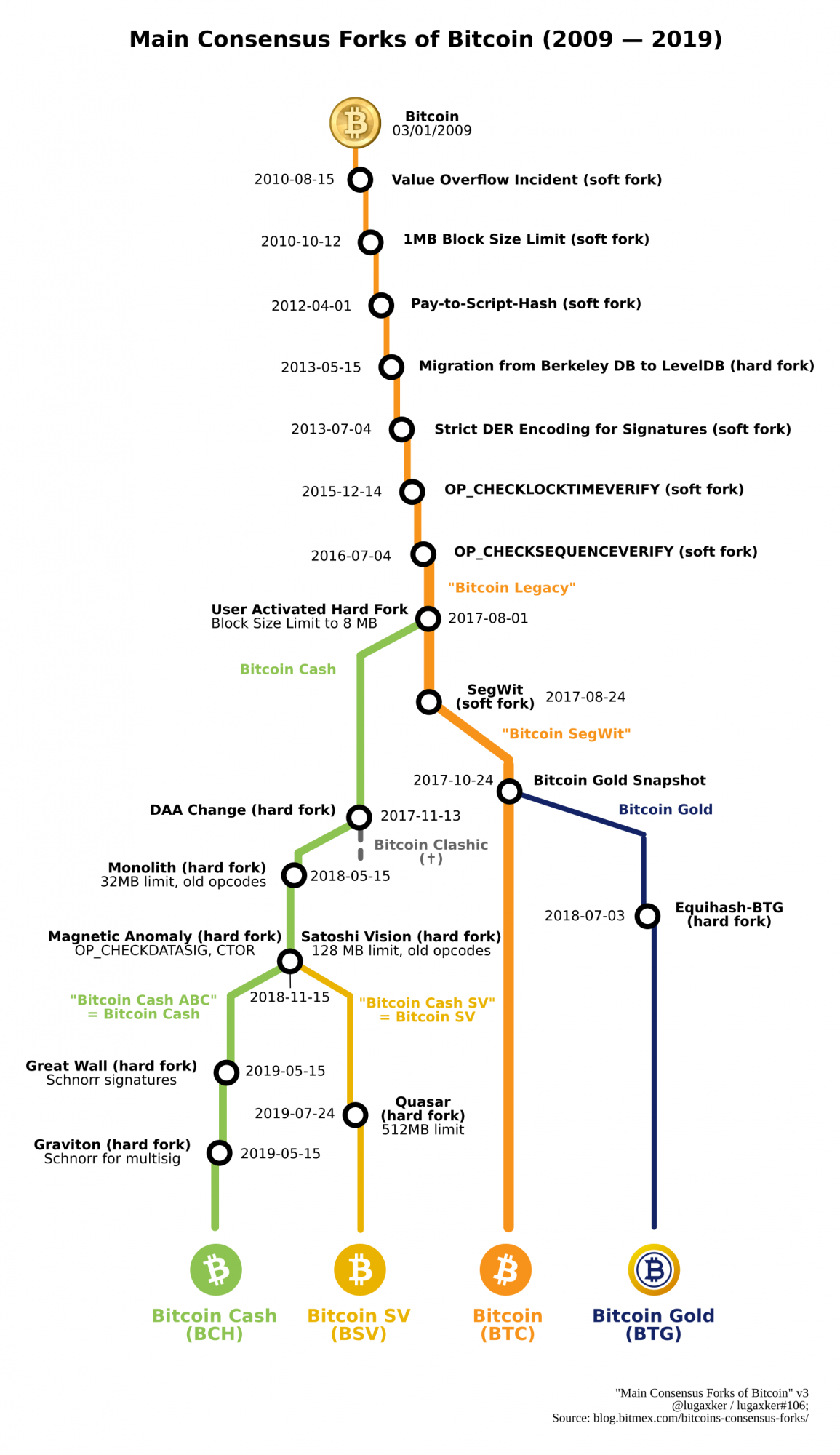
Bitcoin “Satoshi’s Vision” (BSV) is a fork of Bitcoin which has its roots in at least 2016, when Craig Wright (CSW) first started publicly to “out” himself as Satoshi. In 2018 BSV forked from BCH “fulfill Satoshi’s Vision” and is headed by CSW and funded by Calvin Ayre, a billionaire.
BCH itself forked from BTC in 2017 as a culmination of the “civil war” against Blockstream.
The really short version of this: there’s a cartoonish villain who gets paid by a billionaire who is ignorant in the tech who want to make a better version of Bitcoin by fighting Bitcoin Cash without profiting at all.
Lightning Network, Blockstream, and “Satoshi’s Vision” are all privately funded, and the motives behind the investors leave open questions, as well as potentially conflicting interests which were never resolved but ignored instead.
Before BSV was created, CSW tried to win the lead over BCH through being “the truest to the vision Satoshi in the flesh” but when that didn’t work out he instead turned against BCH and attacked it! That’s another proof he was only trying to control the client and not work for it to succeed. Nchain, the company CSW is heading, was very much focused on marketing and made great efforts to convince the Bitcoin Cash community it’s working in their favor trying to convince through words, while providing no code whatsoever. CSW made countless of posts in which he promised “patents exclusive to BCH” and other “big things” which he never provided, he likely were never worked on at all, as evident in how they were never implemented in his newer fork, BSV. https://medium.com/@samwill102244/anatomy-of-a-fraud-a-deep-dive-into-one-of-craig-wrights-plagiarized-papers-96bc8624fc12
Many in the Bitcoin community now believe BSV was another arm employed by the same people giving orders to Blockstream a flanking maneuver if you will against the blockchain.
It was clear BSV was more than just another dev team. Albeit mysterious, the moment it pulled out its own mining power it sets itself apart, since that required months if not years of preparation in advance, and since they lied about working on patents for Bitcoin all along, it’s evident their goal was NOT to introduce upgrades to the protocol, but to simply gain control. Gaining control through being “original to Satoshi’s vision” was just a cheaper way worth trying before they revealed their malicious intentions and their secret weapon mining power. In the meantime the hash war also justified the Blockstream narrative that hard-forks’s are “dangerous and it’s better to keep everything the same in the blockchain and use LN and Liquid instead”.
But it doesn’t end with BCH - as the years will pass and more halvenings will occur, the hashrate will be low, and it will be possible to attack BTC too. BSV declared it’ll “attack BCH for 10 years if that what it takes to bring it down”. Remember: what the attackers are fighting isn’t BCH as a specific fork but the general idea of a successful BTC hard-fork. As we will see later, this is only one of many ways in which BSV is a flanking maneuver complementing Blockstream. Of course Bitcoin ending in LN and Liquid working as intended is still not the attackers’ desired goal since they will still have to force the miners into keeping the blockchain limited, and that’s precisely what BSV was created to do it’s a compelling argument because it’s backed by force.
Remember, hashpower should be viewed globally. BTC failing to scale resulted in an explosion of alt-coins, and multiple coins each on its own blockchain are weak as a sum of them all, and each separately, leaving them open to attacks, which may not make it possible to steal the users’ coins but make it less reliable to transact with, especially by an attack could undermine a cryptocurrency’s ledger, a reorganization attack (a “reorg”), as well as divide the coin’s market value and ecosystem as a whole.
With each split in the chain, two new rivaling coins can form, which furthers weaken their blockchains, since the mining power and economical power is split following the price. Remember: the attackers of Bitcoin don’t want to see any specific coin succeeds, they only want to see no coin which threatens fiat succeed. So if a split is successfully forced on a coin, the coin would lose market value and acceptance. A well funded and determined attacker could force more and more splits, making a coin bleed out value and the security which follows it. Blockstream’s Bitcoin hasn’t changed its rules (hardforked) in a few years, with the excuse it “won’t be attackable” in that form of attack, despite it being many times higher in hashrate than even the highest estimate for the required security demand (at $10K a coin it cost $37500 to reverse a payment with 3 confirmations in 2016).
It’s hard to fight Bitcoin directly, since it was originally designed precisely to be censorship resistant, but this strategy makes sure 1. hardforks can be made undesirable by making at least the concept “generally” risky (as it turns out people fear of the unknown and willingness to move to the future dreadful event with uncertainty is a stronger factor than what they agree is better done in the present), 2. undermine cyrptocurrencies in general, since any attack like that on any coin results in at least two blockchains instead of one, which makes them weaker as a whole.
But it takes two for a tango.
And now we’re getting a step closer to the complete picture, where everything starts to connect in ways hard to see as separate events.
In an interview with Reina Nakamoto in August 2018, Craig Wright laid out the plan to give government's backdoors to reverse transactions in other words, to make BSV permissioned. https://www.youtube.com/watch?v=2gsuKwAoj6k
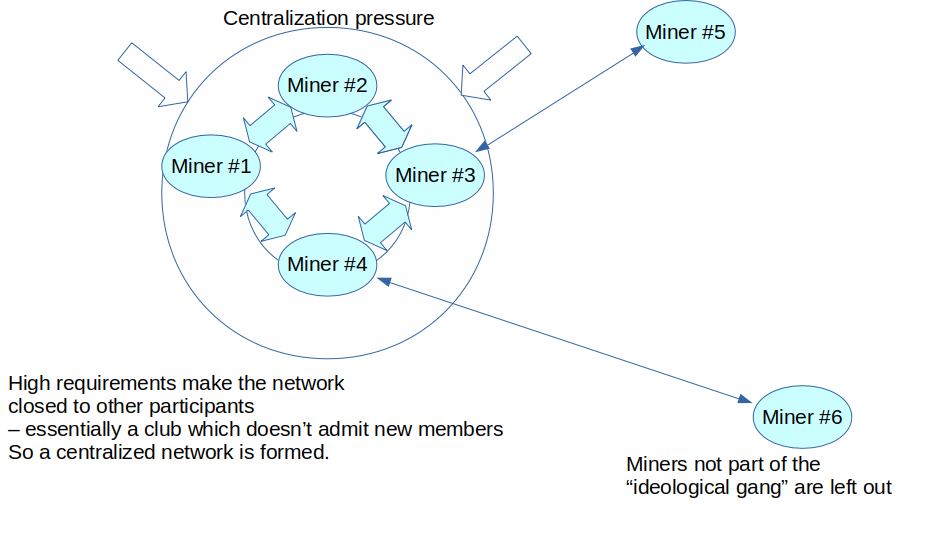
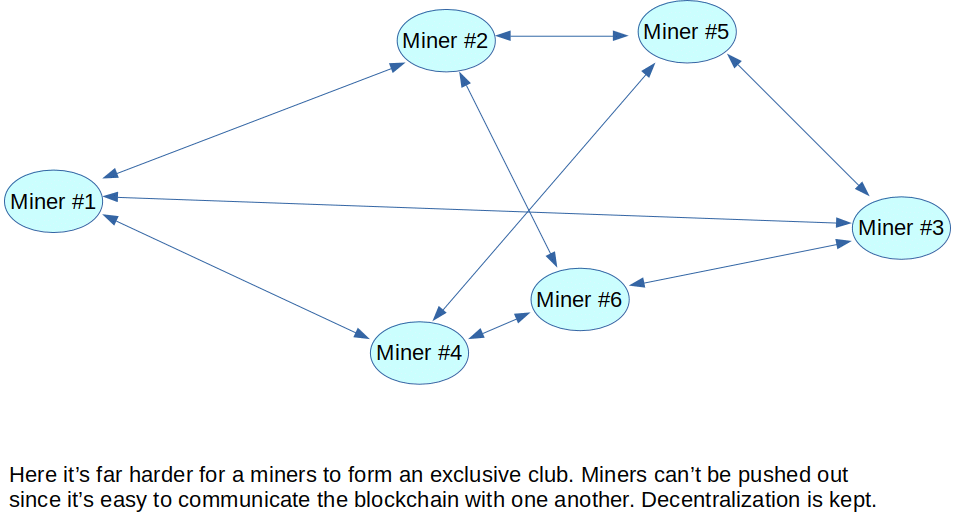
It is no coincidence BSV is the extreme opposite of Blockstream. Instead of limiting the blocks to only 1MB like Blockstream, which makes the coin useless in the short run, and ending in a dead end in the long run, they made the blocks excessively large as part of a “true to Satoshi’s Vision” opposite narrative (while really helping Blockstream’s narrative blocks should be limited to only 1MB. In short BSV has such a large blocksize of 128MB without doing the required considerable changes need to the software, defying the goals of Bitcoin for technical reasons and means the coin could in practice only operate as in a single LAN of which no other miner could join and participate freely, effectively making the coin owned by the companies nChain/Coingeek which will leave the network at the mercy of the devs, who already announced they will turn the coin into a permissioned banking 2.0 system. Apparently the users will have to choose between the LN, and a LAN. In crypto parlance, BSV is a constant 51% attack. The other implementations were rejected.
Also, similarly to BTC, BSV is discouraging its usage as a currency! The only use case BSV is actively promoting is using the network for data storage, such as weather. The attackers obviously are only fighting the application of blockchains as a currency. Likely what they’re doing it is to try to surpass BCH in metrics, specifically in terms of number of transactions happening on the blockchain, to show it’s winning in popularity, hoping to attract investors and the market ruling it as the “winning fork” over BCH, while providing a plausible cover story for keeping their operation despite not profiting from it.
As we saw, a permissionless coin raises some questions that can’t be ignored of how the technology is used, e.g. who has right to issue money and control it’s free flow, the morality and social consequences which comes with that freedom. Civil liberties and darknet markets both can only work thanks to cryptocurrencies, just like physical cash bills are used in offline black markets, but we’ll have to skip here that question and focus on the technical aspect: the problem with the idea of permissioned transactions (that is, any transaction can be blocked or retroactively be nullified by a third party) is that it sets up a single point of failure - a single entity wields the power to decide which transaction is approved. The problem with single points of failure is that they can be given to the wills of an actor with enough power external to the program. In simple words, that’s not a cryptocurrency, that’s a service like PayPal.
In effect it makes those wielding the permissioning power are legally money transmitters, and they will have to license in every jurisdiction on the planet. They will have to comply with the laws of every jurisdiction. And if they aren’t careful and allow a single "illicit" transaction to occur, they will have to face the full wrath of the legal system. That's simply impossible either the Bitcoin operator will be too small to be important in the network anyway, or will be too big to be able to avoid the attention which comes with big money. Having the business operate from Antigua or a tax-haven country will not give any protection from that either, as past events proved.
A permissioned coin is also a coin which the regulator, which is naturally also the central planner, naturally prefers. BSV is supposed to be the chain which wins similarly to how facebook and google won their market share by emerging as unelected unofficial state authorities. There’ll be no alternative to BTC, which is digital gold - a non-disruptive technology.
The BSV fork was the “First Cryptocurrency War”, not that a war took place in any meaningful sense - it was nothing but a virtual boxing match, despite advertised otherwise - but only for a reorganization attack, which is a way to disrupt the normal functioning of a chain by rolling back some of the ledger, which it planned against BCH, but never took place because of an emergency change in BCH called a checkpoint.
We will discuss further BCH (Bitcoin Cash), since we’re really interested in the general idea of hardforking away from Blockstream’s version of the client and it helps us to understand what Blockstream is trying to do and what are their methods.
We can already have a hint from the BSV-BCH war: with enough resources, hardforks can be made dangerous, and even impossible. By the time the BTC hashrate will be low enough, all their attempts to hardfork will be stopped by BSV, or the original chain will be kept mined to “vote” for it to retain the ticker, therefore the main path Blocsktream is working on - years in advance (!) - is forcing a “fee market” which will defend BTC in the unknown future. BSV was created to provide the excuse to have to use that defense and even further limiting the blockchain and increasing the block reward so the miners will have high enough income to keep securing the blockchain. Viewed like that, BSV is the stick complementing Blockstream’s carrot.
Another similarity both share is the trick of doing everything well except one thing that’s crucial to carrying out this plan.
A look at BSV
Before we see how things start to make sense as part of a long term strategy, let’s have a closer look at BSV to understand who it represents better and its motives.
1. The People Behind BSV:
“Satoshi’s Vision” (BSV) is primarily supported by Coingeek, which Calvin Ayre keeps funding, despite the fact Craig Wright was proven dozens of times to be a fraud. There is no evidence Wright was Satoshi despite him going through extreme lengths and even caught lying multiple times trying to prove he is.
The first question we should ask about such a large well funded operation as Coingeek is what its owners are trying to achieve. Strangely, Calvin Ayre went from being one of the FBI's 10 most wanted to being the almost sole investor in BSV, giving Craig Wright complete control over the operation, which consists mostly of a mining operation, and some conferences and public relations with barely any software development. This lack of fear of operating publicly which raises the question are they serving as a guise to cover a manipulation on Bitcoin? Given that almost the sole investor in BSV’s main expertise is money laundering we should ask if he’s providing a plausible story to the funding of BSV. https://www.ice.gov/news/releases/bodog-and-4-canadian-individuals-indicted-conducting-internet-gambling-business
So far Coingeek burned hundreds of millions of dollars on it without any plan to profit from it and it doesn’t look like Ayre has any understanding at all in his business, even calling 1GB “gigamegs”, and never provided any explanation to his involvement in the crypto market. Wright’s and Ayre’s backgrounds are similar, and there’s no evidence Wright was involved in the creation of Bitcoin, yet he still made every possible effort to prove he was Satoshi Nakamoto the creator of Bitcoin, and arranged to meet Gavin Andersen, the 2nd in line after Satoshi, in London, to provide a cryptographic proof in person. Later Wright used the same simple trick which he used to fool Gavin into making him believe he signed with Satoshi’s key, and make the signature look authentic [even though the attackers likely know Satoshi’s real identity, handing out a real signature to Wright for the proof to Gavin was absolutely no option for them since that wouldn’t just limit their options in the future in case the authenticity was revealed to the public, but would jeopardize the whole attack, since that would raise questions leading to the only logical conclusion: Wright received the signature from someone else who knows the identity of the real Satoshi, and Blockstream can’t be trusted, since Satoshi is working for them himself behind the scenes and their motives are completely different from what they say. That realization would lead to the users and miners choosing to hardfork against Blockstream and abandon their plans and the attackers will lose all the huge investment they made. How Wright cheated in the verification: https://github.com/patio11/wrightverification
Wright’s tweets are archived in this link: https://twitter.com/botfaketoshi].
This explanation we believe to be the most likely for the true story behind BSV:
Some have suggested the mastermind criminal, Paul Le Roux was the man behind the handle Satoshi Nakamoto. Paul Le Roux, who operated from the Philippines, was considered to be the first mafia boss of cyberspace, and had such a sophisticated operation he some called him the “criminal version of Elon Musk” - a drug lord who sold prescription drugs to millions of Americans online. Roux may have wanted to circumvent banks for his dealings, and BTC would have made his life so much easier. Did he create BTC to solve the problem of receiving payments in his online business without intermediaries after the American banks stopped wiring him payments? The first successful commercial use of Bitcoin was a black market, the Silk Road.
Roux was always on the look for new operations and went as far as Somalia to expand his business. His first software was a strong privacy tool said to be unbreakable (later became known as Truecrypt) which required understanding of cryptography. He developed it for himself and provided the software for his workers’ laptops to encrypt their hard drivers. The solution to the problem of making a distributed public ledger and create BTC was based on the work of others, such as Nick Szabo. Satoshi put together existing pieces in an ingenious way no one had thought of before, and may have been able to solve the it ironically, because the computer scientists tried to solve it mathematically, while he couldn’t waste time on that and approached it as a practical problem (BTC isn’t a perfect solution, it is an approximation). It’s plausible Roux was the inventor of Bitcoin, and unlike other people suggested to be behind the handle Satoshi, he even had a connection to later events in Bitcoin one report indicates Roux had worked for Ayre.
Satoshi left the development in the hands of a successor never to be heard of again and the early coins he mined were never moved since. In light of the heated debates in BTC in which Satoshi didn’t intervene at all his absence raises questions even more.
One explanation for Roux’s connection with Ayre was that he may have tried to sell a Bitcoin based casino solution to Ayre for his online business to solve the problem of chargebacks one of the biggest problems for such a business.
Some of the very early Bitcoin adopters reported there was an extensive manhunt after Satoshi going on early on, as early as 2011. Finding Satoshi could mean forcing him to work for the attackers or at least confiscate his vast fortune of the first 1.2M BTC coins mined - this has been mostly ignored, until Blockstream tested the BTC community’s reaction of the idea of making the 1.2M first coins unsepndable. One day that could turn out to be the most important missing piece in the puzzle and is potentially a huge tool to manipulate the space: in case SN’s coins were confiscated, the attackers could take over a much bigger part of the LN than is possible than buying coins in the market and could also crash the price of BTC or its forks.
2. Blockstream - BSV connection:
There is evidence BSV and BTC worked together, likely as two separate entities with the same employer: 1. Greg Maxwell helped BSV attack BCH in 2018, 2. BSV is dedicated to attacking only BCH despite having no casus belli or any compelling motivation. The attack aligns perfectly with Blockstream’s narrative which avoids hard-forks (no other coin has had troubles hard-forking, that issue is unique to BTC and BCH).
3. what’s BSV tried to do:
When considering what’s at stake, it sounds like an impossibility Bitcoin wasn’t targeted since it first became widely known thanks to the Silkroad. Outlawing or fighting Bitcoin would have only helped it further by giving it credibility and recognition, and fighting it directly wouldn’t have resulted in the single most important goal of self-limiting it to the contrary, that would have given all the reasons to hard-fork against such attempt. The only way to stop Bitcoin was to convince the stake holders limiting the blockchain is good for them.
The individual events in BSV always “erred in the same direction”, that of playing in the hands of Blockstream narrative. The main narrative created, keeping the blocks 1MB, was an excuse not to hardfork, and BSV worked to justify that by doing a “contentious hard-fork”. In reality, when BSV were unable to take over the BCH reference client and it turned against BCH while in practice there was almost no difference at all between BCH’s and BSV’s stated goals. The only explanation was, their real war was against the blockchain.
4. the BSV plan:
The sheer amount of resources invested in BSV while not being able to provide a single proof CSW is SN draws us to the conclusions:
1. either the attackers have SN’s coins, or in the rare case he destroyed the private keys, they most certainly know the identity of the real Satoshi and can be certain the coins will never be spendable again without the attacker’s approval. If that wasn’t the case it’d hard to see how such a huge investment would be made which could have been averted at the click of a mouse button by the real Satoshi crashing Bitcoin and its forks at will or expressing support in one fork over the other.
Interestingly, Blockstream raised the idea of making the SN’s coins unspendable, which is possible to do by changing the code (as a new consensus rule). Such a change can’t be done overnight and requires preparing the users to accept the idea and gauging their acceptance of it first. That would make the BTC chain immune against such crashing of the price (BSV could never make Satoshi’s 1.2M BTC unspendable while CSW claims he himself is SN). It’s hard to ignore that possibility the first coins are worth $12B in BTC alone, and can help to further secure the position of BTC as the leading coin when needed while crashing other forks. There mere transacting of the coins between addresses after Wright declaring he’ll “move the coins” (while in reality he won’t have access to them, only be instructed to spend them), could stir havoc in the market and be used to further help Blockstream keep its power.
2. The real war is against the miners. Whereas Blockstream used a soft-fork and a 2nd layer to take the miners out the intermediaries from most of the transactions, “Satoshi’s Vision” introduced mining at a loss dishonest mining (investing proof of work not for net profit) working against any BTC hard-fork which has a chance of increasing in popularity (BCH is the 2nd contender in the currency application of blockchains) so that no hard-fork at all would be possible eventually out of Blockstream’s limited blockchain. Until BTC’s blockchain is attackable, Blockstream is dragging development and gaining time with the LN, waiting for the hashrate to drop until BSV could attack from the other side and force it into an ever decreasing blocksize to create its wished “fee market”.
5. the BSV business plan
It’s improbable BSV is working for profit, the only plausible explanation is that it’s a cryptocurrency kamikaze.
A word about incentives: a honest miner is unlikely to attack another coin even for a small chance for increasing revenue over the long term - getting into unnecessary conflicts where there is a clear zero sum game situation is almost always bad strategy.
Honest miners use their hashpower to mine coins on the chain which will yield them maximal profit and as by product providing security for the blockchain, which further increasing the value of the coins they are mining. Diverting hashpower away from the chain one deems valuable to a chain one doesn't deem valuable with the intent of destroying it, mining coins with the goal of making them worthless, and driving away thousands of one’s current users, is dishonest mining. A simple way to think of it is a market in which one car manufacturer is using his factories to manufacture bad cars which look like one competitor’s cars which no one will buy to ruin his competitor’s business, instead of using his factories for making and selling his own good cars.
Making another competitor in a negative sum game fail really means fighting in another battlefield than what they declare, that of the zero sum game of fiat versus Bitcoin, where the stakes are immeasurably higher than in BSV vs. BCH.
Given this information, the incentive model seems to have failed even worse than previously thought. The attackers could profit from mining BTC, mine BCH at a small loss, and in case BCH is hurt in the long run they won't lose much, since BTC isn't expected to go away so fast, and their mining hardware will only be good for probably only a 2-3 years based on past life cycle of mining equipment.
At this point it’s clear, “Satoshi’s Vision” and Blockstream’s actions all systematically err in one direction, that of realizing Blockstream’s plan. “Satoshi’s Vision” has no raison d’etre besides serving as the other side of Blockstream’s coin by punishing hard-fork attempts from Blockstream, both working for the same goal of no permissionless transactions on the blockchain.
Blockstream is following BSV’s footsteps:
Blockstream recently acquired its own mining power too. Looking at the BSV experience and how it almost successfully used mining power to overtake BCH and win its ticker and planned to attack it by reorganizing its blockchain, the advantage is clear. At some point in the future it’ll have to have its own “voting power” so like BSV, it could “vote for itself” and work against the majority of the ‘honest miners’ who act for profit (and not for external reasons like banks/governments securing their fiat position) and keep itself in power and secure its position of power over Bitcoin.
If you take only one thing from this part it should be that BS/BSV should be viewed not as two unrelated events but what appears to be part of a bigger long term strategy.
Part VI Connecting the dots
*All the happy families are the same, but every miserable family is different.* - Tolstoy
When everything we discussed so far is viewed together, the long term strategy can be discerned from actions which don’t look significant on their own.
Why was the Lightning Network chosen?
The properties which Bitcoin needs to function are security, provided by hash-power, and to a lesser degree the decentralization (distribution), without which no censorship resistance is possible. Once the security is reduced enough it becomes less reliable and also there’s no way to guarantee permissionlessness the ability to for the users to transact freely. Fighting the permissionlessness aspect of Bitcoin necessitates another war the war on the miners, since they ultimately provide that permissionlessness by including transactions in a distributed way. Everything points out the LN was only a first step in a plan to drive out the miners out of Bitcoin and cement the protocol in a way which is fundamentally non-disruptive but pointless since at most it does everything fiat does already. The LN was essential to delay BTC from gaining in popularity for a few years, which is why Blockstream started the war on on-chain tx’s the number of transactions that are taking place on the blockchain, and which eventually could pay and support the miners who provide security with fees in mass scale.
The LN can’t stop Bitcoin in itself. It doesn’t stop the miners from hard-forking and removing the limit on the blockchain. It was only pushed as a temporary way to 1. delay the usage of the technology, and encourage speculating instead of using it so the part of the revenue going to the miners from fees would be negligible, and the miners eventually will have little incentive to expand and hardfork the blockchain to accommodate for more tx’s because the demand would be from speculating on future value, not from usage. 2. it wasn’t meant to succeed at all, only to be always planned for the near future as a way to keep things until the hash-rate decreases. It’s psychological warfare, and people didn’t question at all the motives of the LN team, and whether they could be affiliated with Blockstream and work together. People didn’t question it because of the high investment in the LN and in Blockstream, which people saw as an indication of “voting with money” - it’s so extraordinary in human experience to see millions invested in something just to make it fail it’s counter-intuitive (again, the human factor). In reality they didn’t try to succeed at all, they were working from the start to take it as long as possible on purpose, while at the same time providing Liquid, a centralized side-chain so users won’t complain and the miners won’t be pressured to do the thing they worked to prevent all along a successful hard-fork by the miners. 3. the LN was a way to keep centralized power over the Bitcoin software development by drastically increasing the threshold for developing the new 2nd layer, making it costly and a years-long commitment it’s such a costly high-risk low-reward venture naturally no one would risk developing it seriously other than the attackers themselves, since they develop it at a bargain... for free, especially not the miners who understand there’s no need for it and know they could only lose from it since it has diametric interests to theirs. That way the fate of Bitcoin was cleverly tied with that of a single development team. Compare the LN with developing the blockchain itself which can be done in small increments without a huge upfront investment, similarly to how Linux is developed. Any potential competition to Blockstream was pushed aside that way. The risk of the miners working independently from Blockstream was greatly reduced by tying the fate of BTC with that of the developers working for the LN. So this is one of the best examples on how propaganda was essential for taking over, most programmers don’t have the time to learn the technology in depth.
What if several years from now the LN gets adopted and grows in popularity? That’s a big if, but in that case it’s important to remember the LN does NOT help to secure the blockchain! They’ll either 1. further decrease the blocksize using the BSV threat to make even the LN unusable, and force BTC into a minimal use case of “store of value”, or 2. in case they have Satoshi’s coins, use them to crash BTC (in case the coins were confiscated they couldn’t be used to crash the BTC/BCH price because first they had to set up “Satoshi’s Vision” so they will have mining power at their disposal to attack BTC right after the crash when its hash-power is low) or, 3. attack the LN itself in numerous ways, e.g. spamming the LN channels, using liquidity to form hubs which they own dictating permissions for the users’ who will have no way to avoid the hubs their coins are locked in because of the high on-chain fees.
In either of the above cases the outcome has no inherent permissionlessness as in the blockchain, which is why it’s questionable the LN-based Bitcoin will have value at all to begin with.
A shadow war:
Blockstream and BSV are playing a double game using two different “competing” coins working to neutralize BTC’s threat to fiat, while BSV also covers the option the market will choose the “Satoshi’s Vision” version of Bitcoin, in which case the attackers will control the software and minimize its disruptive properties, therefore BSV’s and BTC’s strategy is attacking the middle from both sides - they don’t care which side “wins” as long as the middle loses.
Why everything we outlined above is almost certainly a long term plan to destroy Bitcoin:
As we saw, the three vectors of attacks that are being worked on:
1. delay adoption as much as possible before a high demand for tx’s will be reached, then there would be little remaining to give much value to the network there will be no incentive to pay the miners, the hash-rate will decrease as a result and it’ll become attackable like BCH/BSV proved would happen.
2. The ability to change the protocol to make Bitcoin removing the 1MB limit on the blockchain relies on pure faith on Blockstream making the call (since they support the LN which helps keep the price high) AND on BSV not attacking. It won’t be hard-forked to increase usability and become congested forever and at most remain useless “digital gold” - a mostly non-disruptive pointless tech.
3. the 2nd layer has no inherent permissionless and allows for manipulations based on liquidity e.g. using a fractional reserve like Tether, or exchanges, or Satoshi’s coins to take over the LN.
And when also considering:
4. Blockstream using a series of excuses to do the above without providing any good explanations for the choices they made RBF and higher miner reward incentive (as suggested by Todd).
5. “Satoshi’s Vision” spending years in preparation and hundreds of millions of USD attacking an implementation breaking free from Blockstream without an economical motive while using a series of excuses proving they planned to do so all along.
Therefore:
Any combination of the above 1, 2, 3, together with 4 and 5, leads to the conclusion it’s extremely likely “Satoshi’s Vision” and Blockstream were set up to destroy Bitcoin and that its demise is a certainty.
Any combination of the above 1, 2, and 3, together with 4 and 5, and what’s described in chapter War Games, could be used in practice, and it doesn’t matter which, since 1, 2, and 3 suffice alone alone.
Considering BTC’s current condition and since it’s unlikely to change its path: THE DAMAGE DONE TO BTC CANNOT BE UNDONE!
The roadmap Blockstream laid for Bitcoin could be summed as reshaping the on-chain tx over time graph: the anticipated increase in the number of tx’s will start later than it would have otherwise.
Note:
1. By “BSV attacking Bitcoin” we’re speaking generally of any out of several possible ways by which mining power can be used to manipulate a blockchain. Essentially any Proof of Work coin is attackable that’s the cost of it being distributed.
2. By destroying Bitcoin we’re not talking about completely stopping it because that’d impossible without finding a critical vulnerability in it, but making it unreliable enough for its purpose as a currency will it make it useless.
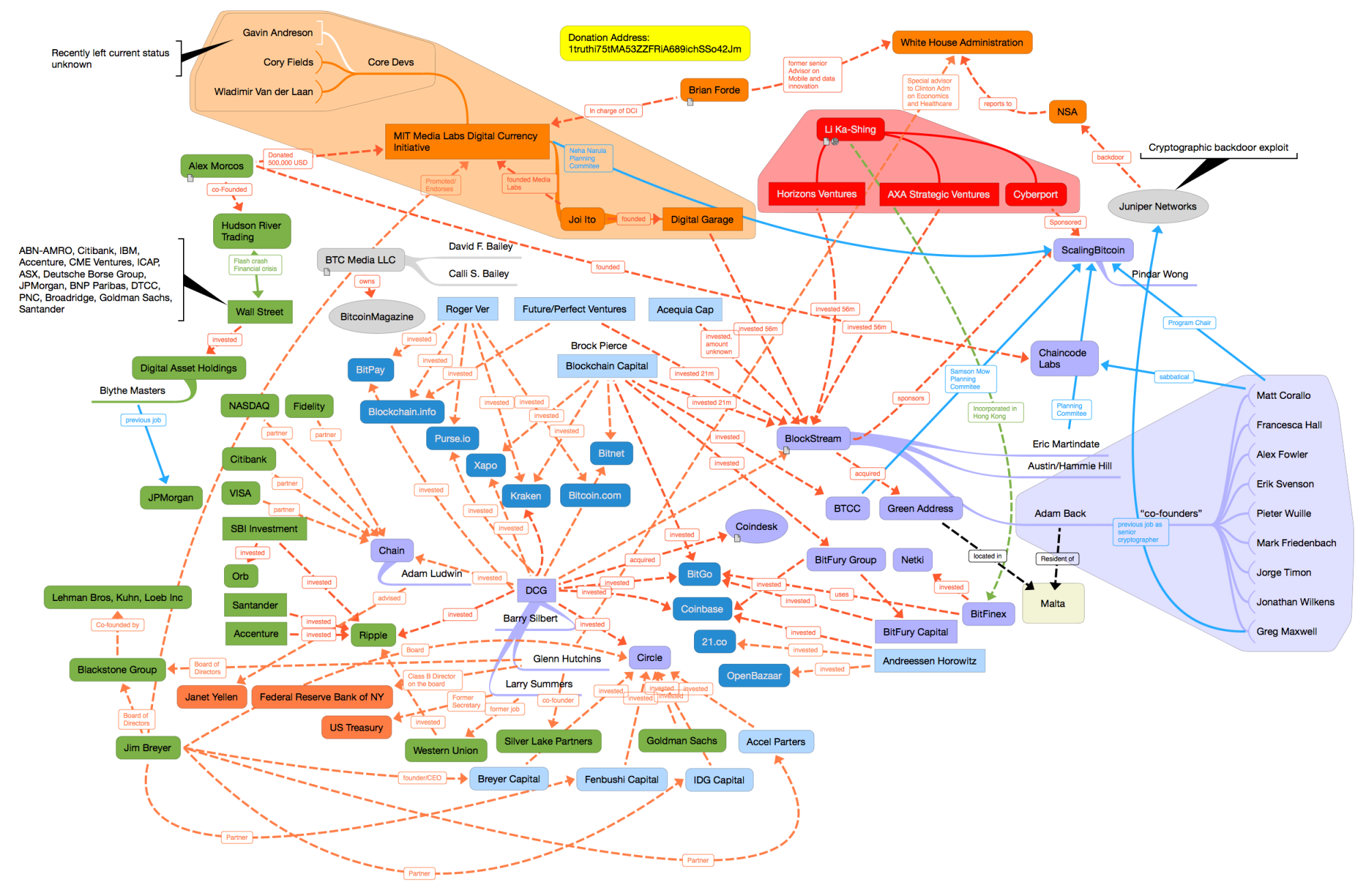
3. This isn’t a conspiracy theory since it is parsimonious. The actions of Blockstream and “Satoshi’s Vision” can’t be explained as a business plan AND they never provided any evidence they are positioned in cryptocurrency to the contrary, everything points out Blockstream is positioned in fiat the bank AXA is their primary private funders: 1. there are evidence of the state working in similar ways in the past, 2. the amount of people involved who actually know what’s going on according to the explanation provided here is minimal e.g. the BSV and Blockstream employees don’t even have to know why they’re heading their coins the way they do for that plan to work, they could be fed excuses like selling financial products on top of the coins (see “Liquid”), 3. it would be inconceivable if they didn’t work to stop crypto, so the motive for doing the above isn’t only plausible but spending huge sums of money if needed to stop Bitcoin from succeeding is irrefutably extremely likely.
Decentralization is an antithesis for current powers. The most expected move from someone desiring to keep control over money supply in the case of Bitcoin would be to put someone in control who they could coerce into changing the code to their preference.
The entire book can be summed up like this: Bitcoin depends for its success on hard-forking to remove a limit on its blockchain, which is the aspect of it which gives it its value, therefore the attackers focus all their resources in preventing the removal of that limit through making hard-forking impossible.
Bitcoin depends for its success on hardforking to remove a limit on its blockchain which is the aspect of it which gives it its value therefore the attackers focus all their resources in preventing the removal of that limit through making hardforking impossible.
*Instead of working on both scaling the LN and the Blockchain as above, Blockstream opted for a solution which delays as much as possible any possible change*
The Crypto Armageddon:
What about a scenario in which the miners rebel against Blockstream and decide to hardfork and unite their power to mine a single non-approved chain?
Total distribution of Tether is greater than $4 billion, and $850 million was seized. Since there’s no reason to believe Tether was 1:1 backed before the seizure, that question brings us back to the devastating affect Tether or perhaps any high capitalization stable coins could have on the market by being vaporized at once. In that scenario there’s no way for any mine-able coin to recover ever again because a collapse in the total market price, once BSV or any mining power attack operation for that matter, is able to use their mining power to selectively suppress any new coin it could very well be game over for any permissionless decentralized cryptocurrency, since no economical entity working for profit will work at such high risk against determined powers with such vast resources at their disposal who are willing to mine and operate for many years at a loss to defend centralized power structures.
Part VII - Postmortem and the lessons we can learn
In this part we’ll review what we learned so far and try to see where things are heading.
It’s important to note how everything discussed in this book could be generalized to any technology which has the potential to take away from the existing power structures’ ability to rule economically or legally and moves too much power to a foreign entity (Google and Facebook, as centralized corporations and form symbiosis, they don’t bypass governments).
Dead end:
Bitcoin was considered to be so groundbreaking at some point its price reached $20k, it was viewed as a safe bet. At retrospect, it first appreciated for a good reason thanks to it being a first of its kind class of asset unseen before. At some point the market its price detached from the value of the underlying asset which didn’t provide yet utility, and was priced based on being able to sell it for someone else hoping to sell it later for a higher price, which doesn’t help at all for Bitcoin’s success in the long run. In that model everything will still be priced in fiat that is, no one will want to hold BTC for its own special properties. That’s the definition of a bubble.
“Satoshi’s Vision” was so improbable it almost makes it unnecessary to look for further proofs to the explanation we provide for their goals. The contradictions in Blockstream’s and “Satoshi’s Vision” narratives were so numerous and all erred in the same direction, that of trying to stop Bitcoin. It’s immaterial if there will be no conclusive proof for this explanation, since if someone wanted to stop Bitcoin he’d do exactly what they’ve been doing with surgical precision. Blockstream couldn’t provide an excuse not to improve Bitcoin, so they worked on improving it in everything but that which gives it value, while false forks of the coin and later BSV were created to provide a justification for their main narrative by creating contentions, so it improved everything but the delayed into the future the most essential part the blockchain. BTC was forced into a position where it’s pressured to stay in place and change it course and later will be pressured by BSV (or another operation) to give up on being useful as a currency at all. It’s hard to see this fact from the sea of details, everything looks normal on the surface, which is why the scheme to stop Bitcoin is perhaps more brilliant than Bitcoin itself because for practical matters it fulfills the definition of the perfect crime.
Large groups of people don’t behave like organizations:
Anarchic movements are easy to infiltrate and have no way to coordinate their actions by their very definition. The users were no match for the level of sophistication that went into stopping Bitcoin since “mob wisdom” doesn’t add up.
The development team’s power outweighs the miners’ and the users’. The social aspect overruled hash-power which had little effect. If all the miners just started running a hard-fork upgrade to Blockstream’s client, there's not a whole lot the BTC devotee folks could do about it, but the chain running Blockstream’s client would almost certainly continue to exist though and hence such a move is risky for both sides and the miners won’t try it unless Blockstream did something suicidal.
The weak link are the humans running the software:
Blockstream introduced a huge disruption to the way crypto is supposed to work which adds a considerable level of uncertainty in the market so much that the price of non-minable coins surged as a result of the BCH-BSV “hash war”. We also saw even if ideally hardforks are harmless since there’s enough time for the community of developers, miners and users to discuss what’s best for the coin, it isn’t the case in practice when someone puts great enough effort and devotes great resources at putting obstacles at every point on the way and uses the weak spot creating contention where there was none before.
As part of the above strategy, a problem was first created by Blockstream, to which is later offered its solution, and moved to a radical anti-hardfork approach, since they needed hard-forks to be difficult to justify a “hardfordks are contentious” narrative so they’ll be able to keep playing the long term strategy we described.
Bitcoin in the meantime could still be a highly yielding speculative instrument, but in the long run it’s a certainty it will fail since it’ll reach the point where it has to face the unavoidable a successful hard-fork or being locked in a position where its block-size will be decreased forever to pay the miners for securing the blockchain against BSV or the like.
Propaganda:
Another aspect of crypto-politics we saw was pivotal was the community and the ease with which it can be persuaded until the users work against their own interests the BTC user base was convinced to accept the Litecoin project, with a “LTC is silver to BTC’s gold” as if it had physical properties, as a complementing project despite them having no stake in it (it used to be considered a scam in the BTC community).
By fracturing a community further and further by every time supporting the “losing” minority side an attacker could help the minority coin take a greater share of the market from the leading coins and thus not letting any single coin succeed in the real world and gain the network effect, by which point it’ll be too big and hard to fight. The crypto media war is almost totally virtual so it’s hard to tell if a user is even a real person. This leaves an opening for a well organized actor to shift the protocol by sowing and promoting ideas which really serve nothing but pushing proposals which otherwise wouldn’t have won traction look like they have wide acceptance. It’s unknown who first thought of the LN but the earliest mention of it was by an anonymous user in an online forum, and that idea has been promoted in a similar way online. Later the idea was adopted and promoted in what had the appearance of serious conferences where Blockstream was practically the only one allowed to speak. The LN became increasingly popular for various reasons as we will discuss.
Another issue the Blockstream take over showed was the huge conflicting interests between the people/corporations controlling the social media and popular Internet platforms and the interests they serve by possessing such great power in their hands, so e.g. when Twitter CEO invests in the LN development, to protect his investment he can replace the owner of the @Bitcoin handle to promote his investment, and when considering regulators could join in and can make decisions with huge impact on the giant media corporations, they could indirectly shape the private businesses to suit their needs. Regulators could leverage their power on the new media corporations e.g. by making rules so hard to comply with only a few giants who could afford to cooperate will remain afoot due to the high costs of complying, thus the advantage of the Internet for democracy in information will be lost.
This can’t be overemphasized: Bitcoin really died a long time ago.
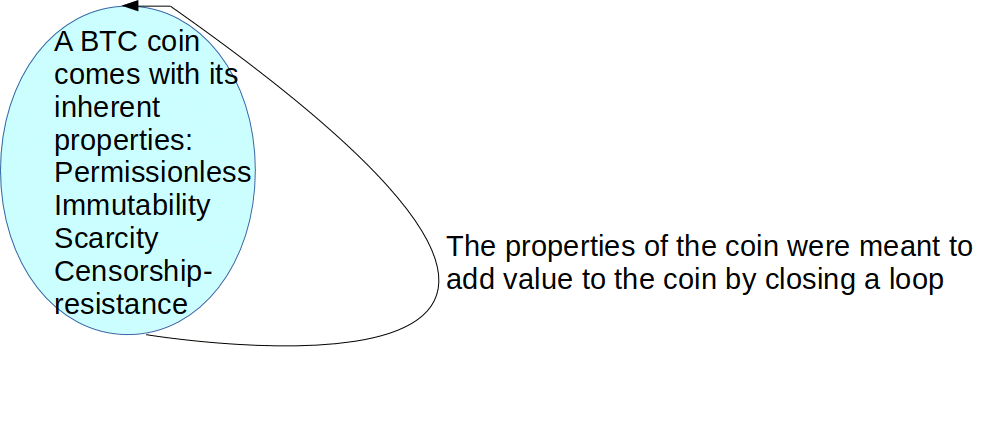
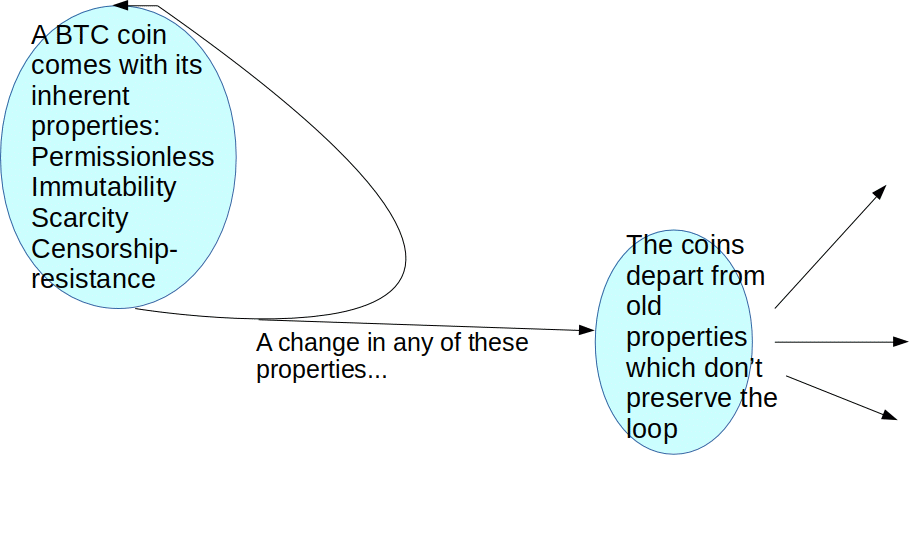
The permissionless, immutability, scarcity, as well as limit on number of tx’s in a block, and all other properties of a crypto are dictated by the code. Changing any of these properties shouldn’t be possible by design and the incentive system is supposed to prevent to change them. The moment one of these can be changed from the original it means the design is broken, therefore changing the permissionless property of a coin isn’t different at all from interfering with the scarcity property in that regard Blockstream could’ve just as well changed the supply and make it infinite (Blockstream’s Peter Todd suggested in late 2019 keeping a constant inflation a change in the supply). Changing a fundamental property like permissionless really means the code is not law, that it’s centrally controlled by the whims of the dev team overseeing the code, possibly as a dictatorship winning through politics and not merit. This point is crucial for understanding the Bitcoin invention. Satoshi designed the rules (protocol) would be self-reinforcing as if they’re “set in stone”, which is really that. The moment the code could be changed so fundamentally, it necessarily means Bitcoin has failed as an invention.
That can’t be overemphasized, so to iterate in other words, once Bitcoin can be changed fundamentally it is necessarily not Bitcoin anymore, because that would mean there’s someone at control who can change the project at will, and winning support in social media doesn’t change that fact, since it was designed to be self-sustaining by code, not by relying on a corporation which dictates the rules. That aspect of Bitcoin has failed early on with the miners preferring to run a protocol which is more profitable in the short term but could reach a dead end in the long run.
The lesson is anarchic movements don’t work in practice. The Ethereum foundation which oversees how the project is managed according to the principles it was designed to follow and pays for work with coins from the founder’s initial coins solved some of that problem since the stake holders have great incentive to make their coins appreciate in value. There’s no future for a project without management and leadership and planning. The speculators sitting on the side are too shortsighted to manage a years long commitment and will sell a long time before the project has a chance to fail.
What made Blockstream and “Satoshi’s Vision” so alluring to the public?
Considering the number of core public figures and the majority in social media followed Blockstream, assuming no more than a small number were getting paid as some Youtube vloggers and a few high profile public figures, it seems the degree to which psychology has influenced users was the most important aspect of their operation. What we estimate was turning the public to consider Blockstream’s plans seriously was the large sums of money alone which Blockstream and later BSV’s Coingeek/nChain were spending (Nchain received 300 million USD in funding), and was an argument more convincing than any logical argument presented. Such market behavior is well known for corporations in the traditional markets. It could be thought of as a sort of “Proof of Stake” except it was in fiat money instead of in the mined coins as the original model designed to be based of). When Blockstream first appeared people saw the situation as smart money voting for them “we’re smart, and it can’t be a scam if successful smart people put money in what we believe in” - and once people already followed Blockstream, they kept following out of confirmation bias once they were set on a course and regretting it and changing their decision about their past action would be admitting they made a bad choice, they tend to be biased towards an explanation which confirms what they already believe in. In that regard once a certain path has been followed, it’s mentally cemented.
Who’s funding the Lightning Network? Few people in the sphere seem to address that question. As long as someone is funding the project it’s satisfying the investors.
It’s also hard to see who would have taken the role and pay for the dev team in place of Blockstream and the Lightning Network. Looks like the companies involved filled a vacuum no one else could fill, and they offered development for free no one else was eager to pay for from his own pocket, including the miners who were happy someone else assumed the responsibility for them - for the miners it’s hard to fund a project since by definition they’re at competition with one another, and every penny they pay for the common project is one penny less in their revenue compared to the competition.
Also the changes Blockstream made look minimal to users who don’t suspect such manipulation could go one in plain sight. The absolute brilliance of the scheme is that it stops only the permissionless aspect of the coin without stopping things which give it value at the present, scarcity and security. “Temporarily”, until Blockstream is willing to hard-fork - most likely it will be chosen when the BTC hashrate will drop into attackable levels by BSV - all the technology and innovation as seen on Ethereum and other coins could work just the same on BTC except it won’t be on the blockchain but on side-chains, which is why it doesn’t cause resentment in the community out of lack of foresight to this future.
Conflicting interests always follow the money:
There have been many well known cases of well funded companies buying up smaller businesses only for the sole purpose of taking them out of business, so that there is no competition/threat to their existing business. Such misbehavior in the market can be hard to detect in time and penalize, and apparently the free market doesn’t correcting for them. That's exactly what they are doing now in the cryptocurrencies space, by investing/buying up certain entities/people, so that they can stay in power. There are many well funded banks or private people who did not wish new competiton to their money-laying goose.
Blockstream, nChain, and Coingeek, are far from being the only companies with questionable motives in the market. Digital Currency Group, which owns or has a large stake in pretty much every crypto business, is owned 50% by Mastercard. It’s easy to see how they all could profit from market manipulation while at the same time working to make it fail, which introduces an even bigger potential threat.
Similarly there is no reason to believe Calvin Ayre and Craig Wright are nothing but a front for the real perpetrators and only provide a cover story. Calvin Ayre and Craig Wright had legal troubles, and may have had ties with the actual Satoshi possibly Paul Le Roux, in which case he almost certainly made a deal to stop Bitcoin to get leniency in his sentence. Note Craig Wright never was prosecuted in Australia and no news article seem to question how that was possible.
Always follow the money, there is no such thing as a free lunch. The questions a community of a cryptocurrency needs to ask new players who invest in the platform: 1) Who are the people behind it and what are they working to achieve? 2) Who is bankrolling them? 3) Are they funding (bribing) devs or startups to buy their influence or stop them from working on something else? 4) What is their business model / how do they make a profit? 5) If 4 has no clear answer, it's probably an attack from diametric position.
Unholy marriages technology manipulation
Libra is a glimpse to the future of currencies. This could be a new era in which corporations have even more power over people more than ever before and governments could negotiate with the corporations without the public being aware of the nature of the ties and the deals that might be cut while his interests are left out. Blockstream trying to control BTC is analogues to Apple controlling the apps users can run through a closed garden, or Google influencing the ways apps run through developing, for “free”, Android. By distributing it for “free” they control the whole platform. Lightning Network similarly took over the standards by investing in it for “free” and thus keeping any other players out by “saving them money”.
*State-Corporation Symbiosis*
*Market based on decentralized dapps no corporation protectionism*
Facebook and Google are prime examples of marriages between corporations and the government - a symbiosis. A similar outcome where BTC is going could be turning into a new form of control over people ruling over the World’s Currency. In such an implementation Bitcoin could “succeed” depending on whose interests it serves - in that case it will only turn into universal “Paypal backed by digital gold” - the aspect of minting new coins is still preserved in Blockstream’s Bitcoin, but nonetheless such a coin would be hardly related to the original Bitcoin ideologically and its pro will be limited to a cheaper way of transacting by cutting some of the middlemen. That outcome of Bitcoin succeeding as digital gold is unlikely since fractional reserve banking would still be possible, as long as the users have no freedom to send their own tx’s on the blockchain.
The network effect was successfully killed:
Bitcoin was attacked early on to stop the network effect, which is perhaps the single most important requirement for a decentralized digital currency. Similarly to social network, once most of the users are already in one network, moving to another platform is impossible to coordinate and do in practice and the users will be tied to the platform until a better or newer kind of product appears in the market, by which time existing corporations could easily acquire it thanks to their monopoly. To complete the analogy, Facebook would be worth nothing if it cost $1 to post on it (around the current tx fee on BTC) and the users would have moved to a competing platform. The block size limit raised the fees up to a median of $5 in times of high demand which makes Bitcoin practically useless, stopped adoption and moved the edge back to centralized services like traditional banking and giving them enough time to prepare and develop their own competing apps.
As WeChat’s success in China showed, losing the network effect can lead to a centralized world out of which there is no escape, and since in this case technology has a crucial role in society it should be viewed as a matter of human rights and democracy.
Price manipulation:
There is reason to believe price manipulation takes place by Tether:
In Mt. Gox, the famous early exchange, "wily bot" was discovered as a tool to artificially inflate the price through wash trading. A study suggested that Tether is being used for the same purpose:
Less than 1% of hours with such heavy Tether transactions are associated with 50% of the meteoric rise in Bitcoin and 64% of other top cryptocurrencies. The flow clusters below round prices induce asymmetric auto-correlations in Bitcoin and suggest incomplete Tether backing before month-ends. These patterns cannot be explained by investor demand proxies but are most consistent with the supply-based hypothesis where Tether is used to provide price support and manipulate cryptocurrency prices.
Bitfinex supplies Tether regardless of the demand from investors with fiat currency to purchase Bitcoin and other cryptocurrencies. The acquired Bitcoins can then gradually be converted into dollars. In this setting, the Tether creators have several potential motives.
First, if the Tether founders, like most early cryptocurrency adopters and exchanges, are long on Bitcoin, they have a large incentive to create an artificial demand for Bitcoin and other cryptocurrencies by ’printing’ Tether. Similar to the inflationary effect of printing additional money, this can push cryptocurrency prices up.
Less than 1% of hours with such heavy Tether transactions are associated with 50% of the meteoric rise in Bitcoin and 64% of other top cryptocurrencies. The flow clusters below round prices induce asymmetric auto-correlations in Bitcoin and suggest incomplete Tether backing before month-ends. These patterns cannot be explained by investor demand proxies but are most consistent with the supply-based hypothesis where Tether is used to provide price support and manipulate cryptocurrency prices.
Bitfinex supplies Tether regardless of the demand from investors with fiat currency to purchase Bitcoin and other cryptocurrencies. The acquired Bitcoins can then gradually be converted into dollars. In this setting, the Tether creators have several potential motives.
First, if the Tether founders, like most early cryptocurrency adopters and exchanges, are long on Bitcoin, they have a large incentive to create an artificial demand for Bitcoin and other cryptocurrencies by ’printing’ Tether. Similar to the inflationary effect of printing additional money, this can push cryptocurrency prices up.
On April 2019, it was revealed that New York AG is investigating Bitfinex and Tether for defrauding New York investors. It was also revealed that $850 million dollars of Bitfinex/Tether funds was
confiscated. This created a panic because Bitfinex has no money to process withdrawals. They were
essentially insolvent at that time. So given those information, if Bitfinex is insolvent, what might be a last change to survive is to print more USDT. If they didn’t print tethers, they’d out of business anyway. But if they printed, “pumped and dumped”, maybe there was a chance. That’s when the bull market started. April 2019 right after that New York AG report was out.
Back in 2017, many people are interested and searched about Bitcoin so the price growth is driven by actual demand. In 2019 the small bull run seems almost entirely based on Tethers.
If we look back at all previous Bitcoin bull markets, there is always an increase in Google searches during the bubble but this time, it seems oddly different.
Could it not also be reverse causality and that the interest in Bitcoin is causing them to create more tether to meet demand of traders? Then we need to explain why there was no such gradual interests in the last few months, and the sudden explosive interests on the day right after New York AG public announcement of their investigation with Tethers. Usually interests come gradually, not all at once suddenly in a short period of few days (and no interest few months prior).
And we need to explain why traders need to go through fake tethers from an insolvent exchange instead of through legitimate regulated audited exchanges... suspiciously at the day right after the New York AG investigation on tethers. Would a trader who knew the exchange is under investigation and insolvent and may shut down anytime really give his money to them?
Not to mention how Tethers keep on changing their story from Tethers being 1:1 backed by USD to backed by reserves to Tethers printing based on rough projected demand.
There is also a lack of interests for Google searches for the main exchanges as shown in the following charts so where are the new money coming from for the BTC parabolic price increase?
Another common question was, couldn’t this be institutional money? People had been talking about institutional money since 2013. They are not going to buy BTC. Look at Facebook, if they want to come in, they will have their own coin. Plus if they want to come in, they would come in through regulated exchanges such as Coinbase and definitely not through fake Tethers from an insolvent exchange at the exact week when New York AG announces their investigation and seizure of $850 million dollars. Bitfinex/Tethers had just lost their banking relationship, where are these institutional going to deposit the $2 billion dollars into during the last 2 months? The timing of the parabolic BTC price increase looks like a the Mt Gox bot manipulation back in 2013, which also happens after the exchange had serious solvency problems and had to resort to fraud to cover their problems.
If we look at the individual signs by itself, it doesn’t mean much. But when put all together, it is obvious what is going on. A Bitfinex leaked document discussing the situation said the BTC price may drop below $1000 because that may be the true price without Tethers artificially supporting the price. From a utility point of view all these manipulation is worrisome because there is no real price discovery if there is no free market.
On the other hand, working opposite to Tether, there’s evidence for price suppression. When Christopher Giancarlo, ex-chairman of CFTC, shared that the CFTC, the Treasury, the SEC and the NEC had come together to suppress the crypto prices. https://papers.ssrn.com/sol3/papers.cfm?abstract_id=3195066 https://www.coindesk.com/trump-administration-popped-2017-bitcoin-bubble-ex-cftc-chair-says https://medium.com/@super.crypto1/4th-dimension-bitcoin-manipulation-cartel-can-it-be-burnt-no-way-c53de65c166a
Could it be the attackers are working to inflate its price instead of suppress it? It’s possible the BTC price was inflated so the market capitalization would be high relative to other coins, and the price on a general uptrend to keep the investors invested in BTC and prevent them from diverging to other coins which aren’t as easily contained, while the new capital from the manipulation would allow the attackers to fund the attack against the very coin they inflate. Once the gold narrative has been accepted, all the price does is really help to maintain BTC’s new purpose which was changed into digital gold without effecting the disruptive side of BTC that would make BTC’s use case only a means to earn more fiat! It’s so easy to make that into a popular trend, everyone wants to get rich, no matter in which currency, and the speculators in crypto don’t invest based on the software of the coin, since it’s so hard to review new complex code (such as SegWit the LN), and anyway the demand is based on the potential to sell for another speculator, not based on utility, since the real usage of cryptocurrencies is very limited. That theory has drawbacks but when considering how the LN dramatically postponed any chance for real utility, how the miner reward halves every 4 years, and how BTC is under the attackers’ control through Blockstream it makes sense BTC would be kept as the only cryptocurrency which would be allowed to exist, since controlling a crypto and then making it the default is easier than stopping all currencies completely, especially when non-minable coins like Ethereum show success. In that case BTC will be kept alive as a custodial service through sidechains (Liquid, working with the exchanges), with greatly diminishes its original properties. While censorship like the Great Firewall of China are the customary way to treat a new threat in China, in the free world censorship won’t be accepted and would be counter-productive as validating the censored idea as having potential merit, so instead of fighting new ideas that can’t be completely suppressed, alliances are made to collaborate with the private actors and allows to influence their technology in exchange for protecting their monopolies.
What can be done about market manipulation?
We suggest moving to indexes which try to track measure real world metrics of the coins like usage (how many coins are locked in contracts, how many are used for remittances, etc.). Indeed that’s hard to conceive of currently, but smart contracts and DeFi dapps may make it at least partially solvable. For example, by using trade-able futures contracts which track the utility of a cryptocurrency such as the number of coins locked in contracts could create a self fulfilling prophecy which further helps to tie the price to the actual utility replacing some of the value based on pure speculation alone.
Can I profit from such manipulation?
That’s impractical because understanding the market manipulation that’s going on should make it possible to profit from it or avoid losing money for only a limited time. Also the risk in playing in such a fragile market are great since it could fail sooner than expected.
Blockstream plans for the future suppressing demand for tx’s, maintaining the digital gold narrative:
“1MB Maximalist Implies the 21 Million Cap Might Have to Go”. The narrative in the future seems to shift to protecting the chain through higher miner reward. https://www.trustnodes.com/2019/09/15/theres-a-debate-goin-on-regarding-bitcoin-perpetual-inflation-says-lightning-network-proponent
Further down the road what the attackers are trying to achieve is restricting the blockchain even more by increasing transaction fees in place of the miner reward. It's perfectly in line with everything they done so far to decrease utility.
*By limiting the blockchain, Blockstream reduced the future security of the chain:*
*Schematic illustration of the fundamental change to the reward model:*
In any case, it’s certain Bitcoin will be kept alive as "digital-gold" along with BSV just in case crypto succeeds the only coins available would be the least disruptive variants possible. These coins will have the protection of the regulators as the “least evil” option to attract the economic activity, similarly to how Facebook and Google are offering “free” services while being monopolies which violate the citizens’ privacy.
Is there a chance for Bitcoin after all?
In 2019 Russia declared it’ll invest in Bitcoin mining and will acquire 20% of the mining power of the network. That opens a new opening of possibilities for the future since and suggests at a hidden international crypto-war between super powers over control of the network could be taking place, with the USA based Blockstream and Satoshi’s Vision on the one side, and Russia on the other. One way in which this could unfold would be for one side to undermine the other country’s fiat currency by supporting an opposition.
Prediction:
The attackers have no reason to spend resources on coins which aren’t disruptive to current powers, instead they’re focusing their efforts in coins which have a real chance to succeed. The decentralized nature of true cryptocurrencies comes at the cost of making them vulnerable to hash-power and liquidity attacks, so any low market capialization with low hash-power doesn’t concern them since it could be focused individually ahead of any wide scale real world success. A prediction we aren’t hesitant to make is that any cryptocurrency which provides decentralized applications like money will be targeted before it’ll have a real chance to win the network effect. Ethereum likely was a victim to such attack when ETC forked away from trying to divide and conquer. Bitcoin Cash likely will be attacked once again either in a planned hard-fork or in a hash-power reorganization attack, and with greater force, perhaps with the aid of the new hash power bought by Blockstream. Remember, Bitcoin is first and foremost an idea, not a particular token or brand name, therefore it isn’t attacked based on what bears the name but based on what fulfills the idea, and Bitcoin Cash, which isn’t limited the blockchain into the foreseeable future will likely be a prime target from now on until either BSV wins over its market share, or it’s crashed by exploiting a bug which will ruin its repute.
Blockstream’s former coder who helped BSV attack Bitcoin Cash, already hinted at what’s coming. Greg Maxwell commented “Blockstream's mining farm has more than enough hash to attack every other SHA256 coin at the same time. BTC forks are not secure”.
The stakes are so high it’d be impossible an attack of this scale to stop Bitcoin was taking place.
If you take only one thing from this part it should be that the 2008 bailout wouldn’t have happened in a financial system based on the original BTC but possible in Blockstream’s new BTC.
A compromise we suggest for the future:
We suggest that in order to not rock the boat too much and hurt the economy while still preserving unalienable individual rights like ownership of digital currencies, the best compromise will be keeping the permissionless aspect of the cryptocurrency while making functions like taxation which interface with the state go through an opt-in system for voluntary transparent reporting of taxable activity. Users will still have a black box where their monetary activity will be private but everything outside of it which interacts with real goods and services could optionally still go through the same regulations as before removing doubt in some cases. This will ensure enough rights are preserved by moving to true ownership of money back to the citizens while still benefiting from cutting the middlemen in some financial activities, having optional immediate and objective auditability (proving solvency etc.), and keeping taxation for public interests (of course taxation will have to be drastically reformed to adapt the new financial reality).
Crypto may have one thing working in its favor, and that is the looming global financial crisis which the 2008 crisis taught us is fragile more than we had thought, affecting every nation in fact the Great Depression may have been the catalysis to WWII. We can use this to awaken and educate people about the advantage of a monetary system that is in the hands of the general user and not governed centrally.
Why we should mourn Bitcoin:
We’re at a critical crossroads where one of the few last bastions of free speech is at risk. Fiat money is data, and as such it should, and to an extent already is, protected by the freedom of speech. Crypto is protected by the American constitution.
So who should care about the fate of Bitcoin ? Everyone who cares about freedom should care about Bitcoin. We used to have physical cash, but it’s slowly and gradually disappearing. Cash used to be private and retained a degree of freedom but this one of the last remaining freedoms is going away too. Money 2.0 will end as a perfect social engineering tool.
Even someone who sits on the fence and is undecided should mourn Bitcoin because it can’t be bootstrapped again! It can only be started once or it’s gone for good. In short, it’s the chicken and the egg problem which makes it extremely hard to bootstrap another coin a second time when its potential is already recognized. Such a disruptive technology will likely be stopped before it gets the chance to be too useful enough to be widespread. We might never know in our life-time the true potential of the technology because it didn’t have a chance to show how it can succeed and change the world in midst of a fragile economy on the verge of a financial crisis.
The alternative which will replace it by having widespread adoption will most likely be a fiat cryptocurrency, similarly to the Chinese electronic cash, which is 100% controlled by the Chinese government through corporations, or at most a private coin like Libra, and will take away one of the last islands of privacy people still have the freedom to transact without being constantly monitored. A famous historical example for exactly the same thing happening are mobile phones which could be great privacy tools if they were implemented to be such, but they were designed in a way which makes them the perfect tracking devices which slowly over the decades erode civil rights and harm basic liberties. The immediate counter-argument is that there are privacy phones in existence without the apps violating the users’ rights and the government doesn’t limit their use, but because of the network effect and first mover’s advantage it’ll be hard for people to change what they are already using, and therefore unlikely to make the shift. Also if they suddenly became popular the manufacturers could be coerced into easing on their privacy features and their distribution discouraged perhaps by taxation or by using an implicit technical artificial limitation imposed on them in the cellular network provider level. In order for phones to be truly private they’d have to be introduced very fast, like Bitcoin was released to the public when it was already completed and ready to be used.
Mobile phones in this regard are seen by some as a trap into which society fell out of convenience without realizing the cost, and there’s no going back.
New digital fiat money will likely make everything we do more convenient but will also make us slaves to a system with far reaching consequences for our lives while we have no way to effect them. We will not be able to break free from the magic circle - if we choose to, and embarrassingly, on top, the scheme is a conquest of individual freedoms in plain sight.
Part VIII War Games
In this chapter we’ll go over a summary of the strategies employed by the attackers and possible future scenarios, which aren’t meant to be a forecast but to demonstrate the freedom the attackers have.
Strategy 1: making hardforking impossible or too costly or hard:
Why hardforks are targeted?
Hard-forks are the way to change in the rules which the miners reach consensus on and later were targeted as a point of failure where contention could be generally created and increase uncertainty: 1. every time a split is occurs in a blockchain, the overall voting power that secures it and with it the economical power which gives value to the blockchain, decreases (it’s split between two blockchains instead of one), which results in lower security for the coin, since it could end with smaller mining power protecting the chain, and overall increased uncertainty in the market party for the above factor. 2. The Proof of Work mining model showed it has flaws which were underestimated. There’s no way to stop an actor with several hundreds of million dollars from renting or buying miners and using them to mine for a while at a slight loss and then when taking over the majority of the network to force a split or at least temporarily win the majority of the voting power, and later perhaps win the support of the market which will follow it, making it the de facto coin.
Hardforks are the perfect way for “throwing sand in the gears” - decreasing usefulness:
They can be used for: 1. Creating infighting, and therefore also make them undesirable, and so delay them as long as possible. 2. Force transactions to wait for many confirmations taking up to several hours in some cases due to variance in block finding time, before they can be safe, severely limiting the velocity of money. This would be billed as a "security feature" to make sure everyone's coins stay safe in the case of a rollback, but makes the coin unusable for every day transactions, only for buying and selling seldom as a speculation. 3. Not updating the software results in artificial limits e.g. the number of transactions.
Who retains the ticker symbol in case of a hardfork?
When a hard-fork occurs and two new lasting coins emerge, the question arises, which chain retains the “brand name” and the ticker? The coin which is valued more highly by the market is probably the only way to rule. When a blockchain splits, and the two chains have compatible rules, the nodes follow a rule which says the fork with more hashpower is the legitimate chain. In case the rules are incompatible, one coin could be fundamentally different, so being the fork which owns the ticker should also depend on what the rules implement - a coin could still be the same old coin in that it continues the same ledger while it drastically changed the rules until it reinvented itself.
Don’t let the users get used to a usable good money or they will never go back:
This is extremely important to understand: everything points out every measure was taken to make BTC unusable as money e.g. by creating an artificial “fee market” despite BTC having extremely high hashpower. One reason why it was insisted on was because if the users got used to a good user experience they’d never want to go back from it and will insist on making the user experience better and better with every upgrade which would have put pressure on the miners to fork Blockstream’s client. There’s no downgrading in a software product, there just can’t be a good excuse for that, so the product had to be limited as early as possible.
Strategy 2: create as many useless forks without a future to dilute the effect of any fork in particular:
It’s hard to call most of the Bitcoin forks as serious attempts to succeed. It’s not cheap at all to start a coin which is listed on exchanges and has a team who first kick starts it, it looks likely all of the BTC forks, like the Equihash clones for example, were just another Blockstream troll attack. They did that because the "bcash" campaign failed to do anything useful, so they tried to drown Bitcoin Cash, the only Bitcoin fork which seems to have grassroot support, in a storm of worthless forks in a hype cycle to make it seem like just another one of these cash grab forks. This didn't seem to work very well and the closest fork to BCH by market cap is BTG, which is a small market cap coin. It’s hard to view these coins as legitimate forks that existed for a reason, some of which were scams with malware wallets.
Blockstream used hardforking as an excuse to create a dictatorship:
Blockstream changed its program with a softfork which made the changes impervious to the miners. The way it changed the rules really means everything stayed almost the same but will support the Lightning Network.
Hard-forks were portrayed to the public as undesirable while in reality soft-forks are coercive. After a hard-fork, a user can choose which chain he will use, but after a soft-fork, he can not. Therefore there is no difference between a soft fork and a 51% attack - except the speaker’s opinion. That way, by avoiding forks, the control over the consensus rules gravitate towards the development team instead of the miners who don’t vote on the consensus rules themselves in the soft-fork. The miners were replaced in voting over the network rules.
Strategy 3: BSV
Harassment by litigation:
BSV sued ABC for making their chain harder to oreorg by adding a new checkpoint rule to their client. They also sued people who claimed CSW was a liar for saying he is Satoshi.
BSV vs BTC:
BSV will be used as an excuse for BTC not to change the protocol to increase capacity (hardfork). As an attack, BSV could keep mining the old BTC blockchain protocol and declare it has “conquered” BTC Core by owning the ticker, or try to reorg the BTC chain, or force splits on it. Note: BSV can’t attack BTC too early or it will also lose its excuse to attack only BCH.
Strategy 4: Tactics for delaying adoption or for limiting the usefulness of a coin:
Delay adoption:
BTC at its current state is a race against the clock, with the LN serving as a way to gain time until more hash-rate is lost without any chance for practical use cases which will increase the demand for tx’s. The price itself is used as a giant sinkhole for wasted hash-rate in BTC, since every year without utility increasing, and all the hashpower only going to secure tx’s going for speculation on future use comes at the expense of growing use cases and investment into apps on top which would have resulted in higher demand for transactions by the time almost all of the coins will be distributed the coin will have to start to gain adoption from a disadvantaged point, and the hash-power will decrease with halvenings and with lost tx revenue.
The LN Complexity as a goal:
BTC is in a race against time. Every year without significant adoption of the tech itself means the distribution phase is going on while the mining power is wasted on minting new coins and not securing actual transactions making use of the coins.
The LN delayed adoption years into the future because of how extremely complex it is compared to the blockchain.
Problems inherent to the LN:
Problem
Severity
Inability to verify own tx’s leading to a fractional reserve system
***
Finding a route
**
Node centralization pressure
*****
Risk losing funds
****
Onboarding users
*****
No economical incentive for locking coins to provide liquidity
*****
High channel opening fees
**
Hurts scarcity
****
1. How to run a fractional reserve on LN: In the LN the BTC users don’t have a way to verify the tx’s on the network, which allows for the hubs in the LN to lend coins which don’t exist. This is not a bug, it is by design, and there is no way to fix it since it replaces to only known way to counter it the blockchain, which is a public ledger. An IOU will never be exactly equal to what it is backed by, which is why a fractional reserve be made possible by it.
There’s no way to stop parties from running a fractional reserve in conspiracy with one another on a shadow banking network behind the scenes by definition, because the very fact it's not visible / broadcast means you don't even know it's happening until the entire thing collapses.
The recent bug in the Lightning Network, vulnerability CVE-2019-12998 / CVE-2019-12999 / CVE-2019-13000, was just an obvious in retrospect edge case highlighting of the central fact that the off chain transactions simply are not the same as on chain transactions and there is nothing that can be done to change that period. https://lists.linuxfoundation.org/pipermail/lightning-dev/2019-September/002174.html
Also hubs would eventually issue IOUs outside LN just like a bank liability that the average Joe think its cash. This could happen right now. Any commercial bank could open a "BTC account" where the client deposits BTC and gets an IOU. And then they can issue more IOUs than BTCs held.
To prevent fractional reserve banking on bitcoin it has to be clear that no private key means no bitcoin, and that a bank liability is just that: a bank liability, a promise to pay.
In the above bug:
* Alice writes an IOU to Bob, then Bobgives it to someone else, they give it to another, and so on. In theory this bitcoin is locked up while this happens.
*The last guy comes back to Alice and asks to be paid, and that's closing the channel.
*In the case of this bug they were able to create an IOU based on BTC that didn't exist, and since people assume all Lightning IOUs are created based on locked up BTC, then they could by this means defraud people.
*The last guy left holding the bag closes the channel to get his money and nothing is there, never was.
*In terms of the Bitcoin network, a Lightning payment is an 'anyone can spend' payment that via a couple special tricks, allows a user to overwrite who gets to spend it until the day someone closes a channel and then it's theirs. During that time it effectively is not moving on the BTC network. That's why they hoped to create a system that would allow for scaling.
2. LN will never work as promised, the devs only pretend they’re working on it as fast as they can. There’s no one with an interest to replace them, so it’s a natural way to keep anyone from solving its problems.
3. One of the biggest problem is the on-boarding users, who will first have to be able to make an on-chain tx, even if the fees are very high.
4. As Bruce Schneier wrote: complexity is the enemy of security, and Bitcoin’s primary concern should be security. https://www.schneier.com/news/archives/2012/12/complexity_the_worst.html
So the Lightning "solves" 1 problem and creating at least 7 new ones. Getting the middle man out of the picture is ostensibly the reason Bitcoin has any value in the first place.
*Schematic illustration of the original inflation rate (coin issuance) and total coin supply:*
Now let’s look at the projected reward for the miners in the original model, which includes the fees plus the block reward times the price. We’ll assume the coin price is constant and that the transactions increases lineary with a fixed fee.
BTC is in its distribution phase right now, and it is a race against the clock.
Bitcoin was a potential black swan event for the banking at first. Slowing adoption since 2017 when the blockchain capacity was reached was helpful most of all for the banking industry, to stall the rapid growth of Bitcoin so that the fiat banking system would be given time to prepare and defend itself by:
1. developing convenient digital fiat alternatives
2. develop legal infrastructure which is damaging to crypto (e.g. complicated tax laws which are difficult and expensive for crypto users to comply with).
3. develop law enforcement training and tactics for dealing with cryptocurrency which is associated with terrorism and money laundering.
4. have enough time to develop a plan to gain control of the crypto markets long term.
5. deploy corporate news media propaganda to train the general public to associate crypto with theft, violence, chaos, financial turmoil and more generally: fear & pain (as horror stories of people losing their money on bad investments).
Strategy 5: Reducing utility
Digital gold:
Changing the code to minimize its use while encouraging merely holding it without sending it with these methods:
1. The RBF “return by fee” convention was introduced to let the users change the transaction’s fee to make it confirm faster or when when the blocks are constantly full with higher fee tx’s. In the original design, in the time span when the tx’s wait to get confirmed the nodes were supposed to be waiting for inclusion in a block, which weren’t supposed to be constantly full, and were not supposed to be replaced with another transaction even if it has a higher fee, as a convention. So far not respecting that convention has been rare, but RBF was introduced to make the coin less suitable for using, and promote the "digital gold" narrative (since its the stake holders’ interest to defend their coins).
2. Lowering the capacity also made BTC unsuitable for dapp (digital applications using smart contracts) development. Originally Ethereum, the biggest smart contract cryptocurrency by market capitalization was planned to be built over BTC.
3. Permissioned side chains like Liquid were introduced to promote the idea blockchain capacity should be precious. Money velocity is correlated with the demand for the basic asset, which is depends on the properties and functions of the asset itself as opposed to the qualities the market attributes to the asset (markets can be irrational as seen in the dot-com boom), and could change as the public opinion changes over time. Apple doesn’t only invest money in ads to make its product look fashion accessories but also constantly invests in improving the products to make them appealing on more objective measurements. That’s why we believe BTC could change in popularity from a “must have money of the future” to yesterday’s news in a relatively short time.
The way to become a store of value would be by having a secondary purpose, namely the ability to instantly transfer value, or more broadly, complex dapps implementing DeFi, building a parallel economy without middlemen. BTC as it currently is represents an extremist ideology of keeping blocks small regardless of technical limits, just to keep the blockchain out of the users’ reach.
The plan to turn BTC into digital gold is synonymous with making it unsuitable for transacting, which is just as bad news even for digital gold even if it had persistent demand - that will require paying higher fees voluntarily in a perfect competition market conditions without restrictions, according to Gersham’s Law which dictates good money pushes out bad money, and for BTC to win market share while having artificially high fees would require people paying more for the same. As more economical activity takes place on blockchains, users will choose other options over BTC, and eventually the users who hold the coins will be a minority and won’t keep a pressure for high fees, as a result the “fee market” will fail.
Delaying adoption has severe consequences in the long run:
Blockstream plan proposed by Peter Todd who was the first publicly known person to promote limiting of the Bitcoin’s blockchain in 2014: The reward for the miners will replace fees from transactions with higher block reward. The income from transactions hits an artificial limit but the income for the miners will come from higher block reward to compensate the miners and remove the incentive for them to increase blockchain capacity.
The miner reward problem is well known but by limiting the blocksize instead of doing the opposite and encouraging increase in revenue for the miners from fees, works does the opposite than every model requires. https://uncommoncore.co/research-paper-a-model-for-bitcoins-security-and-the-declining-block-subsidy/
Blockstream employees suggested a long time ago even smaller blocks to have fewer transactions and “secure the blockchain” by having higher fees.
So the miner tx fees will eventually be replaced with miner reward FOR FREE, WITHOUT PROVIDING ANY ADDED UTILITY. Replacing the reward from utility is further strengthens our the above explanation the goal is to diminish the disruptive aspect of BTC.
Again, “Satoshi’s Vision” proves to be the other side of Blockstream’s coin and does an equivalent thing on the opposite end currently it’s trying to fill as many tx’s as possible to pay the miners with fees from storing data instead of the original use case as a currency.
*Bitcoin’s most likely future:*
*Bitcoin’s likely future in the unlikely case LN adopted:*
Remove opcodes:
Remove opcodes (instructions which were originally placed for increasing the smart contract functionality), arguing that it's to reduce attack interface to secure Bitcoin, and pointing to unsubstantiated theoretical attack vectors written about in arcane blog posts using math notation that nobody can read.
Does BTC have real contenders for a useful blockchain currently in the market?
1. XRP is a permissioned coin designed for the banking system, and not meant for the customers to use directly.
2. ETH was designed specifically as a platform for smart contracts. Currently there are defi products on ETH which could function as a currency but their complexity probably comes with added risk.
3. BCH has too low hash-rate to compete.
4. LTC is almost identical to BTC.
Generally, it doesn’t look like there’s a serious replacement to BTC since a currency is also a convention, and it’s hard to change conventions and standards once they’re set in. It actually seems to be one of the few if not the only valid argument BTC holders and public speakers make in favor of it as a valuable investment and not a speculative mania.
Strategy 6: Propaganda
What is the cost of lies? It's not that we'll mistake them for the truth. The real danger is that if we hear enough lies, then we no longer recognize the truth at all."
While the coin itself is decentralized, the social media its user base relied on was centralized. Blockstream is a case study of how the narrative built around a product is more important than the functionality of the product itself.
One lesson Bitcoin’s history can teach us is that a slander campaigns as seen against Gavin and Hearn, who released an alternative client to Blockstream’s, are hugely effective at character assassination. All it takes to ruin someone is to make it look like a small percentage of the people truly vehemently object him, and portray him as wanting hurt the group.
Evidence for the censorship:
There are numerous examples for the censorship, a random sample includes:
* The moderator of r/Bitcoin and Bitcointalk, Theymos explained it in his own words: “You must be naive if you think the censorship will have no effect. I've moderated forums since long before Bitcoin (some quite large), and I know how moderation affects people. Long-term, banning XT from /r/Bitcoin will hurt XT's chances to hijack Bitcoin. There's still a chance, but it's smaller.” That censorship was simultaneous on bitcointalk.org, bitcoin.it, and bitcoin.org.
* There were even false flag attacks where they claimed Bitcoin Cash was hacking them (later it turned out Blockstream’s Greg Maxwell was the one attacking Bitcoin Cash). https://www.trustnodes.com/2017/11/22/reddit-bitcoin-mods-gregory-maxwell-accused-false-flag-bot-attack-hacking
* Censorship to brainwash newcomers with Bitcoin misinformation and propaganda. https://medium.com/@johnblocke/a-brief-and-incomplete-history-of-censorship-in-r-bitcoin-c85a290fe43
* In the meantime it looks like Theymos is very busy deleting the history of Bitcoin from the Internet (Wright, after the BSV fork war, also deleted all of his tweets). https://www.youtube.com/watch?v=hU7343Ji8GI
* Buying media outlets: paying off as many cryptocurrency news sources so they will write about how the attacker's network-crippling changes are "actually a good thing".
* Bots in social media.
Evidence the propaganda was successful:
Never ask for explanation from someone whose job depends on him not understanding it.
The proof the major factor in Bitcoin has been propaganda is Litecoin. The BTC users were successfully convinced after long propaganda to legitimize LTC with the slogan “it’s the silver to BTC’s gold” while they had no stake at all in it, in fact it was considered a scam in BTC circles in the early days, so unless somehow a large number of BTC holders bought significant amounts of it without raising its price, they were acting against their self-interest because of what the people in control over the main BTC communication channels have been telling them to believe.
LTC was absorbed by Bitcoin Core probably because it was so similar to Bitcoin, a very early project and one of the first “alt-coins”, and could become a threat in the future by simply working. Once LTC was assimilated and became a clone of BTC in its code and roadmap, it was neutralized as a threat to BTC. The threat of not self-limiting the blockchain and not following BTC and showing how Bitcoin could work contradicting Blockstream. It was a win-win bargain for the LTC and BTC developers: LTC, whose main stake holder were Charley Lee, positioned in LTC which he mined himself in its early days, got free publicity and an OK stamp from BTC and free code relieving him from the need to sell LTC as a distinct product from BTC, with its own code base.
Another issue this raises is the loyalty of the devs. There’s no board of directors who are held accountable in a cryptocurrency.
The devs had no choice but to “assimilate” LTC and turn it into a BTC clone with higher nominal supply (or alternatively, with smaller value per unit), or else it would have hurt Blockstream’s narrative and frustrated their anti-hardfork effort.
Why did the users follow through with a constraining narrative?
The users didn't "fall" for the manipulation but had no other way but to go along with it or they were silenced. Eventually the censored forums where the above issues were discussed turned into echo chamber in which only the same voice could be heard formed.
“Follow the Money”:
What made “Satoshi’s Vision” so convincing as a legitimate project was the same trick which made Blockstream convincing was that they were so heavily funded, similarly to how traditional stocks are influenced by positive news unrelated to any fundamental change in the companies involved. Voting with money was viewed as “signaling” the market. It’s situation in which that return would be a LOSS is counter intuitive the more useless Blockstream and “Satoshi’s Vision” the better for the private investors in these companies.
*Always follow the money:*
What made the propaganda so effective?
One lesson learned is that all the freely available useful info online isn’t worth much if it can be buried in a sea of irrelevant data which may be accessible but not what the majority of the users discover by default. Even in the open and free cyberspace, the information tends to be in highly centralized platforms (mostly in Reddit, Twitter) due to the fact websites which are first to gain in popularity are likely to attract even more new users using their existing dominance and the user data already owned by them, and in a positively feedback loop become digital monopolies. Sites which are still small and haven’t gained adoption are easy to attack by DDOS, bots, trolls, misinformation, smear campaigns and more. Since crypto by its nature belongs to cyberspace and a lot of the revolving events take place pseudonumously, the limited attention and time users have makes Internet censorship and propaganda extremely effective. Most users have no time to do real research, and almost everything they know is limited only to what’s presented to them, and since crypto is highly technical almost everyone of the users follows what he perceives everyone else does in a behavior that’s similar to a herd which is precisely why everyone ignored Bitcoin early on. That herd behavior be especially effective in a speculative market.
Those who want to hide their real motivation use unclear language:
Part of the manipulation is that everything is so “cutting edge” no one is supposed to understand it except for a select few. That intentional obscurity is a tactic hard to resist and one of the best examples for psychological warfare.
But so far what was achieved by propaganda and Blockstream in general?
BTC has to be delayed and crippled to make fiat solutions better relatively to it.
BTC lost its edge and advantages over proprietary middlemen traditional payment solutions.
The user experience was changed in every imaginable way, e.g. many users could find out too late their coins were unspendable because Blockstream’s devs decided to change the fundamental design and artificially forced high fees (a “fee market”).
Why isn’t it enough to take over the client and change the code? Anyone can fork the code since it’s open source. It’s not controlled by anyone, not copy righted, and the blockchain can be forked by the miners dictating new rules. The downside to that would be a miner cahoot which will be portrayed as an attack it completely depends on how it is framed e.g. in reality the devs aren’t any less “centralized” than such a cahoot. The protocol was also changed in a way which would further prevent other forks outside of Blockstream’s control from happening, and sealing BTC off from competing implementations
Let’s review what Blockstream has achieved:
Preventing any competing clients from making alternative implementations. They found a way instead of hardforking, to change the rules in a way which will enable the LN without allowing for an easy increase in blockchain (by removing the limit on the block size): in simple terms, a softfork only can tighten the rules, a hardfork can loosen the rules (increasing the capacity). The difference was marketed as significant despite the difference between a softfork and a hardfork being only psychological. There’s nothing necessarily “contentious” or problematic about them unless they’re made so on purpose. Propaganda was used to present to the public the choice Blockstream made as keeping the old rules “the same” by remaining backward compatible, meaning old unupdated clients would still be able to support the new code as if that aspect of changing the code was contentious! The result was effectively making any alternative client which tries to update the protocol without their consent an alt-coin since it’ll either have to regain BTC in hashrate, or gain the majority of miners’ support in a soft-fork despite not having the ticker symbol and name recognition. Then, the next move was… paradoxically, setting up as many forks as possible to create as many competing factions as possible, while simultaneously fighting every fork with any traction (the end goal is to delay blockchain reaching high number of transactions). For that to work, holders first had to be convinced this is for their own good. That was done using as much infighting as possible, while Core promised a solution, the LN, which due to its high level of complexity could be a perfect excuse to gain time, which in the case of Bitcoin - still in its distribution phase - is of paramount importance. By the time the LN will be useful in a few years after more halvenings (decrearses in miner reward) have occurred, the blockchain will be easier to attack.
Convincing people this is the only way to go was essential, otherwise anyone would have been able to take the lead.
Chicken and egg problem:
The spiral illustrates Bitcoin can only be bootstrapped once: security follows value follows adoption.
This is one of the most overlooked aspects of Bitcoin, the coin and the idea, since it likely had only one shot at succeeding.
Bitcoin can be likened to a rocket lunched to space. First to escape gravity it has to gain speed, and for that its tank packs a huge amount of fuel. In this analogy, the fuel is correlated with the value of the BTC coins, and the coins pay for the security of the blockchain. Unfortunately, the coins first have to have value from being useful in the real world, and since the amount of security is equivalent to the value of the coins times the block reward, unless there’s optimistic speculative force in the market, for Bitcoin to succeed it has to first be successful! That’s the “chicken and the egg” problem. That’s why Bitcoin could only be bootstrapped once, and if it fails it won’t have a second shot.
Also in case the market loses faith in BTC, a mass exodus from BTC could result in a crash in the market no coin will survive, and no new coin will be able to start from zero because of the same same chicken and egg trap.
Strategy 6: Jurisdictions and regulations
Patents:
Another strategy is filing patents for everything that’s useful before the honest implementations it under free to use license. Craig Wriest tweeted for months promises of hundreds of "patents exclusive to BCH" before BSV forked and he was still trying to win the support of the BCH community. The "patents" and "scientific papers" were likely a bluff but they still provided an example for a vector of attack which could make a higher threshold when develop a new technology.
Strategy 7: Luring devs and start ups into working in contracts forcing them to make the apps lacking, or paying them to grind to a halt, or waste their time doing nothing of value chasing windmills:
Hiring devs who work for a project instead on something else or to develop bad code.
Notable examples: Lightning Network. Security issues have been found in various lightning projects which could cause loss of funds.
The LN was promised knowing it won’t work without considerable work done, but because it was such a magical miracle do-it-all solution at the time nobody knew how it will work in practice. The attackers don’t have to know precisely why it’ll fail, all they have to know is that there’s no way for it to be worked out as promised in a reasonable time.
Paying key figures:
Andreas M. Antonopoulos himself said in 2015: "Gavin is right. The time to increase the block size limit is before transaction processing shows congestion problems. Discuss now, do soon". Andreas changed his mind when money started flowing to him from undisclosed sources. https://twitter.com/aantonop/status/595601619581964289
Andreas A. announced publicly that he received the $1M “anonymous tip” in BTC. There’s no way to tell if it was a bribe but it raises a red flag since in this case he won’t have to report who paid him and it won’t be obvious his opinions are bought while also not having to conceal his new wealth.
Taking over companies:
Even though Blockstream admitted some of this points: Samson Mow admitting in an interview that Blockstream is out for profit (in other words, the BTC holders will be milked as their cash cows, BTC miners will be driven out with Lightning Network taking its place). https://www.youtube.com/watch?v=cFOmUm-_DMQ
An new kind of attack could be to invite startups "lured" by a hefty investment to locate and innovate in Australia so they would be trivially subject to an Australian crypto backdoor law. In context of "compiled modules without the source code that assemble into complex software components" this amplifies the damage of the aforementioned potential attack. In fact potentially all you'd need to do is backdoor the ec compiler and everything downstream is similarly tainted and controlled. https://gizmodo.com/australia-s-new-encryption-law-is-forcing-tech-companie-1835074557
After seeing nChain / CoinGeek's tactics, the playbook has been opened on a few more pages, so we should watch out for signs of application builders being locked in to potentially patented, non-open source technology stacks.
Taking over the dev team of the reference client:
This gives the attacker's rogue developers as much control over the full-node landscape (and thus the consensus rules) as possible.
Let’s review the strategy of setting up a company to develop for “free” then stall development or at least adoption for a while:
2011-2012
Peter Todd and Greg Maxwell appear as "developers" for BTC
2013-2014
Digital gold and anti-hardforking narrative starts in bitcointalk.org, Blockstream is all puppies and ponies, announces plans to fund BTC development. DCG invests money, WU and Mastercard's money in all the Bitcoin startups.
2015-2017
BTC is completely at the mercy of Blockstream. VC's stop almost all funding for BTC startups in 2016 and fund "distributed ledger technology" boondoggles instead because "Bitcoin isn't interesting, but the underlying "blockchain technology" is incredible", whatever that means. Block size becomes untouchable. Mass censorship and banning happens when people try to even talk about what's going on. RBF is implemented on Black Friday (!). Segwit gets forced down as a soft fork. Leaders of BTC are smeared and taken down. Gavin Andersen and Mike Hearn tried to resist Blockstream’s take over and created a new client. Other leaders get really quiet all of a sudden, go work on altcoins, or suddenly have a change of heart that makes no sense.
August 1st 2017
BCH forks away from those.
Almost immediately after the fork, Wright (who took down Gavin with a cryptographic signature trick) inserts himself in the community.
November 2018
Wright and "nChain", a company funded by an online gambling billionaire who formerly on the FBI's 10 most wanted list suddenly demand changes to a planned release long after the code freeze, and force a fork in BCH to BCH and BSV, taking paid off people like Ryan X. Charles (created Money Button) with them.
2019
Latest suspicious event: Code Valley raised $50mm to build a tech park, aggregate BCH startups, and build a mining facility. They also want to develop their own BCH client.
Market Manipulation:
Examples of Tether market manipulation:
"$850 million in Tether funds were seized by the federal government in an alleged unlicensed shadow banking operation. Bitfinex is under investigation by the State of New York. Innocent until proven guilty, but questioning Tether doesn’t make one a conspiracy theorist."
The goal was to push the BTC price up with printed air so hash-rate would follow, after all miners follow profitability (BTC, BCH, and BSV share the same mining algorithm).
The market can’t price two similar coins much differently without someone able to artificially inflate one coin at the press of a button, since at the split two ledgers are created with every owner of a coin “receiving” two coins instead of one, and as research showed most coin holders don’t even spend (or even claim) their new free coins! Therefore a new fork should be logically viewed by the side holding the competing fork as receiving an “alternative” implementation or the “backup” plan of the other (remember: the holders who held one coin pre-fork get the forked coin for free). In the case of the BCH and BSV forks, most likely market manipulators unloaded massive amounts of BCH which they gained from mining the coin for a few months before the fork (Coingeek has been mining BCH for months preparing for this), trying to “flip” BSV with BCH. The massive rally behind BSV, a coin which had a tiny user base supporting it and even smaller ecosystem (including almost no exchanges trading it), shortly post-fork can’t be explained otherwise.
To sum it up: Blockstream hijacked BTC, Bitfinex (Tether) likely hijacked the market.
If we accept the claim that BTC prices are artificially propped up by Tether, then it follows that BTC hash-power is artificially propped up by Tether, which means that BTC security is artificially propped up by Tether. If fiat-printers can control BTC prices, then they control BTC security. Which implies BTC receives (at least some of) its security from the very thing it claims to insulate us from: printing fiat.
It’s possible to wash trade BTC for pennies to make it store "a lot of value":
BSV possibly was pumped so unnaturally high using wash trading. It's unlikely it was organic, and in this case they didn’t have to use USDT, not even fiat money. The most likely answer is Coingeek mined BCH (and maybe BTC) for months, and exchanged it all for BSV in a short time, and then used wash trading on top. It's easy to manipulate the price when the liquidity is so low, especially after many of the large exchanges dropped BSV.
Of course that would prove BSV wasn't really an "investment", but a thing whose sole purpose was to initially usurp the BCH name/ticker, and when that failed, to simply fracture hinder the blockchain for a while longer.
A Hypothetical: If Tether, the company, were to disappear tomorrow, how would it affect the crypto market?
Tether is a potentially ultimate tool to break Bitcoin (and make a lot of money in the process) it can’t be ignored.
Tether has $4 billion worth of USDT in circulation, almost half of it goes to BTC, the rest gets split.
Circulation of Tether Vs. Combined Circulation of (GUSD, TUSD, USDC, PAX)
**(USDT)83% Vs.17% (GUSD+TUSD+USDC+PAX)**
Without Tether propping up the price, BTC's price will plummet on tether-free exchanges while sky rocketing on tethered exchanges. There will be no way out for traders, or anyone holding USDT. The funds have already been stolen.
We will see BTC chain go into a death spiral. The price of BTC will decline faster than the difficulty adjustment can compensate. The mass exodus of hash-power will increase block times.
Tx fees will sky rocket as the BTC network collapses. No one can buy, no one can sell, BTC just gets stuck, frozen in time. Days turn to weeks, weeks to months, months to years. Eventually the most faithful of maximalists will lose all hope.
Then comes the social attack. Banks, government, big money, enemies of freedom, I will refer to as: "they". Media will be plastered with "Bitcoin is dead". "Experts" will crawl out of the wood work to say "I told you it wouldn't work", "we warned you", "you're stupid for investing in bitcoin". Sad stories of lives destroyed by crypto, families torn apart, suicides. They will not go into details why, the years of warning from the early adopters, the obvious (and inevitable) failure of crypto will be all you hear.
Tether’s ultimate function could prove to be teaching the public that Bitcoin shouldn't be trusted, and that any decentralized money is dangerous. They=good.
Traders will cry to governments to make it all better. There will be public outcry and support for consumer protection, regulation, reform. This is where they set up barriers to entry into crypto, without resistance, "for your protection"
Bitcoin and ultimately humanity will be set back generations as they persuade the masses into believing we are better off trusting them.
So far regulation seems to not be hard on Tether and the threat is hard to gauge.
A new threat: Bakkt
In late 2019 Bakkt added futures contracts backed by BTC using a federated sidechain product. As a product which requires trust it makes a potentially and equivalent tool to USDT to manipulate the market or equip with enough liquidity to own a large share of second layer networks such as the LN. Currently it transacts with only small amounts of coins.
Strategy 8: the nuclear option nuke everything by dumping Satoshi’s coins:
Over the years many coders who were pointed out as possibly Satoshi, but Le Roux is one of the few who fulfills all of the criteria, while nothing rules him out from being Satoshi. His personality and occupation, and the fact he was taken in custody shortly at the time when the manhunt after Satoshi was taking place, explains Satoshi’s mysterious disappearance (Le Roux kept connecting from a distance to his servers when incarcerated as part of his deal to help frame other criminals he worked with).
That leads us to one of the unavoidable conclusions: the people behind BSV most likely know the identity of the real Satoshi and in the least have knowledge of the coins’ fate in case they couldn’t be confiscated.
The coins won’t be used to crash the market unless BTC itself will get out of hand and Blockstream will lose control over it. The 1.2M Satoshi coins listed on exchanges all at once would cause a panic sell in BTC as well. The real identity of SN and what happened to him are probably among the most kept secrets of everything we covered here.
Making Satoshi’s coins unspendable in the protocol would avoid that outcome. Indeed it’s a hard choice, almost impossible to conceive of for a coin, but making the coins unspendable might be the only option.
Part IX Code Valley
Code Valley applying what we learned from Blockstream and Satoshi’s Vision:
Code Valley is a company which seem to have been dormant for 10 years but first came to public attention when revealed in a conference in mid 2019 it raised $50mm to build a tech park in Australia, aggregate BCH startups, and build a mining facility. They also want to develop their own BCH client.
It is an interesting case because potentially it’s a similar attempt as seen in the Bitcoin hijacking to control open a free open source decentralized cryptocurrency.
Reviewing the above BTC history should serve a lesson to BCH when evaluation how it should be treated or it could end with a Trojan horse in its city.
The first questions BCH needs to ask about the new investors is:
1. Who is Code Valley and their CEO?
2. Who is bankrolling the "Tech Park"?
3. Why are they bribing startups to come work at their "Tech Park" instead of hiring their own team?
4. What is their business model / how do they make a profit?
5. If 4 has no clear answer, it's probably the same old attackers.
Currently their main product is something thought to be impossible or at least unrealistic so far dividing open source snippets of programs into small units and selling them using blockchain technology by compiling them individually. Their code is closed source but they demonstrated it working. It seems to repeat the same pattern seen when the LN took hold: the promise of a revolutionary castles in the sky completely untested and unknown tech which will be a “killer app” (and make everyone rich on the way). Similarly to Blockstream they also don’t have a business plan.
So far, they too are mainly a propaganda operation:
Their description of the product is deliberately extremely vague and contains no concrete information. Deliberately, because it takes serious mental gymnastics to write so much text without actually giving any concrete information about a product which has actually a pretty simple premise of binary software fragment market. And such mental gymnastics can only be done on purpose. This reeks of dishonesty.
They have no code despite being 11 years old in the field (indicative of a shell corporation).
Apparently they put great effort in social media and publicity despite not having a product or an business plan, indicative of trying to dazzle coin holders with promises for magic product if only they’ll trust them.
Does not reveal even why it won’t reveal business plan, which shows dishonesty on its very existence as a company.
Hides its business plan, indicative of having to hide ties with its funders.
They are well funded without a product or a business model.
Possible explanations:
MODEL 1. Incompetence.. A normal honest company: Having incompetent owners, victims to the sunk cost fallacy, developing product that will never work and pointlessly hoping for their dreams to come true while also trying to pull as many people in as possible, for some psychologically peculiar reason (something akin to group suicide).
MODEL 2. Dishonesty. A normal dishonest company: A normal company with dishonest and manipulative owners that understand perfectly that the product they are selling is pointless and will never work as advertised. But they try to pull as many developers as they can into their system, make them sign contracts and NDAs, so money can be milked from them in a hopefully steady manner. There is a danger this type of company can morph into Placeholder company(3), pure evil-type company(7) or patent troll company(6).
MODEL 3. A "Placeholder" company: A shell company positioned in some specific place by a very wealthy and influential person or organization. It is a sleeper company, that remains dormant for a long time until it accomplishes enough and gains enough foothold in the specific industry that the actual owner can use it to influence the industry and earn huge money or achieve certain goals in politics. Example: nChain.
MODEL 4. A "Phantom Placeholder" company: The same as placeholder company, except it (owner, CEO and employees) does not actually know that it is a placeholder company. The biggest investor (the actual owner) has "other plans" for the company, which he will reveal in appropriate time and make the company do whatever he wants.
MODEL 5. Dirty money company: Company created for laundering dirty money (from prostitution, drugs, illegal gambling, human trafficking or illegal arms). Mostly harmless, will just produce junk and pretend it is doing something until the money run out. Or if they won't run out, it will produce junk indefinitely.
MODEL 6. A patent troll: A company that deliberately created or used very complex technology in order to pull as many companies as they can into their system in order to sue them and then milk them continuously through trials and lawyers.
MODEL 7. A "pure-evil" company. Company that is deliberately working in order to destroy or cripple a technology or an industry for political gain while pretending to be saints and pretending to make progress in the field/industry. Examples: Blockstream, GAZPROM(russian company).
It should come with no surprise the attackers will try to repeat the success of the LN/Blockstream stunt. Since Bitcoin is trying to create the future world money no model above can be ruled out - the stakes are so high the attackers will go through great lengths to ensure it doesn’t succeed in its original goal.
The possible attack scenarios:
SCENARIO 1) A normal dishonest company or a money Laundering company (MODEL-2 or MODEL-5) selling bad product:
The company will try to earn money by selling their failure product by convincing developers to use their product first, which developers will later convince their managers & CEOs to buy mass licenses for the tech. Because this kind of attack is not targeted at Bitcoin Cash and its Open Source ecosystem, it may appeal to multiple companies of various business models compatible with closed source software. If Code Valley is just a money laundering company (MODEL-5), then they will not exert large pressure to sell a lot of products. If this kind of company pulls some BCH/Cryptocurrency startups into its patented technology, there could be limited damage to the whole Bitcoin Cash ecosystem. This is not their goal though, which is the main reason for the insignificant danger.
Possible timespan of attack: Unlimited.
Worst-case-scenario danger and damage to Bitcoin Cash if successful: Very Low to Low
Probability of (limited) success: Medium to High
SCENARIO 2) A placeholder company or pure-evil-type company (MODEL-3, MODEL-4 or MODEL-7) trying to acquire control and establish position in Bitcoin Cash market:
Once the company gains enough foothold in the Peer-To-Peer Cash industry, its owner will try to influence the industry to achieve its goals, whatever the goals may be. If their goal is to destroy or harm Bitcoin Cash ecosystem, it is enough for them to bootstrap a VC fund using the $50M they received and pull developers into their closed software ecosystem in order to divert them from Peer-To-Peer Cash to occupations "less threatening" for banks, or whoever is controlling CodeValley.
Because the CodeValley's ultra-closed SaaS software is not compatible at all with the open source nature of CryptoCurrencies, they will have it very hard to gain foothold in this industry or convince anybody from BCH ecosystem to go completely closed source.
Also, because I have already vaccinated the ecosystem against this attack method before it even happened, it makes it even more difficult to mount against us. However, if successful - as unlikely as that sounds - consequences of the attack could turn out pretty severe, similarly to nChain/Calvin/Craig Wright's attack on Bitcoin Cash.
Timespan of attack: 2 to 3 years.
Worst-case-scenario damage to Bitcoin Cash ecosystem if hostile & successful: Low to Medium
Probability of success: Low
SCENARIO 3) A patent troll company (MODEL-6) trying to pull startups & corporations into using their patented technology, in order to sue them later and earn money from court battles. This kind of attack may or not be targeted at Bitcoin Cash specifically, but it may cause low amount of damage to Bitcoin Cash ecosystem, as some startups will waste a lot of money on lawyers and could end up frozen because of legal shenanigans. It will, however, not cause almost any damage to existing ecosystem participants - meaning open source projects and companies. With high probability, only new startups will be affected.
Timespan of attack: 3 to 20 years.
Worst-case-scenario damage to Bitcoin Cash ecosystem if hostile & successful: Low
Probability of success: Low to Medium
SCENARIO 4)
Another option that’s available to them is using an open source product which is valid and has a real use case for the blockchain - which isn’t money. That way the product could be built to utilize the blockchain as an open platform for another purpose than it was originally intended for. In such case it will be possible to fill the blockchain with transactions which will push away its use case as money. At first it won’t be obvious, but as with the LN, they’ll provide a free solution just so they could divert the coin where they want. This is an interesting attack vector because it’ll use the blockchain for a solution which otherwise might have used a permissioned or a specialized blockchain.
Defending an ecosystem against attacks:
1) If you have a Bitcoin Cash - related startup or are a developer considering taking part in the "BCH Tech Park", be wary and careful of various clauses/provisions in the tenancy agreement. Especially dangerous conditions are the ones that:
a. Allow CodeValley to break the contract in case you didn't do what they want or didn't buy some of their products.
b. Allow CodeValley to break the contract in case you didn't use their patented technology.
c. Give you the usage of CodeValley's patented technologies "for free", if you agree to the their tenancy contract.
d. Forcefully bundle the usage of CodeValley's patented technologies in one bag together with the tenancy contract (tenancy + technology together).
e. Allow CodeValley to break tenancy contract immediately, without giving any reason whatsoever.
f. If you do not know how to read "lawyer-english" and are not good at reading complex contracts, get a lawyer to read it for you.
g. Obviously Do NOT sign (any) contract without reading it slowly & thoroughly at least one time. Best to take it home and read it when you are relaxed, not at CodeValley's office.
2) Also be wary of multiple popular socio-technical tricks they use. They may signify dishonesty and will to use more manipulation techniques in person:
a. Symphatizing with your problems, while not knowing them
b. Praising you with no logical reason, without knowing your achievements
c. Inviting you to their workshops and conferences - while paying expenses - with seemingly no valid reason at all
Final verdict:
Those who don’t learn from history are doomed to repeat it. In CodeValley’s case, it is unlikely as serious danger to the ecosystem because their business model (ultra closed source SaaS) is inherently totally incompatible with cryptocurrencies' software model (open source), but the lessons from past mistakes should be learned as cryptocurrencies march into the unknown and become more integrated in our lives.
Part X Conclusion
To sum it up:
There are 3 plans worked on in parallel :
Plan A: repurpusing BTC it’s changed to digital gold, which is minimizing the blockchain by encouraging users to hoard coins instead of using them, while reducing the miners’ interest in a high number of tx’s on the blockchain by first creating a “fee market” and later when the block reward will decrease increasing the block reward while decreasing the blocksize. That way almost all of the activity will move to permissioned solutions built on top while the blockchain will minimal.
Plan B: clogging the blockchain to make confirmation time take hours unless an exorbitant fee will be paid, to create a “fee market”. The fees will increase forever, even if the Lightning Network works out, for mass adoption it will require a hardfork, and as long as the balance of power between Blockstream and the miners stays the same, and the hash-rate declines every 4 years in half, the chain will increasingly become easier to attack and BSV will be used as a threat to artificially force higher fees, and the coin’s usage will forever decrease from then on.
Plan C: censoring transactions in the Lightning Network even if someone successfully hardforks away from Blockstream, the Lightning Network-based BTC will depend on liquidity instead of on the miners to function. Attackers’ early acquired coins, or fake USDT, possibly even using Satoshi’s confiscated coins, will own such a vast part of the LN, and lock it in LN hubs for free, they’ll become be the gateskeepers for every transaction back to the banking system.
BSV:
It is the backup plan in case BCH succeeds. Currently looks like BSV is working on surpassing BCH in the number of tx’s to win in the race for being the fork with wider “adoption” and they’re doing it by using the blockchain as a storage space for data (a tx could optionally include 256bytes instead of a normal transaction). BSV is in a perilous position though since they can’t make it succeed as money since that will be shooting themselves in the leg yet they have to compete as a currency. Whatever BCH will do, BSV will be at its back trying to win over the market by throwing more money at it.
Another thing to consider is that the attackers could rent or buy miners and still profit from BTC by not killing the coin but only turning it into a non-disruptive tech digital gold without cheap transactions. The fact they will profit from it means they will have a huge incentive to do so and the original model didn’t predict the new situation of BTC.
What will be lost with Bitcoin.
Two reasons why we should care about BTC:
1. It cannot be bootstrapped again! It only works once because of the chicken and the egg problem.
2. The alternative will most likely be a coin like Libra, or similar to China’s electronic cash, which is 100% controlled by the corporations and the government and will take away one of the last bastions of liberty people still have the freedom to transact without being constantly monitored. A famous historical example for exactly the same thing happening: it was technically possible to make Facebook and mobile phones great privacy tools, but in the case of mobile phones they were designed in a way which makes them the perfect tracking devices which slowly over the decades erode the civil rights and hurt liberties. There are many privacy phones in existence and the government doesn’t limit their use, but because of the network effect and first mover’s advantage it’ll be hard if not impossible for people to move to alternatives. Also if alternatives suddenly became popular the manufacturers will likely be coerced into easing on their privacy features and their distribution discouraged perhaps by taxation or using an implicit technical artificial limitation imposed on them in the cellular network provider level (current mobile technology has to use a closed source chip). In order for phones to be truly private they’d have to be introduced very fast, like BTC was released to the public when it was already completed and ready to be used.
The mobile phones also were a more tricky trap than just a better way to do things, it was a trap into which people fell into out of convenience, and cannot go back to the previous world without them. They believed it’ll make their lives better, and now they’re expected to be reachable most of the waking hours and work from home because the tech allows them to. Similarly the new digital fiat money will likely make everything we do more convenient but will make us even more slaves to the system with fewer ways to break free from the magic cycle.
The compromise we suggest: a permissionless blockchain with opt-in permissioned transactions:
What if it's a bad idea to have a currency which is decentralized and isn't controlled by any state? It could be used by criminals and for “bad things”. Unfortunately there's no way to discriminate tx’s on a moral basis because such a function would be by definition permissioned it wouldn't be a decentralized permissionless world currency anymore and defy its purpose. If a coin can be controlled in any way by a single actor, that wouldn't be Bitcoin anymore, it would be a needlessly expensive digital version of fiat. Being useful for the "bad guys" unfortunately will always be a price to be paid for a currency which no one can control and it can't be manipulated, but the current situation with cash and loopholes for the rich isn’t that much different.
For some, illegal drug purchases are buying needed medicine for their families, for others “funding terrorists” is sending aid to pro-democracy advocates in Hong Kong, for some Bitcoin is simply pro-freedom and anti-authoritarian. If the users wish to choose a coin which permits a single governing actor to remain in control over their finances they’re in for good news - users who want to work inside a regulatory system can opt-in into a system and voluntarily work with the gatekeepers - at the end points there’s no way to hide financial activity anyway, and they could transparently provide proof of incomes and expenses for taxation purposes more efficiently than the current centralized monetary and financial systems allows them to. That way citizenship could be made individually based. In addition, all the compliance with anti-money laundering purposes would be filled. At least for the foreseeable future, since almost all of the purchases we make are physical goods and assets there is likely no issue with the legality of financial activity in crypto anyway.
The war over Bitcoin is one example of a broader war on standards for forcing state-corporate control over industries and markets the middlemen are fighting to remain in power. Currently the typical symbiosis between the state and corporations such as Google led to such great power at private hands that using the Internet usually involves Google so it really is a privatized bureau.
Perhaps more than anything, Bitcoin’s short history proved it wasn’t a technological invention as much as a social one, ahead of its time, and without a real shift in perception a theoretical idea cannot shine. The real power is in the hands of the people running the software.
The Bitcoin Wars continued... 2/3
There were zero views to the Satoshiwall full version, and it's Christmas, so here's a continuation of Part I, II, of the 'beta' version of the book (ty tippers!): https://read.cash/@unitedstatian/excerpt-from-the-bitcoin-wars-how-it-was-seized-by-unknown-attackers-in-a-brilliant-scheme-d022e816
(Some of the original formatting is gone, but even for free I doubt a single soul will read it...)
Part III A few concepts and how Bitcoin different from other types of money.
Before getting into the heart of the matter we’ll have to define a few of the concepts in our discussion.
When Bitcoin was first released it claimed to solve what was considered by some computer scientists to be an unsolvable problem: a distributed ledger working without any centrally planning authority in control, and it does so using an incentives system rewarding participants in the network which follow the consensus rules. It’s very nature is to be censorship resistant. The program was supposed to be so resilient to attacks once it is released in the wild there’ll be no way to stop it.
The blockchain is nothing but a public ledger which relies on miners as to not require any central authority - that sets it apart from any technology that existed until now and gives it unseen properties. For achieving decentralization it requires miners who constantly provide work with their computation resources to earn money in exchange for voting on the correct state of the ledger. You could also think of mining as “voting power”, or as commonly known as “hash rate”. This mechanism of incentives was put in place so that economic forces have an interest to work for the health of the network aligned with profiting from the rules.
Mining as a concept is really no different from a wedding ring which is given as a gesture showing commitment. By itself it’s not supposed to do nothing but… to cost money. Similarly the miners invest money to prove they are committed to the protocol giving value to the coins.
Is it fail proof? Is there a way to completely stop Bitcoin? An attacker could try to acquire 51% of the miners’ voting power, and since it costs money to mine blocks for the chain, the users and miners will generally choose the most voting power to make the safest bet by staying on the “real” chain if the new rules make sense, otherwise they’d be dismissed as invalid. Having the majority of the voting power really says one thing: “the majority of the money is voting in one way, if you want to be sure you won’t be left with worthless coins, you better follow us, the majority.” Of course in the lack of a central owner, this openness in how the rules and what constitutes the coin are open to interpretation, and leaves out many open questions and there are many edge cases which we can’t cover them all, and we already see governance or the lack of it is perhaps the weakest link in the chain. Instead of covering all the edge cases we’ll talk about the ones that will be most important for us down the line:
Nothing stops any miner from voting for any new incompatible rules or cheating on the system, but the incentives system will make sure the bad actors risk not being rewarded with new mined coins or with fees from transaction in the network. A hard-fork is really a simple protocol change agreeing on following new rules, and there’s no way around it since any software needs updates. When the miners don’t agree on the protocol rules which constitute Bitcoin and vote for two different sets of rules, blockchains diverge from the old one, and a split, also called a fork, occurs in the ledger, generally two coins are created with incompatible rules, and the economic forces either follow one or both coins and assigns different values to each. A fork could happen either when: 1. a coin has two legitimate or illegitimate contending factions each with its own group of miners supporting and voting for it with their mining power, or 2. when a the developers of a coin decide to update the software and the protocol and the miners decide to move to vote on the new rules as an upgrade to the coins, in which case only one blockchain remains out of lack of interest in the old rules, or 3. as an outright attack trying to seed FUD (there is a surprising number of such cases, including Ethereum Classic).
The blockchain itself is really just a chain containing all the transactions that took place arranged in blocks. Once a block is created it shouldn’t be reversible - it is immutable. The attack which tries to reverse their order is called a “reorg” attack a reorganization of the last blocks by providing more proof of work. The transactions in the blockchain are nothing more but a never ending entries in the ledger each indicating a coin transfer between the addresses which typically are owned by different users.
The economical incentive means that in a blockchain the price of the coin follows the “voting power” is a self-feeding loop to an extent which causes one coin to be valuable because it’s already valuable.
So we can see Bitcoin is based on game theory, and was first conceived as order in anarchy, achieved by employing self-interest, since everyone assigns similar importance to money as the abstraction of value, and the participants in the network are rewarded for playing by the rules, and the rules everyone follows are assumed to naturally converge into what’s best for all the players, since they all benefit from the coins having value.
By now we’re knowledgeable enough to understand that either Bitcoin is permissionless or it’s pointless. By permissionielss we mean anyone can make a transaction without any privilege required. To be valuable and useful before it can even be law-compliant it has to retain that quality. That’s a requirement for preserving it as a special asset class unlike any other, without it it’s no different than using any means of payment which existed before it, like SWIFT or PayPal. Without that property there’s no importance for the level of the network’s security, which measures how hard it is to attack the network and making it unreliable.
Decentralization isn’t an ends in itself, but it’s needed since it helps to achieve permissionless. Decentralization is, 1. the degree to which any participant can take part and join the network and provide proof of work to mine new blocks, 2. the number of participants in securing it, since securing the blockchain requires a long number of participants as a protection from collusion with each other. Without that property mining and proof of work have little significance since the whole network could become a one man’s show and be at the mercy of the single miner making the rules he wants.
On the difference between permissionless and decentralization: 1. when we talk about permissionlessnes we typically also mean decentralization. Since the former is the desired result of the latter, the two terms should go together in the context of our general discussion the ability and freedom for a random user to use the network and make a transaction. 2. decentralization is not easy to measure and to evaluate its effect for various reasons, for example two mining pools could be really the same operating under different names.
Even if what we desire is a permissioned system, it could only work as long as it is permissionless and made permissioned on top. Permissionlessness isn’t about tax evasion, it’s about not being censored, or more generally, about the rules not being overriden by anyone. If a permissioned currency is a desired quality for some of the users, and it’s implemented as such on the base level, it wouldn’t be able to work as a decentralized system anymore, but would be nothing but a database operated by a single authority, and the special properties of the coin which give it value won’t be preserved, since it’s not a physical asset like gold, and it would be completely pointless to make it decentralized. The only use case for a blockchain which isn’t decentralized or isn’t permissionless would be really just saving money for the centralized authority operating it, as long as there’s trust between its users.
This can’t be stressed enough: There’s just no point at all in Bitcoin that isn’t implemented in a way which doesn’t make it permissionless!
Part IV Blockstream taking over
*Those who don't learn from history are doomed to repeat it.*
The pivotal point in Bitcoin’s history was this a single line of code in the software which SN (Satoshi Nakamoto) put in place as an anti-spam measure.
This little insignificant-at-the-time constant was essential for stopping Bitcoin.
This book isn’t about the “block size debate”, and the infamous civil war which followed, which is already settled with two forks, one under the ticker BTC, the other under the ticker BCH, and the question of “what’s the optimal block size” is no longer disputed.
Fighting something directly can be counter productive, since that would only serve it by validating its strength, and with it helping it and making it stronger. Fighting an idea can be difficult, but fighting a technology which the very thing it was designed to do was being resistant to being shut down can be even harder.
In that case the most effective way to stop it would be not fighting it overtly at all but making it appear like it won when in reality it’s vice versa.
Since Bitcoin is synonymous with Blockstream, the history of Bitcoin since 2015 is the history of Blockstream.
BTC has a $188B market cap. The first important question we should ask is who makes the important calls about BTC and steers the giant ship that it is today? The developers? The businesses built around it? Is it the “community”? If so, is it a democratically elected committee of representatives? A consortium of miners?
It’s clear before going into the details how vastly influential the developers are to a coin since some of the decisions they make for it cements its very purpose in the future. The question of who the developers are, why they were chosen, by who, and what their motives are is clearly important. The two leading original devs were replaced by Blockstream, their solutions were vehemently rejected, and after they were removed from the project, all of the remaining Bitcoin Core (Bitcoin’s reference client) devs were working for Blockstream or funded by the same sources. Unlike in its early years, Bitcoin has moved to no competing alternative implementations, mainly because of the complexity of it’s all-or-nothing scaling solution, the Lightning Network.
To understand the current situation we’re at now, we’ll have to start with a very brief overview of how Blockstream came to power:
First take control over the channels of communication:
A hugely underreported part of the story of Bitcoin is the story of the online propaganda that shaped it and brought it to where it is currently. We can’t go into all the details here, but it’s enough to say it had such a huge role it has wider implications and questions how the Internet is really close to the democratic egalitarian principles it was hailed to promote in its early years. Nothing can be completely removed and censored from the World Wide Web, but as it proves it’s still possible to control what information almost every user receives by controlling the few popular platforms which disseminate most of the information, and by buying out a few key figures. When an online forum becomes too popular, the administrators could always be bought or harassed or tricked into selling their accounts or quitting. The tools available at the hands of a determined attacker with authority aren’t much different in the digital age from what they were before, and the list of tricks they could use is never ending. Kings can be dethroned, and new kings be crowned in their place by creating a community consensus around an idea.
If you repeat a lie enough times it’ll become the truth worked in online forums despite the borderless nature of the internet. r/bitcoin, the main sub-reddit for the Bitcoin community is held and managed by a person who goes by the pseudonym u/theymos. Theymos not only controls r/bitcoin, but also bitcoin.org and bitcointalk.com. Reddit is the most popular one with thousands of daily users participating, and even many of the developers are active on it, important as the central forum in crypto and the was heavily targeted by bots and astroturfers (paid users faking grassroots public views) at critical times in Bitcoin’s history.
Around mid 2015 a new player came out of the dark and appeared on the scene, a for-profit private company called Blockstream. Blockstream was made up of/hired many bitcoin developers. Some people pointed out right away there are some serious potential conflicts of interest that could arise when one single company controls most of the main developers for the biggest decentralized and distributed cryptocurrency in the world.
The details of the fight to cement Blockstream’s position in power can fill whole books and we can’t cover them all here. It’s enough to say the attacks were highly organized to censor down any dissenting views.
Since Bitcoin at that time didn’t allow for higher capacity than 3 transactions per second, Gavin Andersen and Mike Hearn, the next in line after Satoshi Nakamoto, released a client without that limit where the original model based on a blockchain and miners could be continued. As a result anyone trying to distribute or run it was DDOS’d to obliteration.
Later followed a large scale sweeping censorship started against even any mentioning of that client’s existence. Theymos censored anything that didn’t agree with Blockstream, and r/bitcoin, which was the main discussion sub-Reddit, started changing the forum code to conceal as much as possible the censorship from the users by changing the way posts are displayed, while Reddit sat idle, despite Theymos admitting to what he was doing. In April 2016 Reddit removed its warrant canary.
Twitter was flooded by bots with pro-Blockstream messages. The actual competing implementations were DDOS’d to oblivion. Bitcoin Classic and Bitcoin XT, the two most famous attempts to break out of Blockstream went to oblivion (the DDOS attacks were so severe in some cases whole towns were disconnected from telephone and Internet). Later in 2015 Greg Maxwell and his friends from Blockstream expelled Gavin from his own project, which he invited them to contribute to. This has meant that all control of bitcoin development is in the hands of the developers working at Blockstream.
Propaganda wasn’t limited only to social media. Blockstream paid for conferences in which they controlled the messages allowed to be expressed. They were meant to create a false impression of “we’re seriously working on it” and to create a voice opposing the community which was in favor of Gavin’s, while employees of Blockstream were recommending attacks against Gavin’s software. Blockstream employees were also publicly talking about suing Gavin and Mike from various different angles simply for releasing this open source software that no one was forced to run, which is reminiscent of the bullying and harassment through lawsuits “Satoshi’s Vision” did in 2018.
Back to Blockstream: Whole conferences were funded for the sole purpose of publicly sounding the message “blockchains don’t scale” (even though that’s a clear paradox blockchains are the very mechanism which makes Bitcoin useful in the first place, without it they could dismiss Bitcoin completely). Every effort was made to make sure the original model won’t be followed through. Reddit has been culprit and turned a blind eye to the army of shills (users paid to promote a message in social media), trolls, and astroturfers who made sure only one voice will be heard and that voice will have an appearance of “the people have spoken”. In reality there was no public square discussion taking place in the virtual world, but one big puppet show to make it appear like there was “community consensus”.
Some developers like Jeff Garzik were harassed and their families received threats, even users in r/Bitcoin received death threats for supporting the XT client which didn’t bend the knee to Blockstream.
Eventually Hearn declared “Bitcoin failed” and he and Gavin quit working on Bitcoin for good.
And now to the 1MB limit debate and how it led to where we are now…
The block-size constant was an anti-spam measure added to the code by Satoshi with a clear intention it will be removed in the future. As more transactions are taking place in the network, the blocks, which were limited in size, only have enough capacity for around 7 transactions per second, which is far too low for any real use case, and as the capacity reaches its limit, the miners include only the transactions with the highest paying fees, at times of peak usage leaving out any tx (abbreviation for transaction) below $5 and up to $20. Former Bitcoin Core developer, Jeff Garzik, posted on the bitcointalk forum about raising the blocksize as Satoshi agreed with and the first objection to that was by... Theymos, the same person censoring r/Bitcoin to this day.
It’s important to note: as time passed, Blockstream refused even the most conservative solution to the problem suggested by Gavin, a solution which was much more conservative than even the employees of Blockstream had proposed themselves months earlier. As this software started to gain support in the community nonetheless, Blockstream organized more meetings, especially with the biggest Bitcoin miners and made a pact with them. They promised that they would release code that would offer a scaling solution within about 4 months, but if the miners wanted this they would have to commit to running their software and only their software. The miners agreed and the ended up not running the most conservative proposal possible, which would have had all the necessary capacity to accommodate for today’s transactions of BCH and BSV, two BTC forks, and Ethereum, a cryptocommodity which was originally proposed to be built over BTC, combined.
Did Blockstream win by having merit?
Understanding who maintains the software is essential because he’s the gatekeeper and gets the last word. Blockstream received around $100M in funding from private sources, mostly from the investment bank AXA. All the new software they released was offchain that is, off the blockchain: Liquid, which is a centralized solution analogues to converting BTC coins to fiat, wiring the fiat money in a bank account using the banking SWIFT, and converting the fiat back to BTC.
The Bitcoin client is now maintained by 10 developers, working under two companies. Blockstream and Chaincode. As people who followed Bitcoin remember, around 2015 when people started crying foul about Blockstream having been created to fund Bitcoin devs, people defending Core were pointing at van der Laan as being funded by MIT therefore "independent."
One of the two founders of Chaincode also participated in funding MIT's Media Labs Digital Currency initiative, which funds Wladimir J. van der Laan (who has final responsibility for deciding what gets merged into Bitcoin Core) and Corey Fields. Matt Corallo (Blockstream) is a team member of Chaincode.
It appears the two companies provide some "plausible deniability" for a corporate entity which is the same.
That goes completely against what Blockstream claims that “the head maintainer has nothing to do with Blockstream”.
MIT DCI is such heavily core focused and directly dismisses blockchain R&D even when MIT is supposed to be agnostic of corporations/chains and review, research and develop tech that makes a difference. Some devs external to Core report their intereactions with DCI the members in Boston/Cambridge, their connection with BitDevs meetup comes up (funded by Fidelity Investments) and they refuse to even talk about any alternatives to Blockstream’s approach.
Since van der Laan controlled the merge process for Bitcoin Core he was basically the ultimate gatekeeper.
The real number of developers involved in Bitcoin:
As we can see on the Bitcoin Core client github page, https://github.com/bitcoin/bitcoin/graphs/contributors, there are 32 contributors with over 30 commits. Out of these 32, 8 have made no contributions at all in 2017 so lets drop that number to 24. There are 10 contributors with over 200 commits.
Wladimir J. van der Laan he is funded by MIT Media Labs Digital Currency initiative.
Pieter Wuille, co-founder of Blockstream.
Matt Corallo (https://blockstream.com/team/matt-corallo/), also works for Chaincode Labs.
Corey Fields, funded by MIT Media Labs Digital Currency initiative.
Jonas Schnelli is cited as 'independent'. Works on the GUI.
Marco Falke - Chaincode Labs
Luke Dashjr - Blockstream
John Newbery - Chaincode Labs
Alex Morcos - Chaincode Labs founder
Suhas Daftuar - Chaincode Labs founder (199 commits)
So just scratching the surface this is far from a decentralized team. 7 of the top 10 developers of Bitcoin Core work for Blockstream and Chaincode.
Now let's take a quick look at Chaincode. It was self-funded by its founders Alex Morcos and Suhas Daftuar who also started Hudson River Trading in 2002. Here's where it gets interesting. Alex Morcos also participated in funding MIT's Media Labs Digital Currency initiative, which is who funds Wladimir J. van der Laan and Corey Fields. Matt Corallo (Blockstream) is a team member of Chaincode. While everybody is focused on Blockstream, we have Alex Morcos funding 6 of the top 10 developers for sure. Only Jonas Schnelli is uncertain how he is funded.
One curious investor not in the graphic above: Jeoffery Epstein, the source of some of the money to those who controls the Bitcoin Core repository.
Relevant points:
1: Epstein had considerable interest in Bitcoin, parroting a Blockstream promoted narrative: “Bitcoin is not a currency. Bitcoin works as a store of value.”
2: Epstein money (at least $525.000) went directly to MIT Media Lab, which employs Wladimir van der Laan, the lead maintainer of Bitcoin Core.
Mr. Ito, who has helped the lab raise at least $50 million, revealed that he had taken $525,000 from Mr. Epstein for the lab and $1.2 million for his own investment funds .
3: There will be an independent investigation by an external law firm about the sources of the funding to MIT.
MIT Media Lab not only funds the key gatekeeper of Bitcoin Core but also is funding Lightning Labs. Why this is important we’ll see later.
Chaincode is basically a fork of Blockstream: Some of the investor group and developers just spun off into another corporate entity. Perhaps as Blockstream reputation was getting rocked a bit.
Anyway, there’s always just one guy at the top you have to buy off to buy the entire ecosystem with him, so on the fact of it one guy permissions the BTC blockchain.
This one guy maintains 97% of all active BTC consensus code installations.
That means he's a gatekeeper who can block almost anything he doesn't want. For example:
Wladimir van der Laan, wrote on Friday that Andresen’s ability to make changes to the main code running Bitcoin has been revoked. The circumstances in which Andersen code repository privileges were revoked were interesting in themselves to make it very brief, he was invited to London for a first person “proof” Craig Wright was the real Satoshi, and when he later posted he “found Satoshi”, van der Laan wrote: “the prudent thing to do was to revoke his ownership of the ‘bitcoin’ organization on github, under which the Bitcoin Core repository currently lies, immediately.” (we’ll see later how these two dots, Blockstream and Craig Wright, connect togethe.)
One guy was able to completely kick out Gavin (the leader of the project!) for nothing more than saying something politically incorrect.
A very powerful gatekeeper indeed.
Bitcoin is now Blockstream.
Bitcoin is a software, an open source free project. According to the FOSS principles the code with the best merit is supposed to win. It doesn’t produce a highly complex pipe dream software but through a never ending series of incremental small steps of improvements where anyone could build upon and expand on it’s always going forward, just like life itself in an evolutionary process. As we’ll see, Blockstream didn’t provide any evolutionary code, but made revolutionary changes instead, based on promises for a future breakthrough, as a result delaying as much as possible actual improvements years into the future, when all of Bitcoin’s problems will be solved. They basically said to the public: “just sit tight for a few years and see how it’ll work out after a complete overhaul when a new solution no one has tried before or knows how it will work will be implemented”. This brings up one of the most important questions for a decentralized cryptocurrency: how should it be governed? When we look at how a single private company successfully took over the project, apparently Bitcoin never was governed at all. It’s ruled after it was conquered in a carefully planned way years ago.
There are three stages in decision making in crypto: client (devs), miners, market. Normally the devs suggest their code, the miners decide if it pays off to run it, and the market works as an arbitrator and chooses the price of the network based on the code and votes of the miners, and the price feeds back the previous stages. So the market votes by pricing the network’s worth, but that’s an oversimplification, since the first stage in the decision making are the developers, and their opinions can be bought. There’s no way to stop an entity from paying them and hiring them to develop certain code, and what exacerbates that problem even more, is that due to the requirement to be backwards compatible and not make changes to the properties of the coin, which will change it fundamentally, changes are easily becoming entrenched, therefore even by capturing the client for a short duration, say one year, it could take the whole network with it to an alltogether new path.
Cryprocurrency brings with it a promise to effect decision making, but everything points out it’s too late, at least for Bitcoin.
The entire space can be bought with a small amount of money relatively to the coins’ market size, because it’s enough to influence the developers, and the public figures “the ideologues” - who speak on its behalf and eventually the whole network will follow like a river diverted at a critical meeting point of a ravin. Blockstream has been in a position in which it fundamentally changed Bitcoin since at least 2015.
We can’t do any investigative journalism leading to a hard “proof” like a leaked document Blockstream was set up to serve exterior motives, but the smoking gun are their decisions and actions and own words, which speak stronger than any document which wouldn’t come with authenticity proof anyway. There's alsono hard evidence Blockstream bought off Theymos, the famous forum admin either, it's just a “coincidence” that he got 6000BTC in donations, then r/bitcoin started kicking everyone who didn't agree with Blockstream plans to reengineer Bitcoin.
This experience must have been a serious wake up call for many people who previously only considered programs and code and believed everything can be solved with technology alone and accustomed to question governance - in general: the story of Bitcoin is really the story of digital age propaganda, should we conclude from Bitcoin’s history truth is democratic? Is it enough to make it look like the majority of people believe something to make it true?
Generally speaking, in the 2016 elections Russian online manipulation was taking place behind the scenes. In the same time a USA based mega-forum is so heavily manipulated it’s hard to not reach a conclusion “everyone is doing it”.
BTC is unlikely to fail because of simply “bad code”:
It’s not hard to find computer scientists who give valid reasons to side Blockstream from a pure code perspective, and ignoring assuming goodwill in the Blockstream devs, who are unlikely to hide a kill switch in the code (although that assertion can be debated as seen in the CVE-2018-17144 bug found in 2018, and possibly the reason why China is encouraging their own platforms made by Chinese developers is to decrease the likelihood for backdoors) which is open source, but as often is the case, the same programmers easily can judge software existing in itself while ignoring data external to it (reality), missing the big picture, grading the code alone, while the larger view requires many parts beside the code itself to fit together. The small details is where Bitcoin failed. Some programmers seem to be completely blind to politics and to the human factor. Some even value projects not based on practical considerations but based on how complex it is (the more the better). The human factor is the weakest link in the blockchain.
How Blockstream killed Bitcoin:
The problem Satoshi approximately solved which made BTC possible was the Byzantine Generals Problem (BGP) arriving at consensus between parties which aren’t forced to cooperate - and he solved it using the hashing power the miners provide to the network to vote on the chain following the rules. In reality the miners vote for the “true” chain with every new block they mine and add to the chain. In short, the BGP is when one battalion defects from the battle the whole war plan to fails. Only when all work together it can succeed, and the problem is to make them work together.
As we saw, the only way to completely get rid of Bitcoin would be to acquire 51% of the mining power, which isn’t likely to happen since mining equipment manufacturers don’t want to kill their own business.
What actually happened was that the attackers didn’t even have to do any mining at all to take over BTC the miners were completely useless in this case - all they had to do to take over Bitcoin was to take over the dev team, then NOT change a line in the code the limit was already there, self-imposed while changing everything else around it. The rest was making sure anyone trying to change the code will become a minority fork and not gain any traction, which is easy since he won’t have the first mover’s advantage. The remaining problem for the attackers is to convince the BTC holders keeping Blockstream’s software is the best option for them, especially by convincing them the main scaling solution, the Lightning Network, is being worked on and is going to change everything.
The details of how it was conquered is a subject that could be covered in several books. This a summary of that history:
The BTC user-base was fed with excuses and propaganda all along, from the start, but that alone probably was not enough for Blockstream to succeed in its plan. At the end of the day these were just distractions. It’s impossible to conclude if people actually believed them or it was nothing but an avalanche of astroturfers the word commonly used in social media for users paid to create a semblance of real grassroot support. What actually mattered was at the economic level, that the exchanges all accepted Blockstream’s code (via UASF, a user activated soft-fork, a workaround to avoid a hard-fork) while abandoning an agreement between the miners and Blockstream called The New York Agreement. That in combination to how Blockstream modified the Bitcoin software (in a softfork) in effect sealed Blockstream’s position as the sole maintainer of the Bitcoin software. As we’ll see later, a most relevant fact is that this was only made possible when the exchange Bitfinex promised the Bitcoin name will belong to Blockstream’s implementation, and the other exchanges followed suit out of fear a conflict over the “brand name” Bitcoin would follow and hurt the price of the coins they mine.
Note: The fact alone the miners can meet and negotiate is a proof the original model broke - the solution to the BPG relied on the fact it’s hard to collude when large groups are involved whereas mining is mostly centralized industry today and is influenced by the public opinion and short term profit.
How was it possible for Blockstream to take over Bitcoin? 1. It was just organized and well funded, while its target wasn’t. Unfortunately, in reality the interest of the thousands of holders doesn’t add up to a massive force, while the adversary, the bad guys who want to kill cryptocurrencies were able to act instrumentally, devise a strategy, and follow it through. We all know too well this problem exists similarly in real life societies and nations as well. 2. The holders were thinking in terms of fiat. How is a war good for business? It never is since it introduces a great level of uncertainty and puts off potential new buyers. People wanted to get more fiat in return for their coins, thinking in the short term, that’s why they made the speculation in the first place, and Blockstream made promises and invested money how can new capital and interest be bad for a business?
Satoshi’s original model created an incentive system which is supposed to make it self-sustaining, but no system is perfect, and thus Bitcoin always relied on the “free market self-correcting itself” to sustain it and keep it on course. The miners’ and holders’ interests are aligned with it working properly.
To sum this up, Bitcoin has the highest market cap because Blockstream was cunning enough to find a way to retain the ticker the “brand name” - (by softforking instead of hardforking) while drastically changing the way Bitcoin works, all done in plain sight.
The LN, the 2nd layer, means the bulk of the tx’s will just move to a second layer and no harm will be done? It’s important to understand the debate whether a 2nd layer is a good thing or a bad thing on its own is a distraction from the real issue, which is how the 2nd layer is used as part of a whole set of actions.
Interestingly, Blockstream’s main argument against the block-size is to artificially create a “fee market”, which was never shown to work in practice since 1. in part because the LN will simultaneously make it ineffective to enforce high fees on the LN which will be inter-operable across different blockchains, and 2. the exactly same “fee market” could’ve been formed with much higher capacity, with 8MB blocks as originally suggested by Gavin Andersen and Blockstream’s Adam Back himself, as long as the demand is slightly higher than supply. Note: the fees currently are still a negligible percentage of the miners’ income. There’s no justification for it even as a preparation for the future since imposing a limit could be done later on. Currently the hash-rate is very high and the BTC blockchain is un-attackable, so all it does is make BTC useless for transacting and the blockchain model was broken irreparably because of it.
Blockstream’s Bitcoin is limiting it to only 7tps (transactions per second) for comparison Visa can process 2000tps. But why is the blockchain limited and why limiting it is such a bad idea ?
That is a subtle point but a crucial one because it’s where Bitcoin ceases to be Bitcoin. In the old design the coins were transacted directly and there was nothing that could be done to stop the network from running, or as Satoshi Nakamoto said, it set the rules in stone. It was unstoppable.
Self-perpetuating. As long as a miner, somewhere, accepted a tx (transaction), it would be included, and there was no way to stop a miner from operating somewhere in a barge in the middle of the ocean from adding all the tx’s even when all other miners following regulations of some evil World Government in a hypothetical future, didn’t include and therefore it’s permissionless.
The distribution of the network makes it like playing whack-a-mole impossible to hit all nodes when another one will always pop up.
On the other hand, a design which isn’t using the blockchain and isn’t sending the tx’s directly has no such decentralization and can’t ensure permissionless. It bypasses the miners, since the 2nd layer doesn’t inherit the blockchain’s properties, at most it could only alleviate from the load by taking care of “micro transactions” (usually defined as a few cents), and the inclusion of all tx’s will rely on the individuals operating it who provide the liquidity and connectivity to send the tx’s in channels they maintain, similarly to how banks wire money to other banks. As a result, since liquidity can be bought with money - anyone who has the power to dictate regulations in “the real world” can win control over the network.
This isn’t just a theoretical concern but a concrete and real one in fact this certain outcome can’t be averted.
On the outset, considering the LN’s prospects, incredible as it sounds, the majority of investors and users supporting it were fooled, Blockstream set BTC on a path which could only end in two possible paradoxical outcomes, both mean BTC will necessarily lose all value: either 1. there will be demand for a high number of tx’s and they’ll all have to go to a 2nd layer which doesn’t have any of the special properties of the blockchain and therefore will make BTC pointless, and no one will have a reason for using BTC in the first place, or 2. there will be no demand for a high number of tx’s and therefore there will be nothing to protect by limiting them. It’s a choice between two undesirable outcomes, a dilemma forced on the network by the devs.
Note: The difference between 1MB and 10MB sounds quantitatively tiny but qualitatively it makes all the difference because it changes the whole game theory model and even the goal of BTC in the first place. A 10MB block has capacity for 70 tps (transactions per second), which provides the transactional demand of a town.
It’s important to mention at this point no one has ever showed raising the blocksize would create centralization pressure (and as a counter argument, Blockstream created a whole fallacious “run your own node, don’t trust verify” campaign in social media).
This is important because even if the 1MB block limit had a valid argument (More about the history of the scaling debate), as we will see, it was only used as an excuse as part of a trick to gain time to push the Bitcoin into a corner, it was a sub-plan of a bigger plan of theirs and wasn’t important on itself. https://hackernoon.com/the-great-bitcoin-scaling-debate-a-timeline-6108081dbad
The war on the Blockchain:
Blockstream’s shift to a new model requires the blockchain the LN is running on to decrease in usability to push transactions to the new layer, or there’d be reason to move into it, with the pretext “to create a fee market”. A long almost endless technical debate preceded it, but most of the arguments for it proved at the end to be bad excuses, as evident from how the LN turned out like the predictions saying it’s castles in the sky. But the important part for us to understand is that their model makes the blockchain artificially choked up so that in the near future only tx’s costing hundreds of dollars will use it, effectively making it too expensive for 99.99% of the transactions, which will all have to move to the LN. The situation is similar to a public highway which at some point was turned into a toll road without the citizens having memory of the tax money they had paid to build it in the first place...
Slowly and gradually over the years while the users made concessions after concessions it turned BTC into something completely different than it originally was (the salami method).
In the meantime the official “use case” of BTC was changed from a currency to digital gold and the community in the official forums accepted it without questioning it despite it being absurd the more the coin fails as a technology the more it succeeds. There are several problems with this approach. The immediate one: it does bear many similarities to the Greater Fool Theory. Today’s speculators are not speculating on the future of bitcoin’s economic activity, but rather they’re speculating on what the speculators of tomorrow would speculate about the speculators of the day after. Once the market has run out of greater fools, bitcoin’s price is guaranteed to drop because of higher supply than demand.
How that poses a problem we’ll explore later more in depth.
Calling it digital gold doesn’t easily satisfy questions such as how hard to transport does it have to be in order to be considered digital gold and not a currency (the limit is artificial)? Where the line between gold and currency is drawn (perhaps 24% a currency?)? Is it a teleology given it first succeeded as a currency? Would it still be a store of value had the capacity wasn’t limited and there was no choking of the blockchain?
The changes were made in ways that make it vulnerable to all sorts of possible new attacks. In fact, the changes essentially made it a new coin which bears little resemblance to the original.
Perhaps the most popular narrative which helped to push the changes were through a “run a full node to verify your own tx” propaganda. Peter Todd, a Bitcoin dev, was advocating in a Youtube video for a blocksize limit so users will be able to verify their own tx’s. We can’t get into all the myriad of technical debates but there’s no need to it, since the propaganda was simply lying. "Full nodes" are not offering the network even one iota of protection against malicious attackers. That’s the jobs of the miners (and full nodes never stopped any fork from taking place). We will see later how this was tested and proven to be true in practice and not only in theory.
Convincing people to run their own full verifying nodes bear similarity with the campaigns from the 1940’s trying to convince girls to smoke, and convince women instant food wasn’t taking away from their roles as housewives.
Another change Peter Todd pushed for in 2013 was to create RBF, and according to some evidence was coerced to do so. In 2016 he pushed for turning BTC into a permissioned payment system. https://steemit.com/bitcoin/@adambalm/in-2013-peter-todd-was-paid-off-by-a-government-intelligence-agent-to-create-rbf-create-a-propaganda-video-and-cripple-the-btc https://archive.is/cIacm
That was one of the earliest signs something was way off.
But why was that change made? What did Blockstream try to accomplish? That was used as an excuse to take away from the special properties which give the blockchain its strengths. It didn’t want to make Bitcoin forkable, because that would risk someone taking away from its power, so instead it used a hack by which way to change the rules by which Bitcoin runs in what is called a soft fork - which also means in this case the full nodes are validating... nothing it wasn’tan upgrade, it was an exploit that’s breaking the rules, and lying to the nodes about it.
The open source principles are renowned for making some extremely popular software possible. The strengths of FOSS (free open source software) include the ability to program competing implementations and let software succeed based on merit instead of market monopoly (for example thanks to first mover’s advantage) that can be created by closed source restrictive-license software. Another hidden motive behind the changes Blockstream made to Bitcoin was for the way they limit the number of programmers who can compete, review, and modify the code, by making it as complex as possible, effectively creating a mostly closed garden due to the low number of programmers who would be able to invest the months in learning the program and then years to actually implement their specification.
Blockstream proved it’s the enemy of open standards. They want to be the authority which makes the call on how the technology is actually implemented, therefore their goal is creating the standard, not just doing the programming - and pushing out any coders from the community of who might contribute code in an incremental way shaped the future Bitcoin decision the Lightning Network.
As the number of implementations available show, almost all of BTC is a monopoly of Core 96% of the clients are Blockstream’s. The way that hegemony was obtained showering money on the software development to have all the influence. Joi Ito, former working for Media Labs, explicitly made it clear Blockstream, and therefore Bitcoin Core, has to do what the "venture money" says because they gave them $900 million. https://youtu.be/MGiv-OuIA5I?t=2799
*Bitcoin’s protocol was designed to be set in stone self-perpetuating.*
*Once the circle breaks there’s nothing that can hold it against an external adversarial manipulation.*
In fact, everything that happened so far shouldn’t have been possible. All the properties of Bitcoin are dictated by the code and were designed to penalize anyone trying to change them. The novel incentive system should have prevented any diminishing of the properties which give the network its value and shouldn’t have been possible by design. At the lack of any overseeing authority, it really had no choice but to be self perpetuating. That’s what Satoshi meant when he wrote the rules (the protocol) is “set in stone”. Note that doesn’t mean any change to the code shouldn’t be possible, like with any software it has to be maintained and fixed and updated, but it shouldn’t be possible to change it in any way which alters it functionally - that would break the incentive model which keeps it running and supporting itself to give more value to the coins the miners mine.
To put it in simpler terms: the critical flaw happened the moment any change at all was possible. The damage was done the moment Bitcoin was changed since Bitcoin was invented to offer people a monetary system where there is no intermediary to trust, no middleman, and no state or corporate entity stopping anyone from transacting on a decentralized network. Instead of using fiat money which is predicated by force and violence, individuals and organizations can voluntarily choose to use a system that is transparent (the protocol makes it impossible to cheat), permissionless, censorship-resistant, reliable, fast and empowering individuals over corrupt states and greedy corporations alike. Once any of these properties can be changed, no other property can be guaranteed to remain. The system breaks. Blockstream hasn’t only shifted Bitcoin slowly in what’s called the salami method into a lesser use case which covers a smaller part of what it used to, but found a way to break the incentive model, part of which was the income going to the miners from the transactions.
Now that we are familiar with the key concepts of Bitcoin, and with how Blockstream made changes to it, we are ready to examine the three components used to stop Bitcoin from succeeding:
1. by choosing the LN as a scaling option replacing the blockchain:
There are many technical reasons why it’s a bad choice, but these reasons may be irrelevant, since the LN (Lightning Network) likely won’t get a chance to prove itself working at all for other factors as we shall see, but since there’s a small chance the LN will be a working product in practice we have to study it to see what it is actually capable of and why it can’t be a replacement for the blockchain.
Reasons why the LN isn’t going to be useful:
1. The Lightning Network is economically nonsensical - keeping $5m locked up online in a hot wallet as the LN requires, makes the coins subject to a potential hack, while only earning $20 per month (A study, “A Cryptoeconomic Traffic Analysis of Bitcoin’s Lightning Network”, concluded the LN is economically irrational), making it not a good risk-reward trade-off. https://www.trustnodes.com/2019/08/20/guy-makes-20-a-month-for-locking-5-million-worth-of-bitcoin-on-the-lightning-network https://arxiv.org/pdf/1911.09432.pdf
2. If you thought the LN were going to be hugely popular one day (and owned a lot of BTC), it might make some sense to fund a lot of channels as an early position play. The LN has an obvious inherent tendency towards massive centralization (a tendency that is greatly amplified by high on-chain fees). Being highly active in the network's formation early on could increase your chances of ending up close to its center as it grows.
It’s important to keep in mind that the Lightning Network is not a piece of software. It’s a network of nodes and channel connections that grows and changes as people open channels, route payments through those channels (thereby changing their liquidity states), and close channels. There is of course a cost to opening a channel. This cost includes the cost of the requisite on-chain transaction as well as an opportunity cost, e.g., funds committed to one channel can’t simultaneously be used to fund another channel. There is also a cost associated with the risk that a particular channel will not prove useful, leading to its closure in the future and the re-dedication of those funds to some other channel, thereby necessitating additional on-chain fees. On the other hand, the primary benefit of opening a channel, at least as far as end users are concerned, is the possible future payments it will allow you to send and receive. The greatest benefit in these terms is provided by a well-funded (on both sides) channel connection to a channel partner who has a huge number of other well-funded channel connections, i.e., a “hub." That's the kind of channel that enables you to send and receive the most payments and do so with the shortest - and thus, likely the cheapest, easiest-to-find, and least-likely-to-fail - routes. Of course, becoming such a “hub” will require massive capitalization to fund all of these channels.
3. There’s also a positive feedback loop / network effect aspect to hub formation. As an emerging hub grows more connected, it becomes an even more desirable channel partner, encouraging even more connections, making it an even more desirable channel partner, etc. A constrained base blockchain amplifies this naturally-centralizing dynamic by greatly increasing the cost of opening and closing channels. If, for example, it costs $50 every time someone goes to open (or close) a channel, individuals will have a strong incentive to be very reluctant to open channels with any nodes other than those who can provide the most benefit (i.e., massively-capitalized, massively-connected hubs). And of course, the real minimum number of LN channels for a user is not one -- it's zero.
4. High on-chain fees will price some users out of using the LN entirely. They'll opt for cheaper (and infinitely easier to use) fully-custodial solutions.
5. Of course, the tendency towards massive centralization described above is itself (one of) the reasons the Lightning Network is "economically nonsensical." So the ultimate conclusion is the same.
6. The LN has the chicken-and-egg problem (a problem that permeates crypto). To have coins locked in it, first it has to have usage, and to have usage it first have to have coins locked.
7. It’s possible to steal funds, so doesn’t solve the double spend problem. To steal funds without revealing the attacker’s identity, Bob could: 1. Find a target, Alice, that routes lightning tx’s with channels with only n confirmations, 2. have a channel open that can receive BTC that is older than n confirmations, 3. open a channel with Alice, 4. make an LN payment to himself to the channel from (2), 5. double spend the (3) tx.
Everything above assumes the devs actually are trying to solve its problems. The funding to the LN devs has connections to Blockstream, which raises a hugely important question for understanding the motives which may lie behind the network of the generous “investors” was it designed to fail? Did they have the intention try to succeed at all? Even after 5 years of work it’s simply too complex to work hassle-free and is considered experimental and has recurring serious bugs which stop users from relying on it with anything but small amounts of BTC coins.
Since the block-reward declines over time, time is of the utmost importance. Each more 4 years they’re able to delay a release will make it easier to prevent a miners block-size increase.
The devil is in the details in this case, since there doesn’t seem to be any wrongdoing in the eyes of the BTC speculators who speak on behalf their position, while for non-stake holders BTC’s failures are nothing but a proof Bitcoin was a bad idea. Even for the speculators who have the knowledge to evaluate software, the complexity and the uncharted territory of the LN makes it beyond the capacity of most devout BTC supporters to criticize. The investment in time and knowledge to understand the technology is how they hid themselves in plain sight. Any other competing implementations to the LN are kept at bay by the sheer development costs.
That’s how the attackers locked out other devs from “their” coin to freeze it in time as it were for a few years.
One common criticism against Blockstream was it’s at conflicting interests by moving the tx’s to side-chains which they hope to profit from. There’s no reason whatsoever to believe they’re working for profit or that they could profit from their solutions at all. That common “anti- Blockstream” argument is actually serving Blockstream by helping it hide the real goal they’re working towards, which is stopping Bitcoin from succeeding, so quite the opposite.
Once we understand the biggest threat of all to Blockstream’s plan is the threat of an alternative implementation gaining in popularity by making many small incremental steps of improvements instead of one giant leap years in the future, Blockstream advocating for the LN makes more sense than ever before.
All the major flaws in the design that have been pointed out from the very beginning suggest the LN is all about gaining time. Most of the flaws were never addressed, even theoretically. There was enough time to implement the specification several times already, yet they can't do it even once... It's in a permanently broken state: as of date it's been 3.5 years since the white paper release. Compare it with Bitcoin itself: it was specified, coded by very few people (maybe even one person), and released within a year, and it was pretty much running in production within months.
You can also compare it to Ethereum, which was coded by 2 or 3 guys, it's not a bitcoin fork, so it was coded from scratch. And it has advanced features - a Turing-complete language built in. Not a simple thing, when billions of dollars are literally at stake. In only one year a new technique called ZK Sync was coded for Ethereum enabling scaling far superior to the LN reaching 3k tps (as of late 2019 it’s still in testing). https://medium.com/matter-labs/introducing-zk-sync-the-missing-link-to-mass-adoption-of-ethereum-14c9cea83f58
The failure of the LN to be deployed on time is likely intentional.
Compare the “cautious” design choices Blockstream made with the original version which assumed that in order for it to succeed, it first needs to be used as money. If it is ever used as money, then transactions will cover the miner subsidies. If it's not then it failed anyway, and the experiment is over. In either of the cases, eventually BTC will have to hard-fork anyway to accommodate for more transactions.
The LN was never shown to work but it was hard to argue against it at the time it was first proposed since cryptocurrency technology as a whole is so new.
2. a narrative change from a currency to a store of value:
The interest in Bitcoin led to phenomenal returns for investors who bought their coins early enough, but the pool of potential buyers who could increase the price based on nothing but trying to guess the future price will increase, and at one point dreams will have to meet reality, which is where utility is found (see Gersham’s Law). A subtle narrative change has been pushed on the users, that of “digital gold”, which the users had no choice but to accept, and it’s now widespread. Many economists have argued Bitcoin can’t be valuable based on merely marketing it as such, without having serving a purpose - utility, as illustrated by a famous scam taught in economics history when Gould cornered the gold market successfully in 19th century. Bitcoin is proclaimed as “digital gold”. The inherent value as money is what gives it velocity a function of utility measured by how many hands the average coin changed. It’s hard to see how the market will value BTC for long based on a social media marketing alone which could be spread by bots calling it “digital gold” - especially not after it won’t perform as well compared to cryptocurrencies with hard demand based on utility, so for example if Ethereum wasn’t accepted as digital gold but its usage steadily rose until its base token backed 1% of the global capital market which amounted to 282K billion USD in 2013, it’ll far surpass BTC both in being adopted and in ROI (return of investment) for the holders, which would make it more attractive as a store of value as well.
BTC as realized by Blockstream is an abomination of incentives since it must perpetually charge a small niche of users a premium that is greater in sum than the aggregate of all its rivals employing the same SHA256 miners in order to retain it's sole advantage the brand name. Not only that, but the target is moving, and the use cases Blockstream caters to must continually evolve - a cryptocurrency doesn’t have real physical properties that can’t be replicated (Gersham’s Law).
How did the shift from a currency to a store of value become such a critical problem? The LN will require more blockchain capacity, which for the foreseeable future will likely be completely at the hands of Blockstream, and to ever increase capacity beyond the 1MB limit requires blind faith in them, and not in any line of code, since they make the software and control the Bitcoin protocol. This is a most grievous concern that seals the fate of Bitcoin forever, since everything points at another vector of attack is worked on making it impossible to hard-fork (required to change the protocol) Bitcoin by anyone. When considering everything discussed here together, and since the choices only make much more sense as part of a lateral plan, and not separately on their own, the conclusion is the real reason why BTC is marketed as a store of value isn’t because it can in itself stop bitcoin but because it helps to delay as much as possible the inevitable hardfork! In Bitcoin, time is of the utmost importance. By the time there will be no other option but to hardfork Bitcoin it’ll be impossible to do it because of the reduced security of the blockchain.
All the methods we discuss here only viewed together reveal to be a full attack, so it can be said Bitcoin is silently attacked - since reaching that conclusion requires accepting several premises against the normal assumptions most users make, e.g. that the devs work having the goal of the software succeeding as intended. There’s no reason to accept these assumptions without an in depth review of the details and all the different aspects involved.
The Fee Market:
In the meantime the Blockstream model necessitates the blockchain to decrease in usability it’s their declared goal, not a side effect! It’s supposed to be so choked up only tx’s costing hundreds of dollars will be used in it, effectively making it useless for transacting on it, with the goal of creating a “fee market” to artificially create high fees. According to Blockstream only the LN will to be used, with a promise to eventually increase the blockchain capacity as needed while keeping fees high. The reason given is to provide more security to the blockchain but rewarding the miners even when the block reward decreases in the future, but it’s a given the network will have to hard-fork to accommodate for increasing demand from the LN, which also uses the blockchain to create routing channels between the users on the network. The fee market, like the store of value narrative, helps to delay the future hardfork to a time when the hashrate will be low, since by the time there’ll be high demand for LN tx’s to keep the fees artificially high, so much time will pass there’ll be no fees to secure the blockchain.
3. perhaps the most overlooked:
Adding a 2nd layer which doesn’t use the coins themselves but adds an abstraction layer makes it possible to enforce rules or take over over the network directly through owning a large enough share of the coins, or indirectly by having authority over the owners of the liquidity. It’s a silent conquest of the network without anyone being able to know what’s really going on.
*Adding a 2nd layer which doesn’t use the coins themselves but adds an abstraction layer makes it possible to enforce rules or take over over the network directly through owning a large enough share of the coins.*
This sort of attack could be pulled using any centralized instrument which represents cryptocurrencies, including the new product Bakkt, but the currently the biggest by market capitalization is USDT.
Tether (USDT) is one of the biggest “cryptocoins” by market capitalization, as a stable-coin it aims for a peg to the dollar so that 1 Tether will always represent 1 USD (United States Dollar) and help users to hedge against cryptocurrencies’ volatility while still holding a token and not rely on an exchange for it, while the exchanges save money and hassle by not having to go through regulations required for handling fiat money. The company running it, a sister company of Bitfinex, one of the largest exchanges, is “issuing” more to the existing supply when the ratio increases above one dollar to maintain its peg to the USD, and “destroying” from the supply when the ratio decreases, while promising the outstanding supply is backed up by real USD. This is in short how Tether works, as unbelievable as it may sound.
Coincidentally, a huge printing of USDT has preceded two of the great price surges in BTC.
Considering more than 40 % of Tether volume is BTC/USDT emphasizing that as a huge gap in our knowledge is critical. It’s important to understand Tether is a potential kill switch not only for Bitcoin itself but for the whole cryptocurrency market. So far the rest of the market, the “alt coins”, were heavily dependent on the performance of BTC, so its collapse most likely will trigger a massive crash of the whole market, and with it the mining hash-rate which follows the price.
First, let’s look at the manipulation potential of the price. The simplest case: when there's none or very little liquidity (no one is buying and selling BTC), Alice could just sell BTC to herself at any price and that becomes the market price. If there's just 1 BTC being bought and sold at the current price (let's say 10k), Alice could still manipulate the price by having more volume, let's say 2 BTC. By buying out the 1 BTC at 10k and then selling to herself at 11k, she’s just increased the market cap by 10% at the cost of 0.00002% of the market cap.
Of course, when there's more volume it gets harder. The more Alice raises the price, the more she'd have to buy out people shorting, so Alice has to be careful. She has to always have more volume than the actual traders, else the manipulation won't be that effective. USDT has been having more volume than BTC for quite the time now. Based on the fact alone it is allowed to exist it should be assumed USDT has been successfully manipulating the prices for that time.
Such manipulation is especially bad in Bitcoin because by having such a tool to affect the price the hash-rate can be manipulated as well, and liquidity in the LN be bought.
Aside from market price manipulation, at the right hands Tether could be used for much worse vectors of attack:
It could be used to completely hijack Bitcoin. The LN (Lightning Network) is really an independent network which transacts with notes representing BTC coins similarly to how old dollar bills were representing real gold inherently there’s no accounting of the BTC coins that are being transacted in the LN. That means if there’s a way to control the network which transacts the “BTC bills”, it’ll really control Bitcoin.
To make it clear, in that case the goal of the hubs and spokes LN transaction system isn't simply printing money like the FED creating a fractional reserve, but rather the goal is to force a specific topology in the LN to practically form banks by manipulating the market with a large number of coins acquired with fake Tethers - or equivalently, any other means like a fractional reserve on large exchanges. That attack is relatively easy and shouldn’t be ignored since it’s hard to see how it can not be employed. Letting a decentralized crypto win in the market is not an option for the attackers, and letting a decentralized coin which they only control the developing team which could theoretically be replaced one day by a foreign country win over all the market share isn't much better option for the attackers either. On the other hand, secretly transforming a coin which appears to the unsuspecting observers to be a decentralized crypto into a banking system that isn't much different from the current banking system is the best option they have.
It should be added, of course people will still have the freedom to use the first layer, similarly to how bank clients have the freedom to withdraw their USD from their bank accounts (ignoring limit on cash), and use them directly without relying on an intermediary, but that is impractical. Also a 1st layer with fees kept high by a “fee market” will be too costly to use.
Some pointed out Tether‘s (see history of Tether) and Blockstream’s interests often seem to be aligned. https://www.kalzumeus.com/2019/10/28/tether-and-bitfinex/
Once we consider the figures involved, and the pivotal role Tether has in the crypto market, a warning flag should be raised. It’s a prime target and easy to pressure since it’s completely based on trust.
*Adam Back, Blockstream CEO, sided with USDT numerous times: "The FUD around Tether is being repeated in publications without citation, please do not repeat @bitfinexed FUD, it does Tether a disservice. Tether is the biggest fiat coin, and no other fiat coins to my knowledge have particularly clearer audits."*
That’s despite Bitfinex (sister company of Tether) themselves already admitted to only have 75% backed by currency and also admitted to buying Bitcoin with Tethers reserve! Bitfinex in the past helped Blockstream tremendously by being a lever which pushed the other miners for Blockstream’s controversial software change, SegWit.
As one study suggested, Tether also to be used for price manipulation in the crypto market. https://247cryptonews.com/university-of-texas-tether-is-used-to-provide-price-support-and-manipulate-bitcoin-price/
One of the unexplained open questions in crypto is how Tether got away with it for so long. https://finance.yahoo.com/news/nyag-court-don-t-let-163017232.html https://www.theblockcrypto.com/linked/42172/tether-and-bitfinex-decry-expected-meritless-and-mercenary-cryptocurrency-market-manipulation-lawsuit
The CEO of Crypto Capital was arrested for being a member of an international drug cartel and involved in its money-laundering operations using the Bitfinex exchange.
Bitfinex used Crypto Capital because Bitfinex needed Crypto Capital's money laundering services in order to move USD. It’s hard to explain how no one suspected that Bitfinex was not involved in money laundering given that's exactly the reason why they hooked up with Crypto Capital in the first place.
Coincidentally, Tether is now also being offered on Bitfinex using BlockStream’s Liquid Network sidechain, an inter-exchange settlement layer built on top of the Bitcoin blockchain.
What Tether is doing would probably be illegal had it wasn’t used to stop decentralized money.
It’s not necessary to own a huge amount of BTC coins to do the above manipulation, getting the required liquidity using fake Tether would only make it cheaper, but the same could work just by operating LN hubs operating at a small loss, therefore pushing aside any honest players playing for profit.
It’s important to note that even if Tether wasn’t used to procure BTC for free to run hubs, it’d still cost very little for a state actor to take over the network, since the profit margin for running a node is so low, and the initial capital required so high, and the threshold for running a LN node relatively high, and the potential for making a profit is so small, there’d be no financial incentive to run one, so it’d almost certainly end with a hostile LN with and without Tether.
The same problem exists with hostile miners mining Bitcoin as well.
*Honest miners are working for profit, and the competition is perfect once everyone can buy mining equipment or some is rented. As a result even at a small additional cost over operational profitability a cahoot of miners can be formed by out competing the honest miners and become the majority of the network. That way it’s possible to clandestinely take over the network over time at a much lower cost than the original model predicted even profiting from killing the original Bitcoin replacing one product with another.*
Long Living Connections:
In the envisioned Lightning Network which will have ever-increasing on-chain fees, it won’t even be necessary to own the BTC coins in hubs in order to make the network permissioned. The high fees are meant to force the users into using the 2nd layer in payment channels, and the hubs holding the liquidity aren’t meant to open channels often, so eventually the connections that will arise in the LN will be those which provide maximal connectivity between nodes with minimal number of failed routes, meaning a centralization power will force the network into fewer bigger nodes. These hubs will necessarily be long living connections, or in other words, they will be linked to a physical location or identity, and in affect their legal status will be that of banks (legally, money transmitter), and later on the regulators could enforce on them any policy they want, which will be back to the old centralized permissioned currency and all of the advantages of Bitcoin will be lost, including the designed scarcity, since normal users will be left without the power to enforce any of the rules of the network by losing the power to close payment channels.
Summary: a new model was sneaked in on top of the old model which using enough BTC coins and regulation of exchanges (which hold large amount of coins as custodians) allows forming huge LN hubs that turn Bitcoin into a banking system.
To sum up the above, three vectors of attacks are being worked on:
1. The name of the game: a race to delay adoption as much as possible before a high demand for tx’s will be reached, then there would be little remaining to give much value to the network, and it’ll be too late with no turning back there will be no income for the miners, then either the hashrate will decrease as a result and it’ll become attackable like BCH/BSV proved would happen, or the block reward would be increased to compensate miners for a decrease in fees from transactions.
2. The ability to change the protocol (a hardfork) to make Bitcoin scalable relies on pure faith in Blockstream and in Bitcoin not being attacked. It won’t be hardforked as promised until eventually it won’t be hardforkable at all and become congested forever and at most remain a mostly non-disruptive uesless tech a “digital gold” speculative asset.
3. the most insidious reason for why a 2nd layer was chosen was because it does not have the same inherent properties of the blockchain and as such it leads the way for taking over the LN by running hubs or enforcing policy on hubs.
We’ll see why these aren’t only a possibility but an inevitable outcome later on.
Mid-way conclusions:
At this point, given everything Blockstream did without providing convincing reasons for their actions points at them working towards the above outcomes which are the certain end of Bitcoin, and given the sheer force and scope and success of the social media censorship and propaganda campaigns, it’s extremely likely Blockstream was set up from the start for bringing this ends.
Excerpt from The Bitcoin Wars: how it was seized by unknown attackers in a brilliant scheme
I tried to summarize the topic in a book form but since the final result is too technical despite my efforts, and won't have an audience in the public who isn't holding BCH, I decided to post it on Satoshiwall ($2.08, nearly 40k words) instead, with the two first parts readable to all:
Part I - Introduction
*If governments can't crack encryption, then people are walking around "with a Swiss bank account in their pocket.* - President Barack Obama
In 2009, an anonymous person or group of persons using the handle Satoshi Nakamoto released the first implementation of the software running the Bitcoin network, which was recognized as early as 2011 as a potential unprecedented black swan event for the financial institutions and for the old power structures - from authoritarian regimes to liberal democracies. As such, never before in the history of the modern state, so much was at stake was threatened by so few.
This complex topic which involves computer science, economics, and politics, but to simplify things we’ll try to rely on as little prior knowledge as possible.
The most certain assertion, an inevitability, is that huge efforts would be made to stop Bitcoin from becoming widespread for the purpose it was invented for and great human and monetary resources would be invested in stopping it. Before we delve deeper into the subject matter, it should be noted it isn’t our primary concern to answer the economical question of whether deflationary assets are better money or the philosophical question of who has the right to control money. Our goal is understanding how Bitcoin was effectively seized years ago without the public knowledge, and examining why and how it happened. The perfect crime, the paradox, fits here perfectly.
Until someone from the private corporations which we’ll discuss which are involved with Bitcoin comes forth and confirms the conclusions of this book there’ll be no single evidence, but that’s unnecessary when everything combined is the smoking gun. It’s hard to see the forest among the trees, but connecting the dots and understanding what the “forest” looks like is where the ingenuity lies. Bitcoin wasn’t attacked directly, but hijacked at the helm, with the captain announcing. For some of the passengers, something is out of place, but such a feeling isn’t easy to substantiate with facts since everyone seems complacent. Once we’ll see how small the odds things unfolded as they did by chance were, and considering interests which lay with fiat will do everything in their power to stop Bitcoin, we’ll see in the least to be on the safe side it’s worth sounding the alarm. The choices made by the leading development teams, all are employed by sources with questionable motives, point at them working towards the explanation we present here, all leading to Bitcoin’s demise as a coin and perhaps as an idea, and make the explanation we present here is highly likely based on the probabilities things ended up as they did. It’s much easier to accept a single excuse in a series of excuses as valid but when examining the forest made by the trees the picture gets clearer, and a “systematic error” is revealed, and that’s our main goal to shed light and reveal the plan shrouded in misleading misinformation for years. Nothing presented here is secret, but it seems rarely the “dots are connected”, out of interests, for profit, or out of spite for what some see as a “missed train” which they can’t take part in again anyway.
On the surface Bitcoin is doing great, or half as great as it’s all time high if to judge by the price. Beneath the surface, the underlying asset is quite different than it was in 2013 when it started to attract public attention. As it proved, they can’t kill Bitcoin entirely, but they can greatly reduce its disruptive aspects to minimize its threat in a way that makes it so pointless it’ll certainly be irrelevant within a few years.
To make it short, Bitcoin is dead.
Part II - Why crypto at all?
Before we go further, we have to ask why is Bitcoin beneficial for society at all? What’s bad with the central bank issued money we are using current? Bitcoin moves the power away from someone else deciding for the citizen back to him, which is hard for us to grasp as something desirable or as an even a choice at all. There are no free meals, and someone will have to pay for the roads we drive on, but this tech could in theory make a large number of the middlemen who are taking a cut from our money without providing something in return - obsolete. These middlemen aren’t always even liable for what they’re doing despite having huge power in their hands.
A brief history of money: First money was invented, and allowed for a much greater efficiency in trade. Then came financial institutions and added new ways of raising capital and optimizing risk and reward. Then came Bitcoin, which for the first time in history gave individuals an empowering tool allowing them to set their own terms on their finances, and liberating them from a system which let them use money and financial products only on a 3rd party’s terms which had the power to manipulate the supply of money against their will, sets extortion fees, as well as forming cartels with the institutions that are built around money, and cooking the books.
For the first time since Government issued banknotes began to be used in 11th century China, fiat money issued by a centralized authority is subject to competition, and since competition gives the free market an edge, suppressing Bitcoin is equivalent to central planning authoritarianism. Fighting Bitcoin goes against the people’s freedom to engage in financial activity as they choose and some argue the right to use it is protected by the freedom of speech. So it’s not only a question of what’s better money, but whether citizens have the right to choose for themselves what form of money serves their purposes the best.
Bitcoin, or cryptucurrencies in general, can do more than just implement decentralized money. If you can express it algorithmically as a sequence of calculations - it probably could be done in crypto, and traditional fiat will eventually have to adapt to such competition. That’s why crypto isn’t only here to stay, it will change and and coexist with fiat, so it’s not a question of if but which cryptocurrency will be the one with widespread acceptance. Going from fiat to crypto adds unnecessary cumbersome friction, and there’s no infrastructure, no legal nor technical in the form of apps which will make it easy and safe to use for the average user.
Theoretically, the coin which will prove resilient could be any decentralized coin, or perhaps multiple cryptocurrencies without any single one gaining dominance over the other. People may one day choose to use wallets which will be compatible with a basket of coins of the user’s choice, some of which will be tokens representing real assets like gold, and some will be cryptoassets tied to real assets, e.g. DAI which is pegged to the USD, and some cryptocommodities, like Ethereum. These pegged cryptoassets could eventually be sent while being agnostic to the peg on receiver’s end, e.g. paying a value set in USD from a customer keeping a peg to the gold price, while the merchant keeping a peg to the Yen. That way users could protect themselves from wild volatility, inflation, and even hedge with stocks with low fees in the same time, and more, in the meanwhile achieving higher market efficiency than is possible today. Corporations and central banks have already recognized that potential and begun working on their own cryptocurrencies which will enjoy protectionism on behalf of the current financial and the ruling elite (see China’s plan to replace M0, cash in circulation, and Facebook’s real asset-backed crypto, “Libra”), which is in fear of losing their influence on the monetary and financial system, until then everything will be done to stall decentralized crypto. To understand the new unexpected landscape when Bitcoin first appeared it’s important to remember how primitive the financial system was in 2009 when BTC was first released to the public, which suddenly allowed for anyone to send money anywhere in the world for a penny from the mobile phones in their pockets. Defi was almost non-existent 10 years ago. No bank had anything which could compete with that imagine the 2008 bailout in a world of cryptoassets out of the reach of anyone but the owners, the banks would have defaulted and fragility would have decreased naturally by market forces. Therefore it’s important to make the distinction between the future centralized cryptocurrencies, and the ones like Bitcoin which is permissionless, act according to predefined rules, and isn’t controlled by any single actor who could use his power to manipulate and overrule people’s financial decisions nullifying any edge over the current system. In other words, even if the government or corporations’ private cryptocurrencies will replace the current traditional fiat system, it would only be better technologically saving on costs, mainly by cheap fees and immediate settlement, but have few of the truly revolutionary advantages real cryptocurrencies have - the advantage of not being given to the desires and whims of any single actor having power in the system without being elected. In Bitcoin, the protocol was meant to be the law.
There are many advantages to crypto over conventional fiat:
Forced inflation is only one of several fundamental issues with the current monetary system. If central banks would just print money to cover debt, there would be hyperinflation. But what seems to happen instead, the financial system has repeated weird hiccups. In mid 2019, there was a sudden increase in overnight lending needs for banks. The games that banks play have been much more refined since the days of hyperinflation so the system doesn’t fail globally at once and central banks are like masterful string pullers now: They have various measures available to both destroy and create currency in various places of the economy to steer it into a certain direction. And if they play it well, they can steer the market as they like (and indirectly shift value into their own pockets). Within limits, of course. If Bitcoin is successful, it is because it has drastically lowered those limits. At the same time these games clash with the simple expectation of what money is and is supposed to, which is common to most humans and has been simplified / purified / abstracted and of which Bitcoin is the closest realization yet. Central banks and the financial institutions have built themselves an amazingly well-working system to extract value into their own pockets and it has worked for quite a while. But these clashes, which become more and more frequent recently due to the inter-connectivity, are the signs of the expectation of money vs. the central bank (social-)engineering colliding more and more. It almost seems as if the fate of the central banks of this world is not to end up in a hyperinflation, but rather being routed around by all market participants eventually. In the meantime, they are creating a huge amount of collateral damage, such as making owning housing out of reach for many. Banks control the supply and the velocity of money now since it's almost all electronic and the supply is held in financial institutions' computers, so the inflation is kept at bay by them using “wash trading” deflating the supply with out-of-air financial activity to counter it.
The future cashless society:
Many countries are pacing fast towards a cashless society. In a world with no cash, the poor, the homeless people, small retailers, charity workers, casual workers getting paid in cash would suffer the most from it.
Cash theft: in a society in which crypto is properly implemented the problem of physical cash theft would be eliminated.
Tax evasion: the current system is biased in favor of huge corporations. Recent investigations show that in total $2.6 trillion in profits is held offshore by the US Fortune 500 companies! This is achieved by abusing loopholes when using foreign countries. Bermuda Ireland Luxemburg and the Netherlands account for 63% of all profits from American multinational companies. E.g. between 2008 and 2015, Apple earned $605B in revenue and paid only 5.8% in foreign tax and returned nothing in the US taxes.
Banks are the biggest money launderers: A recent study conducted in the UK focusing on money laundering revealing that regulated banks and accounting firms were the two biggest facilitators of illegal transfer of funding. More than cash, a lot more than casinos and cryptocurrencies. Banks are almost twice as likely to be involved in money laundering than all money laundered in cash. If we’re going to cite unlawful transactions as a rationale for banning cash, it only makes sense to ban banks and accounting firms first.
In the cashless society people will have no longer custody of their money. All that will be remained to them would be a mere claim that a number on their account balance belongs to them. In Greece during the debt crisis in 2015, banks imposed a nationwide limit on cash withdrawals to 60 Euro a day essentially preventing people from accessing their savings. In such a system the banks will have full control, there will be no way but to accept their service on their terms. These service providers could ban clients for speech or political position.
The cashless society will also enable charging negative interest rates. People will pay interest for not spending their life savings.
Without cryptocurrency, a cashless society is an Orwellian surveillance society. In this day and age privacy seems to be the right that’s given up on first. Anonymity will be a thing of the past in an unprecedented way since the time smart phones became widespread, since cash is one of the few last niches in life where people still have privacy.
Macro engineer behavior the planning of the behavior of the public by deciding how they can spend money will be a new tool at the hands of authoritarian states.
But the most important aspect of Bitcoin is the separation of money and state.
Slowly the liberty of owning our own money is being taken away from us.
Shapeshift CEO Erik Voorhees explained how we all learned 100 years ago about the separation of church and state. At the time humans realized the practice was immoral and he with the state currently having control over money the system today, it is rotten to the core. The state could tell you what to worship and how, when and why somehow, society realized perhaps that it was unethical that we shouldn’t permit control of something so personal and important to your life to be controlled by the state. Money is absolutely as fundamental to our lives as religion, and so, to have an institution like money so controlled by a central entity by a monopoly is absurd.
The crux of this debate is whether open money is a greater benefit to the world than closed money which enables the nation states to regulate and censor money in order to exert control or to plan the economy. For example, nation states typically impose economic sanctions before going to war. The sanctions themselves are often more harmful than war, because people starve and economies collapse, but they could also have the desirable effect. Economic sanctions are probably more effective when the adversaries are more symmetrical in power, because people typically don't starve as much, and it's a lot more dangerous when two real powers go into a hot war.
In the free world, nation states also use censorable money to prevent money laundering and terrorism, some of it ends up being an arguably effective tool for law enforcement, but at the cost of economic friction and a lot of false positives, which end up hurting innocent people.
The broader debate needs to be centralized money vs. open (decentralized) money and if money itself should be used as a tool for state power and law enforcement. Open money can’t fit into the framework of central bank issued currency, which is why we see people like Nouriel Roubini "debating" from an anti-cryptocurrencies position, and companies like Blockstream sabotaging cryptocurrencies that start to show signs of adoption.
It’s hard to predict where this will pan out. Nation states aren’t expected to let open money coexist alongside fiat, unless open money starts to be used as a significant percentage of trade. In every likelihood on the long road to widespread crypto they will a) fight adoption tooth and nail through every means at their disposal, and eventually b) outlaw it entirely - two countries with the largest population in the world, India and China, one already outlawed owning it, the other outlawed exchanging it.
Short of a global societal breakdown, current powers won’t be letting crypto usurp fiat. The best outcome if probably if crypto can be adopted as money in pockets/certain countries around the world, and then those countries succeed because of lower friction economies, as happens today in Russia where a few merchants use crypto to bypass trade restrictions with China.
We have seen a lot of the playbook already. “The powers that be” have been intervening in Bitcoin since at least 2011-2012, and knew about it in 2010.
Their game plan was to quickly introduce chokepoints at exchanges and use blockchain surveillance companies for non-obfuscated crypto. It's almost certain they back projects like Blockstream and Lightning Labs, to throw "sand in the gears" against cryptocurrency’s use case as money. The disinformation campaign against crypto as money has been intense and extremely well funded as well. It’s impossible to know for certain but when weighing everything we know about the sphere, the prices of the major cryptocurrencies are likely rigged and manipulated to shake out retail buyers, and keep the controlled cryptocurrencies on top. This price manipulation is a powerful deterrent to adoption as money, because what merchant is going to accept the #15 or #5 cryptocurrency when the #1 cryptocurrency (in terms of market cap) doesn't function at scale, and its maintaining developers go out of their way to highlight that fact (although we know they sabotaged it)?
They will continue the narrative manipulation online/psyops, and continue to sabotage cryptocurrencies using "companies" like Blockstream, nChain, and (possibly) the newest one, "Emergent Coding".
The effect of this will be to divide the community. The people who sit on the side of "law and order" and buy into the mainstream media narrative can probably continue to speculate on digital coins with impunity. The people who want to use crypto as money, however? They will be on the wrong side of the line. Eventually the "War on Crypto" has to mean the criminalization of using it for trade without KYC. We can probably guess the timing of the next major currency collapse based on the intensity with which the "War on Crypto" heats up.
Money is only the beginning, the use cases include:
In blockchain the dapps which can be imagined include decentralized markets for matching buyers and sellers could be implemented for general purpose, so AirBnB and Uber could be made decentralized where buyers and sellers meet directly without a middlemen taking a cut, thus increasing as a result efficiency in the market as a whole and fighting inequality - a problem in the current system many economists warn of. Complex functionality could be achieved using smart contracts.
Another use case is solving the problem of royalties payment without trust, implementing general item tracking at almost zero cost, and the holy grail of smart contracts, the digital autonomous organization, DAO, which makes it possible to run a “corporation” directly by the stake holders voting for the details of how it’s running is probably still far away from realization because of the number of challenges that have to be overcome before a truly decentralized corporation could run autonomously. In the meantime, less fancy voluntary organizations could be used.
Smart contracts could be used to “flow” money around in a automated manner, like a personal broker assistant, instead of “parking” money in a checking account, while watching for liquidity necessary for covering bills, increasingly come at various days of the month the money available could be leveraged in low risk/low reward investments and have the checking account “pull” money back only exactly when it’s needed. Basically that will be recreating what banks used to do which is pay interest on savings.
Fighting control of the media by the digital giants is another application with huge social impact. Not only the Chinese government, but western web giants like YouTube employ overreaching censorship. In a future decentralized Web3 where information and money will be transferred freely around the world the restraints over the media will be removed allowing for greater freedom and equality in business and communication. Some projects are already building decentralized VPN’s that could help to solve a small piece of that puzzle.
The next generation of apps could be dapps, which aren’t running on old model of the “bare bone” Internet and a centralized operator providing a server connecting users and providing data etc., but work on an abstract layer of operations independent of the solution provider, and run by paying micro-fees, perhaps paid for by ads so the user won’t have to pay anything, following the current business model. Decentralized open dapps could include instant automatic direct lending, reputation system, distributed hosting, p2p encrypted messaging, hedging of digital assets, future contracts, proof of coin ownership, notarization, all in the user’s pocket anywhere in the world. Proof of ownership could mark a new age in managing by voting with money for shares in corporations, a collateral for a general "proof of seriousness" could kick start a new kind of DeFi economy that alone could change the way society behaves a world in which words will be backed by coins and being wrong will come at a price.
Complex financial products could be formed. For example, cryptocurrencies pegged to the CPI. Also a completely new form of monetary policy could emerge by creating future contracts tokens which will track real indexes of assets and coins, allowing speculating on more general metrics like utility, not just on the "price" which only represents general demand. For the first time programmers will become central banks and be able to shape the market with their code - similarly to how the technical ability to do a futures market influences a commodity price, futures market of metrics could cause a feedback loop between metrics and the contract helping to effect the value of the underlying asset through linking the future price to the actual real world metric.
More use cases:
More use cases: data markets. Individuals could sell information to hedge funds rather than trade individual assets which are only partly affected by the info, so that for example a new breakthrough which affects many unrelated products could be traded separately from the wide range of assets affected by it.
A special form of data market could be created which utilizes a cryptographic technique called zero-knowledge proofs which will allow selling user data without giving away the unique fingerprint of the users. A new application could be created which will use users’ data such as key word searches, location, sites visited, contacts, pay the user micro-fees for each action while not giving away his privacy in exchange for his personal data, thus being able to compete directly with Google which is a data service monopoly middleman, using a true free distributed alternative (it’s hard to think of a more both democratic and free market application of distributed permissionless cryptocurrencies aside from a currency).
Crypto could revolutionize media consumption by using pay-per-minute streaming.
Subscription services could be implemented as smart contracts in which the service providers can't cheat the clients and provide them services they didn't ask for. Linking money with contracts will make the subscription hard coded in the payment as a contract.
It could facilitate a whole new legal branch by making a new breed of negotiations for reaching settlements which isn’t possible so far, one in which no matter what agreement is reached, all of the agreed conditions must be fulfilled by all sides in the final outcome.
All of the above use cases are still possible in permissioned centralized blockchains and aren’t attacked themselves, it’s the public permissionless blockchains themselves which are attacked and will be attacked to prevent them from circumventing a middleman the point which allows for controlling how the application is used.
The most impact on the world has the original use it crypto was created for: money. The 2008 bailout couldn’t have happened in an economy based on decentralized permissionless coins if the banks owe money the money can’t be taken out of taxpayers’ pockets without their permission. The importance of this can’t be overstressed.
Bitcoin isn’t anti-government. Bitcoin sees any attempt to intervene with its ledger, the blockchain, as trying to cheat with its temper proof mechanism (as we shall see BTC failed because the people using the software were successfully convinced to run a different version which fundamentally changes it), similarly to the way the Internet (IP) sees censorship as a malfunction in the network. It was designed to be agnostic of governments.
As a side effect of Bitcoin, governments risk losing their ability to force policy without control over money flow and monetary policy.
The manipulation in the space is harmful because it goes against decentralization. In the future, citizenship itself could be individually based instead of territorially, and it’s not hard to see why the current system would want to try to delay that. The breakthrough which allows true decentralization implies the obsoleteness for the current centralized power structures.
On the other side of this, a valid argument is governments as issuers of money are a sort of a “necessary evil”. By its very nature it’s violent, but by having a monopoly over violence it may overall help the average individual by also concentrating force in a single body instead of several bodies. It’s still early to tell how technology will shift the balance.
The idea of liberty isn’t an abstraction, people think and behave differently when they know their speech and actions can be monitored in today’s digital world. Regardless, the USA started as the freest most liberal country in the world. It won’t be an exaggeration to say the USA was the first country in the world which was created for the sole purpose of promising liberties to its citizens. The idea of Bitcoin is also based on a value, not only economics, and values can’t be argued with, since they’re core beliefs people hold dearly and are willing to pay a price for. Bitcoin is also generally freedom of speech.
Lastly, in many parts of the world, Bitcoin is one of the best tools for fighting oppressive regimes, as well as protecting privacy, which is a basic human right - what people do in their own homes with their own bodies and their own minds is their own prerogative.
The rest is behind a paywall:
https://satoshiwall.cash/paywall/e4a05629-1b38-11ea-9eae-0242c0a8e003
 @unitedstatian