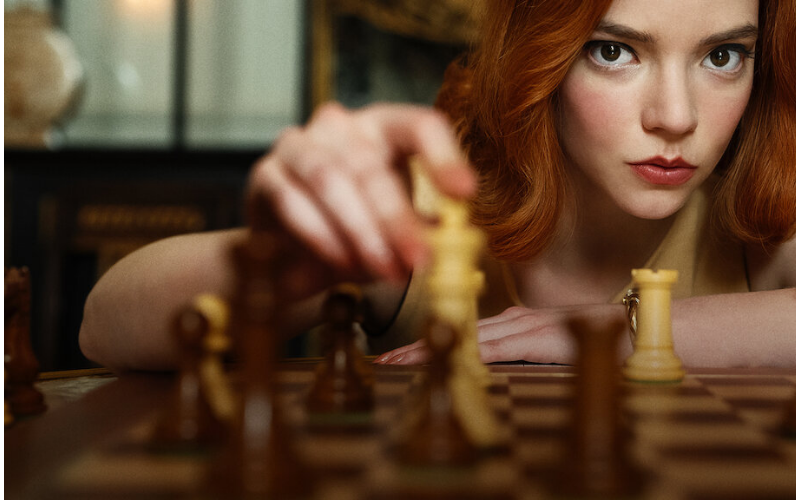
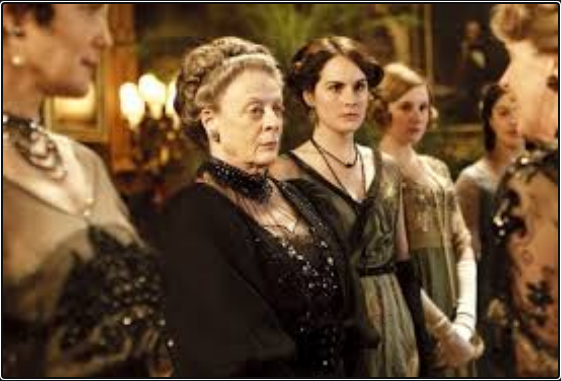
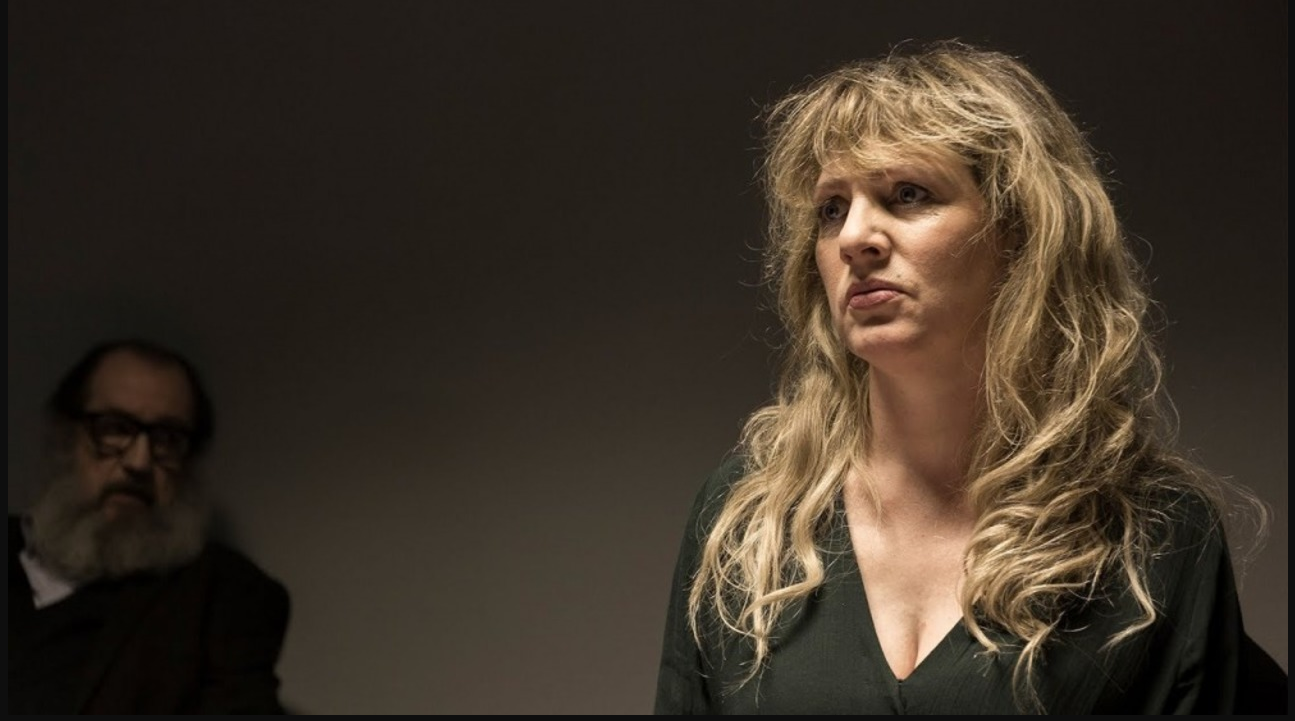
"The Queen's Gambit"- Series - What else is life but a chess game
I haven't written about my favorite topic for a while - TV series. Now I have watched a series that I believe deserves our attention, so I decided to write you something about it.
What else is this life but a game of chess. After the withdrawn move, there is no going back, as well as after good or bad decisions. You can just look at the board and hope for the best. We defend, attack and in the end we win or lose. But when the game is over, the figures are put aside and that is the end. That is why this life is exciting, composed of black and white figures, black and white fields, jumpers, pawns, queens, kings, cannons and horses. Sometimes it's black, sometimes it's white and the game doesn't last forever, whether you are satisfied or not with the final outcome.
The series "The Queens Gambit" by director and screenwriter Scott Frank, based on the novel by Walter Tevis, breathes so deeply and pulsates so strongly that at times it is hard to believe that we are witnessing fiction and not true stories. Elizabeth Harmon's vivid intrusion into life, as well as life itself, is full of unexpected events that depict the reality of a girl walking somewhere on the border of genius and madness. "The Queens Gambit" as a chess maestro is a maestro of drama that we no longer see and that we have been missing for a long time.
Although it may seem so, the series does not require any knowledge of chess, or even knowledge, because the narrative is personal and full of empathy towards the numerous actors who play on the black and white fields around Elizabeth Harmon.
This silent and distant girl from the 1950s was placed in an orphanage. The mentally disturbed mother did not want to spend her life with her daughter, she just wanted to end it. The moment of parting happened on the bridge. The girl waited for the police, and the mother waited for the funeral company.
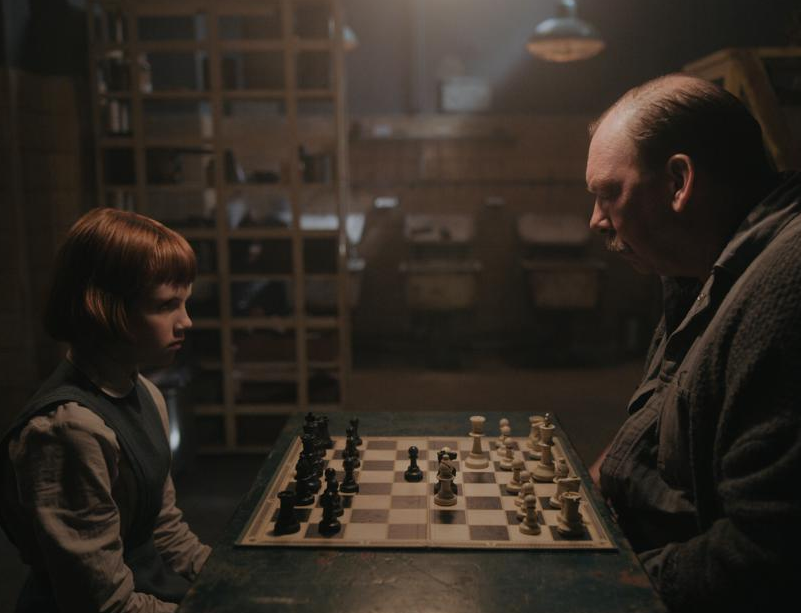
An orphanage as a safe home, until conditions are created for others, is the greatest tragedy and the greatest happiness in Elizabeth's life. The girls were fed daily vitamin tablets and "mood pills". Instead of "mood", there was a serious and manic addiction to drugs. Elizabeth's love for green and blue pills opened the door to a new world. A world in which she could plan every move in advance solves even the most difficult mathematical problems. The boundless view shot up before her eyes when she first saw the janitor playing chess with himself. Raw talent, lack of any social skills and addiction that will get out of control in order to ruin her life, Elizabeth is leading a long way.
From the label "child prodigy", through adoption and living with a dysfunctional family, to the desire to beat the famous Russian chess player, "The Queen's Gambit" is as intimate as a whisper and personal as a defeat in a game in which no one likes to lose.
Elizabeth Harmon's life did not turn out the way she wanted, so the chessboard, as a controlled and limited living conditions, is a great place where she can maneuver the situation so as not to lose. The inner world of the heroine, in addition to the desire to win and strong anxiety from defeat, melts the story into a case study of addiction and alcoholism. The dominant motive of the narrative is the feeling of isolation and loneliness, which are the main drivers of bigger problems, but of a problematic life.
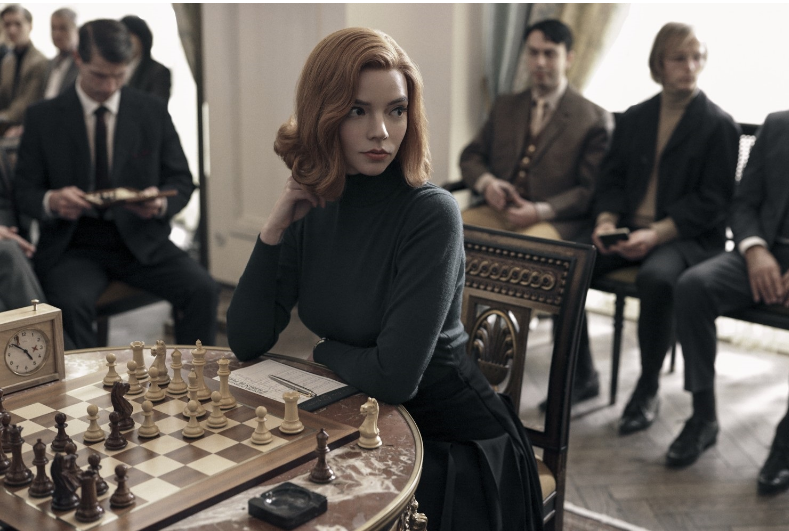
Elizabeth, as the only woman in the chess world, is a kind of finger in the eye, but an object for humiliating the opponent, because how is it possible for a red-haired girl to whip much older guys. An ingenious look at the gender aspect and the sporting spirit in the game is an emotional lure that sells the story as if it were made on true events.
"The Queen's Gambit" was filmed and directed with incredible care, elegance and love for the story. The composition of the shots, the choice of color palettes and the subtle change of tones in accordance with the events atmospherically affects every condition that the heroine goes through.
Anya Taylor Joy as Elizabeth Harmon is the best acting choice in recent television history. The actress is able to describe the psychological and emotional state of the character without a single spoken word with the help of facial expression. The spectacular acting of Anja Taylor Joy, which accompanies the rest of the ensemble, raises the series to an even higher level. After Robert Egars' "The Witch", this is the best role she has ever had.
https://www.youtube.com/watch?v=CDrieqwSdgI
This is a new Netflich series, released this year. In my opinion, "The Queen's Gambit" is the best example of the attractiveness of the material based on care. It did not happen soon that someone approached the adaptation with so much love. Take a peek into the series through Netflix’s official trailer, and I’d recommend you take the time to watch it.
Just listen to your heart and everything will be fine, woops problem
"Only the heart can see well. The essence is invisible to the eyes. "
Antoine de Saint Exupery
How many times have you happened to listen to your heart and make a mistake?
Your heart just dragged you towards someone who is not good for you.
You have seen for yourself, as well as everyone around you, that the situation you are in is not good for you, but in vain. The "heart" prevailed.
Or, you feel afraid of a situation. You believe that your heart is telling you that this situation is dangerous for you, and you agree. And in that way you miss a lot of beautiful things.
You feel fear of love, you listen to your heart and you are lonely. Something is wrong here.
**Is it really best seen with the heart?**
**And is the heart always right?**
Evolutionarily, the "heart" or feelings are older than the brain. While our brains as a species were not sufficiently developed, it was the feelings that guided us through life. She warned of danger, gave energy for action, connected with others so that we could survive together more easily.
Yes, the heart really shows best. The heart knows best what is good for us and what is not.
And if we always listened to our heart, we would spare ourselves many inconveniences, disappointments, hitting our heads against the wall.
**The small problem in this story is that during growing up we become so far away from ourselves and our heart, that it becomes a stranger whose messages sound either like a tuned radio or like some strange foreign language.**
We move so far away from ourselves and our feelings that we no longer know when something is whispering to our heart, and when the feelings are caused by mental constructions, ideas of what and how something should be.
Sometimes our heart is so hurt that it needs care and recovery first, so that it can be our wise life counselor again.
Sometimes the situation is really dangerous and fear is a useful signal that we need to do something to protect ourselves.
How do I know whether to obey my heart or not?
Of course, there is no short, clear and accurate answer to this question. There are only guidelines.
Listening to your heart does not always mean automatically following your feelings.
It is important to be ready to hear ourselves and our heart, but also to re-examine what it tells us.
It is important that we make friends with our heart, get to know it, heal it, nurture it and in that way learn to use it for our own good.
**THE HEART IS LIKE A COMPASS. IT CAN INDEFINITELY GUIDE US THE WAY WE NEED TO GO TO REACH THE GOAL. AND IT CAN ALSO BE "CORRUPTED" AND GIVE US WRONG AND UNCLEAR SIGNALS.**
Most of us have been hurt, neglected and silenced many times during our growing up.
And that’s why it’s hard for most of us to know when our heart is turning and when it’s our brain.
It is difficult for us to know when a feeling is authentically ours, and when it is a reflection of some old injury or wrong belief.
And that is why the hearts of most of us are shy, scared and confused.
In order to bring our heart again to lead us wisely through life, we need to heal it first, get to know it and develop a friendly relationship with it.
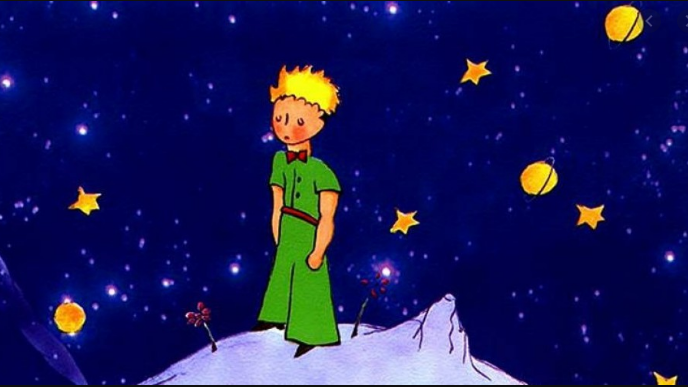
It takes time and it takes daily small steps dedicated to just that - as the fox from the Little Prince would say - to taming his heart.
As for everything else - exercise makes a master.
Set aside a little time each day for yourself and your heart. Take some time to listen to yourself, look at your feelings and reconsider them.
In time, you will learn to recognize the quiet voice of your being in the noise of thoughts.
Keeping some kind of emotion diary can help a lot.
When we write something down, we will find it easier and more objective to look at the situation than when we put our thoughts in our heads.
Home recording and Instagram commercials: how brands work with influencers during a pandemic
How did social media save fashion during the crisis?
As countries began to gradually close their borders and put their citizens in strict quarantine, the fashion industry temporarily fell into depression. All the usual mechanisms of work were now inaccessible and all established processes were disrupted. Nobody understood how to show new collections in such conditions, make and sell clothes and in general: what will happen next with fashion? But while some were in a panic, others were looking for ways out of this situation. And they found him - on social networks and in collaborations with influencers.
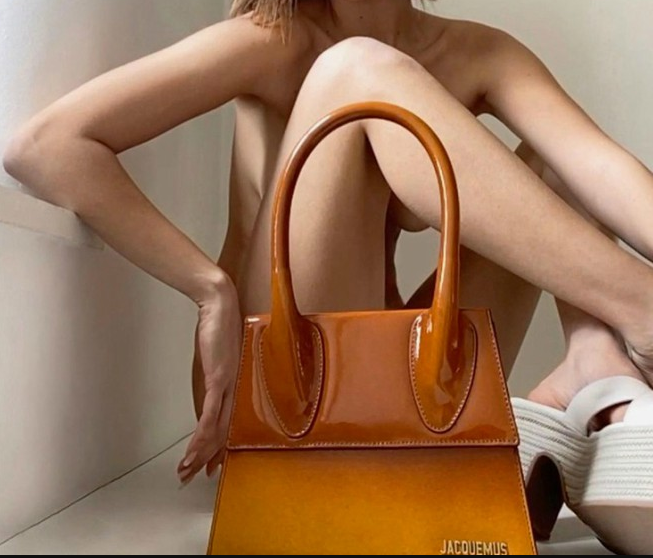
When the world began to close in the spring due to a severe blockade, it became clear: it will not be like before. It was simply impossible to organize Fashion Week with the usual fashion shows or to record a full-fledged advertising campaign. At the beginning, we did not believe that the new autumn collections would be in stores, because all the factories were closed. It was not clear how to promote their products now. It suddenly became obvious that not all old methods are very effective in the current situation, and new ones have simply not been invented yet. But the crisis always stimulates creativity, so designers could still move in a new reality. The first was the king of Instagram, Simon Port Jacquemus: at the very beginning of the quarantine he had a great idea to virtually present his new advertising campaign.
Following him, this idea was adopted by all the major great magazines in the world. Thus, the designer set a precedent and invented a new way of working with influencers that does not require direct contact and expensive recording with a whole team of professionals. You just send things by courier service, and then celebrities appear on Instagram, where they are immediately seen by millions of people around the world. And although by the fall the situation had begun to improve somewhat, and we had already adapted to life under conditions of restraint, it was still obvious that we were still far from returning to the old norm. Therefore, Jacquemus' colleagues adopted his method and surpassed the teacher. The first was Olivier Rousteing, creative director of Balmain. In order to present new items with monograms to the public, which he discovered in the archives of the house, he sent clothes with this print to his muses. Not only did they put pictures of Balmain clothes on their accounts, but they also appeared in them at the last fashion show of the brand - although not physically, but only on the screens, which this time replaced the traditional first row. The move literally blew up social networks and news sites.
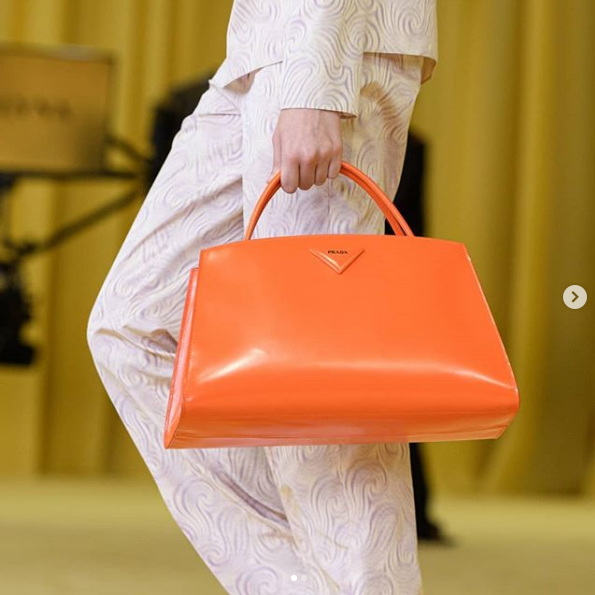
Miuccia Prada, who always goes one step ahead of the entire fashion industry, also could not stand aside and not think of something of her own. It has brought together fashion editors and influencers around the world, broadcasting Prada and Miu Miu shows in major cities. At the same time, the guests gathered in their hometowns, where they were shown a fashion show on the screen. Thus, they are enabled to have the full effect of participation without flying and dangerous contact with a large number of people from all over the world. At the same time, there was no one on the site except the models - and that was strategically correct not only for medical reasons. Against the background of the empty hall, the clothes on display attracted even more attention and it was possible to examine it in more detail.
Well, the last (and perhaps most impressive) case was shown by the new creative director of Givenchy, Matthew Williams. He prepared the presentation of his debut collection as concisely as possible - simply by posting a lookbook on Instagram stories. But a week later, a real information bomb awaited us: all the new looks were sent to friends of the House - celebrities and influencers around the world, so that they could take pictures in them. The obtained photos were on the personal accounts of the heroes and on Givenchy Instagram. Therefore, it will not surprise us at all if, after the release, the collection sells out in a few hours - with such a convincing support team, anything is possible.
And if anything else tells us that the pandemic will end, we believe that this new influencer marketing will remain. With a relatively modest cost, it shows great efficiency.
Montenegrin princesses who seduced Europe
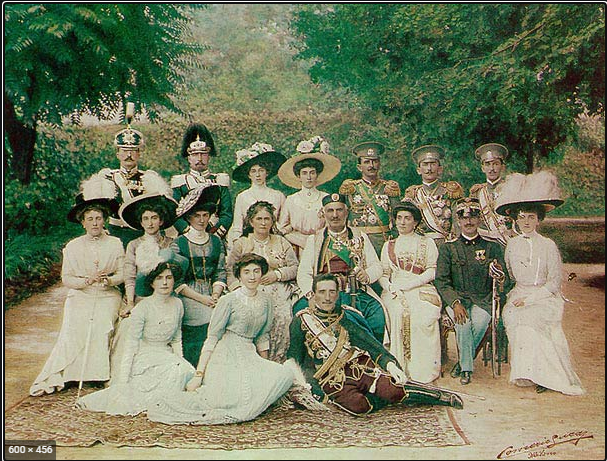
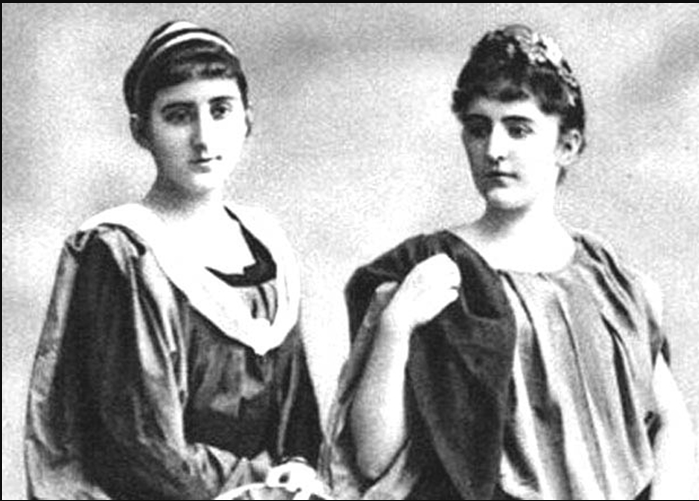
When mentioning the history of Montenegro, one always thinks of Njegos, Marko Miljanov, Prince Nikola, chivalry and heroism, only at the end of the ladder, somewhere in the corner, are the characters of the four daughters of Prince Nikola Petrovic Njegos. The four of them, Milica, Anastasia, Zorka and Jelena, contributed more to the glory of this small kingdom and dynasty in Europe than all its famous male representatives. The four daughters of Prince Nikola occupied the Serbian, Russian and Italian courts and left their mark on them for all time. Many are inclined to claim that they have decisively influenced the history of Europe.
Their fame and value did not fit the image of a Montenegrin woman locked in a house behind the stove. Their characters belonged to the modern world and fit perfectly into the image of a free woman who chooses her own path.
When asked by a foreign diplomat - "what can you export from this poor country" - Montenegrin King Nikola Petrovic answered - "You underestimate my daughters". It turned out that the ruler was right, since the four princesses became "tenants" of the Serbian, Russian and Italian court, thanks to which their father received the nickname "Europe's father-in-law".
The ladies, who are remembered as "the most powerful weapon in their father's diplomacy", were ahead of their time, which often provoked the indignation of the patriarchal environment. Although there is a belief that the prince and the later king planned to build a monastery on the lonely island of Vranjina on Skadar Lake, so that his daughters could live as nuns, he soon gave up the idea and sent Zorka, Milica, Stana, Marija and Jelena to high school. Smolny in Russia. In the elite school, European blue-blooded ladies acquired knowledge from various sciences and etiquette, but a significant part of their education was also lessons on how to make a man propose to them, and at the same time he thinks that it is his initiative.
The knowledge gained in Smoljno made the descendants of the king become refined ladies for whom the crowned heads on the Old Continent sighed. According to the testimony of contemporaries, the ruler was worried about how to find a groom in his homeland for proud daughters who dressed in the latest Italian and Russian fashion, and he feared that they would remain settlers who would be a huge burden to the state. he spoke), but he was relieved when marriage offers from different parts of Europe began to arrive in Cetinje.
**Zorka Karadjordjevic**
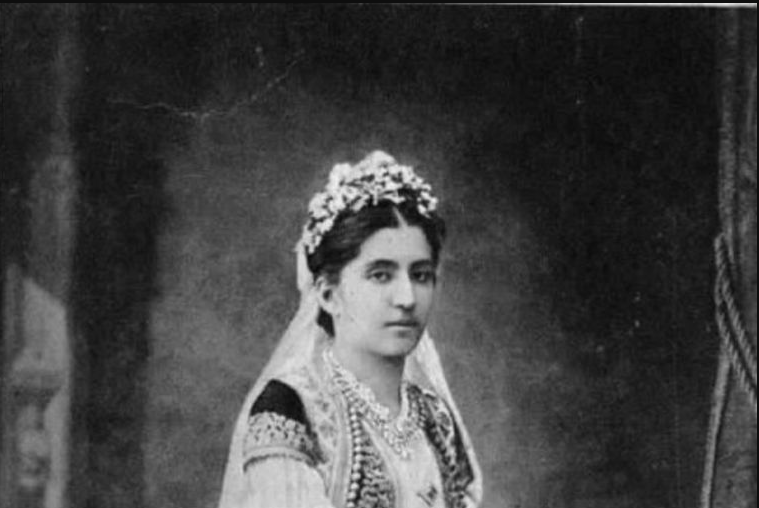
At the age of 18, the eldest daughter of King Nikola, Zorka, met the 39-year-old heir of the Karadjordjevic dynasty, Petar, who, like the Montenegrin princess, was in love with France, where he received his education. Pediatric biographers noted that the prince was enchanted by Zorka's beauty and soon asked for her hand. Although he knew that this move would worsen relations with Obrenović's Serbia, and thus with Austria-Hungary, the Montenegrin ruler decided to grant the beggar's wish and the wedding took place in August 1885 in the church of the Cetinje Monastery. Although she was much younger than her husband, Zorka had great ambitions and dreamed of the day when she would become the Serbian queen. Desiring to leave as many descendants as possible to her mother Milena, who gave birth to twelve children, she gave birth to Jelena, Milena, George, Alexander and Andrew, but she died after the last birth, on March 16, 1890. Zorka's husband ascended the throne at the age of 16 later, after the May coup in which King Aleksandar Obrenović and Queen Draga were killed.
Zorka's death is still an enigma, considering that some historians claim that she fell down the stairs after an argument with her husband, due to which the birth occurred prematurely. It is interesting that fans of her character and work claim that it served as inspiration for several scenes of the Hollywood classic "Gone with the Wind", because allegedly director Victor Fleming heard the story of the unfortunate princess while traveling in Europe and weaved it into a story of defiant and enchanting Scarlett O'Hary.
**Milica and Anastasia - Stana Romanov**
Although Duchess Milena traveled with her daughters to European capitals and presented them to blue-blooded grooms, there were no announcements that Milica would become the wife of the uncle's brother of Emperor Alexander III. Montenegro was in a delirium of happiness. For days, shots were fired and celebrated in all directions, as if some important battle had been won in the war.
Telegrams with congratulations from Franz Joseph, Queen Victoria, the Russian imperial couple and other crowned heads arrived at the court in Cetinje. On the other hand, it was rumored in European court salons that Milica enchanted her future husband with witchcraft.
In August 1899, there was a wedding in the presence of numerous crowned heads. Just a day before the wedding, another incredible piece of news was published - Princess Anastasia-Stana, who got engaged to Prince Georgij Maksimilijanovic of Leichtenberg Romanovski. This engagement in Montenegro was also celebrated as a won battle in which thousands of Turks lost their heads.
Grand Duchess Milica and Duchess Anastasia-Stana, daughters of King Nikola Petrovic, marked the life of the Russian court until the October Revolution, and their names are associated with numerous mystical and occult acts and "accused" of bringing one of Russia's most controversial personalities to the royal family. history - Raspucina.
Milica and Anastasia escaped the revenge of the Bolsheviks by fleeing to the West. They first resided in the Crimea and then fled to Paris. For a time, the sisters lived with their families in Egypt and Paris. Milica had three children, a son Roman and daughters Marina and Nadežda. Her husband, Grand Duke Peter, died at Cap D'Antibes. Grand Duchess Milica died in 1951 in Alexandria and took the secret of Grigory Rasputin with her to the grave.
**Jelena Savojska**
Although all the daughters of King Nikola were perceived as fatal women, Jelena, who already in her youth showed a rebellious spirit by frequently running away from classes, was remembered as the princess who raised the most dust in her homeland. Thanks to her charm and intelligence, she managed to realize her dream of marrying Italian Prince Victor Emanuel of Savoy. Marrying the future king meant converting to the Roman Catholic faith, which some compatriots never forgave. On the other hand, Jelena said that God is one and that "it doesn't matter whether he is baptized from left to right or vice versa." She gave birth to four daughters and a son, and after Victor Emanuel ascended the throne on July 29, 1900, she tried to help the poor with charity work, which made her a favorite among the people. However, one of the biggest mysteries is the relationship of the royal couple with the fascist government of Benito Mussolini, because it is believed that the infamous duke greatly influenced the decisions of the court.
After the collapse of fascism, Jelena's husband abdicated in favor of his son Umberto II, hoping that the Italians would support the rest of the monarchy in a referendum, which did not happen and the couple soon left the country. Victor Emmanuel of Savoy died in Alexandria in 1947, and Jelena outlived him by five years. Her funeral in Montpellier was attended by 5,000 French people who fell in love with her because of the charity she did after leaving Italy.
For cold and rainy days: A chocolate bomb that lifts the mood with the first sip
Hot chocolate or the drink of the gods, as the ancient Aztec civilizations called it, did not get such an epithet in vain.
Namely, although hot chocolate is mainly consumed for pleasure, it also has its healing properties due to the antioxidants found in cocoa. It was even used in medicine as a remedy for stomach problems until the 19th century.
Today, we know that this magical chocolate drink will relieve cough, as well as have a beneficial effect on the cardiovascular system.
Chocolate itself has been especially valued for centuries and is credited with aphrodisiac properties, and according to Aztec legend, hot chocolate was considered the drink of the gods in paradise, and was also used for various rituals.
The drink is usually made of chocolate or cocoa powder, warm milk, water, sweet sour cream, sugar ... It is a drink that is popular all over the world and is made in different ways. Cocoa is the basis of all beverages, and they generally differ in density or additional aromas.
For example, in Italy hot chocolate is really thick, while in America it is common for it to be sparse, like milk. With the first snowflakes or after a hard day a cup of this hot beverage will come as a real treat. There are also purchased versions, but, of course, you can also make this chocolate magic yourself.
You can also experiment with flavors, with the addition of even chili, ginger, cinnamon, pieces of orange, liqueur, rum, wine or various aromatic flavors of chocolate, and decorate with whipped cream, biscuits ...
Hot chocolate is a beverage that we all like to drink when the cold days come. Especially if we embellished it with additional flavors and whipped cream. Treat yourself to a delicious drink when it is cold and rainy outside, because it will surely improve your mood.
Ingredients for 2nd hot chocolate:
350 ml of milk
120 ml sweet sour cream + a little more to serve
50 g nutella
100 g dark chocolate
½ teaspoons of vanilla extract
Preparation:
Heat the sweet sour cream and milk to boil, then pour over the chopped chocolate and nutella. Stir until you get a smooth mixture. Then add the vanilla extract and pour into glass cups. Whisk in some more sweet sour cream, then pour over the hot chocolate. If you want a little stronger hot chocolate, add a teaspoon or two of bourbon.


NORBS - National Organization for Rare Diseases of Serbia
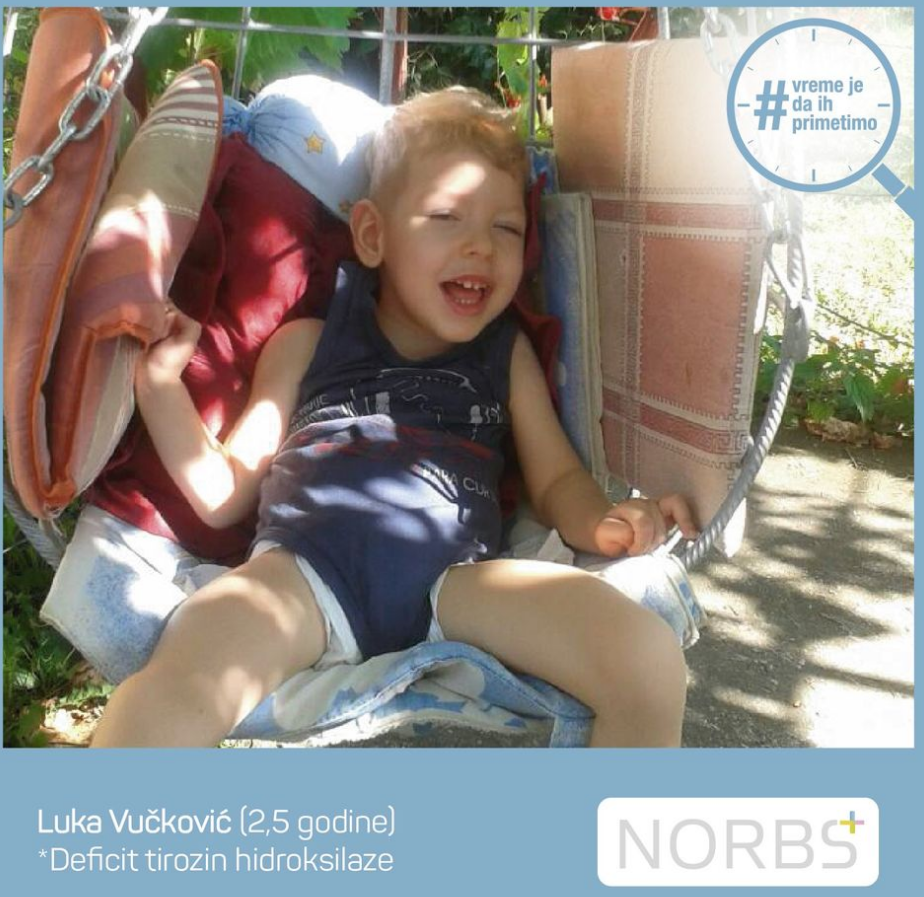
I became aware of the existence of these diseases only when my nephew Luka fell ill with one of them. Luka has a deficiency of tyrosine hydroxylase, a rare neurometabolic disease characterized primarily by movement disorders, unstable blood pressure, variations in body temperature and abnormal eye movements.
This is what Luka looked like a year ago when he was finally diagnosed. He was 2.5 years old at the time, he could neither sit on his own nor could he perform some movements willingly.
Fortunately, there is a therapy for Luka's illness. Thanks primarily to the NORBIS organization, he was able to see the right doctors and start receiving rhe appropriate therapy.
https://drive.google.com/file/d/1TqMKJnz2RKZJaFYkdAHjV-dA4C_Q8TZ2/view?usp=sharing
Today, Luka is a boy who walks independently, a curious and cheerful child who can finally explore the world around him. Of course, there is still a long way to go before he recovers completely, but the results of the therapy are more than obvious.
These are pictures of what Luka looks today.. If you click on the link under the pictures, you will be able to see a video of Luka walking to get to his dad who is waiting for him with his arms opened.
Of course, I have the permission of his parents to publish these pictures and the video, in order to raise awareness about this issue.
There are still many who, like Luka, suffer from diseases that aren't very well-known. To raise awareness, I'll tell you something about rare diseases.
**Rare diseases.**
A rare disease is classified as any disease that affects up to 1 in 2,000 people.
According to the estimates of the
European Commission estimates that 6% to 8% of the population suffers from a rare disease. We also use in estimate in Serbia.
In Serbia, it is estimated that about half a million citizens live with a rare disease.
The most important characteristics of rare diseases:
-80% of rare diseases are of genetic origin; they often occur due to infections, allergies, the influence of the factors found in the surrounding environment or are generations and proliferative.
-In 50% of people with rare diseases, the first symptoms of the disease appear at birth or in early childhood.
-30% of children with rare diseases live less than 5 years.
-There is no registered therapy for more than 95% of rare diseases.
-The most common consequence of rare diseases is permanent disability.
Despite their differences, people with rare diseases and their families face the same number of difficulties that arise from rarity:
-Unavailability of diagnosis or years of searching for a diagnosis
-Lack of information: about the disease itself, where to get help for it, including the lack of qualified specialists
-Lack of scientific research, lack of medication and appropriate medical aids
-The high costs of existing drugs and treatments that lead to family poverty and reduced access to treatment
-Social consequences: stigmatization, isolation, discrimination, lack of professional opportunities
-Lack of quality health care: exclusion from health care, even when the correct diagnosis is made
-Inequality: encountering administrative barriers in trying to treat or exercise social protection rights
*****What is NORBIS?*****
The National Organization for Rare Diseases of Serbia - NORBS was founded on July 23, 2010, as an association of associations that deal with issues people with rare diseases and their family members face.
The main goal of the National Organization for Rare Diseases of Serbia is to improve this population's position and quality of life.
Objectives of NORBIS:
-unified representation of the interests of persons with rare diseases and persons with disabilities resulting from a rare disease in Serbia and unified appearance before decision makers and other actors in society;
-protection and realization of basic human rights, elimination of discrimination and realization of equality, equality and social inclusion of persons with rare diseases and persons with disabilities caused by a rare disease;
-commitment to decision makers in Serbia to accept and apply international and European standards, principles and documents in the field of rare diseases, in order to provide persons with rare diseases and persons with disabilities resulting from rare diseases the highest possible quality of life;
-advocating for the adoption and implementation of national policy in the field of rare diseases and the reform of national legislation in accordance with the needs and interests of persons with rare diseases and persons with disabilities resulting from rare diseases;
- providing, through national policies and legislation, special support to families whose members are persons with rare diseases and persons with disabilities resulting from a rare disease.
**NORBS is a member of the European Organization for Rare Diseases - EURORDIS**
An online regional conference on rare diseases was held yesterday and today. With this article, I wanted to contribute at least a little to a better understanding of this problem. Look up the NORBIS Facebook page, find out a little more about them, build awareness of the existence of these diseases, and of course help somehow if you can.
Rosa Parks - a woman who changed America with civil disobedience
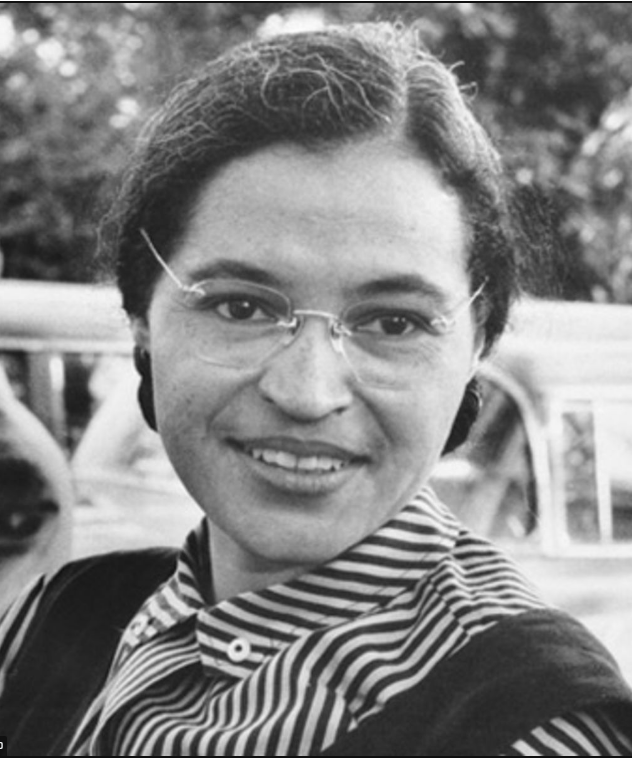
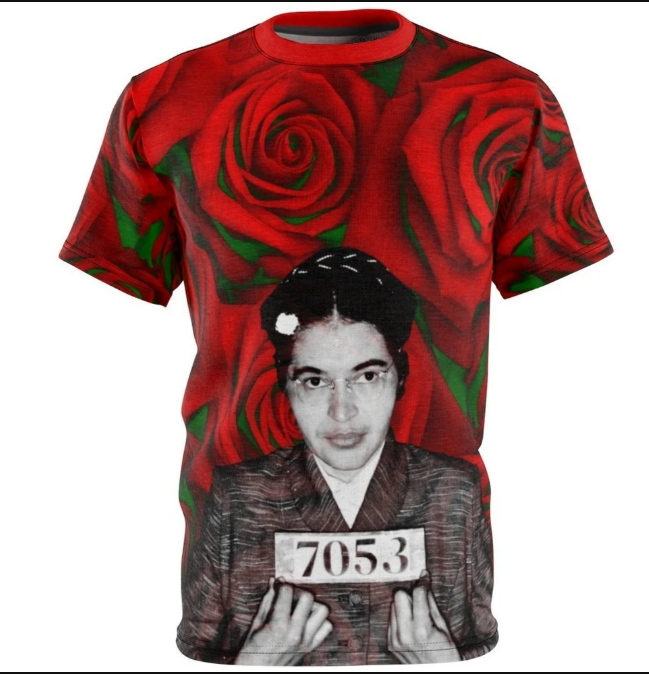
Rosa Parks (February 4, 1913 - Detroit, October 24, 2005) was an African-American human rights activist and tailor who was declared the "mother of the modern human rights movement" by the US Congress.
Rosa Parks was born Rosa Louise McCauley Parks in Taskigi, to father James, a carpenter, and mother, Leona Makeli, a teacher. After her parents divorced, Rosa and her mother moved to Pine Level, not far from Montgomery. They lived on the estate together with their grandparents, as well as Rosa's younger brother Sylvester. Rosa Parks became a member of the African Medotist Episcopal Church, to which she will belong for the rest of her life. Until the age of eleven, her mother taught her at home, after which she enrolled in the Industrial School for Girls in Montgomery. She subsequently attended Alabama State College, but was forced to leave it to care for her grandmother and later her ailing mother.
In 1932, Rosa married Raymond Parks, a barber from Montgomery. Raymond was a member of a group that raised money to support a group of blacks who were unjustly accused of raping two white women. After marriage, Rosa did a variety of jobs, from working as a housekeeper to helping out at the hospital. At her husband's urging, in 1933 she completed her high school education. At the time, just under 7% of African Americans had a high school diploma. Despite Jim Roof's so-called law, which made it very difficult for blacks to participate politically, Rosa managed to register to vote on her third attempt.
In December 1943, Parks became an active member of the Human Rights Movement, joining the NAAKP branch in Montgomery. She volunteered as a secretary to President Edgar Nixon. About her position, she later said: "I was the only woman there, and they needed a secretary and I was too shy to say no."
The struggle for desegregation in the United States has been very long and arduous, and has originated from individuals who, through their individual cases, climbed the legislative ladder to the Constitutional Court and changed segregation laws one by one, so to speak, manually. Even the victories were hard to come by. Despite the successful legal abolition of racial segregation in schools in 1954 (Brown v. Education Board), it remained de facto in force in a large number of southern states for a very long time. The racist population in the states of the former Confederation vigorously and dramatically opposed these changes, openly expressing their dissatisfaction in the form of direct, sometimes violent, resistance.
However, unlike schools, where changes took place almost directly through the judiciary and legal proceedings, in the field of public transport this path was a little more dramatic.
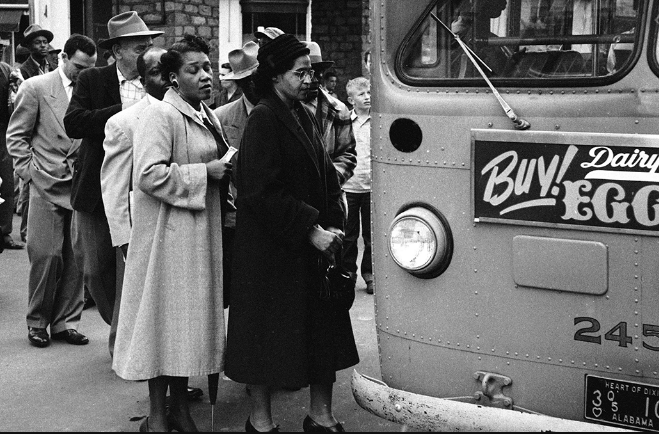
Segregation in public transportation was designed so that the seats would be divided into two bus zones - in the first half of the bus, the seats were reserved for light-skinned citizens, while the other half of the bus was for African Americans. If the bus were full, every African-American passenger would have to give his seat to a white man who gets on the bus, and spend the rest of the ride standing. Drivers had the discretion to control the distribution of seats and regulate the accommodation of passengers, and they were even legally armed in case the tension between the passengers escalated.
The boycott of public transport began with the famous case of Rosa Parks, who on December 1, 1955, refused to give up her seat on a white bus, for which she was arrested. Her act of civil disobedience started a revolt among the citizens of Montgomery, who in just two days managed to organize a massive but secret boycott of public transport at the level of the entire city. Some walked, hitchhiked on the day of the boycott, and some used horse-drawn carriages or rode mules. Martin Luther King, a hitherto unknown young priest, was elected leader of the boycott.
Besides King, who is considered the ideological leader and key figure of the Civil Rights Movement, Rosa Parks is probably the most famous figure in that period of American history, whose process began the entire process of political and social change, until the final abolition of laws based on racial segregation. and racial discrimination in the United States.
Although Rosa later often joked that she was just tired that day, and that she hated to get up from her seat, far from just accidentally finding herself in the right place at the right time. Rosa was then forty-two years old, and had many years of experience in activism and the fight for civil rights. She participated in numerous campaigns, worked as a secretary of the local branch of the Movement for more than a decade, and as a counselor in their youth committee, she was educated on methods of nonviolent resistance and civil disobedience.
The trial called Browder v. Gale began in February 1956, two months after the act of Rosa Parks. The lawsuit was based on a violation of the 14th Amendment to the US Constitution, which guaranteed equal protection before the law for all citizens, through racial segregation in public transportation in Montgomery. On June 19, 1956, the court ruled that racial segregation in public transportation in Montgomery was unconstitutional, and that the law in the Brown v. Education Board case, which had previously abolished racial segregation in schools, could be applied to public transportation. This verdict was confirmed by the Constitutional Court in December. The boycott of public transport, which lasted a total of 381 days, ended that month.
Rosa Parks lived in Detroit until her death. She died in her apartment on October 24, 2005, at the age of 92. In 2004, she was diagnosed with dementia.
Her body was laid on the altar in the church in Montgomery. The commemoration was held the next morning, and in the evening, the coffin was transferred to the city of Washington by a bus similar to the one in which Rosa once refused to give her place to a white man. It is estimated that the coffin on the stage in Washington was seen by 50,000 people, and the event was shown on television on October 31, after which another commemoration was held.
Although scheduled to last a maximum of three hours, due to a delay of one hour, a large number of speakers and the length of the speech, the funeral was extended to seven hours, until late at night, so many television stations outside Detroit did not broadcast it completely.
During the passage of the funeral procession on the way to the cemetery, the gathered crowd applauded and released white balloons into the air.
Disney + adds racist warnings to its cartoons
There has been a lot of talk about racism in recent years. For myself, I'm sure I'm not a racistand I strongly despise racism as well as any form of discrimination , but sometimes I wonder that maybe we haven't started to exaggerate a bit and declare racist content what it may not be.
New ethics at work!
The Disney + streaming platform has added warnings of racist stereotypes to some of its cartoons. Now, when choosing a cartoon to watch, users may see a warning: "This program includes a negative image and / or unfair treatment of people or cultures." Such an update has now been added, for example, to the well-known childhood cartoons "Peter Pan", "Beauty and the Beast", " The Ladu and the Tramp".
These additions came about as a result of the fact that service representatives consulted with independent experts from the African American Film Critics Association, the African American Film Critics Association, the Coalition of Asian Pacifics in Entertainment, and GLAAD on these issues.
For example, a warning before watching the cartoon "Aristocats" reads: "The cat is shown here as a racist caricature of East Asians with exaggerated stereotypical features such as slanting eyes and large teeth." "Those stereotypes were wrong then and they are the same today. Instead of just deleting this content, we want to highlight its detrimental effects, learn from its experiences, and open a discussion to create a more inclusive future together. Disney wants to create stories with inspiring themes that reflect the rich diversity of human experiences around the world, ”the company said in a statement.
Initially, these warnings were only displayed on pages with detailed descriptions of cartoons, but now they appear even before the content is released.
I don't know about you, but I only see animation of various cat news here. Okay, Asians have hairy eyes, but why mention big teeth for God's sake? Personally, hairy eyes are beautiful to me, I wish I had them too, and as for big teeth, individuals who belong to all races have them.
I don’t know, maybe they’re right, maybe racists really see it that way. Still, I’m afraid it doesn’t produce the counter-effect that some people might start noticing things in a way they haven’t done before.
**What do you think about that?**


Let's walk through the favorite castles of Catherine the Great
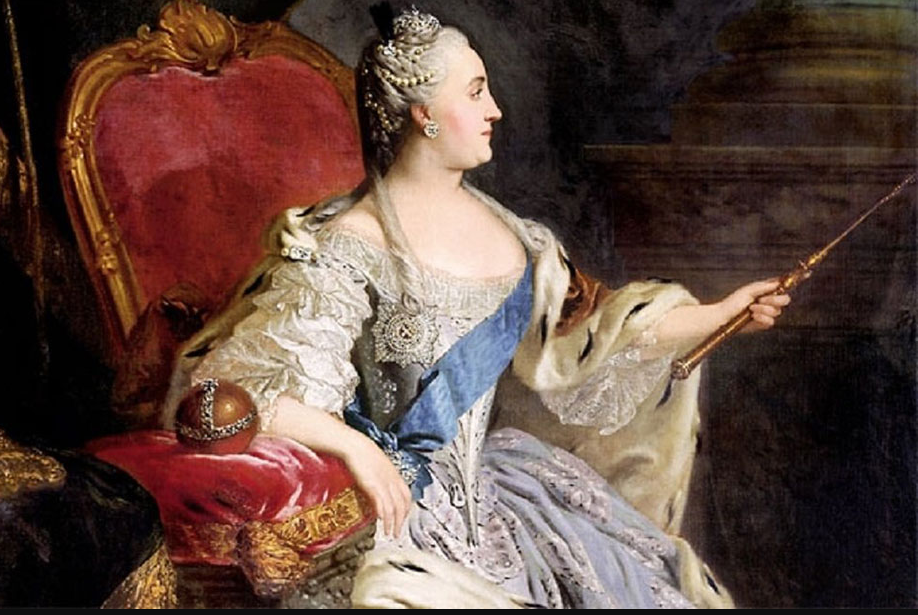
Catherine the Great is considered one of the most interesting rulers of the 18th century. The woman who was the empress of Russia for more than 30 years, managed to pull Russia out of the dark Middle Ages and make it the most powerful country in the world. Due to the revival of the country, the Russians called Katarina "mother of the homeland".
It is interesting that Katarina did not have a drop of Russian blood. She was born in 1729 as Sophia August Frederik von Anhalt-Cerbst in Szczecin in present-day Poland and enjoyed excellent prospects for marriage thanks to her mother's good bloodline. When she was only 15 years old, she received an invitation from the Russian Empress Elizabeth I Petrovna, who took over the Russian throne only three years earlier. Unmarried and without children, Jelisaveta chose her nephew Petra to be her heir and decided to find him a bride. The young Prussian princess, well trained by her ambitious mother, left a positive impression on Empress Elizabeth, and the wedding ceremony was held on August 21, 1745, after the bride accepted Orthodoxy and was named Catherine.
Jelisaveta Petrovna died in January 1762, and Peter III and Catherine came to the throne as his wife. In order to leave his mark, Peter soon ended the war between Russia and Prussia, returning to this country the previously conquered territories, which was very unpopular among the Russian army. The reform program aggravated the otherwise difficult position of the serfs, and all that affected Katarina, who was afraid of Peter's further plans. As the tension grew, so did the plans for Peter's overthrow. After the conspiracy was discovered in July 1762, Katarina acted quickly and, with the support of the most powerful military regiment, organized the arrest of her husband.Only six months after he became tsar, Peter abdicated, and Catherine was proclaimed the only ruler of Russia. Shortly after his arrest, Peter III was killed in prison.
Her reign is considered the "golden age" of the Russian Empire.
Today I am taking you on a short "journey" through the favorite palaces of this Russian empress.
**Peterhof Palace**
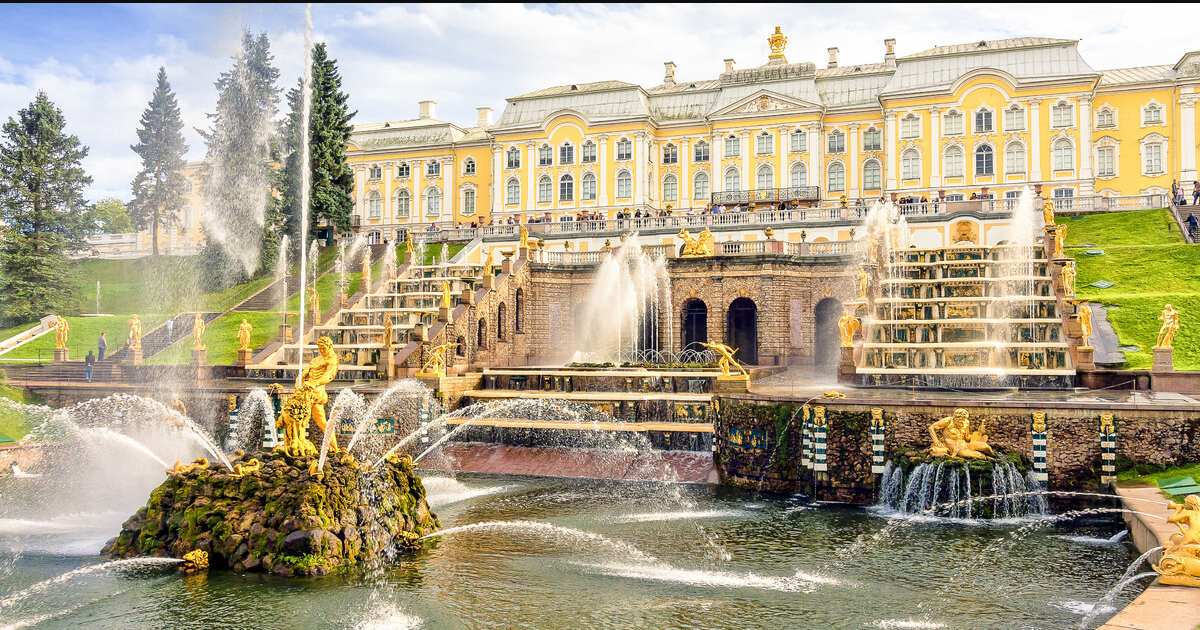
This large palace by the sea, near St. Petersburg, was commissioned by Peter the Great, the father of Elizabeth Petrovna. Peter was impressed by Versailles, the lavish home of the French "king of the sun", Louis XIV. Named "Russian Versailles", this place, which is on the UNESCO list, was designed in the Baroque style by architect Domenico Trezzini. Catherine the Great loved to stay in Peterhof. Here, she allegedly met the famous military leader Grigory Potemkin, who soon after became her lover.
**Winter Castle**
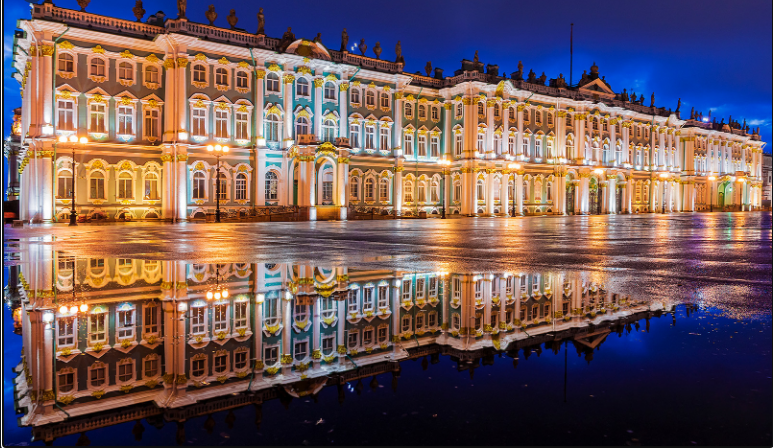
Catherine the Great was a great lover and patron of art. She founded the Hermitage Museum in St. Petersburg, when in 1764 she acquired an impressive art collection of the Berlin merchant Johann Ernst Gotzkowski. Expanded over the years, the collection now contains about three million items. Precisely because of this collection, the Hermitage Museum is considered one of the best museums in the world. In the center of the complex is the Winter Palace - the official residence of Russian tsars from 1732 to 1917, when the monarchy was abolished in the Bolshevik revolution. Catherine died in this very palace, in 1796.
Apple has published a video from the Hermitage Museum in St. Petersburg, which lasts for almost five and a half hours.
All art lovers who are not able to travel are able to enjoy a virtual walk like this.
During this kind of tour of the Hermitage, you can see the luxurious rooms of the former imperial palace, as well as the corridors with works of art at every step.
There are as many as 43 galleries with works by old masters such as Rembrandt, Caravaggio, Raphael and Rubens, several dance points in the great halls of this building and, finally, a concert by the ensemble of Russian composer Kirill Richter.
https://youtu.be/49YeFsx1rIw
**Catherine's Palace**
This Rococo palace in Pushkin, 30 km south of St. Petersburg, was built for another Catherine - the second wife of Peter the Great and became a summer residence for other Russian kings and emperors, including Catherine the Great. Behind its blue, white and gold exterior, you will find sumptuous rooms and chambers with crystal chandeliers, mirrors and prestigious paintings. The most interesting is the Amber Room, which was looted by Nazi troops during World War II, but was later renovated by Russian masters.
**The Kremlin**
The seat of power of ancient and today's Russia, the famous Moscow fortified citadel has countless connections with past emperors and empresses, including Catherine the Great. Her solemn coronation was held in the white stone Cathedral of the Assumption with golden domes in the Kremlin. The royal crown decorated with a diamond, which she wore at the coronation, is now on display at the Museum of Weapons, one of several places that attract visitors to the Kremlin.
How to "recharge your batteries" in a quick and easy way
Imagine what would happen if you drove a car non-stop, at maximum speed. No standing, no oil and part changes. How long would that car work?
And what happens to a cell phone after a while? His battery is low. And it won't work until we refill it. The more we use the phone the battery consumes faster.
That's how we humans function. We have a certain amount of energy at our disposal and when we consume it we just stop and can’t go any further. A small number of people reach that stage, but that is why the vast majority function at a minimum.
**The vast majority of people use only a small percentage of their potential.**
We use weekends to do the backlog of private and household chores, so that only vacation is usually left for vacation. That can never be enough. It is impossible to make up for 350 days of non-rest in 15 days. Even if we take into account the stress around the trip, it takes time to adapt to the new environment, and then time to adapt to return home. The stress of getting holiday money (if we can do it at all), the stress of vacation checks arriving by the end of the year, I won’t even mention it. It turns out that even from annual leave, most people do not take a break, but only get extra tired.
**Is it even possible to rest nowadays?**
**Yes, it is possible! And very simple!**
**How?**
First, it is important to give yourself permission to rest! Today, it is almost modern to "be in a hurry", "not to have time for yourself", "to be tired". The reason for this is that most people equate fatigue with value. We worked hard and with quality only if we were sooo tired. If someone is fresh and rested, it means that he is not doing anything, or that he is working superficially.
Nothing further from the truth!
It is possible to work hard and with quality and at the same time stay rested!
**How?**
By resting regularly and before you get tired!
Regularly means taking time every day for yourself and your vacation, recharging your batteries. Here we come to the following problem: How to rest?
Rest can be passive (sleeping, lying down, absence of any activities…) and active (engaging in some physical activity or activity that is different from the work we do).
All of this usually takes time and we may not be able to set aside enough time each day for any of the activities. Sometimes we are not in the mood to play sports or hobbies. That is why it is important to do something on a daily basis to help us recharge our batteries.
**How to set aside time for yourself?**
Here, too, it is first important to give ourselves permission to set aside time for ourselves. Permission to be important to ourselves. Permission to be kind and gentle to ourselves.
If we love ourselves and set aside time for ourselves, it does not mean we are selfish. On the contrary, it means that we do everything in our power to live our lives in the best possible way and thus provide our neighbors with the best possible version of ourselves. Mothers who know how to take care of themselves and nurture themselves pass this skill on to their children! Is there a better legacy? Workers who know how to take care of themselves are more productive and their work is of better quality and more creative. Partners who know how to take care of themselves are more pleasant to be in a relationship. They do not expect you to take care of them. They know how to love as adults.
When we have given ourselves permission to set aside some time for ourselves every day, we come to the following questions: how is it done? what does that actually mean
One way is to introduce the habit of listening to some relaxing music every day. Music is very powerful because it penetrates to the deep levels of the human soul. It is recommended that it be some instrumental, without words. The sound of nature also has a strong and deep impact on us. Choose something you like (there are many beautiful instrumentals on you tube) and listen every day. It is desirable that it is always the same music, because over time, through a certain number of listeners, a strong connection is created between a certain music track and a state of peace and relaxation. And over time, that effect intensifies.
Listening to music allows us to focus away from everyday thoughts, while actively listening and paying attention to sound we cannot think ordinary thoughts and worry about everyday worries.
**Why?**
Because it lowers our brain waves to an alpha level of functioning. At that level we are calmer and more relaxed, thoughts are slower and we are closer to our authentic being and our creativity.
Ten minutes sounds small, but it is enough to refresh, rest and recharge the batteries.
And no one can say they can't set aside ten minutes a day for themselves.
Try it now, listen and watch the video that follows below, and see how it affects you.
https://www.youtube.com/watch?list=RDMAjXiyKPBu8&v=MAjXiyKPBu8&feature=emb_rel_end
If you like it, try listening to this or that music of your choice every day for the next seven days.
Only ten minutes a day.
You will be amazed by the results!
This drink has been proven to destroy viruses and clean the airways
Sage tea is used to strengthen the body and in the fight against numerous health problems. This drink has been used in folk medicine for decades and is one of the most powerful for preserving the health of the entire organism.
The leaves of this plant contain various minerals - magnesium, calcium and iron; vitamins - A, C and B vitamins; essential oils, tannins and flavones.
Sage is often said to be a cure for the whole body. It can be used for both oral and external purposes. Coatings are made from it, but it can also be consumed as tea or in the form of oil.
It is also rich in antioxidants that help the body fight toxins. Therefore, it has a beneficial effect on preventing the development of cancer in the body, improves brain function and memory function.
Sage stimulates the central nervous system and digestive tract. It is great for lowering body temperature. In addition, it is a natural blood purifier. Sage tea maximally strengthens the immunity, so it is recommended in the period when the viruses are active.
It successfully reduces headaches and tension.
Sage has many beneficial properties, including increased concentration and memory, inflammation of the throat and respiratory tract, hoarseness, inflammation of various internal organs, infections of the genital organs, fungal infections of the mucous membranes and skin.
Until the invention of antibiotics for all these conditions, only sage was used.
This herb has also been shown to be very effective in menopausal symptoms and menstrual disorders, in cleansing the liver of toxins.
Sage is used externally to stop bleeding and disinfect wounds and ulcers. As it has an antispasmodic effect, it is also used for inhalation in asthma, bronchitis, but also in respiratory infections.
Sage as an antiseptic is used for rinsing the throat with inflammation and canker sores in the throat and mouth. Sage has both antimicrobial and antispasmodic effects (relaxes muscles). Reduces increased salivation and regulates sweating. Sage is a natural preservative, because it has an antimicrobial effect.


For all of you who are told they are hypersensitive
Within a couple of days two different people told me the same thing about me. "Only" they formulated differently.
One is to say you are hypersensitive.
The other is to say you are a gentle thin soul, take care of it.
I am sensitive. To some too much, to some gently and subtly. I have been sensitive since I know for myself.
Until recently, I also thought of myself as hypersensitive. A lot of them told me that.
Now I know I'm not hypersensitive.
I'm just sensitive.
It is neither better nor worse than others. Only different in its sensitivity. I have long believed that this is my flaw. That I need to somehow become less sensitive. Until I learned about the term highly sensitive person This may sound like pettiness and hair-splitting to some.
As if it matters, hypersensitive or highly sensitive. You can think. Someone. Not to me. For me, that difference made a huge change in my view of myself.
I'm not too much,
I don't miss anything.
**I am neither better nor worse than others. Only different in its sensitivity.**
I was born with a more sensitive nervous system and that's it.
As someone is born tall and someone short. Both have their advantages and disadvantages.
Thus, someone is born with a more or less sensitive nervous system.
Dr. Elaine Aron, a clinical psychologist and scientist, was among the first to draw attention to the fact that some people (about 20% of the population) differ in this characteristic.
Some of the questions she asks, and which help determine if you are highly sensitive, are:
-Are you easily overwhelmed by things like strong lights, strong smells, rough materials, the sound of sirens?
-Do you get upset when you have too many things to do in a short period of time?
-Do you avoid violence in movies and TV series?
-Do you need to retire to bed or a darkened room during the day with a lot of obligations and thus take a short break?
-Is it extremely important for you to organize your life in such a way as to avoid disturbing or overwhelming situations?
-Do you enjoy delicate smells, tastes, sounds and works of art? do you have a rich and complex inner life?
- When you were a child, did your parents and teachers consider you sensitive and shy?
Just as you can't blame someone who is too tall or short, because that's something a person can't influence, so you can't blame someone for being oversensitive.
When I learned about the existence of this trait, I experienced great relief. I realized that everything was fine with me, only different. Neither better nor worse. Different.
The question that came to my mind was - what's next with that?
I'm not going to go around, I'm informing people that I'm highly sensitive, that I'm not guilty of it and that they should treat me differently, with special care.
I don’t think it’s okay to bully others, but it’s also not okay to bully yourself either.
Thinking bad of yourself because of your difference is wrong.
I experienced a big difference in the experience of myself and therefore in my self-esteem with the very awareness that this is my trait, high sensitivity, something that I cannot influence and something that I should not change.
What I can influence is that first I respect my own diversity and my own needs.
This means that I am aware that occasionally, more often than others, I need to pull and charge the batteries. And that's what I do. I don’t force myself to the pace that others have. I respect my pace.
I am aware of how much other people's feelings and moods affect me and that is why I choose company whenever I can.
I am aware that no one is obliged to tremble around me, but I am also aware that it is my obligation to withdraw from relationships that exhaust and hurt me. It is possible to make a satisfactory compromise with some people, but not with others. And that's okay.
They don't have to change, but I don't have to change something I can't change.
It is important that I am aware of that, not to blame myself or others, but to accept what is.
**Why do people find it bad to be emotional or sensitive?**
Being emotional or sensitive in the time and society in which we live is not easy. But that doesn’t mean it’s bad. I even think, and experience teaches me, that when we accept ourselves with our sensitivity and emotionality, when we learn to protect and nurture ourselves, to set boundaries and choose people with whom we will be in closer relationships, then emotionality and sensitivity become advantages.
Yes, some people consider emotionality and sensitivity a weakness and a disadvantage. It is not a problem.
**The problem is when we ourselves begin to consider our emotionality and sensitivity as a disadvantage.**
To try to be less something we are and more something we are not.
It is a sure path to dissatisfaction and a failed life.
To me, knowing that there is a trait called high sensitivity has made a huge difference in my life. Change to much, much better. Knowing that I am neither too much nor too little but quite enough but a little different.
I hope it will benefit some of you as well. If you are highly sensitive or have such a gentle and subtle soul in your environment.
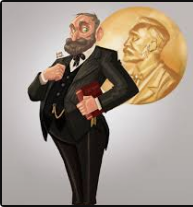
Alfred Nobel-invented dynamite, and then bequeathed his wealth to awards
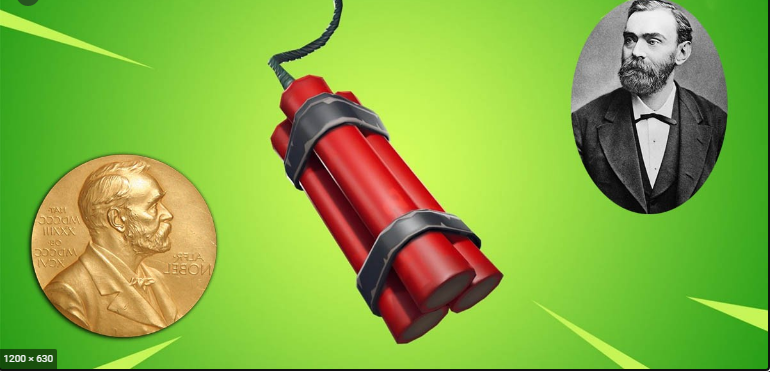
On this day in 1833, Alfred Nobel was born, a Swedish chemist, inventor, industrialist and great philanthropist.
The element number 102 in the periodic table of elements - nobelium - is named after him.
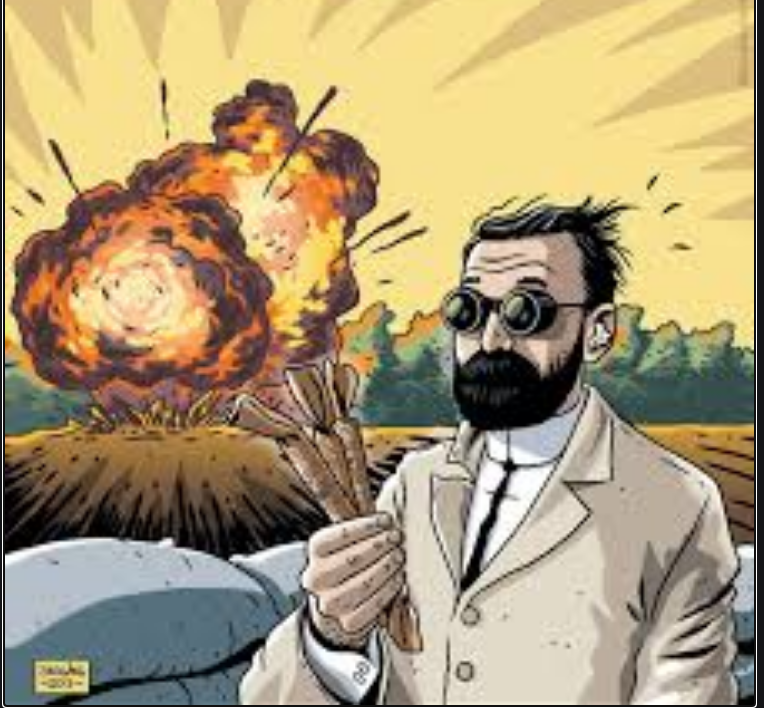
In 1867 he found dynamite, and in 1886 ballistite, one of the first smokeless gunpowder. His inventions were diverse, he patented 355. Although he was most interested in the use of explosives in construction, we are witnesses that his most famous invention is abused on a daily basis.
Although he was most interested in the use of explosives in construction, we are witnesses that his most famous invention is being abused on a daily basis.
**How did Nobel get the nickname Death Dealer?**
Nobel came up with the idea to use his money for annual awards after his brother Ludwig passed away in 1888, and French journalists mistakenly wrote that Alfred himself had died. Namely, the newspaper published an article entitled: "The death dealer is dead", and it was further written: "Dr. Alfred Nobel, who got rich by discovering the way in which more people can be killed faster than ever before, died yesterday".
When Nobel read this, he began to think about how to improve his image of himself in public and decided to leave his enormous wealth as a pledge to create awards that will bear his name. The Nobel Prizes were created as awards for people who have made a great contribution to humanity in the fields that interested this scientist - physics, chemistry, medicine, literature and peace.
Nobel studied physics and chemistry, and saw the benefits of advancing medicine. It is believed that the award for "peace" was proposed and promoted by his former mistress and secretary Berta Kinski, who herself won the award in 1905, just a few years after it was established.
The awards were first presented in 1901. For chemistry and physics, the awards are given by the Swedish Academy of Sciences, for medicine (and physiology) by the Carolina Institute in Stockholm, and for peace by a commission of five members elected by the Norwegian National Assembly.
He died in 1896 at his home in San Remo, Italy. On the day of his death, December 10, the Nobel Prizes are awarded. It happened that some winners refused the same. In any case, receiving this award is considered prestige.
**Five interesting facts about the Nobel Prize**
**1. Poet Alfred Nobel**
Alfred Nobel went down in history as the inventor of dynamite. But he was also a skilled poet and a lover of Shelley and Byron verse.
He wrote songs all his life, sometimes in his native Swedish, but mostly in English.
"I have no intention of calling my verses poetry. I have written and am writing only for the purpose of alleviating depression or improving my English," Nobel wrote in a letter to a friend.
In 1862, at the age of 29, Nobel questioned his literary talent. "Physics is my field, not writing," he wrote in a letter in French to a young woman.
In the year of his death, 1896, he wrote a scandalous tragedy in four acts, "Nemesis". He was inspired by Shelley's drama "Cenci" about a woman who killed her incestuous father in Rome in the 16th century.
**2. Award-winning families**
After the first Nobel Prize awards, six children followed in their parents' footsteps and became winners themselves.
The seventh child, Lawrence Bragg, won the award together with his father William for physics in 1915. It was by Nobel standards in his "tender years." He had only 25 of them.
The Kiri family won a total of four awards, and "gained" the fifth by getting married.
Two belonged to Maria Curie, who is still the only person who can be proud of that. She shared the Nobel Prize in Physics in 1903 with her husband Pierre. She won the Nobel Prize in Chemistry in 1911.
The eldest daughter, Irena, won the Nobel Prize in Chemistry with her husband, Frederic Jolie, in 1935.
Irena's younger sister Eva Curie, the only one in the family who did not choose a scientific career, married Henry Richardson, the winner of the Nobel Peace Prize in 1965, when he was the head of UNICEF.
Swede Gunnar Midal won the Nobel Prize in Economics, and eight years later his wife Alva was the winner of the Nobel Peace Prize.
**3. Award winners in absentia**
ince 1901, five Nobel laureates have not been able to participate in the awards ceremony in Oslo.
German journalist and pacifist Karl von Osecki was in a Nazi concentration camp when he was declared the winner in 1936.
Chinese dissident Lu Xiaobo was imprisoned in 2010, and Russian dissident Andrei Sakharov was represented in 1975 by his wife, Jelena Boner.
Former Polish President Lech Walesa rejected the invitation to the award ceremony in Oslo in 1983, because he feared that he would not be allowed to return to Poland.
Myanmar's opposition leader Aung San Suu Kyi was under house arrest when she won the Nobel Prize in 1991. Although she was allowed to travel to Oslo, she declined the invitation for the same reason as Valens.
**4. Why is there no Nobel Prize in Mathematics?**
Historians stopped the rumors in the 1980s that Alfred Nobel's partner had an affair with the mathematician Guest Mitag-Lefler, and that this was the reason why the inventor did not want to pay tribute to mathematicians as well.
There are two plausible explanations for why there is no math award.
When Nobel compiled his will in 1895, the prize for mathematics already existed in Sweden and he did not see the need for another one.
At the beginning of the 20th century, the applied sciences were at the mercy of the public and the profession. The contribution of mathematics to humanity was not as obvious as it is today.
**5. Posthumous awards**
The Statute of the Nobel Foundation from 1974 does not provide for the posthumous award. Before that change, only two people won the Nobel Prize after death.
UN Secretary-General Swede Hammarskjöld of Sweden was killed in a plane crash in 1961, but was declared the winner of the Nobel Peace Prize later that year.
In 1931, the Nobel Prize for Literature was posthumously awarded to another Swede, Erik Axel Karlfelt.
The board awarded the Nobel Prize in Medicine to Canadian Ralph Steinman in 2011, not knowing that the doctor had died three days before the winner was announced, and the award was recognized.
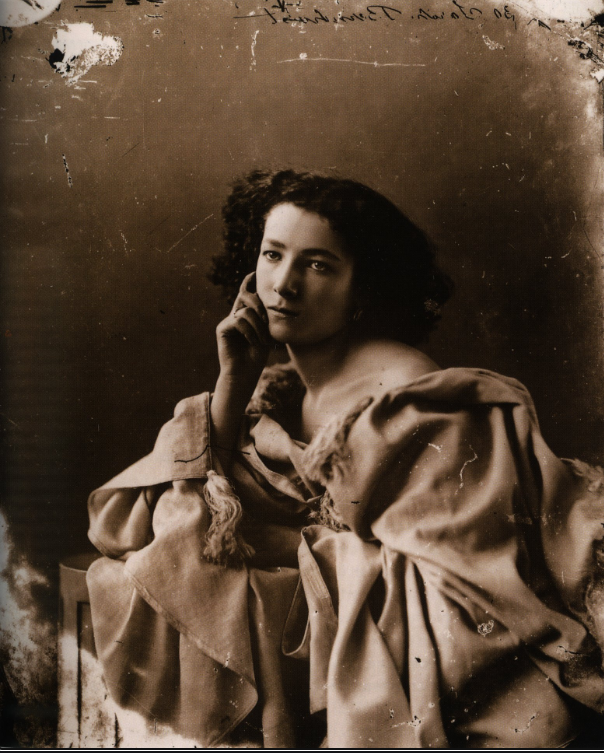
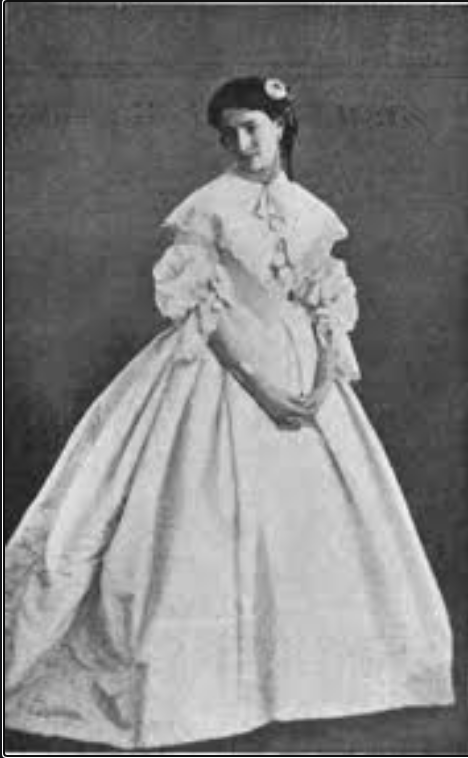
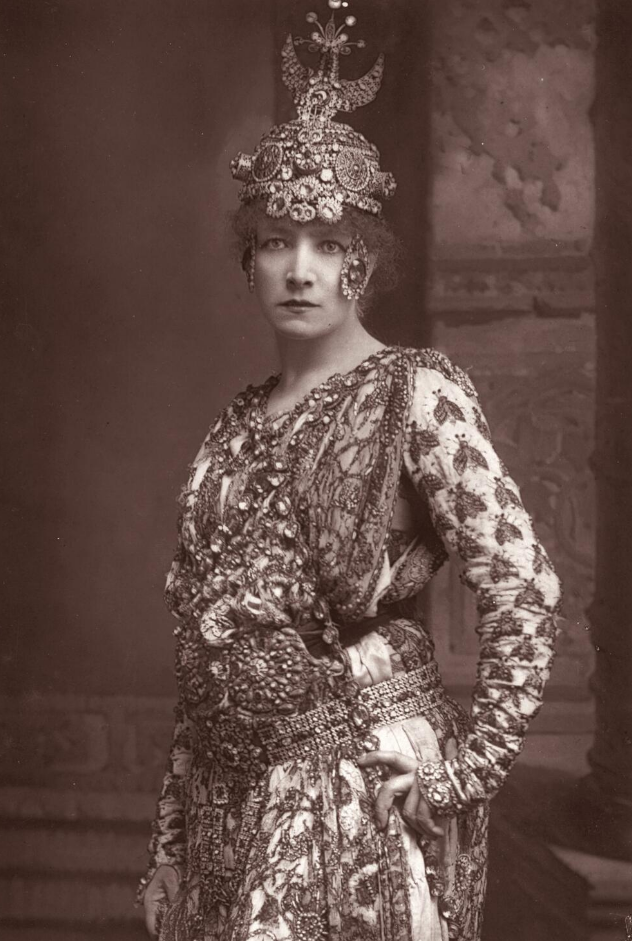
Some cursed her, others cut her veins behind her - The life story of the legendary Sarah Bernard!
Nothing could stop her passion for acting, not even a leg amputation. Until her death, she played the fatal main characters in the theater without getting up from her chair during the entire play.
Scandals have always been circulating around her. There was always applause and applause in front of her. She became a theater legend with whom generations of actors have been compared for decades.
She was quite unique. A proud woman with a lot of passion and zero shame.
Some were not surprised by her shamelessness and unscrupulousness. They said that she was of shameless origin, because she was one of the illegitimate daughters of the seamstress and courtesan Julie Bernard.
At first, she bore the epithet "little ugly fool", which did not promise a great career, but the wheel of fortune turned in her favor.
Sarah was born on October 22, 1844. Julie did her best not to follow in Sarah's footsteps, so she sent her to a Catholic school from the age of five. At the age of 13, Sara returned to Paris and got a job as a teacher in several rich houses that could afford it. After working for several years, Sara enrolled in high school music. There she enjoyed learning to sing, play and act.
Although she loved music, in the nineteenth century artists were socially completely unprotected and in fact courtesans belonged to a higher class than them. They had a chance to go down in history because they got the lead roles, so it became clear to Sarah how to become popular and famous.
Sara was also very lucky - her mother had many influential acquaintances. Among her clients were the famous writer Alexander Dima the Father and the Duke de Morney. It was they who helped Sarah start her career by securing her a place at the Comedie Francaise, a legendary theater also known as the House of Moliere.
The eighteen-year-old girl immediately debuted in the lead role in one of Racine's classic plays and fully justified the trust of her protectors. Sarah was very much liked by the audience. Beautiful, tall, impeccable diction, enchanting voice.
Contemporaries claimed that her voice enchants, excites and drives people crazy. After the praise of the famous writer Victor Hugo, she soon became "immortal and divine", the genius of the French stage.
She acted in various theaters in Paris, as well as in her own, which she later opened. She is celebrated as the greatest dramatic artist of her time.
She first appeared in the film in "Hamlet's Duel", playing a male role - Hamlet himself, and later many more film achievements followed, because her very appearance ensured commercial success, so the directors fought for her. One of the first successful feature films, "Queen Elizabeth" from 1912, was played by Sara in the lead role.
After beginning her theatrical career in 1862, Sarah left France and went to Belgium, where she became the mistress of Prince Henry, to whom she gave birth to an illegitimate child - son Maurice (1864). After the birth of his son, the prince wanted to marry her, but his family forbade it and forced Sara to disappear from their lives forever.
She was successful in painting and sculpting. She studied painting with famous masters, and exhibited at numerous exhibitions. About 25 of her sculptures have been preserved.
Sarah Bernard despised journalists, but she loved animals very much. She owned dogs, cats, birds, turtles, and even a lion, as well as six chameleons. She begged her personal doctor to sew a real tiger tail for her and was disappointed when he explained to her that it was impossible.
After the outbreak of the Franco-Prussian War, she stopped performing and turned the theater into a hospital, where she worked as a nurse and cared for wounded soldiers.
In 1899, it took over the Théâtre des Nations and renamed it the "Sara Bernard Theater". She inaugurated it with one of her best performances ever, starring in the play "La Tosca" by Victorien Sardo.
On May 20, the premiere of her most controversial role, Shakespeare's "Hamlet" adapted in prose, written by Eugene Morand and Marcel Schwab, was held. The play delighted critics despite lasting four hours. Then, Sara gained the reputation of a serious dramatic artist and became one of the most famous actresses of the 19th century. She managed her theater until her death, when it was taken over by her son Maurice. After his death in 1928, the theater kept its name until the German occupation in World War II when it was changed to the Théâtre de la Cité, due to Sarah's Jewish origins.
**Sarah as a muse of a time**
Sara also enchanted the famous Czech painter and the most important artist of the Art Nuvo movement, Alfons Muhu, who immortalized her in 1894 on a poster for the Lady with Camellias.
When she visited New York, the famous scientist Thomas Edison noticed her and was interested in her, but Sara became interested in Nikola Tesla. Accustomed to no one refusing her invitations and the opportunity to see her, she was surprised when Tesla said that the actress' presence disturbed him and separated him from work, so it was better not to see each other.
She always carried a suitcase full of love letters with her and sometimes she would spill them on the bed and lie down to sleep over them. She had numerous admirers among celebrities such as Marcel Proust, Prince of Wales, former King Edward VII. Among the biggest fans, Aleksandar Dima Sin stood out, who, torn between love and hate, called her a notorious liar. She also had numerous lovers, but in 1882 she decided to marry the actor Aristides Damalu, who was eleven years younger, and who died at the age of 34 as a morphine addict. She delighted the Danish audience so much that, in addition to the standing ovations they prepared for her, they named one treat in her honor Sarah Bernard's cake.
It was so popular in Denmark that a delicacy called Sara Bernard's Cake was created in that country.
**The end of her career did not exist for her**
In 1905, performing at the theater in Rio de Janeiro, Sara seriously injured her right knee while performing the final scene of the play La Tosca, which involved jumping from the parapet. That wound was never completely healed, but Sara continued to suffer pain and continued to act. Ten years later, gangrene occurred and Sarah had her right leg amputated. That didn't stop her either - she continued her career using a prosthesis during the performance, she played fatal main characters in plays without getting up from her chair. She did so until her death in Paris on March 2, 1923, at the age of 78 from severe renal failure.
Sarah Bernard has her star on the famous Hollywood Walk of Fame. In the Belgrade neighborhood of Sremcica, there is a street that bears her name.
When a man neglects a woman he only teaches her to live without him
There is a myth about the so-called "Pretending invincibility" - which claims that the more a person looks distant and uninterested, the more we are obsessed with him.
Many men still falsely believe that by behaving that they show they don’t care about a woman, they can get the results they want. They believe that if you ignore her, it will make her run after you. Some people even think that if they treat their wife badly, they will get even more love and attention.
Well, many people forget the fact that these manipulative techniques can only work on inexperienced girls, and never on real women!
A real woman knows what she wants. She is a fulfilled woman, who has no time to play. If you are willing to truly be with her, love her and treat her the right way, she will do the same for you.
On the other hand, if she notices that you are not honest, that you are playing games and that you are not serious about her - she will leave you without looking back.
Because she knows that when you really love someone, you can’t just ignore that person. When you love someone, you can’t help but reciprocate your love and feelings because it’s so counterproductive.
A real woman loves to be loved, appreciated and showered with attention. She wants to make sure you always come back to her and that she can always count on you. If you don’t give her what she needs, she will leave you.
Simply.
Also, many people think that in a relationship it is better not to reveal their true feelings towards their partner. They forget that the foundation of any successful relationship is honesty. And real women value honesty more than anything. They know they can never have true intimacy with an insincere partner.
So if you want to have the right woman by your side, turn off your cell phone when you’re with her and focus only on her. Be caring, loving and paying attention. Always treat her with respect.
Only if you treat her as she deserves will she fall in love with you and reward you with even more love and attention, and that could be the beginning of a wonderful relationship based on trust, love and sincerity.
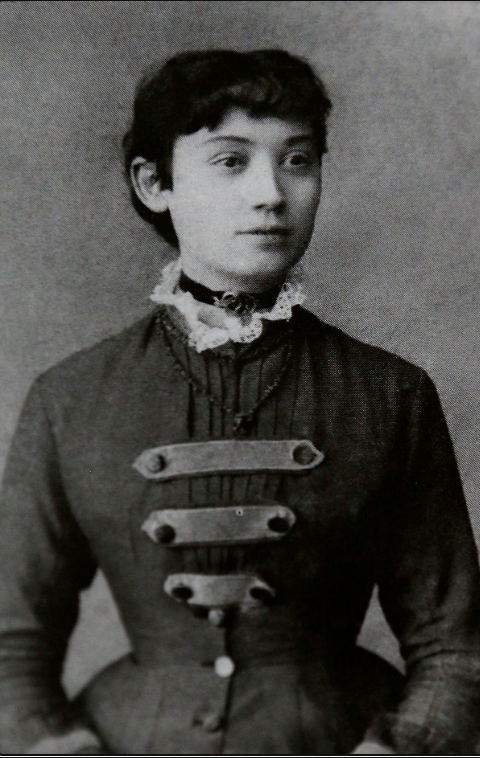
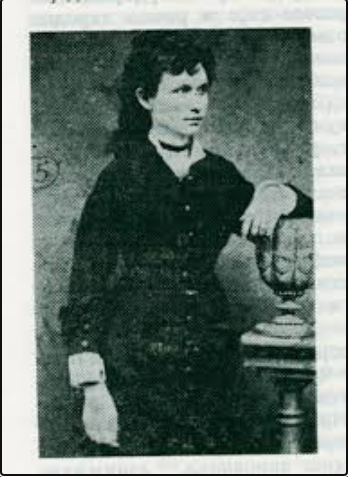
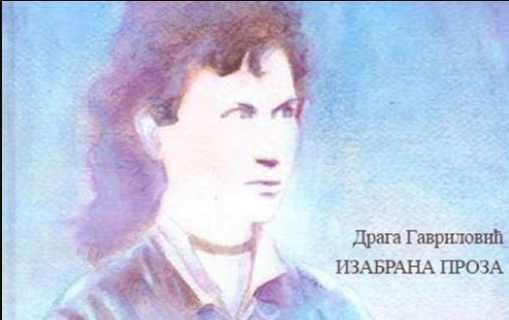
Draginja Draga Gavrilović - The first woman novelist in Serbia also fought for women's rights
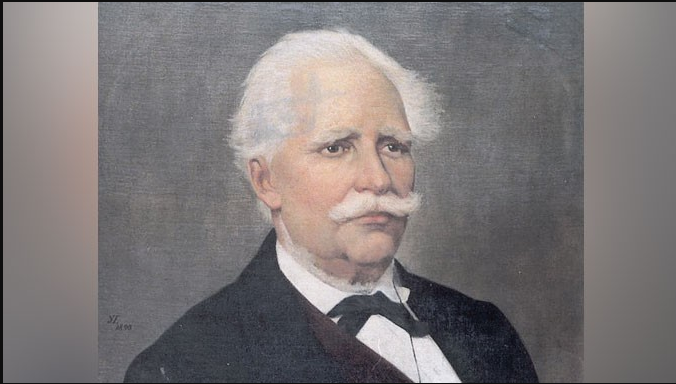
Srpska Crnja - Draginja Draga Gavrilović, the first woman novelist in Serbian literature, was born and lived here. In addition to the trace she left in the literature, she was also the forerunner of the struggle for women's rights in this area. She mostly lived and created farther from the metropolis and in the shadow of the much more famous poet and painter Đuro Jakšić. The real affirmation of women in our work began only in this century, and then there was a reference to the life and work of Draga in Srpska Crnja, where more and more attention is drawn to her.
The director of the local Cultural Center, named after the most famous Serbian romantic, Rodoljub Boškić, emphasizes the intentions of the cultural representatives to return Dragi Gavrilović and her work to the place that belongs to them. One street in the town was named after her, and in front of the Cultural Club, an initiative was launched to do the same in other places in Serbia, which are in some way related to the work of the writer of the first "female" novel.
Draga was born in 1854 in the prominent family of Milan and Milka Gavrilović from Crnjan. In addition to trade, my father was also involved in municipal affairs and for a time worked as a school manager. There was a lot of emphasis in the family on the education and upbringing of children. In addition to their mother tongue, the children also knew Hungarian and German, had a music education and were familiar with the literary events of that time. Draga finished four grades of primary school in Novi Sad, then she lived in her hometown and did housework with her mother, which was all preparation for the usual life and destiny of women at that time.
However, due to her interest in a better position of women in society and her desire to gain independence through her vocation, Draga enrolled and graduated from a teacher's school in Sombor. The United Serbian Youth movement had a strong foothold in that city, and thanks to that association, the Decree on Higher Serbian Girls' Schools was passed in 1871, which allowed female youth to attend classes regularly. Draga Gavrilović was a member of one of the first generations
Through her teacher training, she was in an environment where the written word was nurtured. All this went hand in hand with the development of her literary talent, but also with the approach and adoption of the ideas of the Youth Movement, based on the teachings of Svetozar Markovic. First of all, she was attracted by the idea of women's emancipation, and she processed and represented it through her literary work.
Her first published poem "In memory of Đuro Jakšić" was written on the news of the poet's death in 1878. After finishing teacher's school, he returned to Srpska Crnja. This is where he begins his teaching work, to which he is completely dedicated, but he also works a lot on educating women.
It was not until January 1884 that Draga Gavrilović began to publish longer prose "From Teacher's Life". At that moment, she is thirty years old, and thus the experience of her vocation, and of the values of life in general. Her personal disappointments, ups and downs can also be sensed. Since then, she has been represented in periodicals of her time, "Javor", "Orla", Zmajevo "Nevena" and "Sadašnjosti" with her prose and translations into German. In all her stories, the character of a highly moral teacher is encountered, whose life is focused on the purposefulness and significance of the vocation and the well-being of her people.
In 1889, in Novi Sad's "Javor", whose owner is Jova Jovanović Zmaj, he published "Devojački roman". According to critics, this book occupies the main place of her literary work and gives her the place of the first woman novelist in our literature. It is believed that writing and research on the work of Draga Gavrilović have not been completed yet.
Another superpower of the most resilient living creatures in the world has been discovered
Although tardigrade are tiny creatures of comic appearance, they are one of the most optorous living species. Scientists have managed to discover that some individuals can boast another superpowerful property, an unexpected protective fluorescent shield that repels deadly ultraviolet radiation.
Tardigrade, also known as water bears or long-lived beetles, are microscopic creatures that live on land, in freshwater and a small number in the seas. Their body size ranges from a few microns to one millimeter. Their body is worm-shaped and stocky, divided into four segments and there are a couple of limbs on each segment.
However, their ability to survive inspires awe. These creatures can survive in the vacuum of space, at extreme temperatures and under extreme pressure, and they can withstand intense ionizing and ultraviolet radiation.
One of their survival tactics is to have the ability to shrink into a state of hibernation in which they can survive for decades, while at the same time producing proteins that protect their cells.
Another protective mechanism has now been discovered that seems to help tardigrades cope with potentially deadly ultraviolet light, and that is a kind of fluorescent substance that absorbs such radiation and then releases energy like blue light.
"Our study suggests that these creatures can survive in the driest and sunniest places on Earth," said Dr. Sandep Esvarapa, co-author of the study. In an article published in the magazine Bayoloji Letters, Esvarapa and his colleagues state that they found a new type of tardigrad in a sample of moss that was caught on the wall of their institute.
When both found species, called Paramacrobiotus BLR strain, and the other, H exemplaris, were exposed to ultraviolet light for 15 minutes, only the first survived. To their surprise, the surviving species emitted blue light during the exposure.
To investigate this phenomenon in more detail, he covered UV-sensitive tardigrade with this fluorescent substance. The results showed that the extract of this substance provided at least partial protection, because half of the X exemplaris managed to survive for a few days.
"There are other species that show tolerance to UV radiation, but Paramacrobiotus BLR is the only one that has fluorescence as a mechanism to resist this deadly radiation," emphasizes Esvarapa.
Professor Lukasz Kaczmarek, an expert on tardigrade from the Polish University "Adam Mickiewicz", who did not participate in this research, believes that this study supports previous works that show the possibilities of using substances that produce tardigrade to protect other organisms from harmful environmental conditions.
However, Kachmarek adds that the team failed to identify a substance that provides protection from ultraviolet radiation, noting that that protection may not come from fluorescence, but perhaps from some proteins.
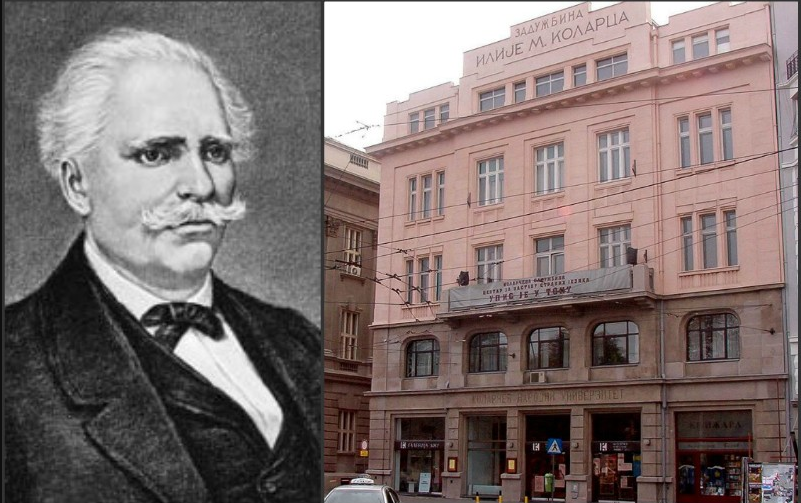
Ilija Milosavljević Kolarac - A merchant who enriched his people
They ran and kept to leave a memory to their people for the whole of their life - it is written on the tombstone of Ilija Milosavljević Kolarac and his wife Sinđelija. This epitaph was carved according to the testamentary wish of a great Serbian benefactor who passed away on this day (according to the old calendar, October 6), 1878. The immortality of his name is preserved by the endowment, Kolarac People's University, which began operating on October 19, 1932.
Ilija Milosavljevic, one of the richest Serbs of the 19th century, had one passion in his life - trade, one love - his wife Sindjelija, and one mission - the educational uplift of his people.
He was born in 1800 in the village of Kolari, about ten kilometers from Smederevo, hence the nickname by which history will remember him. There he studied elementary school, which will be his only formal education. He acquired business knowledge by serving with reputable traders in Pancevo, Vrsac and Belgrade. He stayed with the most prominent wholesaler in the capital, Milutin Radovanović, for the longest time. Boss Milutin estimated well that the young journeyman would go far, so he gave him the hand of his daughter Sinđelija.
It was a big surprise for the city, and they were even more surprised by their marriage, which did not fit into the norms of that time. The couple jointly ran their first independent store, Kolarac emphasized and inscribed the woman's name everywhere on an equal footing with his own, and at every opportunity he publicly showed how much he loved her and how much he was attached to her.
Along with Sinđelija as a faithful life companion, he took over the trade primacy in Belgrade from Jewish, Cincar and Armenian families, which have been engaged in this business for generations. Then, in 1928, they moved to Pancevo, from where Kolarac branches the trade network all the way to Vienna. He acquired an unimaginably large fortune in money, land, real estate, he had his own merchant river fleet, warehouses, magazines ... "I knew neither about hunger, nor about thirst, nor about sleep when it was necessary to work and earn", he said is friends about the period of his business rise.
And then the black years came, Sinđelija got sick. Kolarac brought the best European doctors to Pancevo, but there was no salvation. She died in 1855 at a hospital in Pest. She was buried in Belgrade's New Cemetery, and then Kolarac returned to the Serbian capital. He reduces trade to a minimum, and puts energy and wealth in the service of his people. Kolarac was known as a man of wide charitable hands, especially when it came to helping the poor, schools, gifted students, writers or any educational endeavor.
On that track, in 1861, he founded the Literary Fund for "publishing works in the Serbian language, which spread honesty, patriotism and useful (useful) knowledge among the people." He bequeathed to the fund's board to publish textbooks and give them to poor students, as well as to help "people who write for public education, but are not able to publish in the press themselves."
An advanced and critical spirit, he did not hesitate to sharply criticize the government. When the Topolska revolt was suppressed at the end of 1877, the goal of which was to overthrow Prince Milan Obrenović, Kolarac was imprisoned under the accusation that he supported the conspiracy. He was sentenced to five years in prison, but was released after a few months.
He returned from prison in very poor health. He passed away in October 1878. The authorities rejoiced: they calculated that the property would be taken over by the heirs, since Kolarac and Sinđelija had no children, and so his name would quickly sink into oblivion. And then the news of the opening of Kolarac's will resounded like thunder, the first sentence of which read: "I bequeath all my property for the benefit of my people." Apart from the provisions concerning the money intended for the Literary Fund, the main item of the will is to "form a fund from all the property from which a Serbian university will be built in time", as an endowment to the fatherland for achieving educational goals.
The legal battle for the recognition of the last will lasted for three years. Two of his nieces initiated the procedure for overthrowing the will, supported by the regime press, which wrote that Kolarac was "turned over or forced", that the creation of the endowment was a "party-demonstrative thing" and a "danger to the state and monarchy" ... this painful episode was staged in 1881 by a judgment of the Court of Cassation.
The erection of the building of the Kolarac endowment, with an area of 4,500 square meters, was completed at the beginning of 1932, and on October 19, the program activity will begin. Apart from spreading scientific knowledge, the People's University also organized courses for farmers, craftsmen, merchants, officials ... The educational mission continued through decades of socialism, state disintegration and transition.
In recent years, it has been frequently heard that due to financial problems, this institution is about to close. The enviable 2020 and the cancellation of 160 programs came to all that, so the number of giro accounts for donations was announced on the Kolarac website, which would enable him to continue working. In the fight for survival, the help of the state and the city is also expected. But also the help of all who, like Ilija Milosavljević Kolarac, believe that the meaning of property is in - giving.
The turbulent life of the legendary actress - Maggie Smith
A long time ago my older daughter told me, "When I grow up I want to be like Maggie Smith."
The famous actress Maggie Smith was born on December 28, 1934. Her life story hides ups and downs, and in her biography she recorded a turbulent love life.
Despite her grandmother's advice to learn blind typing, because she is not beautiful enough to be an actress, Maggie Smith has a 60-year acting career.
She made her Broadway debut at the age of twenty-one, and soon received an invitation from Lawrence Olivier to join the British National Theater.
She became world famous after she played the main role of Jean Brody in the film "The Prime of Miss Jean Brodie", which won her the Oscar for Best Actress in 1969. In total, she won two Oscars, three Emmys and one Tony Award
Her private life was no less turbulent.
Maggie Smith first met her second husband, Beverly Cross, with whom she was married for 23 years until his death (Cross died of a heart attack in 1998). Although he was already married, he proposed to her and she agreed to wait for him. However, while she was waiting for Cross to divorce, Smith met Robert Stephenson.
She married Stephenson ten days after the birth of their first son, Chris Larkin. The couple had another son, Toby Stephenson.
After seven years of marriage, in 1973, they divorced and Maggie married Beverly two years later.
Maggie Smith says that she enjoys spending time with her grandchildren and that they are wonderful
A few years ago, she stated that she was still struggling to come to terms with her husband's death, saying: "Everyone says it will be easier for you in time, but I don't think so. It will just be different. "
"Judy Campbell once told me a wonderful thing when her husband died, it's a strange feeling that you are no longer in the first place," added Smith.
The decoration is a veteran of the British theater, which we can currently see in the role of the Countess of Grantham in the BBC series "Downton Abbey", awarded for six decades of acting.
Among the earlier winners of this award, established in 1917 and limited to 65 living prominent personalities, are physicist Stephen Hawking, actor Ian McKellen and artist David Hockney, writes Nadlan.
According to the AP, the 79-year-old actress has won two Oscars: for the best female role in the film "The Best Years of Miss Gene Brody" and the best supporting role in the drama "California Apartment".
The most famous films in which she played are "Othello", "Room with a View", "Travels with My Aunt" and "Gosford Park", and the younger generation remembers her best for the role of Professor Minerva McGonagall in the **Harry** **Potter film** series.
She had an equally successful career as a television actress. She played notable and praised roles in the TV series "Suddenly, Last Summer", "David Copperfield", "My House in Umbria", "The Persecution of Mary".
For her role in "Downton Abbey", she was awarded an Emmy for Best Supporting Actress in a Miniseries in 2011 and 2012.
Maggie Smith has been nominated for six Oscars. She has won a BAFTA award five times, has three Emmys and three Golden Globes, and is rightly considered one of the best and most respected actresses in the world. He is currently shooting the film "The Lady in the Van" in which he reprises the role of an eccentric homeless woman in the play of the same name by Alain Bennett.
https://youtu.be/l3-dmo5PrDE
A solemn Bafta awards ceremony was held in London a few years ago. Leonardo DiCaprio is one of the big winners of the evening, as he went home with the recognition for the best actor. The moody star, to whom the long-awaited Oscar smiles, was the main star of the evening also because of the sympathetic kiss with Maggie Smith.
Considering that the ceremony was held on Valentine's Day, everything was in the sign of love, so one segment was designated for the "kiss camera". So, whoever was in the frame of this romantic camera, had to kiss. DiCaprio enthusiastically accepted this task when he found himself in the frame with 40-year-old Maggie Smith.
Krusevac, a city of "immortal" actors
It is often said about Kruševac: It is a town under Bagdala. But given the large number of great acting names, it could also be: it’s a city under Italy. This Greek muse of theatrical art seems to have landed here. And under her lap came out:
Ljubinka Bobic, Miodrag Petrovic Ckalja, Tasko Nacic, Milan Puzic, Bata Paskaljevic, Radmila Zivkovic, Nebojsa Bradic, Zoran Karajic, Milija Vukovic, Miroljub Arandjelovic Rasinski, Toma, Sergej and Branislav Trifunovic, Vojin Cetkovic, Marko Zivic, Natasa Tapuskovic …
- actors who are unavoidable in Serbian theater and film history.
How many actors flashed and got lost, and the people of Kruševac left an indelible mark. Our best "Mrs. Minister" - Ljubinka Bobić, who played in this Nušić's comedy until her death, was inherited by another woman from Kruševac, Radmila Živković. On the same stage of the Belgrade National Theater, she is now brilliant and listens to loud applause.
In many theater plays, movies and television series, he plays several actors from Krusevac. Ljubinka Bobić and Đuza Stojiljković played in the long-made film "Pop Ćira i pop Spira" directed by Soja Jovanović, which is still popular. In the series "Zona Zamfirova", three people from Krusevac played, the main role was played by Vojin Ćetković, and Radmila Živković and Bata Paskaljević had effective episodes. In the famous television series "Theater at Home", the main roles were played by Đuza Stojiljković and Rada Savićević. In the remake of the series that is being shown these days, one of the main roles is played by Nataša Šolak, recently Tapušković.
We, the people of Kruševac, have a habit of saying that if we withdrew our actors, the Belgrade theaters would be deserted! I think it is a matter of heritage, because when a certain group is formed, successful in their work, those who come have great role models to follow. Well, now that actors, especially comedians, have started to be born in Kruševac, I don't know. Although, the fact is that we are always ready for a joke - are the words of the manager of the Kruševac Theater, Branislav Nedić, which best reflects the phenomenon of the Kruševac actor.
Krusevac lives seven days a week, and many towns in the province are stagnant. It is a city that has a soul, tradition and pride. In Kruševac, there is an extremely professional theater, an exceptional alternative theater scene, galleries, a literary club… We constantly had contact with cultural events, guest appearances, young people had an artistic choice… In Bata Paskaljević's family house we made a theater, a gallery. Bata Paskaljevic also came and acted with us in two plays: "Fly" and "Crazy with Love". That older generation of actors from Kruševac had a parental relationship with us. Even when I was an acting student, Rada Savićević took me home, fed me, took care of me. Rada Savićević helped me get a scholarship from Kruševac - says Vojin Ćetković.
A few years ago, Krusevac finally paid tribute to the greats of our actor who came from this city. Four years ago, as part of the Vidovdan event, a permanent photo exhibition entitled "Windows of Memory" was opened on the then Youth Square. Photographs of famous Kruševac actors and managers were placed on nine windows in the theater building, thus beginning the long-standing idea of set up landmarks reminiscent of famous actors born in Krusevac.
Recognizable paintings by Vlastimir Đuza Stojiljković, Bata Paskaljević, Milan Puzić, Taško Načić, Radmila Savićević, Miodrag Petrović Čkalja, Borisav Mihailović, Ljubinka Bobić and Dragoslav Vasiljević Figa, now watch us from their "windows" and remind us of all the roles they have become. ""immortal," and therefore a part of our lives.
Last year, on Vidovdan, the Youth Square became the Actors' Square when the busts of seven great Serbian actors who were born in Krusevac were discovered.
In the future, Miodrag Petrović Čkalja, Vlastimir Đuza Stojiljković, Taško Načić, Mihajlo Bata Paskaljević, Milan Puzić, Radmila Savićević and Ljubinka Bobić will watch over the culture of the city in this way.
They were real ambassadors of our city, and now they will be the guardians of our theater and culture of our city, they will always stand here and remind us how important it is for a city to have the art and culture that our city has - said the manager of Krusevac Theater Branislav Nedic at the grand opening of Actors Square.
He announced that two former managers of that theater should soon get a well-deserved place in the building of the Theater, which would complete the first part of the idea of the Actors' Square.
As the manager of the Krusevac theater announced at the time, so it is happening. Pictures and busts of famous Krusevac actors watch over the numerous cultural events that take place on the Actors' Square. They are vigilantly following young people who are following in their footsteps and who may, one day, become "immortal" like them.
Do partners in long-term relationships start to look like each other over time?
One question has been of interest to psychologists for decades: do people in long-term relationships start to look like each other over time? That is why researchers from Stanford University decided to check this ingrained opinion with the help of modern technology.
This topic appeared in psychological circles in the early eighties and has since become a common subject of discussion. Nevertheless, these observations have never been scientifically confirmed or refuted.
That is why researchers from Stanford University decided to try modern technologies used for the purpose of recognizing faces and started analyzing thousands of publicly available photos of couples, believing that they would finally solve this dilemma.
"It's something that people believe in and we wanted to solve it," said Pin Pin Tea-makorn, a doctoral student at Stanford. "We started from the assumption that people's faces start to match over time, so we decided to check which traits start to change first," the researcher added.
Working with her Stanford professor, Mikhail Kosinski, Tea-makorn searched the Internet for Google to find couples celebrating marriage anniversaries and genealogy sites to find photos of couples taken at the beginning of the marriage and many years later. They managed to compile a database of photos of 517 couples taken at the beginning of their relationship and 20 and 69 years later.
To test whether the faces of the couples became similar over time, the researchers showed the volunteers a photo of the "target" person along with six other people, one of whom was the face of their spouse, while the other five were chosen at random. Volunteers were then asked to rank how similar each of the six faces was to the target person. The same task was then performed with state-of-the-art facial recognition software.
In the original study in 1987, the late psychologist Robert Zajonk from the University of Michigan gave volunteers to rank photos of only a dozen couples. He concluded that the faces of couples became more and more similar as their marriages progressed, with the effect being stronger if they lived in a happier relationship.
Psychologists claimed that living together shapes people's faces, as well as the way they eat, live, the amount of time they spend outdoors, fight "laughs" and the like.
However, in their work published in the journal Scientific Report, Tea-makorn and Kosinski claim that they did not find evidence that the couples began to look like each other over time. But they found that at the beginning of the relationship, they looked more like each other.
That is why they assume that over time, couples will not start to look like each other, but that they chose each other precisely because of similar characteristics.
The study highlighted the importance of revaluing and updating previous research.
"One of the biggest problems in the social sciences is the need to establish new, incredible theories that will resonate with the public," Kosinski said.
In addition, the professor praised Tea-makorn for her courage to embark on this project, because most young scientists are not willing to "wave" and find shortcomings in the work of other researchers.
"Clearing the field could be the most important challenge facing researchers in the social sciences today, but she will certainly not be quoted and praised so much for her work, as if she came up with something that would be very interesting and 'popular,'" says Professor Kosinski. .
The next project to which this team will be dedicated is the claim that a person's name can be easily guessed only on the basis of the person's appearance.
What do the most common dreams we dream actually mean?
You fall. Your teeth are falling out. You overslept an important presentation. We all had those dreams that made us wake up in a panic, only to realize that they were just dreams. But what do they really mean?
Dreams are your subconscious thoughts. They are a continuation of your thoughts throughout the day. While you sleep, the brain creates about five dreams a night (even if you don't remember them). It is a lot of subconscious thoughts that need to be unpacked. And although each dream is unique, they usually follow certain symbolic patterns, writes Harper’s Bazaar. According to world-famous psychiatrists, I found the five most common dreams we all have. What do they mean?
1. You have returned to school or are taking an exam
Usually this dream is related to work. School was our first job ever and this dream is common when a work challenge is on the horizon. Whether you are trying to get a new client, a promotion or it is time to evaluate and you have to prove yourself. How did you feel in your sleep? Were you ready? It’s kind of like a mirror.
2. Hang out with a celebrity
There is something about that person you dream of and it may be deep in the history of IMDB or Spotify that is relevant to you at the moment. Ask yourself what has to do with that person.
It could be a movie in which that person is acting, their song, the message will be in the title of that movie or the text of that song. The message could also be related to the personality of that celebrity. If you are friends in a dream, whatever it is in that celebrity that you like, it is about what you like and about yourself. That is something that makes you want to be recognized.
3. Cheating on you partner
If there has been deception in your past, whether in this or a past relationship, it will keep popping up, because it is a stumbling block in yourself. Dreams are not prophecies. If there are no problems with trust, it does not mean that your partner is cheating on you. Instead, another "third wheel" may be to blame. Something is taking up too much of your time and attention.
It could be a job, a hobby, friends, a new baby… which makes you feel cheated in a relationship.
In the end, this dream can be positive, until you wake up angry about your partner for something he did in your subconscious. It lets you know that something needs to be fixed. You and your partner can start night meetings and try to solve everything that bothers you.
4. Be late for something very important
If you work in a time-oriented field, this is pretty self-explanatory. Maybe you want to lose weight or you want to advance in your career by a certain date, he writes
5. Pregnancy
Even if you are not trying to have children, this is a positive dream because it reflects that something is growing and developing in you. It can be anything, from a new idea to working on a promotion, and in fact, many women dream when they are working on a degree or even when they are on the verge of a new relationship.
Premiere of the documentary "Boise in Belgrade"
Fans of John Sullivan's famous British TV series "Only Fools and Horses" had the opportunity to watch the premiere of the long-announced documentary "Boys in Belgrade" in the "Cineplex" cinema chain. The realization was filmed in our capital, and the main star is the actor John Challis, who in the famous comedy plays the character of the overbearing used car dealer Boise.
During his visit in January, the famous British actor used the opportunity to go to the Faculty of Philology, University of Belgrade and socialize with students, tour the Temple of St. Sava, football fields and the White House, a private tea party with the British ambassador, a sudden appearance in the series "State Business" , and he also met at the Ušće Shopping Center, where a "meet & greet" was organized, when journalists asked him questions, and visitors talked and took photos with him. All these activities were recorded by the camera, and that is how the documentary was made, which was shown for the first time last night.
Due to the situation with the coronary virus pandemic, Chalis himself was prevented from attending the prime minister. That is why a few days ago, he sent a special video message to his fans in the Balkans and invited them to watch the film.
The first episode of the series "Only Fools and Horses" was broadcast in 1981, but its popularity in the Balkans is so great that there is almost no person who does not know who Del Boy, Rodney, Boise, Marlin, Triger, Denzel and other Sullivan's heroes are. That information also reached Chalis, who then decided to come and find the answer to the question why everyone in Serbia adores "Only Fools and Horses" so much. During the research, as he said during his visit to "Ušće", he realized that there really was no man who did not recognize him on the streets, addressed him by the last name of his character or asked about Marlin. And what other conclusions he came to and whether he found the answer that interested him, the viewers had the opportunity to see in this interesting film.
"Alan Ford" - a comic book that spoke
The comic about a confused secret agent became cult only in the country in which it was created, Italy, but also in the former Yugoslavia. If the cartoonists from Milan who used the pseudonyms Max Bunker and Magnus were the reason for their popularity in Italy, one of the reasons for their success in Yugoslavia was called Nenad Brixi, the great translator of "Alan Ford".
At a time when comics were full of superheroes who defeat evil and save the world with superpowers, a comic was born that was not intended for children. Alan Ford is a serious critique of society, history, political arrangements told in a witty way.
The main characters, selfish, greedy, cynical and, above all, poor secret agents, became favorites throughout the SFRY in the 1980s.
It was the underground in the world of comics and was read by those who don't like comics.
And in France, Brazil and Denmark, only a few issues came out.
Anti-heroes who always somehow defeat the bad guys, were actually the image and opportunity of the then Yugoslav society. It was easy to identify with them.
Robert Coban, owner and director of the publishing house "Color Press Group", which publishes Alan Ford in Serbia, says that in those years SFRY had a new wave in cinematography, literature and music, and on a global level a superbly refined sense of humor and aesthetics.
Alan Ford fit in perfectly.
These forbidden thoughts were spoken by intelligent rags, victims of all social injustice.
Nenad Brixi, a Croatian journalist, writer, comedian, translating the comic into Serbo-Croatian, devised a new language spoken only by the TNT group.
That language was so successful that many phrases from comics entered everyday life throughout the fragile SFRY.
The action of the comic takes place in New York, and it is actually a critique of the Italian society at the time. And not just him.
It is a critique of history written by the victors, a critique of the military leadership in which the highest officers pay dearly for services to amateurs who solve the most serious state affairs, corrupt city authorities who keep an incompetent policeman at the head of the police, just because it suits them.
There are also sarcastic comments, incredibly intelligent poor people, as well as mockery of racism, capitalism and Nazism.
**Read between the clouds**
The plot of the comic was layered. It was read by those who were looking for fun and those who knew how to read between the lines. More precisely - between the clouds.
Both of them could have read Alan Ford, only they didn't read the same things
Just as ‘Metallica’ is a band for people who don’t like heavy metal so is this one. At the time, comics were populist entertainment without overly great intellectual ambitions. Alan Ford put it all upside down. He was a witty, clever social intellectual commentary. "
Many fans of the events in the super-secret Florist will tell you that Alan Ford was not the same when Brixi stopped translating it.
However, Alan Ford has been coming out in Serbia for a long time. And it’s a best-selling comic.
"We decided on ekavica because I think you can never enter the same water twice. If Brixi's translation and the whole environment corresponded to that time, generations changed and I didn't want to do nostalgia. I didn't want to fake the atmosphere and the period from the eighties, because that was impossible ", explains Robert Čoban.
"A kid who is 20 or 25 years old today would have a completely different relationship if he was served a Brix translation. No matter how witty and ingenious he was, the circumstances simply changed and that might move Alan Ford's sense in another direction ", concludes Choban.
Even if you’ve never read a comic, it’s clear to you why those who grew up with Magnus and Bunker (cartoonists Alan Ford) still sometimes speak Brix’s language today.
Finally, a few quotes from Alan Ford:
"One swallow doesn't make spring, let alone two." (Grunf)
"If you intend to win, you must not lose." (Number 1)
"Better a living coward than a dead hero!" (Grunf)
"He who loses his gain loses." (Grunf)
"Better to live a hundred years as a millionaire than seven days in misery!" (Bob Rok)
"He who sleeps is not awake." (Alan Ford)
"Better to publish a book than a friend!" (Grunf)
"Buy flowers for your beloved woman, but don't forget your own." (inscription on the flower shop)
"Alan, let's run, there are two of them, and we're alone!" (Bob Rok)
"Everything hurts and more." (Jeremiah)
"One for all, all for one." (Number 1 shares salary)
Ticket: $ 1, Crippled: $ ½, Deaf: 30 cents, Blind: 20 cents, Blind and Deaf: 50 cents. ” (at the entrance to the theater play)
Paul Newman - one of the few actors who knew how to deal with fame.
Fans around the world mourned when Hollywood Golden Age acting legend Paul Newman passed away on September 26, 2008.
Paul, who was once a sex symbol and won over women with his charm and blue eyes, was born on January 26, 1925 in the American city of Shaker Heights as the second son of Slovak mother Teresa Garth and father of Hungarian-Polish origin Arthur Sigmund Newman. His dad was a Jew and later the actor himself declared himself that way when asked about his faith, and he ran a sports equipment store where Paul's mother also worked.
The actor showed interest in theater early on and played his first role at the age of seven.
He played a court madman in a school production by Robin Hood. After graduating from high school in 1943, Paul briefly went to college in Ohio. Newman served in World War II at the Pacific Theater because he first started training to be a pilot at Yale University, but it was discovered that he is colorblind, that is, he does not see colors. He was trained as a radio operator, and fortunately survived the attack in Bunker Hill, while a large part of his unit was killed.
After the war, Paul received a degree in drama and economics from Canyon University in Gamabier, and his colleague was Olof Palme, the former Swedish prime minister. He later joined the traveling theater. Because of his acting career, Newman moved from New York to Los Angeles, that is, Hollywood with his first wife Jackie White.
In the early 50's, he auditioned for the film "East of Paradise", but he lost the role due to a handsome actor six years younger. It was about the famous James Dean who died in a car accident before the movie came out. After his death, Paul was given roles in the films “The Left Handed Gun” and “Somebody Up There Likes Me” to be played by Dean.
https://youtu.be/Fohtsdjvq0U
Several blockbusters starring Newman have become culturally, historically and aesthetically significant and have been preserved in the US National Film Registry. These are the films "Butch Cassidy and the Sundance Kid", "Sting", "Gambler", "Cold-Handed Convict", "Hood" ...
Paul's older brother Arthur Newman also built a career in Hollywood. Which was named after their father. But he was not interested in acting, but found his place behind the camera as a production manager and film producer.
It was less known that Paul played the piano skillfully. In the movie "Road to Perdition", he showed his musical talent with Tom Hanks, with whom he played. They did the music part themselves in all the scenes.
Newman, who finally got his star on the Hollywood Walk of Fame on February 1, 1994, was also picky when it came to roles. Namely, he refused to appear in the films "Shark", "Dirty Harry" and "Ben Huru". In addition to acting, Paul's passion was car racing, so he competed under the name "P. L. Newman". He even formed his own team with professional race driver Bill Freeman, and enjoyed it at a later age.
While he was participating in a charity race, an unusual situation happened to the actor. Namely, he was approached by an older woman who wanted to stir her punch in the glass with her finger. "I'd love to, but I just pulled it out of the cyanide bottle," Paul replied.
https://youtu.be/4h5TkpsK-rw
When it comes to love and private life, Newman has been married twice. His first wife was Jackie White, with whom he was married from 1949 to 1958, and they had a son and two daughters. The same year he divorced, he married actress Joan Woodworth. They were married for 50 years, or until Paul's death, and they had three daughters.
Newman has been nominated 11 times for the Oscar, and won three, for the best leading role in the film "Color of Money", the Gene Hersholt Humanitarian Award for outstanding contribution to humanitarian affairs, and the Oscar for Lifetime Achievement.
Only a few months before Paul's death, that is, in June 2008, the American media discovered that he was suffering from lung cancer and was spending time in hospital. Writer A. E. Hotchner, who worked with the actor, said he learned of the disease 18 months earlier. According to Newman, when the sad news spread, he said that he was fine, but he neither denied nor confirmed that he was suffering from lung cancer.
By the way, the actor was a passionate smoker until 1986 when he finally quit smoking. The legendary Newman passed away on the morning of September 26, 2008 in his home with his family, and he was 83 years old. His body was cremated and a private funeral was held near his home in Vetsport.
Do you trust Google?
Yesterday and the day before yesterday, I watched the film Social Dilemma with my students, which I wrote about in the article https://read.cash/@ruza17/nothing-great-comes-into-the-life-of-a-mortal-without-a-curse-sophocles-ffeaf001 (I'll bore you until he looks at you as much as he can) We talked about the movie in class today. All the students (and today I talked to 3 classes of different ages) were full of impressions. Although they knew some things, they could not even imagine (like me after all) to what extent we are being manipulated on a subconscious level.
One of the things they couldn’t believe was that different people searching for the same thing, Google gives different results. In the film, they said that it depends on the geolocation and someone's interests. They also set an example. If you type, say, climate change, some will find it a huge problem as a result of the search, and others that it is all just a scam.
Today I heard comments like, "Teacher, that's impossible, so Google is a search engine, it's impossible to give different search results for the same thing." Since I teach them not to believe in anything unconditionally, we did an experiment. Everyone in Google searched exactly what was stated in the film and all of them, in all three departments, got different search results. At the same time, we were all in the same geolocation, the difference was only in our interests. A new question inevitably arose: What does Google know about us?
1. For starters, Google knows where you've been
Google remembers and stores all your locations every time you turn on your phone.
At the following link, you can see literally all the locations since you started using the Google app on your phone.
2. Google knows what you searched for, as well as what you deleted
Google stores all data of your searches, ie search history, on the whole device. This means that what you delete remains with Google, even the history that was on one phone, so you bought another and it remains stored with them.
3.Google has your marketing profile
Google has created a marketing profile based on your information, location, gender, age, hobbies, career, interests, relationship status, and sometimes your weight, as well as earnings or any other type of data.
4.Google knows which apps you use Google stores all information related to your applications that you use on your phone.
They know how often you use them, and they also know how to interact with friends or family. This means that they know who you are texting with, whether you are talking to someone abroad, what time you went to bed, what time you wake up for work and all the other information.
5.Google also has all the information about your searches on Youtube
Google stores all of your browsing history from YouTube channels. This way they can see what you are learning about, what kind of music you are listening to, your interests, whether you are in the mood or not, they can simply know everything about you with this approach to information.
6.Goolge offers us the option to download all our data stored on their server.
We tested on a couple of samples and it turned out that we have about 2 GB of data on Google, which would look like a million documents if it were transferred to the "word" application.
So Google has millions of papers about us.
With this option, you can access your email accounts on Google. Google Drive files, YouTube searches, bookmarks of pages that you have saved on your computer or your browser. Your photos, music and other information. Everything you search for or buy through Google. Your calendar, so they can see all the dates when and where you bought, current locations and location history, what music you listen to, which sites you accessed and which pages you shared with friends… absolutely everything!
By accessing someone's Google Account, you can learn almost everything about that person and, based on that information, create a person's profile for destructive purposes, as well as for the purpose of abuse. That's why I'm asking you: Do you trust Google?
And restaurants in Serbia in competition for Michelin stars
Michelin stars are finally arriving in Serbia.
Namely, Serbia has become a part of the prestigious Michelin gastronomic guide, and which restaurants in our country received this, the most prestigious culinary recognition, according to Tanjug's information, will be known in December.
The Michelin star is a kind of culinary "Oscar", the largest and most valuable recognition in the culinary world that restaurants receive with a prestigious offer and service.
Restaurants can receive up to three stars for food quality based on five criteria: food quality, mastery of taste and cooking techniques, the personality of the chef in his kitchen, price-supply ratio, as well as consistency of quality, confirmed by Michelin inspectors.
Michelin inspectors visit restaurants around the world anonymously and evaluate only the quality of the food they serve, based on these five criteria.
The stars do not depend on the interior, the decor of the table or the quality of the service of the restaurant, it is ranked separately, with a rating from 1 to five.
All star winners are in the Michelin Guide, which recommends these restaurants, in over 30 countries on three continents.
So far, more than 30 million publications have been sold.
Of the surrounding countries, only Croatia and Slovenia were in the Michelin guide - Croatia with seven restaurants with stars, and Slovenia with two.
Michelin stars were started by brothers Andre and Eduard Michelin, whose last name is also carried by the most famous tires in the world.
To motivate people to travel and thus increase sales of cars and their tires, the Michelin brothers created a small guide in 1900 with useful information for travelers, such as maps, a list of car repair shops, gas stations, and a list of places to eat. or finds accommodation.
Among other things, the guide had anonymous ratings of European restaurants, and from 1926 he started awarding famous stars.
The people who evaluate the food - Michelin inspectors, are permanently employed in the Michelin group, and most of them studied in the best catering schools in the world.
Clinical death offline - can we still communicate directly?
Communication has never been talked about as much as this year. Even in the focus of the domestic public during the state of emergency was the topic of how the state and the Crisis Staff communicate to their citizens. Communication was also discussed from a business perspective with a focus on teleworking. The emphasis is still on recovering the economy and preserving public health, and these topics continue to appear in the foreign media. What is still not given enough attention is how today, in the age of the pandemic, we communicate with each other, whether in a family or private context. How did the already changed models of communication adapt to the pandemic or did they go through another transformation?
In case your attention was not drawn to the Netflix documentary "The Social Dilemma", which I wrote about in one of the previous texts https://read.cash/@ruza17/nothing-great-comes-into-the-life-of-a-mortal-without-a-curse-sophocles-ffeaf001, and you still use social networks and chat applications without much thought to get information, send reactions and talk to your friends. , then you probably didn't think about the huge impact that technology has on changing interpersonal communication processes. With so many ways available to communicate, new norms have been formed that vary from group to group. Is it cultural to call someone directly by phone or is it necessary to announce by message? Is SMS being sent or are chat applications still in use? Should I give someone a phone number at all or simply "give them Instagram", which is less intrusive?
**We are all spies**
Today, everything can be considered intrusive, even though we live in an era where we are all online and sharing information about ourselves "with our fists and hats". How do you find a job if you don't have a LinkedIn account? Do you know that most employers will search your first and last name on Google before inviting you for a job interview? He will look for your profiles on social networks, where he could collect information about you. What will be the reaction if you meet someone new and say that you do not have an account on any social network?
If we are talking about intrusion, it may be more correct to say that everything that implies real contact in real time and space is intrusive today. Anything that involves actions under the grain online and stalking is considered expected. Anxiety is caused by the possibility of direct contact, voice or live. Everything else we can "fave" and "see" without consequences, with a lot of subtext that no one will force us to analyze
**We are so connected, and we only communicate our ego**
We live in a world that has never been so connected before. The Internet shortens space and time and allows us to learn more about events happening on the other side of the world. Only 30 years ago in Serbia we sent letters, telegrams and used a landline phone, while today, with an internet connection, we can not only communicate with the whole world, but also work in societies that have completely different cultural characteristics and business ethics.
In all this unprecedented connection, we spend most of our time on social media or using chat apps, communicating our ego or consuming someone else’s. Instead of giving us a global connection and a global perspective, an insight into burning problems at the world level, our view is narrowed down to one point.
Those who design digital products today use their knowledge of psychology not to motivate you to be interested in the challenges of global society and to inspire you to action, but to stick your gaze to the screen. Attention is the required currency, and you choose to waste your time.
**Online communication and principles of the fast food industry**
The first fast food restaurant was opened in America between the two world wars, and the real expansion of these restaurants began in the 40s and 50s of the 20th century. What distinguishes this industry is the speed of food preparation, where everything is already prepared in advance, and no more than half a minute passes from the order to the collection. Another feature is the standardized offer and the same taste, so guests always come back because they know exactly what they will get and what their needs will be met. And third, at a time when fast food restaurants were starting to open in America, it was the cheapest option for a delicious meal outside the home
By drawing rough parallels with fast food logic, it takes less than 30 seconds to launch a chat app or Instagram on your phone. It sometimes takes less time to respond or communicate. Online tools mold our communication and limit it to the functionality of the tool you choose, so you always come back there because there are no surprises, you always know the "taste" and the reaction that its use causes in you. Lastly, you don't usually pay to use these apps.
Instant communication, like any "out of the bag" solution, is too simplistic to be meaningful and truly meet your essential needs. Additionally, it raises big questions like adding meaning to actions that aren’t really actions but are conditioned by the digital product you use - how do you interpret someone just seeing your message and not responding, do you attach meaning to who constantly follows your Instagram stories, liking your old photo means that the person in question is extremely interested in you or is something completely different on Wednesday.
**Coronavirus: clinical death offline**
Even before the coronavirus pandemic, there was a change in the way we communicate. We embraced the new tools and understood the benefits of instant communication. What we haven't considered is the fact that new digital products, in addition to helping us communicate faster, also create new needs that we didn't have before. In addition to creating new needs, each user gives them a new meaning, for example, swipe on Tinder makes you feel powerful, with one swipe you decide who you like and who you don't.
Isolation and distancing have made online the only possible option for communication. Those who showed resistance to digital tools could choose between complete isolation and adaptation to the new reality. This situation re-created new needs and gave us the opportunity to give new meanings to Zoom backgrounds and turned off cameras.
Where next? The easiest answer, and the most difficult to realize - outside the comfort zone. There are no, and never will be, instant replacements for direct communication. Communication is not simple and no tool can simplify it, although perhaps our needs dictate simplification. Understanding what the other person wants to tell us, no matter how trivial the topic of conversation, is related to the essence of his being. How do you think you understand the essence, if you reduce communication to predefined reactions within one application?
Myth or truth - the most common beliefs about love
Maybe you advised others, and maybe they advised you sometimes. Find out what are true and what are completely wrong claims when it comes to love.
**"Opposites attract" - Myth**
That opposites attract is just a myth, research has established. As it turns out, there are very few relationships in which partners have completely different traits and preferences. For a long relationship, it is necessary to have similar beliefs and views of the world, and opposites can only be endured in the short term. Everything else requires great compromises.
**"Partner can change" - Myth**
Perhaps the most common mistake in a relationship is the thought that we can change our partner the way it suits us. Any attempt can lead to a breakup, and change is possible only if the partner really wants it. The decision to work on certain things that bother you must be and is entirely up to him and you can't really do much about it.
**"The choice of a man is also influenced by a woman's cycle" - Truth**
Depending on the menstrual cycle, women are attracted to different men. During ovulation, they choose sexy and less reliable types, while before ovulation, they are more interested in reliable and stable men. At the same time, women during ovulation are attracted to types of men with higher testosterone levels because they subconsciously believe that they can produce offspring with them.
**"Before marriage, it is better to live together" -Myth**
Today, more than 80 percent of couples live together before marriage, a US study found. But experts say living together increases the risk of breaking up. The research showed that almost a fifth of couples who lived together broke off their relationships, while only twelve percent of couples who did not live together did the same. However, whether a divorce will occur normally depends on the characteristics of the partners, as well as their beliefs. Partners who do not live together before marriage are often more religious than others and take the concept of marriage more seriously, and are even less likely to seek divorce.
**"Pheromones affect attraction" - Truth**
Pheromones are chemical secretions in sweat that can cause a sexual reaction in the opposite sex. Thus, women in men are also attracted to their sweat, ie the testosterone derivative androstenedione. The chemical excites women and makes them happier, and the effect lasts for several hours, as one American study showed.
In addition to sweat, a natural scent combined with a perfume that contains pheromones can increase one's attractiveness, but only if it goes well with its unique genotype, a German study revealed. If the smell is too strong, it rejects what is one form of defense mechanism. Evolution has made it so that women can smell a potential partner with whom they would have a child, and the subconscious dictates that a good sense of smell also protects against possible diseases.
**"Men are afraid of successful women" - Myth**
Although successful women may seem a little intimidating to them, men above all like intelligent partners who radiate self-confidence. They see them as an equal partner who will help them deal with problems as easily as possible.
**"With sex, you should wait at least until the third meeting" - Myth**
The unwritten rule that you should wait with sex at least until the third meeting should not be literally accepted, scientists say. The most important thing is to get to know your partner well before entering into intimate relationships. Therefore, if you feel ready even before the third meeting, that's fine. Every relationship is unique, so the most important thing is to listen to yourself.
**"Marriage kills sex life" - both Truth and Myth**
Experts disagree about this claim. Research has shown that married couples have a better quality of sex life than singles, but they also have less sex. Many couples complain that the excitement has disappeared, and a large number have admitted that they prefer a good night's sleep to sex.
The series "The twelve" - currently the best thriller - drama on NETFLIX
I love watching drama thrillers. I’ve watched a lot of series, many of them are court dramas.I thought that I would no longer come across a series of content that could surprise me, and I was wrong.
Just when you think you’ve seen everything that exists from court dramas, the Belgian “The Twelve” (De Twaalf) creators Bert Van Dil and Sana Nujens patiently and gently hold the viewer’s hand as he introduces them to the Ghent town hall. The judicial system, which has not been immortalized on small screens so far, obliges invited citizens to be part of the jury through a system of random selection. If the judge takes your name out of the box, your business, professional, family and personal obligations are a secondary matter because you are obliged to sit quietly at the trial and adjudicate the controversial case of Free Palmers who is suspected of killing her friend Brisce and two-year-old daughter Roche. This sad woman with the look of a desperate man who has lost everything sits quietly, while witnesses take out their dirty laundry and roll her in the mud that changes the case from trial to trial. As much as the jury knows about the case, nothing at the very beginning, so much will the audience know. As time goes on and when the details of the investigation hit the table, a jaw blow from the pathos is inevitable because "The Twelve" without a shred of pretentiousness it calls into question the moral decisions of the person being tried, and those who judge him.
A close-up of the life of Free Palmers very quickly turns to 12 members of the jury. The eyes that look at her without blinking are not just figures on the chessboard because they are an important part of the narrative that will expose the accused's decisions and actions, the people who placed her on the dock, but above all the life backgrounds of the five jury members.
At first glance, "The Twelve" seems like a standard court drama, but very soon it will take off the court cap and turn the series into a thriller-drama in which every person in the courtroom lies as they sing.
The jury made up of Dolphin, Arnold, Holly, Jroy and Mark are equally lost souls as the accused. The narrative explores the passive-aggressive marriage of Dolphin who is locked in a life cage with three children and a violent husband. Although the first idea would be about a violent marriage - a man beating a woman, "The Twelve" gives a much more correct picture of a "bad marriage", ie. what exactly verbal aggression and psychological torture mean. Arnold is a loner and one of the employees at the zoo. The initial empathy for the withdrawn man from the neighborhood took on a much more cynical and sinister tone.
The story of Holly, Jory and Mark is a moral dilemma and a question for the audience - how exactly are these people in any way fit to judge anyone.
The giant story that accompanies a dozen characters is a mastery of script and characterization that never misses parts of the story during ten episodes. And while the central dilemma - what did Free Palmer really do while a social worker, ex-husband, his mistress, mistress's mother and her best friend's father play around her life in front of the courtroom, "The Twelve" looks outside the court walls at the cruelty of life and imperfect methods of punishment people.
Given that ordinary and imperfect citizens are a jury in a controversial court case, the series subtly pushes the judge's chair under the viewer's buttocks, placing him in the role of commander-in-chief. The audience will share almost identical emotions and feelings towards the accused and the witnesses with the jury, but when they meet them, they will think carefully - whether he wants to hit the table with a hammer and say - she is guilty or innocent.
The Belgian series, which won its second season immediately after its debut, very deliberately leaves the end of the season as it is. Without intending to deceive the audience or leave it unanswered, but to make them think for themselves and reconsider their own value system.
Mild stomach pains and discomfort are inevitable because the fantastic acting, screenplay, directorial decisions and narrative of the Free Palmers case make you really called to the courtroom to be a jury, so please judge if your conscience is clear.
 @ruza17