The role of the mask in society throughout history
The word mask in our language came from the Romance languages. In French it means mask, cheek, larva. The larva, as we know, is one of the forms of metamorphosis. In Italian mascaron - a large mask, a grotesque figure.
The Swiss scientist K. Mojli believes that the word mask comes from the word macabre, which originally meant a net in which they wrapped the dead so that they would not return.
The Serbian medieval expression for a masked participant is a ***licepohodnik***.. In Srem, masks are still called **čuvuda**.
Theatrologists, architects, anthologists, psychologists, sociologists and many scientists are interested in this term.
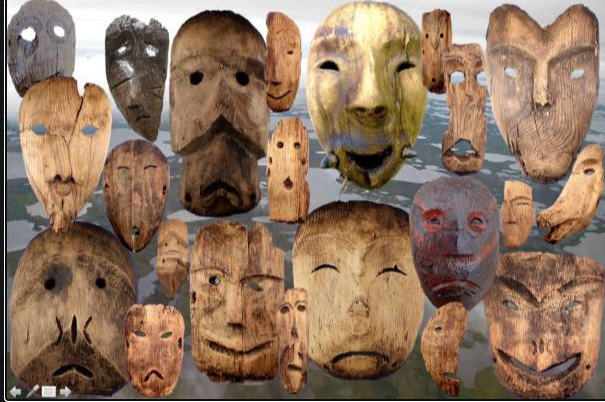
Already in cave painting, we notice the notion of a mask that represents the characters of animals (the famous play "sorcerer-deer").
Hi Janis Neolithic figures represent masked creatures (masks of totems or tribal representatives). Even Paleolithic sculptures, no matter how miniature, were masked.
The Dogon ethnic group, known for its mythology related to the star Sirius, invisible to the naked eye from our planet, stands out with its masks. The purpose of their masks is to ritually transport the souls of deceased members away from the village and increase their reputation.
The mask and the human face are in the eternal dualism of the god Janus.
If we look at this phenomenon from psychological aspects, we are tempted to say: the feeling of shame started from the face. A covered face meant something that transcended people in individuality.
The mask, the make-up, the sacred cap marked the beginning of the determination of someone who entered the given form as a larva in a doll
The mask is the one who masters man, gives inspiration and she communicates with the cosmic forces because everything else under the gaze of the cosmos is imperceptible. A man without a mask is gentle and without personality. An actor without a mask, without a "role" is not seen on stage. The priest and the king without a mask pass into the aspect of profanity.
Everything that man has learned from nature can be seen on his masks and they are a kind of opinion of a man of certain communities about the world in which he lives.
In our area, masks mostly present animal attributes (leather dresses with inverted hair on the outside, goat shape, wolf skin). This is especially true in the southeastern parts of Serbia.
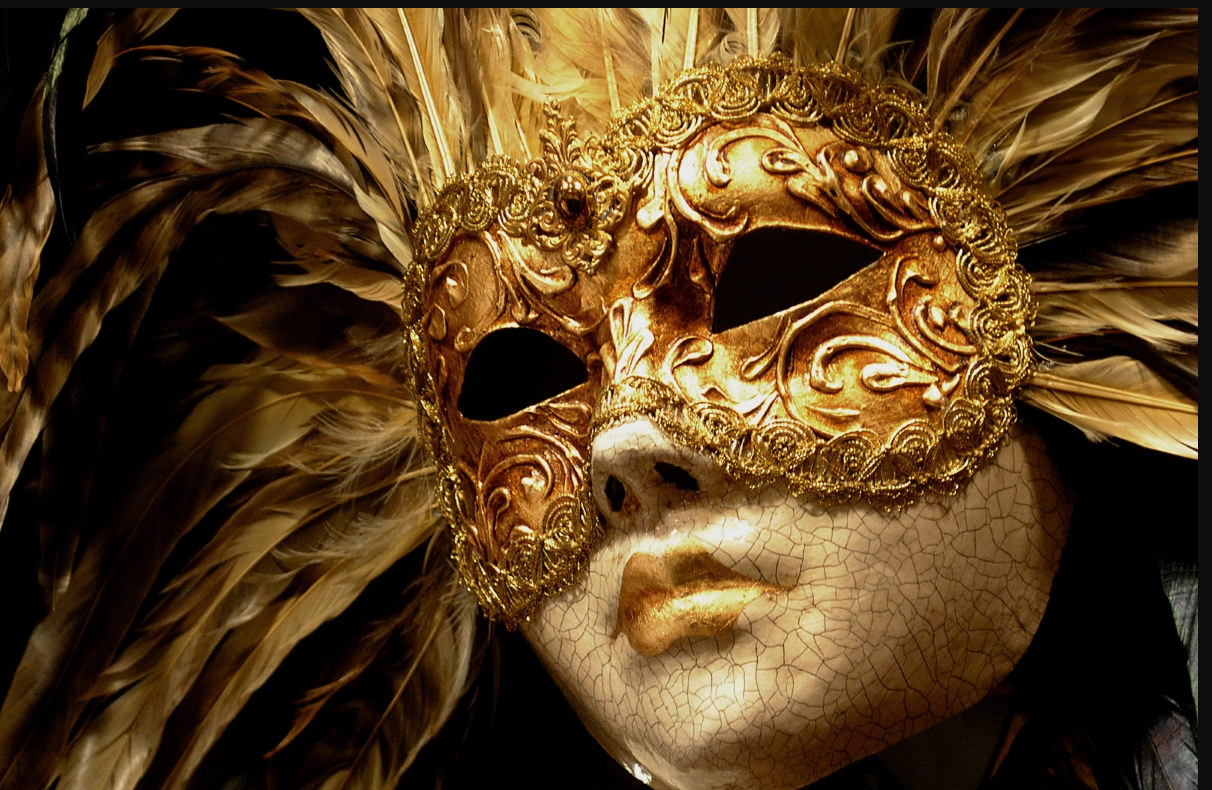
The cheek that hides the face and the mask that transforms it; cheeks of dishonorable road robbers and masks of honorable citizens; death masks and masks from which one lives ... Mycenaean masks made of gold sheet (with the one that Schliemann held in 1876 to be the figure of the destroyer Troy Agamemnon). Masks of Indian sorcerers with Grizzly fangs. Demon feather masks of the Incas. Masks from the island of Java made of wood. Eskimo fur masks. Japanese theatrical masks. Dodol masks of Eastern Serbia for invoking rain. Masquerade masks.
Not to forget, human skin masks that we use every day.
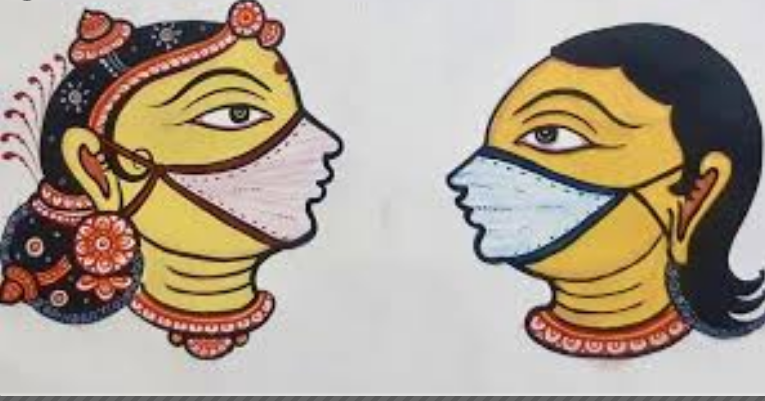
And finally, a medical mask that will become a part of our everyday lives. They are not a novelty in human history either. The protective mask was worn back during the plague pandemic in the 14th century, but of course it looked completely different than it does today. Even today, the masks we wear to protect ourselves from the current COVID-19 are only soft protection, and for some they are a fashion accessory. The world's greatest designers, such as Gucci, design protective masks for a selected clientele.
Many psychologists have speculated about why wearing a mask is widely accepted in Asian countries, and in the West, suggestions and orders to wear masks have been met with resistance. French anthropologist, pandemic specialist Frederic Keck notes that in the West, wearing a mask is seen through individual glasses ("the virus is outside, I wear a mask to protect myself"), while Asian societies react collectivistically ("I wear a mask to protect others").
From a public health perspective, it doesn’t matter what the mask looks like, where you got it, or how you made it; functionality is the only thing that matters.
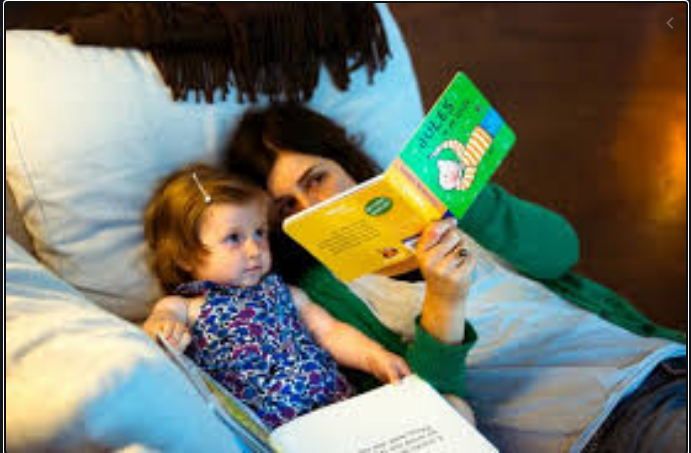
With these 30 old methods of upbringing, you can't go wrong even today.
No matter how much the weather has changed today, some things you can still apply, and you will surely succeed as a parent Surely you have heard that familiar sentence from at least one of your parents, grandparents: In my time there was no such thing, I went to school alone, I did everything myself, and the like. Although a lot has changed today, some values "hold water" even today! With these 30 old methods of upbringing, you can't go wrong even today.
1. Be persistent
If you say "you have to stop arguing or go to bed right away", stick to it.
2. Eat together
Can't do it on weekdays? Get together at least for Sunday lunch.
3. Let the children learn from their mistakes
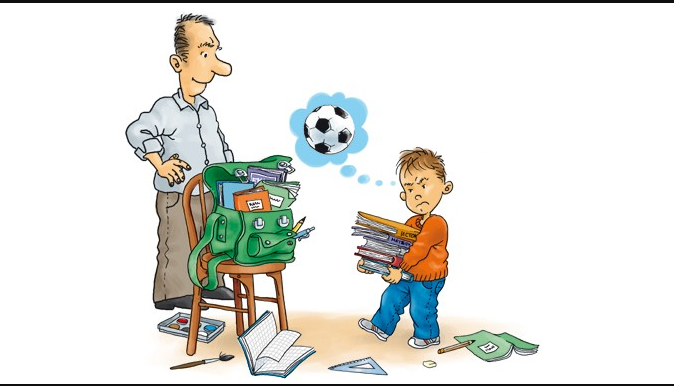
Should chemistry work be submitted tomorrow? Don't do the child's job. Let him understand that one day it may not be you to do it for him. He will learn best from his mistakes.
4. Send the children outside to play
The fresh air never hurt anyone.
5. Establish house rules
It doesn’t matter what their friends ’parents allow. It is your house where your rules apply.
6. Sometimes it's okay to say "because I'm a parent"
You don't have to explain every decision you make to your child.
7. No privileges
Children have to bear the consequences for the bad things they do.
8. Sometimes they have to be bored
Yes, it is the job of the parents to provide the child with food, clothes and all the security. But if they're bored, you don't have to entertain them all day.
9. Sometimes you can have fun without children
Among other things, don't forget the time you adults should spend without children. Organize an outdoor picnic with your husband or go to a romantic dinner. Of course, without children.
10. Establish bedtime
This is very important so that everyone can get some sleep and be more rested in the morning, and not nervous and nervous.
11. If he won't, he won't
If you make lunch and your child is not satisfied with what is on the table, don't get upset. Give him two options: take it or leave it. Let him find another choice only.
12. Teach him respect
Don't let your child have disrespect for you or anyone else. Likewise, children learn from you, so the same is required of you.
13. Teach them good manners
It is very important to teach children how to behave. Teach them to be polite, polite, teach them the rules of etiquette.
14. Teach them to help
Every child in the house can help with something. Engage them and teach them from an early age how important it is for each eye to help with something in the house.
15. Be a good example to them
We have been through this before, but really, you are the best example to your children. Therefore, be careful what you say and how you behave.
16. Don’t let them interrupt adults as they talk
Also, when they talk don't interrupt them. Let them finish the same as they will you.
17. Be a parent, not a friend
You can have fun together, but you need to know when to act as a parent.
18. Cook together
A great way to connect even more, and to teach your child the life skills he needs.
19. Tell them family stories
Show them your photos when you were young, tell interesting stories.
20. Make traditional gatherings
For example, for Dad's birthday, a barbecue is made in a certain place every year ...
21. Let them hang out with grandma and grandpa
It’s good for you and for them.
22. Stick to the sentence "You can't always get what you want"
There are no special treatments. Not even for a birthday. Not even when he did something good. You must not give up.
23. Teach them proper dress
It is very important to teach them, for example, that when they go to a wedding, they should be trained in accordance with the occasion.
24. Don’t forget that you are a parent
When you tell them to clean the room, they have to listen.
25. Trust your instincts
When talking to your child's doctor or school teacher, trust your instincts to help assess the situation and make a decision.
26. Teach them to maintain hygiene
It is very important to teach a child from an early age how to wash his hands properly and how to wash them often.
27. Teach them to respect the elderly (and everyone around them)
This is very important because if they do not have respect for the elderly, they will build a very ugly character.
28. Show them how to help people in need
Volunteer together. Tell the children to help someone in need. Let a child learn from you too. Show him by example.
29. Give them time to play
Kids need to play, but they also need to know when it’s time to play and when it’s time to go home.
30. Teach them to clean up after themselves
At school. In the House. At friend's. In general, in life ...
Why are children's creativity most often killed in schools?
Finally, the last day of my writing on various types of literacy has arrived (I hope I haven't bored you much). Finally, I will write to you about one type of literacy that I believe has contributed the most to the development of the whole human society.
Creative literacy
Creativity is, according to an old saying, the last resource that the human race has; what we do when we don't know what to do. Creativity is the closest thing to magic in our individual and collective action. It creates new industries, new perspectives, new inspirations, new resources and new ways to solve problems. And yet - as many activists fighting for education reform point out - something strange and tragic is happening to this vital force in our lives.
Several years ago, NASA developed a special creativity test for its scientists, and then, out of pure curiosity, they decided to use it to test 1,600 school children, ages 4 and 5. The results were astonishing: 98% of the children on the test were in the ‘genius’ category in terms of creativity. When the test was repeated with the same children five years later, the percentage dropped to 30%, and by the time the children turned fifteen, to only 12%! The same children, tested as adults, barely reached 2% of the level of creative genius. The conclusion was that the school, as we know it today, systematically destroys creativity, our natural state, the superpower we are born with and have until the relentless press of industrial education and the modern business environment drains us.
Creativity is ‘new’ and ‘different’ by definition, deviating from norms, disagreement, change, shock, undermining the sameness - all that most of our official environments try to avoid at all costs! We, as creative beings, have managed to make the mother of all paradoxes: to build a civilization that treats its basic and most magical trait as an enemy, as a hindrance, as a disease that is exterminated by processes, measurements, systemic norms and customs that punish diversity. The new education system needs a new ideology not only of acceptance, but also of active celebration of ‘neuronetypicality’, eccentricity, radicalism and counter-racialism of all kinds - provided it does not jeopardize the security and personal integrity of others, of course. (And I use these words here in their basic, not symbolic or status sense). This, due to the nature of current education systems, will probably be the most difficult literacy to develop and implement, for two reasons.
The first is what I mentioned at the very beginning of my study on various types of literacy: the structure of the system itself, which is based on standardization and mass averaging. Teacher training, the ways in which both their and students' success are assessed, the daily structure of activities - everything is in fundamental antagonism towards creativity. Another reason is the lack of understanding and non-acceptance of the very ideology of creativity by the competent ministries and their political systems. Our biggest collective, civilizational, problem is that the planet is ruled by a cabal of fundamentally uncreative and unimaginative people. Exceptions are extremely rare and only put others in even stronger contrast.
An educational program for these new types of literacy already exists. Literature and methodologies, too. No one can say that we do not know how we would do this new enlightenment project. There are even many successful individual examples, not only in Finland. What is really missing is the systemic will to even try. The challenge to the ‘status quo’ is simply too great.
I wonder why? Namely, all these types of literacy can easily be found in various branches of the economy, with large investments in their creation and development. Advertising, political propaganda, sales and entire entertainment industries make big money through archetypal storytelling, impulse stimulation tactics, ‘hacking’ attention, super-rational organization of expert teams and intensive use of data and statistics. Various consumer industries are immersed in creativity. They all understand very well how human nature and our cognitive ‘shortcuts’ work, and then they turned that knowledge into a weapon against us. Sometimes that creativity is used to develop ideas that realistically improve the way we live our lives. But I can't resist the impression - that for the most part this creativity is being used against us, in an ideological system that puts profit above people and above the planet.
These ‘human sciences as weapons’ have created an invisible methodology, a ‘black operations’ type of thinking that pushes various hidden interests under the radar of our attention and our understanding. Literating the population in these ways would fundamentally change existing power games, our perceptions of reality and priorities in life, the political and economic systems we believe in (or only support for various human reasons, even if we don’t believe in them).
That vicious circle, however, must at least weaken, if not break, if we care about ourselves, on this grain of dust called planet Earth
Of all the survivors of the Titanic tragedy, his excuse was the funniest and by far the poorest!
When the legendary ship Titanic began to sink one fateful night on April 14, 1912, its crew tried to save as many women and children as possible. The men were expected to remain on board, and 1,352 of them obeyed the order, disappearing forever into the icy waters of the Atlantic Ocean, to enable their wives and children to survive. Dickinson Bishop was not one of those people.
Dickinson Bishop was a wealthy American businessman and first class passenger on the Titanic. The boat trip from Britain to New York was actually the end of his four-month honeymoon with another surgeon, Helen, whom he married after his first wife and wealthy heiress, Mary, died in childbirth.
The couple was in their chambers in first class when they felt the blow. Due to the position of the cabin, they were one of the first to go on deck when the evacuation began, writes the portal Listverse
Helen and Dickinson Bishop were aboard the lifeboat No. 7, the first to be lowered into the icy waters of the Atlantic. A few hours later, and after more than 1,500 people, including the Titanic, disappeared forever in the depths of the ocean, the boat picked up the ship Carpathia, which took the Bishops and other survivors to New York.
**Controversial testimony and crazy excuse**
In an interview with a newspaper made immediately after disembarking, Helen Bishop said that she heard on deck how someone said that newlyweds had an advantage in boarding and that her husband and she found themselves in the boat they were in so quickly because of that. three young married couples. However, during the official hearing, she did not mention this story again. On
the other hand, her husband had an even more incredible excuse. Asked how he was rescued from so many women and children left on board, Dickinson Bishop came up with a "perfect" excuse - he said he accidentally tripped, fell and landed right in the lifeboat.
He kept the story even when during the official hearing held due to the investigation and the sinking of the Titanic, I almost gave up. Namely, to the question: "Who told you to get into the lifeboat?", Bishop answered: "One of the officers, he helped me climb." Then, probably realizing what he said, he tried to get out: "Actually… I fell into the boat."
Dickenson also claimed that he never heard that women and children should have an advantage, and he supported that with the fact that there were 12 other men in the boat next to him.
**Fate has found a way to take revenge**
In the days after the accident, the tabloids fought over the story of how the Bishops survived the Titanic. There were even rumors that Dickinson boarded a boat disguised as a woman, although there was never any evidence for this.
On the other hand, the Bishops did not have much luck after that. In December of the same year, Helen gave birth to a boy, but he died two days later. In November 1914, they had a major car accident. Dickenson was only slightly injured, but Helen had such a serious head injury that doctors were forced to resort to an experimental technique and implant a metal plate to heal her skull.
After all these accidents and gossip that did not stop, Dickenson and Helen divorced in early 1916. Helen accused her husband of cruelty and drunkenness and received alimony of $ 100,000.
As for Dickens, less than two months after the divorce and only two days before Helen's death, he married for the third time, again to the wealthy heiress Sydney Boys. He was married to her until her death in 1950.
After that, he lived in seclusion in Ottawa, Ilionois. He died of a heart attack in 1961.
Nothing great comes into the life of a mortal without a curse - Sophocles
I thought I wouldn’t be posting anything more on the blog today. I started looking for materials that would help me explain the abuse of the internet to students because I am now working on it with them and came across Netflix's documentary "The Social Dilemma". I watched it as an enchanted movie and upon completion I wanted to share my impressions with you.
The title of this article greets you as an introductory quote before the start of the film itself. I’m not going to tell you this movie, it’s impossible. I'll tell you what it's about and share my impressions with you. I'm just going to say that I believe that absolutely everyone should watch it.As a small incentive, I will only show you the official trailer for it.
https://www.youtube.com/watch?v=uaaC57tcci0
Rational consciousness has collapsed. She knelt the moment we rode the Instagram wind with the daily obsessive need to spy on other people, as if we were going to miss something very important. The twist in the story, we missed nothing, except that the child of our friend burped, which is not crucial for our existence. She knelt down because while we look at others with one eye, we choose a filter with the other to match them with the same intensity as they lie to us. And how she knelt down. Especially when we have decided to stop believing in exact science and data, while unconditionally handing over our trust to YouTube shalabayzers. And while the rational part of consciousness sinks deeper and deeper into darkness, in its place comes its majesty - collective thought.
A suitable mediocre figure with whom you can do as you want and as you like. It is submissive, it is very resistant to critical thought that is undermined by the rational, and most importantly, it is perfect for manipulation. An elitist would say - ah, you poor mortals are not even capable of resisting the primary urge, while on the other hand, the creator of the documentary "The Social Dillema", Jeff Orlovski, reminds us that we have been powerless under the digital paw for more than a decade. In complete magnetization and ignorance, we discovered everything about ourselves, without even being aware of it, while privacy as a concept evaporated in the thin air together with the raid. How? So while reading this you hold the phone in your hand or it is very close to you while you check out of the corner of your eye if someone has sent you something. Well, this is exactly the topic of "The Social Dillem" - why we all use it so passionately.
"The Social Dillema" is not just a documentary that puts a finger in your eye and laughs at you because you knelt before the gods of Google or Instagram, but because we all together allowed these places to become a battlefield and a terrain for racial segregation, verbal abuse, conspiracy theories, false news, belittling and belittling basic human rights. The place of fun and leisure has become a political and social construct for sending passionate messages, an outpouring of frustration and causing unrest in every sense of the word.
The actors of the documentary, who are not only analysts and theorists of modern society, but also a part of the system they created and in which we all participate today, discover how every social network and every platform for socializing and photography has become something completely different.
When you think a little better, the goal of every product creator is to make the user envious of him. First of all, satisfied, and then envious. Social networks, operating systems that run phones, computers and all the wonders of modern technology have become a kind of narcotic. Something that is easy to get used to, but hard to undress. Some groups laughed out loud about ten years ago when social network rehab clinics appeared. However, statistics highlighting the marked increase in suicides, more severe forms of depression and anxiety since 2010 (when social networks gained momentum), especially when it comes to younger people, signal that rational consciousness has lost this battle and that social networks and telephones are creating an identical form of addiction such as gambling or individual opiates.
I will end with another quote from the movie: "If you do not pay for the product, then you are the product"
World Mental Health Day October 10
World Mental Health Day has been celebrated since 1992 because there is an increasing obligation to talk about this problem and work on its solution. World Mental Health Day is celebrated every year on October 10 at the initiative of the World Mental Health Federation and with the support of the World Health Organization. organizations, in partnership with ministries of health and civil society organizations around the world.
Mental health implies a harmonious relationship in the person himself in the emotional, intellectual and social sense. Mental health is very important for the good functioning of each individual and society, because mental disorders not only cause a deterioration in the quality of life, suffering and alienation of sick people, but also create a huge burden on the whole community mediated by economic factors.
This year, the celebration of the World Mental Health Day is dedicated to suicide prevention. Every year, nearly 800,000 people take their own lives, while the number of suicide attempts is even higher. Every suicide is a tragedy that affects the family, and the impact on the community and the state has a long-term effect. Suicides occur throughout life and are the leading cause of death among young people aged 15 to 29 globally.
Who is at risk?
Although the link between suicide and other mental disorders (especially depression and alcohol abuse) has been proven in high-income countries, many suicides occur impulsively in times of crisis when a person is unable to cope with the stress of life, such as financial problems , severing an emotional connection or with chronic pain and illness.
Also, the experience of conflict, disaster, violence, abuse, loss, and feelings of isolation are strongly associated with suicidal behavior. The suicide rate is high among people belonging to vulnerable groups who are often exposed to discrimination, such as refugees or migrants, LGBTI people and prisoners. By far the strongest risk factor for suicide is a previous suicide attempt.
Prevention and control
Suicides can be prevented. There are a number of measures that can be taken at the level of the population, group and individual with the aim of preventing suicide and suicide attempts.
Prevention and control include the following measures:
• reduction of access to means used for suicide (eg pesticides, firearms, certain drugs),
• responsible media coverage,
• implementation of strategic documents with the aim of reducing harmful use
alcohol,
• early identification, treatment and care of people with mental disorders and
abuse of psychoactive substances, symptoms of chronic pain and acute emotional distress,
• training of non-specialized health workers for assessment and management
suicidal behavior,
• Ongoing care for people who have attempted suicide and providing support in
community.
What can you do?
If you have noticed that a person you know is suffering, if you suspect that he is losing the will to live, talk to him. You need to show her that she is not alone. Put yourself in that person's position and that will help you better understand what he is going through, and it will also help you react in a natural way.
Be an attentive and impartial listener. Don't criticize her, don't moralize her, don't feel sorry for her and don't tell her what is best for her to do. This can close it and keep it away from further communication.
It is important to show that you accept the person as he is.
Unfortunately, most people are very uncomfortable talking about suicide. In our culture, it is a taboo topic and society generally ignores the existence of problems. But the fact is that almost a million people in the world commit suicide every year. That is why you should not hesitate to offer help to those who need it!
Sentences that can help talk to a person you care about who is thinking about suicide:
• "It seems to me that you have been sad and unhappy lately"
• "How are you feeling?"
• "Do you ever find it so hard that you will never get better?"
• "Are you thinking about death?"
• "Are you thinking about suicide?"
• "How would you do that?"
• "When did you plan to do this?"
• “Would you like someone to help you find another way out of it
difficult situations? ”
It is important that we all understand that mental health is very important and that we must constantly take care of it.
Does statistics help us understand important things or does it just blur the view?
Here I am, on the fifth day, writing about, in my opinion, the important types of literacy that we will need in the period after COVID -19. We live in a world full of numbers, and do we really know how to read them? today I am writing to you about
Statistical literacy
In a world full of numbers, knowing how to read them has never been more important. From an early age, we learn that truth is in numbers, that they are the same as science, and that if we want to avoid making mistakes with the 'heart' - otherwise a completely blind organ fr any deocisions - it is better to have some options for our options. records.
What we are never told is how various interests have become spectacularly skilled to tear our understanding with numbers, to manipulate us and to seduce us. There are already worn-out sayings like ‘99% of statistics tell only 49% of the truth’, Disraeli that ‘there are lies, disgusting lies and statistics’ or Andrew Lang, very famous in the world of marketing research, that ‘most people use data like a drunk uses a flagpole: more to keep from falling than to light the way '. General numerical literacy is not enough; we also need a specific statistical.
Our days and screens are full of charts, statistics, estimates, averages, figures that stand alone in the windstorm, out of any context, orphans appropriated by anyone who has a current interest in using them as witnesses for their story, their goals and their excuses. Statistics are ammunition for cannon stories, and we are clay pigeons for their cannonade.
As with other types of literacy that I have written about so far, it is tragic to what extent this type of illiteracy is part of our civilizational naivety.
Examples are all around us. Our indistinguishability from the ‘average’ from the ‘typical’ creates a completely different picture of reality. If the average salary in one country is 450 euros, while the typical salary (where the most inhabitants are grouped) is around 250, what does that tell us? In mass marketing, averages are one of the most dangerous numbers for decision making, which successful brands understand well. Smart brands work with typical values, they are closer to reality.
Or, understanding the ‘base’: the initial level from which the growth of anything is measured. If the economic growth of one country is a little higher than others in the region, but from a much lower starting point - and it is known that the typical growth from such a starting point should actually be higher - is it a success or just a statistical blur ? The context is always God, regardless of anything else that is claimed to be the King.
Probably the biggest blind spot in this type of literacy, something that is an evolutionary characteristic of the entire human species, is our fundamental inability to deal with probability. Probability is simply not understood by the human brain, especially the statistical definition of chance. Although it is completely probable, statistically, that someone has ten consecutive points from a distance, so that he does not score any long after that, the very beginning of the series drives us to attribute a "happy day" or some other kind of special magic to that player. We fable probability.
It is the other way around, because each of us has better and worse days at work, on the exam, at presentations and similar assessment situations. It is statistically almost certain that some of the students who, by the way, worked hard all year, will have anxiety, poor concentration, weaker physical energy and various other reasons for poor results on the day of the exam - but they will still be punished for it, despite annual effort. This is another thing that makes the various final exams a rough (even cruel) and statistically not very robust means of assessing one's ability.
Our brain does not like disconnection, the feeling of complete coincidence is terrible for us and the brain compensates for that with narratives, stories that ‘with certainty’ suggest to us that something ‘obligatory’ will happen, or not. Especially if we are pushed to do so by current events, such as a pandemic, or cultural customs or manipulators that ‘frame’ the data so that it sounds more favorable. Illiteracy of the phenomenon of probability is one of the main reasons for various superstitions, wrong bets, poorly evaluated candidates in job interviews or investments in various aspects of the social system. Narrative and statistical illiteracy are relatives who live happily together in our heads, to our collective detriment.
How Olivera, the daughter of Duke Lazar, conquered the Turkish sultan and saved Serbia
Little has been written about this period of Serbian history, perhaps because the splendor of Dušan's empire overshadowed those years that people mostly associate with the disintegration of the Serbian state after the Battle of Kosovo. But the Serbian despotism survived 70 years after the battle, as a more or less independent state. Serbian-Ottoman relations at that time were very strange: they are still relations between two independent states, later it will become relations between one people who conquered another people and will get different dimensions, but still in the late Middle Ages all established elements of our later relationships; everything that will happen to us later, began here.
We have the wrong perception that women left a deeper and more significant mark in the 19th and 20th centuries, but if we look at the Middle Ages, in accordance with the general elements of the time, women were extremely important in our country. They were not in a coma, they had access to a court and they did not have to be represented by a man, which did not exist in some western countries either. There were many powerful women of that time in Serbia who were rulers, such as DuchessMilica, who after Lazar's death led politics and diplomacy on her own.
Almost a year has passed since the Battle of Kosovo.
The Serbian state, and literally beheaded by the death of Prince Lazar on the battlefield, is led by his widow, Princess Milica. Lazarus, moving into battle, gave her the authority to rule the country until she returned. Duke Stefan is still a minor, relations with Vuk Brankovic after the Kosovo battle are on the brink of conflict, and the Hungarians are invading from the north. The Turks, again, are waiting for Serbia to kneel down and accept a vassal position.
One day, Milica called the nobleman, state officials, the patriarch, the high clergy. They decide to make peace with the Turks. There are three conditions before Serbia - to pay the agreed tax annually, to send the army as an aid in the Turkish military campaigns and to - marry Oliver to Bayezid.
The third condition is the most difficult for everyone. Olivera is to marry her father's killer.
Milica cut in. He decides to sacrifice his youngest, 16-year-old daughter, believing that her political marriage with the ruler of Turkey will ensure the survival of the Serbian state and people. At least for a while.
Olivera was taken to Bayazit's temple by brothers Stefan and Vuk. It is also their first vassal journey to pay homage to the supreme lord. At that time, the harem was located in Edirne, in the European part of today's Turkey, on the river Marica, about 250 kilometers east of Krusevac.
The legend says: The people, saying goodbye to Olivera, with sadness and admiration at the same time, sprinkled her way with rose petals. Celebrating and mourning her at the same time.
And, when the heart of the people was torn, how was it for mother Milica ?! According to one legend, she personally tied her child's ovaries so that she would not give birth to Bajazita's children.
Some medical procedure has certainly been performed. It is not known for sure whether it was on Milica's initiative, or maybe it was done by the Turks because Olivera did not want to change her religion. She did not want to renounce Orthodoxy and convert to Islam. The fact that Olivera did not have children supports that thesis.
How, then, the young Serbian woman had such a great influence on Bayazit, who immediately married her, as soon as she was with her brothers over the walls of the sailing steps.
The arrogant heir to the Turkish throne, who already has three wives and six children, falls in love with Oliver. Crazy, deadly, at first glance. He holds her like a little water in the palm of his hand and allows her to remain her own in faith. She will be married for twelve years, and she will not convert to Islam. He will remain faithful to Orthodoxy and will have a personal priest at the court in Jedren.
Of course, Bayazit also blessed her to remain Orthodox, but don't forget, at that time, while she was not yet at the peak of her power, Turkey was relatively liberal on the issue of religious freedoms.
However, being the wife of the Turkish sultan, one of the most powerful people in the world at the time and being also a Christian, is a fact that indicates that Olivera really had a special place in the heart and life of a powerful Turk who was estimated to be about 15 years older than her. The secret, they say, lay in her moderation and modesty. She took care of her every move and did not interfere in court intrigues.
Not only for herself, but also for her husband, so as not to harm him, because she has already been accused of being guilty of Bayazit, in spite of all religious rules and customs, starting to drink wine with his wife. At the same time, with her diplomatic wisdom, she influenced important decisions of her husband, which also concerned Serbia. Olivera helped the homeland with her "female diplomacy" as much as she could, and she saved her brother Stefan's head when he turned against the Tutrak and wanted to make an alliance with the Hungarians.
Just when Stefan, with the urgency of Bajazit, took over Kosovo from Brankovic and when Serbia became a stable vassal state, the young prince made a mistake that could have cost him his life.
Stefan begins negotiations with Hungary to unite and get rid of Serbia's Turkish vassalship. At that time, the Turks suffered a defeat in Bosnia and Herzegovina and blamed the Serbian duke for that.
Milica and Jefimija go to Jedrene to investigate the situation. The main reason for the trip is to beg Bajazit to allow them to transfer the relics of St. Petka to Serbia, which, with Olivera's help, they succeed. By the way, they "feel" the atmosphere a bit to see how angry the powerful son-in-law is with Stefan. Olivera tells them that the Serbian nobles beat Stefan Bajazita and that he is furious. He tells his mother to tell his brother to come to Jedrene and to - admit everything! To say that he was wrong and to ask Bayazit for forgiveness and to say that he will not sin again.
Olivera, knowing how the others who "screamed" passed, gave her brother advice that would save his life.
Bajazit, satisfied that the young Serbian nobleman came to his feet in repentance, forgives him everything. Moreover, he fatherly embraces him and gives important advice for governing Serbia. Stefan doesn't forget his sister's husband's generosity either. He will become, it will be shown, his most faithful and best warrior. And when it's hardest.
The idyll in Bajazit's and Oliver's lives lasted until 1402, when the Mongols began to threaten Turkey in Asia Minor. Bayezid sends an army to intervene, but is defeated. The battle of Angora will soon begin, which will be fateful for both.
In a relentless hand-to-hand fight, the Turks begin to lose, Bayezid is surrounded, but a knight in silver armor with a golden cross on a black uniform appears on the battlefield. He and his men instill fear in the bones of the Mongols and, like kamikazes, rush into the depths of the battlefield to pull out Bayezid.
Tamerlane, the Mongol khan, is in awe. Fascinated, he thinks that they may be members of a Turkish dervish order. Because, who would fight so fanatically for Bayazit ?!
He would later find out that it was a Serbian knight, the brother of the beautiful sultan he had captured. Stefan fails to pull out Bayezid and Tamerlane enslaves him. Coincidentally, he captures Oliver as well.
Bajzit dies in captivity, but Tamerlane is allowed to be buried in a mosque in Bursa according to Muslim customs. He releases Oliver and the Serb detainees, in recognition of Stefan's chivalry in battle.
Olivera returns to Serbia, for a while she lives with her brother in Belgrade, but not at the court, but in the house near the court in Kalemengdan. She was Stefan's most valuable advisor because she knew the circumstances and nature of the chieftain at the Turkish court. After Stefan's death in 1427, of her brothers and sisters, only her sister Jela Balšić Kosača remained, with whom she spent some time in Dubrovnik.
After Bayezid, she did not marry. She died in 1444. It is believed that she was between 65 and 71 years old and did not experience the final fall of Serbia under Turkish rule in 1459. Her grave is unknown. Bones believed to be Oliver's were found in a church on the island of Beska on Skadar Lake, built by her sister Jela, who was later buried there. Awaiting the result of DNA analysis.
The Serbian Orthodox Church has not forgotten Olivera's sacrifice. Her figure is painted in the holiest place of the the Saborna church in Belgrade - in the altar. With a halo and the inscription Holy Martyr Empress Olivera.
The church thus identified Lazar's sacrifice, who gave his head for the fatherland and the sacrifice of his daughter Olivera, who gave her life for Serbia. Her figure is also on the stained glass window of the St. George's Church in Novi Sad, where she is shown with a turban on her head and a cross in her hand.
Although the church has not forgotten it, ordinary people have. Much is known about the glorious Sultanate of Hurem. Today, grandiose monuments have been erected to her in Ukraine, postage stamps with her image are printed a little by Russians, a little by Ukrainians (they are still arguing whose it is), while Olivera has no monument, not even a bust in Belgrade where she lived when Belgrade became the capital.
Six days, for the six types of literacy that I will need in the world after COVID - part four
Did new technologies allow us to work better and easier as a team, or did they distance us and make it harder for us to work as a team? Today I am writing to you about
Team literacy
And, again, everything is connected.
The same illiteracy also makes us both selfish and less able to work in a team. When the impulse reigns and when it is seduced by iconic stories, when we are accustomed to being the only one in the center of attention and when that attention is easily broken, the ability to empathize about needs or just the points of view of others is also weak. This, in turn, has direct consequences for the fact that we need to function in the current and future post-industrial world.
That world is rapidly becoming even more complex. More and more occupations are now contextual and dependent on the complementary knowledge and skills of others around us, members of one team. Lonely cowboys are slowly losing their prairies. ‘The project delivery factor,’ as they say in Silicon Valley, ‘is the team’. Teamwork is primarily based on impulse literacy and empathy. Successful teamwork requires balancing different energies: introversion and extroversion, different communication styles, recognizing a common mission or goal. Teamwork is an extraordinary training in introspection and understanding one's own sides of personality.
The ‘rack profile’ is a simple but powerful concept: we all have more pronounced and less pronounced sides of our personalities, especially when judged in a specific professional or group context. Let's just take the generic term, often used in job advertisements, 'good communicator'. It is one of the more vain descriptions, almost completely useless if it is not put in a specific context. What kind of communication are we talking about? Some are strong in public presentation to dozens of foreigners, even company executives, for some it is their biggest nightmare; some are excellent in 1-on-1 communication, but not very useful in creative workshops; some write extraordinarily, others barely compose a few functional sentences. There are many sides to a ‘good communicator’, which ones are critical to this specific position because we will have a hard time finding a person who has it all together?
The same is true for many other dimensions that companies and their consultants use to find candidates to describe different positions. ‘Energetic’ (what kind of energy: permanent but slow, for example for a marathon, or fast and short, for sprints?); ‘Smart’ (useless general); ‘motivated’ (pathological, or…?) Here’s one from my personal experience, but carefully thought out: one of the four ‘baskets’ of characteristics that Google uses to assess its candidates is ‘Guglines’, in which one of the very essential dimensions of ‘success in chaos’. In a sense, chaos should not paralyze us, but be treated as an opportunity to radically change things for the better, or to see a commercial opportunity in it. Chaos rewards agile, fast, flexible. Chaos is good, if approached properly. So if he doesn't index candidates very high by this characteristic, it is to be expected that he won't have many happy moments in a company like Google.
A team is a collage of personalities for a specific context and for specific goals. Understanding our own ‘rack profile’, as well as the people around us, helps to achieve ‘synergy’ (another favorite word of the business world). As with a team of astronauts or special forces, complementary talents and personalities are critical. It takes less ‘adjustment’ and stress to fit. There is more understanding and acceptance of everyone's contribution to the whole, specific 'holes' in the team when we are not there.
And, again, we don’t learn about this in school, or later. We are emotionally illiterate, which usually means group illiterate. As in our common evolutionary past, our survival depends on working together, small and large, globally and locally.
Krusevac - the the capital city of Emperor Lazar
In the beginning, he was a courtier of Emperor Uroš. After that, he fought among other great men and became a Duke. The people loved him so much, they called him Emperor . And he left us a city, a colorful city - Krusevac.
Characterized by a very favorable geographical position, Kruševac and the Kruševac area were inhabited in prehistory. Archaeological finds speak of life in this area in the Neolithic era. However, the search for the origin of Kruševac takes us to the Middle Ages, to the time of Prince Lazar, who introduced it to history as his capital in the eighth decade of the 14th century.
In 1329, Duke Lazar Hrebeljanovic was born in the town of Prilepac, near Novi Brdo. Lazar was brought up at the court of Emperor Dušan, where his father Pribac was also the emperor's logotet (chancellor). During that time, Lazar acquired a higher education and Emperor Dušan appointed him as his setter (keeper of the seal). In 1353,Emperor Dušan married Lazar with his cousin Milica, the daughter of Prince Vratko, a prominent military leader from the Nemanijć lineage. It is not known exactly in which year Emperor Uroš awarded Lazar the title of prince and gave him the administration of Pomoravlje. It was most likely in 1366 when Vukasin proclaimed himself king. After the death of Emperor Uroš, soon after the Battle of Marica, Duke Lazar became the most powerful nobleman on the territory of the former Serbian Empire.
The legend of the origin of the city
For a long time, Duke Lazar and Duchess Milica researched where they would build a new capital. According to folklore, they spent one night on a hill above West Morava. That night, Stefan Nemanja appeared to Duchess Milica in a dream and told her to build a new capital right where they slept. So it was.
One legend says that Kruševac was named after the stone pear, a round river stone with which the city was mostly built.
In 1371, Kruševac was built. Aware that his country is threatened by the Turks, Duke Lazar decides to build his court in the north, away from the main directions of the Turkish army's advance. He chose Kruševac, which, with its geo-strategic position, best suited its needs. Duke Lazar built the city, but the settlement existed even before that. The construction of the fortified city was approached in a hurry. For that purpose, Duke Lazar brought his best builders from Novo Brdo to Kruševac. It is assumed that the construction lasted up to two years, although at that time it was normal for the cities to be extended later.
The city itself was in a very good strategic position. From the south, in the direction of the Ottoman invasion, the city was protected by the area of Vuk Brankovic. To the west was the land of Tvrtko l Kotromanić.
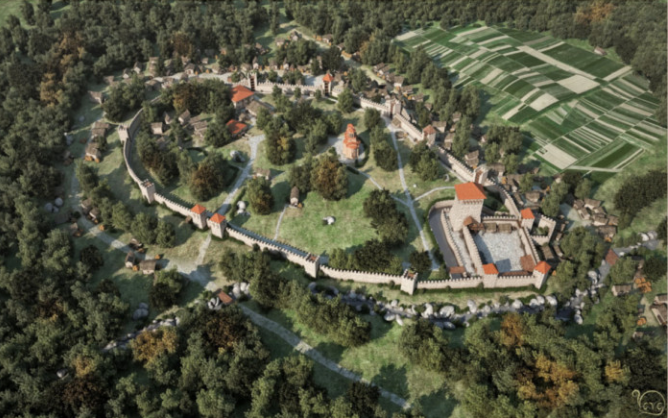
The fortress itself was first mentioned in 1381. It is assumed that it was built on the foundations of former fortifications. The city itself was surrounded by high walls, it had a plateau on which a court, a church and buildings were built in which nobles and courtiers lived. There were high observation towers on the walls, between the two belts of walls there were deep moats bridged by bridges on chains erected at night.
Right next to the city walls, a suburb was built - a civilian settlement. There were houses for housing, a square, a market, shops, lodgings. During the period of peace, Lazar's state prospered economically, so Krusevac imposed itself as a center of economic activities. Merchants from all over the Balkans met on its streets, and the people from Dubrovnik were the most prominent, coming to Lazar's capital, in addition to trade, for diplomatic activities.
From the charter issued in 1387, we learn that the Duke himself spoke about the city:
"In the glorious city, my lordship, Krusevac."
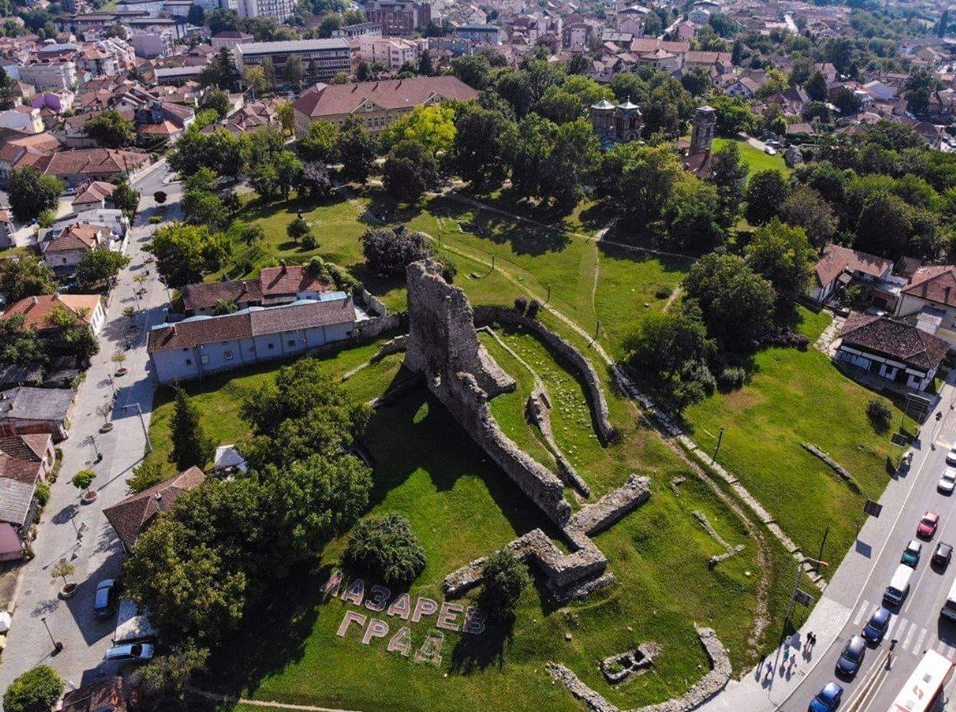
Today, the Lazarev grad Archaeological Park is located on that place.
This archeological site represents the rest of the medieval city, which was built as the capital and military fortification.
In the park there are authentic remains of the Don John Tower, the church of Lazarica from the 14th century, the remains of the prince's court, the monument to Prince Lazar and the National Museum.
The Lazarica Church is dedicated to Archdeacon Stefan, the patron of the Nemanjić dynasty. It was built in the period from 1377/78. to 1380 in honor of the firstborn son of Duke Lazarus, despot Stephen, heir to the throne.
During the renovation of Lazarica, after the liberation from the Turks, the church was painted again in 1843. The author of this fresco, the painter from Požarevac, Živko Pavlović, also made the iconostasis of the church, during 1844, before the visit of Prince Aleksandar Karađorđević to Kruševac. Karadjordje donated a bell to the church, which has been preserved to this day.
Inside the complex of Lazarev grad, the National Museum is located in a building erected in 1863 for the needs of the Kruševac High School.
It was adapted for the needs of the Museum in 1969
The museum fund contains about twenty-three thousand museals of natural, archaeological, ethnological, historical, cultural-historical and artistic character, whose historical step is over six millennia - from prehistory, through antiquity and the Middle Ages, through the period of Turkish domination and renewal of Serbian statehood. , until the middle of the 20th century.
Duke Lazar dies in the Battle of Kosovo on Vidovdan on June 281389, when he chose to, in his own words, as the legend says "Replace the kingdom of the earth with the kingdom of heaven"
Today, the monument to Kosovo's heroes, located in the center of Krusevac, keeps the memory of that event.
The monument to Kosovo's heroes is a symbol of Kruševac from Vidovdan in 1904, when it was solemnly unveiled by King Petar I Karađorđević on the occasion of the celebration of the centenary of the First Serbian Uprising. The cornerstone was laid by King Aleksandar Obrenović in the newly formed core of the city, on the occasion of the celebration of the 500th anniversary of the Battle of Kosovo in 1889. Thus, the space of the future center of Kruševac was determined.
The monument is the work of the famous Serbian sculptor George Jovanovic and is the most monumental work of national sculpture from the beginning of the 20th century. At the world exhibition in Paris in 1900, where sculptural elements were exhibited, the author was awarded the First Order Gold Medal.
The monument is in the shape of a marble pyramid, 6 meters high. It was performed in the spirit of French academicism in the neoclassical style with clear sculptural symbols.
The most significant is the composition at the top. Bosko Jugovic, the flag bearer of the Serbian army, fights wounded, with a broken sword, but does not drop the flag. In the dramatic last moments, Villa flies in and accepts the flag, symbolizing the continuation of the fight, and puts a laurel wreath on his head.
The figure of a guslar on the north side represents the duration of an epic struggle through the centuries. The girl on the south side symbolizes Serbia, which, with its outstretched hand to the south, calls for the liberation of the enslaved brothers, promising a wreath of glory to the transgressors.
The relief on the east side shows the epic communion of the Duke 's army, and on the west the scene of the assassination of the Turkish emperor Murat.
On the north side is the coat of arms of Nemanjić and 1389 - the year of the Battle of Kosovo; on the west - the coat of arms of Emperor Dušan and 1904 - the year of the unveiling of the monument; on the east - the coat of arms of Prince Lazar and the dedication to "Serbian Kosovo heroes", with a laurel wreath and a palm branch at the base, while on the south side is the new coat of arms of the Kingdom of Serbia from 1888 and the year of proclamation of Serbia as a kingdom - 1882.
The motifs on the cast iron fence around the monument represent stylized Kosovo peonies.
As part of the celebration of the 600th anniversary of the Battle of Kosovo, in 1989, a wreath was gilded on the monument, which the fairy puts on the head of Boško Jugović.
After the Battle of Kosovo, in 1389, the Turks briefly took power in the city. To Despot Stefan Lazarević, the son of Duke Lazar, Kruševac was the capital until 1405, when it was moved to Belgrade. However, the city itself does not lose its significance, because during the 15th century it was often "the subject of conquest". It is from the 15th century that the name colorful city originates, which was given to it by the Turks, or as it would sound in the original, aladža hisar. Kruševac got its name due to the fact that the fortress was built of different materials.
Next year we celebrate six and a half centuries since the founding of our city. This is my modest contribution to the preparations for the celebration of that great jubilee.
The Mystery of the Death of Edgar Alan Poe
The famous writer was last seen in public on October 3, 1849, in a very bad condition. There is information that he called Reynold before his death, and to this day no one is sure who that man could be.
A master of mystery and spooky, a writer of extraordinary genius and visionary imagination, Edgar Allan Poe was born on January 19, 1809 in Boston.
At the age of six, he was sent to England to study, where he studied Latin and French, mathematics and history. After five years, he returned to America where he continued his education. When he turned 17, he enrolled in studies at the University of Virginia. Although Poe was a successful student, he indulged in alcohol and fell into debt, leaving school after a year.
Poe is the first known American to try to make a living from writing, and his most famous work, the song "Raven", was published in early 1845.
His works have greatly influenced literature in the United States and the world, as well as cosmology and cryptography. They also appear in popular literature, music, movies, and television. His many houses are museums today. "Mystery Writers" of America is awarded a prize known as the "Edgar" Prize each year for outstanding works in the mystery genre.
Poe was found confused on the streets of Baltimore on October 3, 1849. Joseph V, the man who found him, called for help, and Poe was taken to "Washington College Hospital", where he died at five in the morning, on October 7, 1849. He was not with himself long enough to explain how he ended up in someone else's clothes and in such a state. Many claim that on the night before his death he kept repeating the name "Renolds". According to some sources, his last words were: "Lord, help my poor soul."
His death remained shrouded in mystery, because no one knows exactly how he spent the last days of his life and from what he died.
There is a lot of information that Po really couldn't stand alcohol. Po would be drunk from a glass of wine, as would his sister. Those who were in Poe's environment admitted that the writer often thought of being poisoned by alcohol.
Also, many have started the theory of Poe's death due to carbon monoxide poisoning. They considered it possible because the light was filling with carbon at that time. Many rejected this theory because after testing the hair of Poe's hair, no traces were found that would indicate that. There is also a theory that the famous writer died of rabies.
At a conference of pathologists in 1996, a doctor, together with a list of symptoms that he compared with the symptoms of patients suffering from this condition, presented this theory. The doctor did not know who it was, he just reviewed his doctor's reports.


Six days, for the six types of literacy that I will need in the world after COVID - part third
Today, I am writing about a type of literacy that is extremely rare nowadays, primarily due to the presence of a large number of electronic media. I notice that every day. Most people very often manage to keep their attention on the bull, which is why I am writing to you today about
Attention literacy / algorithmic literacy
As a consequence of the previous two illiteracies, the real world pandemic, for decades, is in fact the one we notice the least: attention illiteracy. This biologically limited resource has never been under greater pressure and demand. As a rare and precious ore, everyone is looking for it. One of Google's mantras is that 'money follows attention': whoever manages to hire it, attracts it, is automatically in a better position to monetize it. Attention is capital. Today, instead "spare me some change we hear spare me a share"
We really live in an ‘attention economy’ and this is seen in the number of books, articles and debates that all try to conceptualize the same problem: we are all overwhelmed by content, we are all tired, frustrated and anxious because of it, we are all permanently distracted and often emotionally confused by the paradoxical demands that are sent to us through various channels in very convincing ways. Professional emotional vampires have found hundreds of methods to trigger our impulse, and thus attention, in their favor, leaving us to wander through our daily lives in the fog and dizziness of FOMO (fear of missing out), feelings of inadequacy and anxiety, incapable of self-reflection , empathy and quality decisions.
Attention literacy is not only a problem of today's world, but it is also becoming one of the biggest barriers to our education and functioning in the future. ‘4. the ‘industrial revolution’ requires a much greater reliance on self-directed learning and training - outside official institutions - on the internet, in ‘massive open online courses’ (MOOCs) and in various professional groups and forums. It requires strong, almost ascetic, focus, and strength to control impulse and resist hypersurfing; not to disappear, sometimes for hours, in the endless meanders of the Internet, the virtual worlds of various games and the endless circus of YouTube, Netflix and other entertainment platforms. It is very difficult to do in a world of countless distractions.
Why do we suffer from so much illiteracy of attention? Lack of awareness and training about how archetypal narratives and our impulses work is certainly the main reason. However, there are environmental factors that contribute significantly to this. As Joseph Heath also pointed out, we live in a civilization that is cognitively the most demanding of all we have had so far, and that has inherent, consciously embedded, commercially driven predatory relationships with our attention and our daily time. Two technological phenomena reinforce this illiteracy.
One is ubiquitous algorithms, as one of the primary ways in which modern people receive the mediation of their on-screen - and that largely means ‘real’ - realities. Their task is not to give us what we really need the most, but what is most commercially useful for their platforms and their advertisers. That’s right, in the beginning it’s usually what we really need, as a great profiling factor, but very quickly some other dynamics become part of the approach.
Algorithms are a training system for automating and ‘outsourcing’ our attention and the criteria we use to engage it. The result: the attention economy makes money, we ‘earn’ insomnia and the loss of common sense. ‘Algoi’ can help us find what we think we need, but at the same time they endlessly hinder and manipulate us. Again, behind everything sits our cognitive preferences, our illiteracy of attention and impulse, and the socio-political system designed to use them consciously. Algorithms are just part of the story. Perhaps another problem is even greater: the conscious incorporation of dependencies into our operating platforms.
Mobile phones, with the exception of "pacemakers" and "dildos", are the most intimate personal technological devices of today. Many studies show that we use them more than a hundred times a day, and we touch more than a thousand! There is no person in our lives who receives the same treatment. There is a reason for that. Both major mobile platforms - iOS and Android - as well as most social networks, are designed to create physical dependence on users, in the same way that machines in a casino or a reward system in computer games work. We are ‘hooked’ on notifications, permanent micro-doses of dopamine, neurochemical addictions. Mobile phones have become dopamine pumps.
These pumps affect our future the most: our young people. We rely on them to get us out of the current nightmare that we have created ourselves, by looking at the world with different eyes, by being different politically, commercially, socially. Different in the sense of ‘better than us’. If, however, we look at who are the most frequent visitors to new technology addiction clinics, which are sprouting faster and faster in various countries, I wonder… Narrative, impulsive and illiterate attention makes us physically ill.
Attention illiteracy is in fact ‘attention obesity’, tickling with distractions to satiety, which kills our ability to focus on other, more important things. No one sleeps in front of the polling station to be the first in the morning to give their contribution to the functioning of democracy. But we sleep in front of Apple stores when they launch a new product; we spend hours in rows to be among the first to run to the store on Black Friday and fight over a toaster at a discount. We have become fantastic consumers, and very bad citizens. That Friday is rightly called ‘black’, there is nothing bright or positive in it. That is why many "confusing" and "unexpected" things happen during these Crown days, in our societies. We let them happen, blind to the forces acting on us.
This is a real epidemic that needs to be talked about. It prevents us from seeing current and many upcoming problems. Kovid-19 will be a walk in the park compared to the impending climate catastrophe. And we failed to organize ourselves to provide even the simplest protective equipment to doctors who are fighting for our lives! We lost our jobs within a few days, some countries and no food. We are not writing well for the future if we do not become literate with our attention.
All the secrets of the legendary Corleone family : What was hidden behind the scenes
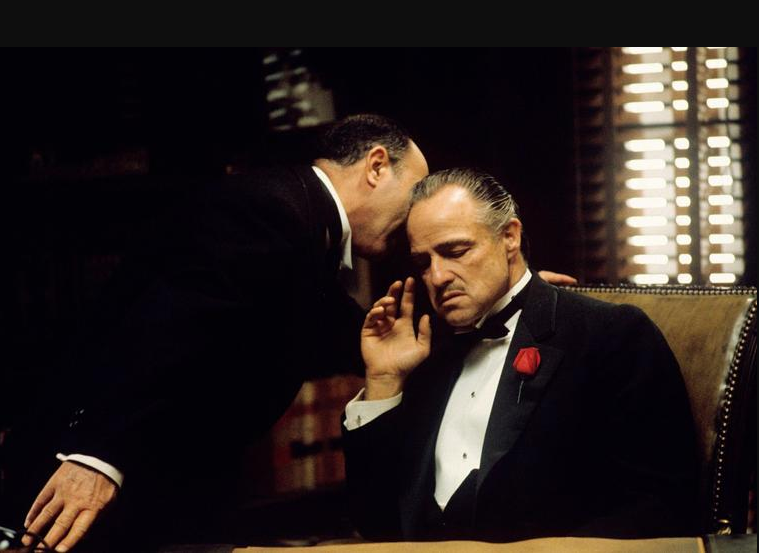
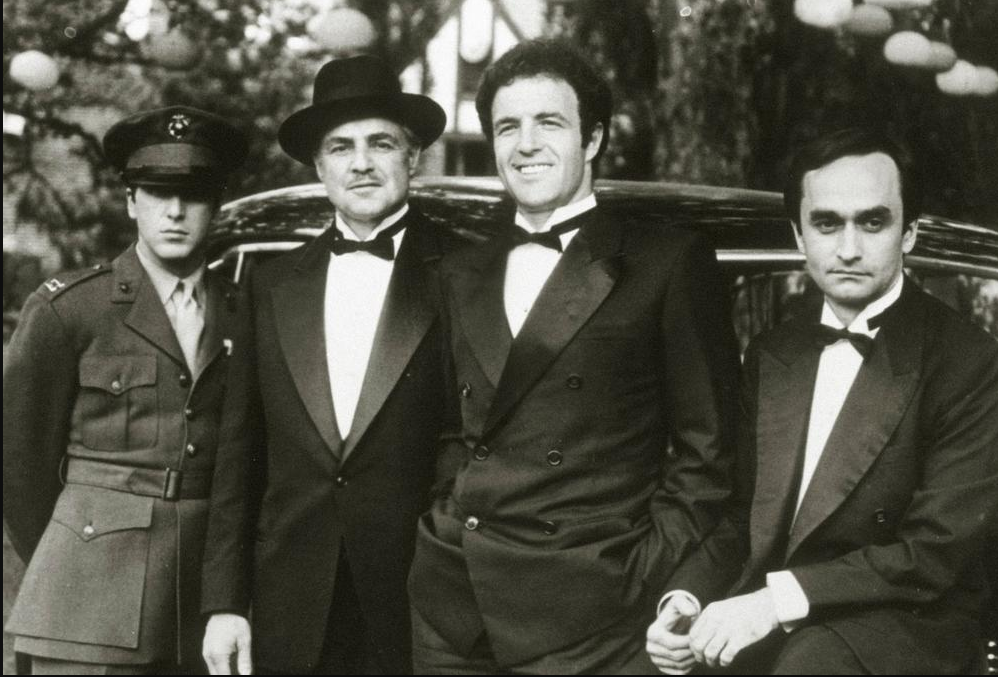
Simply - that something that should be found with the music of Mozart and Bach on a gold engraved plate of Voyager that would be sent into space for aliens to get acquainted with our culture. If we would send it again. By the end of 1990, Francis Ford Coppola had launched the epic Godfather trilogy into humanity and cemented his throne among the historical figures of the film industry - forever. The nine hours of material he gave us is something worth devoting the whole day to, although I'm not sure who has the will or time to watch an evergin film marathon these days - I believe it's an endeavor that only true, dedicated film lovers are ready for.
That is why I bring you a list of interesting things that are hidden behind the Godfather in the hope that you will dedicate the next rainy day to him! Believe me - it will pay off every minute!
The Godfather (1972)
Let's start with the fun fact that you probably all know - a horse's head in a legendary scene that doesn't even need to be retold - was real. I'm not sure if John Marley's scream was real either - considering that an artificial head was used at the rehearsals. I wouldn’t be surprised if he was genuinely screaming when the cameras really turned on.
On February 5, 1973, Marlon Brando became the second person in history to win an Oscar for the leading role. Namely, he sent Sasha Littlefedr, a woman dressed in Apache clothes, to the award ceremony, who told Branda that the reason for his rejection of the award was the treatment of American Indians in the film industry - just one of his moves to fight for the rights of vulnerable American minorities and movements. .
A little more about Brando, more precisely about his acting techniques. The first is that, contrary to what many assume, Brando did not fill his mouth with cotton in order to get that slightly puffy look, but asked to have a special "oral supplement" made for the hanging jaw effect. Another trick is to use memo cards with individual words of text. Brando wrote parts of the text on cards that were pasted everywhere, and even on other actors, so that he actually managed to create the impression that the character really thinks deeply about what he is saying, when in fact he as an actor tries to connect the seen words with the context of the text given to him for the role.
The famous sentence "Leave the gun. Take the cannoli."
The words "mafia" and "mob" are not used in the film at all. But, not by chance - it was a matter of Coppola's agreement with the Italian-American Civil Rights League, an organization that deals with the fight against stereotypes towards the said group. The closest term appears in the film as the headline in the newspaper "Mobster Barzini Questioned in Unworld Feud" the day after Michael's (Al Pacino) massacre in an Italian restaurant.
The word "don" does not mean what you mean. In Italian, the term would be much closer to the meaning of "respected uncle" than "criminal boss-killer". This latter meaning was, one might say, invented by Mario Puzo, the author of the books The Godfather, and - simply kept.
The Godfather: Part II (1974)
Since working on the first sequel to The Godfather pretty much drained him, Francis F. Coppola came up with one crazy idea - he wanted to hire another director to continue, but by keeping the title to himself. He even thought seriously about hiring Martin Scorsese. However, he (of course) was not allowed to do that, so Coppola continued working on Godfather II under certain conditions, to which the studio agreed. In addition to receiving a Mercedes Benz sedan, he managed to achieve: that the first two sequels were interconnected with the intention that they could later be shown together, that he was allowed to direct his personal text for The Conversation (1974), that he was allowed to produce for the San Francisco Opera and for him to be the one to write the screenplay for The Great Gatsby - all this was given to him just so that Godfather II could see the light of day before Christmas 1974. It's no small thing ...
**The Godfather: Part III (1990)**
Making the last piece of the puzzle, Godfather III was the sequel to one of two trilogies ever, which was nominated for an Oscar for Best Picture for each of its sequels. The second was Peter Jackson's Lord of the Rings trilogy.
Francis F. Coppola's daughter, Sofia Coppola, appears in all three sequels to The Godfather - in the first part she appears in the christening scene, in the second she plays a little immigrant on the same ship that brings Vita Corleone to Ellis Island, and in the third, of course, Michael Corleone's daughter. although she was assigned the role only after Winona Ryder gave up the same to star in Edvard Makazic. In the end, Sofia managed to earn as many as two Golden Raspberries. Maybe it was a curse of the role - namely, Rebecca Schaefer entered the serious choice for the role of Mary Corleone, but she was killed shortly before the start of negotiations.
So, although he was initially against the concept of the film, due to its great popularity, Frank Sinatra showed interest in the role of Don Altobel. Since the compensation was not excessive, he gave up the role of Eli Walsh. On the other hand, back in 1953, Sinatra got a role in From Here to Eternity after Walsh gave up due to - low fees.
Coppola had only a year to shoot, direct and edit Kuma III.
The best fun fact for the end: The Vatican Bank once owned Paramount Pictures. We don't know if the possible business disputes were the reason why the entire team of the set was not allowed to enter the Vatican.
Six days, for the six types of literacy that I will need in the world after COVID - part two
Today I continue the story of the types of literacy that I think we will need in the world especially KOVID - 19. Today I will introduce you to another type of literacy that is necessary in our daily lives.
Impulse literacy
The modern world can also be seen as a huge machine for stimulating various, often paradoxical, emotional impulses. Everything is ‘affected’, emotionalized: our news, our policies, our economy, our everyday relationships. If it doesn't stimulate emotions, especially fun, it's boring; and boredom doesn’t make money in Huxley’s world of dating to death. Rational discourse and attitude towards life is the most tragic victim of modern society. We are permanently, from birth to death, trained to be impulsive, to satisfy whatever we feel at that moment, immediately, to always put ourselves first, our opinion, our desires, our feelings. The world is made so that everything is at our fingertips, so that the impulse does not suffer, because then it suffers profit.
Impulsivity is a deep evolutionary human characteristic, it is how the animal in us breathes. That is why civilization is hard work, because its essence is putting impulses under at least some control. Hence the laws, and decency, and consumer protection rules, and training for non-conflict communication, teamwork, and other similar demanding categories. Hence the idea of education, with the semi-realized hope that it is in itself sufficient to ‘civilize’ someone; in other words, to increase his impulse control, above all by a strange way of shoving as much information as possible into someone's head.
Unfortunately, traditional academic education only partially fulfills this mission, primarily because impulse behavior is a consequence of evolved cognitive tendencies, the way our mind processes reality, and a dozen cognitive ‘shortcuts’ (or distortions, depending on the point of view) that make up most of our daily functioning and feeling whether we are ‘right’ or not. We now know, without any doubt, that we are deeply irrational creatures who use their educated minds most often to post-rationalize decisions made on the basis of emotions and impulses.
Unfortunately, not in education. School curricula, globally, do not reflect these breakthroughs in the cognitive sciences. We do not yet teach children (nor adults) how to recognize common evolved cognitive ‘shortcuts’. The only ones who study them diligently are those who use them to influence us, in various ways: governments, marketing agencies, brands, sales, politicians. experts and interests focused on stimulating our impulses for various, mostly commercial, results, while on the other hand there is a whole fragmented planetary population unaware even of the concept of cognitive shortcuts, let alone what to do about it to reduce the automaticity of our decisions, poor individual and collective consequences.
In this lies one of the great paradoxes of our modern life, already full of various stimulated and consciously designed inconsistencies. There is a huge discrepancy, an abyss, in fact, between the officially proclaimed political-educational and everyday commercial sphere. The former, superficially and mostly falsely, requires us to behave like rational, responsible citizens, while the latter trains us to behave like irrational and irresponsible consumers. Let's be impulsive, because without that, the economy of consumption stops. This is a deep and fundamental problem, and requires a deep and fundamental approach to solve it. Not just general education, but a long, concentrated training for which no one in power seems to have much interest at the moment.
Pessimism is justified here. And yet, in the long run, we have no other. Either we will become literate and skilled in managing our cognitive mechanisms, or we will continue to repeat the mistakes of the past. Archetypal and impulsive illiteracy are the main reasons why - according to the famous statement of the Canadian philosopher Joseph Heath - 'civilizations are rapidly collapsing into barbarism, and not the other way around.' , are stunning. In just a year or so, highly civilized societies, we thought, began to sink into chaos, insecurity, incompetence, racism, and social disorder. The most advanced economies on the planet that send intelligent robots to Mars cannot produce simple surgical masks and even simpler plastic aprons for medical staff. Or to solve the supply of the population. Thin as an egg shell is the glaze - or, as Joseph Heath calls it, the ‘scaffolding’ - of a civilization that covers our evolved impulses.
Impulse control training (and the narrative tactics we are consciously served to trigger them) is one of the most important we will ever undertake. It is also another opportunity for cognitive scientists, marketing strategists and sales experts to contribute to society outside of their professions. They are in a unique position to separate the heavy draperies of the great theater we are surrounded by and to show us the machinery behind the scenes: incitements and narratives designed to trigger the impulses on which various hidden interests profit.
Six days, for the six types of literacy that I will need in the world after COVID - 19 - part one
We will not deal with the problems of the present (and the future conceived in it) if we do not become literate in new ways.
The very notion of ‘literacy’ is more than ripe for change. Functional typographic literacy - reading and writing - are now only the most basic technical condition for functioning in the modern world, but far from sufficient.Generic typographic literacy allows us basic communication in a mediated world of screen relationships, but it does not offer us - at least not by itself, without instrumentalized application - wisdom and protection, development and good decisions, individually and collectively. For that, we need new types of literacy, from an early age, at the socio-systemic level. Typographic literacy, as prof. In her legendary book ‘Having Fun to the Death’, Neil Postman lost the battle with television and, now, the internet.
What new literacy do we need now, what is the matrix of new education? There is a lot of debate on this topic. My contribution, in the way it is shaped here, is inspired by existing considerations, but it packs them here in a slightly (much) different way. I have not yet seen anyone talk about these new literacy through these new interconnections, as the architecture for a new set of ‘scaffolds’ around our societies, to stop repeating the mistakes of the past - but also the present
The educational system of the 20th century was designed for the industrial, mass, adoption of relatively inaccessible knowledge, mostly defined as a sea of facts. They were not easy to find at the time if they were not concentrated in special books, 'textbooks', and - since the human race does not like to think and actively strives to add facts to its cognitive repertoire - in special physical spaces - known as ‘school’ and ‘classroom’ - and in special time intervals known as ‘classes’. And teacher training was subordinate to that.
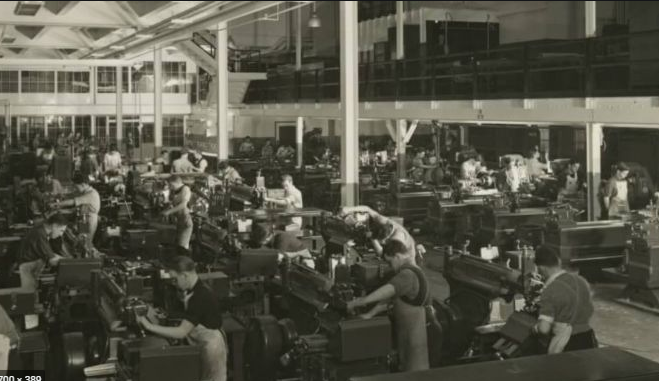
Many of us do not know that industrial education as we know it today was designed in America at the beginning of the last century out of the need to discipline the predominantly rural population and prepare it for work in city factories. The conveyor belt requires standardization, synchronization, routine. It is an ant ideology, based primarily on conditioned behavior through repetition, punishment, and reward. ‘Behavioral psychology’ by Pavlov and Skinner in practice. That is why we have a bell for the beginning and end of the class: the sound signal is the preparation for work in the factory, the symbol of the beginning and end of the ‘shift’ and the sound stimulus of collective synchronization. In such a system, individuality is pushed aside.
Averageness - more precisely, the need to be a little better than her, but not too much - has become the main measure of success. Otherwise, the system does not know what to do with exceptions. Exceptions, for better or worse, are a problem in the smooth running of the industrial process, an ‘abnormality’ that is mostly removed. The average is the law and the main measure of success. That's how we reward ourselves. Nowadays, even in highly developed countries such as Britain, children with strong talents are treated as children with ‘special needs’. Because, objectively, they have them, but not in the way it is usually defined. So the system doesn't know what to do with them. The consequences are catastrophic for all of us.
The school system as we know it is the last legacy of civilization - that is, given the enormous benefits it has brought to humanity - which has not undergone an ideological-technological transformation. The classroom is the latest modern archaeological artifact. It took a global epidemic that locked us in our homes to make us aware that it could be done differently. It can also be a chance for an overall re-examination of the very notion of education.
Post-industrial society, often summarized in the concept of "4. industrial revolution" , requires new types of literacy, for new forms of organizing society and living. Here I will now depart from the usual dimensions of education that are often mentioned as key to this new civilization paradigm, although they are encompassed by my approach. I think our task is much bigger than just transforming the economy. We have to change ourselves, as social and political beings, if we want to survive on this planet (before we even think of moving to others).
We also need new literacy because of the need to stop repeating mistakes from the past and the present. It is tragic how bad we are as citizens and how great consumers we are! We choose the wrong people to lead us, for the wrong reasons, because of wrong assessments of what matters, driven by various functional illiteracies that are actively stimulated, even created, by modern political-economic-media elites, in whose interest it is to remain like this as we are now. We are easily managed because of that. Any system that calls itself ‘progressive’ must pay close attention to this new civilization curriculum. This new great enlightenment struggle must have the following types of literacy in its focus
Archetypal / narrative literacy
In short: storytelling is the most powerful technology that the human race has invented because it pushes us in the most powerful, individually and collectively, in various directions. The story is a machine for controlling gravity: it can literally lift us to the stars, or plunge us into moral abysses. Ideologies, religions, economic systems, fashions, trends, entertainment, media… they are all just stories, narratives, certain ways of constructing, conceptualizing and mediating our reality, in order to influence our behavior. Most of these narratives have a certain ideological-commercial goal behind them.
It is critical for all of us, for our collective survival, to understand how narratives work and why we are evolutionarily programmed to react strongly to them. Why do we immerse ourselves in them so easily? One of the most bizarre facts of the modern world is that this, one of the key literacy of the modern age, is almost nowhere studied in an organized way. More precisely, storytelling courses are very common, but in a very commercially useful way: how to tell strong stories in order to influence people and earn money or fame in the process. But nowhere do we learn how to defend ourselves against strong narratives such as populism, conspiracy theories and various forms of propaganda, political or economic. This literacy is the antidote to almost all the manipulations that digital space has unleashed on the modern world. This whole dark theater of problems has only one thing in common: reliance on strong emotional narratives.
Archetypal stories are patterns, formulas: about the fight between good and evil, about 'us' and 'others', about an external enemy that threatens 'our way of life', about what a 'real hero' looks like ... They are all patterns for dealing with our collective anxieties, evolved and inherited over the millennia. Drama and conflict are in their essence, packed into a formula. Many anthropologists, from Vladimir Prop to Claude Levi-Strauss, have pointed to this formulaic nature of archetypal stories. The most famous among them in this regard is certainly the American anthropologist Joseph Campbell, who in 1949 created the most durable and probably most used formula of all, his famous book 'Hero with a Thousand Faces', which not only inspired George Lucas to finally shape' Wars star ', but also Hollywood in general for many other' blockbusters'.
This template is as easy to understand as it is powerful. Once we are aware of it, when it is part of our life training, it is easy to open the hood of a hot emotional topic and see a few simple structural buttons that skilled storytellers - and populists and propagandists of all kinds - press to get the expected reactions from us. If there is one subject that should be learned from an early age (not just as passive consumers of these narratives in commercial form), if there is a primary collective vaccination for a more constructive society, intellectual BCG against ideological tuberculosis, then it is narrative literacy.
It, of course, requires new staff in schools at all levels. Who would these new narrators of narrative spells be? This is a place for radical innovation. It is a space in which writers of political speeches and playwrights, writers and copywriters, directors and editors - narrators of all kinds - can find a new expression and mission of their social usefulness. Instead of naked and cynical exploitation of our narrative illiteracy, turning it only into "business" or "success", here is an opportunity for karmic great washing, for contribution to the collective good. New secular catechists, in the mission of demystifying mystification
So much from me for now, the sequel follows ...
The benefits of a sauna you didn't know about
A twenty-minute stay in a warm room relaxes muscles, relieves stress and accumulated toxins, strengthens the cardiovascular, immune and nervous systems and makes us more rested and beautiful.
Cryotherapy, acupuncture, hypnosis - these are just some "must do it" if we want to be healthy, fit and beautiful. These are trends that we can and do not have to follow, but there is something that will surely make us better, and that is the sauna. Mental and physical relaxation thanks to staying in a heated room, which encourages sweating and secretion of toxins, is an old method from the Scandinavian countries, which is especially pleasant at the end of the working day, especially in winter.
1. Recovery after strenuous exercise
After intensive training, you should spend at least 15 minutes in the sauna because the heat relaxes the muscles, reduces tension and eliminates lactic acid from the body. It also speeds up recovery from injuries, which is why it is recommended for athletes.
2. Regulates blood pressure
Just one visit to the sauna can lower blood pressure, a recent study on a sample of one hundred people showed. They spent 30 minutes in the sauna, after which their upper pressure was reduced from 137 (mmHg) to 130, and the lower from 82 to 75. As the upper pressure did not change for another half an hour after leaving the sauna, scientists believe that there is a long-term benefit from its use. However, people who have problems with high blood pressure should consult a doctor first.
3. Strengthens the heart muscle
A scientific study published in the "Journal of Human Hypertension" showed that 15 minutes in the sauna acts on our body as a medium-intensity exercise lasting up to 30 minutes (swimming at 800 and 1,500 meters, running at 5,000 and 10,000 meters, or half-hour cycling or hiking). During such activities, the heart muscle is under exertion of prolonged duration, and the circulation is significantly accelerated.
4. Reduces the risk of dementia
A study was conducted at a university in eastern Finland, which showed that the risk of dementia and Alzheimer's disease was reduced by 65% in people who visited the sauna at least four times a week compared to those who used it only once a week.
5. Treats headaches
Lady Gaga swears that nothing helps her like a sauna in the fight against fibromyalgia, a chronic muscular disease that causes pain in the whole body, headaches and insomnia, so she made one in her home. A recent study published in the Journal of Alternative and Complementary Medicine showed that this is not just imagination. The study involved 37 subjects who spent eight weeks and 15 minutes a day in the sauna and suffered from chronic headaches, and all stated that the sauna significantly reduced the intensity of their pain.
6. Build immunity
Sitting in a sauna will prevent the flu? Unfortunately, it won't, but it will help the immune system. A study published in the Journal of Human Kinetics states that an increase in white blood cells was measured in the blood of athletes who spent 15 minutes in a sauna, and they destroy viruses and bacteria.
7. Maintains mental health
People in the sauna are relaxed, satisfied, happy. According to the journal Psychosomatic Medicine, everyday stay in the sauna is very pleasant for depressed people. Each small escape from the real world has a positive effect on mental health and reduces stress levels.
8. An ally in weight loss
Sweating, of course, loses only fluid, not kilograms, but it has been proven that the body also releases toxins, such as bisphenol, which disrupts the work of hormones and the endocrine system, ie slows down the metabolism, which affects the weight loss process.
9. Lowers cholesterol
The International Journal of Occupational Medicine and Environmental Health published a study stating that people who went to the sauna every other day for 20 days managed to significantly lower their cholesterol levels.
How to protect yourself from cyber attacks during coronavirus
In March, due to the coronavirus pandemic, employees around the world switched to work from home over the Internet. This was followed by an increasing number of hacker attacks on systems that connect computers to company servers. Among the most endangered were the Kovid hospital.
IT security experts organized "Red Goat", a group for free help against hackers, during the corona.
At the beginning of the pandemic, hackers were the so-called Ransomware programs tried to access data and blackmail hospitals by sending so-called fishing emails with false instructions to medical staff.
When hospitals procured equipment in the midst of the pandemic, they set up fake companies to sell medical equipment and thus fraudulently obtained large sums.
Since the beginning of last year, there have been more than 200 IT attacks on health systems in America, and hackers have obtained the health data of about 500 patients.
Those companies paid more than $ 400 per patient to get their health data back, and more than $ 1.7 million for advertisements to repair their compromised reputation.
Kaspersky CEO for North America Rob Cataldo says that health organizations can do much more in educating and raising employee awareness, drafting regulations and protocols, so that employees know what to do if they find something or suspect something.
"Those companies must improve the protection of their devices, but, more importantly, they must inform the employees that they have set up protection systems, so that they know how to protect patient data and their company," Cataldo pointed out.
There is no secure future without a protocol in the event of a cyber attack
Most hospitals in the world are also digitalized on the Internet, and they do not have protocols in case of cyber attacks, nor training for employees. Usually, only the administrator takes care of the patient's health data, who, in addition to his job, does not have time for IT security, and is not even trained for that job.
"Employees in companies should have regular security awareness training, because it is not a question of their personal safety but also the safety of their company," warned Dimitri Galov, a cyber security analyst.
According to him, we must have more educational programs for children and students: "They will live in such a world where they will have more and more technology and know how to use it correctly, safely and safely since childhood, that's good, that's my opinion."
Experts recommend that healthcare institutions protect their business network with VPNs and strong passwords, that they regularly update security software, and use encryption or data encryption to protect against unauthorized access to business devices.
It is also obligatory to always have fresh back-up files in case of an attack, as well as to store data not only on hard disks but also on cloud platforms.
Richard Zorge - a spy who served as the inspiration for the James Bond novels
Zorge was probably the most successful international spy of the 20th century. He was born in 1895 in the city of Baku (which then belonged to the Russian Empire). His father was German and his mother Russian. A couple of years after his birth, he moved with his family to Germany, where he grew up in aristocratic circles of German society. Historians, however, agree that Russian roots left a deep impression on Zorge in his youth.
He joined the German army before the beginning of the First World War, and was even awarded the Iron Cross. After demobilization due to injury, he became acquainted with the works of Karl Marx and became a socialist. He completed his doctorate in 1919 and joined the Communist Party of Germany. In the next few years, Zorge often took part in the agitation of the Left.
Due to problems with the German authorities, he fled to the Soviet Union in 1924 and joined the Comintern - a Soviet structure that served as an instrument for working with foreign communist parties. Zorge first reflected in the role of a military intelligence agent in the early 1930s in China.
At that time, he had already gained a reputation as a "womanizer". "Zorge was handsome and charismatic. "Women couldn't resist him, and men admired him," Stuart Goldman wrote in an article on History Net. He was married to a Russian woman (theater actress), but he had many mistresses.
Japan annexed Manchuria in 1932, after which Moscow began to worry about Japanese plans for the Soviet Far East. Zorge was given the task of creating a network of agents in Japan in order to find out as much as possible about Tokyo's intentions regarding the Soviet Union.
The editor of a newspaper in Germany agreed to send Zorge as a correspondent to Japan. He even wrote a cover letter to Colonel Eugene Otto, the German military attaché in Tokyo. It turned out to be the perfect cover for Zorge. Ott, who would later become the German ambassador to Japan, inadvertently helped Zorge set up an agency in Tokyo, and was one of his best informants for the next few years.
He worked with Richard Zorge in the so-called Zorge's ring, together with Max Clausen, Ozaki Hotsumi and Miyagi Yokota and Yugoslav journalist Branko Vukelic. Vukelic was employed by the French newspaper Havas and Belgrade's Politika as a special correspondent. Vukelic's main activities were gathering information from Japanese newspapers and magazines, as well as from embassies and journalistic contacts, and he was also in charge of the photographic business.
Zorge lived near the Tokyo police station and was often seen in public making drunken noise, surrounded by women. Some historians believe that Zorge was in an intimate relationship even with Eugene Otto's wife. The German ambassador probably saw it all through his fingers because Ot helped him get to know the Japanese political scene better, which can be concluded on the basis of individual reports.
The most important discoveries
Zorge learned about the German-Japanese negotiations against the Anti-Comintern Pact, which were directly directed against the Soviet Union. It was one of his first spy successes in Japan.
Then, in 1939, he warned of attempts by Japan to persuade Germany to form an anti-Soviet military alliance, which prompted Joseph Stalin to intensify negotiations with Berlin that resulted in the Molotov-Ribbentrop Pact. The move completely thwarted plans for Japan to attack the Soviet Union along with Germany, thus forcing the Russians to fight on two fronts.
As early as December 1940, Zorge warned that Germany could attack the Soviet Union. According to Robert Weimant's book "Stalin's Spy", Zorge informed Moscow on May 30, 1941, that the attack could begin in the last weeks of June.
Stalin decided to ignore those warnings, and said of Zorge that he was "a freak who reopened factories and brothels in Japan." Historians are still debating whether Zorge told Moscow the exact date of Operation Barbarossa. In any case, as soon as the attack began, Stalin immediately changed his attitude towards the top intelligence officer.
If Japan had attacked the Soviet Far East at the same time as Germany attacked on the European front, the consequences would have been catastrophic. However, Japan was at war with China and had to decide whether to attack the Soviet Union or the French, British and Dutch colonies in Asia.
Hotsumi Ozaki was close to the Japanese government and helped Zorge assess the danger that Japan posed to the Soviet Union. Zorge informed Moscow that Tokyo would focus on the southern front and attack Russia only if the Red Army was quickly defeated in the war against Nazi Germany. The master of espionage managed to get confirmation from Otto about how Germany did not convince Japan to attack the Soviet Union without delay
.Based on these data, in November 1941, the Soviet Union transferred 15 infantry and 3 cavalry divisions, 1,700 tanks and 1,500 planes from the Russian Far East to the European front, writes Stuart Goldman. "It was this powerful reinforcement that reversed the situation in the Battle of Moscow in the first week of December 1941, at the same time as Japan attacked Pearl Harbor," he writes in the History Net.
Arrest
Zorge's secret radio messages were encrypted with a one-time key (Soviet encryption technique) and looked like "abracadabra" to the Japanese secret police. Still, Zorge was suspected. A Gestapo man from the German embassy was given the task of following him, and so Zorge was finally caught.
Other reports suggest that the seamstress, who was recruited by lower-ranking agent Ozaki, betrayed Zorge's agents when she was arrested. Richard Zorge was arrested in October 1941. He agreed to cooperate with the authorities if they promised not to arrest his mistress Hanako Ishi and the wives of his colleagues. The Japanese accepted that condition.
After three years in prison, the Japanese authorities offered Zorge in exchange for a Japanese man who was imprisoned in the USSR, but the Soviets stated that they did not know him. His return to the Soviet Union would not suit Stalin, because he ignored Zorge's warnings that Germany was preparing an attack.
Zorge and Ozaki were executed in 1944. Zorge's mistress Ishi was spared and later received a Soviet pension.
After the end of World War II, this great hero was not promoted to the Soviet public for almost two decades, until 1963, when Nikita Khrushchev made a French film called "Who are you, Mr. Zorge?", Whose plot is based on a very impressive the life of the maestro Soviet spy Richard Zorge. According to the eminent historian Stuart D. Goldman, the Soviet leader, asked the KGB leaders if that was a true story. The answer was yes and Zorge was posthumously awarded the title of Hero of the Soviet Union.
Admirers of Soviet intelligence include the English writer and naval officer Jan Fleming. "Zorge is the man I consider the most dangerous spy in history," Fleming writes of an informant who probably served as the inspiration for the James Bond novels.
5 characteristics of mentally strong people
Nowadays, each of us in some way encounters insults from other people. But life is too short to spend it on the resentment of toxic people.
It is difficult to understand why someone needs to constantly quarrel with others, criticize and insult. Such people are mostly dissatisfied with their lives, so they transfer their negativity to someone else's yard. Some people succeed, but some do not!
Namely, there are mentally strong people that society has not "eaten". They never allow the environment to control their emotions, attitudes and moves.
They just don't react to insults, and here's how they do it:
They are guided by the saying: Silence is gold
Mentally strong people recognize when people cover up their insecurities by insulting, criticizing, or when they say they need to change.
They know that such people should not be wasted energy because they will never be happy because of someone else's success or they have already experienced their own failure. Strong people never react when such people "spit" on them.
The proof is the American physicist and inventor Thomas Alva Edison. He did not pay attention to the people who ridiculed his ideas, and he is the creator of a great invention - a phonograph.
Therefore, keep in mind that people will always analyze and comment on your ideas, goals and moves and create the image they want. You can't influence it, but you can focus your energy on yourself and your life goals.
They know it's just someone else's opinion
Mentally strong people know that an insult is just someone's opinion. They are aware of their qualities, and they are not touched by negative criticism. They do not waste their energy on negative comments.
People who constantly criticize others by doing so actually only show that they do not have emotional intelligence, and smart people feel that.
They ignore insults
Mentally strong people are well aware that hatred of other people only makes life worse. Therefore, they want to cut it at the root. And how do they achieve that?
They ignore toxic people who want to provoke a reaction. When someone insults strong people, he is quite surprised when he encounters ignorance.
The lack of reaction turns them to other people where they can continue to spread their negativity.
Their health and happiness are in the first place
Mentally strong people know the value of their happiness and health.
That is why he will not react to the insults of people who spread malicious negative energy, but will simply turn his head and leave.
Peace of mind is more important to them than other people's opinions. They will not allow malicious people to drain their energy and thus destroy their health.
People who ignore negative people are calmer, happier and more fulfilled than those who get into arguments and quarrels.
They are looking for a solution
Mentally strong people are aware that not everyone can be satisfied. When they encounter an obstacle in life, they always look for solutions. They know how to deal with toxic people, and avoid them in a wide arc.
The secret organization of Tula - The originators of the idea of a pure Aeian race
Yesterday, I wrote an article by Marija Oršić and mentioned that she was a member of the secret society of Tula. I first heard about this secret organization while watching the series "Shadows over the Balkans" and thought: Is it possible that I don't know that there was such a secret organization in Belgrade between the two world wars? Well, it's possible. I also thought that they were probably exaggerating in the series to amplify the dramatic effect, but it turned out that was not true either.
The Thule Society is an organization founded in Munich in 1918 by Rudolf von Zebotendorf. The name comes from the mythical land of Tula (Hyperborea), which was believed to be the homeland of the people who survived from Atlantis, that is, the homeland of the superior white race of Aryans. This society combined the legends of Atlantis and national myths into its philosophical teachings, at the same time creating the occultism of racial superiority. At the same time, attitudes about superiority over Jews and other minorities were born. This teaching quickly gained a large number of followers among the Germanic peoples.
The society also had its own political party - the German Workers' Party, which will be taken over by Hitler. Rudolf Hess, Heinrich Himmler and Reinhart Heydrich were in Tula. At the head of the society, in addition to Zebotendorf, were Dietrich Eckart and Karl Haushofer. Eckart and Haushofer are very important in shaping Hitler's view of the world. Eckart, a drug addict and black magician, saw a future in Hitler. He wrote a book of conversations with him "Bolshevism from Moses to Lenin", and in 1923 he said of the future Führer: "Here is the one whose only prophet and predecessor I am." Before his death, he stated: "Don't feel sorry for me, I have influenced history more than any German."
The goal of the Tula organization was to break the "little self" - a barrier consisting of physical reality and moral shackles, in order to come into contact with the "divine self". They believed that this would awaken the inner power that would develop the superhuman abilities that are characteristic of the Aryan race.
Symbolic killings by beheading the victim can be assumed as a "ticket" to joining this secret society. In 1918, the society devised a "bloody declaration of allegiance" which each member had to sign. In this way, one who joins the organization swears "by his knowledge and conviction that no Jewish or colored blood flows in either his or his wife's veins, and that there are no members of the colored race among their ancestors."
In addition to practicing sexual rituals, racist choral singing, and black magic, Tula members often participated in "supernatural" rituals where they would summon demons and seek to lead them to a higher goal.
Interestingly, some sources show that the secret society Viril (Vril Gesellschaft), or Lodge of the Illuminati, was a secret occult society that existed as early as pre-Nazi Berlin. The Berlin Vril Society was actually an inner circle of the Tula Secret Society. It is also assumed that this society was in close contact with an English group known as the Hermetic Order of the Golden Dawn.
But what is especially significant, and therefore especially hidden from the public eye, is that, soon after its founding, the Tula Society became part of the international "Brotherhood of Death", a network that connected several secret societies, the most famous of which is today Skull and Bones, which has a center at Yale University.
The members of this society combined occult events, ie rituals, with science and technology. As paradoxical as it may sound, the result has been major breakthroughs in invention and the creation of new technologies.
After the Second World War, many members of the Tula Society were recruited by the United States as part of Operation Staple. They were given new identities, immunity, as well as the opportunity to continue with the projects they worked on under Hitler
For that reason, this organization was not given political significance or any other significance at all, although it is evident that its members created an occult system that had not been seen before and in whose name they committed the greatest crimes of the 20th century..
Drug addiction - an increasingly present disease today
History and beginnings of drug addiction
From the oldest records it can be seen that primitive people consumed psychoactive substances. They were taken by all peoples in the younger Paleolithic. Archaic ecstasy in primitive man was in the function of religion and medicine. Since the only psychoactive substances that man consumed were plants, he began to give them magical properties. It is interesting that almost every nation has its own legend about Mandragora, a plant with human roots.
Poppy
Poppy is the first plant with psychoactive properties to be mentioned in history. It was cultivated by the Sumerians 5000 years ago, then they transferred their knowledge to Persia and Egypt, and it is also known that opium, which is made from poppies, was used by both Greeks and Arabs. The Sumerians called opium, for the preparation of which they left instructions on clay tablets, gil, which meant luck. Opium is also thought to appear in Homer's works, such as the Odyssey. The beautiful Helena gives Telemachus to drink "nepantes" - a drink that makes forgetting pain and misfortune. It is believed that in the 8th century, the Arabs expanded the poppy culture from Asia Minor to India and China.
Hashish
Hasis is mentioned during the reign of Chinese Emperor Shen Nung in 2737. p. n. e. as a remedy for cough and diarrhea. In ancient China, it was used as a primitive anesthesia during surgery, and in India as a medicine against various diseases. It is also believed that the Indian holy drink of catfish, among other things, contained Indian hemp from which hashish was obtained. It is known from Herodotus' writings that some Scythian tribes also had the habit of inhaling steam from heated hemp and that they were "in a good mood" after that.
Drug addiction today
Today, the problem of drug addiction is an increasingly common problem of our society. According to police data, between 70 and 80 percent of 15- to 25-year-olds have been in contact with narcotics. In recent years, the limit has dropped to the age of 12, and there are registered drug users who attend the sixth, seventh grade of primary school.
There are no easy drugs! Every drug is dangerous because its action drastically reduces the ability to work, study and concentrate. Some drugs create a psychological dependence which is reflected in the fact that the addict relies on drugs in situations of tension, uncertainty, anxiety, fear, emotional crisis. Other types of drugs create physical dependence, ie tissue dependence on drugs where the body cannot do without a substance for a single day, which means that the body needs a constant concentration of the drug in the blood to function "normally". A sudden interruption leads to a crisis.
Young people usually deny the harmful effects of drugs. In addition, they are often divided into light and heavy drugs, not knowing that it is very easy to switch from so-called light drugs to heavy ones. The reason is that after a period of taking the drug, tolerance to the drug occurs and the dose is increased in order to achieve a satisfactory effect. When that drug, which they call varnish, stops working "them", it switches to a stronger substance. Drugs should not be divided into light and heavy.
A psychoactive substance is a psychoactive substance, whatever it may be.
People who consume psychoactive substances often show changes in behavior, prolonged absence from home, periodic separation from the household and locking in a room or other room, sudden mood swings, disturbed sleep rhythm, changes in functioning at work or school, loss of will and concentration. , lack of interest in previous hobbies, new company or girlfriend / boyfriend he / she does not want to introduce you to, weight loss, increased spending of money, theft of money, items or valuables from home,aggressive behavior caused by some drugs, secret conversations or incomprehensible text messages, etc., and all this can negatively affect the safety in the environment in which they are, and therefore the consequences can be catastrophic.
Depending on the psychoactive substances and their influence, after taking them, you may notice the following: incomprehensible, incoherent, fast, or slow and difficult speech, the person may even talk to himself, or express paranoid ideas, can be very aggressive, verbal and physically, or extremely cheerful for no apparent reason for frequent bursts of laughter, may often have bloodshot eyes, pupils are either pin-shaped or very dilated, eyes are often glazed, unable to fall asleep, or sleep very long so that the person is barely awakened by the parent. All these signs do not have to be present together, but if someone has entered the problem of addiction to psychoactive substances, you will notice at least a few, which is quite enough to take decisive steps to solve the problem.
Treatment of drug addiction
There are clinics that specialize in the treatment of drug addiction, and to which a person who consumes psychoactive substances should be referred.
Many adolescents are disappointed if the first attempt at treatment does not bring the expected results. Then it seems as if all hope is lost and that the rest of life will pass exclusively in the fight against the terrible symptoms of drug addiction.
However, if the treatment is carried out in specialized institutions, with the help of experts in the field of addiction treatment, the chances of achieving long-term success increase. With the use of the latest medical devices, personal and group psychotherapies and with the help of pharmacological blockade, the chances of a cure increase.
Even after leaving the clinic, it is necessary to recognize risk factors and actively work on avoiding situations that could return the person to old habits. Also, maintaining constant contact with psychologists is recommended, as well as coming to regular monthly check-ups.
During recovery, young people must find new interests and hobbies. Although they may initially oppose these deliberately created commitments, once they find a society that shares similar healthy interests, teens will gradually begin to form habits that can last the rest of their lives.
Sergei Yesenin - a favorite Russian poet
On this day in 1895, the Russian writer Sergei Alexandrovich Yesenin was born.
If you go once, don't turn around, because if you turn around, you have to come back, and I don't want you to come back leaving, "said Jesenjin, a poet with a reputation as a bohemian, who turned his soul into poetry.
And it was largely determined by the very life of the poet, say literary historians, growing up in the countryside, revolution, wandering, great passions and loves.
What am I? Who am I? I'm just a dreamer,
whose gaze fades into fog and mist,
and I love you by the way, like I dream,
like many others on that earth.
He came to Moscow from his native village of Konstantinova as a golden-haired boy. He studied at the City People's University and wrote. Russian folklore and customs were the main inspiration.
His talent and freshness of poetic expression were recognized by prominent poets Aleksandar Blok and Sergej Gorodetski, who helped him improve his writing style and promote his literary work.
In the capital, Jesenjin lived bohemian, mostly staying in taverns, small bars and canteens, where writers, actors and painters gathered during the revolution. He would sometimes recite the verses of his songs aloud.
"I left often. I turned around and came back. And nothing was the same, neither the landscapes, nor the people, nor me. I realized there was no need to come back, what was beautiful let it stay in dreams forever. It will last forever." , said Jesenjin.
He also said that the reader in his verses should pay the most attention to lyrical feelings and forms. Immediately after the revolution, with a few other poets, Jesenjin conceived and began to promote a new poetic movement - imaginism.
"In the storm and the storm near the misfortunes of all, with heavy losses and sad sorrow, to be natural, smiling and quiet is the greatest art in the world," are the verses from the song Black Man.
Women adored him as a man of rare beauty and as a talented poet. Isidora Duncan was among them.
According to the official police report, the great Russian poet committed suicide on December 28, 1925, at the Angleterre Hotel. He writes his funeral song with his own blood, and then straps himself from the suitcase to rage about the heating pipe and thus ends his life in hotel room number 5. This version of Yesenin's death was widely accepted until some more details appeared that could testify that everything was different.
Goodbye, buddy, goodbye
My breasts are guarding you, darling.
Parting is a sign of predestination,
The meeting is offered to us in the distance.
Goodbye, no squeeze, no voice,
Don't grieve me, frown -
It's not new to die before your class,
But life is not a novelty of law either.
This song, Jesenjin gave to his friend Wolf Ehrlich the night before his death, who that evening, with two other people, found himself in Jesenjin's room. The poet put the paper with the poem in the pocket of his friend's coat and told him not to hurry with reading, not to talk about the poem, and to read it tensely tomorrow. This detail that the poem reached Ehrlich in this way remained recorded only in his book, which he wrote a few years after Jesenjin's death.
Marija Oršić - the goddess of evil of unreal beauty who "swirled Htler around her little finger"
I heard about Marija Oršić for the first time while watching the series "Shadows over the Balkans". Since I read somewhere that she was a real historical figure, I was interested to learn more about her.
There is not much official information about her, but what little is known reveals that Marija Oršić was a woman of divine beauty and sinister mind. The greatest powers of that time revolved around the little finger.
Who exactly is Marija Oršić and what did she do?
According to the data of the people who dealt with this mysterious woman, Marija had a passion for occult things since she was a child, so she allegedly communicated with ghosts as a child. Already as a young girl, she joined the circles of ardent German nationalists who advocated the unification of Germany and Austria
She is called the "goddess of evil" by those who, despite all the evidence and facts to the contrary, are convinced that Hitler was an occultist, and everything is based on almost insane claims that allegedly came from her. It is believed that it played a key role in the formation of the ideologies of the Third Reich and their main symbol - the swastika.
According to some claims, it was Marija Oršić who inspired Ante Pavelić for the novel "Lipa Plavka". Her father Tomislav, a prominent Zagreb architect, had an office on Ban Jelačić Square before he moved to Vienna, and her mother, an Austrian named Sabina, allegedly wore floor-length hair tied in a ponytail.
She was a strong supporter of the unification of Germany and Austria in 1919 and was definitely a high member of the Tula society.
In December 1919, Karl Haushofer, leader of the Thule Society, invited famous and respected occultists to a meeting in a hut in the Alps near Berchtesgaden (later the house would become Hitler's alpine residence). After everyone gathered, Haushofer surprised everyone present. Two young and divine women joined the group. One of them was very silent and was barely 18 years old. For some reason, her identity remained a secret. She introduced herself as "Zigrun". The other woman was Marija Oršić.
In addition to divine beauty, they both wore long hair tied in a ponytail. Maria was a woman of timeless beauty, airy complexion, blue eyes and blonde hair that, according to legends, reached the ground. Orsic allegedly thought that her long hair seemed like an "antenna" to other dimensions. Haushofer presented them that night as female psychic media between worlds. Mary became famous in occult circles for claiming to have come into contact with Aryan aliens living on Alpha Centauri in the Aldebaran system.
Why the Albaderan system? It is allegedly inhabited by Aryans, who allegedly lived on Earth in the distant past, in the area of Mesopotamia, where they influenced the development of civilization. The Third Reich expected Mary, with the help of the inhabitants of the Albaderan system, to purify the population of the Earth and definitely enthrone the Aryan race on earth. They believed in her claim and decided to financially support the machine construction project.
Thus, the Vril Society was involved in research based on Victor Schauberger's anti-gravity experiments. The project is called "Hanebu" or "Vril project". The very name of the Vril society comes from Bulver Liton's novel "Vril, the Power of the Emerging Race".
The novel describes an underground kingdom ruled by more than people who are descended from amphibians and have energy of unimaginable proportions called Vril. It became the "holy grail" for occultists of the Third Reich, and even more official circles, who sought every opportunity to build super-weapons.
Although the companies Tula and Vril had the same goal - the construction of the Vril aircraft - their motives were completely different. Here they were focused on the search for something "higher", their only interest in the project was to go back to the time "when the gods walked the planet" and learn more about spiritual truth, as well as the exploitation of energy. The Vrilovci wanted to establish contact with the aliens and learn from them.
It is planned to send a large transport aircraft VRIL 7 to Aldebaran, which can fly at the speed of light. The experiment was performed at the end of 1944, and it almost ended catastrophically, because after a short flight, the VRIL 7 rocket was damaged in several places and "looked like it had been flying for hundreds of years." The last "appearance" of Marija Oršić, ie the Vril company, is the date of March 11, 1945, after which she disappeared. The document "Vril Gesellschaft" was sent to all members - a letter from Marija Oršić. The letter ends: "Niemand bleibt hier" (no one stays here). Since then, no one has heard anything about Maria or the other members. There are theories that they went to Aldebaran. In 1945, Marija was 50 years old.
One of the claims is that the Americans took her over for secret operations, where she married richly and had a daughter named Jolanta Rafa.
The research on Marija Oršić is one of those cases where the more data there is, the less reliably it is known. However, it does not matter whether Marija Oršić really got in touch with the Aryans from Aldebaran; whether she practiced alternative rocket science, and whether it was successful; whether she fled to South or North America or to distant Aldebaran at the end of the war - she had an interesting life story that asks many unanswered questions. Her photos remain the only reality about her, although she looks unrealistically beautiful on them as well.
Why is it easier to give a child a mobile phone than to deal with it?
I remember when my older daughter was a year - a year and a half old, every night, before going to bed, I told her a story. I ask, Boko, what story do you want me to tell you, and she answers: "Mom, tell Goldilocks " Why did that again, so I told you that story last night? Because in the story mom mom, dad bear and Boka bear. A small problem arose when I gave birth to a younger daughter (she was two years old at the time) but it was very quickly overcome by having to put another bear in the story.
At that early age, she knew how to speak fluently and to think logically, to be able to explain why she wanted something.
I work in high school. I see generations coming to us who have an extremely poor vocabulary. In class I try to use only simple words to understand me, and even then it happens that they do not know what a word means, so I have to explain it to them. I wondered why that was so? Well, speech is learned in the earliest childhood. Then I remember small children from my environment who at the age of two or three know how to say only yes and no, possibly using words that only their family members understand. And they all consider it normal.
What do they have in common? They don't lack anything, thank God, because when you ask them about flowers, water, sky - they will point in that direction. If you ask for a clip, they will bring it. If you ask where mom is, she'll look at the gate. But he will hardly speak. At best, you will get a "yes", "no", facial expressions or gestures.
What is the problem? All these children spend a lot of time with their phone and tablet. They don't know how to walk on their own and say "mom", but they know how to turn on the phone and use their fingers to get what they need.
They know where the games and YouTube are. And for hours, from early morning, in their pajamas, the unwashed look at the screen. They wake up with him and lie down. If someone tries to steal it from them, there is crying, throwing, hysteria. In order not to listen to him, the kidnappers quickly return the toy - for the sake of peace in the house. And your personal.
Screens are also their favorite in the car, especially if the ride is long. They also watch it in GSP's trucking vehicles. While waiting for an examination at the health center. While riding shopping carts in supermarkets. During the swimming break. When parents still want to sleep. To be comforted if they cry. The list is long, and there is one thing behind it.
Line of least resistance. It is easier to put a phone in a child's hands than to deal with it. Answer a hundred questions, and you're tired of everything. And you want to drink coffee in peace. And you barely fit an appointment with a friend you haven't seen in a long time. And just get some more sleep. And to type this message again. The boss also writes to you. And just a favorite band released a new video.
But the child needs time, patience, attention. And you really want to provide them, but not in a car while traveling on vacation, because vacation has just begun, you will dedicate yourself to it when you arrive at your desired destination.
And there you will already find another excuse. You also find justification while waiting in line with your child for anything. Because so that he wouldn't ask you when he will, when he will, when he will - you turn on his screen and everything is fine. No questions, no problems. If someone asks you "Why don't you dedicate yourself a little to the child?", You will start with the story of how you work like a horse, you are harassed at work, you run shopping, you pay bills, you buy things for that same child - when to arrive!
And where are you in the whole story? What about your free time? And like this, you give him the phone and everyone is happy. Both you and the child. Everyone is drugged by their screen. God forbid that someone asks you "How are you not sorry that a child looks at his mobile phone all day, because that is not good for his brain or eyesight".
When you give two answers from the cannon. The first is "You don't have a child, so you don't know." And others "Children were different when you were parents, now are different times."
And a child as a child, no one asks him anything, no one tells him, they give him a screen, and there it is colorful, cheerful, fast. He just clicks, and here's his cartoon, music, whatever he wants. He has everything, without pain. He doesn't have to talk, think, imagine, research. There's a smart device. And it is used by both dad and mom. They give it to you too. What stories, playing in nature, reading, research.
There is no thousand why - a thousand because. And then I wonder why little kids barely answer my questions. And what they don't talk about. Well they have no need.
Let's face it, my daughters grew up at other times, but even then they had a computer that they used occasionally, watched cartoons, but also arranged Lego bricks, made puzzles, played with friends, first listened and then read books ... .
Finally, let me tell you what I saw some time ago. I was in a park where there is also a children's playground. my attention was drawn to a girl who kept shouting, "Mom. Mom, Mom."
He wants to show her how to climb on the devices, but mom is constantly looking at the phone and not raising her head.
The girl eventually runs to the phone and blocks the screen with her fist. Mom is ugly and angrily points her finger back to the playground. A friend approaches her and asks why she is crying.
"I wanted my mom to see how big I was when I got up."
Einstein's advice for achieving balance in life
A balanced and orderly life.
You know when you put all the dice together, all the fields aligned, everything works?
You don't know?
I do not know either.
There are days when everything flows like clockwork, but those are the days, not to mention the moments. More often than not, life presents us with obstacles and challenges. Through them we learn and grow. We master one lesson, pass the test, enjoy it a bit and then a new unknown arrives. A new situation that requires us to adapt and learn.
Let's just fix one area of life, in the other something squeaks. Let's fix that, when the… .in the third there were changes… For a long time, my goal was to organize my life so that everything works nicely. I arrange everything and enjoy.
Then I matured a little.
And she realized that life is a constant movement and that change is the only constant.
It’s not my fault, proof that I’m not doing something well or that life isn’t on my side. Life is life. It flows. It is up to us to decide whether to get angry that it is not as we imagined, or to accept the waves and maybe learn to surf. The idea of achieving lasting balance in life is beautiful, but, as far as I know, it is unattainable in practice. Expecting such a life for yourself, permanently balanced and free of waves and storms is a sure path to disappointment. A much more constructive approach is offered to us by Albert Einstein who says:
Life is like riding a bike, to keep your balance you have to keep moving.
Movement is the only way to maintain balance. No standing, at least not for long.
Water stands for a long time when it stands.
So do we.
When we stand in one place for a long time, we lose freshness and enthusiasm. The longer we sit and the less we move, the more we lose our balance.
Riding a bicycle is a beautiful metaphor for maintaining balance in life.
But why stick to metaphors? Why not do it literally.
I like to ride a bike for several reasons. Moving is fast enough that I don’t get bored, and yet slow enough that I can enjoy the beautiful views around me. Another reason I like to ride a bike is that the idea of sitting and moving and recreation at the same time is fascinating to me.
What do you want more than life?
I love that sense of peace that I have as I move slowly and pedal lazily.
Fresh air that somehow breathes better, more completely while riding my bike.
I also like that the feeling of peace and satisfaction lasts long after the ride.
I know some people for whom cycling is much more than an occasional recreation. For them, it is a means of transportation and a way of life.
For me, it’s just recreation for now. And, thanks to Einstein, a reminder that the only way to keep my balance is to move.
Physically, but also mentally.
A reminder to be open to the new and different.
To accept change as an integral part of life and not as proof that I am wrong somewhere.
That the disturbed balance is only an indicator that life is flowing, and that it is mine to look for a way to restore balance. Until the next challenge. Or life lessons.

Prostitution as a socio - pathological phenomenon
Prostitution (from the Latin word prostituere, which means “to expose publicly”) is the sale of sexual services for money or some other service (employment, problem solving, etc.). Prostitution is often referred to as "the oldest craft in the world."
Briefly about prostitution throughout history
Prostitution is one of the oldest forms of social deviation. The first data on prostitution date back to 1500 BC and refer to the so-called "temple prostitution" in Babylon. . For example, in 594 BC, Solon tried to legalize public prostitution in Athens and opened the first brothel with special rules of conduct. According to some understandings, prostitution originated as a product of religious rituals in temples, as a form of communication with supernatural forces. In the Roman Empire, prostitution was represented to a significant extent.
Prostitution today
In the past, prostitution was a "job" attributed to women, but today more and more men are "engaged" in it.
A woman engaged in prostitution is called a prostitute, and a man a prostitute or gigolo. Female prostitutes are often accompanied by "protectors" (pimps) who often take part of their earnings or use violence and blackmail.
Prostitution is regularly accompanied by various vices such as alcoholism, drug addiction, and sexual trafficking.
Prostitution is regulated differently in different legislations - in many countries it is prohibited by law, while in some countries it is legally regulated as an activity.
Prostitution carries with it many security risks
.1. Health hazards: risky behavior and low awareness of the need to use condoms (both by clients and sex workers) are the main causes of this phenomenon. Some of the most common sexually transmitted infections seen in sex workers are: gonorrhea, chlamydia, fungal infections, and conditions caused by the human papilloma virus and HIV. Especially in the past, and to a lesser extent even today, due to the social stigma related to prostitution, this layer of people often received inadequate health care, which effectively effectively excluded them and alienated them from national health care systems. In addition to the long-term consequences for the attitude towards health institutions, this situation often led to an increased degree of morbidity due to inadequately treated infections.
2. Security threats in terms of trafficking in human beings due to prostitution - There are a large number of women (both men but most of them women) who are drawn into this whole world out of their own will, most often through human trafficking. Those who do not benefit from prostitution as prostitutes who do it voluntarily, but sell their bodies to someone else (usually a pimp) who completely controls her life (by force and threat)
3. Drug addiction and alcoholism as a consequence of prostitution - Drug addiction and alcoholism are related to prostitution in several ways: prostitutes often indulge in drugs or alcohol to be able to "do their job", pimps are often also involved in the so-called drug mafia. "or are users of these substances, users of their services are also often drug addicts or alcoholics and the like. Drug addiction and alcoholism are deviant forms of behavior that leave extremely destructive consequences for the individual, and the consequences are of a health, social and economic nature, but these consequences are also maintained on society as a whole.
4. Endangering security in terms of committing criminal acts due to prostitution as a sociopathological phenomenon - Undermining and enabling sexual intercourse and mediation in prostitution are criminal acts which of course (like any other criminal act) endangers security, but prostitution as such can cause committing other criminal offenses (eg offenses of violence) or misdemeanors (for example, disturbing public order and peace) which further endangers security
The Oregon Alternative Prostitution Counseling Center has been helping many women quit prostitution for ten years. These are the conclusions of their counseling center based on data from the experience of women engaged in or engaged in prostitution:
- 84% of women say that pimps force them into prostitution
- 78% of women were raped while being prostitutes:
- 48% of women were raped by pimps, on average 16 times a year
- 79% of women are raped by men who buy them, on average 33 times a year - 84% of women are victims of violence:
- 63% of women are beaten by pimps, on average 58 times a year
- 81% of women are beaten by men who buy them, on average 45 times a year - 49% are victims of kidnapping:
- 31% were kidnapped by pimps, on average 5 times a year (this happens to women trying to escape)
- 47% of women are abducted by men on average 5 times a year - 53% are victims of sexual torture:
- 44% are victims of macro torture, on average 49 times a year
- 43% are victims of torture by men who buy or kidnap them, on average 5 times a year
- 27% of women have injuries as a result of torture:
- 27% were wounded by macros on average 3 times a year
- 21% are wounded by a man who buys or kidnaps them 4 times a year - 73% of women often think of suicide as a way to escape from everything: - 65% have tried to commit suicide
- 38% have attempted suicide several times
In the United States, prostitution is often a continuation of the exploitation that women experienced as children. The average age of women and girls when they start prostitution is 16 years. Another women's organization that fights prostitution is WHISPER. Their data show that 85% of women in prostitution were sexually abused in childhood. 90% of women in prostitution were physically abused in childhood and 98% of women in prostitution were emotionally abused as children. The girls run away from home to escape the violence. They end up as homeless people on the city streets, where they are gathered by pimps who turn them into prostitution.
These girls, women, use alcohol and others to dull their emotional pain from all this violence and exploitation. Many become addicted to drugs and alcohol.
Prostitution is widespread and is therefore often accepted as normal.
Chronicle of a good time - Belgrade disco clubs through decades
The recently published book "Chronicle of Good Fun" by Maja Vukadinović and Aleksandra Mikata describes entertainment in cultural discos and clubs from 1967 to 2017, providing an answer to the question why nightlife is a Belgrade brand. Through the testimonies of numerous interlocutors - celebrities of public life and people who came out, as well as thanks to the research of newspaper documents, the Chronicle of Good Time depicts the spirit of the time and the urban way of entertainment, as well as the way of life of several generations.
When the first disco was opened in the German city of Aachen in 1951, few could have imagined that they would become a planetary phenomenon in the coming decades. The feuilleton "Belgrade at night - symbols of one time" by Maja Vukadinović, published fifteen years ago in the daily "Politika", was the first reading in our country that took readers back to the years when our capital revealed the conduction in the Western way.
The story of the emergence of the first discos in the heart of the Balkans, in Belgrade, seems romantic. The "Chronicle of Good Conduct" states that on April 24, 1967, Belgrade became the first city in the former Yugoslavia, but also in the Balkans, to boast of a disco. It is located in a small and modestly decorated basement space at 17 Lole Ribara Street, which belonged to the Šećerović family. Officially, it was the Red Star basketball club - because at that time, night gatherings of teenagers could only be opened under the auspices of a sports association or youth institution.
Unofficially, everyone called this disco without a name "Kod Laza Šećera", after the translator Lazar Šećerović, Milan's younger brother, in whose apartment unforgettable parties were organized before that spring, at which Belgrade cream was present. The guests of Belgrade in the late sixties were surprised by the fact that something like this exists here, and they were especially surprised by the information of young people and "hot" songs "taken" from foreign meters of musical popularity.
And all this was happening in a country that they thought was behind the "iron curtain". During the Fashion Fair, well-known models and creator Pako Raban came to this disco, who, just like the members of the Living Theater, compared this ambience with the Parisian disco "Castel". After less than two seasons, in the fall of 1968, a padlock was put on Belgrade's first disco: neighbors were bothered by noise caused by loud music, car rumbles and murmurs, and officials commented that "decadent trends from the West are poisoning our innocent and pure youth." .
The real heat of Belgrade's nightlife began in 1970. At that time, the work around the opening of the disco was still on an amateur level, but everything "smelled" of certain shifts in the understanding of the entertainment industry. For example, the appearance of the famous "Zeppelin" is well planned. The interior of the "Zeppelin" was reminiscent of the London cult disco "Lavalbon", from where the records that the disc jockeys released were purchased: soul, funk and rock. Film and television crews did not resist the image of meeting young, beautiful and successful people.
In the seventies, it was popular to go out to "Aquarius". This small rented space in Deligradska Street, in the house of the painter Mićo Trnavac, was the only real competition to "Zeppelin". In doing so, each had its own audience. While young people who were close to the way of thinking of the hippie generation flocked to "Zeppelin", somewhat more serious, wealthy and "make-up" members of the young generation appeared in "Aquarius". Maja Vukadinović reveals that in the 1970s, Monokl in Skadarlija was also held in Belgrade, and sometimes discos in the suburbs, especially in "Bis" in Resnik, as well as that local discos were opened in garages, atomic shelters and barracks in those years. … Such small, closed spaces were easy to create, but often lasted only one summer.
In the eighties, the obligatory stop on the city's alternative route was the "Academy". It can be said that, with the exception of "Zeppelin", it was the only club in Belgrade to which cult status was attributed. Few were indifferent to this club. As a rare place, the "Academy" strictly divided young people into those who spent time there like never before in their lives and those who did not even have the desire to peek into this space.
The "Academy" was at the epicenter of a new wave. Those who grew up at the time of this direction, regardless of whether they were involved in music, felt this place as their own. The Dark Club, only fifty meters from Kalemegdan, was perfect for rocker performances. Famous and lesser-known bands played, not only from Yugoslavia.
Across the Academy was the "Star," for which the unwritten rule "the better you look - the better your chances of getting in." The favorite place of people from the stage during the eighties was "Duga", in which everything was subordinated to celebrities. Maja Vukadinović and Aleksandra Mikata also write about the procession in the famous "Nana", where the companies were obliged to order a bottle of whiskey, and the waiters had an excellent tip. There are also vignettes about video discos, such as "Amadeus", "Bezistan", as well as interesting facts about summer fun: disco on roller skates of the eighties, party at swimming pools…
Following the example of Berlin and London parties, various genres and subtypes of electronic music began to conquer Belgrade clubs in the mid-1990s. Following the example of world mass parties in unusual spaces, rave happenings have started to be organized in Belgrade as well. Mass rave parties took place in the Tasmajdan catacombs, on the ski slope in Kosutnjak, on Ada, in the old power plant on Dorcol… First raves, and then the creation of a complete club scene ("Industry", "Underground", "Four Rooms") were response to criminal skirmishes in the middle of the day, confiscation of sneakers in schools, worship of silicone singers and the dominant turbo-folk mass culture.
Two thousand, according to the authors, were marked by eclecticism. Aleksandra Mikata says: "There has always been order in Belgrade: who listens to what, where they go out and how they dress. A new generation of millennials has disrupted that order - the same person could now start the evening with current pop music, sing EKV songs out loud before midnight, and AcaLukas after midnight. The thing would not be interesting if such a mixture of music is not played in the same Belgrade club!
During the 2000s, more and more young tourists from the former Yugoslavia and abroad started coming to Belgrade because of the nightlife, and reputable world magazines reported on the various club offers.
Belgrade is a Balkan center of good conduct
Formulas of life - People of strong will
They will be able to resist temptation and make a good decision in internal conflict, but those who are not capable of that will face feelings of guilt, which should help them be stronger in the next similar situation.
Will is a complex concept that can be approached in different ways. One way is to understand the will as a product of someone's desire, that is, what a person wants or does not want to do. In this sense, we can say that the will refers to energy and perseverance in the realization of a desire. Will is also related to one's choice or decision. The term "free will" implies that a person decides for himself what he wants or does not want, and that this is exactly his freedom in relation to other people.
When we look at the will as a phenomenon that occurs during the development of the personality, it appears strongly during the middle of the second year. It is a period of "second year negativism", when a child refuses to obey the demands of his parents and wants to do the opposite of what the adults demand of him. It is a period in which there is a conflict between the parent's and the child's will
For proper development, it is necessary for the parent to prevail in this conflict, in order for the child to learn to submit to some of his demands. If a parent is unsuccessful, the child is likely to develop behaviors that are described as "strong-willed children", the essence of which is that the child will not only do what he wants, but will force others to do what he wants. will.
The plot from the second year is based on the child's wrong logic in which he equates himself and his wishes, so that when the parents refuse to fulfill his wishes, he experiences that he is unjustifiably rejected and unloved. By defying his parents, he tries to make them accept and love him. Parents must overcome this conflict and teach the child to obey their demands and prohibitions.
If the child is clearly shown love, he will later realize that he and his desires are not the same, that is, that his parents forbid or command something precisely because they love him. If parents teach a child to submit to their demands in some situations by the age of four, they will spare themselves great problems with the child's stubbornness in his teenage years.If the child is clearly shown love, he will later realize that he and his desires are not the same, that is, that his parents forbid or command something precisely because they love him. If parents teach a child to submit to their demands in some situations by the age of four, they will spare themselves great problems with the child's stubbornness in his teenage years.
Just as someone's will is manifested in the conflicts between a child and a parent, so is the will manifested in conflicts between two adults. It is not uncommon for people to always have to impose their will on others, using manipulations as well as emotional extortion, such as intimidation or provoking other feelings of guilt, duty, compassion. Sometimes they use physical violence in that.
Just as we can look at the will in a conflict between two people, so we can look at it through the internal conflict of two parts of a person. A typical example is a situation of some temptation, that is, a situation in which a person is in conflict between something he wants and his own moral norms according to which that desire is unacceptable. It is a situation of conflict between one’s own desire and one’s own will.People with a strong will will resist temptation, and people with a less strong will will succumb to temptation. In the latter case, they will probably be overtaken by a sense of guilt afterwards, which will help them resist a new temptation in the next similar situation.
Similar to the described internal conflict between I want and I can't, there is another conflict between I don't want and I have to. This often refers to situations when a person has to perform some unpleasant and useful task, for which he is not motivated enough. People who have work habits and consequently a strong will will perform such tasks as well. Others will probably delay completing the task for a while, until they become very uncomfortable with not completing the task. When that inconvenience due to non-performance is stronger than the inconvenience of the task itself, they will perform it.
The will gives the desired goals time stability. When people want something, they are naturally motivated to achieve it. The problem with desires is that they are not permanent enough. For example, if someone is motivated by a desire for an activity, probably after a few days or weeks, they will no longer feel the desire and will lose motivation to continue engaging in that activity. This is the moment when the will enters the scene, because people who have the will will continue to engage in activity because they know they want to, even though they do not feel the desire.
Because of all that, it is important, in addition to expressing love, to discipline children as parents, because on the basis of discipline, self-discipline and strong will are created, which are important for success in life.
Yoga & stress - how yoga affects the body and mind and relieves stress
Before we talk about how yoga fights stress, we need to get to know the true dimension of this phenomenon.
Stress is a normal reaction to danger and demanding situations. When it occurs with limited frequency, it does not pose a health risk, but sometimes helps us deal with situations and make decisions. However, when stress becomes intense and daily, it affects the quality of life and symptoms such as insomnia, dizziness and nausea, migraines, shortness of breath, intestinal problems, high blood pressure and panic attacks appear.
The best "cure" for negative stress
Practicing yoga can help in cases of stress during a crisis, but also on a deeper level. Through breathing techniques, meditation, posture (asanas) and philosophy, yoga offers instant relief to the body, but also improves the quality of life, making changes that will positively affect our psyche.
This is exactly what we discovered in a study conducted by researchers from the University of Miami on 40 children and adults, in which one yoga training with asanas and guided meditation resulted in a reduction of stress symptoms and a reduction of stress hormone - cortisol.
Similarly, a University of Duisberg-Essen study conducted by Dr. Andreas Michalsen, conducted on 24 women with anxiety symptoms, found that two-week 90-minute yoga practices over a three-month period resulted in reduced anxiety, depression, and cortisol levels.
A third study by Dr. Jon Kabat-Zinn, founder of the Stress Reduction Clinic at the University of Massachusetts Medical Center, found that an eight-week asana and meditation program reduced symptoms of anxiety, depression and panic in 20 of 22 patients diagnosed with generalized anxiety and panic disorder.
How does yoga affect the body?
One of the techniques used to treat stress is concentrating on breathing and controlling it. Breathing is affected by our mental state. In stressful situations, breathing becomes fast and shallow or can even stop for a few seconds. Yoga teaches us full breathing, deep and slow, using the diaphragm. At the same time, by concentrating on the breath, we stimulate the mind, in order to remove unpleasant thoughts. Together with asanas, body positions that we perform during yoga practice, muscle tension is removed, the body is deeply relaxed. This removes the accumulated tension and calms the body.
How does yoga affect the mind?
Observing the mind through meditation, we notice habits that do not benefit us and gradually try to change them. After that, we can notice a reaction in the mind in advance that could lead to the peak of anxiety or panic attacks, and apply immediate relaxation techniques in a timely manner. At a deeper level, it is possible to discover the source of stress and what triggers it. Awareness developed by practicing yoga systematically helps us understand behaviors that negatively affect our psyche. Our choices, the food we eat, the people we hang out with, our activities, the way we choose to use our free time, have an impact on our psyche. Through yoga, our choices are made consciously, with love and self-respect.
In addition to the instant relaxation that yoga techniques offer the body, systematic practice allows us to change beliefs and lifestyles, achieving healthier behaviors and conscious choices.
The most beautiful European library - the abbey of St. Gallen in Switzerland
I have already written about my stay in the children's village Pestaloci.Pestaloci is located near the small Swiss town of St. Gallen. On the last day of our stay we went to St. Gallen together with the students and our hosts. Our hosts told us the history of the city itself, so let me tell you some of it.
The founder of the city was basically the Irish monk Gallus, who in 612 settled in a hut on the river Steinach. 100 years after his death, an abbey was built on the site of the hut and named after a monk - the abbey of St. Gallen
In 954, a fortress wall was built around the abbey to protect it from the Saracens, and the city began to grow around those walls under the control of the monastery. In 1311, St. Gallen became a free imperial city, and forty years later guilds led by a guild guild gained control of the civilian government. In 1415 they bought freedom for the city from German King Sigismund. In the middle of the 15th century, the city joined the Swiss Confederation.
Our kind hosts walked us through the city, showed us many of its sights, and then took care of our students, and gave us mentors tickets to one of the oldest and most beautiful libraries in the world, which left a huge impression on me, a lover of books and reading. I believe that such an impression leaves on everyone who sees it because it is really magnificent.
Rector's Abbey St. Gallen in Switzerland is a religious complex founded by Saint Otmar in 719. The abbey was built with a library in its structure, because it followed the rule of St. Benedict, which prescribes as mandatory - the study of literature. The abbey has grown and developed over the centuries, and with it its library. Over the centuries, it has suffered several occupations, changed several owners, been devastated and renovated. It got its final look in the 18th century, when it was renovated in a luxurious Baroque style. Valuable manuscripts collected over the centuries, as well as the oldest architectural plan, drawn on parchment after renovation, were moved to a new space, which finally provided an adequate framework for such a valuable literary collection.
Right at the entrance you are greeted with slippers that you have to put on over your shoes because otherwise you cannot enter the library. He also explained to you that painting is forbidden to avoid any possibility of damaging old and rare books, books and manuscripts that are there. All the pictures you see in this article are in the brochure you can buy at the entrance to the library.
When you enter, you are literally out of breath. You will be greeted by a not very large space with a high, richly painted ceiling. Immediately notice the globe which is one of the oldest globes made. You are also greeted by lines of books of rare manuscripts and you really don't know where to start sightseeing and what you want to see the most.
The oldest evidence of the collection in the abbey library dates back to 820. Today, the library contains the most complete collection of early medieval manuscripts in the German-speaking area of Europe, as well as 160,000 books, of which 2,100 are manuscripts. Half of them date from the Middle Ages, and 400 of them are more than 1,000 years old. Unique manuscripts from the 9th century and the first architectural plan on parchment are just some of the literary treasures kept in this 1,200-year-old library.
As one of the interesting things, I would like to point out that this library also contains books in the Serbian language, which were donated to this library by the Milutin Bojic library from Belgrade. The Swiss believe that the preservation of their own language and culture is very important, because only in this way can the preconditions be created for getting to know other cultures and their writers.
If you ever go to St. Gallen, I sincerely recommend that you definitely visit this library, you will not regret it.
 @ruza17