 @minimaus
more from that month
@minimaus
more from that month
All the writer's heroes existed, he didn't even change their names
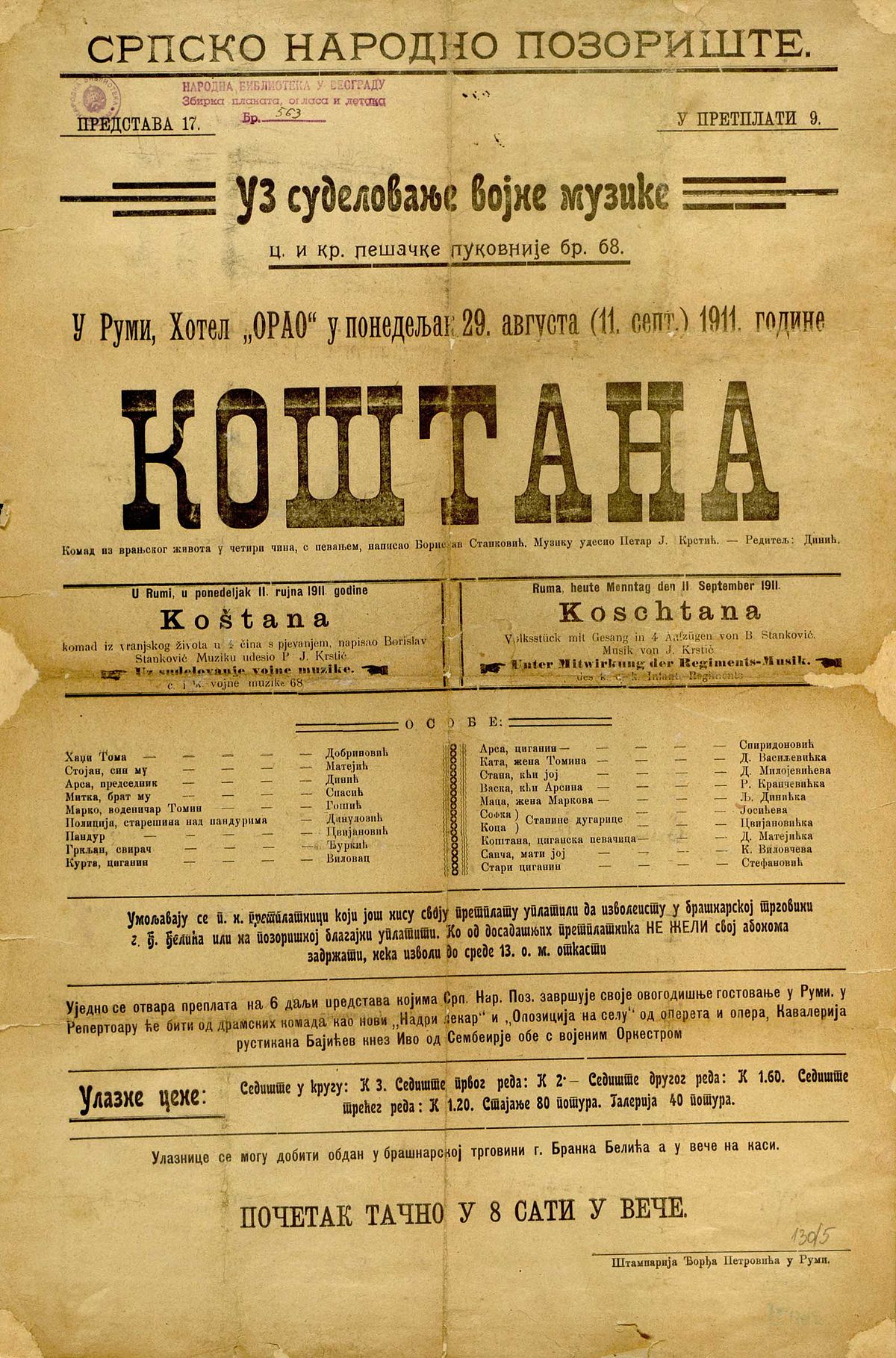
"Koštana" Bore Stankovića

"They remember Mitke well. He was a tall, handsome man. He was always kind of thoughtful, preoccupied with thoughts. He had a red scar on his cheek and a hooked nose. He wore a dolama and chakshiras of a blue-blue color. tassel. It was surrounded by a syllable, a special kind of cloth. He liked to dress nicely. That's why he always wore stilettos, patent leather black shoes and white wool socks. And under the dolama, mint embroidered with braids (a vest with narrow sleeves made of heavy silk). It is said that Mitke, constantly persecuted by his brothers in order to give up wandering, begging and sevdah, and oppressed because of that, almost bound by the constant reproaches of his relatives and the bazaar, perhaps more by his conscience, was a real melancholic, silent and as he could be before the world he fled from all seeking only those who would respect him, fearing at the same time his violent nature; at that time only Gypsy musicians could be like that. He always had a leather bag with money in his loins and would always generously distribute it to children. He was a good man, gentle, pleasant and almost shy when he was not caught in the fury of drunkenness and sevdah. But nothing could change him, he remained the same even after the birth of his children; he had two daughters and four sons. And after that, the people of Vranje continued to come to his brothers and say: "There's Mitke still lumping." But the whole story about Mitke doesn't end where Bora's story ends - by forcibly taking Kostana to the village. Mitke failed to overcome his eastern kara-sevdah, so deeply ingrained in his veins. Here is Mitke's real end: one day, before the holiday, when his wife was preparing everything to welcome the guests, Mitke suddenly brought Gypsies to his balcony, who on the eve of the holiday, as if they knew they were playing for their great Mitke for the last time, they call their wives a real, painful set of Vranje songs. That night he was unrestrained, mad as he might never have done it; at one point his wife approached him, begging him to stop because it was a holiday; then, Mitke pulled out a scythe and the woman fell. I guess thinking that he had killed her, Mitke rushed to the room on the balcony. Immediately after that, shots were heard. That was the final end; he killed himself from a holster. But Vranje has not forgotten Mitke to this day. Some people from Vranje were afraid that something would be forgotten from the stories about this romantic hero, and they quickly hurried to prepare the drama "Kostana" after his death. The famous traveling theater from Nis came. Director Stojicevic was the protagonist of Mitka; he came to the house of Stajić's and Mitke's daughter-in-law, it was Arsa's wife who dressed Stojičević so that he looked like a real Mitke. They went into so much detail that Mitke's daughter-in-law drew a stain on his face that Mitke himself had. The first show has begun. That day, Vranje saw its own life on stage for the first time. Mitke appeared followed by an astonishing silence and then I cried. The crow cried. And while today Vranje is once again changing its character and high-rise buildings are replacing the former houses of the house, Mitke's grave still stands next to the old church. Those who raised their hands did not have a place in the cemetery. Mitke remained lonely even after his death. The legend of our Hamlet, as Skerlic called it, has grown into miraculous stories for decades. "



19 comments
Informative article
Great article
MashaAllah... Its such a beautiful Written... Just loved to read This...keep it up
GREAT platform for great article
This a Great article. Keep up Dear
I think it was a great article.
I never hear about him and his wrote! Seems that he was a great writer. I'd like to read his book if I get enough time for it
Just hearing about him
Wat humility
Kostana worked as a literary work and then as an opera, a play, and it is best to tell you that Borisav Stanković is the least read in his hometown. They presented that a few days ago in an interesting show about the cultural center in Vranje. They organized open libraries on the streets so that everyone could borrow a book without a membership fee and of course return it to the same place so that others could read. And based on the interest tracking, they realized that no one was looking for any of his books, Sofka, Impure Blood, The Gypsy Girl
Mitke had everything he wanted, good horses, rifles and women, he lived like a real bekrija. His brother forcibly married him and thus took his life and started suffering.
There was not a man in Vranje who had not heard of her beauty - "blond hair, white face, honey lips, enchanting hips, thighs like sails, and eyes as big as hinds". This is how Bora Stanković described his Roma beauty, singer Koštana from Vranje, but the story says that the woman who served as his inspiration was more than that! She sang to rich merchants, agas and beys, even to kings themselves, but that did not bring her happiness.
The first performance of "Kostana" was directed by the actor Ilija Stanojevic, who played Mitko, Kostana was played by Zorka Todorovic, and it went badly. "There were few people at the premiere and the income was only 399 dinars, at the rerun on June 24 there was an even smaller audience, while at the third performance there was a little more audience." When asked how satisfied the young writer Bora Stanković is with the Prime Minister, he answered: "I ran away." Later, when it became clear that the prime minister had failed, Stankovic said: "The actors ruined my play because they did not understand it. They eventually wanted" Kostana "to turn out to be a joke." Judging by the testimonies of his contemporaries, it seems that he was right. "On the first performance, Kostana was shown as a work in which one only drinks and lumps." In order to improve the impression as much as possible, Bora Stanković then modified the original version of "Koštana", of which only the third act has been preserved, "by removing and remodeling especially those places that characterized Mitke as a drunkard and a pustahija". While Bora was battling criticism of Kostana's rights, she was sitting in Vranjska Banja, expelled from her native Vranje "under pressure from women whose men she seduced with her song and dance. Mitke continued to carouse, even rumored to have left the country.
Nice
Night fell, and I remembered the rage of Mitka and Kostana once a song from old Vranje.
very valuable information
it's also interesting to read about other countries heroes 😅 we also have our own heroes like this.
No había un hombre en Vranje que no hubiera oído hablar de su belleza: "cabello rubio, rostro blanco, labios color miel, caderas encantadoras, muslos como velas y ojos tan grandes como ciervas". Así es como Bora Stanković describió su belleza romaní, la cantante Koštana de Vranje, ¡pero la historia dice que la mujer que le sirvió de inspiración fue más que eso! Cantó a los ricos comerciantes, agas y beys, incluso a los mismos reyes, pero eso no le trajo felicidad.
Interesting article keep it up