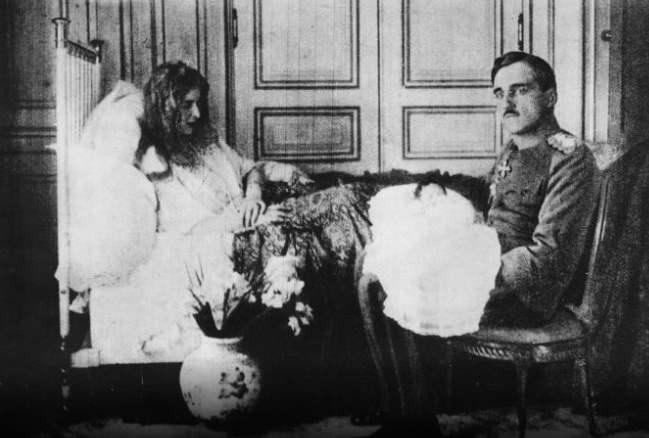
The Yugoslav king "UNIFIER" was tattooed without anyone knowing it for decades!
Known as the "Unifier" King, Alexander I Karadjordjevic was born in Cetinje as the fourth child (second son) of Peter I Karadjordjevic and Princess Ljubica Petrovic of Montenegro, the eldest daughter of Montenegrin King Nikola I Petrovic.
He was born on this day in 1888. He was the king of the Kingdom of Yugoslavia, and here are the details from his life, which tragically ended with the assassination in Marseille.
His godfather at his baptism was, through an envoy, the Russian Tsar Nikolai II Romanov. Alexander was two years old when his mother, Princess Ljubica, died of complications in childbirth during the birth of his younger brother Andrija, who also died twenty-three days later.
He spent his childhood in Montenegro, and finished elementary school in Geneva.
He continued his education at the military academy in St. Petersburg. While Aleksandar and his younger brother George were at the military academy, their father Petar, together with his conspirators, managed to carry out a coup d'etat in the Kingdom of Serbia known as the May coup in which King Aleksandar Obrenović and his wife Draga were killed.
In that way, the Karadjordjevic dynasty regained the Serbian throne after forty-five years. Alexander's 58-year-old father became King of Serbia Petar I Karadjordjevic, which is why George and Alexander returned to Serbia to continue their studies.
A fateful turning point in the life of Prince Alexander occurred on March 27, 1909, when his older brother, Prince George, renounced his right to the throne after strong pressure from political circles in Serbia. As heir to the throne, Prince Alexander embarked on the reorganization of the army, preparing it for the final showdown with the Ottoman Empire.
A fateful turning point in the life of Prince Alexander occurred on March 27, 1909, when his older brother, Prince George, renounced his right to the throne after strong pressure from political circles in Serbia. As heir to the throne, Prince Alexander approached the reorganization of the army, preparing it for the final showdown with the Ottoman Empire.
Foto: Profimedia
In October of that year, the official name of the country instead of the Kingdom of Serbs, Croats and Slovenes became the Kingdom of Yugoslavia. The basis of the concept of "January 6", that is, the personal government of King Alexander, was the most consistent implementation of the policy of integral Yugoslavia, where no longer separate tendencies were tolerated, or emphasis on any regional, tribal (or national) or religious peculiarities in relation to the whole state or Yugoslav nations.
In 1931, after the situation in the country had largely stabilized, a new Constitution of the Kingdom of Yugoslavia was introduced, which established a bicameral representative system, and the country was thus returned to parliamentarism.
The assassination of King Alexander in Marseille was preceded by two attempts, the first in 1921, in Belgrade, organized by the communists, the assassin was Spasoje Stejić. While the assassination attempt on King Alexander was carried out by members of the Croatian Ustasha movement, on December 17, 1933, in Zagreb. The Ustashas Petar Oreb and Ivan Herničić were later arrested and convicted, as was the communist Stejić.
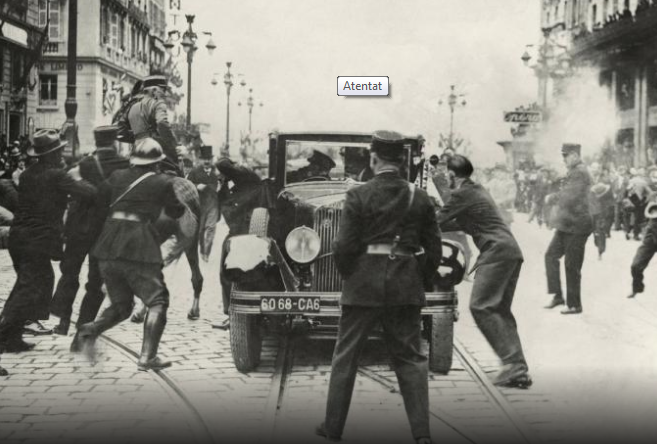
The assassination on October 9, 1934 in Marseille, in which the head of French diplomacy, a member of the French "Academy of the Immortals" Louis Barthou, was assassinated, was carried out by Croatian Ustasha terrorists and members of the pro-Bulgarian organization VMRO (Internal Macedonian Revolutionary Organization), with Mussolini's undoubted support.
The further background of this crime, as Tanjug wrote earlier, has never been fully clarified, and there are even more contradictory theories.
The immediate perpetrator was a member of the VMRO, Vlado (Veličko) Georgijev Kerin, nicknamed Chernozemski, with the help of three members of the Ustasha movement.
https://youtu.be/nuNx2nMAQVA
In October 1934, King Alexander Karadjordjevic came to France on an official state visit. About 100,000 people greeted him on the streets of Marseille.
The assassin Chernozemski, pretending his enthusiasm, chanted to the king in French, and then he took out a revolver from the bouquet he was waving and fired several shots.
The mortally wounded King Alexander soon passed away, a few hours later Minister Louis Barthou passed away, while the wounded General Joseph Georges survived. As the press of that time wrote, the last words that King Alexander uttered were: "Save Yugoslavia for me".
The mass lynched the assassin, whom the police had previously managed to wound, and he soon passed away. French police arrested three conspirators-assassins Zvonimir Pospisil, Ivo Rajic and Mijo Kralj, Croatian Ustashas. A French court sentenced them to life in prison.
Benito Mussolini, the Italian fascist leader who had territorial aspirations for parts of Yugoslavia, refused to extradite the instigators of the crimes of the Ustasha champions Ante Pavelic and Eugene Dido Kvaternik, who was the leader of the group that carried out the assassination. For some time, the Italian authorities held them captive.
According to the general assessment, the creator of the Yugoslav state was sincerely mourned throughout Yugoslavia. Hundreds of thousands of people paid tribute to the killed ruler along the entire length of the route, starting from Split, and along the railway routes from Split through Zagreb to Belgrade.
King Alexander was buried on October 18 in the family tomb of Karadjordjevic in Oplenac, with the highest state and military honors, and the presence of representatives of almost all European countries, courts and governments, including war opponents.
Since the eldest son of King Alexander Peter II was a minor, the power was taken over by a three-member governorship, which consisted of Prince Pavle Karadjordjevic, Dr. Ivo Perovic and Dr. Radenko Stankovic.
The governorship was overthrown by a military coup on March 27, 1941, and was soon followed by Nazi Germany's attack on the Kingdom of Yugoslavia. Apart from Germany, Italy, Bulgaria and Hungary also took part in the attack.
Foto: Profimedia
A TATTOO THAT ALMOST NO ONE KNEW
It is interesting that Aleksandar I Karađorđević was a big fan of tattoos, so he had one on his body.
Namely, a large tattoo was made on his chest, which depicts a Prussian one-headed eagle with outstretched wings holding a sword in one hand, a pattern in the other, while a heraldic crown rests on his head.
The fact that the Yugoslav king "Ujedinitelj" was tattooed for decades was completely unknown.
Deacon Nenad Jovanović discovered this fact by collecting material for the book "Coats of arms, flags and anthems in the history of Serbia", in which a photograph of the king's tattoo was published for the first time.
The tattoo depicted a single-headed eagle with wide spread wings, with a sword in one claw and a pattern in the other. Above the eagle was a crown resembling that of the Holy Roman Empire.
Therefore, according to historians, the tattoo was most likely created before the First World War, in the king's younger days, but the possibility that it happened a little later, as part of his wedding to Queen Maria, a Romanian princess from the Hohenzollern-Sigmaringen family, is not ruled out.
source: Serbia Today
Mida - mythology
The mythical ancestor of the Friesian royal house, famous for its immeasurable treasure and wisdom. While he was still in the cradle, the gods hinted at his future wealth with one sign: a procession of ants brought grains of grain and put it in the toddler's mouth. There are several legends about him, the most famous of which is the one about "Mida's touch".
Mida owned beautiful gardens at the foot of the Macedonian mountain Bermion, in which the most fragrant roses grew, with flowers of sixty petals. One day, old Silenus, a teacher and companion of the god Dionysus, wandered into his rose garden. Mida wanted Silen to teach him wisdom, and in order to achieve that, he resorted to cunning. Knowing that Silenus often came to one spring to quench his thirst, the king poured wine into the water; when the old teacher of Dionysus got drunk and fell asleep, Mida caught him without difficulty. In the garden full of flowers, when asked by the rich king what is the greatest happiness for a man, Silen answered that it is best not to be born, and for the one who has already been born - to spend as little time as possible in this world.
Some say that Silena, who staggered from old age and wine, was captured by Frisian peasants and brought before the king. Mida, when Orpheus instructed him in the divine secrets, immediately recognized Dionysus' tutor in the old man; he hosted Silena for ten days and ten nights, and then took him to Lydia. Dionysus was so overjoyed to meet his teacher again that Midi promised to grant him one wish, whatever it was. The king of Phrygia wanted everything he touched to be turned into gold. Dionysus fulfilled his wish, but he was sad that the king did not ask for something more valuable. Overjoyed, Mida immediately began to use the acquired gift: everything he touched with his hand immediately turned into gold, even food and drink. Thus, in addition to the rich table, the king remained hungry and thirsty. The unfortunate Midas begged Dionysus to free him from the gift that brings misery. Dionysus came out to meet him this time as well and ordered him to dive into the river Pactol. When Mida did that, he lost the power to turn everything he touches into gold, but the river has since become gold-bearing.
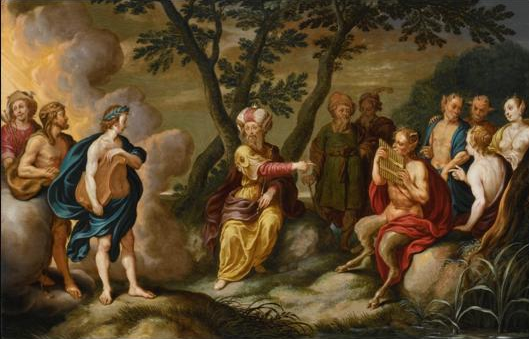
After that event, Midas hated all pleasures and gold; he decided to retreat to the woods and live modestly, in the company of Pan. There he was struck by another accident. Pan challenged Apollo to a music competition, which was also attended by Midas. When Tmol, the god of the nearby hill, ruled that the sounds of Apollo's guitar were more beautiful than the sound of Pan's flute, Midas recklessly declared that the judgment was unjust. As punishment, donkey ears grew on the non-musical king. Mida tried in various ways to hide that shame; he covered the monstrous ears with a purple tiara cloth, but they were still noticed by the servant who was cutting his hair. The king threatened him with death if he revealed the secret. Feeling the need to tell someone after all, the servant dug a pit and whispered into it that Mida had donkey ears. Soon a reed grew in that place, which, with every gust of wind, whispered about King Mida's donkey ears and thus revealed his secret to the world.
In the oldest tradition, Midas is the son of Gordian, the mythical founder of the Phrygian state and the city of Gordian; it was later narrated that his mother was the goddess Cybele, that Mida established a cult for her and that he built her first temple in Pesinunta. The unsurpassed reaper Litiers is mentioned as Mida's son, and it was rumored that the king also had a daughter whom he married Attis.
Mida was considered the inventor of lead, lenger and syringa (shepherd's flute). From a wise and immensely rich king, he later became an example of human stupidity and greed.
Romulus and Remus - mythology
Descendants of the famous Trojan hero Aeneas; Romulus is the legendary founder and first king of Rome. Greek tradition links the founding of Rome to Roma or Roma, and Roman - to the twins Romulus and Remus, sons of Rea Silvia or Elijah and the god Mars.
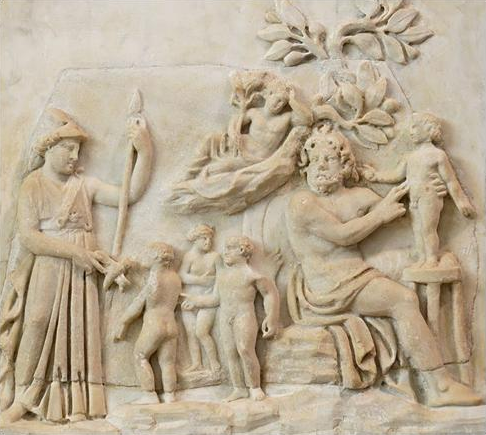
Sylvia Proc, king of Alba Longa, left the throne to his older son Numitor. Amulius, his younger son, who was ruthless and eager for power, did not respect his father's will, but deprived his brother of the throne and killed his son Laus. In order to completely destroy his brother's descendants, he forced Numitor's daughter Rea Sylvia to become a vestal and thus condemned her to eternal virginity. The gods thwarted his intention, because the descendants of Rea Sylvia were destined to build a great city and establish a powerful state. Mars approached Numitor's daughter and she conceived twins - the future founders of Rome. As soon as he noticed his niece's pregnancy, Amulije put her under guard, and when she gave birth to sons, he ordered the children to be thrown into the Tiber. The river came and Amuli's men, afraid of the swollen water, left the cat with the little ones by the shore. When the river returned to its bed, the cat remained at the foot of the Palatine, in the shade of a fig tree. The wolf, who went down to drink water, breastfed the twins and took care of them with the help of a woodpecker. When the shepherd Faustul saw the beast gently licking the little ones, he immediately realized that the gods were in favor of abandoned children. He entrusted the boys to his wife Aka Larencija, who raised them as born sons (picture below).
Romulus and Remus grew up among shepherds. They surpassed their peers in beauty, stature and strength. Romulus showed early on that he was destined to be the leader of the people, and it was clear to everyone that it was more appropriate for the brothers to rule than to obey. While some loved them and respected their will, others hated them and wanted to hurt them. When a quarrel broke out one day between Amuli's and Numitor's shepherds, Remus was captured and, as the main culprit, brought before Numitor. He did not want to punish the young man himself, but took him to Amulia, who this time generously left the decision to his brother. Astonished by Rem's handsome appearance and elegant demeanor, Numitor asked him for his name and origin. Remus replied that he had been found by the river with his brother Romulus, in a cat with vague inscriptions, that they had been breastfed by a wolf, that they had been fed by beasts, and that Faustul had nursed them. Hope was born in Numitor's heart to see his grandson in front of him. Meanwhile, Faustulus, who was worried about Remus' fate, revealed to Romulus the secret of his origin. Romulus immediately hurried to Numitor and soon the grandfather and grandchildren recognized each other. The brothers did not dare to openly attack Amulia. While Romulus was gathering comrades, Remus encouraged the citizens of Alba Longa to rebel against the arrogant king. With a large number of supporters, the brothers attacked and killed Amulius, and then returned the legitimate king Numitor to the throne.
Romulus and Remus decided to build a new city on the banks of the Tiber, near the place where they were miraculously saved. There was an immediate disagreement, because Romulus wanted to found a city on the Palatine, in a place called Roma quadrata, and Remus - on the Aventine, in a naturally protected place, which, according to him, was called Remonium. Romulus and Remus did not agree on further plans for the future. As they were twins, the question of eldership was immediately raised, as well as who would give the name to the future city. To avoid conflict, they decided to make heaven's decision. Romulus observed favorable signs from the Palatine, and Remus from the Aventine. When Remus saw six kragujas, and Romulus twice as many, it was clear to whom the gods preferred. The gathered people immediately greeted Romulus as king, and the only thing left for the distressed and disappointed Remus was to watch his brother approach the founding of the city.
Romulus harnessed oxen to the yoke and plowed a furrow around the Palatine, among the future Rome. To belittle his brother's work, Remus jumped over the furrow, and Romulus killed him for that sacrilege. Some say that Rema was killed by Romulus' companion Celer and that their benefactors Faustul and Faustin lost their lives in the conflict between the brothers. Romula was deeply moved by her brother's death; he even wanted to take his own life, but was prevented from doing so by Aka Larencija, who persuaded him to continue the work he had begun. After burying Remus on the Aventine with honors, Romulus began to settle in the new city.
According to tradition, Rome was founded on April 21, 753 AD, on the feast of Parilia. Romulus sent his men to Etruria to learn all the rites associated with the founding of the city. According to the instructions received, he first dug a round pit (mundus), the future center of Rome, into which the first fruits and lumps of earth brought by the newcomers from their homelands were ceremoniously thrown. With a bronze plow, pulled by a cow and a bull, Romulus then marked the boundaries of the city (pomoerium) and determined the places for the gates. In order to inhabit the newly founded city, he made a refuge between the two peaks of the Capitol for all the homeless, fugitives, culprits and slaves. From the people who could carry weapons, he created legions (3000 infantry and 300 cavalry), and he chose a hundred of the best (patricians) for advice - the Senate.
Rome soon became a populous city, but there were few women. In order to obtain wives for his subjects, Romulus resorted to cunning. On the holiday of Consualia, which was celebrated on August 21, he invited neighbors with women and children. During the celebration, he attacked them and abducted all the girls present, of whom there were 30, 527 or 627; among them, only Hersilia, a noble Sabine woman, was married (although married, she was abducted together with her daughter; since she did not want to separate from her child, Hersilia remained in Rome).
Neighbors of the Romans, angry at the kidnapping of their daughters, gathered around the Sabine king Titus Thaci and decided to take revenge on Romulus and his men. Romulus easily conquered the inhabitants of the Latin cities of Cenina, Antemna and Krustumeria, but he was seriously threatened by the Sabines. They set out from Quirinal and, thanks to Tarpeia, who betrayed the Romans, captured the Capitol. The Romans fled in disarray to the Palatine, where Romulus turned to Jupiter in despair and promised him a temple if he would stop the retreat of his men. Jupiter responded to that request and Romulus later, at the place where the Sabines were stopped, built a temple to Jupiter Stator. The Sabine military leader Met Kurcije escaped, and when the decisive battle took place, the abducted Sabin women joined the fighters. They rejected their shyness and bravely intervened in the fighting. With their hair untwisted, they rushed among the spears and separated the angry enemies (picture below). They shouted to their fathers and husbands that they were now the mothers of their grandchildren and that they would rather perish than remain alive as orphans and widows. After those words, the battle noise subsided, and the leaders of the warring parties made peace. One of the two states was created, and the united nations were ruled together by Romulus and Titus Tacitus.
Romulus ruled Rome for thirty-seven years and founded all the city and military institutions; he divided the population into thirty curias and three tribes, established a system of patrons and clients, issued numerous laws, and organized an army. He was dining at the Palatine Hill, where a huge dogwood tree, which grew out of his spear, was shown.
The council of the gods decided to give Romulus immortality. On the day of the July grandmothers, while the fifty-four-year-old Romulus was holding an army parade on the Field of Mars, the sky darkened, and a terrible storm descended on the earth, in which the first king of Rome disappeared. The people mourned their ruler until a man named Julia Proculus announced that Romulus had appeared to him in a dream and revealed to him that he had been exalted to heaven, like the god Quirinus. Others say that Romulus was brutally killed and that the conspirators took his dismembered body out of the Senate under his clothes.
Legends are also known that speak differently about the birth of Romulus and Remus. It is said that Elijah, the daughter of Aeneas and Lavinia, gave birth to Romulus on Mars, or that he was the son of Telemachus and Kirk's son Latino and Roma, the daughter of the Trojan captive of the same name. Others say that Romulus and Remus are twins, born to Aeneas by Forbant's daughter Dexitea. The children were brought to Italy, but a strong storm scattered all the ships, and only the boat carrying the twins landed peacefully at the place where Rome was later built. The legend according to which Romulus and Remus were born at the court of King Tarhon is also known.
Literature:
• Dragoslav Srejović - Aleksandrina Cermanović-Kuzmanović, Recnik grčke i rimske mitologije, drugo izdanje, Beograd: Srpska književna zadruga, 1987

10 TIPS FOR DRIVING IN FOG: Road visibility will be reduced in the coming period
A thick fog dawned all over Serbia this morning, making driving difficult, visibility reduced to about 200 meters.
You need to be careful and drive carefully, and read 10 tips on how to drive safely when there is fog.
On the road only if you have to
Fog usually descends early in the morning and in the evening around the area near rivers and lakes. So, if you can choose, try to avoid driving at that time of day.
Reduce speed
Adjust the speed to the condition and conditions on the road. This practically means that you should drive in the fog at a speed at which you will be able to stop in front of any obstacle when you notice it.
Increase the distance
In conditions of reduced visibility, such as fog, keep a greater distance from the vehicle in front. This gives you more time to react in case of unforeseen circumstances.
Drive in the middle of a traffic lane
When moving through thick fog, use the center line and the right line of the road edge as landmarks if it is marked. In order to avoid vehicles from the opposite direction, as well as pedestrians and cyclists moving along the right edge of the road, try to always keep the vehicle equally away from those two lines.
At intersections extra caution
When you approach the intersection, lower the windows and listen to the traffic. This is a good way to know if you can get through it if the visibility is so bad.
Watch out for ice
When it is very cold and the fog descends, count on the fog to freeze easily and very quickly on the road so that in just one moment the surface can become very slippery. Therefore, when driving in fog and slippery roads, drive the vehicle without sudden and hasty movements.
Four turn signals and a stop
If the fog happens to be so thick or you just can't see where you're going, it's best to park your vehicle by the roadside and of course turn on all four turn signals so that other road users can notice you. If the fog is so thick and visibility is reduced to a minimum, you need to keep all four turn signals on while driving to be more visible.
Turn on the glass heaters
As fog can create moisture, feel free to turn on the glass heaters and use wipers to ensure the best possible visibility.
Fog lights
Certainly one of the most important things is fog lights. If you have them on your vehicle, use them, because they are placed low and directed downwards and wide, which is the only solution in fog to illuminate the road and prevent dazzling other drivers. Never drive with high beams.
Turn off anything that might be bothering you
Turn off music, cell phone, or anything that will distract you. In the fog, the most important thing is your full attention.

Scylla and Charybdis - mythology
According to the beliefs of the ancient Greeks, two terrible monsters were located on both sides of the Strait of Messina and which did not allow any ship to pass unscathed.
Scylla is the immortal sea monster, Krataja's birth. She lived in a cave below a smooth high ridge, the tops of which were covered with eternal mists. It has twelve legs and six very long necks, with horrible heads, on which are three rows of teeth. Perhaps the most unusual thing about Scylla is her barking; he is no stronger than the whining of a newborn puppy. It is hidden in a cave up to half of its body, and it hunts with its heads everything that moves in the sea and on its surface. Each ship paid tribute to her; Scylla used to catch sailors (one for each of her six heads) and transfer them to the rocks, where she broke their bones and ate them tightly. As Odysseus' ship passed by Scylla's cave, Odysseus, on the advice of the sorceress Kirke, sacrificed six of his companions to her, so that they would not all become the prey of the even more terrible Charybdis.
In a later legend, Scylla is imagined as a creature with the face and chest of a woman, who has six heads and twelve dog legs on the sides. Fork and Hecate, Typhon and Echidna or Crateida and Trien are mentioned as her parents, and some say that she is Lamia's child. It was believed that Scylla was at first a beautiful girl, loved by Glaucus, Poseidon's son. When she refused his love, he sought help from the sorceress Kirke, who herself loved Glaucus. Jealous of his love for Scylla, Kirka put powerful herbs and poison on the place where Scylla bathed. When the unfortunate girl stepped into the water up to her waist, she noticed a terrible dog's head around her thighs; in fear, she went ashore and only then did she realize that the heads of hellish animals were part of herself.
Others say that Scylla loved Poseidon and that the jealous Amphitrite, his wife, turned that beautiful girl into a dog-like monster with six scary heads and twelve dog legs. According to the Italian-Sicilian tradition, Scylla was killed by Hercules when she kidnapped one of Gerion's cattle. The sea god Fork, Scylla's father, assembled his daughter's body with lighted torches and revived it.
Charybdis is a monster that resides under a rock on which grows a large fig tree, and is far from another monster - Scylla - within range of an arrow. With a terrible echo, Charybdis sucked a huge amount of sea water three times a day and expelled it three times, swallowing everything in it. Even the god of the sea, Poseidon, could not help the ships approaching Charybdis; because of that, the sorceress Kirk advised Odysseus to pass Scylla with her ships, which is less scary. After the shipwreck, Odysseus was thrown to Charybdis on the log of a wrecked ship, at the moment when she was drawing water into herself. He was saved only by his ingenuity; he held fast to the large fig tree, until Charybdis threw out the parts of the ship, on which he continued his journey to the island of Ogygia. On their return from Colchis, where they obtained the golden fleece, the Argonauts managed to pass by Charybdis happily only thanks to the help of Thetis and her sisters. On his way to Italy, after escaping from war-torn Troy, Aeneas escaped Charybdis by sailing around Sicily.
Charybdis and Scylla were believed to live in the Strait of Messina, below Mount Pelora. According to a later legend, Charybdis is the extremely voracious daughter of Poseidon and Gaia. When Hercules passed by her with Gerion's cattle, she stole and devoured his cattle. Zeus punished Charybdis with a lightning strike and threw her into the sea, but she still remained very voracious.
Literature:
• Dragoslav Srejović - Aleksandrina Cermanović-Kuzmanović, Recnik grčke i rimske mitologije, drugo izdanje, Beograd: Srpska književna zadruga, 1987

Papers of Kraljevo high school students on the EU calendar
Solidarity on the pages of the calendar of the EU PRO program for 2021
Young people in Serbia have shown in art that solidarity, which is an essential European value, is healing, erases borders between people, generations and countries, and that it is not difficult to be in solidarity and follow simple preventive measures that give results in overcoming difficult current situations. situations. High school students also showed that they care for the most endangered who need help - the elderly, children, pregnant women, people with disabilities or some disease, and that doctors are the heroes of our time.
"The European Union has significantly helped Serbia to cope more easily with the covid-19 pandemic in 2020, primarily by reallocating unspent funds from IPA funds that financed the purchase of medical equipment and medicines, and the most important large funds are for post-pandemic economic and social recovery. of our country. Solidarity has become a basic topic of relations between Serbia and the EU, and this year's works show that young artists, high school students, have noticed, understood and illustrated it with their drawings. It is important to say that Serbia, as a candidate for EU membership, has demonstrated solidarity with member states in difficult times for them and has shown itself as a country that can contribute to strengthening the Union in the future, "said Jadranka Joksimovic, Minister for European Affairs. integration.
The European Union (EU) in partnership with the Ministry of European Integration has supported this art competition for more than a decade and thus motivates young people to be creative, but also active members of their local communities.
"The past 2020 has once again confirmed the old saying that a friend in need knows each other, that solidarity makes us stronger and that only together can we overcome every adversity," said Deputy Head of the European Union Delegation to Serbia, Mateja Norcic Stamcar, adding that the crisis caused by the spread of the coronavirus has once again confirmed that solidarity transcends generations and nations.
Olga Kijurina, a student of the Technical School from Sabac, won the first prize in the competition for the calendar of the EU PRO development program for 2021, while the second and third place went to Elma Agushi, from Bujanovac High School "Sezai Suroi" and Iva Arandjelovic, students of High School "Vuk Karadzic" from Babusnica. According to the votes of the audience and the expert jury, they responded best to this year's theme "Solidarity unites us", which aimed to encourage young people to recognize the importance of solidarity during the pandemic.
"Just as the students presented examples of solidarity that started the community, so the countries of the European Union towards Serbia, but also Serbia towards the EU countries, with concrete support, showed during this crisis that solidarity knows no borders. The assistance provided by the EU was primarily focused on strengthening the health system of the Republic of Serbia, donating the necessary health equipment and hiring medical staff, but it also took into account the support of marginalized groups by procuring basic food and hygiene products, "concluded the Deputy Head of the EU Delegation. In the coming period, it will continue with the already provided support provided by the EU for economic recovery.
On the pages of the EU PRO calendar for the upcoming year, in addition to the first three awarded works, there will also be works by Milica Čairović, students of the Kraljevo High School, Aleksandra Simić, students of the Kraljevo School of Economics and Trade, Nikola Marković from Aleksandrovac, Teodora Matijaš and Katarina Stojanović from Niš Stambolic from Cacak, Milica Zujica from Zagubica, Djula Hidanovic from Kragujevac and Ibrahim Causevic from Novi Pazar.
The school with a home for hearing impaired students from Kragujevac was declared the best on the basis of engagement and dedication during the preparation of the school competition and was awarded with a computer and a projector. The students of this school said in their works that only with united forces and powerful weapons such as a smile, love and outstretched hands, we can emerge from this situation as winners.
"All students who participated in our competitions helped us to see, from the perspective of young, talented people, what challenges their communities face, how to solve seemingly unsolvable problems, what kind of support has borne fruit, but also given new ideas on how to EU support can further help the development of local communities, ”said Olivera Kostić, EU PRO Program Manager, thanking everyone for their participation and commitment.
The results of the art competition "Solidarity connects us" can be found on the website of the EU PRO program.
The activities of EU PRO, a program that contributes to a more balanced socio-economic development of Serbia, are supported by the European Union with a total of 25 million euros. The program aims to contribute to increasing the competitiveness of micro and small enterprises, improving the business environment and improving social cohesion in 99 local self-government units, in two regions: the Region of Šumadija and Western Serbia and the Region of Southern and Eastern Serbia. Field activities are conducted by the United Nations Office for Project Services (UNOPS).
source: kraljevo.o
Medea - mythology
The famous sorceress, daughter of Heli's son Ejet and Okeanida Idija. The goddess Hecate is later mentioned as her mother, and the sorceress Kirk as her sister. Medea's homeland is the mythical land of Eya, identified with Colchis, on the eastern shores of the Black Sea.
Medea lived happily and peacefully in her father's beautiful palace until the Argonauts came to Colchis. When their leader Jason asked for a golden fleece, King Eyet decided to destroy the stranger. He promised him a golden fleece, but demanded that he first harness Hephaestus 'bulls and sow the teeth of Ares' dragon. Hera and Athena wanted to help their protégé Jason. They called on Aphrodite to ignite love for the beautiful stranger in Medea's heart, because they knew that only Ajet's daughter could help him with her spells. Medea hesitated for a long time whether to stay with her father or to obey her heart; it was only when Eros wounded her with an arrow, and when Frix's widow, her sister Halkiopa, supported the Argonauts, that she decided to help Jason.
At Hera's will, Medea first saw Jason's character in a dream; she later met him outside the city, near Hekate's sanctuary, where she promised to help him on the condition that he marry her. When Jason swore to her that he would take her as his wife and take her to Greece, Medea gave him a magical ointment that would protect him from the flames of Hephaestus' bulls, and then helped him defeat the dragon that guarded the golden fleece.
Several other legends about Jason's and Medea's meeting are known. Some say that Medea, unlike the cruel and inhospitable Eyet, mercifully treated strangers and because of that she clashed with her father. She had to leave the city and take refuge in the Helium grove by the sea; there she met Jason and the Argonauts and warned them that King Eyet was ruthlessly killing all the strangers. When Jason promised her marriage, Medea took him to the sanctuary of Ares, where the golden fleece was kept by the Tauride soldiers (bulls) and their leader the Dragon (dragon). After defeating the guardians of the sanctuary, the Argonauts acquired the golden fleece, which some say is in fact the skin of Frix's companion Kri (ram), who was sacrificed to the gods. On the news that foreigners had entered the sanctuary of Ares, King Eyet and the Colchians rushed to the seashore; when one of the Argonauts killed Eyet, the Colchians fled, and the Greek heroes sailed home with Medea.
Others say that Medea was the priestess of Artemis, who sacrificed all the strangers to her goddess. When the Argonauts arrived at Colchis, the cunning Jason disembarked on his own and approached Medea, and the gods immediately ignited in her heart a love for the beautiful stranger. Instead of a cruel and bloody sacrifice, that meeting ended with Medea and Jason's wedding. Through Dionysus, Eyet blessed their marriage. So Jason stayed in Colchis. Only after four years did he remember his task, and Medea then helped him get the golden fleece.
As soon as the Argonauts and Medea boarded the ship, Eyet sent a chase after them. To stop the pursuers, Medea, for Jason's love, killed even Apsirt's half-brother. Medea and Jason's wedding took place before the return of the ship Argo to Jolk, either on the island of Peuki or on Corcyra. On the way to Greece, Medea helped the Argonauts in several moves, with advice and spells. She ordered the Greek heroes to carry the ship Argo from the Red Sea to the Mediterranean for twelve days, and in Crete she enchanted and conquered the giant Tala.
After the return of the Argonauts to Jolk, Medea decided to take revenge on King Pelia, who sent Jason to Colchis and in the meantime killed his entire family. And on that occasion, she used cunning and deeds: in front of Pelija's daughters, she dismembered a ram and put it in a large cauldron with boiling water, and then she revived it completely rejuvenated, like a lamb. Wanting to rejuvenate the aged father, the king's daughters did the same with Pelia, but Medea did not revive him. After that crime, Akast, the son of King Pelia, expelled Jason and Medea from the country. The exiles found refuge in Corinth.
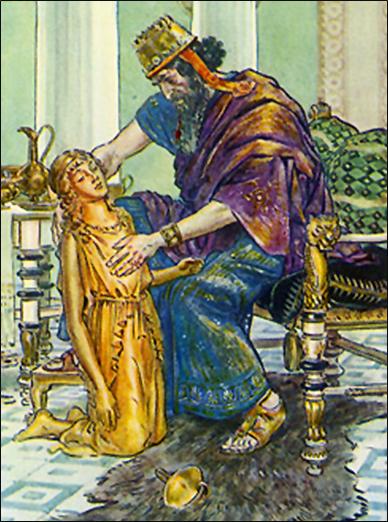
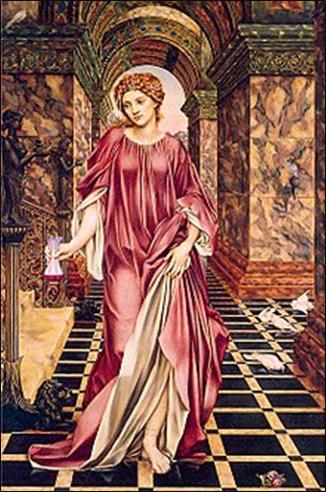
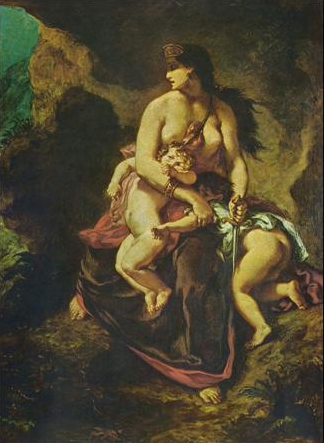
Medea and Jason lived happily in Corinth for ten years. When the Corinthian king Creon offered the newcomer his daughter's hand, Jason, wanting to consolidate his position, accepted the marriage. The humiliated Medea took cruel revenge on both Creon and Jason. She sent the bride a dress and a wreath, but these "gifts" quickly turned into flames, which destroyed the court, the king and his daughter. Meanwhile, to make her revenge even more cruel, Medea killed the sons she gave birth to Jason (picture below), and then went to Athens in Helium's carriage.
Medea was warmly welcomed in Athens, because she promised the Athenian king Aegeus that she would enable him to get an heir with her spells. She stayed there for years and gave birth to Aegean's son Med. Only when she tried to poison Theseus, Aegeus expelled her from Athens and she went to Asia with Med. She later returned to Colchis, where she killed her uncle Pers, who in the meantime had taken power from Eyet.
Others say that Medea and Jason, after Pelia's death, first went to Corkir and that a lioness tore their son Marble there. After the death of their king, the Corinthians called on Medea, as Helius' granddaughter, to rule over them. Thus, thanks to his wife, Jason became the ruler of Corinth. Medea wanted her children - Ferret, Tetal, Alcimen, Tissander and Eriopida - to become immortal, so she left them in Hera's sanctuary. As the children died there one after the other, Jason left his wife and returned to Jolk. Medea then handed over the Corinthian throne to Sisyphus, and went to Colchis herself.
According to a lesser-known legend, after the murder of her children, Medea fled to Thebes, where she cured Hercules of insanity. Then she came to Athens, and after trying to poison Theseus, she fled to Phenicia. From there, she headed north and arrived in Asia, where she married a king to whom she gave birth to a son, Med. After her death, she was transferred to the Blessed Islands, where she became Achilles' wife.
Medea's destiny is a frequent theme in ancient art. Euripides' tragedy Medea, from the year 431 AD, was a model for later poets and tragedians (Enia, Pakuvia, Ovid, Seneca). On black-figure and red-figure vases, Medea was depicted as a sorceress. Only from the middle of the 5th century AD was she presented as a jealous wife who was preparing to kill her children. That moment is the subject of a famous painting by Timomach (1st century AD), which is often copied.
Literature:
• Dragoslav Srejović - Aleksandrina Cermanović-Kuzmanović, Recnik grčke i rimske mitologije, drugo izdanje, Beograd: Srpska književna zadruga, 1987
Milan Jovanovic Batut - "Patriarch of Yugoslav Health"
"If anyone in the world needs a lesson on maintaining and nurturing health, the Serbian people of all parts need it.
He, to the soul, is by nature clear and prudent, and in many ways judges maturely, but - miraculously - he is somehow harmless and ignorant in matters of life and health; what's more gullible, unreasonable, and therefore backward. "
These words, although they sound as if they are from 2020, were written in the preface of the Serbian edition of the Book of Health by Dr. Milan Jovanović Batut back in 1896.
His name is the Institute of Public Health of Serbia, and this year we mentioned the corona virus every day.
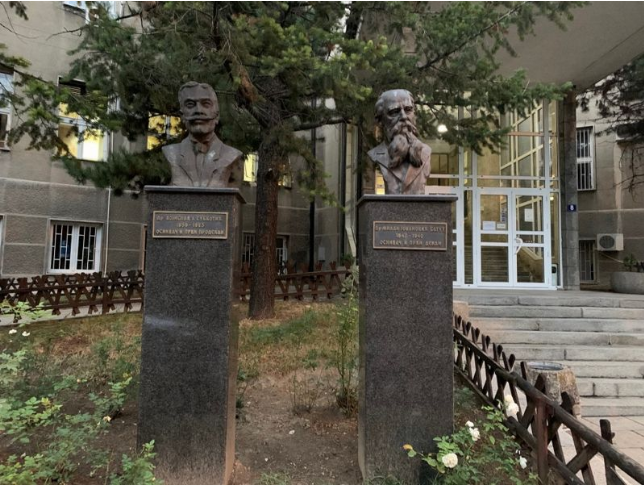
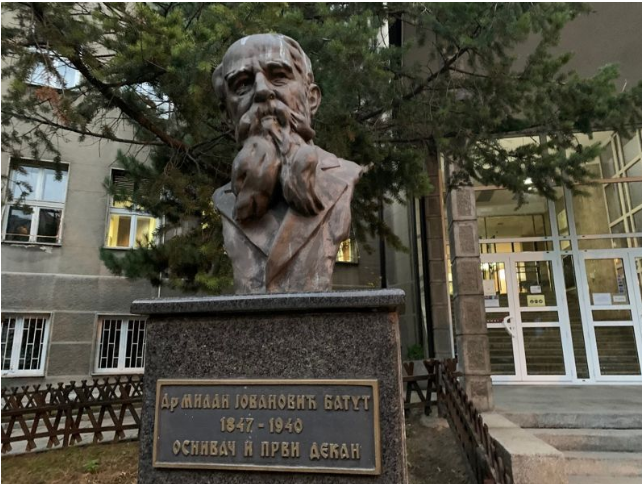
Trampoline was a doctor and university professor, the founder of the Faculty of Medicine, and because of his work on educating the people, they called him "the patriarch of Yugoslav health culture".
Unsurpassed in enlightenment
"Now you can see the importance of prevention and hygiene at the crown, and Trampoline was the prototype of that.
"He mostly fought for the formation of the Faculty of Medicine, and he was unsurpassed in enlightening the people."
Not everything went smoothly in Batut's life.
He had to stop his medical studies in Vienna due to lack of money and poor health.
During his stay in Austria, he returned to the family disease tuberculosis.
"They used to find him on the sidewalk," says Zizic.
Although he comes from a respectable and wealthy family, the Jovanovićs became impoverished in Batut's youth, during the struggle of the Serbian people for liberation in the second half of the 19th century.
"When he returned to his studies, a dozen Mitrovica residents gave money for his tuition."
Even today, the people of Mitrovica are proud of such a fellow citizen.
"The people of Mitrovica know that Trampoline was born in their city. Works about him were published in magazines and newspapers. "
"Even a dilapidated boat can sail far"
He was born on October 10, 1847 in Sremska Mitrovica.
He studied high school in Pancevo and Sremski Karlovci, and graduated in 1865 in Osijek.
He first worked as a doctor in Sombor, and then went south.
He founded the health service in Cetinje and was the chief of medical services in Montenegro in the period from 1880 to 1882.
During his stay in Montenegro, Belgrade became interested in Batuta, and as a scholarship holder of the Serbian government, he went abroad to study from 1882 to 1885.
In his youth, he suffered from tuberculosis, but the scars - cavities on his body remained for the rest of his life.
However, with a moderate and orderly life, he managed to reach the age of 93. He died in the fall of 1940.
He applied everything he told others and proved with discipline that "even a dilapidated boat can sail far".
Who are the doctors who defend Serbia from the corona virus
What would the doctors seeking the change of the Crisis Staff do differently
He studied the problems of hygiene and bacteriology in particular, but he also learned some life lessons in Europe.
"He learned from the French to be a patriot, and from the Germans that hard work can achieve great results."
He also performed autopsies, and was a professor of hygiene and forensic medicine at the Faculty of Law.
Dr. Trampoline was a pioneer in many ways.
He was educated in Vienna, Paris, Munich and Berlin and had famous teachers there.
There are great names in world medicine - Robert Koch, Louis Pasteur, English statistician Sir Francis Galton and Max Joseph von Pettenkofer.
Koch discovered the tubercle bacillus and won the Nobel Prize in Medicine and Physiology, and Trampoline was with him in the years after that discovery.
Pasteur is a French chemist and microbiologist who, among other things, found a vaccine against rabies, while Petenkofer is considered one of the founders of hygiene in Germany.
Trampoline kept their portraits in the study.
He rejected the offer to be the head of the microbiological department at Charles University in Prague, wanting to establish faculties in the then Kingdom of Serbs, Croats and Slovenes.
He was also the founder of the cremation society - Oganj.
"It is known that there was no significant work in the country regarding the health of the people, without Trampoline participating in it."
Tips for all times
In Sombor, as early as 1880, he started the magazine Zdravlje and continued it in Cetinje.
"The magazine 'Zdravlje' from 1908 states that cancer noticed on time can be operated on and does not have to be fatal, as well as descriptions of how it can be recognized in time and an appeal to call a doctor and be monitored regularly." .
From the same period at the turn of the century, he adds, there are allegations of educating the population about the harmfulness of tobacco and alcohol, as well as a program to reduce their use.
There are also instructions for vaccinating school children - which was then called "grafting".
Trampoline also wrote about the procedures for protecting the household from infectious diseases.
"From these and many similar allegations, we can easily conclude that at that time there was a developed awareness of preventive medicine in Serbia, on the improvement of which Dr. Milan Jovanović Batut worked in particular."
Respect for the Czech Republic
Numerous decorations, but especially two scenes with the Czechs, show how much they valued Trampoline not only in Serbia, but also in Europe.
"For his 90th birthday, a Czech magazine called him `patriarch of Yugoslav health culture`, "
When he received an honorary doctorate from Charles University in 1937, which has existed since the 14th century, the Czechs brought insignia to Serbia.
"In order for the act of delivery to be the same as in Prague, they presented the rector's flags for the first time and brought them to Belgrade.
Relationship with kings
He was not always on good terms with the Serbian king Milan Obrenović, because he was able to oppose him, and his opinion was respected.
"He had offers to be in the ministries, but he did not want to side with the parties."
It was not better with the Montenegrin King Nikola either.
King Nikola was too human and did not allow to talk about the problem of poor nutrition and poor treatment of the population, which Trampoline was personally convinced of.
"When King Nikola once asked him: 'Who will play cards?', Trampoline answered: `You and I`, to which the ruler became angry, asking him to address him with `your majesty`.
"However, he was his own, so he didn't care much for the royal orders."
A thorny road to the Faculty of Medicine
The health conditions at the end of the last century in Serbia were so difficult "that it is better not to mention them".
In everyday life and health care, there were no clear boundaries between medical practice and quackery.
Doctors mostly came from abroad, and from here they rarely went to other countries to study.
There was no prevention, the country was poor, and the treatment was mostly related to rulers or the army and wars.
Because of all that, Batut has been dreaming and working for decades to establish a Medical Faculty in Serbia, and he took over the idea from Dr. Josif Pančić.
However, not all colleagues supported him.
"There was a strong current of doctors educated abroad who opposed the creation of the faculty, because they thought they would be impoverished if there were many of them."
The conditions were acquired after the First World War, and this year the Faculty of Medicine in Belgrade is marking the centenary of its existence.
Then, Trampoline and his colleagues visited 17 high schools in Europe to emulate them.
The Faculty of Medicine was ceremoniously opened on December 9, 1920, with a trampoline speech in the ceremonial hall of the University.
"He was the first dean, but he did not manage to teach hygiene at the age of five, he retired."
Statistical microscope
"Whenever he researched something, he was studious, he was among the first to use the statistical method - he said that everything should be passed through a statistical microscope.
"He had a wide viewing angle."
He dealt with social medicine, but also demography - population and migration in European countries.
"When looking at whether a disease will become massively present in the population, such as the crown now, the influence of climate, weather, crop condition, number of births and deaths is analyzed.
"Trampoline saw all this at the beginning of the 20th century in order to be able to explain some phenomena."
a
In the book Rebirth, he wrote recommendations and advice for young men and women after the First World War, when the population was decimated.
He also wrote about bachelors and old women.
He believed that the family is "the foundation of the strength and spirit of the people, the crossroads of all paths and the primary source of good and evil in human society."
He spoke several world languages and was married to a German.
He received four honorary doctorates.
Journalist and writer
He published books in various places across the country - in Sombor, Belgrade, Split.
"His life's work is `Material for Medical Terminology`, he has been making thousands of cards with medical expressions on them for decades. "
He kept a simple and understandable language.
"He had a wonderful style - he wrote in Vuk's language and Dositej's wisdom."
He was one of the most prolific health educators, writing 57 books and brochures, and hundreds of articles.
"Trampoline used to say, 'The book must be courted to the people.'"
He was also one of the founders of the Serbian Literary Association. He collaborated with Matica Srpska, the Serbian Literary Herald and was one of the first and most prominent associates of Politika.
Among other things, he was the president of the Serbian Medical Association, and he played a decisive role in the establishment of the Ministry of Public Health after the First World War.
He was able not only to write clearly and speak beautifully, but also to paint.
While he was in Montenegro, he drew landscapes.
A high-minded dude
It is not known exactly how he got the nickname by which he is still remembered today.
"There are two theories - that it is based on the card game, and according to the other, he took the family nickname from the merchant with whom his father cooperated.
"In his youth, he added that surname to be different from his contemporaries, such as the doctor and travel writer Milan Jovanović Morski."
It is known that material things did not mean much to him - he did not build houses and buy properties.
"He liked to dress nicely. He wore a top hat, suits, pants with a line, he was a real dude. He looked as high-minded as he was.
Helena - mythology
The beautiful daughter of Zeus, for whom the Trojan War was fought. The oldest legend does not mention the name of Helen's mother, but only her brothers Castor and Polydeuces, as well as her husband - the Spartan king Menelaus. It was later said that Helena was the daughter of Zeus and Tindare's wife Leda. Zeus approached the Lady the same night as Tyndareus, and transformed him into a swan; with the father of the gods Leda she conceived Helen and Polydeuces, and with Tindareus - Castor and Clytemnestra.
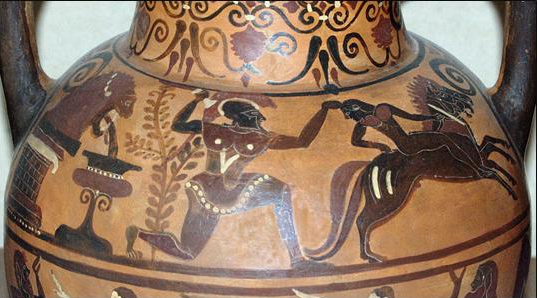
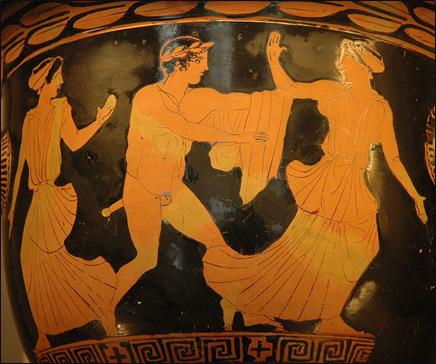
There is also a well-known legend that Helena is the daughter of Zeus and Nemesis; in order to avoid Zeus' embrace, Nemesis fled across the sea and the land, transforming herself into various animals. When she turned into a goose, the father of the gods, in the form of a swan, united with her, in Ramnunt, in Attica. The fruit of their love was an egg, the color of a blue hyacinth, which a shepherd found and handed over to the Lady. From that egg, Helena was born, who was raised by Leda and Tindarej as their child. Helena grew up at the court of Tindareus, and the word about her exceptional beauty, which spread throughout the Greek world, reached Athens, Theseus and his friend Pirito. Although she was not yet ready for marriage, the heroes kidnapped her and fled with her to Attica (picture below). As the Athenians did not want to clash with the Lacedaemonians because of that kidnapping, Theseus took Helena to the Attic town of Afidna and entrusted her to his mother Etri for safekeeping. In Theseus' absence, Helen's brothers - the Dioscuri - invaded Attica with their army and ravaged the country until the Academy or Ehedem revealed to them the place where Theseus had taken the girl. Castor and Polydeuces then razed Afidna to the ground and, after capturing Etra, returned to their homeland with their sister. It was rumored that Helena was already carrying Theseus' child under her breast at that time; on her return to Sparta, she gave birth to a girl, Iphigenia, in Argos, and, as a sign of gratitude for an easy birth, erected a sanctuary for the goddess Eiletia. Helena entrusted her newborn daughter to her sister, Agamemnon's wife Clytemnestra.
After some time, King Tyndareus decided to marry his beautiful daughter. Beggars with rich gifts came from all over Greece; they were all respectable princes, so that Tyndareus could not decide to whom he would give Helen's hand. Odysseus advised the king to swear before all the beggars that he would defend the lucky chosen one from any misfortune, and to leave the choice of husband to Helena. Tyndareus obeyed Odysseus' advice; he sacrificed a horse, and then called on all the heroes to swear in front of the altar that they would protect Helen's future husband. After the beggars took the oath, Tindarej buried the pieces of the sacrificed animal in a place that has since been called the Horse's Tomb. Helena decided to give her hand to Menelaus, who, after Tindareus' death, became king of Sparta.
Helena gave birth to Menelaus' daughter Hermione. Their happiness was short-lived, because the goddess Aphrodite was not in favor of that marriage. One day before Helen's marriage, Tyndareus offered sacrifices to the gods, but forgot about Aphrodite. In order to take revenge on him, the goddess decided that his daughters - Helena, Clytemnestra and Timandra - would become adulteresses. Paris 'verdict (in a dispute between three goddesses - Hera, Athena and Aphrodite) brought misfortune to Menelaus' home and all Greeks. Aphrodite promised Paris the most beautiful wife, and since it was Menelaus' wife Helena, the young Trojan prince, according to the goddess's advice, came to Sparta. Unaware of the evil, Menelaus entertained the newcomer for nine days, then left him with his wife and sailed for Crete to attend the funeral of his grandfather Catreus. In Menelaus 'absence, Paris easily won the love of his beautiful wife, and she, with her husband's treasure and her slave, Theseus' mother Ether, left home and her minor daughter Hermione. The lovers reunited on the island of Cranai, and then Paris' ship, after a long wandering and staying in Sidon, sailed to Troy. The Trojans welcomed Paris and Helen with open arms; everyone was enchanted by the beautiful newcomer, even King Priam. Menelaus and Odysseus later arrived in Troy and demanded that Helen be returned to them, and when the Trojans refused to do so, the Trojan War began.
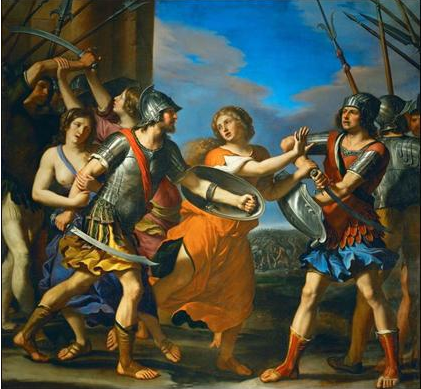
Helena lived in Troy as Paris' lawful wife during the whole war, but the goddess Irida constantly instilled in her a longing for her homeland, parents and her husband's home. In the last year of the war, when Odysseus entered the city disguised as a beggar, Helena recognized him, but did not betray him. After Paris' death, she remarried Priam's son Deiphobus. Helena soon betrayed the trust of the Trojans and the love of her new husband. That night when Troy was set on fire and destroyed, she gave the agreed torches to the Greek fleet with burning torches, and then she removed Defoe's weapon and allowed Menelaus to kill him. Menelaus gave up his firm intention to take revenge on his unfaithful wife when he saw Helen's beautiful face in front of him again; her loveliness overcame his anger, and the sword of vengeance fell from Menelaus' hands (picture below). Then, the Greek army decided to stone Helena, the culprit of all their sufferings and deaths of numerous heroes. Her beauty won again and the avengers gave up their intention.
Menelaus and Helen's return to their homeland was arduous and lasted eight years. Their ship wandered for a long time in the eastern Mediterranean and the bora finally threw it on the shores of Egypt. With the help of Eidoteja and Proteus, Menelaus and Helena, with rich gifts, left Egypt and, thanks to favorable winds, arrived in Sparta, where they lived in love and harmony until their deaths. It was later said that Helena never arrived in Sparta. Menelaus' ships, full of gold, docked on the shores of Argolis on the same day that Orestes took revenge on Agamemnon's murderers - his mother Clytemnestra and her lover Aegisthus. Menelaus sent Helen to go to Agamemnon's court at night and to find out what had happened in their absence. When Orestes saw Helen in Trojan clothes sitting, surrounded by maids, according to foreign customs, he realized that she was to blame for his misfortunes; with a drawn sword, he flew at her, but at the same moment, on Zeus' order, Apollo wrapped a cloud around Helen and took her to Olympus, where she became immortal.
In Rhodes, it was rumored that Menelaus left behind two illegitimate sons, Nicostratus and Megapentus, who expelled Helen from Sparta. She fled to Rhodes to her friend and compatriot Polyxius, whose husband died in the Trojan War. Polikso welcomed the beautiful Leda's daughter in a friendly way, but she secretly decided to take revenge on her for her husband's death. While Helena was bathing, Polixo changed her maids into Erinyes and sent them to frighten her. When she saw the horrible apparitions, Helena went mad with fear, and the maids then hung her on a tree.
After her death, Helena arrived on the island of Leuca, where she became Achilles' wife. She gave birth to the greatest Greek hero, a son Euphorion, Zeus' pet. Some say that Achilles and Helena met while they were still alive; after landing on Trojan soil, Achilles wanted to see the woman who caused that terrible war. Aphrodite and Thetis immediately fulfilled his wish. During that meeting, which some say happened in a dream, the love between Achilles and Helena began.
There is also a well-known legend according to which Helena did not tarnish the honor of Menelaus and the Greeks. When Paris took Helen from Sparta, the bora tossed his ship to the shores of Egypt. King Proteus of Egypt received the newcomers warmly, but when he discovered the crime that Paris had committed in Menelaus 'home, he expelled him, and kept and guarded Helen and her treasure until Menelaus' arrival. Others say that the goddess Hera, out of hatred for Paris, made a ghost made of air (eidolon), which the Trojan prince married, while Hermes, on Zeus' order, transferred the real Helen to Egypt and handed her over to King Proteus for safekeeping. Helena was safe as long as Proteus was alive. After his death, while the Greeks and Trojans were fighting over the deceptive character made by Hera, Helen was persecuted with love by Proteus' son Theoclimen. After the destruction of Troy, Menelaus arrived in Egypt with Eidolon and met the real Helen. When the couple recognized each other, the deceptive character disappeared, and Menelaus and Helena, with the help of Dioscurus, returned to Sparta.
The legend mentions five of Helen's wives: Theseus, Menelaus, Paris, Deiphobus and Achilles. The oldest legend speaks only of Menelaus and Helen's daughter Hermione, but it was later said that Helen gave birth to all her husbands, except Dephobe. Theseus gave birth to a daughter, Iphigenia, and to Paris - sons Bunik, Korita, Agana and Ideja, as well as a daughter Helena. Finally, on her return from Troy, she gave birth to Menelaus' son Nicostratus, while she gave Achilles, on the Blessed Isles, a son Euphorion.
Helena is revered as a deity in the Peloponnese (Terapna, Sparta) and on the island of Rhodes. Her and Menelaus' tomb was shown in Terapna, and Helen's sanctuary was also located there. Her sanctuary in Sparta is also mentioned, as well as the cult she enjoyed in Rhodes. Helena is probably an ancient Minoan deity of vegetation, akin to Ariadne; in the cult it is associated with Menelaus and the Dioscuri.
The character of the most beautiful woman in the world captured the imagination of all artists. The poet Stesihor (around 600 AD) sang of Helena as a beautiful but unfaithful woman. It is said that the poet lost his sight because of these curses; only when he denied the previous one with a new song and stated: "It is not true that I sang, you did not go on the ships of beautiful oars nor did you come to the Trojan fortress", Stesihor saw again. That chaste heroine is the main character of Euripides' tragedy Helen. Based on the preserved fragments, it can be concluded that Sophocles wrote a tragedy and a satirical play about Helena. In Greek handicrafts, Helena with Paris and her meeting with Menelaus after the conquest of Troy are often depicted on painted vases and mirrors.
Literature:
• Dragoslav Srejović - Aleksandrina Cermanović-Kuzmanović, Recnik grčke i rimske mitologije, drugo izdanje, Beograd: Srpska književna zadruga, 1987
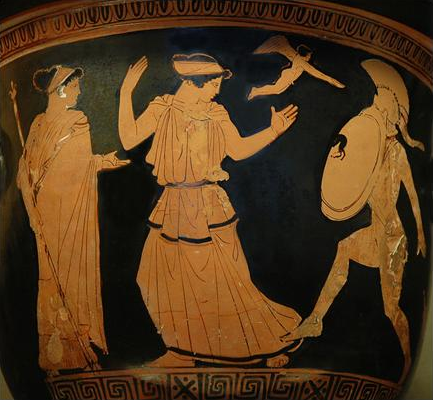
Achilles - mythology
Son of the Thessalian king Peleus and goddess Thetis, grandson of Eac and great-grandson of Zeus, the greatest Greek hero in the Trojan War. Thetis courted Zeus and Poseidon, but when it was prophesied that the goddess would give birth to a son who would be stronger than the father, they withdrew and left Thetis to Peleus. The goddess resisted marriage with a mortal in such a way that she transformed into various animals, but Peleus still managed to marry him.
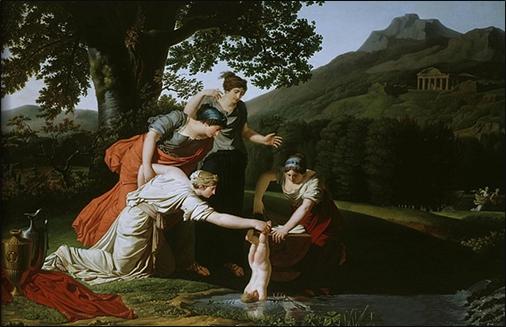
Several legends are known about Achilles' birth and early childhood. He was raised by Tethys in Peleus' house, and was raised by Phoenician or the centaur Chiron. To make Achilles immortal, she anointed him with ragweed during the day and hardened him over the fire at night. One night, Peleus interrupted that dangerous act and snatched the child from its mother's arms. Tethys then left her husband and returned to the depths of the sea to her sisters Nereids. It was later rumored that Peleus did it out of fear for his son's life, because Tethys killed all six children she gave birth to before Achilles with her acts of immortality. Some say that the goddess immersed Achilles in the water of the Styx to make him invulnerable, but that the right heel, which she was holding, remained un wetted and that he could only be wounded in that place (picture below).
After Thetis' departure, Peleus took Achilles to Pelion, the centaur Chiron. That noble centaur first replaced Achilles' ankle, which burned while his mother kept him in the fire. Chiron dug up the bones of the giant Damis, famous for his speed, and inserted the corresponding bone into Achilles' leg; because of this procedure, Achilles was nicknamed the Fastfoot. He was fed and cared for on Pelion by Chiron's mother Filira and his wife Hariklo. Chiron fed him only the entrails of lions and wild boars to gain the strength of these animals, as well as honey, to make him gentle and eloquent. The wise centaur gave him the name Achilles instead of the earlier Ligiron. It was only when he grew up that Achilles returned to his father in Fti.
When Agamemnon was preparing to march on Troy, Nestor and Odysseus came to Phthia to persuade Achilles to go to war with them. Tethys foretold him the fate that awaited him: if he went to Troy, he would have a glorious but short life, and if he remained in Phthia, he would live to old age and be left without glory. Achilles decided on fame and, together with his friend Patroclus and educator Phoenician, led the Myrmidons into the war. Before their departure, Peleus vowed to the river god Sperheus that he would give him his son's hair if he returned home alive.
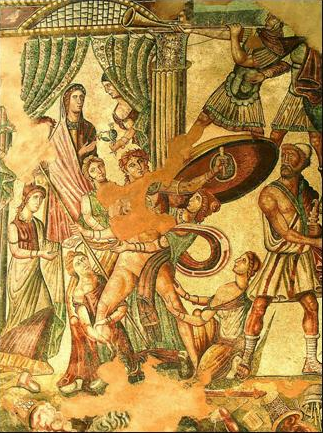
It was later narrated that Peleus or Thetis was prophesied that Achilles would lose his life before Troy. As soon as the preparations for the war began, the parents sent Achilles, disguised in women's clothes, to the court of Lycomedes, king of the island of Scythia. There he, under the name of Pira, spent nine years in the company of the king's daughters. With one of them, Daydamia, he had a son, Pyrrhus or Neoptolemus. When Calhant prophesied that Troy could not be conquered without the participation of Peleus' son, Odysseus, Phoenician and Nestor went to look for Achilles. After Peleus refused to tell them where Achilles was hiding, they, on Kalhant's advice, went to Skir and exhibited jewelry, clothes and expensive weapons in front of the king's court. While the king's daughters were choosing jewelry, in Pira, who grabbed a weapon, Odysseus recognized Achilles. Some say that Odysseus discovered Achilles by suddenly playing the trumpet; at the sound of the trumpet, Lycomed's daughters fled, and Achilles grabbed his weapon (pictured below).
According to another legend, Achilles asked Tindarei for the hand of his daughter Helena. After he rejected him, he fought a war with Tanagra, whose king did not want to go to the Trojan War, and he also occupied the island of Skir to avenge his father's friend Theseus. On Skir, Achilles reconciled with Lycomedes and married Daydamia. When the Greek army gathered at Aulida, Thetis returned him to Phthias, giving him the weapons Hephaestus had given Peleus as a wedding gift, the divine horse Peleus had received from Poseidon, and the slave Mnemon, whose duty it was to prevent Achilles from conflicts with the son of Apollo.
According to the oldest legend, the Greeks arrived without difficulty from Aulida before Troy. It was later rumored that the Greek fleet, in confusion, first sailed to Moesia. Convinced that they were in Troas, the Greeks began to ravage that country, until the appearance of Hercules' son Telephus, who managed to suppress them. Only Achilles and Patroclus remained on the battlefield; Achilles pursued Telephus and wounded him in the leg with a spear. After that skirmish, the Greeks directed the ships towards Troas, but their fleet was destroyed by a storm, which threw Achilles on the island of Skir. Achilles returned to Greece, where Telephus found him and begged him to reconnoiter his wound. When, after eight years, the Greek fleet regrouped at Aulida, Telephus was ready to show the Greeks the way to Troy, but the winds prevented the departure of the ships. In order for the fleet to set off, Agamemnon had to sacrifice his most beautiful daughter, Iphigenia.
Odysseus and Taltibius brought Iphigenia to Aulid, allegedly with the intention of marrying Achilles. Her mother Clytemnestra revealed to Achilles Agamemnon's true intention; Achilles tried to save the girl, but when the army wanted to stone him, Iphigenia volunteered to die. Only then did the Greek fleet, under the leadership of Telephus, set out for Troy. During a short stay in Tened, Agamemnon prepared a great feast, but he did not invite Achilles in time, which is why he had a serious conflict with him for the first time. During his stay on the island, Achilles killed Thenedos, the son of Apollo (picture below).
The following is said about the disembarkation of the Greeks in Troas: Thetis warned her son that the first Greek to enter Trojan soil would be killed, and therefore Achilles was the last to jump out of the ship or did so immediately after Protesilaus. Achilles' leap was so violent that a spring opened under his feet. He immediately suppressed the enemy and stoned Poseidon's son Kikn to death. It was only then that the Greeks pulled the boats ashore and built a camp. They remained in front of the walls of Troy for nine years, and since they did not succeed in conquering the city, the army wished to return to their homeland. To dissuade her from this, Achilles set out on a campaign against the cities of Asia Minor and devastated the whole of Troas. He first seized the cattle that were guarding Aeneas on Ida; in the process, he killed Priam's son Mesther, and released his brothers Isa and Antifa only after he received a large compensation. Aeneas escaped and took refuge in Lirnes; Achilles followed him and destroyed the city, but Aeneas escaped him again. In Lirnes, during the division of the spoils, Achilles received Briseis (Hippodamia) and Astinomus. While on that expedition, Odysseus slandered his friend Palamedes, who, with Agamemnon's consent, was stoned. Because of this, Achilles became angry and clashed with Agamemnon for the second time. One night he captured the Trojan prince Lycaon, and later he killed Priam's youngest son Troilus. When he wanted to see the beautiful Helena, Aphrodite and Thetis enabled him to see her first in a dream, and later in front of the walls of Troy. Achilles conquered both the city of Pedas and Thebes in Asia Minor, where he killed Andromache's father, King Etion, and his seven sons, and captured the queen. He also brought from You the horse of Pedas, whom he harnessed to his immortal horses. Achilles conquered many cities and islands: Colophon, Smyrna, Klazomena, Andar, Lesbos and Skir. At the same time, he received the most beautiful girls as prey, among them Briseis, whom Zeus predestined to separate Achilles from the Greek army.
In the tenth year of the war, Achilles and Agamemnon clashed over the beautiful slave girl Briseis. When he was forced to surrender to Agamemnon, Achilles retreated to his tent and gave up the fight with the Trojans. He angrily went to the seashore, called his mother Thetis and asked her to beg Zeus for the victory of the Trojans. Although reluctant, Zeus promised Thetis that the Greeks would not win until he reconciled with Achilles. After the successive defeats of the Greek army, Agamemnon sent a message to Achilles and promised him the most wonderful gifts, to Briseis, the twenty most beautiful Trojans, the hand of one of his daughters and the seven cities of the moon. Achilles kindly received the deputies, but he stuck to his decision. Then Nestor asked Patroclus to persuade Achilles to return to battle or to allow Patroclus to appear on his battlefield in his war gear, so that the Trojans would think that Achilles was taking up arms again. It was only when the Trojans broke into the Greek camp and started burning the ships that Achilles gave Patroclus his weapon and allowed him to lead the Myrmidons into battle. Patroclus pushed the enemy to the walls of Troy, but there Hector killed him and took off his Achilles' war gear. A fierce battle broke out around Patroclus' corpse; it was only when, at Hera's urging, Achilles appeared with Athena's aegis and a fiery cloud around her head that the Trojans withdrew.
The Achilles' mourning for Patroclus was heard by Thetis, who, with her sisters Nereids, came out of the depths of the sea and promised her son that she would bring him a new weapon from Hephaestus the very next day. Achilles swore that he would not bury Patroclus until he brought Hector's head and weapons on his bonfire, and sacrificed twelve Trojan young men on it. The next day, Thetis brought her son new war equipment (pictured above), and Achilles told the Greeks that he was ready to reconcile with Agamemnon and return to the battlefield. Having received Briseis and rich gifts, he jumped into the chariot, and then ordered his divine horses - Xanthus and Bali - to carry him alive through the hustle and bustle of war. Xant told him that he could still save him today, but that the day of his death was approaching. While searching for Hector on the battlefield, Achilles met Aeneas, when Apollo persuaded him to oppose him. Achilles wounded Aeneas and then killed several of the bravest Trojans, including Priam's son Polydorus. When he learned of Polidor's death, Hector set out to find Achilles, but the gods postponed their meeting. On the shores of Scamander, Achilles captured twelve young Trojans, which he intended for Patroclus' shadow. When he killed Peontus Asteropaius, he incurred the wrath of the god of the river Scamander, who poured out his waters and endangered Achilles' life. Only when the gods intervened and when Hephaestus, at Hera's request, lit a fire that forced the waters of Scamander to retreat, Achilles managed to save himself and return to the walls of Troy. There, in front of the Skate Gate, he met Hector. When he spotted Achilles, Hector fled, but Achilles followed him, so that the heroes ran around the city walls three times. When they ran around Troy for the fourth time, Zeus decided to weigh their destinies. The bowl on which Hector's destiny rested descended toward Hades; then Apollo left Hector, and Athena, in the form of his brother Deiphobus, deceived him and kept him on the battlefield. Achilles killed Hector, then tied his body to his car and dragged him to a Greek camp (picture below).
After fulfilling his vow, Achilles began preparations for Patroclus' funeral. Together with the Myrmidons, he drove around Patroclus' body three times, and then prepared a funeral feast. After that ceremony, Achilles went with the Myrmidons to the seashore, where he was overcome by sleep. In his dream, Patroclus appeared to him, begging him to bury him with dignity as soon as possible, so that he could enter the realm of the dead. The next day, the Greeks raised a huge bonfire and Achilles sacrificed twelve Trojan young men on it. He poured liquid sacrifices all night, and at dawn he extinguished the flame of the bonfire with wine and collected Patroclus' powder in a golden urn. Competitions were organized in Patroclus' part, in which the greatest Greek heroes participated.
Achilles continued to pity Patroclus and dragged Hector's body around his friend's mound three times a day. Apollo protected the body of the Trojan hero from injury, until Thetis told Achilles that the gods were angry because of his actions. Accompanied by Hermes, the reception came to Achilles' tent to beg his son's body from the greatest Greek hero. Remembering his old father and moved by the pain of the Trojan king, Achilles handed over Hector's corpse to Priam.
Later legends mention the fight of Achilles with Penthesilea, the queen of the Amazons. She came to the aid of the Trojans at the moment when they were organizing funeral ceremonies in Hector's honor. When she and her Amazons pushed the Greeks all the way to their camp, she fell at the hands of Achilles. It was only when he plunged his sword into her chest that Achilles saw the face of the Amazon queen and, overshadowed by his beauty, surrendered to sincere pain (picture below). Tersit mocked his feelings and Achilles killed him for it. Later, the love of Achilles and Penthesilea was told, as well as their son Kaister.
After defeating Memnon, the son of the goddess Eos, Achilles reached the Gate of Scythia, where Paris, with Apollo's help, shot him in the heel, the only vulnerable spot on his body. Apollo himself is sometimes mentioned as Achilles' murderer. Some say that Achilles loved Priam's beautiful daughter Polyxena and that that love cost him his life. The fight over Achilles' corpse was so fierce that not even the night interrupted it, but Zeus with a terrible storm. The next day, while Odysseus was pushing the Trojans, Ajanta grabbed Achilles' body and brought it to the Greek camp. Everyone mourned Achilles' death, and Tethys arrived at the funeral accompanied by muses and nereids (picture below). Athena protected Achilles' body from decay with ragweed. After the bonfire was extinguished, Achilles 'ashes were buried, together with Patroclus', in a golden urn, which Dionysus gave to Thetis. In the competitions that were organized after that, the main prize was Achilles' expensive war equipment, for which Odysseus and Ajanth competed.
Achilles' soul went to the underworld. It was later narrated that Thetis took Achilles to the island of Leuca, at the mouth of the Danube, where the divine part of his being continued to live. There Achilles married Iphigenia, Medea, Helen or Polyxena.
Achilles is revered in several places in Greece (Epirus, Thessaly, Laconia), as well as in southern Italy and Sicily. His sanctuaries on the Black Sea are the most numerous, and the most famous is the temple that was built for him on the island of Leuci. The meaning of his name is uncertain, and it first appears around 1400 AD on a tablet from Knossos.
The myth of Achilles has inspired many literary works. It is often shown in fine arts. In addition to his cult statue on the island of Leuci, one equestrian statue of Achilles in Delphi is mentioned, as well as the famous Skopas group, which depicts the goddess Thetis bringing Achilles a weapon. The famous painter Polygnotus presented Achilles in the underworld (in Delphi) and Achilles among Lycomedes' daughters (in Athens). In important painting, Achilles chasing Troilus or Achilles pulling Hector's corpse is most often depicted. The most famous is Hezekiah's amphora, in which Achilles is depicted gambling with the Great Ajanta (last decades of the 6th century AD), then Socia's Cup (Achilles bandaging Patroclus' wounds - around 500 AD) and the Cup from Vulcius (Achilles kills Pentesile - around 460 AD). In Pompeii, the frescoes show Chiron teaching Achilles, as well as Achilles among Lycomedes' daughters.
Literature:
• Dragoslav Srejović - Aleksandrina Cermanović-Kuzmanović, Recnik grčke i rimske mitologije, drugo izdanje, Beograd: Srpska književna zadruga, 1987
Muses - mythology
Nine daughters of Zeus and Mnemosyne: Polychimnia ("rich in hymns"), Clio ("the one who celebrates"), Melpomene ("singer"), Thalia ("solemn"), Urania ("heavenly"), Erato ("the one who challenges longing ”), Terpsichore (“ player ”), Euterpa (“ the one who pampers ”) and Kaliopa (“ beautiful ”). They were born not far from the top of Olympus. There, near the courts of Harita and Chimeros, they had a beautiful palace and a place to play; from there they went to their father on Olympus, with a song that made the whole country roar. And in Boeotia, at the top of Helicon, the muses played around the altar of Zeus and bathed their delicate bodies in the waters of Permes, Hippocrates and Olmeus. Their song in honor of Zeus and other gods does not stop even at night.
Muses also approach people to reveal true truths, but also many lies similar to the truth. They infuse the poets with a divine song to celebrate the future and the past, they keep their eyes on some king, and they sprinkle sweet dew on his tongue so that honey words would flow from his lips. Everyone is happy when the muses fall in love, because then he gives the most beautiful sermons and is able to sing about the glory of ancient heroes and the blessed Olympian gods. The most famous mythical singers are the sons of certain muses (Orpheus, Lynn).
It is said that the muses are the daughters of Harmony, Apollo or Uranus and Gaia. According to the Boeotian myth, there were first three muses: Meleta (Exercise), Mnema (Memory) and Aoida (Singing). Aloadi, the brothers Ot and Efijalt, were the first to offer sacrifices to three muses on Helicon, and they were respected there until a Macedonian named Pierre came to Helicon and introduced the cult of nine muses. Some say that Pierre had nine daughters, nine false muses (Pierides), who competed with the rights.
The muses sing to Apollo's music and warm the hearts of the gods on Olympus. They delight guests with their song at Kadm's and Harmonija's wedding, as well as at Pele's and Tetida's wedding. They also attended Achilles' funeral. In addition to Helicon, muses often reside in Pieria and at the foot of Parnassus, near the source of Castalia. There they are led in song and dance by Apollo, and in the winter months they join Dionysus.
Muses severely punish those who dare to compete with them in singing. Thus, after the competition with the muses, Pieride was turned into a bird, the mermaids were left without feathers, and the singer Tamiri lost his sight and gift of singing.
A divine song is constantly flowing from the lips of the muse, and they inspire poets and singers to create works that remove sadness and worries. The poet turns to the muses to give him inspiration and immortality, and philosophers beg them for good ideas. Only later, a certain creative activity was tied to each of the muses, and the appropriate attributes were added to them. Thus Erato, with a stringed instrument in his hands, becomes the protector of lyrical poetry, especially love poetry; Euterpa, the patroness of playing the flute, is shown with doubles; Kaliopa, with a scroll and a pen, inspires epic poetry and science, and Clio, with a half-open book in his hands, becomes the protector of history. Melpomene, the protector of singing and tragedy, holds a tragic mask, Hercules' club and a wreath of vines. Polychimnia, the protector of anthems, is presented without attributes, always thoughtful and serious; the protector of the game Terpsichore is depicted with a lyre or plectron; Talia, the protector of comedy, is characterized by a comic mask, an ivy wreath and a curved stick, and Urania, the protector of astronomy, is shown with a globe.
Muses - divine beings who teach and help poets, musicians, dancers and thinkers - were originally nymphs of springs and streams, but over time they became deities of song and poetic inspiration because running water was believed to give prophetic inspiration, that is, to foretell poetry. Muses were first revered in Pieria and Boeotia; Pieria is also the homeland of famous Thracian poets and singers, such as Orpheus, Lynn, Tamirius and Musei, and there are also muses associated with the cult of Dionysus. In the sanctuary of the muses on Helicon, great ceremonies were organized every fifth year, with music competitions (Museums). The cult of the muse is related to all places where science and art are nurtured - to schools, high schools and philosophical circles. Statues of muses were placed in those places.
In fine arts, muses are represented on vases of black-figure and red-figure style, but they have only been shown in monumental art since the Hellenistic era. There is a famous relief from Mantinea (around 330 to 320 AD) and a group of muses that may be the work of the sculptor Philiscus of Rhodes (3rd century AD). Archelaus of Priena presented Homer's apotheosis in the presence of the muses (around 125 AD). A large number of Roman sarcophagi with representations of muses are known, and in late antiquity, muses were represented alongside certain philosophers on ivory diptychs.
Literature:
• Dragoslav Srejović - Aleksandrina Cermanović-Kuzmanović, Recnik grčke i rimske mitologije, drugo izdanje, Beograd: Srpska književna zadruga, 1987
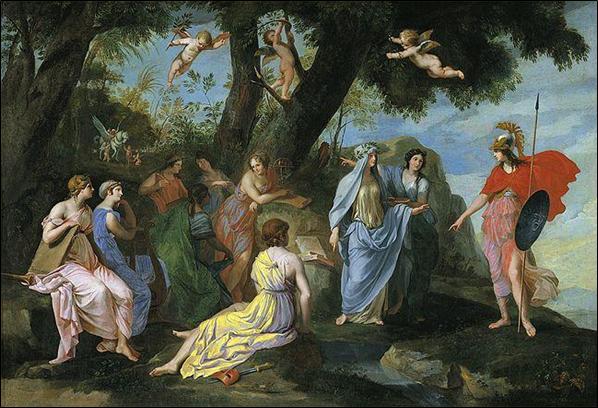
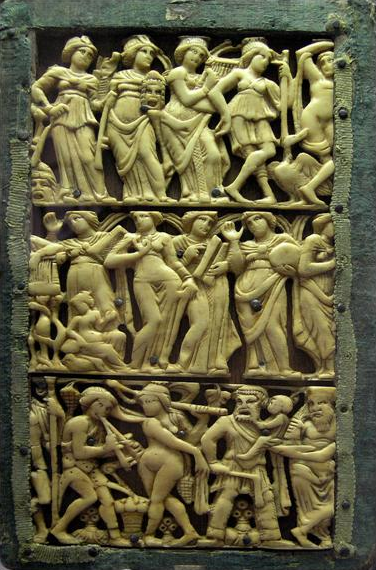
A Serbian scientist discovered everything about the corona virus
So far, no one in Serbia has explained to the citizens what they need to know about the coronavirus and how to behave accordingly. Till today.
This is exactly what the world-renowned Serbian scientist Dr. Milanko Shekler, doctor of veterinary sciences, did, who was the first, with his expert team at the Veterinary Specialist Institute in Kraljevo, to "read" the genome of coronavirus in Serbia, which is entered in the world database.
People don't know
According to him, most citizens are very unfamiliar with important facts, which would be of great use to them in the daily implementation of measures to protect themselves and their families, as well as other people, from the coronavirus.
-Today, in terms of knowledge of coronavirus, advanced or experienced scientists are almost non-existent in the whole world - because this virus is relatively new and has been intensively studied for less than a year. So we are all, at least for this new coronavirus, including my little one, more or less complete beginners, and at least for now, guaranteed "losers". In order for that not to happen in the future, we will all have to work on informing as many people as possible. Of course, with the assumption that all those professionals, for whom viruses, epidemiology and immunology are the field of work - must do their best to find, to begin with, the least "harmful" and, in the future, the best possible solution for stopping the existing human coronavirus pandemic - says our scientist.
source: google
According to him, "we who deal with infectious animal diseases, ie veterinary virology, know and" fight "with this group of viruses, in different types of domestic animals, chickens, pigs, cattle, dogs, cats for almost 100 years."
-Production of vaccines against this disease of chickens, as well as the beginning of vaccination in chickens began to be carried out intensively in the early sixties, which means that veterinary medicine has more than half a century of experience in the use of vaccines against coronavirus infections in chickens! According to that accumulated half-century experience in the fight against coronavirus, we can use a lot of things in the fight against this new human or strain that infects people - he explains.
It is not a respiratory virus
According to Dr. Shekler, this coronavirus is a systemic virus, infecting all organs, not the respiratory ones.
- It infects the entire human organism, ie almost all its organs. This means that regardless of the fact that the respiratory organs are the entrance door to coronavirus infection - pharynx, larynx, nose, sinuses, trachea, lungs, etc.…, it spreads very quickly after multiplication in these organs, through the bloodstream and probably lymph flow throughout organism. Of course, since the coronavirus first infects the respiratory organs, the harmful consequences of its presence and reproduction are the easiest and first noticed - he points out and adds:
- And, surely, the most extensive and dangerous inflammations of the nasal mucosa, throat, pharynx, sinuses, trachea, bronchi and, finally, severe pneumonia, because the infection gradually progresses in this order: from the upper parts of the respiratory organs "descends" deeper and deeper. , to the lungs - explains the expert, adding that the most important thing is for all of us to learn important things about coranivurus.
Coronavirus
-All viruses can, among other things, be divided into those that do not have a membrane and viruses that have one. This second group of viruses, those that have a coating, includes all coronaviruses, including this pandemic. This envelope, as a rule, also contains a large proportion of lipids or fats, which makes such viruses much more sensitive to the action of the external environment. Therefore, these viruses are very sensitive to drying because they quickly lose their infectivity on dry surfaces, such as tables, glasses, tablecloths, handles, windows, walls, concrete. Also, they are sensitive to high temperatures because 56 degrees Celsius drastically reduces their infectivity. They are also sensitive to all types of disinfectants, even ordinary alcohol, as well as all detergents and soaps, which, as a rule, dissolve fats. These are viruses, which, when found in our stomach, are instantly killed by stomach acid, so they cannot infect our intestines and other internal organs in that way - our scientist states.
They are very sensitive
Dr. Milanko Shekler continues that coronaviruses are also very sensitive to the external environment and that it is very difficult for people to become infected by "picking them up" somewhere, from a surface or object.
- Theoretically, you can be infected with the coronavirus through the infected surface of a table, glass, window. Just in case the infected person threw or spat on that surface, and after a few minutes you touched it while it was still wet and "injected" viruses into your nose or mouth. So that's just a theory. From the very beginning, that is why no one mentions wearing gloves in everyday life. Because coronaviruses can survive and be transmitted to other people only if they are protected in a body fluid, such as saliva or saliva, feces, urine or blood - he states.
Describing the behavior of the coronavirus when it enters the human body, Dr. Milanko Shekler reveals:
-The coronavirus, in order to infect someone, must first bind to the surface of precisely defined cells of our body. It cannot enter the body through skin or facial cells, but only through the cells of our nasal mucosa, throat, sinuses, trachea or lungs. The coronavirus, in that case, must bind to precisely defined places on the surface of the mentioned cells. These places are called receptors. We will imagine that those places are like doors on the house, through which it is only possible to enter it. Well, the coronavirus also uses specific places, which have the role of a "door" for entering the cell and infecting it - this scientist is picturesque, noting that only then and only then can the coronavirus pass through the "entrance door" and enter the cell .
Like the boss of the house
He adds that when the virus is found in the cell, it immediately starts behaving like the "boss of the house".
-The virus starts to use everything that is in that cell and has only one goal - to produce as many new particles of coronavirus, its descendants, and so efficiently, that from one virus thousands and tens of thousands of new ones are formed, in just a few hours or days. Then that infected cell bursts, disintegrating from so many newly formed coronaviruses. All these new, young viruses, after leaving the cell, immediately stick to the surrounding healthy cells and enter them, multiplying again and causing the same effect. This practically describes the very beginning of the infection, which lasts only a few hours or at most a few days. During this period, the infected person usually has no symptoms of the disease - he explains and continues:
Symptoms
-The symptoms of the disease appear only in a few days. During that time, the infected person has no signs of the disease, but it contains millions and billions of virus particles, which penetrate deeper and deeper into the body. At the same time, such a person begins to expel coronaviruses from the body through exhaled air, but also with tiny drops of saliva while talking, singing or shouting. At the moment of getting the symptoms of the infection, the infected person starts sneezing and coughing, throwing out millions and tens of millions of viruses all around him - Dr. Shekler is clear.
As he points out, sometimes someone does not show any noticeable clinical signs of the disease at all, which is most often the case when it comes to children or young people.
Asymptomatic cases
- But also middle-aged and even older people. One can have such mild symptoms that it is difficult to notice them. Slightly stuffy nose, transient fever of only 37.1 or 37.2 degrees, headache… These are the so-called asymptomatic cases of coronavirus. Luckily, these people are much harder to infect others because they do not shed such large amounts of coronavirus. Only by sneezing and coughing, droplets of saliva, saliva or mucus full of viruses are expelled, at a distance of about five to six meters - he reveals.
As Dr. Shekler points out, in order for another person to become infected, an infectious dose of the virus is necessary, and that is a precisely determined amount of coronavirus, expressed in an approximate number of particles, which is needed to enter someone's organism.
When an infection occurs
-The latest research data indicate that the amount of coronavirus, which needs to enter your throat, nose, sinuses, throat, lungs, in order to become infected, is between 500 and 1,000 virus particles, in a period of several hours. Such a quantity is necessary for the virus to be able to "break through" through the defense system and successfully start to multiply and cause infection and clinically manifested disease - he describes and adds that the higher the amount of viruses, the more severe the disease.
However, as he explains, if you inhale 30 or 50 virus particles, there is a high probability that you will not get sick at all, because your many white blood cells will be able to "beat and tear" all those 50 "robber" particles, and you will not even know about it. "Battle" in your body.
If you hug a sick person
-On the other hand, if you inhale or inject several thousand or tens of thousands of viruses at once, for example, hug an infected person and sing together at a wedding, celebration, birthday, concert or nightclub, then the amount of virus is large enough to "Overcomes" your defense capabilities and manages to infect several of your cells - he states.
There is something else very important, says Dr. Shekler, and that is the fact that our organism can successfully fight every day with a small amount of coronavirus, a few dozen, up to a few hundred, without getting sick.
Immunity
-And, as time passes, and you ingest that small number of coronavirus particles every day or every few days and your immunity easily defeats them, then your body feels more capable and stronger and fights the coronavirus more and more successfully. It is becoming increasingly difficult for the coronavirus to infect it. This is what is called "herd immunity". At the same time, that would be my explanation of the so-called "Madrid miracle", that is, the inexplicable decline in the number of newly infected and seriously ill people in Madrid, although preventive measures in that city are "weakened" and everything works until midnight - he points out. this happens when the proportion of people in a population who have been in contact with small amounts of coronavirus is close to 50 percent of the total population.
- Practically, the coronavirus then finds it increasingly "difficult" to find new, healthy and susceptible individuals, who have never had contact with the coronavirus before. Such a scenario will probably be seen more and more often in the world, even in Serbia. Maybe it will happen in our country somewhere in the middle of December, at the latest by the New Year - that scientist finished.
source:24 sedam


Multiple sclerosis - what you need to know
Multiple sclerosis is a disease of the brain and spinal cord, ie. central nervous system. In multiple sclerosis, the immune system attacks the protective myelin sheath that covers the nerve fibers and thus causes communication problems between the brain and the rest of the body. Ultimately, multiple sclerosis can cause worsening and permanent nerve damage.
The signs and symptoms of multiple sclerosis can vary and depend on the amount of damaged nerves, but also on which nerves are affected by this disease. Some people with MS may lose the ability to walk independently or walk at all, while others may have long periods of remission without any new symptoms.
There is no cure for this disease. However, a successful diagnosis of multiple sclerosis leads to treatment that can speed recovery from the attack, modify the course of the disease and alleviate its symptoms.
Symptoms of multiple sclerosis
The signs and symptoms of multiple sclerosis can vary greatly from person to person and during the course of the disease depending on the location of the affected nerves.
Motor and sensory symptoms are as follows:
• Stiffness, numbness or weakness of one or more limbs that typically occurs on one side of the body at the same time.
• The feeling of current passing through the body during certain movements of the neck, especially when bending forward (Lhermitt's sign).
Fatigue, lack of coordination and unsteady gait.
• Involuntary, painful muscle spasms.
• Unintelligible speech.
• Tingling, tingling.
Vision problems are also common:
• Partial or complete loss of vision, usually in one eye, often accompanied by pain when moving the eyes.
• Involuntary twitching, flickering and play of the eyeballs
• Extended double image.
• Loss of color vision.
Other symptoms of multiple sclerosis can be:
• Fatigue.
• Dizziness.
• Impairment of sexual functions.
• Disorders of urination and defecation.
• Sleep disorders.
• Appetite disorder.
• Lethargy and loss of will to live - depression.
• Unexplained good mood.
Causes and risk factors
The cause of multiple sclerosis is not yet known. It is considered an autoimmune disease in which the immune system attacks its own tissues. It is not entirely clear why multiple sclerosis occurs in some people and not in others. However, it is assumed that it is a combination of genetic factors and environmental factors in which we live. So, the factors that can contribute to the development of this disease are the following:
• Age - most common in people aged 16-55.
• Gender - occurs three times more often in women than in men.
• Family history - if one of the parents or siblings has MS, the risk of developing the disease is higher.
• Certain infections and viruses - herpes virus type 6, virus that causes infectious mononucleosis, etc. are associated with this disease.
• Ethnicity - people from northern Europe get sick more often than others.
• Climate - there is a higher risk in countries with temperate climates such as Canada, the northern part of the United States, New Zealand, Southeast Australia, European countries.
• Vitamin D - low levels of vitamin D and insufficient sun exposure increase the risk.
• Certain autoimmune diseases - thyroid diseases, type 1 diabetes, inflammatory bowel diseases contribute to a higher risk of disease.
• Smoking.
Diagnosis of multiple sclerosis
There are no specific tests to detect multiple sclerosis. Instead, the diagnosis of multiple sclerosis is usually made with the removal of suspicion of the existence of other diseases with the same or similar signs and symptoms.
In any case, you must consult a doctor, and your doctor can refer you to:
• Blood test.
• Lumbar puncture and cerebrospinal fluid analysis.
• Measurement of electrical activities of the brain - evoked potentials.
• CT (scanner) of the brain
• MR - magnetic resonance imaging of the brain.

Cyclops - mythology
Many myths testify to what the Cyclops looked like, but not to how many there were and what their origin was. In the oldest tradition, the Cyclops are defiant one-eyed giants who live in the far west, on the tops of high mountains, separately, in spacious caves, where they rule over women and children at will. They do not know the laws, they do not plow or sow the fields, but they still sprout wheat and bear vines. These enemies of gods and people possess enormous power and a terrible voice, have only one eye each and consider themselves stronger than Zeus. They devour people because they are afraid of being robbed of their flocks. Cyclops are opponents of all progress, they do not know seafaring, and their only occupation is grazing herds and making cheese. The most famous of these cyclops is Polyphemus, the son of Poseidon and Fork's daughter Toosa. Odysseus blinded him, which is why he drew the eternal hatred of the god of the sea on himself.
Polyphemus possessed great power. Stupid and insensitive, he was not afraid of the gods and lived alone in a cave near Mount Etna in Sicily. That one-eyed cannibal spent all his time with flocks of goats and sheep. When Odysseus arrived in the land of the Cyclops, Polyphemus imprisoned the hero and his twelve companions in his cave. They soon found themselves in mortal danger, because Polyphemus immediately devoured two of them. Odysseus got drunk and blinded Polyphemus with a red-hot stick, and then, thanks to his cunning, he came out of the cave with his friends. The ingenious Odysseus tied his comrades and himself under large rams and so, hidden in their fleece, they escaped from the cave.
Later tradition knows of three Cyclops - Bront, Sterop, and Argy - the sons of Uranus and Gaia; they were born after titanium, and before hekatonheir. These terrible giants were captured underground by their father, from where Zeus freed them when he started the fight against Crohn's. As a sign of gratitude, Bront, Sterop and Argej, whose names signify thunder and lightning, gave Zeus lightning and thunder. Some say that the Cyclops were freed by the Titans, that Crohn threw them back into Tartarus, and that they remained there until Zeus killed the monster Campus, who was guarding them. After they were released, the Cyclops gave Zeus lightning and thunder, Hades - an invisible hat, and Poseidon - a trident. Later, Apollo killed the Cyclops because he held them responsible for the death of his son Asclepius, when Zeus killed him with lightning. Apollo then killed the Cyclops, the creator of lightning, to avenge Zeus for his son's death.
In the younger tradition, the Cyclops are the oldest inhabitants of the islands of Sicily or the Aeolian Islands, where, in volcanic craters, deep underground, they have workshops in which, by Hephaestus' order, they make weapons for the gods. Etna is most often mentioned as their seat.
The Cyclops are also mentioned as the builders of the giant ramparts of Mycenae, Argos and Tiryns. It is said that these cyclops were translated by Pret from Lycia to the Peloponnese and that he first entrusted them with the construction of the ramparts in Tiryns. Then they built the ramparts of Mycenae, and then Perseus brought them to Argos.
In fine arts, starting from the 7th century AD, the encounter of Odysseus and his friends with the Cyclops Polyphemus is often depicted, and most often - the motif of Polyphemus 'blindness or Odysseus' escape.
Literature:
• Dragoslav Srejović - Aleksandrina Cermanović-Kuzmanović, Recnik grčke i rimske mitologije, drugo izdanje, Beograd: Srpska književna zadruga, 1987
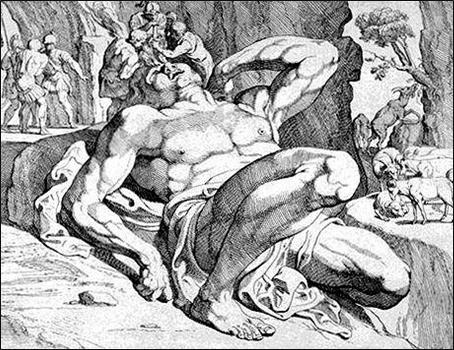
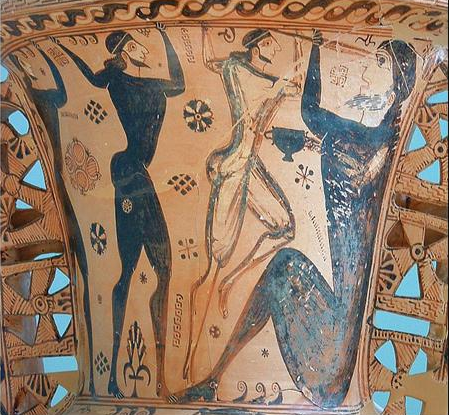
Pandemics throughout history
The corona is not the only plague that plagues the world, millions of people have died from severe infectious diseases throughout history, and some of them have remained an enigma for scientists to this day.
Throughout the history of the world, most people have died from infectious diseases that have spread at an unbearable rate. However, in the past, infections spread more slowly than is the case today, and the reason is population density. The history of action is very long, and the first major epidemics were recorded in the distant past.
Athenian plague (430 BC)
The plague of Athens was adopted as the name for the epidemic of this contagious disease that broke out during the second year of the Peloponnesian War, in the city-state of Athens in ancient Greece, while the city was under siege by the Spartans.
Foto: Profimedia
According to the estimates of medical historians, about a third of the inhabitants of the city and its surroundings died from this disease. Part of historians use the Athenian plague to mark the period of the end of the Golden Age of Athens, because it considered the plague to be the reason that Athens lost not only the Peloponnesian War, but also its influence in this area as the dominant force among Greek polises.
Symptoms: Fever, swollen throat and tongue, red skin and tissue damage and changes.
Black Death (1347 - 1351)
It ravaged Europe in the Middle Ages, taking the lives of 75-200 million people, or a third of the then European population. Most scientists believe that the Black Death was a plague pandemic, while some believe that it was a virus similar to Ebola. An analysis of the ancient DNA of the victims of the disease in Europe determined that the responsible pathogen is the bacterium Yersinia pestis.
Foto: Profimedia/ilustracija
The Black Death originated in China in 1334, and then slowly spread to the west. In 1346 it reached Egypt, Syria and then Crimea, and in 1347 it reached Constantinople, Sicily and then southern Europe. In 1348 it reached France, the Netherlands, Germany and England, and in 1349 it reached Scandinavia and Russia.
Symptoms: They occurred 2 to 5 days after exposure to the bacteria. Symptoms began abruptly with fever and fever up to 41o C. The heartbeat became rapid and weak, and blood pressure dropped slightly.
The Great Plague in London - The Bubonic Plague (1665)
The plague that killed more than a quarter of the population of London in 1665 and 1666 was the last major outbreak of bubonic plague in Great Britain. It took a year to confirm the discoveries from the funeral pit, which was supposed to be the location where the plague victims were buried, and which is located in Liverpool Street.
Foto: Profimedia
- Few people who become infected survive, but there have been such cases. The plague was reportedly very easily transmitted from person to person, although we are still not sure how it happened - said Vanessa Harding, a history professor at the University of London, adding that all measures were taken then to limit the spread of the plague, but that they were best yet those who fled London passed.
Symptoms: In addition to sensitive, enlarged lymph glands, which can be egg-sized, symptoms include fever, chills, headache, muscle aches and fatigue. Plague can also affect the lungs, causing coughing, chest pain and difficulty breathing.
Cholera (1817)
The first of seven cholera pandemics in the next 150 years broke out in Russia, where a million people died. The bacterium was transmitted through water contaminated with feces and food, transmitted to British soldiers who then brought it to India, where a million people died. Given the size of the British Empire and the activities of its fleet, cholera spread to Spain, Africa, Indonesia, China, Japan, Italy, Germany and the United States, where another 150,000 people died.
Foto: Profimedia
According to some estimates, 3-5 million people worldwide were susceptible to cholera at that time, and it caused 28,800-130,000 deaths a year. Although currently classified as pandemic, it is rare in the developed world. The children were mostly affected. Cholera appeared as an epidemic and as a chronic disease in some areas. Areas with a persistent risk of disease include Africa and Southeast Asia. The cholera vaccine was found in 1885, but the pandemic appeared several more times.
Symptoms: May be manifested by a mild, uncomplicated episode of diarrhea; or it can be a fulminant, potentially deadly disease. The initial symptoms are usually sudden, painless watery diarrhea and vomiting. The consequence of severe loss of water and electrolytes leads to strong thirst, oliguria, muscle cramps, weakness and significantly weakened skin turgor with inflamed eyes and wrinkled skin on the fingers.
Spanish Fever (1918)
During the three waves of Spanish flu or Spanish flu in 1918 and 1919, experts estimated that between 50 and 100 million people died worldwide. Direct comparisons between the pandemic then and today do not work today: the world did not know then why people die. Viruses as pathogens were discovered only in 1933.
The virus was deadly because the immunity of many people was weak due to malnutrition caused by the circumstances of the war. The drug penicillin was not found until 1928, so in 1918 there was no drug to stop bacterial infections in a weakened organism, which led to fatal pneumonia. Chroniclers note that, for example, people in the United States fell ill overnight and died in the morning on the way to work. According to the American Center for Disease Control and Prevention (CDC), the Spanish fever was deadly and was manifested by rapid and serious lung damage.
Symptoms: A few hours after feeling the first symptoms, extreme fatigue, fever and headache occurred, and the victims would turn blue. Sometimes the blue color would become so pronounced that it was difficult to determine the original color of the patient's skin. Patients would have had such a strong cough that some even tore their abdominal muscles. Foam and blood rushed from his mouth and nose. Some also bled from their ears, some vomited, and others could not control their behavior
SARS (2002-2003)
Severe Acute Respiratory Syndrome or SARS (Severe Acute Respiratory Syndrome) is a contagious disease that was first observed in November 2002 in the Chinese province of Guangdong, and has become more widespread since early February 2003 due to a growing number of patients in Hong Kong, Singapore. Vietnam, Taiwan and Bangkok, half of whom were health workers who cared for the sick.
After several months of research, it is now known that severe acute respiratory syndrome is etiologically associated with the new, hitherto unknown, SARS-CoV (SARS-associated Coronavirus). Evidence of SARS-CoV infection has been found in SARS patients in several countries (serological or RT-PCR positivity, increase in virus on cultures).
Symptoms: Sudden and rapidly rising, high temperature (over 38 ° C), inflammation of the pharyngeal mucosa with cough and hoarseness, shortness of breath, muscle aches, headache.
Avian Influenza (2003-2007)
Avian influenza is a contagious bird disease caused by certain strains of influenzavirus A (some other strains of the virus cause human flu epidemics). Influenza virus is extremely variable and subject to constant genetic changes (mutations and gene changes between strains), so it appears in a large number of subtypes and strains, of which only a small number leads to severe disease in birds. One such pathogenic strain (subtype H5N1) was first recorded in 1997 in Hong Kong and has since spread to much of Asia and Eastern Europe.
Foto: Profimedia
The total number of birds that died from the flu or were killed to prevent the spread of the infection is estimated at around 120 million.
Symptoms: Incubation and symptoms are similar to those of the human influenza type. Incubation in adult patients lasts 7 days, while in children it takes 21 days. The death rate (lethality) in human flu is below 0.05%, unless it is a large and severe pandemic with a new type of virus, and in bird flu as much as 30 to 70%.
Swine flu (2009)
Swine flu is a highly contagious disease caused by different strains of the flu virus. The prevalence of this disease is high among pigs, but only 1-4% of cases end in death. Outbreaks among pigs are relatively common and mainly occur in autumn and winter, so a large number of countries carry out routine vaccination.
Sometimes the infection can be transmitted from animals to humans, so occasionally cases of human disease have been reported. Of the three genera of influenza viruses (Orthomyxoviridae) endemic to humans, two are also endemic to pigs: influenza A virus and influenza B virus.
Symptoms: The symptoms of swine flu (H1N1) are very similar to the symptoms of the common flu. In many cases, diarrhea (diarrhea) and vomiting occur as a symptom of swine flu, and cases of pneumonia have been reported.
Ebola (2013-2016)
It is one of at least 30 known viral diseases and one of four life-threatening quarantine hemorrhagic fevers, with a high mortality rate. As the virus can remain in the ejaculate of Ebola patients for up to three months, it can also be considered a sexually transmitted disease.
This dangerous human disease is caused by ebolaviruses which are currently classified into five separate species: Zaire (EBOV), Sudan (SUDV), Bundibugijo (BDBV), Forest (TAFV) and Reston (RESTV)] and are all endemic in Africa except the Restor strain which is also endemic in parts of Southeast Asia and China. The immunopathogenesis of Ebola is complex and requires serious research. Severe forms of the disease are accompanied by numerous complications, multiple organic failure of functions and signs of septic shock. Mortality ranges from 55% to 75%, sometimes more.
Symptoms: Nausea, vomiting, and diarrhea, along with decreased liver and kidney function. which can lead to bleeding.
COVID-19 virus (pandemic of the modern world)
Coronavirus disease in 2019, recognized by the abbreviation kovid 19 or COVID-19 (Coronavirus disease 2019), is an infectious disease caused by severe acute respiratory syndrome virus corona 2 (SARS-CoV-2). The disease has spread worldwide since 2019, leading to the coronary virus pandemic 2019/20.
The disease is still unexplored.
Symptoms: Muscle pain, sputum production and sore throat. In most cases, mild symptoms occur. On the other hand, more severe symptoms include pneumonia and organ failure.
Mermaids - mythology
Mermaids are omniscient demonic beings, who stop the winds with a song, calm the sea and enchant sailors.
When Odysseus returned from the underworld to the island of Eyu, Kirka showed him all the dangers that awaited him on his way to his homeland. She told him that she would pass by an island on whose flower meadows sit two mermaids, surrounded by the bones of unfortunates who stopped boats to enjoy their song. In order to happily pass by the Mermaid Island, and still hear their enchanting song, Odysseus ordered his friends to tie him tightly to the catarrh, and covered their ears with wax. As the ship approached the island, the sea calmed down and Odysseus heard the sirens calling to him with a ringing song. The hero wanted to meet them, but his friends tied him tighter and rowed faster.
It was later said that three mermaids tried to stop Odysseus' ship - Pisinoi, Aglaop and Telexia (or Parthenope, Lygea and Leucosia), the daughters of the river god Aheloi and Muse Melpomene or Terpsichore. One played the lyre, the other the flute, and the third sang. These demonic beings were prophesied to die as soon as a ship passed them without stopping. When Odysseus and his friends passed by the mermaids, they died of despair or crashed into the sea and turned into rocks. Some say that the Argonauts passed by the Mermaid Island before the Odyssey and that, thanks to Orpheus' enchanting gig, they did not become their prey.
Several other legends are known about the origin, number and destiny of mermaids. The sea god Fork is mentioned as their father, and some say that they are the offspring of Aheloy and Portaon's daughter Steropa. It is said that mermaids were born during the fight between Heracles and Aheloy around the arm of Aeneas' beautiful daughter Dejanira, from drops of blood that fell to the ground at the moment when the hero Aheloy, who had turned into a bull, broke his horn. Some mention four mermaids: Teles, Rydna, Molpa and Telksiopa.
The mermaids were first of all beautiful girls, inseparable friends of Demeter's daughter Kore (Persephone). When Hades kidnapped Kora, the mermaids begged the gods to give them wings, so that they could look for a friend by sea and land. Their request was granted: they got bird feathers and legs, and kept the girl's face and voice. Others say that Demeter changed their character to punish them for not keeping their friend Kora more vigilant, or that Aphrodite took away their beauty because they despised the pleasures of love. According to that second, later version, after the birth of a beautiful girl, they became winged freaks, keeping a beautiful face and a beautiful voice, because they insulted the goddess of love and beauty, Aphrodite. She turned them into winged monsters because they did not give in to the ecstasy of love. Their bird feathers later became the prey of the muses. When the mermaids, at Hera's urging, competed in singing with the muses, the beautiful voices of Zeus' daughters defeated them and made crowns out of their feathers.
The mermaids were very ashamed of their appearance, so they sought refuge far from people and found it on a rocky island not far from Scylla and Charybdis. Mermaid Island was located in the western Mediterranean, near Cape Poseidonion or Pelora. Some say they reside in the underworld, where they care for the dead and mourn them. Their melodious song also made them a personification of cosmic harmony: there is one siren in each of the celestial spheres, and their voices are set to create perfect harmony.
Mermaids are winged demons of death, akin to ceramas and harpies, closely associated with the deities of the underworld. Their character is taken from oriental art. The oldest mermaid paintings come from the eastern regions of the Greek world. On the monuments from the VIII and VII century AD, they are shown with outstretched wings and faces, and on later ones - with folded wings and in profile. Beginning in the 6th century AD, mermaids were sometimes depicted as bearded creatures. On Attic vases from the 5th and 4th centuries AD, their hands and female breasts were added. They were later understood as muses of the underworld and were often depicted on tombstones and sarcophagi.
Literature:
• Dragoslav Srejović - Aleksandrina Cermanović-Kuzmanović, Recnik grčke i rimske mitologije, drugo izdanje, Beograd: Srpska književna zadruga, 1987
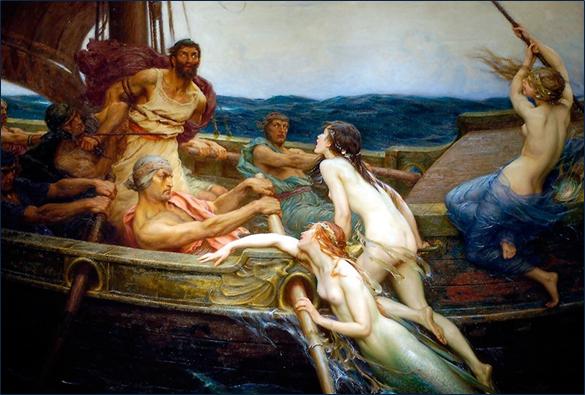
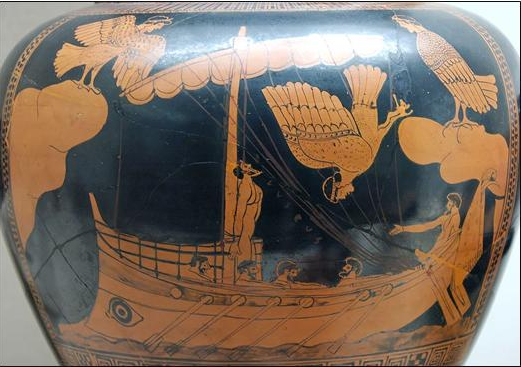
Here, theorists, let's see HOW IT IS IN PRACTICE
A few days ago, it was officially a year since the first case of coronavirus was recorded. Since then, until today, we have had the opportunity to see through the stories of health workers, patients, as well as their families, the strength of this, body-destroying virus.
Branislav Sjeran, a young man from Mladenovac, is one of those fighting the battle against the crown from a hospital bed. He turned his experience, as well as the great sacrifice of health workers, into a status on Facebook, which became viral in a very short time due to the way it was written.
Namely, in addition to describing how the treatment procedure works, and in what condition it is now, he satirically referred to conspiracy theories spread by "antimaskers" and other conspiracy theorists, which the virus, which has been killing lives for a year, does not see. as a serious threat to humanity, but a global conspiracy that serves only to intimidate humanity. With his permission, we transfer the status to you in full:
FOR SMART
“I scratched my bed. It’s not evil, but it’s not fine either. Pneumonia, until yesterday regular temperature for a week. Today is the first day without any temperature.
Doctors and nurses died. I'm sorry to ask them anything. It is difficult to explain how many perished. It's not a "fuss, let's all act for two hours now", but the action never stops. The same sister comes to us on the third day, all day. Yesterday at 5 pm he says he is going to have breakfast. They also withdrew some students, it can be seen that they are children, they are more frightened than the patients and they do little, they measure oxygen, but at least they have more people to visit the rooms more often. Which is rare again. I am in the hospital which is open for kovid on Friday. It's completely full. A woman who was taken to the intensive care unit was lying in my bed a couple of hours before me. They try to divide the rooms into men's and women's, but it is not always possible due to the crowd. Where there is a bed there you go.
Everyone in my room has pneumonia. No one lies ‘after. Do not leave the room.
I am writing this not to scare anyone, but as a personal experience to know what it looks like on an easier level of a hospital. Beware, the question is how many more people can serve before they completely fall apart. And they're really trying. "
In the second part of the status, the guy sarcastically refers to conspiracy theorists and their insulting insinuations that patients are somehow "paid to pretend to be ill":
FOR SMART ENOUGH
It's nothing to me. He applied to cool me for a couple of days, when 70,000 came to my account. They say that from Soros. He got it from Gates at the exit. We immediately ordered a roast from the room and a party with us tonight. Tomorrow we play a hockey tournament with a floor below. We'll break them, half the grandma there.
This weekend, they are taking us to see where the stolen votes for Trump are kept.
Of the drugs, only preventive communion with the same spoon. And not for kovid, it doesn't exist, but for general health anyway ", stated Branislav at the end of the status, who in this way, through satire, wanted to explain to everyone who doesn't believe in the crown, and sees a world conspiracy in it as well. , that's all, just don't play
source: blic

A FOOTBALL DEITY, and he ended up as a FAILURE
On this day, November 25, 2005, one of the best football players in the world ever passed - the legendary George Best.
On the field, he was considered a football deity, because of his abnormal alcohol consumption, he went for a liver transplant, but even that did not stop him from continuing to hang out with the syringe.
FOTO: PROFIMEDIA
George Best was born on May 22, 1946, and he was a winger for Manchester United and the Northern Ireland national team.
He was a member of the famous generation of 'Bazbi's babies', which brought Manchester its first European Champions Cup in 1968. In the same year, he was named the best football player in Europe in the traditional French football poll.
In numerous polls, he is ranked among the best players in the world of all time, and in his native Northern Ireland, he was elevated to the status of a deity.
https://youtu.be/uJWWA-h_-5g
In 10 years spent at United, he had 466 appearances and 178 goals scored.
He was known for his long black hair, charm and extravagant lifestyle. He could not resist numerous vices. Alcohol, nightlife, beautiful women ... were challenges he couldn't handle. George was a front-page guy and was loved by both the rich and the working class. He had it all. Women adored him because men respected him, and men respected him because women adored him.
FOTO: PROFIMEDIA
The famous statement: "I gave up women and alcohol in 1969 - it was the worst 20 minutes in my life", best describes his way of life.
A debauched life cost him his career, but also his life in the end. He left top football at the age of 26. He spent the next 11 years playing for second-rate clubs around the world, only to definitely leave football in 1983.
FOTO: PROFIMEDIA
He hit rock bottom in 1984 when he was serving two months in prison for driving under the influence of alcohol and attacking police officers. In 1988, friends gathered for a friendly match to raise money to prevent his bankruptcy. 75 thousand pounds were collected.
His 30-year struggle with alcohol replenished journalistic columns in March 2000. George Best was admitted to the hospital due to liver problems and was strongly warned by the hospital staff: Stop drinking or he will kill you. He was admitted to the hospital again in 2001 due to lung problems. In 2002, he underwent a liver transplant at King's College Hospital, which was at the expense of the state, which was condemned due to his problem with alcoholism. That conviction was justified because in 2003, he was seen drinking a syringe in front of everyone.
Best was admitted to intensive care on October 3, 2005, due to a kidney infection, which he received because he was taking medication that was supposed to prevent him from continuing to drink. On November 20, a British tabloid published a picture of him in a hospital bed, where he sent a message:
"Don't die like me."
He died on November 25, 2005, at the age of 59.
https://youtu.be/hJw7tnLHxA4
About 100,000 people gathered at his funeral in his native Belfast, who, despite the rain that fell all day, came to pay their respects to the best football player in Northern Ireland and one of the best players of all time.
His compatriots also repaid him by naming the international airport in Belfast after him, and the Ulster Bank issued a million five-pound sterling banknotes with his image on the anniversary of his death.
Fans will remember him as a great player, who was side by side with greats like Beckenbauer ...
https://youtu.be/qs6WTt7atic
Legendary statements of the first football superstar
George Best will be remembered for the statements that many still quote today.
"I gave up women and alcohol in 1969 - it was the worst 20 minutes of my life"
"I've been with at least 2,000 women. No need to seduce them. It was enough to just say, 'Hello, I'm Best of Manchester United.' '
"If Matt Besby had been stricter with me by any chance, I might have been better. I always ran away, I thought I could do whatever I wanted. The team's rules didn't apply to me."
"I spent a lot of money on women, alcohol and cars. I wasted the rest."
"I was born with a great gift, and with it comes destructive behavior.
They say I slept with seven muscles of the world. I had to disappoint them. I was only four when I came out with three. "
"I lived my life and drank on time."
"When I played in the US, I lived in a house by the sea. I never took a bath because there was a bar nearby."
"I always wanted to be the best in everything. The strongest on the field, stronger in the bar than what he drinks the most."
Pan - mythology
God of forests, pastures, flocks and shepherds, Dionysus' favorite. While Hermes was guarding the herds of a mortal in Arcadia, he saw a beautiful nymph, Driop's daughter, and wished her love. The fruit of that love was a wonderful child, with goat horns, legs and tail, noisy and smiling. The mother was frightened by the two-horned bearded toddler, but Hermes rejoiced greatly at him; he wrapped his son in the fur of a mountain rabbit, and then took him to Olympus and proudly showed him to the gods. Everyone was happy for the boy, especially Dionysus. The gods named Hermes' son Pan (meaning "all, all"), because he made everyone's hearts happy.
Pan was born in Arcadia, a pastoral land in the middle of the Peloponnese. Some say that his father is Apollo, Zeus or Crohn, and his mother is the nymph Penelope or Callisto. The nymph Penelope was later identified with Odysseus' wife; therefore Pan was thought to be the son of Odysseus and Penelope, or Penelope and Hermes, or Penelope and all her beggars. According to another legend, there are two Lords: one - who is the son of Zeus and Callistus, Arkady's twin brother, and the other - who is the son of Cronus and Ray.
The snowy mountain peaks and rocky paths belong to the hairy, two-horned Pan; he runs through thick bushes, walks around caves or wanders on a steep rock, where he hunts beasts and plays the shepherd's flute. He is accompanied by mountain nymphs, with whom he often sings and dances near springs. He is naughty and cheerful, but also irritable, especially when he is upset during the afternoon rest. Tired of hunting, singing and playing, Pan sleeps at noon, and the shepherds are afraid that he will be disturbed at that time. He is often in the company of Dionysus and his merry companions - nymph, Silenus and satire. Panu is sometimes joined by many similar beings, pani and panisci. Its sudden appearance causes confusion and fear (hence the "panic"). He knew how to fill people and animals with fear, unexpected and unreasonable terror. Blowing into the shell, he caused panic when Zeus led the gods in the fight against Crohn and the Titans. He possessed the gift of prophecy and taught Apollo to prophesy.
With his love, Pan persecuted many beautiful nymphs and young shepherds. He was unlucky in love: the nymph Pitis transformed into a spruce, Echo rejected him, and Syringa transformed into a reed, from which the loving Pan made a shepherd's flute (syringa). Pan also loved the goddess Selena, who rejected him until he put on a white ram's fleece or gave her a beautiful sheep's fleece.
Pan is the only deity believed to be mortal. Stories of his death appeared during the reign of the Roman emperor Tiberius (14-37). A ship sailing from Greece to Italy was left without wind not far from the island of Pax. Suddenly, a voice from the shore shouted three times, "Tammuz!" The Egyptian helmsman, whose name was Tammuz, answered the call, and a voice from the shore said to him, "Tell them that the great Pan is dead." When the sea current brought the ship closer to the shore, but in another place, the helmsman shouted that Pan was dead, to which the people on land burst into tears and lamentations. As soon as the sailors arrived in Italy, the emperor Tiberius called the helmsman, and the scholars summoned to interpret the event agreed that the Pan in question was not a god but a demon of the same name. Apparently, the sailors heard a ritual lament for Adonis or even the Babylonian Tammuz. The early Christians found solace in this story, believing that it heralded the beginning of the end of the pagan age. In the late Middle Ages, in various theological speculations, this great Pan was equated with Satan or Christ.
Pan was first revered in the Peloponnese, in Arcadia, and only after the Battle of Marathon (490 AD) did his cult spread throughout the Greek world because it was believed to have helped the Athenians win that battle. It happened that with his behavior, appearance and shouting, Pan filled the entire army with fear, so the belief spread that in the Marathon battle, he threatened the Persians with a noise, who fled. In the caves on the slopes of the Acropolis of Athens, Pan was revered along with the nymphs.
As a deity who multiplies herds and ensures successful hunting, Pan is conceived as an itiphalic god, clad in lynx fur, with a shepherd's staff (pedum) and a lagobolon in his hands. In Roman times, he was identified with Fauna and Silvanus.
In fine arts, Pan is often represented, especially on painted vases and reliefs, as he plays in the company of nymphs or as he pursues them. In later works of art, his human qualities are more emphasized.
Literature:
• Dragoslav Srejović - Aleksandrina Cermanović-Kuzmanović, Recnik grčke i rimske mitologije, drugo izdanje, Beograd: Srpska književna zadruga, 1987
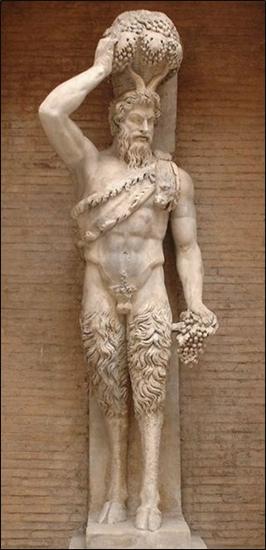
Narcissus - mythology
Son of the river god Kefis and the nymph Liriope. After Narcissus was born, the parents asked the prophet Tiresias if their son was destined to live to old age. The prophet replied that their son would live long, but only if he did not see his character.
As a boy, Narcissus was so handsome that he became the object of adoration of many young men and women. All those loves found no response in his icy heart. He did not return the love even to the nymph Echo, who retreated into solitude, where she withered from the longing for love, until only her voice remained. Finally, one of the rejected fans cursed Narcissus for falling in love with what was unattainable for him. The goddess of revenge, Nemesis, agreed with that curse, and sixteen-year-old Narcissus was justly punished. One day, tired of hunting and the summer heat, he went down to the spring to quench his thirst. He saw his face in the mirror of the water, which immediately fascinated him with its beauty. He saw his own eyes as stars, his hair as the hair of Apollo or Bach, and the delicate skin of his face and neck as precious ivory. He tried in vain to hug and kiss that deceptive image, which smiled and cried with him. Stretched out on the cold grass and fascinated by his own eyes, he forgot about food and sleep until he realized that he saw his own doom in the water. Just as wax or frost melts and disappears in the heat, so it slowly disappeared from the flame of love for itself. At the time of his death, only Echo saw him and sent him one last greeting. Narcissus' pale head sank wearily into the green grass and an eternal dream closed his eyes forever. Dryads and Echo mourned the death of the handsome young man, and his nymph sisters gave him their cut hair. When they came to bury him, near the spring, instead of Narcissus' body, they saw a flower with a yellow cup and a white rosary, which was named "narcissus" (Greek nárkissos). And in the underworld Narcissus mirrors his face in the waters of the Styx.
According to Boeotian myth, Narcissus was born in Thespia, a city where the god of love Eros was worshiped. In his arrogance, Narcissus despised Eros and rejected all those who loved him. To Ameni, one of his admirers, Narcissus sent a sword instead of a love gift. The young man took his own life with the sword at the door of his pet's house. After that event, Narcissus saw his character in one source and fell passionately in love with himself. When he realized that passion was a just punishment for his arrogance and Amenia's death, Narcissus committed suicide; a narcissus flower sprouted from his blood. The inhabitants of Thespia have especially respected Eros since that time, because Narcissus' fate once again confirmed the power of that god.
One rationalist version of the myth of Narcissus is also known. It was rumored that he had a twin sister, who looked like him in everything. She was even dressed the same, because she often accompanied her brother on the hunt. Narcissus tenderly loved his sister; when she died, he used to watch his character in the water and imagine that his sister was still by his side.
One legend mentions Narcissus from the city of Eretria, on Euboea, Amarint's son, a hunter known for his chastity. In the prime of his youth, he was killed by one of his rejected fans, named Eupo. Narcissus' tombstone, which was located near Orop, instilled fear in passers-by. It was said that flowers sprouted from Narcissus 'blood and that the Erinyes were the first to adorn themselves with it, demanding that the early shed Narcissus' blood be atoned for.
Narcissus' plays are known only in the fine arts of the Hellenistic-Roman era; it is shown on gems, mosaics and wall paintings.
Literature:
• Dragoslav Srejović - Aleksandrina Cermanović-Kuzmanović, Recnik grčke i rimske mitologije, drugo izdanje, Beograd: Srpska književna zadruga, 1987
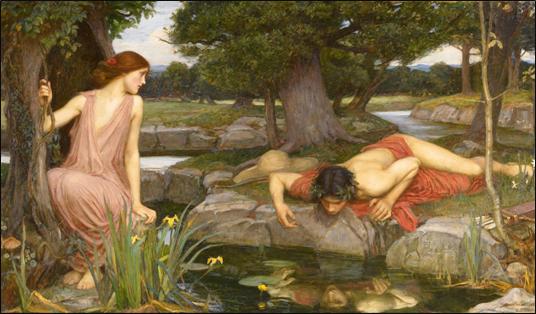
Joan of Arc
She was born on January 6, 1412, in the small champagne village of Domremi, France. She is the greatest French national heroine, she is even considered a saint, although during her life she was accused of witchcraft and heresy and burned at the stake when she was only nineteen years old. She lived in the period marked by the Hundred Years' War (1337–1453), in which the two largest powers at the time, England and France, clashed. She was the daughter of humble peasants. Her two brothers and two sisters died very young, while she lost her parents when the English conquered Domremi, after which her uncle and his wife took care of her. In her early youth, she was a pastor, and she went to church every day to confess. When she was thirteen, she believed she heard the voice of God, and later claimed to have seen St. Michael personally and the first Christian martyrs, St. Catherine of Alexandria and St. Margaret. As strange as it may sound, Joan of Arc claimed for the rest of her life that the voices of those two women echoed in her head and that they were with her while she was praying. She was only sixteen years old when the voices of the saints ordered her to help the French heir to the throne Charles VII and save France from English supremacy in the Hundred Years' War.
In any case, in 1429, these voices encouraged her to join the commander of the French army and defend her homeland from English attacks. When the city of Orleans was in danger of falling into enemy hands, motivated by religious and national inspiration, in the deep conviction that "heavenly forces" had entrusted it to save France, Joan of Arc asked the future French King Charles VII to assign troops to defend it. a city under siege. Dressed as a man, she went to the prince with no intention of convincing him, his advisers and church dignitaries to support her. To justify her intention, she claimed to have a divine mission to save France, and after convincing them of the truth of her arguments, she was assigned troops to defend Orleans. With the strength of her conviction, she gathered the French army, with which she managed to arouse fanaticism and with which she broke through the English siege of Orleans. On that day, Joan of Arc became the real heroine of her people and many believed that she was a saint. Shortly afterwards, with detachments of French armored vehicles, she defeated the English near Pattaya. She encouraged the indecisive and weak Charles VII to be crowned with the royal crown in Reims and led him to a more energetic fight against the enemy.
A few months later, she refused to obey the royal order and voluntarily set out for Compiègne, near Paris, to take part in his defense. There, during the siege, on May 24, 1930, she was captured by the Burgundians. Although she believed that Charles VII would pay for her ransom and set her free, that did not happen. It was given for safekeeping to John of Luxembourg, who sold it to King Henry VI of England. The English sent her before the church court, because she dared to claim that she was talking to God. She is accused of being a false prophet, wizard, witch and heretic. She is also accused of committing a mass crime by killing English soldiers and ordering atrocities. She first appeared before a church court in Rouen, which was under the direct influence of French priests sympathetic to the English, in February 1431. Joan of Arc defended herself fervently, but in the end she admitted the mistake and was sentenced to life in prison. She was tortured in prison in various ways, only to be executed in the end. When she claimed again that she had acted on a divine command, she was sentenced to death. She was burned at the stake in the town square in Rouen, on May 30, 1431, and her remains were thrown into the Seine.
In 1456, in Paris, with the consent of the Holy See, a procedure was initiated for her rehabilitation. After several witnesses were examined and the entire material from the trial was reviewed, the verdict was annulled and Joan of Arc was rehabilitated. She was beatified only in 1909, and was proclaimed a saint in 1920, at the time of the pontificate of Pope Benedict XV. Today he represents one of the most popular saints in the Catholic Church; it is celebrated every May 30th.
Numerous writers, delighted with the personality of Joan of Arc, covered her life and exploits. Over time, she became one of the most artistically portrayed historical figures in the world. She was also the inspiration for the emergence of various legends and contradictory ideologies. In almost six centuries, thousands of books and as many scientific papers have been written about it; a large number of films have been made about her life. In Paris, in 1874, a monument was erected to her - a four-meter high gilded bronze sculpture, depicting Joan of Arc on horseback, with a flag in her hand. She is still the embodiment of French patriotism.
Marco Polo
He was born in 1254 in Venice. He was the most famous European medieval explorer and Venetian merchant, one of the greatest adventurers in history. In 1271, he set out with his father and uncle for the Far East, as one of the first Western Europeans to travel the Silk Road to China, where he spent seventeen years before returning to Venice. While living in China, he was in the service of Kublai Khan (grandson of Genghis Khan and the last great khan of the Mongol Empire and founder and first emperor of the Chinese Yuan dynasty; then ruler of Mongolia and China), at whose court he became rich and where he kept diaries writing about the things he saw. He toured many countries of the Far East, all the way to present-day Myanmar and Vietnam. After 24 years and 30,000 kilometers, the Poles returned to Venice in 1295. Marco Polo's experiences, recorded in the Book of World Wonders, encouraged sailors from European countries to search for sea routes to the Far East. Based on his stories, geographical maps of eastern countries were made, which at that time were almost completely unknown to Europeans.
source: google
Arriving in Venice, Marco Polo's adventures did not end. A few months after his return, a war broke out between Venice and Genoa, in which he participated as the captain of a warship. During a naval battle, at the end of 1298, he was captured and taken to the prison where he was until the summer of 1299. In prison, he met the writer Rusticel from Pisa, to whom he told in detail his experiences on travels in Asia. This is how the famous book Books of World Wonders was created, later known as The Million (Il Milione) and The Voyages of Marco Polo. For the first time, that book was written about coal, banknotes, carpets made of silk and gold from China, Indian spices, gunpowder and many unusual things that were not known in Europe. The book was immediately a huge success, although a large number of medieval readers considered it an extravagant romance rather than a true narrative. Many considered him a fraud.
Marco Paul is considered by many to be one of the world's greatest researchers, while skeptics call him the world's greatest narrator. Most historians believe that he reached China, but there are also those who claim that he did not actually get that far, but that he only retold the information he heard from others. When he was asked on his deathbed if everything he talked about in his book was true, Marco Polo reportedly replied that he had not written even half of what he saw. He died on January 8, 1324 in Venice.
Poseidon
Crohn's and Ray's son, one of the twelve Olympian gods. He ruled the world with his brothers Zeus and Hades; it was decided by lot that Poseidon would rule the foamy sea, Hades the kingdom of the dead, and Zeus the sky, while the earth and Olympus belonged to all three. Poseidon, although reluctant, obeys his older brother Zeus. He shakes the earth and has all power over the sea; with its trident it stirs the waves, causes or calms the storms, ensures good navigation or breaks ships on the high seas. With his wife Amphitrite, Poseidon lives in golden courts in the depths of the Aegean Sea, and when he comes out on earth, all the mountains and forests tremble under his footsteps. His chariots are pulled by giant horses with golden manes, and at such a speed that the waves do not wet their axle. Poseidon's battle cry is as strong as the shout of ten thousand people.
Together with Athena and Hera, Poseidon took part in a conspiracy against Zeus, and therefore the father of the gods was not always in favor of his younger brother; he sent him to serve the Trojan king Laomedon with Apollo for a year and to build the ramparts of Troy. Poseidon often took advantage of Zeus' carelessness and thwarted his intentions. Thus, during the Trojan War, when Zeus removed his view from the battlefield, Poseidon hurried to the Greek camp to encourage Ajanta, Idomeneus and other Greek heroes to fight. In that war, Poseidon was always on the side of the Greeks; only thanks to him, Achilles escaped death before the swollen water of Xanthus. He only protected the Trojan hero Aeneas, who was destined to extend the Trojan royal line. Poseidon could not reconcile himself with the decision that the Trojan ramparts, which he had built, would fall into oblivion, and that the fortifications built by the Greeks around their ships would remain on the shores of Troas. Therefore, Zeus allowed him to destroy forever and cover the fortifications built by mortals with sand.
In an older tradition, Poseidon is older than Zeus; Crohn swallowed him, as did his other children, but Zeus later freed his brothers and sisters, and then, together with them, began a fight with the Titans. After the victory of Crohn's descendants, Zeus was chosen as the lord of the world, on Gaia's advice, who gave their parts to the brothers and sisters. At the will of Zeus, Poseidon placed a bronze door on the border of the sea, on the ramparts that surrounded Tartarus.
In Arcadia, it was said that Poseidon hid the cunning Ray among the sheep, and that she gave the Crown to swallow the foals instead of the child. Others say that Kron threw Poseidon into the sea because he was prophesied that his son would overthrow him. Ray took Poseidon to the island of Rhodes, where he was raised by the Telchins, who made him a trident. Poseidon later fell in love with Halija, the sister of Telhin, who bore him six violent sons and a daughter, Roda. His other youthful love was the beautiful Theophanes, the daughter of King Bizalt. She had numerous beggars, but Poseidon stole a beautiful girl and, in order to escape the pursuers, he transformed himself into a ram, and Theophanes into a sheep. The fruit of their love was a beautiful golden-haired ram, which later transferred Frix to Colchis. In addition to his lawful wife Amphitrite, whose love he won with the help of a dolphin, Poseidon loved many goddesses and mortals, whom he approached in various forms - as a stallion, bird, bull or dolphin. In order to gain the love of the goddess Demeter, Poseidon was transformed into a stallion and in that form he impregnated the goddess, who gave birth to his horse Arion and one daughter, whose name no one was allowed to say. Of his numerous mistresses, the most famous are Etra, Amimona, Medusa, Keleno, Hiona, Alopa and Tiro, and of his children - Theseus, Nauplius, Pegasus and Chrysaor, Lik and Euripil, Pelia and Neleus, Eumolpus and Hypotontus. His legitimate son is Triton. Poseidon is also the father of giants and heroes who were the progenitors of mythical peoples or royal lineages: the Cyclops Polyphemus, Otto, Ephialtes and Nausitoi. When Odysseus blinded Polyphemus, Poseidon persecuted the hero with his hatred and prevented him from returning to his homeland.
Poseidon often clashed with the gods over supremacy over certain cities and areas. He argued with Athena over the Athenian Acropolis and the region of Trezene (picture below), with Hera - around Argos, with Helium - around Acrocorinth, with Zeus - around Aegina, and with Dionysus - around Naxos. Poseidon was unlucky in those disputes, because the judges almost always gave priority to his rivals.
In myth and cult, Poseidon is associated with the horse. It is said that he created the first Scythian horse, by hitting a rock with a trident, or that the animal was created by the earth when Poseidon's seed fell on it. Poseidon is also a horse tamer and protector of knightly competitions with horses; to many heroes - Pelops, Peleus, Ida, Adrastus - Poseidon gave divine horses. As the god of the sea, in myth and cult, Poseidon is often associated with the bull, which symbolizes the roar of the waves. According to one legend, he created a bull and often sent that animal to punish his enemies and other criminals.
Poseidon shook the earth; its occurrence often causes disasters and earthquakes. During the Trojan War, when the gods entered the fight, Poseidon shook Troas so strongly that Hades feared that the earth would collapse and that sunlight would reach his dark and wet kingdom.
Poseidon is an ancient deity, who has long been revered on the Greek mainland, especially in the Peloponnese (Sparta, Tenar, Telpus, Istam, Mantinea). Tables with a linear letter from Pila, the capital of Poseidon's son Neleus, show that Poseidon was revered there during the Mycenaean culture as the main deity and that rich sacrifices were made to him. Poseidon was originally the god of inland waters, the creator of numerous springs, closely related to the humidity of the earth and its fertility. He is the nurturer and fertilizer of plants (Phytalmios), the tamer and master of horses (Hippios), the mighty earthquake (Gaiaochos), the protector against earthquakes (Asphalios) and the mighty lord of the sea (Pelagios). Poseidon is the protector of fishing and navigation, the founder of cities and the ancestor of many tribes and peoples. Most often, bulls and horses are sacrificed to him, by throwing them into the water. The eighth day of the month is dedicated to him. In his honor, Isthmian games were celebrated on Isthmus, near Corinth, which consisted of car racing. Poseidon's attributes are trident, horse and dolphin.
In fine arts, Poseidon is presented as a dignified, mature man, with curly thick hair and a beard. His performances from the archaic age are very similar to those of Zeus; he is shown naked, in motion or in a calm posture, dressed in a long chiton and himation. On ceramic tiles from his sanctuary in Corinth (VI century AD), Poseidon is shown riding a horse or riding in a chariot with Amphitrite. The most famous is the bronze statue of Poseidon, which was taken out of the sea near Cape Artemision (around 460 AD). On the western gable of the Parthenon, the conflict between Poseidon and Athens due to the supremacy over Attica is presented, and on the eastern frieze of that temple, Poseidon is shown next to Apollo and Artemis. Beginning in the 4th century AD, Poseidon is depicted in a characteristic stance, leaning on his right foot, which is laid on a rock, the front of a boat or dolphin, with a trident or a fish in his hands. Only in Hellenistic-Roman art, Poseidon, ie Neptune, was often depicted accompanied by hippocampus, newts, nereids and other inhabitants of the sea.
Literature:
• Dragoslav Srejović - Aleksandrina Cermanović-Kuzmanović, Recnik grčke i rimske mitologije, drugo izdanje, Beograd: Srpska književna zadruga, 1987
Advantages of connecting multiple devices to the Internet
With the advent of network technology that has enabled us to have very fast data flows and that has raised the experience of surfing the internet a couple of years ago, we have received many other benefits as users. One of them is connecting several devices to the Internet, which we will talk about in the following lines.
It has long been a novelty that in one house or apartment with more members, we have more technological devices, such as smartphones, tablets, laptops or desktops, but also TVs - which have become smarter over time and whose more advanced use is based on internet connection .
Moreover, an increasing number of users today decide to buy a package of stable and fast internet, preferably the "optical" one, so that all family members can use their devices and consume content on the web stably and quickly.
source: google
**Logistics of connecting multiple devices to the Internet**
In this case, we need to pay a little more attention to the technical details related to the network load by connecting more devices (especially for more demanding users). Namely, the first thing to keep in mind is the data flow, more precisely that the maximum flow that one device (router) delivers, in most cases, is not the best possible speed of the Internet, but it is the speed of the Wi-Fi link.
What does this actually mean in practice? Let's say one router can deliver about 30Mbps, and each of the connected devices actually draws that maximum possible speed, and the more users, the speed will be distributed differently to the user - regardless of the speed of the internet link.
What is also very important to mention is the signal strength that comes from a network device, more precisely a router that allows traffic between multiple computer networks. Depending on the configuration of the space in which people are staying, it is very important to have powerful Wi-Fi device hardware that can deliver a good enough signal over a larger area at any time.
Here we come to another important item, and that is the so-called access point. What is it really about? If you have in mind to increase the number of devices connected to the Internet, more precisely to the wireless network (either at home or at work), then it is necessary to integrate an additional Wi-Fi device, for a better access point. In this way, you will be able to reduce the load that the main router suffers, and the integration of another router or the mentioned access point, within the local network, significantly contributes to its relief.
**How important is optics in this case?**
The moment you set all the settings of a router that covers a certain area of the object, then you can easily connect several different devices to one Wi-Fi network, which, for example, provides data through an optical cable. And in that case, this technology contributes to ensuring the highest possible flow, so that the speeds are evenly and stably distributed to all devices.
Hence, at home, the ideal speed could be up to 40-50Mbps, which is more than enough for the uninterrupted use of more demanding operations on the web, while for business conditions, however, you should choose the strongest possible packages with higher data rates unit of time, given that one Wi-Fi network will be used by significantly more people at a given time.
Let’s say you connected two computers, one TV, and two phones in one apartment to your home network. It really seems great that each member of the household uses the internet for different purposes without any problems.
However, where can the problem occur here, if you have an unstable network? Today, almost most videos on the Internet are in 4K resolution, which in itself "pulls" a lot of data, there are also online music services, then online video services, and then, online gaming and a lot of other things.
All this would not be possible to use in real time and at the same time, if the router does not deliver high data rates in a stable connection. Moreover, we will agree that more and more users are turning to the benefits of the mentioned services, apart from just surfing the Internet.
Precisely for these reasons, optical internet cable (which is being talked about more and more) is slowly becoming a standard for ordinary users, as well as for those who today cannot imagine their work without optics without optics. Just keep in mind how many computers there are in one place - and today the Internet has become the need and basis of almost every business. Ultra-fast optical internet offers speeds of up to 1000/400 Mbps.
The development of technology and technological solutions today is so advanced that, day by day, we hear about new computers, new video resolutions, new video games, video services and other advanced solutions. All in all, as I mentioned a moment ago, it brings with it certain hardware requirements and infrastructure that will support it.
Therefore, we must be aware that something we once only dreamed of is now right at our door. And in order to enjoy everything that the Internet provides us, both business and private, then we must respond to it in a timely manner - by monitoring technological trends and their integration in our own environment.


Sisyphus - mythology
Hello my dear friends, due to the great interest in Greek mythology and for my friend who loves this topic @Feniks25, we continue writing.
Aeolus 'son, Glaucus' father and Bellerophon's grandfather, ancestor of the Lycian kings. Sisyphus, the wisest, most cunning and most corrupt mortal of ancient Greece, ruled Epirus in Argolida. For his wickedness, deceit, and deceit, which he did to men and gods, he was condemned to a severe punishment: , and he, in sweat and dust, again accepts his futile and arduous work.
Later legends also mention the reasons for his suffering. Zeus kidnapped the beautiful nymph Aegina and took her to the island of Enon. Her father, the river god Asop, searched in vain for her all over Greece, until Sisyphus, who saw Zeus taking Aegina from Acrocorinth, revealed the name of her kidnapper. Because of that betrayal, Zeus sent Sisyphus, the god of death Thanatos, but he caught and chained him to deception, and people stopped dying. To restore harmony to nature and punish the arrogant, the father of the gods ordered Ares to release Death. As soon as Ares completed that task, Thanatos dragged Sisyphus into the underworld. This time, too, the cunning king succeeded in outwitting the gods. Before the god of death grabbed him, Sisyphus ordered his wife Meropi to deny him all funeral honors. When he arrived in the realm of the dead, he begged the lords of the underworld, Hades and his wife Persephone, to bring him back to earth for a moment, in order to punish his godless wife. They did not see through his intentions and allowed him to come out into the light of day. Sisyphus did not even think of returning to the dark realm of the dead, but remained among his own and died in old age. Others say that after his death he was severely punished either because he revealed divine secrets to people (as the son of the god Aeolus, lord of all winds, he knew many divine secrets, but in his arrogance he could not keep them) or because of ungodliness, probably because raped Tire, the beautiful daughter of his brother Salmoneus.
According to one legend, the daughter of Tire, Salmoneus and Alcidica, famous for her wisdom, gave birth to her uncle Sisyphus with two twin sons. Salmoneus and Sisyphus, although they were born brothers, hated each other. Sisyphus was looking for a way to kill his brother, but Apollo's prophecy in Delphi announced that he would not succeed, but that the children that his niece Tire would give birth to would do. To destroy Salmoneus, Sisyphus kissed his daughter. Later, when she realized that he did not do it out of love for her, but out of hatred for her father, Tiro, in order to save her father, killed the sons she gave birth to Sisyphus.
Sisyphus, who was as cunning as a god, was also considered the father of another great cunning man - Odysseus. Someone stole cattle from Sisyphus during the night. Not far from him lived Autolik, the son of Hermes and Hion, who was a thief over thieves, because Hermes gave him the power to turn the animals he steals - horned into horny, white into black and vice versa. Thus, at first, Sisyphus could not determine who was stealing from him, although he noticed that his herd was constantly decreasing, while Autolikovo was increasing. To discover the thief, Sisyphus one day marked the hooves of all his cattle. During the night, Autolik, as usual, went to steal, and at dawn, following the tracks on the road, Sisyphus reached Autolik's barns and easily recognized his cattle by the markings on their hooves. Autolik realized that the most cunning man was in front of him. Wanting to get an equally cunning grandson, he subjugated Sisyphus to his daughter Anticlea, and then, already pregnant, he soon married Laertes. Anticlea gave birth to Laertes' son Odysseus, whose real father was Sisyphus.
It was later narrated that Sisyphus was the king of Epirus and the founder of Ephirah (a city later known as Corinth), the son of Aeolus and Enaretus, the brother of Atamant, Salmoneus, Crete, Perrier, Deion and Magnet. In addition to the two sons who bore him Tiro, Minija, Almos, Ornit and Tersandar are mentioned as his children. Some say that the famous sorceress Medea, before she went to Colchis, handed over power over Corinth to Sisyphus, and that Asopus, because of his help in finding Aegina, gave him the source of the Pyrenees on Acrocorinth. When Melikert, Atamant's younger son, jumped into the sea with his mother Inon, the dolphin brought their bodies ashore; Sisyphus buried them, and then, in honor of his cousin, he established the Isthmian games.
Aeschylus, Sophocles and Euripides used the myth of Sisyphus for their plays, which have not been preserved.
Literature:
• Dragoslav Srejović - Aleksandrina Cermanović-Kuzmanović, Recnik grčke i rimske mitologije, drugo izdanje, Beograd: Srpska književna zadruga, 1987
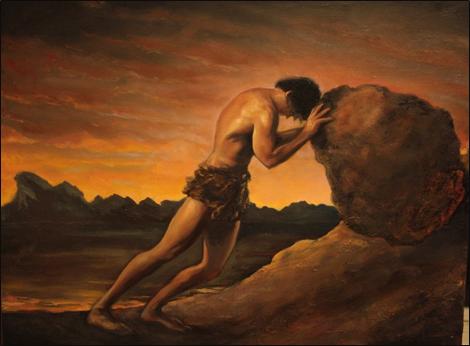
Is it safe to make love after lying down covid 19?
Those who recover from the virus for at least 30 days should beware of great efforts, says Dr. Ristic.
Patients who have had coronavirus should not make love for at least a month after recovering from the infection, experts warn.
a
In addition, the relationship itself should not be fierce and should not last longer than ten minutes, because otherwise it can greatly worsen the existing condition and lead to serious heart disease and even death.
Because of all this, experts advise to use less strenuous poses.
Cardiac surgeon prof. Dr. Miljko Ristic explains that kovid-19, depending on the severity of the clinical picture, leaves various consequences in the body, and one of the most endangered groups are heart patients and people with high blood pressure, so premature activity and excitement, as well as other physical efforts could only to worsen the patient's condition.
- Regardless of the degree of heart damage and the severity of the clinical picture of the corona, the patient should not have sexual intercourse for at least four weeks after the infection. The relationship itself should not be strenuous and should not last longer than 10 minutes. Over time, as recovery progresses, a return to sexual activity may also improve a patient’s health, but must be patient. So, first recovery, then making love - says Ristic.
He adds that after the virus has survived, recovery follows under the supervision of a doctor, and its length depends on the basic diagnosis and potential damage caused by covid-19.
- Coronavirus destroys to a greater or lesser extent the cells of the heart, ie the heart muscle, which leads to its weakening, and all this causes fatigue, lack of fitness, poor mobility. In order for a person to fully recover, it must take from a few weeks to a few months. Thus, the return to normal life, including making love, depends on the general clinical picture and is measured in weeks - Ristic explains, and adds that the return to normal life must be under the supervision of a doctor. Based on an ultrasound examination that shows the strength of the heart muscle, the doctor can assess how the patient should behave and what to deprive for the sake of their health.
No exhibitions
Psychiatrist Jovan Marić said that the greatest risk is for men around the age of 50 who have had the coronavirus and have younger mistresses, because they want to prove themselves and so often a heart attack occurs.
Desirable poses
- "Tired mower" if the man had a crown
- "Missionary" if the woman had a crown
- "Lateral" if both the man and the woman had a crown
- I advise the greatest caution to successful business people who are over fifty and have younger mistresses. This is where they often go beyond their means to prove themselves and then get a heart attack. That is why I appeal to them not to make exhibitions in bed and to avoid proving for at least a few months after the corona has been passed - states Marić.
Pose "tired mower" for men
Jovan Marić suggests several poses for couples in which they are the least tired and in which there is the least pressure for the heart.
- If a man has contracted the coronavirus, the best pose is a "tired mower". The man is lying on his back with his arms bent under his head, while the woman is on it. If a woman was infected, the best is a “missionary” pose so that all the burden of fatigue falls on the man above the partner. In case both partners have had the coronavirus, I advise a side pose or "sideways", as some call it, because it is the least tiring - explains Marić.
He advises everyone who has had the coronavirus to refrain from classic lovemaking for the first time, because there are other ways to enjoy with your partner and experience the climax.
- You don't have to make love to enjoy each other and have orgasms. There are many other ways for partners to satisfy each other without bothering at all. For example, the oral that everyone loves and is not at all strenuous, so I warmly recommend it to everyone who has almost passed the coronavirus - Marić is clear.
source: srbijadanas


Prometheus
Prometheus is the son of the titan Iapetus and Oceanida Klimena, the brother of Atlantis, Menetius and Epimetheus, the greatest friend and benefactor of men. When the gods and men met in Mecona, Prometheus slaughtered the bull, and then, wanting to provide a better part for himself and the people, he hid the meat under the ox's skin and covered the bones with white fat. He placed both crowds in front of Zeus and left him to choose; the father of the gods saw through Prometheus' cunning and, as he already thought evil for people in his soul, he took the part with the fat. Since that time, people have sacrificed bones to the gods, and they keep the meat for themselves. Zeus never forgot that deception and because of it he denied people fire. Prometheus helped humanity this time as well: he stole fire, hid it in a reed and brought it to earth. Zeus then devised the greatest evil for humans. By his order, Hephaestus made the first woman out of the earth, Pandora, and then he sent that beautiful evil to the unwise Prometheus' brother Epimetheus. Prometheus was restrained by Zeus with unbreakable shackles and fastened to a huge pillar. Every day an eagle flew in to peck at Prometheus' divine liver, which grew again at night. This voracious bird was killed by Heracles (picture below).
Others say that Hephaestus, by order of Zeus, chained Prometheus with hard chains in a distant Scythian land. There the proud titan, living a life without sleep, exposed to the cold of night and the relentless rays of the sun, suffered for the love of men. Prometheus knew his destiny and everything that would happen in the future. From one person with many names, from the mother of Gaia Temida, Prometheus received the prophecy that neither strength nor strength would free him, but only cunning. He knew that Zeus was hard-hearted and that he did justice to his will, but he was sure that one day, when he lost his throne and power, he would silence his anger and fall into his brotherly embrace. Zeus has all the power, but Iapetus' son knows the future and that is his strength and advantage. When Ija, persecuted by the jealous Hera, reached Prometheus, the chained titan foretold her future and announced that her descendant in the thirteenth generation would be his savior. At the same time, he announced that Crohn's curse would be fulfilled and that Zeus would marry a woman who would give birth to a son stronger than his father. Fearing that he would lose the rule of the world, the father of the gods immediately instructed Hermes to learn the name of that woman from the chained titan. Despite threats that Zeus would throw him into Tartarus with fire and lightning, Prometheus refused to reveal the secret because he knew that his sufferings would last for centuries and that they would end when one of the gods decided to replace him and voluntarily went into dark hell. With lightning, the thunder and the terrible howls of the winds, as the sky and the sea clashed, Prometheus called his mother and the source of all light to see his sufferings. At that moment, the earth split, and the proud titan disappeared into the abyss.
Only endless love for people caused all these Prometheus' sufferings. When Zeus occupied Crohn's throne and distributed honors to the gods, he wished to eradicate the entire human race. Everyone agreed with that decision; only Prometheus invested all his strength to save humanity. He did not allow people to see death in advance, but filled their souls with blind hopes. His other great gift to humanity was fire (picture below). Prometheus also gave people a mind, taught them to build houses, revealed to them the movement of stars, gave them numbers, letters and memory. He taught the people to harness cattle, to tame horses, and to build ships; he taught them how to make medicine, interpret the flight of birds, and all that the earth hides in its womb.
Zeus' threats came true; Prometheus suffered the most terrible torments on the top of the Caucasus for centuries and finally wished for death, which the father of the gods denied him. The time of his salvation has finally come. Ija's descendant Heracles, while passing through the Caucasus on his way to the land of the Hesperides, shot a terrible eagle that tore Prometheus' liver. When the immortal Chiron decided to go to his death voluntarily, Prometheus was freed from torment. In order for that liberation to be in line with Zeus' decision to keep Prometheus tied to a rock for all time, the defiant titan had to wear a wreath and an iron ring with a stone forever in memory of his shackles.
Prometheus resented the gods even before the creation of mortal beings. The gods made of earth and fire all living creatures that move on earth, and then left Epimetheus and Prometheus to endow them with various qualities and abilities. Prometheus left it to his brother to do so. The irrational Epimetheus distributed all the gifts to the animals, and the man was left naked, with nothing. Then Prometheus gave people fire, which he stole from Hephaestus and Athens, and the ability to create works of art. The man could live now, but the noble titan was severely punished for these thefts. Others say that Prometheus created a beautiful first man and hid him from the gods. When Zeus found out about this creature, he wanted to see it. Prometheus agreed to reveal the work of his hands, but he demanded that the gods grant immortality to that first human being. Since then, that wonderful Prometheus man has shone in the sky like the planet Jupiter.
**In later legends, Prometheus is not only a friend and benefactor of people but also** ***their creator (picture above). He created man from earth and water, and then gave him fire, which he secretly took from Zeus or from Hephaestus' smithy. Some say Athena helped Prometheus light a fire at the sun spot. Prometheus' man is the only being who has a mind, he is the only one who goes upright and looks at the sky and the stars. Others say that Prometheus is the creator of animals and people. He first created all animals, and when he wanted to make a man, he noticed that he spent almost all the material. So he was forced to give people some of the animal traits.***
Apart from Oceanida Klimena or Gaia Temida, Asia or Asopis is also mentioned as Prometheus' mother. Hesion, who gave birth to Prometheus' son Deucalion, is most often mentioned as his wife.
Prometheus enjoyed divine honors in Athens, and was especially revered by potters. In his honor, the feast of Prometheus is celebrated every year; on that day torches were lit on Prometheus' altar, and then runners brought fire into the city.
Prometheus' destiny was treated by Aeschylus in a trilogy, of which the second part is preserved, Chained Prometheus (around 470 AD).
Literature:
• Dragoslav Srejović - Aleksandrina Cermanović-Kuzmanović, Recnik grčke i rimske mitologije, drugo izdanje, Beograd: Srpska književna zadruga, 1987
Hera - mythology
Crohn's and Ray's daughter, sister and lawful wife of the supreme god Zeus. Kron swallowed Hera immediately after birth and she lived in her father's womb until she was released by her youngest brother Zeus. During the fight between Zeus and Crohn, the titan Ray entrusted Hera to guard Ocean and Tethys. Even then, Zeus secretly reunited with his sister and remained with her in an unofficial marriage for three hundred years. Others say that Hera was raised by Asterion's daughters or Pelasg's son Temen. Only after the victory of the gods over the titans, the wedding of Zeus and Hera was solemnly celebrated. This holy marriage was concluded in the far west, by the ocean, and all the gods came to the wedding and brought precious gifts. Hera received as a gift golden apples, which she liked so much that she planted them in the garden of the gods. The islands of Crete, Samos and Euboea are also mentioned as the place of Zeus' and Hera's wedding.
According to an Arcadian legend, Zeus cunningly won over Hera. He transformed into a coward and landed on Mount Tornak, and then caused a storm and rain. Hera, who was walking on the hill, sat down to rest, and a cold and wet coward landed on her lap. The goddess took pity on the bird and clung to her chest, and Zeus immediately showed his true face. Hera agreed to unite with him only when he promised her marriage. Since then, Tornak Hill has been called Kokigion (Coward's Hill).
Hera bore Zeus a son Ares and daughters Eiletius and Heba. Some say that the goddess could give birth to children on her own. Competing with her husband, she gave birth to Hephaestus herself. Later, enraged by the birth of Athena from Zeus' head, Hera withdrew from the gods and begged Gaia to conceive a son on her own who would be stronger than Zeus. She did not approach her husband for a year, and then she gave birth to the terrible Typhon. Some say that the goddess conceived Ares with a flower given to her by Flora. By bathing in the spring of Kanatu, near Nauplia, Hera regained her virginity and celebrated her wedding.
As the mistress of heaven and Zeus' lawful wife, Hera is the protector of marriage and punishes those who violate it. She never defiled her double bed. Jealous and quarrelsome, unable to prevent numerous infidelities of her husband, she cruelly took revenge not only on her rivals but also on their children. Thus, she tried with all her might to prevent Leti and Alcmene from giving birth, and she persecuted the greatest Greek hero, Hercules, Alcmene's son, until his death on Eta. Since she cruelly punished her rival Semela, she tried to harm not only her son Donis, but also those who took care of him (Atamant, Inona). On her orders, the obad tortured Zeus' mistress Iya for a long time. To punish her for persecuting Hercules, Zeus tied Hera with a golden rope and hung her on the clouds.
Hera often clashed with Zeus for other reasons as well. On one occasion, she quarreled with her husband about whether men or women enjoy love more. When the prophet Tiresias sided with Zeus in that dispute, Hera blinded him. However, the spouses always reconciled, sometimes thanks to Zeus' indulgence, and sometimes because of his threats. During the Trojan War, Hera had a fierce quarrel with Zeus. She did not forget Paris' verdict and, hurt by vanity, she inflicted the greatest evils on the Trojans. Among the Greek heroes, Hera especially protected Achilles and Menelaus. To help the Greeks in the war with the Trojans, she asked Aphrodite for a magic belt to seduce Zeus with it. While he slept deep in her embrace, the Greeks seriously threatened Troy. Not even the destruction of Troy calmed her anger; Hera persecuted Aeneas and the other Trojan refugees until they landed on the shores of Lazio.
Hera is one of the oldest Greek deities. Her name (Mistress) shows that she is the protector of every house, city and the whole country. An inscription on a tablet from Pila (13th century AD) documents the cult of Zeus and Hera during the heyday of the Mycenaean culture, but it can be assumed that Hera is the deity of the older, Pelagian population of the Aegean. This goddess was originally revered by the population of Thessaly, Boeotia and the Peloponnese. Hera's attribute "volooka" (boopis), as well as the myth of Ija and Pretida, shows that the goddess was originally the mistress of vast fields where countless cattle graze. Later, in Mycenaean times, this great goddess became associated with the supreme Greek god, becoming his wife and protector of Mycenaean kings and palaces. At the same time, Hera is associated with Athens: both goddesses take part in the campaign of the Seven on Thebes, in the campaign of the Argonauts and in the Trojan War.
Although the cult of Hera was spread all over the Greek world, it is still noticeable that it had the largest number of sanctuaries in the Peloponnese, especially in Argolida (Tiryns, Corinth, Sicyon, Argos, Epidaurus). Hera's favorite places are Arg, Mycenae and Sparta. The Argonauts transferred her cult from Argos to the island of Samos. Already in the Mycenaean era, Hera was also the protector of certain heroes, in the first place Jason.
Hera was first revered independently of Zeus; it shows the position and age of her sanctuary in Olympia, as well as numerous myths about the enmity between the two deities (the myth of Typhon's birth, the transformation of Zeus into a coward, or how Hera, Athena and Apollo chained Zeus). In historical times, Hera was primarily the goddess of marriage; it governs the fate of a woman on her journey from girl to mother. The sanctity of marriage is emphasized by the wedding of Zeus and Hera, which was celebrated in Athens, Samos and Crete as a holy marriage (hieros gamos).
The most important holidays of the goddess Hera are Toneja (on the island of Samos) and Daedalus (in Boeotia). On Samos, her cult statue was carried to the seashore, where she was bathed, dressed in bridal attire and wrapped in twigs of ligos. The statue was left on the shore overnight, and the next day the believers solemnly returned it to the temple. In Plateia, on the feast of the Little Grandfathers, a doll made of oak was driven in a car and burned in memory of the reconciliation of Zeus and Hera. All the cities of the Boeotian alliance took part in the celebration, and each city was awarded one of fourteen wooden dolls with a dice. These dolls were decorated and bathed in the river, and then taken by car to Kitheron, where they were placed on a bonfire together with the sacrificial animals. Each city gave one cow as a sacrifice to Harry and one bull that was sacrificed to Zeus.
Hera is most often respected as the protector of marriage (Gamelia), the protector of the city (Akraia) and as the one who brings victory (Tropaia). From animals, cows, peacocks and cowards are dedicated to her, and from plants - pomegranate and ligos. Its attributes are: tiara, scepter and shield.
Hera was first revered in the form of aniconic idols (high pillar in Argos, log in Thespia, plank on Samos). Terracotta is known from Boeotia, depicting Hera with a stripe (a kind of sundial) on her head and a body stylized in the form of a board. Only the head of Hera's old cult statue in Olympia has been preserved. Her marble statue from Samos, a gift from Heramije, is stylized in the form of a pillar. A holy wedding of Zeus and Hera (middle of the 5th century AD) is shown on one metope of the temple of Hera in Selinunt. The famous sculptor Polycleitus presented Hera on the throne.
Literature:
• Dragoslav Srejović - Aleksandrina Cermanović-Kuzmanović, Recnik grčke i rimske mitologije, drugo izdanje, Beograd: Srpska književna zadruga, 1987
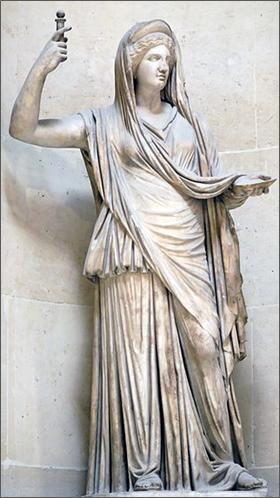
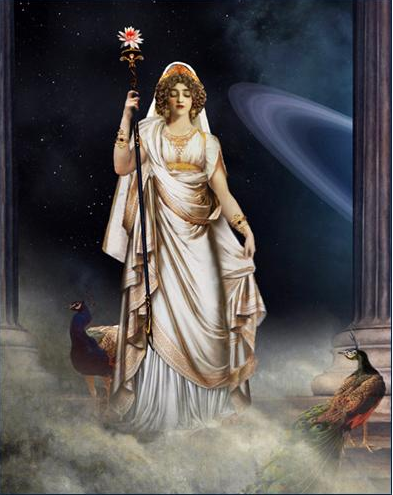
Milky Way
Our galaxy, called the Milky Way because it looks like a jet of milk in the night sky, has long been a great unknown. In 1610, the Italian astronomer Galileo Galilei was the first to point a telescope at the night sky and noticed that a faint whitish belt consisted of many thousands of stars, which seemed to touch each other. In time, astronomers realized that all these stars, as well as the Sun, were part of a huge whole - the Milky Way galaxy.
The diameter of the Milky Way is between 100,000 and 180,000 light-years. Its age is difficult to determine, but it is estimated at approximately 13.6 billion years. The Milky Way belongs to a cluster of about thirty galaxies and after the Andromeda galaxy (the largest galaxy closest to us, approximately 2.5 million light-years away) is the largest in the entire group. Until the end of the 1920s, the Andromeda galaxy was thought to be part of our galaxy, until the American astronomer Edwin Hubble proved that it was a separate system.
It is not possible to determine exactly which type of galaxy the Milky Way belongs to. It is a spiral galaxy and, according to Hubble's division, belongs to the type Sb or Sc (spiral galaxy with a smaller core and more open branches), but recent research shows that the Milky Way has an obstacle (or at least something that looks like an obstacle in structure) in the central region . According to that, the Milky Way belongs to the type SB (spiral barbed galaxy), ie. in some intermediate type SBb or Sbc (between a normal spiral galaxy and a spiral galaxy with a bar).
**The composition of the Milky Way**
The Milky Way, which is estimated to contain between 100 billion and 400 billion stars, has four spiral branches that revolve around its core. In Sagittarius branch, which is located between the Orion branch and the center of the Milky Way, there is one of the brightest stars in that galaxy, Eta Pramca. There are young stars and nebulae in Perseus' branch, the main outer branch of the Milky Way. In the Orion branch, which stretches between Perseus and Sagittarius, is the solar system, at a distance of 26,000 light-years from the center of the galaxy. The Orion branch is a real factory for the production of stars, where billions of new stars can be formed from gaseous interstellar matter. It also contains the remains of former stars.
The brightest part of the Milky Way in photographs taken with optical lenses (which record visible light) is located in the constellation Sagittarius. The bright band in the night sky, which most likely extends towards the center of the galaxy, consists of so many stars that it is impossible to count them. In some cases, the stars are obscured by a thick cloud of dust, which makes some parts of the Milky Way very dark (dark areas in the night sky).
The speed of rotation of different parts of the Milky Way depends on the distance of these parts from the center of the galaxy. Most stars are concentrated in the space between the center of our galaxy and its periphery. There, the speed of rotation is much higher due to the attractive effect of billions of stars on objects located in that space. The speed of rotation decreases with increasing distance from the center of the galaxy.
**Central region of the Milky Way**
Seen from Earth, the center of the Milky Way is in the constellation Sagittarius. So far, no image has been made of the very center of our galaxy due to gas clouds and interstellar dust that are around it. However, the center can be seen through telescopes that record infrared light, radio waves or X-rays because they can pass through matter that blocks visible light. The central axis, which contains ancient stars about 12 billion years old, shows intense activity in the interior, where there are two gas clouds: Sagittarius A and Sagittarius B. These gas clouds are associated with strong activity at the center of our galaxy and hide the heart of the Milky Way. In the center of the Milky Way, there is the largest concentration of stars, old, red and orange giants, whose diameters are larger than 100 to 200 times larger than the Sun. Many astronomers assume that there is a massive black hole in the center of the Milky Way surrounded by a large layer of cosmic dust. Namely, the center of our galaxy is surrounded by a strong magnetic field, which probably originates from a rotating black hole.
Moving away from the center, you come across young, blue stars. In addition to individual stars, which are impossible to count, the Milky Way also abounds in a large number of star clusters, nebulae and multiple star systems. It is estimated that there are about 200 compacted star clusters in it, and so far over 150 have been discovered. The most beautiful such star cluster is the Hercules cluster in the constellation Hercules, about 23,000 light-years away. Nebulae, which represent perhaps the most beautiful phenomenon in the sky, are divided into light and dark, and the difference in brightness depends on the position of the star that illuminates them. The best example of a light nebula is the Great Orion Nebula, which can be seen with the naked eye, and for the dark nebula Horsehead NGC 2024, which is located near the star Zeta Orion in the constellation Orion.
**Milky Way satellites**
The Milky Way, like other galaxies, has its satellites, which are:
1) Small Magellanic Cloud - seen only from the southern hemisphere, and is a small irregular galaxy designated NGC 292. It orbits the Milky Way at a distance of 210,000 light-years, making it the third closest galaxy, after the Large Magellanic Cloud and the Dwarf Elliptical galaxies.
2) Large Magellanic Cloud - also seen only from the southern hemisphere, and is a small irregular galaxy that orbits the Milky Way at a distance of 179,000 light-years. Until 1994, when the Dwarf Elliptical Galaxy was discovered, it was thought to be the closest galaxy to us. Like the Little Magellanic Cloud, this galaxy is full of interesting objects, such as diffuse nebulae, dense and scattered star clusters, planetary nebulae.
3) Dwarf elliptical galaxy - that galaxy in the constellation Sagittarius represents the closest galaxy to us, which is located at a distance of 80,000 light years. A team of astronomers from Johns Hopkins University discovered in February 1998 that the galaxy had been orbiting the Milky Way for about a billion years.
**Basic data of the Milky Way galaxy**
• Age: 13.6 billion years
• Diameter: 100,000 - 180,000 light years
• Center diameter: 10,000 light years
• Mass: 0.8–1.5 × 10¹² solar masses
• Number of stars: 100 billion - 400 billion
• Distance of the Sun from the center of the galaxy: 26,000 light years
• Sun orbital time around the center of the galaxy: 225 million years

Polar light
Aurora borealis is an exceptional natural phenomenon that most often occurs near the Earth's magnetic poles and is manifested in the form of nebulous rays of light of various colors (mostly green, purple or reddish). It appears in the form of bows, ribbons or curtains in the sky, but it can also take fascinating shapes. It occurs suddenly and quickly and often disappears after a few minutes. This natural phenomenon, which can mainly be seen north of 60 degrees north latitude and south of 60 degrees south latitude, occurs when charged particles of the solar wind (mostly electrons, but also protons and heavy ions) hit the outer layers of the Earth's atmosphere. , causing a flash of existing air molecules. The color of light depends on the type of particle: oxygen atoms produce green light at altitudes of 100 km and red light at altitudes of 200 km; nitrogen atoms produce red light when not ionized, and light blue when they are ionized.
The aurora borealis that occurs in the northern hemisphere is called the aurora borealis, and the light that occurs in the southern aurora australis. Both auroras are of the same origin and originate in the same way, and can be as copied in relation to each other.
In addition to the atmosphere, the Earth is surrounded by belts of charged particles, the so-called. Van Allen belts, which stretch from 3840 km to 16000 km above the Earth's surface. These bands are made up mainly of electrons, protons and some atomic nuclei, which originate from the Sun. Namely, it is known that the outer parts of the solar atmosphere constantly lose mass in the form of the solar wind, currents of charged particles ejected at high speed from the higher layers of the solar atmosphere. When these particles reach the vicinity of the Earth, the Earth's magnetic field begins to act on them, trapping them in its atmosphere. These particles have since been forced to oscillate constantly between the north and south magnetic poles. When eruptions occur on the Sun, a larger number of charged particles reach the Earth's atmosphere, which then disrupts already existing particles. Then some charged particles, following the lines of the magnetic field, are directed towards the magnetic poles. They then move in an accelerated spiral around the lines of the magnetic field, as a result of which they emit light, which represents polar light. In periods of increased solar activity, the intensity of aurora borealis is also increased, so in such cases, this natural phenomenon can be seen even at lower latitudes.