 @evomeopetrobi
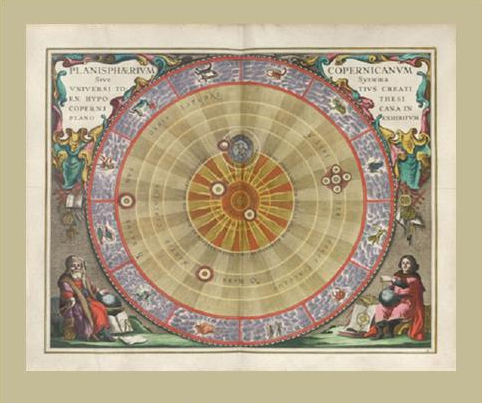
Renaissance The Renaissance marks a period when art, culture, and intellectual endeavors turned to classical art and the teachings of Greece and Rome. Such a revived past, in which Renaissance artists and scientists found inspiration for developing and researching new ideas and procedures, influenced all arts and science. This new approach became known as humanism, because it encouraged people to achieve something for themselves, rather than simply accepting as truth what they had been taught. The Renaissance appeared in Italy in the 14th century, and reached its peak in the 15th and 16th centuries, when it spread throughout Western and Northern Europe. The term is also used for cultural renewal in England during the VIII century, the Frankish state during the IX century and in Europe during the XII century. The name "renaissance" comes from the French word Renaissance, which means "rebirth, renewal". Inspired by the art of ancient Greece and ancient Rome, Renaissance artists created paintings and sculptures wanting to show the visible world and adhered to the mathematical principles of proportionality, harmony and perspective. New aesthetic principles found expression in the works of Italian artists such as Leonardo da Vinci, Sandro Botticelli, Raphael, Titian and Michelangelo, and Florence became the center of Renaissance art. In literature, humanists, such as Desiderius Erasmus, rejected strict religiosity for the sake of studying human nature, and writers such as Francesco Petrarca and Giovanni Boccaccio in Italy, Francois Rabelais in France, and William Shakespeare in England dealt with the complexity of human character. . Astronomy The Renaissance encouraged scientists to explore new ideas and challenge existing opinions. The Polish astronomer Nicolaus Copernicus (1473–1543) claimed in 1543 that the Sun was at the center of the solar system and that all the planets revolved around it. This idea was contrary to church doctrine, which for centuries supported the view of the Earth as the center of the universe. The image below shows the order of the celestial bodies as seen by Copernicus.
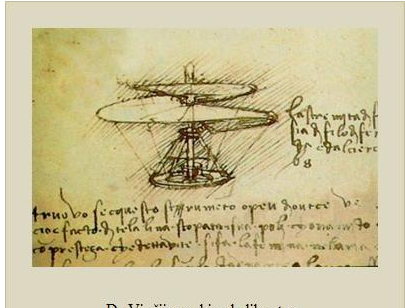
**Scientific discoveries** The Renaissance man was someone who could do more at once. Such was Leonardo da Vinci (1452–1519), uomo universale of the Italian Renaissance and the most famous intellectual of that period. He was a painter, sculptor, astronomer, architect, inventor; he made a submarine, a spacesuit, a drill, made blueprints for a helicopter (pictured below) and a tank. He also dealt with anatomy, in order to discover more about how man functions.
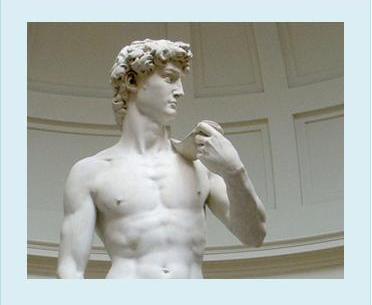
**Art** Renaissance artists portrayed people and landscapes in a very natural way, by studying anatomy and perspective in order to make their paintings as realistic as possible. Michelangelo Buonarroti (1475–1564), perhaps the greatest Renaissance artist, created sculptures that exude life, such as David (pictured below), and huge paintings, such as the one on the vault of the Sistine Chapel in Rome.
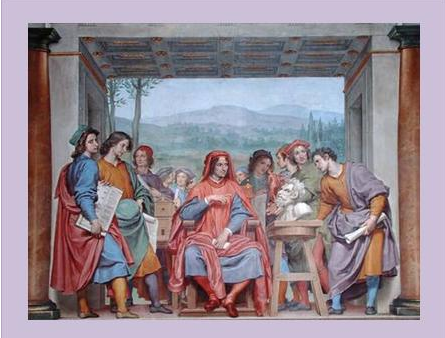
**Patronage** Italian dukes and church leaders competed with each other in financial support of Renaissance artists, all for the sake of glorifying their own countries. The picture below shows Lorenzo de 'Medici, Duke of Florence from 1469 to 1492, surrounded by artists. He admires the sculpture made by Michelangelo, who worked for the Medici family in the 1990s, before going to Rome to work for the pope.
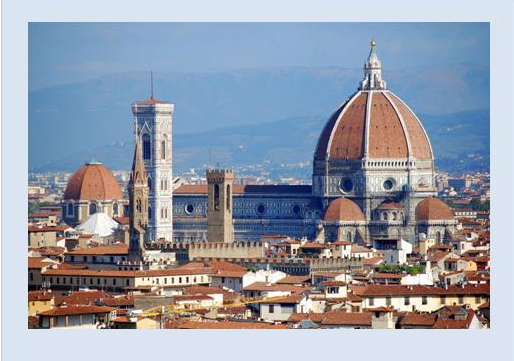
**Architecture** The architects of that period sought inspiration in much older artistic directions. They inserted classic pillars, rounded arches and domes into their buildings. Work on the Florence Cathedral (pictured below) began in 1296 in the medieval Gothic style, but the architect Filippo Brunelleschi (1377–1446) completed the building by adding a magnificent dome. That cathedral was a model for all future Renaissance churches.

3 comments
I remember more lessons from the history of Humanism and the Renaissance. Humanistic ideas first appeared on the Apennine Peninsula where developed and rich cities and wealthy citizens coexisted, citizens increasingly turned to earthly life and their values, but that did not mean that they stopped believing in God, you are very interesting, after so many years it has remained in my head.
The renaissance was necessary to happen because the period that gave birth became too rough and became like mathematics for artists. Everything was done in art with some rules. Then the sad mole of the ladder changes into a cheerful major and the chromatics bring a new style of rebirth. what historians would say was his time to flourish. I love the renaissance in all arts :)
The Renaissance is one of the most creative periods of art that marked a break with the Middle Ages. Early Renaissance painting began with the appearance of Masaccio.