Why Friday the 13th instills so much fear
**The scary story behind this day!**
The fear of Friday the 13th is so great that it even got its name, paraskavedekatriaphobia is the name for the feeling of discomfort associated with this day.
Foto: Shutterstock
Many believe that the number 13 brings misfortune since biblical times. Judas, who betrayed Jesus Christ, is claimed to have been the 13th guest at the Last Supper, so even today it is considered not good to be the thirteenth guest at the table. In the West, some even go so far as to place no. 13 put a doll or a teddy bear to break the bad karma of the most unfortunate number.
However, number 13 was perceived as unfortunate even before Christ. Namely, the historical number 12 was considered complete, that is, it signified perfection, while 13, which disturbed the natural harmony. There are 12 months of the year, 12 Olympic gods, 12 hours on the clock, 12 apostles, 12 descendants of Muhammad, 12 zodiac signs.
Superstitions regarding the number 13 are very widespread today, so in some hotels there is no room with that number, many tall buildings do not "have" the 13th floor but "jump" directly from the 12th to the 14th and in some airlines have solved to eject an unlucky number plate from the row of seats on which it should stand.
Others believe that everything originated when Philip IV of France arrested hundreds of Templars on Friday, October 13, 1307. In the story "The Da Vinci Code", Dan Brown mentions the execution of the Templar Jacques de Molay on Friday the 13th. He allegedly cursed the Pope and the King of France. It is also possible that Thomas Lawson's 1907 novel "Friday the Thirteenth" played a significant role in spreading superstition. In the novel, an unscrupulous stockbroker uses superstition to create panic on Wall Street on Friday the 13th.
Another belief is that the panic around that day was created in 1927, when the second biggest stock market crash occurred. Business failures and bankruptcies have prompted desperate brokers to throw themselves through the windows of a Wall Street building. The day was remembered as "Black Friday" and after that it instilled fear in the Americans again, and skepticism spread to the rest of the world, primarily to Europe, where Friday the 13th soon became synonymous with misfortune.
The fear of the number 13 is also related to the Norwegian myth of 12 gods who prepared a dinner attended by an uninvited thirteenth guest. He led the blind god of darkness Hoder to shoot the god of joy Balder. After he died, the whole country was wrapped in black.
foto: Shutterstock
This day still causes fear in many people, so many avoid doing important work on that day.
The number of properties sold fell on Friday the 13th. The survey found that between 2005 and 2012, there were 43 percent fewer transactions on Friday the 13th than on any other Friday. The worst day for real estate sales, according to this research, was Friday, May 13, 2011, when real estate sales fell by as much as 51 percent. Real estate agents claim that houses with number 13 are not so common. According to the real estate site Zoopla, only 28 percent of the streets have a house with the number 13.
For those who do not worry that the chandeliers could fall from the ceiling during the wedding, there are special offers on this day. For example, an American wedding agency offers couples a 13 percent discount for those who decide to get married there on Friday the 13th.
On this day, one option is to stay in your bed and avoid the potential bad luck that may befall you on Friday the 13th, or to ignore this superstition anyway.


Renaissance
The Renaissance marks a period when art, culture, and intellectual endeavors turned to classical art and the teachings of Greece and Rome. Such a revived past, in which Renaissance artists and scientists found inspiration for developing and researching new ideas and procedures, influenced all arts and science. This new approach became known as humanism, because it encouraged people to achieve something for themselves, rather than simply accepting as truth what they had been taught. The Renaissance appeared in Italy in the 14th century, and reached its peak in the 15th and 16th centuries, when it spread throughout Western and Northern Europe. The term is also used for cultural renewal in England during the VIII century, the Frankish state during the IX century and in Europe during the XII century. The name "renaissance" comes from the French word Renaissance, which means "rebirth, renewal".
Inspired by the art of ancient Greece and ancient Rome, Renaissance artists created paintings and sculptures wanting to show the visible world and adhered to the mathematical principles of proportionality, harmony and perspective. New aesthetic principles found expression in the works of Italian artists such as Leonardo da Vinci, Sandro Botticelli, Raphael, Titian and Michelangelo, and Florence became the center of Renaissance art. In literature, humanists, such as Desiderius Erasmus, rejected strict religiosity for the sake of studying human nature, and writers such as Francesco Petrarca and Giovanni Boccaccio in Italy, Francois Rabelais in France, and William Shakespeare in England dealt with the complexity of human character. .
Astronomy
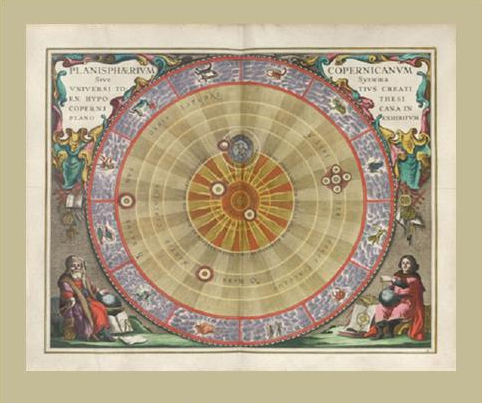
The Renaissance encouraged scientists to explore new ideas and challenge existing opinions. The Polish astronomer Nicolaus Copernicus (1473–1543) claimed in 1543 that the Sun was at the center of the solar system and that all the planets revolved around it. This idea was contrary to church doctrine, which for centuries supported the view of the Earth as the center of the universe.
The image below shows the order of the celestial bodies as seen by Copernicus.
**Scientific discoveries**
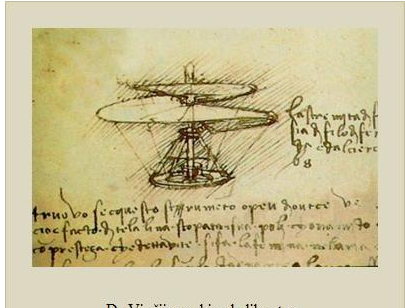
The Renaissance man was someone who could do more at once. Such was Leonardo da Vinci (1452–1519), uomo universale of the Italian Renaissance and the most famous intellectual of that period. He was a painter, sculptor, astronomer, architect, inventor; he made a submarine, a spacesuit, a drill, made blueprints for a helicopter (pictured below) and a tank. He also dealt with anatomy, in order to discover more about how man functions.
**Art**
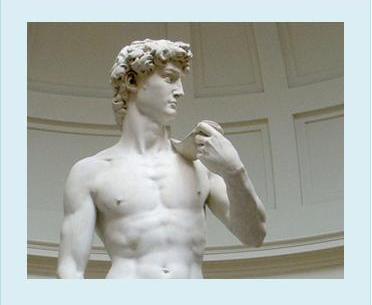
Renaissance artists portrayed people and landscapes in a very natural way, by studying anatomy and perspective in order to make their paintings as realistic as possible. Michelangelo Buonarroti (1475–1564), perhaps the greatest Renaissance artist, created sculptures that exude life, such as David (pictured below), and huge paintings, such as the one on the vault of the Sistine Chapel in Rome.
**Patronage**
Italian dukes and church leaders competed with each other in financial support of Renaissance artists, all for the sake of glorifying their own countries. The picture below shows Lorenzo de 'Medici, Duke of Florence from 1469 to 1492, surrounded by artists. He admires the sculpture made by Michelangelo, who worked for the Medici family in the 1990s, before going to Rome to work for the pope.
**Architecture**
The architects of that period sought inspiration in much older artistic directions. They inserted classic pillars, rounded arches and domes into their buildings. Work on the Florence Cathedral (pictured below) began in 1296 in the medieval Gothic style, but the architect Filippo Brunelleschi (1377–1446) completed the building by adding a magnificent dome. That cathedral was a model for all future Renaissance churches.
Mining - What awaits us in the coming period?
Despite all the events in the world, we can say that 2020 is quite positive for the crypto world for now. We have seen a jump in the prices of various cryptocurrencies, as well as the emergence of some completely new projects with full potential. Everything looks as if the crypto winter has passed and that we can expect a much better situation in 2021. As cryptocurrency prices rise, so does interest in mining some coins. In this text, we will go through what we can expect in the field of mining in the coming period.
Ethereum and ETH 2.0 mining
Ethereum is moving unstoppably towards a complete Proof-of-Stake model which can potentially be very good for this project because it offers big improvements over the current situation. The transition from Proof-of-Work to Proof-of-Stake also means that ethereum mining will be completely shut down, as all blocks will be validated using PoS nodes.
This process takes place gradually, and the complete shutdown of the Proof-of-Work model is expected in phase 1.5 of the Ethereum 2.0 implementation. This means that ethereum mining will stop during 2021 if there is no delay. Landfills of a similar type have occurred before, so some sources claim that it will be possible to mine ethereum until 2023.
What to do when Ethereum becomes a complete Proof-of-Stake?
If you use graphics cards to mine ethereum, you can switch to mining another coin. In case you use ASIC, the choice of the next cryptocurrency for mining will be significantly smaller. You will only be able to mine cryptocurrencies that use the ethash algorithm.
The problem with ASIC ethash miners will arise when everyone switches to other ethash coins. This will significantly increase the difficulty of digging these coins, and the profitability will decrease by that much.
Keep in mind that all miners will stop mining ethereum at the same time and will have to find an alternative. This could potentially make mining unprofitable for a large number of miners no matter what cryptocurrency the miners use.
Ethereum DAG file size
Another important news for ethereum miners is that the size of the DAG file will soon exceed 4GB, which means that ethereum mining with graphics cards that have less than 4GB of memory will no longer be possible. The exact date when the DAG file exceeds 4GB is December 23rd. If your cards have more than 4GB of memory you will not have any problems.
It is assumed that a part of the miners will decide to sell 4 GB cards, so we can soon expect much more affordable prices for used cards on our market.
In the following part of the text, we will consider how to find new coins for mining, if you decide not to sell your equipment.
**New mining equipment**
This year, we have witnessed the introduction of new series of processors and graphics cards that are, judging by the performance, at least two generations ahead of expectations. Nvidia unveiled a series of RTX 30 cards with incredible performance in September, and AMD unveiled a series of Ryzen 5000 processors in October, as well as a new series of RX 6000 graphics cards that should match the RTX 30 in terms of performance. The RX 6000 series will be officially released during November and December, so we don't yet know the specific performance of these cards when it comes to mining. Although the new products are significantly better in terms of performance than the previous generation, the prices of these products have remained affordable.
Better performance for typical computer shops (business and gaming) does not mean that mining performance will be just as much better.
We currently know that the most powerful RTX 3090 series card delivers around 120Mh / s on an ethash algorithm with a power consumption of 300W. At current prices, that means that for 24 hours of mining, you can expect a fee between 3 and 4 dollars, which is very little for the price of this card. The starting price of this card is 1,499 USD.
The RTX 3080 card with a starting price of 799 USD gives 80Mh / s, and the RTX 3070 of 499 USD gives only 60Mh / s. There are a lot of better options right now, but you should definitely wait for the mining software to be optimized for these cards.
**Mining of new coins**
How to choose the right coin for mining? There are two strategies that need to be well thought out.
The first strategy involves looking at the current profitability of mining a coin and constantly changing what you are mining. It often happens that small and little-known coins are the most profitable. Their profitability can change very quickly, so you will have to constantly check the condition. To avoid the volatility that comes with lesser known coins, you can transfer what you mine to bitcoin, ethereum or some other better known coin.
This strategy requires constant attention and a lot of technical knowledge because it is necessary to adjust the hardware to mine a different coin each time. You will also need an account at each exchange office that supports the coin you are currently mining so you can change it to a better one.
There are several different sites where you can see the current profitability for a large number of coins. The first site you can use is CoinWarz. You need to enter the hashrate of your hardware for each algorithm separately, as well as the consumption and price of electricity.
An alternative could be WhatToMine. This site works on a similar principle as CoinWarz. The main difference is that WhatToMine offers the option to enter the number of cards you have and gives an estimate of the hashrate, while for a calculator on CoinWarz you need to know in advance how many hashrates you have for each algorithm.
Another option is to use software like NiceHash. This software automatically finds the most profitable mining coin and adjusts your hardware itself, and pays the earnings into the coin you choose. The disadvantage of this software is that it charges a large usage fee.
**Speculative mining**
The second strategy is of the speculative type because it requires you to find a coin that has good potential, but is still not so popular and is not on larger exchange offices. The difficulty of digging such coins is very small and you can mine a large number of coins in a short time. Ideally, as interest in that coin grows, so will its price. You don’t need to constantly take profitability into account, but it goes without saying that you have researched the project well.
Both strategies have their advantages and disadvantages and carry with them risks. It is important that you understand these risks well and that you do not invest more than what you are willing to lose.


Why do people get wrinkles with age?
Wrinkles on the face are mainly a consequence of two things: life on the surface of the Earth and the social nature of human beings. No matter where a person is - at school, in the office or on top of a mountain - the Earth's weight pulls his skin, pulls it down. In addition, when it is outside, ultraviolet radiation coming from the sun passes through the outer layer of the skin, damaging its deeper structure. On top of that, a person constantly bends and folds his skin - by smiling, frowning, raising his eyebrows. As the years go by, those wrinkles are etched into the skin, leaving a visible trace of all the conversations he has had, all the tears he has shed.
Some people get very few wrinkles. This can be partly caused by genetic inheritance - if someone's parents, grandparents didn't have many wrinkles, that person probably won't have them either. If the skin is naturally dark, then it will be less prone to wrinkles, because the dark path helps protect from the sun. The monks who spent most of their lives in dark and quiet monasteries are an example of how the skin ages slowly if it is protected. They do not spend much time in the sun, and their way of life is generally not lively, but relaxed and full of thinking. That is why an eighty-year-old monk can look like a sixty-year-old because of his smooth and mostly undamaged skin. Why not as a fifty-year-old or a forty-year-old? Because even a monk in the sanctuary of a monastery cannot escape the power of the Earth's gravity. The skin relaxes as it is heavier it relentlessly pulls and leaves us with bags under the eyes and a throbbing jaw. And part of the tissue under the skin dies over time, but the body does not compensate for it. The cheeks and temples are sunken. The skin becomes too large for the tissue over which it was once tightened, and instead falls in loose folds.
In most people, the main culprit for wrinkles is exposure to the sun's rays. Ultraviolet radiation damages a part of the dermis, the inner layer of the skin. Collagen fibers, which are made up of proteins and are found in the dermis, hold the skin structures together. Under the action of ultraviolet radiation, collagen fibers shrink, so skin support weakens. Radiation can also thin the skin, and wrinkles are easier to create on thinner skin. Just as it is easier to bend thin paper than a thick pile of paper, so thinner skin bends more easily. As the skin wrinkles with each change in facial expression, wrinkles are easier to create on the one damaged by the sun. However, the skin is easy to protect from ultraviolet radiation - you should not sunbathe and spend too much time in the sun unless the skin is previously protected with a sunscreen that prevents radiation from penetrating the skin.
Smoking also creates wrinkles - smokers get wrinkles earlier than non-smokers. And the more cigarettes smoked, the more wrinkled the face. People who smoke a lot are five times more likely to get excess wrinkles. The reason for this is that smoking damages collagen in the skin. Also, the smoke goes into the smoker's eyes, which causes him to blink, which creates small wrinkles around the eyes. And finally, smoking in smokers creates small wrinkles above the lips, which are also created when whistling.
Literature:
• Kathy Vollard, And why ?, Belgrade: Laguna, 2006


Parents, no fear: 6 golden tips about baby's first days!
Your baby is finally with you, but no matter how happy you are, there is certainly a great deal of fear in you. Here are a few things you should know…
You went to courses, read books, searched the internet… So you have an idea of what to expect when your baby finally gets home. However, no matter how much you prepare, you can expect surprises.
The reality is that, although they know which car seat is the safest or how to replace diapers, many new parents are still very uninformed about important health topics concerning their newborn.
Don't be afraid. Here's what to expect in your baby's early days!
**Your baby will be more active after 48 hours**
Immediately after birth, babies usually just sleep, or more precisely, they are very sleepy while they are still in the hospital. After the vaginal birth, you will probably leave the hospital after 48 hours, and then your baby will become aware that it has left the uterus and will be very hungry.
It’s mostly a big shock for new parents who thought their baby was calm, and then suddenly she’s often awake and crying, and of course, there’s no help from the hospital anymore.
**You may not feed your baby every three hours**
You have probably read or heard that your baby will eat about eight times in 24 hours. What many parents do not know is that these feedings are not equally distributed night and day. Your baby may eat several times in a row, so there will be no need to feed her again after a while.
It is still very early to worry about the feeding schedule, but relax and feed your baby whenever she is hungry. If you are breastfeeding, try to make your baby eat eight times a day, no matter when it happens, that way you will also be encouraged to lactate.
**Mild jaundice is just fine**
Jaundice may not be the best thing when you want to photograph your newborn baby, but that is not a big reason why you should worry. "All newborn babies can get jaundice in the first days of life. This is due to increased bilirubin production. Namely, the baby's red blood cells "live" shorter, which means that they break down more, releasing bilirubin.
In addition, the baby still does not have enough useful bacteria that help digestion, which is why food stays in the intestines longer, so more bilirubin returns to the circulation than normal. However, you can have cause for concern if your baby suddenly turns yellow, is born prematurely, or gets yellow only on certain parts of the body, especially the legs and feet. In that case, you should contact a pediatrician immediately.
**Babies are nocturnal birds**
Unfair, but true. Babies usually sleep during the day, waiting for the night to party, just when you are already dead tired. Babies do not produce melatonin during the first four weeks of life, so they do not have a circadian rhythm, so they are often awake at night.
Fortunately, in time it will be sorted out.
You can help by lighting your home during the day and being lively during the day, while creating a calm and dark atmosphere at night. When your baby wakes up during the night, try to leave the room as dark as possible, as long as you are able to change diapers and feed the baby.
**Your baby will sneeze and hiccup a lot**
When a baby sneezes, it can be very irresistible, but it can also lead to parental concerns about allergies. However, rest assured that in most cases this is the most normal occurrence. Babies do not know how to wipe their noses, and in most cases it still contains the fruits of water that passes through the airways.
You have probably also felt your baby hiccup while he was in the womb, which will probably continue to work even when he is born. Babies are sensitive, so any stimulation leads to a spasm in the diaphragm, which is manifested by hiccups, but keep in mind that for babies, the effort, ie stimulation, can also be the transition from sleeping to eating.
Your obsession with how to start on the first day
You will probably quickly become one of those parents who thinks, dreams, reads, searches the Internet all about baby khaki all day long. Many breastfeeding mothers think that the baby has diarrhea, but the stool in the first days is of a liquid composition.
You can also expect your baby to change color during the first few days. It will be black first, then brown, then green, and then yellow.

LEFT-HANDED people have unique GENES
**Every tenth person on Earth is left-handed**.
British scientists found dozens of genes only in left-handed people - and came to interesting conclusions.
Every tenth person on Earth is left-handed, and this strangeness, in a world where everything is adapted to "right-handers", has always attracted attention.
The vague realization that humans become left-handed as a result of some kind of mutation appeared in 2019, when scientists from Oxford discovered several genes that right-handed people did not have. This year, Australian colleagues from the QIMR Berghofer Institute for Medical Research in Brisbane found even more “left” genetic differences: 41 unique genes.
The British analyzed the genomes of about half a million people, the Australians - 1,766,671 people. Based on these data and some other surveys, it turned out that 10% of the respondents were left-handed, which coincides with previous findings.
Along the way, seven more characteristic genes were found, thanks to which the so-called ambidexters are born - those that use both hands equally well. They are especially appreciated in special services because, say, they can use weapons with both hands equally well.
**They are more creative!**
Among the famous artists and scientists there are a large number of "leftists": Leonardo da Vinci, Isaac Newton, Albert Einstein, Nikola Tesla, Ivan Pavlov, Pierre and Maria Curie, Charlie Chaplin, Marilyn Monroe, Angelina Jolie, Brad Pitt, Mila Jovovic, Bruce Willis , Sylvester Stallone, Julius Caesar, Bill Gates, Napoleon, Oprah Winfrey, Jimi Hendrix ...
It is logical that the unique - "left" genes change the brain, affecting its structures and functions. But what exactly they bring and how it manifests remains to be seen. Also, it is still unclear why nature "set" that the right-handed are nine times more.
There is another interesting fact: there are as many as 21 left-handed people among the twins, which is significantly more than the average.
Left-handed people think faster when they play computer games or play sports, they are impatient, and they easily get bored of monotonous activities.
Also, they are more reckless, they find it harder to orient themselves in space, and they are supposedly scared faster than right-handed people. Greater creativity is also attributed to them, since it is believed that their right cerebral hemisphere is more active.
Zombie
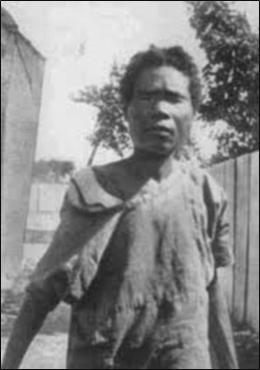
In the African-Caribbean cult of voodoo, a zombie represents a creature whose soul has been occupied by another person through evil magic and whose body is completely at the disposal of the person who performed the ritual. According to the generally accepted meaning, a zombie is a creature that rises from the dead to commit crimes. The inhabitants of Haiti, the birthplace of voodoo and a country where this cult is very widespread, believe in zombies, dead people who are revived by a black magician with the help of voodoo rituals, which are a mixture of African magic and religion. However, they do not come to life completely. A zombie can breathe, eat, drink, work, even talk; he can perform all the physical activities of a living person, but without being aware of what he is doing. They can be recognized by the look and expression on their faces - their eyes are always motionless, their gaze indefinite, and their face expressionless. Zombies are more dead than alive, they are like robots of flesh and blood, they are deprived of feelings, they have no control over themselves and they do not remember anything from the previous life. Also, they do not understand what is happening to them and they can be easily manipulated, because they do not have intelligence. A zombie is usually a body controlled by a bokor - a cruel sorcerer who magically turns the dead into mindless slaves. The word "zombie" appears in many African languages, and is believed to be derived from the word zumbi, which in Zaire refers to the media, ghosts and spirits of the deceased, while in Congo it means "fetish". The same word, zombie, also refers to the god with the image of a snake, the deity of certain peoples of East Africa. In the modern voodoo sense, it refers to the deity of the serpent who revives the dead when the sorcerer has chosen to be his servant.
There are many stories of zombies in Haiti. Many claim to have seen the dead working in the fields of cotton, sugar cane and coffee. Some say that they saw their relatives wandering the streets of the city like crazy, which would not be strange to them if it were not for the relatives who passed away a few months earlier. There are also those who believe that zombies are not dead but living people whose sorcery was taken away by a magician in order to use them as slaves. In any case, what is certain is that the vast majority of Haitians are afraid of sorcerers who have the power to turn a dead man into a zombie. In order to prevent the possibility of turning their family members into the living dead, Haitians have a custom of covering the grave with massive stone slabs and thus protecting them from desecration. Those who cannot afford such an expensive grave monitor the deceased for days, waiting for the body to rot and become unusable. Sometimes a knife is left next to the deceased so that he can defend himself from the sorcerer. Those most threatened that their loved ones will be turned into zombies apply even more extravagant defensive measures. Some inject poison into the body of the deceased, or mutilate it with a knife, and sometimes kill it another time, just in case. A less drastic measure is to put needles with cut ears and balls of thread in the grave, as well as thousands of tiny sesame seeds. It is believed that then the spirit of the deceased will be busy with unsuccessful attempts to insert the thread into the needle without ears and in counting sesame seeds, so they will not hear the summoning of the sorcerer. Outside the cities, graves are placed as close to the roads as possible so that sorcerers would not steal bodies for fear of being noticed.
Canadian anthropologist and ethnobotanist Wade Davis, a professor at Harvard University, traveled to Haiti in 1982 to investigate the legend of zombies and came to the conclusion that a man can be made a zombie with the help of two magical powder mixtures, popularly known as zombie powder. Using the first mixture, the victim would be brought to a state of clinical death; her relatives and friends, believing that she was dead, would bury her, after which the sorcerer would dig her up and revive her. Then, with the help of another mixture, which has a psychoactive effect, the victim would be managed. Davis was so convinced of the miraculous effect of powder that he wrote the cult book Snakes and Rainbows (published in 1985), which had a huge impact on the rest of the world and sparked a debate about zombies. Davis' book and zombie powder theory have caused a lot of controversy, and it has never been independently confirmed that this mysterious powder really works. According to the book Snake and Rainbow, a horror film of the same name was made in 1988.
Many people believe that there is still a rational explanation for such and similar cases of dead people, buried, and seen months or years later still alive, but without reason and control. Among those who do not believe in the supernatural was Antoine Villiers, a French doctor who lived in Haiti for years. He did not believe that anyone could be resurrected from the dead. According to the theory advocated by Willie, some sorcerers in Haiti know drugs that can cause deep numbness, which can be equated with death. The sorcerers would dig up their victim "after death" and bury him and bring her back to life, but not to a normal life, because under the influence of these drugs, the functioning of the brain would stop. Some evidence confirms that knowledge of such drugs existed in West Africa, from where most slaves arrived in Haiti.
Inke
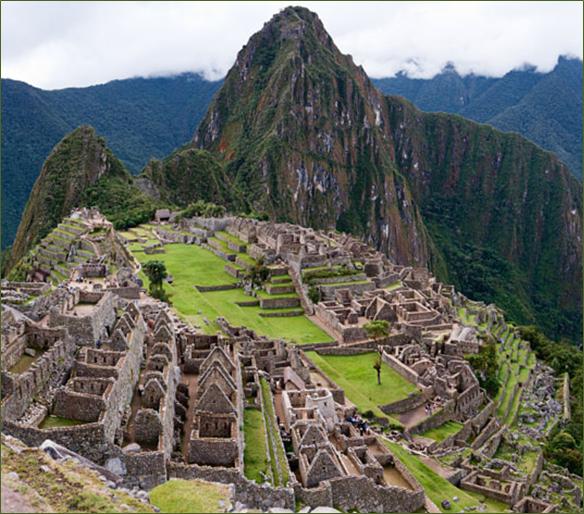
The Incas are a tribe of South American Indians who ruled an empire whose territory stretched along the Pacific coast and the Andes mountain range, occupying the area from present-day northern Ecuador to central Chile. According to legend, the founder of the Inca dynasty, Manko Kapak, took his tribe to Cusco, which would become their capital. During the reign of the fourth emperor, they began to spread, and during the time of the eighth bearer of the crown, the Incas formed garrisons composed of subjugated peoples. During the reign of Tupac Inca Jupanki and his successor on the throne, Huain Kapak, the empire, from the point of view of conquering the territory, reached its peak. At the beginning of the 16th century, the Inca tribe ruled an empire inhabited by about 12 million subjects.
The Incas were top builders and spatial planners, who developed extremely sophisticated mountain agriculture and built equally complicated and efficient cities on mountain slopes. They made terraces on the mountain slopes to grow grain, as their kingdom had few flat valleys where food could be grown. They built an endless network of roads, their architecture was highly developed, and the remains of their irrigation systems, palaces, temples and fortifications can still be seen throughout the Andes. The Incan society was strictly hierarchical, and the aristocratic bureaucracy took care of the order in the country. The Incas worshiped the sun god, the creator god, the rain god and other deities in a colorful pantheon, behind which stood a highly organized state religion. The Incas left no written documents behind; data on the number of inhabitants, taxes, harvests and other things were recorded on knotted ropes - kipuima.
In 1531, the conquistador Francisco Pizarro set out to explore Peru on behalf of Spain. He soon met with the emissaries of the Inca emperor, Atahualpa, with whom he arranged a meeting with the emperor in Cajamarca. At that meeting, Pizar's men massacred the unarmed emperor's retinue and captured Atahualpa himself. This disabled the kingdom because no decision could be made without the king's consent. Pizarro first accepted a fabulous ransom for Atahualpa and then ordered him executed. Then, with less than 200 soldiers, he quickly conquered the Inca Empire, which had not yet recovered from the long civil war (1525-1532), which was fought between the sons of Huain Kapak. The Inca Empire fell in 1532–1533. under the unstoppable onslaught of the Spanish conquistadors, who took advantage of the Incan road network to penetrate the American continent.
The Andes are still inhabited by Inca descendants - they are peasants who speak the Quechua language. In Peru, almost half of the population is of Inca origin. They live from agriculture and animal husbandry, they accepted the Roman Catholic faith, but they also preserved the belief in pagan spirits and deities.
Šurko - a legend of Kraljevo fishing
I wrote this article and dedicated it to my friend @varda42, a fishing enthusiast.
The fishing story is cultivated, told and retold for generations, about rivers rich in fish, about trophy catches of capitalists, about successful and malicious fishermen, catches of rare fish and other fishing events, myths and legends are created. "Shurkov vir", a rich fish district at the mouth of the river Ibar in Zapadna Morava, between the villages of Sumarica and Ratinsko polje, known throughout the Republic of Serbia, from Subotica to Leskovac, often in the Republics of the Old South, as well as the "owner" and "tenant" of vir, where Radomir Katic-Surko spent days and nights in hunting, these days they are celebrating sixty years of acquaintance and friendship in hunting capital, trophy fish, catfish, carp, bream, barbel.
- At the age of twenty-two, I became a hunter, my father then bought a hunting rifle and enrolled me in the hunting and fishing association "Fourth Kraljevo Battalion" in the village of Vrba. I was a very active hunter, so I later became the president of the society. Going to the field, which was located next to the pond on the Morava, I met the fisherman Tom Jovanović and at his urging I started hunting carp. He is a specialist in finding catfish and carp, and I am a beginner. We were on the water day and night, we stayed under the tent, fishing, I learned and "stole" the craft, so in time I fell in love with fishing - the legendary Shurko begins the story.
- I hunted carp capital, weighing ten, fifteen kilograms. I had on a fishing rod with two hooks on both hanging carp, I pull one out, the other tears the nylon, there were so many fish at that time - remembers Shurko.
Shurko hunted for his diggers in the field for lunch what they wanted, both carp and catfish, and his wife, who was a master at preparing fish, prepared specials that the workers were happy to consume.
- Catfish hunting was also my passion. I fished it on a "check", initially with a drain stick, with a little nylon wound on two nails nailed to the handle. The possibilities for capital specimens were minimal, so I decided to buy equipment adequate for capital hunting. Yes, it was quite an investment, but it paid off. I hunted several pieces during the day, with an enviable weight of up to several tens of kilograms. There were capitalists from twenty to fifty kilograms each - Shurko tells us.
Back in 1972, the legend of sport fishing in this area, with Žiko Dedinac, an excellent and successful lure, caught one of the largest catfish in the local waters. From the boat, they searched the whirlpool with decoys, after a few throws, Ziko catches a catfish weighing about ten kilograms, and then the mythical story begins.
- I throw the decoy downstream, I start turning the lever on the machine, it gets stuck. I got stuck somewhere again, in a fracture, I thought. After a few minutes, while I was thinking and consulting with Zika what to do, the nylon on the machine starts to unwind, a sign that the fish is capital on the hook. The fight begins, the fish tries to unhook, I hold the rod firmly in my hand, I control the movement of the fish, it pulls the boat, time passes slowly. It's only been about an hour since I've been holding her on a stick, by the way I tell Zika to prepare the hook for accepting the fish. He is ready, but the fight with the fish is in full swing, outwitting, waiting, who will give in first, me or the fish. After two hours, I feel weak, but fatigue has gripped my "opponent" as well. I slowly pull the fish to the edge of the boat. Ziko hooks her, lifts her to put her in the boat. At that moment, the hook bursts and the fish is in the water again. I still hold it firmly on the rod next to the boat, while Ziko takes the spare hook, catches the catfish and I help him to put it in the boat. The fight is over, we light cigarettes, congratulate each other, only now are we aware of what kind of "hello" we fought. The capitalist has nothing, he weighed exactly 69 kilograms on the scales - says Shurko in his breath, just like Hemingway himself.
In addition to capital catches of carp and catfish, at that time he had payloads of one to five kilograms on the hook. In one day, he caught twenty kilograms of smaller fish, barbells of seven, eight kilograms per piece, pumpkins, at night on a hand-made lure, from one to ten kilograms.
- Now the whirlpool has gained by construction. In addition to my cottage, a dozen new cottages of famous fishermen have sprung up, an ethno holiday house of the famous fisherman floater Žuka. We meet and socialize there, with the inevitable fishing stories next to a roasted lock on a spit or fish specialties, the confluence of the Ibar and the West Morava has become a real fishing village. This is a small part of the story with an 84-year-old true lover of river and fishing, who selflessly passed on knowledge and skills to younger generations, spawned excellent lure fishermen who "comb" the whirlpool with lures, when the weather allows, respecting the spawning season, focused on the catch of catfish in the desire to break the record set by the legend of sport fishing Radomir Katic-Surko.

Why it says-continued
My dear friends, judging by the comments and reactions to my last article, I see that you liked it, so I decided to write a sequel. I hope you enjoy.
**Ariadne's thread - why it is said**
The story of Ariadne's thread, or Ariadne's ball, is connected to the myth of the Attic hero Theseus.
Since, after strong fights and overcoming various obstacles, he happily arrived in Athens, Theseus came across a sad sight. Athens and the whole of Attica were wrapped in black, because just in those days the envoys of the powerful king Minos from Crete arrived to take their bloody tribute for the third time. Every ninth year, namely, seven young men and seven girls had to be sent to Crete by the Athenians to be sacrificed there to the Minotaur, a monster with a human body and a large bull's head, which lived in a huge castle - a labyrinth. Minos imposed that tribute on the Athenians because they killed his son Androgeus. The Athenians, with great sorrow, but unconditionally, paid a bloody tribute until Theseus arrived in the city.
Pitying the poor young men and women, Theseus, in spite of his father's opposition, decided to go with them to Crete, to kill the Minotaur and free the innocent victims, among whom he was himself. Thus, on ships with black sails, as a sign of mourning, the Athenians sent the flower of their youth, and the old king Aegeus sent his only son Theseus. At the parting, he asked him to put white sails on the ship if he killed the Minotaur - to see from afar whether the bloodthirsty monster had disappeared, or whether Theseus had also died as his victim. Before leaving, Theseus, on the advice of the Delphic prophecy, offered a sacrifice to the goddess of beauty Aphrodite and placed himself under her protection.
When the Athenian boys and girls arrived in Crete and stood before the mighty King Minos and his retinue, he immediately noticed the beautiful and stout Theseus, who also dared to take one of the girls brought - Peribeus, the daughter of the Megarian king Alcataeus - for protection from his aggressiveness. Because of his audacity and statement that he is the son of the great god of the sea, Poseidon, and that is why he can oppose anyone, even if it was the son of Zeus himself, the mighty king Minos, Theseus had to do something to confirm it. From the depths of the sea, with Poseidon's help, he took out and handed Minos the thrown ring, thus proving that it was of divine origin.
There was joy among the captured Athenians, but Theseus 'feat was rejoiced more than any of them by the beautiful Minos' daughter Ariadne. In her, as soon as she saw Theseus for the first time, a great love flared up, which was aroused by Theseus' protector, the goddess Aphrodite. Approaching the Attic hero secretly, Ariadne revealed her feelings to him and promised to help him kill the Minotaur if he took her as his wife and took her to Athens. When Theseus agreed to this, Ariadne gave him a sharp sword and a ball of thread, with which he would return when he killed the Minotaur before he could tear and devour the sacrificed young men and women. Without that thread, no one, even if he managed to destroy the Minotaur, could find a way out of the labyrinth in which he lived.
After tying him to a rock at the entrance by the end, which will show him the way back, Theseus set out for the labyrinth with the young Athenians. After a long wandering through the intricate and dark corridors of the Minotaur's castle, he finally came across a bloodthirsty monster, which greeted him with a terrible roar. In a difficult fight, Theseus finally managed to grab the Minotaur by the horns and stab his sharp sword, obtained from Ariadne, right into his heart and thus kill him. Then, together with the overjoyed Athenians, following in the footsteps of the thread that unwound at the entrance, he came to light. In order to avoid Minos' rage over the murder of the Minotaur and prevent the pursuit, Theseus drilled the bottoms of all the Corinthian ships and, taking Ariadne as his wife, set out with his entourage for Greece.
The joint life of Theseus and Ariadne did not last long. There are various stories about their parting on their return to Athens. One of them reads as follows:
"Already pregnant, Ariadne had a hard time with the sea. When a storm hit the ship near Cyprus, Theseus landed Ariadne on the island, and he stayed to save the ship. A strong gust of wind threw the hero into the sea and separated him from his beloved woman for a while. The islanders took care of Minos' pregnant daughter and, to comfort her, brought her letters allegedly written to her by her husband. By the time Theseus succeeded in bringing the ship back to the island, Ariadne was already dead. Her death shook the hero deeply; he distributed money to the islanders and ordered them to offer sacrifices to Ariadne, and then, in her part, he placed two statues, one of bronze and one of silver. "
Legend goes on to say that Theseus, due to his great sorrow for Ariadne, forgot to point out white sails instead of black ones before entering the Attic waters, as a sign of his victory. That was the cause of another tragedy. When he saw Theseus' ship with black sails, King Aegeus, thinking that his son had died, threw himself into the sea in distress and drowned. Since then, they say, after the king of the Aegean, the waters along the Attic coast have been called the Aegean Sea.
Along with that name, behind the exciting story of Theseus and Ariadne, the expression Ariadne's thread, or Ariadne's ball, remained in the language, meaning: "saving means", ie "the way of deliverance from a difficult and complicated situation".
The motif of Ariadne is often treated in art: from her statue from the IV century BC. e., which is kept in the Vatican, through Titian's painting of Dionysus and Ariadne to the opera by Richard Strauss Ariadne on Naxos. There is one work in Serbian literature that follows the myth of Ariadne with its idea. It is a novel by Radmila Popović, Ariadne's Threads.
**Throwing trees and stones - why is it said**
When someone is sharply condemned for something, when they are fiercely attacked, it is usually said that they throw trees and stones (at him). In the dictionaries of the Serbian language, that phrase is recorded in combination with different verbs, but always with the same meaning: "sharply, fiercely attack, condemn someone". So it is said: to throw (or lift, scatter, pour) trees and stones (at someone). The SANU dictionary also cites these examples from our literature, more precisely from the works of our writers and publicists: Jovan Popović, Lazar Komarčić, Radoje Domanović, Vladan Đorđević, Stevan Sremec, Stjepan Mitrov Ljubiša, etc .:
"He was an irreconcilable oppositionist, and many (were) declared him mad and threw trees and stones at him." (J. Popović) "On that, Mališ raises trees and stones." (L. Komarčić) "Public opinion condemns wood and stones to painters, everything enters the battle line against that attack." (R. Domanović) "Deputies who poured trees and stones on the rulers until then took to the streets victoriously." (V. Djordjevic) On him and trees and stones. " (S. Sremac)
In some examples, such as in the work of Stjepan Mitrov Ljubiša, trees are left out, so it says: "Let the peasants throw stones at what they do not like."
The phrase throwing trees and stones (or just stones), in that or in other verb connections, originated from an ancient custom, which was known in ancient times. It was the stoning of the guilty, a severe and shameful death penalty, applied to the ancient Egyptians, Persians, Jews, Greeks, Romans, Gauls and other ancient peoples. In that way, the most serious criminals were punished: murderers of parents, traitors of the homeland, blasphemers and adulterers. There was also a well-established stoning ritual. The convict was usually driven out of the city to the place of execution of the sentence, under guard and accompanied by an angry mob. The persecution from the city itself symbolized the expulsion of the culprit from the community he sinned against. There, at the place of execution, all those present threw stones at him (and judging by the given phrase, trees and other solid objects) until the unfortunate man died in agony. Then everyone, morally relieved, would return home, while the crowd under which the convict lay was considered a place of curse.
Based on that custom, which once existed in our country, a common expression was created in the Serbian language to throw trees and stones (at someone), as well as others similar to it, with the already mentioned meaning: "sharply, fiercely attack, condemn someone".
**Red thread - why say**
The established term red thread is often used in our country, not only in fiction but also in journalism, daily press, and even in ordinary speech.
J. Matešić records three examples in the Phraseological Dictionary. The first is Ujević's: "… that motif always runs like a red thread." The other two are from the newspaper: "And insecurity, like a red thread, runs through all parts of the film…" and "Every musician in an orchestra must know the red thread of music."
The term red thread, meaning: "the main idea (thought, theme, etc.) that runs through a work", "a motif that is constantly repeated", or, as it would be called "foreign" - "leitmotif", the first used by Johann Wolfgang Goethe, in his novel Soulmates (German: Die Wahlverwandtschaften, 1809). Explaining in the introductory part of the same sentence (in a broader comparison) what that expression means and where it came from, the great German poet writes:
"All the accessories of the royal fleet, from the anchor ropes to the thinnest ropes, are judged in such a way that a red thread runs through them along its entire length, which cannot be pulled out without falling off everything else; so even the smallest piece of rope can be seen to belong to the English crown. ”
This is followed by his comparison: "This is exactly how the red thread of sympathy and affection runs through all of Otilia's diary„ "
The data presented by Goethe, in order to explain the mentioned comparison, completely correspond to reality. In the 17th century, the Admiralty of the British Navy issued a strict order that a conspicuous red thread must be woven into every naval rope belonging to the English Royal Navy. The reasons for this seemingly strange order were not of an aesthetic nature (to make the ropes on the ships of the royal fleet more beautiful). The basic motive for this order is much more prosaic: the interference of the red thread was the only way to stop the mass theft and resale of ship's ropes, which sailors exchanged for drinks (whiskey, rum and beer) in port taverns, or gave them for money. Since they were marked with red thread, the ship's ropes could no longer be alienated without being noticed. Violators were easily caught in the act and severely punished on the spot.
After Goethe, the term red thread - of course, in a figurative sense: "the basic thought or idea that runs through a work", or "a motif that is constantly repeated" - began to be used and spread by French journalists, publicists and speakers, and then their English, German and Russian colleagues, and then our people, so that term is now established in many languages, including, of course, Serbian.
**Precious stone - why it is said**
The term gemstone, as well as several other expressions (same yardstick, on the same ledge, posters as the year), differs in its origin from most of the established expressions explained here. It is not taken from the Bible, nor from Greek myths and legends, nor did it originate in literature or in certain life circumstances; it is not related to certain historical events and personalities, folk beliefs or superstitions. It was created by preserving the old meaning of the adjective drag, which, except in petrified expressions and some derived words, can generally no longer be found in the modern Serbian language.
When we say dear today, we usually mean something that is loved, towards which one feels love or affection. This adjective can also mean kind, lovely, sweet, or good, attentive, or pleasant, pleasant, or friendly, cordial, even kind, and so on. But none of these meanings corresponds to the meaning of the adjective drag in the expression precious stone. Namely, everyone knows well that a precious stone (a decorative mineral used in jewelry making) is, in fact, "precious, expensive (stone)", ie that it is "of great value", "precious" and the like. That is why it is said that something that has too high a price is "expensive as a precious stone".
That meaning of the adjective drag is mentioned in the Dictionary of Matica Srpska only in the fourth place, and only in the petrified expressions precious stone and precious metal, with the interpretation: "who is worth a lot, who has great value, precious, precious". In the SANU Dictionary, such a meaning is marked as obsolete, which is completely true.
In the past, however, this was not the case. The adjective drag, meaning "expensive", "precious", was often used. This is evidenced by numerous examples in the great JAZU Dictionary, where, among other things, it says:
"DEAR, adj., Are the two main meanings as in both Latin and Germanic languages (compare German teuer, English dear, etc.), one: who is worth much (objectively), and the other: whom the other loves (subjectively); it is generally thought that the former is older, and that it has become the latter. ”
Today, in the first, older meaning, the adjective drag is no longer used, except in rare cases, among which is the term precious stone.
It should also be said that the adjective drag, meaning "expensive", "expensive", is used to make, and is still in use, several well-known words, such as jewel ("precious stone"), jeweler ("a craftsman who makes jewelry and other decorative items made of precious stones and precious metals "and" the one who sells such items "), then a jewelry store" shop where jewels are sold ", whether it is" precious stones ": diamonds, diamonds, rubies, sapphires, etc. , or "precious metals": silver, gold, platinum, or precious objects in general, such as pearls), then jewelery, jewelery (products), etc.
In some other Slavic languages, unlike Serbian, that meaning has been well preserved to this day. Thus, for example, "expensive" in Slovenian is said to be dear. And in the Russian language dorogoi (read: "dear"), in addition to "appreciate", it means - "expensive". In our country, as it could be seen, it remained only in the stated words, derivatives, and in petrified expressions. That is why it is called a precious stone instead of a precious stone or something else.
**Stupid to the brim - why say**
In our street jargon, one can often hear someone being said to be stupid to the brim. It is not difficult to decipher that this expression, which is used in our country mainly in argo (speech of narrow groups or certain environments), means: "completely stupid, completely, completely, completely stupid". However, it remains unclear why it is said to the board instead of the end or something like that.
At first, one might think that it is related to the expression he lacks (lacks) a board (in his head), which means that someone is stupid, limited, silly, crazy, unreasonable, etc. However, these two phrases have nothing to do with each other (except that they coincide in the word board). This can be proved by the fact that there is also the term drunk to the board, with which J. Matešić, in the Phraseological Dictionary, gives a short interpretation: "completely drunk". It is also said to unscrew or unscrew (eg radio) to the board, again in the meaning: "completely, completely". (This refers to amplifying the tone by turning the "knob" to the limit.)
As can be seen, the connection to the board in all these cases means: "completely, completely, completely, to the end". Where does that meaning come from?
Car drivers will remember another expression that includes the one next to the board. It is gas to the board or, more completely: press (shut off) the gas to the board. The meaning is again essentially the same: "do something to the end, completely", and that is in this case: "press the gas, more precisely, the accelerator pedal, to the very end" - in order to achieve maximum speed. And this is exactly where the key is to explain the origin of phrases that have a connection to the board in their composition.
Unlike all other mentioned expressions, in the expression gas to board - the word board is used in the right sense. Namely, in car mechanic and driver's speech (jargon), the surface on which the accelerator pedal rests (in cars and motor vehicles in general) is called. Therefore, pressing the gas to the board literally means: "push the gas lever, or the fuel supply, to the base (board)", which means - to the very end.
By transferring to other cases (where there is really no board) the connection to the board has acquired a new, transferred meaning, which is observed in many expressions, such as: stupid to the board, drunk to the board, obsessed (ie "exclusive, impatient") to boards, then: unscrew (or unscrew) to the board, sin to the board, stray to the board, etc.
All these expressions are characterized by two things: that they belong mainly to the colloquial language (argo or jargon) and that their source is in the field of technology (motoring), according to which they belong to a group of phrases that are very rare.
**Go from Pontius to Pilate - why is it said**
Pontius Pilate, a man whose name is immortalized in the phrase in question here, was the Roman procurator (governor) of Judea, from the age of 26 to 36, at the time when Jesus Christ preached the new faith. The founder of the Christian religion provoked, with his ideas and actions, the wrath of the Jewish powerful, "writers and Pharisees", for which reason he was caught and brought before Pontius Pilate to judge him. In the New Testament, in the Gospel of Luke, it is written:
And all the multitude rose up, and took him to Pilate.
And they began to accuse him, saying, "We have found this our apostasy, and forbids to pay tribute to Caesar, and says that he is Christ the King."
Pilate, however, did not accept the accusation, saying to the chief priests and the people, "I find no fault in this man." Despite this, prosecutors and the crowd insisted on condemning him. Pilate then tried to somehow "get away", declaring himself "incompetent". When he heard in the investigation that Jesus was a Galilean, he sent him to the competent Galilean ruler, Herod Antipas, who was staying in Jerusalem at that time. Herod also did not find Jesus guilty, and "embarrassed him and his soldiers, and mocked him, put on a white robe, and sent him back to Pilate."
Pilate had nowhere else to go. The leaders and the crowd insisted on crucifying Jesus. The evangelist Luke describes the end of the dramatic trial of Jesus Christ as follows:
"And Pilate said again that he would let Jesus go.
And they cried, saying, Crucify him, crucify him.
And he said unto them the third time, Why, what evil hath he done? I found nothing on it that deserved death; therefore, to knock him out and let him go.
And they cried out with a loud cry, and demanded that he be crucified; and their cry prevailed, and the chief priests.
And Pilate judged it to be as they desired. "
It was from that biblical story that the expression to go from Pontius to Pilate arose, which is used today in the meaning: "to seek, to wander for some goal, to go from unkind to unloved, to break thresholds"; "To address many, with various vicissitudes, to ask for help and information without success."
In professional magazines, by the way, the question is often asked why it is said to go from Pontius to Pilate, when it is known that it is the name and surname of the same person. How can one go from one person to himself and not to another? Wouldn't it be more logical for that expression, given the context in which it originated, to go from Pontius to Herod, or from Pontius to Antipas (as stated in a novel by Stevan Jakovljević)?
Philologist Ivan Klein once suggested that "former religious students certainly did not listen very carefully to this story, so instead of Pontius to Herod, the term from Pontius to Pilate was established, not only in our country but also in Italian, German and other languages."
Professor Dragana Mršević-Radović, in the journal Naš jezik, gives a much more detailed explanation:
"At the time of the emergence of expression in the consciousness of the speaker, there was knowledge about the unity of the person based on the biblical text, but also the awareness of another 'implicit' participant in the event. It is clear that it is Herod, that is. that Christ went from Pontius to Herod, and that Herod ‘sent him back’ to Pilate, as stated in the Gospel. In this way, Christ's movement "circle" is clearly presented, and by closing the circle, the meaning of "unsuccessful" is motivated (to ask for help, understanding, etc.). Only thanks to the possibility of such a double semantic interpretation, this structure could become phraseological and be maintained in language. ”
To make the interpretation even more convincing, the author finally points out:
"I think it is no longer bold to assume that there was a popularly written text describing this episode from the life of Christ, and in which such an expression was used with a concrete description of Christ's journey from Pontius (Pilate through Herod) to (Pontius Pilate) , and that he 'imposed' himself in both Serbo-Croatian and Slovenian. "
**The same yardstick - why say**
The word arshin is mainly used in the expression the same arshin, as well as in the semantically opposite relation different arshin. In the Serbian speaking practice, the expressions one arshin, equal arshin, unequal arshin, etc. are still found. The key word in all these expressions, among which the same arshin is the most common, is certainly arshin, so the question arises as to what it means, and how and from where it entered the Serbian language. Based on the given examples, it can easily be concluded that this is a measure or measure, which is, in fact, the yardstick. It is a very old measure, which, except in established expressions, such as the same yardstick, has not been used for a long time. Therefore, it is necessary to say a few words about her.
According to encyclopedic manuals and dictionaries of the Serbian language, arshin was a measure that was once used in eastern countries (mostly in Turkey and Persia), and then in Russia and Serbia. The word itself comes from the Turkish language (arsin) and means "elbow". This is the distance from the tips of the fingers to the shoulders. This measure was also known in our country under the domestic name elbow. It was not uniform everywhere and ranged mostly between 65 and 75 centimeters, somewhere even higher, as in which country or area of use. Thus, for example, in Turkey it was 68.5 cm (today 1 m), and in Russia 71.1 cm. There, 1500 yards made up one species (1066.5 m). In Persia, the yardstick exceeded one meter (it was exactly 1.12 m). In our country, too, there were arshins of different sizes: tailor's (tailor's) - 65 cm, bazaar (commercial) - 68 cm and dundjerski (construction) - 75.8 cm.
Thanks to the fact that arshin, as it can be seen, was not a uniform measure (like, say, a meter, etc.), the expression same, equal or different, unequal arshin could have arisen in the Serbian language. Hence, the warning to those who are inclined to take different positions towards the same actions or phenomena and pronounce different judgments is sent as a pictorial message that they should measure with the same or the same yardstick. The use of different standards in society, and especially in politics, is always a morally dubious act. Therefore, it can be said that the yardstick (in the same or equal relationship, one yardstick) has become not only a measure of length, which it has always been, but also a measure of fairness and honesty.
**Pull out the thick end - why say**
It is one of the phrases, if not the only one, that can have two meanings. In addition, the opposite !? Namely, in the dictionaries of the Serbian language, it has been noted that to draw a thicker end means: 1) "to get a better, more valuable part during the division" and 2) "to pass very badly" or "to suffer", "to suffer". The first meaning, as the expression itself shows, is related to the division of something, so then it is quite logical that in that situation it is better to get a thicker than a thinner end, that is. more than less. There, then, is all clear. The question then arises as to where the other, opposite meaning came from.
This meaning of the phrase to draw a thicker end can only be interpreted if another phrase, also common in the Serbian language, is taken into account. This is a well-known saying: a beating has two ends. She warns us that the fight with batons or batons can, in a literal, but also in a figurative sense, end in two ways: either favorably or unfavorably, that is. good or bad. Since the beating is usually held by the thinner end, the one who is beaten and who, therefore, passes badly, really pulls out the thicker end. Hence the meaning of the mentioned expression.
It is interesting that in the same sense ("pass badly", etc.), the term to draw a thinner end is used, mostly in Croatian speech practice. It probably came from the first meaning. If someone pulls out the thick end, it means that they get a bigger, and thus a better part. He, therefore, is doing better. And the one who pulls out the thinner end, logically, does worse. Therefore, the first, positive meaning of the expression to draw (draw) the thicker end arose in the situation of some division, and the second, negative ("bad pass", etc.) according to the expression of beating has two ends.
It should be said that there is another similar expression. It is to draw a shorter end, which always means: "pass badly" and the like. As linguists have already clarified, it arose from the custom of awarding unpleasant jobs or duties by pulling out sticks or matches, one of which is shorter than the others. He who draws a shorter match or a stick is a loser and must come to terms with the execution of an unpleasant job or task. Hence, the negative meaning of the expression to draw a shorter end is quite logical.
Whichever way it turns, it is not good to pull out either the thicker end (beating) or the thinner (more precisely: shorter) end when pulling out matches. It is only at what division it is good to draw thicker, ie. bigger, better end. And when the term draw the thick end has one meaning, when the other has another meaning, it can usually be concluded based on the context itself.
**The apple of discord - why it is said**
The term apple of discord, which originates from Greek mythology, is used in the meaning: "cause, reason or occasion of quarrel", "subject of dispute or disagreement", etc. Since time immemorial, there has been love, but also hatred and discord between people and nations. In ancient times, when it was believed that nature and human destinies (happiness or misfortune in life) are governed by various divine forces, there were, among many ancient peoples, gods of light, lightning and thunder, wind, dawn, beauty, love, and even - hatred and discord. In Greek mythology, the goddess of discord (discord) was Eris, the daughter of Night and the mother of many evils: Sorrow, Oblivion, Hunger, Pain, Quarrel, Fight, Battle, Murder, Bloodshed, Lies, Lawlessness, Blindness and Perjury. That evil goddess, sister and faithful companion of the god of war Ares, with one of her actions, which will be discussed here, indirectly caused the great Trojan War. That war was fought by the Greeks and the Trojans - both with the help of the conflicting gods, who were the first to start it all.
It happened at the celebration on the occasion of the marriage between the sea goddess Thetis and the Thessalian king Peleus, the parent of the greatest Hellenic hero Achilles. The celebrations on Pelion were attended, as usual, by all the Olympian gods, among them Hera, the sister and lawful wife of the supreme god Zeus, then Athena, the goddess of wisdom, and Aphrodite, the goddess of beauty and sensual love. The wedding torch was lit by Hera, and then merriment ensued. It was celebrated with divine food and drinks and with the song of the muses. And everything would have gone in the best order if the evil Eris, who was not invited, did not come up with a hellish plan: she threw a golden apple with the inscription "The Most Beautiful" among the guests. And it is precisely that apple that will become the subject of great controversy. Which of the guests present is the most beautiful? The three of them - Hera, Athena and Aphrodite - each for themselves, were considered the most beautiful. Each of them was convinced that she was more beautiful than the others and that was why she had an apple. A dispute arose and someone had to rule. Since none of the gods wanted to be the judge, Zeus ordered the conflicting goddesses to be taken to Mount Ida, the mortal Paris - to decide which one was the most beautiful.
Paris, by the way, was the son of the Trojan king Priam. Because of the prophecy that he would cause the downfall of Troy, his father ordered that he be killed immediately after his birth, but he still survived, growing up in the mountains with beasts and shepherds. Paris greeted the gods with fear, who came with a request to make a decision in their great dispute. In order to get the apple, the interested goddesses promised him various rewards, emphasizing their virtues and possibilities. Hera offered him dominion over all of Asia and the rest of the world, which she would obtain with Zeus 'help, Athens great war victories and trophies, and Aphrodite - the love of the most beautiful mortal, Zeus' daughter Helena, wife of the Spartan king Menelaus.
Paris did not hesitate much. Between greatness and glory, on the one hand, and love, on the other, he decided for love, that is. for the beautiful Helen. Therefore, he declared Aphrodite the most beautiful and handed her a golden apple, thus provoking the wrath of the other two goddesses - Hera and Athena. Aphrodite fulfilled the given promise: Paris and Helena met and great love ignited. Then the Trojan prince, with Helen's consent, carried out the kidnapping and took her with him. Due to that, the Trojan War broke out, in which all the conflicting gods would be involved.
The root cause of that great conflict was, as could be seen, Eris's golden apple or the apple of discord. And from then until today, the term apple of discord, as already mentioned, is used in the meaning: "cause, reason or occasion of quarrel", "subject of dispute or disagreement" and the like.
**Judas' kiss - why is it said**
Judas was one of the twelve apostles ("believers") of Christianity. It is, in fact, about Judas Iscariot, because the Bible mentions several people under that name. This was Judas the apostle. In the Gospel of Matthew (New Testament, translated by Vuk Stefanović Karadžić) it is written:
"And the names of the twelve apostles are these: The first Simon, who is called Peter, and Andrew his brother; James the son of Zebedee, and John his brother;
Philip and Bartholomew; Thomas and Matthew the tax collector; James of Alphaeus, and Levi called Thaddaeus;
Simon the Canaanite, and Judas Iscariot, who betrayed him. "
Judas Iscariot was, therefore, the one who betrayed Jesus Christ. In the mentioned Gospel of Matthew, this event is described as follows:
"Then the chief priests and the scribes and the elders of the people came together to the court of the chief priest named Caiaphas.
And they consulted that they might take Jesus by subtilty, and kill him.
And they said, Not on the feast day, lest the people revolt.
The chiefs, however, did not know who Jesus was.
"Then one of the twelve, named Judas Iscariot, went to the chief priests,
And he said, What wilt thou give me, that I may deliver him to you? And they gave him thirty pieces of silver.
After that, Judas waited for the opportunity to fulfill his promise. At the last (secret) supper, Jesus prophesied that one of the apostles would betray him, targeting Judas. That soon came true. At that very moment Jesus foresaw, saying to the disciples,
“Get up to go; behold, my traitor is at hand.
And while he yet spake, lo, Judas, one of the twelve, came, and with him a great multitude with knives and chariots of the chief priests and elders of the people.
And he that betrayed him gave them a sign, saying, Whomsoever I shall kiss, that same is he; hold it.
And straightway coming to Jesus, he said, Hail, master; and kisses him.
And Jesus said unto him, Friend; what are you doing here Then came they, and laid hands on Jesus, and took him.
When he later heard that Jesus had been condemned and executed, the traitor Judas repented and returned thirty pieces of silver to those to whom he had been sold. He threw them in the church, saying, "I have sinned by betraying true blood." The chiefs themselves considered the money dirty and cursed, so they said: "They should not be put in the church treasury, because it was taken for blood." Thus was born the term Judah's money or Judah's money.
Judas Iscariot could not wash the moral stain off himself even by taking his own life (he hanged himself after returning the silver coin). Thus, his name became a sign of a traitor in general, and it remained in the established expression Judas' kiss, which is still used today in the meaning: "treacherous, insincere kiss", or "treacherous act under the veil of friendship".
**Stumbling block - why it is said**
This expression usually means "difficulty that someone encounters in work, in some endeavors, etc.". The stumbling block is also explained in the Matica Srpska Dictionary as "the main difficulty in achieving what".
The term comes from the Bible. It is already found in the Old Testament, in the Book of the Prophet Isaiah (translated by Đuro Daničić), where, in the eighth chapter, it reads as follows:
“Lord of hosts, saints; and may He be your fear and apprehension.
And it will be a sanctuary for you, and a stumbling block and a rock of offense. ”
And in the New Testament, in the Epistle of the Apostle Paul to the Romans (translated by Vuk Stefanović Karadžić), in the ninth chapter, it is written:
"And Israel, seeking the law of justice, has not grasped the law of justice.
Why? For he seeks not by faith but by works of the law; because they stumbled upon a stumbling block,
As it is written, Behold, a stone of stumbling and a rock of offense is in Zion; and whoever believes in him will not be ashamed. "
Therefore, the stumbling block is, according to the Bible, an obstacle set by God so that people would remain firm and consistent in their faith, so that they would only fear him and be humble in the fear of God. From there, a broader meaning later developed: "obstacle, difficulty in general" or, as stated in the Dictionary of Matica Srpska, "the (main) difficulty in achieving what".
The phrase stumbling block is often equated in speech with another similar phrase, which is also taken from the Bible - the stone of trouble, meaning: "cause or occasion of quarrel, or discord."
With such an explanation, J. Matešić, in the Phraseological Dictionary, gives, among others, this example: "… grades and grading have been a stumbling block since school and schooling."
These examples from the daily press also testify to such significance: "Migration is a stumbling block for the new government", "Justice - the biggest stumbling block", "Iran as a stumbling block for the USA and Europe", and so on. Taxes, laws, borders, customs regulations, overtime work, property, money, religion, etc. are also mentioned in newspaper headlines as a stumbling block or a stone of trouble (which means disagreement, discord).
**The wheel of fortune - why it is said**
The well-known song Osman by the Dubrovnik poet Ivan Gundulić mentions, among other things, the wheel of fortune. Gundulić says (Singing first):
"A circle of happiness around
spinning does not fit:
who would burn, here she is,
and he that cometh down riseth up.
In those verses, and the verses that follow, the poet points to the transience of everything that exists, even every force and evil, that is, to the constant changes in the world. So he continues:
"Now the tip of the saber crown hangs,
now the tip of the sword's crown is falling,
now the slave is exalted to the kingdom,
and whoever the emperor would do is now a slave. ”
Thus, Gundulić, encouraged by the defeat of the Turks in the battle of Hotin (1621), already in the first half of the 17th century, ie two hundred years earlier, hinted at the downfall of the powerful Turkish Empire and Turkish domination in our area. The deeper historical meaning and artistic values of his singing could be written and spoken about at length. But it is a job for literary historians. We are only interested here in the expression circle of happiness, which appears in the above verses.
It should be said immediately that this expression is not the fruit of Gundulić's poetic inspiration, but of the established understanding of life that ruled in his time, and which century before. In accordance with this understanding, the idea of transience and constant changes in the world is presented in the form of the so-called point of destiny. At that point (or circle), people tied to spiders can be seen rising or falling, depending on where they are. By turning the wheel or "wheel of destiny" in the Middle Ages, the collapse of ancient civilizations (Assyrian, Phoenician, Egyptian, etc.), the change of various forms of government, and even the personal destiny of ordinary people were interpreted. Namely, it was believed that in history everything revolves: peace gives birth to wealth, wealth gives birth to laziness, laziness causes quarrels, quarrelsomeness leads to war, which ends in peace, so that wealth that gives birth to laziness arises again… And so in certain cycles everything constantly repeating.
According to that understanding, a person's destiny also depends on the circle of happiness, more precisely: on the place where he is, that is. whether it is tied to the part of the point that rises, or to the part that falls.
Such medieval representations of human destiny and the destiny of peoples and civilizations, created somewhere in the middle of the second millennium, ie around 1500, have, in fact, their roots in Greek and Roman mythology. They are associated with the cult of the goddess Fortune, originally the Italian deity of bliss, fertility and women, who was later revered in ancient Rome as the deity of happiness and destiny. Therefore, Fortuna was identified with the Greek goddess of fortune, Tycho.
Fortuna is usually represented with signs of the variability of destiny: primarily a circle, a point or a circle that rotates. Later, in the Middle Ages, the already mentioned point of destiny or the circle of happiness developed from such a play, which still lives today, less often as a picture, and more as an established expression in language. This expression is also mentioned in the Dictionary of Matica Srpska, with the explanation that it means "the instability of happiness in life".
**Who shoes, who both - why do they say**
In order to understand that phrase, it is necessary, first of all, to know what sandals are and what both are. Mostly everyone knows about sandals: it is that light rubber peasant footwear that is fastened with straps or stiffness to the feet, which is why it is said that when moving on the road, "sandals" should be tightened. Especially famous are the Serbian sandals, the so-called spikes. For both, however, rarely anyone knows, especially the younger world, because both have not been worn in our country for a long time. These were leg wrappers that were worn instead of socks: ordinary pieces of cloth in which the feet were wrapped so that the sandals would not scratch them. Both were also called insoles made of cloth, which were lined with sandals, and later with shoes. When that is known, the question arises as to what it means and how the phrase kom opanci, kom obojci came about.
As for the meaning itself, it is, at least to those who use the term, quite clear. The expression kom opanci, kom obojci, or vice versa, kom obojci, kom opanci, means "who gets what, pulls out, how who passes (in a conflict), and how it happens, how it turns out". It is clear, therefore, that the expression kom opanci, kom obojci expresses the possible outcome of a conflict in which one enters consciously, with the possibility of going well (ie to get opanci, or to stay in opanci), but also with the risk to be lost (i.e., to whom only both remain, or, more likely, to remain only in both, since they kill and strip him). The latter could also be the original meaning of the expression in question here.
In Serbian folk proverbs, Vuk Karadžić gives the following explanation: "To both of them, to whom are the shoes. When it is said that someone will fight or quarrel with someone, then who will be stronger, or who will get what. It seems that once two people were fighting over shoes, so one of them grabbed both shoes and the other shoes. "
And that explanation seems convincing. Because, in any case, it is better in what kind of robbery to get sandals (which are more valuable) than both, as it is better in the fight to the death (because the phrase we are talking about here implies such a fierce fight) to stay in sandals, therefore alive, but without opanaks - dead and emaciated, ie. only in both.
**Crocodile tears - why it is said**
It is a phrase that means false pity, false compassion, extreme hypocrisy. A man who pretends to be upset and saddened by someone's accident, but in fact secretly rejoices in it, who publicly mourns the victim of his own violence or intrigue, is said to shed (or shed) crocodile tears. There are many life situations to which this expression refers, because people often, instead of real pity and help to those in need, shed crocodile tears heartlessly and transformatively. It is necessary to say a few words about how this unusual expression came about.
The crocodile is a terrible beast, bloodthirsty and heartless, so it is strange that it can cry at all, let alone pity someone, even with a pretense. That is why, at first glance, it is difficult to understand how, then, false tears are connected with the crocodile. However, there are reasons for that. The crocodile really cries sometimes, but not out of sadness and grief, but because its tear and salivary glands are in a close relationship, so when it devours its prey, it reflexively tears, sheds big tears. People living in areas where there are crocodiles noticed this phenomenon, so they began to believe that crocodiles mourn their victims. Hence, then, the expression crocodile tears, with the meaning: "false tears", "false pity".
In addition to crocodile tears, there is also the term crocodile laughter, meaning: "false, insincere laughter". This example is noted in the Dictionary of Matica Srpska: "As soon as we were left alone, she burst into her crocodile laughter…" It is easy to explain how this expression came about. Since crocodile tears are "false tears", the adjective crocodile got the meaning - "false", so, then, false laughter became - crocodile laughter.
**Swan song - why say**
The last important work or work of a creator before his death (or at the end of an active artistic, scientific or any other creation) is usually called a swan song. In the Serbian language, this phrase is very often used, not only to denote the last work of a creator, but also the last manifestation of any talent in general, such as, say, the last great game of a generation of athletes, football teams and the like. Thus, the sentences can be read in the newspaper: "It will turn out that it was a swan song of a great team", "It was my last performance on the stage, my swan song" and the like. Even, in its time, the last steam train ride on the narrow-gauge line Capljina-Niksic was followed in the press by a sentimental text entitled Swan's Song of the Tireless Cire.
The phrase swan song is very old. It was also known to the ancient Greeks and Romans. They believed that swans before death let out voices reminiscent of a beautiful melodic song-lament. According to some myths, all swans, when they feel that their end is near and the hour of death is coming, return to the river Meandar (in Asia Minor) to sing their last song there. Aesop noted in a fable (6th century BC): "They say that swans sing before death." And Clytemnestra, the heroine of Aeschylus' tragedy Agamemnon, says of the pre-death inspired words of the slave Cassandra: "She who, like a swan, sang her last, mournful, death song." The phrase swan's song was used in one place by Cicero in his work On the Speaker.
That the beliefs about the pre-death song of the swan, translated into one beautiful and picturesque expression, are not without grounds, testifies the great German naturalist Alfred Edmund Bram. In the well-known work Animal Life, he, among other things, describes in detail the life of swans, emphasizing this observation of the German researcher Schillings:
"The yellow-billed swan not only delights the viewer with its beautiful appearance" but also with the open, different and clean tones of its voice that appear on every occasion. " I will die. On such occasions, I listened to the lamentations of numerous voices from a distance many long winter evenings and all night long… That singing call reminded me of the pleasant sound of a bell, of the sounds of an instrument. ”
Based on that description and other data, Brem concludes:
"Everything that is said about the song of the dying swan is not a fabrication, because the last sighs of the mortally wounded swan twist in the form of a singing melody."
"After all that" - concludes the great naturalist - "the story of the swan's song turns out to be very true. It is, obviously, based on reality, but poetry and fairy tales have taken it to another form. A dying swan cannot be considered a real singer, but his last sigh is as melodic as any other he produces. ”
Swans, therefore, at least those yellow-billed swans (so-called clickers), still die singing. This fact was, as it could be seen, a support for creating the established expression of the swan song, which, as it has already been said, means: "the last significant work, a great experience at the end of one's career, life".
**Low kick - why do you say**
Established expressions in language usually have their roots in folk customs and beliefs, in religion and mythology, or in historical events. There are very few of them who come from the world of sports. One of them is a low kick. This expression is related to the most popular martial art - boxing. The rules of that sports discipline, namely, prohibit "low blows", ie. shooting the opponent with fists lower than the chest. It is especially forbidden to hit the plexus, where there is an important nerve entanglement, the injury of which can cause tragic consequences. A stronger blow to that part of the body (blow to the plexus) causes fainting, and often cardiac arrest, as a result of which even death can occur. That is why it is a very immoral act, which is resorted to only by those who have neither the strength nor the talent to fight correctly and fairly.
The term low blow (more often in the plural: low blows) was transferred from sports to other areas, so today it is used in all occasions when we want to say how a participant in a competition of any kind (whether it is a controversy, a struggle for work place, position, etc.) serves by illicit and dishonest means. Such people usually, instead of using arguments, try to morally humiliate their opponent, to destroy him by presenting dirty details and planting the lowest kind. The effect is usually the opposite: the moral stain falls precisely on those who use dishonorable means, who resort to low blows.
In troubled times, in which many values, including human morals, are degraded, low blows are common. Thus, J. Matešić, in the Phraseological Dictionary, with the determinant low blow (accompanied by the explanation that it is an "unfair / dirty attack on whose reputation, in whose honor") gave this characteristic example: "There is, indeed, fair competition, in the clear, in front of impartial observers, with pure arguments and without low blows. ” And the writer of aphorisms, Srećko Lazari, expressed, wittily and caustically, another great truth: "In high society, there are the most low blows."
**Turn green melon - why say**
In the second edition of the Serbian Dictionary (1852), Vuk Stefanović Karadžić cited the following saying along with the word watermelon: j. it will fail. ” The same saying, only in a slightly different form, and with another determinant (ruin), was noted in the first edition of the mentioned dictionary (1818), this time with an explanation in German and Latin: “you will turn green melon (du wirst nicht gut fahren; male succedet tibi) ”, which again essentially means:“ you will not have a good time ”or“ you do not write well ”.
The phrase turn green melon is often used in our country without the provision green, so we only speak turn green, in the same sense: "evil to pass, perish", "suffer". There are many examples of such use in our speaking practice and in literature. The SANU Dictionary states this confirmation from the work of Milovan Glisic: "Even if you find that I am the cause of that, then I have picked a watermelon for you." The same phrase, in exactly such a (narrower) form, can be found in several places in the great four-volume novel The Time of Death by Dobrica Cosic, otherwise a masterpiece of Serbian fiction. In the novel The Sun is Far Away by the same writer, there is a broader version - turn a green melon: "If these rule, we will grow a green melon."
How the term obrati (zelen) melon came into being was explained by M. S. Lalević in the pre-war series of the magazine Naš jezik (No. 2, 1934, 282). He says: "He picked a green watermelon" means that someone did the job wrongly "similar to a gardener who picks a watermelon early". From that, the meaning could be easily developed: "to have a bad time", "to have a bad time", "to fail", "to suffer", etc.
As can be seen, the phrase turn (green) watermelon is semantically similar to the phrase found in unpicked grapes, only it did not originate in the same way, in the same life situation, nor in the same area, because it is obvious that it could have originated in an area a lot of watermelons, as well as the expression to be found in unpicked grapes originated in a vineyard area. Nevertheless, both of these phrases have spread throughout our language area and are often used - both in everyday speech practice and in the literature.
**The ax fell into the honey - why is it said**
When something beautiful happens to someone, when great happiness suddenly smiles on him, or when he achieves success in life, in some endeavor, etc., it is usually said that his ax fell into the honey. As for honey, it is quite logical here, because, in a figurative sense, it means sweetness and pleasure, and thus happiness. But how to explain the ax? Why is it considered great and sudden happiness when it falls into the honey?
Searching for the answer to that question, linguists came up with interesting and convincing explanations of the origin and meaning of the expression the ax fell into the honey. Although this term is used by many, and they mostly know what it means, it is not out of place to cite a few characteristic examples. J. Matešić, in the Phraseological Dictionary, with the determinant fell (inflammation) to whom the ax in the honey gives an explanation: “to come suddenly to great gain, to position, to success; to be very lucky ”and illustrates these meanings with examples from the works of Ivo Andrić, Stevan Jakovljević and other Serbian writers:
"Congratulations," he says, colleague. "Your ax fell into the honey." (I. Andric)
"Now my ax has fallen into the honey. Let's untangle that kajmakchalan knot once. ” (S. Jakovljevic)
"Because, after so much service, an ax fell into the honey for him" (D. Radić)
Stjepan Babić, writing in the magazine Jezik about the expression the ax fell into the honey, cites numerous examples from the works of Croatian writers, which shows that the term is known and that it is often used in the entire Serbo-Croatian language area. He also gives an answer to the question why it is considered great and sudden happiness when an ax falls into honey. But long before him, the right answer, albeit with a dose of speculation, was given by Vuk Karadzic. In the collection of Serbian folk proverbs, he notes:
"The ax fell into his honey. He is happy. I don’t know how this proverb came about; is it not, when the foreheads are cut out of the tree, and when the hollow is full of honey, and the ax, as it strikes the tree, falls into the honey? ”
Along with Vuk's interpretation, Babić adds that, more likely, the expression originated in such a way that people accidentally, cutting or chopping wood, suddenly came across honey, which was accumulated by runaway or wild bees.
"I experienced that once as a child," says the author. "He brought his uncle from the woods and chopped them up and came across honey. It was a great joy for everyone. That experience later helped me understand this phrase with the ax. There used to be more such concrete experiences, when people burned with wood that they cut and chopped themselves, so we moved from the concrete to the transferred meaning, which is a completely normal phenomenon in language. ”
After all this, it is clear how the expression fell ax fell into the honey. This, however, is not widely known, so it seemed to many that it was illogical, and that is why they started taking the word spoon (or spoon) instead of an ax. Thus the expression fell (mu) spoon (or spoon) into honey. This substitution, given the basic meaning of the phrase in question ("to come suddenly to great happiness"), is difficult to accept, because when the spoon falls into the honey, there is no surprise. However, the expression "fallen spoon in honey" is found somewhere in life and literature, although linguists prefer the first (fallen ax in honey), because its origin and meaning are easier to explain, and it is also more expressive than the second.
Literature:
• Milan Shipka, Why it is said, sixth edition, Novi Sad: Prometheus, 2010
Cold War-Berlin Wall
The Cold War is the name for the state of tension and hostility in international relations that developed after World War II, primarily between the United States and the Soviet Union, but also between their allies. Although both America and the Soviet Union emerged victorious from World War II, the political differences between them soon grew into open but limited rivalry and hostility, which, despite the constant threat of war, never developed into a comprehensive military conflict. Until 1949, the world was roughly divided between pro-Western and pro-communist states. The allies of the two opposing sides fought wars on their behalf, like those in Korea (1950-1953) and Vietnam (1955-1975), while both America and the Soviet Union amassed vast arsenals of nuclear and other weapons. Attempts to reach an understanding between the two conflicting parties failed in the 1970s. By the late 1980s, America had surpassed the Soviet Union in allocating funds for nuclear weapons and pushed the Soviets toward financial ruin, leading to a series of arms reduction agreements in 1988 and 1991.
After 1985, the leadership of the Soviet Union wanted to reduce military costs and improve the living conditions of its citizens. In 1988, the Soviets withdrew their units from Eastern Europe. Without Soviet support, communist governments could not survive and, one by one, were replaced by democratically elected governments. The Berlin Wall, a symbol of the Cold War, was torn down in 1989, and the two German states merged into one state a year later. At that time, the Soviet Union was disintegrating, and in 1991 it was replaced by fifteen independent states. The fall of communism led to the end of the Cold War in 1991.
The Cold War was, above all, a political, economic and propaganda conflict, and only limited use of weapons. The term "cold war" was first used by Bernard Baruch, an adviser to US President Harry Truman, during a debate in the US Congress on April 16, 1947.
Significant events from the Cold War period
• Guatemala - America supported the counter-revolution in Guatemala in 1954 in order to overthrow the socialist government and set up a pro-American military junta.
• Vietnam War - In the war from 1955 to 1975, America supported South Vietnam, while the Soviet Union and China supported North Vietnam, the ultimate winner.
• Hungary - In 1956, Soviet tanks thwarted Hungary's attempt to withdraw from the pro-Soviet Warsaw Pact.
• Berlin Wall - In 1961, the communist government erected a wall in East Berlin to prevent its citizens from fleeing to the free West. The wall was torn down 28 years later, on November 9, 1989.
• Cuban Missile Crisis - On October 16, 1962, the Soviet Union deployed nuclear missiles in Cuba, bringing the world to the brink of nuclear war before agreeing to remove them. That crisis lasted thirteen days.
• Prague Spring - In 1968, Soviet and other military units stifled an attempt to soften communist rule in Czechoslovakia. This prevented significant reforms carried out by Czechoslovak Prime Minister Aleksandar Dupcek.
• Chile - In 1973, a military leadership led by Augusto Pinochet, who enjoyed American support, overthrew President Salvador Allende, the first leader of an openly Marxist Latin American country, who was elected to the post in 1970.
• Afghanistan - The Soviet Union invaded Afghanistan in 1979 to support the communist government there, leading to the severance of relations between America and the Soviet Union.
• Grenada - In 1983, US troops overthrew the left-wing (socialist) government of Grenada because of its growing ties to communist Cuba.
**Berlin wall**
After the Second World War, Germany was divided into four occupation zones. The capital Berlin, completely surrounded by the Soviet zone, as the seat of the Allied Control Council, was itself divided into four occupation zones, and the Soviet sector was by far the largest. Although the Allies intended to jointly rule Germany within the 1947 borders, the onset of Cold War tensions led to the French, British, and American zones uniting into the Federal Republic of Germany in 1949, excluding the Soviet zone, which became the German Democratic Republic the same year. . Thus, the western part of Berlin belonged to the Allies, and the eastern part to the Soviets. The border between East and West Germany was closed in 1952, while it remained open only in Berlin. The idea of building the wall was put forward by the East German administration of Walter Ulbricht, and it was approved by the Soviet leader Nikita Khrushchev. The wall was built with the intention of stopping the outflow of workers and improving the economic balance that was connected with the daily migration of a large number of professional and skilled workers between East and West Berlin, as well as to prevent escapes that had political and economic consequences for East Berlin. The wall effectively reduced emigration from 2.5 million between 1949 and 1961 to 5,000 between 1962 and 1989.
Construction of the Berlin Wall began on August 13, 1961 and took place in four separate phases:
1) the original wire fence (1961),
2) improved wire fence (1962–1965),
3) concrete wall (1965–1975),
4) border wall "75" (1975-1989).
The wall was 155 km long and was built by East German soldiers and workers, not including the Soviets directly. The wall physically divided the city and completely surrounded West Berlin. There were eight border crossings between East and West Berlin that allowed West German citizens, West citizens and Allied personnel to cross into East Berlin, and East German citizens into West Berlin, provided they had special permits. On November 9, 1989, the demolition of the Berlin Wall began, which for 28 years was a symbol of the division of Europe after the Second World War and the ideological-political and military confrontation between East and West.

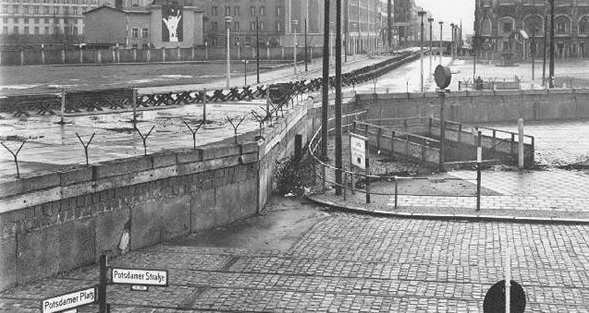
Why is it said
**Adam's apple - why it is said**
According to dictionary definitions, Adam's apple means "external bulge of the thyroid cartilage of the larynx (especially expressed in men)", ie "bulging cartilage in the throat at the entrance to the trachea". Its Latin name is Pomum Adami, which literally means "Adam's apple". This form - apple, instead of the diminutive apple, is often used in our country, so we speak both Adam's apple and Adam's apple.
Why is the apple or apple tree, which plays under our throats (when swallowing or some kind of excitement), connected with the name of the ancestor Adam? The answer to that question can be found in the biblical story of the lives of the first people on earth - Adam and Eve.
When he created Adam "from the dust of the earth" and breathed life into him, God, according to the Old Testament, planted a garden in Eden to the east; and there he placed the man he had created. And the LORD God made thee a tree of every kind, good for sight and good for food, and a tree of life in the midst of the garden, and a tree of the knowledge of good and evil.
Thus, according to the Bible, the Garden of Eden (earthly paradise) was created so that Adam could enjoy it forever, with only one limitation, that is. the prohibition God gave him:
"And the Lord God rebuked the man, saying, Eat freely of every tree of the garden;
But from the tree of the knowledge of good and evil, do not eat from it; for in the day that thou eatest thereof thou shalt surely die.
Adam kept this commandment until Eve persuaded him to break the divine prohibition. This event is described in the Old Testament as follows:
"But the serpent was cunning in all the beasts of the field which the Lord God had made; And he said unto the woman, Is it true that God said, Ye shall not eat of every tree of the garden?
And the woman said unto the serpent, We eat the fruit of every tree of the garden;
Only the fruit from that tree in the middle of the garden, God said, do not eat or touch it, lest you die.
And the serpent said unto the woman, Ye shall not surely die;
And when the woman saw that the fruit of the tree was good for food, and that it was a pleasure to behold, and that the tree was very glad for knowledge, she took the fruit out of it, and tasted it;
According to popular belief, when Adam realized what sin he had committed and how much trouble he would suffer in the future, a piece of apple stopped in his throat, so a bulge appeared on his throat, which still marks all Adam's descendants today, ie. men.
**Achilles heel - why is it said**
The term Achilles heel is used to mean a vulnerable spot, a weak spot, a weakness. It is difficult to say whether the heel became famous for Achilles, or Achilles for the heel. Because, in the great Trojan War, sung in Homer's Iliad, there were more heroes: Paris, Hector, Patroclus, Memnon and many others. But the name of none of them has remained with the people for so long and is not pronounced as often in everyday speech (in almost all languages of the world) as Achilles'. Only those who have read the Iliad know about Paris, Hector and other Homer's heroes and remember them only when they read it again, or when they think about that great work. The only Achilles' name is mentioned today and without any connection with the Iliad, and the reason for that is precisely his famous - the fifth.
Achilles, or Achilles, was, according to legend, the son of the Thessalian king Peleus and the goddess Thetis. He was raised on Pelion, where the noble centaur Chiron made him fast and strong, but also gentle and eloquent. He was just ready for war when the Mycenaean king Agamemnon was preparing a great campaign against Troy (Ilion), due to the kidnapping of the beautiful Helena, the wife of the Spartan king Menelaus, who was kidnapped by the Trojan prince Paris. Achilles responded to the call for him to go into battle, although his mother Thetis warned him that if he went to Troy, he would live short, but also gain fame, and if he stayed, he would live long as an ordinary man. Achilles opted for glory, despised death, and, together with his friend Patroclus and his Myrmidons, joined the strong Greek army, which included Odysseus.
The siege of Troy lasted a long time, a full ten years. Homer describes only forty-eight days of the last year of the Great War, in which Achilles became the main Hellenic hero. Coming into conflict with the commander-in-chief of the Greek army, Agamemnon, over the beautiful slave Brizeida, Achilles withdrew from the fight, but returned again when the Greeks began to lose and when the Trojan hero Hector, thinking he was fighting Achilles, killed his best a friend of Patroclus. Angry and armed with the divine (Hephaestus) weapon, which was given to him by his mother, the goddess Thetis, Achilles kills Hector and drags his body around the walls of Troy three times a day. He then kills Memnon, the son of the goddess Eos, but in the heat of battle, disobeying even Apollo himself, he dies at the Gate of Scythia. There, Hector's brother Paris met him and, with Apollo's help, hit him with an arrow in the only vulnerable place on his body, in the heel. Thus ended the life of the glorious Achilles and thus the fatal prophecy of the goddess Thetis came true.
The story is exciting and familiar to many. However, it remains to be explained why Achilles was vulnerable only in the heel, and not in some other part of the body: in the shoulder, knee or arm. The legend says the following. After she married a mortal, King Peleus, the goddess Thetis gave birth to his son Achilles. Wanting to make him immortal, that is, invulnerable, she anointed him with ragweed (divine ointment) during the day, and tempered him with fire at night. Some, again, say that, for the same reasons, she put it in the water of the underground river Styx. The only place that remained unmoistened with protective water was the heel, which Tethys held Achilles by immersing him in Styx. Therefore, he could only be wounded in that place.
Thus, Achilles' heel remained an unprotected place, a weak, vulnerable point on his body, and that, as it could be seen, was fatal for his very life. Later, the term Achilles' heel expanded, was taken over into the Serbian language, and is used in the meaning: "weak, vulnerable place", "weak point" or "weak side" in general.
This is how the established expression (and anatomical term) Adam's apple (or apple) emerged from a biblical story and folk imagination.
**If Muhammad doesn't want the hill - why is it said**
At the end of the 16th century, more precisely, in 1597, in his Ethical and Political Essays (in the essay On Courage), the famous English philosopher Francis Bacon (1561–1626) attributed this witty incident to the founder of the Islamic religion, Muhammad:
Going among the people and preaching a new faith, Muhammad, in order to show his prophetic power, stated on one occasion that he could start the hill and make him come to it. But when, at the urging of the believers, he tried to do so, he failed. He wasn't confused, though. He calmly said: "So what ?! If the shore does not want Muhammad, Muhammad wants the shore! ”
From then until our days, this saying is used in speech when one wants to avoid an unfulfillable promise in a witty way, or to justify achieving a goal in an easier, simpler way.
The story of Muhammad and the hill is not original. Like some others (e.g. the story of Columbus' egg), this incident has been attributed to various personalities. Thus, for example, Marco Polo (1254–1324), a famous Italian traveler and travel writer, in records published in Latin after his death (probably in Rome or Venice, 1484), speaks of a shoemaker from Baghdad, who assured Caliph Al Mujetasim to the advantage of Christianity in such a way that, by showing the power of his faith, he allegedly managed to move the shore. There is, however, no ghostly excuse for failure, as in Bacon's anecdote about Muhammad, but this can be explained by the fact that the myth of moving the hill was known in Christianity and was associated with various Christian missionaries. (Even the Holy Apostle Paul, in the First Epistle to the Corinthians, wrote about a faith that "moves even worse.")
The story of Muhammad and the hill could, therefore, be based only partially on that Christian myth. Its second, more witty part (the very apology for the unfulfilled promise) is probably taken from an Eastern story about Nasrudin Hoxha, first recorded in the early 17th century. According to that story, Nasrudin once presented himself to the people as a saint. When asked to prove it by some miracle, he replied that he could order the palm tree to move and reach it. The miracle, of course, did not happen, but Nasrudin, like Muhammad, cunningly escaped. He approached the palm tree and said, “Prophets and saints are not arrogant. If the palm tree won't come to me, I will to it. "
The replacement of the palm tree with a hill (or mountain), in the story of Muhammad, could have been made according to the mentioned Christian models, and perhaps it also relies on the once quite widespread Turkish saying: “Goro, goro, move; if the mountain does not move, let the saint move! ”
It is difficult to say whether it is one or the other, or both at the same time. But it doesn't matter that much. It is an important fact that the anecdote about the miracle worker and the hill is related to the great Islamic prophet, so today it is used exclusively in that variant, not only in Serbian but also in some other languages (Russian, for example). It is said everywhere: "If Muhammad does not want the shore, Muhammad wants the shore."
**Alajbeg's straw - why it is said**
Alajbeg's straw is a typical Serbian phrase. Although the word alajbeg itself (or, as a proper name, with a capital letter: Alajbeg) is a word of oriental, more precisely - Turkish origin, this expression does not exist in Turkish or in other oriental languages, nor is it recorded in any other language. in the world except Serbian. Originating from life, in special historical circumstances, the expression alajbeg's straw testifies to the times in which it originated, but also to us who use it today: our natures and habits.
According to the interpretation of Abdulah Škaljić, the author of the dictionary Turkism in the Serbo-Croatian language, the phrase alajbeg's straw means: "property without a master, something that everyone can take and use", that is - something that belongs to everyone and no one, measures and controls. In order to find an answer to the question of how a phrase with such a meaning developed in the Serbian language, it is necessary to clarify what the word alajbeg means (because it is assumed that everyone knows well what straw is). Škaljić interprets this word as follows:
„Alajbeg m (tur.) 1. commander of the spahis in the sandžak; each sandzak had its own alajbeg… Later, after the reform of the Turkish army, alajbeg was the name for the commander of the gendarmerie regiment. 2. in the tobacco guild (guild) the ćehaja was called alajbeg. ”
For the phrase in question, the first meaning is important, ie. alajbeg as an elder of alaj (paramilitary or military units the size of today's regiment). It was, as could be seen, in the beginning, and for a long time for the Turkish empires, the commander of the feudal lords in a sandzak (area). Vuk Karadzic also states in the Serbian Dictionary: "They say that there are four alajbegs in Bosnia, under which all the beys and spahis are there." In the event of war, all these feudal landowners (smaller, so-called timariots, and larger ones - ziametlije) joined the alay (regiments) and under the command of alajbeg defended the Turkish Empire, or went on war campaigns. In addition, they were obliged to provide hay, straw and all other needs for riding and pack horses in their alleys.
It has not been confirmed, but it can be assumed that the expression alajbeg's straw developed from the irresponsible attitude towards that jointly collected property under the alajbeg. With the weakening of the central government in the Ottoman Empire, irresponsibility and mischief became more and more widespread, so, as a reflection of that situation, the expression in question probably arose.
Perhaps the origin of that expression is related to a specific event, to the story of the distribution of the straw of an alajbeg, which had a foothold in reality. And that assumption is quite possible, especially when you take into account the fact that some sources state that expression with a capital letter (Alajbeg's straw), and that already points to one's own name and the specific person to whom the phrase is related.
Therefore, both interpretations are possible and convincing, although there is no written or any other evidence in that sense. At least for now. We are left with only one story, recorded by a television camera, by the writer Ćamil Sijarić, who, based on his artistic imagination, shows the origin of the expression alajbeg's straw as follows:
"Summer has come, without water: there is no grass, no grass - no hay, no strong cattle to spend the winter with. And when winter comes, everyone runs to the alajbeg and its straw (collected for military needs). Everyone grabs and puts on their backs as much as they can carry in order to save the treasure. And it can be assumed that in some case, there was a whole drama about that straw with some alajbeg. Around these alajbeg's straw, around the stacks, people gathered and distributed as much as anyone wanted and could. And everything around was yellow from that scattered straw… That is, I guess, some truth and some fact about how the expression alajbeg's straw came about. ”
Apart from that literary view, there is no other, safer evidence of the origin of that often used phrase, as it has already been said. So we will continue to stick to the assumptions. But one thing is for sure. The expression alajbeg's straw testifies to our inherited and maintained habit of not caring about what is common. Judging by how much common (social, state or collective) property is being squandered and lost today, that term will be used in the Serbian language for a long time to come.
**Alpha and omega - why say**
In the Revelation of Saint John the Theologian (New Testament, translated by Vuk Stefanović Karadžić), the phrase alpha and omega is used in several places. Thus in the first chapter, in verse 8, it says:
"I am the Alpha and the Omega, the Beginning and the End," says the Lord, who is, and who was, and who will come, the Almighty.
Or in verse 10 of the same chapter:
"I was in the spirit on Sunday, and I heard behind me a voice as big as a trumpet saying: I am the Alpha and the Omega, the First and the Last."
That alpha and omega means "beginning and end" or "first and last" is confirmed in Chapter XXII, verse 13, where it says:
"I am the Alpha and the Omega, the Beginning and the End, the First and the Last."
Such a meaning of the phrases alpha and omega is not difficult to explain when it is known that the Greek alphabet begins with the letter alpha (α) and ends with omega (ω). The whole alphabet has 24 letters, which are read: alpha, beta, gamma, delta, epsilon, zeta, eta, theta, jota, cap, lambda, mi, ni, xi, omicron, pi, ro, sigma, tau, epsilon, fi, hi, psi, omega. Hence, the alpha and omega label for something that is first and last, or that is the beginning and the end, is the end of something.
This established expression is also used in modern language, so it is recorded in our dictionaries and encyclopedias, with the meaning that is in the Bible. In the Dictionary of Matica Srpska, it was added that alpha and omega also mean - "everything that is important, essence, essence". Thus, this expression, after all, can be interpreted on the basis of the cited examples from the Bible, where the Lord reveals himself as the essence of everything that exists: "who is, and who was, and who will come, the Almighty". Therefore, it can be said that "honey is the alpha and omega and the only purpose of the beehive", as stated in one place in the work of Miroslav Krleža, or that he is the director of "alpha and omega of progress", as once noted in a newspaper. It could also be said that the persistent and systematic work of "the alpha and omega of every success", etc.
In addition to alpha and omega, we also speak from alpha to omega, which means: "from beginning to end", ie. "Complete", "extensive", "exhaustive", as in the example: "He told us all the tensions: from alpha to omega."
It used to be spoken in the same sense from a to izica, because the Old Slavonic alphabet began with the letter a, and ended with a letter called izica. In our time, it is spoken from a to sh, according to the first and last letter of the Serbian alphabet, or from a to z, according to the beginning and end of the Serbian alphabet. In some places, according to the letters of the German alphabet, one can also hear: od a bis cet (originally: a bis z). In this last case, which is already a combination of Serbian and German (Serbian from and German bis), it is often wrong, so it is heard: from a to bis cet. There is no need to repeat the same words, because encore in German already means "to".
**Throw away the glove - why is it said**
The phrase to throw down the glove means to challenge someone to a duel, to enter a fight, to sharply oppose in a dispute. Opposite to that is the expression to accept (or receive, raise) a thrown glove, meaning: "to agree to a duel or a fight, a dispute, a dispute". It is also said to reject (or return) the thrown glove, in the sense: "not to accept, to refuse a challenge to a duel, fight, dispute, etc.". The explanation of how the expressions in question came about is interesting and worth hearing.
In the Middle Ages, knights, and even other respectable people, usually resolved mutual quarrels (usually due to injury to personal parts and reputation) through duels (duels). Opponents crossed swords in front of witnesses, or shot at each other from a certain distance. The one who stays on the square was the winner. He was rarely defeated in life. Thus, in the duels, defending their part, the two greatest Russian poets lost their lives: Alexander Sergeyevich Pushkin and Mikhail Yuryevich Lermontov.
The duels were organized according to strictly established rules, and they were announced in such a way that the offended person threw a glove in the face of his opponent. If this one raised her, it meant that she accepted the duel, and if not, it was considered that she did not agree to the showdown.
From there, the established expressions to throw a glove, to accept (or receive, pick up) a thrown glove, to reject (or return) a thrown glove later developed.
No hair on the tongue - why say
The expression without a hair on the tongue means to speak openly, decisively, without hesitation to express one's opinion. It is difficult to say with certainty how it originated and where the expression comes from, which, in the same sense, is used in another version: not to have hair on the tongue. Such an expression also exists in German, except that it does not say there is no, but, on the contrary - to have hair on the tongue (German: Haare auf der Zunge haben). In addition, Germans also speak and have hair on their teeth (German: Haare auf den Zähnen haben).
What can be noticed in connection with all these variants of one and the same expression in the Serbian and German languages is that their common backbone is the word hair, as well as the meaning itself, which is determined in dictionaries in more or less the same way. For expressions used in the German language, an explanation is given in the phraseological dictionaries: with the determinant Haare auf der Zunge haben (“to have a hair on the tongue”) - “to have a long tongue; to be impudent in language ”, and with Haare auf den Zähnen haben (“ to have hair on your teeth ”) -“ to be energetic; sharply defend his position, his right; have a sharp tongue; to be impudent ”. The question arises as to how these, essentially very similar meanings of Serbian and the corresponding German phraseology could have developed. There are two assumptions, which are not particularly convincing.
In some parts of our country, there was a belief that those who lie grow hair on their tongues. That's how mothers usually told their children: "Stick out your tongue to see if you're lying!" This should mean that those who do not lie, who, therefore, have nothing to hide, can show their language, ie. to speak openly and sharply, without hesitation. And that is the basic meaning of the expression without hair on the tongue, that is, not having hair on the tongue.
The Germans connect their expression Haare auf der Zunge haben, or Haare auf den Zähnen haben, with the story of a man who wanted to appear as a werewolf, so he showed veins (and, probably, hair) on his tongue and teeth. Hence the "to have hair on the tongue / teeth", as opposed to the Serbian: "not to have".
For the German expression, however, the explanation, which (as already mentioned) is given in one etymological dictionary, is more convincing, that hair, that is, hairiness, is the primordial sign of a free man. According to that, hair on the tongue, or teeth, means "free" (speech, etc.).
If this explanation is correct, and if the term in question here is taken from Serbian to German, the question remains how German to have hair on the tongue turned into Serbian to have no hair on the tongue. So far, no convincing answer has been found to that question.
**Cesarean section - why it is said**
The phrase caesarean section arose as a result of a double error: the error of mother nature and one simple linguistic error. The term itself originated in the 17th century, but the surgical procedure used to describe it ("removing the fetus from the mother's womb by cutting through the abdominal wall and uterus") existed much earlier. According to Greek legends, that is how Dionysus, the god of wine and joy, and even the god of medicine Asclepius, came into the world. The birth by caesarean section is also associated with some heroes of folk epics (the mythical hero Rustem from the Iranian epic Shahnameh, for example), and there was a belief that the famous Romans Publius Cornelius Scipio Africanus, consul and military leader who defeated the Carthaginians, were born that way. , and Gaius Julius Caesar himself, the great emperor. The Roman writer and historian Pliny the Elder believed that the nickname Caesar (originally Caesar) came from Caesares or Caesaris, as people who were ex utero matris exsecti were called, i.e. "Born cut out of the womb."
Such a birth of Julius Caesar has never been proven, but the term caesarean section (Latin: sectio caesarea) is still associated with his name. But about that later. Now a few more words about the caesarean section as a human correction of Mother Nature's mistake.
The operation of removing the child from the mother's womb is performed in cases when, due to various disorders, natural childbirth is impossible or dangerous. Today, it is a routine surgical intervention, with a negligible mortality rate, and once the outcome of that procedure, due to poisoning and other complications, was fatal for the fetus, and especially for the mother. In the past, caesarean sections were performed mainly on newly pregnant women (sectio caesarea in mortua). The reasons were twofold: humane (to save a child) and magical or religious. Justinian's code records the old Roman provisions that a child must be removed from a dead pregnant woman. According to the customs of some ancient peoples, a pregnant woman was not allowed to be buried or burned with a child in her womb, and in the Middle Ages the Catholic Church recommended that a child be removed from a dead mother so that she could be baptized if she survived.
Although there are some assumptions that caesarean section on a living woman was applied much earlier, the first such procedure was performed only around 1500. This endeavor, as the first, is attributed to a certain Jakob Nufer, a Swiss castrator of pigs, who thus, with the prior permission of the priest, and with the assistance of the local executioner and the presence of the mayor and judge, saved his wife and child from certain death. It is noted that a little later (more precisely, 1540), the Italian vidar Christopher Baino performed the same operation, saving one mother, but, unfortunately, not her child. As early as 1581, the first monograph on caesarean section was published. It was written by the French doctor Francois Rousset.
Let us return to the very expression of caesarean section and the linguistic fallacy on which it is based. Since Caesar was believed to have been born by cutting from his mother's womb, the Latin name for the operation was sectio caesarea (which is, in fact, a tautological combination of two words of the same or very similar meaning: sectio - "cutting" and caesarea - "cut"; the words are derived from verbs meaning "to cut, to cut" - the first from secare, and the second from caedera), it has been misinterpreted, so that caesarea is connected with Caesar, which also means "king". That is how, thanks to a mistake, the term caesarean section was created.
There is another interpretation of the origin of that expression, but it also points to the connection with the name of Julius Caesar. In his law (Lex Caesarea), namely, it was prescribed that the womb of every woman who died in an advanced pregnancy be opened, so, allegedly, according to him, the operation was called a caesarean section. This assumption has not been proven either. Therefore, the conclusion remains that the term caesarean section originated as a result of a linguistic misconception. But, regardless of that, he entered medical terminology, and even ordinary everyday speech, where it is used in the meaning: "energetic, saving procedure in solving a difficult problem".
**Sword of Damocles - why is it said**
The story of the sword of Damocles is very short, but interesting and instructive. Damocles, as the famous Roman orator Cicero notes in his Tusculaan sermons, was one of the closest and most trusted collaborators of Dionysius the Younger (397-343 BC), the unlimited ruler (tyrant) of Syracuse in ancient Greece. Dionysius lived in a luxurious castle, he was very rich and influential, and with his attitude he caused (fear) respect among his subordinates and in the whole people of Syracuse. Everyone envied him because of such a position and luxurious life, and most of all his close associate Damocles. Damocles expressed his envy in a cunning way - praising his master, emphasizing his virtues and the happiness that the gods gave him to live peacefully in prosperity and abundance and to rule over everyone without fear of anyone or anything. "You are the happiest of all people!" - said Damocles to the tyrant Dionysius.
But Dionysius himself knew that the ruler's luck was deceptive and that every ruler was lurking in numerous dangers. On one occasion, he made this known to the flattering Damocles in an obvious and witty way. In his sumptuous castle, he prepared a rich feast, inviting all dignitaries from his immediate surroundings, among them Damocles. To the great surprise of those present, and most of all of Damocles himself, he placed him in his place, thus enabling him to feel the satisfaction of unlimited authority and respect, at least on that occasion. During the feast, the agitated Damocles saw a sharp sword above his head, which hung on a thin horse's hair, threatening to detach itself at any moment and hit him right in the head. In such a situation, Damocles became very afraid - he no longer liked eating or drinking, and the pleasure that had permeated him until then because of the honors and importance given to him, turned into a hellish sea. Then Dionysius approached him and explained that the sword hanging on a thin string above his head was a symbol of the danger to which every ruler was constantly exposed, so he must know that the ruler's happiness is only apparent. "Here, under such a threat of constant danger, I enjoy my wealth and my power," Dionysius concluded.
From that story came the expression Sword of Damocles, meaning: "danger that constantly threatens", "dangerous situation", "threat" and the like. It has survived to this day and is often used.
The story of the sword of Damocles has its own deeper, one might say - philosophical meaning. It encourages thinking about the deceitfulness of the satisfaction and happiness of those who rule, but also about the instability of every government and force in this world. "Every government is for the times" - says our people, expressing their knowledge and the proverb: "Today vizier, tomorrow rezil", ie. "Disgraced, humiliated, ridiculed." The poet Ivan Gundulić (1589–1638) also expressed the same thought in the song Osman with the following verses: "Now the top of the sword of the crown hangs, Now the top of the crown of the sword falls,
The sword of Damocles, therefore, constantly threatens every authority and every force. It is good when the tyrants and rulers know that, as the Syracusan tyrant Dionysius knew very well, showing the envious Damocles what the ruling happiness and contentment mean.
**Day D - why say**
It is one of the rare phrases that is very often used in different meanings, which is not very characteristic of phraseology. In order to answer the question of what day D is, how the term originated and what its original meaning is, it is necessary to go back many years, and decades, back to the time of the Second World War, when the Nazi German army was under occupation. almost all of Europe. Having lost two decisive battles against the Red Army in the east, near Stalingrad (in the winter of 1942) and near Kursk (in the summer of 1943), Hitler's war machine was severely shaken. At that moment, it had to be dealt a decisive blow on the Western Front as well, so the Allies (Anglo-American armed forces, with the help of the French resistance movement) planned and carried out a large landing operation in Normandy (from June 6 to August 30, 1944). It was the largest landing operation in the history of wars so far, and it involved 39 allied divisions, close to 12,000 planes, 4,500 tanks, 5,000 ships and about 4,000 smaller boats and other naval vehicles. It goes without saying that the preparations for such a large and important military operation had to be carried out in strict secrecy. Therefore, the day of the beginning of the invasion (June 6, 1944) was marked with the code D, which, in fact, means "day" (English day). The clock is denoted by H (from the English hour, which means "hour, hour"). All other days and hours, before and after, were marked with D +, D - and H +, X -.
This is how the term D-day (read: "di dej"), or, translated into Serbian, dan D ("dan de"), came into being in English. It initially marked only the date of the Allied landing in France, June 6, 1944. Later, the term gained general meaning and is used today, most often in the press and political language, as a sign of an important, significant, crucial day (date), the day of the decision, the day when a big turnaround is expected, and then a difficult, dramatic day. etc.
**David and Goliath - why say**
David and Goliath are biblical figures. In modern language, these two names are woven into a common expression that denotes opponents of unequal strength. Goliath is a giant, strong, cruel and ruthless, and David is weak, weak, but he fights for a just cause and therefore wins. The biblical story of David and Goliath is related to the fight between the Israelites and their worst enemies - the Philistines. When the two armies, ready for battle, lined up against each other, the Bible says, "a prisoner named Goliath of Gath, six cubits and one foot tall," came out of the Philistine district ("over three and a half meters"). Terrifying in appearance, all in armor, with deadly weapons, he said in a loud voice to the Israelites:
"Choose one among yourself, and let him come out to me.
If he overcomes me and kills me, we will be your servants; if I overcome him and kill him, then you will be our servants, and you will serve us. "
When the Israelites heard this, they were terrified. The only one who had the courage to oppose Goliath was young David, God's chosen one and the future king of Israel. The Philistine was surprised. "And when the Philistine looked and saw David, they laughed him to scorn, because he was young and brown, and had a fair countenance," the Bible says. The struggle of David and Goliath is described in the Bible at length and extensively. Here is the main part of that description (1 Samuel, chapter XVII):
And it came to pass, when the Philistine arose, and came nigh unto David, that David made haste to run before the Philistine.
And David put his hand into his bag, and took a stone out of it, and cast it out of the sling, and struck the Philistine in the forehead, and a stone went in his forehead, and he fell on his face to the ground.
So David overcame the Philistine with his scythe and stone, and struck the Philistine and killed him; and David had no sword in his hand.
And David ran upon the Philistine, and took his sword, and drew it out of its sheath, and slew it, and cut off his head. And when the Philistines saw that their hero was dead, they fled.
And the men of Israel and of Judah arose, and cried, and drove the Philistines to the valley, and to the gate of Aaron. and the slain Philistines fell by the way of Sarai to Gath and to Ekron.
This biblical story clearly indicates the origin of the terms David and Goliath and does not require special comment. It should only be added that the broader term struggle of David and Goliath is also used in our country, meaning: "an unequal struggle, a struggle in which justice and victory are on the side of the weaker".
**Draconian punishment - why say**
The term draconian punishment (more often in the plural: draconian punishments) means inappropriate, excessively severe, drastic punishment, ie. an extremely strict legal sanction that is not in proportion to the gravity of the violation. That expression is very old. It is associated with the name of the Athenian legislator Drakon, who, according to tradition, lived in the 7th century BC. e. It is believed that he was 621 BC. e. codified through laws that were characterized by extreme rigor. It was said that they were "written in blood", because they foresaw the death penalty for almost every crime.
Such were the Dragon's laws and the punishments imposed on them. Members of the high aristocratic class of slave owners (eupatrids) contributed even more to the frightening strictness and inhumanity of these laws with arbitrary and arbitrary interpretations of their provisions.
One hundred years later (in the 6th century BC), the dragon's laws were repealed by the famous Athenian politician and legislator Solon (638-539 BC), one of the seven ancient Greek sages. Thus, the imposition of unbalanced and drastic punishments in Greece stopped. Yet they have been remembered for all time, along with Dragon's name, woven into an expression denoting excessively severe legal sanctions, which are disproportionate to the act committed.
There were draconian punishments even after the Dragon, otherwise that expression would not have remained in the language. It could be said that many provisions of the well-known Dušan's law from the 14th century were draconian. Especially the ones after which the unfortunate culprits had their hands cut off, "cut their tongues", "stung their beards", etc. However, in terms of severity and cruelty, the Dragon remained unparalleled in the history of the civilized world, as evidenced by the very adjective draconian, which, in all combinations, means: "too strict, relentless, cruel, ruthless." So, then, in addition to the draconian punishment, draconian laws, draconian measures, draconian actions, etc. are spoken today.
**Oedipus complex - why it is said**
The legend of the unfortunate King Oedipus is one of the most shocking and sad stories from ancient Hellenic times. Marked by his very name (which in Greek means: "one who has swollen legs"), Theban king Oedipus had a difficult and dramatic life, and he ended it in the greatest physical and mental torment. He suffered, in fact, the sins of his father, King Laius, who, because of the kidnapping of a boy (the prince of Elis), was cursed to lose his offspring, or to die at the hands of his own son, if he had one. Since his wife Jocasta gave him a male descendant, King Lai, in fear of the curse, ordered the child's legs to be stumbled and left mutilated, in the middle of the harshest winter, on Mount Kitheron. The shepherd, who was entrusted to carry out that order, did not carry it out - he took pity on the boy and handed him over to King Polyb's men. Polybius did not have male children, so he adopted the intentions they brought him, calling him Oedipus (because his legs were mutilated). Together with his wife Merop, he raised him at his court, where Oedipus grew into a handsome and strong young man. By nature, however, he was quite impulsive.
Oedipus lived happily until one day he learned from a drunken Corinthian that he was not the son of Polybus and Merop. He immediately set out for Delphi to learn the truth about his life from Apollo's prophecy there. There he was prophesied to kill his father and marry his mother. Because, despite the stories, he believed that his parents were Polybius and Merope, he did not want to return to Corinth in order to avoid fulfilling the terrible prophecy. But the foretold evil fate did not pass him by. On his way from Delphi, he met King Laius and his entourage in a gorge. Tormented by doubts, Lai also went to Delphi to find out from the prophecy what happened to the boy when he gave his shepherd to leave him on Kitheron. The two bystanders did not know that they were a father and a son, and that led to a tragic outcome. As the king's men ordered him to get out of the way, the impulsive and angry Oedipus caused a quarrel in which he clashed with Lay and killed him, and then killed all his companions. Thus the first part of the prophecy was fulfilled: King Lai died at the hands of his own son. But an even greater disaster was brewing for Oedipus. After destroying the Sphinx, a monster that destroyed many human lives and endangered the survival of the city of Thebes, he received as a reward the royal throne and Queen Jocasta to marry, which he did without knowing that it was his birth mother. Namely, the Thebans had promised to proclaim the one who answered the Sphinx's riddle alive (because she ruthlessly killed those who did not know the answer) as the savior of the city and give him Laius' widow as his wife. It happened, exactly according to the fatal prophecy, that the Sphinx's question "Which creature goes on four legs in the morning, on two at noon, and on three legs in the evening?" the right answer was given by Oedipus. "That being is," he said to the Sphinx, "a man who, as a child, walks on all fours, that is. on arms and legs; when he grows up and gets stronger, he goes on two, and when he grows old, he uses a stick as a third leg. ” After that, the Sphinx, defeated, threw herself off the rock and disappeared, and Oedipus became king of Thebes and married Jocasta. With her, he gave birth to four children: two sons - Eteocles and Polynicus, and two daughters - Antigone and Ismen.
Because of the grave sin of Oedipus, the plague began to plague you, and there was great poverty and hunger. People were dying en masse, and the survivors were looking for salvation from the great trouble in which they found themselves. The Delphic prophecy predicted that Thebes would be saved when the murderer of King Laius was found and punished. Oedipus ordered a search for the murderer, cursing him to be an eternal martyr and exile, when none of the people, as a villain, would be accepted into their home. He did not know that he was passing judgment on himself.
Searching for Laius 'murderer, King Oedipus, after much doubt and hesitation, reliably determined (because, among other things, a shepherd was found who handed him over to Polybius' men) that he was the villain. The terrible knowledge that he had killed his father and married his mother - who, because of the same knowledge, hanged himself - Oedipus pierced the pupils of both his eyes with a golden needle taken from Jocasta's dress, so blinded not to look at the sinful deeds he had committed. And then, blind and crushed by pain, mourning his fate with bloody tears, he was expelled from You. Long after that, accompanied by his faithful daughter Antigone, he wandered around the world, without a roof over his head, accompanied by contempt for people, until he ended his unhappy life in the greatest torment.
Oedipus' destiny was treated in his works by the famous Greek tragedians Aeschylus and Sophocles, and later by the Roman philosopher and writer Seneca. But what makes his name known to many people around the world has not been so much a literary work as the term Oedipus complex, which in psychology means "a child's subconscious tendency to feel attachment to a parent of the opposite sex and hostility to a parent of the same sex." which in some cases also occurs as a more severe mental disorder and can be a source of neurosis in later life.
**Gordian knot - why say**
Two ancient legends with several prophecies are woven into the famous Gordian knot.
The first legend tells of a poor Phrygian peasant named Gordian. For years, he worked the sweaty land in the sweat of his brow in order to somehow survive and feed the numerous weaklings. One day something strange started happening around Gordy, which he himself could not explain. As, hunched over, he followed the plow to plow the field, a large flock of birds flew around him constantly, following him from foot to foot. To find out what that celestial sign means, Gordian went to a nearby town to a local prophet. At the very entrance to the place, he meets a young girl from a prophetic family and she explains to him that the flock of birds that accompanies him is a prediction that he will become king. Hearing that, poor Gordian returned home in disbelief.
After some time, difficult times arose in Phrygia. A fratricidal war broke out, which threatened the self-destruction of the Phrygian people. In order to prevent such an outcome, one prophecy advised the Phrygians to establish a kingdom and to proclaim a man king when they first met him to go to the temple of Zeus in a car. The Phrygians, in their trouble, obey the prophecy and go out in front of the temple of Zeus, expecting the first newcomer in the car. It happened, as predicted, that it was Gordian, when he was immediately welcomed and enthroned as King of Phrygia.
Gordian became a good ruler: he calmed the country, multiplied its wealth, founded the Phrygian dynasty and built the large and luxurious city of Gordian. And his chariot, with the ore on which the yoke was tied so tightly that no one could untie that knot, stood in a place of honor in the temple of Apollo. After that unbreakable knot, which tied Gordian, the established expression Gordian knot was created, with the meaning: “something very complicated; insurmountable difficulty, unsolvable problem; difficult, unsolvable task ”etc.
The second legend, or, one could say, a continuation of the first, tells of Gordian Knot and Alexander the Great of Macedonia (356-323 BC), the greatest military leader of the ancient century and one of the most famous warriors of all time.
The son of Philip II and a disciple of Aristotle, King Alexander the Great conquered and united all of Greece, and then set out on further conquests. Before his arrival in Phrygia, it was prophesied that the one who untied the Gordian knot would rule the whole of Asia. And that honor and glory belonged to him, Alexander the Great. Arriving in Gordion, Alexander toured the temple of Apollo. When he saw the unbreakable rope on the dedicated Gordian chariot, he swung his sword and cut the famous Gordian knot with one blow. Thus, according to legend, he opened his way to the vast expanses of Asia. He first conquered Asia Minor, and then conquered, one after another, the hitherto powerful states: Syria, Egypt and Persia, reaching as far as the distant Indus River. He died in Babylon. Behind him, in addition to great warrior glory, there was also the expression to cut Gordian knot, which means: "to solve a complicated, difficult problem with one move", "to solve a difficult issue by force or in the most immediate way", etc.
Such moves, however, are not always the best. That is why the writer August Chenoa advises in one of his works:
"… That Gordian knot should not be cut, but finely and skillfully unraveled."
Chenoa was probably right. Because, to untangle (untangle) some Gordian knot, ie. to solve a great and difficult social problem without resorting to violence is greater wisdom and heroism than reaching for the sword and force.
**Unfaithful Thomas - why is it said**
There are a lot of unfaithful Tom in the world, ie. those who are not inclined to believe other people's words until they themselves are convinced of their truth; who, therefore, doubt everything that is not available to their own experience. There are also those who are overly suspicious, who do not believe in anything and find it difficult to accept even quite convincing evidence for a claim. Such born suspects are also called unfaithful Tomas. Therefore, the term unfaithful Thomas in the Serbian language means two things:
1. a man who believes only in his senses, ie. to that which he himself can see, hear or touch, which, therefore, checks everything and accepts nothing in advance, without valid evidence;
2. a man who is an incorrigible suspect, who does not believe in anything.
In that first sense, philosophers, even all true researchers, are unfaithful to Thomas. Since "doubt is the virtue of reason", everyone who cares about the truth must doubt that he could think at all and penetrate deeper into the secrets of the world in which we live. In another sense, the term unfaithful Thomas indicates a negative trait of those who are overly suspicious. Such their attitude towards the world leads to the denial of everything that exists, even the possibility of any knowledge and progress. There are many examples that confirm the first or second meaning of the term unfaithful Thomas in the daily press, literature or in everyday speech, so it is not necessary to list them. In any case, it will be more interesting to say a few words about how that expression came about in general and who was Tom, whose name became a symbol of human suspicion.
The first and true unfaithful Thomas was Thomas the Apostle, one of the twelve disciples of Christ and believers in Christianity. He acquired the attribute of the unbeliever because he was the only one among the apostles who did not immediately believe in the resurrection of Christ. The New Testament (Gospel of John, chapter XX) talks about how Jesus Christ rose from the grave on the third day after the crucifixion, that is, on Sunday. He first appeared to Mary Magdalene with a message to go to his brothers (the apostles) and told them to return to "his Father", i.e. God. He also appeared in front of the students in the evening, while they were sitting in a closed room, and told them: "Peace be with you." Then he showed them his hands and his ribs, which made the disciples rejoice to see the Lord. The Gospel goes on to say:
"And Thomas, who was called the Twin, one of the twelve, was not there with them when Jesus came.
And the other disciples said unto him, We have seen the Lord. And he said unto them, Except I see in his hands the print of the wedge, and put my finger into the print of the wedge, and put my hand into his side;
And after eight days again his disciples were within, and Thomas with them. And Jesus came when the door was shut, and stood among them, and said, Peace be unto you.
Then said Tommy, Stretch out thy finger, and behold my hands; and put forth thine hand now, and put it into my side, and be not unfaithful, but faithful.
And Thomas answered and said unto him, My Lord and my God.
Jesus said unto him, Because thou hast seen me, thou hast believed. Blessed are those who have not seen and yet have believed. ”
From that biblical narration came the expression unfaithful Thomas. It has remained in the language for centuries and today, as it has already been said, it is used in the meaning: "one who doubts everything, who is filled with disbelief, who does not believe in anything, a skeptic".
Literature:
• Milan Shipka, Why it is said, sixth edition, Novi Sad: Prometheus, 2010
Zero
Zero is a number that indicates the absence of any quantity and that forms the boundary between positive and negative numbers, denoted by the digit 0. Zero is an even number and the only real number that is neither positive nor negative. It is a neutral element in addition and subtraction. Since the number zero is the cardinality of an empty set, depending on the definition, it complements the set of natural numbers (when zero is added to the set of natural numbers N, an extended set is obtained, which is denoted by N0). In the set of integers, zero is followed by minus one (−1) and the predecessor is number one (1). The name comes from the Latin word nullus, which means "none, nothing".
Zero has not always been considered a number. At the beginning, it did not appear as a numerical value, but as a digit, as a consequence of the appearance of positional number systems. Unlike, for example, ancient Rome (and Roman numerals), some of the ancient civilizations used positional number systems, in which the position of each digit determines the numerical value assigned to it. Thus, in Babylon, the positional number system with base 60 has been used since the 19th century BC. e., the Maya used a positional system with a base of 20, while in India a decadal system with ten digits was used. Although the concept of zero as a number was not initially known, all of these cultures eventually developed a way of using zero as a number. Namely, without zero as a number, it is not possible to distinguish, for example, the numbers 11 and 101. The Babylonians left this difference for a thousand years to the context in which the number was used, before introducing the mark for an empty position - two upper commas. Over time, the Maya began to mark the empty position with the shell symbol, while in the Indian number system, the forerunner of today's decadal system, the empty position began to be marked with a sign similar to today's zero.
Going from zero as a digit to zero as a number was not easy. Numbers have developed as a way of marking the quantity of a set of objects. The question was what to count if there were no items. And what, in that context, negative numbers should represent. It was not until 650 that the Indians began to develop the concept of zero as a number. Thus, descriptions of the interaction of zero (and negative numbers) with other numbers can be found in the writings of the Indian mathematicians Brahmagupta, Mahavira, and Baskar through the operations of addition, subtraction, multiplication, and division. Considerations of the problem of division with zero, as well as the first discussions on the mathematical concept of infinity, should be singled out as an exceptional achievement.
In the twelfth and thirteenth centuries, the Indian conception of the number system and zero as a number spread west to the Arab countries, but also to the east, to China, where they further expanded their knowledge of operations with zero and negative numbers. Through Arabic translations and writings, zero is finally coming to Europe. Fibonacci introduced it to Western civilization with the book Liber abaci ("The Book of Computing"), which contains a bold Eastern idea - that nothing can be counted. Leonardo of Pisa, remembered in mathematical history as Fibonacci, presented in 1202 a completely new view of numbers. Namely, in his book, he presented a new decimal system for writing numbers using ten symbols, which are called digits. Fibonacci came to the new number system by studying Persian manuscripts and called it modus indorum (Indian method), although today it is commonly called Arabic. With it, single-digit and multi-digit Arabic numbers appeared for the first time in Europe, which will eventually displace the numbers written in Roman numerals. In addition to the nine Arabic numerals, the tenth, zero, which is marked with a circle, also entered mathematics at that time. Zero thus first appeared in the West as a number preceding one. Before that, in calculations using Roman numerals, zero appeared as zero for centuries, which meant "nothing", but it was not considered a number and was written as a word.
In the East, zero has been a common thing for centuries. Indian mathematicians knew about it in the 7th century, and the idea was taken over by the Persian mathematician Muhammad al-Khorezmi in the 9th century. However, Fibonacci did not have enough courage to treat zero in the same way as other numbers. It took a long time for Western civilization to accept zero as both a number and a number. As much as three hundred years after Fibonacci's book, the Italian mathematician Girolamo Cardano solves the cubic equation without the use of zero, and the concept of zero and negative numbers enters European mathematics slowly and with great resistance.

Skills for the future
These 5 skills will be the most sought after in the job market of tomorrow
Thanks to modern technology, many businesses have managed to survive the crisis caused by the Kovid 19 pandemic. Whether they moved segments of their business to digital channels or fully automated some processes, some business models flourished during this period.
This means that in the future, the demand for employees who know how to automate these processes and how to make them available to people without technical experience will be great. So train for those jobs on time.
The fact is that the labor market is changing, because the needs are different. In other words, if you want to survive in that world and keep your job or progress in it, you will have to improve some of your skills.
If you are not sure what you should improve on, here is what will be most sought after in the future.
**Arranging databases and tables**
Automation primarily requires certain information that must be entered into the system in order for it to have something to do.
This data is kept in databases or tables that someone has to manage. Knowing Excel at an advanced level or managing databases will be a skill that will not only be sought after, but also implied for most of the positions you will apply for.
**Digital media management**
If you run or start your own business, or do marketing in a small company, you will need to know digital media.
Communication via social networks, writing blog posts for the site, as well as managing various orders for paying media space are something you should train in as soon as possible. So improve your knowledge in the domain of digital communication.
**Design skills**
Visual communication has become extremely important for end users, because visual information is remembered much better. People are able to process more data when they are presented graphically.
If you think you have talent and if you have ever tried to work in graphics, train for this job. Not only will you be able to work as an employee in a studio, agency or company, but you will initially create an opportunity for yourself to become your own boss and choose the projects you will work on. There will always be work for good designers.
**Software development**
Bearing in mind that this is mostly about automation, it is not surprising that this skill was also on the list.
As was once the case with a foreign language, the fact is that the IT industry will progress more and more and that many positions will not be able to function without a basic knowledge of programming.
So master the basics of programming.
**Software maintenance**
Software never ends with development, but it is necessary to maintain it in good condition and improve it so that it responds to the needs of those who use it. That is why the administration of these systems is extremely important.
It is important for every company to have a trusted person who can establish at any time where the problem occurred, how it happened and how the problem can be prevented in the future. Train to be an administrator and you won't have to worry about work.
If you are preparing for a change of occupation or you want to further educate yourself and be ready for all the changes that the future brings, then you must work on yourself continuously and constantly acquire new knowledge. Whatever industry you are in, circumstances will change. Digitization and automation will make you expect to adapt quickly. So enroll in a quality school, choose your orientation and train for jobs that will be the most popular in the world ahead and in the new times to come.
Roman mythology
The conquest of the countries surrounding the Mediterranean Sea (which is a historical event of the greatest importance, almost completely completed before the birth of Christ) created from imperial Rome the metropolis of the ancient world, and at the same time the heir to several mythological traditions. And while no one could oppose the advance of the Roman legions, the conquered peoples, to their great surprise, realized that the citizens of Rome were completely helpless before foreign religions. This was especially true of the relationship between Greece and Rome. The process of assimilation began in the second half of the 4th century AD, when Rome, as the largest power in Italy, came into contact with the city-states of the Greek world. Skorojevic's Rome was eaten up due to the lack of tradition, the non-existence of a glorious past filled with gods and heroes, and his historians were tasked with creating a chronology worthy of Roman greatness. They fulfilled that duty, and Rome finally got a national tradition that dates back to the Trojan War, a tradition that is complete and harmonious, mostly because Roman historians tried to make it so. The imaginative legend of the origin of the Romans received state recognition in 239 AD, when the Senate decided to protect the Akarnans, who were constantly attacked by the Aetolians, because of all the Greeks, only the Akarnans were not hostile to the Trojans, the alleged ancestors of the Roman people. We have a classic treatment of that myth in Virgil's Aeneid, sung in honor of Augustus' establishment of the Kingdom of the 27th century AD.
There were other influences on the early Romans. In the neighborhood were their main rivals, the Etruscans and the Carthaginians. "The power of the Etruscans, before the rise of the Romans," wrote the Libyan historian, a contemporary of Virgil's, "spread across the land and sea" from the Alps to the Strait of Sicily. " Rome itself was once ruled by Etruscan kings, and the Romans were aware of the role of Etruria in spreading Greek and West Asian culture among the Italian peoples. Due to our current ignorance of the Etruscan language, we cannot make any final judgments. We do not know exactly where the ancestral home of the Etruscans was, although it was probably Asia Minor. We know the Etruscan skill of divination from the wombs of sacrificial animals and the names of Etruscan gods, but that is mostly all. More is known about Carthage, a colony founded by the Phoenicians in 814 AD, but its influence on Rome was completely negative and can be summed up in a single word: Hannibal. The torments that the Romans suffered because of his campaign - fifteen years of defeat and devastation (218-203 AD) - instilled in them the fear of great powers in the dangerous vicinity of the Apennine Peninsula. Rome sought to control the Mediterranean, attacking any state that would show signs of independence. He even destroyed the already weakened cities of Carthage and Corinth in 146 BC. The consequence of such a policy was the collapse of the Roman Republic and the founding of the Roman Empire.
Most Roman mythology has long since fallen into oblivion. What is preserved from it in literary sources, especially among the poets and historians of the Augustus age, is to such an extent clothed in the spirit of Greek myth that it acts as an artificial creation, as a pseudo-mythology. That is why science has long been convinced that the Romans did not realize a kind of mythology or that, overshadowed by the beauty of Greek myth, they very early neglected and forgot their legends about gods and heroes. Only in the last decades of the 20th century were all literary and archaeological sources thoroughly re-examined in order to find elements for a complete reconstruction of Roman myth. These efforts were not without results, but they sometimes led to exaggerations, especially when efforts were made to prove at all costs that Roman mythology originated very early.
All those who study Roman myths are faced with the fact that the original material is insignificant in volume and that it is of a late date. What forms the core of Roman mythology - the legend of Aeneas' arrival in Lazio and the founding of Rome - was first mentioned in Greek literary sources. Homer already knew that Aeneas would prolong the Trojan royal line, Stesihor (c. 550 AD) also mentioned his departure from devastated Troy, and Hellenic from Lesbos (c. 500 AD) was also familiar with the story of Odysseus' and Aeneas's arrival. in Lazio. It was only, however, that Timaeus of Tauromenius in Sicily (c. 356–260 AD) showed a real interest in Roman antiquities. In his History, he was the first to write enthusiastically about Aeneas, who, from the ruined Troy, instead of treasure, carries the gods on his back to his old father and ancestors. It seems that the Romans established their faith in their Trojan origin only thanks to Hellenic's work. In the song of Alexander (around 295 AD), the Greek poet Lycophron not only connects Aeneas with Lazio, but also anticipates the idea of the future rise and glory of Rome. It is unlikely that the Romans accepted these Greek stories before the 3rd century AD, because the assumption that Appius Claudius, a pioneer of Roman literature, formulated the mythology of Rome as early as the end of the 4th century AD is not based on any reliable data. What is known on the basis of preserved fragments about the works of the oldest Roman poets - Livy Andronicus, Nevius and Aeneas - only shows that the Romans became more familiar with Greek mythology at the end of the 3rd and the beginning of the 2nd century AD. Livy Andronicus (c. 280-204 AD), who translated Homer's Odyssey and wrote a number of tragedies with themes from the Trojan cycle and the myth of Perseus, often replaced Greek deities with Italian ones. Some Italian and Roman legends are included in the works of Nevi and Eni. It is known that Nevius (around 270–2011 AD) wrote plays with themes from Roman history and that in the past Romulus replaced the Greek myth with a Roman legend.
As it is not possible to prove on the basis of preserved literary sources that Roman mythology is original and that it originated before the 3rd century AD, experts today are trying to reconstruct its original contents and its development with the help of archeological data and religious facts. However, it should be immediately pointed out that these researches go into the sphere of more or less acceptable assumptions. Archaeological material provides certain information about the formation of Italian tribes and peoples, but it does not contain numerous or reliable evidence of Italian mythology.
If it is not speculation but facts that can be established, only three factors that establish Roman mythology can be reliably established: the history of Rome itself, Greek civilization that flourished in southern Italy and Sicily from the eighth to the third century AD, and the dominance of the Etruscans in Lazio during the 6th century AD. These factors almost completely explain all the main features of Roman mythology: its distinct dependence on political history, its strong connection with religious rites, and its overemphasized morality.
Roman mythology is so focused on history that there are almost no myths about gods in it; the deities only foretold a bright future for Rome, a bright historical perspective, in which the main role will be played by heroes "without blemish and fear", flawless sons of the fatherland and founders of cities or important institutions. This is not a feature of Greek, Celtic or Germanic, but only Roman mythology. This means that this mythology is not constituted by the Indo-European heritage and the old Italian Mediterranean tradition, but primarily by the circumstances under which the Roman state developed. Three basic developmental phases in the long history of Rome, namely Rome-village, Rome-city, Rome-metropolis of the world, are clearly seen in the Roman religion, and also in mythology, which was connected to it by countless threads.
**Religion and mythology**
Early Roman religion was ruled by forces that ruled the sown fields, which filled the granaries or protected the estates (mani, penati, lari). The entire system of the oldest Roman religious representations is related to the activities of farmers and shepherds or to the places with which they come into contact in everyday life. These are in the first place sown fields (lari), then sowing (Saturn), harvest (Konsus, Opa), all plants and fruits (Pomona), forests (Faun), rivers (Volturno) and, finally, the house itself (Vesta, Janus). If we add to this a large number of divine forces encompassed by the term "indigeti" (deities of limited functions, which are invoked at certain events or affairs; their names usually denote specific actions), then it can be concluded that there was no significant phenomenon or activity that would not was under the protection of a particular god or goddess. However, this large number of gods does not imply complex religiosity and developed mythology. All these gods are deprived of individual traits, and no genealogical connection has been established between them. This means that no special myths or cosmogonic or theogonic systems could be attached to them.
Numerous facts from the Roman religion clearly show that the Romans in the time of the last kings and in the first decades of the Republic were ready to accept certain gods from foreigners, but not mythology. At the beginning of the 5th century AD, at the time of the shortage of grain, a temple was built on the Aventine to Ceres, Libera and Libera, in fact the Greek divine triad - Demeter, Dionysus and Cory. In that Aventine triad, as in the corresponding Greek tribe, Ceres and Libera (Demeter and Cora) are not interconnected, but Liber and Libera (Dionysus and Cora). At the same time, the cult of the Greek Hermes was introduced, which in Rome, under the name of Mercury, was revered exclusively as the god of trade. From Dioscurus, only Castor was respected, and a temple was built to Apollo in 431 AD, but not as a god who leads muses and who prophesies, but only as a god - a doctor. All this shows that the Greek deities were gladly accepted in Rome, but not the stories that were told about them in the Greek world.
**The origin of Roman mythology**
It has always been pointed out in science, and it seems even today, that Roman mythology, unlike Greek mythology, is closely connected with religion and cult. If this opinion is accepted as true, then even on the basis of the history of the Roman religion, it can be concluded that the Romans did not spin any stories about their gods until the end of the 3rd or the beginning of the 2nd century AD. Only myths that explain the origin of certain holidays and rituals could have arisen much earlier, in the chronological order that can be determined on the basis of studying the history of the Roman religion. These etiological myths are mostly original. However, the problem of the origin of the myths about the founding of Rome, as well as about the heroes from the legendary past, remains unsolved. The Roman statesman and writer Cato the Elder, who tried his best to oppose the Roman tradition to Greek influences, mentions poems in which the ancient Latins celebrated the deeds and virtues of important people. If those songs did exist, however, it remains uncertain whether the people who sang in them were respectable people or mythical heroes. On the other hand, the assumption that the Roman nobility preserved the ancient Italian tradition in their family chronicles, even if it proved to be true, would only prove the existence of an individual myth. Living, generally accepted mythology, however, was not witnessed in Rome before the Punic wars began. This fact does not devalue the Roman myth, but, on the contrary, determines its peculiarity and high value. The Punic wars were a great temptation for a young people, a matter of life or death. They had the same significance for the Romans as the great Aegean and Doric migrations had for the Greeks. In both cases, one nation developed all the abilities of its spirit, including myth-making, in order to oppose the historical event that threatened national catastrophe. Both the Greeks and the Romans were looking for everything around them and behind them that could help them, but as their present and their past were not the same, they also realized different mythologies. In the period from the 12th to the 8th century AD, the Greeks found themselves in cultural and historical isolation, and they had their own glorious history behind them, which could only provide them with material for creating mythology. However, during the first two Punic wars, the Romans were surrounded by the ripe fruits of Greek and Etruscan culture, and behind them stood only a short and unclear history. These differences had to establish two, in many respects contradictory mythologies: while the Greeks formed a myth from the elements of their real history, the Romans built their own history from the elements of foreign myths. The Mycenaean king Agamemnon has as much to do with Agamemnon from the Iliad as Aeneas from the Greek myth with the hero of the same name from Virgil's Aeneid. Almost the whole of Roman mythology consists of transformations of that kind.
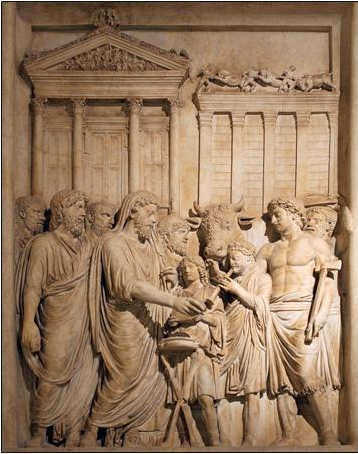
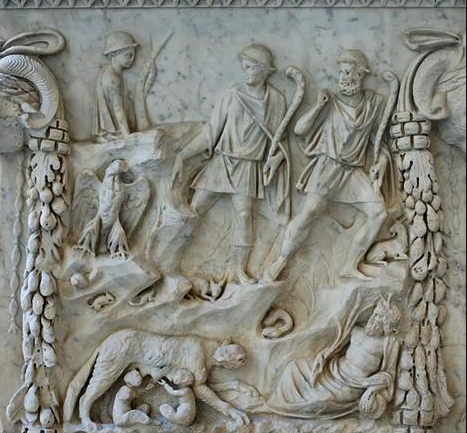
Time of discoveries and inventions
**New century and late feudalism**
The new century begins with discoveries and new knowledge in the field of science, technology, economy and, especially, by getting to know one's own planet. That is why Columbus' discovery of America (New World), 1492, is taken as the date of the beginning of the new century. Of great importance are many other geographical discoveries, as well as the appearance of the press, the improvement of war techniques, the progress of science and the reform of the church and spiritual life. The appearance of the press contributed the most to the progress of the human spirit and the literacy of the people, which in some parts of the world lasted from the middle of the 15th century until today. The credit for the invention of the press, around 1450, belongs to Johann Gutenberg. The Chinese knew about the printed book even earlier, but its reproduction and progress began with Gutenberg's printing house. People will write by hand, ie style (handle) and pen for a long time (until the advent of typewriters and computers), but books, especially church books (Bible), newspapers and other writings to be printed. The press has significantly improved education and schooling.
War technical discoveries predominated due to the use of gunpowder, with the help of which firearms, cannons and rifles were perfected, and later many other types of weapons. The superiority of the rifle bullet easily threw the medieval knight into oblivion. New weapons and new wars took far more lives than medieval wars. The development of science is stimulated by observations, experiments and the application of mathematics. Astronomers have contributed a lot to getting to know their own planet, above all that it does not have the shape of a plate, but that it is round, by studying the Earth and other celestial bodies. Among them, the Polish astronomer Nicolaus Copernicus stands out. He developed a detailed mathematical and astronomical model that shows how the Earth and other planets move around the Sun. Johann Kepler, Galileo Galilei, Giordano Bruno, Isaac Newton also made a great contribution to the development of science. They are accompanied by the development of philosophy as a science, led by Francis Bacon and Rene Descartes. The clock, binoculars and compass are being perfected, the construction technique is advancing, especially ships for long voyages (caravels).
**The great geographical discoveries**
of Man's knowledge of the universe and of the Earth were very small. Europeans did not know about the American and Australian continents, and knowledge of Asia and Africa was poor. The need of Europeans for Eastern goods (spices, silk) was growing, and how much it was priced can be seen by the fact that pepper was as expensive as gold. A sea trade route to India had to be found. The Portuguese were the first to go in search. The exploration of Africa began at the beginning of the 15th century, and continued with Henry the Navigator, to Bartholomew Diaz, in the winter of 1487–1488. year, sailed to the south of the continent - the Cape of Good Hope. Africa was sailed by the navigator Vasco da Gama, and arrived in Calcutta, on the west coast of India, in 1498. The way to India was found, so the Portuguese continued to explore and conquer the neighboring islands - Borneo, Sumatra, Java.
Christopher Columbus' attempt to sail west to India led to a great and unexpected discovery. After studying the maps of that time and believing that the Earth was round, he set sail under the patronage of King Ferdinand of Spain and Queen Isabella. After crossing the Atlantic, he reached an island he named San Salvador (Holy Savior). Convinced that he had sailed to India, he called its inhabitants Indians. Columbus traveled to America three more times, and died believing that he had discovered India, and not a new continent - America. His geographical discoveries did not bring fabulous wealth to the Spanish court. The great sailor died disappointed, in misery. One country in South America is named after him - Colombia.
The English and French soon joined the Spaniards and Portuguese in exploring the New World. The competition in new discoveries and knowledge began, but also the conquest of the newly discovered continent, America, and the conquest of the native population. The English king sent John Cabot, who reached the northern part of the American continent and discovered Newfoundland and Greenland. Frenchman Jacques Cartier surveyed the Canadian coast. The Portuguese Pedro Cabral reached the coast of Brazil (1500), and Amerigo Vespucci explored unknown areas of South and Central America (after him, all these areas were named). Vasco Nunez de Balboa, a lesser-known navigator and adventurer, was the first to see the Pacific Ocean (1513). Frenchman Jacques Cartier surveyed the Canadian coast. The Portuguese Pedro Cabral reached the coast of Brazil (1500), and Amerigo Vespucci explored unknown areas of South and Central America (after him, all these areas were named). Vasco Nunez de Balboa, a lesser-known navigator and adventurer, was the first to see the Pacific Ocean (1513). Frenchman Jacques Cartier surveyed the Canadian coast. The Portuguese Pedro Cabral reached the coast of Brazil (1500), and Amerigo Vespucci explored unknown areas of South and Central America (after him, all these areas were named). Vasco Nunez de Balboa, a lesser-known navigator and adventurer, was the first to see the Pacific Ocean (1513).
The greatest discovery after Columbus was made by the Portuguese navigator Fernando Magellan. With five ships and 265 sailors, he sailed the globe (1519–1522). After crossing the Atlantic, he sailed around South America, passing through the strait that was later named after him. He was killed in the Philippines, in a conflict with the natives, and only one ship with 18 people returned to Spain. This journey proved that the Earth is round.
The English and French continued to explore and conquer North America, and the Spaniards and Portuguese continued to explore South America. The Spaniards were more aggressive than the Portuguese. Thus, the conquistador Hernan Cortes crossed from Cuba to Mexico and conquered it after the weak resistance of the indigenous population. Then Francisco Pizarro conquered Peru. The Spaniards easily enslaved the Aztec and Inca states and plundered their gold and silver, and then they forced the indigenous population to the hardest forms of work. Robbed, tortured, converted to Christianity and satirized by hard work, the Indians almost completely disappeared from most of the American continent. The Spaniards and Portuguese in South America, and the English and French in the North, began to bring in the African inhabitants by turning them into slaves. Apart from precious metals, Europeans imported corn and potatoes, llamas and turkeys from America, then unknown plant and animal species in Europe, and they transferred many European plants and animals (rye, cotton, horses, etc.) to the American continent. they began to bring in the African inhabitants by turning them into slaves. Apart from precious metals, Europeans imported corn and potatoes, llamas and turkeys from America, then unknown plant and animal species in Europe, and they transferred many European plants and animals (rye, cotton, horses, etc.) to the American continent. they began to bring in the African inhabitants by turning them into slaves.
Apart from precious metals, Europeans imported corn and potatoes, llamas and turkeys from America, then unknown plant and animal species in Europe, and they transferred many European plants and animals (rye, cotton, horses, etc.) to the American continent.
The last continent, Australia, was discovered by Europeans in the middle of the 17th century. Australia was sailed by Dutch navigator Abel Tasman.
Great geographical discoveries enabled Europeans to see all the expanses of the Earth, little or not known until then. Unfortunately, they also left negative consequences - the destruction of indigenous civilizations in both Americas and the beginning of African black slavery.
**Manufacturing**
With the new century, Europe is experiencing population growth, especially in cities. The natural increase in population is reduced by wars, plague and typhus epidemics, and famine. The city and city life give a mark to the new age, although most Europeans will live in the countryside for a long time. At the beginning of the new era, the largest European city is Constantinople, which has more than 100,000 inhabitants, as well as Rome (the seat of the Pope and Catholicism), followed by Venice, Naples, Milan, Paris, London, Antwerp, Moscow. In the 17th century, Amsterdam suppressed Venice in trade, and Paris and London made rapid progress. Italy and Flanders are the most urbanized and industrialized areas of Europe. With the transfer of gold from America to Europe, the value of money dropped, so the prices of agricultural and handicraft products were extremely hig
The beginning of capitalist production is known as manufacture (Latin manufactura - handmade).
Workers in manufacturing workshops did all the work by hand, perfecting only one type of work. Manufacturing developed especially in the Netherlands, then in England, France and Germany. The most famous manufactured products were made in cloth, silk, leather, shipbuilding, etc. Agricultural production, especially livestock, took on capitalist characteristics in England and then in other Western European countries. By "enclosing" the municipal morning, by buying or appropriating peasant land, the English nobility, which accepted bourgeois habits and the way of production, laid the foundations for the agricultural industry. The strengthening of cities affected the development of manufacturing, and its bearer was the bourgeoisie, then in its infancy.
Production was improved by inventions: in textile production - automatic spinning machine, in metallurgy - metal melting. Labor is increasingly being replaced by wind and water; the "water engine" (water wheel) was invented. Undoubted progress was brought by the invention of the steam engine in the 17th century, but its improvement and revolution in production came in the 18th century. Since then, the machine industry has been suppressing manufacturing.
Fire robot
In addition to high taxes, crazy real estate prices and the invasion of the homeless, California has been besieged by apocalyptic forest fires in recent years. Climate changes? Certainly, but also human stupidity, because eucalyptus trees were planted en masse all over this American state on the west coast in the 1970s, whose oils emit flammable vapors when heated.
Therefore, it is not surprising that the fire robots in America were first hired by the service from Los Angeles, at a price of 278,000 dollars. In exchange for this amount, they bought a vehicle that seemed to fly out of a C&C game. The Thermite RS3 weighs almost 600 kilos (573 to be more precise) and is able to expel about 9,400 liters of water from the nozzle in just one minute at an angle of up to 70 degrees. The robot is controlled remotely and the range is limited by a hose length of 90 meters. It is powered by a 36-horsepower diesel engine with a top speed of 13 km / h. In order to overcome obstacles on the road, the Thermite RS3 is equipped with a dispenser, and it also has a winch with which it can pull 1,600 kilograms of cargo. The fact that it looks like a tank in the video is not accidental. The company that manufactures it, Howe & Howe Technologies, is currently engaged in the production of this type of vehicle, including the electric Ripsaw M5.
https://www.youtube.com/watch?time_continue=56&v=o1y_qA5o5ZM&feature=emb_logo
source youtube
https://www.youtube.com/watch?v=cX7XZTmVu0c&feature=emb_logo
source youtube


Thanks, sorry, please
Thanks, sorry, please
These words are used less and less, the corresponding terms are less and less expressed. It is noticeable that this phenomenon is not characteristic only for one part, for one layer of one nation, but universally for a large population. So people meet people who are not sympathetic to themselves, or at least people who do not hesitate to show rudeness. Politeness, a way of life acquired from an early age, is developed and designed by years of life and personal efforts to improve (Dale Carnegie sought to make people happy by himself and others - his book "How to make friends with yourself" in the Francophone area is gained great popularity - it was published by the house Ashet).
By unpolished behavior, a subconscious negativism towards her is created around the person who behaves in this way. How does such a person start a conversation? She immediately begins to declare herself, her desires, plans, experiences, her self. Discernment requires something quite the opposite - a conversation should be started or included in the conversation by taking an interest in your interlocutor - honestly, from the heart with an effort to be kind to that person.
It is becoming more and more common to be interested in another only if the desired or any benefit can be obtained from him - if there are no such prospects and it is concluded that there will be none, any interest in that person is lost.
Obviously, such behavior loses sight of the simple consequence of this attitude and this organization of relationships with others: people who distance themselves from selfishness or gross disinterest in others and themselves are rejected by such behavior - the vacuum that created and maintains it around them, no one can approach him, not even those who are kind to him or could be kind to him.A clear loser is a person of negativistic behavior.
Lack of gratitude (whether it is expected or not), failure to pay attention to how one perceives one's own shortcomings, non-expression and basic forms of politeness are the reason for negative evaluations, expressed or not, that go with people of such behavior and those evaluations quickly become ) assess the personality of those persons.
Everyone has a system of self-defense that allows them to predict what can endanger them - from small to large and the largest intensities of inconvenience and danger.
An unpleasant person is very quickly registered by the defense mechanism and always risks being rejected - and as an unpleasant, undesirable, rejected person, he will certainly have life difficulties because of that - the consequences of his unpleasant behavior.
Life is sacrifice and it is desirable to make sacrifices voluntarily, with love.
How to successfully motivate children with autism in a safe and secure way
Children with autism usually have difficulty interacting with others and face communication problems. It is a real challenge for parents and therapists to find a safe, effective and safe way to motivate such children. Language development and the adoption of adequate behavioral and communication skills can be a major problem for children with autism; however, there are several ways to make it easier for them to do so.
Meet the child
Before you decide on any learning strategy, it is necessary to get to know the child well. Should:
Make a list of your child's interests and strengths. This should include what fascinates and preoccupies the child, and which may seem strange.
Understand which activities frustrate the child and cause anxiety in him
Keep in mind the development problems present
Once you've done that, you can create a strategy that your child can learn best. No two children are exactly the same, so you will need to observe the child carefully and assess the situation before deciding on the next step.
Ways of motivating
There are several ways you can motivate a child with autism. Here are some:
Game therapy
You can motivate your child with play therapy, which will give him the impression that he can only achieve something, encourage him to express himself and learn new skills.
Give him a choice
You can motivate your child by allowing him to choose an activity that stimulates him, such as jumping or dancing. You can join him in that activity until he is able to make eye contact or communicate spontaneously.
Use positive support
During therapy or learning new things, the child will usually react better if you let him try again after an unsuccessful attempt and if you praise him when he does something properly.
You can try using some other type of support. Children with autism often cannot be motivated in some traditional way that we are used to in everyday life. In that case, you will have to find what suits the child.
One way is to give the child a few things and observe what he chooses. In most cases, the first subject that the child chooses will also be the most powerful means of support.
Once you find out what works best for your child and what motivates them the most, you can give them that item after they do something right. Be sure to include some form of verbal support, e.g. "Well done!". In that way, they will become aware of the importance and efficiency of verbal support.
Combine new skills and what the child already knows
It is important that the child's learning is fun and interesting. This means that in addition to learning new skills, you should also include what the child already knows and knows. While it is important to create a routine so that the child can expect what to do, research has shown that children with autism behave better, are better concentrated, and learn better if the activities are varied.
Turn on sensory activities
The child can learn new skills of helping activities based on sensory integration faster. However, it is important to keep in mind that these activities should be introduced slowly and gradually in order to avoid sensory overload.
Music therapy
Many children with autism like to sing, even if they can't speak. With songs with simple phrases that are repeated, you can help them develop their language. Singing can also help them eliminate monotonous speech patterns. It can also improve their social interaction by encouraging them to participate in group activities.
Reward a child
You can reward a child when he behaves well or when he successfully completes an activity. You can give the reward at a certain time of the day, if the child did what he needed to do.
Children with autism are usually harder to motivate than children who do not have the problem. However, there are several ways that can help you with this. With the help of these tips and when you know well what suits your child, you will be able to create a plan or strategy with which you will be able to successfully motivate a child with autism.
It is necessary to cooperate with therapists and use the same types of support and rewards, in order for the child to better understand and learn the verbal indicators that go with them. This will make your child more motivated and easier to learn new skills.


Horse Milos Obilica Ždralin
What Aleksandar Makedonski and Bukefal are for Greek history and mythology, are Miloš Obilić and his Ždralin for ours, Serbian.
Milos Obilic was a Serbian knight from the Middle Ages who is often mentioned in epic poems. He is the knight who killed the Turkish Sultan Murat I in the Battle of Kosovo. He was celebrated as a hero of supernatural birth and strength, his mother was a fairy and his father a dragon.
Zdralin, Miloš Obilić's horse, was a hero as well as his master. Together they were followed by fame, and together they perished. It is the only legendary Serbian horse that died in battle. According to epic poems, Zdralin was a tall horse, even so tall that he looked like a giant among other horses. And they were afraid of him. That is why Milos had a few duels and they lasted for a short time, because no one had the strength to fight against such a horse and hero for longer.
Although Zdralin was a powerful horse, he could not fly, but he did not need that, considering his size. Miloš Obilić was an armored man, all in armor and iron, so he put armor on his horse as well. Neither of them was ever scratched, let alone wounded. He simply destroyed everything in front of him with his enormity, so Miloš was unreachable for his opponents. Zdralin is not from the royal stud farm, although Milos Obilic was a court man. He could have chosen horses for himself and his armored men, as the commander of the border units, in the imperial stables, but he did not do that. He had his own stable, as a high-ranking officer and a nobleman. Milos selected horses in it himself. Zdralin was also drawn there.
The chronicles say that Miloš's stable was located on the northern slope of the Cer mountain, on the place where before that, in the time of Emperor Trajan, there was a Roman camp, which is still called Konjuša.
At the time of the Battle of Kosovo, Milos Obilic was forty and Zdralin was ten. They were both in their prime. The work they performed will be remembered for its historical significance and the way it was performed. It is a lie, according to the latest archival data, that Miloš approached Tsar Murat on fraud, pretending to be a surrender, because no one armed could approach the Tsar, and at least one defector from the opposing army. Milos came to Murat on his Zdralin, breaking through the Turkish army with his armored men. Miloš's surrender was invented by the Turks because out of shame they could not admit that someone managed to break through to their sultan. In that way, they wanted to diminish the feat of Miloš and his knights, and thus Ždralin. That miracle of horses and heroes astonished the Turks and their horses, so Miloš used that current Turkish confusion and fear and came to Murat. Zdralin trampled everything in front of him, while Milos cut everything around him.
Both Zdralin and Milos died in the same place, in the most famous place in the country of Serbia - Gazimestan. Thousands of Turkish horses and heroes attacked the two of them, who fell, fighting, both to the last breath. Zdralin died as a man, a knight, which earned him his name in the list of Kosovo knights. It doesn't matter what the horse is, because his death was heroic.

 @evomeopetrobi