Лора Лумер як гарний приклад боротьби з російською пропагандою
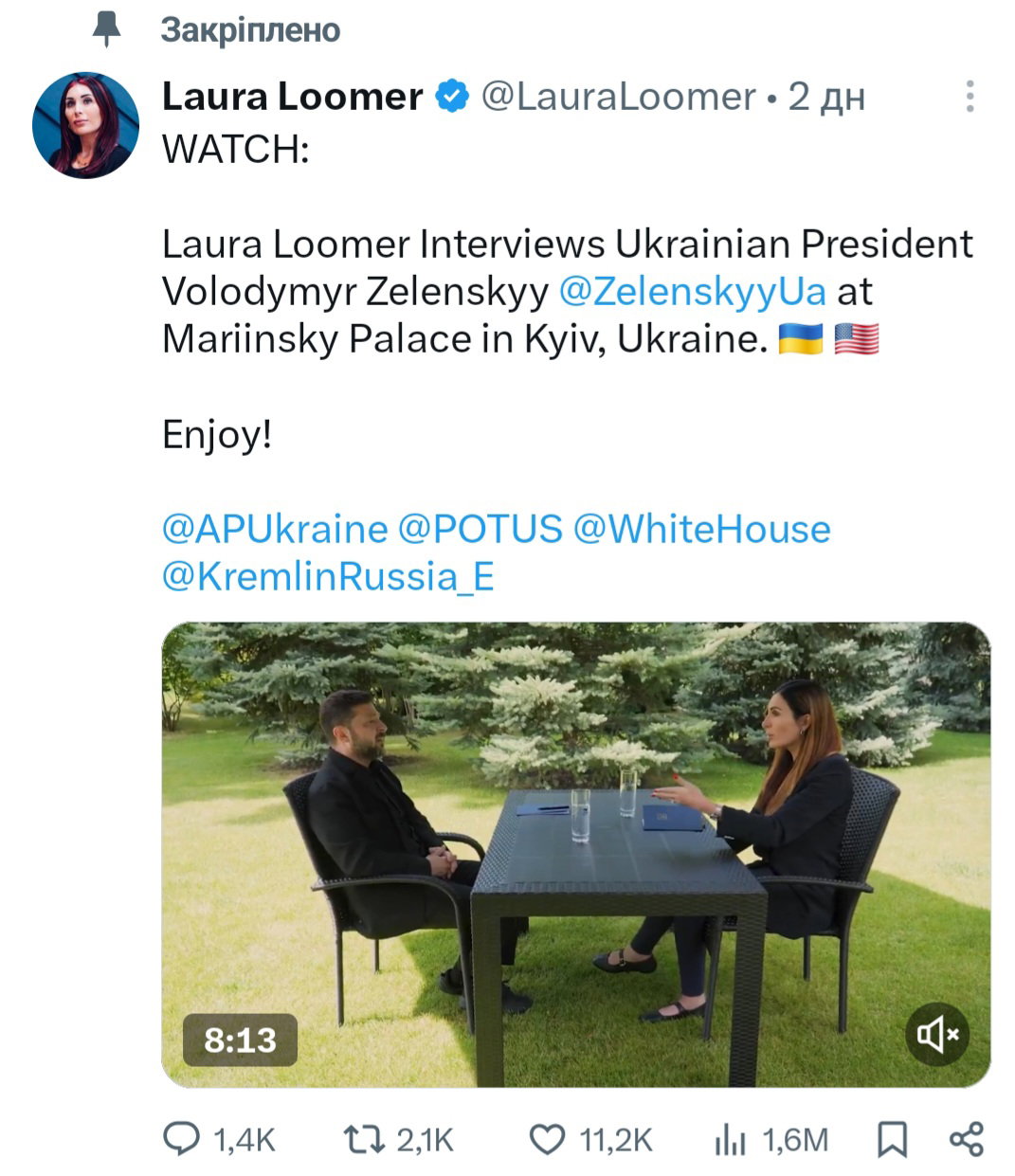
У дорозі переглянув інтерв’ю Лори Лумер із Зеленським та її інтерв’ю з Марічкою Падалко.
Кілька спостережень і думок.
1. Провальна стратегія української влади (а також опозиції та всього «істеблішменту») у минулому полягала в тому, щоб робити ставку виключно на демократичних кандидатів і майже повністю ігнорувати республіканців. Окрім цього — потоки хейту в бік Трампа з боку журналістів і різного типу інфлюенсерів. Навіть у цьому інтерв’ю Лора Лумер згадала, що Зеленський брав участь у кампанії на боці демократів. Зрозуміло, що Зеленського підставили — неясно, чи через дурість своїх, чи через заангажовану прихильність до демократів або ліво-ліберальної ідеології, чи з іншої причини. Ну, Зеленський добре відповів, і начебто ця стратегія вже змінилася.
2. Лорі Лумер дуже сподобалися Київ і Україна. Це особистий досвід, який вона проживає і вже ніколи не забуде. Тому треба більше спілкуватися. Усім. Бо маємо такий парадокс: українське суспільство переважно консервативне, але часто просуваємо як усередині країни, так і за кордоном ліво-ліберальних інфлюенсерів, митців і журналістів, представників громадських організацій. Такі «лідери думок», звісно, можуть лише відштовхнути консервативних лідерів думок, таких як Лора Лумер.
3. Лора на своєму прикладі ще раз показала, як працює російська пропаганда. Їй знищили Twitter-акаунт (до купівлі його Ілоном Маском), ліво-ліберальні медіа блокували її, а russiatoday надала свою платформу та аудиторію. Маю сказати, що я не дивився її подкастів. Вірю, що росія не платила їй, але самого надання платформи й можливостей було достатньо.
Так само про-російські пропагандисти неоднорідні. Є огидний Такер Карлсон (якого сама Лора зневажає і називає «Катарсоном», натякаючи, що йому гроші платить Катар). Звісно, якщо брати гроші від Катару, то можна й від росії? Є Джон Міршаймер — і цей дід давить на геополітику. Кожен із пропагандистів має свої підходи, свою аудиторію та свою «оплату»: хтось отримує «моральну подяку й визнання», а хтось — банально російські гроші.
Взагалі якось думав написати про цих пропагандистів окремий пост. Скажіть, якщо вважаєте, що це гарна ідея, — тоді напишу.
Для Лори Лумер поворотним пунктом стало те, як вона зрозуміла, як працює росія, зокрема й на Близькому Сході. Вона зрозуміла, що ця країна — не друг США, навіть якщо в якийсь момент могла здатися союзником.
4. Нам може здаватися, що ми — центр Всесвіту, і очі всього світу прикуті до України. Але багатьом людям байдуже. Частина світу підтримує росію — на жаль, це такі реалії, які важко змінити в одну мить. Задумайтесь самі: у вас точно є знайомі, які «за євреїв» і «за арабів» у конфлікті на Близькому Сході. І точно більшості знайомих абсолютно байдуже, що там відбувається — їх цей конфлікт не торкається. Тож марно очікувати, що весь світ буде за нас. Але, звісно, суспільна думка змінюється, і треба спілкуватися — кожен на своєму рівні.
5. Позабавило, наскільки сильні кліше російської пропаганди. До 2022 року нашу війну взагалі переважно називали «Ukrainian conflict». Це словосполучення десь лишається досі. Але от Лора, яка вже за нас, все одно згадує «Azov battalion» і свастики. Чомусь її радники та команда не просвітили, що Азов уже давно не батальйон, а корпус. Проте це словосполучення настільки сильне, що я його періодично чую навіть від тих іноземців, які симпатизують Україні. Звісно, не варто очікувати від іноземців розуміння різниці між військовими формуваннями. Утім Лора вдається до пафосної поради, що, на її думку, треба змінити лого. Це свідчення того, наскільки глибоко російські тези про «денацифікацію» засіли в тих, хто споживав російську пропаганду.
Водночас росіяни завжди самі готові до співпраці як із відвертими нацистами й ультраправими, так і з ультралівими з усього світу.
Наче дрібниця, але дуже позитивно, що в українських архівах знайшли документи про предків Лори Лумер, які жили у Вінниці, а потім переїхали до Києва. Це їй дуже сподобалося, вона багато про це говорила.
Загалом уже видно, що це дуже продуктивний візит. І таких подій, такого спілкування треба більше.
Старий Лендкрузер
Більш ніж півроку тому взяв собі старий Toyota Landcruiser, і з того часу дуже полюбив цю модель. Єдина проблема, що старе авто на дорогах Слобожанщини і Донбасу швидко ламається, тому я частий гість на СТО.
Також виснажує це і бюджет. Тому попрошу своїх читачів уважно ставитись до всіх зборів. Я ніколи не відкривав збори, завжди ремонтував за свій кошт, але наступає момент коли й заощадження можуть закінчитись. І от я задумався про збір, тільки задумався - адже все-одно ресурси вичерпні, і багато великих зборів, важливіших - на техніку, дрони, НРК.
На щастя, вже і думати не потрібно, бо мій давній друг Denys Shupta , з яким я періодично спілкуюсь про життя, економіку, машини - прийшов на допомогу і скинув велику суму, якої точно вистачить на найближчий час.
Тепер можна не продавати свою стару Теслу, навпаки я вирішив взяти її туди та там де дороги дозволяють- їздити на ній. Далеко не скрізь можна на ній проїхати, і не дуже далеко - адже майже відсутні платні зарядки.
Зате вдома можна заряджатись по дешевому тарифу.
Такі реалії: живу в хаті-сараї, де немає навіть води, зате заряджаюсь електрикою (як там блогери кажуть: "Машину бачать всі, а хату ніхто").

Blablacar історія. Повар
Повар Серце старого Лендкрузера просить масла. Тому зупиняюсь на вже замаскованій від потенційних прильотів заправці. Згадую про Blablacar та публікую поїздку. Знаходиться пасажир. Він каже, що йому пощастило, і це напевне справді так, бо це - не популярний маршрут.
Бачу він підходить, йде повільно, з паличкою.
- Та їду в звільнення на 3 дні, - розповідає
- Ви військовий?
- Так
- Ну тоді вам проїзд безкоштовно. Зараз такі часи, що треба допомагати один одному.
Він з цим не дуже погоджується, а потім трохи розповідає про свою службу.
- Я - повар.
Так, він саме сказав «повар», а не кухар чи якесь інше слово. Повару 58 років. Він прокидається в 5 ранку і робота на кухні триває десь до 21ї. Зараз графік тиждень через тиждень, але бувало, що працював довгий час взагалі без вихідних. Відпускають дня на 3, і йому справді пощастило, що ми підвеземо його прямо під будинок.
Трохи поговоривши, ми слухаємо подкасти. На відміну від інших пасажирів, які мені попадались, і любили щось коментувати чи розпочинати політичну дискусію, повар мовчить. Таке враження, що йому байдуже на картонки, він просто робить свою роботу. Цей чоловік навіть запитує чи є в нас де заночувати, бо в нього є квартира. Отак буває: ми знайомі ледве годину, а він вже пропонує допомогу. Що ж, так і працює «бартерна економіка», але від квартири ми відмовляємось, бо їдемо в інший пункт призначення.
Північ ще не наступила, але деякі заправки закриваються і не працюють в тривогу. Ловлю себе на думці, що на цій заправці сідаю за той же літній столик де зупинявся раніше з А. Отак буває - мережа заправок по всій Україні обрастає спогадами і асоціаціями. А ще - магазини, кафе, електрозарядки - вся ця кількість з роками настільки вже велика, що про них можна було б написати якийсь гід (в стилі Уельбека «Карта і Територія»).
Місто, яким ми проїжджаємо, повністю порожнє, не видно ні таксі ні поліції. Повар хоче зійти трохи раніше й ще пройтись - але я наполягаю щоб підвезти його прямо під будинок. І вже там, він наполягає щоб я взяв «хоч на каву». Я відмовляюсь, але він наполегливий - доводиться погодитись. Робота повара непомітна. Його ви точно не побачите в інстаграмі і тредс. Ми не знаємо, щасливий він чи ні. Але Повар точно не зневірився і продовжує робити те, що йому вдається найкраще.

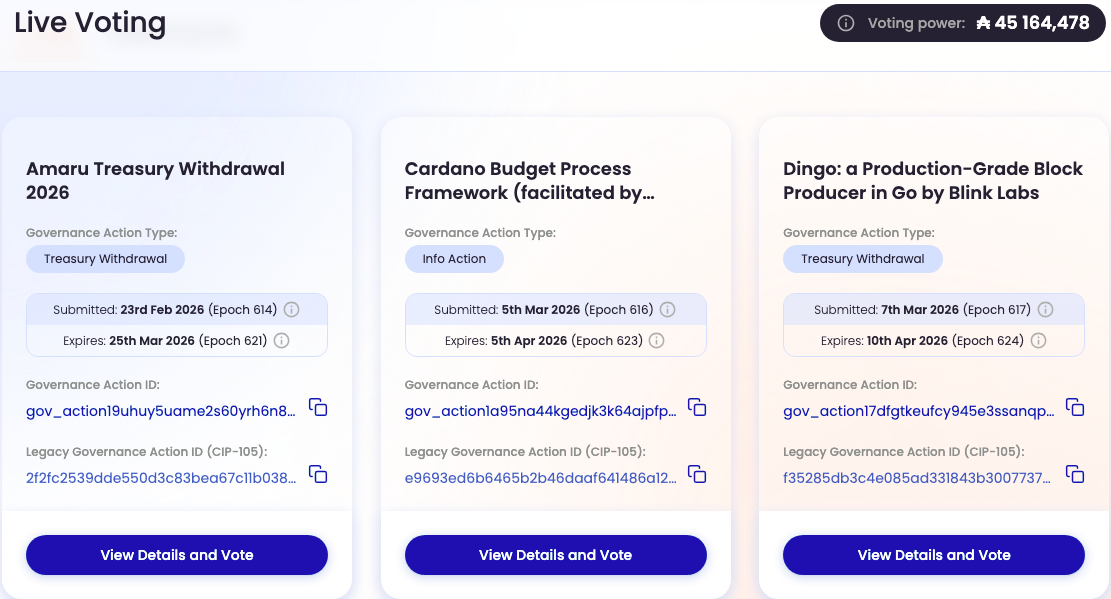
Cardano Decentralised Deputy Diary. Text 21
Hello, my readers and everyone interested in Cardano and blockchain governance.
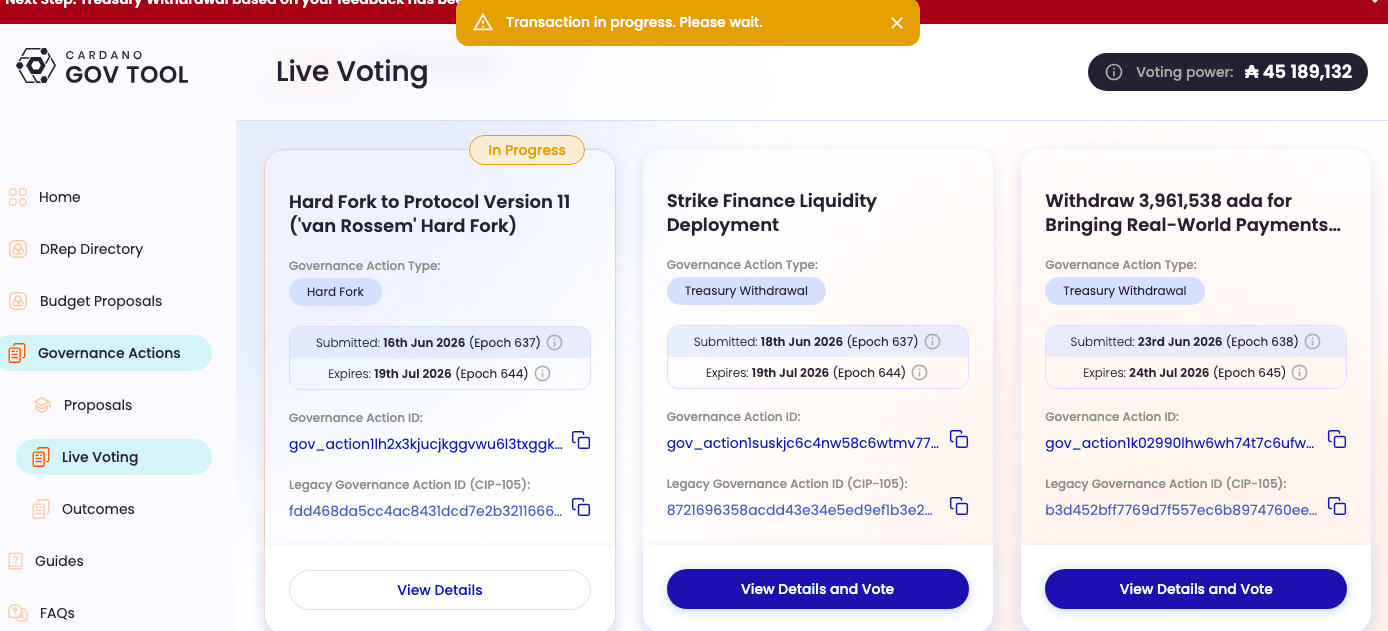
Date: 7 July 2026
Voting Power: ₳ 45 189
Today - many many votes to make. Here is the full list of my votes
1 . Eternl: Path to Sustainability - v2
Voted Yes.
2 . Hard Fork to Protocol Version 11 ('van Rossem' Hard Fork)
Voted Yes.
3 . Strike Finance Liquidity Deployment
Voted No.
4 . Withdraw 3,961,538 ada for Bringing Real-World Payments to Cardano with Wirex
Voted No.
5 . Bifrost: Unlocking Bitcoin DeFi on Cardano — Road to Mainnet (Phase 1 of 2)
Voted Abstain.
6 . Net Change Limit: Cardano Treasury (Epochs 613-713)
Voted No.
7 . Global Order Book connect Cardano DeFi to increase transaction
Voted No.
8 . Blockfrost's transformation to not-for-profit
Voted No.
9 . Se7en Labs: Daedalus Wallet Maintenance and Improvements 2026-2027
Voted Yes.
10 . Withdraw 4,969,231 ada for Cardano Enterprise Adoption: Ticketing Platform
Voted No.
11 . Cardano Builder DAO
Voted No.
12 . Alchemy by Sundial x Charms: Cardano-Native Bitcoin Treasury Protocol
Voted No.
13 . Withdraw 540,750 ada for UTxO RPC by TxPipe: Maintaining Cardano’s Integrati
Voted Abstain.
14 . Withdraw 1,310,960 ada for Hardware Wallet Maintenance 2026
Voted Abstain.
15 . Withdraw 1,193,000 ada for Intersect Technical Steering Committee Support
Voted No.
16 . Withdraw 540,750 ada for UTxO RPC by TxPipe: Maintaining Cardano’s Integratio...
Voted Abstain.
17 . Withdraw 1,684,050 ada for Tx3 by TxPipe: Open API Layer for Cardano's dApp P...
Voted Abstain.
18 . Withdraw 540,750 ada for Pallas by TxPipe: Maintaining Cardano's Core Rust Li...
Voted Abstain.
19 . Withdraw 540,750 ada for Oura by TxPipe: Maintaining
Voted Abstain.
20 . Withdraw 1,162,746 ada for MLabs Core Tool Maintenance & Enhancement: Plutarc...
Voted Abstain.
21 . Withdraw 3,810,423 ada for Mithril Protocol
Voted Abstain.
22 . Withdraw 25,400,000 ada for Intersect: Governance coordination and technical ...
Voted No.
I'll get back to you in few days or few weeks.
Best regards,
Cardano DRep Cryptotexty
GovTools page: https://gov.tools/connected/drep_directory/drep1yqmr09530yuehxdz2wca5setx03ps5tnxxrvzlgwmk3wswugxwh My
Cardano address: addr1q8ltprg2dpuftk3xa773c4eqz62d63syevwqmeeqk75h0swy974pwpegzh7kay6pdypdedrfrunyge4fam22062a4ghq3v8jqe
Мукачівський замок
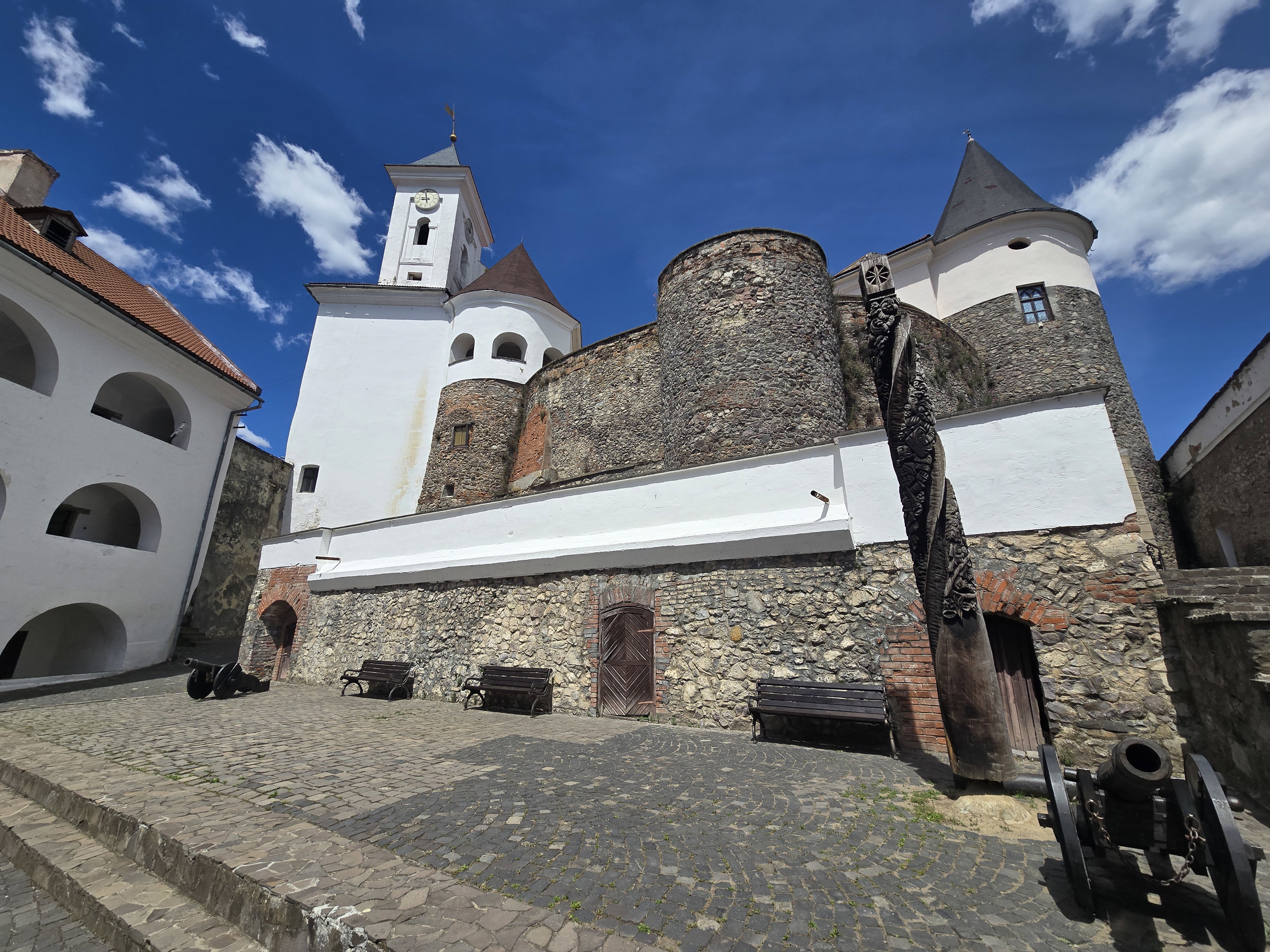
Ще один замок, який відвідав під час відпустки - Замок Паланок. Це напевне один з найпопулярніших і найвідоміших замків в Україні.
Не вдаватимусь детально в історію, але замок згадується документах ще XI століття.
Раджу замовляти екскурсію, вона коротка, але дуже змістовна й весела.
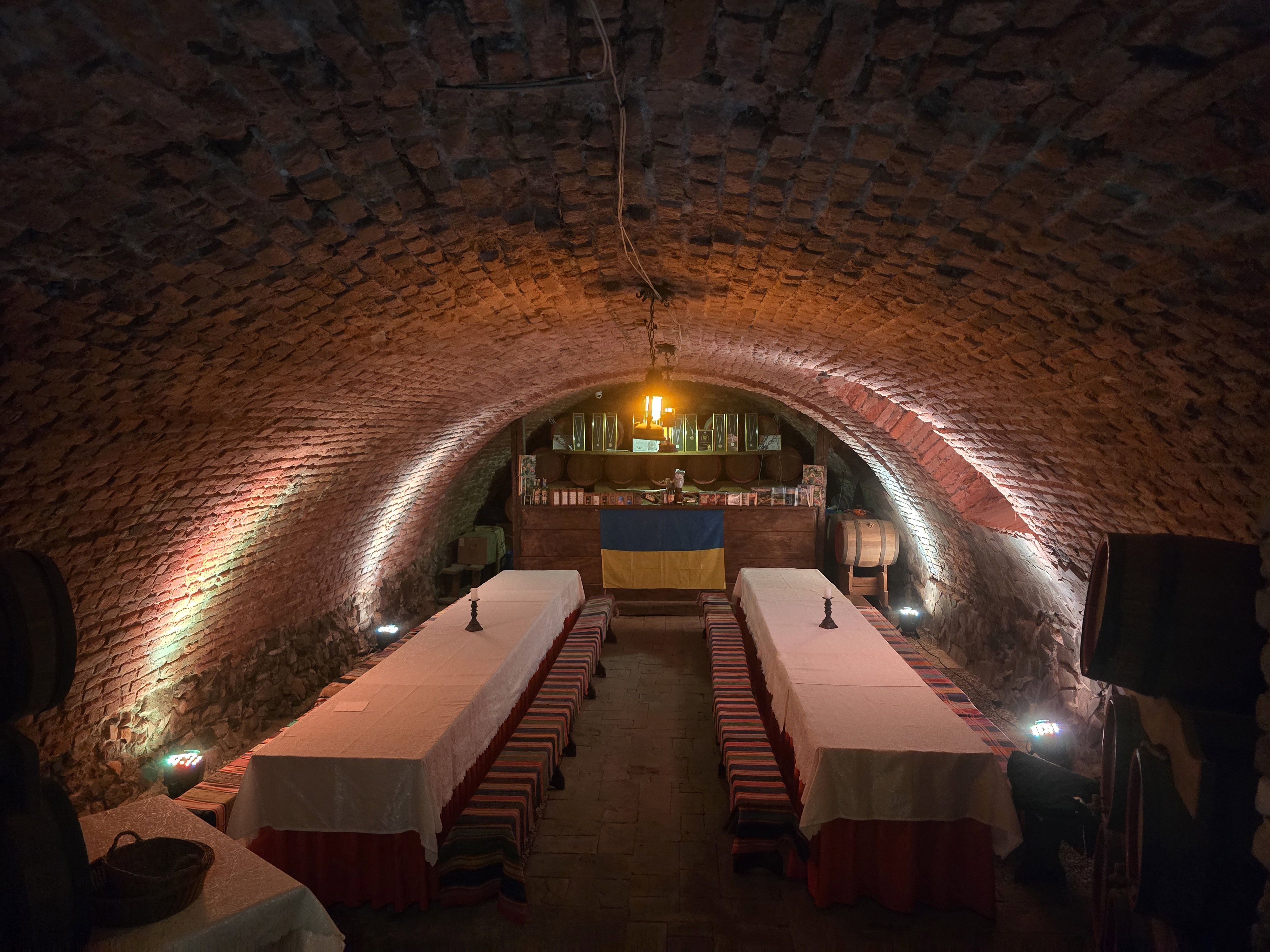
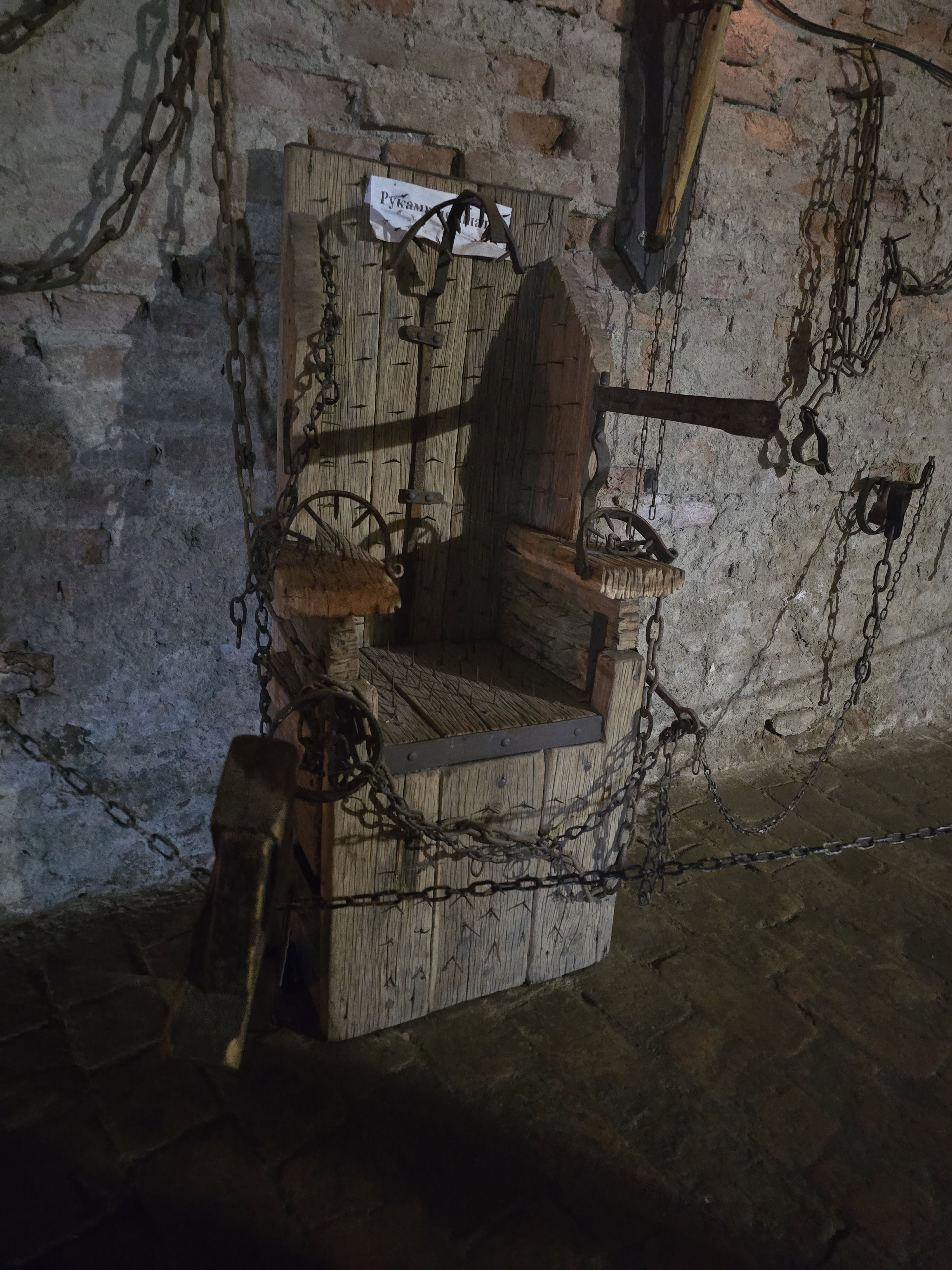
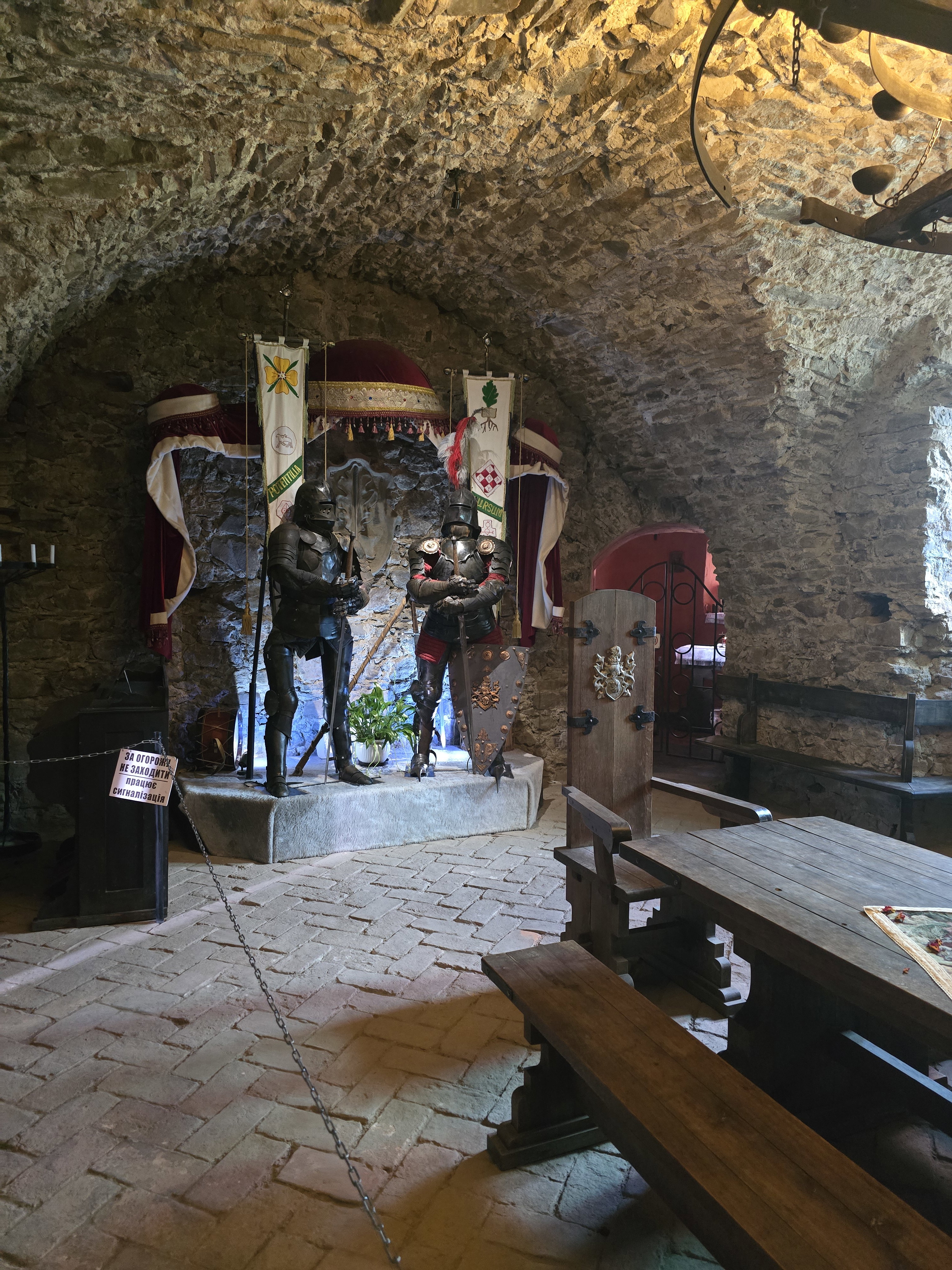
З цікавих місць в замку, які можна відвідати - Кімната катувань, Кімната історичної пам'яті князя Федора Коріятовича, атмосферне середньовічне кафе-ресторан. Є кімната з опудалами тварин, де не знаю чому, але представлено також двоголове ягня.
У 2022 році встановили Тризуб замість угорського турула. Лише в жовтні 2022... тепер цей високий Тризуб біля якого відкривається гарна панорама міста - найбільш інстаграмне місце в замку (ну може після кімнати катувань).
Як і в багатьох музеях, відкритих в наші дні, є зал присвячений і сучасній війні. Там побачив світлину і особисті речі Ігоря Климовича (Друг "Африка"), військового, хорунжого з Третьої штурмової, який загинув 30 липня 2025. Я був знайомий з ним. Хоча це напевне голосно сказано, спілкувався 1 раз в Дружківці декілька років тому. Чесно кажучи, не знаю, чому саме в цьому Замку знаходяться його речі, можу припустити, що він спілкувався й організовував співпрацю, і звісно ж бував тут. Африка займався фотографією, і серед речей можна побачити його камеру.
І в далекому від фронту Закарпатті, варто пам'ятати, що війна ближче ніж здається.
Тухля. Музей війни
Тухля. Музей війни
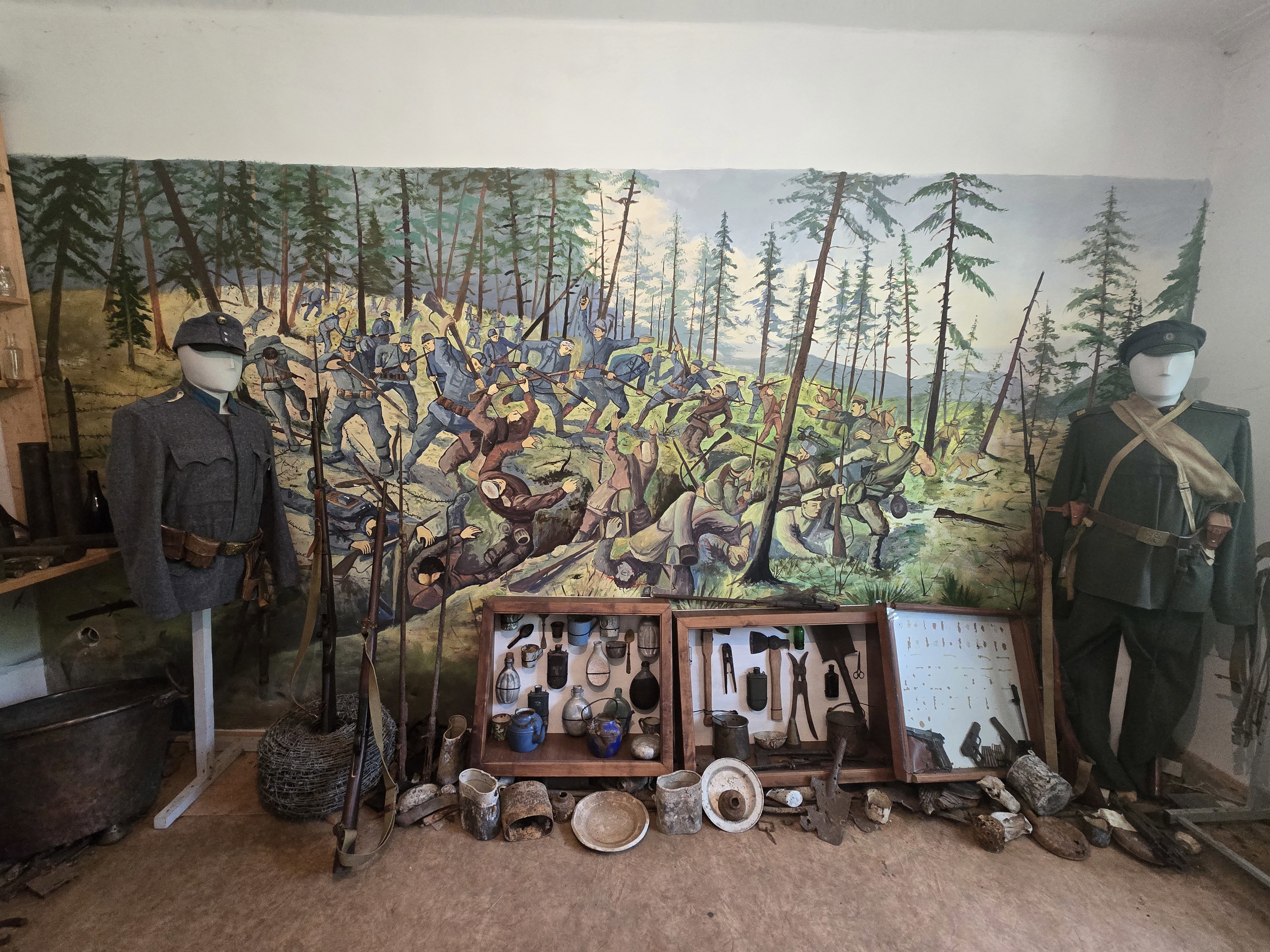
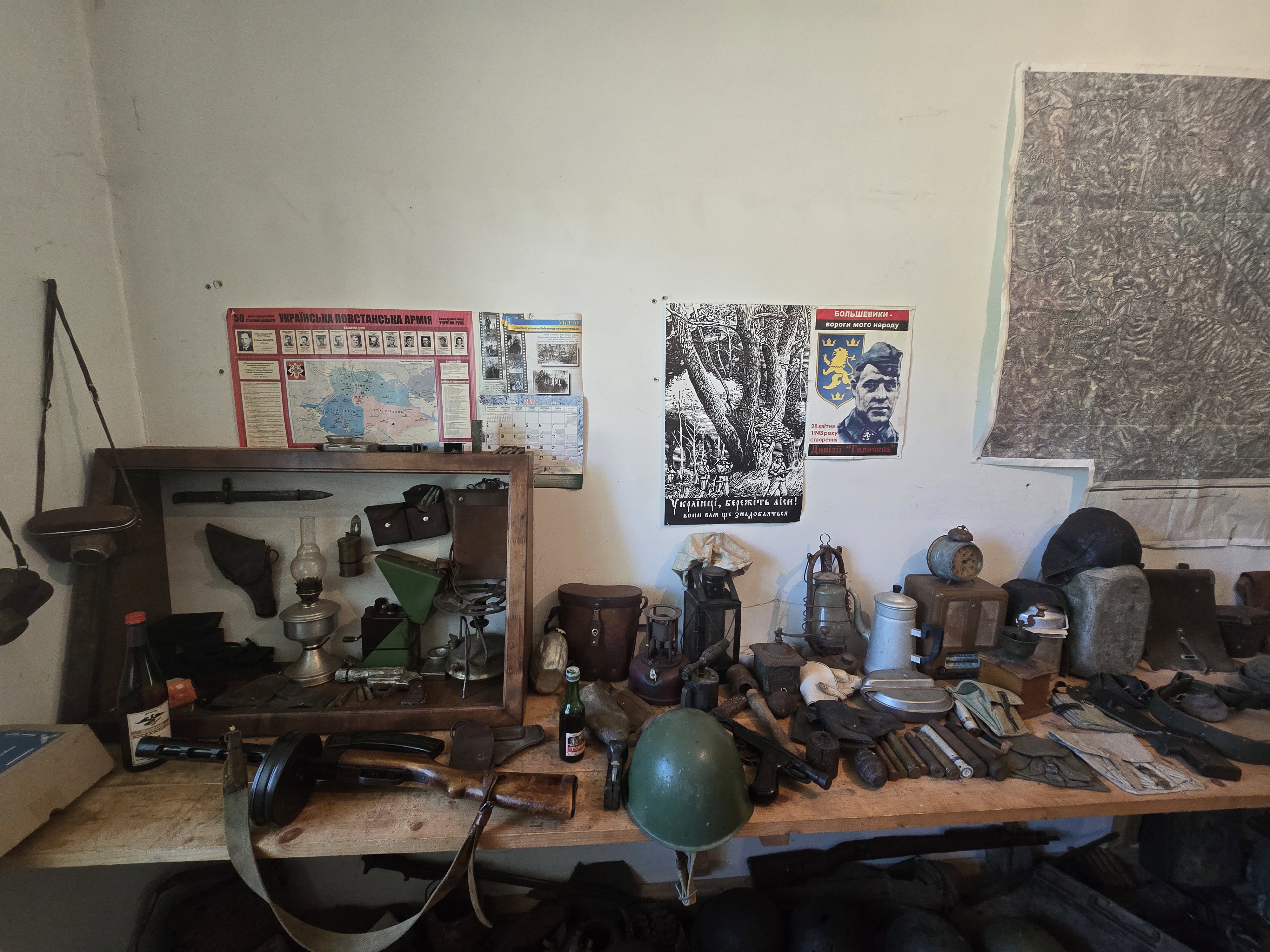
Недалеко від Славська є село Тухля. Багато разів по цій дорозі (Львів - Славсько), але раніше не знав, що прямо по цій дорозі знаходиться цікавий музей війни. Його ще називають "Музей Героїв Маківки", адже гора Маківка поруч. В 1915 там проходили бої, в яких брали участь Українські Січові Стрільці, і саме там в полон потрапив Євген Коновалець.
Приватний музей створено місцевим ентузіастом, який багато років за допомогою металошукачу познаходив більшість експонатів у горах в цьому районі. Є зала присвячена Першій світовій війні, зала про Другу світову війну, і зал про війну теперішню. Також є книжкова полиця видань, а на вікні в першому залі я навіть помітив відомий колись літературний журнал "Четвер".
З засновником музею можна поспілкуватись на тему історії та дізнатись деталі реманенту, зброї тих часів. Отже якщо проїздом, або на відпочинку ви опинились у Львівських Карпатах - раджу відвідати цей музей.
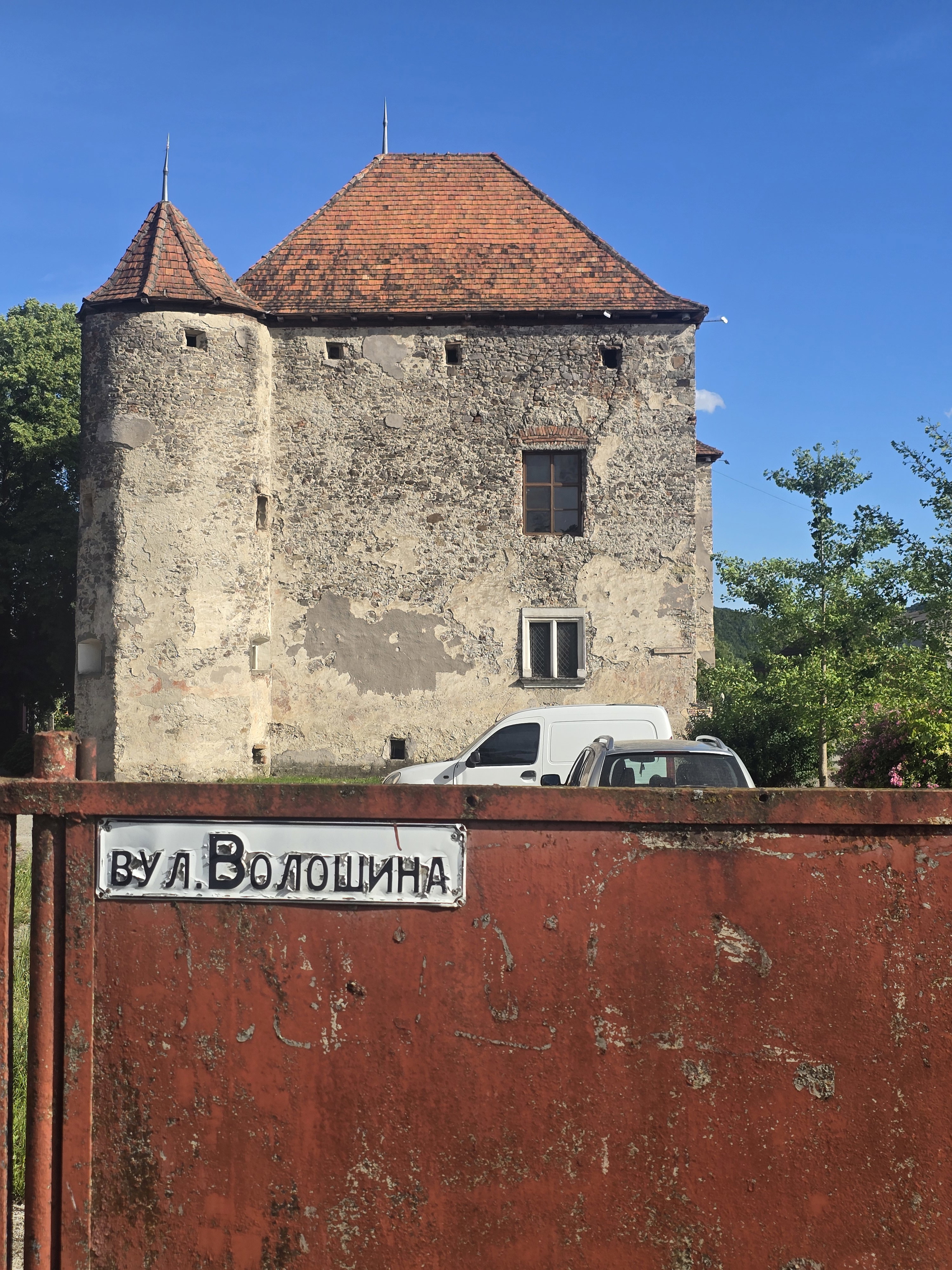
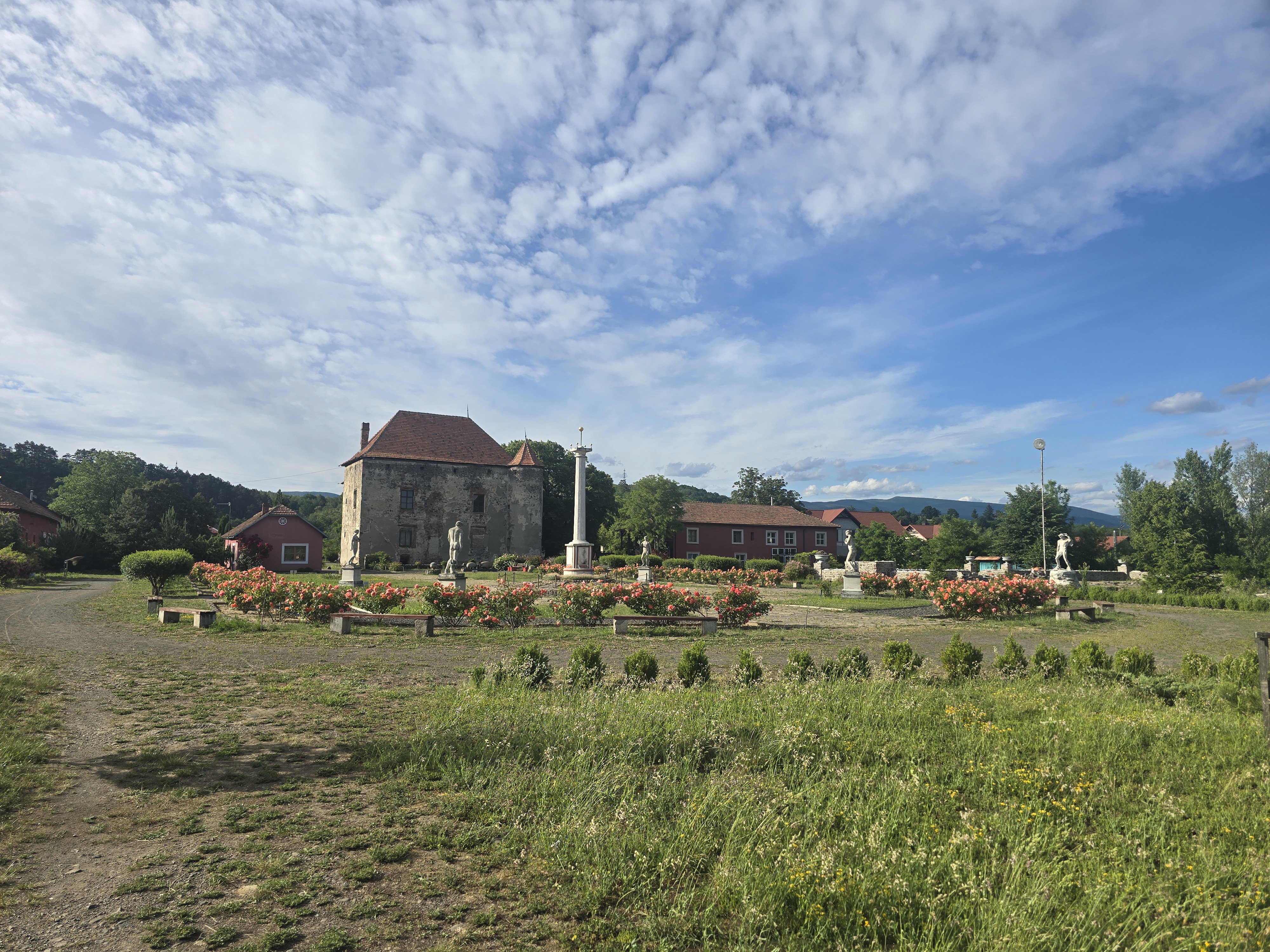
Замок «Сент-Міклош - Чинаді́ївський замок
У відпустці вирішив зробити невеликий тур по закарпатських замках. Деякі з них я відвідував вже не раз, інші — вперше. Крім Ужгородського та Мукачівського замків, цього разу завітав до Замку «Сент-Міклош» у Чинадійово.
Поселення на цьому місці відоме з 1214 року. До радянських часів Чинадійово називалося Сент-Міклош (угорською — Святий Миколай). Чому з’явилася назва «Чинадійово» — достеменно невідомо, існує кілька версій.
Чинадіївську фортецю збудували в XIV столітті барони Перені. Згодом її добудовували графи Телегді. Серед відомих власників — княгиня Ілона Зріні, її син Ференц II Ракоці та графи Шенборни.
Замок часто називають «Замком кохання» через легендарну історію кохання Ілони Зріні та графа Імре Текелі (він був молодшим за неї на 14 років). Кажуть, саме тут вони проводили таємні романтичні зустрічі. Є навіть окрема «спальня Ілони», яку показують туристам.
На двох поверхах замку розташовані експозиції: від давніх артефактів (наприклад, скульптура кельтського божества) до сучасних картин, фотографій та мистецьких інсталяцій. Також є цікаві потаємні ходи, прокладені всередині товстих стін.
У 2001 році замок віддали в концесію подружжю художників. Разом з однодумцями вони вже чверть століття реставрують споруду, проводять фестивалі та мистецькі заходи. Прямо біля замку я випадково зустрів Йосипа Бартоша — того самого художника, який відроджує цю фортецю. Ми трохи поспілкувалися.
Це справді позитивний приклад того, як приватна ініціатива може дати друге життя історичній пам’ятці. Нещодавнє зацікавлення українцями своєю історією, та зменшення ксенофілії й відчуття меншовартості - напевне збільшить кількість відновлених пам'яток.
Хай цей приклад надихає інших!
Cardano Decentralised Deputy Diary. Text 20
https://read.cash/@cryptotexty/cardano-decentralised-deputy-diary-text-20-a08a18c4
#Cardano #DREP
Cardano Decentralised Deputy Diary. Text 20
Hello, my readers and everyone interested in Cardano and blockchain governance.
Date: 19 May 2026
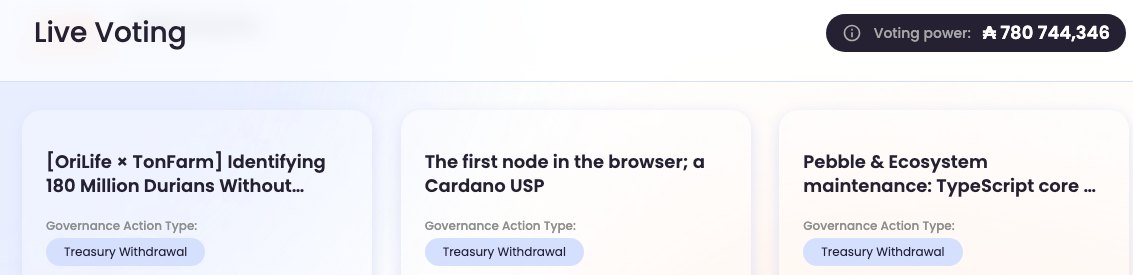
Voting Power: ₳ 780 744
Today - many votes. Here is my complete list of votes:
1 . [OriLife × TonFarm] Identifying 180 Million Durians Without Physical Labels
Voted No.
Reasoning: After reading I don't see the reason to support this project, I think there are much more interesting and crucial.
2 . The first node in the browser; a Cardano USP
Voted No.
Reasoning: While the idea looks interesting, I don't see the need to spend 1 mln $ on browser node. Who will run it? SPOs, Dapp developers and technically educated enthusiasts have all the necessary conditions and skills to run the node as it is now.
3 . Pebble & Ecosystem maintenance: TypeScript core of Cardano
Voted Yes.
Reasoning: If in brief: TypeScript is important as one of the most-used language among Cardano developers, so I decided to vote Yes.
4 . Cardano Vision 2026: Human Centred, Scalable, Post Quantum Secure - IO Research
Voted Abstain.
Reasoning: I wanted to vote "Yes", because anyway IO did the most Cardano-related research work. But the huge budget of 32916000 ADA, which is now (at the moment of voting) more than $8 million dollars made me to choose Abstain.
5 . Cardano dOSPO and OMF Program
Voted No.
Reasoning: 12 million ADA is huge amount. I think such and similar project should seek the smaller and modest funding via Project Catalyst and go through the process of community checking, reviews and voting.
6 . Scalus: Cardano’s Application Platform for Building, Launching, and Scaling
Voted No.
Reasoning: Big amount and the Treasury is limited. Once again I Ithink such and similar project should seek the smaller and modest funding via Project Catalyst and go through the process of community checking, reviews and voting.
7 . Eternl: Path to Sustainability (2026-2027)
Voted Yes.
Reasoning: Eternl is well-known company in Cardano ecosystem. While I mostly use other wallets now, I remember my good experience with Eternl, especially using Dapps, etc. The budget is relatively modest comparing with other Treasury withdrawal proposals. Additional plus I see in transparency with providing information about Catalyst proposals which Eternl team won, and the idea to return Ada to the treasury if the price increases. So if in brief - I'm confident that existence and development of Eternl will be beneficial to the Cardano ecosystem.
I'll get back to you in few days or few weeks.
Best regards,
Cardano DRep Cryptotexty
GovTools page: https://gov.tools/connected/drep_directory/drep1yqmr09530yuehxdz2wca5setx03ps5tnxxrvzlgwmk3wswugxwh
My Cardano address: addr1q8ltprg2dpuftk3xa773c4eqz62d63syevwqmeeqk75h0swy974pwpegzh7kay6pdypdedrfrunyge4fam22062a4ghq3v8jqe
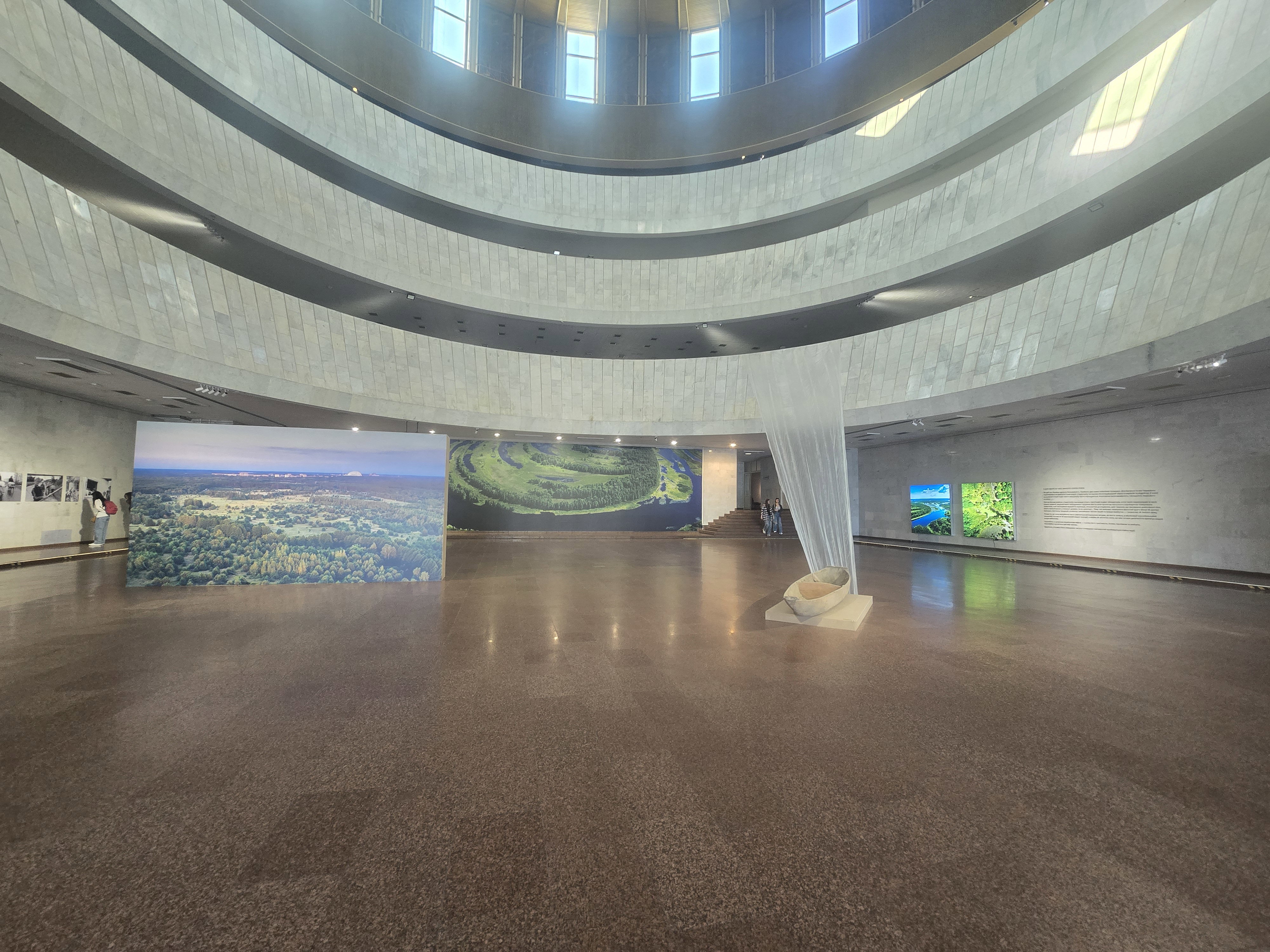
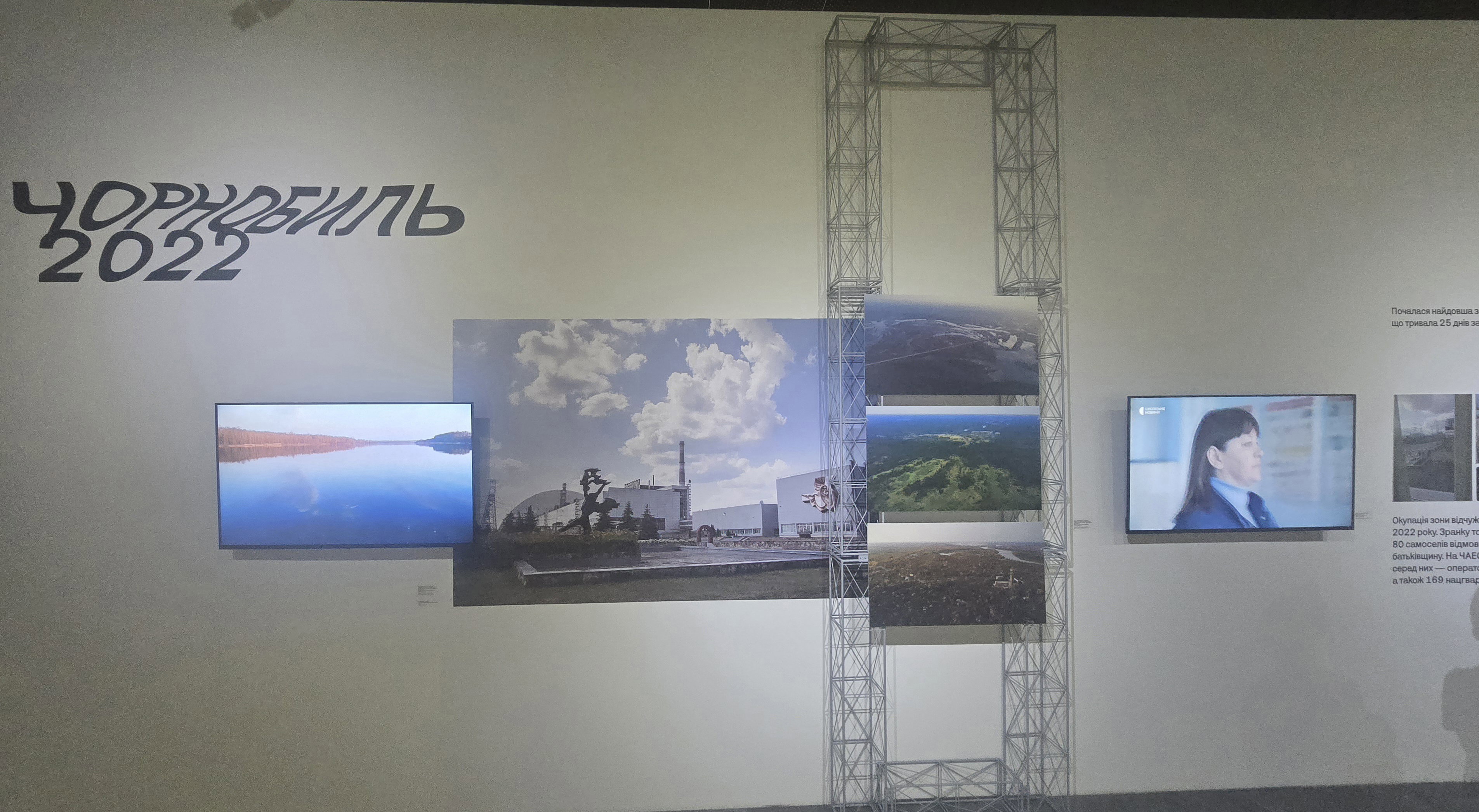
Виставка про Чорнобиль в Українському домі
Перебуваючи у відрядженні в Києві всього один день, я випадково відвідав виставку про Чорнобиль в Українському домі. Вирішив написати короткий текст-рекомендацію відвідати її.
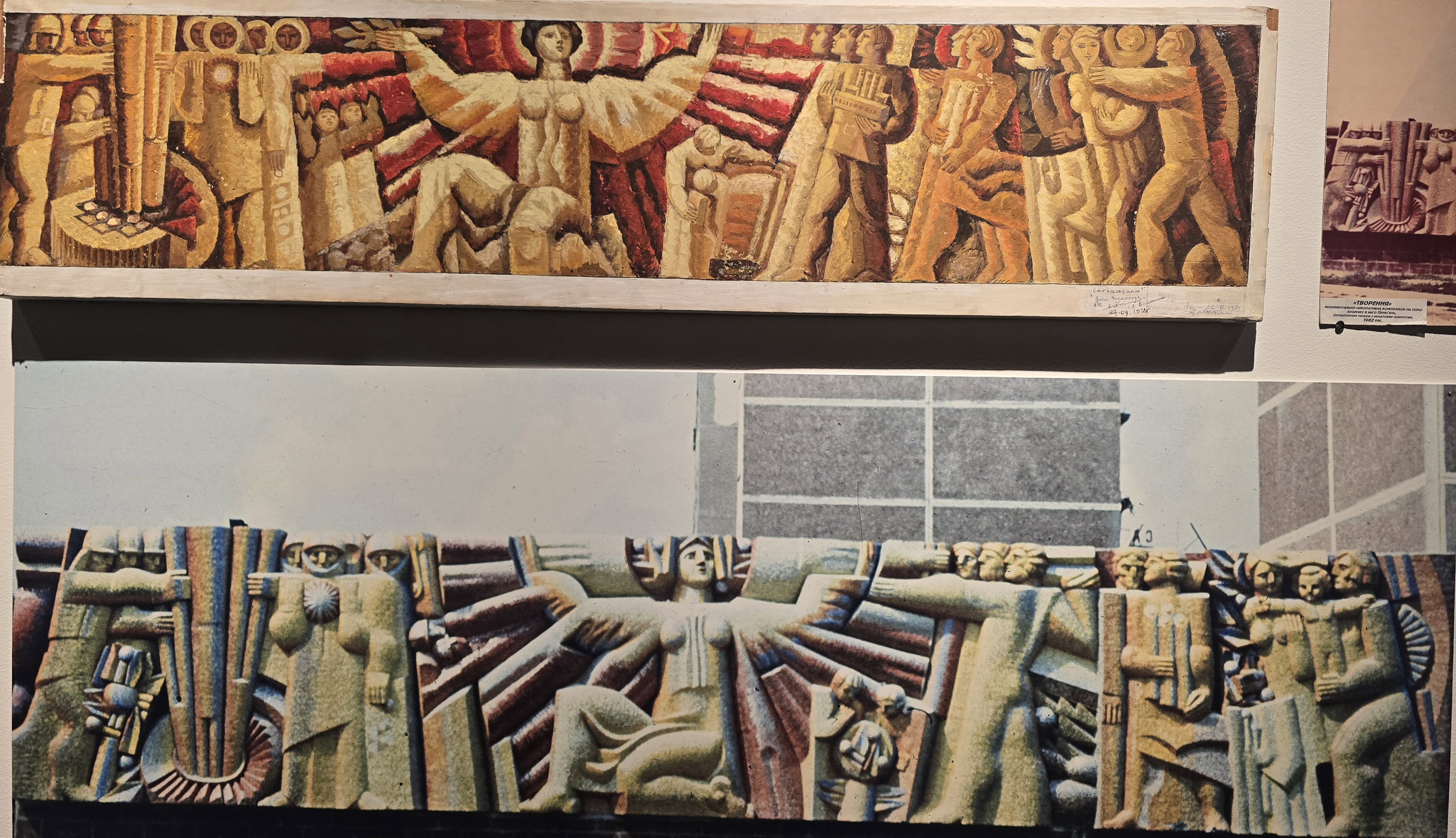
Це не банальна виставка, присвячена цій тематиці. Це вдале поєднання мистецтва та історії з усіма сучасними аудіовізуальними технологіями. Достатній простір залів і поверхів дозволяє поринути як у часи чорнобильської трагедії, так і в більш давні історичні часи Полісся. Адже перша згадка про Чорнобиль у літописі датується 1193 роком.Висвітлено як давні часи, міфи й традиції поліського Чорнобильського регіону, так і сучасність — війну та 2022 рік. Багато картин, фотографій і скульптур — як часів створення ЧАЕС, так і сучасних (наприклад, панно Людмили Мєшкової «Хіросіма — Чорнобиль») — чудово доповнюють атмосферу. Для любителів кіно можу додати, що це ніби переглянути гарний сюжетний трилер.
Раніше я багато мандрував Поліссям, але в самому Чорнобилі й поруч ніколи не був. Після виходу фільму значно збільшилася кількість іноземних «паломників», і я думав, що рано чи пізно з’явиться нагода поїхати туди з іноземною делегацією. Чорнобиль постійно нагадує про себе — і через творчість, і, наприклад, через дуже популярну гру «Сталкер».
Цей регіон ще може стати привабливим у туристичному, культурному та рекреаційному плані. А поки там панує тиша, природа, ліс, тінь трагедії та відчуття небезпеки.
Міф про трудових мігрантів
Міф про трудових мігрантів
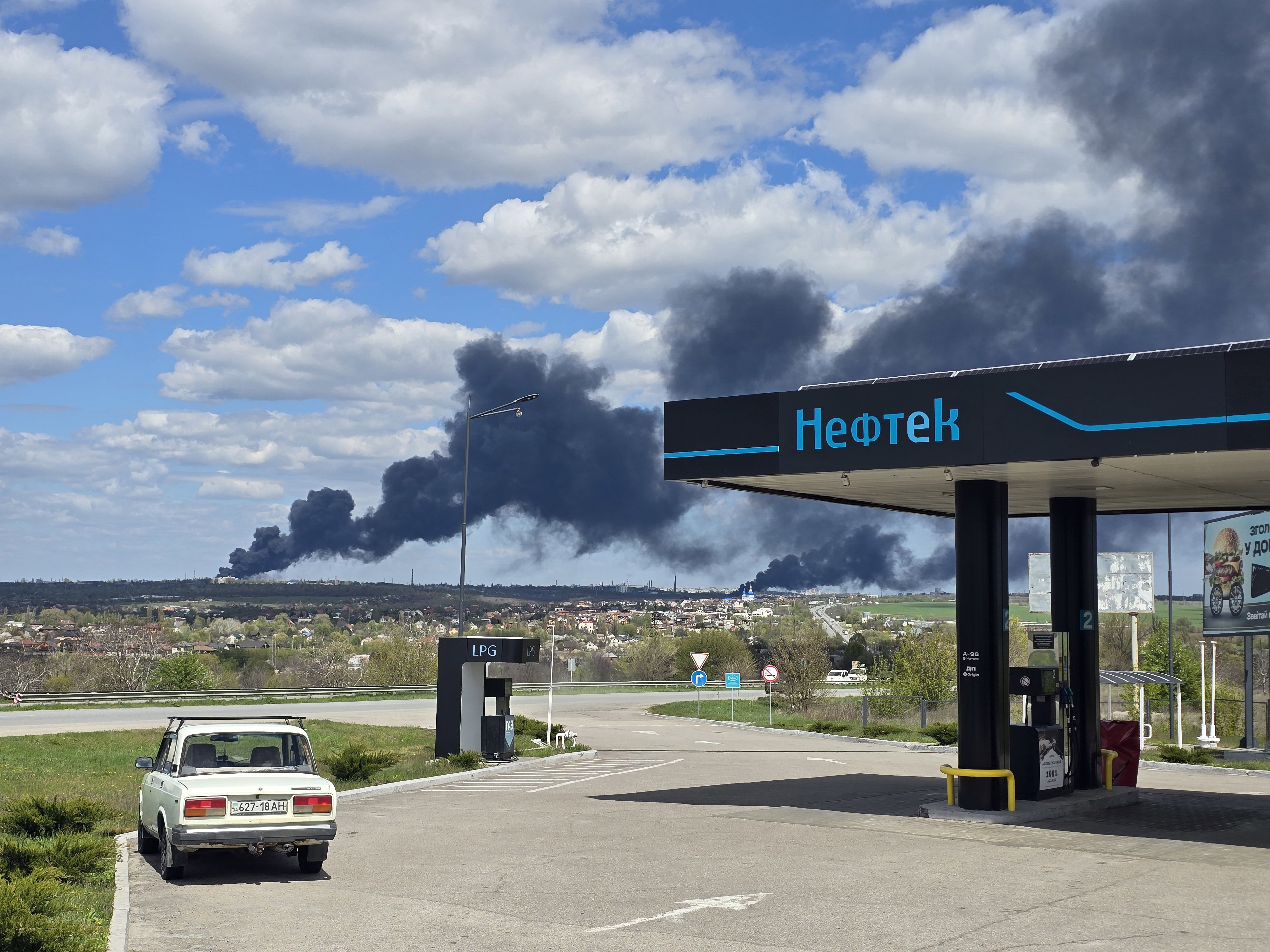
На жаль, в інформаційному просторі зараз поширюється небезпечна тенденція — підготовка суспільства до позитивного ставлення до масової міграції з країн третього світу. Доведеться сказати кілька слів на цю тему.
(На фото - палаючий Дніпро 26 квітня 2026)
Нещодавно на зустрічі Кирила Буданова в CEO Club Ukraine один з учасників бідкався про складнощі імпорту мігрантів:
Ну а звідки ви їх берете?
Бангладеш, Індія, Колумбія, Ефіопія… Перепробували вже все.
Можливо, я б і пропустив цей фрагмент повз увагу — ну такі вже «цинічні бариги», які думають лише про свій бізнес і прикриваються словом «економіка». Таких не дивно зустріти.
Але коли Володимир Поперешнюк, засновник «Нової Пошти», написав цілий пост на цю тему — це вже інший рівень. Я дуже поважаю його як підприємця, людину, яка глибоко цікавиться економічною теорією, фінансує видання Австрійської школи та мислить стратегічно. Але тут він помиляється.
Ось із чого він починає:
«Міф про те, що трудові мігранти “забирають роботу” в українців — такий же абсурдний, як і міф про те, що технології створюють безробіття або що імпортні товари знищують вітчизняних виробників».
На жаль, зараз нам активно насаджують зовсім інший міф — що трудові мігранти це безумовне благо для економіки. Більше того, іноді лунає теза, що без них економіка просто не витримає. Але ж якось вона тримається досі. Думка «здатися» напливу мігрантів чимось нагадує думку здатися вимогам путіна. І це в той час, коли, наприклад, Ілон Маск каже, що вже за 10 років працювати взагалі буде не обов’язково через розвиток технологій.
Мігранти — це не лише питання економіки. Чому ми не хочемо вчитися на чужих помилках? Чому заплющуємо очі на серйозні демографічні та соціальні проблеми, які спричинила масова міграція в багатьох країнах Заходу? Ми намагаємося вирішити одну проблему (нестачу робочих рук), створюючи цілий комплекс набагато серйозніших проблем у майбутньому.
Чому замість цього не думати про покращення демографічної ситуації, про прозорі механізми демобілізації та бронювання, про створення умов для повернення українців з-за кордону? Врешті-решт, ми й так уже стали демографічним сировинним придатком для інших країн.
Чому бізнесмени-мігрантофіли не говорять про залучення саме висококваліфікованої робочої сили? Чому не згадують, що в більшості країн для отримання статусу резидента (не громадянства) потрібні значні інвестиції?
Порівняння з ОАЕ в цьому випадку недоречне. Я багато разів бував у Дубаї та інших еміратах і вивчав їхній шлях. Це окрема тема. ОАЕ — ієрархічне, фактично феодальне суспільство (у позитивному сенсі цих слів). Там мігранти — нижча каста без політичних прав і перспектив їх отримати. А в нашій корумпованій олігархічній демократії з тенденціями до ксенофілії та непропорційно великих можливостей для іноземців у владі — мігранти стануть загрозою не лише суспільству, а й самій демократії.
Як це виглядатиме для військових, їхніх родин і волонтерів? «Ви воюйте, віддавайте останнє, а ми віддамо ваші міста й села мігрантам. Ну а якщо виживете — збережемо для вас робоче місце (тільки з вашим ПТСР і вже неактуальним досвідом, до речі, ваш менеджер може бути індусом — тож у вільний час вивчайте гінді».
Невже в нас так мало актуальних питань, які могли б піднімати підприємці? Чому економіка досі не перейшла на воєнні рейки? Чому не покарані ті, хто наживається на війні? Чому така слабка боротьба з корупцією? Чому не відбувається ротація влади та залучення військових на ключові посади?
Можна поставити й класичне лібертаріанське питання — про зменшення ролі держави в економіці та кількості чиновників. Врешті-решт, можна підняти тему виборів. Як казав Кулеба в нещодавньому інтерв’ю: проводити вибори — ризик, але не проводити їх — ще більший ризик. Побачимо, чи про-мігрантська партія отримає більшість. А може, в цьому й полягає задум — наводнити Україну мігрантами, легалізувати їх і отримати новий лояльний електорат, який проголосує так, як скаже роботодавець?Запросити мігрантів легко. Набагато важче відправити їх назад. Це міна сповільненої дії, і ми не знаємо, коли вона вибухне.
Виходить, що зараз війна, неприваблива економіка та складна бюрократія — це те, що ще захищає нас від масового напливу мігрантів.Щодо думки українців — кому вона цікава? Можливо, лише перед виборами, але невідомо, коли вони будуть. Навіть у коментарях під цією публікацією Володимира Поперешнюка сотні українців засудили його позицію. Раніше я слухав і читав його інтерв’ю з захопленням, активно користувався послугами «Нової Пошти». Важко не погодитись з її внеском у сучасну логістику. Втім, саме через неправильну стратегічну позицію в кадрових питаннях (а не через 17 громадян Індії) я буду змушений перестати користуватись цими послугами, якщо ситуація не проясниться.
Practical Recommendations for Cardano Project Catalyst
Based on Comparative Analysis of 9 DAOs (Aragon, DAOstack, Colony, Moloch, Abridged, Kleros, Horizen, Optimism, Nouns)
Project Catalyst is one of the largest decentralized funding mechanisms in blockchain, with hundreds of millions of ADA distributed across thousands of proposals. However, the nine DAOs analyzed reveal recurring patterns that Catalyst can adopt to solve its most persistent challenges: voter fatigue, variable proposal quality, sybil risks, plutocratic tendencies, low long-term alignment, and coordination overhead.Below are eight high-impact, actionable recommendations, prioritized by feasibility and expected ROI. Each is directly grounded in lessons from the studied DAOs.
1 . **Introduce a Bicameral or Hybrid Review Layer (Optimism + Horizen Model)**
Recommendation: Create a second chamber — an Impact / Review House (reputation-based or expert-curated) alongside the existing stake-weighted Token House. The Review House would evaluate proposals for feasibility, impact, and alignment before they reach full voting.Why it works: Optimism’s Citizens’ House dramatically improves public-goods focus and proposal quality. Horizen’s Special Council provides security and compliance checks without centralizing power.
Implementation: Start with a pilot “Impact Review Council” of 7–11 elected members (based on past contributions or reputation). Apply it first to proposals above a certain size threshold.
**2 . Adopt Ragequit / Exit Rights for Major Decisions (Moloch Model)**
Recommendation: Introduce a ragequit mechanism for high-stakes treasury or constitutional proposals, allowing dissenting ADA holders to exit with a proportional share of the treasury before execution.Why it works: Moloch’s ragequit is the gold standard for minority protection and high alignment. It eliminates tyranny-of-the-majority risks and forces proposers to build genuine consensus.
Implementation: Apply it initially to proposals that allocate >5% of the treasury or involve constitutional changes.
**3 . Shift Toward Continuous or Rolling Funding Streams (Nouns + Optimism Model)**
Recommendation: Move from fixed large funding rounds to continuous or rolling funding streams (e.g., “Catalyst Streams” inspired by Nouns’ Flows.wtf and Optimism’s RetroPGF evolution).Why it works: Nouns proved perpetual/continuous funding dramatically improves capital efficiency and builder sustainability. Optimism’s RetroPGF rewards proven impact rather than promises.
Implementation: Pilot smaller, ongoing funding pools with expert curators and real-time impact tracking.
**4 . Integrate Meritocratic Reputation Mechanisms (Colony + DAOstack Model)**
Recommendation: Introduce a reputation layer alongside stake-weighted voting. Reputation earned through contributions (task completion, successful proposals, community service) would grant boosted voting power or eligibility for review roles.Why it works: Colony’s reputation-based voting (with decay to encourage ongoing participation) reduces plutocracy and promotes meritocracy. DAOstack’s Holographic Consensus shows how reputation + prediction markets can filter low-quality proposals even with low turnout.
Implementation: Start with a non-transferable reputation score that decays over time and is earned only from value-adding activities.
**5 . Add Privacy and Anti-Collusion Tools (Aragon + Kleros Model)**
Recommendation: Integrate privacy-enhancing technologies such as MACI (Minimum Anti-Collusion Infrastructure) or coherent voting incentives in selected funding rounds.Why it works: Aragon’s MACI and Enclave ballots prevent coercion and vote-selling. Kleros’ coherent voting with slashing rewards truthful consensus and reduces low-effort participation.
Implementation: Pilot MACI in one Catalyst round and experiment with coherent voting mechanics for proposal evaluation.
**6 . Enhance Usability with No-Code and Chat-Native Interfaces (Abridged Model)**
Recommendation: Integrate no-code proposal creation and messenger-native tools (Telegram/Discord bots) for submission, discussion, voting notifications, and status updates.Why it works: Abridged demonstrated that chat-native interfaces can increase participation up to 11× compared to traditional dashboards.
Implementation: Partner with or integrate tools similar to Collab.Land for Catalyst-specific bots and no-code proposal builders.
**7 . Strengthen Constitutional Safeguards and Institutional Clarity (Horizen Model)**
Recommendation: Ratify a lightweight Catalyst Constitution with clear values, differentiated voting thresholds (technical vs. non-technical), and limited expert oversight mechanisms.Why it works: Horizen’s Constitution + Special Council provides accountability and security without sacrificing decentralization.
Implementation: Define mission alignment, legal compliance checks, and a rotating stewardship council with narrowly scoped review powers.
**8 . Tie Funding More Directly to Measurable Impact and Ecosystem Revenue (Optimism + Nouns Model)**
Recommendation: Link a portion of treasury inflows or protocol revenue to RetroPGF-style impact funding and explore revenue-sharing with funded projects.Why it works: Optimism’s sequencer revenue → buyback/public-goods flywheel and Nouns’ perpetual auction model create powerful self-reinforcing alignment.
Implementation: Allocate 10–20% of future treasury growth or protocol fees to proven-impact RetroPGF rounds.
Quick-Win Priority Combination
For the highest immediate impact, implement the following three together:
Bicameral / Hybrid Review Layer
Ragequit mechanism for major decisions
Continuous funding streams + reputation layer
These changes would significantly reduce voter fatigue, improve proposal quality, strengthen alignment, and make Catalyst more resilient while preserving its core democratic strengths.
Project Catalyst’s greatest strength has always been its vibrant, passionate, and globally distributed community. As we learn from other leading DAOs, we must preserve the openness, inclusivity, and collective spirit that define us. By staying strong and united, Catalyst can evolve thoughtfully while remaining true to its core identity and becoming an even more effective decentralized funding system.
Cardano Decentralised Deputy Diary. Text 19
https://read.cash/@cryptotexty/cardano-decentralised-deputy-diary-text-19-ddf18b68
Cardano Decentralised Deputy Diary. Text 19
Hello, my readers and everyone interested in Cardano and blockchain governance.
Date: 22-30 April 2026
Voting Power: ₳ 770 914
My voting power decreased by 3K - that was me who sold 3K of ADA. For the moment that's half of my ADA and I want to share with you that I did an "investment" move. I sold this amount and bought Midnight (NIGHT), so now I have around 22K of NIGHT. I also had another "sign" from the real life. Who knows if it was some kind of notice from above or just my imagination. Time will tell. One more reason now is that NIGHT is cheap now, and I see potential in it, as I see potential in Midnight. I keep myself informed about it and I agree with Charles that Cardano and Midnight will both become stronger from this cooperation. So on the long-term - I plan participation both in Cardano and Midnight ecosystems. Who knows, maybe I will be also Midnight DREP in the future)
The paragraph above I wrote on April 22, 2026, but it took me several days to make a mind on proposals. Yes, many proposals these times. And honestly speaking, I can't be "fulltime into Cardano", I can honestly tell that at current moment I lack the complete knowledge to evaluate all the possible pos and cons of IO proposals and existing alternatives. I watched all Charles' recent videos, as I try to keep up with them and other main news from the Cardano ecosystem. I really think Project Catalyst: its variety and pluralism of proposals would be the best option for the big part of Treasury withdrawals. And at the moment, as I don't want to delay my voting even further - I decided to vote "Abstain" on IO proposals. Well, my voting power (770K) is still small to be decisive, but in voting Abstain I say that - ok, you guys decided if we support huge IO proposals or maybe we need to have bigger discussion on them and alternatives.
This time Gov.tools was down, so I used https://app.cgov.io/ for reading and navigating proposals and https://tempo.vote/ for voting (via Vespr wallet)
Here is my complete list of votes
1 . Blockfrost: Maintenance and Next Generation Indexing
Voted Abstain.
2 . IO & VacuumLabs: Enhancing Plutus - Performance, Correctness, and Usability
Voted Abstain.
3 . Tweag Core Cardano Infrastructure: Treasury Withdrawal 2026–2028
Voted No.
Rationale: That's insanely huge budget and what's strange is that why do you need funding for years (till 20208)? I think such proposals can go via Project Catalyst in the future.
4 . Revised Cardano Summit 2026 Singapore
Voted No.
Rationale: As I explained previously in past votes, I consider this (even reduced, even edited) as HUGE waste of funds. We had Community Events category in Project Catalyst - I think it's good practice to renew it and make each event go via community voting and discussion. Another option is to empower Ambassadors or DREps with (1/1000 or 1/100 of such budget).
5 . Cardano at TOKEN2049 Singapore 2026: Top-Up ‘Title’ Sponsorship Upgrade
Voted No.
6 . Cardano at TOKEN2049 Singapore 2026: Baseline ‘Platinum' Sponsorship Proposal
Voted No.
7 . IO: Developer Experience Initiative
Voted Abstain.
8 . IO: Cardano Upgrades
Voted Abstain.
9 . IO: Consensus Initiative
Voted Abstain.
10 . IO: Cardano High Assurance Technical Collaboration
Voted Abstain.
11 . IO & Midgard Labs: L2 Scalability Initiative
Voted Abstain.
12 . IO & Ensurable Systems: Cardano Maintenance Initiative
Voted Abstain.
13 . Pogun: Capital Without Compromise
Voted No.
I'll get back to you in few days or few weeks.
Best regards,
Cardano DRep Cryptotexty
GovTools page: https://gov.tools/connected/drep_directory/drep1yqmr09530yuehxdz2wca5setx03ps5tnxxrvzlgwmk3wswugxwh
My Cardano address: addr1q8ltprg2dpuftk3xa773c4eqz62d63syevwqmeeqk75h0swy974pwpegzh7kay6pdypdedrfrunyge4fam22062a4ghq3v8jqe

Nouns DAO Analysis
**Nouns DAO: The Perpetual Auction Treasury Model – Generative NFTs, Community Governance, and Public Goods Funding – Technical Architecture, Governance Mechanics, Ecosystem, Goals, and a Comparative Analysis with Cardano Catalyst**
Nouns DAO, launched on 17 August 2021, pioneered a radically simple yet powerful perpetual funding mechanism: one generative Noun NFT is trustlessly auctioned every 24 hours forever, with 100% of ETH proceeds deposited directly into the DAO treasury. Each Noun grants its holder one non-transferable but delegatable vote in governance, creating a self-perpetuating cultural and financial flywheel. By April 2026, the DAO has minted over 1,887 Nouns, accumulated a treasury exceeding Ξ 3,750 (~$8.8 million), funded more than 148 on-chain proposals and 350+ community initiatives (via Prop House and subsequent evolutions), and established a legally recognized Decentralized Unincorporated Nonprofit Association (DUNA) in Wyoming. Governance has evolved from direct Compound-style proposals to Prop House competitive rounds and then to Flows.wtf — a continuous, curated streaming model described as an “onchain Y Combinator.”
This research paper analyzes Nouns DAO’s technical characteristics (daily auction contract, Compound Governance fork, and DUNA legal wrapper), voting and proposal mechanics, ecosystem scale and impact, strategic goals, and long-term vision. A detailed comparison with Cardano’s Project Catalyst highlights fundamental divergences: Nouns DAO generates and deploys treasury through perpetual cultural NFT sales and community curation, prioritizing meme-driven public goods and continuous funding, while Catalyst relies on permissionless stake-weighted voting for large-scale grant distribution. The core question—how Nouns DAO functions in practice, how it differs from Catalyst, and its resulting pros and cons—reveals a highly original, culturally resonant model that excels in sustainable treasury generation and creative public-goods allocation but introduces unique risks around concentration and meme volatility. Data is drawn from official documentation, governance records, recent proposals, and ecosystem updates as of April 2026.
**1 . Introduction**
Few DAOs have captured the imagination of the crypto community as effectively as Nouns DAO. Its core innovation — auctioning a single, generative, public-domain NFT every 24 hours forever, with every ETH of proceeds flowing directly into a community-controlled treasury — created a self-sustaining economic and cultural engine. Each Noun functions as both a collectible artwork and an irrevocable membership token granting one vote in DAO governance. This mechanism has produced a vibrant, meme-native community while funding hundreds of public-goods initiatives, cultural projects, and builder programs across the globe.
Nouns DAO operates on Ethereum mainnet using a fork of Compound Governance. Proposals require a minimum of 4 Nouns to submit, votes are delegatable but non-transferable with the asset, and the treasury is used exclusively for long-term growth and prosperity of the Nouns project and broader public goods. To address legal and liability concerns, the DAO ratified Proposal 727 establishing a Wyoming Decentralized Unincorporated Nonprofit Association (DUNA), providing limited liability while preserving on-chain sovereignty. The Nouns Foundation retains a temporary, narrowly scoped proposal veto right to mitigate extreme risks such as 51% attacks or unaudited upgrades.
By April 2026, Nouns DAO has evolved significantly in its capital deployment strategy — transitioning from direct on-chain proposals to Prop House competitive rounds and finally to Flows.wtf, a continuous curated funding stream often characterized as an “onchain Y Combinator.” This progression reflects broader lessons in DAO capital allocation: moving from high-friction governance to lightweight, impact-focused continuous deployment. The treasury, while fluctuating with ETH price and auction dynamics, has historically supported substantial public-goods spending, with over 605 builders funded across active flows by early 2026.
This paper provides a comprehensive, research-grade analysis of Nouns DAO. It examines technical infrastructure, voting and proposal mechanics, ecosystem metrics and cultural impact, strategic goals, followed by a head-to-head comparison with Cardano’s Project Catalyst. By synthesizing primary sources — the Nouns website, governance forum, recent proposals, and 2025–2026 evolution reports — the analysis answers the core research question: How does Nouns DAO actually function as a perpetual auction treasury model, how does it differ from large-scale stake-weighted funding mechanisms like Catalyst, and what are the resulting pros and cons in terms of sustainability, cultural resonance, and capital efficiency?
Nouns DAO stands as a compelling case study in meme-driven, culturally native governance that has proven capable of generating ongoing treasury inflows while funding meaningful public goods. Its lessons are particularly relevant for DAOs seeking sustainable funding models beyond initial token sales or inflation.
**2 . History and Origins**
Nouns DAO launched on 17 August 2021 with a deceptively simple premise: one unique, generative 32×32 pixel Noun would be auctioned every 24 hours on Ethereum, with 100% of the proceeds deposited into a DAO-controlled treasury. The project was conceived by a small team (including Punk 4156) as an experiment in perpetual funding and community ownership. The first Noun (Noun 0) sold for 613 ETH, setting a high bar, while subsequent auctions stabilized around 30–150 ETH depending on market conditions and cultural momentum.
Early governance relied on a fork of Compound’s Governor Bravo, with each Noun granting one vote. Proposals required a minimum of 4 Nouns to submit, and the treasury was used to fund community ideas ranging from events and merchandise to developer grants and public-goods initiatives. The entirely on-chain, public-domain artwork (generative traits stored as compressed SVGs) created instant cultural virality: Nouns became a recognizable brand with global appeal, appearing in real-world events, art installations, and community projects from Uganda to São Paulo.
Governance evolution has been iterative. Initial direct proposals proved bottlenecked by low participation and high friction. The DAO introduced Prop House — a competitive grant round system — to accelerate funding. By 2025–2026, it further matured into Flows.wtf, enabling continuous, curated capital deployment. This progression addressed concrete failure modes: from reactive treasury management to proactive, impact-focused infrastructure.
Legal maturation culminated in Proposal 727 (ratified 2025), establishing a Wyoming DUNA for limited liability and operational clarity. The Nouns Foundation was granted a temporary, narrowly scoped veto right over specific high-risk proposals (e.g., treasury drains or unaudited upgrades) to protect the collective during early scaling. By April 2026, Nouns DAO had funded hundreds of proposals, built a global community, and demonstrated that perpetual NFT auctions could sustainably support public goods at scale.
**3 . Technical Characteristics**
Nouns DAO is architected as a minimalist, perpetual, and trust-minimized governance system deployed entirely on Ethereum mainnet. Its design philosophy prioritizes simplicity, permanence, and cultural sovereignty, deliberately avoiding complex tokenomics, inflation mechanisms, or mutable core contracts. The DAO operates through a tightly integrated set of smart contracts that handle generative NFT minting, daily auctions, treasury management, and governance execution. This architecture has remained remarkably stable since the project’s genesis on 17 August 2021, demonstrating exceptional robustness in a highly dynamic Web3 environment.
**3.1 Core Smart Contract Architecture**
The foundational contracts form a self-perpetuating system centered on four primary components:
**Auction Contract**: The heart of Nouns DAO’s perpetual funding model. This contract automatically generates and auctions one new Noun every 24 hours. Upon settlement of each auction, the contract immediately triggers the minting and listing of the next Noun, creating an unbroken chain of auctions that will continue indefinitely. One hundred percent of the winning bid (in ETH) is transferred directly to the DAO treasury contract, ensuring zero leakage and full community ownership of proceeds.
**Noun Token Contract**: An ERC-721 NFT contract that issues the generative Nouns. Each Noun is algorithmically composed on-chain from a fixed set of traits: 2 backgrounds, 31 bodies, 144 accessories, 258 heads, and 24 glasses. Critically, all Nouns are equal in rarity — there are no “rare” traits or artificial scarcity mechanics. Artwork is stored entirely on-chain as compressed SVG code, guaranteeing permanence, censorship resistance, and public-domain status.
**Governance Contracts**: A fork of Compound’s Governor Bravo, optimized for Nouns’ specific use case. Each Noun grants exactly one vote. Votes are fully delegatable but non-transferable with the underlying NFT (selling a Noun transfers the voting right to the new owner). A minimum threshold of 4 Nouns is required to submit proposals, providing a modest skin-in-the-game filter without creating excessive barriers.
**Treasury Contract**: Holds all auction proceeds and executes approved governance actions. The treasury is fully on-chain and transparent, with disbursements occurring only after successful proposal execution.
The entire system is designed for perpetuity: no team allocation beyond the initial Nounders’ vested share (every 10th Noun for the first five years, after which the DAO receives 100% of proceeds), no inflation, and no mechanism for minting additional Nouns outside the daily auction cadence. This minimalist approach minimizes attack surfaces and maximizes long-term predictability.
**3.2 Legal and Institutional Wrapper: The Wyoming DUNA**
A significant technical-institutional evolution occurred with Proposal 727 (ratified in 2025), which established a Wyoming Decentralized Unincorporated Nonprofit Association (DUNA). This legal wrapper provides limited liability protection for DAO participants while preserving fully on-chain governance sovereignty. The DUNA structure serves as an administrative and legal layer that interfaces with the smart contracts without altering their immutable logic.
The Nouns Foundation, operating under the DUNA, was granted a narrowly scoped, temporary veto right over specific high-risk proposals (e.g., unaudited smart-contract upgrades or treasury actions exceeding defined thresholds). This veto is explicitly temporary and constitutionally limited, functioning as a calibrated safety valve rather than centralized control. Recent governance upgrades (collectively referred to as v3) have further refined DUNA administration processes, including clearer election mechanics for Foundation representatives and enhanced forking capabilities for treasury splits or protocol upgrades.
**3.3 Security Model, Audits, and Trade-offs**
Nouns DAO’s security posture benefits from its deliberate minimalism. The core contracts have undergone multiple independent audits and have operated without major exploits since launch. The perpetual auction mechanism is self-contained and deterministic, reducing reliance on external oracles or complex logic.
Key trade-offs are explicit and intentional:
**Simplicity vs. Flexibility**: The system favors extreme simplicity (no inflation, no complex token utilities) over feature richness, which has contributed to its longevity but requires governance evolution (e.g., the shift to Prop House and Flows.wtf) for capital deployment efficiency.
**On-Chain Permanence vs. Off-Chain Evolution**: While artwork and core mechanics are fully on-chain, governance processes have iteratively moved toward hybrid models (Prop House → Flows.wtf) to improve capital velocity without compromising the immutable auction core.
**Cultural Sovereignty vs. Institutional Safeguards**: The DUNA and Foundation veto provide necessary legal and operational guardrails while preserving the DAO’s on-chain, community-owned ethos.
In summary, Nouns DAO’s technical architecture represents a masterful exercise in minimalism and perpetuity. By combining a self-perpetuating daily auction contract, fully on-chain generative NFTs, a Compound Governance fork, and a carefully layered legal wrapper via the Wyoming DUNA, the DAO has created a robust, censorship-resistant, and culturally resonant governance system. This stack has proven capable of generating sustainable treasury inflows and funding meaningful public goods for over four and a half years, offering a compelling alternative to traditional token-sale or inflation-based funding models in the decentralized ecosystem.
**4 . Voting and Proposal Mechanics**
Nouns DAO employs a streamlined yet effective governance system built upon a fork of Compound’s Governor Bravo contract, optimized for its unique perpetual auction treasury model. Each Noun functions as a non-transferable but fully delegatable voting unit, granting its holder exactly one vote in all DAO decisions. This design creates direct alignment between ownership of the cultural asset and governance participation, while delegation mechanisms encourage professional representation and broader community involvement without fragmenting voting power.
The proposal process is deliberately minimal to reduce friction while maintaining sufficient safeguards:
**Proposal Submission**: Requires a minimum threshold of 4 Nouns held or delegated by the proposer. This skin-in-the-game requirement filters low-effort or speculative proposals while remaining accessible to active community members.
**Voting Period**: Standard on-chain voting windows (typically 3–7 days, configurable via governance) follow Compound’s established pattern. Votes are cast on-chain, with real-time visibility and full auditability.
**Quorum and Approval Thresholds**: A simple majority of votes cast is generally sufficient for passage, subject to the standard Compound quorum requirement. The system avoids overly complex supermajority rules for most proposals, favoring agility in a cultural and public-goods context.
**Execution**: Passed proposals enter a timelock period before execution, allowing any address to trigger the transaction. This ensures transparency and prevents last-minute interference while enabling rapid implementation of approved actions (e.g., treasury disbursements, parameter changes, or legal structure updates).
Governance has undergone significant maturation since inception. Early direct on-chain proposals proved high-friction and suffered from low participation rates. To address this, the DAO introduced **Prop House** — a competitive grant-round system that allowed expert curators and community voters to evaluate and fund proposals in structured batches. By 2025–2026, the DAO further evolved to **Flows.wtf**, a continuous curated funding stream often described as an “onchain Y Combinator.” This model enables ongoing builder support rather than discrete grant cycles, dramatically improving capital efficiency and builder sustainability.
The Wyoming Decentralized Unincorporated Nonprofit Association (DUNA), ratified via Proposal 727, adds an important institutional layer. It provides limited liability protection for participants while preserving fully on-chain governance sovereignty. The Nouns Foundation retains a narrowly scoped, temporary veto right over specific high-risk proposals (e.g., unaudited smart-contract upgrades or treasury drains exceeding defined thresholds), serving as a safety valve during periods of potential 51% attack risk or extreme volatility.
Recent governance activity demonstrates the system’s health. In early 2026, multiple Flows.wtf streams were approved for cultural, educational, and infrastructure initiatives, with high participation rates and strong consensus. Special Council-style oversight is not present; instead, the DUNA structure and Foundation veto provide calibrated institutional guardrails. Overall, Nouns DAO’s mechanics prioritize cultural alignment and capital velocity over complex weighted voting or reputation layers, creating a governance system that feels native to its meme-driven origins while scaling effectively for public-goods deployment.
**5 . Ecosystem, Scale, and Impact**
Nouns DAO’s ecosystem is distinguished by its perpetual auction treasury mechanism and vibrant, globally recognized cultural brand. As of April 2026, more than 1,887 Nouns have been minted through daily auctions, generating a treasury that has historically exceeded Ξ 3,750 (approximately $8.8 million at prevailing ETH prices). The DAO has directly funded over 148 on-chain proposals and supported more than 350 community-driven initiatives through Prop House and the subsequent Flows.wtf continuous funding model, directly enabling 605+ builders across ecosystems including Higher, Zora, and Farcaster.
Scale is measured not only in financial terms but also through cultural and network effects. The entirely on-chain, public-domain generative artwork (32×32 pixel SVGs with traits including backgrounds, bodies, accessories, heads, and glasses) has enabled unprecedented remixing, merchandise, and real-world activations. Nouns have appeared in global art exhibitions, community events from Uganda to São Paulo, and high-profile collaborations. This cultural resonance has driven organic adoption far beyond typical DAO metrics.
Impact is both tangible and intangible. Financially, the perpetual auction creates a constant, market-independent revenue stream that funds public goods without reliance on token inflation or initial sales. Culturally, Nouns has become a recognized symbol of crypto creativity and community ownership, inspiring derivative projects, educational programs, and charitable initiatives. The transition to Flows.wtf has markedly improved capital efficiency by shifting from discrete grant rounds to continuous, curated builder support — effectively functioning as an on-chain incubator with real-time feedback loops.
Broader ecosystem contributions include funding for developer tooling, security research, educational resources, and cross-chain public-goods infrastructure. The DAO’s public-domain ethos maximizes virality and remixing potential, creating positive externalities that extend well beyond the treasury balance. By April 2026, Nouns DAO has established itself as one of the most successful examples of meme-native, culturally driven public-goods funding in Web3, demonstrating that perpetual NFT mechanics can sustainably support meaningful impact at scale while building a vibrant, globally distributed community.
**6 . Goals, Plans, and Strategic Vision**
Nouns DAO’s mission is elegantly simple yet profoundly ambitious: to make Nouns more valuable by funding ideas that strengthen the brand, community, and broader public goods. The DAO exists to perpetuate a self-sustaining cultural and financial flywheel through daily auctions, community governance, and strategic capital deployment.
Core strategic goals include:
Ensuring sustainable, perpetual treasury growth independent of market cycles or token sales.
Funding high-impact public goods, cultural projects, and builder initiatives that enhance the long-term value and recognition of the Nouns brand.
Maintaining credible neutrality and community ownership while evolving governance mechanisms for greater efficiency and impact.
Expanding global reach and cultural relevance through real-world activations, education, and collaborations.
Immediate 2026–2027 plans focus on operational refinement and ecosystem expansion:
Full maturation and scaling of the Flows.wtf continuous funding model as the primary capital deployment mechanism.
Further DUNA legal and administrative enhancements to improve operational clarity and liability protection.
Strategic global community activations, merchandise programs, and cultural partnerships that amplify brand recognition.
Exploration of additional perpetual funding innovations and cross-ecosystem collaborations.
The long-term strategic vision positions Nouns DAO as a self-sustaining, culturally iconic institution that demonstrates how elegant, meme-native mechanics can indefinitely fund public goods and creative expression in Web3. By combining perpetual revenue generation with community-driven curation, Nouns aims to serve as a benchmark for culturally resonant, sustainable DAO models that transcend traditional tokenomics. The DAO’s success will ultimately be measured not only by treasury size or proposal volume but by its enduring cultural impact and ability to inspire the next generation of decentralized creative and public-goods initiatives.
**7 . In-Depth Comparison with Cardano Catalyst**
Cardano’s Project Catalyst exemplifies large-scale, permissionless treasury allocation. It distributes tens of millions of ADA per funding round through stake-weighted voting by thousands of registered holders, emphasizing broad participation, ecosystem experimentation, and high-volume grant distribution across diverse categories. The model is democratic and inclusive, with low barriers to entry and structured review phases, but it can suffer from voter fatigue, variable proposal quality, and challenges in long-term impact measurement.
Nouns DAO operates on an entirely different paradigm: perpetual treasury generation through daily generative NFT auctions combined with community-curated capital deployment. Where Catalyst relies on existing protocol reserves and stake-weighted democracy, Nouns creates its own ongoing revenue stream independent of inflation or external funding. Governance in Nouns is ownership-based (one Noun = one vote), culturally resonant, and has evolved from high-friction direct proposals to efficient continuous funding via Flows.wtf.
Key structural differences include:
**Treasury Generation**: Catalyst draws from protocol reserves; Nouns generates fresh capital perpetually through auctions.
**Participation Model**: Catalyst is purely stake-weighted and permissionless; Nouns ties voting power directly to cultural asset ownership with delegation.
**Capital Deployment**: Catalyst uses periodic large rounds; Nouns has shifted to continuous, curated streams for higher efficiency and builder alignment.
**Incentive Alignment**: Catalyst incentivizes broad voting; Nouns aligns holders through cultural ownership and perpetual revenue sharing.
Catalyst excels at democratic breadth and volume; Nouns excels at sustainability, cultural virality, and efficient builder support. Both advance public-goods funding, but Nouns offers a more self-sustaining revenue model while Catalyst provides greater raw scale. Hybrid approaches—such as incorporating perpetual auction elements into broader treasury systems or routing Catalyst-style grants through Nouns-style curation—represent promising future directions.
**8 . Pros and Cons of Nouns DAO: A Critical Evaluation**
Nouns DAO represents one of the most original and culturally resonant governance experiments in Web3. Its perpetual auction treasury model has proven remarkably effective at generating sustainable funding while building a vibrant, meme-native community.
**Key Advantages**:
**Perpetual Revenue Generation**: The daily auction mechanism creates a constant, market-independent inflow of capital, eliminating reliance on token sales or inflation.
**Cultural and Meme Resonance**: Public-domain generative artwork and strong brand identity have driven organic global adoption and virality far beyond typical DAO metrics.
**Efficient Capital Deployment Evolution**: The transition to Flows.wtf has markedly improved builder support and capital efficiency compared with traditional grant models.
**Legal and Institutional Maturity**: The Wyoming DUNA provides meaningful liability protection while preserving on-chain sovereignty.
**Public-Goods Impact**: Hundreds of initiatives funded across education, infrastructure, events, and creativity demonstrate tangible real-world value.
**Principal Limitations**:
**Voting Power Concentration**: A relatively small number of large Noun holders can exert disproportionate influence, though delegation mitigates this to some extent.
**Treasury Volatility**: Auction proceeds and treasury value fluctuate with ETH price and cultural momentum, introducing inherent market risk.
**Governance Evolution Overhead**: Multiple iterations (direct proposals → Prop House → Flows.wtf) were required to reach current efficiency levels.
**Cultural Capture Risk**: Strong meme identity, while powerful, can occasionally prioritize cultural fit over pure merit in funding decisions.
Relative to Cardano Catalyst, Nouns DAO offers superior sustainability and cultural impact but trades off broad democratic participation and raw capital scale. Its pros in perpetual funding and community ownership make it particularly well-suited for culturally driven public-goods initiatives, while its cons highlight the classic tension between simplicity and concentration in ownership-based governance models.
**9 . Conclusion and Future Outlook**
Nouns DAO functions as a perpetual auction treasury DAO that generates ongoing revenue through daily generative NFT sales while deploying capital via evolving, community-curated mechanisms for public goods and cultural projects. Its one-Noun-one-vote governance, combined with legal maturation through the Wyoming DUNA and continuous funding innovation via Flows.wtf, has created a resilient, culturally resonant model that stands apart from traditional token-weighted DAOs.
Compared with Cardano Catalyst’s large-scale stake-weighted funding, Nouns prioritizes perpetual sustainability, cultural virality, and efficient builder support. Its pros in revenue generation and community ownership outweigh cons in concentration risks within its specialized domain.
As Flows.wtf matures, global activations expand, and governance refinements continue, Nouns DAO is poised to remain a leading example of how creative, meme-native mechanisms can sustainably fund public goods and build lasting cultural institutions in Web3. Its success offers enduring lessons in perpetual funding, cultural governance, and the power of simple, elegant mechanics executed at scale. In an era when DAOs seek sustainable models beyond initial token sales, Nouns demonstrates that perpetual cultural assets can create self-reinforcing flywheels capable of supporting meaningful public-goods impact indefinitely.
More about Nouns DAO: https://nouns.wtf/
More about Project Catalyst: https://projectcatalyst.io/
Optimism DAO Analysis
**Optimism DAO and Collective: Bicameral Governance, the OP Stack, and the Superchain Vision – Technical Architecture, Governance Mechanics, Ecosystem, Goals, and a Comparative Analysis with Cardano Catalyst**
Optimism (optimism.io) is a leading Ethereum Layer 2 scaling solution built on Optimistic Rollups and the modular OP Stack. Its governance, known as the Optimism Collective, employs a unique bicameral system comprising the Token House (OP token-weighted voting and delegation) and the Citizens’ House (reputation-based, one-person-one-vote via soulbound badges). This structure separates economic and public-goods decisions, with Retroactive Public Goods Funding (RetroPGF) as a flagship mechanism for long-term ecosystem alignment. As of April 2026, the Collective has evolved significantly: Season 9 (January 2026) marked the transition “from experiment to organization,” introducing Protocol Upgrades 2.0, Capital Allocation 2.0, and a landmark OP token buyback program (approved January 2026) that allocates 50% of Superchain sequencer revenue to recurring buybacks for 12 months.
The OP Stack powers dozens of chains (including Base) in the emerging Superchain network, securing over $14 billion in total assets and processing millions of daily transactions with sub-cent fees and Ethereum-grade security. This research paper provides a comprehensive analysis of Optimism’s technical characteristics (Optimistic Rollups, Bedrock upgrade, OP Stack modularity, and Superchain interoperability), governance mechanics, ecosystem scale, and strategic vision. A detailed comparison with Cardano’s Project Catalyst highlights fundamental differences: Optimism’s bicameral, reputation-augmented model prioritizes public-goods funding and long-term alignment, while Catalyst relies on pure stake-weighted democracy for broad treasury allocation. The core question—how Optimism DAO functions in practice, how it differs from Catalyst, and its resulting pros and cons—reveals a mature, hybrid governance framework that balances token economics with reputation-based stewardship, offering valuable lessons for sustainable L2 scaling and decentralized coordination. Data is drawn from official documentation, governance proposals, Season 9 updates, and ecosystem metrics as of April 2026.
**1 . Introduction**
Ethereum Layer 2 solutions have become essential for addressing the base layer’s scalability trilemma, but effective governance of these systems remains a critical challenge. Optimism stands out not only for its technical approach—Optimistic Rollups and the fully open-source OP Stack—but also for its innovative bicameral governance model within the Optimism Collective. By separating token-weighted economic decisions (Token House) from reputation-driven public-goods oversight (Citizens’ House), Optimism seeks to align short-term incentives with long-term ecosystem health.
The OP Stack has powered a growing Superchain of interoperable L2s (including OP Mainnet and Base), delivering sub-cent fees, 200 ms block times, 99.99% uptime, and Ethereum-level security. Recent developments, including the January 2026 approval of OP token buybacks tied to Superchain revenue and ongoing privacy enhancements to the OP Stack (April 2026), underscore the Collective’s active role in tokenomics evolution and infrastructure upgrades.
This paper delivers a rigorous, research-grade examination of Optimism DAO/Collective. It analyzes technical infrastructure, voting and proposal mechanics, ecosystem metrics and impact, strategic goals, followed by a head-to-head comparison with Cardano’s Project Catalyst. By drawing on primary sources—including the Working Constitution, governance documentation, Season 9 announcements, and recent proposals—the analysis answers the core research question: How does Optimism’s bicameral governance function in practice, how does it differ from large-scale stake-weighted models like Catalyst, and what are the resulting pros and cons for L2 protocol stewardship and public-goods funding?
Optimism’s model represents a deliberate evolution beyond simple token voting, aiming to reduce platform risk, prevent short-term extraction, and foster sustainable coordination across a multi-chain Superchain. Its lessons are highly relevant for any ecosystem seeking to scale Ethereum securely while maintaining credible neutrality and long-term alignment.
**2 . History and Origins**
Optimism was founded in 2019 with the mission of scaling Ethereum through Optimistic Rollups—optimistic execution with fraud-proof-based security. The project’s early focus was technical: building a production-ready optimistic rollup that maintained Ethereum compatibility while dramatically reducing costs. The Bedrock upgrade (June 2023) marked a major milestone, introducing modularity, two-step withdrawals, and the foundation for the OP Stack.
Governance began as foundation-led but evolved rapidly. The Optimism Collective was formalized around 2022 with the Working Constitution, establishing the bicameral system: the Token House for token holders and the Citizens’ House for reputation-based participants. Retroactive Public Goods Funding (RetroPGF) emerged as a core innovation, using Citizens’ House voting to allocate resources to public-goods contributors after impact was demonstrated.
By 2025–2026, the ecosystem had matured into the Superchain vision: a network of interoperable OP Stack chains sharing security, sequencing, and governance. Season 9 (January 2026) represented a pivotal shift “from experiment to organization,” introducing refined protocol upgrade processes, Capital Allocation 2.0, and mechanisms to increase accountability (including explorations of legal structures such as a DUNA). The landmark OP token buyback proposal (passed January 28, 2026, with 84.4% approval) tied 50% of Superchain sequencer revenue directly to OP token demand, marking the first major step toward sustainable tokenomics.
This evolution transformed Optimism from a single L2 into a modular infrastructure provider powering dozens of chains and billions in secured value, with governance maturing in lockstep to support long-term coordination.
**3 . Technical Characteristics**
Optimism is built on **Optimistic Rollups**, a Layer 2 scaling technique that executes transactions off-chain while posting compressed data and state commitments to Ethereum mainnet. The security model is “optimistic”: transactions are assumed valid unless challenged during a fraud-proof window. This approach delivers massive scalability (sub-cent fees, 200 ms block times) while inheriting Ethereum’s security through data availability and dispute resolution.
The core technology is the **OP Stack**—a fully open-source, modular framework for launching custom L2 (or L3) chains. Key layers include:
**Data Availability Layer**: Ethereum mainnet (or alternative DA solutions).
**Sequencing Layer**: Decentralized or centralized sequencers (with ongoing experiments in stake-based ordering).
**Derivation and Execution Layer**: Optimistic execution engine with EVM equivalence.
**Settlement Layer**: Fraud-proof system (Bedrock introduced significant improvements).
The **Bedrock upgrade** (2023) was foundational, modularizing the stack, reducing protocol costs by ~47%, and enabling two-step withdrawals for improved UX and security. Subsequent upgrades have added privacy features (April 2026 announcement), interop capabilities for the Superchain, and horizontal scaling.
The **Superchain** is Optimism’s long-term architectural vision: a network of OP Stack chains that share sequencing, security, and governance while maintaining sovereignty. Chains contribute sequencer revenue back to the Collective treasury, creating a flywheel that funds public goods and token buybacks. As of April 2026, the OP Stack powers 50+ chains, securing over $14 billion in total assets and processing millions of transactions daily.
Privacy enhancements (announced April 20, 2026) integrate zk-SNARKs and related primitives into the OP Stack, enabling confidential compute and shielded transactions without sacrificing EVM compatibility. The stack’s modularity allows chains to customize components while benefiting from shared upgrades and security.
This technical foundation—optimistic execution, modular OP Stack, and Superchain interoperability—underpins the governance layer, allowing the Collective to focus on capital allocation and protocol direction rather than day-to-day infrastructure management. The architecture has proven battle-tested, with 99.99% uptime and no major security incidents in production environments.
**4 . Voting and Proposal Mechanics**
Optimism’s bicameral governance is one of the most innovative in the L2 space. The **Token House** (OP token holders and delegates) and **Citizens’ House** (reputation-based participants via soulbound badges) operate as co-equal chambers with distinct responsibilities, reducing capture risks and balancing economic and public-goods priorities.
**Token House**: Token-weighted voting and delegation for protocol upgrades, tokenomics, treasury parameters, and business decisions. Voting occurs on-chain or via Snapshot, with delegation encouraged for broader participation.
**Citizens’ House**: One-person-one-vote system for RetroPGF and public-goods funding. Citizens are selected based on demonstrated contribution and alignment, creating a reputation layer that counters pure plutocracy.
**Proposal Process**:
Proposals originate in either house or from the Foundation.
Token House handles economic and protocol parameters (e.g., sequencer revenue allocation, buybacks).
Citizens’ House focuses on RetroPGF rounds and impact assessment.
Joint approval is required for certain high-impact decisions.
Recent example: The January 2026 OP buyback proposal (50% of sequencer revenue) passed with 84.4% approval in the Token House, demonstrating effective coordination on tokenomics.
The system includes veto rights, staged reviews, and accountability mechanisms (Season 9 refinements). This bicameral design prevents token concentration from dominating public-goods decisions while ensuring economic stakeholders retain influence over sustainability.
**5 . Ecosystem, Scale, and Impact**
Optimism’s ecosystem has matured into one of the most influential Layer 2 networks in the Ethereum scaling landscape, defined by the rapid adoption of the OP Stack and the emergence of the Superchain — a network of interoperable, OP Stack-based chains that share security, sequencing, and governance while preserving individual sovereignty. As of April 2026, the OP Stack powers more than 50 active chains (including OP Mainnet, Base, and numerous third-party L2s and L3s), collectively securing over $14 billion in total value locked (TVL) and processing tens of millions of transactions daily with sub-cent fees and Ethereum-grade finality.
The ecosystem’s scale is underpinned by three mutually reinforcing pillars. First, technical adoption of the OP Stack has been exceptional. Developers and organizations can launch custom L2 or L3 chains in minutes using the fully open-source, modular framework. This has driven horizontal scaling: chains can customize execution environments, data availability layers, and sequencing mechanisms while benefiting from shared upgrades and interoperability. The Superchain architecture enables atomic cross-chain transactions and shared sequencer revenue, creating powerful network effects that incentivize new chains to join rather than compete in isolation.
Second, **Retroactive Public Goods Funding (RetroPGF)** has become a flagship mechanism for sustainable ecosystem growth. Through the Citizens’ House, the Collective has distributed tens of millions of OP tokens across multiple rounds to builders, researchers, infrastructure providers, and community contributors based on demonstrated impact rather than prospective promises. This retroactive model has funded critical public goods — developer tooling, security audits, educational resources, and privacy primitives — that traditional venture funding often overlooks. By April 2026, RetroPGF has established itself as one of the most effective decentralized public-goods funding experiments in Web3, fostering long-term alignment and reducing the “free-rider” problem common in open-source ecosystems.
Third, tokenomics and treasury impact have strengthened through deliberate governance decisions. The January 2026 OP token buyback program (approved with 84.4% support) allocates 50% of Superchain sequencer revenue to recurring buybacks for at least 12 months, directly linking protocol usage to token demand. Combined with the staking program and ecosystem developer fund (1 million+ OP allocated), these initiatives have improved capital efficiency and reduced sell pressure. The Collective’s treasury, managed through bicameral oversight, supports ongoing grants, security bounties, and infrastructure development.
Broader impact extends beyond raw metrics. Optimism has played a pivotal role in Ethereum’s scaling narrative by demonstrating that optimistic rollups can deliver both high performance and credible neutrality. The Superchain’s shared governance model reduces fragmentation risks that plague multi-chain ecosystems, while privacy enhancements announced in April 2026 (zk-SNARK integrations into the OP Stack) position Optimism at the forefront of confidential compute and shielded DeFi. Developer activity remains exceptionally high, with thousands of projects building on OP Stack chains and contributing back to the public-goods pool.
In quantitative terms, the ecosystem’s growth is impressive: daily active addresses across the Superchain regularly exceed several million, with peak throughput rivaling or surpassing many Layer 1 networks. Qualitatively, Optimism has influenced industry standards for L2 governance, open-source infrastructure, and sustainable public-goods funding. Its success has accelerated the shift from single-chain narratives to interoperable, modular scaling solutions, while its governance innovations offer a blueprint for other L2s seeking to balance token-holder incentives with long-term ecosystem health.
**6 . Goals, Plans, and Strategic Vision**
Optimism’s strategic vision is ambitious yet focused: to become the default infrastructure layer for Ethereum scaling by creating a decentralized, interoperable Superchain of OP Stack chains that delivers massive scalability, verifiable privacy, and sustainable public-goods funding. The Collective’s governance model is explicitly designed to support this vision by aligning short-term economic incentives with long-term ecosystem health, reducing platform risk, and preventing value extraction at the expense of public goods.
Core goals include:
Scaling Ethereum through modular, open-source infrastructure that any developer or organization can deploy and customize.
Building a self-sustaining economic flywheel where Superchain sequencer revenue funds public goods, token buybacks, and ecosystem growth.
Advancing verifiable privacy and confidential compute within the EVM ecosystem without sacrificing usability or security.
Maintaining credible neutrality through bicameral governance that balances token-weighted and reputation-based decision-making.
Immediate 2026–2027 plans center on the successful execution of Season 9 priorities (“from experiment to organization”). These include:
Full rollout of Capital Allocation 2.0 — refined treasury management frameworks with improved accountability and impact measurement.
Protocol Upgrades 2.0 — continued modular enhancements to the OP Stack, including deeper privacy primitives (zk-SNARK integrations) and advanced interop capabilities for the Superchain.
Expansion of the RetroPGF program with more predictable funding cycles and broader impact categories.
Scaling the OP token buyback program and staking incentives to strengthen tokenomics and long-term holder alignment.
Governance maturation initiatives, including potential legal structuring explorations (such as a Decentralized Unincorporated Nonprofit Association — DUNA) to enhance operational efficiency while preserving decentralization.
Long-term, the Collective envisions the Superchain as a global, permissionless scaling network where chains contribute revenue and governance input in exchange for shared security and interoperability. Privacy enhancements will enable new use cases in DeFi, gaming, and institutional applications, while RetroPGF ensures that public-goods contributors are sustainably rewarded. The bicameral model will continue to evolve, with potential refinements to Citizens’ House selection and Token House delegation mechanics to maximize participation and alignment.
Optimism’s vision is not merely technical; it is philosophical. The Collective aims to prove that decentralized scaling infrastructure can be governed in a way that prioritizes credible neutrality, public-goods funding, and long-term sustainability over short-term token speculation. In doing so, it seeks to set a new standard for L2 governance that other ecosystems can emulate.
**7 . In-Depth Comparison with Cardano Catalyst**
Cardano’s Project Catalyst represents the archetype of large-scale, permissionless treasury allocation. It distributes tens of millions of ADA per funding round through stake-weighted voting by thousands of registered holders, emphasizing broad participation, ecosystem experimentation, and high-volume grant distribution across diverse categories. The model is democratic and inclusive, with low barriers to voting and structured review phases, but it can suffer from voter fatigue, variable proposal quality, and challenges in measuring long-term impact.
Optimism’s bicameral governance, by contrast, is purpose-built for L2 protocol stewardship. The Token House handles economic and protocol parameters using token-weighted voting and delegation, while the Citizens’ House provides a reputation-based counterbalance focused exclusively on RetroPGF and public-goods allocation. This separation of concerns prevents pure plutocracy from dominating decisions that affect long-term ecosystem health.
Key structural differences include:
**Participation Model**: Catalyst is purely stake-weighted and permissionless. Optimism combines token-weighted democracy (Token House) with reputation-weighted stewardship (Citizens’ House), creating a hybrid that mitigates capture risks.
**Decision Scope**: Catalyst allocates capital broadly. Optimism separates capital allocation (RetroPGF via Citizens’ House) from protocol and tokenomics decisions (Token House), enabling more specialized expertise and accountability.
**Incentive Alignment**: Catalyst relies on stake-weighted voting that can favor short-term proposals. Optimism ties sequencer revenue directly to buybacks and public-goods funding, creating a self-reinforcing flywheel between usage and ecosystem investment.
**Governance Maturity**: Catalyst emphasizes volume and speed. Optimism has invested in structured processes (bicameral review, staged implementation, accountability mechanisms in Season 9), prioritizing quality and long-term alignment.
Quantitatively, Catalyst moves larger absolute capital volumes per round, but Optimism’s impact per dollar deployed is often higher due to RetroPGF’s focus on proven contributors. Philosophically, Catalyst optimizes for democratic breadth; Optimism optimizes for sustainable coordination and credible neutrality in a scaling infrastructure context.
These models are complementary. Catalyst excels at broad innovation funding; Optimism excels at disciplined stewardship of critical infrastructure. Hybrid approaches — such as routing certain Catalyst-style grants through Optimism’s Citizens’ House or incorporating reputation mechanisms into Catalyst — represent promising future directions.
**8 . Pros and Cons of Optimism DAO: A Critical Evaluation**
Optimism DAO/Collective exemplifies a sophisticated evolution in L2 governance, deliberately designed to address the limitations of simple token-weighted models while scaling Ethereum infrastructure sustainably.
**Key Advantages**:
The **bicameral structure** effectively balances economic incentives (Token House) with public-goods stewardship (Citizens’ House), significantly reducing the risk of short-term value extraction.
**RetroPGF** has proven to be one of the most effective public-goods funding mechanisms in Web3, rewarding demonstrated impact and fostering long-term alignment.
The **OP Stack and Superchain** have driven massive adoption and network effects, with sequencer revenue now directly supporting token buybacks and ecosystem growth.
Privacy enhancements and modular architecture position Optimism at the forefront of confidential compute and verifiable scaling.
Governance maturation in Season 9 (Capital Allocation 2.0, accountability mechanisms) demonstrates a commitment to continuous improvement and organizational professionalism.
**Principal Limitations**:
Bicameral complexity can introduce coordination overhead and slower decision-making for certain cross-chamber proposals.
Reputation-based Citizens’ House selection, while valuable, introduces subjectivity and potential gatekeeping concerns that require ongoing refinement.
Hybrid Foundation involvement, while providing necessary execution capacity, creates measured centralization elements compared to fully on-chain models.
The model’s sophistication may present a higher barrier to entry for casual participants compared to simpler stake-weighted systems.
Relative to Cardano Catalyst, Optimism offers superior long-term alignment, public-goods effectiveness, and infrastructure focus, but trades off raw democratic volume and proposal velocity. Its pros in sustainable coordination and credible neutrality make it particularly well-suited for critical scaling infrastructure, while its cons highlight the classic tension between simplicity and sophistication in DAO design.
**9 . Conclusion and Future Outlook**
Optimism DAO/Collective functions as a mature bicameral governance system that successfully balances token-weighted economic decision-making with reputation-based public-goods stewardship on a modular, privacy-enhanced Optimistic Rollup infrastructure. Through the OP Stack and Superchain vision, it has scaled Ethereum dramatically while pioneering sustainable funding mechanisms such as RetroPGF and revenue-tied token buybacks. Its governance innovations — bicameral separation of concerns, structured review processes, and continuous maturation in Season 9 — address many of the coordination and alignment challenges that plague simpler token-voting models.
Compared with Cardano Catalyst’s permissionless, stake-weighted treasury allocation, Optimism prioritizes long-term ecosystem health, credible neutrality, and sustainable public-goods funding over sheer volume and breadth. Its pros in alignment, infrastructure impact, and governance sophistication outweigh cons in complexity and participation barriers within the specific domain of L2 scaling.
As privacy features mature, the Superchain expands, and governance refinements continue, Optimism is well-positioned to remain a leader in Ethereum scaling and to serve as a blueprint for hybrid decentralized coordination. In an era when Layer 2 ecosystems manage billions in value and critical infrastructure, Optimism demonstrates that sophisticated, reputation-augmented governance can deliver both technical excellence and sustainable community alignment — offering enduring lessons for the broader Web3 ecosystem.
More about Optimism: https://www.optimism.io/
More about Project Catalyst: https://projectcatalyst.io/
Horizen DAO Analysis
https://read.cash/@cryptotexty/horizen-dao-analysis-cf6c6832
Horizen DAO Analysis
**Horizen DAO: A Constitutionally Anchored Hybrid Treasury and Protocol Governance Model on a Privacy-Focused L3 – Technical Architecture, Governance Mechanics, Ecosystem, Goals, and a Comparative Analysis with Cardano Catalyst**
Horizen DAO (also known as the ZEN DAO) serves as the decentralized governance body of the Horizen ecosystem, granting $ZEN token holders sovereign authority over treasury management, protocol upgrades through ZenIPs (Horizen Improvement Proposals), and strategic ecosystem direction. Operating under a comprehensive, binding Constitution that codifies core values of transparency, accountability, security, community involvement, continuous improvement, and social responsibility, the DAO employs a liquid-democracy model with differentiated voting thresholds for technical and non-technical proposals, Snapshot-based signaling, and a 7-member elected Special Council for security oversight and administrative review. The Horizen Foundation (a Cayman Islands entity) acts as operational steward, executing DAO-approved initiatives while maintaining compliance with legal and security standards.
As of April 2026, Horizen has transitioned to a privacy-first Layer 3 appchain on Base, with $ZEN migrated as an ERC-20 token. The DAO manages a phased 3 million $ZEN treasury and has driven significant outcomes, including the successful March 2026 relaunch of $ZEN staking (ZenIP 42408) and the allocation of 1 million ZEN to an ecosystem developer fund. This research paper provides a rigorous analysis of Horizen DAO’s technical characteristics, operational mechanics, ecosystem scale, strategic vision, and voting processes. A detailed head-to-head comparison with Cardano’s Project Catalyst highlights fundamental divergences: Horizen DAO prioritizes structured accountability, constitutional safeguards, and disciplined treasury stewardship within a privacy-oriented L3, whereas Catalyst emphasizes large-scale, permissionless stake-weighted funding for broad innovation. The central question—how Horizen DAO functions in practice, how it differs from Catalyst, and its resulting pros and cons—reveals a mature hybrid model that balances community sovereignty with institutional rigor, offering valuable lessons for long-term protocol governance. Drawing on the official Constitution, governance documentation, recent ZenIPs, Discourse activity, and ecosystem updates as of April 2026, this paper positions Horizen DAO as a benchmark for constitutionally grounded, hybrid decentralized stewardship in the evolving Web3 landscape.
**1 . Introduction**
In the maturing blockchain ecosystem, effective governance remains one of the most persistent challenges. Decentralized Autonomous Organizations (DAOs) promise transparent, inclusive decision-making free from centralized control, yet many struggle with low participation, misaligned incentives, treasury mismanagement, or regulatory uncertainty. Horizen DAO addresses these issues through a deliberately hybrid framework: community-driven token-holder sovereignty anchored by a binding Constitution, an elected Special Council for security and compliance oversight, and operational execution by the Horizen Foundation. This model enables $ZEN holders to propose, deliberate, and vote on treasury allocations, technical upgrades, and ecosystem initiatives while embedding safeguards against hasty or harmful decisions.
The broader Horizen ecosystem has undergone a deliberate evolution from its origins as a privacy-enhanced Bitcoin sidechain (launched in 2017 with zk-SNARKs for shielded transactions) to a modular, privacy-first Layer 3 appchain built on Base. This migration, completed in phases through 2025, positions $ZEN as an ERC-20 token optimized for low-cost, scalable governance and utility in verifiable private applications. $ZEN now serves dual purposes: as the primary governance token for DAO participation and as a utility asset supporting staking, privacy services, DeFi yield strategies, and zkApp development.
This paper delivers a comprehensive, research-grade examination of Horizen DAO. It analyzes the DAO’s technical infrastructure, voting and proposal mechanics, ecosystem metrics and impact, strategic goals and future plans, followed by an in-depth comparison with Cardano’s Project Catalyst—one of the largest decentralized treasury-allocation mechanisms in blockchain. By synthesizing primary sources including the Horizen DAO Constitution, governance documentation, recent ZenIP outcomes (notably the March 2026 staking relaunch via ZenIP 42408 and the 1 million ZEN ecosystem fund), and on-chain/Discourse activity as of April 2026, the analysis answers the core research question: How does Horizen DAO actually function as a hybrid treasury and protocol steward, how does it differ from large-scale permissionless models like Catalyst, and what are the resulting pros and cons in terms of accountability, scalability, and long-term sustainability?
The paper argues that Horizen DAO exemplifies a mature, constitutionally grounded approach that mitigates common DAO pitfalls through structured processes and institutional checks, while leveraging the privacy advantages of its underlying L3 infrastructure. Its lessons are particularly relevant for ecosystems seeking disciplined treasury management and protocol evolution without sacrificing community sovereignty.
**2 . History and Origins**
Horizen’s governance journey reflects the broader maturation of blockchain projects from foundation-centric models to fully decentralized stewardship. Launched in 2017 as a privacy-focused sidechain built on a modified Bitcoin codebase, the project initially relied on the Horizen Foundation for development and decision-making. Early community discussions highlighted the need for greater token-holder influence over treasury funds (sourced in part from block subsidies) and protocol direction, especially as the ecosystem expanded into DeFi, zkApps, and cross-chain privacy solutions.
The ZenIP (Horizen Improvement Proposal) process was introduced as a structured, open-source-inspired mechanism for community proposals, modeled on successful precedents in other blockchain projects. To formalize this transition, the community and Foundation collaboratively drafted and ratified the Horizen DAO Constitution, creating a binding legal and operational framework that defines roles, values, and procedures. This Constitution, which remains the foundational document as of April 2026, established the DAO as the sovereign community of $ZEN token holders while designating the Horizen Foundation (a Cayman Islands foundation company) as the administrative and execution arm.
Key milestones include the 2025 migration of the Horizen chain to a privacy-first Layer 3 on Base, the phased allocation of 3 million $ZEN to the DAO-controlled treasury, the establishment and first elections of the 7-member Special Council in 2025, and ongoing regulatory bridging efforts. By early 2026, the DAO had demonstrated operational maturity through high-impact decisions such as the unanimous passage of ZenIP 42408 (relaunch of $ZEN staking with ecosystem incentives) and the approval of treasury yield and developer funding frameworks. These developments transformed Horizen DAO from a conceptual governance layer into a fully functional steward capable of balancing rapid innovation with security and accountability.
**3 . Technical Characteristics**
Horizen DAO is architected as a sophisticated hybrid governance layer that deliberately integrates off-chain deliberation, gas-efficient signaling, and selective on-chain execution within a privacy-first Layer 3 ecosystem. Unlike single-contract treasury DAOs (such as early Moloch implementations) or purely on-chain voting systems, Horizen DAO operates as a constitutionally anchored middleware that bridges community sovereignty with institutional execution safeguards. The DAO does not rely on a monolithic smart-contract treasury; instead, it leverages the underlying Horizen L3 infrastructure on Base, where $ZEN functions as a native ERC-20 token following its full migration in Q3 2025. This design enables low-cost, scalable participation while inheriting Base’s security model and Horizen’s native zk-SNARK-based privacy primitives for verifiable private transactions and zkApps.
**3.1 Blockchain Deployments and Layer 3 Strategy**
The Horizen ecosystem has completed a strategic evolution from its original privacy-enhanced sidechain (built on a modified Bitcoin codebase with zk-SNARKs for shielded transactions) to a modular, privacy-first Layer 3 appchain deployed on Base. This migration, finalized through phased upgrades in 2025, positions $ZEN as an ERC-20 token optimized for efficient governance interactions, staking, and utility within verifiable private applications. The L3 architecture provides native support for zkVerify (zero-knowledge proof verification) and advanced zk-SNARK constructions, which indirectly enhance governance security by enabling private signaling, shielded staking rewards, and confidential treasury operations where required.
Deployments are intentionally hybrid:
**Base L3 for core operations** — low gas fees, high throughput, and Ethereum-level finality via Base’s optimistic rollup settlement.
**Ethereum mainnet compatibility** retained for legacy $ZEN holders and cross-chain bridging.
**Cross-chain capabilities** via established bridges for treasury and staking flows.
This L3 strategy dramatically reduces participation costs compared with Ethereum mainnet while preserving privacy guarantees that differentiate Horizen from transparent treasury DAOs. Backend infrastructure includes Atlas-like modernization elements for spam resistance and real-time analytics in governance flows. No major exploits of the L3 or governance mechanisms have been reported as of April 2026, reflecting the robustness of the layered security model.
**3.2 Core Governance Infrastructure and ZenIP Process**
At the technical heart of Horizen DAO lies the **ZenIP (Horizen Improvement Proposal) framework**, a structured, standardized proposal system that serves as the primary interface between community input and protocol execution. Proposals are drafted and deliberated off-chain on the official Discourse forum (horizen.discourse.group/c/governance), following a rigorous template that includes preamble, abstract, motivation, specification, rationale, security/privacy considerations, and reference implementation (for technical ZenIPs).
Once matured, proposals move to Snapshot.org for gas-free, off-chain signaling. Snapshot integrates seamlessly with the ERC-20 $ZEN contract on Base, allowing weighted voting (one vote per $ZEN) without on-chain transaction costs during the deliberation phase. Binding results are then handed off to the Horizen Foundation for execution: technical changes are merged into the L3 codebase, while treasury actions trigger on-chain smart-contract calls for disbursements, yield strategies, or liquidity provisioning. This off-chain/on-chain hybrid deliberately balances accessibility with finality, avoiding the high gas overhead of fully on-chain voting systems while maintaining cryptographic verifiability through Snapshot signatures and Foundation-executed smart contracts.
The Constitution serves as the overarching procedural smart-contract equivalent, codifying minimum holding thresholds (25,000 $ZEN for non-technical proposals; 100,000 $ZEN for technical), differentiated quorum and supermajority requirements, and review stages. This legal-technical layering ensures enforceability without over-reliance on mutable on-chain code.
**3.3 Special Council Oversight and Security Layer**
A distinguishing technical and institutional feature is the **7-member elected Special Council**, which functions as a security and compliance oversight body. Council members are elected via the same ZenIP/Snapshot process and interact with dedicated on-chain smart contracts that grant limited emergency powers, proposal tagging rights, and security review capabilities. The Council’s smart-contract interface allows it to:
Flag proposals for legal, mission-alignment, or security concerns.
Return proposals for revision (limited to three iterations).
Execute emergency administrative actions in coordination with the Foundation.
This layer introduces a measured check-and-balance mechanism that mitigates risks of low-quality or malicious proposals while preserving community sovereignty. The Council’s on-chain interactions are auditable and limited by constitutional constraints, preventing it from becoming a centralized point of failure.
**3.4 Treasury Management and Execution Layer**
The DAO controls a phased 3 million $ZEN treasury, managed through a combination of on-chain smart contracts and Foundation execution. Approved ZenIPs trigger:
On-chain yield-generation strategies and liquidity provisioning contracts.
Disbursements to the 1 million ZEN ecosystem developer fund.
Staking program allocations (as executed in ZenIP 42408, March 2026).
Treasury contracts are designed for transparency and auditability, with all flows verifiable on Base. The hybrid execution model (DAO vote → Foundation implementation) ensures regulatory compliance and operational efficiency while maintaining community control over strategic direction.
**3.5 Privacy, Security Model, and Overall Trade-offs**
Horizen DAO’s privacy-enhanced infrastructure is a core differentiator. The L3’s native zk-SNARKs and zkVerify enable shielded governance signaling, confidential staking rewards, and private zkApps, providing stronger participant privacy than transparent treasury DAOs. Security is further reinforced by:
Formal audits of all core L3 and governance-related contracts.
Fork-friendly design allowing community-driven upgrades.
Constitutional safeguards that serve as an immutable procedural layer.
Trade-offs are explicit and deliberate: the hybrid model sacrifices some pure on-chain purity for usability, accessibility, and institutional rigor. Off-chain deliberation and Snapshot voting dramatically lower barriers to participation, while selective on-chain execution and the Special Council provide accountability and security that purely permissionless models often lack. This architecture has proven resilient, with no recorded governance failures or exploits as of April 2026.
In summary, Horizen DAO’s technical stack represents a mature, production-grade hybrid governance system that intelligently combines the privacy and scalability of a Base L3, the accessibility of Snapshot signaling, the structured rigor of the ZenIP process, and the institutional safeguards of the Special Council and Constitution. By embedding constitutional principles directly into the technical and procedural layers, the DAO achieves a rare balance of decentralization, security, and operational effectiveness, positioning it as a benchmark for constitutionally grounded protocol stewardship in the Web3 era.
**4 . Voting and Proposal Mechanics**
Horizen DAO implements a meticulously structured, liquid-democracy governance model anchored in the binding Horizen DAO Constitution and operationalized through the ZenIP (Horizen Improvement Proposal) framework. This system is deliberately differentiated from purely permissionless or simple token-weighted models by incorporating minimum holding thresholds, multi-stage review processes, differentiated voting requirements for technical versus non-technical proposals, and an elected Special Council for security and compliance oversight. The mechanics prioritize rigorous vetting, community deliberation, and enforceable execution while preserving broad accessibility through gas-free Snapshot signaling.
The proposal lifecycle is divided into clear phases, each governed by constitutional rules designed to ensure proposals are well-researched, mission-aligned, and feasible:
**Idea and Research Stage**: Any $ZEN holder may post an initial idea on the official Discourse forum (horizen.discourse.group/c/governance). Proposers must conduct preliminary research to confirm novelty or substantial differentiation from prior discussions. A mandatory 7-day community feedback period allows for refinement before formal drafting.
**Draft and Submission Stage**: Formal ZenIPs follow a standardized template covering preamble, abstract, motivation, specification, rationale, security and privacy considerations, and reference implementation (for technical proposals). Submission thresholds are constitutionally defined: proposers must hold or control at least 25,000 $ZEN for non-technical ZenIPs and 100,000 $ZEN for technical ZenIPs. This skin-in-the-game requirement filters low-effort submissions while remaining attainable for engaged community members.
**Administrative and Special Council Review**: Proposals undergo moderator review for format compliance, followed by Special Council evaluation for mission alignment, legal compliance, security implications, and potential conflicts of interest. The Council (7 elected members) may return proposals for clarification or revision (limited to three iterations), providing a critical institutional safeguard without overriding community sovereignty.
**Voting Stage**: Approved ZenIPs proceed to a 72-hour Snapshot.org vote (gas-free, off-chain signaling with on-chain verifiability via signatures). Voting power is strictly one vote per $ZEN held or delegated. Thresholds are differentiated for robustness:
**Non-Technical ZenIPs**: Simple majority (50% + 1) of participating votes + minimum 3% quorum of circulating $ZEN supply.
**Technical ZenIPs**: 67% supermajority + minimum 5% quorum of circulating $ZEN supply. Ties in non-technical votes trigger up to three additional discussion rounds.
**Post-Vote Implementation**: The Horizen Foundation conducts a final 30-day compliance review before execution. Technical changes are merged into the L3 codebase; treasury actions trigger on-chain smart-contract disbursements or yield strategies. All outcomes are publicly auditable.
Recent examples illustrate the system’s effectiveness. ZenIP 42408 (Authorization of $ZEN Allocation for a Phased, Alignment-First ZEN Staking Program), passed unanimously in March 2026, authorized an initial 50,000 $ZEN allocation from the DAO treasury to bootstrap a 1-year staking program (with a 4-year vision subject to annual renewal) and permitted ecosystem projects to contribute rewards. The proposal’s success—achieving full quorum and 100% approval—demonstrated strong community alignment on long-term incentives. Special Council elections (March 2026 cohort) further exemplify the process, with candidates submitting detailed platforms on Discourse and voters selecting representatives for security oversight.
This layered mechanics—combining liquid democracy, differentiated thresholds, institutional review, and hybrid execution—creates a governance process that is both inclusive and disciplined. It mitigates common DAO risks such as low-quality proposals or governance attacks while maintaining high standards of transparency and accountability.
**5 . Ecosystem, Scale, and Impact**
Horizen DAO’s ecosystem is purposefully centered on treasury stewardship, protocol evolution, and privacy innovation rather than operating as a broad consumer dApp host or grant-distribution engine. Its scale is best measured through treasury management efficiency, proposal throughput, staking participation, and downstream impact on the privacy-focused Layer 3 infrastructure on Base.
As of April 2026, the DAO directly controls a phased 3 million $ZEN treasury, with recent approvals directing funds toward high-leverage initiatives. Key quantitative indicators include:
Management of the 1 million ZEN ecosystem developer fund, explicitly allocated to support privacy zkApps and verifiable compute projects.
Successful execution of ZenIP 42408 (March 2026), authorizing 50,000 $ZEN for the initial year of the relaunched staking program, with provisions for ecosystem contributions and a 4-year renewable vision.
Active Discourse governance forum with dozens of ongoing discussions, candidate platforms for Special Council elections, and multiple ZenIPs under review.
Staking program relaunch driving increased $ZEN utility and long-term alignment.
Qualitatively, the DAO’s impact is profound in several domains. It has enabled the seamless migration to a privacy-first L3 on Base, enhancing interoperability and zk-SNARK capabilities for shielded transactions and confidential compute. Treasury yield strategies and liquidity provisioning mechanisms (approved via recent ZenIPs) generate sustainable revenue for the ecosystem while maintaining transparency. The Special Council’s oversight ensures security in high-stakes decisions, and regulatory bridging efforts (via the Foundation) have strengthened Horizen’s position in jurisdictions recognizing private arbitration and decentralized governance.
Broader ecosystem leverage includes support for zkApps, DeFi primitives with privacy features, and cross-chain privacy services. By providing accountable, community-driven funding and governance, Horizen DAO reduces coordination failures common in permissionless environments and enhances the trustworthiness of the entire stack. Its influence extends beyond direct metrics to shaping best practices in constitutionally grounded DAO design.
**6 . Goals, Plans, and Strategic Vision**
Horizen DAO’s mission is to steward the Horizen ecosystem through transparent, accountable, and community-driven governance that upholds the Constitution’s core values: transparency, accountability, security, community involvement, continuous improvement, and social responsibility. The DAO exists to empower $ZEN holders as sovereign decision-makers while embedding institutional safeguards that ensure long-term protocol health and privacy innovation.
Short- to medium-term plans (2026–2027) focus on operational excellence and ecosystem growth:
Refining and expanding treasury yield and liquidity strategies to generate sustainable revenue.
Full rollout and scaling of the relaunched $ZEN staking program, with annual DAO renewals and ecosystem contribution mechanisms.
Deployment of the 1 million ZEN developer fund to accelerate privacy zkApps, verifiable compute, and confidential DeFi primitives on the Base L3.
Continued Special Council elections and governance process refinements to enhance participation and efficiency.
Exploration of advanced privacy features, including confidential compute environments and zkVerify integrations.
Long-term strategic vision positions Horizen DAO as a global model for constitutionally grounded, hybrid decentralized governance. The DAO aims to lead verifiable privacy innovation, demonstrating how structured community oversight can coexist with institutional execution to deliver sustainable, privacy-preserving infrastructure. By balancing sovereignty with safeguards, Horizen DAO seeks to become the benchmark for protocol stewardship in an increasingly regulated and privacy-conscious Web3 landscape.
**7 . In-Depth Comparison with Cardano Catalyst**
Cardano’s Project Catalyst exemplifies large-scale, permissionless treasury allocation. It channels tens of millions of ADA per funding round through stake-weighted voting by thousands of registered holders, prioritizing broad participation, ecosystem experimentation, and high-volume grant distribution across diverse categories.
Horizen DAO, by contrast, operates as a focused treasury and protocol steward within a privacy-first L3. Its ZenIP process, Special Council review, and differentiated quorums create structured scrutiny and execution discipline absent in Catalyst’s more open model. Catalyst optimizes for inclusivity and velocity (hundreds of proposals, massive capital deployment); Horizen prioritizes quality, security, and finality through minimum holdings, supermajority requirements for technical changes, and institutional oversight.
Incentive structures also diverge: Catalyst relies on broad stake-weighted democracy that can suffer from voter fatigue and sybil risks; Horizen employs liquid democracy with skin-in-the-game thresholds and coherent institutional checks that favor well-researched, aligned proposals. Scale metrics reflect these philosophies—Catalyst moves large volumes with variable depth; Horizen delivers precise, high-impact outcomes (e.g., staking relaunch, developer fund) with constitutional rigor.
These models are complementary rather than competitive. Catalyst excels at mass innovation funding; Horizen at disciplined stewardship and privacy-aligned execution. Hybrid futures—such as routing Catalyst-style grants through Horizen-style review or incorporating Snapshot signaling into Catalyst—could combine the strengths of both.
**8 . Pros and Cons of Horizen DAO: A Critical Evaluation**
Horizen DAO demonstrates the strengths of constitutionally grounded hybrid governance while revealing inherent trade-offs in structured versus permissionless models.
**Advantages** include exceptional clarity and accountability provided by the binding Constitution and Special Council, which embed security, legal, and mission-alignment reviews into every proposal. Differentiated thresholds and quorums ensure proposals meet minimum standards of seriousness and support. Treasury stewardship has proven disciplined and impactful, as evidenced by the successful staking relaunch and developer fund allocation. Privacy integration via the Base L3 further differentiates it, enabling confidential governance and zkApp innovation.
**Disadvantages** stem primarily from participation barriers: minimum holding requirements (25,000–100,000 $ZEN) and differentiated quorums can limit smaller holders’ direct influence. The hybrid Foundation/Special Council role, while providing essential safeguards, introduces measured centralization elements compared to purely on-chain models. Proposal volume remains lower than mass-democracy systems, reflecting deliberate focus on quality over quantity.
Relative to Cardano Catalyst, Horizen offers superior execution discipline and risk mitigation but trades off raw democratic breadth and proposal velocity. Its pros in accountability and privacy alignment make it particularly suited for long-term protocol stewardship, while its cons highlight the classic tension between inclusivity and rigor in DAO design.
**9 . Conclusion and Future Outlook**
Horizen DAO functions as a constitutionally anchored hybrid treasury and protocol steward that combines liquid democracy with institutional safeguards to deliver disciplined, accountable governance on a privacy-first Layer 3. Its structured ZenIP process, Special Council oversight, and differentiated voting mechanics enable community sovereignty while mitigating common DAO pitfalls such as low-quality proposals or governance attacks.
Compared with Cardano Catalyst’s permissionless, high-volume treasury allocation, Horizen DAO prioritizes quality, security, and execution finality—offering a complementary model better suited to long-term protocol stewardship and privacy innovation. Its pros in constitutional clarity, rigorous review, and treasury discipline outweigh cons in participation thresholds within its specialized domain.
As the Base L3 matures and privacy zkApps expand, Horizen DAO is well-positioned to lead verifiable privacy infrastructure while serving as a benchmark for balanced, constitutionally grounded decentralized governance. Its evolution will continue to offer valuable lessons for ecosystems seeking sustainable stewardship without sacrificing community legitimacy.
More about Horizen: https://horizen.io/
More about Project Catalyst: https://projectcatalyst.io/
Kleros DAO Analysis
**Kleros DAO: A Decentralized Dispute Resolution Protocol – Technical Architecture, Ecosystem, Governance Mechanics, and a Comparative Analysis with Cardano Catalyst**
Kleros (kleros.io) is a decentralized arbitration and dispute resolution protocol built primarily on Ethereum, with its Court V2 deployed on Arbitrum for enhanced scalability and privacy. Operating as a “Justice Protocol,” it crowdsources justice through a global community of staked jurors who resolve disputes via game-theoretic incentives, random selection, and coherent voting mechanisms. Since its 2018 mainnet launch, Kleros has processed over 900 disputes, with 800+ active jurors staking approximately 150 million PNK tokens and redistributing 2 million PNK while paying out 350+ ETH in arbitration fees. Its ecosystem spans tokenized communities, DAOs, escrows, Proof of Humanity, token curation (Scout/Curate), and enterprise/government integrations, including recent regulatory recognition in Argentina.
This research paper examines Kleros’s technical characteristics, operational ecosystem, strategic goals and 2026 roadmap, and detailed voting/juror mechanics (including commit-reveal with Shutter privacy in V2). A focused comparison with Cardano’s Project Catalyst highlights fundamental divergences: Kleros functions as a specialized judicial layer for dispute adjudication using stake-based random juries and Schelling-point incentives, while Catalyst serves as a large-scale legislative treasury allocator via permissionless stake-weighted voting. The central analysis reveals how Kleros operates as a permissioned-yet-scalable arbitration DAO, differing from Catalyst in scope, participation model, and incentive design, with distinct pros (speed, cost-efficiency, truth convergence) and cons (stake concentration risks, expertise variance). Drawing on official documentation, 2025–2026 development updates, and on-chain metrics as of April 2026, the paper concludes that Kleros excels in narrow, high-stakes dispute resolution but trades off the broad democratic scale of treasury-focused models like Catalyst.
**1 . Introduction**
Decentralized Autonomous Organizations (DAOs) and blockchain protocols increasingly address real-world coordination failures, but few tackle one of the oldest problems in human society: fair, efficient dispute resolution. Traditional courts are slow, expensive, and jurisdictionally limited in the borderless digital economy. Kleros emerged as a pioneering solution—a decentralized “Justice Protocol” that leverages crowdsourced jurors, cryptoeconomic incentives, and smart contracts to deliver fast, affordable, and transparent arbitration for disputes ranging from escrow disagreements and freelance work to content moderation, token listings, and DAO governance challenges.
Named after the ancient Greek word for “lot” or “allotment” (reflecting its random juror selection), Kleros was conceived in 2017 and launched on Ethereum mainnet in 2018. By 2026, it has evolved into Kleros Court V2 (deployed on Arbitrum), incorporating modular architecture, private voting via Shutter Network, cross-chain capabilities (via Vea Bridge), and integrations with AI-assisted curation. The protocol’s native token, PNK (Pinakion), serves dual roles: staking for juror selection and governance voting.
This paper analyzes Kleros through its technical stack, ecosystem metrics, strategic vision, and governance/voting mechanics. Particular emphasis is placed on a head-to-head comparison with Cardano’s Project Catalyst—one of the largest decentralized funding mechanisms—to illuminate how Kleros’s judicial focus contrasts with Catalyst’s treasury-allocation model. By synthesizing official documentation, blog updates, whitepapers, and on-chain data, the analysis answers the core question: How does Kleros actually function as a dispute-resolution DAO, how does it differ from large-scale treasury DAOs like Catalyst, and what are the resulting pros and cons in terms of efficiency, alignment, and scalability?
**2 . History and Origins**
Kleros originated in May 2017 amid the early Ethereum ecosystem’s recognition that smart contracts would generate disputes unsolvable by code alone. Founders Clément Lesaege and Federico Ast, drawing on game theory (Schelling points) and blockchain principles, envisioned a decentralized court where anyone could serve as a juror by staking the native token. The project’s first whitepaper outlined a minimal viable protocol for crowdsourced arbitration, emphasizing incentive alignment to converge on truthful outcomes without trusted intermediaries.
The 2018 mainnet launch introduced the initial Kleros Court (V1) on Ethereum, with early use cases in token-curated registries and simple escrows. By 2020–2021, integrations expanded to Proof of Humanity (PoH), Reality.eth, and DAO tooling. The 2024–2025 period marked a major upgrade: Kleros 2.0 (Court V2) Beta launched on Arbitrum in late 2024, focusing on affordability, modularity, privacy (Shutter shielded voting), and cross-chain enforcement via Vea Bridge. Regulatory milestones included Argentina’s Resolution 893/2025, granting legal binding status to Kleros-style private arbitration for consumer disputes.
By April 2026, Kleros has resolved over 900 disputes, with ongoing development emphasizing AI jurors, futarchy for governance, and enterprise adoption (e.g., 120+ cases with fintech firm Lemon, public pilots in Mendoza and Junín municipalities). The Kleros Cooperative drives development under pillars of justice inclusion, open-source tech, research, and education.
**3 . Technical Characteristics**
Kleros is architected as a modular, cryptoeconomically secured smart-contract protocol that implements a decentralized arbitration system on Ethereum-compatible blockchains. Its design philosophy prioritizes incentive alignment, scalability, privacy, and upgradability while minimizing attack surfaces through simplicity and fork-friendliness. Unlike monolithic DAO frameworks that centralize treasury management or broad governance, Kleros functions as a specialized “Justice Protocol”—a set of interoperable contracts that enable crowdsourced dispute resolution through random juror sortition, coherent voting, and automatic execution. As of April 2026, the protocol has evolved significantly from its 2018 Ethereum mainnet origins to a production-grade, multi-chain system centered on **Court V2 (Kleros 2.0)** deployed on Arbitrum One, with continued support for Ethereum mainnet and Gnosis Chain in specific use cases.
**3.1 Blockchain Deployments and Layer 2 Strategy**
The original Kleros Court (V1) was deployed exclusively on Ethereum mainnet, inheriting its robust security model but suffering from high gas costs that limited juror participation and dispute volume. To address these constraints, the Kleros Cooperative executed a strategic migration to Layer 2 solutions. **Court V2** launched in beta on Arbitrum One in late 2024 and reached advanced internal review stages by April 2025, with full production rollout progressing through 2026. Arbitrum was selected for its optimistic rollup architecture, which dramatically reduces gas fees (enabling lower barriers for jurors) while maintaining Ethereum-level security through fraud proofs and data availability on the base layer.
Cross-chain capabilities are enabled through the **Vea optimistic bridge**, allowing disputes originating on one chain (e.g., Arbitrum, Polygon, or BSC) to be resolved by jurors on the primary Arbitrum Court and enforced back across chains. Specialized courts, such as the Humanity Court for Proof of Humanity (PoH), continue to operate on both Ethereum mainnet and Gnosis Chain to maintain compatibility with legacy integrations. This hybrid deployment strategy reflects a deliberate trade-off: Ethereum mainnet for maximum security in high-value or legacy disputes, and Arbitrum for cost efficiency and throughput in high-frequency use cases. Backend modernization via the **Atlas infrastructure** further enhances spam resistance, batch processing, and real-time analytics across deployments.
**3.2 Core Smart Contract Architecture and Modularity**
At the heart of Kleros lies a suite of audited, modular smart contracts written primarily in Solidity. The architecture follows a separation-of-concerns principle that decouples core arbitration logic from application-specific extensions:
**Kleros Court Contract**: The central hub responsible for dispute creation, juror sortition, voting rounds, appeals, and final execution. It maintains state for active disputes, juror stakes, and outcomes.
**Sortition Module**: A critical V2 component that implements cryptographically secure random selection of jurors from the pool of staked participants. Selection probability is strictly proportional to an individual juror’s staked PNK relative to the court’s total stake. This module prevents Sybil attacks and ensures statistical fairness.
**Dispute Kits**: Modular voting templates that define the structure of each dispute (binary Yes/No, multi-option, numerical scales, or custom formats). Dispute kits are stored in a chain-specific **Dispute Template Registry** singleton contract, allowing new dispute types to be added without core protocol upgrades.
**Arbitrable Contracts**: External contracts (escrows, token registries, PoH, etc.) that declare Kleros as their arbitrator. These integrate via standardized interfaces, enabling seamless dispute submission and automatic enforcement of rulings.
The V2 architecture is deliberately **fork-friendly and upgradeable via modularity**. New features—such as additional dispute kits, privacy modules, or enterprise workflows—can be introduced through new contracts without modifying the immutable core Court logic. This design mitigates the risks associated with on-chain governance upgrades while preserving backward compatibility.
**3.3 PNK Token and Cryptoeconomic Security**
The native **Pinakion (PNK)** token is an ERC-20 contract deployed on Ethereum mainnet (address: 0x93ed3fbe21207ec2e8f2d3c3de6e058cb73bc04d), with a current total supply of approximately 764.6 million tokens as of early 2026. PNK serves three interlocking functions that underpin the protocol’s security:
**Anti-Sybil Protection**: Staking PNK in a specific court creates a costly barrier to entry, making it economically infeasible for a single actor to dominate juror pools.
**Incentive Alignment**: Jurors who vote coherently with the final majority receive arbitration fees plus redistributed slashed tokens from incoherent voters. Incoherent jurors lose a portion (the “alpha” rate) of their stake, creating a strong Schelling-point incentive toward truthful consensus.
**Governance and Forking Defense**: PNK holders participate in protocol governance and can trigger forks in extreme 51% attack scenarios, isolating malicious tokens and preserving the integrity of the honest majority’s network.
Staking occurs per court, with court-specific minimum stakes and slashing parameters configurable via governance. In V2, staking interfaces have been optimized for mobile usability and include dedicated reward dashboards.
**3.4 Voting, Privacy, and Dispute Flow in Court V2**
The dispute resolution flow in Court V2 is deterministic and multi-round:
**Dispute Creation**: An arbitrable contract or party submits evidence and pays fees; a Dispute Template defines the voting options.
**Juror Sortition**: Random selection from staked pool via the Sortition Module.
**Evidence and Review Period**: Jurors review off-chain evidence (IPFS, external links, or on-chain metadata).
**Voting**: V2 introduces **Shutter Network** integration for single-transaction private (hidden) voting, eliminating front-running and vote-selling risks present in earlier commit-reveal schemes. Votes remain encrypted until the reveal phase.
**Appeals**: Losing parties may appeal by increasing stakes and drawing additional jurors, creating a natural escalation mechanism.
**Execution**: The winning outcome triggers automatic smart-contract enforcement (e.g., escrow release, token blacklisting).
Additional V2 enhancements include batch processing for gas efficiency, real-time juror analytics, and enterprise-grade workflows with customizable policies.
**3.5 Security Model, Audits, and Trade-Offs**
Kleros employs rigorous security practices. All core contracts undergo multiple rounds of formal verification and audits by firms such as Certora. The protocol’s fork-friendly design provides an ultimate backstop against catastrophic failures. No major exploits of the core arbitration contracts have been recorded since inception.
Design trade-offs are explicit: off-chain evidence submission prioritizes practicality and cost over full on-chain data availability, while cryptoeconomic incentives and random sortition provide robust security guarantees. The hybrid on/off-chain model (evidence off-chain, voting and execution on-chain) balances usability with verifiability, though it introduces reliance on external oracles and IPFS for certain metadata.
In summary, Kleros’s technical stack represents a mature, production-ready decentralized arbitration system that combines Ethereum-grade security, Layer 2 efficiency, modular extensibility, and advanced privacy primitives. Court V2 on Arbitrum, augmented by Shutter, Vea Bridge, and Atlas infrastructure, positions the protocol for scalable adoption across Web3 and traditional sectors while maintaining the cryptoeconomic rigor that has defined Kleros since its 2018 genesis. This architecture not only resolves disputes with finality and low cost but also serves as a foundational judicial primitive that can be composed into broader decentralized applications.
**4 . Voting and Proposal Mechanics**
Kleros DAO employs a dual-layer governance architecture that distinguishes sharply between its primary judicial function—dispute adjudication through staked juror voting—and its secondary protocol-level governance exercised by PNK token holders. This bifurcated model reflects the protocol’s specialized mandate as a decentralized justice system rather than a general-purpose treasury allocator. The mechanics are deliberately designed to maximize incentive alignment, minimize coordination costs, and ensure credible finality in high-stakes decisions.
**4.1 Juror Voting in Dispute Resolution**
The core of Kleros’s operational voting occurs within individual disputes submitted to specific courts. The process follows a deterministic, multi-round lifecycle:
**Dispute Submission**: Any party or integrated arbitrable contract initiates a case by depositing arbitration fees and providing evidence. A standardized Dispute Template defines the voting structure (binary, multi-option, numerical, or custom).
**Juror Sortition**: Eligible jurors who have staked PNK in the relevant court are randomly selected via the Sortition Module. Selection probability is strictly proportional to each juror’s staked balance relative to the court’s total stake, ensuring statistical fairness and Sybil resistance.
**Evidence Review and Voting Period**: Selected jurors review off-chain evidence (hosted on IPFS or external links) during a designated review window. Voting employs a commit-reveal scheme in Court V1 and single-transaction hidden voting via Shutter Network integration in Court V2, eliminating front-running and vote-selling risks.
**Coherent Voting and Schelling-Point Incentives**: Jurors cast votes aligned with what they believe the majority will conclude. At round closure, the majority outcome prevails. Coherent voters (those on the winning side) receive a pro-rata share of arbitration fees plus redistributed slashed PNK from incoherent voters. Incoherent voters forfeit a configurable portion of their stake (the “alpha” rate). This game-theoretic design creates powerful economic pressure toward truthful consensus without requiring perfect information or expertise from every participant.
**Appeals Mechanism**: Losing parties may escalate by paying higher fees and drawing additional jurors, increasing the jury size and total stake at risk. This natural escalation path corrects potential errors while raising the cost of frivolous appeals.
**Automatic Execution**: Upon finality, the smart contract enforces the ruling—releasing escrows, updating registries, or executing any arbitrable action—without further human intervention.
Court-specific parameters (minimum stake, number of jurors, appeal rounds, and alpha rates) are configurable via governance, allowing tailored incentives for different dispute types.
**4.2 Protocol-Level Governance Voting**
PNK holders exercise oversight over the protocol itself through a hybrid off-chain/on-chain process:
**Proposal Submission**: Community members or the Kleros Cooperative submit parameter changes, new court creations, dispute kit additions, or major upgrades.
**Snapshot Voting**: Off-chain signaling via Snapshot provides gas-free, accessible participation for broad PNK-holder input.
**On-Chain Execution**: Approved proposals are executed through the Kleros Governor contract, ensuring binding implementation.
**Futarchy Experiments**: Emerging mechanisms integrate prediction markets to evaluate and potentially veto high-impact proposals, further decentralizing sensitive decisions.
This layered approach maintains efficiency in day-to-day dispute resolution while preserving community sovereignty over the protocol’s evolution. As of April 2026, the system has demonstrated resilience, with coherent voting rates consistently supporting reliable outcomes across 900+ disputes.
**5 . Ecosystem, Scale, and Impact**
Kleros’s ecosystem is purpose-built around decentralized dispute resolution rather than broad treasury management or consumer dApps. Its impact is best measured through dispute volume, juror engagement, integration depth, and real-world legal recognition.
Key quantitative metrics as of April 2026 include:
Over 900 disputes resolved since mainnet launch.
More than 800 active jurors across courts.
Approximately 150 million PNK tokens actively staked.
350+ ETH distributed as juror rewards and 2 million PNK redistributed through coherent voting incentives.
The protocol supports 60+ integrated dApps and partners, spanning Proof of Humanity (PoH V2 with zero-knowledge enhancements), Scout and Curate (token-curated registries handling 508 curation disputes and 16,000+ address submissions), Escrow V2, and multi-chain oracles. Enterprise adoption includes 120+ cases processed with Lemon fintech, while public-sector pilots in Argentine municipalities (Mendoza and Junín) demonstrate pathbreaking regulatory integration. Argentina’s Resolution 893/2025 further elevates Kleros by granting legal enforceability to its arbitration outcomes in consumer disputes.
Qualitatively, Kleros functions as a foundational judicial primitive that enhances the trustworthiness of the wider Web3 stack. By providing impartial, enforceable resolution for escrows, DAOs, content moderation, and identity systems, it reduces counterparty risk and coordination failures that plague permissionless environments. Its modular architecture and cross-chain capabilities position it as an extensible justice layer capable of scaling alongside the broader decentralized economy.
**6 . Goals, Plans, and Strategic Vision**
Kleros DAO’s overarching objective is to establish decentralized, cryptoeconomically secured justice as a public good for the global digital economy. Guided by the Kleros Cooperative, the protocol pursues four strategic pillars: justice inclusion, open-source technological excellence, rigorous research, and community education.
Short- to medium-term plans (2026–2027) center on the full production rollout of Court V2 on Arbitrum, expansion of AI-augmented juror tools, deeper futarchy integration for governance, and further multi-chain scaling via the Vea Bridge. Regulatory harmonization efforts will continue, building on Argentina’s landmark recognition to secure similar status in additional jurisdictions.
The long-term vision is ambitious yet focused: Kleros aspires to become the default arbitration infrastructure for Web3 and beyond, blending human crowdsourcing with emerging AI capabilities to deliver fast, affordable, and universally accessible dispute resolution. By serving as a credible judicial complement to treasury and governance DAOs, Kleros seeks to complete the institutional stack required for a truly sovereign decentralized society.
**7 . In-Depth Comparison with Cardano Catalyst**
Cardano’s Project Catalyst represents a large-scale, permissionless treasury allocation mechanism that channels tens of millions of ADA per funding round through stake-weighted community voting. It functions as a democratic legislative body, prioritizing broad participation, ecosystem experimentation, and capital deployment across hundreds of proposals.
Kleros, conversely, operates as a specialized judicial body. Its core activity—adjudicating specific disputes through staked random juries and coherent incentives—focuses on finality, accuracy, and enforcement rather than resource distribution. Where Catalyst optimizes for inclusivity and volume (thousands of voters, billions of ADA in play), Kleros optimizes for precision and alignment (random sortition, slashing/reward mechanics, and automatic execution). Catalyst’s stake-weighted model risks voter fatigue and shallow scrutiny; Kleros’s model risks stake concentration but gains robust truth-seeking incentives.
These differences are complementary rather than competitive. Catalyst allocates capital; Kleros adjudicates conflicts arising from that allocation. Hybrid architectures—such as routing Catalyst-funded project disputes to Kleros courts or incorporating Catalyst-style signaling into Kleros governance—represent promising avenues for future interoperability.
**8 . Pros and Cons of Kleros DAO: A Critical Evaluation**
Kleros DAO exemplifies a specialized application of decentralized governance: a cryptoeconomically secured arbitration protocol that resolves real-world disputes through staked random juries and Schelling-point incentives. While its judicial focus distinguishes it sharply from large-scale treasury-allocation DAOs such as Cardano’s Project Catalyst, a balanced assessment of its strengths and limitations is essential to understanding its practical utility, long-term viability, and comparative positioning within the broader DAO ecosystem. This section evaluates Kleros’s advantages and drawbacks on technical, economic, social, and institutional dimensions, drawing on on-chain metrics, governance outcomes, and real-world adoption data as of April 2026. Particular attention is given to its performance relative to Catalyst, illuminating the inherent trade-offs between narrow, high-precision adjudication and broad, democratic resource allocation.
**8.1 Key Advantages**
Kleros’s primary strength lies in its **speed, cost-efficiency, and incentive-aligned truth convergence**. Traditional legal systems often require months or years and incur prohibitive costs; Kleros resolves the majority of disputes in days or weeks at fractions of conventional arbitration fees. Court V2 on Arbitrum has further reduced gas costs, enabling broader juror participation and higher dispute throughput. The protocol’s 900+ resolved cases, 350+ ETH paid to jurors, and 2 million PNK redistributed demonstrate tangible economic efficiency.
The **Schelling-point mechanism** provides robust cryptoeconomic security. By rewarding coherent voters (those aligning with the final majority) with arbitration fees and redistributed slashed stakes while penalizing incoherent ones, Kleros creates strong incentives for jurors to converge on truthful outcomes rather than personal bias. Random sortition proportional to stake mitigates Sybil attacks and concentrates decision-making among committed participants. In practice, this has yielded high coherence rates across binary and multi-option disputes, particularly in standardized use cases such as token curation (Scout/Curate) and Proof of Humanity (PoH).
**Modularity and scalability** represent another core advantage. Court V2’s architecture—featuring pluggable dispute kits, Shutter privacy for hidden voting, Vea cross-chain enforcement, and Atlas backend infrastructure—allows seamless addition of new courts and dispute types without protocol-wide upgrades. This fork-friendly design has facilitated 60+ integrations, including enterprise pilots with Lemon fintech (120+ cases) and municipal pilots in Argentina. Regulatory recognition, most notably Argentina’s Resolution 893/2025 granting legal binding status to Kleros-style private arbitration, positions the protocol as a bridge between on-chain and off-chain legal systems—an achievement few DAOs have matched.
Finally, Kleros’s **ecosystem leverage** is substantial. By serving as a judicial primitive, it enhances the trustworthiness of other decentralized applications: escrows execute automatically, DAO governance disputes receive impartial resolution, and token-curated registries maintain quality without centralized gatekeepers. These network effects amplify its impact beyond its own treasury or user base.
**8.2 Principal Limitations and Risks**
Despite these strengths, Kleros faces several structural and operational challenges. **Stake concentration** remains a persistent concern. Although sortition distributes selection probabilistically, large PNK holders can disproportionately influence court composition and, by extension, outcomes. While slashing and coherent-voting rewards mitigate outright capture, the protocol’s reliance on economic skin-in-the-game inherently favors capital-rich participants, potentially reducing diversity of expertise or viewpoint. Mitigation efforts in V2 (lower minimum stakes, improved reward distribution) have helped, but the risk has not been eliminated.
**Expertise variance and evidence quality** constitute a second limitation. Jurors are generalists drawn from the global PNK staking pool rather than domain specialists. In highly technical or fact-intensive disputes (e.g., complex IP claims or nuanced smart-contract interpretations), coherence may suffer if jurors lack specialized knowledge. Off-chain evidence submission, while practical, introduces reliance on external oracles, IPFS links, and subjective interpretation, creating a hybrid trust model that is less verifiable than fully on-chain systems. Appeals mechanisms help correct errors but increase overall costs and time.
**Scale and volume constraints** are inherent to Kleros’s judicial mandate. Unlike treasury DAOs that process hundreds of proposals per funding round, Kleros handles targeted, high-stakes disputes. Its 900+ lifetime cases, while impressive for arbitration, pale in comparison to Catalyst’s hundreds of grants per fund. This narrower throughput reflects deliberate specialization but limits its role in high-frequency, low-stakes coordination.
Finally, **governance centralization risks** persist at the protocol level. Although PNK-holder votes via Snapshot and Kleros Governor govern parameters and new courts, the Kleros Cooperative retains significant influence over development priorities, audits, and regulatory outreach. Futarchy experiments aim to decentralize sensitive decisions further, but full transition remains ongoing.
**8.3 Comparative Assessment Relative to Cardano Catalyst**
When contrasted with Cardano’s Project Catalyst, Kleros’s pros and cons crystallize along functional lines. Catalyst optimizes for **inclusive, large-scale treasury allocation** through permissionless, stake-weighted voting by thousands of ADA holders, achieving massive capital deployment (tens of millions of ADA per round) and broad ecosystem experimentation. Its democratic openness maximizes participation and legitimacy but can suffer from voter fatigue, low individual scrutiny, and sybil vulnerabilities.
Kleros, by contrast, optimizes for **precision adjudication** through permissioned-yet-random juries, coherent incentives, and final on-chain execution. Its pros—speed, cost-efficiency, truth convergence, and legal enforceability—address exactly the coordination failures Catalyst does not: enforcement of outcomes and resolution of conflicting claims. However, its cons—stake concentration, expertise gaps, and lower volume—mirror Catalyst’s own challenges in inverted form: Catalyst risks shallow participation and diluted accountability; Kleros risks elitism and limited accessibility.
In essence, Kleros functions as a specialized judicial layer that complements rather than competes with treasury mechanisms like Catalyst. Hybrid architectures (e.g., using Kleros as a supreme court for Catalyst-funded disputes or integrating Catalyst-style voting into Kleros governance) represent promising evolutionary paths.
**8.4 Implications for the Research Question**
Kleros demonstrates that a DAO can function effectively as a decentralized court by leveraging cryptoeconomic incentives and modular design to deliver credible, enforceable dispute resolution. Its differences from Catalyst—judicial versus legislative focus, expertise-aligned sortition versus mass stake-weighted democracy—highlight the value of domain-specific governance primitives. While its pros in efficiency and finality outweigh cons in specialized contexts, broader adoption will depend on continued progress in stake decentralization, AI-assisted expertise augmentation, and regulatory harmonization. As of 2026, Kleros stands as a mature, battle-tested example of how DAOs can solve real coordination problems beyond capital allocation, offering lessons for the next generation of decentralized justice infrastructure.
**9 . Conclusion and Future Outlook**
Kleros DAO functions as a mature, cryptoeconomically secured decentralized court that resolves disputes through random juror sortition, coherent voting incentives, and automatic smart-contract execution. Built on a modular Layer-2 architecture with advanced privacy primitives, it delivers fast, affordable, and enforceable arbitration for escrows, DAOs, identity systems, and enterprise applications. Its judicial mandate fundamentally differentiates it from treasury-focused models such as Cardano Catalyst: where Catalyst allocates capital through broad democratic participation, Kleros adjudicates conflicts with precision and finality through expertise-aligned incentives.
The protocol’s pros—speed, cost-efficiency, truth convergence, modularity, and growing regulatory recognition—outweigh its cons—stake concentration risks, expertise variance, and comparatively lower throughput—in its specialized domain. As AI jurors, futarchy governance, and cross-chain enforcement mature in 2026 and beyond, Kleros is poised to solidify its role as the foundational justice layer for the decentralized economy. In an era when DAOs increasingly manage real value and real disputes, Kleros demonstrates that decentralized institutions can deliver credible rule of law without centralized intermediaries, offering a vital complement to the broader ecosystem of treasury and governance DAOs.
More about Kleros DAO: https://kleros.io/
More about Project Catalyst: https://projectcatalyst.io/
Abridged DAO Analysis
**Abridged: A No-Code Platform for DAO Creation and Community Management – Technical Architecture, Ecosystem Scale, Governance Mechanics, and a Comparative Analysis with Cardano Catalyst**
Abridged (abridged.io) is a user-friendly blockchain application development platform that enables teams and communities to build, deploy, and manage decentralized projects without writing code. Launched with Collab.Land in May 2020, it combines a drag-and-drop no-code builder, an SDK for developers, and deep integrations with messaging platforms like Discord and Telegram. Its core mission is to reduce coordination friction in Web3 by making tokenized community management, decision-making, and resource allocation accessible to non-technical users through familiar chat interfaces.
Collab.Land, the consumer-facing product, has powered membership systems for over 30,000–40,000 communities and millions of users (historical peaks exceeded 3.5 million community members). Abridged advances the concept of **DAO Ops**—a methodology for systematizing DAO functions such as seeding communities, configuring parameters, collecting capital, summoning contracts, and iterating through feedback—to lower human overhead in decentralized organizations. Experiments like Signal DAO illustrate chat-native governance with reputation-based signaling and high participation rates.
This research paper analyzes Abridged’s technical characteristics (multi-chain capable with Ethereum-centric examples and hybrid on/off-chain architecture), ecosystem metrics, goals and strategic plans, and voting/proposal mechanics. A detailed comparison with Cardano’s Project Catalyst highlights contrasting approaches: Abridged prioritizes usability, rapid deployment, and chat-first participation for small-to-medium communities, while Catalyst focuses on large-scale, stake-weighted treasury allocation. The central question—how Abridged functions as an infrastructure layer rather than a standalone treasury DAO, how it differs from Catalyst, and its resulting pros and cons—reveals a platform that excels in accessibility and experimentation but trades off pure on-chain sovereignty and massive capital deployment. Drawing on official site data, Medium articles on DAO Ops, Collab.Land updates, and governance literature as of April 2026, the analysis positions Abridged as a key enabler in the maturation of user-friendly Web3 coordination tools.
**1 . Introduction**
The promise of Decentralized Autonomous Organizations (DAOs) lies in transparent, community-driven governance without centralized intermediaries. Yet, many DAOs struggle with steep technical barriers, low participation rates, complex smart-contract interactions, and high coordination costs. Abridged addresses these challenges by providing a no-code technology stack that brings blockchain capabilities into everyday messaging apps, allowing non-developers to create and operate decentralized projects intuitively.
Founded by a team including James Young (co-founder and CEO) and others with backgrounds in community building and Web3, Abridged positions itself as the bridge between Web2 usability and Web3 primitives. Its flagship product, Collab.Land, automates token-gated access and membership verification for Discord and Telegram servers, while the broader platform offers visual builders and an SDK for custom dApps and DAO workflows. Through concepts like DAO Ops, Abridged seeks to systematize the operational side of DAOs—turning ad-hoc coordination into repeatable, low-friction processes.
This paper provides a comprehensive examination of Abridged: its technical foundation, ecosystem reach, strategic vision, and governance mechanics. Special attention is given to a head-to-head comparison with Cardano Project Catalyst, one of the largest decentralized funding mechanisms. By exploring how Abridged actually functions in practice (as an enabling infrastructure rather than a capital-allocating DAO), its differences from stake-weighted treasury models, and the inherent trade-offs, the analysis offers insights for DAO builders, community managers, and governance researchers. Data is drawn from the official Abridged site, Collab.Land resources, Medium publications on DAO Ops, and broader blockchain governance literature as of mid-2026.
**2 . History and Origins**
Abridged traces its roots to the 2020 boom in tokenized communities and NFT projects, when managing access to Discord servers became a major pain point for Web3 groups. Collab.Land was formed in May 2020 as the initial consumer product under Abridged Inc. It quickly gained traction by providing secure, automated token-gating bots that verify wallet holdings and assign roles without manual intervention. By 2022, it had integrated with over 3.5 million users across communities and was adding roughly 100 new communities daily. As of 2026, Collab.Land continues to support tens of thousands of communities (estimates range from 30,000 to 40,000+), making it a standard tool for NFT collections, DeFi projects, and emerging DAOs.
The broader Abridged platform evolved from this foundation to address deeper coordination challenges. Team members, including James Young, published on “DAO Ops” starting around 2020–2021, framing it as a practical playbook for reducing human friction in DAOs. Key experiments, such as Signal DAO, demonstrated how Abridged’s tools could “summon” functional DAOs rapidly using chat interfaces. By 2026, Abridged has expanded toward multi-chain extensibility, mobile-first experiences, and programmable organizations, while maintaining a focus on privacy (read-only wallet verification) and usability. It has been referenced in cross-ecosystem discussions, including potential integrations or parallels in funds supporting DAO tooling. Unlike pure governance token DAOs, Abridged operates primarily as infrastructure, with Collab.Land itself exploring delegation and community governance models.
**3 . Technical Characteristics**
Abridged is not a single on-chain DAO or a standalone smart-contract treasury but a **hybrid technology stack and platform** designed to abstract blockchain complexity for end users. It functions as middleware that connects familiar messaging environments with decentralized primitives, enabling the creation, deployment, and operation of dApps and programmable organizations without requiring users to write code or manage raw blockchain interactions. The platform emphasizes usability, mobile accessibility, and deep integration with everyday tools while preserving on-chain verifiability for critical actions such as membership verification and resource management.
**No-Code Builder**
The core no-code interface is a **visual drag-and-drop builder** that allows non-technical creators, communities, entrepreneurs, and organizations to compose decentralized applications and workflows. Users can visually define rules for membership, decision-making, resource allocation, and community operations directly in the platform. This builder eliminates the need for Solidity, wallet management, or traditional development environments, making blockchain-powered projects accessible to anyone. The interface supports the full lifecycle of programmable organizations — from initial setup to ongoing governance and fund management.
**SDK for Developers and Organizations**
For more advanced use cases, Abridged provides a dedicated **SDK** that enables developers and organizations to build sophisticated applications. The SDK supports programmatic Web3 calls, allowing seamless integration with any smart contract or Web2 API. This dual approach (no-code for broad accessibility + SDK for extensibility) creates a layered architecture where non-technical users can prototype quickly while developers can extend functionality with custom logic.
**Messenger-First Architecture and Integrations**
Abridged is fundamentally **messenger-native**. It enables groups to communicate, make collective decisions, and programmatically manage resources (including money) inside popular messaging platforms such as Telegram, Discord, and WhatsApp. The platform’s bots and deep integrations handle proposal submission, voting, notifications, role management, and fund operations directly within chat interfaces. Collab.Land — formed in May 2020 as the consumer-facing product of Abridged — exemplifies this approach by providing automated token-gated membership systems across more than 30,000 Discord and Telegram communities. All interactions remain context-aware and real-time, significantly reducing the friction typically associated with separate governance dashboards or wallets.
**Contract Wallets, Authentication, and Mobile-First Design**
Abridged introduces **custom contract wallets** that support familiar OAuth login methods, allowing users to authenticate with existing accounts rather than managing seed phrases or gas fees. The platform is explicitly **mobile-first**: it brings blockchain capabilities directly to users’ phones without requiring additional software downloads. Transactions are designed to be instant and feeless (or with abstracted fees), eliminating network delays and providing a Web2-like user experience. Key management is fully customizable, balancing security with usability.
**Blockchain Support and Hybrid Model**
The platform supports building decentralized projects using blockchain and crypto primitives without being tied to a single chain. It performs read-only public blockchain queries for verification (e.g., token holdings for membership gating) and can interact with any smart contract. While specific chain examples are not exhaustively listed on the site, the architecture is inherently multi-chain capable through its integration layer. The overall model is **hybrid**: off-chain components (bots, no-code UI, notifications, and messenger logic) handle user-facing interactions for speed and accessibility, while on-chain settlement ensures verifiability and trustlessness for critical operations. This design philosophy prioritizes incremental decentralization — starting with high usability and progressively adding on-chain guarantees as needed.
**Security and Privacy Considerations**
Security is maintained through read-only access to public blockchain data (no asset custody or private key exposure by the platform) and customizable contract-wallet key management. The platform does not control user funds or private keys, reducing attack surfaces. Upgrades and new features are typically handled through new deployments rather than mutable core contracts, aligning with common Web3 best practices.
In summary, Abridged’s technical stack represents a deliberate shift from traditional smart-contract-centric DAOs toward a **usability-first middleware layer**. By combining a no-code builder, developer SDK, messenger-native bots, contract wallets with OAuth, mobile-first instant transactions, and hybrid on/off-chain execution, the platform makes decentralized coordination feel as intuitive as group chat. This architecture directly addresses common DAO pain points — technical barriers, low participation, and coordination overhead — while remaining extensible across blockchains and Web2 systems.
**4 . Voting and Proposal Mechanics**
Abridged does not impose a single, rigid governance model on its users. Instead, the platform supplies flexible, configurable primitives that communities, teams, and organizations can customize through the no-code builder or SDK. All governance interactions—proposal submission, voting, notifications, and execution—are designed to occur natively inside familiar messaging platforms (primarily Telegram and Discord, with extensibility to WhatsApp and others) via bots. This **chat-native** approach is the defining feature of Abridged’s governance philosophy, deliberately reducing friction and dramatically increasing real-world participation rates compared to traditional dashboard- or wallet-centric DAOs.
**Core Mechanics (Configurable via No-Code/SDK)**
**Membership and Access**: Entry is typically permissioned or reputation-based. Prospective members request access from an existing member or meet predefined token/NFT holding criteria verified by Collab.Land bots (read-only blockchain query). No mandatory financial tribute is required in basic setups, emphasizing alignment through community norms rather than capital. DAO Ops playbooks guide seeding with clear values, rewards, and penalties to establish healthy participation norms from the start.
**Proposal Submission**: Any authorized member can submit proposals (often called “signals” in early experiments) directly through the chat bot. Submissions include a description, context, and any relevant parameters (e.g., requested resources or actions). The no-code builder allows creators to define submission rules, required fields, and formatting during initial DAO configuration.
**Voting Period**: Proposals automatically open for voting shortly after submission (e.g., one hour in documented Signal DAO tests). Voting is simple yes/no or signaling-style, with options for configurable duration, quorums, or weighting (reputation-based, token-weighted, or equal). The platform encourages repeated or unlimited voting to maximize engagement rather than enforcing strict one-vote-per-member limits.
**Notifications and Real-Time Participation**: Bots deliver contextual, real-time alerts to all members, dramatically boosting turnout. Early experiments showed participation rates up to **11× higher** than comparable Moloch-style DAOs despite voting periods that were 168× shorter, illustrating the power of messenger-native UX.
**Execution and Follow-Through**: Highly supported proposals can trigger automatic on-chain actions (if the DAO is configured with smart-contract integrations) or serve as strong signals for external funding/execution. In pure signaling mode (as used in Signal DAO), results are surfaced to partner DAOs or funds for potential grants or investments rather than executing treasury transfers directly. The SDK and no-code tools allow users to define multicall-style execution logic or link to external contracts for more complex outcomes.
**Signal DAO as the Canonical Example**
The most documented governance implementation built with Abridged tools is **Signal DAO** (launched January 2024). It operated as a lightweight, Moloch-inspired signaling mechanism entirely within Telegram:
101 active members
17 project proposals submitted
146 votes cast
Achieved significantly higher engagement through bot-driven notifications and low-friction voting.
Signal DAO functioned primarily as a discovery and signaling layer rather than a direct treasury allocator: strong signals were forwarded to established grant DAOs (e.g., MetaCartel, Moloch) for potential funding. This hybrid signaling model demonstrates Abridged’s focus on **practical coordination** over complex on-chain capital deployment.
**DAO Ops Configuration Layer**
During the initial “summoning” of a DAO, users define governance parameters once via the visual builder:
Voting periods and grace windows
Notification rules and escalation logic
Quorum thresholds
Integration with external treasuries or contracts
Reputation or token-weighting logic
These settings are persistent yet easily adjustable, allowing iterative improvement without redeploying contracts. The platform supports hybrid models—off-chain discussion and voting for speed, with on-chain verification or execution only when needed—striking a balance between usability and trustlessness.
In summary, Abridged’s voting and proposal mechanics prioritize **accessibility, speed, and sustained engagement** by embedding governance inside daily communication tools. By making proposals, votes, and notifications feel like ordinary chat interactions, the platform directly tackles the chronic problems of voter apathy and technical intimidation that plague many on-chain DAOs. This configurable, chat-first system makes decentralized decision-making practical for non-technical communities while remaining extensible for more sophisticated implementations.
**5 . Ecosystem, Scale, and Impact**
Abridged operates primarily as an **infrastructure and tooling platform** rather than a single treasury-holding or grant-disbursing DAO. Its ecosystem revolves around empowering independent communities, projects, and organizations to create, govern, and manage decentralized applications and workflows with dramatically reduced technical barriers. The platform’s impact is measured not by a central treasury size or grant volume but by the number of tokenized communities it enables, the participation rates it unlocks, and the broader reduction in coordination friction across Web3.
**Collab.Land: The Consumer-Facing Engine**
The flagship consumer product, **Collab.Land**, launched in May 2020, serves as the primary entry point and adoption driver for Abridged’s technology. It functions as a secure, automated membership and token-gating system for Discord and Telegram communities. Using read-only blockchain queries, the Collab.Land bots verify users’ wallet holdings (ERC-20 tokens, NFTs, or other assets) and programmatically assign or revoke roles without manual intervention or exposing private keys.
Key ecosystem metrics as of April 2026 include:
**Communities Supported**: Over **30,000 Discord and Telegram communities** have been powered by Collab.Land since its inception. This figure reflects sustained adoption across NFT collections, DeFi protocols, emerging DAOs, and other tokenized groups, making it one of the most widely used tools for community onboarding and retention in Web3.
**User and Wallet Reach**: Historical data from earlier growth phases (2020–2022) documented peaks exceeding **3.5 million integrated wallets** and millions of community members across participating projects. While exact current totals are not centrally dashboarded on the main site, indirect reach remains in the millions, as thousands of active communities continue to rely on the platform for daily membership management and verification requests. The platform processes large volumes of verifications at scale without rate-limiting, supported by robust backend infrastructure.
**Integrations and Activity**: Deep native support for Discord and Telegram (with mentions of potential expansion to WhatsApp and other messengers) allows seamless token-gated access. Communities range from small experimental groups to large NFT and DeFi projects, with combined market caps of participating tokens historically exceeding hundreds of millions of USD in early snapshots.
**dApps, DAOs, and Experimental Projects**
Beyond Collab.Land, the Abridged no-code builder and SDK have enabled the creation of numerous custom dApps and DAO-like structures:
**Signal DAO Experiment**: One of the most documented use cases, Signal DAO (launched January 2024) demonstrated the platform’s chat-native governance capabilities. By early data points, it had grown to **101 active members**, hosted **17 project proposals**, and recorded **146 votes**. Notably, Signal DAO achieved **11× higher voting participation** than comparable Moloch-ecosystem DAOs despite a voting period 168× shorter, highlighting the effectiveness of bot-driven notifications and low-friction interfaces.
**Broader dApp Development**: Early SDK pre-release feedback (circa 2021–2022) reported eight products built with the tools and feedback from more than **1,000 total users**. Individual projects showed rapid traction, such as one community onboarding over **5,000 new users** and others reaching hundreds of daily active users shortly after launch. While exact current counts of deployed dApps are not publicly aggregated, the platform supports dozens to hundreds of custom experiments, ranging from tokenized community tools to programmable organization workflows.
**Broader Impact and Influence**
Abridged’s ecosystem impact is best understood through qualitative and operational lenses:
**Participation and Engagement**: By embedding governance inside familiar messaging apps, the platform addresses chronic DAO challenges such as voter apathy (often below 5% in traditional systems like Aragon or Moloch). Chat-native notifications and contextual interfaces have demonstrably increased meaningful participation.
**Adoption Across Web3**: The tools have been referenced in cross-ecosystem funding proposals (including Cardano-related DAO tooling initiatives) and are used by creators, developers, and organizations seeking to bridge Web2 usability with Web3 primitives. The emphasis on mobile-first, feeless experiences and OAuth-based contract wallets has helped onboard non-technical users who would otherwise avoid complex wallets or dashboards.
**DAO Ops Contribution**: Through documented experiments and Medium publications, Abridged has advanced the discipline of **DAO Ops**—systematizing seeding, configuration, resource allocation, and iterative learning—providing reusable playbooks that benefit the wider DAO tooling landscape alongside projects like Aragon or Moloch forks.
**Limitations in Metrics**: Unlike treasury-focused DAOs, Abridged does not publish centralized TVL, grant disbursement totals, or on-chain proposal counts. Impact is distributed across thousands of client communities rather than concentrated in a single on-chain entity.
In summary, Abridged’s ecosystem as of 2026 is characterized by broad, distributed adoption through Collab.Land’s 30,000+ communities and the rapid prototyping of custom DAOs and dApps via its no-code/SDK stack. Its scale is measured in enabled organizations and elevated participation rates rather than capital under management, positioning it as a foundational usability layer that amplifies the effectiveness of decentralized coordination across multiple chains and communities.
**6 . Goals, Plans, and Strategic Vision**
Abridged’s core mission is to **democratize Web3** by making the creation, governance, and operation of decentralized projects as intuitive and accessible as using everyday messaging apps. Rather than focusing on capital allocation or treasury management like many traditional DAOs, Abridged positions itself as a foundational usability layer that lowers technical barriers for non-developers, communities, creators, entrepreneurs, and organizations. The platform explicitly aims to bring blockchain capabilities into familiar environments (Telegram, Discord, WhatsApp, and beyond) so that anyone can communicate, make collective decisions, and programmatically manage resources without needing coding skills, wallet expertise, or complex dashboards.
**Key Strategic Objectives**
**Empower Non-Technical Users**: Provide a no-code drag-and-drop builder and messenger-native bots so that creators and communities can summon, configure, and operate programmable organizations in minutes rather than weeks.
**Systematize DAO Operations (DAO Ops)**: Promote a repeatable methodology for reducing human coordination friction. This includes clear playbooks for community seeding (defining values, rewards, and norms), parameter configuration, resource collection (capital and human), contract summoning, decision execution, and iterative learning through feedback loops.
**Achieve Mobile-First, Feeless Experiences**: Deliver instant, abstracted-fee transactions via custom contract wallets and OAuth login, enabling true everyday adoption on mobile devices without gas fees or seed-phrase management.
**Foster Pro-Social, Tokenized Communities**: Create tools that turn ad-hoc groups into sustainable, programmable organizations while preserving privacy through read-only blockchain verification and customizable key management.
**Enable Multi-Chain Extensibility**: Support any underlying blockchain through public data queries and smart-contract integrations, ensuring communities are not locked into a single ecosystem.
**Plans and Long-Term Vision**
As of April 2026, Abridged continues to evolve Collab.Land (its consumer-facing product that already powers over 30,000 communities) toward deeper programmable organization features and broader messenger support. Future development priorities include:
Expanded AI-assisted automation for onboarding, moderation, and engagement.
Enhanced multi-chain read/write capabilities for seamless cross-ecosystem governance.
Iterative refinement of DAO Ops templates based on real usage data from experiments such as Signal DAO.
Community-driven governance explorations within Collab.Land itself (e.g., delegation seasons and collective decision-making tools).
The long-term vision is to become the **default social and operational layer for Web3** — the infrastructure that makes decentralization feel ordinary and human-centered. By abstracting blockchain complexity while preserving on-chain verifiability where it matters, Abridged seeks to bridge Web2 familiarity with Web3 sovereignty. In doing so, it aims to accelerate the transition of millions of users from passive community members to active participants in programmable, sovereign organizations.
This strategic focus deliberately complements larger treasury-focused models (such as Cardano Catalyst) by addressing the “last-mile” problem of usability and daily coordination that many on-chain governance systems have historically overlooked.
**7 . In-Depth Comparison with Cardano Catalyst**
Cardano Project Catalyst is a large-scale, decentralized innovation fund that allocates tens of millions of ADA per funding round from the protocol treasury through stake-weighted, permissionless voting. It represents mass-democracy treasury allocation, with thousands of participants and broad ecosystem coverage. Abridged, by contrast, functions as infrastructure that enables many smaller DAOs and communities rather than managing capital itself.
**Key Mechanics of Catalyst (2025–2026 context)**: Proposals are submitted in categories, reviewed by the community, and voted on by registered ADA holders using stake-weighted Yes/No (or nuanced) votes. Disbursements occur in tranches tied to milestones. Scale is massive—hundreds of proposals and significant ADA per fund—with low barriers to voting participation.
**Structural Differences with Abridged**:
**Scale and Participation**: Catalyst mobilizes thousands of wallets and billions of ADA in voting power for broad funding rounds. Abridged enables high-engagement, small-to-medium groups (e.g., Signal DAO’s chat mechanics yielding significantly higher participation rates) but does not orchestrate large treasury votes. Collab.Land supports millions indirectly through communities.
**Accessibility and UX**: Catalyst requires wallet interaction and a dedicated voting app. Abridged lowers barriers dramatically with no-code builders, chat bots, OAuth login, and feeless mobile flows—targeting users who might never engage with traditional DAO interfaces.
**Voting and Decision Mechanics**: Catalyst relies on economic stake for weighting. Abridged offers flexible, configurable models (reputation, signaling, token-based) embedded in chat, prioritizing speed, notifications, and inclusivity over pure capital alignment. No native large-scale quorum or milestone enforcement; focus is on signaling and programmatic execution.
**Treasury and Execution**: Catalyst disburses protocol-level funds at volume. Abridged provides tools for communities to manage their own resources (token gating, fund allocation via bots/contracts) without a central Abridged treasury. Decisions often inform external actions rather than direct on-chain payouts.
**Focus and Philosophy**: Catalyst optimizes for inclusive, ecosystem-wide experimentation via democratic stake. Abridged optimizes for frictionless creation and daily operations via DAO Ops, making decentralization feel like group chat management.
Quantitatively, Catalyst moves large capital with broad but sometimes shallow participation; Abridged powers thousands of communities with deeper, more frequent engagement in smaller settings. Catalyst represents “governance as voting on funds”; Abridged represents “governance as everyday coordination.”
**8 . Pros and Cons of Abridged**
**Advantages**:
**High Accessibility**: No-code and chat-native design onboard non-technical users effectively, expanding Web3 participation beyond developers and token holders.
**Rapid Deployment and Iteration**: DAOs and workflows can be summoned and configured in minutes, with DAO Ops providing repeatable playbooks.
**Improved Engagement**: Bot notifications, contextual messaging, and mobile UX combat voter apathy, often achieving multiples higher participation than traditional DAOs.
**Usability and Privacy Focus**: Feeless/mobile experiences and read-only verification reduce friction while respecting user data.
**Ecosystem Enablement**: Powers tens of thousands of communities and advances meta-tools like DAO Ops, benefiting the broader Web3 space.
**Disadvantages**:
**Hybrid Trust Model**: Reliance on off-chain bots, no-code platforms, and Abridged Inc. infrastructure introduces potential single points of failure or reduced transparency compared to fully on-chain, immutable DAOs.
**Limited Native Capital Scale**: Abridged does not manage large treasuries or disburse at Catalyst levels; it depends on external DAOs or community funds for significant allocation.
**Configurability Risks**: Flexible mechanics (e.g., reputation-based) can introduce sybil or gaming vulnerabilities without strong identity layers.
**Platform Centralization Elements**: While tools are extensible, core summoning and bot logic remain under the platform’s influence, potentially conflicting with pure decentralization ideals.
**Maturity of Advanced Features**: As a usability layer, it may require additional integrations for complex treasury or legal compliance needs.
Relative to Catalyst, Abridged excels in speed, inclusivity, and operational efficiency for community-level governance but sacrifices the raw democratic scale and direct economic weighting of stake-based systems. Future hybrids—using Abridged as a front-end for Catalyst-style voting or large DAOs—could combine strengths.
**9 . Conclusion and Future Outlook**
Abridged functions as a meta-infrastructure layer: a no-code, messenger-centric platform that abstracts blockchain interactions, configures governance through DAO Ops principles, and powers experiments like Signal DAO with high-engagement chat mechanics. It differs fundamentally from Cardano Catalyst by focusing on creation, accessibility, and daily coordination rather than large-scale treasury allocation—enabling thousands of vibrant communities instead of one massive fund.
Its pros in usability and participation address persistent DAO challenges like low engagement and technical barriers, while cons around hybrid dependencies and scale limitations highlight the ongoing tension between usability and pure decentralization. As Web3 matures—with better multi-chain interoperability, AI-assisted operations, and verifiable credentials—Abridged is positioned to become a default onboarding and management tool for new DAOs and tokenized groups.
Ultimately, Abridged demonstrates that effective decentralization often begins with making the experience feel ordinary and intuitive. By turning group chats into programmable organizations, it offers a practical path toward broader adoption. Its success will be gauged not by TVL or vote volume alone, but by how many non-technical communities successfully transition from casual participation to sovereign, coordinated on-chain action. In the evolving landscape of Web3 governance, platforms like Abridged may prove as essential as the underlying blockchains themselves.
More about Abridged DAO: https://abridged.io/
More about Project Catalyst: https://projectcatalyst.io/
MolochDAO Analysis
https://read.cash/@cryptotexty/molochdao-analysis-04f4f48e
MolochDAO Analysis
**MolochDAO: A Minimalist Grant-Giving DAO on Ethereum – Architecture, Governance, Ecosystem, and a Comparative Analysis with Cardano Catalyst**
MolochDAO, deployed on Ethereum mainnet in February 2019, represents one of the earliest and most influential implementations of a “minimum viable DAO” framework. Designed explicitly to combat coordination failures in public-goods funding—personified by the mythological demon Moloch—it pools member capital solely for grants that advance Ethereum infrastructure and digital public goods. Its defining technical innovation, the *ragequit* mechanism, allows dissenting members to exit with a proportional share of the treasury before any proposal executes, thereby aligning incentives without relying on complex governance layers or quorums.
This research paper examines MolochDAO’s technical characteristics, operational mechanics, ecosystem scale, strategic goals, and long-term plans. Particular emphasis is placed on its voting and proposal processes. A detailed comparison with Cardano’s Project Catalyst highlights fundamental differences in membership models, voting scale, treasury dynamics, and incentive alignment. Finally, the analysis evaluates the pros and cons of MolochDAO’s approach relative to Catalyst and broader DAO design trends as of April 2026. Drawing on official documentation, on-chain patterns, historical grant data, and governance literature, the paper concludes that MolochDAO excels in tight-knit, high-alignment funding environments but trades off scalability and inclusivity compared with Catalyst’s permissionless, stake-weighted model.
**1 . Introduction**
Decentralized Autonomous Organizations (DAOs) emerged as a response to the coordination problems inherent in blockchain ecosystems. Traditional venture funding, foundations, and centralized treasuries often suffer from misaligned incentives, capture by insiders, or inefficient capital allocation. MolochDAO was conceived as a radical alternative: a permissioned, minimalist smart-contract framework where members voluntarily contribute capital with the explicit intent of giving it all away to Ethereum public goods.
Named after the Canaanite deity symbolizing destructive coordination failure (as popularized in Allen Ginsberg’s *Howl* and later Ethereum lore), MolochDAO reframes collective action as a mythic battle. Its simplicity—initially a single smart contract—prioritizes security, usability, and extensibility over feature richness. Since its 2019 launch, the framework has been forked over 100 times, spawning grant DAOs such as MetaCartel, Raid Guild, and numerous ecosystem-specific vehicles.
This paper analyzes MolochDAO through five lenses: technical stack, ecosystem metrics, goals and roadmap, voting mechanics, and a head-to-head comparison with Cardano Catalyst. The core research question is: How does MolochDAO actually function in practice, how does it differ from large-scale treasury models like Catalyst, and what are the resulting trade-offs in efficiency, alignment, and scalability? By synthesizing on-chain data, official documentation, grant histories, and governance theory, the analysis provides a comprehensive 2026 snapshot of this foundational DAO.
**2 . History and Origins**
MolochDAO traces its roots to early Ethereum community discussions around Eth2.0 funding. In late 2018, amid concerns that Ethereum lacked native inflation-based treasury mechanisms (unlike some proof-of-stake chains), developers and researchers sought voluntary, trust-minimized ways to pool capital for public infrastructure. Ameen Soleimani and a small group of Ethereum contributors deployed the first Moloch v1 contract on 14 February 2019.
The original whitepaper outlined a clear mandate: fund public infrastructure for Eth2.0 (research, clients, tooling, coordination). Founding members (initially 22) each contributed 100 ETH, creating an early treasury of roughly $275,000 at the time. By 2021 the DAO had disbursed hundreds of thousands in grants; cumulative funding surpassed $845,000 by mid-decade, with annual disbursements consistently exceeding $1 million.
Key milestones include the 2021 annual report detailing funded projects and the transition to Moloch v2 (via DAOhaus), which introduced multi-token treasuries, loot shares, and guild-kick mechanics. By 2026 the original MolochDAO remains active on Ethereum mainnet, while v2/v3 forks power dozens of specialized grant vehicles. Its cultural influence—manifested in Discord, Medium blogs, newsletters, and cross-collaborations with Ethereum Cat Herders and Death Guild—has endured even as newer frameworks (Aragon, Governor, Zodiac) emerged.
**3 . Technical Characteristics**
MolochDAO is built exclusively on **Ethereum mainnet**. It was originally deployed as a minimalist smart-contract framework emphasizing security through simplicity, usability for non-technical users, and extensibility via forks and upgrades. The core philosophy is “minimum viable DAO”: fewer lines of code reduce the attack surface and potential bugs while maintaining robust governance primitives tailored for public-goods funding.
**Evolution of Versions**
**Moloch v1 (2019)**: The original deployment consisted of essentially two main contracts — the core **Moloch** contract handling membership, shares, proposals, voting, and the **GuildBank** for treasury management. It supported a single tribute and payment token (initially focused on ETH). Voting power derived from non-transferable shares, with the revolutionary **ragequit** mechanism as its defining feature. This version launched on February 14, 2019, and demonstrated the viability of permissioned, exit-rights-based DAOs for Ethereum infrastructure funding.
**Moloch v2 (via DAOhaus)**: Released roughly a year later, v2 introduced significant improvements for treasury flexibility and organizational complexity. Key additions included:
Support for multiple ERC-20 tokens in the treasury (whitelisted tokens for tribute and payments).
**Loot shares**: Economic rights without voting power, allowing members or grantees to hold claims on the treasury without governance influence.
**Guild kick** proposals for expelling members.
Optimized proposal types, including the ability for non-members to submit proposals (with sponsorship required).
Updated **ragequit** and **ragekick** mechanics that no longer automatically transferred tokens but updated internal balances for safety.
DAOhaus provided a user-friendly frontend and factory for summoning v2 DAOs, making the framework more accessible. The v2 contracts are available in repositories such as those maintained by HausDAO.
**Moloch v3 (Baal, 2022 onward)**: The latest major iteration, codenamed **Baal**, represents a radical simplification and modularization. Launched publicly around ETHDenver 2022, Baal shifts focus to a pure **governance layer** while offloading treasury and execution logic to battle-tested standards:
Treasury management is delegated to **Safe** (formerly Gnosis Safe) multisig wallets.
Transaction execution uses **Zodiac** modules for composability and safe interactions.
DAO shares/tokens become standard **ERC-20 compatible**, improving interoperability and potential transferability options.
Proposals support **multicall** by default, enabling complex, atomic on-chain actions (any combination of transactions).
Enhanced flexibility in voting periods, grace periods, reputation logic, governance power adjustments, and “shamans” (special contracts for extended coordination).
Improved minority protections and cross-chain compatibility considerations.
Baal is designed as a minimal yet highly composable template, continuing the lineage from original Moloch, Minion helpers, and Compound-style governance elements. Development has involved repositories from Moloch-Mystics and HausDAO, with a focus on hexagonal architecture patterns for better security layering (core modules, adapters, etc.). One can summon a Baal DAO and attach or deploy new Safes as needed; multiple Safes can even be governed by the same Baal instance.
As of 2026, the original MolochDAO instance continues operating on Ethereum mainnet, with its treasury visible on Etherscan (including V3-related deployments). Upgrades in the broader ecosystem occur through forking and new summons rather than mutating the original immutable contracts.
**Core Technical Features**
**Membership and Shares**: Governance is permissioned. New members join through a sponsored proposal, typically offering a tribute in whitelisted ERC-20 tokens in exchange for voting shares. Shares confer weighted voting power and are traditionally non-transferable (though v3 introduces more flexibility). Loot shares (from v2 onward) separate economic claims from governance rights.
**Ragequit Mechanism**: The hallmark innovation. After a proposal passes its voting period and enters a grace period, any member (or loot holder) can burn their shares/loot to claim a pro-rata portion of the treasury’s whitelisted tokens *before* the proposal executes. This provides strong minority protection against adverse decisions without requiring quorums or supermajorities. **Ragekick** extends this to forcibly redeem shares of expelled (“jailed”) members after due process. In v3, the mechanism integrates cleanly with the modular Safe/Zodiac setup.
**Proposal Process**: Proposals include grant requests, membership additions, guild kicks, or other actions. In v2+, anyone can submit (with sponsorship), and proposals queue to prevent front-running. Voting is simple yes/no with one vote per share; no native quorum in the base design (though configurable in forks). Grace periods allow ragequits before execution.
**Extensions and Composability**: Early versions used “Minions” as helper contracts for indirect interactions with external protocols. In v3 (Baal), composability is native through Zodiac modules, allowing the DAO to execute arbitrary transactions safely via the attached Safe(s). This reduces bloat in the core governance contract.
**Security Posture**: The framework’s emphasis on minimalism has resulted in an excellent security record since 2019. Audits and community scrutiny (including for forks like The LAO) have reinforced robustness. By offloading treasury logic to Safe and execution to Zodiac in v3, Baal further minimizes risk in the governance layer. No major exploits of core Moloch contracts are widely reported; forks inherit this battle-tested foundation. Deployments use verified Solidity contracts (e.g., older versions with compiler 0.5.x).
**Deployments and Tooling**: The original MolochDAO lives on Ethereum mainnet. DAOhaus serves as the primary interface for summoning and managing Moloch-based DAOs (hundreds to nearly 750 instances created over time). GitHub repositories (MolochVentures/moloch, HausDAO forks, Moloch-Mystics/Baal) host the open-source code. Integration with tools like Etherscan for treasury visibility and Dune Analytics for on-chain metrics is common.
**Blockchain and Dependencies**
Everything runs natively on **Ethereum mainnet**, inheriting its security and decentralization but also its gas costs. There is no native migration to Layer 2s evident in the core framework, though individual forks or extensions may explore them. The design prioritizes Ethereum’s public-goods ethos, funding infrastructure that benefits the base layer itself.
In summary, MolochDAO’s technical stack has evolved from a single-contract minimalism (v1) to a flexible, multi-token system (v2) and finally to a modular governance overlay (v3 Baal) that composes industry standards like Safe and Zodiac. This progression maintains the original spirit — security through simplicity and powerful exit rights — while addressing real-world needs for treasury diversity, complex proposals, and better interoperability. The result is a highly influential framework that has powered numerous grant-giving and coordination DAOs in the Ethereum ecosystem.
**4 . Voting and Proposal Mechanics**
MolochDAO’s governance follows a deterministic, time-bound lifecycle that prioritizes exit rights over complex voting rules:
**Proposal Submission**: Any address (in v2+) or sponsored member can submit. Requires a tribute (even zero) and specifies requested payment from the treasury.
**Sponsorship**: An existing member must sponsor the proposal on-chain, signaling community vetting.
**Queueing**: Proposals enter an ordered queue; only one advances to voting at a time.
**Voting Period**: Fixed window (historically 7 days in early examples). One vote per share; simple majority (no quorum required in base implementation). Yes/No only.
**Grace Period**: Post-voting window (typically 48–72 hours) during which *any* member may ragequit before execution. This is the critical safeguard.
**Execution**: If not ragequit-blocked, the proposal executes automatically—transferring funds or updating membership.
**Ragequit / Ragekick**: Permissionless exit with proportional assets. Loot can be ragequit independently.
Off-chain processes complement on-chain mechanics. Prospective members undergo Discord/Telegram vetting and must be championed by an existing member. Culture fit, expertise, and commitment are evaluated before on-chain proposals. This hybrid model keeps the smart-contract layer minimal while leveraging social trust.
No liquid democracy, conviction voting, or quadratic mechanisms are native; the design deliberately avoids them to maintain simplicity and predictability.
**5 . Ecosystem, Scale, and Impact**
MolochDAO functions primarily as a grant-giving vehicle rather than a hosting platform for dApps. Its direct ecosystem metrics as of 2026 include:
**Grants Disbursed**: Over $845,000 since inception, with annual run-rate exceeding $1 million. Three grant cycles per year (April–May, August–September, December–January).
**Notable Funded Projects**: Ethereum Cat Herders ($10k–ongoing coordination), DAppNode, Lighthouse (Eth2 client), Tornado Cash (early privacy tooling), TrueBlocks, Stereum node setup, Sybil-resistance research, clr.fund infrastructure, and multiple state-of-the-art reports.
**Membership**: Small and permissioned—dozens of active voting members rather than thousands. Exact on-chain holder counts fluctuate but remain low compared with token-holder DAOs.
**Treasury**: Multi-token (ETH, DAI, and others via v2). Exact current size is not publicly dashboarded in the crawled data, but consistent grant flow implies healthy capitalization through member tributes and residual assets.
**Broader Ecosystem Influence**: The Moloch framework has been forked >100 times. DAOhaus (Moloch v2/v3 frontend and factory) powers dozens of specialized DAOs. Indirect “dApps” include grant-matching tools, coordination platforms (e.g., MetaCartel Ventures), and infrastructure projects that received seed funding. No consumer-facing consumer dApps are operated by the core DAO itself.
Community infrastructure—Medium blog, newsletter, Discord, Twitter—drives proposal discovery and member recruitment. Impact is measured not by TVL or user counts but by Ethereum ecosystem health: client diversity, research output, tooling maturity, and coordination capacity.
**6 . Goals, Plans, and Strategic Vision**
MolochDAO’s manifesto frames its mission as “slaying Moloch”—i.e., defeating coordination failures that prevent voluntary funding of non-rivalrous public goods. Core goals remain:
Fund Ethereum infrastructure as a digital public good that ultimately supports physical public goods.
Operate in a fully decentralized, open-source manner.
Prioritize high-leverage, early-stage projects in privacy, identity, DAO tooling, network decentralization, and ecosystem coordination.
Demonstrate that voluntary, aligned capital allocation can scale without inflation or coercion.
As of 2026 there is no formal multi-year roadmap published on the main site; instead, the DAO operates via recurring grant cycles and community-driven evolution. Future emphasis appears to include: anti-fragile system design, multi-directional funding (both “race to the bottom” and altruistic experiments), and continued support for Ethereum scaling primitives. The DAO’s anti-fragile ethos encourages redundancy and parallel experimentation rather than centralized planning.
Plans for v3/Baal adoption or deeper Zodiac integration could further reduce on-chain complexity while increasing composability with other Ethereum primitives.
**7 . In-Depth Comparison with Cardano Catalyst**
Project Catalyst serves as Cardano’s primary decentralized innovation and treasury allocation mechanism. Launched in 2020 as part of the broader Voltaire governance era, it channels a portion of the Cardano treasury—sourced from protocol reserves and transaction fees—into community-driven projects through recurring funding rounds. As of early 2026, Catalyst has distributed well over **$150 million** across more than 2,200 projects since inception, making it one of the largest and most accessible on-chain funding programs in the blockchain industry.
Recent developments include a major stewardship transition from Input Output Global (IOG) to the Cardano Foundation, with Funds 15 and 16 paused or reset in their proposed form during the handover. Existing commitments from earlier funds (including Fund 14) continue under milestone-based disbursements, while earmarked budgets (e.g., 18.5M ADA + 250K USDM for Fund 15) are being returned to the main treasury. This pause highlights ongoing governance maturation but does not alter the core mechanics analyzed here.
**Key Mechanics of Project Catalyst (as of 2025–2026)**
**Treasury Source and Scale**: Funded from the Cardano protocol treasury (on-chain but with custodial elements for operational efficiency, e.g., via Zodia custody). Funds are allocated in large tranches per round—Fund 13 used ~~46.5M ADA, Fund 14~~ 18.6M ADA, with earlier larger rounds. Cumulative distributed value exceeds $150M, with millions of ADA available per fund for grants and ecosystem rewards.
**Proposal Submission**: Anyone can submit proposals, often categorized into challenges or tracks (e.g., Partners & Products, Open). Proposals undergo community review phases where reviewers assess impact, feasibility, and value for money.
**Voting Process**: Registered ADA holders (with a minimum threshold, historically low like ~25 ADA for snapshot eligibility) vote using a dedicated app. Voting power is strictly **stake-weighted** (proportional to ADA held and staked at snapshot). Votes are Yes/No or sometimes more nuanced with reviews. High participation is common—e.g., over 2.5B ADA and thousands of wallets casting hundreds of thousands of votes in recent funds. No formal membership gate exists; it is largely permissionless.
**Disbursement**: Successful proposals receive funds in tranches tied to milestones. Oversight includes community reviews, with recent shifts toward more structured foundation involvement.
**Scope**: Broad coverage across DeFi, infrastructure, education, real-world applications, governance tools, and more. It emphasizes ecosystem-wide innovation rather than a narrow focus.
Catalyst aims for mass participation and scalability, turning economic stake in Cardano into voting power for innovation funding.
**Structural and Operational Differences with MolochDAO**
MolochDAO and Catalyst represent contrasting philosophies in DAO treasury allocation:
**Membership vs. Open Participation**
MolochDAO is **permissioned**. Prospective members must be sponsored by an existing member and typically provide a tribute (assets contributed to the treasury) in exchange for non-transferable voting shares. Membership remains small—dozens of active participants focused on deep alignment with Ethereum public goods. This creates a high-signal, high-trust environment but limits inclusivity.
Catalyst is **permissionless** for voting. Any ADA holder meeting the low registration threshold can participate. This enables thousands of wallets and billions of ADA in voting power per round, fostering broad community input but introducing risks like voter fatigue, low individual engagement, or sybil concerns.
**Voting and Decision Mechanics**
MolochDAO uses a simple yes/no majority with **no required quorum** in its base design. Proposals follow a strict lifecycle: submission (often with tribute), sponsorship, queuing, fixed voting period (e.g., 7 days), and a **grace period** allowing **ragequit**. The ragequit is the critical safeguard—any member can exit with their pro-rata treasury share *before* execution, protecting minorities without complex voting math.
Catalyst relies on **stake-weighted voting**. Turnout can be high in terms of total ADA, but individual proposal scrutiny varies. There is no native “ragequit” equivalent; dissenters can only sell or unstake ADA, with no direct claim on a proportional treasury exit. Decisions are more majoritarian and scaled for volume.
**Treasury Model and Control**
MolochDAO’s treasury is member-owned and fully **ragequittable**. Assets (multi-token in v2/v3) sit in contracts like Safe, and members can withdraw proportionally at any time via ragequit or ragekick. The design intentionally spends capital on grants rather than growing it indefinitely. Current treasury visibility shows holdings around $100K+ in ETH/WETH equivalents, consistent with its ~$1M+ annual grant run-rate through member contributions and cycles.
Catalyst’s treasury is **protocol-level**, drawn from Cardano reserves. It uses custodial arrangements for practicality while maintaining on-chain voting. Funds are earmarked per round but ultimately community-controlled via governance. This enables much larger scale (tens of millions ADA per fund) but introduces custodial dependencies and less direct individual exit rights.
**Scope, Speed, and Focus**
MolochDAO targets **narrow, high-leverage Ethereum public goods**—infrastructure, clients, tooling, coordination, privacy, and research. It runs 3 grant cycles per year with low overhead, emphasizing quality over quantity.
Catalyst supports **broad ecosystem innovation** across Cardano, funding hundreds of proposals per round in diverse categories. Its scale allows massive experimentation but can dilute focus or lead to coordination challenges during transitions.
**Incentive Alignment and Skin-in-the-Game**
MolochDAO members demonstrate commitment through tributes and ongoing ragequit risk, aligning them tightly with public-goods outcomes.
Catalyst voters hold native stake, creating indirect alignment with Cardano’s success, but participation does not require direct contribution to the funded treasury beyond holding ADA.
**On-Chain Purity and Technical Dependencies**
MolochDAO keeps core processes (propose, vote, ragequit, execute) highly on-chain with minimal off-chain elements beyond social sponsorship. It runs natively on Ethereum mainnet.
Catalyst mixes on-chain voting with off-chain reviews, milestone management, and custodial disbursement. It leverages Cardano’s proof-of-stake model for efficient, low-cost voting at scale.
**Quantitative Contrast (Approximate 2025–2026)**
**Annual Scale**: MolochDAO dispenses $1M+ per year in targeted grants with a small, permissioned group. Catalyst routinely allocates tens of millions of ADA ($10M–$30M+ USD equivalent depending on price) per fund, often funding 100–250+ projects.
**Participation**: MolochDAO — dozens of active voting members. Catalyst — thousands of wallets, billions of ADA in voting power (e.g., 2.5B+ ADA in recent rounds).
**Proposal Volume**: MolochDAO — selective, sponsored proposals with deep vetting. Catalyst — hundreds to over 1,000 submissions per fund.
These differences stem from foundational design choices: MolochDAO optimizes for **alignment, simplicity, and strong exit rights** in a tight-knit collective. Catalyst optimizes for **scale, inclusivity, and broad participation** in a stake-based proof-of-stake ecosystem.
**Implications for DAO Design**
MolochDAO’s model excels in environments requiring high trust and mission alignment (e.g., funding non-rivalrous public goods where coordination failure is the primary risk). Its ragequit mechanism provides elegant minority protection rarely matched in larger systems. However, it sacrifices breadth and capital velocity.
Catalyst demonstrates that stake-weighted, permissionless voting can mobilize significant resources and engage a global community, but it faces challenges around voter engagement depth, sybil resistance, review quality, and governance transitions (as seen in the 2026 stewardship shift).
Hybrid approaches—such as incorporating Moloch-style ragequit or loot shares into larger stake-weighted systems, or using modular frameworks like Baal for sub-DAOs—are increasingly explored. Both models prove decentralized funding is viable; the “better” choice depends on priorities: depth and alignment (MolochDAO) versus width and accessibility (Catalyst).
**8 . Pros and Cons of MolochDAO**
**Advantages**:
**Superior Minority Protection**: Ragequit eliminates 51% attacks and tyranny-of-the-majority risks—dissenters simply leave with their share.
**High Alignment**: Permissioned entry + tribute requirement ensures members are committed public-goods advocates.
**Security & Simplicity**: Minimal code reduces attack surface; battle-tested since 2019.
**Efficient Capital Allocation**: Focused grants to high-leverage Ethereum projects; low bureaucratic overhead.
**Cultural Influence**: Framework spawned an entire genre of grant DAOs.
**Disadvantages**:
**Limited Scalability**: Small membership caps total capital and proposal throughput compared with stake-weighted systems.
**Permissioned Nature**: Excludes broader community participation; potential for gatekeeping or stagnation.
**Gas Costs & Ethereum Dependency**: Mainnet transactions remain expensive; no native L2 migration evident in core contracts.
**Reliance on Off-Chain Coordination**: Social vetting and championing are critical yet opaque to outsiders.
**No Built-in Revenue**: Treasury is designed to be spent, not grown indefinitely.
Relative to Catalyst, MolochDAO offers tighter incentive alignment and stronger exit rights but sacrifices breadth, speed of capital deployment, and democratic legitimacy. Catalyst risks voter fatigue and sybil attacks but achieves massive scale and ecosystem-wide experimentation. Hybrid models (e.g., Moloch-style ragequit inside larger stake-weighted systems) are emerging as potential future evolutions.
**9 . Conclusion and Future Outlook**
MolochDAO functions as a lean, battle-tested grant engine: members pool capital, propose and vote on public-goods projects via a simple on-chain lifecycle, and retain the nuclear option of ragequit to protect against adverse decisions. Its minimalist Ethereum-native design has proven durable, spawning forks and cultural memes that continue to shape DAO discourse in 2026.
Compared with Cardano Catalyst, MolochDAO prioritizes depth over breadth, alignment over openness, and exit rights over pure majoritarianism. Each model solves different coordination problems: Moloch for high-trust, mission-driven public-goods funding; Catalyst for large-scale, inclusive treasury allocation in a proof-of-stake ecosystem.
As Ethereum matures and L2 scaling reduces costs, MolochDAO (or its v3 descendants) may integrate with modular frameworks like Zodiac to remain competitive. The DAO’s long-term success will depend on its ability to attract new aligned members, maintain grant quality, and evolve without compromising its core simplicity. In an era of increasingly sophisticated governance (quadratic voting, conviction voting, AI-assisted curation), MolochDAO stands as a reminder that sometimes the most powerful innovation is deliberate minimalism.
Ultimately, both MolochDAO and Catalyst demonstrate that decentralized funding is viable; the optimal design depends on whether the priority is tight coordination among believers or broad participation among stakeholders.
**References** (selected; full citations available via inline sources)
Official MolochDAO site & docs (molochdao.com)
Gitcoin Mechanisms overview (2026)
Historical whitepaper and Medium archives
Cardano Project Catalyst documentation and fund reports (2024–2025)
DAO governance literature (DeepDAO, academic papers on ragequit and public-goods funding)
This paper provides a self-contained, research-grade overview suitable for blockchain analysts, DAO builders, and governance researchers. For real-time treasury dashboards or on-chain transaction histories, tools such as Etherscan, Dune Analytics, or DAOhaus interfaces are recommended.
More about MolochDAO: https://molochdao.com/
More about Project Catalyst: https://projectcatalyst.io/
Cardano Decentralised Deputy Diary. Text 18
https://read.cash/@cryptotexty/cardano-decentralised-deputy-diary-text-18-34a3956e
Cardano Decentralised Deputy Diary. Text 18
Hello, my readers and everyone interested in Cardano and blockchain governance.
Date: 14 April 2026
Voting Power: ₳ 773 034
My voting power increased a little bit. And that's good. That's good to have it at high level. What is high voting power? Many DREPs have millions, but more me 773K of ADA is huge amount. Just for "history", at the moment it is $189 988. So almost $200 000. For Ukraine, that's huge amount. But I hope my voting power will raise even more. I just need to restore my podcast, and be active, more active in the Cardano ecosystem. Time will tell.
Today I'm voting on 2 governance decisions.
1 . Pebble + Gerolamo - HLabs 2026 Budget
Voted No.
Reasoning: "The estimated USD budget is of $2,250,000 (or ₳6,428,571) + 25% in refundable contingency (₳1,607,143); for a total ask of 8,035,714 ADA." - This is huge budget and I see no point of dedicating it for this company. Such proposals can and should go via Project Catalyst. If the community and experts approve - Ok. But at the moment I don't support this idea.
2 . Cardano Summit 2026 and TOKEN2049 Singapore
Voted No.
Reasoning: Definitely No, this is HUGE waste of funds. Just for 2 events: "The Cardano Foundation and EMURGO teams are requesting a total of 14,076,539 ada $3,659,900". With CF I had negative experience. I don't know how now - but they paid Cardano ambassadors very small payments while paying themselves huge salaries. This is "the new establishment" - the ones whom we need to protect treasury from. We can do 100 or even 1000 events worldwide for this amount. If they want - they can also apply via Project Catalyst. Btw, at least for now other DREPs support me: only 6.99% Yes and 17.39% (₳ 1.00B) No.
I'll get back to you in few days or few weeks.
Best regards,
Cardano DRep Cryptotexty
GovTools page: https://gov.tools/connected/drep_directory/drep1yqmr09530yuehxdz2wca5setx03ps5tnxxrvzlgwmk3wswugxwh
My Cardano address: addr1q8ltprg2dpuftk3xa773c4eqz62d63syevwqmeeqk75h0swy974pwpegzh7kay6pdypdedrfrunyge4fam22062a4ghq3v8jqe
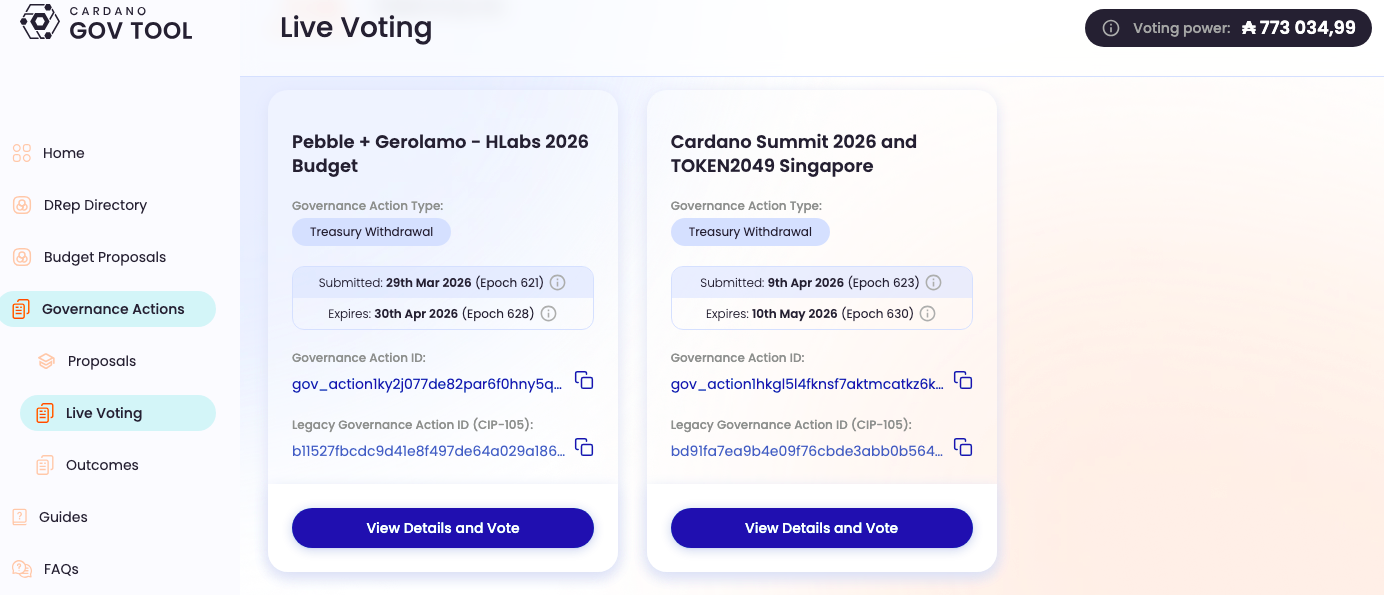
Шахрайська схема - Nano Glass - ФОП Луцькова Дарія Андріївна
Штучний інтелект активно розвивається, і саме завдяки ньому одна з соц мереж видала мені рекламу такого засобу як Nano Glass, розчин, який усуває тріщини на склі в авто. Але цей пост не про те, як саме ШІ "дізнався, почув" та додав мене в "target audience" на facebook, instagram, а про банальну шахрайську схему.
Отже як бачите по скріншоту, замовив рідину за 399 грн. В порівнянні з сумами, які постійно витрачаєш на підтримку машин, це дрібниці. А тріщина була, і збільшувалась. Чому б не спробувати?
Потім дзвонять, оформлюють замовлення, оплата тільки через Нову пошту (так з доставкою, процесингом Нової пошти виходить вже сума 706.48).
Nano Glass не те що не діє, це чи то клей розбавлений з водичкою, ніяких вихідних даних, ні контактів.
Телефон не відповідає, ні той з якого дзвонили, ні той який прикріплений до нової пошти та фоп (068 163 87 57)
Я оформив "Легке повернення", але звісно ж ніхто не збирається забирати цю посилку назад.
От і вся схема: 500-700 грн - це мало, щоб йти витрачати час писати заяву в поліцію про шахрайство, чи тим більше їхати в те село, чекати хто прийде відправляти на нову пошту (а прийде ж просто наймана людина, яка, можливо просто отримає копійки за відправки, ну і фоп може бути "мертвим"). Закриють цей фоп - знайдуть інший.
Потім якось мені знову видає цю рекламу (лендінг сторінка може бути іншою), я лишив замовлення вже на інший номер. Потім подзвонили, і з розмови з дівчиною я так і зрозумів, що то швидше за все "аутсорсинговий кол центр", ну і вона вже не сперечалась з тим, що це шахрайство.
500-700 грн наче небагато, але якщо це масштабовано, можливо це й великі суми. Підтримка Нової Пошти нічого не робити не буде, хоча я й пояснював, що тут вони ж не лише як пошта, а й фінансовий посередник. Але, може цей пост допоможе комусь бути уважнішим, наприклад тим, хто робить інтернет покупки.
Прикро, звісно, що замість створення нових виробництв, розвивається шахрайство, але я рідко роблю інтернет покупки (крім книжок), мені важко оцінити рівень інтернет шахрайства. Здавалось би, ту ж саму енергію і час можна було б використати на реальний бізнес процес, хтось дурить людей.
Cardano Decentralised Deputy Diary. Text 17
Hello, my readers and everyone interested in Cardano and blockchain governance.
Date: 28 March 2026
Voting Power: ₳ 766 293
Good news that I have some new delegators, and now my stake is 766K+ and that's good! Who knows if my diaries helped this? I don't know.
Today I'm voting of 3 governance decisions.
1 . Cardano Defi Liquidity Budget - Withdrawal 1
Voted Abstain.
Reasoning: I don't think that's good decision to allocate such amount of ADA for DeFi. I think the market and people should decide whether to provide liquidity or not. On the other hand - if the community thinks this might be benefitial for the Cardano ecosystem - what can I do? It's not the worst imaginable spending of ADA - that's why I choose to "Abstain" now rather than vote No.
2 . Cardano x Draper Dragon: Orion Fund
Voted No.
Reasoning: 50Millon ADA is a huge amount. To be honest, at this point I don't see a reason to create new fund while we have Catalyst, community-driven fund, which proved its effectiveness and definitely has big community participation.
3 . Approve Cardano Foundation as New Managing Entity of Project Catalyst
Voted Yes.
Reasoning: I'm not a fan of Cardano Foundation. I had problems dealing with them in the past. I prefer that Catalyst would be community-driven, but as it seems now IOG won't continue to supervise Catalyst and there is no easy and fast way for the community to take over the management over Catalyst. Maybe we, DReps can do it? I think this will be good.
But now proposal says that "CF and IOG strongly believe that approving the change in managing entity for Project Catalyst from IOG to CF is the most responsible path forward to resolve legacy funding obligations and protect the Cardano Treasury"
Moreover "if the CF does not assume this role in time, the continuation of Project Catalyst is uncertain at this time." That's why I decided to support and vote Yes. I hope I will have time to do calls/interviews for my podcast and speak more about the future of Catalyst. But as now is time to vote - so my vote is Yes.
I'll get back to you in few days or few weeks.
Best regards,
Cardano DRep Cryptotexty
GovTools page: https://gov.tools/connected/drep_directory/drep1yqmr09530yuehxdz2wca5setx03ps5tnxxrvzlgwmk3wswugxwh
My Cardano address: addr1q8ltprg2dpuftk3xa773c4eqz62d63syevwqmeeqk75h0swy974pwpegzh7kay6pdypdedrfrunyge4fam22062a4ghq3v8jqe
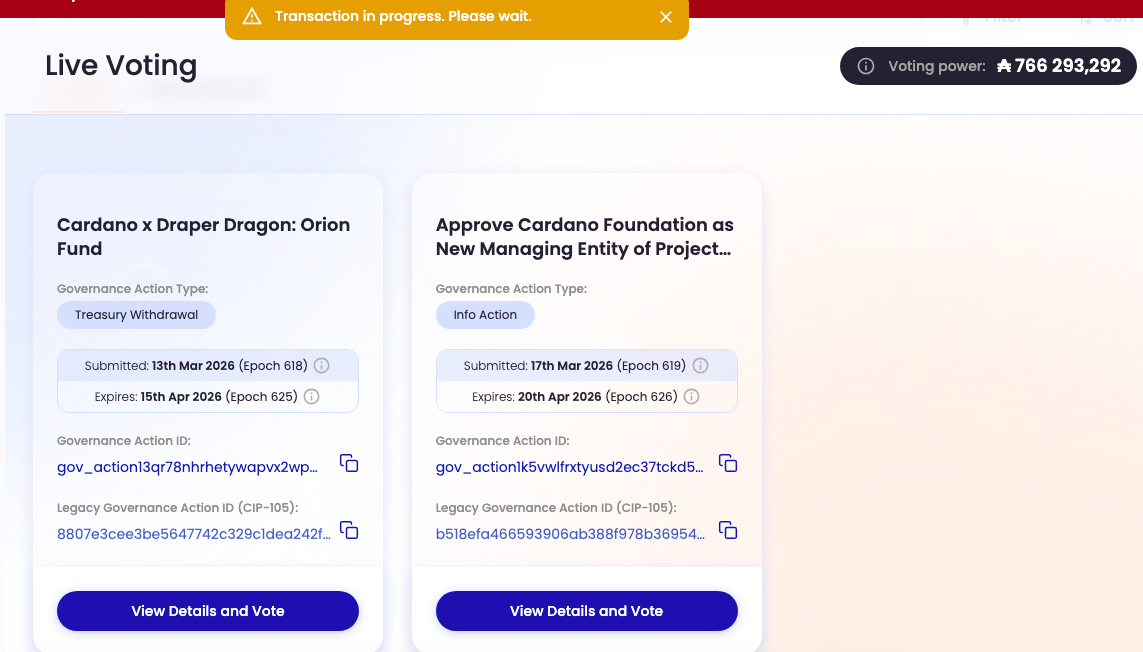
Шевченко
Жоден інший автор не вплинув на українську культуру так, як Тарас Шевченко.
Шевченко всюди присутній в українському житті та іноді така його присутність викликає відторгнення. Для тих в кого виникало щось таке, або через вивчення в школі, або через стереотипну думку: "те що популярне - те попса", я би радив звернутись безпосередньо до творочості Шевченка - його поезії, його картин.
Якщо ж хтось хоче краще пізнати Шевченка як людину - раджу читати його щоденник. Там ви знайдете його опис нудної армійської служби, його подорожі по околицях російської імперії - брудної та відсталої, його особисті прагнення, спілкування з людьми та навіть гулянки.
Тим, хто любить подорожувати - раджу відвідати Тарасову гору та музей в Каневі. Я вирішив туди їздити щороку.
Позаминулої весни там була виставка чудових картин Марчука - дуже моторошні, готичні й трилерні картини.
Багато політичних мітингів націоналістів в Києві, починались біля пам'ятника Шевченка. Москалі бояться Шевченка, тому його хотіли зробити "своїм" і славянофіли і комуністи.
Я раджу кожному вивчати творчість Шевченка в своєму ритмі. Наприклад поезії Пророка потужно звучать і з музикою Кому Вниз, і з Drudkh.
Безвідносно до того, як уважно читали Шевченка в школі, на цих гуртах, виховане вже не одне покоління націоналістів.
А "Ой чого ти почорніло, зеленеє поле?" здобуває нове значення в композиції Drudkh "Price of Freedom" (Ціна Волі) та ідеально пасує до краєвидів Донбасу.
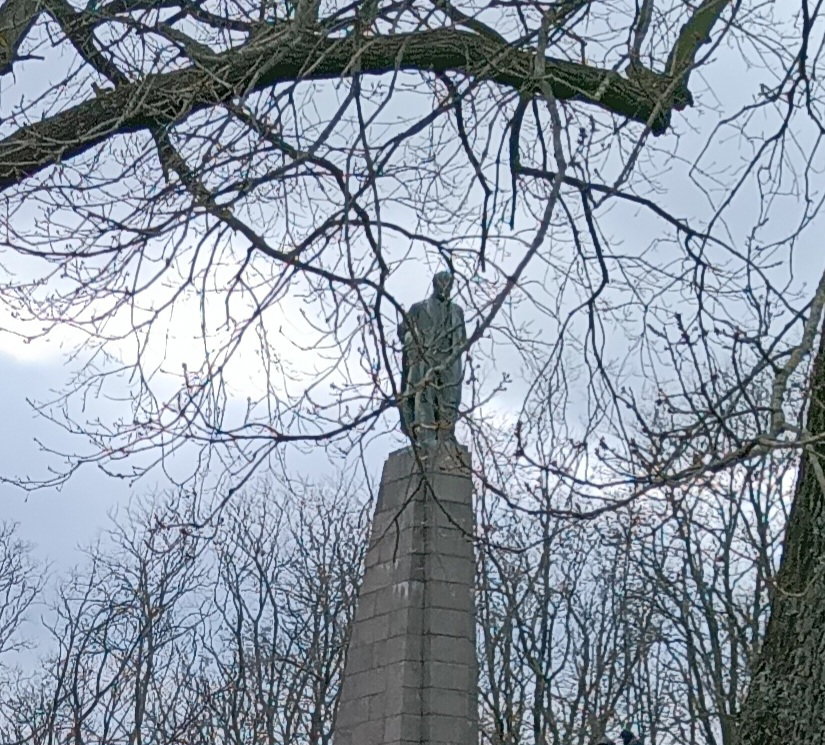
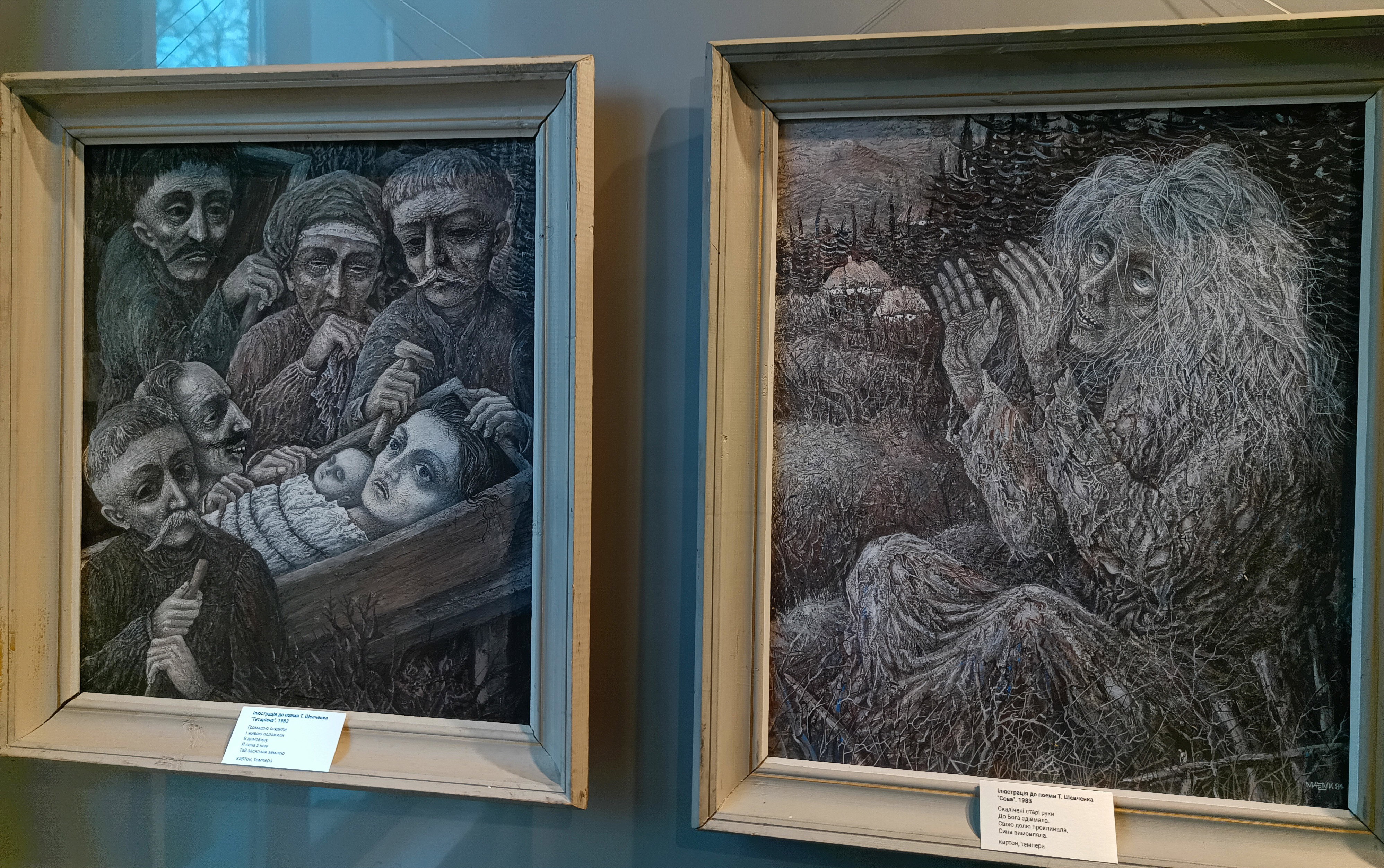
Cardano Decentralised Deputy Diary. Text 16
Hello, my readers and everyone interested in Cardano and blockchain governance.
Date: 8 March 2026
Voting Power: ₳ 45 164
Today I'm voting of 3 governance decisions.
1 . Amaru Treasury Withdrawal 2026
Voted No.
2 . Cardano Budget Process Framework (facilitated by Intersect)
Voted No.
3 . Dingo: a Production-Grade Block Producer in Go by Blink Labs
Voted No.
I'll get back to you in few days or few weeks.
Best regards,
Cardano DRep Cryptotexty
GovTools page: https://gov.tools/connected/drep_directory/drep1yqmr09530yuehxdz2wca5setx03ps5tnxxrvzlgwmk3wswugxwh
My Cardano address: addr1q8ltprg2dpuftk3xa773c4eqz62d63syevwqmeeqk75h0swy974pwpegzh7kay6pdypdedrfrunyge4fam22062a4ghq3v8jqe
Blablacar історія. Шевченко
Екватор моєї майже 20-годинної подорожі. Північ в одному з міст центральної України. Ось вони стоять - двоє в формі, з великими сумками. Так іноді буває, коли зустрічаєш людей, які когось нагадають з історії. Цей пасажир - Шевченко, з такими ж вусами.
- Взяв недавно Volkswagen Polo, але розбив його по дорозі з Донбасу. Зараз вертаюсь з поховання тещі. А нещодавно мама померла. Якась чорна полоса…
Моя подорож починалась теж з поховання. Ми трохи обговорили авто та інші теми.
- Хотілося б, щоб все це закінчилось, - якось сумно говорить Шевченко
Він хотів підтримувати якось розмову, щоб мені було легше не заснути за кермом. Але я сказав що не треба, буду подкасти слухати, але вони хай відпочивають. Тому я і не розповідаю, що слухаю якраз промову Трампа, в якій він говорить, що закінчив 8 війн, і скоро закінчиться дев’яту.
- То ви в одному підрозділі служите? - спитав я десь наприкінці подорожі.
- В різних, але в одній бригаді.
Не одразу я зрозумів, що вони чоловік та жінка. Але, до речі, вони й не казали цього. Врешті-решт ми майже не спілкувались. Я слухав подкасти в навушниках, лише під ранок, коли вони вже остаточно прокинулись - включив музику в авто.
Сонячне сяйво сильно світить в очі, але водночас й не дає заснути. На зміну темноті приходять вже добре знайомі пейзажі.
На далеку відстань за двох, по блаблакару була ціна 1600 грн, але я вирішив, що не братиму їх. Що ж, все дорожчає, все росте - й ціни на паливо, ціни на продукти та інші речі. Все, крім зарплати військових. Шевченко наполегливо просить декілька разів, але я відмовляюсь. Я це ще вирішив трохи раніше. У нього чорна полоса. «Ой чого ти почорніло, зеленеє поле?». Але, можливо, сонячне сяйво, яке так яскраво світить - скаже, що ця полоса завершилась. Прощаючись, знаходжу свої темні окуляри. Скоро весна. І 9 березня, день народження Шевченка.

Барвінкове - "Випічка від Койота"
В світі говорять про підтримку України, інвестиції та відбудову. Тільки чомусь не поспішають інвестувати.
Тому все відбувається своїми силами. І це, особливо, видно в прифронтових містах.
От, наприклад, Барвінкове
Найкраща пекарня, кав'ярня міста - "Випічка від Койота". Сімейний бізнес, створений місцевими. Крім гарної кави, випічки (наприклад, сосиска в тісті), пекарня спеціалізується по тортам і десертам. Намагаюсь не їсти солодке, але спеціально спробував "Червоний оксамит", щоб переконатись в його якості й рекомендувати.
В прифронтовому місті, де окрім проблем з нерухомістю є явні ризики (нещодавно прилетіло в супермаркет "Барвінок", що неподалеку) - відкрити такий бізнес - це справді подвиг.
Але також це бізнес, що заснований на трагедії. Мама відкрила пекарню в пам'ять про сина (Позивний - Койот), який загинув на війні ще в 2022 році.
Пам'ять - це важливо, але як зберегти її, коли довкола стільки смертей? Врешті-решт, вони роблять що можуть, і що в них добре виходить. Я заїжджаю в цю пекарню, коли мій шлях пролягає в тих краях. Врешті-решт, це вже - невід'ємна інфраструктура, цього химерного міста, відомого своїми ямами і кратерами на дорогах.
Здається, це один з найкращих способів зберегти пам'ять.
А якщо у вас колись опускатимуться руки, ви можете згадати цей приклад.
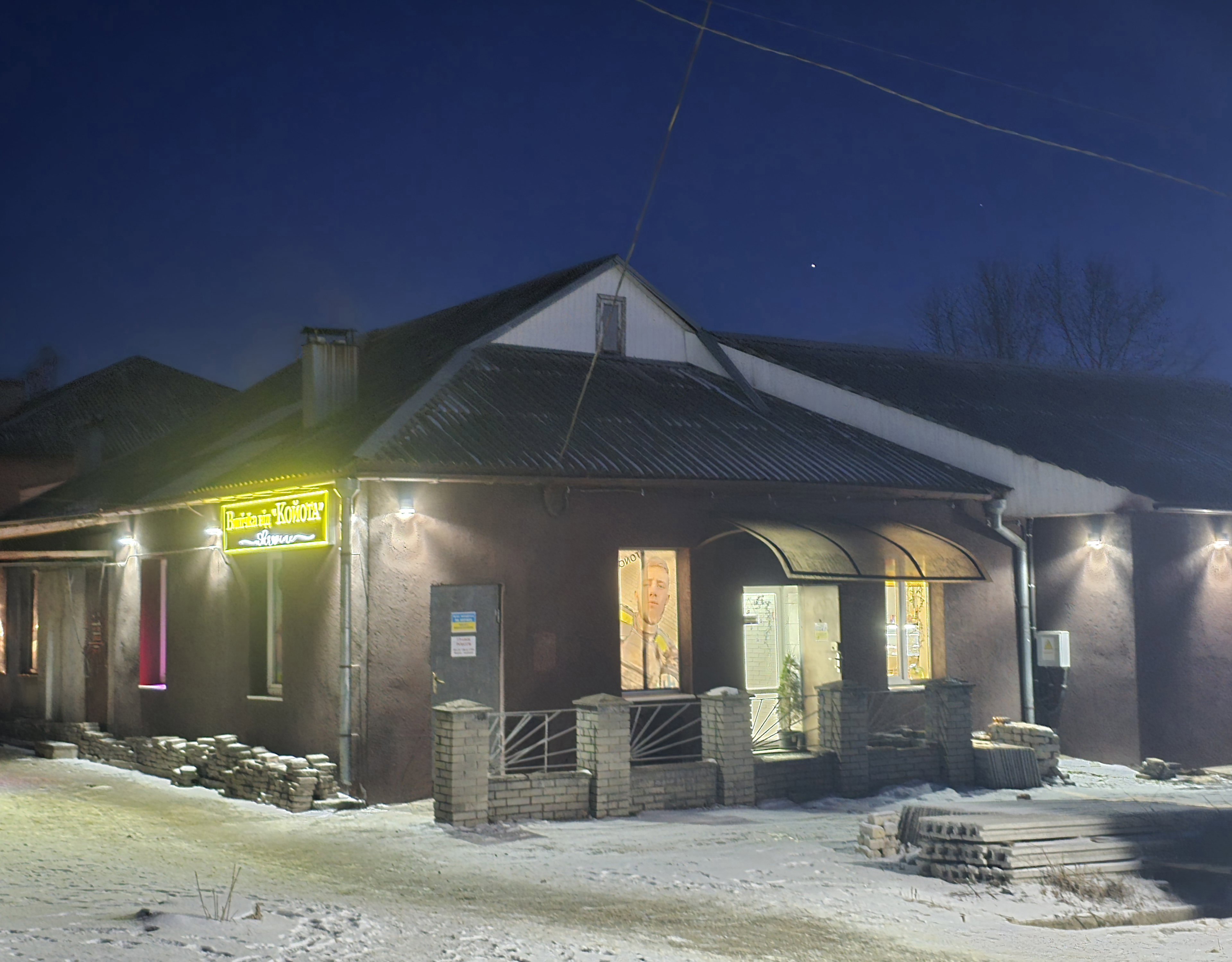
 @cryptotexty