Cardano Decentralised Deputy Diary. Text 15
Hello, my readers and everyone interested in Cardano and blockchain governance.
Date: 12 February 2026
Voting Power: ₳ 45 109
My voting power increased only a bit, I assume that's because of staking rewards. I really need to find time to reach even the people whom I know and with whom I spoke in the past. To do "campaign" in order to get more votes.
Also I got back to Project Catalyst. I will see how I can participate in the future. Right now I'm not happy with some things. But being participant since Fund1, at the moment I stay away from the critics. I only address positive critics which I shared with some people whom I know for years.
And back to DREP work:
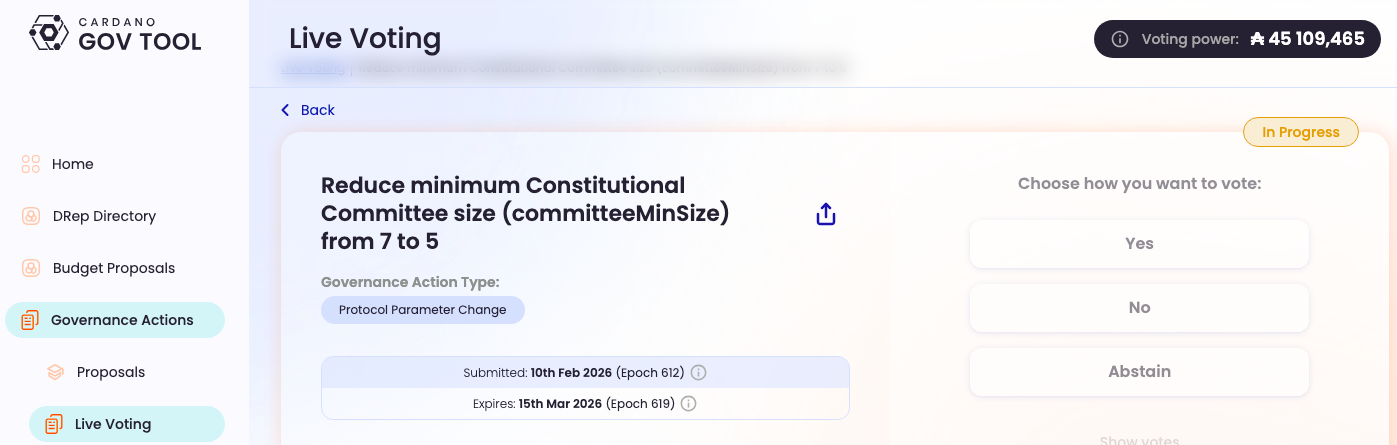
Today I voted on "Reduce minimum Constitutional Committee size (committeeMinSize) from 7 to 5"
Voted Yes.
That's it.
I'll get back to you in few days or few weeks.
Best regards,
Cardano DRep Cryptotexty
GovTools page: https://gov.tools/connected/drep_directory/drep1yqmr09530yuehxdz2wca5setx03ps5tnxxrvzlgwmk3wswugxwh
My Cardano address: addr1q8ltprg2dpuftk3xa773c4eqz62d63syevwqmeeqk75h0swy974pwpegzh7kay6pdypdedrfrunyge4fam22062a4ghq3v8jqe
Cardano Decentralised Deputy Diary. Text 14
https://read.cash/@cryptotexty/cardano-decentralised-deputy-diary-text-14-f8af0f70
Cardano Decentralised Deputy Diary. Text 14
Hello, my readers and everyone interested in Cardano and blockchain governance.
Date: 7 February 2026
Voting Power: ₳ 44 993
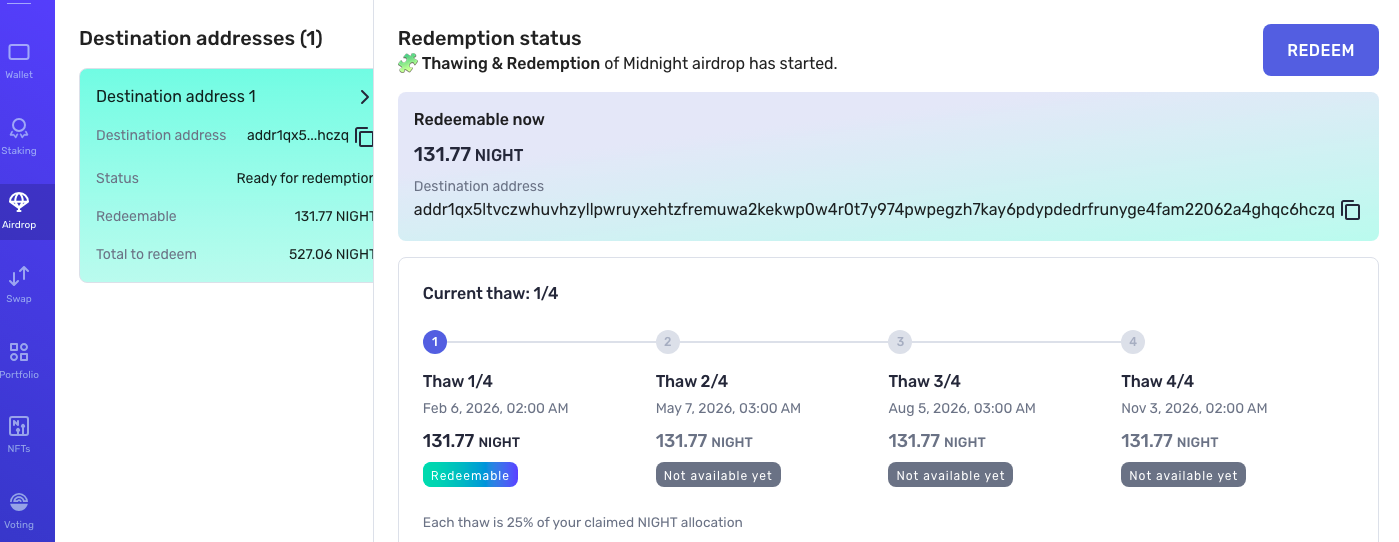
Today I claimed Midnight (NIGHT) tokens. So now I hold 131 NIGHT token which at this day is around $7. I will have to claim for tokens 3 more times. Next time - in 88 days.
I tried to claim yesterday from Vespr mobile wallet and many times I tried - no result. Then I used Yoroi wallet - browser wallet, I wanted to connect it to the Midnight page, but then I noticed "Airdrop" section in Yoroi itself. And that's exactly what you need. I'm writing this as I assume some of my readers will also want to claim NIGHT airdrop. And that's the easiest way to Redeem the tokens. I decided I won't sell tokens now, as Midnight is the project which I will pay attention to, and maybe will participate in the future.
While checking the wallets and the way to redeem Night, I used also Eternl and I decided to sell some Cardano tokens. I did this not only for financial reasons (the numbers are so small so they will barely cover my transaction fees which I pay for voting on Cardano governance decisions). I checked Minswap, SteelSwap, Cswap, SundaeSwap and Wingriders. I sold Shards and Copi tokens - got few ADA back for them. I've been using DripDropz site to claim tokens once in 5 days or sometimes less frequently. I used it for small "investment" into Cardano tokens. I accumulated lots of them, but unfortunately only some of them are possible to sell. And with fees, commissions - you need really big numbers of tokens. That's something what needs improvement in the Cardano ecosystem. But that's another big topic - not for this blog.
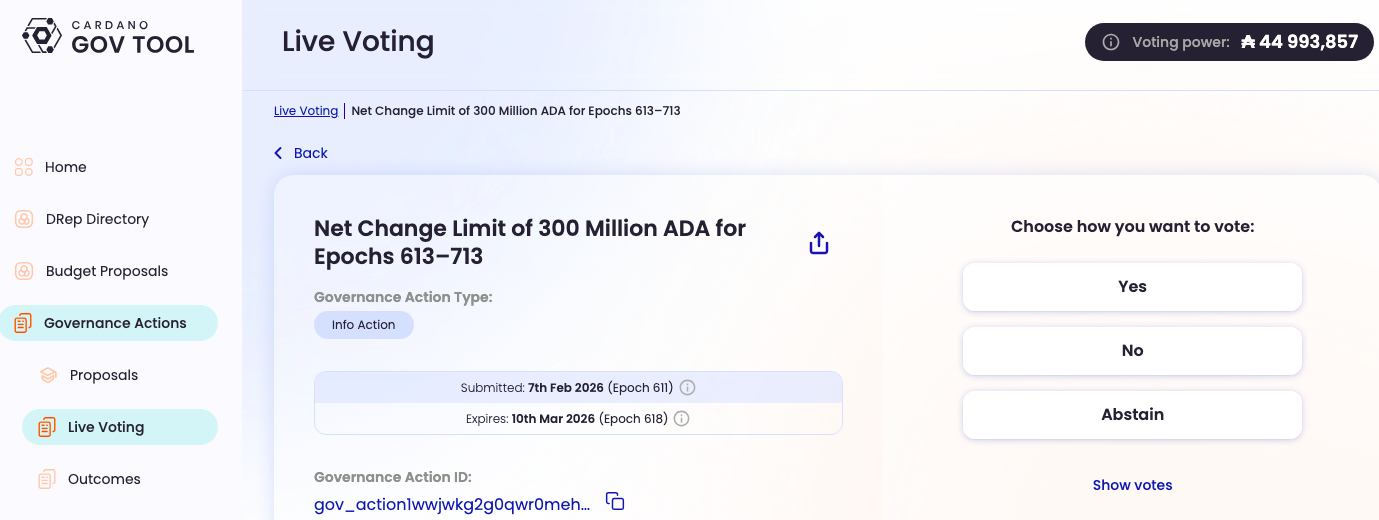
Today I also voted on 1 governance decision
Net Change Limit of 300 Million ADA for Epochs 613–713
Voted No.
I'll get back to you in few days or few weeks.
Best regards,
Cardano DRep Cryptotexty
GovTools page: https://gov.tools/connected/drep_directory/drep1yqmr09530yuehxdz2wca5setx03ps5tnxxrvzlgwmk3wswugxwh
My Cardano address: addr1q8ltprg2dpuftk3xa773c4eqz62d63syevwqmeeqk75h0swy974pwpegzh7kay6pdypdedrfrunyge4fam22062a4ghq3v8jqe
Blablacar історія. Захисник
Колеса старого джипу трохи ковзали по трасі, як він прямумав в бік Києва. Одна з причин - стара «анти-болотна» гума, яку довелось поставити, як єдиний варіант, бо з десятка шиномонтажів регіону ніхто не мав гуму такого радіусу й розміру.
- М-да. Я ставіл сєбє на Defender анті-болотку, нє понравілось, - коментує пасажир, коли я ходжу довкола авто, протираю фари
- Ну і як, подобається Defender? - запитую. Хоч загалом ця поїздка досить понура, як і погода й атмосфера за вікном. Двоє інших пасажирів мовчать, і один з них здається ще й з бодуна - то спав, то гикав, то виходив в аптеку.
- Да, очень нравится
- А за скільки брав, якщо не секрет?
- Стодвадцать, - каже таким тихим голосом, наче соромлячись ціни.
- З салону брав? Чому саме цю модель вибрав? - питаю, бо ж за такі кошти вибір дуже й дуже великий.
- Трьохлітровий дизель. Полний пакєт
Ну й на цьому десь розмова завершилась. Слухали далі аудіокнигу, ну точніше я слухав, пасажири не протестували, але й не коментували, не заперечували цього.
До речі, після цього в інстаграм мені стала попадатись реклама Defender'a.
Він коштує рівно в 24 рази дорожче ніж мій теж трьохлітровий дизель. Але от що мене дивують люди. Чи варто купувати таку дорогу машину, щоб потім їздити на Блаблакарі?.. Ну, звісно, така дорога як в той день зовсім не приносить задоволення від вождіння. Але ж якщо є ресурс, чи є сенс економити паливо, жертвуючи своєю певною свободою пересування? Далі ж йому довелось їхати на метро чи таксі. Та й взагалі різні ж водії бувають - хтось міг би приїхати невчасно, нагрубити, або навіть відп...ти.
А Defender досить красиво виглядає. В перекладі з англійської, як напевне ви всі знаєте, це - Захисник. Отак от, хтось захищає на фронті, хтось - на економічному фронті.
Дякуємо за захист!

Colony DAO Analysis
Decentralized Autonomous Organizations (DAOs) have revolutionized collective decision-making by leveraging blockchain technology to create transparent, trustless systems for governance and resource allocation. This research paper provides a comprehensive examination of Colony DAO, a versatile framework for building DAOs, accessible at https://colony.io/. It analyzes Colony’s technical characteristics, built on EVM-compatible blockchains with governance optimized on Arbitrum for low-cost operations. The ecosystem, while specialized in decentralized finance tools for teams, lacks publicly available precise metrics on dApps or users, but supports applications in project management, DeFi, and collaborative ventures. Colony’s goals focus on enabling meritocratic collaboration, minimizing coordination costs, and aligning incentives through reputation-based systems. Voting mechanics emphasize reputation-weighted decisions, including innovative methods like lazy consensus to balance speed and security. Overall, Colony functions as an all-in-one payment and governance suite, promoting progressive decentralization.
In comparison, Cardano Catalyst operates as Cardano’s decentralized innovation fund on its proof-of-stake blockchain, with recent expansions to multi-chain support. It features robust ecosystem stats, including over 2,221 funded proposals from 11,233 submissions across funding rounds, involving millions of ADA in allocations and 3,257,805 votes. Catalyst’s goals center on fostering ecosystem growth through community-driven funding, with a token-weighted voting system (one ADA = one vote) that has drawn criticism for plutocratic tendencies, though mitigated by quadratic voting in newer funds. The paper explores how Colony’s merit-based model differs from Catalyst’s stake-driven approach, highlighting pros like Colony’s inclusivity and agility against cons such as complexity and limited adoption data. Drawing from official sources, academic analyses, and recent discussions, this analysis underscores the strengths and challenges of each, offering insights for future DAO designs in the evolving Web3 landscape. (Word count: 412)
**Introduction**
The emergence of blockchain technology has paved the way for Decentralized Autonomous Organizations (DAOs), which represent a fundamental shift from traditional hierarchical structures to community-governed entities enforced by smart contracts. DAOs enable participants to collaborate, allocate resources, and make decisions in a transparent, immutable manner, reducing reliance on central authorities and minimizing trust issues. Colony DAO stands as a prominent example, designed as a flexible protocol for creating “Internet Organizations” – decentralized teams that operate efficiently across various scales. Launched on Ethereum, Colony has evolved to support multichain EVM compatibility, emphasizing a reputation system that rewards contributions and decays over time to encourage sustained engagement. This meritocratic approach addresses key challenges in DAOs, such as power concentration among token whales, by tying influence to proven value rather than financial stake.
Cardano Catalyst, in contrast, functions as a specialized governance mechanism within the Cardano ecosystem, often described as the world’s largest decentralized innovation fund. Built on Cardano’s proof-of-stake blockchain, it allocates treasury funds through periodic funding rounds where ADA holders vote on proposals to drive ecosystem development. While effective in channeling resources toward innovation, Catalyst’s “one ADA = one vote” model has been critiqued for fostering plutocracy, where wealthier holders exert disproportionate influence. Recent iterations incorporate quadratic voting to address this, aiming for a more balanced distribution of power.
This paper fulfills the query by dissecting Colony DAO’s core aspects: its technical foundation on EVM chains with Arbitrum for governance, ecosystem focused on practical tools despite limited quantifiable stats, goals of reducing coordination costs in decentralized markets, plans for enhanced interoperability, and voting mechanics centered on reputation and lazy consensus. It details Colony’s functioning as a modular platform for payments, budgeting, and dispute resolution. The central comparison with Catalyst highlights differences in governance philosophies (meritocracy vs. stake-based), operational mechanics (agile teams vs. structured rounds), and ecosystem scales (niche flexibility vs. large-scale funding). Pros and cons of Colony are evaluated, including its inclusivity and low barriers against complexities in reputation management and adoption hurdles.
Sources include Colony’s official site, whitepaper, comparative guides like the 2024 DAO tools analysis, Catalyst’s funding reports, and community discussions from platforms like X and Medium. The structure begins with Colony’s individual components, followed by Catalyst’s overview, a detailed comparison, pros/cons, and conclusions. This exploration not only addresses the query but also contributes to understanding DAO evolution, drawing from recent 2025-2026 developments in funding rounds and community sentiments.
**Technical Characteristics of Colony DAO**
Colony DAO is constructed as a protocol for decentralized organizations, primarily on Ethereum Virtual Machine (EVM)-compatible blockchains to facilitate broad interoperability and scalability. Its architecture allows for the creation of “colonies,” which are the basic units of organization, capable of managing assets and executing smart contracts across multiple EVM chains. Governance is handled on layer-2 solutions like Arbitrum, which covers on-chain gas costs, enabling gasless transactions for users and significantly reducing operational expenses. This multichain support is crucial, as it permits seamless control over assets on various networks while keeping decision-making efficient and cost-effective. For instance, colonies can interact with DeFi protocols on Ethereum, Polygon, or other compatible chains without the high fees associated with mainnet transactions.
At the heart of Colony’s technical design is its reputation system, an algorithmic mechanism that quantifies contributions through completed tasks, peer reviews, and value added to the organization. Reputation is non-transferable, domain-specific (tied to particular teams or expertise areas within the colony), and subject to temporal decay, ensuring that influence remains dynamic and merit-based rather than static or purchasable. This system is implemented via smart contracts that automate calculations, preventing manipulation and aligning incentives with ongoing participation. Colony’s whitepaper emphasizes how this reduces coordination costs in decentralized markets, making models like Holacracy viable through automated rule enforcement.
Key features include a suite of payment tools tailored for teams: flexible payments supporting one-off or scheduled transactions with multiple tokens; batch payments via CSV uploads for efficient multi-recipient processing; streaming salaries for continuous, capital-efficient payouts; smart splits for revenue distribution based on reputation or percentages; and staged payments acting as milestone-based escrow. Additionally, Colony supports crypto-to-fiat conversions, such as USDC to USD or EUR, with a modest 1% fee, bridging decentralized finance with traditional banking. Organizational structure is hierarchical yet decentralized, with colonies divided into nested domains (teams) each having independent budgets, permissions, and decision methods. This modularity allows for scalable operations, from small teams to large DAOs, without subscription fees, user limits, or transaction caps.
Security is enhanced through diverse decision methods: individual permissions for quick, trusted actions (high speed, low security); multisig (M-of-N) for shared responsibility (medium speed and security); and lazy consensus for decentralized, high-security scenarios where proposals advance unless opposed within a set period. These methods are customizable per domain, providing flexibility. Colony’s integration with standard wallets like MetaMask and DeFi tools further bolsters its technical robustness. However, dependence on layer-2 rollups like Arbitrum introduces risks related to sequencer centralization or network outages, though these are mitigated by EVM standards and ongoing developments. In comparisons with tools like Aragon and DAOstack, Colony is noted for its focus on reputation over pure token voting, making it suitable for meritocratic governance. Overall, Colony’s technical setup prioritizes accessibility, efficiency, and decentralization, positioning it as a versatile framework for Web3 organizations.
Read full research paper here: https://cryptotexty.io/colony/
More about Colony: https://colony.io/
More about Project Catalyst: **https://projectcatalyst.io/**
DAOStack Analysis
The rise of blockchain technology has ushered in a new era of organizational innovation, where Decentralized Autonomous Organizations (DAOs) emerge as entities governed by code rather than centralized authorities. DAOs leverage smart contracts to facilitate transparent, peer-to-peer decision-making, enabling global communities to coordinate resources, allocate funds, and pursue collective goals without intermediaries. However, early DAOs faced significant hurdles in scalability, particularly in managing attention and participation in large groups, often leading to decision paralysis or centralization in disguise.
Since my active involvement in the cryptocurrency world in 2017, DAO is one of the major topics which is interesting for me. I'm an active participant of the Cardano ecosystem. I have participated in Project Catalyst since Fund1. Also I’m DREP (Delegated Representative) - I constanly vote on Cardano governance decisions. Even in the hard times which we have right now (war, danger, lack of electricity and heat) - I maintain my long-term interest in the evolution of DAOs in the blockchain industry.
DAOSTACK, launched in 2018 by an Israeli development team led by Matan Field, positioned itself as a pioneering "operating system for collective intelligence" on the Ethereum blockchain. Born from the lessons of The DAO's infamous 2016 hack, which highlighted the risks of untested governance models, DAOSTACK aimed to provide a robust framework for building resilient DAOs. Through an Initial Coin Offering (ICO) that raised approximately $30 million, the platform introduced the GEN token and a modular suite of tools designed to democratize DAO creation and operation. By emphasizing interoperability and open-source development, DAOSTACK sought to foster ecosystems where decisions align with the broader collective will, drawing inspiration from holographic principles where local actions reflect global consensus.
At its core, DAOSTACK's purpose was to enable scalable decentralized governance, allowing organizations to self-organize around shared objectives while mitigating common pitfalls like voter apathy and proposal overload. Key features included the Arc framework—a library of reusable smart contracts for custom DAO configurations—and the innovative Holographic Consensus (HC) mechanism, which integrates reputation-based voting with prediction markets to filter and prioritize proposals efficiently. Deployed initially on Ethereum and later adapted to sidechains like xDAI (now Gnosis Chain) for cost efficiency, DAOSTACK supported diverse applications, from community funds to collaborative ventures, hosting around 92 DAOs and engaging over 9,000 users at its peak in 2019–2020.
Despite its ambitious vision, DAOSTACK's trajectory revealed the challenges of sustaining decentralized systems, with activity declining by 2021 due to incentive misalignments and competition from newer platforms. This research paper delves into DAOSTACK's technical architecture, ecosystem dynamics, governance mechanics—particularly HC—and strategic goals, while comparing it to contemporaries like Cardano's Project Catalyst. By examining its functions, differences, pros, and cons, we uncover valuable lessons for the ongoing evolution of DAOs in the blockchain landscape.
**Abstract**
DAOSTACK, an Ethereum-based platform for decentralized autonomous organizations (DAOs), represents an early attempt to facilitate scalable, collaborative governance through blockchain technology. Launched in 2018, it aimed to enable collectives to self-organize around shared goals by providing modular smart contracts, reputation-based voting, and a novel mechanism called Holographic Consensus. This paper examines DAOSTACK's technical characteristics, including its deployment on Ethereum; its ecosystem, which hosted around 92 DAOs and over 9,000 users but largely consisted of small, short-lived entities; its goals of fostering resilient decentralized coordination; and its voting mechanics, which integrate prediction markets to prioritize proposals. Central to the analysis is how DAOSTACK functions as a DAO framework, emphasizing modular architecture for proposal creation, staking, and decision-making. Additional focus is placed on comparing DAOSTACK with Cardano's Project Catalyst. Key differences include blockchain infrastructure (Ethereum vs. Cardano), governance models (reputation and prediction staking vs. token-weighted with quadratic elements), and adoption outcomes (DAOSTACK's decline vs. Catalyst's ongoing activity). Pros of DAOSTACK include innovative scalability and flexibility, while cons encompass ineffective incentives, low user engagement, and eventual abandonment. This comparison highlights lessons for future DAO designs, underscoring the challenges of balancing decentralization with practical utility in blockchain ecosystems.
**Introduction**
The emergence of decentralized autonomous organizations (DAOs) marks a paradigm shift in organizational structure, leveraging blockchain technology to enable peer-to-peer coordination without centralized authority. DAOs operate through smart contracts that encode rules for governance, resource allocation, and decision-making, allowing global participants to collaborate transparently and autonomously. This model addresses limitations in traditional hierarchies, such as inefficiency and corruption, by distributing power among stakeholders. However, scaling DAOs to handle large communities while maintaining resilience and efficiency remains a core challenge.
DAOSTACK, developed by an Israeli team and launched in 2018, positioned itself as an "operating system for collective intelligence." It sought to provide a comprehensive stack for building and managing DAOs on Ethereum, emphasizing interoperability, modularity, and innovative governance mechanisms to support large-scale collaboration. The platform raised approximately $30 million through an initial coin offering (ICO) of its GEN token, attracting attention for its potential to revolutionize decentralized governance. At its core, DAOSTACK aimed to create resilient systems where decisions align with collective interests, drawing from concepts like holographic consensus to filter proposals efficiently.
This research paper analyzes DAOSTACK in depth, covering its technical foundations, ecosystem metrics, strategic objectives, and operational mechanics. Particular emphasis is placed on its voting system, which integrates reputation and prediction markets to mitigate attention overload in large groups. The main inquiry focuses on how DAOSTACK functions as a DAO—through proposal submission, boosting, and reputation-based voting.
By comparing these systems, the paper identifies pros such as DAOSTACK's modular flexibility and Catalyst's sustained activity, alongside cons like DAOSTACK's economic incentive failures and Catalyst's plutocratic tendencies. Drawing from empirical data on DAOSTACK's lifecycle—from peak activity in 2019-2020 to decline by 2021—and Catalyst's ongoing funds exceeding $100 million, this analysis offers insights into DAO evolution. Ultimately, it argues that while DAOSTACK pioneered advanced governance tools, its shortcomings underscore the need for better incentive alignment and user engagement in future designs.
**Technical Characteristics**
DAOSTACK is built on the Ethereum blockchain, utilizing its smart contract capabilities to create a modular framework for DAOs. Ethereum's Turing-complete scripting language enables DAOSTACK's core component, Arc, a collection of reusable smart contracts that define building blocks for DAO operations. Arc allows developers to compose custom DAOs by combining elements like voting schemes, reputation systems, and proposal mechanisms, promoting interoperability with other Ethereum-based tools.
The platform's architecture consists of four layers: Ethereum as the base blockchain for security and immutability; Arc for governance primitives; Arc.js, a JavaScript library for interfacing with contracts; and user-facing applications like Alchemy for intuitive DAO management. This layered approach ensures flexibility, allowing DAOs to integrate with external protocols while maintaining on-chain transparency. For instance, each DAO has a treasury managed via smart contracts, with operations recorded publicly to prevent tampering.
Technically, DAOSTACK leverages Ethereum's proof-of-work (at launch) and later proof-of-stake consensus for transaction validation, ensuring decentralized execution. The GEN token, an ERC-20 asset, facilitates staking in prediction markets within the Holographic Consensus mechanism, adding an economic layer to governance. Reputation, a non-transferable metric earned through contributions, serves as voting power, distinguishing DAOSTACK from purely token-based systems.
However, Ethereum's high gas fees posed challenges, leading to deployments on sidechains like xDAI (now Gnosis Chain) for cost efficiency. Of the 92 DAOs created, 67 were on xDAI, reflecting adaptations to scalability issues. DAOSTACK's contracts are upgradable via proxy patterns, allowing evolution without forking, though this introduces potential centralization risks if upgrades are controlled by a small team.
Overall, DAOSTACK's technical design prioritizes composability and resilience, enabling DAOs to own assets, manage budgets, and execute decisions autonomously. It integrates with tools like Safe{Wallet} for multisig security and supports custom plugins, making it suitable for diverse applications from venture funds to community governance. Despite these strengths, the platform's reliance on Ethereum exposed it to network congestion, contributing to its eventual decline as newer layer-2 solutions emerged.
**Holographic Consensus in DAOSTACK**
**Detailed Mechanics of Holographic Consensus**
Holographic Consensus (HC) represents DAOSTACK's innovative approach to resolving the inherent tension between scalability and resilience in decentralized governance. At its core, HC is a protocol that enables decisions in large-scale DAOs to be made quickly and locally—requiring only a small fraction of the DAO's total influence or voting power—while ensuring these decisions align with the global opinion of the entire DAO. This alignment is achieved through a crypto-economic game that transforms potential mismatches between local and global opinions into economic opportunities for participants. The name "holographic" draws from the analogy of a hologram, where each small fragment contains the information of the whole image; similarly, local decisions reflect the broader collective will.
The mechanics of HC begin with the proposal lifecycle. Proposals in a DAOSTACK DAO start in a pre-boosted state, queued for consideration. In this phase, they require an absolute majority (typically over 50% of the total reputation in the DAO) to pass, ensuring resilience against manipulation but limiting scalability due to the high attention required from all members. To scale, HC introduces a "boosting" mechanism: proposals can be elevated to a boosted state if they meet certain staking thresholds. Boosting shifts the voting requirement to a relative majority, where approval depends only on the majority of active voters within a defined timeframe (e.g., a week), regardless of total participation. This reduces the quorum barrier, allowing decisions with lower overall turnout while maintaining efficiency.
Central to HC is the integration of prediction markets via staking with the GEN token, DAOSTACK's native cryptocurrency. Anyone—DAO members or external participants—can stake GEN tokens on a proposal's outcome: "upstaking" to predict it will pass (boosting it toward relative majority) or "downstaking" to predict failure and prevent boosting. Staking creates a bet ratio (success-to-failure stakes). If this ratio exceeds a predefined threshold (e.g., exponentially increasing based on the number of already boosted proposals), the proposal is boosted. Successful predictors are rewarded with bounties derived from staking fees, DAO contributions, or forfeited stakes from losers, while incorrect stakers lose their GEN. This market-driven filtering prioritizes high-value proposals by monetizing collective attention: promoters must pay (via stakes or fees) to elevate items, ensuring only those with sufficient "internal value" (perceived benefit to the DAO) consume limited attention resources.
Key parameters in the Genesis v0.2 protocol, DAOSTACK's implementation of HC, include exponential thresholds for boosting to prevent spam and attention overload. For instance, the boosting threshold might scale as e^{k \cdot b}, where ( b ) is the current number of boosted proposals and ( k ) is a constant, making it progressively costlier to boost additional items. Voting rules incorporate reputation—a non-transferable, merit-based score earned through contributions—as the primary voting weight, promoting meritocracy. Proposals in boosted mode pass with a relative majority (e.g., >50% of votes cast), but if opposition arises post-boosting and shifts the outcome, predictors who upstaked incorrectly are slashed, creating arbitrage opportunities that reinforce alignment.
Incentives are structured game-theoretically: mismatches between local (boosted, relative majority) and global (absolute majority) outcomes generate profits for accurate predictors, encouraging monitoring and correction. For example, if a boosted proposal is ultimately rejected by voters, downstakers profit, incentivizing them to flag misalignments early. This dual-token economy (DAO-specific tokens for internal governance and GEN for external prediction) separates concerns, allowing open participation in filtering without diluting DAO control.
Empirical validation from DAOSTACK's deployment highlights HC's practical workings. Across 92 DAOs and over 9,000 users, HC was analyzed in 23 active DAOs, where it facilitated governance with average voter turnout of just 8% per proposal. Boosting achieved 97% precision in identifying relevant proposals and 76% sensitivity in capturing approved ones, though 48% of non-boosted proposals still passed, indicating occasional filtering lapses. In high-volume DAOs like dxDAO (918 proposals) and Genesis Alpha (peaks of 40 open proposals), HC enabled scalability by reducing the need for mass participation, with 86% average approval rates and most decisions unopposed.
**Pros and Cons of Holographic Consensus**
HC offers several advantages in DAO governance. Its primary pro is enhanced scalability: by allowing relative majority for boosted proposals, it permits large DAOs to process more decisions without requiring universal attention, as seen in DAOSTACK's ability to handle peaks of over 30 proposals in multiple DAOs. Resilience is bolstered through economic incentives that align local actions with global consensus, preventing minority hijacking—proposals not aligned with the DAO's will are downstaked and filtered out. The prediction market fosters efficiency, acting as a neutral filter that rewards accurate forecasting and punishes errors, potentially attracting external expertise. Innovation in futarchy (governance via markets) makes HC a pioneer, influencing modern systems like optimistic governance in other platforms.
However, cons emerged from DAOSTACK's real-world implementation. A key issue was the lack of independent staking: only 34% of stakes came from outsiders, with 83% from DAO members and a third from proposers themselves, turning HC into a self-referential tool that favored insiders and potentially exacerbated plutocracy. Complexity and costs—such as GEN token burns and Ethereum gas fees—deterred broad adoption, contributing to declining accuracy post-2020. Power imbalances persisted, with high Gini coefficients in small DAOs indicating oligarchic tendencies. Ultimately, insufficient incentives failed to sustain an active predictor network, leading to HC's underutilization as DAOSTACK declined.
**Comparison with Cardano Catalyst in the Context of HC**
In comparing DAOSTACK's HC with Cardano's Project Catalyst, HC's prediction-market filtering stands out as a differentiator for scalability in general-purpose DAOs, whereas Catalyst relies on token-weighted voting (one ADA = one vote, with quadratic experiments) for funding-specific decisions. HC's boosting reduces attention demands, enabling low-turnout governance (8% in DAOSTACK vs. higher in Catalyst's community reviews), but Catalyst's sustained activity (over $100M distributed) highlights better incentive alignment through direct rewards. Pros of HC over Catalyst include merit-based reputation mitigating wealth bias, but cons like staking dependency led to DAOSTACK's fall, while Catalyst's simpler model avoids such complexity, though risking plutocracy without full quadratic implementation.
**Ecosystem**
DAOSTACK's ecosystem, while innovative, remained modest in scale and longevity compared to contemporaries like Aragon. From its launch in April 2018 to its peak in 2020, the platform hosted 92 DAO deployments—25 on Ethereum's mainnet and 67 on xDAI for lower costs. These DAOs varied in purpose, including venture funds, community initiatives, and experimental governance groups. Notable examples include Genesis Alpha, a flagship DAO for platform governance, and dOrg, a developer collective that persisted beyond DAOSTACK's active support.
User metrics show over 9,000 registered addresses, but active participation was limited to about 900 users, with two-thirds joining during the initial growth phase from 2019 to 2020. Major DAOs like Kyber Network (5,000 users) and BuffiDAO (2,700 users) drove much of this, indicating concentration rather than broad adoption. dApps built on DAOSTACK were few, primarily Alchemy—a user interface for proposal management and voting—and integrations with tools like Snapshot for off-chain signaling.
Ecosystem activity plateaued at 22 active DAOs by April 2020, with a small persistent community of 20-40 weekly users post-2021. Partnerships included collaborations with projects like Gnosis for sidechain support and integrations with wallets for seamless participation. However, most DAOs were small and short-lived, with limited dApp diversity beyond governance tools.
Recent X discussions highlight DAOSTACK's influence on modern DAO tooling, with mentions of its Holographic Consensus inspiring current frameworks. Despite this, the ecosystem's decline after developer support ended in 2021 underscores challenges in sustaining engagement without ongoing incentives.
**Goals and Plans**
DAOSTACK's primary goal was to enable scalable decentralized governance, allowing large collectives to self-organize around shared values efficiently. It envisioned DAOs as resilient entities capable of managing resources, making decisions, and fostering collective intelligence without central control. By addressing attention scarcity in large groups, DAOSTACK aimed to catalyze a new era of collaboration, potentially impacting sectors like finance, supply chains, and social initiatives.
Plans outlined in its 2017 whitepaper included building a modular stack for DAO creation, with Arc as the foundation for customizable governance. Future developments focused on enhancing Holographic Consensus for better scalability, integrating with other blockchains, and expanding user tools like Alchemy. The GEN token was designed to incentivize participation through staking rewards.
Post-ICO, DAOSTACK pursued pilots with projects like dxDAO and partnerships for real-world applications. Long-term visions included thousands of dApps on Arc, but economic incentives proved ineffective, leading to stagnation. By 2023, the project was largely abandoned, though its open-source code influenced subsequent DAO platforms.
**Voting Mechanics**
DAOSTACK's voting system, centered on Holographic Consensus (HC), addresses scalability by combining reputation-based voting with prediction markets. Proposals start in a queue, where users stake GEN tokens to predict outcomes—boosting if stakes exceed a threshold, or quiet-ending if not.
Boosted proposals require relative majority approval using reputation, a non-transferable score earned via contributions. Reputation determines voting weight, promoting meritocracy over wealth. Parameters like proposingRepReward incentivize successful submissions, while votersReputationLossRatio penalizes misalignment.
HC uses GEN staking for/against proposals; correct predictors earn rewards, incorrect lose stakes. This filters high-quality proposals, reducing attention demands. Empirical data from 22 DAOs and 6,000 users validated HC's ability to prioritize aligned decisions.
Mechanics include time-bound boosting periods and slashing for malicious actions, ensuring resilience. While innovative, issues like cost and complexity limited adoption.
**How the DAO Functions**
DAOSTACK DAOs function as on-chain entities managing treasuries and decisions through modular contracts. Users deploy a DAO via Arc, configuring reputation, voting schemes, and tokens.
Proposals are submitted with reputation rewards for passers. HC filters them: staking GEN boosts visibility for reputation votes. Approved proposals execute automatically, reallocating funds or updating parameters.
Reputation accrues from contributions, enabling voting without financial barriers. The GEN economy incentivizes accurate predictions, aligning local actions with global consensus. Alchemy provides UI for interactions, while interoperability allows external integrations.
In practice, DAOs like Genesis handled community governance, but low engagement led to treasury drains. Functionality emphasized resilience over speed, though real-world use revealed incentive misalignments.
**Comparison with Cardano Catalyst**
DAOSTACK and Cardano's Project Catalyst represent distinct approaches to DAO governance, differing in technology, mechanics, purpose, and outcomes. DAOSTACK functions as a general-purpose framework for building DAOs on Ethereum, enabling modular creation of organizations for various uses like funds or communities. Proposals undergo HC filtering before reputation-based votes, emphasizing merit and prediction accuracy. Catalyst, conversely, is a specialized funding DAO within Cardano, distributing treasury ADA for ecosystem projects via community proposals and votes.
Key differences start with blockchain: DAOSTACK on Ethereum (with xDAI) vs. Catalyst on Cardano's proof-of-stake chain. Voting mechanics diverge sharply—DAOSTACK's HC uses GEN staking and reputation for scalable, meritocratic decisions, while Catalyst employs ADA-weighted voting (one ADA = one vote), with quadratic experiments in Fund 14 to curb whale dominance. Catalyst proposals pass via yes/no tallies ranked by net votes, requiring minimum ADA holdings for participation.
Functionally, DAOSTACK supports broad DAO operations like treasury management and custom governance, whereas Catalyst focuses on innovation funding, with stages like proposal submission, community review, and voting via apps. DAOSTACK's ecosystem was smaller (92 DAOs, 9,000 users) and declined, while Catalyst manages billions in ADA across funds, with high participation in votes.
Pros of DAOSTACK include innovative HC for attention efficiency, modular flexibility for custom DAOs, and reputation over wealth to reduce plutocracy. It excels in theoretical resilience for large groups. Cons encompass ineffective incentives leading to low activity, complexity deterring users, and abandonment post-2021 due to funding issues.
Catalyst's pros: Active community, transparent funding (over $100M distributed), and incentives like voter rewards. Quadratic voting mitigates some inequalities. Cons: Plutocratic bias favoring large holders, slow processes (e.g., 18-month delays), and legal ambiguities in accountability.
Overall, DAOSTACK prioritizes general scalability but failed in sustainability, while Catalyst succeeds in focused funding but risks centralization.
**Conclusion**
DAOSTACK pioneered ambitious DAO tooling, but its decline highlights governance challenges. While technically sound and innovative, poor incentives and adoption limited impact. Catalyst's success in funding underscores targeted applications' viability, though both reveal decentralization's trade-offs.
In conclusion, DAOSTACK DAO exemplifies the pioneering spirit of early blockchain governance experiments, offering valuable insights into the potential and pitfalls of decentralized coordination through its modular Ethereum-based architecture, Holographic Consensus mechanism, and reputation-driven voting. While its technical innovations, such as scalable proposal filtering and meritocratic decision-making, addressed critical challenges like attention scarcity and plutocracy, the platform's decline—marked by low user engagement, ineffective incentives, and abandonment by 2021—underscores the difficulties in sustaining broad adoption without robust economic models and real-world utility.
And Cardano's Project Catalyst emerges as a thriving alternative, demonstrating how a focused, funding-oriented DAO can foster ecosystem growth by distributing over $100 million in ADA for innovative projects, incorporating community-driven improvements like quadratic voting to enhance fairness, and maintaining high participation through transparent processes and rewards.
For researchers, developers, and enthusiasts seeking active involvement in blockchain governance, Project Catalyst represents an excellent opportunity to explore and join: it not only empowers users to propose, vote on, and fund real-world initiatives but also contributes to Cardano's evolving treasury system, promoting decentralized innovation with tangible impacts on sustainability, scalability, and global collaboration—making it a compelling model worth investigating and participating in for those committed to advancing the DAO landscape.
As an active Project Catalyst Participant since Fund1 and as Cardano DREP (Delegated Representative) - I’m here to help you if that’s needed. I will continue studying the DAO topic as well as the Cardano ecosystem with my articles, videos and communication.
I would be happy to hear your opinion and feedback - feel free to contact me by email or any other messenger.
More about Project Catalyst: https://projectcatalyst.io/
Aragon DAO Analysis
Decentralized Autonomous Organizations (DAOs) - decentralized organizations with no central authority that use smart contracts and blockchain to make decisions - have emerged as an interesting transformative paradigm in our informational age.
Since my active involvement in the cryptocurrency world in 2017, DAO is one of the major topics which is interesting for me. I'm an active participant of the Cardano ecosystem. I have participated in Project Catalyst since Fund1. Also I’m DREP (Delegated Representative) - I vote on Cardano governance decisions. Even in the hard times which we have now (war, danger, lack of electricity and heat) I maintain my long-term interest in the evolution of DAOs in the blockchain industry.
Aragon DAO, established in 2017, has evolved into a leading modular platform for on-chain organizations, built primarily on Ethereum with multi-chain extensions. As of early 2026, Aragon supports over 10,000 launched projects governing more than $35 billion in assets, with integrations across protocols like Curve, Lido, Polygon, Taiko, and Yield Basis. This research paper provides a detailed examination of Aragon's technical architecture (Aragon OSx framework with plugin composability and upgradeability), ecosystem dynamics (including DAOs, users, governed assets, and integrations), strategic goals and roadmap (DAOs 2.0 focusing on value accrual, automation, privacy, and investable tokens), and governance mechanics (customizable token-weighted voting with advanced plugins for quadratic, conviction, escrow, and privacy features). Special emphasis is placed on recent 2025–2026 advancements, such as the Value Accrual Toolkit (March 2025) for veLockers and gauges, Capital Distributor (September 2025) for automated incentives, MACI integration (August 2025) for anti-collusion voting, Enclave verifiable secret ballots (November 2025) for confidentiality, BORGs (September 2025) for legal liability wrappers, Guardians V2 (September 2025) for veto oversight, LockToVote upgrades (November 2025) for escrow mechanics, Ownership Token Index (December 2025) for verifiable standards, and rule-based automation from the "Beyond Proposals" series (January 2026) to minimize voter fatigue. The main inquiry explores how Aragon functions as a DAO framework, its differences from Cardano's Project Catalyst—a stake-weighted innovation fund that has processed over 11,000 proposals, funded more than 2,200 projects, and facilitated millions of votes as of 2026—and the respective pros and cons. Drawing from official sources, web analyses, and 2026 ecosystem metrics, the paper argues that Aragon's modularity offers unparalleled customization for protocol-specific tokenomics and ownership, while Catalyst excels in accessibility and large-scale community participation. Pros for Aragon include scalability and innovation, with cons such as complexity and turnout issues; Catalyst's strengths lie in inclusivity and impact, with drawbacks like plutocracy and proposal spam. Implications for hybrid models and future DAO evolution are discussed, informed by rigorous methodologies akin to IOHK's protocol analyses.
Introduction
The advent of blockchain technology has catalyzed innovations in organizational structures, with DAOs representing a shift from centralized hierarchies to code-enforced, community-driven entities. As articulated in foundational works on Ethereum, DAOs leverage smart contracts to automate governance, reducing reliance on intermediaries and enhancing transparency. Aragon DAO, launched in 2017, has positioned itself as a pivotal infrastructure for DAO creation and management, evolving from a simple deployment tool to a sophisticated framework supporting modular governance and value accrual mechanisms. This evolution is evident in its response to early challenges, such as the 2016 DAO hack on Ethereum, which underscored vulnerabilities in smart contract design. Aragon's initial focus on no-code tools democratized access, but by 2026, it has refined its approach to address real-world issues like voter apathy, proposal overload, and token value erosion.
In 2026, Aragon stands as a mature platform, powering over 10,000 projects with $35 billion in governed assets, as per official metrics. Its modular architecture, Aragon OSx, enables DAOs to upgrade without full redeployments, ensuring longevity in a dynamic blockchain landscape. The platform's multi-chain compatibility, including Ethereum, Polygon, Taiko, and others, mitigates scalability issues, while recent innovations like the Value Accrual Toolkit emphasize economic alignment. This paper analyzes Aragon's technical characteristics, ecosystem, goals, and governance mechanics, with a special focus on its functioning as a DAO framework. A comparative evaluation with Cardano's Project Catalyst—a decentralized innovation fund that has distributed millions of ADA across thousands of projects—highlights key differences, pros, and cons. Catalyst, as of 2026, has processed over 11,000 proposals, funded more than 2,200 projects, and engaged millions of votes, making it a benchmark for large-scale community funding.
The analysis is grounded in primary sources from Aragon's documentation and blog (2025–2026 entries on DAOs 2.0, value accrual, and automation), supplemented by web analyses and ecosystem metrics. It addresses the main question: how does Aragon function, how does it differ from Catalyst, and what are its pros and cons? By drawing from IOHK-inspired methodologies, including protocol formalizations and incentive analyses, the paper contributes to understanding decentralized coordination in blockchain ecosystems. The discussion extends to implications for future hybrid models, where Aragon's modularity could complement Catalyst's participation scale.
Read full research paper here: https://cryptotexty.io/aragon-dao/
More about Aragon: **https://www.aragon.org/**
More about Project Catalyst: **https://projectcatalyst.io/**
Cardano Decentralised Deputy Diary. Text 13
https://read.cash/@cryptotexty/cardano-decentralised-deputy-diary-text-13-879a153e
Cardano Decentralised Deputy Diary. Text 13
Hello, my readers and everyone interested in Cardano and blockchain governance.
Date: 25 January 2026
Voting Power: ₳ 44 977
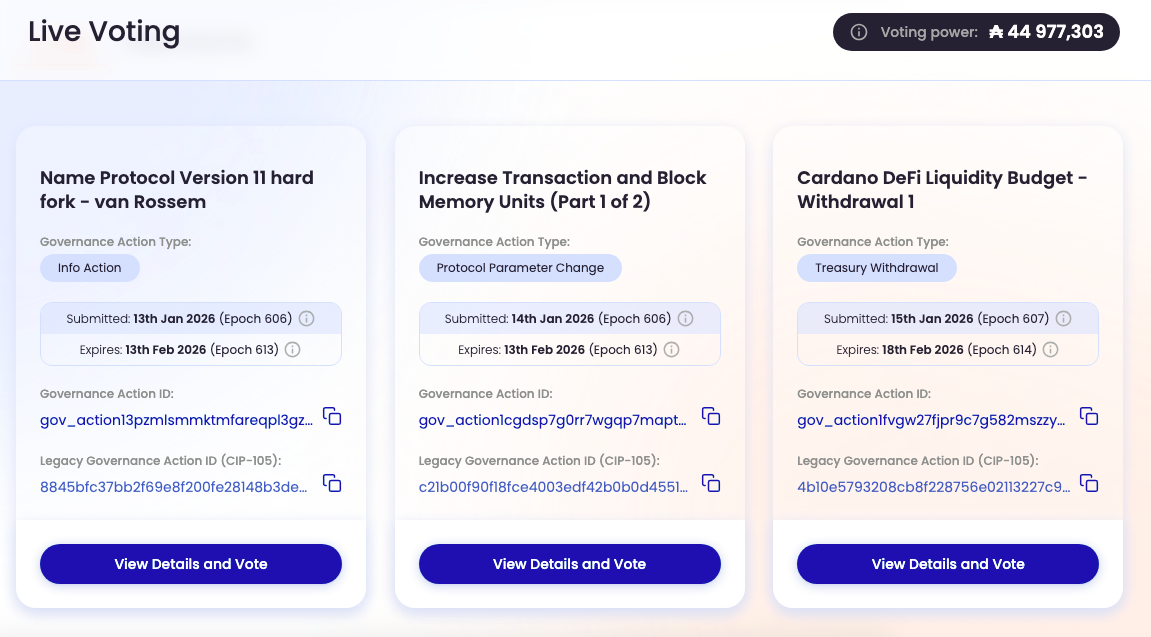
Today I'm voting on 3 governance decisions
1 . Name Protocol Version 11 hard fork - van Rossem
Voted No.
2 . Increase Transaction and Block Memory Units (Part 1 of 2)
Voted No.
3 . Cardano DeFi Liquidity Budget - Withdrawal 1
Voted No.
That's it. I will keep you updated about my DREp life and other events and things from the Cardano ecosystem.
Best regards,
Cardano DRep Cryptotexty
GovTools page: https://gov.tools/connected/drep_directory/drep1yqmr09530yuehxdz2wca5setx03ps5tnxxrvzlgwmk3wswugxwh
My Cardano address: addr1q8ltprg2dpuftk3xa773c4eqz62d63syevwqmeeqk75h0swy974pwpegzh7kay6pdypdedrfrunyge4fam22062a4ghq3v8jqe
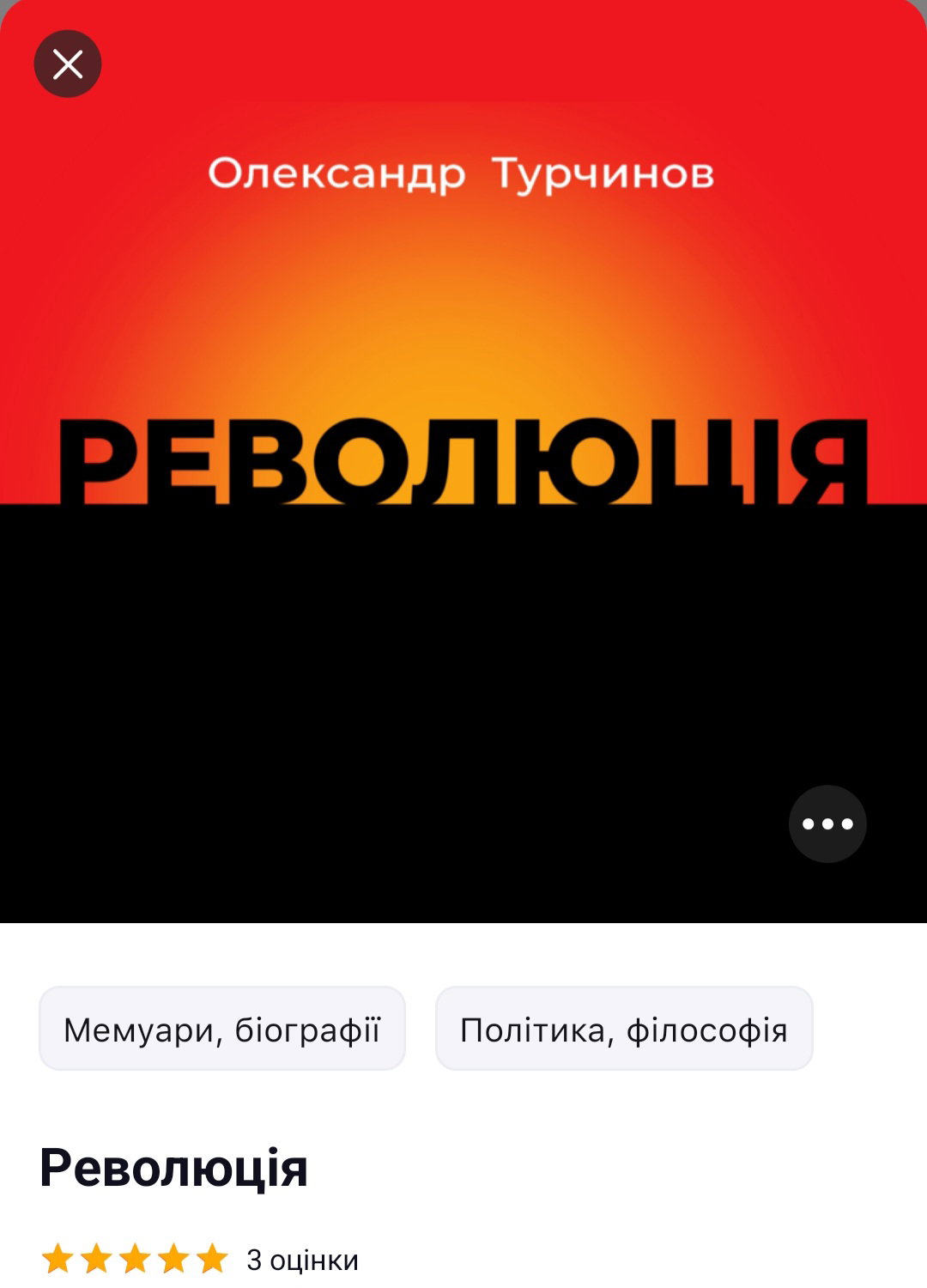
Аудіокнига - Олександр Турчинов - Революція
Навіть в цифрову епоху я лишаюсь прихильником паперових книжок. Книжки - це напевне єдине, що я продовжую накопичувати у великих кількостях. Але от мені подарували аудіо книгу, та я вперше її прослухав повністю. Хвилина реклама - в додатку Абук це дуже зручно, можна закачати книгу та слухати коли відсутній інтернет, можна вибирати глави в навігації. Отже рекомендую, та тепер іноді купуватиму і аудіо книги, хоча звичайно перевага буде завжди за папером.
"Революція" - це гарна цеглина в стіну української політичної історії. А також, цілком можливо, нова реклама для Юлії Тимошенко. Так і лунає фанатичний відголосок "Юля, Юля" і це особливого кумедно в контексті останнього корупційного скандалу.
Турчинов, безперечно, цікава особистість: трудоголік, дуже віруюча людина, яскравий приклад протестанстської етики і духу капіталізму (він в книжці згадує Вебера). Це певна загадка - чому він так фанатично вірить ще й в Юлю. Але для об'єктивності - згадуються й моменти, коли він був категорично не згодний з ЮВ та навіть дивувався її амбіціям та сприйняттю світу.
Особливо мені цікаво було прослухати про період 2005-2010 років, не всі деталі були мені відомі, та й напевне деяка інформація публікується вперше.
Книга дуже збалансована, достатньо дипломатична, але іноді Олександр Турчинов не соромиться категоричної оцінки та негативної характеристики окремих політиків. Особливо дісталось Ющенку, Шепєлєву та Анатолію Гриценку. "Вічний непрохідний" полковник згадується особливо часто й в доволі в кумедних ситуаціях. Цікаво, до речі, куди він зник з політики.
Події Революції Гідності - крізь призму особистого погляду Турчинова, тому деякі аспекти з історії Майдану не розкриті, іншим же приділено багато уваги, як і особистій участі Турчинова.
В цілому - цікаво, адже так чи інакше, Турчинов був не надто публічним, але одним з лідерів Революції Гідності.
Щодо багатьох інших моментів, то згадуєються корупція регіоналів, він нарікає на депутатів-перебіжчиків. Але, звісно, ні слова про "Батьківщину" і її п'ятірочників (сума щоб потрапити в прохідний список), продаж квот, посад, тощо. Тому, звісно, сприймати цю інформацію варто без фанатизму й захоплення. Ці "старі" політики безперечно спробують повернутись, але такі спроби новим українським суспільством, швидше за все будуть сприйняті без ентузіазму.
Для широти картини, я колись читав книжки і "з іншого боку" - Азарова, Клименка - то там набагато більше й самовихваляння і обмаль якоїсь інформації для роздумів.
"Революцію" можу сміливо рекомендувати всім, хто цікавиться політикою й історією.
Cardano Decentralised Deputy Diary. Text 12
https://read.cash/@cryptotexty/cardano-decentralised-deputy-diary-text-12-f26cae11
Cardano Decentralised Deputy Diary. Text 12
Hello, my readers and everyone interested in Cardano and blockchain governance.
Date: 11 January 2026
Voting Power: ₳ 44 949
My voting power increased only a little bit. I assume that's because of staking rewards. But I have ideas how to increase them in the long-term. Sooner or later I plan to restore my crypto podcast and make conversations about Cardano and related topics. Also I will write to all my contacts from the Cardano ecosystem. So I hope that's a matter of time.
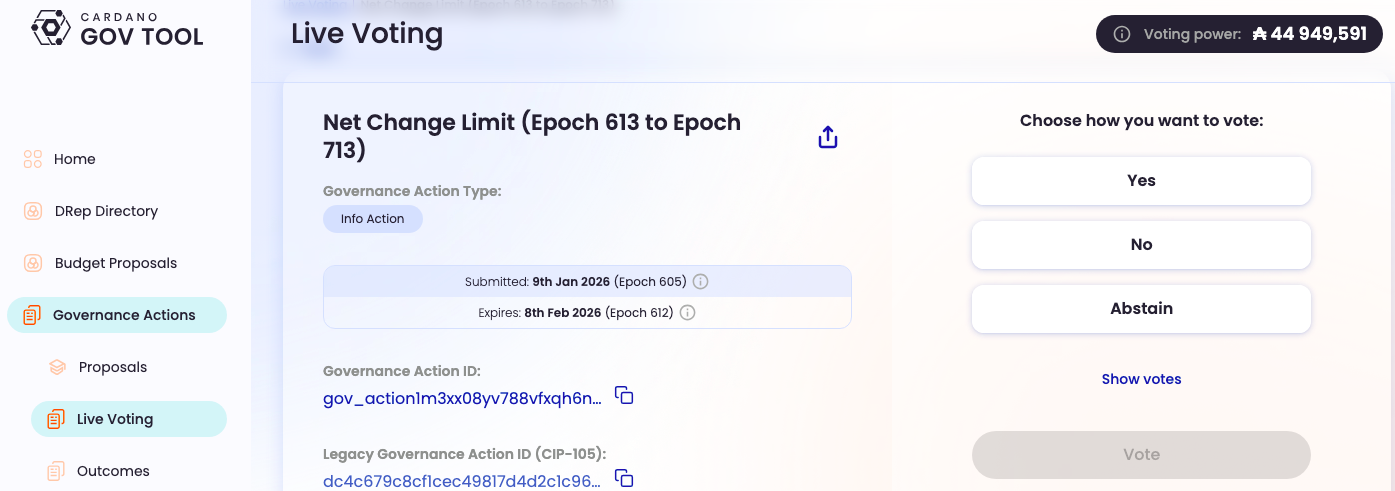
Today I voted for the proposal: Net Change Limit (Epoch 613 to Epoch 713)
Voted No.
Reason: Interstect is behind this proposal. I don't trust them, I don't support this organization. I think it should be replaced by community-based organization.
I think it's the matter of time that it will be replaced. Now I don't have time and energy to "fight" Intersect, but I didn't forget how they prevented me and others from running into positions. I remember this.
Anyway, it's interesting to see how Cardano governance evolves and sooner or later I hope we'll get rid of these unelected bureacrats! (P.S. maybe they are elected - but by themselves)
Best regards,
Cardano DRep Cryptotexty
GovTools page: https://gov.tools/connected/drep_directory/drep1yqmr09530yuehxdz2wca5setx03ps5tnxxrvzlgwmk3wswugxwh
My Cardano address: addr1q8ltprg2dpuftk3xa773c4eqz62d63syevwqmeeqk75h0swy974pwpegzh7kay6pdypdedrfrunyge4fam22062a4ghq3v8jqe
Cardano Decentralised Deputy Diary. Text 11
https://read.cash/@cryptotexty/cardano-decentralised-deputy-diary-text-11-aacc9068
Cardano Decentralised Deputy Diary. Text 11
Hello, my readers and everyone interested in Cardano and blockchain governance.
Date: 27 December 2025
Voting Power: ₳ 44 916
I have a significant decrease in voting power. But I don't have to analyze it why. I checked - and the number of delegators increased. That's why I want to continue my work as DRep. There will be times - and I will be more active in the Cardano ecosystem (with podcasts, Catalyst, etc.). Now the war continues and it's cold, freezing and dangerous here. My resources are depleted, motivation fell down. And the happiness is when can do small things such as drink coffee, smoke cigarette and drive a car. Even if you drive in the middle of nowhere, on the outskirts of the frontline city. Even checking what's going on in Cardano ecosystem is a good switch from the poorness of everyday life. If I survice - there will be time for more active work as DRep. But as for now - I continue voting and keep informed about Cardano and crypto news as much as I can.
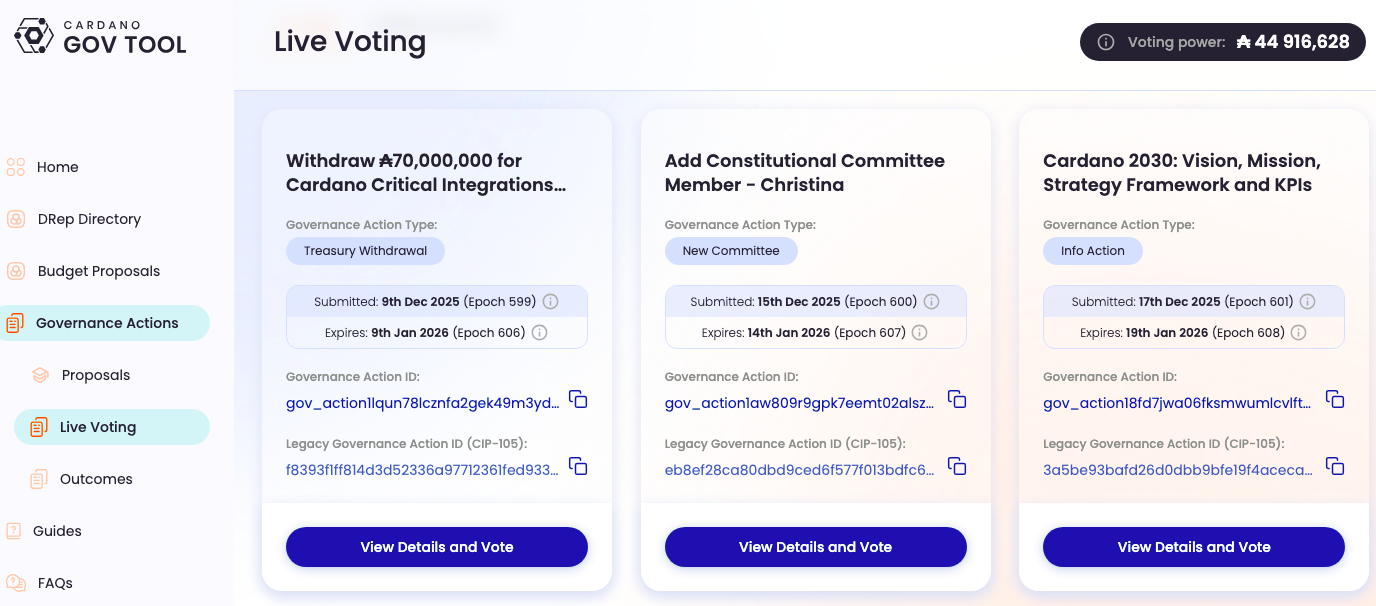
So here is what I voted today:
1 . Withdraw ₳70,000,000 for Cardano Critical Integrations Budget
Voted Yes.
2 . Add Constitutional Committee Member - Christina
Voted No.
Reason: I don't approve Intersect and what they are doing. I had bad experience with them, they were not open for new people and because I have this negative image of Intersect and "their people" I choose to vote No.
3 . Cardano 2030: Vision, Mission, Strategy Framework and KPIs
Voted No.
The same - because of Intersect.
4 . CARDANO BLOCKCHAIN ECOSYSTEM CONSTITUTION v2.4
Voted Yes.
Best regards,
Cardano DRep Cryptotexty
GovTools page: https://gov.tools/connected/drep_directory/drep1yqmr09530yuehxdz2wca5setx03ps5tnxxrvzlgwmk3wswugxwh
My Cardano address: addr1q8ltprg2dpuftk3xa773c4eqz62d63syevwqmeeqk75h0swy974pwpegzh7kay6pdypdedrfrunyge4fam22062a4ghq3v8jqe
BlaBlaCar story. Ipso victim
The wheels were spinning fast as the car confidently bounced over the potholes of Donbas and Barvinkove. Ahead lay at least a 20-hour drive one way, and then the same again back. Roads always give you that sense of perspective and adventure. Henri di Fore, a ginger cat was traveling with me. It was pure stress for him, and he climbed out of his box right away. The whole way he sat in my lap — only when I rolled down the window and lit a cigarette he jumped off, run around the cabin, and meowed loudly, as if protesting for a healthy lifestyle. Quick coffee stop in Izium with French volunteers, a hot dog and coffee at an OKKO station in Kharkiv, and then the long way to Kyiv.
“Di Foret” because he was found in the forest. In Kyiv he’ll definitely have a better life.
In Kyiv I slept a few hours and continued the journey in another car. I thought long and hard about switching the cars — with all these power outages the situation is unpredictable. But the savings won out. Even with some stations jacking prices up to 20 UAH/kWh, it’s still way cheaper to drive on electric vehicle. On BlaBlaCar the passenger only appears in Khmelnytskyi, so I can take any route I want. I charge in Berdychiv, at a new station somewhere on the roadside — a place with not even a café nearby. Next stop is the small, slightly mystical town of Liubar. At least its name — a town most of my readers have never even heard of — preserves centuries of grandeur and the memory of its founder, Prince Liubart. I’ve been there many times and always stop at the “Dok” petrol station, which also has a charger. First thing — the power goes out. The station runs on a generator, but I can set it to a third of the power and still charge. They make tasty burgers there, and they also sell the firm “Liubar” cheese — the station owner also owns the dairy plant. This little station is completely on par with the country’s top chains. I see they’re already building a dedicated cheese shop next door. It’s nice to watch local business grow and create infrastructure at the same time. Because apart from that place, I honestly don’t know what else to recommend seeing in Liubar…Next charging stop — Oasis Mall in Khmelnytskyi, where everything is already so Christmas-like. You feel as if you’ve stepped into another reality. By midnight I reached where I needed to be. A day and a half later — the return trip. I had posted the ride on BlaBlaCar well in advance, so there were lots of passengers: someone constantly getting off, someone getting on. Only one guy was going the whole long way with me to Donbas, but we didn’t really talk — he clearly needed to catch up on sleep. I never force conversation anyway. And frankly, I like driving alone, even without music, in silence.
But this story is about a different passenger.
“Mr. Andrii,” he addresses me respectfully even over the phone, before we meet.
I pick him up on the outskirts of a village near Kyiv.
“I just sold my Tesla Model 3,” he says as we switch cars.
“What did you get instead?”
“Bought the wife a brand-new BMW X3 from the showroom.”
“Why from the showroom? Not worried that you overpaid?”
“Well, there’s the warranty, and I’m sick of running around repair shops. I’ll buy myself another electric car later, but also new from the dealer.”
The man is an engineer, intelligent, middle class.
“What’s going to happen to the TCC after the war?” he suddenly asks.
(Note: TCC - Territorial center of complectation - army body which is responsible for mobilization and hiring new recruits)
“Nothing much. They’ll demobilize most of them,” I reply, understanding that the question was really about something else and that he probably hoped for a different answer.Then he very diplomatically muses about the abuses of the TCC.
“But you probably have a reservation, right?”
“Yes, personally I’ve never had any problems. Just show the papers and that’s it. But then you look at what’s happening online… Such rudeness!” Of course the TCC aren’t angels, but Russian IPSO is working hard too (Note: IPSO - informational-psychological special operation) — that’s the conclusion he (probably) reaches during our talk. Meanwhile in my head I’m recalling a recent idea from one writer about creating “TCC ultras.” I’m also thinking about the authorities’ serious failure in information policy when even people like him — thoroughly patriotic and civically active — have a negative view of the TCC and mobilization.Technical elite, genuine Ukrainian, extremely polite (“Mr. Andrii, Mr. Andrii”), generous (bought me a hot dog and coffee at the gas station) — he definitely won’t be writing treasonous comments. But he doesn’t just fear the TCC; he despises it.
Finding a solution goes beyond this short text. But thoughts like his are far from isolated. They create space for the so-called “draft-dodgers’ party,” whose representatives have long been active, while military people currently have zero political opportunities. More military people in power — from local administrations to ministerial posts — that could be a true national unity government. But even those thoughts fade into the background as sleep and fatigue increasingly take control of my mind.
Daylight again, the sun is shining. But in Donbas it’s colder. Just a day ago I was stepping out for a smoke in a T-shirt; now I’m cold even in a jacket. That’s the climatic contrast of our big Ukraine.The legendary shawarma at Sloviansk bus station puts an end to my 44-hour journey.
BlaBlaCar історія. Жертва іпсо
Колеса крутилися швидко, коли авто рішуче підскакувало на ямах Донбасу й Барвінкового. Попереду була подорож у 20 годин мінімум, і потім ще стільки ж назад. А дорога завжди створює враження перспективи й пригоди. Зі мною їхав Анрі ді Форе, рудий кіт. Для нього це стрес, і він одразу ж виліз із коробки. Всю дорогу їхав у мене на руках, лише коли я відкривав вікно й запалював цигарку — здіймався з місця, бігав салоном і голосно нявчав, наче виступав за здоровий спосіб життя.
Коротка зупинка на каву в Ізюмі з французькими волонтерами, хот-дог і кава на ОККО в Харкові й довга дорога до Києва.
Di foret — тому що його знайшли в лісі, а в Києві йому буде точно краще.У Києві поспав кілька годин і продовжив шлях на іншій машині. Довго думав, чи варто пересідати, адже з цими відключеннями електрики ситуація невідома. Але момент економії переважив. Навіть із піднятими цінами до 20 грн/кВт·год на деяких зарядках вартість усе одно значно менша. На BlaBlaCar пасажирка з’являється лише в Хмельницькому, отже можна їхати будь-якою дорогою. Заряджаюсь у Бердичеві, на новій зарядці десь на узбіччі міста, де поруч немає навіть кафе. Але далі наступна зупинка в невеликому містичному містечку Любар. Хоча б у своїй назві це місто, про яке більшість моїх читачів і не чули, зберігає велич століть і пам’ять про засновника — Князя Любарта. Я був там уже неодноразово й зупиняюсь на заправці «Док», де також є зарядка. Спершу — вирубає світло. Заправка працює на генераторі, але можна поставити на третину потужності й заряджатися. На заправці смачні бургери, і там же продають фірмовий сир «Любар» — власник заправки є також власником молокозаводу. Ця маленька заправка цілком на рівні з провідними мережами країни. Бачу, що поруч уже будують спеціалізований магазин сирів. Приємно бачити, як локальний бізнес розвивається й водночас створює інфраструктуру. Бо крім неї я не знаю, що можна порадити відвідати в Любарі…
Наступна зупинка на зарядку — Oasis Mall у Хмельницькому, де все вже таке новорічне, потрапляєш наче в іншу реальність. До ночі доїхав, куди треба. Через півтори доби — дорога назад, поставив поїздку на BlaBlaCar заздалегідь, тому було багато пасажирів: хтось постійно виходив, заходив. Лише один хлопець їхав зі мною довгим шляхом до Донбасу, але ми якось не спілкувались — видно, йому треба було відіспатися. Я ніколи не пристаю із зайвими розмовами. Та й відверто кажучи, мені подобається їхати самому, навіть без музики, в тиші. А ця історія про іншого пасажира.
— Пане Андрію, — поважно звертається він ще по телефону, до зустрічі.
Забираю його з-під села в Києві.
— Я от свою «Теслу-трійку» продав, — розповідає, коли міняємо машини.
— А що взяли?
— Та взяв дружині BMW X3 із салону.
— А чому з салону? Не переймаєтесь, що переплатили?
— Та там гарантія, і задовбало по СТО їздити. А собі куплю трохи пізніше якусь електричку, але теж із салону.
Чоловік працює інженером. Інтелігенція. Середній клас.
— А що ж буде з ТЦК після війни? — питає він раптом.
— Та нічого. Демобілізують більшу частину, — відповідаю, розуміючи, що питання було зовсім про інше й він, можливо, чекав іншої відповіді. Далі він дуже дипломатично розмірковує про свавілля ТЦК.
— Але у вас же, напевно, бронь.
— Так, особисто в мене не було проблем. Просто показую документи — і все. Але подивишся на те, що відбувається в інтернеті… Яке хамство!
Звісно, ТЦК — не янголи, але й російське ІПСО працює активно — до такого висновку він (напевно) доходить у процесі розмови. А подумки я згадую нещодавню ініціативу одного письменника про створення «ТЦК-ультрас». Також думаю про серйозний провал влади в інформаційній політиці, якщо вже такі люди — цілком патріотичні й з активною життєвою позицією — мають негативну думку про ТЦК й мобілізацію. Технічна еліта, щирий українець, дуже ввічливий («пане Андрію, пане Андрію»), щедрий (пригостив хот-догом і кавою на заправці) — він точно не писатиме зрадойобських коментарів, але ТЦК він не те щоб боїться, а зневажає.
Пошук рішення виходить за межі цього невеликого тексту. Але такі думки, як у нього, — не поодинокі. Вони створюють нішу для так званої «партії ухилянтів», представники якої вже давно ведуть активну діяльність, тоді як військові наразі позбавлені будь-яких політичних можливостей. Більше військових у владі — від місцевих адміністрацій до міністерських посад — таким міг би бути уряд національної єдності. Але й ці думки відходять на другий план, коли сон і втома все більше перебирають владу над свідомістю.
День, і світить сонце. Але на Донбасі холодніше. Лише день тому я виходив на перекур в одній сорочці, а тепер мені холодно й у куртці. Такий кліматичний перепад великої України. Легендарна шаурма на автовокзалі Слов’янська завершує мою 44-годинну подорож.
Cardano Decentralised Deputy Diary. Text 10
https://read.cash/@cryptotexty/cardano-decentralised-deputy-diary-text-10-fecb2668
Cardano Decentralised Deputy Diary. Text 10
Hello, my readers and everyone interested in Cardano and blockchain governance.
Date: 5 December 2025
Voting Power: ₳ 206 876
In Brave browser (which I use the most) Vespr browser extention didn't work, so I could vote with it. I don't know what happened. But I installed Yoroi - old well-known Yoroi, which I remember so well.
So with Yoroi Gov.tools worked fine and Today I voted for 2 governance decisions.
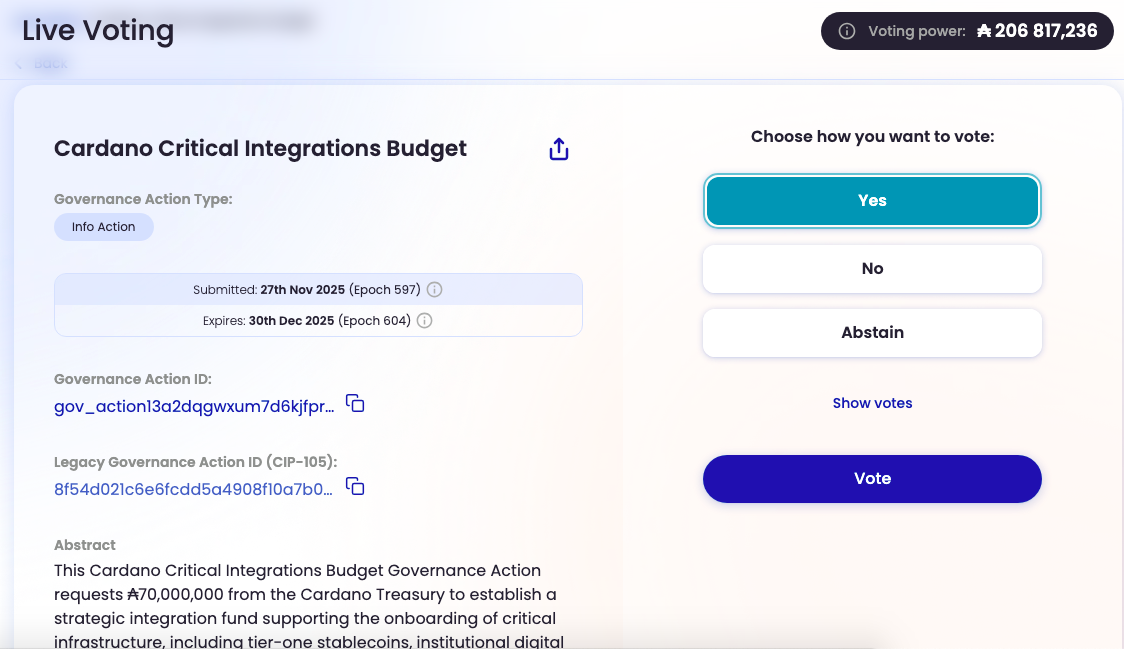
1 . Cardano Critical Integrations Budget
Voted Yes.
2 . 2025 Net Change Limit Extension
Voted Yes.
Best regards,
Cardano DRep Cryptotexty
GovTools page: https://gov.tools/connected/drep_directory/drep1yqmr09530yuehxdz2wca5setx03ps5tnxxrvzlgwmk3wswugxwh
My Cardano address: addr1q8ltprg2dpuftk3xa773c4eqz62d63syevwqmeeqk75h0swy974pwpegzh7kay6pdypdedrfrunyge4fam22062a4ghq3v8jqe
Ліс
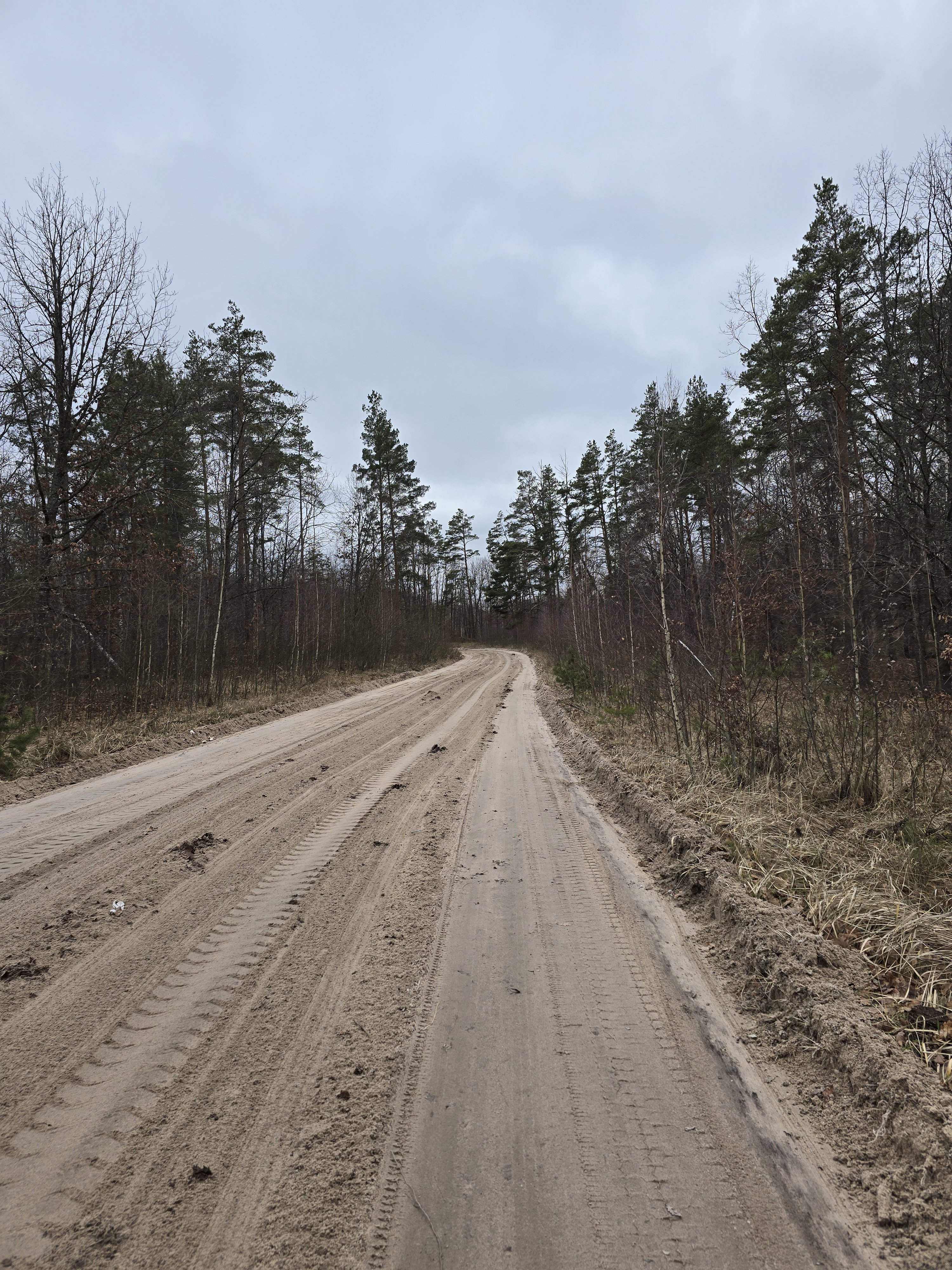
Ліс... колись я зрозумів, що ліс мені подобається набагато більше навіть ніж гори.
Наступний текст - це слова Льва Жиденка, співзасновника мережі "Аврора" (журнал Forbes, жовтень-листопад 2025)
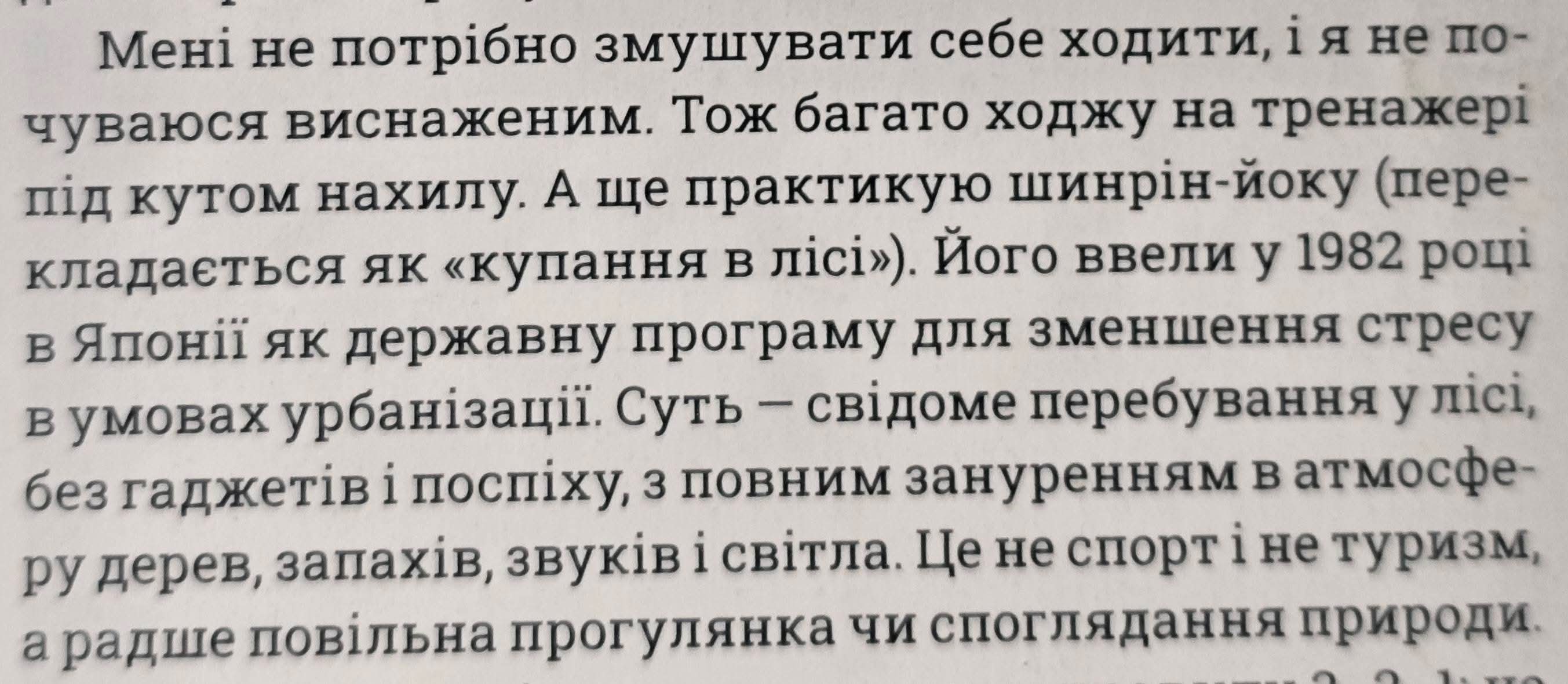
Я зрозумів, що давно практикую таке "занурення у ліс", яке радять японці.
В Україні чимало гарних лісів. Крім карпатських і волинських, мені подобаються ліси біля Київського моря, Коростишівський ліс, ліси Житомирщини біля Дружбівського кар'єру та Камінного села, та багато інших. Згадуються і маленькі ліси, які не мають назв, і конкретна хатина в якій так добре було писати тексти, періодично ж виникають й спогади з минулого тих локацій, які вже неможливо відвідати.
Колись, можливо більше напишу про кожне з цих місць, а поки - може комусь знадобиться така порада.
Цікаво, чи вам ліс допомагає зменшити стрес?..
Cardano Decentralised Deputy Diary. Text 9
https://read.cash/@cryptotexty/cardano-decentralised-deputy-diary-text-9-d45f2be5
Cardano Decentralised Deputy Diary. Text 9
Hello, my readers and everyone interested in Cardano and blockchain governance.
Date: 25 October 2025
Voting Power: ₳ 206 386
It's been a while since I voted. I was almost a month without a laptop. If you are curious to ask why - well, we have a war going on. And what I was doing - that's the matter of another subject and another blogs. Maybe in the future I will write some novels on this topic.
But back to Cardano. Today I'm voting on 6 governance decisions.
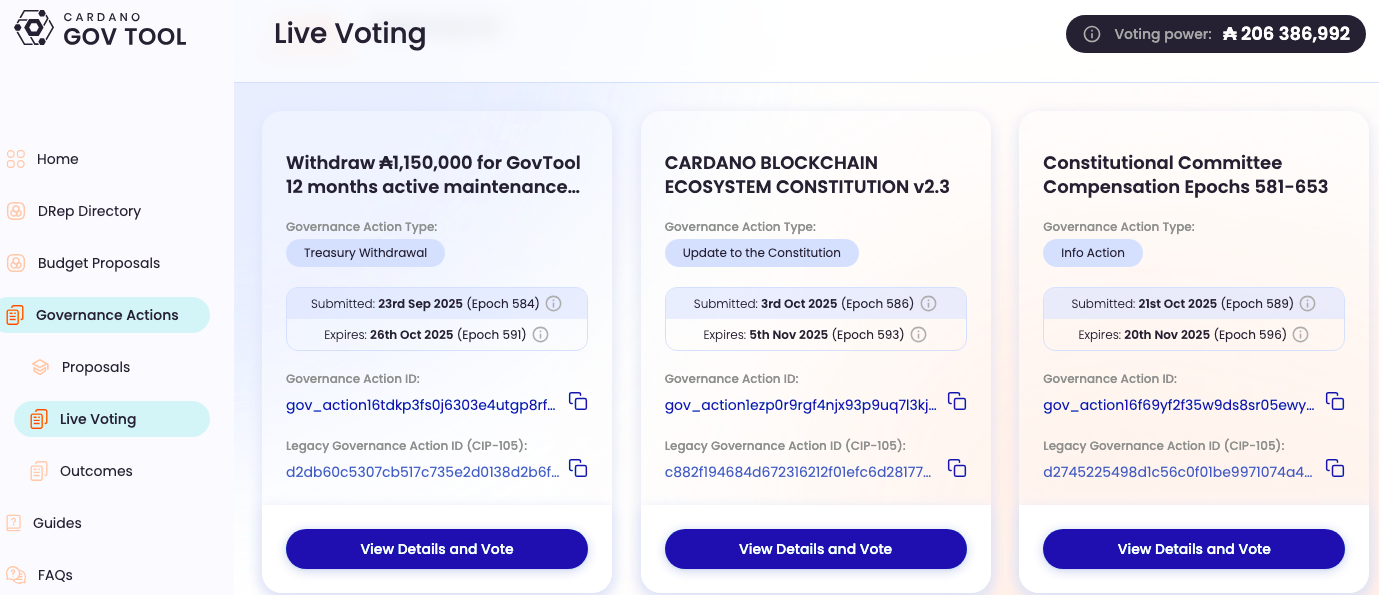
1 . Withdraw ₳1,150,000 for GovTool 12 months active maintenance and development
Voted Yes.
The reason is simple. As for now I'm not aware of any good alternative to GovTool. Simply without GovTool we won't have appropriate governance now. And I like this site, that's what I use all the time for voting. What I hope for the future is the mobile integration, so we'll be able to vote via mobile. I think that's a matter of time.
2 . CARDANO BLOCKCHAIN ECOSYSTEM CONSTITUTION v2.3
Voted Yes.
3 . Constitutional Committee Compensation Epochs 581-653
Voted No.
4 . Securing Generic Top-Level Domains for the Cardano Ecosystem
Voted No.
5 . Loan ₳5,000,000 to Expand Cardano's Global Listings
Voted No.
6 . Reimburse Ikigai Info Governance Action Deposit.
Voted
Best regards,
Cardano DRep Cryptotexty
GovTools page: https://gov.tools/connected/drep_directory/drep1yqmr09530yuehxdz2wca5setx03ps5tnxxrvzlgwmk3wswugxwh
My Cardano address: addr1q8ltprg2dpuftk3xa773c4eqz62d63syevwqmeeqk75h0swy974pwpegzh7kay6pdypdedrfrunyge4fam22062a4ghq3v8jqe
Військово-політичне есе
Ми часто чуємо термін "військово-політичне", особливо в словосполученні "військово-політичне керівництво".
Це правильно звучить за Клаузевіцем, адже війна — це продовження політики іншими методами. Але в дійсності у нас зараз немає нічого військово-політичного. Є військове керівництво і є політичне, яке над ним.Більше того, найбільшу проблему, яку я бачу, — це відсутність співвідношення між військовим і політичним і майже тотальна відсутність військових у владі.
Багато позитивних прикладів можна привести щодо появи та кар'єрного зростання військових, але жодного — про перехід військових до політичного керування (можливо, крім призначення Павла Паліси заступником Єрмака).Політичне керівництво обирали 7 років тому. Це скликання Верховної Ради, на мою думку, найгірше за якістю — не те, щоб не відповідає настроям суспільства, — воно не відповідало їм ще в 2022 році.
Що ми бачимо, — це те, що військові змушені служити без кінцевого терміну служби. Та навіть ті, хто вже демобілізувався через легітимну причину (вік, поранення, полон тощо), — не знаходять шляху до посад та можливостей. На жаль, склалася ситуація, що військові в певному плані відторгнені й відлучені від політичного життя, а саме від процесу керування державою.
Саме це — і є однією з причин картонних мітингів. З військових: хто підтримує їх, хтось ні, але молодь, яка їх ініціювала, — також переважно не знаходить для себе ні можливості проявитися в соціально-політичному аспекті, ні ліфтів, ні можливостей участі в житті держави. У той самий час економіка не переведена на воєнні рейки... Влада в наш час ніби закритий клуб, де хоч і відбуваються зміни, переважно завдяки зв'язкам і протекції, але в ній немає місця ні для активної молоді, ні для військових. Найгірше — це те, що корупція триває, те, що бачимо в ЗМІ, — це ж лише частина... і не видно ні шляху для змін (бо які ж можуть бути вибори під час війни), ні якогось стратегічного бачення.
Навіть і на міжнародному рівні — при всій любові до американців — влада ніби діє спеціально, щоб зіпсувати враження про себе й країну. Всім відомо, що адміністрація Трампа і його прихильники притримуються консервативних поглядів. Тоді навіщо, та й за які заслуги віддавати посади відвертим ЛГБТ-лобістам (наприклад, призначення Заліщук послом у Швецію або нещодавнє призначення заступника міністра культури). До речі, також усім відомо, що в армії переважно консервативні погляди. Для більшості військових такі призначення — це відвертий плювок в обличчя, якщо не ніж у спину. Армія захищає від навали орди підарасів зі сходу (адже саме "підар" — найпопулярніший синонім ворога), а тут інші підараси захоплюють посади.
Багато чого можна було б зробити, наприклад, віддати військовим більшість посад у уряді. Або Верховна Рада (яка вкрай неефективна, і більше того, склад її досі включає зрадників і відверто проросійських політиків) могла б самоусунутися на користь Військової Ради (куди кожна бригада могла б делегувати представника). Звісно, можуть спитати, але це ж може бути неконституційно? Так хай тоді діючі народні депутати голосують за те, що визначать військові. Можливо, це замінить фракційні рішення — військовими, — але що тут такого? Також депутати могли б і поступитися своїм представницьким правом — щоб на міжнародні події їздили діючі військові та ветерани. Це лише приклади. Але в умовах нерівної боротьби зі сильнішим ворогом хитка українська олігархічна демократія знаходиться в слабшій позиції, ніж тоталітарна неокомуністична олігархія. Саме військова економіка росіян і допомагає їм залучити більше ресурсів у виробництво дронів і всього іншого. А українська економіка так і не стала на військові рейки. Крім прифронтових міст — життя триває як і раніше.Але й вільною економіку не назвеш, адже присутність держави в економіці досить велика. Тоді треба звільняти тисячі неефективних бюрократів, скасовувати регуляції, звільняти чиновників та закривати цілі міністерства. Така, скажімо так, "лібертаріанська" модель матиме менше корупції, бо не буде такої кількості чиновників усіх рівнів і зменшаться як потенційні корупціонери, так і антикорупційні органи.
У нас же немає ні військової, ні вільної економіки, і, на жаль, не видно стратегії розвитку. Ми ніби пливемо по течії, оглядаємося на Захід, ну, а ті, хто якось при владі, намагаються зберегти свій вплив над потоками та свою броню і гарантію неучасті у війні.На жаль, ті, хто зараз "у кермі", та різні блогери, "лідери думок" і ставленики олігархічних чи інших лобі — і після війни матимуть пріоритет над військовими. Адже вони заробляли гроші і вплив, поки військові втрачали кров, піт і кошти на стримування ворога.
А має бути не так. Бо вже настав час нових військово-політичних лідерів.

Cardano Decentralised Deputy Diary. Text 8
Hello, my readers and everyone interested in Cardano and blockchain governance.
Date: 4 October 2025
Voting Power: ₳ 208 604
Voted in Project Catalyst. In case you don't know, I'm in Project Catalyst since the beginning, since Fund1.
This time I have hard and busy period so in Fund14 I participate as a voter only. I voted for proposals which I think will bring benefit to Cardano ecosystem. I voted for those people and Cardano teams whom I know for years. This time I didn't spend many hours checking each and every proposal as I did before. But who knows, in future funds I might dedicate more time to studying them.
As DRep it's still important for me to be aware of what's going on in Project Catalyst, as I thinking that's where Cardano governance started, scaled and grew. If you are knew person in the Cardano ecosystem - Project Catalyst it's the good place to start and meet new people, projects. I invite everyone to join!
Best regards,
Cardano DRep Cryptotexty
GovTools page: https://gov.tools/connected/drep_directory/drep1yqmr09530yuehxdz2wca5setx03ps5tnxxrvzlgwmk3wswugxwh
My Cardano address: addr1q8ltprg2dpuftk3xa773c4eqz62d63syevwqmeeqk75h0swy974pwpegzh7kay6pdypdedrfrunyge4fam22062a4ghq3v8jqe
Cardano Decentralised Deputy Diary. Text 7
https://read.cash/@cryptotexty/cardano-decentralised-deputy-diary-text-7-7ca9e433
Cardano Decentralised Deputy Diary. Text 7
Hello, my readers and everyone interested in Cardano and blockchain governance.
Date: 21 September 2025
Voting Power: ₳ 209 767
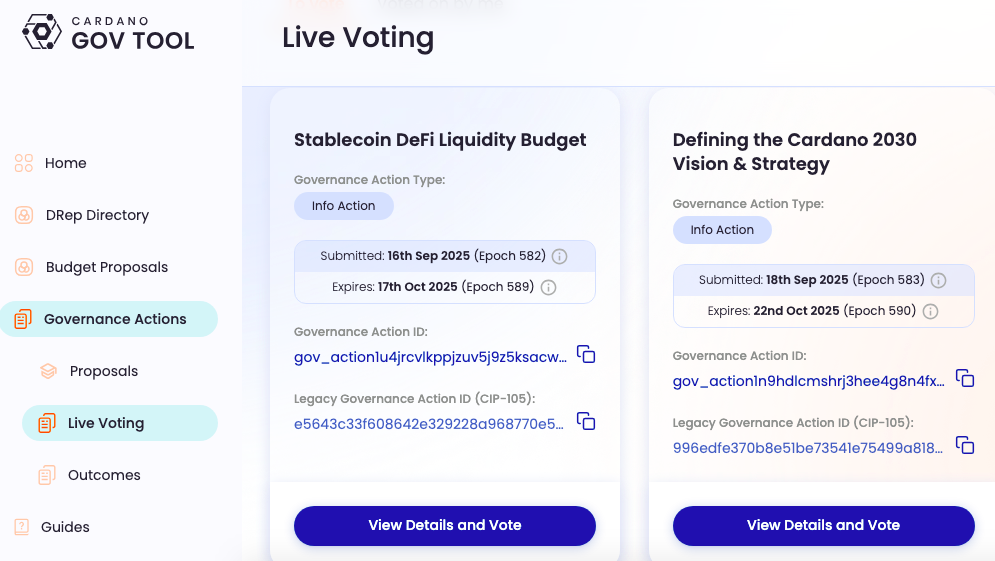
Today I voted on 2 governance decisions, both of them are info actions.
1 . Stablecoin DeFi Liquidity Budget
Voted No.
2 . Defining the Cardano 2030 Vision & Strategy
Voted No.
Soon, in few days, I'm going to vote in Project Catalyst. Most probably my next diary post will be about Project Catalyst and voting there.
Best regards,
Cardano DRep Cryptotexty
GovTools page: https://gov.tools/connected/drep_directory/drep1yqmr09530yuehxdz2wca5setx03ps5tnxxrvzlgwmk3wswugxwh
My Cardano address: addr1q8ltprg2dpuftk3xa773c4eqz62d63syevwqmeeqk75h0swy974pwpegzh7kay6pdypdedrfrunyge4fam22062a4ghq3v8jqe
Cardano Decentralised Deputy Diary. Text 6
https://read.cash/@cryptotexty/cardano-decentralised-deputy-diary-text-6-612ba02c
Cardano Decentralised Deputy Diary. Text 6
Hello, my readers and everyone interested in Cardano and blockchain governance.
Date: 4 September 2025
Voting Power: ₳ 209 614
Today I voted on 2 governance decisions, both were info actions.
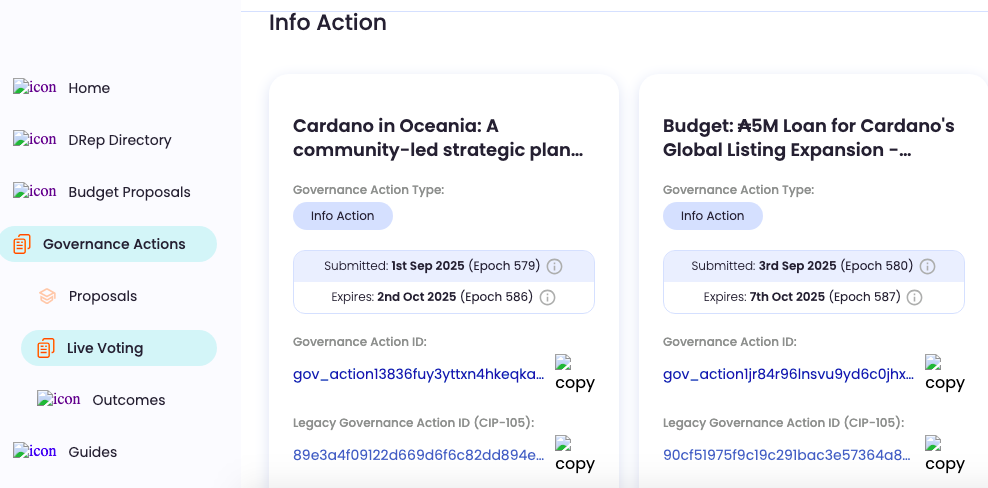
1 . Cardano in Oceania: A community-led strategic plan for investing in growth.
Voted No.
Reason: I don't think Ocenia is geographical priority. Proposal is very general, it lacks details and the amount (778K ADA is huge). Moreover - Project Catalyst is the place for such proposals. It can start with something small (5-50K of ADA) and then if successfull, it will be supported. Yes, it takes time and effort. But I see no reason to give this insane amount from the treasury.
2 . Budget: ₳5M Loan for Cardano's Global Listing Expansion - Powered by Snek
Voted No.
Reason: I already explained it in previous diary posts. Maybe just to add - I think that's a big waste of funds, and listing should come generic, even if takes some time.
So that's all for today.
Best regards,
Cardano DRep Cryptotexty
GovTools page: https://gov.tools/connected/drep_directory/drep1yqmr09530yuehxdz2wca5setx03ps5tnxxrvzlgwmk3wswugxwh
My Cardano address: addr1q8ltprg2dpuftk3xa773c4eqz62d63syevwqmeeqk75h0swy974pwpegzh7kay6pdypdedrfrunyge4fam22062a4ghq3v8jqe
Книжковий Виноградів
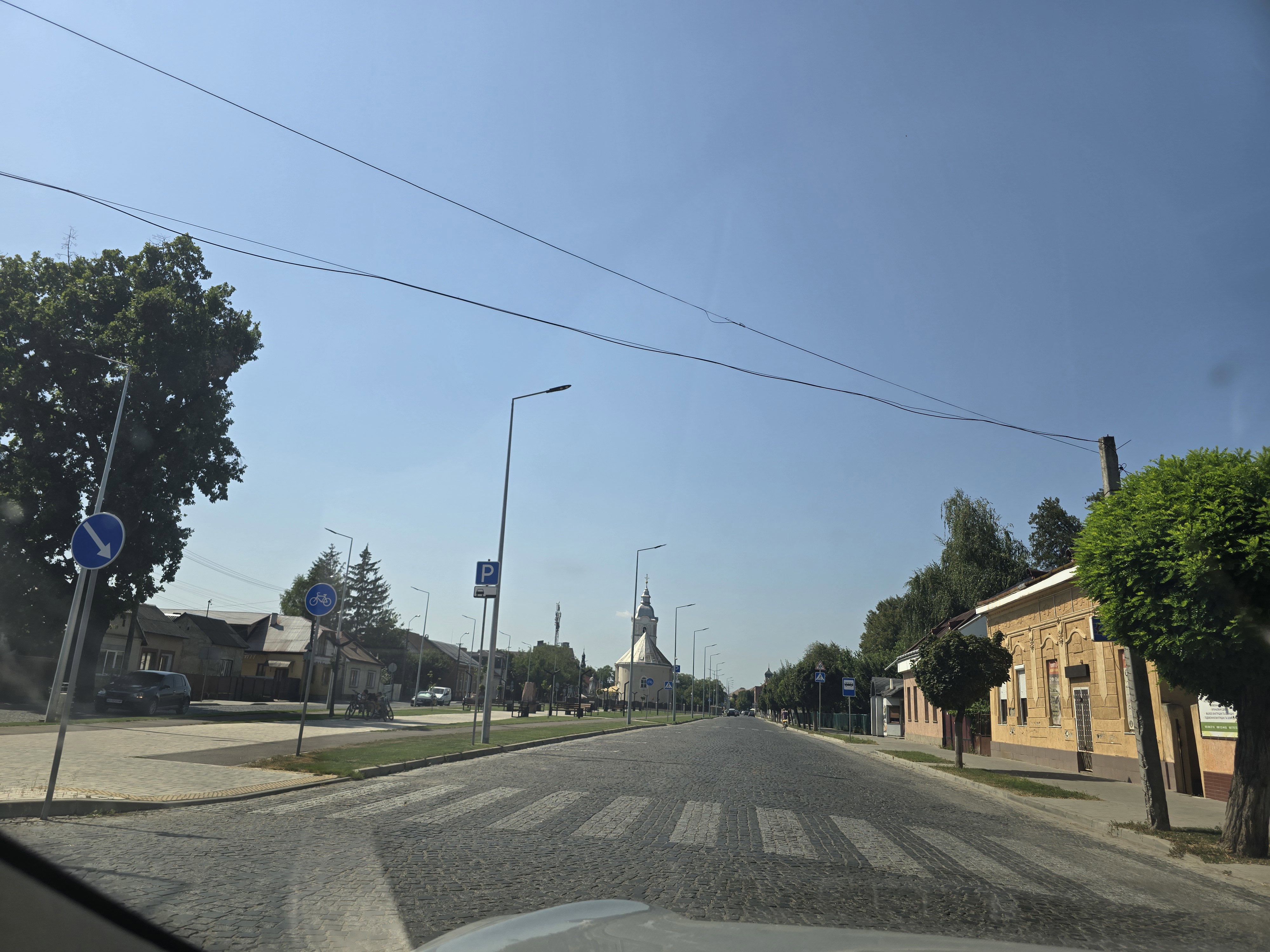
Нещодавно був у відпустці, подорожував Закарпаттям. Окрім міста Хуста, відвідав Виноградів і Берегове, а також декілька мальовничих сіл дорогою. У цих містах я провів мало часу, бо треба було їхати далі.
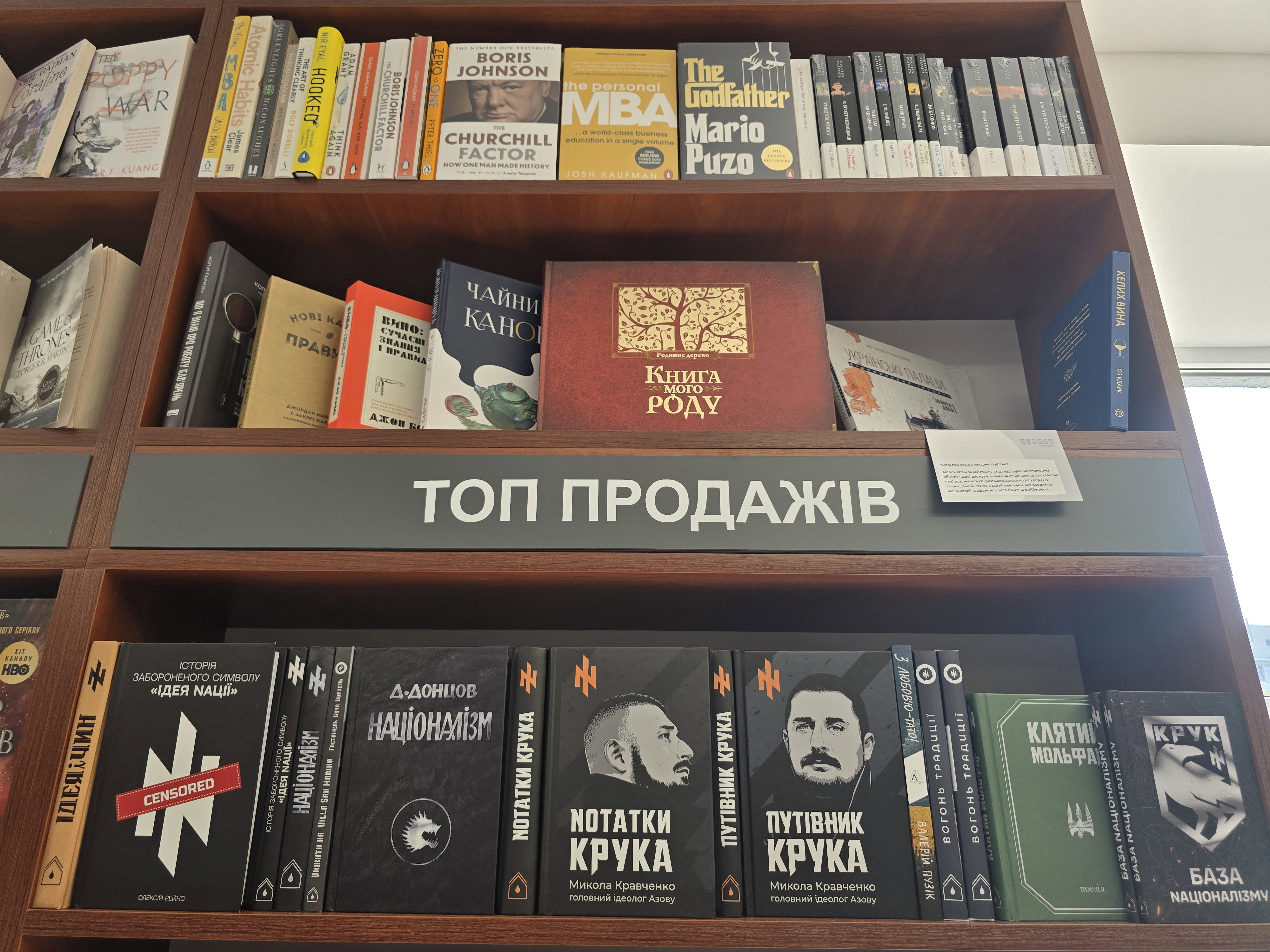
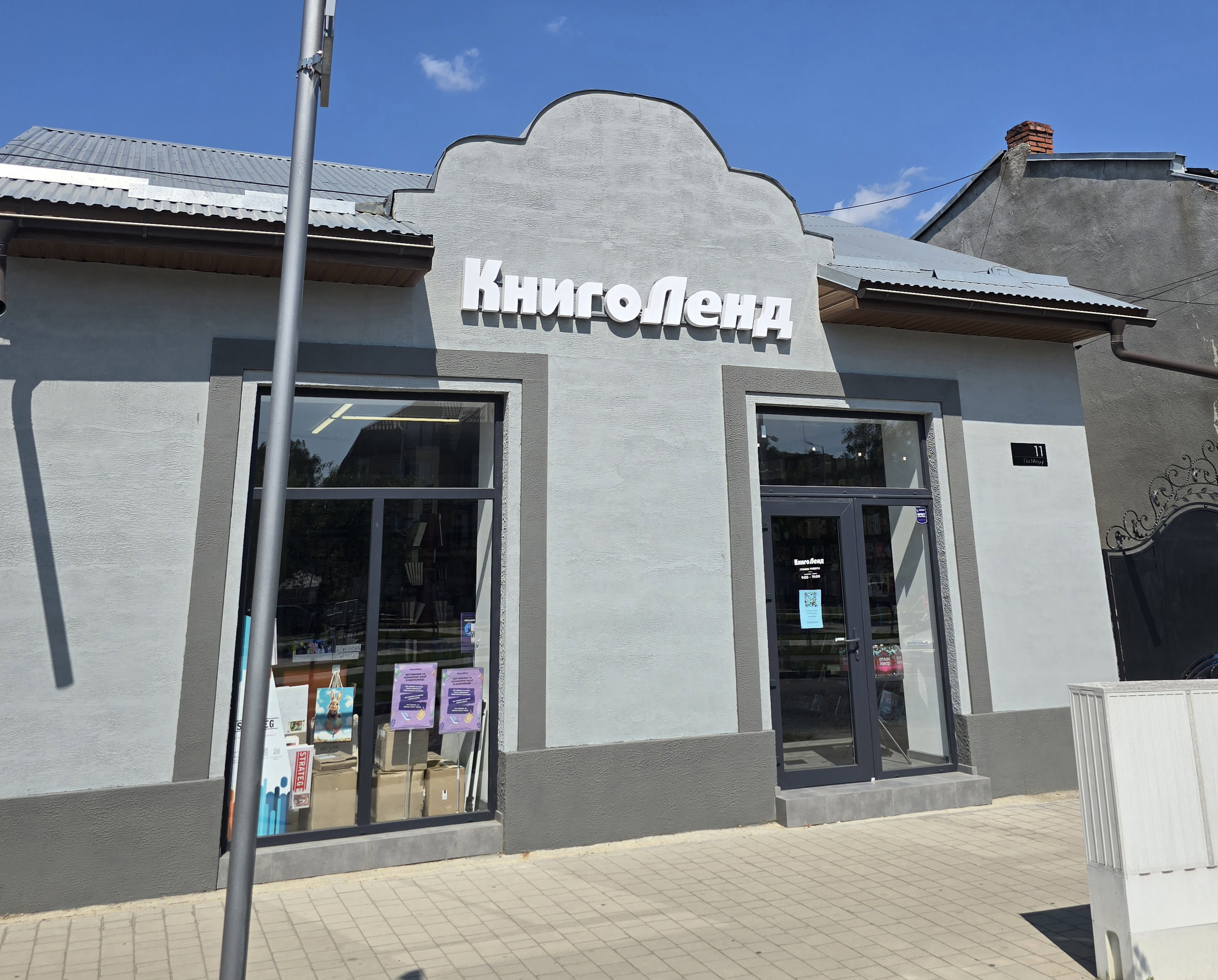
Але хочу відзначити Виноградів. Тихе містечко було майже безлюдним у серпневу обідню спеку. І в такому невеликому місті є книгарня "Книголенд"! Можна лише вітати розширення цієї мережі. І подивіться: які книжки в топі!
Багато книжок із націоналістичною тематикою: твори Крука, Дмитра Донцова, "Вогонь традиції" сучасного філософа-традиціоналіста Едуарда Юрченка. Така синергія роботи видавництв і книгарень — дуже позитивний крок, який ламає стереотип про брак культурного життя в маленьких містах.
Поруч із книгарнею на розі є гарна піцерія. Також додаю кілька фото Виноградова.
Вітаю з Днем Незалежності!
Вітаю з Днем Незалежності!
Люди часто починають цінувати щось у житті, коли втрачають або коли загроза втрати стає реальною. Так само і з незалежністю. Коли втрата незалежності стала ближчою, українці більше почали цінувати Україну як державу, так і все українське: від мистецтва до товарів українських виробників. До того ж, далеко не всім сподобалося жити в Європі. Масове повернення показало, що багато людей зрозуміли: врешті-решт у нас не так уже й погано.
Зараз у нас подвійна реальність. Одна половина країни (менша) воює, а друга (більша) продовжує жити своє життя. Попри війну, економіка зростає, створюються нові бізнеси, підіймаються ціни, зростає кількість дорогих авто на дорогах, але зарплати військових чомусь не зростають... Чому економіка так і не була переведена на воєнні потреби?
Хитка олігархічна демократія України протистоїть авторитарному ворогу, який переважає нас за ресурсами. Якщо вийти за межі своєї бульбашки в соцмережах, можна побачити, що ворог перемагає і на дипломатичному, і на інформаційному фронті.
Влада стала закритим клубом, недоступним ні для військових, ні, майже, для молоді. Звідси популярність мітингів із картонками, адже проблема — у відсутності діалогу та впливу на владу. Щоб ці рядки не здавалися безпідставною критикою, зазначу, що влада справляється з багатьма викликами: це і швидка реакція на події, наприклад мітинги, і діджиталізація, і певні точкові приклади боротьби з корупцією, і навіть заяви, що треба більше військових у владі.
Збереження незалежності зараз тримається на Силах Оборони. У довгостроковій перспективі для цього необхідна провідна роль націоналістичних сил. Навіть зараз, звісно, на словах мало хто скаже, що не хоче перемоги. Але скільки людей подумки зневажають військових, плюють їм у спину, поширюють "зраду" та російські наративи (наприклад, ненависть до ТЦК), привласнюють збори чи пожертви, або ж поставили "хрест" на Україні, бачачи своє майбутнє в інших країнах? Проблема не в подвійній реальності і не в тих, хто заради грошей чи уявної безпеки готовий відмовитись від незалежності. Проблема в тому, щоб та частина країни, яка робить усе для перемоги (не лише військові, а й бізнес, волонтери), отримала можливість формувати майбутнє — у політиці, бізнесі, культурі. Без значної ролі націоналістичних сил важко уявити, як можна втримати незалежність надовго. Адже завжди будуть люди, які заради власних корисливих інтересів готові віддати суверенітет східному ворогу, західному союзнику чи наднаціональному органу.
Керівництво рф заявляло, що готове воювати десятиліттями. Отже, щоб втримати незалежність, потрібна довгострокова програма розвитку. Наша тисячолітня історія нагадує нам про це, а також може нагадати, як бувало набагато гірше. Хай це додасть оптимізму та усвідомлення, що все могло бути і ще може бути значно гіршим.
Періодично можуть виникати думки, що ти робиш недостатньо. Але могили загиблих воїнів, цвинтарі з прапорами в кожному місті й сотнях сіл нагадують, що неможливо опускати руки. Могили та спустошені землі — найбільша ціна за незалежність. Кредит, який ніколи не повернеться. Свідчення жорстокості та несправедливості світу, який існував би і без України, але не без мільйонної армії та кількох мільйонів тих, хто її підтримує.
Над якими б гарантіями безпеки зараз не працювали, ми розуміємо: поки існує рф, незалежність завжди буде під загрозою. Незалежність могла здаватися подарунком долі, але вона створена поколіннями, оплачена кров’ю, здоров’ям і майном сотень тисяч українців — мертвих, живих і ненароджених.
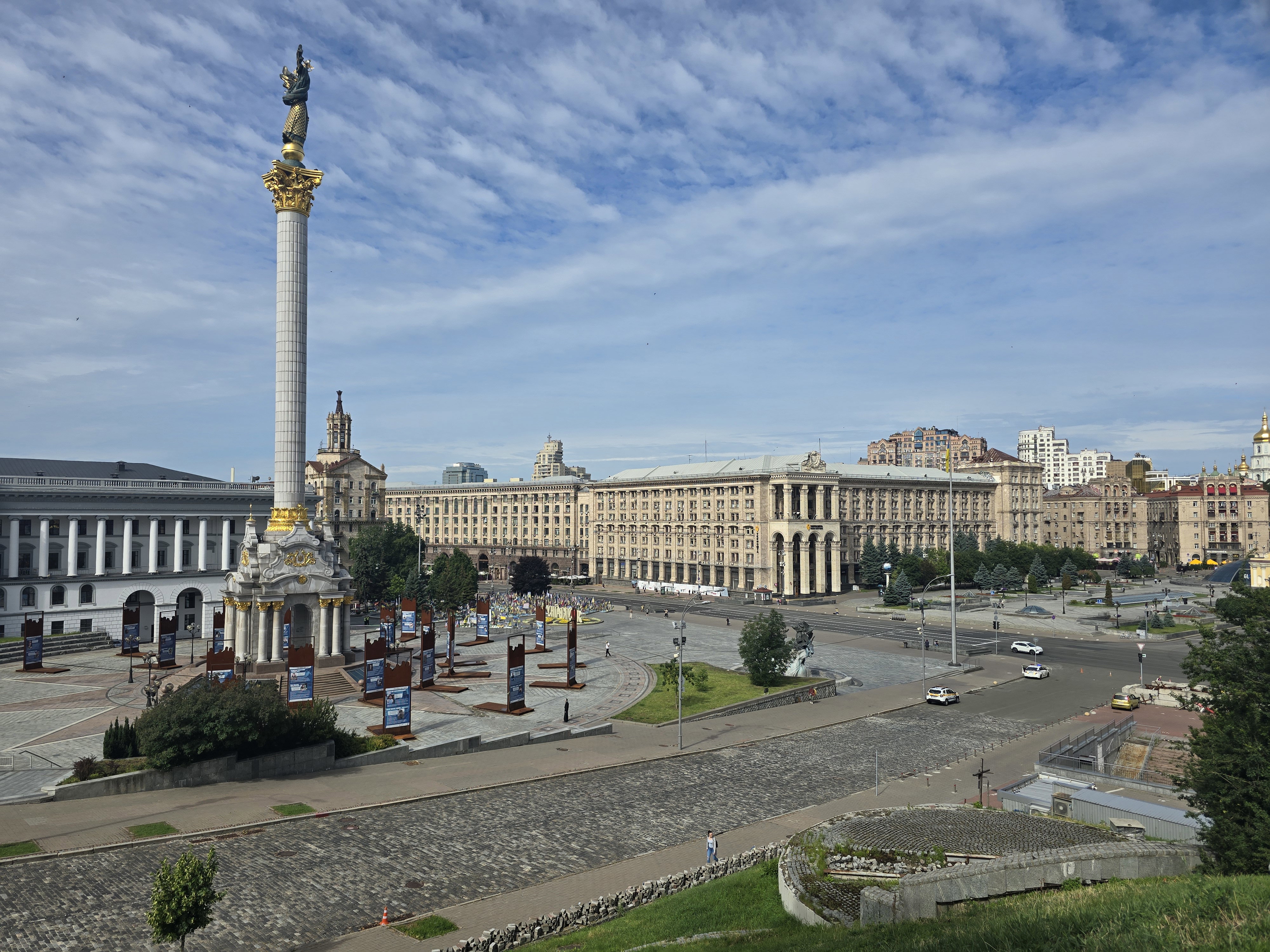
Хуст
Хуст - одне з улюблених міст. І саме тому, що це була столиця Карпатської України.
Піднявся до Замку (руїн замку), де відкривається панорамний краєвид на все місто. До речі, раніше (наприклад, я був там в 2021) - можна було заїхати до замку прямо на авто. Тепер - лише пішки.
Цього разу, я не гуляв по центру, але зайшов в місцевий краєзнавчий музей, який поруч з замком та будівлею уряду Карпатської України (зараз - міськрада).
В музеї два поверхи, декілька залів, на тематику від природи до сучасних днів, але найцікавіший зал, який всім раджу відвідати - присвячений Карпато-Українській Державі.
Дуже інформативна експозиція.
Якщо ж хтось зацікавиться цією темою більше - рекомендую книгу Петра Стерчо "Карпато-Українська Держава", та "Одноденна Держава" Майкла Вінча, яку він писав як журналіст, іноземець, та в нейтральному тоні, хоч і не без невеликої симпатії до українців.
 @cryptotexty