Banana Farming in Nigeria
Banana farming is the most neglected farming in Nigeria. Yet, holds more promises and profit potential than most other farming. Knowledge is power and useful, but when it is kept away from the others it becomes useless! In this post we want to take a look at plantain and banana farming in Nigeria and how to get started.
You can be making N1million monthly from plantain and banana farming if you take it to commercial standard. If people in Nigeria today could sit down and review their living standards, they would realize that most of their complaints for poverty and their inability to take care of their situations were actually their own making.
Why would the city be clustered with hungry people who are doing nothing when the surrounding states are made up of vast expanses of productive farmlands? Why would people prefer to suffer even when they can make millions from farming without stress? Take up banana farming today and see how much you will be making in the next two years.
**Market Value For Plantain And Banana Farming**
Take plantain for example, Nigerian don’t joke with plantain as they prefer to eat it in various ways both ripped and unripe. Plantain is very good for the body too as it work on the body sugar levels.
Other food like beans, rice, and groundnuts all make very good combination when taken with banana or plantain. Think again about the delicious chips that we like to eat, all these and many more are the end products of plantain.
So without going into much details, looking at various usages of these fruits is enough to tell you the profit potential in this business. For people with entrepreneurial mindset, that is simply money in bunches!
You may be new into farming or has been farming but hasn’t cared enough to consider banana and plantain as all that important.
But with the above brief analysis, we are encouraging you to give it a trial, with the assurance that if done properly, you will not regret it.
For those interested in plantain/banana cultivation, we will be glad to provide you with just enough knowledge needed to go into its farming and take part of the profits that those already in the business are enjoying.
**Guidelines For Starting Banana Farming in Nigeria**
Hear what a man said with regards to Banana farming in Nigeria: *“I was shocked to realize that I was largely to blame for the poverty I was wallowing in. Since I started plantain and banana farming, things have turned around for good for me and my family.”*
**1. Look For The Right Climate**
Plantain and banana have one thing in common and that is, they thrives very well in an average climate that is neither too hot nor very cold. They do well in naturally fertilized soil or thick compost manure. Having them in groups is another tricks to getting good harvest because they protect each other from harsh rays of the sun.
Alternatively, if there are other trees to provide needed shades that could help to maintain the humidity of the environment, that would suffice.
**2. Get Healthy Suckers**
Bananas and Plantain are not grown like other plants. They are grown through suckers and as such, choosing healthy suckers goes a long way to producing healthy harvests. Always use suckers from matured and dying plantain or banana plants.
**3. Transplant**
While transplanting, make sure that the corm or the roots at the bottom is trimmed properly to facilitate good growths. Give five meters gap between plants and keep the plants moist at the early days. Do not over wet the soil because the leaves are not yet out for much water evaporation.
**4. Maintain The Banana Farm**
Apply any method to have it protected from strong winds. Throwing the dead plantain leaves back into the plantation is good to sustain the needed manure for good growth.
Do not leave much suckers to be attached with a plant as two are usually enough. Cultivating plantain or banana doesn’t usually cost much except the initial capital to secure the land and plant the suckers after which the plants keeps growing unassisted.
Once it starts to produce, another form of work involved is to make sure that strong winds doesn’t get freely into the plantation as that could lead to the falling of the banana trees.
**5. Cost of Starting a Banana Farming**
Starting a plantain or banana farm is not in any way expensive if you have a sizable land. The only thing that you would spend little money on is the clearing of the farmland and buying of the suckers for planting.
For an acre of land, you may spend less than N300,000 to have every thing done and that includes clearing as the needs may be until the first harvest.
Once a plantain plantation picks up, the owner stands the chance of continuous harvest for the next 20-years or more depending on how the farm is maintained.
**6. Recommended Species**
The best breeds to go for is the ‘hybrid/agbagba’ species. This is a good specie because apart from producing on time when properly taken care of, its usually very big and long, making people to compare it with elephant trunks.
Maintaining the plants doesn’t entail more than heaping soil around the suckers, removing of the unwanted suckers, fertilization, mulching and weeding once in a while.
Starting a banana or plantain farming is very lucrative because any amount you realized in the first harvest, be sure that with less hard work, you will have an increase the next harvest. You will be making an increment year by year till the next 20 years or there about.
Though the business is lucrative, here is the advice from long time farmers, *‘The size of your farm should depend on the size of your dream, creativity, and innovation. Avoid taking on too much than you can be able to handle financially and in terms of personnel’. Besides, embracing modern farming practices, seeds and technology, be passionate about what you do and give your plantain and banana farming additional time’.*
“I had always dreamed of becoming a big farmer. Naturally, I was inclined to the agriculture sector, in which I believed I had some basic skills to do a decent job.”
These are the words of a long time banana farmer in Nigeria who have achieved countless of his dream goals through agribusiness and banana farming in particular.
The three mission of Life
**You have three missions in this life. One is to enjoy life, the second one to contribute (create value) and the third to personally grow, to become the best possible version of yourself. Person growth is nothing but diminishing the gap between your starting point and who you want to become (your ideal self). Obviously the worse your starting point and the bigger your ambitions, the bigger the gap. But that’s the job you have to do, that’s your mission.**
**The bigger the gap, the bigger the opportunity for you to grow. The bigger the gap, the more demanding the level you’re playing the game of life in. Consequently, you can become much more skillful and resourceful.**
**At one point, you realize that you only have two choices in life – the blue or the red pill. You can either feel sorry for yourself for the rest of your life or you take full responsibility for your life and how things are.** ***If you have emotional issues, you talk to a therapist, if you want to progress intellectually, you read, do math or whatever, if you have bad relationship patterns, you read everything about relationships and commit to becoming an authority on how to excel in relationships, if all of your ancestors were fat and you inherited genes that make you gain weight faster, interrupt the unhealthy pattern and become obsessed with being totally fit and living a healthy lifestyle.*** **Whatever it is, you have to take responsibility and deal with it at some point. As I’ve already mentioned, that’s one of your missions in this life, something that life expects from you.**
**You also have to know that accepting your past is not a one-time event, it’s a process. It’s a process of ups and downs; the harder the past, the longer the process with all its highs and lows. But it can be done. If we look at the bottom line, your past may shape your present, but it can’t control it.**

Palm oil plantation in Nigeria
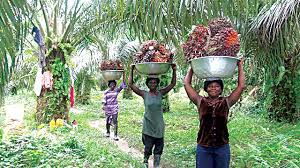
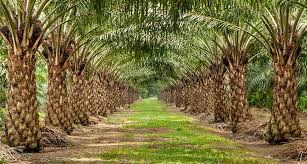
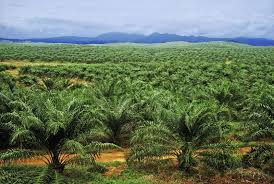
Red Palm Oil Tree Plantation is one of the most useful plantation in the world. Nothing in palm tree that is not useful, from the fruit to the palm frond, everything is used for one thing or the other that brings benefit to man. The use of red oil palm fruit to extract edible and useful red oil has been in practice all over the world for many centuries.
Almost the entire economy of countries such as Malaysia depends of palm oil plantation and exportation. Making the country one of the biggest player in the palm oil industry. They account for the estimated 5% of global productions. Malaysia is currently producing more than 20 million tonnes of palm oil and holds the second largest palm oil producer position in the world.
According to tales, Malaysia got their palm fruit from Nigeria who used to be the origin of this product and one of the biggest producer in the past. Whether that is true is yet to be verified. But what really happened to this sector of viable agriculture in Nigeria? If the wealth of entire nation could depend on this product, does that not tell you the amount of revenue in palm oil plantation business that we are neglecting?
Palm oil is the red oil extract from the oil palm fruit ‘Elaeis guineensis’ while palm kernel oil is also derived from the seed of the same oil palm fruit. Palm oil is the best cooking oil in the world due to its low content of cholesterol. It is a healthy cooking oil, more health than the vegetable oil in the market.
Palm oil is sold both in the local and international markets. If you have good quantity of palm oil, selling it is never a problem because it is a product that always in high demand. A good palm oil plantation is capable of producing thousands of tonnes of palm oil in a year that can be sold for million of naira in the local market. It can also be exported to oversea and sell for foreign currency.
Why are Nigerian farmer shying away from this goldmine? The main reason most Nigerians farmers are not paying attention to oil palm tree plantation is because they think palm tree take so many years to mature to the point of production, therefore they are not ready to wait. That is total ignorance. There are varieties of palm tree that starts producing just two years after planting.
This means, if you start your own palm oil tree plantation this year, you start harvesting your palm produce in two years time! If that is the case, then what are you waiting for? Start planting your own palm oil tree plantation now and let’s see how it goes in two years time.
**This is how to proceed with setting up your palm oil tree plantation.**
**Look For Suitable Land**
Almost all lands in Nigeria, especially East and West is suitable for palm tree survival and proper yield. Get a good quantity of land in acres in a good location. Good location I mean land in a place that is motorable, at least tractors and lorries would be able to get in there.
If you are not sure of the quality of the soil, whether it is suitable for palm tree plantation or not, you can take the sample to **Nigerian Institute for Oil Palm Research**(NIFOR). They will be able to analyze and make recommendation. You can get much more additional information from them as regard your venture and the merits.
After buying the land, you prepare it in good condition. I recommend that you use Tractor Soil Pulverizers to loosen the soil, pulverize, and level packed or encrusted soils. Remove hard roots in preparation for palm seedlings, making the soil well suited for planting.
**Before preparing the land, you have to get the palm nursery ready. You have two options, either to germinate your own seeds or buy already germinated seedlings.**
**Germinate Your Own Seeds**
Get the high yield seed from the Nigerian Institute for Oil Palm Research or any other places you can find it and make it germinate. If you do not take care of the seeds, it will take several years before they germinate. To make it germinate fast, the seeds are kept in a very hot room. This makes the seeds to germinate in about 90 to 100 days.
When the seeds are germinated, you transfer them into small plastic container with black loam manured oil. They will grow new leaf every month. The young seedlings will stays in the container for 4 to 5 months. When the seedling begins to bring out new leaf with two points (bifid leaf) you start transplanting to the nursery.
The seedlings will stay in the nursery for 1 year. By that time, they will have about 15 green leaves. Then you finally transplant them into your prepared farm land. The overall period it will take before the seedlings are transplanted into the farm is 15 to 17 months old.
Or you can just go to the agricultural institute to buy already prepared seedling at about N120 per seedling. If you are planting 10,000 palms, you will have to have 120 x 10,000 = N1.2 Million. So, germinating your own seedling is less costly but takes some times.
**Planting Your Seedlings**
You palm need to be planted preferably at the rainy season when it will have enough water in the soil for sustaining the young palm. Plant with proper spacing, taking into cognizance grown period when the palm frond will be spread all over the place.
My experience with palm oil plantation according to a farmer. I started my own oil palm nursery in early 2018 with 1575 seeds, bought from NIFOR at N15,000 per pack, each pack had 525 seeds. I grew the nursery for 14 months. by June 2019 I cleared land for planting. pegging was carried out, then digging and planting. 1050 trees were planted, it took me almost 4 weeks with 10 men to carry out the all work on a 7 hectare farm.
**Spacing Palm Oil Tree Plantation**
Spacing for his palms was 7[10] meters by 7[10] meters in a triangle. First weeding and fertilizer application was carried out after 3 months. NPK Fertilizer was applied to each palm tree. Second weeding was done 3 months latter, towards the end of the raining season. By may, he had carried out first weeding and fertilizer application 1 bought 3 bags of NPK Fertilizers at N6,800 per bag most of the labor was done by him with the help of some of his relative. The land used is inherited land. the money he had spend thus far is around N250,000*.*
**Right Density**
It is important to plant at the right density, the spacing in the above quotation is considered low density and low density oil palm doesn’t produce well. Therefore, to be sure of the right density before planting, you must peg out the area properly. The distance must be the same between rows and in each row should also be the same distance between oil palms.
If the oil palms are planted too close together, the roots get in each others way, and the leaves do not have enough air and sun: the yield will be low. If the oil palms are not planted close enough together, each separate tree produces much, but the roots do not use all the soil: the yield per hectare will be low.
**The Proper Pegging Measurement**
Trace lines across the slope and put in your pegs in straight lines; leave 7.8 meters between rows and 9 metres between pegs. In this way you can plant 143 oil palms per hectare; this is the best density. Pull out tree stumps and remove fallen trees close to the pegs, because these stumps and trees would interfere with the oil palms.
**Spacing Palm Oil Tree Plantation**
Spacing for my palms was 7[10] meters by 7[10] meters in a triangle. First weeding and fertilizer application was carried out after 3 months. NPK Fertilizer was applied to each palm tree. Second weeding was done 3 months latter, towards the end of the raining season. By may this year, I had carried out first weeding and fertilizer application 1 bought 3 bags of NPK Fertilizers at N6,800 per bag (open market price, may 2013) most of the labor was done by myself with the help of some relative. The land used is inherited land. the money I have spend thus far is around N250,000*.*
**Right Density**
It is important to plant at the right density, the spacing in the above quotation is considered low density and low density oil palm doesn’t produce well. Therefore, to be sure of the right density before planting, you must peg out the area properly. The distance must be the same between rows and in each row should also be the same distance between oil palms.
If the oil palms are planted too close together, the roots get in each others way, and the leaves do not have enough air and sun: the yield will be low. If the oil palms are not planted close enough together, each separate tree produces much, but the roots do not use all the soil: the yield per hectare will be low.
**The Proper Pegging Measurement**
Trace lines across the slope and put in your pegs in straight lines; leave 7.8 meters between rows and 9 metres between pegs. In this way you can plant 143 oil palms per hectare; this is the best density. Pull out tree stumps and remove fallen trees close to the pegs, because these stumps and trees would interfere with the oil palms.
Having done your part of setting up your oil palm plantation in Nigeria, the next is to maintain it and wait for your yield. Palm tree starts yielding fruits just two years after planting. From that moment onwards, you will be harvesting cash all year round for generations.
Your Gratitude list
**The last technique that can help you to see your past more positively is a gratitude list. Many times, you simply forget how much you already have and all the things that you can be grateful for.**
**Gratitude shifts your focus from what your life lacks to the abundance that’s already present. Research in psychology has shown that being thankful makes you happier and healthier, it reduces stress and makes you stronger and more resilient. If you remind yourself what you are grateful for every morning, it will definitely increase your level of alertness, enthusiasm, determination, optimism and energy in everyday life.**
***If you don’t know what to be grateful for, here are some ideas. You can be grateful that you woke up this morning, breathing and with a heartbeat. Life itself is a precious gift. You can be grateful for your health, spouse, family, friends, the employment or business you have, the value you’re able to create, your genes, looks, the outdoors, the technology you can use, the things you own, food and shelter, free time, things you enjoy and so on. If you need additional ideas, you can find many good ideas online, simply search for things to be thankful for in life, although it’s much better if you write them down straight from your heart.***
**By practicing everyday gratitude, you’ll put your life into a more positive perspective, you’ll realize how much you already really have and you’ll definitely accept your past more easily. With your personal gratitude list, you’ll constantly be aware of the wonderful things in your life.**
**It may be hard to begin, but you should see gratitude as an emotional muscle that will grow and strengthen with use. There’s always something to be grateful for, so make your list. Last but not least, the more gratitude you have in your life, the more you open yourself up for abundance, meaning getting even more excited about your future.**
**If you think successful people don’t do that kind of stuff, you’re wrong. Extraordinary results demand an extraordinary way of thinking and actions, that’s a fact. Average people only read about it, successful people really do it. Let me give you an example.**
***Mark Zuckerberg, the founder of Facebook, sets himself annual challenges. In 2010, he committed to learning Mandarin, in 2011 to eating only animals he slaughtered himself, and in 2013 to meeting someone new each day. And guess what, in 2014 he wrote at least one well-considered thank you note every day .***

Focus on what you got and not on what you didn't
**The first step you can make is focus on the positives. You cannot change what happened, only how you view it. Your past cannot be changed and it may never be forgotten, but it can always be used. No matter how bad your starting point was, there must be positive things you got, be it on the physical, emotional, intellectual, spiritual or material level. You should be focused on the thing you did get, not only on what you didn’t. There are, of course, big differences in starting points, but nobody gets everything and nobody gets nothing. Try to find the things that you got, the things you’re proud of, the lucky parts of your past that you’re grateful for. Add them to your gratitude list.**
Goodnight love, sweet dreams
I begin to miss you dearly when the night comes and we are to say goodnight to each other however, I am happy that you can take a rest after all the hard day’s toils. Sleep well, my dear!
I have no doubt that you are the reason why the moon and stars show up every night. Have a sleep full of sweet dreams!
As you close the day with a sleep, it is my wish that your pillow will release nothing but the sweetest of dreams for you tonight. Sleep well!
Among the billions of souls that walk on earth, you are the one whose life inspires me to become the best I can. Good night.
Sleep is the only thing that can refresh you after the work of the day. May your sleep be filled with amazing dreams. Good night!
As you close your eyes to sleep, don’t forget to dream about us because I am going to do the same here. Have a peaceful sleep
To all my fellow readcash user, I say goodnight and sweet dream from this side.
How to win your Husband's Heart.
Follow this and he will be yours and yours alone forever.
1. Discover his favourite pet name and call him by that.
2. Allow him exercise his authority as the head of the family.
3. Do not challenge him when he is hurt.
4. Be silent when he is angry. You can go back to him in his sober moment with apology and explain why you behaved the way that annoyed him.
5. Be quick to say “I am sorry dear”. Whenever you offend him, insist on his forgiveness and kiss him when he does.
6. Speak good of him before his friends and siblings.
7. Honour his mother and opinions.
8. Insist that he buys gift for his parents and be sure that he will do same for your parents.
9. Surprise him with his favourite dish, especially when he has no enough money at hand
10. Do not allow the maids to serve him food when you are at home, because you may lose him to them. And don't allow outsiders to clean your matrimonial room. Its risky.
11. Give him warm reception with an embrace when he returns. Collect his luggage and help unclothe him.
12. Smile when you look at him and give him occasional perks when you are out socially.
13. Praise him before your children.
14. Wash his back while he is in the tub or shower.
15. Put love note in his lunch or purse.
16. Phone and tell him that you miss him.
17. Dial his number and on hearing “hello” just tell him, “I love you.”
18. If he is a public figure or politician, gently wake him at the early hours of the morning and romance him to the point of demand. He will not be enticed by any other woman that day.
19. Tell him how lucky you are to have him as your husband. Respect him and heed to those attitudes he dislikes.
20. Give him a hug for no reason.
21. Appreciate God for the Adam of your life. Implement this law that every morning your family will wake up and pray. It brings unity.
22. Value your husband because you may not have the second chance to love him. Pray to God to protect him.
23. If you practice all these, your husband will be afraid to cheat on you; even if he does, his mind will not be at rest.

Take care of your man
*SIDE CHICK* VS *WIFE* (A MUST READ!!!)
A brief telephone conversation with a housewife and her hubby's side chick.
*Madam:* Hello Angela, please, leave my husband alone.
*Angela:* Hello Madam, sorry I will, but kindly permit me to collect the money he promised me so as to enable me open a saloon.
*Madam:* Money? How much is the money my husband promised you?
*Angela:* (afraid.) Erm... erm... it is 250k ma.
*Madam:* Just 250k? Alright, send me your account details.
_Alert received gbam!_
*Angela:* (surprised.) Wow... madam, you sent 450k instead of 250k.
*Madam:* Yes 250k for the saloon, and 200k for defining your purpose of sleeping with my husband. Don't worry, I was once in your shoes. Please, just leave my husband alone.
*Angela:* Thanks and God bless you Ma. But Madam, I have confidential issues to discuss with you Ma.
*Madam:* Yes, go on...
*Angela:* (coughs.) Madam, your husband told me that each time you return from work, you just take your bath and go to bed without preparing his meal. You don't as well have romantic discussion with him except you want something important to collect from him.
*Madam:* (surprised.) He told you that?
*Angela:* Yes madam. Well ma, let me tell you how I handle him on bed, so that he won't think of going out to look for young girls like us as I have already quit my relationship with your husband.
*Madam:* (anxious.) Ok, go on.
*Angela:* Madam, once it is 6pm and you are not yet home due to the nature of your work, try to call him and ask him what he will eat even if you won't be home on time to prepare it. Are you with me Ma?
*Madam:* Yes, I am with you.
*Angela:* On your way home, visit a good restaurant and get delicious food, then see how best you can get home before him. Dish the food, and since he is not the kitchen type, he won't know if you bought it. Even if he eventually knows, he will appreciate the fact that you care about him.
*Madam:* Hmnn... Go on.
*Angela:* Then, make sure you wear catapult or g-string pant and a transparent night gown. Lay carelessly in the sitting room as he is eating. Ma, ensure you are wearing his favorite colour pant. He likes white and pink.
*Madam:* (crazy.) What? _am in trouble
*Angela:* Don't be surprised madam. I am not through with what I am saying or should I stop here?
*Madam:* No, no, please go on.
*Angela:* Then as soon as he stands from the dinning, ask him how he spent his day, and prophesy to him that tomorrow will be better and that great things will surely come his way.
Always be positive in your conversation. He told me you always spend such moment either in gossiping about others with him, pressing phone or reminding him of family challenges when you know what he need is rest or words of encouragement after a stressful day.
*Madam:* (sobs.) God! _ So he told you this too?
*Angela:* Yes, he did. Madam, I am not through. See, after that scene, ensure he takes his bath, and if possible give him body spray and prepare the bed for him to sleep. Don't ask him for sex as you always do according to him.
*Madam:* (flabbergasted.) This is serious!
*Angela:* Very serious Madam. As you make your way to join him on bed, ensure you remove your pant, and sleep close to him with your night gown. Also ensure you use body spray too. Because he complains too much about you not smelling nice.
You can use good body spray. Check the supermarkets for your choice. Concentrate on your armpits too. Madam, after 10 minutes, stylishly look at his manhood. I bet you, the idiot will be protesting. But because he is tired, his strength won't be there to take the first step.
*Madam:* (shakes her head as tears drop from her eyes.) Angela, how old are you?
*Angela:* I am 23 years old Ma.
*Madam:* I have to tell you this, my younger brother deserves a wife material like you. Please, I will transfer another 100k to you. I have a younger brother who is single and rich and I promise not to tell him about your escapade with my husband. I will give your number to him. You are a very nice girl because you just restored my home.
After few days, the husband creditted Angela N250k, and in return he got this text message; _"Sir, thanks for this kind gesture. But I think this money is no longer needed. Your children deserve the best. Starving them while you give me this huge amount is unacceptable and God won't forgive us. Have you consider the joy or smile you will put on your wife's face if you give her this money? Please send me your account details. I don't need the money."_
The man replied; _"Your message is touching, never mind, keep the money and move on with your life."_
#Facts
Many of you, yes you married women today, are responsible for all what you are passing through in your marriages. Women now compete with their husbands at home instead of remaining loyal and submissive. Be a royal queen, mother, and wife.
My advise to our married women is that, it is better to approach your hubby's side chick(s) just like the woman did in the above play, then try to know those areas you aren't doing well which the side chick applied. Apply the tricks too to win your man's heart.
When I say side chick, I am not referring to those night stand girls that he pays after sex. I mean that very particular lady that takes his time more, and make him feel at home each time they are together. She is the only opponent you have. If you are not careful, she will take over your home without using charm.
That's part of feminine psychology.
As the saying goes, beauty will do you good by taking you to paradise, but only good attitude will keep you there, or sustain your stay.
May God give us wisdom and intelligence.
Let me also add this; a beautiful face without intelligence is like a cosmetic of foolishness! Women, use your natural brains and whatever you have to protect your marriage.

Perfection
Perfection was created
to make us feel imperfect,
but imperfect, of course,
is the perfect thing to be.
We spend every hour of every day,
every day of every week,
trying to be different,
trying to be unique.
Our nature is to search
for answers to life's questions,
concepts we don't understand,
like "What is perfection?"
You strive to be "perfect,"
a term you don't understand.
You should be yourself
before it gets out of hand.
Surely happiness is of priority
over a word like "perfection,"
so ask yourself this,
Who looks back in your rreflections?
Apple farming in Nigeria
In Nigeria, the majority of apples consumed are imported from countries like South Africa and the United States of America. The statistics show that at least 50, 000 tonnes of these apples are imported into the country annually.
Each year the consumption of apples is on the rise and there’s the need to find ways to begin to grow apples in the country in order to meet this growing demand.
The type of apple that can be grown in large quantities in a place like Nigeria is the Bell apple. The Bell apple is as nutritious and beneficial as the imported variety although it tastes quite different. It has a mixture of a sweet and sour taste and the intensity of the sweetness or sourness depends on how ripe it is.
This article will take you through the process of planting and harvesting the Bell Apple as well as the temperate variety.
**Bell Apple Planting**
The planting season of the Bell apple is between September and April. You can plant 160 seedlings per acre at a spacing of 5m by 5m. The seeds are pressed into the soil but barely covered with soil. This is because the seeds need light to germinate. Also, the seeds should be spaced at least 1 inch apart. Additionally, the soil should be watered after planting. Usually, it takes about 3 weeks for the seed to germinate.
You can begin to sell the seedling 10 weeks after planting. Currently, there’s a great demand for the Bell apple seedlings because there are only a few farmers involved in planting this apple. However, the apple can be cultivated in at least 34 of the 36 states in the country with the exceptions being the core northern states of Borno and Sokoto.
Bell apples require adequate humidity and rainfall to thrive. It can tolerate different soil types from sandy to clay. It can also thrive in moderately acidic soil.
**Harvesting**
Usually, the tree takes 3 years before they begin producing fruits. Each harvest yields at least 1000 fruits and there are a minimum of 2 harvests in a year.
**Temperate Apple**
The most popular apples consumed in Nigeria are those produced in the temperate or Mediterranean regions. They can not be grown in Nigeria because they require cold conditions for optimal growth and fruit production. Ideally, the plant should be exposed to cold temperature below 70C for at least 6 weeks (1000 hours) during the planting season. However, the apples have been grown in the past in the plateau regions of Nigeria like the Jos, Mambila and Obudu plateau.
These apples can grow in most soils however; the ideal soil should be well drained; properly aerated, loamy type; rich in organic matter and with a ph of 5.5 to 6.5
They are planted in January/February and require rainfall of 115-120cm of per year. During flooding, the excess water should be drained out quickly to prevent waterlogging. However, in this case of heavy rain, there’s no need for irrigation. The frequency of irrigation increases to four times a month during the summer and reduces to once a month during winter.
Additionally, training and pruning of the apple tree is very essential because this ensures optimal plant growth and increased productivity.
Usually, the most common apple pests are thrips and aphids. These can be prevented by using pest resistant root stock. Also, in the case of diseases like the crown blight and collar rot, the use of disease resistant root stock can also reduce disease susceptibility.
Generally, apple orchard starts bearing from the 7th or 8th year. The economic life of this apple tree is about 35 years, although some continue to bear even after 35 years.
**Wrapping up**
There’s a growing interest in Bell apple farming and, it is possible to generate a 100% return on your investment within 6 months and 3 years depending on what aspects you are focused on. You can make a 100% profit by selling the seedlings within 6 months of planting. Or you could wait a little longer when the fruits are ready and you can also make great returns on your investment.
However, one major challenge with these apples is the attack of bats during the fruiting period. Another challenge happens during storage. The apples are quite perishable and tend to rot within 3 days. However, it could last a couple of weeks if refrigerated.
Also, you can try to cultivate the temperate apple at a pilot scale if you live in any of the cold regions of the country particularly the plateau area of Jos, Mambila and Obudu.
The jos apple.
Health Benefits of sugarcane
**1. It gives you a shot of instant energy**
There’s a reason sugarcane juice sells at most roadside kiosks in summer. It’s the best way to energise yourself, and ensure you don’t experience dehydration. The simple sugars in the juice are easily absorbed by the body and are used to replenish sugar levels.
**2. It enhances liver function**
Sugarcane juice is said to be one of the best natural treatments for liver-related ailments such as jaundice. Alkaline in nature, sugarcane juice helps maintain the electrolyte balance in the body.
**3. It can help the body fight cancer**
The high concentration of calcium, magnesium, potassium, iron, and manganese makes sugarcane juice alkaline in nature. This – along with the presence of flavonoids – helps the body stave off cancerous cells, especially prostate and breast cancer.
**4. It eases the digestive system**
People suffering from digestive distress would do well to include sugarcane juice in their diet. The potassium in sugarcane juice balances the pH levels in the stomach, facilitates the secretion of digestive juices and keeps the system on track. It also helps prevent stomach infections.
**5. It is helpful for people with diabetes**
The high sugar content in sugarcane juice may make diabetics wary of consuming this juice. But, in moderation, sugarcane juice can benefit diabetics – the natural sugar has a low glycemic index, preventing spikes in blood glucose levels.
**6. It maintains kidney health**
Being a natural low-cholesterol, low-sodium food with no saturated fats, sugarcane juice helps keeping the kidneys in top shape.
**7. It alleviates pain associated with STDs & UTIs**
Consumed in a diluted form, with lime juice and coconut water, sugarcane juice can help reduce the burning sensation associated with sexually transmitted diseases, urinary tract infections, kidney stones and prostatitis.
**8. It aids in development of bones and teeth**
Back in the day, chewing on a sugarcane stick used to be a regular pastime for young children and adolescents. Apart from keeping them occupied, the calcium-rich sugarcane also ensures proper development of the skeletal system, bones and teeth.
**9. It keeps bad breath & tooth decay at bay**
Experiencing bad breath linked to tooth decay? Sugarcane juice can be your saving grace. Rich in minerals, including calcium and phosphorus, sugarcane juice helps build tooth enamel and strengthening teeth and ensuring they are prone to decay. It also overcomes bad breath caused due to the deficiency of these nutrients.
**10. It can help cure acne**
Topical use of sugarcane juice can help reduce and cure skin problems such as acne. Sugarcane juice contains alpha hydroxy acids (AHAs) like glycolic acid, which increase cell turnover. They also exfoliate the skin, eliminating chances of acne buildup. Just mix with Fuller’s earth (*multani* *mitti*) into a mask-like consistency, apply on face and neck and leave on for 20 minutes. Wash off with cool water.
Sugar contained in sugarcane juice is natural, but keep in mind that it is essentially sugar.

Shawwal and the missed days of Ramadan
Can I fast six (days) of Shawwal before making up for the missed days of Ramadān?
*Response:*
This matter deals with ruling on performing a voluntary act before making up for the missed obligatory act.
The basic principle is that voluntary fast is not permitted before making up missed days of Ramadān.
This is based on the jurisprudential principle that says: *"No act can make an obligatory act abandoned (put aside) except an obligatory act."*
Be as it may be, *there are three (3) different opinions of the scholars on the matter and this of course, has shown the beauty, uniqueness and simplicity of Islām:*
1⃣ *It is NOT allowed to fast six (6) days of Shawwal before repayment of the missed days of Ramadān.* This is based on the jurisprudential principle earlier quoted (above). As an addendum, Abū Hurairah (may Allāh be pleased with him) said that *he who observes voluntary fast and has some days to make up for in Ramadān but does not do so, his fasts won't be accepted until he does so.* See Ahmad in his Masnad 2/352, At-Tabarāni in Al-Awsat. Said Al-Haithami in Majma' Zawā'id 3/179 that the hadīth is hasan.
2⃣ *One is allowed to benefit from the virtues of the 6 (days fast) of Shawwal for its period is short as compared to the period of making up for missed days of Ramadān that is lengthy*. Says Allāh: *"but whoever among you is sick or on a journey, then (he shall fast) a (like) number of other days"* So there is no specific time stated here for the "make up". In addition, the six (6) days fast measured and likened to observance of Nāfilah during the timing of obligatory Salāh. Imām Ahmad Hanbali reiterated this in his explanation of "Al-Ashbāh wan nadhā'ir filqawā'id wal furu'.
3⃣ *The two fast could be combined and observed at the same time. This is simply achieved by combining two intentions together.* As such, one is allowed to make up missed days of Ramadān in the first ten days of Dhul Hijjah thereby earning the rewards of those days too or fasting six days of Shawwal with the intention of making up for the missed days of Ramadān thereby earning two rewards simultaneously.
The proof on this opinion are: (1) It has been reported that 'Umar bn Al-Khattab loves making up his missed days of Ramadān in Dhul Hijjah. (2) Similar acts of worship are allowed to be done with combined intentions. For instance, combining intention of Friday Ghusl with Ghusl Janabah, combining intentions of Tahiyyatul Masjid with the compulsory Salāh as said by Imām Mālik. And there could be an instance of making up Salāh during the period of Duha or Qiyāmul Lail earning the rewards of those periods too.
Therefore, it's allowed to fast during those special days, Shawwal inclusive, to *save time and have rewards for the two acts easily which could have been done separately*
*Which of these is most preferred?:*
No opinion is most superior or preferred for we have been allowed to pick anyone that will pleases us. If one chooses to pay up for the missed days of Ramadān and observe the 6 (days) of Shawwal, that is best. But if this will pose challenge & be difficult, let him fast Shawwal first and delay making up for Ramadān. That is also best. And if he combines intenhtions thereby observing Shawwal and at the same time making up for Ramadān, that is also best.
*Allāh knows best*
The rights of women
Are women oppressed? YES!
Are men using religion as a cover to oppress women? YES, some of them!
Is asking for equal rights for men and women the solution? Hell no! That will be washing urine with feces!
What you should do is ask for the rights of women! Request for more stringent regulations that punish beasts among men. Imagine a woman in an abusive marriage for instance, whose husband always beats her, then you talk about equal rights for her, do you want her to learn Taekwando or Tai chi? So that when next her husband raises a fist to hit her she hits him with a flying Van Damme kick? I am sure you know life is not a movie and all women can't be Cynthia Rothrock - sorry if I got carried away by Old Classics, I am sure you got the picture😀. What you should strive for is how to make such men pay and deter others.
Beyond that, you need to stop playing the victim all the time and admit your own shortcomings that contribute to your woes. Stop letting your hearts sail you to ruin, picking the wrong man over the follies of love, and when it boomerangs you come out to blame all men.
Many of you are so greedily fixated on the rights of men that you wish to be yours that you no longer know what exactly are the rights of a woman in marriage. I once asked a woman what she considered the most important rights of a woman in marriage and she said "her opinion should matter. She should be carried along in every decision he makes in the house". "What next " I asked. "To have eyes for her alone". I just shook my head, women are like that. She probably lacked those things when she answered. If I were to see her in a year or two and ask the same question she would mention those things she missed at that moment. If you don't know what your rights really are how will you know what and how to ask?
That woman whose post you are reading, speaking polished English about how men are scum blah blah lah may be just another heart broken woman from a broken marriage or relationship. You can't know better than God. There are rights fixed that has been given to you, which is enough reason to leave a marriage if a man refuses to give them to you despite all efforts to make him do so, such as the right to feeding, clothing and shelter as the basics, then there should be emotional fulfillment and companionship. A woman is entitled to protection at all times and should be shielded from whatever exposes her very delicate nature to stress in the society.
Unfortunately all this call for equal rights is turning our men lazy and even hostile to women and pushing our women to do even more difficult tasks to measure up to men, and they pretend like all is well, 'suffering and smiling'. What the Fish should request for is clearer water to swim in not smoother grounds to run because she is confident that in the water she will run faster than a Cheetah! Ask for your rights because you have the right to ask for that, but asking for rights that were not yours by default will only make life difficult for you.

Remember Me
If I were to leave this world today, I'd want to be remembered, it's true,
for going that extra mile just to show my love for you.
I'd want for you to be proud of me and know I always tried.
When you hurt, I did, too; your tears I also cried.
I'd want you to be compassionate to never turn away
from someone who might need a hug or encouragement one day.
I'd want you to know I'm sorry if I ever caused you pain.
I hope you learn from my mistakes and
forgive me just the same.
There are no second chances when God
says it's time to go.
We only have today to let our feelings show.
Remember this when you say your prayers and count your blessings tonight,
and treasure every precious moment God gives you in this life.
You can be happy Alone
Many people think of their marriages as a source of happiness. That’s great, but it doesn’t mean that if you’re not married that you won’t be happy.
In one study of 24,000 people in Germany over 15 years, researchers found that getting married only triggered a small bump in happiness, measured as one-tenth of a point on an 11 point scale. Of course, there were big variations among individuals. Some people were much happier after marriage; and sadly, some were much less happy after getting married. The bottom line was that **if you are already a happy person, you will not gain much extra happiness from marriage**, probably because you already have a rich social network. The extra companionship of marriage, while nice, doesn’t have a marked impact on your overall sense of happiness.
At the same time, if you lack a strong social network, you will get a bigger happiness benefit from partnering up. At the same time, a married person with a limited social network will suffer more after divorce or the death of a spouse. Here’s what we know about relationships and happiness:
Individual personality tends to influence overall happiness, married or not.
Happier people are more likely to get married.
Marriage triggers a short bump in happiness, but after two years, everyone settles back to pretty much the same level of happy they were before getting married.
The more isolated you are now, the bigger the happiness benefit you will get from getting married.
**The lesson:** Improving all of our social connections and relationships is good for overall happiness. But if you are not married, or don’t have a happy marriage, you can still improve your happiness by nurturing your friendships and social connections.

Relationship
**Spend Time With Happy People**
Studies consistently show that our own happiness is linked with the happiness of others. One of the ways we know this is from the Framingham Heart Study, a massive study started in 1948 that has tracked three generations of participants. The study was designed to identify risk factors for heart disease, resulting in reams of data on health, food, fitness habits, stress, family issues and happiness.
To measure happiness, the Framingham study asked people how often they experienced certain feelings during the previous week.
I felt hopeful about the future.
I was happy.
I enjoyed life.
I felt that I was just as good as other people.
Yale scientists decided to mine the data to study happiness and social networks. The structure of the study allowed them to track changes in happiness over time. And because the scientists who designed the study wanted to keep track of people, they asked participants to identify their relatives, close friends, place of residence and place of work. The result was a complete picture of the participants’ social networks.
After parsing the data, the Yale researchers reached a number of conclusions about happiness:
People’s happiness depends on the happiness of others with whom they are connected.
Social networks have clusters of happy and unhappy people.
A person's happiness extends to three degrees of separation — meaning that it can influence (and be influenced by) their friends, their friends’ friends, and the friends of people who are friends of their friends.
People who are surrounded by many happy people are more likely to become happy in the future.
Each additional happy friend increases your chance of happiness by about 9 percent.
Geography matters. Our happiness increases when we live close to happy friends and family members.

The double Queen (Elizabeth)
An important part of the history of Nigeria is her colonial story. Under colonialism and under the administration of Britain, the Queen (Queen Elizabeth) was the highest monarchical authority who was in control of government affairs. She carried out ceremonial functions in her position as head of state in the colonised Nigeria. She was also the monarch of the other common wealth realms, including the United Kingdom.
Even when Nigeria gained her independence in 1960, the Queen still held a high and important status in Nigeria. Queen Elizabeth was Queen of Nigeria from 1960-1963, the time between the nation’s independence and when she became a republic. You can see now the reasons her visits to Nigeria were always with such great fuss.
During her reign as head of state and Queen of Nigeria, Queen Elizabeth visited Nigeria twice.
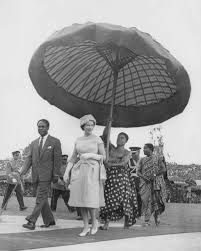
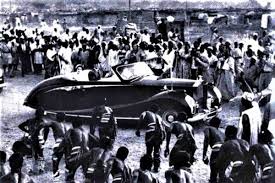
The first time was in 1956, from the 28th of January to the 16th of February, 1956. At the airport, she was welcomed by federal dignitaries which included the Minister for Labour and Welfare at the time, Festus Okotie-Eboh and Governor-General Sir James Robertson. She was driven around in a Rolls Royce
in the country’s capital, Lagos with lots of fun fare and royal services. She spent time in the Northern part of the country with the Sultan where she visited Kano and Kaduna. She also visited Jos and Enugu. The second time was when she attended the Common wealth Heads of Government meeting which was held between the 3rd to the 6th of December, 2003.
The 2003 **Commonwealth Heads of Government Meeting** was the eighteenth meeting of the Heads of Government of the Commonwealth of Nations. It was held in Abuja, Nigeria and hosted by the then President, Olusegun Obasanjo.
During the meeting, the Zimbabwean issue was dominant. This was the dispute over Zimbabwe’s suspension which led to another dispute over the re-election of Secretary-General Don McKinnon. Before the end of the meeting, Robert Mugabe’s announced that Zimbabwe was withdrawing from the Commonwealth. This best explains the need for the presence of the Queen at the meeting. In a letter addressed towards the Nigerian President at the time, the Queen explained that her visit was a demonstration of the value Britain attached to its relations with Nigeria and recognition of the country’s role on the international stage. Queen Elizabeth opened the Commonwealth Heads of Government Meeting in Abuja on Friday, 5th December. Herself and the Duke of Edinburgh (often referred to as Her Majesty and His Royal Highness respectively) also attended other events during the Meeting.
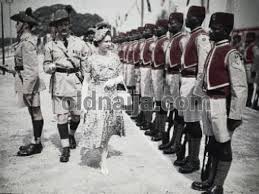
During the Queen’s first visit in 1956, she went on a tour, known as the Queen’s 1956 Tour of Nigeria and the following incidents took place
**Queen Arrives In Lagos (1956)**
Queen Elizabeth and Prince Philip received welcome in the Nigerian capital, Lagos at the very start of the Royal tour
**Inauguration Of New Federal Courts (1956)**
The Queen attended the inauguration of the new federal courts in Nigeria.
**The Queen was at the Durbar also known as the Royal Durbar (1956)**
At Kaduna, the then capital of Northern Nigeria, Queen attended a Royal Durbar
The Queen visited Kano (1956)
**Queen Elizabeth And Duke Philip Visited Jos – Tin Mines (1956)**
Nigerian tribal canoes held a regatta for the Queen at Port Harcourt on the Ronny River after which she visited a Leper colony
**Queen went on a tour in Enugu, Nigeria (1956)**
When on the Royal tour, The Queen went on a visit to children’s rally and a tribal dancing at Enugu, Nigeria
In Lagos, Queen Elizabeth attended a garden party and a formal session of the Federation Parliament.
**The life of Queen Elizabeth**
Queen Elizabeth became queen following her father’s death in 1952. She was 25 years old at the time and became the queen regent of seven independent Commonwealth countries which were the United Kingdom, Canada, New Zealand, South Africa, Pakistan, and Ceylon (later renamed Sri Lanka). Many of the colonial realms, to include Nigeria. Nigeria gained independence during the course of her reign. As of the year, 2018, Queen Elizabeth II has been ruling England for 66years and is currently the longest-reigning British monarch in history
**The role of Queen Elizabeth in colonial Nigeria**
British influence in Nigeria began with the prohibition of the slave trade to British subjects in 1807. In 1861, Britain incorporated Lagos and in 1884, the Oil River Protectorate was established. It was at the Berlin’s conference of 1885 that other European powers acknowledged Britain’s dominance over the Niger area.
From 1886 to 1899, much of the Niger area was ruled by the Royal Niger Company, authorized by charter, and governed by George Taubman Goldie. On 1 January 1900, the Royal Niger Company transferred its territories to the British government for the sum of £865,000; the Southern Nigeria Protectorate and Northern Nigeria Protectorate were then passed from the Royal Niger Company to the Crown. The constitutions after the world war were progressive and allowed for increased representation and electoral government by Nigerians. The colonial period in Nigeria was precisely from 1900 to 1960, after which Nigeria gained its independence.
Queen Elizabeth II was Queen of Nigeria forms 1960- 1963: Nigeria was an independent constitutional monarchy. She was also the monarch of the other commonwealth nations such as the United Kingdom.
Nigeria became independent on 1 October 1960 by a British Act of Parliament. Nnamdi Azikiwe was installed as Governor-General of the federation and Tafawa Balewa continued to serve as head of a democratically elected parliamentary. The Queen was head of state in Nigeria, though her constitutional roles were mostly delegated to the Governor-General of Nigeria. The Governor-General represented the British monarch as head of state and was appointed by the Crown on the advice of the Nigerian prime minister in consultation with the premiers of the regions. The Governor-General was also responsible for appointing the prime minister and for choosing a candidate when there was no parliamentary majority. Other than this, the Governor-General’s office was essentially ceremonial.
The retention of the monarchy was not accepted by all and the political parties in Nigeria at the time agreed that the country should be a republic.
Nigeria adopted the President of Nigeria as head of state, on 1 October 1963 and hence, severed its relationship with the British monarchy.
The Nigeria colonization
Nigeria is a country in West Africa and was colonized by the British. Nigeria in the past was forced to participate in the slave trade. The British had participated in it until human trafficking was abolished in 1807. The British took an interest in Nigeria because of its resources.
I chose this image because it is the Flag
of British Colonial Nigeria.
The British colonized Nigeria in 1884. It was established as a colony in 1884 at the Berlin conference where Africa was divided by European powers. Britain gained power by the use of its military. “Britain maintained it’s economic hegemony [rule] over the colonies through military power, Strategic alliances and the collaboration of indigenous rulers” (The Colonial Economic Legacy). The British established a trading post at the Niger River, exploiting the Africans. There was resistance, but it was crushed. “British control did not come without cost. In the Village of Satiru, natives armed with axes and hoes massacred a force of 70 black soldiers and a British officer, as well as two civilians. Lugard responded by sending a column of 500 infantrymen, supported by the friendly sultan of nearby Sokoto, against Satiru. They slaughtered an estimated 2,000 men, women and children. This act of vengeance alarmed government officials” (44, Harmon). This was not fair; the amount of damage done was not proportional to the amount of damage taken. Lugard or the white people killed twenty-seven times the amount of people the natives or blacks killed to send a message that they were in control of the Nigerians.
The British wanted some of the products, like palm oil and palm kernels, the Nigerians made so they decided to colonize Nigeria it took them a while. “[The] medium of exchange, encouraged export trade in tin, cotton, cocoa, groundnuts, and palm oil” (The Colonial Economic Legacy). For those things the British thought Nigeria was a good catch.
The people of Baro, a small village, four hundred miles from the sea, were chosen as a link for transportation between Baro and Kano. A three hundred fifty mile railroad was built for shipping peanuts and cotton, as well as water; it was built with native labor (48, Harmon). The people had a better source of transport
Nigeria gained independence from Britain in 1960 on October first. The British had been indirectly ruling for just about 76 years. Nigeria had been colonized by Britain’s military force.

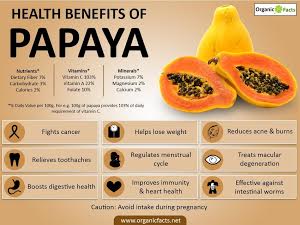
Health benefit on PAWPAW (PAPAYA)
With a lot of hidden benefits for skin, health and hair, coupled with its deliciousness, pawpaw now ranks as one of the most beneficial gifts nature has blessed us with.
So what are the health benefit if pawpaw?
One extremely important health benefit of Pawpaw is that pawpaw leaves juice is widely recognised as a natural cure for dengue fever which is very prevalent in the Pacific Islands. The leaves have a mix of nutrients and organic compounds which help in increasing your platelet count. Papaya leaves also have a high level of vitamin C which stimulate the immune system.
All you need to do is crush the leaves and stain the juice from the crushed leaves. Pawpaw leaves also cures dengue fever.
Pawpaw contains dietary fibre, folate, vitamin A, C and E as well as small amounts of calcium, iron, riboflavin, thiamine and niacin and is very rich in antioxidant nutrients flavonoids and carotenes. It is also used in the manufacturing of several cosmetic, skin, and beauty products as well as certain chewing gums.
Pawpaw are available for consumption throughout the year and the whole fruit, including the leaves & other parts of the tree, are beneficial to health in several ways.
**LOWERS CHOLESTEROL**
Papayas are rich in fibre, vitamin C and antioxidants that prevent cholesterol buildup in the arteries. Too much cholesterol build-up can block the arteries, causing a heart attack. But with pawpaw, the building up of the cholesterol in the arteries, is made impossible.
**HELPS BOOST IMMUNITY**
Amazingly, a single papaya can fulfil more than 200% of your daily requirement of Vitamin C, making it a great agent of a stronger immune system.
**RELIEVES CONSTIPATION & REDUCES MOTION SICKNESS**
The presence of folate, vitamin C, and vitamin E in papayas may reduce motion sickness by producing a tonic effect in the stomach and in the intestines. The fiber obtained from the fruit helps to increase bowel movements and improved bowel movements reduces the effects of constipation.
**ANTI CANCER PROPERTIES**
Free radicals and oxidative stress are closely related to different types of cancer. Because pawpaws are rich in antioxidants, the fruit can help protect cells from damage and lower the risk of cancer. Additionally, pawpaw contains the antioxidant beta-carotene. One study found that beta-carotene offers protection from prostate cancer.
**ANTI-INFLAMMATORY**
Papaya contains several unique protein-digesting enzymes including *papain* and *chymopapain*. These enzymes have been shown to help lower inflammation and to improve healing from burns. In addition, the antioxidant nutrients found in papaya, including vitamin C and beta-carotene, are very good at reducing inflammation.
**GREAT EYE CARE**
Papayas are rich in Vitamin A and flavonoids like beta-carotene, zeaxanthin, cryptoxanthin and lutein, which keep the mucous membranes in the eyes healthy, preventing them from damage.
The Vitamin A in pawpaw helps prevents the development of age-related macular degeneration.
The unforgettable Icon (Mandela)
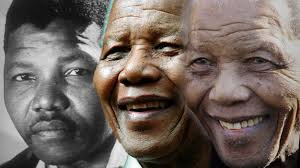
Rolihlahla Mandela was born into the Madiba clan in the village of Mvezo in the Eastern Cape, on 18 July 1918. His mother was Nonqaphi Nosekeni and his father was Nkosi Mphakanyiswa Gadla Mandela, principal counsellor to the Acting King of the Thembu people, Jongintaba Dalindyebo. In 1930, when he was 12 years old, his father died and the young Rolihlahla became a ward of Jongintaba at the Great Place in Mqhekezweni1.
Hearing the elders’ stories of his ancestors’ valour during the wars of resistance, he dreamed also of making his own contribution to the freedom struggle of his people.
He attended primary school in QUNU where his teacher, Miss Mdingane, gave him the name Nelson, in accordance with the custom of giving all schoolchildren “Christian” names.
He completed his Junior Certificate at Clarkebury Boarding Institute and went on to Healdtown, a Wesleyan secondary school of some repute, where he matriculated.
Mandela began his studies for a Bachelor of Arts degree at the University College of Fort Hare but did not complete the degree there as he was expelled for joining in a student protest.
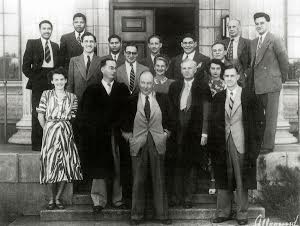
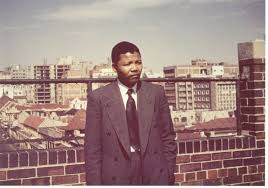
On his return to the Great Place at Mqhekezweni the King was furious and said if he didn’t return to Fort Hare he would arrange wives for him and his cousin Justice. They ran away to Johannesburg instead, arriving there in 1941. There he worked as a mine security officer and after meeting Walter Sisulu, an estate agent, he was introduced to Lazer Sidelsky. He then did his articles through a firm of attorneys – Witkin, Eidelman and Sidelsky.
He completed his BA through the University of South Africa and went back to Fort Hare for his graduation in 1943.
Meanwhile, he began studying for an LLB at the University of the Witwatersrand. By his own admission he was a poor student and left the university in 1952 without graduating. He only started studying again through the University of London after his imprisonment in 1962 but also did not complete that degree.
In 1989, while in the last months of his imprisonment, he obtained an LLB through the University of South Africa. He graduated in absentia at a ceremony in Cape Town.
**Entering politics**
Mandela, while increasingly politically involved from 1942, only joined the African National Congress in 1944 when he helped to form the ANC Youth League (ANCYL).
In 1944 he married Walter Sisulu’s cousin, Evelyn Mase, a nurse. They had two sons, Madiba Thembekile "Thembi" and Makgatho, and two daughters both called Makaziwe, the first of whom died in infancy. He and his wife divorced in 1958.
Mandela rose through the ranks of the ANCYL and through its efforts, the ANC adopted a more radical mass-based policy, the Programme of Action, in 1949.
In 1952 he was chosen as the National Volunteer-in-Chief of the Defiance Campaign with Maulvi Cachalia as his deputy. This campaign of civil disobedience against six unjust laws was a joint programme between the ANC and the South African Indian Congress. He and 19 others were charged under the Suppression of Communism Act for their part in the campaign and sentenced to nine months of hard labour, suspended for two years.
A two-year diploma in law on top of his BA allowed Mandela to practise law, and in August 1952 he and Oliver Tambo established South Africa’s first black law firm, Mandela & Tambo.
At the end of 1952 he was banned for the first time. As a restricted person he was only permitted to watch in secret as the Freedom Charter was adopted in Kliptown on 26 June 1955.
**The Treason Trial**
Mandela was arrested in a countrywide police swoop on 5 December 1956, which led to the 1956 Treason Trial. Men and women of all races found themselves in the dock in the marathon trial that only ended when the last 28 accused, including Mandela, were acquitted on 29 March 1961.
On 21 March 1960 police killed 69 unarmed people in a protest in Sharpeville against the pass laws. This led to the country’s first state of emergency and the banning of the ANC and the Pan Africanist Congress (PAC) on 8 April. Mandela and his colleagues in the Treason Trial were among thousands detained during the state of emergency.
During the trial Mandela married a social worker, Winnie Madikizela, on 14 June 1958. They had two daughters, Zenani and Zindziswa. The couple divorced in 1996.
Days before the end of the Treason Trial, Mandela travelled to Pietermaritzburg to speak at the All-in Africa Conference, which resolved that he should write to Prime Minister Verwoerd requesting a national convention on a non-racial constitution, and to warn that should he not agree there would be a national strike against South Africa becoming a republic. After he and his colleagues were acquitted in the Treason Trial, Mandela went underground and began planning a national strike for 29, 30 and 31 March.
In the face of massive mobilisation of state security the strike was called off early. In June 1961 he was asked to lead the armed struggle and helped to establish Umkhonto weSizwe (Spear of the Nation), which launched on 16 December 1961 with a series of explosions.
On 11 January 1962, using the adopted name David Motsamayi, Mandela secretly left South Africa. He travelled around Africa and visited England to gain support for the armed struggle. He received military training in Morocco and Ethiopia and returned to South Africa in July 1962. He was arrested in a police roadblock outside Howick on 5 August while returning from KwaZulu-Natal, where he had briefed ANC President Chief Albert Luthuli about his trip.
He was charged with leaving the country without a permit and inciting workers to strike. He was convicted and sentenced to five years' imprisonment, which he began serving at the Pretoria Local Prison. On 27 May 1963 he was transferred to Robben Island and returned to Pretoria on 12 June. Within a month police raided Liliesleaf, a secret hideout in Rivonia, Johannesburg, used by ANC and Communist Party activists, and several of his comrades were arrested.
On 9 October 1963 Mandela joined 10 others on trial for sabotage in what became known as the Rivonia Trial. While facing the death penalty his words to the court at the end of his famous "Speech from the Dock" on 20 April 1964 became immortalised:*I have fought against white domination, and I have fought against black domination. I have cherished the ideal of a democratic and free society in which all persons live together in harmony and with equal opportunities. It is an ideal which I hope to live for and to achieve. But if needs be, it is an ideal for which I am prepared to die. ”*
On 11 June 1964 Mandela and seven other accused, Walter Sisulu, Ahmed Kathrada, Govan Mbeki, Raymond Mhlaba, Denis Goldberg, Elias Motsoaledi and Andrew Mlangeni, were convicted and the next day were sentenced to life imprisonment. Goldberg was sent to Pretoria Prison because he was white, while the others went to Robben Island.
Mandela’s mother died in 1968 and his eldest son, Thembi, in 1969. He was not allowed to attend their funerals.
On 31 March 1982 Mandela was transferred to Pollsmoor Prison in Cape Town with Sisulu, Mhlaba and Mlangeni. Kathrada joined them in October. When he returned to the prison in November 1985 after prostate surgery, Mandela was held alone. Justice Minister Kobie Coetsee visited him in hospital. Later Mandela initiated talks about an ultimate meeting between the apartheid government and the ANC.
**Release from prison**
On 12 August 1988 he was taken to hospital where he was diagnosed with tuberculosis. After more than three months in two hospitals he was transferred on 7 December 1988 to a house at Victor Verster Prison near Paarl where he spent his last 14 months of imprisonment. He was released from its gates on Sunday 11 February 1990, nine days after the unbanning of the ANC and the PAC and nearly four months after the release of his remaining Rivonia comrades. Throughout his imprisonment he had rejected at least three conditional offers of release.
Mandela immersed himself in official talks to end white minority rule and in 1991 was elected ANC President to replace his ailing friend, Oliver Tambo. In 1993 he and President FW de Klerk jointly won the Nobel Peace Prize and on 27 April 1994 he voted for the first time in his life.
**President**
On 10 May 1994 he was inaugurated as South Africa’s first democratically elected President. On his 80thbirthday in 1998 he married Graça Machel, his third wife.
True to his promise, Mandela stepped down in 1999 after one term as President. He continued to work with the Nelson Mandela Children’s Fund he set up in 1995 and established the Nelson Mandela Foundation and The Mandela Rhodes Foundation.
In April 2007 his grandson, Mandla Mandela, was installed as head of the Mvezo Traditional Council at a ceremony at the Mvezo Great Place.
Nelson Mandela never wavered in his devotion to democracy, equality and learning. Despite terrible provocation, he never answered racism with racism. His life is an inspiration to all who are oppressed and deprived; and to all who are opposed to oppression and deprivation.
He died at his home in Johannesburg on 5 December 2013.
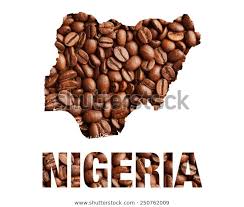
Coffee and it locations in Nigeria
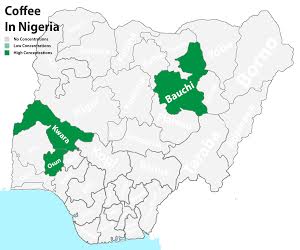
Nigeria has been a onetime large producer of coffee in Africa with the producing states including Kwara, Bauchi, and Osun. It is widely consumed by many people across the globe and has been ranked as the most international export commodity after petroleum.
Coffee (Coffea Arabica) is a beverage crop which originated from Africa where it was initially exported to other countries of the world.
Coffee is of different species but only two is widely grown, namely;**Arabica** and **Robusta,** Arabica is widely grown than its counterparts and has less caffeine and taste better than Robusta that has a burnt-like taste, and contains about 60% more lipids and almost twice the concentration of sugar than Robusta.
To grow a coffee, the seeds are soaked in water for a day, after which it is drained and then sow in damp soil and is highly productive if planted in the rainy season.
It is generally planted in large beds in shaded nurseries and is transplanted after its starts growing, it takes about3 - 4 years for the coffee trees to start bearing fruit (coffee cherry), when ripe it turns from green to bright, deep red which signals it been ready for harvest.
After harvesting the coffee berries can be processed by using either the dry method or the wet method.
**The Dry Method** is used mostly in areas where water is limited, it is spread out to dry in the sun on huge surfaces, to ensure effective drying it is usually been turned continually and then covered from getting wet in the night, from early morning dew or rain.
This process is continuous and may last for days or weeks depending on the weather condition, so as to make sure that the moisture content of the cherries reduces to about 8-11%.
**The Wet Method** is done by soaking the cherries in water for about 12-48 hours and passing it through a pulping machine to separate the skin from the bean after which is then dried.
Either way used, when the coffee beans is well dried, it can be roasted until the desired flavour is achieved, after which it is then grounded and brewed with near boiling water to produce coffee as a beverage.
Though the cultivation of coffee in Nigeria, West Africa has declined over the past years, adequate measures have been put in place to help rehabilitate its plantation.
The Classic Cars
The 1967 Chevy Corvette, the 1975 BMW 3.0 CSL, any pre-1974 Porsche 911–these are some of the vehicles that have earned a significant place in automotive history. Iconic yet accessible, they are museum-quality cars that you really just want to take for a spin. These automotive legends have weathered the decades, but with some ingenuity, you can still get behind the wheel of most of them. Here's our list of the ones worth the hunt.
THE JAGUAR E-TYPE
Once called "the most beautiful car ever made" by Enzo Ferrari, the 1960s Jaguar E-Type is a classic sports car mainstay. "If you only choose one car from this list to drive, this is the one," says McKeel Hagerty, CEO of Hagerty, the world's largest provider of collector vehicle insurance. This staple of British motoring history still has verve–it can perform up to 150 m.p.h. and brakes better than most cars from its era.
THE CHEVY CORVETTE
The emblem of Big Three muscle cars, the Chevy Corvette is the most collected vehicle in America. The second generation, which spanned 1963 to 1967, is "the most iconic American car ever made," says Keith Martin, publisher of *Sports Car Market*. "It's still breathtaking and fresh today." Early generation Corvettes remain plentiful in the U.S., so you can scour auctions, collector car dealers, and websites like classiccars.com for deals.
LAMBORGHINI MIURA
Considered by some to be the sexiest car ever built, the Miura debuted in 1966 as a sleek mid-engine speedster designed to challenge Ferrari. "Piloting the Miura transcends driving experience to become a life experience," Hagerty says. "If the sound of six carburetors feeding a thirsty, vibrating V-12 moored right behind your head isn't enough, it's also arguably the most beautiful car ever produced." To buy one, contact the Lamborghini Club America or an auction house like RM Sotheby's or Gooding & Co. They're usually in the know about the cars before they reach the general market.
THE PORSCHE 911
The Porsche 911 represents vintage driving at its best—particularly during the golden era before the car's 1974 redesign. "There's magic in the early 911," Hagerty says. "It's an amazingly well-built machine that delivers one of the most honest driving experiences of any sports car ever built." Even by today's standards, first-generation 911s still have plenty of horsepower and can hold their own on the track. You can find one, even in mint condition, on eBay.
FORD MODEL T
Produced from 1908 to 1927, this is the car that birthed the American automotive industry. Affordable by mass market standards, the Model T begat car culture and road trips. "Everyone needs to know where they came from," Hagerty says. "When it comes to American motoring, that starting place is the Model T." With a volatile hand-crank engine and two-speed transmission (not including the reverse gear), the Model T isn't easy to drive, even if you can get your hands on one. But rest assured–27 mph will never feel so thrilling.
VINTAGE JEEP
Jeep rose to prominence as a GP, or "general purpose" vehicle driven by the U.S. military during World War II. In 1945, the 4x4 was sold commercially as the Civilian Jeep, considered by some to be the first mass-produced SUV. "It's neither quick nor comfortable, but it's the automotive embodiment of democracy," Hagerty says. "And if you're planning on going off-road, you could do far worse than the Jeep's simplicity and ruggedness." An integral part of American history, the Jeep can be found in equal parts in museums and online classified ads.
CHEVROLET CAMARO
The original Camaro served as Chevrolet's answer to the Mustang–but with more style and power. General Motors introduced the Camaro in 1967, setting off an eight-cylinder pony war of American muscle power that persists today. First-generation Camaros abound online. If you'd like to buy one, search sites like eBay or AutoTrader Classics.
DATSUN 240Z
The Datsun 240Z started the Japanese sports car craze when it arrived in America in the early 1970's. Offering lots of power and a pleasant interior for not much money, the Datsun paved the way for Toyota, Honda and Nissan to gain acceptance with U.S. consumers in the following decades. Classified ads from Hemmings and AutoTrader Classics have many Datsun 240Zs listed for sale.
DeTomaso Pantera
With Italian styling and a reliable Ford V8 engine, the DeTomaso Pantera represents the best of both worlds and is a worthy alternative to similar Lamborghinis and Ferraris from the same era. "You'd expect an early '70s Italian car to be garish, loud, and hard to drive," Hagerty says. "While it is garish and loud, the Italian-bodied and American-powered Pantera is actually rather easy to drive." Procure one at a high-end classic car auction house, such as Barrett-Jackson or Bonhams.
FERRARI 250 GTO
Ferrari made just 39 of these elegant race cars between 1962 and 1964, so they are extremely rare. "The 250 GTO is probably the holy grail in terms of value and recognition, but the reality is only a handful of people in the world will ever have the chance to legitimately drive one," Hagerty says. An early model fetched $38 million at Bonhams' Quail Lodge auction at the Pebble Beach Concours d'Elegance two years ago. If that's too pricey, know that any 1960s Prancing Horse with a V12 engine is worthy of making the list.
Which of this is your favorite?
Like and comment below.
Losing Touch (covid 19 set back)
Affectionate touches tap into the nervous system’s rest and digest mode, reducing the release of stress hormones, bolstering the immune system, and stimulating brainwaves linked with relaxation.
**I**t had been seven weeks since I’d touched another human being. Arms outstretched, I walked quickly toward my dad, craving his embrace. In the instant before we touched, we paused, our minds probably running quick, last-minute calculations on the risk of physical contact. But, after turning our faces away from each other and awkwardly shuffling closer, we finally connected. Wrapped in my dad’s bear hug, I momentarily forgot we were in the midst of the worst global crisis I have ever experienced.
“Touch is the most powerful safety signal of togetherness,” says Steve cole, a psychiatrist and biobehavioral scientist at the University of California, Los Angeles.
Like more than 35 million other Americans, I live alone, and with the guidelines of physical distancing set by the Centers for Disease Control and Prevention, I hadn’t been getting close to anyone to avoid being infected with (or potentially spreading) SARS-CoV-2, the virus that causes COVID-19. I’d been working, thankfully, at home and staying connected with friends and family through Zoom and Skype, but those virtual interactions were no replacement for being with loved ones in person.
“When we get lonely and isolated our brainstem recognizes that suddenly we are in insecure territory and flips on a bunch of fight-or-flight stress responses without us even knowing it,” Cole says. “There’s all sorts of things in our social world that lead us to calculate that we are either safe or unsafe. You can think of physical touch, supportive and affectionate touch, as the most fundamental signal that you’re with somebody who cares about you . . . a fundamental signal of safety and well-being.

The first SKYSCRAPER in Tropical Africa
**COCOA HOUSE, IBADAN**
An iconic 26 storey building with a height of about 105 meters and land area of 1.7 hectares, the first known skyscraper in tropical africa, sit in the heart of Ibadan, Oyo State, Nigeria.
Sometimes after the independence of Nigeria, agriculture was a major boost for the economy, and Cocoa was the center in the exportation business. Proceedings from cocoa at that time was used to construct this monumental building. On 30th July, 1965, this building then called *'Ile Awon Agbe'*, meaning the *'farmers' house'*, (later changed to cocoa house) was comissioned. To beautify it, a water fountain was constructed, I am guessing those who know the building would be amazed! A cocoa tree was also planted, and it stands till date!
THE PLACE AND IT PEOPLE
Today, the compound now have a beautiful Heritage Mall, a cinema and a nite club for night crawlers. It continues to serve as a nucleus to a lot of the commercial hustles of the Ibadan people.
You will agree with me that this iconic building has scores of stories to tell *(pun intended)*
**FOUR THINGS YOU SHOULD KNOW ABOUT THE COCOA HOUSE**
**1. Late Chief Obafemi Awolowo conceived the idea.**
A 26 storey building would have made little or no sense in the 60s when Obafemi Awolowo proposed it. The Action Group(A.G) under his leadedrship decided to embark on the project, which would turn out to be the tallest building in tropical Africa as at that time. Proceedings available from Cocoa were used, and no Federal Government allocation was used.
**2. It is now a commercial center.**
While the Heritage Mall stands the busiest during the day, with thousands of people trooping in to shop in places like Shoprite; The Place; PEP; Casa bella; healthplus; and of course relax at the Filmhouse cinema, the kokodome stands the busiest at night, with night crawlers and other gentlemen of the dark, relax and enjoy theirselves. A nite club, a swimming pool and lounge provides atmosphere to relax and catch fun. The building itself now houses offices for major firms and broadcasting outfits, while the last floor is reserved for the Odua museum and Hall of Fame.
**3. Who constructed this monument?**
The oldest constructed firm in the country, Cappa and D'Alberto, was the company behind this iconic building. This building and civil engineering contractor operating in Nigeria since 1932, and have to their credit, buidings like Mobil house, Victoria Island; Diamond Bank, lekki, Lagos; Bella's Place, Victoria Island.
**4. The fire story**
It was disaster on January 9th, 1985 when news of the burning flames struck the Ibadan people. Their beautiful building is on fire! The sad news was that the building burnt down. Then in 1988, plans to renovate and reconstruct was in play and in 1992, August 2nd, the Cocoa house was reborn and reopened to the general public.
*The story of Cocoa house is one of strength, tenacity and survival!*
*This is a storey from the city of Ibadan*
What's next after Ramadan
The Right of Allāh does not end upon the ending of Ramadan
By: Shaykh Salih Al Fawzan
Although the month of Ramadan has ended, the right of Allah never ends. Allah said: [And worship your Lord until there comes to you the certainty (death).] (Surah Al Hijr, 99)
Allah is the Lord of Ramadan, and the Lord of Shawwal, and He is the Lord of all the other months. So fear Allah throughout all the months. Safeguard your religion. Safeguard your religion throughout your life, for indeed it is the most valuable thing you have to Allah SWT. And it is your savior from the fire. So safeguard your religion and be steadfast in holding on to it throughout all the other months, and throughout the times.
Indeed Ramadan should be followed up by gratitude, seeking Allah’s forgiveness, and happiness over the bounty of Allah. So we are happy that we were able to fast this month and stand in prayer in it, we rejoice at this blessing. We do not rejoice that the month has ended, we only rejoice because we have have completed it in worship to Allah, for this reason we rejoice.
Allah said: [Say, "In the bounty of Allah and in His mercy - in that let them rejoice; it is better than what they accumulate."](Surah Yunus, 58)
And beware of excessive useless speech, play, and excessive negligence and turning away from the worship of Allah. Because Shaytan is keen and working hard on wasting your deeds, erasing and canceling all the good deeds that you have done, so he makes it seem to some people that when the month of Ramadan ends, the person becomes a free man, as though he has just left prison, so he goes forth and indulges in useless speech, play, negligence of Allah, not taking care of prayers, and other than that from the despised evil actions.
So do not undo the knot you have tied, Allāh said: [And do not be like she who untwisted her spun thread after it was strong](Surah An Nahl, 92)
So fear Allah O slaves of Allah, and safeguard what you have done from good deeds, and turn to Allah in repentance for your shortcomings and mistakes, for indeed Allah accepts the repentance of the one who repent.
Setting up your bedroom
Choose Subtle Color
Instead of bold primary colors, choose soothing shades and a restful palette of monochromatic tones. Remember color theory: gentle hues of blue, lavender, or green are considered calm and serene. Rich jewel-toned hues help set the mood of coziness and comfort. These might include toasty browns, deep pomegranate, or topaz. Use toned-down versions of your favorite colors in the bedroom." That might mean choosing mauve instead of eggplant, or pumpkin instead of tangerine.
Don't Overlook the Ceiling
The ceiling is the fifth wall in a room. When you lie in bed, do you see a bland, blank surface? Add a subtle pattern or soft color. Paint the ceiling a slightly lighter version of the wall color. This will help to visually lower the ceiling and give the space a feeling of comfort and intimacy.
Other solutions would be to stencil or wallpaper the ceiling, add architectural elements in the form of beams or moldings or use a decorative paint treatment. For ultimate luxury, silver-leafed bedroom ceilings, a canopy or tented bed with a dressing that hangs from the ceiling can envelop you in sensuality and warmth while adding texture, design, and color to the ceiling. Add a molded medallion and chandelier of crystal or delicate shades bringing color, pattern, and texture to the "fifth wall" above you.
Keep the Bedroom Simple
A bedroom should look cozy and simple, sophisticated, and elegant, regardless of what style of decorating you choose. For ease of movement, leave a minimum of three feet between the bed and side walls or large pieces of furniture and at least two feet between the bed and low furniture, like tables and dressers. If you have to walk around the bed to get from the closet to the bathroom, think of how you can move the bed.
Furnish your bedroom with only what you need. A bed, a bedside table or two, a dresser, and chair are necessities. Anything else is clutter. If you have room, place a chest of drawers in the closet.
Accessories should be kept to a minimum. Choose a beautiful piece of artwork, arrange some family photos, add flowers and candles, and leave it alone
Choose the Right Size Furniture
When you're ready to buy bedroom furniture, start out with a floor plan and a measured drawing of the space. Furniture should fit the room it lives and this is particularly true for bedroom furniture. Don't choose a heavy, large bed and dresser for a small bedroom. If the ceiling is high, a tall headboard will help to visibly bring it down to size.
If your bedroom is large, choose furniture that fits it, too. Add a chair and ottoman or place a piece of furniture at the end of the bed. Furniture and accessories that are too small will look lost in a large room.
Your bedroom your happiness
A lot of potential for happiness happens in the bedroom. It’s the place where we sleep, have sex and retreat for quiet contemplation — all of which are activities that can improve happiness. As a result, many people who study and write about happiness encourage people to focus on life in the bedroom.
A “living well” index created by British researchers found that the two strongest indicators of wellness being were sleep and sex. People who feel rested most of the time are happier than people who don’t. The same can be said for people who are happy with their sex lives — they are happier overall than people with less-than-satisfactory sex lives.
So as you think about your living space and how it’s affecting your happiness, make the bedroom a high priority.
*Turn your bedroom into a luxury hotel suite.* Think of the feeling you get when you escape to a nice hotel on vacation. Capture that in your home every day.
*Invest in comfort.* Buy comfortable sheets, pillows and bedding and a quality mattress.
*Don’t skimp on window treatments*. Blocking out light will help you sleep better.
*Remove the television*. Bedrooms are havens for sleep, sex and contemplation, not screen time.
*Make the bed.* Making the bed starts your day off with a small accomplishment, and you can end your day returning to a neat, tidy welcoming retreat.

African philosophy
If you keep watering a plant, it will never grow deep roots, because there is no need to grow deep roots if water is easily accessible. Arnold Toynbee stated that for society to function, for people to be creative, you need challenge. The greater the challenge, the greater the response. And if there is no challenge, you go soft, and by Darwinian process of weeding, you die....... Professor William Sahlman of Business Admin at Harvard Business School.
In summary, you make people struggle for what they need so that they can be more creative and productive.
How realistic is this philosophy?
Is there a situation in which it will be inhumane to adopt it?
How do you think some African Government is adopting this philosophy?
Any positive or negative results?
Jonathan the Oldest Tortoise
Born circa 1832 – five years prior to the coronation of Queen Victoria – Jonathan the tortoise is due to turn 187 years old in 2019. That makes him the **oldest-known land animal** alive today.
This puts him just one year away from the title of **oldest chelonian ever**, currently held by Tu’i Malila, a radiated tortoise that reached at least 188 years old. She was owned by the royal family of Tonga between *c.* 1777 and 1965, and had been presented to them by British explorer Captain James Cook during his third – and final – Pacific voyage (1776–80).
n his lifetime, Jonathan has lived through two world wars, the Russian Revolution, seven monarchs on the British throne and 39 US presidents.
His estimated year of birth also predates the release of the Penny Black, the **first postage stamp** (1840), the building of the **first skyscraper**(1885) and the completion of the Eiffel Tower (1887) – the **tallest iron structure**.
Other human milestones to have taken place in his long life include the **first photograph of a person** (1838), the **first incandescent light bulb** (1878) and the **first powered flight** (1903).
Now the **oldest animal** in the world – among terrestrial animals – Jonathan has outlived the **oldest person ever** by around 65 years. The greatest authenticated age for a human is a "mere" 122 years 144 days, achieved by Jeanne Calment (1875–1997) from France.
Happiness in Pets
Psychologists conducted a series of experiments to determine the role that pets play in our happiness. They found that **pet owners were happier, healthier and better adjusted than were non-owners.** Pet owners said they received as much support from their pets as they did family members. And people who were emotionally closer to the pets also tended to have deeper ties to the humans in their lives.
Dog owners who felt a strong connection to their pets were happier and healthier. And in one expressive writing exercise, writing about pets was just as effective as writing about a friend when it came to staving off feelings of rejection,according to the report published by the America psychological association.
 @Rioelder