💚 Ode to Bitcoin Cash 💚
A Sonnet by Omar
💚💚💚💚💚💚💚💚💚💚💚💚💚💚💚💚💚💚
**My** Bitcoin Cash, you inspire me to write.
How I love the way you develop and CHIP, https://bitcoincashpodcast.com/faqs/BCH/how-does-BCH-governance-work
Invading my mind day and night,
Dreaming about one-upmanship.
💚💚💚💚💚💚💚💚💚💚💚💚💚💚💚💚💚💚
Let me compare you to a pretender?
You are more awesome, low fees and quick.
Good fogs hide the oceans of December,
And wintertime has the excellent kick.
💚💚💚💚💚💚💚💚💚💚💚💚💚💚💚💚💚💚
How do I love you? Let me count the ways. https://bitcoincashpodcast.com/faqs/BCH/why-bitcoin-cash
I love your CashTokens and true adoption. https://blog.bitjson.com/cashtokens-v2/
Thinking of Cashrain fills my days. https://cashrain.com/
My love for you is the sole option.
💚💚💚💚💚💚💚💚💚💚💚💚💚💚💚💚💚💚
To me you are always the real Bitcoin.
Decentralized, and the vision is clear.
With open arms for the world to join.
Smooth transactions, peer-to-peer.
💚💚💚💚💚💚💚💚💚💚💚💚💚💚💚💚💚💚
Decentralized, voluntary, and for inclusion.
Anyone can market, or do a Flipstarter.
My money is private, thanks to Fusion. https://flipstarters.bitcoincash.network/#/ https://fusionstats.redteam.cash https://cashfusion.org
You are not digital gold but much much larger. https://whybitcoincash.com/
💚💚💚💚💚💚💚💚💚💚💚💚💚💚💚💚💚💚
Trust-less applications are being made.
Your devs are working like a busy bee. https://bitcoincashresearch.org
Testing things for the May upgrade.
While maxis debate "Replace-by-Fee".
🤦🏻♂️
💚💚💚💚💚💚💚💚💚💚💚💚💚💚💚💚💚💚
Along the way, I made many friends.
Jason, Ryan, Jeremy and Jett. https://www.youtube.com/@BitcoinJason https://www.youtube.com/@RyanGiffin https://www.youtube.com/@BitcoinCashPodcast
Hope the energy never ends.
Amazing group and a worldwide net.
💚💚💚💚💚💚💚💚💚💚💚💚💚💚💚💚💚💚
Now I must away with a sublime heart,
Remember my bright words whilst we're apart.
💚💚💚💚💚💚💚💚💚💚💚💚💚💚💚💚💚💚
That is all folks!
Hope you liked my attempt at poetry.
Any feedback is welcome and appreciated!
Happy Bitcoin Pizza Day!
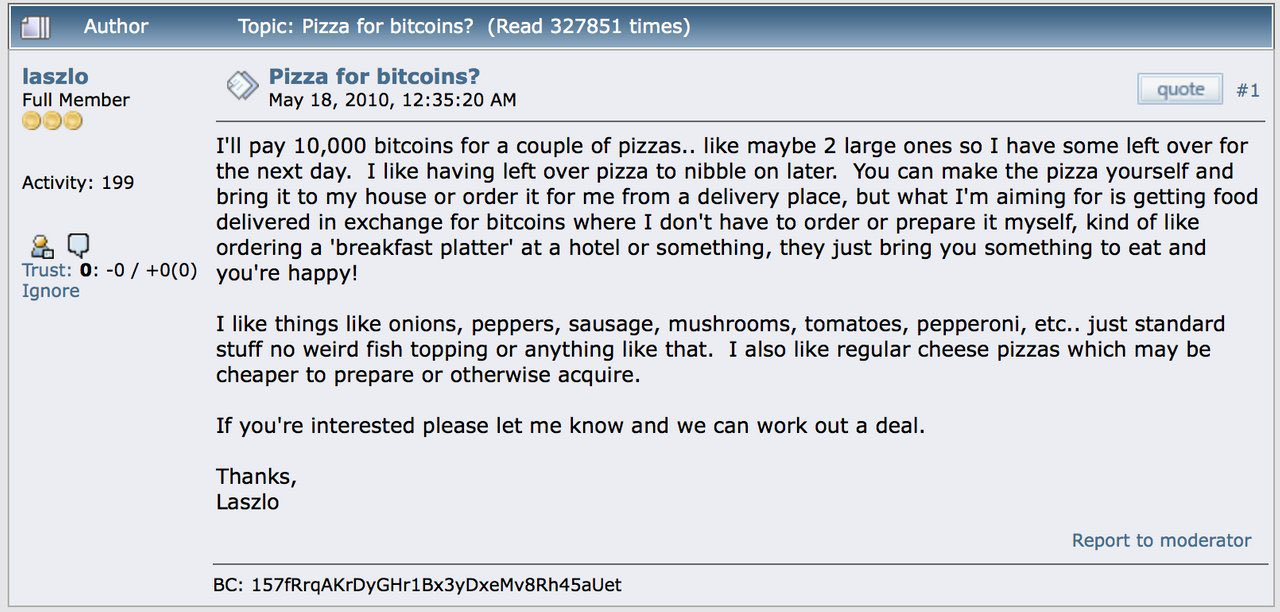
Happy Bitcoin Pizza Day! May 22nd marks the 11-year anniversary of the first Bitcoin transaction, in which Laszlo Hanyecz, a Florida man, paid 10,000 bitcoins for two slices of Papa John's pizza on May 22, 2010.
Hanyecz was the first person to use bitcoin in a commercial transaction.
The 10,000 BTC were worth just $41 at that time.
He made the offer on bitcointalk forum. He wrote: “I'll pay 10,000 bitcoins for a couple of pizzas.. like maybe 2 large ones so I have some left over for the next day. I like having left over pizza to nibble on later … If you're interested please let me know and we can work out a deal.”. https://bitcointalk.org/index.php?topic=137.msg1141#msg1141
It is understandable that one can't help but calculate how much 10,000 bitcoins would be worth now. However, even though some people make fun of him now, Laszlo Hanyecz is a true legendary because he realized the real mission of Bitcoin as peer-to-peer electronic cash system as described in the whitepaper. https://bitcoinpizzaindex.net https://read.cash/@Omar/what-is-bitcoin-the-whitepaper-as-a-guide-for-the-rest-of-us-f35a842d
Unfortunately, BTC later lost that mission because of the high fees and delayed confirmations. It became a coin just for "HODL" and speculation. In fact, currently the fees to send a BTC transaction are almost equal to the price of a pizza. https://bitcoinfees.cash
BTC maximalists claim that it is good money because it is a good "store of value". However, Menger-Mises theory of the origin of money states that store of value is a **secondary** function of money which depends on its utility in its primary function as a **medium of exchange**. Here is also a nice video by Roger Ver explaining these concepts. https://www.newlibertarian.io/2019/08/the-economics-of-btc-maximalism.html https://www.youtube.com/watch?v=uKklU59m47U
Bitcoin Cash BCH is the best version of Bitcoin nowadays since it continues that vision of Satoshi Nakamoto as money for the world.
.
.
Let us celebrate Bitcoin Pizza Day by buying, selling, sending, tipping, or exchanging something for Bitcoin Cash!
You may know a person or a business that accepts Bitcoin Cash in your neighborhood.
If not, may I suggest the following resources / businesses ?
https://www.bitgree.com/
https://map.bitcoin.com
https://purse.io/shop
https://www.egifter.com/buy-gift-cards-with-bitcoin-cash
https://www.travala.com
Please invite your family and friends to read.cash. This way, they can learn about Bitcoin Cash, download a wallet, see how convenient BCH is, and maybe earn some money while doing so!
Thank you for reading!
- Omar
Trololo Trend-Line For Assessing The Cryptocurrency Market Fair Value
Hello readers!
When we buy something, especially an investment asset, we would like to know its estimated worth or "fair value".
Bitcoin, being a new technology, is especially hard to assess. Many models have been developed to help estimate bitcoin's fair value. One of the most successful is the Trololo trend line. The following is a review of this nice indicator, answering a few basic questions about it.
**What Is The Trololo Trend Line?**
Trololo trend-line is a logarithmic regression fit of **all past data points** for bitcoin or for total cryptocurrency market capitalization since Bitcoin inception (2010). For bitcoin, the market capitalization is the total value of all the coins that have been mined. The total crypto market capitalization is the sum of all individual market caps of every cryptocurrency tracked.
Charting this trend line is useful to assess the current fair value of bitcoin or cryptocurrency market. Comparing the current value to this indicator helps to judge whether the current bitcoin or the cryptocurrency market valuations are cheap, expensive, or fairly priced.
This way, you can consider selling when the market is extremely overvalued, and buying when it is undervalued.
The original work was done by someone named **Trolololo**, who discussed it in bitcointalk.com message board back in October 2014 when BTC price was around $400. https://bitcointalk.org/index.php?topic=831547.0
Please note that the actual name is Trolololo (3 lo's), while the name most widely used for the trend line is Trololo (2 lo's).
**What Is A Logarithmic Regression Line And Why Do We Draw One?**
.
.
.
.
.
.
.
.
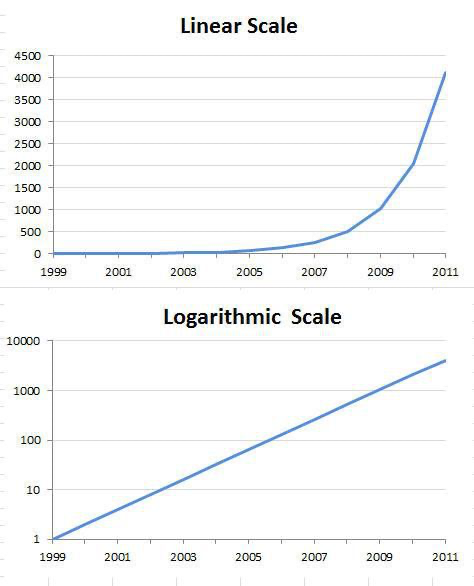
In Trololo logarithmic regression trendline, a base-10 log scale is used for the Y axis.
This means that each "tick" point on the Y axis is **10 times** the previous one.
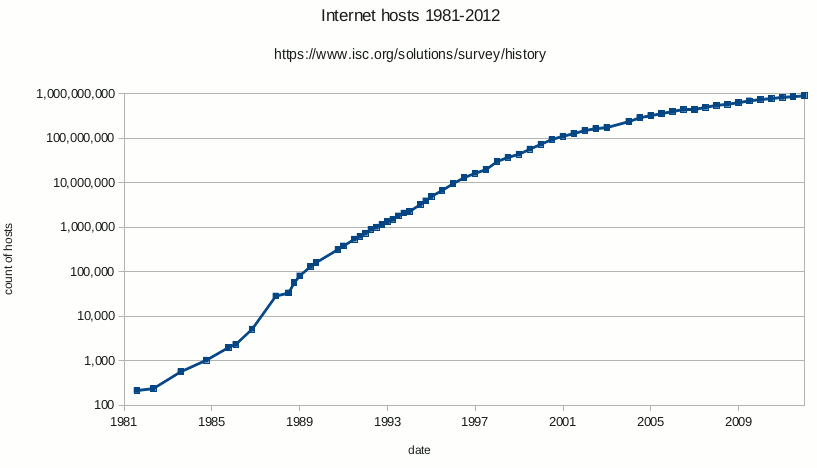
A logarithmic regression line is useful in visualizing phenomena that are **fast growing but decelerating** over time, such as the growth of a new technology.
For example, the logarithmic scale graph on the right plots the growth in the number of internet hosts over 30 years.
**How Do I Read a Trololo Chart?**
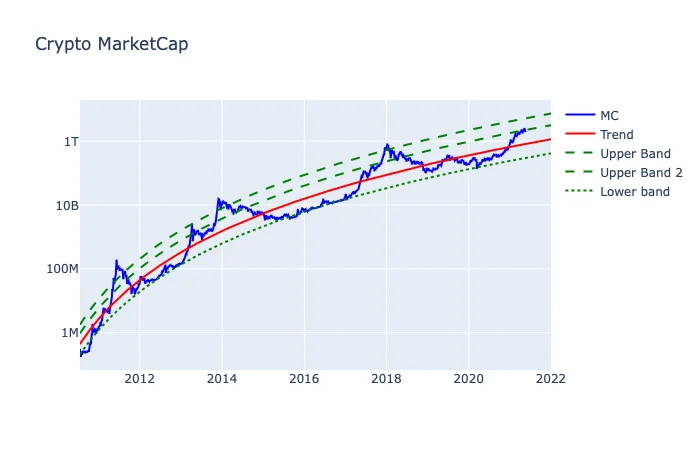
The red line represents the Trololo trend line. It is the logarithmic regression line for the market "fair" valuation. It represents Bitcoin’s (or total crypto market) stable, long-term value. This line is the “**psychological mean**”; the zone where long-term holders see true value.
The blue line is the actual value for Bitcoin price or for the total cryptocurrency marketcap (as in the chart above).
A lower band and two upper bands are added to represent areas of oversold, and overbought and extreme overbought.
You can see that the current fair value for total crypto market cap is around $800 Billion. The current actual value (as of May 20th) is $1.7 Trillion, about double the fair value. On aasasoft website, you can see the exact values by pointing on the Trololo chart. You can clearly see yesterday's dip (May 19th)! https://aasasoft.org/investing/models/trololo.html
**The Spread Chart:**
This second chart is the spread chart which shows deviation from the average (in percentage points). In other words, it is an "**oscillator**" that tracks the deviation between market value and fair value.
The idea is that market alternates between periods of overvaluation "bull market" and undervaluation "bear market". This happens because of the aggregate human psychology alternating between greed and fear. It is the the emotions of the crowds or "herd mentality". https://read.cash/@Omar/the-tricks-your-mind-plays-on-you-20-biases-that-impact-your-investment-success-part-33-294345a5
The reason is, as prices go up, less and less participants sell. Everyone tends to "HODL". Actually some investors regret selling too soon, and buy back higher. This fuels the parabolic run up. The opposite happens in a bear market, where there are very few buyers. Some people start to lose hope and continue selling on the way down.
This metric clearly displays the peaks and busts of the price cycle, emphasizing the oscillations between fear and greed.
For example, you will see that at the peak of the bull market in late 2017, the crypto market was %800 overvalued. The total market cap was 8 times its fair value.
The market was undervalued in early 2020, and is starting to become overvalued again (be patient however, not necessarily time to sell yet, please see below).
Of note is that every consecutive crypto market bubble is bringing less extreme overvaluations (percentage wise).
**What Are We Looking At? BTC? BCH? Total Market Cap?**
Trololo trend line was originally designed for bitcoin in 2014, when it was the only cryptocurrency. Logarithmic regression line proved to be the best visualization of this new technology.
However, since 2017, BTC started to lose market share to other cryptocurrencies after it strayed away from its original goal as peer-to-peer electronic cash and became a speculation coin.
All coins market capitalization (the total market capitalization of all cryptocurrencies) became a better measure of the growth both in adoption and an market value of cryptocurrencies. https://coinmarketcap.com/charts/
Marc De Mesel says: *"I asked Trololo middle 2017, who was one of first to plot this for Bitcoin on bitcointalk.org, to make it also for Total Market Cap instead of just Bitcoin, as I felt relevance of Bitcoin Core would go down over time and less and less representative of where we are in cycle. Since then, I have been publishing it from time to time on my YouTube channel and Twitter.".*
You can find the forum thread here. https://bitcointalk.org/index.php?topic=2000218.0
Since its inception in August 2017, Bitcoin Cash BCH sought to continue the original vision of Bitcoin as electronic cash. Trololo line can be used for BCH, starting with Bitcoin in 2010, using BTC price (marketcap) until the fork, and continuing with Bitcoin BCH after August 2017 .
Another approach is to look at the total cryptocurrency marketcap **excluding BTC**. The idea is that we want to exclude the money that entered BTC since it was "infiltrated" around 2017. This is "bankers' money" that fueled speculation, and is not necessarily correlated with the healthy growth and adoption of the peer-to-peer electronic cash invention. This is the approach of Classic David described here. https://www.youtube.com/watch?v=cBxlEEIc-6k&t=512s
**Where Can I Find the Trololo Chart?**
1. This website shows the Trololo charts for total crypto marketcap, with a daily update:
https://aasasoft.org/investing/models/trololo.html
For BTC: https://aasasoft.org/investing/models/trololo_btc.html
This is the work of @HeyAxP . If you find his charts useful, please consider tipping him at the addresses at the bottom of those pages. https://twitter.com/HeyAxP
2. Marc De Mesel updates and shares Trololo charts for both the total marketcap and BCH:
Crypto Market Cap vs Trololo Trendline / Fair Value / Log Regression https://docs.google.com/spreadsheets/d/1ujXSmxad9WrNpkPhuJv_kcNvy6TtVMNTQZQt3lwYeA0/edit#gid=935586956
Bitcoin BCH Market Cap vs Trololo Trendline / Fair Value / Log Regression https://docs.google.com/spreadsheets/d/1VoJtLe5QG_HNv3l5SBgfr7pjbLosJrbXrmyZIZ37Lxw/edit#gid=465266941
These google sheets files are updated about once a month.
Marc has done a great job over the past few years updating the charts. His commentary and him sharing his investment portfolio and strategy are huge bonuses. You can follow him on YouTube, noise.cash or twitter. https://www.youtube.com/user/Marcdemesel https://noise.cash/u/MarcDeMesel https://twitter.com/MarcDeMesel
3. Classic David did some very nice work on Marc's google sheets. He prefers to look at the total marketcap excluding BTC. https://twitter.com/ClassicDavid3
He describes the history of Trololo logarithmic regression line in this video. Please consider thanking him through donation to the address in the description of this video. https://www.youtube.com/watch?v=cBxlEEIc-6k https://www.youtube.com/watch?v=SU_P2fy0AqU
4. Trololo line for BTC is available on TradingView as two free indicators.
5. You can draw your own Trololo chart if you want to put the time and effort.
The original formula as posted by Trolololo is here. Obviously, different formulas are needed for BCH and for total marketcap. Also, the formula needs constant updates, as more price historical data points are added. https://www.wolframalpha.com/input/?i=10%5E%282.66167155005961++*+ln%28%28number+of+days+since+2009+Jan+09%29%2Fdays%29+-+17.9183761889864%29
How Can I Use Trololo Trend Line In My Investment Strategy**?**
Your investment strategy will depend on your goals and your level of risk tolerance.
If you, like me, is convinced that Bitcoin (BCH) is the best form of money for the world, you can take comfort in seeing that the fair value for BCH and for the total coin market cap is predicted to continue to go up. You can ignore the periods of over- and under-valuations and continue to exchange your fiat money to BCH at regular intervals (**dollar cost averaging**). Even though the growth rate is slowing down, it continues to be parabolic and spectacular. https://www.investopedia.com/terms/d/dollarcostaveraging.asp
Better yet, in the context of a trading strategy, the Trololo chart can be used as a market timing indicator for overbought and oversold extremes. You can sell your crypto investments when the market is extended to the upside (overbought), and buy back when it is approaching oversold. This way you "**lock-in**" profits on the top, and buy back lower.
Just be careful not to sell prematurely. As you can see from the charts, the market tends to extend to the upside longer and higher than many expect. Let those profits run.
Also, please **don't overtrade**. Please resist the temptation to time every market move. You may have regretted not selling in early May, and buying back on May 19th at a huge discount. But no one could have predicted the downturn and its depth.
These trades might make you a few percentage points here and there, but one time the market might turn suddenly in the other direction and you might miss a big move up, and you may end up having to buy less coins at a higher price.
Marc's videos and google sheets files are the resources I recommend for the trading strategy.
What Does The Trololo Chart Tell Us About the Current Bitcoin BCH Valuation**?**
According to Marc De Mesel (on April 16, 2021): https://www.youtube.com/watch?v=eZFnUWms8xE&t=1s
*"Bitcoin BCH still has lots of catching up to do to reach its Trololo Trendline / Fair Value that still stands 10x higher around 120B / 5k BCH, and would go to 1T or 50k per BCH if it goes also 800% vs its trendline, not a probable scenario but certainly a possible scenario given the law of reversion to the mean, the higher it undershoots the mean, the higher it will overshoot too.".*
Let us look at the numbers again. As of April 16, 2021, BCH is trading at $800 (market cap of $15 Billion) while the Trololo trend line indicates a fair valuation of BCH marketcap at around $120 Billion, or a market price for BCH of >$5000. This is evident also in the spread oscillator, where the current value is around 12 percent of the fair value.
Please note that the Trololo line as updated by Marc is **constantly changing** as new data points are added. This is especially evident in Bitcoin BCH where it has been undervalued for a long time and is "pulling" the trend line downwards.
However, Bitcoin BCH is predicted to catch up, and probably overshoot to the upside as Marc says, because of the strong fundamentals (better technology and utility) and because of the statistical tendency for "**reversion to the mean**" - not financial advice!
I hope this article was helpful in introducing the concepts around Trololo trend line, and its practical uses.
My **sincere thanks** to Trolololo for the original outstanding work, and to Marc for popularizing the idea, updating the charts, and sharing his thoughts in his videos and updates.
**Thank you for reading. Feedback is very welcome. - Omar**
**Further Reading:**
1 . Colin Talks Crypto Bitcoin Bull Run Index (CBBI): a very nice new index by @ColinTalksCrypto - iPhone and android apps of the CBBI index are available. https://colintalkscrypto.com/cbbi/
Please consider donating to the CBBI team to support this great work.
2. WHEN to SELL!! Colin Talks Crypto Bitcoin Bull Run Index - a video explanation of the CBBI index. https://www.youtube.com/watch?v=bq7djf1n0j4
3. Bitcoin’s Logarithmic Growth Rates, Facebook’s S-curve, and Future Projections by Awe & Wonder https://medium.com/coinmonks/bitcoins-logarithmic-growth-rates-facebook-s-s-curve-and-future-projections-22d8acaaa801
4. Introducing The Bitcoin “MVRV Z” Metric That Predicts Market Tops with 90%+ Accuracy by Awe & Wonder https://medium.com/@Awe_andWonder/introducing-the-bitcoin-mvrv-z-score-metric-that-predicts-market-tops-with-90-accuracy-89d90df043d7
5. Classic David YouTube channel. https://www.youtube.com/channel/UC5GGEa2blX5R6ce7KPt9J0w
The Tricks Your Mind Plays On You: 20 Biases That Impact Your Investment Success (Part 3/3)
Hello readers!
In the final part of this series, we continue going through 20 types of biases that can affect our decision making in life and investments.
The first eight were discussed in **Part 1** and Part 2. Please read them if you have not done so already! https://read.cash/@Omar/the-tricks-your-mind-plays-on-you-20-biases-that-impact-your-investment-success-part-13-0dec3149 https://read.cash/@Omar/the-tricks-your-mind-plays-on-you-20-biases-that-impact-your-investment-success-part-23-f04e8c31
***12. Oversimplification Tendency:***
In seeking to understand complex matters humans tend to want clear and simple explanations. Unfortunately, some matters are inherently complex or uncertain and do not lend themselves to simple explanations. In fact, some matters are so uncertain that it is not possible to see the future with any clarity. Many investment mistakes are made when people oversimplify uncertain or complex matters.
Albert Einstein said:“Make things as simple as possible, but no more simple.”
**Why it is a problem:**
We are all prone to taking mental shortcuts when trying to understand complex issues. It’s an adaptation that speeds up the decision-making process. But oversimplification can also lead to a reliance on assumptions and preconceived ideas that might not be accurate.
***13. Recency Bias:***
***What it is:***
Recency bias is when the last piece of information is given more value than the information before. If you do a bad investment and then you do a good investment, you are more likely to be overconfident than if you first did a good investment and then a bad one. This is true also in the stock market. In a bull market, we forget about the bear market and are all positive. And in a bear market, we forget about the bull market and are all negative.
We are always more concerned about the recent past than the actual past. And this tendency to think in terms of what happened most recently and taking a decision based on that is recency bias.
**How it tricks us:**
Think of the recency bias as your short-term memory winning out over your long-term one. Essentially, it's the tendency to believe that what happened in the most recent past will continue to happen in the future.
In investing, recency bias happens when people choose investments for their portfolio based on the most recent top performers, a phenomenon also known as "chasing returns,". So even if you know past results don't predict future performance, it's the most recent run-up that tends to stay in your mind.
**How to avoid recency bias:**
The best way to avoid this bias is to stick to the fundamentals and stick your investment strategy. That is look at the category, its past performances and then try to analyze whether it is the right fit for your investment rather than judging an asset based on its current returns.
Also remember that generally speaking, what goes up will eventually go down when it comes to the markets. So getting in on the market when it's riding high, and pulling out when it drops, potentially leaves you worse off than if you had stayed the course.
***14. Neglect of Probability:***
Humans tend to ignore or over- or under-estimate probability in decision making.
This type of investing bias refers to a tendency to ignore probability when making an uncertain decision. Although it seems crazy to ignore basic odds, it occurs often.
This presents itself when an investor either entirely ignores small risks or hugely inflates them.
Since this may be hard to fully understand, consider the following example:
You’re choosing between two investments. In one, you can earn $10 million, and in the other you can earn $10,000. With the first one, you can retire and live out your life exactly how you want. With the second one, you can take a couple lavash vacations, but then it’s back to reality. The odds of success in the first investment are one in 100 million, whereas in the second investment it’s one in 10,000. Choose one.
Most people’s tendency is to choose the first, even though the odds are significantly better in the second option. In this case, the difference in probabilities is ignored simply because both are extremes.
***15. Bandwagon Effect / Groupthink Bias / Herd Mentality:***
The bandwagon effect, or groupthink bias, operates on the assumption that there is ‘safety in numbers’. Investors take comfort in knowing that ‘everyone is doing it’ and believe that ‘everyone can’t be wrong’.
Measuring one’s results using others as a reference point can lead to the bandwagon effect, or herd behavior, where following the crowd feels safer because it eliminates the risk of loss as compared with the reference group, even if the absolute risk is substantial.
To be a successful investor, you must be able to analyze and think independently. Speculative bubbles are typically the result of groupthink and herd mentality. We should find no comfort in the fact that other people are doing certain things or that people agree with us. At the end of the day, we will be right or wrong because our analysis and judgement is either right or wrong.
People follow the herd because it feels safer. There's also the "fear of missing out": If your colleagues are making money investing some risky new small crypto, it feels uncomfortable to sit on the sidelines.
We have all seen this or experienced it ourselves. “If everyone else is buying it, it needs to be good”. Does it need to be good just because many people buy it? Who are these people? How can you know that they know what they are doing?
Even before going to a restaurant or watching a movie, we often rely on the fact what others are saying about it. We read reviews and look at the rating to form an opinion without experiencing it ourselves.
This ‘power-of-the-crowd’ mentality influences our investment decisions too. For example, we often make our investment decisions based on what the people around us are doing. All of us, at least once in our lifetime, have put money into something just because someone from the family did it or because a friend has told us that it is a good investment opportunity. For example, if all your friends are investing in “shitcoins”, you might start too, even though it is risky.
Herd behavior can backfire. It can create massive bubbles like the Dutch tulip market bubble, the Dot-Com bubble, and the real estate bubble of the mid-2000s. And bubbles burst.
**How to outsmart the Bandwagon Effect:**
Do your own due diligence. Don’t just follow the crowd.
Your investment portfolio decisions should be based on research, your individual situation, your current asset mix, your investing timeline, and your risk tolerance. If you don't truly understand what you're putting your money into, or if the investment isn't a good fit for your portfolio, brush off that peer pressure.
Step back and look at investments carefully, and be skeptical of hot stocks or cryptos promoted on internet forums or making news headlines. Instead, make a conscious effort to make your own investment decision. Try to find out whether such investments can help you achieve your financial goals in a timely manner. What might have worked for your friend or a family member as per his/her investment objective, might not be the right fit for your goal.
Warren Buffett became one of the most successful investors in the world by resisting the bandwagon effect. His famous advice to be greedy when others are fearful and fearful when others are greedy is a denouncement of this bias. Going back to confirmation bias, investors feel better when they are investing along with the crowd. But as Buffett has proven, an opposite mentality, after exhaustive research, may prove more profitable.
This "**contrarian thinking**" is also the basis for for approaches such as the crypto fear and greed index. It makes more sense, and likely more money, to buy when the fear is at its extreme, and to sell when the greed is very high, than to do the opposite. https://alternative.me/crypto/fear-and-greed-index/
***16. Hot Hand Fallacy:***
**What is the Hot Hand Fallacy?**
This is the false belief that recent winning streak will continue to the future without regards to other available data.
For example, a particular share has made profits every day for the past 15 days. Based on this profitability streak alone, an excited investor pumped in more money to invest than he could afford, betting it will continue to rise regardless of other economic indicators. The investor only consider one factor for buying the share i.e. the current price upward trending of the share.
**Why avoid the hot hand fallacy?**
For investing, being foolhardy is dangerous when the market is bullish.
Following up on the example above, imagine when emotions are running high. Prices rising for 15 days in a row and the market talk says it will continue to increase for the next 10 days. Everybody is buying. In your mind, you are thinking if you don’t buy, you will lose out (herd mentality). Thus, you invest more money than you can afford. All the time-tested sound investment principles forgotten in the midst of the excitement. The next day, Bang!… the market collapses (an extreme assumption) or the share price suddenly makes a sharp downturn.
**How to avoid or overcome the hot hand fallacy?**
It‘s wise to be cautious. Investing with emotion is gambling. Instead of placing an investment decision on recent events, analyze the trends and patterns of the share price movements. Unless you look for short-term gain, long-term investing is the way.
Practice sound investing principles before parting with your money.
***17. Gambler’s Fallacy:***
A win expected after a succession of losses (or vice versa).
**What is the gambler’s fallacy:?**
Gambler’s fallacy is an incorrect presumption that say:
If a particular event/effect/result happens again and again in a row, the opposite result is certain to occur soon.
We often interprets the outcomes of a future event by judging its corresponding past events even if the two are **completely independent** of each other.
Best example to illustrate this fallacy is the coin toss. Assuming the first four toss is all head, what do you think will be the fifth toss? Head or tail? Tail right? Since head four times in a row. That’s the answer given by most people. And this is gambler fallacy at play. Probability theory suggest the answer is **50/50** for either head or tail. Past tosses do not influenced future toss result.
**Why you should avoid it:**
Emotional investing using your heart would not generate wealth for you. The stock market operate based on the underlying company fundamentals.
In investing, gambler’s fallacy is widespread. Investors believed that a share price continuous daily climb can’t be forever. As such, many start to sell prematurely and lose out.
The day share price is independent to the previous days prices. Investors should base their buy or sell decision on fundamental analysis. (fundamental analysis refers to the examination of the economic health of an entity as opposed to only its price movements).
**How to avoid the Gambler’s Fallacy:**
Always remember this: your past successes or failures have no influence on the result of your next transaction. Investors should use fundamental analysis to predict what will happen.
Don’t gamble. Stop making investing decisions that depend completely on probability.
***18. Over-Analysis Fallacy:***
**What is it?**
Analysis Paralysis. You overanalyzed a situation resulting to inaction i.e. no outcome. Too much information resulting in brain freeze or paralysis.
**Why you should avoid it:**
Often, you came across a good investment deal. Your gut feeling is telling you to go for it. The main indicators are there. But your analytical background is cautioning you to analyze further. You cave-in (loss aversion bias) and seek further information. The more data you analyze the more you are unsure and get confused about it. The deal passed by and that that. No action, no outcome. And the actual outcome? You lost a chance to a 20% gain after 3 months.
**How to avoid it:**
Many investors over-analyze with many statistics, indicators, checklist to fill in. There are news to look at, expert‘s opinion and other indicators to digest. They want to be 100% sure they got it right (perfect result) before parting with their money. This leads to analysis paralysis.
Best solution? Stick to a consistent trading strategy.
Briefly, your trading strategy should decide the following:
Whether the share is cheap or expensive or fair value
If a share is cheap/expensive, decide if you wants to buy/sell that asset
Given that a share is fairly priced and if we hold a position in that share (bought or sold it earlier), decide if you want to exit that position or the price (or price range) that you want to make this trade at.
***19: Choice Paralysis:***
From soaps to clothes to restaurants to investments, today we are all spoilt for choices. Moreover, we are bombarded with information through print, electronic and social media. Now, the excess of choice makes the decision difficult and this dilemma is identified as choice paralysis.
In terms of investments, while making an investment, one might get lost in the asset types, investment schemes, etc. This dilemma often leads to taking no action.
**How to avoid choice paralysis:**
While making an investment decision, first be very clear on the risk you are willing to take and the returns you expect. Try to narrow down your choices.
For instance, for equity mutual funds, if you are okay with taking slightly higher risk for higher returns, you will automatically have a shortlist of categories you should consider. Similarly, if consistency is more important than one off high returns, you then filter options based on that criteria.
Limiting your choice is the only way to overcome choice paralysis.
***20. Overconfidence Bias / Optimism Bias:***
**What it is:**
Overconfidence bias is the tendency to see ourselves as better than we are. It's common in investing.
“I have an edge that you (and others) do not.”
A person with overconfidence bias believes that their skill as an investor is better than others' skills.
For example, a person who works in the pharmaceutical industry may believe in having the ability to trade within that sector at a higher level than other traders. The market has made fools out of the most respected traders. It can do the same to anyone.
**Why it is a problem:**
The problem with the overconfidence bias is that it can make an investor overestimate their abilities and knowledge, which can lead to rash or poor decisions. For example, overconfidence in investing skills can lead someone to believe they can accurately time the market (even though markets are notoriously unpredictable).
**How to overcome overconfidence bias:**
Be honest with yourself about your trading skills and ability.
Be aware that you tend to feel more certain about an investment future than it is. This means you tend to take more risks than you think you are taking. Investors should always add an extra margin of safety in their decisions.
If you're a beginning investor, consult a professional and get a gut check on your investing strategy to solicit alternative perspectives. Consider sticking to passive investing rather than trying to time the markets.
This concludes this 3 part series on investment psychology.
I hope this series was helpful by introducing / reminding you of these 20 types of biases. Please stay alert to these biases when making important life or investment decisions.
Do you have any stories to share that are related to this topic? Please do so in the comments below. Any feedback is also very welcome.
Thank you for reading! - Omar
The Tricks Your Mind Plays On You: 20 Biases That Impact Your Investment Success (Part 2/3)
Hello readers!
In the second part of this series, we continue going through 20 selected types of biases that can affect our decision making in life and investments. The first five were discussed in Part 1. Please read Part 1 if you have not done so already! https://read.cash/@Omar/the-tricks-your-mind-plays-on-you-20-biases-that-impact-your-investment-success-part-13-0dec3149
***6. The Green Lumber Fallacy:***
The green lumber fallacy refers to a kind of fallacy where one mistakes one important kind of knowledge for another.
The name derives from an example narrated by Nassim Nicholas Taleb:
"Joe Siegel, one of the most successful traders in a commodity called “green lumber”, actually thought that it was lumber painted green (rather than freshly cut lumber, called green because it had not been dried). And he made it his profession to trade the stuff!"- **Antifragile**
Taleb outlined a second similar situation: a star Swiss Franc trader whose inability to locate Switzerland on the map didn’t hinder his ability to make money trading its currency.
The green lumber fallacy happens when you mistakenly think that certain knowledge or skill is helpful for an investment decision when in reality it has no impact. What works in the real world does not necessarily match our stories of why it works. Unimportant details can often seduce us into thinking we know the reasons for something when we really don’t. Only time filters reality from narrative.
Our narratives about the type of knowledge or experience we must have or the type of people we must be in order to become successful are often quite wrong; in fact, they border on naive. We think people who *talk well* can *do well*, and vice versa. This is simply not always so.
**Why to avoid:**
It seems confusing at first, and quite counterintuitive. Why should more knowledge hinder your success?
The problem of green lumber fallacy lies in the reliability and depth of knowledge - typically the deeper you go, the more unreliable the knowledge becomes, and if you know the surface behavior perfectly well, the increased complexity of the deeper knowledge may lead you astray, even if it is correct.
**How to avoid:**
It is better to focus on what you know, and what you need to know instead on focusing on the intricacies that may not bring additional benefit.
***7. Loss Aversion Bias:***
We hate losing money. We hate it so much that studies have found that we feel our pain from losses twice as keenly as our joy from wins.
Loss aversion is people’s tendency to focus on avoiding losses more than making gains. It can make people avoid investing entirely, or invest too conservatively.
If someone is given an option of earning $1000, but there is a probability that he might lose $500, he will never go for it. For them, the pain of losing $500 is always bigger than the joy of gaining $1000.
**Why you should avoid it:**
Nobody like to lose especially when it comes to our investments. Warren Buffett said “never lose money” and that is a good rule. But if you are too loss averse, you may actually end up losing more than if you weren’t.
For instance, you may have a stock that made you a return of -10%. A person with loss aversion may be so afraid to take the loss that they hold on to the stock for no other reason than to not take a loss. Then the stock perhaps falls to -20%. By being too afraid to sell the stock you actually lost more. I am not saying that you should always sell a negative stock. What I am saying is the ‘sell decision’ should not be biased on an aversion toward loss.
Also, loss aversion causes us to avoid small risks even when they're probably worth it. It's why people save rather than invest, even though inflation will erode the value of their savings. They do so because they fear "the volatility of the stock market" or the cryptocurrency markets.
In summary, loss aversion can:
Stop and prevent the investor from selling or getting rid of loss-making investments. It can make you hold on to losing investment and sell the winners instead.
Make investors overthink on avoiding risk when assessing possible gains. Evading loss is prioritized over making a profit.
***How to avoid or overcome loss aversion:***
Losing is part of the investment game. No risk, no gain. Prepare an investment plan before you get into a trade. Give your investments some trading space to move and don’t set your stop losses too tight.
Giving up due to loss aversion bias without justification would reduce your chances of winning. For example, if you don’t start up a business you always dreamed off just because you worried about losing money, you will lose.. in the real sense.
Know in mind, the greatest risk is living a risk-free life.
Alter your attitude. Don't leave it up to emotion. Create an investing strategy and stick to it. Make a mental effort to adopt some risk.
***8. Disposition Effect:***
The "disposition effect" is a term that describes investor behavior in which they have a tendency to sell winning investments too early before realizing all potential gains while holding on to losing investments for longer than they should, hoping that the investments will turn around and generate a profit.
This is related to the loss aversion discussed above.
The disposition effect is the tendency to buy more when a stock falls and sell prematurely when a stock is rising. A rising stock tends to continue to rise. While a falling stock often falls for a longer time than you expect.
**Why to avoid:**
For that reason, the disposition effect can make you lose money by buying or selling too early. The opposite is actually what you should do. Cut your losses and make your profits run.
***9. Familiarity Bias:***
People often tend to favor what they are familiar with. This can cause bad decisions as your other choices are given less value than they may deserve.
This is not always a problem. You can have an advantage by being familiar with what you are investing in. But you should not make too hasty conclusions.
Familiarity bias is like being at a party where it’s easier to chat with friends than mingle with strangers — but it can lead to suboptimal diversification as investors stick to familiar ‘go to’ assets, rather than exploring the full universe of options.
**Examples**:
When investing, you might have a bias to your home country, a bias to the company you work for, or a bias to companies you “like”. Some investors tend to buy stocks of companies whose products they like, or whose products they use frequently. There is nothing inherently wrong with this approach – in many cases, it means buying a company that makes a profitable product and runs a profitable business. But investing should involve more analysis and ongoing research into a company.
**Why to avoid:**
The result of familiarity bias is that it can overly influence investment portfolio construction, and hence investment outcomes. It can result in investors not exploring the full range of choices, and excluding a wide range of valid investments for reasons other than the investment case.
If we go back to the friend analogy: it’s like being at a party where it’s easier to chat to someone you know than to make the effort to speak to a stranger. But that interaction outside your comfort zone might be where the real gains are.
***10. Self-Attribution Bias:***
This bias makes you attribute successes to yourself while failures are attributed to external factors. If you buy a stock and it goes well you pat yourself on the shoulder. But if the stock plummets you blame the market or something other than yourself.
**Why to avoid:**
Self‐attribution teaches investors to unwittingly take on inappropriate degrees of financial risk and to trade too aggressively, amplifying market volatility. Self‐attribution bias often leads investors to trade more than is prudent. This bias leads investors to “hear what they want to hear”.
Self‐attribution bias also prevents you from learning from your mistakes.
**How to avoid:**
Every time you make an investment decision and it does not go as you expected, you should try to see if you overlooked something in your analysis. If you blame external factors every time, you will keep doing the same mistakes.
***11. Sunk Cost Bias:***
**What is it?**
The term sunk cost fallacy describes our tendency to commit to something just because we've already invested resources in it—even if it would be better to give up on it. It makes you invest more money in a losing project because of previous investments. The more you invest in something, the harder it becomes to abandon it.
We’re reluctant to recognize that money already spent is, well, gone. Say your car breaks down and you spend $4,000 on a new engine. Then, it breaks down again a month later and the mechanic says you need a new transmission for $3,000. Your emotional response might be, “I have to pay to fix the transmission, otherwise I wasted that $4,000 on the engine.”
In truth, that $4,000 is already gone. It’s a sunk cost. Also, it is very likely that the old car will keep costing you money, so you are likely better off spending that $3,000 on a new one.
As another example, have you ever finished reading a book you knew was awful 50 pages in, or watched a three-hour movie even though you knew you did not like it in the first 15 minutes? Then you may have fallen victim to the sunk-cost fallacy.
As you saw from the examples, the costs can be money, effort, time or other things that are invested into something. Sunk cost bias makes you refuse to cut your losses and acknowledge that you can't get back those "sunk costs."
**Why avoid it?**
The thinking behind sunk-cost fallacy is similar to the loss aversion bias discussed above. It can make you act foolishly and incur a further loss.
Any investment in your portfolio that is not ultimately going to help you should probably be offloaded. So tell yourself that whatever money you're putting into it now is blocking you from another, potentially better opportunity.
Commitment is important in business, but there's a fine line between perseverance and falling prey to the sunk cost fallacy.
**How to avoid or overcome it?**
It’s tough. Nobody likes losing. When we lose, the feeling is awful!
But saometimes you should cut your losses and walk away. Just because you have invested some money you should not keep putting more money into a falling stock hoping to regain your initial investment. Just walk away. And just because you invested a lot of time in researching a cryptocurrency does not mean that you should invest money in it if you are not otherwise convinced that it is a good investment.
Practice awareness and logical thinking to make rational decisions.
Determine your limit for loss and gains before selling or buying further. The concept of anticipation reduces the agony of losing.
List out the pros and cons of the next action. This gives you a clear view of whether it’s a worthwhile action.
Everyone experienced failures during their lifetime. But these fails are the best educator. Allow yourself to fail sometimes but learn from the failure and plan for a way out.
If a product, strategy, partnership, or other work endeavor isn't working, it can be hard to cut ties and move on. The general advice here is to always reevaluate your processes in light of new evidence.
Journaling is also recommended as a way to release your mind from past choices. You can use a journaling app to track your projects and determine which investments are paying off, which are likely to pay off soon, and which you should abandon before they drain you.
In the upcoming third and final part of this series, we will continue going through the rest of 20 selected types of biases.
Stay tuned, and please be alert to these biases in your life and investments! https://read.cash/@Omar/the-tricks-your-mind-plays-on-you-20-biases-that-impact-your-investment-success-part-33-77a6a688
Thank you for reading. - Omar
The Tricks Your Mind Plays On You: 20 Biases That Impact Your Investment Success (Part 1/3)
*"The investor’s chief problem - and even his worst enemy - is likely to be himself."*
*Benjamin Graham, The Intelligent Investor.*
-
***Introduction***
Hello readers!
We don't always see things as they are. We don't simply glean information through the senses and act on it. Instead, our minds give that information their own spin, which can sometimes be deceptive. The inner experience is not always in perfect sync with what is going on in the outer world.
There are some alarmingly standard mistakes that people make again and again. These common thinking errors that hinder our rational decision-making are called “biases”. Several biases have been described. It is very easy in the heat of the moment, or when subject to stress or temptation, to fall into one of these mind traps. Behavioral finance studies these biases which can negatively affect investor's returns.
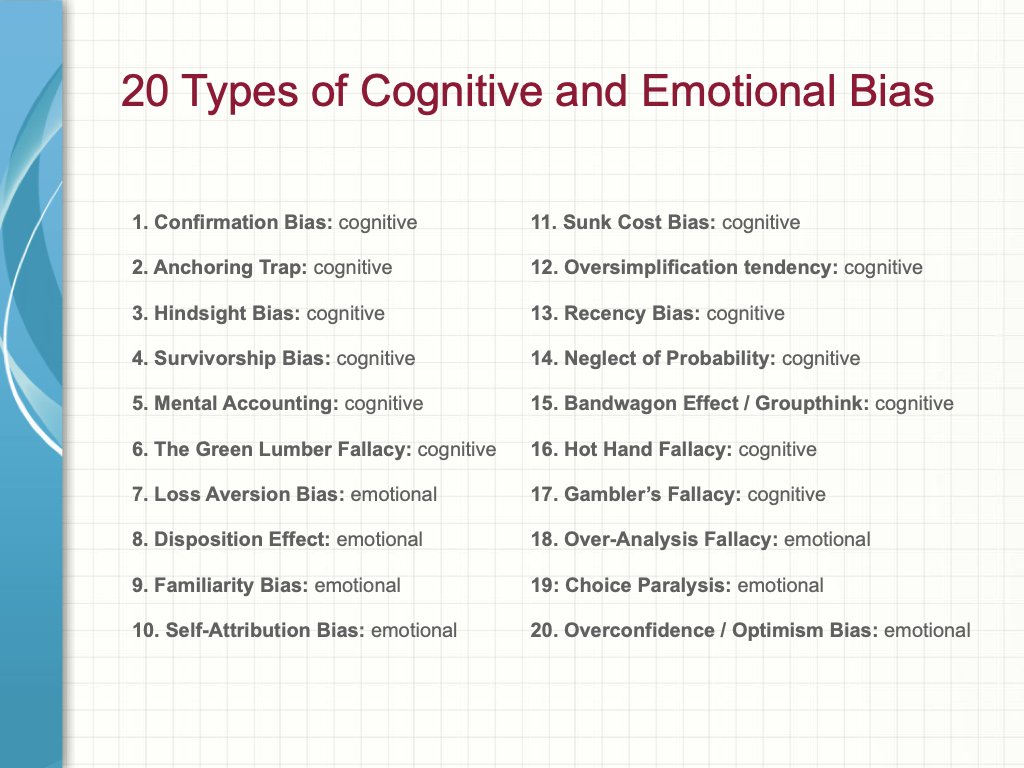
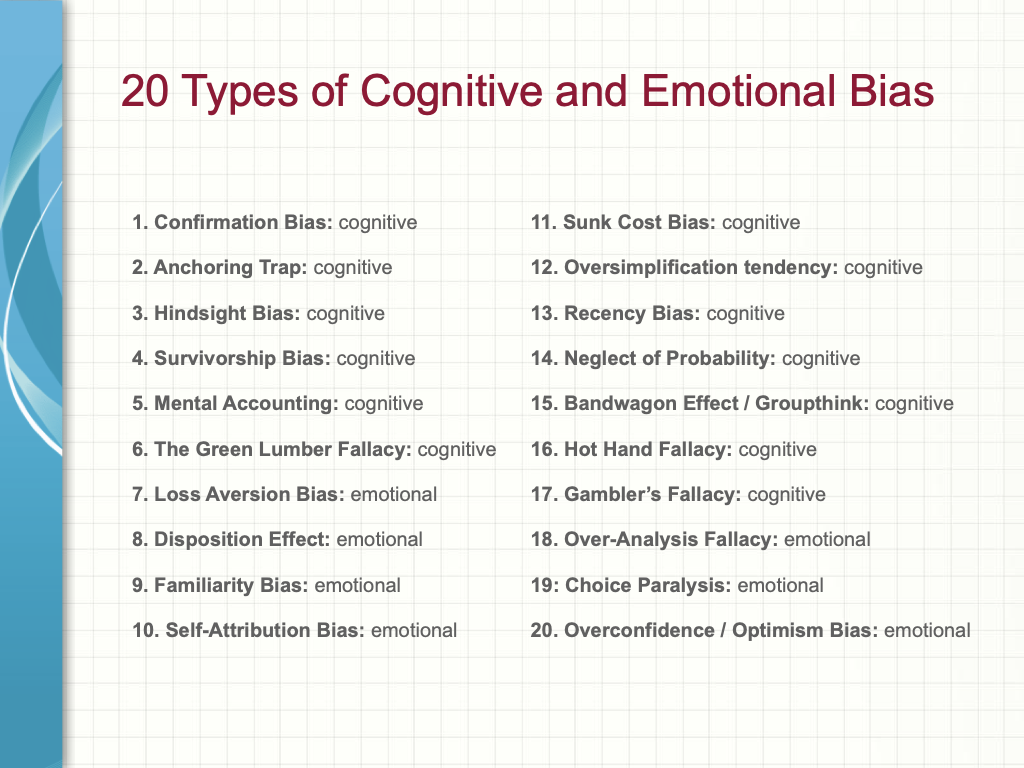
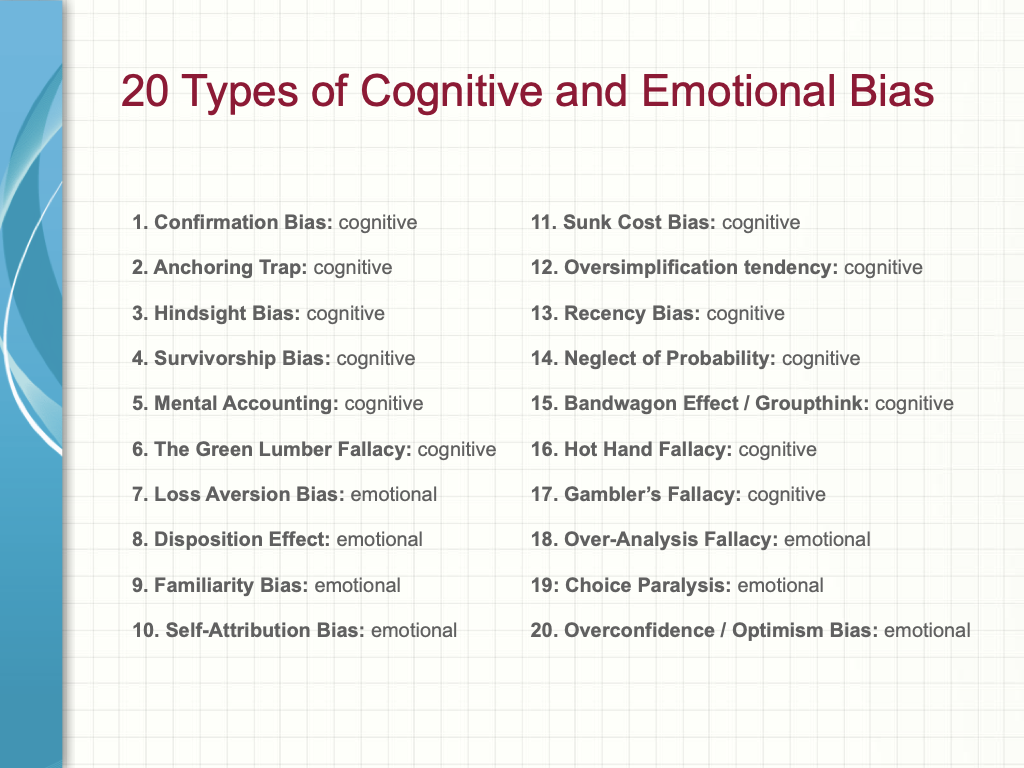
There are two categories of biases: cognitive bias and emotional bias. Cognitive biases involve basing decisions on established concepts that may or may not be true. Emotional biases are often spontaneous. They involve basing decisions on individual feelings.
The bad news is that we can't get rid of cognitive and emotional biases. The good news? The better we understand them, the more often we can subvert them—or even leverage them for our own benefit.
The first step toward overcoming biases is to acknowledge that we have them. The most sophisticated thinkers fall prey to their own cognitive biases, so at least we're in good company. The second step is to take advantage of tools that can help balance out our own irrational tendencies.
Wise investors can limit the potential impact of behavioral biases by developing and focusing on their own systematic investment process (what to invest in, position sizing e.g. using Kelly criterion, when to sell, etc.). There are also recommendations specific to each type of bias to help avoid or overcome them.
In this 3 part series, I will go over 20 common traps / biases / fallacies that we face, and discuss how to outsmart them. I hope that this series will help the reader make better decisions, in investing and in life.
Let’s dive right in.
***1. Confirmation Bias:***
**What is it?**
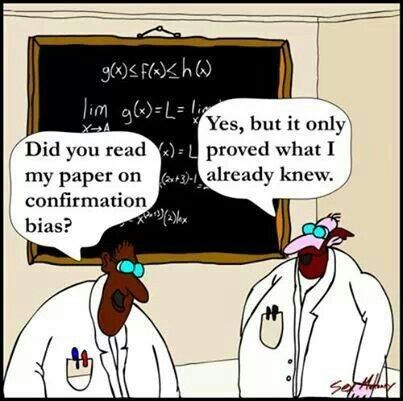
Once we make a decision, we want to be right, so we tend to block out information that might show we’ve made a mistake and pay attention only to data points that make us look smart. The confirmation bias is the tendency to seek information that confirms or favors your pre-existing belief or hypothesis, and to reject or trivialize any suggestion that disagrees with it.
When we become attached to our beliefs, we're really good at spotting facts that seem to support them. After all, it's easier to convince ourselves we're right than it is to consider another view.
All too often we feel more confident regarding a potential investment when we read comments by experts or other investors which validate, or confirm, our hypothesis and reasoning for investing in a company or cryptocurrency. Investors often watch financial news networks or read investment blogs, looking for individuals who lay out the same hypothesis they have regarding the stock or cryptocurrency and thus validating their basis for investment.
Confirmation bias is a basic human flaw: **We like to think we're always right**, and will go to great lengths to seek out information to uphold our preconceived notions.
**Why avoid confirmation bias?**
The problem with confirmation bias is that when we refuse to take in conflicting information, we filter out important data that could help us make more informed decisions. For example, you may get a "hot tip" about a company and focus on all the good news you read, while ignoring the bad news. Or when you identify a trading signal: You will notice the technical indicators which support your opinion, and not those against it. **Any bad idea can look good if you want it to work**.
The confirmation bias can have a really dangerous effect when investing. Investors will have a partial picture of a situation because of confirmation bias. Because of one-sided information which biases our frame of reference, we are prone to making flawed decisions.
Confirmation bias can enhance potential negative effects of other biases such as overconfidence, as we tend to believe the more “facts” we read and review, which often agree or relate to our view of the investment thesis, causes higher levels of conviction. This can lead to investors buying outsized positions or taking on excessive risk, as they believe the facts they have reviewed, which often simply validate their view, suggest an even higher level of conviction in any investment is justified or warranted.
**How to avoid confirmation bias?**
Investors should spend almost zero time in their investment process looking for confirmation of their thesis, but instead focus on **disproving their thesis** and understanding what in their views could be wrong and cause an alternative outcome to the one they believe is most certain. Unfortunately, investors are twice as likely to look for information that agrees with their thesis than they are to seek out disconfirming evidence.
When everything seems to support your market view or reinforcing your idea, stop! Reflect further and seek for reasons against your view. This can save you from slipping into the pit of over-confidence. **Seek out information that goes against your pre-existing beliefs**. If you think a project will succeed, go out of your way to brainstorm reasons it might not. Brainstorm. If possible, have three potential hypothesis instead of one. Do not rationalize conflicting evidence
Say for instance that you are looking for a stock that is friendly to the environment. At the same time, you have been looking at an oil company that has performed well lately. You start researching if this oil company is green. Then you come across an article saying that the company is ‘thinking’ about investing in solar panels. “Yes!”, this was exactly what you were looking for. The hypothesis was that this company was environmentally-friendly. Once you found an article “confirming” this, you stopped searching for more information. So you now have only information that confirms what you wanted. The most valuable research would actually be the opposite. **You will do better research if you try to break your hypothesis**. Try to find out if the company is an enemy of the environment. If you can't prove that, the investment is good (if you regard green investments as a goal).
The strength of many of history’s most accomplished scientists has been their ability to overcome their confirmation bias and to see all sides of a problem. Carl Jacobi, a famous 19th century mathematician, said: “**Invert, always invert.**”
***2. Anchoring Trap:***
The anchoring effect is the tendency to privilege the first information we encounter, even when subsequent information turns out to be more relevant or realistic. Anchoring is a phenomenon where someone values an initial piece of information too much to make subsequent judgments. For example, if you first see a T-shirt that costs $1,000 – then see a second one that costs $200 – you're prone to see the second shirt as cheap, even though both are really expensive.
People often take decisions based on the first piece of information they receive and stick to it. No matter what research says or how hard you try to convince them, nothing can change their opinion. This tendency to come to a decision based on the first bit of information you have is called anchoring bias.
That is why, in salary negotiations, it is recommended that you be the first to say a number: according to the anchoring effect, you've now set the expectations for the rest of the discussion.
An investment example is the electronics retailer Radio Shack. Once a thriving seller of personal electronics and gadgets in the 1990s, the chain was crushed by online retailers such as Amazon. Those trapped in the perception that Radio Shack was there to stay lost a lot of money as the company filed for bankruptcy and closed most of its stores.
Another example of this is holding on to the narrative that BTC is a good long-term store of value, and ignoring the fact that since 2017 it has become a failed coin with no utility.
**Why it is a problem:**
The anchoring bias makes you get “hung up” in a piece of information you are given. This may make it hard to change your mind if new information is made available. Charles Darwin said "It is not the strongest of the species that survives, nor the most intelligent that survives. It is the one that is most adaptable to change." If your mind is anchored, you will have a hard time adapting.
Since many investment decisions require multiple complex judgments, they're vulnerable to anchoring bias. Looking at past history can be a distraction.
For example, a person may hold on to a stock longer than they should because they've "anchored" on the higher price that they bought it at. The buying price biases their judgments about the stock's true value.
**How to avoid anchoring bias?**
In order to avoid this trap, you need to remain flexible in your thinking and open to new sources of information, while understanding the reality that any company can be here today and gone tomorrow.
Before investing your money based on the first piece of information that you get, try to counter question the fact. Put your own research to analyze if this information is even relevant to your investment objective. Sometimes you have to stop looking at past history, and assume it hasn't happened!
Take time to do research and make a decision. A comprehensive assessment of an asset's price helps reduce anchoring bias. Finally, be open to new information even if it doesn't necessarily align with what you've initially learned.
***3. Hindsight Bias:***
The hindsight bias is when you view an event that has happened as more predictable than it was. Hindsight bias is the misconception, after the fact, that one “always knew” that they were right.
Hindsight bias is a psychological phenomenon in which one becomes convinced that one accurately predicted an event before it occurred.
Consider the 2008 financial crisis or the dot-com bubble of the late 1990s. If you talk to many people now, they may state that all the signs were there and everyone knew it was coming. However, if you examine the history, you learn that analysts or investment professionals who were screaming that there was a problem at the time weren’t listened to, in fact, they were laughed at and investors largely ignored their warnings. If it was so obvious why did it happen and why did it affect so many people? Why didn’t all the people claiming that it was obvious short the market and become very rich?
**Why is it a problem?**
The danger of this bias is to take too many risks because you expect to see what is coming next time because the last event was so obvious.
It causes overconfidence in one's ability to predict other future events.
Hindsight bias prevents us from recognizing and learning from our mistakes. We talk about it as a limit to our learning because we tend to believe after the fact that we knew about something all along.
**How can we deal with hindsight bias?**
1. First, remind yourself that you can't predict the future.
2. Examine the data.
3. Record your thought process. Hindsight bias is revisionary.
4. Consider alternative outcomes. Make sure to list these, too.
5. Make your decision.
6. Analyze the outcome.
7. Use an investment diary, comparing outcomes to the reasoning behind our investment decisions, is a good way to keep this hindsight bias in check.
***4. Survivorship Bias:***
Survivorship bias or survival bias is the logical error of concentrating on the people or things that made it past some selection process and overlooking those that did not, typically because of their lack of visibility. People tend to focus on these survivors, even if they survived in large part due to **luck rather than viability**.
For example, a gym might feature those who have toned up quickly as a result of going to their facilities. But, of course, what they never show is those who signed up but achieved no more than a depleted bank account!
Survivorship bias comes into play when a person starts with a success story, whether it be a successful entrepreneur, a world-champion athlete or a billionaire stock investor, and attempts to reverse-engineer a personal pathway to similar success. The presumption is if I do exactly what this billionaire investor or entrepreneur did, I will be a success just like he or she was.
In reality, the most successful outliers on Wall Street over any given short-term period almost always took some extreme amount of risk that just happened to pay off big. But just because a particular strategy worked one time for one person does not mean it is a good strategy for others.
The most common place you will find this bias is in investment courses, webinars, and consultancies. They often use it as a sales trick, disguised as “Check our cases of success”. **Nobody shows examples of failure.**
Survivorship bias is best summed up as "**dead men don't tell tales**."
***5. Mental Accounting:***
Mental accounting, also known as "**two-pocket**" theory, is the concept of giving money different value depending on the source. It is where people treat money differently depending on where it came from and what we think it should be used for.
Would you say that $500 from X is worth more than $500 from Y? No, probably not. You don’t know what X and Y are, and $500 is therefore worth the same to you. What if I say that X is your salary and Y is from a large work bonus? Would you be more likely to spend the $500 from the unexpected bonus on some unnecessary luxury items? Yes, that is more likely. But should it be like that? No, whatever the sources are, you have a total of $1,000 and that is what you should take into consideration when deciding what to do with the money.
The idea is that we separate our money into "**mental accounts**" for different uses, which influences our spending decisions. We guard some money cautiously when we mentally categorize it for a house, but spend it liberally when it's "fun money”.
Another example of mental accounting is people's willingness to pay more for goods when using credit cards than if they are paying with cash.
**Why is mental accounting a problem?**
Mental accounting can sometimes hurt your bottom line. It can confuse your financial priorities.
For example, investors are, as a group, highly prone to the “money you can afford to lose” variant of mental accounting. Under this notion, investors view some arbitrary amount of their investment capital as “play money” which they feel comfortable squandering on speculative and uncertain things. At first glance, this appears to be a sensible decision-making. It seems prudent to clearly delineate between money that matters and money that doesn’t. The problem, of course, is that “money you can afford to lose” is a purely mental creation.
**How to overcome mental accounting:**
Stop keeping everything in your mind and write it down. Create a **budget** to guide your financial decisions and better determine when to save versus spend money. And create a plan for how to spend windfall gains, like an inheritance or work bonus, ahead of time.
-
In Part 2 and Part 3 of this series, we will continue going through the rest of 20 selected types of biases.
Stay tuned, and please be alert to these biases in your life and investment decisions! https://read.cash/@Omar/the-tricks-your-mind-plays-on-you-20-biases-that-impact-your-investment-success-part-23-f04e8c31 https://read.cash/@Omar/the-tricks-your-mind-plays-on-you-20-biases-that-impact-your-investment-success-part-33-77a6a688
Thank you for reading. Feedback is much appreciated. - Omar
Using the Kelly Criterion to Maximize Investment Profits: A Practical Guide
The Best Investment Deserves The Largest Exposure - Marc De Mesel
*****Introduction*****
When an investor puts his or her money in the market, their aim is to make as much money as possible at the lowest level of risk.
You might think "I am not an investor, I don't have much money". In reality, most of us are investors, one way or another. Whether it is putting down the deposit for your first car, the lease for your apartment, or whether to buy more Bitcoin Cash in addition to what you earned on read.cash or buy some Ethereum instead, you are making investment decisions in various sizes.
There is one question smart investors ask themselves every time they are about to make an investment decision. Is the amount I am allocating and committing to this investment too large? Too small? Can I afford the size of this bet? Will I regret it later?
You might wonder if there was a framework or a criterion that one could use to get these answers. It turns out there is. We just need to focus on the question we want to answer. If we want to maximize the long-term growth rate of wealth, one of the answers (actually, the scientifically tested best answer) is **optimizing the bet size** using the Kelly criterion.
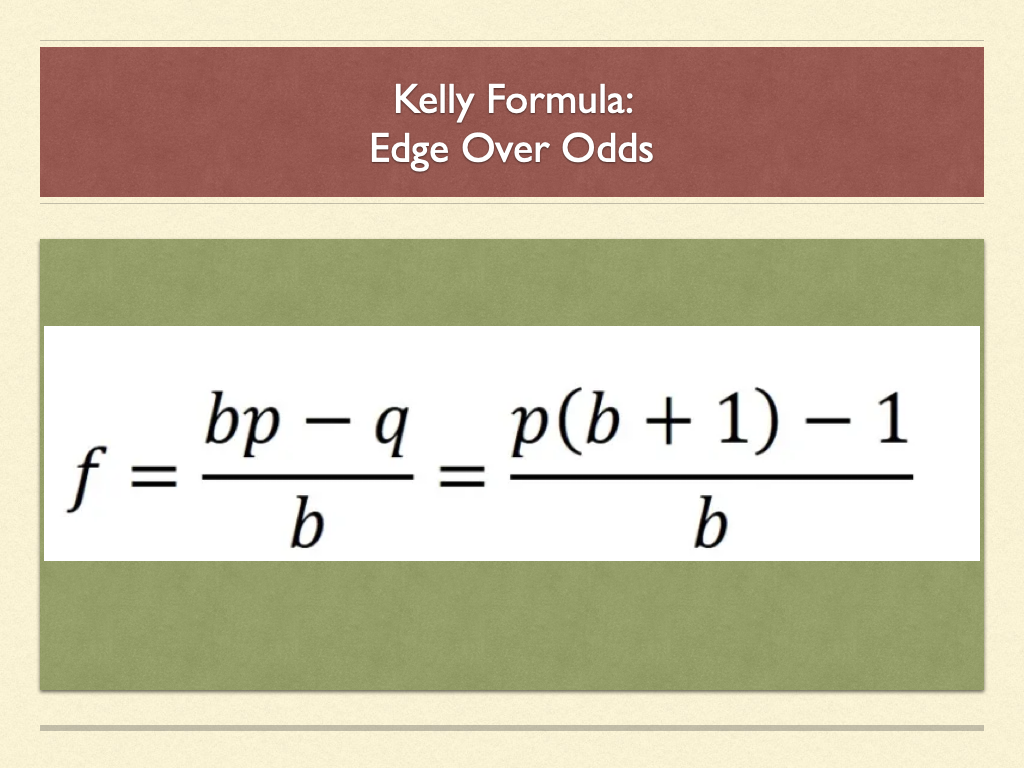
Kelly criterion is a mathematical formula for investment position sizing. It helps you determine the percentage of your capital you should bet on any given circumstance, **assuming you have an advantage**. The goal of the equation is this: **don’t go broke.**
**Kelly’s criterion**, Kelly’s formula, Kelly’s bet and Kelly’s strategy all refer to the paper written by John L. Kelly, Jr. in 1956 that explored the relationship between the rate of growth of wealth and bet size. Kelly was an American scientist who worked as a researcher at AT&T’s Bell Labs. He originally developed the formula to help the company with its long-distance telephone signal noise issues. Later, it was picked up upon by the betting community, who realized its value as an optimal betting system since it would allow gamblers to maximize the size of their earnings. Kelly criterion typically leads to **higher wealth in the long run** compared to other types of strategies. https://www.princeton.edu/~wbialek/rome/refs/kelly_56.pdf
Although it was reported that Kelly never used his formula for personal gain, it is still quite popular today and is used as a general money management system for investing. The Kelly capital growth strategy has been used successfully by many prominent investors, such as **Warren Buffet** of Berkshire Hathaway, and **Marc De Mesel** who quotes the Kelly criterion in his videos and shares his estimates and Kelly calculations of his investment portfolio in a spreadsheet format. You can find those spreadsheets labeled as "Crypto Investment Plan" in the description section of some of his Youtube videos.
One might wonder what a criterion focused on betting and gambling has to do with investing. The answer is that, after researching an investment decision, it becomes a decision with inherent risk and a lot of unknowns, just like gambling. I might dislike gambling and the notion that I am gambling with my money, but whether I am buying a house, investing in gold, or in Apple company stock, I am exposed to various types of **risk** (weather, economy, currency exchange rates, wars, pancemics, etc.). That is why, the term "bet size" is also used to refer to investment position size.
*****How do you determine the size of your bet?*****
If you, like me, can get intimidated by math equations, don't worry; no more math after this point!
The Kelly criterion can be simplified as:
***Edge / Odds = Fraction of capital that should be allocated***
The edge is the amount you are likely to win (on average over multiple bets).
The odds are the assessment or likelihood of that win.
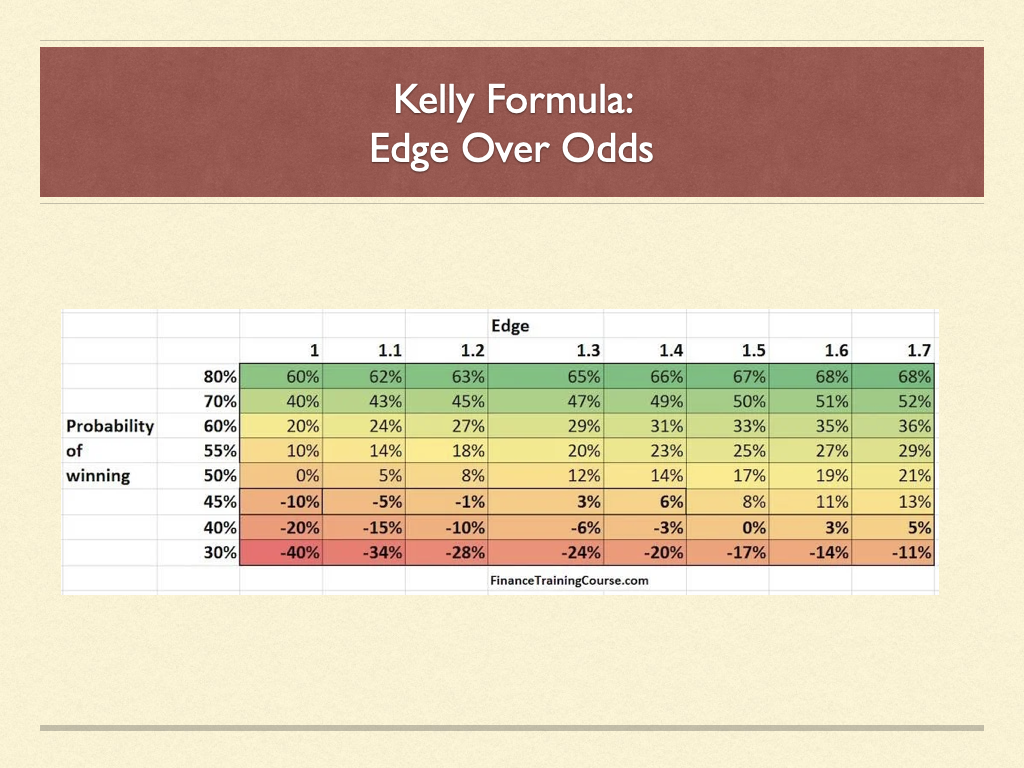
How would optimal bet sizes vary with changes in the probability of winning and edge? If the odd were in your favor (80% chance of winning) and your edge stood at 1.2, should you bet the entire bank or only part of your capital? The table below presents optimal bet sizes based on Kelly for changing values of edge and odds.
The vertical index lists a scale of probabilities that goes from high to low as we move from top to bottom. These figures represent the probability of winning the bet. the horizontal index lists increasing edge as we move from left to right. The numbers listed in the table represent estimated bet sizes using Kelly’s criterion for each cell. For instance with a **60%** probability of winning and **1.5** edge, the recommended Kelly’s criterion bet is **33%** of your investment capital.
The color coding shows areas of strong promise (**shades of green**), neutral (**between lime green and yellow**) and unfavorable (**ocher and hints of red to red**).
Even the best odds (**80% chance of winning**) and a reasonable edge (**1.4**) lead to a bet size of **2/3 of your capital**. Remember under Kelly the objective is to not maximize expected payoff but growth in capital. Growth in capital over multiple bets or seasons has a central condition: survival. If you have nothing left to bet, if you have depleted your capital, you are out of the game.
The next time you come across a sure thing, you know what to do.
Hold a part of your capital back, don’t bet the boat. Capital preservation, not accumulation is the key to maximizing wealth over a multi-period investing time horizon.
What dominates the determination of bet size? **Is it the probability of winning (your odds) or the pay off (your edge)?**
The answer is that the **probability of winning** is much more important than the edge. If you look at Table 2 above, you will notice that at higher probabilities of winning, an increase in payoff will only result in a slight increase in your bet size. Kelly is not going to recommend that you bet all your money. The model would still suggest that you hold some capital back. Again, the goal is: **don’t go broke.**
OK, let's see this strategy at work.
*****Putting It to Use*****
Frequent traders can easily put Kelly's system to use. If you are a trader, you can follow these simple steps:
The Kelly criterion is based on your previous trades.
Access your last 50 to 60 trades. You can do this by simply asking your broker or by checking your recent tax returns if you claimed all your trades. If you are a more advanced trader with a developed trading system, simply backtest the system and take those results. The Kelly criterion assumes, however, that you trade the same way now that you traded in the past.
Calculate "W"—the winning probability:
To do this, divide the number of trades that returned a positive amount by your total number of trades (both positive and negative). This number is better as it gets closer to one. Any number above 0.50 is good.
Calculate "R"—the win/loss ratio:
Do this by dividing the average gain of the positive trades by the average loss of the negative trades. You should have a number greater than one if your average gains are greater than your average losses. A result of less than one is manageable as long as the number of losing trades remains small.
Input these numbers into a **Kelly's equation calculator**. You can find a few of them online.
I like the one here: **dqydj.com/kelly-criterion-bet-calculator/** https://dqydj.com/kelly-criterion-bet-calculator/
Record the Kelly percentage that the equation returns. This is the percentage of your capital the Kelly criterion is recommending to invest.
The above is straightforward for frequent traders since they have a long hisotry of hundreds of trades. It is more challenging for investors, but they can still use the Kelly criterion to optimize returns. An investor just has to use estimates rather than exact calculations for the edge and odds.
*****A practical example: Ethereum*****
Suppose you did your research and you think that **Ethereum** is going to increase to **5 times** its current price. You estimate the probability of this happening to be **70 percent**.
You use the online calculator mentioned above. You put 0.7 in the probability field (70%). You enter 5 in the "odds" field. You calculate and get **64%**. Kelly criterion recommends that you allocate 64% of your capital to this trade for optimal growth. https://dqydj.com/kelly-criterion-bet-calculator/
***Full Kelly, fractional Kelly and rebalancing***
Just because Kelly suggests that you should bet 64% of your pool of capital, should you? The answer is no.
Your estimates of odds and edge are most likely inaccurate and off. While the Kelly strategy will outperform all other strategies over time, the required time duration for Kelly to outperform may surprise you. Depending on the value of parameters that define your market and your bet, the time required for Kelly to outperform all other strategies with a certain degree of confidence may range anywhere from **80 years to 200 years**. With shorter time frames, randomness and risks can be more exaggerated, so a more conservative approach is wise.
Which brings us to fractional Kelly strategies. Models that don’t be the entire amount recommended by Kelly but some fraction. There are different opinions on how effective this approach is, but there is consensus that a fractional Kelly approach leads to lower short term risk at the cost of giving up potential upside. In other words, fractional Kelly strategies provide more security (less risk) but with less growth.
So for the above example with Ethereum, you might want to use **half Kelly**, or **32%** of your investment capital on that trade for a more conservative approach.
A second element is **rebalancing** and fixed portfolio weights:
Your original strategy and allocated weights go out of alignment as soon as any one position outperforms the others. You may want to regularly review your investments and rebalance your positions (adjust actual dollar value by buying and selling) to get the weights back in alignment. This helps with performance over a multi-period investment horizon but adds to transaction and execution costs. Despite these costs, rebalancing leads to better performance when compared to strategies without rebalancing.
*****Summary*****
The Kelly Criterion is a money management tool that helps you calculate how much money you can afford to risk on each new trading position.
It calculates a Kelly percentage number based on how much profit or loss you have made on similar trades in the past, or based on your estimates of edge and odds.
This number tells you what percentage of your trading account you could sensibly risk on this kind of trade now.
Market conditions will affect the outcome of any trade, so make sure that you only include in your calculation trades that were taken during similar market conditions as those in effect now.
Do not over-rely on the Kelly criterion to judge position sizes and risk tolerance. Whatever it tells you, never risk more than your usual maximum risk level. Consider using fractional Kelly calculations.
That is all. I hope this was a useful introduction to the principles of the Kelly criterion. There is a lot more details related to this strategy, with advanced concepts and complicated math. But what I personally like about the Kelly strategy is that it can be used by anyone to help with the investment position size determination. You can use an online calculator, enter your estimates of the probability and odds, and calculate the Kelly percentage. You can then take a fraction of that result, according to your level of risk tolerance, and allocate that much percentage of your money to your desired investment.
**Thank you for reading!**
*****References and Recommended Further Reading*****
Calculator: **dqydj.com/kelly-criterion-bet-calculator/** https://dqydj.com/kelly-criterion-bet-calculator/
https://financetrainingcourse.com/education/2019/10/kelly-criterion-founders-startups-optimal-betsize/
The Kelly’s Criterion in Blackjack, sports betting and the stock market, Ed Thorp, 2007 – https://wayback.archive-it.org/all/20090320125959/http://www.edwardothorp.com/sitebuildercontent/sitebuilderfiles/KellyCriterion2007.pdf
https://demonetizedblog.com/2019/02/23/edge-over-odds/
http://home.williampoundstone.net/Kelly.htm
The Dhandho Investor: The Low-Risk Value Method to High Returns. 1st Edition.
What is Bitcoin? The whitepaper as a guide for the rest of us
Hello readers!
The following is a reading through the bitcoin whitepaper, and an attempt to summarize it by a non-technical person. I have been interested in Bitcoin since 2015. Bitcoin and the principles it stands for (decentralized sound money that is free from inflation and censorship; in a voluntarist world with free markets) have become a way of life for me since then.
I kept reading up and learning about Bitcoin and its technology. I also followed the discussions on reddit and other platforms. However, I found that most of these discussions are among the developers and the technology experts. I thought there has to be a lot of people like myself.
In this article, I try to read through the whitepaper as a person with a limited (but not zero!) technical background. It is a difficult task summarizing a 9 pages long technical paper in a few paragraphs, but I will do my best. You will find a few slides for illustration of some of the basic concepts, and a commentary at the end.
OK, thank you Omar, but what is the whitepaper anyway?
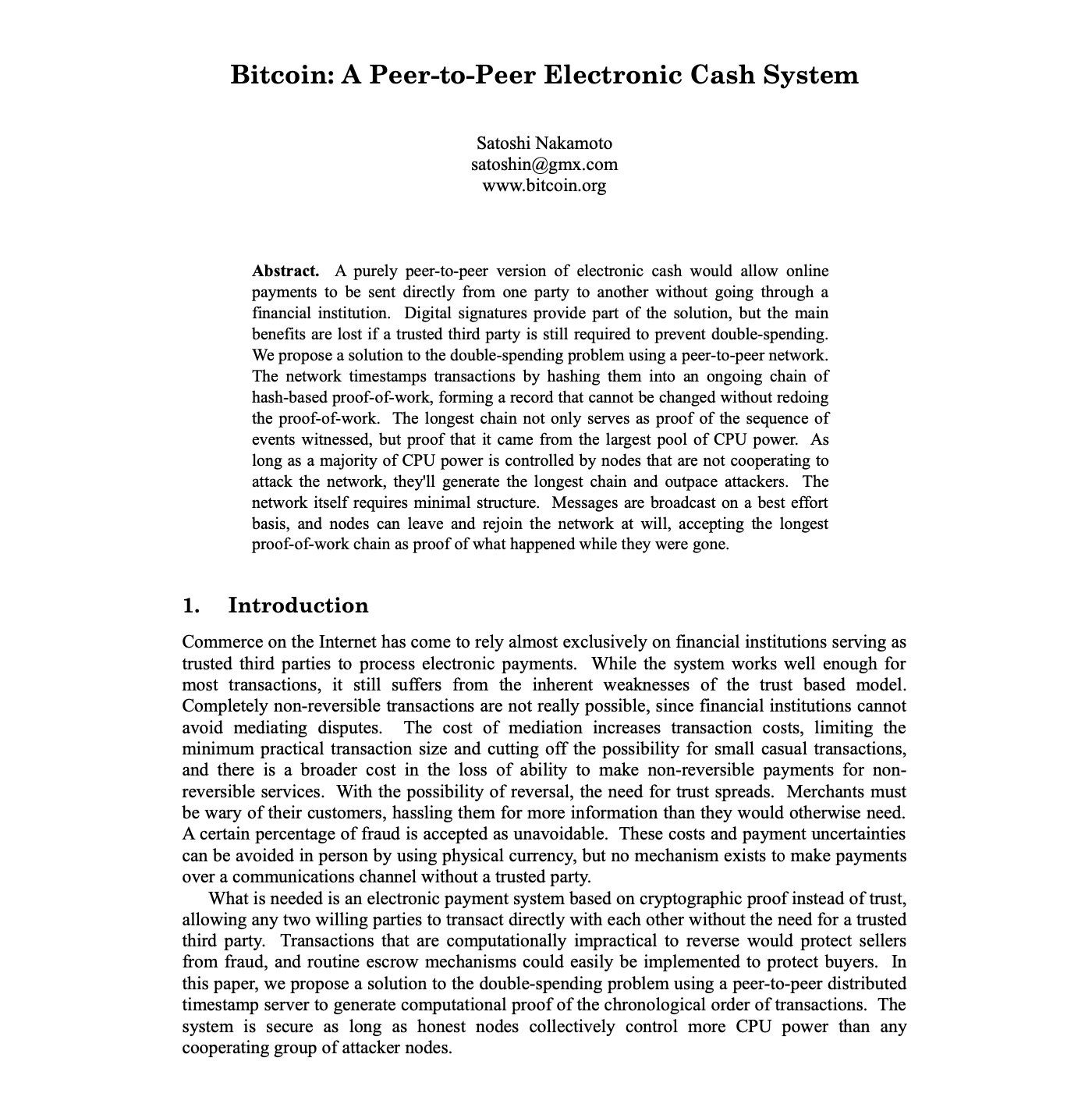
The Bitcoin whitepaper by Satoshi Nakamoto was the first document to outline the principles of a cryptographically secured, trustless, peer-to-peer electronic payment system that was designed to be transparent and censorship-resistant, as well as put financial control back in the hands of the individual. https://www.bitcoin.com/bitcoin.pdf
So who is Satoshi Nakamoto?
In short, nobody really knows. Satoshi has chosen to keep his/her identity a secret. It has been the subject of much speculation. While Satoshi's identity may be interesting, it is the ideas that are truly revolutionary. Satoshi announced the invention of Bitcoin in a forum post here on February 11, 2009. http://p2pfoundation.ning.com/forum/topics/bitcoin-open-source?id=2003008%3ATopic%3A9402&page=1
OK, back to the whitepaper, let's dive right in.
Bitcoin: A Peer-to-Peer Electronic Cash System
The Bitcoin whitepaper is 9 pages long and consists of an abstract and 12 sections.
**Bitcoin Whitepaper: ABSTRACT**
Satoshi Nakamoto outlines:
The Problem:
There is no way of making **peer-to-peer payments** online that bypass financial institutions. Some solutions exist that utilize digital signatures, but these require a trusted third party to ensure that the digital value is not spent more than once.
The Solution:
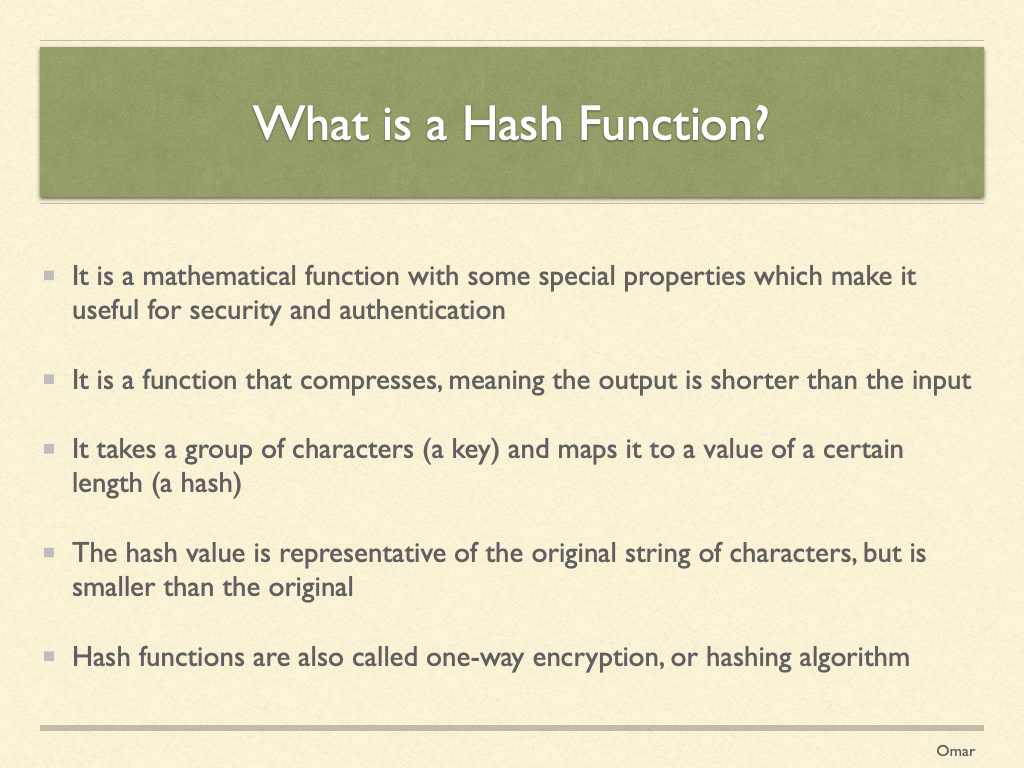
A pure **peer-to-peer network** that "hashes" transactions, using cryptography, into a chain of hash-based proof-of-work records.
The chain provides proof of the chronological sequence of transactions and the verification from “honest” nodes that collectively control the largest pool of CPU power.
1. INTRODUCTION
Satoshi discusses the inefficiencies of online commerce: reliance on financial institutions and the need for trusted parties to process payments. There is a need for an electronic payment system that: 1) uses cryptographic proof rather than trust, 2) enables parties to transaction directly with one another bypassing any central or trusted third party, and 3) protects sellers from fraud.
2. TRANSACTIONS
Satoshi explains that Bitcoin is a **chain of digital signatures**.
Every owner of an electronic coin passes it to the next owner by digitally signing: A hash of the previous transaction and the public key of the new owner, and adding the above 2 components to the end of the coin.
The new owner is in turn able to verify the signatures which in turn allows him/her to verify the ownership of the electronic coin.
In order to achieve the above without a trusted third party requires that the transactions are declared publicly, and confirmed through a system whereby all participants (nodes) agree the history and order in which the transaction was received.
3. TIMESTAMP SERVER:
The timestamp server is software that takes the hash of a **block** of transactions, timestamps them and publicly broadcasts the hash.
This hash serves as proof that a block of transactions existed at a given time, which allows network participants to verify the order in which blocks of transactions were broadcasted.
Each block's timestamp includes the previous block's timestamp, creating a chain, and as new timestamp hashes are added, the chronological order and links are strengthened.
4. PROOF OF WORK:
Satoshi explains that implementing a distributed timestamp server requires a proof of work system. Proof of work requires scanning for a value using an algorithm, which when hashed the hash value starts with a number of zero-bits.
POW is a verification process which requires significant CPU effort, and ensures that a verified block cannot be changed because all later blocks that are chained to it will also need to be changed (each subsequent block would need to be verified, requiring increasing CPU). It provides one vote per CPU, not by IP address; otherwise an attacker may allocate several IPs in an attempt to hack the network.
5. NETWORK:
This section outlines the process required to run the network. New transactions must be transmitted to all nodes.
Each node gathers each transaction into a block, nodes accept the block if all the transactions within it are valid and not already spent.
Nodes continue to work on the longest chain, which is always the correct one.
6. INCENTIVE:
The goal in the peer to peer electronic cash system is to encourage nodes to connect to the network and validate transactions.
In order to generate new blocks and therefore coins (value), CPU and electricity are needed.
7. RECLAIMING DISK SPACE:
Any old transactions can be removed to save disk space, transactions are hashed in a "Merkle Tree".
This allows for old blocks to be consolidated by essentially removing the tree branches, but keeping the root.
8. SIMPLIFIED PAYMENT VERIFICATION:
Payment verification is possible without running a full network node by: getting a copy of the block headers of the longest proof-of-work chain, verifying that you have the longest chain, and linking the transaction to the chain.
9. COMBINING AND SPLITTING VALUE:
To allow value to be divided and merged, transactions contain various inputs and outputs. e.g., a single input from a large transaction, or many smaller inputs.
10. PRIVACY:
Limiting access to information is not workable in a model where the transactions are broadcast publicly, but the need for privacy is still important. Privacy is maintained by keeping public keys anonymous. While everyone may be able to see transactions, no identifiable information is distributed.
11. CALCULATIONS:
This is the longest section in the whitepaper, and the calculations require a somewhat advanced understanding of mathematics.
Here, the paper considers a scenario where bad actors in the system try to generate an alternative chain faster than the honest chain. In this scenario there is a race between the honest chain and an attacker chain. This section proves that the odds are against the attacker chain.
12. CONCLUSION:
The whitepaper concludes:
Where honest nodes control the majority of CPU power, a peer-to-peer network that uses proof-of-work to record public transactions makes it computationally impractical for attackers to tamper with.
The network strength lies in its unstructured simplicity.
Nodes working independently with little coordination, they can leave and rejoin the network as they wish, relying on the proof-of-work chain as proof of what happened while they were gone.
Nodes vote with their CPU power.
Rules and incentives are enforced through the consensus mechanism.
Congratulations!
We have finished reading through the whitepaper. I hope that this summary gave you an idea of what the whitepaper describes and its main concepts.
****Thoughts and comments:****
The Bitcoin whitepaper is an interesting read, even for the non-technically inclined like myself.
As much as the technical descriptions in the whitepaper are intriguing, the non-technical messages are straightforward, clear, and very important for anyone interested in Bitcoin, since they convey the true vision of the designer of this great invention.
A brief history: As Bitcoin became more widely used, a debate on how best to increase its capacity started among developers "scaling debate". The "big blockers" wanted to increase the maximum block size to allow Bitcoin to scale on-chain. The other side was pushing for keeping a limit on the block size.
While both sides had valid technical arguments, it became clear that the small block group was intentionally aiming to limit the network capacity to push for their "Layer 2" solutions: making money by offering commercial solutions to the network congestion problems by handling transactions off-chain.
The scaling debate ended with the activation of "SegWit2x" hard fork of Bitcoin, and Bitcoin split in August 2017. Bitcoin Cash was born, allowing larger blocks. The new SegWit2x coin managed to keep the Bitcoin name; even though technically, SegWit (BTC) is the one that forked away from the original Bitcoin.
In fact, the United States National Institute of Standards and Technology published a document: “Interagency Report: Blockchain Technology Overview” in 2018. **Page 41** reads "When SegWit was activated, it caused a hard fork, and all the mining nodes and users who did not want to change started calling the original Bitcoin blockchain Bitcoin Cash (BCC). Technically, Bitcoin is a fork and Bitcoin Cash is the original blockchain.". https://csrc.nist.gov/CSRC/media/Publications/nistir/8202/draft/documents/nistir8202-draft.pdf
More importantly, looking at the whitepaper, it is clear that BTC is the coin that diverged from Satoshi's original description, while Bitcoin Cash BCH kept the original vision. It is clear that Satoshi wanted to create "peer-to-peer electronic cash", not a settlement layer, digital gold or "hodler" coin that is useless in commerce. BTC, is that you?
Satoshi specifically wrote against the need for trusted parties to process payments. The congested BTC blockchain with a limited block size pushes users towards trusted third parties. BTC "maximalists" who say "if you want cheap transactions, just use PayPal or Visa" have clearly not read the whitepaper.
Everything in the whitepaper favors BCH over BTC: "electronic cash system", "small casual transactions". It is as if it is saying: "BCH is the real Bitcoin".
Unfortunately, with the 2017 Bitcoin split, BTC kept the Bitcoin name and a lot of the "infrastructure". Bitcoin Cash BCH, while being the better and more usable version of Bitcoin, had to start from a much earlier stage in adoption.
Because of the high fees and congested network, BTC's user experience has become so bad that BTC became practically useless as money. Unfortunately, this led to people and businesses turning away from using Bitcoin (negative adoption). BTC became a speculation coin. While BTC maximalists talk about "HODL"ing, the usual practice among BCH proponents is "spend and replace".
The argument that BTC has "evolved" into a store of value and a new "electronic gold" contradicts the Menger-Mises theory of the origin of money. Store of value is a **secondary** function of money which depends on its utility in its primary function as a **medium of exchange**.
One might think that the BTC problems are temporary, and that a technical solution will be found. The issue is that there is an **artificial** cap on the BTC block size. It is not a technical problem, it is a commercial and ideological decision.
I like this table illustrating the differences between BTC and BCH.
Credit: Roger Ver https://twitter.com/rogerkver/status/1037395600965292033
With a functional and scalable network (BCH), a lot of exciting things become possible, such as: micro-transactions like the ones powering this site and noise.cash, CashFusion and CashShuffle privacy solutions, SLP tokens, and the upcoming Smart Bitcoin Cash, which has all of Ethereum 2.0 functionalities (programmable money) on a side-chain of Bitcoin Cash. https://smartbch.org
None of the above is possible on BTC. The only advantage BTC still has is holding the Bitcoin name and brand, for now!
I hope that this article gave you some useful thoughts about Bitcoin, right from the original whitepaper.
Thank you for reading!
****Suggested further readings:****
Bitcoin Whitepaper: a beginner's guide An excellent resource from bitcoin.com. Highly recommended if you want to take your reading of the whitepaper one step further. https://www.bitcoin.com/get-started/bitcoin-white-paper-beginner-guide/
The Economics of BTC Maximalism by Sal Mayweather "Sal the Agorist". https://www.newlibertarian.io/2019/08/the-economics-of-btc-maximalism.html
Why does Bitcoin have Ridiculously High Fees and Slow Confirmations? by Jonald Fyookball. https://medium.com/@jonaldfyookball/why-does-bitcoin-have-ridiculously-high-fees-and-slow-confirmations-e3fd58258a6d
The Great Bitcoin Scaling Debate - A Timeline by Daniel Morgan. https://medium.com/hackernoon/the-great-bitcoin-scaling-debate-a-timeline-6108081dbada
Bitcoin Didn’t Die 323 Times. Just Twice by Jonald Fyookball. https://medium.com/@jonaldfyookball/bitcoin-didnt-die-323-times-just-twice-6dd0b76f4a37
How Digital Currency Will Change The World by Brian Armstrong. https://blog.coinbase.com/how-digital-currency-will-change-the-world-310663fe4332
BTC Devs: “It Works Great For Very Large, Unimportant Transactions” -sarcasm, from thesoontimes.com; a website that is full of nice Bitcoin humor. https://thesoontimes.com/2021/02/25/btc-devs-it-works-great-for-very-large-unimportant-transactions/
A first look at the Moeing Chain whitepaper
Hello readers,
The following is a first look at the exciting upcoming Moeing Chain whitepaper. https://read.cash/@fixthetracking/seven-reasons-you-should-be-excited-for-moeing-chain-7255b95e
As far as I know, it is not officially released. However, this is the whitepaper document which became publicly available on GitHub a few hours ago. There is also a Chinese version. https://github.com/moeing-chain/docs/blob/main/whitepaper/MoeingChainWhitepaper-en.md https://github.com/moeing-chain/docs/blob/main/whitepaper/MoeingChainWhitepaper-cn.md
Please note again that this is not an official announcement yet, and probably still a work in progress (it is labeled as initial version), but I was so excited I thought I could share this.
Beginning of document
Moeing Chain: a Bitcoin Cash Sidechain with EVM&Web3 compatibility
Abstract
While Bitcoin Cash aims to provide a decentralized, high-throughput, low-cost, and easy-to-use infrastructure for cryptocurrency, any changes to the mainnet require a high consensus, therefore, hindering the trial-and-error process.
So, we decided to develop Moeing chain - a sidechain for Bitcoin Cash and with an aim to explore new ideas and unlock possibilities. It will be compatible with Ethereum's EVM and Web3 API for they are the de facto standards for blockchain DApps nowadays.
Ethereum is solving the issues related to low-throughput and high-cost by switching to ETH2.0, which, as we all know, still requires years of development to finish. Moeing chain attempts to tackle these issues differently: to optimize the implementation of EVM and Web3 low-level in order to fully leverage the potential of hardware, especially its inherent parallelism. We believe that Moeing chain will provide the same benefits of ETH2.0 in a much shorter while.
Motivation
Different people want different new features from Bitcoin Cash.
Bitcoin Cash's block interval remains to be 10 minutes, which is too long by comparison, as there are other chains offering intervals of seconds. Although Bitcoin Cash supports secure zero-confirm transactions, complex scenarios besides payment need short confirmation time for better user experience, such as DeFi.
Bitcoin Cash has a limited script system which is not Turing-complete, making it more difficult to use than Ethereum's EVM. Also, it is by contrast less capable as, undoubtedly, EVM and Solidity offer the best ecosystem and encompass the most programmers among all the smart contract platforms. It's a pity they cannot be utilized in Bitcoin Cash's ecosystem.
Currently, Bitcoin Cash's capability has been proven to reach 14MB. Although at this moment its block size is only 0.8 MB approximately, it is growing fast: more than 3 times since the beginning of 2021. If it keeps growing at such a rate, 14MB would be not enough in the near future. Since issues surrounding block size larger than 14MB remain unknown issues and have not been field tested, it would be best to begin getting prepared for the further scaling up of Bitcoin Cash's throughput. https://news.bitcoin.com/new-bitcoin-cash-stress-test-sees-700000-transactions-in-one-day/
What can Moeing contribute to the Bitcoin Cash ecosystem? Well, it builds a new playground for new features practice: it has a short confirmation time, supports EVM and Web3 with novel optimizations to provide higher throughput, and also provides new channels for one to invite more users to join Bitcoin Cash's ecosystem.
As Moeing chain is growing more mature, the developed libraries and the learned lessons will help with the improvement of the Bitcoin Cash's mainnet too.
Background
It has been 8 years since Vitalik Buterin proposed Ethereum in 2013. Smart contract was born, bred, and has been blooming ever since. Ethereum is now the most successful smart contract platform, and we may examine its ecosystem as well as make observations from it:
**The single chain's user experience is hard to be approached through sharding or layer2 solutions**. Zero latency and atomic interoperation between smart contracts is only possible within the same chain. The cross-shard or layer2-to-layer1 interoperation must undergo an interchain communication process, which prompts latencies similar to deposit and withdraw at centralized exchanges. Some famous mechanisms, such as flash loan and flash swap, would not work crosschain. https://wwz.unibas.ch/fileadmin/user_upload/wwz/00_Professuren/Schaer_DLTFintech/Lehre/MA_Florian_Gronde_Flashloans-ohne_Appendix.pdf https://uniswap.org/docs/v2/core-concepts/flash-swaps/
**Low-throughput deters ordinary users from interacting directly with DApps**. The gas upper bound is fixed for each block, and miners pack the transactions with a high gas fee first. Meanwhile, transactions with a low gas fee must wait a long time to be packed into a block or never get packed at all. Naturally, only high-value transactions are worth a high gas fee. So, ordinary users who cannot afford so can only deposit their funds into centralized organizations, then delegate them to operate their funds. In the DeFi world, only a small number of accounts are sending transactions. These accounts have a lot of funds, either because they own a lot, or because they gather a lot from ordinary users. Ironically, today's decentralized finance is not so decentralized.
**Storage costs more resources than computation when executing smart contracts**. In the history of Ethereum, the storage's gas cost has been increased by two EIPs: EIP-1884 and EIP-2200. But that is not enough, as Research shows that Ethereum still underestimates certain storage operations, making it susceptible to DoS attacks. So, another EIP-2929 is about to increase the gas of high storage operations again in the upcoming Berlin hard fork. At the same time, the 256bit arithmetic of EVM is speeded up substantially by new libraries from Martin Holst Swende and Paweł Bylica. https://eips.ethereum.org/EIPS/eip-1884 https://github.com/ethereum/EIPs/blob/master/EIPS/eip-2200.md https://arxiv.org/pdf/1909.07220.pdf https://github.com/ethereum/EIPs/blob/master/EIPS/eip-2929.md https://github.com/holiman/uint256 https://github.com/chfast/intx
**Off-chain QPS (query per second) is as important as on-chain TPS (transaction per second)**. A Dapp works by not only sending a transaction for execution but also querying the latest onchain state and the chain's historical events. Though a transaction is executed only once, the corresponding events and state changes may be queried many times. So the total requirements for QPS are much higher than TPS. In Ethereum's ecosystem, the queries are made through Web3 API, the largest provider of which is Infura. Infura maintains an optimized Web3 implementation, which is better than standard full node clients, such as go-ethereum, but is not open-sourced. Many developers choose to use Infura's low-cost service instead of running their full nodes. Consequently, when Infura experiences a severe service interruption, many Dapps and exchanges would fail to work. https://blog.infura.io/faster-logs-and-events-e43e2fa13773/ https://github.com/ethereum/go-ethereum https://blog.infura.io/infura-mainnet-outage-post-mortem-2020-11-11/
**Users are quite tolerant of transaction latency and do not pay much attention to the exact order of transactions**. Usually, we use a wallet such as MetaMask to sign transactions, for which a proper gas price is chosen before broadcast. To save gas fee, we often choose a lower gas price and expect the transaction to be confirmed in minutes or even hours, instead of in the next block. In some cases, some other transactions may be packed before yours, resulting in losses such as larger slippage. But most users can live with that.
We also observed that since 2013, the most important trend in computers being **CPUs have gone further in the direction of multi-core**. Let's compare a MacBook in 2013 and in 2021, and predict how it will be like in 2029:
Integrated circuit technology can hardly boost frequency further after 28nm; however, it does provide more transistor budget in the new generations. Designers may use these transistors to implement more and more CPU cores. In the last decade, surrounding all the novel programming languages hype is the easy leveraging of the potential of more CPU cores: channels and goroutines of Go, isolates of Dart, and fearless concurrency of Rust. https://medium.com/hootsuite-engineering/golang-routines-and-channels-dff7336eb457 https://medium.com/dartlang/dart-asynchronous-programming-isolates-and-event-loops-bffc3e296a6a https://doc.rust-lang.org/book/ch16-00-concurrency.html
The above observations shall guide the design and implementation of Moeing chain.
Moeing's Core Components
Moeing chain's innovation lies in libraries. Instead of inventing fancy consensus and cryptographic algorithms, we decided to adopt another methodology: to develop low-level libraries with the aim to fully uncover the hardware's potential, especially its inherent parallelism. Ordinary users and developers are provided with a compatibility layer supporting EVM and Web3, so the optimized low-level "close to the metal" libraries themselves remain concealed by this layer of abstraction.
With these powerful components, Moeing chain aims to enlarge the gas consumption every 15 seconds to one billion gas in the medium term. In the long run, overall throughput will be boosted further by adopting sharding and rollup.
**MoeingEVM**
MoeingEVM is a parallelized execution engine that currently manages multiple EVM contexts and executes multiple transactions. Based on an optimized EVM implementation from evmone, it can be observed that there are several novel techniques adopted to maximize transaction parallelism. https://github.com/ethereum/evmone
As multi-core CPUs become more and more popular, scalability would be hindered in the context of Ethereum's single-thread execution semantics, under the constraint of which speeding-up is very hard. But if we switch to multi-thread execution semantics, a better overall result would be achieved as multi-core CPUs can be utilized more easily and in a more straightforward manner.
So MoeingEVM is developed following the multi-thread execution semantics.
To fully utilize the inherent parallelism in modern hardware, we attempt to leverage two kinds of parallelisms:
The parallelism between consensus engine and transaction execution engine.
The parallelism among different transactions.
To make consensus engine and transaction execution engine work concurrently, MoeingEVM uses such a scheme: when a block is committed, the transactions in it would not be executed immediately. Instead, these transactions would be saved as a part of the world state. After they are saved, the Merkle root of the world state would be calculated and the next block will be proposed and determined; meanwhile, the saved transactions will be examined and executed.
To make EVMs run parallelly, we allow transactions from several blocks to be mixed and reordered. In each round, a bundle of independent transactions is picked and executed in parallel to achieve a higher degree of concurrency. After several rounds, all or part of the saved transactions get executed, whereas the remaining unexecuted transactions are saved back to the world state for later execution. Since transactions are always enforced into bundles and each bundle is executed in parallel, this scheme is named "**enforced-bundle parallelism**(EBP)".
EIP-2930 makes a transaction explicitly containing a list of addresses and storage keys that it plans to access. This list helps analyze the interdependence of transactions. In the future, MoeingEVM will utilize it to further boost the parallelism of transaction execution. https://eips.ethereum.org/EIPS/eip-2930
**MoeingADS**
Why are storage operations so expensive? Well, Ethereum’s storage engine MPT is absolutely the root cause.
Is it okay to skip MPT? Yes, many blockchains (including Bitcoin Cash) work well without it. However, as an authenticated data structure capable of proving what states do or do not exist in the world state, it remains very important for trustless and is the cornerstone for light clients and chain-crossing.
So we move forward to develop MoeingADS— another authenticated data structure capable of replacing MPT.
Ethereum’s storage engine has a two-layer architecture. The first is LevelDB and the second, MPT. On the other hand, blockchains such as Bitcoin Cash adopt a single-layer architecture for storage—using LevelDB to store UTXOs directly. MPT works on top of LevelDB to be an authenticated data structure, at the cost of a lower read&write throughput. Every time the EVM reads or writes the world state, MPT must perform several LevelDB operations, prompting multiple operations on the SSD, and resulting in the slowness of MPT.
MoeingADS uses a single-layer architecture, accessing the file system directly without having to use any other databases. It is a KV database that can provide existence and non-existence proof. With MoeingADS, reading a KV pair requires one read to disk, overwriting a KV pair requires one read and one write, inserting requires two reads and two writes, and deleting requires two reads and one writes. What’s more, the writes are appending, which is very SSD-friendly.
Experiments show that MoeingADS is even faster than LevelDB. The cost is the larger consumption of DRAM: each key-value pair demands about 16 bytes.
**MoeingDB**
Besides supporting MPT, LevelDB is also commonly used to store historical data such as blocks, transaction receipts, and logs. However, it is not optimized for blockchain workloads, which carry the following characteristics:
Read volume is much larger than write volume.
No need to support Read-Modify-Write atomic transactions.
Simple read/write locks are better than MVCC, as modifications are large batched writes for blocks https://en.wikipedia.org/wiki/Multiversion_concurrency_control
Poor spatial locality for efficient caching, which results from most keys being Hash IDs.
Susceptible to DDoS attack, unless cold data’s read latency has a reasonable upper bound.
MoeingDB is an application-specific database that stores blockchain history, and developed with the above characteristics in mind, enabling it to suit blockchain's workload best. Based on its features, an open-source high QPS Web3 API can be built, benefiting both Moeing chain and Ethereum. We hope that it will facilitate the Web3 API provider market to be more decentralized.
**MoeingKV**
MoeingKV is a KV storage much faster than LevelDB in reading and writing, at the cost of removing iteration support.
To support iterators, LevelDB involves a lot of trade-offs and optimizations. But in most cases, blockchain storage engines can work without iterators, with examples like Ethereum’s MPT and Bitcoin Cash’s UTXO storage.
In underlying data structure design and code implementation, MoeingKV produces trade-offs and optimizations to speed up normal read and write operations. So, it can replace LevelDB as a better “first layer” for MPT.
While MPT cannot be replaced by MoeingADS due to compatibility, one can use MoeingKV to support MPT. MPT backed by MoeingKV might not be as fast as MoeingADS, but it is much faster than one backed by LevelDB.
Though MoeingKV is not used in Moeing chain, its key ideas come from MoeingADS and MoeingDB. We particularly hope other projects may benefit from MoeingKV.
**MoeingAOT**
MoeingAOT is an ahead-of-time compiler for EVM.
EVM, which is adopted more commonly than other VMs like WebAssembly, is a de facto standard for smart contracts.
However, EVM lacks certain important speedup methods, such as ahead-of-time (AOT) compilers and just-in-time (JIT) compilers. In the software industry, almost every important VM has its AOT and/or JIT compilers, for example, JVM, ART VM, Javascript V8, DartVM, WebAssembly, LuaJIT, and GraalVM. We believe that it is about time that EVM has its compiler. And implementing an AOT one for it would be reasonable, since, unlike Javascript and Lua, it has static semantics.
MoeingAOT can compile EVM bytecode into native code, which would consequently be saved as a dynamically linked library. When the EVM interpreter starts running a smart contract and finds its corresponding compiled library file, the library will be loaded and run, and bytecode interpretation wouldn’t be necessary.
For the frequently used contracts, such as USDT and UniSwap, ahead-of-time compilation is valuable because native code is much faster than interpretation, which reduces the execution time drastically.
**MoeingRollup**
Rollup is an offload methodology to scale up a chain's throughput. Different projects, such as optimistic rollup and arbitrum rollup, have different implementations. Generally speaking, rollup means rolling up a whole set of states into one commitment, meaning one state root. Usually, one rollup extension resides inside a smart contract and a sequencer maintains its states, packs users' transactions into blocks, and submits the respective state roots into the smart contract. The transition between the state roots of two adjacent blocks can be validated with some proof data. https://optimism.io/ https://offchainlabs.com/
An honest sequencer must reliably maintain the states and neutrally packs users' transactions, which means without any censorship. It must also provide the states and blocks to anyone in need; otherwise, users may evict it and find a new replacement using some staking mechanism predefined in the smart contract.
Furthermore, the submitted state roots sequence must be linked with valid transitions between adjacent roots. If an invalid one is located, the sequencer may be challenged to provide the proof data. And when the sequencer fails to do so, he will be slashed and evicted.
The detailed running rules are defined in smart contracts and may vary in different rollup extensions. Anyway, their common purpose is to prove valid state transition with proof data. Unfortunately, the proving task is quite heavy and hard to implement in EVM.
MoeingRollup implements this proving task natively. Using a primitive for smart contracts, all the rollup extensions can perform the proving tasks easily and efficiently. Proof data are required to encompass these three parts:
A block of transactions
The transactions' input KV pairs and their existence proof against starting state root
The transactions' output KV pairs and miscellaneous data for calculating the ending state root
At the same time, MoeingRollup also eases the sequencer's job by providing utilities, including proof data generation.
**MoeingLink**
Moeing chain will start as a single-shard chain. But in the long run, it is possible to include more shards and transform them into a multi-shard chain.
MoeingLink is a protocol enabling different shards to interact directly without executing any transactions on Bitcoin Cash's mainnet.
Currently, all major sharding solutions require an intermediate chain. In ETH2.0, it's the beacon chain, and in Polkadot, it's the relay chain. As more and more shards are created, the inter-shard transactions will produce a huge pressure on the crowded layer-1.
To avoid so, MoeingLink allows shards to prove self-state to others, utilizing MoeingADS's state roots committed on layer-1. Once they have acknowledged with each other’s state, they can interact directly without the help of layer-1.
Moeing's Consensus Algorithm
Moeing chain adopts tendermint as its consensus engine. The quorum of validators are elected by both hash power and BCH owners, and they take on duties in epochs. https://github.com/tendermint/tendermint
An epoch contains 2,016 blocks (takes about two weeks). During an epoch, BCH owners prove their ownerships of time-locked UTXOs and use the values of these UTXO to vote for a validator; whereas mining pools use coinbase transactions to vote. This is a hybrid consensus model: proof of hash power and stakes.
An epoch's end time is the largest timestamp of its blocks, and its duration time is the difference between the end times of adjacent epochs. The quorum elected during an epoch will stay in a stand-by state for about 5% of the epoch's duration time. Then it takes turn to be on duty, until the next quorum leaves its stand-by state, which is necessary because Bitcoin Cash's reorganization may alter the blocks in an epoch.
Each validator must pledge some BCH as collateral, which would be slashed should it misbehaves during its duty.
At the first phase after Moeing chain's launching, only hash power is used for validator election. Locking BCH at mainnet for staking will be implemented later and take effect in a future hard fork.
Token and Gas
Moeing chain will not introduce new tokens. Its native token is BCH, and its gas fee is paid in BCH.
At the end of a quorum‘s tenure, half of the collected gas fee will be rewarded to the validators and the other half will be burned. In this sense, BCH will become a deflation currency. A validator must pledge enough collateral to get its gas fee reward, and the reward must undergo a lock period before it can be spent.
The buyback-and-burn mechanism is very common for exchange tokens (BNB, HT, FTT, OKB, etc) and DeFi governance tokens. And Filecoin has a similar mechanism to burn part of gas fee, which will be followed by Ethereum in EIP-1559. This mechanism has been proven effective, so we decide to use it. https://medium.com/invao/buyback-and-burn-how-it-works-and-why-its-effective-cb2c7d9b9297 https://docs.filecoin.io/about-filecoin/how-filecoin-works/#gas-fees https://medium.com/@TrustlessState/eip-1559-the-final-puzzle-piece-to-ethereums-monetary-policy-58802ab28a27
BCH can be transferred bidirectionally between Bitcoin Cash's mainnet and Moeing chain, which means we can lock certain coins on the mainnet, and unlock the same amount of coins on Moeing chain, and vice versa. To bootstrap Moeing chain, we are inviting the major players in Bitcoin Cash's ecosystem to run a federated two-way pegged gateway, which bridges the mainnet and Moeing chain to transfer BCH bidirectionally, just like how RSK and Liquid work. https://blog.rsk.co/noticia/the-cutting-edge-of-sidechains-liquid-and-rsk/
We are aware that BCH's scripting language is capable of implementing a non-custodian trustless gateway by using a lock script to trace the voting process carried out inside coinbase transactions. However, this scheme has not been field-proven. We will write up dedicated proposals to describe this scheme and it will be implemented in CashScript upon passing. Afterwards, Moeing chain will switch to this new scheme in a hard fork. https://cashscript.org/
Interoperation with other Layer-2 solutions on Bitcoin Cash
There are many layer-2 extensions on Bitcoin Cash to allow issuers to mint fungible and non-fungible tokens. Among them, the most successful and important one is Simple Ledger Protocol (SLP). In an SLP token's ecosystem, its issuer plays a central role, who can be helpful in the transfer of tokens across Moeing chain. https://simpleledger.cash/
For example, if Alice wants transfer 10 XYZ coins from SLP to Moeing chain, she can send the coins to XYZ's issuer using SLP, then XYZ's issuer will send her 10 coins on Moeing chain, and vice versa. To step up security for this process, Alice can use atomic swap to ensure the sending on two sides both happen or neither happen.
Roadmap
MoeingADS, MoeingEVM and MoeingDB are almost finished. Regardless, some throughout test are necessary before Moeing chain is officially launched.
MoeingAOT will be ready and take effect after a hard fork by the end of 2021. MoeingKV will also be developed in 2021 with the hope to meet potential demands from Bitcoin Cash's mainnet.
MoeingRollup and MoeingLink will be developed in 2022. By then, if the traffic of Moeing chain is in congestion, they will be deployed in a hard fork for further scaling up.
Conclusion
Moeing chain provides an EVM&Web3-compatible sidechain for Bitcoin Cash, staking its hash power while utilizing BCH as gas. What’s more, by incorporating hardware-friendly components, scalability is unlocked. We believe that it will provide the same benefits of ETH2.0 in a much shorter while, achieving the block gas limit of one billion.
The Moeing chain, to a large extent, can be viewed as a demo and an experiment of the novel and aggressive techniques we have been developing, which aims to optimize storage and execution engine for extreme throughput. Just like other open-source projects, there might exist bugs and vulnerabilities in its design and implementation. So please be aware of the potential risks and make sure that possible losses are affordable when transferring your assets (including BCH) onto the Moeing chain.
End of document.
Glossary:
ADS : Authenticated data structure
EVM: Ethereum virtual machine
DB : Database
KV : Key value
DDoS : Distributed denial-of-service
MPT : Merkle Patricia Trie
**Thank you for reading!**

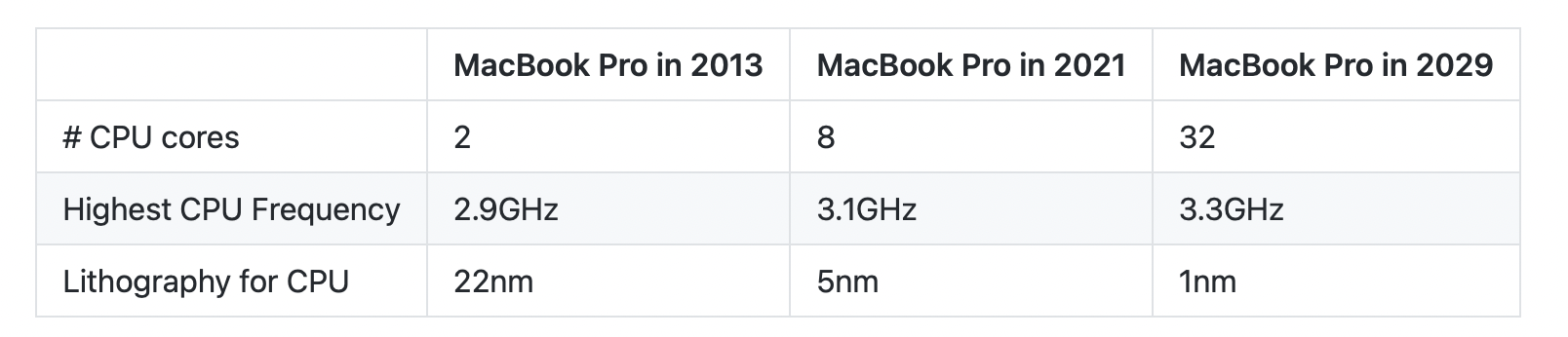
Dear readers and noisers,
I am not much of a writer, but I got motivated after my last article was well received.
Now I would like to ask your help choosing the topic for my next article:
1. Bitcoin whitepaper - a guide for the non-technical person. (my favorite, but most demanding).
2. Grayscale Investments holdings of BCH, the premiums, and implied BCH price (with graphs).
3. More BCH on-chain analysis, using daily active addresses.
4. Read.cash and noise.cash website traffic analysis.
Please comment below. Your help is much appreciated.
How much is Bitcoin Cash really worth? A fundamental analysis using "Currencies Fair Value" model
Hello everyone!
Is Bitcoin Cash (BCH) currently cheap or expensive?
Well, one way to evaluate the value of bitcoin and other cryptocurrencies is "on-chain analysis", or assessing the value of the network by metrics related to its use and activity.
The following is a fundamental analysis of Bitcoin Cash using the model used in coinfairvalue.com. It is a website that uses "*Currencies Fair Value*" model to evaluate and calculate an implied "fair value" for cryptocurrencies based on their current usage. https://www.coinfairvalue.com
The *Currencies Fair Value* model was originally published by @pablompa in 2017. You can read the whole article here. PDF format is here. It is a nice read, but there is a lot of math in there. https://keybase.io/pablompa https://steemit.com/bitcoin/@pablomp/cryptocurrencies-what-is-the-fair-value-of-a-currency https://keybase.pub/pablompa/Whatisthefairvalueofacurrency.pdf
The concept is similar to the *Network Value to Transactions (NVT)* ratio explained nicely by Marc De Mesel in a recent article. https://read.cash/@MarcDeMesel/nvt-ratio-bch-near-atl-while-btc-near-ath-701446bf
However, the *Currencies Fair Value* model uses a more complex formula to reach a rating of how 'valuable' a blockchain is. It uses a combination of inputs including money velocity, transaction count, value transacted, and "basket".
This is a purely fundamental chain analysis, and has nothing to do with the current crypto prices, so the market cap doesn't influence the "fair valuation".
So, how did this model perform in the past? Here is a chart from the original article plotting the fair value of LTC/BTC pair and the actual price between 2013 and 2017.
Image source: Cryptocurrencies - What is the fair value of a currency? https://steemit.com/bitcoin/@pablomp/cryptocurrencies-what-is-the-fair-value-of-a-currency
The fair value appears to converge to the actual price of the currency, despite the fact that the model does not use any market data at all (no prices, no market cap, etc.). This is impressive. Additionally, I noticed that the turns the in the fair value appear, most of the time, to precede the turns in price, a *"leading indicator"* if you will. It is as if the fair value is acting as a magnet for the price.
The website coinfairvalue.com uses the above model to make "fair value" calculations for 78 currencies, continuously updated. https://www.coinfairvalue.com
"OK, Omar", you say; "sounds like you are excited about this website". Well, I am actually excited about Bitcoin Cash!
So let's go to the website, and look up BCH. We find that the current "fair value" for BCH is around $2500. With a current price of around $700, BCH appears to be undervalued. https://www.coinfairvalue.com/
Interesting. But how do other cryptocurrencies compare? Well, to do that, we can divide the current price of each coin by its current estimated "fair value" to adjust for the current price and reach a number (ratio) that is comparable across all the coins (remember, the model itself does not consider the current price at all).
We find that Bitcoin Cash is the **most undervalued** of all the 76 cryptocurrencies listed on coinfairvalue.com http://coinfairvalue.com/
If you sort all the coins by *"price to fair value ratio"P/FV*, BCH comes out on top.
For the past two months or so, BCH's "fair value" has been exponentially increasing. This started in late December, and is probably due to the increase in both 1. BCH transaction count (noise.cash started in late December, likely the main factor), and 2. BCH total value transferred per day.
Image source: coinfairvalue https://www.coinfairvalue.com/coins/bitcoin%20cash/
Image source: bitinfocharts https://bitinfocharts.com/comparison/sentinusd-transactions-bch.html#6m
OK sounds great, but does the model have limitations? Of course. A famous quote in statistics is "All models are wrong, but some are useful".
The model itself has "uncertainty", which is defined and modeled.
Additionally, looking a the bigger picture, the question is, what happens if the network activity starts to decrease? Obviously the "fair value" will also decrease. Anything is possible of course, but I actually predict the BCH network activity to continue to increase due to the following:
The BTC network is becoming more congested day by day and the fees are rising. Bitcoin Cash network offers much lower fees compared to ETH and BTC, and this will certainly draw the attention of cryptocyurrency users. Please see the chart below.
Increased use of BCH in business in more locations using direct payment or through payment processors like eligma / gocrypto. https://map.bitcoin.com/
Increased use of BCH for local and cross-border payments, especially in the developing world.
Increased social media use on sites like noise.cash, read.cash, member.cash, and memo.cash. https://noise.cash/
Chaintip and other online tipping tools.
Simple Ledger Protocol (SLP) tokens: anyone can issue their own loyalty tokens or digital money on Bitcoin Cash from as low as 1 cent to mint. It's easy and anyone can do it at mint.bitcoin.com https://mint.bitcoin.com/
Upcoming applications; such as the Kim Dotcom's recently announced digital content system. https://k.im/#roadmap
Image source: bitinfocharts https://bitinfocharts.com/comparison/transactionfees-btc-eth-bch.html#3y
Bitcoin Cash's average transaction fees are in orange; if you can't see them don't worry, your vision is OK, they are around the zero x axis.
Conclusion:
According to the "Currencies Fair Value" model, BCH is still at a bargain price at this point, especially relative to BTC.
Please note the following:
Nothing here is investment advice.
This analysis is interesting and useful; however, the model has its limitations as discussed. That is why I used quotes whenever I mentioned "fair value". Not everything is fair anyway.
Markets can be irrational for a long time, and things may stay ridiculously cheap or ridiculously expensive for a long long time.
Feedback is welcome and appreciated.
Thank you for reading.
Welcome my friend @bisho to read.cash..
Also, check out noise.cash, you will like it there!
https://branch.wallet.bitcoin.com/JPEpC7HBvcb
scan with your bitcoin.com wallet for some BCH
https://branch.wallet.bitcoin.com/hXNXgLGBvcb
https://branch.wallet.bitcoin.com/qAQ0jUEBvcb
In case anyone wants to try bitcoin.com 's wallet new feature of sending Bitcoin Cash by a link,
try this for a little BCH :
https://branch.wallet.bitcoin.com/roSTSSwBvcb
Onboarding Merchants to Crypto is Easy With Bitcoin Cash!
Thank you @RogerVer for all you do to spread crypto adoption.
https://youtu.be/AGWaeFtSamU
Another successful flipstarter campaign..
flipstarter.gameflame.cash was fully funded.
The idea, spreading BCH adoption via intellectual games, is lovely.
@ralak, congratulations bro!
I have no doubt that you will return the great value to BCH community!
10 Ways to Improve Interactions While Wearing a Mask
Face masks keep us safe, but do make communication more challenging!
I recently came across a list of 10 suggested strategies to help improve communication while wearing a mask. They were primarily written for healthcare practitioners, but most of the principles apply to other various life situations.
I thought that the subject is important, especially that it looks like we will be wearing masks for quite some time!
So, without further ado, here is the list:
**1. Focus on what you can do.**
Immediacy behaviors such as moving closer to someone, smiling, and touching may be difficult during COVID-19, but there are other ways to establish interpersonal closeness. You can maintain genuine eye contact, lean forward toward the patient, have an expressive tone of voice, and use gestures. If you are working in an inpatient setting, you may need to re-introduce yourself when you re-enter a room as it will be harder for patients and families to remember faces when masked.
**2. Be an active listener:**
When a patient is speaking, use nonverbal encouragement (head nods, forward lean, etc.) and maintain eye contact. While wearing a mask, the message your eyes and body language are sending becomes amplified. You may feel confident that you can look at a patient's chart and listen at the same time, but not all patients share that perspective. A lack of eye contact can contradict a verbal invitation for patient participation. If you ask the patient, "Is there anything else you'd like to discuss?" but accompany this question with a "no" head shake or pulling away and looking at the chart, the patient gets the impression that no further information is welcomed.
However, the call for more eye contact comes with an important caveat:
**3. Do not engage in uncomfortable levels of eye contact:**
Genuine eye contact should occur while the patient is speaking, but genuine does not mean continuous. You should gaze comfortably between the patient, the chart, and your notes. Just be aware of those specific conversational moments that require direct eye contact: (1) implicit or explicit requests for attention (i.e., pauses, emotions, and questions) and (2) conversational turns: establish eye contact before you start talking and to signal that it's the patient's turn to talk.
**4. Mirror what you are saying with hand gestures and body language:**
Try to integrate simple gestures like a hand wave to signal "hello" and "goodbye"; a thumbs-up or okay sign to deliver positive news, offer encouragement, and confirm understanding or agreement; and a shoulder shrug or "huh" hand gesture to express uncertainty or lack of understanding. These forms of nonverbal communication make your communication more expressive, and reinforce a verbal message that may be muffled behind a mask.
**5. Exaggerate emotion with your eyes, not your entire face:**
Patients may be able to tell that you are smiling from behind a mask, but exaggerating your smile all day can be exhausting. Instead, focus on expressing emotion using your eyes and eyebrows (along with hand gestures).
**6. Use vocal variety to convey emotion:**
Your patients cannot see your smile behind your mask and may misconstrue a neutral expression for a negative one. By varying your rate, pitch, tone, and volume you can more accurately convey emotion. With that being said...
**7. Focus on talking slower, not louder:**
When you face communication challenges with patients due to language barriers or other limitations, you may find yourself speaking louder even if the patient has no trouble hearing. You have probably noticed yourself doing the same thing while wearing a mask. This comes across as aggressive or dominant, and will likely tire the muscles in your face quickly.
Speaking slowly will help you conserve energy and will increase understanding (which means you won't have to repeat yourself!). An added benefit of talking slowly is that it conveys to your patient that you value the time you are spending with them and are not in a hurry to rush off to another patient.
**8. Look for empathic opportunities:**
An empathic opportunity describes when a patient expresses an emotion, a challenge (e.g., negative experience or event), or progress (e.g., positive change or event). You should listen for empathic opportunities and view them as a prompt to respond using acknowledgment, praise, validation, or support: all forms of responsive communication. Learning to listen for these empathic opportunities can be particularly important when facial expressions are masked. You can also elicit these empathic opportunities by asking patients directly about their reactions/feelings when you are unable to read facial expressions.
**9. Minimize dominant communication:**
Dominant communication involves controlling the conversation. These behaviors are associated with power, authority, and compliance-gaining, which can have negative impacts on patient outcomes. These behaviors intensify the perceived distance between you and your patient that already exists while wearing masks. Some dominant behaviors include standing during the visit, interrupting the patient, and making the patient wait for you without explanation.
**10. Modify your communication to match your patient’s:**
Communication accommodation refers to the extent to which two or more people match or differ the other person's verbal and nonverbal behavior during an interaction. Matching helps convey interest and relational closeness -- especially when both parties are wearing masks -- and is useful for developing trust. You should try to match your patient's behaviors including talk time, body position, speech rate, gesturing, nodding, and eye contact.
Hope this helps improve our communication in healthcare and other life situations.
Thank you for reading.

They Lie: You think they're Bitcoiners just like you. You’re wrong!
https://www.youtube.com/watch?v=zR4IOP4RBBs&lc=UgxgLUgUjVpiIbiS2HZ4AaABAg.9AtVVE-H-sC9AtYCBpF8gp
 @Omar
@Omar