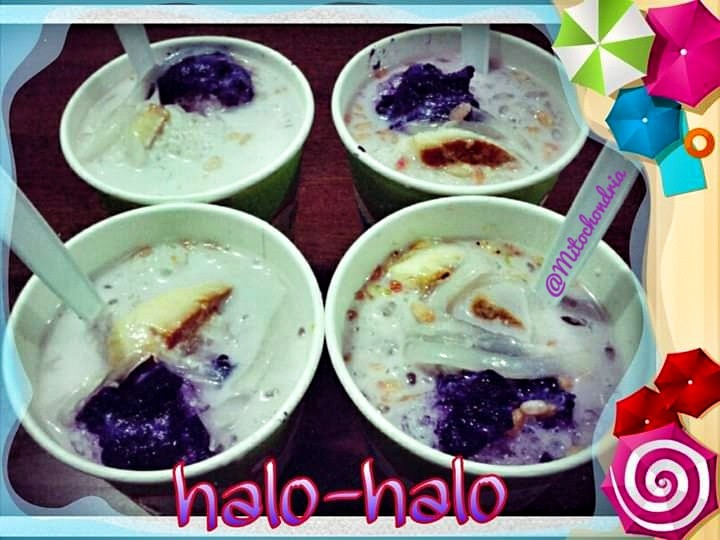
With the hot, humid, and steamy weather we've been having lately...🌤️ Summer has definitely arrived! And eating has turned out to be a real challenge...🤤 You simply don't have the appetite anymore for the warm meals that you usually enjoy, except for this cold, sweet, yummylicious 'halo-halo!'🍨 It's a good thing I've stumbled upon a 'halo-halo' stand outside in the neighborhood because I no longer have time to go to a fast food chain like Chowking, Goldilocks or Mang Inasal and buy. These three actually are the city's most well-known food stores for these icy treats. The home-made ones sold on the streets, on the other hand, were just quite as delicious and much less expensive. Each one only costs 25 pesos (US$0.50). And I assure you, it's clean...😬 Haha! Because I've inspected it with my diagnostic eyes!🧐 The lady selling it wore gloves, and the foods were kept cool in an icebox to avoid spoilage from the heat. The ice used was also clean because it was not purchased from ice plants in filthy sacks. They even have their own ice crusher or shaver. Seeing these for myself, at the very least, gave me the confidence as a consumer that what I was buying was safe. Well, I wasn't able to take pics because I was in a hurry and one more for 'delikadeza' sake (proper decorum), it wasn't nice to take pics without first asking a permission... Anyway, for those who are unfamiliar, 'halo-halo' is a popular Filipino cold or frozen dessert that is typically sold during the summer. It is the ultimate summertime treat in the country!🌤️⛱️ It is made up of a variety of colorful fruit ingredients that are layered like a rainbow and then combine to make a healthy and delightful refreshment. Actually, 'halo-halo' is considered to be the unofficial national dessert of the Philippines. Isn't this fantastic?🤩 For the street version of this ice cold treat, they use the traditional ingredients such as slices of boiled banana, camote (sweet potato), langka (jackfruit) and white beans, also boiled sago (tapioca pearls), gulaman (gelatin) and coconut strips. Then covered with crushed or shaved ice, drizzled with evaporated milk, and topped with pinipig (rice crispies), 'ube' jam (purple yam) and a slice of leche plan (creme caramel). Not all of the components are typically found in a 'halo-halo' from food stores because they are replaced with bottled ingredients such as nata de coco, kaong (sugar palm), and so on. They do, however, add one or two scoops of ice cream as toppings, making their 'halo-halo' more special and expensive. Before eating it, you must slowly stir and mix the contents, that is why it is called 'halo-halo' from the Tagalog word 'halu-haloin,' which means to mix up together. So it literally means 'mix-mix.' 😁 To our non-Filipino Noisefriends here, do you have any dessert similar with 'halo-halo?' Or have you already tried eating this?' What about you, Filipino Noisemates? What are your favorite ingredients? For me I like most the coconut strips and boiled camote.😋 Without these two, my 'halo-halo' won't taste any better...😬 Someone quoted, "STRESSED is just DESSERTS spelled backwards." Aww, that's really amusing!😁 So don't be stressed, instead beat the heat! Grab a refreshingly creamy 'halo-halo!'🍧 💕@Mitochondria 💯Original content creator Caloocan City, Philippines🇵🇭
10 comments
Sis natawa ako dun sa diagnostic eye hihihi...
I don't know this meal, but you really have summer and we're freezing here
wow. super nakakatakam nman heheh. tapos ung ube at leche flan hehehe. the best
yummmmy! yes we too after our work we always eat Halo -halo sis. Super hot! Grabe!
After seeing this yummy dilicious I am really wanted to eat something like this and also I really wanna eat burger now
Nag halo halo rin ako kanina po, my favorite ingredient was kamote and banana hehe. I love that word po na binaliktad lang, our prof told us that.
We have a kind of dessert we call fruit salad that contains banana, kiwi, strawberry, cream, and sometimes ice cream. It's very tasty. Enjoy the summer, as for us, the weather is very cold. It seems that winter loves us and refuses to leave us.
Bili ka na lang ingredients at gawa ng sarili mo mas masarap pa ta madaming sahog. Kami kapag madami ng watermelon nagfreez ako nyan overnight the next day lagay ko lang sa blender may shake n kami. Pwede add mo ng milk or just the watermelon lang okay na.
I remember the first time I got halo-halo. I was startled to find beans in my ice cream!
Ahh yep.. Here too sis.. I rarely seeing rain lately.. I think summer time is come🥲🙃🤣