Amaury Séchet on Evolution, Governance & Religion: Bitcoin Cash & Beyond
I’ve always liked the villains
What I mean is, I’ve always been able to understand multiple versions of a story, and every story that has a hero, has a villain. In cryptocurrency, we have many of them, and we don’t always agree about who they are
But where some see “bad guys” and “good guys,” I just see guys (and some gals) who disagree about how we’re going to get to the promised land. That’s why I’ve interviewed crypto celebs from Craig Wright and Brock Pierce to Roger Ver and Richard Heart. My commitment to the study of crypto tribalism and the social history that enables it has led to the development of some unique theories that extend beyond bitcoin cash and into the larger cryptoverse. I don’t have all the answers, so the best I can do is to ask all the questions and let you decide. That’s why I recently had a conversation with the lead developer behind the original bitcoin cash implementation: Amaury Séchet
Although Séchet’s name is less well-known than some other early crypto proponents, his impact on the ecosystem is undeniable. He’s the person who came up with the contingency plan for in case bitcoin wouldn’t be allowed to scale. He’s the architect behind the BTC/BCH hard fork. He’s the “benevolent dictator” of bitcoin ABC. And now, he’s the divisor who plans to split bitcoin cash — like the red sea — again
But why? And…
**Who tf even cares about bitcoin cash?**
In truth, it’s a small community. Bitcoin cash developers and community members certainly care — but not many others do. Outside of their modest core team, bitcoin cash is in a somewhat unique position of having a global community that actually relies upon the coin for daily transactions and as a store-of-value. So I asked Séchet what impact he foresees this split will have on the people who depend on bitcoin cash
*“These people are the real victims here, and I feel bad for them. Idiots are playing games with their money. Money needs to be very boring. The last thing I want my money to be is exciting, and most people feel the same. This shit needs to ‘just work.’ Forks and power struggles are killing the value proposition of Bitcoin Cash. The only way this project is valuable is by having a roadmap* ***and*** *the means to execute on it”*
Since we’re discussing who is even paying attention, this is probably a good place to talk about *why* those who do, care
**The truth behind the delusion**
There are a few reasons bitcoin cash enthusiasts care about the upcoming split: The reasons BCHN proponents will give you, the reasons ABC supporters will give you, and the reasons that have nothing to do with either chain and everything to do with the group’s subconscious collective memory
**1. The IFP —** The IFP stands for Infrastructure Funding Plan, and while I’m not going to get all into that here (because those who want or need to know the details about it already do) what matters is that it’s a built-in funding mechanism — not unlike those used by DASH or Z-cash. But according to Séchet, the reason BCHN proponents don’t support the IFP isn’t because they don’t want community funding. It isn’t even because they don’t want Amaury and a handful of ABC team members to hold absolute control over development on bitcoin cash
Séchet told me, and after further investigation, I tend to agree, the split is “about none of these things…. It’s about the dynamic of the moment”
**2. Lack of Talent, Laziness & Ego —** So, according to Séchet, what is the dynamic of the moment? When I asked if the best developers would ultimately go where they would be compensated for their work instead of maintaining chain loyalty, he responded:
*“Money is only part of it, but sure. Talented people have choices and gather in places where their talent is valued… I think that you touch here to something much closer to the core of the issue than anything related to the IFP. If you’re a mediocre developer who spends part of his or her time on a project while having a real job on the side, and you enjoy a position of status and fame within a community because there is no one better, would you want to attract the best people? Obviously, you can’t say that out loud, and you’d probably even be lying to yourself first and foremost, but the feeling is there”*
What Séchet is alluding to (and not so subtly) is his belief that the real reason for opposing the IFP is that many BCH developers are simply not good enough to warrant funding. Particularly not when he and the ABC team are carrying the bulk of the weight. While I agree with Séchet’s position that the IFP isn’t the real reason for the split, I don’t know enough to weigh-in on ABC’s contribution level relative to other groups. But I do know that it is often difficult for those who are mired in conflict to view their situations objectively, and that’s where I come in
**3. Collective Trauma —** Within crypto, bitcoin cash has seen more division and tribalism than any other group. For those who don’t remember, the 2017 BTC/BCH hard fork escalated into a battle for the soul of bitcoin from which the larger crypto community has still not fully recovered. Adding insult to injury, the chain unexpectedly split again in 2018 after a **civil war over block size** erupted between two competing bitcoin cash tribes, and BSV was born from the ashes
The thing is, each of these forks represents not only a difference of opinion over software implementation, but also the dissolution of long-standing friendships and business relationships. Having studied crypto tribalism in the field for several years, I can speak with some authority about the significance of its impact on community members
One prominent BSVer once told me about the anguish s/he felt when s/he realized s/he couldn’t approach Roger at a conference for fear of lingering animosity. Collin Enstad has spoken about how his options for professional development as a videographer and biographer have forever been limited because of his association with bitcoin cash. Tribal affiliations have divided families, as evidenced by the Lee brothers. Heck, I’ve even been fired from a freelancing gig because CoinGeek published a story I wrote. And when prompted, Amaury told me that he’s been experiencing tribalism first-hand since before the fork:
*“We were initially trying to make things work with other projects, namely bitcoin unlimited and bitcoin classic, but it became clear that these project leaders wouldn’t do the right thing, so we created ABC. All these projects failed, and they ended up reluctantly following the path we laid out, but not without kicking and screaming the whole way. It’s been one smear campaign after another since then”*
Framed in this light, it becomes a bit easier to see. The real problem with bitcoin cash (and perhaps with the larger crypto community as well) is collective trauma, triggered by the mere mention of a hard fork
Collective trauma occurs when a group is subject to on-going physical and/or emotional distress brought on by repeated exposure to common stressors. Examples of groups who have experienced this sociological phenomenon include race, religion, nationality, and now, apparently, coin of choice. Although collective trauma differs from individual trauma in some ways, it shares many characteristics. One of which is that trauma is often counter-productive because it can lead to long-term increased perception and sensitivity to potential existential threats where there are none. When the effect of the trauma is severe, repeated, or long-lasting, the group experiencing it may exhibit serious symptoms such as an inability to behave differently when the same circumstances repeatedly unfold
I believe this collective trauma is the real heart of the issue within the bitcoin cash community. But history doesn’t have to repeat itself. Not when people grow from it AND recover so that they aren’t acting from a place of fear and learned behavioral patterns
**It doesn’t have to be like this…**
… because both ABC and BCHN can survive this split as long as BCHN maintains a sizable majority of miners’ support. Additionally, although Séchet insists that the IFP was always a part of the plan, when I asked if he would be going to war for ‘the real bitcoin cash’ title, he said “No. Such fighting is ultimately destructive for both parties, no matter who wins. If the ecosystem at large decides to get involved in this dynamic, then it’s a dead man walking anyways.” And at least on this one topic, it appears that Amaury and Roger agree
In-fighting stifles innovation and helps no one. But agreeing in theory isn’t always as easy in practice. Leaders (and their minions) on both sides of this unraveling drama have leveled attacks against each other
**Amaury vs Roger**
Although both Amaury and Roger have expressed a lack of animosity and the need for both sides to continue developing, their actions are sometimes inconsistent with their words. This further illustrates my theory that the frontmen for ABC and BCHN respectively are both experiencing trauma. When triggered, they lose rationality and resort to childish tactics and name-calling, even though in their right minds, they both know this is counter-productive
In a recent **interview** with Joel Valenzuela, Roger asked if Amaury may have been paid to implement a take charge plan of BTC as a contingency for if it wasn’t allowed to scale. A question which Roger most certainly already knows the answer to since the fact that Séchet was on a research grant at the time is a matter of public record. Furthermore, as Valenzuela told me, “I personally think that’s a nitpick on Roger’s part because he wants to characterize ABC as splitting off/attempting to take over BCH rather than his camp splitting off… I wouldn’t call it mudslinging though, more like ‘aggressive narrative building.’ Kind of like when the GOP points out that the Dems were the pro-slavery, pro-segregation party. It’s true but of little modern consequence” https://odysee.com/@DigitalCashNetwork:c/RogerIFP:1?r=FqowB2QREmrBV4DcLpAWb8cz2K4gYVUV
On the flip side of the coin, when I asked Séchet about Roger, he had several choice words to describe a man with whom he was once friendly. Ultimately referring to his former comrade as a “zealot” who would rather die than adapt. Said Séchet, Roger is “effectively an NPC. He follows his own script. In a sense, people were right to call him ‘Bitcoin Jesus’”
This made me laugh, and so I had to say, “Yes, absolutely, and they’re going to crucify him on the cross just like Jesus. The question is: Will he rise again?”
To which Amaury responded, “Probably not because he is unable to take advantage of the people who can make this happen. He’s mentally stuck”
If true, Roger isn’t the only one. Several bitcoin cash community members I spoke to were opposed to the IFP for the sole reason that a tax on miners wasn’t part of the original bitcoin plan. But being stuck on the narrative “because it’s the real bitcoin” didn’t win many hearts or minds in 2017, and it won’t win *any* now
**So what’s the takeaway?**
When viewed from an objective perspective, this split gives both BCHN and ABC the opportunity to start anew, rebrand, and distinguish themselves from the coin that the court of public opinion has deemed the enemy
The time has come for leadership and general community members of bitcoin cash to rise and heal the scars that have collectively held back the entire blockchain industry. Just because previous hard forks have led to devastating personal and professional losses, doesn’t mean future forks need to cause the same effect. There is no reason why a person who believes that ABC will ultimately win out over BCHN shouldn’t maintain a friendship or a professional working relationship with someone who believes the opposite
Ultimately, a group’s sustainability and longevity is dependent upon its health, and health is dependent on ability to move forward from prior trauma. This is the reason I created hugs — to try and spread some love through the community. And that’s why I’m asking members of the bitcoin cash community to take this matter into their own hands and heal thyself. After all of this, I feel a bit like Pontius Pilate, so I wash my hands of this situation and leave it to you.
`Source: Nicole Grinstead`

Bitcoin Cash, a key tool in the fight for freedom
In the last almost 12 years, blockchain technology has attracted the attention of various sectors in various branches, due to its characteristics such as traceability, transparency and that it is immutable.
**While blockchain is recognized for being the technology behind cryptocurrencies, the uses of blockchain go far beyond serving as the foundation for digital money, and it has been adopted and used by various industries, including the government** .
**In turn, cryptocurrencies have also gone from being just digital money and have managed to fulfill one of the purposes that cyberpunks and Satoshi Nkamoto once envisioned them for, financial freedom and access to financial systems for unbanked people.**
You just have to turn your gaze and observe how cryptocurrencies and blockchain are helping countries like Hong Kong, Ghana, Venezuela and Argentina to fight against the different types of oppression that these countries are facing, both financial level and freedom of expression.
Blockchain technology to combat oppression
The uses of the technologies underlying cryptocurrencies have expanded since their early beginnings, from being a part of Bitcoin, to creating decentralized networks in various ways and with applications in more and more sectors, such as finance, education, mining and many more. Some of these applications even have implications in the eternal struggle for freedom of expression.
**Blockchain works as** ***"a system that organizes the participation of servers around the world."*** **This system consists of an accounting ledger with different identical copies existing at the same time, in which if one copy is eliminated or altered, the others continue to exist without any problem.** Let's imagine that if a government wants to censor information, there will be several copies of it in different parts of the world.
Blockchain technology is distributed in nature, making it an uncensored tool. What has been used to protect human rights in various parts of the world.
The libertarian traits of the blockchain
Currently several authoritarian governments manage to monitor the online activity of their citizens and through the use of censorship software they can restrict users' access to certain unwanted sites.
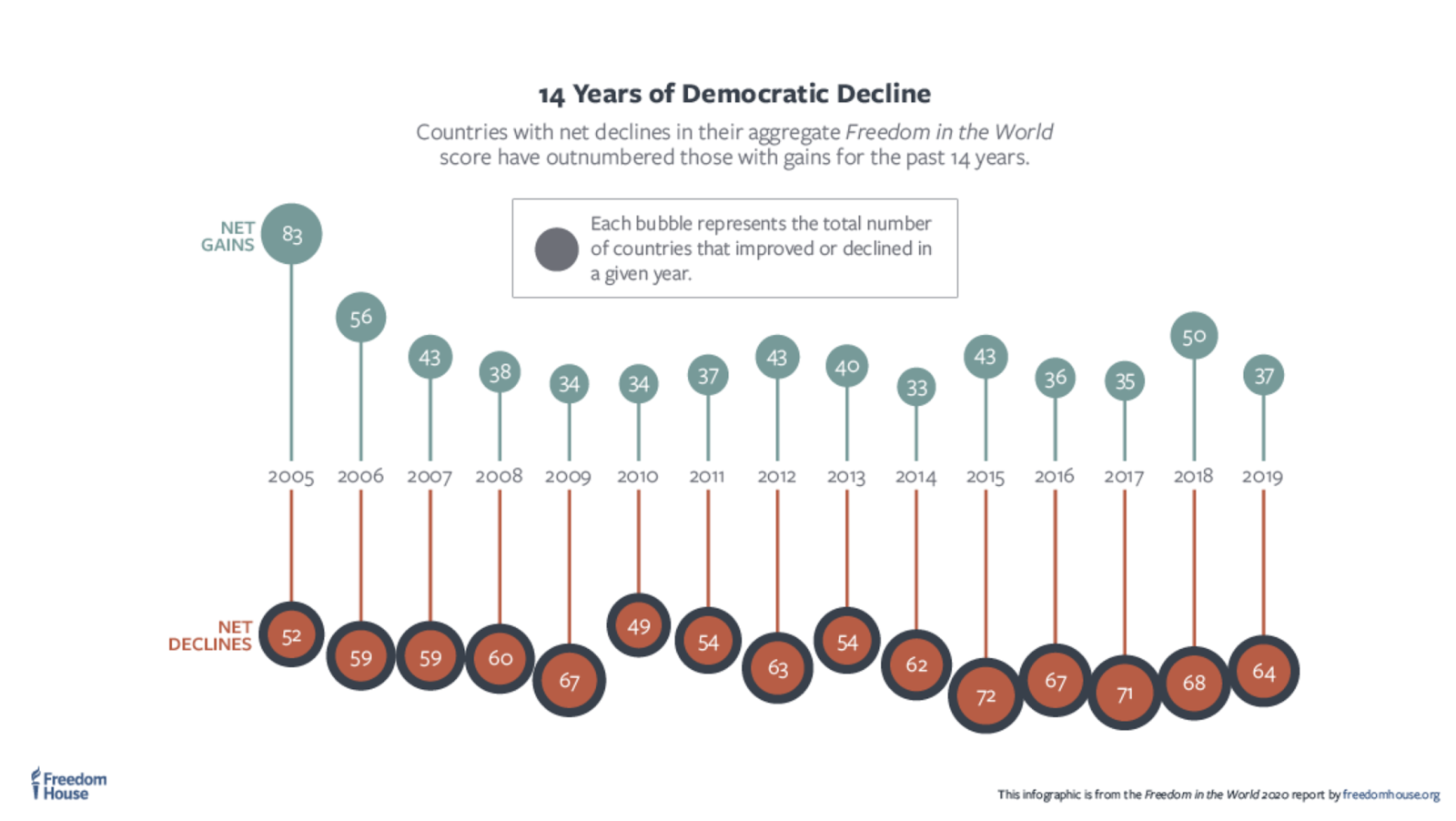
According to a study conducted by **Freedom House** in 2019, internet freedom fell for the 14th consecutive year. The study highlighted that 3 out of 5 internet users were subjected to some kind of censorship by the State, and even by companies that provide the internet or by the social network they use. https://freedomhouse.org/report/freedom-world/2020/leaderless-struggle-democracy
**Faced with this problem, blockchain seems to be presented as a solution since thanks to its decentralization it generates that no person, institution or government can take control of a blockchain and all the data stored there.**
But not only blockchain helps freedom since cryptocurrencies have also granted freedom to citizens by giving people the possibility to be real owners of their money.
According to Freedom House, ***" when the adoption of cryptocurrencies is close to 100%, governments and central banks will have effectively lost the ability to threaten the control of wealth or financial exclusion."***
Venezuela and its relationship with cryptocurrencies
Venezuela is not only experiencing the most serious humanitarian crisis on the American continent in recent years, it is also facing a high degree of censorship and authoritarianism from its government.
**Hyperinflation in Venezuela is currently the largest in the world, the drop in its GDP already exceeds 80%, more than 90% of Venezuelans are in extreme poverty.**
**The Bolivarian Republic remains under a sharp authoritarianism** in which the electoral processes lack transparency and have repeatedly been accused of being unfair, for this reason it is almost impossible for citizens to carry out political reforms to improve their economy **and any dissident voice it is simply silenced.**
Besides being in the middle of a destroyed economy, the government of Venezuela prohibits Venezuelans within the territory of the country access to international financial markets and banking Given these restrictions **blockchain and criptomonedas are presented as a lifeline to the crisis that exists in the nation** .
Proof of this is that the trade of Bitcoin Cash, and other cryptocurrencies is only increasing day after day in Venezuela.
**In nations that have an unstable economy and politics, cryptocurrencies like Bitcoin are presented as a financial tool** as a means of exchange resistant to censorship. Through digital assets, citizens can send and receive money, save in a much more stable and reliable currency such as the Bolívar, and even serve as a payment method for a service.
Censorship and control in China and Russia
**Although China and Russia have a stronger economy than Venezuela, their authoritarian governments represent a problem for the freedom of their citizens.**
In China, the government can massively monitor transactions made by its citizens through payment platforms such as Alipay and WePay. For this reason, **opponents of the government are using cryptocurrencies to finance their projects since it is not possible for the government to monitor this type of asset** .
Meanwhile in Russia, the government has chosen to freeze the bank accounts of those who oppose its government, from an NGO to a candidate. However, with Bitcoin doing this type of action, therefore **raising funds through cryptocurrencies has become a viable alternative for opponents** .
Blockchain and freedom of expression
**Blockchain technology for its part, gives people the right to express complaints on a protected platform, without fear of censorship or retaliation.** This technology cannot be manipulated by a third party and the ideas expressed publicly, which are registered in these systems, and cannot be deleted or edited.
The governments of China and Russia are known for their strict censorship of anti-government propaganda. Both states have learned the impossible task of censoring not only cryptocurrencies, but any information stored on a blockchain.
In these countries there are a large number of news pages and blogs built on blockchain platforms in order to transmit opinions, criticisms and any type of news, out of the reach of their authoritarian leaders.
A long way to go
Without a doubt, Bitcoin Cash is still an incipient technology and does not offer usability, or impressive speed of transactions for the tastes of more developed countries. But, as the world is far from perfect, **there are places where Bitcoin Cash is the best option, since its fight against censorship, distribution and its pseudo anonymity is what has saved many lives in countries where freedoms do not they are a right but a privilege** .
**According to** ****Freedom House,**** **more than 50% of the world's population lives under an authoritarian regime, which is equal to 4.5 billion people around the world. These people could use cryptocurrencies like Bitcoin Cash, and blockchain technology to regain their freedoms.** https://freedomhouse.org/report/freedom-world/2020/leaderless-struggle-democracy
If we invest the time and resources to develop user-friendly wallets, more crypto exchanges, and better educational materials for Bitcoin Cash and the blockchain. We would have the potential to make a real difference for the 4.5 billion people who cannot or cannot trust their rulers. access the banking system. ***"For them, Bitcoin Cash can be a way out*** . ***"***
Standing on the Shoulders of Giants
I am pretty vanilla. I like that.
It’s my favorite flavor ice cream and don’t even try to tell me that vanilla isn’t a flavor. Fuck, people circled the globe in search of spices and the vanilla bean is the second most expensive spice in the world, second to saffron.
But I digress.
I like being vanilla for this exact reason.
*Seems boring, but it is actually very special. I may seem like an average guy, but I’m not. I could list reasons why, but let’s not kid ourselves, you’re here to read about Bitcoin.*
**Two areas of my own personal interest in Bitcoin center around the culture of Bitcoin. I am inspired by Bitcoin collectibles and by Bitcoin art. I am by no means an OG collector or famous artist, but I enjoy collecting and creating.**
I have only just started to come out of my shell in the Bitcoin community. I got plugged into the collectibles page at bitcointalk.org and have really enjoyed interacting with genuine people from all over the world. Mind you these are some of the first people I have EVER interacted with who get it. http://bitcointalk.org/
I have not met in person anyone who is interested in and has Bitcoin independent of my influence. So understandably, I feel small in this community.
I know that I am not a big name artist. I don’t want to be.
I have certainly found Bitcoin inspiring and have been influenced by countless other Bitcoin artists and collectors. The phrase “*standing on the shoulders of giants*” comes to mind. This metaphor is familiar and expresses the idea that we can better explore and discover greater depths of knowledge by utilizing the truths found by those that have come before us.
The English scientist Sir Isaac Newton wrote in a 1675 letter to Robert Hooke,“*If I have seen further, it is by standing on the shoulders of giants.*” While this is often thought to be the source of the metaphor, it predates Newton by many centuries.
In the 12th century, Bernard of Chartres is credited with the idea that dwarves on giants shoulders could literally see farther. There are even older references from Greek mythology demonstrating the blind giant Orion carrying his servant Cedalion on his shoulders.
Regardless of the origins, it is a metaphor that has stood the test of time with countless modern references. Newton popularized this metaphor hence it is typically used to emphasize the progress of scientific knowledge. It is hardly a stretch to see that it truly applies to the progression of any knowledge base.
**We stand on the shoulders of giants daily.**
**I can list giants in my Bitcoin journey, I’m sure you can too.**
Undoubtedly we have relied on the experiences, wisdom, and mentorship of those who have come before us to get to where we are now.
Interestingly though, we are not simply observers standing on giants’ shoulders anymore. Without getting too philosophical, the point I want to make is you are already a giant. It was not apparent to me at first as I truly feel like a small person in this whole game, but I have come to the realization that I am a giant already.
**If you are reading this, you are a giant too**.
As I watch Bitcoin grow I see that anyone here now *is already a giant,* and others will be standing on our shoulders, even if we only feel like a plebe. It doesn’t matter what you contribute or even if you do (although it is more rewarding when you do).
Being involved at this point in the history of Bitcoin makes everyone reading this a giant. You may be coding, starting a business, writing a book, teaching friends, making art, acquiring collectibles, or publishing a niche zine.
It doesn’t matter, just do it. Engage and enjoy, because by doing these things you are a giant whose shoulders others will stand on someday.
Source: geophphreigh - Citadel21 https://twitter.com/geophphreighhttps://twitter.com/geophphreigh https://twitter.com/ctdl21
**Remember: read, learn, enjoy, follow me** ****HERE**** **on my new** ****Twitter**** **(or the less important one: tip me if you liked it)... and with or without Giants, be happy!** https://read.cash/@GusT https://twitter.com/crypto_trips

Bitcoin as a Tool for Secession
***Bitcoin may be many things to many people, but one cannot ignore its primary effect on the mind - the realization of how much power is acquired by a simple act of holding private keys to censorship-resistant unconfiscatable property.***
The hardest money on earth brings the concept of inalienable property rights back on its feet, and with it, an available opportunity for *personal secession*.
***Throughout history, protests, revolutions and civil wars proved to be ineffective against State tyranny.***
The predictable result of any such event was the replacement of one tyrant with another. When the democratic way became the standard around the world, it guaranteed that only bad men could rise to the top. Demagoguery, cunning and trickery were the tools that one had to master to be able to sway the public opinion in your favor. When at the top, all bets were off. The four short years of so-called "office", turned the dangerous man's high time preference into a frenzy of wealth redistribution, surveillance and wars. And if a rare good man managed to occupy the desired position, demonization or assassination was sure to follow.
But that was in the past.
****Today We Have Bitcoin****
The importance of the times we live in cannot be stressed enough. With ease, one can say that on January 3rd 2009, the timeline split into the pre-Bitcoin and Bitcoin eras. Property rights were restored, and personal secession became possible again.
Although the effect may not be immediate and seen by the majority, those in the know understand that what governments around the world took for granted for so many years, is now gone. Taxation and expropriation, the bread and butter of every State, have become nearly unenforceable. What is yours, is yours to keep. There is a key to your property, and you are the key master. Every ten minutes, with each block produced, your belief in the new system is justified and strengthened. There is no referendum or democratic vote that can change that.
The mob has lost.
With the newly restored property rights, you can focus on your work. Slowly but surely, the process of personal secession kicks in. First, it is a purely mental event: the ultimate red pill, the walk through the door. But as soon your stash grows to a sizeable amount, the wheels of secession in the physical realm are set in motion. Capital accumulation becomes a natural habit. And with capital, many more doors open.
****Opt Out****
***Opting out of the oppressive system, disassociating from anyone who supports Leviathan, ignoring unjust rules whenever possible while building your own tools, joining communities of like-minded individuals, creating independent circular economies - this is what personal secession is about.***
Replacing the flag of the usurping State with that of human dignity. Summoning the courage to escape the grotesque reality imposed by the Parasites, and step into the brave unknown. Relentlessly studying oneself and the world, cultivating higher aspirations, perfecting skills to become part of the new Natural Elite that will restart the engine of *civilization*.
The process of civilization is only possible under Natural Order, a state of affairs that adheres strictly to the foundational principles of the Universe. The modern State directs its energies to the defiance of natural laws, and thus must be considered the ultimate agent of *decivilization*. By infringing on peaceful individuals' property rights, it degrades relationships among people and distorts the naturally occurring order. Now that it is possible to reclaim individual sovereignty, the unwinding of the global destructive machine has begun. Leviathan's demise may be slow but certain.
True progress does not always imply a move forward. Sometimes, a better state is achieved by *taking a step back*. The laws of Nature are universal and eternal. Going against them, as we have done in the past century, is always a mistake. Therefore, to restore Natural Order, we must look back to when it was more prevalent and identify what it is that made it so. The answer is undoubtedly *Family* - the principal benefactor of property rights, the nucleus of society.
**Status of Family Estate**
***In its traditional form, Family has been under a massive attack, especially in the Western world.***
The process of individual atomization, devaluation of familial relationships and degradation of youth has been long, but in many cases successful. Spiking rates of singledom, divorce, single parenting, abortion, abuse and non-traditional sexual relationships are all the proof you need. One may argue that this process occurs naturally due to the general liberalization of society, but it is not so. There is someone who benefits from the disintegration of the most vital unit of civilization - the Parasite.
***By encouraging atomic individualism, the parasitic element in our society wants to achieve its ultimate goal: total control and domination over people's lives.***
For what is a better place to do that than in a household? Traditionally, the head of Family is responsible for the ultimate decision making. He is the procurer of goods, the protector of the estate, the reason and the muscle. Removing him from command is akin to relieving the captain of the ship of his duties and telling the sailors that they are now in charge all at the same time. Naturally, only chaos can ensue. And that is what we see. Men are told to be women, women are encouraged to become men, couples are brainwashed to forego having babies, children are incited to rebel against parents. Generational ties become ever weaker to the point where the concept of a family estate ceases to exist. There are only individuals, linked by their DNA, who feel nothing but disdain towards each other. Having no support from immediate family, but still needing it psychologically and often financially, they turn to Leviathan for help. And he is there, waiting with open arms.
Managing people's political affiliations and professional lives is one thing. Affecting their decisions inside households is a whole new level. It is a crown achievement of the micromanaging State, a parasitic dream come true.
***If one can be told how to behave in his own bedroom, then the last glimmer of personal liberty has disappeared.***
Unfortunately, in many parts of the world, we are very close to such a condition. But as things seemed to reach the bottom, when sinking further was almost impossible, and the process of moral degradation was near complete, a savior appeared.
***Like Prometheus who gave mankind fire, a world-changing technology, Satoshi Nakamoto brought with him the gift of Bitcoin. And with it, a hope of restoring the civilizing force of Family.***
As Bitcoin lowers one's time preference, gradually, the outlook on life starts to change. An existence filled with instant gratification is replaced with one of delayed consumption. Foresight, long-term plans and projects, personal restraint take hold. Man turns his attention to the future. He realizes that there is a moment in the coming years when he will have to pass and leave his legacy behind. But to whom? Who will care about his life achievements more than anyone else? Most certainly Family, a tribe of kinship. And so he starts planning for the *ultimate long-term project*.
Not only does the act of accumulating Bitcoin strengthen one's material well-being, it also promotes higher aspirations in man. The focus shifts from short-lived superficial relationships, to the establishment of a family estate that will last generations. Man's children and grandchildren are raised in an environment that promotes farsightedness, culture and morals. In cooperation with like-minded neighbors, they work diligently to improve their surroundings. The process of civilization is set in motion once again.
Strong individuals create robust families. And strong families form resilient communities. When faced with the moral degeneration of the rest of the world, such outposts of civilization have no choice but to strive for segregation - physical, cultural and intellectual. What starts as personal secession turns into a collective movement for self-determination. *This is not a violent global revolution* but a peaceful exit of thousands of newly formed congregations into different ways of living that they decide for themselves.
***The Parasites may stop one or two of them, but can they really crush a multitude of independent citadels?***
Before Bitcoin, one could not help but wonder how far downhill we would go. It seemed like the end of civilization was near, and there was no way to prevent it. Now that we have the necessary tools to create new systems independent from the parasitic status quo, we can finally reverse the painful damage inflicted upon our spirit. The process of personal secession is the creation of a citadel of the mind, first and foremost. A fortress of light, impenetrable to the forces of darkness. Combined with the power of will, it helps us mold the physical reality into what we want it to be. A world of Natural Order, a place of fairness and justice.
**You can only change the world by changing yourself. Bitcoin may be the catalyst you were looking for.**
Proclaim your independence.
Start a family.
Cultivate your community.
Secede.
`Source: Y_deGaia - Citadel21`
**Remember: read, learn, enjoy, follow me** ****HERE**** **on my new** ****Twitter**** **(or the less important one: tip me if you liked it)... and with or without Secession, be happy!** https://read.cash/@GusT https://twitter.com/crypto_trips
Why The Yuppie Elite Dismiss Bitcoin
Exasperated with our conversation, I asked bluntly, “*what do you think the probability is that Bitcoin hits $1M per coin?*” Without hesitation, my friend replied: “*0.001%.*” I laughed and said I put it at 80%. I asked if, after thousands of hours of research on my part, maybe there was some information asymmetry? He quipped, “or maybe self-motivated beliefs.”
That’s Dan. He’s one of my good friends from business school. He got a 780 on his GMAT and is almost always the smartest man in the room. We both worked at one of the elite management consulting firms before attending one of the elite MBA programs, followed by returning to elite job opportunities in the most desirable cities in America. My B-school friend group is full of Dans - the kids who ran the gauntlet of achievement-obsessed America and cleared the highest bar every time it rose higher. The consummate yuppie elite.
Yet they are all resistant to Bitcoin. It has become a topic of frustrated fascination for me. My other friend groups have largely heeded my vociferous and fervent testimony that Bitcoin is the most important asset of the 21st century. Yet my elite MBA friends cling to dismissiveness that borders on outright hostility. Why?
This is a complex topic, with a few layers I will try to address here. As a starting point, let’s introduce the closest attempt at an explanation that I’ve seen to-date:
https://twitter.com/MustStopMurad
Clever and compelling, this model explains what many in Bitcoin perceive: some of the smartest people in the world think Bitcoin is going to boom, but so do some dumbasses. Importantly, this model also explains the mockery and resistance we see from our reasonably intelligent friends and family. But it’s too easy of an explanation - I cannot claim to be smarter than Dan or the hundreds of other brilliant MBAs in my graduating class, not one of whom has reached Bitcoin maximalism, as far as I know. Clearly, there is something else going on here.
***After mulling this over for a number of months, I think I’ve come up with a framework that, while not perfect, provides more explanatory power.***
First, let’s separate the $250k believers in Murad’s meme into what they really are: Bitcoin moon bois on the left, and deeply researched Bitcoin maximalists on the right. In truth, they are two different groups. The first group believes that Bitcoin is going to the moon largely because they believe that past performance is indicative of future results - we’ll say that this group subscribes to “*Bitcoin moonism*”. The second group has come to understand the game theoretic inevitability of Bitcoin’s continued rise in the context of central bank money printing, the deterministic price mechanics of quadrennial supply shocks via Bitcoin’s halvings and the market psychology that programmatic price appreciation precipitates, and the winner-takes-all implications of an absolutely scarce store of value asset - what we call “*Bitcoin maximalism*”.
The IQ framework seems to hold up decently with regard to the moon bois, but it doesn’t account for the Dans and all of the other brilliant yuppies that I know. When I thought about what is the defining difference between the Bitcoin maximalists and my yuppie elite friends, the surface level distinctions that popped out were political (e.g., libertarianism, Trump support, second-amendment rights, Black Lives Matter). **But these stem from a deeper divide: the degree to which a person has trust in the system**. As a lifelong liberal recently cast into the netherworld of distrust of both parties that one necessarily acquires when journeying down the Bitcoin rabbit hole far enough, I feel reasonably qualified to speak to the liberal condition.
At the heart of liberalism is a belief that the system can work, if it could just be architected well enough and administered competently and compassionately. My personal journey to Bitcoin maximalism involved a painful dissociation from this fundamental worldview, specifically in the course of digging in to understand central banking monetary policy and the irresistible levers that come with it.
As an aside, I went to the best business school in the world and they didn’t teach us anything about that. For what it’s worth, I don’t think that this was a knowing or malicious omission. I think this battle was won 100-years ago, in Keynes’ day, with the self-serving support of governments weighing heavily on the outcome. Which is to say, my professors learned from Keynesians who themselves learned from Keynesians. The business leaders and educators of today are completely unaware that they are passing on the shoddy propaganda version of monetary theory as a result of the largely successful ideological extermination of sound monetary theory.
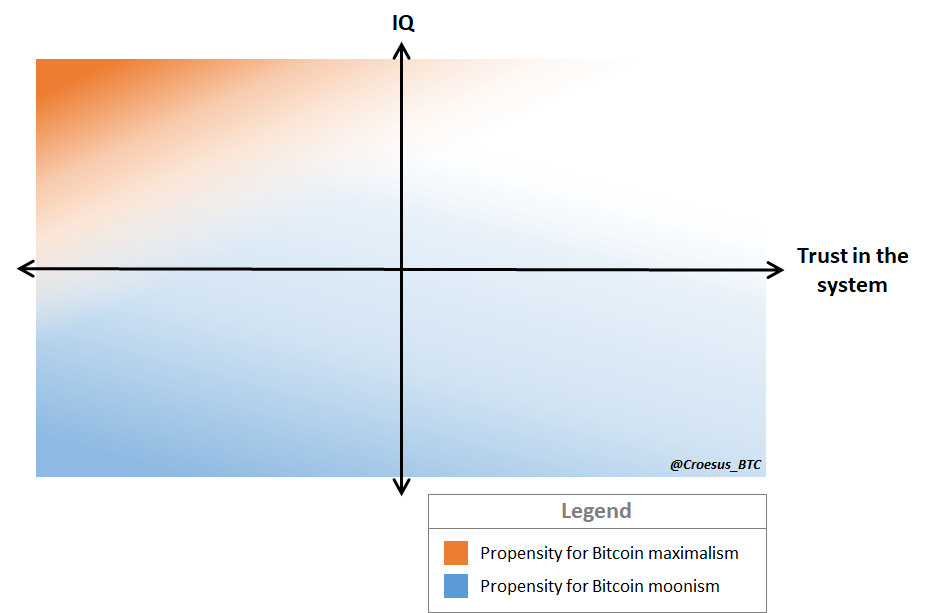
But I digress, if we take Murad’s IQ framework, split the $250k believers into their respective groups, and add the dimension of trust in the system’s ability to work, we get something like this:
If this is a reasonable representation of reality, there are a number of insights we might draw from it:
Bitcoin maximalism is correlated with intelligence but also with distrust in the system. Someone who is very smart and has high conviction that the system is broken is more likely to reach Bitcoin maximalism than someone lacking one of these qualities, all else equal.
Bitcoin moonism is less sensitive to one’s distrust in the system - if you’re a dumbass, you’re a dumbass. But it probably helps a little to be a dumbass and distrust the system.
It is easier to reach Bitcoin maximalism if you are already primed for it via a pre-existing distrust of the system. This helps explain the early adoption of cypherpunks, anarchists, and libertarians, and even the current representational skew towards Trump supporters who share a distrust of the establishment.
On the flip side, it is more or less impossible to reach Bitcoin maximalism while retaining any amount of trust in the system - indeed, this was my experience. To get to maximalism, I had to first grapple with the uncomfortable dissonance of my beliefs and the things I came face to face with as I dug deeper into the rabbit hole, confront them rather than turn back, and ultimately tear down my entire worldview in order to resolve the dissonance and continue deeper down the rabbit hole. Fun times.
Of greatest relevance to our particular focus, however, is the white space in the top right quadrant. Those with high intelligence and trust in the system’s ability to work are very unlikely to subscribe to either Bitcoin maximalism or Bitcoin moonism. Let’s expand on this further...
The upper right quadrant of the chart also happens to be the native home of the yuppie elite. To succeed in the educated, professional class, you have to be smart. But it’s also crucial that you know how to fit in, be a good team player, navigate industry politics, be polite and likeable, and above all be a good foot soldier willing to sacrifice for your employer. The requisite core belief to be able to be all of these things is trust in the system - trust that if you are a good employee and play nice with others, that you will be rewarded via promotions and social standing. In this sense, if we were to plot where the yuppie elite live on our graph, it would look something like this:
In just the same way that Bitcoin maximalists are some combination of smart and distrusting of the system, the yuppie elite are typically smart and trusting of the system. Some are more brilliant than others, but the ones that are less smart and still successful are typically so because they are exceptionally committed and loyal employees.
As you can see, the empty corner of our 2x2 matrix is exactly where the MBAs and other yuppie elites are. From their vantage point, belief in Bitcoin is a peculiar phenomenon that will surely go away. None of their yuppie elite friends believe in it, and since they don’t know much about Bitcoin, they don’t draw any distinction between Bitcoin moonism and Bitcoin maximalism - it’s all lumped together for them. As a result, the yuppie elite tend to view belief in Bitcoin like this:
Unfortunately for them, this perspective makes them unlikely to seriously consider Bitcoin on its own merits. Part of what makes this disinterest so resilient is that it falls into a neat heuristic pattern like many other things in the yuppie world. The yuppie elite are accustomed to having the best information, the best education, and the quickest knowledge of and access to trends. **Yuppies believe they are the people in the know**.
When you’re in the ivory tower, you think the term “ivory tower” is a silly misrepresentation of your very normal life; when you’re no longer in the ivory tower, you realize how willfully out of touch you were with the world. Part of being in the ivory tower means being in a socially insular bubble, interacting only with other elite yuppies. The natural outcome of this is that you tend to believe things are important and worthwhile if the other yuppies in your social network believe they are - after all, yuppies are the people in the know. Conversely, if people outside of the yuppie social world are engaged in something but other yuppies aren’t interested in it, it must be something for people not in the know. In this case, the lack of belief in Bitcoin among the yuppie elite combined with the significant interest in Bitcoin among non-yuppies triggers a clear pattern-recognition response: **Bitcoin is for people not in the know**.
A second characteristic of yuppies also helps ensure that this heuristic label is not easily revised: as smart people who are good at navigating the world, yuppies need to understand something in order to believe in it. That’s how they’ve done well in life so far, so that’s what they’re sticking to.
Ironically, it’s adherence to the central ethos of Bitcoin that keeps yuppies from investing in Bitcoin: don’t trust, verify. I have a childhood friend who is a sailboat captain for a living. In his mind, I am one of the smartest people he knows. When I strongly recommended that he look into Bitcoin, he bought some that same night. He didn’t verify my thesis for himself, he trusted me. The same is not true for my yuppie friends - they know it is unwise to invest money in something that they do not understand. At the same time, they lack the time, conviction, and persistence to replicate my years of research.
What’s more, Bitcoin’s surface layer provides it with a subtle camouflage. The first hour or two of learning about Bitcoin triggers a multitude of scam red flags. For the business and financial elite, who have honed their heuristic abilities for filtering out the deluge of noise they sift through on a daily basis in order to be effective in their professions, these red flags are a non-starter. For their entire adult lives, they have been reinforced to think within the box (often while calling it “out of the box thinking”). The odds that a new piece of information comes along, for which an hour or two of investigation creates more confusion than answers and yields several red flags, but actually turns out to be an outstanding investment are vanishingly small. That’s what heuristics do - filter out the garbage based on a cursory investigation of substance. A typical member of the yuppie elite flags Bitcoin as garbage to be ignored upon their first investigation of its merits, and because of the groupthink of yuppies only paying attention to what other yuppies are interested in, that’s where Bitcoin remains.
Of course, this will all change as Bitcoin’s mechanics continue to play out, making Number go Up. In time, everyone will have to face the painful realization that their reasons for writing off Bitcoin were wrong. Because of the dynamics at work with the yuppie class, it may take longer for them to come around to Bitcoin than with most new technologies or trends.
Source: Croesus - Citadel21 https://twitter.com/Croesus_BTC https://www.citadel21.com/
Blockchain is the Most Famous DLT, so what does mean DLT?
We all know, some with more details, others with less, what is the **Blockchain**. But few know that it belongs to a family of which it is the star: the **DLT** family. So Blockchain is just one of the technologies, perhaps the pioneer, that tried to make a DLT.
But what does DLT mean? Formally it is ***Distributed Ledger Technologies***, and if we lower it to a more everyday language it is ***Distributed Cash Book Networks***.
So let's understand what is special about a DLT, so that the blockchain was the first technology to get its hands on it.
**The first thing a DLT eliminates is the brokers**, who may be good, reliable, transparent, but they are brokers. Until now, banks are still the ones that play the role of reliable intermediaries, being responsible for keeping records and taking charge if a security breach appears. And here comes DLT with its first special feature: it is the DLT that becomes the security element, because the technology is strong enough in those terms to dispense with people in the management of security.
Maybe this about the intermediary and the security you already knew somehow. But few relate this to the fact that a **cryptocurrency represents anything we can think of in encrypted form**.
A cryptocurrency can be a concert ticket, an institution, a contract, a medical history, a grape harvest, a magazine subscription, a supermarket purchase, and so on infinitely, or anything that needs an immutable record, safe and reliable.
And here is another great feature of a DLT: it gives any of the previous examples **the chance to be programmable and behave automatically according to what has been preset in the application**.
And if we talk about applications, you have to understand what DLTs do in relation to Applications. **An App that uses a DLT (or blockchain) for its records, has the potential to be a Dapp**, that is, a decentralized application. Still the great majority of all the services that we know are executed in private servers of large corporations. My wish, and I hope that of the majority, is that all those services end up having their decentralized versions, which will no longer belong to those large corporations, nor necessarily to private companies, but to communities of all kinds, with its own governance and voting rules.
Finally, it is worth going back to the crypto world for a moment, and bring the trending magic word **DeFi**, to see how a DLT operates in the same way. If we need a money loan, today we go to a bank or a finance company, or we look for a family member or generous friend. In the case of the bank, we know that it is a monopoly, a concentration of power, and in the example of family or friends, trust between people is present. This is where DeFi, always through its origin of functionality, a DLT, provide us with simple and safe ways to eliminate the broker and human trust when we ask for or loan money.
It is only a matter of time (not much more in my opinion) so that the use of DLT, and its favorite star, the Blockchain, becomes massive and daily, and thus brings us closer and simplifies our lives.
**And remember: read, learn, enjoy, follow me** ****HERE**** **on my new** ****Twitter**** **(or the less important one: tip me if you liked it)... and with or without DLT, be happy!** https://read.cash/@GusT https://twitter.com/crypto_trips
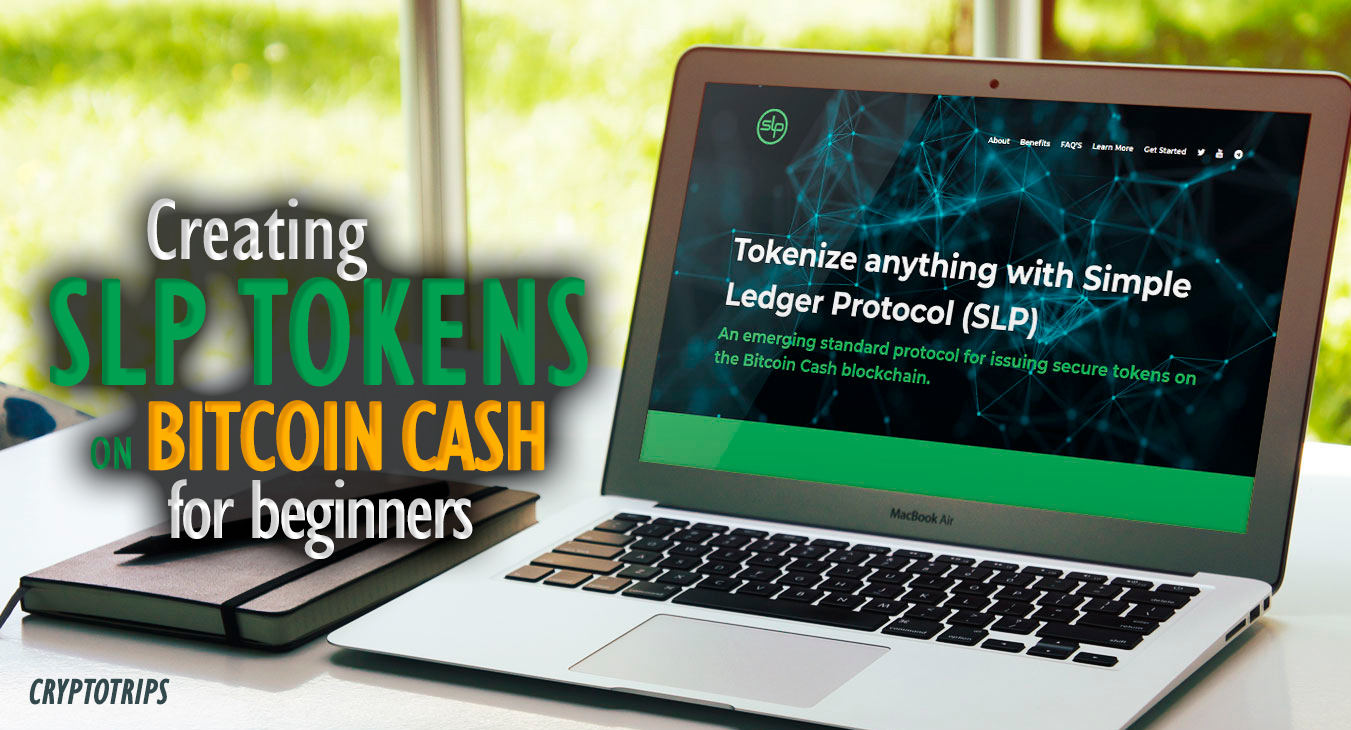
Creating SLP Tokens on Bitcoin Cash for Beginners
The recent introduction of **SLP** technology may be the most important innovation to hit **BCH** since its inception, but what is it? What purposes does it serve? How can we use it? And what are its wider implications?
**SLP** stands for **Simple Ledger Protocol**, and all non-devs really need to know about it is that it enables quick and cheap (almost free) transactions, and it allows for permissionless building of “***simple tokens***” on top of **BCH.**
Simple tokens are easy to build; they cost fractions of a penny to send and spawn, and creating them requires little to no development skills. But before I get into the tutorial on how you can make your own simple token, let’s go over some of the use cases.
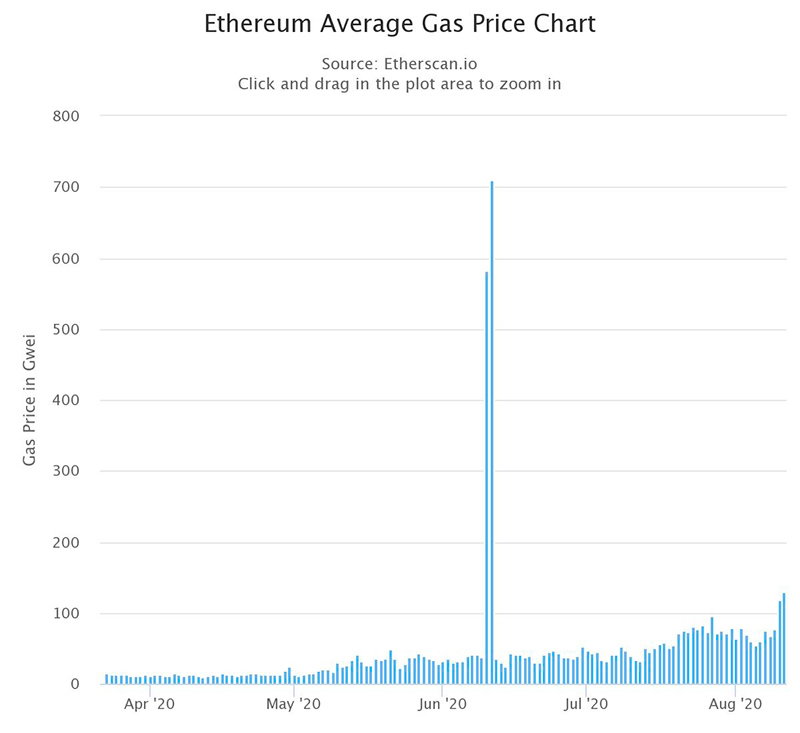
**Meme Coins**. A vast majority of the over 10,000 simple tokens built on BCH are memes. They are mostly jokes within the community. They’re designed to have no tradable value. For that reason, creating and sending them on SLP offers a significant advantage to say Ethereum, where gas prices (and the Solidity learning curve) are incredibly high.
**Customized tokens.** As more and more people embrace a self-driven entrepreneurial, gig economy way of life, it’s highly likely that we’ll see an increase of personal tokenization. Customized tokens could allow people to sell or trade their time and services once a decentralized SLP exchange, or DEX, is created.
**Stable tokens.** Though controversial, cryptocurrency’s original stable coin USDT has already been built and functions on SLP. This allows users of SLP-enabled wallets to easily switch into and out of what some view as a more “stable” asset for transferring or holding value.
**Multi-layer constructions.** In addition to building single-layer tokens, SLP facilitates more complex constructions by allowing users to build tokens on top of each other. Although it’s seldom used now, the implications of this technological innovation may be beyond our current comprehension.
**Rewards tokens.** Offering rewards points that can be used for discounted or free goods and services is one of the oldest tricks in the marketers’ handbook. Nearly every chain from Starbucks to Bloomingdales already awards them, but issuing these points (or tokens) on SLP would make keeping track of them easier, AND (in conjunction with an SLP DEX) it would allow token holders to freely trade them.
**Securities tokens.** Along the same lines as rewards, SLP allows for the construction of tokenized securities, like dividend tools. Though possible, this option is not yet being taken advantage of.
**Non Fungible Tokens.** NFTs are the talk of the cryptoverse lately. Many argue that NFTs will ultimately be the catalyst that spurs mass awareness. Thus, bringing them to BCH -where artists can create them for fractions of what they cost on some competing chains- might be what sparks community adoption of bitcoin cash.
**Now, how to create your own simple token:**
While there are several methods for creating an SLP token, ****mint.bitcoin.com**** is by far the easiest, though you’ll have to use something like **Electron Cash** if you want to create an NFT. https://mint.bitcoin.com/ https://electroncash.org/
First, you’ll need to create an account at **mint.bitcoin.com**. Enter your details and select, “**create account**”. https://mint.bitcoin.com/
The next step will be to fund your account. To create an SLP, you’ll need fractions of a **BCH** in your wallet. You can either import a wallet or create a new one and transfer in some funds. To do this, I scanned the QR code in mint from my mobile **bitcoin.com** wallet, and sent 10 cents of BCH. The transfer fee was 0.00000266 BCH, which equates to less than a tenth of a penny at present values, and it appeared in my mint account instantly. http://bitcoin.com/
Enter the details of the token you’d like to create. You can enter your token’s symbol, name, number of decimals (up to 9 places), and total supply. You can also chose if you want the token to have a fixed supply (like bitcoin), or if you want to be able to create more at any time (like you’re the federal reserve, and your token is the dollar). For additional functions, you can add a token icon from the images on your computer. You can also add a link to the project’s white paper and website if you have those readily available.
The final step is to hit the “**Create Token**” button, and bada-boom! You’ve just created your very own simple token on Bitcoin Cash.
**How do I list my simple token on CC Tip Bot?**
Once you’ve created your simple token, you may wonder how you’re going to distribute it. You could ask people to share their SLP QR codes for a more custom experience, but if you plan on circulating a large supply, you’ll probably want something you can automate.
The **CC tip bot** isn’t perfect, but I’m comfortable using it for distributing, so if you feel the same, here’s how:
**Create an account** at ****CCtip.io**** and link it to the social media of your choosing. Your options should include: Twitter, Telegram, Discord & Reddit. https://cctip.io/
After you’ve created your account or logged in, you’ll need to **set a payment password**. This step is very important because without one, you won’t be able to get your token listed. So click settings, then next to Payment Password, select “Change”. Then, enter and set your password.
At the top, **select “list your coin”** and then chose whichever social media platform you logged in through or have connected.
**Select “SLP”**.
Open your **mint.bitcoin.com** tab, select the token of your choosing, and copy the token ID. Then, go back to CCTip and paste it in the first line. Enter your token’s ticker symbol, your email address, and optionally, the website, as well as your handles on twitter and/or telegram. Then, click “Next”. https://mint.bitcoin.com/
On the next page, you’ll see all 4 of the available social media platforms where you can use the tip bot. **Each one costs 1 cent to list for the year**. Deselect any you don’t use. Then, click the down arrow next to the payment coin to select which currency you’ll pay in.
***Pro Tip:*** *The first time I did this, I selected USDT thinking it would utilize the SLP version, but it didn’t, and I ended up paying several dollars in gas fees for a 4 cent transaction. This time, I selected bitcoin cash instead).*
Click the box, acknowledging that you agree to the terms and conditions, and finally click “**Submit**”.
Enter the captcha and go to the email inbox you entered on the previous page.
Open the email from CCTip. Scroll down until you see “**Go to Pay**” in blue. Click it.
On the next screen, select “**Pay**”.
Enter the payment password you set up in My.CCTip.io and hit enter.
Wait 60 seconds, and that’s it. **Your simple token should now be ready to tip people with on the social media platform of your choosing**.
`Source: Nicole Grinstead`
**And remember: read, learn, enjoy, follow me** ****HERE**** **on my new** ****Twitter**** **(or the less important one: tip me if you liked it)... and with or without SLP, be happy!**
https://read.cash/@GusT https://twitter.com/crypto_trips
Advantages of Blockchain Domain Names: Butterfly Protocol, NBdomain and Unstoppable Domains
**Domain names** on the **blockchain** represent a new class of assets that belong to you, and not to a third party or central authority. You manage the private key of your own domain, so it is totally under your control, and for life.
This is how the domains on the blockchain constitute a set of smart contracts that associate these names with the addresses of their owners. For example, Ethereum developers have created the **Ethereum Name Service** (ENS), which allows you to register, in a decentralized way, domain names ending in **.eth**. These work on the Ethereum blockchain and can interoperate with your applications (wallets, exchanges, storage systems, etc.). https://ens.domains/
On the Bitcoin blockchain (BSV), for their part, they have developed **Paymail**, a new identity protocol that removes Bitcoin addresses from the user experience. Instead of addresses, Paymail uses "human-readable" names, just like email addresses. It is a free protocol for any application that is developed on the Bitcoin blockchain (BSV). These addresses are fully compatible and complementary to email addresses: **MoneyButton.** https://blog.moneybutton.com/2019/05/31/introducing-paymail-an-extensible-identity-protocol-for-bitcoin-bsv/ https://www.moneybutton.com/
**What is the objective and what do these types of domains solve?**
They are more convenient to carry out transactions than traditional cryptocurrency addresses, those long alphanumeric strings that are very difficult to remember and susceptible to confusion. For a person who wants to transfer funds in cryptocurrencies, simply enter a domain name or email address related to the wallet.
Being located within the immutable registry of the blockchain, these are domains that cannot be hacked, in addition to being much more resistant to censorship than traditional domains.
**Three examples of Blockchain Domains**
**Unstoppable Domains** https://unstoppabledomains.com/
You are developing an exclusive blockchain for domain names (.zil and .crypto names can now be registered) outside the ICANN system. To send cryptocurrencies, you only need to know the recipient's blockchain domain, being able to send various cryptocurrencies to a single domain. In addition, it allows the creation of incensible web pages. The domain will be stored in your wallet, where only you can move it, being able to point it to a decentralized storage network (like IPFS) to create a web page that only you can put and remove.
**Butterfly Protocol** https://www.butterflyprotocol.io/
Advertises itself as a decentralized naming system for the new Internet. Their goal is to create a decentralized autonomous organization (DAO) that replaces the DNS system and changes the economics of domain ownership, wresting governments of central control of the Internet to create a durable and uncensored network. Names live on the blockchain forever and no one can take them away from you. Aside from ASCII characters, Butterfly supports Chinese characters (like 商业) and even emojis (😀).
The name can be associated with a website, or used to send money and secure messages. These, in addition, can be sold when you no longer need them. You just have to install an extension in the browser to access this new dimension of the Internet. Each name constitutes an ERC-721 token and can easily create ERC-223 tokens, which can be used as the basis for game and other application development.
**NBdomain** https://nbdomain.com/
Built on the BSV blockchain, uses a decentralized design to store the domain information on all Bitcoin nodes, which gives it high security and speed, allowing to test the domain ownership cryptographically. Furthermore, all the data stored in the blockchain is accessible from all over the world, not requiring any permission to access your query. They also offer a global identity system owned by users and an updateable data warehouse on the blockchain. It is the perfect complement to Maxthon, whose version 6 constitutes the first browser developed on the original Bitcoin blockchain (BSV).
In short, the domains on the blockchain, still in the initial phase, will soon become part of our lives, replacing the old Internet with a new more secure, robust and efficient network, with multiple functionalities to directly manage our money, our data and our identity.
**And remember: read, learn, enjoy, follow me** ****HERE**** **on my new** ****Twitter**** **(or the less important one: tip me if you liked it)... and with or without Blockchain Domain Names, be happy!** https://read.cash/@GusT https://twitter.com/crypto_trips
What is Bitcoin Days Destroyed (BDD) and why is it important?
In a data-ridden marketplace like the crypto market, knowing what **Bitcoin Days Destroyed** is crucial to having a consistent investment strategy.
Like any financial market, the cryptocurrency market is full of metrics that allow us to understand what situation it is in. Thus, from the volume of transactions per day, to price variations and the ranking of the main exchanges, all this data allows us to plan an investment strategy. However, one of the most important metrics in the crypto world is very little known, that's why today I tell you what **Bitcoin Days Destroyed** is and what is its importance.
The crypto world is full of facts and figures. So many that sometimes it is difficult to locate the information we need at any given time, to know how to act within the market. Or even worse, we find data that we are not very sure what they are for. This being the case, on many occasions, of Bitcoin Days Destroyed (**BDD**).
And is that, ***Bitcoin Days Destroyed*** is a measure to visualize the volume of transactions in the crypto market. Measuring it through the multiplication of the number of Bitcoins traded in any operation, by the number of days that have passed since the last time those same BTC were moved.
In other words, ***suppose we buy 100 Bitcoins on Monday and by Friday we sell them. Five days have passed, which will be multiplied by 100 Bitcoins to give a total of 500 BTC. Now, if the person who bought the cryptocurrencies from us resells them on Sunday, two days will have passed, so the value of BDD will be 200 BTC.***
**What is this for?**
Now, if the concept of ***Bitcoin Destroyed Days*** is not difficult to understand, it remains to be clarified what its usefulness is in practical terms. Well, at the end of the day, it is not at all obvious what we can do knowing what is the multiplication between the number of Bitcoins traded, and the number of days since their last operation.
In this regard, CoinDesk Senior Analyst Galen Moore commented on the importance of **BDD** on the CoinDesk Crypto Podcast Network. Explaining that it would be a metric of the behavior of investors in the long term:
***BDD is a metric that reflects the collective action of long-term holders (…) What is the psychology of a long-term holder? It can be viewed collectively (through BDD) in a way that I don't think is possible in other asset categories.***
Therefore, thanks to the use of ***Bitcoin Days Destroyed***, any user or investor in the crypto world can observe the trends of the large holders of Bitcoin.
So, when this metric starts to increase, we know that holders are trading with their cryptocurrencies. While if it decreases, we understand that there is a trend towards saving, rather than trading. All of which allows us to be more effective in planning our investment strategy.
**And remember: read, learn, enjoy, follow me** ****HERE**** **on my new** ****Twitter**** **(or the less important one: tip me if you liked it)... and with or without BDD, be happy!** https://read.cash/@GusT https://twitter.com/crypto_trips
Dapps, Wallets and Altcoins that are Not Vaporware
For a few weeks now, our of cryptocurrency world has really moved, and if we deviate from the path of the two main cryptos, **Bitcoin** and **Ethereum**, we will find ourselves within the territory of **altcoins**, a place where things get as uncertain as they are exciting . But there are ways to go through that territory, clearing up uncertain fantasies and smoke projects, to finally come across concrete realities.
There are three projects that have long attracted me because they have great applications and utilities in the real life, and because they exist beyond the cryptocurrency ecosystem. So they are **NOT Vaporware projects**. This is the point where many will wonder what that means, simple:
***Vaporware is a pejorative term used to refer to the software or hardware announced by a developer long before development, but later does not emerge, or have a cycle of more or less stable development.***
Clarified the term I summarize these three projects that I mentioned, warning you as always that no one can ensure the success of anything in the future, but that the following are serious projects is already a great discovery in the madness that we live today.
Here we go:
**STATUS (SNT)** https://status.im/
**Status** is an open source project, a multipurpose communication tool that ***combines a private messenger, a decentralized crypto wallet and a Web3 browser***. And that recently through a tweet, he had the blessing of Vitalik Buterin, the founder of Ethereum, not bad.
The functionalities and features that **STATUS** offers make it much more than a mobile application, and future development is truly limitless thanks to open source, the ability for developers to create any Dapp imaginable and the use of all the Dapps that are being created. . . for the Ethereum network.
As a reinvented social network that puts power back in the hands of the people, Status could well be the social platform that blockchain has been waiting for, by using **Status Network Tokens (SNT)**, created as a utility token to power transactions. on the Status Network.
**SIA - SIACOIN (SC)** https://sia.tech/
**Storage** is rarely a major problem these days, but **Sia** takes care of the issue by applying decentralization. Instead of using a centralized hub like Google Drive or Dropbox, users have their files encrypted and divided into different hosts, which results in a much stronger, more private, secure system, and without unwanted failures. A decentralized cloud storage platform with no signups, no servers, no trusted third parties, and with super affordable rates compared to centralized monsters.
After being quiet for a while, **Sia** has released the latest updated version of Equinox v1.5.0 and a Layer 2 application called Skynet, which allows users to access and publicly share the content they have stored on **Sia as BitTorrent**.
*And what about SIACOIN?* It is the cryptocurrency used with the Sia system. Anyone with extra room on their PC can use the Sia decentralized network. In exchange for their storage space, they’ll get paid in **SiaCoin**. On the other side of the coin, anyone that needs space pays in SiaCoin to a host.
Like everything in life, the winner is the one who gets mass adoption, so we will see if SIA will reach the top of decentralized cloud storage platforms, even though it is one of the oldest, launched in 2015.
**BASIC ATTENTION TOKEN (BAT)** https://basicattentiontoken.org/
I think we all know this one if we are here: **BAT**, the utility token of the **Brave** privacy web browser. And what was the premise of its creation? Instead of users giving up their privacy and data for ads and trackers, why not trade BAT?
***And why does it work?***
Thanks to a protective layer in Brave that protects user data. Users can watch ads and be rewarded with **BAT** tokens, and they can also tip tokens for the content they like. In turn, content creators earn tokens based on the amount of attention they receive, such as viewing time or duration, thus eliminating the always undesirable middlemen who take some of the money without doing much to deserve it.
Since its inception, **Brave** has always come under fire for various reasons, but the important thing is to see and assess how much more security it can offer as a browser in the near future. Even with all the doubts it may raise, Brave is successful as a real world app that you can download right away and start earning **BAT**.
**And remember: read, learn, enjoy, follow me** **HERE** **on my new** ****Twitter**** **(or the less important one: tip me if you liked it)... and with or without vaporware projects, be happy!** https://read.cash/@GusT https://twitter.com/crypto_trips
All about Namecoin, The First and Almost Forgotten Altcoin Born After Bitcoin
Let's dive into the short but long forgotten history of cryptocurrencies.
What was the first Altcoin after the creation of **Bitcoin**? It was **Namecoin**, a project that is still alive, based on software developed in Bitcoin technology, created to offer without intermediaries the registration of online identities and domain names in a decentralized system, which means that the registration, storage and backup is done on the Blockchain, and **Namecoin's .bit domains** are managed by its P2P network, without the need for a central authority.
**Namecoin** is also considered the **first fork of Bitcoin**. The initiative was presented in April 2011 through the **Bitcointalk** forum, and is based on the Bitcoin code, incorporating some changes, but with its own blockchain and its own cryptocurrency. The mining process is the same as on the Bitcoin blockchain, although it takes place on a separate chain. It also works thanks to the Proof of Work (PoW) consensus algorithm and the SHA-256 algorithm.
While the purpose of Bitcoin was always to free money in the hands of users, **Namecoin aims to free DNS and identities on the Internet**, and just like Bitcoin transactions, Namecoin domain names are also difficult to censor or confiscate. Domain registration comes at a cost that includes a very small registration fee, and a transaction fee for miners. There is a capped maximum of 21 million NMC coins and the reward for miners is also halved every 210,000 blocks (about 4 years), such as the total supply and halving of Bitcoin. Its platform is free to use, free and open source, with which anyone can review it, propose improvements or report errors on GitHub, as well as be used as a basis for other projects.
**Namecoin** was presented at the time as the first solution to the *Zooko Triangle*, an age-old problem associated with creating a network protocol that is at the same time **Secure**, **Decentralized** and **Human-meaningful**.
The identity of its creator is also a mystery (as is Mr Satoshi Nakamoto) and in this case he is known under the pseudonym **Vinced**.
Today, the project is developed by a team of volunteers and academics at the international level, committed to working *to protect freedom of expression online and save the world from an Orwellian surveillance state*.
Currently, although it can be used for the storage of value and to make transfers, that is as a digital currency for daily use, which is abbreviated as **NMC**, the developers of the project do not promote this use, promoting the use of Bitcoin.
One of the biggest goals that **Namecoin** faces today is to get the existing browsers and operating systems to support Namecoin in the future, and also to achieve compatibility with ISPs (Internet Service Providers); for example, those that do not support DNS over TLS, DNSCrypt or other security protocols used by Namecoin.
**What are the possible uses of Namecoin?**
Register and own domain names in a decentralized system.
Access to websites using the .bit domain.
Explore domains on a blockchain.
Transfer NMC coins.
Mine your digital currencies.
Promote free expression on the Internet by making the web more resistant to censorship.
Have more private online identities.
Target Tor .onion domains with human meaningful.
Validation of the TLS (HTTPS) certificate in decentralized mode, thanks to its blockchain consensus mechanisms.
To learn more about how to obtain **Namecoin**, how to mine it, how to view websites with .bit domains, and what you can think of to know about this historic altcoin, I leave you all the links here:
**Official Website**
**White Paper**
**Twitter**
**Github**
**Reddit**
**Bitcointalk**
**Block Explorer** https://www.namecoin.org/ https://www.econinfosec.org/archive/weis2015/papers/WEIS_2015_kalodner.pdf https://twitter.com/namecoin https://github.com/namecoin https://www.reddit.com/r/Namecoin https://bitcointalk.org/?topic=6017.0 https://namecha.in/
**And remember: read, learn, enjoy, follow me on my new** **Twitter** **(or the less important one: tip me if you liked it)... and with or without Namecoin, be happy!** https://twitter.com/crypto_trips
The Most Complete NFTs Categories List, No Just Crypto Kitties
The imagination of **NonFungible Tokens, NFTs,** is actually huge, but the real obstacle is that the digital life in our lives is actually monopolized by most centralized services. Imagine that a digital creator can issue **NFTs** through the blockchain to the middleman, and then you can truly own part of his intellectual property. **NFTs** is no longer just a hype kitty, nor is a tulip bubble game that everyone knows is worthless, but a tool that allows any digital content to be listed on the blockchain and become circulated intellectual property.
Before starting, I tell you that this incredible list was produced by **@DCLBlogger**, which has authorized me so that I can spread it, since I consider it to be of great informative, educational and current value. The images are my own search and and they link to their websites respective owners. Each category has suggested link to follow on **Twitter**. https://twitter.com/DCLBlogger
**Here we go with the NFTs industry categories list:**
**1. ART**
HUGE Growth Industry for NFTs.
Pieces go for $50,000+ and certain Artists sell out $100,000+ in a single day.
SuperRare alone report $2.3M transaction volume.
Suggested to follow: @makersplaceco @SuperRare_co @KnownOrigin_io @mintbase @niftygateway @rariblecom https://twitter.com/SuperRare_co https://twitter.com/makersplaceco https://twitter.com/KnownOrigin_io https://twitter.com/mintbase https://twitter.com/niftygateway https://twitter.com/rariblecom
*Image:* *trevorjonesart*
**2. VIRTUAL LAND**
Another Monster Industry.
Build virtual conferences, games, DeFi banks, art galleries, etc.
Over $50M worth of Transaction Volume so far!
Suggested to follow:
@decentraland @SomniumSpace @cryptovoxels @TheSandboxGame https://www.trevorjonesart.com/ https://twitter.com/decentraland https://twitter.com/SomniumSpace https://twitter.com/cryptovoxels https://twitter.com/TheSandboxGame
*Image:* *Decentraland* https://decentraland.org/
**3. GAMES**
Probably the leading NFT usecase.
Own skins, games, pets, items, everything you'd buy in a traditional game.
YOU own the asset as an NFT. Play to Earn is becoming a thing.
Suggested to follow:
@AxieInfinity @neondistrictRPG @mycryptoheroes_ @CSCgame @Ethermon_io https://twitter.com/AxieInfinity https://twitter.com/neondistrictRPG https://twitter.com/mycryptoheroes_ https://twitter.com/CSCgame https://twitter.com/Ethermon_io
*Image: Neon District* https://neondistrict.io/
**4. TCG's**
Yes, MORE Games.
Played Hearthstone or Magic the Gathering? Buy Decks, trade cards, win more cards, another possible play to earn contender.
Suggested to follow: @GodsUnchained @splinterlands @SkyWeaverGame https://twitter.com/GodsUnchained https://twitter.com/splinterlands https://twitter.com/SkyWeaverGame
*Image: Splinterlands* https://splinterlands.com/
**5. COLLECTIBLES**
From Cryptopunks selling for 10's of thousands to Cryptokitties selling for six figures. Collecting will be at the heart of the NFT industry.
Suggested to follow: @CryptoKitties @AvaStarsNFT @BlockchainCutie @larvalabs https://twitter.com/CryptoKitties https://twitter.com/AvaStarsNFT https://twitter.com/BlockchainCutie https://twitter.com/larvalabs
*Image: Crypto Kitties* https://www.cryptokitties.co/
**6. CARD/ANIMATED COLLECTIBLES**
One step further. Projects like @nba_topshot where you can collect 'moments' or @WAX_io Card Drops, (Garbage Pail Kids from @Topps).
Bringing collectible cards to Blockchain. https://twitter.com/nba_topshot https://twitter.com/WAX_io https://twitter.com/Topps
*Image: Nba Top Shot* https://www.nbatopshot.com/
**7. DOMAIN / WALLET NAMES**
It makes sense to own a domain name as an NFT.
Projects like @ensdomains and @unstoppableweb which recently saw a 230 ETH sale! .crypto, .eth, etc. https://twitter.com/ensdomains https://twitter.com/unstoppableweb
*Image: Ethereum Name Service* https://ens.domains/
**8. FANTASY SPORTS**
Buy sports players as NFT's, position them, earn rewards.
We first saw this with @MLBChampions but have recently seen @SorareHQ (Fantasy Football), top 7 day transaction volume for weeks now!
A Bright Future. https://twitter.com/MLBChampions https://twitter.com/SorareHQ
*Image: Sorare* https://sorare.com/
**9. NFT MARKETPLACES**
The Nature of NFT's allows you to take them to any secondary market and buy/sell.
Marketplaces have been the backbone for the NFT economy to function.
Suggested to follow: @opensea @rariblecom @TokenTrove @GPKMarket @enjin https://twitter.com/opensea https://twitter.com/rariblecom https://twitter.com/TokenTrove https://twitter.com/GPKMarket https://twitter.com/enjin
*Image:* *Myth Market* https://myth.market/
**10. NFT PROJET LAUNCH PLATFORMS**
Need the right tools to integrate/launch your project or game on Blockchain?
Projects like @enjin @gamecredits @WAX_io leading the way. https://twitter.com/enjin https://twitter.com/gamecredits https://twitter.com/WAX_io
*Image:* *Enjin* https://www.enjin.com/
**11. DeFi x NFT's**
Fresh but extremely interesting.
Stake Tokens, earn rewards as NFT's? Ties in to collecting but having assets with varying values and rarities brings a whole element of awesome to traditional DeFi.
Suggested to follow: @DontBuyMeme @aavegotchi https://twitter.com/DontBuyMeme https://twitter.com/aavegotchi
*Image:* *DontBuyMeme* https://dontbuymeme.com/
**12. DIGIPHYSICAL GOODS**
Physical Merchandise like Tees, Hoodies, etc BUT connected to a Digital wearable you can wear in Virtual Projects like Decentraland, Cryptovoxels, etc.
Suggested to follow: @TheMetaFactory @digitibles https://twitter.com/TheMetaFactory https://twitter.com/digitibles
*Image:* *Metafactory* https://shop.metafactory.ai/
**13. VIRTUAL SCENES|MODELS|ASSETS**
Think an 'app store' but for the Metaverse.
@MetaZoneio have been doing this in #Decentraland.
A reported, 2 MILLION #MANA Earned from Devs selling games, models, etc to Land Owners.
HUGE Potential as the Virtual Blockchain Industry grows. https://twitter.com/MetaZoneio https://twitter.com/hashtag/Decentraland?src=hashtag_click https://twitter.com/hashtag/MANA?src=hashtag_click
*Image:* *MetaZone* https://metazone.io/
**14. SHARED OWNERSHIP|SHARDING**
Can't afford a $10,000 premium NFT? Why not own a piece?
Break your NFT into 'shards' or 'erc20's' and sell them on @NIFTEXdotcom.
A unique solution to unlocking liquidity. https://twitter.com/NIFTEXdotcom
*Image:* *Niftex* https://www.niftex.com/
**15. INSURANCE POLICIES AS NFTs**
You can actually repackage Insurance as NFTs and buy/sell them.
@gabusch figured this out and made some #ETH selling @iearnfinance policies on @rariblecom to Liquidity Pool providers. https://twitter.com/gabusch https://twitter.com/hashtag/ETH?src=hashtag_click https://twitter.com/iearnfinance https://twitter.com/rariblecom
*Image:* *Rarible* https://rarible.com/
**16. DIGITAL CARD**
With the rise of Blockchain Virtual Worlds, @CryptoMotors_io has sold 100's of ETH worth of Digital Cars.
@F1DeltaTime and @BattleRacers are more racers. Buy them, ride them, sell them. https://twitter.com/CryptoMotors_io https://twitter.com/F1DeltaTime https://twitter.com/BattleRacers
*Image:* *CryptoMotors* https://www.cryptomotors.io/
**17. GOLD BACKED NFTs**
@Bullionix_io allow you to use @DigixDGX, (gold backed tokens), to mint Gold backed NFTs!
We used them in @decentraland as the prize for the HUGE 24 team football tournament.
Cups, medals, prizes, the potential for gold backed NFTs is BIG. https://twitter.com/Bullionix_io https://twitter.com/DigixDGX https://twitter.com/decentraland
*Image:* *Bullionix* https://bullionix.io/
**18. PROOF OF ATTENDANCE PROTOCOL**
@poapxyz's allow you to hand out attendance badges as NFT's during events.
Whether physical or digital, having a collectible only event attendees can claim can encourage attendance.
Again, used in Decentraland for Virtual Events. https://twitter.com/poapxyz
*Image:* *POAP* https://www.poap.xyz/
**19. EVENT TOCKETS|ACCES TOKENS**
Verified access for physical and virtual events.
Suggested to follow: @mintbase @DigiTxio are doing some work here.
Along with @digitibles using them in @decentraland for special HQ access and Kakao to verify investors. https://twitter.com/mintbase https://twitter.com/DigiTxio https://twitter.com/digitibles https://twitter.com/decentraland
*Image:* *Digitix* https://digitix.io/
**20. MUSIC**
Another one currently possible on @mintbase.
@DAOrecords_ using the platform to sell Music NFTs.
The music industry will be HUGE as traditionally there has been huge digital ownership issues.
Blockchain to the rescue. @rariblecom has also been working on it. https://twitter.com/mintbase https://twitter.com/DAOrecords_ https://twitter.com/rariblecom
*Image:* *Mintbase* https://mintbase.io/
**21. SPONSORSHIP|FUNDING**
Need an NFT as proof you are a sponsor or funded a project?
Recently @BasedProtocol issued NFTs to those that committed $50k to the development of V1.69. https://twitter.com/BasedProtocol
*Image:* *based.money* https://based.money/
**22. WEARABLES IN VITUAL WORLDS**
Another use case for @decentraland @SomniumSpace @cryptovoxels where wearables or avatars will be made available as NFTs.
Collect them, flaunt rare ones when you can.
Some wearables have sold for $1,000's! https://twitter.com/decentraland https://twitter.com/SomniumSpace https://twitter.com/cryptovoxels
*Image:* *Somnium Space* https://somniumspace.com/
**I hope this post is useful to you, I loved to share it!**
**And remember: read, learn, enjoy, follow me on my new** **Twitter** **(or the less important one: tip me if you liked it)... and with or without NFTs, be happy!** https://twitter.com/crypto_trips
Which is the Best Blockchain Platform Comparing Avalanche with the Famous Ones
In this post I compare the ambitious new **Avalanche Blockchain Platform** with others already known such as the **Ethereum**, **Stellar** and **NEO** **Blockchains**, analyzing their positive and negative sides, to get to know which of them is the best today. I will try to be fair and objective, even if it is impossible: I am a human being.
**Ethereum** is a decentralized platform. This means that there is no effective way for the community to fully update the protocol without the threat of a fork. But at the same time, the enormous importance of the opinion of *Vitalik Buterin* (co-founder of Ethereum) on the development of Ethereum calls into question the decentralization of the platform.
Most likely, over time, Ethereum will find it increasingly difficult to compete with newer technologies. Therefore, it may well turn out to be a highly specialized platform to support ICOs or special smart contracts.
**Positive**:
+ Huge popularity;
+ Easy integration with exchanges;
+ Cooperation with reputable organizations;
+ Dominant platform for ICOs and DApps.
**Negative**:
- Exposure of the network to overloads;
- Low speed;
- Limitation by CPU performance;
- Frequent mistakes in smart contracts;
- Vitalik Buterin plays too big a role in the development of the platform.
**Stellar** has a relatively cheap and fast protocol. 100,000 transactions on Stellar cost only one cent. It is more secure than Ethereum: its dedicated system for smart contracts limits the ability to write code. Its simplicity makes it ideal for applications that do not require Turing complete smart contracts. In short, Stellar is all about high performance, security, and very cheap transactions.
**Positive**:
+ Faster transactions;
+ Low commissions;
+ Good performance;
+ Liquidity;
+ Safety;
+ Own decentralized exchange.
**Negative**:
- Centralization;
- Lesser role in ICO;
- More complex integration with exchanges.
When developing **NEO**, Ethereum's mistakes were taken into account and the platform itself is being developed for the future, while Ethereum seeks to adapt to current requirements.
**Positive**:
+ Compatible with government regulations;
+ Developed for the future;
+ Cooperation with OnChain (great potential for NEO);
+ Speed: 10,000 transactions per sec vs 30 transactions per sec for Ethereum;
+ The use of NEO and GAS tokens are a great advantage when using the Proof-of-Stake protocol;
+ No risk of bifurcation.
**Negative**:
- Lack of anonymity
- Less decentralization compared to Ethereum;
- ICO ban in China.
Avalanche offers better performance, security and efficiency compared to previous decentralized protocols. With Avalanche is easy to create powerful, reliable, and secure applications and customizable blockchain networks with complex rule sets, or run them based on existing public and private subnets.
**Positive**:
+ Avalanche provides over 4500 tps of throughput.
+ Uses a new consensus protocol to continuously confirm transactions in 1 to 2 sec.
+ Scalability: It processes thousands of transactions per sec and can accommodate thousands of validators without sacrificing performance.
+ Stronger security guarantees than classic consensus protocols.
+ Support Solidity smart contracts, as well as well-known Ethereum tools such as Remix, Metamask, Truffle and others.
+ Users can create their own public or private blockchains.
**Negative**:
- Nothing concrete yet, this project is still so new and, as it develops, it may cease to interest investors.
- Unknown, still only heard by a small circle of users.
**Now let's summarize and compare these blockchain platforms according to some concrete criteria.**
**Ethereum**: Undoubtedly wins all others in popularity, but is inferior to Avalanche in speed and scalability and security.
**Stellar:** Wins Ethereum in terms of speed and security, but again loses to Avalanche in these indicators! However, Stellar is more popular than Avalanche, but it's a matter of time. In terms of scalability, again, Avalanche has the lead.
**NEO:** Loses to Avalanche in all criteria except popularity, and loses to Ethereum and Stellar in terms of speed and popularity. I believe it can be ranked 4th among the compared blockchain platforms.
**Avalanche:** It wins Ethereum, Stellar and NEO in terms of transaction speed, security and scalability, and only loses to them in popularity.
Draw your own conclusions, but you can immediately tell that Avalanche looks very attractive, and in the future it may create great competition not only with blockchain platforms compared to current ones, but also with many others that have appeared relatively recently.
**As always, research, read, learn, enjoy, follow me on my new** **Twitter** **(or the less important one: tip me if you liked it)... and with or without Blockchains, be happy!** https://twitter.com/crypto_trips
Proof of Achievement (PoAch): The Evolution in Blockchain Games + Mining
Since the appearance of Bitcoin in 2009, a large majority of cryptocurrencies have used protocols called Proof of Work (PoW) or Proof of Stake (PoS) for the verification of their transactions, which allow obtaining coins and expanding their profits through crypto mining to those who use them.
Blockchain technology has led the online gaming industry to an accelerated evolution, and there are already proven experiences in the past of the application of blockchain networks in gaming.
In 2014, **Motocoin** was created, the first cryptocurrency to implement a different approach by introducing the concept of proactive mining with a test model called **Proof of Play (PoP)**, which allows users to participate in a game to achieve get coins. Motocoin was the pioneer in the cryptocurrency market by launching this novel proactive mining protocol. Unlike these protocols, Proof of Play requires the player to perform a cognitive workload, when participating in a simulation game to mine and extract the coins, which means that the algorithm uses more human skill and dexterity to mine instead of computing power. https://www.reddit.com/r/Motocoin/
In those years, **Huntercoin** was also launched, as an experimental test to see how blockchain technology could be handled in the world of games. An open source, cryptographically secure, decentralized and innovative cryptocurrency, whose main difference is that 80% of the coins could be obtained by collecting them in a virtual universe that resides within the blockchain. Just a few months after its launch, Huntercoin was a success, managing to create over 35,000 controlled characters in the game despite having a low-key launch, and ended up providing a number of world-leading ideas in blockchain technology. . https://xaya.io/huntercoin-legacy/
Both Huntercoin and Motocoin were the inspiration behind the blockchain games that invade us today and could come to dominate tomorrow.
Thus was born from the hands of **Arian**, the **Proof of Achievement (PoAch) protocol**, the most recent evolution of Proof of Play, which proposes a consensus protocol inspired by the best of Proof of Work and Proof of Play. The **PoAch** makes mining a really simple process, since it proposes a strategy in which the effort or work carried out by a person on a computer or mobile device is rewarded for achieving the goal proposed by the proposed challenge. https://ariancoin.io/poach-en/
In other words, whoever invests time developing an activity, can achieve the validation of a block and, therefore, be the winner. That is the basic concept behind the **PoAch** protocol, a much more efficient protocol from the point of view of energy saving and becoming completely decentralized, leaving behind failed attempts based on Proof of Play (PoP), which do not achieved the expected results. It also enables high immutability in the blockchain ecosystem allowing hundreds or thousands and even millions of participants in the network because it is light, easy to implement and also does not require specialized equipment or much knowledge.
Revolutionary would be the most accurate qualifier for the work achieved with the **PoAch** protocol, an interactive and intelligent mining that achieves an optimal productive relationship between the investment of time and the use of hardware with basic characteristics. The combination of the benefits of the first and old protocols show us the new frontier of blockchain technology in the gaming world. It is in our hands to make the most of the **Proof of Achievement**.
**And remember: research, read, learn, enjoy, follow me (the less important one):**
****Twitter**** https://twitter.com/crypto_trips
****Publish0x**** https://www.publish0x.com/@GusT?a=Jrb2kr6zdW
****Hive**** https://hive.blog/@crypt0trips/
**and with or without PoAch, be happy!**

The Definitive 2020 Guide to Margin Trading for Beginners
**Margin-trading** is an important tool that all of us should understand to know if we should implement it or not, and how to do it. The use of **leverage** and **short position** has the potential to dramatically **increase the profitability** of a wide range of different strategies, as well as unlocking many opportunities that would not otherwise be available.
However, failing to fully understand what exactly margin-trading is and how to use it, many mistakenly associate margin-trading with risk, when in fact it is an essential tool for professional and institutional investors.
**In this guide, I'm going to delve into what cryptocurrency margin-trading really is, how to implement it, what is leverage, short position, the best ways to use margin-trading, and obviously the ways to avoid the risks involved in margin-trading.**
**What is Margin-Trading?**
**Margin-Trading** is a set of tools that allow us to increase the opportunities available so that we generate greater profits.
The margin-trading process consists in that we receive a loan from a broker, and that loan allows us to create investments that would not normally be within our reach, but that have the potential to generate significant amounts of profits.
Margin-trading has grown in the cryptocurrency market in recent years, and more and more investment platforms are incorporating it into their services in response to investor demand to explore new ways to increase their profitability.
Margin-trading is a term that encompasses two different but similar tools that we can use to increase our profits: **leverage** and **short position**.
**What is Leverage?**
**Leverage** is the process by which an investor borrows funds from a broker in order to create significantly larger investments than he could make with his available capital.
As part of this process, we as investors will provide an amount of our own capital, known as the **margin**, to ensure the leverage operation. This margin is used in case the operation results in losses instead of generating profits.
Due to the mechanics of leverage, the profit generated by the operation can be substantially greater than that which would occur with a normal investment, since it can multiply what would normally be earned with it.
Let's see a concrete example of this: ***if we believe that the price of Bitcoin will increase and we put a trade with 10X leverage in Bitcoin, for every dollar that we would have generated normally we will get 10 if the price of Bitcoin actually increases***.
**What is Short Position?**
Similar to leverage, the underlying principle in **short position** involves an investor borrowing funds from a broker. However, the objective of the short position is to make a profit if the price of an asset falls, rather than if it increases.
This is achieved when an investor borrows from a broker an amount of an asset that he believes will lose value, sells it immediately, waits for the price of the asset to drop to an acceptable level, and then buys the same amount of the asset back at a lower price. You can then return it to the broker and keep the difference as a profit.
This would be a concrete example of a short position. ***We may think that the price of Ethereum is going to drop sharply, so we borrow a quantity of Ethereum from an investor and sell it immediately. The price of Ethereum then drops 10%, and then we buy back the same amount 10% cheaper, we return it to the broker and we keep 10% of the difference in its price as a profit.***
The ability to use the short position in the cryptocurrency market opens up a wide range of opportunities that are not normally available without this option. This means that if the price of an asset falls, a profit can also be generated.
**WHAT ARE THE BEST WAYS TO USE MARGIN TRADING**
****Flat Trend Leverage****
One of the best and most undervalued ways to use margin-trading in the cryptocurrency market is to leverage relatively short movements during flat trends and their consolidation.
While for many investors the only chance to make a profit is when prices move widely higher or lower, the opportunity to make a profit during flat periods is often offset by the risk of having to predict sharp short-term swings.
However, a problem can arise when a flat trend lasts for a long time and an investor is out of the stock during that period, meaning that they cannot make a profit until an uptrend or downtrend forms.
One way that margin-trading can help open up many more profit-making opportunities in the cryptocurrency market is by using leverage during flat periods to make relatively small moves up or down more profitable.
With the use of the short position to be able to invest during downtrends, and the use of leverage to engage with profitability during flat trends, we can now generate profits in the cryptocurrency market without exclusion.
****Go Short on Spikes and Excess Purchases of Assets****
Spikes are rapid short-term increases in the price of a cryptocurrency that occur frequently in the market, and present a wide range of different opportunities.
One of the best strategies to use margin-trading to create situations where there is an increased probability of making a profit is to go short on rallies, and also when crypto assets are overbought.
According to the mean-reversion theory, when a crypto asset moves far away from its historical average price, there is a greater probability that it will return to its mean at some point in the future.
From a psychological perspective, when the rally occurs there are a significant number of investors who will be holding the asset to make a short-term profit.
Consequently, it is logical that when they have the opportunity to generate that profit they will, and this will cause a chain reaction where the price of the asset falls to where it was before the rally.
When the rally has been identified, it is possible to short the crypto asset at its highest point, and when the asset price falls, close the position and make a short-term profit.
****Going Long in Bullish Periods****
Unlike other financial assets, the cryptocurrency market has an inherent mechanism in the way that Bitcoin works, known as the 'halving cycle', which implies that every 4 years the amount of Bitcoins generated by the miners.
Due to the artificial shortage programmed in the way Bitcoin works, since the rest of the cryptocurrency market more or less follows the price of Bitcoin, this means that every 4 years there is a rapid increase in the value of the cryptocurrency market, known as a bull period.
While large profits can be made simply by buying cryptocurrencies at the start of a bull period and holding it for the duration, astronomical profits can be made using leverage long during these periods.
At no other time does the cryptocurrency market present a better opportunity for profit generation than leveraging a long position just before a bullish period.
**WHAT ARE THE RISKS OF MARGIN TRADING**
****Use a Stop-Loss****
Some investors associate margin-trading with risk, particularly with leverage, and, while it is true that they do involve certain risks, there are a number of mechanisms available for investors to avoid this risk and keep their potential profit generation intact.
One of the most widely used and best known risk avoidance mechanisms is the use of a **stop loss**, which is executed when the price of an asset moves too far in the opposite direction from what was expected.
When that limit is reached, the order is automatically executed and closes the position to protect the investor from incurring further losses, effectively ending the trade.
It is highly recommended that investors using leverage also include the **stop loss** to ensure that if the trade goes in the opposite direction than expected, it is stopped at the threshold and prevents the investor from losing the entire balance you have.
****Inefficient Use of Capital****
Many investors often spend months or even years in the cryptocurrency market before accumulating enough knowledge to be able to develop strategies to generate profits on a regular basis.
When an investor has developed a strategy that reliably guarantees profits, all the profits generated can be significantly amplified using leverage, and this is by far the most efficient way to use capital, as opposed to leaving profits on the table for not using margin-trading.
One of the great risks that cryptocurrency investors face is the inefficient use of their capital by not using leverage to amplify the benefits they are already generating, settling for much smaller returns.
For example, if an investor has a strategy that consistently generates a profit of 10% per month, and has invested $ 1,000 in this strategy, he will generate a profit of $ 100 per month.
If you used that $ 1,000 every month and leveraged it up to 50X, you'd generate $ 5,000 a month in profit with just $ 1,000 of capital.
****Use Maximum Leverage for All Trades****
Another risk investors need to be aware of is using maximum leverage in all trades, rather than calculating a balanced way to implement leverage based on each situation.
Professional investors go through a process of assessing the risk of each situation before designating how much leverage they will use on each trade, to make sure they are protected.
If a trade has a high risk factor, then using less leverage will ensure a greater margin for error, whereas if the investor has calculated that the risk of a trade is low, then it makes sense to use higher leverage to try to secure a higher return on investment.
**Conclusion**
Margin-trading is a powerful tool for beginners to open up new opportunities to generate profits, and to protect their capital in the cryptocurrency market.
While many retail investors lose the opportunity to use margin-trading in their daily activities, it is an essential tool used by almost all professional investors for the efficiency it offers in the use of capital.
Although many investors only perceive the risks involved in margin-trading, this is only part of the equation, and it is important to consider the different ways in which margin-trading can reduce as well as increase their risks, and the different tools. mitigation tools that investors have at their disposal.
**Finally, I would like to clarify once again that the purpose of my articles is always informative and educational, and I tirelessly recommend that you do not take any word as sacred and infallible.**
**Research, read, learn, enjoy, follow me (the less important one):**
****Twitter**** https://twitter.com/crypto_trips
****Publish0x**** https://www.publish0x.com/@GusT?a=Jrb2kr6zdW
****Hive**** https://hive.blog/@crypt0trips/
**and with or without profit, be happy!**


Wallets: The Ultimate Beginner's Guide to the Lightning Network.
**Lightning Network** is a protocol that works in a second layer on the Bitcoin blockchain, so only the strictly necessary information will be registered on the Blockchain. The goal is to significantly decongest the network to make it more efficient, while running a powerful network for immediate small-scale payments and with really low fees. By moving the data record out of the blockchain, congestion on the core network is decreased significantly and then it's all for the benefit.
Now, the most important thing for you who are reading: **you don't need to be an advanced user to use the Lightning Network**. I'll show you how easy it is for anyone to start using the Lightning Network in minutes, so you can make instant payments, avoid increasing Bitcoin's transaction fees, or get your transaction stuck in mempool-limbo and delay confirmation. .
There are plenty of wallets for the **Lightning Network**, but this guide will focus only on automated ones:
****Muun: The easiest Bitcoin / LN hybrid wallet to use****
The **Muun wallet** is the easiest way to start if you still want to use a “normal” Bitcoin wallet but eventually want to pay something for Lightning. When you scan a QR code Muun detects if it is Bitcoin onchain (normal) or Lightning, and simply pays it interchangeably, for super low rates.
Muun is a large project based in Argentina, which built a non-custodial wallet to make and receive on-chain payments and which in turn uses swaps to instantly pay bills on the Lightning Network for 1 or 2 Sats / byte.
This means that you don't need a Bitcoin or LN node, you don't have to worry about opening, financing or closing payment channels, nor any of the other technical barriers that prevent regular Bitcoin users from using Lightning. Just scan the LN invoice like any other Bitcoin QR code or paste it. Unlike native Lightning wallets, instead of taking a few seconds to confirm the payment, Muun takes about 40–50 seconds to do so (which takes the swap).
Muun is not custodial, you have complete control of your private keys and a unique approach to key management to protect users using multi-signatures.
It also allows you to send and receive payments using contacts and phone numbers, making mistakes for Bitcoin's long and complex addresses a thing of the past. Muun's only limitation is that he currently cannot receive Lightning payments, only send them, although the feature will be added in the future.
**Muun** is available for iOS and Android.
****The easiest to use Lightning Network custody wallets****
****Blue wallet****
**Blue Wallet** is an easy to use Bitcoin wallet with many cool features. It has an unguarded “regular” (on-chain) Bitcoin wallet and also offers guarded Lightning wallets, which can be easily refilled from the on-chain wallet. Blue Wallet stores your Lightning funds in its well connected and managed node to guarantee a simple and easy to use experience with zero configurations. You can also connect it to your own node and make it unguarded.
Blue Wallet integrates with physical wallets, allows you to complete partially signed offline transactions, replace with commissions to replace or cancel transactions, uses Segwit and has an incredible Lightning Apps market.
It is available for iOS and Android.
****Wallet of Satoshi****
**Wallet of Satoshi (WOS)** is Lightning's simplest native wallet. WOS keeps your funds in their custody, but they also ensure the smoothest and most intuitive user experience.
WOS has an option to buy Bitcoin in the app and has a built-in Lightning app marketplace. With WOS, any beginning user can start using Red Lightning in seconds with zero settings.
WOS is not the most advanced wallet in terms of features, it forgoes complexity and is focused on one thing, but it does extremely well. It makes Lightning ridiculously easy and guarantees a good experience for users, regardless of their technological prowess.
Wallet of Satoshi is available for iOS and Android.
****The easiest Lightning non-custody wallets to use****
****Phoenix Wallet****
The **Phoenix Wallet** is designed to make Lightning as easy as possible for new users without taking custody of their coins. Phoenix automates the process of creating channels, exchanging inputs and outputs to finance channels, withdraw funds, and also to send and receive on-chain payments.
Phoenix houses an LN node on your phone and allows you to control your own keys, so that you have full ownership of your coins.
It has a refreshing approach to make an intuitive LN wallet and, like Wallet of Satoshi, it focuses on one thing and runs it impressively. It is probably the easiest non-guarded Lightning Wallet to use.
One drawback is that Phoenix is not yet available for iOS, although there is a version in development.
Phoenix is available for Android.
****Breez Wallet****
Despite being a beta version, **Breez** is already a popular, easy-to-use Lightning wallet that simplifies the user experience so anyone can use LN to spend and receive Bitcoin. It was one of the first wallets to implement Neutrino to be able to run a node on your phone.
Breez offers inbound liquidity for free to new channels, and has a business app that enables businesses looking to integrate the ability to accept Lightning payments, an easy to connect and use solution. Payment channels are automatically opened with Breez Hub, so merchants can receive LN payments immediately.
Breez is unguarded and has integrations with Exchanges to allow for instant Fiat currency conversion. This allows both merchants and users to easily convert their Bitcoin if they need it. It is also integrated with Bitrefill!
Breez is available for iOS and Android.
**Recharge a Lightning wallet before Bitcoin commissions continue to rise!**
Links to the wallets:
****MUUN Wallet**** https://muun.com/
****BLUE Wallet**** https://bluewallet.io/
****PHOENIX Wallet**** https://phoenix.acinq.co/
****BREEZ Wallet**** https://breez.technology/
Thanks for your time. You are invited to leave me a tip if you like the content, read my other posts and follow me on:
**Twitter** https://twitter.com/crypto_trips
****Publish0x**** https://www.publish0x.com/@GusT?a=Jrb2kr6zdW
**Hive** https://hive.blog/@crypt0trips/
All the Ways to Earn Bitcoin for Freelance Work
We are witnessing the death of traditional employer-employee relationships. Currently we can live separated by oceans or continents, or may be traveling non-stop, and continue to work without problems, earning bucks or euros. However with exaggerated capital controls and money oversight, several freelancers are selecting to be paid in **Bitcoin**. It's cheaper, quicker than ancient international payments, and works globally.
Here is wherever the **Cryptocurrency-focused Freelance Sites** appear.
These are sites that enable you to register as a person searching for a freelancer or a freelancer looking for jobs.
Here we go with some of them:
**r / Jobs4Bitcoins**: Reddit's Jobs4Bitcoins is one of the busiest places to find paid work in BTC. https://www.reddit.com/r/Jobs4Bitcoins/
**Cryptogrind**: One of the oldest and most well-liked freelance Bitcoin sites. https://www.cryptogrind.com/
**Coinality**: Coinality is another solid place to seek out freelance and half / full time work that pays in Bitcoin. https://coinality.com/
**WorkingforBitcoins**: The web site title says: you'll be able to notice jobs that pay in BTC. https://workingforbitcoins.com/
**Freelanceforcoins**: Another freelance web site that pays in Bitcoin and other altcoins. https://freelanceforcoins.com/
**Bitfortip**: A bit different than the other sites we've listed so far, it focuses on micro-tasks, instead of freelance work, and pays in Bitcoin or Nano. https://www.bitfortip.com/
**CryptoJobs**: Offers freelance and regular work for different positions within the Blockchain business. https://crypto.jobs/
**BitGigs**: A very active Bitcoin job board, with a good vary of listings. https://bitgigs.com/
**Blocklancer**: A freelance job web site that pays in Ethereum. https://blocklancer.net/
**CryptoJobsList**: Another active job web site providing freelance and half / full time positions within the Blockchain. https://cryptojobslist.com/
Additionally, there are variety of microtasking sites that enable you to earn Satoshis for finishing mini-tasks on the Lightning Network.
**Stakwork****:** Allows you to instantly pay or earn Sats for finishing a spread of straightforward tasks. You'll be able to collaborate with an army of microworkers if you would like one thing completed. https://www.stakwork.com/
**Paid****:** An application for iOS and Android that allows users to get paid on Sats for finishing easy tasks. https://app.paid.co/
**MicroLancer**: A P2P task list board wherever you'll be able to post employment you wish done or request to finish one among the posted ones. https://microlancer.io/
**EarnSats**: allows you to receive payments in BTC through the lighting network doing online surveys. https://www.earnsats.co/
**Sats for likes**: An application where you receive payments in Sats for providing likes on social networks on trendy platforms as Twitter and YouTube. https://kriptode.com/satsforlikes/index.html
And now appears **Bitwage**, and get paid in BTC on **Ancient Freelancer Sites.** Traditional freelancing platforms, in contrast to their crypto counterparts, aren't niche and have an enormous quantity of job listings and opportunities. But the disadvantages are that they don’t pay in BTC, which there's loads additional competition for the gigs that are posted, as there are loads additional freelancers submitting proposals. https://www.bitwage.com/
Freelance sites like **Guru**, **Upwork**, **Fiverr**, **Flexjobs**, and **SolidGigs**, all pay wages in FIAT currency, that may take a jiffy to clear and it gets dearly-won when they take their fees. This is where Bitcoin really shines as a payment for freelancers.
The workaround to the restrictions of ancient freelancing sites that pay in FIAT, is to use **Bitwage**. This company makes Bitcoin, for both employers and employees.
**Bitwage** is a Bitcoin-centric Payroll and Human Resources service that allows employers and employees to pay or be paid in BTC. You can choose to receive your pay 100% in BTC, or Bitwage will provide you with a little of your wages in FIAT currency, and a little of your wages in BTC. https://www.bitwage.com/
They will provide you with a US bank account, that you'll be able to use to receive payments from your freelance platform’s fiat compensation system. Once the cash hits your **Bitwage** account, they're going to instantly convert some or all of it to BTC and send it to your wallet. The great issue is that since your employer only sees a US bank account, they don’t even need to apprehend you’re receiving your payment in Bitcoin. https://www.bitwage.com/
This solution also works for those who have any kind of traditional employment. You just modify your direct deposit data or deposit your checks directly into your Bitwage account and be paid in Bitcoin.
Thats all. I hope it helps you.
**Dont forget to research, read, learn, enjoy, follow me (the less important one)** **HERE****... and with or without freelance work, be happy!** https://www.publish0x.com/@GusT?a=Jrb2kr6zdW

Metamask: Guide to Unblock an Ethereum Network Pending Transaction
One of the hottest topics these days was the **transactions gas price** on the **Ethereum Network**. While that cost is down a bit today from last week, it is still insane. Due to this, among other things, the Ethereum Network becomes congested and many times transactions can be pending for a long time without confirming.
To find out why this happens, we have to know what gas is and how it works on the Ethereum network.
Gas is the internal unit that defines the price of putting into operation the power to calculate and run the Ethereum network.
The cost of gas can be seen at **Ethgasstation** https://ethgasstation.info/
The more “gas units” we offer for a transaction, the greater the chance that it will be confirmed faster.
The network works the same as any asset, prices go up when there is more demand and more is paid for your transaction to occur, and they go down when the opposite happens.
So, if we use an amount of GAS less than that indicated by “**STANDARD**”, the transaction could be “blocked” because the miners in charge of processing the transactions can leave it as pending, choosing others of higher value.
But if we want the transaction to be faster we can "**dropping and replace it**" in the following way:
As an example we are going to go to **Uniswap** to exchange ETH for a token.
When we click Swap, **Metamask** automatically opens, and there we will change the amount of GAS for a very low value, for example 20 Gwei, and click Confirm. https://metamask.io/
With the transaction code we go to the Ethereum transaction explorer, **Etherscan**, to see the status. https://etherscan.io/
If we see that the ***Estimated Confirmation Duration*** is too long, we can cancel this transaction, sending another transaction to drop and replace the previous one. For that it is important to copy the **Nonce** of the transaction, a number that we will find by going down in the previous screen and clicking on the option “click to see more”.
Now we go back to **Metamask** and self-send a 0 ETH transaction but in this case with a higher GAS rate than the one indicated on ethgasstation as “**TRADER**”. For this we use our own Metamask address, manually placing the same **Nonce** of our transaction that we previously consulted in Etherscan.
It may happen that you do not have the **Custom Nonce** option enabled. You can do it manually in **Settings> Advance Settings> Turn ON Nonce** as seen in the following image:
Once we send the new transaction with the same **Nonce** to drop the previous one, we enter **Etherscan** with the ID to verify the status. https://etherscan.io/
Finally we can see that the blocked transaction changed to **dropped and replaced**.
And that's it: we already have our Ethereum at home again.
**I hope this post is useful to you, and remember: read, learn, enjoy, follow me on my new** **Twitter** **(or the less important one: tip me if you liked it)... and with or without Metamask, be happy!** https://twitter.com/crypto_trips
The Ultimate DEFI Concepts Guide for Everyone
My intention with this post is to try to clarify all the aspects that surround this great explosion called DeFi, from the most basic concepts about finance to the structure of the current great protagonist of this article.
Lets start by the beginning.
**What is Finance**
Its the study of the circulation of money between individuals, companies or different states. Thus, they appear as a branch of the economy that is dedicated to analyzing how funds are obtained and managed. ***In other words, finances take care of money management***.
We understand management as the action of making investment, saving and spending decisions under conditions of uncertainty. Now that we know a little more about what finance is, let's better understand the term **decentralization** or **decentralized**.
**What is Decentralization**
Its the process of distributing or dispersing functions, powers, people or things outside of a central location or authority. ***In other words, we could indicate that decentralization is the process of distributing and dispersing the records of economic transactions outside of a central authority or server***.
Now let's include the context of **Blockchain Technology**, which allows us to develop applications whose codes (**Smart Contracts**) are distributed in a computer network, without a central authority that controls it, and create digital assets of which you maintain control.
So, we could conclude that **DeFi** is a term that groups together companies, which provide services that allow you to manage (make investment or saving decisions) your money on a platform distributed in a **Blockchain Network**, in which you control your funds.
**So, would DeFi be the new financial system to replace the traditional one?** Strictly speaking, **DeFi** would be a **subsection of applications** related to finance and money built on a blockchain, public and open network, such as Ethereum. Specifically, it would be a new financial system based on a distributed, decentralized, and censorship-resistant network. This new system would allow activities such as debt, credit, capital markets, money, store of value, investments and more, without a central authority associated with the traditional banking system.
Unlike the traditional system, **these DeFi applications can work together**, that is, interoperable (connect with each other like laymen), offering global services, without barriers, simple and easily accessible for people. This last description is what makes **Bitcoin** just a form of decentralized money or value, which in fact could be part of DeFi, but that the little possibility of creating applications and much less interoperating between them is what leaves it very limited in its developing. Lightning Network, which is a payment network, is included within DeFi. More about the Lightning Network, you can read my related post **here**. https://www.publish0x.com/cryptotrips/wallets-the-ultimate-beginners-guide-to-the-lightning-networ-xolreno?a=Jrb2kr6zdW
**What are the main fundamentals of DEFI?**
**Open source and interoperable**
**Accessibility and financial inclusion**
**Financial transparency**
Given the above, DeFi is a new financial system that is currently being built. Complementary to Bitcoin which is a new economic and monetary system.
**What services can I access in DeFi?**
Currently it is possible to access interests, options and derivatives, I can request fund loans, exchange tokens, among more than 40 applications or platforms that allow it.
You can review each of them at **defipulse.com**, an open platform that groups these applications within this ecosystem, and which could be like a kind of app store of applications based 100% on DeFi.
On this platform you can view a ranking that is ordered mainly by the amount of collateralized assets they have in their respective smart contracts. https://defipulse.com/
The top 10 of these applications show us the following:
**In total, there are 5 classifications that are given to DeFi platforms:**
**Lending**. They allow you to request the loan of a cryptoactive, leaving another as collateral.
**DEXes or Decentralized Exchanges**. They allow you to exchange crypto assets for others directly with your wallet.
**Assets**. They allow you to generate or represent real assets in tokenized assets to later be traded or exchanged.
**Derivatives**. They allow you to access assets leveraged on other types of assets, such as futures of a particular crypto asset.
**Payments**. They allow you to access payment protocols such as the Lightning Network on Bitcoin.
**Within this ecosystem we have known new financial terms, within which we can mention:**
**Yield Farming**: It is an activity carried out by users (investors, traders) who own cryptocurrency assets and use these to invest them and obtain the highest possible return on their investment. They look for opportunities on the Internet to commit their crypto assets in making loans to other users, or to request loans from other users who make a living in the crypto assets trade, on the platforms that offer these possibilities. All of this translates into Yield Farmers being able to earn a profit in the form of interest earned on the amount of crypto assets that are deposited on the platform. And also, in DeFi you can receive implicit governance tokens to this platform.
**Liquidity Mining** **(mining pools)**: Mechanism by which the users of a protocol can provide liquidity in crypto assets and leave this liquidity blocked in a smart contract that is part of a DeFi project. It is a way of encouraging the community to participate in these projects by creating a liquidity market that allows offering financial services to other users.
**Staking**: You can imagine staking as an alternative to mining that requires a smaller amount of resources. It consists of keeping funds in a cryptocurrency wallet, to support the security and operations of a blockchain network. Simply put, staking is the act of depositing cryptocurrencies in order to receive rewards.
**What has been the impact of DeFi?**
At todat, there is $ 9.27 billion dollars blocked or collateralized in these smart contracts, according to the platform **defipulse.com** https://defipulse.com/
You can appreciate, this amount of collateralized assets has been growing for a long time. During 2019 the figure was around $ 500 million dollars, and in February of this year it exceeded $ 1,000 million. This last month its growth has really been exponential.
**What is its potential?**
The truth is that there is a lot of potential, considering that the traditional financial system cannot interoperate, that is, to access the services of a particular bank you must be a customer of that bank, and if there is another that offers other services, you must be also customer of that bank, and so on. In this ecosystem it is possible to operate with multiple services only with your wallet or wallet, without the need to be opening accounts in each of them. In addition, these same services can be connected to offer you more sophisticated services.
The potential of **DeFi** is tremendous, but very limited at the moment due to the low scalability that exists of **Ethereum**, the main network that is being used for the development of this ecosystem. It is time to see if these projects have the possibility to develop on other networks or wait for the growth of **Ethereum 2.0.**
**I hope this post is useful to you, and remember: read, learn, enjoy, follow me on my new** **Twitter** **(or the less important one: tip me if you liked it)... and with or without DeFi, be happy!** https://twitter.com/crypto_trips
Analyzing Bitcoin Today (Sept 1st): Indecision, Key Levels, and Possible Scenarios.
The price of Bitcoin remains in an uptrend despite the last retracement we observed in the price of **11%** , where we saw the price fall from **12,500** to practically $ **11,100** .
The market threatened to lose the support levels that are in the area of **11,200** and **11,300** dollars. However, since the market tried to trade below this price range, we quickly saw a recovery of almost **6%,** leaving behind for the time being the idea of being able to trade below $ **11,000** .
It has been almost a month since the market has been able to quote below $ **11,000** and, at a technical level - graph, a large area of demand begins to consolidate, which is reflected by all the minimums that the price has consolidated in that level.
The market is still in a process of transition, we have generated new highs less than 2 weeks ago, we experienced increases in volatility and volume, followed by large movements, not only in the Bitcoin market, but also in most of the global markets.
**Today Scenario**
As of today, the price is trading around $ **11,700** , we can see that the price has left behind the downward momentum that it had maintained from $ **12,500** .
The price has remained trading above $ **11,000** for **27** days, creating a demand zone around $ **11,000** and $ **11,100** .
At the moment we must keep under surveillance the area of $ **11,800** , which is our zone of **"short-term resistance"** , it is there where the last levels of supply have been registered.
**Bullish scenario**
The bullish scenario remains practically the same with respect to last week, this scenario would begin with the exceeding of the level of $ **11,800** and, its objective is the zone of $ **12,000** .
It is important that we see the price respect the bullish guideline indicated on the chart. If price is able to break through **"short term resistance"** and has not yet pierced the bullish guideline, then we can give it a higher degree of probability that we will finally hit the target zone.
**Bearish scenario**
The bearish scenario would begin with the drilling of the **“Demand Level”** , we believe that if the price is able to trade below this level, we could see a decline to the area of $ **11,366-11,337** .
This decrease of 2% in the price would take us again to the important level of $ **11,300** , in case the movement shows signs of continuity from the supply, we believe that it is possible that the price will try to even reach the level of **"Short-term support"** we mean the $ **11,100** and $ **11,200 levels**.
**Some conclusions**
After a setback from the $ **12,500** level , which is the last important maximum registered in the price, what we have observed is that the market seems to continue developing a lateral process, this process is quite normal, we must have take into account the context in which the market is located.
We have been able only a month ago to overcome a maximum level that remained in force for practically 1 year, we refer to the level of $ **10,400** . It is for this reason that after the large increase in volume and the upward momentum, it is normal that we see the price form lateral structures like the ones we find ourselves in today, these lateral structures generate a lot of indecision in the market and at the same time many expectations.
We must keep our eyes on the levels and possible scenarios that we proposed in this analysis, we believe that the price will respond to these ideas and they may be one more tool to make decisions in the market during the next few days.
**This is a personal analysis, it is not an advice for you to follow it without first doing your own research and having your own opinion, and remember: read, learn, enjoy, follow me on my new** **Twitter** **(or the less important one: tip me if you liked it)... and with or without Bitcoin, be happy!** https://twitter.com/crypto_trips
The 10 DEFIntastics United on Binance Futures
**Binance**, considered by many to be the exchange platform with the largest trading volume in the world, decided to jump on the wave of **DeFi** and has just presented a new index that will track **Ten DeFi Tokens**, considered among the best performing of the year : **Aave, Band Protocol, Chainlink, Compound, Kava, Kyber Network, Maker, Synthetic Network Token, Swipe and 0x**. I liked calling it **The 10 DEFIntastics.**
This new index will be based on perpetual contracts, an agreement to buy or sell a currency at a predetermined price at a specific time in the future. The contracts will be linked to Binance futures and will be paid in **Tether** (USDT). These contracts will also be dominated at the USDT anchor, so they will be able to offer traders a leverage of up to 50 times their money.
This is Binance's announcement through its official **Twitter** account. https://twitter.com/binance/status/1298614966090514438
In the same way as with the traditional futures contract, perpetual contracts have the characteristic of paying more attention to the price performance within an asset. In this way, traders are not directly exposed to DeFi tokens separately, but rather to the built-in performance of the indexes. The significant and obvious difference between futures and perpetual contracts is that the latter, as their name indicates, do not have an expiration or settlement period.
This new **USDT DeFi** index will allow those of us who use this exchange to join DeFi more comfortably and have more variants to operate. As an additional tool, this DeFi index, together with its average retained value, can be checked every week through the **Coinmarketcap** platform, which, as we well know, is also owned by **Binance**. Thus, it will be possible to know the changes in capitalization, volume, among many other market conditions that Coinmarketcap usually offers. https://coinmarketcap.com/ https://www.binance.com/en/register?ref=42098368
It is important to take into account that the growing DeFi sector has presented a progressive performance since its inception, capturing almost 9 billion dollars in value for investors, of which 8.3 billion dollars have been accumulated in 2020 alone. Only one token, **Aave**, has presented a growth of 20,000 percent in the last year.
Here is the link to **DEFI USDT**pair on **Binance** Futures. https://www.binance.com/en/futures/DEFI_USDT?ref=42098368 https://www.binance.com/en/register?ref=42098368
With the unstoppable explosion of DeFi growing at a maddening rate, it's no wonder that the exchange with the world's largest trading volume has noticed the obvious business opportunity, and whether we like it or not, it should be kept an eye on. In the meantime research your own, read, learn, enjoy, follow me on my new Twitter (or the less important one: tip me if you liked it)... and with or without DeFi, be happy! https://twitter.com/crypto_trips
TokenScan: Instantly Find Out When a Token is Released, A Real Discovery
Short and good, twice good. A phrase that applies perfectly to this post.
I found **Tokenscan**, a super simple website that has been created so that we can discover the **tokens** that were launched just a few hours ago in the **Uniswap Pools** and that are just starting to gain traction, and thus keep track of them. Its creator's Twitter is **0xdev0**. https://tokenscan.xyz/ https://twitter.com/0xdev0
**Tokenscan** has four search criteria to find new tokens in Uniswap pools: https://tokenscan.xyz/
**Total volume**
**Liquidity**
**Tx count**
**Pool launch days**.
Once we obtain the result of our search, we can see the list of tokens with the precise data about the search items, to which two interesting details are added: a small icon of a magnifying glass that will take us to all the tweets that mention this token, and also, clicking on the token symbol we will be redirected to all the complete information of the chosen token within the website **uniswap.info**. https://uniswap.info/
Simple and functional.
By the way, remember that anyone can create any ERC20 token on Ethereum, including creating fake versions of existing tokens and tokens that claim to represent projects that do not have a token. Always do your own research before interacting with any ERC20 token.
**As always, research, read, learn, enjoy, follow me here or on my new** **Twitter** **(the less important one)... and with or without Tokens, be happy!** https://twitter.com/crypto_trips
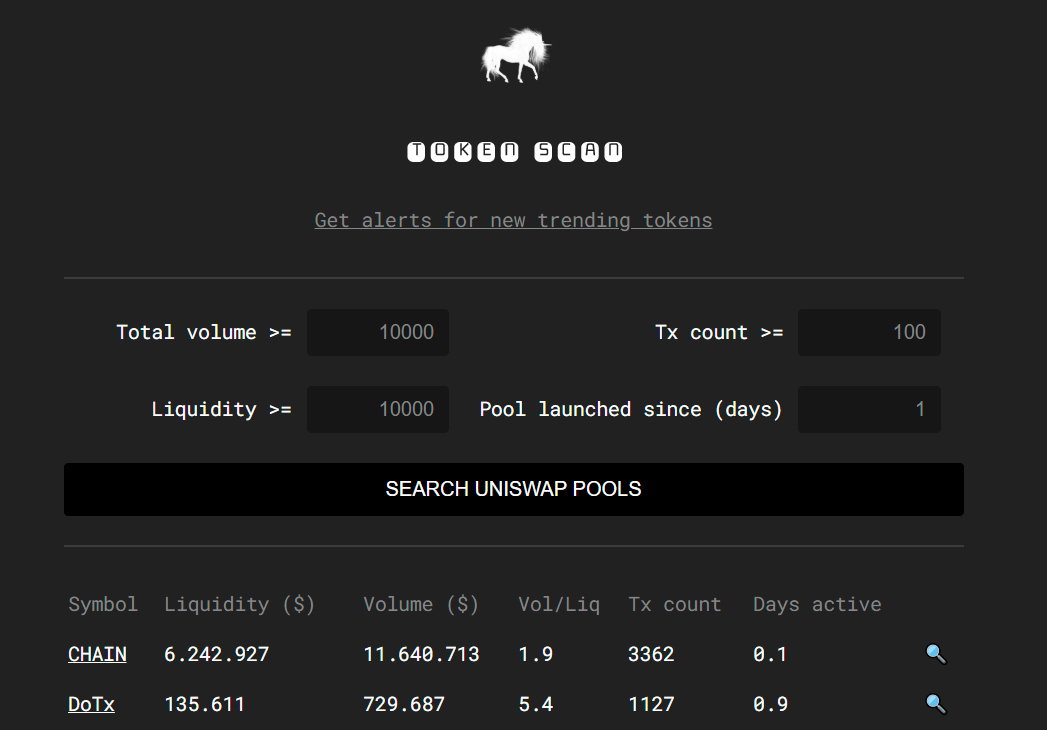
In Depth: The Fascinating and Winding Way of Calculating Cryptocurrency Mining Profitability
**Cryptocurrency mining** is a fascinating topic, but you should know that your interest in mining is not enough to make a profit. You will have to learn a lot to maximize the performance of your hardware and the resources invested. You have to know what equipment to buy, how to optimize it, but above all you must have a very clear idea of **how to calculate the profitability of cryptocurrency mining**, otherwise you will end up getting carried away by high profit ads, spending a lot of money and overestimating your profits. And this is my purpose with this post: to give you the information on how to **calculate mining profitability** and **what tools you will need** to optimize your profits.
**Main factors determining the profitability of cryptocurrency mining**
There are countless factors that can influence the profitability of mining, but these are the three most important:
**The mining algorithm.**
**The equipment used for mining.**
**The total hash rate.**
Let's see in detail.
****The Mining Algorithm****
Cryptocurrency mining is a complex process that involves solving mathematical algorithms. It is a proof-of-work consensus algorithm that rewards the miner with digital currency. There are currently two proof-of-work hashing algorithms that are widely used in cryptocurrencies: **SHA-256** and **Scrypt**. Obviously, the most popular currency among the mining community is **Bitcoin**. There are also other currencies that use different protocols, but we will focus on the main two.
**SHA-256** is an algorithm that uses enormous power to solve mathematical calculations. When it all started, Bitcoin could be mined using CPUs and graphics cards (GPUs) that were used in normal PCs, let's say home ones. But over the years, mining hardware was forced to evolve to keep up with the increasing difficulty of Bitcoin mining, which has led to the development of specialized processors known as **Application Specific Integrated Circuit** (ASIC). Currently, Bitcoin is only mined with this type of device.
As the difficulty of mining Bitcoin grows, new ASIC models are created that are more efficient and faster, and this in turn creates a technology race. This means that even newly manufactured chips can quickly become unusable.
The most popular cryptocurrencies based on the SHA-256 algorithm are:
**Bitcoin**
**Bitcoin Cash**
**Bitcoin SV**
**Bitcoin Diamond**
The other algorithm used is the **Scrypt**, which uses a very large amount of RAM and parallel processing to mine cryptocurrencies, which means that it can use GPUs to mine. Currently, devices based on the Scrypt algorithm are not as popular, so the level of difficulty in mining cryptocurrencies using this algorithm has not yet reached as high a level as in the case of Bitcoin. The best known cryptocurrencies that use the Scrypt algorithm are **Litecoin** and **Dogecoin**.
**There are two ways to create a mining system:**
**Do-it-yourself (DIY) excavator:** Requires the use of your PC along with several graphics cards (GPU) that can be mounted in a rack. The advantage of home systems is that both the CPU and the GPU can be used at the same time without affecting performance.
**ASIC:** They are independent devices equipped with a USB and/or Ethernet port and are manufactured to be ready for use immediately after connection. ASIC equipment is much more expensive than in-house assembled excavators, and is mostly American or Chinese-made, that means interested miners from other countries must import it first. ASICs are much faster in calculating algorithms and require much less power, as they are devices designed to specialize in cryptocurrency mining.
****The Total Hash Rate****
The performance of an excavator can be calculated by taking the ratio of the number of hashes it can make in one second and dividing it by the energy it consumes: **Hash speed / energy consumption = mining efficiency**.
***E.g. The profitability of the Antminer S9 excavator, whose hash speed is 13.5 TH / s, and the energy consumption of 1372 W is: 0.0098396501.***
There are also ways to be more precise, and that is by using the **Profitability Calculators**. There are many websites that calculate mining profitability for specific cryptocurrencies based on equipment used, energy consumption, costs, and other details. There are other simpler calculators with fewer factors, and some much more advanced ones that also take into account, in addition to the factors mentioned above, the pool fees, the mining difficulty, the reward per block and the price of the cryptocurrency in USD. In all cases, profitability can be calculated by hour, day, month and year.
Here are some sites for research:
***CryptoCompare***. A calculator with default values for many factors, allowing you to adjust the hash rate, power consumption, cost per kWh, and mining pool fee. With these values you can calculate your daily, weekly, monthly and annual earnings. The downside is that you have the option of calculating future difficulty changes, which leads to an overestimation. https://www.cryptocompare.com/mining/calculator/btc
***CoinWarz***. Similar to the previous one, but with more options: the ability to adjust the difficulty, the block reward, the price of BTC in USD and the cost of purchasing an excavator. Huge list of cryptocurrencies calculators. ***Check it***. https://www.coinwarz.com/mining/calculators
There are also calculators that consider price fluctuations and difficulties.
***My Crypto Buddy*** is one of them. It has the ability to make monthly price changes and difficulties. Based on this data, a table of your possible future income is generated. https://www.mycryptobuddy.com/
You should know that when it comes to **Bitcoin**, most calculators are based on a different hash rate increase, and they also show earnings that are actually much more inflated than the actual ones, because when they do their calculations they don't consider the growth rates.
As you will see, cryptocurrency mining can be an excellent way to make money, but it has several factors that can influence profitability, it is very difficult to accurately forecast your profits, especially since there are certain factors that are beyond our control, such as the life itself.
**As always, research, read, learn, enjoy, follow me (the less important one)** **HERE****... and with or without Hash Rate, be happy!** https://www.publish0x.com/@GusT?a=Jrb2kr6zdW

Technical Analysis for All: RSI Indicator in Depth
Today I want to talk to you about one of the most useful and important technical analysis tools for which we trade: **The RSI indicator**. I am going to focus on its particularities, how it is built, interpreted and configured correctly.
The **RSI** or **Relative Strength Index** is an oscillator-type technical indicator that is plotted below the price chart.
It is one of the favorite oscillators of traders, in fact in a recent survey it was chosen as the favorite oscillator among traders around the world. It was designed in 1978 by Welles Wilder, one of the great fathers of technical indicators, and presented this indicator as a tool to measure cycles.
Its formula is the following, do not be scared that I will explain it to you and you will see that it is easy to understand:
With this indicator, Wilder managed to measure the strength of a trend, taking the number of bullish sessions with respect to the bearish sessions, taken to percentage in the formula. That is what **RS** means in the formula, **Relative Strength**, and what is put there is the average of the gains in the bullish candles divided by the average of the lost in the bearish candles. That is, from the period selected by the oscillator, normally 14 periods, those that have risen are taken, the average rise is taken, and it is divided by the average loss of the periods that have lost. The rest of the formula is just a way to index it between 0 and 100.
Now that you know better how the RSI is calculated, you will see that it is no magic formula, there is no mystery behind it, just a way to measure the rises compared to the falls taken as a percentage.
**RSI parameters**
When Wilder designed the **RSI** he did so with a standard parameter of **14 periods** and with an **overbought zone above 70** and an **oversold zone below 30**.
As a general rule, I think it is not necessary to complicate your life by changing this parameter of 14 periods for any temporality. Why? Because the higher this parameter is, the flatter the RSI chart will be, and the more difficult it will be for it to reach the 70 and 30 levels. Look at this chart:
In the image you can see that I have put **three RSIs with three very different parameters: 14, 28 and 56 periods**. The 14, which is the standard, takes the last 14 candles to measure relative strength and compare bullish candles with bearish ones of the last 14 periods; the 28, the last 28 candles, and the 56 takes the last 56 candles.
You can easily see that the RSI look is basically the same, all three go up and down more or less in the same places, the only small visual difference is that the RSI's vertical scale of 14 was more stretched, and that makes it reach the levels 70 and 30 more easily. In fact if you look closely, you will discover that the RSI of 56 never reaches those levels in the example of the image. Do you know why? Because the higher the number of the RSI parameter, the more candles it will be computing to compare its bulls and bears, and precisely by the ***law of large numbers***, the more candles you count, the more likely it is that there are half of one color and half of another; for the higher the parameter, the flatter the RSI will be, staying around 50, therefore any parameter that you put all these RSI will mark the cycles in the same way, there will be no difference.
The only real difference will be that you will have to change the overbought and oversold zones for figures closer to 50 the higher the parameter, and that is why I recommend that you leave it at 14 and that's it, don't get too much crazy playing with this parameter. What will be important is that **you carry out research for the asset, timeframe or market in which you are going to use the RSI**, to decide if you are going to maintain 70 - 30 as overbought and oversold levels, or are you going to change them.
Remember that there is no technical indicator better than another, there are only traders who prefer one or the other. In summary, no technical indicator is a magic invention that will give us infallible trading signals, they all take the price data and represent it in another way. The decision to use the RSI should be accompanied by a small study to decide what overbought levels to use, or if you are going to keep the standard 70 - 30.
And one last important issue: **you should not confuse the RSI with the RS**. Here Wilder got the name wrong because they are too similar and can lead to confusion: the **RS or Relative Strength**, (which is not the same as the RSI) is a way to measure the behavior of an asset with an index or sector, to see if it is stronger or weaker, and should not be confused with this RSI indicator, however much the name may sound like it.
**As always, research, read, learn, enjoy, follow me (the less important one)** **HERE****... and with or without RSI, be happy!** https://read.cash/@GusT
Order Books for Beginners, and for All Who Do Not Pay Attention to Them.
Be honest. When you decided to enter the crypto world, were you scared the first days when you found all that immensity of unknown words, concepts, topics and opinions that we had never heard or read? I do. It seemed like a world exclusively for nerds, nuts, and computer and finance experts.
But when the first days passed, I realized that each crypto word or concept were simpler and more frequent in our daily life than I thought, I just did not know them by the same name, and even I used them without realizing it.
A particular example are the **Order Books**, throughout my life I have been in one of these books without being aware of it, so here I will try to explain in a practical way what these nice little books are about in the crypto field.
**What is an Order Book**
The term **Order Book** simply refers to a list of buy and sell orders, organized by order price and volume. Let's first look at its basic properties to understand it better:
*Negotiation item:* It can be anything that has value for a group of people: Tomatoes, cars, artworks, gold, cryptocurrencies!
*Order type:* Buy (Bid) and Sell (Ask). In some exchanges they may have more specific names or variants.
*Price:* Expressed numerically in another negotiation item, usually currencies or cryptos.
*Size:* The quantity expressed in the unit of measure of the bargaining item, such as ounces, feet, units, satoshis.
*Volume:* Total purchase / sale transactions made. This is one of the most important, since it represents the liquidity of a market.
*Identity:* Although many choose to be anonymous, this property helps traders a lot to make better decisions because the transparency of the market gives us valuable information.
**How Cryptocurrency Order Books Work**
As I said at the beginning of this article, to "make friends" with the Order Books, we must first lose the fear of the enormous amounts of numbers and data, since in essence they are simple components listed in that way for the simple fact that There are many users using them simultaneously, but we can advance on this flow of information by understanding three basic areas:
*Supply or Offer:* Sales orders, always in red.
*Demand:* Purchase orders, always in green.
*Last Market Order:* The last buy or sell transaction made in a recent time range.
Each of these three groups show two pieces of information: **price** and **volume**. The combination and analysis of price and volume are necessary to determine two issues: if the market in which we are immersed has liquidity, and to analyze possible trends.
By understanding the ***Supply***, ***Demand*** and the ***Last Market Order***, we can already have our first smile in front of an Order Book, and choose which side we are going to be on, review the history of that market, stay updated with the trend, and try to earn a difference speculating on the future by betting on our predictive abilities.
An obvious advantage, but no less important, is that in cryptocurrency Order Books we have the advantage of being able to trade 24 hours a day, every day of the week, with instruments of global and transparent reach.
Order Books are one of the most relevant and quietly used tools today. Keeping them in mind when we analyze cryptos will make us see more broadly all the movements we make, we can really see the trend of a market by looking at the full scale, not just our side.
**As always, research, read, learn, enjoy, follow me (the less important one)** **HERE****... and with or without Order Books, be happy!** https://www.publish0x.com/@GusT?a=Jrb2kr6zdW

Beat-Coin Culture: Bitcoin's Cypherpunk Past
**Bitcoin**, the star cryptocurrency, has a **punk past** and **cultural effects** that, with its massiveness, build an influential global movement every day.
**Bitcoin** - the cryptocurrency that spreads in price and popularity, and the financial status quo of the world defenestrates by word of mouth and perhaps creeps up inside - is an antisystemic invention of a vanished utopian little group: **The Cypherpunks**.
We are talking about a countercultural reaction, like that of those American writers of the **1950s** who forged the beat movement, the ideological basis of the hippie phenomenon.
It was at the end of the **1990s** when the digital revolution and its incipient reach to the masses gave reason to unruly young people, with minds as privileged as they were brave, to imagine an onslaught against the instituted that today is already beginning to manifest itself in a cultural key, with speech, aesthetics and visible imprint.
Those pioneers were anarchists who did not deny capitalism as a mode of human economic organization, but they did abhor all corporate or state intervention. Consequently, they exalted individual freedom as the highest standard and placed it as the north of their actions. None other than Julian Assange - the later creator of **WikiLeaks** - was among them.
In this ideological kit, cryptography came to be thought of as the technical guarantee for the protection of personal freedom.
In the face of the avalanche of vigilant elements that the computerization of society implied, the cypherpunks concentrated on finding a way to protect data and individual actions so that they would be unsafe by states and corporations.
During the following decade, at the beginning of this millennium, the North American real estate crisis arrived. In **2007**, many traditional banks failed, mortgages became unsustainable, interest rates skyrocketed, and the economy cooled. It was a blast of a gigantic magnitude.
In short: **cypherpunks, cryptography and the explosion of the american real estate bubble made possible Bitcoin**, the utopian dream of the elimination of financial mediators.
This is how in **2008** an unknown person, **Satoshi Nakamoto**, who was never known who he was but who was supposed to be a group of people, sent a message to almost a hundred cryptographers around the world to study his project through the specialized forum ***metzdowd.com***.
**Satoshi** attached a founding letter (his famous “**White Paper**”) where he explained that he had created an economic system based on user-to-user exchange, anchored in a deregulated currency, which protects the privacy of holders through a cryptography system of extreme security (**Blockchain**) and that records all operations in an inviolable accounting book audited by community users, who, in turn, generate assets in that currency by validating such transactions (they are called "**Miners**") .
Following the message from the hidden creator, one of the recipients downloaded the proposed software and agreed to create a program to store the coin. It was **Hal Finney**, a libertarian developer and staunch defender of cypherpunks notions, who until his death vowed not to be Nakamoto himself.
Thus was born **the first virtual wallet**. And Nakamoto sent him **10 bitcoins**. The economic system that banks fear today because it leaves them out of business had materialized.
**Bitcoiner speech is romantic**. Well, he assumes for himself the epic: a creative crusade for a world without intermediaries, for the decentralization of the economy, the fall of the great financial empires, the possibility of an internationalist exchange of assets without restrictions and for individual privacy from the transnational eye algorithmic (**Big Data**) that sees everything.
Such a paradigm, spreading in number of people, had to necessarily generate a subculture, which radiated this worldview, spreading the cyberpunk idea of Satoshi Nakamoto in a vehement way.
But for **Bitcoin** to succeed and stabilize, it must still be assumed as a tool for the exchange of goods and services. Today its volatility prevents it. That is why the “**Satoshi Boys**” (convinced bitcoiners) applaud every non-speculative transaction. End... or Beginning.
**Dont forget: research, read, learn, enjoy, follow me (the less important one)** **HERE** **or** **HERE****... and with or without Bitcoins, be happy!** https://www.publish0x.com/@GusT?a=Jrb2kr6zdW https://read.cash/@GusT
You've Got Mail ... when the Ethereum Gas is Cheap
The **Ethereum** network has been very congested for a few months now, and this is due to the increase in adoption and on-chain activity, which places the average **price of gas** above 250 GWei as of today. We spend too much time looking at this price at **ETH Gas Station**, waiting and looking for the right moment to be able to execute our transactions without spending so much money. https://ethgasstation.info/
So it would be great if we could receive notifications that alert us when the price of gas reaches more accessible values, right? The answer is yes. Let's see how thanks to **HAL** and **Chainlink** we can already do it.
For practical reasons, I am going to show you how to receive notifications by Email, but in the same way it can also be configured to receive alerts from Telegram, Discord, Slack, Twitter and even WebHooks. https://9000.hal.xyz/ https://feeds.chain.link/fast-gas-gwei
We just need:
A few minutes of our time
An email account
An account at **HAL** (you can log in using your GitHub account, Google or an Ethereum wallet such as Metamask) https://9000.hal.xyz/
What we have to do is create a trigger from the **HAL website**, responsible for sending us an email when the price of gas reaches a certain value. https://9000.hal.xyz/
These are the steps:
1. We log in to **HAL** https://9000.hal.xyz/
2. We click on “Chainlink” (what is Chainlink? It uses oracle networks to connect “real world” information to smart contracts on the Ethereum network)
3. Click on the recipe "Track Gas Price"
4. Once there, all we have to do is fill in the value of the gas for which we want to be notified (20 for example)
5. Scroll down, click on **Send an email** and fill in our Email address, a subject of your choice, name our trigger, click **Create** and that's it!
This is all. Short, simple and useful, I hope it helps you.
**Research, read, learn, enjoy, follow me (the less important one)** **HERE** **or** **HERE****... and with or without gas, be happy!** https://www.publish0x.com/@GusT?a=Jrb2kr6zdW https://read.cash/@GusT
The most 10 promising projects in the DeFi World
The **Ethereum ecosystem**, which has just turned 5 since its birth, has flourished in different directions, making **unthinkable projects possible** in the world of cryptocurrencies until a few years ago. Think about Stable Coins, Tokens, and DeFi: in half a decade, the development platform Smart Contract has broadened the Blockchain concept and given developers the opportunity to create applications with increasing performance. **We are only at the beginning** of a path that wants to revolutionize the foundations of finance as we know it. Let's discover the most promising projects in this ecosystem:
1. **renBTC** https://renproject.io/
A platform to tokenize Bitcoins over Ethereum by creating expendable ERC20 tokens. These tokens can be used in DeFi projects, using, for example, a decentralized liquidity exchange like UniSwap. Through renVM (virtual machine), users can create renBTC on a 1: 1 basis compared to real bitcoin. This solution is proposed as an alternative to more centralized projects like Bitcoin wrapped, and it is emerging as one of the most interesting sectors of DeFi.
2. **Matcha** https://matcha.xyz/
A decentralized exchange that makes simplicity and design the strong point. The liquidity of the exchange is derived from multiple sources such as 0x Mesh, Kyber Network and Uniswap to obtain the best prices per operation. The simplicity of this platform has the potential for an excellent future.
3. **Loopring Pay** https://loopring.org/
A layer 2 platform on Ethereum to solve cryptocurrency scalability issues. Although we are not talking directly about DeFi, this platform is positioned in the payment systems in which we find Lightning Network (for Bitcoin). Loopring Pay allows you to send ETH and ERC20 tokens instantly and for free, saving data within the chain but leaving the transaction calculation outside the chain using the ZeroProof-Knowledge algorithm for confirmation. This project is without a doubt one of the best solutions to Ethereum scalability issues.
4. **Lition** https://www.lition.io/
A platform to buy and sell energy directly on Ethereum. Here too, as with Loopring Pay, we are not talking directly about DeFi but, to be precise, DeEn, that is Decentralized Power. The platform has its own exchange of energy for the exchange between pairs, therefore, without intermediaries, of energy. In this way, the sale of green energy has a low cost, its producers earn much more and intermediaries are eliminated.
5. **mStable** https://mstable.org/
A protocol focused on stable coins and designed to improve the fragmentation of the various coins in circulation. The first product created is called mUSD and it is a metastablecoin compatible with DAI, USDC, USDT and TUSD. In this way, through mUSD, you can redeem in a 1: 1 ratio with any of the underlying stables. The same mUSD can also be used with Aave or Compound to generate returns through commissions and loans.
6. **The Force Protocoll** https://www.theforceprotocol.com/
A protocol that provides secure, inclusive, innovative and transparent crypto financial services for users around the world. Therefore, the project is an additional package for decentralized finance that aims to offer solutions for cross-platform transactions, stable monetary problems and chain payments.
7. **Balancer** https://balancer.finance/
One of DeFi's most promising liquidity protocols. While Uniswap is an Automatic Market Maker with the ability to support liquidity pools of just two tokens, Balancer reaches up to eight with arbitrary weights. It is still a young project, but it is already among the 10 best values anchored in it.
8. **NFTfi** https://nftfi.com/
A marketplace for receiving loans using NFT as collateral. This project is halfway between the world of DeFi and NFT, allowing anyone with inactive or unused digital assets to use them as collateral for a loan.
9. **UMA’s Synths** https://umaproject.org/
A protocol for creating a global and decentralized financial market using synthetic assets. The first product of this protocol is a token that tracks the price of ETH / BTC by relying on an index instead of an oracle. The platform allows users to create their own synthetic assets, so that they can deposit or withdraw, exchange tokens and easily track information on already distributed synthesizers.
10. **InfiNFT** https://www.infinft.com/
An NFT token coin platform whose data is stored in the chain, is therefore more secure, verifiable and transparent. This solution, which cannot be connected directly to DeFi, also seeks to make the use of non-expendable tokens more common and to simplify their operation and maintenance.
This is it, just for now. In future posts we will see more in depth each of these projects.
**Don't forget: the future came a long time ago. Research, read, learn, enjoy and... follow me (the less important one)** ****HERE**** https://www.publish0x.com/@GusT?a=Jrb2kr6zdW
Discover SolarCoin (SLR), The Cryptocurrency That Rewards You If You Use Solar Energy
The sun is life, energy and cryptocurrencies forever, and with this premise as simple as eternal, this green cryptocurrency was created and began its journey in 2014. Its objective is to achieve a much faster and more effective evolution of the ecological transition towards the definitive use of cleaner and renewable energy. The intention is to have a method to encourage the use of this type of energy and this is where the **SolarCoin** comes in: **this coin offers a reward to photovoltaic solar power generators. Each MWh that is produced results in the generation of 1 SLR.** https://solarcoin.org/
Among the advantages of this cryptocurrency is free and the benefits that the person or company that produces solar energy can already obtain. It is a form of appreciation for your choice to embrace fully sustainable and green energy, and also an appeal to those who have not yet made up their minds.
Another interesting point is that **SolarCoin** is completely independent, it does not adhere to any specific State or government, it is free of political commitments and, for its exchange and transmission, it uses a P2P network as it happens with other cryptocurrencies through BlockChain. https://solarcoin.org/
****SOLARCOIN KEY FEATURES****
Litecoin Project: The entire platform is made in open source.
Vision: Generate 97,500 TWh (Terawatt-hour) of solar energy.
Project with an approximate validity of 40 years.
It works through the usual cryptocurrency market; also through the exchange of solar energy by SLR.
1 MWh = 1 SolarCoin
Its blockchain is known as ElectricChain.
Like any cryptocurrency, it is managed through virtual wallets.
Users who generate solar energy receive payment in SolarCoins every 6 months.
**How does this SolarCoin work?**
Those with a photovoltaic solar power generation system can register for free at the **SolarCoin Foundation** and wait for approval. When the approval is received, you can start receiving coins for each of the MWh that is generated in the solar installation. https://solarcoin.org/
**What can be done with the received SLRs?**
The **SolarCoin** user can benefit from their accumulated assets through various types of channels:
Use the exchange and transfer system through blockchain in a direct way for the use of their SLRs.
Switch to other cryptocurrencies.
Exchange your SLRs for government currencies from different countries. Converting the cryptocurrency into euros or dollars, for example, is one of the preferred ways for those less familiar with digital currency.
We are facing a really useful system of protection of assets known as natural capital. This is the case of renewable energies whose best introduction and final settlement in our current way of life is to promote it from the economy. Equally necessary is to give users a real incentive to bet on these clean systems, abandoning historical methods fundamentally based on fossil fuels.
The conjunction of economy, market, functionality and concern for the sustainability of the planet come together in **SolarCoin** demonstrating that a new way of proceeding is possible. https://solarcoin.org/
**SolarCoin Foundation** https://solarcoin.org/
**SolarCoin Claiming** https://claims.solarcoin.org/
**Don't forget: the future came a long time ago. Research, read, learn, enjoy and... follow me (the less important one)** **HERE** **or** **HERE****... or** **HERE****!** https://www.publish0x.com/@GusT?a=Jrb2kr6zdW https://read.cash/@GusT https://hive.blog/@crypt0trips/posts
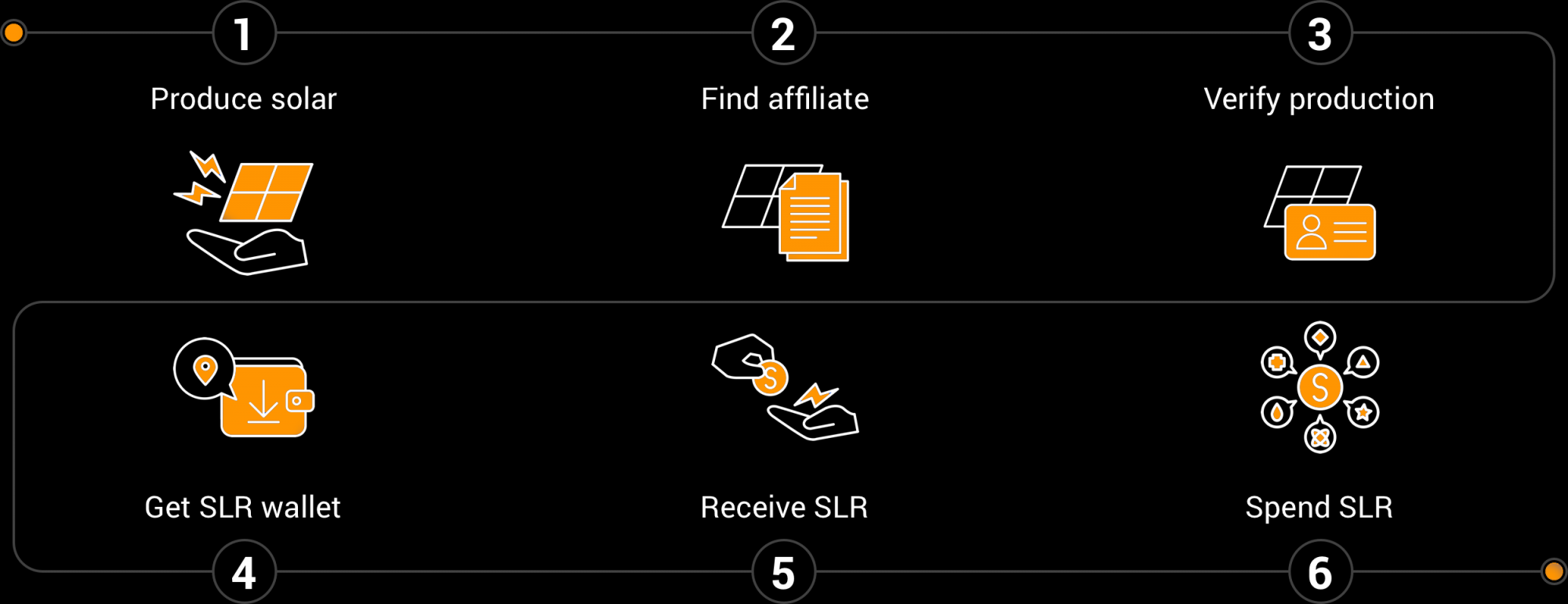
What is a Cryptocurrency White Paper? + Database of almost all of them
In the context of digital currencies, so called **White Papers** are technical documents, prepared prior to the launch of a cryptocurrency or blockchain based project. It contains all the necessary features and details, including technological, commercial, financial and other valuable information so that a user can decide whether to invest in such an initiative, or whether or not to buy a certain virtual currency.
**Four things to keep in mind**
The truth is that **White Papers** has been used for a long time and in various fields; both in the field of business, marketing, technology, as well as to develop and explain problems and solutions. Linked to cryptocurrencies, this is a key element of the so-called **ICO** (Initial Coin Offerings).
But... like everything in this world, they can also be used to sell *smoke*, that is, nothing. Tomorrow maybe the **Punky Dunky Funky White Paper** comes out, although that does not imply that all its content is solid and based on something concrete, real. Maybe **Punky Dunky Funky** never even exists. Hence the importance of not taking what you read as true, even if it is a white paper. **You need to analyze and question every document you find**.
Satoshi's original conception regarding the Bitcoin protocol came in White Paper format. It also appeared in the form of a white paper what would be the next big blockchain platform, Ethereum. The same with many other very popular cryptocurrencies. But be careful! **Fake cryptocurrencies and projects may also have their own White Papers.**
There are a number of fundamental questions, which should be answered when reading a White Paper. Let's see some of them.
**1 What is the project about?**
To determine the legitimacy of a document about a cryptocurrency, it is inescapable to really understand what exactly the project does or proposes. While this seems easy to identify, it is not at all.
White papers are often confusing and riddled with technical jargons, formulas and terms never seen before, especially for an ordinary user. In case this question cannot be answered by the White Paper user, there are basically 2 possibilities:
You need more training or knowledge to fully understand it
The project does not exist and they are pure words, dead theory that will not reach any real port
Before investing in any cryptocurrency or associated project, you should understand what it is about. If not, what is the point of investing? We would already enter the field of speculation, it would be luck and truth. In this sense, neither take the words of Reddit, Telegram or Twitter users as sacred.
**2 How does the project work?**
If it is really and truly proposing something, it is also important that the white paper sets out how it will work, through what types of technology. A good example of White Paper is that of Bitcoin: It is one of the most understandable and readable, it is not very long, in contrast to many modern white papers. If you have never read it, it is a good place to start.
The document should also be able to explain what problem the project will solve and how, as well as answer: who needs this project, why, what for?
**3 Who is behind the project?**
It is essential to do background research: who are the team members, what is their experience, training or background, what other things have the developers and promoters of the project done, etc.
**4 Why does the project use blockchain technology?**
After reading the document, it should also be understood why the proposed initiative aims to use the blockchain.
Some projects simply mention the term "Blockchain" as a caller, when in reality they are just web applications like others and do not require the use of this technology. If you read things like, for example, "... a novel blockchain project to spend less fuel", or "a blockchain to accelerate laundry ...", be suspicious.
In short, always be wary of what you read and analyze on a case-by-case basis. That it is an official or white paper does not imply that this project or cryptocurrency will come to light.
**To finish, here I leave you the links of a website that brings together almost all White Papers. HAPPY PAPERS!**
**White Paper Data Base** https://whitepaperdatabase.com/
Thanks for your time and dont forget to follow me (please) ****HERE**** ****or**** ****HERE**** https://www.publish0x.com/@GusT?a=Jrb2kr6zdW https://read.cash/@GusT

 @GusT
@GusT