Monetizing recycling through blockchain and cryptocurrencies
Today we can create new economic initiatives that do not need the buying and selling of a product or service to improve themselves. New tasks focused on carrying out positive human actions towards our environment, trying to alleviate or correct the problems we cause from an increasingly seasoned industrialist and consumerism system that only seeks economic growth as if it were the great and only objective.
But these new types of value processes that are emerging with the Blockchain and Cryptocurrencies, allow us to break mental barriers as to what should / will be these new "jobs" that are discussed both in high forums or theorized by some futurists. **They are a new type of task** that any person, anywhere in the world, will be able to carry out and that will cement the life in the Community so that it works in a positive way and aligned with the ecosystem itself. **It is no longer a salaried job for a private or private company; It is an occupation that belongs to us as citizens, but that we have not had a certain economic incentive, and therefore, we have not been able to carry it out on a massive scale - not yet**. These are part of those new jobs that will appear in a new sphere of value outside the commercial logic and that are added to the existing traditional market jobs.
It is not new since recycling is a central issue in these tasks that we need to carry out; and that by being able to monetize them now with Blockchain, they will allow us in the medium / long term, not only to recycle what is produced; but also to change the form of industrial production towards goods that no longer need to be recycled or do not impact the environment.
Below, I mention some initiatives that are taking place in different latitudes, with the aim of generating recycling processes on a massive scale. Undoubtedly, it is one of the areas where Blockchain and Cryptocurrencies have the most powerful impact, since creating proof of work. But to understand it better, let's look at some of these cases.
**EcoDocta** (Cordoba, Argentina). The action of making products that need to be recycled available, and avoiding their disposal on public roads or in waste bags without separating them, generates the emission of this cryptocurrency. There are machines used to check the "proof of work". The challenge is to get it accepted in shops and local counties - against payment of taxes. http://ecodocta.com/
**Plasticoin** (Montevideo, Uruguay): Although it does not yet use Blockchain, it is planned. It already has the support of the National Development Agency (ANDE) and more than 20 companies already accept Plasticoin as a form of payment. A currency whose endorsement is the action of recycling and impacting on several of the United Nations SDGs. https://www.plasticoin.com.uy/
**Deposy** (Biota, Germany): Use the IOTA Blockchain and give rewards in that cryptocurrency for people who use their machines to recycle. He has made an agreement with a Swiss firm, Omoku that allows him to transform the IOTAs that recyclers receive into Euros. https://www.deposy.org/en/
**The Bounties Network** (Brooklyn, United States): Organized an experiment in the Philippines (Manila Bay): carrying out a cleaning of its beach by volunteers in exchange for cryptocurrencies in December 2018. They managed to clean 3 tons of garbage in just two days.
**Plastic Bank** (Vancouver, Canada) that works with the Blockchain powered by the company IBM: It also chose the Philippines to start with its initiative to produce cryptocurrencies to reduce pollution. https://plasticbank.com/
**Agora Tech Lab** (The Netherlands): There, the effort of citizens in different cities, x to recycle their waste, is rewarded with cryptocurrencies that are then accepted by the different municipal governments, in exchange for services that citizens receive. https://www.agoratechlab.com/
And we can include other initiatives such as W2V Eco, Litterati or Swachhcoin. All with a global vision and that allow cities to save, improve the environment, and provide extra income to their citizens.
**Circularize**, The Netherlands. It proposes a price system for recycled material, based on its composition, the number of times it has been recycled; helping companies to use and value them correctly. https://www.circularise.com/
**Empower**, Norway. It uses the creation of cryptocurrency, to be able to encourage and articulate donations from all over the world and to help recycle anywhere on the planet. https://empower.eco/
And there will surely be more Blockchain initiatives - with or without cryptocurrencies - in other parts of the world. It is very likely that many of these projects will not prosper, but they will give way to new initiatives that will eventually achieve mass adoption in the world. It is always necessary to generate a high volume of proposals, so that the central idea / process is improved, and those that end up creating the conditions to modify the negative impact that we are having on ourselves, other forms of life and our planet remain.
Thanks for your time and dont forget to follow me (please) ****HERE**** ****or**** ****HERE**** https://www.publish0x.com/@GusT?a=Jrb2kr6zdW https://read.cash/@GusT
OPENVINO Project, the world's first winery with its own cryptocurrency based on the value of wine
**Openvino** is a revolutionary project in the wine world that aims to create the first open-source winery and the first wine-backed cryptocurrency in the world. Mike Barrow, an American computer scientist, is its creator. Established since 2003 in the province of Mendoza, cradle of the best vineyards in Argentina, he decided to unite two apparently antagonistic worlds, BlockChain and Wine. https://openvino.org/
Just 3 years ago, applying the open-source philosophy known in the world of software and new Blockchain technologies, Mike Barrow transformed his company **Costaflores** into the first winery, the first micro-enterprise in the world to share all its information, from data from grape cultivation and winemaking, through IoT devices, to complete accounting and sales logistics. This is how **Openvino** makes extreme transparency and extreme traceability available to everyone, stripping all its practices and sharing its intellectual property for any observer, hobbyist or expert. https://openvino.org/
On May 6, 2018, **Costaflores** launched its ICO (Initial Coin Offering), where it showed the world the first cryptocurrency linked to wine production: **MTB18**. Production during this year amounted to 16,384 bottles of MTB (Mike Tango Bravo) wine, exactly the same amount of tokens. Once the ICO was completed, the tokens were purchased on Ripio.com exchange where they can be exchanged and / or sold, and thus the cycle is played every year on the same date with each new harvest.
The only way to buy is from someone who has cryptocurrencies, so the price varies depending on the supply and demand of the token, a token is always equivalent to a bottle of wine and the only way to obtain the wines is through the tokens, so the price of acquiring that token / wine is different in euro, peso, dollar, bitcoins, etc. The objective here is that it is the market that ends up defining the price of the product.
According to information on **Costaflores** website, the schedule for this year's harvest is as follows: https://costaflores.com/
The last days of March, we harvest the grapes from the vineyard.
During the month of April, we make the “Mike Tango Bravo 2020” wine
On May 6, 2020, we issued the MTB20 tokens, based on the number of bottles of wine produced.
The ICO ended on July 25, and the MTB20 wine tokens are available for resale on the Viniswap exchange.
Three years later, the wines are ready to drink, and can be purchased starting May 6, 2023, ONLY with MTB20 tokens.
By 2020, the ICO price of MTB20 tokens is based on the COST of the value of the wine. Once the ICO is over, we let the market decide the "real" value of our wines.
**"You drink it, you own it"**
In May 2021, the first MTB18 bottles will be available for consumption and what Mike calls "You drink it, you own it" will take effect, the consumer becomes a partner.
After uncorking it, the back label invites you to scan it with the phone, which takes you to download an App. Then you should take a selfie with the bottle and answer some questions about the experience drinking that bottle of wine. "And so we can know who the consumers are, what they think and what they think. In exchange for that intellectual effort, the winery delivers a security token that gives you the right to legal action by the company. Then, the consumer becomes the owner of the company. The philosophy behind this is that, if you are drinking their wine, you are committing yourself to the product and if you are ingesting it within your body, the question arises: why not be part of the company? How do you like your wine?
**OPENVINO Project** https://openvino.org/
Thanks for your time and dont forget to follow me (please) ****HERE**** https://www.publish0x.com/@GusT?a=Jrb2kr6zdW

The free streaming platform Flixxo gives Netflix a fight with its own cryptocurrency FLIXX
**Flixxo** is a platform created in Argentina, which distributes short audiovisual content, but with a great difference from Netflix: **Flixxo** is a free platform that rewards the interaction and creation of content with its own tokens that have market value.
The human being is always in search of new technologies to innovate and advance, and fundamentally to improve the way of life. It is a natural process that the past faces the future and normally the second has everything to win. Currently we can observe it with fiat money and the arrival of cryptocurrencies. This may also be happening with the Netflix streaming service, and thanks also to cryptocurrencies.
We already know almost everything about Netflix: a global company based in the United States, whose revenues exceeded $ 7 billion last year, and is also one of the most valuable companies in the world with a capitalization of $ 221 Billions. But what perhaps we have forgotten, is that it was the same Netflix who stepped on the head of BlockBuster, the old movie rental company, due to the impossibility of it to face new technologies. Exactly the same seems to be brewing today in the field of cryptocurrencies, where Flixxo can forget platforms like Netflix in a few years.
Following one of the fundamental philosophical principles of the cryptocurrency universe, decentralization, this project is based on the file sharing modality: Flixxo works from person to person (peer to peer), transmitting files between users without having to need servers central. And cryptocurrencies fulfill several functions within this new platform. The first function uses cryptocurrencies as a data optimizer, and increases resistance to data censorship. The second is as an incentive for content creators to use the platform.
Many people in the world normally cannot monetize their content on YouTube, much less on Netflix, because they do not have an international bank account, or because of the same prohibitions and censorship of these companies.
Flixxo solves this great problem with the use of cryptocurrencies, since anyone in the world, without the need for a bank account or PayPal, can start to monetize their content, and also as much as the content, as well as access to them by anyone in the world it will always be available.
**Flixxo has its own token: FLIXX**
The platform wants to use its own cryptocurrency, built under Ethereum technology. It is called FLIXX and is currently trading at $ 0.016 for each token.
“For each action that the user does, they earn credits: FLIXX, and they can be consumed within FLIXXO by watching content, or exchanging them for another currency in exchanges such as Liquid, Livecoin, Folgory and Bancor Network ”. *Adrián Garelik, CEO and founder of Flixxo*
In summary, the streaming platform is free because users have access without paying a subscription, unlike Netflix. However, the user must deposit Flixx for each video they want to see, although they will be able to do it with the tokens that they will get for seeing advertisements on the same site, and content creators will receive an equal contribution for each visit.
Cryptocurrency continues on its way, and every day shows us that it not only works as money, or store of value, but that it can be used for many things, this time, with dreaming of defeating Netflix.
**FLIXXO Website** https://www.flixxo.com/
Thanks for your time and dont forget to follow me (please) ****HERE********.**** https://www.publish0x.com/cryptotrips?a=Jrb2kr6zdW

Consequences of writing about cryptocurrencies and blockchains: Secured Spam
Four months have passed since last March. On that date I started this unexpected path, which led me to become a writer specialized in BTC, cryptocurrencies and the trending topic: blockchain.
In this time I learned many things that I never imagined before. Not only in the field of Bitcoin, its technology and economic principles, but also about the people, the *"investment opportunities"* and, above all, the scamming intentions of those who present themselves as formal representatives of alleged legitimate businesses.
In this world of cryptocurrencies there is everything. But from my experience I could classify three large groups: solidarity groups, which explain and teach those who have been least exposed to the subject; those who believe that others are fools because they know "less" than they do; and, the worst, those who simply seek to take advantage of everyone. Whether out of necessity, ignorance or simple greed, there are always those who fall before this last group.
It was a surprise for me to see the wide specialty of scammers and profiteers that inhabit the world of cryptocurrencies. It's not that I didn't know that the world is full of these types of people, but the volume did take me by surprise. Especially, I was surprised that after four months, it is practically daily for me to receive messages from strangers on various platforms, offering me *"amazing opportunities"*.
In these few months I went from receiving messages from family, friends or coworkers, asking about life, daily chores, series, movies or sports; to accumulate in inboxes offer after offer presenting me "the great Bitcoin" or how to earn money "magically" from my home.
**Does anyone believe in magic money?**
There are those who out of necessity fall in love with ideas of "magic money" or "easy", which actually hide a scam or at least a misleading offer. The famous "small letters".
But if you pay attention, a message that starts with ***"Do you want to make $ 500 a week from home?"***You should turn on the alarms. And if it comes from a stranger, much more.
This is what happens to me every day. Especially in social networks, very active platforms in this world of the "crypto ecosystem".
I joined I no longer know how many of these groups or channels, seeking to be informed, capture interesting data to review or find good information sources.
In exchange, I received the “hello” lottery from people with funny names, from countries with which I have had no contact. Mining, investments in pyramid schemes and impossible returns that to the most uninformed could seem "irreproachable".
Today I got used to blocking whatever strange contact anyone told me. But for a while, I even got to interact to see what was behind those breaches of trust. Nothing good.
***“You only have to invest 50 dollars and in three months you receive triple your investment. But for each person you refer, you get 15% of their investment ”***, it is an example of“ opportunities ”that they came to present me and that, logically, I rejected. If my income depends on bringing people to your scheme, I already know that you do not have a real product with which you can respond to your investors. End of discussion.
Added to messages from strangers is another practice as common as unpleasant, more invasive, more violative of your privacy and your time. It is the constant inclusion, without prior notice, consultation or approval, of groups on social networks.
You are calm in your messaging application and suddenly you see that you have 100, 200 new messages in a chat. When you realize that, that chat didn't exist 10 minutes before. You are in a group that nobody warned you about and to which, in addition, a perfect stranger added you.
Do you expect me to rush to deposit $ 10, 20, 50, 100 into your investment scheme, your trading "academy" or buying? The best they can hope for from me is a block and report as spam. But the worst of the practice is that there are always those who fall.
Almost all the stories start the same: ***"Hello, I think you are a cryptocurrency enthusiast and you may be interested in the proposal I have for you"***, it may be an example of a received message. Behind that presentation there are always the same schemes, the same deceptions. In short, scam after scam seek to hide among the tangle of groups and chats of the "ecosystem". They always start from the same, offering extraordinary investment returns and taking advantage, above all, of ignorance. After all, saying "blockchain" or Bitcoin puts you on the hot topic.
Unfortunately, the "bad guys" are much more than I would like. And it seems that there is a price to pay for undertaking this trade in the area of cryptocurrencies. Luckily, the good ones are more, for now.
Thanks for your time and dont forget to follow me (please) ****HERE**** ****or**** ****HERE**** https://www.publish0x.com/cryptotrips?a=Jrb2kr6zdW https://read.cash/@GusT

The loneliness pandemic
From the beginning of humanity until today, man lives with infinity of individual and collective problems.
In modern societies we are riding at the maddening pace of the cities, crossed by economic, cultural and emotional needs, pressured to achieve social success at any cost, and fed by journalistic and political agendas that crush us on what issues we should talk about. The result is the sublimation of our personal deficiencies, and we only face the social ones. In other words, if there is an economic and social crisis, we suffer economic problems as individuals; or if it is chaos to park the car in our neighborhood, we will have personal problems to find a place.
We live solving, or at least trying to find solutions to the daily problems that rain down on us from the outside, but at the same time dry up our interior. We leave aside what happens to us as people. We are sponges that absorb the outside and expel the inside.
In times where psychosocial conditions are classified as syndromes, this game of covering up the personal with the group could be called “SOS Syndrome”, the loneliness entrenched in the bones, the loneliness imposed, the unelected, the one that marginalizes and needs help of who provokes it.
Who lives in the middle of the field, does not suffer loneliness, he is simply a lonely being. But those who live in large cities can be invaded by loneliness without realizing it, as long as society is our dealer of tools to mask them in a thousand different ways.
Although societies and cities existed, exist and will always exist, it is enough to make a cut of time and space anywhere in the world to find the particularities of the SOS Syndrome:
People who, in the absence of a family affective environment, try to supply it with material goods.
People who move away from their own in search of a social promotion.
People without major conflicts, that society uses them by raising them to a pedestal, to lower them from a stone the next day.
Large cities invaded by gangs of street boys who commit crimes as an excuse, not only to subsist, but to supply their emotional deficiencies and create new groups of belonging to escape that life of imposed loneliness
In all cases, society is the generator of needs that we do not need, and that derive in loneliness due to frustration at not being able to satisfy them. Power is what needs the loneliness of people to perpetuate themselves while offering us cosmetic well-being.
The future of SOS Syndrome is predictable, and if it can be predicted, it can be prevented. It is only about connecting with our interior and its true needs, and from there building social bridges that communicate us in a genuine way, to banish the true current pandemic, loneliness.

Mining a Bitcoin has an average value of $ 5000
The investment price to mine a Bitcoin, according to BitOoda data, has a cost of about $ 5 thousand US dollars. The study was carried out taking into account several factors such as the cost of ASICs, the value of electricity, as well as the difficulty of the network to carry out the work.
Naturally, the price of electrical energy is the determining factor in this business. For this reason, it must be taken into account that the cost of the service makes the investment value different in each country.
For example, right now in some provinces of China, such as Sichuan or Yunnan, the winter season is a factor in favor of mining. Hydropower costs reach a minimum in those regions due to the winter season.
**The investment cost varies according to each country**
According to the data of the study, the cost in cents of dollar per kilowatt / hour, is counted from $ 0.5 onwards. However, there are exceptions such as the aforementioned Chinese provinces, where the value at this time would be approximately $ 0.03. Based on the average of these costs, the cost of mining a Bitcoin is calculated.
There are more extreme examples such as the case of Venezuela, where electricity is free and Bitcoin mining is a completely legal activity. That South American country currently ranks 10th in the world ranking of hash power, according to data from the Cambridge University Center for Alternative Finance.
Although Venezuela could have the ideal characteristics, appearances can be deceiving. Taking advantage of the situation of internal anarchy caused by a prolonged economic crisis, the police forces of that nation act with impunity.
Lately, there have been known cases of seizure and extortion against Bitcoin miners. Even so, the country continues to occupy a respectable position in this business, which highlights it in the international top ten. Another negative fact is that in that country there are constant interruptions of the electrical service.
**Nations where mining a Bitcoin costs more than the value of BTC**
In Latin America, there are countries where the electricity cost, as well as other regulations and taxes make the activity difficult. For example, in Costa Rica, the electrical value is about $ 0.12 cents per KW / H. However, the costs of equipment and infrastructure, added to the taxes of the Fiscal Plan, make business success uphill.
It should be noted, however, that the parameters used in the study to calculate the cost of mining a Bitcoin, focus on large companies. Thus, for example, it is shown that most of the large mining centers do not pay more than 3 cents per KW / H.
In the United States, the electrical cost, although not the highest in the world, poses great challenges to investors who want to mine a Bitcoin. In that nation, the machines that make mining profitable are the latest models such as the S17 70T or the new S19 series from Bitmain.
It should be noted, that the legendary S9, one of the most used machines to mine Bitcoin, is already practically inoperative worldwide. With some exceptions, this team has been offline.
**Data to consider**
The general average to mine a Bitcoin, is done without taking into account small miners, since it is difficult to determine its location.
Electricity costs vary in each country. Currently the most profitable sites could be Sichuan and Yunnan in China and Venezuela.
The cost of electricity varies between 0.5 and 8 cents per Kilowatt / hour.
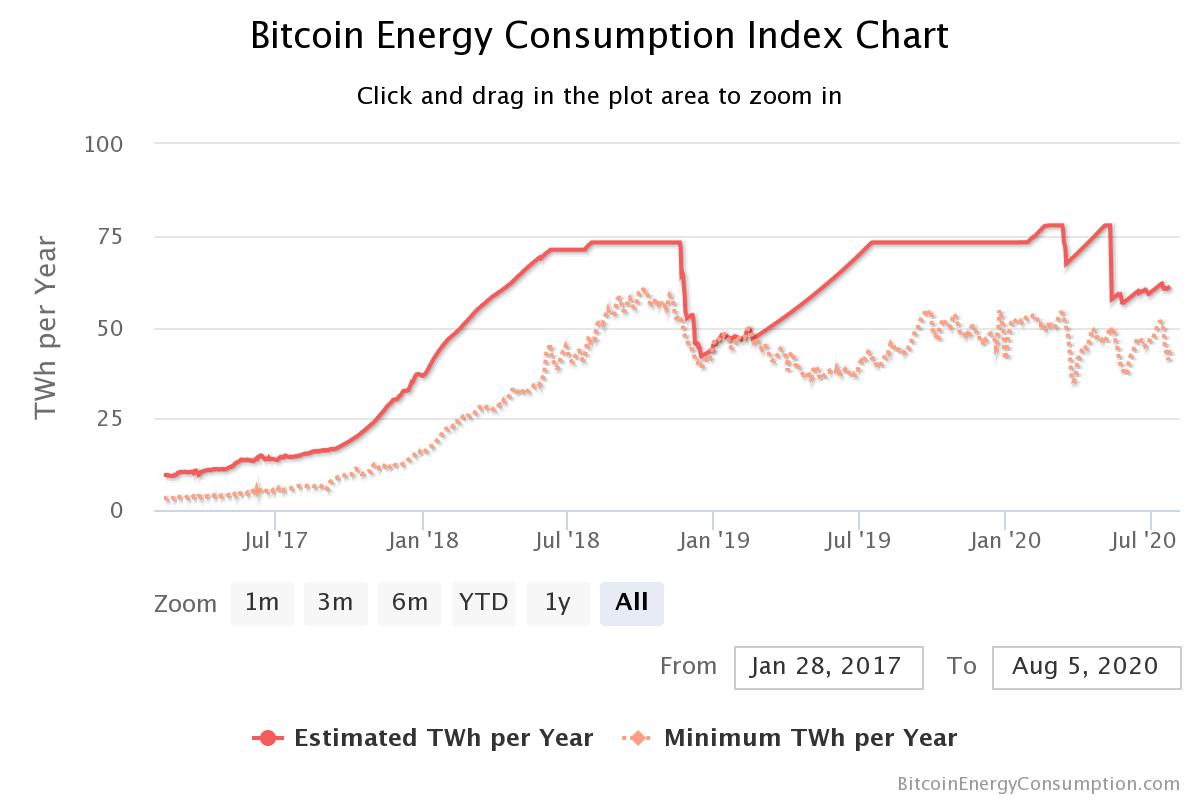
Bitcoin's global consumption estimate sits at 9.1GW.
Sources:cbeci.org crhoy.com BitOoda.io criptotendencia.com
Thanks for your time and if you like the article dont forget to tip me or follow me **HERE** **or** **HERE** https://www.publish0x.com/cryptotrips?a=Jrb2kr6zdW https://read.cash/@GusT
Bitcoin treasure : 10,000,000 satoshis are hidden in a comic
A Bitcoin treasure is hidden in a graphic novel about cryptocurrencies and whoever finds it will be able to take a real handful of bitcoins.
Bitcoin's cultural magazine **Citadel21** has just published a new volume of its crypto comic **Bulltardia** with a hidden reward of 10,000,000 satoshis (today it would be around $ 960). Bulltardia is the Bitcoin-inspired digital comic written and drawn by Dim Zayan. https://www.citadel21.com/
Readers who accept the challenge should carefully study the previous and upcoming episodes of the comic. But in addition, they will have clues that will help them decipher the code and reach the hidden 0.1 Bitcoin.
The third volume of the **Citadel21** magazine includes the first two episodes of the story, ***"A Prayer To The Moon"*** and ***"Honey Badger Doesn't Care"***, and the third episode, ***"The Herd"***, has just been published in volume 4 of this great "cryptozine". https://www.citadel21.com/ https://www.citadel21.com/bulltardia-ep1 https://www.citadel21.com/bulltardia-ep2 https://www.citadel21.com/bulltardia-ep3
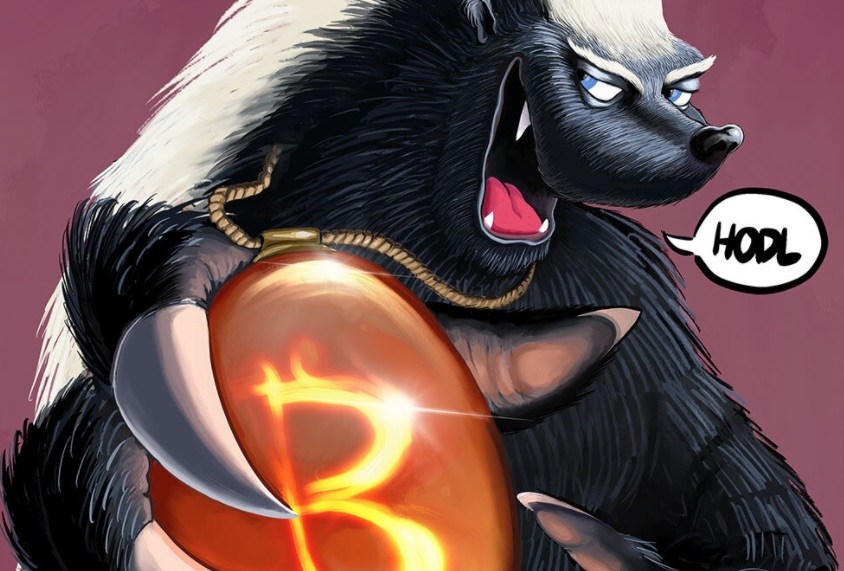
Bulltardia relates the adventures of creatures oppressed by a supreme fiduciary lord. There is a dark collector who is always accompanied by bodyguard bears, and who imprisons those who conspire against the oppressive "holy church of fiat" and pray to the moon (a metaphor for the rise of Bitcoin).
But the story takes a turn when the rebellious character Honey Badger is sent on a mission by his father, Satoshi, to return the moonstone (a stone with the Bitcoin symbol) to its rightful home.
The adventure seems fun as well as intriguing, but it also hides the additional attraction: a crypto treasure. Perhaps the most interesting element of this comic is that it hides twelve keys that form a phrase to access a Bitcoin wallet. According to a Citadel21 post, there are 0.1 BTC ($ 960 currently), or 10 million satoshis, hidden in the story.
In this way, anyone who can decipher the phrase will be able to access the wallet and claim their bitcoins. Furthermore, its creators have provided a clue: "The first clue is one of the reasons why Honey Badger doesn't care." Those interested may follow other indications to decipher the secret code "in the coming months" through the **Twitter accounts of** Citadel21 and **its creator**. https://twitter.com/ctdl21 https://twitter.com/cryptgm
**Bitcoin hides in artwork and puzzles**
This is not the first time that an artist hides a Bitcoin treasure that motivates users to search for it. In 2015, artist Marguerite Driscoll created a challenge that mixed art and crypto. In a painting she hid the key to access a wallet that contained 4.87 bitcoins.
The following year, when Bitcoin was far from reaching its historical price highs, two crypto enthusiasts created a treasure hunt game on the streets of Barcelona. These challenges were hardly the beginning of multiple similar initiatives that have appeared around the world.
Last year, Primitive Ventures co-founder Eric Meltzer released a puzzle called Satoshi's Treasure, where he hid the keys to access a $ 1 million fortune in Bitcoin. Many video games have also appeared including puzzles with hidden rewards in Bitcoin. Among those even Minecraft created a version called SatoshiQuest to search for satoshis treasures.
But cryptocurrencies have also dabbled in the world of comics and graphic novels for several years. The comic “Bitcoin. The hunt for (on the hunt for) Satoshi Nakamoto ”, written by Josep Busquet and Alex Preukschat, with drawings by Jose Ángel García, was announced at the Coin Summit in London in 2014. Bitcoin also had its appearance in a Marvel comic starring by the superhero herself, Ms. Marvel.
Thanks for your time and dont forget to follow me **HERE** https://read.cash/@GusT
Binance moves towards DeFi: integrates DAI and MAKER. Its Blockchain adds Chainlink oracles
Binance **announced the integration of the MakerDAO project governance token, Maker (MKR) and its decentralized stablecoin DAI**. The initiative appears to be a step towards the decentralized finance ecosystem (DeFi) by Binance, which has also announced other efforts along that path.
The exchange will initially support eight trading pairs for MakerDAO tokens. Both MKR and DAI will be able to be exchanged with Bitcoin (BTC), Tether (USDT), BNB and BUSD, the native token and stablecoin of Binance.
The news comes amid the growing boom in the DeFi ecosystem. In recent weeks, DeFi has been registering consecutive historical maximums in terms of the total value blocked in the different protocols that comprise it. A Binance spokesperson commented on the initiative:
DeFi is a hot topic for the Blockchain industry this year. We get a lot of requests from our users [to list the tokens].
DeFi already has more than USD $ 2 billion in BTC and Ether (ETH) blocked as a guarantee for the operation of stablecoins. Of all the existing protocols, MakerDAO ranks at the top, just above the Compound that competes for the throne.
It should be noted that Binance is not the only popular exchange that has listed MRK and DAI this year. The initiative follows Coinbase's efforts last year to list the two tokens. Also other exchanges that support MKR and DAI include OKEx and Bitfinex, as well as DEX Uniswap and Balancer protocols.
But this does not seem to be the only effort Binance is making to enter the world of decentralized finance. An integration with Chainlink and a new set of tools to delve into the DeFi market also speak to the intentions of the exchange.
As reported by various news media, **Binance's dual-chain architecture, called Binance Smart Chain (BSC), is now integrating Chainlink (LINK) data oracles**.
Integration with Chainlink will allow Binance to extend the usability of its Smart Contract-enabled Blockchain; in particular, in areas such as decentralized finance, payments and asset management. Chainlink provides data from intermittent chain sources called oracles for decentralized applications (dapps). The network has been integrated with numerous DeFi projects such as bZx during the first half of 2020.
For his part, Chainlink co-founder Sergey Nazarov said the integration will save BSC developers time and effort. "Now, they can simply use Chainlink as an abstraction layer to create universally connected, secure and reliable smart contracts."
The integration also highlights Binance's intention to create an alternative platform for decentralized applications (DApps) running on Ethereum, specifically targeting the DeFi market.
Notably, Ethereum is the largest Blockchain Dapp network by market cap at around $ 25 billion, so the question arises that the Binance Smart Chain initiative is a competition for Ethereum. In addition, Binance included in its document numerous parameters, such as transaction speed, waiting capacity and scalability, within the framework of its hybrid delegated proof of stake (PoS) and proof of authority (PoA) algorithm that would surpass Ethereum at a theoretical level.
At the moment, Ethereum has the upper hand: Its main DeFi project, MakerDAO, went live in 2015. Now, five years later, many are interested in the ecosystem while other chains like Tezos and the BSC itself are trying to catch up.
Thanks for your time and dont forget to visit my other posts **HERE****.** https://read.cash/@GusT
Satoshis do not arrive? Bitcoin in its third largest congestion of 2020 | July 23rd
Bitcoin congestion has increased considerably in recent days. The levels are close to, but not higher than, those in days close to the halving of May 11, when the reward for mining was cut in half. This is the third-highest period of congestion so far this year.
On July 21 there were **more than 83 thousand transactions in the mempool**. This is, within the blockchain, the temporary memory where the transactions pending confirmation are stored.
**Commission average also increases**
As a consequence, there is also an **increase in the amount of commissions in Bitcoin transactions**. This is because miners first choose those that pay a higher commission, and those in a hurry to confirm their transactions decide to pay more, creating a snowball effect.
The average commission on July 21 was $ 3.55. This implies, measured in dollars, **an increase of 438%** from the recent low of July 12, when the average commission was USD 0.81.
A possible cause of the latter is the increased use of services such as LocalCryptos, which, by default, calculate very high commissions.
Also, as a German developer who presents himself on the Web under the pseudonym "*0Xb10C*" points out, a third of Bitcoin shipments are made from the online wallet of Blockchain.com.
*0Xb10C* shows that this data can be reached, which the company considered valid, based on common traces left by the transactions sent from that wallet, including:
Only P2PKH output addresses are used (those starting with 1, also known as "inherited").
SegWit and multi-signatures are not used.
With each transaction one or two outputs are created.
They all follow the BIP-69 protocol.
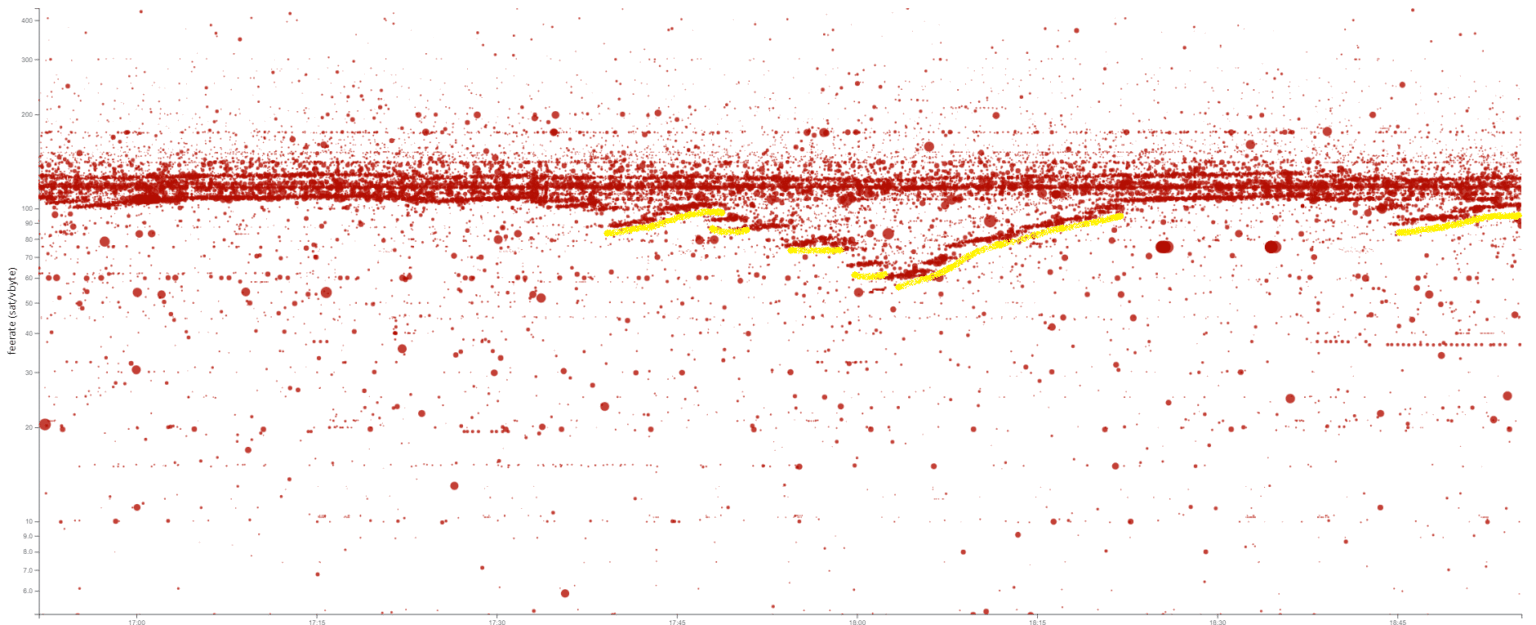
Blockchain.com users generally follow the rate recommendations that the platform offers them. It is seen in the following image, a large number of shipments that use exactly the rates suggested by this wallet. At the time of writing this article they were 89 sat / vbite (the “Regular” option) and 119 sat / vbite (the “Priority” option):
***A large number of Bitcoin shipments are observed that pay exactly the Blockchain.com recommended rate of 89 AND 119 sat / vbyte, on April 22, 2020 at 22:00 UTC. The fee suggested by the wallet is indicated in yellow as “Regular”. Source: screenshot from*** ***https://mempool.observer/monitor/***
**Discussions, complaints and advice**
The situation did not go unnoticed in the “crypto twitter” and, as usual, some promoters of altcoins used these numbers to criticize Bitcoin and, at the same time, praise its cult cryptocurrency, which gave rise to numerous debates.
This was done, for example, by a user who, for the aforementioned reasons, assured that "Bitcoin and Ethereum are not worth it." Instead, he proposed Digibyte, a cryptocurrency that he highlighted having instant transactions, 15-second block times, infinite scalability, minimal commissions, and decentralized products that work on his blockchain.
It did not take long for another person to respond, noting that Digibyte's low commissions are due to empty blocks, that infinite scalability does not exist and that altcoin is not decentralized.
Others used the network to express their displeasure, for example, the person who said she had waited 5 and a half hours for the confirmation of a transaction. "Bitcoin is like gold: it is valuable but not always easy to send," was one of the responses he received.
To conclude, it is important to clarify that although the average value of Bitcoin commissions is high, users can avoid paying excessive amounts.

Small cryptocurrencies that performed better than Bitcoin so far in 2020
There is a popular belief that the only cryptocurrency that exists in the world is Bitcoin (BTC), or failing that only the largest ones such as Ethereum (ETH), the second largest or Ripple (XRP), the third.
But in reality, there are more than 5,500 cryptocurrencies that are very different from each other and that try to solve various problems of our day to day, from renewable energy to the storage of medical records, with a very wide range of options in between.
**Bitcoin's behavior**
Weeks ago, the price of Bitcoin (BTC) fell from $ 9,800 to $ 8,900. On the other hand, the second of all, Ethereum (ETH) collapsed 10% in that same period, going from US $ 248 to US $ 215.
But, although the main cryptocurrencies had a negative behavior, several small cryptocurrencies or Altcoins, not only increased in price, but also set records of a new historical maximum in their prices.
The weight of uncertainty and fear that continues to cause the Coronavirus and all the negative impacts it has brought, are conditioning all markets worldwide, and the universe of cryptocurrencies has been no exception.
Large cryptocurrencies, such as Bitcoin for example, are struggling to stay stable and not fall, rather than thinking about a possible considerable rise in their prices. Instead, many altcoins have done nothing but set higher and higher highs.
We can see how 3 smaller-cap cryptocurrencies set a new all-time high two weeks ago.
**Universal Market Access (UMA):** This small cryptocurrency aims to create a decentralized financial system, in which those unbanked, or with prohibitive regulations in their regions can access the traditional and cryptocurrency financial system anywhere in the world. UMA had an increase of more than 100% in a matter of months, and it seems that every week it continues to break a price record.
**Ren (REN):** The REN team tries to solve the interoperability problem that exists between different cryptocurrencies. For example, if you have Bitcoin you cannot make a transfer to someone who has Ethereum. So REN seeks to be the intermediary between any pair of Blockchains of different cryptocurrencies, allowing the instantaneous exchange of value.
**DMM Governance (DMG):** It tries to allow users of cryptocurrencies to acquire stocks and bonds of the traditional financial world,
such as at Tesla or Apple. Furthermore, they plan to create their own ecosystem, in which these actions and even the cryptocurrencies stored in their ecosystem, can gain additional interests within the project's governance system. This Altcoin has continued to reach maximums in its prices week after week, managing to exceed 100% in value increases.
**Altcoins with good returns don't end here**
There are a handful of other cryptocurrencies that have also managed to hit new all-time highs despite the unfavorable conditions of the big ones in the cryptocurrency market:
**Synthetic Network Token (SNX)**
**Celsius Network (CEL)**
**THORChain (RUNE)**
**Reserve RightsToken (RSR)**
**pNetwork (PNT)**
**Balancer (BAL)**
**Aleph.im (ALEPH)**
This handful of cryptocurrencies, known as Altcoins, don't even come close as they enter the top 100 with the largest capitalization. Put together, they are nowhere near $ 500 million in total capitalization.
Aside from being small-cap Altcoins, these assets have very little in common with each other, and even with large cryptocurrencies like BTC and ETH.
It is clear that thanks to the fact that their total valuation is still small, they allow their price to skyrocket at times.
To take into account when the investor decides to venture into the world of cryptocurrencies: there are some of the largest, best known and consolidated, but in the sea of the more than 5,500 in existence, opportunities also arise, which carry greater risk due to the not-so High liquidity as enjoyed by the leaders in total market capitalization.
 @GusT
@GusT