Comparativo entre BCH e LTC
Por muitos anos venho analisando o comportamento dos agentes do criptomercado, e cheguei a conclusão de que esse mercado tem um problema gravíssimo de assimetria informacional, pois os critérios dos critpoinvestidores são variados, porém são poucos os casos baseados em fundamentos econômicos, talvez por ter muita gente de fora do mercado tradicional, aventureiros e amadores, assim, fatores emocionais, de gosto, de identificação, estão sobrepostos sobre o que realmente importa como; segurança da rede; avanços tecnológicos; capacidade de desenvolvimento; corpo técnico qualificado; geração de valor e diferencial de mercado.
O LTC infelizmente tem uma equipe de desenvolvimento muito limitada! Muito mesmo! Não me refiro a capacidade técnica dos desenvolvedores, embora só pesquisei sobre o Charlie Lee, me refiro ao que foi gerado de valor para LTC durante todo esse tempo, e não houve nada! Simplesmente nada! Sendo isso o que vou demonstrar brevemente neste artigo, com o comparativo do LTC com o BCH. https://en.wikipedia.org/wiki/Charlie_Lee_(computer_scientist)
**O princípio do LTC**
Pode-se observar no criptomercado pessoas comprando Doge, por simpatia, ou NANO por ideologia, são grandes exemplos de como esse mercado está desnorteado. O LTC é mais um exemplo, porém mais sútil. A moeda do Charlie Lee foi criada como uma alternativa ao bitcoin, e seu diferencial era oferecer uma moeda mais leve, e para isso aumentou o número de moedas e reduziu o tempo médio de confirmação dos blocos, portanto um diferencial extremamente tacanha, sem importância alguma. Porém aos olhos de um investidor novato pode parecer a princípio algo talvez relevante, mas não é.
O que muda na vida do consumidor esperar em média 2 ou 10 minutos, se moedas como o LTC e o BTC têm RBF (*Repleace By Fee*) e podem sofre um ataque de gasto duplo em pequenas transações? No BCH por exemplo o consumidor não precisa esperar nenhuma confirmação para pequenas transações, podendo fazer comércios de maneira instantânea. Além disso, a grande quantidade de moedas que o LTC tem faz com que seu valor possivelmente fique baixo, e isso significa maior volatilidade e consequentemente maior o risco de investir no ativo. O que não é bom para o varejo.
Pode parecer estranho o LTC ter o recurso RBF, mas isso é porque sua equipe de desenvolvedores não tem criatividade alguma, em nenhum momento eles parecem ter alguma iniciativa que confronte de maneira factível a tecnologia do BTC. Tudo que o LTC faz e copiar as ferramentas do BTC e vice-versa, sendo de conhecimento de todos que o LTC é quase uma plataforma de testes do BTC. Então, como em algum momento o LTC pode ter futuro? Pessoas estão investindo em uma Testnet do BTC, e isso é bizarro!
O LTC é realmente capacho do BTC, não duvide disso! É por isso que ambas comunidades se dão tão bem, pois um é o ativo e o outro o submisso dessa relação, e os desenvolvedores ficam trocando entre eles (códigos obviamente). O BCH, esse sim, é odiado pela comunidade do BTC, pois é uma ameaça real e tem crescido cada vez mais, porém o LTC não oferece nada de novo, que possa despontar acima do BTC em alguma qualidade, e para eles está bom assim.
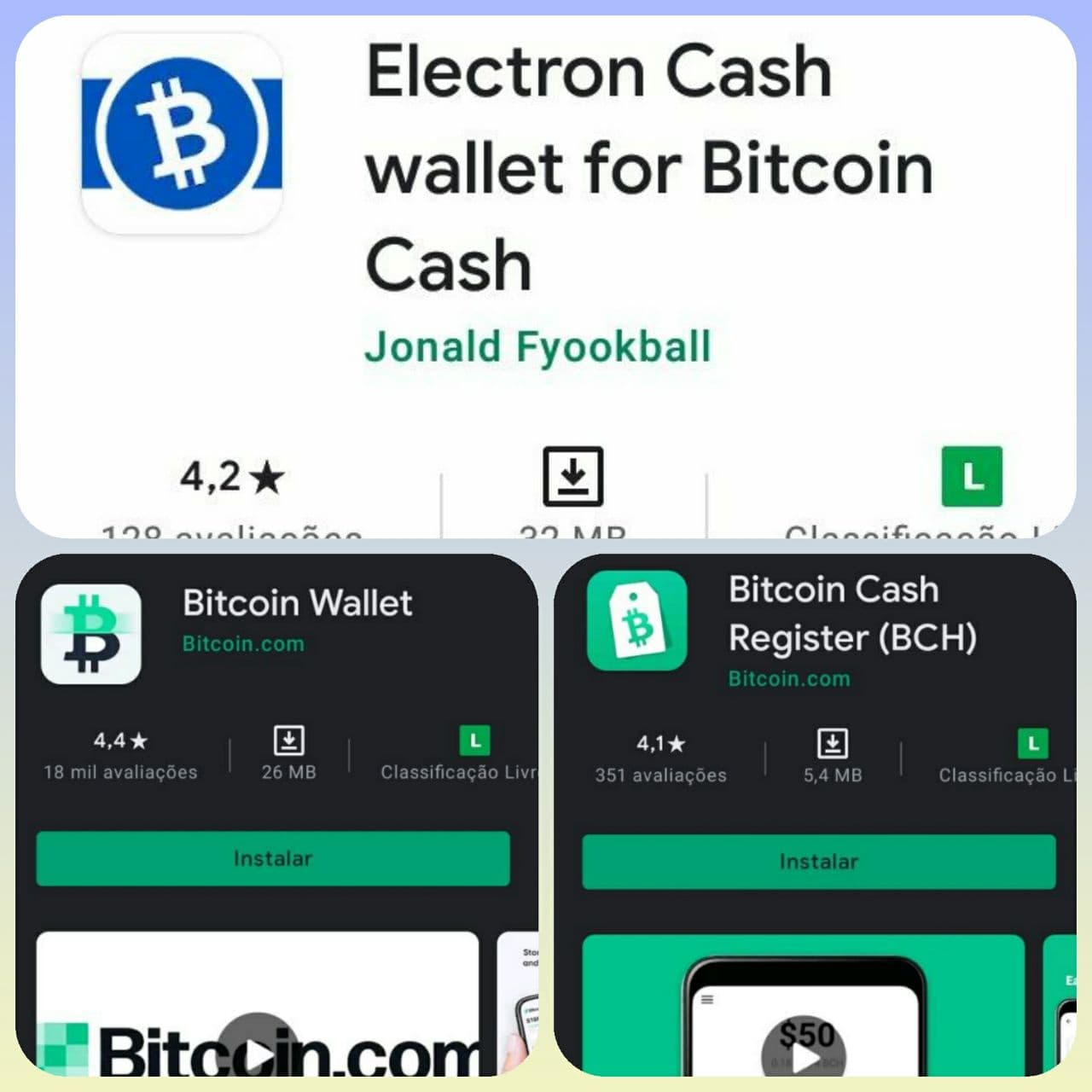
Se por acaso acha que estou exagerando, peço aos leitores que faça uma reflexão simples, indaguem-se deste modo: “Com mais de nove anos de existência porque o LTC não tem ao menos uma carteira própria para Android que seja boa?” ou “Com no mínimo uma avaliação de 4 estrelas?” O BCH tem várias! E não tem nem quatro anos de existência! Como pode não investir no desenvolvimento de uma boa carteira, se em teoria o LTC seria para facilitar as comparas? Na verdade, LTC também não quer ameaçar o BTC nesse sentido, e se considera agora uma reserva de valor menor, assim como a prata, e deixa o BTC sendo o protagonista, como ouro digital. Esse tipo de comportamento é limitante e interfere seriamente no desenvolvimento tecnológico do LTC.
**O comparativo**
Vamos então comparar as moedas, embora o BCH já supere o BTC em tecnologia, muitas pessoas ainda acham a LTC uma alternativa viável para confrontar o BCH, o que certamente não faz o menor sentido, mas, ainda assim, esclarecer essa questão é o propósito desse artigo.
Como é de se imaginar o foco de uma moeda que tem transações baixas e velocidade deveria ser o seu uso no varejo, que demandará o uso da blockchain fazendo com que esse ativo ganhe valor real e não somente valor especulativo, se tornando um bem real na economia, e consequentemente uma reserva de valor, que colocaria um fim no protagonismo do BTC. Porém como explicado acima, embora seja essa a noção clara para os desenvolvedores, entusiastas, e comunidade de ambas as moedas, somente o BCH busca realmente por isso, pois o LTC é subserviente do BTC.
Poder da rede
A primeira qualidade para análise é o poder de rede, isso é importante para dar segurança nas transações, neste quesito o BCH é quase sete **mil de vezes** superior ao LTC, e isso não é força de expressão, pois o LTC tem apenas 0,0003 Ehash/s contra 2,383 Ehash/s do BCH (*no momento em que escrevo*). Assim um ataque de 51% no LTC é muito fácil, e isso ainda não ocorreu por causa do algoritmo, que é pouco utilizado, então o atacante necessitaria gastar com um maquinário mais específico, mas, ainda assim, é bastante arriscado.
Taxas
A segunda qualidade para avaliação, são as taxas cobradas. Na rede do BCH as taxas são menores que um centavo de dólar, assim como a do LTC, porém em uma situação de tenção da rede as taxas do BCH não aumentariam, ao contrário da rede do LTC, que facilmente aumentaria para valores absurdos, isso porque o BCH pode processar centenas de transações por segundo, enquanto o LTC algumas dezenas.
Velocidade / E trancações com zero confirmações
O terceiro item é a velocidade, e o quarto item são as transações sem confirmação. No LTC é necessário esperar 2,5 minutos para validar a sua comprinha do dia a dia, porém o BCH não tem RBF, e assim o cliente não precisa esperar a transação confirmar na rede para efetuar pequenas compras, logo as transações de varejo no BCH são praticamente instantâneas.
Uso da rede
A quinta qualidade é o uso da rede, com seu uso podermos valorar a importância de uma criptomoeda, pois quanto maior o uso real de sua blockchain significa que mais empresas e pessoas estão demandando essa tecnologia para os seus serviços, e isso está intrinsecamente ligado a importância da moeda para a economia real. Sendo um dado crucial para moedas que querem servir para o varejo. O LTC no semestre nunca chegou a 200 mil transações, enquanto o BCH avançou muito nos últimos meses é atualmente processou mais de 322 mil transações no mesmo período de tempo do LTC, portanto, mais que o triplo das transações do LTC.
*Fonte:* *https://www.statista.com/statistics/730838/number-of-daily-cryptocurrency-transactions-by-type/*
Transações On-Chain
A sexta qualidade são as transações On-Chain, atualmente o BCH dispensam o uso da Lightning Network (LN), o que garante maior segurança nas transações, como também facilita que pessoas e empresas possam criar projetos em cima da blockchain do BCH, já a blockchain do LTC é pequena e portanto não é escalável, necessitando do uso da LN, o que coloca em risco as transações, como também dificulta que pessoas e empresas utilizem o LTC para as suas necessidades de modo exponencial.
Facilidades para o varejo
A Sétima qualidade item é a facilidade para a adoção no varejo, o BCH criou uma plataforma muito amigável com diversas carteiras que facilitam o uso do BCH para os comerciantes, existem também empresas que ensinam e qualificam pessoas e empresas para usarem o BCH no dia a dia, como o Satoshi Angel e a Panmoni, Já o LTC tem apenas uma carteira POS (Point-Of-Sale) nota 3,9 da Play Store bastante limitada.
Cunhagem de Tokens
O oitavo item são a possibilidade de criar tokens de modo nativo em suas Blockchains, afinal como o foco é o varejo é importante que os comerciantes e outras empresas possam criar ativos digitais para recompensar e atrair seus clientes, o BCH possibilita isso com a plataforma Simple Ledger Protocol (SLP), mas o LTC não tem nada assim.
Cunhagem de Tokens Colecionáveis ( NFT )
O nono item, é mais uma alternativa as empresas em poder oferecer tokens aos seus clientes, por meio de tokens colecionáveis NFT, a blockchain do BCH já fornece esse serviço, mas o LTC não.
**Anonimato e fungibilidade**
O Décimo item é sobre anonimato e fungibilidade, pois uma moeda necessita ser fungível e também discreta, que mantenha a privacidade de quem as usam, como medida de segurança, em nove anos o LTC não desenvolveu nada para o anonimato, porém recentemente vão pegar carona (como é de costume) no protocolo Mimble Wimble (MW) para tentar solucionar esse grave problema, enquanto que o BCH possibilita anonimato e fungibilidade por meio do CashFusion que pode ser ativado com a Electron Cash sua carteira para Desktop mais popular.
Protocolos DeFi
O Décimo primeiro item da lista é adesão aos protocolos DeFi que servem para prover finanças descentralizadas aos usuários de ambas criptomoedas. A LTC usa o protocolo da LN, que já se mostrou ser um fracasso, com baixíssima adoção, e insegurança, nada amigável, não é atoa que quase nenhuma empresa usa até o momento, existem poucas tentativas de uso por grandes empresas, estando presente de modo limitado em algumas Exchanges. Já no BCH o protocolo DeFi ainda está incipiente, porém já conta com um serviço como o Detoken https://detoken.net/ que pode oferecer ao varejista uma proteção as flutuações do mercado, por meio desse brilhante protocolo DeFi.
Carteiras mobile
O décimo segundo item, são as carteiras, pois quando pensamos em uma moeda para o dia a dia uma carteira Android é fundamental, pois isso é o mínimo que qual quer criptomoeda para o varejo deve oferecer, imagine lugares remotos e simples, pessoas em países com debilidade econômica, necessitando utilizar criptomoedas para as compras cotidianas, bem o BCH sobra nesse item pois toadas a suas carteiras para Android são excelentes com muita tecnologia e uso amigável, quanto o LTC só existe uma e tem uma nota muito baixa entre os usuários, além da carteira POS, que também é bastante duvidosa!
Resultado:
Cada qualidade foi avaliada com nota de 0 a 10, e o resultado você confere na tabela abaixo:
**Conclusão**
Assim, com este texto foi possível ver o quão melhor é o BCH em comparação com o LTC, com diferenças discrepantes entre a qualidade tecnológica entre as duas moedas. Se você leu até aqui pode estar pensando; Como pode o LTC estar acima do BCH no Market Cap? A verdade é que eu também fico surpreso, mas como escrito logo no primeiro paragrafo, a conclusão é que a maioria dos investidores não sabem disso, não fazem a análise correta entre os ativos, apenas olham os gráficos e andam junto com a manada, mesmo que ela os leve para um precipício. Sinceramente ainda poderia escrever mais, porém tenho pouco tempo para isso, mas esse resumo deve ser suficiente.
*Sou da comunidade Brasileira do BCH, e se você quer que eu escreva mais textos assim, você pode me enviar uma gorjeta generosa para que eu continue escrevendo.*
*Deixe um comentário se você gostaria de um comparativo com o BTC.*
*Até a próxima, Abraços!*
BitcoinCash Vs Litecoin
For many years I have been analyzing the behavior of the agents of the crypto market, and I came to the conclusion that this market has a very serious problem of information asymmetry, because the criteria of the crypto investor criteria are varied, but there are few cases based on economic fundamentals, perhaps because many people outside the traditional market, adventurers and amateurs, thus, emotional factors, of taste, of identification, are superimposed on what really matters how; network security; technological advancements; development capacity; qualified technical staff; generation of value and market differential.
LTC unfortunately has a very limited development team! Really much! I am not referring to the technical capacity of the developers, although I only researched Charlie Lee, I am referring to what was generated of value for LTC all this time, and there was nothing! Simply nothing! This being what I will demonstrate briefly in this article, with the comparison of LTC with BCH.
The LTC principle
You can see in the crypto market people buying Doge, out of sympathy, or NANO for ideology, are great examples of how this market is messy. LTC is yet another example, but more subtle. Charlie Lee's currency was created as an alternative to bitcoin, and its feature was to offer a lighter currency, and for that it increased the number of coins and reduced the average confirmation time of the blocks, therefore an extremely feature simplistic, without any importance. However, in the eyes of a novice investor it may seem at first to be perhaps relevant, but it is not.
What changes in the consumer's life for expect an average of 2 or 10 minutes, if currencies like LTC and BTC have RBF (Repleace By Fee) and can suffer a double expense attack on small transactions? At BCH, for example, the consumer does not need to wait for any confirmation for small transactions, being able to make trades instantly. In addition, the large amount of currencies that the LTC has makes its value possibly to be low, and that means greater volatility and consequently greater risk of investing in the asset. Which is not good for retail.
It may seem strange that LTC has the RBF feature, but that is because its team of developers has no creativity. They don't have the initiative to confront BTC technology. Everything LTC does is copy the BTC tools and vice versa, and everyone knows that LTC is almost a BTC testing platform. So how can LTC ever have a future? People are investing in a BTC Testnet, and this is bizarre!
LTC is really BTC's doormat, don't doubt it! That is why both communities get along so well, as one is the active one and the other is the submissive of this relationship, and the developers keep exchanging between them (codes obviously). BCH, this one, is hated by the BTC community, as it is a real threat and has been growing more and more, but LTC does not offer anything new, which may emerge above BTC in some quality, and for them it is good like that .
If you happen to think that I am exaggerating, I ask readers to make a simple reflection, ask yourself this way: “With more than nine years of existence, why doesn't LTC have at least a proper Android wallet that is good?” “With at least a 4 star rating?” The BCH has several! And it's not even four years old! How can you not invest in developing a good mobile wallet, if in theory the LTC would be to facilitate comparisons? In fact, it also does not want to threaten BTC in that sense and now considers itself a reserve of lesser value, like silver, and leaves BTC as the protagonist, as digital gold. This type of behavior is limiting and seriously interferes with the technological development of LTC.
The comparative
So let's compare the currencies, although BCH already outperforms BTC in technology, many people still find LTC a viable alternative to confront BCH, which certainly doesn't make any sense, but still, clarifying this issue is the purpose that article.
As you can imagine the focus of a currency that has low transactions and speed should be its use in retail, which will require the use of blockchain making this asset gain real value and not just speculative value, becoming a real asset in economy, and consequently a reserve of value, which would put an end to BTC's leading role. However, as explained above, although this is the clear notion for developers, enthusiasts, and the community of both currencies, only BCH really seeks this, as LTC is subservient to BTC.
Hashate
The first quality for analysis is the hashate, this is important to provide security in transactions, in this regard BCH is **seven thousand times higher** than LTC, and this is not way of speaking, since LTC has only 0.0003 Ehash / s against 2.383 Ehash / s of the BCH (*at this point when I write*). So a 51% attack on the LTC is quite easy, and this hasn't happened yet because of the algorithm, which is little used, so the attacker would need to spend on more specific machinery, but it is still very risky.
Fees
The second quality for evaluation is the fees charged. In the BCH network the rates are less than a cent, like LTC, but in a situation of tension in the network, BCH rates would not increase, unlike the LTC network, which would easily increase to absurd values, this because the BCH can process hundreds of transactions per second, while the LTC a few tens.
Zero confirmations and Speed
The third item is speed, and the fourth item is transactions without confirmation. At LTC, it is necessary to wait 2.5 minutes to validate your day-to-day shopping, but the BCH does not have an RBF, so the customer does not have to wait for the transaction to confirm on the network to make small purchases, so retail transactions at the BCH they are practically instantaneous.
Network usage
The fifth quality is the use of the network, with its use we can value the importance of a cryptocurrency, because the greater the actual use of its blockchain means that more companies and people are demanding this technology for their services, and this is intrinsically linked to importance of cryptocurrency to the real economy. Being a crucial data for currencies that want to serve for retail. LTC in the first half never reached 200 thousand transactions, while BCH has advanced a lot in the last few months and is currently processing more than 322 thousand transactions in the same time period as LTC, therefore, more than triple LTC transactions.
*Source:* *https://www.statista.com/statistics/730838/number-of-daily-cryptocurrency-transactions-by-type/*
On-Chain Transactions
The sixth quality is On-Chain transactions, currently BCH does not require the use of the Lightning Network (LN), which ensures greater security in transactions, as well as facilitating people and companies to create projects on top of the BCH blockchain, LTC blockchain is small and therefore not scalable, requiring the use of LN, which puts transactions at risk, as well as making it difficult for people and companies to use LTC for their needs exponentially.
Retail facilities
The seventh item quality is the ease for adoption in retail, BCH has created a very friendly platform with several portfolios that facilitate the use of BCH for traders, there are also companies that teach and qualify people and companies to use BCH on the day day, like Satoshi Angel and Panmoni, LTC has only a POS (Point-Of-Sale) 3.9 note from the very limited in Play Store.
Token minting
The eighth item is the possibility to create tokens natively in their Blockchains, after all, as the focus is retail, it is important that merchants and other companies can create digital assets to reward and attract their customers, BCH allows this with the Simple platform Ledger Protocol (SLP), but the LTC has nothing like that.
Coinage of NFT Collectible Tokens
The ninth item, is another alternative for companies to be able to offer tokens to their customers, through NFT collectible tokens, the BCH blockchain already provides this service, but LTC does not.
Anonymity and fungibility
The Tenth item is about anonymity and fungibility, because a currency needs to be fungible and also discreet, that keeps the privacy of those who use them, as a security measure, in nine years the LTC has not developed anything for anonymity, but recently they will be hitchhiking (as usual) in the Mimble Wimble (MW) protocol to try to solve this serious problem, while BCH allows anonymity and fungibility through CashFusion that can be activated with Electron Cash, your most popular Desktop wallet.
DeFi Protocols
The eleventh item on the list is adherence to the DeFi protocols that serve to provide decentralized finance to users of both cryptocurrencies. LTC uses the LN protocol, which has already proved to be a failure, with very low adoption, and insecurity, not at all friendly, it is no coincidence that almost no company uses it so far, there are few attempts to use it by large companies, being present limited mode on some Exchanges. In the BCH, the DeFi protocol is still incipient, but it already has a service like Detoken that can offer retailers protection against market fluctuations, through this brilliant DeFi protocol.
https://detoken.net/
Mobile wallets
The twelfth item, are wallets, because when we think of a currency for everyday life an Android wallet is essential, as this is the minimum that any cryptocurrency for retailers must offer, imagine remote and simple places, people in countries with economic weakness, needing to use cryptocurrencies for everyday purchases, well the BCH is perfect in this item because all of their wallets for Android are excellent with a lot of technology and friendly use, as the LTC only exists one and has a very low score among users besides the POS wallet, which is also very doubtful!
Result:
Each quality was evaluated with a score betwen 0 to 10, and the result you can see in the table below:
Conclusion
Thus, with this text it was possible to see how much better the BCH is compared to the LTC, with discrepant differences between the technological quality between the two currencies. If you've read this far you may be thinking; How can LTC be above BCH in MarketCap? The truth is that I am also surprised, but as written in the first paragraph, the conclusion is that most investors do not know this, do not make the correct analysis between the assets, just look at the charts and walk with the herd, even let her take them to a precipice. Honestly I could still write more, but I have little time for that, but this summary should be enough.
_____ **/ /** ______
I'm from the Brazilian BCH community and if you want me to write more texts like that, you can send me a generous tip so I can continue writing.
Leave a comment if you would like a comparison with BTC.
Until next time...
It looks like a story, but it's history. An Account.
In this article, I will transcribe a story by my graduate supervisor, who reports on a fact that occurred in the Brazilian rural environment. In 1972, a 15-year-old girl was washing clothes on the edge of a river in a municipality in the forest area of the State of Alagoas. Suddenly, a 16 year old Caucasian man arrives and begins to bathe in the same river. They exchange looks. In a short time, the young man asks for dating, immediately accepted. Next step: the boy named Arnon proposes to flee. She lived with her mother and brother in a house in the middle of a farm with a garden. Mother Helena goes into despair in the search for her only daughter. After three months, a resident of the farm claims to have seen the girl on another farm far away. The mother goes on foot with her son in search of her daughter in a house. She manages to bring the couple to their home, and they start living together.
In 1980, after the couple lost several children, six in all, due to childbirth problems, and one case of illness, they managed to save a single daughter named Silvana. Her son, Severino, followed the same routine since he was 7 years old, as well as Silvana's father. Lourdes took care of the kitchen, washing clothes and her care baby daughter. Dona Helena, after work, took care of the garden, It had dimensions of almost a third of a hectare. A huge variety of foods was planted there: sweet potatoes, beans, tomatoes, yams, cabbage, watermelons, bananas, and much more. This guaranteed a “non-monetary income”, impossible to be achieved in urban centers. In addition, there was a rearing of chickens that were trapped at dusk to protect against attacks by nocturnal predators. This routine is broken in 1981.
At the end of the week, the men take their time off to drink. Young Arnon, while drinking cachaça at the bar, met a man who was carrying a basket with bananas on a horse. He became interested in half the bunch of bananas. And he recommended that the man leave her with him and go to his house and take his wife and only daughter as payment. That's right! The man then went to the farm to seek payment, in the face of the confused thoughts of the drunk young man.
When he arrived and talked about the deal between drunks, he pulled his wife (Lourdes) and daughter (Silvana) of just over a year to put them on the horse. Dona Helena (now 99) and her daughter were home alone. Each armed themselves with a machete, and the owner of the house said that no one would leave. It was a scandal, but common sense prevailed.
To everyone's happiness, the man gave up. Her husband, Arnon, arrived drunk, complaining that they had not left. Dona Helena expelled her son-in-law from the farm. And so ended the HISTORY of Arnon and Lourdes. When she found out that her love was worth only half a bunch of bananas.
*Story reported by André Maia Gomes Lages, Economist and Professor of Economics at FEAC / UFAL*
BitcoinCash para pagamentos anônimos
Fungibilidade e anonimato são temas que atualmente causam muita controversa no universo das criptomoedas. Por desenho as criptomoedas seriam anônimas e fungíveis, mas com a popularidade desse mercado, surgiram também as empresas de análise de Blockchain focadas exclusivamente no rastreamento de transações com criptomoedas, essas empresas de análises, que geralmente são bancadas por fundos de pesquisa oficiais, ficaram ótimas em desvendar a identidade dos usuários.
Abusca por anonimato
Assim como os serviços de rastreamento evoluíram, se faz necessário também evoluir a tecnologia das criptomoedas para manter o mais fungível e anônimo possível, assim como uma cédula de Real. Atualmente esse tem sido um grande desafio para os desenvolvedores.
Antes de prosseguir explicando as inovações que o BCH fez para se tornar, além do melhor dinheiro eletrônico do mundo, uma moeda anônima. Se faz necessário entender, que tais medidas de anonimato e fungibilidade não são desenvolvidas em essência para atividades criminosas, mas para a manutenção da privacidade e da liberdade das pessoas. A exemplo das armas, a princípio ninguém fabrica armas para que haja assassinatos, mas para que pessoas possam se defender ou prática esporte. Deste modo o dinheiro essencialmente precisa ser fungível e anônimo.
Diante do enorme desafio, criptomoedas de todos os tipos começaram a focar em anonimato. Neste campo podemos destacar as moedas: Monero, Zcash e Dash. Embora a Monero tenha feito um ótimo trabalho, infelizmente tanta atenção no aspecto anonimato fizeram prejudicar sua funcionalidade como meio de pagamento. Portanto, Monero se descaracterizou como moeda e passou a ser um ativo intermediário para ofuscar transações para outras moedas. Dificilmente alguém se sentiria confortável em utilizar Monero como meio de pagamentos, há não ser que seu objetivo maior seja somente o anonimato.
Um risco para quem investe em Monero é que sem o anonimato a moeda perde o sentindo de existir, e já existem duas patentes de uma empresa de análise que afirma quebrar a privacidade das transações com Monero, embora não foi vista comprovação prática ainda. https://news.bitcoin.com/ciphertrace-patents-monero-transactions/
Quanto a Zcash, e a DASH, embora sejam moedas mais funcionais do que a Monero, infelizmente, oferecem risco aos seus usuários, pois ambas permitem que suas transações possam ser do tipo privativa ou não privativa. E isso acaba fazendo com que moedas, que não estão com a privacidade assegurada, contaminem as moedas privadas. Assim, usuários estão com suas transações expostas e as vezes não sabem! Causando um risco maior pela falsa sensação de estar em segurança.
O envio conjunto de moeda "Coinjoin"
O BCH, assim como o BTC, não quiseram limitar sua funcionalidade de meio de pagamento, embora o BTC já deixou de ser dinheiro funcional a algum tempo, ambas optaram pelo Coinjoin, um sistema que ofusca os verdadeiros destinatários das transações, para que assim pudessem oferecer algum tipo de privacidade, sem ter que mudar suas características básicas. Que é ser um meio de pagamento viável. https://en.bitcoin.it/wiki/CoinJoin
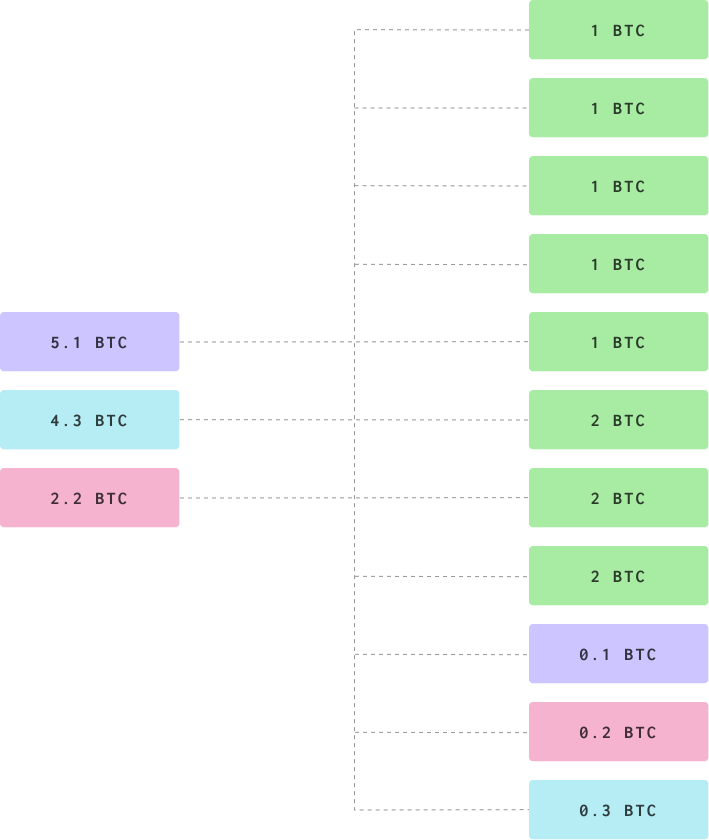
De maneira muito simplificada o Coinjoin possibilita o recebimento conjunto de moedas, o que ofusca quem tenta determinar qual é o verdadeiro detentor de uma determinada moeda. Por exemplo, suponhamos que; Ana, Bruna e Carlos tem em suas carteiras respectivamente (1, 2, 3) moedas, e digamos que você sabe disso apenas reconhecendo os seus endereços em um explorador de blocos. Agora, suponha que Ana, Bruna e Carlos decidem de maneira conjunta enviar as moedas para outros endereços de suas posses. E você acompanha no explorador de blocos a transação conjunta que resultam em 5 endereços com a quantidade de moedas assim distribuídas (1, 1, 2, 1, 1), você saberia dizer qual é a moeda de Ana? Na verdade o máximo que você pode fazer é aplicar um cálculo probabilístico, com as possibilidades possíveis, exemplo:
(1 Ana, 1 Bruna, 2 Carlos, 1 Bruna, 1Bruna) ou (1 Ana, 1 Bruna, 2 Bruna, 1 Carlos, 1 Carlos) ou (1 Bruna, 1 Ana, 2 Carlos, 1 Bruna, 1Bruna) ou (1 Bruna, 1 Bruna, 2 Carlos, 1 Ana , 1 Bruna) ou (1 Bruna, 1 Bruna, 2 Carlos, 1 Bruna, 1 Ana) ou (1 Carlos, 1 Carlos, 2 Bruna, 1 Bruna, 1 Ana). Então nesse exemplo existe a possibilidade de 1 em 4 (25%) de você acertar o endereço aonde está a moeda de Ana. Agora imagine isso em uma escala maior, de maneira extremamente resumida isso é o Coinjoin.
O limitado anonimato do BTC
A carteira Wasabi do BTC é a mais popular que oferece o serviço de Coinjoin. No website da Wasabi, informa que a carteira executa transações CoinJoin confiáveis através da rede de anonimato Tor. O coordenador do CoinJoin não pode roubar nem violar a privacidade dos participantes, e que atualmente, você paga uma taxa de 0,003% multiplicado pelo valor definido para anonimato. Se o conjunto de anonimato de uma moeda for 50, você paga 0,003% * 50 (= 0,15%). Se você definir o anonimato desejado definido como 53, o Wasabi continuará a misturar até que seja alcançado, então você pode acabar com um conjunto de anonimato de, digamos, 60, e você pagará 0,003% * 60 (= 0,18%). https://wasabiwallet.io
Ou seja, se faz necessário consolidar moedas a partir de saídas embaralhadas, e isso é um **limitante** desse sistema, note que é possível não encontrar o valor necessário, por exemplo 53, assim a carteira poderá usar um outro valor como 60, e isso gera uma lentidão nas trocas… (*típico do BTC, não é mesmo?*). Outro problema do Coinjoin do BTC é a existência de custos para poder simplesmente ofuscar as transações.
No início o BCH também resolveu adotar o Coinjoin para ofuscar as transações, é neste momento que entra o trabalho fantástico dos desenvolvedores do BCH, como Jonald, Mark e certamente tantos outros. **Jonald Fyookball** foi o responsável por criar o **CashShuffle**, que tinha uma proposta muito parecida com a carteira Wasabi do BTC, porém com uma diferença fundamental, ele poderia trabalhar sobre um protocolo que tem como objetivo ser realmente um meio de pagamento, rápido, barato e escalável, e isso facilita tudo! Pois é possível realizar o Coinjoin praticamente sem custos.
O funcional anonimato para pagamentos "CashFusion"
Jonald foi um dos integrantes do movimento Big-Blockers que resultou no fork do bitcoin, é portanto um dos responsáveis pelo BCH ser a melhor criptomoeda para pagamentos. Porém, quando criou o CashShuffle, mesmo sendo mais econômico e viável que o Coinjoin da Wasabi, Jonald percebeu que consolidar moedas a partir de saídas embaralhadas era problemático e isso levou à investigação de algo melhor. https://www.reedsmith.com/en/perspectives/2018/01/bitcoins-block-size-debate-big-blockers-v-decentralists
Então, mais um participante fundamental para a criação do anonimato nas transações com BCH entra na história, é o Phd em Física da *University of British Columbia*, **Mark B. Lundeberg**, na qual Jonald o define com um gênio! Mark tem mais de duas mil citações de trabalhos acadêmicos, na qual trabalha com estudos sobre; grafeno, eletrônica, spintrônica, eletrodinâmica e plasmonics (*seja lá o que for isso*), mas atualmente se dedica a tecnologia Blockchain. https://scholar.google.com.br/citations?hl=pt-BR&user=D1_hbLYAAAAJ
A contribuição de Mark, segundo Jonald foi pensar da seguinte maneira: “*Embora as quantidades reais de bitcoins adicionem mais precisão decimal, tornando as correspondências mais raras, vamos mais do que compensar isso, porque a quantidade total de partições será simplesmente insana*” portanto Mark percebeu que não era mais necessário consolidar moedas, mas sim aumentar a quantidade de partições com um valor astronômico! (*Acredite, o adjetivo astronômico aqui não é força de expressão*).
Assim surge **CashFusion**, um sistema que oferece uma maneira **prática** de recombinar transações anônimas fragmentadas em um ambiente seguro, sem que o servidor seja capaz de roubar os fundos ou desvendar o anonimato dos usuários. Atualmente esse sistema pode ser encontrado na popular carteira Electron Cash ativando-o com um simples click, e pronto! Sua carteira começará a participar de uma transação com muitas entradas e saídas fornecidas por vários outros participantes do CashFusion, rodando em segundo plano, com o número de combinações possíveis de dimensão incomputável, sendo essencialmente impossível para qualquer pessoa saber quais entradas e saídas pertencem a um determinado usuário. https://electroncash.org/
Quer entender melhor o funcionamento do CashFusion? Para nossa sorte Jonald também é escritor do read.cash e fez dois excelentes artigos sobre o tema, que foram usados como fonte para construir esse artigo:
Analyzing the combinatoric math in cashfusion https://read.cash/@jonald_fyookball/analyzing-the-combinatoric-math-in-cashfusion-29943fb7
More CashFusion Math https://read.cash/@jonald_fyookball/more-cashfusion-math-1257bde7
Alguns detalhes interessantes sobre o CashFusion podem ser lidos nesta postagem no Reddit . O sistema do CashFusion passou por uma rigorosa auditoria e você pode ler sobre isso clicando aqui. https://www.reddit.com/r/btc/comments/jgs053/its_fusion_friday/ https://news.bitcoin.com/privacy-enhancing-protocol-cashfusion-completes-security-analysis/
**Conclusão.**
Neste artigo apresentamos a importância do anonimato nas transações com criptomoedas, e mostramos os desafios de manter as criptomoedas anônimas. Apresentamos o Coinjoin e sua evolução mais avançada, produzida pelos incríveis desenvolvedores do BCH, que é o CashFusion. Apresentamos também como o CashFusion possibilita anonimato seguro para os usuários do BCH de maneira simples, com apenas um click, na popular carteira Electron Cash. https://electroncash.org/
Sem custos! E de maneira rápida! Assim o BCH oferece transações com elevado nível de anonimato para usuários simples, sem perder suas características fundamentais de dinheiro eletrônico descentralizado. Democratizando o acesso à privacidade e ao dinheiro, e desbancando os bancos.
Para conhecer mais sobre o CashFusion acesse o site: https://cashfusion.org/ se possível colabore para que esse fantástico projeto continue disponibilizando liberdade e segurança para as pessoas.
*Agradecimento especial a* @jonald_fyookball *, pela sua generosidade em ceder um pouco de seu tempo precioso para tirar as minhas dúvidas*.
__ **/ /** __
Quer conhecer mais sobre BCH, acesse nossos grupos do Brasil
Facebook: **https://www.facebook.com/groups/504437216905955**
Telegram: https://t.me/bchbrasil
BitcoinCash for anonymous payments
Fungibility and anonymity are themes that currently cause a lot of controversy in the universe of cryptocurrencies. By design cryptocurrencies would be anonymous and fungible, but with the popularity of this market, Blockchain analytics companies also focused exclusively on tracking transactions with cryptocurrencies, these analytics companies, which are usually funded by official research funds, were great in unraveling the identity of users.
The Search for Anonymity
Just as tracking services have evolved, it is also necessary to evolve cryptocurrency technology to keep it as fungible and anonymous as possible, just like a dollar bill. This has been a major challenge for developers today.
Before proceeding to explain the innovations that BCH has made to become, in addition to the best electronic money in the world, an anonymous currency. It is necessary to understand that such measures of anonymity and fungibility are not developed in essence for criminal activities, but for the maintenance of people's privacy and freedom. Like weapons, at first no one manufactures weapons for murders, but for people to defend themselves or practice sport. So money essentially needs to be fungible and anonymous.
Faced with the enormous challenge, cryptocurrencies of all types began to focus on anonymity. In this field we can highlight the currencies: Monero, Zcash and Dash. Although Monero has done a great job, unfortunately so much attention on the anonymity aspect has impaired its functionality as a means of payment. Therefore, Monero became uncharacterized as a currency and became an intermediate asset to overshadow transactions for other currencies. Hardly anyone would feel comfortable using Monero as a means of payment, unless their main objective is only anonymity.
One risk for those who invest in Monero is that without anonymity the currency loses its sense of existence, and there are already two patents from an analytics company that claims to break the privacy of transactions with Monero, although no practical evidence has yet been seen. https://news.bitcoin.com/ciphertrace-patents-monero-transactions/
As for Zcash, and Dash, although they are more functional currencies than Monero, unfortunately, they offer risk to their users, as both allow their transactions to be of the private or non-private type. And that ends up causing coins, which are not guaranteed privacy, to contaminate private coins. So, users have their transactions exposed and sometimes they don't know! Causing a greater risk due to the false feeling of being safe.
The beginning of Coinjoin
BCH, like BTC, did not want to limit the payment functionality, although BTC is no longer functional money today, both opted for Coinjoin, a system that outshines the real recipients of transactions, so they could offer some kind of privacy , without having to change its basic characteristics. Which is to be a viable means of payment.. https://en.bitcoin.it/wiki/CoinJoin
In a very simplified way, Coinjoin allows the joint receipt of coins, which overshadows anyone trying to determine who is the real holder of a certain currency. For example, suppose that; Alice, Bob and Charles have in their wallets respectively (1, 2, 3) coins, and let's say you know this just by recognizing their addresses in a block explorer. Now, suppose that Alice, Bob and Charles jointly decide to send the coins to other addresses of their possessions. And you follow the joint transaction in the block explorer, which results in 5 addresses with the amount of coins distributed in this way (1, 1, 2, 1, 1), would you know what Ana's currency is? In fact the most you can do is apply a probabilistic calculation, with the possibilities, for example:
(1 Alice, 1 Bob, 2 Charles, 1 Bob, 1Bob) or (1 Alice, 1 Bob, 2 Bob, 1 Charles, 1 Charles) or (1 Bob, 1 Alice, 2 Charles, 1 Bob, 1Bob) or ( 1 Bob, 1 Bob, 2 Charles, 1 Alice, 1 Bob) or (1 Bob, 1 Bob, 2 Charles, 1 Bob, 1 Alice) or (1 Charles, 1 Charles, 2 Bob, 1 Bob, 1 Alice). So in this example there is a possibility that 1 in 4 (25%) of you can set the address where Alice's currency is. Now imagine this on a larger scale, in an extremely short way this is Coinjoin.
Bitcoin Core's (BTC) limited anonymity
Bitcoin Core's Wasabi wallet is the most popular offering the Coinjoin service. On the Wasabi website, it states that the wallet performs trusted CoinJoin transactions through the Tor anonymity network. The CoinJoin coordinator cannot steal or violate the participants' privacy, and that you currently pay a 0.003% fee multiplied by the amount set for anonymity. If the currency anonymity set is 50, you pay 0.003% * 50 (= 0.15%). If you set the desired anonymity set to 53, Wasabi will continue to mix until it is achieved, so you can end up with an anonymity set of, say, 60, and you will pay 0.003% * 60 (= 0.18%).
In this way, it is necessary to consolidate currencies from scrambled exits, and this is a limitation of this system, note that it is possible to not find the necessary amount, for example 53, so the portfolio can use another value like 60, and this generates a slowness in exchanges ... (typical of BTC, isn't it?). Another problem with BTC's Coinjoin is that there are costs to simply overshadow transactions.
In the beginning BCH also decided to adopt Coinjoin to overshadow transactions, it is at this moment that the fantastic work of BCH developers, like Jonald, Mark and certainly many others, comes in. Jonald Fyookball was responsible for creating the CashShuffle, which had a proposal very similar to the Wasabi wallet, but with a fundamental difference, he could work on a protocol that aims to really be a means of payment, fast, cheap and scalable, and that makes it easy! Because it is possible to carry out Coinjoin at virtually no cost.
CashFusion - "The functional anonymity for payments"
Jonald was one of the members of the Big-Blockers movement that resulted in the fork of bitcoin, and is therefore one of those responsible for BCH being the best cryptocurrency for payments. However, when he created CashShuffle, even though it was more economical and viable than Wasabi's Coinjoin, Jonald realized that consolidating shuffled coins was problematic and this led to the investigation of something better. https://www.reedsmith.com/en/perspectives/2018/01/bitcoins-block-size-debate-big-blockers-v-decentralists
So, another important participant in creating anonymity in BCH transactions enters the story, is the Phd in Physics from the University of British Columbia, Mark B. Lundeberg, in which Jonald defines him with a genius! Mark has over two thousand citations of academic papers, in which he works with studies on; graphene, electronics, spintronics, electrodynamics and plasmonics, but currently is dedicated to Blockchain technology. https://scholar.google.com.br/citations?hl=pt-BR&user=D1_hbLYAAAAJ
Mark's contribution, according to Jonald, was to think in the following way: "Although the actual amounts of bitcoins add more decimal precision, making matches rarer, we will more than make up for it, because the total number of partitions will be simply insane" he realized that it was no longer necessary to consolidate currencies, but to increase the number of partitions with an astronomical value! (*Believe me, the astronomical adjective here* it is not a figure of speech).
Thus comes **CashFusion**, a system that offers a **practical** way to recombine fragmented anonymous transactions in a secure environment, without the server being able to steal funds or reveal users' anonymity. Currently, this system can be found in the popular **Electron Cash** wallet by activating it with a simple click, and that's it! Your wallet will begin to participate in a transaction with many entries and exits provided by several other CashFusion participants, running in the background, with the number of possible combinations of incomputable size, making it essentially impossible for anyone to know which entries and exits belong to a particular user. https://electroncash.org
Want to better understand how CashFusion works? Luckily for us, Jonald is also a writer for read.cash and made two excellent articles on the topic, which were used as a source to build this article:
**Analyzing the combinatoric math in cashfusion** https://read.cash/@jonald_fyookball/analyzing-the-combinatoric-math-in-cashfusion-29943fb7
**More CashFusion Math** https://read.cash/@jonald_fyookball/more-cashfusion-math-1257bde7
Some interesting details about Cash Fusion can be read in this post on Reddit. The CashFusion system has undergone a rigorous audit and you can read about it by clicking here. https://www.reddit.com/r/btc/comments/jgs053/its_fusion_friday/ https://news.bitcoin.com/privacy-enhancing-protocol-cashfusion-completes-security-analysis/
Conclusion
In this article we present the importance of anonymity in cryptocurrency transactions, and show the challenges of keeping cryptocurrencies anonymous. We present Coinjoin and its most advanced evolution, produced by the incredible developers of BCH, which is CashFusion. We also present how CashFusion enables secure anonymity for BCH users in a simple way, with just one click, in the popular Electron Cash wallet.
Free! And quickly! Thus BCH offers transactions with a high level of anonymity for simple users, without losing its fundamental characteristics of decentralized electronic cash. Democratizing access to privacy and cash, and helping the unbanked.
To learn more about CashFusion visit the website: https://cashfusion.org/ if possible collaborate so that this fantastic project continues to provide freedom and security for people.
__ **/ /** __
*Special thanks to* @jonald_fyookball *, for his generosity in giving up some of his precious time to clear my doubts.*
*This article was originally written in Portuguese for the BCH community in Brazil. The text may present possible errors in grammar and spelling, any suggestion of correction will be highly appreciated. Thanks...*
Daniel Fraga: O Herói ANCAP entusiasta do BCH
O primeiro grande Anárquico Capitalista (ANCAP) da história do Brasil, e quem sabe até do mundo, é sem dúvidas uma lenda na atualidade. Seu nome é Daniel Fraga um Youtuber que desafiou o sistema Estatal, a política, e o poder judiciário no Brasil, e graças ao bitcoin saiu vitorioso!
Daniel foi tão polêmico e fez tanto sucesso que já tem vídeos produzidos no exterior ao seu respeito. Como este: The Missing Bitcoin Millionaire - Internet Mysteries https://youtu.be/hUC7plAbQAM
https://youtu.be/hUC7plAbQAM
Também se tornou um personagem na animação brasileira **Ancap Park**. A série contará sobre uma jornada épica nas fazendas austríacas e no Parque Comuna. O estilo da animação é baseado na série americana South Park.
https://youtu.be/85NuLI-2LXc
**A história lendária**
Tudo começou aproximadamente no ano de 2010 com seus vídeos polêmicos na plataforma do Youtube, na qual mostrava as debilidades e contradições das leis estatais, a ineficiência do Estado na economia, e seu *modus operandi* opressor. Fraga demonstrava muito conhecimento sobre a filosofia ANCAP, porém em vez de apenas expressar seus pensamentos em seu vlog, com falas e textos, foi além, levando toda a sua filosofia anarquista para a prática, em seu cotidiano. Armado com sua força de expressão, e o poder midiático conquistado com milhares de inscritos no seu canal do Youtube, e principalmente municiado com bastante bitcoins. Daniel fez um escarcéu com três juízes brasileiros, e com uma Deputada Estadual do Rio de Janeiro. Os juízes desistiram de processá-lo, pois a cada intimação Fraga expunha suas contradições em vídeo para a sua audiência, protegido pela incensurável blockchain, disse em um de seus vídeos “*Será que esse juiz sabe o que é bitcoin? Se não sabe vou explicar; Bitcoin é o seu pior pesadelo, e o que vai fazer o Estado desmoronar!*”
Enquanto que no caso da Deputada, ela foi até o fim, e exigiu o bloqueio das contas bancárias de Daniel Fraga para receber a sua indenização, mas Fraga já tinha convertido todo o seu dinheiro e bens em bitcoins, na verdade quase tudo, pois propositalmente deixou R$ 5,26 em suas contas, aproximadamente $1,00 para que a justiça encontrasse uma conta bancaria ativa, que pudesse ser bloqueada, e falou sobre esse caso em um dos seus vídeos da seguinte maneira: “*Esses R$5,26 eu deixo de caridade para a deputada que certamente ganha muito pouco e precisa de mais dinheiro, lembrando aos telespectadores, que todo esse ataque do estado contra mim, está sendo sustentado com o dinheiro de vocês!*”.
Fraga começou a ser procurado pela justiça e desapareceu no ano de 2017 sem deixar rastros. Não se conhece o seu paradeiro até os dias atuais, porém fez fortuna com bitcoin, pois foi um adepto recente da moeda, e foi o responsável por introduzir bitcoins no Brasil, tanto com explicações técnicas e filosóficas, mas principalmente na prática vivendo como um autêntico ANCAP. Distribui bitcoin espalhando as sementes de Satoshi e dos Cypherpunk. Em uma época em que as moedas de bitcoin valiam apenas dezenas de dólares.
**O Herói e o BCH**
Antes de desaparecer totalmente em 2017 Daniel Fraga fez declarações sobre o Bitcoin Cash (BCH), vislumbrava na moeda as características essenciais necessárias para um verdadeiro meio de pagamento descentralizado. Em março de 2018 quando o preço do BCH tinha caído aproximadamente 76% fizeram um questionamento crítico endereçado ao Fraga se ele ainda achava que o BCH é a melhor criptomoeda? E ele respondeu assim: " *Continuo apoiando o BCH, pois o BTC em si já perdeu o rumo. Questão de tempo até as pessoas acordarem*". Também foi questionado sobre a Lightning Network, e ele respondeu: "*Esqueça a lightning network! Pois isso é apenas uma parafernália para manter a rede centralizada nas mãos de alguns hubs*". Os textos do Fraga mostram o quanto ele era um entusiasta do BCH e de como ele tinha uma visão além do alcance, pois hoje o BCH já supera e muito em tecnologia o BTC, enquanto atualmente vemos o Core realmente estagnando o bitcoin. Fraga em seus comentários ainda em 2018 disse: “*O Core faz com o BTC é engessar o sistema*”. https://exchangewar.info/coinprice?bch_brl
**Conclusão**
Os brasileiros devem muito ao Daniel Fraga pela expansão do bitcoin no Brasil, certamente sem ele o bitcoin ainda engatinharia em nosso país. É possível imaginar o quanto o BCH ganharia em notoriedade e adoção no Brasil, se esse herói do underground nacional não tivesse tido sua voz silenciada. Infelizmente temos apenas seus textos do passado, porém a revolução deve continuar, deve-se focar no que se acredita, e fazer a diferença que se almeja. Estão criando liberdade por meio de bits, e nada pode detê-los, pois, aqueles que negam liberdade aos outros não a merecem para si mesmos. O BCH representa a continuidade de um objetivo que a humanidade sempre persegue, que é a de um mundo mais livre, de um mundo melhor. Com suas finanças sobre a sua custódia, sem trapaças, sem opressão.
Para conhecer mais sobre Daniel Fraga existem dezenas de vídeos na internet, como esses, que serviram de fontes para esse texto:
*Daniel Fraga: O brasileiro que desafiou o Estado*
*https://youtu.be/vCFAYzoq6pc*
*The Missing Bitcoin Millionaire - Internet Mysteries*
*https://youtu.be/hUC7plAbQAM*
*Confronto Entrevistas: Daniel Fraga*
*https://www.youtube.com/watch?v=_pDoE7_eiYk*
*Analise: DANIEL FRAGA, processos e censura na internet*
*https://youtu.be/_XiQPCXOVHc*
*Daniel Fraga vai virar personagem de animação*
*https://cointimes.com.br/daniel-fraga-vai-virar-personagem-de-animacao-confira/*
ANCAP PARK
https://youtu.be/85NuLI-2LXc
_____________ **/ /** ___________
Quer conhecer mais sobre BCH, acesse nossos grupos do Brasil
Facebook: https://www.facebook.com/groups/504437216905955
Telegram: https://t.me/bchbrasil
Daniel Fraga: The enthusiastic ANCAP Hero of BCH
The first great Anarchist Capitalist (ANCAP) in the history of Brazil, and perhaps even the world, is undoubtedly a legend today. His name is Daniel Fraga a Youtuber who challenged the State system, politics, and the judiciary in Brazil, and thanks to bitcoin he emerged victorious!
Daniel was so controversial and so successful that he already has videos produced in other countries about him. Like this: The Missing Bitcoin Millionaire - Internet Mysteries https://youtu.be/hUC7plAbQAM
https://youtu.be/hUC7plAbQAM
He also became a character in the Brazilian animation **Ancap Park** . The series will tell about an epic journey in the Austrian farms and in the Commune Park. The style of animation is based on the American series South Park.
https://youtu.be/85NuLI-2LXc
The BCH enthusiast**The legendary story**
It all started approximately in 2010 with his controversial videos on the YouTube platform, in which he showed the weaknesses and contradictions of State laws, the inefficiency of the state in the economy, and its oppressive modus operandi. Fraga demonstrated a lot of knowledge about ANCAP philosophy, but instead of just expressing his thoughts in his vlog, with speeches and texts, he went further, taking his entire anarchist philosophy into practice, in his daily life. Armed with his strength of expression, and the media power conquered with thousands of subscribers on his Youtube channel, and mainly provided with enough bitcoins. Daniel made a fuss with three Brazilian judges, and with a State Representative from Rio de Janeiro. The judges gave up on prosecuting him, as each subpoena Fraga exposed his contradictions on video to his audience, protected by the incensurable blockchain, said in one of his videos “*Does this judge know what bitcoin is? If you don't know, I'll explain; Bitcoin is your worst nightmare, and what will make the state fall apart!* ”
While in the case of the Deputy, she went all the way, and demanded the blocking of Daniel Fraga's bank accounts to receive her compensation, but Fraga had already converted all of her money and assets into bitcoins, in fact almost everything, because on purpose left R$ 5.26 in his accounts, approximately $ 1.00 for the justice to find an active bank account, which could be blocked, and spoke about this case in one of his videos as follows: “*These R $ 5.26 me I leave charity to the deputy, who certainly earns very little and needs more money, reminding viewers that this whole state attack against me is being sustained with your money!* ”.
Fraga began to be sought by justice and disappeared in 2017 without a trace. There are only a few rare manifestations in 2018. His whereabouts are not known until today, but he made a fortune with bitcoin, as he was a recent adept of the currency, and was responsible for introducing bitcoins into Brazil, both with technical and philosophical explanations, but mainly in practice living as an authentic ANCAP. It distributes bitcoin by spreading the seeds of Satoshi and the Cypherpunk. At a time when bitcoin coins were only worth tens of dollars.
**The Hero and the BCH**
Before disappearing entirely in 2017 Daniel Fraga made statements about Bitcoin Cash (BCH), glimpsed in the currency the essential characteristics necessary for a true decentralized means of payment. In March 2018, when the price of BCH had dropped, approximately 76% asked a critical question addressed to Fraga whether he still thought BCH is the best cryptocurrency? And he replied: "*I continue to support BCH, because BTC itself has already lost its way. A matter of time before people wake up*". He was also asked about the Lightning Network, and he replied, "*Forget the lightning network! Because this is just paraphernalia to keep the network centralized in the hands of some hubs.*" Fraga's texts show how much he was a BCH enthusiast and how he had a vision beyond reach, because today BCH already surpasses BTC in technology, while currently we see Core really stagnating bitcoin. Fraga, in his comments in 2018, said: “*Core makes BTC plaster the system*”. https://exchangewar.info/coinprice?bch_brl
**Conclusion**
Brazilians owe a lot to Daniel Fraga for the expansion of bitcoin in Brazil, certainly without him bitcoin would still crawl in our country. It is possible to imagine how much BCH would gain in notoriety and adoption in Brazil, if this national underground hero had not had his voice silenced. Unfortunately we only have his texts from the past, but the revolution must continue, we must focus on what is believed, and make the difference that we want. They are creating freedom through digital bits, and nothing can stop them, because those who deny freedom to others do not deserve it for themselves. The BCH represents the continuity of an objective that humanity always pursues, which is a freer world, a better world. With your finances in your custody, no cheating, no oppression.
To learn more about Daniel Fraga there are dozens of videos on the internet, like these, that served as sources for this text:
Daniel Fraga: O brasileiro que desafiou o Estado
https://youtu.be/vCFAYzoq6pc
The Missing Bitcoin Millionaire - Internet Mysteries
https://youtu.be/hUC7plAbQAM
Confronto Entrevistas: Daniel Fraga
https://www.youtube.com/watch?v=_pDoE7_eiYk
Analise: DANIEL FRAGA, processos e censura na internet
https://youtu.be/_XiQPCXOVHc
Daniel Fraga vira personagem de Animação
https://cointimes.com.br/daniel-fraga-vai-virar-personagem-de-animacao-confira/
Ancap Park
https://youtu.be/85NuLI-2LXc
_____ **/ /**____
*BCH - Brazil*
*Facebook**:* *https://www.facebook.com/groups/504437216905955*
*Telegram:* *https://t.me/bchbrasil*
O novo algoritmo de ajuste do BCH é muito superior ao do BTC.
Atualmente o BCH está incrivelmente preciso no tempo de confirmação dos blocos, as transações estão levando 10 minutos em média, as vezes até menos que isso! Resolveram o problema da "ordenha", e agora os blocos do BCH são muitos mais precisos mediante a volatilidade de preços do BTC, assim como a do próprio BCH. Isso se deve graças ao novo algoritmo de ajuste de dificuldade implantado na nova atualização, que infelizmente foi ofuscada pelo polêmico fork. O novo algoritmo é chamado *ASERT Difficulty Adjustment Algorithm (aserti3-2d) o*u Simplesmente, **ASERT DAA**. Como dito ele veio para modernizar o algoritmo de Ajuste de dificuldade do BCH deixando a anos-luz do algoritmo do BTC.
Suas melhorias foram:
Eliminou as oscilações periódicas em dificuldade e hashrate;
Reduziu a diferença de lucratividade entre mineradores estáveis para aqueles que mudam para outras cadeias de mineração;
Manteve os intervalos de bloqueio médios próximos da meta de 10 minutos; e
Trouxe o tempo médio de confirmação da transação para mais perto do tempo alvo (dez minutos).
Segundo jtoomim o DAA ASERT foi desenvolvido principalmente por Mark Lundeberg em fevereiro de 2020, embora uma fórmula equivalente também tenha sido descoberta de modo independente em 2018, por Jacob Eliosoff, mas sem a análise detalhada de Mark Lundeberg, e novamente em 2020 por Werner et. al no Imperial College London. https://read.cash/@jtoomim/bch-upgrade-proposal-use-asert-as-the-new-daa-1d875696
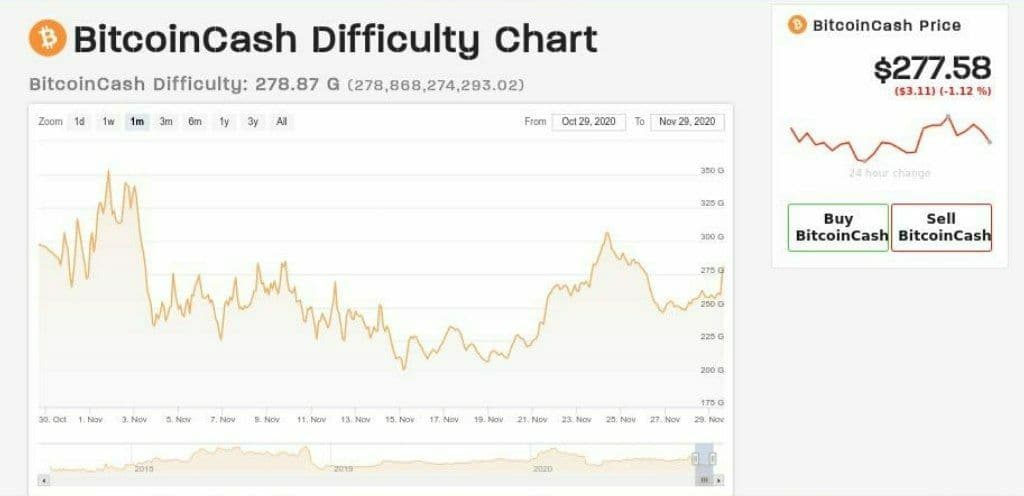
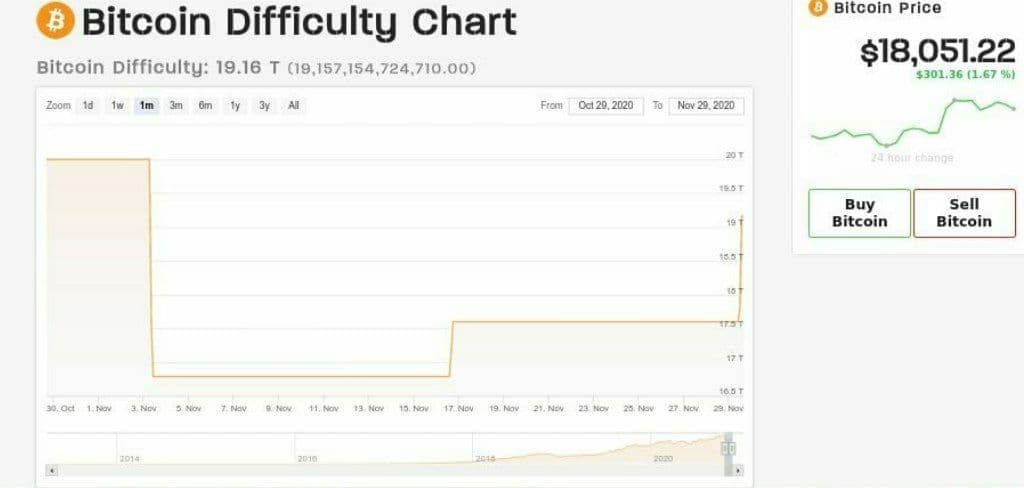
Mas isso não só beneficia os usuários, que não terão que ficar com suas transações paradas aguardando confirmação, mas agrada também os mineradores que há semanas estão tendo lucros maiores em minerar BCH do que BTC. Como mostra as imagens dessa postagem.
Então você me pergunta, mas porquê o BTC não implementa algo assim? Logo eu respondo, porquê congestionamento nas transações elevam os custos da mesma, e fazem os mineiros lucrarem em cima da sua impaciência. Como também reforça a fictícia dependência da Lightning Network.
__________
*Gostou do conteúdo? Quer saber mais sobre o Bitcoin Cash? Então participe das nossas comunidades;*
*Facebook**:* *https://www.facebook.com/groups/504437216905955*
*Telegram**:* *https://t.me/bchbrasil*
*Você será muito bem-vindo!*
How I Would Like The IFP To Be
Introducion
In this text I will address how I think an IFP (Infrastructure Funding Plan) should be. I certainly disagree with how it can possibly be implemented, but I don't disagree with its importance for the BCH, since IFP would be a solution to increase the security and autonomy of the BCH, that is indisputable. However, this theme still brings a lot of controversy and in these moments of crisis it is always good to remember the reason why we are united, despite all our differences.
There is a wonderful text by George with the title: “A Manifesto for the Next 10 Years of Bitcoin (Cash)” it deserves be read and that presents a summary of our pretensions and hopes for BCH. But the text lacked what for me is also a characteristic that defines our desires with BCH, which is independence. Unlike BTC, I believe that we all have concerns about BCH's freedom and independence. https://read.cash/@georgedonnelly/a-manifesto-for-the-next-10-years-of-bitcoin-cash-c67d115a
IFP allows the security and independence of the BCH to be maintained over time, and therefore, somehow an alternative must be created to finally promote the advances necessary for this sustainable development. In this context, I question myself; Why didn't the other nodes create their investment fund proposals? If we calm down we will see that no one is actually against IFP, in fact we are against the uncompromising way in which node ABC wants to implement. That is the question.
I don't know what made Amaury take such a harsh decision. Reading his last text on the subject, I noticed that he quotes Satoshi and game theory, to justify his action. I do not imagine where this confidence comes from that this can work, nor do I know what goes on in his head and those who support him. But I know that he is wrong to be uncompromising, because there is something called emotional payoff, and when I draw the matrix the result of your IFP is not the dominant strategy.
For example: Imagine someone who suddenly wants to buy a shirt for less than $ 20.00 and the seller is offering a shirt for $ 20.00, so the alleged customer asks for a discount, and the seller says he can give a discount, then the customer is looking forward to the discount amount, so the seller says $ 19.99. Mathematically the consumer would buy the shirt, but in the real world, the customer would be furious. This is emotional payoff. The customer prefers to lose $ 0.01 instead of accepting the seller's proposal.
So, even if everyone agrees on a proposal for a fund that would benefit BCH, it is preferable to forgo it if that implementation is being proposed in a way that offends the community. So, I thought of an IFP, which could be implemented to satisfy BCH's need for independence and sustainability. So that it was as less invasive as possible, respecting the freedoms that are necessary and that it covers all agents of that system.
A new method
The BCH has several nodes and this is very important. All nodes want the best for BCH and all have their importance for network security. They all have some kind of foundation, and they certainly would not dispense with a donation. In this context, everyone should, in some way, be part of some type of “IFP” financing.
I thought of the following solution; Let us imagine that each node is linked to a foundation and that it is beyond presenting its proposal of how it works for the benefit of the network and how it invests in its development. It also offered an SLP token in exchange for BCH to accumulate funds to maintain its services. By assumption there could be tokens like:
BITCOIN UNLIMITED NODES (BUN);
BITCOIN ABC NODES (ABC);
BCHN NODES (CHN);
BCHD NODES (CHD);
FLOWEE THE HUB NODES (FHB);
BITCOIN XT NODES (BXT);
BITCOIN VERDE NODES (VER);
there could be, for example, and other foundations such as;
FLIPSTARTER (FST);
EATBCH (ECH).
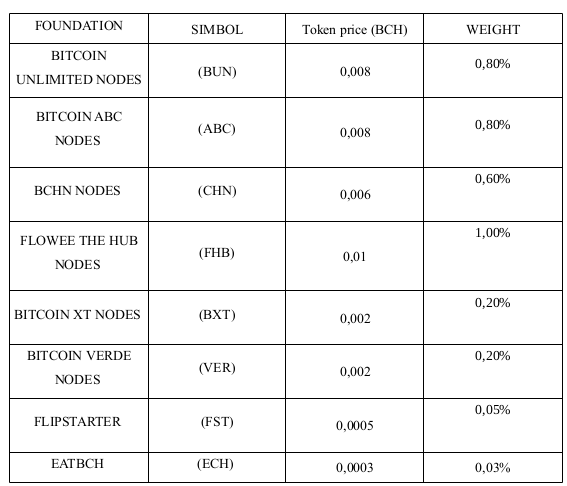
If the ignored value of the base currency was 8%. Each token could correspond to a recovery of 1% of 6.5 BCH, which is the current value of the base of the coin, therefore 6,500,000 satoshis, and if the miner wanted, he could buy a basket of tokens or choose eight units of a single token to be able to fully receive the coinbase reward. It is important to note that the price is offered by the foundation, how much they need to collect, and how much they believe they can sell. Another observation is that the miners do not know which block they are going to mine, so the value of the token will be much lower than 0.065BCH, as it will be necessary to send the tokens on each attempt. So the costs will be well distributed. Tokens would only have a weight of one percent if they all had the same price, otherwise their weight will be proportional to the value of the highest price among tokens. To avoid a price war. As below:
According to the table above, a miner who wanted to receive 100% of the coinbase, and not just 92% would be enough, for example, to buy 10 tokens (BUN) or (ABC), or 8 tokens (FHB) or a mix of 9 (ABC) , 10 (ECH) and 10 (FST).
If the miner does not want to purchase the token, he will receive a discount, for example, of 8% in his reward for each block mined, and the entire network would gain from deflation, as these 8% would disappear from the network, causing the BCH to be more scarce. Any miner, who does not take coins from the coinbase, can reduce the supply of coins in the BCH and BTC network.
It would be up to the miner, at every attempt to mine a block, to add a transaction from the token that was purchased to an burns address . Thus, it would prove to the entire network that the miner contributed with some node (or foundation that has a recognized token). Otherwise, the miner and the network would benefit from deflation.
Not only that, anyone could now contribute to their favorite foundation. Buying tokens and then donating to miners whith faucets. Small miners and anonymous miners would certainly source from these faucets. Thus the responsibility for the development of the network would be shared with everyone. It would also be possible to sell your tokens on the future market and thus have stability in the foundation's resources.
Conclusion
In this way, developers are obliged to work hard and make significant contributions, because otherwise nobody would buy their tokens. Because developers cannot receive financial resources without an incentive to continue receiving them. In short, this proposal creates a new market to encourage the development of BCH that includes everyone; Miners, investors, developers and users. Without the dictatorial imposition and that is accessible to all.
I admit that I do not know how to design such a system, as I am an economist and not a developer, so I think it is important to communicate that any operational errors may be present in the text, as it is only a conjecture to raise ideas to those who have more technical capacity, so that perhaps it can help with new ideas for a new form of IFP.
___ **//** __
*I hope you liked the text. Be sure to comment what you think. This text may have several grammatical flaws, since English is not my native language. I would be grateful for any corrections, grammatical or methodological.*
Peace be on you.
A solution to increase consumer adoption for BCH
**1 – Introduction**
I recently read a post on readcash that shows the difficulties in adopting BCH by merchant. This is a problem that I have been analyzing for some time, and I came to a more fundamental conclusion than the author of the aforementioned post. The post is correct in asking consumers what they gain from using the currency, but comes to a conclusion that limits the possibilities, which Satoshi and the other Cyberpunks, idealized for digital currency. https://read.cash/@georgedonnelly/merchant-adoption-is-pointless-without-regular-growing-inflows-8e8446d2
To solve the problem of adoption, there needs to be stability in the BCH, and also gains for those who use the system. That is what I will try to explain in this text. I will also explain a possible method, which theoretically can solve the problem of mass adoption of BCH, and which helps in the general development of the system.
**2 – The problem of instability and opportunity cost.**
In Brazil, and other South American countries, problems of monetary inflation or currency devaluation are recurrent, in these countries during a period of economic instability there is a bonus for people who use cryptocurrencies like BCH. The bonus is in the protection against inflation or exchange protection.
Even in countries with economic problems, which offer a bonus for those who use BCH, these bonuses can be eliminated by the high volatility of the currency, so it is necessary that gains on inflation or exchange devaluation are not subtracted by the sudden drops in the price of cryptocurrency.
However, there are countries with a more stable economic situation, which would not offer an immediate gain for those who use BCH. Thus, it is necessary to offer stability to users in general, and gains, which would make its use more attractive to consumers in countries with a stable economy.
The adoption of BCH is not slow just because of adaptation or difficulties in use. The biggest problem with adoption is the gains that the currency can offer its potential users, when compared to the gains from using fiat money (an economic opportunity cost problem). We must understand that many people do not understand that the current financial system is a scam and that individuals' freedom is being violated, and this is moreproblematic than not knowing how to scan a Qcode. https://www.investopedia.com/terms/o/opportunitycost.asp
Instead of, at first, spending time developing a system that tries to facilitate the use of cryptocurrency technology. The primary focus should be on economically adapting BCH for people, offering stability and gains to these potential consumers, so I thought of a method to solve these two problems, which will increase BCH's economic attractiveness.
**3 – The idea**
At first, to stabilize a currency it is necessary to use a system similar to the Crawling Peg, but we do not want to intervene in the market, we want a market as free as possible! The solution to this would be to use a token with the Simple Ledger Protocol (SLP) and develop a native stablecoin. https://en.wikipedia.org/wiki/Crawling_peg
Companies like Bitfinex, among others, developed their stablecoins with a grotesque error! Tether, and the like, represent the monopolistic, controlled and potentially fraudulent financial model that we experience. The 1-to-1 parity with the dollar, or any other fiat money, requires specialized auditing, and does not differ in any way from the failed conventional system that is in place.
**The challenge is to create a stablecoin using the SLP, which has no parity with fiat money and which offers transparency and security for users**. Thinking about it, the solution found is to develop a token with stable, global value, backed by a product or service preferably endogenous, and that has economic attractiveness for consumption, therefore, that offers some gain to users.
With this “Stablecash” it would be possible to provide stability and attractive gains to BCH users. The overall value could be the price of a lottery ticket like Mega Millions. **The solution I found for the product was to add to the token the quality of also being a lottery ticket, and consequently the attractive bonus would be a prize in BCH**, derived from a percentage of the amount paid for this product. https://www.megamillions.com/
It would work like this: Let's say that 1 "Scash" equals a Mega Millions ticket and that 1 Mega Millions ticket is costing $ 1.84, so a $ 18.40 shirt can be purchased with 10 Scash. It is important to avoid direct correlation with fiat money to ensure the independence of stablecoin, which will facilitate direct conversion with BCH in the future, when the currency becomes large enough to no longer need Stablecoin.
The financial backing of "Stablecash" would be a BCH premium, which could easily be audited by anyone, so if the market needs 1000.00 Stablecash tokens, you should buy $ 1840.00 in BCH, which will be at an auditable public address, if 1 BCH is costing US $ 350.00, 5,25714286 BCH must be deposited at this address in order to dump the 1000.00 Stablecash tokens on the market.
The entire system must be transparent and easy to be audited, and its basic dynamics would work as follows: Let's say that the market demands 1000.00 Scash at the price of 0.00525714 BCH each, so it must deposit 5.25714286 BCH in a public multsig address or guaranteed by smart contract. At first I imagine that this public address should belong to a group in charge of keeping these values, but it is important to develop something decentralized, similar to what happens in the technology environment Decentralized Finance (DeFi). So each 1 Scash corresponds to 0.00525714BCH, which according to the previous example corresponds to 1 a lottery ticket. https://en.wikipedia.org/wiki/Smart_contract https://101blockchains.com/decentralized-finance-defi/
The product that Scash offers is a chance to win a lottery prize to compete for a percentage of the 5,25714286 BCH that has been deposited. The method of operation of the draw is not necessarily my responsibility, but I also imagined what it would be like, but it will be explained in paragraph 6.
**4 – Theoretical explanation.**
To understand how a tokenized lottery ticket could serve as a stablecoin. A brief explanation of the behavior of a consumer (bettor) of lottery tickets and the basic operation of the lottery is necessary.
A lottery prize is a percentage of the amount collected in the payment of bets, so if the lottery prize is 50% of the amount collected. Bettors pay 50% of the lottery prize to be entitled to compete for 50% of the total amount to be collected.
The cost of the lottery ticket already incorporates the winnings as well as the risks. Therefore, when a rational bettor buys a ticket, the amount paid is a fixed price, which has already accounted for any fluctuations in its value. Thus, in theory, the speculative value of the asset is softened, without the need for parity and backing with fiduciary money.
So, a lottery ticket with payment in BCH, the bettor has already accounted for the possible currency variations when making the payment. In the same way, the bettor acounted the possible values of the prize and his chances of winning. It would work like this: Suppose the project developers decided that 40% of the prize amount is given to the winner of the draw, so buyers are paying for 60% of the token to be entitled to compete for the prize of 40% of the amount collected.
If, after the draw, the value of the BCH goes down by twenty percent (-20%), these costs have already been counted by bettors at the time of purchasing the token. Therefore, the amount paid for the token reflects a stabilization of currency fluctuation, which softened speculation by rationally considering the risks involved in the purchase.
It is in this way that a lottery token would make it possible to derive a stablecoin, through the market, with an analysis anticipated by the buyer in an instant of time, which incorporates the possible fluctuations of the BCH. Thus, a stablecoin governed by the free market.
But what about non-gamblers? Obviously, Stablecash would not be limited to bettors only, but its functional characteristics would meet the needs of those who demand a stable currency. Also offering the opportunity for earnings to its users. So, necessarily, users would not buy the currency, but would use it in their transactions (accepting and issuing). Soon there would naturally be a “free rider” on the part of the other users who are not characterized as gamblers. https://en.wikipedia.org/wiki/Free-rider_problem
**5 – The Economic Model**
To illustrate the expected result of the proposed mechanism, I will use simple examples of basic microeconomics and some graphs. Firstly with the lottery market, I demonstrate how your offer can be represented by an infinitely elastic demand.
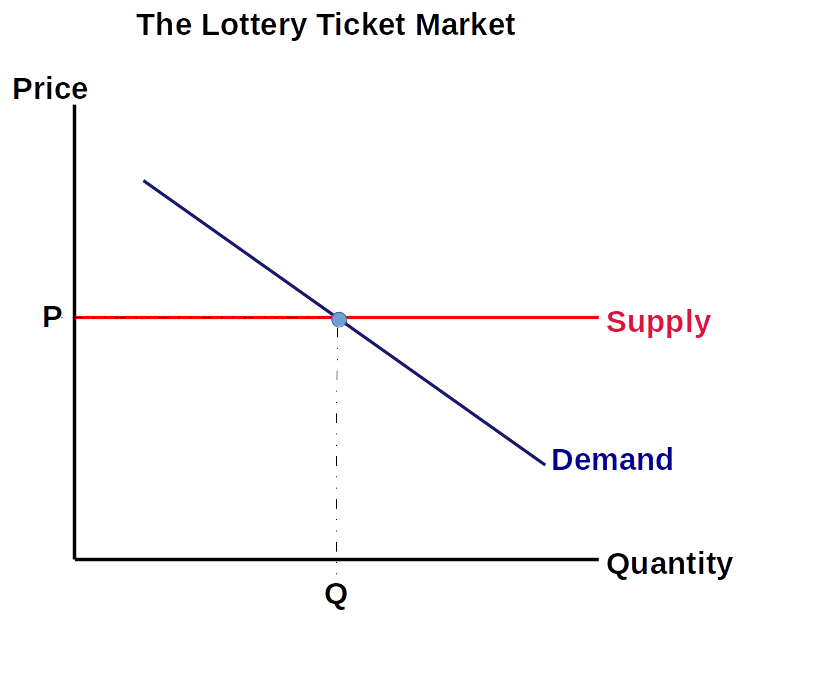
With the possibility of increasing its offer with virtually zero marginal cost, and its market in a competitive environment. The supply curve tends to be perfectly elastic in the lottery ticket market. Thus, the price tends to remain constant, as shown in image 01.
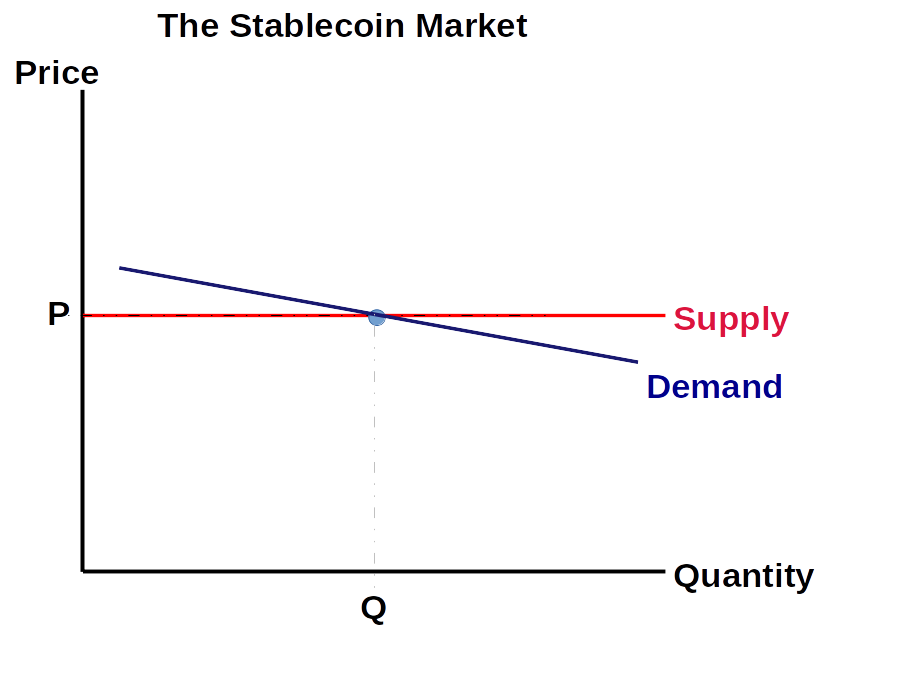
Image 02 of the graph shows the stablecoin market. With the price anchored in possible fiat money reserves, the price remains stable, similar to a perfectly elastic supply curve.
Image 03 shows both markets. In this example our token market is anchored in the lottery ticket market, thus keeping its supplys correlated.Image 03 – The Stalecoin Market and The Lottery Ticket Market. Source: Author
The image in graph 04 shows a shift in the demand curve of the stablecoin market. Demand at the moment zero represented by D increased, moving to point D¹, which caused an increase in the quantity of tokens demanded from Q to Q¹, but did not put pressure on prices. This shift may occur due to increased income or new expectations from users, with the shift of the demand curve to the right or to the left, but **in both cases the result would not pressure the price.**
**6 – How the Draw Works**
A system for the draw requires a more technical knowledge of the functioning of the blockchain, which I don't have, so if there is any mistake I would appreciate the criticism in the comments. Regardless of how the draw would work, the most important thing is to be easy to audit. After all, transparency is one of the main qualities of a blockchain system, and lottery too.
As explained earlier, each token is also a lottery ticket. It means that by consensus each token makes it possible to compete for the prize, which corresponds to a percentage of the amount paid for the token.
To be drawn, I thought about using the transaction hash, so it is necessary to use (transmit) the token to be able to compete for the prize, thus stimulating its use, because the more it is used the greater the probability of being the winner of the draw. The transaction hash would be like the lottery ticket numbers. A hash consists of numbers from *0* to *9* and letters from *A* to *F*. You should disregard the letters and recognize only the numbers.
Let's assume that the last 6 numbers are the ones that are recognized to compete for the prize, being analogous to the selected numbers on a lottery ticket. Later it would be enough to compare the NONCE of the block, which has been mined, with the hash of the transaction. If both have the same 6 final numbers, the sender's address (input) will receive the prize.
*Example:*
*Hash =*
*d749006ec82fe336276227c39a5d02cc55d27217455354ab36d154827730eb20*
*Disregarding the lyrics of Hash =*
*749006823362762273950255272174553543615482773020*
*Then the ticket numbers are: 773020*
*If the NONCE of the block is: 3389****773020*** *the input address of this transaction is the winner of the lottery.*
I believe that 40% of the amount paid for the tokens could be used to pay the prize winner. Of the remaining 60%, at least 40% must remain in the wallet to maintain the game's attractiveness and consumer interest in the token. The rest of the amounts could go to the BCH developers, as well as to the miner who would discover the winner, who might be compensated for making the payment by airdrop at the input address of the winning hash.
**7 – Implementation possibilities**
With the creation of the native BCH Stablecoin, it would be possible to solve the problem of BCH membership in merchant by correcting instability and offering gains to users. The BCH would have an increase in consumption because of the demand for the token as well as to pay for the gas of the token. This increase in consumption will tend to raise the price of BCH, another important factor is the concentration of coins stored for the premium, which will tend to accumulate over the years making BCH even more scarce, contributing even more to the increase in its value.
As the years went by, the BCH would have a much higher value and consequently its volatility would be reduced, so it could dispense with the native Stablecoin.
**8 – Conclusion**
The text presented a solution to increase BCH's adherence in trade, through a native Stablecoin using the SLP, which would dispense with the use of fiat money, and which would offer stability and gains to potential consumers worldwide.
The native Stablecoin would have properties similar to a lottery ticket, which with a perfectly elastic supply its price would not fluctuate with the increase or decrease in demand for the token.
The prizes would be awarded to those who transmit the token, with each transaction hash functioning analogous to a lottery number, the result of the drawing being the combination of the hash numbers with the nonce of the block.
Finally, it can be concluded that the token would hypothetically solve major problems of the BCH by increasing its value in a virtuous cycle. For, the token provides greater demand for BCH, as well as increasing its scarcity, with the concentration of coins in the prize address. It would solve financial resource problems for developers and increase the membership of sha256 miners.
*I hope you liked the text. Be sure to comment what you think. This text may have several grammatical flaws, since English is not my native language. I would be grateful for any corrections, grammatical or methodological.*
*Peace be on you.*
BCH is strong competitor for credit card companies
We all know that, to some extent, the value of a currency is related to its use, therefore the number of transactions made, as well as the increasing ability to handle more and more transactions to maintain their potential value. After all, cryptocurrencies should first of all offer the ability to process transactions that meet the demand, like a real peer-to-peer electronic cash system.
This is a big challenge, but the BCH has so far been developing very satisfactorily. Some billion dollar credit card networks could already have the demand for their customer transactions supported by the BCH blockchain. In this text will be analyzed which credit card companies that BCH could be a strong competitor.
The first credit card network to be compared is Discover Financial Services, which operates the Discover and Pulse networks, and owns Diners Club International. Discover Card is considered the third largest credit card brand in the United States, when measured by current cards, your market cap is $ 26.03 Billions. https://ycharts.com/companies/DFS
The second company to be compared to BCH is JCB, which is a credit card company based in Tokyo, Japan. Its market cap is $ 96.85 billion. https://markets.ft.com/data/equities/tearsheet/summary?s=8584:TYO
The third card company to be compared with BCH is American Express, which currently has a market cap of $ 105.39 billion. certainly one of the most valuable brands in the world. https://ycharts.com/companies/AXP/market_cap
**Let's the statistics**
Diners Club International, together with Discover Card, processed in 2018 worldwide 2.8 billion transactions. According to data from the **Statista** website, therefore, it can be inferred an average of 88 transactions per second. https://www.statista.com/statistics/261327/number-of-per-card-credit-card-transactions-worldwide-by-brand-as-of-2011/
In 2018, JCB had a demand for 3.9 billion transactions from its customers, which results in an average demand of 123 transactions per second, while American Express surpassed the others with 8.3 billion transactions in 2018, which results in an average need of 263 transactions per second.
Comparison and results
The BCH with an average transaction size of 481.62 bytes, can realized 116 average transactions per second. To understand this, you can read the coinanalysis post. https://coinanalysis.io/how-many-transactions-per-second-bitcoin-cash/
But according to data extracted in the last 30 days (2019-12-15 / 2020-01-14), the average transaction size has shrunk to 384.30 bytes, so it would have the ability to process 146 transactions per second. We also know that a simple "standard" transaction only needs about 226 bytes, so it would also have the ability to process 247 transactions per second.
The calculations in this text **disregard how quickly BCH can process blocks and send them.** Therefore a hypothetical demonstration of its potentiality.
Let's compare these different processing power with the processing power of card networks. Then we can produce the following table:
The table above shows that BCH is able to surpass by up to 28 transactions per second demand from Diners Club and Discover Financial card customers.
Using the average transaction size over the last 30 days of BCH, which was 384.30 bytes. It would offer an ability to meet, with a surplus of 23 transactions per second, the demand for JCB card customer transactions.
Finally, the table above shows that only 16 transactions were missing to meet the demand from customers of the American Express card company. In a situation where the BCH average transaction size was 226 bytes.
Thus you can see the important advances that the BCH system has made in recent years. It is noted its growing potential to establish itself as a common currency in the future and a free tool for daily payments by a significant amount of people around the world.
 @Adeilton_Filho