Mars
Besides Jupiter, the most important Italian and Roman deity. It has been revered since ancient times throughout Italy, under various names: Mavors - by Latins, Mamers - by Oska and Sabinjan, Marisl - by Etruscans, Maurte - by Tusculum, and Marmar or Marmor - in the song of the priestly order of the Arval brothers. In the official cult, Mars is primarily the god of war (Mars Gradivus), but the rural population considered him a deity of agriculture and animal husbandry (Mars Pater). Therefore, all his holidays are in March and October, ie in the months that mark the beginning and end of agricultural work, but also the time of the beginning and end of war campaigns. As it rules the battlefield and fertile fields, prayers are offered to Mars to protect the earth from enemies and from all natural disasters. That is why Mars is a great god of general progress, both of fertile fields and cattle, and of the progress of the Roman people and state.
The oldest center of the Martian cult in Rome was located outside the city, on the Field of Mars. According to the legend, Numa already dedicated an altar (Ara Martis in campo) to Mars, where a ritual of consecration of weapons and a great purification ceremony (lustrum) were performed. The symbols of Mars are the sacred spear (hastae Martis) and the sacred shields (ancilia), and the animals dedicated to it are the wolf, the woodpecker and the bull. The cycle of his holidays begins at the end of the old and the beginning of the new year, with the consecration of horses - Equirria, on February 27 and March 14, war weapons - Quinquatrus, March 19, and battle trumpets - Tubilustrium, March 23. Two more March holidays are connected with them, celebrated on March 1 and 17 (agonium Martiale). In all these ceremonies, the priestly order of the Salians took part, whose members in warrior clothes performed games with weapons in the Martian part. The cycle of holidays in October begins on the day of Ida, with the sacrifice of horses (Equus October), and ends with the consecration of weapons (Armilustrium), also with the participation of the Sali people.
Until the time of Augustus, all the sanctuaries of Mars were located outside the city. It was erected in front of the Kapen Gate 338-337. year old temple of Mars, which housed his statue surrounded by wolves. On the Field of Mars, in 138 AD, another temple was built for him. In honor of Mars, Augustus erected two temples: one smaller, on the Capitol, in gratitude to Mars Ultor for punishing Caesar's assassins, and one large temple, in the center of the newly built Forum, which surpassed all other shrines in Rome in splendor. . There, Mars is revered along with Venus and is identified with the Greek god Ares.
In the old Italian cult, Mars was associated with the goddess Nerio, who was later considered his wife. Along with him is the goddess of war Belona, who personifies one of the most important functions of Mars. Later, under Greek influence, Mars was associated with Minerva and Venus in cult and myth. Accompanying Mars, as the terrifying god of war, are Horror (Pavor) and Fear (Pallor), as well as personifications of military virtues - Honor (Honoris) and Courage (Virtus).
Mars is in the myth of Juno's son, when she conceived thanks to a flower given to her by Flora, the goddess of flowers and spring. The connection of Mars with Ana Perena (an ancient Roman deity of obscure functions; probably the goddess of spring and longevity or the goddess of the beginning and end of the year) and Mamuri (that name was given to an old man wrapped in fur, when they banished white cane from Rome; this old man probably symbolizes the past agrarian year) certainly stems from the accidental coincidence of the Martian March holidays and Italian rituals in connection with New Year's customs. The role of Mars in the "holy spring" (ver sacrum) stems from the old Italian custom that one generation of young people leaves their hometown in early spring and starts looking for happiness elsewhere. These colonists are often led by Mars' sacred animals - the wolf or the woodpecker. The myth that Mars is the father of Romulus and Remus is probably based on that motive.
Mars is revered in all Roman provinces, especially in Gaul and Germany; in these areas various local deities were often called by the name of Mars.
In Roman art, Mars was most often depicted as the Greek Ares, mostly as a naked young man, with a helmet on his head and a spear and sword in his hands. Only Mars Avengers is presented as a mature bearded man, in a legionary uniform.
Literature:
• Dragoslav Srejović - Aleksandrina Cermanović-Kuzmanović, Recnik grčke i rimske mitologije, drugo izdanje, Beograd: Srpska književna zadruga, 1987

Jupiter - mythology
The ancient Italian deity of the sky, time and lightning, the supreme god of the Roman pantheon, whose cult had the greatest state and political significance. In Rome and all of Italy, Jupiter was revered first on the tops of hills. Its oldest shrines were on the Capitol (Iuppiter Feretrius), on Esquiline (Iuppiter Fagutalis), on Monte Cava (Iuppiter Latiaris) and on Ciminius (Iuppiter Ciminius). As the god of the sky and light, all the days of the full moon in the year (going) are dedicated to him, when light does not disappear from the firmament. Every month on that day, which in the old Roman calendar is marked as a holiday (feriae Iovis), the high priest sacrificed a white sheep to Jupiter at the Capitol. As the god of light and sky, the holidays of grapes are dedicated to Jupiter - a fruit that is most dependent on the weather. The feast of Vinalia rustica was celebrated in the vineyards on August 19, and at the beginning of the grape harvest, the high priest sacrificed lambs to Jupiter. The end of the harvest is also marked by Jupiter's holiday - Meditrinalia, which was celebrated on October 11. For the first time, a wider drink was poured on that holiday, and on the third Jupiter holiday, Vinalia priora (April 23), last year's wine was brought into the city and poured. Less clear are Jupiter's functions in connection with his other three holidays: Poplifugia (July 5), Regifugium (February 24) and one holiday that falls on the Day of the Dead (December 23).
As the god of the sky and lightning, Jupiter is called Fulgur. Every place affected by lightning is surrounded by stones (puteal). The lightning thrown by Jupiter is divided into the lightning of the day (fulgur dium) and the lightning of the night (fulgur summanium). As the god of night lightning, Jupiter is identified with Suman (lord of night lightning) and Vejovis (a deity of obscure functions, which may have been created by separating the negative functions of Jupiter, that is, he is Jupiter who takes revenge and brings evil). Jupiter is also revered as the god of rain (Iuppiter Elicius, Iuppiter Pluvialis). In times of drought, he was asked for rain; a solemn procession of priests, magistrates and barefoot matrons with loose hair brought to the Capitol a stone that closed the mundus (lapis manalis), and then water was poured over it. As the god of rain, Jupiter is associated with the fertility of the earth and the ancient Italian god Liber (Iuppiter Liber). From the protector of fields and fertile fields, Jupiter also becomes the guardian of their borders (Iuppiter Terminus).
New functions were added to Jupiter very early, according to which he became the supreme deity of the Roman religion. According to legend, Romulus had already built a shrine to Jupiter Ferretri on the Capitol, in which one stone (Iuppiter Lapis) was revered. In that sanctuary, which was later restored by Augustus, Romulus dedicated to Jupiter the war equipment he had taken from the enemy. Therefore, even later, war trophies and enemy weapons were vowed to Jupiter Ferretri. Thus, Jupiter, from the god of thunder, became a deity that ensures victory in war and guarantees the given word between nations, states and individuals (Dius Fidius).
Capitoline Jupiter (Iuppiter Optimus Maximus), "the best and greatest", established under the Etruscan kings, is the supreme god of the Roman state. Sacrifices were offered to him by young men when they entered their manly years, and the consuls took an oath to him in taking office. After winning the war, the triumphant wore clothes that imitated the clothes on Jupiter's cult statue, that is, he embodied Jupiter himself.
Jupiter brings victory to the Romans (Iuppiter Victor) and stops the enemy (Iuppiter Stator). In Lazio, on the top of the Albanian mountains, a temple was built for him as the patron of the Latin Alliance (Iuppiter Latiaris).
Jupiter's temples in Rome are most often associated with events significant to Roman history. The temple of Jupiter Ferretri on the Capitol and the temple of Jupiter Stator below the Palatine were built by Romulus after the victory over King Akron, that is, after the defeat of the Sabines. Sibyl books (books of prophecies, which could only be opened by order of the Senate), all important documents and numerous laws were kept in the temple on the Capitol.
Capitoline Jupiter was revered in all the provinces; the first task of the architects was to build a temple in the provincial cities, similar to the one on the Capitol, as part of the great triad - Jupiter, Juno and Minerva. In the eastern provinces of the Roman Empire, Jupiter was identified with local deities, with the god from Doliha (Iuppiter Dolichenus), Sabazius or Amon.
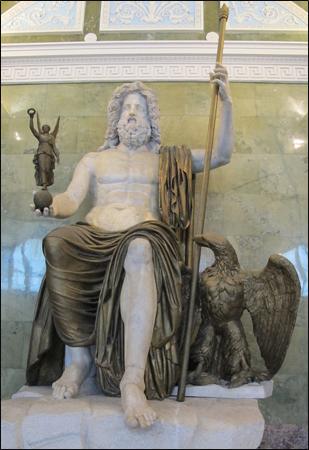
There were no cult statues in the oldest sanctuaries of Jupiter, that is, Jupiter is symbolized by a sacred stone. The first cult statue of Jupiter in the temple on the Capitol was made by Vulka from Vej. That statue was made of baked earth and represented Jupiter as a bearded man holding lightning in his right hand. The face of that statue was painted red on holidays. Representations of Jupiter on republican money were made under the influence of Greek iconography, modeled on the representations of Zeus, with lightning, a scepter or an eagle in hand. The medallions of Trajan, Hadrian and Antoninus Pius often depicted the Capitol Triad (Jupiter, Juno, Minerva).
Literature:
• Dragoslav Srejović - Aleksandrina Cermanović-Kuzmanović, Recnik grčke i rimske mitologije, drugo izdanje, Beograd: Srpska književna zadruga, 1987
Aeneas - mythology
The famous Trojan-Roman hero, a descendant of Zeus and Dardanus, the son of the Trojan prince Anchises and the goddess Aphrodite, the founder of the power and glory of Rome. When she gave love to Anchises on the Trojan mountain Idi, Aphrodite told him that she would give birth to his son Aeneas, who would rule the Trojans. The goddess entrusted the child she conceived with the mortal to the nymphs immediately after birth, who handed him over to his father only when he was five years old. Alcata, the husband of Anchis' daughter Hippodamia, took care of his further upbringing.
At the time of the Trojan War, Aeneas was grazing cattle on Ida. It was there that he first met the greatest Greek hero, Achilles, who attacked his cattle. Aeneas fled to Lirnes, and when Achilles destroyed that city, the Trojan prince was saved by Zeus himself.
In the last year of the Trojan War, Aeneas, together with Antenor's sons, led the Dardanians. Because of his extraordinary courage, he enjoyed the greatest respect of Hector and the other Trojans. Aeneas first clashed with Diomedes; Aphrodite came to her son's aid, but Diomedes wounded them both and Aeneas survived only thanks to Apollo. Upon his return to the battlefield, Aeneas killed Creton and Orsilochus, and in the great battle for the ships, he clashed with Idomeneus, killed Afarei and helped Hector leave the battle. In front of Troy, Aeneas met Achilles again, who was the only one who could kill him. At a critical moment, Poseidon pledged that the gods would spare the lives of Aphrodite's son, who was destined to extend Dardan's lineage and rule the Trojans after the destruction of Troy.
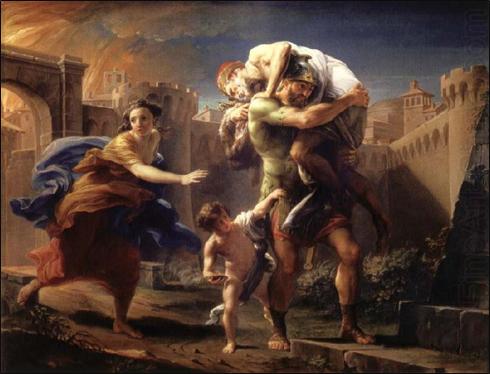
In the last days of the war, Aeneas, with his father Anchis, son Askanius and wife Kreus, took refuge in Ida. Others say that he and his men bravely defended the upper part of the city and that he enabled women, children and the elderly to take refuge on Ida. It was only when Troy was on fire that Aeneas left the city, with the exhausted Anchises, the weak Askanius and the greatest Trojan shrines (picture below). On his way out of Troy, he noticed the disappearance of his beloved wife and returned to the city to rescue her. On Ida, Aeneas gathered the surviving Trojans and founded a new city with them.
The most famous legend is about the journey of Aeneas and his Trojans to the west, to Italy. After a short stay on Ida, Aeneas set out with his men for Thrace and Macedonia, and then, via Samothrace, Delo, Crete, Strofad, Zakynthos and Leukada, he reached the coast of Epirus, where he was warmly welcomed by Helen and Andromache. There Helen prophesied a long and painful journey for him, but he also comforted him: his sufferings will end when he founds a city in the place where a white pig, under a cherry tree, sucks thirty piglets. After visiting the prophecy in Dodona, Aeneas, across the Ionian Sea, reached the eastern shores of Italy and, sailing south, came to Sicily, where he founded the cities of Egesta and Elim. In Sicily, in Drepanon, Anchis died. According to Helen's instructions, Aeneas sailed from Sicily to the west coast of Italy, but the storm threw his ships to the African coast. With his men, he stayed for a while with the Carthaginian queen Dido, who fell in love with him. After fate determined Aeneas to found a city on Italian soil, Jupiter gave him an order to leave Africa via Mercury. Aeneas set out from Carthage accompanied by Dido's curses; the storm brought his ships to the shores of Sicily, and there, after being amicably received by Akest, he prepared funeral games in honor of Anchis. Aeneas left some of his companions in Sicily, and then set out for Italy and disembarked at Kuma. There, in a cave, he met the Kumei Sibyl; she prophesied to him that on Italian soil he would clash with the new Achilles, King Turnus, and that Juno would continue to persecute him with his hatred. At Aeneas' request to allow him to go down to Hades and see Anchises, Sybil replied that the gods only allowed a mortal who could gather a golden branch in a dark forest - a gift for Proserpine, the queen of the underworld. After reaching the golden branch, Aeneas, accompanied by Sybil, descended to Charon. There he talked with the shadows of his unburied comrades, and then entered the realm of the dead. There he met Minos, Dido and all the heroes of the Theban and Trojan Wars. In Tartarus, Aeneas saw the sufferings of great sinners, and in the fields of the blessed, in Elysium, he found Anchises, who presented him with the glorious future of Rome and showed him his descendants, all the glorious Romans.
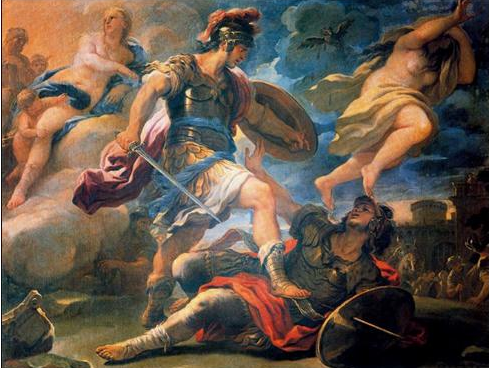
When he came out of the underworld, Aeneas sailed further north and arrived in Lazio, at the mouth of the Tiber. There he was received amicably by King Latin and promised him his daughter Lavinia as his wife, as well as the place where he would found the city. These promises were opposed by Lavinia's mother Amata, as well as her fiancé Rutul King Turno. Juno, who hated Aeneas and all his Trojans, encouraged Turn to attack the newcomers. On the advice of King Euandra, Aeneas went to the Tyrrhenians to ask them for help. During his absence, Turno set fire to Aeneas' ships and stormed the Trojan camp. When Aeneas returned from thirty Allied ships, Turno was forced to retreat. In that fight, Aeneas killed Turn's allies, young Laus and his father Mezentius. As the losses on both sides were great, a truce was made. King Latin tried to prevent further conflicts, but Turno refused to negotiate peace. In the meantime, Aeneas reached the city of Laurent, and in the ensuing battle, the brave Camilla fell. On the news of her death, Turno rushed to the aid of his allies, but the night prevented further fighting. When he saw that his army was fainting, Turno decided to solve the war by a duel with Aeneas. While the heroes were preparing for the battle, Juno, through Turn's sister Juturna, led Rutula to start the fight again. In the general commotion, Aeneas was wounded, and Turno and his men began to sow desolation and death among the Trojans. Venus quickly healed her son and returned him to the battlefield; he attacked Laurent and caused disarray in the ranks of the enemy. When she realized that the battle would be lost, Queen Amata took her own life. Turno then hurried to deal with Aeneas; when he called him to divide the square, the armies parted, and Aeneas cried out with joy. The country groaned from their struggle, in which skill and courage merged into one. Turno attacked Aeneas with all his might with his sword, but his weapon broke and only a hilt remained in his fist. Aeneas chased the disarmed enemy across the field, until Juturna handed her sword to her brother. Jupiter then persuaded Juno to leave the battlefield and no longer protect Turn, promising her that even after Aeneas' victory, the natives would keep the customs and language of their ancestors, and that the Trojans would become Latins and use Latin. When Juno left her protégé to fate, Jupiter sent a fury to scare Juturna and drive her off the battlefield. At that moment, Turno felt his strength leave him and the end was near. As he looked for his sister, Aeneas swung his spear and wounded him in the thigh. The Rutul king fell to his knees and humbly asked Aeneas to return him, alive or dead, to his old father Down.Aeneas hesitated for a moment, but when he saw the belt of his friend Palant on Turn's shoulders, he was seized with rage and he plunged his sword into Turn's chest (picture below).
Little is known about Aeneas' further fate; it is said that he founded the city of Lavinium and that after the death of the Latin king he ruled the united Trojans and Latins. This unification gave Aeneas the courage to go to war against the much superior Etruscans. The Latins and the Trojans took the victory, but Aeneas was killed in the last battle. It is said that he was buried on the shores of Numik and that Venus begged Jupiter to transform her son into a deity. Having obtained the consent of the gods, she ordered Numika to take to the sea all that is mortal in Aeneas; Venus anointed his divine part with divine balm and ragweed, and then included his son among the gods. The Romans called this new deity Indiges.
The origin of the legend of Aeneas' wanderings is probably related to the cult of Aphrodite as the goddess of the sea and navigation. Her cult was established on the shores of the Mediterranean, in all the areas that are legendarily marked as waypoints on Aeneas' journey to Italy. Archaeological findings show that the Etruscans already knew about Aeneas and his escape from Troy at the turn of the 6th and 5th centuries AD. Through the Etruscans or through the Greek colony of Kuma, the Romans accepted the myth of Aeneas; legends about his travels were officially accepted at the beginning of the 3rd century AD in Rome and were harmonized with the Roman policy of conquest. The Romans saw in the legends of Aeneas the possibility of connecting with the most glorious gods and heroes of Troy and Greece, that is, of moving the beginnings of their history into the distant past.
The Romans considered Aeneas not only their great ancestor but also bestowed divine honors on him. From the 1st century AD, Aeneas was associated with the family of Julius (gens Iulia), ie with the ruling imperial dynasty.
Aeneas was depicted on vases of black-figure and red-figure style. He is represented on them in Greek clothes, less often in Frisian, and most often in scenes that show the battles in front of Troy, around Troy's, Patroclus 'or Achilles' corpse. In Roman art, Aeneas and Dido were often depicted, followed by funeral games on the occasion of Anchis 'death, Aeneas' encounter with Sybil, battles with the Rutuls, and Turn's death. From Pompeii, a caricature is known which depicts Aeneas, Anchises and Askanius with animal heads.
Literature:
• Dragoslav Srejović - Aleksandrina Cermanović-Kuzmanović, Recnik grčke i rimske mitologije, drugo izdanje, Beograd: Srpska književna zadruga, 1987
Dionysus
Zeus' youngest immortal son, who together with Hermes, Apollo and Artemis belongs to the second generation of the Olympian gods. The legend mentions two Dionysus: the older one - Zagreus, the son of Zeus and Persephone, and the younger one - the son of Zeus and the Theban princess Semele. That is why his divine origin was doubted; Dionysus had to prove by miracles that he was a god, and he, as well as his followers, were constantly threatened with persecution and death. Thrace and Phrygia competed for the honor of being considered the homeland of Dionysus, although he may have originated from the island of Crete.
According to Orphic tradition, Zeus gave birth to a daughter, Persephone, by Ray or Demeter. After giving birth to a girl, Demeter left Crete and went to Sicily. There, in a cave, she left Persephone and two snakes to guard her. While Persephone was weaving a woolen cloth, she was fertilized by Zeus, transformed into a snake. Thus was born the new ruler of the world, the horned boy Dionysus Zagreus. He was immediately placed on the throne; he was given dice, a ball, a tern, golden apples, a woolen tassel, and a rattle to play with, and was guarded by curettes, who played around the throne, to the sound of their weapons. Jealous Hera wanted to destroy Zeus' successor and sent titans to kill the little one. Dionysus Zagreus tried to save himself by transforming himself into a goat, a lion, a snake and a bull. While he was in the form of a bull, the titans tore him apart, and then they prepared a feast and brought his dismembered body to the table. The smell of roasted meat also attracted Zeus; when he discovered the crime, he killed the titans with lightning, and handed over Dionysus' limbs to Apollo to bury them next to his tripod in Delphi. Some say that Zeus' lightning and titans burned the whole feast and turned it to ashes. From that ash, which contains titanic and divine elements, the whole human race was created. The heart of Dionysus, which was the only one preserved, Athena hid in a basket and handed over to Zeus. From the heart of Dionysus Zagreus, the younger Dionysus was born.
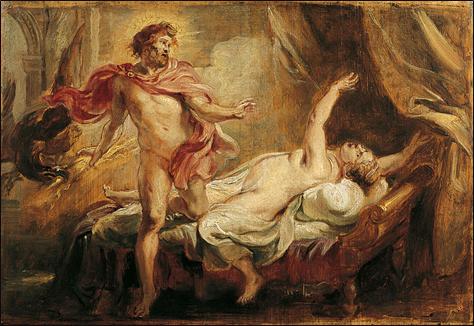
According to the usual legend, Dionysus is the son of Zeus and Semele. The father of the gods fell in love with Semele, the beautiful daughter of Cadmus and Harmony, and united with her in the Theban Cadmeia, in the sanctuary of Demeter. When Semela conceived a divine child, Hera noticed her pregnancy. In order to take revenge on her rival and prevent the birth of a child, Zeus' wife advised Semele to ask her lover to appear to her in all his greatness and splendor, like a thunderbolt. The reckless daughter of Cadmus obeyed that advice and forced Zeus to approach her the way he approaches his divine wife (picture below). The flash of lightning fried the mortal, and the child that Semela was carrying under her breast was saved by Zeus from the fire and sewn into his thigh. After three months, Zeus gave birth to Dionysus in Nis and handed him over to the nymphs of that country.
Others say that Semela secretly gave birth to Dionysus in Thebes, and that Cadmus put his daughter and granddaughter in a coffin and threw them into the sea. The waves threw the coffin on the shores of Laconia. The people who opened it found Semela dead in it, and the child, who was still alive, was handed over for safekeeping to Atamant's wife Inona. Some say that Zeus entrusted his son Inona, demanding that she raise him as a girl. That precaution did not deceive the jealous Hera; she discovered the deception and punished Inona and Atamanta with madness. Zeus then turned Dionysus into a kid and handed him over to the Nyssa nymphs for safekeeping.
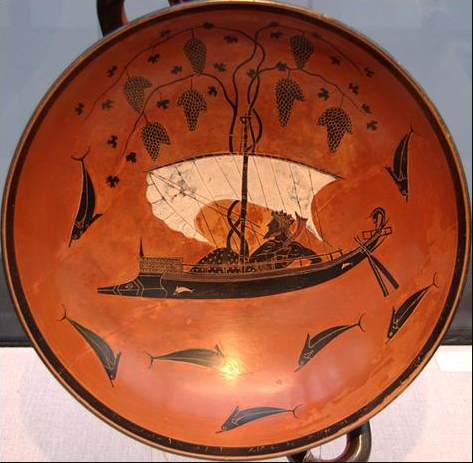
Dionysus grew up among the women, who stayed with him even when he set out into the world, adorned with wreaths of ivy and laurel. His companions - menades, tijads and bahant women - wander the mountains and forests, filled with divine inspiration. After finding a way to grow vines and make wine, Dionysus and his entourage, which included his educator Silenus, began a victorious campaign. On the way from Egypt to Thrace and from Spain to India, he spread new customs and taught people how to grow vines. Along the way, he encountered numerous supporters, but he also gained many enemies. When he arrived in Thrace, King Lycurgus opposed him. Dionysus had to save himself by jumping into the sea, where Tethys accepted him and gave him refuge under water. Lycurgus is punished with madness; convinced that he was cutting the vine, he cut his son with an ax. In Orchomenus, Mini's daughters refused to take part in the mysteries of Dionysus, which is why they were punished with madness: the eldest of them dismembered her child, and then ate it, together with her sisters. When the king of Argives, Pret, did not believe in the divine origin of Dionysus, the god confused the minds of all Argives, and they tore and ate their children. Dionysus came to Thebes to punish his aunts, who did not believe that their sister Semele was kissed by Zeus. King Pentheus, Cadmus 'heir, ordered the imprisonment of the newcomer, but Dionysus encouraged Agave, Pentheus' mother, and the other Thebans to tear apart the godless king. Then the young god wanted to cross to the Aegean islands. While standing on the seashore, dressed in beautiful purple clothes, Tyrrhenian pirates came across a fast boat. Thinking that the king's son was in front of them when he would receive a large ransom, they captured Dionysus and dragged him to their ship. The thick ropes, with which they wanted to tie it, tore themselves. Realizing that the young man was one of the gods, the helmsman advised his friends to leave him on the shore. The commander ordered the sailors to row, but then a miracle happened: wine flowed through the boat, ivy wrapped around the boat, a vine with ripe grapes descended over the sails, and the oars turned into snakes. The frightened sailors tried to steer the ship towards the mainland, but Dionysus turned into a lion and with a terrible roar made them jump into the sea, where they transformed into dolphins (picture below).
On the island of Dia, Dionysus found Ariadne, the daughter of King Minos, whom Theseus had abandoned. To comfort the unfortunate girl, he gave her the crown of Hephaestus, and then married her and took her to Argolid. In the conflict that broke out between him and Perseus in Argos, Ariadne lost her life. In order to punish the Argives, Dionysus confused their wives and they killed and tore their children in madness. In Attica, Dionysus was warmly received by Icarus, and in Aetolia - by King Aeneas. It is said that Dionysus came to India in a carriage in which panthers were harnessed and that he conquered that country with the power of his weapons. Since his cult was accepted all over the world, Dionysus decided to leave the country and settle on Olympus. The Olympian gods accepted him warmly; he received a place of honor, next to the right knee of Zeus. After some time, he decided to go down to Hades, in order to take Semele out of there and join the gods. Near a spring near Lerne, he met a peasant named Prosimno or Polimno, who, for a fee, showed him the way to the underworld. Hades and Persephone allowed Dionysus to bring Semele out of the realm of the dead, and he in turn gave them his favorite myrtle plant. He took his mother to Olympus and, under the name of Tiona, included her among the gods.
With the other Olympians, Dionysus took part in the fight against the giants, because it was prophesied that the gods would defeat the giants only with the help of a god whose mother is mortal. In the great battle of the Phlegrian plain, Dionysus killed the giant Eurytus with a saw.
Dionysus is one of the most enigmatic deities of the Greek religion. His name is interpreted as "son of Zeus", "god of Nisa" or is associated with the word woinos, which means "wine". In continental Greece, it was certainly respected as early as the second half of the second millennium AD, which is confirmed by tablets written in the Mycenaean script. The character of Dionysus was probably created by merging the divine child, which has long been revered in the Aegean world (Dionysus Zagreus), and the Thracian-Frisian deity of vegetation, whose cult spread throughout Greece from two directions: from the north - through Boeotia, and from the east - through Aegean islands.
Dionysus is the god of vegetation, a great deity who, like all plants in nature, is constantly renewed. In the cult and myth of Dionysus, ecstasy, killing and chopping a child (sparagmos) and eating raw meat (omophagia) are common. The parts of the torn divine child are miraculously reassembled and Dionysus is born again. His killing and resurrection ensures fertility and constant renewal of nature, and eating a dismembered god or his holy animal guarantees believers union with God and salvation after death. From year to year, the thiades celebrated the birth of Dionysus on the peaks of Parnassus, and at the same time a secret ceremony was performed at his tomb in Delphi.
As the god of vegetation, Dionysus is primarily the protector of trees (Dendrites, Endendros). His favorite plant is ivy. Dionysus is also the protector of flowers (Anthios), and a large number of his nicknames are associated with various trees and other plants, especially figs and vines. The phallus plays a significant role in his cult; Dionysus was never presented as itifalic, but that is why his companions - silens and satyrs - are presented in this way. On his holidays, the phallus (faloforija) was solemnly worn.
The myth of Dionysus' descent into the underworld, as well as the feast of Antesteria, shows that this god, like other deities of vegetation, was considered the lord of the dead. Dionysus was also the god of divination in Thrace, but he had only one prophecy in Greece, and that was in Amfiklea, in Phocis. During the winter months in Delphi, he replaced Apollo and gave prophecies. With his arrival in Delphi, divination by lot was replaced by divine inspiration.
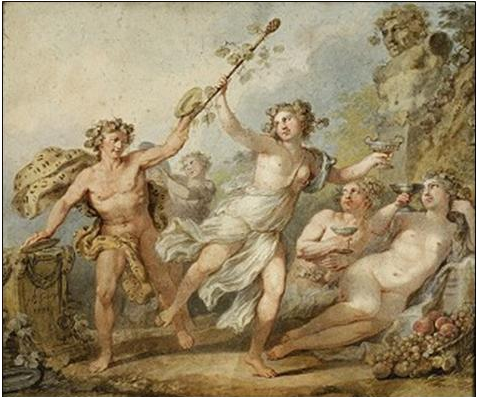
The main feature of the cult of Dionysus is orgy, falling into ecstasy. The participants in Dionysus' ritual were mostly women, who, after long wanderings and great efforts, under the influence of games and music, fell into ecstasy (picture above). The cult of Dionysus was widespread throughout Greece; his most important holidays are Antesteria, Agrionia and Leneia. Like Demeter, Dionysus is the deity of the peasants and the broad masses. The centers of his cult are not magnificent temples, but mountains and modest village sanctuaries. In the classical period, he is not only the god of vegetation, but also a great deity, to whom the whole of nature is subordinated, above all man. Only that god fills people's souls, so that they identify with him in ecstasy. Dionysus' myths resolve the conflict between what is rational and what is irrational in human life.
Dionysus' sacred animals are the panther and the lion; goats and goats are sacrificed to him. Of the plants, ivy is dedicated to him, which crowns his head and wraps the sawdust - a stick crowned with a cone.
In fine arts, Dionysus is represented as a child, a young man or a mature man. The oldest cult statues of Dionysus were a stake or a wooden pillar, on which a mask and a suit were placed. This archaic way of depicting Dionysus has long persisted in Greece because of the character of his cult. On archaic vases of black-figure style, Dionysus is always depicted as a mature, bearded man, dressed in a long Ionic chiton, with ivy in his curly hair and a goblet or vine in his hands. Next to him are represented his sacred animals the goat and the bull, and he himself often rides on mules. The most famous of these vases are the Hezekiah Cup (around 540 AD) and the amphora of Amazis' painter (around 530 AD). Only from the 5th century AD, Dionysus was portrayed as a handsome and gentle young man. Beginning in the 4th century AD, his performances became more and more feminine. Dionysus with Tyrrhenian pirates is depicted on the monument of Lysicratus (334 AD).
Dionysus is the main character of Euripides' tragedy Bach (406 AD), as well as Nono's epic Dionysius (5th century).
Literature:
• Dragoslav Srejović - Aleksandrina Cermanović-Kuzmanović, Recnik grčke i rimske mitologije, drugo izdanje, Beograd: Srpska književna zadruga, 1987
Apollo
One of the twelve Olympian deities, the son of Zeus and the titan Letta, the twin brother of the goddess Artemis. The myths of Apollo are numerous, but unrelated; the oldest and most famous are those who speak of his birth on the island of Delos (one of the Cycladic islands) and the founding of a sanctuary in Delphi.
Pregnant Leto, driven by Hera's jealousy, traveled to all countries and islands, praying for a place where she would give birth to divine twins. Fearing Hera's revenge, everyone rejected her except the small and desolate island of Delos. For nine days and nine nights, Leto struggled on Delos, because Hera kept the goddess of childbirth, Eiletia, on Olympus. The other goddesses, who had gathered to attend the birth of the new god, sent a messenger to Iris to Olympus to appease Eileti with a precious gift - a gold necklace nine cubits long. The moment the goddess stepped on Delos, Leto knelt, leaning on Mount Kint and embracing the palm with her hands, gave birth to Artemis, and then, with her help, to Apollo. When Apollo was born, the whole island blossomed and smelled, and the swans, with a beautiful song, flew around Delos seven times because it was the seventh day of the month. It is said that his birth was attended by a rooster and that this witness of the sunrise became Letina's favorite animal because of that. The goddess Themis fed the newborn nectar and ragweed, and she immediately discarded the diapers and accepted the gifts of Father Zeus - a golden miter, a lyre and a chariot with a team of swans. Apollo asked for a bow and arrow, which Hephaestus immediately gave him.
According to the Delos legend, Zeus ordered Apollo to go to Delphi immediately, but he, in a car pulled by swans, first went to the land of the Hyperboreans, a people living in the far north, on the shores of the Ocean. It was not until a year later that Apollo returned to Greece; he arrived in Delphi in mid-summer, where joyful nature greeted his arrival with songs of nightingales and crickets.
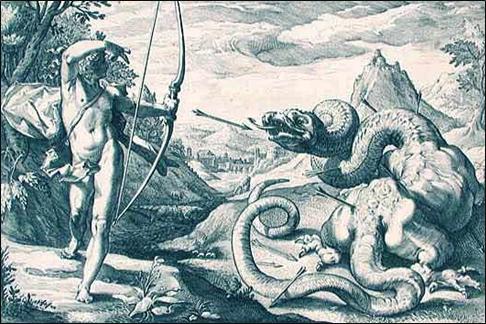
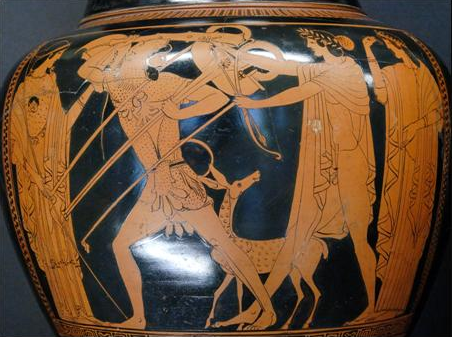
According to Delphic legend, Apollo arrived in Delphi from Olympus, but he immediately had to fight the dragon, which guarded the old Gaia sanctuary. This monster is nameless in older legends, and in later ones it is called Delfina or Python. Apollo found a dragon in a cave below Parnassus and killed it with an arrow of rain (picture above). After burying the angry enemy under the omphalos, he prepared a funeral play for him, and then he appropriated the old prophecy of Gaia and dedicated a tripod to the sanctuary, which has since become his symbol. Apollo, in the form of a dolphin, intercepted a ship of Cretan merchants and brought it to Chris, the port of Delphi. It was only in Chrissy that he appeared before the merchants in the form of a wonderfully handsome young man and took the Cretans as his priests. Due to the murder of Python, Apollo had to spend nine years in Thessaly for purification. After that, he returned to Delphi, as "pure", as Feb (Phoibos), with a wreath and a branch of holy laurel from Thessaly Tempe. He later had to defend his prophecy from Hercules. When Pythia (a prophetess and priestess in the temple of Apollo at Delphi, famous for her ambiguous answers) refused to prophesy to Hercules, who was sick and stained with blood, he stole the holy tripod to establish his prophecy elsewhere. Apollo then attacked his half-brother (pictured below), but an angry Zeus separated them by throwing lightning between them. Apollo also fought other enemies, including Phlegia and Titus.
To explain the difference between Delos and Delphic myths, there is a story that Leto was persecuted by Python even before Apollo's birth, that is, that Apollo went from Delos to Delphi on the fourth day after his birth and killed a dragon that threatened his mother. It was also rumored that the inhabitants of Delphi invited Apollo to leave the Hyperboreans and come to them.
Other myths about Apollo are unrelated; the most famous are those about his love for Hyacinth and Cypress, Daphne, Driopa, Cyrene, Cassandra, Castalia and Marpesa. All these loves end tragically: Hyacinth suffered at the hands of Apollo, Cypress was transformed into a tree of mourning, and Daphne - into a laurel. Apollo had numerous descendants: Coronida gave birth to Asclepius, Cyrene - Aristotle, Euadna - Jama, Akakalida - Kidon and Mileta, Kaliopa - Lina, Orpheus and Hymenaeus, Manto - Pug, Phthia - Dora, Laodicea and Polypetta, and Roy - Ania . His children are most often eponymous heroes of certain cities or larger areas in Greece and Asia Minor.
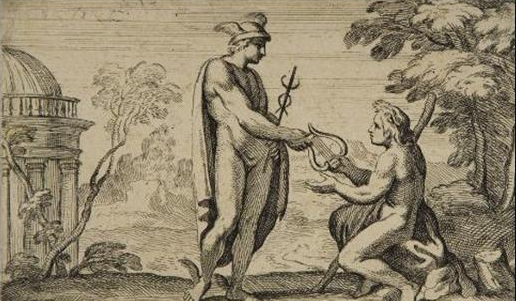
Apollo was forced to serve mortals in two waves. Because he killed Python or the Cyclops, Zeus punished him for being a servant of King Admetus. Later, together with Poseidon, he was in the service of the Trojan king Laomedon, either because of the rebellion against Zeus or because the gods decided to tempt that king. With both Admetus and Laomedon, Apollo kept cattle. It is said that Admet's or Apollo's cattle were stolen by the newborn Hermes. Apollo found a small thief and stolen cattle, but Hermes alleviated his anger by playing the lyre, which he had just invented. Delighted by the new instrument, Apollo gave him his cattle and kerikeon (golden rod) in exchange for a lyre; since then the two gods have been linked by a deep and lasting friendship (pictured below).
In antiquity, the Kara-Frisian myth about the competition between Apollo and Mars was very well known. Marcia, the inventor of the twins, whose gig enchanted everyone who would hear her, dared to invite Apollo to a gig competition. It was agreed that the winner would punish the loser at his discretion, and the residents of Nisa were chosen as judges. After the judges declared Apollo the winner, Marcia was severely punished: Apollo tied him to a tree, then skinned him and hung his skin in the square in Kelena. Apollo soon repented of his cruelty, tore the strings on the lyre, and for a time neither played nor sang. Some say that after the victory, Apollo spared the life of his opponent and that Marcia, as a punishment, received a pig's tail.
In the myth, Apollo is associated with a number of deities. Together with other Olympians, he participated in gigantomachy. In the Trojan War, he helped the Trojans in the fight against the Greeks and caused the death of Achilles. However, his connection with Artemis (in the myth of Delos) and Dionysus (in the Delphic myth), as well as with the muses, choirs, charites and nymphs, is most pronounced. Apollo is already in the oldest tradition marked as the leader of the choir of muses (Musagetes). Together with Artemis, he punished Niobe and Titus, and with Dionysus he shared the sanctuary in Delphi. During the three winter months, Dionysus stayed there, to whom dithyrambs were sung, and in the other months, Apollo was present, to whom songs were sung. Apollo's close connection with certain animals, things and plants, expressed in the cult, is also explained by special myths. His sacred animals are bull, lion, boar, hind, goat, dolphin, mouse, lizard and frog; birds - swan, raven, hawk and kraguj, and plants - laurel, palm and olive. Apollo's attributes are a bow and arrow, a lyre, a tripod and an omphalos (picture below).
The origin of Apollo's name is unclear; its name is probably derived from the Babylonian word apullu (meaning "door"), or the name of the Hittite god Apullunas, the protector of gates and entrances.
Based on the names, myths and preserved archeological monuments, it is concluded that Apollo is a deity that the Greeks took over from the Hittite-Babylonian cultural circle during the Mycenaean culture, through Crete or the Mycenaean colonies on the Aegean islands and the coast of Asia Minor. The Hittite god Apulunas is probably the predecessor of Apollo Agieus ("gatekeeper"). In the Babylonian religion, the gates (abullu) are protected by the sun god Shamash, who, like Apollo, is a god builder, prophet and legislator. The sanctuary of Shamash was considered, like the Delphic omphalos, the center of the world. On the other hand, the conical stone with ribbons, the symbol of Apullunas, is similar to omphalos, and it is known that the oldest cult statues of Apollo were aniconic, in the shape of a pillar or cup (Apollo of Amikla, Apollon Agyieus). Apollo may also be associated with stones found in front of the entrances to Troy. The connection between Apollo and the Trojans is also emphasized in the myth: Apollo builds the walls of Troy, kills Achilles in front of the city gates and always protects the Trojans in the Trojan War. The lion, which is an attribute of the oriental sun god, also became an attribute of Apollo, especially on the coast of Asia Minor and the islands (the alley of lions on Delos). Finally, the calendar indicates Apollo's oriental origin, because in his cult, as well as in the myth of birth, the seventh day of the month plays a significant role, which is also one of the elements of the Babylonian religion. It is certainly significant that in the myth, Lycia or Ephesus is sometimes mentioned as the place of Apollo's birth.
The connection of the Greeks of the Mycenaean epoch with Asia Minor and the Hittite-Babylonian cultural circle is also attested by archeological findings, so it can be assumed that Apollo was revered on the Aegean islands and the Greek mainland certainly in the middle of the second millennium AD. The introduction of his cult is probably related to the erection of fortified cities on the Greek mainland during the Mycenaean era. First the god of the city population, Apollo gradually suppressed various local deities of vegetation, which is illustrated by the myths of Hyacinth and Carney. Thus, the new god was quickly accepted throughout the Greek world - from Delos to Delphi and from Crete to Thessaly. In the Iliad, which reflects the circumstances in the Greek world at the end of the Mycenaean era, it is noticed that Apollo, although portrayed as the protector of the Trojans, is still a deity to whom the Greeks show special respect.
Apollo had several functions, which arose from his basic and oldest function - to defend and protect. Already the Hittite Apulunas was the deity of the gate, defending against evil. The closest to this Hittite deity is Apollon Agyieus, whose symbol - a pointed pillar - was placed in front of houses to protect them. Apollo's protector of gates (Prostaterios) and protector of entrances (Propylaios) are similar to him. Apollo's epiclesis Apotropaios and Alexikakos also indicate its primary function - the rejection of evil.
Apollo is also associated with vegetation, but not as an agrarian deity, but again as one who protects fields, sowing and crops; he is the protector of the harvest (Thargeios), the one who defends crops from field mice (Smintheus) and from locusts (Parnopios). That his functions were important is shown by the statues of Apollo Parnopius (Phidias 'work) and Apollo Sminteus (Praxiteles' work). As a protector of crops, he assimilated the older deities of vegetation. Thus in the Peloponnese he suppressed Hyacinth, degraded him to a hero, and appropriated his feast of Hyacinth. He also appropriated the holiday of Carneia, and he took the name Carneios from the god Karna, to whom that holiday is dedicated.
One of Apollo's main functions is healing, which is expressed in the oldest tradition: in the Trojan War, he calmed the pain and saw the wound of Glaucus, but he sent disease, infection and death with his arrows. As every disease was considered a kind of impurity (miasma), which could be removed by purification and repentance, the god who sent the disease easily became a god who protects from the disease.
One of Apollo's qualities is mantic (the skill of divination, divination). It developed from his vidar function, because in all nations, magicians and sorcerers (doctors) are also prophets. His sanctuary in Delphi became the most famous prophecy of the Greek world, and in many other sanctuaries of Apollo it was prophesied in various ways.
Apollo is also the god of death; in the Trojan War he disarmed Patroclus and sent the plague to the Greek camp with his arrows. Penelope's beggars were killed on his holiday, and he also appears in the myth of Alkesta as the god of death. He is also the god of music and art; immediately after his birth, he received a lyre from Zeus, with which he cheered the gods at a feast, and the muses sang under his guidance.
As the god of seafaring, Apollo is called Delphinios; in that capacity it is associated with Greek colonization, because the whole of the Greek colonies bears his name. Apollo is the leader and founder, so a large number of cities and noble families consider him their ancestor. Only from the 6th century AD did Apollo identify with Helium and become the sun god. He was a god of light before, but not elementary but spiritual, in the sense of heavenly purity and full splendor, which is why the epithet Feb became his personal name. The messages written on the temple in Delphi are connected to that Apollo (Phoebus): "Know thyself" and "Nothing too much". Thus, over time, Apollo became the god of measure, order, law, positive creative forces and artistic inspiration.
The most famous shrines of Apollo in the Greek world were located in Didyma and Clare, on Delos and in Delphi. Numerous temples are dedicated to him, of which the most important are the temples in Corinth and Thermae (7th century AD), in Selinunte (6th century AD) and in Basam (5th century AD). In the part of Apollo, the holidays of Hyacinth, Carneia, Targelia, as well as the Pythian games were celebrated.
The earliest representations of Apollo had an aniconic form. His cult statue in Amiklam was made of bronze, in the shape of a pillar, and on it only the face, arms and legs were human. There Apollo is depicted with a helmet on his head and a spear and bow in his hands. The oldest surviving representation of Apollo dates from the end of the 8th century AD (a head with a helmet made of terracotta, also from Amikl). Already in the early 7th century AD, Apollo was depicted as a naked young man, with long hair or a helmet on his head, with a bow and arrows in his hands (bronze statuettes from Thebes and Drera). In the sculpture of the archaic period, he is shown naked and without a beard, while in painting, on vases, he is represented dressed with a beard, most often as a guitar. The famous vase from Mel shows the arrival of Apollo accompanied by Hyperborean virgins from the land of the Hyperboreans: with a guitar in his hand, Apollo rides in a chariot drawn by winged horses (the earliest performance of Apollo Kitarod). A supernatural statue of Apollo (around 600 AD) was found on Delos; it is not excluded that some of the archaic "young men" (kurosi) represent Apollo.
The cult statue of Apollo for the sanctuary at Delos was sculpted by Tektay and Angelion; there Apollo is depicted with outstretched arms: in his left he held a bow, and in his right three haritas, while at his feet sat two griffins. This cult statue served as a model for Apollo's sculptures made by Kanah, as well as the cult statues in Didyma and Thebes.
Certain scenes from the myth of Apollo are also shown on the reliefs and in important paintings. His fight with Heracles over the tripod is most often presented (the eastern gable of the treasury of the Siphnians in Delphi, a large number of black-figure vases). Of the other mythological scenes, the punishment of Niobe and Apollo's struggle with Titus are shown (picture below).
At the beginning of the 5th century AD, the iconography of Apollo was finally established: he is shown naked, less often as a trained young man, without a beard and with shorter hair. The statue of Apollo from the western gable of the Temple of Zeus in Olympia is known from that time. There are numerous performances on vases, where new scenes from the myth of Apollo are shown, such as: the fight with Python, the theft of Apollo's cattle and Apollo's conflict with the giants. During the second half of the 5th century AD, the iconography of Apollo did not change. It was not until the 4th century AD that the great sculptors - Praxiteles, Skopas, Briaxides and Leohar - created a new type of Apollo. A copy of Praxiteles' statue of Apollo Saurocton is known, where he is shown as a young man. The same artist, as well as Skopas and Brijaksid, also made statues of Apollo Kitarod. Skopas sculpted the cult statue of Apollo Sminte, which depicts a god putting his foot on his sacred animal - a mouse. Leohar made three statues of Apollo, the most famous of which is Apollo Belvedere. Scenes from the myth are mostly no longer shown, that is, Apollo still only presents himself as an observer of various events. In Hellenistic and Roman art, it is mainly represented by models from the end of the 5th century AD and from the 4th century AD. Scenes from the myths of Niobium, Daphne and Marcia are depicted on sarcophagi, mosaics and frescoes.
Literature:
• Dragoslav Srejović - Aleksandrina Cermanović-Kuzmanović, Recnik grčke i rimske mitologije, drugo izdanje, Beograd: Srpska književna zadruga, 1987
Eros - mythology
An old deity of nature, which, with the help of love longing, ensures the continuous creation and constant renewal of the world. In the dark, in a terrible emptiness, the Night, fertilized by the wind, laid a silver egg, from which came a deity with golden wings - Eros, Protogon or Fanes. The huge egg broke in two halves - Heaven (Uranus) and Earth (Gaia). Eros encouraged Uranus and Gaius to unite. That is how the creation of the world began. That Eros was created after Chaos, together with Gaius and Tartarus, as the basic, original element of the cosmos. Only later are Eros' parents mentioned; he is the son of Uranus and Gaia, the son of Zephyr and Irides, or the son of Ares and Aphrodite.
In philosophical speculations Eros is the oldest of all the gods; it was said that there were two Eros: one good, when Aphrodite Urania gave birth, and one evil, when Aphrodite Pandemos gave birth. Understood as a demon, Eros is the son of Penia (Poverty) and Poros (Wealth); he unites the opposite qualities of his parents: he is never poor or rich, because what he gains immediately he loses; he stands between wisdom and ignorance and between beauty and ugliness. Later, it was believed that there were three Eros: one - the son of Hermes and the chthonic Artemis, the second - the son of Hermes and Aphrodite born of sea foam, and the third - the son of Ares and Aphrodite, the daughters of Zeus and Dionysus. The latter, also called Anteros, was the protector of friendship or love between men.
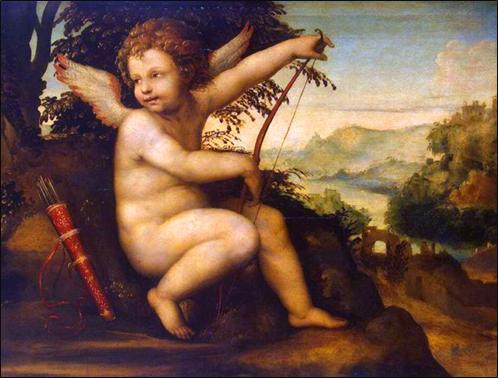
Eros is the god of love and Aphrodite's constant companion. He is imagined as a boy, often with wings, who brings unrest and love longings into the hearts of people and gods with his bow and arrows. He wounds not only mortals and heroes (Hercules) with arrows, but also great gods (Apollo, Zeus), and even his mother Aphrodite. Eros is the most beautiful of all immortals; golden-haired and longing-eyed, he walks on flowers; sometimes he is gentle and kind, and sometimes like a terrible storm or a cold northerner. He often stays in Cyprus, from where he comes among the people together with spring. At leisure, he plays with Dionysus or Ganymede in the Gardens of Zeus. Unstable and in constant motion, Eros is not permanently attached to any person even in myth. Only the story of his love for the beautiful Psyche is known.
The cult of Eros is very old. In Thespia (Boeotia), Eros was revered as the god of nature, in the form of a stone, which may have had the shape of a phallus. The inhabitants of Thespia held ceremonies at the Helicon every five years in his part, the so-called erotidia, followed by gymnastic and music competitions. In a similar way, Eros was celebrated in Parion, in Troas. His temple and holy grove are also mentioned in the Lacedaemonian Leuctra. As a god of friendship among men (Anteros), he was especially revered in Sparta and on the island of Crete, where sacrifices were offered to him before he went to war.
In fine arts, Eros was often depicted only from the beginning of the 5th century AD, first on vases of the late black-figure style. In important painting in the 5th century AD, Eros is always represented in the circle of men and boys, as a winged young man holding a flower, wreaths or ribbons in his hands. On the Parthenon, on the Panathenaic frieze, this gentle boy relies on Aphrodite and protects himself with an umbrella. Phidias also presented him on the throne of the statue of Zeus in Olympia. It was not until the 4th century AD that Eros became a favorite motif in art. On all the monuments he is shown winged, with a bow and arrows. Three of Praxiteles' statues of Eros are mentioned, the most famous of which is the one dedicated by the heterosexual Frina in Thespia. For the sanctuary in Thespia, Lysippus made a statue of Eros in motion. Scopas' statue of Eros was placed next to the figures of Potos and Chimeros. Beginning in the 4th century AD, in works of art, Eros is always presented in the company of Aphrodite and is introduced to various scenes related to his mother's love for Anchises, Adonis or Ares. In the Hellenistic period, Eros transforms from a handsome young man or boy into a spoiled child, but he also often appears on tombstones, legs crossed, with a torch in his hand.
Eros is the main character of Apuleius' novel Metamorphosis.
Literature:
• Dragoslav Srejović - Aleksandrina Cermanović-Kuzmanović, Recnik grčke i rimske mitologije, drugo izdanje, Beograd: Srpska književna zadruga, 1987
Oedipus - mythology
The son of the king of Thebes, Laius and queen Jocasta, the unfortunate king of Thebes, who in ignorance killed his father and married his mother. The gods quickly proclaimed that terrible sin and sentenced Oedipus to an evil fate: his mother hung herself on a high beam in despair, leaving him sorrow and remorse. Oedipus still ruled over You, but he was persecuted by Erinyes. When he died in one battle, the Thebans buried him with the greatest honors. This short and sad story was later supplemented with new details that explain the causes of Oedipus' accident.
Oedipus was cursed before he was even born. His father, King Lai, abused Pelops' hospitality and cursed himself either to lose his children or to be killed by his own son. Although he was prophesied in Delphi that he would lose his life at the hands of his son and that Thebes would prosper only if he died without offspring, Lai, drunk or overwhelmed with lust, nevertheless approached his wife Jocasta. When his son was born, he stabbed and pierced the child's ankles, and then gave it to a shepherd to leave him on Mount Kitheron. This good man did not obey the king, but handed the little one over to the herdsmen of the Corinthian king Polybius. Others say that the Corinthian shepherds found Oedipus themselves and took him to King Polybus. Since he had no children, the king accepted the child and raised him and his wife Merop as their own son.
At Polybius' court, Oedipus grew into a strong but impulsive young man. His early youth flowed in undisturbed happiness, until the day when a Corinthian, in drunkenness or envy, told him that he was not the king's son, but at will. Those words disturbed Oedipus. He immediately asked Polybus and Meropa about his origin and, as their answers did not satisfy him, he went to Delphi to learn the truth from Apollo's prophecy. Instead of answering the question, he was told that he would kill his father and marry his mother. Convinced that Polybius and Merope were his parents, he avoided Corinth and the house where he grew up. Meanwhile, Lai, when the signs warned that his son would kill him, went to Delphi to find out what happened to the little boy who was left on Kitheron. In Phocis, in the gorge where the roads from Daulida, Thebes and Delphi intersect, there was a tragic meeting of father and son. Since the passage was narrow, Laius' messenger Polyphon or Polypet ordered Oedipus to get out of the way. The young man blazed with anger and hit the messenger, but as he passed the car, Lai whipped him. Instead of retaliating in the same way, Oedipus killed the old man with a strong blow of a stick. Filled with rage, the young man then killed Lai's companions, but one of them escaped death and returned to Thebes.
Others say that Oedipus met Laius before he arrived in Delphi and learned from the prophecy that he would kill his father and marry his mother. Since he had stained his hands with Blood's murder, he knew that the prophecy would not give him an answer, and so he returned to Corinth. Only later, in Delphi, did he learn of the fate that awaited him.
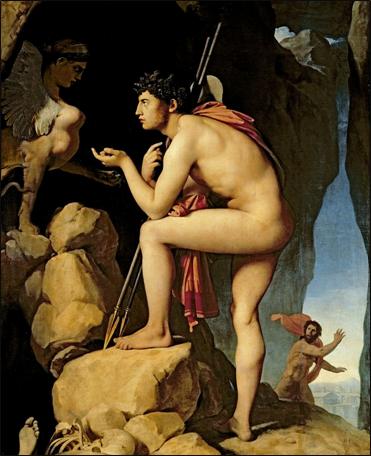
After Lai's murder, Jocasta's brother Creon took power in You. Even during Lai's life, the city was threatened by the Sphinx, a winged monster with the lion's body and the head of a girl, sent by Hera because of Chrysippus' abduction or Ares to take revenge on the Thebans for killing his son Cadmus. That monster was staying on a rock near You and asked passers-by to answer her question: "Which creature goes on four legs in the morning, on two legs at noon, and on three legs in the evening?" Anyone who did not solve the riddle was killed by the Sphinx immediately. As the number of victims increased day by day, the Thebans used to gather in the town square every day to find the answer to the Sphinx's question. All their efforts were unsuccessful, and in the meantime, the monster devoured the king's son Hemon. Creon and the citizens of Thebes announced that whoever liberates the city from that evil will receive the royal authority and the hand of Laius' widow Jocasta. The gods wanted Oedipus to set Thebes free. He answered Sphinx's question that he would be a man, because at the dawn of his life he walked on four, at noon on two, and at dusk, like an old man with a stick, on three legs (picture below). After the riddle was solved, the Sphinx jumped off the rock, and Oedipus, as the liberator of the city, received the promised reward.
For a time, Oedipus ruled peacefully. Jocasta bore him four children - sons Eteocles and Polynicus and daughters Antigone and Ismen. Suddenly, plague and famine began to plague you. When Oedipus sent Creon to Delphi to ask the prophecy what caused those misfortunes, he received the answer that Thebes would be saved when the murderer of King Laius was punished. Oedipus demanded that the Thebans find that criminal and cursed him to be an exile and an unfortunate person until his death, so that no one would greet him and receive him into their home. That is how he pronounced the verdict on himself. On Creon's advice, the blind prophet Tiresias was brought in and Oedipus asked him who the murderer of King Laius was. The prophet initially refused to answer that question, but when the king attacked him with ugly words, Tiresias announced that Laius' killer was Oedipus himself. The king then accused him of colluding with Creon, who wanted to gain power, and declared the prophet's statement a fabrication. Now the blind Tiresias dealt an even more terrible blow to Oedipus: he told him that he was blind in his eyes, that he thought he was a newcomer, and he was born in Thebes, that he would soon find out that his children were both brother and father, , and that the rich will become a poor man who will wander blindly abroad. The old prophet's confidence was shaken by Oedipus, who began a long investigation: he questioned Creon about the circumstances of Laius 'death, Jocasti complained about Tiresias' and Creon's intrigues, and when she tried to calm him down with a story about a bandit attack on Laius and his child who was whispered ankles left on Kitheron, a terrible suspicion was born in Oedipus, and he called the only surviving witness to the death of the old king. His suspicions were shattered for a moment by the arrival of a messenger from Corinth, who brought the news that Polybius had died. At that moment, Oedipus believed that he was not the murderer of his father, but when the messenger called him to take power over Corinth and told him that Polybius and Meropa were not his parents, dark forebodings began to torment him again. Jocasta was the first to realize the terrible truth. After futile attempts to dissuade Oedipus from further questioning, she retired to the court and took her own life. Finally, the old shepherd of Laius appeared before Oedipus, who admitted that he did not leave the child on Kitheron, but that he handed it over to Polybus' men. Only then did everything become clear to Oedipus. In the greatest despair, he entered the court to find Jocasta. When he saw her hanging from the beam, he moaned in pain, untied the rope and lowered her lifeless body to the ground. With a golden needle, which he tore from her dress, he pierced his pupils so that they would not look at his sinful deeds. Blind and helpless, covered in bloody tears, he came out in front of the Thebans and demanded that he be expelled from the city as soon as possible.
It is not known who expelled Oedipus from You and when it happened. Some say that Oedipus' sons, in order to cover up the shame, imprisoned their father in the palace and took away his royal authority, which is why Oedipus cursed them. It was said that Jocasta and Oedipus were still in Thebes when Eteocles and Polynicus killed each other in a duel, that Jocasta took her own life over the corpses of her sons, and that Creon expelled Oedipus.
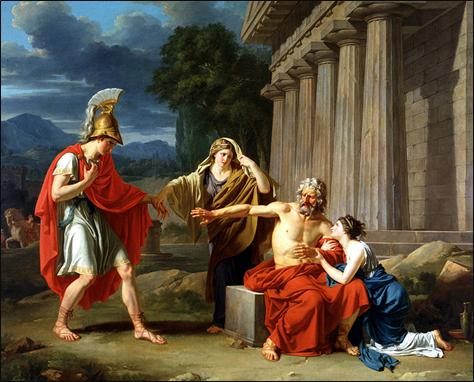
Blind Oedipus was accompanied in exile by his daughter Antigone. All the cities refused hospitality to the unfortunate Theban king, until the day when the exiles arrived in Attica, on Colon, and took refuge in the holy grove of Eumenides. Oedipus then told his daughter that he was destined to die at that place and asked that King Theseus of Athens be brought to him (picture above), because he knew that the country that gave him refuge would be richly rewarded. In the meantime, Oedipus' younger daughter Ismena arrived at Colon, who informed her father and sister about the conflict between Eteocles and Polynicus. Since the prophecy in Delphi announced that the victory would be won by the one whose side Oedipus was on, the brothers asked for support from their father. Instead of helping them, Oedipus cursed his sons to kill each other in a duel.
The thunder indicated that the torments of the unfortunate Theban king were coming to an end. Oedipus said goodbye to Antigonus and Ismen, and then showed Theseus the place from which he would leave this world and which would protect Athens better than its ramparts in the future. Before Theseus' eyes the blind martyr disappeared; in the grove of Eumenides he was transformed into a hero.The fate of Oedipus was dealt with by Aeschylus in the tetralogy Lay, Oedipus, the Seven against You, the Sphinx. Two of Sophocles' tragedies about Oedipus have been preserved, namely King Oedipus (around 428 AD) and Oedipus on the Column (406 AD), as well as Seneca's tragedy King Oedipus. In fine arts, Oedipus is rarely depicted; only Oedipus with the Sphinx is represented on vases, and late antique frescoes from Hermopolis have been preserved, with scenes from the myth of Oedipus.
Literature:
• Dragoslav Srejović - Aleksandrina Cermanović-Kuzmanović, Recnik grčke i rimske mitologije, drugo izdanje, Beograd: Srpska književna zadruga, 1987