BCHA Incentive Model
Bitcoin ABC ($BCHA) was created on November 15th, 2020 by the founders of main BCH node implementation, inherited from BCH and BTC chains with genesis block. Bitcoin ABC introduces a new way to fund directly to developers and govern the fund based on major holders and miners. It aims to attract talents to build and commit for long term, while bringing additional benefits for users and miners where they can have their say at GNC based on their proof of stakes: Each miners with more than 1000 blocks and 21 major coin holders are qualified for a share of GNC fund. With the new incentive model, Bitcoin ABC aim to address the funding issues that plague the open source community for long.
As the Wired put it in the article The Few, The Tired, the Open Source Coders https://www.wired.com/story/open-source-coders-few-tired/
But we need to rethink the very idea of what crowdsourcing is capable of—and understand that it is perhaps more limited than promised. The open source revolution has been carried on the backs of some very weary people.
Will Bitcoin ABC Incentive Model be able to solve the open source funding issues? The developers team at Bitcoin ABC think it is. See this article from Cain. https://read.cash/@Cain/the-bcha-opportunity-cc92f5c5
For me, I believe the incentive will at least provide a stable funding for developers, so that they focus to build and stay, rather than to to seek for unstable and risky sources of incomes, such as donation, sponsorship or trading.
Crypto is full of dump and pump scheme which scare people away. It is time to build it as a professional place!
Sources:
Bitcoin ABC Global Network Council Framework https://blog.bitcoinabc.org/2020/09/04/the-global-network-council-framework/
Wired: The Few, The Tired, the Open Source Coders https://www.wired.com/story/open-source-coders-few-tired/

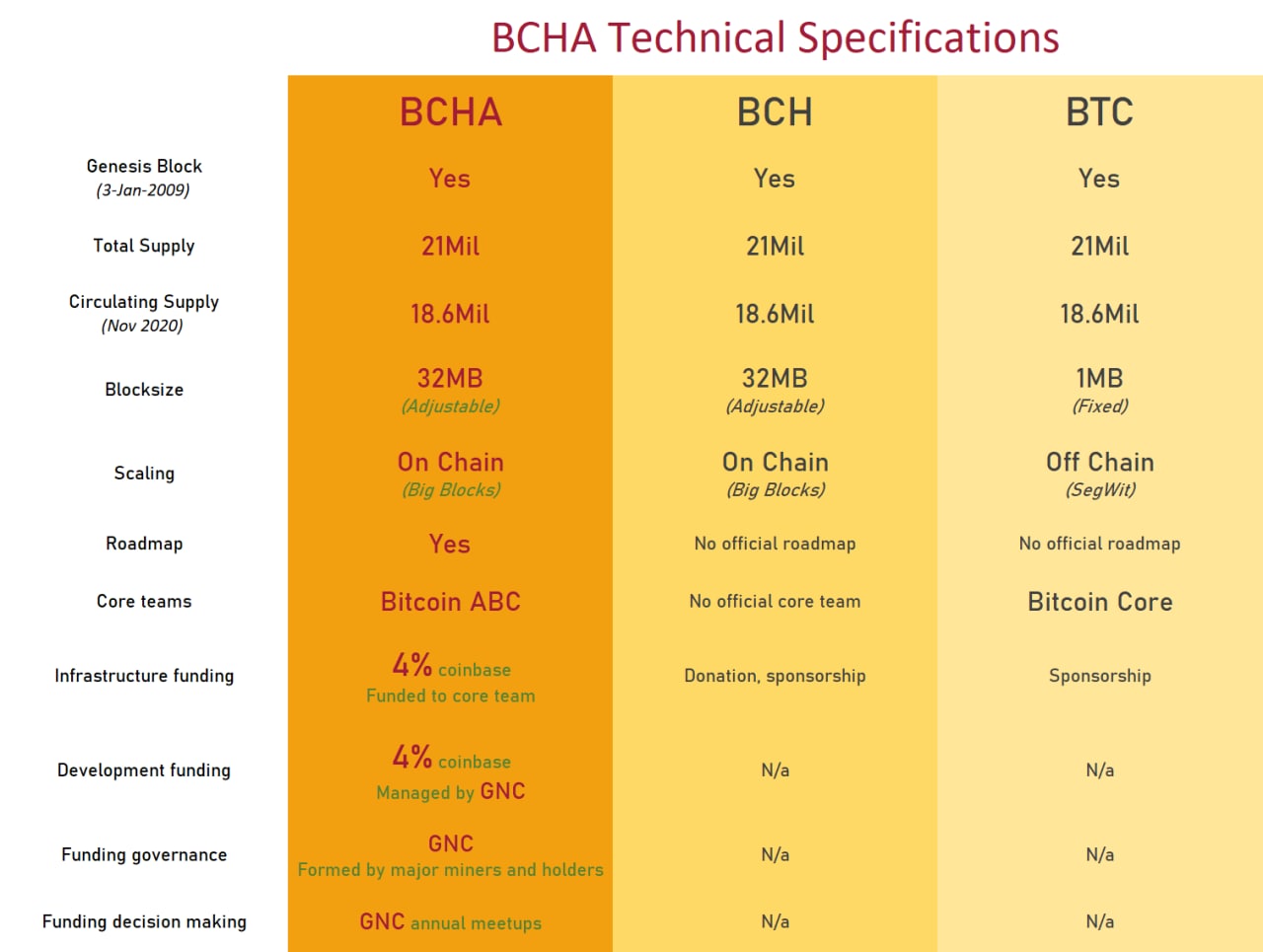
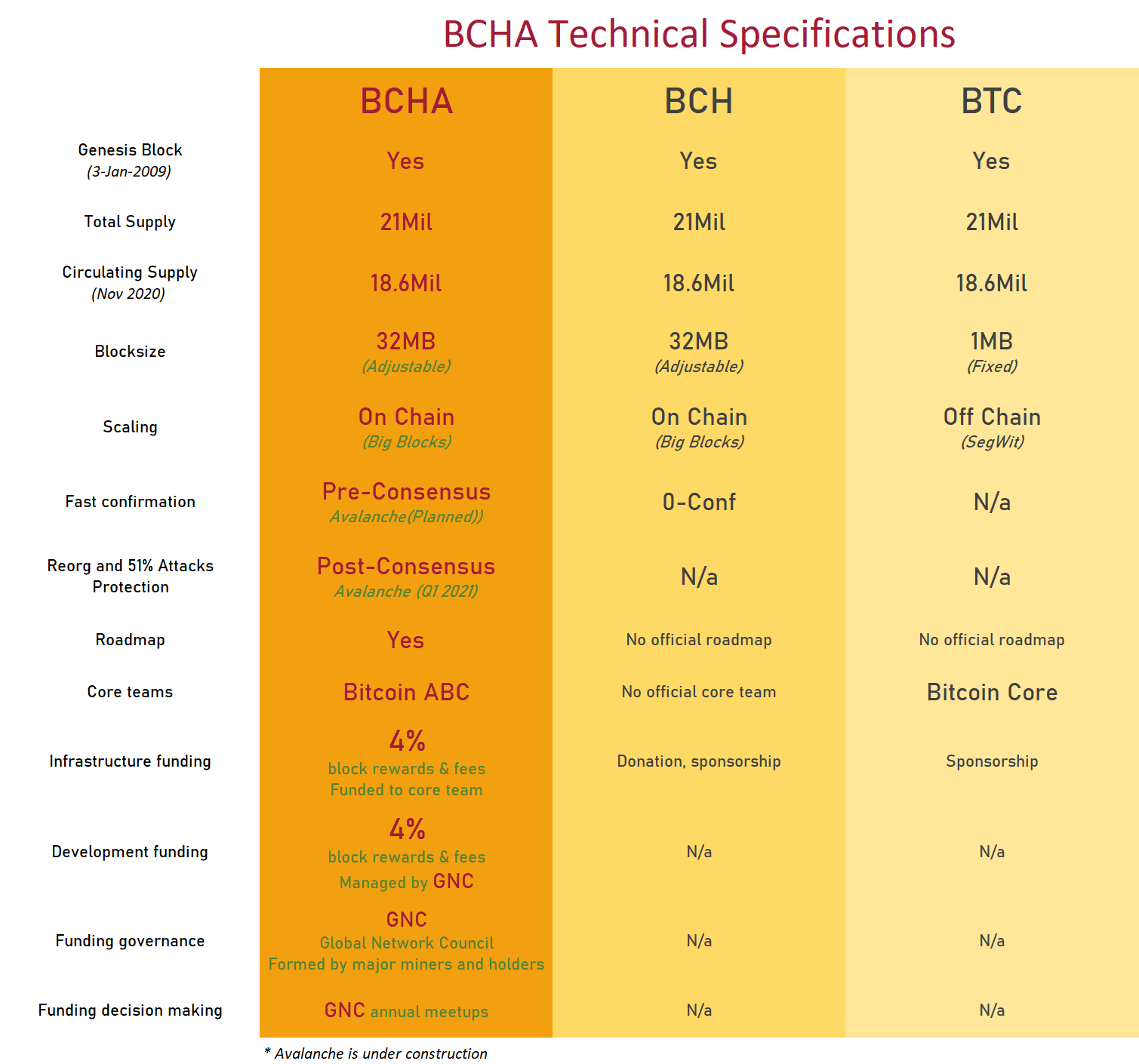
BCHA Technical Specs
On November 15th, 2020, BCHA was forked from BCH to form a new chain with new incentive model for infrastructure funding. Find below for some quick facts about the new chain:
More information:
*Website: www.bitcoinabc.org*
*News Channel* https://t.me/GlobalBCHANewsCHANNEL
List of exchanges support for BCHA
Fully support (Deposit/Withdrawal/Trading) - Currently withdrawal is disabled.
Coinex
Bitfinex
Poloninex
Kucoin
Binance
Huobi
To be supported:
HitBTC
Not support
Coinbase (May split coins, but not withdrawal/deposit)
Kraken - Not support split, trading, withdrawal, deposit.
**To be updated as more information is available. Pls comment if anything is incorrect or missing, I will update the articles accordingly.**
A star is born
On November 15th, a new breed of Bitcoin was born. As with previous splits, this time the new chain has a new mission. It aims for unifying network resources to build a lasting and sustainable economy.
Bitcoin system works on incentives. The miners' incentive via PoW has created one of the biggest computing network in the world, securing the chain for people to store and transaction value. It has also created one of the most specialised equipment, the ASICs are much better at producing hashpower than any other hardware ever produced, even from computing giants like Intel, AMD, Apple, Nvidia.
However there was no incentive for the developers at start. It was the right things because the developers were passionate with new technologies, they learned a lot from the founder. But since Satoshi left the team, so with all the passions of the Core team. There was no lead so there were many leads, and the position was up for grasp. The fight exhausted the core team, with many core members left the team, Gavin Andersen, Mike Hearn. That is understandable as they no longer have the passion to work under corporate influence and internal fighting. It eventually led to the famous split in 2017, the core team, under Blockstream sponsorship, won the ticker, aim to become the Digital Gold focusing on SoV, resulted in BCH together with the remaining implementations. Fast forward, and there was another split, resulted in BSV, pursuits its missions for corporate blockchain solutions.
And the history repeated itself, a new chain is born with ambition to address the fundamental issue in Bitcoin, which may potentially complete the incentive models.
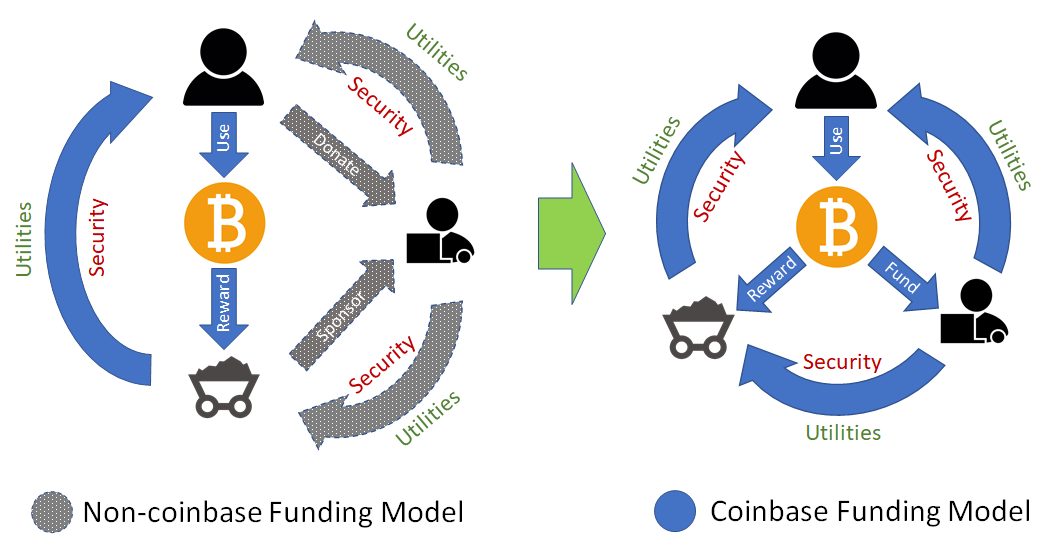
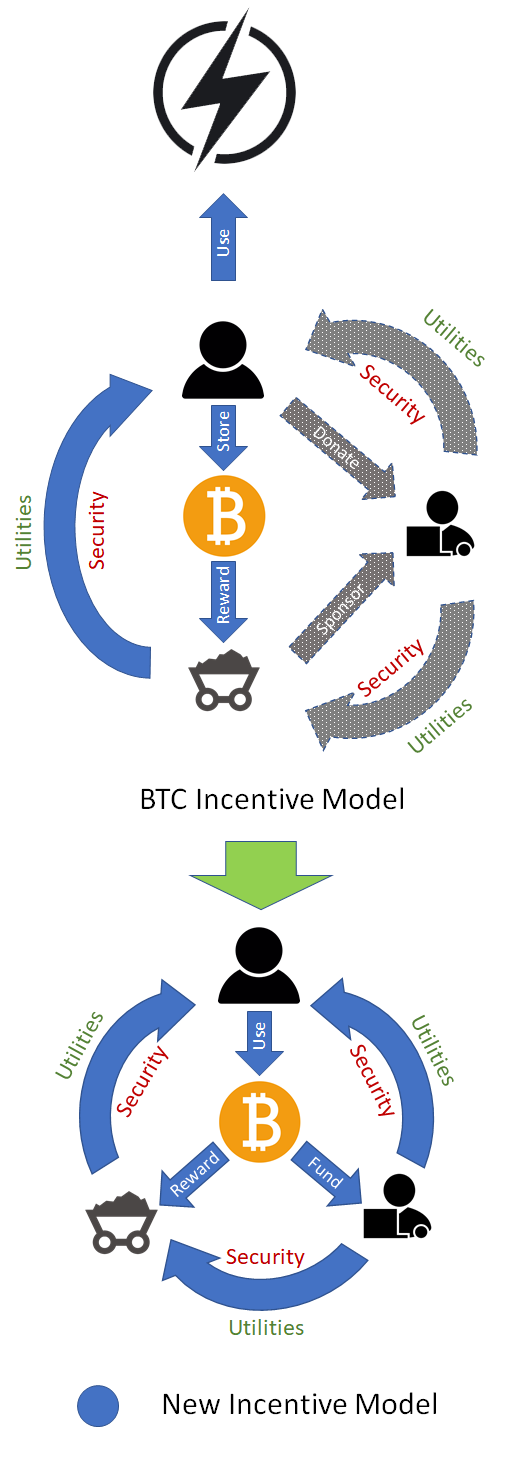
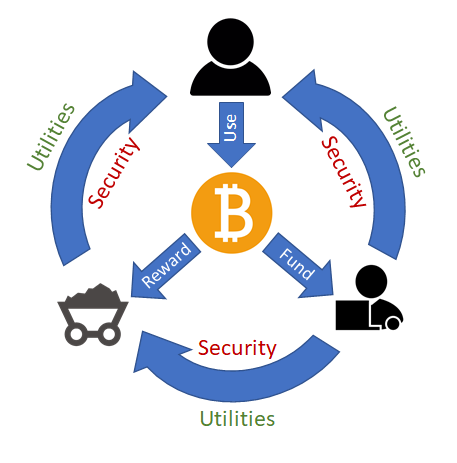
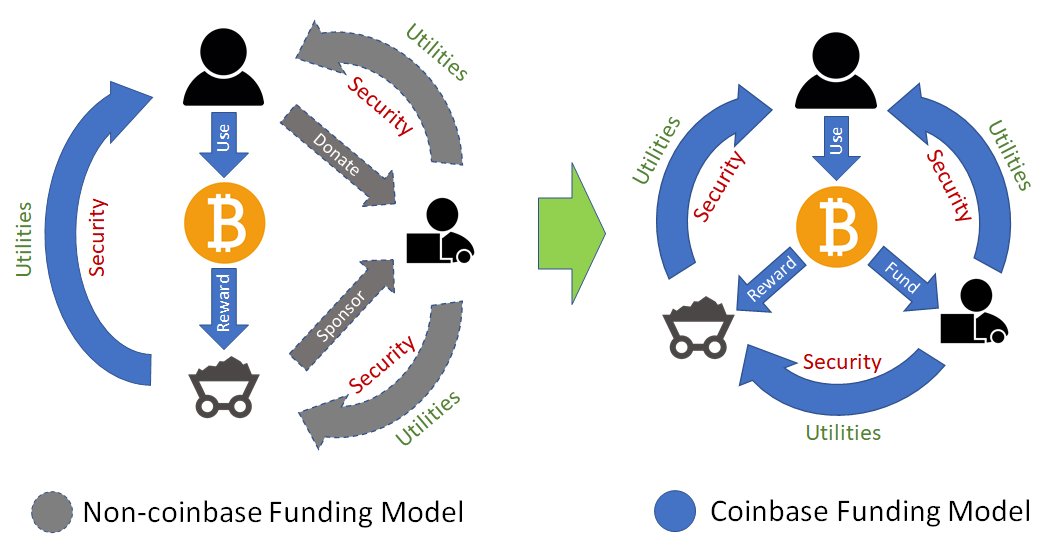
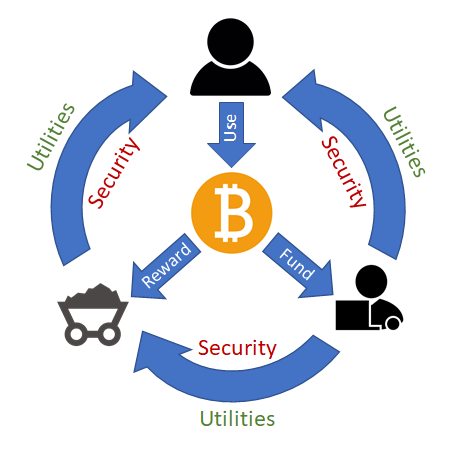
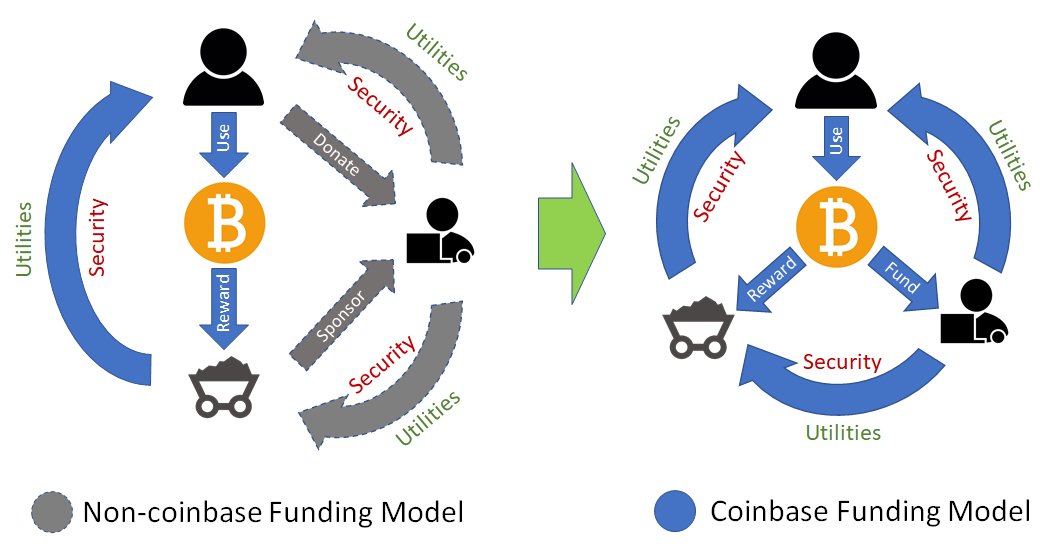
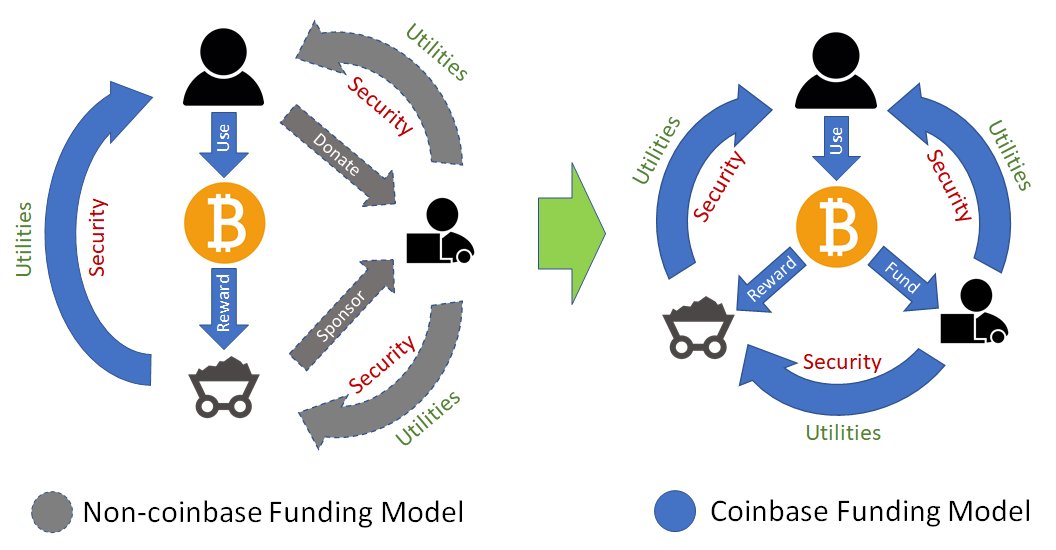
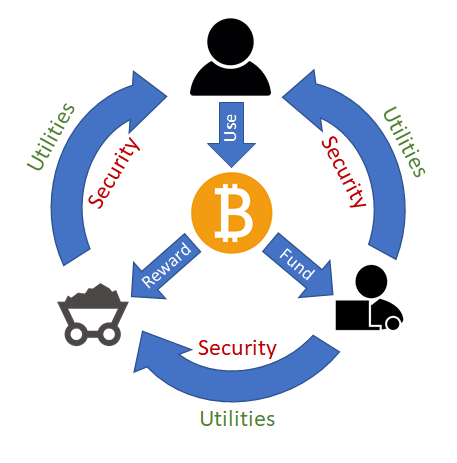
The new model aim to address the weak links between Developers - Users and Developers - Miners, so that Security and Utilities are constantly improved for the reliable and lasting SoV, and also the best MoE. It has the advantage to put everything on chain to incentivise Miners to secure the network more. Transacting off chain as current BTC model will discourage the Miners as they are not rewarded for transaction fees. So let's see what benefits from the new model...
Benefits for Miners
Some might thought the new coinbase funding will disincentivise the Miners because they have to share the coinbase reward with Developers. However, the reverse is true.
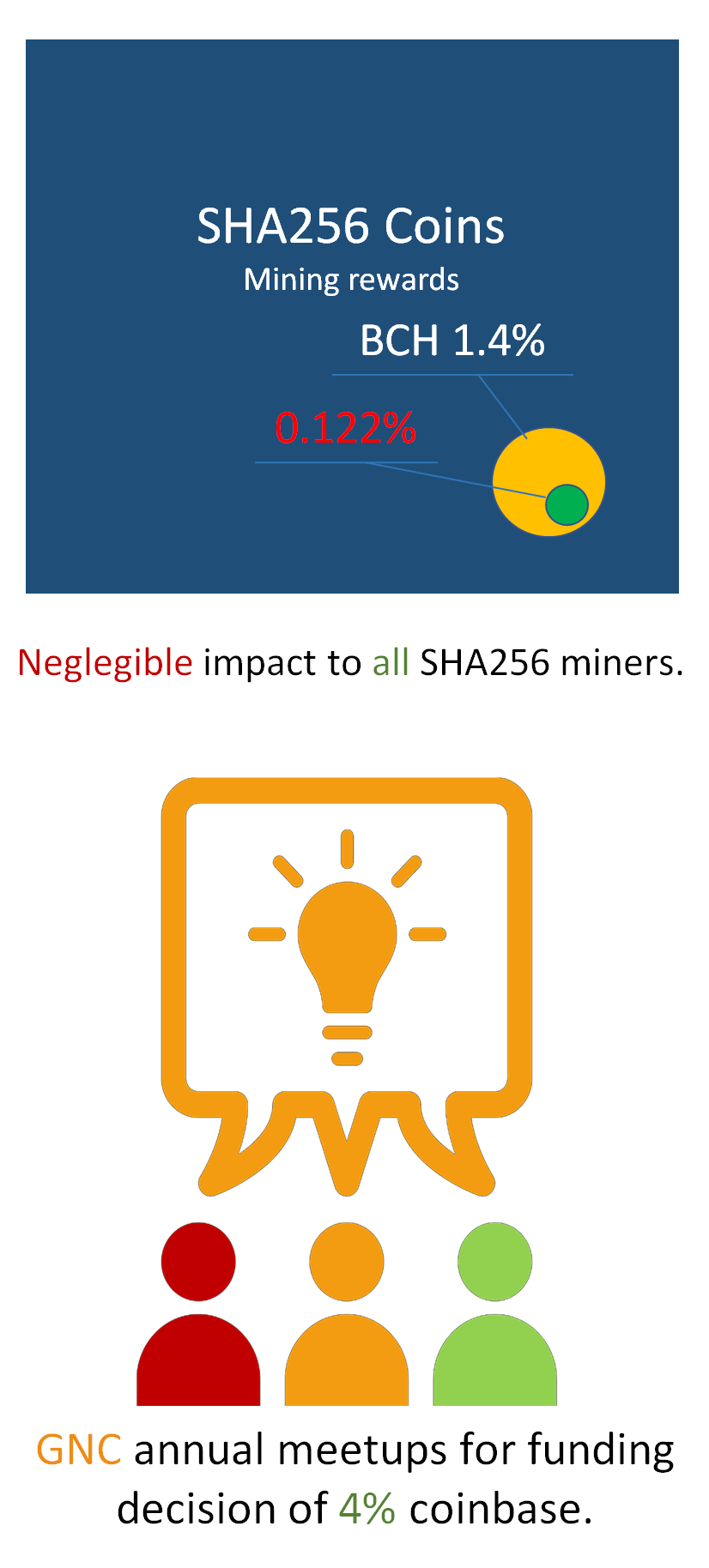
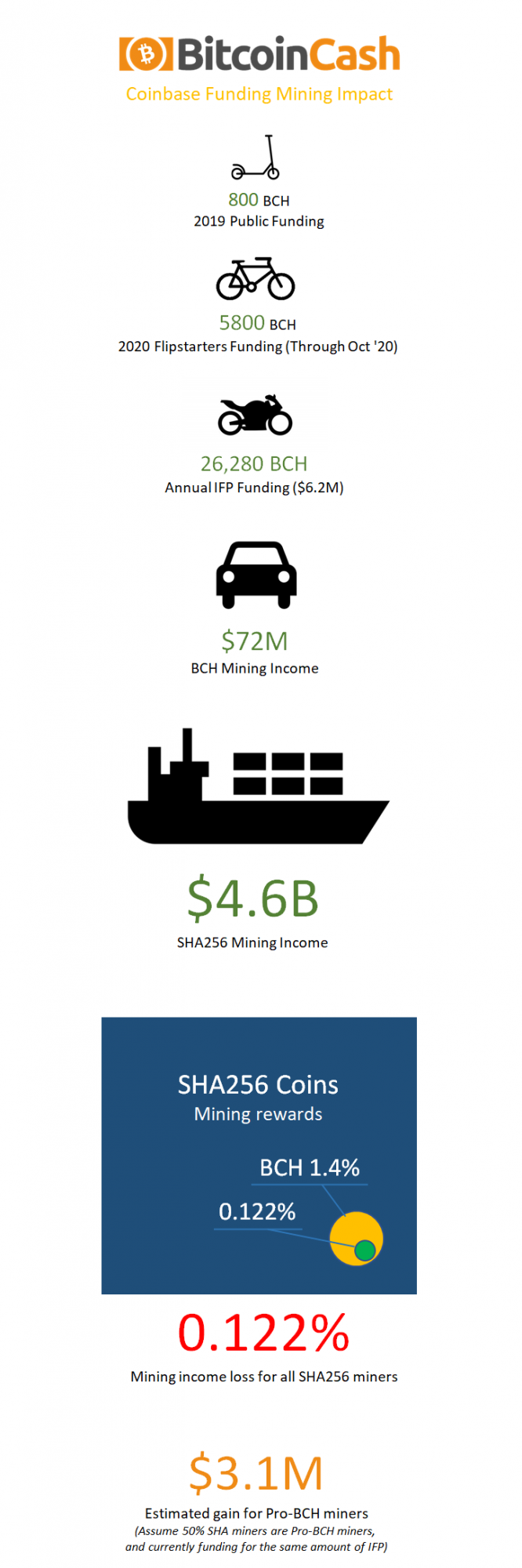
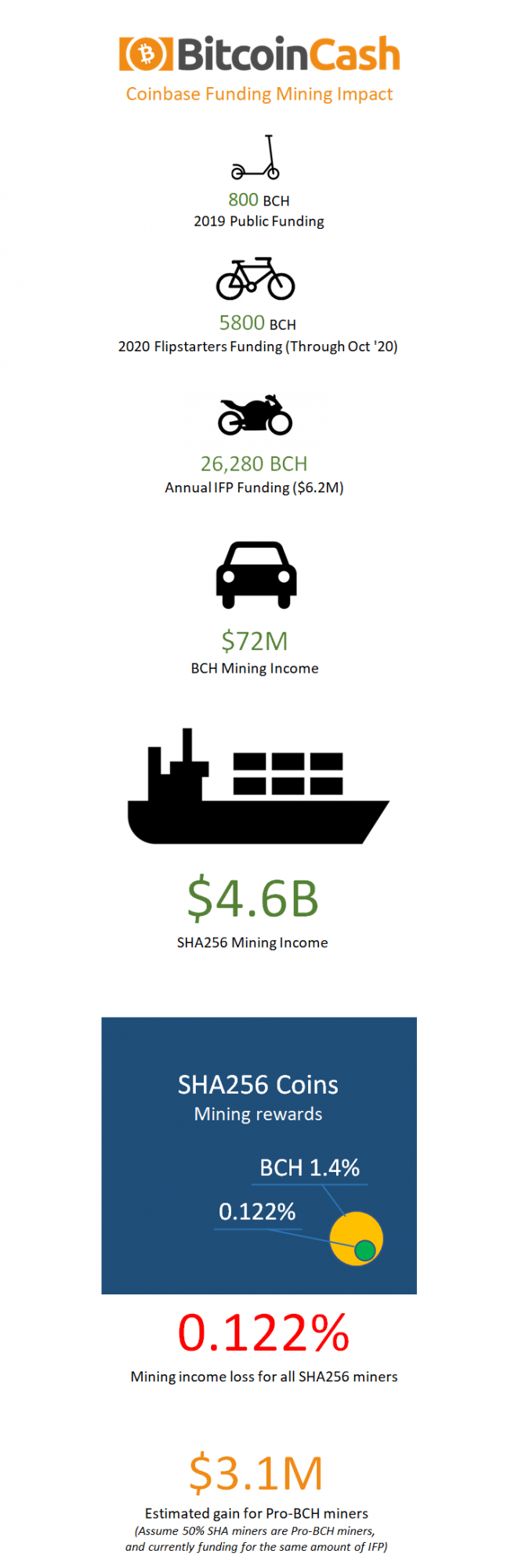
Due to difficulty adjustments and switch mining, all SHA256 miners will be contributing to **#BCH** **#Coinbase** **#Funding**, whether they mine BCH or not. All miners have similar ratio of profit due. However, only BCH miners have access to **4%** **#Coinbase** fund via Global Network Council. https://read.cash/search?q=%23BCH https://read.cash/search?q=%23Coinbase https://read.cash/search?q=%23Funding
Originally the Miners position was designed so that they would make key decisions the the network. However, for all the past splits, the contrary is true. Surprisingly the Miners have had too little influence on the network development and consensus. They may signal and do something, but eventually they would mine any chain that has value. They have become just miners, so little voice in the system. Yet, they had to pay for Developers via sponsorship and got the free riders issues that have been under community discussion for years without any resolution.
The brilliant idea from the GNC is now giving Miners the right position they deserved for. **By having their voice to decide on the 4% coinbase, they are contributing to the network development collaboratively without worrying on the free riders.**
Users' benefits
The coinbase funding brings paramount benefits to the Users. With stable funding and with a team in charge, they will now rest assured their fund are safe for their life time and their next generations. Should they have any issues, they know where to reach out too. The chain is now well **maintained**, fully **supported** and aim to provide **innovative and cutting edge experience** to the Users. They will not be scared in case of any issues with the software, and not worried by some technical nerds shouting at them because of their lack of technical knowledge. They are now looked after by a professional team, paid directly by the Users via Coinbase funding. SoV is not just about Hash. **Reliability**, **maintenance** and **support** play a big part in ensuring the top and lasting security. Would you rather pay the developers for their support and maintenance rather than storing your lifetime saving in a chain that does not pay for its developers, has no vision, no roadmap and no team in charge to solve your issues when you have problems with your fund or your software? You will be lucky to find someone helpful, at worst scam and shouting matches.
They will also not worry about the pump and dump scheme when Developers materilize from market high due to unsustainable funding with a fixed amout of coins in hand, leaving the network unfinished. So what happen if the Developers with coinbase funding still leave the team or doing something malicious to the network? With 8% of coinbase at stake, other Developers will keenly grasp the network to provide better services! So Users fund are safe and looked after again.
And the best part is, with GNC, they will be able to voice their opinions in how the fund will be distributed, without worrying on free riders again. The GNC will also do the job to filter out the noise, scams, beggars and social manipulations.
Developers' benefits
What about Developers? Did you know that cost for software maintenance is often 4x more than its development cost? Developers prefer new tech rather than boring jobs, which require high skills, knowledge and patient, even with much lower pay.
Without sustainable funding, developers, who passionate with the technologies, have risked their living conditions, even their lives, under threat, stress and terms posed under corporate sponsorship or donations.
With **stable** income, clear **vision**, well defined **roadmap,** strong **leadership** and high coding **standards**, the developers will work in harmony to #BUIDL an integrated and innovative eco-system, profiting the Users and Miners so that they will continue support the Developers in return. The fund is paid out every 10 minutes, if Users and Miners are not happy, Developers will get less money because of price decline as Users leaving the network.
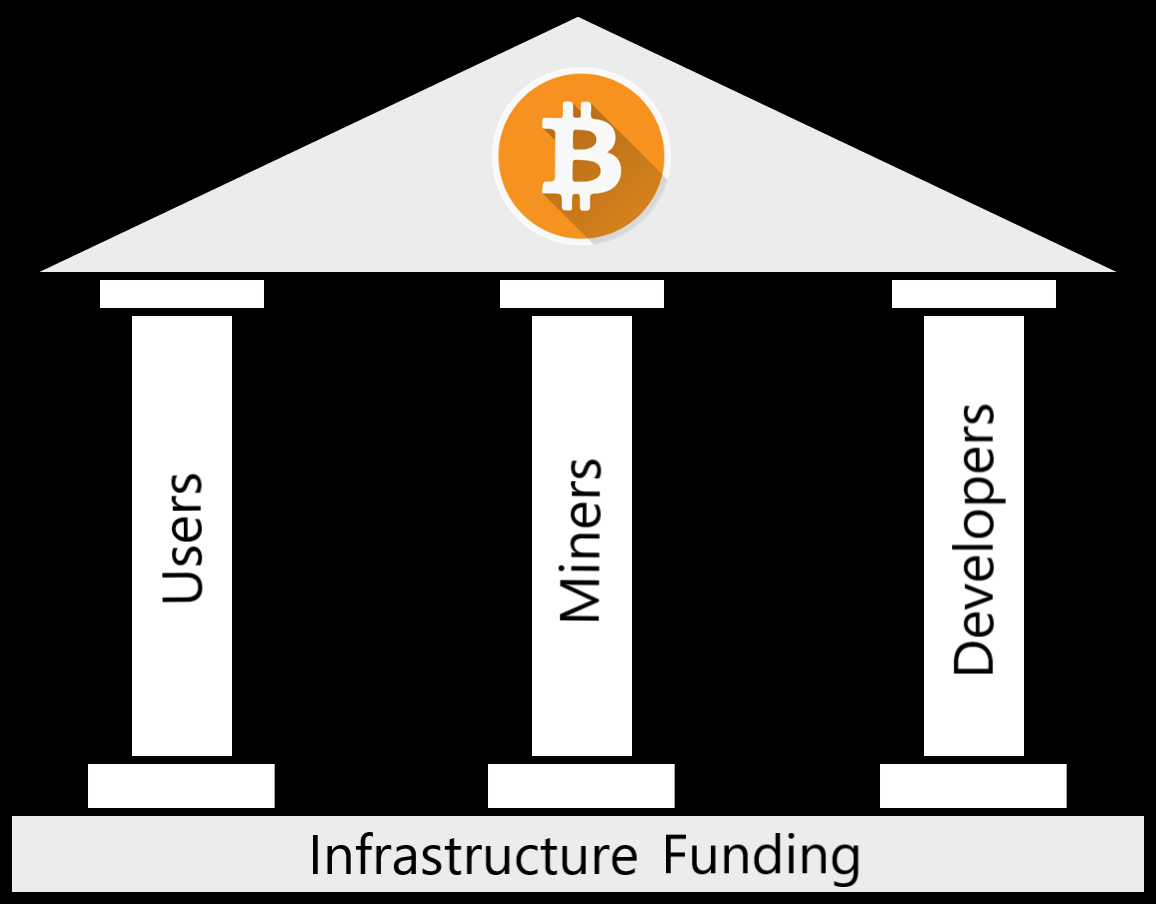
For the first time ever, Developers can now develop their favourite crypto project with love and passion, and form the three Pillar of the Bitcoin eco-system governed by GNC, a foundation for future growth and adoptions, addressing many fundamental issues in the past.
Will a small but nimble team under strong leadership be able to achieve their dream? With a strong foundation, they might have a shot.
Link to the developers' website:
https://www.bitcoinabc.org/
https://t.me/joinchat/HCYr50mxRWjA2uLqii-psw
A billion dollar development funding market
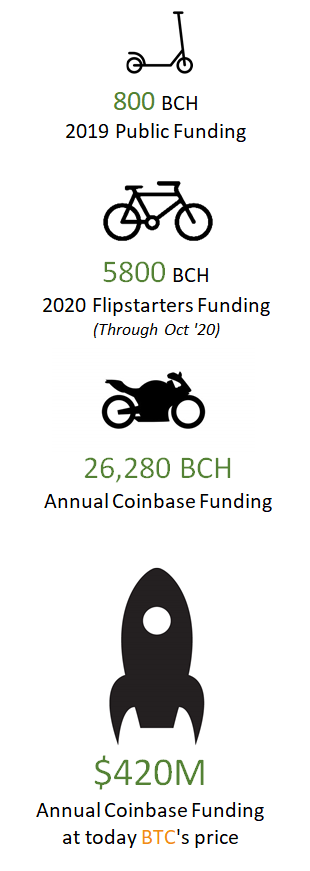
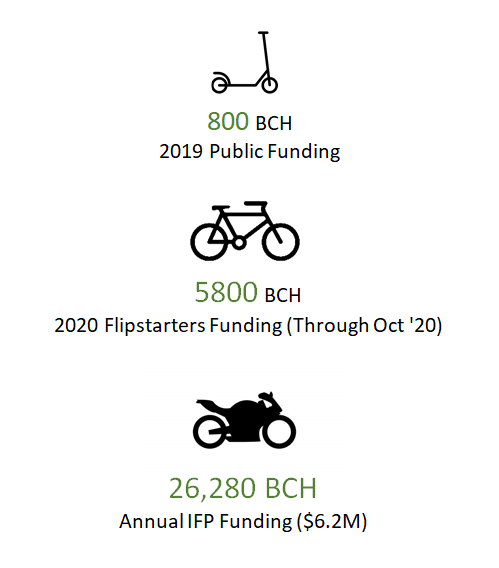
At the current BTC's price, the #Coinbase #funding would worth **$420M if it overtake BTC**! That is **290X** more than all Flipstarters funding (through Oct). https://twitter.com/hashtag/Coinbase?src=hashtag_click https://twitter.com/hashtag/funding?src=hashtag_click
Don't risk your living condition by living off donations. Join the movement today!
Just by:
Use the coin
Join the team
Spread the words.
Like or Retweet to support the developers:
https://twitter.com/nghiacc/status/1327831024579997698?s=20
Support for Developers to BUIDL
As a developer, do you want to work in an environment with full of stress, threats and no stable income? Come support for developers to #BUIDL in peace via #Coinbase #funding by:
- Use the coin
- Join the team
- Spread the words.
It is coming today November 15th!
Retweet or like if you want to contribute to their struggle immediately:
https://twitter.com/nghiacc/status/1327745878132625408?s=19
Coinbase funding empowers users
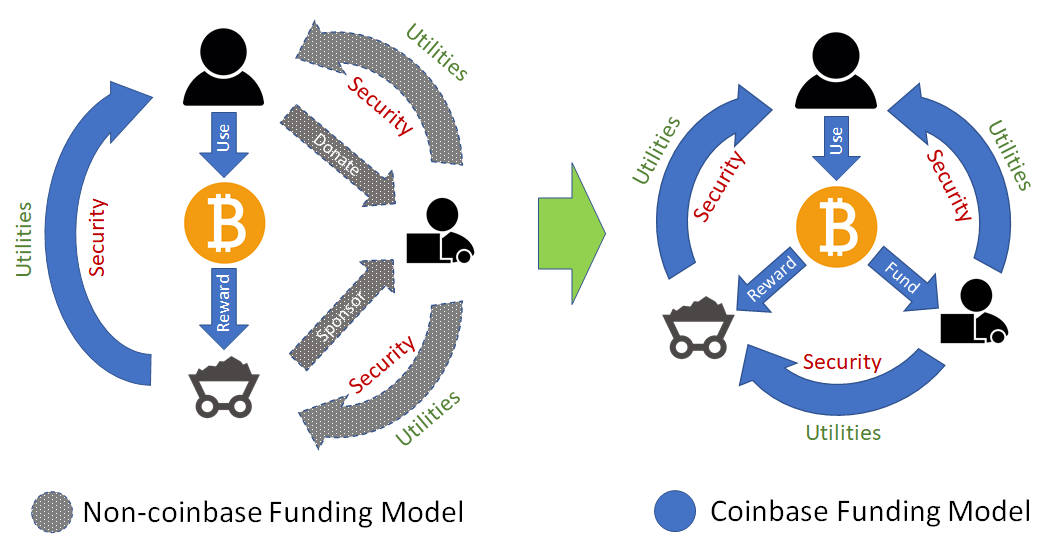
With coinbase funding, **Users** will have much more power in the network. By just "**Use**" the coins, HODLing or spending, users are **rewarding** and **funding** Miners and Developers via coinbase and transaction fee. They get reliable and lasting security and utilities in return.
More over, they have a voice in GNC to decide how the fund is distributed via careful review and selection of BCH projects.
Coinbase funding vs Flipstarter
Did you know that #BCH coinbase funding is **4.5X** more than 2020 Flipstarter (Through October), and a whopping **33X** more than all 2019 public funding?
The funding is stable, predictable, and payout to developers and Global Network Council every 10 minutes for infrastructure and development funding. It will help liberate the developers to commit and innovate to bring reliable and lasting security and utilities to Bitcoin, hence creates both SoV and MoE for the P2P electronic cash.
Store of Value
Where do you trust to store your wealth for next generations?
- A chain that does not pay its developers
- A chain that has stable and gradual income for its developers?
#Coinbase #funding ensures reliable and lasting SoV for your wealth, while also offers best MoE. https://t.co/TTY5zcP7JE
Miners' participation in GNC
Did you know that all SHA256 miners will be contributing to #BCH #Coinbase #Funding, whether they mine BCH or not? All miners have similar ratio of profit due to switch mining. Only BCH miners have access to **4% #Coinbase** fund via Global Network Council.
Come to mine for BCHA for a voice in Global Network Council!
Like or Retweet to support developers: https://t.co/5P8SJ3Qjby
More information:
**Bitcoin Funding Models - Non-coinbase vs Coinbase** https://read.cash/@nghiacc/bitcoin-funding-models-voluntary-vs-coinbase-00ebd3b2
**The Three Founding Pillars of Bitcoin** https://read.cash/@nghiacc/the-three-founding-pillars-of-bitcoin-cash-471ed0ed
**Coinbase Funding Mining Impact** https://read.cash/@nghiacc/coinbase-funding-mining-impact-7cb91396
**Bitcoin Cash November 15th Network Upgrade - What price is right** https://read.cash/@nghiacc/bitcoin-cash-november-15th-upgrade-what-price-is-right-63657fcd
Bitcoin Funding Models - Non-coinbase vs Coinbase
Further reading:
The Three Founding Pillars of Bitcoin https://read.cash/@nghiacc/the-three-founding-pillars-of-bitcoin-cash-471ed0ed
Coinbase Funding Mining Impact https://read.cash/@nghiacc/coinbase-funding-mining-impact-7cb91396
Bitcoin Cash November 15th Network Upgrade - What price is right https://read.cash/@nghiacc/bitcoin-cash-november-15th-upgrade-what-price-is-right-63657fcd
Johnny’s Bitcoin Cash Rant https://read.cash/@jbcache/johnnys-bitcoin-cash-rant-ec52be51
The Three Founding Pillars of Bitcoin Cash
Come support for Developers!
Further reading:
**Bitcoin Funding Models - Voluntary vs Coinbase** https://read.cash/@nghiacc/bitcoin-funding-models-voluntary-vs-coinbase-00ebd3b2
**Coinbase Funding Mining Impact** https://read.cash/@nghiacc/coinbase-funding-mining-impact-7cb91396
**Bitcoin Cash November 15th Network Upgrade - What price is right** https://read.cash/@nghiacc/bitcoin-cash-november-15th-upgrade-what-price-is-right-63657fcd
Coinbase funding- Mining Impact
*Notes: The numbers may vary depending on the market price of the coins.*
*Inspired by the analysis from* *BitcoinBCH* https://read.cash/@BitcoinBCH/new-bitcoin-cash-bch-coinbase-rule-only-0122-for-bullish-gains-and-security-7d847961
Further reading:
**Bitcoin Funding Models - Voluntary vs Coinbase** https://read.cash/@nghiacc/bitcoin-funding-models-voluntary-vs-coinbase-00ebd3b2
**The Three Founding Pillars of Bitcoin** https://read.cash/@nghiacc/the-three-founding-pillars-of-bitcoin-cash-471ed0ed
**Bitcoin Cash November 15th Network Upgrade - What price is right** https://read.cash/@nghiacc/bitcoin-cash-november-15th-upgrade-what-price-is-right-63657fcd
Bitcoin Cash November 15th Upgrade - What price is right?
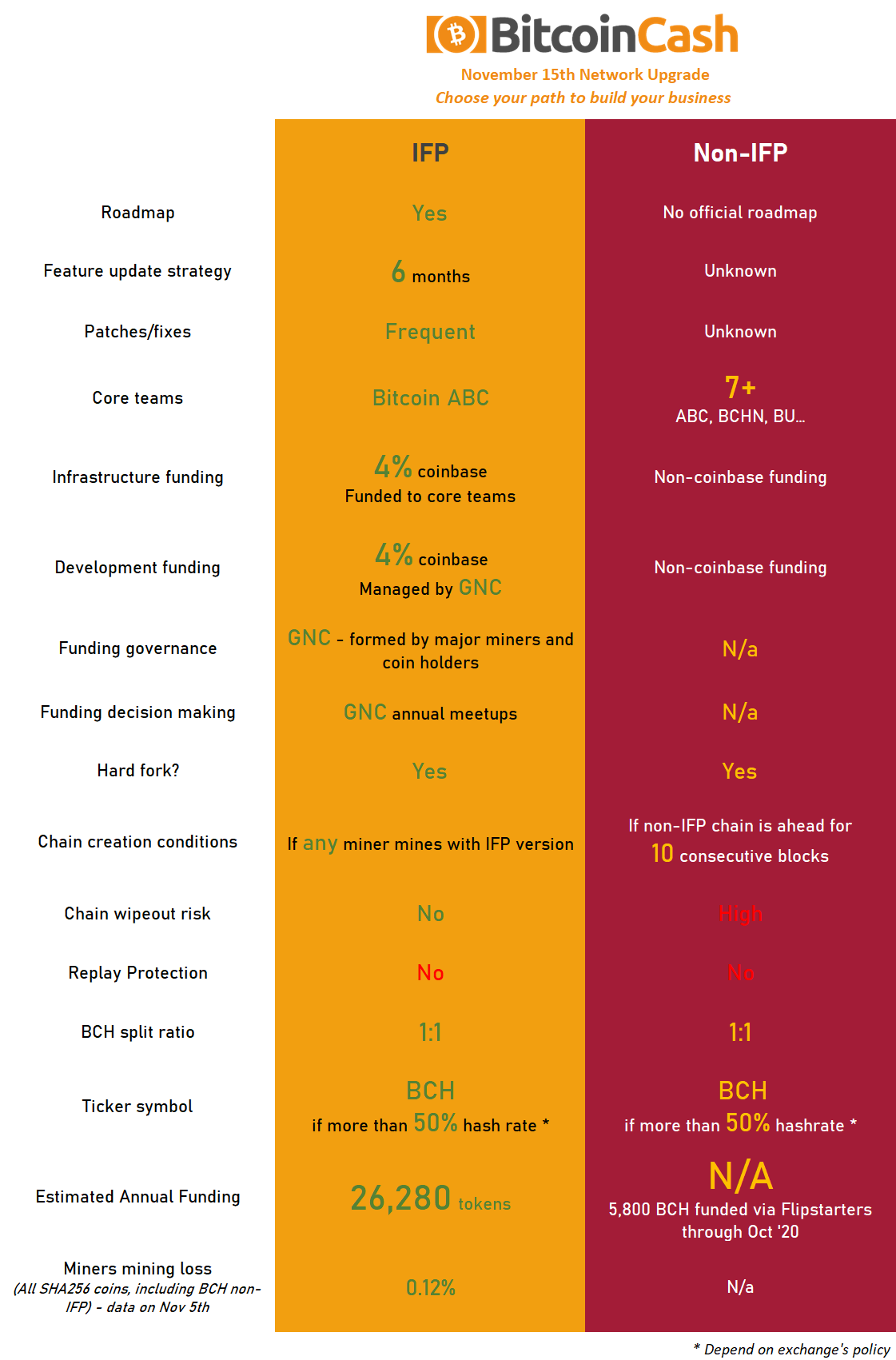
To help businesses understand the facts on the possibility of chain split on November 15th, I am collecting the information from both sides of the split, so that businesses can gauge the price ratio and make informed decision on which coin to invest and build their business on, and which price is right. Here is the summary:
*Notes: IFP chain will always be created on November 15th even if they do not get majority hashrate. Non-IFP chain will only be created if they are ahead of IFP chain for 10 blocks, or manually split by each individual node operators. In either case, the original chain will be abandoned. One chain will retain the BCH ticker symbol depending on exchange's policy, most likely will be based on hashrate. Do check with your exchange if and how they support the split.*
***Risks:***
***If no chain split, then Non-IFP nodes will follow IFP chain, and IFP chain will claim BCH ticker***
***Non-IFP chain, even after creation, may experience the wipeout issue (Which the node will point to the longer chain), especially for node implementations other than ABC (Non-IFP) and BCHN. New nodes or rebooted nodes will also experiencing the wipeout issue. Expected to have a patch soon after the split to prevent the issue.***
***No replay protection has been added to both IFP and non-IFP. I am checking if the replay protection will be added in the future to avoid the transactions will be broadcast to both network and will update the article once I have the informatoin.***
If you find anything is incorrect or any critical information is missed out, kindly let me know. This is just some simple facts about both proposal, please do check each implementation capability, credibility and other factors to determine your investment strategy.
**Don't trust, verify**:
**Bitcoin Funding Models - Non-coinbase vs Coinbase** https://read.cash/@nghiacc/bitcoin-funding-models-voluntary-vs-coinbase-00ebd3b2
**The Three Founding Pillars of Bitcoin** https://read.cash/@nghiacc/the-three-founding-pillars-of-bitcoin-cash-471ed0ed
**Coinbase Funding Mining Impact** https://read.cash/@nghiacc/coinbase-funding-mining-impact-7cb91396
**Bitcoin Cash November 15th Network Upgrade - What price is right** https://read.cash/@nghiacc/bitcoin-cash-november-15th-upgrade-what-price-is-right-63657fcd
https://blog.bitcoinabc.org/2020/11/06/bitcoin-abc-will-support-both-bcha-and-bchn-after-the-chain-split/
https://blog.bitcoinabc.org/2020/09/14/preparing-businesses-for-a-successful-network-upgrade/
https://upgradespecs.bitcoincashnode.org/2020-11-15-upgrade/
*Edit: Updated the infographic with chain wipeout risk.*
*Edit 2: Updated with some feedbacks on Non-IFP chain wrt governance and funding and lead developer.*
*Edit 3: Updated after ABC's announcements on supporting for Non-IFP chain.*

If donation model is working, BCH should ask all miners to mine BCH for donation. All coinbase reward should be redistributed to community and the community will reward for whichever miners they like.
Coinbase's Crypto Community Fund vs Flipstarters vs IFP
Recently, Coinbased has just announced its Crypto Community Fund (CCF) to solve the fundraising issues.
https://twitter.com/coinbase/status/1316801517983334401?s=20
This is somewhat similar to the Flipstarters. Candidates will present the idea or capability to the sponsors to get funded. There are some differences between the two models, especially on how the fund will be distributed and how the performance will be measured for payout. The CCF will surely be more structured and organised, where the candidates will have to meet some conditions in order to get the payout, etc... However one thing for sure is that there will be influences from Coinbase to the developers, that may do things in favour for Coinbase. And there is still the free rider problem. Those are the shortcomings for community fund, such as CCF, and even for Flipstarters.
With now the CCF is in the picture though, more and more investment will flow into the development of BTC. With its vast resources, BTC will eventually attract majority of talents from crypto space. That sure will impact BCH as well. For the same amount of effort, BTC developers will likely to be paid more than BCH or other crypto. Likewise, the same amount of cost paid to BTC developers will likely to gain more value for the network due to its relative value. So we can clearly see where the talents will be going for.
Now with the IFP, it will address the free rider problem, but it will also take away from the hash of all SHA256 network, including BTC, to fund for BCH development. And because of the coupling of BCH price and the rewards, IFP's grants will do things that benefit the whole network to drive the price high, instead of dump and pump, or for any specific group's benefits. Seems like it is the way to go, until BTC also have the IFP on their way. Can't wait until November comes.

If you don't pay for contents, what do you get? Ad.
If you don't pay for developers, what do you get? #Sushi!
With LTC and now SUSHI, it is proven that developers without long-term commitments can only do harms to the network. Similarly, it is the reason for LN on BTC, which led to BCH split. Without addressing the funding issues, it is like building sand castles.
Hi - I got a problem with my payout transaction. Today I got a payout from read.cash, but there is no transaction to my wallet. The transaction id is: https://explorer.bitcoin.com/bch/tx/ec750e7ebc80ce7f4a8b4ffe770e3e0161aeb9608fcd69e79ec764867714271d
Can you take a look if any issue? It is just a small amount so don't bother much, but it maybe a system-wide bug which maybe more concerning... Let me know if this is not the right place for asking for support.
Bitcoin Development Incentive
In my previous article , I explored ways for developers to participate and contribute to Bitcoin node development. Do it right, we can attract diversified and talented developers with different starting point, skills, experience, reputation and objectives to participate fairly and cooperate closely for the development of the whole eco system and reduce the chance of network splits. https://read.cash/@nghiacc/coinbase-reward-split-linux-vs-windows-a76dfde7%20,
In this article, I will delve a bit further on why this can be a sound alternative for the current funding models and the coming IFP along with shortcomings of this approach.
**Network split: Miners or Developers or Community?**
For simplification, I would classify Bitcoin stakeholders into 3 main categories: Miners, Developers and Community. The first two are relatively simple to understand; "Community" is anyone that are not in the first two but have some influence to the network or be impacted by the network's changes. They can be users, investors, traders, holders, app developers around the protocol, or simply outsiders who just watch or have conflicting interest with BCH network. A person or group can be both Miners, Developers and Community.
According to Nakamoto consensus, it is the miners who keep the network secure and determine which chain is a longest chain, hence the winning chain, in the event of hard fork. The assumption is that after "hash war", the miners on the lesser chain will give up and move on to the longest chain for security and benefits. As it turns out, the miners will keep mining any chain as long as they still have value, that means is still profitable to mine, as witnessed with BCH, BTG, and recently BSV. So actually it is not the miners who decide on which chain will win and survive and the other will become obsolete. It is not that black and white. Yes the miners will determine which chain will retain the ticker symbol, but in the end, it is the community who decide if the minority chain will still be alive by continue supporting the lesser chain. In pure terms, hardforks will encourage innovations and radical improvements, meanwhile, splits will deteriorate both networks, causing incompatible apps and services, awkward and confusing user experience, damaged public image and on-going infighting between divided communities.
**Developers caused the split?**
Some may say it is not the community who causes the split, but rather the developers who develop incompatible changes. This is where it is getting interesting. Actually the developers so far have no direct incentive from developing and maintaining the node software. All coinbase rewards and transaction fees go to the miners. The users have the benefits of network security and features, and the investors are rewarded (or punished) by the market values.
Ironically, the developers who spends effort to develop and maintain the software has zero direct incentive from the system. Here I meant developers, not investors and I assume they are two different stakeholders, but very often developers also hold the coins. However they are two very different things. So how can the developers earn benefits, assuming they do not hold or trade? As many have pointed out, so far it works by having donations from community and miners, or simply the developers just work for fun.
The point here is that, developers are under influence of community and miners, and they will develop whichever software the community and miners will give back to them the most, regardless of whether the implementation will benefit the whole network, nor do they have any intention to avoid network split.
In the end, it is their fight to win the community and the miners, not to maintain the network. Having said that, I am not ruling out some good will developers who is putting the network security on top and working with their passion, however they are not the one who decide a split. It is the community who still support, believe, invest and hold the value of the lesser chain that cause the split. Looking at the split events of BTC/BCH and BSV, we can see it is the forces behind the developers which caused the splits. Not the developers, not the miners. As long as the lesser chain has no value, the miners will abandon it, and the developers will also abandon it. And it never happens yet.
**Bitcoin is just a piece of software**
Nobody deny the importance of node developers in Bitcoin. It is one of the most sophisticated software ever developed. The developers will also need to ensure the quality because of the value of the network and the confidentiality of transactions which give Bitcoin values, they will also need to maintain and upgrade development infrastructure, including hardware, software, internet access bandwidth, etc... Miners rely on the software to earn millions a day. In fact, Bitcoin is simply just a software. People with a computer can participate in the network and mine for reward at least in early days. Eventually it also becomes a hardware business with the invention of ASIC machines, however at its core, it is simply just a piece of software.
In that sense, the role of Bitcoin's node developers are quite undervalued so far, they have no direct incentive from the system they help developed and maintained. However, most of them have been happily putting hours of work to keep the system running. I have come to appreciate all those developers who give all they can to keep the revolution goes on.
On another hand, with Bitcoin is supposed to revolutionize the financial world on how the people will transfer values, make payments, or simply hold as a store of value, it is really a strange position that developers are still treated using the funding methods of the open source world, where developers raise fund via public or private donations, or private funding agreement with miners or other stakeholders. There are good things with that approach, and it has been proven working for Linux. However, **what if we have a direct way to incentivise the developers on chain?**
**Bitcoin is based on PoW**
With the invention of Bitcoin, Satoshi Nakamoto solved the problems to incentivise miners who provide PoW to keep the system secure and process transactions for users. Bitcoin also provide a secure ways for its users to transact or store values with its supply cap. What about the developers who put hours of **work** to the Bitcoin software? That is essentially Work, proven by hundreds of thousand lines of code written, proven by the quality, security and reliability of the software that has been running with zero failure since day one. They deserve to be rewarded fairly based on their work.
So if there is a way to provide incentive to the developers directly on-chain, that will make the system stay true to the PoW philosophy, that everyone got paid for their work, and in doing so, encourage more talented developers to join the development.
**On-chain development incentive**
More details have been provided in my previous article, here just a summary of how on-chain development incentive will work:
There is no conflicts between developers who want to charge for a fee and developers who want to contribute freely
The coinbase reward will have an option for developers to ask for a fee, it can be from zero to an agreeable maximum ratio (e.g. 10%)
Developers can compete fairly depending on their own goal (money, market or simply just credits). Some may do for free, some may ask for a small fee, some can ask for a premium
A fair and healthy system will encourage all developers to remain and compete for the end goal to keep up with the roadmap for scalability and most importantly for stability, and have incentive to avoid split
This is not another IFP, the fee will go directly to the developers for using the node software without a whitelist or a IFP governance. The fee will be completely of developers' control for the expenditure in software development and maintenance.
**Development incentive vs IFP**
One key element of the development incentive, is that it is not a IFP with a centralised governance. I don't think marry a decentralised, PoW based system like Bitcoin with a centralised governance is will play out well, especially for the PoW philosophy, where the work is rewarded and there is no trust among the parties. What has the governance done to receive the reward? Why do we need to trust them? **PoW don't base on trust or future commitments. It is just Work!**
There are PoS systems for such a need. Having PoW system with a centralised governance is like having the worst of both worlds - the inefficiencies of PoW and the centralisation of the PoS. We should rather go with one way or another.
With development incentive go straight to developers' wallet, as long as the developers still contribute to the network, they are rewarded. The day they have no contribution, there will be someone taking over and change the software, and the incentive will be redirected to the new developers. The incentive is totally of developers' use for their expenditure and future investment, and for maintaining their development resources and infrastructure. It works similarly to the miners' reward, anonymously without any financial bonding and commitment, but in fact there are quite a strong bonding in term of existing and future investment in resources and infrastructure, as well as software development know-how.
Another key difference to the IPF is that the reward split is not at protocol level, developers can set it in the code so that part of the rewards will go to their wallet without a whitelist of approved addresses and at any ratio developers deem necessary. By doing so, it will level playing fields for new developers who want to get into the game. Having a whitelist of developers’ wallet or a fixed fee will only benefit the established developers and prevent new comers, lowering the network ability to attract talents. Why a miner would want to use a new node software if they have to pay the same with the existing ones? It is very difficult unless the new software offer much greater features and quality, which mean higher cost of entry.
So what if greedy miners don’t want to pay the developers and instead modify the software to redirect the fee to their own wallet? In software development, effort for changing the code is just a small part of the total cost, it is the overall software quality assurance which takes the most effort. In fact, the developers may develop their own quality test suites and development methodology which is not necessary open sources to ensure rapid development.
By having the flexibility, there will be many developers join the market, providing different quality and extra features with different fee rates. They compete for the incentive to drive the innovation, user experience, features and quality to new highs.
Leaders and Challengers
There will be two main developers' classes:
**Leaders**
Leaders are the one who are always first, deliver the best quality, reliability and innovation, leading the network to compete with other networks and stay relevant in the crypto landscape. They are also the first to provide hotfixes on security issues or solve the network issues. In return, they always charge for a premium, for all their investment and development team. However the big miners are willing to pay for the Leaders because of the features, credibility and reliability of the software.
**Challengers**
Challengers are developers who do not have as much resources and reputation as the Leaders, however they can compete for some niches or at lower segments of the market where cost is a primary concern. Some examples such as integration with certain exchanges, specific reporting, etc... The miners themself may also fund for their own development team help diversify the market to retain or even earn some extra reward.
**Small entrance cost for new developers**
With the nature of Bitcoin software as open source, there is very small entrance cost for new developers. Anyone can easily fork from the main code base to build a new software and add features into it. The formation of BCHN in just a few month time is an example, similar with the BSV node implementation in the BSV split. So the Leaders will have to evolve constantly to stay relevant to fence off the competitions from the Challengers, or at least keep them at bay. With the competitions between Leaders and Challengers, the whole network will benefit with added features, better quality and reliability, in the meanwhile drive down the incentive rate. There will be a wide range of options for miners and users to choose from with ever enhancing user experience.
**Development incentive vs fund raising programs**
As mentioned earlier, the current incentive models put developers under huge pressure and influence from miners and community. Network unify is not at their stake, and they can develop conflicting code as long as they gain more money. And it causes unhealthy competition, whoever has greater social skills will likely to win over the skilled developers who do not communicate well. I do not mean to play down the importance of public communication, however there are a lot more effort putting in social engineering to the public crowd who does not have full understand of technology.
And since all incentive come from off-chain donation or support, the incentive does not link to performance at all (or Work in the PoW system). The less developers in the space, the more money developers can ask for, regardless of features or quality of the software. So most often, developers compete by introducing conflicting changes to drive out other developers instead of competing for work and services based on aligned and collaborated roadmap. It is less PoW based, but more social based. **Crowd is always divisive and community funding development will almost always lead to network split.**
With direct, on-chain PoW incentive, developers will now have their skin in game directly. The more they fragment the network, the less they will benefit. No developers want to develop for fragmented systems. Developers will have to collaborate, while still in fierce competition, to keep the whole system unified. Once the network split, they will have to either abandon one of the systems or split their resources to maintain both, that means less profit. They would rather to service one big eco system than multiple smaller ones. In previous splits where developers introduced conflicting changes, developers may even have more money from off-chain incentives. They didn't have much benefit of staying unified or even can be sued for avoiding network split. **Developers will have to collaborate to avoid network fragmentation.**
There are still cases where the conflict of interest will cause developers to develop conflicting changes and part away to stay with their vision. The thing is, with their reward at stake, they would seriously look for ways to avoid fragmentation and unnecessary splits.
Having said that, there are also developers who have great social skills will be privately or publicly funded via fund raising programs while still earn through on chain reward. In the end it will create variety and diversifications to the system and hence more competition. In fact, the voluntary donation system will still be quite relevant and will play an important role in keeping the system more balanced. More on this shortly.
**Three Pillars of the Bitcoin ecosystem**
There are still risks with this development incentive model where the Leaders will have a lot more resources than the Challengers, which may create centralised development and monopoly. This is where Miners and Community roles will play to prevent the centralization of development. Miners may defer aggressive roadmap and prefer more stable ones so Challengers can catch up and provide cheaper alternatives. Community can vote with their wallets if their security is at risk due to the centralization. In fact, given the open source nature of node software, it is very hard for the Leaders to maintain the lead, let a lone become monopoly. Other developers will just simply fork the software and offer cheaper fee, so without the constant innovations, there is no way for the Leaders to ask for premium incentive. Once the protocol is stablized without any new development, the incentive rate is expected to be lower. Less Work less reward!
**Centralization threat**
The real threat comes from the centralization of mining, bigger miners may control the development so they don’t have to split the reward, while still collect fees from smaller miners who use their software. This has been an inherent issue with the PoW system, and by collecting a fee will further favor bigger miners. However as the fee is not part of protocol level, the smaller miners can choose to mine using free or cheaper alternatives. This is the reason why protocol level fee as proposed by various IFPs will further centralise the system. Here is where the community will play a big role to prevent such a thing, and the donation system will still work along with the development incentive to support Challengers to compete with the Leaders. However, the advantages seem to be far worth the challenges, most importantly, in Bitcoin, **Work will be rewarded**.
On another hand, development incentive will encourage miners to invest back to the development if it is a viable incentive for them, as opposed to the “free” model, where free riders will pay nothing and have the same benefits. They will need to look for alternatives or pay for first class software and services.
Doing it right, there will be **three foundational pillars** - **Miners, Community and Developers**, all have equal but different and significant roles in the network, no one should be able to dominate and rule.
**Summary**:
On-chain development incentive will provide a fair reward to developers' role in the Bitcoin system, based on PoW, encouraging healthy competition
Development incentive will make the Leaders to be innovative, leading the technological curve and competing with other chains, while the Challengers will drive the cost down and provides alternative options for miners and users, enriching user experience
Developers will need to collaborate more to keep the system from fragmentation, minimizing network splits
Again, this is not another IFP. The incentive is given to developers at their own use similar to the rewards to miners for their past work, anonymously without any bonding or commitment. The bonding is with existing and future investment and software know-how
There will be **three foundational pillars** - **Miners, Community and Developers**, all have equal but different and significant roles in the network, no one should be able to dominate and rule.
Bitcoin is still an experiment, many things have worked very well, many things haven’t worked as good. Network split is one of them. This approach may or may not work or I may over-simplify something so appreciate comments. However I believe any chain that put developers at the forefront, as one of the core pillars in the system, together with Miners and Community, will eventually win the game. The crypto space is still in its infantry. Let's our developers to do their best, connect the dots between technologies and the (future) market, maximise the benefits of miners and users, and on the way, change the world!

Coinbase Reward Split: Linux vs Windows?
With the recent announcement from ABC for their plan to split the coinbase reward as a fee for using their node software, I found it is quite a debatable approach that needs further discussion and exploration.
Maintaining a node software is not a simple task, it requires a lot of work for coding, testing and quality assurance to ensure smooth and reliable mining operations. Anyone who works in financial sector know how critical it is for developing software for financial institutions. Here the miners use the software to earn million dollars everyday. A glitch in the software can cause huge lost in revenue and a big crash in the market price as well. And this is just part of the story. With Bitcoin Cash and its roadmap, the developers are in constant stress to adhere to the deadline to upgrade every 6 months. While I do not quite like that aggressive roadmap, I do understand how much pressure for the developers to keep up with the timeline.
Having said that, there are many ways of getting funded for the cost. It can be from the fund raising programs with proposal and marketing effort, to privately funded via some affiliate contracts, or can be via holding and trading the coin itself... These have been what the developers in crypto currencies have been doing so far and I think they are **viable options**. In fact, these approaches have been working very well for the open source world for decades.
However, with the invention of Bitcoin and the crypto currency world, we now have a revolutionary way for financing stakeholders with direct and instant payment. That what crypto currency is meant to be. Take miners' reward for example, that is quite revolutionary, isn't?
So thinking of the node software implementation cost needs to pay back to the developers someway or another, why not makes it obvious and transparent? The miners who keep the network secured and proceed the transactions got the coinbase reward and transaction fees directly on chain. What about the developers who developed the software to keep the network secured and help the miners proceed the transactions and find block reward? **Why they cannot be paid directly on chain**?
Now, let's look into ABC's plan. They propose to redirect x% of coinbase reward to developer's address. While I am not saying it is fair, it is what the developers deemed fair to them for anyone to use their software. So let's respect it. However, I don't think it is a conflicting change either with other developers who doesn't want to pose a fee. There is no additional coins generated for the fee, it is just part of the coinbase reward. Previously the miners can determine to redirect the coinbase to what ever addresses they want, and now part of the coinbase will go into developer's wallet. Yes it may cause a network effect and make the coinbase reward less attractive and hence less network secure. However, that is how the whole eco system works, oneway or another, the cost of node implementation will have to be absorbed, either by direct or indirect payments from miners, users, privately funded or any other goodwills.
Let's look into the **big picture** instead. The plan is one way to make the payment more direct and transparent, taking advantage of Bitcoin as "a currency". And this will also make the node software development more competitive. By having an **option** for splitting the reward to developers, it opens up a whole new opportunity for anyone who wants to join the implementation. On one hand, we have some amateur developers just want to work for fun, they can contribute to an open node software without a pay. We also have some developers who are well funded, and willing to compete for free. On another hand, we have other developers who has a plan and commitment to compete commercially by asking for a fee. Implemented well, there shouldn't be any conflict. At the end of the day, there is always only that many coins generated per block. How the reward is split doesn't matter. Developers who don't want to collect a fee can allow the miners to redirect all the coinbase reward to the miners themselves. Others can charge a smaller fee, others may ask for higher, a premium. In the end, it is the miners who choose which software to mine, as long as it satisfies their requirements, it can be of cost, quality or reliability, or just simply they like a specific developer's software... And the developers can play to their advantages: some have free time can contribute freely to learn and to get credits, some are well funded and have good marketing can compete for market share, some have good branding and reputation can charge for premium. The miners themselves can also fund their own development team to avoid the fee.
While it is not entirely the same, in some ways, this mimics the competition between open source and proprietary software, Linux vs Windows, Libre Office vs MS Office, etc... In the end, the users will win with superior software and a rich options to choose from, whether pay for or free software. It is a win-win-win solution for miners, users and developers. This also eliminates the middle man of the previous IFP, the money will go directly to the developers as "pay as you go", quite simple, without a centralised entity. Of course this will leave non-node software developers from adequately funded, however once the whole system has a a strong and stable infrastructure with health competition and cooperation, it will actually benefits and encourages other developers to develop apps and utilities for the system. Leaving this unsolved will lead to split again in the future, regardless of whether ABC still stay with BCH (or another way around). There eventually will be another ABC, from our past experience, whether they were Bitcoin Core, SV.... **Unstable and unhealthy systems will not be attractive to developers and users.**
So, let's the power of money drives the system development and stability instead of causing conflicts, uncertainty and instability. The BCH world is big enough to house everyone. Anyone can contribute to the BCH eco system, whether amateur, freelance developers, privately funded ones or well established developers. All should have a place to compete fairly for the stability and scalability of the system. Miners and users can come and go, there is little cost for them to switch systems. Losing a single developer will cause a lot of damage! If we have fair rules to keep developers stay within the system and compete fairly, altogether for the end goals, eventually miners, users and **more developers** will come. It will be a win-win-win!
(Edit) This is not to fund for a centralised funding governance, but rather a direct payment to the node software developers themselves for the use of the software. The node software may hard code the fee so that portion of the coinbase reward will go to the developers, so any miners who wish to use the node software will have to pay (or split the reward). It would be possible for the miners to modify the software to avoid the fee, however they will risk of any quality issues related to modifying the code and recompiling it. In software development, the effort for modifying code is usually small compare to effort for testing and verification. They will have to spend a lot of time to test and verify it. There maybe other developers will fork the software and make it free, but will miners trust those forked versions? Also, when the miners run a modified version of node software, they are essentially opt out for future updates for fixes and patches, which may cause damage to their business.
The point is that the fee is just a part of agreement between the developers and miners, not at protocol level. The miners choose a node implementation for which they can afford for, in exchange for the quality assurance and support services.
**Summary**: People is asking whether or not to have a fee built in on chain or not. Why can't we have both?
There is no conflicts between developers who want to charge for a fee and developers who want to contribute freely
The coinbase reward will have an option for developers to ask for a fee, it can be from zero to an agreeable maximum ratio (e.g. 10%)
Developers can compete fairly depending on their own goal (money, market or simply just credits). Some may do for free, some may ask for a small fee, some can ask for a premium
A fair and healthy system will encourage all developers to remain and compete for the end goal to keep up with the roadmap for scalability and most importantly for stability, including avoiding split
This is not another IFP, the fee will go directly to the developers for using the node software without a whitelist or a IFP governance. The fee will be completely of developers' control for the expenditure in software development and maintenance.

Tipping system to BCH developers
Recently I have seen so many responses to the development fund for BCH developers. Don't want to delve too much into the PROS and CONS, perhaps many have already discussed, here I just wanted to provide some alternatives that may or may not work... or perhaps these have already been discussed or implemented, so pls disregard if that is the case.
Let me just go straight to the points:
There would be two tipping mechanisms:
1. Miners' tips:
Here a miner can choose to tip a particular developer, maybe based on the public address used in the BCH node software. The miner can choose to send directly to a specific developer's wallet - the software should be designed in a way that the miner should not send the tip to themself, or let the software choose to a random wallet based on currently active BCH node software
The random should take into account of the number of node currently operated by each developers' software, so the higher the node, the better of chance to receive a tip
The tip's ratio can be set at minimum as compulsory (maybe 1%?) so that it won't hurt much the miner's profitability, but also generate a minimum viable revenue to the developers to cover for development cost. And this is more encouraging the developers to keep providing their service
The miner can also choose to tip a higher ratio at their will and for a specific developer(s) that they support
There is no tertiary org or middle man between the miner's tips and developers whatsoever, the developers can use the tips to do whatever they want, of course to increase the miner's satisfaction and the value of the whole ecosystem and the currency's market values.
2. User's tips:
Similar to the tipping mechanism with the miners, with a few key differences:
The tip is non-mandatory. The user can choose to tip at any amount or nothing at all. Default is NONE, but with a UX that points out the feature so the user can easily choose to tip (maybe a preconfigured of $0.1, $0.5, $1, $2, $5 when sending a transaction?)
The user can also let the software to choose a developer to tip for, or he/she can choose a specific developer to tip
There should be a way for the user to validate the wallet's address of the developers in the wallet vs the published one, so they can ensure the tip goes to the right one
There should be a limit to the tip, e.g. $5, to avoid user's mistakes and cause bad image with the tipping system.
Pls comment if any point is not valid or there should be anything be added.
**Let's small drops of water to make a big wave!**
Cheers

 @nghiacc