The World on a Plane with a Bomb: The Risk of Forced Nuclear Escalation
The world is currently in a high-stakes standoff that can be explained with a chilling metaphor:
**"Imagine the world is an airplane mid-flight. Inside, a passenger is clutching a live bomb. Outside forces are trying to wrestle the bomb away from him by force while the plane is still in the air."**
This is the reality of the U.S.-Iran conflict and the looming nuclear shadow.
**1. The "Bomb" (Nuclear Ambiguity)**
The "bomb" is Iran’s nuclear infrastructure. The danger isn't just a deliberate launch. The true "nightmare scenario" is an **accidental detonation**. If an attacking force (U.S./Israel) strikes what they believe is a conventional drone base or a missile silo, but it secretly houses nuclear material, they might "trip" the bomb they were trying to prevent.
**2. "Wrestling by Force" (The Escalation Trap)**
Using drones or missiles to "neutralize" the threat while the plane (the world) is mid-flight is a gamble with 8 billion lives. A kinetic strike on a nuclear-sensitive site could release a radioactive cloud or trigger a "sympathetic detonation." In trying to take the bomb away by force, we might be the ones who pull the pin.
**3. The "Airplane" (Global Collapse)**
The plane represents our global economy, the Strait of Hormuz, and our collective survival. If the "bomb" goes off—even accidentally—the plane crashes. Oil prices would skyrocket to $200+, global trade would freeze, and radioactive fallout would ignore national borders, affecting even those far from the conflict.
**4. The "Only Way Out" (Strategic De-escalation)**
Trying to snatch a bomb from a desperate person's hand mid-air is a recipe for disaster. The only logical path is to convince the person to **disarm voluntarily** through iron-clad guarantees and diplomacy. We need to stabilize the flight, not cause a mid-air explosion.
**Conclusion:**
We are all passengers on this plane. There is no "winning" a nuclear accident. The goal shouldn't just be to "hit" the target, but to ensure the plane lands safely for everyone.

The Engineering of Diplomacy: Why Arab Nations Choose Strategic Silence Over Conflict
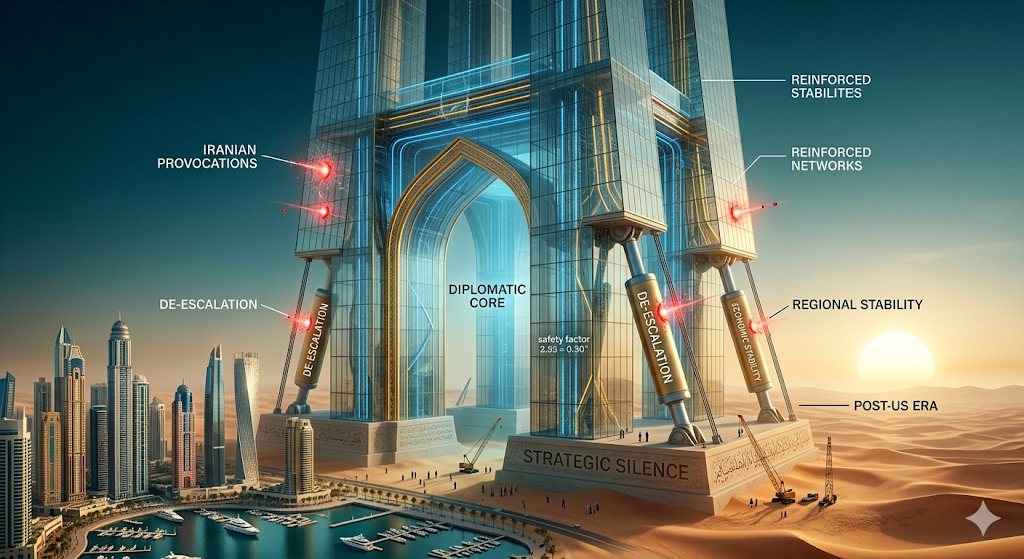
In structural engineering, we are taught that rigidity is often a weakness. In earthquake-prone zones, the most resilient skyscrapers are not those that stand stiff against the tremor, but those designed with **"Base Isolation"** and **"Damping Systems."** They absorb the energy of the shock rather than fighting it head-on.
As I observe the escalating tensions in the Middle East—specifically the restrained reactions of Arab nations despite provocations and strikes linked to Iran—I see a masterclass in **Geopolitical Engineering.** To the untrained eye, restraint looks like weakness. To an engineer, it looks like **Structural Load Management.** Here is the breakdown of this strategic silence:
**1. Protecting the "Economic Skyscraper"**
Cities like Dubai, Riyadh, and Doha are no longer just regional capitals; they are the world’s new financial foundations. Billions of dollars in foreign investment are anchored in these glass-and-steel hubs. A full-scale kinetic war would be the ultimate "Demolition Charge" to decades of growth. These nations have calculated that the **"Cost of Conflict"** is an unacceptable structural failure.
**2. Retrofitting Alliances (The Post-US Shift)**
For decades, the Middle East relied on a single "Support Column"—the United States. Today, that pillar is shifting. In response, Arab nations are "Retrofitting" their foreign policy by diversifying their foundations with China, Russia, and even regional rivals. Silence provides the necessary **"Curing Time"** for these new diplomatic structures to solidify.
**3. The Factor of Safety in De-escalation**
In a neighborhood you cannot move out of, direct confrontation is a design flaw. By choosing diplomacy over retaliation, these nations are increasing their **"Factor of Safety."** They understand that regional stability is a shared infrastructure; if one corner collapses, the entire roof comes down.
**The Conclusion:**
In engineering, silence isn't an absence of activity; it’s the sound of a structure holding its breath under immense pressure. The Arab world isn't just "staying quiet"—they are calculating the most sustainable path for the next generation's prosperity.
The Body as a Structure: Why Maintenance is Better than Repair
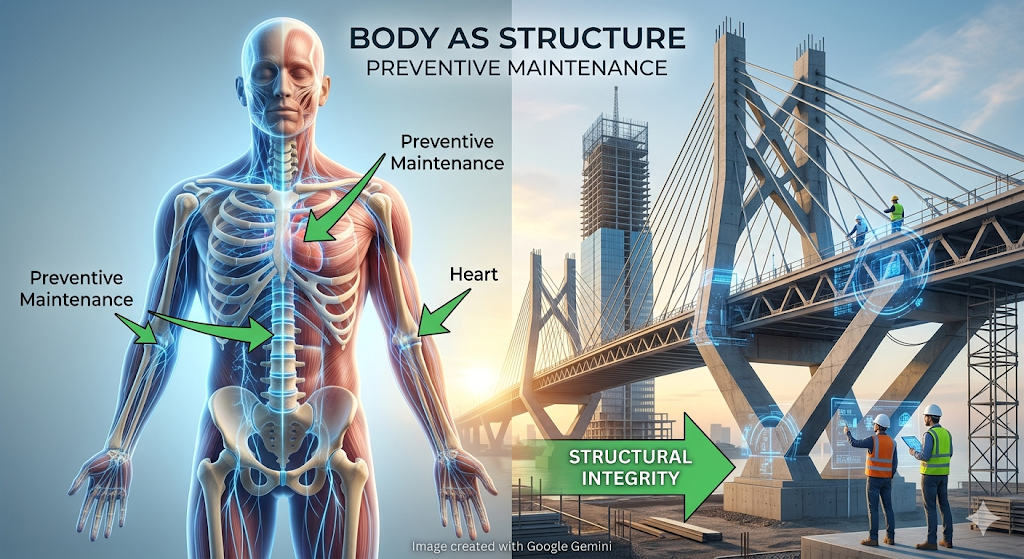
**In civil engineering, we never wait for a bridge to collapse before we inspect it. We use 'Preventive Maintenance' to ensure its integrity. But why do we often treat our bodies differently?"**
As a Civil Engineer, I look at the human body through the lens of structural mechanics. Our bones are the columns, our muscles are the tension cables, and our nervous system is the sophisticated electrical grid that powers everything.
**The Foundation of Health:**
Just as a skyscraper needs a solid foundation, our health relies on three core pillars:
**Structural Fuel (Nutrition):** Poor materials lead to a weak mix. What we eat is the concrete that builds our cells.
**Stress Loading (Movement):** A structure that never carries a load becomes brittle. Controlled physical stress (exercise) strengthens our internal frame.
**The Resting State (Recovery):** Even the strongest steel needs time to cool. Sleep is where our biological maintenance crew does the heavy lifting.
**The Takeaway:**
Whether you are building a dam or building a life, consistency in maintenance is the only way to avoid a total collapse. Don’t wait for a 'crack' in your health to start caring for your structure.
**What is your daily maintenance routine? Let’s discuss in the comments!**
Introducing Semere: A Civil Engineer's Journey into the Digital World
Hello Read.cash community!
My name is Semere, and I am a trained Civil Engineer based in Ethiopia. With experience in both office engineering and site management, I have always been passionate about technical precision and problem-solving.
Beyond the construction site, I am also a content creator, graphic designer, and a firm believer in the power of digital systems. In this space, I will be sharing my expertise on:
**Civil Engineering & Quantity Surveying**
**Mathematics & Calculus Simplified**
**Building Digital Empires and Passive Income Strategies**
My goal is to bridge the gap between technical engineering and digital entrepreneurship. I look forward to connecting with fellow experts and curious minds here.
Thank you for reading and for your support!