The Ghost in Your Pocket: How to Reclaim Your Life from Your Phone (And What’s Coming Next)
It is a familiar, modern ritual. You wake up, and before your eyes can even fully adjust to the morning light, you reach for it. Your thumb scrolls mindlessly through a sea of notifications, emails, and short-form videos.
By the time you look up, twenty minutes have vanished.
Recent data shows that the average person now spends over 5 hours a day glued to their smartphone—translating to roughly 70 to 80 days a year lost to a glass screen. If it feels like your phone is controlling you rather than the other way around, you aren't imagining it. These devices are meticulously engineered to capture your attention and keep it.
But as hard as it is to maintain boundaries today, the landscape is shifting. Technology is about to become even more deeply integrated into our lives. Here is how to regain control of your time now, and a look at the deeply immersive—and potentially eerie—advancements heading our way next.
Part 1: How to Put the Smartphone Back in Its Place
Taking back your life from your device doesn't require going completely off-grid. It requires shifting from passive consumption to active intent. Try implementing these steps to build a healthier relationship with your screen:
1. Change Your Screen to Grayscale
The apps on your phone use psychological triggers to keep you hooked, and bright, vibrant colors (like that little red notification badge) act as a reward mechanism for your brain. By turning your phone’s display to grayscale (black and white) in your accessibility settings, you strip away the visual excitement. Instagram and TikTok suddenly look incredibly boring, breaking the addictive dopamine loop.
2. Establish "No-Phone Zones" and Times
The easiest way to stop checking your phone is to remove the temptation entirely.
The Bedroom: Buy a classic alarm clock and charge your phone in the kitchen overnight. This eliminates late-night scrolling and the immediate morning reach.
The Dinner Table: Make meals a sacred, screen-free space for actual human connection.
3. Deliberately Introduce "Friction"
Phones are designed for convenience, which makes mindless scrolling effortless. Introduce friction to slow yourself down:
Move social media apps off your home screen and into hidden folders.
Log out of your accounts after every session so you have to manually type your password to return.
Turn off all non-human notifications. If a real person didn't send it, it doesn't deserve to interrupt your life.
Part 2: What is Coming Next (The More Intrusive Future)
If you think managing a smartphone is difficult now, the next generation of tech will present entirely new challenges. We are moving away from phones as "tools" we pick up and toward technology that continuously lives with and monitors us.
Incoming Technology What It Does The "Worse" / Dystopian Realities
Multimodal On-Device AI AI that processes live data continuously from your phone's microphone, camera, and background apps. Your device will essentially be "watching" and "listening" to your entire life in real time to predict your needs, eroding the final remnants of privacy.
Emotion Recognition & Mental Health Tracking Biometric sensors and AI that analyze your facial micro-expressions, typing speed, and vocal tones to detect your mood. Algorithms will know exactly when you are vulnerable, lonely, or anxious. Advertisers could exploit these emotional low points to sell you products when your impulse control is lowest.
Invisible & Continuous Authentication Replacing passwords with background tracking of your behavior patterns (how fast you type, your walking gait, your unique tone). While highly secure, it requires your device to maintain a permanent, hyper-detailed behavioral profile of your physical movements.
Environmental & Public Health Sensing Advanced built-in sensors that constantly scan your local air quality, UV radiation, and ambient noise. Hyper-local data tracking could lead to increased baseline anxiety, or potentially be leveraged by insurance companies to adjust premiums based on your daily environmental exposures.
The Psychological Shift: From Tool to Extension
The biggest change over the next few years won't just be flexible or rollable screens; it will be the quiet disappearance of software interfaces. With advanced conversational AI and predictive tech, you won't even need to open apps. The phone will simply tell you what to do, where to go, and what to buy based on its constant surveillance of your environment and body.
Tech companies call this "seamless integration." Critics call it the ultimate capture of human attention.
The Takeaway
The future of technology aims to remove all friction between your mind and the digital world. While that promises unparalleled convenience, it also threatens to strip away our ability to just be—to sit in silence, to daydream, and to engage fully with the physical world around us.
Controlling your phone today isn't just about saving a few hours of time; it is practice for a future where preserving your mental autonomy will be the ultimate challenge. Turn off the screen, look up, and remind yourself what a world without algorithms
The Velocity of Memory: Why Time Speeds Up
The Velocity of Memory: Why Time Speeds Up
Have you ever noticed how the first few days of a new venture feel incredibly long, filled with vivid details and sharp focus, only for the final weeks to vanish in the blink of an eye? It is a universal human experience: time starts out with a slow, deliberate cadence, but accelerates aggressively as we race toward the finish line.
This phenomenon is not just a trick of the mind; it is a direct reflection of how our brains process reality, memory, and routine.
The Brain’s Internal Clock: Novelty vs. Routine
To understand why time shifts gears, we have to look at how the human brain logs information. Our brains are highly efficient machines designed to save energy. When you encounter a brand-new situation—the beginning of a project, a fresh career move, or a new phase of life—your brain enters a state of high alertness. It aggressively records data, mapping out the unfamiliar territory, learning new faces, and adapting to fresh challenges. Because your mind is processing a massive influx of unique information, it creates dense, detailed memories. When you look back at that initial period, it feels long and substantive.
But as time goes on, the unfamiliar becomes predictable.
Once a routine sets in, the brain flips onto autopilot. It stops recording every minute detail because it already knows what happens next. If your days become identical sequences of tasks, meetings, and habits, your brain compresses that data to save cognitive power. When you reach the end of that period and look backward, there are very few distinct "mental milestones" left behind. The middle and the end simply collapse into a brief, singular blur, creating the intense illusion that the clock is ticking twice as fast.
The Countdown Effect
Another major psychological driver is the shift in our mental focus as an ending approaches. At the beginning of a timeline, your mind is rooted firmly in the present moment, focused purely on execution and discovery.
However, as the deadline or the conclusion nears, your perspective shifts from living the time to counting the time. This hyper-awareness of the remaining days or hours creates a psychological pressure cooker. By constantly checking the clock and anticipating the end, you mentally distance yourself from the present, making the remaining moments slip through your fingers even quicker.
How to Stretch the Clock
While you cannot physically slow down the rotation of the Earth, you can absolutely alter your perception of its passage. If you want to put the brakes on a rapidly accelerating timeline, you have to break the autopilot loop.
Inject Micro-Novelty: Introduce small, unexpected changes into your daily structure. Change your working environment, alter the sequence of your daily habits, or tackle a familiar problem from an entirely experimental angle.
Force Active Reflection: Periodically stop to document unique micro-moments. Writing down a specific breakthrough or a distinct conversation creates a permanent anchor in your memory, preventing that day from being swallowed by the routine.
Reset the Focus: When you feel the anxiety of an approaching deadline, consciously pull your attention away from the countdown and place it firmly back onto the immediate task at hand.
Time will always move forward, but by consciously forcing your brain to wake up and log new data, you can stretch the moments you have left and ensure the end doesn't arrive unannounced.
The Power of 15 Minutes: Why a Short Morning Walk Changes Everything
In a world obsessed with intense gym routines, long workout sessions, and complex fitness hacks, we often overlook the simplest solutions. If you want to transform your health, sharpen your focus, and boost your mood, you don’t need hours of spare time. You just need 15 minutes every morning.
Stepping outside for a brief, brisk walk right after you wake up is one of the most powerful habits you can build. Here is how a quarter of an hour can completely reshape your day.
1. It Ignites Your Brain and Focus
When you walk in the morning, you expose your eyes to natural sunlight. This exposure does something incredible: it signals to your brain’s internal clock (the circadian rhythm) that the day has officially begun.
The Cortisol Spike: Natural light triggers a healthy release of cortisol, a hormone that wakes you up and sharpens your mental alertness.
Brain Boosting Circulation: The physical movement increases blood flow to the brain, sweeping away that lingering morning brain fog and replacing it with crisp, clear focus for whatever tasks lie ahead.
2. A Natural Boost to Your Mood
Ever notice how your worries seem a little lighter after a brief walk? Walking releases endorphins—the body's natural "feel-good" chemicals. A 15-minute walk acts as a gentle, natural antidepressant.
Furthermore, being outside in nature, seeing the morning sky, and hearing the world wake up reduces active stress and anxiety. It creates a peaceful buffer zone between waking up and diving into the chaos of emails, work, or daily responsibilities.
3. It Sets the Stage for Deep Sleep Tonight
It sounds ironic, but a great night's sleep actually starts the moment you wake up. By getting natural sunlight into your eyes during your morning walk, you regulate your body's production of melatonin (the sleep hormone).
Your brain counts the hours from that morning light exposure, knowing exactly when to start making you sleepy later that night. If you struggle with insomnia or restless nights, a morning walk is a brilliant, drug-free remedy.
4. Surprisingly Powerful Physical Benefits
Don't let the short duration fool you—15 minutes of daily walking adds up to 105 minutes of cardiovascular exercise a week.
Health Metric What a 15-Minute Morning Walk Does
Metabolism Kicks your digestion and metabolic rate into gear early.
Blood Sugar Helps stabilize glucose levels, lowering the risk of type 2 diabetes.
Heart Health Gently raises your heart rate, strengthening cardiovascular endurance over time.
Joint Mobility Lubricates the knees, hips, and ankles, reducing stiffness.
How to Make It an Effortless Habit
The beauty of a 15-minute walk is that it requires almost zero preparation. You don’t need fancy workout gear or a gym membership.
Leave your phone on "Do Not Disturb": Use this time to connect with your surroundings, think, or practice gratitude, rather than scrolling through news or social media.
Anchor the habit: Tie it to an existing routine. Tell yourself, "As soon as I finish my first glass of water, I put on my shoes and step outside."
Protect the time: 15 minutes is less than 1% of your day. Everyone, no matter how busy, can find 15 minutes to invest in themselves.
The Verdict
You don’t have to climb a mountain or run a marathon to experience the profound benefits of movement. Tomorrow morning, before the digital world demands your attention, step outside. Walk down the street for seven and a half minutes, turn around, and walk back. Your mind, your body, and
your day will thank you for it.

The Squeeze on Our Seasons: What Happens When Winter Loses Its Chill?
6If it feels like your winter clothes are spending way more time tucked away in the back of the closet lately, you aren’t imagining things. The traditional, crisp cycle of four distinct seasons is shifting right before our eyes. Our summers are stretching out, stretching deep into months that used to require a heavy coat, while our winters are steadily shrinking.
But this isn't just about getting a few extra beach days or saving on the heating bill. This seasonal shake-up is quietly throwing a massive wrench into how our planet functions—especially when it comes to the food on our tables.
The Reality of the Shrinking Winter
Climate scientists tracking seasonal lengths over the decades have noted a very clear trend: globally, summers have expanded by nearly three weeks over the last half-century, while winters have contracted. If greenhouse gas emissions continue on their current path, some regions could see summers that swallow up half the calendar year by the end of this century, leaving winter as a brief, fleeting afterthought.
When winter loses its bite, it acts as a thermal amplifier. Summers start from a warmer baseline temperature, making heatwaves more frequent, more intense, and much harder to break.
Why Our Food Needs the Cold
To understand why a warm winter is a problem, you have to look at how nature hits the "reset" button. Many of the crops we rely on every single day—especially fruit and nut trees like apples, cherries, peaches, walnuts, and pistachios—actually need the winter cold to survive and thrive.
Trees use a built-in biological clock to track what scientists call chill hours (time spent in cold temperatures, usually between 0°C and 7°C).
[Cold Winter] --> Smooth Reset --> All Flowers Bloom Together --> Plenty of Fruit
[Warm Winter] --> Confused Tree --> Scattered, Weak Blooming --> Poor Crop Yield
When winter stays mild or gets interrupted by sudden heatwaves, the tree’s internal clock gets completely scrambled. Here is what happens next:
Confused Blooms: Instead of waking up uniformly in the spring, the buds open late, weak, and scattered over several weeks.
Pollination Mismatch: If male and female trees (or different varieties that need to cross-pollinate) get confused and bloom weeks apart, they miss each other entirely, and no fruit forms.
The Frost Trap: A warm winter can trick a tree into thinking spring has arrived early. If the buds open in February and a normal, sudden frost hits a week later, the tender blossoms are destroyed instantly, wiping out an entire harvest overnight.
Our staple grain crops, like winter wheat, also suffer. They require a sustained period of cold to trigger the genetic switch that tells them to grow grain headers instead of just leaves. Without that cold snap, the yield drops drastically.
The Hidden Side Effects
The problems don't stop with the plants themselves. A long, hard winter freeze acts as nature’s natural sanitizer. It keeps pest populations in check and wipes out fungal spores. When winters stay warm, bugs survive the season in massive numbers, waking up early and hungry, which forces farmers to spend more money on chemical pesticides to save their crops.
Furthermore, shrinking winters mean less snow in the mountains. Mountain snowpacks are essentially natural water towers—they store water all winter and melt slowly through the spring and summer to feed our rivers. When winter is cut short, rivers dry up much earlier in the season, leaving major cities and agricultural belts scrambling for water just when the summer heat is at its worst.
A Changing Way of Life: The loss of winter chill is a powerful reminder that climate change isn't just an abstract headline about the future. It is a subtle, structural shift happening right now, quietly rewiring the ecosystems that feed us and keep our world in balance. Keeping our climate stable isn't just about surviving the summer heat; it's about protecting the cold seasons we completely depend on.
The Wealth of Winter and Summer: How to Give Your Kids a Rich Vacation on a Zero Budget
When the school gates close for summer vacation, a collective sigh of relief from children is often met with a wave of anxiety from parents. In today’s hyper-connected world, we are bombarded with images of expensive summer camps, theme park trips, and luxury family travel. The unspoken message is clear: creating a memorable summer requires a significant financial investment.
But here is a truth that child psychologists and experienced parents know well: children do not measure the quality of a vacation by the currency spent. They measure it by the shift in routine, the feeling of freedom, and the quality of connection with the people they love.
If you are operating on a zero budget this summer, you are not depriving your children. In fact, by stripping away commercialized entertainment, you invite them into a world of creativity, resilience, and genuine connection. Here is how to unlock a brilliant summer holiday without spending a dime.
1. The Magic of a "Bent Routine"
Children thrive on routine during the school year, which means the greatest gift of summer is the novelty of breaking it. You don't need a plane ticket to give kids a sense of escape; you just need to alter the environment at home.
The Living Room Campout: Turn off the television, move the couch cushions to the floor, and drape bedsheets over chairs to build a massive family fortress. Sleep on the floor together, use flashlights to navigate the "campsite," and tell stories in the dark.
The "Backwards Day" Tradition: Pick one day a week where the household rules turn upside down. Eat dinner for breakfast, wear clothes inside out, or let the children "assign" homework to the parents. It costs nothing but generates endless laughter.
2. Turn the Home into a Creative Laboratory
When toys and screens are limited, a child's imagination is forced to wake up. Boredom is not the enemy; it is the fertile soil from which creativity grows.
The Cardboard Kingdom: Gather old delivery boxes, plastic bottle caps, and scrap paper. Challenge your children to build a miniature city, a racetrack, or a fully functioning board game with its own rules.
The Kitchen Masterclass: You don’t need special ingredients to make cooking an adventure. Use basic pantry staples like flour, water, and salt to let younger children sculpt salt-dough ornaments, or teach older children the science behind making simple flatbreads.
3. Discover Free Community Spaces
Many of the best educational and recreational resources in our neighborhoods are completely free, yet we often overlook them.
The Public Library Revival: Modern libraries are no longer just quiet rooms for books; they are vibrant community hubs. Most libraries run completely free summer reading clubs, arts and crafts workshops, and storytelling hours. It is also an excellent, air-conditioned escape from the midday summer heat.
Parks with a Purpose: A trip to the local park becomes a grand expedition if you reframe it. Pack a simple lunch from home in a container to make it an official picnic. Before you leave, write down a quick "scavenger hunt" list: find a perfectly round stone, a leaf shaped like a star, and three different bird sounds.
4. Reconnect with the Natural World
Nature does not have an admission fee, and it provides the ultimate sensory experience for growing minds.
Midnight Stargazing: On a clear night, take a blanket up to the roof, balcony, or backyard. Lay down together and look up at the sky. Spotting constellations or simply watching the moon change shapes over the weeks creates a quiet, powerful sense of wonder.
Embracing the Elements: If a summer rainstorm hits, don’t lock the doors. Put on old clothes, step outside, and let the kids splash in the puddles. It burns off immense energy and transforms a gloomy day into an unforgettable highlight.
The Takeaway for Parents Long after the summer is over, your children will not remember the expensive gadgets they didn't get or the trips they didn't take. They will remember the night mom and dad slept in a blanket fort, the afternoons spent building games from scratch, and the feeling of being deeply seen and heard. Presence will always triumph over presents.
The Zero-Momentum Survival Guide: How to Start a New Line When You Feel Like "Nothing"
When you want to launch something fresh—a new series, a new project, or a brand-new professional direction—but you are met with zero energy and a history of recent stagnation, your brain experiences a specific kind of paralysis.
Here is the psychological blueprint to survive this dry spell, break the freeze response, and quietly build a new foundation from absolute zero.
1. Lower the "Activation Energy"
In chemistry, activation energy is the minimum amount of energy required to trigger a chemical reaction. When you are emotionally depleted, your brain perceives starting a "new line" as a massive, high-energy requirement, so it shuts down to save power.
The Psychologist's View: According to behavioral psychologists specializing in burnout, waiting for inspiration during a period of prolonged stress is a losing battle. The brain requires an "action-first" loop. Motivation does not cause action; action causes motivation.
The Strategy: Make the initial tasks so ridiculously small that your brain's defense mechanism doesn't see them as a threat.
The Execution: Don't try to outline 10 steps or design a massive framework today. Your total goal for day one is simply to create a blank document, title it "Line 10 Project," and write one single bullet point about what it is. That is a complete win.
2. Shift from "Outcome Focus" to "Identity Focus"
When you have faced a lack of success, looking at metrics, sales, or external validation will actively drain your remaining energy. If your only definition of success is a grand, winning result, your brain will refuse to risk trying again.
[Old Broken System]: Focus on Results (Sales/Views) -> No Results -> Burnout/Stops
[New Survival System]: Focus on Identity (Tiny Inputs) -> Control Retained -> Momentum
The Strategy: Adopt what pioneer psychologists call Self-Efficacy building. You must prove to your subconscious that you can still execute small things flawlessly.
The Execution: Change your daily metric. Success is no longer "making this new project a hit." Success is "I spent 12 minutes editing this specific piece of text today." You are focusing strictly on the input, which is 100% under your control.
3. Enter a "Low-Stakes Flow State"
When you try to start a major new venture under high stress, the pressure to make it perfect kills creativity. You become highly self-critical, analyzing every word or idea before it even hits the paper.
The Psychologist's View: Clinical research from the American Psychological Association (APA) suggests entering "low-stakes flow states." To break chronic stagnation, individuals need to engage in activities where the pressure to perform is completely removed, allowing the brain's neural pathways to relax and reconnect.
The Strategy: Create a "messy sandbox" where no one is watching. Write drafts that you fully intend to throw away.
The Execution: Give yourself explicit permission to make the first few iterations completely terrible. Tell yourself, "I am writing the worst possible version of this new line just to get it out of my head." You cannot clean a room until the objects are actually inside it; get the messy ideas out first, then refine them later.
4. Protect Your "Oasis Moments"
When a creator or educator feels like they are achieving "nothing," the tendency is to overwork out of guilt—staring at a screen for 12 hours straight while producing very little. This patterns turns into a toxic cycle of exhaustion.
The Strategy: Establish hard boundaries. If you only have the mental bandwidth to work productively for 20 minutes, work intensely for those 20 minutes, and then completely disconnect without guilt.
The Execution: Protect your recovery time just as fiercely as your work time. Walk, disconnect from screens, and let your subconscious mind process the new direction in the background.
The Core Takeaway: You do not need a grand burst of inspiration to begin your next chapter. You only need the courage to take a microscopic, imperfect step today, off-screen and low-pressure.
The Radiant Return of Eid: A Celebration of Gratitude and Connection
As the crescent moon graces the night sky, it brings with it a wave of profound joy and spiritual renewal. Eid—whether it is the celebratory feast of Eid al-Fitr following the discipline of Ramadan or the selfless devotion of Eid al-Adha—stands as a vibrant testament to faith, community, and the enduring human spirit.
It is more than just a date on the calendar; it is a shared heartbeat across the globe.
The Spirit of the Celebration
At its core, Eid is an exquisite balance of the sacred and the social. It marks a transition from internal reflection to external expression. After a period of sacrifice, the festivities serve as a reminder that patience is rewarded and that life’s blessings are meant to be shared.
Gratitude in Motion: The day begins with the Salat al-Eid, a unified prayer that brings together neighbors and strangers alike.
Charity (Zakat): Before the feasting begins, the act of giving ensures that the most vulnerable members of the community can celebrate with dignity.
Renewal: It is a time for forgiveness—a "spiritual spring cleaning" where old grievances are tucked away in favor of fresh starts.
A Symphony of Senses
Eid is a feast for the soul, but let’s be honest—it’s also a feast for the senses. Every culture weaves its own unique thread into the tapestry of the day:
Element The Experience
The Sights Streets shimmering with lights, intricate henna patterns on palms, and the "Eid best"—vibrant new clothes that symbolize a fresh beginning.
The Scents The intoxicating aroma of Oudh and perfume mingling with the kitchen's promise of cardamom, saffron, and roasting meats.
The Tastes From the "Sweet Eid" classics like Sheer Khurma and Baklava to savory biryanis and slow-cooked lamb, every bite is a celebration of abundance.
The Power of Connection
In an increasingly digital world, Eid remains a fiercely physical and present holiday. It is defined by the "Eid Mubarak" whispered during a third embrace, the chaotic laughter of cousins playing in the yard, and the tradition of Eidi—the small gifts or cash given to children that spark a lifetime of memories.
"Eid is the universe’s way of reminding us that no matter how difficult the fast or the trial, the feast is always coming."
A Message for Today
As we celebrate, we carry the lessons of the season with us: empathy for those less fortunate, the strength found in discipline, and the undeniable beauty of a diverse community coming together as one.
Whether you are spending the day in a crowded family home or celebrating quietly afar, may your heart be light, your table be full, and your spirit be renewed.
Eid Mubarak to you and your loved ones!
The Endless Ladder: Why Global Inequality Breeds Global Conflict
## The Endless Ladder: Why Global Inequality Breeds Global Conflict
The world today is defined by a widening chasm between the "haves" and the "have-nots." Just as there are individuals who possess immense wealth while others struggle for a single meal, our global landscape is divided into rich and poor nations. This imbalance is not a mere economic statistic; it is the primary engine behind the wars and suffering that define our modern era.
### The Psychology of the "King"
At the heart of global instability is a specific facet of human nature: the desire for dominance. There is a persistent drive in some individuals to not only accumulate resources but to be "kings"—to be at the top of a hierarchy where others must obey.
This mindset treats the world as a zero-sum game. For one person or nation to feel "up," they feel a need to keep others "down." This pursuit of satisfaction is often bottomless. A person driven by pure greed will occupy one world, then seek the next, never finding a point of contentment until their life ends. When this psychological trait is scaled up to the level of powerful nations, it results in the exploitation of smaller countries and the marginalization of entire categories of people.
### The "Reaction": Why Inequality Leads to War
Peace is not simply the absence of fighting; it is the presence of balance. When a system is intentionally tilted—where one group lives in extreme luxury while denying the basic rights and thinking capacity of another—it creates a "hitting environment."
History shows that humanity will only stay "down" for so long. Eventually, a reaction occurs. The suffering caused by being pushed aside creates a friction that inevitably sparks into war. As long as the global structure categorizes nations and people into tiers of worth, the "reaction" of conflict will continue to cycle through generations.
### The Spiritual Solution: Finding the "Happy Stay"
If the nature of greed is to never stop, then the solution must come from an internal boundary. This is where the wisdom of religious and moral frameworks becomes essential. These traditions provide a "happy stay"—a place of contentment where the focus shifts from occupying more land or money to finding peace within.
True leadership is not about making others obey; it is about recognizing the shared humanity of all. To stop the cycle of war, the world must move toward a model where "everyone is rich like humans"—meaning every person has the dignity, resources, and rights they deserve as living, thinking beings.
### Conclusion
The path the world is currently on is one of endless accumulation and inevitable collision. If we continue to allow a few "kings" to store the world’s wealth while others are pushed down, we are choosing a future of permanent conflict. True peace will only arrive when we balance the scales, replace the desire for dominance with the pursuit of equity, and learn that the greatest satisfaction comes not from being above others, but from standing beside them.
Mastering the Fire: A Guide to Controlling Your AngerWe’ve all been there.
We’ve all been there. Your heart starts racing, your face flushes, and suddenly you’re ready to say something you’ll definitely regret by dinner time. Anger is a natural human emotion, but when it starts driving the car, you're likely headed for a crash.
The goal isn't to stop feeling angry—that's impossible—it's to learn how to **respond** rather than **react**. Here is how to keep your cool when things heat up.
### 1. The "Pause" Button
When anger hits, your brain's "fight or flight" center (the amygdala) takes over, bypassing the logical part of your brain. You need to buy yourself time for your logic to catch up.
* **The 10-Second Rule:** It sounds cliché, but it works. Count to ten before opening your mouth.
* **Physical Distance:** If you’re in a heated argument, literally walk out of the room. A change of scenery can break the "anger loop."
* **Square Breathing:** Inhale for 4 seconds, hold for 4, exhale for 4, and hold for 4. This tells your nervous system to calm down.
### 2. Identify the "True" Emotion
Anger is often called a **secondary emotion**. It acts like a shield for more vulnerable feelings that are harder to admit. Ask yourself:
* *Am I actually angry, or am I just embarrassed?*
* *Am I mad, or am I feeling unappreciated and hurt?*
> **Pro Tip:** Addressing the root cause (like exhaustion or feeling ignored) is much more effective than just venting about the anger itself.
>
### 3. Change Your Internal Script
The way we talk to ourselves during a conflict can pour gasoline on the fire.
| Instead of saying... | Try saying... |
|---|---|
| "They are doing this just to spite me!" | "They might be having a really bad day." |
| "This is so unfair, I can't stand it!" | "This is frustrating, but I can handle it." |
| "They NEVER listen to me!" | "We are having a hard time communicating right now." |
### 4. Use "I" Statements
When you're ready to speak, avoid "You" statements. Saying *"You always mess this up"* puts the other person on the defensive. Instead, focus on your experience:
* **"I feel frustrated when the dishes are left in the sink because it makes my morning routine harder."**
This approach focuses on the problem, not the person, making a resolution much more likely.
### 5. Know When to Seek Help
If your anger feels like a "blackout" experience, leads to physical aggression, or is damaging your closest relationships, it might be time to talk to a professional. There is no shame in getting a coach for your brain; it’s one of the best investments you can make.
**The Bottom Line**
Controling anger is a muscle. You won't be perfect at it the first time, but every time you choose a deep breath over a sharp comment, you're getting stronger.
**What is your biggest "trigger" that usually sets off your temper?**
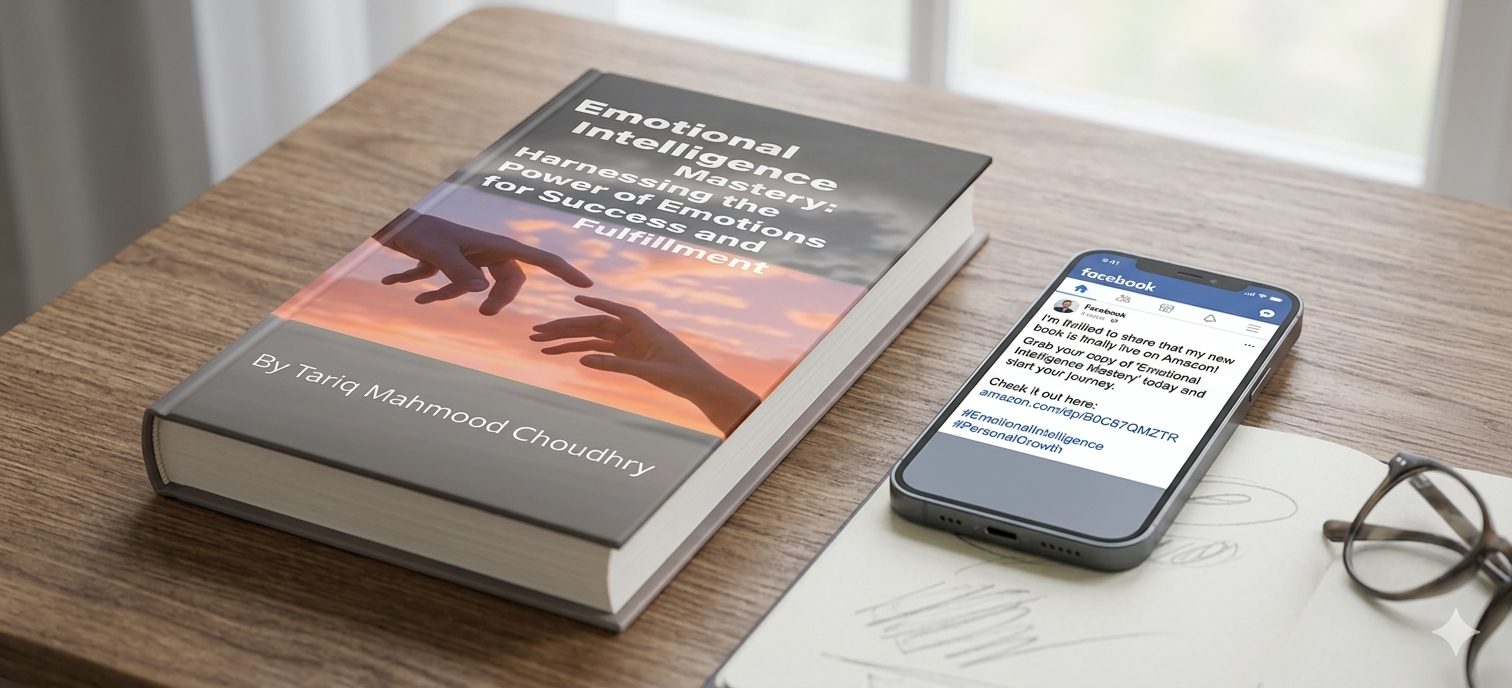
You can find book at amazon kdp publishing for details

The "Micro-Leap" Strategy: How to Build a Digital Income from Absolute Scratch
We’ve all seen the headlines: *"How I made $10,000 in 30 days"* or *"Retire early with this one simple trick."* Let’s be honest. For the average person, those headlines feel like noise. When you are starting with limited time, a hectic day job, or literally just a few dollars in your digital wallet, jumping straight to a four-figure monthly income feels less like a "step" and more like a canyon you can’t cross.
But what if you didn’t try to jump the canyon? What if you built a bridge, one tiny plank at a time?
This is the **Micro-Leap Strategy**. It is a systematic way to turn small pockets of time, minimal starting capital, and basic digital skills into a self-sustaining ecosystem of online income.
Here is the exact three-step blueprint to go from zero to a diversified digital portfolio.
## Step 1: The Zero-Capital Launchpad (Write-to-Earn & Learn-to-Earn)
The biggest barrier to entry for most digital ventures is capital. If you don't have money to invest in paid ads, expensive software, or trading assets, your primary currency is **your attention and your perspective.**
Platforms like **BULB, Read.cash, and Publish0x** have fundamentally changed the rules of the creator economy.
* **Don't wait for "perfect":** You don’t need a master’s degree in literature to write online. Share what you are currently learning. If you are learning a new language, practicing a skill, or even figuring out a math shortcut, write about it.
* **Engage to earn:** On Web3 platforms, community is currency. Reading other creators' work, leaving thoughtful comments, and sharing insights isn't just polite—it actively builds your visibility and boosts your daily platform rewards.
> **The Goal:** Build your initial "seed fund" entirely out of sweat equity.
>
## Step 2: Master the Art of the "Micro-Trade"
Once you have generated even a tiny amount of digital asset capital—whether it’s $3, $5, or $10—your mindset needs to shift from *creator* to *allocator*.
Too many people take their hard-earned rewards and cash them out immediately for minor daily expenses. Instead, treat this micro-capital as a sandbox to learn high-income skills like market analysis and asset management.
```text
[Earn from Writing] ──> [Accumulate Micro-Capital] ──> [Consistent Scalping / Spot Trading]
```
To grow a small balance, you must abandon the "get rich quick" mentality and focus on strict, disciplined setups:
1. **Define Your Risk:** Never risk more than you can afford to lose. If you start a trading setup with $5, your goal isn't to turn it into $5,000 overnight. It’s to practice execution.
2. **The 1:2 Rule:** Always aim for a risk-to-reward ratio of at least 1:2. If you are risking $0.50 on a tight scalp trade, your target profit should be at least $1.00.
3. **Compounding is Magic:** A 2% gain on a small account might look like pennies today, but mastering the *process* of consistent 2% gains is what allows you to manage larger capital safely later.
## Step 3: Build Your Own Platform (The Ownership Shift)
While Web3 blogging platforms are incredible for getting discovered and earning immediate rewards, the ultimate goal of any digital entrepreneur is **platform ownership**.
Once you have a steady stream of ideas and a small audience, start migrating your best insights to a dedicated newsletter platform like **Substack**.
* **Own your audience:** On social networks and writing pools, an algorithm change can hide your content overnight. With a newsletter, you own your email list. That list is a direct, unmediated line to the people who value your voice.
* **Monetize your expertise:** Use your newsletter to deep-dive into the things you do best. Whether you are sharing freelancing guides, technical analysis, tutoring tips, or digital earning strategies, a dedicated subscriber base is the holy grail of sustainable income.
## The Golden Rule: Bridge Your Earnings Safely
A digital empire is useless if your earnings are locked in a digital void. As you scale, always ensure you have reliable, secure financial bridges set up.
Utilize reputable peer-to-peer (P2P) networks and specialized digital payment platforms to seamlessly convert your online earnings into local, usable currency. Keep your transaction costs low, secure your private keys, and always pay yourself a small percentage of your profits to keep your motivation high.
### Final Thoughts: Start Where You Are
The digital economy doesn't care where you live, what your background is, or how much money you start with. It only cares about consistency, adaptability, and value.
Start writing today. Keep your eyes on the charts. Secure your audience. Your digital freedom is built one micro-leap at a time.
*If you found this guide helpful, hit the **like/thumbs up** button, leave a comment below sharing your own digital earning journey, and don't forget to subscribe for more actionable strategies!*
Guiding with Love and Logic: A Parent’s Guide to Stress-Free Home Discipline
# Guiding with Love and Logic: A Parent’s Guide to Stress-Free Home Discipline
Let’s be honest: parenting is one of the most rewarding journeys in life, but it is also one of the most testing. One minute you are sharing a warm, laughing moment with your child, and the next, you are negotiating like a hostage negotiator over a plate of vegetables or a tablet screen.
Many of us grew up in households where discipline meant strict obedience, fear, or shouting. Today, we know there is a better, more human way. True discipline isn’t about control, fear, or punishment. The word *discipline* actually comes from the Latin word *disciplina*, which means **"to teach" or "to instruct."** Our goal as parents is to guide our children so they can eventually guide themselves. Here is a comprehensive, practical guide to creating a peaceful, structured, and respectful home environment.
## 1. Shift Your Mindset: Connection Before Correction
Before we look at rules or consequences, we have to look at our relationship with our children. Think of your relationship with your child like a bank account. You cannot make a withdrawal (asking for compliance, setting boundaries, or correcting behavior) if you haven't made enough deposits (showing love, spending quality time, and listening).
> **The Golden Rule:** A child who feels connected to their parent is naturally more willing to cooperate. When a child is acting out, they are often using their behavior to say, *"I am feeling disconnected, overwhelmed, or unseen."*
>
### How to make "deposits":
* **The "Golden 10" Minutes:** Spend at least 10 minutes a day of undivided, screen-free time with each child. Let them choose the activity. Be fully present.
* **Active Listening:** When they talk to you, put down your phone, look them in the eyes, and listen to understand—not just to reply or correct.
* **Separate the Child from the Behavior:** Make sure your child knows you love *them*, even if you do not love their *action*. Instead of saying, *"You are a bad boy for hitting,"* say, *"You are a good kid, but hitting is not okay."*
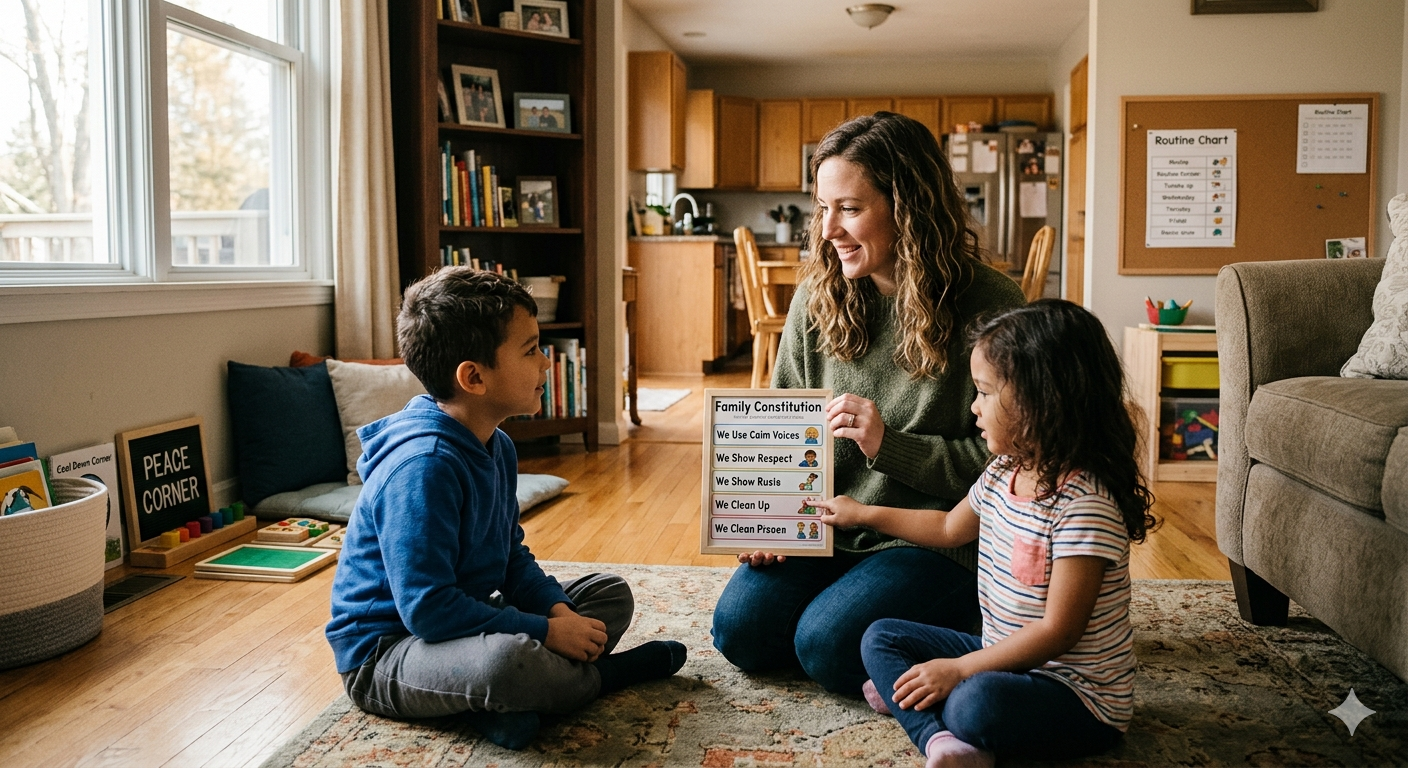
## 2. Establish Clear Boundaries (The "Family Constitution")
Children actually crave boundaries. Rules make the world feel safe, predictable, and fair. When there are no rules, children feel anxious and will constantly push boundaries just to see where the actual walls are.
Instead of having dozens of unwritten, confusing rules, sit down as a family and create a simple **Family Constitution**.
| **Traditional "Don't" Rules** | **Positive, Actionable Rules** | **Why It Works** |
| :--- | :--- | :--- |
| "Don't yell!" | **"We use calm, respectful voices."** | Tells the child exactly *how* to behave instead of just what to stop. |
| "Stop leaving your mess everywhere!" | **"We clean up one activity before starting another."** | Establishes a clear, logical routine for shared spaces. |
| "No hitting!" | **"We keep our hands and feet to ourselves."** | Defines physical safety boundaries clearly and positively. |
## 3. Let Routines Do the Heavy Lifting
If you find yourself constantly nagging your child to brush their teeth, do their homework, or put on their shoes, you are carrying too much of the mental load.
When you establish a strong, predictable daily routine, **the routine becomes the boss**, not you. Instead of saying, *"Go do your homework right now because I said so,"* you can calmly point out, *"It's 4:00 PM. What does our schedule say we do now?"*
### Creating a friction-free routine:
* **The After-School Transition:** Give children a brief transition period (e.g., 30 minutes to eat a snack and unwind) before expecting them to jump into homework.
* **Visual Checklists:** For younger children, create a chart with pictures of their morning and bedtime routines. Let them have the satisfaction of checking off each task themselves.
* **Predictable Bedtimes:** A tired child is a child who cannot regulate their emotions. Prioritize a consistent wind-down routine (reading, talking quietly, turning off screens an hour before bed) to ensure they get enough sleep.
## 4. Move from Punishment to Logical Consequences
Punishment is designed to make a child suffer for their mistake (e.g., "You didn't do your homework, so you can't go to your friend's birthday party"). This breeds resentment and teaches them how to lie to avoid getting caught.
**Consequences**, on the other hand, teach responsibility because they are directly linked to the behavior.
```
[ Negative Behavior ]
│
▼
[ Logical Consequence ]
│
▼
[ Learning & Growth ]
```
### The Three "R"s of Consequences:
1. **Related:** The consequence must relate directly to the behavior. (e.g., *If you break a toy because you threw it, the toy is put away or recycled. It is not replaced.*)
2. **Respectful:** Deliver the consequence calmly, without sarcasm, shouting, or shaming. (e.g., *"I see you are choosing not to turn off the TV. That means we won't have screen time tomorrow."*)
3. **Reasonable:** The consequence should fit the "crime" and be age-appropriate.
## 5. Master the Art of Calming Down Before Speaking
Have you ever tried to teach a child a lesson while they were in the middle of a screaming tantrum? It is impossible.
When a child is highly emotional (angry, frustrated, crying), their logical brain (the prefrontal cortex) completely shuts down, and their survival brain (the amygdala) takes over. They are in "fight or flight" mode. They physically cannot learn or process advice in this state.
Similarly, if *you* are furious, you cannot teach effectively.
### The "Cool-Down" Protocol:
* **Take a parent time-out:** Step back, take three deep breaths, and remind yourself: *"My child isn't giving me a hard time; they are having a hard time."*
* **Create a "Peace Corner" at home:** Instead of a punishing "Time-Out" chair, create a cozy "Time-In" corner with books, coloring pages, or sensory toys. Teach your child to go there to calm their body down, not as a punishment, but as a tool for self-regulation.
* **Discuss the mistake later:** Wait until the storm has passed. Once your child is calm and feeling safe again, sit down and talk about what went wrong and how they can make it right next time.
## 6. Be the Person You Want Them to Become
The most challenging truth of parenting is that **our children rarely do what we say, but they almost always do what we do.** If we tell our children to speak respectfully, but we yell at them or our spouse when we are frustrated, they learn that yelling is how adults handle anger. If we want them to manage screen time, we must show them that we can put our own phones away at dinner.
Be patient with yourself. You do not have to be a perfect parent; you just need to be a present, consistent, and growing parent. When you make a mistake—because we all do—use it as a powerful teaching moment:
> *"I lost my temper and raised my voice earlier, and I am sorry. That wasn't the right way for me to express my frustration. Next time, I will take a deep breath first."*
>
By modeling self-awareness, emotional control, and respect, you aren't just managing today’s behavior—you are raising a respectful, responsible, and loving adult for tomorrow.
The Architecture of Creativity: From Synthesis to Breakthrough
## The Architecture of Creativity: From Synthesis to Breakthrough
Creativity is often viewed as a mysterious spark, but it is actually an advanced form of **information processing**. It is the art of taking what we already know and restructuring it into something the world has never seen.
### 1. The Synthesis: Building the Unicorn
Most "new" ideas are actually **recombinations**. Our brains function like a massive library of existing data—images, facts, and experiences. When we "create" something like a unicorn, we aren't pulling an idea from a void; we are performing a sophisticated mental merger:
* **The Component Part:** A Horse (Existing Data)
* **The Modification:** A Horn (Existing Data)
* **The Enhancement:** Flight/Wings (Existing Data)
By layering these known elements, we create a **unique synthesis**. This demonstrates that the more information you consume, the larger your "inventory" of parts becomes, allowing for more complex and imaginative creations.
### 2. The Narrative Layer: Context and Story
Once an object is created, the next level of creativity is **contextualization**. We don't just see a winged horse; we build a world around it. We create a story—where it lives, what it eats, and what it represents. This is where creativity moves from a visual exercise to a structural one, using logic and emotion to make the impossible feel real.
### 3. Reaching the Peak: The "Never-Before-Done"
While synthesis is the foundation, the **Peak Value** of creativity is reached when we transcend simple combinations and achieve a true "breakthrough." This is the moment we do something that has no prior precedent.
| Level | Type | Definition | Example |
| :--- | :--- | :--- | :--- |
| **Foundational** | Derivative | Improving an existing idea slightly. | A faster horse-drawn carriage. |
| **Intermediate** | Combinatorial | Merging two unrelated concepts. | The "Unicorn" (Horse + Horn). |
| **Peak Value** | **Transformative** | Creating a new category or paradigm. | The invention of the internal combustion engine. |
### 4. Expanding Your Information Bank
If creativity comes from the information we have, then the "Art" lies in **curating your input**. To reach peak creativity, you must:
* **Feed the Machine:** Read widely across different fields (Science, History, Art).
* **Deconstruct the World:** Look at objects and ideas and break them down into their "base components."
* **Experiment with Proximity:** Take two ideas that are completely unrelated and force them to interact.
### 5. From Information to Innovation
True innovation happens when we move past the "Unicorn phase" and use our gathered information to solve problems in ways that were previously unthinkable. This requires a shift from **imagination** (seeing the unicorn) to **innovation** (applying the concept of "unique combinations" to real-world challenges).
> **The Creative Equation:** > Existing Information + Novel Connection = Innovation
>
By recognizing that your mind is an architect rather than just a mirror, you can begin to intentionally stack your knowledge to reach those "Peak Value" moments where you create something truly original. What "components" are you collecting today to build your breakthrough tomorrow?
The Illusion of Choice in an "Obesogenic" World
This article explores how our "obesogenic" environment—the way food is marketed, placed, and labeled—dictates our dietary choices, often steering us toward health-comprising ultra-processed foods (UPFs). It highlights that while we feel in control, systemic shifts like clearer labeling are the most effective tools for behavior change.
## The Illusion of Choice in an "Obesogenic" World
We like to believe we are the masters of our own diets, but public health experts argue otherwise. According to Franco Sassi of Imperial College London, our environment is the primary determinant of what we eat. From the moment we walk into a supermarket, we are bombarded by strategically placed, highly affordable, and hyper-palatable ultra-processed foods.
These products aren't just convenient; they are engineered. Manufacturers "tweak" UPFs to make them irresistible and potentially addictive, despite clear links to adverse health outcomes and increased mortality rates.
**### The Rise of Obesity**
The consequences of this environment are stark. A 2025 *Lancet* paper predicts that **over 50% of the world's adults will be obese by 2050** if current trends hold. Researchers emphasize that without immediate intervention to alter the food environment, this global health crisis will only accelerate.
**## The Power of the Label: Case Studies in Change**
One of the most effective ways to combat the "environment of abundance" is through aggressive, clear front-of-pack labeling. Evidence shows that when consumers are confronted with the reality of what they are eating, their habits shift.
| System | Region | Mechanism | Impact |
| :--- | :--- | :--- | :--- |
| **Black Warning Labels** | Chile / Central America | High sugar, salt, or calorie warnings. | **23.8% decline** in high-calorie purchases. |
| **Nutri-Score** | France / Europe | A (Green) to E (Red) color-coded letter grades. | Used by **1,500 brands**; increasing consumer awareness. |
#**# Why Better Labeling Works**
Clearer labels bridge the gap between "marketing" and "truth." While food companies spend billions to make UPFs look healthy or desirable, labels like the Nutri-Score provide:
* **Instant Cognition:** Consumers don't have to decipher complex nutritional tables on the back of the pack.
* **Behavioral Nudges:** The psychological "friction" of a red "E" or a black warning label can stop an impulse buy.
* **Industry Accountability:** To avoid "bad" scores, some manufacturers are pressured to reformulate products to be healthier.
#**# Looking Ahead: Policy vs. Personal Responsibility**
The consensus among experts like Fabio Gomes of the Pan American Health Organization is that these interventions are the "minimum information" required for a fair food system. While individual education is important, it is often no match for a profit-driven environment designed to maximize consumption.
To prevent the dire projections of 2050, the focus must shift from blaming individual willpower to implementing robust policy changes—starting with the very labels we see on the shelf.
How do you think your own grocery shopping habits would change if every "unhealthy" snack had a prominent black warning label on the front?
Beyond the Honeymoon: How to Sustain Attraction for the Long Haul
When a relationship begins, attraction is a wildfire—effortless, intense, and all-consuming. But after years of sharing a roof, a grocery list, and a morning routine, that fire often settles into a slow-burning hearth. The transition isn't a sign of failure; it’s an invitation to build a more resilient kind of desire.
Here is how to maintain—and even amplify—the attraction when the "newness" wears off.
1. Reframe the Evolution of "The Spark"
The frantic energy of early dating (Limerence) is biologically designed to fade. In its place comes a deeper, more sustainable attraction rooted in emotional safety and mutual respect. Don't mourn the loss of the "honeymoon phase"—embrace the "partnership phase," where intimacy is built on history rather than just mystery.
2. Practice the Art of "Re-Introduction"
We often fall into the trap of thinking we have "finished" learning our partner. In reality, people are dynamic.
The Fix: Approach your partner with the curiosity of a stranger. Ask about their evolving dreams, their current fears, or their changing tastes. Discovery is a powerful aphrodisiac.
3. Cultivate "The Separate Self"
Paradoxically, the best way to get closer is to occasionally step back. Over-reliance or "merging" can stifle desire.
The Fix: Maintain your own hobbies, friendships, and goals. When you pursue your own growth, you remain a three-dimensional individual rather than just a "roommate." Being a little bit of an enigma keeps the interest alive.
4. Prioritize Micro-Novelty
You don't need a grand vacation to break a stagnant routine. Attraction thrives on novelty.
The Fix: Swap the "Netflix and Scroll" routine for something unpredictable. Try a new cuisine, take a different route for your evening walk, or tackle a small project together. New experiences trigger dopamine, the same chemical responsible for early-date jitters.
5. Keep the "Dating Mindset"
Comfort is the enemy of effort. It’s easy to let standards slide when you see someone every day, but small gestures of "presentation" signal that your partner is still worth the effort.
The Fix: Continue to "show up." Whether it’s dressing up for a night in or maintaining the small courtesies you had when you were first courting, effort signals value.
6. Replace Criticism with Connection
Resentment is the fastest killer of attraction. When communication becomes a series of logistical complaints or "corrections," the romantic bond frays.
The Fix: Focus on "I feel" statements rather than "You always" accusations. Vulnerability—sharing what you need rather than what they did wrong—invites your partner in rather than pushing them away.
7. Build an "Inner Circle" Language
Laughter and playfulness are the glue of long-term desire. Shared jokes and "inside" nicknames create a private world that only the two of you inhabit.
The Fix: Don't let life get too serious. Tease gently, play often, and find the humor in the chaos of daily life. A couple that laughs together stays "allied" together.
8. The 5:1 Gratitude Ratio
Research suggests that for every one negative interaction, a healthy relationship needs five positive ones to thrive.
The Fix: Notice the "invisible" work your partner does. Acknowledging a chore they did or a trait you admire builds a "bank account" of goodwill that makes physical and emotional intimacy feel natural.
9. Create "Unplugged" Sanctuaries
In the digital age, we are often physically present but mentally miles away.
The Fix: Designate "tech-free" zones—the dinner table or the hour before bed. Deep attraction requires attunement, which is impossible when you're competing with a smartphone screen for attention.
10. Master the "Beautiful Mess"
Real attraction isn't about perfection; it’s about being seen and still being wanted.
The Fix: Accepting your partner’s flaws (and having yours accepted) creates a profound sense of security. When you feel safe to be your unpolished self, the intimacy that follows is far more "magnetic" than any superficial spark.
The Bottom Line
Maintaining attraction isn't about chasing the past; it’s about curating the present. It requires the discipline to choose your partner every day, the courage to stay curious, and the wisdom to know that a slow-burning fire provides far more warmth than a flash in the pan.
The Joint-Friendly Foundation: A Low-Impact Circuit for Total Wellness
Low-impact workouts are excellent for building strength and cardiovascular health while minimizing stress on the joints. The key is to keep one foot on the ground at all times to eliminate the jarring force of jumping.
Here is a balanced, full-body routine designed to be performed in a circuit.
1. The Warm-Up (5 Minutes)
Prepare your muscles and joints with fluid, rhythmic movements.
* **Arm Circles:** 1 minute (30 seconds forward, 30 seconds back).
* **Torso Twists:** 1 minute (gentle rotation with feet planted).
* **Marching in Place:** 2 minutes (drive knees up, swing arms).
* **Cat-Cow Stretch:** 1 minute (on hands and knees to mobilize the spine).
2. The Main Circuit (Repeat 3 Times)
Perform each move for **45 seconds**, followed by **15 seconds** of rest.
| Exercise | Focus Area | Technique Tip |
| :--- | :--- | :--- |
| **Squats to Overhead Reach** | Legs & Shoulders | Keep your chest up; reach high as you stand up. |
| **Modified Mountain Climbers** | Core & Cardio | Perform against a wall or chair for less wrist strain. |
| **Lateral Lunges** | Glutes & Adductors | Step wide and sit back into your heel. |
| **Bird-Dog** | Core & Stability | On all fours, extend the opposite arm and leg slowly. |
| **Wall Push-Ups** | Chest & Triceps | The further your feet are from the wall, the harder it is. |
| **Glute Bridges** | Lower Body | Squeeze your glutes at the top of the movement. |
3. The Cool Down (5 Minutes)
Lower your heart rate and improve flexibility.
* **Forward Fold:** 1 minute (soft bend in the knees).
* **Quadriceps Stretch:** 1 minute per side (use a wall for balance).
* **Child’s Pose:** 2 minutes (focus on deep, rhythmic breathing).
**Tips for Success**
* **Control over Speed:** In low-impact training, slow and intentional movements often engage more muscle fibers than rushing.
* **Hydration:** Keep water nearby, as "low impact" does not mean "low intensity"—you will still build up a sweat.
* **Consistency:** Aim for 20–30 minutes, three to four times a week to see steady improvements in stamina.
Are you looking to focus on a specific goal with this routine, such as improving flexibility or building core strength?

Facing Difficult People at Home and Work When You Cannot Quit
Life is not always comfortable. Sometimes, the biggest challenges do not come from outside enemies but from the people around us—our family members at home or our bosses and colleagues at work. These situations become even more stressful when quitting is not an option. In such moments, patience, understanding, and strategy become more important than escape.
At home, conflicts often arise due to differences in opinions, expectations, or financial pressures. You may feel misunderstood or unappreciated. However, reacting emotionally usually makes things worse. Instead, calm communication is key. Listening carefully and choosing respectful words can slowly reduce tension. It is also important to set healthy boundaries so that you protect your mental peace without disrespecting others.
At the workplace, dealing with a difficult boss or coworkers can feel overwhelming. You might face unfair criticism, pressure, or lack of support. Since quitting is not always possible due to financial responsibilities, you must learn to manage the situation wisely. Stay professional, focus on your work, and avoid unnecessary arguments. Document your work and communicate clearly to avoid misunderstandings. Improving your skills can also give you confidence and better opportunities in the future.
Most importantly, take care of your mental health. Spend time with positive people, engage in activities you enjoy, and give yourself time to relax. Remember, difficult phases do not last forever, but the way you handle them shapes your character.
In the end, strength is not shown by running away, but by standing firm, staying calm, and growing through challenges
📉 Major Delisting Alert: April 2026 Orchid
https://youtu.be/4Sl2CikqE28?si=YT0roAqYMA0nylno
## 📉 Major Delisting Alert: April 2026
Binance has announced several rounds of delistings this month to maintain market quality and liquidity. If you are holding any of these, check your trading bots and open orders.
### **1. Spot Trading Pairs (Delisting April 17, 2026)**
The following pairs will be removed at **03:00 (UTC)** on April 17:
* **Majors/Fiat:** BTC/TUSD, ETH/TUSD, ARB/EUR, TRUMP/EUR, WIF/EUR
* **Altcoin Pairs:** BANANA/FDUSD, CYBER/BTC, ICP/FDUSD, RLC/ETH, TIA/BTC
> **Note:** The tokens themselves remain available; only these specific trading pairs are being removed.
>
### **2. Full Token Delistings (Delisting April 23, 2026)**
Binance will cease all trading for the following assets due to low volume or failing to meet listing standards:
* **BIFI** (Beefy Finance)
* **FIO** (FIO Protocol)
* **FUN** (FUNToken)
* **MDT** (Measurable Data Token)
* **OXT** (Orchid)
* **WAN** (Wanchain)
## 🚀 Market Snapshot (April 17, 2026)
While some pairs are leaving, the overall market sentiment remains quite active:
* **Bitcoin ($BTC):** Currently trading around **$75,000**, showing strong resilience after clearing the $75k bear trendline.
* **Top Gainers:** **ENJ** (+34%) and **BIO** (+31%) are leading the market outperformers today.
* **Macro Update:** The global crypto market cap is holding steady at approximately **$2.53T**.
### **Action Plan for your Binance Square Post:**
1. **Headline:** Use something punchy like *"April Housekeeping: Is your portfolio safe from the latest Binance delistings?"*
2. **Visual:** Use the image I generated earlier or a screenshot of the $BTC price action crossing $75,000.
3. **Call to Action:** Ask your followers which delisted token they are most surprised by
Health is the Real Wealth (Sehat Asal Daulat Hai)
Zindagi mein kamyabi ke liye sirf bank balance nahi, balkay jismani aur zehni tawanaee (energy) zaroori hai. Jab hum sehatmand hotay hain, toh hamara dhimag tezi se chalta hai—chahe wo math ke mushkil sawal hon ya crypto ki fast scalping.
Zaroori Life Changes (Zindagi mein Tabdeeliyan)
Humein apni routine mein ye choti magar ahem tabdeeliyan lani chahiyen:
Behtar Khurak (Balanced Diet):
Sugar aur Junk Food se parhez: Ye hamari energy ko foran gira dete hain.
Pani ka zyada istemal: Kam se kam 8-10 glass pani rozana piyein taake dhimag fresh rahay.
Jismani Harkat (Physical Activity):
Rozana 20-30 minute paidal chalna: Ye dil ki sehat aur stress kam karne ke liye behtareen hai.
Proper Neend: Kam se kam 7-8 ghantay ki neend lazmi hai taake agle din aap fresh ho kar trading aur teaching kar saken.
Digital Detox (Screen se Break):
Tariq Sahib, aap sara din mobile aur laptop (Binance, BULB, Publish0x) par hotay hain. Har aik ghantay baad 5-10 minute ke liye screen se door hat kar apni ankhon ko sakoon dein.
Positive Thinking (Musbat Soch):
Stress aur pareshani hamari sehat ki sab se bari dushman hain. "Loss" ho ya "Profit", hamesha pursukoon rehne ki koshish karein.
Health & Wealth ka Correlation
Sehat ko aik Multiplier samjhein. Agar aap ki mehnat '10' hai aur sehat '0', toh result 0 hi aayega. Lekin agar sehat '1' hai, toh aap ki har mehnat ka phal aap ko mileg
🚀 Huma Coin & ENJ – Hidden Opportunities or Just Hype?
**In the crypto world, new coins come and go every day, but some projects quietly build their space. Recently, I’ve been looking at Huma Coin and Enjin (ENJ), and honestly, both give very different vibes.**
**Let’s start with Huma Coin. It’s still not very mainstream, which means most people are either ignoring it or just hearing about it now. Coins like this can be risky, but they also bring early opportunities. If the project grows, early holders benefit the most. But at the same time, you need to be careful — low popularity also means uncertainty.**
**Now coming to Enjin Coin (ENJ) — this one is more established. ENJ is connected to gaming and NFTs, and that’s a big space. Even though the hype around NFTs has slowed down, the idea is still alive. If blockchain gaming grows again, ENJ could benefit strongly.**
**What I personally feel is:**
**Huma Coin = High risk, high potential**
**ENJ = More stable, long-term hold**
**As a small trader, I prefer mixing both strategies. A little amount in risky coins like Huma, and a safer portion in coins like ENJ. This way, even if one fails, the other can balance things out.**
**Crypto is never about “guaranteed profit.” It’s about smart decisions, patience, and controlling emotions. I’ve learned that even small investments, if done wisely, can grow over time.**
**👉 In the end, don’t follow hype — follow logic.**
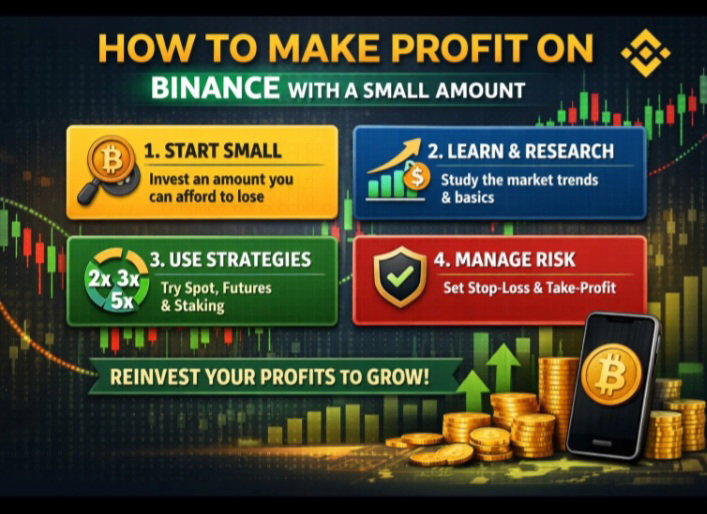
How to Make Profit on Binance with a Small Amount
How to**tarting crypto trading with a small amount can feel risky—but the truth is, you don’t need thousands of dollars to begin. With the right strategy, even $5–$20 (or a few hundred PKR) can be used to learn, grow, and slowly build profit.**
Start Small, Think Smart
**Many beginners jump in hoping for quick gains, but success in crypto is about consistency, not luck. Platforms like Binance allow you to trade in small fractions, making it perfect for beginners.**
**Instead of risking everything in one trade, divide your amount into smaller parts and trade carefully.**
Choose the Right Coins
**Focus on popular and active coins like:**
**Bitcoin**
**Ethereum**
**Shiba Inu**
**Pepe**
**These coins have high trading volume, which means better chances of small, quick profits.**
Use Simple Strategies (Beginner Friendly)
**1. Scalping (Best for small capital)**
**Buy at a slightly lower price and sell at a small profit (like 1–3%).**
**Do this multiple times a day.**
**2. Buy the Dip**
**When price drops suddenly, buy and wait for a small recovery.**
**3. 1:3 Risk-Reward Rule**
**If you risk $1, aim to make $3.**
**This keeps your losses small and profits bigger.**
Control Your Emotions
**The biggest mistake beginners make is panic buying and selling.**
**Don’t chase pumps**
**Don’t sell in fear**
**Follow your plan**
Use Binance Tools
**Binance offers helpful tools:**
**Spot trading (safe for beginners)**
**Charts & indicators**
**Limit orders (buy/sell at your price)**
Real Example (Small Trade)
**Start with $10**
**Buy a coin**
**Sell with 2% profit = $0.20**
**Repeat 5 times = $1 profit**
**Slowly, your capital grows—and so does your confidence.**
Final Tip
**Small money trading is not about getting rich fast. It’s about learning skills, managing risk, and growing step by step. If you stay disciplined, even a small amount can turn into something bigger over time.** Make Profit on Binance with a Small Amount
How to Earn on Binance Without Investing Money: A Practical Guide
Many people believe that to make money in the cryptocurrency market, you must first have a large amount of capital. However, as a Math Teacher and a strategic trader, I have discovered that Binance offers several "Zero-Investment" formulas that allow you to build a portfolio from scratch.
If you are looking to start your crypto journey without financial risk, here are the most effective methods:
1. Binance "Learn & Earn"
This is the most direct way to get free crypto. Binance frequently hosts educational courses about new blockchain projects.
The Process: You watch short educational videos and read articles about a specific coin.
The Reward: After completing a simple quiz (which is easy for anyone with a logical mind), Binance rewards you with actual tokens. You can hold these or convert them into USDT immediately.
2. Binance Square (Content Creation)
Binance has its own social feed called Binance Square. This is a "Write-to-Earn" opportunity.
Strategy: Share your trading insights, market analysis, or even educational content (like the math shortcuts I share).
Benefit: High-quality creators can receive "Tips" from other users and participate in reward pools hosted by Binance. It’s a great way to turn your knowledge into capital.
3. Referral and Affiliate Programs
Mathematics is all about networking and logic. By using the Binance Referral Program, you can invite friends or colleagues to join the platform.
How it works: Every time your referral makes a trade, you earn a percentage of their trading fee as a commission. Over time, this creates a consistent stream of passive income without you ever spending a dollar.
4. Binance Megadrop & Airdrops
Occasionally, Binance introduces "Megadrop" or "Launchpool" events where you can earn new tokens by completing simple "Web3 quests" (like connecting a wallet or following a project). These tasks cost nothing but a few minutes of your time.
My Final Advice:
Earning without investment requires patience and consistency. Treat these methods like a math problem—solve it step-by-step, and the results will follow. Start small, accumulate your free rewards, and then use those funds to start your actual trading journey.
Which of these methods are you going to try first? Let’s discuss in the comments below!
Practical Tips for Tariq Sahib:
For Read.cash: Copy this article and post it. Use tags like #Binance, #PassiveIncome, and #CryptoEducation.
For Your Profile: Since you are already active, mention that you are a teacher. People trust educational content more than "get rich quick" schemes.
Trading Update: I noticed you mentioned the number 0.025604 earlier. If you manage to earn even small amounts from these "Learn & Earn" programs, you can add them to your WLFI or XRP holdings on Binance to increase your position
Why I Prefer 1:3 Scalping (Even When I’m Wrong Most of the Time
When I first started trading, I had the same mindset most beginners have — “I need to win every trade.”
That idea didn’t last long.
After a few small losses (and yeah… some frustration), I realized something important:
trading isn’t about being right all the time — it’s about how much you win when you’re right.
That’s when I started focusing on 1:3 risk-to-reward setups.
So What Does 1:3 Actually Mean?
Nothing complicated.
It just means:
I risk $1
I aim to make $3
Simple.
If the trade goes against me, I exit quickly with a small loss.
If it goes in my favor, I let it run to a bigger profit.
That’s it.
The Part That Changed Everything for Me
This is where things clicked.
You don’t need to win most of your trades.
Seriously.
Let’s say I take 10 trades:
I lose 7 trades → total loss = $7
I win 3 trades → total profit = $9
End result: I’m still in profit (+$2)
At first, this felt strange. Losing more than winning didn’t feel right…
but the math doesn’t lie.
That’s when I stopped stressing about being wrong.
How I Personally Trade This Strategy
I don’t use big money. I started small — even around 0.5 USDT trades just to practice.
Here’s what I focus on:
Clean setups (usually short-term charts)
Tight stop loss (small risk)
Letting winners hit the full target
Most of the time, I’m just waiting.
Scalping sounds fast, but honestly… it’s mostly patience.
A Few Things I Learned the Hard Way
Small trades teach more than big losses
Don’t rush to increase size.
Not every setup is worth taking
Sometimes the best trade is no trade.
Emotions will try to mess you up
Especially after 2–3 losses in a row.
Consistency beats excitement
This isn’t gambling. It’s a process.
What I Do When I’m Not Trading
I don’t like my funds just sitting idle.
So when I’m not trading, I keep my balance in earning options (like USDT earn).
It’s small, but over time it adds up.
Final Thoughts
I’m still learning. Still improving.
Since one thing I’m sure about now:
You don’t need to predict the market perfectly.
You just need a system where your wins are bigger than your losses.
That’s why I stick with 1:3.
What about you?
Do you go for quick 1:1 trades, or do you wait for bigger setups like 1:3?
Let’s share experiences 👇#crptocurren̈cu #bitcoin#

Title: Magic Math: Square any number ending in 5 in seconds!
Content: > Hello Read.cash community! I am a Math Teacher and I love sharing shortcuts.
To square 25:
Multiply the first digit (2) by the next number (3) = 6.
Always put 25 at the end.
Result: 625!
Stay tuned for more tricks.
 @Tariw3052