 @mc5punk
more from that month
@mc5punk
more from that month
Short story: The Blackout That Brought Us Together
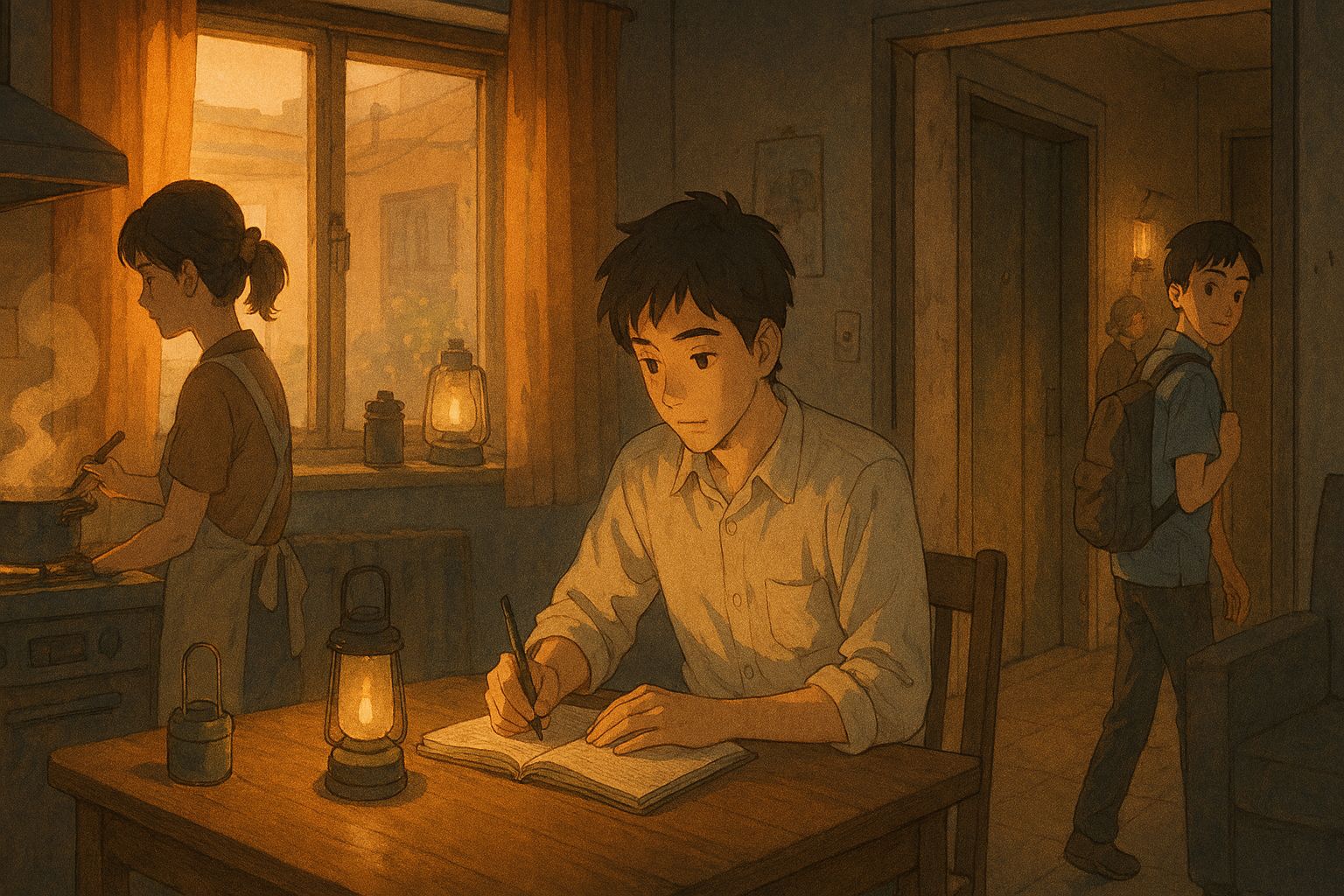
That morning the building woke to a different kind of silence, thick as a curtain that had descended without warning. It wasn’t the usual quiet of early hours—those that still hold the murmur of sleep—but a tense stillness that slipped through the cracks and clung to the house’s skin. In the living room, my mother, my brother and I remained motionless, each with their own restless habit: rubbing hands, searching glances toward the window, breaths trying to adjust to the improbable. The message arrived like an expected confirmation: the power had been cut again. This time, however, the darkness had burst in in the middle of the morning. “Again in the morning?” my mother asked, her voice small and tense. “I thought it was something at night, at least predictable.” “They changed it,” I answered. “They’ve been like this for days; before they cut it at night, now in the morning. I don’t know if it’s because of works, the company, or what they’re planning.” She frowned and pressed her forehead into the palm of her hand, as if she could stop the advance of worries with the pressure. There were elderly people in the building, families with early shifts, people who depended on strict schedules. The possibility that someone might be trapped in an elevator pricked at her voice. “If someone is in the elevator right now,” she murmured, “I don’t know how long they’d have to wait to get out. The janitor isn’t always here and the homeowners’ association president doesn’t answer immediately.” We remembered previous times: neighbors buzzing down the hall in the middle of the night, flashlights lent from door to door, resignation turning into jokes. But now the situation had another texture: the loss of power in broad daylight upended routines that, even if fragile, sustained jobs, medication schedules, and commutes. The quiet conversation opened into broader questions. “What if this affects people who work in offices?” my brother said. “Many leave at six. Imagine the chaos.” We decided, partly out of caution and habit, not to sleep through the waiting. My mother prepared the kitchen like someone offering refuge: she dusted off the frying pan, lit the gas stove, and set about the usual recipe—the one that seems to glue the house together with the smell of stew. Smoke and warmth from the stove began to outline the shape of an alternative normal. “At least we have gas,” she said, trying to smile as she peeled potatoes. “Let’s make something to eat and wait.” My brother, for his part, needed air. He went out into the street looking for movement, as if the city in its imperfect state gave him an excuse to move. I accompanied him for a few steps; the street looked different: shops that could do so turned on noisy generators, others closed and lowered shutters; people peered from doorways, exchanged news, and shared uncertainty. On the corner, Don Alfredo was improvising a watering system with buckets; the woman from the third floor, her face pinched with worry, told us her husband had a 8 a.m. shift and the company would not accept delays. “If he has to walk to the station, I don’t know if he’ll make it,” she said in a trembling voice. “And if he’s late, he could lose his job.” The news drove another wedge into the problem: it was no longer just domestic; it was a fracture affecting employment, medical schedules, deliveries, schools. Back in the building, the hallway smelled of soap, stew, and the taut calm of people forced to wait. The elevator lay motionless, its panel completely dark; its interior, a small stopped world that evoked the ever-present possibility of entrapment. Over the course of the day discussions and plans emerged. In the lobby, the janitor—a man worn by years of routine tasks—lit a cigarette and seemed thoughtful. “If someone ends up inside, we have to wait for the president or someone who knows how to operate the system,” he said gravely. “It’s not something I can handle alone, and if the building’s morale goes down, I’m the one who’s expected to respond.” The homeowners’ association president appeared later, papers in hand and the look of someone who’d been sleeping poorly for days. The conversation rose in tone: log incidents, demand explanations from the company, organize a list of vulnerable people who would need priority attention in case of entrapments or medical emergencies. “I’ll call a meeting today,” he announced. “We can’t keep going blind.” The decision rekindled a sense of collective responsibility. Suddenly, from fear came something like initiative: neighbors offering phone numbers, volunteers offering to be in contact with elderly residents, names jotted in a notebook to know who would need help in an emergency. The community, tense though it was, began to coordinate. Meanwhile, in our apartment, the absence of electricity shaped a new way of passing time. My mother sat to read a few pages of an old book—reading that used to be reserved for night but now regained meaning in the afternoon light. The smell of the stew gathered us around the table; we spoke of small things: the price of bread, a neighbor’s joke, the old battery-powered radio that miraculously worked. Partially charged phones became precious objects. My brother returned with stories from the street: neighbors gathering in the square, children playing in the face of uncertainty, street vendors adjusting their routes. “A lot of people are organizing on the corner,” he told me. “Some bring chairs, others bring what they have left; for a while the square seems like the center.” The day slid by in improvisations: someone offered hot tea at the front desk; another went down the stairs with a flashlight to check on an elderly man on the fourth floor. Conversation was no longer only about the lack of light; it turned to immediate consequences and the need for contingency plans. Concrete proposals emerged: a team of neighbors with spare keys for emergencies, temporary guards to answer entrapment calls, and a letter to the company requesting a clear and responsible schedule. While I wrote notes by hand—a habit technology had made us lose—I tried to order my impressions: the feeling of fragility before systems that operate in the background without apparent accountability; how a simple power outage can jeopardize daily life and expose our interdependence. Everyday reality, with its small routines, showed its vulnerability; yet at the same time a luminous side appeared: solidarity, the conversation that otherwise would not have surfaced. As night fell, when we suspected the day would be consumed in shadows, the power returned without ceremony. We turned on lamps as if opening our eyes after a nightmare; the bulbs flickered and normality returned with its familiar weight. Some neighbors applauded in an improvised gesture; others breathed sighs of relief. The association president, weary-faced, proposed calling an assembly the next day to formalize the measures discussed. “Put it in writing,” he said. “Have the company give us a schedule and have the board demand accountability.” That night, in bed with the book open on my chest, I thought about everything that had happened. There was something that transcended the mere outage: the experience left a map of new possible routes for the community. In that map were names jotted down, phrases exchanged in the hallway, an improvised committee discussing protocols, shared stews, and hands that knew how to turn screws. It was evidence that when infrastructure fails, people can support one another, even if the response sometimes comes from the depths of patience and ingenuity. Before falling asleep I reread what I had written and felt it was more than just a tale of a blackout: it was a small chronicle about living with the fragility of everyday life and about how, faced with disruption, the community can become a network of support. The next morning, with the light of a new day, we perceived that something had changed: not the supply itself—that struggle would continue—but the willingness of neighbors to organize and to demand clearer answers. The electricity had returned, but what remained lit was the awareness that true light is not only that which hangs from the ceiling, but the one that emerges when people recognize shared responsibility. Source of the images. Image created with Bing.
4 comments
And thats why i have an UPS and a 18w foldable solar panel.
That's great 😁👍
I also sent you some small tip, but the site doesnt shows it. Something is terribly broken with this site lately - it doesnt shows the tippers.
Thank you very much for your contribution, I really appreciate it. I send you a big hug.