swallowing bitter pills
I've been gone for entirely too long.
Rather, I've stayed away for too long.
Rather, I've been avoiding this place.
Ah, why must I be so coy? Well, mostly to get this next bit out of the article preview. Is this enough preamble? Seems like it.
So why have I been avoiding read.cash? I think Marc De Mesel is a creep and I needed to overcome some of those feeling before returning.
It's strange, I barely interact with him, barely overlap with his world, his feelings, his opinions. Yeah, I used to subscribe to his noise.cash account, in hopes of chat about BCH or crypto projects he's following or other potentially meaning market insights.
But I forgot that people are always larger than their jobs, their interests, their various platform personas. It took some time before I gained a better picture, and when I did, I really didn't like what I saw.
I won't go into it now. I'm sure many of you know what the sorts of things I'm talking about and you all certainly have your own opinions on the matter. This isn't about that.
I'm not even exactly certain why I feel the need to mention this at all. I could slide back in, start tipping and writing again, as if I didn't feel distinctly different about using this site, but I do. I felt a little...dirty? That's not it, exactly. It felt like interacting with this site was a tacit endorsement of certain people's creepiness.
Weirdly, noise.cash feels no different. Maybe I always felt more comfortable there, less inhibited. Maybe it's easier to tune out the bullshit there, or to avoid posts with $1000 upvotes from You Know Who....
I'm rambling now.
I'm treating this post like my high school LiveJournal account (which still exists in a weirdly edited time-capsule-ish form, if there are any intrepid users that want to go on a wild goose chase with zero payoff).
So enough of all that, I'm choosing happy.
I'm choosing emojis in appropriate doses 😅✌️
I'm choosing Bitcoin Cash.
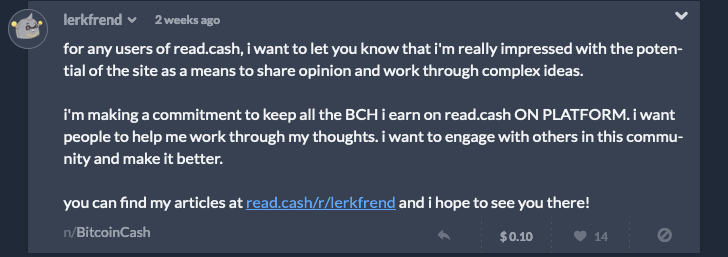
I'm choosing writing, tipping, and exchanging interesting ideas.
I'm choosing frends.
Mostly, I'm choosing engagement with the good I see, with the potentials of BCH and y'all great people. Happy to be back!
I don't have any plans for upcoming articles but I'm sure I can slap a pile of words together in a pleasing enough fashion at some point in the near future, so stay tuned?
Lead photo by Ksenia Yakovleva on Unsplash. https://unsplash.com/@ksyfffka07?utm_source=unsplash&utm_medium=referral&utm_content=creditCopyText https://unsplash.com/s/photos/pills?utm_source=unsplash&utm_medium=referral&utm_content=creditCopyText
Happy pill photo by lilartsy on Unsplash. https://unsplash.com/@lilartsy?utm_source=unsplash&utm_medium=referral&utm_content=creditCopyText https://unsplash.com/s/photos/pills?utm_source=unsplash&utm_medium=referral&utm_content=creditCopyText


i haven't forgotten
I've been meaning to write more. I've been promising articles, but much of my writing energy these days has been taken up by noise.cash nonsense that I'd rather not to get into further. https://noise.cash
I haven't forgotten about you, readers. I'm still here most days, and will be for at least a few more months until my schedule changes. I appreciate all the people that I talk to here and the ideas you are sharing. I've learned a lot and feel special that I've stumbled into this community.
I've benefited more from the people than the BCH. I do like BCH as a project. I feel like it's making good progress, but its' really a bunch of people, working hard on the things they're good at, building something together.
Let's keep building. I'm still here even though the last few days have been hard for me, because I want to work more with a lot of you, pool our knowledge and build our skills together.
I'm also spending more time on the Hive blockchain blogs, LeoFinance and Splintertalk in particular. I like a lot of what I see from that community and they seem to be crypto agnostic and very welcoming. Setting up a Hive account can be a little daunting at times, but there are many users on noise.cash that would be happy help. I'm a newbie and not best equipped to explain the whack process I went through to get signed up. https://leofinance.io https://www.splintertalk.io/ https://noise.cash
Not my usual fare today. Apologies to those that were hoping for more. I'm tired, but not dead.
Lead photo by **Suzy Hazelwood** from **Pexels** https://www.pexels.com/@suzyhazelwood?utm_content=attributionCopyText&utm_medium=referral&utm_source=pexels https://www.pexels.com/photo/white-and-purple-flowers-in-tilt-shift-lens-5114326/?utm_content=attributionCopyText&utm_medium=referral&utm_source=pexels

BCH has been / is currently / will be ON SALE, but not forever
The headline pretty much sums it up, but of course I'm going to type for a while. I like hearing the clack of my keyboard and the whir of my brain, so bear with me.
We know that BCH is undervalued. We talk about it all the time. I'm not going to bother linking to articles (there are many), because what I'm trying to get at is simpler than that.
Think about the following details:
Kim Dotcom is wrapping up development on "the ultimate content monetization system" that integrates BCH
Moeing Chain chose BCH for their EVM improvement project
General Protocols recently received $3 million in investment capital
NFTs—waifus in particular—are getting Flipstartered (and funded!)
If you heard all that about a company and its plans for improvements, I think you'd be pretty stoked.
So why are you waiting for BCH to go below some arbitrary USD value, say $500, for example, like that is where the sale *really begins?*
Sure, we can look at price history and say, "lerk, it's higher than it was three months ago, I'm going to wait for the price to **go back down**."
You might miss your chance.
BCH is undervalued, but we can't predict when the market will realize it. You think the FOMO was bad when BCH shot to $700....
wait for Kim Dotcom to release k.im
wait for May when Moeing starts their demonstrations
wait for General Protocols to show what they've done with their $3 million
wait for NFT showrooms to sell out
We are lucky to be BCH insiders. We are lucky that @MarcDeMesel has been sharing his thoughts and BCH with us for MONTHS. We are lucky to be so close to the BCH development teams that make an effort to post updates here. We are lucky to have sites like read.cash and noise.cash to share news and updates with each other.
Speaking of read and noise (which we all love to do): were you aware that Read.Cash contributes to the mainnet.cash project Github? Do you understand what that means? Let RowanSkie and my slow brain help: https://mainnet.cash/ https://github.com/mainnet-cash/mainnet-js
What am I trying to say?
Good things are brewing for BCH. Get a piece.
And that's surprisingly easy! I mean, you're here, right? You're using noise.cash in a decidedly non-spammy manner, *right?*
But there's something else that's happening here. I ignored this detail earlier. In previous drafts I had this listed above, with all those exciting improvements:
BCH has been / is currently / will be the target a dedicated propaganda and disinformation campaign.
How long? Since before the BTC fork that created BCH in the first place, almost three years now. The other forks along the way haven't helped either, but anyone paying attention and using their brain should see that **BCH is not trying to scam anyone, or dupe anyone, or defraud anyone.**
BCH isn't a person or a business or a specific stakeholder. It isn't Marc De Mesel, or Roger Ver, or Jihan Wu.
It's not Bitcoin ABC or Bitcoin Unlimited, BCHN, BCHD, or Bitcoin Verde. It's not Flowee or Knuth. It wasn't Bitcoin XT.
It isn't Bitcoin.com, General Protocols, Bitcoincash.site, Moeing, Memo, mainnet, read or noise. It isn't a Waifu camp or faucet.
It's all those things, all those people, every node, every business, every user, every wallet, every address, every UTXO.
BCH is a voluntary gathering based around a common goal.
We all have a stake in the future of money. Those that say BCH is a scam are ignoring or downplaying the organizing principles at play here. There's no conspiracy.
Marc De Mesel is not looking to "pump his bags" when he says good things about BCH. He's an investor that likes Bitcoin and wants to share his opinion with other that like Bitcoin. He even funded a website so people would have a cool place to talk at length about it. Oh, and then another one. https://read.cash https://noise.cash
Roger Ver is not a Jesus-like figure, a Messiah that has special crypto insights for his followers. He's a rather well-spoken guy that's committed to the cause of peer to peer electronic cash. How many times does he need to say it?
This article uses BCH price as a framework, but consider that most of the things I mentioned work perfectly regardless of price. If BCH is $0.01, you could still:
marvel your waifu and NFT collection
use the AnyHedge service
receive tips from read or noise or the k.im monetization process
run complex smart contracts on a BCH sidechain EVM
But all of these things will draw attention and users and eventually dollars. Mr Dotcom is certainly looking for that sweet ROI, as are ***ALL INVESTORS***.
That just makes sense, right? People get into crypto to make money. Miners do it **all the time.** Some count their earnings in BCH, some in fiat at the exchange.
Take advantage of your position here. You are on the BCH vanguard.
I'm not here telling you to make any investments or take monetary risks. This is decidedly my opinion, but I thought it was worth sharing.
Also, my list of various BCH stakeholders is not exhaustive. BCH is a big place. Let me know of some other names and I might throw them in the mix.
Keep your eyes peeled for my thoughts on capybaras, coming in the near future. I promise at least 200% more pictures! Thanks again for reading.
Lead photo from Pexels, in the public domain. https://www.pexels.com

thanks for giving me space to write
I did not expect to find a community that would accept my writing. I did not expect to find a site that *paid* for my writing. It's created a very strong incentive for me to continue plying my craft, practicing my limited skill.
I don't know what I would've done for the last few months otherwise. Surfed the web, learning and forgetting little nuggets of information, distracting myself from the troubles of my workplace and the world at large.
I would've played Hearthstone until the RNG drove me literally crazy. I would've sank days into Stardew Valley 1.5. I would've gone through game development tutorials that I'd forget in a few weeks, or watched endless Starcraft and skateboarding Youtube videos.
There's nothing *wrong* with that. But there isn't much *right.*
We can tell, can't we? When our lives aren't matching up with our dreams and goals. I've always wanted to write, and here I am. Why has it been so hard?
Having even a small audience helps! I did not realize this. I've been too scared to put myself out there. Even if some of the love comes from a bot, it is a boost to one's confidence, and I feel that I'm having a slightly larger human impact as well.
I remember first perusing read.cash a few months back. It was intimidating, seeing dollar values next to articles and thinking, "That can never be me, I've got nothing to say that anyone will care about."
Well that's a self-fulfilling prophecy. You're never going to write those thoughts down if you feel like they are useless. But this "useless" is a lie based on insufficient information. We can't know what others are thinking until we communicate with them.
Language is a necessary human function. It's how we continue to flourish despite all the problems we create, all the challenges of nature. We can share information, and written information is particularly special: it can time-travel.
I'm trying to convince myself that this humble effort is worth it. I think I'm succeeding, but at times I suffer from extreme self-doubt, misgivings about my attitude and actions.
This week has been particularly hard for me. I haven't been sleeping well. I'm struggling in dealing with my work superiors and my local government. My parents seem more and more disconnected from the world at large. Occasionally I feel untethered from reality entirely.
I think about my brother's son, my nephew. I wonder what sort of world view he's developing, how in or out of tune it might be. Can I really judge this sort of thing? Am I in tune?
I wish I could start over, but that thought is meaningless for so many reasons.
I'm tired and rambling. I want to write my truest thoughts. I want to read other's truest thoughts. I think it would help me feel like things matter.
I want writing to be like *money:*
a store of value
a medium of exchange
a unit of account
What are our most valuable thoughts? Are we exchanging these with each other? Are we progressing in our thinking?
It's hard to judge these sorts of things, and it's definitely not a one-size-fits-all solution. Individuals need to make this value judgment for themselves.
I'm pleased when a bot says I did good, but it's not even *reading my words*.
Likewise, I could get paid a decent salary somewhere for doing *abominable things* to the world.
This isn't easy. I'm going to say this a lot I guess, for myself as much as you. Staring at this white, editable expanse below is a moment of reckoning. Am I trying to fill space or really say something?
(
Even now I'm thinking to myself, "This article seems too short to get attention from Rusty."
I refuse to pen a paean.
I'm much more declarative and certain here than anywhere else.
Is this a side-effect of language, all these statements of "being"? I am, this is....
How can we resolve this either/or meaningfully? https://read.cash/@lerkfrend/flow-states-reflections-on-either-or-420d2d0a
What is my identity?
My public thoughts and writings are small emissions from my event horizon.
)
Thanks for sticking with me through this loose collection of thoughts. I'm working on a few more polished articles for the next few weeks on the following subjects:
Capybaras as meme-able BCH mascots
Ampleforth, an interesting attempt at solving currency problems
Tarot, an introduction to my methods
Personal growth and assessment, in my "flow states" series https://read.cash/@lerkfrend/flow-states-1aaa3382
Check my profile for more articles on related topics, and maybe subscribe if I haven't bored you to death. https://read.cash/@lerkfrend
I'd love any feedback you have. I respond well to constructive comments. If you can explain why I might be wrong, I'd really appreciate it. https://youtu.be/vOa--Dhu11M
Lead photo from Pexels, in the public domain. https://www.pexels.com

flow states: reflections on Either / Or
We last left me on the second floor of my college library. It is quiet. The building's ventilation shushes gently at students hunched over their books and papers. They will not speak. There is a reverence to the space.
My fingers rasp on the page of Søren Kierkegaard's *Either*, the first volume of his exploration of life and morality, *Either/Or*. I knew nothing of its history, its context, except those words I was reading:
What is a poet? An unhappy man who conceals profound anguish in his heart, but whose lips are so fashioned that when sighs and groans pass over them they sound like beautiful music.
I checked out the book, took it back to my dormitory, elated, but I didn't read much past the first few sections. I liked the book as an artifact, for what it represented to me, a me that I saw in the writings of this Mr Kierkegaard, more than 150 years after its publication.
Looking back, twenty years on, I see something else in this coincidental meeting, something that set me to writing about it here in the first place.
form
*Either/Or* is written from the perspective of various authors, each expounding their own lived experience and, by extension, some argument for how one should live. The authors in the *Either* volume operate in an aesthetic mode of subjective experience and feeling, detailing their lives through vivid imagery and metaphor.
Authors in *Or*, by contrast, urge for a different understanding of life, a level of engagement requiring adjustment and responsibility to the objective world. They argue that one must **choose** life in this way for life to have meaning.
It was as if these volumes were bookends to my life. I had been going along, nearly unable to choose, until I washed up on the shores of adulthood, starved for understanding, desperate for direction.
Kierkegaard was Christian, a philosopher and pastor that wrote many critiques of the religious practice he saw about him. I was attending a Christian college but was becoming increasingly frustrated with my Christian contemporaries.
Kierkegaard's arguments in *Either/Or* are his arguments with himself, about his place in the world and how he must live. I needed to decide for myself how I would live my life, and I had never done that before.
Kierkegaard recognized the yearning of the self, the internal poet, but could not help but counterbalance that desire with a recognition of everything else, others' yearning, the requirements of society, the requirements of the soul.
Have I recognized myself, by my own understanding? Do I need a page of another's words to define me? Can I convince myself of my own needs, the fundamental rights of my existence?
More Kierkegaard, from the section entitled 'Diapsalmata', seems appropriate:
My soul has lost its potentiality. If I were to wish for anything, I should not wish for wealth and power, but for the passionate sense of the potential, for the eye which, ever young and ardent, sees the possible. Pleasure disappoints, possibility never.
In finding, does one lose the search?
logic
*Either/Or* also functions as an examination of Aristotelian and Hegelian logic, the important concept being that of the "excluded middle" in relations of identity. Something must be one thing or another: if you are A, you cannot be Not-A. You are one, or the other. True or False. Either / Or.
This is well and good when we **rational thinkers** consider objects, like rocks or mushrooms or clouds (hmm, maybe not the amorphous collection of vapors).
Hegel went ahead and threw a wrench into Aristotelian thinking when he argued that things are never static in such a way. A cannot simply *be* A, because there is no static *being*, only *becoming*. While we're at it, A could very well *become* Not-A sometime.
The German philosopher Johann Gottlieb Fichte wrote about the complications of applying this sort of logic to rational thinkers in *The Science of Knowledge*. In short:
**rational thinker** thinks
reflects to self: what is **this that is thinking**, it must be something. **(A)**
further reflection brings complication: what is **it that can be reflected in my thoughts** in such a way, if I have only just thought of **it**? **(B)**
what is **B** in relation to **A**?
This makes my brain hurt, but Fichte resolves his argument by saying it is impossible to say meaningful things about the identity of this 'B' given what we know about 'A'.
Put another way, in a living context if you will, statements about one's thoughts, beliefs, opinions, commitments, dreams, et cetera, fail to perform as anything beyond vapid identity statements about oneself.
This is where *Either/Or* comes in, with Kierkegaard dressing up as other characters and dancing on a knife's edge, navigating Aristotle, Hegel, Fichte and self identity.
I'll leave this here for the moment, with some final words. I am using my current *"right-now"* existence to analyze myself, through the lens of my past, with aid of information my past self did not have. As I've said, I was not a Kierkegaard fan in college. I had no wider context. I read maybe forty pages of that book, but it stuck with me.
I'm sitting *here now* on my couch, tapping away on my laptop keyboard with a few Wikipedia articles open in my browser. My cats are running around because my wife fed them some catnip earlier. My dog is currently licking the floor clean of said catnip.
My logic probably sucks. My feeble understanding is feeble.
I'm not trying to convince you of anything. I'm trying to convince myself.
I'm a slim glass of water, and when the sun hits sometimes, I can see color and light on the table before me.
Thanks for stopping by. I'll be continuing this series of introspections over the next few weeks. Maybe subscribe if you want more like this, or perhaps ramblings about currencies or capybaras.
You can read the first part of this series here. https://read.cash/@lerkfrend/flow-states-b60634fc
Thanks to Wikipedia for information on Kierkegaard and Either/Or. https://en.wikipedia.org/wiki/S%C3%B8ren_Kierkegaard https://en.wikipedia.org/wiki/Either/Or
Lead photo by **Dobromir Hristov** from **Pexels** https://www.pexels.com/@dobromir-hristov-119509?utm_content=attributionCopyText&utm_medium=referral&utm_source=pexels https://www.pexels.com/photo/optical-glass-triangular-prism-3845161/?utm_content=attributionCopyText&utm_medium=referral&utm_source=pexels

a worthy BCH mascot?
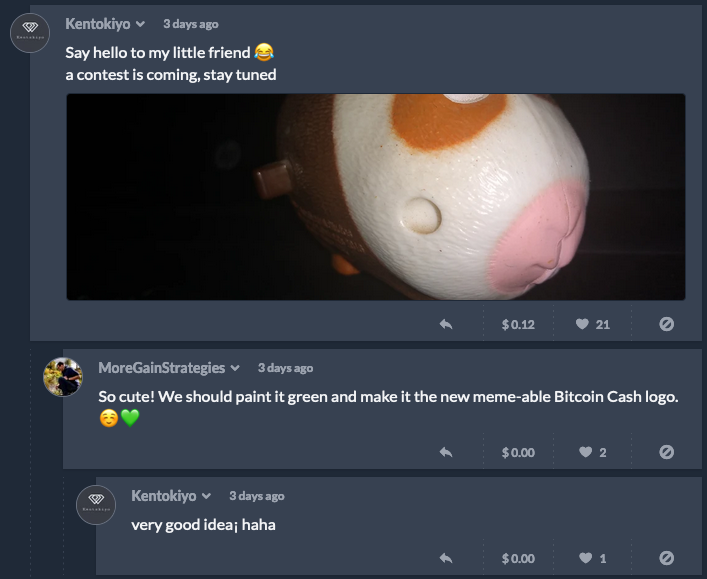
The cacophonous cauldron that is noise.cash is always bubbling. Pure noise, many say, but there are scrumptious morsels there, too, if one cares to look. Consider the following post, from user Kentokiyo, with @MoreGainStrategies: https://noise.cash/post/ljnwmg07 https://noise.cash/u/kentokiyo
MoreGainStrategies posted about it. I liked the idea of a BCH mascot, but thought that we couldn't modify an existing product as it would be copyrighted. https://noise.cash/u/moregainstrategies https://noise.cash/post/l7pnq8m0
Later that day, user Feels posted this: https://noise.cash/u/feels https://noise.cash/post/lvn5vvz8
...to which I responded (with MoreGainStrategies and Whattheactualduck): https://noise.cash/u/whattheactualduck
I told MoreGainStrategies that I was inspired by their post and I've been thinking about it since.
What would make a good mascot for BCH?
I think we can begin to standardize qualities of a good crypto mascot by looking at some other crypto projects. Consider the following:
Dogecoin
Uniswap
PancakeSwap
Beefy Finance
Curve Finance
LeoFinance
HONK HONK
Some of these are obvious, some less so, but each can tell us something. Note: the following sections got rather longer than anticipated. You can skip ahead to my conclusions if you'd like. https://read.cash/@lerkfrend/a-worthy-bch-mascot-b9229d32#conclusions-mascotability
Dogecoin
The meme gold standard, right? The important thing to remember here is that Sir Doge was a meme before he was a crypto meme. https://knowyourmeme.com/memes/doge
**Qualities: Popular, Established Meme. Dang Cuteness. Meme-iest Project?**
Uniswap 🦄🧦🚀
This one is about consistent branding. Check out Uniswap's Github. Note that a fair number of their repositories have **emoji identifiers**: https://github.com/Uniswap
uniswap-interface 🦄
uniswap-sdk 🛠
uniswap-lib 📖
governance 🏛
etc...
This sets a standard of communication. Each emoji is vested with additional connotation as part of a group language.
🦄 *is so cute and magical and it's going to make us so much money!*
There's also 🦄🐷 and 🧦. Some of you know what I mean in this context, and that speaks to the power of Uniswap's early branding methodology. For the rest of you I'll give a bit more context.
🦄🐷 stands for Unipig, a "gamified demo of Uniswap on Ethereum Layer 2." Built in collaboration with Plasma Group (PiG), Unipig was a demonstration of the power and scalability offered by Ethereum Layer 2 protocols. It primarily used social media engagement to drive the airdrop distribution of PIGI tokens, that could then be swapped on the site to demonstrate one's allegience, either to 🦄 or 🐷. Now defunct, the project boasted 20,769 blazingly fast transactions that avoided a total of 33.2304 ETH in gas fees. https://unipig.exchange/welcome https://etherscan.io/token/0x761137Dd355d2C86633f954FeB0567AF4D556dd1
🧦 stands for Unisocks, an exploration of dynamic asset pricing based on market maker bonding curves. The asset in question: neat socks, valued at the time of writing at **$64,261.79 USD**. Pat Doyle has written a very good article on this phenomenon over at Medium. https://unisocks.exchange/ https://medium.com/frst/money-laundry-the-rise-of-the-crypto-sock-market-f979aafc3796
I would argue that Uniswap have successfully laid claim to the Unicorn emoji. 🦄 is their mascot. They are a consistent brand with an aim towards casual ease of use. They leveraged a fun meme-y approach to showcase their project's technical scope. They even have a particular shade of pink: #FF007A.
**Qualities: Consistent, Fun Brand. Emoji Identifiers. Memes Demonstrating Tech.**
PancakeSwap and Beefy Finance
I'd like to mention these projects together as they follow the general trend of Uniswap, each with their particular flavor. The main take-aways here are in branding and mascot choices.
PancakeSwap's Bunny
Or is it a pancake? It's both! Their logo is obviously inspired by Oolong, the meme rabbit that balances things on its head. https://knowyourmeme.com/memes/pancake-bunny
This is another example of a crypto mascot basing itself on a **well established meme**. This comes with some built in brand recognition and memetic loyalty.
Note also that their documentation uses an **emoji identifier** schema, just as Uniswap did. https://docs.pancakeswap.finance/
🐰 + 🥞 = 🤑
**Qualities: Established Meme. Cute AF. Consistent Branding. Emojis.**
Beefy Finance's Cow
Beefy Finance offers a clean brand experience along with its cute and simple little cow logo.
This is not particularly noteworthy for our purposes, but one can imagine any funny picture of a cow getting a Beefy Finance spin.
The same concept applies to PancakeSwap and Uniswap. Take their iconography, their branding, use that foundation to build a meme. A weird pancake for that error you keep getting. A tired cow ( 🐮💤 ) when the APY dips. A unicorn with its horn piercing the moon.
When you have community engagement with a quality brand, the memes will come.
**Qualities: Branding. Starting With Cuteness. Meme Potential as Community Potential.**
Curve Finance
You might be wondering why this is on the list. You don't see any mascots looking at the Curve Finance website. This one requires a dip into Telegram. https://curve.fi
Meet the Curve Llama:
Rad. How about another?
And one more:
You can't find these memes anywhere but the Curve Finance Telegram. They are...so good. But what can we learn here?
It's those cute animals again, but what I'm really trying to get at here is the **diversity of visually expressible emotions.** This is something that made emojis particularly resonant in the context we discussed earlier. They transcend human verbal language. They express ideas within a readily understandable visual context.
A well constructed meme takes this property and adds a twist, sometimes humor, sometimes critique, sometimes non sequitur. The purpose of the meme is engagement of the viewer through surprise or joy. It can become a tool for group bonding. It can convey complex information.
*A sad bedraggled llama on a surfboard, whaaaaaat!? Love this image, yes, show it to all my friends, so cute!*
And then:
*I'm lurking in Curve's Telegram and someone flash loan attacks Yearn Finance. I throw out the "Ride the Curve" llama. We all laugh and hope for the best.*
**Qualities: Strong Visual Language. In Jokes. Community.**
LeoFinance
This one's real quick. Their branding is slick but not super meme-y. But they chose a good animal. And so, thanks to @Sneezewort for this, posted to noise.cash (go check out his LeoFinance!): https://noise.cash/post/lvnxqw67 https://leofinance.io/@cryptosneeze
**Qualities: Sneezewort Knows Memes. Choose The Right Animal.**
HONK HONK (a note on Pepe)
I understand why the HONK team chose a Pepe meme. It makes sense for their branding, and it has strong recognition and engagement. I like HONK, but Pepe has too much baggage.
Pepe wearing a BCH shirt? Hell yeah, sounds great. But Pepe doesn't belong to anyone, and is certainly not for everyone.
Plus, we already have the Feels SLP token. https://feels.cash
**Qualities: Meme Recognition. Pepe. Meme-iest Project.**
Conclusions: Mascotability
Let's review the qualities we've seen in these projects.
Cute Animal 🐰
Consistent Branding 🦄
Meme Recognition 🤡
Strong Visual Language 🦁
Community 🦙
The first one is easy. A good BCH mascot should be a **CUTE ANIMAL**.
The other criteria are more complex. A mascot should be representative of BCH. That being said, BCH does not have consistent branding, because we are not a brand. We are a collection of stakeholders looking to build value for our network.
I was looking around for good examples of mascots and I realized very quickly that it's the projects that have mascots and branding. Most of Defi. Microblogging like HIVE ( 🐝 ) and LeoFinance. Things like DOGE and HONK are weird outliers where the coin is also the meme.
But I saw a lot of similarities in the feel of Curve Finance's Telegram and BCHChannel, for example. There's a lot of memes floating around. The BCH gang can tip each other SPICE and HONK and that's fun. But Curve has a rich set of memes all their own.
A BCH mascot should be **a cute animal that can be ours.** Not some Doge off the street that we tape to the sides of our coins. We need sufficient source material: images in the public domain or licensed specifically for remix without attribution. Thankfully, a few of the image sites recommended to users here on read.cash fit these restrictions.
**We, the community, can make our own memes**. Anyone with a phone can make a good meme these days. We can build our **strong visual language**, our **community jokes** and **demonstrations of tech**.
Are you ready?
No, are you?
For capybaras?
I'll go over some of my motivations in a future article, but this is my personal choice.
What do you all think? Do you have an idea for a mascot or a great meme format? Leave a comment below, let me know what you think, make the meme, share the meme, subscribe if you liked what you saw and think I can pull it off again, and I'll see you next time!
Lead photo by **José Luis Photographer** from **Pexels** https://www.pexels.com/@joseluisphottographer?utm_content=attributionCopyText&utm_medium=referral&utm_source=pexels https://www.pexels.com/photo/brown-dinosaur-mascot-2564846/?utm_content=attributionCopyText&utm_medium=referral&utm_source=pexels
Capybara photo by **Brett Sayles** from **Pexels** https://www.pexels.com/@brett-sayles?utm_content=attributionCopyText&utm_medium=referral&utm_source=pexels https://www.pexels.com/photo/selective-photo-of-brown-capybara-1040416/?utm_content=attributionCopyText&utm_medium=referral&utm_source=pexels
it isn't inevitable
You know what I mean. The "crypto future." It's not going to happen by itself.
It might be easy to kick back while the market plows ever upward. Certainly there are many making "passive" income on the current strength of crypto markets, but that approach is not sustainable.
We know this. We know about bubbles. 2017 was educational, but many entering into crypto now do not understand its historical record, the importance of the past.
Consider Dogecoin. Meme-y and fun though it may be, it belies a truth at the core of many crypto projects. It is no longer in active development and it's a bad, inflationary currency. It was a silly game for its developers but now it's out of hand. Money pouring into DOGE does one thing, inflate a bubble.
Now consider some recent BCH numbers (that we're all justifiably hyped about):
transactions are up!
price go up!
NVT ratio is still low!
Coin Fair Value says* we're absurdly undervalued! (I've written about this, as did user @Omar recently here) https://www.coinfairvalue.com https://read.cash/@Omar/how-much-is-bitcoin-cash-really-worth-a-fundamental-analysis-using-currencies-fair-value-model-59b96227
This is all good news, and it does speak to real changes and improvements in the community. Developer morale is high, as seen in the February developer livestreams hosted by BCH Network Discussions. But it could fall apart. We could get distracted by problems that don't need to be solved yet. We could keep watching that price point, and all those happy charts that say "We're really doing it! We're the real Bitcoin!" https://www.youtube.com/channel/UCmyoHmbSsChInLzZ9S5aAAw
Yes, these metrics mean things are happening, but couldn't there be more happening? What can we do as a community to help?
I don't mean to discourage anyone here. I'm speaking specifically to the laymen in the audience, those that can't contribute to programming or business development or the like. I am in this group. There is a place for what we're doing here. read.cash is somewhat of a peer review process for BCH thinking. We are building and confirming our understanding of a revolutionary technology, and that takes time.
We are leaders of a sort. By writing and engaging in this community, we are fostering potential economic growth. Upvotes are a powerful endorsements of thoughts and methods. This the aim of the site, but it becomes the aim of its users as well, if/when they realize the potential of BCH.
The worry, however, is that these sites will become echo chambers, voicing the same ideas over and over while time and society move onward. So what can we do? How do we avoid empty talk and meaningless token swapping that inflates our numbers? As members of the BCH community, I feel we should strive to:
learn and grow along with the network
engage with ideas over people
give honest feedback
Learning and Growth
This is the crux of the issue, right? A blockchain is only as strong as its network protocols, and programming means nothing if it's not being run. This is what separates a Bitcoin from a very shiny rock, after all.
We need to keep distributing that ledger. The more nodes the better. The more users the better. The more wallets the better.
We, the BCH community, need to understand our product. For the majority of users, that does not mean node software. It means a wallet and basic cryptocurrency management. What wallet should we recommend new users? While we're asking, why are you using the wallet you use currently? What do new users need to know to use a wallet safely and effectively?
We need to be clear about cryptocurrency terms. For example, can you tell me what HODL means to you? Can you explain your thinking? Do you think that definition applies or should apply to someone else?
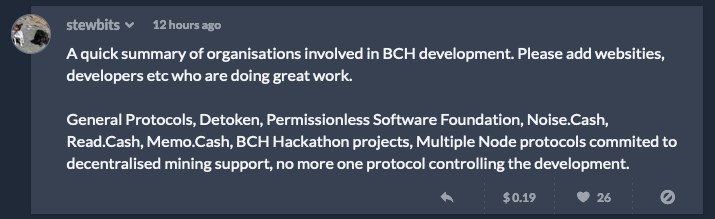
We should be prepared to point to appropriate resources when we're asked something we don't quite understand. We above all should look to provide accuracy. What are our most reputable sources? As a decent example, take this post by user stewbits on noise.cash: https://noise.cash/post/lkkk7z8g https://noise.cash/u/stewbits
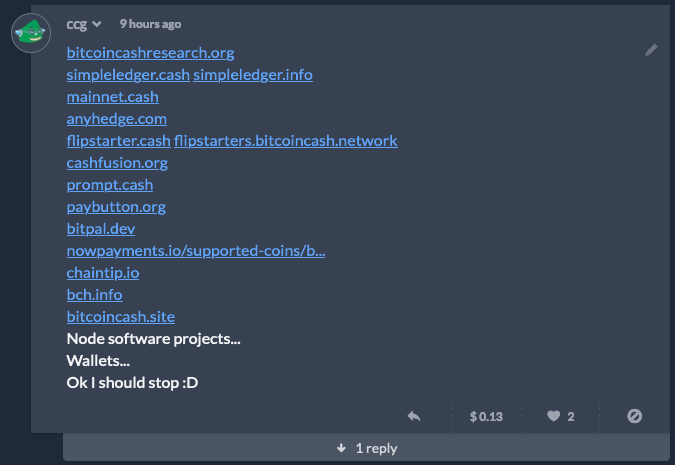
User ccg responded: https://noise.cash/u/ccg https://noise.cash/post/l0zzvx5z
Think about how Wikipedia functions: many people coming together to put forth their knowledge, with the understanding that they will be fact checked by others. Accurate information arises from group investment. There can be momentary distortions, but they are overcome by a plurality of correcting signals.
Ideas over People
Uhh, lerk, didn't you just write about how you were here for the people? Yes, emphatically yes, but I also recognize that I'm not going to get along with everyone. This is a fact of large groups, the varieties and vagueries of human nature. But this doesn't mean I won't try to listen or engage with your thinking. https://read.cash/@lerkfrend/my-bch-mindset-goals-and-commitments-dcd7bbe9#i039m-here-for-the-people
We cannot become a loose confederation of feel good BCH splinters, each ignorant of or blinded to the next, trying to do our best for BCH but finding it so hard with **all those competing interests out there!** Guess what? We all benefit when we can work together, and that means listening respectfully, speaking respectfully, building on each other's ideas regardless of our politics.
The world at large may try to cast the BCH community as hardline libertarians that like the idea of gold and assassination markets, and we need to understand where that judgment is coming from to appropriately respond. We need to understand the appeal of cryptocurrency to people from diverse political and socioeconomic backgrounds.
Diversity of perspective can help build a better end-user experience, a better network experience, a better money experience.
Honest Feedback
Death to 🥰
Death to drama.
Give your opinion if you feel it is **valuable to the group cause** to do so. Let others have space to voice their opinions. Remove yourself from a situation that might go over this line of respectability. The record will show how everyone has acted. We are here to share our ideas and build a network. We benefit from staying united in this regard, but we do not need to agree on everything.
Take for example here a recent article by @dave_gutteridge, and in particular the comments from @RowanSkie. It is so necessary we continue to have these types of conversations. https://read.cash/@dave_gutteridge/no-one-cares-about-bitcoin-cash-if-it-doesnt-make-them-money-a7fc4d7e https://read.cash/@dave_gutteridge/no-one-cares-about-bitcoin-cash-if-it-doesnt-make-them-money-a7fc4d7e#comment-2356f2f0
The Bitcoin network benefits from a diversity of node software. Likewise we benefit from a diversity of perspectives and attitudes.
We must be wary, however, of useless feedback, meaningless comments, noise. Here we can include critique without reasoning, linking others to unrelated content, misleading or scammy advertising, censorship or misinformation. If we, as laymen stewards of BCH, are to create meaningful improvement and growth we need to appropriately manage our social media platforms. We cannot become /r/bitcoin.
Yeah, but that's just, like, your opinion, man.
Yep, it is. Thanks for reading.
A quick final note: this is NOT the article I was talking about in my most recent mini-post. The words must flow and all that. Stay tuned! https://read.cash/@lerkfrend/post-6156bd35
Lead photo by **James Wheeler** from **Pexels** https://www.pexels.com/@souvenirpixels?utm_content=attributionCopyText&utm_medium=referral&utm_source=pexels https://www.pexels.com/photo/building-with-tree-1534057/?utm_content=attributionCopyText&utm_medium=referral&utm_source=pexels
Footnotes:
*Coin Fair Value makes no speculative claims. They provide an analytical model that can be useful in cryptocurrency valuation.
Hey everyone, sorry I haven't posted a new article in a bit, I'm working on something that's a bit more complicated. Hopefully I'll get it to you in the next few days.
my BCH mindset: goals and commitments
It's been whirlwind three weeks for me. BCH and noise.cash and read.cash have been rather transformative. I have too much free time while I'm on leave, but I seem to spend most of my day looking at crypto charts, reading about BCH developments, and tipping all you lovely people.
Shortly after I received my first upvote from Rusty, the Random Rewarder, I made a post on noise.cash: https://noise.cash/post/1qrnwpmx
At the time, I didn't really know what to expect from my earnings. I had made less than $1. Rusty has visited me a few times since and I want to remain true to my commitment. To that end, I would like to open up my read.cash finances for a bit of scrutiny.
This is my read.cash wallet, and this is a wallet I created last night when Rusty went on a tipping spree, as I did not want to hold too much in my read.cash wallet. https://explorer.bitcoin.com/bch/address/bitcoincash:qrh0stkk0zyr6yvmv2fdjdvk2mssk9q9cykuks4sy4 https://explorer.bitcoin.com/bch/address/bitcoincash:qpg7pexzmw9fkqcpgu3fgscevln858jy0yrgfxgwem
Now I'm not going to go crazy with the accounting. This is an informal commitment on my part, and I mean to stick by it, but I was not expecting to make more than $5 on any particular article.
I no longer think I can reinvest 100% of my earnings. I'd like to do what I've been doing on noise.cash: distribute 75%, keep 25% for myself. Again, this is an informal commitment and I'm not going to count out my satoshis like some miserly old Scrooge. Many things may change, but the core remains the same:
I want to make a habit of engaging and including others on this platform. I want to foster the exchange of opinions and ideas by encouraging others to write and share.
I'm not going to hold myself to any tipping standards or reading requirements. I'm doing this because it's fun and rewarding and I don't want to make it a job. If I earn from my writing then so much the better but this platform is bigger than me.
I'm here for the people.
I want to embody some crypto organizing principles and lead by my example. I am not looking for followers, but I want my actions to be a statement of my faith in this project. The more time I spend here the more I feel that I need to be here for the long-haul, that I can engage my talents here to make a difference.
but wait, there's more commitment!
I posted this to noise.cash five days ago: https://noise.cash/post/1844r64r
I've since done some follow up. The majority of merchants accepting BCH in my city are restaurants that use Menufy. This is all well and good but I'm not looking to onboard people to Menufy and have no need for the service.
There are three non-restaurant businesses that are listed as accepting BCH. Two of them are individual guys that are into Bitcoin that accept BCH as payment because it has Bitcoin in the name. The other is a Kratom retailer that seems to only accept BTC, and their website recommends their clients buy it on Coinbase using a credit card, while also saying that BTC allows users to transact anonymously. They then ask you to register an account on their site before you can make purchases. Not very reassuring.
I'm not particularly discouraged, though. I knew it would be an uphill battle to raise crypto awareness and this is as much about my growth as it is about BCH's. I am going to have to overcome some social anxiety hurdles to go out and start talking to people.
I've started with my mother-in-law, who has been vaguely interested in Bitcoin for a few years now. We've only had a couple conversations where I've outlined some Bitcoin basics, and she's left them a bit confused but I don't think that was entirely my fault. It's hard to communicate these complex ideas to people with very little frame of reference.
I have been studying a lot of merchant on-boarding resources and I'm trying to develop my approach. I'm reminded of the many Roger Ver debates I've watched recently, where he seems to have every phrase ready and practiced, where he even knows the opposing side's argument and is always ready to counter. I'm not there yet. I'm not comfortable with BCH in that way, but I'm not going to let that discourage me. You've got to start somewhere.
Bringing the world a sound, revolutionary currency is worth the effort.
Thanks for reading. Comment below if you have any thoughts for me, I'd really love the feedback!
Lead photo by **Karolina Grabowska** from **Pexels** https://www.pexels.com/@karolina-grabowska?utm_content=attributionCopyText&utm_medium=referral&utm_source=pexels https://www.pexels.com/photo/silver-and-green-round-coin-5980862/?utm_content=attributionCopyText&utm_medium=referral&utm_source=pexels
proper introductions!
Well, I've been here for three weeks now, I guess I'll say it officially: hi?
I'm Tom! Or lerkfrend, or lerkfeend, or Lerk, or any sort of interaction on noise.cash, you get the idea. https://noise.cash/u/lerkfrend
I stumbled into the crypto world almost four months ago. I can barely believe it, it seems like so long ago. The Brave browser was my introduction, then Coinbase (wow), then brief forays into Ethereum, then Publish0x, and now here, and by that I mean the dotcash/BCH community.
Can you imagine that just months ago I knew literally nothing about BCH? This is an absurd idea to me, but it is true. Did you know there are other crypto spaces out there that aren't awesome, that aren't committed and engaging, that are full of scams and lies?
But anyway, this article is supposed to be about me. I live on the west coast of the United States, where it rains a lot and there are a lot of tall evergreen trees. I have a wonderful wife and three fur babies:
a Shiba Inu / black Labrador mix doggo named **Leela,** after the Futurama character (yes, she's part Doge)
a fat black cat named **Salem**, after Sabrina the Teenage Witch's cat
a skinny little gray firecracker of a cat named **Freya**, after the Norse goddess
They are truly my children. We adopted Leela from a person that could no longer take care of her and she is the sweetest dog I have ever known. Salem and Freya are siblings that we fostered when they were just weeks old. We bottle fed them four times a day for just one week. We bonded with them so strongly. They became what is known in the animal fostering community as "foster fails," we just could not give them away! They are too precious!
So crypto and animals? That's it? That's your life, lerk?
I like lots of things, okay! Just because I've looked like an absolute noise.cash degenerate doesn't mean I have no other interests. But it's funny. I started watching BTCUSD charts in December and it was...exhilarating. That sounds weird, let me explain. I've always liked math, especially math that makes my brain hurt. I feel most like I'm learning when I can't quite grasp a subject but my brains insists on more, More, MORE! I was studying candlesticks, watching BTC's ATH after ATH and I wasn't excited about the price as much as the social event that was unfolding. I knew that there were methods and techniques for analyzing what the chart was saying, a financial sector back-end rich with mathematics, but at the same time the numbers were so many individuals, trying to do the same as me, watching a chart or reading headlines, gauging and analyzing markets as I was trying to do.
I realized that I cared about crypto. I wanted it to succeed.
At the time, I was all for BTC. The big name with all the branding and media attention. I kept my wife up to date on its price. 20k, 22k, 24, 27, on and on. She humored me and enjoyed that I was excited. I widened my scope a little bit, started looking into Ethereum. It's not immediately apparent to an outsider but a world computer can be very powerful. Smart contract technology blew me away, but there was an obvious price barrier.
I discovered Helium and felt I had found a project with a simple but powerful use-case. I realized that I could be a relatively early adopter and leapt at the chance to buy an HNT mining hotspot. They have been on back order now for a few months but I have staked my place in line and look to receive it in March. At the time I was making my cost calculations, HNT was trading around $1.40. It's now over $4, so I feel that I made the correct choice. I'll be sure to do some write-ups of my experiences. https://www.helium.com
Now BCH is fully in my attention. I love read.cash and noise.cash as platforms, as methods for increasing awareness and adoption. I've always wanted to write more and this gives me a great opportunity, and I'm happy to be a part of a community with so many people working hard to make it better.
One of the big things I'm starting to see is how groups and individuals go about making these loose decentralized projects work. Going back to Rick Falkvinge's quasi-satirical Official Statement from the CEO of Bitcoin Cash, this community has made an effort to put the protocol first in its dealings, to come together to build and not tear each other down. https://falkvinge.net/wp-content/uploads/2017/11/letter-from-the-ceo.pdf
The gate's open, come on in. If you don't like someone or something, you can share your opinion, but the best thing to do is to leave them to themselves. I hope they're here to help BCH, too, after all, and everyone does that differently.
Anyway, I'm really excited to be here, and it's distracting from what this is supposed to be: all about ME! My crypto learning interests are all over the place but right now they include:
tokenomics and smart contracts
currency dynamics, money, how and why fiat sucks
counting in satoshis
noise.cash as a social platform / growing engagement / turning spammers into good noisers
Javascript development with mainnet.cash and floweejs (I'm a complete noob here but it's exciting)
I'm currently on a leave of absence which gives me an absurd amount of time to do stupid things. Outside of the crypto sphere, I mostly manage my fur babies, cook mostly-vegan food, read, and watch/play video games. I really enjoy:
AfreecaTV Starcraft 2 GSL, and by association, the supreme English caster duo of Artosis and Tasteless https://www.youtube.com/channel/UCK5eBtuoj_HkdXKHNmBLAXg https://www.twitch.tv/artosis https://www.twitch.tv/tastelesstv
Magic: the Gathering deck-building -- currently focused mostly on meme Commander lists https://www.edhrec.com
League of Legends professional play -- North American teams Team Liquid and Evil Geniuses are my current favorites (though not to win Worlds or anything, lololol) https://www.lolesports.com
Other games include: Stardew Valley, No Man's Sky, Hearthstone, Darkest Dungeon, Dota 2....probably more, my own humble game dev ideas included
I'm currently doing a lot of rereads, mostly theory and fantasy:
The Gutenberg Galaxy, by Marshall McLuhan https://en.wikipedia.org/wiki/The_Gutenberg_Galaxy
A Storm of Swords, by George R. R. Martin https://en.wikipedia.org/wiki/A_Song_of_Ice_and_Fire
The Society of the Spectacle, by Guy Debord (this has been a constant reference for that last few years) https://en.wikipedia.org/wiki/The_Society_of_the_Spectacle
Anarchism and other Essays, by Emma Goldman https://en.wikipedia.org/wiki/Anarchism_and_Other_Essays
The Vlad Taltos series, by Steven Brust https://en.wikipedia.org/wiki/Steven_Brust#Dragaera
I'm also interested in spiritual and magical practices, as well as "divination" techniques like Tarot and I-Ching. I try (and have failed recently) to do a simple daily Tarot reading in the DailyTarot Chamber on noise.cash. You can drop a post in the Frendzone Chamber if you are interested in a small personal Tarot reading or you have questions for me. https://noise.cash/n/dailytarot https://noise.cash/n/frendzone
One more thing before I go: I'M REALLY EXCITED TO BE HERE! This platform is connecting the world and helping us share our stories, thoughts and wisdom. We are better for it, so let's keep it going!
Lead photo by **cottonbro** from **Pexels** https://www.pexels.com/@cottonbro?utm_content=attributionCopyText&utm_medium=referral&utm_source=pexels https://www.pexels.com/photo/persons-left-hand-with-purple-manicure-4629634/?utm_content=attributionCopyText&utm_medium=referral&utm_source=pexels

uncertainty is good for BCH (hint: it's all those transactions)
If you haven't checked it out yet, I recommend you look at coinfairvalue.com. https://www.coinfairvalue.com
I first read about this site in an article by @MarcDeMesel, where he illustrates just how absurdly good of a deal BCH is right now. https://read.cash/@MarcDeMesel/nvt-ratio-bch-near-atl-while-btc-near-ath-1193db90
The "fair value" of BCH listed on the site might be a little shocking (in a good way). What is it now? I'm writing this article just after noon on February 9th (I'm in the US), and BCH is listed at $1951.67! Almost four times its currently traded value! But what does this mean exactly? Why aren't we trading at that price?
I saw this a few weeks back now, and I needed to know how they came to that number, so I dug into the site's Methodology page, which eventually leads to another article on Steemit about currency value modeling. I've been reading and rereading these materials and I'm digesting it rather slowly, but something stuck out to me yesterday that I felt I needed to share, even if the larger "currency valuation modeling" perspective remains a bit foggy. https://www.coinfairvalue.com/reference/ https://steemit.com/bitcoin/@pablomp/cryptocurrencies-what-is-the-fair-value-of-a-currency
You'll see on Coin Fair Value's BCH listing that there is a glaring red "Uncertainty" value, currently at 78.7%, which is very high, higher than almost any other listing. So what does this mean? To quote the Methodology page:
Our uncertainty model targets the fact that we cannot be sure that our moving averages are an indication of the non-speculative behaviour —utility trades—. We take the difference between the logarithm of each model variable and its actual value as the 99th-percentile of the uncertainty. This way, **changes in the behavioral variables and fast changes in transactions lead to a higher uncertainty.**
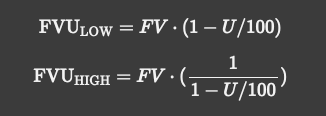
It goes on to say that this uncertainty model gives us "an approximate region instead of an exact value." This region can be said to have upper and lower bounds according to the following formula:
What do we get if we plug in our BCH numbers? For the lower fair value price boundary, with BCH fair value at $1951.67 and Uncertainty of 78.7%, we get a price of $415.70. For the upper boundary, we get $9,162.77!
But why did I want to share these numbers? What got me excited? Well we're currently near the lower uncertainty boundary, hovering just above $500, and that upper boundary is near Coin Fair Value's BTC valuation, sitting at $10,947.90 at the time of writing.
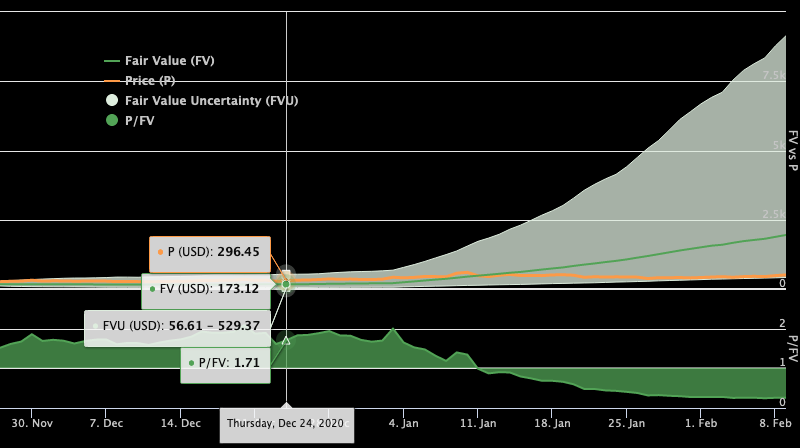
Let me put it another way, drawing from the quote above from CFV's Methodology page: the BCH fair value is so uncertain because it takes into account the number of new transactions on the BCH network, transactions with unknown utility. Look at this graph, also from Coin Fair Value:
The FVU matches a timeline we are all aware of, the slow and steady increase in daily transactions on the BCH network, due in large part to the introduction of noise.cash.
But lerk, you might say, these transactions are meaningless in comparison to those on BTC's network. noise.cash users are sending pennies to each other, that's not real utility! Well, yes and no. Is the BCH network going to be sustained into the distant future with an entire economy swapping pennies? No, but there will be a large number of transactions, a massively large number.
We are talking VISA levels. That's one of the the original intents of Bitcoin, a worldwide monetary network capable of processing a world's worth of transactions. BCH is proving something by increasing its transaction load, and not just its fee structure.
As of yesterday, BCH surpassed BTC's daily transaction totals, when BTC is at an all time high. The Bitcoin Cash community is demonstrating the power of an untainted Bitcoin network. So why are things so uncertain?
People aren't willing to admit BTC's lack of utility. It's not a judgment of BCH, it's an anti-judgment. They can't admit their valuations are speculative, that BTC isn't used for payments, that the network has serious issues. It's a "big numbers good," "dab on 'em, Elon!" sort of situation that feeds on memes and market caps, but utility doesn't care about that, it just does work.
The upper bound of BCH's Fair Value Uncertainty is right there next to BTC's fair value, which makes sense. They started out as the same coin, after all.
But one of them is doing it better, and honestly, we're just getting started.
Lead photo by **Thought Catalog** from **Pexels** https://www.pexels.com/@thought-catalog-317580?utm_content=attributionCopyText&utm_medium=referral&utm_source=pexels https://www.pexels.com/photo/woman-holding-two-coins-2228570/?utm_content=attributionCopyText&utm_medium=referral&utm_source=pexels
we need BCH price Oracles for merchants
Can you count in satoshis? What if I told you it was in your best interest to do so? How much would it take for you to learn?
In this article I'm going to argue for merchants to undercost their goods by listing alternative prices in BCH satoshis. That is, to specifically take less profit on each sale they secure through BCH transfer as a means to incentivize the use of BCH.
This process has a logic to it, but I must say that I am not an expert. I will not be able to provide a useful method of developing these pricing techniques. Pricing goods is a complicated process and a lot of effort will need to be put into developing this sort of system.
First of all, each specific locale would need its own pricing Oracle. This concept should be familiar to you, but if not, an Oracle is an on-chain method of determining information about things happening off-chain. But here, the Oracle would most likely need to be a group of people that aggregate hard-goods price data and correlate that with BCH market movements. A network of merchants or supply chains in some locality that are all committed to accepting and growing BCH as a payment system would all have a common interest in providing each other accurate data, for example.
This is built on the expectation that BCH will follow a similar path of adoption as BTC. Institutional interest in BCH would reward the savvy merchant that has built up their stores of BCH by such methods.
Supply chains built with BCH payment methods in place allow for ease of payment and come with built-in immutable accounting, operating without bleeding value into other institutions that might not have the same interests.
Back to the mechanics of pricing. The key element here is an understanding of potential market movements. Pricing weighted toward or against an expected market movement could help a local economy absorb crypto price volatility. We see these sorts of hedging measures in many markets. It is not beyond the scope of an Oracle to aid in this sort of system.
A merchant group would most likely look for a satoshi pricing system that allowed for ease of understanding for consumers unfamiliar with crypto currencies. Perhaps the aim would be a satoshi price that did not change very often, even though, by our market currency pair understanding, each satoshi could change drastically in value.
Again I would stress the concept of savings. The merchant is saving in many ways by using BCH, and that savings should be passed on to the consumer. It must be obvious that this new way of transacting is good for all parties.
The necessity for these sorts of decisions to remain in each merchant's hands is obvious, and we can expand this also to the merchant's suppliers, and those other merchants in the locality that may have mutual benefit from an increase in satisfactory business in the area. Low prices drive business and support the movement of money. Now imagine if that money never ends up going into a vault somewhere.
The ultimate goal, then, would be a slowly expanding self-sufficient BCH economy that uses the benefits gained from transacting on the BCH blockchain to build advantage and gain value. Short term loss of optimal profit pays off in appreciation on BCH holdings.
This is not simple, but the necessary infrastructure is already here. Oracles are being built for many platforms with diverse uses. We can start doing this now.
Photo by **Jeff Stapleton** from **Pexels** https://www.pexels.com/@jeffstapleton?utm_content=attributionCopyText&utm_medium=referral&utm_source=pexels https://www.pexels.com/photo/summer-building-wall-architecture-5792815/?utm_content=attributionCopyText&utm_medium=referral&utm_source=pexels

a lesson from DOGE (and GME) in price discovery
I hope that the main takeaway from the events of the last few days is not that Elon Musk drives markets. To be sure, that's what happened. But it doesn't have to be Elon, or any other leader.
What I take away here is that groups have power. What I take away is that people put value into things because they care about them. The thing doesn't really matter.
GameStop is a particular case, but the lesson is the institutional response. Had another stock or another business been in a similar position and a determined number of people felt it was worth pursuing, we would see similar events play out.
DOGE is a particular case, and perhaps even more illustrative here. A critique of cryptocurrencies I've discussed in a few of my previous articles was their price volatility. An asset that could not be counted on to store its value was not a currency.
But haven't the DOGE Days been incredibly volatile and wildly unpredictable? Yes, but the lesson is not in the price, but in the lack of concern about the price. Valuation is what we make it. DOGE was worth it because people bought it. Have some of those new DOGE holders now lost value? Yes, but they haven't lost DOGE.
These are the sorts of issues we come up against when we start to think about cryptocurrencies. We are at a time where crypto into crossing boundaries into fiat currencies spaces, but cryptocurrencies do not behave "properly." They are made up of mathematics and not physical objects. We can't use them for everything. There is resistance from the current infrastructure and a concerted disinformation campaign.
But perhaps that has something to do with our thinking as well. Are we looking to improve the ways we transact, the ways we communicate? Are we seeking opportunities for cryptocurrencies to expand?
Information is easily distributed on the Internet, trivially so if you're Elon Musk. But we shouldn't need Elon to tell us what to do. Or centralized banks that want to protect their value. Or governments that want to control distribution of the world's resources.
I'm glad we're here so we can talk about this. We've got a lot of work ahead.
Photo by **Evgeny Tchebotarev** from **Pexels** https://www.pexels.com/@evgeny-tchebotarev-1058775?utm_content=attributionCopyText&utm_medium=referral&utm_source=pexels https://www.pexels.com/photo/shiba-inu-resting-on-pavement-2187304/?utm_content=attributionCopyText&utm_medium=referral&utm_source=pexels

gatekeeping BCH and the crypto gold standard
If we are truly after an electronic peer-to-peer cash, we will need to reassess our understanding of cash. The language we use when speaking about currencies needs to change because the idea of currency has changed. Note that money, cash, and currency all mean the same thing for our purposes.
This article builds on some ideas in my two previous articles, here and here. https://read.cash/@lerkfrend/cryptos-wont-work-as-real-currencies-and-other-economic-assumptions-from-the-banking-world-68b89280 https://read.cash/@lerkfrend/why-btc-cant-pass-the-proper-currency-test-but-bch-can-6aefb590
There is a lot of pressure from mainstream financial authorities to maintain their privilege. They do not like the ways in which cryptocurrencies open up the space. But eventually they realized they could co-opt the potential financial power of the Bitcoin project if they...just...bought it all. And Bitcoin, like it or not, has ascended. It is now accepted.
More and more financial folk are talking about what a great **store of value** it is. And, at least according to this article in Bitcoin Magazine by someone named Casey, valuations using Bitcoin can help us make sense of other assets as well, even currencies. https://bitcoinmagazine.com/articles/stocks-dont-truly-discover-price-bitcoin-fixes-this
This was a main concern, one of the key ingredients of a "proper currency" that Bitcoin was supposedly missing: it is very hard to count in Bitcoin. Who knows how many satoshis a banana costs? Around 400? Depends on the day, you might say, but no, not true, says Casey. We should be better able to understand financial concerns because Bitcoin is currency system agnostic. It is pure value. Casey argues that valuations of Bitcoin denominated in a particular currency are not measures of Bitcoin's value, but rather the value of the currency.
This means that one can **account for the value** of other assets in Bitcoin, a necessity for currency propriety. And Casey says the only reason we don't know how many satoshis a banana costs is because we've been using other, messier currencies as intermediaries. We haven't revised our understanding of currencies.
I think I get it, especially after this most recent bout of institutional buy-in. These moves were all judgments in favor of long term value storage in the form of Bitcoin, moves meant to stabilize price for its use in the traditional financial system. These institutions are even willing to accept some price volatility in the short term, because these are long term plays. As Casey says, "by envisioning time on a scale beyond that of market cycles and economic quarters, we can see that a store of value’s price discovery is a long-term operation." These are accounting measures, hedges against messy currency issues, but that in itself is warning sign.
"Gold has always been worth gold..."
Wait, isn't this a good thing? Crypto being valued, recognized as important in the modern economy, isn't this what we wanted? Sure, and lots of people are making money, and many other fantastic crypto projects are receiving attention and funding, but at the cost of Bitcoin. In their frenzied and sustained effort to evaluate and control it, our financial systems turned Bitcoin into gold, and the Kings Midas of Bitcoin Core didn't help.
There's a reason we dumped swapping bits of gold around with each other: it sucks. But it's worse with Bitcoin. Buying that banana costs more than the banana itself. The network's transaction market works on gold logic: somewhere along the line it was decided that transactions *should* be expensive, as if miners were all moving around something terribly heavy.
A Bitcoin that is sluggish and hard to break into meaningfully small pieces is not Bitcoin, nor is it a useful **means of exchange**. It can't be money.
"Money allows us to express our idea of value"
There's also another trend we can see here, something that underpins most of Casey's argument. The fate of Bitcoin is essentially decided, but how it got here is still very relevant.
Casey makes a distinction between valuations of Bitcoin: there's the value of Bitcoin, and the value of its protocol. One is the cost of one Bitcoin in whatever currency, the other, the total value of transactions stored on the network. These tell us similar but distinct things, pointing to acceptance and utility in addition to "pure" valuation. Measuring stick and distance measured.
It's this "distance measured" that's relevant to us, as it charts the history of Bitcoin's acceptance. But Casey is really more interested in currency valuations of Bitcoin. The article is about price discovery, after all. This is the mechanism whereby a market settles on the price of an asset.
Casey argues that most of our modern stores of value are not allowed to naturally discovery their price. Investment into various assets--stocks, real estate--for their use as long term stores of value has necessitated false levels of support for those assets. A stock once bought should only go up in price, regardless of the performance of the underlying business. Real estate investments, likewise, must mature and gain value or they are no longer useful.
Casey is very pleased that Bitcoin came along, as it does away with all this nonsense. There is nothing underlying the protocol that needs shoring up, they argue. It is pure value, and as such is pure storage of value.
Bitcoin, then, allows us to evaluate the market as a whole and see where our financial tools are misaligned.
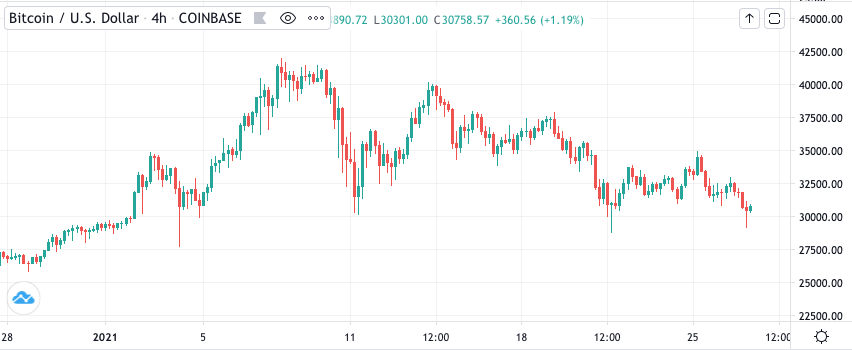
But Casey is too optimistic in my opinion. From an outsider perspective, looking at trading histories, it might seem that Bitcoin has indeed discovered its price. It got over the speculative hump of 2017, slowly building up value again to the present day where it has been welcomed with open arms. But look at the image above and tell me that there is no false support.
Institutions are playing the same game with Bitcoin that they have played with all their other stores of value. BTC can no longer drop below a certain price level or institution hedges will be liquidated. There is a vested interest in false support, a practice that makes BTC more and more an elite financial tool, impractical for its originally stated purpose.
HODL Gang?
Casey is obviously a BTC maximalist, so we shouldn't be surprised at their short-sighted reading of the situation. They are illustrating a new instance of the same basic concepts that were applied to gold for the last 500 years. We must have a financial object that we can use to make value judgments about the world, and Casey is not wrong in stating that Bitcoin has become that object. But this isn't something to celebrate.
What are currencies for, after all, but to use, to exchange, to keep economies moving forward? We can see then, that financial institutions are treating Bitcoin as a new gold because this is in their best interest. The openness of the platform was a threat to institutional power, but Bitcoin bars no entry. This accessibility combined with Bitcoin Core's technical blunders have now made it useful only to elites and those with the resources to play. Trustless peer-to-peer exchange of BTC may still be possible but it is entirely impractical.
Enter BCH, Bitcoin in every way except its enshrinement in the mind of the public. There is potential for BCH to serve as the proper currency Bitcoin was meant to be, but it must not be co-opted. Greyscale is already increasing its stock and we can't let speculation and institutional investment get the better of the project.
The original goals outlined in the Bitcoin whitepaper still matter, more so than ever. We need to open the gates to allow more people financial freedom.
Lead photo by **Bich Tran** from **Pexels** https://www.pexels.com/@thngocbich?utm_content=attributionCopyText&utm_medium=referral&utm_source=pexels https://www.pexels.com/photo/closeup-photography-of-white-gate-with-brass-colored-padlock-846288/?utm_content=attributionCopyText&utm_medium=referral&utm_source=pexels

why BTC can't pass the "proper currency" test, but BCH can
I've been doing some thinking about crypto as currency, and I'm back with a quick and dirty analysis. I read this article, entitled "Why Bitcoin is Not a Proper Currency," and a lot of its talking points sounded familiar. Let's break it down! https://read.cash/@lerkfrend/cryptos-wont-work-as-real-currencies-and-other-economic-assumptions-from-the-banking-world-68b89280 https://medium.com/the-rebus/why-bitcoin-is-not-a-proper-currency-b7084cd1e7ed
Bitcoin is not a "proper currency"
There's that word again, "proper," meant only to discourage. What the author, Nicoló Patti, means here is that Bitcoin does not meet criteria necessary to be considered a currency. Bitcoin is being impolite, and a proper currency would be more amenable.
And what criteria does Patti list as necessary and proper? Money (he decides to call it money here, as a bid to your anecdotal understanding of the word):
is a store of value
is a unit of account
is a medium of exchange
Okay, we've all read Wikipedia. But why doesn't Bitcoin have these qualities?
Patti argues that Bitcoin is not a **store of value** due to the volatility in its price. Sure, we've been here before. I'll speak more about volatility in a moment.
He then goes on to talk about **units of account**. A person using a currency must be able to know, by some means, how much something should be valued in that currency. Currently, crypto valuations are paired against fiat currencies to make sense of their value. Patti uses the throwaway argument that it's hard to measure value in bushels of corn, but if you were a corn trader, you would most likely have a very keen sense of those matters.
I personally have a hard time looking at trading pairs that aren't USD because it's the currency I'm most familiar with, but the understanding I've developed doesn't give fiat any special status. **Any object valued by a group can be used as money if they develop the rules for value assessments and use.** Money hasn't existed forever. We made it. Now we want to improve it.
Finally, can Bitcoin be a **medium of exchange**?
No, lol, are you serious? But Potti argues that the problem is lack of broad acceptance, which certainly applies.
Volatility
The oft repeated argument goes that Bitcoin could never be a store of value because of the price volatility....
And then 2020 fully matured and now everyone is talking about how it is the new gold, but this is not the sort of value storage Potti means. He means price stability. A reliable Euro. Consistent buying power.
But the volatility we see in most crypto markets is not driven by people wanting to use Bitcoin as money, but by speculation and media hype.
But what about BCH?
Everything we've said about Bitcoin above applies to BCH as well, except BCH has made some of the improvements necessary to enable it to be digital money:
low fees and fast, secure confirmations make it a means of exchange.
broader acceptance would stabilize its price and allow for the wider adoption necessary to be the store of value that all those bank economists could finally count in
BCH seems well positioned to demonstrate the core of the cryptocurrency project: that it is possible to decentralize money and to empower the individual in doing so.
One further note: Potti seems unconcerned with the inelastic supply issue I talked about in my previous article. That is something I'll be looking into in the future. https://read.cash/@lerkfrend/cryptos-wont-work-as-real-currencies-and-other-economic-assumptions-from-the-banking-world-68b89280
I hope you enjoyed my thoughts. I'm certain I'll be back for more. Leave a comment if you have any thoughts and catch me on noise.cash! https://noise.cash/u/lerkfrend
Photo by **Karolina Grabowska** from **Pexels** https://www.pexels.com/@karolina-grabowska?utm_content=attributionCopyText&utm_medium=referral&utm_source=pexels https://www.pexels.com/photo/green-and-white-round-ornament-5980889/?utm_content=attributionCopyText&utm_medium=referral&utm_source=pexels
"cryptos won't work as real currencies" and other economic assumptions from the banking world
I was inspired to write this piece after reading an article from Bloomberg I saw posted on noise.cash by @cryptoph (they are here, too!). The article is entitled "Cryptos Won't Work as Real Currencies, UBS Economist Says." The economist in question, Paul Donovan, is Chief Economist of UBS Global Wealth Management. On his company website he says he that he "[believes] passionately that economics is something everyone can and should understand" and that it is his "job to help people realise what they probably already know." https://www.bloomberg.com/news/articles/2021-01-22/cryptos-won-t-work-as-actual-currencies-ubs-economist-says
Okay then. Tell us what we know Paul.
The article is brief, almost just a single pull quote stretched into 150 some words. Donovan advises caution, to the world I suppose, about crypto currencies because they cannot act like fiat currencies. Why not? Because, as he puts it,
"People are unlikely to want to use something as a currency if they’ve got absolutely no certainty about what they can buy with that tomorrow."
And that seems fair. We've seem many crypto projects start strong only to then tank into oblivion, leaving some sadly the poorer. There are risks in this space. Speculative interest and media crazes do not help. But somehow I don't think Donovan is thinking about those examples. His argument is based on something else.
To dive in further, I watched the short video listed as the source of the article. First, let me say that you can tell this is a bank's website because it is terrible, but I digress. The video makes the following points: https://www.ubs.com/global/en/wealth-management/chief-investment-office/about-us/meet-the-experts/paul-donovan.html?campID=UC:E:601227:601241:269449152:0:644002907:644002909:en:272925767:::#video
price volatility in crypto markets makes them risky
"proper" currencies should be a stable store of value
"proper" currencies should be a stable store of value
repeated bouts of hyperinflation have weakened the buying power of crypto
crypto has a "fundamental flaw" in its fixed supply, it cannot respond to a decline in demand
"proper" currencies should be a stable store of value
What a fun video! He even illustrated his points with PlayMobil toys (was that Honkler talking to the dinosaur?). Let's go through his points:
price volatility
I'm not going to argue but this was a gimme. Next.
"proper" currencies should be a stable store of value
I wasn't sure what he meant exactly by "proper" but thankfully a quick Google brought me to Wikipedia, which did not agree with Donovan's fundamental understanding. At least to the group of editors of the Currency Wikipedia page, a currency is "money in any form in use or circulation as a medium of exchange" and then goes further to say "a currency is a system of money (monetary units) in common use." https://www.google.com/search?client=firefox-b-1-d&q=proper+currency
It makes sense that a medium of exchange needs to have value to both parties wishing to make an exchange, but this value is not all that money is. It is easy to be confused by this, especially given the histories of fiat currencies. We would all like to think that when we put a fun currency symbol in front of a number, valuation is done, $50 or €50 or ₱50 will always be the same value. This doesn't match up with most experience in modern society. But Donovan is helping us realise things we know, so maybe we've forgotten how money works.
Money is not just value, however, but value put to work. **Storage of value become more important to those that have it in excess.**
And yes, he harps on this point for most of the video, restating it different ways but it boils down to the same thing.
repeated bouts of hyperinflation have weakened the buying power of crypto
This one just seems like a jab. He doesn't explain it. It's mentioned in passing after he says we need to think about things "objectively." While this is certainly true for some projects—the recent infinite minting attack on Cover Protocol's token leaps to mind—framing it in this way is more scare tactic than useful commentary. This framing also makes it seem as if crypto is a homogeneous space, perhaps pegged to BTC, and we all realise how silly that sounds. https://cointelegraph.com/news/cover-protocol-suffers-infinite-minting-attack-price-tanks-97
crypto's "fundamental flaw"
So here's where we get to the meat of Donovan's argument, what he calls its fundamental flaw, and again, this speaks more to his lack of understanding of crypto spaces than anything else as it ignores the fact that there are many different approaches to monetary policy here.
There are many different projects trying to solve many different problems through many different means. Yes, there is a lot of overlap between projects, and there most definitely should be, but to act like there is some sort of High Crypto Comptroller that is in control of all the monetary decisions is laughable.
This is just my subjective stance. Papa Donovan knows best, but I'll need to break down his statement further to figure out what I already know.
Fiat currencies are issued by central banks that work closely with government. These banks and their governmental advisors watch the economy through various measures, charts, numbers, and conversations with business leaders and other politicians, and then make decisions based on what they think is happening.
What doesn't then occur to him, and to me it's baffling, is that anyone can follow the same practice. In fact, those closest to the markets that matter most to them have the best sense of their own needs and would be best suited to devise their own value systems.
Donovan's argument is built on fiat currency thinking. An insistence on centralized control as "objectively" the best option because he believes centralized institutions are best suited to make those decisions. But he's ignoring a large part of what money is supposed to do. The sorts of boogie men of crypto he peddles are the same ones that haunt fiat currencies but he seems to think that for him, it's already been solved.
Note also that he said "proper currencies" but gave no successful examples!
And regarding his worries about fixed supply cryptos, he's obviously never heard of AMPL! https://www.ampleforth.org/
I'll leave you with one final piece of UBS wisdom: crypto can go to zero. You know, I knew that, but I never realised it. I always thought we were supposed to realise profits, not losses. Thanks UBS! https://www.bloomberg.com/news/articles/2021-01-15/ubs-wealth-warns-clients-crypto-prices-can-actually-go-to-zero
Lead photo by **Ryutaro Tsukata** from **Pexels** https://www.pexels.com/@ryutaro?utm_content=attributionCopyText&utm_medium=referral&utm_source=pexels https://www.pexels.com/photo/set-of-various-banknotes-placed-on-table-5746260/?utm_content=attributionCopyText&utm_medium=referral&utm_source=pexels

flow states
I tend to go with the flow. Say I'm out with some friends, they can't decide where to eat and they ask me. I say, "wherever you want, I'm easy," because it's true. Food is good all over and I'm relatively omnivorous.
When I was younger, I often struggled in those circumstances. I couldn't communicate my thoughts and further prompting would only make it worse, flooding my thinking entirely with indecision. So my parents would whisk me along whatever path they thought I might want, and that was that.
I suppose the one habit developed from the other, though calling childhood anxiety a habit would be misstating it, but I'm only now seeing things this way, thirty years on. At the time, I didn't know how to tell someone what I was feeling in those moments, and others saw a quiet kid that didn't seem to mind when others made decisions for him. So I went with the flow.
Eventually, it became obvious that something was different about me. My father saw my behavior as taking "the path of least resistance." Accepting fate without a fight. But for me it was a fight to speak, to voice any of my desires. It was so challenging, and others never really understood that. I kept up until I didn't really want to fight any more.
I grew up. I performed well in school. It was a place where expectations were clearly communicated, where I could follow directions and get rewarded. I would feel good when teachers noticed my capabilities, but there were still signs that I was not quite present in the same way as other children. During recess periods I looked for others to direct my interests. I remember making a series of friends in the grades above me and then following them dutifully around the playground, grateful for the direction, until they realized I wasn't really contributing in the way their other friends might be, and they'd distance themselves from me.
This continued into high school, where I was on the periphery of many different friend groups, but never essential to any of them. Sure, I'd get invited to hang outs, but I never felt comfortable. It was so easy for others in those settings, giving their opinions, voicing their concerns, while I would be focused on managing all of the social interactions that were threatening to overwhelm me.
I graduated high school and I moved out. I went to college, but without the ability to specifically communicate my direction, or any direction really, I ended up paying a lot of money for a mish-mash of classes I barely went to. Somehow I only failed one class but I still had to meet with an advisor. "We" talked for five minutes and then "we" decided that I could retake the class over the summer quarter.
I told my parents that I would need to stay at school over the summer. My father decided it couldn't work. That I needed to come back home and then transfer to a different school. I didn't know what to say. It was more of the same, my head was swimming, so I went with the flow.
That summer was miserable. I limped through another college application, to the school my parents graduated from and that my brother was currently attending, where he was thriving. I was accepted and the admissions people seemed very excited. I felt lost, flotsam at sea, hoping to reach land.
The school was much smaller than my previous one, the town where it resided notable only for the university. I felt little pressure and zero motivation. I enjoyed spending time with my brother, but it felt like I was melting, that everything was moving except me.
I started going to the library, a drab, blocky building, all brown stone work and dark glass. Inside it was always cool, with a hushed, humming chorus of HVAC and fluorescent lights that I rather liked.
I tend to peruse libraries randomly, feeling them out by the texture of their volumes, the lighting and auditory changes as one passes through the rows of shelves. Here I was immediately drawn to the second floor.
The stairway was closed off from the rest of the structure for fire safety. Opening the door into the second floor felt like coming up for air.
I saw it as I stepped past the first shelf, wrapped in a faded red cover, stamped with the words *Either / Or* in crisp black letters on its gently rounded spine*.*
I had heard of Kierkegaard but I knew nothing of his writing. I took the book down from the shelf, felt the fine grain of the cover's cloth. The smooth, acid proof paper gave off a stale, perfumed scent as I opened to the first section, entitled Diapsalmata:
What is a poet? An unhappy man who conceals profound anguish in his heart, but whose lips are so fashioned that when sighs and groans pass over them they sound like beautiful music.
I felt known, discovered, seen, and I read on, and whether those words reflected my current situation accurately was inconsequential. My heart's anguish was not being heard. Kierkegaard could see it plainly from a century away but here he was dead in my hands.
I want to continue but could then only think of a particular expression I would get on my face as a child, for example when my father would push me up to a fast food counter, saying nothing but requiring everything, and I would be slowly overcome with a dizzying anxiety. An expression that I knew from the inside—muscles contorting as my best representation of thought and emotion—but that was never enough to convey what was happening to me to those outside.
I was seventy percent water poured into a slender glass, liable to shatter but still desperately in need of molding. It didn't matter what I thought about it because water settles into its container, and you don't get to choose your glass. But here, on the second floor, a weight of words in my hands, I was slowly realizing how disassociated I had become.
check back for more in this series in the coming weeks
Also, I wanted to add that this is my first post here and it kind of became...a lot more than I was expecting, but in all the best ways. Hopefully I'll be able to continue this soon and I'd appreciate any and all comments and critiques y'all may have!
Header photo by **Steven John Pascua** from **Pexels** https://www.pexels.com/@steven-john-pascua-1663900?utm_content=attributionCopyText&utm_medium=referral&utm_source=pexels https://www.pexels.com/photo/waves-crashing-on-a-beach-4104006/?utm_content=attributionCopyText&utm_medium=referral&utm_source=pexels

 @lerkfrend