How To Do The Dishes In The Middle Of Dungeons & Dragons
The quality of any game of Dungeons and Dragons depends on the quality of the Dungeon Master. Some may enjoy drawing the story of your character out of you. Some may enjoy plunging their adventurers straight into the heart of battle. Some may take perverse delight in occasionally saddling their charge with unexpectedly mundane tasks — like doing the dishes.
How should a team of rangers, barbarians, wizards, dwarves, elves and orcs — arguably some of the bravest in the land — deal with this?
If the wizard in the party wants to cast a spell to clean all the dishes, ask yourself — will the Dungeon Master turn this into a battle of wills over whether or not someone someone has physically gone to clean the dishes? How bad could the consequences get? Will the plates grow little legs, cue up the theme from *Fantasia*, and start throwing themselves at the party?
Are you being attacked by a Lich? If you’re in the middle of being attacked by a Lich, then doing the dishes could serve as a distraction. If so, do the dishes slowly. Make sure the counterclockwise motion of your hand holding the washcloth is visible to the beast, stopping just short of offering the dish and cloth to the beast and using your body language to say, ‘Here — you try.’
Gently drum-tap the dishes in the hope that you will find the kinds of sounds, beats, and rhythms that Jonnie Common found when he recorded the album Kitchen Sync. https://jonniecommon.bandcamp.com/album/kitchen-sync-deluxe-edition
https://www.youtube.com/watch?v=ieccsrPIVuw&feature=emb_logo
4. If the Dungeon Master insists that you visualize the wooden cabinets perched over the aluminum-colored basin, ask if you can put out a call to have the cabinets removed and replaced with paintings, even if that means that any dishes or glasses stored in those cabinets would have to be put somewhere else.
Prepare yourself to do battle with a painter who will inevitably insist on doing a photorealistic painting of a set of cabinets over a sink. Ready your mental engines to argue the point that there are a variety of other painters who inhabit the fictitious land who are worthy of consideration as well — like that bull who only does paintings of a bald man from Málaga, Spain.
5. Travel back in time. Hide a rare treasure in the dishes. Guard that treasure. Watch its legend grow. Age. Die — but continue to live. See yourself begin to do the dishes. Approach your younger self and your party to warn them about the dishes. Wonder exactly where the Lich is the entire party suddenly seems to be speaking about. Guard the area from the Lich as they flee, dishes in hand.

Airfield Cafés
Diners like The Airfield Café in North Hampton, New Hampshire or Nancy’s Airfield Café in Stow, Massachusetts are interesting in the same way that Drive-In movie theaters are interesting: there aren’t that many of them, and the persistence and presence of these institutions don’t just reflect the generic New England-like idea of looking at a piece of architecture and deciding to attach something else onto it, but an interesting way of the idea of eating at airports that has existed through the years. http://theairfieldcafe.com/ http://www.nancysairfieldcafe.com/site/
Fine dining came to airports in the 30’s, 40’s, and 50’s through a combination of demand and an expectation that restaurants in airports would have significant responsibility for an airport’s overall revenue. In other words: good food aimed not just at travelers, but towards those who might not be traveling at all (with an eye cast towards later converting them into travelers.) https://restaurant-ingthroughhistory.com/tag/airport-restaurants/ https://www.citylab.com/transportation/2014/11/when-people-looked-forward-to-eating-airport-food/383203/
While fine dining obviously exists in airports today — and while the airport in Pittsburgh has moved to let the public hang out in a portion of the airport, amongst a small handful of others — neither of these things are a cheap cup of coffee served with some eggs next to a field of Piper Cubs, Cessna Skyhawks, and more. As a place, the Café is not *as* defined by class as some of the airport dining experiences of the past, and the lack of that assertion of money feels bracing — that strange relief of realizing you’re worrying about outsized wealth striking a location down while simultaneously knowing that it isn’t nearby, and feeling grateful for it. https://www.eater.com/2015/11/18/9750940/airport-restaurants https://www.bloomberg.com/news/articles/2019-07-03/airports-open-up-to-terminal-tourists-who-just-want-to-hang-out
“‘Normal’ food sells,” Scott Aversano, the owner The Airfield Café, told me when reached by e-mail. “We always felt good food at reasonable prices will always work even in bad times. And the pilots in our area are very much regular people. I was actually told to close [the place] and change [the] name and raise [the] prices and [change the] style of food but I could not do that as” — amongst other reasons — “I don’t think it works long term.”
The implicit relationship between how the cafe and the airfield physically fit into the landscape seems loaded with such friendly potential that you’re almost surprised when you don’t see more of that potential in action — when you don’t see someone wandering straight from the runaway into the restaurant to have a cup of coffee as someone throws a tarp over the plane outside.
[sponsors]
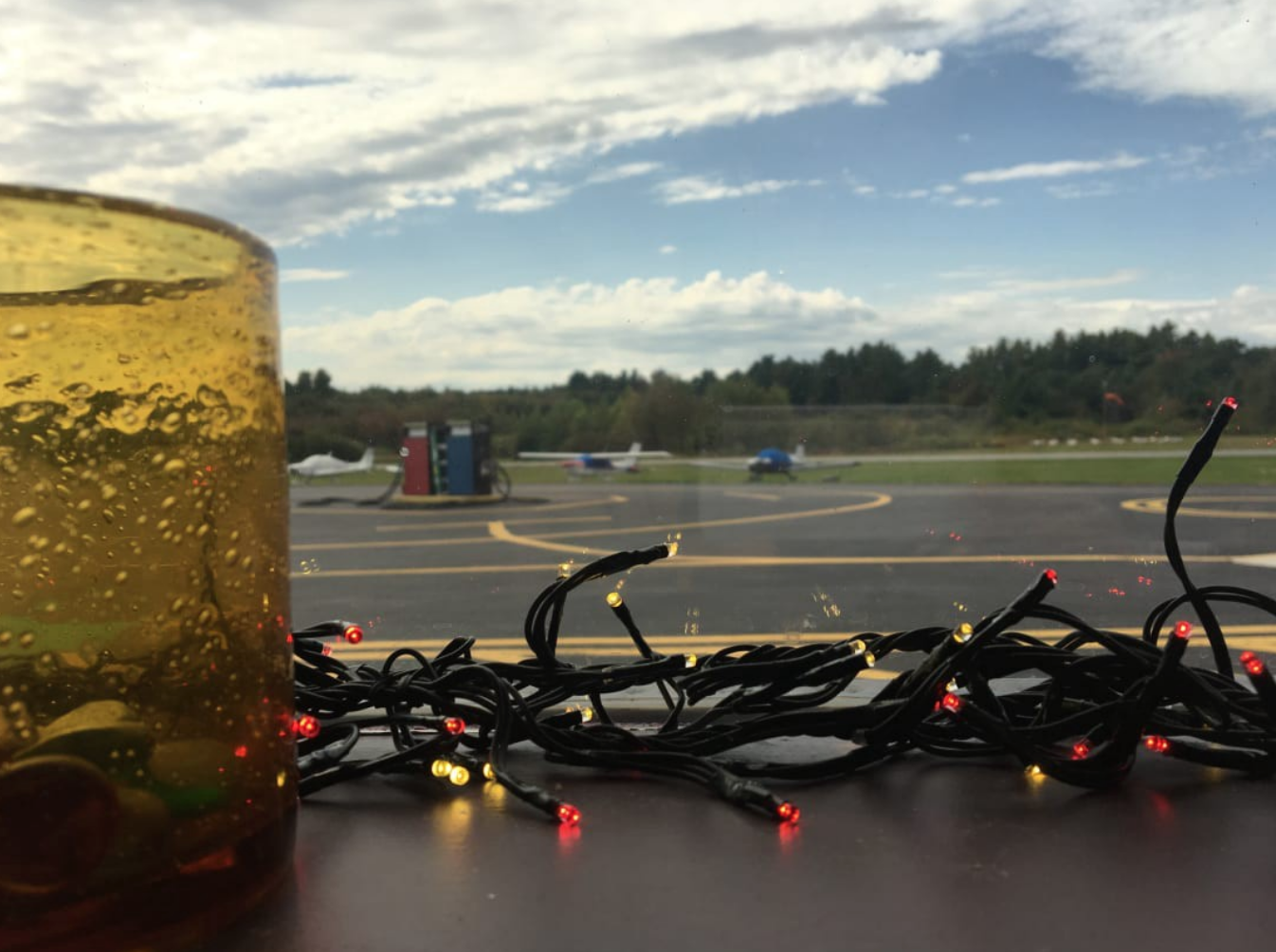
If the pace of The Airfield Café is too frenetic and packed and you have an interest in exploring a few Massachusetts backroads, then you should make your way to Nancy’s Airfield Café in Stowe. Nancy’s Airfield Café has a homemade vibe to it: the interior is filled with light yellow and light green colors amongst wooden tables, chairs, homemade coffee mugs, and scatterings of Christmas lights. The airport and the cafe are surrounded by trees. When I visited the café near the end of September, I was able to watch a harvester carry a boxload of pumpkins with its lift parallel to the runway while the titular Nancy herself roamed around with what seemed to be a friendly word. A plane landed, pulled up near the café to pump some gas, and someone working in an office attached to the café went out with a clipboard to say hello.
Families may have started to stop going to airport restaurants in the 1970’s, but there are still families visiting both cafés. You hear them say things like, “Good to see you.” And folks watch the planes come and go.
An American Haiku (For 1,000 Years)
Standing by the Rio Grande
striking a guitar chord which
confettis itself into spilled flowers
a blend of blossoms
a tulip bulb
reaching into the air
like a cat’s nose.
The Laughing Room
*Note: this article was originally published elsewhere in November of 2018.*
I recently heard about a project put together by a student at MIT where an A.I. was built on the back of stand-up comedian transcripts in order to see if it could determine what was and wasn’t funny based on what it heard from the everyday public. Not too long after I heard about the project — dubbed The Laughing Room — I found and decided to visit the project in person hoping to get a sense of what it was like and to see what role I could play in getting the machine to laugh. https://www.cambridgema.gov/News/detail?path=%2Fsitecore%2Fcontent%2Fhome%2Fcpl%2Faboutus%2Fnewsandannouncements%2F2018%2F11%2Fthelaughingroom
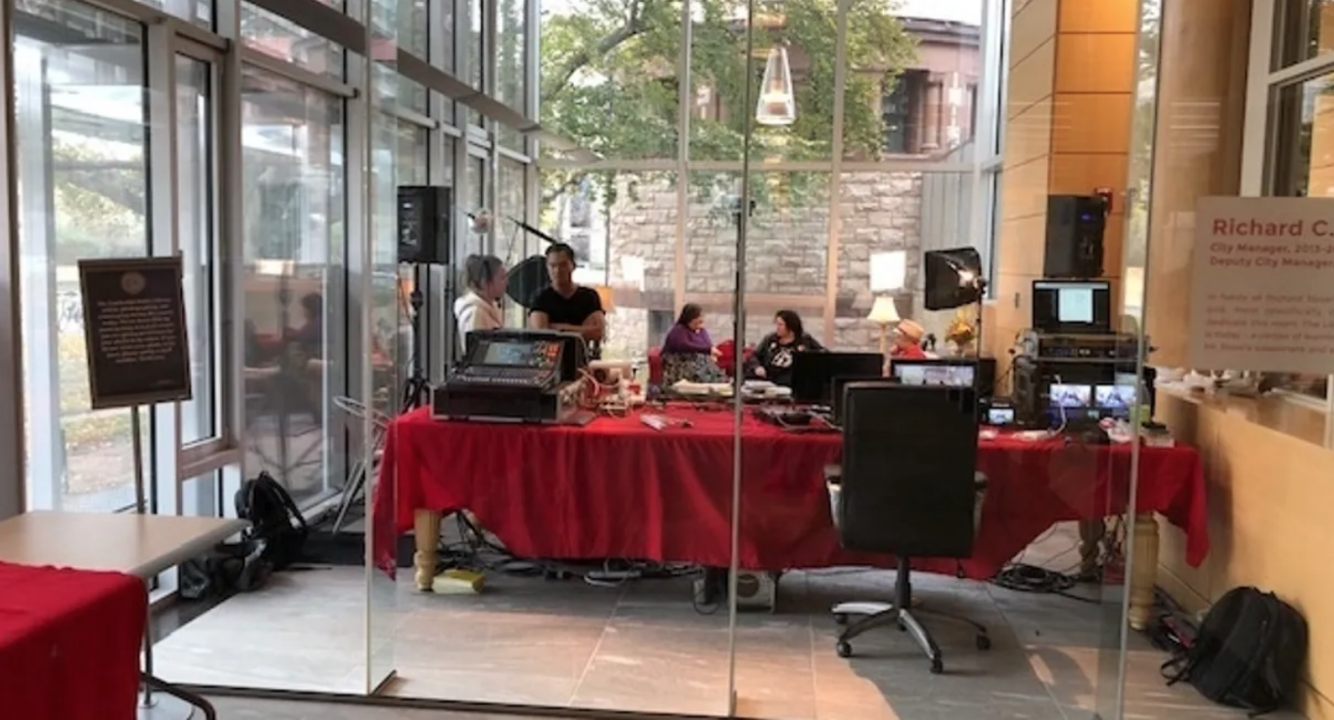
The Laughing Room was a project put together by Jonny Sun and Hannah Davis that was tucked into the corner of the Cambridge Public Library in Cambridge, Massachusetts. Minus the laptops, the camera, the audio output and the recording equipment, the room was set up to resemble a sitcom-like living room: there was a couch, two adjoining chairs, and books related to comedy left all over the table. The glass wall ensured that the room was well lit.
I came into the room late, and you can watch my brief appearance on the seven-hour live stream here. (I come in around 3:01:44.) Four other people were already there. There were three young students who knew each other on the couch and an elderly woman sitting on the chair across from me. She was in the middle of running through a few personal tests of the machine of her own: what she saw on a sweater (the machine didn’t laugh), an infamous comic from XKCD (the machine didn’t laugh), and a single line — “It gives me the hydrostatics to such a degree” — from an eighteenth century comic play (which the machine *loved*.) https://www.youtube.com/watch?v=UlLQW662WYc&feature=emb_err_watch_on_yt https://xkcd.com/386/ http://www.gutenberg.org/files/383/383-h/383-h.htm
Using the last point as a prompt, I turned in the general direction of the camera and — levying the falling point of a finger — said, “All right. Next up: *The Iceman* *Cometh*. Go.”
The group and the two people monitoring the equipment laughed. A pause.
I abandoned the beat almost immediately, sailing away from the awkward and exploitable silence with a quick, “No?”
The machine laughed.
The creative part of my brain immediately assigned a motive of suspicion to the machine. (A motive that could well have been warranted if we’re to factor in what others have been tweeting about their experience. (This also led me to jokingly reference *Black Mirror* but Hannah — who was in the room — politely pushed back when kiddingly asked about it, saying that we were ‘nowhere near’ that particular dystopian reality.)) https://twitter.com/laserquest666/status/1064206100835254273 https://twitter.com/cpmurp/status/1064186803010355200
What was ultimately learned? It’s early days (*very* early days) — Jonny Sun tweeted that he was interested in taking The Laughing Room to other museum and libraries and for the project to live on — but there is a list of what the machine deigned to be the funniest thing said over the course of the experience, with “fish” deemed to have the highest probability of being funny and “oh wow fruit” carrying with it the second highest probability of being funny. https://twitter.com/ahandvanish/status/1064227326987300864
On a personal level, I was struck by two things: one was the change in the dynamic between those seeking to produce laughter while knowing that the machine was responsible for conveying the laughter (at one point, one of the young women on the couch simply leaned into saying “*Really?”* to see if it would provoke a response, which it did.) The relationship in the room slowed down to something almost resembling a pause at some points because the five us were collectively toeing the line between actually speaking with each other and speaking in such a way to prompt laughter.
https://www.youtube.com/watch?v=xpZLusV-1IY&feature=emb_logo
It brought to mind the experiment called “7 Minutes in Purgatory” (which I mistakenly upgraded to ‘Heaven’ when I mentioned it in the room), where comedians had to put headphones on and deliver their routine without the audio or visual feedback of an audience; the other thing that struck me during all this was the fact that the machine misheard some of what was said when we were in the room, meaning that it was reacting to us based on what it thought it heard. https://www.youtube.com/watch?v=xpZLusV-1IY
The thread that runs through each of these reactions is the fact that comedy has within it the potential to offer up a quick and dexterous way to affirm mutual humanity through something that skirts up against the edge of — and can frequently often outright be — art. And it’s something that offers up immediate feedback.
The difference between the two reactions above was that — with one — one person still knew that their jokes were reaching an audience. The drama of the shift in the structure was that we were placing the comedian’s humor all the further away from us — and vice versa. The implicit tension in that — and the ways in which comedians succeeded and failed because of that — fueled part of the laughter.
The equation finds itself somewhat flipped in The Laughing Room: while everyone was being live streamed to an audience, there was no ‘someone’ being prompted to laughter. Going into that room was like trying to prompt the weather into raining — or, in this case, laughter. There is — and was — something cloud-like at work when one person tried to describe the fact that they were acting in a play that evening and the A.I. could only respond with waves of laughter that passed over our attempts to speak. You couldn’t ‘read’ someone the way a comedian ‘reads’ someone, which was interesting in and of itself, as people used to talk to a chat program ELIZA as if it were a real person when it would simply mirror text back to an individual in the form of a question. https://en.wikipedia.org/wiki/ELIZA
However: if we were to take a neuroscience-like approach, we could perhaps reframe some of the above by pointing towards one hypothesis that was tested in 2017: “It has been proposed that endogenous opioid release after social laughter would provide a neurochemical pathway supporting long-term relationships in humans.” https://www.ncbi.nlm.nih.gov/pubmed/28536272
Did anyone else feel an ‘endogenous opioid release’ after entering The Laughing Room? Will anyone else feel that if and/or when the Room travels?
I’d head back into The Laughing Room and put these questions to the A.I. itself, but — I have to confess — part of me is still worried that it would just respond with “oh wow fruit.”

A birthday poem
100 years of Lawrence Ferlinghetti is one of those unexpected gifts
like discovering a restaurant where you can still get a whole meal for $5
in a neighborhood where landlords burn buildings down left & right
so they can sell it all off and watch emerge in its glorious place
like Stanley Kubrick’s obelisk
an object that has the size of a building but the heart of a phone. It’s like …
*(Snap the fingers and observe the landscape.)*
It’s like we’re watching Auden’s candle trying to conquer the darkness
and then … silence, because the brave creature was giving a wad of money; someone heard that no one had built a luxury apartment in the last five
minutes and what better place to conquer with a shining box of parked
anonymous money than the sound of a lone frog somewhere in the darkness?
But Lawrence Ferlinghetti is still here, and, even if he leaves, even if
he picks up Auden’s flame & takes it upstairs to his paintings to workshop,
re-write, and let loose amongst a land of color, no one will ever know.
I’m convinced of that. 100 years of Ferlinghetti. God bless you.
And, are you hungry? There’s a place around the corner. We should go.
Another Alphabet
A poem you will never know
featuring:
an alphabet that changes one silent letter at a time,
a guest track you can never track, or, rather,
a city map with no such thing as “You are here”
as frogs dipped in gold pass through a nearby marsh
as you, yourself, holding a record, say,
“Whatever you say this Arctic Monkeys album is —
well, that’s what it is.”
How To Write An Adventure Story
You would like to write an adventure story. You would like people to look at you the way George Lucas looked at Ace Drummond or Alfred Hitchcock looked at John Buchan. The music of James Bond waits at your feet like a dog waiting for you to throw a ball it can go gallop and fetch.
You sit in a hut near a beach in the Scottish Highlands listening to a tale of how the father of an acquaintance made their way around half the top arc of the top of the United Kingdom in less than a day on a recumbent bicycle and find yourself weighing that up against the highest number you ever achieved in a game of keepy-up — somewhere in the hundreds, but not in the thousands because all the other soccer players would want to go home at some point, have family, friends, and wives — and you wonder if this is good enough. You bean count your athletic accomplishments.
You are well aware that David Foster Wallace stood up in front of a graduating college class and declared that true heroism is in hours of quiet probity with no audience to see or applaud.
You are working towards a definition of ‘adventure’ as some kind of ‘critical unit’ — in the second person, no less — as something one-step beyond the ‘lightness’ Calvino characterized in his *Six Memos For The Next Millennium*. http://anemonehaze.com/assets/2008/1/13/interior.pdf
As Hervé Gardette said during an episode of “Du Grain à moudre” on France Culture, “The adventure of today is not the same of yesterday.” If you are climbing Mount Everest, if you are circumnavigating the globe, you have to align yourself with “the demands of simultaneity” — that is, Twitter, Facebook, and whatever other form one can think of — but if one aligns one’s self *with* “the demands of simultaneity,” then to what degree is “the narrative form taking precedence over the substance of the project?” https://www.franceculture.fr/emissions/du-grain-moudre/la-mise-en-scene-des-aventuriers-t-elle-denature-laventure
To ask for and pursue an adventure, then — that is to say, ‘a transcending of the limits’ in a world that never offers *up* limits, but one that is, in fact, *always with you* and *always present* is to understand that one frontier of an otherwise traditional ‘adventure’ has now been reduced to a cocoon, a carapace of compellingly constructed humanity. When we knock the carefully curated world of an Instagram feed, this is what we’re knocking.
Biographical diversion: I am wandering through Colonial Williamsburg in the beginning of spring wondering about someone adventuring through the invention of America. I am imagining Revolutionary Era detectives. I am imagining time flattening out and allowing for more than one person from more than one era to occupy a bench beneath some Japanese Cherry Blossoms and by a running brook.
But to seek to seek an adventure in the current political and technological moment as a place of narrative refuge reminds us not only the power of silence and avoidance, but of the democratic power buried in magical realism as well — of a shape-shifting, talking dog; of Ireland suddenly becoming something worthy of The Odyssey itself; of the fact that “no man is an island” — but every man, woman, and child being capable of adventure, too.
What Makes A Lynx A Lynx
*Note: this was originally published elsewhere last year.*
If you want to know what makes a Canadian Lynx a Canadian Lynx, I can now point you directly to the DNA of a Canadian Lynx. I can point at the genome of a lynx and say, “That’s what makes a lynx a lynx.” The genome was sequenced by a team at UMass Amherst, and it’s one of fifteen animals whose genomes have been sequenced by the Vertebrate Genomes Project, whose stated goal is to sequence the genome of all 66,000 vertebrate species in the world. https://vgp.github.io/genomeark/Lynx_canadensis/ http://www.umass.edu/newsoffice/article/umass-amherst-leads-team-first-sequencing https://vertebrategenomesproject.org/
Sequencing the genome of a particular species of an animal is important in terms of preserving genetic diversity. Future generations don’t necessarily have to worry about our memory of the Canadian Lynx warping the way hearsay warped perception a long time ago. It is easy to see how one can look at 66,000 genomic sequences stored away as being the analogous equivalent of the Svalbard Global Seed Vault. It is a potential tool for future conservationists. https://io9.gizmodo.com/how-europeans-imagined-exotic-animals-centuries-ago-ba-1545362205 https://www.croptrust.org/our-work/svalbard-global-seed-vault/
But what are the practicalities of sequencing the genome of a lynx beyond engaging with broad bioethical questions? As the animal’s habitat shrinks and the earth warms, the Canadian lynx demonstrating less genetic diversity. Cross-breeding with bobcats in some portions of the lynx’s habitat also represents a challenge to the lynx’s genetic makeup. The two themselves are also linked: warming climates could drive Canadian lynxes to cross-breed with bobcats. https://onlinelibrary.wiley.com/doi/pdf/10.1111/j.1600-0587.2013.00629.x
[sponsors]
John Organ, chief of the U.S. Geological Survey’s Cooperative Fish and Wildlife units, is quoted in a story in MassLive saying that the results of the sequencing “can help us look at land conservation strategies to help maintain lynx on the landscape.” https://www.masslive.com/expo/news/erry-2018/09/e565d904646142/umass-scientists-oversee-first.html
What does DNA have to do with land conservation strategies? Consider the fact that the food found in a landscape, the toxins found in a landscape, or the exposure to drugs can have an impact on genetic activity. That potential change can be transmitted down the generative line. If you know exactly how a Lynx’s DNA is impacted by something, then the environment they occupy can be fine tuned to meet the needs of the Lynx and any other creature that happens to inhabit that particular portion of the earth.
Given that the current administration has opted to consider withdrawing protection for the Canadian Lynx, a move which caught scientists by surprise, it is worth having as much information on hand as possible — all the way down to the very building blocks of a lynx’s life. http://www.spokesman.com/stories/2018/jan/11/federal-governments-step-toward-delisting-canada-l/

Giant fans that suck CO2 out of the air are operational in Italy
*Note: this was originally published elsewhere last year.*
With the U.N. releasing a report on climate change that demands sustained attention, it’s worth noting that ClimeWorks — a company based in Switzerland — opened its third ‘carbon capture’ site on October 2nd in Troia, Italy. https://bigthink.com/politics-current-affairs/scary-un-climate-change-report http://www.climeworks.com/ https://e360.yale.edu/digest/swiss-company-opens-its-third-co2-capturing-site
As an idea, pursuing carbon capture as a way of fighting climate change *seems* to make a practical kind of sense: if there’s too much carbon in the air, then why not take that carbon out of the air?
But here’s the thing: the ClimeWorks carbon capture center in Italy only takes the equivalent of 32 cars off the road per year. That’s more than zero, but it’s nowhere near where the numbers should be — and other carbon capture sites that purport to be carbon neutral aren’t carbon neutral. At best, as David Roberts pointed out over at Vox this past July, some of the capture sites in the world are — at best — carbon neutral, and the goal should be to produce a ‘carbon negative.’(Of the three carbon capture sites ClimeWorks has in the world, the one in Iceland is the only one that’s carbon negative.) Unless something changes, then it’s fair to say that the frozen arctic and moss do a better job of capturing carbon than some currently existing carbon capture sites. https://www.vox.com/energy-and-environment/2018/6/14/17445622/direct-air-capture-air-to-fuels-carbon-dioxide-engineering https://bigthink.com/evan-fleischer/wildfires-in-the-arctic-circle-spell-the-stark-new-reality-of-global-warming
That doesn’t mean that there aren’t promising steps being taken: as Akshat Rathi notes in Quartz, where the story was first reported, the carbon dioxide first captured at ClimeWorks’s first carbon capture site was “fed to a greenhouse, which boosted the growth of the plants inside it.” https://qz.com/1407687/climeworks-has-opened-a-third-plant-capturing-carbon-dioxide-from-the-air/
The gas captured and converted by the ClimeWorks plant will be used to provide fuel for trucks. 32 cars off the road is nowhere near enough to take a bite out of the 40 billion metric tons of carbon currently in the air, but it’s a step.
Above: Map of currently active carbon capture sites across the world.
But — as noted in a lengthy paper from the University of Sheffield (from which the above image comes) — there are other considerations worth bringing into the framing of this as well: there’s the fact that there are new carbon capture products on the verge of hitting the market (focusing on chemical looping, membrane-based technology, ionic liquids, and others); there’s the fact that the cost of ‘de-carbonising’ key industrial sectors will ultimately get ‘lost in the noise of the market’; and — of course, as the U.N. recently reminded us with a climate report — there’s the fact that we have twelve years to get it right. http://eprints.whiterose.ac.uk/126186/8/c7ee02342a.pdf https://openei.org/wiki/Chemical_Looping https://www.theguardian.com/environment/2018/oct/08/global-warming-must-not-exceed-15c-warns-landmark-un-report

True North
I’m as wide as a pair of eagle wings
with hands to reach around the hours.
I’ll send Romulus one way
& Remus the other —
playback my Bach on the school board chalk
until the wolves have always been my brother.
When A.I. does what you say, not what you mean
*Note: this was originally published elsewhere.*
Artificial intelligence can drive a car, buy/sell a stock, and perform healthcare tasks, amongst numerous other tasks as the technology grows and changes each day. At the end of 2016, The White House predicted that 3.1 million individuals who drive for work could see their jobs replaced by autonomous vehicles. https://www.nbcnews.com/think/opinion/will-robots-take-your-job-humans-ignore-coming-ai-revolution-ncna845366 https://qz.com/868716/the-white-house-predicts-nearly-all-truck-taxi-and-delivery-driver-jobs-will-be-automated/
But A.I. isn’t going to take every job in the world just yet. In order to better understand that fact and the nature of what constitutes Artificial Intelligence, it’s worth taking a temporary to detour to examine not just its successes, but its failures, curiosities, and hiccups as well.
A list has been making its way around Science Twitter featuring — as one individual put it — “instances of AI doing what creators specify, not what they mean.” It is a delight. Here are some of our favorites. https://docs.google.com/spreadsheets/u/1/d/e/2PACX-1vRPiprOaC3HsCf5Tuum8bRfzYUiKLRqJmbOoC-32JorNdfyTiRRsR7Ea5eWtvsWzuxo8bjOxCG84dAg/pubhtml https://twitter.com/mogwai_poet/status/1060286856493813760
1. A robotic arm trained to move a block to a certain point on the table opted in to move the table to the block instead. https://github.com/openai/gym/issues/920
2. AI was charged with evolving a creature built for speed — and so grew a really tall creature who generated high velocities by … falling over. http://www.karlsims.com/papers/siggraph94.pdf
3. In one simulation where creatures required energy and giving birth cost no energy, one species evolved themselves into a lifestyle that consisted of them sitting around, mating, and then eating their children. https://www.researchgate.net/profile/Larry_Yaeger/publication/2448680_Computational_Genetics_Physiology_Metabolism_Neural_Systems_Learning_Vision_and_Behavior_or_PolyWorld_Life_in_a_New_Context/links/0912f50e101b77ec67000000.pdf
4. A four-legged creature trained to carry a ball on its back decided to instead drop the ball between its legs and wiggle across a floor. http://blog.otoro.net/2017/11/12/evolving-stable-strategies/
5. A pancake-making robot decided that the best way to make a pancake would be to throw it as high in the air as possible to keep it as far away as possible from the ground. https://connect.unity.com/p/pancake-bot
6. A creature learns to bait an opponent into following it off a cliff, which gives the creature enough points to get an extra life — which is a strategy the creature then pursues in an infinite loop. https://arxiv.org/abs/1802.08842
7. A robot awarded for touching a soccer ball learned to get to the ball whereupon it would touch the ball by vibrating as fast as possible. http://luthuli.cs.uiuc.edu/~daf/courses/games/AIpapers/ng99policy.pdf
Hot Coffee/Cold Brew
*Note: this was originally published elsewhere last year.*
It’s the kind of news that makes you want to listen to “The Java Jive” by Ink Spots once again: a study has been published in *Nature* noting that hot coffee has been found to have higher levels of antioxidants than cold brew coffee. https://www.youtube.com/watch?v=iP6IUqrFHjw https://www.nature.com/articles/s41598-018-34392-w
Antioxidants are compounds that prevent oxidation. When cells become exposed to oxygen, it can induce a chemical reaction that create molecules called “free radicals,” molecules which are highly chemically reactive. A ‘free radical’ is a lot of things, sometimes positive (it’s necessary for life, for one), but — in the specific context of this study — it is an unstable compound that can potentially have a cascading effect on someone’s health, be it in the form of cancer, Parkinson’s, or other items of concern.
This is why a study like this is quietly encouraging: while coffee has “long been associated with indigestion, heartburn, and other gastrointestinal symptoms,” as the study notes, a review of numerous studies found “coffee consumption to be associated with decreased risk of liver, metabolic, and neurologic diseases,” amongst other decreases in cardiovascular disease and stroke.
The reason why this is — the reason why the antioxidants in coffee take the pathways that they take to subsequently produce a decrease in these particular risks — remains somewhat unclear. One suggestion put forward by the study is that “the compounds present in hot brew coffee but absent from cold brew coffee may be larger molecules with temperature-dependent solubilities” and that — in addition to the hot water extracting new compounds out of the coffee — “there may be additional compounds responsible” for the difference between hot coffee and a cold brew.
Part of what makes coffee a little bit more difficult than you would expect to study is the fact that there is space in-between the beans or grounds and there is a porousness to the grounds itself. Different kinds of water can produce different kinds of coffee irregardless of the temperature. (And then you have to consider the temperature.) Coffee beans have a shelf life in relation to their preparation and eventual use. And, what’s more, a variety of acids are produced in a cup of coffee that ‘detach from the coffee matrix’ and diffuse throughout the water as the cup cools. Coffee remains ‘coffee,’ but there is a swirl of chemical activity happening in every cup that makes the matter difficult to delineate into easily classifiable chunks. https://onlinelibrary.wiley.com/doi/full/10.1111/j.1745-4557.2006.00093.x
That being said: the study suggests that there might be one potential culprit that drives the health benefits of hot coffee: the compound melanoidin, a compound “known to have antiradical properties” and which “accounts for upwards of 25% of coffee’s dry matter.” https://www.sciencedirect.com/science/article/pii/S0308814611004572
But further investigation is warranted — perhaps over a cup of Ethiopia-Yirgz, which was found to have the highest antioxidant activity examined by the study.
Wings
Ornithologists at Cornell have built a bird.
They have built several.
They have built a bird that sings.
They have built a bird that dances.
They have built a series of birds that quietly watch Jonathan Franzen get into the car every morning.
They have built a bird that wants to hire other birds to replace the ticker-tape at ticker-tape parades.
Ornithologists at Cornell have assembled themselves into what they *claim* is a giant bird and are slowly making their way down university halls, going, “Squawk! *Squawk!*”
Car keys of the mind left to the branches,
and, ‘Where are my keys?’
and — you hop, and — you point.
How to Write A Screenplay in a Café
*Note: this piece was* *originally published elsewhere**.* https://catapult.co/stories/how-to-write-a-screenplay-in-a-cafe
1.
You have decided to write a screenplay in a café. You may be in Los Angeles and have decided that The Bourgeois Pig is the right place for you to accomplish this task. But, really, you could be anywhere reading this, and you have to go with what you know works for you: I know of one café in Edinburgh where I could duck out of the rain and listen to Fabrizio De André and let a spoon clink around a wide white mug like a kid swimming in a small hotel pool. I know of a handful of coffee places in Austin and Portland that caught my eye that I didn’t have a chance to visit when I was there. There’s a place in New York where breakfast coffee hits the angle of the opening eyes just right, a place in London whose artisan aspirations struck me as being almost gaudily surreal (the shop was housed in an *Inception*-like open cube of a space near the Thames and a nearby market), and I know of a coffee place in Boston where I can lose hours as easily as a cup lets loose steam. https://www.facebook.com/pages/Bourgeois-Pig/109388522432614
2.
It’s about layers: Ultimately, you’re not going to be writing just for yourself. You may be doing this at the beginning, and that moment is vitally important and worth taking as much time with as you’d like (and there’s a degree to which that never really goes away either), but you’ll soon be writing for people who have a particular sense of what they see and how they see the world; you’ll be writing for people who have a certain range as an actor; and more.
3.
If you’ve never had the experience of writing for an actor, I’d recommend it. I once took great joy in writing for someone who I knew was capable of taking a Chris Farley or John Belushi-like level of energy and landing it with great precision on the head of a very small pin, both behaviorally and verbally. I knew he was capable of a decent range of emotion: His face could convey wounded surprise, muted disappointment, and a brow-furrowing miniature adventure of egoism collecting itself to come roaring back in the face like Quixote leading a charge. He could take that Farley-like energy and use it to convey authority.
4.
To play off of #3 for just a moment: As good a show as *Westworld* happens to be, the script takes pains to come across as fairly plain and restrained, which is how — as *The Nerdwriter* highlights here — we get to see how good Anthony Hopkins is at his job.
[sponsors]
https://www.youtube.com/watch?v=4kSGkGKwp9U
5.
Beware in-script characterization — not only because it’s limiting, but because it’s not worthy of what your script can be. If you’re writing a screenplay, you’re not expected to be a novelist, but it would be a welcome change of pace if more scripts took the step to acknowledge that the characters depicted were characters worth caring about. Consider the example given here, which can sometimes be far, far too typical — http://www.wikihow.com/Write-a-Screenplay
*LOUISE is a waitress in a coffee shop. She is in her early thirties, but too old to be doing this. She is very pretty and meticulously groomed, even at the end of her shift. She is slamming dirty coffee cups from the counter into a bus tray underneath the counter. It is making a lot of RACKET, which she is oblivious to.*
We’re given thirty seconds to learn something new about a woman, and the screenwriter opted to tell us us within three sentences that Louise puts an importance on being “very pretty and meticulously groomed, even at the end of her shift,” as if she was nothing more than an early Don Draper fever dream. There was nothing about where she came from, whether or not the nub of her formative experience came from perhaps something more Toni Morrison-like (“She is a friend of my mind. She gather me, man. The pieces I am, she gather them and give them back to me in all the right order”), or whether or not she was thinking of the last film she saw, like Chantal Akerman’s *Jeanne Dielman, 23 quai du Commerce, 1080 Bruxelles* or similar.
6.
Take a break from writing the screenplay in the café and listen to what’s going on around you. Take time to engage with what’s happening around you. It could be more important than you might realize. In The Los Angeles Review Of Books, Benjamin Aldes Wurgaft wrote of how Hemingway characterized himself as “a charging rhino when he wrote” in the café, adding that, when he wrote in cafés himself, he found that “without all that noise I could never recognize a signal.” https://lareviewofbooks.org/article/writing-in-cafes-a-personal-history#!
7.
Just as it’s important to realize that you’re writing for different actors, so, too, is it important to realize you’re writing for different *eyes*, too. For months in college, I kept trying to figure out how to film the outro to “My Iron Lung” by Radiohead as I walked across the Salt and Pepper Bridge and over the Charles River to class: What change would mark the shift between quiet and the frenetically loud? It would have to be at night, but what sort of night? Who would be out? A camera floating down the Public Alleys wouldn’t match well with the ultimate jump of the track, so what was needed? What part of the city? Where? I flicked through the legion of streets I knew and kept coming up empty. Had I been working with someone at the time, they could well have had a solution, perhaps offering up a fantasy redesign of a street corner somewhere the way *The Departed* turned a dry cleaners on Charles Street into a bar. (And, for what it’s worth, all that ended up happening with the Salt and Pepper Bridge was I took part in a scene in which I rounded a corner on the bridge in my boxer shorts in a deep February cold that left me cursing repeatedly in-between takes as I pretended to be a bourbon-soaked comedy enthusiast.)
8.
Here is the most recent café I went to: a place called LOKAL, where there’s a small front, a large basement with a hidden yoga studio right near it, and a few tables that linger outside. In the basement, where I sit, the wall opposite is covered in chalk, quick proclamations like ACHIEVE THE STARS, GOD IS BLACK AND I MET HER, a Grateful Dead wash of colors striking a yoga pose.
9.
Here is the café I dream of: somewhere perched near the top of Paris, a skylight, a large and quiet room of studio-like stucco, and steam from my cup making its way up to the skylight, where — perhaps — a bird or two have gathered to warm themselves in the rising steam.
10.
Whether or not I ever find the café I want, the screenplay is waiting — yours, too — so do me a favor and get back to work.
Space
A string of poems set in a spaceship. The alien life force has taken over the vessel and that is what it indeed requests, Captain. But why? I don’t know, sir. I wish I knew. Some matters are an issue of math. Some are a matter of negotiation. Some are a matter of the rules by which we fly through the corridors of space — you signal the relevant watch station before plunging into a wormhole, for instance, but this … And what kind of poetry does it want, Ensign? The only bit of language we’ve been able to decode from it so far is “Stars,” sir. Stars? That’s all it’s saying: “Stars. Stars, stars, stars. Stars.”
Tiny, Soft Robot, MD
*Note: this was originally published elsewhere last year.*
Imagine you’re heading into surgery. You’re wheeled into the operating room. You’re placed under anesthesia. The Doctor and nurses are milling about. And, as you start to relax, you hear someone say that they’re going to begin by releasing the spiders.
This is an exaggeration intended for comic effect, but it’s the gist of what was concocted at the The Wyss Institute for Biologically Inspired Engineering (which is part of Harvard University) in Boston, Massachusetts. A small team has created a proof of concept “soft, animal-inspired robot[…] [in the hopes that they] can be safely deployed in difficult-to-access environments, such as inside the human body or in spaces that are too dangerous for humans to work.” https://wyss.harvard.edu/soft-multi-functional-robots-get-really-small/
https://vimeo.com/280414671
Here’s how it works: the robot starts off flat: then — depending on the task at hand — fluid (UV-curable resin) is pumped into the robot. It slowly begins to gain shape, and — if the video is any indication as to how it looks in real life — one could say that the ‘spider’ looks like a piece of origami coming to life. (If you read the paper published in conjunction with the testing of the robot, you’ll note that the robot — designed after a peacock spider — is referenced as ‘microfluidic *origami* for reconfigurable pneumatic/hydraulic.’) When the robot is exposed to UV light, the resin solidifies, locking what’s dubbed the ‘actuators’ (as in — things that can be moved, i.e., the abdomen, head, jaw, and legs) in a certain position. Those locked ‘actuators’ can then be further moved through water that’s pumped into the robot.
[sponsors] https://onlinelibrary.wiley.com/doi/full/10.1002/adma.201802739
“The idea of designing and fabricating a soft robot inspired by the peacock spider comes from the fact that this small insect embodies a large number of unsolved challenges in soft robotics,” Tommaso Ranzani — the lead author of the paper — told Popular Science. https://www.popsci.com/soft-robot-spider#page-3
Which isn’t to say that previous instances of soft robotics didn’t have have noteworthy elements of their own: scientists are Cornell have developed a robot activated by popcorn (with potential applications for jumping; there’s a ‘grabber’ designed to handle deep sea creatures more gently; army researchers are developing ‘a self-aware squid-like robot you can print in the field’; researchers at UC San Diego have developed a transparent eel robot that swims silently underwater (with the aim being not to disturb the local environment with a motor); a Swiss research institute has developed edible robot fingers; and researchers at Harvard made a snake-like robot out of kirigami. https://newatlas.com/popcorn-powered-robots/55756/ https://www.nationalgeographic.com/science/2018/07/news-rad-sampler-soft-robotics-marine-deep-sea-biology/ https://www.armytimes.com/news/your-army/2018/04/18/army-researchers-are-developing-a-self-aware-robot-squid-you-can-3d-print-in-the-field/ https://www.sciencedaily.com/releases/2018/04/180426102906.htm https://www.theverge.com/circuitbreaker/2017/10/8/16435314/edible-robot-fingers-technology-food https://www.seas.harvard.edu/news/2018/02/snake-inspired-robot-uses-kirigami-to-move
In short: there is variety. The future of these robots created at Wyss will be in seeing them “perform delicate surgical tasks at scales well under what’s currently possible for soft robots” — something that is currently at the stage in which individuals are envisioning its future — and enter into environments that other robots — let alone humans — couldn’t enter and explore. https://www.popsci.com/soft-robot-squeeze-heart-failure https://www.sciencedirect.com/science/article/pii/S0003497517313863
a birthday poem
100 years of Lawrence Ferlinghetti is one of those unexpected gifts
like discovering a restaurant where you can still get a whole meal for $5
in a neighborhood where landlords burn buildings down left & right
so they can sell it all off and watch emerge in its glorious place
like Stanley Kubrick’s obelisk
an object that has the size of a building but the heart of a phone. It’s like …
*(Snap the fingers and observe the landscape.)*
It’s like we’re watching Auden’s candle trying to conquer the darkness
and then … silence, because the brave creature was giving a wad of money; someone heard that no one had built a luxury apartment in the last five
minutes and what better place to conquer with a shining box of parked
anonymous money than the sound of a lone frog somewhere in the darkness?
But Lawrence Ferlinghetti is still here, and, even if he leaves, even if
he picks up Auden’s flame & takes it upstairs to his paintings to workshop,
re-write, and let loose amongst a land of color, no one will ever know.
I’m convinced of that. 100 years of Ferlinghetti. God bless you.
And, are you hungry? There’s a place around the corner. We should go.
Six Writing Prompts
Write a piece of dialogue where a realtor tries to sell a home to Peter Parker without revealing Parker’s secret identity.
Write a piece of dialogue where a carpet salesman offers up their thoughts on *The Big Lebowski.*
Pick a famous letter. What was happening around the writer of that letter as they were writing it?
Write a piece of flash fiction where humans accidentally recreate a scene in either *Mossflower* or *Redwall*.
What do you think is in MF Doom’s ‘Money Folder?’
OPEN QUESTION: what will be the first flower to grow on the moon?
Woke Up This Morning
Sunlight on my voice
brings out the taste of the last last night,
the final over-the-shoulder look
before the plunge into the post-blues flow,
a Mississippi River dried to dusty air
where riverboat musicians honk zombie gas into
mouthpieces, reeds, and plastic cups with the hole cut
out of the bottom and held up to the mouth,
a trumpet improvised out of charm and out of a place
that does not keep the dead.
Hints of Regeneration
*Note: this article was originally published elsewhere in 2018*.
Just after 12 on August 17th, surrounded by construction projects in various stages of completion across the campus, Dr. Igor Adameyko of the selfsame Adameyko Lab presented a talk at the Harvard Medical School Library on “non-canonical functions of the nervous system” with an eye towards “regenerat[ing] damaged tissues in tandem with regaining sensory nerve functions.” In other words: Adameyko was delivering a talk that left the layperson wondering about the regenerative properties of Wolverine. http://www.adameykolab.eu/
As a general rule, it’s helpful to think of science as a thousand incremental steps (each of which have to be confirmed and then confirmed again), meaning that we should not — as a rule — believe the promise inherent in every amazing discovery that is passed onto us — but that doesn’t necessarily mean that we should try and limit our imaginations either.
That being said: the Lab argues that the study of the nerve cells in question that relate to the overall process being advanced here is a something new, noting that “10 publications from other independent research groups proving and expanding this very new concept.” http://www.adameykolab.eu/projects.html
And while we weren’t able to get into the talk itself — even the man who gave the talk reported on having some trouble getting into the building where he was supposed to deliver the talk — we were able to get our hands on and look over the slides of the presentation. It’s here where we see slides of mice teeth growing back, a starfish regenerating an arm, a pedal crab regrowing an arm, and a newt regrowing a limb.
What is the principle of what’s at play? What are the fundamental issues underlying these quasi-analogous citations of other animals regrowing one particular bit or another?
Nerve cells transmit information across the body, but that’s not all they do: nerve cells also transmit morphogenic information as well — as in, information that determines an organism’s shape. The parasympathetic nervous system — the nervous system linked to the conservation of energy and the digestive tract — also has a role in developing glands.
The presentation notes that their idea — their concept — is the idea that nerve cells could serve as a ‘transportation route’ for ‘multipotent regenerators’ — as in, stem cells, citing a paper of theirs from 2017 where “peripheral glial cells” — cells which are responsible for maintaining homoeostasis (the state of your body simply being your body and doing a litany of normal, ‘automatic’ things) and for insulating and protecting neurons and axons — “generate neuroendocrine cells” and a paper that describes an end goal where “these multipotent nerve-adjacent cells can be reprogrammed in vivo and play a number of roles from creating pigmentation to controlling regeneration of a limb in amphibians or skin in rodents.” http://science.sciencemag.org/content/357/6346/eaal3753.long https://www.ncbi.nlm.nih.gov/pubmed/24140263
What does this research set up? Per the presentation documents, it means potentially “understanding melanoma, neuroblastoma, and pheochromocytoma origin.” It means “improvements of skin healing, solving neurocutaneous diseases,” and “better treatments for leprosy.” More broadly, it means further exploring cell-replacement therapy. It means a chance to explore how the shape of a human face comes about and what kind of coding regarding the geometry of the face might already exist.
What sort of questions did this raise at the lecture? Per Adameyko, reached by e-mail, “there were some big questions pertaining mostly to the unknown heterogeneity of peripheral glial cells and how this cryptic heterogeneity can be connected to the diversity of their ‘alternative’ functions.” In other words: there were questions about how it was that the portion of the nervous system that had these particular cells could have the functional capacity to permit both uniform behavior and aberrant behavior.
Adameyko’s and his lab’s ultimate goal is to explore “non-canonical functions of the nervous system” with an eye towards “regenerat[ing] damaged tissues in tandem with regaining sensory nerve functions.” They have studied mice, zebrafish, and pursued single-cell transcriptomics in the name of pursuing this goal, though there is no word yet as to whether or not they’ve studied someone who sometimes goes by the name of Logan.

Sketch (11/20/19)
Like a boat in a river looking up at the shore: walking through the city, filled to the brim with John Coltrane’s soprano saxophone contained by the rib cage of piano chords, the eye-scratching LED light of televisions sharing the national narrative began to move slantwise into the cityscape. And it was a narrative that would be known, even in the rain — from those stopping to look all the way down to the pigeons punching holes in a full loaf of bread like they were working over a boxing bag in a gym.
 @evan.fleischer