Complex Economic Environment Facing the Crypto Market
Previously we spent a lot of time to discuss web3.0 and emerging concepts in the currency circle such as DAO, GameFi, Metaverse, etc., but we did not analyze the market situation. Today, we will simply analyze the current market.
**Market Overview**
**Analysis of bad factors**
Many people are well aware of the factors that affect market changes.
**1.** The epidemic affects the economy. The outbreak of local epidemics causing the market to fall. The most intuitive thing is that people must sell their assets in exchange for fiat currency to maintain a life if they want to live. Even the epidemic will cause prices to rise and fiat currency to depreciate.
**2.** The U.S. raises interest rates, which means that the U.S. dollar will inevitably flow back to the U.S. worldwide, resulting in the world's dollar cash flow contraction. Companies sell assets to repay U.S. dollar debts and their asset prices fall.
**3.** Risks in individual countries and regions, such as the exchange rate plunge of the Turkish currency and many other factors, we do not know, but it does not mean that they do not exist.
**4.** More companies and investment institutions in the United States invest in cryptocurrencies, and Wall Street venture capital invests in cryptocurrencies. They have no beliefs, and some even invest in cryptocurrencies with certain speculative behavior. When the stock market price falls or other sudden risks occur, institutional investors will give priority to selling cryptocurrencies (cryptocurrency can be traded at any time 7*24 hours), thus causing cryptocurrencies to face greater pressure.
**Analysis of Positive Factors**
Now, we also summarize the bullish factors for cryptocurrencies:
**1.** The United States took the lead in raising interest rates, but some other countries in the world are generally using different methods in response to the US dollar interest rate hike (partly due to the epidemic, companies have not resumed normal production), which lead to the depreciation of the legal currencies of various countries relative to the US dollar and the sharp decline of the Turkish Lira. Under this situation some wealthy people also convert their fiat currencies in to cryptocurrenies and supporting the crypto industry.
**2.** Bitcoin scarcity and inflation rate, in the long run, although the number of Bitcoins is constant, we focus on the fact that Bitcoin still has a certain inflation rate. At present, the inflation rate of Bitcoin is less than 2%, which is lower than the monetary deposits of most countries, so Bitcoins is relatively scarce.
**3.** The rapid development of blockchain technology, blockchain technology has achieved good development and Ethereum 2.0 has also developed rapidly. The combination of Metaverse, web3 and gamefi also enables blockchain to be applied in a variety of scenarios.
**4.** El Salvador uses Bitcoin as a legal currency to promote the large-scale application of Bitcoin.
**5.** Cryptocurrency has played a role that cannot be ignored in various economic activities. Top companies and Internet companies cannot bypass the impact of Bitcoin, which will also lead to these companies choosing to support cryptocurrencies in the next few years.
In general, we can see that cryptocurrencies such as Bitcoin may decline in the short term, and even lead to losses for some investors who were chasing higher in the early stage, but in the long run, the crypto market is the next internet.
**The next thought - Crypto Bubble**
In fact, my guess there is a big bubble burst in the cryptocurrency originated from 21 in July, when the market just recovered from the May and June crash, and later came up in august when discussing with several well-known industry leaders. My personal view is that there will be a very big bubble burst at a certain time point. The bubble burst in the future may lead to the collapse of most of the crypto oriented companies and project teams, but it will also give birth to teams and projects with great influence and i hope this factor will improving the crypto industry.
The reason is relatively simple. We can see that the development paths of cryptocurrencies and the Internet are very similar. In the early days, they have also attracted the attention of a large number of investors in the market, and many new technologies and new enterprises have also been born, and capital has also gathered in this direction.
Of course, this is my personal opinion. Whether or when such a bubble will burst in the future is unknown.
Ethereum Gas
Looking back at the trend of the crypto market in the past year, we can find that concepts such as DeFi, GameFi, Metaverse and web3.0, MEME, and emerging public chains have been hyped by the market. Obviously, the market is also pursuing new hot spots and Ethereum handling fees are also soaring in the bull market.
**Why Ethereum fees keep rising**
This round of bull market is mainly started by Ethereum DeFi. Investors basically pay much more than normal transfer fees when interacting with ETH DeFi smart contracts, and AMM market-making DeFi projects like UniSwap requires high timeliness for investors' transactions, investors must complete the transaction exchange of tokens in a short time, usually within two or three minutes, The price fluctuation is about 5%. Therefore, investors will choose higher handling fees in order to confirm the transaction on the chain in time.
The concepts of NFT, chain games and metaverse, and some well-known projects gave users high airdrop returns on Ethereum, which intensified people's enthusiasm for airdrops, so the usage of UniSwap and OpenSea on Ethereum has always been High ever.
**Exploration of fee reduction scheme**
The soaring transaction fee on the chain has caused the community to seek solutions. The market is mainly divided into three directions. The first is to expect EIP-1559 to destroy miners’ income. Many self-media believe that this solution can improve the ETH price, thereby reducing the fee denominated in legal currency that people spend on ETH. After all, ETH is more expensive, and corresponding people cherish ETH more and will not spend ETH recklessly. However, it turns out that EIP-1559 not only cannot reduce the handling fee, but also has the opposite effect.
The second solution is the side chain and the competition chain. Some people used to call Polygon the Ethereum side chain expansion solution. Now it seems that Polygon is more like a separate public chain. Polygon has its own token certificate, and the previous competition Chains such as BSC, HECO, Fantom, xDAI, celo, etc. have all begun to snatch the Ethereum market. The main feature of this part of the public chain is that it supports EVM virtual machines, which means that the smart contracts running on Ethereum can run directly on this part of the public chain without too much modification.
The prosperity of the competition chain mainly has two parts. The first is that the application can be rolled out on a large scale and quickly, thereby attracting a large number of players to participate, and it can also meet the urgent needs of the market. The second is a relatively mature cross-chain DApp. Cross-chain enables people to easily transfer assets from one chain to another.
It is reasonable to say that the Ethereum fee should be reduced, but the NFT and MEV increaseing the fee in market. NFT gradually prospered in June 2020 and reached a peak in September, followed by chain games development., thats the reason NFT market has always accounted for the majority of Ethereum transactions, so to a certain extent, this can indicate that competing chains are not enough to attract Ethereum DeFi overflow funds. We can think of MEV as an arbitrage mechanism with first-mover advantage in on-chain transfers. The MEV program finds arbitrage opportunities on the chain and will use higher handling fees for arbitrage, which to a certain extent aggravates the rise of Ethereum fees.
Only strong projects can gain a foothold on Ethereum, which is what we often call the head effect. In addition, some heavyweight airdrops such as ENS are all given to users on Ethereum by the project party, so people have a deeper understanding of this kind of airdrop.
**Rollup**
In fact, the third solution is Rollup. Rollup once became the focus of many people attention, but the current development is not hot, which is beyond people expectations, many people were counting on this kind of rollup solution to solve the pressing problems for Ether, but the progress is slow. Therefore, many people are disappointed.
The proposal of Rollup is actually relatively early, but what really attracted the public attention is bull market. Due to the relatively high innovation at the technical level, the development difficulty is relatively high, so the deployment of applications will naturally be much slower. In contrast, the speed brought by the competition chain + cross-chain bridge is very fast, so the competition chain can develop but Rollup has not improved yet.
So does this mean that Rollup is useless? In fact, according to our past experience, Ethereum Rollup will definitely develop and become a market hot spot for a period of time. In fact, the reason is relatively simple. Most of the development of new technologies in Ethereum will takes time to wait and shine.
To sum up, the rise of Ethereum fees is eliminating small retail investors in the market, which is beneficial to Ethereum to a certain extent. On the one hand, it can inhibit investors from short-term operations on Ethereum, and on the other hand, Ethereum has become an aristocratic chain, so that only rational and powerful investors such as institutions or large investors can participate, and the price will not fluctuate easily due to market factors. These are great benefits for Ethereum, while applications on other competing chains may appear bleak due to the arrival of the bear market. However, it still needs a long time for public chain applications to develop and maintaining a prosperous growth.
Terraland
The real estate field has always been a hot spot for many medium and large investment institutions. With the further improvement of the global economy, these investment institutions have also benefited from the dividends in this field. Whether it is Southeast Asia where the gap between the rich and the poor is relatively serious, or the economically developed regions such as Europe and North America, or the East Asia where the overall economy is growing faster, under the further promotion of capital, the overall real estate price has maintained a rapid growth trend. Although real estate investment may have considerable returns, for many small or ordinary investors, the capital occupancy rate and threshold of real estate investment are still relatively high.
Generally speaking, for ordinary investors, the smallest unit to invest in real estate is 1, that is to say, we like the real estate in a certain area and think it has the possibility of further progression. Both commercial and residential properties can only be purchased in a complete set. Similarly, in addition to the high value of real estate assets, the liquidity of their assets is insufficient, and it is difficult to directly sell them like ordinary commodities. Usually, the transaction process is complicated and the cycle is long.
With the economic downturn and the influence of national policies and other factors, the resulting decline in house prices may also cause investors to bear large losses that are difficult to recover in a short time due to the poor liquidity of real estate. So overall, the real estate market in the traditional financial sector is not suitable for small investors . Of course, regional issues and legal issues in different countries are also one of the main obstacles affecting cross-regional investment in real estate assets.
Generally, the decentralized world constructed by DeFi is often considered better than traditional financial field. With the continuous evolution of various DeFi protocol models, the synthetic asset sector has gradually certified traditional assets to further allow DeFi investors to access and profit through them, such as Synthetix, UMA, etc.
Terraland, the Decentralized protocol built on terra ecosystem. Terraland linking the international real estate market and following the legal system of various places, all investors who intend to invest in real estate can make real estate investment with low threshold and low risk.
**Terraland, which certifies the real estate and circulates it in the form of defi**
Terraland itself contains a large number of real estate resources around the world. By tokenizing and dividing these real estates, investors will invest in the smallest unit set by Terraland. Of course, there may be a minimum amount of investment for different properties, such as a minimum investment of 3 square meters. In the first phase of Terraland's operation, the real estate resources provided by Terraland are usually commercial real estate for investment purposes, which can bring returns to investors without maintenance. Of course, 100% of investors who purchase real estate will have the option to actually use the real estate in different ways, such as commercial use, move-in or lease.
The real estate provided by terraland platform is located in different parts of the world. Investors can make investment judgments and make investment decisions based on the economic development and policies of the country or the region. Of course, Terraland does not control the user's investment funds. These funds will be stored in the smart contract after the user makes an investment decision. After the two parties reach a transaction and sign the contract, these funds will be controlled by the smart contract. Terraland itself has established a company in its location for each real estate, which means that different real estate will be sold in accordance with the laws and regulations of different countries.
The advantage of Terraland is that investors do not need to visit the country where the real estate is located, and this does not require notarization, land, court mortgage division and other procedures. Terraland itself is built on the Terra blockchain. Any real estate assets issued by Terraland and all transactions with users will be presented on the chain and recorded to ensure the security, storage and transparency of transactions. At the same time, Terraland will also build a DeFi-based secondary market after the overall facilities have further matured to promote the liquidity of these real estate tokens. Of course, before investing, investors need to follow the law and pass KYC.
Usually Terraland investors want to invest in real estate, they need to go through the following steps:
**.** Choose the real estate you are interested (a comprehensive weighing of factors such as region, country, etc.)
**.** To determine the amount of investment, investors can choose to invest the entire investment package, i.e. 100 per cent, or the minimum investment amount or based on the amount of their intermediate amount.
**.** Complete KYC on Terraland, sign the electronic contract, and transfer the funds to the smart contract provided by Terraland. (At present, as seen from Terraland's official website, the main circulating funds for investment are based on the stable currency UST on the Terra chain.)
**.** When the real estate shares are all sold, the smart contract conditions are met and the real estate token (a CW-20 token on the Terra chain) is automatically issued according to the investor's investment ratio. If the property is not sold within a certain period of time, the funds will be automatically returned to the investor.
Overall, TerraLand reduces the investment threshold for small and medium investors, and promotes the further integration of CeFi and DeFi in the real estate field. TerraLand further provides liquidity for real estate in the form of DeFi, which fix the current problems in the real estate field to a certain extent and breaks the restrictions on regional investment in this field.

Polkadot and its ecological project
Polkadot opened the era of multi-chain interconnection, what Polkadot wants to achieve is that different blockchains can interact, just like the Internet can be distributed through the TCP/IP protocol. Like computers all over the world are connected, Polkadot will connect different blockchain networks together to realize the interconnection of all chains.
However, it is not free to connect Polkadot on the blockchain network, it has a relatively high threshold. Moreover, due to the limitation of Polkadot's performance, the number of parachain slots that Polkadot can provide at this stage it is limited, and currently only 100 parachain slots can be provided. If this number is exceeded, it will inevitably affect the operation of the Polkadot network.
For a blockchain network or a DApp, if you want to connect to the Polkadot network to achieve interaction with other blockchain networks then both the capital and technical thresholds are relatively high, and you have to participate in it. Parachain slot auctions, so if you want to interact with other blockchains through Polkadot Parachain slot auctions, it is not a universal way. Then, is there a cheaper and more convenient channel? Of course, for example, choosing to build a blockchain app on X Protocol.
X Protocol is well developed on the Substrate architecture, and plans to connect to the Polkadot mainnet and test networks such as Rococo and Kusama to realize cross chain processing and analysis of assets on heterogeneous public chains such as BTC, ETH, BSC, Heco, Solana.
In other words, we can regard X Protocol as a public chain similar to Ethereum, which also has the function of smart contracts. Just as Dapps in different fields can be developed on Ethereum, we can also develop decentralized applications on X Protocol.
Moreover, the X Protocol project was approved by the Web3 Foundation Grant at the end of March, which also shows to a certain extent that its business direction is recognized by the Web3 Foundation. Most of the projects that received the Web3 Foundation Grant are from Polkadot ecology. The reason why X Protocol was able to get financial support from the Web3 Foundation was because of its impact on the Polkadot ecosystem.
X Protocol, as an underlying protocol project running on Polkadot, this project will create commercial application scenarios around the protocol. Its business scope is also very suitable for the popular track of the current market, such as the current popular DeFi and NFT, social applications, and even Metaverse. X Protocol has a layout, which means that we want to be in X Protocol for the development of DeFi/NFT and other related DApps, X Protocol has a relatively complete support system.
For example, cross-chain DEX can be developed on X Protocol, so that tokens issued on different blockchains can be freely traded through X Protocol, regardless of which chain assets it comes from, we can trade tokens like we do on a centralized exchange, which will greatly reduce the transaction threshold and improve the user's trading experience.
Lending DApps, they can also be developed on X Protocol. Decentralized lending projects on X Protocol naturally have cross-chain functions. We can also develop DeFi projects such as revenue machine gun pools on X Protocol. The DeFi application running on X Protocol will greatly promote the free circulation of digital currencies.
For the current popular track NFT, X Protocol also has a layout, and the NFT is also combined with the prediction proposal. Each prediction proposal can generate an NFT bound to the equity, that is to say, behind these NFTs Bind tangible interests.
X Protocol is constantly creating its own application scenarios. In the ecosystem of X Protocol, the predictive project X Predict has landed.
Users can create and participate in prediction projects, and obtain corresponding NFTs. Successful predictions and liquidity can be rewarded by governance tokens POT.
In fact, the decentralized forecasting market is still relatively large, so it is beneficial for X Protocol to developed decentralized forecasts market. In addition to popular areas such as decentralized forecasting, DeFi, and NFT, X Protocol will also expand its business to other different areas (such as Meta Universe) in the future. It will take advantage of Polkadot’s cross chain advantages to realize the free cross chain flow between different digital assets.
In summary, X Protocol is a Polkadot-based cross-chain protocol that not only provides a decentralized bridging scheme for asset cross-chain management between different blockchains, such as decentralized lending, DEX, etc., but also provides solid decentralization. X Protocol will use its own cross-chain advantages to continuously expand application scenario.

Let's talk about Chain games
In 17 years, when investors in the currency circle discovered that the combination of blockchain and games has undergone wonderful changes after that chain games has become a new development direction. From the early support of the game industry, and even some universities have set up a special "eSports" professional program to train the corresponding e-sports talent. The situation of the chain game industry in the future development direction seems a bit subtle. Whether people's attitudes towards the game industry will affect the development of chain games has also become a question for many practitioners.
Many countries have severe control on game products for minors, which is very necessary in the early stage of game development, for example, our country has implemented the filing and review of games. Only online games that have passed the filing can be officially launched. Operators are required to access the anti-addiction system to prevent juvenile addiction. However, even with these policy restrictions, a large number of underage students are still the main players in popular mobile games, and the current policy changes is useless.
For blockchain games, the development is just beginning now, and whether blockchain games can take up the flag of the future game industry is actually a very important thing.
**The goal of chain games is not underage students**
At present, the main user groups of blockchain games are mainly investors in the currency circle, and most of these people are adults with civil capabilities. Chain games are currently not suitable for most under-age students. The main reasons are as follows:
**1.** For minor students, it is not the user group considered by the chain game producer at present. Therefore, from a general perspective, the chain game has no impact on the students. After comparing the interactive experience of chain game with that of mobile game, it can be found that the experience of chain game is very poor compared with that of mobile game, because chain games mainly attract users who are investors as the main body and adults who are interested in games and have a relatively mature way of thinking. These two types of people are actually more inclined to make money when playing chain games, rather than to relax.
**2.** Chain games are not very attractive to players outside the circle, because the problem is user's payment thinking. We all know that most of the current mobile games are free for users, and players need a small part of privileges or spend money to buy equipment in the game in order to save time, and this part of the paying group occupies a small part. Of course, even a small number of such local tyrants contribute most of the income of game operators. Therefore, for minor players who do not have the corresponding civil and criminal capacity, playing Mobile games are a kind of wasteful practice.
For chain games, we need to think in another way. First of all, the threshold of chain games is higher. Spending money has become the only solution for all players to enter chain games. This is a kind of money game. There are basically very few free players here, so this alone can reject a large number of underage players. Before playing mobile games, underage players spend time to conduct corresponding "game training" to familiarize themselves with the game, but chain game players do not have this channel, so the entry threshold for players is virtually increased. At the same time, minors are also unable to buy the cryptocurrency required for chain game through the exchange.
**3.** Chain games tend to be designed as the closest way of experience to the goal and reality, which is very different from the traditional game thinking. For traditional games, why are players addicted to the game? In fact, the main reason is that they may suffer from unsatisfactory things in real life, so they want to seek a certain sense of satisfaction in the game, and this sense of satisfaction is psychological. Therefore, this kind of game is more like an entertainment consumer product. It is a way to spend money to have fun. For minors, due to the increase in learning pressure, the chance of academic setbacks is also rising, so underage students are more likely to indulge in such games.
But for chain games, this is very different. The design of chain games is more inclined to reality mode, that is, the game is infinitely close to reality. The props and characters in the game can be directly exchanged for cryptocurrency, and then exchanged it for cash, and if we need to manage the protagonist of the game, we must pay a certain amount of effort , and even need to judge the price changes of the corresponding equipment in the market at different time periods. Just like the price changes in our real world, people with good business can make money, and people with poor business can lose money. In fact, the purpose of more people joining chain games has gradually deviated from the entertainment consumption mode, and is more like a kind of "work" for yourself, obtaining corresponding rewards through hard work, skills and knowledge. In other words, the effort and skills in the game can be slowly practiced through interest, but learning is also a certain economic knowledge. Therefore, it is basically difficult for juvenile gamers to turn to the field of chain games.
**Current problems in chain games**
At present, most of the chain games have not been reviewed or banned by the corresponding countries. At present, the regulatory authorities have not paid attention to chain games, because it involves some tokens, how to regulate chain games is a relatively difficult problem. The second is The user group of chain games is still very small, not enough to attract the attention of regulatory authorities. Third, chain games currently do not directly threaten the income of traditional online games or mobile games.
Of course, some time ago, Axie Infinity revenue has surpassed the glory of the well-known mobile game king, but this data is hyped through the rise of currency price. Therefore, there are still some moisture and exaggerated elements in the data of chain games here. This model and The revenue model of traditional mobile games is completely different.
We all know that popular chain games may not last for a long time. For mobile games or terminal games, there are generally at least three or four years of market popularity. The popularity is mainly based on the rise in currency prices. Therefore, once the market turns bearish, it will be difficult to control it. This is also the current problem of chain games.

GameFi games and NFT+Defi
On July 30 , the cover of Fortune magazine reported: DeFi is occupying Wall Street . The article means that Defi is rapidly penetrating Wall Street, so it is necessary for all financial institutions must build their own Defi strategy to avoid being eliminated from future competition. In fact, we can find the tremendous changes in the development of Defi in recent months . It has become a broad concept. Now we can understand Defi as a more appropriate " a financial economic system with valuable data on the chain ". Under this new category definition, the recent development trend of Defi has been alienated: the original "pure finance" is subject to the market conditions, and its development has not been as fast as imagined. Instead, the first thought edge but gradually become the mainstream of development areas, most notably the chain game Defi ( GameFi ) it is clear that this game shows a potential to change the world like, which is not limited to the so-called decentralized finance. This is a new product of the global financial circle.
First look at the chain game GameFi . In the near future, it should be the superstar coin just like AXS , which is familiar to all people. AXS has skyrocketed by more than 20 times , and it was once the number one in Twitter search. According to the latest statistics in July, Axie Infinity's 30- day cumulative trading volume exceeded US$ 600 million, an increase of 449.5% from the previous month . On July 31 , its single-day income exceeded 40 million U.S. dollars, which was three times the income of the traditional game overlord that day . There are many articles about AXS project introduction, and i cannot repeat its gameplay here. What we can really recognize from its enthusiasm is why this type of NFT+Defi chain game can become the hottest and fastest-developing Defi field nowadays ? You know, not only Axie Infinity , but also My Neighbor Alice (token ALICE) , CryptoBlades ( token SKILL) , Aavegotchi (token GHST ),Alien Worlds (token TLM ) etc, these coins have a certain degree of popularity.
I believe that speculation is nothing more than a kind of " imagination of market dream rate. " The prospect is imaginative, and the speculation is effective, not only abundant money can be but this type of chain game is actually out of the circle. I feel that it is not appropriate to describe it as a "game". Strictly speaking, the game is just a carrier of financial transactions, which makes financial transactions interesting and enhance the sense of experience and operability . Previous games used "games feature" as their core, while GameFi used "finance" as their core. From a long-term perspective, the game is actually used as a means of marketing and opening. The project itself is a meta-universe, an attempt to build a large ecology that integrates countless business formats, and it is a "virtual world." The investment value of similar projects is no longer evaluated based on the playability of the game, but based on its development prospects as a virtual world . The industrial positioning and the superiority of the economic system are far more important than the playability of the game.
GameFi idea is to develop a city, but the initial capital is limited, so the game is developed first, which is equivalent to building a trading terminal or a coastal town. When the terminal or town is prosperous and attracts a lot of people, it will gradually develop the city . The idea of a large platform is to directly build a meta-universal city, divide industrial areas, establish one, two, and three levels of virtual land with different values, and then "invite investment". Games is just a part of its entertainment sector.
In the large-platform meta-universe, chain travel is very important, but after all, it is only a part of the meta-universe. But what needs to be recognized is that everyone wants to develop their own ecology and hope it to became a prosperous meta-universe city in the digital world in the future-a virtual digital community. It now appears that starting through the chain game has become the main short-term method, and it has proved to be very effective . This wave of craze led by AXS is exactly the capital's response to this trend. In the second half of the bull market, GameFi will continue to be probable. There is a quotation, because this is not just a single project of Axie Infinity , but represents an important or even mainstream path for the development of blockchain .
GameFi developed so quickly because NFT has become the sharpest weapon in the development of various fields of blockchain. NFT is the value packet of the Internet. What does that mean? That is, all valuable data is integrated into data packets on the chain. Of course, data packets are valuable and need value circulation. How to achieve this? It is NFT . And because most of the tokens are non-homogeneous, and homogeneous tokens are only a small part, the mainstream of future tokens will be NFT instead of the various project tokens or tokens that we are already familiar with. More simple way, you can understand that NFT is a valuable data package in the future. NFT makes data capitalized, valued, and then tradable .
Therefore, for GameFi , we can understand its concept and path is to use NFT to realize the exchange of data value, and use this as a basis to conduct decentralized financial Defi transactions, while game is fun to trade transactions and marketing to achieve user growth. This NFT+Defi+Game has formed a huge synergy, achieving new hotspots and new major trends in the history of its blockchain development.

Defi is up and down
The overall situation is : **"The general trend is down, the Ether is tough, the other chain is sinking, and its weaknesses are exploding frequently."**
The Defi boom that started last spring , after more than a year of enthusiasm, has entered a consolidation period, and the heat has obviously weakened. According to official information at the end of June, the Defi Agreement TVL(Total Locking Volume) was $72.6 billion, down 9.8% from $80.2 billion at the end of May, and net locking volume decreased to $55.2 billion. **Compared with the peak period, TVL has almost dropped by half**. In addition to the decline in currency prices, there should be a lot of withdrawal funds. The reason is actually very simple. **So far , the currency circle has not generated much real borrowing demand. Only when the market is good, there will be a lot of borrowing to speculate** but the market has been quiet during this period. What are you doing with borrowing? As for the lenders, there is less lending and the yield has dropped, and there is not much enthusiasm to mortgage interest.
The so-called etheric toughness means that when the market is not very good, the advantages of big players on the ether chain are undoubtedly reflected. A few months ago, Pancake , the BSC chain, had become the top of Defi 's TVL list for two consecutive months , and now it is out of the top 3 TVL . At present, the top three are curve, AAVE and compound, with TVL of US $8.3 billion, US $7.7 billion and US $7.1 billion respectively. Pancake ranked fourth with US$ 6.9 billion . Judging from the original peak of more than US$ 20 billion, it dropped by more than 70% . At the critical moment, the sword will be ready, and it still depends on the ether chain. After this round of sinking, I am afraid the dominant position of the ether chain Defi will be consolidated . Fundamentally, the Ethereum chain has the advantage of large users, and the Defi project on it is relatively strong and safe. When the gas fee decreases, the competitiveness becomes stronger.
The sinking of its chain is naturally relative to the ether chain. **Except for the ether chain, the Defi of almost all other chains have suffered a major or even a super major blow this time.** The price of a large number of Defi platform coins is only a few tenths of the original price, which makes liquid mining almost a large area of "impermanence" loss. This impermanence is not unconventional, but it's like the "impermanence" in hell coming out and hooking the soul .
Everyone knows how frequent the weaknesses exploded. How many Defi projects exploded some time ago ? It has become fertile ground for hackers. The reason, Defi early too hot, a lot of projects, especially **non-Ethernet link project, is shoddy imitation disks, fundamental and technical team, but related**, including BSC projects on as well. If it runs for a little longer, hackers will see through its weaknesses, causing widespread theft and loss. There are also unscrupulous projects that are highly suspected of being stolen.
How should we seize possible opportunities from the perspective of investment speculation?
**1.** Demand determines the trend. **The turning point for Defi lies in the improvement of the market .** Obviously, there are two main lines of Defi , one is lending and the other is DEX . Both are inseparable from the market. If the market improves, the demand for funds will rise significantly, and the number of people who need to borrow coins will increase, which will drive the increase in total demand and the rate of return, and will also attract new mortgagers to invest in funds and increase TVL . When the market improves, the trading volume of DEX will of course increase, the fee income will also increase, and the rewards allocated to liquidity providers will increase, leading to an increase in the rate of return. Therefore, whether it is a loan or a DEX project, the degree of enthusiasm with the market is positive feedback . If market may recover at the end of July , the operation and profitability of the natural Defi project will improve. Defi cannot form stable income like traditional finance. It can only rely on the circulation of funds in the currency circle itself. The speculative nature far exceeds the investment nature.
**2 .** Medium-term investment perspective Ethernet Square chain, short-term speculative look at other chains . "Ethereous toughness" proves that Defi projects on the Ethereum chain are the main body of Defi , and this status is actually being strengthened. The inclusion of Ethereum L2 will make the advantages of projects on the Ethereum chain more obvious. In the past, the biggest reason why other chains had opportunities was the high handling fees.When L2 become popular in future and the handling fees were also controllable in future, naturally the biggest disadvantages would be compensated. Looking at other chains for speculation, it is only short-term, because at this stage their Defi platform currency and mining currency have fallen too badly . However, the possibility of growing up to compete with the Ethereum chain is very small, including the popular projects on the BSC chain.
If the bull market is not over, take the Bitcoin market as an example. So far, it can be regarded as an ABC three-wave structure (if the bulltail double tops in the future, it can be regarded as 5 waves), and the current big B- wave decline may run to the later stage. If the bull market has ended, then the downward phase may also be the ABC three-wave structure, and the A- wave decline has also run to the latter stage. After the end of the month could open the B wave rally. Defi market performance should be lagging compared to Bitcoin, but the structure should be consistent.

Why Big authorities scared about cryptocurrencies?
The recent supervision and suppression of the currency circle has confirmed a simple fact, that is, the **great powers always have a fear of cryptocurrencies, even the most open attitude of the United States is the same.** To be honest, the market value of the overall cryptocurrency system including Bitcoin is only 2 trillion US dollars, which is only equivalent to a large American stock. Among the US financial assets of more than 300 trillion US dollars, it is just an absolute little brother. Don't talk about global financial assets because it doesn't seem to be enough too much fear. So where does this bad attention come from? Is it just awe of new technology?
Market value is obviously not the point. **The fundamental reason should be that central banks have seen the destruction and impact of the liquidity of cryptocurrencies on the existing global monetary system .** Taking Bitcoin as an example, the daily liquidity (trading volume) at its peak is as high as 30 billion U.S. dollars. In the first half of 2021 , the average daily liquidity is 5 billion U.S. dollars. The global foreign exchange daily trading volume is about 6 trillion U.S. dollars, of which the U.S. dollar accounts for about 89% of the trading pairs, which means that the daily U.S. dollar trading volume is about 3 trillion US dollars. The U.S. dollar and **Bitcoin (calculated at 5 billion U.S. dollars per day ) account for only 1/600 of the U.S. dollar transaction volume on average** , which is not worthy of attention at all on the surface. but! The daily transaction volume of 3 trillion US dollars has a huge amount of water, and most of them are businesses such as inter-bank lending. This part of the transaction volume is roughly just adjustments on various bank accounts, but in fact it is not enough for "real transactions." And if the retail foreign exchange transaction volume of 15 million people in the world is not found, then you cannot get the latest data. According to my memory , **it is only 100 billion US dollars .** To put it bluntly, the peak transaction volume of Bitcoin is relative to the real retail transaction volume of foreign exchange. So, it is no longer a "little brother", but a real "brother". Such **real liquidity makes Bitcoin more powerful and, in fact, Ethereum look a bit "terrible" and have to be taken seriously.** According to the data of Ethereum, the settlement volume in the first half of the year has reached as high as2.5 trillion U.S. dollars, which is estimated to be 5 trillion U.S. dollars for the whole year , which is almost equivalent to the entire foreign exchange settlement volume of a medium-powered country.
According to official data reports Asian traders under the age of 35 are the main force driving the exchange market-this group accounts for about 2/3 of all brokerage clients. In 2019 , the vast majority of these traders had annual incomes of more than $ 40,000.
It is true that the liquidity of Bitcoin and Ethereum is too terrible and has begun to affect the liquidity of global finance. This is where the major central banks are most afraid. And this kind of **liquidity is actually formed by the characteristics of blockchain technology, including peer-to-peer transactions and disintermediation. It is an essential advancement in technology relative to traditional transaction systems.** We all know how fast the currency circle trades relative to traditional financial accounts, fundamentally, this is not a competition between rabbits and turtles, so there is an essential difference in efficiency, which **results in a huge liquidity gap between cryptocurrencies and traditional financial legal currencies.**
This kind of technological gap can be suppressed by policies in the short term, but it is clear that at least the traditional legal currency and financial system have to deal with this challenge fundamentally. The two paths to resolve this challenge are obviously central bank digital currency or fiat currency on-chain stable currency.
Generally speaking, people in the currency circle simply think that what fiat currency cannot solve is the "inflation" problem. The government will continue to issue more fiat currencies, causing the depreciation of fiat currencies. In the long run, Bitcoin's anti-inflation property is precisely the problem. In fact, central banks are also aware of this solid logic. **Whether it is digital fiat currency or stable currency, if the inflation problem is not solved, it will not be able to overwhelm cryptocurrencies like Bitcoin in the long run .** However, starting from the digital legal currency and applying the same blockchain technology, central banks have a new idea, which is **to replace the "over-issued legal currency" with "enhanced liquidity" .**
**This is the reason that cryptocurrencies face the suppression of big powers. Of course, i do not believe that central bank digital currencies can kill cryptocurrencies.**
Polytrade and DEFI solving the trillion-dollar market problem
Beginning this year, due to the research and development and large-scale production of vaccines, the global new coronavirus epidemic has been contained to a certain extent. In the post-epidemic era, economic development has become the main focus of all countries in the world. At the same time, due to inflation expectations, global trade has gradually begun to pick up. , Many companies are beginning to pay attention to the international trade market.
After the new coronavirus epidemic, many small and medium-sized enterprises around the world have encountered difficulties such as the capital and rising labor costs. They are struggling in 2020-2021 , and the pressure to survive has soared. On the one hand, companies have a large amount of accounts receivable, and on the other hand, they need a part of cash flow for turnover in the short term. How to obtain short-term loans and seize the opportunity in this wave of recovery.
When it comes to borrowing, most people may think of bank borrowing, but for traditional banks, they actually prefer to provide lending services to some large companies. Although part of the reason is due to the good credit of large enterprises, the behavior of traditional banks will put a large number of small and medium-sized enterprises in trouble, which also restricts economic development and affects competition in many industries. With regard to financing, every country in the world has cases of bankruptcy due to breakage of the corporate capital chain due to various reasons.
**The origin of financing difficulty of small and medium sized enterprises**
The problems of difficulty and high financing for small and medium-sized enterprises have always existed. For bank credit and financing for small, medium and micro enterprises, there is a natural contradiction between the two, which is difficult to reconcile for a long time. Some people may think that banking institutions provide deposit and loan services, so why not borrow from banks to solve business operation problems? In fact, two aspects are mainly involved here:
The first aspect is the risk control of banks, which means that in most cases, banks play the role of sending umbrellas on sunny days and collecting them on rainy days in economic activities. When companies do not need to borrow, banks will provide companies with loan. When companies encounter funding difficulties in a short period of time, banks often refuse to lend due to risk.
In most cases, companies need loans for a short time but sadly loaning process is slow . Therefore, the bank’s business process is obviously difficult to meet the needs of the company.
Blockchain technology has given people hope for new finance. What role will the financial industry play in helping SMEs solve financing problems? In fact, Ploytrade has been exploring in this regard, and proposed the use of decentralized DEFI liquidity incentives to build a new framework to solve corporate financing problems.
**How does Ploytrade help SMEs in financing?**
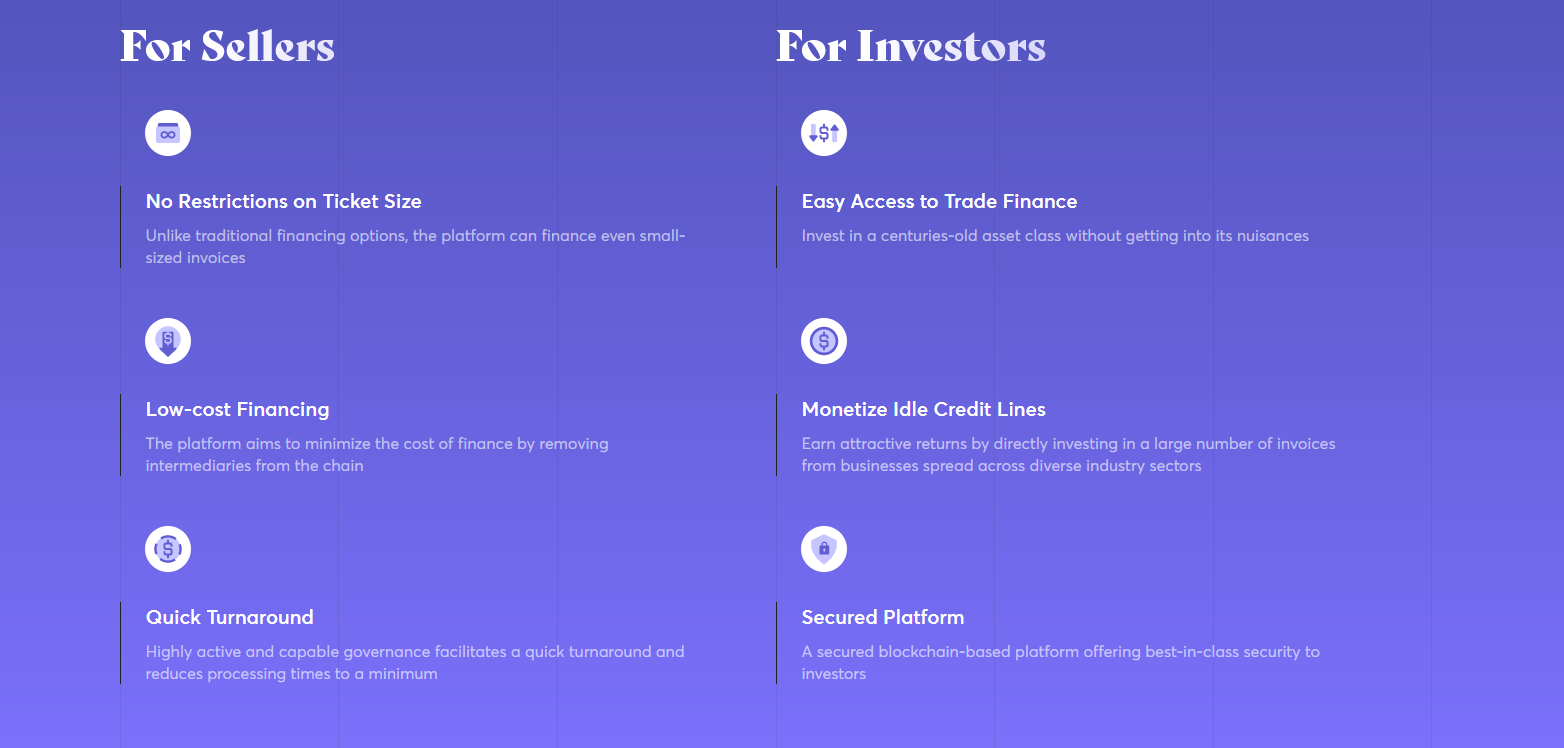
Ploytrade mainly provides a simplified financing solution that brings together sellers, buyers, investors, insurance companies and other parties on a platform to tokenize real-world acceptance invoices and provide a series of token incentives Mechanism to provide enterprises with fast financing services . So, that they can solve their financing problems.
Ploytrade mainly involves two aspects. The first is the credit status of each role, and the second is the flow of tokens and funds and incentives. This is also the core and key point of the operation of polytrade.
First of all, on the ploytrade platform, all participants need to perform strict KYC real-name authentication in order to determine the main identity of the participants, so as to ensure that the use of funds is normal.
Secondly, investors will be funding in a liquidity pool in this way similar to our liquidity in the form of mining, and investors can get ploytrade token TRADE rewards to motivate more users to participate in liquidity mining.
In this way, the liquidity pool can provide enterprises with convenient financing and provide them with special lending services. For example, buyers obtain acceptance invoices by using accounts receivable for pledge lending, and then pay the sellers, and the sellers send the goods Sell to *home, get **, and then exchange into corresponding funds in the ploytrade contract, and get a certain TRADE token reward.
**Here we can learn:**
**1.** The target groups of token incentives are mainly sellers and investors. Through the DEFI liquidity pool, investors can put stablecoins into the liquidity pool, and the amount of stablecoins invested by investors into the liquidity pool is directly Determines the number and amount of invoices generated by the contract, which also ensures that funds will not be overused .
**2.** The invoice obtained by the seller can be exchanged at any time, and the seller can accept the acceptance function of the invoice by matching offline trade, and the buyer's accounts receivable will be audited by polytrade and be subject to a certain amount of quota , which can solve their short- and medium-term capital use problems and prevent the buyer’s capital chain from breaking. Since the accounts receivable here need to be reviewed by a professional team, the lender’s repayment background check is still required. The following service team conducts investigation and review so as to prevent the occurrence of bad debts.
**3.** Since this intermediate smart contract is the key process for processing invoices, and everything in the contract is open and transparent, the invoice will naturally be recognized by the market. At the same time, due to token incentives, sellers also have the confidence to accept such invoices.
In this model, Ploytrade has formed an intermediary agency similar to a bank, which scientifically and transparently manages the use and flow of funds through smart contracts, brings together buyers and sellers to conduct money transactions on the platform and ultimately helps companies .
At present, in the field of blockchain financing, Ploytrade is a combination of on-chain and off-chain. It obtains the corresponding user group by serving corporate customers. The operating model is similar to the Internet finance of previous years, but for Internet finance it is said that due to the opaque use of funds and the credit problems of borrowers and incentive problems, the Internet finance sector has experienced bankruptcies in recent years.Ploytrade uses smart contracts to manage the use of funds, Ploytrade truly solves the needs of the borrower and help the small companies.

Chia hashrate and the price of the currency
Recently, due to the continuous increase in the computing power of Chia's entire network and the continuous decline in the price of the currency, many people engaged in chia mining are confused about this project. After all, due to the continuous extension of the return cycle, many people who invest in mining may be confused. How we should look at this project has also become very critical.
**Estimation of currency price and computing power**
We all know that the computing power of chia has now surpassed the computing power of 24EB, and the growth rate of computing power has begun to gradually flatten out. The new p-disk tool has improved the speed of the p-disk for a while, but it still lacks stamina.
Although the improvement of Chia's P-disk efficiency can increase the growth rate of the entire network's computing power in the short term, the further the later, the impact will naturally be less obvious. The main reason is the impact of currency prices. Until a certain point in time, the whole network computing power no longer increase, that is, to achieve a state of balance, so where is this state of equilibrium?
In fact, we can compare with other POC currencies. At present, besides chia, the POC project with relatively good returns is mass. Mass's income per PB is 53 US dollars, and bhd's income is 35 US dollars per PB. PB’s income is US$120. That is to say, if the computing power remains the same, then there is still half of the room for chia’s earnings (one-half of the current currency price), that is, the lowest currency price is about US$208. This is also the current situation. A reasonable income from other POC mining projects.
So if the currency price wants to increase or the downside is reduced, that is to say, the computing power of the entire network must continue to grow, so as to meet the currency price supporting computing power, otherwise the market will automatically find a new balance point, of course. Power growth will also cause a decrease in daily income. From the current point of view, this is not over yet.
**Room for growth in computing power**
We believe that the future computing power will inevitably continue to grow, and there is also room for growth. The main reason is that the new mining pool agreement has not yet been made public, so part of the reason is that miners may continue to wait and see.
Although there is still room for growth in computing power in the future, we still need to see that the current market enthusiasm is obviously close to fatigue. The growth rate of 1 EB in the previous day has been reduced. If we want to continue to increase the growth rate of computing power in the future, In fact, it is not a difficult task. It only needs to pull offers from relevant interest groups. However, due to the delay of the new agreement in the early stage, many people who waited for the p-disk after the new agreement appeared may no longer be able to wait. They can only continue with the p-disk and then exhaust the hard disk in their hands. This is the only way at present.
At this time, the official can launch a new agreement in due course when the consumption of the hard disks in everyone's hands is about the same, so that the market can once again use disks for profit, that is, at that time, it is a good way to pull up again. The advantage of this is that the current small miners can be cleaned out, and the other is to maximize the computing power of the entire network, which is also in the best interests of hard disk manufacturers.
If you still have free hard disks in your hand, i don’t recommend waiting for the p-disk after the new agreement appears, but choose to directly p-disk now, so that you can also maximize your own interests. The income after the new agreement appears according to the current situation. The main reason is that the distribution method of the new protocol reduces the amount of coins that can be distributed to everyone.
**Chia's influence on filecoin and swarm**
Some people think that many miners are now turning their attention to storage mining to new projects such as swarm or crust, but the actual situation may be that the current new mining project is not sure about the gameplay, so there are some people who wait and see. In fact, projects such as filecoin, swarm, and crust will not have much impact on chia's hard disk mining, and it is meaningless to wait and see.
The main reason is actually relatively simple. We all know that chia mining is done by writing a large amount of meaningless data to the hard disk. And let’s look at filecoin, swarm, crust, etc. mining. Their original design is to solve the storage problems in the blockchain, create a decentralized storage network, and provide data for the network, although their forms are different. , But it is certain that the data in the storage space of filecoin, swarm and crust mining are all useful to the network.
It is also because the storage data of projects such as filecoin is useful for the network, so generally their data requires little storage space. For example, we said that the filecoin, now the storage space is only a few E's of data, which is so large. In fact, most of the storage space is still junk data. In other words, the storage of valuable data required by the actual blockchain network is actually very small, so there will not be much room for improvement in the short term. But chia is different. It is precisely because its hard disk data has no practical use, so its demand for hard disks is theoretically unlimited. It is also because of this that after chia has shown a relatively good prospect, its computing power Can quickly increase to more than 25E.
So people who are waiting for swarm with a large number of hard drives in their hands may be a little disappointed, because in the short term, swarm may not consume too many hard drives on the market, and finally a large number of hard drives in the market have to rely on chia.
Finally, for retail investors, the reduction of chia's current computing power is a normal process, because in essence, the income of other POC mining projects is now lower, and there is also a demand for manufacturers to sell hard drives in the market, and the chia team is adding hard disks and computing power, and aims to create a long-term hard disk demand market. At present, in the short term, mining chia may be a thankless thing, especially now that the initial mining period has passed, the market will inevitably have a cooling process for the project. I think this process is also a better period for some capital to intervene in the layout . From a long-term perspective, we believe that if there are no other phenomenon-level POC projects, chia is still a good choice. Of course, from the perspective of input and output ratio, the income of chia mining and graphics card mining may not be much different, and other POC projects have not developed to the scale of chia.

Why cryptocurrency bull market is not over yet ?
Due to the influence of various external factors, the cryptocurrency market has recently begun to turn cold, and many investors are generally pessimistic, believing that the bull market in cryptocurrencies may end, and this view has gradually gained recognition from many people. However, through comparison with the past, i believe that the current bull market is not over, and the second half of the bull market is bound to come. So why is the second half of the bull market not over yet? So, i analyze from multiple angles, mainly for the following reasons:
**1. The law of bulls and bears in the investment market**
I believe in the laws of market cycles and business cycles. Basically, economic development is mainly maintained by people. That is to say, the economic cycle should also be based on the life of a person. Therefore, we usually talk about a 60-year cycle and an economic crisis once every ten years. The small direction says that every industry such as the stock market, real estate, bulk commodities, food crops, oil and gas, etc. has its own price cycle, and these cycles are not only a separate individual, but also by many other large cycles. For example, the Internet bubble in 2000, the financial crisis in 2008, the cryptocurrency in 2013, the A-share bull market in 2014, the real estate in 2016, the cryptocurrency in 2017, the real estate in 2019 and the cryptocurrency and commodities of this year, etc. Wait, although there is a slight time deviation in the bull-bear cycle market, it will eventually continue to come, sooner or later, but will not be absent. This is the reason why many people think that a 4-year bull market is actually Bitcoin. The halving is caused, but it is still slightly different, either early or late, but it will not be absent.
One of the reasons for this phenomenon is the self-regulation of the market. We take pig raising as an example. When African swine fever appeared, everyone gave up raising pigs. So once swine fever passed, the price of pork rose, so pork market is a very lucrative market. In the end, a large number of farmers raise pigs. As a result, the pigs are delivered for slaughter at the same time. As a result, the market is oversupply and the value of pork has plunge. So far, the price of pork is close to the cost of pig raising. In other words, If the price drops again, it is at a loss.
For other markets, the principle is similar. Of course, there may be factors that influence each other, so that the economic development cycle is not particularly precise, but has a certain error, such as Bitcoin this time. Bull market, if you use the rules of the previous few bull markets to find the opportunity of this bull market, the general direction is correct, but in fact it will still be different, but from the perspective of time, the time of this round of bull market should be It will last until the second half of this year, instead of ending early in the first half of this year. Of course, some people also think that this is the "carving boat for sword" method, but basically the periodic time will not be too different. If it ends now, it will obviously be It's a bit early.
**2. Reasons for the bull market in the currency circle**
We all know that the main driver of the bull market is capital, that is, money. So there is a question here. Is the increase in market prices caused by the increase in incremental capital, or the increase in market prices caused the admission of incremental capital? From the perspective of the currency circle, in most cases, the increase in internal market prices leads to incremental capital entry. At present, the currency circle is still a market that is not particularly regulated. Many currencies are subject to manipulation such as dealers, that is, after the stock market believes that the conditions are ripe, the collective consensus led to price increases. Once the external conditions for the currency market rise are mature, the main force will conduct large-scale publicity and campaigns, so that outsiders who have received the news and believe in the early days will think that the bull market is coming, and then there will be conceptual hype, so as to attract all kinds of novices to join in. The rise in the market has caused more people to confirm that the bull market is indeed coming.
However, the longer the timeline of this process, the higher the possibility of a big correction in the middle, because after a period of time, everyone makes money, but no one loses money. This is obviously unreasonable. Therefore, an external force Under this situation, there will be relatively large corrections, such as mid-2013, 94 in 2017, 519 in 21, etc. The advantage of this is to cool the market a bit, and clean some people, leaving some people on the scene. Playing inside will form a healthy bull market.
To put it simply, a constant rise will cause many people to keep panicking. If there is a callback, some risks will be eliminated, which will naturally make the bull market healthier. Therefore, we think the current market situation is normal.
**3. Market funds and new stories**
Although the cryptocurrency market is currently under attack, there are still many innovations in terms of industry technology development, which makes the market still have many new stories, so the bull market will naturally not end so easily now.
This is like in 19 years, we all know that 19 is a bear market, but there is a small bull market cycle in the first half of the year. The main reason for this phenomenon is that the market has new stories to tell (Exchange IEO) , And is there any new story in the current market? Of course there are such topics as layer2, storage and mining, and Polkadot ecological section, which have not officially exploded on a large scale.
In other words, there are still many cryptocurrency sectors that have not seen significant gains so far, but they have better stories that can be presented to the market in the next few months. What effect will they have? That is, the influx of funds into these "low-lying areas" will naturally cause a rebound in the market.
I also mentioned before that every June is a time when market funds are tight, so it is inevitable to usher in a callback. However, once the period of capital shortage is over, it will naturally move closer to those sections with stories, such as Polkadot Ecosystem Projects, L2 DEFI projects, etc., all have a lot of room for development and will naturally make the bull market continue to exist.
Conversely, if it is a bull market now, then for the market, there is still room for continued rise, and there will be some reaction to the increase in the market currency, and second, there will be a certain margin for future bear market declines. The bear market has to fall by at least 70 to 80%, so that investor education in the market can be done well and large funds can flow into other markets. Both the bear market and the bull market need a certain amount of time to recover, so that they can develop healthily.

Shaky market and a new Defi project
I believe that the recent market has made many people feel tormented again. If you sum up the current cryptocurrency market in one sentence, it can be said: Bitcoin market is unstable and most DeFi project is in an awkward state.
On the one hand, Bitcoin dropped from a minimum of 37,000 US dollars at the beginning of the month to 31,000 US dollars, and then violently rebounded by 6,000 US dollars to form a V-shaped reversal. However, many investors have been unable to resist the market shock and the dealers have no choice but to get out of the car. On the other hand, after a series of high APY projects on BSC, Heco, and Polygon broke out one after another, DeFi mining projects seem to have reached a stage of failure.
How can I still play in this state? I also had a headache at the beginning, until recently I accidentally tried to participate in a new defi project BabySwap.
**BabySwap and unique ILO**
Let’s briefly introduce BabySwap. According to the official definition of itself, BabySwap is the AMM+NFT decentralized exchange that is the best choice for new projects on the Binance Smart Chain, providing a more friendly trading experience and more thoughtful support services. , Focusing on the long tail altcoin market that has long been overlooked by Binance Smart Chain .
What attracted my attention at first was the first ILO liquidity issuance activity launched by BabySwap . The most common estimates are IDO and IFO. ILO is BabySwap's original issuance mechanism . Specifically, before BabySwap starts full mining, users add whitelisted tokens (252, including all items from the head to the waist of BSC) to BabySwap’s liquidity pool within 24 hours of the platform’s launch, and obtain LP, Stake LP on the ILO page to earn 1% (10 million) BABY rewards of the total circulation, so as to complete the distribution of tokens in the process of drainage. The initial offering price of BABY is USD 0.1.
Another interesting point is that BabySwap will set rewards with different coefficients according to different items. For example, the reward multiplier of CAKE is 100 times multiplier, and there are a total of 1 million BABY rewards. At the final settlement, the proportion of your liquidity in the CAKE liquidity pool determines the number of BABY rewards.
The liquidity pool of BabySwap is the default USDT exchange path. It is estimated that many people, like me, still choose to hold USDT in the stable currency field, but the default trading channels on BSC such as PancakeSwap are BNB or BUSD. Once USDT is used, there will be two transaction fees and slippage losses, except The cost issue is not conducive to the arbitrage between CEX and DEX.
After learning about the relevant highlights of the project, I decided to try BabySwap's ILO, thinking that the project passed the CertiK audit , and there must be no problem with security. Anyway, I still have some cake in my hand.
**BabySwap ILO yield**
It was after the ILO that I became very interested in the subsequent mining play of BabySwap, which led to the discovery of a new opportunity.
**BabySwap mining types**
The mining mode of BabySwap is divided into trade mining (Trade Mining), liquid mining (Yield Farm) and single currency pledge mining (Snack Pool) . BabySwap’s economic model shows that each block produces 20 BABYs, and the daily output is about 576,000, of which transaction mining and liquidity mining each account for 40%, and single currency pledge mining accounts for 20%. The mining reward rules of the stage will be decided based on community voting.
I believe everyone is familiar with transaction mining. Fcoin's transaction mining has set off a wave before. Recently, MDEX has also risen strongly through transaction mining. The transaction fee of BabySwap is 0.30%, and there are currently 28 trading pairs available for trading and mining. In the transaction mining mode, every transaction can be rewarded with BABY.
My friend strategy is to trade BABY-USDT in the trading mining mode. Because the amount of funds is not large, I personally used ILO BABY income for single-currency pledge mining at the earliest.
At present, the APR of BABY single currency pledge mining on BabySwap is as high as 606.26% . In contrast, the APR of CAKE single currency pledge on PancakeSwap is only 77.47%, and the difference in income is self-evident.
I realized that the **most profitable strategy on BabySwap is the BABY-USDT LP liquidity mining. The reason is that BabySwap is different from other projects' special empowerment.**
As mentioned above, the transaction fee of BabySwap is 0.30%, but this 0.30% is not owned by the project. **Among them, 0.15% is rewarded to LP; 0.05% is used to buy back BABY and burn it for deflation; 0.05% is used to buy back BABY and used as a growth fund to fund projects through the funding plan; the remaining 0.05% will be sent to the BabySwap treasury.**
Everyone may not have a concept of 0.15% of the transaction volume as a handling fee. The **current 24-hour transaction volume of BABY-USDT is up to 11.84 million U.S. dollars. The daily transaction volume of the DEX platform on BSC ranks third, after CAKE and MDX. BABY-USDT LP has a single-day dividend of up to US$17,760.** As of June 16, BabySwap's average daily turnover has reached 10 million U.S. dollars, and LPs can get an average of 15,000 U.S. dollars in commission rewards per day. And **this is only the BABY-USDT transaction BabySwap of achievement start in less than ten days.**
On the other hand, in the extremely volatile market from May to June, the overall trading volume of DEX has also increased relatively. According to Debank data, several high-performing DEXs on BSC during this period, MDEX and PancakeSwap's average daily transaction volume is at the level of 1.5 billion U.S. dollars, 1inch is at the level of 100 million U.S. dollars, and DODO is at the level of 50 million U.S. dollars. Near the level. **If BabySwap can achieve the above-mentioned DEX average daily trading volume level (tentatively set at 100 million U.S. dollars) in the future, then the total daily dividend of LP will be as high as 150,000 U.S. dollars.**
Excluding the advantages of commission rewards, BabySwap liquidity mining itself has very considerable benefits. Also compared with Pancakeswap, the current **APR of BABY-USDT on BabySwap can reach 610.56%, and even the APR of CAKE-USDT, BAKE-USDT, WBNB-USDT can be up to 150%-200%** . The liquidity mining APR of several mainstream currency trading pairs on PancakeSwap is basically less than 100%. A few high-yield liquidity pools also have corresponding currency risks.
Of course, I still want to express my strong appreciation for BabySwap's adoption of USDT as a listed trading pair. Personally, the user experience is too good.
In general, **BabySwap is a DEX, but it is also a link between new projects and users, which provides a guarantee for them to participate in a decentralized world and enjoy DeFi dividends at a low threshold. The recognition and participation of users will further feed back the development of BabySwap and the increase in the price of BabySwap.**
Taking into account the above factors-such as the sustainable development of BabySwap itself, and the future **Grants (more project growth incentive fund plan), vBABY (membership certificate NFT, enjoy fee discounts and other rights), NFT (NFT mining) , Trading, asset fragmentation), Games (Lottery, Prediction) and other products will help the project increase its visibility and valuation, and the value of BABY can be further captured.**
In terms of BABY's performance, its initial price was $0.1. After it went online, it rose from $0.1 to $0.4, and then fell back to below $0.1. This is not unfamiliar to everyone. After ILO is over, a large number of people will inevitably choose to dig and sell, and the low market capacity can easily reach the low level. However, after BABY’s liquidity mining was launched, there were also larger and smarter funds that chose to purchase BABY for pledge or liquidity mining, thereby **raising the price of BABY to the highest level when the market plummeted in the beginning of June. US$0.55, an increase of 550% from the initial price.**
BabySwap can achieve a spiral increase in its own development, and the price of BABY currency will also rise accordingly.

Complex economy and the benefit of Polkalokr
The emergence of DeFi is a major step forward for cryptocurrency. In the past, the circulation and trading of tokens had to go through a centralized CEX. Centralized CEX has its own advantages, such as a good transaction depth and a sense of extreme transaction experience. At the same time, derivatives can be traded on CEX. However, CEX has many problems, such as centralized control that reduces the cost of evil. The emergence of DEX broke the inherent model of CEX, that is, the first need to top up their assets into CEX to trade. DEX allows users to log in directly with their accounts. In this process, users only interact with the contract and the funds are always in their own hands. DEX further embodies the concept of decentralization and DAO.
And many DeFi protocols also choose DEX as the starting position for tokens, such as Compound, Balancer, Aave, and so on. Because this type of head DeFi product comes with a "star ", it also has a considerable financial advantage in the liquidity pool. In the form of decentralization, after some project parties issue tokens and provide initial liquidity, they also throw their concentrated chips into the capital pool, arbitrage investors’ funds, and ultimately make the liquidity pool . And users don’t know anything about the token model of this currency. After all, in a decentralized world, there are many people who do not disclose the actual token model. Therefore, for the decentralized world that advocates DAO autonomy, tokens model ,The actual model and the liquidity of the capital pool are the pain points of the decentralized world. Fortunately, polkalokr provides a good medicine for such pain points.
**Polkalokr**
Polkalokr's ecological members eliminate human factors through a seamless omni-channel digital experience platform (accessible through mobile phones, PCs, etc.), and focus on governance through code, thereby establishing trust in the DeFi space. Polkalokr provides a set of modular building blocks that meet all needs, and builds a token-locking platform for the highly customizable token economy. By creating a seamless omni-channel digital platform with user experience as the core, Polkalokr plans to use a multi-chain token custody platform to distribute tokens to investors' hands, simplifying and credibility of the complex token economic ecology.
Polkalokr contains two products, Lokr and Swapr. The combination of the two products can provide a comprehensive choice for the token economy and users to lock, distribute, monetize, and ensure and exchange tokens that support future DeFi and blockchain protocols.
**Lokr** is a multi-chain token custody platform. Lokr will enable a highly customizable and flexible release schedule for tokens. The project party can formulate a token model based on Lokr, and the locked part of the token will be hosted on Lokr, and Lokr will be unlocked according to the unlocking conditions set by the project party, such as project milestones, specific events, and dates. On the one hand, the transparency of tokens is guaranteed, and it is also ensured that opaque tokens will not flow into the market intensively, resulting in losses of investors’ funds due to liquidity tending to zero.
**Swapr** is a cross-chain token exchange protocol that allows users to exchange assets and conduct transactions in a non-circulating form. From the current market as a whole, there is almost no DeFi protocol that allows users to extract corresponding value from locked assets. SWAPR realizes the establishment of a secondary market by allowing the creation of peer-to-peer (P2P) transactions for locked assets. Users can set prices for locked assets, and then other market participants can determine whether the prices are reasonable, and then purchase these locked assets. Sellers using Swapr immediately obtain the liquidity of their assets, while allowing buyers to purchase locked-in assets at a price that is satisfactory to them. In this way, transparency and credibility can be maintained, and the smart contract acts as the executor of this process.
In Swapr, any data change based on the oracle can be used as a trigger for your transaction. Whether it is the result of a ball game, the temperature changes of the north and south poles, etc., they can all be used as factors to trigger transactions. With the continuous improvement of the oracle, even after the death of the asset holder, its assets will be directly released by the smart contract to the wallet of its successor. Swapr has unlimited application potential.
Therefore, for the decentralized world, although decentralization and openness were advertised in the early days, the actual distribution of many tokens did not follow the principle of openness and transparency. The system constructed by Polkalokr, on the one hand, templatized the token distribution model, allowing more teams to focus on product developers instead of paying too much attention to non-technical and logical parts. At the same time, for investors, it is possible to avoid the significant drop in liquidity on the AMM model DEX caused by the concentration of tokens, making the tokens in their hands unable to sell and becoming non-performing assets. Now Polkalokr is also welcoming eco-partners such as Terra Virtua, API3, Ferrum Network, Tidal, and more.

Chia mining
Since Chia became popular in early May, many people have participated in the mining of Chia and earned the first wave of bonuses. However, with the passage of time, the current computing power on Chia has grown too fast. I previously calculated computing power of the entire network could reach 4e around May 20. As a result, it was actually above 5e at that time, and it can be said that the deviation reached over 25%.
Of course, the computing power is still advancing by leaps and bounds in the past few days, so that even if i speeds up the p-disk speed, than it is barely equal to the growth rate of the whole network. That is to say, when my computing power increases from 6t to 20t this month, the daily income is still constant, about 0.01 coins, which shows that my current income is so low.
For users, what is more concerned is whether chia is worth continuing to mining on the P disk. Let's objectively analyze whether it is appropriate to continue the P disk now.
First of all, mining is closely related to the price of the currency. It was estimated that as long as the price of the currency is 700 US dollars, it is basically close to the Cost price. Now according to this calculations, such a cost price can be said to have exceeded 1,000 US dollars. In terms of currency standards, we can now basically determine that buying coins is more cost effective.
Of course, this does not mean that p disk mining is not good. One advantage of p disk mining is that we still have a hard disk in our hands. Although the p disk of chia is damaged the solid state drive, what we need to know is that, the final files is stored on the ordinary mechanical hard disk, so the damage of the mechanical hard disk is very small. That is to say, if you want to quit one day and don’t mining anymore, you can format the hard disk and then sell it on second hand online market, which is completely possible.
Of course, if you can’t sell it yourself, you can also use it yourself. This kind of mechanical hard drive is basically not too bad, and it’s different from graphics card mining. Therefore, if you sell the hard disk, you will be surprised to find that you have made a lot of money by selling the hardware. In this way, chia mining is actually very cost-effective at present.
Of course, if you want to get more profits, then speculation is always the fastest way to make money under ideal circumstances, but many people are not capable of making money. I also admit here that it is difficult for me to make money through speculation, which is why i chose to crypto mining.
Is it a time to buy chia's cloud computing power now? This may also be a concern of some people. In fact, what we need to know here is the use time of the cloud computing power you purchased. Currently on the market there is a one-year period, there are three-year period, there are also perpetual, here I personally is more inclined to perpetual chia computing power, because in this case, it is easy for you to permanently continue to mining Chia, without thinking about selling hard disks. So it's also easy to enjoy the increase in the number of coins dug up over a long period of time.
Of course, for sustainable chia computing power, you still need to calculate the cost yourself. I previously estimated that the corresponding cost may be more than 500+ dollar per T, so if the market price difference is not very large, it can be considered, but here also need to do a good job of long-term holding the coin plan, if you are mining to sell, if the current currency price of cloud computing power is below 1000, it may be difficult to make you back on the currency standard. As for the legal currency standard, the main thing is to look at the market currency price. I also believes that it is still very possible to recover and make money in the fiat currency standard.
Of course, the difficulty of mining chia is too high. Many people may be waiting for the official mining pool agreement to come out, because the mining revenue of rtnpool is too different from the actual theoretical revenue. According to the my estimation, the mining revenue of rtnpool is compared with the actual theoretical mining income differs by about 18%-30%. Of course, according to rtnpool official explanation, it is mainly because most people currently obtain income through dual mining. Even if rtnpool freezes the relevant accounts, it is basically difficult to recover the funds for dual mining. In addition, there are some reasons for false hashrate files in the rtn mining pool, so the income will naturally decrease.
At present, according to actual measurement, there are indeed some double-mining behaviors that cannot be eradicated officially, so this also causes a reduction in revenue. Of course, this reduced amount is still acceptablfor me. The main reason is that since the new version of chia software was updated, the phenomenon of unsynchronized nodes has been greatly reduced. Therefore, the number of dual-mining people has increased a lot . The possibility of high profits, although knowing that it is wrong to do so, but it is not fair for others to do evil and let oneself bear the loss. Although there is no real solo block yet, it can be worth the risk.
Of course, for large users, I think that double mining is not worth it, because it is said that rtnpool is forming a vip mining pool, which is pure mining, and will not perform dual mining. This part is composed of large computing power, so if your computing power is large enough, then you can either wait first and see if there is a chance to apply for their pure mining pool, or if you have enough ability to merge with other big players to create a new private pool, this is also a good choice for mining , This depends on your personal connections.
At present, from the perspective of fiat currency, chia mining mainly depends on the speed of the p disk, that is, the faster the disk, the better result. Therefore, if your p disk speed is very fast, your income will increase every day.

Avoid risks in bull market
On May 19, the market fell very sharp, and top 10 Cryptocurrencies such as BTC , Eth, Doge have fallen by 40%. Around that time, the market liquidation volume also reached a new high for a while. It is true that the advent of the bull market has caused many digital currencies to rise, and this has also made some people eager to try leveraged contracts. Although the contract market has continued to strengthen the stability of the system in the past few years, the occurrence of pins has been greatly reduced, but due to extreme market conditions are also prone to Downtime. Huobi, Binance, and coinbase are all experiencing difficulties in trading. Many investors who are eager to buy bottoms have not been able to buy low prices coins.
Bull market leverage is a dangerous thing. Although the bull market has a very high probability of currency price increases, from a market perspective, there must be a certain downside callback area, which is mainly related to leverage and capital utilization. We all know that capital is an important force that drives the market upward. We assume that there is a certain amount of funds on the market. At this time, we set the currency price as the initial value, and then leverage is an important force that drives continuous price fluctuations. When leverage is added, the amount of funds can be manipulated in nominal terms will increase, bringing huge profits to speculators. Once some of these speculators are higher than the initial value and cash out, then speculators in the back will inevitably need to deal with this. Part of the profit comes to buy the order, so the final outcome is that the price will fall, so that the currency price will be lower than the initial value, thus causing a decline. In other words, a correction or a sharp drop is a must in the bull market. This is also a normal thing. There must be a deleveraging process in the market, so that most of the long positions will burst and then return to a new equilibrium point.
**Where is the risk of leveraged investment?**
For investors, the risk of leveraged investment is very large compared to the spot market. Of course, since last year, major exchanges have introduced the problem of position loss caused by leveraged liquidation. A product like leveraged tokens, but in essence, whether it is leveraged or leveraged tokens, in fact, it is not good for long-term investors.
This is because the leverage setting itself is a short-term investment strategy, not a long-term strategy. From a small cycle, there will generally be a process of rising, falling and oscillating. For leverage, if you choose to open long, you must eat the rising part of the market to avoid falling and volatile markets, so that you can get the final profit and also same strategy for shorting.
Unless you are a hedging user, you can choose to take low leverage for a longer period of time. Generally speaking, leverage is suitable for short-term operation. In traditional financial markets, leverage is basically held overnight unless the volume is particularly large. In other words, open a position today and close it today. If you hold a position overnight, either the next day, there will be no positions, or there will be no positions. Therefore, most small position traders, especially positions that cannot affect market conditions, will not choose to stay overnight. In the cryptocurrency circle, many people are basically using leveraged contracts for several days. This will naturally bring more risks.
For leveraged tokens, although there will be no liquidation, it will eventually lead to overall losses due to long-term price changes. For example, the initial currency price is 1 dollar. When you go long with three times leverage, A week later, the currency price is still 1 dollar, but your leveraged tokens have begun to be far below 1 dollar. So, leveraged tokens is not good for investors.
**DEFI lending provides tools for large investors to cash out**
In fact, if you just talk about leverage, you must first understand whether you can bear the risk of leverage. This also includes DEFI pledge. DEFI is essentially a way to increase leverage. When we pledge 1 ethereum to a smart contract, At the time, we get loan 2000usdt, but if the market price drops, there may be insufficient collateral value, then the contract will ask for a position to be filled. If the position is not filled in time, then our ETH will also be liquidated, but such liquidation is relatively For DEFI, there is an advantage, that is, the currency in the account will not return to zero. That is to say, if the 1 ethereum is liquidated, the 2000 usdt we loaned out still exists in the account. Of course, this also depends on the execution process of the contract. If some contracts lock the account balance, it will not work, but if we loan out and If 2000usdt is taken away, it will not have much impact. In this way, the smart contract tool will provide a good strategy for large-scale cash out, that is, high-fold pledge, and then withdraw the pledged stablecoin, so as to achieve an operation similar to selling.
In the end, more people may be concerned about how to avoid asset losses caused by the market decline. In fact, there is no good strategy here, but as a prudent investor, Have a stable source of income and wait patiently for value coins. A stable source of income is generally a good way to buy mining machine computing power to mine. Bull market makes money, and bear market makes money. The other is naturally to stay away from speculation, stay away from leverage, and be a friend of time. You must always realize that the current cryptocurrency is still in a very early stage. Therefore, if you can stick to it, it is a success, crossing the bull and the bear, and finally enjoying the market development.
Order book and AMM
**Coexistence of order book and AMM mode DEX**
With the continuous development of blockchain and cryptocurrency technology, the market share of centralized exchanges (CEX) is being swallowed by decentralized exchanges (DEX), especially in this wave of DeFi, the form of the decentralized exchange DEX is also evolving. In addition to traditional DEX, DEX in the form of Swap based on the AMM (automatic market maker) model is emerging. In the current DEX track, there are mainly two types of DEX in the market. Large categories of DEX, namely AMM mode and order book mode.
In the DEX track, the earliest DEX in the order book mode can be called traditional DEX, and the DEX in the form of swap is a new DEX mode that only appeared in this wave of DeFi bull market.
In the history of the development of digital currency exchanges, the earliest model is the order book model. At present, centralized exchanges still use the order book model, which is also called the pending order model. In this model, the buyer and the seller are counterparties to each other. Buyers or sellers can take the initiative to place orders at a price they deem reasonable, and all the orders of buyers and sellers form the exchange's order book. The exchange only acts as an intermediary to match, and the user (buyer or seller) places more orders.
Different from the order book matching model, in the AMM (automatic market maker) model, the counterparty of the user (buyer or seller) is not another user, but a pool of funds. The AMM model is a human-machine transaction model, which does not Like the order book matching mode, the time required for exchange matching is required. AMM's human-machine trading mode is executed immediately, and the transaction price is not controlled by the user. As long as any transaction volume is given, the pool of funds will automatically provide a trading price according to the algorithm. In the DEX of the AMM model, users can be rewarded by providing liquidity to the pool of funds, known as liquidity mining.
**The DEX of the AMM model has achieved explosive growth**
According to relevant statistics, the annual transaction volume of DEX on Ethereum in 2019 was only 3 billion U.S. dollars. In 2021, the total transaction volume of Ethereum DEX in January has exceeded 60 billion U.S. dollars, which is basically 30 times the 2019 full-year DEX transaction volume. The reason for such a large trading volume is known to all. Among them, the DEX of the AMM model plays a key role.
With the continuous development of DeFi, the DEX of the AMM (automatic market maker) model has achieved explosive growth. Basically, each public chain has its own Swap (AMM model) exchange, and it has gradually become the mainstream model of DEX. For example, Uniswap daily trading volume on Ethereum was second only to Binance, Huobi, and OKEx and now it became the world’s fourth largest cryptocurrency exchange. Pancakeswap on the Binance Smart Chain has achieved tremendous development.
Newdex caters to changes and integrates the **AMM model**
The great success of the AMM model DEX has also triggered many spontaneous changes in the order thin model DEX. Take Newdex on the EOS chain as an example. Its development process has also witnessed the transformation of the DEX model.
Newdex was launched in August 2018, that is, two months after the EOS mainnet was officially launched. It developed with the development of the EOS public chain. As we all know, compared with other public chains, EOS public chain The chain is not only fast, but the transfer fee is also very low, even free. Relying on the performance of the EOS public chain, Newdex provides us with a DEX transaction experience of matching and settlement on the chain. At the time, it was very in line with decentralization .
When trading at Newdex, not only does it require no registration and KYC, but the EOS wallet connection can be used for trading, and the relevant contract account adopts the EOS multi-signature model. The Newdex project party cannot unilaterally transfer the assets in the contract or modify the contract code. It provides security for users' digital assets, and therefore becomes the leading DEX exchange on the EOS chain.
However, after the rise and explosion of the AMM model DEX, it has had a great impact on the traditional order book model DEX, especially in the AMM model, users can not only be DEX users, but also can be DEX "shareholders" , Share DEX transaction fees by providing liquidity for the Swap pool.
After the AMM model of DEX (such as Defibox) broke out, Newdex also actively catered to the changes, and launched aggregate trading in December 2020.
**The innovation and advantages of aggregate trading**
Newdex's aggregate transaction is to aggregate the traditional order book model and the AMM model Swap pool. These two models have complementary advantages. For users, the transaction depth has become significantly better, and Newdex user experience has been significantly enhanced.
After Newdex integrates the order book matching mode and the AMM fund pool mode, users can not only enjoy the convenience of the AMM mode, as long as they select the corresponding transaction pair and enter the amount to be exchanged, the transaction can be completed quickly, that is, the human-machine transaction. For users who want to quickly complete the exchange transaction, the AMM model is very convenient, especially when the market is volatile, you can use the AMM model to quickly lock in gains or reduce losses. Moreover, you can also enjoy the convenience of the traditional order book model, that is, users can conduct pending orders at a price specified by themselves according to their own judgment on the market.
The depth of the trading pairs of Defibox have been aggregated into the Newdex exchange, and the trading prices will be better while maintaining the experience of decentralized products. The system will even automatically calculate the optimal transaction for the user according to the algorithm, such as splitting the user’s order, one part uses the AMM mode, the other part uses the order book mode, or part of the transaction volume is completed by Defibox, and the other part The transaction is completed by Swap fund pool.
Although Newdex has long been famous on EOS, the cruel fact is that when we talk about Dex liquidity in the broad market, the data sources are ETH and BSC because the circulation of assets on EOS, is not rank among the big streams. In today's environment, going out of the circle is an eternal topic.

Best Way to invest in NFT field
The sharp rise of the four kings of the Binance NFT field ( Bake , Alice , CHR and SLP) reminded the people that the NFT field is likely to be one of the main lines of the emerging sector of the next bull market, just like the Ethereum L2 field . In addition to mainstream currencies (Bitcoin, Ethereum , etc.) as the traditional protagonists of the bull market, in emerging fields, the next DEFI liquid mining currency ( DEX , lending, etc.) has a certain probability of entering a quiet period , and the emerging mainstream is most likely to be replaced , one is Ethereum L2 and the other is NFT . However, we know that NFT is probably the most complex ecology in the blockchain field at present . If other areas of the blockchain are similar to a piece of artificial forest, NFT is naturally a pristine forest, not only has a variety of plants. Big trees, there are small grasses and kaleidoscope-like creatures. Therefore, most of the currency users are still relatively unfamiliar with how to invest in the NFT field.
So i roughly divides the investment framework in the NFT field into three levels as follows.
**The first level: public chain and infrastructure :**
Public chain currency is the concept of "shovel". After these months of training, the coin people are generally familiar with DEFI mining, and the most basic lesson from DEFI liquid mining is that the quality of shovels is far more important than the yield . Some time ago , the profit rate of mining on the Binance Smart Chain BSC was actually not high, generally below 500% per annum , but why the pool of large funds? The most powerful mine on HECO can only accumulate roughly 200 million U.S. dollars, while the mine on BSC can easily accumulate more than 1 billion U.S. dollars. The reason is that the shovel for mining on the BSC is almost all proved to be a gold shovel , while the shovel on the HECO or EOS chain is proved to be a fragile earth shovel . My personal experiences, used Bunny single currency dig WBNB income over 4 times, because the reason is that the shovel Bunny has increased from more than $120/coin to $400/coin. And the bumper harvest that was involved almost in the same period turned out to be a mess. The reason was that the shovel USDC plummeted and then plummeted. At present , most new mines are on HECO , but almost all of them are fast-running games , so recently they bought some shovel if they were fancy. Some people went in to mine and pushed up the price of shovel and quickly dumped it. As a result of tens of thousands of mining coins , the mining pool will drop 10 times in a short time , and there is really no willingness to mine. After the bull market is over, the golden shovel will also become a dirt shovel, but at least now the duration and rise are longer.
Closer to home, the bottom infrastructure of NFT is of course the public chain. According to the concept that mining is better than buying a shovel, there are currently two most famous NFT public chain concepts , one is FLOW and the other is ENJ . Flow is a public chain built specifically for NFTs , behind which are consortiums such as Warner Music Group. The ENJ is the NFT 's ERC-1155 Ethernet Square tokens standards , each one able to NFT marked "label" work to ensure the uniqueness of circulation. These two projects still have their own characteristics. Although most NFT projects in the future will start from smart chains like BSC , the scarcity is more expensive. These two professional NFT chains are still worthy of attention, and there is a high probability that they will be in the NFT boom.
**The second level: NFT trading platform :**
Currency security NFT4 kings generally fall into this level, and in the NFT thriving trading areas king OpenSea also belong to this level. The tokens of the NFT trading platform are of course more similar to those of the exchanges. In fact, paying attention to this level is the idea that mining is not as good as a gold shovel.
It should be noted that, although the field of NFT is broad, the current climate is mainly 4 sub-markets, namely Art-NFT (art collection), FI-NFT ( DEFI financial certificate), IP-NFT (intellectual property) and Game- NFT (gaming) . In addition to large platforms such as OpenSea, which are all-encompassing, most trading platforms will gradually focus on a certain field . Therefore, investment needs to observe whether the trading platform has outstanding performance in one of these four sub-markets. Whether it can become a leader on the road, including transaction volume, activity level, work status, etc.
Projects at this level are similar to DEX on Defi . There are many projects and a mixed bag. Now it is difficult to tell who has the lead besides the leading OpenSea . So the key point is that in addition to the Binance magic bonus for Binance 4 Heavenly Kings, the business development so far is relatively good and you can pay attention to it. For example, the Rarible ( RARI ), Decentraland ( DCL ) and SuperRare , Terra , Virtua , Async Art , NFTfi etc.
**The third level: specific NFT works :**
Paying attention to the shovel does not mean not caring about the content at all. Of course, the biggest opportunity in the NFT field lies in NFT works , but the vast majority of coiners , like me, have nothing to say about "artistic accomplishment". How can they be in NFT works like the ocean ? Looking for possible opportunities? I feel that this level should not be considered by ordinary coin users in the short term under the current boom, but in a bear market, it is a good time to start, because the possible increase after the bear-bull conversion may be at least comparable to that of a hundred times coin.
To summarize, NFT works have several characteristics: fixed total amount (pursuing the rarity of the Bitcoin model), multiple unique image series and an overall ecology (unique and systematic combination), interesting and humorous content, and easy Circulation and application . This kind of "set" NFT can be considered as a commercialized work with high liquidity, and if encountered in a bear market, it should be worthy of long-term investment.
Compared with previous projects in the currency circle, NFT is more "different" and "alternative", but it is inseparable from its origins. When it comes to every emerging investment field, people always unfamiliar at the beginning, but continue to study. Maybe you will find new opportunities for "heterogeneous" and "alternative".
DeFi is wealthy opportunity for people
There is no doubt that this round of bull market was triggered by DeFi. To a certain extent, the outbreak of DeFi is also inevitable. After all, blockchain technology and finance are naturally related, and even Bitcoin was born in at the time of the financial crisis.
Unlike previous rounds of bull markets.Before this round of bull market, the cryptocurrency industry was basically in a pure hype stage with no practical application, although this round There is still hype in the bull market, but many real applications have been born. For example, in the Ethereum ecosystem, classic DeFi applications such as Uniswap, Compound, AAVE, and Synthetix have been born.
Ethereum is the birthplace and testing ground of DeFi, and then quickly spread to other public chains. For example, in the DeFi subdivision track, DEX has greatly changed the way we conduct cryptocurrency transactions and is more in line with the decentralized spirit of the blockchain. DEX is constantly eroding the market share of centralized exchanges; decentralized lending , Machine gun pools, etc. can activate the cryptocurrency we already have in our hands and increase the utilization of tokens; while synthetic asset agreements, derivatives agreements, etc. can bring traditional high-quality financial assets into the DeFi world, expand the scope of our investment targets, and promote The integration of DeFi and centralized finance, the explosion of DeFi has accelerated the application of blockchain technology.
DeFi is by far the most influential and influential application track for the industry in the history of blockchain and cryptocurrency technology development. , DeFi industry innovation is still ongoing, especially the DeFi innovation on the Ethereum public chain is constantly emerging.
In short, due to the financial attributes of blockchain technology and the continuous innovation of DeFi track, the DeFi boom will not pass quickly. Therefore, there are still many opportunities in DeFi.
The global economic downturn, coupled with the impact of the new epidemic, people’s lives are not easy. In order to stimulate the economy, some countries continue to print fiat currencies, which further dilutes the redemption power of fiat currencies in people’s hands, especially in some African countries , The inflation rate is extremely high, which exacerbates people's poverty.
However, the wave of cryptocurrency bull market detonated by DeFi since last year has provided us with a lot of opportunities. Not only can we hold high-quality large currencies such as BTC and ETH, we can easily beat the inflation rate and enjoy the Ten times the income, and the explosive DeFi track also contains a lot of money-making opportunities.
**My DeFi experience**
The experiences I share below are all my personal experiences, and I hope to inspire you.
**Arbitrage between Swap and centralized exchanges**
With the outbreak of DeFi, there are more and more DEXs based on the AMM model. Basically every public chain has its own Swap exchange. As we all know, CEX adopts the order book model, which means that both buyers and sellers need For pending order transactions, the pending orders of both buyers and sellers constitute an order book. The system completes the matching of orders between the buyer and the seller. The counterparty of the transaction is another user, while the Swap type DEX adopts the AMM (automatic market maker) model. Its counterparty is a machine, that is, a fund pool. It is different from the order book model. Swap is a human-machine transaction. As long as you specify a trading pair and give the number of transactions, the fund pool will automatically give a quote.
It is precisely because of the different modes adopted between CEX and Swap that there is room for arbitrage between CEX and the Swap capital pool.
**Make full use of borrowing and increase the amount of available funds**
In this bull market, the decentralized lending segmentation track has also exploded. Not only has the tokens of the decentralized lending platform skyrocketed, but the volume of lending business has indeed risen sharply, and decentralized lending business has become the cryptocurrency holders just need, and many users are borrowing to increase the number of tokens they can use, thereby increasing their income.
Therefore, with the popularity of DeFi, the decentralized lending track has been very perfect. We need to change our concept. We don’t have to purchase to increase the number of tokens in our hands. We can use borrowing to activate the existing tokens. Currency, through borrowing to increase the number of tokens that can be used in their hands, borrowing is equivalent to a leverage tool, it can amplify our income.
**Use synthetic assets to buy US stocks such as Tesla**
As we all know, the DeFi subdivision track synthesis asset protocol can synthesize traditional financial assets into currency assets. For example, stocks, gold, silver, etc. can be synthesized into currency assets, and then we can purchase traditional financial assets through digital currency. It is very convenient, and for our currency circle users, it expands the scope of investment targets.
Moreover, due to the influence of policies and other reasons, some traditional financial assets often have national boundaries, and users in other countries cannot easily trade. However, many restrictions can be avoided by purchasing synthetic asset forms of native assets through the Synthetic Asset Agreement.
Through the Synthetic Asset Agreement, these traditional financial assets can be turned into global digital assets. By trading these synthetic assets in the form of financial assets, you can achieve profits.
Through the Synthetic Asset Agreement, I have traded Tesla and other U.S. stock assets. Compared with the high volatility of currency assets, these U.S. stock assets are relatively more stable and less risky. After all, there is a real reality behind these U.S. stocks. Supported by the cash flow. It is very convenient to invest in high-quality U.S. stocks through a synthetic asset platform.
**Use of off-market leverage**
Many traders know that the price of crypto fluctuates sharply. If leverage is added, the risk will increase by several orders of magnitude. I am a risk-averse cryptocurrency investor, and I was lost to over tens of thousands of dollars when I first entered the market. Therefore, using high leverage to make money, more than 90% of people may end up losing money, only a very small number of people earn handsome amount of money.
Although DeFi is very hot at the moment, it is foreseeable that once the bear market comes, many DeFi coins will plummet or even return to zero. We must be psychologically prepared. Therefore, while conducting DeFi mining, we must pay attention to risks. If your hands are full of DeFi coins, you may not be able to sleep well at night, but the necessary BTC, ETH, etc. as the gold coins will allow us to live longer.
In short, DeFi is still developing wildly, various DeFi innovations are still going on, and more opportunities are emerging in this industry. In terms of mentality, we must be prepared for long-term investment. In terms of action, we must learn more and study more.
SBF best project OXY
Recently, the name SBF has frequently appeared in the ears of DEFI miners. Because of his place, the project currency is at risk of being smashed and unable to rise for a long time. Miners naturally pay special attention to its movements.
In fact, SBF is not just a miner holding a large amount of funds, but a financial genius with extensive experience on Wall Street. He once worked as a traditional ETF trader, founded a secondary market quantitative trading company and investment institution Alameda Research, and later founded the digital currency derivatives centralized exchange FTX.
Beginning in 2020, SBF's sight has begun to extend to the decentralized world of blockchain, and the focus is on the field of decentralized finance, which is DEFI. In the following year, SBF deployed multiple tracks in the field of decentralized finance, with the intention of creating an ecosystem that includes the construction of a complete DEFI infrastructure.
These layouts started with the launch of the Decentralized Exchange Serum Agreement by SBF in cooperation with Alameda Research founded by itself in early 2020, and gradually touched all aspects of DEFI.
The tracks and projects involved include decentralized exchange (DEX) Serum, front-end platform Bonfida, liquidity protocol Raydium, lending protocol + synthetic asset protocol Oxygen, and application scenarios Maps.me, etc.
Today we introduce two of them: **Serum and Oxygen**
**Serum DEFI universe on the Solana chain**
Serum is a fully decentralized trading platform DEX developed based on the Solana public chain. It is mainly aimed at the trading of encrypted asset derivatives, which is also a familiar track for SBF. Unlike most DEXs on Ethereum, Serum uses an order book rather than an AMM mechanism.
The choice of this pre-order mechanism is to meet the low-cost, fast trading and high-frequency trading features required by derivatives exchanges, and these features are guaranteed by the high performance of the Solana public chain, which is why Serum chose to develop on the Solana public chain.
Because Solana is known as the fastest blockchain in the world, it can help Serum achieve more than 50,000 transactions per second, with a fee as low as $0.0001.
Such performance is unimaginable on the Ethereum chain, and it has an extremely important role for DEX whose main business is trading, especially for DEX whose main trading object is derivatives. Such performance also makes Serum's efficiency comparable to that of payment giants in the traditional financial world.
In fact, in addition to being a decentralized exchange based on the order book mechanism, Serum also uses Solana's wormhole cross-chain function to develop a cross-chain transaction protocol to convert ERC20 assets on the Ethereum chain and assets on the Solarna chain. Serum has also developed Serum USD, a stable protocol coin based on a basket of stable coins.
The purpose of these functions is to realize the connection with the Ethereum public chain, reduce the difficulty for developers and users to obtain funds from the Ethereum ecosystem, and provide basic tools for the development of DEFI business for their own ecology, and improve the DEFI basic modules.
It can be seen that SBF is built using Serum as a DEFI infrastructure , and the entire DEFI layout is developed around this basic ecology. Therefore, some people call this ecology that accommodates the entire DEFI infrastructure construction as the Serum universe of SBF.
Serum's target is the decentralized version of the FTX exchange, which will be built as a spot and derivatives trading platform on the Solana public chain, and will provide liquidity and other infrastructure for the entire ecosystem.
**We know that in the world of DEFI, the three most important tracks are trading, lending and derivatives.**
Oxygen hit the three tracks with the greatest potential of DEFI in one go
**Nature of the Oxygen Agreement**
The product that carries the functions of lending, asset management and derivatives issuance in the Serum universe is the Oxygen platform. In fact, it also has the functions of DEX trading and exchange.
**The core of the agreement:** According to the official website, the Oxygen agreement is a decentralized finance (DEFI) chain prime broker business agreement.
However, the term prime broker is very professional, and it is difficult for people without financial background to understand it. In fact, it is a concept in traditional finance and a core business in traditional financial markets.
**Let's first understand this concept.**
The so-called Prime Brokerage (Prime Brokerage referred to as PB) refers to one-stop financial services provided to institutional investors, professional investors or high-net-worth individual investors.
For example, fund clearing, delivery and settlement, custody, valuation, risk control, operation, asset statement preparation, trading, leverage, investment research support, margin financing and securities lending, design and execution of derivatives, and capital introduction, etc.
It can be understood as putting investors in different financial service institutions to do things, or different financial services provided by different financial institutions on one platform or one project.
It can be seen that this business of prime brokers is mainly for centralized and professional investment and fund management services for institutional investors and professional investors, such as high-level financial services , fund coordination, and margin trading.
It is generally provided by investment banks, commercial banks and other large-scale centralized financial institutions that have the ability to connect different market participants. These various types of market participants may include hedge funds, pension funds, asset management companies, insurance companies, institutional investors, liquidity providers, and so on.
It can also be seen that the threshold of this service is very high, and it is impossible for ordinary users to enjoy such a service. Because of the nature of services such as risk management, capital coordination, and financing, it involves very high professional capabilities, resource capabilities and capital costs.
The **fundamental goal** of the agreement: Oxygen chose such a business model to cut into the field of decentralized finance. Obviously, it wants to bring the ultra-high barriers to specialization and in-depth financial services in the traditional world into the world of DEFI , So that ordinary people can enjoy such high-level services.
To have such a bold idea, the most basic resources should be the trust mechanism brought by blockchain technology and the DEFI model, the ability to reduce costs, the permission-free entry mechanism, and the composability of different financial services and other new era characteristics.
On this basis, Oxygen has also made some choices that are more conducive to the overall goal. For example, the Solana public chain was selected for efficiency, high performance and cost reduction. Serum was chosen because it has the infrastructure to start the entire DEFI, and the project’s The team, investors and SBF (SBF is Oxygen's consultant) have senior background and resources in the traditional financial industry.
Another more important option is to cooperate with another super application of Solana Eco, the map APP maps.me. Maps.me has just completed a financing of 50 million US dollars and has 140 million registered users.
Regardless of the user base that Oxygen can attract through other channels, just maps.me 100 million-strong user base makes Oxygen's vision a more likely possibility: making it easier for the general public to use. Previously, only professional investment.
The main trend of future finance must be to move these complex financial processes from a fragmented platform to a professional one-stop service, until a simple application can achieve one-click operation. This is an idea with a very big vision. If it is made, it will be an aircraft carrier-level financial service platform. Oxygen actually wants to do such a thing.
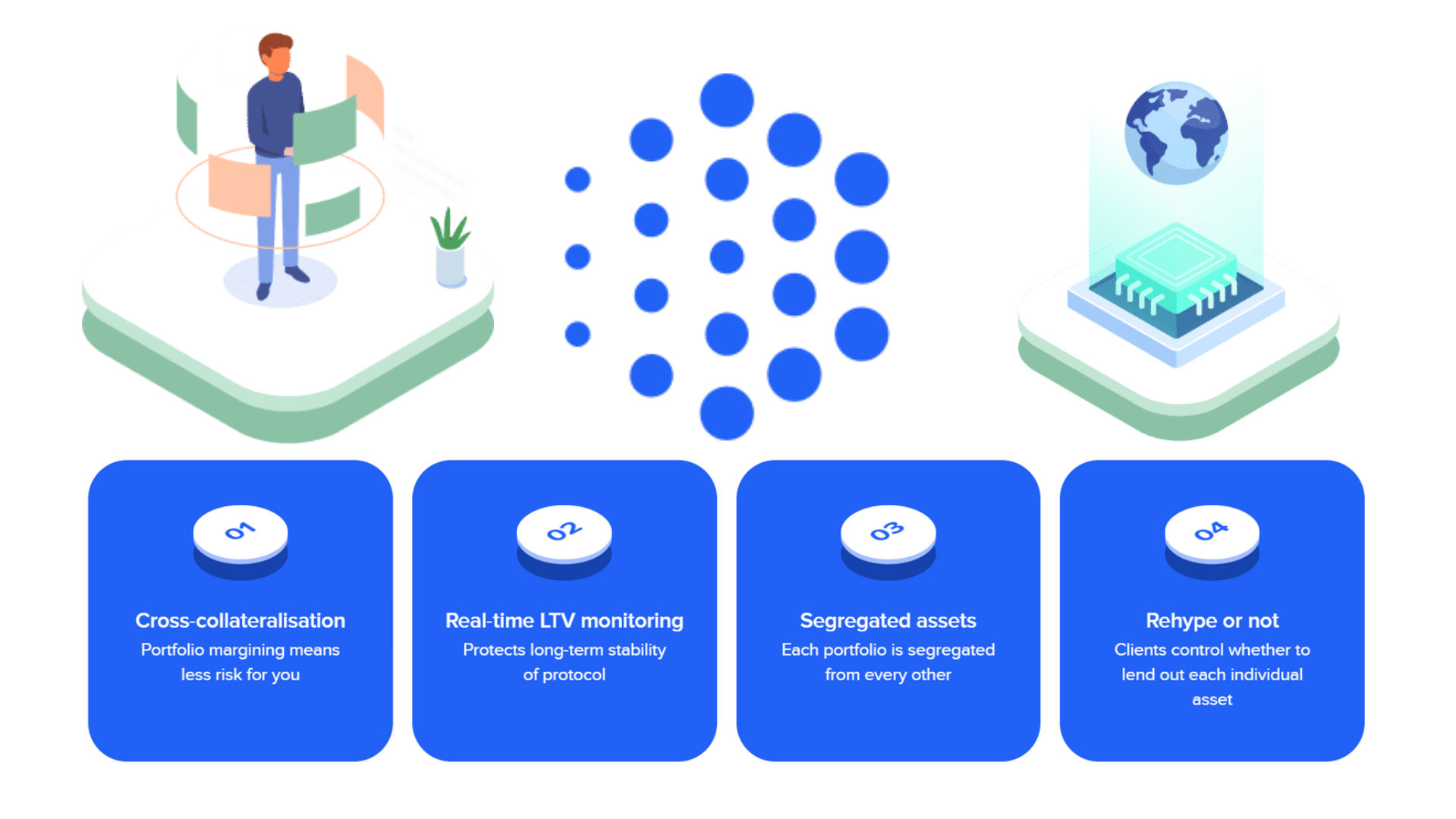

PARSIQ and the blockchain world
This is an era of big data. All kinds of leisure, entertainment, and consumption constitute your personal data. Personal data aggregates into groups and eventually becomes a valuable report that can bring commercial effects.
**1. The scale of digital assets is gradually increasing**
Speaking of blockchain, although Bitcoin has only been available for more than 10 years, the crypto currency market has begun to take shape. According to official data from CoinGecko, the crypto market value is now trillions of dollars.
Remember when Bitcoin exceeded $30,000, the number of new registrations on the Binance Exchange exceeded 10 million in a day. What an exaggerated growth rate!
In addition, the game has gradually diversified. The introduction of Ethereum smart contracts has established a threshold for many decentralized and trustless scenarios to access. Nowadays, under the DeFi boom, various games such as decentralized transactions, lending, and mining are being used.
**2. Challenges and opportunities under blockchain big data**
Blockchain technology has decentralization, transparency and immutability, and has excellent advantages over the traditional financial world.
As the blockchain model continues to change, the public's awareness continues to increase, the scale of the blockchain is gradually expanding, and the data is developing rapidly, but there are still many challenges.
The first is the security issue . The more money is gathered, the easier it is for some problems to breed. Many asset thefts are still happening. The KuCoin exchange 150 million US dollars of digital assets were stolen. The assets on the recent DeFi agreement have been stolen. Theft also happens from time to time. These incidents have brought some obstacles to the development of the blockchain and also brought new thinking to the industry.
**Solutions to the Difficulty:**
**1. Prevention**
Prepare in advance, make some predictions and monitoring, and intervene in time to prevent incidents from happening.
**2. Solve problems in time**
If you can make some preparations in advance, prevention is definitely a better way. In order to enhance the credibility and transparency of digital assets, we need some scientific measures to prevent criminal behavior and purify the blockchain environment.
**Secondly, there is the issue of data transparency** . Although the blockchain is decentralized, in fact many places still adopt methods that are not decentralized enough.
Finally, the integration of data, the utilization rate is extremely low and the system is not enough . Big data is of course valuable. Effective data analysis and integration can help companies better integrate, mine, and analyze user data, build a stable data analysis background, better analyze user behavior, and improve user experience. The user level can also use big data analysis to provide help for their own investment decisions in order to obtain better returns.
Anatoly Ressin, the co-founder of the blockchain analysis and monitoring company PARSIQ, said, “ So far, there has been a lack of a complex tool with automation and in-depth analysis capabilities, which is necessary for large-scale real-time monitoring of the blockchain. ”
Now the Solution is **PARSIQ**
**3. Blockchain big data intelligence platform PARSIQ**
Before the bull market really started last year, ChainLink (Link) was regarded as one of the focus projects. The price rose all the way and the market value continued to break through, and finally ranked among the top 50 mainstream coins. It also made everyone look at the blockchain oracles.
An oracle is an indispensable type of middleware in a decentralized world. Its main function is to connect off-chain and on-chain, and synchronize information off-chain to the chain.
Is there a path opposite to the oracle, which synchronizes the information on the chain to the off-chain ? Of course, many people have used acoin, and they are actually doing this kind of thing, large-value transfer monitoring, exchange stolen asset transfer warning, etc., but in general, the function is relatively simple, mainly to provide intelligence, and PARSIQ does things It is much stronger!
The PARSIQ team believes that the blockchain is extremely complex, with native unstructured massive real-time data; the independence and distributed characteristics of the blockchain cause isolation from the centralized world, making the tracking and application of data extremely complicated. The current market lacks a complex tool with automation and in-depth analysis functions to perform large-scale real-time monitoring of the blockchain. This is also the background when PARSIQ was born.
**Many people may not have heard of PARSIQ. I'll say a few things as a stepping stone:**
**1.** In 2020, KuCoin exchange assets were stolen 150 million US dollars . The stolen coins were mainly NOIA. NOIA Network officially cooperated with PARSIQ to take a snapshot of wallet assets. According to the snapshot provided by PARSIQ, NOIA Network implemented a hard fork and abolished the assets on the hacker's account, while restoring the assets of the stolen users.
**2.** The Coinmetro exchange uses the PARSIQ monitoring function . In October 2020, PARSIQ successfully prevented most of Coinmetro hot wallet assets from being hacked, protected the security of user assets.
**3.** PARSIQ currently has more than 30 companies paying users . The industry covers digital exchanges (such as Coinmetro), payment processors (such as Bit.One), stable currency platforms (Brazil's first stable currency BRZToken), and trading desks (such as TransferoSwiss), wallet service providers (such as BC Vault), some hedge funds and family asset management offices, etc.
**4.** PARSIQ business partners include BinanceX , well-known public chains Celo, Algorand, Bitfury, Chainlink, Solana, Moon Capital, Cryptorank, Coinlist, BlockVis, European Crypto Association, etc.
**5.** The Beta version of the product has been launched, and currently has 40,000+ users and active overseas communities.
**After talking about these things, everyone probably also basically realized the strength of PARSIQ.**
PARSIQ is positioned as the " Zapier in the blockchain world ", allowing users (including individuals, companies, and enterprises) to monitor any events on various blockchains and applications in real time and on a large scale, and integrate these through a customized trigger mechanism. Events are linked to application scenarios such as applications or devices under any chain to enable automation of workflows.
PARSIQ can be applied in a rich variety of usage scenarios, including big data analysis and real-time monitoring and anti-fraud tracking on the chain, abnormal alarms, real-time attention to related blockchain projects, tracking their changes, collecting and integrating data on the chain for off-chain business processes. Ability (risk management, market intelligence, etc.).
**Technically speaking, PARSIQ also has its own advantages:**
**Real-time and large-scale :** The digital currency market is changing rapidly, and time is money. PARSIQ is based on big data technology, real-time + large-scale monitoring of the blockchain world.
**Multi-chain solution :** The different public chains and side chains in the blockchain world are interrelated and have some independence. PARSIQ supports multi-chain, not limited to a certain chain, and has great scalability.
**Overlay calculation and real-time notification are combined** , and a custom smart trigger concept is introduced. Users can define their own filtering, conversion, and aggregation logic for all aspects of the selected blockchain.
**Mempool** tool used as an early warning system digital assets.
PARSIQ's powerful technology is inseparable from a professional team. The team has more than 20 professional full-time personnel. The team members include information security experts, big data architects, cross-chain technology experts, financial technology talents, cryptography, etc., from well-known companies such as Deloitte, Fortumo, Civic, Bitfury, Bigbank, Playtech, etc. As the so-called professional people do professional things.
Through the analysis of the current blockchain world transparency, security, big data utilization and other issues, combined with the goals and directions of PARSIQ, it can be found that PARSIQ’s has great potential, which will help reduce market manipulation and improve the transparency of blockchain. If we verify from multiple dimensions such as team composition, partners, application scenarios, we will find that PARSIQ's business has made good progress.

BlackOcean: Dark pool
On March 2021, a piece of news caught the attention of everyone : the innovative liquidity dark pool BlackOcean completed a US$4.3 million institutional round of financing,with participation from 25 investment institutions including SuperChain Capital, Jackdaw Capital, NGC, FBG and LD Capital.
Combined with the current trend of digital currency transactions, and contacting the team behind BlackOcean, which is the world's top quantitative team VRM, I had to spend some thought to study this project.
**1. Why does the crypto world need dark pool?**
Dark pools are not a new concept, and have always existed in traditional financial markets such as stocks.Generally speaking, dark pools are used to trade large stocks (according to SEC Rule 600, a minimum transaction of 10,000 shares or $200,000 is called a large stock transaction), and the price will only be disclosed after the transaction. Of course, it has now been extended, and the dark pool is not limited to the stock market, but applies to all financial markets.
Through the concept, we know that the main service objects of the dark pool are giant whales and large households. The purpose is to hide some information, better maintain the stability of the market, and let the giant whales create a private trading place.
**So why does the crypto market need a dark pool?**
Blockchain and Bitcoin are one of the greatest inventions of the 21st century, but their development is relatively slow due to their innovative and disruptive nature and certain cognitive thresholds.
Before 2020, traditional companies sneered at digital currencies, and cryptocurrencies seemed to be just a game for speculators. However, as the global economy is getting colder and Covid is sweeping the world, the traditional financial market supported by entities has been greatly impacted, and traditional institutions have gradually changed their attitudes. Institutions such as Grayscale kept buying stocks and Cryptocurrencies on every day, and then many giants have also begun to deploy digital currencies, which eventually leading to the current institutional bull market.
Large institutions are becoming more and more interested in cryptocurrency. Many institutions have entered the market and many are eager to try. The transaction level of institutions is definitely not comparable to retail investors, which is the fundamental reason why the crypto world needs dark pools, and this demand will grow in the future!
**2. The top quantitative team VRM incubated the dark pool project BlackOcean**
It focuses on high-frequency trading based on AI algorithms in the digital asset trading market and provides market-making services for exchanges. According to relevant data, the top three global digital asset quantitative teams are Alameda (FTX), VRM (FLY), and Kronos (WOO). The exchanges served by VRM include mainstream global exchanges such as Binance, Huobi, OKEx, and BitMex.
Although VRM is already providing services for many mainstream digital exchanges, many non-mainstream exchanges or other digital asset fields are difficult to form a market with sufficient liquidity due to issues such as platform depth and user volume, so they need Liquidity providers that using their power to provide liquidity for exchanges/trading pairs.
VRM itself already has enough money-absorbing ability, but based on some obsessions and visions of digital currency, it has incubated the innovative dark pool platform BlackOcean.
**Three, dark pool and liquidity pool**
There are mainly two core modules of BlackOcean: dark pool and liquidity pool.
The dark pool is mainly for institutional customers, and the service object is to execute large orders of more than 300,000 U.S. dollars or 5 bitcoins. BlackOcean relies on the strong technical strength of VRM, microsecond delay and unlimited API rate limit, enough transaction depth, can easily meet the needs of high-frequency and large-value transactions, and hide transaction-related data, which can well meet the need to protect information without affecting market prices of users. In addition, depth and speed also save users' costs to a certain extent, because BlackOcean can provide more flexible and better execution prices.
For a long time, dark pools seem to be exclusive to large investors and institutions, and the product level is also independent of ordinary retail products. However, there are still many retail investors in the market, so BlackOcean also designed a liquidity pool for retail investors.
The liquidity pool has no minimum order limit, and the data is open and transparent. Like the ordinary liquidity pool, the main service objects are market makers and ordinary transaction orders, and the counterparties are other liquidity providers. In fact, in addition to providing liquidity functions with ordinary DEX, BlackOcean will also rebate commissions to liquidity providers without charging any fees, thereby saving customers the cost of using liquidity services.
BlackOcean's dark pool and liquidity pool both save costs and increase revenue for users in different ways.
**Fourth, the advantages of BlackOcean**
Compared with similar products on the market, BlackOcean still has its own advantages, which mainly reflect the security of funds and technology.
**1. Asset security**
Fund security is the prerequisite for any transaction, and BlackOcean has done a great job in this regard, which is reflected in these aspects.
First, institutional-level hosting solutions . Cooperating with the world-renowned custody product Cactus Custody . All customers' funds are always managed by guarantee, so there is no need to worry about asset security.
Secondly, the fiat currency settlement supported by Signature Bank.
Finally, the industry's fastest risk inspection mechanism can detect problems in time.
**2. Technical advantages**
BlackOcean's technical advantages are mainly due to the background of VRM, which is the world's top quantitative trading platform, and the team has strong technical strength, which has also created BlackOcean's excellent technology.
**First, Speed**
The digital market is changing rapidly, and time is money. BlackOcean also has enough technology to support this. BlackOcean is 100% perfect on each server including the matching engine, ensuring non-stop normal operation. At the same time, it can satisfy unlimited API requests/calls of less than 2 microseconds. BlackOcean's matching engine and market data transmission system have been patented.
**Second**, the pursuit of ultimate optimization . BlackOcean supports a wide range of order types, up to 17 orders including ICE orders, and ICE orders are the only supplier in the crypto market . The automatic correction mechanism can reduce energy consumption, hardware costs, and user intervention. Unique and special technical protocols can increase throughput and optimize risk checks.
When we analyze similar competing products in detail, we can see that BlackOcean has many innovations, such as custody scheme, fund import, unlimited API, ICE orders, etc., as well as the liquidity pool of derivatives that will be launched in the future.
**Summary**
BlackOcean is supported by a strong incubator VRM, with outstanding technology, amazing security, compatible with institutions and retail investors. So, there will be more and more institutions deploying digital assets, and the demand for dark pools will increase.

Economic model of Refactorer
The NFT boom is surging. The competition for NFT exchanges as a counterpart to traditional cryptocurrency exchanges is getting more and more fierce. Rarible, is the first exchange that issue coins, and opensea, which has received a16z million in financing and may issue coins in the near future, they are already extremely competitive, both gaining market recognition. In particular, rarible, which is despised by crypto art lovers, has been criticized for its arbitrary banning behavior, but after issuing coins, it has become the top three platform for crypto art. However, its tens of times increase also discouraged many NFT enthusiasts, and these people are looking for the next NFT exchange that issue coins in future.
It's coming. As the most powerful competitor of the next-generation NFT head exchange, RefactorerNFT aims to maximize the liquidity of the NFT. Based on the token RFT issued by the platform itself, it provides an interesting economic model: multi-sector dual Token circulating supply system and NFT liquidity mining, creating incentives for the entire NFT industry, and promoting more users to actively participate in production, trading, and holding NFT. This initiative is the first of its kind in the NFT industry.
I have read many analysis articles on NFT exchanges in the market before, and found a very important problem: Many NFT exchanges do not issue coins. Coins have pros and cons, but as long as they are used properly, the advantages far outweigh the disadvantages. Not only can it effectively solve the problem of how to solve the problem of liquidity in the industry, but it can also greatly promote the development of the platform itself. Among them, one of the most typical examples is RefactorerNFT, an NFT trading platform that has received million-level financing from numerous institutions and is about to issue coins.
Why are so many institutions competing to participate in the financing of RefactorerNFT platform currency RFT? Why has the platform reached an exclusive partnership with many crypto artists before it went live? Why have thousands of communities been built in just a few days? Let's know these main issues.
What is RefactorerNFT? It is an emerging NFT trading platform. This platform combines NFT and DeFi, and is committed to opening up the on-chain transfer of physical assets and covering the entire industry chain of the NFT market. Refactorer announced that it has received investment from leading institutions in the industry such as CMT DIGITAL and Bolliger.
Of course, we enter the crypto circle to make money. We only need to see what the token model looks like and how it works**.** As we all know, the reason why many projects cannot keep up with the average increase in the big bull market because the economic model of the project itself has greatly deviated from the economic law of project development. The unreasonable market circulation of tokens, resulting in extremely heavy market selling pressure, which in turn hurt the confidence of investors and the community, and seriously led to the death of the project.
However, the total amount of this project is still moderate, and there are no tens of billions and hundreds of billions of projects. The angel round has now completed the fundraising, and the private fundraising round is currently underway. There are very few quotas on the market at present, and the team is very cautious in private equity. There has not yet been a situation of confusion and overweighting of private equity prices for projects . The information disclosed by the public offering is being docked with the IDO platform. It can only be determined that the IDO platform may be DODO, DAOmaker, Polkastarter, etc. The details have not been released .
**Functions of RFT:**
Judging from the white paper, in order to better empower RFT and promote the rise of RFT prices. The platform itself incorporates all NFT production and trading links into the RFT incentive system.
**Rights of RFT holders:**
First, grant holders exclusive privileges, airdrop platform exclusive commemorative NFT artwork, game props, collectibles, etc. from time to time.
Second, enjoy the platform's quarterly dividend rights, and 50% of the platform's profits are shared with all RFT holders.
Third, support the transaction fee of the RFT payment platform, and other exchanges require a minimum of 5%. RFT is expected to reduce the transaction fee.
Fourth, participate in DAO governance and voting, including voting not limited to the use of platform operating funds and the admission of artists.
Fifth, there is a priority auction right for the platform's exclusive NFT.
In the future, the platform will further expand the rights and interests of RFT holders to maximize the stable value-added and value circulation of RFT. From the perspective of disclosure, RFT is worth investing, but limited to the strict private placement requirements of the project party, it is not easy to get the quota.
**DAO governance**
In order to better comply with the distributed characteristics of the blockchain, the governance of the platform will gradually be delegated to the community in the future, and the project party only reserves the right to execute and make proposals. There are two main aspects to adopting the form of DAO governance: one is for real anti-inflation assets on the chain (such as real estate and gold, etc.), a decentralized review committee needs to be established; two, the platform operation and liquidity mining are guaranteed to be part of the incentive token. Recently, the project is working on drafting governance plans simultaneously. The platform is launched and the DAO is also directly launched to gradually realize the decentralization of the platform and the community. However, users can also get token incentives for participating in governance.
**NFT liquidity mining**
At present, liquidity mining has been proven to be one of the effective methods that can partially effectively improve the liquidity of NFTs. But RefactorerNFT has been expanded and improved.
Traditional liquidity mining only provides incentives for a single homogenized token. However, with the improvement of functions in the future, RefactorerNFT will gradually support single NFTs, asset fragments, specific homogenized tokens split by a single NFT, and liquidity mining of RFT and RFC, which greatly enriches the reward types and platform value.
And in the future, the project party will build liquid mining pools in mainstream DEXs such as uniswap, Sushiwap, dodo, and solswap to provide corresponding mining services for different public chain users.
Compared with general DeFi project liquidity mining, NFT liquidity mining has stronger user relationship. Unlike users who only support high-value APY, the liquid mining pool created through NFT will have unique characteristics. Each single NFT liquidity mining pool increases the value of NFT.
Investment in Polkadot beneficial or not
To talk about the bull market in 2021, only talking about DEFI and not talking about Polkadot is obviously incomplete. Polkadot, as a project that has attracted much attention in 2020, has attracted the attention of many people from the beginning, and remains a hot spot in the market until now.
I started to pay attention to Polkadot from 2019, early on it was difficult to understand because of the lack of information. Last year, Polkadot’s launch was a focus, and related media publicity has gradually increased. The most important thing is Polkadot ecology. The wealth effect caused by some of the projects, such as KSM and the like, of course, as a big fish we know that Polkadot’s parachain slot auction is still a focus of attention.
Many people see Polkadot's promotional materials and will always associate the rest of the web 3.0 , mainly because the Web 3.0 Foundation has invested heavily in the Polkadot project and they look forward to applying Polkadot to the future development of web 3.0. Based on Blockchain technologies such as Polkadot, a series of new types of Internet designed to replace the existing Internet have been constructed.
Of course, the vision is beautiful, and there may be certain difficulties in the realization of the actual project. Compared with the previous EOS blockchain 3.0, but i currently sees Polkadot more like the blockchain 3.0, and it will also integrate the Internet in the future. , There is a trend to do well in web 3.0.
**Main reason: inflow of funds**
In the current blockchain project investment field, DEFI uses liquidity mining to distribute tokens. The project party uses this method from the market when the project is launched. The previous ICO model was abandoned because of legal risks, and the exchange's first token model did not generate much craze because of the cost of listing on the exchange. But now there are many Polkadot ecological projects for institutional investors. Now a large number of Polkadot ecological projects have reached a very active level, and with cases of overfunding abounding.
This type of project of Polkadot currently has several similar characteristics:
**1.** The project party needs money to conduct the slot auction.
**2.** The valuation of the project is relatively US$100 million, and the market value is relatively low.
**3.** There are many types of projects, including DEFI, on-chain privacy, and DID, aggregator, oracle, and so on.
**4.** The project has obtained excess private placement of funds during the private placement stage, and some quotas even have to be grabbed.
Of course, if we combine a little bit, that is, the parachain auction is about to come, but the DOT currency price has not dropped much in the callback, then what can be determined is:
**1. Polkadot's ecological building is under construction, which is an advantage for other public chains**
In fact, compared to the public chain, ecology is its best moat. For example, Bitcoin also has a moat. This includes POW currencies such as Litecoin and Dogecoin, and their clients basically copy Bitcoin. For Ethereum, DEFI and DAPP are the moat. As long as someone uses these applications on the chain, then the price of Ethereum will have a certain demand in the market. There is also a negative example, EOS. Although there are DAPPs on the EOS chain now, the value of the tokens on the chain will not be very high, and after the gambling application is down, except for one of the few well-known DEFI projects now Besides, there is nothing worthy of attention.
Therefore, Polkadot is also a forward because of its ecological project. In the future, we will not say how good it can develop, but at least it is not easy to see the possibility of a sharp price pullback, unless the overall market is broken, or there is a major technical problem.
**2. For Polkadot to succeed, it will inevitably need more funds to participate in it**
There is no doubt that the success of Ethereum was precisely because the currency issuing function at the time attracted many project parties to issue coins and then hyped them in the market, which brought a lot of funds to Ethereum. It is precisely because of these funds that Ethereum survived. , There is a saying in the market: Pulling is the best publicity, it is this truth.
So if Polkadot has a future in the later stage, it will inevitably need to continue to pull the market to attract the attention of others in the currency circle. The wealth-making effect will naturally make people feel good about Polkadot, which will have certain benefits for the development of future projects.
**3. Ecological projects pay attention to the overall situation**
We see the ecology of Ethereum, and the Ethereum Foundation plays an important role in it. During the bear market, some people were only concerned about the Ethereum Foundation’s investment in its ecological projects. Now the bull market is coming, and these investments have been successful. , The price of project tokens has also doubled several times, and this strategy is now being used by Polkadot.
At present, from the perspective of market news, a large number of Polkadot ecological projects have received investment from the web 3.0 foundation. This is different from EOS, which was previously known as Blockchain 3.0. We all know that the EOS project parties took the money from crowdfunding to buy bitcoin and US treasury bonds in the first place, but they did not invest a lot in EOS ecological projects, which also showed that they may not be optimistic about EOS's ecology, so they would not choose to invest.
For Polkadot ecological projects, getting the investment from the web 3.0 foundation on the one hand binds the core interests of both parties together. The foundation must provide some support to the project, their own investment will be easy to drif. On the other hand, they are also optimistic about the project's contribution to the Polkadot ecology and even the web 3.0 ecology. Therefore, it is certain that Polkadot ecological projects are worthy of attention.
Mining on booster
Since the beginning of this year, the DEFI project on HECO has developed vigorously, attracting a large number of users to participate, and this has also made HECO ’s popularity rapidly increase, and a large number of high-quality DEFI projects have also focused on the HECO public chain, and have begun to deploy their own DEFI ecology.
Up to now, in fact , the DEFI projects on the HECO public chain have relatively complete ecology. In addition to DEFI products such as deposits, liquid mining, insurance, etc. , there are actually some interesting leveraged mining projects, such as booster . Booster is an open DEFI aggregator, which mainly provides aggregation services for public chain infrastructure, allowing users to experience one-stop mining. Not only that, the user's mining income can be reinvested, which maximizes the user's mining income, which also attracts a large amount of funds to participate.
**Security of the contract**
For a DEFI mining project, the first thing we should pay attention to is the security of smart contracts, which is the first priority. In terms of smart contracts, booster has now completed the audit with the help of SlowMist and smart track to ensure the safety of the code. At the same time, the team of partners is also strong. Therefore, in terms of funds, booster has a large number of institutional partners, this also makes booster get a lot of people's attention.
**Booster's mining game**
Booster has also introduced some different games methods for users with different risks. Of course, it is worth noting that the booster has a reinvestment function and a leveraged mining function, which is to use this method to maximize profits and enjoy the wealth effect brought by compound interest. Because of this, booster has attracted a large number of users to use.
**Deposit mining**
The current rate of return is basically a dozen to thirty or forty points. Of course, the more distinctive feature is that you can perform one-coin double mining, which can also maximize the benefits for users. Single currency gaming has always been a passion for many participants, and booster 's single currency realizes one currency dual mining , so in terms of profit, it also has more profits than other DEFI mining.
**Liquidity mining**
In addition to single currency mining, Booster also has what we often call liquid mining. Liquid mining is mainly divided into ordinary mining and leveraged mining. For ordinary mining, people who have played DEFI may be familiar with it. Of course, liquidity mining can be reinvested, which can also maximize the possibility of users obtaining higher returns.
**Leveraged mining**
Our focus is on relatively new leveraged mining. For some users who can bear a certain risk, leveraged mining is a good choice. Compared with the leveraged contracts of centralized exchanges, leveraged mining can obtain token rewards. Therefore, leveraged mining is also a good choice for users who frequently do contracts.
For booster , the biggest advantage of leveraged mining is that it can increase the rate of return of funds on the premise of judging the market trend, which provides the user with the maximum possible return. At the same time, we see that leveraged liquidity mining is basically a mainstream trading pair, such as trading pairs btc/usdt and eth/usdt , so in essence, their price fluctuations are relatively low, so they are not prone to large transactions. At this point, we can see that the choice of booster still has a certain purpose.
Booster allocates different leverage for each different token, and users can also adjust it according to their own risk level. Of course, for users, while enjoying the benefits of leveraged mining, they must also bear the risks brought by leverage. If the leverage cannot cover the platform fees and allocation fees, the leverage will face the risk of liquidation. Therefore, leveraged mining also has certain risks.
**Automatic re-investment function**
Anyone who knows the basics of finance knows that compound interest is a very profitable thing. In fact, compound interest is like snowballing and constantly invests profits in principal, so as to realize the function of rolling profit. For participating users, it can be Rapidly increase your principal in a short period of time, so that you can achieve rapid growth in wealth.
The main starting point of Booster’s addition of the re-investment function is actually to maximize the value of revenue for users, so that the user’s actual rate of return is much higher than other DEFI products, so that it can quickly attract a large number of users to participate, so that the market value of booster can also be reflected, which can provide certain benefits for the booster ecosystem . The automatic re-investment does not require constant attention, and the automatic re-investment greatly facilitates the user experience. Therefore, once it was launched, it received a lot of praise!
**Advantages of the Booster platform**
Booster 's platform currency is the token revenue generated by the user 's DEFI mining on the booster platform. For the booster 's DEFI system, it not only bears the incentives for users, but also undertakes the management of the platform and other functions. After the booster platform, there will be corresponding repurchase and destruction measures. In this way, for the booster platform, the deflation of the tokens will inevitably be more obvious in the later stage, and there will be greater upward momentum.
Of course, the DEFI project is most worried about the various systemic risks that arise. For booster , the team has also set up a risk deposit system, including 10% of the platform handling fee into the risk deposit. The risk deposit should mainly deal with the liquidation loss caused by the sudden rise and fall, as well as the user loss caused by some other problems. Once such an event occurs, the user's assets will naturally be put in the first place, and the system will respond accordingly.
The platform sets up a risk deposit, mainly to ensure the safety of users' funds. If there is a user loss, the risk deposit can also be used to reduce the loss. In this case, it is also the best of both worlds for the platform and users.
Pros Finance enters in a new market
**Pros Finance enters the NFT market**
Pros Finance is a financial ecology based on DeFi. Pros Chain itself has high TPS and extremely low transaction fees to support cross-chain exchanges of various currencies. It is worth mentioning that Pros Chain introduces a sharding scheme, and each shard is an independent The chain supports up to 800 sub-chains, and the supported TPS scale is 1,000 times that of Ethereum. So naturally, Pros Chain can achieve better cross-chain connectivity, which also lays a good foundation for Pros Chain to develop DeFi. The future ecology of Pros Chain will cover multiple fields such as flexible stablecoins, DEX, lending, and cross-chain bridges.
Pros Swap scenarios will include transactions, pledge pools, flash swaps, liquidity mining pools, Lottery, NFT, IDO (financing sector), lending, cross-chain asset bridges, etc. Pros Swap straddles the two ecosystems of BSC and Polkadot, and may continue to attract over-users from the two ecosystems to participate.
Especially the NFT sector is the focus of Pros Swap's layout. As a non-homogeneous asset, NFT is characterized by the uniqueness and uniqueness of each token. Based on this, NFT will be effective in many fields, such as the most extensive game field and art field for NFT at this stage. Christie’s first auction of NFT artworks worth millions of dollars. In addition to artworks, NFTs also have great potential and market in areas such as asset confirmation. Then, in the Pros Swap ecosystem, NFT transactions and auctions will be deployed. First of all, similar to Opensea, Pros Swap will support the free trading of NFT assets. Pros Swap will provide a trading section of NFT. When the buyer and seller's intention price and the selling price reach an agreement, the smart contract will be entrusted to complete the transaction to realize the transaction of NFT assets. Compared with some art and game assets of non-fixed value, auction seems to be a more suitable way of trading.
**How much is Pros Swap worth? underestimated!**
The NFT market ushered in an explosion. In fact, as early as 2018, the launch of the well-known NFT project CryptoKitties in the Ethereum community was the early appearance of NFT in the blockchain field. As for CryptoKitties, they were actually highly sought after in the early days, and because the CryptoKitties Ethereum network was once congested, there is quite a momentum for the development of DeFi in 2020. After 2020, with the popularity of the DeFi sector, NFT and DeFi have also formed a deep linkage. In fact, most of us are paying attention to the siphonic effect and FOMO sentiment produced by DeFi, but we don't know that the NFT market is also the same. We can analyze the NFT market from two perspectives. One is the rising trend of NFT concept tokens (investor sentiment), and the other is the market data of current mainstream NFT trading platforms (the actual NFT assets themselves are traded).
At present, the tokens of the NFT concept sector have exceeded 200+, among which the more representative ones are MANA, ENJ, CHZ and THETA, etc. The current rise of the tokens in the NFT concept sector in the past two months has exceeded 50%. , And even for example, THETA has made great strides all the way to the 18th in market value. The NFT sector has become a hot spot for investment, which shows that the potential and market prospects of NFT are highly favored by investors.
For the current NFT largest trading platform Opensea, the total transaction volume in February reached 93.904 million US dollars, and its NFT transaction volume in January has doubled nearly ten times. At the same time, as an art NFT collection project NBA top shot, the turnover reached 1 million US dollars as of January. And entering March, for many investors, if they can grab a sale package from the NBA top shot, the value can be doubled. In summary, after a whole year of acceleration in 2021, the NFT market has also ushered in an unprecedented outbreak, and it is time for Pros Swap to deploy the NFT market at this time.
NFT trading will gradually become a rigid demand in the future like trading conventional cryptocurrency assets. The current lack of infrastructure for the NFT market is just like the lack of trading venues in the early days of cryptocurrency. According to the plan, Opensea will cooperate with Pros Swap in the second quarter of 2021. In the field of NFT, explore global cooperation plans, and Pros Swap also launched the NFT asset trading section. Pros Swap appears in the role of NFT infrastructure and is also expected to occupy a favorable position in the NFT field.
The market value of pros tokens is seriously underestimated
Pros Chain uses PROS tokens as its own native tokens. PROS to Pros Chain is equivalent to ETH to the Ethereum public chain. Pros Chain has cross-chain advantages based on Polkadot, and soon with the continuous improvement of DeFi facilities on Pros Chain, PROS tokens interact with other currencies such as BTC, ETH, USDT and other mainstream currencies to form value exchanges. At present, Pros Chain is still in its early stage. With the continuous explosion of Polkadot's DeFi ecosystem, Pros Chain will also usher in a considerable increase in value. At the same time, Pros Chain will also span the two major sectors of DeFi and NFT.
At present, the market value of PROS tokens in circulation is only US$ 3.3858 million, which is rare compared with other NFT tokens with a market value of hundreds of millions of US dollars. As a currency with a small market capitalization, PROS will also have huge potential with the massive growth of the current market volume.

WeStarter
Will cryptocurrency investments make a steady profit in 2021 with high yields?
The answer is yes, first, stablecoin mining; second, IDO launches new ones.
**The sought-after Coinlist**
Coinlist has become a must-see for retail investors to realize their "dream of getting rich".
Whenever the Coinlist public offering ends, Lucky's circle of friends will appear in the "Versailles" scene , friends who got the public offering of Coinlist tokens have shown their screenshots to celebrate. Lucky, who registered early on Coinlist and completed the KYC certification, has repeatedly failed, and can only complain in the telegram community: "I feel depressed watching others get rich."
**Why is Coinlist's public offering share so popular?**
From the previous projects of Coinlist public offerings, it is found that its selection criteria for projects are relatively high, which indirectly brings participants an objective return on investment.
At the same time, because the agreement laboratory participated in the establishment, Coinlist has a relatively complete compliance gene, and users need to complete a strict KYC process to participate in the public offering.
In other words, Coinlist is more like an extension of the traditional financial world, which is equivalent to the role of the investment bank or securities firm in the traditional financial world, that is, the sponsor and underwriter. On the one hand, it is responsible for the due diligence, audit, and evaluation (sponsorship) of the proposed project. On the other hand, it is also responsible for completing the sale of new projects (underwriting).
Although the "new currency asset issuance" has brought huge profits to users, it is undeniable that Coinlist's compliance restrictions are a double-edged sword.
The strict KYC certification of traditional finance prevents a considerable number of people from enjoying its financial and financial derivatives services.
Therefore, the DeFi world has given investors an opportunity. The centralized Coinlist needs to have a decentralized mapping in the DeFi world. The rise of various IDO platforms will bring wealth effects.
"Although a certain confirmation time and GAS fee are required, the open and transparent form of IDO is a great experience for our retail investors, and Coinlist is always down when crowdfunding.", praised Kurtis, a blockchain industry practitioner who has participated in IDO many times. "After IDO, you can immediately trade in the secondary market with stable profits."
The rise of IDO platforms such as PolkaStarter, Bounce, WeStarter, etc., allows ordinary investors to participate in the new feast.
In March 2021, Polkastarter launched 14 projects and raised 1,741 ETH in total. According to official statistics, as of March 28, the total market value of 14 projects has exceeded 2 billion US dollars, bringing investors up to hundreds of times the return on investment.
The IDO platform's own tokens also capture value as the scale of asset issuance increases. The return on POLS investment exceeds 65 times, and the return on Bounce (now Auction) exceeds 90 times.
When the IDO platform value logic was verified, **WeStarter**, which has not yet officially issued tokens, became the next target of investment hunters.
**Decentralized Coinlist**
With the rise of BSC and Heco, whether it is assets, or DEX and IDO platforms, it is no longer limited to the Ethereum ecosystem, and multi-chain parallelism has become a trend.
WeStarter is the first asset issuance platform of the HECO chain. It has already issued 6 projects and is now the preferred platform for all kinds of new tokens to be sold on the HECO chain.
It is reported that the project will complete the deployment of the BSC chain in the near future, and then it will be deployed on the Ethereum chain and the Polkadot chain to become a cross-chain asset issuance platform.
In one sentence, **WeStarter is a cross-chain decentralized Coinlist.**
WeStarter's IDO form is basically divided into two types-public exchange pool and private exchange pool.
The private exchange pool provides a whitelist of participation to users who participate in community governance to complete platform tasks, and users can directly exchange corresponding tokens according to a fixed amount.
The public exchange pool is similar to the IEO (Initial Exchange Offering) of a centralized exchange, and the user's winning rate is equal to the share/total pledged funds.
**What is the popularity and wealth effect of WeStarter?**
According to statistics, there are currently 6 projects that have completed IDO on the WeStarter platform. Among them, AntiMatter (MATTER), the first project to log on to the WeStarter platform for IDO, completed the exchange of 12,500USDT equivalent HT after 1 minute and 30 seconds after opening the whitelist exchange. 33,000 addresses competed for 130 places, which was extremely hot.
At present, the accumulated financing amount of projects on WeStarter exceeds 268 million US dollars, and the average return rate of IEO projects is 3400%.
After the asset is successfully issued, WeStarter also supports the initial exchange of cross-chain assets. For example, it has supported the free exchange of MATTER in the BSC\Heco\ETH three-chain.
"Compared to PolkaStarter, WeStarter's development is still very early. When the scale of asset issuance explodes when BSC and Ethereum are deployed." Recently, I heard that WeStarter is about to launch the IDO issuance of native tokens, and decisively participate in it.
It is reported that, including WeStarter, WeStarter's native token WRA will participate in the sale on four platforms. The other three platforms are Helmet of the BSC chain, PentaLaunch of the Ethereum chain and MDEX of the HECO chain (LBP mode).
The issuance of WeStarter is divided into three pools: whitelist 1 pool (KOL), whitelist 2 pools, and open pools, each with a share of 120,000 WAR.
**Value capture of IDO platform**
In the DeFi ecosystem, the project token economic model is prone to fall into an awkward situation where only governance cannot capture financial value. The token price is only an emotional response and cannot actively increase value from the development of the project.
So, how does the IDO platform **capture value?**
In general, the value of IDO platform currency is mainly reflected in three categories: practical value, financial value and governance value.
Here you can use the platform currency of the exchange as an analogy. Binance uses the 7-day average holdings of BNB as the basis for calculation of shares. Gate.io determines the user level according to the number of GT positions held, and allocates shares according to the user level.
In the IDO platform, tokens are usually also used as entry coupons to participate in asset purchases. For example, DuckStarter determines the level according to the number of DUCK positions, and determines the quota according to the level.
WeStarter is no exception. The platform will calculate the purchase share of newly issued tokens based on the amount and time of pledged WAR token (age of the coin).
In addition, WAR also undertakes the governance function of important matters on the platform. After the DAO governance is launched, the person who initiates the asset pool needs to pledge a certain amount of WAR or a certain percentage of project tokens as a pledge deposit, which is within a limited time (normally set to 3 months) Do not move and use.
For investors, in addition to use value, the most concerned thing is how WAR continues to capture financial value.
When subscribing for assets, users need to provide liquidity for WAR, and put LP composed of WAR + settlement tokens (such as HT) into the asset pool.
When the asset issuance is completed, the project party obtains the settlement token (such as HT), and the corresponding WAR token is directly destroyed, which is WAR. As the scale of asset issuance expands, demand will increase, and the total amount will continue to deflate and decrease. .
This generation of currency deflation model is similar to the IFO model of PancakeSwap on BSC. In this model, CAKE-BNB LP is used to participate in the purchase, and CAKE is directly locked. The strong performance of CAKE seems to prove that this set of deflationary logic is effective.
For people, WeStarter can be both a bull market offense and a bear market defense.

Stablecoins and Polkadot Standard Protocol's
Stablecoins are probably the second pillar of the cryptocurrency circle besides Bitcoin. Readers can imagine how troublesome and unstable transactions in the cryptocurrency circle would be without USDT and other stable currencies. The stable coins we commonly use are those with a value of 1:1 anchored to the US dollar , but everyone knows that this type of stable currency has its own problems, that is , centralized, opaque, and stability is also affected by the US dollar exchange rate . If you put it for a long time One point, it is difficult to say how stable it is. For example, last year, the exchange price of USDT to JPY even exceeded 7 , but now it is only about 6.5 , a drop of about 8% . To say that it is stable, it can only be said that it depends on how you look at it . And now the most widely used TEDA USDT , most people know its potential risks . Does TEDA really have so many 1:1 U.S. dollars in the bank? If it is over-issued, how much is it really over-issued? Is TEDA's compliance risk really lifted now? What if the US SEC settles the case against TEDA?
Because of the above-mentioned weaknesses, we know that a second category of stablecoins has emerged, that is , algorithmic stablecoins that do not need to be anchored to legal currency and assets . Starting from AMPL , algorithmic stablecoins have sprung up like mushrooms after a rain, appearing and practiced in large numbers. As the name suggests, algorithmic stablecoins mainly rely on algorithms to achieve target anchoring value , for example, the USDC of the Great Harvest is a typical algorithmic stable currency. The issuance of USDC will be accelerated during inflation . If the price drops above the anchor point, then the deflation process begins, and the overall attempt is to use the algorithm to control the stablecoin coin value near the anchor point. However, the algorithmic stable coin so far not stable, even to demonstrate that their practical applications are still in doubt, because it is too unstable, the harvest of USDC has certainly let a lot of people suffer, even AMPL is the largest algorithmic stablecoin , is still not come out, and its practical application is also lacklustre . You can't think that AMPL has succeeded because the FORTH airdrop has allowed a group of people who have held and interacted with AMPL and users can earn a lot of airdrops . Whether algorithmic stablecoins can truly develop successfully or not but it is still unknown.
The weakness of algorithmic stablecoins is very obvious, that is, the lack of real assets or legal currency collateral . It is difficult to convince users to recognize that it has substantial value by using algorithms alone to issue coins, and it is even considered "air" by many people. So until now, explorers are still looking for a better path to stablecoins. Now, the third option appeared. The most typical one is a stablecoin project introduced in this article: Polkadot's Standard Protocol.Its stablecoin definition is based on Polkadot ecology 's hybrid mortgage elasticity based on synthetic assets.
This definition seems to be awkward. To put it simply and bluntly,the main 3 points are as follows:
**1.** It has asset collateral to provide stable currency value . The reason why Polkadot is chosen is because Polkadot is a cross-chain. Standard supports the use of cross-chain digital assets (synthetic assets) as a guarantee, and mortgage assets to avoid the price instability caused by the lack of collateral for the algorithmic stable currency . USDT anchors the US dollar fiat currency, while Standard pledges synthetic assets .
**2 .** The value of assets provided by the synthesis of a number of authoritative oracle . The price information comes from different oracle clients (for example , big exchanges such as Binance and Coinbase ) , so that the price cannot be manipulated by a single entity. For example, if you mortgage Bitcoin, the value of Bitcoin is finally determined by multiple oracle clients. This ensures that the value of the mortgaged synthetic asset is the fair value of the market .
**3 .** As you all know, the risk of asset mortgage lies in the price drop . The asset you mortgage produces a number of stable coins, but if the value of the mortgage asset falls below the value corresponding to the specified stable currency, you will face asset liquidation. Standard 's solution is to build in AMM . If the price falls below the clearing set price, the mortgaged assets (synthetic asset tokens) will be directly transferred to its built-in AMM asset clearing pool and listed for trading . In this case, the actual clearing price will be under the AMM market auction. Almost in line with the external market, there is no need to worry about additional discount losses.
Therefore, with such a system of " collateralized assets-oracle pricing-automatic market clearing ", it is easy to see that this is indeed the third option, which is very different from both the USD anchored stable currency and the algorithmic stable currency . As for the success of this new model of stablecoins, it is naturally up to the readers to judge by themselves.
Standard Protocol is a South Korean project. Importantly, this project is the Polkadot Substrate ecological project ,a favorite of the Web3 Fund which is established by the founder of Polkadot , Dr. Gavin Wood. There are 3 kinds of tokens in this project . The first one is of course the main stable currency MTR . Through the above innovative mechanism, Standard is similar to the USD anchored stable currency, and the corresponding anchor point is still 1 USD . The second token, LTR, is its platform currency with built-in AMM , just like Uniswap 's token UNI . The third is its governance token STND , the main interest is the handling fee of the Standard system . The rights and interests of producing and minting stable coins and withdrawing and destroying stable coins belong to STND .
In addition to algorithmic stablecoins, can the new stablecoin system challenge and create new, more practical, safer and more stable stablecoin applications? This will be an interesting point in the history of the development of blockchain stablecoins.
Verasity POV protocol
In recent weeks, the transaction volume of the NFT section and the number of platform users have dropped sharply, and it has fallen by more than 50% from the peak period in February this year. This has to make people wonder, is this the end of the NFT craze?
In fact, all new technologies face such moments in the development process. As an ownership tool, NFT's value is by no means limited to hype, and its market space is far beyond our imagination. Today, the technology itself may not be hindering the development of the NFT market. While NFT continues to spread the myth of sky-high art prices, many artists are also suffering from NFT headaches because fake artists uploading artworks to the NFT platform for sale without the artist's consent, defrauding the artist's income. It is the existence of such "counterfeit goods" that makes it difficult for buyers to confirm the value of NFTs.
Rather than relying on NFT platforms like Rarible to complete the "due diligence" of works, it is better to use existing technology to improve the situation, reduce the occurrence of NFT fraud problems as much as possible, and make the entire NFT ecosystem sustainable.
Verasity, a cryptocurrency company, is planning to use its proprietary POV technology to improve this situation, making it easier for buyers to confirm the value of NFTs, and allowing creators to enter the NFT market without worrying about fraud and security issues. So what exactly is POV technology? How does it bring gains to the NFT market? In addition to NFT, what other areas can POV be used for? How to implement the technology application?
**How does POV bring gains to the NFT market?**
Founded in 2019, Verasity is a rapidly growing cryptocurrency company in the fields of e-sports, video entertainment, and advertising. The POV protocol is one of the product modules it develops, mainly used to improve users, creators, brands and users in the digital world. The ecosystem between advertisers.
POV is the abbreviation of Proof of View , which can detect and eliminate fraud problems in view, and release the truly valuable content. Not long ago, this innovative technology also obtained a US patent, becoming the only protocol layer patented technology in the blockchain industry.
POV technology can ensure that all data and indicators related to the view are accurate and verifiable. It provides identity verification including parameters such as the ownership chain, hashes user data and saves it on the chain, which guarantees the view’s availability Verification and also protects user privacy.
By applying POV to NFT, potential sellers can confirm and measure the value of NFT through various transparent indicators provided by POV. Creators have the "protective film" of POV, so there is no need to worry about fraud caused by counterfeit goods. Can safely join the NFT creation.
Verasity did not build its own public chain. It deployed the POV protocol on the Ethereum network, using the ERC777 token standard . ERC777 is an upgraded version of ERC20, it is backward compatible with ERC20, the transaction speed is faster than ERC20, and the cost is lower. Therefore, it allows the rapid deployment of POV for ERC20-based NFT projects to improve the growing NFT ecosystem.
At present, the E-sports Fight Club built by Verasity is about to launch NFT products, including posters, badges, emojis, weapons, and exciting moments of the game. All of these are based on POV technology to ensure that each NFT is unique and exclusive by the owner. Yes, fans or investors also have a basis for reference when buying.
It is worth speculating that, in addition to improving the status quo of the NFT market, the POV agreement created by Verasity may also help the NFT market acquire a lot of fresh blood.
Not only the Esports Fight Club platform, but at present, all major game competition companies regard NFT as a way of making money. If POV becomes an industry standard for verifying ownership , it will attract more and more e-sports companies. With well-known e-sports players, launch the fan favorite NFT, NFT will surely arouse higher enthusiasm and usher in a broader market space.
In fact, the POV protocol can play a role in much more than NFT. It is applicable to different types of digital fraud problems. Among them, the advertising industry is an area where it can plays a huge role.
**How does POV help eliminate advertising fraud?**
Online advertising has always been a profit point for many companies. However, there is a serious problem in this area: 40% of ad viewers are program robots rather than real people.
According to statistics, the scale of the online advertising market has now reached 400 billion US dollars, and by 2024, this scale will grow to 525 billion US dollars. However, for advertising providers, 40% of the advertising costs (approximately US$160 billion) are equivalent to white flowers.
Every year, more than 2 million brands are worried about advertising fraud. Google and Facebook return a large amount of funds to the brands every quarter, because after the advertisements are broadcast, the brand merchants will use the report results of companies that specialize in detecting advertising fraud to recover their advertising expenditures.
This is where the patented technology of POV works. It can detect and eliminate advertising fraud, and store effective "viewing behavior" on the blockchain to achieve openness and transparency among users, platforms, and brands. So specifically, how does POV solve this problem?
**First**, it uses 200 touch points and AI technology to confirm whether robots or humans are watching advertisements or other content in real time with a very low error rate. This process is carried out in real time, rather than detecting after the advertisement is played, so that the brand does not need to wait until after the launch to analyze the authenticity of the data, as long as the advertisement fraud occurs, it will be detected and eliminated immediately.
**Second**, the POV protocol can also prevent someone from deliberately manipulating indicators such as page views and viewing rankings. In order to calculate the real market reaction of the video, when the audience creates an account, they will be assigned an anonymous hash ID, and then the number of video views generated by the user will be marked. This "viewing behavior" is like a transaction on the blockchain Open and transparent.
With the POV agreement, brand owners can achieve more accurate and effective advertising. At the same time, this method allows more people to see the truly high-quality video content, and content creators will also get a fairer opportunity to make money.
As a result, we once again see the true role of POV in NFT, advertising and other fields-reducing fraud and providing participants with a fair and transparent environment. The cryptocurrency world is becoming more and more diversified. Verasity has also added elements such as NFT and e-sports from its original online advertising project, which not only brings a broader development space for itself, but POV also provide helps to other technologies.

Advantages and Disadvantages of EOS
In the public chain, the controversy of EOS has always been relatively large. Although its technology is leading, the price has not risen, or the price and value are somewhat out of touch. So, what are the advantages of EOS compared with other public chains, and where are they not as good as other public chains? Let me share some of my views.
**1. The advantages of EOS**
In terms of technology, EOS is still ahead of other public chains. I remember that the many top analysts said in an interview with EOSwriter that EOS technology is currently at least a year ahead of other public chains. Among all public chains, the technical performance of EOS is the closest to the commercial level, and the TPS of many other public chains cannot keep up. For example, in ETH, the entire network dragged down by a crypto cat game , which is known as the first major problem. According to statistics, the domestic public chain IOST has the highest TPS of more than 1,200, while the current highest TPS of EOS can reach 3996. After EOS 2.0 is launched, TPS will have a substantial growth. On the EOS public chain, It is capable of hosting some large-scale commercial DApps.
At the beginning of its establishment, EOS set its goal: to achieve large-scale application of blockchain technology. To achieve this goal, EOS must be able to carry a large number of DApps at the same time. If its performance cannot be satisfied, that is, TPS. If it is not achieved, then the implementation of blockchain technology is still empty talk. Therefore, in order to improve TPS, EOS adopts the DPoS consensus mechanism. Its block generation is completed by 21 super nodes, so that the confirmation speed of transactions is improved. Currently on the EOS mainnet, two blocks can be produced in one second.
In addition to the high performance of TPS, its account system design is more in line with the usage habits of our Internet users. Compared with BTC and ETH, it is obvious that EOS’s account system design is easier to be accepted by people. You can easily customize account name, which is more user-friendly. Transfers between EOS accounts are as convenient and fast as Apple pay transfers and Paypal transfers.
Both TPS and EOS account system have laid a solid foundation for the large-scale application of EOS technology. However, as of now, there have not been made some phenomenal super DApps on EOS, and EOS does have one kind of problem or another in the process of operation, and even a lot of questioning voices have appeared. Let's talk about the bad things of EOS has done.
**2. The disadvantages of EOS**
First of all, the most criticized part of EOS is its on-chain governance. In many people’s eyes, the 21 block nodes are too small in number and not decentralized enough, and in the current node distribution, it is also for those that are not decentralized enough, for example, in terms of distribution, two-thirds of the 21 super nodes are backed by Big Giants operations teams. Among the node types, exchange-type nodes and wallet-type nodes account for a large proportion, because they have resource advantages. On the contrary, some EOS nodes with very strong technology are ranked outside the top 30.
Second, many EOS supernodes, which are only responsible for blocking, do not contribute much to the EOS ecosystem, such as some of the top big mine nodes, and do not contribute much to the EOS ecology.
Of course, this is also related to the design of the EOS voting system. To contribute to the EOS ecosystem, the official has not promised any rewards. Like the IOST public chain, there is a clear ecological contribution rewards, even if a node does not produce a block, if you contribute to the ecology, there will be contribution rewards. However, in the design of EOS, there is no such clear reward regulation. As a result, some nodes that have made many contributions to the EOS ecology have not received any rewards. What is the motivation to make more contributions?
Then, in the EOS ecosystem, there is no investment reward system. Some EOS nodes have designed their own voting rebate system in order to obtain more votes. This is not fair to some other nodes. If the EOS official is like the IOST official, explicitly state that voting can be rewarded , and there is a complete voting rebate system, then more EOS holders will definitely participate in the construction of the EOS ecosystem.
It can be said that EOS's rewards and penalties are not properly designed, causing EOS ecology to be a bit like a piece of loose sand. If the rewards and punishments are properly designed, then the cohesion among EOS official block one, community EOS holders, EOS nodes and other parties will be stronger, and the EOS ecosystem will develop faster.
In contrast to other public chains, such as TRON, Justin Sun has been promoting TRON and always looking for various opportunities to promote TRON DApps. The official IOST public chain has done a good job in this respect, and the official has given great efforts to the development of the ecology. For many excellent projects, IOST officials have given strong support, such as in terms of resources, technology, etc., but EOS does not do enough in this regard.
**3. Summary**
In short, although the EOS public chain is leading in technology, it still has a lot of shortcomings in terms of on-chain governance and official promotion of the project. I hope that block one will pay more attention to the development of some DApps in the EOS ecosystem in addition to EOS technology. It also gives the community more tangible encouragement.
TrustBase helps the web3 development
**Polkadot opened an era**
In this round of cryptocurrency bull market, the hot spot besides DeFi is Polkadot. Although the Polkadot Parachain Slot auction on Polkadot's mainnet has not yet started, there are already a lot of projects developed in the Polkadot ecology. Only the Web3 Foundation grant supports more than 200 projects (distributed in more than 50 Countries), the Polkadot ecology is getting more and more prosperous.
The reason why Polkadot has received widespread attention from the market is mainly because compared with other blockchain projects, Polkadot has opened an era. Before Polkadot appeared, there was no interaction between various blockchain networks. Information islands, the so-called "stand-alone era", with Polkadot, each block chain can interact with each other, and the world of block chains has also begun to move towards the "Internet era" of 10,000-chain interconnection, just as the Internet is revolutionary.
Polkadot is positioned differently from other public chains. Compared with other public chain projects, Polkadot is a lower-level infrastructure. In Gavin Wood’s view, the future blockchain world will be multi-chain coexistence. The main function of the card is to connect these different blockchain networks together, and these connected blockchain networks can interact with each other.
In order to realize this great vision, Polkadot has introduced the basic structure of "relay chain-parachain". After the parallel link is connected to the Polkadot relay chain network, it will not only interact with each other You can interact with each other and share Polkadot’s consensus security, so you can spend more time focusing on your own business.
Polkadot parachains are divided into isomorphic parachains and heterogeneous parachains. Since Polkadot is developed using the Substrate framework, the parachains developed using Substrate can be called isomorphic parachains. After all, the underlying structure is the same. As the name implies, the parachains are different. The underlying structure of the parachain is different from Polkadot. For example, Bitcoin, Ethereum, EOS, TRON, etc. can all be used as Polkadot's parachains to connect to Polkadot. The underlying structure of these blockchain networks is obviously different from Polkadot. They are different, so they are called heterogeneous parachains, and heterogeneous parachains need to pass through a bridge to access the Polkadot network.
For a blockchain project, the same development framework Substrate as the bottom layer of Polkadot can be used for development, so that it can be directly connected to the Polkadot network without passing through a bridge.
**Substrate framework lowers the threshold of blockchain development**
As we all know, Polkadot has revolutionized the Substrate development framework for blockchain developers around the world. The framework modularizes the basic underlying design of the blockchain, allowing developers to call with one click, saving the original complicated workload. .
Before the advent of Substrate, it was very troublesome to develop a custom blockchain. It needed to consider factors such as security, upgradeability, expansion, and cross-chain, and required a lot of coding and testing. Developers need to have a sufficient in-depth understanding of the technical issues on the p2p network, consensus protocol and other chains.
In the process of developing Polkadot, Gavin Wood found that many blockchain networks did the same things, such as consensus security, scalability, etc., so he felt that these repetitive things could be encapsulated and abstracted as "Development framework" means "making wheels", and those who use this "framework" for development can focus more on their own business logic without having to spend a lot of energy repeating "making wheels".
Therefore, Gavin Wood abstracted the existing achievements of Polkadot and Ethereum and named Substrate as the basic framework for blockchain development. Substrate is the first "wheel" of the blockchain world.
The Substrate development framework is composed of many ready-made functional modules, such as Staking, Consensus, and contract modules. When using this framework for development, blockchain developers can freely combine and customize these modules according to their business needs. , There is no need to reinvent the wheel, thereby reducing the development threshold of block projects and greatly improving the development efficiency of block chain projects. If Ethereum enables one-click issuance of coins, then Polkadot also enables one-click chain issuance with the Substrate development framework.
Subscript further reduces the barriers to blockchain development
Although the Substrate framework lowers the barriers to the development of blockchain networks, Substrate's native smart contracts use a Rust-based ink! language. The language has a relatively large learning difficulty curve, and many traditional web developers are not familiar with the this language. Therefore, the high barriers for Polkadot blockchain development make it difficult for a large group of traditional web developers to enter, which is not conducive to The long-term development of Polkadot ecology.
There will be a market if there is demand. In order to help traditional web developers and Java engineers to participate in the construction of the Polkadot ecosystem without barriers, TrustBase independently developed the lightweight WASM smart contract language Subscript to meet the needs of traditional developers to break through industry barriers and promote the realization of Web3.0
TrustBase brings together the advantages of Polkadot, and at the same time provides developers with a low-threshold Subscript language and various development "kits", which will continue to attract other developers to join the Polkadot ecosystem. The Polkadot ecology is of great significance to the blockchain world, and TrustBase is expected to lower the barriers for developers to enter the Polkadot ecology.

 @ekrem