Social Network: Decentralized social media on Dot ecosystem
**1. The application of blockchain technology in social media**
With the continuous development of Bitcoin, the consensus it has gained globally has become wider and wider. The blockchain technology behind Bitcoin has also gained more and more attention and recognition, and the scope of application of blockchain technology has also increased. More and more widely, it will become the basic technology of the Web3 era together with technologies such as artificial intelligence and the Internet of Things, and it will also bring more convenience to our lives.
Distributed ledger is undoubtedly one of the core features of blockchain technology. It can also be called decentralization. Because of the decentralization feature, it can prevent a single point of failure. For example, for Bitcoin, it does Both rights and transaction confirmation are jointly completed by nodes distributed around the world, so even if one node in the network is damaged or shut down, it will not affect the whole. At the same time, no one or organization can destroy this network. Bitcoin has been operating safely for more than 10 years, proving the tenacious vitality of decentralized technology, which is also the charm of decentralized technology.
The decentralized technology at the bottom of the blockchain can be applied not only in the field of cryptocurrency, but also in other industries, such as the social media industry.
**2. What is Social Network**
Social Network is a decentralized social media platform on which users can communicate freely and contribute to the improvement of various difficulties, including poverty, racial and income inequality, personal health and so on. Users can also search for job opportunities and exchange digital currencies.
**3. Advantages of Social Network**
What are the advantages of Social Network as a social media:
**1. Social Network is a decentralized social media**
As we all know, in centralized social media, data is stored in a centralized database. Not only is there the phenomenon that the content is tampered with or even deleted by the platform, but there is also a security risk of personal privacy data being leaked, even for a social network of the size of Facebook. From time to time, the platform is also reported to be leaking user data, and even personal data will be used by companies for profit.
With the continuous development of blockchain technology, social media has also begun to be decentralized. For example, Social Network. In this decentralized social media platform, data is stored on the chain, tamper-proof and anti-delete, and personal privacy data can be updated. Good protection will not be abused.
**2. The Social Network is established based on the cross-chain Polkadot**
Social Network is a decentralized social media platform running on Polkadot. With Polkadot, Bitcoin, Ethereum, EOS and other different blockchains will be able to pass the wave. Card to interact, Polkadot opened an era.
As a decentralized social media platform on Polkadot, Social Network is naturally cross-chain. Through the interaction between Polkadot and other chains, Social Network will no longer be limited to For a certain public chain, the users in the Polkadot ecology will be its potential users.
It is foreseeable that Polkadot will become the infrastructure of the Web3 era, and Polkadot ecology is still in the early stages of development. Social Network will choose to build and deepen the Polkadot ecology at the beginning, which will have certain first-mover advantages.
**3. NFT products can be created on the Social Network**
NFT refers to Non-Fungible Tokens, that is, non-fungible tokens. The outbreak of DeFi has also promoted the vigorous development of NFT. Nowadays, the application range of NFT is becoming wider and wider. Even in the decentralized social media Socail Network platform, it also has its place.
**4. Application of Social Network in the three major SDGs**
On September 25, 2015, the United Nations Sustainable Development Summit was held at the headquarters in New York. At the summit, the member states formally adopted 17 goals aimed at eradicating poverty, protecting the earth’s resources and ensuring prosperity. As a decentralized organization, Social Network also hopes to use blockchain technology to contribute its own strength to solving some major human problems. Social Network expounds the three major SDGs of poverty eradication, zero hunger, and physical health. Sustainable development goals and the contribution that Social Network can make.
**No poverty**
Eliminating poverty in all its forms is still one of the main challenges facing mankind, and many people in the world are still struggling with daily food and clothing problems.
In order to eliminate poverty, in the past few years, many innovative companies have tried to use their own technological advantages to try to solve the poverty problem, and Social.Network, as a collaboration platform for humans, can use blockchain technology to integrate global resources and achieve distribution. Cooperation in order to unite mankind to achieve their common goals, and has been actively exploring the eradication of poverty.
**Zero hunger**
Social.Network is a collaboration platform for mankind and will work hard for mankind to fight hunger and i hope It can help mankind build a sustainable future for future generations.
**3. Good health**
Infectious diseases, including pneumonia, diarrhea and malaria, as well as premature birth, suffocation and trauma, and congenital malformations, are the leading causes of death among children under five years of age worldwide.
Social.Network, as a collaboration platform for global humans, will also use blockchain technology to make its own contributions to human health, such as providing health knowledge and establishing corresponding health clubs.
In short, Social.Network is a decentralized social media platform that can make full use of Polkadot’s cross-chain advantages to interact with other parachains, and people all over the world can communicate freely on this platform.

Is the hard disk mining project chia worth mining?
Many people may have heard of this project for the first time.
**Several mining projects related to hard drives**
At present, hard disk-related mining is divided into three types
The first is hard disk projects like chia. The more well-known projects of this type are btchd, mass, brust, etc. The second category is mining projects like filecoin. Of course, filecoin is mainly used here, and other similar projects are forked. The third is to focus on traffic cdn mining. The more well-known projects here include Thunderplay Cloud and NKN.
Let's first talk about projects such as filecoin. The technical application is still based on ipfs. The miners who mine basically use the data center to mine. Mining machines are high-end servers. The worst hard disks used are SSDs, and they have high requirements on memory and cpu. Ordinary users cannot participate in filecoin mining, so the only way to participate is to buy these data center cloud computing power. After understanding this, everyone also knows why when Filecoin was launched, the major platforms were frantically promoting the filecoin cloud computing power. The reason itself is that the operators of these data centers have too high investment costs, so they need to reduce costs, recover some of the funds, otherwise it really won’t work.
Furthermore, let's talk about projects like nkn. They mainly do cdn services. We will not discuss its legality here. Originally, their main technical reserves were downloading and network data transmission acceleration. Therefore, the main business of CDN is the model that everyone is a server, that is, to contribute resources stored in their local hard disks to accelerate downloads for network users, such as applications. For online video sites, there are specific practical uses. You can use the Raspberry Pi to mine on-hook. Of course, ordinary people can also participate in this mining mode. The requirements for hard disks are basically SSDs, but more of them The internet speed is still required to be faster. The main reason is the need to upload local content, which is also a bit like downloading and sharing on the bittorrent network.
Of course, there are also some cloud storage projects, such as storj, etc., which are mainly between the two. The general idea is the same, mainly because of the different priorities. This kind of cloud storage blockchain project is mainly to create Centralized storage business is somewhat different from ipfs. The difference from projects like nkn is that it does not pay much attention to the network's big data traffic application requirements, but focuses more on distributed storage.
The third is a hard disk mining mode like brust. This kind of mining does not require a good hard disk, and the hard disk does not have much practical use. It is the same as Bitcoin mining for hashing, such as brust. Hard disk mining is more about the hard disk content as an algorithm to generate data. This type of data is essentially to protect the network. Of course, the same is true for chia hard disk mining. There is not much demand for the speed of the hard disk, but a p disk step is needed to generate p disk files. This method is similar to Ethereum mining. The function of the DAG file during mining is just that the process of the p disk is very slow, so it takes a lot of time. After the p disk, the p disk file can be transferred to the ordinary hard disk, where the number and size of the p disk file are equivalent to the ordinary hard disk. The computing power of mining, the larger the files on your p disk, the more coins you can mine naturally, but it should be noted that each file on the p disk is different, so copying and pasting the files on the p disk will not increase the computing power.
**Chia mining is sought after by hard disk miners**
Previously hard drive mining mass and brust were among the better known in the hard drive mining tracks, now after the arrival of chia, this situation is completely broken. From the perspective of computing power, the current difficulty of chia has reached more than 100P, and more people are actually stepping up the p-disk.
Downloading the wallet on the official website, you can find the plot and you can use the p disk. The official recommendation is to choose ssd as the cache disk. The mechanical hard disk is used as the storage disk of the final p disk file, but many miners also said that the p disk is particularly harmful to the ssd, so some people are still willing to choose the mechanical hard disk as the cache disk for the p disk.
The main reason why Chia is actually getting attention is that it has a better background. This project was created by Bram Cohen, the inventor of BitTorrent, and Chia also received a16z investment in 2018, so this also makes many people willing to participate.
The Crypto price is a bit expensive now, what should I do?
If you have been reading my article these months and careful readers will find that I have rarely mentioned some specific tokens since December last year, and even if some coins are mentioned, most of them are mine. Bought before last December.
**why?** Because since Bitcoin, Ethereum, and the DeFi tokens that I used to be optimistic, have crossed the fixed investment price set by me, I no longer feel that there is any currency worth buying right now. It’s not that the coins that I’m optimistic about have no value, but that I think the current price is too expensive.
If you buy again at this stage, I am afraid you will have to worry about when it will fall and when it will rise in two days. This kind of mentality will not only affect our daily life, but also our rational judgment in the investment market, so it is better to stay inactive at this time.
During this period of time, I also found some tokens that were once overlooked but now considered to have great potential, but I have been watching them go up for the past few months and never bought them, even in the crash at the end of February . The reason is still that I think their prices are still too high, and it is not too late to wait for the bear market to come at least a year later.
**In my opinion,** investment is actually a very boring thing, most of the time is mechanical operation: either fixed investment or fixed dump; and the rest of the time is even more boring: do nothing, wait for the market Go to the price you set and then act.
The passion and excitement in the investment market described by many people, I only experienced it in the early years, and then I almost forgot it.
When chatting with my friends in the past two days, we also talked about: From the beginning of 2019, I started to write the text, until 2020, before Bitcoin surpassed the previous round of peaks, I wrote articles for nearly 2 years. Readers who are willing to read this boring article are expected to be very patient. But we can't think of anything more important than reminding people to invest in bear markets, so even if it's boring, we still have to write it.
Now that we are in the bull market, we have come to another kind of boring: that is to remind everyone that the bull market is still there so far, and everyone should hold the coins and not move; the other is to remind everyone to buy now, the risk will become greater and greater. The income will become smaller and smaller, and it is now difficult to find a suitable coin to buy.
Therefore, in the bear market and the bull market, we only have a small amount of time to share our judgment and operation of the market with readers. More often, we mainly share the experiences and lessons we have learned in this market over the years, and why we do so now.
I think that many times, investment ideas and concepts are formed through continuous reflection and time polishing. Especially when we want to treat investment as a lifetime career, we need a complete framework to guide us in coping with the changes in various markets, and to survive these storms.
At this time, we need to calm down, jump out of the market and specific currency prices, and think about things other than investment.
So in these boring hours during the investment process, I did more to sum up my own experience and lessons, read classic books, and then constantly reflect on the mistakes and missed opportunities I made in the previous stage, so that I can continue No longer make similar mistakes in a similar market situation, and make an appropriate layout in advance.
The world's first NFT+DID data protocol
**1. Not only works of art can be NFT, but personal data can also be NFT**
In the current cryptocurrency market, NFT is becoming more and more popular in the market. Not only are insiders in the cryptocurrency industry talking about NFT, more and more non-currency artists have begun to auction their art on the NFT platform. works. For example, Musk’s wife Grimes sold $5.8 million worth of digital art through Nifty Gateway in 20 minutes.
In addition to paintings and other artworks, some influential people around the world are also auctioning their NFT works in some form. For example, the NFT column auction of "New York Times" columnist Kevin Roose finally sold for 350 ETH. Approximately 560,000 US dollars. The first tweet NFT minted by Twitter CEO Jack Dorsey through Valuables has also been successfully auctioned for 1,630 ETH (valued at over US$2.9 million).
NFT has successfully "out of the circle" and it will become another hot spot in the cryptocurrency market after the DeFi wave. In the future, more and more people will sell their works in the form of NFT. The main reason why NFT is so popular is that it can use blockchain technology to prove the "uniqueness" of works. Everything is queried and verifiable on the chain, and all pirated copies are no longer valid.
In fact, in addition to artworks, personal data can also be NFTized and can create value as a result. **For example**, **Tapmydata** is a decentralized data protocol that NFTizes personal data.
**2. Tapmydata: Data Infrastructure in the Web3.0 Era**
With the continuous development of technologies such as artificial intelligence and big data, data has developed into an indispensable means of production for enterprises. Even Google, Facebook claims that it is actually a data company, and data can be used for users. Carry out accurate product push, but while these technology companies use user data to make money, they actually did not pay the user (that is, the true owner of the data) due to this, and even the platform leaked or sold the user's individual Data, this is obviously unreasonable.
In the world of Web2.0, it may be restricted by many factors such as technology. It is difficult for users to commercialize their personal data. The personal data that originally belonged to them is used by merchants for free, or even abused.
In the era of Web3.0, user data will be better protected, and users can obtain a certain amount of revenue by sharing their own data. When merchants use user data,not only need to obtain user authorization, but also users can obtain a certain amount of economic benefits. Tapmydata is committed to becoming a data infrastructure in the Web3.0 era.
Tapmydata is a decentralized data protocol that allows people to have their own digital identities through NFT certification and enables companies to rebuild trust. Tap m y d ata provides a way to break the cycle of data abuse, share data where it is needed, and give it value. Using NFT enables everyone to store, manage, distribute and certify their personal information along with offline accessible data packages.
Tapmydata uses blockchain technology and the spirit of Web3 to help people create NFTs that contain verified elements of their ID, data, and digital activities (Spotify, social, network), and authorize third parties to use these elements, own and control them.
Tapmydata's vision is to use blockchain technology and Web3 technology to allow people to control their own data and get their own benefits from the huge data market worth US$325 billion each year. The operation process is actually very simple. Personal data is often scattered in all corners of the Internet. The Tapmydata protocol tokenizes data with commercial value through the network of professional data providers and makes the token liquid on Uniswap. Users get rewards by providing liquidity for tokens.
**3. Tapmydata products and functions**
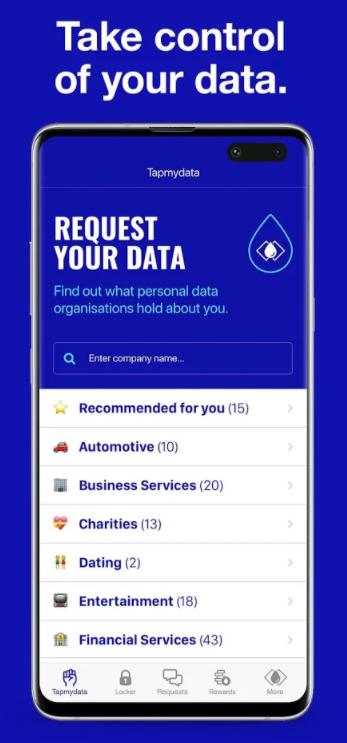
Tapmydata PDS (Personal Data Storage) is a consumer-friendly mobile application that can be downloaded on Google Play or Apple App Store. It currently has more than 1000+ active users.
**Tapmydata PDS has three main functions:**
**1. Personal data storage cabinet: users can organize and verify personal data**
Tapmydata follows two general principles when processing user data:
First, collect as little data as possible from users, sometimes referred to as privacy in design, or beyond this privacy by default.
Secondly, don't hold any unencrypted personal data, and make sure that only participants can decrypt it.
For example, applications usually require user profiles, and user profiles often require data. In accordance with past practice, the platform needs to collect emails and passwords.
Tapmydata’s solution will instantly generate a user profile without your intervention, will randomly assign you an email address (this address will be used in some features later, but it’s not relevant at this time), and also create With a super secure password, you will never know and never need.
**2. Generate NFT: Realize the value of users' own data storage**
Tapmydata platform uses self-developed ID verification technology to establish self-sovereign identity (SSI) for users, and user data can generate NFT tokens. That is, NFT and data owners can construct their data profile and package their profile information into NFT (data block) to exchange TAP tokens.
**3. Wallet: store tokens and receive rewards**
The Tapmydata platform also has the function of a wallet, which can store Tapmydata's platform token TAP, and the rewards that users receive for sharing personal data are also stored in the wallet.
How APRON blockchain infrastructure can serve the web 3.0 ecosystem
**The risks of Internet centralization**
In 2020, there were frequent attacks on blockchain network services. Two of the more well-known incidents were the attacks on uniswap's network services, which caused a large number of users to be unable to log in to uniswap to operate. Later, the team urgently used the ipfs protocol. To make the service run normally, the second is the interruption of the Infura service, which caused multiple exchanges to suspend the deposit and withdrawal of the Ethereum tokens.
Most dapp applications and exchanges are built on various centralized Internet cloud services, such as Amazon Cloud, Google Cloud etc. Coupled with centralized CDN acceleration service providers such as cloudflare, search engines are also controlled by giants such as Google and Microsoft etc. It can be said that the giants basically monopolize most of the Internet.
Basic Internet providers seem to provide good services, but they are in a monopoly position, they have damage the fairness of the market. The Internet urgently needs basic service facilities in a decentralized form and **APRON** provides a complete decentralized basic service that has attracted the attention of many people.
**Advantages of APRON**
APRON mainly provides middleware and basic services for the current blockchain industry, such as node services, on-chain data indexing, random number services, and digital currency quotation services. These services are also required by most current blockchain DAPPs, such as Random numbers provide a fair environment for dapps such as quizzes, and the quotation service provides services for various defi. This is a bit similar to an oracle. The same node service can enable various public chains or L2 nodes to complete decentralization, Protected from all types of DDOS attacks or other kinds of attacks.
It can be said that APRON provides a complete decentralized solution for the current blockchain network, enabling developers and project parties to conveniently use its functions to form their own network applications. At the same time, decentralization also greatly enhances the security of the system.
**APRON leads blockchain to the Web 3.0 era**
Since last year, Polkadot’s ecology has received market attention, and related facilities have gradually improved. Obviously, Polkadot’s parachains and slots are the focus of the bull market in 2021. Polkadot aims to build a new generation of the Internet. also known as web 3.0, in the framework of web 3.0, more infrastructure and network projects will replace the existing web 2.0 architecture, and make the Internet move towards a new era.
We all know that with the development of big data on the Internet, there are more and more problems under the influence of personal privacy, centralized power. In the US election last year, Twitter ban Trump account . During the campaign, brokerage Robin Hood banned retail investors from buyingGME stocks, making more people aware of the many problems existing in the Internet, and the new generation of Internet web 3.0 has attracted more attention.
A very important point in Web 3.0 is to break the monopoly of Internet giants and realize user data autonomy. At the same time, web 3.0 nodes are more decentralized. In this way, everything must be refactored, such as how user data can achieve self-control . How to break the effect, the security of the network, and how to retrieve information. These issues have some light due to the birth of Polkadot and the development of the ecology. The emergence of cross-chain and side-chain makes people quickly realize that this is a very important opportunity.
Web 3.0 is still in its infancy, although there are many types of web-based ecological projects and DAPP applications, there are few more important infrastructure projects such as chainlink, graph, litentry, etc., but there are still many aspects. Here, APRON’s API interface can be used to provide application data, and there is no need to worry about problems in the form of decentralization. The authenticity of the data is also guaranteed, and it is also crucial that cross-chain technology can be used in multiple public chain ecosystems.
**Summarize**
The world is changing, and this is the only constant truth. The road from the Internet to web3.0 may not be smooth, and there may be setbacks in the middle. In fact, Ethereum 2.0, Polkadot Parachain, Cosmos cross-chain ecology, IPFS, etc. are all areas that need to be combined in the later stage of web 3.0. For APRON, these ecology have a certain market share, and there is a trend to participate in the future waves. Grasping such an opportunity to provide underlying services for the public chain can promote the development of the entire ecosystem.

What is the NEAR protocol?
The NEAR protocol is an open source decentralized PoS public chain platform. The protocol uses sharding technology and is very friendly to developers. On the other hand, NEAR is also a cloud platform driven by the community. Technically speaking, the NEAR protocol has the advantages of high scalability and low development cost. The NEAR platform also supports a large number of tools, from browsers, wallet applications, and other common components, which can help developers build applications easily and quickly.
The NEAR protocol is not controlled by any legal entity, but is maintained by a group of geeks. The NEAR team has award-winning champions from programming competitions and financial professionals who have worked in the cryptocurrency industry for many years.
The NEAR protocol uses sharding technology, but it is not an Ethereum side chain, but an independent PoS public chain. It has its own consensus mechanism and native token format. NEAR can be regarded as a competitor to Ethereum.
**Introduction to NEAR protocol fragmentation technology**
As we all know, every node in Bitcoin needs to run all the code. As the blockchain grows, the code increases day by day. This is actually a waste of resources. In order to solve this problem, the NEAR protocol uses a fragmentation technology to divide the blockchain network so that many nodes can perform calculations at the same time, thereby improving efficiency. Although Ethereum 2.0 also proposes sharding technology, it has very high hardware requirements and requires at least 32 ETH to be pledged to run a node. In the NEAR protocol, NEAR allows small enough nodes to run on the cloud, and a low threshold means a high degree of decentralization.
Ethereum's sharding technology has multiple blockchains. Unlike Ethereum, the NEAR protocol is a single blockchain. Simply put, Ethereum sharding separates the ledger, and different nodes manage a part, so that everyone does not need to store it all; Near sharding is in the same ledger block, and then subdivided, the entire ledger block remains unchanged.
The NEAR protocol is like a traditional blockchain. Each block contains all transactions of all shards, but this data does not exist in a single physical block; therefore, each node does not need to store all the data. On the contrary, validators only store the transactions of their specific shards, and the list of all transactions in the block is physically stored in the "chunk" of each validator in the network. This model can ensure that NEAR will not double spend in cross-shard transactions without sacrificing high throughput. The "chunk" design and continuous reallocation of resources enable NEAR to achieve more efficient cross-shard communication.
**NEAR has three core technical highlights:**
Dynamic sharding is one of them. With the increase in usage, the technology can flexibly provide expansion capabilities according to demand, and does not require developers to release a new blockchain, transfer contracts, etc.
Account model-The secret key is hidden from the user, and some new use cases will emerge as a result: Meta transactions, payment using other cryptocurrencies, and the NEAR Drop function. With this feature, it is even possible to transfer assets to users who do not yet have a wallet. As we all know, in public chains such as Ethereum and Bitcoin, users need to keep their private keys in order to have an account. The NEAR Protocol does not require users to remember the public key and private key, they only need to be familiar with the username to use it. And all the handling fees for Dapp on NEAR will be borne by the developer, giving users a perfect sense of experience. But when users use Dapp, they don't even need to understand the profound knowledge of blockchain. This is also the future trend, simplification and popularization.
Trust-free Ethereum Bridge-the link between Ethereum and NEAR, any ERC-20 assets or non-homogeneous tokens (NFTs) can be transferred between the two chains through this tool; in addition, NEAR can also use this The tool calls the Ethereum contract.
From a technical point of view, NEAR Protocol greatly reduces the barriers to entry for developers. NEAR is compatible with Rust, Solidity, and TypeScript, and is perfectly compatible with the cross-chain Polkadot contract. This is also more conducive to more Web3 projects in the future. Development and integration.
Thresholded Proof of Stake and POS algorithms have certain similarities, such as the ability to exchange Stake Token for network rewards. On the other hand, Thresholded Proof of Stake should be safer in terms of system damage. In TPoS, there is no leader node that can be manipulated maliciously, and witnesses are rotated out of all the fragments in detail. In addition, participants who want to act as witnesses need to lock a certain amount of tokens. Once the participant has malicious behavior, the pledged tokens will be deducted.
Due to the unique design, the TPS of the NEAR network is about 1000, but the number of nodes is currently only 162.
**NEAR tokens and investment institutions**
According to public information on the official website, there are a total of 24 investment institutions under the NEAR agreement, including well-known institutions such as a16 Capital, Coinbase etc.
The main functions of NEAR tokens are as follows:
NEAR is the native token of the NEAR protocol, and its first role is to protect network security. Since running nodes need to pledge NEAR tokens, they can be punished once they do evil. This mechanism can effectively guarantee network security.
Medium of transaction. Users need to use NEAR as a transaction medium when trading in NEAR. Used for network governance voting to determine the distribution method of network resources and the future technical direction of the protocol. The initial supply of NEAR tokens is 1 billion. An additional 5% of the supply is issued each year as a block reward, 90% of which is allocated to validators (4.5% in total), and 10% is allocated to the protocol reserve pool (0.5% in total). 30% of the transaction fee is paid as a rebate for the contract interacting with the transaction, and the remaining 70% is destroyed.
Eye-catching applications in Fil ecosystem
As the incentive layer of IPFS, the Filecoin mainnet has only been online for 6 months. So far, it has developed more easily interoperable and open programming tools, applications and infrastructure in the distributed network. The developers of these tools, applications, and infrastructure connect the IPFS, Filecoin, and Ethereum communities. Today, i will introduce more interoperable and open programming tools, applications and infrastructure in Filecoin.
**1. "Social" start-up projects**
**1) Huddle : Use Huddle 01 to make online classroom video conferences more attractive. Speak better, listen better, work better.**
Huddle is the first video conferencing solution built using Web3 and blockchain technology. Huddle 01 has been carefully designed to avoid video and audio delays, loading times and interruptions.
Human social interaction is very complicated . In order to have a good online experience, video conferencing products tailored to different scenarios are required . Huddle 01 hopes to solve this problem for the education industry and give people an overall classroom experience. Educators need a tool to achieve seamless teaching in a remote environment, and students need to maintain classroom interaction, collaboration and learning fun under this program.
**2) Voodfy : A decentralized video platform that allows creators to host content and make money in their own way. Easily upload, manage and securely distribute your video content.**
Voodfy is a powerful and private distributed video hosting platform . This is an integrated security solution for streaming media, you can give users control over their content.
**3) MintGate : MintGate turns any online content into exclusive rewards.**
Token gateway refers to setting up a side* in front of your network content with your own cryptocurrency, and requiring fans to have a "token unit" (your cryptocurrency) in order to obtain the exclusive digital experience you provide. They rewarded these tokens to participating fans through their Twitter account. Then, they can set a gate or * on any Web2 content, requiring fans to hold a certain amount of these tokens to access.
**4) Underscored Labs (_dLabs) : Plug and play SDK for cryptocurrency games .**
One problem with the current development of Web3 games is the lack of tools for building cryptocurrency games. The bridge between game engines such as Unity and the blockchain protocol does not exist. The status quo is that developers are mixing various technology stacks together to create novel yet patchy encrypted games. _dLabs has established an SDK with a complete technology stack that can connect any game to the Web3 ecosystem. The SDK works out of the box and supports ERC20, ERC721, and ERC1155--and any additional custom contracts, such as leaderboards.
**2. Start-up projects in the "enterprise application" category**
**1) Myel : Community-driven content distribution network ( CDN) .**
Myel provides a distributed CDN for Web3 applications, allowing applications to obtain content on Filecoin from the secondary market at a faster speed.
The demand for bandwidth in web applications continues to grow. For emerging technologies such as VR, the expensive infrastructure they require is slow to expand, making it difficult to meet future needs. In addition, to use Filecoin in addition to cold storage, a secondary market is needed to accelerate content acquisition. Currently, there is no decentralized CDN for Web3 applications. Most applications rely on Web2 CDN, which is a potential single point of failure source.
The Myel make application easier access to content stored on the Filecoin , without having to build expensive infrastructure. Binding the CDN service and storage together, users can pay FIL directly.
**2) Valist : Make secure code signing and global software distribution easy.**
Valist allows developers to publish software and firmware to a distributed storage network, supplemented by strong access control. At the same time, Valist extensively supports the integration of existing package managers, such as NPM and Pip, as well as Docker .
Currently, most Web3 tools are still distributed via Web2, and Valist is changing this situation while still providing a bridge back to Web2. This will eliminate single points of failure, such as certificate authorities, centralized access control systems, and cloud providers.
Valist supports "multi-factor release"-that is, multi-signature for software release, that is, the release of a package requires multiple developers or build servers to sign before release. This reduces the chance of attacks on the software supply chain, such as the build server being hacked, or the developer's key being stolen to release malware. At the same time, Valist enables you to use Web3 infrastructure to distribute software securely instead of relying on centralized cloud providers and fragile access control systems.
Valist is bringing many of the most popular Web3 and Web2 software packages to the Filecoin ecosystem. Some of the software that today's world relies on is maintained by a specific third party. Valist will reduce this dependence.
**3) PowerLoom**
The PowerLoom protocol aggregates on-chain and off-chain data to generate snapshots with encrypted proofs in a decentralized manner. By incentivizing ecological participants and stakeholders to join the agreement, PowerLoom aims to build trust and provide insights into needs.
For most DeFi protocols, there are many flexible components, abstraction layers, and stakeholders, and this is very complicated. For the blockchain industry to develop sustainably, seriously, and on a large scale, we must adopt verification-based trust. The snapshot data of the PowerLoom protocol, according to the design, is stored hot on IPFS and anchored on the Filecoin network. This makes it affordable and easy for nodes to store/retrieve data instead of using centralized services. As an extension, others in the Filecoin ecosystem can also use these data sets to build on them.
**4) Kotal**
Kotal is an open source, multi-client, cloud-less vendor-bound blockchain Kubernetes operator. It can easily deploy a highly available, self-managed and self-healing blockchain infrastructure (network, node, storage cluster) on any cloud.
Blockchain operation and maintenance is very difficult, expensive, and time-consuming, with a lot of overhead and risks. Therefore, dapps rely heavily on centralized services to integrate blockchain protocols. Kotal makes blockchain operation and maintenance simple, achieving faster development and sustainable decentralization.

Observe the major obstacle under the PoS mechanism from ETH2.0
The latest data of ETH 2.0 shows that the number of pledges has been close to 2.3 million, and the annual interest rate has dropped from the initial 21.6% to the current 10.4%. As the price of ETH continues to soar, the cost of participants' input is also getting higher.
However, judging from the past 2020, the concept of DeFi, DAO, and NFT has exploded this year, and it has also promoted the development of more public chains and projects. The fundamental logic of their outbreak lies in the PoS consensus mechanism, due to the diversified expansion of pledge led to the outbreak of DeFi.
Although the ecology has grown and people have gained through pledges such as liquidity mining, I would like to illustrate its flaws in terms of the actual scenario of PoS.
The POS mechanism itself is a joint-stock company, and everyone can hold it, but the people who hold the final meeting are those who hold a relatively large share. They can participate in the governance vote to decide whether the proposal is passed, and the small shareholders have to choose their trusted major shareholders , Pledge your own shares and wait for the income.
It itself is a better solution for retail investors who cannot participate in the PoW mining model, but it is also an indicator that evaluates whether the node is competent based on the number of pledges, and then determines whether to continue to provide services. This situation will inevitably lead to vicious competition, and the node party receives tokens from the secondary market instead of continuously working through technical means. When the currency price drops, this becomes the most painful point of the node party.
**First problem**
From the Ethereum 2.0 pledge analysis chart that everyone is paying attention to, it can be seen that the higher the pledge amount, the lower the profit. As the price of the currency continues to rise, the cost of participants is getting higher and higher, and the later the gains become less. When the price of the currency drops, the investors who enter the market later will even reach a situation where the profit and loss are imbalanced. In fact, looking at it in detail, all liquid mining is just an upgraded version of deduction. No matter how it is modified, such a factor cannot be changed.
**Second Major Problem**
Many people’s voting rights are meaningless. If you encounter a few big money holders, they will decide the final voting proposal and become the object of node contention. It is just the amount of funds that determines whether the ranking is reliable. For example, we can see that after Unsiwap issued coins in September 2020, its governance token, UNI, is still held by some big players. Even if the liquidity mining is cancelled, the big holders of UNI can still control the governance plan.
**Third major problem**
Traffic attracts users. This is the main strategy of companies. It has also become the main operation method under the blockchain PoS mechanism in the current era. Nodes with a large number of coin-holding addresses can do activities for the mass distribution of tokens, but most of them are just attracting people caused the tokens to be sold in a short period of time. The airdrops of UNI and 1inch just confirmed the pain points under the PoS mechanism. After the airdrop, the number of people willing to vote and mine at the node accounted for relatively few people, but a large number of sell-off led to a decline in the price of the currency, causing dissatisfaction among miners.
These are the main problems of the PoS consensus mechanism, but I have to admit that at this stage, it is the best mechanism model that will allow Ethereum to transform from PoW to PoS.
Major prospects of blockchain in 2021
We have witnessed too much history in 2020, and we also feel too much uncertainty.I believe these prospects can help readers find a little certainty among many uncertainties.
**Bitcoin will be more valued by institutions and become one of the major asset allocation tools.**
The skyrocketing bitcoin price at the end of 2020 also allowed us to see many institutions, including the world's largest bitcoin trust fund Grayscale, payment giant PayPal, and Micro Strategy and Square, which have made huge investments in bitcoin. The institutional investment and support for Bitcoin has convinced many people that Bitcoin is becoming the gold of the digital world. Of course, in addition to Bitcoin, other cryptocurrencies have also received the attention of institutions, and cryptocurrencies may become a major asset allocation tool. Therefore, in 2021, we can boldly predict that Bitcoin will be more valued by institutions and become one of the major asset allocation tools.
**Ethereum 2.0 development progress may not be as good as expected.**
On December 1, 2020, the Ethereum beacon chain was created, which marked the official start of the 2.0 version of the roadmap for Ethereum. According to the Ethereum development roadmap, Ethereum 2.0 will go through three main stages from Phase 0 to Phase 2. Among them, the main task of Phase 0 is to launch a beacon chain with PoS as the consensus mechanism; Phase 1 will mainly solve Ethereum's transaction congestion problem has improved scalability; Phase 2 is a continuation of Phase 1, and will continue to implement the sharding mechanism.
However, Ethereum 2.0 is not a simple upgrade, nor is it a short-term change that can be achieved at one time, but an unusually huge system engineering that may take years or even longer. Therefore, considering the high difficulty of the entire system upgrade, we believe that the Ethereum 2.0 upgrade needs to do a lot of work in 2021, and its development progress may not be as expected.
**The Diem (Libra) stablecoin is officially launched**
In 2019, Facebook launched the stablecoin project Libra and released the project white paper, which immediately attracted the attention of regulators around the world. Many countries expressed different degrees of concern and concern about Libra. In April 2020, the Libra Association updated the project white paper. Compared with the content of the first edition of the white paper, the updated white paper added a lot of design on compliance. Some people think that this is a compromise on supervision. In December 2020, Libra changed its name to Diem again. This move is intended to emphasize the independence of the project and once again strive to obtain regulatory approval. At present, Diem (Libra) has made sufficient preparations for the launch of a single stable currency in 2021.
**Public chain technology has achieved breakthroughs, and scalability and interoperability have been greatly improved.**
In the technical field of public chains, there has always been a widely discussed technology "impossibility triangle", that is, "scalability", "security" and "decentralization" cannot be achieved at the same time. Among them, the scalability of the public chain has been criticized the most, that is, the on-chain transaction processing efficiency is too low. Ethereum 2.0 considers using sharding to solve the scalability problem. Another problem related to scalability is cross-chain interoperability. The launch of Polkadot's mainnet in 2020 provides a reference solution for the interoperability problem. In 2021, we expect that public chain technology will achieve breakthroughs in scalability and interoperability, and the overall public chain performance will be greatly improved.
**The development of the alliance chain pays more attention to the real needs of the industrial application side and drives the development of related technologies with demand.**
At present, the development of domestic blockchain technology is dominated by consortium chain related technologies and has made considerable progress, but there are still shortcomings in specific scenarios and landing applications. On the one hand, blockchain technology is still in the initial stage of application, and it needs to solve effective adaptation with existing technologies and application scenarios; on the other hand, on the demand side of blockchain technology applications, there is still a vast demand space.
**The on-chain of physical assets or the digitization of assets will expand exploration and practice, and the establishment of digital asset exchanges will enter the stage of substantial advancement.**
With the development of the digital economy, after land, labor and capital, data has been recognized as the fourth major production factor, which means that data will increasingly reflect the "asset" that can create value. How to digitize existing physical assets and capitalize data will become an important issue for market players to think about in the future, because the breadth and depth of data also determines the breadth and depth of assets. In terms of asset digitization, digital identity and digital right confirmation are inseparable from blockchain technology. Therefore, in 2021, we expect that physical assets on the chain or asset digitization will expand exploration and practice, and facilitate the establishment of trading venues and markets for data asset transactions. Will enter the substantive advancement stage.
**DeFi leads the continued development of the open financial model, and the application of insurance will become a new hot spot.**
DeFi ushered in an explosion in the second half of 2020, leading the development of the encrypted digital currency market. Nowadays, with the repeated record highs of Bitcoin prices, the attention of DeFi has been weakened, but this is not necessarily a bad thing for the DeFi ecology.As more and more mainstream institutions pay attention to technology-driven emerging financial models such as DeFi, their open, credible, and fair business concepts and service awareness to protect user data will also influence and change traditional finance to a greater extent.
However, with the evolution of blockchain technology and the deepening of industrial applications, the formulation of related technologies and industry standards will be further accelerated.

Nigerian government promotes blockchain national strategy
**Blockchain a national strategy in Africa**
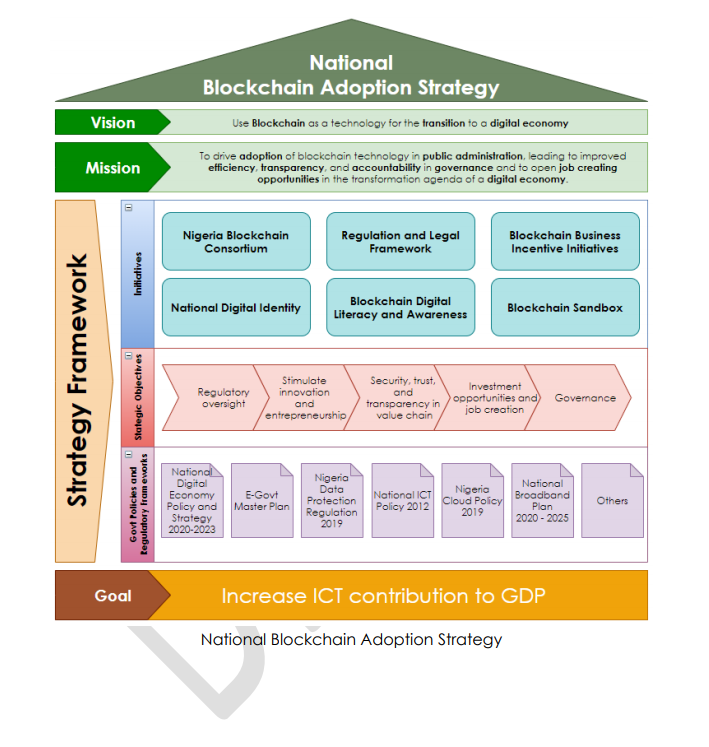
**Nigeria's federal government, which has Africa's largest population and economy, is planning to introduce blockchain technology as a national strategy.**
According to this document (draft), the Nigerian government is using digital technology to step up its efforts to diversify its economy in order to move away from an economy that is highly dependent on its main industry, the oil and gas sector.
In order to promote the creation and development of a "digital Nigeria" that is efficient, safe, productive and viable, the strategy of adopting blockchain technology has stood up.
The document introduces the value of blockchain to promote trust between the government and the private sector, considerations and challenges in evaluating blockchain use cases, and lessons learned from blockchain implementation experience in developed countries.It is intended to be a guide for the introduction of the blockchain system in Nigeria.
**Strategic framework**
The document outlines the roadmap and strategies for adopting blockchain technology, and sets strategic goals and specific initiatives that should be specifically pursued through all federal ministries.
**Vision**: using blockchain as a technology to enable the transition to the digital economy
**Mission** : Promote the adoption of blockchain technology in government, increase efficiency, transparency and accountability in governance and open up opportunities for job creation in the transformational challenges of the digital economy.
The strategic framework consists of five goals, six initiatives, and a government policy and regulatory framework.
Strategic goal
Establishing regulatory and supervisory methods
Promote innovation and entrepreneurship
Improving safety, reliability and transparency in the value chain
Promote investment opportunities and job creation
Governance
The following six initiatives are listed as initiatives to achieve these goals.
Establishment of Nigeria Blockchain Consortium
Strengthening regulatory and legal framework
Creating a framework for national digital IDs
Incentive program for blockchain business
Promote knowledge and awareness about blockchain
Establishment of public blockchain sandbox for proof of concept and pilot operation
The following government frameworks support the promotion of blockchain adoption.
National Digital Economic Strategy and Policy (2020-2030)
National IT Policy (formulated in 2012)
E-Government Master Plan
Nigeria Cloud Policy (formulated in 2019)
National Broadband Plan (2020-2025)
Data Protection Regulations (formulated in 2019)
**Nigeria has a high level of cryptocurrency usage**
According to a cryptocurrency usage report released in September by blockchain analysis company Chainalysis, Nigeria ranked 8th .
The first legal currency pair supported by leading exchange Binance is the Nigerian naira, which is also available in the social payment app Bundle, which mainly targets the African market P2P cryptocurrency trading is also the most popular among African countries.
In terms of regulation, the situation has been ambiguous for a long time, but last month the Securities and Exchange Commission (SEC) announced that it would treat all digital assets and token offerings as securities.
The above-mentioned strategic document aiming at the spread of blockchain also mentions the strengthening of the legal framework for virtual currencies, and it is expected that the momentum for regulatory development will increase in Nigeria in the future.
Solana project announces "Wormhole" to connect to Ethereum network in both directions
**Tokens across blockchain**
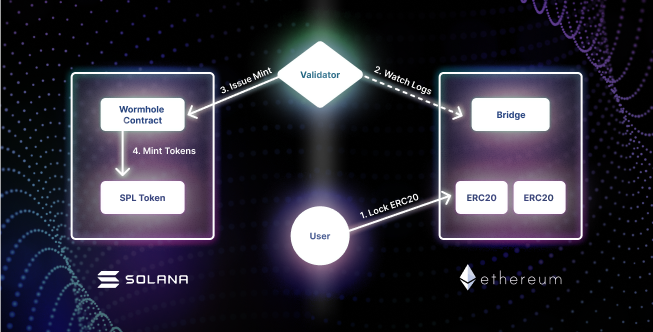
Solana, which is used in the decentralized exchange Serum , has announced the "Wormhole" bridge that interconnects Ethereum and Solana.
The name's wormhole is like a tunnel between one point and another in space-time, and it appears as a concept that allows for instant long-distance travel .
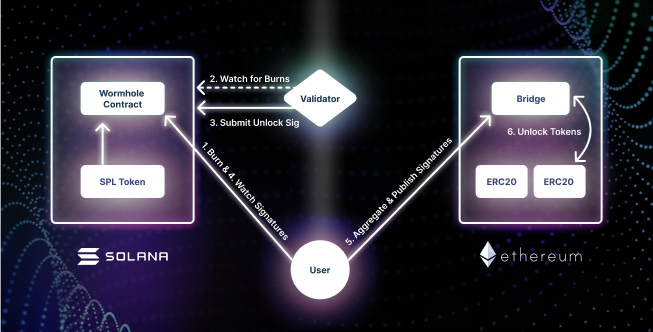
Wormhole connects Ethereum (ETH) and EERC20 tokens to SPL tokens, which are token standards for the Solana blockchain. This allows tokens on the Ethereum network to benefit from Solana's processing speed and low cost, but it is also possible to return value to the Ethereum network at any time.
Wormhole introduces a decentralized cross-chain oracle called guardians, which checks token lockups and burns on one chain to which the guardians are connected.
This will either issue a new token or release the token in the other chain. The reverse is also possible.
In addition, startup **Certus One** is cooperating in the development of Wormhole. Wormhole is one of the projects connecting Solana to other networks, and many teams are also working to build a bridge to Solana and Serum.
DeFi issues, fees and speed
The decentralized finance (DeFi) sector, including Serum, has received a lot of attention in the last few months, creating a new boom, but Ethereum network congestion and high fees have once again emerged as challenges.
Compared to Ethereum, the newly developed blockchain Solana ensures scalability and enables faster processing, and can be expected to reduce network congestion and fees.
On the other hand, it is undeniable that platforms that have already attracted a large number of users and value have an advantage over new projects in terms of liquidity, even if fees are high, and it can be said that the network effect is working.
Regarding Serum (using Solana), which is a decentralized exchange of FTX, Leopold Schabel, CTO of Certus One, said, "It is difficult to start a new ecosystem from scratch"
Wormhole, which connects Ethereum and Solana, is expected to solve these problems.
Regarding the launch time of Wormhole, most of the functions have already been implemented, and although the launch time of the main net has not been disclosed, security audits are scheduled to be carried out by experts.
About Solana
Features of Solana (SOL)
The blockchain "Solana" is faster processing and has lower fees than the Ethereum blockchain. Ethereum is currently processing about 15 transactions per second, while Solana is capable of processing 50,000 transactions. SOL, the native currency on the platform, is used for staking, transaction fees and governance. Unlike other high-scaling projects, it is unique in that it does not rely on a Layer 2 solution, but instead achieves high scaling at Layer 1.
Source: Medium https://medium.com/solana-labs/wormhole-solana-ethereum-bridge-d5502e944acb
History of DeFi
**History of DeFi**
DeFi (Decentralized Finance). One of the most significant triggers was yield farming, an investment method that started around June 2020 and has an unthinkable interest rate.
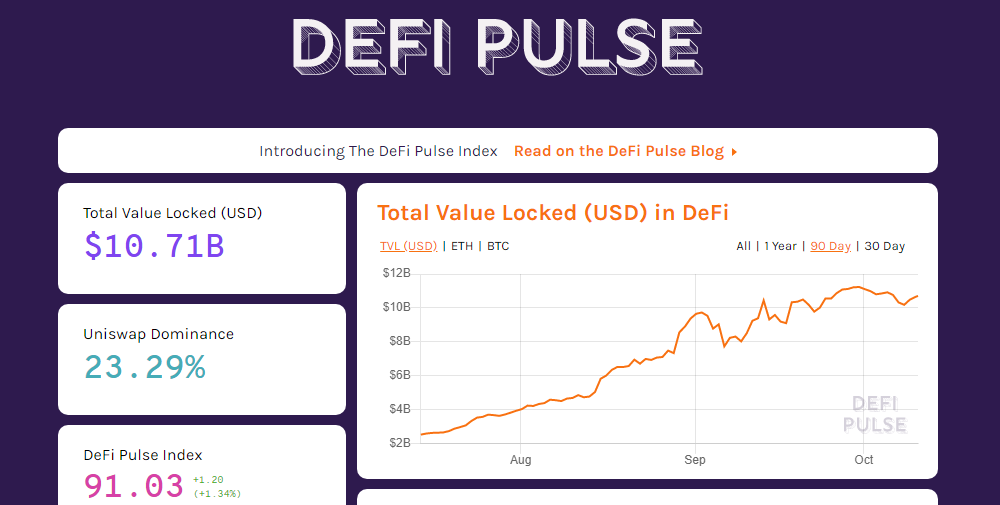
Yield Farming, which was established by various DeFi protocols distributing governance tokens to users, brought a new inflow of billions of dollars into the DeFi sector. According to **DeFi Pulse** data, which records the amount of money deposited in the DeFi protocol, the deposit amount increased from about $ 1.1 billion on June 1, 2020 to about $ 11 billion on October 5. doing. It means that the amount of money that users manage with DeFi has increased tenfold during the four months when interest rates have risen dramatically.
Since many people learned about DeFi because of yield farming, there is a tendency to equate DeFi with yield farming, which is an unavoidable phenomenon considering the degree of attention. However, DeFi development has a long history, and yield farming is only a part of it.
Around 2017
**DeFi begins with ICO and DEX (Distributed Exchange)**
DeFi is a financial function that can be realized by using smart contracts on the public blockchain. Ethereum (ETH) and ERC20 tokens automatically move between addresses according to the conditions specified in the smart contract code. ICOs and DEXs are well-known examples of the first use of this.
From 2016 to early 2018, the Ethereum-based application development team conducted an ICO (Initial Coin Offering) to raise funds. In a broad sense, this method of deploying smart contracts that manage unique tokens and realizing token issuance and ETH procurement without a broker can be regarded as part of DeFi.
As a result, there will be demand to buy and sell the numerous tokens created by ICO. It was possible to buy and sell on conventional exchanges such as Binance, but we have also advanced the development of applications that realize token trading functions by smart contracts without the need for brokerage of such exchanges.
This is DEX (Decentralized Finance).
DEX like EtherDelta, Bancor in 2017, Kyber Network in 2018, 0x project are already up and running, giving users the option to buy and sell ETH and ERC20 tokens independently of the exchange. It was. When it comes to buying and selling tokens, the foundation of DeFi is complete.
At the end of 2017, DeFi-leading MakerDAO launched DAI, a decentralized stable coin. Among cryptocurrencies and tokens with volatile prices, the advent of DAI, which always maintains a price close to $ 1, has added great convenience to token trading by DEX.
Around 2018, 2019
**Birth of "DeFi" community and expansion of DeFi ecosystem**
In addition to DEX, which buys and sells tokens, the development of products with more complex financial functions will proceed. In order to support such a movement, around August 2018, DeFi's community activities will start at the request of overseas developers. At first, the connection was only to discuss and exchange information on the chat app Telegram , but gradually it became commonplace for the DeFi development team to provide mutual aid in funding and development through events such as hackathons.
The impact of this community activity is enormous and has triggered the birth of many DeFi projects that are currently attracting users.
From 2018 to 2019, more than just DEX, a variety of DeFi protocols will be launched.
Compound that allows you to lend and borrow tokens with smart contracts
Betoken, a diversified hedge fund
Fulcrum that enables margin trading
TokenSets that automatically rebalances the portfolio according to the conditions
Opyn offering options trading
Functions handled in traditional finance, such as, are expressed in Ethereum smart contracts. Many products have succeeded in quickly gaining users.
**WBTC**, which distributes the value of Bitcoin on Ethereum, has also been distributed since October 2018, and has steadily penetrated these protocols to this day.
**Uniswap**, the most famous and huge DeFi protocol, is DEX, which started in November 2018. Uniswap gained user support for its more pure decentralization .
2020 year
**Big mistakes and the epidemic of yield farming**
In 2020, the DeFi ecosystem has become wider and deeper, with DeFi alone sufficient to operate cryptocurrencies and tokens. The variety was plentiful, the funds were raised, and the liquidity to handle them was large enough.
On the other hand, of course, hacks and accidents aiming at the funds collected in DeFi will also occur. The following are the main events.
Fulcrum Flash Loan Hack
MakerDAO Insolvency
DeFi is constantly developing new technologies, one of which is flash loans. It is a technology that allows you to borrow ETH and tokens without collateral if you make repayments within one block.
In February 2020, hackers used this technology to successfully withdraw bzx funds.
In addition, MakerDAO's collateral settlement did not function properly even in the March market plunge, resulting in a large debt as a protocol. Fortunately, users haven't suffered any concrete losses, but since then there have been multiple hacks across DeFi, a time when challenges have been highlighted.
From June 2020, DeFi's hottest project, Compound, will begin distributing the Governance Token COMP to its users. This is to give token holders the right to decide on the operating policy of the protocol.
Many users moved their funds to Compound for COMP, so they decided to take a share within DeFi at once.
Immediately after this
Balancer (BAL)
Yearn Finance (YFI)
Curve (CRV)
Uniswap (UNI)
Etc. distribute governance tokens in the same way. YAM, SUSHI, etc. with the names of foods will also appear, and yield farming.Governance tokens, which determine the direction of the protocol and in some cases generate revenue, play an important role in DeFi.

What is the use of Bitcoin Cash paper wallet?
Paper wallets are one of the ways to store BCH. Under certain circumstances, paper wallets are a very ideal way. This is a more appropriate choice for me or the older people with more traditional thinking. After all, this It is a good way to hold BCH safely, and I also think this is a very practical function. This is a paper wallet. This article will discuss with you what these often talked about paper wallets are?
**Wallet type**
Before understanding paper wallets, we should first understand what types of bitcoin cash wallets are available. There are many types of digital currency wallets, but the most common types of wallets based on storage and transactions are cold wallets and hot wallets.
**Cold wallet**
Cold wallet is not connected to the Internet for example, hardware wallets and paper wallets belong to this type. The advantage is that the security performance is higher than that of the online wallet, but the disadvantage is that it is inconvenient to use.
**Hot wallet**
Hot wallets are connected to the Internet for example, online wallets, mobile wallets, and applications are all hot wallets.
**What is a paper wallet?**
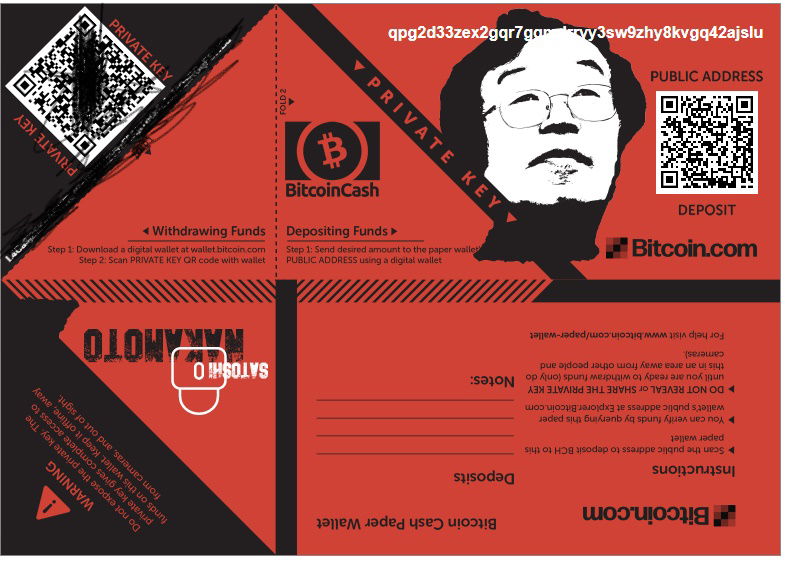
A paper wallet is essentially a printed version of a single wallet address based on digital currency. Paper wallets are inherently more secure than software-based wallets, second only to hardware wallets.
Paper wallets are cold wallets, so they are sometimes used to save money. These things are actually very easy to set up. They only need a printer, a formatted picture and the user’s private wallet address. People have created websites that specifically allow users to create paper wallets, and even built new addresses into them by using random algorithms. among them.
**How to use a paper wallet?**
To use a paper wallet, you should first create a paper wallet address. For Bitcoin Cash, there are dozens of paper wallet generators. (Download address of paper wallet https://paperwallet.bitcoin.com/)
In fact, the process of each paper wallet generator is basically the same, which can be summarized as follows:
The user generates entropy (a bunch of random letters and numbers) to determine the paper address the user will get.
After random generation, the paper wallet generator website will display a paper wallet address, and depending on the website, the user can choose a design and multiple addresses, as if you really copied the entropy and input it into a BIP39 generator In, you can get the paper wallet address.
Then the user needs to right-click to print (it is better not to save the picture to ensure safety). Basically, the paper wallet generator website provides a "print" button. For example, Bitcoin.com paper wallet has this function.
Follow the prompts to fold the paper wallet.
At this time, the paper wallet has been created, you can deposit any amount of BCH, and store the paper wallet properly.
**Common folding methods of Bitcoin.com paper wallets**
Hide Private key
If you fold it correctly, you will get a paper wallet .
**Deposit and withdrawal**
You can deposit money into a paper wallet via a QR code, or you can manually enter your address in the transfer wallet. However, there are two ways to retrieve the stored BCH:
Get it back by scanning the QR code with an unused private key secret.
Import the private key into a software wallet, such as Electron Cash.
Of course, you'd better check your wallet after this process is completed to make sure that the funds arrive.
**Store paper wallets properly**
There are other ways to protect paper wallets, such as holding your paper wallet’s private key and opening it with an application such as e-cash, but this is also insecure because you actually turn your cold wallet into Hot wallet.
Other ways to protect your wallet depend entirely on how you choose to hide your paper wallet safely. You can keep it in your diary etc.
To send and use Bitcoin Cash and many other cryptocurrencies, paper wallets are a good choice. Paper wallets allow you to show any friends in your real world how to use Bitcoin Cash, and express the workflow of BCH by actually showing the wallet address . These paper addresses can also be a currency holding strategy, allowing investors to hold BCH in the long-term, so as to maximize the ultimate benefits.
In the BCH transaction, are the miners the middleman?
**BitcoinCash**
In many cases, when the community promoted the benefits of P2P electronic money (Bitcoin Cash) to the outside world, the outside world also raised many questions. When we explain to the outside world the benefits that payments between people can be made directly without any intermediary (third-party intermediary), some people may ask: "But are the miners not the middlemen?" Then the miners are in Bitcoin What is the role in the cash world?
**The role of miners in transactions**
The miner is the bookkeeper who packs TX (transaction) in the network and puts it in a new block. This new block will become part of the entire BCH blockchain, and the miner can work in a competitive environment in the process And finally get a fair return.
Why do we need a transaction model without an intermediary, in other words, without an intermediary to pay, then no one can control our funds, no fraud, and no one can review our transactions. The BCH secure transaction is based on only **three conditions** :
The source of the transaction funds is correct (not fraudulent).
The owner of the funds authorizes the transaction.
The owner of the funds cannot commit fraud by canceling the previous transaction through a transaction sent to another recipient in a double-spending transaction.
The first concept in the world of legal tender is equivalent to when I receive paper money, I must check whether the paper money is counterfeit. In the world of cryptocurrency, security is provided by verifying the source of the money, we only need to view the transaction in the blockchain browser, and then we can verify it.
The second concept is based on the mathematical characteristics of electronic signatures based on elliptic curves. This is a more complex mathematical problem, but any application can easily check the compliance of the fund owner.
The third concept is the most important. In a decentralized environment, it is difficult to fully synchronize all transaction participants. Therefore, since the Bitcoin era, the possibility of covering a previous transaction with a transaction has always existed. This kind of fraud is called a "double-spending transaction", which simply means that the owner of the original funds tries to use the same source of funds to pay multiple recipients.
**Double spend rule**
Miners are part of the network and will continuously check all transactions. When a miner detects that 2 or more tx (transactions) use the same source of funds, he knows that he cannot pack all funds into the block, because in this case, according to the blockchain rules, The post-packed block will be invalid, which is why the double-spend transaction can only be successful in the end. It is possible that two different miners get two transactions from the same source. In this case, generally the first packaged transaction successfully obtains most of the confirmations, and the other one fails.
Therefore, a transaction that has been included in the last block of the blockchain is more secure than a transaction that is not packaged in any block, because a transaction with 0 confirmation may eventually be overwritten by another transaction that has already been confirmed. So the best case is that when a new block appears in the blockchain, the packaged transaction has already received two confirmations. Having two confirmations will increase the security of the original transaction, making the original transaction difficult Covered by another double spend transaction.
But in practical applications, we use probability to calculate. In fact, there is a high probability that 0 confirmed transactions will eventually be confirmed valid, and the probability of double-spending transactions is very low. This is why it can be accepted as payment if the amount is small (subjective conditions may be used). But the exchange is more strict in this regard, and the exchange will use different acceptance strategies for each cryptocurrency. Generally speaking, 6 confirmed transactions can basically be considered safe, but please note that if I receive a large amount of money, it is best to wait for a larger number of confirmations to determine that the payment is successful.
**But is the miner an intermediary?**
I think it is not.
An intermediary (middleman) is a necessary participant in the transaction process. For example, when I make an online transfer from my bank account to the other party's bank account, the transaction uses two intermediaries (my bank and the other party's bank). When I pay with a debit card or Paypal, both are intermediaries.
There is no doubt that the fact that miners charge transaction fees may make many people think of him as an intermediary (all previous intermediaries charged fees in one way or another), but in this case there is a premise In BCH, miners themselves are not part of the front end of the transaction process. It is just a preset process, that is, no one knows which miner will receive the transaction fee in this transaction.
In any case, I am not worried about whether to call miners an intermediary, because Bitcoin Cash transaction fees are low enough, and transaction funds are not escrowed by miners at all.
Bitcoin Cash is the world's electronic cash.
DeFi fever : How SushiSwap raised $ 1 billion in two weeks
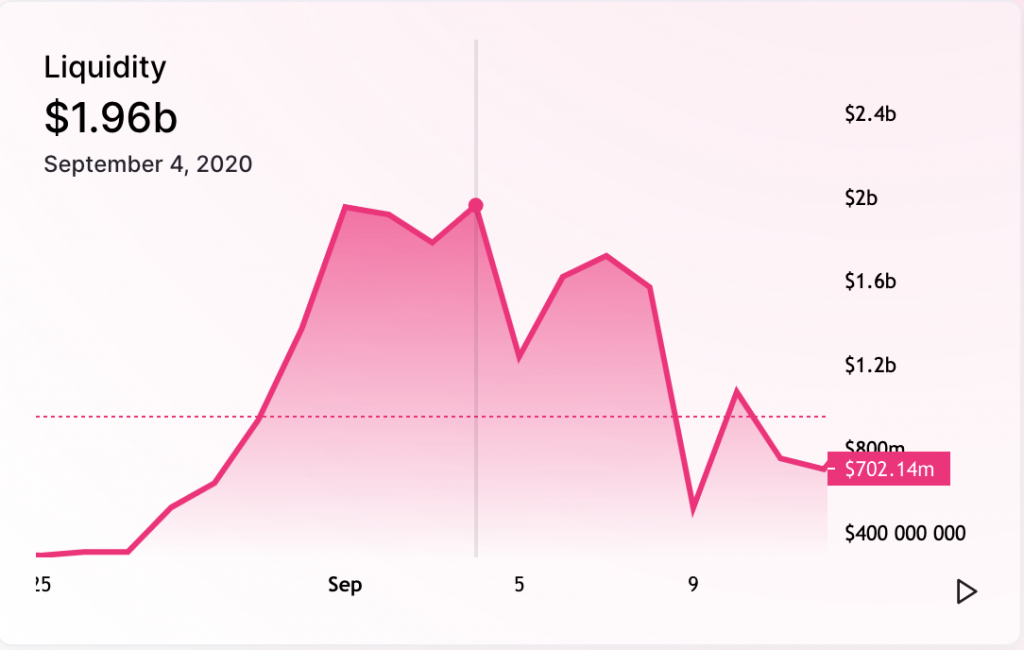
On September 3, the volume of blocked funds in the protocol of the **Uniswap** decentralized exchange approached a record $ 1.8 billion. However, on September 10, in just one day, the exchange lost more than 70% of this amount. The funds migrated to the Uniswap fork, culinary name **SushiSwap**, which had launched just two weeks earlier.
Despite such a short period of time, many events have already taken place around the new project, including the scandalous departure of the anonymous founder, who took **$ 14 million** from the developers fund and then returned it with an apology.
**How is SushiSwap different from Uniswap?**
The Uniswap exchange operates on the principle of liquidity pools that replace order books. A user who blocks his coins in one of the exchange's smart contracts becomes a liquidity provider. Locked tokens are combined into liquidity pools. Anyone can open a pool with a new cryptocurrency.
Exchange users can conduct exchange transactions (swaps) between any tokens present on the exchange. A flat fee of 0.3% is charged for each trade. It is distributed among liquidity providers in accordance with their share in the pool. The liquidity provider can withdraw all of its funds from the pool, but then it will stop receiving commission income.
Despite its neatly implemented system, Uniswap has been criticized more than once for its lack of decentralization, namely the lack of a decentralized governance system.
The commission rate has remained the same since launch, although the rise of profitable farming has increased competition with other other DeFi apps .
On August 26, Twitter user ***Chef Nomi*** unveiled the SushiSwap protocol, calling it the "evolution" of Uniswap. The anonymous creators of SushiSwap called the main difference a new incentive system based on the SUSHI management token.
However, SUSHI was used primarily to lure liquidity providers away from Uniswap.
According to the SushiSwap tokenomics, described in the project's blog, the commission for exchanges is the same 0.3%, but only 0.25% goes directly to the pool participants - the remaining 0.05% is converted into SUSHI tokens and distributed among all token holders. This made it possible to receive passive income even after completely exiting the pool.
**An ocean of liquidity**
SUSHI tokens are issued every Ethereum block starting at block # 10750000. They were originally distributed as a free reward to members of 13 special Uniswap pools created through the SushiSwap website.
The SushiSwap protocol is based on the emission of 100 tokens in each Ethereum block, although this figure was increased 10 times for the period before the migration to the SushiSwap protocol to encourage early adopters.
Users started investing in SushiSwap pools. The profitability of the pools grew with the increase in the volume of blocked funds, reaching hundreds and even thousands of percent per annum (APY). At the same time, in the "native" SUSHI / ETH pool, the reward in tokens was doubled, which made it the most profitable.
According to the DeFi Rate portal, on August 31, the SUSHI / ETH yield reached 1500% per annum. The need to obtain SUSHI tokens to participate in the pool also pushed the token price up.
In total, from August 27 to September 2, according to DeFi Pulse , the amount of funds blocked in the Uniswap protocol increased from $ 387 million to $ 1.7 billion. A significant part of this amount was withdrawn on September 9 as a result of the migration to the SushiSwap platform.
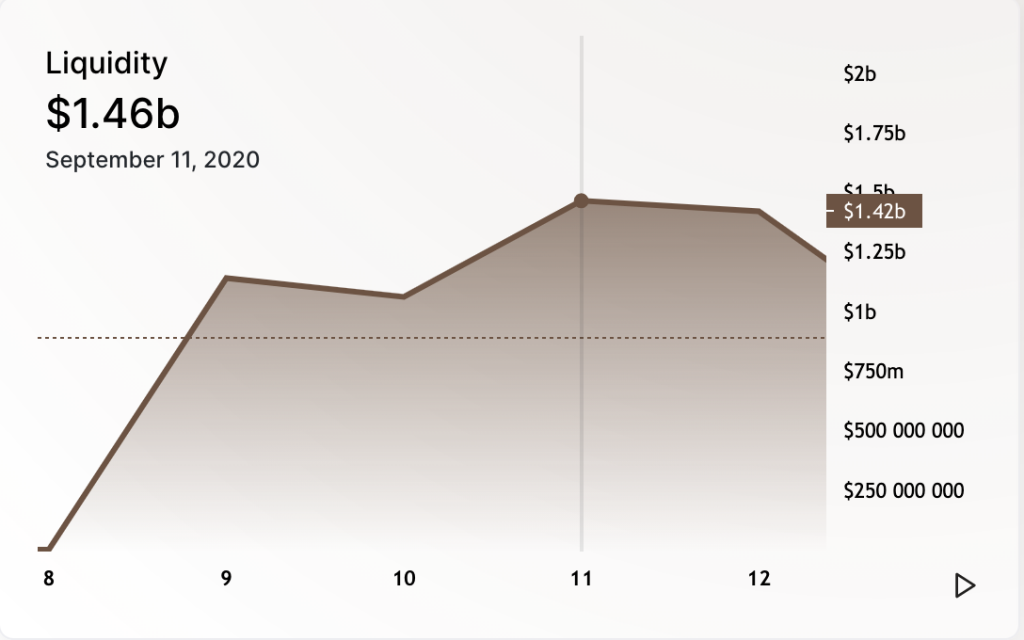
According to **SushiSwap Vision** , on September 13, the volume of funds blocked in SushiSwap amounted to $ 870 million. Ironically, the decrease in SUSHI emission to the established standard led to an outflow of liquidity back to Uniswap .
**The inflationary mechanism puts pressure on the SUSHI price**
SUSHI tokenomics was studied in detail by the Glassnode service. According to their analysis, provided that 100 new SUSHI tokens are issued in a block and the current block generation rate in the Ethereum network, a year later there will be 326 million SUSHI in circulation, and in two years - almost 600 million. At the time of writing, the emission is approximately 90 million. SUSHI has an inflationary mechanism that stimulates not only to keep the token, but to be an active provider of liquidity.
The main source of demand for SUSHI is trading commissions in the protocol. The token price rises with an increase in the trading volume. While maintaining a relatively low trading activity, the price of SUSHI will also be low - new coins are simply added to circulation, diluting the supply.
Glassnode calculates that for a “fair” (that is, protocol demand for liquidity providers) SUSHI price of $ 10 or more, SushiSwap's daily trading volume would need to be tens of billions of dollars. However, a more realistic value for trading volume is around the $ 400 million mark, like Uniswap. In this case, the equilibrium price of the native token will be only $ 0.31 .
**Sushi for developers**
An important point is that holders and liquidity providers do not receive all SUSHI tokens: 10% of new coins are automatically sent to the developer fund. It is with him that a major scandal is associated that arose in the first days after the launch of the project.
On September 5, it became known that the project leader, "Chef Nomi", unilaterally withdrew SUSHI in the amount of $ 14 million intended for developers, although earlier in the community's Discord chat he had promised not to do so. As a result, SUSHI price collapsed by 50%.
Hype, FUD, and scandals have led to strong volatility in the native token.
**Are the whales playing DeFi?**
The threat of an outflow of liquidity from Uniswap made the creator of the protocol, Hayden Adams, speak out. On September 1, he stated that SushiSwap is a project of a relatively small group of professional speculators.As early as September 1, the SUSHI / ETH pool on Uniswap had about 2,200 addresses, with a total volume of $ 173 million at that time - that is, an average of $ 75,000 per address. About the same number of addresses voted for the holders of the multisig wallet of the SushiSwap developers.
What is the BCH development team doing recently?
The BCH core development team Bitcoin ABC has done two things recently: announced the new client Bitcoin ABC 0.22.0 and announced the establishment of the BCH Global Council.
**Bitcoin ABC 0.22.0**
On August 18, Bitcoin ABC, the core development team of BCH, announced the new client Bitcoin ABC 0.22.0, which was upgraded on November 15. The functions of this version have been frozen, and two main functions will be added: ASERT DAA and coinbase reward rules.
The improvements of this version mainly include the following aspects:
**The new difficulty algorithm ASERT is adopted.** The biggest advantage of this algorithm is that the BCH block time is stabilized at about 10 minutes, which is not friendly to the machine gun pool, but it can increase the profit of honest miners by 6%.
**Canceling the restriction on unconfirmed** transactions. The main solution to the removal of the restriction on unconfirmed transactions is the problem of transaction delays. For enterprises, more potential profits can be obtained. For users, a better user experience can be obtained.
**Coinbase reward rules** The new version will use 8% of the block reward as BCH infrastructure development funds to solve the problem of BCH development funding difficulties.
**Adaptive blocks** will make blocks flexible so that the network can gradually expand to meet the needs of global currencies, instead of fixing block size restrictions through codes.
**The avalanche protocol** Through pre-consensus, allows transactions to be confirmed within a few seconds. The avalanche protocol (Avalanche) enables nodes to communicate in real time, and nodes can better identify transactions. This adds security to BCH transactions and avoids double-spending attacks.
**BCH Global Council**
Key elements of the BCH Global Council announced by Bitcoin ABC, BCH's core development team, include.
Coinbase rewards are mainly divided into two parts, one is to fund the development of the BCH basic protocol, and the other is to fund the development of the application protocol. Bitcoin ABC is currently responsible for the development of the basic protocol. 50% of the funds will be allocated to the basic protocol development team. The use of funds is determined by the Bitcoin ABC team. The other 50% will be used to fund the development of application protocols, and the use of funds will be decided by large miners and large households. In January 2021, Bitcoin ABC will hold the first Global Network Council.
**BCHN new version 22.0.0**
On August 18th, BCHN, a rookie from the BCH full-node development team, also announced the new version 22.0.0. This version implements the technical features of the network upgrade on November 15, 2020, including the ASERT difficulty algorithm, improved technical documentation, bug fixes and performance improvements. But does not include coinbase reward rules.
**BU new version 1.9.0.0**
On August 24, BCH Unlimited (BU), another important full-node development team of BCH, released a new version of BCH Unlimited 1.9.0.0. Compatible with BCHN, but also does not include coinbase reward rules.
**bch.info is online**
This website will be used to promote cooperation and provide various BCH related information such as available node software, wallets, development tools and pending updates.
At present, the domain name of this site is managed by imaginary_username, and the management will be handed over to a new organization that participates in BCH stakeholders, and finally a permissionless governance mechanism will be created for maintenance, in order to be closer to people's needs.
At present, there are some differences between Bitcoin ABC and other full-node development teams. The difference between the version planned to be upgraded on November 15th is mainly the coinbase reward rules. The differences between the two parties have a long history and seem to be difficult to reconcile.

Which countries are practically adopting Cryptocurrency?
Blockchain analytics firm Chainalysis has devised its own "CryptoCurrency Adoption Index" in its latest report, which looks at 154 countries around the world where the use of Cryptocurrencies is most advanced.
Ukraine in first place, Russia in second place, and Venezuela in third place.
4th China, 5th Kenya, 6th USA, 7th South Africa, 8th Nigeria, 9th Colombia, 10th Vietnam.
The new indicators introduced by Chainalysis will focus on the percentage of residents spending on cryptocurrencies in their financial activities.
On the other hand, Chainalysis said, "Long-term speculation on cryptocurrencies is likely to be based on the idea that it can ultimately become the mainstream means of value transfer and payments." Focus on daily use by users.
It is said that the purpose of the index developed this time is to show in which country such actual use is carried out.
How to design indicators
The indicators were measured from four directions: the amount of on-chain cryptocurrency received, the amount of on-chain retail sales sent, the amount of on-chain cryptocurrency deposits, and the amount of transactions on P2P exchanges.
These figures are adjusted by taking into account purchasing power parity per capita and the number of Internet users in that country.
For example, if two countries receive the same amount of cryptocurrency, the country with the lower purchasing power parity per capita will be ranked higher. Similarly, if the same amount of deposits are held in two countries, the country with the fewest Internet users will be ranked higher.
Means of value preservation and exchange in developing countries
According to the survey results, the use of practical Cryptocurrencies, especially as a medium for storing and exchanging value, is flourishing in developing countries.
In Venezuela, the adoption of cryptocurrencies is increasing when the value of their own currencies is declining due to inflation. This pattern is also found in other Latin American countries, Africa and East Asia.
In Venezuela, hyperinflation of 1.7 million% in 2018 and over 7,000% last year has caused a serious shortage of supplies and devaluation of legal tender, and it seems that Cryptocurrencies are also used to maintain the value of savings. In addition, it seems that the number of stores accepting Cryptocurrency as a payment method is increasing.
In another report released by **Chainalysis** , cryptocurrency transfers from Latin America to Asia were prominent, with exporters based in Asia and buying goods from them. Cryptocurrencies are widely used in practical commercial transactions to avoid complicated banking procedures and high remittance fees.
In Ukraine, which ranked first this time, the president is recommending the digitization of the nation, and it is also positive for cryptocurrency mining. According to the Ministry of Digital Transformation of Ukraine, the blockchain developer community is large and has a large tech-savvy population, there are complex regulations on import and export transactions, and there is no domestic stock market. It is said that it is a factor that drives the currency. Some say that tethers (USDT) are widely used to pay for imported goods.
P2P platform is essential
P2P platform is essential for the spread of cryptocurrencies in developing countries.

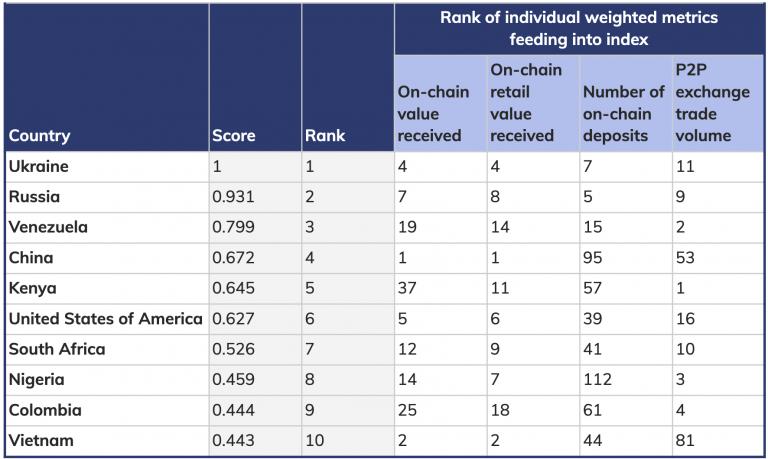
What you and the billionaire have in common is that you both bought BCH
Billionaire and venture capitalist Tim Draper recently purchased BCH and praised BCH on his Twitter page. He also praised the ease of buying and using it, and further encouraged his followers to go to Bitcoin Learn about BCH and thank Roger Ver for his innovation in all aspects. Although his tweet did not introduce the specific reasons for praising BCH, the analysis from his comments seems to be about the current high network fees and slow confirmation times affecting other networks.
In the recent stage, due to network congestion and surge in transactions, indicators such as ETH transaction fees and single block fees have hit new highs, which have been criticized by many users. High transaction fees and slow confirmation time are unavoidable and urgent dilemmas in the development of cryptocurrencies. BCH is not affected by the current problems faced by cryptocurrencies such as BTC and ETH. These attributes that seem to be the most basic of cryptocurrencies but overlooked by other cryptocurrencies are indeed the stepping stone for BCH to increase the usage rate worldwide.
On Monday, the British innovation bank **Ziglu** announced that it has been licensed as an electronic money institution (EMI) by the British Financial Conduct Authority (FCA). After obtaining the license, this fintech startup can make P2P payments in BCH and fiat currencies. They told the media, “No matter where people are or what currency they use, users should do it immediately, freely and easily, whether it’s paying for accommodation or sending cryptocurrency as a birthday gift.”
These simple and pristine reasons have prompted some new cryptocurrency-related companies to consider adding BCH to trading pairs or payment methods. A Nigerian exchange called **Yellow Card** is actively adding BCH to their conversion into legal currency. In the same value transaction, when the handling fee of BTC and ETH is higher than 8 USD, the BCH fee is still lower than 0.01 USD.
On the track of the utility of cryptocurrency, BCH has always been in the leading position. In the past nine months, the BCH network has successfully accumulated a large amount of infrastructure and support, and more than any cryptocurrency launched to date. After teaching people how to use BTC for years of experience, BCH proponents will not try to push users to a proprietary toll road, but push them to reliable and cheap on-chain transactions. Even today, transaction fees of more than one dollar are still too expensive for residents living in developing countries. The network fee of less than a cent is more suitable for promoting money transfer apps for cryptocurrency enthusiasts who dreamed of just a few years ago.
African cryptocurrency users have shown a keen interest in digital assets. Digital assets have brought real advantages over traditional assets. So far, BCH seems to be the cryptocurrency for this.
Fexonice1, a BCH user in Africa, proposed the development direction of BCH in Africa in the community. He believed that he could start by arranging workshops to appropriately guide those who have not yet followed BCH and introduce BCH and its advantages to them. Portable cash management systems are making progress throughout Africa, reaching people in towns and homes without bank accounts. In the face of this situation, a variety of cash proceeds can be used as exchanges to fill in. BCH developers can cooperate with local portable cash management institutions in Africa and expand the adoption of BCH along these routes.
The road ahead is always full of difficulties and obstacles. How BCH can help the unbanked obtain financial services and regulate electronic cash channels globally is a huge issue. The emergence of the wave will not only promote development but also bring some adjustments.
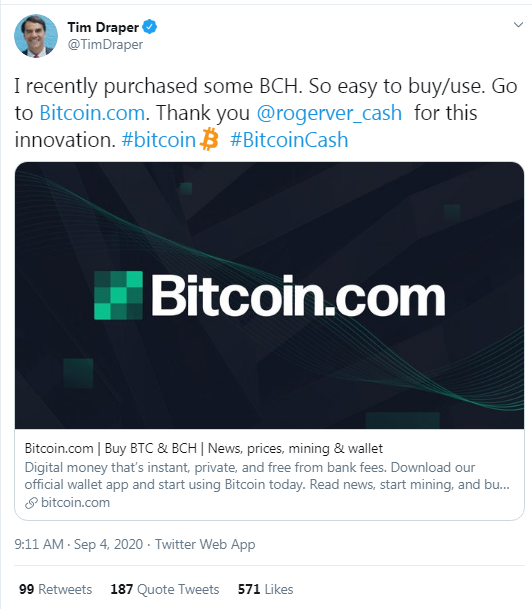
Bithumb was seized, and the cryptocurrency market experienced its biggest recent decline
On the evening of September 2nd, the cryptocurrency market suddenly fell collectively, and mainstream currencies such as BTC and ETH suffered the biggest decline in nearly half a month. BTC fell below $11,300, with a maximum drop of 5%. ETH once fell below $420, a drop of 8%.
The contract market also suffered heavy losses. According to the data of the contract emperor, in the one hour of the plunge, the entire network had a total of US$455 million in liquidation, 37,544 people had liquidated positions, and the entire network had liquidated US$601 million in 24 hours.
The reason for the plunge may be related to the sudden change in the Korean cryptocurrency market
With a relatively loose regulatory environment, South Korea has gradually occupied a place in the cryptocurrency trading market in the past two years, and has become one of the most important cryptocurrency markets in the world. There are many well-known cryptocurrency exchanges in its territory.
South Korea's Seoul Metropolitan Police Department raided and seized South Korea's largest cryptocurrency exchange Bithumb on the grounds of suspected fraud. According to data, Bithumb's 24-hour trading volume was around US$350 million.
The oldest newspaper in South Korea, "Seoul Shinmun", reported the news on Wednesday, saying that Bithumb's office had been raided by the police. According to reports, the exchange was accused of pre-selling local BXA tokens worth about US$25 million to investors, but failed to list the tokens, which allegedly caused investors to suffer serious losses.
It is said that Bithumb has issued BXA tokens in the past, and then it is rumored that it will be acquired by Singapore-based BK Group. However, it was reported that the acquisition transaction did not materialize.
Not only Bithumb, but other cryptocurrency exchanges in South Korea seem to be having trouble recently. Last week, the Seoul Metropolitan Police Department also seized the Coinbit Exchange, claiming that it allegedly inflated its trading volume by 99%, thereby bringing the exchange and its team at least $84 million in "improper profits."
Now is the best time to invest in Bitcoin Cash
Bitcoin Cash is regarded as one of the purest blockchains. BCH has a strong development, a solid community, and a healthy ecology. These are the reasons why many users invest in BCH.
I have been optimistic about BCH for a long time because of the solid foundation of Bitcoin Cash:
**1.** The open source community distributes Bitcoin Cash fairly and widely through a hard fork, giving it a solid foundation for Bitcoin.
**2.** It is reasonable and logical that the large block project that was born from the Bitcoin expansion dispute has solved the expansion problem that has plagued the Bitcoin community for 4 years (or more) since its birth.
**3.** All the basic properties of Bitcoin. (For example, the total amount of 21 million will never exceed the issued amount, etc.)
Bitcoin Cash has become better over the years
Simple classification protocol SLP and its token ecology.
Cashfusion (mixed currency) privacy protection tool.
**Cashaccounts.**
Coupled with the actual adoption of Bitcoin Cash in core areas such as Tokyo, Townsville, Slovenia and other areas, Bitcoin Cash has developed far more than 99% of blockchain projects, and there is huge room for development. However, there have always been quarrels and conflicts within Bitcoin Cash. At present, it seems that we are at a fork in the road of dispute and conflict.
**Bitcoin Cash hard fork may be good news**
People who are afraid of hard forks may think that hard forks are a bad thing and may make prices fall, just like during the BCH/BSV split, the total value of both coins was lower than before. This is due to market uncertainty. The main reason for this situation is that because of the computing power war, CSW threatened the Bitcoin Cash chain with computing power and refused to add replay protection. This must have affected the stability of the BCH chain and the price drop caused by the main chain problem. Not only BCH, the computing power war greatly shook the market, and even BTC collapsed.
The current situation of BCH is very clear. It is completely different from that of BSV. At first, both parties said that they would not fork (now the attitude of BCHN has changed), and they are not planning to fight hard. This shows that 100% will not affect BCH. With the main chain function, exchanges and users can still trade and use BCH normally. Moreover, ABC issued an announcement last week. ABC was quite sincere and expressed its willingness to negotiate. The differences were not as big as many people thought. Even if the split really occurs in the end, what many people predict is that it may be a "price war" this time. Maybe this is good for retail investors.
Frankly speaking, the external concerns are all developer-level differences. Of course, this situation is not uncommon in the past. The BCH community resembles the Bitcoin community from 2013 to 2014. Development technology discussions have always been the main theme of the community. There are multiple development teams and everyone has the right to speak. Developers dispute It is always difficult to understand and stubborn, but this is also one of the manifestations of decentralized communities. The current situation is the dispute that has occurred because of IFP, which has become a problem at least as early as the first IFP attempt.
Regardless of the final outcome, BCH has a total of 7 clients, several wallet vendors, and a very large development team such as SLP ecology. The main development team ABC and the opponent BCHN have strong development power. No matter who wins in the end, It will cause an earthquake in BCH, which makes me quite optimistic about Bitcoin Cash. However, the incentive problem for developers still needs to be solved. Even if IFP is abandoned, other programs should be implemented as soon as possible. Developers must have the protection of funds to continue to be hot for BCH. The significance of stable development is very important.
For the ABC side, assuming that they really lost their leadership, I think it is a good thing. The heavy and complicated development and maintenance tasks limit ABC's hands and feet, and unloading the burden allows them to pursue their own vision, such as development avalanche Agreement (Avalanche), this is the biggest "big killer" of the BCH community at this stage. Its value is self-evident. If ABC can realize the avalanche agreement one day earlier, they can bring the greatest development to BCH.
**sum up**
If a hard fork does happen, no matter who wins . The market will determine the value.

Will "decentralized exchanges" disrupt the blockchain industry?
With the current popularity and operational strength of the three major exchanges, even if facing the competition and pressure of decentralized exchanges, I believe that in the future, they will still be the preferred platform for ordinary traders to trade. This means that they still enjoy huge profits. With this guarantee, their platform currency prices are unlikely to fall too much. This is a guarantee.
But at the same time, we should pay more attention to the fact that **in the field of investment, we evaluate a product to see if it has potential. There is an extremely important factor-that is, whether there is room for imagination in the future of this product, and its imagination. The bigger it is, the bigger its future growth will be** .
The direct competitor of the "centralized exchange" is the "decentralized exchange", then let's take a look at the decentralized exchange (for the sake of simplicity, I will refer to the "decentralized exchange" as DEX below) The imagination of the future.
The rise of this round of DEX has completely achieved disruptive changes in two aspects:
**First, it has changed the way tokens are listed and traded, so that there is no threshold for token transactions (no exchange review is required), and at the same time, no threshold for traders' transactions (no registration, no need to provide identity information) , This is the true meaning of decentralization and the true meaning of blockchain** . In a more essential way: it gives people the freedom to trade tokens. Once there is freedom, there will be prosperity and miracles.
Since using Uniswap, I never want to provide my phone number or even my ID number to register for an exchange. Now, in addition to the decentralized exchanges that I want to buy Bitcoin and Ethereum, most of the coins I want to buy are already available on Uniswap. The proportion of centralized exchanges in my trading activities is getting lower and lower.
I believe this is an irreversible trend.
**Second, DEX makes the transaction process and transaction information completely public, and even the profit of the exchange is completely public. This has done what the regulators dream of but have been unable to do. Whether it is a listed company in a traditional stock exchange or a digital currency exchange, which company or exchange can have such transparent and open operating data? Now DEX technically achieves this** .
Only transparency and openness can usher true trust and real prosperity.
**Any of the two disruptive changes brought about by DEX is beyond the reach of centralized exchanges. These two points are the imagination of DEX in the future, and they also indicate that this field will have a huge increase in the future; at the same time, these two points are precisely the ceiling of centralized exchanges, which limit their future imagination** .
Therefore, in this case, if we look at the future trend of the "centralized exchange" platform currency, we will come to the conclusion that the price will not fall too much, even if it falls, it will not fall deeply, and there is a minimum guarantee; but The room for imagination to rise is extremely limited, and will no longer be the leader of the future bull market, but will only become an established blue-chip stock and follow the market.
And if the development of DEX is extremely rapid, and the scale is large enough to shake the centralized exchange, then the centralized exchange platform currency may not even be the status of "old blue chip stocks". I am afraid that this day will not come in the short term, but the long-term possibility is not small.
**Based on this value judgment, the way we invest in the exchange platform currency is clear: that is to continue to hold and wait for the bull market climax or some positive stimulus to cause the currency to suddenly rise in installments and batches** .
**Let's look back at DEX.**
Let's look at the DEX platform first. Currently, there are mainly Ethereum, EOS, etc. I only like Ethereum, because its ecological scale has formed a barrier that other platforms cannot overcome.
DEX on Ethereum can be roughly divided into two categories: one is the old projects, such as Bancor, Kyber, Loopring, etc., and the other is the emerging projects such as Uniswap, Balancer, and Curve.
**What is more embarrassing now is that the trading volume of the established projects are low, so their currency prices are also relatively low, it seems that investors have limited interest in them. However, Bancor is worthy of our attention in the old-brand projects, because the project team has been moving frequently recently, and the latest version has been greatly improved in technology. Whether it can increase the transaction volume based on this in the future is whether its currency price can turn around. The key** .
And the three emerging projects I just listed have made the limelight in this DeFi wave, and the trading volume far exceeds that of the established exchanges. However, the strongest Uniswap and the third Curve among the three emerging exchanges currently have no tokens, only Balancer has issued the token BAL.
BAL's currency price has risen astonishingly in the past few days. It is obvious that funds are being sought after, and it is being sought after at all costs, which is obviously affected by the FOMO mentality. So what is the current investment value of BAL? I think it is in an embarrassing position: if you look at the future, it does have room to rise, but how big its room can be is currently unpredictable; if you look at the short-term, its rise is really too strong, and it will not be unexpected if it pulls back.

Solve the problem of BCH development funds through tokens
There is no long-term effective solution to the problem of BCH development funds. I recently thought about it for a long time and came up with a plan .
**General plan**
**1** Establish a BCH foundation, which only executes and does not make any active decisions about capital expenditure. Please note that this is very important.
**2** The foundation issues a token on the SLP (BCH token protocol) that is not fixed in total and can be issued at any time. It is assumed that the name of the token is vote.
**3** Any user who donates 1 USD to the foundation will automatically get 1 vote
**4** Any expenditure of the foundation needs to be approved by all vote holders for digital signature voting.
**Detail**
**1** Why is the foundation not allowed to make active decisions?
This can avoid corruption to the greatest extent.
**2** Why is there no upper limit for vote?
This is to ensure that all donors have the same voting rights. Whether you donate $1 today or donate $1 a few months later, you can get 1 vote.
**3** Can vote be traded freely?
Vote holders can trade on their own, and those who need voting rights can either get votes through donations or buy votes on the free market. If you got the vote from the donation at the beginning, and then sold the vote, no matter how many times you resold it, assuming that the vote price has not changed, it is equivalent to the last purchaser actually making a donation.
**4** Is the voting right of vote permanent or one-time?
Vote's voting rights are permanent. As long as you hold a vote, you can vote on any proposal of the foundation. Please note that this is very important. Only votes with permanent voting rights have transaction value, which will greatly stimulate people's motivation to donate. In the traditional donation behavior, the donor is purely donating. In this mode, you will get a vote and have the right to vote. When you don’t want this voting right, you can still sell it for cash. The choice is very flexible.
**5** How to vote? What is considered as a proposal?
Use the wallet for digital signatures to approve or oppose a proposal. Within the specified time, if more than 50% of all votes cast for a certain proposal are approved, then the proposal is passed. As the executor, the foundation transfers the corresponding funds from the fund wallet to the wallet of the proposal initiator.
**6** If you make decisions based on the number of votes cast, will it become a big deal?
The core idea of Vote is that whoever donates more money has more right to speak, rather than the egalitarianism of one person, one vote. Why do you donate US$1 and others donate US$10,000? You want to have the same voice as others. So I think even if the big business has the final say, there is nothing wrong with it.
**7** How to restrain the foundation and prevent corruption?
First of all, make the accounts transparent, and make every income and expenditure public, and these can be checked on the blockchain. Secondly, use professional digital asset custody services to prevent people from running away with donations. Finally, it is through legal constraints. The foundation should be initiated by respected people in the BCH circle.
**8** Does the foundation need to provide centralized services?
The foundation needs to establish a website to publicize various income and expenditures, and also needs a section for users to initiate proposals for funding.
**9** What if the daily operation of the foundation also requires funds?
It's very simple. Just initiate a proposal and let everyone vote for it.
**10** Why does BCH as a POW need to use this POS-like method to make decisions?
Because POW only protects the network security of BCH, it cannot directly provide funds to developers. The holder of the vote is the sponsor of the development funds, whoever pays the money and speaks, nothing wrong. Vote holders only vote on the issue of "who use the money we donated", not everything.
**Several advantages of this program**
**1** Fair and reasonable. Let the donors vote to decide how to use the money, the foundation has no decision-making power.
**2** This scheme can perfectly fit the pumping scheme of miners. The miner pumping scheme is to use a certain percentage of the proceeds from each block of the miners to inject into the foundation. Many people agree with this scheme, but the most unhappy group must be the miners, because they have to "take it for nothing". money. But if you combine the scheme of this article, it will be different. Miners will automatically get 1 vote for every $1 of BCH drawn. Then miners can sell votes on the market and recover most of their losses.
**3** Developers can be counterbalanced. Now the leading development of BCH is the ABC team. If the ABC team provokes public anger, then when ABC wants to apply for development funds from the foundation in the future, vote holders can vote against and strongly support other teams to counterbalance the ABC team.
**4** More efficient. From the time a proposal was initiated to the end of voting, ten and a half months was almost over.
**5** No permission required. The program does not need to be approved by anyone, and those who are capable and willing can start it now.
**sum up**
This article is just an idea, many details are not in-depth. But in general, I think it is feasible. This solution can not only provide funds for protocol/application developers, but also provide funds for the marketing of BCH.

New types of attacks can steal funds from LN payment channels
Researchers at the Hebrew University found that "a systematic attack on the Lightning Network can steal funds locked in payment channels." Through this attack, "the attackers force many victims to immediately cash out their funds to the network."
**Lightning Network is vulnerable to systematic Flood & Loot attacks**
However, supporters of the Lightning Network (LN) believe that 2020 is not an ideal year for the stagnant BTC expansion problem. The second layer of the network, the off-chain payment solution Lightning Network, was initially stolen from the LN torch during the development of the new year. Soon after, a company dedicated to building a capital channel system admitted that it wanted LN to be "like Visa." Shortly after celebrating its 5th anniversary, university researchers from Luxembourg, Norway, the United Kingdom, and the United States concluded that privacy deficiencies are unique to its design.
Then recently, Square Crypto open source engineer Matthew Corallo disclosed an attack on the lightning network, which is equivalent to "a new method of stealing money from LN nodes." Last month, the Ethereum DeFi project was found to hold 4 times the amount of BTC locked in the Lightning Network. One of the most famous password debit card service providers BitPay announced that they will not support the second layer solution (Lightning Network). If this is not enough to explain the dilemma of the Lightning Network this year, early this month, the Bitcoin core developer connected to the chaincode laboratory demonstrated a time expansion attack. The developer said: "It seems that it is currently the most practical way to steal funds through the Eclipse attack. The reason is because it does not require computing power to access attacks, nor just attacks against merchants."
**Lightning Network**
"A topology example showing the attacker's node and the channel he shares with the victim", excerpted from "Flood & Loot: System Attacks on the Lightning Network".
Now, researchers from the Hebrew University of Jerusalem, Jona Harris (Master of Science) and Aviv Zohar, associate professors in the School of Engineering and Computer Science (also the chief scientist of qd-it), have published the latest research, showing the lightning network Vulnerability, they call it "Flood & Loot attack". "The consequences of the attack depend on the choice of the Lightning Network attacker and the way the Lightning Network is implemented, Harris and Zohar explained, showing that "if there are 85 channels that are simultaneously attacked, it is enough to ensure that the attacker succeeds in the attack and obtains funds for the Lightning Channel. (And this assumes that there is no other blockchain space for competition-in fact, this is already a very optimistic assumption."
They warned cautiously that their "attack may lead to the theft of innocent users' funds. It is best not to try to use the Lightning Network." And unfortunately, there has been no obvious change to the protocol to completely eliminate it. Currently, the results of this work have been shared with the developers of the three main Lightning implementations. ," Haris and Zohar further pointed out. In essence, they follow the Hash Time-Locked contract (HTLC), control two nodes, and load them with HTLC payment. When the attacker requests funds transfer, they will be rejected. HTLC has this Many unresolved payments, no matter how hard the victim tries to reduce them, are unlikely to recover the funds.
The development problems of the Lightning Network are frequent, and the launch of large-scale applications is still far away.

Documentary depicting Africa's "Bitcoin Revolution"
Amazon Prime will release a documentary on the situation of Bitcoin in Africa.
The title is "Banking on Africa: Bitcoin Revolution."
It depicts how people are using cryptocurrencies to overcome the widespread challenges of southern Africa such as lack of infrastructure, poorly managed economies, high remittance fees and poverty.
**Botswana's "Bitcoin Lady"**
One of the characters is Alakanani Itireleng, a woman also known as Botswana's "Bitcoin Lady".
She experienced poverty on her own, and a few years ago she was soliciting bitcoin donations for the charity SOS Children Village, which helps orphaned children. The charity provided children with essentials such as food, school supplies, clothing and medical care, and was also a shelter for children rescued from child labor.
Alakanani Itireleng is now launching a non-profit educational institution called the Satoshi Center to teach locals how they can benefit from Cryptocurrency and change their lives.
Usizo
Usizo is a blockchain-based charity platform that allows users to support African schools with Cryptocurrency donations.
In the rural areas of South Africa, electricity costs were high and prepaid, and there was a problem that electricity was not supplied to schools. Usizo introduced blockchain-enabled smart meters and set up an energy payment platform. Allows donors to pay their electricity bill in Cryptocurrency from anywhere in the world.
Demand
In developed countries, Cryptocurrencies are often used for speculative purposes, but in areas such as Africa where poverty is a problem, cryptocurrencies match the needs of daily life.
For example, cryptocurrencies provide fast money transfers at a low cost.
Especially in countries such as Nigeria where foreign currency purchases are restricted, Bitcoin is attracting attention as an alternative.
Africa, with a population of over 1.2 billion, has the potential to become a huge market for Cryptocurrencies.

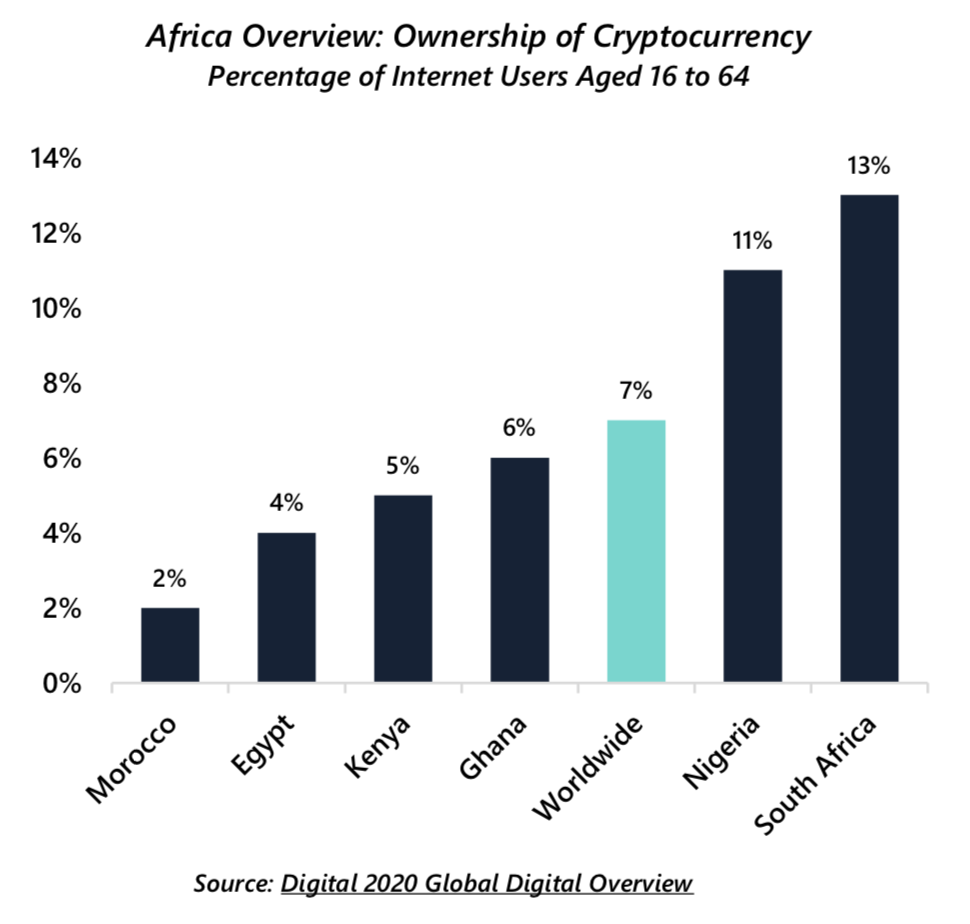
Can the Bitcoin Cash Foundation solve BCH's funding and decision-making problems?
Since the upgrade of Bitcoin Cash on May 15, 2020, the controversial Bitcoin Cash Infrastructure Finance Plan (IFP) has not been activated and the IFP plan has failed, but the development funds and decision-making issues of BCH still exist. In the livestream AMA live broadcast hosted by Bitcoin ABC recently, ABC developer and ViaBTC founder Yang Haipo discussed the idea of establishing the BCH foundation, including a voting committee to resolve BCH disputes.
**BCH Foundation**
Bitcoin Cash should establish a perfect platform for decision-making and funding. This is the view of ViaBTC founder Yang Haipo. On May 14, 2020, he and BTC.TOP founder Jiang Zhuoer participated in the livestream AMA live for 3 and a half hours . Jiang Zhuoer participated in the meeting for a relatively short time, but he also expressed support for the sustainable funding mechanism for the future development of BCH. Jiang Zhuoer also discussed a funding scheme similar to the Nobel Prize, but did not reveal more details. Jiang Zhuo'er's speech attracted much attention because IFP was originally proposed by Jiang Zhuo'er.
IFP ’s solution was initially praised by community users. Bitcoin.com ’s Roger Ver, Bitmain ’s Wu Jihan, Yang Haipo, and Jiang Zhuoer signed a joint support for the IFP program. These are BCH community opinion leaders. However, after the release of the whitelisted IFP version of BitcoinABC, IFP began to be opposed by more and more people. Jiang Zhuoer publicly opposed IFP. Roger Ver also said that he never supported it in any formal way.
**Decentralization is a means, not a result**
In the 1 hour and 29 minutes of this meeting, Yang Haipo said that he has been considering decentralization issues related to the full node or protocol layer in the past few years. He believes that for the development of the Bitcoin Cash network, decentralization is not necessary, Bitcoin ABC should continue to be responsible for Bitcoin Cash, and the community's concerns are too scattered.
He believes that the BCH Foundation (or a certain governance mechanism) should have been established as early as the birth of BCH in 2017. If so, the goal of promoting Bitcoin Cash to the world may have been completed. Yang Haipo said that users outside the circle may think that the BCH community is very chaotic. Too many voices completely affect development, which completely prevents users from investing or adopting BCH.
At 1 hour and 42 minutes, Jiang Zhuoer also participated in Yang's discussion on the topic of decentralization. Jiang Zhuoer emphasized: "I think decentralization is a means, not a result. The goal we want to achieve is survival. The most important meaning of decentralization is to fight against government censorship." He pointed out that the number of full nodes It is essential to prevent the government from destroying blockchain projects. But for development, decentralization is not the goal, and the goal of development is to deliver an excellent product to the end user.
**Foundation member**
Regarding the structure of the foundation, Yang Haipo worries that the foundation may be affected due to lack of funds. Many people are willing to donate. The question is whether they can participate in decision-making after they donate. If someone donates a lot of money, he wants to know something, and he wants to participate in it, what should he do?
Establishing a foundation means that members can make decisions through voting, and decide the priority of BCH development or certain projects, as well as the delivery schedule. Yang emphasized that the communication and debate on the Telegram Group were useless, and called for simplified methods by voting by Foundation members.
Yang Haipo has even begun to consider the choice of foundation members. He suggested that he, Amaury Sechet and Jiang Zhuoer (who had left the discussion at this time) become the initial members of the foundation. If someone wants to join the foundation, they need to pay a certain amount of fees, and then the existing members of the foundation vote on the new members to decide whether the new members can join the foundation. Yang said that if someone wants his voice to be heard, he should pay the price and participate. Finally, Yang Haipo emphasized again that the decision-making ability of BCH must be strengthened to improve the image of Bitcoin Cash in the world.
**Sum up**
Yang Haipo's point of view is the program that has received the most attention after IFP and may constitute an important ecology for BCH in the future. But at present, the plan is still in the discussion stage, and more detailed details have not been discussed. Yang Haipo said that the Bitcoin Cash Foundation should have the "hacker spirit" of "open source" and "change the world", and it does not necessarily have to be so profit-driven. At the end of the live broadcast, Yang Haipo stated that if the BCH Foundation develops smoothly, he is willing to donate to the Foundation.

BCH BSV hashrate climbed after half-life of Bitcoin
Bitcoin last April (8.88% ) Bitcoin Cash ( which had a half-life before ()3.5% ) (BCH) and Bitcoin SV (2.92% ) (BSV) hash rate has been sharply reduced after half-life and has recently recovered. The industry analyzed that the miners of the two coins either abandoned mining or moved to Bitcoin and then returned after half-life of Bitcoin. After Bitcoin's half-life, the hash rate fell slightly and then recovered quickly. It is an analysis that miners continue to operate because the transaction fees are higher than the two coins.
**BCH and BSV hash rate**
cryptocurrency analysis bit Information chart according to (Bitinfocharts) BCH hash rate rose to 90% or from 10 days 1.43EH / s to 13 days 2.74EH / s. The BSV hash rate also rose from 1.1EH / s to 1.78EH / s during this period. https://bitinfocharts.com/comparison/hashrate-bch-bsv.html#3m
Earlier, the two coins passed their half-lives on April 8 and 10, respectively, and the hash rate fell sharply. BCH had a hash rate of more than 80% less than one day after half-life, and BSV dropped 60% for 14 hours.
As the hashrate decreased, cryptocurrency experts warned of the security risks of the two coins. Cryptocurrency expert Crypto 51 dot app pointed out that "the cost of attacking 51% against the BCH network for an hour is 14,400% higher than Bitcoin." The reason for this phenomenon was that miners who could not afford the operating cost when mining compensation was reduced turned off the miner or turned to bitcoin mining. https://www.crypto51.app/
However, as the number of miners returning to BCH and BSV after the half-life of Bitcoin increases, the hash rate is also recovering. There are also observations that the return on the coin is faster because the three coin's mining profit is similar.
**BTC**
stable hash rate even after half-life Bitcoin shows a stable hashrate level after passing the half-life on the 12th. Looking at the data of the cryptocurrency mining platform CoinWarZ , the hash rate of Bitcoin decreased by 6% from 130.47EH / s to 122.64EH / s for 7 hours after half-life. Although it fell slightly, it is less than BCH or BSV. The average hash rate of Bitcoin over the past 7 days is 120EH / s, which has virtually returned to its half-life. https://www.coinwarz.com/mining/bitcoin/hashrate-chart
This is due to Bitcoin's high transaction fees. The transaction fees of BCH and BSV remained at $ 0.002 and $ 0.0002, respectively, while the bitcoin transaction fees have recently skyrocketed to $ 3.19. Shortly after the half-life, the block height was close to $ 100,000 from 630,000. "Bitcoin miner compensation accounts for 15% of transaction fees," said Jack Voell, an analyst at cryptocurrency media Coindesk. This means that the commission is large, and there is less concern about earnings deterioration after half-life. https://twitter.com/zackvoell/status/1260029286628511744
There is also a cautious argument that the situation should be monitored more. Cryptocurrency service providers block spyware solution (Blockware Solutions) Matt de Souza (CEO) "half-life after mining those who are in danger of extreme" and "about 30% of the current hash rate "The miners are mining with zero profits." Digital asset manager Charles Edwards said, "After the half-life, the cost of mining per bitcoin has risen to $ 14,000 (assuming $ 0.04 in electricity cost per kWh). In his words, miners are currently in the red The miner is in operation. https://twitter.com/mjdsouza2/status/1259992239582982145 https://twitter.com/caprioleio/status/1259775138943434753
The birth of a bull market
Based on the complexity of the current market, **thinking about the next round of the bull market is not just looking at the rise and fall of the secondary market, nor the price height of a currency. Need to see the evolution direction of people, enterprises and organizations in the industrial cycle and industrial structure. Drive away the fog, cross the bull and bear, and see the light of the bull market.**
For many people in the industry, although they understand the attributes of the industry, they have never experienced a financial cycle. Whether it is an old man in the industry or a newcomer, we all hope that the industry will be evergreen and look forward to the round-by-round bull market. What factors will be needed for the bull market to come?
**Supply and demand in the secondary market**
The climax of cryptocurrency prices has formed a bull market, which is mainly manifested in the skyrocketing currency prices and the explosion of tokens, but for the secondary market, the **basis is the main course of action.**
Most people who have previously participated in the stock market know the terms bull market and bear market. The bulls and bears of cryptocurrencies are the same as the principles of the stock market, and the main experience is the price. **The essence of stock market prices, or fluctuations, is the change in supply and demand in the trading market.**
The logic of supply and demand determining prices is established based on transaction methods. The purchase order in each exchange is from an individual account to another account. Each transaction is an independent transaction process, and the transaction price of this transaction process is the stock price or currency price at this time. . Therefore, the rise and fall of the entire market is a combination of several orders. This is like a physical trading market, where every single purchase and sale synthesizes the whole market economy.
Similar to the logic of physical transactions, when the supply-demand relationship between buying and selling changes, the panic buying will push both buyers and sellers to think that the value for money and the price increase, and a large number of sell-offs also mean that the value is not worth the price and the price falls.
Following this logic, currency price fluctuations are changes in supply and demand in the entire market. Here we must know the key factors of supply and demand, supply and demand change in real time, and transactions continue to occur.
Trading is buying and selling, and it is only during the trading process that you can achieve low buying and high selling profit or increase the profit of open positions. Even if we think that weird goods are habitable, we have been holding and not buying, but such a market is a dull market and cannot reflect the value of the transaction.
From this point of view, the effectiveness of the transaction and the frequency of the transaction determine the profitability. That is, investors must increase the above two points. And who decides the supply and demand of the entire trading market? Is the main market and small and medium-sized retail investors. **To be precise, the market's main force determines the basic trend of the market, and small and medium-sized retail investors make profits or losses in the main trading behavior.**
The bull market must rise in **price**, and **before** the **rise**, it must be in **shock** or **bottom**. And the judgment at this time is that supply and demand are depleted, and demand is growing and dominating the market. Simply put, it is impossible for the position holder to sell the goods, and the main market cannot receive the goods, but the position holders are beginning to use the funds to enter the market. The supply-demand relationship at this time is obviously that supply is less than demand.
In a large market with a small supply, if there are many retail transactions, it is difficult for the market to give quick feedback. Because the main force is the basis for determining price fluctuations, when the main market force begins to dominate the market, the market will begin to enter the cycle of rapid exchange and change of supply and demand. That is, it is beginning to enter a crazy increase, and most of the properties of retail investors will be affected by the market and chase the rise.
At this time, the supply and demand are probably balanced. For the organization, all shipments must be staged, that is, in every rise, it is the best time to ship, but because of the increase in demand, supply and demand are basically still Balance, and the demand will be greater. When there is a second or third increase in demand, this time is often in the price, has undergone several ups and downs test, the price line is in line with a relatively high-quality rising channel.
Supply and demand have begun to change, and all positions can only be counted as earnings after the transaction is completed. What traders should pay attention to is the efficiency of transactions. Therefore, the main market shipment is the reason for the change in supply and demand.
In the context of strong demand, because of the continuous delivery of the main force. The volume of transactions in the market has skyrocketed, and most traders will consider it to be a second outbreak, but in fact it may be a process in which supply gradually exceeds demand.
**When the supply is completely greater than the demand, the main market does not think that the current price has a value that can be bought again. The price stops, most investors continue to ship, the price no longer rises, the ascending channel ends, and enters an oscillating stage. When the market is seriously dull, the main force will ship again and sell short to increase liquidity, and the bear market opens. The next cycle begins.**
This is the most basic supply and demand relationship when a bull market is formed. In this supply and demand relationship, the main investment method is to absorb goods at the beginning of the cycle and ship at the beginning of the bull market. All actions determine the changes in the market. If after a round of sharp increases, the market has not entered a bear market, and the demand in the market has not decreased because of price stagnation, which will trigger the second round of spring.
In summary, the increase in demand is the basis for the formation of a bull market, and the change in supply determines the starting point of the bull market cycle.
**The next round of bull market**
Right now, the halving of Bitcoin is coming, and everyone in the industry is looking forward to the bull market, but at present, the blockchain industry has exposed more obvious problems. It contains:
1. Capital accumulation in the industry, as market conditions change, capital liquidity weakens, and the market shows signs of bluntness.
2. The development pace of public chain technology is slow, and there is a big market hole between the underlying technology and the application of the scene. So far there are very few blockchain products available.
3. Various public chains and entrepreneurial teams have tried too much in financial business, and there is no core business based on blockchain technology.
4. Exchanges, stablecoins, lending, mining, and other markets have become the Red Sea, with fierce competition and isolation from external investors and users.
**These problems are the background of the next round of the bull market. After solving these problems, the industrial structure of the blockchain can be initially formed. Only the horn of the bull market can be heard loudly. If not, based on the current background, it is quite certain that the next round of the bull market will not be like the bull market in early 2018, but will be a replica of the 2019 bull market.**
The first is the benefit brought by the halving of Bitcoin. This major benefit is bound to be a good cycle opportunity for many institutional investors. Through the secondary market, you can get rich returns. However, from the perspective of Bitcoin's increase and market value in 2019, Bitcoin's bull market will be inevitable, but it is not a bull market for the cryptocurrency or even the blockchain industry.
The lack of market power in the secondary market is mainly due to the lack of continuous and effective capital entry. The transactions in the blockchain industry have become an embarrassing situation of inherent capital flow and even cut-off.
The progress of the entire industry is indeed very long. People in the industry who have a clear understanding of the status quo, are closely watching external policies and the attitudes of other regional markets to Bitcoin and cryptocurrencies, because This may be an opportunity to help the industry grow again quickly.

DeFi project Aave introduces asset selection risk framework
**AAVE** is a recent industry-emerging lending agreement that has just introduced a risk framework for assessing new assets on the platform.
In light of the rapid growth of the agreement over the past few months, Aave is rapidly establishing its market leadership in top digital currency lending.The agreement supports nearly 20 assets, and the diversity of the agreement provides people with the ability to deposit top digital assets such as LINK and SNX (thus earning additional borrowing power) according to their preferences.
For those unfamiliar with Aave, the agreement will also allow people to make Flash Loans at a stable annual interest rate and use. The timing of the introduction of this risk framework is critical, as the team has recommended that the native token LEND be used to upgrade the governance framework in the coming weeks.
Here are some key points of the framework, and what lessons can be learned from other loan agreements:
Methodology
Like other risk frameworks, Aave's asset ratings follow a similar approach, which is to rate assets from A + (least risk assets) to D- (highest risk assets). By scoring each asset, others can easily see the risk status and changes of different assets. In recent weeks we have also seen similar services provided by projects such as DeFi Score and Inspection.
Aave's risk team focuses on the following risk factors:
Smart Contract Risk. This risk is considered in terms of the number of audits, maturity, and transactions of the underlying contract of the asset.
Counter-Party Risk. The degree of asset centralization is based on governance and custody.
Market risk. Market value, price volatility and liquidity risk. Can an asset withstand market fluctuations? Or is it too volatile and often faces the risk of liquidation?
Next, let's take a look at how these factors have contributed to the assets on the current platform.
It should be noted here that although Dai is often touted as the asset with the least risk of centralization, in terms of maturity (Maturity) it is the most risky asset on Aave because Multi-Collateral Dai Launched less than a year. This is not to say that Dai is "risky", we just say that using a series of different indicators helps to better determine the potential risk (and the return level corresponding to taking the risk).
The new risk framework also provides qualification criteria (Qualification Criteria), which better demonstrates how different ratings are achieved.
The figure below is the Currency Risk Map, which clearly shows the different ratings that each supported asset of the platform has received so far. With the addition of new assets and the update of new indicators, this list will be updated regularly to better reflect the real-time rating of assets.
Overall, it is clear that ETH is the least risky asset on the Aave platform. This explains why it is most often used for lending and lending the digital currency with the lowest rate of return. This is because the supply of ETH is sufficient, and because the risk of lending ETH is far less than that of bUSD (D +) or WBTC (C +).
Going forward
Although the risk framework is nothing new, it is in fact one of DeFi ’s biggest and probably one of the most important trends in recent months. As more and more projects launch risk assessment frameworks, these ratings will be more easily digested and understood by end users (this is also a matter of course), which will better guide their lending activities and avoid dealing with investors. Design more high-risk asset activities.
As DeFi continues to mature, we firmly believe that an appropriate risk framework is critical to the development of the deauthorized digital currency market. To be sure, Aave will introduce more assets in its existing diversified asset pool in the near future.
Can cryptocurrency compare with traditional investment?
**Cryptocurrencies are decentralized in nature, so they are likely to become a stable alternative to other investment products.** The most common traditional investments that people participate in the stock market, bonds, foreign exchange (foreign exchange), and precious metals.
**CRYPTO vs. stock**
First, we will discuss how cryptocurrencies compare to the stock market. Stocks are the closest comparison in the traditional investment field, and can be compared with cryptocurrencies, because when the market is strong, the benefits of price increases can usually be expected, and both markets (stocks and cryptocurrencies) have their bad Time.
As the stock market has a long history, there can usually be better forecasts to guide investors in the future. However, stocks face different types of risks, including **commercial and financial risks, purchasing power risks, market risks, government controls and regulations, and even overall economic conditions.**
In addition, because there are actually thousands of stocks to choose from, it may be difficult for investors to predict the risk of the company's future performance.
**Crypto vs Bond**
Next is a comparison between cryptocurrencies and bonds. Bonds are often referred to as fixed income securities, which places them in a generally different category from stocks and cryptocurrencies. Regardless of the investment method, bonds allow investors to borrow money from third-party entities for a period of time, and investors will regularly receive fixed interest.
**Compared with cryptocurrencies and stocks, bonds are generally considered to have lower risks and provide higher current income.** Regardless of current income, in the long run, the probability of high returns is much lower compared to cryptocurrencies and stocks, but since the risk is relatively low, this can be expected.
**Cryptocurrency to foreign exchange**
Next, we will discuss foreign exchange, also known as foreign exchange. Investors who participate in and actively participate in the foreign exchange market buy and sell foreign exchange. Since capital gains depend entirely on the country ’s economic situation, **this type of investment has a higher risk than cryptocurrencies.**
**Encryption and precious metals**
Last but not least is the comparison of precious metal investments with cryptocurrencies.
Interestingly, Kiana Danial, CEO of Invest Diva, mentioned in the book ***"When someone tells you that cryptocurrencies have no intrinsic value, they are worthless, so precious metal comparisons are actually the best argument "*** This is the main reason why people will consider investing in precious metals in today's era, mainly because they will buy such items for jewelry or other currencies.
**Market sentiment is the only factor that determines the value of gold and silver.** Such risks involved in investing in precious metals include their portability, possible import taxes, and the need for a high degree of security.
Through these comparisons, we can see that although cryptocurrency is still a fairly new form of alternative currency and investment, it has already achieved benefits that most traditional investments cannot. Just like any other market, the investment period and investment period will be poor, and the trading platform will have more understanding of trends and forecasts.
Thanks For reading
Authorized Iran's largest Cryptocurrency Bitcoin mining facility
Iran's largest bitcoin farm
It turned out that the Iranian government has given a new business license to foreign bitcoin mining companies.
According to local media **PressTV**, the mining operator "**iMiner**" registered in Turkey has been granted permission to establish a bitcoin mining business in Iran by the Iran Ministry of Industry, Mines and Trade. It is reported that it will be "the largest bitcoin farm in Iran".
With a total investment of US $ 7.3 million , a mining facility constructed in Semnan, central Iran, will have 6000 mining equipment installed and will mine bitcoins at a hash rate of 96,000 TH / sec. Say.
As the half-life of Bitcoin, which will significantly change mining profits, is approaching, it seems that there are active movements in the global mining industry to complete investment in advance and prepare for the management system after the half-life.
According to iMinier's website, the company, which has seven years of experience in mining operations, has a mining equipment rental business in Turkey, Russia, the United States and Canada.
Iran Mining Circumstances
The Iranian government made a decision at the end of July last year to legalize the mining of Crypto currencies. Mining operations can be performed by receiving registration approval from the Ministry of Industry, Mines and Trade. Earlier this year, it was reported that over 1,000 miners have licensed.
The 6th largest oil producing country in the world, and because the electricity cost that greatly affects the mining operation cost is cheaper than other countries , Iran has a favorable environment for miners. Attention has been paid. There are also reports from Chinese miners that they have been consulted to establish a mining farm in Iran.
Local media reported earlier that mining seemed to have flourished already before the registration system and that thousands of illegal mining equipment were seized by the Iranian authorities from closed factories.
However, since mining also imposes a load on the country's stable power supply, regulations have been established that prohibit mining during peak power consumption, which is said to be 300 hours per year. In addition, the bounty will be given by reporting illegal mining, such as using the electric power which received the subsidy of the country.
In addition, the Iranian National Tax Service says that the income of mining operations generated overseas is subject to tax exemption conditionally.
**CryptoCurrency trading is prohibited**
While mining is recognized as an industry, cryptocurrency trading is totally banned in Iran.
 @ekrem