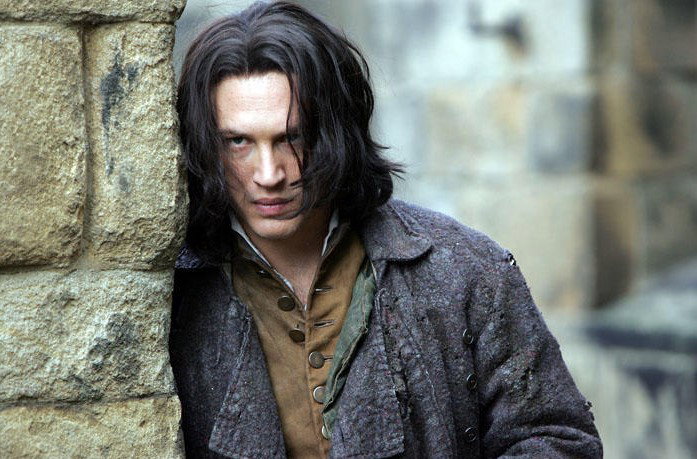
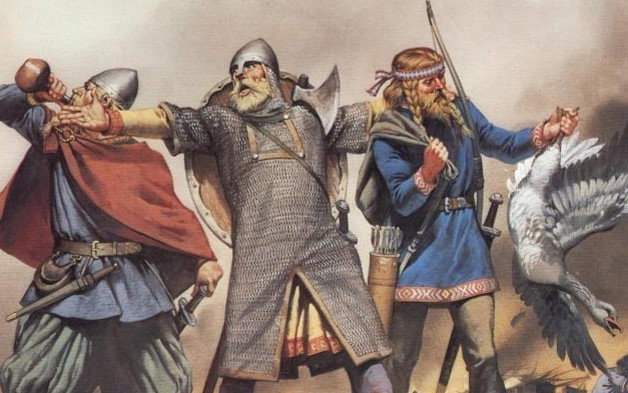
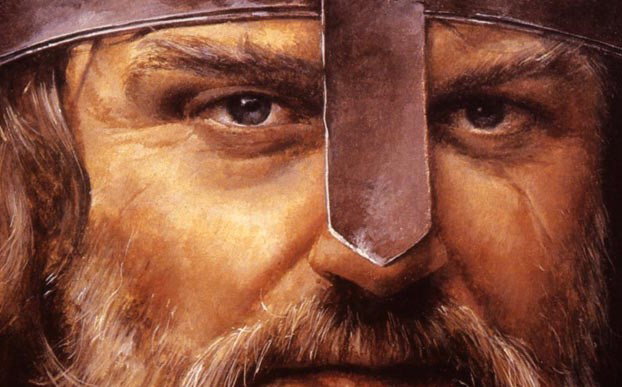
Everyone knows about Robin Hood, but what historical figures are hiding behind him?
There is no person in the world who has not heard of him. Robin Hood, a mythical hero from Sherwood, steals from the rich and gives to the poor, and fights for justice. But - how much of the legend about him is true?
**Did Robin Hood exist?** To this day, researchers do not give a single answer to this question. Since the middle of the 18th century, there have been various assumptions about his identity.
- The biggest problem is that this hypocrite of the name Robert-Robin is extremely common in medieval English sources that were strongly influenced by French culture, while the term for the hood Hood, Hood, Hood is also very present, as well as the name Robin Hood in various forms. Robert Hood was named after many outlaws who appear in the writings of the Middle Ages - explained Assistant Professor Dr. Boris Stojkovski at the forum "Robin Hood - the birth of a legend" recently held at the club "Youth Forum" of the Cultural Center of Novi Sad.
The earliest mention of Robin Hood comes from York between 1226 and 1234. The financial documents there first mention one debtor, and then the outlaw under that name. In medieval English law, an outlaw was someone who was outside the realm of law, one who violated royal regulations.
- None of this, however, is definitely true, because there is no specific source that says that a certain person was used to create the legend of Robin Hood. There are also assumptions that due to the parallels with the apostasy, some personalities served for the creation of the legend - said Stojkovski.
It is true that in the personalities of Robin Hood and Little John, some sought parallels with historical figures who were also brothers, and these are Robert and John Deville. Some authors thought that Roger Godberd or Robin Hood from Wakefield, a medieval figure from England, was hiding behind Robin Hood.
However, there is no explicit confirmation for any of them.
The most important source for the formation of the idea of Robin Hood and his merry company are folk ballads, among which the ballad "Robin Hood and the Monk" is considered to be the oldest, and it was found in a manuscript in the second half of the 15th century. Then, more precisely in 1475, the first play "Robin Hood and the Sheriff of Nottingham" was written.
Already in the Tudor era, the story of Robin Hood was completely formed, and this motif of the "good outlaw" follows the legend of this hero to this day. Only after Queen Elizabeth, in the 17th century, during the early modern century, did a large number of manuscripts appear with ballads about Robin. Some of them have medieval roots, and some are a continuation and shaping of an already existing tradition.
- Robin Hood had a very strong tradition in the early new century, as evidenced by the rich opus of William Shakespeare. Mentions of this brave outlaw in Shakespeare can be found in the works "Two Nobles from Verona" and "How glad you are", while in the play "Henry IV" the great writer mentions Robin's love for Mariana, but as a synonym for unfeminine and immoral behavior - Stojkovski points out.
Sir Walter Scott and his "Ivanhoe", Alexander Dima and his "King of Thieves", as well as Howard Pyle and his compilation of stories called "The Merry Adventures of Robin Hood", are works based on which a modern legend is built, but also a modern image of Robin Huda.
The twentieth century brought a total revolution and evolution of the character of Robin Hood. More than a hundred screen adaptations have been made - Errol Flynn has made one of the most famous film versions of this hero. Parodies were also made, the most famous of which is Mel Brooks' version.
- There were TV series, operas, operettas, comics and other shows in popular culture for children and adults that determined Robin Hood as one of the greatest (pseudo) historical figures known to almost the whole world today - Stojkovski concluded.

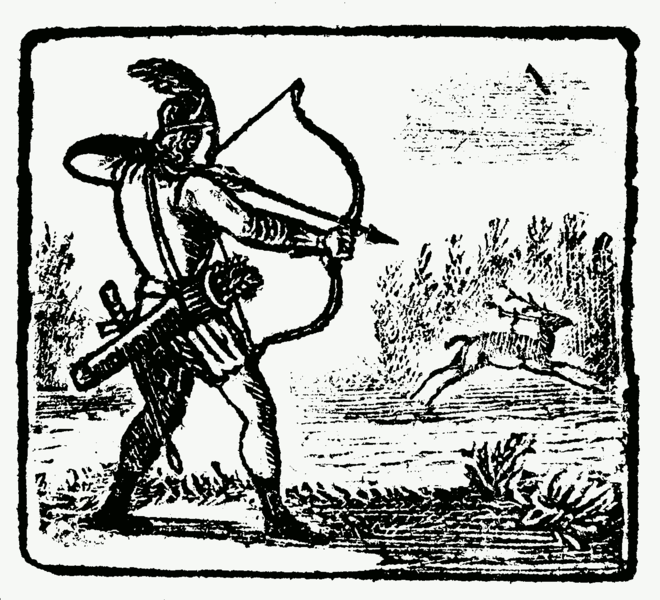
Culture and contemporary challenges - part 2
**Capitalism - commercialization, politicization and technicalization of culture**
In a relatively short time, a little over a century ago, when capitalist social relations were established, they spread to a good part of the world. Shortly before, and especially after the fall of the last opponent - communism, capitalism began to develop and spread unstoppably, recommending itself, and often imposing itself on every form of society and its organization. Thus, capitalism was given the epithet - neoliberal, although in its essence it remained the same as the old one and became only seemingly liberal. The birthplace of capitalism is, you guessed it, Western Europe, to which the very imposition of neoliberal capitalism, as a very real and tangible creator and judge of every social and thus cultural order, enables the simultaneous placement of its own cultural principle of life, which would not be possible without capitalism. The expansion of capitalism and westernization (which refers not only to the European but also to the even more "western" - the American West), again, was made possible by globalization (or did they make it possible? - either way, the fact is that these three phenomena are interdependent and that in that triangle every member is necessary, and none in itself is sufficient for complete domination over the remaining societies and cultures of the world. As the driving force of the capitalist system is money, its influence on every culture is basically based on the fact that value, as a universal feature and goal of culture, gives way to price, which is only a way to reach a new goal - earnings. Such drastic change has a very significant impact on the understanding of contemporary culture, which is almost always in exclusive connection with the above-mentioned social phenomena. In particular, this means that it no longer matters whether any cultural heritage - moral code, tradition, work of art, scientific patent, thought and everything else that falls under culture, is valid in itself, but their value is conditioned by the answers to the two questions that most often decide their future destiny - are they and if so, how cost-effective are they? Why "spend" a gift for writing on some, presumably, artistically valuable work that may only be published from the tenth attempt and from which a larger circulation will have a weekly catalog from a nearby supermarket, when it can be used and, more importantly, paid off in marketing, advertising and copywriting… Why play in a play of ancient tragedy that will be watched by 400 people in one night, if it is possible to host a fun-humorous show program that will be watched by 400,000 viewers in the same time interval… Why the titles about functional illiteracy of children from school desks, when newspapers best sell explicit photos from "stolen" phones of pop "artists"… Why work, think and after all - be, something that is not financially viable when it turned out that it no longer matters whether work and thought ennoble a person but to whether he is paid and how much he is paid. This problem that every culture faces in the capitalist social, economic and value system is called commercialization. Every such, capitalist, system, in every state, must have its own political frameworks that enforce it and often legitimize it - in that way it exercises complete power over all factors, creators and consumers of culture. The politicization of culture is best reflected in intolerance, condemnation and prohibition of any opinion that is not in line with the dogmas of the current political set, and which, in turn, are directed by neoliberal centers, organizations and authorities.
When we remember that culture could not exist without thoughts and opinions, it becomes clear to us how limited it is at this age. It became possible only when it was in the service of the ruling propaganda, while in any other case it was marginalized, restrained and ridiculed. While in commercialization the value of culture directly depends on profitability, in politicization it directly depends on suitability - if it is in accordance with the goals of government representatives, it becomes possible, protected and placed, while otherwise these honors are very difficult to achieve. There must be a third point in every triangle, so that it can be called that at all - and since the triangular composition of social phenomena is more stable than the linear one, it is natural that there is a third phenomenon - technization. Like commercialization and politicization, technization would not be possible without a global view and a capitalist framework of reality. There has already been talk of the so-called an information revolution that was so successful that it left behind a once unimaginable and incredible legacy - a new, virtual, world facing our old and real. This would mean that culture must find a way to penetrate this new world if it wants to exist in it, and thus in the personal worlds of millions of people - because it, in its traditional form, will not exist in it until it is found. on a network that, as we shall see, is neither suitable nor overly hospitable for the vast amount, above all, of knowledge that every culture inevitably contains. If we deal with the root of the word "informatics", we would very quickly find a similarity with the root of the word "information", and this is certainly not a coincidence, since information is the basic unit of informatics whose only role is to store, manage and share propellants. The media, which in modern times are based on the achievements of informatics, inform us every day - they fill us with an abundance of various information, each of which we will notice with our senses, and keep some in our memory, and we will do all that to be "up to date". . instant time. This trend of "bombing" and "filling" with information has led to two worrying phenomena. First, the multitude of available and aggressively placed information has caused less and less interest in its meaning and credibility, because at some point there must be oversaturation and a stage when the mind can no longer receive it, so it defends itself and its owner by creating a shield of indifference that prevents access. and the penetration of new information. Second, partially adopted available information creates an “illusion of knowledge” that is incomplete, fragile, and superficial and that as such can be very dangerous. In this way, the "knowledge" acquired through information, which is just a bunch of unrelated and somewhat adopted fragments, appears in contrast to the coherent, complete and in-depth knowledge that culture, in one sense, is. Such a thing becomes very understandable when we realize that knowledge in its traditional form cannot survive on any network whose meaning is to change it constantly and incredibly quickly, automatically. In this way, by playing with its parts, simplifying and transforming it, technization creates a substitute for culture, and thus directly endangers its survival - because why nurture and adopt it slowly, gradually and completely in its full scope, when it is now possible much faster and much easier, and in a much narrower scope? In that conflict between culture and its pale copy, it is clear that the original is endangered, which, unfortunately, does not enjoy the support and encouragement from the side because it does not serve any of the goals of those who make that side. The center of the KPT triangle (commercialization, politicization and technization) is one big K in the sign of capitalism, which, in cooperation with globalization and westernization, proves to be an equally serious part of the challenge facing our culture. So far, much more has been said about the causes, which have been clarified in the previous parts in the light of their own consequences. For a change, in the next section the light will be redirected to probably the most obvious and visible consequence.
**Cultural industry and production of mass media culture and kitsch**
While in the previous lines, culture was presented in its full scope and form, the specificity of the phenomenon we are now dealing with requires us to focus on one of its, often the most prominent and most frequent, segments - art. Since early civilizations, art, often equated with culture, has coexisted in its more open and closed form and environment - as folk and as elite. There is no doubt that throughout history, both of them aspired to and fulfilled their differently set and shaped goals, and they often recognized and merged in many points of their rich creations. At the beginning of the twentieth century, both folk and elite art received a serious threat - kitsch, which means a bad imitation of art, and which is one of the main features of their competitor - mass culture. When we look at the phenomena and phenomena we have already talked about, it becomes clear that mass culture is only a natural consequence of its causes - capitalism, globalization and westernization. To confirm this, we will list its three very important features, which fully reflect its causality with the mentioned phenomena. The law that mass culture obeys is the volatile law of the market. As in capitalism, like any commodity, culture and its products are produced, sold and, most importantly, consumed in bulk. Permanence, as an imperative that was once strived for, becomes unthinkable, and more importantly - unnecessary, because the hyperproduction of the new makes meaningless only the existence of the old. An important feature of mass culture is also its spread, which would be impossible in a process other than globalization. He can thank the media in his service for that, because, unlike in the past, today, they are the main means of communication that allows them to dictate and place all the trends and phenomena they want, making them available to anyone who has access to electricity. returns to technicalization. The Western value and cultural model, which holds a monopoly over the mass media, is another feature of every mass culture in essence, while what distinguishes individual (mostly national) interpretations of the same is precisely kitsch. The question is often asked what is so tempting in kitsch, that is. What allows him to "get under the skin" with so many people of completely different psychological, national and class profiles? There is no one, completely correct answer to such a question, and the reason for that lies precisely in one of the characteristics of kitsch, and at the same time, equally tempting mass culture. In order to understand the objective reasons for the success and rise of mass culture and its kitsch art over the folk and elite, it is necessary to distinguish what it "borrowed" from one and what from the other.
Democracy and almost complete openness have proven to be very useful features of almost every folk art, while the elite have a beautiful and attractive appearance, which, however, will not always be of crucial importance. What is common to the people and the elite, the irritation of the senses and the supremacy of the spirit, which every art evokes, will be taken only half, of course, in favor of the senses. It is this ability to activate the senses that will prove to be much more cost-effective than mere aesthetics, which is less and less crucial when it comes to consuming cultural products. On the other hand, "astonishment", as one of the impressions that primarily refer to the admiration for linguistic procedures in a literary work, but can also be applied to any artistic work, will give better results as time passes and the shackles of morality and shame loosen. Beauty, nowadays a boundless category, will give its pedestal of appreciation and demand to the grotesque, almost unifying feature of everything that is a product of kitsch, and thanks to the astonishment, such products will be sought after. The power of transformation, since it is not tied to anything permanently and permanently, is crucial for the rise of kitsch. What is new, and one of the secrets of the triumph of mass culture over the popular and over the elite, is the incredible simplification. Her ambitions do not refer to permanence, nor to value, nor to any spiritual interaction with her recipients - her only goal is earnings, and therefore she can afford once unimaginable qualities, which are the main reason for her popularity. In folk culture, the creator and recipient was the people; in the elite it was the elite - later those boundaries were moved, even erased, while in mass culture a new recipient stands out, and sometimes the creator - the masses. The term derived from the Greek word for dough refers to a bunch of people who, logically, have some characteristics of the dough, such as e.g. easily shaped formlessness and complete passivity. Kitsch art almost exclusively activates the instinctive part of consciousness, which gradually begins to suppress the spiritual part, whose participation in making any decision is unsolicited and undesirable. Only then can the real influence that mass culture has without any doubt emerge, because like any culture, it strives to be adopted, only that, unlike others, the content it offers is empty and bad. Entertainment, instead of a lesson, is one of the mottos that can be separated from this complex issue. In mass culture, the end result of the pursuit of global processes, the most important change in what culture is impossible without is embodied - human consciousness. Her tastes and demands are exploited in order to seemingly be satisfied, and since the satisfaction is never complete, a need arises that grows into addiction. The absence of firm and lasting support provided by the former art means that the (self) consciousness of each individual is doomed to two choices, one of which is easy and the other incomparably heavier - it can indulge in the swaying vanity of kitsch or return to staunch works of past art. . As a complete return to the past is impossible, we remain doomed to live in an unstable present and uncertain future, to whose whims, unfortunately, we are not immune. In the direct conflict between the values of culture and the worthlessness of its surrogate, it remains uncertain whether old ideals or new idols will prevail in the struggle for consciousness and soul.
**Conclusion**
Each of these challenges individually and together with the others signifies the coming change. Throughout its long history, culture has never remained immune to change, on the contrary, it has gone through them together with man, whether good or bad, and has become somewhat different, but stronger each time. What distinguishes this impending transformation from others is that its ambitions and appetites are much greater - it threatens to transform culture from an existing to a non-existent state, creating a world in which it is unnecessary and undesirable and having a ready replacement for it. In the time of the rule of the right to choose, he, completely paradoxically, seems to not exist. Coercion, though it may not seem so, is a relationship that describes the modern world. As much as we resist the new culture of living, it is imposed on us through every possible channel of penetration and influence. The choice certainly exists, but it refers exclusively to the individual who, still (in most societies), has the right to choose, but only for himself. And since man, above all, will be a community, it is inevitable that his personal choice will conflict and be, either mentally or physically, overpowered by the collective, which, again, does not have to be consciously made, but whatever it is, it is there. Like man, culture is as much a matter of personality as it is a matter of the collective, which means that regardless of the form that an individual nurtures in himself, he survives and transfers from the form adopted in the collective - family, community, people, nation and society. Precisely because of that, the sanctification of individuals means nothing until, as in the golden age of the Enlightenment, it spreads to the group and to the groups, and with them, to the whole society. From the point of view of the author of this text, there is no ambition to change anything in the unstoppable course of time and the path that civilization follows, but there remains, above all, the desire to, if nothing else, at least be aware of the direction we are going, because if we knew more, perhaps we could use that so hard-won right to choose. Perhaps, all together, we would choose to save our culture and thus preserve our souls, which in every opposite option would become, not victims, but (un) intentional accomplices in the intentional crime against the greatest human good.
Culture and contemporary challenges - part 1
**Introduction - on the concept of culture and the scale of the challenge**
When we use the term "culture" in free conversations, debates and other forms of exchange of opinions, we usually mean that culture is "a set of various products of the highest sublime reach of the human spirit" and we almost always connect it, and often identify it with art and human activities. is, in a sociological sense, wrong. Understanding culture as extremely valuable, precious, authentic and accessible only to the worthy describes the position of those who consider culture elite. Of course, every art is a very important part of every culture, but in that domain it is just that - just one of the equally important parts. In contrast to the "elite", relatively recently - with industrialization and radical changes in society that it caused, there was a "popular" or "mass" culture. Just as the "man of the new (capitalist) age" opposes elitism of every kind in every sphere of life, demanding freedom and the right to choose, so "his" mass culture, with its main weapon - the mass media, completely opposes the elite, but also the people's , culture, by making meaningless their valuable and rapidly preserved achievements and achievements that become simplified, distorted and fully accessible to the masses (s) serving, while hiding behind the two main achievements of modern civil society which are almost always means, and almost never a goal. Between these two, rather exclusive views on the concept of culture, stands out the French philosopher and culturologist Edgar Morin who believes that culture, as the most universal legacy of exclusively human existence and action, should not be separated from human everyday life (organizational principles of every society, so-called existential codes). by reducing it to the domains of scientific knowledge and artistic expression.1) In this way, uniting all areas of human activity throughout history, we can understand culture as, conditionally speaking, the pattern, code, principle of life of every human being who by his birth, growth and as he matures, he consciously and unconsciously becomes a follower of at least one, and often more, culture and subculture. Although there is no single generally accepted definition of culture, it is important to concretize it as much as possible, in order to imagine as accurately and comprehensively as possible the wide field of existence and manifestation of each culture. To this end, and in connection with the previously explained views, we will use the words of British sociologist Anthony Giddens, who says that the culture of a society includes both intangible aspects - beliefs, ideas and values, which make up the content of a culture - and material aspects - objects, symbols or the technology through which the content of the culture is expressed. Now that we have shed some light on the concept and meaning of the first word of the title, we can shift the focus of the introduction to the phrase - "contemporary challenges". Nowadays, the very often used word "challenges" does not require additional explanations, but it is necessary to list those that our culture is facing, and which we will deal with later in the paper: globalization and westernization of culture, capitalism (commercialization, politicization, technicalization of culture), cultural industry (the problem of mass culture and the rise of kitsch). When we look at culture as the broadest area of exclusively human action and existence, it is certain that we will understand that the influence of the above phenomena, processes and changes has long exceeded the boundaries of politics and economics, which are nothing but the strongest means of control and power over man. . Based on these conclusions, we can assume that the blades of these numerous processes are directed towards (against) what constitutes the center of individual and collective existence of every human being - culture.
**A changing world - globalization and westernization of culture**
The development of communications, information technologies and transport enabled the intensification of contact and connection between the local and the global and thus contributed to the creation of the largest and most powerful social phenomenon today - globalization. Simply put, globalization is a set of all processes that encourage and intensify social relations and interdependence around the world.) The key phrase in the concept of globalization is "information flow" - without it, globalization would hardly be possible in the form in which we know it. Global media, which are usually the main source of information for local media, provide their followers, directly and indirectly, with huge amounts of information about events from all parts of the world, and since this trend has lasted for several decades, it is certain that certain consequences . In the light of the topic we are dealing with, we are interested in the concrete realized and potential impact of globalization on the culture of modern man. If we say that it is a perspective, ie. determining and directing the view of reality, one of the important elements of any culture, we will notice that globalization in a very short time managed to move the local and national cultural (and therefore economic and political) perspective to the global, which in this context means the opposite of national, and which is reflected in a general, unique, uniform and common perspective. This means that the consciousness of each individual is no longer limited by state and national borders, on the contrary, it crosses them without any restrictions on the path of transformation from the consciousness of a citizen of the state to the consciousness of a citizen of the world who is responsible, questioned and interested in everything. It happens.) Thus explained, a change of perspective does not necessarily have to be understood as something bad and undesirable - a sense of togetherness, belonging, altruism and humanity without prejudice is always more than desirable, but we cannot help but wonder what this new feeling often excessive concern, curiosity and interest in the global means for the national and does overcoming differences mean at the same time renouncing them? Although, theoretically and ideally, the image of the "global world" and its structure should mean a single and uniform "essence" of all, in it equal, states of the world, common sense, and the senses of sight and hearing still tell us otherwise. Instead of all national cultures (which together make up the world) together with their achievements, values and achievements being equally valued, accessible and understood at an age when this is possible more than ever in human history, they are often condemned and marginalized so as not to accidentally obscure the light of a culture that considers itself superior, and which we popularly call Western.) Western culture has its language - English, its deity - money and its liberal - (quasi) cosmopolitan value system, and with all that, a very awkward set of features - unreasonable self-confidence combined with arrogance, ruthlessness and arrogance, on the basis of which she gives herself the right and the task to swallow all those, in her opinion, barbaric, uncivilized and underdeveloped cultures.
**The question that logically arises from these words is: has globalization enabled the dizzying rise and dominance of Western culture over everything else, or is Western culture using globalization to fulfill its imperialist aspirations?**
Since a valid solution to this complex dilemma requires much more knowledge, words and pages, let's leave this question for free thinking about the topic we are dealing with, and return to the focus that we need to shed light on. One of the concerns that globalization creates with its appearance, duration and strengthening is related to the establishment of a "global culture" which in reality would be much more Western than "global") There are objective reasons for such opinions - we are witnesses that With the fall of communism, the last obstacle to the spread of the already fairly widespread Western lifestyle and value system fell, ie. a cultural pattern that is more or less adopted and followed by almost every individual, regardless of which side of the world they live on. This process, which exists and works in parallel with globalization, is called "westernization". Just go to the mall and feel like a "citizen of the western (and thanks to globalization and every other) side of the world" - you are surrounded by the world's most famous and affordable brands, which in their huge well-lit bars overwhelm you with huge quantities of not so cheap assortment which you will see for hours (if you really want to see the whole range) by listening to the biggest hit from the top list of English-speaking area, while on the top floor you can go to the cinema whose repertoire usually includes over 90% of films exclusively Hollywood and almost strictly entertaining. and after that you can have a snack in one of the many fast food restaurants and return home, exhausted, exhausted and completely ready for tomorrow's working day which must be a victory if you think to continue living in a new style.
Globalization has, generously, made it possible for almost every one of us, at least for a day, to feel like a powerful man from the West. Crises in which national cultures fall, and thus national identities and interests, are real and real - whether it is the complete loss of them or the creation of "hybrid identities" composed of elements of conflicting cultural sources and global, often conflicting national interests. Globalization, along with Westernization, is proving to be a difficult challenge for both universal human and national cultures. Not so favorable consequences are noticeable, at least in the country where we live, in the form of alienation, depersonalization, meaninglessness and disorientation of a man forcibly pushed into a huge world that does not care for him and does not tolerate diversity in any sphere of existence, feelings and opinions. Of course, there was no warning for any of them, but the thought remains of how they could have been foreseen, and as such, as much as neutralized. The most tragic thing in all this is the real possibility that at some point, the return from that big world to the smaller one, where we are much more accepted, understood and cared for than in the big one, will be impossible, because our small world and its culture will no longer exist. to be. Such a not lonely, in a way apocalyptic position is only an indicator of the huge and unlimited scale of the destructive influence that globalization is achieving with great speed in terms of human and national culture of each individual and nation. What, apart from the above-mentioned developments of technologies and techniques, enabled the insatiable domination of the global-western cultural perspective to the detriment of every human and national one, I will explain in the next section.
William Blake: eyes a man of imagination
*The world of imagination is the world of eternity. It is a divine embrace that we will all go to after the death of the physical body. The world of imagination is infinite and eternal, while the physical world is only short and fleeting.*
*I know of no other Christianity, no other gospel, than the freedom for man to express through art his divine imagination — the imagination, the real and eternal world, of which this dilapidated universe is but a pale shadow, in which we will live in our eternal or imaginative bodies, when these mortals disappear.*
*(from the prophetic poem Jerusalem: The Emanation of the Great Albion, William Blake)*
*In a grain of sand you see a picture of the world,*
*Hold the whole universe in the palm of your hand,*
*To see the sky in the middle of a flower,*
*Embrace eternity in one moment*
With these verses from the poetry collection Prediction of Innocence (Auguries of Innocence, 1801-1803), the English romantic William Blake in a completely unusual but complete way presents the goal not only of his own poetry but also of the entire creative imagination inspired by prophetic imagination and mysticism and interwoven with intense personal visions. , brings a specific experience of the world and the human soul as an entity in it. But such emotion does not come suddenly; on the contrary, it is almost expected, since the romantic wave not only in poetry and painting, but in almost all aspects of human existence and action, appears as a pronounced negation and open contempt directed towards all established conventions, and especially towards the tendencies of classicism his most important representative in England, Alexander Pope (1688 - 1744), in verses:
*These rules, discovered long ago, not invented,*
*Nature is constant, but Nature is methodical.*
Opposite the stated classicist-enlightenment teachings is the romantic revolution, therefore, in its essence, anti-classicist and anti-rationalist. Strongly opposed to established order, reason, simplicity and extreme purity in the use of form and expression, Romantic artists emphasize the further development of the view and sentimentality of the Swiss-French philosopher and writer Jean-Jacques Rousseau, emphasizing nature and all its aspects, individualism and restlessness, passionate feelings. falling in love with the distant and undiscovered, politics and social engagement, and enthusiasm and interest in the supernatural, the unusual, often creepy and scary. Also, it is necessary to emphasize the love for folk creations and the so-called to the popular, ordinary man of everyday life, who is close to nature, childishly simple and uninformed.
However, despite the fact that English romantics do not form a homogeneous group, as can be seen in other European countries, but stand out as true individualists, some of whom have their own and often very different theories of not only poetry but art in general, it is an indisputable fact that they were all shaped by the same social reality and political events. The most significant were certainly the wars waged against Napoleon, which significantly weakened the country, however, the English still won in the end. Also, this period in history is impossible to observe without the awareness of the strong momentum of the industrial revolution and the spread of industrial capitalism, and in connection with them the increasingly difficult position and condition of the English working masses, but also the acceptance of the French Revolution on freedom, brotherhood and equality. a large part of the citizens and finally, as a result of all that, riots and demonstrations in Ireland and numerous protests and revolts of the working class in England. Many have reacted to such a social reality, and in art this reaction is manifested in several ways. Many, disappointed, overwhelmed by that worldly pain (Weltschmerz), will flee to some new reality, most often to nature and imaginary, outside cities and people that are almost suffocating, sometimes to distant, unexplored landscapes, and often to heavenly spaces that appear to man. as the only salvation. Contrary to them, the second group of individuals will boldly face this unfortunate reality and react with a strong rebellion which will, again, in the third, grow into a real revolutionary fervor of destroyers of existing institutions and systems accompanied by a clear political program and picture of the future, almost reborn human condition. a completely different and more beautiful social system in which each individual will find a place for himself.
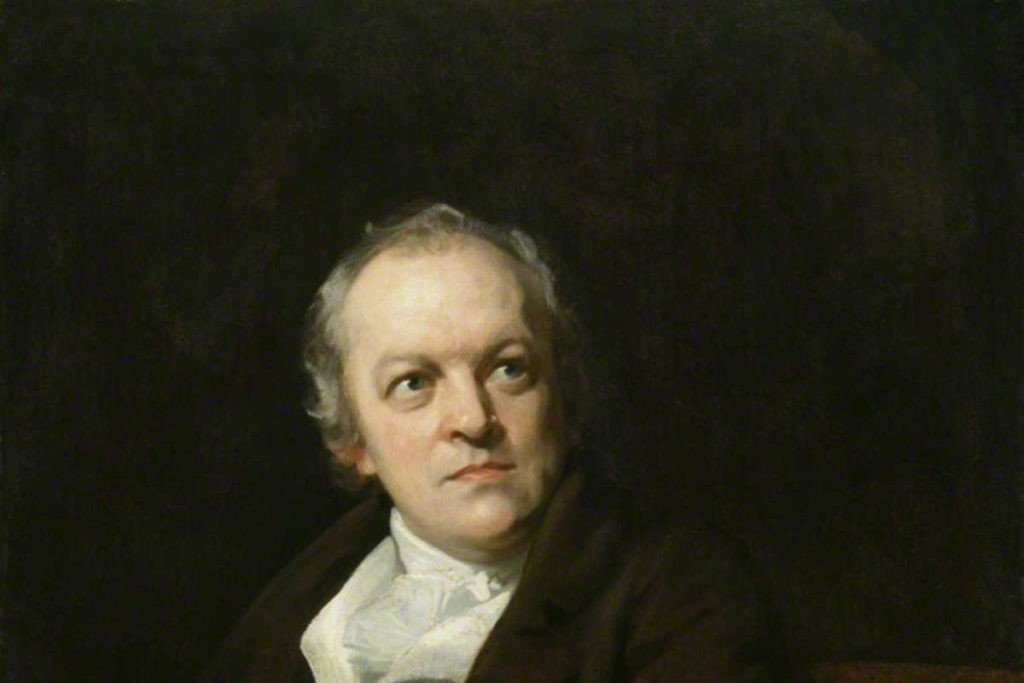
Many histories of English literature take the date of the publication of Wordsworth and Coleridge's joint collection of Lyrical Ballads in 1798 as the beginning of the romantic movement in England. However, it is indisputable that the wave of romanticism in England appeared much earlier, so it is almost impossible to determine the exact date, but it is certainly certain that some poets before Wordsworth and Coleridge showed clear tendencies of romanticism in their works; among them the most important is William Blake, a completely unusual and versatile person who left a deep mark not only in literature but also in painting.
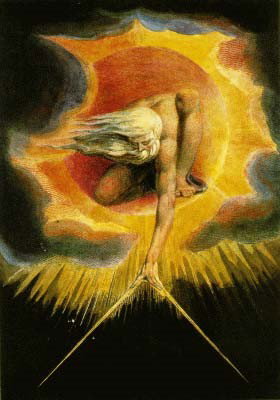
This great man of English poetry and painting comes from the family of a poor London craftsman, which is why his education suffered a lot - so self-taught, he chose his path and role models. He tried his hand at painting early on, for which he showed an exceptional gift, impressively absorbing various scenes around him, and he often saw objects around him that did not even exist. Such a ability, that is, a kind of vision, was interpreted by some critics as a tendency towards hallucinations, while others saw in it an exceptional and unrepeatable tendency towards the visual, and thus a special sensibility necessary for the fine arts. Namely, Blake started studying painting at the age of ten, and at the age of fourteen he became a student at a London engraving school, where he quickly distinguished himself as an exceptional talent. He will be engaged in engraving all his life, which will be his main source of income. In parallel, he created artistic images of incredible content and strong emotions, taking themes mostly from the Bible or Shakespeare's and Milton's literary works, which in themselves were constantly the subject of numerous controversies in artistic circles in London. He also wrote songs; the first only at the age of eleven, to take a critical attitude towards contemporary English poetry at the age of fourteen. Namely, in his first collection of Poetic Sketches (1783), he showed a clear and decisive deviation from the poetic models that were in vogue, and even then his incredible artistic imagination and a special experience of the world that definitely set him apart from of all the literary figures of that century. Blake's poetic talent served continuously for some thirty years in order to express himself most strongly, in addition to the above collection, in the next two - Songs of Innocence and Songs of Experience, both written between 1789 and 1794. Both collections undoubtedly illustrate Blake's deep, almost ecstatic and sensitive impressions from the outside world and his mystical understanding of the universe and man as an eternal fighter in search of truth. Such thoughts will culminate in later poems, and with their increasingly complex and obscure symbols in order to more faithfully represent Blake's personal spiritual experiences for the average reader, they will become almost completely incomprehensible; in that sense, it seems that in painting the author more consistently follows the path of the unusual, since his painting visions vary only in terms of representations of the mythological, religious, fantastic, and sometimes grotesque. He also felt great admiration for the achievements of the Middle Ages and came closer than any other romantic artist to the restoration of pre-Renaissance forms (it is interesting that he published books of his poems with engraved text and hand-painted illustrations, which many of his contemporaries saw as descendants of illuminated manuscripts. ). These elements are also found in his famous painting The Cause of Things - God (Figure 1), which is dominated by a muscular figure of the Mannerist style, which, radically shortened, is located in a circle of light almost in the center of the painting. This phenomenon of the circle, that is, a kind of point of universal beginning and end, was explained in the light of romanticism by the Belgian literary critic of the Geneva school Georges Pule (1902-1991) in his work Metamorphosis of the Circle: "Man, therefore, only repeats the process of divine and cosmic creation. In himself, from his concise version of his original condition, he contains in the germ of God and the world. To find man in that original point means to find, in condensed form, divine immensity and cosmic totality. As Paracelsus said, everything comes out of man and everything leads to man. According to Herder, he is: The central point of the circle, to which all rays seem to gravitate. " Also, the compass in the hands of the Lord originates from the medieval notions of God as the builder, that is, the architect of the Universe. Accordingly, it could be said that the artist has largely betrayed the expectations of the average observer, since the painting does not represent God as an almighty creator, but the figure personifies the power of reason which, according to Blake, has a destructive effect. He literally suffocates vision and inspiration and as such is the complete opposite of the so-called. an inner eye whose significance Blake only acknowledges. The complex phenomenon concerning his faith is most fully illustrated by probably the most intriguing, somewhat controversial topic, and according to some critics, the most ambitious poem The Everlasting Gospel (1818). Decades before the appearance of the German philosopher Friedrich Nietzsche, he presented the Antichrist as Jesus, rejecting the divine, and insisting entirely on the human, since the only thing that matters now is that man, and especially the artist by his gift, is a kind of architect. the whole world:
You are a man. God is no more;
*Learn to adore your humanity!*
This kind of call is not unusual and testifies to a lot of romantic criticism, not only the achievements of rationalism, but first of all the new position of the artist, which is a kind of alter deus. Namely, now he has the main place in creation, from where a new and ever-expanding world of imagination is created; the subject becomes fully aware of his creative possibilities for the first time. The artist is definitely no longer a craftsman, but a Creator who unreservedly projects his will as a kind of center and focus of imagination, while all external entities are passive in relation to him. We can read about that world in the author's response to a priest regarding the attack on his art, as well as sharp criticism of how the artist is overshadowed by superstition: "I feel that a person can be happy in this world. And I know that this world is a world of Imagination and Vision. I see everything I paint in this world, but not everyone sees the same. Through the eyes of a fortress, guinea is far more beautiful than the Sun, and a bag worn out from carrying money has better proportions than a vine full of grapes. The tree, which entices some with tears of joy, in the eyes of others is just a green thing standing in the way. Some see nature as ridicule and deformity, and I will not determine my proportions by them; and some barely see nature. But through the eyes of the Man of Imagination, nature is Imagination itself. He sees what a man is like. As eyes are formed, so are their powers. You are certainly wrong when you say that visions of imagination are not in this world. To me, this whole world is a constant vision of imagination or imagination, and it flatters me when it is said.
What is especially important to point out is the fact that William Blake, both in this work and in some later ones, even identifies Christ with art, that is, an artist who broke all laws and as such a new Christ establishes a new world of tangible creative imagination that erases all boundaries. between reality and fantasy.
By this procedure, the borders between heaven and hell are erased, leaving man in a misty interspace in front of which both the spaces of Eden and numerous hellish scenes exist at the same time. Blake illustrated the proximity of paradise, and the path of man not only as an individual but as the soul of all humanity, with a recognizable biblical narrative from the Book of Genesis. Namely, according to the Old Testament, Jacob fell asleep on his way from Beersheba and on that occasion had an incredible dream. "The ladders leaned on the ground, and the top touched the sky, and behold, the angels of God climbed and descended on them; And, behold, there stood a LORD under them, saying, I am the LORD God of Abraham thy father, and the God of Isaac. and to the east, to the north and to the south, and all the nations of the earth will be blessed in you and in your offspring. ”5) gradually transforming into a bright yellow. Its intensity is additionally highlighted by the element in the upper part of the painting from where it radiates; namely, the connection with the Sun as a celestial body realizes the complex symbolism of the entire work. The sun as light, heat, around the world, that is, the lord of the firmament; its numerous meanings can be found in mythology, but also in folklore and folk culture. Everything that exists merges into it, that is, it is the end point in the movement of not only man but also angels, and all of them are presented in a completely interesting way. The whitish, almost airy figures calmly walk in light clothes resembling ancient tunics, thus clearly alluding that it is a dream of the sleeping Jacob in the lower part of the picture. The dreamy atmosphere is largely complemented by soft, almost pastel colors, gentle transitions and strokes of the brush, and the absence of any dynamics.
Finally, that calmness and composure is expressed in Blake's verses, where he, as an incredible humanist, precisely sees social problems and in this connection wants and demands justice for all, as well as a paradise, bliss and peace for all afflicted souls, even for the little chimney sweep from the song of the same name.
After hard work and numerous beatings, the two poor boys wish for those steps that lead to the gardens of paradise:
*Then an angel came near the quiet boy*
*And with a shining key set them free;*
*And each ran down the green to*
*With a giggle to the river and the sun.*
*Bathed, white, without bags, all,*
*Naked boys sat on the cloud;*
*The angel said to Tom, "You don't have a father;*
*From now on, luckily you will be the father of God!*
Blake's unusual talent and originality set him apart from the established artistic trends of the time, and he was often left alone, left to personal unrest in a constant struggle with himself. These inner demons will undoubtedly find a central place in his paintings, almost in constant conflict with religious and moralistic themes. This moment is especially impressive in the moments when William Blake was commissioned to illustrate certain biblical books between 1805 and 1810, when the famous cycle of four watercolors of The Great Red Dragon was created as an illustration of the monster from Revelation. Namely, each image follows a part of the biblical story of St. John with its narrative, more precisely three chapters in which beasts, ie dragons, appear.
The first two watercolors (pictures 3 and 4) illustrate the chapter entitled Woman and Dragon: “And a great sign appeared in heaven: a woman clothed with the sun, - the moon under her feet, - with a wreath of twelve stars on her head. She was pregnant and was crying, because she was in pain and in pain. And there appeared another sign in heaven; and behold a great red dragon, having seven heads and ten horns, and seven crowns upon his heads. His tail drew a third of the stars of heaven and threw them to the ground. (Revelation 12: 3-4) The next picture (picture 5) entitled The Great Red Dragon and the Beast from the Sea refers to the chapter The Beast Coming Out of the Sea and the Monster is described in thus: “Then I saw a beast coming up out of the sea, having seven heads and ten horns, and on the horns ten crowns, and on their heads blasphemous names. The beast I saw was like a leopard, its legs like a bear, its jaws like the lions of a lion. The dragon gave her his power and his throne and great power. And I saw one of her heads as it were wounded to death: but her deadly wound was healed. And the whole earth marveled after the beast. And he worshiped the dragon, which gave power to the beast; and he worshiped the beast, saying, Who is like the beast? And who can fight it? And there was given unto her a mouth speaking great things, and blasphemies: and power was given unto her to continue forty and two months. And she opened her mouth, and blasphemed God, to blaspheme his name, and his tabernacle, and them that dwell in heaven. And she was allowed to make war with the saints, and to defeat them. And she was given authority over every tribe and people, language and tribe. And all the inhabitants of the land, whose names have not been written since the beginning of the world, and the book of the life of the lamb that would be slaughtered, will worship her. (Revelation 13: 2-9) Finally, the last in a series of watercolors about the Red Dragon, The Number of the Beast is 666 (The number of the Beast is 666), (Figure 6) presents a chapter called The Beast Rising from the Earth, which closes in a striking way the New Testament story of the beasts. precedes the heavenly struggle for supremacy over the world and the establishment of the New Heaven and the New Earth in the New Jerusalem: “Then I saw another beast come up out of the earth, having two horns like a lamb, and speaking like a dragon. She exercised all the power of the first beast before her; and he pretended that the earth and its inhabitants worshiped the first beast, which healed the mortal wound. She performed great miracles, even as fire descended from heaven to earth before men. She deceived the inhabitants of the land with signs, which she was given to do before the beasts, telling the inhabitants of the earth to make a sign of the beast that had a sword wound, but was alive. And it would be given to her to revive the image of the beast, to speak the image of the beast, and to make all those who do not worship the image of the beast kill. And he caused all, small and great, rich and poor, free and slaves, to be stamped on the right hand or forehead, and that no one could buy or sell except he who had the mark, the name of the beast, or the number of his name. There is wisdom. Whoever is reasonable, let him calculate the number of the beast, because that is the number of a man, and his number is six hundred and sixty-six. (Revelation 13: 11-18)
This cycle seems to represent the culmination of universal ideas and almost in the most complete way presents all those multiplicities, contradictions, but also the emotions and ideas of the English romantic William Blake. The dark scenes of visionary ecstasy as an expression of personal demons imbued with a pure, phantasmagoric representation of freedom and light, and a universal path that indisputably leads to bliss, represent the author's path to truth and self-knowledge. It is possible only in dynamics and movement, strong muscular figures of incredible creatures, and a soft and limited palette of colors, which deepens the overall idea.
But Blake's inspiration for biblical texts in a very specific way will not be approved by his contemporaries; the artist will die in poverty and is virtually unknown in 1827. His entire poetic and pictorial language is too different and too closed in his own fantasy, which is probably why he suffered and waited too long to be rediscovered and truly understood. However, it is an indisputable fact that Blake's completely different form of cognition as a kind of feature of his overall artistic poetics brings an unusual emotion and specific vitality whose strength keeps us from imaginary opinions and views of things, allowing us to enter, just like him into a higher reality and penetrate into the new forms and essences of existence. They are the embodiment of new visions; the divine embrace of the imagination as the only Eternal that remains to Man.
"Sickness, madness and death were three angels" by the desperate artist Edvard Munch
"Sickness, madness, and death were the three angels who dwelt in my cradle and have followed me all my life ever since": Edvard Munch, desperate artist.
Tormented by depression and alcoholism, Edward Munch chose the darkest paths of life to make them the center of his art and to paint the hidden and painful sides of the human soul.
The Norwegian painter, according to some a predecessor of expressionism, according to some a typical representative of that painting direction, Edvard Munch, was born on December 12, 1863 in Loten, Norway. As a painter, he was quickly recognized as an innovator in Germany and Central Europe. His later works attracted the most attention and inspired many artists.
Many stereotypes arose around Munch, and although most are true, what really defined the greatness of his work was the courage in overcoming his own fears and in bequeathing art history with a huge and priceless work. At the end of his life, the Norwegian artist wrote: "In my art, I tried to explain life and its meaning, I also tried to help others understand my own life."
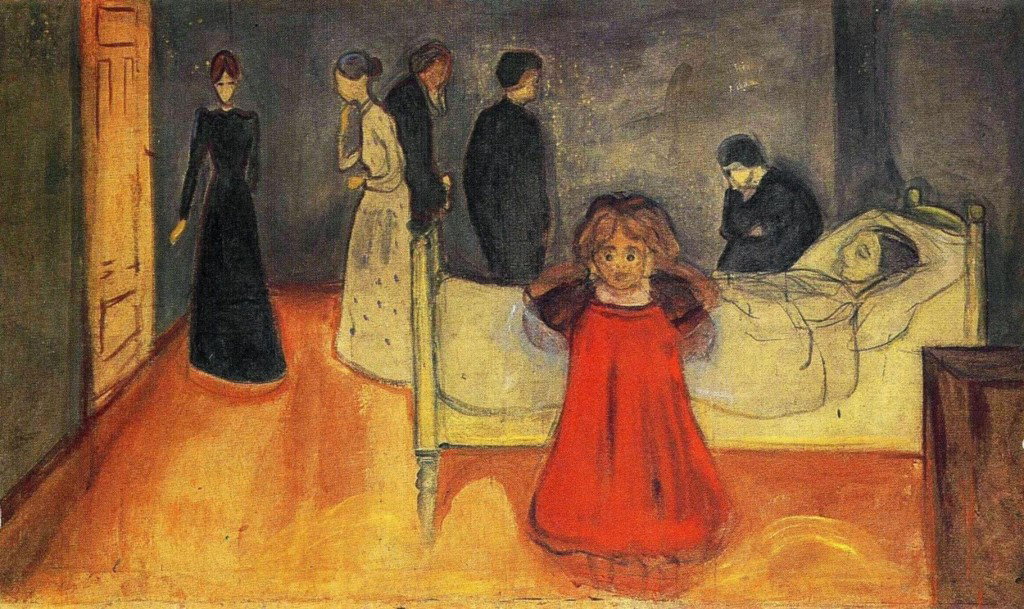
Munch's childhood was marked by two premature deaths: the death of his mother and sister Joanna Sofia. These sad events defined his work and turned it into an expression of pain and experience of death, loneliness, anxiety and, inevitably, old age, topics that will be repeated in his work. Paintings such as "Sick Girl", "Death in the Room" and "Dead Mother with a Girl" are obsessive repetitions that show the strong impact that the loss of mother and sister had on the artist.
During his stay in Paris in 1885, Munch came into contact with the most advanced painting movements of the time, led by artists such as Paul Gauguin and Toulouse Lautrec. The knowledge of other artists forced Munch not only to imagine art in a different way, but he also began to define the characteristics that will mark his future work: schematic expressions and the symbolic use of colors. But on the other hand, the bohemian life of Paris led Munch into alcoholism and neurosis because of his love affair with Emily Tauilov.
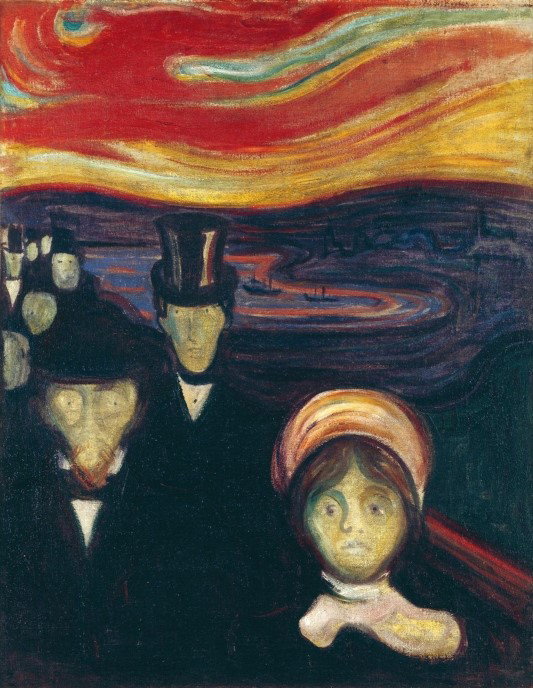
Munch moved to Berlin in 1892, and in the fall of 1893 he painted what may have become his most famous work, The Scream, whose main character was inspired by a Peruvian mummy the artist once saw in Paris; Munch made four versions of "Scream": an original from 1893, exhibited at the National Gallery in Oslo; another version at the Munta Museum in Oslo that was stolen in 2004 and restored in 2006; the third belongs to the same institution, and the fourth is in a private collection.
According to Giulia Bartrum, the restorer of the British Museum, the painting clearly shows that the protagonist of the work is a person who hears a scream, and not a person who screams. The painting reflects the painter's feelings when he saw nature red from the fire on the shores of the Norwegian fjord.
Munch's more than likely bipolarity - which led him to a psychiatric hospital - an excessive passion for women, stormy relationships and an obsessive-psychotic desire for a self-portrait forced many authors to compare him to Van Gogh. The approximately fifty self-portraits he painted during his lifetime seem to highlight the need to have proof of his own existence that constantly sees his image captured on canvas or in a photograph.
He also felt that women were distracting him from the mission he had to perform as an artist. But wealthy heiress Tula Larsen became obsessed with the Norwegian artist for not caring about being a chronic alcoholic, depressed or bankrupt; Tula wanted to marry him and even offered to help him financially. At first, Munch allowed himself to be loved, but little by little, he distanced himself from her and her presence so obsessed him that he voluntarily went to the sanatorium to get rid of her.
The tumultuous relationship ended first with marriage and then with divorce.
Munch continued to paint and returned to Norway in 1909, where the industrialist Meyer bought part of his paintings. Under Nazi rule in Germany, Munch's works were removed from the museum because they were considered "degenerate". With the Nazi invasion of Norway, things got worse, because all his works were removed from the museum. Munch did not want to have any relations with the Nazis.
Munch's health was always fragile and, as the artist himself recounted, "when I was born, they hurried to baptize me, because they believed that I would die." The creator of great works, an artist who marked the 20th century, died of pneumonia, in silence and solitude, on January 23, 1944, at the age of 80.
"Sickness, madness and death were the three angels who resided in my cradle and have followed me all my life ever since," he wrote.
Interesting facts you may not have known about the cult film "The Wizard of Oz"
On the 80th anniversary of the premiere of this achievement, we bring you seven interesting things you may not have known about The Wizard of Oz.
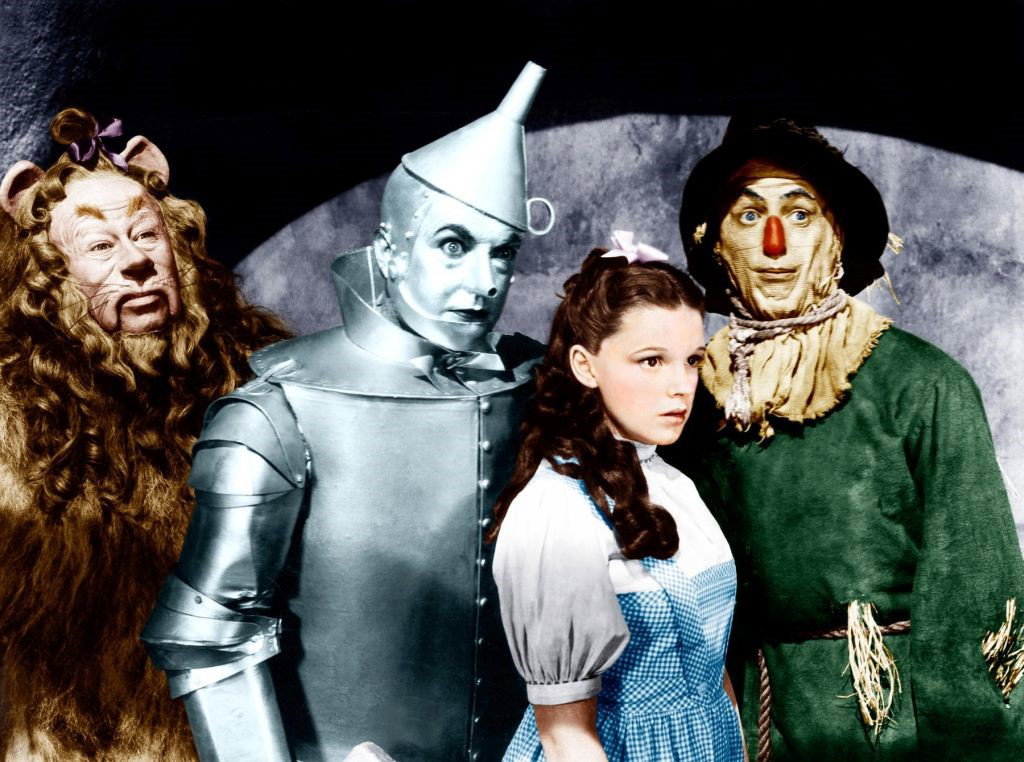
Eight decades ago, one of the most famous and influential films of all time was premiered - "The Wizard of Oz" - starring Judy Garland, the song "Above the Rainbow", the characters Scarecrow, Can and The Scary Lion, as well as the sentence "Toto, we're not in Kansas "gave a permanent place in the history of popular culture of the 20th century.
Eight decades ago, one of the most famous and influential films of all time was premiered - "The Wizard of Oz" - starring Judy Garland, the song "Above the Rainbow", the characters Scarecrow, Can and The Scary Lion, as well as the sentence "Toto, we're not in Kansas "gave a permanent place in the history of popular culture of the 20th century.
Namely, "The Wizard of Oz", based on the novel of the same name by Frank Baum, won two Oscars (he was nominated for six), and last year it was declared the most influential and most watched film in the world.
Here are just a few interesting things you may not have known about the cult film:
**THE SONG "ABOVE THE RAINBOW" SHOULD NOT HAVE BEEN IN THE MOVIE.**
When composer Harold Arlen presented the famous song "Above the Rainbow", the producers thought that the song was too "symphonic" and that it would not be easy to perform. In addition, director Victor Fleming wanted to throw it out, considering it too long and complicated. However, the song entered the final version of the film, but the troubles did not stop there. Critics rated the song as long and unnecessary, but the song "Behind the Rainbow" won the Oscar for best original song.
**THE GREEN PAINT USED FOR MARGARET HAMILTON'S COSTUME WAS SO POISONOUS THAT AFTER THE END OF THE FILM, THE ACTRESS HAD TO GO ON A STRICT DIET.**
Jack Young, one of the make-up artists who worked on the film, discovered that the green paint, used to cover the body and face of actress Margaret Hamilton, was very toxic because it contained copper. "Every night when we took off her costume, her face had to be cleansed flawlessly.
Apparently, the color remained on her face for some time after the end of filming, so the actress had to be on a special diet.
**DIRECTOR VICTOR FLEMING SLAPPED JUDGE GARLAN BECAUSE SHE COULDN’T STOP GIGGING.**
In the book "Victor Fleming: The American Master of Film", film critic Michael Sragow described this incident.
When Judy Garland couldn't stop laughing on the set, Fleming took her outside and said, "Darling, this is serious," and slapped her, then added, "Now come back to do the job."
Allegedly, Fleming felt bad that he slapped the actress, so he asked someone else to slap him. Garland heard this and said, "I'm not going to do that, but I'm going to kiss your nose."
**THE SCARY LION COSTUME WAS MADE OF REAL LION FUR.**
In an effort to make the Wizard of Oz look as authentic as possible, the Cowardly Lion costume, worn by Bert Lahr, is made of real lion fur. There were several specimens of costumes, which means that more lions lost their lives due to the media company Metro Goldwyn Meyer.
The costume was lost until 1970, when he found a drug dealer and later sold it at an auction in New York for 3 million dollars.
**SEVERAL (SERIOUS) INJURIES HAPPENED DURING THE RECORDING.**
Margaret Hamilton, who played the character of the Evil Witch from the West, suffered burns on her face and hands.
Ray Bolger, the actor who played the character of the Scarecrow, got permanent indentations on his face from a rubber mask that was glued to his face every morning.
Buddy Ibsen, the actor who was originally chosen to play the character of Tin, gave up the role because of the costume that contained aluminum dust, which caused complications in his lungs.

Scientists have made a robot insect that flies alone
Some people like tropical heat, and some people don't know how to cool down. With them come various insects that can spoil summer pleasures. The number of such flying creatures could increase in the future, because scientists have decided to make robotic insects
The first insect robot to fly without wires is already a reality. It weighs 190 milligrams, slightly less than a toothbrush, and was created by a team of experts and students from the Mechanical Engineering University of Washington, USA. RoboFly, the name given to it by the creators, is not the first robot in the form of an insect. In 2015, Harvard University introduced RoboBee, a small 3 cm robot that could move through air and water. However, Robofly should be more advanced than its predecessor, since it is able to fly without the need to be tied to a wire that provides it with electricity.
Sawyer Fuller, co-author of the study and a professor in the Department of Mechanical Engineering at the University of Washington, confirms at the University's news forum that the concept of flying wireless robots the size of an insect was science fiction. But Robofly now shows that they are much closer to today. Fuller was also part of the team at Harvard developed by Roboby.
The team of engineers explained in their study that the real turning point of this invention is that they achieved the first wireless take-off of a robotic insect. Until then, they had to face several problems: the engines and the necessary propellers for flying do not work well in such small sizes, the smaller batteries that exist for performing wireless flights are too heavy for a single robotic insect. In addition, making electric circuits and motors light enough for a robot to fly is complex.
The solution was to create your own "feeding" system. Robofly can fly without wires and batteries thanks to one small laser beam and a flexible circuit which, with the help of a photovoltaic cell installed on the robot, converts the laser into electricity. It also has a microcontroller that strikes its wings. According to Johannes James, the main author of the study. the microcontroller works like a robot brain and is as heavy as a grain of sand. The author also expressed a desire to develop bee-sized robots, because more robots that are cheaper can be more useful than just one expensive robot.
Although the creators have launched their patent, the research is still ongoing, because if these robots still have to be connected by wires, then they will not be able to be used outside the laboratory. Robofly is still not completely independent and, according to the researchers, that is the biggest challenge they face - achieving complete wirelessness and self-control. The future of robots is still in the laboratory. We need to work harder to improve them, says James.
https://youtu.be/mzBVp7QMS14
According to the team from the University of Washington, the creation of this robot opens new possibilities for air micro-vehicles. One day, many Roboflies will be able to help monitor crops and sources of pollution, detect leaks in pipes and refineries, as well as help with search and rescue. According to Johannes James, if they made many robots like this, they could monitor many areas at the same time, and so many problems would be solved. The author even states that they could be of great use for space exploration.
Reasons to get CCTV cameras
If the first association with video surveillance cameras is funny video clips of accidentally recorded adventures, then you probably haven't even thought about the fact that security cameras have their purpose - the safety of family or employees, as well as personal property, private or business.
Go through the list of reasons why you may need video surveillance with us, and it is very likely that you will find at least one of those reasons that could make you consider buying video surveillance equipment.
You may still think that video surveillance is reserved only for the richest layer of society or for large companies, but it is not so. Today, security cameras are cheaper than ever, and for that good price you get top quality footage and the ability to easily control the video surveillance system remotely, wherever you are.
**Private reasons for procuring video surveillance**
It has probably happened to you once before that you are not sure if you left the front door of your home unlocked when you went outside. Or maybe you forgot to close the windows? If you are going somewhere, on vacation, or on a business trip, it is certain that you want to be calm and convinced that your house is safe. Sometimes a dangerous dog in the yard is not enough. Even if you wave your hand because you have insurance, keep in mind that with video surveillance you can avoid more damage.
Today, it is possible to connect to your video surveillance system from any part of the world, with the help of the Internet, and follow what is happening in your home. That way, you can notice all suspicious activities in time and report them to the police. Or if you think the police are reacting too hastily and hastily, you can definitely tell a neighbor to close a forgotten, wide-open window.
**Video surveillance as a top solution in case of burglary**
If there is a burglary, which is more, unfortunately, that is not strange today, then it will certainly be useful for you to inform the police as soon as possible. Fresh evidence is the best evidence and there is a greater chance that the perpetrator will be caught. You can also alert a relative or friend to remove valuables that have remained intact or to make your home safe in another way - by replacing a lock or a broken window.
When it comes to a crime, you will be secured with a video. It can be located on the memory card of the camera itself or it can be in the form of a recording on a computer or DVR device. In addition to helping the police find the perpetrator, this video will be important when it comes to insurance, but also as crucial evidence in court proceedings.
**Child surveillance cameras**
If you have small children and you work, there may be a need to hire a babysitter. Even if you rent it on a recommendation, you will probably be restless at first because you have entrusted your child to a stranger. Video surveillance cameras can help you with that. The very fact that the babysitter knows that you can watch her at any time of the day will force her to be more responsible. However, be careful, do not turn into an obsessive person who controls and comments on every movement. It is important to you that everything is fine with the child, and that the babysitter treats your home with respect. If you measure her every break and measure her every action, be sure, you will soon be left without her help!
You may not need a babysitter because of the age of your children, but you would still like to know how your children are and what they do while you are on a business trip. Video surveillance is a recommended option, especially if you have reason not to trust your children and their answers when you call them on the phone.
In addition, a security camera can be very useful if you have an elderly, sick person in the house, who cannot perform all daily activities without someone's help, so in that case audio feedback is not enough. Finally, you can also use security cameras to monitor your pets.
**Video surveillance in the service of your business**
When it comes to business-oriented video surveillance, then it is best to install both types of security cameras, indoor and outdoor cameras.
**Outdoor cameras**
Experts advise that outdoor cameras be as conspicuous as possible, because in that case, a criminal, thief or burglar is less likely to decide to rob your bar or office. In addition to potential thieves, outdoor CCTV cameras can detect any suspicious activity around your business premises and allow you to be alerted in a timely manner and alert if necessary.
**Indoor cameras**
Indoor video surveillance cameras are also there for several reasons. The most obvious is to prevent theft. If you are in the trade, and you do not have the space or means to cover every corner of your shop, focus the cameras on the part with the sale, the part with the cash register and the part with the most valuable things.
In addition to monitoring illegal activities, internal video surveillance can also serve as a kind of control of employees. It is very likely that employees will behave more conscientiously if they know that you can catch them lying. You can also monitor the implementation of new procedures and rules and make sure that the business environment is safe.
Also, state-of-the-art video surveillance systems have a number of advanced options, such as video analytics that can help you analyze customer behavior in your retail outlets, giving you information relevant to improving your consumers' user experience.
In accordance with the desired or necessary type of security cameras, you can choose only one camera or the entire video surveillance system, as well as the recording quality itself, more precisely, the resolution. You can also choose between black and white or color camera. It is recommended that you choose a camera that you can easily control via the commands you give via the application on your smartphone.
Whether you want instant, real-time video surveillance or your goal is to own footage in the event of an illegal activity, video surveillance is the right choice for anyone looking to improve security in their business and private facilities. In addition to the obvious security benefits, video surveillance will provide you with a calmer absence from home or work, and, of course, a more peaceful sleep.
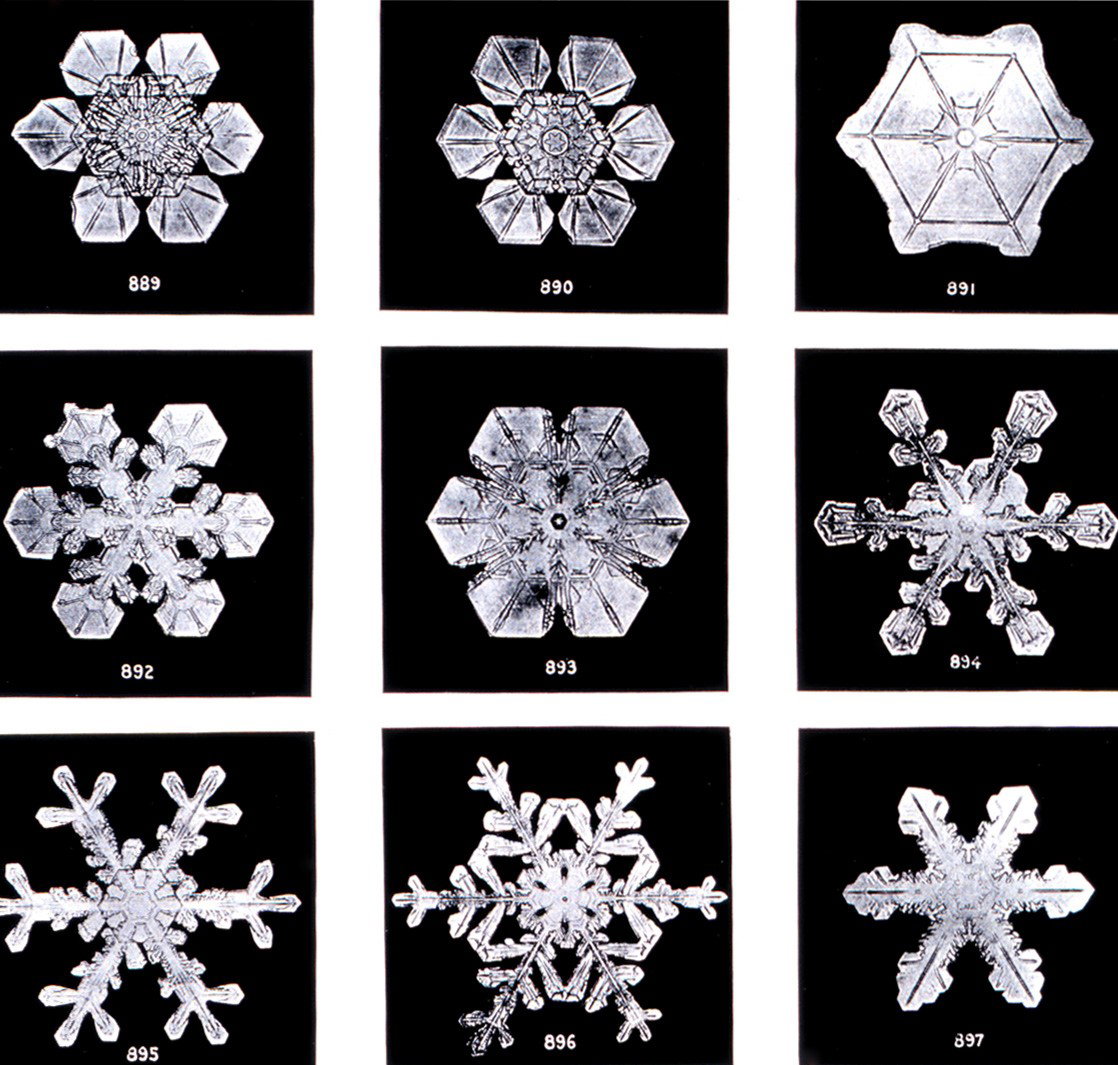
Snowflake
Wilson Bentley's enthusiasm for snowflakes has existed since he was a child. He called them "little wonders of beauty" and "ice flowers", and at the age of 15, looking through a microscope given to him by his mother, he tried to draw their enchanting structures. Five years later, one of the snowflakes that formed on January 15, 1885, in the sky above his hometown of Jericho, Vermont, he greeted on a comfortable black velvet and placed under a microscope that was mounted next to a large camera. This is how the first known photograph of a snowflake was created. As Bentley did not marry or leave his hometown, it can be said that he dedicated his life to snowflakes leaving behind more than 5,000 photos of them. Noticing that all those photos of snowflakes were different, he allowed us to exploit his discovery as one of the most famous metaphors. It's a metaphor that compares snowflakes to people in terms of variety, asking us to look at each other a little more patiently.
The construction of metaphors around natural phenomena such as the behavior of water is no less interesting and diverse than the diversity of snowflakes. For example, writing about a paper published in the journal Nature in 1988 by immunologist Jacques Benveniste, journalists coined the term "water memory" in an attempt to explain his thesis as briefly as possible. Benveniste's work contained unusual results of experiments according to which water retains the properties of antibodies with which it was in contact even when they are absolutely no longer in it. However, when Nature's editor John Maddox, chemist Walter Stewart and James Randy wanted to check his results as a well-known fighter against charlatanism and pseudoscience, the situation became complicated. Repeating the procedure under controlled conditions of a double-blind experiment in which Benveniste could not know which water contained antibodies, the results were completely absent. It was clear that Benveniste had deceived the scientific community, but his likeable idea continued to attract an audience, so at one point he received the support of even two Nobel laureates. He refused to admit fraud, and in 1990 he went a step further, claiming that he had found a way to turn water memory into an electrical signal that could be sent over a telephone line and thus make healing water at the other end of a telephone connection. Although James Randy was willing to pay $ 1,000,000 if Benveniste could confirm his results under controlled conditions, he never opted for such a check.
Masaru Emoto made Benveniste's idea even more picturesque and romantic, claiming that "water contains a blueprint for our reality." Since 1990, Masaru has delighted the public with alleged evidence that very vividly showed that water crystallizes into harmonious or inconsistent crystals, depending on whether it is sung or shouted at during the process. Of course, the offer he received from Randy, to repeat his results with a million compensation, he resolutely refused. Not only did he refuse offers to test his experiments, but he also rejected any serious argument with jokes and word games that aroused sympathy in his loyal audience. When asked, for example, why they refused to repeat the procedure under the conditions of a double-blind experiment, he replied that we were created with two eyes to see, not to be blind.
When science points out omissions in such romantic malversations, it is usually greeted with disapproval by the followers of such ideas as someone who is trying to tear down their castle in the sand. Although tearing down a castle in the sand can seem cruel, it is there to protect us from deception, and in addition, science in the process always offers us its own version of the story, which is inevitably even more magical. True, her story is sometimes harder to follow, because it requires us to get acquainted with physics, chemistry, mathematics, but the effort we put in is always rewarded many times over. The shape of water molecules and the hydrogen bonds that are formed between the molecules are just the beginning of the story about the unusual properties of water, and they are also the beginning during the formation of every snowflake, which is always hexagonal precisely because of those properties. From that basis, the stories about the specific thermal capacitance of water are further branched, due to which the temperature of the lake changes minimally during the year, enabling the survival of life in them. It is at the expense of the energy needed to break the hydrogen bonds during the evaporation of water that our body cools down by sweating. Hydrogen bonds contribute to the cohesion of polar water molecules crucial for the transpiration process in plants. The fact that due to hydrogen bonds, water expands during freezing and remains on the surface as an insulator, preventing further freezing, leaves us with the question of whether life on earth would be possible without this seemingly insignificant feature. At the same time, this series did not even scratch the layer of miraculous stories about how science sees water, which are becoming even richer every day. The greatest wealth of these stories is precisely in those places where science admits that there are still no answers and where, wondering how exactly the snowflakes crystallize, they send us an invitation to join the adventure of writing another story.
Time of Fear: A Brief History of Hell
"Hellfire is awful, huge and, moreover, it is prudent," writes the French historian Jean Delumeau in the book Sin and Fear, which deals with creating a sense of guilt in the West from the 14th to the 18th century.
If we ask the question of how hell was imagined in the past, we find the most vivid descriptions at that time, in the late Middle Ages. Namely, the representations of hell then play an important role both in the intimate life of the individual and in the wider social context.
Many modern historians characterize this age, which precedes religious wars and hints of gradual changes in Europe, as an age of fear. Sin is certainly as widespread as in any age of human history and therefore, in the absence of accessible education, the fear of hellish torments is the most powerful weapon for social control.
"Fire will be your element, it will feed you, it will sustain you forever to torment you forever," said the French preacher Gerard, in order to, like many Christian orators in the late Middle Ages, vividly describe what awaits the souls of the damned in the fires of hell.
In the ancient tradition that preceded the idea of Christian hell, this space was conceived as cold and dark, but even with Christian thinkers, from Tertullian and St. Augustine to Jesuit scholastics, the image of hell is far more complex than the image of a glowing pot in which the souls of the accursed are simmering forever .
According to the scholastic division into eighteen accompanying torments of the damned, the punishment by cold, rigor frigoris, is in the seventh place between "fire that does not destroy" and "hunger that rages".
Unlike previous epochs, such paintings are not confined to monastic cryptocurrencies and do not concern only a select group of educated people. They inspire the performances on the frescoes and make the content of the sermons of wandering preachers frightening.
Like many such preachers in the 16th and 17th centuries, the wandering Italian Jesuit Paolo Segneri, one of the most inspired orators on hell, gave his frightening sermons at dusk, in a meadow on the outskirts of the settlement.
When his horrified audience came to a state of complete intimidation, Senjeri led him to the waist and with a whip "all those who are sinners" to the church where, in semi-darkness, mass self-punishment and repentance were carried out by candlelight.
Singer is said to have said: "You will feel the embers of the embers, the cold of the glacier, the bite of the snake, the bile of the dragon, the teeth of the lion, the intensity of the torture, the tearing of the nerves, the dislocation of the bones, the hail of stones, the rain of whips, the neck iron chains, the chains on your hands. Iron reefs, gallows, wheels and horses, tortured, it will all come together and come together. "
Today, one can only imagine how while this is being uttered, Senjeri's eerie voice echoes between the walls painted with representations of hell and the dance of the dead. The picture shows a detail of the composition The Triumph of Death by Peter Brueghel from the 16th century.

How long do we sweeten and chill with ice cream? The story of one of the favorite treats
How it became a favorite dessert that has been cooling and sweetening people for centuries.
The tradition of enjoying cold desserts is thousands of years old. Ice desserts were enjoyed all over the ancient world, from China to Mesopotamia.
About 4,000 years ago, the Chinese enjoyed some kind of frozen syrup. Centuries later, around 400 BC, sherbe was drunk in the Persian Empire. This drink, which was served cold, had cherry, quince or pomegranate syrup as its main ingredient, and was cooled with snow. "Sherbet", "sorbet" or "syrup" are recipes, but also words that originated from that ancient drink.
Historical reports say that Alexander the Great, who conquered the Persian Empire in 330 BC, also enjoyed cold drinks sweetened with honey. The Greeks, and later the Romans, also adopted the custom of cooling drinks. In the early years of the Roman Empire, the banquets of Emperor Nero were known for fruit juices that were sweetened with honey and cooled with snow. Centuries later, during the 1920s, Marco Polo returned from China with a recipe for "flavored ice," and some recipes included milk.
**IMPORTANT INGREDIENTS**
These treats, which were the forerunners of ice cream, could only be made if you were able to get snow or ice brought from cold mountainous areas or from frozen lakes and rivers. Residents living on the mountain would collect ice and pack it by covering it or covering it with straw and branches, to reduce melting, and then transport it across the mountain to urban areas.
In the mountains, snow and ice were placed in "ice houses", and different civilizations made different variations of those houses. These were mostly chambers without heat and light, and deep pits were often used, which were covered with straw or sawdust.
The procurement of ice was complex, which made it a very valuable commodity in the old world. In the Middle Ages, snow was still brought from the mountains throughout Europe. By the 17th century, many estates had private ice chambers, and from the 18th century large ice houses began to be built in the cities, and merchants sold large blocks of ice door to door. In some cities, the ice trade was regulated by the authorities, who set the price and then the penalties for illegal sales. In 1807, there were 43 "ice sellers" in Naples, who, as required by the rules, sold ice only during the summer.
The exact time of including milk in frozen desserts is difficult to determine. Some historians believe that this practice first developed in Asia, and that it was brought to Europe by Marco Polo, while other historians say that it is a myth.
To include milk and sour cream in the frozen dessert, the cooks used an endothermic procedure. They would put the ingredients in a metal container, which would then be placed in a larger bucket filled with ice and salt. It would lower the melting point of the ice, which would "pull" the heat from the creamy mixture, which would then solidify.
The first evidence of the use of this technique in Europe comes from a treatise published in 1550 by Blas de Vilafranca, a Spanish physician residing in Rome. The technique spread throughout Italy, and in 1558 the Neapolitan Giambattista della Porta described it in his work Magia naturalis: "Since the first thing people want to do at parties is drink wine as cold as ice, especially in summer, I will learn You can just cool it, even freeze it, and then sip it so coldly. it will gradually freeze. " His recipe for frozen wine also presents a way to make sorbet.
Sorbet became more popular in Naples than anywhere else in Europe, and in 1690 the first book on sorbet (by an anonymous author) was published, entitled "New and fast ways to easily make all kinds of sorbet". Judging by the ingredients used, these recipes were made in an aristocratic household. Then came the "Modern Steward" (1692-94) of Antonio Latini, who worked for the Spanish viceroy in Naples, and his book also contained a section on household management that included a section on cooking.
It is believed that the first European ice creams were made in Italy, and the recipes spread to France during the 17th century, and then to England, where they were really "received". In support of this is a detailed display of ice cream in a work of art among the many complex dishes that were served in Windsor in May 1671 on the feast of St. George. In that period, in the 1970s, the term "ice cream" first appeared.
**Craze for ice cream**
Making ice cream, unlike sorbet, was very hard. The ice had to be crushed by hand and sprinkled with salt, in order to fill a large "tub", in which another bowl with sour cream, milk, sugar and aromas would be placed. The contents are then mixed by hand for several hours, until ice cream is formed.
Ice cream would often be poured into imaginatively designed molds in the shape of fruits and flowers. Due to the cost of making and serving ice cream, the dessert remained inaccessible to most Europeans and was mostly enjoyed by members of high society.
Sorbet became popular in major European cities during the 18th century. Due to the middle class, which was more and more, frozen sweets became part of the offer in local stores. In addition to sorbet, there were granite (semi-frozen fruit and ice products) and sorbet with cream (the forerunner of gelatin and today's ice cream).
Royal porcelain factories, such as Sèvres near Paris, produced ice cream cups and plates for shops and houses as more modest families began to enjoy sorbet.
The earliest book of recipes entirely dedicated to making ice cream was L'Art de bien faire les glaces d'office, published in France in 1768.
Although the craze for ice cream soon spread to the North American colonies, in the 18th century it was still a luxury for them. Data from a New York merchant shows that President George Washington spent about $ 200 on ice cream in the summer of 1790 - thousands of dollars today.
In the United States, ice cream also became available to ordinary people in 1843 when New Yorker Nancy M. Johnson patented an ice cream machine that drastically shortened production time.
American companies improved the design of this machine, and in 1851, a milkman from Baltimore, Jacob Fusel, opened the first ice cream factory.
After the Civil War, the popularity of ice cream escalated across the United States.
*A group of children ate ice cream on a London street in 1967.*
Ice cream shops and taverns have appeared all over the world and made all people enjoy this cold treat that was once reserved only for rulers.
6 terrifying mythological creatures from all over the world
I present to you the 6 scariest mythological creatures, and once you discover their main features and "powers", you will be glad that they do not exist.
**1. SLOVENIAN LEGEND OF IMMORTALITY - KOSCHEI**
Koschei is a part of Slavic mythology and represents a typical sadistic villain who kidnaps women by turning into a dizzying tornado and causing them to fall in love with him. He is known for the possibility of turning into a young man who seduces girls, and he is described as a tall and superhuman thin man of excellent health who rides naked in the mountains of Russia on his enchanted horse. However, in books and caricatures, he is presented as an extremely old and ugly man.
Although it is said to be immortal, it is not. It is true that he cannot be killed with a conventional weapon by aiming at his body, but he can certainly die when you kill his soul. It sounds simple, but his soul (or death) is hidden in a needle that is inside the egg that is in the duck, and the duck in the rabbit, the rabbit in the box, and the box buried under the tree. More precisely, the box was buried under an oak tree on the mysterious island of Bryan, in an unknown location. So, practically, if there is immortality, then Koshei is very close to the being that possesses him.
**2. THE CURSE OF THE GREEDY - THE SPIRIT OF JIKININKA FROM JAPAN**
People outside of Japan have probably not heard of the nightmare known as Jikininki. If you are a little greedy, you should be afraid of perhaps the scariest mythological creature in the world. Jikininki is a spirit that was once cursed precisely because of greed, and now he feeds on human corpses. During the day, Jikininki looks like a completely normal human being, and in the evening he turns into a monster who starts searching for corpses.
**3. STRIGOI - ROMANIAN VAMPIRES**
In Romanian mythology, Strigoi are problematic spirits of the dead coming out of graves. Some of them can be living people with certain magical properties. In addition to having the ability to transform into any animal on earth or become invisible, they are also given the ability to kill the victim by sucking her blood, which is why they are also called vampires. These monsters usually have red hair, blue eyes and two hearts.
**4. BODIES, THE SPIRIT OF SLOVENIAN FORESTS IN EASTERN EUROPE**
Have you ever gotten lost in the woods? According to Slavic mythology, the next time this happens to you, you should turn your clothes upside down and replace your left shoe with your right. That will be the only way to escape Lesia, a muscular human-like monster that devours people and scares travelers and hunters. The corpse does not have its own shadow and has the ability to change height or weight. It can be transformed into a creature that is as low as grass or as tall as the tallest tree in the forest. Also, The corpse changes its voice and imitates the voice of people close to those lost in the forest, and in that way he leads them into caves, captures them and ... tickles them to death.
**5. CAVE WITCH, BLACK ANISE FROM GREAT BRITAIN**
The witch with blue skin and long nails who lives in the cave is related to English mythology and in those areas is the equivalent of Babaroga. A woman with crumpled skin, extremely sharp teeth and long claws hides in the hollows of the oaks and finds special pleasure in catching children whose skin she peels and puts on the walls of the cave as a trophy.
**6. HOMES FROM RUSSIA**
According to Russian mythology, every house has one Domovoi hidden in a basement, pantry or attic. In his true form, he is a small, bearded man with pronounced hairiness all over his body and disproportionately large feet. Domovoi has the ability to transform into a human being, a cat or a dog. Domovoi wants the home to be clean, and since Russian families consider him a caretaker and someone who is a friend of the home, you can often see bowls full of milk, porridge, tobacco, salt or bread left for Domovia. For the Russians, Domovoi is also a prophecy because his behavior can predict the future. If he laughs, tells jokes or plays, good times can be expected, if he plays with a comb, a wedding is expected at home, but if he howls at night, extinguishes your candles or sees him in the glare of his dishes, he will die which is by no means a good sign for house.

Legend of the Chinese Warrior: Who was Mulan?
Did the famous Chinese warrior really exist?
The cute and brave Disney heroine has inspired girls around the world since 1998, when the animated film about Mulan was first released. Although, of course, romanced and adapted to children (although adults also like to watch it), the story of Mulan is not completely made up.
For the Disney company, the ancient Chinese song "Ballad of Mulan" served as the inspiration for the cartoon about the young warrior. Although the ballad is not a guarantee that this warrior really existed, millions of Chinese from generation to generation pass on the story of her, making her as real as possible.
According to the legend, her real name was Hua Mulan, and in some versions of the story there is a different surname: Wei or Zhu. In Chinese, Mulan means magnolia. She lived between the 4th and 6th centuries, during the rule of the Southern and Northern dynasties
When China was attacked by the Mongols, and men were called to war, just like in the cartoon - her family did not have a male heir to join the army. Hua Mulan was 18 when she joined the troops instead of her father.
Legend has it that Mulan was very skilled with a sword, and generally skilled with weapons. She also possessed exceptional martial arts which she is believed to have acquired as a girl.
Hua Mulan spent twelve years in the war, during which she was decorated as many as 12 times. She also progressed in the military hierarchy, so she reached very high ranks. According to legend, after twelve years she confessed to her comrades that she was a woman, and returned home.
The "Ballad of Mulan" from the 6th century ends here, but there is another source in which this warrior is mentioned again. One book, published during the Ming Dynasty (between the 14th and 17th centuries), spreads the story of Mulan and reveals the end. According to this novel, upon returning home, Mulan realized that her father had passed away and that her mother had remarried. The misfortunes of this girl are not over here, because this book says that she was invited to be a concubine with the ruler of the region in which she lived, Heshen Khan. In order to escape this fate, Mulan committed suicide.
Although the poem from the 6th century really exists, no historical source has confirmed that Mulan really existed, or was just the fruit of the poet's imagination.

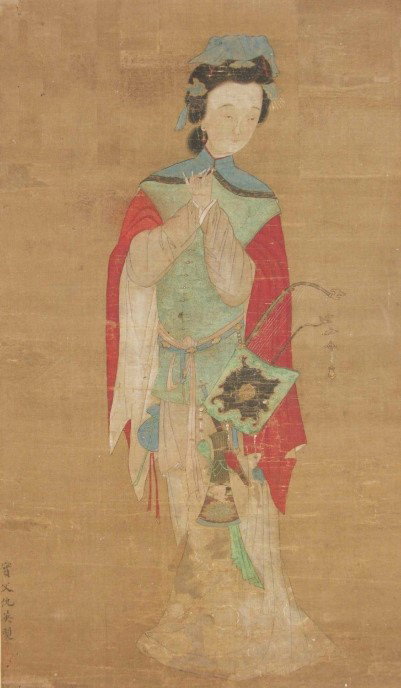
5 things you might not know about Vincent Van Gogh
Discover interesting facts from the life of the famous painter, what he did before painting, in what unusual place he gave birth to some of his best works, as well as which woman played a key role in promoting van Gogh's works after his death.
Although unknown and poor during his lifetime, **Vincent van Gogh** actually had a strong influence on twentieth-century art. He was one of the three greatest painters of post-impressionism, but his works gained the deserved fame only after van Gogh's death.
**1. BEFORE PAINTING, HE TRIED HIM IN MANY JOBS**
Before he became a world-**famous painter** (although fame came only after his death), **Vincent van Gogh did several jobs.**
He worked as an intern in an art trade in The Hague, in companies in London and Paris, as a school teacher in England, and then in a bookstore in the Netherlands. He even worked as a preacher in a religious organization.
**2. HIS CAREER WAS RELATIVELY SHORT**
When his attempt to become a preacher failed, Van Gogh, who sketched local miners and peasants while living in Belgium, decided to focus on art from 1880 onwards. He was a self-taught painter, who from that moment devoted himself to drawing and painting, and his greatest support (financial and emotional) was his younger brother Theo.
When he went to Paris in 1886 to live with Theo, he saw a lot of impressionist and neo-impressionist works and began to use lighter, stronger colors and to experiment with stroke techniques. This year was crucial in his career.
During his last two years of life, he made the best works, but in his ten-year career, he sold only one of 850 paintings and close to 1,300 drawings he made in his life.
However, in 1990, his Portrait of Dr. Gacheta was sold at auction for a record 82.5 million dollars, which remained as one of the highest prices for one painting ever.
**3. HE DID NOT MARRIAGE OR HAVE CHILDREN**
Van Gogh was unhappy in love. In the early 1880s, he fell in love with his cousin, the widow Kee Vos-Stricker, who rejected him. His next choice was a former prostitute who served him as a model for Sien Hoornik, but as his family did not approve of this relationship, it soon ended. He later had an affair with an older neighbor, Margot Begemann, who tried to kill herself because her family did not accept van Gogh. He made his last relationship in Paris with art model and cafe owner Agostina Segatori, but that relationship ended quickly.
**4. THE MOST FAMOUS WORKS PAINTED IN THE HOSPITAL FOR THE MENTALLY ILL**
In May 1889, van Gogh went to an institution for the mentally ill in San Remio, France. Although the artist had been diagnosed with epilepsy by then, researchers have since suggested alternative diagnoses, including bipolar disorder, alcoholism and metabolic disorder, acute intermittent porphyria.
During his stay in a psychiatric hospital, van Gogh painted more than 100 paintings, some of which, such as Starry Night (exhibited at the Museum of Modern Art in New York) and Iris (sold in 1987 for a then-record $ 53.9 million), were classified as his best works.
**5. A WOMAN WHO HAD A GREAT ROLE IN CREATING THE POSTHUMN GLORY OF PAINTER**
In January 1891, six months after van Gogh's death, his brother Theo also died. His widow, Joe van Gogh-Bonger, inherited a large collection of Vincent's paintings, drawings and letters. Since then, she has carried out her mission of promoting van Gogh's work, mostly borrowing paintings for various exhibitions. In order to tell his life story, she published a collection of his letters in 1914, and in the same year she transferred the remains of her husband to France, where his brother was also buried.
After Joe died, her son Vincent William van Gogh inherited his uncle's work and founded the Van Gogh Museum in Amsterdam in 1973.

Charming Raffaello Sanzio: 5 interesting facts about the life of the famous painter
When we talk about great artists, we mostly talk about their great works. The famous "School of Athens" and other frescoes in the Vatican's semi-public rooms, portraits of Pope Julius II and Leo X, Madonna are always mentioned when it comes to Raphael Santi, and do you know any interesting facts from his life?
When we talk about the great artists of the Italian Renaissance, it is impossible not to mention Rafael Santi. He was born in 1483 in Urbino and during his relatively short life (he died in 1520) he managed to become the most sought-after painter in Europe and one of the most influential artists of all time.
His works such as the Athenian School, the Sistine Madonna and Galatea's Triumph continue to arouse the admiration of all who are fortunate enough to see them live, and the name of their author stands side by side with Michelangelo, Leonard, Jan van Icke and other Renaissance masters in art history. .
In the following lines, we will reveal 5 interesting facts that you may not have known about this great painter
**His father was a painter**
Raphael's father, Giovanni Santi, was also an artist. He was a court painter in Urbina, who had the task of painting portraits of members of the court and religious paintings. Giovanni died when Raffaelo was only 11 years old, so it is unlikely that he managed to learn much about painting from his father. On the other hand, there is no doubt that he learned to appreciate real art from an early age.
**Raphael's teacher was a master of the early Renaissance**
At the age of 17, Raffaelo already had enough skills to open his own workshop. At that time, however, the practice was for young painters to work for renowned older painters for some time. For that reason, he moved to Perugia in 1498, where he worked for the next two years for the most famous painter in this city, Pietro Perugina. It is interesting that it was Perugino who was given the task by Pope Julius II to paint the rooms in the Vatican, but in the end he still had to leave this job to his student, whose style the pope preferred.
**Michelangelo was his great rival**
By the time Raphael arrived in Rome in 1508, Michelangelo had been working for Pope Julius II for three years. The young painter was working on his famous frescoes in the Vatican at the same time as Michelangelo was painting the ceiling of the Sistine Chapel. This caused a great rivalry between these two artists. Michelangelo was not thrilled that his younger colleague received so much recognition for his painting technique, and he thought that he was copying his style. It is interesting that Raphael painted Michelangelo on his famous fresco of the Athens School.
**He was very charming**
During his childhood spent with his father at the court of Urbino, Rafael learned how to behave in society. This helped him a lot when he later received orders from people from elite circles, but it also enabled him to establish good cooperation with other artists who helped him in his workshop. His charm, of course, helped him to be successful in finding mistresses. Raffaelo did not marry, but he was in a long relationship with Marguerite Luti, who posed for his famous portrait of La Fornarina.
**Raffaelo had a lot of assistants**
As many as 50 assistants were employed in Rafael's painting workshop. They completed many of his started paintings, and often made paintings from scratch based on his drawings. It was a common practice at the time, which allowed Raphael to accept new orders from wealthy individuals and the church at a time when he was still preoccupied with the work he had begun.

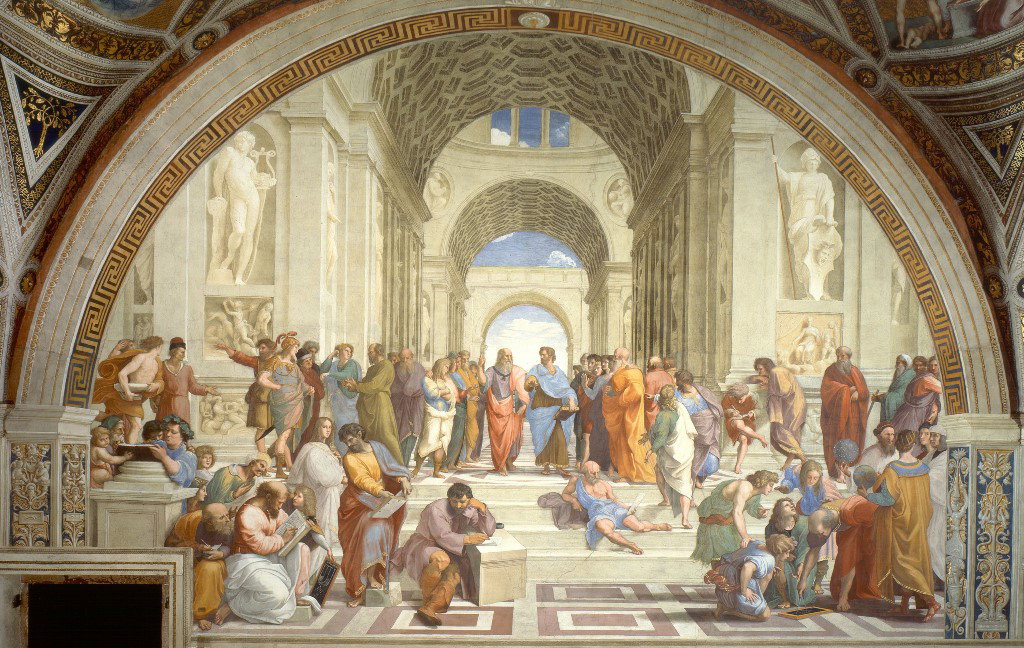
Who was Pocahontas?
The daughter of the chief of the Powhatan Algonquin tribe, although she lived at the end of the 16th and the beginning of the 17th century - and only for 22 years, she is remembered to this day. Why do we still remember Pocahontas?
In her short life, she was known by several names - Matoaka, Amonute, Rebecca Rolfe and had an interesting life path, but history remembers her most often as Pocahontas, the beauty who saved John Smith.
Pocahontas was born in 1595 in present-day Virginia. Her unusual name Matoaka meant "little tern" in the language of her people, and little is known about what her life looked like before she met English Captain John Smith, since the first records about her come from his letters.
That meeting, which probably completely changed the course of Pocahontas' life, happened at the beginning of 1608, when Pocahontas was thirteen years old. Captain Smith arrived in this part of the world in April 1607 and had numerous encounters with the natives, exploring the surroundings and getting to know the New World. However, he did not resist for long - in December, he was captured by the younger brother of Chief Powhatan, while Smith was exploring the Chicago River.
Judging by the letter that the captain sent to Queen Anne in 1616, Pocahontas, at the moment before Smith was to be deprived of life, bravely stepped forward and fought for his life and liberation. The Englishman soon returned safely to the colonized area of Jamestown, and Pocahontas often visited him. According to some sources, she came to Jamestown to play with the boys and brought so much food every four to five days that she probably saved the lives of many English soldiers.
However, as the colony expanded rapidly, the Pocahontas tribe felt increasingly threatened, and a new conflict between the peoples was inevitable. In one skirmish, Smith was wounded and returned to Europe, and his comrades-in-arms told the Pocahontas people that he had passed away, which is why she believed for a long time that she had lost her friend forever and stopped visiting Jamestown.
If we believe the historical data, Pocahontas and John Smith were not lovers - they were not even at the age when they could be a couple. The first records describing them as lovers appeared in the 19th century, and that version of the story was enriched with additional details in 1995, when an animated film was made that presents them in that way.
In March 1613, the chief of the Patawomeck tribe captured Pocahontas and handed them over to the colonists to settle with the English for weapons and prisoners. She was then taken to Henricus (today's Chesterfield County), where she was taught and baptized by the priest Alexander Whitaker. Soon Pocahontas was given the name Rebecca and mastered most of the English language and Christian sciences.
A year later, the English wanted to hand her over to their tribe in order to achieve peace, but Pocahontas decided to stay among the Europeans because his father gave her lightly. As she explained to her new friends, her father considered her less valuable than an English weapon, which is why she would rather live with the English.
During her months in Henricus, Pocahontas became close with the widower John Rolf, a well-known and successful tobacco grower. On April 5, 1614, Rolfe and Pocahontas were married, and early the following year they had a son, Tom.
This marriage contributed to calming the passions between the warring parties. The English noticed the influence of the Indian princess, so they decided that Pocahontas, along with eleven other compatriots, should leave England. The public reacted unexpectedly well to the beautiful Pocahontas, who loved the colonizers and gladly became Rebecca. Moreover, she and other members of the tribe were guests at the court of James I. During this visit to England, Pocahontas also met John Smith, whom she believed was dead for years.
In March 1617, Rolf and Pocahontas boarded a ship to return to Virginia, but at the very beginning of the journey, the tobacco growers wife felt unwell. Because of that, the couple landed in Gravesend, and Pocahontas passed away very quickly. The cause of death remained unknown, and today there are theories that these were some of the common diseases at that time: pneumonia, tuberculosis or smallpox. it was even believed that an Indian princess could be poisoned.
She was buried in Gravesend, where a fire broke out in 1727, which destroyed both the church and the church cemetery, so it is not known exactly which is the Pocahontas Ino grave site.
Although she had only one child, many descendants of John Rolf and Pocahontas live in the United States today. Moreover, there are many famous historical figures who come from their son Thomas - Edith Bolling Galt Wilson (wife of the 28th President of the United States Woodrow Wilson), General George W. Randolph, Admiral Richard Byrd, Governor Harry F. Byrd, Paulina de Rothschild, Nancy Reagan, Glenn Strange, Percival Lowell ...
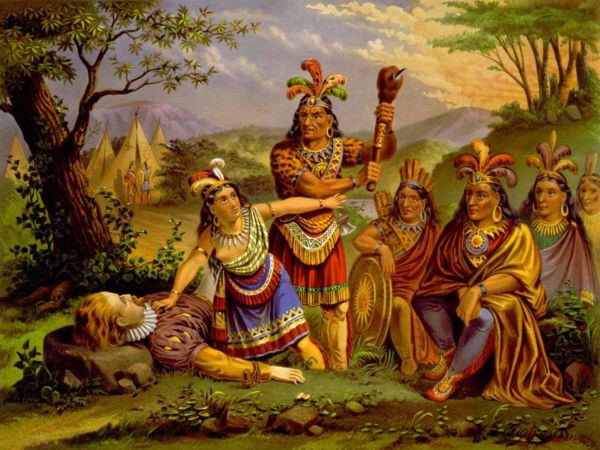
A history of greed
They grabbed whatever they could get their hands on, anything that could be reached. It was simply a robbery without violence, a more serious murder on a larger scale, and people blindly rushed to their deaths, as it should be with those who touch there ", writes the English-Polish novelist Joseph Conrad.
In the cult novel "Heart of Darkness", Conrad, inspired in his time by the current Belgian affair in Congo, created an epic about Kurtz and the greed of a white man, which will experience so many quotes. It is rarely mentioned that opening the novel with Marlowe's story about Romans coming to Britain and which is parallel to the black Congo, Conrad speaks of greed not only as a destroyer but also as a force that brings civilization to a barbaric country.
Greed, not only in literature, but also in many professional works, is understood as an important element of order - a terrible human vice and one of the lowest human weaknesses, which ultimately moves the world forward. After the Napoleonic Wars, when the revolutionary wars against the greed of the upper classes roared the world, greed started capitalism, ignited the furnaces of industrialization, while banking gained its real power, becoming the financial drive of civilization.
Banking has been changing since the 14th century, when large Italian, Christian families, like the Medici family, founded their own banks and amassed a monstrous fortune. In time, debts began to be traded in Europe, and Dutch banks finance overseas expeditions that spread European greed to new continents.
Columbus, and later many other sailors, go to overseas countries pursued by the greed of their kings, and then by a company such as the infamous and all-powerful East Indies Company. The outcome is known - the existing civilizations are being sucked out financially and militarily. The extremely cruel end of this process takes place during and at the end of the 19th century, in the new colonies, with Congo in the heart of darkness.
However, greed also affects the victims on the other side, in the great social changes that precede the new world. Burdened with death, increasingly imbued with fear, the man of the Middle Ages sees danger in entire groups, and one of them is certainly those who are greedy. This changes the attitude towards greed, and resistance to it becomes a significant social force.
Traditionally, the first victims of such a greedy chase were the Templars, as the first real bankers after Ancient Rome. On Friday, October 13, 1307, King Philip of France, wanting to deal with the Templars as a financial force, and under the pretext of various sins, especially greed, will arrest and then severely punish the Templars by burning at the stake.
The order will be abolished, although various traditions and myths will survive long afterwards, including the one on Friday the 13th. The spontaneous persecution of Jews throughout Europe will soon take on elements of this persecution, and the pogroms will be given a new cause - greed that is no longer personal, but collective, greed with a group sign.
Ghettoized and rightfully residing in free cities, Jewish bankers like Shakespeare's Shylock, capricious and stingy, from the play The Merchant of Venice become a symbol of contempt and the alleged main reason for the hard life of the petty aristocracy and the first bourgeoisie. In the 17th and 18th centuries, the so-called Hofjuden, court Jews, appeared in all European centers, who lent money to the rulers, while with the success of their affairs, anti-Semitism grew, which was pronounced precisely by the sin of greed. In the end, that will serve as one of the monstrous justifications for Hitler's Holocaust - a showdown with Jewish greed.
The symbols of greed are slowly changing over the centuries, but the power of hatred towards them is never negligible. In a different scenario, but with the same episodic role - greed, the confrontation with the debauchery of the church and the First Class leads to a positive turnaround - the bourgeois revolution in France, just a decade after the American colonies went to war against the greedy British King George.
In the conditions of the first industrialization, when social stratification and injustice have never been greater in Europe, greed becomes personal again. The symbol of greed is born as Dickens' Ebenezer Scrooge, a stingy old man who meets three Christmas spirits in "The Christmas Story" who show him how to lead a wrong life, as opposed to the joy felt by those who are not dependent on money.
His character is bizarre, but as tragic as Moliere's historically premature fortress Harpagon, Sterija's Kir Janja or Miss from the Belgrade novel of the same name by Ivo Andrić. These heroes, who see the only meaning in money, give a picture of what stinginess and greed represent for the man of the 19th and early 20th century - the disease of money addiction.
Powerful families of this age, such as the Rothschilds in Europe and entrepreneurs like J. P. Morgan in America owns financial empires that build railroads, industrialize cities and bring new technologies, at the same time creating a large social gap between social classes.
It soon became a key political issue again, which, through a series of small European revolutions and revolts in the long 19th century, would end in 1917, during the cold November in front of the Winter Palace in St. Petersburg. A new revolution brings a new idea - a social system completely devoid of greed. But in a bizarre reversal, in an attempt to establish it, new totalitarian systems emerge.
Anger, which in various historical circumstances is directed at entire nations, groups or social strata, in all epochs equally destroys the lives of ordinary people. In the sympathetic 1927 adventure novel The Treasure of the Sierra Madre by the mysterious German author B. Traven, three Americans embark on an adventure to win gold in Mexico, with an idea that has driven thousands of entrepreneurs into uncertainty to get rich.
The photo shows a shot from the Hollywood film of the same name with Humphrey Bogart in the lead role, which will consistently show Traven's story of greed two decades later. At the end of all mutual conflicts and mutual hatred, Traven's heroes are attacked by vagrants who rob them of gold dust, but not knowing its value, they scatter it around.
Geishas: Japanese artists or courtesans?
Geishas are mentioned in the Japanese tradition as early as the beginning of the seventh century, but during the 18th century this profession experienced a new expansion. Geishas still exist today, but they have adapted to the modern world in many ways.
It is known that at the beginning of the seventh century in Japan, there were women who hosted business and entertainment gatherings, poured sake to guests and, with adequate compensation, offered their company even in more intimate circumstances. Elsewhere in the world, such a vocation could rightly be called prostitution, but the institution of geisha has such deep roots in the Japanese tradition that their culture does not allow the trivialization of this profession.
The girls who served guests at high-class gatherings were called "saburuko," or waitresses, and providing sexual services to customers was initially the exception rather than the rule. In the 18th century, the work tasks of a geisha were related to meeting all the needs of customers and tradition became something that in modern terms could be called elite prostitution. Geishas, like other artisans, were organized into smaller communities that had their own clientele, special services for which they specialized and, of course, special offers for the best customers.
While some despise this profession, others equate it with the ancient art of Japan. Whoever is right, geishas have existed for centuries and they adapt their community and practice to modern conditions, trying to preserve the tradition, which, regardless of the job they do, preserves their reputation. The public around the world learned about this ancient Japanese practice a little more only with the appearance of the first photographs of geishas, in the 1950s. The photographs that appeared at the time show the role of geishas in modern society, but also revealed a lot about their mystical way of life.
Geishas are shown learning to serve guests properly, giggling at receptions, perfecting musical skills, or providing more intimate services to clients, such as massages. They are mostly always in traditional clothes and with make-up characteristic of this industry, but the twentieth century has brought changes in their practice, so there are more explicit photographs. In the sixteenth century, the first intimate pleasure chambers in which geishas lived and worked, which were known as yukaku, sprang up. Prostitution outside these houses was illegal and severely punished, but everything that happened in the yukaku chambers was legitimate.
There were real class differences among geishas, so less attractive girls were almost just maids in their communities, gok are more attractive girls with a certain set of skills like a talent for song and play, living in the luxury provided by their fans and special friends. Members of the highest class of geishas were called oiran and were a combination of actresses and prostitutes, as they went to bed only with selected, wealthiest clients, and they also had their performances which mainly consisted of a special erotic dance that these professionals performed flawlessly.
How the girls "baked" the craft
Such a high quality of performance gradually began to appear in the category of geishas, so that over time they were accepted as part of the Japanese traditional art called kabuku. Although the more talented courtesans entertained the guests mostly with dance, song and music, there were also intellectuals among them who specialized in writing and reciting poetry. The official name of this artist-prostitute was given only in the eighteenth century, when many men entered this profession. Until the beginning of the 19th century, the profession of geisha was a legitimate female profession, which was not condemned by society. Geisha communities grew and became richer, and this was a way for large families to make life easier for themselves and their young daughters.
Even today, there are geishas in Japan. Their communities are much smaller and more modest, the women who deal with this are no longer gorgeous and talented beauties, but they still respect tradition and can be seen walking the streets of Japan with unusual hairstyles and antique costumes. Most of these modern geisha communities have put prostitution out of practice, and now act as custodians of a tradition that is very significant to the entire Japanese culture.
Meet Zenobia, the queen who defied the Roman Empire
Queen Palmyra, whose exploits are still talked about today, conquered Egypt, captured the Roman provinces and almost transformed her kingdom into an empire equal to Rome.
Wealth, culture and power prevailed in Palmyra in the third century AD. This cosmopolitan capital of the Roman province of the same name was located near the eastern borders of the empire, providing space for the ambitious power of Queen Zenobia.
By the middle of the third century, the Roman Empire was mired in a political and economic crisis. Its borders were under constant attack, and its center in the struggle for survival. The changes that the Empire experienced in that period in terms of institutions, society, economic life and religion were so profound, that the Crisis of the 3rd century is generally interpreted as a hint of change of the era, ie. a hint of the arrival of the Middle Ages.
During that period, the rebellious Gallic Empire in Europe began to separate from Rome. Weakened and scattered, the Roman Empire faced threats from all sides. Looking at it all from the east, Zenobia saw an opportunity to conquer the kingdom.
Palmyra had a history of cooperation with Roman rule, which resulted in numerous advantages for the desert kingdom. Located in the middle of today's Syria, about 130 kilometers northeast of Damascus, Palmyra has prospered a lot since it came under Roman control in the first century. Located at the crossroads between the Mediterranean world ruled by the Roman Empire and the great empires of Asia, Palmyra became a center of great strategic and economic importance.
The caravan routes that led from the fertile Levant to the mighty Mesopotamia crossed right across Palmyra, bringing it wealth and providing its rulers with the means to beautify the city, as well as the confidence to assert themselves at the regional level. Known as the Pearl of the Desert, Palmyra was famous for its magnificent buildings, such as the Triumphal Arch and the impressive theater. By the middle of the third century, the Palmyra Empire enjoyed some independence - albeit as a state within the Roman Empire. **Zenobia tried to change that ...**
Over the centuries, Zenobia's life story has been the subject of numerous speculations. In the vivid but unreliable "Imperial Tales", a collection of biographies of Roman emperors, it is stated that Zenobia connected herself with the Ptolemaic kingdom, including Cleopatra. Eastern historians, such as the Persian Al-Tabari, believed that Zenobia was not of Greek but of Arab origin. Modern historians agree that Queen Palmyra was not descended from Ptolemy and that she most likely came from an influential Palmyra family in which she acquired a very higher education.
In his book The Decline and Fall of the Roman Empire, the British historian Edward Gibbon described Zenobia in detail:
"Zenobia was highly valued and was considered both the most beautiful and the bravest woman of her time. Not only did she have a knowledge of Latin, but she was fluent in Syriac, Greek and Egyptian. "
Zenobia married Odent, ruler of Palmyra and founder of the Palmyra Empire. Reigning since 263, Odenat successfully defended Palmyra from the Persians. Remaining loyal to Rome - at least from the outside - Odenat managed to break through the Persian borders and force them to withdraw to their territory.
Odenat claimed from the very beginning that he was playing on the side of Rome, but it soon became clear that he only wanted to become the "monarch of the East". Given Rome's weak position, the new emperor of the Roman Empire - Valerian's son, Gallienus - had no choice but to grant Odenatus a powerful status. Odenat was also crowned as "king of all kings" by his own people. Palmyra might have become the capital of the new empire, but it did not happen. Odenat's dreams were shattered in 267 - after returning from a campaign against the Goths in Cappadocia, a cousin killed him in his palace.
Then came Zenobia's five minutes. The son she got married to Odenat, Vabalatius (Latin in Latin), was logically supposed to inherit her father, but he was still a child. Zenobia proclaimed herself regent, which enabled her to control the territories in the east that had been taken over by the Persians shortly before.
Zenobia knew how to take advantage of the moment of weakness of the Roman Empire. She despised Emperor Gallienus and his generals who were unable to stop her. When the next Roman emperor, Claudius II the Gothic, came to power, he had no choice but to recognize the sovereignty of Zenobia. Zenobia thus achieved its goal - Palmyra became equal to Rome.
Keeping the Persians in the Gulf to the east, Zenobia annexed many neighboring states, including all of Syria and much of Anatolia (present-day Turkey). In 269, she sent her forces to Egypt and took over Alexandria. By 270, it had taken control of all of Egypt. **Her empire seemed unstoppable ...**
However, the next Roman emperor, Aurelian, was a very different opponent. Taking power in 270, Aurelian had rigid military discipline.
In 272, the emperor turned to the eastern provinces and the Palmyra Empire. Rome's supply of grain was threatened, as Egypt was under Zenobia's control. As soon as he estimated that the legions were ready enough, Aurelian headed east. Asia Minor was quickly recaptured, Byzantium surrendered, and finally the well-defended city of Tiana, after whose surrender things quickly went in Aurelian's favor. Within six months, the emperor stood at the gates of Palmyra, the city surrendered, and Zenobia tried to escape to Persia. The Palmyrene Empire ceased to exist. The queen and her son were captured and paraded through the streets of Rome, and the normal supply of grain was re-established.
Palmyra rebelled again in 273, but this time Aurelian completely destroyed the city, which never recovered.
Almost like when her birth and origin are in question, Zenobia's death has remained unresolved to this day. Some Arab sources say she committed suicide to avoid captivity. Roman sources claim that Aurelian, refusing to sentence the woman to death, brought her to Rome as a slave. "The queen has always wanted to visit Rome and that wish was finally fulfilled," it is ironically stated in "The Imperial Tales". Some sources claim that she was destroyed there, others say that she married a Roman senator and lived as a Roman matron.
However, no matter what happened to her, the exploits of the Queen of Sand were and remain an inspiration to many writers.
Napoleon, Mathematician
Did you know how the man who perhaps most significantly influenced the history of Europe, the revolutionary general, the first consul and emperor of France, Napoleon Bonaparte (1769-1821), was also a mathematician?
The remarkable development of French mathematics is partly intertwined with the miraculous rise of the general from Corsica, one theorem from geometry is called Napoleon's theorem, and numerous anecdotes speak of this passion of his.
Upon his return to France in 1797, after the success of the first campaign in Italy and the defeat of Austria, one of the most powerful men of that time in the Directorate, was celebrated all over Paris, the dark Foreign Minister Taller asked him if he had any political ambitions.
Napoleon looked at him and allegedly replied that he was not interested in power, but that after the war he was only interested in one thing - to study mathematics again. And, in addition, to be admitted to the Academy of Mathematical and Physical Sciences. This goal, like so many others before and after, was achieved really quickly - in May 1798, Napoleon was elected to the Academy.
Although it could be discussed, this position was by no means completely baseless. During his schooling, before the revolution, Napoleon was noticed in the military school in Brienne Castle as an excellent mathematician, which enabled him to enroll in the elite École Militaire in Paris. Precisely because of his knowledge of mathematics, he became an artillery officer, and he attended classes with the famous Laplace.
His mathematical calculations, after the beginning of the revolution, enabled him to solve the siege of Toulon, where he outplayed the royalists and British forces with artillery fire, in order to bring an unexpected victory to the revolutionary forces and immediately afterwards, get the rank of general. In a similar way, using artillery, he later took part in the bloody suppression of the royalist revolt in 1794. It was also the beginning of its rise and huge popularity throughout France.
After a series of victories across Europe and Africa over the anti-revolutionary coalition, his fame became so great that, despite the answer he gave Talleyrand, he entered politics. In the circumstances of great internal instability, the French handed him almost unlimited power.
Although this fact was forgotten under the obvious influence of British propaganda during the 19th century, Napoleon was elected the first consul of the Republic in 1799 by direct vote in a plebiscite in which 1.5 million voters participated and 98% of whom voted for him. After new victories, his mandate was extended for life in 1802 with 99 percent of the votes won in a new plebiscite in which 3.6 million French people participated. The same result will be repeated in 1804, when he will be proclaimed emperor.
During his career, he also managed to be resurrected when everyone wrote him off, and after the exile on the Elbe in a few months in 1815, he mobilized the whole of France around him again. He won more than 60 different battles, including a glorious victory at Austerlitz, while losing only a few.
It is considered that he was not a special innovator in the military sense, but that he only consistently applied the knowledge acquired in the military school, which he himself said. But his understanding of geometry allowed him to always see many more moves than his rivals during battles. When asked who is the greatest general of the epoch, his mortal enemy, the British military leader Wellington allegedly said "In this age, in previous ones, in every age, Napoleon".
Napoleon's legacy is difficult to measure - he took France out of the period of the revolution and made it a world power, and with his conquests he practically changed the history of most European countries and temporarily expanded French territory to more than half of Europe, which ended in defeat at Waterloo. The photograph shows only one of the monuments dedicated to him, a bust in Cherbourg Castle, which was erected only in 1858.
Napoleon was left with many lasting, civilizational achievements, such as the Civil Code, modern education and the lyceum system, the metric system and the legion of parts. Among other things, even the later French tradition of applied mathematics is connected to him.
In mathematics itself, the so-called Napoleon's theorem is attributed to him. According to it, if equilateral triangles are constructed on the sides of any triangle, their centers will form an equilateral triangle. The true origin of Napoleon's theorem is under discussion, as the British believe that it was not proved by Napoleon.
Napoleon also dedicated some of his military campaigns to science. After agreeing with Tallaren on the need for a military expedition to Egypt, in 1798 he took 150 selected French scientists, mathematicians and artists to Africa with his troops.
Along with Napoleon, the members of the expedition were also chosen by the Furies, and after it one of the most influential books about Egypt was written. Among other things, during this expedition in Memphis, a stone from Rosetta was discovered, which will be used by Champollion to decipher Egyptian hieroglyphs.
How the gray wolf became man's best friend?
The relationship between man and dog is deeply ingrained in our culture and psyche. But our best friends, as many call dogs, have not always been cute, shaggy, sympathetic and friendly. The domestic dog, Canis familiaris, is a direct descendant of the gray wolf, Canis lupus: In other words, the dogs we know today are actually domesticated wolves.
Over time and selective interbreeding, the behavior and physical appearance of these otherwise formidable predators have completely changed and adapted to life with humans. “No other species is so diverse,” says Robert Wayne, an evolutionary biologist at the University of California, who in 1997 conducted one of the largest studies related to canine genetics and evolution.
Charles Darwin believed that dogs were created by crossing wolves, coyotes and jackals, but with the help of modern science, DNA analysis and molecular biology today we know with certainty that all dogs in the world share only one common ancestor - the gray wolf.
Although you can sometimes meet a lone wolf in the wild, the normal social life of wolves takes place in a pack. The wolf pack usually consists of the parent pair and their offspring, so it is a family.
How and when the first domestication occurred is still a matter of speculation. DNA analysis published in 1997 suggests that the transformation began about 130,000 years ago. This means that wolves began to adapt to human society long before humans had settlements and began to engage in agriculture.
According to some researchers, wolves were very useful moored around the campfire to drive away other, even more terrible predators. Other researchers again claim that this is just a myth and that humans did not adapt to wolves - but wolves to humans. Some experts claim that wolves took advantage of human weakness, empathy, and thus protected themselves from extreme cold and harsh winters during which, without human help, they would surely die of starvation or freeze.
*“Humans were already successful hunters and without wolves, more successful than all the other big beasts. Most likely, the wolf approached us, not the other way around, probably as they roamed around the garbage dumps on the edge of human settlements. Wolves, who were brave and aggressive, would be killed, while those who were friendly would survive. ” - Dr. Brian Hare, Director of Duke Canine Cognition Center and Vanessa Woods researcher at Duke University (for National Geographic).*
Whether we domesticated the wolf, or whether the wolf domesticated us is still a matter of debate in scientific circles.
Wolves are very protective as far as territory is concerned but pack conflicts are not common as they usually avoid each other. At the top of each pack is a pair of alphas, a male and a female. Just below them along the chain of command is the beta, and the lowest wolf is the omega.
**Transformation of a gray wolf into a domestic dog**
Molecular evidence shows that the transformation of the gray wolf into a domestic dog began about 130,000 years ago, but the friendly relationship between humans and dogs as we know it today is at least 15,000 years old, making dogs probably the first domesticated animals.
Even if it is clear that dogs are descended from wolves, it is still not entirely clear exactly how this came about. Either way, at one point wolves started living with humans. Over time, humans began to selectively breed these wolf-dogs, until they eventually created the diversity of dogs we see today.
Due to the constant crossing of the now subspecies of wild wolves, ie domestic dogs, dogs began to differ significantly from their ancestors. In addition to changing their mood and adapting it to friendly people, dogs also changed the structure of their body.
While the losses of cattle attributed to wolves are undisputed, attacks on humans have never been proven. Neither in North America, nor in Europe.
“Most dogs today have smaller skulls, smaller teeth, and smaller brains than their wild counterparts,” says Ray Coppinger, a biology professor at Hampshire College in Amherst, Massachusetts, who spent years studying evolution and behavior in dogs. "Dogs and wolves also differ in behavior. For example, a female dog usually has a chase twice a year, while a female wolf has only one. Moreover, many adult dogs beg for food, a behavior typical of wolf puppies but not adults. Dogs greet and lick people just as wolf puppies do with their elders in a pack. ”
Wolves that survived in human environments were probably individuals who continued to behave like puppies even as adults.
At one point, people who lived near these adapted wolves realized that they could also be very useful. First, dogs bark when an intruder is nearby. Second, their sense of smell is superior to that of humans, and they can spot prey much better and even catch it faster than humans.
Until the beginning of the development of agriculture and animal husbandry, the wolf was the most widespread beast on earth. It was widespread throughout Europe and Asia all the way to North Africa as in North America.
Wild wolves are predators and their behavior can be described in seven steps:
1. Orientation
2. Observation (‘eyes’)
3. Spying
4. Chase
5. Capture
6. A bite that kills
7. A bite that tears meat
To survive in the wild, wolves must use all seven traits. While humans have bred dogs, they have singled out individuals and broken down this pattern, emphasizing certain aspects of behavior or downplaying or eliminating others, depending on their purpose.
For example, shepherd dogs must have two very sophisticated items: the second and third, that is, observation and stalking. You will often notice that shepherd dogs follow the sheep by lowering the body as low as possible to the ground, which is a typical attitude for a wolf stalking prey. But after several thousand years of selective breeding, the shepherd will only stalk, but not catch.
Dalmatians were bred to have incredible endurance, Rottweilers were primarily bred to chase cattle (mostly cows), and large cows needed both a large and strong dog. Some dogs are bred to pull sledges, and some again - just to sit on our lap and keep company.
About 15 million years ago, the first real Canis, Leptocyon, appeared, which much later became a gray wolf, and finally a domestic dog. After 15 million years of evolution, this wild beast has become man’s best friend.
Guy Fawkes - the man whose face has become the symbol of modern REBELLION (ANONYMOUS MASK)
Today, it is almost impossible to imagine any political protest without the appearance of a characteristic white mask that has become a protective symbol of modern uprisings. The mask is also a trademark of Anonymous, a decentralized network of activists and hackers advocating for internet freedom, the abolition of censorship, and restrictive copyright laws.
The mask that became a symbol of the modern revolution represents the face of Guy Fawkes, a member of a group of Catholic extremists who planned the famous ‘Gunpowder Conspiracy’ in 1605 aimed at overthrowing Protestant rule in England and imposing Catholic.
Who was Guy Fawkes?
One of the most prominent symbols of today’s revolutions is the 17th-century English revolutionary, Guy Fawkes, who became famous for trying to blow up parliament to destabilize the British [Protestant] government.
Personally, Fawkes was an imposing man. His former school friend Oswald Tesimond, who became a Catholic priest, described him as a man of "pleasant and cheerful approach" loyal to his friends. " Tesimond also claimed that Fawkes was "very skilled in matters of war," while historian Antonia Fraser describes him as a "tall, strong-built man, with thick reddish-brown hair, a mustache, a reddish-brown beard, a man of action, capable, with intelligent arguments, as well as physically enduring, in a way, was a surprise to his enemies. ”
*“Desperate illness requires dangerous medicine. ”- Guy Fawkes*
Guy Fawkes was born on April 13, 1570 in Stonegate, Yorkshire. He was the second of four children of Edward Fawkes and his wife Edith. Like many other people living at the time, not much is known about Fawkes ’early life, except that he grew up in a Catholic setting in Protestant England.
By the age of 21, he had sold a property left to him by his father and went to Europe to fight for Catholic Spain against the Protestant Dutch Republic. His military career went very well, so in 1603 he was recommended for the title of captain. At that time, he left his name ‘Guy’ and adopted the Italian variant ‘Guido’.
In 1603 he left his unit and received permission to go to Spain. In the same year he traveled to Spain and asked King Philip III to give his support in planning a revolt in England against the “heretics” James I. Despite the fact that Spain and Great Britain were technically still at war, Philip refused.
During the campaign in Flanders, Fawkes was approached by Thomas Wintour, one of the conspirators, and asked to join a group led by Robert Catesby which later became known as the group responsible for the ‘Gunpowder Conspiracy’.
**Unsuccessful Gunpowder Conspiracy**
The military experience - the gunpowder experience - gave Fawkes a very dangerous role in the conspiracy - to store and finally set fire to the explosives. But 18 months of careful planning was wasted, for on November 4, 1605, Fawkes was arrested just a few hours before he was to set fire to the explosives.
Just as the conspiracy was carefully planned, so did Robert Cecil, the English king's top spy, work carefully to uncover it. In the basement, just below where the king was supposed to sit during the opening of parliament the next day, thirty-six stacked barrels full of gunpowder were found.
After his arrest, Fawkes was subjected to various tortures. The torture was technically illegal, but James I (the then king) personally issued a permit that allowed the torture to continue. Fawkes endured two days of terrible pain before admitting everything. His signature on the confession was the signature of a man who was obviously broken, the letters themselves telling the story of someone who was barely able to hold a pen. James I himself even stated that he admired Fawkes' endurance during the torture.
After pleading guilty, Fawkes was sentenced to the traditional treacherous death penalty: "hanging and dismembering the body into four parts." During the hanging, Fawkes jumped off the gallows and broke his own neck to avoid the horror that awaited him - cutting his body while he was still alive. Still, he couldn't avoid having his testicles cut off alive and watching his intestines come out of his own stomach. His lifeless body was cut into four pieces that were sent to the “four ends of the kingdom” as a warning to others.
**How did Fawkes ’face become a symbol of modern rebellion?**
Over the centuries, the legend of Fawkes became increasingly popular, and by the 19th century his portrait was placed above the great campfires that were lit each year, as a memorial to his failure.
Guy Fawkes became famous all over the world only after the popular graphic novel, V for Vendetta (2006), in which the main character dresses like Fawkes and fights against a fictitious evil dystopian government in England. After appearing on online forums, Fawkes ’face mask has become a well-known symbol for online hacktivists, such as Anonymous, Occupy movements, and many other anti-government groups around the world.
*"A man is the least of his own when he tells you something in person. Give him a mask and he will tell you the truth. ” - Oscar Wilde*
In developing the idea for “V for Vendetta,” illustrator David Lloyd wrote to comic book author Alan Moore: “Why wouldn’t we portray him [the main character] as a resurrected Guy Fawkes, along with one of those paper masks, a coat and a hat? It would look very bizarre and would give Guy Fawkes the image he deserved all these years. We should not burn the guy every November 5, but celebrate his attempt to blow up the parliament! ” Moore responded to this idea: "All the fragments in my head came together abruptly, united behind the unique image of Guy Fawkes' mask."
Since 2008, Fawkes ’face (mask) has been seen at several protests, and as early as 2011, during Occupy Wall Street and other Occupy protests, the mask has become an international symbol of modern rebellion.
Eric Draven - Modern Byronic Hero - (part 3)
**The presence and popularity of the Byron hero today**
The influence of Byron's hero is visible both in the film and in literature, and there are many works and authors who were influenced and inspired by his character. Its appeal is undoubtedly in its beautiful and attractive exterior and its accursed nature. Byron’s character was designed with the goal of pleasing readers and all of his works were intended for a predominantly female audience. At the time, the only escape from reality for women was literature, and the way Byron manipulated their emotions, using passion and savagery to paint desire, was irresistible to them. Which is not far from the truth even today. Byron's hero has become synonymous with a charming, handsome, bad guy who has a dark secret and, although he is dangerous, he has something that makes us fall for him. According to Atar Stein, "Heathcliff's romantic and erotic attraction" is "the main contribution to today's Byron hero", and erotic glamor and supernatural powers are what make modern vampire characters attractive.
In her study of the presence of Byron's hero today (The Byronic Hero in Film, Fiction, and Television), Stein argues that Byron's hero was not only alive in the second half of the 20th and early 21st centuries, but was in full bloom. , and adds that he has become so popular and ubiquitous in contemporary culture that once the parameters on the basis of which his character is defined are established, we realize that there are infinitely many examples. He mentions only some of them, such as the vampire Lestat from the Vampire Chronicles by Anna Rice, Eric Draven from the Crow, the vampire Angel from the TV series Buffy, the vampire slayer, the Terminator, Q (Q) from Star Trek, etc.
Further, Stein claims that most of Byron's modern heroes possess some supernatural powers, but that despite that they are all in some way presented as ordinary people, with many flaws and weaknesses, which leads the audience not only to respect them, but also to be sympathetic to them. . When it is already difficult for readers and viewers to be like him, they are flattered that he wants to be like them.
Moreover, modern Byron's heroes serve us as a reflection of today's social values and beliefs. Every day we make distinctions between good and evil, right and wrong, black and white, and refuse to see all the shades of gray in between. Byron's hero and his enigmatic nature lead us to reconsider these values and beliefs, because very often we find ourselves in a situation when we doubt his motives and their correctness, and still cheer for him in that fight. We may believe that violence, as a concept, is ethically wrong, but we always find exceptions. Eric Draven is one of them - his behavior may be wrong, but his reasons are certainly not. These are heroes who are not guided by their own interests, which makes them even more attractive. Even in revenge films, such as The Crow, the hero is primarily in the service of some higher ideal of justice.
In addition, the attraction of Byron's hero lies in the fact that he is the embodiment of a double human nature, which makes it easier for the audience to identify with him. Complex characters like him are far more attractive than those painted in pure light or dark colors, because human nature itself is complex. With all that in mind, it is no wonder that such characters were popular in Byron's time, that many authors have since modified and elaborated them, and that they are still popular today - perhaps even more than ever.
5 interesting facts about the Maya
The Mayan civilization is a Central American civilization, known for the most developed written language in pre-Colombian America, as well as for its art, architecture, and advanced mathematics and astronomy. This ancient civilization originated and strengthened between 2000 BC and 250 AD, their cities reached their peak from 250 to 900 AD.
Although the Maya still live in the area of Mexico today, and many of them still cultivate old customs, this article focuses on a civilization that lasted until the arrival of the Spanish conquerors.
**5. They were excellent doctors**
The health and medicine of the ancient Maya was a complex blend of mind, body, faith, ritual and science. Not everyone had access to knowledge, but only the chosen ones who would receive an excellent education. These chosen ones, who were called shamans, acted as a medium between the physical and spiritual worlds. They healed the sick, predicted the future, and controlled natural events.
Because medicine was so closely associated with religion and magic, it was essential that the Mayan shaman had vast knowledge and skill. The Maya are known to have sutured wounds using human hair, treated broken bones, and even had surgeons who could successfully operate on a patient. In addition, they took care of dental health and, if necessary, made dentures.
It is important to note that the Maya associated body disease with supernatural beings. For this reason, treatment has always included elements of ritual, cleansing, and finally herbal medicine or surgery.
**4. They sacrificed people and animals**
Many ancient civilizations practiced sacrifice, mainly to please or please their gods. In this respect, the Maya are no different.
Animal sacrifice and ‘bloodletting’ occurred frequently at many festivals, while human sacrifice was a much rarer occurrence. People sacrificed themselves when bad luck was driven away, during wars, when new leaders came to power and at the grand opening of new temples. Unlike many cultures of the time, the Maya did not sacrifice volunteers, but only prisoners, who were most often from neighboring kingdoms.
Today, many Maya practice these rituals of their ancestors. Elements of prayer, offering gifts to the gods, offering sacrifices (they replaced people with chickens), burning incense, dancing and celebrating - everything still happens in accordance with ancient rituals.
**3. They built sports fields**
Central American civilizations have been involved in sports for more than 3,000 years. These sporting events were often associated with rituals, and the sports games themselves took different forms in different places at different times.
The Mayan sporting event was called Pitz, and the gameplay was called pitziil. The game was played with a ball that was about the size of a volleyball, but was made of rubber and much heavier. Closely related to this sport was beheading, and there is even speculation that heads and skulls were used as balls.
For their sporting events, the Maya built sports fields. In addition to sports, they were also used for other cultural elite events, such as musical performances, rituals and festivals. These sports fields could be found in all but the smallest cities.
Speaking of culture, the Maya were excellent artists who mixed art with architecture, writing, and the general beautification of urban settlements.
**2. They were great astronomers**
The ancient Maya were great astronomers who recorded and interpreted everything that happened in the sky. Because they believed that the will and action of the gods could be read in the stars, the moon, and the planets, they devoted a great deal of time to the study of the universe.
Their calendar (which has been talked about a lot in the media recently) was based on their astronomical studies. It is very important to note here that the Maya did not have a calendar, but calendars. The calendar that was written about in the media, and which allegedly announced the end of the world, only marked the end of one of the 4 cycles of creation. According to the Maya, it is a time of great celebrations and it does not mean the end of the world but the beginning of a new "age".
The Maya believed that the Earth was the center of everything, fixed and immovable. The stars, the moon, the sun and the planets were gods. These Gods had a great influence on human lives, so their movements were closely observed.
The sun was very important to the ancient Maya. The Sun God was Kinich Ahau. He was one of the more powerful Gods, and one of the creators. The moon was almost as important as the sun. Mayan astronomers analyzed and predicted lunar motions with great accuracy. As with the Sun and the planets, it was often claimed that the Maya originated from the Moon.
The Maya were aware of the planets in the Solar System, and by far the most important planet to them was Venus which they tied to wars. Battles and wars were planned according to the position of Venus, and the prisoners sacrificed themselves to turn towards its position in the sky. The Maya recorded the motion of Venus and found that its year (relative to the Earth, not the Sun) was 584 days, which is incredibly close to the 583.92-day figures established by modern science.
**1. No one really knows what caused the collapse of this ancient civilization**
For reasons still unknown in scientific circles, the Maya centers in the southern regions began to decline during the 8th and 9th centuries, and were soon abandoned altogether.
Theories about the decline of this once great civilization are divided into several subcategories, such as overpopulation, foreign invasions, peasant revolts, and the disappearance of key trade routes. Environmental hypotheses include environmental disasters, epidemics, and climate change.
There is evidence that the Maya simply exhausted all the agricultural and animal potential of the environment. Some scientists have recently theorized that it is possible that the Mayan civilization collapsed after 200 years of drought.
Mild droughts that occurred between 800 and 950 were enough to quickly reduce the availability of drinking water. Scientists base this on an analysis of minerals and stalagmites found in caves from which the Maya drew drinking water, and further analyzes showed that another drought occurred between 1020 and 1100, which was probably fatal to this ancient civilization. .
Eric Draven - Modern Byronic Hero - (part two)
"People once believed that when someone dies, a crow takes his soul to the world of the dead. But sometimes something very bad happens and because of the great sorrow that accompanies it, that soul cannot find its peace. Then sometimes, but only sometimes, a crow can return the soul to the world of the living to correct the injustice done. ”(Crow, 1994; 00:00:46)
The very beginning of the film suggests that we will be introduced to a character with whom we can very easily empathize. His story is a story of love, death and loss, a story that is well known to us. In his essay "Philosophy of Composition" (1846), describing in detail the origin of the poem "The Raven", Edgar Allan Poe says that "the death of a beautiful woman is undoubtedly the most poetic object in the world" and that "it is also beyond doubt that such a subject is most invited to says the grieving lover. "
"Crow" follows a similar pattern and the entire film is filled with grief over the premature loss of a loved one. Eric Draven (Brandon Lee) and his fiancée Shelley Webster (Sofia Shinas) were brutally killed on Devil's Night, i.e. the night before their wedding. Exactly one year after their murder, a crow brings Eric's soul back from the land of the dead for just one night and helps him find the perpetrators.
The film begins with a crime scene scene and we see Detroit as a dark, gloomy and scary place where criminals have fun, run wild around the city and burn down buildings. We see Officer Albrecht and the little girl Sarah that Erik and Shelley took care of because her mother Darla was an addict and didn’t care for her. Eric is already dead, and Shelley is taken to the hospital in a very bad condition where, as we find out later, he will die after 30 hours of pain and agony. The cops are wandering around their apartment and we see in the frame both the wedding invitation and Sheila’s wedding dress. They were supposed to get married the next day, that is. on Halloween.
The next scene takes us into the future, a year later. We see little Sarah in the cemetery near Sheila's and Eric's graves. As he leaves, the rain begins to fall and the crow lands on Eric's monument and starts pecking at him. That (again Devil's) night, Eric comes to life and rises from the grave in a daze and fever. He returns to their apartment where he is greeted by his cat Gabriel and there he experiences several painful flashbacks. See what happened that night before his arrival - members of the Detroit gang torturing Shelley and how one of them (Ti-Bird) quotes Milton's "Paradise Lost": appearance wonderful… “, ridicules the mentioned verses and calls them pornography. (00:11:07) This is important because Ti-Bird will quote the same verses in the seconds before his death when he meets Eric again, which will be discussed later.
Watching Eric relive painful memories, we are able to feel his pain and not only sympathize with him, but also justify his every subsequent action concerning these killers. Eric and Shelley were a couple in love and happy preparing for the wedding, and then repulsive criminals appeared, broke into their private space and disturbed the harmony for the sake of mere entertainment. Thrown out the window, Eric was unable to save Shelley from rape and brutal beatings. We see that these memories hurt him a lot and that he wants to get rid of them, and the only way to do that is to find those criminals and take revenge on them.
After those flashbacks, we see Erik put on a black suit and put black and white makeup on his face, thus appropriating a new identity. Here it is easy to recognize one of the typical Gothic elements - the use of duplicates. He died as one man, was resurrected as another, and turned from a happy lover into a ruthless avenger dressed in black. He possesses some supernatural powers and the crow represents his strength and his eyes and helps him find the criminals. After finding them, Eric ruthlessly kills them one by one using their own weapons.
We have already mentioned some of the qualities of Byron's hero that Eric himself possesses: he has supernatural powers, he is tormented by guilt and remorse because he could not prevent rape and murder, he suffers immensely and seeks justice in his own way. Cruel but sensitive, he is half victim, half villain, and we see him declare, “Victims; aren't we all? ”(00:20:56) a moment before he stabs Tin-Tin with his knives.
Imbued with grief to a great extent, the whole atmosphere of the film - all the depression, darkness, rain and endless night - are really just a reflection of Eric's mental and psychic state. But despite all that pain and sorrow, as one of the most famous sentences from the film suggests, there is still a glimmer of hope because "it can't rain all the time." (00:34:47)
Eric also shows Byron's arrogance, superiority and sarcasm, which e.g. we can see in his first encounter with Officer Albrecht:
*Albert: Police! Do not move! I said don't move!*
*Erik: I thought the police always said "stop"!*
*Albert: Well, I'm the police and I say don't move*
*If you move, you're dead.*
Erik: And I say I'm dead and I'm moving. (00:30:25)
We have another example of his supremacy in the scene when he comes to the pawnshop at Gideon where Tin-Tin pawned Sheila's engagement ring:
*Eric: "Someone knocked on my door, knocked on my door - knocked softly - softly ..."*
*Gideon: What are you talking about?*
*Eric: You heard me knock, didn't you? (00:25:23)*
It is no coincidence that Eric quotes Poe's "Raven" here. We have already mentioned Poe and his "Philosophy of Composition" and the subject of the death of a beautiful woman and her grieving lover. The raven is a nocturnal creature and a sign of sad and eternal memory, as well as a prediction of misfortune and death, as is Eric himself. He is a ghost brought back to life by some higher powers to take revenge on those who killed him, who raped and killed his wife, and neither Gideon nor the other gang members are aware of it.
Further, what makes him a likeable character despite the cruelty are his humanity and the fragility we see in scenes from the past and his tenderness towards little Sarah. The scenes then and now are skillfully balanced and we see the supernatural dark being from the present as a fragile human being from the past.
It is true that Eric seeks justice in his own way and that by being cruel, determined and unstoppable, he does not differ from God as he persecutes. But there is a kind of nobility in his deeds and his deadly quest is again justified by the fact that he did not resurrect himself nor did he ask for it. He may be the object of revenge, but not its creator. As the subtitle of Believe in Angels suggests, he is a kind of dark divine messenger whose task is to satisfy God's justice by irrevocably declaring, "They are all dead, they just don't know it yet." (00:31:35) Moreover, when he finds himself face to face with Ti-Bird again, Ti-Bird recognizes him and, staring into his pale face, begins to quote Milton's aforementioned verses again:
**"The Devil stood in the shadows,**
**feeling ‘how awfully good I saw’**
**virtues how wonderful the phenomenon is, see and understand**
**that he is lost ”(Paradise Lost; Book IV, 846-849)**
But this time those verses are not funny to him at all. The first time he utters them with ridicule, the second time with terrible, ultimate knowledge. Staring at Eric, Ti-Bird realizes that he is actually looking at the face of death itself and is horrified. This scene and these verses tell us that someone who has sunk into sin looks at someone who is pure, realizes his corrupt nature, and despairs over his hopeless situation.
Top Dollar and his sister Mika represent another Gothic element. They are in an incestuous relationship and it could be said that Top Dollar and his gang are the source of all the evils in Detroit. Eventually Eric finds them all and kills them. The crow digs out Mickey's eyes, and Top Dollar falls from the roof onto the horns of the gargoyle while fighting Eric. In that way, justice was served, order was established, and Eric and Shelley were reunited in the other world.
The film ends with a scene in the cemetery and the words of little Sarah:
*"If the people we love have been stolen, the way they stay alive*
*is that we never stop loving them. Buildings up, people dying,*
*but true love is eternal. "*
These lines resonate with Byron's philosophy which, in the words of Deborah Luc, “sees love as the ultimate and only necessary truth and the last resting place in this life. Love is the only force that still makes sense. "
Who were the Samurai? ( 5 facts )
Samurai (bushido) were fearless warriors of ancient Japan who primarily fought against evil, but also against other samurai. Between 1603 and 1867, they became the ruling military class, as well as Japan's largest social class. With a katana in hand, guided by a strict code known as the Bushido ("warrior's path"), the samurai were an incredibly disciplined army, the fear and trembling of all the enemies of Japan, a horde of ancient warriors who did not fear death, warriors who always put honor before their lives. .
Here are some of the fascinating facts about samurai:
**5. Samurai were not just warriors**
Samurai have served many functions in Japan, however, their most famous role is that of a warrior. But what set them apart from other warriors around the world was not just a different armor and sword. They were an educated, politically active elite class.
Although their role in Japan has changed over the centuries, the four items that define the term samurai have remained constant: 1. A samurai is a well-trained, extremely skilled fighter; 2. A samurai serves his Daimyo or master, with absolute loyalty, even to death (the word samurai itself means “those who serve”); 3. The samurai is a member of the elite class, considered superior to ordinary citizens and ordinary warriors; 4. The life of the samurai is ruled by Bushido, a strict code of conduct and philosophy of life headed by honor.
War was an integral part of the samurai’s life, but they were also poets, politicians, fathers, and farmers. They have played a key role in the last 1,500 years of Japanese history. In fact, the history of that period in Japan is actually the history of the samurai.
**4. For samurai, homosexuality was not a taboo topic, on the contrary ...**
Samurai were not exclusively homosexuals, but it is a well-known fact that some of them had open same-sex relationships that were quite normal and common at the time. Not only was homosexuality not a taboo subject for samurai, they even encouraged such relationships - because they believed that love relationships would strengthen the soldiers themselves who would get more motivation to win.
This practice was known as wakashudo ("path of youth"), and applied to samurai of all ages. According to historical records, no one would ask Daimy, the “master,” why he entered into a homosexual relationship with a younger warrior, but they would therefore ask him why he did not. In fact, wakashudo was such a common thing, that Daimyoi could face very embarrassing questions if he did not practice it.
Although wakashudo is considered a fundamental aspect of samurai life, history has largely ignored this lifestyle, and popular books and movies almost never mention it.
**3. Samurai did not use only katanas**
The samurai's original weapon was a sword called the "chokuto," which was a thinner, smaller version of the flat swords later used by medieval knights. As sword-making techniques advanced, samurai began to use curved swords, which eventually became katanas - the most legendary of all samurai weapons. According to the code of conduct, the soul of the samurai was in his katana.
But these warriors did not rely on just one sword. They were experts in various types of weapons, such as Yumi - longbow, Yari and Naginata - types of spears, bō, jō, hanbo and tanbo - types of weapons made of wood, several types of iron and wooden sticks, as well as a handful of weapons made of chains. Later, the samurai added a new arsenal: the tanegashima, a type of rifle that began to be used in 1543, and the cannons that became an integral part of the samurai army in the 1570s.
**2. Samurai were educated**
Samurai were far more than a skilled warrior with a sword in his hand. They were also educated, both in public school and at home. At a time when very few Europeans could read and write, the level of literacy of the samurai was extremely high. In addition, they were skilled mathematicians.
During the Tokugawa period, in peacetime, samurai were not much needed as warriors - they dominated their academic skills during that period.
Bushido, an unwritten code of conduct required samurai to be above the ordinary warrior. Precisely because of this, these fearless fighters from all grades wrote poetry, landscaped beautiful gardens, and studied subjects such as calligraphy, literature, and mathematics.
**1. Samurai were not just men**
At a time when women around the world were mostly helplessly waiting for their sons and husbands to decide the outcome of the war, a completely different story was happening in Japan. Women in Japan had strong political power, and they were not just pawns in the game of making alliances through marriage. But politics was not their only strength, they were also fearless warriors, known as Onna-bugeisha, these women fought side by side with their fathers, husbands and sons.
The Onna-bugeisha belonged to the samurai class, and the same Bushido (code of conduct) applied to them as to men. The only difference between male and female warriors was the weapon of choice: While men always went to war with their legendary katanas, women mostly fought with a slanted, spear with a rounded sword on top.
Eric Draven - Modern Byronic Hero - (part one)
Eric Draven is the main character in the movie **"Crow"** (1994), which belongs to the genre of action fiction. The film is based on the comic book of the same name by James O'Barr from 1989. The story follows Eric, a rock musician driven by pain, when a crow comes to life a year after he and his fiancée were brutally killed by members of a Detroit gang. With the help and guidance of a crow, Eric wants revenge and restore order. He is a supernatural avenger whom I cannot kill because he is already dead. But he is also a grieving lover who suffers from the violent and premature death of his beloved. Dark, mysterious and tormented by painful past events, Eric recalls the so-called Byron hero - an exile who is partly a victim, partly a villain.
**Byron's hero - origin and basic characteristics**
In the period of Romanticism, the Gothic genre experienced a significant change - it began to retreat inside and the focus was placed on the thoughts and feelings of the heroes instead of their actions. According to Botting, this "internalization of the Gothic form", where dark and gloomy landscapes are only a reflection of the inner mental and emotional state of the hero, "represents the most significant turning point within the Gothic genre."
A romantic hero is not a hero in the true sense of the word. On the contrary, he possesses several character traits that make him closer to an anti-hero - he is rebellious, disrespectful of authority and power, abide by some law of his own, and fight for what he himself believes in, whether good or bad. Very often he feels alienated from society and from himself and it is difficult for him to fit in. He is isolated, pensive, often changes his mood and suffers from "world pain". Condemned to wander on the margins of society, he is a kind of exile - half victim, half villain. But unlike the Gothic villains, he is not the cause of evil and horror and his presence does not disturb the order. Evil is recognized in society itself, in its institutions of power and their corruption and tyranny, in such a way that its rebellion against social discipline makes it an attractive figure and demands our respect and understanding.
Byron's hero (so named because he developed mainly thanks to the writings of Lord Byron) is a version of a romantic hero. It is believed to be descended from the Greek legend of Prometheus, Cain, Milton's Satan from Paradise Lost, Goethe's Faust, and to stem from the Romantics' fascination with the nature of sin, the fallen world, rebellion, and the world of sensibility.
Lord Byron was a dominant figure during the Romantic movement and the characters he created, as well as the myths with which he performed his personality, are remembered better than some of his literary works. Byron's hero is a complex and intriguing character who developed together with Byron and when he has many traits and flaws. It’s a character that readers and audiences may not like, but it will certainly fascinate them with its irresistible and strong personality. He is often characterized as attractive, arrogant, narcissistic, intelligent, mysterious, sarcastic, cold, tortured in some way or persecuted by the past, and mostly includes some supernatural elements. He shows a great ability to feel and suffer, melancholy, self-destruction and often feels gloomy, but his suffering causes admiration and a pronounced ability to oppose generally accepted morality and social norms elevates him above the ordinary mortal.
*He stands aside, suffers from moral or spiritual sin, and longs to be cleansed of any demons that haunt him. A strong sense of honor and a love of poetry and music, as well as a metaphysical rebellion, make him a typical figure of Romanticism. (taken from the "Encyclopedia of Romanticism")*
It first appears in 1812 in Byron's "Pilgrimage of Childe Harold," but continues to evolve and also appears in his "Oriental Tales." In addition to the characters that Byron himself created, some of Byron's most famous heroes are characters from the work of the Bronte sisters, namely Heathcliff from "Hurricane Heights" and Mr. Rochester from "Jane Eyre".
Something about Leonardo da Vinci
**Leonardo da Vinci**
Leonardo da Vinci (Italian: Leonardo da Vinci; 15 April 1452 - 2 May 1519) was an Italian Renaissance architect, musician, inventor, engineer, sculptor and painter. He was described as the ideal of the "Renaissance man" and as a universal genius. He is known for his masterpieces, such as The Last Supper and Mona Lisa, and his inventions are used today in modern technology, although they were not used in his time. He helped develop anatomy, astronomy, and civil engineering.
His paintings are extremely rare and precious today, and although they are often unfinished, they are considered the supreme works of this "universal genius" as they often called him. He was fascinated by the mystery of the human face and the ability to read “soul movements” through facial movements and expressions. Leonardo's portrait of the wife of the Florentine official of that time, "Mona Lisa", is widely known for the enigmatic expression on the face of the portrayed lady. The portrait "Mona Lisa" is the first psychological portrait painted in history and that is why so much importance is given to this work. Leonardo was born near the city of Vinci in Tuscany in 1452, and he studied painting and sculpture near Veroki, Italy. He moved to various cities in Italy several times - wherever his business took him. Towards the end of his life he lived in Rome, and then in 1517 he was invited to paint a castle in Paris at the invitation of the French king. He died in Paris in 1519.
**Childhood**
Leonardo Da Vinci was born during the Renaissance, on April 15, 1452, in a country house, 3 km away from Vinci. His father was a lawyer and did not marry Leonard's mother, probably because she was the daughter of a farmer. The only reliable information about her is that her name was Katarina. Leonardo was baptized by the parish priest Piero da Bartolomeo, but with the name Lionardi and not Leonardo. At the age of less than five, he moved in with his father and stepmother. Piero and his first wife did not have children, so it is possible that Leonardo was accepted into his father's family because of that.
Leonardo went to school in Vinci. Young Leonard's teachers were taken aback by his questions and thoughts. At school, he learned to read, write and count. He also studied geometry and Latin. He later perfected his knowledge of Latin, because he felt that he had not learned enough in school. At the age of 14, he moved to Florence, where he apprenticed in a workshop.
**Training in Florence**
Leonardo began working for Verocchio in 1466. Andrea del Verocchio was a leading Florentine sculptor and painter. Verrocchio was delighted with the drawings of the young Leonardo and received him in his workshop, where da Vinci began working with many famous artists - Botticelli, Perugini, di Credi. In June 1472, Leonardo became a member of the painting guild, ending his apprenticeship. In the book enrolled in the guild, da Vinci is listed under the name Lionardo.
Leonardo's first known work is a drawing of Arnovale in ink, made on August 5, 1473. It shows Leonardo's talent, because he realistically painted a landscape, which no one had done before.
In 1476, Leonardo and Verrocchio commissioned a painting of Christ's baptism. Leonardo painted the front angel and the landscape. The difference between these two artists can be seen in the creation of angels.
**Scientific work**
In 1482, Leonardo moved to Milan to work as a civil and military engineer for the "Duke", and the job of painter and sculptor became a secondary occupation. Leonardo also worked as a designer and director of court festivals. Here he began his first systematic scientific studies based on practical experiences in anatomy, botany, mathematics, physics and mechanics. In 1499 Leonardo returned to Florence. The following year he entered the service of the French king, remaining in it until 1506, after which he returned to Florence until 1507. From Florence he continued his journey to Milan where he would live for the next five years. From 1516 until his death he lived in France with his student and successor Francesco Melzi (1491-1568).
Leonardo is the most famous intellectual of the Renaissance period, thanks to many interests: from military architecture, through anatomy, geometry, astronomy, construction, hydraulics, physics to general technology.
Although his patrons engaged him in various jobs during his life - from planning fortifications, castles and canals, to creating ball gowns - he has remained known to this day as one of the most important painters.
Da Vinci drew all his life, he made sketches and drawings, in ink or pencil. 4,000 of his drawings, often small in size, have been preserved. Leonardo wrote in narrow lines, written as a reflection in a mirror, from right to left. Next to them are drawings of plants and diagrams of gears and wheels. Entire pages are dedicated to weapons, spears, maces, swords of exotic shape. Then there are sketches for making fortifications and schemes of artillery weapons, drawings of flying machines, tanks, diving equipment and other fantastic things, centuries before they were made.
He even designed a robot, which could sit, wave its arms and move its head as it opened and closed its anatomically faithful jaw. "I can make cannons, small arms, useful and very beautiful shapes, different from the one used. wrote the artist.
Da Vinci also drew various animals: dogs, cats, bears, horses, and even a dragon. Not knowing the details of the anatomy, except the ones he could see with the naked eye, he drew the "Tree of Veins" on which he showed the position of the heart, lungs and main arteries in the human body.
**Art**
Bahus
Although Leonardo created a relatively small number of paintings (many of which are unfinished), he is still one of the most influential and innovative artists of the Renaissance. In his early period, the painting direction he followed did not differ much from the style of his teachers, so that as he matured, Da Vinci skillfully rejected the rigid way of treating figures and objects, and practically revived them, using his widely popular sfumato technique.
In his work Adoration of the Sages, he uses a new compositional approach - the central figure is in front and everything is subordinated to it, while the other figures and objects in the background are grouped so as to emphasize the central figure even more. His stylistic innovations are even more noticeable in The Last Supper, where he presented one established theme in a totally different way. Instead of presenting the 12 apostles as individual figures, he groups them into groups, which surround Christ as the central figure. All the way back, the landscape is shown through the window. Da Vinci portrays the apostles and Christ at the moment when Christ announces the betrayal, and in an almost realistic way he shows the various emotions of the apostles, astonished by this news.
The Mona Lisa, Leonardo's most famous work, is equally known for the innovations it uses in painting technique, as well as for the mysterious smile of the subject that Leonardo depicts. This work is a cohesion of two techniques that he established -
Chiaroscuro and Sfumato.
Da Vinci influenced almost all later artists of the High Renaissance, and above all Raphael. He completely changed the Milan school, and he also influenced the schools in Parma, Florence and other Renaissance centers.
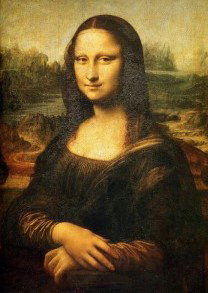
Identity
At the top of analytical psychology is the famous Swiss Carl Gustav Jung. Complex psychology owes a lot to its creator and one of the most important psychiatrists and thinkers of the 20th century. After mutual respect and friendship, Carl Gustav Jung and the then famous psychoanalyst Sigmund Freud set out on different currents of modern psychology. Jung's step out of the natural science model of interpreting psychic phenomena becomes the beginning of a revolutionary development of psychoanalysis. In the field of interesting discoveries, Jung's typology of personality appears, which is not completely completed, but some of its elements indicate the archetypal representations of men and women that we find in psychology, but also in philosophy, painting, and literature. One of Jung's most interesting studies, the typology of female identity, although not complete, was the subject of later research by Gene Shinode Bohlen ("Mythical Archetypes in the Female Psyche") but also by a group of Belgrade psychologists who decided to entertain themselves in the 1990s. by one complex identity of a woman. Like any study, in addition to a scientific work, it also implies a part of the personal (subjective) element that exists somewhere in every researcher when he decides on the very act of developing and releasing his own theory. As Jung is the originator of an interesting and, according to many, very important typology, what will be presented is part of several studies and experiences and should not be accepted as the only and unconditional one. Therefore, the reader has the task to deal with one interesting typology and not to understand certain patterns as templates, but to find his own appropriate context from some known facts.
***"There has always been psychology, since the historical world, but there is only objective psychology recently." (Jung, 1920)***
**WOMAN MOTHER**
Mother of God. In mythology, she is the personified Greek goddess Demeter / Roman Ceres.
It symbolizes the matriarchal principle: protection, birth, creation, care and nurturing.
This type of woman is characterized by care for the "family nest", connection with the family and the parental role of the protector. He is attached to a father who is not at all inclined to a father. Its existence and meaning is in children, and after the child's independence, that meaning disappears. The archetype of the mother is characterized by many qualities: the magical authority of a woman, wisdom and spiritual strength, everything that is benevolent, that nurtures, preserves and supports, that that promotes growth and fertility. The destructiveness of this type is reflected in excessive need and parental protection. Religion knows her as a Christian mother, mythology as a goddess of fertility, while in art she is personified in strong maternal characters. Her male partner is taken for granted, but in reality she is not nearby nor is she the determining aspect. In history, the mother's archetype is accompanied by great sacrifice, strengthened maternal instinct, but also setting one's own interests aside, for the work of others (mostly children). Whether we remember Mother Teresa, but also many literary heroines, this type of woman remains as a pillar on which successes, sufferings, sufferings, but also the strength of others fall.
**Mother Teresa**
One of the greatest benefactors the world has ever known. She dedicated her entire life to others: children, the sick, the elderly, the infirm.
**WOMAN LOVER**
The personified fairy, muse, geisha, courtesan, in history, religion, mythology, is known for his unsurpassed beauty and passion. She is personified in the Greek goddess Aphrodite / Roman Venus. A cultivated courtesan who submits her whole life to sensual pleasures. The meaning of this identity lies in creating a deep mystical loving unity of man and woman. Intimacy with members of the same sex is not characteristic of this type of woman, or if there is agreement that she is the best and most attractive, there is patience. Self-love and a personal experience of falling in love are also characteristics of the female "Narcissus" who very often describes this typology. Depending on the culture, history and circumstances in which she lives, she is loved, celebrated, ridiculed, humiliated or idealized. The Trojan Helena, known as the "cause" of the Trojan War, was an example of an idealized woman, but also of many heroines of literary works (Anna Karenina, Emma Bovary, Petrarch's Laura), heroines who led to death with their beauty. In the modern art of the great Hollywood beauty, models in the passion of art very often lost their real image of themselves and became victims of their own self-love and narcissism. .
**Theodora of Byzantium**
the Empress and wife of Justinian I, was in itself a pleasure. She lived for personal pleasure, but also for the pleasure of others.
As a heterosexual, until her marriage to Justinian, she enjoyed a debauched life and orgies. Subject to all kinds of lust, she had to give up sexual insatiability after marrying Justinian for the public. But it seems that the empress only respected the laws from the outside.
**VIRGO WOMAN**
personified in the Greek goddess Persephone, that is, the eternally "deceptive" woman. Eternally young, carefree woman - a girl around whom parental and marital rivalry are fighting on the one hand. The dependence of this type of identity for another identity, most often maternal, makes it impossible to grow into a woman. At the same time, she is helpless, skillful, naive and dangerous - unaware of her sexual powers. As a woman-chimera, she is vague and ambivalent and becomes a project screen of other people's desires and conflicts.
One of the almost typical examples of this type of identity is Shakespeare's **Ophelia**, the object of love, affection, but also insecurity and fear of one's own freedom.
In the film industry, a platinum beauty overshadowed the then public in the 50's. 20th century, both with her appearance but also with her shyness and almost to infantilism with the different behavior of a girl in the body of an adult woman - the famous **Marilyn Monroe.**
The beautiful Norma Jean, better known as Marilyn Monroe, was the object and prey of Hollywood directors, photographers and puppets of the public. Her death and the real identity of the modern goddess have never been fully clarified. Whether it is a Hollywood virgin, a literary Ophelia, or Greta, a mythical Sphinx, it is an identity whose variability becomes the cause of the very changes in society.
**WOMAN FIGHTER**
Whether her mythological counterpart Athens is the goddess of wisdom and craft, an Amazon or a modern feminist, this archetype implies strength and combativeness that very often exceeds the boundaries of the female and is equated with the strength of the opposite sex. What characterizes this type of woman is logic, practicality and simplicity. The mind takes precedence over the feelings, and selflessness and unpredictability follow actions of this type. It is driven by ambition and extroversion, so power is considered the best aphrodisiac. The principle of efficiency, objectivity and equality distances it from the ecstatic and romantic, which is considered to be both an advantage and a disadvantage to this identity because it is not prone to extremely strong feelings and complete surrender to intimacy. She is often described by a strong connection with her father, so in the typology of identity she is better known as her father's daughter.
An example of such a woman in history is certainly **Cleopatra** a beautiful ruler, surrounded by splendor, known for her wisdom and management skills. She skillfully ruled Egypt and was respected by her compatriots
**Studies that indicate the existence of several other types of female identity, as well as any story about the complexity of the personality, are up to the individual to discover. The question is, do the patterns of today's identity exist and can a person be reduced to only one type, or has the present liked to imitate what it would like to be?**
Who were the Vikings? ( 5 facts )
Most people imagine the Vikings as extremely muscular warriors with horns who have horns, as brutal savages who only plundered and fought, as a dirty horde that came from the north and ravaged everything in front of them. But most of the myths about the Vikings that are popular today originated through Catholic propaganda, after the Vikings burned and looted British churches.
Until the reign of Victoria, Queen of Great Britain, the Vikings were portrayed as a violent and barbaric people. During the 19th and 20th centuries, the perception changed to the point where the Vikings were perceived as a tribe of savages with horned helmets, without any culture, dirty inhumans, invincible warriors… However, today we have much more insight into their lives, and with numerous historical records and archaeological evidence we have the opportunity to look behind the screen of propaganda, and learn much more about the Viking Age, a period of European and Scandinavian history that lasted from the 8th to the 11th century.
While some Vikings were driven by a desire for wealth, most still sought more peaceful economic relations with the surrounding peoples. **And they never wore helmets with horns.**
**5. The Vikings spent most of their time on their farms**
Contrary to popular myths that portray all Vikings as fearless warriors, most Vikings were farmers. Even those who took part in the attacks on Western Europe, or those who sailed east or west as traders, were farmers. After each robbery, war or trip, they would return to their farms and continue their peaceful life.
While looting proved to be an excellent source of income, it still could not replace farms that offered a much more stable income. During the men's absence, their wives took care of the farms.
True, some Vikings were classic pirates who left their ships only when they plundered and set fire to villages, but still most peacefully sowed barley, rye and oats. They also raised cattle, goats, pigs and sheep on their small holdings, which were usually large enough to feed the whole family but not large enough to produce surplus food that could be sold or exchanged for other necessities.
**4. The Vikings paid special attention to maintaining personal hygiene**
English medieval King Henry IV ordered his knights to bathe at least once in their lives. The same Englishmen claimed that the Vikings were dirty barbarians.
But the fact is that the Vikings actually maintained personal hygiene at an enviable level, and that they were one of the cleanest, if not the cleanest, peoples compared to their European contemporaries. It may sound ridiculous today, but the Vikings bathed at least once a week - which was even too much for that period.
Archaeological excavations have revealed that the Vikings also used tweezers, razors, combs and ear sticks, made from animal bones and horns. In addition to regular weekly bathing, these dirty non-humans, as they were then called, often visited natural thermal springs where they bathed additionally. And yes - warriors always wore clean clothes during their bloody campaigns.
**3. The Vikings respected their wives**
During the Viking Age, women in Europe were, to put it mildly, oppressed. In the tenth century, only a few women could be said to possess power, but they too acquired it through their fathers, husbands, sons, and grandsons. The female value of the royal family was simple: they served to give birth to heirs, and as pawns to form new alliances.
But the Vikings treated women quite differently from the rest of medieval Europe. Technically, the term Viking refers to a man, but that does not mean that women did not participate in looting and occupation and settlement of new territories.
Women could have been and were part of the Viking conquests, and there is evidence that during the robberies Scandinavian women traveled the world with men, touring almost every part of the Viking world, from Russia in the east to Newfoundland in the west.
*“To assume that men were ranked above women is to introduce modern values into the past, which would be wrong,” explains Marianne Moen, who studies the status of Viking Age women.*
When their husbands were absent or dead, women had complete control over property, and there is even evidence that Viking women were able to live and trade completely on their own (again, unthinkable in the rest of medieval Europe). After the death of the husband, the entire estate would become the property of the wife, and many of them became very influential in society based on this.
In addition to all the rights they enjoyed, women could then file for divorce without any problems or consequences, and there is historical evidence that women sometimes threatened inactive husbands with divorce, and divorce itself would always, financially speaking, end in favor of the wife.
**2. The Vikings were not a united people**
The Vikings did not recognize the Viking counterpart. In fact, they probably didn’t even call themselves Vikings: this term is actually a name for all Scandinavians who took part in naval expeditions. During the Viking Age, the country that today belongs to Denmark, Norway and Sweden was full of chiefs and tribes who often fought against each other (as in other parts of the world).
Due to the ungrateful geographical position, the inhabitants of Scandinavia were forced to fight each other and to keep a limited amount of arable land. In addition, the penetration of Christianity caused many great divisions among the people.
As for the tribe, each had strict laws relating to robberies, murders, rapes… The convict would be brought before a jury which usually consisted of 12 members (sometimes more, depending on the gravity of the crime). If convicted, the sentences were mostly financial, or the culprit would be declared an outlaw - meaning he had to spend the rest of his life alone in the wilderness, away from Viking settlements.
The habits and social institutions of these "pagan savages" were far more democratic than any other in the Western world. The Vikings gathered in meetings called "thing" or "all things", where they democratically discussed legal and judicial matters, voted on the allocation of land and discussed the possible execution of the death penalty for the most serious crimes.
**1. The Vikings were in America before Columbus**
If you ask the question ‘Who discovered America?’ Most people will instantly answer ‘Columbus’. But this answer cannot be further from the truth. Unfortunately, it is still taught in classrooms around the world that Christopher Columbus discovered America in 1492. The year is correct, but most of the other facts are not.
The very notion of ‘Discovering America’ is dubious, as archaeological evidence clearly suggests that North America has been inhabited by humans for 20,000 years, and Columbus ’journey was only the first step on the road to European settlement on this continent.
Ancient civilizations, such as the Egyptians and Phoenicians had good enough ships to reach America, although there is very little questionable evidence that they ever landed on American soil, but there is more evidence of Roman galleys that could cross the Atlantic without any problems. The ships of the Roman Empire were as big as battleships from the 18th century. Despite the fact that they could certainly get there, there is some very scarce evidence that the Romans were actually in America (around the year 200). Recent theories that still provoke a lot of controversy say that the Chinese arrived in America before Columbus, in 1421 to be precise, although there is very little physical evidence for this.
But the evidence that the Vikings were in America is indisputable, and they are further supported by claims from Scandinavian sagas. According to the Saga of Greenlanders, the first discovery came quite by accident when a merchant set out for Iceland in 896, got lost at sea due to fog and strong winds, and ended up close to a land covered with forests. He did not disembark here, but successfully found his way home. Later, in 1000, after his story inspired Leif Eriksson, he bought a ship and set out to explore the unknown. If the rest of the legend is correct, Leif and his crew sneaked to the mainland of today's Canada.
And there is ample physical evidence to support this. In the 20th century, archaeologists discovered an entire Viking settlement on Newfoundland, a large island in Canada. In the northern part of the island, known as L’Anse aux Meadows, evidence was found that perfectly matches Leif’s journey described in the Greenlandic Saga.
About 7 years after Leif Eriksson's voyage, a new daring explorer, Thorfinn, set out on the same path and successfully reached Newfoundland (and perhaps beyond). Snorri, the son of Thorfinn and his wife Gudrid, is considered the first European baby born in North America. About three years after arriving in America, Thorfinn, along with his family and crew, left his North American settlement, most likely after being attacked by locals, whom the Vikings called ‘poor people’. After sailing to Greenland and then to Norway, Thorfinn settled in Iceland with his family.
It is believed that the Vikings never settled America permanently precisely because of the strong resistance of the Skraeling, that is, the native Indians.
 @deki
@deki