Deflationary, scaling cryptocurrencies are environmentalists
*A boss-level opposition is headed towards cryptocurrencies. The opposition is spearheaded by members of the Better-Than-Cash Alliance. They come in disguise of environmentalists which they're not. Their new weapon is the argument that Bitcoin were energy inefficient. Oddly enough this opposition is at the same time heavily invested in the abolishing of physical cash and are among the biggest holders of the inflationary currency United States Dollar.*
A Peer-to-Peer Electronic Cash System provides enormous benefit to mankind. It ultimately renders a whole industry branch unnecessary, the current financial industry. It will release the resources bound by that industry: Work force, space, and energy. That bears an incredible potential for our society as a whole.
The unnecessary energy consumption of the obsolete banking sector alone is an order of magnitude larger than bitcoin's. The unnecessary space consumption of the obsolete banking sector very likely amounts to yet another several orders of magnitude. The work force consumption does so too. Let me sum this up: the concept of Bitcoin is several orders of magnitude more resource efficient than the current financial system. https://np.reddit.com/r/Bitcoin/comments/lincrs/some_perspective_on_the_energy_expenditure_fud/gn6kwb6/
The benefit comes at the same time with an incredible loss of power and influence for those individuals invested and benefiting from the current financial industry. In that sense Bitcoin *"has kicked the hornet’s nest, and the swarm is headed towards us*". In fact this is history, the banking industry being the most powerful actors on the planet had realized this latest by 2015 and consequentially hijacked Bitcoin [1,2,3,4,5,6,7,8,9]. They strictly keep Bitcoin's blocksize limit at 1 MB. https://www.zeit.de/wissen/2012-05/s37-infografik-wirtschaft.pdf https://hackernoon.com/the-great-bitcoin-scaling-debate-a-timeline-6108081dbada https://np.reddit.com/r/btc/comments/7m046d/how_the_bilderberg_group_the_federal_reserve/ https://np.reddit.com/r/btc/comments/5btu02/who_owns_the_world_1_barclays_2_axa_3_state/ https://medium.com/@johnblocke/a-brief-and-incomplete-history-of-censorship-in-r-bitcoin-c85a290fe43 https://np.reddit.com/r/Bitcoin/comments/37vg8y/is_the_blockstream_company_the_reason_why_4_core/ https://www.reddit.com/r/btc/comments/83vgdm/a_collection_of_evidence_regarding_bitcoins/ https://np.reddit.com/r/btc/comments/4r2pw5/if_bitcoin_becomes_a_major_currency_then_tens_of/ https://www.reddit.com/r/Bitcoincash/comments/8lozww/how_bitcoin_btc_was_hijacked_and_why_bitcoin_cash/ https://youtu.be/UYHFrf5ci_g
Energy efficiency
As a direct result of the financial industry's takeover the maximum number of transactions Bitcoin can process per block are limited. Calculative a low transaction count makes for a very bad energy efficiency. This fact can subsequently and is now vocally employed, e.g. *"Bitcoin uses more electricity per transaction than any other method known to mankind".* https://www.statista.com/statistics/881541/bitcoin-energy-consumption-transaction-comparison-visa/ https://www.nytimes.com/2021/03/09/business/dealbook/bill-gates-bitcoin.html
However, the blocksize does by and large not affect the energy consumption of Bitcoin. Instead the blocksize is directly proportional to its energy efficiency as @Jessquit points out rightfully. Double the blocksize and you immediately double Bitcoin's energy efficiency! The banking industry simply cannot compete with this proposition and it turns them into an endangered species fighting for survival. https://www.reddit.com/r/btc/comments/m0k19v/it_seems_the_most_recent_talking_point_for_the/gq941ed/
Natural-resource efficiency
An aspect mostly overlooked in the debate of Bitcoin's environmental and societal impact is it's deflationary nature. Deflationary currencies appreciate in value over time. The implications of the resulting incentives are far more profound than those of the energetic aspect. https://www.forbes.com/sites/lawrencewintermeyer/2021/03/10/bitcoins-energy-consumption-is-a-highly-charged-debate--whos-right/
Inflationary currencies devalue over time. They continuously level the playing field between early and late adopters (between old and young members of society). Inflationary currencies hence create a strong incentive to spend. That is a great driver for economies and great tool for societies/governments who require less relative purchasing power to repay prior debts. It allows easy growth through fast consumption of resources.
Our finite planet already operates beyond its limits to growth. At this point we cannot afford to recklessly continue pushing the consumption further and further. Mankind needs to reach an equilibrium with its environment and available resources as soon as possible. It needs a currency which doesn't not incentivize spending on nonsense and spoiling resources just for the sake of it. It needs a currency that is spend when a mutual benefit is perceived worth it not due to fear of its devaluation. https://pdfs.semanticscholar.org/fef4/4aab5b606496790e43e79ccac1c035d7daf3.pdf
That is a deflationary Peer-to-Peer Electronic Cash System which doesn't limit its blocksize. That's potentially the OG Bitcoin. https://bch.info/
Let us not fall for the energy fallacy of a falling banking elite and of the largest holders of an inflationary currency. Real environmentalists wouldn't support government plans to delay previous climate goals from 2035 to 2050. Real environmentalists wouldn't support government plans to move the goalpost from 1.5°C to 2.0°C climate warming. Real environmentalists wouldn't support inflationary currencies.

Hashwars are won by miners. Miners follow price. Price follows utility. Utility follows adoption. Adoption follows community. Miners know that.
Amicably splitting
Here we are. Bitcoin Cash is divided for its leaders aren't willing to act in concert anymore. Probably for quite a while already. It only became apparent when one side unilaterally announced changes which the other side had previously already rejected. But the messenger is not by default the one culpable for the relationship split. One can get a sense of this separation being mutually desired when watching e.g. BU Podcast - BU Lead Developer & His Vision for BCH (mark 25:00): "We lost three years [with ABC in the lead]". There are obviously other issues besides the IFP debate. In terms of development it will be most effective if everyone follows their vision and ideals. https://medium.com/bitcoin-abc/bitcoin-abcs-plan-for-the-november-2020-upgrade-65fb84c4348f https://read.cash/@BigBlockIfTrue/this-conversation-was-marked-as-resolved-af7ce950 https://www.youtube.com/watch?v=7tu5R_2DFc8&lc=Ugz12JM-UK2aJe7dB9F4AaABAg&t=1500s
What is true for the development is not necessarily true for Bitcoin Cash gaining adoption. Any further splitting could potentially set us back. If the split continues hostile the following fighting can unnecessarily set us back for years yet again. If the split were amicable it could even be beneficial [1,2]. The latter is true but comes with two challenges attached, the ticker and network security. https://twitter.com/christroutner/status/1291966169054814210 https://youtu.be/huUV4YPA_LY?t=768
Ticker Symbol
Some people claim a ticker is not important because the success of a project won't depend on it. But the argument denies the nature of cryptocurrencies. They are not purely technical but social at heart. A technical implementation without adoption doesn't make a currency. It is by no means set in stone that the technically best currency will be the most successful in the long run. Political, technological, societal, and market forces act intertwined and the ticker represents it all.
Interestingly this is where the two sides of the debate differ in their views. The supporters of Bitcoin ABC seem to agree by and large that the current adoption level is insignificant and any first real-world blockchain business solution will attract orders of magnitude larger user bases than currently seen. The supporters of the No-IFP side highly value the gained community and adoption and believe that it is the actual backbone of the currency which will propel adoption. Currency adoption by business development versus currency adoption by integration of existing businesses.
Network Security
No side in this debate has any interest in losing shares of its network security. Bitcoin Cash is already just barely out of the mercy of miners from the stronger SHA256 chain. On first sight it seems best for both sides to try to accumulate as much support as possible prior to the hardfork. The best outcome is often claimed to outcompete the other side and hinder its creation (if ABC gathers too little hashpower their chain will also be wiped out).
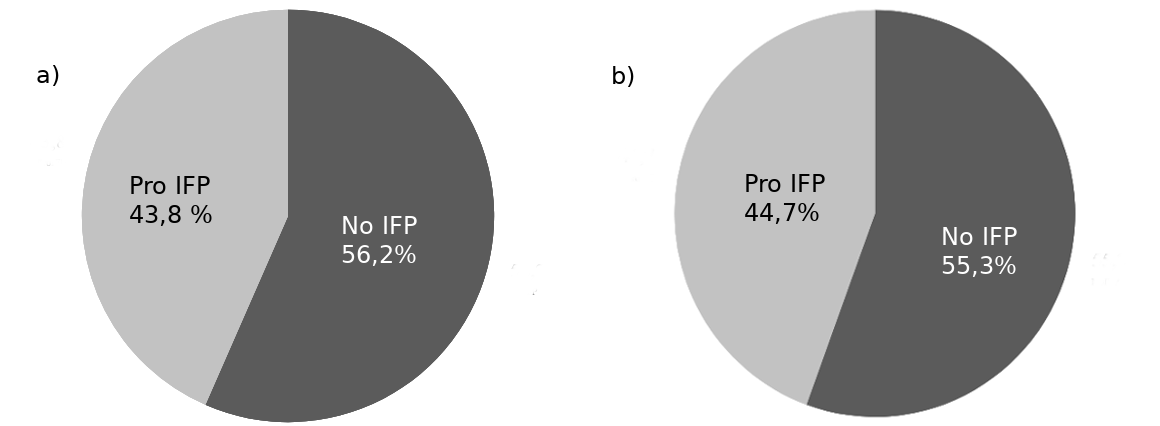
Given the current prospect of divide in community and miner sentiment (see initial charts above this text) it is unlikely that any of the resulting chains would be significantly lower valued than they currently are (Coinflex is a bad reference due to too little liquidity). Either users sell their less liked fork token to get more of the beloved one (leaving values identical if number of user on both forks are similar) or users simply hold onto both (leaving values identical).
At a second glance thus Bitcoin Cash might actually become stronger with the existence of a NoIFP and an IFP fork. Especially so when compared to the network security of Bitcoin Core. It's proven time and again that competing forks have larger marketcapitalisations combined just after the split than their basechain had before. Since hashpower follows price (there's profit to be made), their combined SHA256 hashrate will represent a larger share of the total pool of all SHA256 blockchains.
Solution: Amicable Split
To avoid further community infighting, a long and severe hashwar with bad PR and uncertainty, let's make this beneficial and wish each other's projects well - paving the way into cooperation (@trout has a great take on it on twitter). So here's a surprisingly simple, yet maybe naive solution. All it takes is the following: https://twitter.com/christroutner/status/1291966169054814210
**Both sides announce a new ticker** (e.g. Bitcoin Cash **XBC** and Bitcoin Cash **ABC**).
Both sides announce amity and implement replay protection. Despite code freeze there would be time for this.
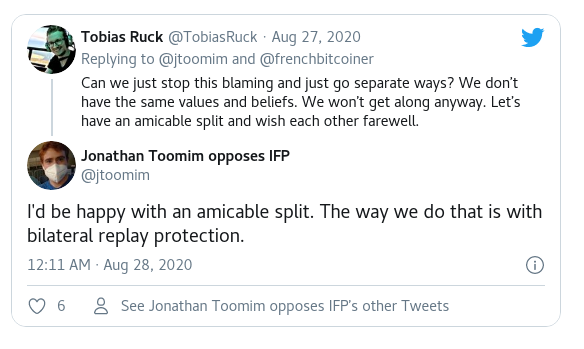
https://twitter.com/jtoomim/status/1299107281359925248
Understanding #proIFP
*The following is a compilation of arguments in favour of the infrastructure funding plan proposed by Bitcoin ABC.*
I'm convinced that all known and relevant actors of our current community act in good faith to promote Bitcoin Cash as a peer-to-peer electronic cash system for the world. For the reading time of this article I invite you to assume the same. I've previously listed the strongest arguments against the #IFP. Here's what I conceive as strongest arguments in favour of it, compiled mainly from Amaury's talks referenced at the end. https://read.cash/@bomtom1/understanding-noifp-a63ded5d https://read.cash/c/debate-infrastructure-funding-plan-95df
Independence in Maintenance of the Codebase is Essential https://read.cash/@bomtom1/understanding-proifp-e1310493#independence-in-maintenance-of-the-codebase-is-essential
A well-defined Roadmap is Essential https://read.cash/@bomtom1/understanding-proifp-e1310493#a-well-defined-roadmap-is-essential
Infrastructure Development must be Incentivized https://read.cash/@bomtom1/understanding-proifp-e1310493#infrastructure-development-must-be-incentivized-properly
8% of the Coinbase Totals only 1% of the Total Supply https://read.cash/@bomtom1/understanding-proifp-e1310493#8-of-the-coinbase-totals-only-1-of-the-total-supply
Business Developer Shouldn't Worry About Infrastructure Development https://read.cash/@bomtom1/understanding-proifp-e1310493#business-developer-shouldn039t-worry-about-infrastructure-development
Value-adding Actors should be in Charge https://read.cash/@bomtom1/understanding-proifp-e1310493#value-adding-actors-should-be-in-charge
Independence in Maintenance of the Codebase is Essential
It's generally underestimated how much resources it takes to run a professional software-development team. The node implementation of Bitcoin Cash which has so far almost exclusively been used for mining (i.e. keeping the network alive) relied on backporting the Bitcoin Core codebase for maintenance. The latter has a multimillion-dollar development team leading the way. We need to afford the manpower to cope with this maintenance work ourselves. If we cannot and we continue to rely on backporting we won't be more valuable as the competitor: If Bitcoin Core were to disappear, we fail along. Hence, independence in maintenance of the codebase is essential.
A well-defined Roadmap is Essential
A multi-node ecosystem is ineffective in achieving consensus. Even the acceptance of a roadmap has previously been seen as collusive in the Bitcoin Cash ecosystem. Decentralization can eventually lead to atomization of the efforts.
In order to effectively develop toward the vision of peer-to-peer electronic cash system for the world a roadmap is essential and must be committed to. Cooperation among developers is fostered better in a lead-node ecosystem.
Infrastructure Development must be Incentivized Properly
Bitcoin Core is a perfect showcase to illustrate why infrastructure development must instead be funded on a protocol level. If it isn't corporations are incentivized to manipulate the Bitcoin development such that they can profit. Here, Blockstream succeeded in doing so, limited the on-chain transaction capacity, and profits from selling off-chain transaction solutions. In order to remove this incentive to manipulate infrastructure development, sufficient funding must be steadily ensured to provide a competitive payroll for well-trained developers with the required skillset.
The main cryptocurrency competitors of Bitcoin Cash by market capitalization are Bitcoin Core and Ethereum. Both have funds at their disposal which are at least two order of magnitude larger than those available to Bitcoin Cash. As a result they will continue to outperform our efforts even if they are 99% less efficient in their development. The coinbase is a natural fit to allow a steadily ensured comparable amount of funding in infrastructure development in order to compete.
8% of the Coinbase Totals Only 1% of the Total Supply
Only 2.5M coins remain to be initially distributed. 8% of those are about 200.000 BCH. That's less than 1% of the total supply and a reasonable amount to be spent on infrastructure development into the future.
This 1% is commonly understood as an upper bound because network upgrades are still scheduled every 6 months. This would allow development teams which provide higher-quality development at the same price or equal-quality development at lower price to out-compete Bitcoin ABC.
Business Developer shouldn't worry about Infrastructure Development
Any resources business builders have to spend on infrastructure concerns (node stability under spam attack with 100x load being the prominent example) are resources not spent on their business, diminishing their likelyhood of success. Successful businesses are ultimately the ones achieving adoption for the currency. To maximize the value of the whole ecosystem it is hence best if businesses need not worry about infrastructure.
Value-adding Actors should be in Charge
The almost unlimited access to information challenges human's power of comprehension. Conventionally more access to information is considered a higher good. Currently the information is so abundant that it becomes challenging to filter and digest what's relevant. In the context of Bitcoin Cash it means filtering relevant actors which add value to the ecosystem from social-media noise (see also General Network Council). https://www.bitcoinabc.org/2020-08-27-global-network-council/
Edit:
2020-09-16: add @Fidel note on 1% being considered an upper bound.
[0] Amaury Séchet, *Back to the Basics*, https://www.youtube.com/watch?v=By0w43NQdiY
[1] Amaury Séchet, *Building Bitcoin Cash Culture*, https://www.youtube.com/watch?v=uOv0nmOe1_o [transcript] https://read.cash/@Cain/transcript-of-amaury-sechet-presenting-at-the-bitcoin-cash-city-conference-9519-cc7a9e91
[2] Amaury Séchet, *Bitcoin Cash Split and IFP and How to Solve Development Funding*, https://lbry.tv/@DigitalCashNetwork:c/AmauryIFP:3 [transcript] https://read.cash/@Cain/running-diary-of-joel-valenzuelas-interview-of-amaury-sechet-4e5b6f0f

Understanding #noIFP
*The following is a compilation of arguments against the infrastructure funding plan proposed by Bitcoin ABC.*
I'm convinced that all known and relevant actors of our current community act in good faith to promote Bitcoin Cash as a peer-to-peer electronic cash system for the world. For the reading time of this article I invite you to assume the same. I've previously explained how a developer might arrive at a #proIFP stance. Here's what I conceive as strongest arguments against it. https://read.cash/@bomtom1/understanding-amaury-4c17f6d5#comment-a30248ff
Introducing a Single Point of Failure https://read.cash/@bomtom1/understanding-noifp-fd8fb02f#introducing-a-single-point-of-failure
Funding is not the Issue at Heart, it's Power https://read.cash/@bomtom1/understanding-noifp-fd8fb02f#funding-is-not-the-issue-at-heart-it039s-power
Diminishing Bitcoin Cash Hashrate https://read.cash/@bomtom1/understanding-noifp-fd8fb02f#diminishing-bitcoin-cash-hashrate
Wrecking Credible Neutrality https://read.cash/@bomtom1/understanding-noifp-fd8fb02f#wrecking-credible-neutrality
Meme Warfaring https://read.cash/@bomtom1/understanding-noifp-fd8fb02f#meme-warfaring
Diminishing Adoption, Diminishing Emergence https://read.cash/@bomtom1/understanding-noifp-fd8fb02f#diminishing-adoption-diminishing-emergence
Redefining who ownes new coinbases https://read.cash/@bomtom1/understanding-noifp-fd8fb02f#redefining-who-ownes-new-coinbases
Once and for all https://read.cash/@bomtom1/understanding-noifp-fd8fb02f#once-and-for-all
Introducing a Single Point of Failure
Achieving Bitcoin's re-centralization back to a single lead implementation (after BitcoinXT had achieved majority vote, after Bitcoin Classic, Bitcoin Unlimited and BitcoinS2x) has previously led us down the wrong road. Even if it wouldn't have been for hostile intents initially, it definitely simplified the final hostile takeover.
Introducing a single point of failure either in development team or in funding address is a bad idea despite the relief it brings to governance.
Funding is not the Issue at Heart, it's Power
More than 13 kBCH (totaling roughly 4 M$) have been raised over the course of the IFP debate [1,2]. While Bitcoin ABC's flipstarter and their own funding campaign have not been completely filled, both together did raise about 8 kBCH. This is sufficient to start a professional software development team and continue a valuable discussion with the other implementation teams and stakeholders. Very likely it is this discussion which turned out too difficult to continue mutually.
That hints at the actual purpose of the upcoming split rather being leadership, i.e. governance, than the urgency for funding. https://read.cash/@bomtom1/without-governance-model-the-infrastructure-development-fund-mustnt-come-from-the-coinbase-a583613d
Diminishing Bitcoin Cash Hashrate
Bitcoin Cash is Bitcoin's last hope. It shouldn't be put on the line lightly. It is currently barely surviving in terms of hash rate. While certain Bitcoin-Core chain miners have a stake in Bitcoin Cash's survival the risk of a 51%-attack persists. It would be a devastating PR event for Bitcoin Cash's security and value proposition.
Both resulting chains of the upcoming split will most likely stand even weaker than we do now united. As long as we don't find consensus on a new way of funding infrastructure development other than voluntarily, we simply cannot afford a change. While people claim this were a deadlock and energy is wasted on discussions, I highly disagree. This issue deserves even more thought given the stakes.
Wrecking Credible Neutrality
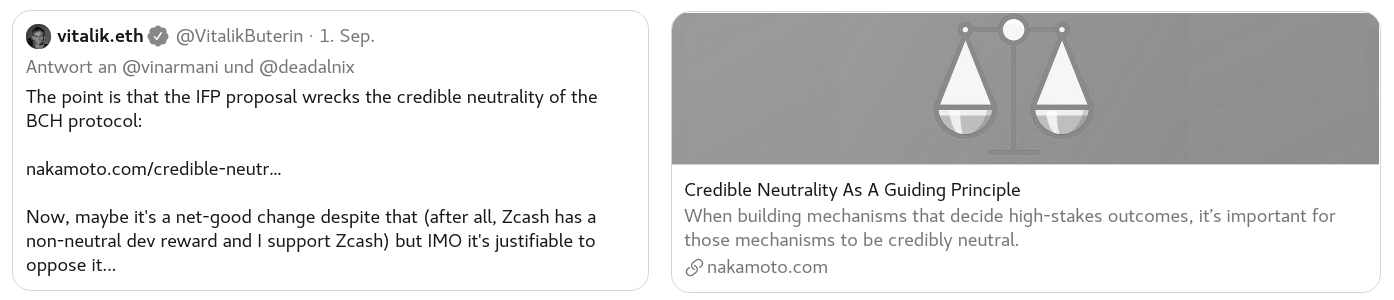
https://twitter.com/VitalikButerin/status/1300714566771290113
As we have already realized the upcoming split is about governance of Bitcoin Cash. We should ensure that which ever governance mechanism is chosen in the long run is credibly neutral.
Any rush in this is unjustified.@BigBlockIfTrue and @ZakMcRofl have pointed to quite some flaws in the current draft of the fund's governance model:
https://old.reddit.com/r/Buttcoin/comments/imj3y1/the_global_network_council_framework_bitcoin_abc/g419z45/
https://read.cash/@ZakMcRofl/analysis-of-the-global-network-council-framework-ed307d5a
Meme Warfaring
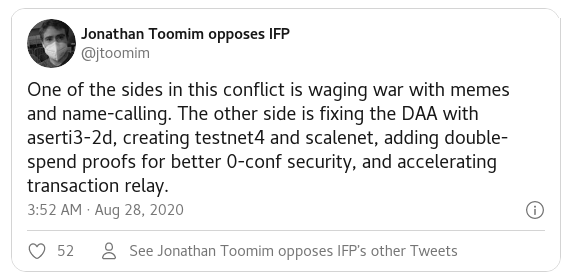
https://twitter.com/jtoomim/status/1299162861562810369
A meme competition by @micropresident paved the way for the debate to personal attacks and towards hostility [3]. While arguments are made the campaign itself were a mere response to hostility, I would yet have to see the particular post by the agent provocateur.
The degree to which Amaury Séchet and prominent advocates of the current IFP engage in the meme warfaring doesn't shed an appealing light on the future governance style of the IFP.
Diminishing Adoption, Diminishing Emergence
Money is a social construct. The more people join a particular currency the more it reduces friction, the more valuable it becomes. This is nowhere more true than in the cryptocurrency space where money is programmable: The more people join a particular currency the higher the likelyhood of emergence.
The Ethereum community is an excellent example for that. Inventive projects mutually enrich each other as they become increasingly interoperable. In Bitcoin Cash we just start to see emergence gain traction. The idea of @TobiasRuck's Be.Cash for example was only born from lucky coincidences (a student's wifi problems at the other end of the world) which were conceivable only because Bitcoin Cash had grown sufficiently large. It would be mean a setback in adoption and emergence in a critical moment. https://be.cash/
Redefining who ownes new coinbases
In his article "The Best of Intentions: The Dev Tax Is Intended to Benefit Investors But Will Corrupt Us Instead" @PeterRizun explains how the change of the incentive structures of Bitcoin as layed out out in a previous IFP proposal is harmful on several levels. The main points remain: https://read.cash/@PeterRizun/the-best-of-intentions-the-dev-tax-is-intended-to-benefit-investors-but-will-corrupt-us-instead-deb0dd72
It introduces trust in an otherwise trustless system.
It redefines ownership of the coinbase with legal implications.
It introduces fiscal policy in Bitcoin.
Once and for all
If successful the current IFP will give a considerable amount of money, i.e. power, to Bitcoin ABC. It is hard to imagine that any other node-implementation team could ever come close to challenge Bitcoin ABC's leadership claim ever (with considerably less funding than their competitor).
Based on historical evidence power tends to corrupt. Once implemented regulations are hard to ever shake off again.
Edits:
2020-09-09: Added a table of content, added section 'Redefining who ownes new coinbases', add last sentence to section 'Diminishing Adoption, Diminishing Emergence'
[1] https://fund.bitcoinabc.org/
[2] https://read.cash/@bomtom1/understanding-amaury-4c17f6d5#comment-a30248ff
[3] https://old.reddit.com/r/btc/comments/i0bkfx/readcash_founder_threatens_ban_permanent_fund/
Understanding Amaury
*The following is a summary of one angle on the current infrastructure funding plan debate. It's compiled to the best of my understanding as I follow along with the debate. Disclaimer: I'm yet another long-time lurker who's passionate about Bitcoin, unassociated with any of the development teams, and doesn't have any clues of what's going on behind the scences. This is my subjective perception of the events and facts.*
I'm convinced that all known and relevant actors of our current community act in good faith to promote Bitcoin Cash as a peer-to-peer electronic cash system for the world. For the reading time of this article I invite you to assume the same. I'm happy to be part of such a passionate community. In the current infrastructure-funding debate, however, different believes separate us irreconcilably. Those are
**a)** proper funding for long-term infrastructure development is necessary, and
**b)** funding for infrastructure development must not come from the coinbase.
As a lurking community member and as a software developer I find myself in the awkward position to consider both statements true [0]. So I cannot wholeheartedly support one side over the other. Here's why.
Understanding the necessity of an infrastructure development fund
If you put yourself in the shoes of a professional software developer who would like to become independent of the Bitcoin Core client, who wants to properly maintain such a project and further develop it according to a well defined roadmap, you will quickly see that you need considerable long-term infrastructure development funding (IFP) [1,2] (Please do read/listen to both references). Without such a funding, you cannot fulfill your goal. Software developers understand this and that's why a large portion of members inclined to the IFP are software developers (e.g. @trout, @VinArmani, @TobiasRuck, @cpacia). https://read.cash/@cpacia/the-253rd-thoughts-on-developer-funding-article-87b4d8e2 https://youtu.be/uOv0nmOe1_o?t=294
Understanding why the coinbase mustn't be touched
The coinbase is the incentive for miners to build blocks. It's the sum of all transaction fees of a mined block plus an decreasing share to initially distribute Bitcoins in the system. A block's miner decides who receives the coinbase (usually the miner itself).
Any development team who by default receives a share of the coinbase which is uncorrelated to a trustlessly verifiable amount of work evolves to a trusted third party of the system: It will never be possible to challenge the resources of this team. Even if the trusted third party is benevolent, this introduces a single point of failure to the system. Bitcoin is a peer-to-peer electronic cash system which intrinsically doesn't and mustn't require a trusted third party.
To my understanding this is why most of the publicly known community members reject any diversion of the coinbase [3,4] in particular given the adversarial attacks Bitcoin Cash is continuously facing from the all-powerful fiat world. https://read.cash/@RogerVer/imagine-how-you-would-feel-3a6b2516 https://read.cash/@georgedonnelly/amaury-sechet-is-forking-bitcoin-abc-away-from-bitcoin-cash-8734adc1
One way forward for Bitcoin ABC
With these points established (necessity for infra funding & majority of the community rejects coinbase diversion), voluntary donations are the natural fit to the problem. Can we achieve this on a voluntary basis? Let's do the math by rule of thumb: 15 decent developers at a salary of 450 BCH at current price for a reasonable first project term of three years totals to 20 kBCH. ABC only asked for 1 kBCH in their fundraiser and couldn't get it filled [5]. https://abc.flipstarter.cash/
Until proven otherwise at this point the only viable option left is to use a share of the coinbase which could decrease as the token valuation grows. Ideally, this would be understood by the community in order to have the essential discussion on governance of the IFP which necessarily needs to predate any implementation [0]. https://read.cash/@bomtom1/without-governance-model-the-infrastructure-development-fund-mustnt-come-from-the-coinbase-a583613d
If the community doesn't understand this or is unwilling to because their funding is already secured (as maybe with Bitcoin Unlimited's predating BTC donation) and thus no other node team joins in on the IFP, then the governance discussion cannot even be had. The issue is then solved as there's anyhow only one team willing to understand the bitter truth and move forward. How much longer shall Bitcoin Cash wait and let Bitcoin Core lead the way? The answer might be 'until we outperform Bitcoin Core in tx volume and then we'll have enough participating companies with vested interest to invest in infrastructure'. The latter might mean a decade of stasis and there's further arguments against it [6]. I don't want to pretend to know what's right. https://youtu.be/uOv0nmOe1_o?t=739
Two ways out for Bitcoin Cash
As I see it @deadalnix is enforcing a more active approach here in a clever way. Let's state the obvious
Jihan and Haipo potentially control enough hash (on BTC) to settle the hashwar short-term in any direction they want. No signaling needed.
Bitmain controls enough Bitcoin Cash to settle the relative price of the coins post furca long-term in any direction they want.
As a result, the hashwar can only be won long-term by Bitmain or an actor which can keep up with their Bitcoin-Cash stack. This incentivizes other large actors (e.g. Bitcoin Unlimited, @RogerVer) to convert an essential share of their total holdings to Bitcoin Cash prior to the fork. Depending on Bitmain's position in the debate this might mean Bitcoin Cash will either get strong leaders that have put not only a considerable but an essential share of their holdings in Bitcoin Cash or it will get a professional software-development team lead by Bitcoin ABC.
Win-Win Situation for Bitcoin
Currently neither BU nor Roger are to an essential degree invested in Bitcoin Cash. That makes sense from the perspective of any investing individual and I don't blame anyone. However, for establishing Bitcoin Cash as the market-leading cryptocurrency it is as huge a problem [7,8] as a missing infrastructure development at the scale of Bitcoin Core. Amaury enforces advancement on at least one of these fronts. It seems this makes some sense from a free-marketeer perspective: On the one hand we believe in the output of the free market, its magic hand which delivers perfect information at minimal friction. Yet on the other hand we're reluctant to provide the input for the output we would like to see by either showing up bold at our degree of investment (essential, not just considerable) or at the infrastructure development front (leading, not just following by backporting core). https://www.youtube.com/watch?v=6ywIL17ityk&t=1499 https://read.cash/@BigBlockIfTrue/fear-uncertainty-and-doubt-ece60d2b
[0] To be a bit more nuanced I'd argue one could actually get around (b) if a well-discussed and communtiy-wide agreed-upon trustless governance model for available funds were at hand prior to any node implementation (https://read.cash/@bomtom1/without-governance-model-the-infrastructure-development-fund-mustnt-come-from-the-coinbase-a583613d).
[1] Chris Pacia, *The 253rd 'Thoughts on developer funding' Article*, https://read.cash/@cpacia/the-253rd-thoughts-on-developer-funding-article-87b4d8e2
[2] Amaury Séchet, *Build Bitcoin Cash Culture*, BCH Conference 2019, Timestamp 294s, https://youtu.be/uOv0nmOe1_o?t=294
[3] Roger Ver, *Imagine How You Would Feel*, https://read.cash/@RogerVer/imagine-how-you-would-feel-3a6b2516
[4] @georgedonnelly , *Amaury Séchet is Forking Bitcoin ABC away from Bitcoin Cash*, https://read.cash/@georgedonnelly/amaury-sechet-is-forking-bitcoin-abc-away-from-bitcoin-cash-8734adc1
[5] https://abc.flipstarter.cash/ - Can someone help me how much was raised at peak?
[6] Amaury Séchet, *Build Bitcoin Cash Culture*, BCH Conference 2019, Timestamp 739s, https://youtu.be/uOv0nmOe1_o?t=739
[7] Amaury Séchet, *Build Bitcoin Cash Culture*, BCH Conference 2019, Timestamp 1499s, https://www.youtube.com/watch?v=6ywIL17ityk&t=1499
[8] @BigBlockIfTrue, "*Fear, Uncertainty, and Doubt*", https://read.cash/@BigBlockIfTrue/fear-uncertainty-and-doubt-ece60d2b
Without governance model the infrastructure-development fund mustn't come from the coinbase
On first sight it is very appealing to fund infrastructure development from the coinbase. Just as miners provide a service to the community by keeping the timestamp server ticking, so do infrastructure developers by maintaining and developing the software. Why should miners be rewarded for their communtiy service but developers not? Let's say we would agree to distribute 8% of the coinbase to a specific address of a given dev team.
Now for miners there remains a well-defined relation between the effort they put and the reward they receive. They prove their work by finding blocks and receive 92% of the coinbase. More proof-of-work, more reward.
For infrastructure developer there's no such relation between the effort they put and the reward they receive. With every block found they receive 8% of the coinbase. More dev work or less, it doesn't matter. A feedback mechanism is missing.
While some incentives persists for the dev team (to deliver high-quality code due to valuation of their network token compared to competing network tokens), **one incentive is lost:** **to compete for better development within the network itself**. The dev team which achieves to redirect a share of the coinbase to their account has no incentive to share it with any other dev team, other than goodwill. The network is then at the mercy of this dev team.
Funding the infrastructure development from the coinbase might be the right thing to do if a proper governance model for the distribution of the available funds is implemented. And funding infrastructure does have very high priority! But its governance should be properly discussed and not implemented lightly or in a rush.
Without a well-discussed and communtiy-wide agreed-upon governance model for available funds such an implementation is an irrevocable power grab of the network by one dev team.
Effectively this turns the IFP debate in a debate on a multi-node vs a lead-node ecosystem. Which one do you prefer?


Tobias Ruck and the Lurker
*The following is a brief write-up of a meeting between Tobias Ruck and bomtom1, their (dis-)agreements, and beliefs. It‘s meant to explain opposing views in the current debate and proves that civilized discussion can be had despite meme warfare and escalating reddit debates.*
The /r/btc-subreddit is curse and blessing as it brings Bitcoin lovers and haters, developers and users, lurker and barkers all together in one spot. It manifests what an ancient Greek Agora must have been like. Ironically the founder of the SLP Agora and me jostled each other just there. We decided to sort things out the non-digital way and met up irl four days later. The following sketches what was discussed between beers and jokes. https://np.reddit.com/r/btc https://github.com/EyeOfPython/slpagora https://np.reddit.com/r/btc/comments/ickdmc/all_the_people_i_talk_with_about_slp_agree_that/g23jwqy/
On the IFP
Agreements
Generally a plan to fund infrastructure development would be a good thing.
Such a fund should be managed by a foundation.
A public discussion about the governance of such a foundation and the distribution mechanism of its funds should ideally have preceded ABC‘s announcement of their current IFP fee.
The lack of any previous discussion on governance / distribution mechanism and the lack of any official statement on such a foundation does not exactly promote ABC‘s side in the debate.
Disagreements
Tobias believes ABC will provide the missing information on a foundation and its governance in due time and that will be sufficient to follow their lead.
bomtom1 believes a public discussion must necessarily be had prior to any unilateral announcement let alone implementation. Its absence rather disqualifies ABC‘s lead.
Tobias believes a single leading node implementation (capable of acting) will be more beneficial for Bitcoin Cash because it allows for more effective development into the future.
bomtom1 believes a multi-node ecosystem which creates consensus through discussion is more beneficial for Bitcoin Cash because it allows for a joined-forces community.
**Why Tobias favors ABC over other development teams**
Tobias is an entrepreneur who wants to build products on top of Bitcoin Cash as a base layer. It‘s essential to him that this base layer
successfully scales beyond 30 MB blocks,
successfully implements pre-consensus to prevent double spends [0],
has a responsive and professionally working base-layer development team at his disposal.
Given his personal experience working and communication with several teams, ABC is simply his best bet on getting what‘s important to build his business [1].
**Why bomtom1 favors a multi-node ecosystem**
bomtom1 is a user of Bitcoin Cash who enjoys to see the ecosystem as a whole flourish.
Giving all power to one node implementation introduces a single point of failure which has led us down the wrong path before with Bitcoin Core.
Money is a social construct. The larger the community is which agrees on one particular implementation of money, the larger is the benefit for all participants, and the more momentum can be created from within the community if it pulls together.
While bomtom1 acknowledges Tobias' needs, it is perceived as given (no matter the development team in charge) that the former two of his points will be met with Bitcoin Cash anyway if it would achieve an adoption requiring 30 MB blocks (i.e. the 300 fold of todays usage).
On Mitra
No matter the outcome of the upcoming hardfork Nov. 15th funding Tobias‘ Mitra flipstarter will better the cryptocurrency space independent of his standing in the IFP debate. The work proposed in the flipstarter does not propel any chain over the other and generated insights could be used by either side. By contributing you will enable an inspiring young lad to contribute meaningfully to the cryptocurrency space. If anything it is by generosity that the voluntarist side can prove their approach to the IFP side. https://mitra.be.cash/
[0] https://www.youtube.com/watch?v=TIt96gFh4vw
[1] https://www.bitcoincash.org/roadmap.html

 @bomtom1