Apollo-Greek God of the Sun and Light
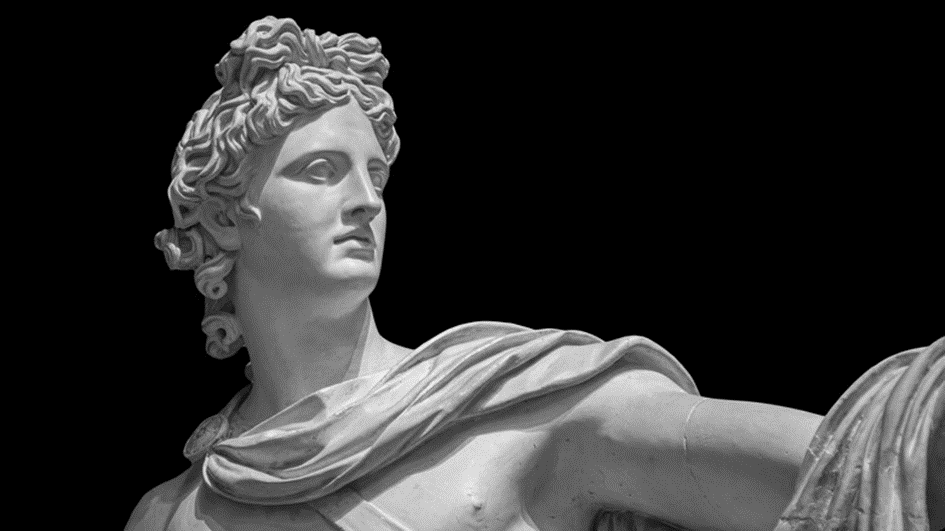
Apollo was a great Greek god associated with bow, music, and divination. Symbol of youth and beauty, source of life and healing, patron of the arts, and as bright and powerful as the sun itself, Apollo was arguably the most beloved of all gods. It is among the most famous of all Greek religious temples. He was worshiped in Delphi and Delos.
Apollo, son of Zeus and Leto and twin brother of Artemis, was born on the island of Delos (holding a golden sword in Hesiod's Theogony). It was said that at the first taste of ambrosia, he immediately transformed from baby to male. Apollo was later given a bow made by Hephaestus, a master artisan of Mount Olympus.
As with other great gods, Apollo had many children; perhaps the most famous are Orpheus (who inherited his father's musical skills and became a virtuoso with the lyre or kithara), Asclepius (whom he gave his healing and medical knowledge) and, according to the 5th century BC tragedy Euripides, the hero Ion.
Apollo is an important hero in Homer's account of the Trojan War in the Iliad. On the side of the Trojans, he specially helps the Trojan heroes Hector, Aeneas and Glaukos, saving their lives more than once with his divine intervention. He brought plague to the Achaeans, all of Troy led his army (holding Zeus' dreaded shield) in an attack that destroyed the defensive walls of the Greek camps, and was also responsible for directing the arrow of Paris into Achilles' heel and killing those who apparently killed it. the invincible Greek hero. Apollo is most often described by Homer and Hesiod as 'remote shooter', 'remote worker', 'hitman of armies' and 'Phoebus Apollo'.
Apollo often played the role of the faithful son of Zeus, father of the gods, and never sought to usurp his position (unlike Zeus who overthrew his own father, Kronos). As a punishment, Apollo had to spend a year herding the king's sheep in the humble service of Admetus of Therae.
Apollo received his lyre from his mischievous half-brother Hermes, who was the messenger god. As a baby, Hermes had stolen Apollo's sacred herd of cattle and cleverly turned his hooves upside down to make it difficult to follow his tracks. Hermes was allowed to retain his ill-gotten gains, but gave Apollo a after he gave his lyre, which he invented using a tortoiseshell.
The dark side of Apollo as the bringer of plague and divine punishment is most famously seen when Niobe slays his six (or seven in some accounts) sons, along with his sister Artemis, as punishment for boasting that their childbearing capacity is greater than Leto's. Another unfortunate victim of Apollo's wrath was the satyr Marsyas, who unwisely claimed to be more musically gifted than the god.
The two had a rivalry, and the Muses decided that Apollo was indeed the better musician. Apollo later went live for his mortal arrogance. flayed his living skin and nailed his skin to a pine tree. The story is an interesting metaphor for the rivalry (at least to Greek ears) between the civilized and orderly music of Apollo's lyre and the wilder, more chaotic music of Marsyas' flute.
Apollo, this time idyllic won another music contest against the god Pan and was defeated by King Midas, thus creating the undisputed musical element in the Greek world. God's defeat of Marsyas and Pan may reflect the Greek conquest of Phrygia and Arcadia, respectively.
Apollo was a well-loved god, and this was most likely due to his association with many positive aspects of the human condition, such as music, poetry, purification, healing, and medicine. God was also associated with moderation in all things. Although his arrows could bring destruction, they could also prevent harm to their favor. One strategy to keep them out of their homes was to erect a column of Apollo Agyieus and, on a larger scale, Apollo Propylaios, to protect the city gates.
The Edda
The term Edda is used to describe two Icelandic manuscripts that were transcribed and compiled in the 13th century. These two manuscripts are the main source of Norse mythology and skaldic poetry associated with the religion, cosmogony and history of the Norse and proto-Germanic tribes. The Prose Edda (Prose Edda) or Younger Edda (Young Edda) dates from about 1220 and was compiled by Icelandic poet and historian Snorri Sturluson. The Poetic or Elder Edda was written around 1270 by an unknown author.
Snorri Sturluson's work was the first of two manuscripts of the so-called Edda, but researchers doubt exactly how it arrived. Snorri himself did not give the name. The term "Edda" was attributed to Snori's work by a different author in an early 14th-century article, Codex Upsaliensis, which included a copy of Snorri's Edda work. In The Poetry of the Old Northern Tongue, Gudbrand Vigfusson describes the Codex Upsaliensis as follows: "The book that Snorri Sturluson put together in a certain order is called the Edda.
This order is first associated with Æsir and Gylfi." The first use of the word Edda, which has been identified until now, is in the poem Lay of Righ (Háttatal) by Snorri. In this poem, the word "Edda" is used to refer to "great-grandmother." Although there are multiple theories, it can be argued that the term may be related to Snorri's handwriting because a word like great-grandmother carries the breadth of ancient knowledge and wisdom. Another widely accepted theory is that the word "Edda" is associated with the name of the Icelandic City of Oddi where Snorri grew up.
Snorri Sturluson's Edda later became known as the Prose Edda after the addition of prose descriptions to its difficult alliterative prose and symbolism. It seems that Snorri intended the manuscript text as a textbook on skaldic poetry. However, his songs and poems describing mythologies, heroism and wars were most appreciated. Snorri's prose reflected the old courtly poetic styles and held a prominent place among other poets. It was in a position perhaps inaccessible to the next generation of poets; because it was considered by many to be too cryptic and difficult.
Snorri's Edda was later referred to as the "Young Edda" because it was ancient in origin. What this source is consists of comments. While some researchers think that Snorri is largely based on folkloric oral traditions he heard; some researchers think he used an ancient Edda. However, experts agree that Snorri himself added most of the details in the text. As a result, he offers readers an elaborate version of Norse mythology that at times reveals Christian influence.
In 1643, Bishop Brynjólfur Sveinsson, a respected Icelandic collector who has studied numerous works on Scandinavian literature, acquired a copy of an earlier manuscript. Although no researcher knew where it came from or whether it was its original name, it was clear that this newly discovered short and detailed synopsis had some common roots with Snorri's Edda.
Although the bishop attributed this manuscript to the priest and writer Saemundur Sigfússon (1056-1153) and called it Saemundur's Edda, researchers today admit that it is false. Its author or compiler is still unknown. However, Bishop Brynjólfur believed that the work was the Elder Edda. Written entirely in prose, the Elder Edda was later named the Poetic Edda to distinguish it from Snorri's prose.
**Today the Eddas are a key to ancient Germanic history. The Eddas, which are a very wide source of mythology, reveal the close relations between humans, gods and nature and the deep respect based on these beliefs.**
In 1622, Bishop Brynjólfur sent King Henry III of Denmark to place many of his important literary collections in the new Royal Library. He gave it to Frederick. Among them was the Poetic Edda. The book is known as the Codex Regius (The King's or Royal Book) and was kept in Denmark until it was returned to Iceland in 1971. The Codex Regius is a valuable work of ancient legends and heroic tales that cannot be found elsewhere.
Old copies of the Codex Regius and their once-existing resources have been lost or destroyed. Only 16 of this 90-page work was lost after it went to Denmark. The Poetic Edda differed slightly from the Codex Regius as other poems were added over the years. Many today refer to the oldest King's Book, the Codex Regius of the Poetic Edda; He says it is important to parse it from a different volume, the Codex Regius, which contains a copy of Snorri's Edda and is dated to the first half of the 14th century. The content of any modern Poetic Edda varies and is subject to its author.
Ancient Britain
Many TV shows have been made about ancient britain, and I may have watched almost all of them. Even though it is far from the country where I was born, I have a curiosity about that history and this leads me to read all the articles and watch all the series. What interests me in this history is that there are many different intrigues, that they have a lot of power and that they have somehow managed to survive throughout history.
Britain (more precisely, Great Britain) is the name of the largest of the British Isles, which stretches to the northwest coast of the European continent. This name is probably derived from the Celtic word meaning 'white'. It is assumed to be a reference to the famous white cliffs of Dover, which cannot be missed by those arriving by sea. The Greek navigator Piteas, who discovered the coast of the island in 325 BC, is the first person to mention this island.
During the Early Neolithic (4400 BC - 3300 BC), many long mounds were built on the island, many of which can still be seen today. In the Late Neolithic (2900 BC - 2200 BC), large stone circles called stone works appeared, the most famous of which was Stonehenge.
Prior to the Roman occupation, numerous tribes often known as Britons lived on the island, mostly believed to be of Celtic origin. The Romans knew the island as Britain.
**PRIOR TO THE ROMAN OCCUPATION, THE ISLAND HAS BEEN HOME HOME TO VARIOUS TRIBES KNOWN MOSTLY AS BRITONS.**
Military reports of Julius Caesar, who went to the island from Gaul (France) in 55 and 54 BC, are recorded in historical records. The Romans invaded the island in AD 43, on order of their general Aulus Plautius, the emperor Claudius, who had crossed to oversee the entrance to Camulodunum (Colchester), where the Catuvellauni, one of the foremost of the most warlike tribes, was located. Plautius invaded with an army of about 40,000 men, consisting of four legions and auxiliary troops.
We learn a lot about the survival of Agricola and the first forty years of the Roman occupation, thanks to the biography of his father-in-law by the historian Tacitus (105 AD). However, further literary evidence is scarce. Fortunately, from time to time we come across many mysterious archaeological evidence. Although Northern Britain was never conquered, the Roman empire later flocked to Scotland. They left behind the great fortifications, Hadrian's Wall (AD 120) and the Antonine Wall (AD 142-155), and many of them can still be visited today. Britain was always tightly guarded and was a top from which Roman governors occasionally made attempts to seize power from the empire.
At the end of the 4th century AD, Roman presence in Britain was threatened by "barbarian" forces. Saxons and Angles from northern Germany invaded southern and eastern England, while the Picts (present-day Scots) and Scots (Irish) raided the coast. In 410 the Roman army was withdrawn. After the battles with the British, the Angles and Saxons were victorious and proclaimed themselves rulers over most of Britain during the Dark Ages (AD 450 - AD 800).
Roman Naval Battle
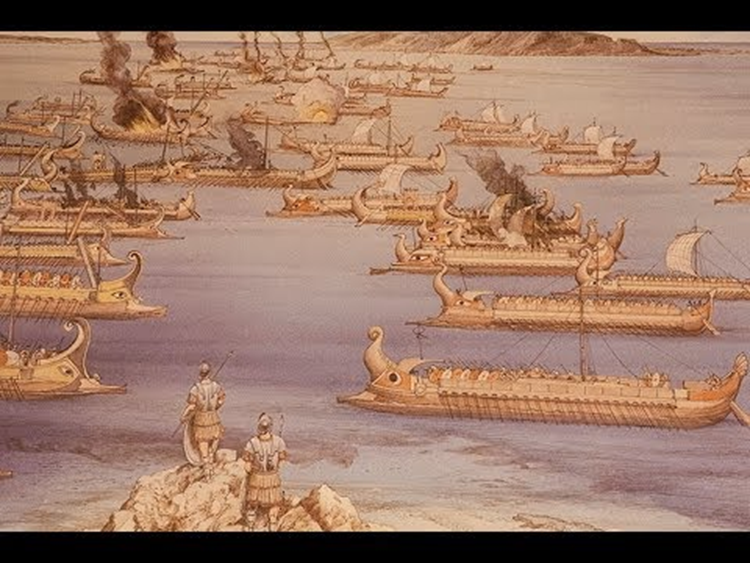
Ancient navy ships were made of wood, waterproofed using pitch and paint, and were propelled by both sails and oars. Ships with multiple rowing tiers, such as the Trireme, had enough speed and maneuverability to slam into and attack enemy ships. The largest ships were the quinqueremes, which consisted of three rows of rowers each, two for the upper two oars and one for the lower oars (about 300 in total). Ships could also be fitted with an instrument known as a platform corvus (raven), from which sailors could easily board enemy ships.
Most warships built for speed were light, cramped and lacking storage space or even a hull for a large unit. Such logistical purposes would be better achieved using troop carrier ships and sailing supply ships. Besides the bronze-clad ram below the waterline in the bow of the ship, other weapons included the artillery ballista, which could be mounted on ships to deliver deadly salvos from an unexpected and less protected flank or at enemy ground positions against other ships. Flameballs (pots of flaming pitch) could also be thrown to destroy the enemy ship with fire instead of hitting it.
Roman naval tactics differed little from those used by earlier Greeks. Ships were propelled by oarsmen and sailed to transport troops, and in naval battles, ships used bronze-wrapped rams to become thrust rams. In real warfare, the sail's maneuverability was limited, and therefore the rowers propelled the ships forward when they were at close range with the enemy.
Sails and rigging were stored ashore to save weight, increase ship stability, and leave more room for sailors. The aim was to position the ram so that it would punch a hole in the enemy ship and then retract it to allow water to enter the submerged ship. Alternatively, a well-meaning blow could break a row of the enemy's oars, thereby neutralizing him.
The best angle of attack to get this type of damage was from the enemy's flank or behind. Due to this, not only maneuverability under the oars, but also speed was a must. Therefore, over time, ships had more and more rowers stacked on top of each other rather than along the length of the ship, making the ship unseaworthy. Thus the triremi of the Greeks' three-level rowing ship evolved from the two-level brirem, and the trireme eventually evolved into the Roman quinquereme.
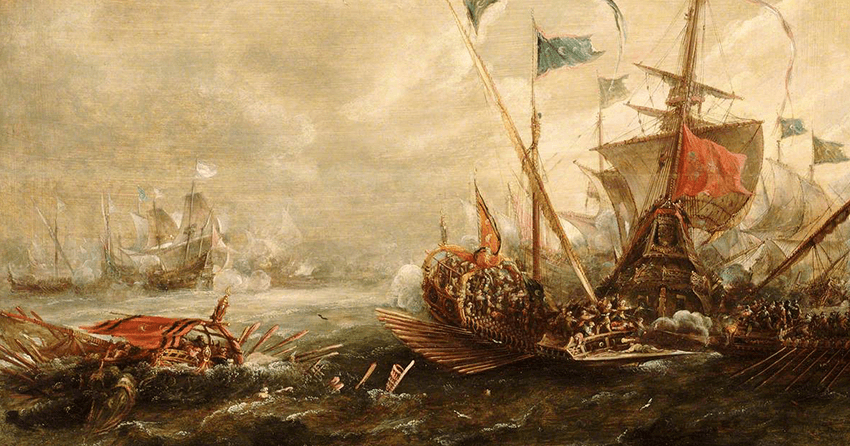
In response to the pirate threat, especially in the Tyrrhenian Sea, Rome had used naval ships from the early Republic era in the 4th century BC, but in 260 BC, they built their first significant navy in just 60 days. In response to the threat from Carthage, they assembled a fleet of 100 quinquerems and 20 triremes. In typical Roman fashion, the designers copied and enhanced it from a captured Carthaginian quinquereme.
The Romans also acknowledged the inferiority of their seafaring compared to the much more experienced Carthaginians. Therefore, they used the corvus. The Corvus was an 11-metre-long platform that could be lowered from the bow of the ship onto the decks of enemy ships and secured with a large metal spike. Roman troops (about 120 on each ship) could then board the opposing ship and quickly take care of the enemy crew.
The first conflict in which Corvi was used to great effect was the Battle of Mylae on the northern Sicilian coast in 260 BC. The two fleets were equal to 130 ships each, but the Carthaginians, not expecting a major jolt in the Romans' naval warfare, did not even bother to form battle lines.
The Corvus proved to be a devastatingly successful offensive weapon against the irregular Carthaginians, and it was a Roman victory, albeit unexpectedly. The commander and consul, Caius Duilius, was not only delighted to see his rival escape from his flagship in a rowboat, but also won a military victory, Rome's first major naval victory.
The Battle of Ecnomus on the southern coast of Sicily in 256 BC was one if not one of the greatest naval battles of antiquity, and it would show that Mylae was not by chance. Buoyed by their initial success, the Romans had expanded their fleet to now have 330 quinquerems with a total of 140,000 men ready for battle. The Carthaginians set out with 350 ships, and the two great fleets met on the coast of Sicily. The Romans organized themselves into four squadrons arranged in a wedge.
The Carthaginians tried to divert the two Roman fleets in front from the two behind and catch them with a pincer action. However, whether due to lack of maneuverability or proper communication of intentions, the Carthaginian fleet instead attacked the Roman rear transport fleet, while the two leading Roman fleets wreaked havoc inside the Carthaginian centre. Melee combat in the center was of little importance to naval knowledge, and corvii was everything. Victory once again belonged to Rome. Rome lost only 24 ships against Carthage's loss of 100.
Still, the war dragged on as Rome's immediate invasion of North Africa proved to be a costly failure. A remarkable expedition led by Gnaeus Servilius Rufus in 217 BC cleared Italian waters of Carthaginian raiders and the Romans eventually defeated the Carthaginian fleet, but largely because they were able to replace lost ships and men more quickly in what turned into a veritable war of attrition.
The victories were mixed with disasters such as the defeat at Drepna in 249 BC and the loss of 280 ships and 100,000 men in a single storm off the coast of Camarina in southeastern Sicily, but in the end Rome prevailed. The war had cost Rome 1,600 ships, but the reward was well worth it: domination of the Mediterranean. This naval control was useful in Rome's wars with Alexander's successor kingdoms in the Macedonian Wars. For example, between 198 and 195 BC, Rome repeatedly conducted successful naval raids against Macedonia's ally, the Spartan tyrant Nabis.
Now the only threat to Rome was Rome itself, and it was, the civil war devastated Italy. Julius Caesar was victorious, and the remnants of Pompey's fleet became the backbone of the Roman navy, used to good effect in campaigns to invade Britain - the second larger expedition in 54 BC included a fleet of 800 ships.
After Caesar's murder, the fleet ironically came under the control of Pompey's son, Sextus Pompeius Magnus. In 38 BC, Caesar's heir, Octavian, had to assemble another fleet to meet the threat of Sextus. With Marcus Vipsanius commanding Agrippa, 370 ships were sent to attack Sicily and the Sextus fleet. Once again, the lack of well-trained sailors forced commanders to innovate, and Agrippa went from maneuverability to brute force, using a catapult-driven grapple on his ships.
This device allowed ships to be winched into close quarters to facilitate embarkation by sailors. The weapon was devastatingly effective in the 600-ship battle of Naulochos (again Sicily) in 36 BC, and Sextus was defeated.
After the victory at Actium, the new emperor Octavian, who now calls himself Augustus, established two fleets of 50 ships - classis Ravennatium based in Ravenna and classis Misenatium in Misenum (near Naples), which was in operation until the 4th century AD. Later there were two fleets, one operating on the Rhine and the other on the Danube, alongside fleets stationed in Alexandria, Antioch, Rhodes, Sicily, Libya, Pontus and Britain.
These fleets enabled Rome to respond quickly to any military need throughout the empire and to supply the army on several campaigns. In reality, there was no real naval competition against the Roman navies. This led to Rome's only one major naval warfare in the following centuries - between the emperor Constantine in AD 324 and his rival Licinius - and thus, at least after Actium, major naval warfare ended in the ancient Mediterranean.
Edward England-Famous Pirate
Captain England has its own chapter in The General History of the Robbery and Murder of the Most Notorious Pirates, compiled in the 1720s. It is written that the book belongs to Captain Charles Johnson, but this is perhaps a pseudonym of Daniel Defoe. (Scientists are still debating whether Charles Johnson, though a wholly unknown pirate expert, may have been a real person.) As with many other pirates, though there are fictional additions to factual information laboriously gathered from sources such as General History, court records, official documents, and letters of the period. It is also an invaluable resource on England's career.
Edward England's real name was probably Jasper Seager (or Seegar). Like many pirates of the period, England had to join a pirate crew after the ship he served was seized. England was an officer in a Jamaican sloop when he was picked up by Christopher Winter in the pirate haven of New Providence in the Bahamas.
After the successful attacks of Woodes Rogers, Governor of the Bahamas since 1717, against pirates in his bunkers in New Providence (now Nassau), England crossed the Atlantic to pursue his piracy elsewhere. Several merchant ships were captured off the coast of the Azores, Cape Verde Islands and West Africa.
In 1718, England forced Howell Davis of Welsh, chief aide on a slave ship, to become a pirate, a dishonest man when he captured Bristol Cadogan. Cadogan's captain was killed, and Davis was given command of the slaver, despite England's refusal to formally sign his ship's clauses and become part of the pirate crew. Impressed by Davis' courage, England allowed him to set sail. Davis was captured in Barbados. Davis managed to escape from prison and went on a spree that ended with his death on Principe Island in 1719, continuing his career as a piracy on both sides of the Atlantic.
Edward England was known to fly a now-classic version of the Jolly Roger pirate flag with a white human skull on a black background above the crossbones. Hoisted before an attack to encourage immediate surrender, England would often fly other flags simultaneously, such as the red flag (to indicate no pity) and the Union Jack (Flag of the United Kingdom).
In early 1719 England seized the sloop called the Pearl and repaired it again to make it faster and more maneuverable, thus abandoning his own sloop, seizing it after capture, in the typical pirate process of continually increasing ship size. The ship's superstructures were destroyed and renamed Royal James. In 1719 the Royal James was used to good effect, taking at least 12 awards off the coast of West Africa, including the 12 gun Bentworth of Bristol. All of these awards are cataloged by Johnson/Defoe by name, crew power and firepower.
In 1720, England was on the rise again after capturing a ship off Madagascar and therefore abandoned the Royal James. He named this new ship the Fancy, and although smaller than the least armed navy ships of the era, it had 34 guns, which is impressive for a pirate ship. England's crew of about 180 were reportedly made up of Europeans, Native Americans, and black Africans, with Africans being captured on ships or slaves escaping their extremely difficult lives on a colonial plantation.
In July-August 1720, Fancy and Victory (still commanded by Taylor) were severely tested in an encounter with a British East India Company ship Cassandra near Johanna Island (now Anjouan in the Comoros group) in the Indian Ocean. The latter was alongside two other merchant ships, but these left Cassandra's captain, James McRae, to face both Fancy and Victory with the combined firepower of 64 guns.
Captain England had won the prize despite causing significant damage to two of his ships and losing more than 90 men.
While some pirate captains were dismissed for being too harsh with the captives and their own crews, Edward England was dismissed by his men for being a little too soft on the prisoners. After England was thought to have let McRae escape, the pirate captain's men decided that this was the last straw, and they voted, along with three other men, to leave him behind on Mauritius.
As with any exile, England was given a pistol, some powder and just a barrel of water so that he could shoot himself when things got really tough. But Mauritius was not (and still isn't) an uninhabited island, and enterprising England managed to find food, buy and build a small boat or raft, and go to the pirate paradise in Madagascar. England's ultimate fate is uncertain, but she died in the poverty and obscurity that was the fate of many pirates from 1720 onwards, as the Royal Navy significantly increased its presence in the region and the seas were made safer for merchant shipping.
Interesting Stories-Four Female Pirates
We might think that women have rarely been found at sea throughout history, but we don't have to take it that way. This is often dependent on time, place, culture and, most importantly, luck. For example, wives of European captains and officers accompanied their husbands on merchant ships. Another group of women, who were betrothed by their husbands to join the Navy, disguised themselves and switched to another ship, and when the ship sailed, they could show themselves freely. There are, of course, many other events in history: for example, a group of women on merchant ships disguised as young men to deceive their peers, or -although it is not uncommon for women to be in the oceans and engage in such things- as well as when they began to engage in fishing and whaling. By contrast, British warships often had female servants. In some cultures, especially in Asia, women were not only sailors but also captains of fishermen and merchant ships.
**Grace O'Malley (c. 1530-1603)**
Grace O'Malley was born around 1530 in Connaught, Ireland. Grace earned the nickname Granuaille ("the bald one") for using her hair so short—perhaps because the name was better suited to living on a ship—and became an enduring figure in Irish folklore. She was the daughter of a chieftain who ruled around Clew Bay. As a child, birds had gone and raided eagles' nests after attacking her father's sheep, and thereafter the eagles scratched Grace's forehead with their talons, leaving scars that they had worn for the rest of her life.
When Grace was 16, she married Donal O'Flaherty and they lived in her castle in Bunowen. They had three children, but when her husband died, she had to leave the house as the women at that time could not inherit the property. After that, Grace began piracy and commanded a fleet of 20 ships of her father. She raided the cargoes of merchant ships, she. In the battle, the Irish leader personally fought with pistols and a machete. Grace also used her ships for legitimate business.
It was his piracy and extortion from passing ships (or allegations that he did) that prompted the British Royal Navy to send ships against him—ships that Grace had destroyed more than once. Despite this disagreement, Grace's fleet sailed a one-off, or perhaps once more, in the service of Elizabeth I of England (throne 1558-1603), perhaps following the advice of her second husband, Irish chief Richard Burke (c. opened.
Grace was caught attacking the estates of the Earl of Desmond in 1577. Just then, the strife between England and Ireland was escalating. He was imprisoned in Limerick for 18 months. In September 1593, Grace was provided with the possibility of a one-on-one meeting with Queen Elizabeth, perhaps to negotiate the release of one of her sons, and would likely receive regular maintenance in exchange for Elizabeth loaning her ships to assist with her policies in Ireland.
The love between the two was strengthened when Grace's son, Tibbot, was knighted by the English queen and renamed Sir Theobold. In 1597, Grace's fleet was operational again. Grace probably died of old age at Rockfleet Castle in County Mayo in 1603. Legend has it that Grace buried over nine tons of gold treasure, but she protected it with a curse and has still not been found since.
**Maria Lindsey (early 18th century)**
The legendary Englishwoman Maria Lindsey (aka Cobham) and her husband Eric—when Eric Cobham was already an established pirate—met in Portsmouth and formed a pirate partnership. They roamed the waters around Cape Breton in the western Atlantic in the early 18th century, with a particular focus on ships carrying valuable furs. Notorious for their cruelty towards captured sailors, some of their victims were once tied up in sacks and thrown into the sea.
It is said that Maria stabbed a rival captain and used the prisoners as a target for aiming exercises. Highly successful as pirates, the Cobhams bought a luxury property in Le Havre, owned a yacht, and moved on to a more dignified life. When they set sail one day, the idea of returning to their old ways entered their minds, when things took a turn for the worse. They captured a cell - including a crew in the process - and then sold it in Bordeaux.
The Cobhams calmly continued to wear the cloaks of "respectability", even Eric Cobham became the local magistrate of all things. But after all this came the sad news: Maria had committed suicide by poisoning herself and jumping off a cliff.
**Teuta (3rd century BC)**
Teuta was the queen of an Illyrian tribe (Ardiaei) located in the Western Balkans. He was known for his connection to piracy. As the second wife of King Agron (231 BC), she reigned as regent to her young stepson Pinnes when her husband died. Teuta continued her husband's aggressive foreign policy, following the siege of Issa in 230 BC and attacking ships in the Adriatic Sea with her own fast, light ships. The Romans sent envoys to Teuta's court to put an end to the piracy and negotiate.
At least the situation It was presented as such by the 2nd century Greek historian Polybius. However, at this time in history there was not a big enough distinction to be problematic between piracy and warfare. Teuta's ships may have attacked his merchant ships, but he had also attacked military targets such as Corfu (Corcyra) and the combined navies of the Achaians and Aitolians.
As a result of one of its ambassadors being killed on the way by Illyrian pirates, Rome was destroyed in the 4th century BC. He declared war in 229. However, there is a fact that it is very difficult to determine the actual events from contradictory sources. The envoys may have met Teuta on the return journey and been killed on his orders. According to Polybius, Teuta had told Roman visitors that there was no way to prevent his subjects from pursuing piracy as usual. Of course, alternatively, it seems possible that none of the ambassadors ever met the queen.
Teuta was then betrayed by Demetrius of Pharos, who eventually negotiated with the Romans, offering his aid and Corfu (Corcyra) as a bargaining chip. B.C. In the First Illyrian War in 228, the Romans were victorious, and Teuta's kingdom shrank considerably as a result. Demetrius had been appointed protector of Pinnes, while Teuta was retreating towards Rhizon (modern Risan in Montenegro). Teuta then signed a peace treaty with Rome, promising to regularly pay tribute and not to allow more than two "pirate" ships to sail south of Lissos (in modern northern Albania) at any time.
Prison of Tartarus
****Please remember that these are just mythology!****
In Greek mythology, Tartarus was the lowest point of the universe, even below the underworld but separate from it. Tartarus is known from Hesiod's Theogonía as the first being to appear in the universe, as well as the burial place for monsters, Titans and, in later legends, mortals who committed unpardonable sins. Penalties for each mortal were different and depended on the crime they committed. Despite being the father of Typhon as a god, Tartarus is not depicted as anything other than a dark abyss used as a prison, so there aren't many legends or stories of the primeval God.
At the beginning of the universe there was Chaos, which meant something like 'emptiness' and not turmoil or disorder as it does now. Chaos was personified as a primordial female deity and was closely followed by three other beings who emerged independently of Chaos: Gaia (Earth), Eros (Lust), and the misty gloom of Tartarus. As described by Hesiod (700 BC), "heaven's distance from being above earth was equivalent to the distance of 'Misty Tartarus' being below earth." (722-25). Hesiod describes Tartarus as a wide abyss, a gloomy, damp, and rotten place. It was the lowest region of the universe, a place lower than Hades. When Zeus and the Olympians deposed Kronos and the other Titans to rule the earth, these Titans were buried not only in Hades, the final resting place for mortal souls, but also in Tartarus, the lower realm of the universe. This area was used for exiled monsters and gods.
Tartarus and Gaia had a child named Typhon. Typhon was a giant monster with 100 snake heads and eyes full of fire. From each head came the distinct, indescribable voices of lions, herds of hounds, roaring bulls, and hissing snakes. Pots depicting Typhon show it winged and incredibly powerful. According to Apollodorus, Tartarus and Gaia were the parents of Ehidna, wife of Typhon, who was half woman, half serpent. These names were known as the father and mother of monsters.
According to Plato (428/7-348/7 BC), souls who were judged to be treacherous and unjust by the rulers of the dead (Rhadamanthys, Aiakos, and Minos) in his Gorgias were sent to Tartarus and cursed forever. Plato, in his Phaedo, says that all rivers pass through the abyss of Tartarus and then flow back from the earth.
Virgil (70-19 BC) changes the idea that, in his Aeneid epic, Hesiod considered the distances of Earth, Heaven, and Tartarus to be equal. Virgil states that "Tartarus himself descends through darkness twice as far as we look at Olympus in the heavens" (6.670-2). describes a large gate that prevented entry or escape from Tartarus, guarded by the 50-headed Hydra.
The inhabitants of Tartarus were sentenced to punishments for their crimes, except for the first prisoners of the abyss. The one-eyed Cyclopes and the 100-handed Hekatonkheir were the children of Gaia and Uranus, along with the other Titans. As soon as the monsters were born, Uranus hid them deep within Tartarus, making them the first captives of Tartarus. After Zeus and the Olympians defeated the Titans at Titanomahia (Battle of the Titans), most of them were imprisoned in Tartarus, along with their siblings, the Cyclopes and Hekatoncheirs.
There are three different versions of the evil that the Lydian King Tantalus did, which sent him to Tartarus, but the most well-known is the ugliest one. Tantalus wanted to see if the gods knew everything, and he cooked stew with his son Pelops to test whether the gods would notice. The gods immediately sensed that something was wrong, except for Demeter, who was still sad for her lost daughter Persephoni and ate some of the stew with Pelops' shoulder. Tantalus was doomed to perpetual hunger and thirst. Tantalus was kept in a pool of water, which he could never drink, and under a fruit tree, from which he could not gather a single piece of fruit.
Sisyphus was the first king and founder of Corinth, and his punishment in Tartarus remained final, although his mythology has many different variants and often conflicts between them. Sisyphus deceived death not once, but twice, with his evil cunning. By the third time he tried, Sisyphus was dead and had come to gloomy Tartarus. Zeus had intervened specifically to make sure that no other mortal would be inspired by Sisyphus and his tricks to deceive death. He was cursed to keep pushing a huge boulder up the hill. When he lifted the rock up, he rolled it down again.
Ixion had made the foolish mistake of trying to seduce Hera, the wife of Zeus, the King of the Gods. Although he was tricked into making love to a cloud instead of Hera (thereby creating the race of centaurs), he was cursed to be tied to a fiery wheel in Tartarus.
Giant Tityos is the son of Zeus and Elara. He died when Apollo shot him after he tried to rape Leto, the mother of Artemis and Apollo, at Hera's request. Two vultures ate the liver of the lying Tityos every day when he fell in Tartarus. His liver would grow back at night to be eaten and destroyed again the next day.
The Danaids are the 50 daughters of Danaos and they are married to the 50 sons of Danaos' twin brother and the legendary king of Egypt, Egyptos. Danaos ordered his daughters to kill their husbands in one fell swoop, which Hypermnestra was only able to attempt. Lynceus, the only surviving son, killed Danaos in revenge, and 49 Danaids were sentenced to the task of carrying water jugs to fill a bowl, but each of the jugs had holes. By the time they brought the water-filled jugs to each bowl, the jugs were already empty.

The value of Gold in Ancient times
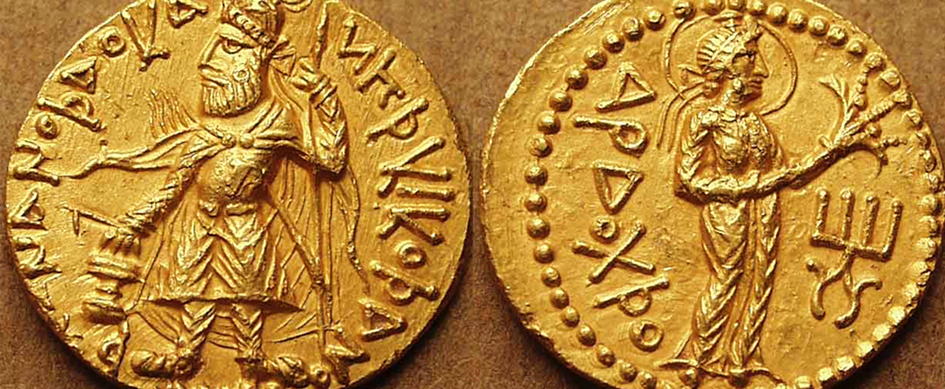
Gold does not corrode and therefore was a symbol of immortality and power in many ancient cultures. Its rarity and aesthetic qualities made it an ideal material for the ruling classes to demonstrate their power and position. First found at surface level near rivers in Asia Minor, such as the Pactolus in Lydia, gold was also mined underground by the Egyptians from 2000 BC and later the Romans in Africa, Portugal, and Spain.
There is also evidence that the Romans smelted gold particles from ores such as iron pyrite. Gold, which is easily worked and mixed with other metals such as silver and copper to increase its strength and change its color, has been used for a wide variety of purposes.
In most ancient cultures, gold was popular in jewelry and art because of its value, aesthetic qualities, ductility, and malleability. Electrum (a natural alloy of gold and silver) was used in jewelry by the Egyptians from 5000 BC. Around 3000 BC, gold jewelry was worn by both men and women in the Sumerian civilization, and gold chains were first produced in the city of Ur in 2500 BC.
The Minoan civilization in Crete in the early 2nd millennium BC is credited with producing the first chain jewelry, and the Minoans made a wide variety of jewelry using a wide range of techniques. Gold jewelry took the form of necklaces, bracelets, earrings, rings, diadems, necklaces, pins and brooches.
Techniques and shapes include filigree (a technique known to the Egyptians since 2500 BC), in which gold is drawn into wire and twisted into different designs), fine hammered shapes, granulation (surface decoration with small, brazed gold granules), embossing, engraving, inlay, molding and machining.
In South America, gold was similarly worked by the Chavin civilization of Peru around 1200 BC, and gold casting was perfected by the Nazca society from 500 BC. The Romans used gold as a setting for precious and semiprecious stones; A fashion continued in the Byzantine period with the use of pearls, gemstones and enamels.
Gold was first used as coins in Asia Minor in the late 8th century BC. Coins of irregular shape and usually only one side stamped were usually made of electrum. The first pure gold coins with stamped figures date back to BC. It was built by the Lydian King Croesus between 561-546 and a modern gold refinery was established in the capital city of Sardis.
Even the purest naturally occurring gold may contain 5% silver, but the Lydians were able to refine their gold using salt and furnace temperatures between 600 and 800°C. The salt was mixed with silver and formed a vapor of silver chloride, leaving pure gold that could be used to create a standard coin with guaranteed gold content.
As with the later Greek and Roman Empires, the Mycenaean civilization also widely used gold coins, although silver was the more common material. One of the most famous gold coins of antiquity was the Roman bezantine. First introduced during the reign of Emperor Constantine, it weighed 70 Trojan grains and was the currency from the 4th to 12th centuries AD.
Concerns over the authenticity of gold led the Egyptians to develop a method for determining the purity of gold around 1500 BC (or earlier). This method is called fire testing and involves taking a small sample of the material being tested and firing it in a small crucible with some lead. The crucible was made of bone ash and absorbed lead and other base metals during the firing process, leaving only gold and silver.
The silver was removed using nitric acid and the remaining pure gold was weighed and compared to the weight before firing. Archimedes was also aware that the specific gravity of gold varies depending on the percent content of the base metals, for example pure gold has twice the weight of silver.
Gold is such a valuable material that over the centuries several attempts have been made to produce it through alchemy - namely its chemical conversion of base metals into gold using philosopher's stone (lapis philosophorum). The first attempts were made in China in the 4th century BC, as well as in ancient Greece, and although unsuccessful, the activity nevertheless laid the foundations of modern chemistry.
Ivar the Boneless
Ivar the Boneless (Ívarr hinn Beinlausi in Old Norse) is known from Old Norse, medieval and Latin sources as the son of the legendary Viking king Ragnar Lothbrok, who, according to legend, raided with his father and brothers and became ruler of York in England in the 9th century AD. . His nickname is the unfortunate result of the impatience of Aslaug and Ragnar on their wedding night, who warned Ragnar to wait three nights before consummating their marriage and that the child they had made would not be born boneless.
Frankly, it's hard to predict why Ivar is boneless, one gets the feeling that he's weak, fragile, or has literally no bones, or at least no bones in his legs. But in any case, Ivar was carried everywhere on a stretcher or something to protect him. He is famous for his cleverness and strategic sense, and is often shown leading his brothers in their adventures. This trait is reflected in the popular television series Vikings, in which Ivar is played by Alex Høgh Andersen, and he is shown to be a clever tactician, also being transported in a car due to his disability, and the cruel, ruthless, spoiled and somewhat sociopathic who killed his brother Sigurd the Snake-Eyed in a fit of rage. He is portrayed as one (All of them are fictitious.).
Apart from medieval legends such as Ragnar and Aslaug, parents of the famous legendary family, which vary depending on the source you are reading (in the 13th century Gesta Danorum), Ivar is often seen with his brothers Demirface Bjorn, Hvitserk, and Snake-Eyed Sigurd. Ivar is sometimes compared to a historical figure seen as one of the leaders of the Great Viking Army that landed in England in 865 AD, or to a Viking leader named Imar who was associated with Viking Dublin between 853 and 873. But there are many problems with such a direct diagnosis. As in the life of the legendary Ragnar Lothbrok, M.S. It is possible that the figures who marked Viking activities in the 9th century helped to inspire later (around 13th century) legends and were adapted for their own purposes by the authors.
With Ivar the Boneless appearing in the legend of Ragnar Lothbrok, the starting point for his actions may be the Icelandic Epic of Ragnar Lothbrok (Old Norse Ragnars saga loðbrókar), his best known and main source. It begins with the childhood of Aslaug, who will become Ragnar's second wife and Ivar's mother.
She is the daughter of Sigurd and Brynhild (who was also a Valkyrie, legendary dragon-slayer in Germanic mythology and was made more popular by Wagner), who died at the age of three. Thus, he was adopted by a poor family in Norway who named him Kráka (crow) and kept his parentage a secret. During this time, Ragnar, son of Danish king Sigurd Ring, meets his first wife, Thora, after saving his town in Götaland from dragon trouble.
Ragnar has two children with Thora, Ivar's older half-brothers Eirek and Agnar. After Thora's premature death, Ragnar encounters Kráka while raiding Norway and marries her despite his seemingly impoverished background. Although Kráka tells her husband on the night of the wedding (rather than waiting three nights) that she is too impatient and is cursed to give birth to a boneless son, Ragnar is unable to control himself. As a result, nine months later, Ivar the Boneless is born
The boy was boneless, as if he had cartilage instead of bones. He was so mature when he was little that no one was his equal. He was the most handsome of all men, and was so wise that it was uncertain whether there was a man wiser than him.
So, despite Ivar's predicament, the situation could have been much worse. Ragnar and Kráka have several more sons, all of whom grow up to be great men and brave warriors: Ironface Bjorn, Hvitserk, Rognvald (and later Sigurd the Snake-Eyed). The brothers, who often raid together, are led by Ivar, carried on a stretcher or shield, displaying a great talent for planning and strategy. He is also adept at using bows.
Indeed, in this epic, despite his bonelessness, he appears to have extraordinary strength in his upper body. Encountering the Swedish King Eystein, who has a magical cow named Sibilija with him and ravages his enemies, Ivar takes a step forward. He orders his men to build a huge bow from a large tree and pulls the bow from his shield like a rotten elm branch and shoots poor Sibilija right in the eye.
Later, Sibilija spirals out of control and Ivar is thrown at her by his men, shattering her. It is clear that Ivar has special powers. After Ivar was recaptured, his voice echoed throughout the battlefield, as if he was standing next to every warrior and motivating them. In the end, Ragnar's sons are victorious.
At the end of the saga, Ragnar, who boasted that he would invade England with only two ships, was captured by King Ælla of Northumbria and was thrown into a snake pit and died there. Later, Ragnar's sons set sail for England and allegedly torture Ælla by making a blood eagle and avenge their father.
Profile Photo by **Erik Mclean** from **Pexels** https://www.pexels.com/@introspectivedsgn?utm_content=attributionCopyText&utm_medium=referral&utm_source=pexels https://www.pexels.com/photo/cozy-room-decorated-with-natural-fur-in-traditional-village-5023732/?utm_content=attributionCopyText&utm_medium=referral&utm_source=pexels

The legend of King Arthur
King Arthur is among the most famous literary characters of all time. The legends of Arthur's Knights of the Round Table, Camelot, the Quest for the Holy Grail, Guinevere and Lancelot's Love, and the Sorcerer Merlin have influenced and inspired literature, music, and other great artistic views for centuries. With the Arthurian legend that developed in the Middle Ages in Europe between 1136 and 1485, countless books, great movies, operas, television programs, plays, toys, written games and comics either retell the legend or were inspired by it. revived and still remains popular today.
The great legendary king is based on a real historical figure, most likely from the 5th or 6th century. The reason why it is difficult to describe Arthur as a historical figure stems from the primary sources that first told his story.
There are early stories of Arthur closely related to the British victory over the Saxons at the Battle of Badon Hill, but this does not identify Arthur as the leader of the British. The figure of Ambrosius Aurelianus is given in the earliest sources, making Ambrosius the best candidate as the historical Arthur, but other sources show a man named Arthur as Ambrosius' warlord. It is generally accepted that the legendary Arthur is based on a real figure, but it is unclear who he might be. The most plausible idea is that the legendary Arthur is based on a great historical warrior named Arthur.
The claim that the legendary Arthur is based on a real person is supported by the fact that Arthur is a Welsh name derived from the Roman surname Artorius. It is suggested that the figure of Ambrosius Aurelianus may have been given the name Artorius. Roman names were widely used in England from the conquest under Claudius in 43 AD.
Rome began to withdraw its troops in the 3rd century AD to protect the empire from barbarian invaders. The severity of these troubles had been increasing for about 200 years until the 5th century AD, and Rome was constantly reducing its military headquarters in England as it needed troops on the continent. In the same year, the Goths plundered Rome. By 410, all Roman troops had withdrawn from England.
Rome's decision to remove its troops left the people of England vulnerable to invaders. The Roman army, deployed along Hadrian's Wall and other areas, had been the protector of the English for over 300 years. With the withdrawal of Roman forces, the Northern Picts and Scots saw opportunity and then moved to English farms and villages. They made raids.
At the same time, the Saxon confederation broke up across the continent, and Saxon immigrants and looters began to appear on England's southeast coast.
When no help came from Rome, an English King named Vortigern invited the Saxons to join forces in order to repel the Scots and Picts. The Saxons accepted the offer, but when they defeated the invaders, they would remain in England. According to the historian Gildas (500-570 AD), Bede (672-735 AD), and Nennius (9th century AD), the Saxon exodus was an invasion in which England was constantly plundered (a claim disputed by modern scholars).
At the same time a great English leader emerged, rallying the people around him and defeating the Saxons at the Battle of Badon Hill. This hero was named Ambrosius Aurelianus by Gildas and Bede, Arthur by the historian Nennius, who was the first to mention his name. Arthur was already before the work of Nennius. seems to be well known. The Welsh poem Y Goddodin, a lament for the warriors who fell at the Battle of Catraeth in AD 600, speaks of him as a great hero. Although extant manuscripts date only from the 13th century AD, the work is thought to have been composed shortly after the war.
It is clear from the foreword to The History of the Kings of Britain by Geoffrey of Monmouth (1100 -1155 CE) that Arthur was considered a great king in his day, but Geoffrey's work would have elevated him to legendary status.
The Art of the Ninja(Shinobi)
Medieval Japan had no less than 18 martial arts called bugei or bujutsu. In addition to the more well-known ones that are still practiced today, such as judo, jujutsu and kendo, there were also those related to horse riding and swimming. One of the 18 martial arts was the ninja art, or ninjutsu, which was developed during the Edo Period (1603-1868). However, as military special forces, ninjas emerged from the 15th century and Warring States Period (aka Sengoku Jidai, 1467) when the internal conflicts surrounding Japan required reconnaissance, intelligence, and espionage to determine exactly by whom and by whom they might be launched in the near future. It had been in operation since -1568.
At that time, a ninja had two main roles: as an assassin and as a spy, gathering intelligence on enemy movements and plans. For both of their missions, they disguised and learned the art of deception. The true identity of successful ninjas has, of course, been kept secret to ensure their own safety and continued usefulness in future operations. Ninjas were also used as forward lookouts and to make as much disturbance as possible behind enemy lines, often during commando raids at night.
Alongside organized ninja groups, there were many freelance ninjas who offered their services to the highest bidder during the unsettled times of the 15th and 16th centuries. Cunning leaders sometimes used ninjas to infiltrate enemy ninja groups. Random passwords were used to make sure ninjas in a group were sure who was who. Every time a ninja heard the code, he had to stand, thus revealing whoever was still sitting.
The earliest approach to ninja training was taken by certain families of samurai warriors who passed their skills from father or master (sensei) to son. These families became famous ninja families, explaining why certain regions had long traditions of producing expert warriors. A future ninja would learn from childhood to ride horses, swim and use all kinds of weapons. From the 15th century onwards, ninjas were trained in special camps that could encompass entire villages. Some schools became famous, especially the Iga and Koga schools. All training was done orally so that written records did not fall into the wrong hands, as leaders did not want their opponents to copy their tactics.
**Educational process**
A ninja was trained to be physically fit and athletic; Jumping from height and crossing ditches and other obstacles was a particularly useful skill and is probably the origin of legends involving flying ninjas. Additionally, they were trained to work in acrobat-like teams so that they could use each other to climb higher. Ninjas could also throw hooks with precision, scale ropes and folding ladders up and down, and break into confined spaces to less skilled workers. Ninjas could dig spy holes using folding saws and slotting tools. They could block pursuers by throwing iron spikes, which they called Makibishi. Ninjas are given the skills to disguise themselves in various terrains, survive outside the country, read topography and maps, understand the signs of weather changes, use explosives, securely bind prisoners, mix poisons, destroy a building with fire, and escape when things don't go well on a mission. and useful skills such as the medical arts were taught.
A ninja's main weapon was his katana or sword, perhaps slightly shorter and less curved weapons than those used by other warriors, as a ninja could find himself in a confined space such as a narrow castle corridor. In order not to restrict their movements, ninjas carried their swords diagonally on their backs, not on their belts. The slime (tsuba) was useful because if one put the sword against a wall, it could be used as a stepping stone, and by passing the foot through the customary cord of the scabbard, the sword could be lifted and not left behind.
Besides being adept at wielding the more common weapons of Japanese warfare (sword, spear, pike, and bow), ninjas had their own and highly specialized weapons. Throwing knives were a common weapon in medieval Japan and ranged from daggers to curved blades, but it is the multi-bladed steel throwing star or shuriken most commonly associated with the ninja. The typical shuriken was 20 cm in diameter and had at least four points, making them light weapons that did not impede movement. There were even ninja schools specializing in star throwing in the Sendai, Aizu, and Mito districts.
While no medieval text actually describes a ninja's clothing in detail, A.D. The most common depiction in Japanese art from the early 19th century is to have all the clothes covered in black. This color seems to be the most obvious choice since most of their work is done at night. It is also a Japanese performing arts tradition for a character to wear black to show the audience that he is invisible. However, ninjas sometimes wore chainmail or bodyguards made of metal plates sewn onto cloth, and sometimes camouflaged themselves as they needed to blend into their surroundings, disguised as beggars, monks, or traveling musicians, and even dressed up as their enemies when necessary. The classic ninja outfit consists of trousers, leggings, jacket, belt, bandana and a face cover made of soft material that does not impede movement and has no dangling parts that can be caught on anything. Soft shoes (of course) were worn, more like socks with the big toe separated from the rest of the toes and a reinforced sole; Simple knotted rope sandals (waraji) could be worn over these to provide a better grip for climbing.
Magic in the Ancient World
For the Greeks, witchcraft (mageia or goeteia) was a broad subject, including incantations and ominous prayers (epodai), cursed tablets (katadesmoi), healing drugs and deadly poisons (pharmaka), amulets (periapta), and powerful love potions (philtra). In the ancient world, the distinction between magic, superstition, religion, science, and astrology was not as clear-cut as it is in the modern world. This mysterious, all-encompassing art of magic was practiced by expert magicians, both male and female, to help people help themselves in their daily lives and overcome obstacles that hindered their happiness.
The first of Mageia's practitioners, sorcerers, were, at least to the Greeks, the Magi Priests (magoi) of Persia; They were seen not only as wise bearers of the unknown, but also as masters of different fields such as mathematics and chemistry. Associated with death, divination, and evil, sorcerers were undoubtedly feared, and their lives in the slums of society meant that cultivators were often poor and in need of help to survive.
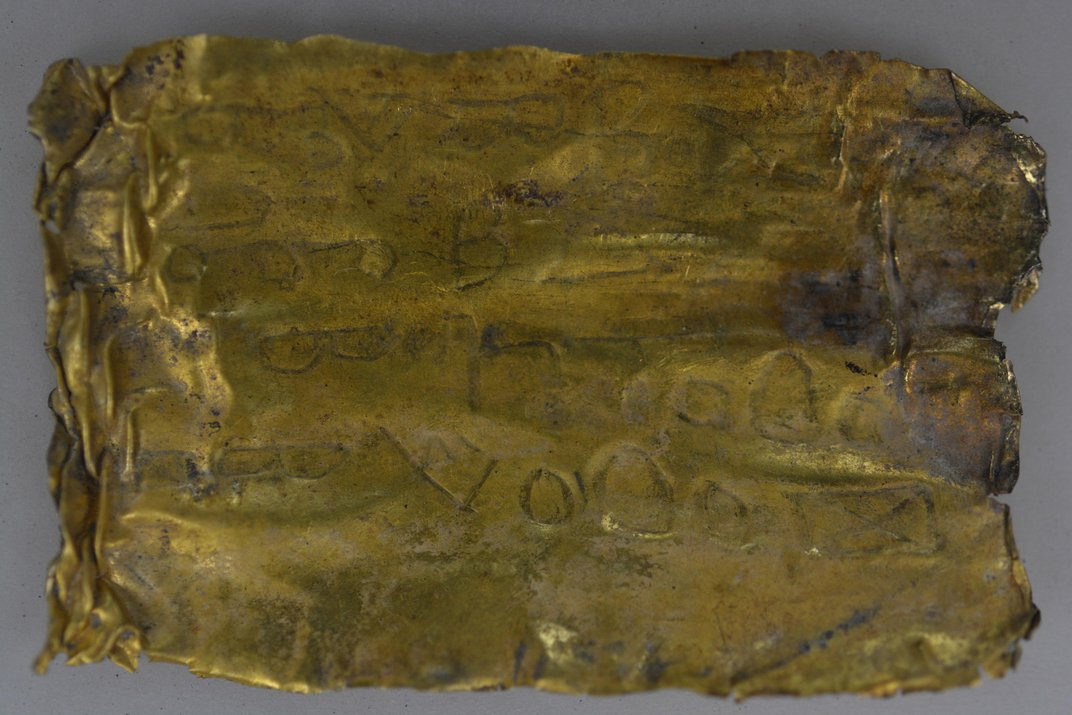
*(This 2,000-year-old scroll is covered with mysterious words in Aramaic. Miomir Korac/Archaeological Institute)*
**Magic in Greek Mythology**
Magic shows itself in ancient Greek mythology and the figures it is associated with are; Hermes is Hecate (goddess of the moon and sorcery) and Circe. Circe is also the witch-daughter of Helios, who specializes in magical herbs and potions and helps Odysseus summon spirits from Hades. Legends abound in tales of magical potions and curses. As an example of this; Hercules died horribly after his wife Deianeira took the magical blood of Nessos, a centaur, and spilled it over Hercules' cloak. When he put on the cloak, Hercules was badly burned and later died of his wounds. Magic has also been practiced by many fictional characters, probably the most famous being Medea from the tragedy play of the same name by Euripides.
In the Greek world, magic did not belong only to the privileged, nor was it only for the poor and ignorant. We know that the official inscriptions were built by the city-states to protect the city against possible disasters. There were also cases, as in Teos in the 5th century BC, when the state sentenced a man and his family to death for convicted witchcraft (pharmakadeleteria). In another example, a woman named Theoris, who lived in the 4th century BC, was sentenced to death for witchcraft and witchcraft and distribution. Clearly, the authorities viewed magic as a practice with various consequences, and it did not belong at all to the world of the lowly peasants. Admittedly, some intellectuals recognized the potential for abuse of magic, like Plato, who wanted to punish those who sold enchantments and cursed tablets. Epicurean and Stoic philosophers were also among those fighting to eradicate magic.
The Egyptians long used spells (best described as a list of instructions to follow) and incantations written on papyrus, and the Greeks continued this tradition. The history of Greek papyri, which was written about magic and survived, dates back to the 4th and 3rd centuries BC. These included instructions on how to circumvent physical ailments, improve sex life, exorcism, deworming the home, as part of initiation ceremonies, and even how to make your own amulet. Recipes and poisons, often using exotic ingredients such as rare herbs and spices and incense from faraway Asia, also often emerged.
Curses (agos, ara, and euche) were intended to restore social order by threatening behavior that was harmful to society with magical punishment, especially for crimes such as murder. It was also seen as a way of harming one's enemies. Cursed tablets were often in the form of metal (usually lead) plates on which the curse was engraved, and then rolled up or folded, sometimes sealed with nails, and buried underground, in tombs, or wells. Sherds, papyrus and limestone fragments were similarly engraved in writing. Figures made of wax or clay were made to resemble the victim of the curse. They would have their limbs tied or bent and sometimes nailed or buried in a miniature lead coffin. As a point of interest, while sorcerers in mythology are mostly women, curse tablets and records of spells often point to a male practitioner. Cursed tablets were often used to turn arguments in one's favor. The earliest record of these dates back to the 6th century BC and includes business deals, relationship problems, legal disputes, matters of revenge, and even sports and theater competitions. There are instances in Greek literature where an entire family or dynasty was cursed, probably the most famous being Oedipus and his descendants.
The Golden Age of Piracy
Is a rather peculiar name to attach to a time when crime was rampant, but it is a secondary concern in terms of defining what exactly this age entails. Most historians do not include the period of pirates targeting the Spanish Mother and treasure ships in the early 17th century (c. 1650-1680). The close of this century is the most common starting point of the Golden Age for scholars, though some would limit it to the first twenty or thirty years, or even just the second decade of the 18th century. So, in order not to miss some relevant points on the issue of piracy, we will adopt a broader perspective and consider the 'Golden Age' as the years approximately 1690-1730. Piracy has been practiced since ancient times and still continues in many parts of the world, so insisting on certain time periods is inherently problematic: piracy seems to have neither a beginning nor an end point.
Finally, there is also the issue of geography. While piracy was prevalent in many parts of the world in our time, the notion of 'Golden Age' in this context is generally limited to pirates operating on both sides of the Atlantic Ocean, the Indian Ocean and the coasts of West Africa. Pirates, such as those of the Barbary Coast and East Asia, are often treated separately. Thus, the majority of Golden Age pirates were British or American, but a significant number of other nationalities included, notably the Dutch and French, and pirate crews could indeed include anyone from virtually anywhere, including ancient Africans, slaves, and indigenous peoples.
The problem is why piracy flourished in this particular era. Men and some women were drawn into the life of piracy because of the harshness of life at sea on a merchant or navy ship - the vast majority of pirates were experienced sailors - or because they could not find meaningful employment after the wars between England and France ended. After the Age of Discovery, European colonies beyond the Mediterranean were now blossoming. These were communities that grew in size and wealth, and grew to serve themselves, with a corresponding increase in merchant shipping. Still, there was hitherto a lack of tight administrative and military containment from the central government, so many ports and ships were easy targets for pirates who didn't care about the consequences of their crimes.
While some pirate crew members have become notorious (or notorious) in their own right, it is the captains' names most attached to this circuit. While the majority of pirates wore the clothes worn by any other sailor crew, captains were more inclined to make a fashion statement and to wear the flamboyant outfits sported by the nobility of the time. Bartholomew Roberts (also known as 'Black Bart' Roberts) was famous for wearing a red silk jacket, a matching damask waistcoat and a diamond necklace. Blackbeard (also known as Edward Teach) wore black ribbons in his beard, carried six pistols, and lit wicks under his hat when engaged in combat. Undoubtedly, these pirate captains were eager to establish a legend about themselves that helped ensure that a target ship would surrender immediately and their crew would remain loyal.
Other captains took a more ruthless approach to fame. Charles Vane (hung in 1721) once fired cannons aboard the Bahamas governor's ship, while Edward Low amassed a long list of heinous crimes, such as mutilating, burning and hanging his victims between 1721 and 1724. 1718), the 'Gentleman Pirate' was unusual because he chose the life of piracy as a change rather than operating his own plantation in Barbados. Piracy, it seems, had all kinds of charms.
**Pirate Loot**
Pirates were first and foremost after portable loot, preferably gold, silver, and precious stones. Coins were the easiest to dispose of, and hence a treasure chest of Spanish silver pesos (aka eights) or gold doubloons was most desirable. The next best thing was a valuable cargo. Easily sold crops included silk rolls, spices, indigo, tobacco, rum, furs, hides, sugar, and other foodstuffs. All valuables and fancy clothing of the crew and passengers were removed. Weapons, navigational instruments, and medicine were always useful. Even ordinary sea goods such as ropes, sails, and anchors were bought to renew the pirates' own equipment. In the end, the attacked ship itself could be the reward. Pirates did not want to spend the time and effort repairing their own ships, and so it was common to trade for a seaworthy ship, such as upgrading to a bigger and better ship that could carry more guns.
While most catches brought only dry goods or liquor and maybe a few coins, there were some really surprising catches during the Golden Age. English pirate Henry Every (b. 1653) captured the Mughal emperor's merchant ship, the Ganij-i-Savai, in 1695, carrying cargo worth over $95 million today. Each crew member's share was more than a lifetime's salary. Captain Henry sailed wisely over the horizon with his trophy and was never seen or heard from again. The loot was controlled by the quartermaster until it could be shared or sold and the proceeds divided. Crew members typically received one share each, quartermaster and captain two shares each, and various 'officers' or more experienced sailors and skilled workers such as carpenters and artillery received between one and two shares. In addition, Crew members were compensated for injuries sustained during an attack. Few pirates have held onto their ill-gotten gains long enough to consider hiding them. Stories of buried treasure can often appear in pirate fiction, but there is little historical evidence of such behavior. Captain Kidd may have buried treasure on Long Island, but treasure seekers were frustrated that they couldn't find any.
Ancient Carthage
Before the conflict with Rome known as the Punic Wars (264-146 BC), Carthage was a Phoenician city-state on the North African coast (where present-day Tunisia is) and was the largest, wealthiest, and most powerful in the Mediterranean. The city was originally known as Kart-hadasht (new city) to distinguish it from the nearby ancient Phoenician city of Utica. The Greeks named the city Karchedon and the Romans changed this name to Carthago.
Founded by the legendary Phoenician queen Dido in 814 BC, it increased in size after an influx of refugees from the city of Tire following Alexander the Great's conquests in 332 BC, and later expanded to the seat of the Carthaginian Empire with colonies (like Sabratha) off the coast of North Africa, Sicily. in , Spain and elsewhere; all of this would be lost in the wake of the Punic Wars, which elevated Rome to the position of Carthage's greatest Mediterranean power.
Legend has it that Carthage was founded by the Phoenician Queen Elissa (better known as Dido). 814 BC; Although Dido's historicity has been questioned, the establishment dates back to this time. Dido allegedly escaped the persecution of his brother, Lebanese Pygmalion, set foot on the North African coast and founded the city on the high hill later known as Byrsa. He claims that the Berber chief told him he could have enough land to be covered by an oxhide; Dido cut a single ox skin into thin strips and laid them end to end around the hill, successfully laying claim to it for his people.
Dido's reign is described as impressive by the Roman poet Virgil (70-19 BC) and others, noting how the city grew from a small hilltop community to a large metropolis. This account and others like it are legendary, but originally Phoenician merchants supplied or repaired their ships. Carthage, which looked like a small port on the coast where they stopped to trade, was clearly a major trading center in the 4th century BC.
The city flourished significantly when Alexander destroyed the great industrial and commercial center of Tire (considered the main city of Carthage) in 332 BC and Phoenician refugees fled from there to Carthage. These Tyrants came with whatever wealth they had. and since many donated by Alexander were rich enough to buy their lives, they descended into the city in important vehicles and made Carthage the new center of Phoenician trade.
The Carthaginians later formed a working relationship with tribes known as the Masaesyli and Massylii of the North African Berber (Imazighen) Kingdom of Numidia, who would fill the ranks of their armies primarily as formidable cavalry units. From a small town on the coast, the city was in size and splendor with huge estates covering miles of land. Carthage quickly became the richest and most powerful city in the Mediterranean.
Formerly a monarchy, the government of Carthage was a republic founded on a meritocracy (rule of the elite) in the 4th century BC. The top position was two elected magistrates known as suffetes (“judges”), who ruled together with a 200-300-member senate for life. The laws were passed by the suffetes and a citizens' assembly, which would vote on measures proposed by the senate. The aristocrats lived in palaces, the less affluent lived in modest but attractive houses, and the lower classes in apartments or cottages outside the city.
Control of Sicily was divided between Rome and Carthage, which supported opposing factions on the island, which quickly brought both sides into direct conflict with each other. These conflicts will be known as the Punic Wars, from the Phoenician word for the citizens of Carthage (given as Phoinix in Greek and Punicus in Latin). While weaker than Carthage, they posed no threat. The Carthaginian navy was long able to enforce the treaty that prevented the Roman Republic from trading in the western Mediterranean. He proved to be much more resourceful.
Although they had no navy and knew nothing about fighting at sea, Rome quickly built 330 ships, which they equipped with smart ramps and passages (corvus) that could be lowered and secured on an enemy ship; Thus, they turned a naval warfare into a land war. After an initial engagement with military tactics, Rome won a series of victories and eventually defeated Carthage in 241 BC. Carthage was forced to cede Sicily to Rome and pay a heavy war indemnity.
Carthage believed that their treaty with Rome ended when their war debts were paid; Rome disagreed. The Romans felt that Carthage still had to submit to Roman will; So much so that the Roman Senator Cato the Elder ended all his speeches with the words “Also, I think Carthage must be destroyed.” In 149 BC, Rome decided exactly this course of action.
A Roman embassy in Carthage submitted a list of demands, which stipulated that Carthage be dispersed and then rebuilt inland, thereby removing its long-recognized advantage in trade from its position on the coast. Evidently the Carthaginians refused to do so, leading to the Third Punic War (149 BC). -146) started.
Roman general Scipio Aemilianus ( 185-129 BCE) besieged Carthage for three years until it fell. After sacking the city, the Romans burned the city and left no stone behind. A legend has grown, but this claim has no basis in fact. It is said that when Scipio Aemilianus ordered the city to be destroyed, he wept and acted virtuously towards those who survived the siege.
Queen Of Ancient Sparta-Gorgo
Gorgo was the queen of the city-state of Sparta, she was also the daughter of King Cleomenes (520-490 BC), the wife of King Leonidas (490-480 BC), and the mother of King Pleistarchus (480-458 BC). Since the dates of birth and death were not considered as important for the women of the period as for the men, it is not known exactly.
It is generally believed, based on the information given by Herodotus (484-425/413 BC), that his birth date was between 518 or 508 BC, that she married King Leonidas in 490 and that she continued to live after her husband's death in 480. She probably lived on during the reign of her son, King Pleistarchus, but his power and role in her son's court is unknown.
Gorgo was an important figure for her wisdom, intelligence, and presumed authority over the people around him. Both her father and husband listened to her advice, and she is one of the few women named in Herodotus' History of Herodotus.
As a Spartan girl from a noble family, Gorgo probably should have received singing, dancing, literature, and especially physical training at court. While Athenian women were viewed as inferior to men and confined to homes, Spartan women could get an education, own land, get divorced, and (within reason) go wherever they wanted. So the presumed situation is that there were many important women like Gorgo, but their lives and achievements were probably not recorded.
Herodotus' first mention of Gorgo occurs when Gorgo is eight or nine years old (but she may be older). This corresponds to the period when the Ionian city-states revolted against the Persian government (499-493 BC). It is assumed that the uprisings were sparked by a Miletus tyrant, Aristagoras, supported by Athens. When the uprising fails, Aristagoras comes first to Greek lands and then to the Peloponnese to seek support so that Sparta can drive the Persians out of Ionia.
Although King Cleomenes rejects this offer and sends Aristagoras, Aristagoras continues to offer bribes to Cleomenes by returning. The interesting thing is that according to Herodotus, Gorgo was present in the room while this conversation was taking place, and that Cleomenes would be present with his daughter when Aristagoras demanded that the child be sent out.
Aristagoras offered the king a large sum of money, but was refused, so he continually offered the king more money, until Gorgo told her father, "Father, if your guest does not go, you will be deemed corrupt" (Herodotus, 5.51). Cleomenes, following Gorgo's advice, refuses Aristagoras' bribe.
When Cleomenes died in 490 BC, he left no male heirs, so his half-brother Leonidas became king. Leonidas and Gorgo were already married at this time, so Gorgo also ascended to the throne as queen of Sparta. Another event that Herodotus tells about Gorgo coincides with this period. The Persians under King Darius I attacked Greece because of the Athenian support of the Ionian Greeks in 490, but were defeated at the Battle of Marathon.
When Dais died, his son Xerxes the Great swore to finish what his father had started and gathered the largest possible army. While Xerxes was preparing this weapon of war, a man named Demartus was living in the Persian city of Susa. Demartes, while co-ruling Sparta with Cleomenes, was exiled in 491 due to a political controversy.
Demartus became aware of Xerxes' military campaign against Greece and wanted to inform the Spartans, but he did not know how. Susa was a region in the interior of the Persian empire, and any message that could be sent to Greece would likely end up in Persian hands before it reached the border.
When the tablet reached Sparta and was brought before the king, no one knew what to do. They could not understand why Demartus had sent a blank tablet and what it meant, but Gorgo believed that a message had been sent that needed to be deciphered. He offered to remove the wax, and when they did, they got the original message about the Persian invasion. They sent word to Athens and other city-states, and as a result, the Greeks could prepare for a possible war.
If Gorgo had not guessed that there was a real message under the tablet, the Persians would probably have caught the Greeks off guard, and the Greeks would not have had time to prepare. Leonidas also deserves praise, for even in Sparta he might not have taken a woman's advice. It is not known how the course of the event would have changed had the message been sent to Athens, not Sparta.
*Leonidas is undoubtedly quite famous for his last stand in 480 BC with 300 Spartans at Thermopylae.*
The Phoenicians - Traders of Antiquity
The island city of Tyre and the coastal city of Sidon were the most powerful cities of Phoenicia. They also owned important religious cities such as Byblos and Baalbek. Phoenician city-states began to be established around 3200 BC and took their final form along the coastline around 2750 BC. Since 1500-332 BC, Phoenicia developed considerably in sea trade and manufacturing center; shipbuilding, glass making, paint making; they reached an impressive level in the production of luxury and public goods.
**Purple Folk**
The purple dye produced and used in Tire for the Mesopotamian royal family's clothes gave Phoenicia the name we know today (from the Greek Phoinekes used for the people of Tyre), and also by the Phoenicians, the Greeks to call it the "Purple Folk" (the Greek historian Herodotus). discourse); The reason is that the color remains like a stain on the skin of the workers. Herodotus pointed to Phoenicia as the birthplace of the alphabet. He attributed the arrival of the alphabet to the Greeks to the Phoenician Cadmus (before the 8th century BC), and stated that the Greeks did not have an alphabet before Cadmus. The Phoenician alphabet, on the other hand, is the ancestor of the alphabet used by most of today's western civilizations, and the alphabet that began to be used in Byblos also gave its name to the Bible (from the Greek "Ta Biblia" meaning "books"). Byblos was a major exporter of papyrus ('bublos' in Greek), the paper used for writing in Ancient Egypt and the Greeks. In addition, many ancient Greek gods were taken from the Phoenicians; Some stories about the Phoenician gods Baal and Yamm and the Greek gods Zeus and Poseidon are thought to have indisputable similarities. On the other hand, it is notable that the war between God and Satan, associated with the last part of the New Testament, is a later version of the war between the Phoenician Baal and Yamm, in which the same myths are used in both cases.
The relationship between the Phoenician city-states flourished with maritime trade between 1522 and 322 BC, when it was conquered by Alexander the Great, and after his death, the region witnessed warfare between those who wanted to replace Alexander. Artifacts in the region have been found in cities as far away as England and in nearby cities such as Egypt, and it is a fact that the value of the luxury goods traded by the Phoenicians is also very valuable for the peoples they trade with.
The Phoenicians were primarily known as the ancient world's best shipbuilders and sailors who could navigate the turbulent waters of the Mediterranean. Shipbuilding was perfected at Byblos, and it was here that the inclined ships (Trireme) were built for the first time.But Phoenician sailors were also known to sail to the shores of England and Mesopotamia.
Phoenicia was spared the military invasions that other parts of the Near East suffered because their goods were so valuable. Mostly, the great military powers of the period preferred to leave the Phoenicians alone with trade. But this did not prevent them from looking at the Phoenicians with envy. The Phoenicians are referred to as "princes of the sea" in the passage of Ezekiel, where the Bible says that the prophet predicted the destruction of Tire and would be happy about it.
The purple color became the standard adornment of royalty from Mesopotamia to Egypt and then to the Roman Empire. The reason for all this success was the competition between the city-states of the region, the skill of the seafarers in transportation, and the high art that the artisans used in making products. This rivalry was rising between these two great Phoenician cities, especially between Sidon and Sur, increasingly controversial. Since these two cities traded together with Byblos merchants, they also carried the cultural heritage and social norms of these nations between each other. Due to their role in cultural transmission, the Phoenicians are called "Merchants of the Ancient World" by many scholars and historians.
In 334 BC, Alexander the Great first captured Baalbek (renamed Heliopolis). Later, Alexander marched to conquer the cities of Sidon and Byblos in 332 BC. After the fall of the Tire, other city-states followed, besieged by Alexander, until the Phoenician Empire collapsed and the region Hellenized. By AD 64, Rome annexed the area, from AD 15 the area was colonized. The Temple of Jupiter Baal, the most famous religious building and pilgrimage site of the region, was well preserved. Its remains still stand today. Phoenician's greatest legacy is undoubtedly the alphabet, but their contribution to the arts and popularization of ancient culture has been equally impressive.
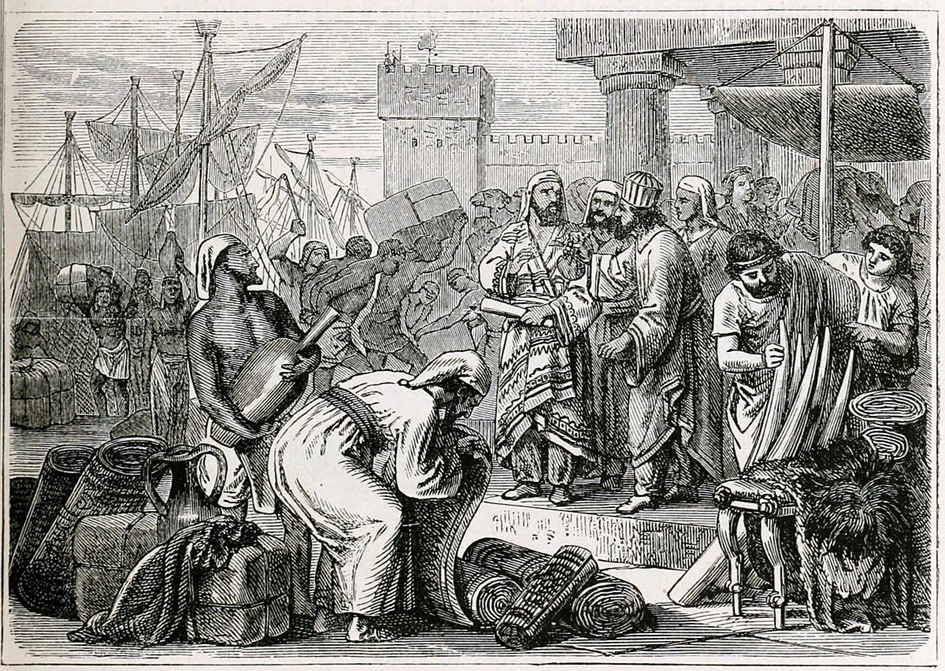
Roman Law - Ancient Rome
Roman laws covered all aspects of daily life. They were concerned with crime and punishment, land and property ownership, trade, maritime and agricultural industries, citizenship, sexuality and prostitution, slavery and manumission, politics, liability and destruction of property, and peacekeeping. We can study these laws today, thanks to ancient legal texts, literature, papyrus, wax tablets, and inscriptions.
Roman Law was established through a variety of instruments, such as statutes, magistrates' decrees, emperor's edicts, senatorial decrees, parliamentary votes, plebiscite, and expert counsel's deliberations, and thus was versatile and versatile to deal with changing situations, from Republican politics to imperial politics, from local to national commerce and from state to interstate. has become as flexible as politics.
**Historical Sources**
One of the most important sources on Roman law is the Corpus Juris Civilis, which was compiled under the auspices of Justinian I and covers civil law as the name suggests. One of his four books, the massive Digest, covered all aspects of public and private law. The abstract was created under Tribonian supervision in AD 533 and is an overview of nearly 2000 separate legal volumes. These original sources were written by prominent jurists or legal experts such as Gaius, Ulpian, and Paul, and they sum up one of the richest surviving texts from antiquity, as they are a treasure trove of incidental historical information used to illustrate points of law ranging from life expectancy to tax figures.
Other law collections include the 3rd century Codex Gregorianus (AD 292) and Codex Hermogenianus (AD 295), both named after prominent jurists under Diocletian and collectively containing more than 2,500 texts. There is also the Theodosian law, a collection of more than 2,700 laws compiled around 430 AD and added in subsequent years, and finally the Codex Justinian (528-534 AD), which summarizes and expands on the older laws.
In addition, there are certain types of legal documents that have survived from antiquity, such as negotiation documents that describe any business transaction, from leases and lease agreements to contracts summarizing the transfer of property. Inscriptions can also reveal laws and their effects, as placed on public monuments where they proclaim new laws or give thanks for court victories to those who helped the party involved.
In practice, lawsuits were often avoided due to the opposing parties taking an oath or bylaw oath, but if such a solution could not be reached, legal proceedings were followed by the plaintiff's summoning the defendant to court (civil actions: udicia publica or for criminal law: quaestiones). The first step in most civil cases is for the parties involved to go to a magistrate who determines the legal issue at hand and either dismisses the case as a matter of legal intervention (denegatio actiomis) or nominates an official (Iudex datus) to hear and hear the case. When both parties accepted the magistrate's assessment, the case would be heard before Iudex, who made a decision on behalf of the state. The defendant and the plaintiff had to represent themselves at the hearing as there was no legal representation system. If the defendant lost a civil action, there was a reprimand and they had to pay an amount of money (litis aestimatio), usually agreed upon by the ria, which could cover the original value of the goods or the damages done to the plaintiff.
Penalties for crimes were considered deterrent rather than corrective, and included fines (multae), imprisonment, caste, seizure of property, loss of citizenship, exile, forced labor, or the death penalty (poena capitis). Penalties could also differ depending on the defendant's status and whether he was a man, woman, or slave. Perhaps not surprisingly, men of higher social status generally received milder punishments. The severity of the punishment could also depend on factors such as preplanning, provocation, frequency, and the influence of alcohol.
In many cases, particularly in civil cases, heirs may have to stand in the place of the original defendant if the defendant died before the lawsuit was completed. There was no real appeal in Roman law in the republic, but under the empire discontented parties could appeal to the emperor or high official and the original decision could be overturned or reversed. However, any objection that was not well-founded could be punished.
Perhaps this was one of the greatest benefits of Roman law and legal systems, that as the empire grew and the population acted as a binding force on communities, citizens became more diverse, law and protection grew, and over time a citizen's rights (not even civil rights) had changed a pattern of wrongdoing. created an expectation that a system would be upheld. In addition, the Romans conveyed to us not only many legal terms still used today in the field of law and legal science, but also their passion and expertise for precise and precise legal terminology to avoid ambiguity or even misinterpretation of the law.
AreS
Ares was the Greek god of war, and perhaps the most disliked of all the Olympian Gods, due to his quick temper, often aggressiveness, and inexhaustible love of fighting. She is known for seducing Aphrodite, fighting and defeating Hercules, and angering Poseidon by killing Poseidon's son, Halirrhothious. Ares, one of the Olympian Gods whose human aspects predominate, had been a popular subject in Greek art and became more popular during the Roman period when it was studied in much more serious terms as the Roman god of war Mars.
The sisters of Ares, son of Zeus and Hera, were Hebe and Ilithia. Despite being a god, the Greeks viewed Ares from Thrace as it reflected their thinking of a completely different, foreign and war-loving people from their own. Ares had many diverse children from different partners, some of whom were unlucky enough to oppose him in performing the Twelve Quests of Hercules. The Amazon queen had lost the belt of Ares' daughter Hippolyte to Hercules; his son Eurytion had lost his cattle. This Greek hero had stolen the horses of Diodimis. Brave and highly warlike Amazons were also believed to be descendants of Ares.
In Greek myths, Ares stood out for his charm and courage, which undoubtedly helped win the love of the Greek Goddess, Aphrodite (although she was married to Hephaestus). Later, a daughter, Harmonia, was born from Ares, and Eros, the god of love and lust. Hephaestus succeeded in trapping the lovers in a skillfully made bed, and this story is detailed in Book 8 of Homer's Odyssey. After his capture, Ares' punishment for his foolishness was his temporary exile from Mount Olympus.
Described by Hesiod as 'the shield-piercing Ares' and 'the city plunderer Ares' in his Theogonia, the god represented the more brutal and bloody side of the war; which was in stark contrast to Athena, who represented the more strategic elements of warfare. In stories from Greek mythology, Ares was often found with Aphrodite, Phobos (Fear), and Deimos (Terror) and their other children, along with his sister Eris (Fight) and Ennyo, who was atop the chariot.
**Battle with Hercules**
The most popular legend about Ares was his battle with Hercules. Ares' son, Cyknos, was notorious for blocking the way of pilgrims to the oracle at Delphi, so it had already caught the eye of Apollo, who had sent Hercules to deal with him. Hercules killed Cyknos, and thus the enraged Ares got into a fight with Hercules. However, Hercules was protected from harm by Athena and even managed to injure Ares. Another legendary and embarrassing event for Ares was his capture when the twin Giants Ephialtes and Otis attacked Mount Olympus. They had imprisoned the god in a bronze jar (or cauldron) for a year, and Ares was released only with Hermes' intervention.
**Trojan War**
In Homer's interpretation of the Trojan War in the Iliad, Ares supported the Trojans, sometimes even leading them in battle with Hector. The Iliad does not show the good aspects of Ares, but rather as a rather consonant member of the Greek pantheon. 'Hateful Ares' has been described as 'human murderer', 'insatiable for war' and 'the curse of men'. Like the mythological tales above, Homer's depiction of Ares is often shown to be weak compared to other gods. Ares is also known for being badly beaten by Athena, who supported the Achaeans and knocked him unconscious with a large rock. He is also shown badly in front of Diomidis, who managed to injure the god with his spear, even with the help of Athena. Homer describes the cry of the wounded Ares as equivalent to the screams of 10,000 people. When he returns to Olympus, Zeus ignores Ares' complaints but instructs Paion to heal his wound.
**Athens & Sects**
Ares once again disrupted the order of Olympus when he was accused of murdering Poseidon's son, Halirrhothius, near a stream below the Athenian acropolis. A special court - the Areopagus (also known as Ares Hill) - convened on a hill near the stream to hear the case. Ares was acquitted when it was revealed that Halirrhothios had raped Ares' daughter Alcippe. Thereafter, the Areopagus in Athens became the site of trials for murder and sacrilege.
Perhaps not surprisingly, Ares was held in high regard in Sparta, given the city's strong militaristic culture. Ares was not widely worshiped, but there were places of worship with temples dedicated to him in Crete (mentioned in the Linear B writings of Knossos) and in Argoz, Athens, Erythrai, Geronthrae, Megalopolis, Tegea, Therapne, and Troezen. He also had a cult in Thrace and was popular with the Colchisians in the Black Sea.
**Representation in Art**
In Ancient Greek Archaic and Classical art, Ares is often depicted wearing full armor and a helmet and carrying a shield and spear. Therefore, when viewed, it is indistinguishable from other armed fighters. Sometimes the Greek god is seen getting into his chariot drawn by fire-breathing horses. The legend of Ares' battle with Hercules, BC. It was a popular subject for Ancient Greek vases in the 6th century.
In later times, the Roman god Mars was given many of the features of Ares, although he had less human qualities, which were also typical of Roman gods. In Roman mythology, Mars was also the father of the legendary founders of Rome, Romulus and Remus (by the rape of the Vestal Virgin Rhea Silvia), and thus the city attained a sacred status. What Athena was to the Athenians, Mars was the patron god of the Roman capital, and the month martius (March) is named after him.
I. Leonidas-King of Sparta
Leonidas, BC. He was the Spartan king who led a small army of Greek allies at the Battle of Thermophile in 480 BC, when the Greeks bravely defended the pass that the Persian king Xerxes was trying to invade Greece with his massive army. Ultimately, Leonidas and his soldiers were defeated, but they bought the Greek city-states big time. They were an inspiring example not only of what the Greek hoplites (infantry) could do against the invading forces, but also of the price the Greeks were willing to pay to protect their freedom from outside pressure.
Herodotus, in his History book, says that Leonidas' lineage dates back to 20 generations ago, namely the mythological character Hercules. Leonidas' father was the Spartan king Anaxandrides. He was also the son of King Leon. However, Anaxandrides had problems finding heirs after his first wife suffered from infertility. The Spartan Ephors (senior judge) and Elders forced Anaxandrides to take a second wife to continue the royal line. She herself bore a son, Cleomenes, but strangely enough, Anaxandrides' first wife also said she was pregnant at the time and gave birth to a son, Dorieus. Then, after a short time, his first wife, BC. She gave birth to Leonidas and Cleombrotus in the 540s, which some said were twins.
Since Leonidas had two older brothers, it seemed unlikely that he would represent the Agiad Dynasty and be one of the two Spartan kings. However, Doreius' death on his campaign in Sicily and Cleomenes' dubious suicide (linked to his bad drinking habits) made it possible to do this to Leonidas, as he had no heirs. Leonidas was married to Gorgo, the daughter of Cleomene. B.C. In 490 BC, the death of his father meant that Leonidas would become king.
**Battle of Thermophile**
We know that Leonidas was in his sixties and undoubtedly a very experienced military commander at the time of the Battle of Thermophile, but we do not know much about his previous battles. Xerxes' BC. After intending to invade mainland Greece in 480 BC, Leonidas was chosen to defend Thermophile's pass and lead a small army of Spartan hoplites (about 300 carefully chosen men with male heirs). During this time, the Spartans had participated in the holy festival of Carneia, so they technically couldn't go to war until it was over. Sparta could have stacked up to 8,000 hoplites on the battlefield, but this was not possible during the Carneian period. Many armies from other city-states, based on up to 7,000 men, had joined the 300 Spartans to stop Xerxes' 80,000-man army, although this was insufficient.
Thermophile, 150km north of Athens, was a great choice for defending Greece, because apart from the mountains and the sea, there was only a narrow pass that was passable. Yet Xerxes was so confident that he would win that he sent an emissary to tell Leonidas to surrender and lay down their arms. The Spartan king replied succinctly; 'molōn labe' (come and get it if it's tight).
Leonidas, leading from the front, and Greek troops fighting in a tight phalange (ancient Greeks speared regiment of infantry) were able to take advantage of their superior armor and weapons to hold the huge Persian army for two days. However, the Greek shepherd, who had told the Persians about the way behind the Greeks, had betrayed his troops and made matters worse. Leonidas, realizing this, ordered most of the army to withdraw. He only kept the Spartans, Thespians, and Thebes to make a final response to the onslaught from behind.
In the end, the Greek forces were defeated by one man, and Apollo's oracle at Delphi was right that one of Sparta's kings had to fall. After the war, Xerxes had Leonidas' head cut off for a public show. This was an extremely dishonorable act, and it was against all the rules of war at the time.
**Leonidas' Revenge Taken**
Leonidas' son Pleistarchus became king upon his father's death, but Pausanius took care of state affairs due to his young age. Within a year, the Greeks had avenged Thermophile with their victories at the Battle of Salamis and the Battle of Plataea. Even Leonidas' nephew Pausanius ruled the latter. Xerxes' invasion was fiercely repelled, and those who perished in Thermophile were not forgotten. A monument was built in Simonides' words. In the monument; 'Go tell the Spartans, stranger passing by: We have obeyed their orders and here we lie dead'. A large stone lion was also erected in memory of Leonidas and his men. Forty years after the war, the king's body was exhumed and brought to Sparta. He was duly buried and a hero temple was established in his honor.
In ancient art, King Leonidas BC. It has been the subject of a marble statue made between 490 and 480, which has survived from the Sparta acropolis. His dazzling face in a crested Corinthian helmet, his wrought eyes depict the merciless determination of the fallen king that has become a legend.
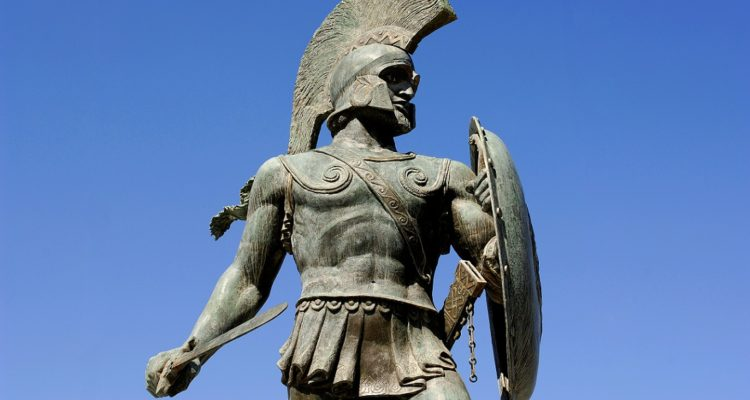
Ancient China-Dragons
Dragons feature in the mythology of many ancient cultures, but nowhere else in the world has this creature been as revered as in China. There, unlike other prominent world mythologies, the dragon was almost always viewed in a positive light and was particularly associated with life-giving rains and springs. Considered the most auspicious sign of the year, worn on emperors' robes, depicted in the most precious materials from gold jewelry to jade figurines, with countless references in literature and the performing arts, the dragon was all over ancient China and seems just as big in the Chinese psyche today.
One of the oldest creatures seen in ancient Chinese tales and legends, the dragon is often depicted as a gigantic and lithe beast that lives in springs or clouds. The Chinese dragon is extraordinarily powerful, and when it flies it is often accompanied by lightning and thunder. It is not known when, by whom, or in what reality the dragon was first invented, but some historians suggest a connection with the 'sky serpent' and rainbows seen after rains or in waterfalls. At the site of the Hongshan culture, which can be dated to 4500-3000 BC, carved jade dragons were excavated long before any written record of the creature appeared.
Chinese scholar Wen Yiduo suggested that this fantastic collection of monstrous pieces was actually based on the political union of several different tribes, each with a different animal as its totem. Therefore, the dragon was a symbolic representation of the assimilation of these tribes into a single nation. An interesting hypothesis, however, that does not explain the appearance of dragons long before such political institutions existed in these early Chinese populations.
Despite the dragon's frightening aspect, he was not often seen as a malevolent beast living in the myths of other cultures around the world, where he was killed by a brave heroic figure. Indeed, in China the dragon was and is considered a just and benevolent creature. For this reason, they were associated with rulership, and especially with the Chinese emperors, who, as the holder of the Mandate of Heaven and God's representative on earth, must always rule their peoples justly and impartially for the good of all.
Another reason rulers imitate dragons is that the creature is considered one of the four most intelligent animals (along with the phoenix, unicorn, and turtle). In a famous legend, a dragon was active in controlling the flood waters that devastated the kingdom of a dragon (or indeed a dragon) and the tortoise to the great Yu (circa 2070 BC), the legendary founder of the Xia dynasty, and to control the floodwaters with a better irrigation system. explains their help.
The public generally regarded the dragon as a lucky symbol and bringer of wealth. Moreover, ancient farmers thought that dragons brought much needed rain and water to irrigate their crops. Dragons were also thought to be responsible for strong winds, hailstorms, thunder, lightning and hurricanes – the latter still known today as the 'dragon's hurricane' or long juan feng. It is also interesting to note that many early depictions of dragons in jade were circular.
In folk tales, there was a race of dragons led by the Dragon-king Lung-Wang. With their scaly bodies, four legs, and horns, they could take human form and fend off young girls. they are similar to the Nagas, snake-like creatures of Hindu folklore who guard water sources. In Chinese art, these dragons often have a magnificent pearl whose iridescent shine resembles a rainbow and may represent the idea of treasure associated with this phenomenon.
Another traditional belief was that the world's Four Seas (according to the ancient Chinese there were four seas, not seven) were each ruled by a dragon king. Their names are Ao Kuang (ruling the East), Ao K'in (South), Ao Jun (West) and Ao Shun (North). Ao Kuang is the leader, but all four must submit to the will of the Jade Emperor, to whom they pay their respects in the third month of the year, the month of the heaviest rains. Alongside these more lordly figures, locals generally believed that any nearby water source was the home of a dragon. The longstanding connection between dragons and rivers is evidenced by the fact that more than 40 Chinese rivers have the word dragon in their names.
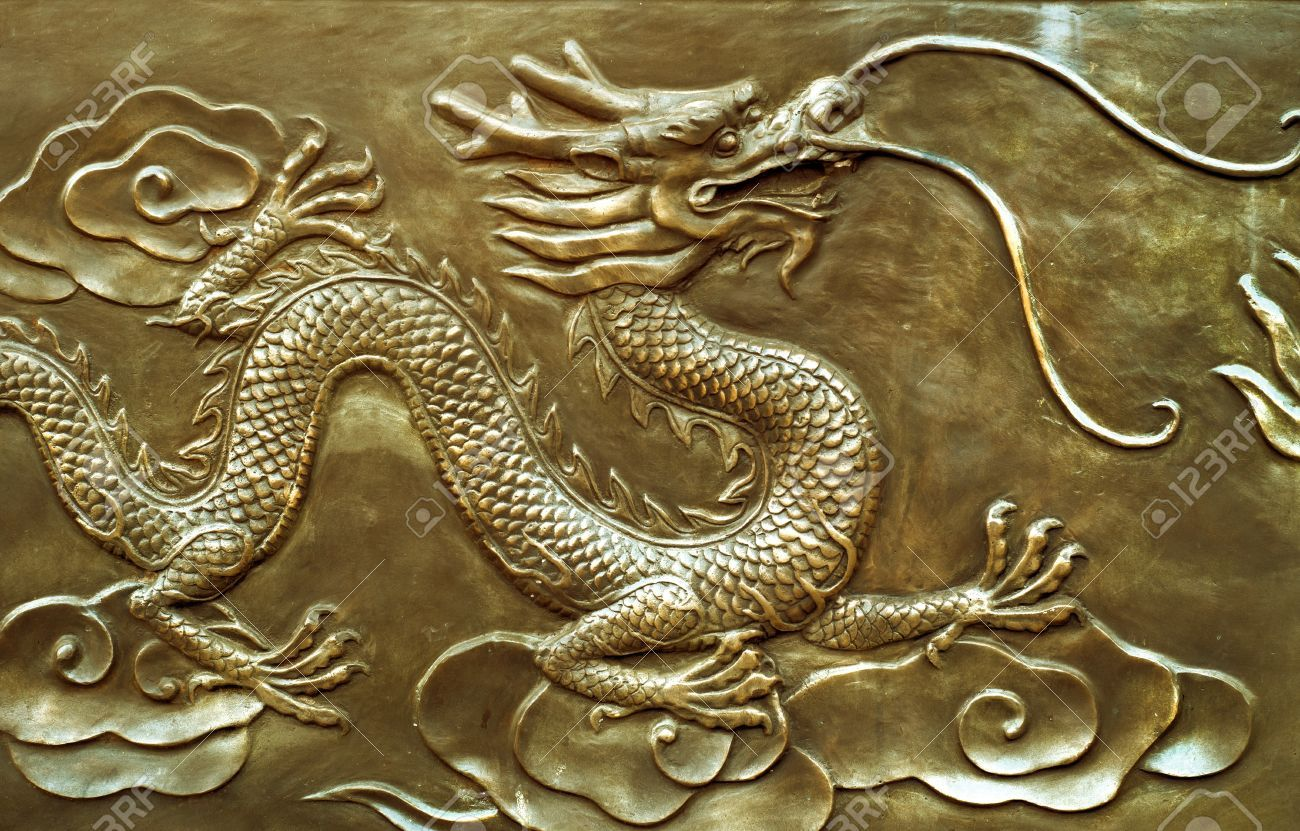
Unbelievable Female Viking Warriors
**Lagertha**
From Lagertha (also known as Ladgerda) only IX of Saxo Grammaticus' 'Gesta Danorum' (History of the Danes). It is mentioned in the section. Legendary hero Ragnar Lothbrok comes to Norway to avenge the death of his grandfather Siward and the humiliation of his wives and relatives by Swedish King Frø. As Saxo writes, she is greeted by some women posing as men to help her. Ragnar is so impressed by her (he especially dedicates his victory to her) that he decides to make her his wife, but Lagertha places a bear and a dog in front of her door to protect him from her. Ragnar kills both animals and marries her and has two daughters. When he remembers how he encouraged the bear and the dog to attack him, he divorces him and marries another woman named Thora. More is unknown about Lagertha.
**Proud Sigrid**
The proud Sigrid (circa 927 – 1014M, also known as the arrogant Sigrid, Sigríð Storråda or Sigrid Tostadottir) was a Swedish queen who refused to live by the rules of others. The Swedish king was married to Erik the Victorious (970 – 995 BC) and preferred to rule alone after his death. Harald Grenske of Norway and Vissald of Kievan Rus were courting him, but Sigrid admitted that he was only interested in him for his land and wealth. She invited them to a party where she and her men fell asleep from drinking too much. She closed the doors of the hall and burned them all to death to deter her prospective suitors. This interesting story may be nothing more than a legend, as its historicity is disputed.
The notorious Olaf Tryggvason (995-1000M), who converted the Norwegian people to Christianity through torture, also wanted to marry her but insisted that he become a Christian first. When she rejected him, she slapped Sigrid in public, and Sigrid promised her vengeance. It is said that she later married Sweyn Forkbeard for her connections and power and organized the Battle of Svolder (1000 M) in which Olaf was killed.
**Brynhild**
Brynhild (also known as Brynhildr, Brunhild, Brunhilde, or Brunhilda) is a Valkyrie who is made mortal after supporting the wrong hero in a contest led by Odin, and is imprisoned in a castle behind a shield wall and sleeps in a ring of fire until she is rescued by a champion. The hero Sigurd saves her and gives her a ring with the promise of marriage. But before all this she must go to the court of king Gjuki. Gjuki's wife, who is a sorceress, wants Sigurd to marry his daughter Gudrun and gives Sigurd a potion that will make him forget Brynhild. The mage also arranges for her to be rescued by his son Gunnar, who will later marry Brynhild, but Gunnar is unable to get past the ring of fire. Sigurd saves Brynhild by posing as Gunnar, and Brynhild thinks it was Gunnar who saved her and marries her. In an argument with Gudrun, Brynhild learns that it was Sigurd who saved her, but she later renounces him and swears revenge on all of them. He kills Sigurd's youngest son and later kills Sigurd in his sleep. As the pyre is lit, he jumps into it and dies with it. On his way to Hel with him, he is condemned by a giant for his actions, but Brynhild has no regrets. She says that now she and Sigurd will live the life they want together. According to the epics, in the middle of all this disaster, Ragnar Lothbrok has a daughter named Aslaug, one of his wives.
**Skadi**
Skadi is the daughter of the giant Thjazi, who was killed by the Asgardian god Thor. Since there was no other man to avenge his father, Skadi "took the helmet and all weapons of war and went to Asgard to avenge his father's death. (Lindow, 268). She was appeased by the Adgardians, though fully clad in the door, by an offer to choose any of them as her husband. But he had to do this only by looking at their feet. She chose one, hoping it would be the handsome Baldr, but she later learned that it was Njord, the god of the sea.
Njordi enjoyed his dark and damp cave by the water, while Skadi enjoyed the mountains where he hunted and skied. They try to reconcile by living in each other's house for nine days at a time, but Skadi can't stand it and leaves her for her own chalet. While Skadi is likely the mother of two important Norse gods, Freyr and Freyja, there is no mention of her involvement in their upbringing. After leaving Njord, she pursues her own interests, including a series of relationships with Odin.
**Freydis Eiríksdóttir**
Freydis Eiríksdóttir (970 – 1004 BC) was either an evil complicit murderer or a great female warrior, depending on which of the two stories about her is read. She is seen in the Epic of Red Erik (hero of epic) and Epic of Greenland (hero of evil). In The Epic of Plum the Red, Freydis, the daughter of Plum Red, accompanies a group in Vinland (Newfoundland, North America). When they are attacked by a group of natives, the men in the group retreat, leaving Freydis alone. He called out to them, “Why do you flee from such worthless creatures when, in my opinion, you are men brave enough to slaughter them like cattle? Let me get a gun, and I can fight better than any of you." she said. (Chapter 12). Alone and unwell (probably pregnant), Freydis takes a sword from her dead comrade, tears off his shirt, and beats his chest with a sword, defeating his fleeing enemies. She thus saves her group, she. In The Epic of Greenland, she accompanies her husband, men, and two brothers/partners to Vinland. She doesn't like her siblings and thinks they are quite arrogant, so she traps them and tells her husband that they abused and beat her. He says that if he does not avenge this insult, he will divorce her. Her husband and men kill his brothers in his group, but they do not touch the women, so Freydis kills all the women himself with an ax. This second story, written later than the first, is likely to be an attempt to discredit the powerful female figure in the ancient epic. Unlike the more overt mythological and legendary characters discussed above, Freydis has a better chance of reflecting a real historical persona, since there is consensus that these two epics that mention Vinland remember real people and events through an oral tradition, at least partially preserved.
**Gudrid Thorbjarnardottir**
Gudrid Thorbjarnardóttir (970/980) BC was among the first to explore North America, according to the Greenland Epic and the Red Plum Epic. Although originally from Iceland, he settled in Greenland with his father and Plum the Red. While in Greenland, his father died and he later married Leif Erikson's younger son, Thorstein. Along with others in her group, she accompanied her husband and brother-in-law on their North American tour where she discovered Vinland.
Thorstein died there and Gudrid returned to Greenland, where he married a Thorfinn Karlsefni. After some time, he returned to Vinland to settle permanently. His son, Snorri Thorfinnsson, was the first European child born in North America. Like Freydis, Gudrid is probably based on a real historical figure.
**Deep Minded Unn**
Deep-minded Unn (9th Century, also known as Deep-minded Aud and Unn- or Aud Ketilsdóttir.) was the daughter of Norwegian Ketil Flatnose, who fled to Scotland after the rise of Harald Fairhair (850-933M) in Norway. When his father and son Thorstein died, he realized his position in Scotland was uncertain and traveled first to the northern Orkneys and then to Iceland, where he discovered before settling down. She commanded a crew so loyal to her that no one entered into marriage contracts that could endanger Unn's property or power. Heading the Unn family, he literally lived in southern Iceland until his death. On the day her grandson Olaf Feilan married, she took a dignified seclusion in her bedroom, where she oversaw the preparations and service and then died in her sleep.
Have you thought about how the Alphabet was found?
The history of the alphabet began in ancient Egypt. By 2700 BC, Egyptian writings had about 22 hieroglyphs representing syllables beginning with a single consonant of their language, and a vowel (or no vowel) practiced by native speakers. These glyphs were used as pronunciation guides for the lexical sign logograms, to write grammatical conjugations and later to adapt borrowed words and foreign names.
But while it may seem alphabetical in nature, the original Egyptian uniliterals were not a system and were never used on their own to encode Egyptian speech. An apparently "alphabetic" system known as Proto-Sinaitic writing during the Middle Bronze Age is thought to have been developed by some for or by Semitic workers in Central Egypt around 1700 BC, although only one of these early writings has been deciphered and the precise nature of their writings has not been interpreted. has remained open. Based on letter appearances and names, it is believed to be based on Egyptian hieroglyphs.
This writing eventually evolved into the Proto-Canaanite alphabet, which in turn was refined into the Phoenician alphabet. It also evolved into the Southern Arabic script, from which the Ge'ez script (an abugida) descended. It should be noted that the above-mentioned scripts are not considered proper alphabets, as not all of them contain characters representing vowels. These primitive vowelless alphabets are called abjad and are still found in writings such as Arabic, Hebrew, and Syriac.
Phoenician was the first major phonemic script. Unlike the other two writing systems in common at the time, cuneiform and Egyptian hieroglyphs, it contained only two dozen different letters, making it simple enough for ordinary merchants to learn. Another advantage of the Phoenician language was that it could be written in many different languages, since it recorded words phonemically.
Phoenician colonization allowed writing to spread across the Mediterranean. In Greece, the writing was modified to add vowels, and the first true alphabet appeared. The Greeks took letters that did not represent sounds that existed in Greek and changed them to represent vowels. This marks the creation of a "true" alphabet, in which both vowels and consonants are used as explicit symbols in a single script. In its early years there were many variants of the Greek alphabet, which caused many different alphabets to evolve from it.
The Cumae form of the Greek alphabet was carried by Greek colonists from Euboea to the Italian peninsula, where it gave rise to various alphabets used to write the Italic languages. One was the Latin alphabet, which spread across Europe as the Romans expanded their empire. Even after the fall of the Roman Empire, the alphabet continued to exist in intellectual and religious works. It eventually came to be used for languages descended from Latin (Roman languages) and later for other languages of Europe.
Ancient Greece-Science
The achievements of ancient Greek science were among the best of antiquity. Personalities such as Thales of Miletus, Pythagoras, and Aristotle developed ideas that would influence Western thought, science, and philosophy for centuries to come, with mathematics, astronomy, and logic based on Egyptian and Babylonian knowledge. Aristotle was the first philosopher to develop a systematic study of logic, an early form of evolution was taught by figures of Greek philosophy such as Anaximander and Empedocles, and Pythagoras' mathematical theorem is still used today.
However, Greek science had its flaws as well as its successes. Observation was scorned by the Greeks in favor of the deductive process in which knowledge was constructed through pure thought. This method is key in mathematics, and the Greeks attached so much importance to it that they mistakenly believed that deduction was the way to obtain the most knowledge.
**Effect of Mathematics**
Greek achievements in mathematics and astronomy were among the best of antiquity. First, mathematics developed under the influence of Egyptian mathematics; Astronomy flourished in the Hellenistic Period after Alexander the Great (356 BC - 323 BC) conquered the East with the help of Babylon.
A strength of science is that it seeks to distinguish itself from concepts with specific uses and seeks common applications and general principles. The more general the science, the more abstract it is and the more applications it has. What the Greeks derived from Egyptian mathematics was basically rules of thumb that had specific applications. For example, the Egyptians knew that a triangle with sides in the ratio 3:4:5 is a right triangle. Pythagoras took this concept and extended it to its limit by deducing a mathematical theorem that bears his name: in a right triangle, the square on the opposite side of the right angle (hypotenuse) is equal to the sum of the squares on the other two sides. This was not just true for the 3:4:5 triangle, it was also a principle for any other right triangle, regardless of size.
Pythagoras was the founder and leader of a sect that fused Greek philosophy, religion, art, and mysticism. In ancient times, the Greeks did not make a clear distinction between scientific and non-scientific disciplines. There is a widespread view that the coexistence of Greek art, philosophy, mysticism, and other non-scientific disciplines interacting with science interfered with the development of scientific ideas. This seems to indicate a misconception about how the human spirit works. It is true that moral and mystical prejudices in the past have delayed or impeded some knowledge, and the sharp boundaries of scientific knowledge are not clear. However, it is true that non-scientific disciplines foster the human mind's imagination, inspiring to approach problems that seemed impossible to solve, and stimulating human creativity to consider the counterintuitive possibilities (such as a global world in motion) proved at the time. The human spirit has found many motivations for scientific progress in non-scientific disciplines, and it is likely that it would largely lack the impetus of scientific progress if it were not for the impetus of art, mysticism, and philosophy.
**Aristotelian Logic**
Aristotle was the first philosopher to develop a systematic study of logic. His system would become an authority in deductive reasoning for more than two thousand years. Although he repeatedly acknowledged the importance of induction, he prioritized the use of deduction to construct knowledge. In the end, his influence turned out to reinforce the overestimation of deduction in science and analogies in logic.
The doctrine of comparison is his most influential contribution to logic. He defined qiyas as a discourse in which certain things are expressed, something else necessarily emerges from their being as such. A well-known example:
All men are mortal. (main proposition)
Socrates is a man. (secondary proposition)
Socrates is mortal. (solution)
This view cannot be logically changed and we cannot dispute its conclusion. However, doing science in this way has at least two failures. First, the way the main premise works. Why should we accept the main premise without question? The only way a major proposition can be accepted is by presenting the obvious statement, such as "all men are mortal." This means that the result of this view is not new understanding, but rather something that has already been implied, directly or indirectly, in the main proposition. Second, it does not seem necessary to go through all this to logically prove that Socrates is mortal.
Aristotle's contribution to logic and science became an authority and remained undisputed until the modern age. It took centuries to realize the flaws of Aristotle's approach to science. The Platonic influence also contributed to the valuation of inference and experimentation: Plato's philosophy saw the world as only an imperfect representation of the ideal reality that resides in the world of ideas.
Another obstacle to Greek science was the concept of "ultimate truth". After the Greeks worked out all the consequences of their axioms, further development seemed impossible. Some aspects of knowledge seemed "complete" to them, and some of its concepts were turned into dogmas that were not open to further analysis. Today we understand that there is never an observation that can make a concept "final". No primitive test can tell us that a generalization is completely and absolutely valid. A single observation that contradicts a theory forces it to be revised.
(Hades)-Lord of the Dead
In the earliest Greek epics, heroes and dead spirits such as Hercules (Heracles), Theseus, Orpheus and Odysseus were told to travel to the underworld ruled by Hades or Aides, brother of Zeus and Poseidon. Over time, as the Greek culture developed, the idea of life after death developed, and new ideas about the rewards and punishments that awaited mortals there emerged.
After the six children of Cronus and Rhea overthrew their cruel father and won a decisive victory against the Titans, the three brothers shared the dominion of the realms, namely the universe, Zeus became the lord of the sky, Poseidon of the sea, and Hades became the lord of the Underworld, namely Tartaros, which Hades 's name was also used to name the realm of the dead. For this reason, he was nicknamed the King of Shadows. Although the etymology of Hades is unclear, it is claimed to mean 'unseen'. It was also known in Rome by the names Pluto (wealth-giving) and Dis, both associated with the gods of wealth. Some writers believe this is because it is a euphemism to avoid uttering the god's terrible name, while others believe that Hades is associated not only with death but also with the wealth of precious metals and gems that come from the depths of the earth.
In Greek art, unlike Poseidon's pitchfork, he was portrayed as an old bearded king with a two-pronged pitchfork, and was portrayed as a ruthless person who did not allow anyone who entered the underworld to return. Hades is sometimes depicted holding the key of the underworld in his hand, as in a painting by Carracci in western art. During the war with the Titans, the Cyclops wore an invisibility helmet on Hades' head, which was also worn by Athena, Hermes, Perseus and Heracles. Hesiod described the land of the dead in Theogonia with these words:
“There he rises the echoing mansion / of the mighty Hades and the terrible Persephone / A raging dog awaits his door / a relentless, master of deceptions / a dog that cringes at those who enter, with its tail, its ears / but as soon as it leaves the one who enters, it waits outside / lurks and shatters those who come to the door to leave.”
**Where Was the World of the Dead?**
The Greeks initially saw the underworld as a gloomy place devoid of light and air. Although the Greeks believed that the World of the Dead was underground, some legends provide information about the entrance gates of Hades. In some myths, it was thought that the underground world would be entered through the craters of the volcanoes, possibly due to the poisonous gases emitted from the volcanoes killing the birds. There is a tradition narrative that speaks of Hades abducting Persephone from a fissure in Enna on the island of Sicily. Aside from volcanoes, numerous caves were thought of as gateways to the underworld, the most important being a cave at Taenarum near Sparta in Greece and Cumae near Lake Avernus in Italy. A Sibyl who could foretell the future lived in the cave in Cumae, who advised Aeneas about his entry into the underworld in Virgil's Aeneid epic written in the 1st century BC.
**Rivers**
The underworld was in the minds of the Greeks a real physical place with geographical features such as rivers, fields, and caves. There were five rivers in the underworld. The most famous of these, Styx, could only be crossed with the help of the boatman Charon, so it was thought in ancient Greece that a coin would be left in the mouth of the deceased to provide the necessary payment for this journey. The river of forgetfulness, the Lethe River, had water that made you forget the past when drunk. The other 3 underground rivers were associated with Acheron 'grief', Phlegethon 'flame' and Cocytus 'lament'. Of these, Acheron is a river that almost never flows, its banks are covered with reeds and mud, and it was believed that it flowed into the underworld because it plunged into a deep gorge and poured into the sea as a black swamp. Famous for its cold waters, Kocytus was the place where Odysseus dug a hole to go underground. While all these rivers flowed around Tartarus, which was a depth of torment without it, the souls of people who lived a good life dwelt in the Fields of Elysia.
**Death and Fate**
Hades only presided over the dead, never deciding when they would die. This was done by three goddesses, also called Moirai, who determined how long a person's life would last. Of these, Klotho was spinning the thread of life, Lachesis was measuring, and Atropos was cutting the thread of life, bringing death. While Thanatos was the god of death, Keres was the goddess of death, who according to Hesiod was particularly associated with death associated with violent, painful deaths on the battlefield.
**Going to the Other World**
The motif of returning after a hero descends to the underworld, called katabasis in Greek, has been used in many legends. In the legends, the hero usually makes this journey to obtain information that is only found in the world of the dead, in one of them Odysseus went to the underworld to take the advice of the dead seer Tiresias, with the advice of the Sorcerer Circe
When you pass Okeanos with your ship / there is the Low Shore and you will see the grove of Persephone / tall tall poplars, barren willows / on the shore of the deep eddy Oceanus pull your ship ashore / then set off towards the marshes of Hades / there Akheron, Pyriphlegeton and Cokytos flow / The waters from Styks also pour in there.”
Orpheus's musical abilities, cultivated by muses, impress Hades and Persephone, allowing his beloved wife Eurydice to come back to life has been used for. Hades would accept Orpheus's request on one condition, and he would not look at his wife while he was going upstairs, but when the man could not stand it and looked behind his shoulder, his wife disappeared in the land of the dead. The most important Greek hero, Heracles (Hercules), traveled to the land of the dead to bring the three-headed Cerberus back to life in the last of his 12 missions. In the Roman poet Virgil's Aeneid epic, Aeneas descended into the underworld in search of his father, Anchises.
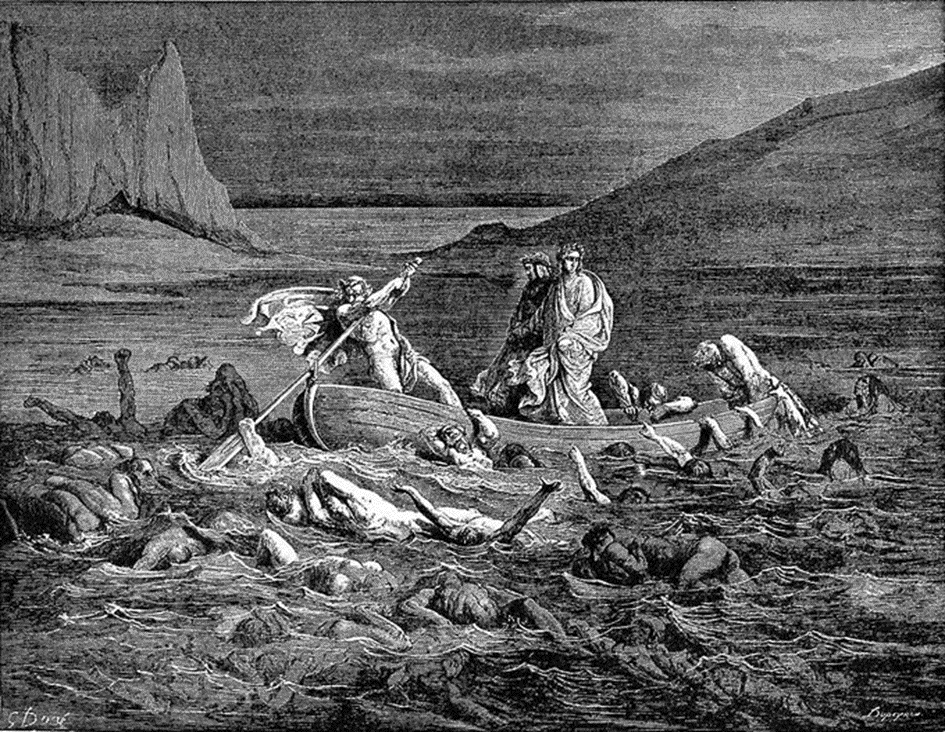
Month Names in the Roman Calendar
The Roman calendar is the calendar used by the Roman kingdom and republic. The Roman calendar is usually BC. It describes the Julian calendar, established in the late 1st century by the reforms of the dictator Julius Caesar and emperor Augustus. Roman days counted forward until the next day of the three main days: the first day of the month (kalendes), the day before the middle of the month (ides), and the eight days (nones). The original calendar consisted of ten months in the spring beginning with March. While the winter period was not clarified in the calendar attributed to Romulus and Numa Pompilius, which was used at the beginning, it was later divided into two months, January and February. Having won his battle with Pompey, Caesar used his position as high priest of Rome to introduce a calendar reform in 46 BC. To avoid interfering with Roman religious ceremonies, this reform added all its days towards the end of the months, and did not hold any nones or ides, even in months lasting 31 days. When Caesar was assassinated, it was up to Augustus to fix the irregularities in the calendar. However, the revised calendar was slightly longer than the solar year. By the 16th century, the date of Easter had shifted so far from the period Equinox that Pope Gregory XIII ordered a readjustment of the calendar, thus the Gregorian calendar was born.
**Ianuarius (January)**
The month of January, which was translated into English in the form January, was named after the Roman god Janus. As you can see in this article, Janus, the god of beginnings and ends, had two faces facing opposite directions so that he could see the future and the past! He was also the god of doors. In the calendars of the Roman Republic, Ianuarius had 29 days. Two days were added when the calendar was rearranged by Julius Caesar in 45 BC. In the oldest Roman calendar, which the Romans believe to have been started by their legendary founder Romulus, the first month was Martius (the "Martian 'month"), and the calendar year had only ten months.
**February (February)**
The month, which was translated into English in the form February, was named after an ancient Roman purification festival called Februa. In the Roman calendar, Februarius was associated with the Latin word februum, meaning 'purification', and was named after the Februa, the purification ritual held on February 15 (time of the full moon) in Ancient Rome. Lupercalia was an ancient festival held from February 13 to 15 to ward off evil spirits and purify the city of Rome, ensuring health and fertility. This festival was also called Dies Februatus because of the name of February, Februa. During the festival, a young man was running around the streets of Rome with the intestines of animals and hitting anyone who came in front of him, using his hand like a whip. In this way, it was believed that women in the city would become pregnant. At the end of the 5th century, Pope Gelasius I sent Lupercalia to St. Replaced it with Valentine's Day. st. Valentine's Day was celebrated as a romantic day associated with lovers after the 14th century. It is said that Julius Caesar used the Lupercalia festival to emphasize that he did not want to become emperor: During the Lupercalia festival in 44 BC, Mark Antony tried to put a golden crown on Caesar's head, but Caesar allegedly refused and later presented it to Jupiter Optimus Maximus. Februarius was the shortest month of the Roman calendar, lasting 28 days in the pre-Julian calendar. Held in this month, the Parentalia was a nine-day festival honoring ancestors and encouraging the dead, while Terminalia was a series of rituals related to landmarks, possibly thought to strengthen the boundary of the year.
**Martius, Mensis Martius (March)**
The month of March, which was translated into English in the form of March, was named after the Roman god of war, Mars. Martius was the first month of the ancient Roman year, possibly until 153 BC. The month of March is associated with farming, military mobilization and sailing. A series of festivals related to religious ceremonies, especially the new year, dating from the earliest period of Roman history, were held this month. During the imperial period, March also saw celebrations of syncretic or foreign deities that pervaded the empire, including the cult of Isis and Cybele. After that time, March became the third month when Februarius (February) and earlier Aprilis (April) were added to the calendar. The day of March 15, known as the Idus Martiae, was noted for the Romans as a deadline for payment of debts. B.C. In 44 BC, it became famous as the date of the assassination of Julius Caesar, which made the day of the Ides Martiae a turning point in Roman history.
**Aprilis, Mensis Aprilis (April)**
The month of April, which took the English form April, was named after the Latin word aperire, meaning 'to unfold', which must have been a reference to the blooming of flowers in the spring. Although it is the fourth month of the Roman calendar, Aprilis was the second of the ten months of the year in the oldest Roman calendar, beginning with March. In the calendars of the Roman Republic, April lasts 30 days, BC. During the reform that produced the Julian calendar in the mid-40s, an additional day was added to the month. As April was a busy month for farmers, it was celebrated with a series of festivals dedicated to aspects of rural life. As Roman society became urbanized over time, some ceremonies increased in importance, such as Parilia, an archaic pastoral festival celebrated as the founding day of Rome.
**Maius, Mensis Maius (May)**
The third month of the Roman calendar, May, is named after the Greek goddess Maia, who is also mentioned in Roman mythology. Maia is one of the Pleiades in Greek mythology and was the mother of Hermes. In ancient Roman religion and mythology, maius, which means big, is associated with size and growth, considering it is associated with the word maior. On the first day of May, Lares Praestites were honored as guardians of the city. The Romans saw May as an unlimited month. Although it began with the Flora Games (Ludi Florae), one of the most notorious holidays of the Roman calendar, mid-month lemurs were devoted to spreading the restless tones of the dead.
**Iunius, Mensis Iunius (June)**
In the earliest calendar attributed to Romulus by the Romans, Iunius was the fourth month in the ten-month calendar beginning with March. The month following June was called Quinctilis or Quintilis, the "fifth" month. Iunius had 29 days, up to one during the Julian reformation of the calendar in the mid-40s BC. June is named after Juno, the Roman god of marriage and childbirth and the wife of the king of the gods, Jupiter. The moon following Junius was named Julius (July) in honor of Julius Caesar. The Latin poet Ovid has claimed that Concordia derives from the word iungo, iunctus, "join" in honor of Iunius' unification of the Romans and Sabines.
**Quintilis, Mensis Quintilis, Julius (July)**
In the ancient Roman calendar, Quintilis or Quinctilis was the month following Junius (June) and the preceding Sextilis (August). Quintilis means "fifth" in Latin, and was the fifth month in the original calendar attributed to Romulus, beginning with Martius ("Mars' month," March ") and lasting 10 months. After a 12-month calendar reform, Quintilis became the seventh month but retained its name. B.C. In 45 BC, Julius Caesar introduced a new calendar (Julian calendar) that corrected old astronomical inconsistencies. B.C. After Julius Caesar's death in 44 BC, the month of birth, Quintilis, was changed to 'Julius' in his honor, hence July. Quintilis was under the tutelage of Jupiter, the supreme god of the Romans. The agricultural festivities for the harvest that took place in this month gradually lost their importance, and the month was dominated by the urban empire Rome by the Ludi Apollinares games (ludi) held in honor of the empire. At the end of the month, a ten-day game was held in honor of Julius Caesar.
**Sextilis, Mensis Sextilis (August)**
Sextilis (“sixth”) or mensis Sextilis was the Latin name for the sixth month in the Roman calendar, during the first ten months of the calendar beginning with March (Martius, “the month of Mars”). After the calendar reform, which produced a twelve-month year, Sextilis became the eighth month, but retained its name. It was renamed Augustus (August) in honor of the first Roman emperor, Augustus.
**Other Months**
September (September, Mensis September), October (October, Mensis October), November (November, Mensis November) and December (December, Mensis December) are named after the Roman numbers 7, 8, 9 and 10: These months are actually the Roman year of the year. It was the seventh, eighth, ninth and tenth months! It was called Quintilis and Sextilis, the fifth and sixth months before July and August were renamed by the Roman rulers.
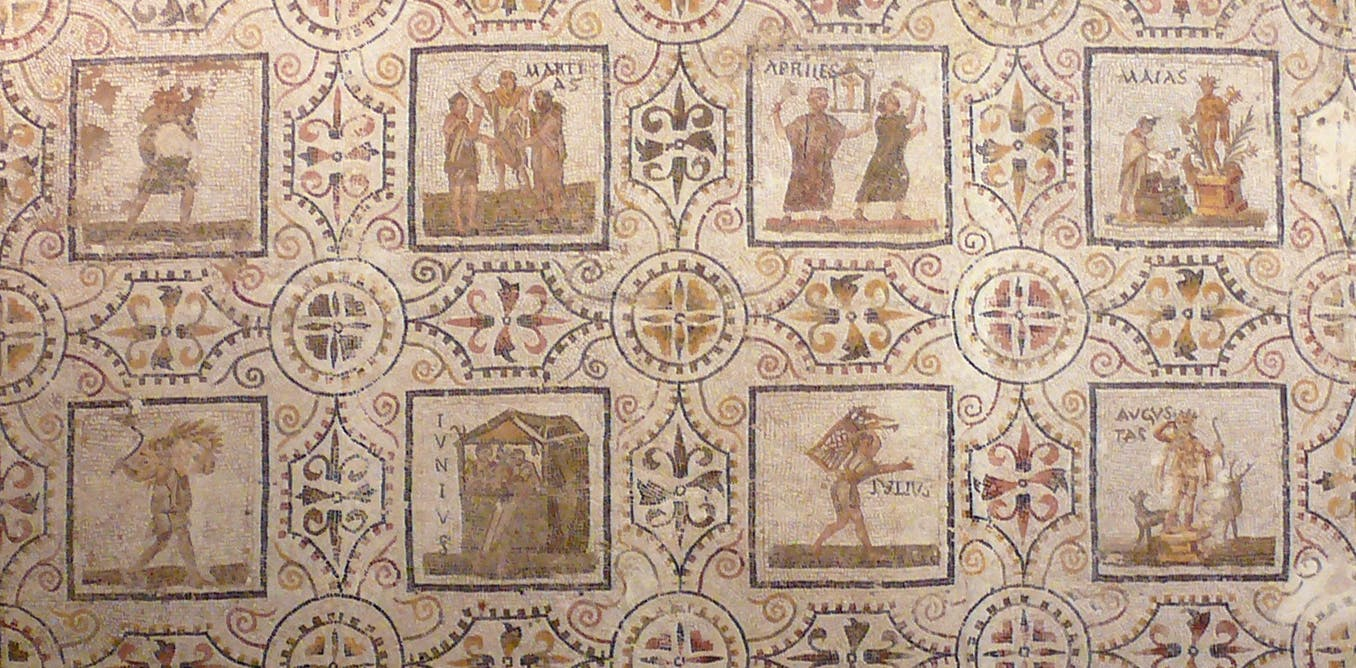
Egyptian Civilization and Art
History is nothing but the storytelling of the past outside of us. History continues its meaning not with where it started, but with whom it was written. Power relations, non-objective views, ethnocentrism are important elements that affect the writing of history.
When we say philosophy, art and science, we think of Greek civilization. References to this civilization are elements that have already existed in Egypt and Mesopotamia for thousands of years. How the Greek civilization was able to get ahead of these two is incomprehensible! Finding the first writing by the Egyptians and the fact that this writing is more pictorial requires us to call the Egyptians the first painters. Especially their interest in death and their thinking about their philosophy in this dimension played an important role in shaping their culture and art. The power of the despotic Egyptian kings was symbolized by their huge tombs (pyramid). The interest these tombs attract today is not only because they are considered as tombs, but also because they are works of art. The belief that the soul will eventually return to the body is the main determinant of Egyptian civilization.
The other world, despotism, immortality of the soul and the Nile make themselves felt in every aspect of life. In particular, the theme of death shows how powerful the mysterious side of Egypt is. The metaphorical description of death by death has led to the creation of works symbolizing eternity in art. Sculptures symbolizing eternity, death and dance music, paintings describing transcendence…
Egypt preserves its past mystery in our time and impresses the artists with the works produced on this subject.
Expressive approaches showed themselves in compositions constructed on linen or canvas. Pyramid form, figure and various symbols of Ancient Egypt were included in the painting works. It has been used in closed compositions as well as open compositions in studies. The compositions are constructed by using open forms side by side. Color is an element used to create a dark light effect in pictures. Brush strokes and the interaction of flat surfaces with each other, which show themselves in the works, are expressed with color when using it to distinguish dark and light surfaces. However, apart from these expressions, an understanding of color that can be called a colorist has also been used from time to time. In most of the works, the color turquoise, which represents the Nile river, the color of Ancient Egypt, comes to the fore. Cold colors that are used as weights, along with the warm colors that enter the composition, are used to emphasize a certain point. Instead of developing variations in the colors used, it is desired to draw attention to the formal rhythm by using the colors purely as they are.
The rhythmic structure in the painting is also a reference to music. Rhythm, which is one of the elements of music, was carried out with the help of color harmonization in the studies. Iconology, from which we acquire knowledge of Egyptian music, is actually nothing more than a pictorial field. Egypt has been offering us an eclectic art in which painting and music are intertwined since the first period. In some studies, the colors have been simplified and the symbols have been asked to strengthen and deepen the interaction between them. Emotional and expressive interaction is established with vivid colors. With the variety of colors in the paintings, it was aimed to combine the symbols from our childhood with the symbols of Ancient Egypt and to open the symbols to our dream world. Thus, the symbols were taken out of their historical context and transformed into our own dreams. Stories were created around the symbols and the symbols were emphasized.
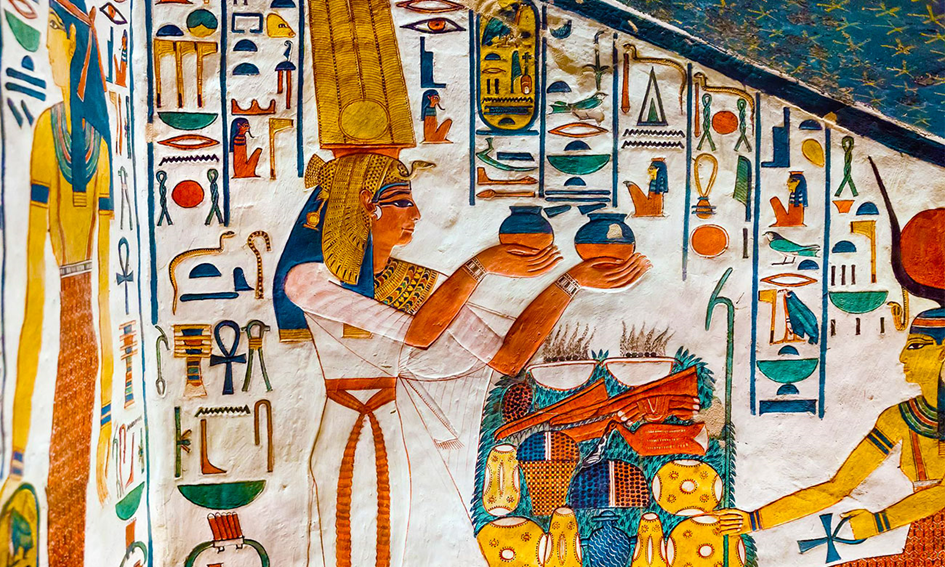
What is the golden Ratio?..
“The concept of the golden ratio and what is the mystery of this concept?” You've been thinking. Perhaps you have heard this concept for the first time. So, what is the golden ratio, where did it come from, does it have a practical use in life? Is it a concept found in nature, or is it just a forced and artificial concept?
Mathematics, like other sciences and disciplines, can be turned into a dangerous toy in malicious hands. Just as rogue fortune-tellers create predictions from water, coffee grounds, or beans, so too can mathematics be used to infer ciphers from religious books and date calculations for the Day of Judgment from Nostradamus verses. You can use it to cut bread with a knife or to kill people, as in the example. Is the concept of the Golden Ratio a subject that can also be used in such exploits? Or is it useful for us to reach meaningful results when considered from a scientific point of view? For now, I think it's best to leave such skepticism to our minds and address the issue.
One of the many sub-topics covered in the gripping novel The Da Vinci Code by the author Dan Brown, who rose to prominence in 2004, was the golden ratio. Also known as the Fibonacci sequence and the Phi number. In fact, drawing attention to the concept of "Golden Ratio", which has been known throughout history, was one of the good aspects of the novel. Undoubtedly, one of the good aspects of the novel is to draw attention to the subject and the curiosity of the masses about this concept, which has been forgotten and remembered for thousands of years.
The aim of this study is to present the data and findings about the golden ratio in the most objective way possible. It does not aim to support or prove any ideological discourse by asserting the concept of the golden ratio.
Various sources did not hesitate to use the golden ratio issue in this way as a support for their ideological discourse. During the research for the study, similar deformations of such welds were removed.
In the study, objective data and findings were handled instead of deformed claims and efforts were made to reveal the facts.
The golden ratio is one of two numbers that, when added to the number 1, equals its square. The golden ratio is 1.618033.... is the decimal number that continues. The other number that is equal to its square when added to the number 1 is the decimal number continuing as - 0.618033...
Mathematical knowledge of the golden ratio was first introduced in BC. In the 3rd century, it was recorded under the name of "extreme and average ratio" in Euclid's work called Stoikheia ("The Elements"). The available data show that the history of this information actually dates back to Ancient Egypt, BC. It shows that it dates back to 3000 years. It is claimed that it was introduced to the Greek world by Pythagoras and the Pythagoreans.
In short, we can call the golden ratio "the ratio of the eye system".
As can be seen in history, artists have used this feature to create works that look beautiful to the eye. For example, the ratio of the height to the width of the Mona Lisa painting gives the golden ratio. It is a rectangular golden rectangle that appears when you draw a rectangle around the Mona Lisa's face. When you divide this rectangle with a line that you will draw at eye level, you will again get a golden ratio. The dimensions of the picture also form the golden ratio. B.C. Pythagoras (Pythagoras), one of the greatest mathematicians of all time who lived in the 500s, expressed the following thoughts about the golden ratio:
"The ratio of a person's height to his navel to his whole body, the ratio of the long and short sides of a pentagram, the ratio of the long and short sides of a rectangle, are all the same. Why is that? Because the ratio of the whole piece to the big piece is equal to the ratio of the big piece to the small piece." (If we compare the AB sides of a regular pentagon with the length AC of a pentagram to be drawn inside, we find its length as Ø = (1 + √5)/2 = 2cos(p/5) = 1.61803... that is the number of golden ratio.)
The answer to the mystery of the golden ratio is hidden in a series of numbers found by the Italian mathematician nicknamed Fibonacci. The feature of these numbers, also called Fibonacci numbers, is that each of the numbers in the sequence consists of the sum of the two numbers preceding it.
**Who is Leonardo Pisano or "Fibonacci" as he is nicknamed?**
Considered one of the greatest mathematicians of the Middle Ages, Fibonacci was born in the famous Italian city of Pisa in 1170, although it is not known for certain. He spent his childhood in Algeria, where his father worked. He received his first mathematics education from Muslim scientists and studied and studied the books of Islamic civilization.
In 1201 he wrote a mathematics book called "Liber Abacci" (book of algebra). He introduced the Arabic numerals and the number system we use today to Europe. In this book, he explained the basic mathematical rules (addition, multiplication, subtraction and division) that we learned in elementary school, by giving many examples. Although it is not known in Europe for its period, it would not be wrong to argue that this ancient knowledge had an initiating effect for a leap in mathematics. Europe has remembered the forgotten information thanks to Fibonacci…
Fibonacci Numbers: 0, 1, 1, 2, 3, 5, 8, 13, 21, 34, 55, 89, 144, 233, 377, 610, 987, 1597, 2584,...
When you divide a number in the Fibonacci sequence by the number before it, you get numbers that are noticeably close to each other. This number is fixed from the number 13 in the series (233).
GOLDEN RATIO = 1.618
233 / 144 = 1.618
377 / 233 = 1.618
610 / 377 = 1.618
987 / 610 = 1.618
The Golden Ratio (golden section, also known as the golden ratio, the golden and divine proportion) is a property of the Fibonacci numbers. This remarkable ratio, which appears in art, nature and even living organisms, is seen by many as proof of the existence of a supreme Creator. I leave aside the discussion of whether the existence of the Creator should be proven, as it is irrelevant.
The general meaning of the Fibonacci sequence is: 'When you divide a number in the sequence by the number before it, you will get numbers that are very close to each other. Even after the 13th number in the series (233), this number is fixed. This number is called the 'golden ratio'.
The Golden ratio, which is fixed after a certain row, such as the "p" Pi number we know, after the 13th row, is equal to 1.61803398874989... It is symbolized by the "F" PHi from the Greek alphabet.
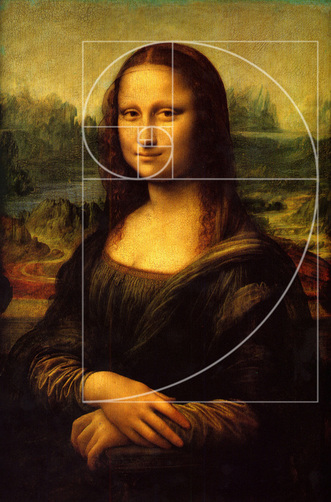
The Beginning and the End- Scandinavian Mythology
Scandinavian Mythology consists of pre-Christian beliefs and legends of peoples called Scandinavian, Norse, Teutonic or Germanic, living in today's Northern Germany, Sweden, Denmark, Iceland and the Faroe Islands, located in the subarctic region between the Rhineland and the North Sea.
From fire and ice in Ginnungagap, which was originally an open void. Nothing else was formed, neither the heavens above nor the earth below nor the sands nor the grasses nor the rising waves of the sea at this time.
The first world to form was Muspelheim, known as the home of the Warriors, and was called "Stur", meaning black, by giants. This place, south of Ginnungagap, was a world of hot, bright flames, guarded by the giant Surt, who wielded a flaming sword that lit up embers glowing with sparks. The second formed world was Niflheim, north of Ginnungagap, where 11 rivers flowed, and was known as the House of Mists. In the middle of Niflheim was a spring called Hvergelmir, meaning boiling cauldron, from which eleven rapid and fearful rivers rose and flowed far into the distance. The foamy poison formed by the waves of these rivers hardened and turned into ice. As it cooled, a drizzle of venom rose and fell on the solid ice of the first layer to form a second, heavy layer of ice, which made Niflheim cold, foggy, and cruel.
Although they lived through endless winters before they formed, over time the ice thawed where the warm air rising from Muspelheim met the ice from Niflheim. For the first time, life developed from drops of melted venom foam, giving rise to a giant named Ymir and a cow called Audhumla, meaning feeder. Ymir, made wild, cruel and evil by the poison he was created, was fed from the four milk rivers produced by Audhumla. In the region licked by the ice-fed Audhumla, the first residence of the gods, the Aesir, emerged. The first god was Buri and his son Bor, the next generation was Odin, Vili and Ve, these last 3 gods were one and killed Ymir. While all the ice giants were drowning in Ymir's blood, the gods first shaped the earth and sky (moon, sun, stars) and then created the first human couple, Ask and Embla, from two tree stumps. Norse mythology also has an apocalyptic legend called Ragnarok (Twilight of the Gods) or Gotterdammerung (death of the Gods), which deals with the destruction of the entire universe so that a better universe can emerge.
**Scandinavian Cosmology**
9 worlds created in Scandinavian Mythology are mentioned, and in some sources they are added to Svartalfheim, where Dark Elves live. The 10 worlds below were believed to be connected by the world tree (Yggdrasil), whose roots reach the lowest worlds and whose leaves reach the realm of the gods.
Asgard: Aesir (for the warrior superior race of the gods)
Vanaheim: Vanir (secondary half of the gods)
Alfheim: Lios Alfar (for Light elves)
Hel: the dead world
Jotunheim: realm of giants
Midgard: the world of the human realm
Nidavellir: kingdom of the dwarves
Niflheim: the ice kingdom
Muspelheim: Fire zone (for fire giants)
Svartalfheim: Dokk Alfar (for dark elves)
**Norse Gods**
The most important Norse gods lived in Asgard, and although they were mortal like humans, they gained immortality by eating the fruits of the magic apple tree guarded by the beauty goddess Freya. It was believed that the Aesir would perish on the Day of Judgment, as described in the legend of Ragnarök.
***The most important Aesir deities are:***
Odin: Leader of the Pantheon.
Frigg: Odin's wife
Thor: The god of thunder.
Sif: Thor's golden-haired wife.
Idunn: Goddess of immortality.
Balder: The white god.
Heimdall: Watchman
Tyr: god of war.
Loki: the trickster god
Secondary gods live in the Vanir, and the most important of them are Frey, the god of fertility, Frey's sister, the goddess of fertility, Freya's father, the sea god Njord or Niord. Although the Vanir once fought the Aesir in revolt, they had to surrender in defeat, which is often interpreted by mythologists as a trace of conflict between new and old religions.
**Supernatural Creatures in Norse Mythology**
The Elven people, called the Amnes, were viewed as a race weaker than the gods but superior to the humans, believed to be descended from the Vanir and possibly the children of Frey. Elfers were divided into 2 groups as Light Elves (Lios alfar) and Dark Elves (dokk ams).
The giants known as Jotun were divided into groups of Ice, Fire, and Mountain giants among themselves, and talented architects and archenemy of the gods, the giants all lived in Jotunheim.
The most important of the Ice Giants (Jotun) are:
Aegir: king of the seas
Fafnir: While he was the son of the dwarf king, he was turned into a dragon because of his greed for gold.
Gerd: Wife of the god Frey.
Gunlod: A giant tricked by Odin
Ivaldi or Vate: Blacksmith who builds flying boats for the Aesir
Skaoli: Wife of the god Njord.
Surtur: King of the fire giants.
Thrym: King of the ice giants.
Ymir: First Ice giant
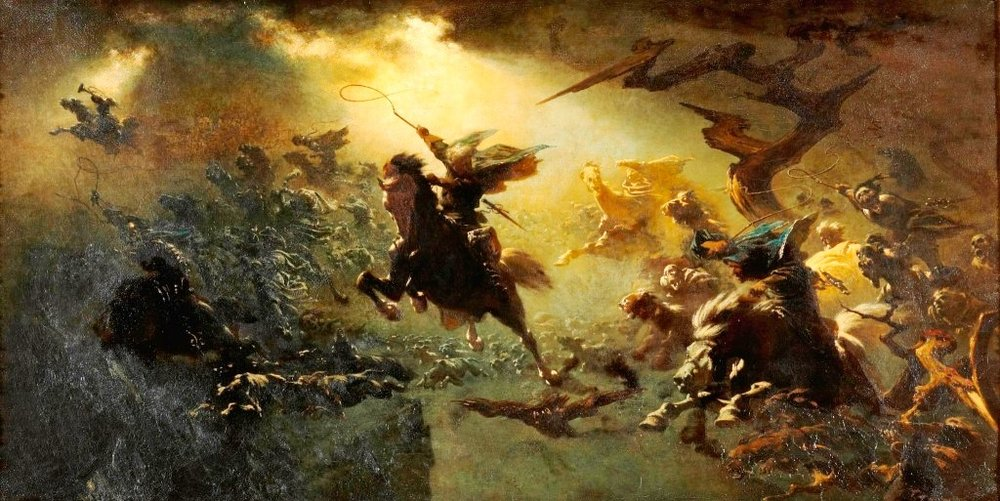
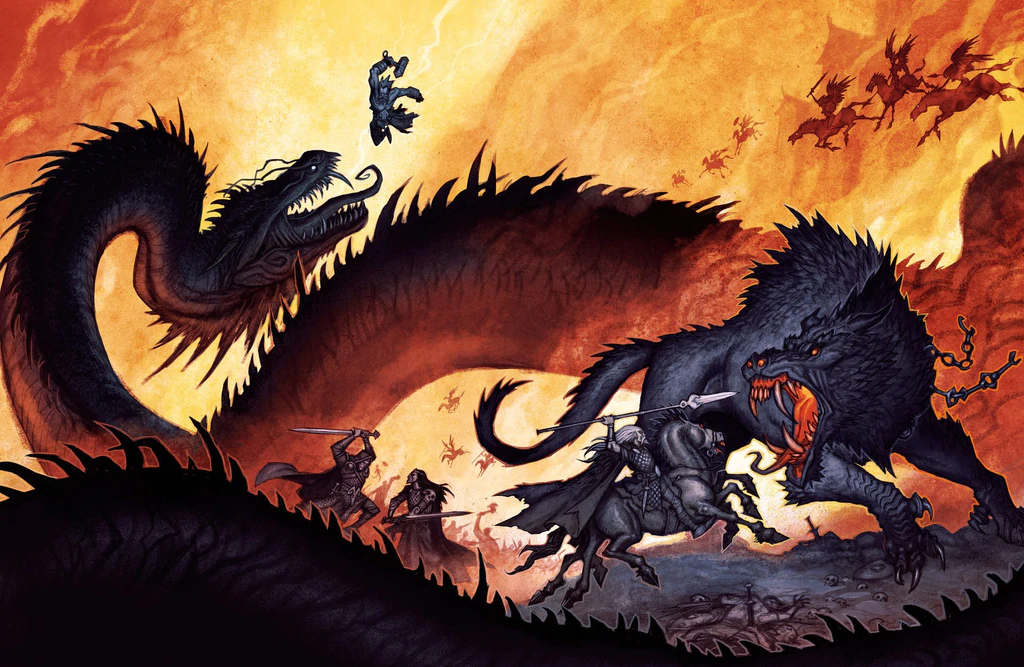
Poseidon-Lord of the Sea
Poseidon symbolizes the sea among the gods of Olympus and is considered the absolute ruler of the seas. He is called Poseidaon in the Homeric epics. Derived from Poti-dan, this name means "lord of the seas" when compared to its other Indo-European language. Its power and sovereignty extend not only to the seas, but also to streams and lakes. Poseidon not only rules the waves, he can also create storms. With one hit of his trident, he can move coastal cliffs and create terrible earthquakes. He is also called Enosigaios, which means the one who shakes the soil, with his identity as a god who can turn the soil upside down. He is the most important god after Zeus. The trident, the horse and the dolphin are its symbols. In Roman mythology, his name is "Neptune".
He is the son of Kronos and Rheia, and the brother of Zeus and Hades. According to a legend; Kronos, like his other children, swallows Poseidon as soon as he is born, then Zeus gives Poseidon the sovereignty of the sea when he is kidnapped with the help of his mother Rheia and made his father vomit his other siblings. According to another legend; After Zeus, Hades, and Poseidon brought their father Kronos down from the sky, they drew lots to determine who would be master of the sky, seas, and desolate underworld. Zeus wins the sky, Hades the underground and Poseidon the sea by drawing lots to make the earth open to everyone's common use.
**His Struggle with Zeus**
Poseidon is depicted in a type similar to Zeus with his beard and ostentatiousness. But although not as strong as Zeus, he was on par with him in dignity. Like his brother, he had a tough and belligerent nature. He did not hesitate to compete with Zeus, did not like to obey his orders, and even tried to put the father of the gods in chains by teaming up with the other gods. He challenges Zeus:
He is valiant for his valor, I know him (Zeus), but what's wrong with belittling me? Rhea gave birth to Zeus, me, Hades, who ruled over the dead, the world divided into three, we all got our share, lots were drawn, the foamy sea fell on me so that I could always sit there. A vast sky fell on Zeus among the clouds. But everyone has a share in the land and big Olympos, so I will not live according to Zeus's will, if he has the strength, let him sit comfortably in his own share, in his country, do not frighten me with his hands, let him not put me on the low place.
**Poseidon and Amphitrite**
Poseidon falls in love with Amphitrite, one of the fifty daughters born from the union of Doris, daughter of Oceanus, with Nereus, one of the sea gods. The girl, who does not respond to Poseidon's requests because of her shyness, flees to the Atlas Mountains. However, God sends a dolphin after Amphitrite. As the fish threw him on his back, he brought him to Poseidon and they got married. Thus, Amphitrite becomes Poseidon's legal wife, and they live in golden palaces at the bottom of the sea - between Tenedos and the rocky Imbros Island in the depths of the Aegean.
In some sources it is mentioned that he had no children from Amphitrite, while in some sources it is mentioned that he had three children named Triton (the only immortal son of Poseidon. Half human, half fish), Rhode and Benthesikyme. Many beings are born out of God's extramarital affairs. These are savage personalities, mortal but inhuman. Among them, Theseus is the only one who has a positive personality.
Poseidon did not stay behind Zeus with the love they had, and this caused jealousy in his wife similar to Hera's. He especially hated his secret love for Phorkys' daughter, Skylla. Therefore, he poured a potion of magic herbs into the lake where Scylla bathed every day, transforming the young woman into a creature with six heads and twelve legs.
**Poseidon and Demeter**
Another important feature of Poseidon is that he created and domesticated the horse. He is also known as the god who first organized horse races. Well, you might think, what does the lord of the waters have to do with the horse? This was born as a result of the love of Poseidon.
Despite being a married god, Poseidon falls in love with Demeter. Demeter loses hope after looking for her lost daughter for days and getting tired. In addition, Demeter, fed up with the lustful passions of all gods or Titans, transforms herself into a horse. He joins the flock of Onkos, son of Apollo, who reigns in Arcadia. But unfortunately, by doing so, he cannot get rid of Poseidon. He also turns into a horse and takes Demeter by force. From this strange union, Nympha Despoena and the wild horse Arion - even faster than Pegasus - are born.
Demeter's anger at this union, which was against her will, was so fierce that the Goddess is still worshiped as "Angry Demeter" in some places because of this.
**Poseidon and Medusa**
The Gorgons, whose names were Stheino, Euryale, and Medusa, were three sisters. Except for Medusa, two of these sisters were immortal. Medusa lived in one of Athena's temples in Athens. Medusa was so beautiful that even the goddesses envied her beauty. The Goddess Athena was also offended by her beauty, and she had a grudge against her. Of course, this beauty, which was told by word of mouth, went to the ears of Poseidon.
Poseidon, who cannot digest his defeat to Athena, comes to Athena's temple one day and falls in love with Medusa when he sees her there. God is fascinated by Medusa's love and chooses the temple as the place of love. He secretly comes to the temple and possesses Medusa. But before long, Athena becomes aware of all that has happened. Athena, who finds the situation humiliating for herself, punishes her anger and jealousy towards Medusa by using this event as an excuse. The goddess transforms him into a monster with eyes that look like fortune-tellers, hair full of snakes, tongue sticking out of his mouth, huge teeth and claws that turn people into stone when he looks at them.
Athena was not satisfied with the punishment she gave and she cooperated with Zeus' son Perseus, his half-brother to kill Medusa, and had this monster's head separated from its body. At that time, Khrysaor and the winged horse Pegasus were born from the blood flowing from the headless body of Medusa, who was pregnant with Poseidon.
**Temple of Poseidon**
Located in the city of Sounion on the Attica peninsula, 70 km south of Athens, the temple is surrounded by sea on three sides. As you can see, the temple has a magnificent view. Located on the top of a cliff overlooking the Aegean Sea, this temple is known to be one of the oldest ancient Greek temples. It is thought that the architect of this beautiful building is Iktinos, who is famous for temple construction.
Ancient Egyptian Inventions Still Used
When it comes to Ancient Egypt, the first things that come to mind are pyramids and mummies. However, he has many inventions that have stood the test of time! We see that they have their signatures on many things that are considered an integral part of modern life, from heels to calendars.You will be surprised to learn that the people of Ancient Egypt are at the root of all these inventions!
The foundations of modern 365-day calendars, which are extremely comfortable to use, were laid in Ancient Egypt. This calendar, invented by the pharaohs, was based on the cycles of the Nile river. Thanks to these calendars, which were used to irrigate the lands, periods of flood or drought could be predicted in advance. This calendar had 12 months and each consisted of 30 days. With the 5 days added to the end of the year, a 365-day calendar was created.
**Eye make-up**
If we look at 4000 BC, eye makeup was very popular in Ancient Egypt in those years. Upper-class women and men always wore eye make-up. They thought that this make-up, which they applied in a thick layer, would prevent eye diseases.
**Papyrus**
We owe the emergence of paper as we know it today to Ancient Egypt! These papers, which we see as early as 3 thousand BC, were obtained from the papyrus plant. This plant, which was grown on the banks of the Nile, was very important to the people of the region. After a while, papyrus became one of the main export products of Ancient Egypt.
**Door lock**
Wooden locks were extremely common in ancient Egypt. The first prototypes found in the ruins of an old palace are thought to date back to 4000 BC. Shortly before the Romans invented keyed locks!
**Toupee**
Wigs were very popular among Ancient Egyptian women. Especially upper class women gave great importance to their appearance. They used wigs not only for styling their hair, but also for protection from the sun and dry air. These wigs, added on top of natural hair, actually looked like ornaments. Royals preferred wigs made from real hair, while the inexpensive ones were made from plant fibres.
**Platform shoes**
One of the things that separated the upper class from the lower class in ancient Egypt was platform shoes. While people of the lower class walked barefoot, those of the upper class wore platform shoes. Both men and women wore these shoes. In addition, high-heeled shoes were preferred in ceremonies.
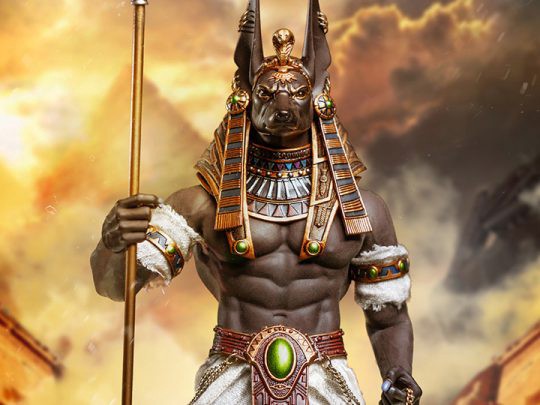 @beyourself