Rise, but no confidence
PayPal and Venmo will provide users with a cryptocurrency storage service through some built-in wallet function, and allow users to buy and sell cryptocurrencies directly on PayPal and Venmo.As an international payment company, Paypal has at least 300 million users worldwide. PayPal is expected to cooperate with multiple exchanges to obtain liquidity.
"PayPal's cryptocurrency buying and selling service is expected to be launched in the next three months (or even earlier)."
Although the official did not state, but according to the earlier information, we can find that paypal and coinbase are inextricably linked. These financial platforms with government background **will have huge channels of capital flow into the currency circle once they open their interfaces.** Why did paypal choose to open this direct channel for fiat and cryptocurrency? The driving force behind it must be the first stick to fight for the digital dollar.
From the perspective of the times, the United States has too many solid physical infrastructures, bridges, tunnels, modern airports, and other complete public transportation systems, but this is the light of the 20th century. Now, it is the 21st century. **Many US financial market infrastructures, even financial regulatory structures, are outdated.**
Today, the world is entering a new digital age. The first wave of the Internet is the information Internet, and the next wave is the digital wave, that is, the valuable Internet of Things. We experienced it early in the CFTC, and even introduced some of the world’s major commodities before we started using Bitcoin futures. The blockchain distribution system then uses Bitcoin as a commodity, and ultimately supervises the issuance of Bitcoin futures and the introduction of institutional funds.
We do see this new wave of blockchain and see the potential to present all valuable things in the form of tokens, digital forms, decentralized forms, and in some cases even programmable forms.
In the United States, it is the digital dollar, and the conflict between these outdated systems and the new wave of digitization is more important than the original dollar currency.
Most of the world's valuables are priced in dollars on the international market, whether they are agricultural products such as corn, wheat, soybeans, cotton, whether they are precious metals, whether they are industrial metals, whether they are energy products. The world's most important contracts and debt instruments are denominated in dollars.
When all these assets become tokenized digital, how long can the dollar remain the world's reserve currency ? Of course, people around the world see this opportunity and are taking swift steps to explore this new wave of blockchain. And **paypal** fired the first shot.

Compound surpasses Maker to become the project with the highest market value of DeFi
**Liquidity mining is a booster for Compound's rising valuation**
2017 is the era of crowdfunding, but the crowdfunding model has many drawbacks. 2020 will turn to the era of liquidity mining. What is liquid mining? Liquidity mining is mainly to provide liquidity for DeFi projects, so as to obtain incentives for project governance tokens.
COMP is Compound's governance token and is an ERC20 token. It allows holders to delegate the token to others to vote. Any token holder can participate in the governance of Compound. As long as you have 1% of the entrusted tokens, you can initiate governance proposals, including adding new assets, changing interest rate models, and other protocol parameters or variables. At the same time, Compound also stipulates that the proposal is not an implementation recommendation, but executable code. The proposal has a three-day voting period. If the proposal receives a majority of votes and no less than 400,000 votes, it can be implemented after 2 days.
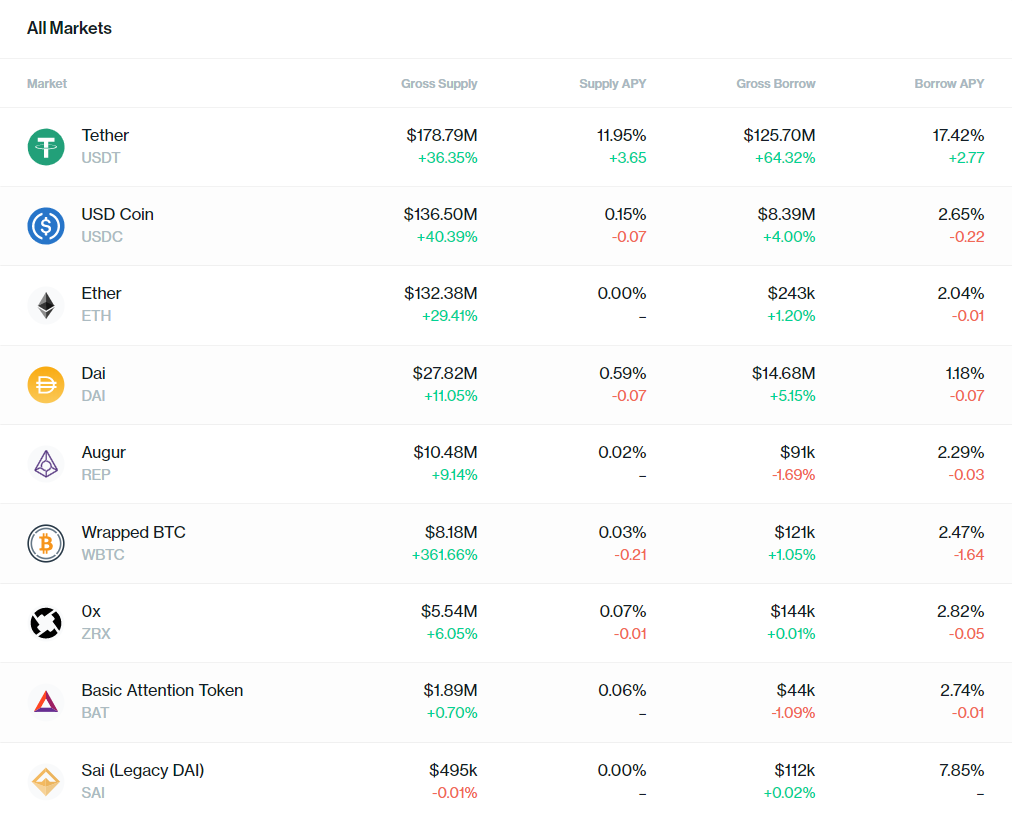
COMP is not only a governance token, but also a token that captures its business value. All debits and lenders on Compound have the opportunity to receive COMP token distribution. The total number of allocated tokens is 4,229,949. These COMP tokens are placed in the Reservoir contract. Each block transfers 0.5COMP into the agreement for distribution, that is, about 2,880 COMPs can be distributed to users every day. These COMP tokens are distributed to all currency markets, and the amount of tokens allocated is proportional to the interest accrued by the currency market. Then, in a single market, 50% of the tokens are allocated to the lender and 50% of the tokens are allocated to the borrower.
It can be seen from the figure that the vast majority of tokens are allocated to the USDC and USDT markets. The USDC and USDT markets receive 90% of the COMP token allocation. The current market demand is not btc or eth, but stable currency.
With COMP, Compound can have more cards to play. For example, under certain circumstances, especially in the early days, users borrow money on Compound, not only do not spend money, but also make money. This means that users can not only use the encrypted assets on Compound for free, but also make money. The secret here is the existence of COMP. As the price of COMP rises, the purpose of people borrowing money is not because they need it, but because they can earn COMP.
The higher the price of COMP, the stronger the motivation of users to save and borrow money. The daily distribution of COMP is about 2,880. According to the price at the time of writing the Blue Fox Note, the value of the tokens distributed every day is as high as US$287,643.2256, far exceeding the daily interest paid. This means that the interest paid by borrowing money is less than the income from borrowing money.
With the further increase in the price of COMP, people will provide more liquidity based on the calculation of income. It is expected that the amount of Compound’s locked assets and borrowing will increase significantly in the future, and it will also generate larger interest income, which in turn further Push up the price of Compound. Of course, once the income of COMP declines, it may lead to a decline in the volume of lending business. It is also worth paying attention to whether Compound can continue its business growth.
**Maker's MKR: There is a lot of room for improvement**
Governance tokens represent the community's right to govern the project, which can determine the direction of the project's development and also capture the benefits of the project itself. The Compound model can be said to be the 2.0 version of the governance token. The 1.0 version of the governance token was created by Maker. Maker's MKR token distribution does not have a mining process. The distribution of MKR has nothing to do with the generation of DAI, the holding of DAI, and the use of DAI. Although MKR can also capture some of its business revenue, the current level of capture is not the focus of its concern, and its focus is on expanding DAI issuance and DAI usage.
But for Maker, MKR can not play as many cards as Governance Token 2.0, Governance Token 2.0 such as COMP, BNT, etc., they have the opportunity to bind the issuance of tokens and business development together. Of course, Maker can also do this, but this requires the resolution of the MKR governor to be passed, that is, in the future business development process, MKR can be issued, and the additional issuance is related to the generation, holding, and use of DAI. In order to take care of the interests of the MKR holders before the issuance, the MKR holders who participate in the ecology can also be rewarded, for example, the holders who participate in the MKR lock or vote can be rewarded with additional MKR.
MKR has not fully tapped the value of its project fundamentals. From the perspective of current loan volume, Maker has about 70% market share, Compound has about 10% market share, and the remaining other projects have about 20%. From this perspective, MKR has not been deeply integrated with its fundamentals, and there is room for improvement in its token economic mechanism. If MKR can improve its token economic mechanism, it will have the opportunity to surpass Compound to become the first DeFi market value project, and the value of MKR will also be greatly improved.
CashAddr address of BCH Bitcoin Cash
As we all know, the development team of Bitcoin Cash has updated the new address format a long time ago. The new address format of Cash Cash, CashAddr, was launched as early as January 14, 2018. Although CashAddr has been launched for 2 years, many friends still have doubts about the address format of Bitcoin Cash, and even some people cannot distinguish between new and old addresses. This article will dispel everyone's doubts.
**1. What is CashAddr?**
CashAddr is a new address format for Bitcoin Cash. If you have ever seen the address of Bitcoin or the address of Bitcoin Cash, then you will at least be familiar with this address-basically a lot of letters and numbers.
CashAddr is a new format, technically, it is a new "encoding". Visually, it will be displayed in different forms.
**2. What does the CashAddr address look like?**
It will be displayed in the following form, for example:
bitcoincash: qpm2qsznhks23z7629mms6s4cwef74vcwvy22gdx6a
Please note the prefix "bitcoincash:", technically, this has always been part of the address. However, this prefix may be optional or completely hidden when some wallets are finally implemented.
**3. How does the change in address format affect us? What do we need to do?**
The new address format was introduced to encourage users to use the new address, but this is not mandatory. For users, there may be a "wallet incompatible" experience at the beginning. However, this can also be solved by address conversion tools. For users, if your wallet or service provider has not been upgraded to support CashAddr, then you can try a new address. The new address format is very useful to solve the problem of transmitting the wrong address.
**4. Can the old address be used?**
Technically, it can be used. However, it is recommended to use a new address whenever possible. If you are still using the old address, the old address can still continue to work. But for most users, it should be upgraded to a new address, because the new address is more secure. In addition, when everyone uses the same format, the user experience will be enhanced.
**5. Can we use the new format immediately?**
Yes, the new format is now fully available.
**6. When I try to transfer my Bitcoin Cash to a new address, the wallet does not support it, why?**
If the wallet is not upgraded, then it does not support the new address format. But don't worry, this problem is easily solved. You can use the address conversion tool to convert the old address format to the new address format. Any legacy Bitcoin address format will be converted to one and only one CashAddr format, and vice versa. Therefore, there are two versions of any given address (Legacy and CashAddr), and they are interchangeable because they correspond to the same set of private and public keys.There are several conversion tools available. **Recommend**
**https://cashaddr.bitcoincash.org/**
Another conversion tool is an electronic cash wallet.
If you use address conversion tools, it is recommended to use only trusted tools. Because there will be some malicious tools to provide you with fake addresses, causing asset losses.
**7. If I convert an old address to a new format and send these bitcoin cash to my friend, but his wallet does not support this new format, what will happen?**
It's ok. The money will still appear on his old address (because the address is actually the same, but the encoding method is different).
**8. What are the benefits of this special address format?**
In addition to providing different address formats, the new format is not case sensitive, which makes addresses easier to write and communicate between people. And it can be expanded, and in the future when Bitcoin Cash adds more new functions, there is no need to change the address format.
**9. Does CashAddr involve the protocol layer, is it a hard fork or a soft fork?**
No, CashAddr does not involve protocol layer modification. Only the format has changed.
**10. Has my private or public key been changed?**
No, it will not change at all.

Send Bitcoin Cash to the mailbox
I tried a product, which is a bit interesting, allowing users to use their mailbox to receive Bitcoin Cash.
This product was developed by bitcoin.com and requires users to log in to a webpage to use it, send.bitcoin.com. The process is very simple and consists of three steps.
**Send BCH to mailbox**
The first step is to open **send.bitcoin.com** and fill in the relevant information.
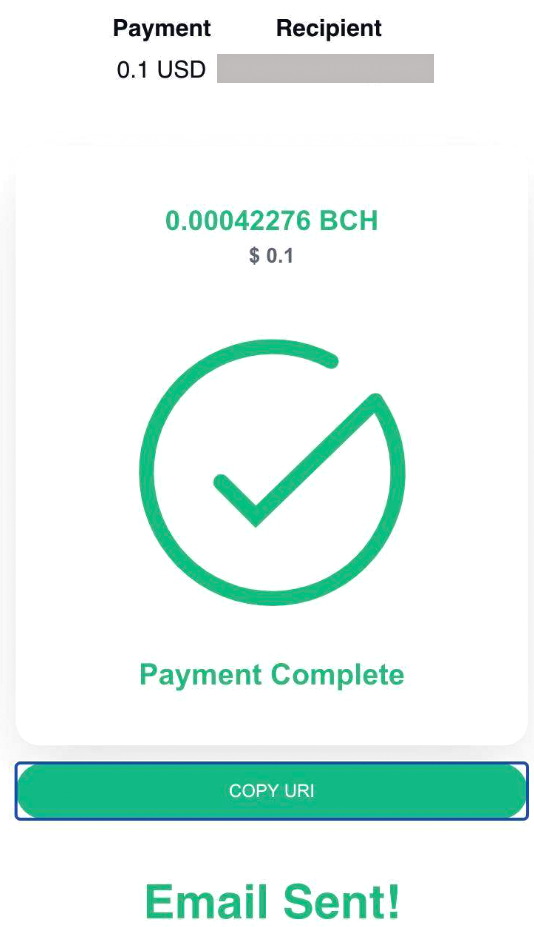
The second step, after completing the first step, send.bitcoin.com will jump to the payment page. The sender is required to pay BCH. This is a QR code for the payment request, which can be scanned and paid using the mobile wallet, or you can directly copy the payment link to the desktop wallet to pay.
When you have finished paying, send.bitcoin.com will prompt you that the BCH has been successfully sent, and sending the coin to the mailbox here is over.
After the payment is successful, send.bitcoin.com will also provide you with a mnemonic word, allowing you to regret taking back the BCH. Of course, the recipient must receive the payment.
The third step is the receiver's turn. The recipient's mailbox will receive a paper wallet, which is a picture, presented using a QR code, and contains a private key. The private key contains the BCH you sent.
The recipient can use the mobile wallet to scan the private key to receive it.
This is the end.
The overall operation process is still very simple, basically people who have used coins will use it for the first time, and the learning cost is zero. But people who haven't used coins and people who haven't downloaded wallets may not understand what this is.
**Fundamental**
The principle of Send.bitcoin.com is very simple, that is, first send BCH to the server, the server generates a paper wallet, that is, a private key, and then sends the paper wallet to the target mailbox by mail.
The whole process requires two BCH transactions. The first tx is sent by the sender's own wallet to the server of send.bitcoin.com; the second tx is sent by the paper wallet generated from the server to the receiver when the receiver receives the BCH wallet. It also requires two miners' fees.
I tested a sum, and the entire process send.bitcoin.com did not charge any fees. The cost is two miners' fees.
**safety**
The security of Send.bticon.com is very low, first you have to trust the server of send.bitcoin.com. Second, you have to trust that the mail server will not steal your coins. Both servers are capable of taking your coins.
BTC & BCH? Who is the true will of Satoshi Nakamoto?
The two believers are always arguing fiercely about which bitcoin is the real bitcoin and which is the better bitcoin.The main differences and similarities between the two mainstream cryptocurrencies.
Bitcoin
Bitcoin is a cryptocurrency, which is encrypted through encryption technology. Bitcoin is decentralized because cryptocurrencies are not issued and managed by a central entity (such as a central bank), but are agreed by a large number of Bitcoin network users. So there is a consensus mechanism called Proof of Work (PoW).
Bitcoin is a deflationary currency with a maximum circulation of only 21 million coins. In order to attract enough participants ("miners") to use their computing power to support the network, miners can get Bitcoin rewards by virtue of their computing power.
**Bitcoin Cash**
Bitcoin Cash is a hard fork of the original Bitcoin blockchain. The history of Bitcoin Cash began in August 2017, when a group of influential Bitcoin miners were dissatisfied with certain aspects of classic Bitcoin (BTC). In particular, the crypto craze that started at that time led to the transaction time of the Bitcoin network being too long, and the transaction cost was very high, so the miners decided to leave the Bitcoin network.
Bitcoin can only process 7 transactions per second, and the transaction time is about 10 minutes. To solve this problem, there are only two possible solutions: either reduce the amount of data to be verified per block, which will make the transaction creation faster and lower cost; or increase the size of the data block to handle more data at the same time.
To this end, the SegWit2x update for Bitcoin was implemented in mid-2017. Almost 80% of Bitcoin miners and mining pools expressed support. But this contradicts the plan originally proposed by Satoshi Nakamoto, and there is a lot of confusion about how SegWit2x continues to develop.
Through the hard fork in August 2017, a new cryptocurrency, Bitcoin Cash, was born. Bitcoin Cash has increased the block size. It is no longer 2MB of Bitcoin, but 32MB of Bitcoin Cash. In addition, the Bitcoin Cash protocol is configured with a flexible hashing difficulty, allowing it to adapt to the number of miners in the network. But if the encryption difficulty is too low, this will also reduce the security of the protocol.
Bitcoin Cash transaction time is 16 times faster than BTC. Therefore, using Bitcoin Cash, a transaction only takes about 1 minutes and 30 seconds. This also facilitates the adoption of the currency, because in particular merchants are more eager to shorten the transaction time.
**Consensus mechanism between Bitcoin and Bitcoin Cash**
The consensus mechanism of cryptocurrency describes the decentralized decision-making method in the public chain network. Since all participants must reach consensus, it is called a consensus process.
The consensus mechanism of Bitcoin Cash and Bitcoin Cash is the same, because Bitcoin Cash is derived from Bitcoin.
**Blockchain Bitcoin consensus mechanism**
Both Bitcoin and Bitcoin Cash use the PoW consensus mechanism. Any computer participating in the Bitcoin network can participate in creating blocks or hashes. However, only nodes that create verified hashes can receive BTC or BCH rewards based on their computing power. The problem with the PoW mechanism is that it consumes a lot of computing power, and all participating computers need to invest a lot of energy to create a hash. Most nodes must reach a consensus on a valid transaction before they can be chained.
**Technical details of Bitcoin and Bitcoin Cash**
Both Bitcoin and Bitcoin Cash use the same hashing algorithm. This is the proven SHA-256 algorithm, which was originally developed by NSA to sign transaction data and generate a fixed-size hash value of 256 bits.
However, Bitcoin Cash uses a technology called "Emergency Difficulty Adjustment (EDA)" to dynamically adjust the difficulty of encryption based on the number of active miners in the network. In this way, the hash calculation should always continue, and the stability of the blockchain operation should be ensured.
**Bitcoin and Bitcoin Cash**
Both Bitcoin and Bitcoin Cash claim to be used as digital currencies for the purchase of goods and services, and as a powerful alternative to fiat currency.Let us wait and see which payment network will eventually attract the largest or most merchants and outlets.
However, due to the long-term influence of Bitcoin and its dominant market position, Bitcoin must be ahead of its currency of the same name in this respect. Another important function of Bitcoin is value storage. In fact, it is "digital gold". When the market is turbulent or the stock price drops to a certain level, crypto enthusiasts will go to bitcoin, and bitcoin cash cannot yet serve as a means of value storage. But bitcoin cash lovers will naturally prefer BCH as a value store rather than BTC.
In addition to technical differences, the reason why the two cannot stop the conflict is an ideological debate about the true will of Bitcoin inventor Satoshi Nakamoto. However, when considering which cryptocurrency to invest in, it is important to distinguish between Bitcoin and Bitcoin Cash. If you want to know which currency is the better investment choice, I can only say that it all depends on you!
If you are buying cryptocurrencies for the first time, you should first ask yourself some important questions. Ask yourself why you should invest in cryptocurrencies, what do you want to do with them, and what are your goals. Also, think about the degree of risk you are willing to take. Cryptocurrencies are always a risk investment that requires careful consideration.

It is a matter of time before Tether's market capitalization overtakes Ethereum :Bloomberg
**Expanding demand for tethers**
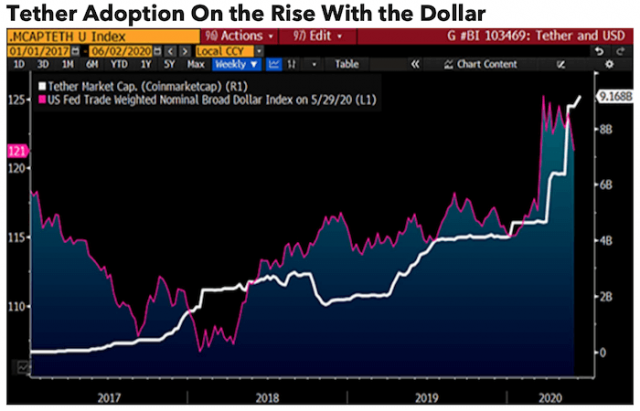
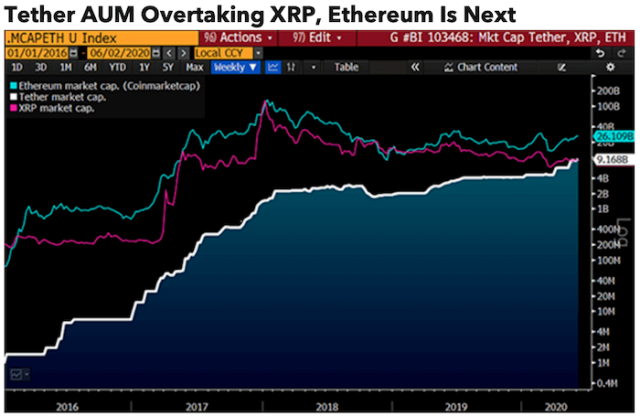
USDT's market capitalization currently stands at around $9 billion , surpassing Ripple (XRP) last month and rising to third place. On the other hand, the market capitalization of ETH is 22 billion dollars.The **USDT** is **continuing to grow as it pegs to the US dollar, which is used as the world's reserve currency** .
The value of the US dollar is declining compared to gold and bitcoin (BTC), but it is still more valuable than other fiat currencies.
He said the demand for USDT is increasing as one of the ways to use the US dollar. Below is a graph showing the market capitalization of USDT (white) and the value of the US dollar against other currencies (pink). Recently, as the US dollar strengthens, the USDT market capitalization tends to rise.
He explained that the attractiveness of stable coins such as USDT is that they do not require an intermediary and their value is stable compared to other virtual currencies.
On the other hand, ETH says that if the price is not raised to BTC, it is unlikely that the price will rise, and unless there is a major trend shift, the market capitalization of USDT is likely to overtake ETH.
Bloomberg (green line is ETH market capitalization, white line is USDT market capitalization)
Bloomberg also said the USDT pegged to the US dollar would help BTC price increases. In this report, BTC is expected to break through the 2017 bubble high of about **20,000 dollars** .
Ethereum has the largest share of Tether’s supply and cannot be defended
Ethereum is a global open source platform for decentralized applications. On Ethereum, you can write code to manage digital assets, run programs, and more importantly, all of these are not geographically restricted.
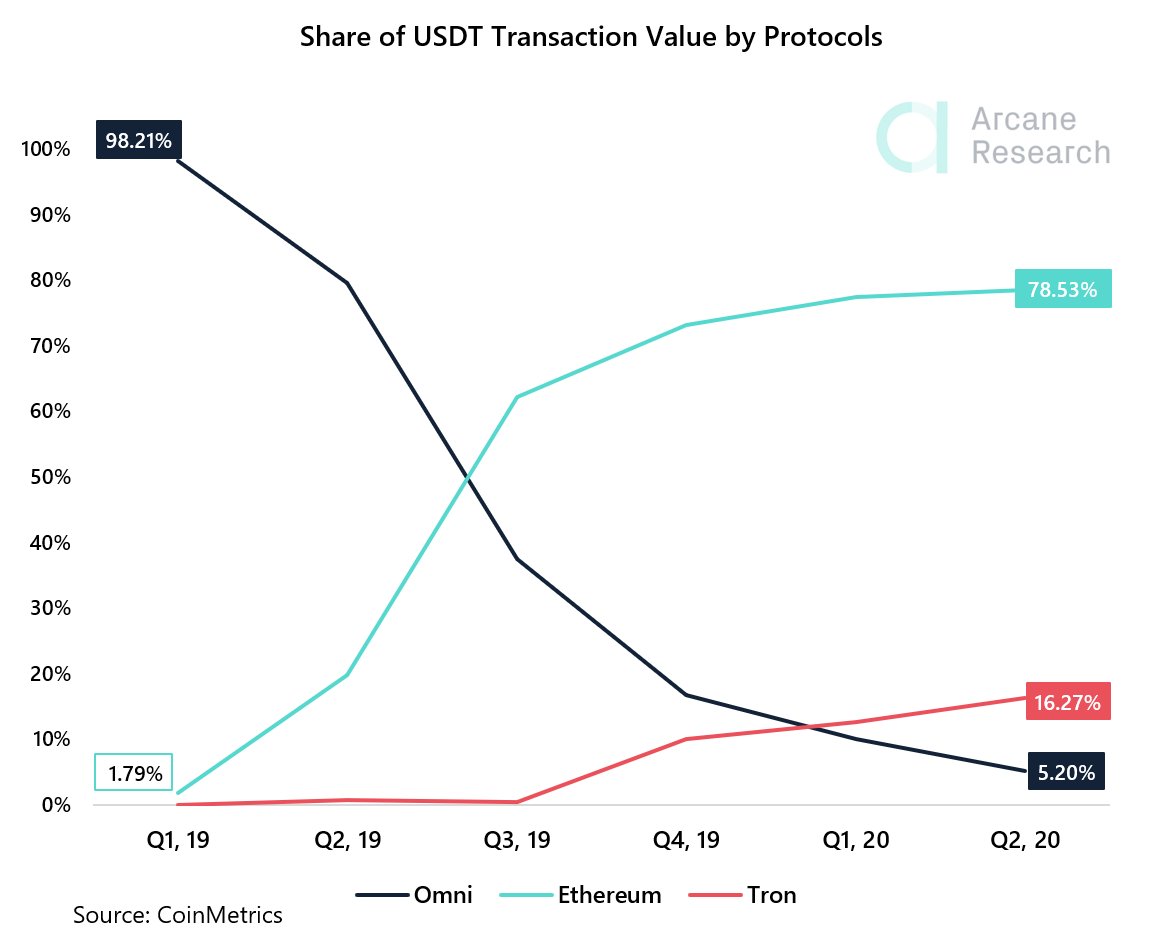
According to the latest Arcane research report, **as Tether's supply reaches new heights, its issuance seems to be moving away from the Bitcoin network** . Tether was originally based on the Omni layer on the Bitcoin blockchain. Since then, it has gradually opened up more protocols, including Ethereum and Tron. Compared with the Omni layer, Tether's transition to the Ethereum protocol is due to Ethereum's faster confirmation time, shorter exchange deposit and withdrawal time, and lower fees. Currently, **Ethereum holds the largest share of Tether's supply** .
If you observe carefully, compared with the Omni protocol, Tether issued based on the Ethereum network has a faster confirmation time, faster exchange withdrawal and deposit time, **and lower handling fees. These advantages have pushed Tether to the Ethereum agreement. Transition** .
Anthony Sassano, the founder of Ethereum data intelligence company EthHub, pointed out that the Ethereum **network is a better payment method for Tether and other** stablecoins .
Paolo Ardoino, Tether's chief technology officer, pointed out that **transaction fees and confirmation time are the main reasons for the migration of** Tether to Ethereum **, and also at the request of traders** .
While seeing these development trends, it is important to understand the impact and changes they may bring. It is a well-known fact that Tether's supply on the Ethereum network currently holds the largest share. Although this is beneficial for Ethereum to demonstrate its value as an infrastructure, it also increases the cost of Ethereum. In fact, if this situation continues, **USDT may replace Ethereum, but it is currently difficult to surpass** .
According to Tokenview data analysis, a total of 157 million USDT was newly issued through the Tether Treasury address. Ethereum and TRON have become the main public chains of newly issued USDT, accounting for 71.34% and 27.85%, respectively. Ethereum **still dominates** .
The report of Grayscale, an asset management company, pointed out that the scale of Ethereum Trust’s asset management increased from US$11.7 million to US$276.5 million. Although the price of Ethereum was lower, it increased by 23.6 times.
Moreover, the usage of Gas on Ethereum has reached the highest level in history. This shows that in anticipation of Ethereum 2.0, the level of user activity on the Ethereum blockchain network is soaring.
All in all, there may be a reason for Tether's migration from the Bitcoin blockchain, but considering the current rapid development, **Ethereum is still the best choice** . As for what problems may occur in the future, will Tether eventually migrate to a different chain again? We will wait and see.
African Digital Currency Revolution and BCH Challenge
According to a new report from **Arcade Research**, Africans have the highest rate of digital currency ownership in the world. South Africa ranks third in the world. About 13% of Internet users worldwide own or use cryptocurrencies, and in this fifth-ranked West African country, 11% of Nigerian Internet users own digital currencies. Africa is becoming the most potential soil for global digital currencies. At the same time, BCH has also been hit by the fire of African digital currencies. As projects such as Bitcoin Cash House and EatBCH continue to advance in Africa, more and more Africans have learned about BCH. Africa is expected to become a Bitcoin Cash continent like Northern Queensland in Australia.
**Difficulties in Africa and USD 48 billion in remittances**
**Arcane Research** believes that the lack of infrastructure (such as full nodes for mining, merchants that support payments, smartphone penetration and Internet connectivity) will slow down the development of digital currencies in Africa. Due to the large rural population in some countries, most of the land on the continent is not powered, which limits the coverage of Bitcoin Cash and other digital assets.
But this cannot ignore the potential of Africa. The report concluded: "Africa is one of the areas with the most potential even if it is not one of the most promising areas for digital currency."
Uganda, Nigeria, South Africa, Kenya and Ghana are listed in the report as the "cryptocurrency" in the top 10 countries searched on Google. The economic challenge is two-way. Essential requirements such as digital currency networking and mobile devices have slowed the adoption of Bitcoin Cash, and the high transaction fees make Bitcoin Cash an attractive option.
Africa is one of the world ’s highest-inflation economies. In addition to government policies, external factors such as US economic sanctions and war conflicts also threaten the safety of citizens ’deposits, which makes digital currencies such as Bitcoin Cash a safer investment fund.
Sub-Saharan Africa has $ 48 billion in remittances every year, but transaction fees are as high as 9%, while some mobile payment transfer services have transaction fees of about 11%. Using bitcoin cash is a way to eliminate centralization while eliminating high remittance costs. BCH can greatly reduce the cost of these 48 billion US dollars and improve the transfer efficiency. Africans can use BCH to transfer money to friends in any corner of the world at a very low cost.
**Bitcoin Cash House's work in Africa**
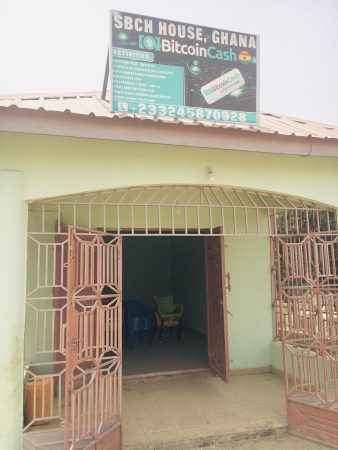
@Koush Bitcoin Cash House Ghana https://www.bchghana.org/
The Bitcoin Cash House was established by BCH enthusiasts, and introduced BCH to locals through the charity BCH House. The main contents of the Bitcoin Cash House include: how to immediately send money to friends and family around the world at a negligible fee; the advantages of BCH compared to Venezuelan fiat currency glass Val and the US dollar; best practices for storing and using digital currency; Coins (including USDH stablecoins) protect assets and prevent fluctuations; work-how to find work and pay in digital currency; and how developers and future developers participate in BCH. At present, the Bitcoin Cash House has been established in Ghana, Venezuela and other third world countries and continues to heat up.
At present, due to the epidemic, the Bitcoin Cash House has to make changes. All the work of the Bitcoin Cash House is temporarily digitized, and the BCH is displayed to the locals through the Internet.
By helping Africans to adopt BCH, they can receive remittances from relatives and friends in any country in the world at a negligible handling fee; through the promotion of BCH, they can help support paid merchants to advertise to obtain global customers; The advantages of BCH help companies gain a competitive advantage. Enterprises and companies that accept Bitcoin Cash are more technologically advanced than other companies and have higher profit margins.
**EatBCH**
At present, EatBCH has helped thousands of Africans solve the current poverty through BCH. Bitcoin Cash is for everyone. With BCH, we can do something that makes Africa better.

Some practical problems faced by Bitcoin Cash (BCH)
**Slow development of basic protocols**
The upgrade of BCH on May 15 this year was the lowest community and media attention in history. Whether it is media reports or community discussions, it seems that everyone is not paying attention. This is also the upgrade with the least changes in BCH history, and there are no new technologies that are more news-intensive. Three main functions have been added. The signature check method "sigcheck" is changed when the script is executed; the opcode ": OP_REVERSEBYTES" is added to reverse the bytes in the string; the transaction limit in the memory pool is changed from 25 to 50.
In the previous upgrade, the BCH block size was increased to 32MB, the Satoshi opcode was re-enabled, OP_Checkdatasig was implemented, CanonicalTransactionOrdering (CTOR), and Schnorr signature support were added. These upgrades are milestones for BCH. As for why BCH's basic protocol development has slowed down, it is mainly because the development team lacks money and lacks technical developers. It can be seen from the fund-raising plan announced by Bitcoin ABC and other development teams that BCH's basic protocol development is a huge project.
Fortunately, BCH's main development team has received enough development funds. The total funds raised by Flipstarter for the BCH full-node client projects BCHD, BCHN, Knuth and Bitcoin Verd donated more than 2000BCH. BCH's important development team, BU, has sufficient funds and does not need to raise funds. BCH's core development team, Bitcoin ABC, has obtained US $ 1.5 million in development funds through other channels. This means that the BCH development team will not worry about development funds for a period of time in the future. With sufficient funds, you can concentrate on the development of BCH infrastructure, making the BCH infrastructure more powerful.
**Infrastructure deterioration**
Cointext, one of the most important projects on BCH, was rejected because of the low adoption rate of BCH. Cointext is a company, an application, or a third-party transfer system. Users can use Cointext to trade BCH in the form of SMS on their mobile phones without the need for Internet access and low handling fees. Bitcoin Jesus, the most important supporter of BCH overseas, fired 50% of the company's employees a few days before the halving, and bitcoin.com is no longer an open source wallet. However, Bitcoin Jesus appointed Dennis Jarvis as the new Chief Executive Officer (CEO) of bitcoin.com, everything returned to normal. Cointext is still welcomed by the community, and it continues to make efforts in payment and international remittances. BCH payment in Australia even occupies most of the cryptocurrency payment market.
**Bitcoin cash transactions grow slowly**
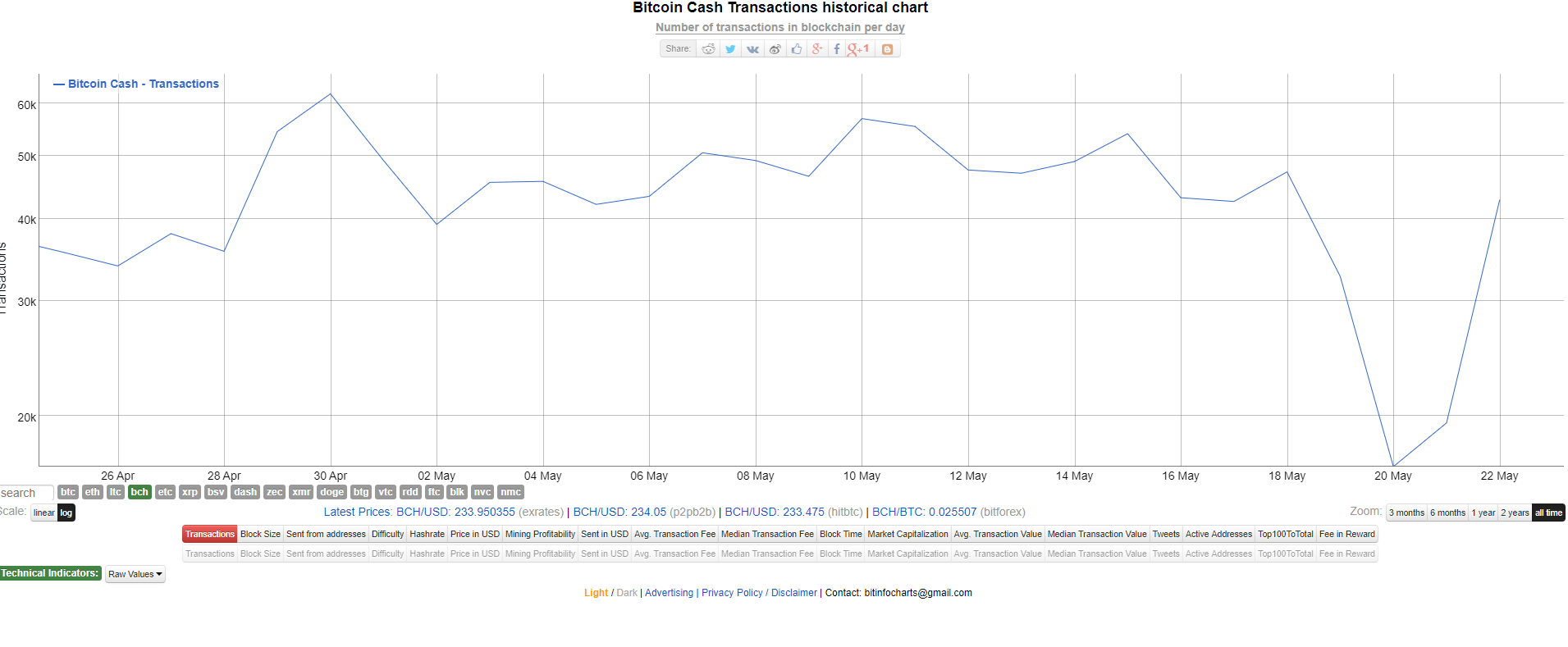
According to BitinfoCharts data, the number of Bitcoin Cash (BCH) transactions has remained at around 50,000 in a year. It can be seen from the graph that the growth rate in the past year is very slow and basically remains stable. Bitcoin is 300,000 transactions, only one sixth of Bitcoin.
**Merchants accepting BCH payments grow slowly**
According to r / btc's "Monthly Merchant Report", the merchant adoption rate increased by only about 50% last year, of which 88% + came from online merchants and about 5-10% came from physical stores. It seems to be growing faster, but it is still a bit slow for BCH, which is committed to becoming a global payment currency. If it has increased 10 times compared with two years ago, BCH is also popular with merchants in the payment field and is the mainstream of cryptocurrency payments.
**Bitcoin ABC and BCHN dispute**
Bitcoin ABC supports the controversial BCH Infrastructure Finance Plan (IFP), but the plan has not been widely agreed. In order to oppose the plan, some developers created a full-node client BCHN. The only difference between this client and the Bitcoin ABC full-node client is the removal of IFP in the code. IFP was controversial in the community at that time, and the technical differences among developers even increased to language violence, which caused an extremely bad impact on the BCH community, and was once misunderstood as BCH to be split. However, in the end, both parties chose to compromise, both refused to split, respected the longest chain principle, and IFP did not implement it.
Recently, the BCH community proposed the creation of a foundation. The foundation is responsible for raising BCH's development funds and coordinating relationships within the community. Others have proposed proposals to encourage developers in the form of Nobel Prizes. These are good suggestions, I hope the community can unite and work together, less debate, more thinking!

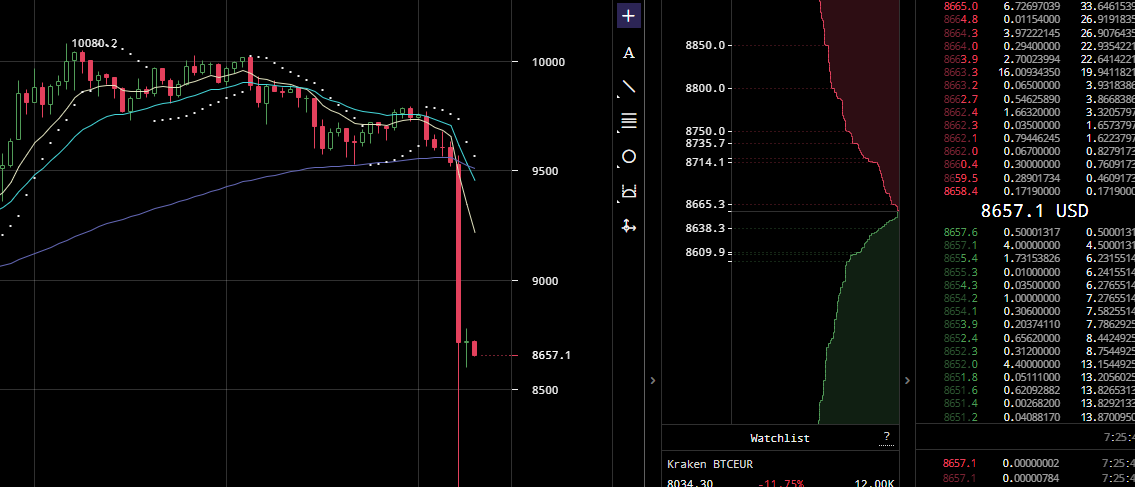
BTC ..F..K $10000 HALVING 😂😂😒$8675🥴
What is the impact on BCH when BTC halved?
The highly concerned BTC is about to usher in the third halving on May 12. Once the halving occurs, it means that BTC will also reduce the mining block reward like BCH, that is, from the previous 12.5BTC to 6.25BTC.
**The halving of BTC** has always been a topic of concern to everyone. Many people will conduct a series of analysis on this. According to the Google Index, the search volume for "halving bitcoin" is close to the highest level in history.
In addition, before the halving, the price of BTC has also risen to a certain extent, and other cryptocurrencies have also experienced varying degrees of increase under its leadership. I believe that the market fluctuations of the past few days have been felt by everyone.
As the legal value of Bitcoin rises, mining Bitcoin may be more profitable than other SHA-256 cryptocurrencies. Therefore, recently, many miners have turned to the BTC blockchain, pushing the computing power to the highest level in history. The transmission speed of the BTC chain per second exceeds 140 exahash (EH / s), which is the highest in history of the network (ATH). This may be that miners want to snatch the final profit cake before halving.
**If BTC is halved, BCH may become a beneficiary. As far**
as BCH supporters are concerned, the most important thing is how halving BTC will affect BCH. After all, there are many similarities between BCH and BTC, and there is a certain degree of correlation between the two. Below we will do a detailed analysis of this.
**BTC's computing power has plummeted, and the computing power has returned to BCH.**
Although the current computing power of BTC has temporarily increased, this halving will result in a significant reduction in BTC's computing power. Currently, more than 50% of BTC's computing power is provided by outdated mining hardware, most of which is the popular Antminer S9 from Bitmain. Given that mining difficulties have continued to reach new highs for a long time, these miners have been operating with meager profits.
Halving will eventually make them unprofitable and will have to be permanently closed. Based on the current BTC price of US $ 8,705, an S9 miner earns US $ 2.09 per day. Based on an average electricity cost of 5 cents per kWh, minus $ 1.68 from the income, the miner only gets a profit of $ 0.41. When the halving occurs, revenue will be halved, but electricity bills will remain the same, which means miners spend 64 cents a day to maintain operations. The above calculation has not considered other mining indirect costs other than electricity, so the reality is that 64 cents will be lost every day, which is no longer feasible. These inefficient mining equipment will eventually end up shutting down.
Of course, some people may say that Bitmain has released its latest miner Antminer s17, which can use this new equipment. Yes, this is also an option. The latest miner can increase the hash value of 27 Th / s, but it will also cost $ 600 or more and consume more than 480 w of power than existing miners. . This caused the total cost of mining one bitcoin to rise to $ 7,300 before halving. After halving, if the hash rate continues to increase at the rate of the past three months, the estimated mining cost after halving will be $ 15,100, and if the hash rate remains unchanged, the cost will be $ 12,600. This means that the price of BTC will have to be doubled miraculously, which is obviously unlikely in the short term.
Therefore, this means that after BTC is halved, some miners will have to shut down due to cost issues and cause some of the loss of computing power. There will be a sudden decrease in BTC computing power.
At the same time, in addition to the reduction in overall computing power, part of the computing power will be switched to the same BCH network as the BTC algorithm. When the BTC reward is halved, BCH may be more profitable than BTC under the same computing power, which makes the profit-mining miners will cut the computing power to the BCH network, which will also cause the BCH computing power to appear decline. In the long run, computing power will form a new balance between BCH and BTC.
**BTC is congested again, users turn to BCH**
The BTC halving will occur at a block height of 630,000, exactly in the middle of the difficulty adjustment period. If the computing power of BTC is reduced by 50%, then at the current difficulty level, about 1008 blocks still need to be mined and then adjusted to reduce the difficulty of adapting to the decline in computing power. Even so, the difficulty change is still limited because it cannot fall more than 25% of its original level or rise more than 400%, so we may have to wait for two difficulty adjustments before we can adjust the block time to 10 minutes again . The block congestion caused by this time will be particularly obvious.
This is different from BCH. Although BCH had a short-term dystocia when it was halved, its DAA algorithm enabled it to quickly return to the normal state of block production, and BTC did not use DAA algorithm. Yes, it is necessary to adjust the difficulty according to the traditional algorithm, so that this process may last for a week or even two weeks.
Once BTC is congested, BTC transactions will be delayed and handling fees will rise. Most BTC users will have to transfer to other cryptocurrencies due to poor user experience. This has led to a decline in BTC's market dominance, while other cryptocurrencies will experience explosive growth.
There is a specific cryptocurrency that will benefit the most from the surge in Bitcoin fees, and that is BCH. To some extent, BCH is another version of Bitcoin. It solves the problem of Bitcoin congestion by increasing the block capacity, and the economic activity on its network is constantly increasing. As BCH is an electronic cash system that has the advantages of being able to create tokens and protect privacy, it will also become a cryptocurrency that makes BTC feel competitive.
In the last major congestion event, the value of BCH reached a quarter of the value of BTC, which is impossible for other cryptocurrencies. Due to its low fees and instant transactions, BCH's merchant adoption rate has surpassed BTC, which is in sharp contrast to the current situation where BTC adoption rate is declining. And with the advantage of on-chain expansion, BCH can facilitate transactions around the world without having to bear heavy pressure-it can easily absorb any users who have fled Bitcoin. These factors all indicate that Bitcoin Cash will be an ideal replacement for Bitcoin's failed BTC version. After the BTC halving event, we are likely to see that BCH will subvert the top position of BTC.
**The halving market appears and BTC drives BCH to rise.**
For investors or speculators, the ultimate concern is still the price, and they are even speculating whether the price will increase after the halving.
In fact, the market has given us the answer. Just like the increase before BCH halved, BTC has also seen a certain increase in the past few days, and it has led to a slight recovery in the cryptocurrency market. As for whether there will be a rise after the halving, this can only wait for the performance of the market.
However, according to the previous halving process of bitcoin, bitcoin will have a substantial increase at least half a year or a year later, which is the so-called halving market. When the halving market really comes, BCH will inevitably rise significantly under the leadership of BTC.
Of course, this is just a possibility. Perhaps BCH will develop rapidly after BTC is halved and become a kind of existence beyond BTC. Eventually, BCH will lead BTC to rise. As for the future results, let us wait and see.

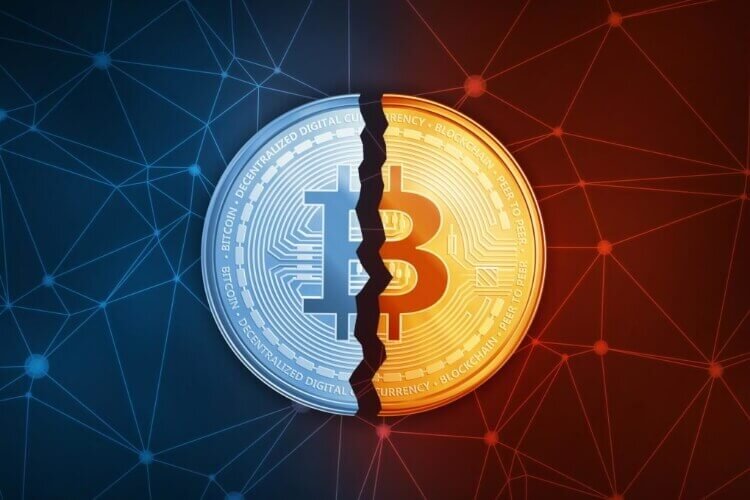
Study: two-thirds of Europeans believe in the future of bitcoin
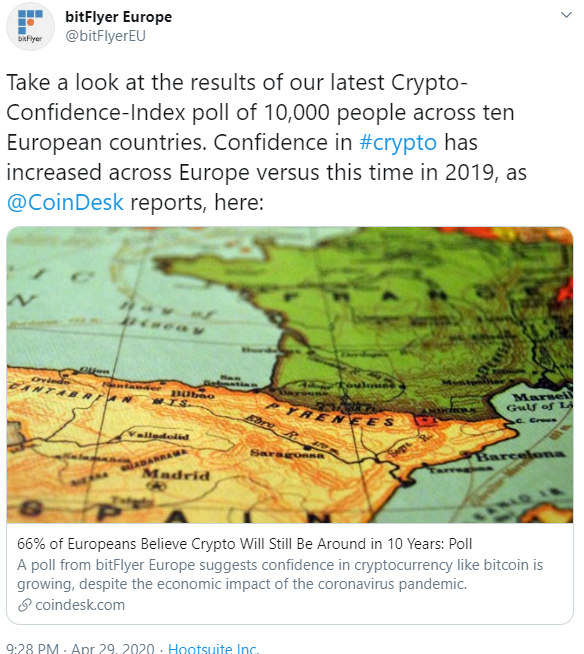
Two-thirds of Europeans are convinced that in ten years, cryptocurrencies will not disappear and continue to exist. Such results were shown by a survey conducted by the bitcoin exchange bitFlyer.
The second annual study to calculate the so-called Crypto-Confidence Index was attended by 10 thousand people from ten countries. A year later, the indicator of confidence in cryptocurrencies grew by 3% from 63% to 66%.
Commenting on the results, bitFlyer Europe's Chief Operating Officer Andy Bryant admitted that the higher level of cryptocurrency adoption is partly due to the current economic uncertainty caused by the COVID-19 pandemic.
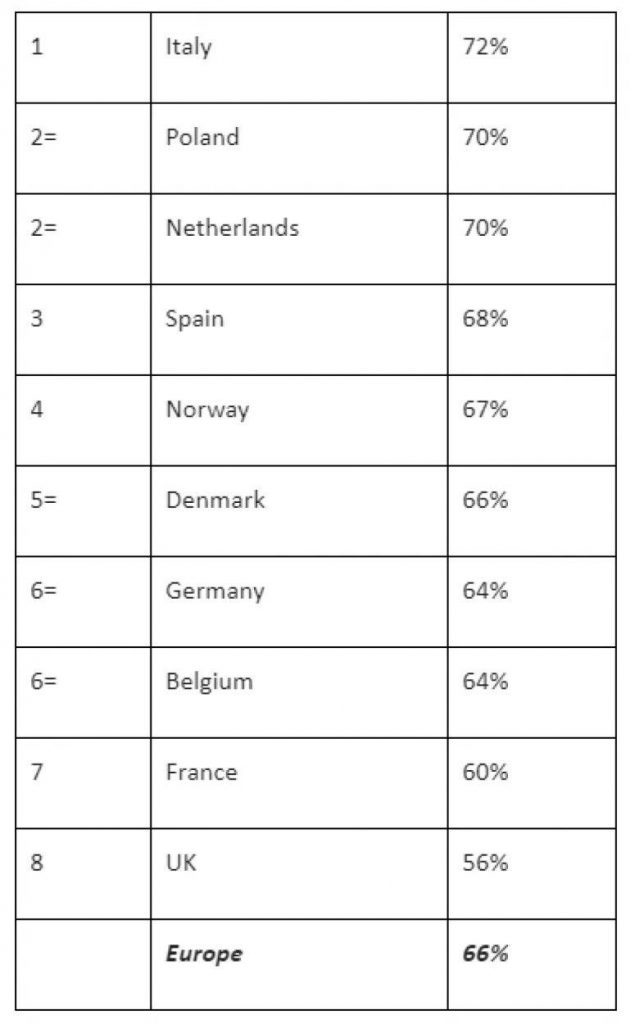
Italy, which took the brunt of the new coronavirus, turned out to be the most optimistic about cryptocurrencies - here the share of those who believe in the future of cryptocurrencies was 72%. The second line in this ranking with an indicator of 70% was shared by the Netherlands and Poland, followed by Spain (68%).
Researchers emphasized that the results should be taken with caution, since a quarter of those who believe that cryptocurrencies have a future found it difficult to explain what role they will play.
BCH halving is approaching, are you ready?
**In April, for BCH, there is a big event that has received much attention-BCH is halved. Regarding the upcoming halving, there have been many discussions and predictions regarding this. As for the outcome, BCH will finally give you an answer with its own performance.**
**What is halving?**
First explain what halving is, " **the reward for producing each new block is halved** ." Like Bitcoin, BCH is obtained through mining machine operations. Miners will receive a certain amount of rewards for the output of blocks. This is also the way each new BCH is born.
Bitcoin is a reward that will be reduced by half for every 210,000 blocks produced, and the mining difficulty is stipulated to be an average of about 10 minutes to dig out a block. Written into the code base. Based on an average block of 10 minutes, we need 4 years to produce 210,000 blocks, that is, every 4 years, the output will be halved.
BCH is set up similarly to Bitcoin, and the reward will be reduced by half for every 210,000th block produced. In theory, the block generation time of BCH and BTC is about 10 minutes, and the halving time should be consistent, but because BCH early adopted an EDA emergency difficulty adjustment algorithm for a period of time, that is, if the BCH blockchain If there are less than 6 blocks mined in an hour, the difficulty is reduced by 20%, which makes the early BCH block generation speed faster than BTC, so the halving time of BTC is later than BCH.
**BCH halving time**
According to the BCH code setting, every 210,000 blocks of BCH is a cycle, that is, the reward will be reduced by half every 210,000 blocks mined. Therefore, when the BCH starts at the block of 0 209999, the reward for each block dug is 50BCH; then there is a halving, in the 210000 419999 blocks, the reward for each block dug is 25BCH; In the 420,000 629999 blocks, the reward for each block dug is 12.5BCH, in the 630,000 839999 blocks, the reward for each block dug is 6.25BCH ...
The first two halvings of BCH followed Bitcoin, which occurred in November 2012 and July 2016, respectively, and the third halving pass calculation this year is expected to occur around April 8.
**BCH halving benefits**
Block reward halving means that all BCH takes longer to circulate, but it also means that mining will produce less and less new BCH, and due to its limited supply and increased difficulty in mining, it leads to its scarcity attribute More and more obvious, scarcity will directly enhance the value, as the saying goes, things are rare! For BCH, there is no doubt that this is a very good thing.
In contrast to the fact that most fiat currencies lose value over time due to inflation, the halving model is the opposite. After halving, the annual inflation rate of BCH will also be adjusted directly to 1.80%, which is a significant decline.
**BCH halved, what preparation do we need?**
In fact, for the halving of BCH, the main thing that BCH supporters do is psychological preparation. Compared with the BCH upgrade, the major nodes are upgraded in time before the upgrade, and the main reason for the halving is the block reward halving. Although we don't need to do anything in advance, we must have a very clear understanding of this matter.
Especially for the miners, with the same computing power, the BCH commission fee obtained from the previous 12.5BCH becomes 6.25BCH. Therefore, some people worry that the BTC has not been halved at this time, and the halving of BCH will cause miners to avoid the loss caused by the halving of BCH earlier than BTC. When BTC and BCH have basically the same increase and decrease, there will be about 50% The BCH computing power is cut to BTC, and the average block time of BCH is greatly lengthened. The output of mining BCH with the same computing power is lower than BTC, resulting in more computing power being cut off, and more computing power being cut away The block time is longer ...
In fact, this worry is superfluous. Because the difficulty adjustment algorithm of BCH is different from BTC. BCH's mining difficulty adjustment algorithm is an improved DAA algorithm. In simple terms, it has the following characteristics:
**1.** Adjust mining difficulty block by block;
**2.** The mining difficulty of each block is adjusted based on the computing power of the 144 blocks in front of it;
**3.** When the computing power changes according to the exponential law, the network will quickly adjust the difficulty to ensure fairness
**4.** Avoid feedback oscillation caused by the mismatch between the current computing power and the target difficulty.
The above characteristics of the DAA algorithm ensure that even if the computing power drops by 50% instantaneously, it will only affect the BCH block generation speed for a short time. The DAA algorithm can quickly adjust the difficulty according to the actual calculation power and return the block generation time to a normal level.
And a large amount of computing power is withdrawn from BCH. This is a practical case to consider: the most typical example is the "hash power war" when BSV splits. BCH computing power has dropped sharply for several days, and the cumulative decline has exceeded 50%. The average block time of BCH can still be stabilized at about 10 minutes. Facts have proved that in the case of rapid withdrawal of a large amount of computing power, the DAA algorithm can quickly adjust the difficulty according to the actual computing power, so that the average block time is restored and stabilized at about 10 minutes. It can be seen that even if there is a withdrawal of 50% of the computing power, the impact on the BCH block time is short and slight. In addition, BCH has added reorganization protection, that is, 10 block confirmation, and there is no need to worry about 51% attack. For BCH, the halving will go smoothly.
For the developers and eco-builders of BCH, halving the BCH is just a small episode, without too much attention, just quietly waiting for the halving to continue, continue the development and ecological construction of BCH, and use your own power for BCH Contribute. They can attract more users to use BCH through technical improvements and ecological improvements, making BCH more powerful.
Therefore, for investors, the best option is to hold for a long time and wait for the peak.
Blockchain poker reaches new record of traffic peak, BCH accounts for 80% of traffic
With the rapid spread of coronavirus in Italy, the government announced a national blockade, and more people could not go out, resulting in a substantial increase in Internet application traffic. Obviously, this has caused a surge in interest in the globally popular digital currency online card game website Blockchain Poker. The data shows that Blockchain.poker comes from Italy. Online players are second only to the United States. Obviously, in this global virus crisis, American players have also risen sharply. Of course, more importantly, 80% of the players on this site are using Bitcoin Cash (BCH), and the increase in game players also provides more people with the advantage of being familiar with Bitcoin Cash (BCH) as a global hard currency.
**@BlockchainPoker**
The development of Blockchain.poker started in 2015, and its goal is to let as many people as possible master Bitcoin, while showing how easy it is to participate in the Bitcoin project. It is the easiest way to experience bitcoin and play poker anonymously through bitcoin. In fact, it is also the first Poker site that rewards bitcoin for free. Participating users do not need to register. New players will automatically get 100 satoshis. Players can get free. Participate in the Poker contest.
During the global epidemic, the increase in global online game traffic is also normal, and people have more time to spend their time. Of course, there may be more people flocking to traditional games and quiz websites, but during the special epidemic period, the deposit and withdrawal of traditional fiat currencies have been interfered to a certain extent, and traditional game websites also have many pain points. This is also one of the reasons for the surge in Blockchain.poker traffic.
**Traffic surges, BCH adoption increases**
Blockchain Poker supports Bitcoin (BTC), Bitcoin Cash (BCH), and BSV. Due to its lower network fees and fast and secure transaction confirmation, Bitcoin Cash provides users with a better experience, which also makes Blockchain Poker bring BCH Set as the default currency. In 2017 and 2018, Blockchain Poker will usually have 30,000 to 50,000 visits per month (about 1 hand per minute). With the development of the website and the global influence of BCH, Blockchain Poker traffic starts in 2019 It is growing fast and there is more activity than ever before almost every month. March is the month with the most traffic to date, totaling more than 900,000 times (> 20 per minute).
In this new traffic record, BCH accounted for more than 80% of the traffic, and peer-to-peer electronic cash also showed all users the value of using BCH as a global hard currency, a fast, cheap, and reliable digital currency. The developer of Blockchain.poker stated that transactions are fast and cheap when using Bitcoin Cash, including many upcoming features on the Bitcoin Cash development roadmap, which are currently only available on low-cost, reliable Bitcoin Cash chains Possible. In the next two months, during the halving of BCH, Blockchain.poker will launch more reward activities to promote the development of BCH and Blockchain.poker.
Bitcoin Cash is the only digital currency with practicality and network effects, which fully meets the needs of such applications as Blockchain.poker. As of the time of writing, Bitcoin Cash only accounts for more than 80% of Blockchain Poker activities, but it is expected that this proportion will continue to increase as Bitcoin Cash becomes more and more accepted around the world. This is also the BCH community and all development Are actively working to advance the goal.
**Halving is coming**
Another thing that users need to pay attention to is that BCH is halved on April 8. There is still a week to go. Miners need to prepare in advance. However, for ordinary users, there is no need to worry. Even if the computing power declines, the difficulty will follow the reduction of computing power to ensure stable block production and ensure that users complete transactions safely, quickly, and cheaply. At the same time, the global financial policy has been relaxed, and more money will be circulating in the market in the near future. Although it can stimulate economic recovery, this may also lead to inflation and currency depreciation. BCH, which is about to reduce production, may become a risk hedge for funds .

Venezuelan bank closes, EatBCH and Flipstarter are helping Venezuelans
Coronavirus is a global public health security event, and Venezuelans are not immune to its consequences. Since the first confirmed diagnosis announced by the Venezuelan government, less than a week has seen the spread of 60 cases across the country. Venezuela then quickly moved to try to stop the spread of the disease.
Venezuelan President Nicolas Maduro has ordered national segregation, including the closure of non-essential companies and stores in the country. This quarantine also affected the banking industry, with banks being required to close their doors and keep only a minimum of staff to keep limited ATMs working. This measure, effective March 15, and communicated by the National Banking Supervision Agency (SUDEBAN), has affected many Venezuelans to obtain the necessary sources of cash for their daily lives.
**Venezuela's severe cash shortage**
Venezuelan economist Luis Barcenas said that in the face of more than 20 million ATM machines, the number of ATMs has halved in the past few years. Banks now have only one ATM per 3,000 people, and 33% of these ATMs are concentrated in the country's capital, Caracas. This has made it more and more difficult for Venezuela to cope with the cash shortage in recent years.
Luis Francisco Cabezas, of COVITE, Venezuela's agency for older people, told 700,000 retirees that 3.8 million registered retirees cannot use their pensions to pay online. This exacerbates the already difficult state of cash use before the outbreak, because without cash, these people would not be able to purchase basic goods and payment services.
Maduro recently asked the International Monetary Fund for a $ 5 billion loan to fund Venezuela's response to the outbreak, but the loan request was rejected due to political instability in the country. The shortage of cash has caused more than 80% of the population to have insufficient capacity to prevent or treat the virus, and they have no access to basic living supplies and anti-epidemic supplies.
**Flipstarter and EatBCH cooperate to rescue Venezuela**
Most people in the BCH community have heard of EatBCH, a charity that shows the world the real use case of BCH as a fast, reliable, and low-fee global currency, dedicated to helping the world in need of help with BCH Region (ie South Sudan and Venezuela) to get out of the predicament; Flipstarter is a decentralized fundraising platform created by a group of volunteers in the BCH community. The goal is to achieve trust-free, third-party custody, and BCH as an Assurance Contract. Raise funds for public projects. The plan to rescue Venezuela is completed through the cooperation between Flipstarter and EatBCH, which is also the first donation proposal of the Flipstarter platform.
**Flipstarter donation method**
At the beginning of this year, some members of BCH resolutely opposed IFP. They believed that the way IFP raised funds could not last long. To prove this, the idea of Flipstarter was born in mid-February. The original intention of the project was to create a volunteer for BCH public utilities. Funding-free platform without trust and trust.
In simple terms, anyone can make a donation to any BCH project through the Flipstarter platform, and then other users can decide whether to donate. This method differs from general donations in that you will use an Assurance Contract (AC) that you do not need to trust and do not need to be held by a third party. Assurance Contract is a game theory mechanism for solving public construction, collective action, and hitchhiking. It is also a financial technology.
Under binding conditions, a group of people agreed to donate to a certain amount and collectively donated for a project. If the agreed amount is reached before the deadline, the project will be funded and the public construction will be completed; otherwise, participants do not need to contribute and can get back the amount put in.
Flipstarter is currently installed in Electron Cash wallet. Users only need to install the specified plug-in on Electron Cash to participate in Flipstarter. This is a more secure solution that does not require third-party custody. Users do not need to withdraw coins to Electron Cash throughout the process.
**EatBCH** intends to raise **20 BCH**, and this number has been reached. But it's too early to say that Flipstarter is a success, and this all-volunteer organization is working hard to make people aware of it. The developers stated that there are flaws in the minimum number of commitments, complex plug-ins and restrictions on sending from private keys, multi-party or hardware wallets, etc. These are features that need to continue to be developed.
The @flipstarter team believes that “funding Bitcoin Cash infrastructure is important, and the diversity of infrastructure creates a resilient ecosystem.

Please Help God
I'm not afraid of death ...
The chances of dying from the Corona virus are a few percent ... But ...
The most annoying aspect of this virus ...
What if you get the virus?
You will not be allowed to meet with a family member after this confirmation ...
You will long to meet them.
And if you die from this disease ...
So knowing your next step will make your torture unbearable ...
You will not be given a bath after you die.
You won't get coffin ...
Your family can't even see your loved ones last ...
Your body will be put in a glass container and the shroud will not be as well. The glass box will be put into a pit and no family member will be allowed to go near, nor will anyone know where your body is. Such a place will be buried. Which would not even be a regular tomb ...
This situation is very painful - please protect yourself and your loved ones and take protective measures.
May god bless us …
Mining History | BTC Evolution, BCH Origins!
**Bitcoin technology has been under discussion around a core issue, namely scaling up and speeding up the transaction verification process.** In the early days of Bitcoin, the block size was limited to 1MB. At first, this restriction guaranteed that personal computers could participate in it, and also prevented the attacker from overloading the Bitcoin network. Under the 1MB limit, a block can hold up to 2000 transactions in 10 minutes, which is also the number of transactions 7 tps (transaction Counts / second). As bitcoin gets more and more attention, the limitations of bitcoin's throughput rate become increasingly prominent.
**BCH derived to solve performance problems**
**Developers and miners have proposed two main solutions to this problem.** The first voice is from mainstream miners. They asked the Bitcoin network to modify the block size from 1MB to 8MB blocks to improve the current bad transaction situation. The second voice is mainly from the core developer Core A small number of community members who advocate the Segwit + Lightning Network proposal proposed by Blockstream. On August 1, 2017, Bitcoin Cash (BCH) performed a hard fork at a block height of 478558 and distributed according to Bitcoin 1: 1, with a total of 21 million. Compared to Bitcoin, it expanded the block size to 8MB, and further hard-forked to 32M in May 2018. Bitcoin and Bitcoin Cash have the same ledger before the fork. Those who own Bitcoin before the fork will receive BCH 1: 1.
**Although BCH has expanded the capacity of the block, it still needs to face many problems.** The forked BCH needs to modify the difficulty adjustment algorithm in a timely manner, because the BCH's block production speed standard setting and the encryption algorithm used in the proof of work and the halving mechanism still follow the BTC rules. Both use the same type of mining machine. Share common computing power. If the difficulty is not adjusted, the higher difficulty and the difficulty of BCH to produce blocks will definitely introduce a death spiral. BCH's EDA adjustment mechanism and the later optimized DAA adjustment mechanism are to solve this problem, making BCH's difficulty adjustment more flexible to ensure that it can survive.
**The imbalance between the balance of the coin price and the computing power of the machine gun pool**
**The mining power and profit of BTC and BCH are directly proportional** . The current BCH currency price is 3.3% of BTC (March 11, 2020), so the computing power of BCH is also 3.3% of BTC. The ratio between the two cannot always be balanced, and when there is an imbalance, the miner only has an optimal mining option, and the **machine gun pool is born. The machine gun pool is a type of mining pool. It determines the most profitable currency based on computing power, mining difficulty, and the current price of the trading platform.** It can quickly smooth this spread. If the computing power ratio of BCH does not reach 3.3% at this time, the computing power will flow to the BCH mining with higher returns until the computing power ratio reaches 3.3%.
**Can BCH halving in advance still ensure safety?**
BCH is expected to be halved one month ahead of BTC. Will the network be secure by that time? First, let's take a look at BCH's current DAA difficulty adjustment algorithm, which has the following characteristics: **1.** Adjust the mining difficulty block by block; **2.** The mining difficulty of each block is adjusted based on the calculation power of the 144 blocks in front of it; **3** When the computing power changes exponentially, the network will quickly adjust the difficulty to ensure fairness; **4.** Avoid feedback oscillations caused by the mismatch between the current computing power and the target difficulty. The above characteristics of the DAA algorithm ensure that even if the computing power drops by 50% instantaneously, it will only have a short-term impact on the block output speed of the BCH. The DAA algorithm can quickly adjust the difficulty according to the actual computing power, so that the block output time returns to a normal level. After understanding the DAA mechanism, you can understand that the impact of halving on network security is minimal, but it only affects the block production time of the previous BCH. After the block is stabilized, a new balance will be generated.
**Transaction fees are the foundation of the future**
For miners, transaction fees are the future. The third halving is imminent, and the block reward will be 6.25 BTC. **Satoshi Nakamoto had predicted that "Bitcoin will be dead in 20 years or the transaction volume will be very large."** Now it is the eleventh year of Bitcoin's birth. In another ten years, Bitcoin's block rewards will become very small. By then, the fees for on-chain transactions will be the main source of income for miners. Regardless of BTC or BCH, for miners, transaction fees are a long-term measure.

The reason for the Bitcoin Cash crash has become clearer😰
After a slump in the evening yesterday, although the market seems to have stabilized in the US market, the new round of plunge this morning has almost shattered the hope of a short-term bullish counterattack. As of the time of writing, Bitcoin cash was the lowest in the market. It dropped to 145.
The avalanche of the global financial markets continued overnight, and the stock markets of many countries continued to plummet. The Dow fell 10%, the biggest one-day drop since Black Monday in 1987. The spread of major currency swaps expanded, and the precious metals fell across the board. Diving at $ 80 fell below the 1600 integer mark; Brent crude oil again experienced a single-day drop of up to 8%, and a large number of cheap supplies from Saudi Arabia and the United Arab Emirates poured into the market, exacerbating price pressure.
At the same time, the CNN fear and greed index yesterday ’s initial reading of the US disk was 2, which was a record low, indicating that the market is currently in a state of extreme fear and the level of fear has reached the level of the 2008 financial crisis. And the Chicago Board Options Exchange (CBOE) VIX panic index also skyrocketed by nearly 30%.
Against the background of the rapid fermentation of market panic, the diving of risky assets seems to be "reasonable," but the short-term plunge of gold in the short term is well worth pondering. As a safe-haven asset with absolute consensus, the truth of the "turbulent world gold" has been circulating for thousands of years, and in this environment of panic outbreaks, gold did not rise all the way, but was obviously frustrated and fell. What is the reason for the large-scale selling? Then? The problem ultimately falls on the **word "liquidity"** .
Liquidity risk refers to the risk of failing to complete the transaction at the ideal point due to insufficient market trading volume or lack of counterparties willing to trade. Liquidity risk is generally due to the negative effects of other risks. In extreme cases, liquidity risk is sufficient to bring down large banks and make them bankrupt. In addition, liquidity risk means that the value of short-term assets is not sufficient to meet the payment of short-term liabilities or unexpected capital outflows. This shows that the better the liquidity of the assets, the more "easy" it is to deal with the crisis. In general, the better the liquidity Assets are more resilient. And liquidity risk may appear in all markets.
When all assets crashed collectively, the voice of "**cash is king**" spread again in the market. The lack of cash in the hands of investors will inevitably trigger a new round of selling demand, while traditional safe-haven assets such as gold, which has been strong before, have naturally fallen under the influence of this "active selling" demand. In simple terms, everything that can sell money may be sold for cash, and this round of bitcoin diving in Bitcoin is also a result of this.
In the past month or so, the trading volume of major cryptocurrency trading platforms has shrunk significantly, showing that the cryptocurrency market itself has always had liquidity problems. After a short run of concentrated runs, the price of coins is prone to extreme fluctuations. In addition, the increasing leverage of the cryptocurrency market has further increased the risk of changes in this unstable market. Once the market quickly rises or falls, a large number of leveraged contract explosions will further increase the one-way market. Kinetic energy, and under the "multiple forces", we have got this amazing market performance in the past 24 hours.
The performance of traditional financial markets in the recent period has become more and more similar to that of the last financial crisis in 2008, and more and more top investment banks have begun to "preheat" a new round of recession. Some analysts pointed out that if the financial crisis erupts completely, the bad external environment combined with the upcoming reward halving will likely cause more than one-fifth of the miners to be "unemployed." And the market's cautious attitude towards risky assets during the crisis stage will also lead to thin buying support in the cryptocurrency market, and the risk of further price dip should not be underestimated.
However, it is worth emphasizing that the large amount of cash hoarding has not been a situation that market participants are willing to face for a long time. It is foreseeable that at some point in the future, investors will inevitably start buying again with cash on their hands. All kinds of assets. For everyone in the market, the key question is how long this psychological construction will take, in fact, how long the new round of "recession period" will last.
Maybe when we look back at this history many years later, the cryptocurrency market can show some unexpected performance in the first real financial crisis experienced since its birth, but at least at this moment There are very few people who are willing to believe that Bitcoin can go smoothly. Is Hodler's faith strong enough?
The biggest pain is watching others make money
**.**The main reason I will talk about this topic is that the stock market has been very good lately. Coupled with this year, I have received too many complaints, such as "holding BTC to go short of the entire bull market", "without leverage is equal to no gain".
**.** I'm not a "son of choice", I only make money within my own knowledge. If I feel regret and annoyance, I must have realized it but my execution has not kept up. If mere cognition is not enough, I won't be jealous. For example, this year's stock market, there is a half round of stupid rise.
**.** But what if someone says I'm jealous of others making money? When everyone is chatting in the group, people often encounter people to gain income. Most of the cases are the returns of the contract (short), and some are the returns of other markets. Especially in the last two days, the stock market basically did not make money, short positions did not make money, and speculation coins and tun coins made little money.
**.** For those who transfer to other markets in advance, there is a desire to share revenue. After all, this not only means that they have made money, but also that they have made a more correct choice. All of you here are stupid. Just as immigrants would madly say that they are okay outside, this pleasure comes very real.
**.** When I was young and ignorant, I would be very envious of this type of income chart, profit chart, position chart, etc. I first saw countless profit charts in the stock market and later in the currency market. I have seen everything from 10% daily limit boards to 100% contract orders to 100 times the cottage. Later, I discovered that most of them either didn't make much money, or they didn't actually make it themselves, or they actually made a loss. The few who really make a lot are very few.
**.** Later, I only envy one kind of person, that is, a person who makes a big envelope after making money. If you send a big red envelope at the same time as your income (please pay attention to this big character, at least one hundred per person), then I am very envious, and this feeling is the same as the village fellow told you on the phone that he made tens of millions of you It may not be particularly envious, but when he goes to your house and puts you two Americans, you will be envious and cry. There is no possibility of bragging. The act of smashing your face with money proves that he is rich, that is really rich.
**.** In fact, they will be envious of other people ’s income hope. Why should I take you to make money? . It's not money you earn yourself, but sooner or later you have to pay it back to the market.
**.** In fact, it is not only the jealousy in different markets that is easy to delay, but the jealousy in the same market is also easy to delay. To put it plainly, it is "frequently changing cars." This does not rise to the rising one, and then replaces the previous one that has not been replaced. The frequency of this incident is so high that almost all players have encountered it, which is also one of the rare short-term red lines.
**.** To say so much is just to explain one thing. If you want to go to other markets or go short, I will not stop. I just hope that everyone is not because they are jealous of others making money. Just go. Because jealousy and FOMO, you can never be an opportunity. In 99% of the cases, because jealousy and FOMO go into the market, basically they are the panzers.

Patience becomes the biggest test in a shock market, don't be taken away by market sentiment
This morning, a whale account claimed that its cryptocurrency account was hacked, stolen US $ 15 million in BTC and US $ 30 million in BCH, and the message was verified by the signature of the coin's founder. Yesterday, there was news that an Irish drug dealer printed a 46 million pounds Bitcoin address on A4 paper and put it in a fishing rod. As a result, the fishing rod was lost, and the two pieces of information lost a **total of nearly $ 100 million in cryptocurrency** . For these two messages, most investors still look at it from a ridiculous angle, but it also reflects several problems. **Online storage addresses are not secure** , including on the cloud and email. They are the targets of hackers. A stolen user is most likely attacked by a hacker through a mobile phone SIM card. In recent years, there have been too many incidents of hacking of exchanges and private user accounts. It is not an exaggeration to say that the **cryptocurrency market has become a cash machine for hackers.** There will still be some negative effects on the market in the short term. After all, it will also cause panic among some major currency holders, change the way of their storage addresses, and even withdraw cash. Although most of our small partners have not encountered such an incident, it is still worthy of vigilance. After all, more and more investors are now storing information online, but have not yet encountered it. It may be that poverty has protected us. That is, the three gourds on our account are not worth the hackers' intention to visit. The storage method of the Irish drug dealer looks ridiculous, but it is relatively safest. **At present, the safest way is to copy the address on paper and put** it in a safer **place** . As for the missing fishing rod, the authenticity needs to be judged by himself. Perhaps the police cannot dig the ground where it is buried. Go find out. It is also funny to say that **we are involved in the most advanced technology in the world, but we still need to ensure the security of our accounts through the most traditional methods.** Speaking of recent cryptocurrency trends, this week's market has brought a strong negative sentiment to the market, but we can jump out of short-term market sentiment and look at the market.**It will be found that the current major source of negative factors is not caused by price fluctuations, but due to the rapid changes in prices in a short period of time** , but this has not played a decisive role in the long-term trend. The trend line fell slightly, the 30-day moving average of the daily line has not yet broken, or it has not been officially broken, and the decline range from 10,200 US dollars to the current 9600, the adjustment range is only about 600 US dollars, which has a substantial impact on the overall trend limited.

Cryptocurrencies are decentralized and secure; investment speculation is centralized and risky.
**All 10 production-reducing currencies fell, BTC fell more than 5%**
Golden Finance reported that the 10 cryptocurrencies that are about to reduce production in 2020 all fell today. The decline in the past 24 hours is: BTC (-5.49%), BCH (-8.45%), BSV (-2.61%), ETC (-7.96%), DASH (-7.94%), ZEC (-5.41%), BCD (-4.30%), ZEN (-9.24%), XZC (-8.58%), SERO (-1.93%).
**BTC rebounded slightly to 9700 USD**
BTC continued to rebound slightly from morning to noon, and has now rebounded to US $ 9700, and it has been consolidated around US $ 9700. BTC is reported at $ 969.48 on Gate.io, a 1.22% increase in 24 hours.
The total value of the global digital currency market is US $ 280.979 billion (+ 0.54%), and the 24h trading volume is US $ 164.799 billion (-1.92%). The performance of mainstream digital currencies is as follows: ETH temporarily reported US $ 261.50 (+ 0.11%), XRP temporarily reported US $ 0.2759 (-0.71%), BCH temporarily reported US $ 380.34 (-0.8%), LTC temporarily reported US $ 71.95 (+ 1.41%), ETC temporarily reports US $ 9.25 (+ 4.25%), EOS temporarily reports US $ 4.11 (+ 2.62%), and BSV temporarily reports US $ 290.91 (-3.61%).
The CME Bitcoin contract is now reported at $ 9,760.
**Swedish central bank begins testing electronic krona, or becomes the first CBDC**
Gold Finance reported that Riksbank said on Wednesday that it had started testing e-krona, bringing the country closer to creating the world's first central bank digital currency (CBDC). Riksbank said that if electronic money eventually enters the market, it will be used to simulate daily banking operations, such as payments, deposits and withdrawals through digital wallets such as mobile applications.
**Brazilian central bank to launch instant payment system to deal with cryptocurrencies**
According to Reuters and local crypto news website Livecoins on the 19th, the Brazilian central bank will launch a new payment system, PIX, which will provide 24/7 payment services through mobile applications, Internet banking and ATMs within 10 seconds. The central bank's governor, Roberto Campos Neto, said at the launch of the system that PIX was developed to address new digital payment methods such as cryptocurrencies. (CoinDesk)
**Norwegian airline customers will pay for flights with cryptocurrency**
Norwegian Block Exchange (NBX) CEO Stig Kjos-Mathisen said in an interview that his crypto trading platform has successfully developed a payment infrastructure that will enable Norwegian Air customers to purchase using cryptocurrencies Air tickets. (CoinDesk)
**ECB Executive: Cryptocurrencies will still be partially supported by fiat currencies**
Golden Finance reported that Benoit Coeure, Executive Director of the European Central Bank, said in an interview recently that even with the advent of digital currencies, central bank currencies will remain the core of the system. Cryptocurrencies still require fiat currencies as part of their support, as this is necessary for system stability. He also pointed out that the central bank's currency may need to be developed to be part of the support, it may have to be tokenized, it may have to take a different form, but it will remain at the core of the system. According to previous reports, Coeure will lead a task force created by a major central bank to explore the viability of the CBDC.
**Bitcoin vs. fiat currency transactions accounted for 68.02% of the US dollar ranked first**
Golden Financial reports that Coinhills data shows that the current U.S. dollar-to-fiat transaction ratio accounts for 68.02% of the U.S. dollar, still ranking first; the second is South Korean won, with a ratio of 20.56%; the Japanese yen is third, with a ratio It is 5.45%; the fourth and fifth places are the euro (3.35%) and the Turkish lira (1.08%).
**Morgan Creek founder: Bitcoin price could triple or triple this year**
Mark Yusko, founder of Morgan Creek Capital Management, recently stated on the show that due to the increasing adoption of bitcoin, the upcoming halving and falling global interest rates, the price of bitcoin (BTC) This year may increase by two or three times. (UToday)
Analysis of BitcoinABC's announcement on accepting community donations
On February 15, 2020, BitcoinABC, the main development group of BCH, posted an announcement on its official website www.bitcoinabc.org about accepting community donations (IFP). BitcoinABC stated in the announcement that BIP9 will be launched for hashrate voting. If it agrees that the hashrate reaches the activation value, the miner infrastructure donation plan (IFP) will be launched in the next version 0.21.0, and 12.5% of the donated block reward will be reduced to 5 %, And the donated projects need to be added to the white list before they can accept community donations. Currently, the proposed donated projects are Bitcoin ABC, Electron Cash and BCHD.
**BIP9**
BIP9 is a protocol used for soft fork in bitcoin. In the specified block, when the block that selects the new protocol (that is, the implementation of IFP) reaches 95%, it means that the IFP hashrate has passed and it also represents everyone's support This program. If it does not reach 95%, it means that the new agreement scheme has not passed and the miners refuse to implement the IFP.
BIP9 is essentially a flexible computing power voting mechanism. It is still a voting system. Only after the vote is passed can the client be launched. It is not that the outside world said that ABC directly launched the IFP protocol. BIP9 can be used for different versions at the same time, as long as the non-conflicting Version bit is used, which means that no matter what the result of the vote, BCH will still remain complete and independent, and a small amount of hash power against it will not fork a new coin Species. The original BTC used BIP9 when implementing CSV (BIP68, BIP112, and BIP113) and SegWit (BIP141, BIP143, and BIP147), and all passed hashrate votes.
**Block donation output 5%**
In the announcement, one of the larger changes is that the donation output was reduced from 12.5% proposed by Jiang Zhuoer to 5%. It seems that the amount of donations to the community has been reduced, but in the ABC announcement, the 6-month experimental period advocated by Jiang Zhuoer was not found. It seems that the 5% block donation was changed to a permanent rule. Further explanation of BitcoinABC is still pending. In any case, if 5% is too much or too little, more scientific testing and discussion are needed, and it should not be set so casually.
Jiang Zhuoer planned to deploy IFP in the major upgrade in May or November of this year after the vote was passed, but BitcoinABC's new plan was immediately deployed to the next version after the vote, with the efficiency of past ABC updates. Look, there may be several updates in a month, BitcoinABC seems to be a little anxious.
**Donation Whitelist**
Whitelist is probably the most contentious point in the BitcoinABC announcement. BitcoinABC believes that the funds can be donated to more than one project, or directly to whitelisted projects (currently Bitcoin ABC, Electron Cash and BCHD). Whitelisted projects must meet 4 criteria:
1. Must be infrastructure.
2. Must be "for everyone".
3. It must be open source and compatible with other projects.
4. Priority should be given to projects that are short of money.
Funding is an indispensable resource for the development process of any project team, and also determines the ultimate success of the project. The BCH Copernicus project was broken because of the funding chain, which eventually led to the project abortion. Since any project needs funding, to whom should this money be given? Bitcoin ABC seems to believe that the core of donation is to help the poor but not the best. Projects that lack money should be donated first, rather than high-quality projects.
Bitcoin ABC currently has three whitelisted items, Bitcoin ABC, Electron Cash, and BCHD. Needless to say, ABC's main development team, Electron Cash is a wallet that supports BCH mixed currency services, and has a certain number of users. BCHD is a weaker team among BCH's many development teams. It seems that in addition to lack of money, Electron Cash and BCHD have been reluctant to be included in the whitelist. The Bitcoin Unlimited (BU) development team with a more user base is obviously more qualified than the two above. BU is not only The client version with the most users outside ABC, Bitcoin ABC seems to be excluding BU.
All in all, the whitelist plan seems to have aroused everyone's resentment, and the opposition to the Bitcoin ABC announcement is endless in domestic and foreign communities.
**Roger ver publicly opposes**
Roger ver's arguing with Bitcoin ABC's chief developer Amaury over the past period of time, which has received widespread attention from the community, and Roger ver himself rarely spoke to the ABC or miner donation plans in the past. On February 16th, Roger ver specially released a video declaring his objection to Bitcoin ABC. Roger ver believes that ABC has the freedom to write code, but miners and users also have the freedom not to use their software version. Roger ver believes that this time The new plan has too many problems and the community will not agree.
**In fact, with the high computing power requirement of 95% of BIP9, there are so many new announcements and controversies will continue to arise.**

CGTOW logo design part 2
@btcfork ......
Cgtow logo design 1
@btcfork ...HOPE YOU LIKE IT
As halving approaches, how will BCH behave?
In April 2020, the BCH block reward will be halved first, but it is only two months before. The BTC block reward is expected to be halved in May, becoming the most concerned issue for BCH users and BTC users at this stage. Some people believe that this could lead to a significant decline in miners' income, while others believe that prices will rise rapidly to make up for the impact of reduced block rewards.
**Why is the block reward halved?**
Every time a new block is generated, the miner mining that block will get a certain amount of Bitcoin rewards. But every 210,000 blocks in the Bitcoin network, the system will automatically halve the number of block rewards, so it is called halving. The mechanism was created by Satoshi Nakamoto to set a supply cap to make Bitcoin more scarce, as the total number will not exceed 21 million. In contrast to the fact that most fiat currencies will depreciate over time due to inflation, the halving model is the opposite, which puts upward pressure on prices.
The first halving took place in 2012, when the block reward was halved from the initial setting of 50 to 25. The second and so far the last halving occurred in 2016, and the block reward decreased from 25 to only 12.5, and it has remained so far. It is expected that the upcoming BCH halving will be in April 2020. After this happens, BCH miners will lose half of the current block reward (12.5BCH), and miners will only get 6.25 BCH and transaction fees per block. BTC is expected to halve after May 2020.
**Investment enthusiasm**
In fact, one month before BCH performed quite well and basically achieved the industry's leading gain. Before that, in fact, the entire industry has experienced a two-year bear market. The two-year reshuffle has given the market a new round of upward opportunities.
**Miner angle**
A halving could lead to skyrocketing prices, which could even skyrocket several times. Only in this way can miners continue to profit and continue to invest in computing power. Hyperblock CEO Sean Walsh commented: "If you look at the first 6 and last 6 months of the first two halvings, you will see a sharp rise in the price of Bitcoin. As a miner, (Half) means that revenue will be halved overnight, which is a bit scary, but the price increase is more than enough to make up for our losses. "
In fact, if observed in the past, each halving triggered a bull market. In simple terms, it is "things that are scarce are expensive," and prices are skyrocketing. Only in this way can we continue to attract computing power and continue to invest in the BCH network. If the growth rate is high enough, the computing power and miners of the BCH network will not only decrease, but will also attract more computing power to join the BCH network. And because BCH is halved first, it is the first digital currency to enter the price dividend period, and it may even absorb the computing power of BTC. Profit-seeking miners may switch computing power to the BCH network because of profitability.
**Half market**
Some people say that the halving market has already started. BCH has been rising for nearly a month, which has doubled from the previous year's low. Investors' enthusiasm is gradually fermenting, and miners are confident. The resulting halving market may become the biggest market turning point since January 2018.
After halving for a long time, the fee is the ultimate way for miners
Some people think that after halving, the block reward will be less and less, and eventually BCH will no longer have miners to operate the network. In fact, block rewards are just the initial benefits for miners. The long-term and rising income of miners is still the source of income for fees. Over time, all BCHs will be mined. At that time, there will no longer be a block reward for each newly produced block. In fact, 20 years after its birth, block rewards have been basically negligible. What about miners? Obviously, miners need sufficient income to maintain mining costs. Without block rewards, miners have only one method left. In fact, this is also the original prediction of Satoshi Nakamoto, who predicted that "Bitcoin will die or generate a large number of transactions within 20 years." Only a sufficiently large transaction volume can sustain the mining costs of miners.
From this perspective, all POW currencies are assumed to be able to produce blocks normally, but after many halvings, most cottage POW coins will face a death crisis. Block rewards, the largest source of income, are no longer available However, the development itself is not enough. Without attracting sufficient transaction volume, eventually miners will leave these insufficiently powerful POW currencies.
This is the fundamental reason why **BCH** is committed to making the **best money** in the **world**. BCH can rely on outstanding payment attributes and transaction functions to attract users to use it. Judging from the current payment capacity of BCH, BCH's activities on the chain have been rising.

What is the point of `` Amazon Managed Blockchain '' that the business layer should keep down
**Amazon Managed Blockchain** ?
Amazon Managed Blockchain is a BaaS that can build and manage a fully managed and scalable blockchain network on AWS. As of January 16, 2020, only "Hyperledger Fabric (v1.2)" is supported (the latest version v1.4.4 as of January 2020 is not supported).
In addition, Ethereum will be supported in the future (it is considered Enterprise Ethereum, but details are unknown).
Fully managed service
Since Amazon Managed Blockchain is a fully managed service, there is no need to consider the infrastructure during development, and the following management costs required when building a blockchain network are cut.
Hardware (node) provisioning
Software installation
Issuance and management of certificates for access control
Configuring networking components
Infrastructure monitoring
Managing network members
As fully managed BaaS, there are "Oracle Blockchain Cloud Service" and "IBM Blockchain Platform" in addition to Amazon Managed Blockchain.
Amazon Quantum Ledger Database (QLDB) for improved transparency and auditability
Amazon Managed Blockchain can use the "Amazon Quantum Ledger Database", a database dedicated to ledger management, to log blockchain applications in an auditable manner. It provides an immutable, cryptographically verifiable history of all changes to application data.
Note that Amazon QLDB is not a blockchain (distributed ledger technology). The database owner is the only entity that uses the service. Amazon QLDB is similar to Amazon Managed Blockchain in that it is tamper resistant and verifiable, but if decentralized or unreliable participants are required, use Amazon Managed Blockchain which supports blockchain Will be.
By using the AWS Key Management Service (KMS), a fully managed encryption key management service, it is possible to manage and protect Hyperledger Fabric certification authorities.
Build process with Amazon Managed Blockchain
We will briefly introduce the process of building a blockchain network using Amazon Managed Blockchain. First, you need the following resources:
AWS account
Linux client (EC2 instance)
VPC
Create interface VPC endpoint
EC2 security group that allows communication on required ports
**Prerequisites and Considerations**
The flow of network construction is as follows.
Create network and first member
Create an endpoint
Set up the client
Register a member manager
Create a peer node
Create a channel
Execute chaincode
Invite members to create a collaborative channel
For a detailed description of each step, see the following documents.
**Get Started Creating a Hyperledger Fabric Blockchain Network Using Amazon Managed Blockchain**
The basic components of Hyperledger Fabric built on Amazon Managed Blockchain are as follows. Members of the Fabric network are equivalent to AWS account holders.
**Amazon Managed Blockchain pricing**
There is no initial fee for using Amazon Managed Blockchain. With the currently available Hyperledger Fabric, there is an hourly usage fee for network membership, peer nodes and peer node storage.
**Amazon Managed Blockchain Use Cases**
Amazon Managed Blockchain is already being used in blockchain projects involving major players. Users include the following projects and companies:
Huge consortium of automotive industry " MOBI "
The world's largest securities custody transfer organization `` DTCC ''
Nestlé, the world's largest food and beverage company
Singapore Stock Exchange (SGX)
A common need among projects and companies is that they want to concentrate on building applications while enjoying the benefits of blockchain auditability and transparency. Because it is fully managed, the cost of managing infrastructure is reduced.
Conclusion: Fully managed BaaS for AWS users and users who want to try blockchain
As of January 2020, the only blockchain supported by Amazon Managed Blockchain is Hyperledger Fabric (v1.2). It can be said that it is BaaS. Furthermore, those who regularly use AWS can build a blockchain network with relatively low learning costs.
The details are explained in the following articles, but if you want to consider the minimum unit price and performance, and if you are running a small project, Amazon Managed Blockchain is recommended. Please also check the comparison with other BaaS.
Featured on Twitter | BCH12.5% miner tax blocked, Bitcoin.com under Roger Ver withdraws support
**1. BCH12.5% miner tax proposal blocked: Roger Ver's Bitcoin.com withdraws support**
Regarding the earlier proposal by Jiang Zhuoer to levy a 12.5% block reward on miners, Bitcoin.com published an article on Read.cash saying that it would not support the proposal unless a larger consensus was reached in the BCH ecosystem . The following is an excerpt from Bitcoin.com:
From the current situation, **Bitcoin.com will not support any plans** unless more consensus is reached in the ecosystem until the risk of **blockchain** split is negligible. We believe that the **existing proposal does not have sufficient support, and** we will work hard to come up with a plan that **is good for all interested parties and retains the basic economics of BCH** .
This is a great opportunity for developers to **figure out the purpose of the funds they need and provide the specific budget and timetable for their work.**
We believe that the lack of clarity is one of the main drivers of confusion and controversy across funding proposals.
We reiterate that **any funding proposal must be temporary and reversible.**
BCH's protocol development is an important temporary phase in preparation for global adoption, so financing proposals must be temporary.
The reason for the development funding discussions is that proper funding will strengthen the BCH ecosystem, but this must not come at the expense **of the basic goals of BCH** ( **global , fast , reliable digital cash** ). Bitcoin.com does not risk the division of the blockchain or changes in the underlying economy. To do this, any proposal needs to involve as many economically influential people as possible, including companies, exchanges, miners, and BCH software implementations.
The Block Hub reported on January 23 that BTC.TOP CEO Jiang Zhuoer issued a proposal to collect 12.5% of block rewards from miners for BCH development and ecosystem infrastructure establishment. The funds will be transferred to a Hong Kong company, and Solve non-following miners. The mining pool that was co-signed at the time accounted for 28% of the computing power of BCH, and Bitcoin.com/Roger Ver was also the signatory. The proposal subsequently caused controversy in the crypto communities at home and abroad. Ethereum founder V Shen considered this move to be a mandatory soft fork. Litecoin founder Charlie Lee thought it would induce BTC miners to conduct a 51% attack on BCH and cause more points. Fork, some cryptocurrency coffees believe that this shows that BCH is really centralized. Other disputes include the fact that the Hong Kong company receiving the funds is not a non-profit organization, has no voting procedures, and concerns that BCH development will be controlled by the company owner.
Read.cash's Bitcoin.com statement reads: "Please continue to share your views online. We will read them one by one." It seems to confirm the resistance to the proposal.
The data shows that Bitcoin.com's share of BCH's entire network computing power is based on different statistical time periods: 4.45% in the past 24 hours; 4.08% in 3 days; 2.62% in 1 week; 6 months Compared with 6.55%, the total percentage of computing power is not high. It is inferior to the three mining pools with the largest computing power in the entire network: BTC.TOP, AntPool, and ViaBTC.

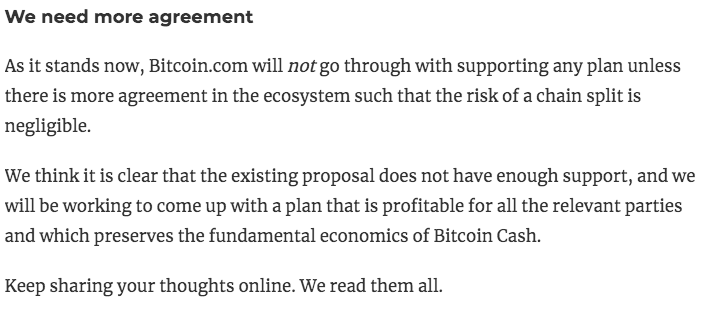
Ethereum's Two-Tier Expansion Road: Plasma Decline and rollup Rise
Plasma, which once claimed to have unlimited capacity, is now disappearing without a trace. ZK Rollup and Optimistic Rollup, which are weighing each other, are on the rise.
That was **2017** in August The price of Ethereum's native token ETH is close to the highest level in history. The Ethereum blockchain is bursting with the increase in usage. The chain is overwhelmed by the growing demand. Researchers and developers are frantically searching for new **expansion solutions** . At blockchain conferences around the world, developers discussed different scaling recommendations. The Ethereum community desperately needs a solution. In this frenzy, the first version of **Plasma's** paper was released, which promised to provide a **layer 2 expansion solution** , saying it could handle "almost all financial calculations worldwide."
*TechCrunch's coverage of Plasma*
takes us fast forward to **2020** . Ethereum is still as slow as ever, but it has defeated all the so-called "Ethereum killers". The release date of **Ethereum 2.0** has been continuously delayed, and as many development teams have died down, Plasma seems to have completely disappeared.
New solutions such as **optimistic** and **ZK rollup are** hailed as the best expansion solutions. And Plasma's memories seem to have disappeared without a trace.
**So, who killed Plasma?**
Let's set the time back to the beginning of 2017. Ethereum became mainstream for the first time, and people are full of optimism about the near future. Some claim that all valuable assets will soon be tokenized. There are only standing places at various parties in San Francisco, and whenever Ethereum is mentioned, the crowds gather. But Ethereum does not achieve **scalability** .
In this boom, **Vitalik Buterin** and **Joseph Poon** published a paper describing a new layer 2 expansion solution called " **Plasma** ".
*Vitalik Buterin and Joseph Poon introduced Plasma*
Plasma's claim *at a conference in San Francisco that it could expand Ethereum* to **Visa-** level transaction volume, a bold statement that thrilled developers and the community. Soon after, Ethereum's research team gathered around Plasma as a solution to the scalability problem of Ethereum.
But what exactly is Plasma and why did it fail to deliver on its promises?
**How does Plasma work?**
The original Plasma white paper described a mechanism for constructing a **MapReduce** " **blockchain tree** ". Each node in the tree represents a unique blockchain, which is connected to its parent node, and all these blockchains are arranged in a huge hierarchy. However, the original specifications were vague and complex. Shortly after its release, Vitalik simplified the specification in a new paper entitled **MVP***(Minimal Viable Plasma)* .
*Plasma "* **Blockchain** *Tree"*
MVP proposes a simplified version of Plasma: a simple **UTXO-** based sidechain that maintains security in the event that data is not available. But what is a side chain? What does it mean when data is unavailable? Before diving into Plasma, let's look at the meaning of these terms.
**A side chain** is a **blockchain** that is connected to another blockchain. Sidechains can be operated in many different ways, such as by a trusted third party, a certain alliance, or a consensus algorithm. For example, Blockstream participates in an alliance sidechain on the Bitcoin network called Liquid. Liquid weighs in its trust model, thus ensuring higher transaction throughput. Users must believe that the alliance will not collude and steal funds. In this case, the blockchain operators are various members of the Liquid Alliance, such as Blockstream.
*Visualization of Liquid peg-in and peg-out mechanisms*
A sidechain is connected to a larger blockchain *(such as Bitcoin)* through a two-way hook . Users can deposit funds into the sidechain by sending funds to a specific address or a smart contract on the main chain. This is called a " **peg-in** " transaction. To withdraw funds, users can perform the same operation on the side chain and get their funds back on the main chain. This is called a " **peg-out** " transaction.
But what does this have to do with Plasma?
As we saw in the example above, moving funds out of the sidechain requires a key component: trust. Users must **believe that** sidechain operators will not abscond with their funds.
But isn't the main feature of blockchains trustless? What if users want to interact with the sidechain without trusting their operator?
This is exactly what Plasma is trying to solve.
Plasma's design minimizes the trust requirements of sidechain operators. That is, even if the operator (or the majority in the consensus) misbehaves, Plasma can prevent theft of funds.
But even if operators cannot directly steal funds, there is another problem with sidechains. What if the sidechain operator publishes a block header but refuses to publish the underlying transaction data? This will prevent anyone from verifying the correctness of the sidechain.
This concept is called data unavailability. Plasma tries to ensure the safety of users even if the operator refuses to provide transaction data-in case the operator refuses to publish the data, all users can still get their funds back out of the sidechain.
Plasma has made a great commitment to its security and scalability, giving people hope. Therefore, in the 2017 bull market, it is not surprising that Plasma can solve the scalability problem of Ethereum. But as the market sobered up in 2018, the blockchain hype collapsed, and a more realistic picture of Plasma began to emerge.
In real-world deployments, Plasma poses more problems than solutions.
The first problem is that **each user** must monitor and verify all transactions on the Plasma MVP chain to detect the behavior of malicious operators and exit in a timely manner. However, transaction verification is costly, and this monitoring requirement adds significant overhead to participating in the Plasma chain.
The researchers also realized that it is difficult for users to exit the Plasma chain. When users try to withdraw funds from the Plasma MVP chain, they must submit a withdrawal transaction request and then wait for a period of time. This is called the challenge period. At any time during the challenge period, any user can challenge the withdrawal of another user by providing proof of invalid withdrawal *(for example, they are minting fake tokens or stealing someone else's tokens)*. Therefore, all withdrawals can only be processed after the end of the challenge period, and some challenge periods can be as long as 1 week.
But things got worse.
Keep in mind that even if the operator deducts the data, we want users to be able to withdraw funds from the Plasma chain. The MVP process is this: If Plasma transaction data is detained, each user needs to exit and get funds according to the last valid state of the Plasma chain. *(Note: In order to prevent malicious operators from seizing the opportunity of honest users, the priority of exit is sorted according to the time of their last transaction.*
*The growth of Ethereum storage*
in the worst case, if all users need to exit a Plasma Chain, then the entire valid state of the chain must be published to the Ethernet mainnet within a challenge period. Considering that the Plasma chain can grow arbitrarily, and the Ethereum block is already close to its capacity, it is almost impossible to dump the entire Plasma chain on the Ethereum mainnet. Therefore, it is almost certain that a large number of exits will crowd Ethereum. This is the so-called batch exit problem.
As prices began to plummet in 2018, Ethereum followers began to realize that Plasma MVP wasn't the all-in-one scalability solution they expected. There is no way to overcome its weaknesses. Plasma MVP is a dead end. Ethereum is still struggling with its transaction load, and Ethereum 2.0 is many years away from us.
**Next-generation Plasma In**
mid-2018, as prices continued to fall, the research community of Ethereum continued to try to improve Plasma, and repeatedly studied the design of Plasma MVP. The new version they proposed was called **Plasma Cash** .
According to its main designer, Vitalik Buterin, Plasma Cash will allow **arbitrary height per second**The volume of transactions and solve the problems that plagued its predecessor. Some even claim that this new design can reach hundreds of thousands of transactions per second.
First, let's remember the problem with **Plasma MVP** .
Bulk exit issues when operators misbehave
Users must wait for the end of the entire challenge period to withdraw money
Users must monitor all transactions on the Plasma chain
Plasma Cash has a major advantage over MVP: By using different data models, Plasma Cash can **completely avoid** the problem of **batch exits** . In Plasma Cash, all tokens are represented as **non-homogeneous tokens** *(NFT)* , which makes the proof of ownership of a token easier. In simple terms, it is the user's responsibility to prove that they own the token, not others. Therefore, users only need to monitor their own tokens, not the entire Plasma chain.
Plasma Cash also proposes a new interactive challenge system that allows users to easily withdraw funds in the event of operator misconduct. With a new Merkle tree structure, the " **Sparse Merkle Tree** ", users can easily verify the history and ownership of tokens using proof of inclusion. In the case of operator misconduct, users only need to publish on-chain proofs of the tokens they currently own *( including the 2 most recent transactions and corresponding proof of inclusion)* .
However, Plasma Cash poses a new set of issues.
First, a malicious user or past owner of the token may make a **wrong withdrawal attempt** . Because users need to prove that they own their own tokens, it is actually these users who discover and question that their money has been cheated. Therefore, like Plasma MVP, Plasma Cash requires users to **go online at least once every two weeks to** detect incorrect withdrawals in a timely manner during the challenge period.
In addition, in order to prove the ownership of the token, the user must maintain the entire history of the token and corresponding proof of inclusion / exclusion, resulting in increasing storage requirements.
By the end of 2018, the price of ETH had fallen to the **bottom** , and utopian optimism no longer existed. Although Plasma Cash is an improvement over MVP, it is not a Visa-scale solution promised by Ethereum. Its MapReduce "blockchain tree" is now a daydream. Most companies developing clients for Plasma Cash have put their work on hold and their implementations are in a semi-complete state.
The Ethereum community is at an impasse. Although new Plasma architectures continue to emerge and improve slightly from their predecessors, the Ethereum community has failed to unite to support any of them.
Plasma seems to be dead.
**Rollup**
comes at a time when people's confidence in the second layer has bottomed out, and a user aliased as **Barry Whitehat** has publicly announced a scheme called " **roll_up** " on GitHub . This report describes a new type of Layer 2 capacity expansion solution: a Plasma-like architecture and "packaged" transactions. It does not rely on trust in the operator. The correctness of packaging can be achieved by using a **SNARK** 's On-chain evidence to prove it.
This SNARK ensures that it is impossible for operators to post malicious or invalid transactions, and that all sidechain blocks are valid.
Soon after, **Vitalik Buterin** released an improved version of Barry's solution, which he called **zk-Rollup** . zk-Rollup has become one of the most viewed posts on the Ethereum forum. Vitalik recommends introducing a solution to avoid Plasma's data availability problem: publishing sidechain transaction data on the Ethereum blockchain.
Publishing transaction data as a function parameter means that you can verify it at the time of publishing and then discard it so that it does not take up Ethereum storage space. zk-Rollup can avoid Plasma's exit games and challenge periods without sacrificing affordability or security. With zk-Rollup, one can use the new cryptography to solve all of the layer 2 scaling issues of Plasma in one go.
*Vitalik's zk-Rollup post*
but zk-Rollup has its own set of trade-offs. Generating proof of validity is computationally expensive. These zk-SNARKs are generated in each block. The generation time may be as long as **10** minutes, and the cost of each verification is up to **350,000** gas *(after Istanbul upgrade)* , which accounts for about **3.5% of the** entire block *(before Istanbul upgrade Accounted for 8%)* .
In addition, it is currently not possible to deploy universal smart contracts on the zk-Rollup sidechain. Special zero-knowledge virtual machines such as **zkVM** and **ZEXE** are currently being developed , but still require a lot of expertise when interacting with them. In most cases, zk-Rollup limits general programmability.
*Visualization of zk-Rollup, cartography of Georgios Konstantopoulos*
By mid- **2019** , these new developments have reinvigorated the research community of Ethereum. zk-Rollup seems to solve many of the problems that plague Layer 2. Like **Matter Labs** *(one of our portfolio companies)*And **LoopRing** such companies are actively developing zk-Rollup, and now the two companies have been testing the network for implementation. Through optimization, Matter Labs believes that it can reach **2,000** TPS on the ZK synchronous network .
**"Optimism" is a good medicine**
but not everyone is pinning their hopes on zk-Rollup. In the first zk-Rollup specification was released a year later, John Adler and Mikerah introduced what they call a " **merger agreement** " *(Merged Consensus)* design. Merging consensus allows the off-chain consensus system to be fully verified on Ethereum without any fancy zero-knowledge encryption. The Plasma team subsequently released an expanded version of the merged consensus design and added the now-infamous name: **Optimistic Rollup** .
zk-Rollup relies on zk-SNARKs to verify and complete each block, and Optimistic Rollup takes a different approach: why don't you assume that each block is valid?
This works well in the "Happy Path" when everyone behaves honestly, but we know that operators can go wrong. So how does Optimistic Rollup handle the wrong behavior of operators?
"Optimism *(optimistic)* answer" is to use **fraud to prove**. A fraud certificate is a calculation proof that an operator performed an invalid operation. If the operator issues an invalid state transition, anyone can submit a proof that the transition is invalid and then resume those transactions (about 1 week). Since these proofs are non-interactive, they can be sent by anyone: there is no need for users to monitor the security of their own tokens.
However, unlike zk-Rollup, Optimistic Rollup requires **3-5** times the transaction data to complete. This data mainly includes witnesses such as **signature data** *(zk-Rollup does not need this data because it validates those data with zero knowledge)* . In the best case, optimistic summary transactions never need to be validated unless proof of fraud is submitted. However, it is expensive to verify and publish on-chain witnesses, and developers have explored aggregate signature mechanisms that allow inexpensive large-scale verification and reduce transactional data requirements. This optimization can increase the theoretical TPS of Optimistic Rollup from about **450** TPS today to potentially **2,000** TPS.
Optimistic Rollup provides a very different set of trade-offs from zk-Rollup. They are less expensive *(assuming that the challenges of fraud are extremely rare)* , but they are less secure, in other words, there has always been the possibility of improperly applying transactions and recovering them later. This security window can last up to a week. Therefore, users cannot log out during this security window period *(otherwise, they may run away with someone else's funds)* .
However, these exit issues can be improved by introducing secondary markets. Users can sell their exit rights to third-party liquidity providers in exchange for a small fee.*(Liquidity providers will be rewarded for the lack of liquidity that lasts a week)* . This will allow the user to exit the rollup chain immediately.
Although zk-Rollup requires programmers to understand complex constraint systems and advanced cryptography, Optimistic Rollup allows common smart contract deployments *(such as Solidity)* . This means that smart contract-based protocols like Uniswap can be built on the Optimistic Rollup sidechain.
The Rollup family of solutions provides a similar approach to Plasma's data availability issues and exit complexity, but both have the potential to greatly expand Plasma's structure. For example, **IDEX** has built and deployed their own version of Optimistic Rollup and run a decentralized exchange (DEX) on this structure. Similarly, **Fuel Labs** has created a version of Optimistic Rollup that allows UTXO-style payments and ERC-20 token exchanges. **The Plasma Group** *(now Ethereum Optimism)* has recently announced that they are focusing on Optimistic Rollup and are committed to providing universal smart contract performance on their platform *(* built *through their Optimistic Virtual Machine)* .
**Everything that goes up must converge.**
Plasma ends up being more than just an agreement. During the period of irrational prosperity, Plasma is the story that Ethereum needs to believe. But in hindsight, the unlimited expansion it claims is a technical arrogance. Only with the development of Plasma can we realize the trade-offs inherent in Tier 2 expansion.
The price of ETH rebounded last year, and people are optimistic about the future of ETH. After nearly three years of exploring safe, scalable and robust capacity expansion solutions, the Ethereum research community has finally aggregated around **rollups** . Plasma and its brothers' initial attempts were noble, but a group of innovators eventually created a more realistic Layer 2 design, which seemed to solve Plasma's worst problem.
Some Plasma-focused research groups, such as Plasma Group, are already working on Optimistic Rollup solutions. But we believe that the search for the ultimate Layer 2 capacity expansion solution has just begun. Many competitors have emerged in this area, and we hope this remains an active and exciting research and development area.
مخاطر لبيتكوين النقدية = أعلى
**Author :** **MarcDeMesel** **Also available in** **English**
https://read.cash/@MarcDeMesel https://read.cash/@MarcDeMesel/risk-for-bitcoin-cash-up-f639ab51
لقد رأيت نماذج الأعمال تغيير من تبرعات التنمية الطوعية إلى مصادر التمويل الأخرى في 2 القطع النقدية من قبل ، NXT (أطلقت ICO تضخيم العرض) وBTC (أثار رأس المال الاستثماري الحد من فائدة السلسلة الرئيسية). في كلتا الحالتين فقدت العملة انها أثمن المستثمرين والمستخدمين: المثاليين. وفي كلتا الحالتين، فقدت العملة حصة سوقية خطيرة. هل البيتكوين كاش هي التالية؟
كنت أعتقد وجود جزء من كتلة مكافأة / التضخم الذهاب إلى التنمية هو وسيلة جيدة للحصول على التمويل المستدام الذي يتجنب مأساة مشكلة المشاعات أن التبرعات الطوعية نموذج الأعمال لديها، حيث عدد قليل فقط التبرع والباقي ركوب الخيل مجانا، وبالتالي لماذا أحببت داش وZcash.
ولكن جزءاً من التضخم يدفع ثمن كل شيء أيضاً يؤدي إلى انهيار التبرعات الطوعية في مجالات المال والتنمية والتسويق، كما يتوقع الناس الآن أن يدفعوا. كما أنه يركز التنمية والتسويق كما أصبح الجميع الآن يعتمدون على هذا تيار التمويل واحد. كما أنه يتسبب في ظهور السياسة كما هو الحال الآن عليك أن تبيع نفسك بشكل جيد من أجل الحصول على التمويل من هذا التيار. عادة مثل هذه المؤسسة مع تدفق الدخل المضمون ، وينتهي بها الأمر إلى أن يتم تجاوزها من قبل الطفيليات الذين يدفعون أنفسهم بشكل جيد ولا يهتمون إلا قليلاً بالمهمة كرواد أعمال حقيقيين أن الرعاية لا تنجذب إلى وظائف الموظفين هذه.
على الرغم من الشكوى الصاخبة من قبل أموري سيشيت حول نقص التمويل للتنمية ، فإن مقدار التنمية التي تم إجراؤها على BCH هو في الواقع مثير للإعجاب للغاية. لديك حاليا العديد من العملاء المستقلين / التطبيقات ، الكبيرة والصغيرة المتنافسة. آخر 6 أشهر حصلنا على CashFusion ، رموز SLP ، وBCH لديها أكبر قدر من المثاليين الترويج لها وإنفاقها. صحيح أن التبرعات المالية ليست مرتفعة مقارنة بسقف السوق ولكن:
1. معظم devs سعداء جدا لتطوير مجانا $BCH وتفعل ذلك في الغالب من الحب، أو لخلق قيمة لإخفاء، أو لديها أعمال أخرى اعتمادا على ذلك. نفس الشيء بالنسبة لمعظم المتحدثين والمسوقين.
2. كان هناك فقط 1 لجمع التبرعات على حد علمي حيث يمكن للمرء أن يتبرع بسهولة لفرق مختلفة وكان في الواقع ناجحة جدا رفع مثير للإعجاب 800 BCH أو نحو ذلك في 2 أشهر. ومع ذلك لم يتم الاعتراف بهذا النجاح لأن أموري كان يسبب المتاعب مرة أخرى تشكو من أن بعض الأطراف لم تكن على القائمة ، لم يتم الامتثال للوائح KYC / AML (ومع ذلك لم يتابع عندما اقترحت التوقيع على ورقة كتبرع كبير) ، ولم يشكر حتى المجتمع على 400 BCH حصل عليها فريقه ، كما لم يفعل شريكه ديفيد ألان من مؤسسة التنمية الذي تلقى 200 BCH أو نحو ذلك.
أكبر مشكلة بالنسبة لي مع هذا "الاقتراح" (وهذا هو في الواقع "أمر واقع" قررت بعض عمال المناجم دون أي نقاش مع المجتمع مسبقا) هو أنهم يخططون لإجبار جميع عمال المناجم الآخرين، فضلا عن جميع أصحاب العملة، لدفع ثمن شيء يعتبرونه جيدا، عن طريق التضخم. هذا يتعارض مع طبيعة بيتكوين (النقدية) بدأت ل: مكافحة التضخم فيات الذي يؤدي دائما إلى ضعف العملة فقدان القيمة مع مرور الوقت بدلا من كسب.
تمويل أي شيء عن طريق التضخم هو منحدر زلق خطير من المرجح أن يؤدي إلى العديد من التكاليف الأخرى التي يرونها ضرورية ، من خلال زيادة الحد من الأمن (نعم هذه هي المفاضلة التي تحدث هنا عن طريق تحويل التضخم القائم من التعدين / تأمين السلسلة إلى التنمية ، وهي مقايضة مشكوك فيها لعملة معرضة بالفعل لخطر كبير لتكون 51 ٪ لهجوم) أو عندما لا يكون من الممكن أكثر للحد من الأمن ، وزيادة التضخم ، وخلق مجموعة أكبر وأكبر من الطفيليات التسكع من النظام.
حل أفضل بكثير وأعتقد أن إطلاق ليس لجمع التبرعات المؤقتة ولكن دائمة حيث بناة (ديفس ، marketeers ، المتحدثين) يمكن أن تجعل قضيتهم لماذا كانوا يرغبون في المزيد من التبرعات ، ويمكن للمتبرعين بناء سمعة على أساس كرمهم. هذا يحتضن ويزرع الطبيعة الطوعية للمشروع ولديه أيضا أسس اقتصادية سليمة: إذا كان من المتوقع أن تفيد مساهمتك الطوعية حقائبك أكثر من مبلغ التبرع ، يتم تحفيزك. وجود الطفيليات غير المساهمة لا يهم ، أي : لا توجد مأساة لمشكلة المشاعات ، فقط المتبرعين الذين تمنون أن الآخرين يعطون أيضًا ، ولكن هذا لا يعني أن على المرء أن يبدأ في إجبار الجميع.
شيء واحد مؤكد ، فإن الاستثمار في خطر BCH ارتفع إلى حد كبير لأن هذا التغيير في نموذج الأعمال من المرجح أن يحدث ومن المرجح أن يبعد جزءًا كبيرًا من المجتمع ، مما يؤدي على الأرجح إلى انخفاض في ترتيب السوق. إذا كانت نسبة المخاطر / المكافأة لBCH تنخفض مقابل ETH على سبيل المثال ، وأصبحت الآن أقل بشكل عام ، وهو رأيي ، فإنه يبرر أيضًا انخفاض التعرض لها أيضًا.
عني، مارك دي ميسل:
أنا معروف في الغالب للقيام بمكالمات السوق الرائعة ، ودفع الناس إلى شراء التشفير بالقرب من أدنى مستوياته في السوق الهابطة ، والبقاء مستثمرًا في الطريق إلى أعلى ، ودفع الناس إلى البيع بالقرب من القمم في الأسواق الصاعدة ، على سبيل المثال في القمة في ديسمبر 2017:
https://www.youtube.com/watch?v=s3QFGyRURXY
بدأت الاستثمار في بيتكوين في عام 2012 @ 10 دولار وكانت واحدة من قنوات يوتيوب في وقت مبكر الترويج لها منذ منتصف عام 2013 عندما كان حوالي 100 دولار (الهولندية):
https://www.youtube.com/watch?v=KIFRLpHlIoo&feature=emb_title
تم سحبها من Bitcoin Core في أوائل عام 2017 إلى العديد من العملات الأخرى ، قبل أن تفقد الكثير من حصتها في السوق:
https://www.youtube.com/watch?v=tNunzGH-p50
استثمرت في بيتكوين كاش في سوق العقود الآجلة قبل إطلاقها في 1 أغسطس 2017 ، عندما كان عدد قليل من بطل BCH الحالي الذي يروج لهذا التحول الكارثي لنموذج الأعمال ، يدعم المشروع (الذي يشمل روجر فير ، فين أرماني ، والعديد من الآخرين):
https://www.youtube.com/watch?v=r3IUGbW45YM
كان أكبر متبرع في حملة جمع الأموال النقدية في بيتكوين والتي بلغت 800 BCH:
**https://www.reddit.com/r/btc/comments/c1ncgt/some_massive_donations_of_bch_just_came_in_to/erec3h4/****؟context=3** https://www.reddit.com/r/btc/comments/c1ncgt/some_massive_donations_of_bch_just_came_in_to/erec3h4/?context=3
تويتر: **https://twitter.com/MarcDeMesel**
بلدي يوتيوب: **https://www.youtube.com/user/marcdemesel**

تقييم واقتراح إعادة: وضع تمويل البنية الأساسية لعملة البيتكوين
Author: **im_uname** **Also Available In** **English**
وفيما يلي ملخص لما رأيته وفكرت فيه في العلن وفي السر. كميات هائلة من تحت الجدول الترتيبات قد تكون موجودة خارج معرفتي. رأيي قد يكون منحازا في أي عدد من الطرق. https://read.cash/@im_uname https://read.cash/@im_uname/assessment-and-proposal-re-the-bitcoin-cash-infrastructure-funding-situation-3e5179fc
في هذا writeup أحاول أن أصف التحديات التي نواجهها والتوصية بمسار إلى الأمام.
وصف المشكلة https://read.cash/@im_uname/assessment-and-proposal-re-the-bitcoin-cash-infrastructure-funding-situation-3e5179fc#problem-description
بيتكوين كاش لديه اقتراح قيمة كعملة مشفرة رئيسية وموثوقة بدون إذن يمكن أن تحجيم للتبني الجماعي ويهدف إلى تحقيق اعتماد المذكور بقوة. تتطلب هذه المهمة ما يلي من برنامجها ، بما في ذلك كل من العقدة الكاملة وغيرها من الضروريات مثل محفظة المصدر المفتوح:
**1. قوية ، والبرمجيات التي تم اختبارها بشكل جيد التي يتم الاحتفاظ بها حتى الآن وخالية من الأخطاء إلى أقصى جهد.**
على عكس ما قد يعتقد البعض ، لا تتعفن البرمجيات إذا لم يتم الحفاظ عليها كما يتم اكتشاف الأخطاء وغير ثابتة ، ومشاكل جديدة تنشأ من التطورات في بيئتهم ، ويتم الكشف عن أدوات الاستغلال الجديدة. وكحد أدنى، هناك حاجة إلى طاقم من الحافظين على دراية عالية. ولا يمكننا أن نتوقع منهم أن يعملوا مجانا بطريقة مستدامة.
**2. الميزات الجديدة التي تمكن من استخدام الحالات وقابلية المساعدة.**
نحن في موقف مبزّر. من أجل الحصول على تأثير الشبكة ، وusecases جديدة مرغوب فيه جدا. ومن الأمثلة الرئيسية على ذلك OP_CHECKDATASIG واستضافة العقود الذكية الجديدة التي تمكنها. وبعد ذلك عندما نحصل على تلك الحالات، سوف نحتاج إلى الميزات التي تمكننا من توسيع نطاق لآلاف المعاملات في الثانية الواحدة بأمان دون التضحية بالصفات الأخرى المرغوبفيها.
معظم العناصر على خارطة طريق بيتكوين كاش ليست التكنولوجيا المتطورة باستثناء الانهيار الجليدي. ومع ذلك، فإن تنفيذها بأمان، بطريقة قوية بشكل واضح، يتطلب مواهب غالبا ما تكون مكلفة للغاية.
وفي حين أن هذه المواهب تتطوع في بعض الأحيان، فإن مثل هذا العمل التطوعي يمكن أن يكون غير موثوق به بسبب حقيقة أن الفرص المربحة متاحة لهم. ويمكن للمرء أن يناقش مستوى التمويل المطلوب، ولكن من الصعب القول بأنه لا يلزم توفير أي مبلغ من التمويل.
وتعود هذه الجهود بالفائدة على كل شخص على الشبكة، ولا سيما أصحاب العملة الذين يرون زيادة في قيمة أصولهم. ومع ذلك، قد يكون من الصعب استخلاص إيرادات مباشرة ومحددة الأهداف وقابلة للقياس الكمي بسهولة من هذا الجهد، وهو ما يجعل قلة منهم على الأرجح تفعل ذلك.
هل ندفع ثمنها على الإطلاق؟ https://read.cash/@im_uname/assessment-and-proposal-re-the-bitcoin-cash-infrastructure-funding-situation-3e5179fc#do-we-pay-for-it-at-all
قد يجادل البعض أنه من غير الضروري دفع أي شيء والجهود التطوعية كافية. قد يعتقد العديد منهم أيضًا أنه لا بأس من الحصول على برامج يتم الحفاظ عليها بأقل قدر ممكن ولكن بدون ميزات قابلية جديدة للتطوير أو الاستخدام لفترة طويلة. ومن شأن ذلك أن يكون أسوأ سيناريو مؤسف يمكن البقاء عليه ولكنه لا يحصل لنا على أموال عالمية غير إذن.
لماذا تدفع لرجل واحد على الآخرين؟ https://read.cash/@im_uname/assessment-and-proposal-re-the-bitcoin-cash-infrastructure-funding-situation-3e5179fc#why-pay-for-one-guy-over-the-others
يبدو أن معظم المناقشة تركز على Bitcoin ABC ، مع طرح إلكترون كاش في بعض الأحيان من أجل التنوع. دعونا نكون صادقين مع أنفسنا، هذه المبادرة هي لبيتكوين ABC.
أي أموال يمكن أن تذهب إلى أغراض أكثر من برنامج العقدة الكاملة من المرجح أن يتم تطبيقها وفقًا لتقدير Bitcoin ABC على أي حال.
انتظر، ماذا؟ https://read.cash/@im_uname/assessment-and-proposal-re-the-bitcoin-cash-infrastructure-funding-situation-3e5179fc#wait-what
من منظور إدارة المخاطر ، فإن النظام البيئي في وضع يجبره على تمويل أي طلبات ABC ، من أجل التخفيف من خطر طيها أو حدوث اضطراب كبير.
منافسيهم إما غير ناضجة وخطيرة موضوعيا إذا ما استخدمت في الألغام (BCHD، Flowee وBitcoin Verde) أو غير مفضلة بسبب سجل متقطع وعدم الرغبة في الماضي المتصورة لخدمة مطالب عمال المناجم بشكل عام (BU).
من المهم أن ندرك أنه ما لم تكن على استعداد للذهاب دون صيانة وتحسين لفترة طويلة ، أو على استعداد لتمويل منافس مقبول لمعظم ، فإن الخطر موجود ، *ويجب أن يدفع شخص ما.*
هذه حالة مؤسفة لتنوع النظام البيئي والقوة، ولكن علينا أن نعالج الفيل في الغرفة.
**هناك أشياء أخرى يمكننا القيام بها لإخراج أنفسنا من هذه الحفرة في المستقبل، ولكن ليس اليوم.**
**لا يمكننا أن ننظر بعيدا.**
حسناً، شخص ما يجب أن يدفع ثمنها سواء كان لطيفاً أم لا من هو شخص ما؟ https://read.cash/@im_uname/assessment-and-proposal-re-the-bitcoin-cash-infrastructure-funding-situation-3e5179fc#okay-someone-gotta-pay-for-it-whether-it039s-pleasant-or-not-who-is-someone
سعيد وصلنا إلى هنا!
قائمة بالأطراف المحتملة التي يمكنها القيام بالتمويل:
استثمار رأس المال المباشر https://read.cash/@im_uname/assessment-and-proposal-re-the-bitcoin-cash-infrastructure-funding-situation-3e5179fc#direct-capital-investment
**بيتكوين ABC تشكل شركة، واعدة العوائد، وصناديق الاستثمار منحهم المال للعمل من أجل تحقيق هذا الهدف.**
ويستخدم هذا النموذج الأكثر شهرة من قبل Blockstream (BTC) والتكافؤ (ETH / Polkadot). وينطوي على مشكلة واضحة تتمثل في أن نموذج عمل تلك الشركة قد لا يتماشى مع فوائد النظام الإيكولوجي.
كما الشركة ترسخ نفسها من خلال السيطرة على عدد المطورين والنفوذ، يصبح من الصعب على نحو متزايد لطرد لهم. ثم سيكون فقط مسألة وقت قبل أن تبدأ الشركة في استخراج الإيجار ، نظرا للشركات تنجذب بشكل طبيعي نحو الربحية والسعي إلى الإيجار هو وسيلة سهلة للقيام بذلك.
رعايه https://read.cash/@im_uname/assessment-and-proposal-re-the-bitcoin-cash-infrastructure-funding-situation-3e5179fc#sponsorship
**تتلقى Bitcoin ABC مساهمات من العديد من الشركات التي تبني على Bitcoin Cash ، وتعود خبرتها وتعطي الأولوية للمخاوف.**
يُشار إليه على نطاق واسع على أنه "نموذج مؤسسة لينكس" وحالة مرغوبة في هذا النموذج ، ويتطلب هذا النموذج العديد من الشركات على Bitcoin Cash مربحة بما يكفي لتكون على استعداد للمساهمة.
حاليا هناك نقص في مثل هذه الشركات بالنظر إلى الدولة في وقت مبكر والتحديات التي واجهتها السلسلة منذ إنشائها.
مدفوعات التعدين (طوعية) https://read.cash/@im_uname/assessment-and-proposal-re-the-bitcoin-cash-infrastructure-funding-situation-3e5179fc#miner-payments-voluntary
**تتلقى Bitcoin ABC دفعات من عمال المناجم الذين يتبرعون بعملاتهم المعدنية طواعية ، على أساس نظرية أن هذا أمر جيد لفوائد عمال المناجم على المدى الطويل.**
Bitcoin.com تقوم بمدفوعات مباشرة من مجموعة السباحة الخاصة بهم على نطاق صغير ، وقد تم التكهن على نطاق واسع بأن Bitmain ، التي تدير تجزئة كبيرة بالإضافة إلى بركها البارزة ، رعت Bitcoin ABC بشكل أكبر.
ومن منظور التعدين البحت، قد يكون من الصعب تبرير ذلك لأن عمال المناجم لديهم هامش ضئيل جدا. عمال المناجم الذين لا إعادة الاستثمار في قوة التجزئة الخاصة بهم تميل إلى الحصول على تنافس بسرعة وتقلص في الحجم.
والأهم من ذلك، فإن الحقيقة هي أن الغالبية العظمى من دخل عامل المناجم يأتي من BTC في هذه الأيام، وليس هناك سبب قوي لكثير منهم لرعاية التنمية BCH أخرى من اعتقاد البعض حول الإيجابيات في المستقبل.
مدفوعات عمال المناجم (إلزامية) https://read.cash/@im_uname/assessment-and-proposal-re-the-bitcoin-cash-infrastructure-funding-situation-3e5179fc#miner-payments-mandatory
**تتلقى Bitcoin ABC مدفوعات من قاعدة تحول جزءًا صغيرًا من كل قاعدة عملة إلى حسابها ، مدعومة بتهديدات يتيمة من قواعد توافق الآراء الفعلية.**
**هذا هو جوهر الاقتراح الحالي المثير للجدل على الطاولة ، حتى لو كانت الإصدارات قد يكون لها تفاصيل مختلفة.**
ويرمي هذا الاقتراح إلى حل "مشكلة الراكب المجاني" عن طريق المدفوعات الإلزامية من كل عامل منجم؛ كما تؤكد أنه مع تعديل الصعوبة، تتوزع "التكلفة" على عمال المناجم SHA256، مما يجعل تكلفة الصندوق إلى "عمال المناجم BCH" متناسبة فقط مع نسبة سعر BCH إلى BTC. كما يفترض بعض مشغلي البرك وعمال المناجم أن هذا سيساعد التذبذب الحالي في BCH.
والافتراض الأخير غير صحيح بالتأكيد، حيث أن المبلغ الإجمالي للاستخراج لا يتحرك بغض النظر عن جزء من عمال المناجم التبديل. فقط ارتفاع نسبي في الأسعار ضد BTC يمكن أن يحل هذه المشكلة ، والتي لا يساعدها كسر المجتمع وكابوس العلاقات العامة.
والأهم من ذلك، يغير هذا الاقتراح طبيعة بيتكوين كاش من سلسلة غير إذنية تمامًا، إلى سلسلة يتم فيها تحويل جزء من التوزيع في بروتوكول إلى عدد قليل من الأطراف الموثوق بها التي اختارها جزء صغير من مجمعات التعدين الخاصة بها.
وفي حين يرى الكثيرون أنه عمل من أعمال النفعية وضرورة البقاء، فمن غير الواضح ما إذا كانت هذه فائدة صافية، لا سيما بالنظر إلى الآثار المترتبة على التبني والاستثمار وجذب المواهب على المدى الطويل حيث تُعرف العملة بأنها مخصخصة من قبل كارتل. ولا يتم التراجع عن مثل هذه الضربة على صورة السلسلة حتى لو انتهت صلاحيتها بعد ستة أشهر، كما يدعي المبادرون في الخطة.
وعلاوة على ذلك، فإن مثل هذا العرض على إعادة توزيع العملات على أساس قوة التجزئة له آثار خطيرة على الرقابة على السلسلة، وقد يتساءل المرء عما إذا كان يجوز للكارتل أن يفرض ضرائب على أي عملة معدنية أو أي معاملة ما دام لديه فعلت العلاقات العامة اللازمة legwork.
غير أن استعداد الجهات الفاعلة البارزة لمعالجة مسألة التمويل بشكل كبير لا يزال علامة إيجابية.
مساهمات حامل https://read.cash/@im_uname/assessment-and-proposal-re-the-bitcoin-cash-infrastructure-funding-situation-3e5179fc#holder-contributions
**تتلقى Bitcoin ABC مدفوعات من مجموعة من أصحاب Bitcoin Cash الرئيسيين الذين يمولون البنية التحتية لتسهيل إدامة ونمو قيمة أصولهم.**
**يمكن أن يكون الدفع إما مباشرة ، يتم تجميعها عن طريق عقد ضمان ، أو إصدار الوقت لـ la Mecenas ، أو أي عدد من الإعدادات المتطورة الأخرى.**
هناك حقيقة واحدة من غير المرجح أن تتغير: أصحاب BCH الاستفادة القصوى من صيانة الشبكة والتحسينات، وذلك بسبب تقدير القطع النقدية الخاصة بهم. ومن الطبيعي إذن أن يقوم أكبر المستفيدين من تحسينات الشبكة بتمويلها.
جزء من الصعوبة ، على الرغم من ذلك ، هو بيتكوين كاش حسب التصميم يحترم ملكية القطع النقدية: من الصعب بكثير مصادرة القطع النقدية المؤكدة من مكافآت coinbase. وإذا تعذر إقناع حامل هُنا، يستحيل إجباره على دفع أي شيء.
بيد أن أصحاب هاهمة ينبغي أن يكون من السهل نسبياً إقناع هم أصحاب هاوية من الناحية النظرية.
طالما أنها تساهم بأقل من الارتفاع المتوقع المعدل حسب المخاطر لأصولها نتيجة للتطوير المستمر للعقدة الكاملة ، فمن المفيد المساهمة كقرار مستقل ، بغض النظر عن أي عدد من الشركات "الحرة" و اصحاب. وينطبق هذا بشكل خاص على كبار الحائزين، الذين لا يحتاجون إلى التنسيق ويمكنهم تمويل مشاريع البنية التحتية بأنفسهم وتحقيق أرباح صافية من خلال مجرد زيادة قيمة الأصول.
وقد يكون أحد الاعتبارات بين الحائزين صعوبة التنسيق. في حين أن أصحاب كبيرة جدا يمكن تمويل المشاريع الكبيرة مثل بيتكوين - ABC بأنفسهم، إذا كان التنسيق من أصحاب أصغر ضرورية، فإنها قد تكون خائفة من عدم وجود التزام كاف من أقرانهم للمشاركة في التمويل، والمدفوعات الجزئية من تلقاء نفسها جيوب ستكون غير فعالة.
ويمكن معالجة هذا القلق من خلال عقود ضمان على غرار المنارة مباشرة على سلسلة BCH. مع ذلك ، يمكن ضمان جميع المدفوعات أو لا شيء.
توجد مواهب في BCH حيث يمكن بناء معاملات تمويل عقد ضمان لمرة واحدة في غضون أيام قليلة.
إذا كان القلق هو دفعات لمرة واحدة قد تقدم حوافز ضارة للمستفيد ، قد يلتزم المرء بجدولة عقود الدفع الذكية مثل Mecenas ، على سلسلة تماما. بل يمكن الجمع بينه وبين عقود الضمان.
الاعتبارات https://read.cash/@im_uname/assessment-and-proposal-re-the-bitcoin-cash-infrastructure-funding-situation-3e5179fc#considerations
عدة اعتبارات يجب وضعها في الاعتبار عند صياغة اقتراح:
1. قد يكون لدى Bitcoin ABC ، المستفيد الرئيسي المتوقع من أي اقتراح ، علاقات قاسية مع العديد من أصحاب العملات ، مما يؤثر على قرارهم. إصلاح تلك العلاقة وجعلها ترى وجها لوجه هو المفتاح. وقد يكون من الضروري نقل شواغل المؤسسة العربية المصرفية وحاملة البطاقة إلى بعضهما البعض دبلوماسيا.
2. قد يكون لدى كبار أصحاب المخاوف لا أساس لها حول "مشكلة المتسابق الحر". ومن المهم أن نبين لهم الفوائد المباشرة لاستثماراتهم بغض النظر عن عدد الأشخاص الذين "يحملون الحمولة الحرة"؛ في الواقع ، العملات المشفرة هي مساحة فريدة من نوعها في أن "freeloaders" الذين يستخدمون سلسلة إضافة إلى تأثير الشبكة ، وبالتالي تضخيم الاستثمار على أي حال.
3 - وقد يكون من المفيد أيضا تأطير الاستثمارات من حيث إدخال تحسينات محددة على خارطة الطريق، بحيث يمكن وصف فائدتها في الاعتماد والقيمة بسهولة أكبر.
اقتراح https://read.cash/@im_uname/assessment-and-proposal-re-the-bitcoin-cash-infrastructure-funding-situation-3e5179fc#proposal
يمكن لستة فقط من أصحاب الحيازات الكبيرة مع 100،000 BCH المساهمة 1 مليون دولار لكل منهم ، 3 ٪ من حيازاتهم لكل منهم ، وسيتم مطابقة مبلغ اقتراح ضريبة التعدين.
**يمكنهم القيام بذلك كل عام ولا يزال يخرج بربح ضخم**، على افتراض أن فوائد التحجيم تدفع BCH لتتناسب مع القيمة السوقية ETH اليوم بعد عدة سنوات.
كلما انضم أصحاب الأسهم الكبيرة إلى هذا الاقتراح ، كلما زاد العائد مقابل الاستثمار - وهو مربح لكل منهم بغض النظر عن عدد "freeloaders".
على الجزء الخلفي من منديل ، (أو إكسل) ، دعونا جعل الإسقاط المحافظ -- إذا كنت 100k BCH حامل ، وكنت تستثمر 1 مليون دولار سنويا. تدفعنا فوائد التوسع والموثوقية إلى هدف محافظ لسقف سوق إسيديوم اليوم بحلول عام 2025. نحن بحاجة أيضا إلى حساب المخاطر، ولكن دعونا نقول أنها تقابلها الإيجابيات أكبر على الجانب الآخر.
مزيد من النظر في أنك فقط hodl ، والخطة ينهار. قد تنهار العملة بسبب قلة الصيانة ، أو قد تتبنى فكرة قيمة غريبة تسمح بالنمو. دعنا نتكيف بشكل متفائل لنفترض أننا ركود كمخزن للقيمة ، وتتبع هدف التضخم في الاحتياطي الفيدرالي.
يجب أن يكون الفرق الصارخ في العائدات واضحًا ، بغض النظر عما إذا كان أي شخص "مستقل".
يجب أن يكون هناك عقد Mecenas يُصدر مدفوعات كل ستة أشهر إلى Bitcoin ABC ، أو وكيلها المعين ، في مخصصات شهرية.
إذا لم يقم المتلقي بجمع المخصصات المذكورة في وقت ما لأي سبب ، يمكن إعادة الأموال بعد وقت.
بعد ذلك ، يجب أن يسبق عقد Mecenas آلية تمويل المعاملات الجزئية SIGHASH_ALL | ANYONECANPAY ، مع مبلغ مستهدف وعنوان عقد Mecenas كإنتاج.
يجب توفير أداة لأصحاب المصلحة المهتمين ، يتم تنسيقها على انفراد ، لتوقيع المعاملات الجزئية وإما إضافة وتخصيصها إلى موقع عام أو وكيل خاص لا يثق فيه. تصبح المعاملة صالحة بمجرد تجاوز المدخلات المبلغ المطلوب ، ويمكن أن يبدأ التسليم المجدول عبر عقد Mecenas.
تتكرر هذه العملية كل ستة أشهر.
يجب على Bitcoin-ABC إثبات التقدم علنًا قبل كل فترة تمويل ، سواء في البرامج أو شرح موجز.
 @arslankhalid