CJK Fly Vision Part 3
III. METHODOLOGY
This section tells us the procedures and techniques used to identify, select, process and analyze information about eyeglasses as inspired by fly. It follows with the following subtopics: design process, materials selection, assembly and performance evaluation that will give us an explanation below.
**Design process of CJK FLY VISION**
The design consideration of CJK FLY VISION were made through reviews of some related literature, studies and articles that can be found in the internet. The researchers’ searched for the reliable sources such as google scholar, science direct and scholarpedia using the keywords eyeglasses, lenses, frames, remote controls and compound eyes that can be used as basis for the design of the product. The related literature, studies and articles that were searched were published from the year 2000. The materials were easily determined as it was shown on the related studies and articles. Through incorporating the logic of science mechanism and technological advancement, the proposed design of the device will definitely work.
**Material selection**
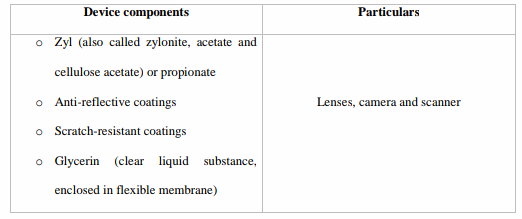
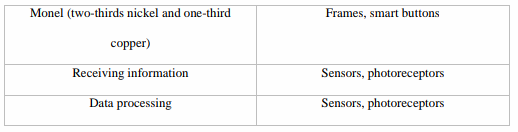
*Table 1. List of materials to be used for eyeglasses*
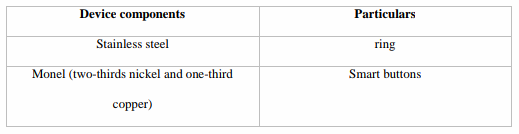
*Table 2. List of materials used for ring (accessory incorporated to eyeglasses)*
**Assembly of CJK FLY VISION**
The eyeglasses inspired by a fly is an all-around device where it can be used as a protective gear to your eyes and an aid for one’s eye impairment. This device was composed of remote controls, frames, lenses, Nano-engineered material (camera) that is attached to the frame and using smart technologies (program incorporated inside the lenses) for data processing.
**Performance Evaluation of CJK FLY VISION**
CJK Fly Vision is a device that helps, not only to improve one’s vision but more importantly helps one on occasional circumstances such as emergency situations, high security missions and even in combat. It is a specific eyeglass with the most unique feature, a fly’s vision or point of view. It is not literally a fly’s vision that you can see while wearing this, although it is the concept of this Specs, some characteristics of the fly’s vision were eliminated because they’redeemed not really helpful. There were still the main characteristics that remain intact and were studied and altered to meet the human standards. You can also use this on a daily basis but it is still up to you since the design is more likelya sunglass and not a correction eyeglass but since its lenses have adjusting grades so it is fit for daily usage. The eyeglass lenses were made up of glycerin, a thick clear liquid, enclosed in flexible membranes. The membranes can be mechanically moved back and forth, changing the curvature of the glycerin lens. The lenses are set in frames containing a distance meter on the bridge, which measures the distance from the wearer’s face to nearby objects using infrared light. The meter then sends a signal to adjust the curve of the lens. This adjustment can happen quickly, letting the user focus from one object to another in 14 milliseconds. It is also scratch-resistant due to its scratch-resistant coating on the front and back part of the lenses as well as the capability to reduce the amount of internal and external reflections on a lens. Another thing was that it can display images or scenes on the line of sight of the camera connected to it. Both right and left lenses were connected to a camera on its connecting arm which when activated enables it to have an almost 360 degree view of the entire field just how a fly can see. Not only has that it portrayed a fly’s vision, it also helps in keeping your guard up specially when worn in combat. When the cameras on both the left and right arm were activated not only it has an approximately 120 degree view, it also has weapon sensors that can identify an explosive, blunt, sharp or pointed weapon at range and it even identifies a gun when it enters its line of sight. The best thing about its lenses was its slow motion perception not that it literally slows down movements but rather sees swift movements slower than what it really is enabling a man to some extent, “predict” an opponent’s attack. This command was only activated after tapping the metal detector on the right side of the CJK Fly Vision. The reason behind this breakthrough lies on the super advanced microchip installed on the CJK Fly Vision and the fiber optic cables. Fiber optic cables on Figure 1 allow for a faster and clearer transmission of signals. Fiber optics works by transmitting signals through light waves. It is either created from glass or plastic fiber where light passes through. At the end of every fiber optics cable is a transmitter. Fiber-optic cables transmit data via fast-traveling pulses of light. Another layer of glass, called “cladding,” is wrapped around the central fiber and causes light to repeatedly bounce off the walls of the cable rather than leak out at the edges, enabling the single to go farther without attenuation. Some impurities are added to fiber optics to control the speed and aid in channeling the signal effectively. Fiber optic cable is still far faster than copper wire, and isn't as susceptible to electromagnetic interference. Fiber can achieve speeds of hundreds of Gigabits per second or even Terabits.
Chemical compounds that make the whole systematic functions work of a fly’s vision were changed to mechanical receptor-like powered by electricity where fiber optic cables pick up a signal from the environment and thus serve as ion channels that delivers certain messages or signals to a microchip that was installed within the spectacle and brings it back to the whole system five times faster until it reaches the lenses where the person can see what has been detected or spotted by the ultra-sensitive sensors built within the eyeglasses.
The main frame of the CJK Fly Vision was made from Monel which is composed of about two-thirds nickel and one-third copper. This highly-yielding alloy can be hammered into a variety of different shapes without losing strength. Its ability to resist stress well makes Monel an excellent choice for stabilizing frame bridges and end pieces. Monel is corrosion-resistant and durable, but may cause problems for people with allergic reactions to nickel. The scanner and detector of the specs were connected to the microchip in Figure 2 installed within the glasses that stores information for up to 1 TB. It also has a wide range of data and information stored there so that it could identify many forms of attacks, danger and weapons. The detector on all the cameras could detect hazards for as far as 5 meters away from the person wearing the specs. As it spots something suspicious, it picks up information then sends it to the microchip then classifies it as danger then the information was sent back to the whole system alerting the person wearing the glasses by slightly vibrating on the side where the danger is.
**OPERATION OF THE DEVICE**
Since the main goal of this device was to make the best use out of a fly’s vision, the operation of the CJK Fly Vision follows very simple procedures to operate per command:
***Motion Detection or Slow Motion Perception***
1. Wear the CJK Fly Vision and make sure to take note of the different buttons or sections on your spectacles.
2. In times of combat, just tap on the nearest portion of the right arm of the eyeglass (see Figure 3) to activate the command. You will right away see movements actually slower which makes you process information five times faster than normal.
3. Double tap on the same spot for deactivation.
***Center Camera (Figure 4)/ Video and Picture Command***
1. If you wish to capture scenes, just press the button below shown on Figure 4.1 the nearest portion of the right arm once like clicking a camera to capture the scene in front of you.
2. If you wish to shoot a video or record what’s in front of you, just press the same button a little longer until you feel a slight vibration then release as it starts recording.
3. To stop recording videos, just press the same button once again. It will automatically be saved on a physical or cloud storage whichever you prefer.
***360 degree Field View (Figure 5)***
This command helps you to have a wider view of your surroundings. The cameras on the right and left arm serves as the ‘eyes’ for your 360 degree field of view. Here are the steps on how you could activate or enable to see the views on those cameras:
1. Make sure that the cameras on both sides of the arm were activated or on the “ON Mode”.
Since this spec was mostly for guarding yourself from any attacks, once you wear this, it would automatically alert itself or ON the cameras and the sensors on all three (3) sides.
As the spec detects your pulse it will automatically be turned on.
2. If you wish to view the cameras field of view or display it in front of you, you can press the button on the ring accompanying the specs. There will be labels on it for the right and left camera.
3. If the sensors on the cameras detect something dangerous for example a weapon pointed at you in that particular direction, it would vibrate when the danger enters the field of view for as far as 5 meters wide within that range.
REFERENCES:
Compound eyes. Functions of compound eye. Retrieved from
https://www.shcolarpedia.org/article/Function_of_compound_eye
Compound eye. What do flies see out of their compound eye?. Retrieved from
https://animals.mom.me/flies-sess-out-compound-eye-5361.html
Compound eyes. Why do flies have compound eyes?. Retrieved from
https://www.pitara.com/science-for-kids/5ws-and-h/why-do-flies-have-compound-eyes/
House flies. Behavioral and physiological response of musa domestica to colored targets. Retrieved from
https://accademic.oup.com/jme.article/49/1/94/862190
House flies. Insight into why flies have fastest vision in animal kingdom. Retrieved form
https://www.google.com/amp/s/phys.org/news/2012-10-eye-mystery-insight-flies-fastest.amp
How Eyeglass Frames are made. Eyeglasses Frame. Retrieved from
https://www.madehow.com/Volume-1/Eyeglasses-Frame.html
How Lenses are made. Eyeglasses Lenses. Retrieved from
https://www.madehow.com/Volume-1/Eyeglasses-Lenses.html
CJK Fly Vision Part 2
II. REVIEW OF RELATED LITERATURE
Eyeglasses has known to evolve its function in the society through the years. Its ability to cure ones eye impairment is the cheapest way than eye surgery that is why it was been a trend for people with such disability. The researchers’ purpose for this study is to improve what an eyeglasses can do when inspired by nature. This eyeglasses were specifically inspired by a house fly.
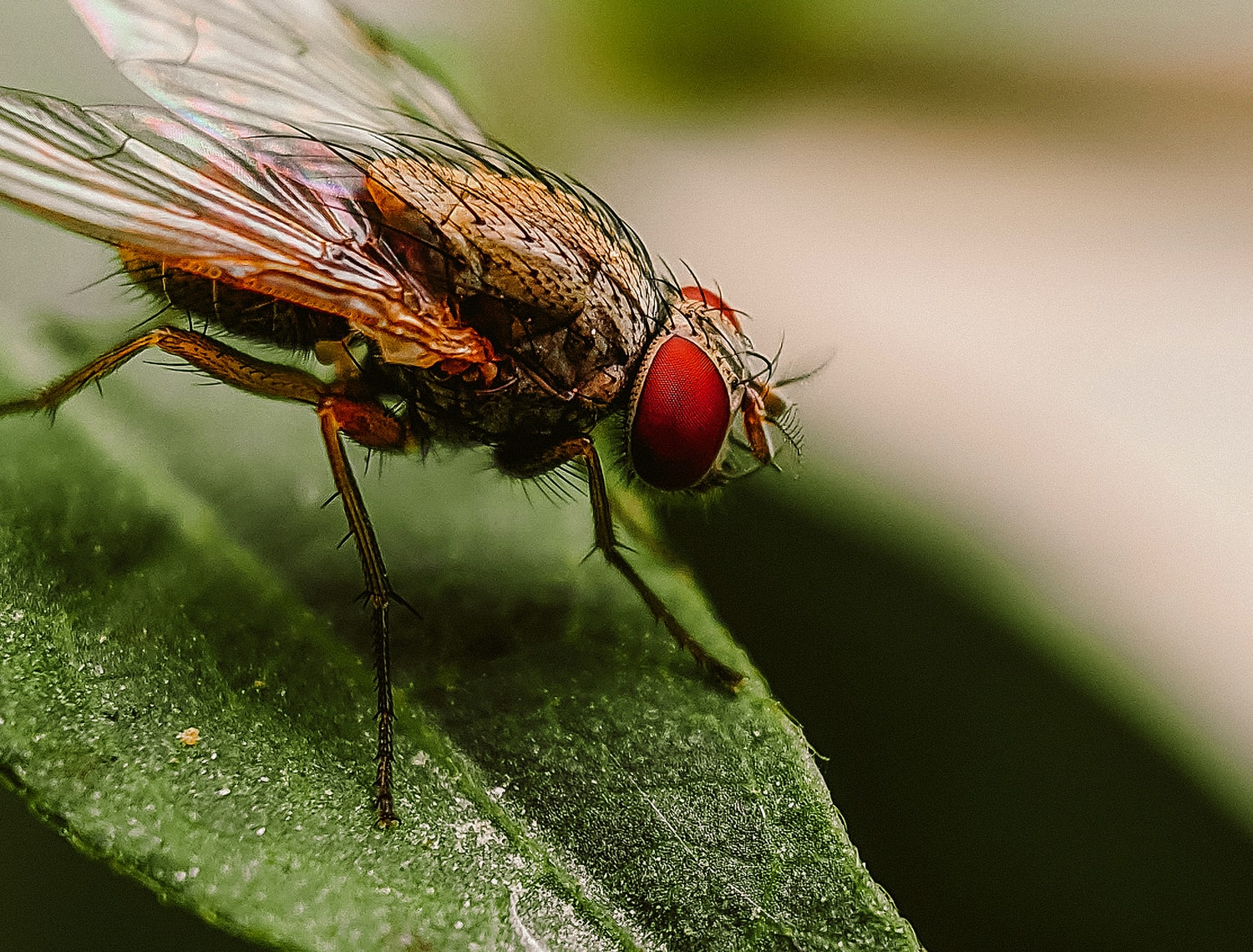
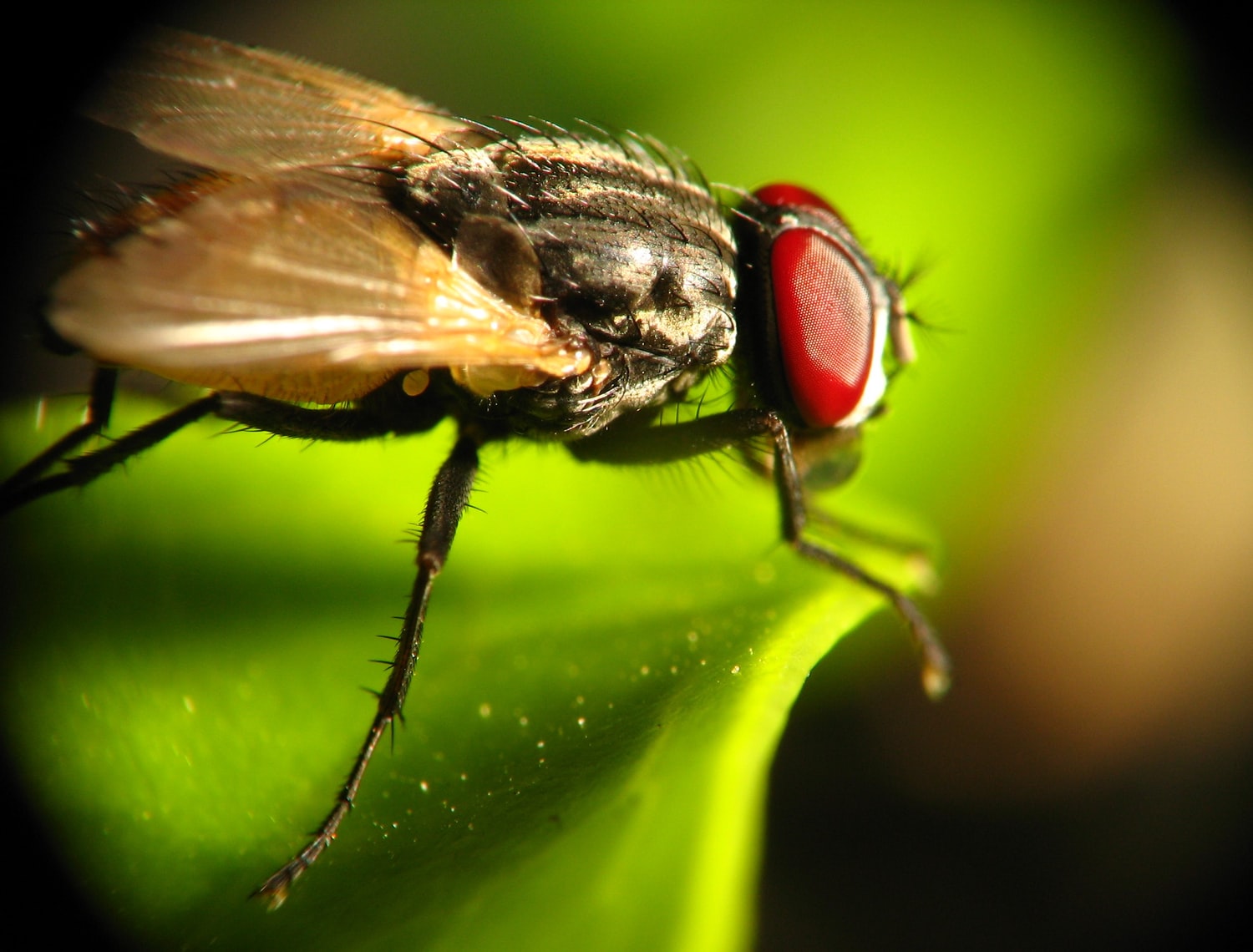
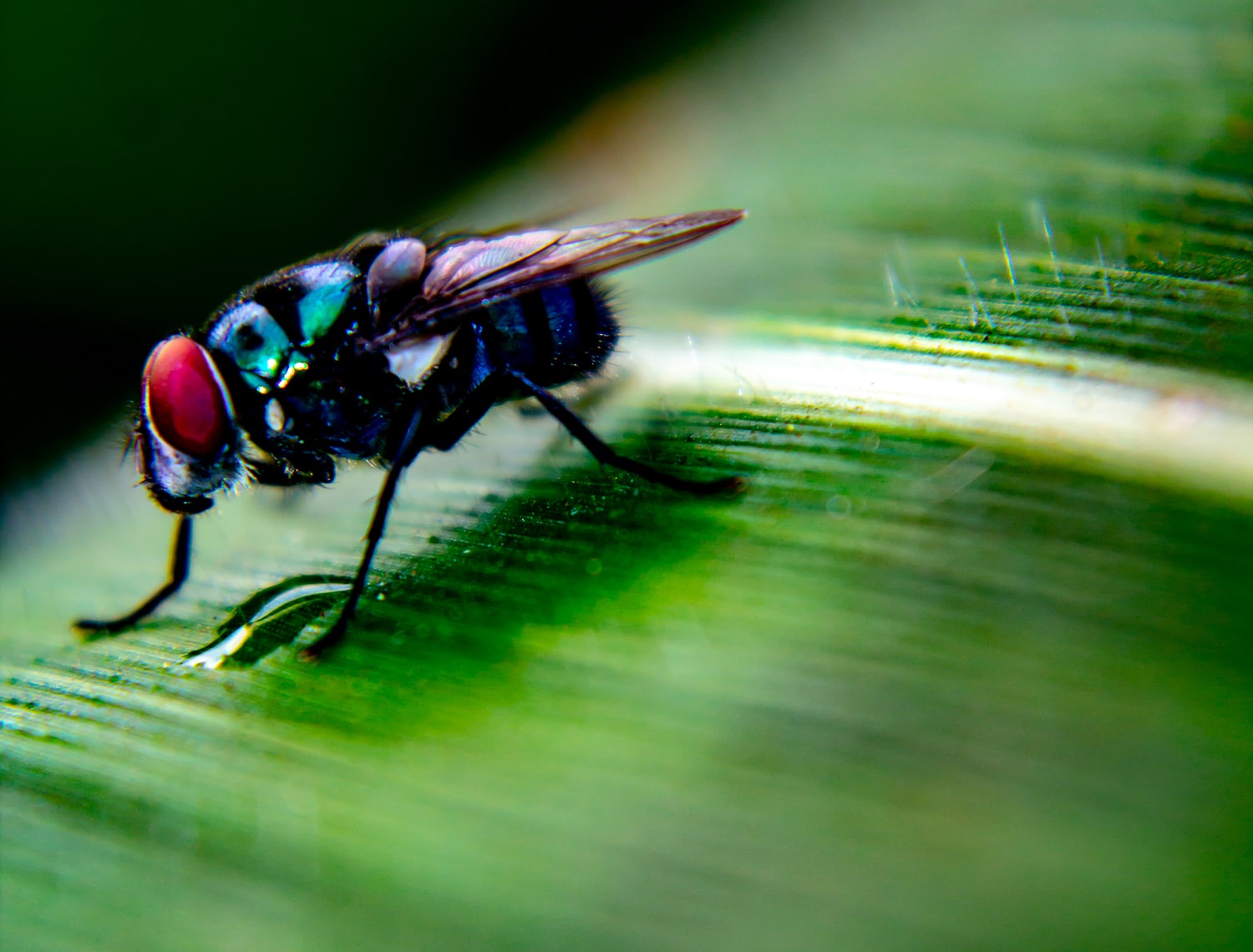
We all know that a fly can be a big nuisance to anyone and their constant buzzing around can really get on everyone’s nerves. For businesses, particularly those in the food and pharmaceutical industries, they can be a huge concern due to the impact they can have on consumer health. However, flies can be quite fascinating creatures. Their breeding, feeding and even moving habits are quite different from ours and can actually be quite interesting. Flies are able to see behind and able to react accordingly at amazing speeds. To put things into perspective, our brains processes around 60 images a second whereas a fly can process around 250 in a single second this is because of their compound eye. House fly has red compound eyes. Each eye contains 4000 lenses called ommatidia that enable visualization of different pictures at the same time. These compound eyes also allows them to have an extremely 360 degree wide field of view. This is the reason why flies can easily see what’s behind them. Using this eyes, flies can also easily detect fast movements (Masters, 2009).
A compound eye is the type of eye commonly found in arthropods, including many insects and crustaceans. A compound eye has a mesh-like appearance because it consists of hundreds or thousands of tiny lens-capped optical units called ommatidia. Each ommatidium has its own cornea, lens and photoreceptor cells for distinguishing brightness and color. Individual ommatidia guide light through a lens and cone into a channel, known as the rhabdom, which contains light-sensitive cells. These are connected to optical nerve cells to produce the image. The ommatidia are separated from each other by varying degrees of pigment (Egelhaaf, 2009).
The ommatidia are packed side by side into bulges that create a wide field of views as each unit is oriented in a slightly different direction, the honeycombed eye creates a mosaic image which, although poor at picking out detail, is excellent at detecting movement. Compound eyes generally allow only a short range of vision. (Rosenberg, 2007).
Below are some key functions of eyeglasses inspired by fly:
*** 360 field of view***
*** Scanner***
*** Camera and video recorder***
*** Sensor***
With the ability of a fly to have a wide field of view is second to none. Its fascinating features proves us that flies can be an inspiration for an object that would be a good use for people. Especially for those human with eye impairment, this device would probably hit the market real hard.
A fly has a compound eyes with 4000 lenses in each eye. Compound eyes are adapted to spot swiftly moving objects, whereas simple eyes are better only adapted to see nearby objects and detect changes in light intensity. With this ability apply to eyeglasses, the sensor, camera and scanner will be a kick to improve everyone’s eyesight in viewing a specific object. It can easily see the movements around the person wearing it.
Compound eyes has its function that would explain why a fly has the ability to react fast and swiftly.
*** Photo transduction***
*** Spatio-temporal filtering by photoreceptors***
*** Synaptic transmission to LMC’s in flies***
*** Lateral inhibition***
*** Feedbacks and network processing***
*** Signal processing in medulla***
*** Motion detection***
*** Looming neurons***
With these processes happening in the eye of a fly, it has the ability to do things naturally. A fly’s eyes are immobile, but because of their spherical shape and protrusion from the head they give the fly an almost 360 degrees view of the world. Applying to eyeglasses, it was made by precision molding. Since it was made of glass, they possess excellent heat resistance and the capability to be used in a wide wavelength range.
This eyeglass is a two-dimensional array of individual optical elements assembled or formed into a single optical element and used to spatially transform light from a non-uniform distribution to a uniform irradiance distribution at an illumination plane.

CJK Fly Vision Part 1
i. ABSTRACT
*A fly has a compound eyes with 4000 lenses in each eye called ommatidia that enable visualization of different pictures at the same time. These compound eyes also allows them to have an extremely 360 degrees wide field of view. This is the reason why flies can easily detect fast movements. With these amazing and distinct abilities of a fly, the researchers apply these to eyeglasses with the following features such as cameras, sensors and scanner. The researcher see the need to improve the preparedness and alertness for the self-defense system. This study will be beneficial to individuals specifically to those who are visually impaired, business owners, investigators, armed forces and individuals that may actually be also useful for them.*
I. INTRODUCTION
Today’s generation, many people seem to have difficulty in vision hence, they are always looking for an aid or solution, an eyeglasses. Eyeglasses is well known as a necessity to everyone who has eye impairment and also a protective gear for field works, making its own name and importance to everyone for the past centuries. It was a solution for them to do task naturally as what people without difficulty in vision do. This invention has been of great help for people since then up to the contemporary period as it goes along with its innovative specs. Many people still find eyeglasses as a necessity despite the popularity of contact lenses and laser surgery to correct vision problems. The improvement of technology in the manufacture of plastic lenses and frames and in the comfort of fitted frames where its history begins to establish the future of frames for the past 50 years have made eyeglasses more enjoyable to wear making it move beyond prescription - the rapid increase in technological advancements, fuses technology and eyewear to create innovative products that focus on improving vision and augmenting reality.
We have known eyeglasses as a treatment for eye impairment and gear for protection where its abilities never fails to impress us over the years. Eyeglasses has different type of lenses that were common to people. Revolutionized treatment of common vision problems were seen notably with the development of progressive lens. Progressive lenses perform the same job as bifocals and trifocals, but in a different way. They work around the dividing lines of bifocals, which was a known inconvenience glasses wearers dealt with for many years. The actual visual field within progressive lenses is smaller than that of bifocals or trifocals. This may help to explain why we still see many older folks wearing trifocals as opposed to progressive lenses. As the world’s first progressive lens to ever be invented, it continues to be the most technologically advanced solution for presbyopia. Ballistic lenses, another type of lens that withstand high-velocity effects from tiny projectiles – essential to protect vision from shrapnel. Without any ballistic lenses, individuals who on a regular basis put themselves in harm could be specifically susceptible to eye traumas.
Technology embedded in premium lenses that reduces the amount of blue-violet light entering the eye. It puts lenses in real life situations, on real people, so that people can evaluate and adapt throughout the entire process, modifying each product to ensure the most natural vision possible. Imagine what can an eyeglasses do if it was design and inspired by nature. From this research, we’re able to reimagine and develop lenses that are unlike any other introduced before.
Have you ever imagine of wearing the same eyes of a fly? Eyes that give you an almost 360 degree field of view and can see shapes, motions and colors differently and being able to see lights in a way that normal eyes cannot. This invention may seem impossible for others but researchers will prove that flies can be useful for studies even if it is a nuisance in our daily living.
Many people associate eyeglasses with cutting-edge technology. As we can see, smartphones get smarter, and cars go greener, eyewear seems comparatively the same. Eyeglassesis also expanding its ability through the years making an absolute quality everyone would love and enjoy. Its lenses are improving as well as the smart technologies attached to it. This research will prove us on what evolution may happen on eyeglasses, especially when it’s inspired by nature. Eyeglasses as inspired by flies, specifically its eyes.
SCOPE AND DELIMITATION
This study focuses on eyeglasses, its importance, purpose and features for refences and improvement. And fly for its features and behavior as reference and inspiration for a new device to form. This study will be beneficial to individuals specifically to those who are visually-impaired, business owners, investigators, armed forces and other individuals that may actually be also useful for them. Also, this study will help to identify on how can the researchers develop the product to be more useful and attainable for the users.
It delimits that the study may not be generalizable to other individuals because of its purposes.
SIGNIFICANCE OF THE STUDY
Research of this study shall pave way towards the uses and importance of an eyeglasses and how it will work once it is inspired by nature. Specifically, this shall benefit the following:
***Visually-impaired.*** This study will help those people who are suffering from eye conditions, for them to be able to cure or fix their vision.
***Business Owners.*** This study will be helpful to businesses who are in line with eyeglasses to know the deficiencies of their product and to improve for the betterment of the consumers.
***Investigators***. This study will be a good help to easily find evidence or data that will be necessary for a case to be solve.
***Armed Forces.*** This study will be useful for the armed forces to enhance and strengthen their defense and awareness specifically in their environment in times of combat or conflict situations.
***Researchers***. This study will provide information to the researchers about the importance and uses of eyeglasses in this modern generation for further development of the product.
***Future Researchers.*** This study will be an important tool for future researchers about the benefits and development of eyeglasses. The outcome of this study may serve as a basic insight to the next researchers. This will also serve as a guide for them to be able to come up on a more develop product.
***DEFINITION OF TERMS***
This section gives definition of some words used in this study.
***Bifocals*** – having lenses each with two parts with different focal lengths, one for distant and one for near vision.
***Compound eyes*** – an eye consisting of an array of numerous small visual units, as found in insects and crustaceans.
***Eyeglasses*** – a single lens for correcting or assisting defective eyesight, especially a monocle.
***Fly*** – insects of the order Diptera that uses only a single pair of wings to fly.
***Progressive lens*** – also called multifocal lenses, progressive addition lenses, varifocal lenses, progressive power lenses, graduated prescription lenses, or progressive spectaclelenses are corrective lenses used in eyeglasses to correct presbyopia and other disorders of accommodation.
***Trifocals*** – having lenses with three parts with different focal lengths.
Future Trends of Eyeglasses
CJK EYEGLASSES: CLEAR VISION WITH BETTER FUTURE
In this abruptly changing era with a society that is tremendously innovating, we, the CJK Corporation, decided to create and develop a device that satisfies a certain need of people with impaired eyesight. We intended to create an ideal model of eyeglasses that will surely be helpful for the benefit of the humanity. Not only that it helps a person to have a clearer eyesight but also contains features that will leave a person awe-strucked by its superb design.
Its sole purpose was to serve humanity at its finest and friendliest. It enables life-changing occurrences with proper and responsible handling. It is simply the best friend everyone needs but at the lowest possible price and by seeing the need of the world to a new technology that is practically useful for everyone, we created a tool that enables man to defy common sense and be innovative. We are naming that technology as CJK Eyeglasses. It has high quality but very low key features that enables man to move at ease on a daily basis. Those basic features includes an adjustable lens, a magnifying feature, night vision, attached also a camera for photo and video recording purposes, it also has a mirroring feature which will be useful depending on the owner's needs whatsoever, and many more cool features that were soon to be developed.
As it was soon to be marketed, the CJK Eyeglasses will surely be a trend within the society. We, in this company, were not just aiming for a popularized gadget, we intend to create something of a better use, something of a tool that changes the world, and something that is handy and worth treasuring.
The history of eyeglass begins to establish the future of frames for the past 50 years. Despite the popularity of contact lenses and laser surgery to correct vision problems, many people still find eyeglasses as a necessity. The improvement of technology in the manufacture of plastic lenses and frames and in the comfort of fitted frames have made eyeglasses more enjoyable to wear making it move beyond prescription - the rapid increase in technological advancements, fuses technology and eyewear to create innovative products that focus on improving vision and augmenting our reality. The fashion industry also actively supports eyeglass frames as an added avenue for expressive designs and a popular method of stating personal style from the moment you wake up to when you close your eyes at night.
Over the years, revolutionized treatment of common vision problems were seen notably with the development of progressive lens. As the world’s first progressive lens to ever be invented, it continues to be the most technologically advanced solution for presbyopia. The use of plastic and lightweight lenses, created Transitions Adaptive Lenses - the first lightweight plastic photochromic lenses available on the market. They appear clear indoors and automatically darken outdoors in sunlight. But, that’s not all, technology embedded in premium lenses that reduces the amount of blue-violet light entering the eye. It puts lenses in real life situations, on real people, so that we can evaluate and adapt throughout the entire process, modifying each product to ensure we can help give you the most natural vision possible. From this research, we’re able to reimagine and develop lenses that are unlike any other introduced before.
Many people associate eyeglasses with cutting-edge technology. As we can see, smartphones get smarter, and cars go greener, eyewear seems comparatively the same. This notion is dead wrong because opticians and materials experts are pushing the boundaries of what eyeglasses can do.
CJK EYEGLASSES: CLEAR VISION WITH BETTER FUTURE
The CJK glasses are normal pair of eyeglasses concealing a hidden camera and mic inside the frame. The lens is located behind a small unnoticeable pinhole in the center of the glasses. CJK eyeglasses captures video in 1080p HD resolution with audio capable of recording faces, locations, and other important details. This eyeglasses are the ideal all-in-one solution for any covert operation or project. The glasses power on and start recording with a single tap on the right arm. CJK glasses are comfortable, easy to use, and inconspicuous. A sleek and simple frame doesn’t draw attention to itself. A perfect solution for anything from recording natural home videos to gathering evidence by private eyes and law enforcement. The glasses come with built-in memory, available in 64GB or 128GB and a built-in solar battery. The frames come with a pair of clear plastic safety lenses and it is water proof that can be used as goggles.
The CJK eyeglasses can be used for legal basis such as Record Altercations for Evidence or Proof, Secret Shopping, Private Eye Covert Missions, Recording Concerts or Events, Recording Lectures and Classrooms, and Harassment Evidence.
The CJK eyeglasses comes with a set of features you’d never imagine that exists. Below are the following:
***AUGMENTER REALITY EYEGLASSES***
Just command your eyeglasses to picture exactly what is in front of you, AR is actually on the nominee list of up-and-coming eyeglasses revolutions.
***BALLISTIC EYEWEAR***
Most of these lenses withstand high-velocity effects from tiny projectiles – essential to protect vision from shrapnel. Without any ballistic lenses, individuals who on a regular basis put themselves in harm could be specifically susceptible to eye traumas.
***SELF-FOCUSING LENSES***
Now in advancement, self-focusing lenses make the automated adjustments possible for the particular power of the prescription. Most of these adjustments are small, but the technologies can make it life easier for those who have specific eyesight issues, for example, presbyopia.
***HIGH-PERFORMANCE SPORTS EYEGLASSES***
***VISION ENHANCEMENT***
A wearable artificial vision device that works by incorporating cameras into eyewear. In one variation of the device, the camera analyzes what the user is looking at and then reads what is being seen by the user via small earpiece. In another variation, high-definition cameras project images from a person’s surroundings to the eyewear lenses, magnifying objects and texts.
***SMART GLASSES***
Another category of eyewear falls under the smart label. This feature do not try to improve the prescription of eyeglasses or are even meant for those with vision impairments.
Smart glasses are intended to seamlessly integrate with technology to allow the user to connect to the internet, record and upload videos, pictures or view files or direction right on the lens of glasses.
***FREE-FORM TECHNOLOGY***
A digital manufacturing process that uses computer-aided design and surfacing to create high-level, customized eyeglass lenses with your unique prescription. Think of it as a tailor for your eyes. Just like you can take an off-the-rack pair of pants and have it customized to fit your specific measurements, you can now have lenses made customized for your specific prescription and frames.
***1920 X 1080P HD LENS WITH BUILT-IN MIC***
*** 120 DEGREE WIDE ANGLE FIELD OF VIEW***
*** SLEEK DURABLE FRAME NEVER DRAWS UNNECESSARY ATTENTION***
*** ELECTRONIC VIDEO STABILIZATION***
*** STORES 10 HOURS OF VIDEO ON 64GB***
*** STORES 24 HOURS OF VIDEO ON 128GB***
*** COVERT HIDDEN PINHOLE CAMERA LENS***
The CJK glasses have a built-in pinhole camera lens in the center of the camera that's almost unnoticeable. Even though the lens is tiny, the glasses can still record a wide 120-degree field of view capturing both front and peripheral vision.
*** HD 1080P VIDEO RECORDING WITH SOUND***
The CJK glasses feature a high-quality color HD sensor that will record faces, along with the important details from impressive distances. The video is ideal for sharing with friends on Facebook and easily uploaded to YouTube. A built-in high-quality microphone is strategically located at the bottom of the frame making extraneous noises caused by wind and rain no longer an issue.
***VIDEO STABILIZATION***
The CJK glasses are equipped with a digital video stabilizer which reduces jitters and shakiness caused by walking, running and other high motion movements. The video glasses are also equipped with a high ISO implementation that reduces blurring when going from a well-lit area to a low lit area by analyzing high-speed lighting and automatic histogram data that increases low tone detail and preserves high tones.
*** SIMPLE FINGER TAP RECORDING***
Start recording instantly with simple finger tap of the button on the glasses arm. With the CJK eyeglasses, simply tap the button to start or stop recording and turn on and off the glasses.
*** BUILT-IN 64GB OR 128GB MEMORY***
The built-in memory and are available in two sizes, 64GB and 128GB. 64GB of Memory can store up to 10 hours of video. 128GB of Memory can store up to 24 hours of video. Erasing older files and recording new files is easy with any PC or Mac so you don't have to worry if the memory is full.
*** TIME & DATE STAMP***
Date and time are optionally displayed in the corner of your video for your personal reference.
*** COMPATIBLE WITH BOTH MAC AND PC***
The CJK is compatible with Windows 98, ME, XP, Vista, 7, 8, 10 and more, both 32 bit and 64 bit, and all versions of Mac OS X Systems. To get the video you want to play, the process is as simple as plugging the glasses into the USB port of your PC or Mac, which automatically opens the device and displays the video files.
As it was soon to be marketed, the CJK Eyeglasses will surely be a trend within the society. We, in this company, were not just aiming for a popularized gadget, we intend to create something of a better use, something of a tool that changes the world, and something that is handy and worth treasuring.
Good Morning everyone! Done with some of my articles(tho I just finish 1 out of 8) hahahhaha gonna do it again once my mind is on condition again. So how are you people? Stay safe always!
Eyeglasses through the Years
Eyeglasses have made known to everyone for the past centuries. This invention has been of great help for people since then up to the contemporary period as it goes along with its innovative specs. But even up to this date, the inventor of glasses and lenses are still unknown. No evidence exists to prove the identity of the inventor of eyeglasses, but many lay claim and believed to be the inventor of it. Roman tragedian Seneca (4 BC -65AD) have allegedly used a glass globe of water as a magnifier to read ''all the books of Rome''. And others stated that the monks in the middle ages used glass spheres as magnifying glasses to read. Meanwhile, Venetians glass blowers are known to have produced reading stones made of solid glass that was put into hand-held, single lens-type frames made of horn or wood during the 13th century and was similar to hand-held magnifying lenses of today.
Historians believe that around 1285-1289, the first form of eyeglasses was produced in Italy by monks or craftsmen in Pisa (or perhaps Venice). It was thought that Salvino D'Armate was its inventor. Salvino D'Armate is most often credited with the invention of the first wearable eyeglasses around 1284 and was prescribed for hyperopia. These magnifying lenses for reading were shaped like two small magnifying glasses and set into bone, metal, or leather mountings that could be balanced on the bridge of nose.
Ancient Chinese were credited for inventing sunglasses. In the 12th century Chinese sunglasses were made from panes of smoky quartz used to dim the light. Inuits used walrus ivory to create goggles with small slits to peer through. Later during the 18th century, English optician James Ayscough, who originally created spectacles with tinted lenses, which he thought could improve vision, created sunglasses which were similar to what we wear today.
Spanish craftsmen in 1600's made the first eyeglass frame temples. They affixed ribbons of silk or strings to the frame and loop them over the user's ears. The new types of eyeglasses carried out to China by Spanish and Italian missionaries. Chinese attached small metal weights to the strings instead of making loops. In 1730 Optician Edward Scarlett designed rigid temples that rest atop the wearer's ears. Bifocal lenses can be used to treat with nearsightedness and presbyopia [with a lower part for viewing objects near at hand (as in reading)]. It was first devised by Benjamin Franklin in 1784.
Concave and convex lenses principle were familiar to the people during 17th century. Eyeglasses can be produced with single lenses that correct for distance vision or up close, or they can be manufactured with multifocal lenses, which correct both distance and reading. Concave glass is used to correct nearsightedness, so that the rays of light are diverged while convex lenses are used to aid the correction of farsightedness, so that the light rays are converged. Cylindrical lenses used to correct astigmatism were invented by Sir George Airy in 1825.
By the 1800s, eyeglasses were common, but not as we think of them today. Lenses weren't custom made; instead, you'd go to a jeweler, a hardware store, or meet with a traveling peddler to try on different pairs of eyeglasses until you found the ones that worked. And because eyeglasses were seen as a sign of old age, people often opted for handheld devices such as lorgnettes (spectacles with a single handle on one side) or scissor spectacles (where lenses moved on a hinge) instead of wearing glasses all the time. In the mid-1850s curl sides were invented, which were curling wires that went behind the ears. Curl-side frames were especially common for children's eyeglasses because they stayed in place while running or playing.
At the end of the 18th century, Philadelphia store proprietor John McAllister the founder of the profession of optician in this country opened the first optical shop in America. When the War of 1812 and the trade embargo with Great Britain hindered his importing ability, he began making his own frames out of gold and silver. He and his son also imported the first cylindrical lenses for astigmatism.
Various styles and types of glasses followed, including reading glasses, glasses for farsighted and nearsighted, anti-radiation glasses, sunglasses with different tints and fashionable glasses that are trend in this century.
IMPACTS OF EYEGLASSES
Eyeglasses build a name for itself for the past years, bringing a lot of impact to different aspects in the society and environment. Below are the following:
***Social Impact***
During the 15th to 16th century, there was an exponential increase in demand for spectacles due to availability of printed materials, i.e. books and newspapers. From that era, it was evident that people treated wearing eyeglasses as a status symbol. This was because the early eyeglasses were possessed by churchmen, wealthy scholars, artisans, and high-class individuals of the medieval world. Hence, people in Spain, Italy and China regarded eyeglasses as a sign of superior intelligence and nobility, a symbol of wisdom and learning.
The start of eyeglasses being a fashion statement was in 1880 when monocles were popular. Aristocrats commonly used monocles as status symbol and fashion statement.
From the 20th century onwards, eyeglasses have shifted from a want into a need for those whose vision needed correction as the production cheapens. People started to view eyeglasses as a medical necessity. According to the Vision Council of America, approximately 64% of adults wear eyeglasses. In addition, eyeglasses as a fashion statement started to gain popularity. A sizeable number of people wore eyeglass frame for fashion purpose. The innovation of sunglasses also contributed to the increase in popularity.
Despite more of the population having access to eyeglasses, there are still social issues whereby people from the developing countries do not have access to eyeglasses. According to VisionSpring, there are approximately 700 million people who need but don’t own eyeglasses.
In a study on the impact of eyeglasses on the academic performance of primary school students in rural China, a very low percentage of students who needed glasses actually owned a pair of glasses. The study also found out that after about 8 months of wearing glasses, children’s test scores improved by 0.16 to 0.22 standard deviations, which is equivalent to 0.33 to 0.50 years of additional education.
***Economic Impact***
The invention of eyeglasses has increased productivity over the ages. In the past years, active and productive members of society had to stop working, writing, reading and using their hands for skillful tasks at a relatively young age. With eyeglasses, these members were able to continue their work.
In the modern age, studies had showed that there is a direct correlation between proper vision correction and productivity. This relationship particularly is evident with complex and/or repetitive computer tasks such as data entry. Computer-related tasks took much longer when the subjects wore glasses with less than the optimum correction. There was reduction in productivity even among computer users who were unaware that they had vision problems.
Computer users with small refractive errors may not noticed any vision discomfort. But without proper vision correction, their performance on a specific task can suffer significantly by as much as 20 percent.
The economic impact of this invention was not identified in the 17th-20th Century, only being measured in recent time. However, from the recent studies, it still shows that the use of eyewear has good economic impact relating to the productivity of the worker because they had an eyewear that helps them to see and do their work better. Another economic impact is the need and the invention of eyewear that has led to the dominance of a company in the eyewear industry.
***Technological Impact***
Sunglasses; Ballistics eyewear; Google glasses; 3D glasses; Makeup glasses; Computer glasses; Chroma; Smart glasses for the blind; VR glasses are some technologies that have evolved from the invention of the eyewear. The creation of frames allowed for the work of newer technology to be added on to the original design for specific purposes.
MATERIALS USE FOR EYEGLASSES
In the past, the production of eyeglass lenses relied on separate optical laboratories. Today, there are a lot of full-service optical outlets that produce lenses for customers on-site. However, optical outlets do receive lens "blanks" plastic pieces already formed to close-to-exact size with different curves ground into the front of the lens from optical laboratories. Blanks with different curves are used for specific optical prescriptions.
The plastic blanks received from optical laboratories are round pieces of plastic such as polycarbonate approximately. 75 inch (1.9 centimeters) thick or thicker and similar in size to eyeglass frames, though slightly larger. Most finished eyeglass lenses are ground to at least 25 inch (.63 centimeter), but this thickness may vary depending upon the particular optical prescription or "power" required. Other materials used to produce eyeglass lenses are: adhesive tape, a liquid with a lead alloy base, metal, dyes and tints.
Eyeglasses frames are typically made of either metal or a type of plastic called cellulose-acetate. Cellulose acetate is derived from cotton and is flexible and strong. It is produced in long narrow sheets that are slightly wider than eyeglass frames. The sheets are up to 3 ft. (0.91 m) long and 0.33 in (0.84 cm) thick.
Lens materials for glasses are glass, plastic or polycarbonate. Glass was the original material for spectacles because it has great optical clarity, but the glass lenses can be very heavy in stronger prescriptions. Plastic lenses are much lighter than glass but they are prone to easily being scratched. The lightest and thinnest lens material for glasses is polycarbonate, also called CR-39.
TYPES OF LENSES
***Single Vision Lenses***
Single vision lenses are the most basic type of lens. Unsurprisingly, they also tend to be the least expensive. Made for correcting one field of vision (near or far), they offer the largest visual field of any lens type.
***Photochromic lenses (Transition) Lenses***
Also known as transition lenses, photochromic lenses darken when they come into contact with UV rays. This eliminates the need for sunglasses, increasing convenience and minimizing expense for the wearer.
They are technically not a prescription type, but rather a treatment added to prescription lenses. Note that the lenses will darken even on cloudy days, which some may find inconvenient. However, they are often a popular choice as they add a little style to your glasses.
***Bifocal & Trifocal Lenses***
Usually wear by oldies. These lenses correct a wider range of more severe vision issues.
Bifocals and trifocals are lenses that have two and three powers apiece, respectively. They are sometimes referred to as multifocal even though this technically refers to progressive lenses.
All within one lens, it has separate sections for near and distance correction, which makes them a versatile choice. Those requiring intermediate vision correction will be prescribed with trifocals that have a third correction too.
The drawback of bifocals and trifocals is that there are lines separating each section, which makes for drastic changes in vision correction when you move your eye inside the lens.
It’s something that you learn to work with, but the inconvenience paved the way for advances in lens technology such as progressives.
***Progressive Lenses***
Progressive lenses perform the same job as bifocals and trifocals, but in a different way.
They work around the dividing lines of bifocals, which was a known inconvenience glasses wearers dealt with for many years. The actual visual field within progressive lenses is smaller than that of bifocals or trifocals. This may help to explain why we still see many older folks wearing trifocals as opposed to progressive lenses.
Overall, progressive lenses offer the same fields of vision correction but without the lines. Transitions from near to intermediate to distance correction are much smoother.
***Screen or Computer Lenses***
These are special-purpose eyeglasses meant to optimize your eyesight when you’re looking at digital screens. They are designed to: reduce glare (a major cause of eyestrain), increase contrast and maximize what you see through the lenses-making it easier to look at a screen for longer periods of time.
Darwinian Revolution
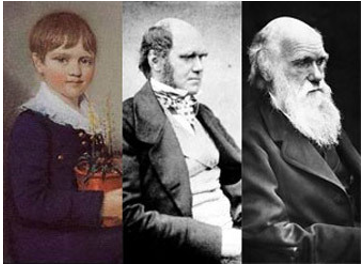
**Charles Robert Darwin (1809 – 1882)**
- English Naturalist
- His fervent interest in the natural world began as a young boy and continued unabated throughout his remarkable career.
- His ideas was influenced by his grandfather, Erasmus Darwin, who published one of the first formal scientific theories of evolution, Zoonomia, or The Laws of Organic Life, in the 1790s.
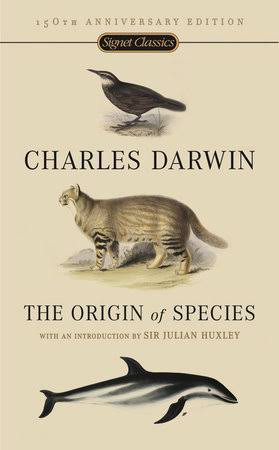
In **1859**, Charles Darwin published the book: ***The Origin of the Species*** where the groundbreaking revolution in both scientific and religious realms started.
The development of ***Darwinism*** changed the general thinking of the world, while unlocking the truth behind both Earth and Life.
Darwin’s Three Observations:
**The geometrical increase of populations.** If left unchecked, the size of the population of a single animal or plant species would increase until the world is overrun.
**Variation**. Individuals within the same species are not always exactly alike—they differ in their particular characteristics.
**Inheritance**. Individuals tend to pass on their own particular characteristics to their descendants.
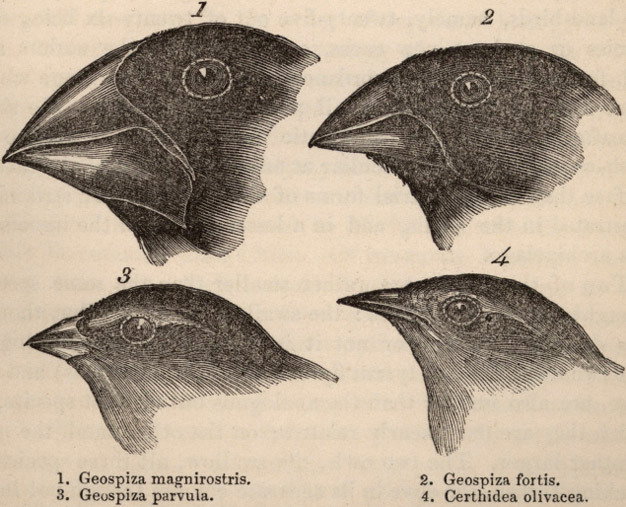
Just **four of the Galapagos Islands finch** species that Darwin observed, described and drew. He pondered the great range in bill type among these species.
**Extinct species** represent gaps in body forms of extant species. **Fossil** discoveries help fill in the gaps and reconstruct the evolutionary trajectory of the group.
Darwin’s Argument�(Created from Animals, pp. 35-6)
*(1) Organisms tend to reproduce in such numbers that, if all survived to reproduce again, they would soon overrun the earth.*
*(2)This does not (and could not) happen. No species can continue to multiply unchecked.*
*(3) It follows that a high percentage of organisms must die before they are able to reproduce.*
*(4)Therefore, there will be a* ***"struggle for existence"*** *to determine which individuals live and which die. What determines the outcome of this struggle? What determines which live and which die?*
***There are two possibilities:*** *it could be the result of random causes; or the reason could be related to the differences between particular individuals.*
*(5) Darwin admits that sometimes it is random; that is, the reason one organism survives to reproduce, while another does not, may sometimes be attributable to causes that have nothing to do with their particular characteristics. One may be struck by lightning, while another is not, and this may be mere luck.*
*(6) But sometimes it is a matter of differences between individual organisms. Consider: There are differences ("variations") between members of species. Some of these differences will affect the organism's relation to its environment, in ways that are helpful or harmful to its chances for survival.*
*Therefore, because of their particular characteristics, some individuals will be more likely to survive (and reproduce) than others.*
*(7) Organisms pass on their characteristics to their descendants.*
*(8) Therefore, the characteristics that have* ***"survival value"*** *are passed on, and tend to be more widely represented in future generations, while other characteristics tend to be eliminated from the species.*
*(9) In this way, a species will be modified--the descendants of the original stock will come to have different characteristics than their forebears.*
*(10) When enough of these modifications have accumulated, we call the result a new species.*
Good morning everyone! Still awake and I dont even know whats keeping me awake lately so instead of staring on the wall, I just decided to watch the new episode of Haikyuu.
Take care everyone! I'll be uploading some articles later so stay tuned😉
Random Fiction
Hey, you little boy out there
Why do you keep on disturbing her?
Is it because of your wants and desires?
Or because she's the only person who is there whenever you're in a run
Stop it. You're no longer together
Stop messing with her heart
She's struggling of forgetting you
Yet here you are keep on entering without even a permission
Stop playing around
Stop using your situation
Stop... Just stop
If you can't leave her right a way then why choose a path
Why choose this path when you know that you'll end up breaking her?
I can't even understand you anymore
Just stop
*Random thoughts I ended up thinking this early morning*
*This fiction is no longer fun*
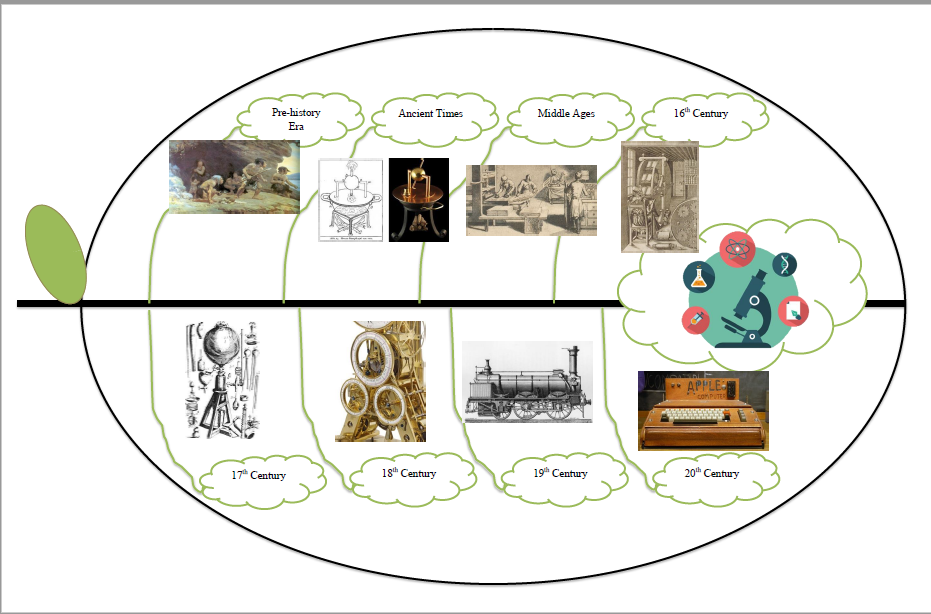
Four Stages Of Technology (ICT)
**The Pre-mechanical Age 3000 B.C. –1450 A.D.**
Writing and alphabets for communication- the Greeks later adopted the Phoenician alphabet and added; the Romans gave the letters Latin names to create the alphabet we use today.
Paper and pens as input technologies
Books and libraries: Permanent storage devices
The first numbering systems
The first calculator: The ABACUS
**The Mechanical Age 1450 - 1840**
The first information explosion
The first general purpose ‘computers’
Punch card- idea picked up by Baggage from Joseph Marie Jacquard’s loom (1752-1834)
Binary logic
Fixed program that would operate in real time
**The Electromechanical Age 1840-1940**
The beginnings of Telecommunication
Voltaic battery (late 18th Century)
Telegraph (1800)
Morse code (1835, Samuel Morse)
Dots and dashes
Telephone and Radio
Electromechanical computing
Paper tape stored data and program instructions
**The Electronic Age (1940 – Present)**
Electronic vacuum tubes
The first high-speed, general-purpose computer using vacuum tubes
Electronic numerical integrator and computer (ENIAC)
The first stored-program computers
The first general-purpose computer for commercial use: Universal Automatic Computer (UNIVAC)
The four generations of digital computing
Microsoft
Apple II
Information and communication technologies (ICT) have been at the heart of economic changes for more than a decade. ICT sector plays an important role, notably by contributing to rapid technological progress and productivity growth. Firms use ICTs to organize transnational networks in response to international competition and the increasing need for strategic interaction. As a result, multinational firms are a primary vehicle of the ever-spreading process of globalization. New technologies and their implementation in productive activities are changing the economic structure and contributing to productivity increases in OECD economies. Economic competitiveness depends on productivity level and in the knowledge economy, ICT sectors determine the productivity level.
Responsibilities
Hello everyone! Its been a while since I shared some of my random thoughts and experiences in this platform, hope you can give me the floor to enumerate some of my experiences now that I'm becoming an independent person❤
So it was September 29 when I decided to stay here in our dormitory due to some unavoidable circumstances I dont want to discuss further. It was my decision to stay here instead of going home as I dont want to stay in a quarantine facility who I dont even know if it still follows at least the social distancing as I heard that a lot of residents were stranded and staying there.
Yeah, you can call me weak but you cant blame that I'm terrified to stay in a quarantine facility.
So fast forward, I was wondering on what will be my life here especially that I dont have any back-up resources for my money allowance. Yep, youre right, I'm self-supporting. Thats why I'm trying to balance my time, accepting some commissions and such to have some money to support my daily needs.
It was kinda fun knowing that the girl who used to beg for some penny from her parents is now making her own. This is new to me, And I am still adjusting, with time, new environment and new people I never thought I'll be staying with.
For a week of staying here, I already created a lot of memories with them, a lot of realization especially about buying groceries in the market, never thought it was really that hard especially today that we are still under this pandemic.
We sought for foods/vegetables in our compound, we jokingly put label in a fruit so that no one can claim or get it and luckily we succeeded. We happily ate the fruit we get from our front yard.
There are a lot of things and memories to remember and cherish. Its up to us on how to keep those❤
It is not also a bad thing to step out with your comfort zone, this decision that I made was a risk, I must balance everything in order to survive and enjoy the rest of my stay here in our dormitory.
Let us all surrendered ourselves to God as He knows the best plan He created for us.
Wishing everyone a good luck with their own journeys in life❤
Good morning and stay safe!
Good night everyone❤ I already created an outline for my next article. You dont have to be afraid as this new article is not about academic stuffs and other jargon words. But I am hoping that you will still like it❤
Spreading love possitivity and goodvibes😇
Collaborative Work
Asia is the biggest continent in the world and is known as the home of many ancient civilization and the host of many cultural, economic, scientific, and political activities of all ages. With these, some intellectual revolutions occurred in China and India will be discuss as follows:
CHINA
Known for acupuncture as their traditional medicine
There are also the ones who discovered compass, papermaking, gunpowder, printing tools
And is famous for their knowledge in
astronomy and for creating lunar calendar
INDIA
Known for manufacturing of iron and
in metallurgical works
Famous in Ayurveda as their traditional medicine
Susruta Samhita
Spherical self-supporting earth
Year of 360 days with 12 equal parts of 30 days each
Siddhanta Shiromani – the interest in astronomy was evident in this book.
Indus Valley Civilization tried to
standardize measurement of length to a high degree of accuracy and a designed ruler. (Mohenjodaro Ruler)
Aryabhata
- first one of the major
Mathematician, astronomers from
the classical age of Indian Mathematics and Indian Astronomy.
- Introduced a number of
trigonometric functions, tables and
techniques as well as algorithms of
algebra. Place value system
- Approximation of pi
- Trigonometry
- Solar and Lunar Eclipsed were
scientifically explained by
Aryabhata. He explained moon and
planet shine by reflected sunlight.
Brahmagupta –Brahmasphutasiddhanta
- Defined the properties of the
number zero, both as placeholder
and a decimal digit
- Suggested that gravity is a force of
attraction
Africa on the other hand is the world’s second largest continent after Asia and has contribution on the intellectual revolution as well. These are the following:
Development of geometry
Center of Alchemy
Studied human anatomy and
pharmacology
Astronomy
Mathematics
Important Thinkers in “The Scientific Revolution”
**Andreas Vesalius (1514 – 1564)**
- Spent years dissecting corpses and drawing detailed illustrations of the human body and contributed a lot to the study of human anatomy, but eventually got grossed out by all the dead bodies and just became the personal doctor to Charles V, king of the Holy Roman Empire.
**Giordano Bruno (1548 – 1600)**
- An Italian Monk who spread Copernicus’ beliefs about a heliocentric universe governed by science that results for his tragic death.
**Antoine van Leeuwenhoek (1632 – 1723)**
- The “Father of Microbiology” who discovers bacteria.
**William Harvey (1578 – 1657)**
- Discovers how the heart works like a pump, sending blood throughout the body with valves and heartbeats
**Robert Boyle (1627 – 1691)**
- Known as the “father of Modern Chemistry” who discovers the Boyle’s Gas Law
**Paracelsus (1493 – 1541)**
- Big supporter of Hermetic Doctrine and also studies stuff like alchemy and other ways of getting closer to God through Science.
**Tycho Brahe (1546 – 1601)**
- Was the one major Scientific Revolution physicist who believed in geocentric universe, rejecting Copernicus’ idea that the Earth revolved around the Sun.
**Johannes Kepler (1571 – 1630)**
- Used Tycho Brahe’s data to develop the 3 Laws of Planetary Motion
1) Planets rotate in ellipses, not perfectly divine circles, around the sun
2) How fast the planets are moving depends on how far they are from the sun
3) Proved that the orbits of planet can be calculated mathematically
**Nicolaus Copernicus (1473 – 1543)**
- The first guy to prove that the earth is not stationary in space and revolved around the sun or known as the Heliocentric.
**Francis Bacon (1561 – 1626)**
- He became a supporter of the empirical method and inductive reasoning where people piece together truths from their own experience.
**Galileo Galilei (1564 – 1642)**
- Promoted experimental physics and observational astronomy by discovering more about inertia and discovering new moons and planetary laws with his mad telescope skills.
**Rene Descartes (1596 – 1650)**
- Mathematician and Philosopher who wrote Discourse on Method, where he promoted the practice of deductive reasoning.
**Isaac Newton (1642 – 1726)**
- His vast discoveries in physics, mathematics and astronomy led to the view of the NewtonianUniverse, where the infinite universe could be described through mathematics that analyze matter in motion.
The scientific revolution, which emphasized systematic experimentation as the most valid research method transformed the views of society about nature. With the developments in mathematics, physics, astronomy, biology, and chemistry, the society has now a wider view and perspective on how the world works and begins. The Scientific Revolution helps the society practiced abstract reasoning, quantitative thought, an understanding of how nature works, the view of nature as a machine, and the development of an experimental scientific method.
Intellectual revolutions is a continuous process of development to achieve the needs of society. It changes the people’s worldview by discrediting old religious and classical presuppositions and showing how an increasingly complex system of natural rules and interactions governed the physical world. These involves critical-thinking, evaluation, and creating appropriate rules for equal opportunity. The intellectual revolutions are necessary as it creates new knowledge, utilization and understanding as well as solving various issues facing in the society.
There were 3 controversies arises during the intellectual revolutions and these are the following:
**Geocentrism** is the belief that the Earth is fixed at the center of the Universe. Geocentrists accept that the earth is round. Before the 16th century most people believed in the theory of geocentrism. From Earth, it looks like the Sun and stars are moving across the sky.
**Heliocentrism** is the astronomical model in which the Earth and planets revolve around the Sun at the center of the Universe. Heliocentrism was opposed to geocentrism, which placed the Earth at the center
**Darwinism** is a theory of biological evolution developed by the English naturalist Charles Darwin (1809–1882) and others, stating that all species of organisms arise and develop through the natural selection of small, inherited variations that increase the individual's ability to compete, survive, and reproduce.

Good morning everyone! My head hurts a lot and I dont think I can accomplish any task for today😢 hope everyone is safe and sound. Have a great day ahead!
Results and Discussion
Good day everyone! If you havent read my recent articles about the methods and process of determining the Physical Properties of an AB materials you can refer to this link https://read.cash/@Yayaya13/determination-of-physical-properties-of-ab-materials-mass-volume-density-and-porosity-87256e87
This article is the results and discussion for the said laboratory activity. Feel free to comment your ideas and related articles about this study😊❤
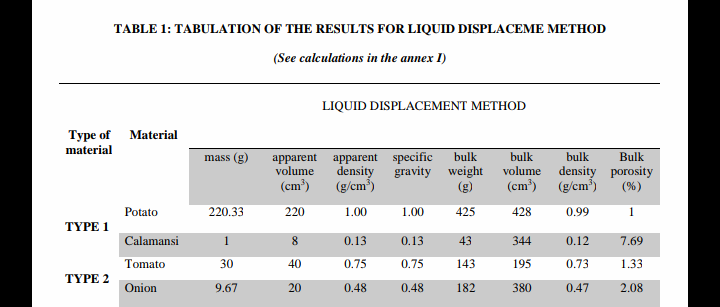
The data collection of the physical properties of the Potato, Calamansi, Tomato, and Onion which includes its apparent volume, apparent density, specific gravity, bulk volume, bulk density and bulk porosity was determined using the liquid displacement method and solid displacement method. The results were tabulated and discussed.
Table 1 shows the tabulated results for the physical properties of potato, calamansi, tomato, and onion using the liquid displacement method. It shows that the potato with the mass of 220.33 grams has an apparent volume of 220 cc, an apparent density of 1 g/cc and a specific gravity of 1. The larger quantity of the sample potato with a bulk weight of 425 g, has a bulk volume of 428 cc, a bulk density of 0.99 g/cc and a bulk porosity of 1%. The sample calamansi of 1 g has an apparent volume of 8 cc, an apparent density of 0.13 g/cc and a specific gravity of 0.13. The larger quantity of the sample calamansi with a bulk weight of 43 g, has a bulk volume of 344 cc, a bulk density of 0.12 g/cc and a bulk porosity of 7.69%. The sample Tomato of 30 g has an apparent volume of 40 cc, an apparent density of 0.75 g/cc and a specific gravity of 0.75. The larger quantity of the sample calamansi with a bulk weight of 143g, has a bulk volume of 195 cc, a bulk density of 0.73 g/cc and a bulk porosity of 1.33%. And the sample Onion of 9.67 g has an apparent volume of 20 cc, an apparent density of 0.48 g/cc and a specific gravity of 0.48. The larger quantity of the sample calamansi with a bulk weight of 182g, has a bulk volume of 380 cc, a bulk density of 0.47 g/cc and a bulk porosity of 2.08%.
Table 2 shows the tabulated results for the physical properties of potato, calamansi, tomato, and onion using the solid displacement method. It shows that the potato with the mass of 220.33 grams has an apparent volume of 250 cc, an apparent density of 0.88 g/cc and a specific gravity of 0.54. The larger quantity of the sample potato with a bulk weight of 425 g, has a bulk volume of 488.75 cc, a bulk density of 0.87 g/cc and a bulk porosity of 1.14%. The sample calamansi of 1 g has an apparent volume of 10 cc, an apparent density of 0.10 g/cc and a specific gravity of 0.06. The larger quantity of the sample calamansi with a bulk weight of 43 g, has a bulk volume of 465 cc, a bulk density of 0.09 g/cc and a bulk porosity of 10%. The sample Tomato of 30 g has an apparent volume of 100 cc, an apparent density of 0.30 g/cc and a specific gravity of 0.18. The larger quantity of the sample calamansi with a bulk weight of 143g, has a bulk volume of 489 cc, a bulk density of 0.29 g/cc and a bulk porosity of 3.33%. And the sample Onion of 9.67 g has an apparent volume of 25 cc, an apparent density of 0.39 g/cc and a specific gravity of 0.24. The larger quantity of the sample calamansi with a bulk weight of 182g, has a bulk volume of 470 cc, a bulk density of 0.38 g/cc and a bulk porosity of 2.56%.
Table 3 shows the tabulated results for apparent volume acquired using the Liquid and Solid Displacement Method. It shows that the apparent volume using SDM is much greater than the apparent volume using LDM.
Table 3.1 shows the tabulated results for apparent density acquired using the Liquid and Solid Displacement Method. It shows that the apparent density using LDM is much greater than the apparent density using SDM.
Table 3.2 shows the tabulated results for specific gravity acquired using the Liquid and Solid Displacement Method. It shows that the specific gravity of the material using LDM is much greater than the specific gravity using SDM.
Table 3.3 shows the tabulated results for bulk volume acquired using the Liquid and Solid Displacement Method. It shows that the bulk volume of the material using SDM is much greater than the bulk volume using LDM.
Table 3.4 shows the tabulated results for bulk density acquired using the Liquid and Solid Displacement Method. It shows that the bulk density of the material using LDM is much greater than the bulk density using SDM.
Table 3.5 shows the tabulated results for bulk porosity acquired using the Liquid and Solid Displacement Method. It shows that the percentage of bulk density of every material using SDM is much greater than the bulk porosity using LDM.
DISCUSSION
The most important data to record is the volume as it will be useful in calculating other physical properties of the sample material. In determining the volume of a sample material, the accuracy for the experiment and data to be record must be apply in order to arrive to a much accurate and desirable result.
Liquid Displacement Method is a method commonly used in determining the volume of irregular shapes sample material. It is originated from Archimedes’ Principle wherein the amount of fluid displaced is directly related to its volume. It is also given that a liquid can occupy the space given in any desired shape container making it easier to measure the volume of an object submerged into it with the help of a cylinder. The volume of a sample with irregular shapes can also be determined by Solid Displacement Method. The smaller the size of the solid sample (glass beads, flour, sand) used in the this method means a way accurate measurement of the data needed for it has the capability to enter into the open pores and fill the open space of the container fully. This method is inexpensive and easy unlike any other method.
The results shows the bigger differences acquired after measuring the volume, density and porosity of the sample materials used in the laboratory activity. The solid displacement method has way bigger data measured compared in the liquid displacement method. This indicates that the sand as the solid sample to measure in solid displacement method is not as fine as liquid that will fill the container together with the sample completely with minimum pore it may have, especially when determining the volume. It is also proven by the Principle of Archimedes that the Liquid Displacement Method is an accurate method in measuring for. In the process of determining the volumes through Liquid Displacement Method and Solid Displacement Method, it is noticeable that the Liquid Displacement Method is more precise than the other method used. Comparing the two method when it comes to measuring the volume of a given sample, you can visibly see that the liquid occupies all the spaces without hallows unlike the sand which has lots of pores inside, which will affect the data of the samples.
Some experimental errors occurs during the laboratory activity, specifically the usage of bigger samples together with the water or sand may overflow in the cylinder when put altogether. To avoid this error, the researcher must identify the dimensions or volume of the container to be used in order to estimate the mass and the quantity of the sample and the liquid or sand, to avoid errors and to get the desirable results needed. It is also advisable to use a finer material for the solid sample to have an accurate measurements.
CONCLUSION
After the laboratory experiment was conducted, the following conclusions are drawn:
The volume, density and porosity of the chosen commodity were determine using the Liquid Displacement Method and Solid Displacement Method during the laboratory activity. For each method, two (2) sample of each type of material (Type 1- heavier than water and Type 2-lighter than water) were used. For Type 1 (heavier than water) commodity, the Potato with mass of 220.33 acquired a volume using LDM of 220 cc while 250 cc using SDM, 1.00 g/cc for LDM and 0.88 g/cc for SDM density and 1 % for LDM and 1.14 % for SDM bulk porosity. Calamansi on the other hand with a mass of 1 g acquired a volume using LDM of 8 cc while 10 cc for SDM, 0.13 g/cc for LDM and 0.10 for SDM density and 7.69% for LDM and 10 % for SDM bulk porosity. For Type 2 (lighter than water) commodity, the tomato with a mass of 30 g acquired a volume using LDM of 40 cc while 100 cc for SDM, density using LDM of 0.75 g/cc and 0.30 g/cc for SDM and 1.33 % bulk porosity. The onion on the other hand with a mass of 9.67 g, acquired a volume using LDM of volume of 20 cc and 25 cc for SDM, density of 0.48 g/cc for LDM and 0.39 g/cc for SDM and 2.08 % for LDM and 2.56 % for SDM bulk porosity.
Liquid Displacement Method is the most precise method used in determining the physical properties of the samples as it was proven by the Archimedes’ Principle where the amount of fluid displaced is directly related to its volume, compared to the Solid Displacement Method in which its particles are not as fine as liquid that will fill the container together with the sample completely with minimum pores it may have or better without pores within its particle, during the determination of the volume.
Limitations were identified and concluded during the laboratory activity conducted in determining the volume of the sample for two methods. Bigger samples together with water or sand may cause overflow from the cylinder, it should be noted that the estimation for the amount to be used shall not exceed the highest volume calibrated in the cylinder. It is also advisable in the solid displacement method to use a finer material that that will fill the container fully than the sand to have a more accurate measurements.
Its cooking time! I'm so proud of myself that I finished all the three activities before the deadlines. Huhuhuhu now its time for my self care. Gonna cook for myself. Good evening everyone! Stay safe😉
Determination of Physical Properties of AB Materials Mass, Volume, Density AND Porosity
METHODOLOGY
This section enumerate and discusses the research methods used in the Determination of Physical Properties of AB Materials – Mass, Volume, Density and Porosity. It provides information on the data collected, wherein it is the criteria inclusion of the study. This section also discusses the methods used to analyze the data.
MATERIALS
Cylinder
Graduated cylinder
Weighing scale
Sand
Container
Calculator
Tabulation sheet or any paper
Pen
PROCEDURE:
In conducting a laboratory activity, the materials, tools and instruments to be used shall be borrowed and prepared prior to the day of the experiment. Prepare at least two (2) sample in each type of AB materials available in your community, type 1 are the materials that is heavier than water and type 2 for the materials that is lighter than water (NOTE: Prepare a larger quantity of two (2) sample of each type of AB materials you selected for the measuring of the bulk volume, bulk density and bulk porosity). Prepare the tabulations sheets for the displacement method’s data needed. Use a weighing scale to measure the mass for three (3) trials of each sample of the AB materials and get the mean. Tabulate the result acquired and use this information for the determination of the other physical properties of your sample.
**Liquid Displacement Method**
FOR APPARENT VOLUME
In determining the apparent volume of the material, prepare the cylinder and put it in a flat surface where you can read the measurement in eye level. Pour water from a container into a cylinder until it reaches a height that will cover the sample. Record the level of water. Note that this is the "initial water level" (The surface of water in a tube may not be completely flat. Instead, the surface may curve in a shallow U-shape called the meniscus. When measuring, read the line just at the bottom of the meniscus). Tilt the graduated cylinder and slowly slide the sample into the water. Place the graduated cylinder upright on the table. If the sample floats (type 2- lighter than water sample), use a pencil to gently push the top of the sample just under the surface of the water. Record the level of the water. Note that this is the “final water level.”
Subtract the initial water level from the final water level to find the volume of the sample AB Materials. (Volume of the sample = Final water level - Initial water level).
Note: “1 mL = 1 cm3”. The unit for volume in the graduated cylinder is milliliters (mL), so you can simply change the unit to cubic centimeters (cm3).
FOR APPARENT DENSITY
From the tabulated results, look for the mass and volume of your sample AB materials. Use this data to calculate for the density and record the density in (g/cm3)
FOR SPECIFIC GRAVITY
After getting the density of the samples of AB materials, calculate the specific gravity of the sample . The density of the object is divided by the density of water (Note: The specific gravity of water is 1g/cm3).
BULK VOLUME
Prepare a larger quantity of two samples for each type of the AB materials you selected. (A larger quantity that is just enough for the water not to overflow at the cylinder when put together.) Using a more accurate weighing scale measure the mass for three (3) trials of the larger quantity of each sample of the AB materials and get the mean. The results acquired can be use in the determination of the other physical properties of your sample. Prepare the cylinder and put it in a flat surface where you can read the measurement in eye level. Pour water from a container into a cylinder until it reaches a height that will cover the sample. Record the level of water. Note that this is the "initial water level".
Note: The surface of water in a tube may not be completely flat. Instead, the surface may curve in a shallow U-shape called the meniscus. When measuring, read the line just at the bottom of the meniscus.
Tilt the graduated cylinder and slowly slide each of the larger quantity sample into the water. Place the graduated cylinder upright on the table. If the sample floats (type 2- lighter than water sample), use a pencil to gently push the top of the sample just under the surface of the water. Record the level of the water. Note that this is the “final water level.”
Subtract the initial water level from the final water level to find the volume of the larger quantity of the sample AB Materials. (Volume of the larger quantity sample = Final water level -Initial water level).
Note: “1 mL = 1 cm3”. The unit for volume in the graduated cylinder is milliliters (mL), so you can simply change the unit to cubic centimeters (cm3)
BULK DENSITY
From the tabulated results get the mass and volume of the larger quantity of the sample AB material, calculate the density using the formula, ρbulk =Bulk Weight/Vbulk and record the density in g/cm3.
BULK POROSITY
Get the apparent density and bulk density from the previous calculations you've done then calculate the bulk porosity using the formula, εB =( 1 −ρbulk/ρapparent)x 100.
Solid Displacement Method
FOR APPARENT VOLUME
First, fill the cylinder with sand of enough volume that will cover the size of the sample uniformly through tapping and smoothing the surface with a ruler. Record the volume as initial volume.
Note: Measurement will only be done until the constant weight of its desired volume is reach between the consecutive measurements. See to it that the volume of the sand and the sample is just enough not to overflow in the cylinder.
Then, place the sample and sand together in another cylinder. Tap and smoothen the surface with a ruler. Then record the volume and put it as the final volume. Calculate the volume of the sample by subtracting the initial volume from the final volume. (Volume of the sample= Final Volume-Initial Volume)
FOR APPARENT DENSITY
Get the mass and the volume of the sample AB material from the previous calculation you've made. Calculate the apparent density of the sample using the formula, and record the Density in g/cm3.
FOR SPECIFIC GRAVITY
After getting the density of the samples of AB materials, calculate the specific gravity of the sample using the formula ,
Note: The specific gravity of sand is 1.631 g/cm3
FOR BULK VOLUME
Prepare the larger quantity of the two (2) sample of each type (type1- heavier than water; type 2- lighter than water) of the AB materials you selected. Fill a cylinder of enough volume that will cover the larger quantity size of the sample with sand uniformly through tapping and smoothing the surface with a ruler. Record the volume as initial volume.
Note: Measurement will only be done until the constant weight of its desired volume is reach between the consecutive measurements. Also, see to it that the volume of the sand and the larger quantity of the sample is just enough not to overflow in the cylinder.
Then, prepare another cylinder with the same volume to transfer the commodity and sand. Tap and smoothen the surface with a ruler. Then record the volume and put it as the final volume. Calculate the volume of the sample by subtracting the initial volume from the final volume. (Volume of the sample= Final Volume-Initial Volume)
BULK DENSITY
From the tabulated results get the mass and volume of the larger quantity of the sample AB materials, calculate the density using the formula, and record the density in g/cm3
BULK POROSITY
Get the apparent density and bulk density from the previous calculations you've done. Calculate the bulk porosity using the formula.

Good morning everyone! I'm sorry I wasnt able to publish new articles as I am still busy with some academic stuffs, but I'll make sure to give you an update as soon as I finish all of the school tasks. Gotta go now! Need to work to meet the deadline 😁
Have a nice day ahead everyone!
Scientific Revolutions
The **scientific revolution** refers to the resurrection of modern-day science. It was the emergence of modern science during the early modern period, when developments in mathematics, physics, astronomy, biology (including human anatomy), and chemistry transformed societal views about nature. The Scientific Revolution is a complicated and twisted term upon whose specific periods and actors nobody agrees upon. Some scientists andhistorians have managed to create their version of the revolution, with their proofs of various events. The scientific revolution began in Europe toward the end of the Renaissance period, and continued through the late 18th century, influencing the intellectual social movement known as the Enlightenment. While its dates are disputed, the publication in 1543 of Nicolaus Copernicus‘s De revolutionibus orbium coelestium (On the Revolutions of the Heavenly Spheres) is often cited as marking the beginning of the scientific revolution.
The "Scientific Revolution" started with Nicholas Copernicus (1473-1543), who asserted a heliocentric (sun-centered) cosmos and ended with Isaac Newton (1642-1727), who proposed universal laws and a Mechanical Universe. It refers to historical changes in thought & belief, to changes in social & institutional organization that unfolded in Europe between roughly 1550-1700.
The Scientific Revolution, and science itself, has been criticized by many since it is unclear, undefinable making it hard to understand about its origin and nature. But because it is still ill-defined to everyone, the society came to learn more about its significance in an endless expanse of space. Previous existing knowledge is almost inconceivable, became a functional reality because of The Scientific Revolution. The period saw a fundamental transformation in scientific ideas across mathematics, physics, astronomy, and biology in institutions supporting the scientific investigation and in the more widely held picture of the universe. The Scientific Revolution, which led to the establishment of several modern sciences, emphasized systematic experimentation as the most valid research method, resulted in developments in mathematics, physics, astronomy, biology, and chemistry. These developments transformed the views of society about nature.
Some pointers happened during **scientific revolution**
*The pre- mechanical age is the age inwhich there were no kinds of computer systems.*
*Mayan are considered one of most scientifically advanced societies in Mesoamerica.*
*According to Copernicus, the sun is the center of the solar system.*
*The Copernican Revolution introduced the concept of Heliocentrism.*
*Charles Darwin published the book entitled The Origin of Species.*
*Intellectual Revolutions stressed a*
*perception of nature that resembles our own understanding of science that is socially acceptable.*
*Muhammad Ibn Musa Al. Khwarizmi founded th “ailabr” which is also*
*known as Algebra.*
*Intellectual Revolutions are often met with huge support and general*
*acceptance.*
*Ayurveda, is a traditional INDIAN MEDICINE*
*The Darwinian Revolution contribution changed the way people*
*understood nature and evolution.*
Obligations and Contract
A body of rules that deals with the nature and sources of obligations as well as the rights and duties arising from agreements in contracts is also well known as **The Law on Obligations and Contracts**. To fully understand the context, below are some layman's definitions of the terms that will be used in the context.
**Law** is a rule promulgated by the authority that states the conduct, just and obligatory, for common observance and benefit. On the other hand, a **contract** is a written or spoken agreement that binds two persons by either asking or rendering of services and is intended to be enforceable by law. And **obligation** is a legal duty, an act or course of action to which a person is morally or legally bound; a duty or commitment.
The existence of obligations will be impossible without its **four elements**, the obligee or creditor, the debtor, an object or the prestation, and the juridical or legal tie.
a) an active subject, also known as the obligee or creditor, who has the power to demand the prestation;
b) a passive subject, also known as the debtor, who is bound to perform the prestation;
c) An object or the prestation, which is an object or undertaking to give, to do or not todo;
d) The juridical or legal tie, the vinculum which binds the contracting parties.
The **nature and effects of obligation** go like this: If the obligations to give is a determinate thing (uses usually on sales)in which, it is particularly designed or physically segregated from all others of the same class, the creditor must have the rights to compel specific performance, recover damages in case of a breach, acquires a personal right to the fruits of the thing from the time the obligation to deliver arises, acquires real right over the thing once the thing has been delivered to him and rights over the accessories and accessions. But if the obligations are a generic thing (commonly uses in loans) on which one whose determination is confined to that of its nature, to the genus to which it pertains such as a horse, a chair. The creditor must ask for performance of the obligation and ask that the obligation be complied with at the expense of the debtor. As a passive subject, you are obligated but is not forced to give a determinate thing - you must comply with some obligations, as stated in the Law of Obligations and Contract to avoid conflicts and misunderstanding that might lead to legal charges if necessary. Obligations to do includes:
a. If the debtor fails to do what he is obliged to do, it will be done at his expense.
b. If the work is done in contravention of the tenor of the obligation, it will be re-done at the debtor‘s expense.
c. If the work is poorly done, it will be re-done at the debtor‘s expense.
The sources of liability (for damages) of a party in an obligation are as follows:
(1) **Fraud**. In fraud, there is an intent to evade the normal fulfillment of the obligation and to cause damage. This kind of fraud is a ground for annulment of the contract plus damages;
(2) **Negligence**. The negligence referred here is the lack of diligence or carelessness. Negligence consists in the omission of that diligence which is required by the nature of the obligation and corresponds with the circumstances of the persons, or the time and of the place.
(3) **Delay (Mora).** The debtor can be held liable for the delay or default in the fulfillment of his obligation only after the creditor has made a demand, judicial or extrajudicial, on the debtor.
(4) **Contravention of the tenor of the obligation.** Performance in contravention of the tenor or terms of the obligations means where performance is contrary to what is agreed upon or stipulated thus making the debtor liable for damages.
A **simple contract** is an agreement that can be an oral or written type is made by two parties. There must be an offer, consideration, and acceptance to make it valid.
Classification of Contracts may differ according to:
Formation and can be classified as an express contract if the terms of a contract are expressly agreed upon between the parties; implied contracts which the proposal is made otherwise than words; and quasi-contract in which it arises not by agreement but by the operations of law.
Performance and can be classified as a unilateral contract or the one-sided contract; and a bilateral contract where a promise on one side is exchanged for a promise on the other.
Execution and can be classified by executed Contract when both the parties to contract have performed their share of the obligation; and Executory Contract which is either wholly unperformed or something remains in there to be done by both the parties to contract.
Other Contracts Besides the above-said classification is the Contingent Contract which is collateral to do or not to do something, if some event collateral to such contract, does or does not happen.
A **legal contract** is an agreement between two parties that creates mutual, legally enforceable obligations. Contracts are typically in writing and signed to prove all of the six essential elements stated below:
The “offer” is the promise one party makes to pay the other for their services. It often includes other terms and conditions, such as the graphic designer giving up the copyright to the logo.
Acceptance is when the other party agrees to perform the task for the compensation specified in the contract.
“Mutual assent” is the combination of a valid offer and acceptance between the parties. A signed contract proves mutual assent.
Exchanging items of value “Consideration” is what is paid in exchange for goods or services.
In contract law, “capacity” is the presumed ability of a person to understand the terms, obligations, and consequences of signing a contract. To be legal, the contract must adhere to the law in the jurisdiction where it’s signed.
A contract doesn’t have to be written to be binding if all six elements — offer, acceptance, mutual assent, consideration, capacity, and legality — can be demonstrated but, in many circumstances, a written contract is required to enforce terms in court.
**Form of Contracts** can be in any form because they are consensual, except, real. Contracts are perfected not by mere consent but by delivery and some contracts can be void if it is not in written form as required by the memorandum to be enforced.
**Defective contracts** are those which may be relatively ineffective concerning certain parties. Two kinds of defective contracts are Rescissible Contracts and Voidable Contracts.
Typical grounds for a contract being voidable include coercion, undue influence, misrepresentation, or fraud. Other examples would be real estate contracts, lawyer contracts, etc. When a contract is entered into without the free consent of the party, it is considered a voidable contract.
**Rule when a determinate thing is lost through a fortuitous event**: The obligation is extinguished and the debtor is not liable, except:
a) When to object is generic
b) When the debtors incurs in delay
c) When the law or contract expressly provides that the obligation will not be extinguished.
**Two classifications of Obligations** were stated under the Civil Code of the Philippines mainly, the **primary** and **secondary** classifications. The primary classification of obligations includes pure and conditional obligations (Articles 1179-1192) which are not subject to any condition and no specific date is mentioned for its fulfillment and is, therefore, immediately demandable. Obligations with a period (Articles 1193-1198) is one whose consequences are subject in one way or another to the expiration of the said period or term. Alternative (1199-1205) and facultative obligations (Article 1206), joint are those where, although there concur two or more creditors and debtors, in one and the same obligation, there is no right to demand nor a duty on the part of each of the latter to render entire compliance of the entire obligation, and solidary obligations are those in which concur several debtors or creditors or both, and where each creditor has the right to demand, and each debtor is bound to perform, in its entirety, the prestation constituting the object of the obligation(Articles 1207-1222). Divisible and indivisible obligations (Articles 1223-1225) and Obligations with a penal clause (Articles 1226-1230) which contains an accessory obligation imposing upon the obligor added burdens or which operates as a previously stipulated indemnity, for the purpose of securing the performance of the principal obligation. On the other hand, the secondary classification of obligations includes unilateral and bilateral obligations (Articles 1169-1191); real and personal obligations (Articles 1163-1168); civil and natural obligations (Articles 1423); and legal, conventional, and penal obligations (Articles 1157, 1159, 1161).
References:
Carpio-Aldeguer (2014). Law on Obligations and Contracts in the Philippines. Far Eastern University Institute of Accounts, Business & Finance

Good evening everyone! I badly need your opinion, hahahhaa this is not so urgent or maybe?
I wanted to write again stories using my imagination and not relating to common issues in my surrounding, but I dont know if its okay with you or what,
What do you think?
Mechanization
In the Philippines, the transfer of agricultural mechanization technology has been a very slow process. The level of agricultural mechanization in the country was mostly dependent on human and animal power. But multitude of machinery have already been imported for adoption. However, these machines were designed to favor large contiguous hectares of land and were then utilized solely by big farm enterprises. This adoption of machineries are only to those who can afford new technologies in farming such as corporations in order to generate more products and generate income.
With the continued technology generation and the growing capability of our local Machinery manufacturers, we then tried designing and adapting small imported machinery, equipment, and other technology to suit our own needs and conditions. These proved to be an effective means of increasing the level of machinery use in the farms and gave birth to the concept of “appropriate technology” or in our special case, “appropriate agricultural mechanization technology.” This has been a catch-all phrase for all agricultural tools, machines, and implements that are simple, cheap, and can be Locally serviced or manufactured.
The very existential question now is how about those farmers belong to the marginalized sectors who cannot afford to purchase farming equipment which is common in our current scenario?
The Philippine government has long been striving to achieve modernization of the rural sector. To date, the latest major enactment by the government is the Republic Act (R.A.) 8435 of 1997, popularly known as the Agriculture and Fisheries Modernization Act (AFMA). It prescribes urgent related measures to modernize the agriculture and fisheries sectors of the country in order to enhance profitability and to prepare for the challenges brought about by globalization. Section 59 of this Act gives priority to the development and promotion of appropriate agricultural machinery and other agricultural mechanization technologies to enhance agricultural mechanization in the country.
In this case, only few have an access to this privilege and still majority of farmers in the Philippines are scarce to utilize advance technologies and not all rural areas have the means to provide these technologies because of poor linkage to other agencies that will aid them in their agricultural production and development.
Moreover, there are no suitable and accessible farming equipment in other rural areas because of its distance and no accessible roads in which majority of the farmers own a small land. According to Salokhe (2003), the main criteria which should be considered during the development are that these machines should be suitable for use in small farms, easily repairable and maintainable, inexpensive, and environmentally friendly. The word “appropriate” should be interpreted as appropriate to the farmers in terms of their needs and affordability.
Aside from inaccessibility to small-owned land, poor linkage to other agencies, and no access to farm equipment, there are still barriers to farmers that will their products at stake. The availability of pesticides and fertilizers and farm manpower in maneuvering farm equipment.
In the Philippine scenario, which majority of farmers belong to the low poverty threshold, few of them especially those farmers who are in remote rural areas cannot afford for pesticides and fertilizers.
According to Presidential Decree No. 1144 other known as Creating the Fertilizer and Pesticides Authority and abolishing the Fertilizer Industry Authority for the purpose of assuring the agricultural sector of adequate supplies of fertilizer and pesticide at reasonable prices, rationalizing the manufacture and marketing of fertilizer, protecting the public from the risks inherent in the use of pesticides, and educating the agricultural sector in the use of these inputs.
As a country where political division is a norm, though this Presidential Decree No. 1144 is implemented in the country, there are still areas in the Philippines especially remote rural areas do not have an access to this due to limited sources and information and institutional weaknesses because of failure to proper dissemination of fertilizers and pesticides because of political affiliation. According to Paras, F. Jr., and Amongo, R. M. (2007), Information is the key to making sound decisions. Some farmers are unaware of the availability of a suitable machine, tool, or implement that could aid in their usually tedious work. They might be secluded from the technology by natural barriers and sociopolitical boundaries. Sadly enough, some farmers are even lackadaisical and seemingly uninterested in mechanization.
In the process of technological advancement in addressing agricultural problems and barriers, it is imperative to solve the existing issues. It is always important to tackle this internal problems first before advancing or taking another step. Poor farmers, limited sources and information, institutional weaknesses, and technological manpower must be eradicated in the Philippine scenario. These are the main cause why Philippine agricultural aspects have poor production of goods to supply the country and good to be imported.
The government must continuously support the farmers belong to marginalized sectors in terms of information dissemination that will provide them knowledge about agriculture. Government should provide seminars and orientation on proper machination to empower majority of farmers in the Philippines. Limited sources of information will result to poor production.
One thing that also hinder them is the failure of supply of fertilizers and pesticides that will be utilized in the production of goods. It should be properly distributed. The government and other agencies must work on this. There supplies from the government but farmers do not know how it works and how it will apply.
Technological manpower is another prevailing issues when it comes to agricultural aspects due to poor linkage with agencies. Though government has provided agricultural areas with technologies still there are farmers incapable of manifesting the equipment. There should also a proper orientation for it. Government may even hire an employee to oversee and guide the farmers. There is no sense in developing machines that nobody is using.
Further, there is also a technology verification and assessment that would permit evaluation for developing, modifying, or entirely stopping the development of a technology. For instance, technology adoption assessment was conducted for the UPLB hand tractor. The study established the potential of the technology and revealed possible modifications to further enhance its performance and acceptability. It also revealed that locally trained manufacturers lacked some knowledge in marketing strategies (Paras et al. 2004).
Lastly, Institutional weakness. Socio-political issues still divide us from local to upper level. This is the main reason why Philippines belong to one of the poorest countries in the world, and listed as one of the corrupt countries. The result will certainly bounce back to the local and marginalized sectors who suffered directly because of this.
Finally, proper mechanization of the Philippine farm is imperative in order to create proper milieu for farmers and to sustain the needs of the agricultural sectors. If properly addressed, this will certainly generate more products and will alleviate the economy of the Philippines. The problems must be solved so we can take another step to a more advanced innovation.
After uncovering the barriers surrounding the transfer of small farm mechanization technology and citing possible strategies to break down these barriers, what is needed now is the implementation of the strategies that were suggested.
The commitment of all the stakeholders to uplift the conditions in our small farms through appropriate mechanization schemes can be our starting point. This will definitely be a long ride but from here on, we will only progress and realize our goal if we will all cooperate and accept responsibilities and be accountable to the farmers who need our help.
References:
Agricultural Mechanization Development Program (AMDP). 2002. AMDP brochure. Institute of Agricultural Engineering, College of Engineering and Agro-Industrial Technology, University of the Philippines Los Baños. Fertilizer and Pesticides Authority. (2005). Presidential Decree No. 1144. Retrieved at http://fpa.da.gov.ph/index.php/about-us-momo/policies-laws-and regulation-momo/pd-1144-momo http://fpa.da.gov.ph/index.php/about-us-momo/policies-laws-and-
Paras, F. Jr., and Amongo, R. M. (2007). Technology Transfer Strategies for Small Farm Mechanization Technologies in the Philippines. Retrieved at https://www.fftc.org.tw/htmlarea_file/library/20110726161100/eb570.pdf
Paras, F. O. Jr.; B.L. Paita; A.A. Blastique. (2004). Technology adoption assessment: the case of the UPLB differential type hand tractor. Mechanization Update. Agricultural Mechanization Development Program 10,2:4.
Salokhe, V.M. and A. Oida. (2003). Development of appropriate agricultural machinery for Southeast Asian countries. Laboratory of Agricultural Systems Engineering. Retrieved 16 April 2005 www.fsao.kais.kyoto-u.ac.jp/ guest_prof/Salokhe_report.pdf

Why now? I still have a lot of paper works to do. Huhuhuhu but my laptop's screen suddenly turn black. What should I do? Anyone? Badly need help
"Keep moving forward, everyone is supporting and waiting for your success. Fighting!"
Good afternoon everyone! Pleas be safe and happy always. gotta go now. see you later.
Existing technologies for Sweet Potato
**Existing post-harvest processing practices for Sweet Potato**
Traditional processes have evolved over the years that yield a higher quality of crop for industrial and domestic uses. Some of the usual methods being practice in many areas due to low cost and ease management are washing of roots using bare hands in running water and drying under the sun or field drying.
Sweet potato roots are bulky and perishable unless cured. This limits the distance over which sweet potato can be transported economically. It was established that in cases where countries are capable of generating a surplus, it tends to be relatively localized but dispersed and this leads to a lack of market integration and limits market size (Katan and De Roos, 2004; FAO, 2011). It was reported by Fellows (2000) that food processing entails combined procedures to achieve intended changes to the raw material and the processing technologies in the food industry. The processing is subdivided into two main groups:
1. Processing of foods with non-thermal methods (Lebovka et al., 2004, 2007) such as high-pressure processing, pulsed electric field (PEF), electronic beams, and
2. Processing of foods with the application of heat (Yadav et al., 2006; Leeratanarak et al., 2006; Ahmed et al., 2010; Fernando et al., 2011; Singh and Pandey, 2012) such as blanching, pasteurization, sterilization, evaporation or concentration, drying or dehydration, microwave, and infra-red heating.
Processing by application of heat that can be used in product development from sweet potato can be carried out using four methods including:
1. Heat processing with the use of hot air e.g. dehydration, baking, roasting (Ahmed et al., 2010; Doymaz, 2012).
2. Heat processing with the use of water or steam e.g. blanching, pasteurization (Fernando et al., 2011).
3. Heat processing with the use of hot oils e.g. frying (Troncoso et al., 2009).
4. Heat processing using radiated and direct energy e.g. ohmic heating, dielectric heating, infrared heating (Zhong and Lima, 2003; Brinley et al., 2008; Wang et al., 2010).
The research in sweet potato processing has established the fact that there is a lot more in sweet potatoes than starch. Available evidence suggests that postharvest processing and subsequent storage of sweet potatoes need further research to explore the ways by which the new cultivars could be used for industrial and export purposes in countries producing sweet potato. Based on this review, future studies of the combined effects of blanching and/or freezing pre-treatments with higher drying temperature, determination of moisture diffusivity, and activation energy during different drying conditions are recommended. (OKE and WORKNEH, 2013)
Root crop washer was designed by Ghuman et al. in 2014. During the testing against the laborers in the agricultural field, the machine is more efficient than the traditional approach used. The testing done was given the same quantity of harvested crops and the time taken was noted corresponding to the number of root crops washed by each of them but further modification is still needed for this washer.
Solar radiation can be highly effective and utilized for the drying of agricultural products in our environment if the proper design is carried out. With this, Gupta et al in 2017 designed and constructed a solar dryer for drying agricultural products. This was demonstrated and the solar dryer designed and constructed expressed sufficient ability to dry agricultural products most especially food items to an appreciably reduced moisture level. Apart from this, solar energy is required for its operation which is readily available in the tropics, and it is also a clean type of energy. It protects the environment and consumes cost and time spent on open sun drying of agricultural produce since it dries food items faster. The food items are also well protected in the solar dryer than in the open sun, thus reducing the case of pest and insect attack and also contamination.
**Tools and equipment being used**
Tools and equipment are used to make planting easier for sweet potatoes and other crops, it is also made to ensure the quality of the crop during the post-harvest and harvesting period. Below are some tools and equipment used for sweet potato.
Small-scale growers lacking access to tractors with middle-busters or hillers can make planting ridges using hiller/furrower attachments on their rototillers or walk-behind tractors. Wheel hoes can also be an alternative tractor or rototiller implements to use, with the proper implements, it can make modest-but-adequate ridges
Sweet potato slips are hardy. Some growers simply drop them on the ground and push the rooting end into the soil with a stick. Methods such as this eliminate stooping. A transplanter is a well-constructed tool. Using a belt-pouch or pocket to carry slips, one person can do the transplanting task alone, without stooping. However, it is better-suited to two-person operation— one person handling the transplanter; one dropping the slips into the chute, and covering the roots.
Such non-motorized hand tools also easily dodge around vines that are growing into the inter-row area. In three seasons of sweet potato trials, cultivation was done with a wheel hoe, followed later by a light hoeing and a bit of hand-pulling to get a few weeds.
Plows used to dig sweet potatoes. ―The long vines must be first disposed of. They are usually pulled by running a plow on each side of the row. This work is done much more satisfactorily if the line of plants be barred off with a turn-plow, to the beam of which is attached a rolling coulter, which cuts the vines close to the row.‖ —Dugger 1911
The Yield Max Gen. II Short Digger is the ultimate machine for the harvesting of sweet potatoes and other root crops. Gentle crop handling is the result of careful design and engineering. Adjustable shakers, variable speed hydraulic driven chains, and very short end drop are but a few of its features. This machines leaves nothing in the ground, but leaves your crop gently place on top of the ground for harvesting.
This machine is the ultimate tool for grooming and maintaining plant height. The special designed housing creates a strong vacuum that lifts plants upward before cutting. Blow-down or twisting plant tops, common problems with other mowers, are completely eliminated with this mower. All plant debris is caught in a collection system; no residue falls back on the plants, thereby reducing disease problems. The collection system dumps hydraulically from the tractor seat.
This machine was designed to provide sweet potato growers an economical means to cut potato plants from the plant beds with a minimum amount of labor.
References:
Kueper G. Small-scale Technology and Practices for Sweet Potato Growing in Southeast Oklahoma. Retrieved from https://kerrcenter.com/wp-content/uploads/2014/03/Sweet-potato-equipment-report-2014.pdf
Oke M.O and Workneh T.S. A review on sweet potato post-harvest processing and preservation technology. Retrieved from https://academicjournals.org/article/article1381917124_Oke%20and%20Workneh.pdf
"Words can kill, be cautious of what you speak."
Good afternoon everyone! So I was supposed to post some articles but, I am tired, and I need to rest first as we have activities that are due tomorrow. Please do pray for my safety as I am now staying in the dormitory.
I hope all is good and well. See you soonest! Babush.
Lessons
In life, we tend to do things without receiving any reward or gift. We sometimes offer our effort just to satisfy their wants and needs. The characteristics of a certain person must have, working hard without wanting for an exchange. According to Mr. Robert T. Kiyosaki the writer of Rich Dad, Poor Dad, he tells that to be able to achieve your goals in life you must learn how to work for free. At first, I didn’t understand the meaning behind those phrase. It’s hard because I never experience that kind of situation. But as of December 6, 2017 at PNB Daraga branch, I started to understand it, at the first day of my work immersion.
Last December 6, 2017, Adrian, Joshua, Lourdes and I were sent to work for free in Philippine National Bank in Daraga, Albay. Actually for me, working at the bank is not for free since we’ll get high grades if we do well in our work. As we enter the bank, all of my confidence dries up. I felt my hands shaking as our adviser, Mr. Al Econar introduce us to the manager and staffs of the bank. I was imagining things that time. I keep on thinking if this will work or not. But then I set it aside as we do our work. This work immersion last only for 10 days (approximately 80 hours). We need to fill those hours to complete our work immersion. In a short period of time, I’ve learned and achieved new things while working in the bank, like scanning and recording of different transaction receipts, folding of papers for cash bundles, sorting of daily transaction receipts, arranging of accounts alphabetically and numerically, filing of accounts and last, the greatest achievement of mine during our work immersion is to count the money deposited by their client. We also do cash bundling and sorting of deposited money because according to our co-worker there are some fake money included so we need to check on it. I guess I counted almost Php.200, 000. The atmosphere in their workplace is nice, some employees were jolly and some were serious. I like it when the assistant manager talk to us like we’re just at the same age. She jokes around, ask questions and commands in a nice way. I also experience encoding a business transaction letter. It was an honor for me since it was ordered by the manager of the bank. Before achieving every goals there are difficulties we need to face. In my situation, my difficulties during work immersion were sleeping late at night resulting for me to wake up late but since I move faster than a rabbit, I'm always on time during my work immersion. And I'm happy since I finished it while practicing punctuality.
Working hard for free is like studying, you do it because you love and need it. And I, a future lawyer and accountant truly understand what Mr. Kiyosaki meant in his words.
This was my work Immersion diary during my senior years. Hahahaha look at me now, I am an ABE student and I am proud to be one.
Maybe soon I will pursue those profession but for now, I wanna explore and learn new things in this track.
Let us all trust the process according to God's plan. Good evening!


Science and Technology
*Importance of Science and Technology*
Technology and science are important in our era as it gives us more knowledge of all existing things. Science deals with everything we see, do, or touch. It has the power to rule on things as it was the origin of everything. Technology, on the other hand, is an escape for us to make our lives easier than before, hence, that is one of the reasons why there is always innovation. It is therefore important to understand and be knowledgeable of its origin or history to be more familiar with how does it start. Studies of technology and science provide students with insight into how different processes of knowledge are initiated and progressed, and how innovative technological processes are developed, employed, and increase in importance.
Science and technology may be partly responsible for the events that we faced today. Both positive and negative effects are visible as science and technology grow and develop. The adversary implications may involve the advancement of weapons, bombs, biochemical and nuclear weapons, which brought us violence amongst ourselves and others. Another implication is human dependencies on technology, such as the internet, computers, cell phones that are not healthy anymore as it makes us all paralyze. The advancement of science and technology may cause pollution in our world. Science and technology also have positive effects that help us work more effectively and efficiently. To be more specific, those abovementioned adversary implications were positive if it was done in a moderate condition. All we need to do is to practice in moderation for us to find the success we were looking for as we use and apply these advancements in our lives.
"Necessity is the mother of all invention" a well-known saying that answers the question on what pushes people to create inventions. Sometimes, people invent things due to the demand of consumers as they thought that there are still ways to turn things simple because society has difficult problems that need solving. A lot of people may agree on this part but actually, it was the reverse scenario because inventions succeed when they do useful jobs that people recognize or notice. And the reasons inventions appear in the first place are not because of just plain "necessity," especially today when we were all satisfied by any number of existing gadgets and machines. The reason why inventions appear is because of scientific breakthroughs. Generally, people who invent are more interested in creating, improving, and advancing human knowledge than in commercializing their discoveries.
**Pre-historic period**
The pre-historic period is the start where they discover that the sun can be a source of energy, and so as fire as t releases heat energy. The first tools from stone, wood, antlers, and bones were also developed, and the earliest boats were constructed.
**Ancient period**
Iron and steel, glass, tools and machines, wheels and axle, digital pens, typewriters, paper, copper alloys, metals, elevators, electricity, hot air balloons, airplanes, Fresnel lenses, compasses, clockwork, turbines, the steam engine, and concrete were discovered and developed during the ancient period.
**Middle Ages**
The middle ages technologies developed were Wind turbines, bullets, fireworks, space rockets, clockworks cams and cranks, robots, lenses, toilets, space rockets, printing, and parachutes.
**16th century**
During the 16th century, some scientists help in developing different technologies. Gerardus Mercator helps to revolutionize navigation with better mapmaking, Dutch spectacle maker named Zacharias Janssen makes the first compound microscope, and Sir John Harington describes one of the first modern flush toilets.
**17th century**
The 17th century is the start to develop things that need a great help from science. In this century, thermometer, magnetism, space telescopes, microscopes, barometer, pendulum clocks, motion, and pianos were discovered and developed.
**18th century**
In the 18th century, tractors began to establish their name on the farming industry. Scientists discovered how does computer work. Steam engines, car engines, metals, satellite navigation, quartz clock and watches, zeolites, speech synthesizers, bridges, pyrometers, hot-air balloons, and titanium were discovered and developed.
**19th century**
In the 19th century, electricity batteries together with electrolyzers, space rockets, xenon lamps, steam engines, Stirling engine, electricity generators, digital cameras, telephones, propellers, fax machine, pasteurization, radio, fire extinguisher, elevators, reinforced concrete, typewriters, wind tunnels, cd and mp3 players, flares, incandescent lamp, and piezoelectricity were discovered, studied and developed.
**2oth century**
The 20th century was the start of science and technology to innovate things to its proper use. Vacuum cleaners, airplanes, chainsaws, air conditioners, robots, refrigerators, Kevlar, lasers, microwave ovens, cellphones, quantum computers, internet world wide web, and wireless internet were developed and still useful even up to the present time.
**21st century**
The 21st century is the time where a lot of innovation in science and technology developed. Apple revolutionizes music listening by unveiling its iPod MP3 music player, Richard Palmer develops energy-absorbing D3O plastic, the Wikipedia online encyclopedia is founded by Larry Sanger and Jimmy Wales, Bram Cohen develop BitTorrent file-sharing, Scott White, Nancy Sottos, and colleagues develop self-healing materials, iRobot Corporation releases the first version of its Roomba® vacuum cleaning robot, electronic voting plays a major part in a controversial US Presidential Electio, Andre Geim and Konstantin Novoselov discover grapheme, a pioneering low-cost laptop for developing countries called OLPC is announced by MIT computing pioneer Nicholas Negroponte, Amazon.com launches its Kindle electronic book (e-book) reader, Apple introduces a touchscreen cellphone called the iPhone, Apple releases its touchscreen tablet computer, the iPad, 3D TV starts to become more widely available, Elon Musk announces "hyperloop"—a giant, pneumatic tube transport system, Supercomputers (the world's fastest computers) are now a mere 30 times less powerful than human brains, Three nanotechnologists win the Nobel Prize in Chemistry for building miniature machines out of molecules, Google claims to have achieved "quantum supremacy"—with a quantum computer that calculates faster than a conventional one.
Beginning
*It all started as you knocked on my heart*
*Just like a door that's unable to open yet full of crack*
*It was hiding because of fear and pain*
*From someone who I thought would never bring me too much rain*
*You stop for a minute, maybe you're thinking*
*Choosing between staying or leaving*
*But hey, you surprised me this time*
*As you choose to stay and bring light to my dark cloud*
*You help me find the missing key*
*The key that would let me set myself free*
*Then you succeeded, you entered my heart*
*You fixed what he broke and bring me back to light*
*We became happy, we laugh so much*
*We cried on movies, silent and sometimes loud*
*We dance on the empty streets, not even afraid of the dark*
*We were so happy, but is happy enough?*
*You showed me the real you*
*The real YOU I wasn't ready to meet*
*The YOU who should be hated and feared*
*Yet here I come still loving you unconditionally*
*I thought it was just a part of you that I didn't see*
*Never have I ever thought it was the whole you who brings chaos and tragedy*
*I should've known or maybe*
*You should know*
*My love is starting to fade*
*My imagination is killing me*
*Seeing you with someone else*
*What hurts most?*
*Having myself is far from reality*
*Cause I know you lost it already*
*I thought you're all I wanted*
*Turns out your just a lesson I must learn*
*It's too late for us*
*Cause I'm falling out of love*
Another work of fiction. Hope you like it. Stay tuned for more updates.


"always seek for the truth, never be blinded by a single lie as it might ruin a big opportunity coming for you."
Good afternoon fam! It was supposedly the day for me to leave in this house but some misinterpretation happened so, it was delayed for a few days.
Anyways, I hope you all doing great. This update is really exciting as a lot of writers/authors here were publishing quality articles and I cant wait to read all of them. See you in the comment section!
 @Yayaya13