 @Tariw3052
Guiding with Love and Logic: A Parent’s Guide to Stress-Free Home Discipline
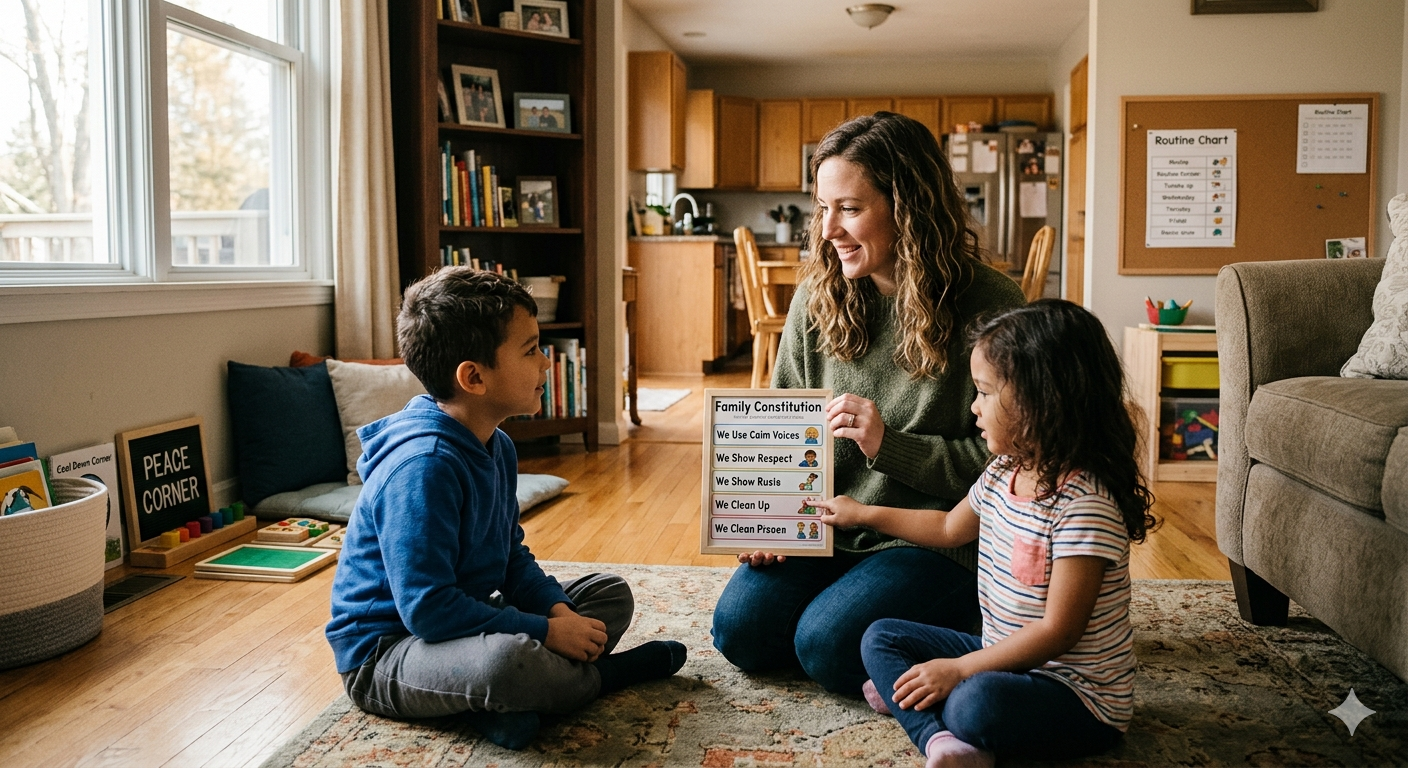
# Guiding with Love and Logic: A Parent’s Guide to Stress-Free Home Discipline Let’s be honest: parenting is one of the most rewarding journeys in life, but it is also one of the most testing. One minute you are sharing a warm, laughing moment with your child, and the next, you are negotiating like a hostage negotiator over a plate of vegetables or a tablet screen. Many of us grew up in households where discipline meant strict obedience, fear, or shouting. Today, we know there is a better, more human way. True discipline isn’t about control, fear, or punishment. The word *discipline* actually comes from the Latin word *disciplina*, which means **"to teach" or "to instruct."** Our goal as parents is to guide our children so they can eventually guide themselves. Here is a comprehensive, practical guide to creating a peaceful, structured, and respectful home environment. ## 1. Shift Your Mindset: Connection Before Correction Before we look at rules or consequences, we have to look at our relationship with our children. Think of your relationship with your child like a bank account. You cannot make a withdrawal (asking for compliance, setting boundaries, or correcting behavior) if you haven't made enough deposits (showing love, spending quality time, and listening). > **The Golden Rule:** A child who feels connected to their parent is naturally more willing to cooperate. When a child is acting out, they are often using their behavior to say, *"I am feeling disconnected, overwhelmed, or unseen."* > ### How to make "deposits": * **The "Golden 10" Minutes:** Spend at least 10 minutes a day of undivided, screen-free time with each child. Let them choose the activity. Be fully present. * **Active Listening:** When they talk to you, put down your phone, look them in the eyes, and listen to understand—not just to reply or correct. * **Separate the Child from the Behavior:** Make sure your child knows you love *them*, even if you do not love their *action*. Instead of saying, *"You are a bad boy for hitting,"* say, *"You are a good kid, but hitting is not okay."* ## 2. Establish Clear Boundaries (The "Family Constitution") Children actually crave boundaries. Rules make the world feel safe, predictable, and fair. When there are no rules, children feel anxious and will constantly push boundaries just to see where the actual walls are. Instead of having dozens of unwritten, confusing rules, sit down as a family and create a simple **Family Constitution**. | **Traditional "Don't" Rules** | **Positive, Actionable Rules** | **Why It Works** | | :--- | :--- | :--- | | "Don't yell!" | **"We use calm, respectful voices."** | Tells the child exactly *how* to behave instead of just what to stop. | | "Stop leaving your mess everywhere!" | **"We clean up one activity before starting another."** | Establishes a clear, logical routine for shared spaces. | | "No hitting!" | **"We keep our hands and feet to ourselves."** | Defines physical safety boundaries clearly and positively. | ## 3. Let Routines Do the Heavy Lifting If you find yourself constantly nagging your child to brush their teeth, do their homework, or put on their shoes, you are carrying too much of the mental load. When you establish a strong, predictable daily routine, **the routine becomes the boss**, not you. Instead of saying, *"Go do your homework right now because I said so,"* you can calmly point out, *"It's 4:00 PM. What does our schedule say we do now?"* ### Creating a friction-free routine: * **The After-School Transition:** Give children a brief transition period (e.g., 30 minutes to eat a snack and unwind) before expecting them to jump into homework. * **Visual Checklists:** For younger children, create a chart with pictures of their morning and bedtime routines. Let them have the satisfaction of checking off each task themselves. * **Predictable Bedtimes:** A tired child is a child who cannot regulate their emotions. Prioritize a consistent wind-down routine (reading, talking quietly, turning off screens an hour before bed) to ensure they get enough sleep. ## 4. Move from Punishment to Logical Consequences Punishment is designed to make a child suffer for their mistake (e.g., "You didn't do your homework, so you can't go to your friend's birthday party"). This breeds resentment and teaches them how to lie to avoid getting caught. **Consequences**, on the other hand, teach responsibility because they are directly linked to the behavior. ``` [ Negative Behavior ] │ ▼ [ Logical Consequence ] │ ▼ [ Learning & Growth ] ``` ### The Three "R"s of Consequences: 1. **Related:** The consequence must relate directly to the behavior. (e.g., *If you break a toy because you threw it, the toy is put away or recycled. It is not replaced.*) 2. **Respectful:** Deliver the consequence calmly, without sarcasm, shouting, or shaming. (e.g., *"I see you are choosing not to turn off the TV. That means we won't have screen time tomorrow."*) 3. **Reasonable:** The consequence should fit the "crime" and be age-appropriate. ## 5. Master the Art of Calming Down Before Speaking Have you ever tried to teach a child a lesson while they were in the middle of a screaming tantrum? It is impossible. When a child is highly emotional (angry, frustrated, crying), their logical brain (the prefrontal cortex) completely shuts down, and their survival brain (the amygdala) takes over. They are in "fight or flight" mode. They physically cannot learn or process advice in this state. Similarly, if *you* are furious, you cannot teach effectively. ### The "Cool-Down" Protocol: * **Take a parent time-out:** Step back, take three deep breaths, and remind yourself: *"My child isn't giving me a hard time; they are having a hard time."* * **Create a "Peace Corner" at home:** Instead of a punishing "Time-Out" chair, create a cozy "Time-In" corner with books, coloring pages, or sensory toys. Teach your child to go there to calm their body down, not as a punishment, but as a tool for self-regulation. * **Discuss the mistake later:** Wait until the storm has passed. Once your child is calm and feeling safe again, sit down and talk about what went wrong and how they can make it right next time. ## 6. Be the Person You Want Them to Become The most challenging truth of parenting is that **our children rarely do what we say, but they almost always do what we do.** If we tell our children to speak respectfully, but we yell at them or our spouse when we are frustrated, they learn that yelling is how adults handle anger. If we want them to manage screen time, we must show them that we can put our own phones away at dinner. Be patient with yourself. You do not have to be a perfect parent; you just need to be a present, consistent, and growing parent. When you make a mistake—because we all do—use it as a powerful teaching moment: > *"I lost my temper and raised my voice earlier, and I am sorry. That wasn't the right way for me to express my frustration. Next time, I will take a deep breath first."* > By modeling self-awareness, emotional control, and respect, you aren't just managing today’s behavior—you are raising a respectful, responsible, and loving adult for tomorrow.
No comments yet