Help LBRY: The Crypto Way
Odysseus, on his journey home to Ithaca, was visited by a ghost. The ghost tells him that once he reaches his home, once he slays all his enemies and sets his house in order, he must do one last thing before he can rest. The ghost tells him to pick up an oar and walk inland. And keep walking until somebody mistakes that oar for a shovel. For that would be the place that no man had ever been troubled by the sea. And that’s where he’d find peace.
Today the Socialist Extortion Criminals, also known as the SEC, are a threat to LBRY and crypto just like all the monsters in the classic epic were to Odysseus. But unlike in the story, the crypto world doesn’t have to start a long and arduous fight to get back home, for we have already been at home.
Permissionless or Submissive Path
When Satoshi started his work on Bitcoin, he didn’t ask for permission, he never sought approval from regulators or registered a LLC. Had he followed this submissive path, do you think Bitcoin would be the success it is today. Do you think it would even exist?
Bernard von NotHaus, creator of the Liberty Dollar, tried to follow all the arbitrary paper scribbles invented by mobsters. Apologies, all the legislation thoughtfully elaborated by elected politicians. We can rest assured the raid made by mobster’s enforcers, apologies again, the raid made by law-enforcement and later criminal charges were nothing but just and fair.
Some will argue now things are different in the crypto space and we need the “legitimacy” of formal companies to attract large investments and grow fast. While large investments are welcomed, there is a massive miscalculation in this old way of thinking.
Bending the knee to a king or emperor seems like one of those antiquated rituals of the past, another stupidity defeated by democracy, but wasting time and money with lawyers to be approved by bureaucrats is just a more convoluted version of the old idiocy. https://libgen.is/search.php?req=Democracy%3A+The+God+That+Failed&lg_topic=libgen&open=0&view=simple&res=25&phrase=1&column=def
The excuses for the rituals may change: “for the good of the realm” becomes “for the good of the people”, “to have legal support” or “to prevent market manipulation”; regardless of the excuse, the real purpose behind them remains the same; to trick everyone into the old protection racket.
If you think coercive central planners are required for legitimacy and civilization, even after the gargantuan spread of tyranny under the guise of fighting a virus, look at what Bitcoin did. It brought progress and liberty founded on the recognition of private property and individual responsibility. Bypassing and pissing off those central crooks at the same time. https://read.cash/@Renan/the-critical-choice-fear-or-crypto-fuel-e48eb4bb
King, emperor, president or tiny bureaucrat, all rulers are naked.
For if tyranny really rests on mass consent, then the obvious means for its overthrow is simply mass withdrawal of that consent.
― Murray N. Rothbard
We know we should act and failure to do so will allow tyranny to grow while we shrink.
Following rules made by the parasitical class of politicians only fuels this centralized sclerotic dinosaur scam, which then levers it for more legalized theft through tax and inflation.
In the off chance LBRY manages to win against the SEC, win against a government tentacle in a government court, no less. It won’t help crypto in the long run. Yes, it could lead to a reduction of regulations and barriers to entry, but only if politicians are desperate enough to recognize they are about to kill an entire productive sector which could feed them for years. Leeches can’t survive on a dead host.
After some time regulation increases again, and the cycle repeats itself. What’s the point of acquiring a *little* more freedom for some time, only to loose it again later?
Winning in a government court opens another creeping issue.
Centralized companies, as they get bigger, love regulations. In fact they are the ones usually pushing for more. Zuckerberg asked for regulation in his sector just like railroads companies did in the 19th century. Oh, I’m sure they are always well meaning and would never use bullshit laws to sidestep the consequences of cutthroat competition. https://libgen.is/book/index.php?md5=7D7366F6953DB38E086E98B725CA2418
Politicians getting involved in the Internet resulted in things like those insurmountable barriers to age restrict content in the form of a button “I am 18 or older” which work flawlessly to keep minors out, or things like cookie policies which magically fixed the problem of privacy invasion. I shudder to think what can happen if they infest the crypto space.
For developers still concerned about how to get investors just keep in mind those downsides, and change your frame of mind towards a creative endeavor with regards to funding just like the required creativity in searching for new tech solutions.
ICO’s, for instance, were an ingenious new way to grow a project, it just needs improvement instead of forced regulation.
Even the scams serve a purpose: feedback to the larger system. Small failures lead to adaptation if they are allowed to happen. This wonderful feedback loop is castrated by regulators, killing innovation at point blank. What new forms of funding can be invented if crypto goes back to its permissionless roots? https://read.cash/@Renan/crypto-antifragility-how-far-does-it-go-2b9bda4d
Besides, large funding becomes a lesser issue if there aren’t centralized companies working on these projects anymore. Just like in the Linux world, the bazaar structure is better than the cathedral for us. https://libgen.is/search.php?req=The+Cathedral+and+the+Bazaar&lg_topic=libgen&open=0&view=simple&res=25&phrase=1&column=def
The Linux world behaves in many respects like a free market or an ecology, a collection of selfish agents attempting to maximize utility which in the process produces a self-correcting spontaneous order more elaborate and efficient than any amount of central planning could have achieved.
― Eric S. Raymond
How About LBRY Inc?
The formal centralized company already exists and the Leviathan is moving to destroy it.
It doesn’t look like any good result will come out of this fight, and there is not much it can be done at this point other than serving as a reminder for entering the regulated path, but I wish I’m wrong.
However, there is something individual users of LBRY can do. Even if it’s just a symbolic gesture, this gesture can grow to overwhelm the status quo.
Swarming The Sharks
Free flow of information is changing the world faster than ever before. The printing press terrified the church for its ability to disseminate “forbidden” knowledge, now the Internet is terrifying central planners in a whole new scale.
Just a few months ago redditors at *Wall Street Bets* have ridiculed hedge funds with spontaneous coordination and a deluge of memes. Big faceless organizations loosing their nerve over the little guy, what an inspiration for the current crypto battle!
The SEC claims LBRY have issued securities, what if every LBRY user starts to issue their own security in the form of a token representing shares in their channel’s profit? How stupid will the mammoth organization look going after single users?
Token shares to fund channels is a topic I wanted to cover in depth on a future post, it can be an outstanding tool no one is currently using and it deserves thoughtful consideration. But for now it can be used to support LBRY in a symbolic manner. The goal here is not to make profit (although it can happen), but to troll the regulators and show the world how senseless these rulers are.
Here is how it works:
Alice creates 100 tokens and sells half, lets call them *Alice Odysse Shares*. Each *AOS* represent 1% of her LBC profits. Bob buys those 50 tokens and now he has a right to 50% of Alice’s profit each month.
If this were a serious project the token should be created on the same blockchain to automate the payout, or rely on a robust decentralized reputation system to prevent fraud; these ideas should be worked on later. Right now it doesn’t matter if the token is created on Ethereum, Cardano, Polkadot or any other base blockchain, nor does it matter if it’s not serious. In fact, the more trolling the better.
Should this go viral the central crooks will overclock their propaganda machine, starting to slander the crypto space and make more dumb accusations against users, such as “hate speech” just like they did against *Wall Street Bets*.
When it happens it will be a sign the trolling is working, just continue to give them the middle finger and refuse to comply.
Politics is by its very nature cooperation-inhibiting intervention - it destroys liberty in every form it has. There is therefore no 'right' policy in the sense of liberty; only the consistent abstinence from politics produces and maintains liberty.
― Rolf W. Puster
Welcome Home Odysee
Central coercive rulers with all their tentacles are getting more aggressive against crypto. It is time for crypto to do what it does best, be aggressive in ignoring all their bullshit.
Crypto exists because the insanity of governments has been out of control for a long time, and it’s been getting worse quickly. The solution is not to follow the regulated and controlled path, but to build upon the foundation Satoshi laid out. That’s where we’ll find peace.
Special thanks to:
Marco Batalha for the invaluable help with proofreading.
Thank you very much for reading!
If you like this article feel free to tip, share and subscribe.
Bitcoin - 1RenanWrFGvuPXefwF6Q2S7noqinQR54e
Bitcoin Cash - qzly3ntn6x7k7qw970vvlm8zlmzt2qnjxu6netzy8f
DAI - 0x6314526213b16aF52BBe227d06c1e8F1e662aa00
Dash - XoCRnBqGFMjdP8PwKfF7Rrb8hnCKLbE27A
Decred - DsacQEaY9gXT6Bjvx9U1SLH3YbhHhkLBhjE
Ethereum - 0x6314526213b16aF52BBe227d06c1e8F1e662aa00
Monero - 4418L4CxTQsa6hz26bEtfEBW4iFvnRfYw6A6gq1Up6qQFLsR8NS5qyvKXc1HieV4HFP2vPF84YwEw9QWDWrnk2uRBA2yqFq
Nano - nano_1r15f1naypwn87zxq75ztx7pdx3ao9hspehh1jijjhb9c3a5jn6kc7ske9gn
NEM - ND6OZRXOWIXHTAOW4YBWDNXKGHLQWYVSU4WGGVPL
Zcash - t1fkoBKABLETDcNQg9XXxhh3ikswvhPf899
Contact
Keybase https://keybase.io/renan_
Mastodon https://mstdn.io/@renan
Twitter https://twitter.com/renan_crypto
Crypto Trading Antifragility — Part2 — Unlimited Upside?
We covered the first steps towards *Crypto trading antifragility* in part 1: downside with its risks identified and characterized, then some recommended approaches around those risks. Now we are going to cover the upside portion of convexity via an approach seldom used in this space. https://read.cash/@Renan/crypto-trading-antifragility-part1-risk-0f1f5678
There are several ways to achieve a *theoretically* unlimited upside in crypto, the most common and main business of big exchanges is altcoin trading. Future contracts, another common way, became popular during the 2017 market hype, especially on BitMEX. The advantages of futures are the added possibility of making profits with price drops, and the use of high leverage.
But for this post I’m going to scratch the surface of *Crypto Options* on Deribit. Options offer so many possibilities of complex strategies that they can become intimidating for beginners – one of the reasons why they are very niche compared to alts and simple futures. But just a superficial understanding combined with the risks we covered before can result in massive profits, even more so when there is blood on the streets.
For instance, during the ‘Crypto Black Thursday’ on March 12 a few options contracts had gains of 500X in BTC value; the lucky ones who bought at the minimal price could have made 1000X or more. https://blog.kaiko.com/how-expensive-are-bitcoin-options-d581e18729cf
A few days before the crash it was possible to buy a Put option contract, way *out of the money*, for 0.001 BTC, the same contract was worth 0.5 BTC when everyone was desperate during the free fall.
We’ll cover all the jargon soon, but first...
What Is An Options Contract?
Like futures contracts, options are derivatives, their value is *derived* from an underlying asset. In our case it could be either BTC or ETH (at the moment).
A futures contract is simply an agreement to buy or sell the underlying asset in the future. In the crypto space, the time factor is not so important due to the innovation of perpetual contracts. As long as you are willing to pay the funding fees, there is no need to worry about the expiration, so you can make a simple directional trade, either up or down, regardless of timing. https://insights.deribit.com/education/perpetual-swap-funding/
In options, however, by definition this limitless expiration is not possible because they are simply a contract (or agreement) to buy or sell an asset at a *specific* *price and date* in the future. At expiration, if the contract is worth something, you can receive the underlying asset. Until then, you can trade the contract at will [1].
The buyer of an option pays to receive a *right*, the seller receives money to give up a right and have an *obligation* instead.
There are two types of options, Calls and Puts.
A Call is a contract to *buy* the underlying asset in the future.
Let’s say, for instance, you find a house you want to buy. The current price is 1.000.000USD, you are quite sure you’ll buy it, but first you need to convince your significant other this is a good investment. The convincing might take some time, and to reduce the risk of someone else snatching the place, you propose the seller to hold off the sell for one month. For his trouble of taking the house off the market in this period, you’ll pay 10.000USD. This agreement is a Call option, you pay to have a right to buy, while the seller receives money to have the obligation of taking the house off the market.
A Put is the exact opposite, a contract to *sell* the underlying asset in the future.
Imagine you’ve just bought your *Lambo* during a big bull market, since lots of precious crypto were spent, you mitigate your risk buying an insurance policy for one year. If something bad happens in this period, like the car getting “*Rekt”* or stolen you get its value back.
The insurance contract is like a Put option, you pay for the right to sell the asset at a predetermined price, and the insurance company receives the money for an obligation to buy.
These examples are simple illustrations about the basics behind Calls and Puts. There are more variables in play in the options market, which will determine how they are priced and traded.
Two crucial aspects to keep in mind about these simple *buy* or *sell* operations are:
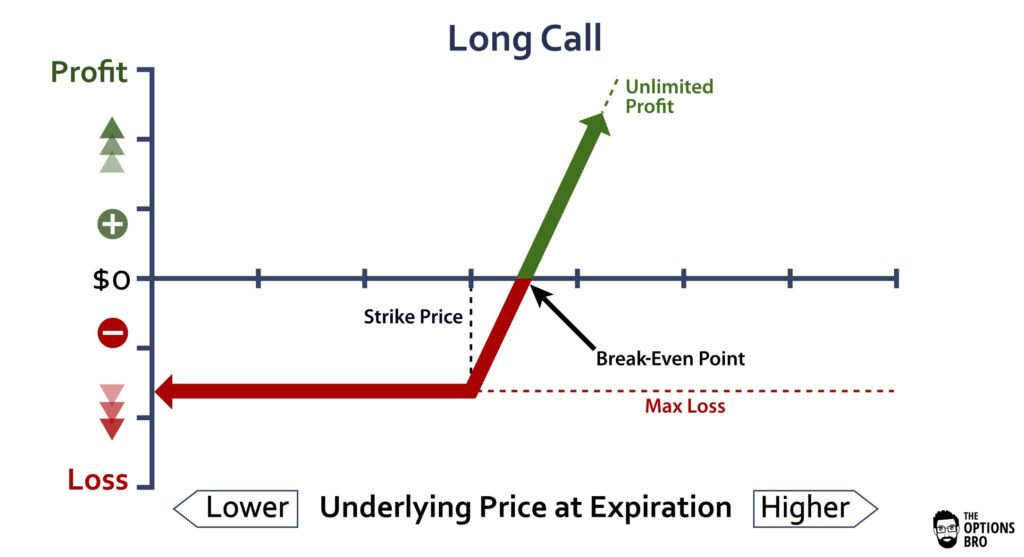
The buyer has a convex position, because his losses are limited and *gains* are theoretically unlimited.
The seller has a concave position, because his gains are limited and *losses* are theoretically unlimited.
When it comes to the *payoff curve* and the *unlimited loss*, there are a few important differences in the crypto-sphere which we’ll cover later. For now, these are the payoff charts to keep in mind:
*Image Source* https://www.optionsbro.com
Belief the underlying will rise
Risk limited to premium paid
Unlimited maximum reward
Belief the underlying will fall
Risk limited to premium paid
Maximum reward limited to underlying reaching 0
Belief that underlying will fall
Maximum reward limited to premium received
Risk potentially unlimited (as the underlying price rises)
Can be combined with another position to limit the risk
Belief that underlying will rise
Risk “unlimited” to a maximum equating to the strike price less the premium received
Maximum reward limited to the premium received
Can be combined with another position to limit the risk
*Image Source* https://optionalpha.com/
These profit and loss charts represent the simplest option trading strategy: buying or selling (long/short) just a single option, also know as *single leg* operations. When you combine them into *multi-leg* operations you can create complex strategies for different market situations, the possibilities here eclipse everything else for simple futures or altcoins trading.
Understanding these payoff curves is the most important thing for anyone interested in options trading, and we only have to cover those two convex operations.
Going long on Calls or Puts allows two important strategies:
1 – Use of massive leverage with limited downside.
2 – Safe hedge against a simple future position, which is much better than any stop limit order (those stops will be skipped on big market moves).
*The same holds for crypto instead of stock* https://optionalpha.com/
Options Moneyness & Pricing
Pricing of an options contract is influenced by four important forces:
Underlying asset price
Option strike price
Remaining time until expiration
Underlying asset price volatility
*Underlying Price & Option Strike*
To make the relation between options and the underlying easy to convey, they are classified into 3 categories:
ITM – In-the-money
ATM – At-the-money
OTM – Out-of-the-money
Suppose BTC price is currently at 24000USD: a Call with a strike price of 22000USD allows you to buy an asset worth 24000USD for just 22000USD. This option is said to be *in the money*.
A Call option *at the money*, in this example, would have the strike price *at* 24000USD or close by. And a Call *out of the money* would be *above* 24000USD.
Options *in the money* and *at the money* have another shade to differentiated them, this is common in most brokers or exchanges.
Put options are the exact reverse.
BTC at 24000USD, any option with a strike *above* 24000USD is *in the money*, because this contract means you could sell the asset for a *higher* price than what is currently worth in the market. Put options *at the money* will have a strike very close to 24k, and those *out of the money* have strikes *below* 24k.
Of course there is no free lunch, if you want to buy an option *in the money* you will pay more for the contract because they have *intrinsic* *value*, meaning, if the option were to expire at this very moment the contract would be worth something.
Conversely, the further you go out of the money, the cheaper those contracts get because they only have extrinsic value. *Extrinsic* value is like expectation value, maybe it will be worth something in the future, but right now there is nothing beyond the anticipation of possibilities.
*The further out of the money is, the cheaper it gets.*
*Time*
Time until expiration is another major force on the price of an option. All other variables being equal, expirations further away allow more “*room*” for the underlying to move into a profitable range, making them more expensive, as options get closer to expire they become cheaper. *Ceteris paribus*, OTM options lose value every day, like a dripping bucket. https://www.investopedia.com/terms/c/ceterisparibus.asp
But *time decay* is not linear, the closer it gets to expiration the more it accelerates, so you will find more options just a little OTM at the smallest price (currently 0.0005BTC) as they are about to expire.
*Volatility*
Volatility, like time, has a directly proportional result in both Calls and Puts. If the underlying’s price moves a lot, the chances of *out of the money* options getting *in the money* are higher, therefore all options get more expensive with higher *vol*.
There is a lot more about volatility, the misconceptions about market averages (*Ludic fallacy*), and the pricing indicators known as *The Greeks*, but we've got the basics covered so we’ll leave those topics for another time. Now we can get to those simple, yet powerful, strategies for beginners: https://en.wikipedia.org/wiki/Ludic_fallacy
High leverage
Hedges
Simple Trading Strategies
High leverage can be like a siren call into to the “*reking” rocks* of liquidation. Some traders considered getting liquidated a badge of honor, or a rite of passage. This is but a rationalization for stupidity.
If you controlled your exposure as explained by part 1 getting a margin call won’t be as terrible as it is for most traders. Still, to avoid it, we’ll use subaccounts and the *3 types of leverage.* https://read.cash/@Renan/crypto-trading-antifragility-part1-risk-0f1f5678 https://insights.deribit.com/education/introduction-to-leverage-and-margin/
Just like the concept of *moneyness* makes the relation between underlying price and option clear, we can use a similar idea for risk and leverage.
As far as I know, Luis Fernando Roxo was the first to make this insightful distinction between the types of leverage. From terrible to good we have: https://twitter.com/luizferoxo
Toxic – When it goes wrong you end up owing more money than what you had allocated on your exchange.
Dirty – When it goes wrong you lose everything in your exchange.
Clean – When it goes wrong your loss is insignificant.
Currently in the crypto world toxic leverage is *impossible.* No exchange can take more than what you send to them.
In big exchanges from the old markets, toxic leverage is possible due to the intrusive kyc and regulation involved, if your trade goes completely south the exchange has a “legal” right to your property beyond what you have in your account. This can happen with naked option selling (the unlimited downside area of those Calls shorts). http://coindesk.com/theres-a-bigger-scam-than-anything-in-crypto-its-called-kyc-aml
This doesn’t make sense in the crypto sphere, but you never know with all the creeping regulations, so keep an eye for these possibilities in the future. Right now there is no need to worry about *toxic leverage* on any exchange, because the collateral remains in crypto. *dirty leverage*, however, is something to be aware.
If you ignore the steps we covered in part 1, you might be exposing yourself to *dirty leverage*. It can even be a matter of mindset, such as when you feel confident to the point of arrogance and increase your position size (on futures) or send more coins to increase your margin. https://read.cash/@Renan/crypto-trading-antifragility-part1-risk-0f1f5678
*Premeditatio Malorum: The worst case scenario of 100% loss on the exchange has to be within your personal acceptable range before sending your crypto!*
Keep your maximum losses small and under control. This is where the fractal barbel strategy comes into play, the base risks are covered which allow for bigger trades and returns with small amounts.
**High Leverage**
OTM options about to expire have an explosive nature, few traders believe in their potential, because (according to traditional models) the likelihood of those options expiring ITM is negligible. But those traditional models are based on false assumptions, although these options usually turn to dust, when they expire ITM, the payoff is so strong it makes sense to take small bets on them.
The explosive event of the Black Thursday (March 12) is the best recent example. Two days prior to the crash, Put options with a strike of 7000, expiring on March 13 were out of the money by at least 700 USD, and worth just 0.001BTC.
As the price plummeted, those options value exploded like few altcoins do, and each contract was worth 0.5BTC or more. Perfect example of antifragile convexity in action! While most traders were desperate during the fall, those who bought Put options had massive gains in BTC, to the point of compensating the drop and making a significant profit.
This strategy works best when volatility is low, which is not very common on BTC, and to make matters worse, those small constant losses aren’t easy for anyone’s mindset. Therefore, selecting or even adjusting the right amount of crypto you are willing to bleed before making a profit is tough and very personal. But worth the effort.
**Upsides for OTM buying**
Provides one of the largest payoff potential in crypto
Small upfront investment
**Downsides for OTM buying**
Requires patience and persistence
Only profitable with *large and sudden price moves*
Adjusting the amount can be difficult
The second simple option strategy is far easier, and if it doesn’t bring antifragility in the strict sense, it will bring resilience at the least.
**Hedges**
When trading *regular futures*, instead of relying on stops to control your losses, it’s much safer to make a hedge with options. Huge price moves can obliterate any stop trigger, on the other hand having an option hedge can bring peace of mind in those scenarios.
All you have to do is make sure your liquidation price is close to the strike of OTM options: Puts when your *futures* position is long, and Calls when short.
Let’s say you open a long position at 24000USD with a liquidation price at 19000USD. Set your stop at a comfortable range and buy Puts with a strike just above 19000USD in the same amount of your *collateral* size (1 contract is worth 1BTC, and can be divided by 10). Usually your stop will work, but if there is a big crash those Put will cover your loss. If your future position was a short just do the reverse and buy OTM Calls.
To minimize hedge costs, buy only options expiring within a week or less and way out of the money. Low costs also require that your liquidation price can’t be too close to your opening, but this is a good practice regardless. The longer you keep future position open, the longer you’ll have to *roll* this hedge forward, which will make a small dent on your profits.
To improve the risk exposure, you can combine this options insurance with subaccounts. https://insights.deribit.com/education/introduction-to-leverage-and-margin/
Deribit doesn’t have an isolated margin system, everything is under cross margin: the entire account’s balance is used as collateral. To isolated the margin there are subaccounts instead, this limits the maximum loss to the specific *sub* you are trading. It is an excellent system because it can be used to organize different trading strategies with no additional risk to your total exchange balance.
**Upsides for Options Hedge**
Covers the downside of a *futures* position with no risk of getting skipped like a stop order
Essential hedge (especially for long positions)
**Downsides for Options Hedge**
Has an extra upfront cost
Has to be managed as long as the position is open due to time limit
Remember I said there are a few important differences regarding the *payoff curve* and the *unlimited loss* in crypto?
Asymmetry of Bitcoin’s Payoff – Crypto Curve
When you account your profit/loss in USD, the above payoff curves images remain the same. Enthusiasts, however, care more about crypto and here is the catch.
Both ***collateral*** and ***payments*** are made in BTC.
The trading pair is BTC/USD.
Inside the platform the ***profit/loss*** is calculated in USD.
*Profit/Loss* https://insights.deribit.com/education/introduction-to-bitcoin-options-profit-loss/
If you long BTC on the perpetual, as its value rises in USD, the crypto amount you get per extra dollar will diminish. Conversely, on the same long position, the crypto loss increases more as Bitcoin’s dollar value decreases.
*Perpetual Long*
***Call Long*** *(Blue), Call Short (Red)*
This curved line is always present whenever there is a *base* *currency* (BTC or ETH) used for collateral and payments, combined with a *quote* *currency* (USD) for profit/loss calculation. We are using an asset for margin trading on the *dollar price of that same* asset. https://insights.deribit.com/education/deribit-inverse-contracts-calculating-profit-in-btc-and-usd/
The same curve would apply to for any combination of base/quote currencies, it’s nothing particular to crypto.
Due to this payoff asymmetry, a long position on futures requires more attention because the crypto loss is bigger when it goes wrong. Here lies the importance of sub-account control and Put hedges.
On the opposite trading, you gain more crypto with a short going well or a buying OTM Puts. Excellent news for net bears right?
*Perpetual Short*
***Put Long*** *(Blue), Put Short (Red)*
Not quite, a bearish position has an *extra risk with violent price drops*. While they create exponential *crypto gains* for Futures short sellers and Put owners, on the other side of the trade, the pressure can cause too many liquidations for Futures long buyers and Put sellers. Which might deplete the insurance fund, leading to socialized losses. https://insights.deribit.com/education/the-deribit-insurance-fund-and-socialised-loss-system/
Deribit (and other crypto derivatives exchanges) work as a bridge between traders. If too many traders get liquidated in a short time, there might not be enough coins to cover the winners. This is where the insurance fund comes in, it covers those trades up it’s maximum reserves. After that, the winners will simply have to accept a reduction in profits.
This almost happened during the Black Thursday event, sudden liquidations happening too fast took a tool. Had BTC price dropped lower, the insurance found would not have been enough to pay those *Put* owners and short sellers
*Looks like the* *Turkey Problem* *doesn't?* https://crowdwise.org/investing-psychology/four-lessons-turkeys-teach-investing/
They have improved their reserves for such events, but it’s another risk to keep in mind. https://www.publish0x.com/editPost/insights.deribit.com/exchange-updates/march-market-crash
**The key to convexity is control the downside, this is done** ***before*** **sending funds to an external private key**. Insurance fund depletion is within the *exchange risk* we have already accounted for before starting to work on the upside, but it’s often forgotten or unknown by many traders.
Between the toxic leverage possibility on traditional exchanges and the socialized losses for crypto traders, I take the crypto world any time.
Antifragile Crypto Trading
Crypto brings more possibilities for individual liberty than any technology developed so far. It also exploded the traders barrier to entry like a cannon ball, now more opportunities for success are within reach for individuals throughout cyberspace. But with great liberty comes great responsibility.
Centralized exchanges play a crucial role in the ecosystem; although Dex’s are the ideal to be aimed, they are years away from technical maturity. It is hard enough to replace centralized spot exchanges, futures exchanges are far more challenging, especially on options.
While the barriers to entry made by fearful rulers still aren't insurmountable, my hope for this post is to add value and make experimentation on the crypto options world smooth.
Trade methodology is extremely personal, it will change between individuals, and even within each one throughout time as markets and personal knowledge change. Avoiding the risk of ruin, however, is an universal imperative.
May you achieve crypto financial independence!
Notes
[1] On Deribit all options are European: *they cannot be exercised before the expiration date. However, it’s worth noting that they can still be traded prior to expiry (i.e. you do not have to hold it until expiry).* https://insights.deribit.com/education/what-is-an-options-contract/
*Exercising an option means putting the right specified in the contract into effect i.e. buying at the strike price of a call or selling at the strike price of a put*.
Disclaimer
Instead of the old cliché **this is not financial advice...** here are the five rules of science from Neil deGrasse Tyson:
***(1) Question authority****. No idea is true just because someone says so, including me.*
***(2) Think for yourself****. Question yourself. Don't believe anything just because you want to. Believing something doesn't make it so.*
***(3) Test ideas by the evidence gained from observation and experiment****. If a favorite idea fails a well-designed test, it's wrong. Get over it.*
***(4) Follow the evidence wherever it leads****. If you have no evidence, reserve judgment.*
*And perhaps the most important rule of all...*
***(5) Remember: you could be wrong****. Even the best scientists have been wrong about some things. Newton, Einstein, and every other great scientist in history -- they all made mistakes. Of course they did. They were human.*
*Science is a way to keep from fooling ourselves, and each other.*
Special thanks to:
Marco Batalha for the invaluable help with proofreading.
Thank you very much for reading!
If you like this article feel free to tip, share and subscribe.
Bitcoin - 1RenanWrFGvuPXefwF6Q2S7noqinQR54e
Bitcoin Cash - qzly3ntn6x7k7qw970vvlm8zlmzt2qnjxu6netzy8f
DAI - 0x6314526213b16aF52BBe227d06c1e8F1e662aa00
Dash - XoCRnBqGFMjdP8PwKfF7Rrb8hnCKLbE27A
Decred - DsacQEaY9gXT6Bjvx9U1SLH3YbhHhkLBhjE
Ethereum - 0x6314526213b16aF52BBe227d06c1e8F1e662aa00
Monero - 4418L4CxTQsa6hz26bEtfEBW4iFvnRfYw6A6gq1Up6qQFLsR8NS5qyvKXc1HieV4HFP2vPF84YwEw9QWDWrnk2uRBA2yqFq
Nano - nano_1r15f1naypwn87zxq75ztx7pdx3ao9hspehh1jijjhb9c3a5jn6kc7ske9gn
NEM - ND6OZRXOWIXHTAOW4YBWDNXKGHLQWYVSU4WGGVPL
Zcash - t1fkoBKABLETDcNQg9XXxhh3ikswvhPf899
Contact - Keybase https://keybase.io/renan_
Mastodon https://mstdn.io/@renan
Twitter https://twitter.com/renan_crypto
A few quick ideas about new features:
Having personal blogs to organize our posts into specific topics would be a great feature for read cash (similar to publish0x). Better stats about viewers, like total reading time (as long as it’s not a security/privacy risk) to gauge boosts efficacy. A dark mode would also be good to have.
https://read.cash/@scottcbusiness/readcash-bch-sponsor-giveaway-2-e239ce3e
The Critical Choice: Fear Or Crypto Fuel
Imagine you are walking in a lush forest. The sights, sounds and smells are intoxicating in a most pleasant way. There is so much to take in you find it hard to focus on a single detail, your mind starts to wander. It is alright, enjoy the moment, the refreshing experience clear the stress and energizes.
Suddenly, right in front of you there is a tiger staring you in the face. Time slows to a halt and all those sights, sounds and smells vanish; now your mind has a single focus – survive.
The higher cognitive capacity of your brain vanishes along with distractions, it requires too much effort and it takes too much work, as they have no place in this situation.
Threats elicit physiological responses that have been evolving for millions of years. The stress caused by them, either the immediate tiger-in-your-face type or those of medium and long term nature, will suppress higher cognitive thinking.
The ability to think rationally about the abstract future is probably the defining characteristic of mankind. What do you do when this ability is hijacked by fear?
Frame Of Mind Control
Every piece of information you receive has to be filtered by countless processes in the brain; most of the time they work well to ensure survival. Sometimes distortions are created such as optical illusions, auditory illusions, and cognitive biases. No one is free from those “brain failures”, including me even as I write this. The best we can do is to be aware of them to reduce the damage, which is usually harmless but it can be devastating sometimes. https://en.wikipedia.org/wiki/Optical_illusion https://en.wikipedia.org/wiki/Auditory_illusion https://en.wikipedia.org/wiki/List_of_cognitive_biases
Fear will inhibit the rational and slower processes of the brain to ensure survival when facing an immediate threat. The degree of this inhibition will vary but it still happens for threats more distant in time, the exact point when the slower rational brain functions can be superior.
While the quick visceral response caused by fear is there to ensure survival, brain failures present excellent opportunities for those willing to take advantage of others, and the greatest manipulators of cognitive biases are generally the greatest creators of misery and oppression in human history.
Fear has been used as the “mass remote control”, since at least the beginning of civilization. It is perfect for those who want to suppress rational thinking. Throughout history, priests and rulers tended to master manipulations using fear and other biases to gain massive power and spread dogma.
Dogma is the death of reason.
Our minds naturally tend to exaggerate the present moment to the detriment of the future. Economists call this hyperbolic discounting. Combine this with fear’s capacity to blind reason and the desire for power over others by a few tyrants, and you get a perfect recipe for a downward spiral of increasing disasters. When people are afraid and can’t think straight, it becomes easy to ask central powers for solutions. These central powers, however, have insufficient knowledge and end up causing more problems, leading to more fear, and a dwindling disaster spiral ensues! https://en.wikipedia.org/wiki/Hyperbolic_discounting
The most absurd notions have always a chance with people who are suffering
― Frédéric Bastiat
Fortunately there are plenty of solutions today which avoid the disaster spiral, we just need to cover a few essential concepts first.
Beyond Zero-Sum
In game theory zero-sum refers to interactions where one player has to lose for the other to win. It’s a closed system of benefits. Positive-sum, on the other hand, represents interactions whereby everyone can win. It’s an open system where benefits and new wealth are created, not just transferred.
Voluntary trade can only happen because it’s beneficial to both participants, otherwise, if the trade were neutral for each one, why would anyone do it? There has to be at least a small benefit for each party; this is the essence of wealth creation – a positive-sum interaction. http://paulgraham.com/wealth.html
At first glance it would make sense for everyone to pursue positive-sum interactions and avoid zero-sum altogether. However, when low productivity is combined with scarce resources (high demand), zero-sum has too many advantages in the short-term and the long-term becomes too uncertain. This gradually changes as productivity increases.
I’ll be making big generalizations here in order to focus on the essentials. Just keep in mind zero-sum is essential to business related to positional scarcity. http://alexdanco.com/2019/09/07/positional-scarcity/
To get a clear understanding, let’s keep it simple, and make distinctions between physical and temporal scale.
In the physical scale:
*The smallest interaction happens between two individuals.*
In the temporal:
*The smallest interaction is just a single (punctual) action.*
In every interaction where someone initiates force against another, the result is always zero-sum. On the other hand, when the interaction between both parties is voluntary the result is always positive-sum (or at least has a strong tendency towards it). Repeating interactions create incentives to honesty and reputation systems, but it takes some time. Voluntary exchanges and production, mediated by demand (measured in price) create wealth.
Zero-sum by itself is not necessarily bad as it’s the basis of social status. Status has its functions, and is related to reputation, the problem only begins with coercion: The initiation of force, or credible threats thereof. https://nav.al/rich
Coercion is the essence of power over others, the result is zero-sum for the short-term, but in the long-term the results are far nastier. At both larger physical and temporal scales the results get magnified for all interactions.
Multiple individuals interacting in a voluntary manner naturally lead to specialization, no central planning required. The distributed nature of trial-and-error makes it adaptive, so wealth spreads fast and compounds over time.
*The increase in wealth & production begets more wealth & production.*
It is a virtuous cycle, but vulnerable to zero-sum coercion. And here lies one cruel irony of life.
The individual who initiates force (or makes a credible threat) can gain all the benefit from those interactions - a strong incentive for robbers and rulers alike. However, when you zoom way out in the time scale, the cycle of wealth creation gets massively crippled, producing a negative effect for everyone in the present and future.
In the large physical and temporal scales, **coercion is negative-sum**. When you assume the inter-temporal view, viewing both short and long-term, it becomes clear that no good can come from legal or illegal coercion. Compounding effects work with both negative-sum and positive-sum, but are hard to notice as they happen in times longer than the human life span. Or rather, it used to take life spans.
Thanks to compound effects and technology, effects only noticeable after several decades or centuries are now obvious in a few years. New technology is also making the architectural differences between negative-sum and positive-sum crystal clear.
Distributed Bottom-Up vs Central Top-down
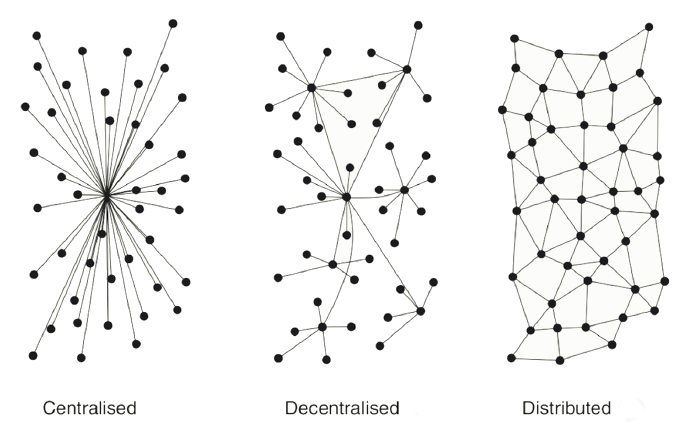
When it comes to natural complex systems – systems with several interconnected parts - information is processed best by small units instead of a large central hub. This happens because the complexity can increase exponentially with more participants taking place, and there is always hidden information a large central node can’t access.
For instance, in order to mitigate a pandemic, people are forced to stay at home, but the variables in each individual’s life, who or what can determine the best course of action, how is each one willing to deal with risk, what are the individual needs, are beyond access of central nodes. And the consequences of such measures are not immediately seen. https://www.nationalreview.com/2020/04/coronavirus-response-sweden-avoids-isolation-economic-ruin/
*That Which Is Seen, and That Which Is Not Seen* https://mises.org/library/which-seen-and-which-not-seen
This is the local knowledge problem: it is impossible for a ruler, no matter how smart or well meaning, to make the best decisions for the ruled. Distributed knowledge resides only in individuals, this makes central-coercive authorities unable to come up with good solutions. https://en.wikipedia.org/wiki/Local_knowledge_problem
Top-down decision makers tend to view events in isolation, ignore the larger process, and what’s worse, are disconnected from the consequences of their actions, i.e. they lack skin in the game. Have you ever seen a politician or political committee paying for their mistakes with their own money? No, they just pass a law to get more funds because “this time it will work".
Centralized authorities carry:
a) Systemic risk – quickly affects everyone down the hierarchy chain.
b) Pervasive payoff – the worst consequences of their actions fall on people unrelated to the decision making.
This transfer of punishment and rewards forces everyone else to pay the price and the system gets worse due to the lack of feedback where is most needed.
Necessity is the plea for every infringement of human freedom. It is the argument of tyrants; it is the creed of slaves.
― William Pitt the Younger
Besides necessity another common excuse for large central powers is that most people are too stupid to take care of themselves, the ignorant masses need a shepherd to lead them into the right path. When a big problem is facing humanity; only smart leaders, with all their massive knowledge, can lead the way. All those ignorant and stupid people have to do is obey and everything will be alright. Anyone who has a different opinion is dumb and just wants to watch the world burn. We also have to wait for scientific geniuses working together with political authorities to solve the problem. They are the only ones capable of coming up with solutions, there is no other way rather than a central-coercive authority.
*We have to wait for the state to solve it, and when it turns worse, don’t complain because without them there would have been no other solution. And if you have a different opinion, it is because you want everyone literally to die.*
― Mrs Submissive Sheep
This means people overestimate the value of a single solution, underestimate the value of several parallel experiments, and ignore the consequences of trusting a system where the worst comes to power.
Distributed systems - combined with low cost of information - will provide much better results, fortunately the Internet have been slashing information costs for decades. This is a quick feedback mechanism working to improve the larger system.
The beauty of distributed systems is that each participant (or node) can try to find different solutions simultaneously, while most of them can fail, the success of a few can spread quickly to the network. All the while the damage of failures is localized.
Instead of the insanity of current days, when a few central-coercive governments are imposing lockdowns on everybody as the solution; we could have several people trying (and failing), very different ideas. The quick feedback, and easy sharing of information created by voluntary solutions will eventually produce excellent results. But this requires self-reliance, not self-submission.
Waiting for political solutions is an incentive towards learned helplessness and a form of responsibility outsourcing. The immediate gratification of lazy thinking (or lack thereof) is a perfect match with the immediacy caused by fear. It adds up to a blindness towards long term and inter-temporal view. https://lbry.tv/@veritasium:f/learned-helplessness:2
It is impossible to live without risk, but the outsourcing of risk related decisions to central authorities makes people forget this fact of life and feel good with a false sense of security. False security is far worse than no security because it induces more miscalculation. How can anyone deal with reality if the decisions are based on false assumptions?
The choice of dealing with risk can only be effective when it lies within the individual, along with the responsibility and feedback.
Top-down systems are making people dumber by removing feedback, creating learned helplessness, and giving false security. It is a downward spiral towards larger problems, if we were heading down the road of serfdom before the current panic, we are now accelerating on the Autobahn of oppression. https://lbry.tv/@NaomiBrockwell:4/coronavirus-the-most-dangerous-moment:2
Domesticated Minds
In order to turn bulls, horses, donkeys and camels into obedient draught animals, their natural instincts and social ties had to be broken, their aggression and sexuality contained, and their freedom of movement curtailed. Farmers developed techniques such as locking animals inside pens and cages, bridling them in harnesses and leashes, training them with whips and cattle prods, and mutilating them. The process of taming almost always involves the castration of males. This restrains male aggression and enables humans selectively to control the herd’s procreation.
― Yuval Noah Harari, Sapiens – chapter 5
Similarly, the process of taming humans can involve cruel and manipulative techniques, but they are far more nuanced. One of the most striking is the castration of free independent thinking, spearheaded by supposed experts. https://www.youtube.com/watch?v=bVG2OQp6jEQ
Was there ever a time in humanity’s history when everyone was forced to suppress commerce and live inside the house by a tyrannical elite? Under the guise of the greater good and the whip of fear, critical thinking seems to have vanished.
*Of all tyrannies, a tyranny sincerely exercised for the good of its victims may be the most oppressive. It would be better to live under robber barons than under omnipotent moral busybodies. The robber baron's cruelty may sometimes sleep, his cupidity may at some point be satiated; but those who torment us for our own good will torment us without end for they do so with the approval of their own conscience.*
― C. S. Lewis
The Latin word *domus* means house, hence the origin of *domestication*. With all the manipulation, fear mongering and coercion forcing the world to stop and to stay inside, domestication has taken an entirely new meaning.
Time, our most precious asset, is being wasted with myths of hierarchical wisdom. Free thinking and free questioning, the most fundamental principles of science, are strangled by politically correct “science”, whenever science bows down to rulers and it is then used to justify political action. The result is a disgusting dogmatic insanity, it is *just a* *slavish imitation of the method and language of Science**.* https://en.wikipedia.org/wiki/Scientism
Blindness towards the future, caused by fear, is cured by switching your brain into analytical mode and questioning everything, especially authority. Political narrative and propaganda are so vulnerable to critical thinking they have developed several strategies to suppress it. When rational thinking prevails, politicians turn to the *moral authority* frame.
*If you have a different opinion it is because you want everyone to literary die.*
The moral authority frame is nothing but smoke and mirrors used to deviate attention from the real intent to create massive zero-sum gains for authoritative rulers at the expense of everyone else. Just another trick to tickle the guilt glands of clueless cretins, which only results in negative-sum for everyone in the long-term.
*Disobedience is the true foundation of liberty. The obedient must be slaves.*
― Henry David Thoreau
A small, and misleading, alleged good such as flattening the curve, based on weak assumptions, can turn into fatal ultimate consequences. These measures will cause harms far greater than any virus. In fact, spreading faster than any pandemic ever could are Orwellian proposals. https://medium.com/@miguelramo/el-virus-m%C3%A1s-letal-mensaje-de-jes%C3%BAs-huerta-de-soto-sobre-el-covid-19-9bd8cf80284d
Strong restriction of movement, commerce, open questioning, and increased surveillance took the world by storm. A deranged mentality commonly reserved for places where the most tyrannical hierarchies rule became ordinary worldwide. Instead of reading the novel 1984 as a warning, rulers are reading it as an instruction manual.
*The urge to save humanity is almost always a false-face for the urge to rule it.*
― Henry Louis Mencken
To See Beyond Our Temporal Shackles
If the defining characteristic of humanity is the ability to think rationally about the abstract future, it is well past time to leave the myopic view of immediacy and look towards the long-term consequences of trusting central-coercive crooks.
Voluntary trade is the engine of prosperity and wealth creation, each participant trades due to the belief of being slightly better after it. If the trade were neutral, it would have no reason to occur. Even if there are some flaws in this process, in large scales it is positive-sum. But now a wrench is jamming this magnificent engine, forcing the world into a destructive consumption.
Getting free from the immediacy caused by fear is crucial, the decisions we make now can either lead to massive destruction or construction of wealth.
Construction only requires courage to take back your autonomy and ignore the whip of fear or the fake moral frame of authorities. The effort it demands can look like a small sacrifice in the short-term, but these short-term small sacrifices working together with voluntary interactions are the only road to massive positive-sum gains in the long-term:
A view from small to large scales of physical interactions - from only two individuals to large groups. A view from small to large scales of temporal interactions – from a single trade to millions of trades made throughout time. It creates a movie of an inter-temporal world.
“*The key is to free oneself from a tyranny of first consequences, overvaluing what comes first at the expense of what inevitably comes later.”*
The DAO of Capital is among those rare books worth reading multiple times, a successful investor’s view of the economy, the lessons it teaches go far beyond finance, they are useful on every aspect of life. The thinking it inspires is essential because it is a roundabout map to bypass fear and immediacy.
But you don’t have to believe a single word I have written, just please consider everything. The reason why coercion (the initiation of force) is wrong, beyond the negative-sum it produces, and other concepts glanced over, deserves more in-depth breakdowns. Those are topics for other posts. For now keep in mind:
*I don’t know shit, you don’t know shit, and autocrats claiming to know what is best for the world don’t know shit!*
*Wait But Why - The Cook And The Chef* https://waitbutwhy.com/2015/11/the-cook-and-the-chef-musks-secret-sauce.html
Now with the essential concepts covered, we can turn towards compelling action.
Permissionless Life & The Satoshi Principles
*The Times 03/Jan/2009 Chancellor on brink of second bailout for banks.*
Satoshi never clearly stated his motivation behind the creation of Bitcoin, but the above news referenced in the genesis block and his messages are strong clues. So I’m going to make assumptions based on his written legacy, I might be wrong but these ideas already have a life of their own and can’t be *owned* by a single person. https://news.bitcoin.com/satoshi-revolution-chapter-2-satoshi-libertarian-anarchist-part-4/
Bitcoin is *what* Satoshi did, the combination of public-key cryptography with proof of work is *how* he did. *Why* he did is the most important of all: https://www.ted.com/talks/simon_sinek_how_great_leaders_inspire_action
To bootstrap freedom at a massive scale.
Legal tender laws coerced the world into fiat-fraud, so Bitcoin was the first step towards independence from central banks. Now we need to take the next steps towards independence from every other central-coercive hierarchy. To get there we need to follow freedom’s first principles, or the Satoshi Principles:
**1 - Build Distributed Systems Where All Reliance On Centralized Hierarchies Is Eliminated By Design**
This is the hardest problem to solve and no one should consider Bitcoin as the ultimate solution, much work remains to be done on distributed consensus technology.
It is the first principle for a reason, centralization has the potential to spread faster than pandemic panic, and when it takes its hold it’s hard to cut off, so a good foundational design is imperative. The Internet infrastructure was supposed to be decentralized but regulated ISP became the norm, the same can happen with Crypto if we’re not vigilant.
**2 – Respect The Individual**
Individual autonomy permeates the Bitcoin ethos and allows a new level of voluntary interactions, with private property and absolute ownership at its core. Freedom of choice to participate in any project, or to pursue different ideas were respected by Satoshi, this is in the integral *why* layer many developers forget due to tribal thinking. As long as the ideas of this base layer are respected, we should welcome different approaches to solve the problems we have.
*It seemed so obvious to me. Here we are faced with the problems of loss of privacy, creeping computerization, massive databases, more centralization -and Chaum offers a completely different direction to go in, one which puts power into the hands of individuals rather than governments and corporations. The computer can be used as a tool to liberate and protect people, rather than to control them.*
—Hal Finney
**3 – Privacy & Anonymity**
We know Bitcoin is pseudo-anonymous by default, and true anonymity is really hard to achieve. Taking into account that surveillance is the key requirement for authoritarianism, privacy and anonymity should never be compromised and need to be the default standard in every project.
Some will argue anonymity can create new problems, and this is true, but they are tiny compared to problems caused by central coercion; the benefits outweigh the harms anyway. https://www.coindesk.com/theres-a-bigger-scam-than-anything-in-crypto-its-called-kyc-aml
**4 - Open & Permissionless Systems**
Distributed systems are naturally open and permissionless, but *no barriers to entry have to be a way of thinking*. Every time a developer asks for permission to regulators, innovation is strangled and the door to creeping centralization gets permanently open. Permission to create, innovate and participate stands in the domain of bureaucrats who use poor excuses such as fear to maintain a tight control over central systems; they don’t belong in the crypto domain. https://lbry.tv/@ArcVRArthur:a/1996-Declaration-of-Cyberspace-Independence-EFF:4
**5 – Bypass Artificial Borders**
The only borders to be respected are those of private property, no central-coercive entity has any legitimate possession of such properties. Voluntary interactions, without control, across the world will lead to unprecedented economic growth. Improvements on this area are relatively easy within the web, but are challenging on the physical world. It is a fertile soil for creative entrepreneurs. https://lbry.tv/@aantonop:8/black-markets-white-markets-a-false:1
**6 – Gatekeeper-proof**
Today Crypto is vulnerable to central choke points mostly on the interface with the old fiat system. How new users on-board the new system is crucial, so with easy access and minimal or no interfacing with centralized systems there is no target for gatekeepers. This goes from the development stage, where devs take precautions with their identities, to the final stage where the result is a parallel world immune to coercive regulation under the guise of compliance. https://hackernoon.com/the-five-keys-to-crypto-evolution-94be921e6354
**7 – Trust Transfer From TTPs To Networks**
Bitcoin is not trustless, it transfers trust from trusted third parties to an entire network. Vulnerability to a third party is vulnerability to gatekeepers, thus unacceptable. Elegant systems transfer trust from a single point of failure to distributed networks. https://nakamotoinstitute.org/trusted-third-parties/
I mentioned Bitcoin a lot because it’s easy to relate, but these principles are the basic building blocks to bootstrap freedom at a massive scale. Cryptocurrency is one of many shapes these blocks can assume, and the compound positive-sum interactions they enable will lead to unparalleled progress.
*The ideas behind Bitcoin have more potential than just money*.
One obvious corollary worth mentioning with emphasis is:
*Never* work with any state!
Developers friendly with regulators will always be on the verge of neutering the most promising aspects of their projects.
Blockchain analytics companies close to governments are among the worst dangers in the Crypto sphere, second only to…
Companies working with government to create panopticon money disguised as crypto.
Central-coercive authorities build systems that can only impoverish and enslave everyone else to create gargantuan zero-sum gains in the short-term, with even more monstrous negative-sum in large time scales which they will always refuse to see.
Satoshi laid the groundwork against an Orwellian future (or present), we just have to keep the core ideas in mind and build upon them. Instead of destructive desires about overthrowing “the system”, the constructive approach of the parallel economy, made for those who love liberty and responsibility is far superior.
The beauty of Crypto and distributed tech is that it has an optional use, not an obligation. When it becomes so good it can’t be ignored by the mainstream, people will willfully abandon the fiat and central counterparts.
A Time To Build, A Time For Action
*Tu ne cede malis, sed contra audentior ito*
*Do not give in to evil, but proceed ever more boldly against it*
*-* Ludwig von Mises moto
The future is always uncertain, this simple fact of life is an ever present incentive towards immediacy. Combined with fear and megalomaniacs pretending to be do-gooders it forms strong chains around humanity’s neck.
Politicians love to deny reality and pretend to fix it with naive interventions: don’t like alcohol, scribble a law against it and create Al Capone as a result; don’t like drugs, start an endless war against them and create massive suffering around the wold; afraid of a virus, cripple individual liberty, the economy and create an Orwellian state because this time it will work.
Fear led to a sudden spread of totalitarianism, it hobbled freedom and made its defenders feel like an immense regress took away years of hard-gained wins, a sense of defeat is unavoidable. Large scale problems are opportunities for dictators to crush individual sovereignty, yet, in the face of authoritarianism there is only one logical response:
*Good*
https://www.youtube.com/watch?v=IdTMDpizis8
https://www.youtube.com/embed/IdTMDpizis8
Bailouts in the 2008 crisis fueled the creation and release of Bitcoin. Infinite quantitative easing, lockdowns and mass surveillance are the current high-energy fuel for new solutions towards independence from every other central-coercive authority. It is time to make them all obsolete.
If you are not a developer or entrepreneur with the capacity to create these exceptional permissionless distributed systems, or a big investor who can finance them, never forget that spreading these voluntary ideas also has value.
*Ideas and only ideas can light the darkness. These ideas must be brought to the public in such a way that they persuade people. We must convince them that these ideas are the right ideas and not the wrong ones.*
*-* Ludwig von Mises
Learn to appreciate individual initiatives and the invaluable competition of ideas, solutions without central planning, and the resulting convexity. The opportunities for the right ideas and action have never been so strong! https://www.publish0x.com/renan/crypto-antifragility-how-far-does-it-go-xzreqm
Cheers.
Special thanks to:
Marco Batalha for the invaluable help with proofreading.
Thank you very much for reading!
If you like this article feel free to tip, share and subscribe.
Bitcoin - 1RenanWrFGvuPXefwF6Q2S7noqinQR54e
DAI - 0x6314526213b16aF52BBe227d06c1e8F1e662aa00
Dash - XoCRnBqGFMjdP8PwKfF7Rrb8hnCKLbE27A
Decred - DsacQEaY9gXT6Bjvx9U1SLH3YbhHhkLBhjE
Ethereum - 0x6314526213b16aF52BBe227d06c1e8F1e662aa00
Monero - 4418L4CxTQsa6hz26bEtfEBW4iFvnRfYw6A6gq1Up6qQFLsR8NS5qyvKXc1HieV4HFP2vPF84YwEw9QWDWrnk2uRBA2yqFq
Nano - nano_1r15f1naypwn87zxq75ztx7pdx3ao9hspehh1jijjhb9c3a5jn6kc7ske9gn
NEM - ND6OZRXOWIXHTAOW4YBWDNXKGHLQWYVSU4WGGVPL
Zcash - t1fkoBKABLETDcNQg9XXxhh3ikswvhPf899
Contact - Keybase https://keybase.io/renan_
Mastodon https://mstdn.io/@renan
Twitter https://twitter.com/renan_crypto
Crypto Trading Antifragility — Part1 — Risk
When there is blood on the streets, both in traditional and crypto markets, enthusiasts panic and lose their precious coins. Some wonder “if Bitcoin is a good store of value, how come it crashes down along with everything else?”
While bloody markets rage on, a small number of traders are still making profits with the right approach.
*For the prepared, volatility is a friend, for the unprepared it’s a nightmare.*
First of all let’s be clear about BTC:
1BTC = 1BTC
The fundamentals of the network remain
It cannot be printed into oblivion
It is border-less
Open
Neutral
Global
Censorship Resistant...
With that in mind I want to cover the basics of antifragility and convexity for crypto traders, as these are the best ways to get disproportional benefits on any kind of market, especially on difficult ones. https://read.cash/@Renan/crypto-antifragility-how-far-does-it-go-2b9bda4d
These posts are meant to be conversational and all feedback is welcomed, so please leave your opinions and questions in the comments below.
Market success is a matter of finding the methodology that is right for you—and it will be different for everyone—not a matter of finding the one true methodology.
― Jack D. Schwager
Know Thy Risk
In order to the use good strategies, we have to understand our risks very well; see them as they are, not as we imagine them to be. Also, we need to be very clear on how to deal with them. Once our understanding is crystal clear the right action comes with easy.
Risks vary in scope and severity
**Severity**
From mildly annoying to a catastrophic problem
Example for traders:
*Mildly annoying – a minor loss on a stop trigger*
*Catastrophic – you lost everything and even owe more than you currently have (this can happen with naked option selling on regular markets)*
**Scope**
From small to large scale, or individual to the global
Examples:
*Individual – One person lost confidence in crypto*
*Global – Everyone, including crypto enthusiasts lost confidence in crypto*
**3D Risk**
Severity and scope offer a broad perspective, but for now let’s focus on the forms of risk, think of them as dimensions. Mostly outside our control, we cannot control the events underlying major risks, we can only control how we are exposed to them, and this is enough.
*Note - you can add more risk dimensions to your threat model, these are just the most relevant and common in crypto.
**Systemic Risk**
Examples:
*P vs NP* *is mathematically proven to be equal and all modern cryptography is flawed* https://en.wikipedia.org/wiki/P_versus_NP_problem
*A new whistle-blower provides documents showing those beloved 3 letter agencies have used hardware exploits to compromise every crypto.*
**Market/Price Risk**
*BTC drop on 2020-03-12, how many stop triggers were skipped that day?*
*ETH* *DAO “hack”* https://www.cryptocompare.com/coins/guides/the-dao-the-hack-the-soft-fork-and-the-hard-fork/
*MTGox Fraud and* *collapse* https://en.bitcoin.it/wiki/Collapse_of_Mt._Gox
**Usability Risk**
*A user who doesn’t understand crypto losses his coins due to ignorance and poor management of his wallet (any resemblance with a famous economist recently is coincidence)*
You get the idea.
So, how do we deal with those risks? In essence with a single strategy and slight adaptations:
**Systemic risk** is the largest in scope and severity, while being the least likely to happen. But we need to be prepared regardless. So the constant theme for dealing with risks is this:
*How does a bad (or good) event affect you?*
If the worst thing that can happen to you is closer to “*mildly annoying*”, on your severity scale, then you are on the right track. Of course some things can never be that insignificant, but it’s a good benchmark to have.
Having almost 100% of your portfolio on BTC will expose you to too much systemic risk, however unlikely these events are, they should always be on your mind. To reduce the severity you have to reduce your exposure, or find different revenue streams. This results in more options, which is another essential aspect of antifragility.
**Market Risk** is more worrying for those who desire price stability relative to fiat currency, but even die-hard crypto-heads worry about it when there is a price crash. The foundation here is the same of systemic risk – control exposure and have optionality, the possibility to choose without having the obligations to do so.
**Usability Risk** requires a different approach because you have already controlled your exposure, which is at a ***lower level*** so to speak, now you just need to think about securing what you have.
In it’s simple form: where do you generate your private key, and how do you store it? Here you need to find your best balance between security and convenience. This is different for everyone. In general I would recommend a large capital percentage with high security which also means low convenience (offline keys), a smaller percentage medium security/medium convenience such as a hot wallet on a pc (my preference is for GNU/Linux operating system), and an even smaller amount on exchanges which presents the highest risk because the private key is not yours. https://www.youtube.com/watch?v=dnC5mFaIW3Q
*Note - I don’t trust hardware wallets – how can you know for sure there is no security flaw at the hardware level? Practically impossible, but that’s for another post. Smartphone wallets are another rabbit whole; if you really need them keep the amounts small. https://blog.kraken.com/post/3662/kraken-identifies-critical-flaw-in-trezor-hardware-wallets/
Not having the private key is generally a bad idea, unless you have a low exposure to its negative results and a high exposure to positive results: we’ll cover more about this on part 2.
Is the idea of controlling exposure burned into your synapses by now?
I hope so, because it’s the essence of the barbell strategy.
The Barbell Strategy
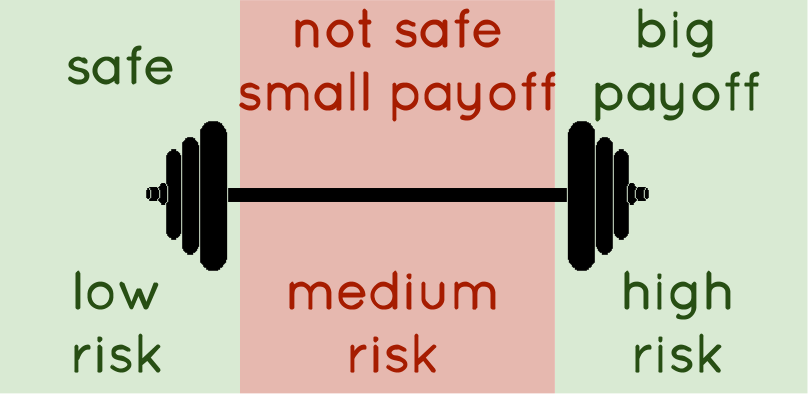
The name is a reference to a gym bar with weights at both ends and nothing in the middle. Unlike the lifters use, it is asymmetrical for us. The classic example is 90% of your portfolio on the ultra conservative and just 10% on high risk. The proportion can be changed according to personal preference, as long as the safe side is able to stand the risk of ruin of the opposite.
You are operating with two opposite modes at the same time: one ultra-conservative, the other highly volatile. This is how the risk of ruin is avoided, although it can never be completely eliminated!
It can also be applied in a fractal manner, e.g. within the risky area allocate 10% of that to borderline stupid ideas with high chance of failure, but a huge potential payoff.
Forget about average risk, or trying to get the best risk/return using some kind of crypto-index fund; being in the middle can never bring high returns, and it is open to catastrophic failures. When you operate at both extremes those risks high in severity and scope are capped, while the benefits of volatility keep working in your favour because small mistakes don’t cause much harm.
And like the previous example of using different revenue streams to manage systemic risk on crypto, it can be used on distinct areas of life.
Antifragility and convexity for traders - overview
Antifragility is a mathematical property of complex systems, where there are several parts interacting with each other in a nondeterministic and nonlinear manner. Small parts can fail to disorder such as stress or volatility, this is how feedback is generated to the larger system, resulting in improvement over time. Just like muscle cells damaged after the stress of a workout lead to stronger muscles, these concepts can be applied to trading by leveraging small failures and avoiding ruin in the larger portfolio. https://read.cash/@Renan/crypto-antifragility-how-far-does-it-go-2b9bda4d
When the negative side is limited to the small, then the positive side can be unlimited, in theory at least, still very high in practice regardless.
Anyone who has to avoid failures or rely on a specific path, has strong signs of fragility – that which was once broken doesn’t return to its previous shape. This is why it’s necessary to avoid ruin before thinking about making profits. While personal financial ruin is not necessarily absolute or final, after all it is possible to recover later, it does steal away precious time.
Opposite to path dependence is having optionality, which makes it easy to adjust to unpredictable changes.
*When the risks were defined and dealt with beforehand, when events happen and it’s easy to adapt, when there is no need to know how things will unfold, that is when you have optionality.*
Our initial work with risk covered and has helped restrict the downside (remember: never 100% since it would be impossible) now we need to know how to reach the unlimited upside. We’ll cover that on the next part.
Recap
The basic process to control risks:
1 – Know what is the worst case scenario before taking action
2 – Find the best ways to deal with those scenarios and limit the downside
3 – Don’t rely on specific paths and have your options open
Trader’s Antifragility:
**Optionality + Limited Downside + Unlimited Upside = Convexity**
Disclaimer
Instead of the old cliché **this is not financial advice...** here are the five rules of science from Neil deGrasse Tyson:
***(1) Question authority****. No idea is true just because someone says so, including me.*
***(2) Think for yourself****. Question yourself. Don't believe anything just because you want to. Believing something doesn't make it so.*
***(3) Test ideas by the evidence gained from observation and experiment****. If a favorite idea fails a well-designed test, it's wrong. Get over it.*
***(4) Follow the evidence wherever it leads****. If you have no evidence, reserve judgment.*
*And perhaps the most important rule of all...*
***(5) Remember: you could be wrong****. Even the best scientists have been wrong about some things. Newton, Einstein, and every other great scientist in history -- they all made mistakes. Of course they did. They were human.*
*Science is a way to keep from fooling ourselves, and each other.*
Special thanks to:
Marco Batalha for the invaluable help with proofreading.
Thank you very much for reading!
If you like this article feel free to tip, share and subscribe.
Bitcoin - 1RenanWrFGvuPXefwF6Q2S7noqinQR54e
DAI - 0x6314526213b16aF52BBe227d06c1e8F1e662aa00
Dash - XoCRnBqGFMjdP8PwKfF7Rrb8hnCKLbE27A
Decred - DsacQEaY9gXT6Bjvx9U1SLH3YbhHhkLBhjE
Ethereum - 0x6314526213b16aF52BBe227d06c1e8F1e662aa00
Monero - 4418L4CxTQsa6hz26bEtfEBW4iFvnRfYw6A6gq1Up6qQFLsR8NS5qyvKXc1HieV4HFP2vPF84YwEw9QWDWrnk2uRBA2yqFq
Nano - nano_1r15f1naypwn87zxq75ztx7pdx3ao9hspehh1jijjhb9c3a5jn6kc7ske9gn
NEM - ND6OZRXOWIXHTAOW4YBWDNXKGHLQWYVSU4WGGVPL
Zcash - t1fkoBKABLETDcNQg9XXxhh3ikswvhPf899
Contact - Keybase https://keybase.io/renan_
[Mastodon](https://mstdn.io/@renan)
[Twitter](https://twitter.com/renan_crypto)
Crypto Antifragility – How Far Does It Go?
People say that bitcoin and crypto overall are antifragile, but what does that really mean? And how does it work?
The basics
When asked to think about the opposite of fragile, most people think of robust. Like the difference between a crystal glass and a rock, one remains the same when it suffers an impact, whereas the other is damaged by even a small impact.
But the opposite of fragile has to be something that becomes stronger after the impact, otherwise it would simply be neutral like that rock.
So if the glass has a mathematical value of -1, the rock is 0 and the antifragile is +1.
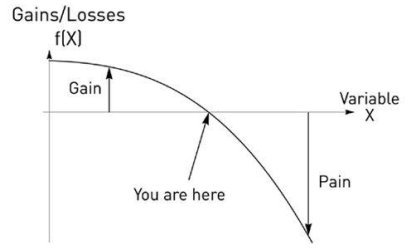
*Fragile – Concave, high sensibility to disorder*
*Antifragile – Convex, benefits from disorder*
Antifragility is a mathematical property of complex systems, where there are several parts interacting with each other in a nondeterministic and nonlinear manner.
Nondeterministic means it is very hard to understand cause and effect because there are too many variables, which by itself makes comprehension difficult, since when those variables interact the possibilities multiply explosively.
My favourite example of complexity is the human brain, with 86 billion neurons on average and 10,000 times as many connections. https://www.ted.com/talks/suzana_herculano_houzel_what_is_so_special_about_the_human_brain https://www.ted.com/talks/sebastian_seung
Somewhere within the nearly limitless interactions between your neurons is your unique self.
That is the explosive complexity that makes you, you!
Nonlinear is dose-response complexity, such as in physiology where doubling the medicine dose will not necessarily result in faster or better healing. The medicine can become poison. So as the saying goes: “the difference between medicine and poison is in the dose”
Of course the nonlinear concept is not just applicable to medicine. It is present in Metcalfe’s Law: a network’s value is proportional to the square of the number of its users.
*“**Networks have ‘network effects.**’ Adding a new participant increases the value of the network for all existing participants. Network effects thus create a winner-takes-all dynamic. And the Rulers of these networks become the most powerful people in society.”* https://twitter.com/naval/status/877468095236849664
Antifragile systems are comprised of small parts that themselves are fragile. In fact these smaller parts, or subunits, need to be fragile to make the whole antifragile.
This happens through the feedback generated by the failures of several subunits under stressors, those failures are discarded, so the remaining survivors are able to maintain a functioning system and respond better to such stressors.
These subunits can have great variability amongst themselves like species in nature, or they can be more uniform as nodes in the Bitcoin network. Either way they respond and adapt to internal and external forces in the system.
A difference is that the existing genetic variety in a population is random and serves no purpose by itself, it just appears to have a purpose (teleonomic process) in retrospect. https://en.wikipedia.org/wiki/Teleonomy
Only when there is selective pressure such as changes in the environment, more predators, lack of resources, diseases and so on; that random variety becomes purposeful by adapting the system to change.
In a crypto network purpose is more or less predefined.
Both natural and crypto ecosystem benefit from *The Disorder Family*:
*The Extended Disorder Family (or Cluster): (i) uncertainty, (ii) variability, (iii) imperfect, incomplete knowledge, (iv) chance, (v) chaos, (vi) volatility, (vii) disorder, (viii) entropy, (ix) time, (x) the unknown, (xi) randomness, (xii) turmoil, (xiii) stressor, (xiv) error, (xv) dispersion of outcomes, (xvi) unknowledge.*
These systems are particularly fascinating when you realize that they usually work in a fractal manner: components of the system contain even smaller parts with the same properties as the whole. This is called fractal self-similarity and it shows interesting characteristics when we zoom out from micro to macroscale.
Maintaining our biology template, skeletal muscle cells become stronger after being exposed to the stress of an intense work out session. As far as we know tiny damages in the intracellular structure lead to stronger cells after a period of recovery.
Zooming out from cellular structure we can look at individuals in a population, in this instance epidemics are among the most striking disorder agents. Epidemics have decimated large portions of the European population throughout the centuries and yet it was that constant stress combined with enough genetic variety that produced resistant individuals, but only after generations.
The benefits of this adaptation goes to the larger population throughout time instead of all the people who suffered the chaos. This is characteristic of every scale we look in several distinct systems – ****subunits (individual) pay the price and the whole (collective) get the reward******.**
Also worth noting is how this larger physical/spacial scale is also accompanied by a larger temporal scale.
Too much stress
Eventually there is a point where the system can’t handle disorder.
When Europeans arrived in the American continent, the native population had no previous contact with those European germs. Germs also adapted to the population, densely packed cities well connected throughout the continent and a variety of domesticated animals made a perfect breeding ground of strong diseases.
The level of disorder those diseases caused in the native population was so large that led to a mortality rate of about 95%.
The amount of disorder is very important because there is a limit on how much a system can take, beyond that limit any antifragile system turns fragile.
Overall, the larger the system scale the larger the stress it can handle.
So any system can benefit from the disorder family up to a point, then after that it will fail just like any fragile system.
The ski resort is not a complex system, it just offers a simple illustration of how volatility can become detrimental if the dose is high enough.
Modeling reality
The world is a complex and complicated place, due to the massive amount of variables and the infinite possible interactions between them we can never fully experience reality as it is. We can use reason and knowledge to complement our limited perceptions of the world.
We can also create models to improve our understanding, in fact our senses are models of the world outside our minds. Sound exists only inside the neuronal symphony of our brains. The same is true for every sensory input we have. Our inescapable personal matrix.
Using reason and creating models of reality we supplement our limited perceptions, like the earth being static with the sun and stars revolving around us. Then, sooner or later, scientific knowledge acquired throughout the centuries can be transformed into useful technology.
Of course every model has limitations, as Benoit Mandelbrot said:
*“All models by necessity distort reality in one way or another. A sculptor, when modeling in stone or clay, does not try to clone Nature; he highlights some things, ignores others, idealizes or abstracts some more, to achieve an effect. Different sculptors will seek different effects. Likewise, a scientist must necessarily pick and choose among various aspects of reality to incorporate into a model.”*
With that in mind I want to present three models to visualize the antifragility of the crypto ecosystem. One is not better than the other, they are just different perspectives that complement each other.
Layers
This model was proposed by the economist and great spokesman of antifragility Richard Rytenband. https://twitter.com/RRytenband
It consists of visualizing the crypto ecosystem expanding out from Bitcoin.
The main takeaway from this model is that the first layer, Bitcoin, is never exposed to the risk of ruin. Since the changes and updates are always very conservative and slowly carried out by developers it doesn’t get exposed to systemic risk.
All the wild experiments and new ideas are tested on the second layer of Altcoins. Alts, unlike Bitcoin, are exposed to systemic risk and can fail completely.
Any failure, while very unpleasant for investors and developers, would be beneficial to system as a whole because failures always provide new information.
That new information can be slowly incorporated into Bitcoin. Thus creating a convex first layer:
Few limited downsides and potentially unlimited upside.
This is why Altcoins are integral to the crypto ecosystem.
The experimental characteristics of the second layer help explain why Altcoins have such a larger profit potential compared to Bitcoin. The higher risk has to be compensated by larger gains, this happens organically like in any natural system, no need for central authorities dictating regulations on returns.
The second layer has fractals in base protocols like Ethereum, Waves, NEO, EOS.
So base protocols can have different experiments running on their own extra layer, just like before these extra layers serve as a new information and experimentation source.
In any project the risk of ruin always increases with more complexity, time, size and development velocity. So developers rushing to finish big projects are increasing the likelihood of sacrificing their ideas for the “greater good” with no personal payoff, remember the individual pays the price and the collective gets the reward.
*Layer1 > Layer2 Altcoins (base protocols) > Layer 2 Altcoins*
Before moving on to the second model let’s look at a complementary, and essential, mathematical concept to antifragility.
Lindy Effect
It is the reason that the classics never go out of style, why people still read books that are centuries old and are expected to continue on reading for centuries to come.
First described by Albert Goldman in The New Republic magazine in 1964; comedians used to gather in Lindy's delicatessen in New York. Where they noticed that the expected length of a comedian’s career was proportional to the time spent on stage or TV. https://en.wikipedia.org/wiki/Lindy%27s
Later Benoit Mandelbrot mathematically formalized the concept and Nassim Taleb made the distinction between perishable and nonperishable:
*Perishable – Fragile towards time (short theta): It ages and die.*
*e.g. Individual organisms*
*Nonperishable – It doesn’t age, it resists time but it perishes as a result of fragilities towards other disorder agents (short gamma)*
*e.g. The great pyramids*
*Nonperishable (Lindy) – It ages in reverse and it benefits from everything in the disorder family (long all)*
*e.g. Almost everything that is informational – genes, ideas, broad categories of technologies (more on that soon)*
In essence the Lindy effect shows that anything (nonperishable) that survives one day has, on average, its life expectancy extended by another day. This is not to be taken literally but it is a good probabilistic indication of survival.
Categories
My first encounter with this model was by the great author and futurist thinker Daniel Jeffries. https://twitter.com/Dan_Jeffries1
Here we have to zoom out from the everyday experience we have with technology and see the broader characteristics behind them.
It’s easy to see things like those old betamax and VHS tapes, DVDs and blu-rays. The old Ford Model T and the new Tesla Model S. In the more abstract world of cyberspace examples range from MySpace and Facebook to Bitcoin and countless Altcoins.
But those are just iterations, that zoomed in view of everyday experience.
The zoomed out view is of the broad categories: video recording, cars, social networks and decentralized ledgers.
The zoomed out view throughout time will show that iterations are the small fragile parts of the technology ecosystem and categories are the antifragile whole.
Those recording mediums are all dead or dying, the Model T now is just a symbol of ingenuity and MySpace was taken over by Zuckerberg’s panopticon. Any technology iteration can die.
Categories, on the other hand, are the nonperishable-lindy survivors.
Once we visualize cryptocurrencies in their categories it becomes easy to understand how the system is evolving.
Bitcoin started the crypto revolution because it was the first decentralized solution to the double-spending problem. https://99bitcoins.com/double-spending/
Litecoin, the first altcoin, started experimenting on the same ledger architecture, then soon after there was an explosion of slightly different blockchain takes. During that crypto-cambrian explosion the first DAGs came out to experiment with a different ledger architecture (although blockchains can be considered a simplified form of DAG). https://twitter.com/ColinLeMahieu/status/1013787453386383360
Constant evolution and experimentation are the norms in natural systems.
On the works for several years, Radix has a singular approach to seemly unbeatable trilemma between decentralization, security, and scalability. All with a new consensus and ledger architecture. https://www.radixdlt.com
But distributed ledger technology is actually a subcategory. The basic problem it solves is how independent nodes come to agreement about a state of reality. So the complete category is Distributed Consensus Technology.
The Internet started out free and open but for years it’s increasingly becoming a walled garden.
That’s why projects like MaidSafe are aiming at creating a distributed autonomous network, like the Internet was supposed to be. https://safenetwork.tech
Something we urgently need.
Tree branches
And here is my slightly different take, a hybrid between both previous models.
Just like a tree of life can be used to represent biological taxonomy we can use one to represent technology as it evolves.
The trunk is the main category, the branches and leafs are the iterations.
Antifragility and the Lindy effect are stronger closer to trunk, the closer you go towards the branches and leaves the weaker it gets. To the point of becoming fragile at the edges.
I used small branches to represent Radix and MaidSafe because although both are closer to the trunk, unique in each category, they are not yet released on the real world. So neither had a chance to prove themselves before the time expert - Lindy.
The purpose of this model is to have a dynamic representation of the crypto world flowing in time. Imagine that the tree is alive and always growing, leaves and some branches can fall to fragilities but new buds appear all the time.
You can argue for a different classification and that’s fine, but here is the main takeaway:
As time goes by, backwards compatibility between different projects becomes harder. Even within a very specific subcategory. It won’t always be possible to retrofit a new tech developed in the edges to another that has had time to differentiate or is closer to the base.
Zooko Wilcox talks about this at the end of this podcast. https://soundcloud.com/cryptovoices/show-39-zooko-wilcox-importance-of-privacy-zcash
It is as if the branches become *“woodier”* with time, which means achieving a useful hybridization without compromise to the stability can be a challenge with diminishing returns.
There has to be a balance between stability and backwards compatibility with improvements and new features. Which means sometimes it’s better to work on a new tech rather than to improve an old one.
In the grand scheme it doesn’t matter because the trunk should remain the same, resisting all but the most drastic elements of disorder.
Conclusion
Distributed consensus technologies are not invulnerable, anything can become fragile if disorder gets to a high enough point. However this is a large tech category and that point is very high indeed.
Analogous to zooming out from small groups of taxonomy classification, from species towards life:
Antifragility and the Lindy effect gets stronger in each step.
No matter how many species go extinct life goes on.
No matter how many crypto projects fail, the crypto ecosystem is here to stay.
So assume the intertemporal view and long the Distributed Antifragile Crypto, short the centralized and fragile. http://www.investopedia.com/terms/l/long.asp https://www.investopedia.com/terms/s/short.asp
_____________
Disclaimer
Instead of the old cliché **this is not financial advice...** here are the five rules of science from Neil deGrasse Tyson:
***(1) Question authority****. No idea is true just because someone says so, including me.*
***(2) Think for yourself****. Question yourself. Don't believe anything just because you want to. Believing something doesn't make it so.*
***(3) Test ideas by the evidence gained from observation and experiment****. If a favorite idea fails a well-designed test, it's wrong. Get over it.*
***(4) Follow the evidence wherever it leads****. If you have no evidence, reserve judgment.*
*And perhaps the most important rule of all...*
***(5) Remember: you could be wrong****. Even the best scientists have been wrong about some things. Newton, Einstein, and every other great scientist in history -- they all made mistakes. Of course they did. They were human.*
*Science is a way to keep from fooling ourselves, and each other.*
_____________
Special thanks to:
Richard Rytenband https://twitter.com/RRytenband
Dan Jeffries https://twitter.com/Dan_Jeffries1
Both inspired me tremendously in this article.
Also Marco Batalha and Kady Coelho for helping with proofreading and graphics. http://www.kadycoelho.com
_____________
Thank you very much for reading!
If you like this article feel free to tip, share and subscribe.
Bitcoin - 1Ny8DefBzKXDpaBCGrFomEJ4uNxFGiJazH
DAI - 0x6314526213b16aF52BBe227d06c1e8F1e662aa00
Dash - XoCRnBqGFMjdP8PwKfF7Rrb8hnCKLbE27A
Decred - DsacQEaY9gXT6Bjvx9U1SLH3YbhHhkLBhjE
Ethereum - 0x6314526213b16aF52BBe227d06c1e8F1e662aa00
Monero - 4418L4CxTQsa6hz26bEtfEBW4iFvnRfYw6A6gq1Up6qQFLsR8NS5qyvKXc1HieV4HFP2vPF84YwEw9QWDWrnk2uRBA2yqFq
Nano - nano_1r15f1naypwn87zxq75ztx7pdx3ao9hspehh1jijjhb9c3a5jn6kc7ske9gn
NEM - ND6OZRXOWIXHTAOW4YBWDNXKGHLQWYVSU4WGGVPL
Zcash - t1fkoBKABLETDcNQg9XXxhh3ikswvhPf899
_____________
Contact - Keybase https://keybase.io/renan_
[Mastodon](https://mstdn.io/@renan)
[Twitter](https://twitter.com/renan_crypto)
 @Renan