5 Ways To Earn In The Metaverse In 2022
You may have heard about the Metaverse after Mark Zuckerberg’s announcement about his company's next goal: **conquering the Metaverse**. According to the USA Today newspaper, the Metaverse is a combination of multiple elements, including virtual and augmented reality, in which people live within a digital universe.
Proponents of the Metaverse envision that, one day, people will work, play, ride virtual cabs and make friends directly in these worlds. Something that, in my opinion, doesn't sound too new, but could mark the beginning of a new era for the digital world. However, what we are interested in is only one chapter in the history of the Metaverse, namely all the earning opportunities related to these virtual worlds. Today we're going to look at **5 ways to earn in the metaverse!**
**1) Play to Earn**
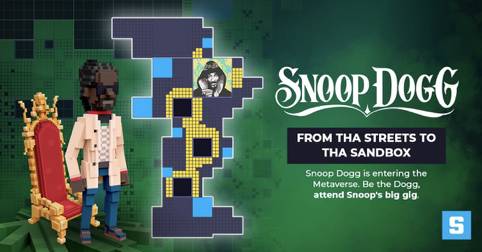
Games of this type are commonly called play to earn, games that are quite famous in the Metaverse. Typically, these games, are combined with winning some NFT that can be resold in the different marketplaces that work on the Metaverse and its augmented reality world. Numerous players around the world make a living playing such games and even **Snoop Dogg** is starting to organize parties in the Metaverse where access is gained with an NFT.
Simply put, the Metaverse is a virtual realm where almost anything is possible. Games in the Metaverse can also include gambling games, old Pacman-style arcade games, and much more. Typically, to participate in these games you need the native currency of the Metaverse in question (like SAND for The Sandbox), which will act as a token to purchase a ticket. Depending on the game you choose, you can win different prizes, ranging from NFT to other digital currencies.
**2) Selling clothes**
Selling clothes is one of the most famous ways to make money in the Metaverse. **Nike** recently purchased a company that deals with the creation of virtual shoes, ready to be turned into NFTs, as written by the Daily.
In addition to Nike, many other companies such as Linkedin, Starbucks and Best Buy have expressed interest in creating stores on the Metaverse. I don't think Starbucks' coffee can be good in an NFT version, but we'll see what they come up with. Since the Metaverse is populated by avatars, it's normal that people will be looking to buy virtual clothing and items to decorate their avatar and make it unique.
If you want to take advantage of this method of making money with the Metaverse you'll have three options:
Create your own NFTs: This is one of the cheapest options if you have the skills to create NFTs. You could create shoes, hats, socks, houses, animals and sell them in the Metaverse. The only cost you will face is the cost of gas to make the transactions.
Paying someone to create NFTs: the second option is to pay a firm that specializes in creating NFTs. There are numerous people who can take care of this, including on inexpensive platforms like Fiverr.
Buying and reselling NFTs: let's finish with the actual speculation! Buying and reselling NFTs is something very much in vogue among influencers and gurus on various social platforms.
**3) Selling access to events**
On Ethereum's blockchain, some Metaverse already allows active users to buy land, build properties, and host whatever business they want. Snoop Dogg for example, has already rebuilt his mansion within Sandbox and is offering VIP tickets for his live show to people on the platform. There are also several figures in the network's business world who are offering access to special events on the Metaverse with the purchase of a few NFTs, a phenomenon that could get bigger and bigger.
Here a little video about Snoop Dogg in The Sandbox:
https://www.youtube.com/watch?v=WD38OueA5zk
**4) Sell digital properties in the market**
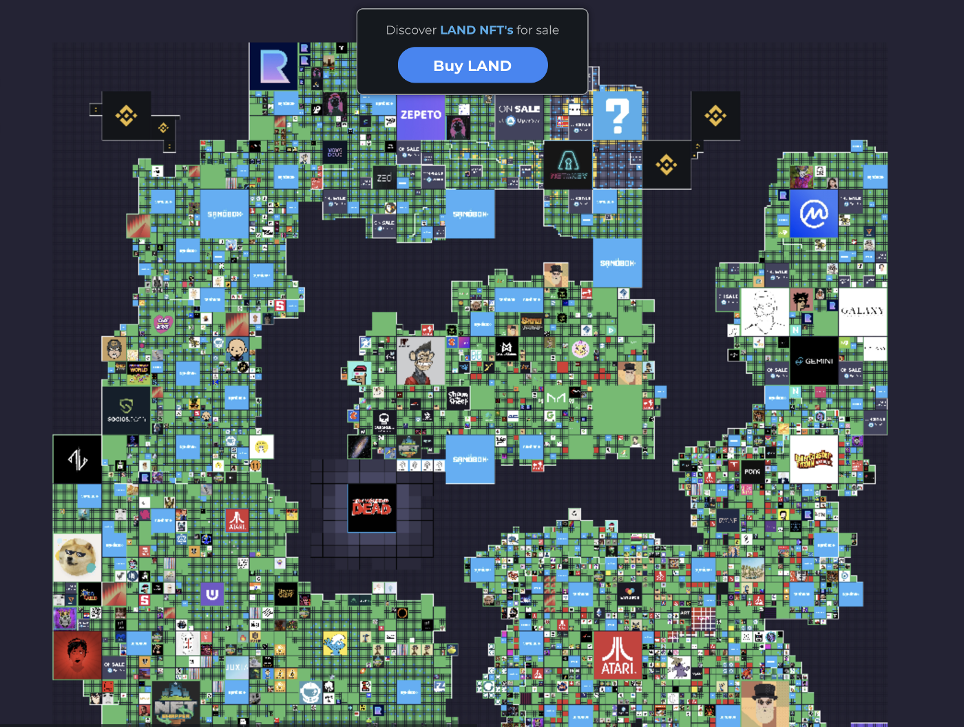
Buying land is one of the popular ways to make money in the Metaverse. There is no single Metaverse, so people are buying any land for sale, hoping to make some money from it. Virtual real estate developer Republic Realm just set a record by buying land for 4 million in The Sandbox platform, breaking a record set a week earlier by Tokens.com for a 2 million purchase.
These companies have the full intention of creating virtual shopping malls and other rentable properties on the Metaverse, thanks to a systematic purchase of the lands currently available. In their own way they seem to envision a world in which storefronts can be rented to tech giants who want to sell merchandise, without maintaining any virtual real estate.
**5) Renting land in the Metaverse**
If you have a small, medium or large amount of land within the Metaverse you can rent your land to creators or builders who cannot afford to buy the land. On Second Life some homeowners earn a monthly rent paid in real money. For each rented apartment, the income is about 20€ per month. Now, we are not talking about huge sums of money, but these could increase as the Multiverse consolidates with the real world. In my opinion, renting lands and buildings in the Metaverse is a good way to passively earn money online.
Crypto Arbitrage is not a good asset for MLM. Let's find out why
Let’s start from a news from the last days: the CEO of Arbistar, Santiago Fuentes, has been arrested in Tenerife, and he has been charged for fraud, affiliation to criminal organization and money laundering.
I see many people denigrating many businesses telling that they are scams. When they are asked “why the heck are you saying that they are scams?” the best answer they can provide is: “It’s a scam because it is obviously a scam and it is not sustainable”.Well. I compare myself to the truffle dog when it comes up to scams. But I never say scam if I have not done a proper due diligence.
**So, how do I detect a scam?**
When someone suggest me a business, at first, I investigate why he is proposing me that business.
1) What kind of interest does he have for suggesting me this business?
2) How much is affordable this business?
3) What is the underlying asset that would provide that kind of Return on the Investment?
1) Is he going to earn a percentage on me joining the business or is he just such a magnanimous person? If he is going to earn a percentage on me, what would pay his percentage? Is my starting capital that is immediately separated into different incomes of the MLM structure?
2) How many people can join this business? Is the entry level from 100$ or the threshold is at least at some thousand euros equivalent? How many turkeys are they trying to pluck?
3) Some business may really be profitable, but how much are they really scalable?
Let’s make an easy example with the Arbitrage.
Crypto Arbitrage is a business which birth goes back to the first stock exchanges at the mid-20th century. You buy a stock on an Exchange where the price is lower and you sell it where it is higher. Easy at it is.
Through the year, different Multi-Level-Marketing have tried to setup assets on the Arbitrage, but the real gain has always been just for the creator of the scheme, that gained money in two different ways: network commission or the sale of automatic/semi-automatic arbitrage software.
So: if the uplines and the founder gains from my entry-package (initial investment), my money is separated. Let us say I invest 100$, and 15$ goes to the uplines, I am left with 85$ working.
Let’s do some math: 15$ on 100$ is 15%. So, 15% is the distribution to the network. From 85$ to get back to the Break-Even Point, requires a profit of 17.6%. Higher that 15%. Not revolutionary higher, but higher. With this thought I wanted to point your attention to a key point: higher the network commissions paid by the starting capital, less sustainable the business will be.
**And if the business is based on the sale of software licences?**
Well, the substance does not change, and we are just moving the problem onto the sustainability of the software licence. How many licences are enough to saturate the market? After market saturation, is the business still going to be profitable?
In case of a Crypto Arbitrage software, the more people have the same software, the less will be the profitability for all. So, if you are going to pay a software licence, be sure that is not affordable for so many people otherwise you will be ejected from the market, starting you losing path.
Anyway, not all Software licences affiliation schemes are not sustainable. Let’s say that a Company is selling a software for email management. Market can take long to reach saturation and even if you will not have residual profits from affiliations, you can still enjoy the software and its features and eventual residual incomes from monthly/yearly subscription.
Why Crypto Arbitrage is not sustainable if carried out with a MLM?
Well, Arbitrage catches orders beyond the negotiation range, but these orders may be depleted soon.
Let’s create a concrete example on the market Bitcoin/Dollar
Exchange 1.
Buy Price: 1000$
Sell Price: 1001$
Exchange 2.
Buy Price: 990$
Sell Price: 995$
We should buy BTC on Exchange 2 and try to sell it on Exchange 1. Profit would be around 1% minus trading fees.
I buy at 990$. The other guy that owns the “Crypto Arbitrage Super Pro Top Gain” software, will buy at 990$ or a price slightly lower, since the orders in the Book will finish soon or later. Let’s say that Guy 1 will buy at 991$. Guy 2 will buy at 992$ and so on until Guy 10 arrives, and he would buy at the price of 1000$. Buying at 1000$ to sell at 1000$? You are just losing time and trading fees. A specular thing would happen on the sell side, reducing the profitable spread between exchanges.
So, are you doing Arbitrage? I am happy for you. Sincerely.
Are you in a MLM proposing Arbitrage? Save your money and make a donation to plant some trees or feed some families. It would be a far better investment than a MLM arbitrage scheme.
Token Review: Litentry (LIT)
Today we are going to introduce a new cryptocurrency: Litentry (LIT)!
**OVERVIEW**
To understand Litentry, you must appreciate the problem to be solved. In short, it all boils down to decentralized identity management.
How do you attach unique identities to certain users on a decentralized blockchain?
How do you know that a particular wallet address with which we are dealing is controlled by a unique individual?
Without attaching an identity to an address, the potential that DeFi (Decentralized Finance) can achieve has certain limitations.
What is Litentry?
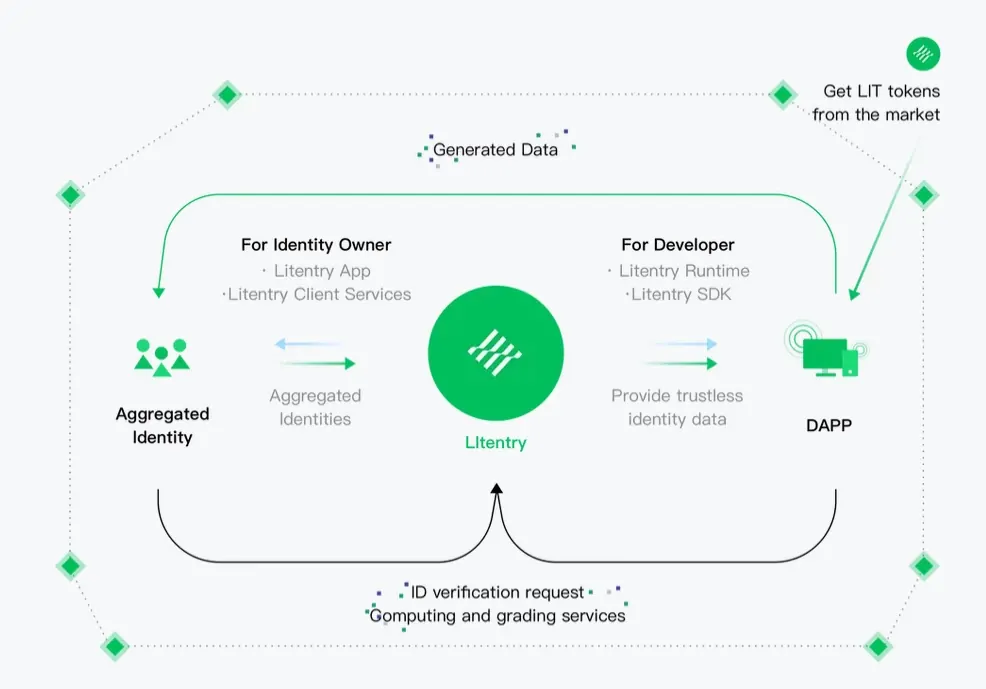
Litentry is a project that is developing a platform that can aggregate and manage decentralized identifiers or DIDs in many different blockchains. Therefore, basically, it is a platform for projects and agreements for managing and using DIDs as input for new and exciting functions.
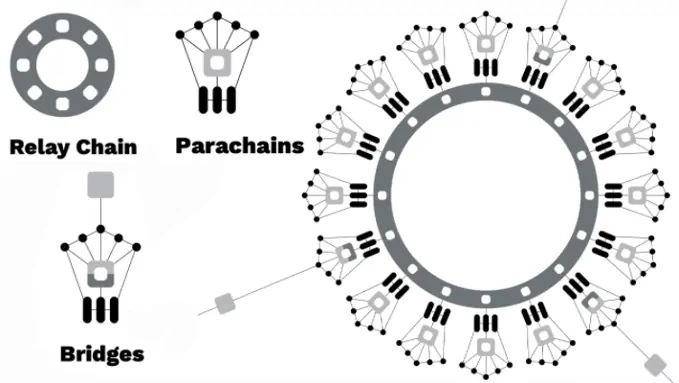
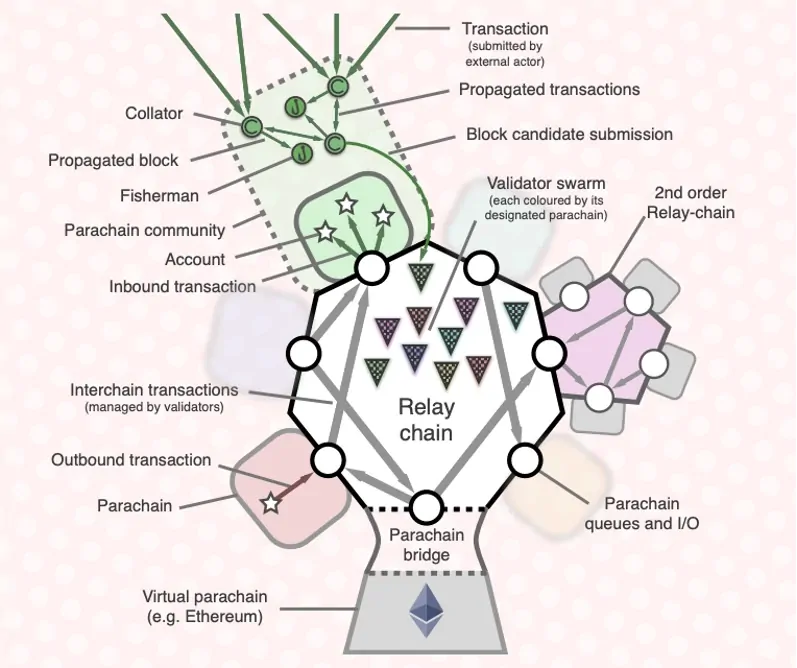
More importantly though. Litentry is trying to build a protocol that will allow these DIDs to be used privately and securely. Litentry performs cross-chain transactions, with the goal of becoming Parachain of the Polkadot network. I have already talked about Polkadot in this article. It handles service requests from Litentry users, who claim it is a security-centric project, through DID (Decentralized Identifier).
The demand for integrated identities data is expected to largely come from decentralized applications that are fueled by personal identity data. Besides interoperability, the identifier plays a critical role in scenarios where the server requests the client for identity data, such as KYC, credit
scores, or credentials, in an attempt to provide services. In the past and present, many applications require users to provide their information from third-party applications or directly track user activities to obtain the information they need. This inevitably compromises users due to privacy invasion and personal data breach.
How it Works?
Let’s take a look at the user side technology, and the primary piece of technology here is the Litentry mobile app. The app will be integrated with the Litentry Network and will allow users to participate in the governance process and access Identity-Based Services. The app could also be linked to other networks and even some traditional identity verification systems. They will also be able to manage LIT incentives here and also use it as a crypto wallet. The app will include the Litentry authenticator. This is the mobile identity and data hub for the Web 3.0 ecosystem. You can actually get a sense of how this looks over here on the initial proposal of the app over in their docs.
On a more technical level, the Litentry runtime protocol will be able to link an account across all other chains using that unique identifier. The users on Litentry can sign transactions attached to their unique identity with a private key. The benefits of this are that the user data can be shared but privately. Nothing about the user themselves apart from the unique identifier is actually shared. This identifier can also be linked to unchain crypto assets to verify information relevant for credit delegation etc.
**DEEPENING**
In the **Overview** section I introduced you Litentry (LIT) and I said that **is a project that is developing a platform that can aggregate and manage decentralized identifiers or DIDs in many different blockchains. Therefore, basically, it is a platform for projects and agreements for managing and using DIDs as input for new and exciting functions**. Litentry is trying to build a protocol that will allow these DIDs to be used privately and securely. Litentry performs cross-chain transactions, with the goal of becoming Parachain of the Polkadot network. It handles service requests from Litentry users, who claim it is a security-centric project, through DID (Decentralized Identifier).
**Tokenomics**
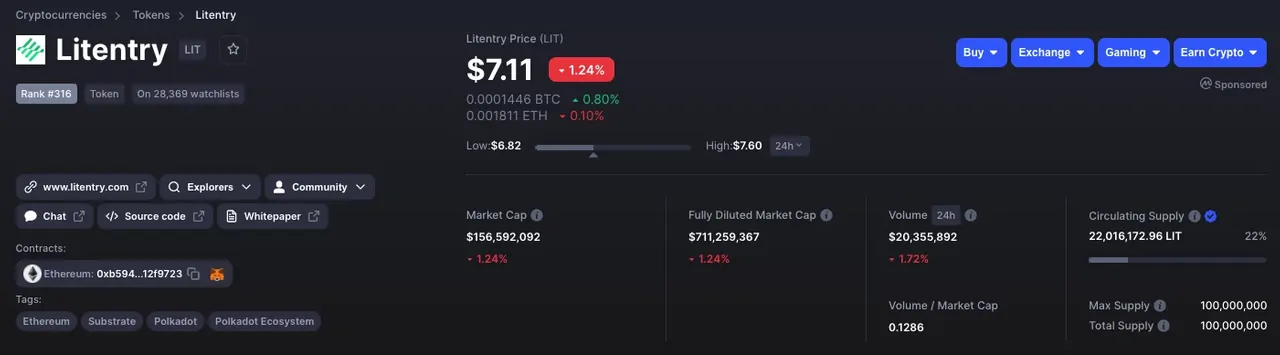
There is a total supply of 100 million LIT. These tokens were split according to the following:
* 15% to the Litentry team
* 8% went to the seed investors
* 12% to private sale and further sales
* 17% will be reserved for the foundation to be used as grants
* 3% to Binance launch pool
* 5% to remain as network incentives in parachain auction system.
Therefore, as far as the initial release is concerned, I think it is quite fair. If we include the distribution of founders into a wider range of network incentives, including the startup pool. The full 65% will eventually be released to the community. However, from an investment perspective, it is important to determine potential supply resistance based on the token unlocking schedule. There is no doubt that users are worried that the initial sales will be dumped on the market.
The 3% released in the Binance launch pool has been distributed and is in circulating supply. Parachain auctions and collective reward inflation will only start in November 2025. Once the block reward starts, the inflation rate will be determined by the amount pledged on the network. The participation rate of the target network is 70%, which means an inflation rate of 5%. For the proof-of-stake blockchain, this is actually quite mild. Therefore, from a supply perspective, it is impossible to face supply saturation or inflation. All of these have played a positive role in long-term price increases.
**Token (LIT)**
**LIT is a native utility token on the Litentry network and performs several different functions.**
First of all, it is used to pay for expenses. Users must pay several different fees on the network. This includes fees such as transaction fees to prevent spam from network matching fees, which are paid by the app to the identity stager. This motivates more people to invest in identities on the network, paying verification fees to the so-called identity guardians, who are responsible for verifying mortgage identities and collating data into acceptable identities. Therefore, this is the utility generated from the network cost. But **LIT tokens are also used for staking purposes.** An identity registrar is a third party that can build an indexed identity database. Then query these databases for scattered identifiers. To ensure that these registrars participate. They have monetary incentives and restraints.
In February Litentry was also listed on the famous exchange **Binance.**
Being able **to verify the unique identity of the wallet address** is the missing key to many other services that DeFi relies on to provide centralized finance. Under collateralized lending and credit delegation, the functions that have not yet appeared on the DeFi menu. Not until we can verify identities, and even then DeFi currently lacks the mechanisms to fully identify how decentralized networks are. All these problems can be solved by Litentrie's technology. In addition, considering that it can be upgraded to a **Polkadot parachain**. This means that it will now be built on one of the most exciting ecosystems in the crypto space.
With this article about Litentry we have discovered new things about this project! I would like to know **your opinion about LIT**!
Next Sunday I’ll introduce you a new cryptocurrency!
So, **be sure to follow my profile** for receive the notification of my next articles on read.cash!
Suggest me with a comment some crypto you would like to see analyzed!
Faucets are not forms of investment
The faucets were born as an advertising medium to introduce a new cryptocurrency to the masses.
Famous faucet was that of Andersen, of the site "The Bitcoin Faucet", by simply registering on the site and entering his wallet address, 5 BTC were credited. Without fees!
Clearly, being an advertising vehicle, the coins are "given away" for purely cognitive purposes so that, beyond the White Paper, a person can realize the solidity of the project or not.
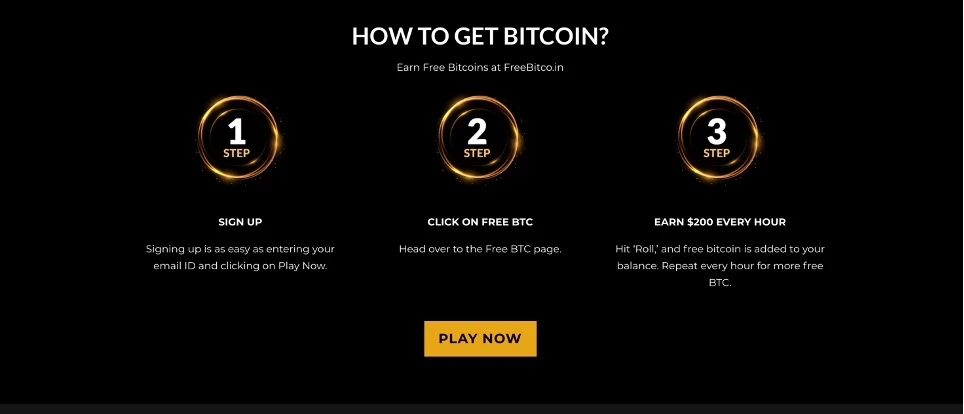
If a faucet is applied to a currency that is already known, it is first necessary to carry out checks as there could be vicious circles to obtain them; or they are up for grabs as a lottery, as in the photo below.
First of all let's talk about BTC and not about a newly minted coin that has to be launched; to have a fraction of BTC (at most $ 200 per hour), you need to register and start a device similar to a slot machine.
This free form to get some Satoshi is to be taken as a game given the negligible amount of satoshi that are offered for each claim.
Out of curiosity, I attended one, and within 1 hour I totalized 15 Sat. … It wasn't a rich booty.
Let's develop the reasoning.
If we search within the page of any faucet, we find an affiliate link.
Well. With this link we can inform other people who can, for free, receive small portions of satoshi. And this is the way the launcher of the Faucet tries to make early adopters of the faucet to spread the word and share the news about the coin.
Is playing with the Faucet really worth it?
Well, in my opinion it is not. It’s just a funny way to discover new coins or tokens and to get some innovative marketing ideas about how to spread new projects.
DeFi and CeFi: they are just different
After the correct observation by a friend of mine, I take this opportunity to highlight the differences between the two types of this new finance, that is full digital.
Although they both have the same goal, it is the means by which they pursue it that are diametrically opposed.
As we know, Binance gives the possibility of staking, through its platform, and following the latest updates and evolutions, it has also added the possibility of lending to its portfolio of financial products.
And here it immediately catches our attention that being everything subordinated to the Binance platform, we cannot talk about DeFi (decentralized finance) but CeFI (centralized finance); in a sense it is as if a bank were offering financial products with cryptocurrencies as the underlying asset.
**CeFi - DeFi the main difference**
The transposition of financial products on the blockchain is affecting a very fervent application field. Starting from lending protocols, passing through security tokens, reaching NFTs (non fungible tokens) are the categories of a very active sector.
**But when can we talk about DeFi?**
We speak of decentralized finance when there is no intermediary for the use of the financial product and everything is supported on decentralized networks, open source software, transparent and trustless protocols.
In DeFi, the user itself get access to the requested financial service and it is then resistant to censorship (no entity can prevent him from accessing it); it also has full power over its assets and personal data.
To have access to DeFi, all you need is a Smartphone and an internet connection.
If no one is checking, who should check?
**Simple: a smart contract.**
As mentioned above, DeFi is based on open source software so it is free and open to all: the code that regulates the smart-contract can be verified by anyone; consequently the logics are transparent.
On the contrary, CeFi is based on financial products, which always have cryptocurrency as their object, managed centrally by a company.
Here is the explanation of the Binance phenomenon: from a simple broker for trading, it has slowly added various financial products to almost become a real "Crypto Bank" and not Crypto-Friedly!
It is for this reason that I have published videos on how to stake directly from the source without going through any platform: it is about maintaining a certain line of decentralization to which we have been introduced since the birth of cryptocurrencies.
**Who wins the competition? DeFi or CeFi?**
The answer is extremely personal, as each of the two solutions brings with it positive and negative sides.
With DeFi, we personally manage everything from the signing of the smart-contract to the communication of personal data; what's more, our cryptocurrencies never leave our wallet.
On the other side (Take it on the Other side, nanananana. Thank RHCP for this amazing memory), however, the management of the smart-contract does not admit any kind of ignorance: whoever executes it must know how, when, where, why, who, is happening.
CeFi, on the other hand, does not require this precise knowledge of things: within the platform the user is guided step by step in the realization of what is desired.
However, it is necessary to know that with a platform that offers these services, it is necessary to fill in a KYC and in some cases, depending on the movements, even an AML.
In addition to all this, our cryptocurrencies can no longer be in our wallet, but in the account we have created within the platform.
**With all the hacking risks that can exist.**
The choice is still very subjective: those who, for fear of making a mistake or out of laziness, do not stop to try to understand the smart-contract and rely on a platform, therefore a CeFi.
While those more enterprising and devoted to decentralization and the holding of power of their money prefer to rely on a DeFi.
**Your Move!**
Token Review: Komodo (KMD)
Today we are going to introduce a new cryptocurrency: Komodo (KMD)!
**OVERVIEW**
**Komodo is a secure, stable and inter-operable blockchain platform and ecosystem that provides end-to-end blockchain solutions for developers in any industry.** Komodo was born as an offspring of Bitcoin Dark (BTCD), which is one of its key platform projects as it is geared towards solving Bitcoin's privacy issues. The official birth of the Komodo platform is said to be on February 21, 2016, when project leader James Lee announced the "Declaration of Independence" from the bitcoin blockchain, which resulted in the development of a specific blockchain, jointly developed on cross-chain atomic asset transfers. Like most privacy coins, the Komodo team remained anonymous for a while. However, as the project gained momentum, many of the team members chose to reveal their identities.
Designed to complete transactions while maintaining anonymity, Komodo was the first cryptocurrency to use a delayed Proof-of-Work (dPoW). The Komodo platform uses blockchain technology that aids in the flexible, secure, inter-operable and scalable creation of business solutions designed on blockchain.
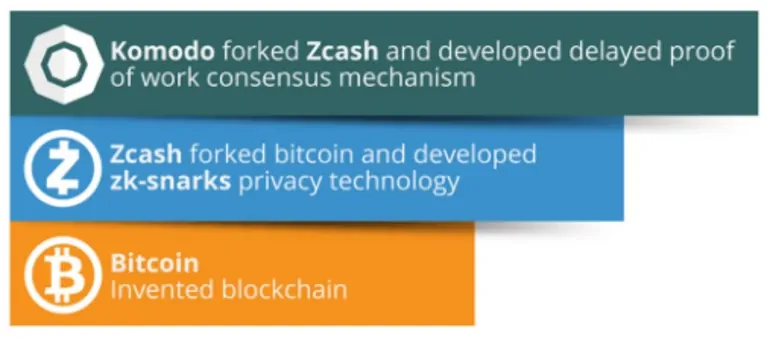
Komodo is a **fork of Zcash**, which is itself a **fork of Bitcoin**, also focused on privacy. This means that features that characterize Zcash are also present in the Komodo platform, such as the zero knowledge proof protocol.
**What are the peculiarities of Komodo?**
What sets Komodo apart is in fact the way it addresses the principles of **security, scalability, adaptability** and **interoperability** and below we will look in detail at each of them!
**Security**: is the most critical aspect of any blockchain project. Komodo uses the delayed Proof-of-Work (dPoW) consensus algorithm that protects the platform with the hashing power of the Bitcoin (BTC) network. With dPoW, attackers would need to overwhelm the KMD and BTC blockchains simultaneously, which is rather impossible.
**Scalability**: unlike other enterprise solutions, Komodo allows each project to have its own dedicated infrastructure and blockchain. All projects in the Komodo ecosystem can scale at any time and add additional blockchains to improve performance.
**Adaptability**: Komodo is an open source project recognized for its innovations and new features. Any project built with Komodo can create custom solutions that work for any situation and need.
**Interoperability**: It uses blockchain federation technology that provides the means for seamless cross-chain interoperability with federated chains. Moreover, Komodo blockchains can use atomic swaps to connect to other chains outside the federation.
Thus, we can say that the Komodo platform is a perfect fit for innovative developers, blockchain technology-based startups, and existing companies with complete end-to-end blockchain solutions!
**DEEPENING**
Komodo was born as an offspring of Bitcoin Dark (BTCD), which is one of its key platform projects as it is geared towards solving Bitcoin's privacy issues. Komodo is a fork of Zcash, which is itself a fork of Bitcoin, also focused on privacy. This means that features that characterize Zcash are also present in the Komodo platform, such as the zero knowledge proof protocol.
If you missed the article you can recover it here before to continue this one.
**How does Komodo work?**
**The Blockchain Platform**: Komodo grants developers unprecedented levels of autonomy and control. Its platform offers a blockchain with its own infrastructure, on Komodo's main chain. This technology is achieved by using parallel chains, which work by creating a separate copy of the Komodo blockchain. All new parallel chains are secured with the same dPoW consensus mechanism. Thus, developers can reap the benefits of an independent blockchain with its own shared/dedicated network and predictable performance without additional risk.
**Secure Privacy Coin**: Privacy and security are the key features of the Komodo platform. At first, the project inherited the privacy of Zcash (ZEC). Later, Komodo's founder, James, developed his own security solution, the dPoW algorithm, which essentially takes snapshots of Komodo's blockchain and inserts them into the Bitcoin chain every 10 minutes. Thanks to these snapshots, the Komodo blockchain can be restored at any time.
**Decentralized Exchange (DEX)**: Komodo's decentralized exchange BarterDEX is at the center of the ecosystem. It serves as the intersection between all chains. Unlike other DEXs that employ proxy tokens, BarterDEX is powered by atomic swaps. The goal of the exchange is to create the largest atomic swap network, which includes parallel chains on the Komodo network and all external blockchains.
**What about the KMD coin?**
Komodo coin can be used for instant zero-confirmation exchanges on Komodo DEX, can be used as an intermediary in transactions involving tokens that do not have direct pairing on BarterDEX, is used to pay for Komodo's Blockchain security service. Powers UTXO-based smart contracts. Is used for dICO crowdfunding launched on the Komodo platform. Anyone owning at least 10 KMDs can earn 5% active user rewards.
**Komodo Technology**
Komodo uses the Delayed Proof-of-Work (dPoW) mechanism to protect its entire ecosystem and as a service to protect other more vulnerable blockchains. Any blockchain, regardless of its consensus mechanism or hashing algorithm, can adopt dPoW consensus. The Komodo platform's dPoW system is connected to Bitcoin's Proof-of-Work network. Third-party chains that are connected to the dPoW chain enjoy the benefits of the Komodo network as they receive Bitcoin-level security but do not pay the associated Bitcoin network fees for notary transactions. Additionally, the security provided by the dPoW has as an advantage the ability to restore the network to its previous stage using snapshots.
**The Komodo project is an extensive and ambitious large-scale project that aims to solve many issues that centralization of cryptocurrencies and blockchains face.**
With this article about Komodo we have discovered new things about this project! I would like to know your opinion about KMD!
Next Sunday I’ll introduce you a new cryptocurrency!
So, be sure to **follow my profile** for receive the notification of my next articles on Hive.Blog!
**Suggest me with a comment some crypto you would like to see analyzed!**
Is the Crypto Tornado going to archive Fiat Currencies?
In this period, also thanks to the crisis that originated the Lockdown to deal with the Covid-19 pandemic, we hear more and more often about finance and fiat currency.
The topic is treated in terms of hyperinflation, Helicopter Money and increasingly cryptocurrencies are returning to the fore.
But if we already have a currency, why use digital currencies, more precisely cryptocurrencies?
The question is correct, but questionable, as cryptocurrencies were not born to replace fiat currency, but as an alternative to the traditional financial system.
**Creditor - Bank - Debtor**
With cryptocurrencies the intermediary is not necessary, in fact the creditor and the debtor are resolved through a direct operation: from the debtor's Wallet the Tokens arrive directly in the creditor's Wallet.
While in the traditional system, coupons with a predefined value are sold through the currency, in the new system it is possible to transfer the ownership of an asset: NTFs and STOs are two clear examples of how cryptocurrencies, although not tangible, can represent something real and concrete.
This inherent characteristic of digital currencies, more precisely cryptocurrencies, makes them difficult to understand.
**Allow me a comparison: the internet**
When the World Wide Web was born in 1991, no one had a clear idea of the extraordinary innovations it had with it; just think that you are reading this article inside a screen and not on an ordinary sheet of newspaper.
And even more so if you think, again thanks to the internet, you can see it in any corner of the Earth.
The worldwide connection has also changed the way people communicate, in fact we write E-Mail (Electronic Mail); but this did not prevent us from taking paper, pen and writing an epistle to a very dear friend.
Obviously you will say that by now the dear and nostalgic handwritten letter is obsolete, but let's not forget that the institutions, even today, rely on registered letters for important official communications!
So the internet has not supplanted post offices, but has joined them to speed up some procedures.
In the same way cryptocurrencies can do, it is not necessary to replace the fiat currency: the world would continue to function anyway.
But let's try to imagine that thanks to this technology it is possible to create a finance without governments, banks and money ...
Companies will be able to choose which system to use, obviously with an eye to what are the expenses and the possibilities of producing as much income as possible.
In this way, by giving end users full decision-making power, we could even think of having multiple cryptocurrencies for different purposes: a bit like work clothes that are not suitable for going to a wedding or vice versa.
In the long run it may become a habit to pay for certain things using cryptocurrencies, until one wonders why, instead, to use fiat ...
Obviously, this choice cannot be shared with most of the interested parties, namely the credit institutions.
**Because?**
Simple if cryptocurrencies were to access mass-adoption, the savings of citizens would flow into the free market and DeFi, and in this way the "traditional" financial products would have a big setback and the banks would pay dearly for the consequences.
**But let's look at it from our point of view**
MY coins, stored in MY Wallet, are mine only and only: only I know the private key and only I can make transactions.
In this way we really become owners of our money and we are Free, this is Satoshi Nakamoto's philosophy: Bitcoin should not make us rich, but Free!
The Timestamp, key aspect of the Blockchain
The Blockchain in addition to recording transactions with many different meanings, it inserts the Timestamp into each validated block. It is simply the date where the block was created and validated.
How does the computer deliver this data to the blockchain to guarantee its truthfulness?
Contrary to what we might think, it is not the computers involved in the Mining Farm that provide the date: it could be tampered with by those who manage the node. To avoid this, the Timestamp is managed through an algorithm; let's take the example of Bitcoin core.
There are 2 medians, that are represented by 2 average dates and a statistic deviation: if we remain within, we can consider the date to be reliable. To achieve a good precision, the greater the nodes that make up the network, the more accurate the data will be.
**Let's go back to the Timestamp**
The first median is calculated on the last 11 blocks of the chain, while the second median on the connected blocks; this comparison variable is called “Network-adjusted time”. Based on this variable, the timestamp is considered reliable if it is between the first median and the second with an offset of 2 hours.
Why is this timestamp important and how can we exploit it?
We can consider the timestamp of each block like a time mark, giving in return a certain date when information have been approved.
In this way, everything we report on the blockchain has a certain and immutable date so if we register our information we are defining with certainty that up to that moment it was not yet present on the blockchain. And I think you are going to agree with me that what was not on the Blockchain could not yet have a timestamp. That is the starting point to determine the potential timestamp of the upcoming data.
Let's see some fundamental aspects made possible by the timestamp.
**In e-commerce**
Let's imagine an online store that records both the terms of sale and product information on blockchain and the transaction of the product requested and sent. A copy of the timestamp including a link to the BC is sent to the customer at the time of purchase.
In the event of a dispute, the Timstamp will rule some parts of it and the customer may even try to act with bad faith but transactions can be verified and cross-checked. Anyway, to solve this case we need that all the stages of the procedure are recorded onto blockchain, from the warehouse to the house of the final customer. This to be sure that the item is correctly delivered in proper conditions.
**In publishing**
The contents that are timestamped with Blockchain, put the writer of the content and the reader on the same level, as each source is available for consultation by the reader and therefore the writer cannot "tamper with" the essence of the article. Timestamp can play a key role in the temporal order: as we all know, the largest sites, in internet searches, are the first to be viewed; for this reason if we read a news or anything else we could determine who was the first to publish it.
But what if it was actually posted by a minor site that doesn't appear in the top? Here the Blockchain and the timestamp undoubtedly sanction who published first!
**As proof of identity**
Soon it will be possible to connect your identity documents to the Blockchain: the block will have all our data and the exact moment in which it was originated. Once the digital identity will become widespread, it will be no longer necessary the KYC to activate a wallet.
And guess what: it will no longer be possible to steal the identity!
**Copyright protection**
The time stamp of texts and images is the perfect way to create an archive and moreover protected: every time the image or text is published with a date after it was archived, it has been published illegally; that is, without the author's authorization.
In this regard, I can mention Blom & Blom which protects its work in this way.
As we have seen, the possibility of being able to give a time stamp offered by the Blockchain can be exploited in various ways with a fundamental aspect: it does not harm anyone, indeed it protects both parties.
Token Review: Orchid (OXT)
Now let’s start with this **Orchid review**!
**OVERVIEW**
The Orchid network **enables a decentralized Virtual Private Network (VPN), allowing users to buy bandwidth from a global pool of service providers.** To do this, **Orchid uses an ERC-20 utility token called OXT**, a new VPN protocol for token-incentivized bandwidth proxying, and smart-contracts with algorithmic advertising and payment functions. Orchid's users connect to bandwidth sellers using a provider directory, and they pay using probabilistic nanopayments so Ethereum transaction fees on packages are acceptably low.
**Orchid's mission is to enable people to understand and control the network activities of their computers without worrying about censorship, surveillance or intermediaries.** In order to achieve this mission, they are using open source software to build solutions for a broad audience to create a probability-driven decentralized VPN market powered by probabilistic nanopayments on the Ethereum blockchain. Orchid inherits some current limitations from Ethereum in terms of payment anonymity, scalability, and censorship resistance. Additionally, their initial focus on affordable high bandwidth, low latency routing currently limits Orchid’s ability to defend against the most sophisticated theoretical traffic analysis attacks.
Orchis has 5 main goals:
- **Scalability**: The Orchid nanopayment system scales to a few million users sending probabilistic transactions once per second on the current Ethereum blockchain, and could potentially scale to billions of transactions per second using sharding with Ethereum 2.0.
Decentralization: All components, from nanopayments to node directory and discovery, are decentralized. There is no special trusted party with outsize influence or control in Orchid, assuming OXT stake is well distributed.
- **Usability**: Usability is key to wide adoption, and the anonymity the system provides per user increases with the size of the user base. For most users, using Orchid to protect their network connection is almost as simple as pressing a button.
- **Simplicity**: The protocol is simple to ease comprehension, implementation, and security analysis.
- **Extensibility**: Our core mechanisms are separable and orthogonal as far as possible to allow for easier future extension as well replacement. The nanopayment protocol and the smart contract do not interact directly with other systems.
Orchid users run a client similar to a typical VPN client for a protocol similar to OpenVPN, but using the Orchid protocol. The Orchid web client goes beyond the basic functions provided by most VPN clients and has the ability to run traffic through an integrated personal firewall. The Orchid client can be accessed via iOS, Android, macOS, Linux and (soon) Windows.
**How can you create an account?**
There are three ways to get access to an Orchid account right now:
- Someone could share one with you
- You can buy an account on iOs
- You can create an account with OXT
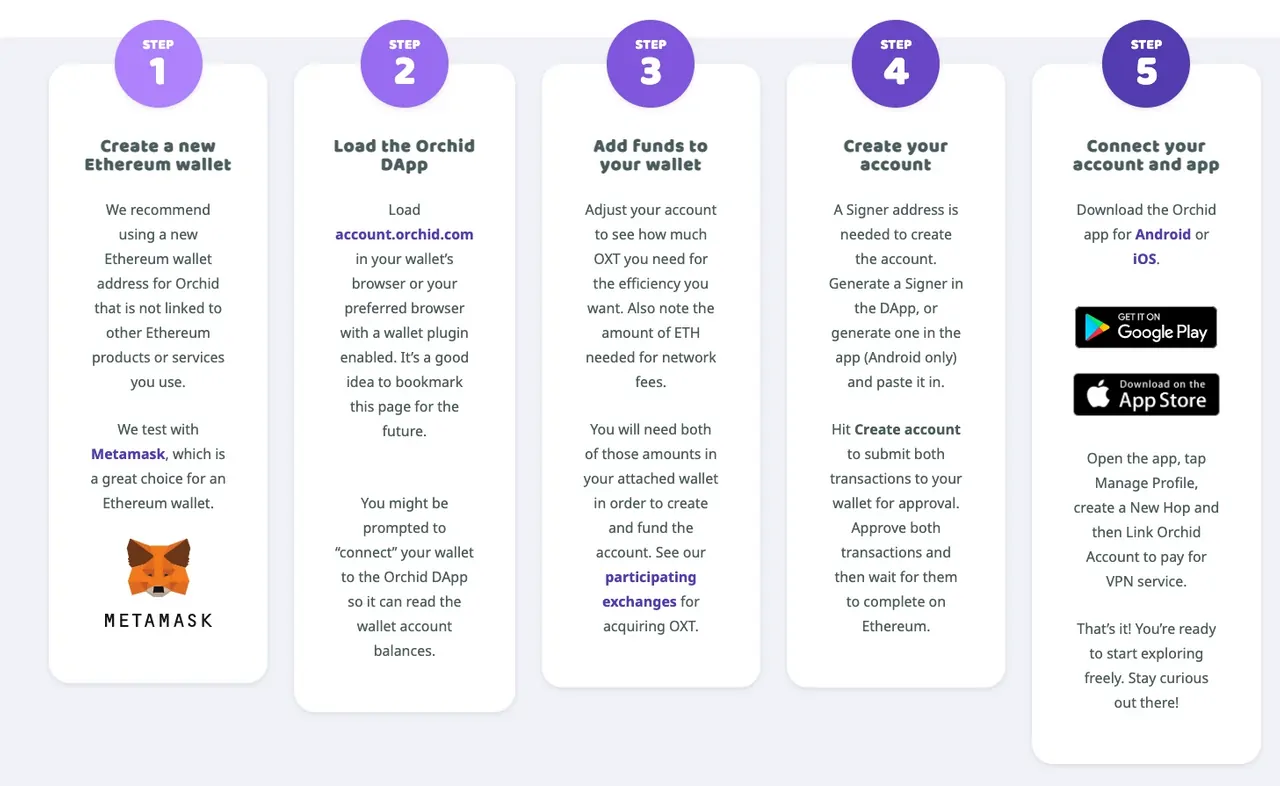
In the screenshot below you can see all the 5 steps to create and connect your account.
**DEEPENING**
Well, the main and basic purpose of OXT is to track who uses computing services, who provides computing services, and whether ordinary users fairly compensate ordinary providers. The OXT digital currency provides value in the Orchid network in a number of ways:
- **Bandwidth provider**: anyone can operate an Orchid Node, but must first stake OXT. More OXT staked = greater chance of reward in the Network
- **Bandwidth user**: users can pay-on-the-fly for a private, secure internet connection. To power up client, a user installs the Orchid VPN, adds OXT to a wallet and then can access the internet through a user-chosen path to ensure a secure connection anywhere in the world.
The primary reasons for this new cryptocurrency OXT are:
To have a digital currency that is specifically tied to consumption of bandwidth on the Orchid network.
To align operator incentives towards the benefit of the Orchid Network.
If you have already read some of my articles or follow my YouTube channel, you probably remember that I have already talked about Staking on several occasions. In a couple of previous YouTube videos I told you about TRX and ALGO staking.
TRX staking
https://youtu.be/aSTsWK3oTJU
ALGO staking:
https://youtu.be/W5RYtxwRi8w
In this occasion we can stake also OXT tokens.
**But… how OXT staking works?**
A provider stakes some number of OXT to create a stake deposit. Anyone can stake OXT on nodes using the smart contract. Clients select new nodes in proportion to their relative OXT deposit size. Larger stake deposits thus lead to more users, bandwidth and revenue.
After the tokens are locked to the deposit, they can be used for bandwidth supply immediately. If the provider wants to withdraw the tokens from the staking contract, they must begin a period of "unlocking" which involves a three-month cooldown period during which their funds cannot be used as a provider deposit or transfer to other places.
I want to see also some of **its limitations**.
- **Network Dependence**: The economic security of Orchid is limited by the economic security of Ethereum itself. An opponent who is capable of destroying or destroying the Ethereum network will naturally destroy Orchid.
- **User Scalability**: The current Orchid nanopayment system has an efficiency/variance tradeoff: larger face value tickets reduce the frequency of on-chain payments and transaction fees at the expense of variance.
- **Payment Anonymity**: Rare winning nanopayment tickets are redeemed through on-chain Ethereum transactions. Thus Orchid nanopayments are only pseudo-anonymous, and occasionally leak some information.
- **Public Node Directory**: The Orchid node directory is published on the Ethereum blockchain and thus is public to the world. Thus it is easy for a censoring adversary to automatically block all the listed contact IP addresses of Orchid nodes.
**Coinbase**, in the section "**Earn**", also gives you the opportunity to earn some dollars in OXT by watching short videos and answering questions correctly.
About Orchid we have discovered new things about this project!
I would like to know your opinion about Orchid and VPN!
Next Sunday I’ll introduce you a new cryptocurrency!
Burn is an interesting prerogative of cryptocurrencies
Leaving aside the speculative aspect, in any case respectable as a trader, it has a very important financial significance and it is the basis of some coins among this new type of digital money.
It works exactly the opposite of fiat currency.
#Burn is the destruction, so from a metaphoric perspective "they burn" a certain amount of coins.
The aims of this operation are rooted in the most basic law of the market: supply and demand.
In this way, the value expectation of the cryptocurrency object of the #Burn is kept "alive".
By decreasing the supply of coins, without prejudice to the demand, there is an increase in value.
Here is the speculative side that traders can take advantage and we’re going to go deeper in one of the next posts.
Now let's analyze why #Burn works the other way around if compared to fiat currency.
Current money in circulation cannot be "burned" as it would not make sense: it has no underlying!
But it can be printed. Well, again according to the law of supply and demand, by increasing supply the value decreases.
This reduction translates into purchasing power ... Have you ever heard of inflation?
The key difference between fiat currency and the most part of the cryptocurrencies - is this: fiat currencies are regulated by an arbitrary inflation while cryptocurrencies are deflationary, or at least, they have a public and predetermined inflation.
Token Review: Harvest Finance (FARM)
This Sunday we are going to introduce Harvest Finance (FARM)!
**OVERVIEW**
**Have you ever heard of this cryptocurrency?**
Well, probably yes, because that it is one of the currencies that Publish0x uses to reward readers and authors.
Harvest Finance is a new DeFi project, essentially a passive fund. Harvest was created by an anonymous team in August 2020, and it is not a fork of any large platform. Like Yearn, it is an income aggregator, but it does not have a star founder. As a yield aggregator, Harvest's service is arduous. Obtaining stablecoins and LP tokens from investors and putting them into the smart contracts of the leading DeFi platform can reduce the rate of return, but investors can be compensated with FARM tokens.
Unlike other yield farming protocols, Harvest has an add-on for token FARM. In summary, 30% of the profits made by companies is used to buy FARM, which means that the currency fundamentally provides “dividends” to the owners.
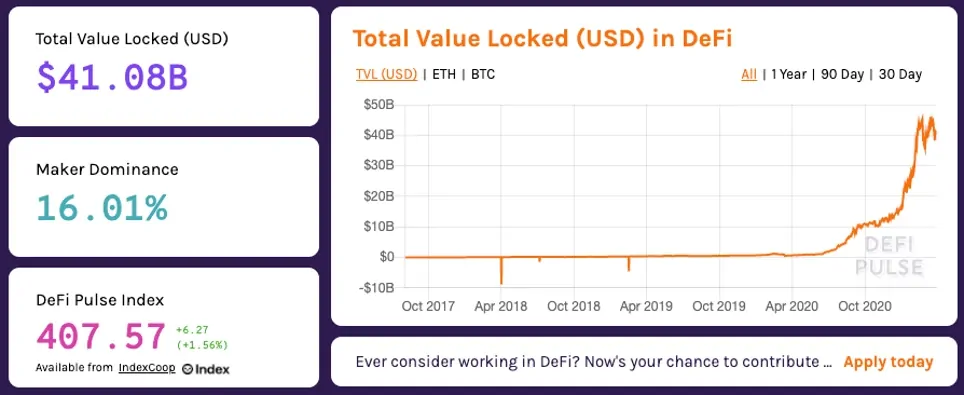
Today, there are already more than 41 billion dollars locked up in DeFi protocols like Maker, Aave, Synthetix, and Uniswap. If you ask me, this shows the huge potential of DeFi and Yield Farming.
Harvest lowers the barrier to entry for people who don’t want to track DeFi 24/7, pay gas costs to harvest regularly and move funds between opportunities, etc. Harvest handles the APY tracking, strategy development and auditing, gas costs, and regular harvesting to ensure that returns compound. Holders of the FARM token can profit share in the yield farming revenue, receive incentives for providing liquidity in Uniswap, and vote to help decide the direction of the cooperative.
**How to use Harvest Finance?**
Navigate to harvest.finance and deposit stablecoins, tokenized bitcoin, Uniswap LP tokens, and other supported assets to start earning interest and FARM. Deposit FARM in Profit Sharing to share in the farming revenue.
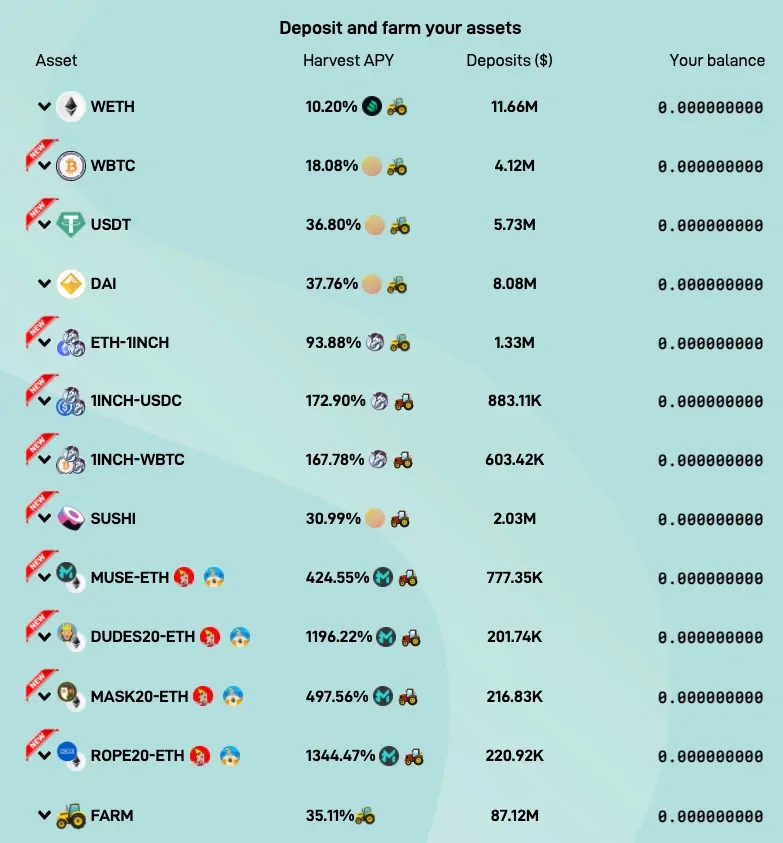
Let’s see how the Harvest Finance homepage look like:
In this screenshot we can see that there are almost 500 million dollars deposited in Harvest with a monthly profits to Farmers around 6 million dollars.
FARM, in these recent months, entered in the portfolio of staking lovers also for its interesting annualized yield, currently around 35%. But, as you know well, we must not only focus on yield.
Here there is my FARM SONG: Harvest Finance Easy Defy for all!
https://youtu.be/w6g_781RA-Q
Harvest Finance is a great project with interesting opportunities of passive incomes, but what about a simple song that explains main features of Harvest Finance?
That’s why I invite you to listen my song to learn, in an easy way, some main features of FARM!
**DEEPENING**
In one week, deposits in Harvest are increased up to 550 millions USD with a monthly profits to farmers of 6,6 millions USD. Around 10% of growth in a week!
These are some assets that you can deposit on Harvest Finance with their relative Harvest APY.
A few month ago, Publish0x decided to replace FARM with iFARM, for the rewards to readers and authors of the website. All of reward FARM tokens are swapped to iFARM tokens.
Both FARM and iFARM are ERC-20 tokens on Ethereum. FARM is a cashflow token for Harvest. It is available on Uniswap. iFARM is a yield-bearing token for Harvest. It can be acquired by depositing into FARM on the front page of Harvest Finance website, with “Use iFARM” checkbox.
We can consider iFARM like a new updated “tractor” of Harvest Finance!
This new token, announced at the beginning of February, represents your profit share stake and can be used in DeFi protocols without losing your profit share APY.
Let’s see some benefits of iFARM.
First of all let’s talk about gas fees. iFARM costs nearly 50% less in gas fees to interact with services of Harvest Finance when using iFARM compared to FARM.
Then it can be transferred like any other ERC-20 token and continue to earn yield.
Another important advantage is that iFARM tokens will enable staked FARM to be used as collateral on lending services while continuing to earn yield in the profit sharing pool.
Besides, the iFARM vault is safe. It has all of the same audits and protections as other vaults.
Where can I hold my iFARM tokens?
Well, it’s important to own our tokens in ETH ERC20 wallets, where we control the keys to. Some good wallets are: MyEtherWallet, Trust Wallet and Metamask.
Besides, there are two exchange where I can trade my iFARM: Quickswap and Uniswap.
Harvest Finance with its updates and developments, despite being a young project, is making its way in the cryptocurrency world. Its growth, since its launch at the end of last year, is really interesting. We are still waiting for an official roadmap to understand with more certainty which direction Harvest Finance wants to go in the coming months and years.
Suggest me with a comment some crypto you would like to see analyzed!
Stable Coins: Perhaps they can be a driving force for DeFi
DeFi (Decentralized Finance) has started to move large volumes of money.
First the various crypto loans started, the AAve project is the example and it has been followed by a variety of projects along the same lines.
After that, financial products have increased, always keeping the traditional finance as reference.
Contrary to what happens with traditional finance, we cannot think that DeFi can give rise to medium-long term investments.
**Why?**
The answer is quickly given: the volatility of the cryptocurrency price.
At this point we could turn our attention to a stable-coin, so as to cancel out the volatility.
It is not advisable, however to peg it to a legal currency: it would have no underlying, such as Tether and the ugly affair in the US.
As if that were not enough, it would become centralized and therefore censurable, it would be a waste of time and above all it could not coexist with DeFi.
In this regard, one could use a token similar to DexToken that aims to limit volatility through AMMs.
More precisely, however, it is better to leverage the Unit protocol.
Through various decentralized assets, it allows users to obtain immediate liquidity.
The protocol increases lending efficiency by expanding the number of crypto assets available for collateralization, and asset holders can use the value contained in a diverse set of tokens to coin the stable coin $USDP
**Let's take a closer look at how it works**
USDP is a decentralized stable coin active on the Ethereum blockchain. The Unit protocol incentivizes users to increase or decrease the supply of USDP tokens based on supply and demand and ensures that the value remains equal to $1 USD.
The protocol uses the ERC20 standard, so it is adaptable to any application with just a few lines of code.
The protocol is extremely secure, when it comes to collateral in fact if the debt to collateral ratio exceeds a certain liquidation ratio (LR) for a collateralized debt position (CDP) it will be subject to liquidation.
Here's the key to understanding this protocol: in addition to always being hedged by an underlying, when the market has downturns, positions never go into loss, in fact they are liquidated before that can happen.
The CDPs are constantly monitored by the BOTs which immediately activate the liquidation if the conditions are met.
In case a CDP is activated for liquidation, the protocol proceeds in this way: The collateral is auctioned with a linear decrease in price.
Each participant to the auction can purchase part of the collateral for the current price by paying the USDP debt related to the liquidated CDP.
The debt amounts to the USDP amount borrowed plus the liquidation fee, calculated as a percentage of the CDP amount.
Once the protocol balances the account, the excess is returned to the borrower, the debt is discharged and the fees transferred to the designated pool.
Using the token resulting from this protocol is like using the good old dollar, but in this case we have an underlying!
Yes I know, it is very interesting this view of DeFi, in fact soon we will deepen the UNIT protocol!
Bitcoin Alliance helps El Salvador to use Bitcoin as legal tender
A few months ago Bukele, the governor of El Salvador announced his willingness to use Bitcoin as a legal tender, alongside the dollar.
September 7, 2021, will be remembered as the pivotal date for Bitcoin, as it has become, de facto, a legal currency.
Bukele, obviously assisted by his entourage, planned everything down to the last detail, even the $150 million fund to facilitate conversions from Btc to classic dollar.
Regardless of the feelings of denial on the part of some citizens, I think the strategy, especially at the macro level for the sustenance of the country is a winner.
**Why?**
If the accumulation plan can be done by all of us, all the more reason a government should do it! Capital gains can be used to lower taxation or allocate funds for development.
To support this "transition", which is not really a transition because Bitcoin will be parallel to the dollar, the Bitcoin Alliance comes into play.
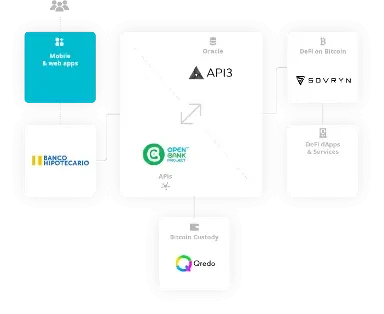
This alliance includes API3, Banco Hipotecario, TESOBE, Qredo and Sovryn.
Of note is API3, which in collaboration with Open Bank Project have created Airnode. This project allows banks to send data directly to blockchain networks.
With this amount of data recorded on blockchain there is the possibility of real-time consultation of any data between banks.
As we know, Salvadoran Bitcoin transactions are all recorded on Layer 2: low fees and negligible transfer times.
Obviously as people are adapting to the use of this new currency, financial institutions have also faced a number of really interesting operational challenges.
API3, which is an oracle platform (they validate off-chain data for on-chain use), found itself driving these regulatory changes alongside Banco Hipotecario.
To be able to provide the right support, they used, first, the decentralized Sovryn platform, and then Qredo's Lightning network.
Clearly, API3's task will be to validate all off-chain information, which will happen thanks to Airnode.
In the diagram above is represented the functioning of this Bitcoin Alliance, where the fulcrum is, precisely API3.
It is interesting to make some points about the various actors in this partnership.
**Banco Hipotecario of El Salvador**
This is a national bank that offers a wide range of banking products and services on a large scale, including, individuals, small businesses, medium-sized companies up to large corporations.
**API3**
As I quickly wrote just above, this is a platform that offers the oracle service.
API3 is a Decentralized Autonomous Organization (DAO) and manages the transition between third-party legacy oracles, into proprietary oracle solutions, offering greater security and regulatory compliance.
The entire API3 ecosystem is managed by dAPIs (Decentralized APIs) that provide auditable data with quantifiable security.
**Open Bank Project**
It is an API Management platform, the software part of which is managed by the German TESOBE. Through this platform we offer to those banks that wish to improve their digital offerings. Through a database with over 450 standardized APIs, it is possible to create a customized Open Banking environment: a further step towards a concrete connection between banks and blockchain.
**Sovryn**
BTC's native DeFi platform, which gives people the ability to use their Bitcoins in decentralized applications.
The Sovryn protocol uses Lightning technologies that will set the pace for the new type of DeFi.
The volumes are really high so it is quite reliable.
**Qredo**
Somewhat along the lines of Sovryn, this is a DeFi platform that leverages Layer 2, allowing BTC, ETH and ERC-20 tokens to be transferred with fees that are much lower than the Ethereum network (especially for ERC-20 tokens).
On top of that comes Layer 1 banking security and institutional-grade governance.
The synergy of these companies will make the implementation of Bitcoin in El Salvador a success, and Governor Bukele will show the world that he understands that a state must be run like any business.
Token Review: Uniswap (UNI)
This week on Token review I am analysing Uniswap!
I'm sure you have already heard of this coin!
**OVERVIEW**
**The Uniswap protocol**, built on the Ethereum blockchain, **allows users to easily exchange between any ERC-20 tokens in a completely decentralized manner.** This means that users can choose to easily trade Ethereum-based tokens directly from their own personal wallets without having to give up their custody of funds throughout the process.
Launched in November of 2018, Uniswap was founded by Hayden Adam, a young yet talented developer/designer who was relatively new to Solidity. With a $100k grant from the Ethereum Foundation, Hayden and his small team of less than 10 were able to build a compelling DEX which has garnered significant traction since launch. Back in April of 2019, Uniswap closed a $1M seed round lead by Paradigm. With this, Uniswap went on to release Uniswap V2 in May of 2020. Uniswap has since raised an $11M Series A round and launched its native governance token.
**Uniswap is an automated liquidity protocol and operates using two smart contracts.** It is one of the most popular decentralized exchanges or DEX. You can become a liquidity provider for a pool on this protocol and swap for other currencies.
Uniswap has **2 main functions.** This includes swaps and pools.
Uniswap Swap enables users to exchange ETH currency for other ERC20 tokens.
Uniswap liquidity pool allows users to make money by providing liquidity. Users make money by depositing tokens in the pool. In return, they receive pool tokens.
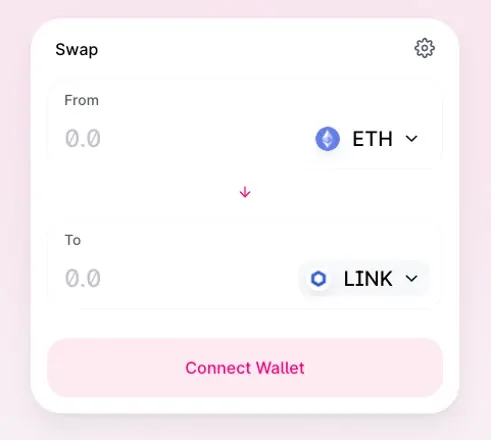
This liquidity protocol gives you access to exchange ERC20 tokens. After connecting to the cryptocurrency wallet of your choice, you can start exchanging coins.
**Uniswap removes the concept of order books in favor of an automated market maker.** Rather than specifying price what price to buy or sell at, users merely select an input and output token while Uniswap provides a market rate. Simply connect a web 3 wallet, select the asset you want to trade, the asset you wish to receive and taaac! Uniswap automatically processes the transaction and updates your wallet balance.
**Why should I prefer Uniswap?**
Compared with other DEX competitors, Uniswap has many advantages for small traders. Specifically, Uniswap does not charge listing fees, does not require local tokens, and is the cheapest gas cost in any DEX. The project is open source on GitHub and essentially unlicensed, which means that anyone can create any ERC market as long as they have an equal amount of ETH to support it. Essentially, this allows new items to create a base price for their tokens after adding appearance to the game. Uniswap is currently one of the most active DEXs and quickly became the actual exchange for DeFi tokens.
In a world where hurdles and barriers to entry continue to limit adoption, **Uniswap provides a much needed DEX experience that traders have long been searching for.** With that being said, it should be emphasized that only Ethereum-based assets are currently supported in the current version. While it is possible to wrap cryptocurrencies like Bitcoin (WBTC) and trade it via Uniswap, at this point in time other protocols are not supported via Uniswap markets.
**DEEPENING**
Now we start with the in-depth part of the protocol.
As I said earlier **it is a protocol built on the Ethereum blockchain, that allows users to easily exchange between any ERC-20 tokens in a completely decentralized manner**. Their goal is to lower the barrier of entry to financial markets by making it easy to join the Decentralized Finance (DeFi) movement. The platform aims to allow anyone to create their own liquidity pools.
Although Uniswap is a very popular component in the **DeFi** ecosystem, it is not without criticism or flaws. In July 2020, complaints about "**fake tokens**" on the Uniswap exchange began to appear. Since anyone can list tokens on Uniswap, and its decentralized nature means that there is no need for censorship, it is easy for scammers to create tokens with names similar to popular DeFi platforms and entice users to buy worthless Token. In August 2020, Uniswap took some steps to try to alleviate this problem by introducing lists. These lists are decentralized solutions to the decentralization problem, aiming to determine the legitimacy of tokens based on the number of tokens and the credibility of these lists. Whether scammers will find a way to exploit this system remains to be seen, but for now, this seems to be a good way to solve the problem while still maintaining Uniswap’s inherent decentralization and still allowing legitimate projects to quickly and easily add their token.
You have probably noticed too how Uniswap has become more and more popular in the last period. **So, let’s see some advantages!**
First of all, you can have the **access to different new coins**. Since Uniswap is decentralized and owing to their popularity, a lot of projects are instead choosing to launch on Uniswap directly. This is crucial for traders that consider important to be the first ones to own the tokens because of the crazy fluctuation prices, especially when they first launch.
Then we can consider the **low trading fees**. It is much cheaper than most decentralized exchanges with only a flat fee of 0.30% per trade.
Uniswap allows you to retain **full custody of your funds**. So, there is no risk associated with centralized exchanges where you could stand to lose your funds if the exchange is hacked or goes bankrupt.
There is no **Know Your Customer (KYC) process**. Uniswap allows you to keep safe custody of your funds, don't require you to go through a lengthy KYC process and reveal your full name, passport details, etc. It also means that getting started with the exchange will be much faster and will drastically reduce the chances of your personal information falling into the wrong hands if the Exchange is hacked.
Regarding the **UNI token**, 60% of the UNI genesis supply is allocated to Uniswap community members, a quarter of which (15% of total supply) has already been distributed to past users. 1 billion UNI have been minted at genesis and will become accessible over the course of 4 years. **A perpetual inflation rate of 2% per year will start after 4 years**, ensuring continued participation and contribution to Uniswap at the expense of passive UNI holders.
So, should Uniswap be a great Decentralized Trading Protocol?
Let me know in a comment below!
So, be sure to follow my profile for receive the notification of my next articles on Read.Cash!
The game that frees your mind
As we all know, any puppy in the animal kingdom is urged by parents to play. Through the game they learn how to behave within the community, what are the sounds that indicate that they have gone a little too far, and all those small and big rules of common living that exist.
The same happens for the human being, through play, our children learn to be in the company of other children and learn the rules of the community.
In this way the cognitive abilities are developed that will enrich the cultural background that we will then carry around the world up to the adult one.
And what does this have to do with blockchain and cryptocurrencies?
**It does, and how.**
It is very interesting to see how play influences our way of thinking: depending on the type of game we play as children, in adulthood we will have outstanding skills in that sector.
I bring you the example of a friend of mine, as a child he was given two types of very creative games: meccano and lego.
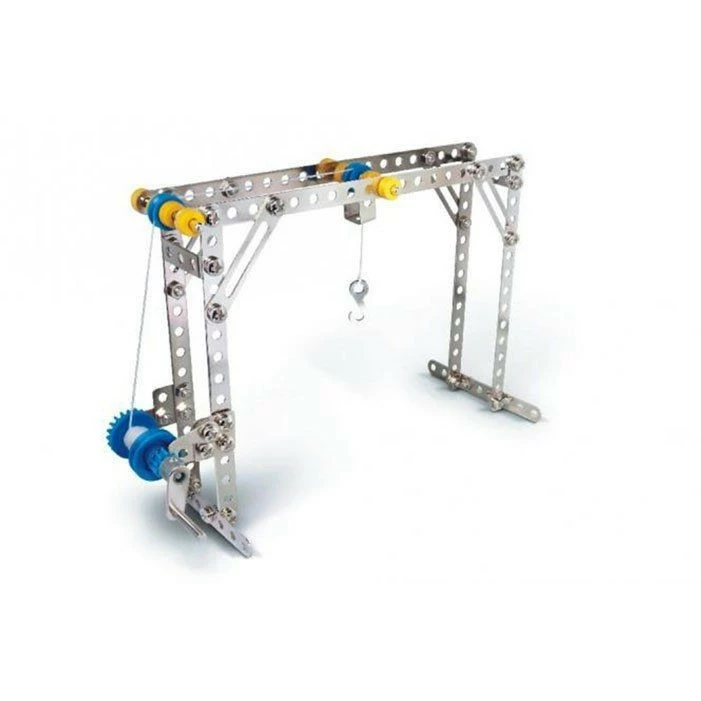
The meccano is nothing more than a series of metal bars of various lengths with holes; machines of any kind can be built using screws and bolts, the only limit is imagination. In the same way, legos are bricks that can be composed together to create constructions. Also in this case the limit is the imagination.
In fact, this person has a certain skill in using his hands.
Now I will explain to you why Blockchain, cryptocurrencies and everything related to finance has to do with gaming.
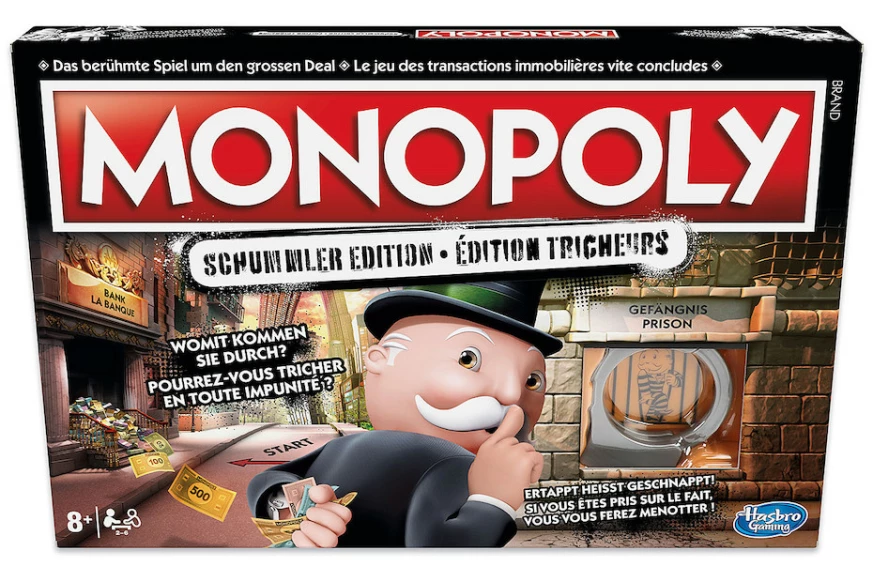
In the early 1900s, a financial game par excellence was devised, Monopoly, the purpose of the game was to bankrupt all the other participants and become the monopoly.
We all have certainly played this game, but, unfortunately, our parents or, why not, our friends have not explained well why this game is played.
**Why become the monopoly?**
How can we become the monopoly in this game?
Clearly, being a game, that variable that is part of fate comes into play, such as the roll of the dice; but this does not mean that our mind must be limited in thinking.
Throwing the dice might represent real-world challenges, but we don't lose focus on our goal!
To these questions, none of the older people who participated in the game have ever given us an answer; most likely they didn't know either!
No one has ever taken the time and patience to explain to us that although we had the land with less income we would be, in every way, by managing our assets WELL, managed to obtain the monopoly.
These types of games open the mind, and perhaps not everyone likes having people thinking with clear goals in mind.
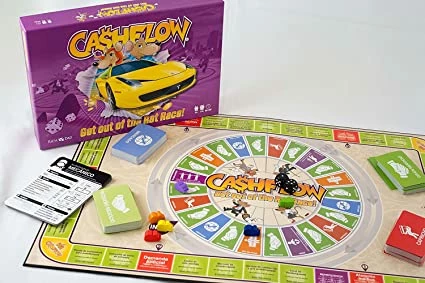
Another game that is very interesting from the point of view of growing financial knowledge and Cashflow 101.
Very similar to monopoly, in this case the stakes are much higher: you don't have to acquire the monopoly of the game, but you have to play in order to achieve your own dream.
**Whatever it is.**
In practice, you bring your life back to the game table, and you have to try your hand at this enterprise in order to achieve this dream. Always talking about this friend of mine, every time we organize a Cashflow table, he always writes “Freedom”, in his dream.
In Cashflow, the first and most important part is to get out of the "wheel of the mouse" that is to try to manage your own capital in order to be able to abandon the binding concept of dependent work with its 8 working hours.
Let's imagine for a moment, that, instead of playing with it at an advanced age what adolescence could be (parents, school and largely friends have already given an imprint to our way of thinking) we start our own son at this game as soon as he has the faculty to understand the numbers and the first operations; let's assume 7 years.
We begin to explain to him what are the possibilities by having a rental property that can produce an income independently, we give him the right advice if it is convenient to buy the house to live or have it for rent.
Gradually we give him all those indications about domestic finance that will lead him, later in adult life, to think outside the crowd and to have a certain mastery of his own future; agree, together with his friends or companions he would feel "uncomfortable" as he has a different vision and, fortunately for him, wider than what life can offer him compared to his peers.
For these reasons, certain types of games can be combined with this new technology which is the blockchain and cryptocurrencies: once your mind is open to certain innovations you are not afraid to use them, on the contrary you exploit them to the fullest of their abilities and a moment you are out of the "rat race"!
I await your point of view in the comments
Shall We Build Together the Cryptocurrency entrepreneurs?
On Linkedin I love watching, how many people define themselves as “cryptocurrency entrepreneurs”.
**But, who really is a cryptocurrency entrepreneur?**
Well, we must define at first understand who an entrepreneur is.
An entrepreneur is someone that transforms an idea into something productive for him (or her). An entrepreneur is not paid in terms of “hours of working”, but he is paid by results.
I smile when on Linkedin I see some people that I know that have their current status on “Cryptocurrency entrepreneur” and not much time ago they faced difficulties in buying some cryptocurrencies on Binance.
**On Binance!** (lol)
We are not talking about a secondary DEX, with arguable accessibility of its Graphic User Interface... We are talking of Binance.
Hey, I am not saying that a cryptocurrency entrepreneur is a sort of Superman that was born with knowledge in his right hand and Money Management in the left hand. I am just saying that a Dollar Cost Averaging is not enough for being considered a cryptocurrency entrepreneur. Neither a Smart investor.
**So who is a Cryptocurrency Entrepreneur?**
In this article I am going to share with you some ideas among which some of them I am already carrying on.
This article is intended to create a sane debate about all the possibilities that cryptocurrencies offer.
And in case someone is trying to make crypto-related business a way of earning money well, we will seen (and in comments too, I hope), there are several ways.
**Courses**
I think that the easiest, and the entry level crypto-entrepreneurship is selling courses. You should identify a specific field, you should consolidate you knowledge on it and then you can produce a course. To sell it, there are several ways. You can have your own platform and eventually host other courses-authors or you can place it on sale on Udemy and other courses-selling platforms. They are free and they take just a percentage on the net sold volume. This would be a highly liquid business.
**Trading**
Another option is Trading. Yes, Trading. It is definitely not a game, it’s a way of earning money, so it can be considered an entrepreneurial activity. You have to define your starting budget, the discipline to operate with it and the patterns when you are going to enter into the market.
And what about the creation of a trading system? Once created and consolidated a specific knowledge, you can leverage it up with a Mirror Trading system. But you see: at first you must be able to dominate trading skills.
**Business**
Business creation and business structuring. In the phase of business creation you need an idea and you need to develop it. This phase can be far away from a liquid business, especially if you have some structures to purchase and or professionals to pay to make your business start-up. When we speak of “Business structuring”, we refer to the phase where the idea is already defined, and often the idea is from someone else. In the case that the idea is not your own, you may save money in terms of the business start-up, bit of course you will not have access to the full revenue.
What kind of business creation? Blockchain consultancy, trading platform, payment processors, schools for cryptocurrency, crypto-accountancy systems, content creation and many more.
And what about business structuring? Often, in this case the ideas come from third parties. In cryptocurrency we may face different start-up ideas (blockchain application and more like just mentioned). And what about tokenization?
Tokenization requires some knowledge on the business side since tokenization of an empty box is not advisable. Furthermore, experience on legal side and tokenomics is required. This two latter aspects may be quantified in terms of professional consulting, but some entrepreneurial experience would increase chances of success. Consultancy should always be oriented towards an optimized solution, not just telling the customer how to do with what he wants to do. Sometimes the customer should also be able to change his target upon proven difficulties in the original way.
Later on we also have the deployment of mining farm facilities. Here regulations, providers, customers must match a delicate equilibrium.
Let us know in the comments what you think and other ideas/input you can give to the community!
China bans Bitcoin, strategic choice?
News of a few days ago, China has completely banned Bitcoin and cryptocurrencies in general.
All financial institutions are no longer allowed to trade with cryptocurrencies: both buying and selling.
**Not only that.**
Even Alipay has been intimated by the central bank to suspend all operations.
The Casus Belli was the extreme volatility of cryptocurrencies; in fact, Bitcoin has been fluctuating lately.
With this stance, the Chinese government thinks it can secure all (or most) of the assets held by investors.
**Questionable.**
The true investor has a perfect and rigorous Money Management to respect; in case he disregards the rules, he has imposed on himself, he is perfectly aware of the risks.
And for this reason, he does not make rash operations in the euphoria of the market.
Let's face it: most of those who have approached Bitcoin don't even know what a DLT (Distributed Ledger Technology) is and have started trading (purely speculative) without knowing anything about this world!
Starting from this concept, we can rectify, saying that the Chinese government has a certain thoughtfulness for the uninitiated.
It is necessary, from certain points of view.
Now a polemic note: when I have a broken pipe in my house, I call a plumber to fix it; in parallel if I have a certain amount of money that I decide to allocate in some financial product, I have to go to an advisor.
Instead, due to the fact that there are applications that accomplish everything, some people feel they have an infused science and set off as determined as firemen.
**And they get hurt.**
But back to the exploit, this time seeming more vehement than the previous one, from China.
Bitcoin declared outlawed by local regulations and almost 90% of mining power suspended.
With regard to mining farms, they have been attributed with an indefinite consumption of electricity.
Undisputable, even if many mining farms use renewable energy and, anyway as I wrote in this article, the consumption of the whole BTC system is 3% of the world electricity produced but dispersed!
I want to instill a doubt in you, and with it my thoughts.
Have you heard of the digital yuan?
**Definitely!**
To understand my position, it is necessary to make a parallel between the two currencies: BTC and Yuan
BTC is decentralized, while the digital Yuan is centralized.
BTC has a public blockchain, digital Yuan has a private blockchain.
BTC is not censurable, digital Yuan is, should the government want it, it ceases to exist.
BTC is regulated by the market (supply/demand), the Digital Yuan is a stable coin.
As you can see the Digital Yuan is nothing more than a private Stable-Coin: it disregards some points of cryptocurrencies, but, in fact, it is!
Now, the records will have to be executed and how else but by undermining them? Because, obviously, a margin of safety is necessary.
Clearly, the consumption is not comparable to that of a public blockchain because validation is not a race to see who gets to find the solution first.
**In this case the node is only one!**
At this point the owners of the machines what do they do, throw them away? But I don't think so, they will ask the government to outsource the registrations; after all if they were efficient for Bitcoin they can't be efficient for the digital yuan?
And there you go, solving a problem of scalability and machine availability....
By doing so, however, the privacy of transactions wavers: the government can verify all of them to intervene if there is a possibility of wrongdoing. But as we know China is not really concerned about the privacy of its citizens.
As for the volatility of the value between BTC and digital Yuan it's obvious that there are fluctuations, but we already know the stable-coins: does Tether mean anything to you?
With this comparison, conclusions are quickly drawn.
BTC has possibilities that the digital Yuan cannot have, so the only weapon in the hands of the Chinese government is to declare it outlawed.
Obviously, not being censurable, the possibility that you have is to force banks to prevent the purchase or sale.
But the human being is diabolical: surely there will be someone who finds a ploy to continue to use cryptocurrency.
The possibilities are many: you convert the BTC into Dollars or Euros and in turn converted back into digital yuan.
We take it for granted that exchanges cannot use digital yuan because if this possibility were to emerge this whole operation to the Chinese government would have brought only popularity ...
In conclusion, I think that this situation has been created ad hoc to launch the digital yuan and give a further setback to cash and not specifically to BTC.
Anyway, with China or without China, BTC goes on anyway: everything else in the world continues to use it.
On an economic level, though, I think China has seen far ahead of other states: the digital yuan, as a cryptocurrency has no borders, and therefore could replace the dollar in international trade.
If this were the case, the West would have to take a nasty blow from the East.
I am increasingly convinced that the maneuver implemented by the governor of El Salvador is the most insightful and fruitful: he did not declare war on Bitcoin, rather he wanted to make friends with it, and at the economic level it is "a friendship that counts".
What do you guys think? I look forward to seeing you in the comments!
Token Review: Synthetix Network (SNX)
This Sunday we are going to introduce Synthetix Network!
Have you ever heard of this cryptocurrency?
**OVERVIEW**
Before we start talking about Synthetix, let's recap what is DeFi and the traditional system.
You must know that prior to Bitcoin a centralized system with a managing single figure (company) on top was the traditional scenario. With the advent of Bitcoin and the Blockchain, a new system has been created that today we define decentralized. This system does not have a single figure at its head but multiple figures (people) who control everything.
Thanks to the blockchain, a process ecosystem has begun to be developed that uses this technology to overcome the problems that centralized systems have. From here the concept of smart contract developed which, thanks to Ethereum-like platforms, the DeFi was built.
Image source: https://www.coinmama.com/blog/defi-explained/
This sector is a derivative of centralized finance (CeFi) but with a very important change which is represented by the blockchain. That is, an economic system, distributed and within everyone's reach where a traditional system would never have arrived. It is from here that the Synthetix project was born and from here that, a finance that will change our lifestyle, is being developed.
Synthetix is a decentralized synthetic asset issuance protocol built on Ethereum. These synthetic assets are collateralized by the Synthetix Network Token (SNX) which, when locked in the contract, enables the issuance of synthetic assets (Synths). This pooled collateral model enables users to perform conversions between Synths directly with the smart contract, avoiding the need for counterparties.
This mechanism solves the liquidity and slippage issues experienced by DEX’s. Synthetix currently supports synthetic fiat currencies, cryptocurrencies and commodities like gold and silver. SNX holders are incentivized to stake their tokens as they are paid a pro-rata portion of the fees generated through activity on Synthetix.Exchange, based on their contribution to the network. It is the right to participate in the network and capture fees generated from Synth exchanges, from which the value of the SNX token is derived. Trading on Synthetix.Exchange does not require the trader to hold SNX.
With Synthetix is possible also to do staking. If you are following me since a few time you know that I’ve already talked about staking in different articles and probably you’re already earning money from this kind of passive income.
If you are new or have you missed my video tutorial for Tron (TRX) staking you can read one of my best successful articles here: https://hive.blog/hive-167922/@mikezillo/passive-income-with-trx-staking
Synthetix Network uses a very complex system in operation. Through Staking it is possible to give, with the SNX token, the liquidity to the system that will be used to maintain the derivatives. When a derivative is generated, in this case the opposite of Bitcoin that is iBtc, a contract is created opposite to the rise of BTC. This is possible with the debt function, i.e. one party generates a debt and creates the contract that will hold it because it believes that Bitcoin will go down in the future.
Image source: https://synthetix.io
In the meantime, the contract has generated a debt that will be covered by a liquidity pool that will be offered by those who will stake the SNX. This process is the same as all contract types that are generated on Synthetix. That is why the system will incentivize a party to stake SNXs because it will offer them a reward. But this reward will have to be redeemed manually every week and in exchange for a very substantial fee. In fact, Synthetix staking is a process not for everyone but above all very expensive which will require a lot of capital in its operation. So the SNX token becomes very important and will constantly increase over time due to the continuous debts due to the creation of derivatives.
**DEEPENING**
After the overview of the project, let's move on to an in-depth analysis!
With Staking and the SNX token the liquidity for the system is created and it will be used to maintain the derivatives.
SNX holders can use Synthetix smart contracts to mint sUSD by locking their SNX as collateral. The steps involved for SNX holders are:
The Synthetix contract checks that the SNX staker can mint Synths against their SNX, which requires their Collateralization Ratio to be below 750%.
Their debt is added to the Debt Register. The debt is the amount of the new value minted, and is stored in sUSD
With the debt assigned to the staker, the Synthetix contract instructs the sUSD contract to issue the new amount. It adds it to its total supply and assigns the newly minted sUSD to the user’s wallet.
The steps involved for the smart contracts to process a Synth exchange are:
Burn the source Synth (sUSD), which involves reducing that wallet address’s sUSD balance and updating the total supply of sUSD.
Establish the conversion amount.
Charge an exchange fee, which is currently 0.3% of the converted amount, and send the fee as sUSD to the fee pool, where it can be claimed by SNX stakers.
The remaining 99.7% is issued by the destination Synth (sBTC) contract and the wallet address balance is updated.
The sBTC total supply is updated.
Image source: https://defiprime.com/synthetix
Whenever SNX holders mint or burn Synths, the system tracks the debt pool. It does so by updating the "accumulated debt incremental ratio." This can measure the proportion of SNX stakeholders in the debt pool when they were last minted or burned, and the change in debt caused by other stakeholders entering or leaving the system. The system uses this information to determine the debt of each staker at any time in the future, without actually recording the changes in the debt of each individual staker.
Probably, after a period of time, you would like to exit from staking or reduce the debt and unlock staked SNX so you must pay back your debit.
How can you pay back this debit?
To reduce your debit to zero you have to complete this process:
Synthetix contract determines its debt balance and deletes it from the debt register.
The required amount of sUSD is burned, and total supply of sUSD is updated along with the sUSD balance in the user’s wallet.
The SNX balance becomes transferrable.
Once having understood how to pay back the debit let’s see how Synths work.
Synths are synthetic assets that track the price of the underlying asset. They allow holders to gain exposure on Ethereum to various asset classes without holding the underlying assets themselves or trusting a custodian. Synths are backed by the Synthetix Network Token (SNX), which is staked as collateral at a ratio of 750%.
Synthetic assets provide exposure to assets without the need to hold basic resources. This has a range of advantages, including reducing friction when switching between different assets expanding the accessibility of certain assets, and censorship resistance.
Trading on Synthetix.Exchange has many advantages over centralized trading and DEX-based order books. The lack of an order book means that all transactions are executed according to contracts, which are called P2C (Peer-to-Contracts) transactions. The price information provided by Oracle is used to assign exchange rates to assets and can be converted using Synthetix.Exchange dApp. This provides unlimited liquidity up to the total amount of system collateral, zero slippage and unauthorized on-chain transactions.
Image source: https://synthetix.exchange/#/markets
By providing synthetic assets to users worldwide, Synthetix is at the forefront of the DeFi movement, allowing users to use specialized trading strategies. Synthetix has the potential to create a massive tokenized market on the Ethereum blockchain.
The market share that synthetic products on the blockchain will have could undoubtedly be significant.
**Have you ever traded on Synthetix.Exchange?**
Cryptocurrencies and Money Laundering: a wrong match
I am into the crypto field since late 2016 and I started more strongly into 2017. The first association of thoughts made with cryptocurrencies was “Money Laundering” because they were seen as an anonymous form of money.
At first, cryptocurrencies are pseudonymous and they are not completely anonymous. Let’s take the example of Binance: until not much time ago you could register a free account with no KYC with just a limitations of 2BTC per day of deposit/withdrawal from the account.
I guess that some wrong guy made its cryptos passing through a Binance account, they received some kind of investigation and they managed to show that they were not colluding with the bad guy. The bad guy may have had some troubles, they eventually paid a fine and they decided that everyone using Binance was asked to file the KYC.
Anyway, Messari in 2019 created a report that does not give much room to doubts:
Title from https://www.ccn.com/fiat-money-outpaces-bitcoin-by-8001-for-nefarious-activities-report/
This Report is from July 21st 2019, where Messari demonstrated, thanks to Chainalysis that Bitcoin gives chances for illicit activities for a volume that is 1/800 the one from Fiat currencies.
Image from https://messari.io/c/research/bitcoin-in-the-grand-scheme-of-things
So, still in 2019 when cryptos were still a dense jungle, they were not the leaders for illicit activities. And if we think that from 2019 Binance has started a flat KYC for all users and many more exchanges have had to adapt their KYC policies?
I do not think that the regulation trend has allowed Bitcoin to increase the ration against fiat currencies for illicit activities and I guess that it has even decreased.
If we also have a look here, at the image beneath we will surely get some doubts
Since dirty money is not so easy to convert into cryptocurrencies since the receiver of the dirty money would have to justify this income or find another person eager to receive it (and justify the income).
With this article I do not intend to stimulate any kind of illicit activity or Money Laundering, but it’s clear that some activities with a lot of circulating cash are more suitable for this kind of “black transactions”. By the way, those activities have also more strict checks from local financial authorities. So, make this circle happening is not so easy as they try to make readers believe.
Another attempt to convert “illicit money” into cryptos is through local exchange and local exchangers. This could be widely carried out with LocalBitcoin but lately they also integrated more strict regulations upon transactions between cash and cryptos.
What is your thought on the matter? Do still feel that money laundering is an existing preconception among new-crypto-comers?
Cover image Credits: https://www.pymnts.com/legal/2018/bitcoin-trader-indicted-money-laundering-charges/
Is it correct to leave your financial future to a state lottery?
The other morning, I ended up in a tobacconists to pay, alas, a bill; logically, I was in a mad rush and the terminal had some connection problems, remaining 5 minutes waiting for the divine telematic providence. In that short period, which seems an eternity when you are in a hurry, some people of various ages entered and put their hope on scratch cards.
I was impressed by a girl who "invested" a 3-figure sum in a game of chance called "Tourist Forever". From the way she talked to the manager, she seemed accustomed to a cyclical investment process. Some reflections on this rampant search for fortune have begun to flash in my mind, when we do not realize that, if we want, we have this "blindfolded goddess" beside us and she is not blindfolded at all. Indeed, he sees very well.
**Follow me for a moment in reasoning.**
Let's assume this investment is $ 100 per month, just to use a calculation basis, but it could also be per week. After 1 year, the average monthly salary of an employee becomes the beauty of $ 1200 (at least here in Italy). If you are lucky enough to be kissed by the Goddess, at this point you twist your life but you are not master of what happened to you, while if you lose you say: "well, amen I gave them up for lost ... it will be for next year ... "
Indeed, I would also like to mention a statistic that I often heard cited a few years ago, and which reported that more than 80% of people who win large sums through these ways, return to the same pre-win situation within 3 years of winning itself.
**Why? They just don't know how to manage their money.**
But if we try to use this money intelligently, what can happen? Let's see:
We divide these 1200 € into 3 and allocate these 400 € in different options:
1 ^ we immobilize them to Staking on Algo or Tron, indifferent!
2 ^ We buy some fractions of BTC and slowly create our PACC (we have seen that everyone demonizes cryptocurrencies but everyone buys them so it will hardly be a hole in the water)
3 ^ We open a position on an exchange and start trading.
**Calculations in hand:**
1 ^ With staking you can have a response of 10%, so our capital can go from 400$ to 440$, without considering the possible appreciation of the currency being staking.
2 ^ This is the most uncertain as it depends on the market, but in this case, we are not interested: despite the sometimes sudden trends of the BTC market, at the end of each year it is still growing.
3 ^ Trading, this word so thorny and for most people considered fraudulent, is actually what could change our lives, it certainly does not make us "Tourists forever" (at least not in the first years)
Let's say we make a 1% average weekly profit, among the three activities: we arrive at the end of the year with a nice nest egg.
Let's do two calculations, albeit approximate
50 trading weeks (a couple of rebates: today I don't feel like it, I'm on vacation and I don't have a cap, etc. etc.)
1% of 400 $ is 4 $
50 X 4 $ = 200 $.
200$ earned over your own capital. And in the meantime, in this early adventure year, you have also learned how to capitalize at best, probably increasing the result of the second year, the third to follow and so on!
Keep in mind that I have not taken into account the eighth wonder of the world, compound interest!
Summing up, the last day of the year, before the dinner, we have 200 $ in our pocket, which certainly does not make you a tourist forever, but well integrate the 13th and any production bonus (if they still give it).
At the appeal, the $ 400 converted into BTC remained out: for these the capitalization is very difficult to define, but in the perspective of diversification those $ 400 are for the mid-term, and therefore we should be able not to touch them for a while.
Note that even for staking I have not considered compound interest.
A careful trader could accuse me of rash reasoning, as the concept of Money management does not appear in the rant; but I left it out on purpose because when you play "scratch cards" the return on investment is not you but the owner of the game!
Token Review: Yearn Finance (YFI)
Today we are going to see Yearn Finance.
**Yearn Finance** is a suite of products in Decentralized Finance (DeFi) that provides lending aggregation, yield generation, and insurance on the Ethereum blockchain. The protocol is maintained by various independent developers and is governed by YFI holders.
As of now, Yearn is one of the most popular and most decentralized DeFi projects in the crypto sector. While the YFI is the native cryptocurrency of Yearn Finance. Unlike Bitcoin, YFI is a governance token that boasts of the autonomous protocol.
That means users of the platform have the rights to cast a vote on the protocol’s direction that favor their intention the most. As of now, YFI is one of the largest Ethereum based tokens prioritizing automated yield farming strategies.
On August 31 2020, Yearn Finance launched the ETH vault which allows users to stake their ETH holdings for high returns via its new YETH product. The new product will likely attract a large amount of ETH tokens from the market, creating more demand for the second largest crypto.
Image source: https://yearn.finance/
**How does governance work?**
YFI holders govern the Yearn ecosystem and are eligble to receive a portion of protocol profits. Therefore, YFI represents a right to govern the platform and a claim on its earnings. Profits are obtained from each of Yearn's products through a governed fee structure.
To guarantee benefits, YFI holders stake their tokens into the Governance contract. Benefits are occasionally shipped off this agreement from the Yearn Treasury Vault, which incidentally holds benefits before dissemination to partners. Benefits are shipped off the Governance contract after the Treasury Vault has gathered a $500,000 save; this save is utilized to pay for different operational costs, including engineer pay and local area awards. The sum held in the Treasury contract before benefits are shipped off the Governance contract are liable to change by YFI holders. Benefits are distributed as yCRV tokens.
To decide on a proposition, YFI holders should be marked in the governance contract. Right now, clients of the YFI Vault (for example yYFI holders) are likewise qualified to cast a ballot. To lessen the burden of fees on more modest holders, Yearn governance chose to relocate to off-chain voting hosted by Snapshot. Snapshot is an off-chain gasless multi-governance customer with simple to check and difficult to challenge results. It makes making and deciding on proposals free with comparative advantages to on chain voting.
Yearn Finance is an interesting protocol that is building unique decentralized finance products. The future seems bright as they hire a team of developers and marketers, but only time will tell if the project will manage to thrive longer in the Ethereum DeFi space.
The introductory part of yearn is over, now let's proceed with the in-depth part!
Now I want to focus the attention on five core products of Yearn Finance:
Vaults
Governance
Zap
Earn
Cover
**Vaults**: they are a capital pool that can automatically generate income based on opportunities in the market. Vaults benefit users by socializing natural gas costs, automating the process of revenue generation and rebalancing, and automatically transferring capital when opportunities arise. End users do not need to be proficient in the underlying protocols or DeFi (Decentralized Finance) involved, so the vault represents a passive investment strategy. Currently there are 2 versions of the yVaults.
**Governance**: The Yearn ecosystem is controlled by YFI token holders, who are responsible for managing and voting on off-chain proposals for the ecosystem. The proposal that generates majority support (more than 50% of votes) is implemented by a 9-member multi-signature wallet. The change must be signed by 6 of the 9 wallet signers to be implemented. The members of the multi-signature wallet are voted and approved by YFI holders and may vary depending on future governance votes.
**Zap**: A tool that enables users to swap into and out of (known as "Zapping") several liquidity pools available on Curve.Finance. Currently, users can use five stablecoins (BUSD, DAI, USDC, USDT, TUSD) and "Zap" in one of the two pools (y.curve.fi or busd.curve.f) on Curve. Alternatively, users can "Zap" from these two Curve pools and enter one of the five basic stablecoins.
**Earn**: Yearn's first product is a loan aggregator. As interest rates change between these agreements, funds will be automatically converted between dYdX, AAVE and Compound. Users can deposit funds to these loan aggregator smart contracts through the "earn" page. This product fully optimizes the accrual interest process for end users to ensure that they always get the highest interest rate on the above-mentioned designated platform.
**Cover**: this is an insurance that enables users to obtain financial loss insurance for various smart contracts or protocols on the Ethereum blockchain. The cover is underwritten by Nexus Mutual.
The release of YFI marks an industry-wide shift in the distribution of coins by cryptocurrency projects. By motivating early users, the project can be quickly adopted and community developed. This is related to the concept of "skin in the game", which implies that those who have a financial or emotional interest in the investment will do their best to make the investment successful.
Yearn.finance is an interesting protocol that is building a unique decentralized financial product. When they hired a team of developers and marketers, the future seemed bright, but only time will tell whether the project can flourish in the Ethereum DeFi field.
**Are you trading YFI or have you already earned something from Yearn Finance Vaults or Earn?**
Bitcoin is not Digital Gold
I was reading just a few moments ago an article on business insider (here) where Goldman Sachs analysts state that Bitcoin is not comparable to digital gold. https://it.businessinsider.com/goldman-sachs-il-bitcoin-sta-fallendo-come-oro-digitale-per-lenorme-consumo-di-energia-e-la-concorrenza-di-ether/?ref=fbpu
Continuing reading it states, more precisely that Bitcoin can no longer be simply a safe haven asset.
**A clarification**
A safe haven asset is any asset that allows you to resist the natural inflation of current money.
So, if I want to preserve from devaluation the sum that with many sacrifices I have managed to set aside I have to convert it into an asset that is not affected by devaluation.
This is why some people buy works of art, collectible wines or gold.
All goods that, although niche, have a very precise market quotation that is bound to rise over the years.
**Let's see the assertions of Goldman Sachs analysts:**
Btc cannot, at the moment, become digital gold as the energy use is high and many investors prefer other assets (in this case other cryptocurrencies)
Another reason why btc cannot become digital gold is that there are no usage scenarios.
For the first point we can all extremely agree that Mining Farms are quite energy intensive.
This factor, however, influences not only the choice of safe haven asset, but well before influences the miner.
The miner is influenced by this factor because if the cost of energy is too high, it will erode part of the profit.
After all, miners are also entrepreneurs, remember that a mining farm is not made in the garage of the house, and then this factor is preponderant.
This is why renewable sources are preferred: the cost of the material is equal to 0. The only costs that remain are those related to the plants of "collection" and distribution.
Always analysts have asserted that investors could opt to channel their interests on Ether....
But Ethereum has not yet made the switch to Ethereum 2.0, so transaction validation is still on PoW.
Agreed being GPU based and not ASIC based the consumption is lower, but the consumption is still very high!
Another point on which Goldman Sachs analysts give importance is the fact that Bitcoin has no usage scenarios.
This lack, which obviously other assets have, prevents Btc from having controlled volatility.
**But what is meant by usage scenarios?**
Usage scenarios means how a safe haven asset can be used.
At this point it seems almost evident to me the absurdity of the statement: leaving aside the possibility of converting gold in order to have immediate liquidity.
Let's imagine to be the owner of a work of art: do we have the same possibility of selling it as we would have with gold or with Bitcoin?
Let's try to follow PlanB Macro Investor's reasoning for a moment, where they adopt a Stock-To-Flow pricing method.
This method is based on the supply of an asset relative to what is coming into circulation in the market.
So we find that gold's STF ratio is 62, meaning it would take 62 years of gold production to be able to generate the current stock of gold.
As for silver, its STF is equal to 22.
If we switch to run the same forecasting model on BTC, we have a discovery: STF is at 25!!!
Obviously these are all forecasting data, but they highlight very well how Golden Sachs' assertions are a bit approximate.
Meanwhile, for all of us traders and, for a good portion of hodlers, in March 2021 Golden Sachs announced that it was reopening its trading desk and the price of Bitcoin shot up to $49,000... https://www.businessinsider.com/goldman-sachs-cryptocurrency-bitcoin-elon-musk-dogecoin-boost-markets-value-2021-3?IR=T
It would almost seem as if Golden Sachs is well aware of how fundamental analysis works and is putting all their efforts into it to get a price drop.
**Perhaps to buy more of it?**
Looking forward to your comments!
"Inflation is Taxation with no Regulation"
With this speech Milton Friedman, American Nobel Prize for Economy in 1976 defined the Inflation concept.
Inflation was created at the beginning to moderate the import/export balance between currencies from the countries that were commercially dealing.
Anyway, as stated from the Italian historian Pietro Ratto it really seems that the first worldwide recognized bank has been the Federal Reserve and it was really likely that its birth happened on the murder of three different relevant personalities that were against its creation.
Anyway, I will not go deeper in conspiracy theories in this article. What I see from this website is that the ECB is owned by private companies and corporations
https://www.ecb.europa.eu/ecb/orga/capital/html/index.en.html
What may be the real benefit that the Central Bank of Europe may bring to EU citizens? And, assuming that ECB is not doing anything against citizens: whom do you think will be the Ultimate Beneficial Owner of the decisions that ECB will take?
In a company, decisions are usually taken for shareholders benefits. And who is the major stakeholder?
Other banks. Where is your God now? How can you still believe that Central Banks is owned by other Banks can pursue interests for “normal citizens”?
The majority of the ECB is owned by National Central Banks from Italy, France and Germany. Three of the most relevant countries in Europe in terms of potent families.
It’s no mistery that Italy incorporation in 1861 was a sort of debt repayment for a loan that the Rothschild family made to the Bank of Italy, that at that time was the Bank of Tuscany, property of Bastogi senator, directly related to Rothschild.
And what about the Federal Reserve? According to the FED’s website the Federal Reserve was created into 1913 through the Federal Reserve Act and is not owned by anyone. Anyway we can read from this article https://www.federalreserve.gov/faqs/about_14986.htm
*“This central banking "system" has three important features: (1) a central governing board—the Federal Reserve Board of Governors; (2) a decentralized operating structure of 12 Federal Reserve Banks; and (3) a blend of public and private characteristics.”*
The governing board is decided from the US President and Senate and it refers directly to the Congress.
But the Federal Reserve must be a company and someone has to own it! Let’s see this website here
https://www.institutionalinvestor.com/article/b1kh4p10qysrhv/Conspiracy-Theorists-Ask-Who-Owns-the-New-York-Fed-Here-s-the-Answer
where the shareholders are identified in other Banks. Not the Reserve Banks. Other institutions. Bansk like Citibank and HSBC USA holds the far majority of Company’s shares. Why private banks hold the majority of something that should work for the “public interest”?
And what is the Public Interest afterall? Something that was private and then became public all of a sudden?
What are your feelings upon this topic?
I created a quite deep video on the inflation and its consequences in history, across the world. If you felt something from this article I do really suggest you to view it and to spread it.
https://youtu.be/uGxkb_JT8bI
Bitcoin is useful and not just a speculative medium
Hi Read.cash readers!, today we will cover an aspect of BTC that is very interesting but underestimated.
Unfortunately, in the vast majority of opinions, BTC, is considered a speculative means to get rich.
Others, insiders, but entrenched in traditional finance, consider it a bubble.
All evaluations that I can not say are wrong, in fact the volatility to which cryptocurrencies are subjected, may partially confirm these perspectives.
But let's try to dwell on some aspects that can make a difference in some socio-economic scenarios.
Let's imagine we are inhabitants of Venezuela, where inflation has reached astronomical values.
Obviously there are immense difficulties to be able to live, as a salary could be used entirely to buy a piece of bread.
**A tragedy!**
It is obvious that credit institutions become accessible only for a few people.
In these situations, cryptocurrencies can be of help to citizens as banks are no longer needed while transactions remain traceable.
As we know, the Venezuelan government has "coined" the Petro: a stable-coin anchored to crude oil.
In some ways it has not brought the desired results, as citizens have preferred to exchange it with Bitcoin and use it later as legal tender.
On this basis, understood as Bitcoin's usefulness, Data Scientist Matt Ahlborg has covered the topic in depth and in a rigorous manner.
**Let's see what it's all about.**
Ahlborg bases his studies on data derived and processed from the LBC Exchange (Localbitcoins.com).
Through the study of this data, in particular on transactions, the scholar was able to represent in a diagram the volumes of bitcoin exchange: this diagram is a rectangle within which each state is represented by another rectangle.
The size of the rectangle is determined by the volume of exchanges
Analyzing this diagram we can notice a very important thing: the Eurozone has exchange volumes that are almost half of those of Nigeria.
In fact, what Ahlborg has extracted from his studies is that developing countries have a greater use of BTC than more "advanced" countries.
The study highlighted the possibility of mathematically expressing the value per person transferred.
In order to have a good reliability of the values, it is not sufficient to relate the exchange volumes with the inhabitants of the country under consideration.
In order to refine the result, the formula created by Ahlborg also takes into account the internet penetration among the people living in the country under consideration and the purchasing power parity.
The formula is as follows:
The variables considered are:
V = Volume of BTC
Pr = Equivalent price in USD on the day of trading
IP = Internet penetration in the country under consideration
Po = Population of the country under consideration
E = PPP Purchasing Power Parity of the country under consideration.
Ahlborg called this value Usage per (Online) Economic-Person.
The results of this formula are beyond astounding and we can link back to the colored diagram I gave at the beginning of the article.
Venezuela has a BTC exchange that almost doubles the Eurozone, Russia is even more than doubling the US.
I wanted to dwell on this analysis by Ahlborg, because it numerically proves that Satoshi Nakamoto was right:
**Bitcoin will set us free!**
The important thing is to understand it!
**Have you understood it?**
If you haven't figured it out I want to give you a tip, watch this video!
https://youtu.be/uGxkb_JT8bI
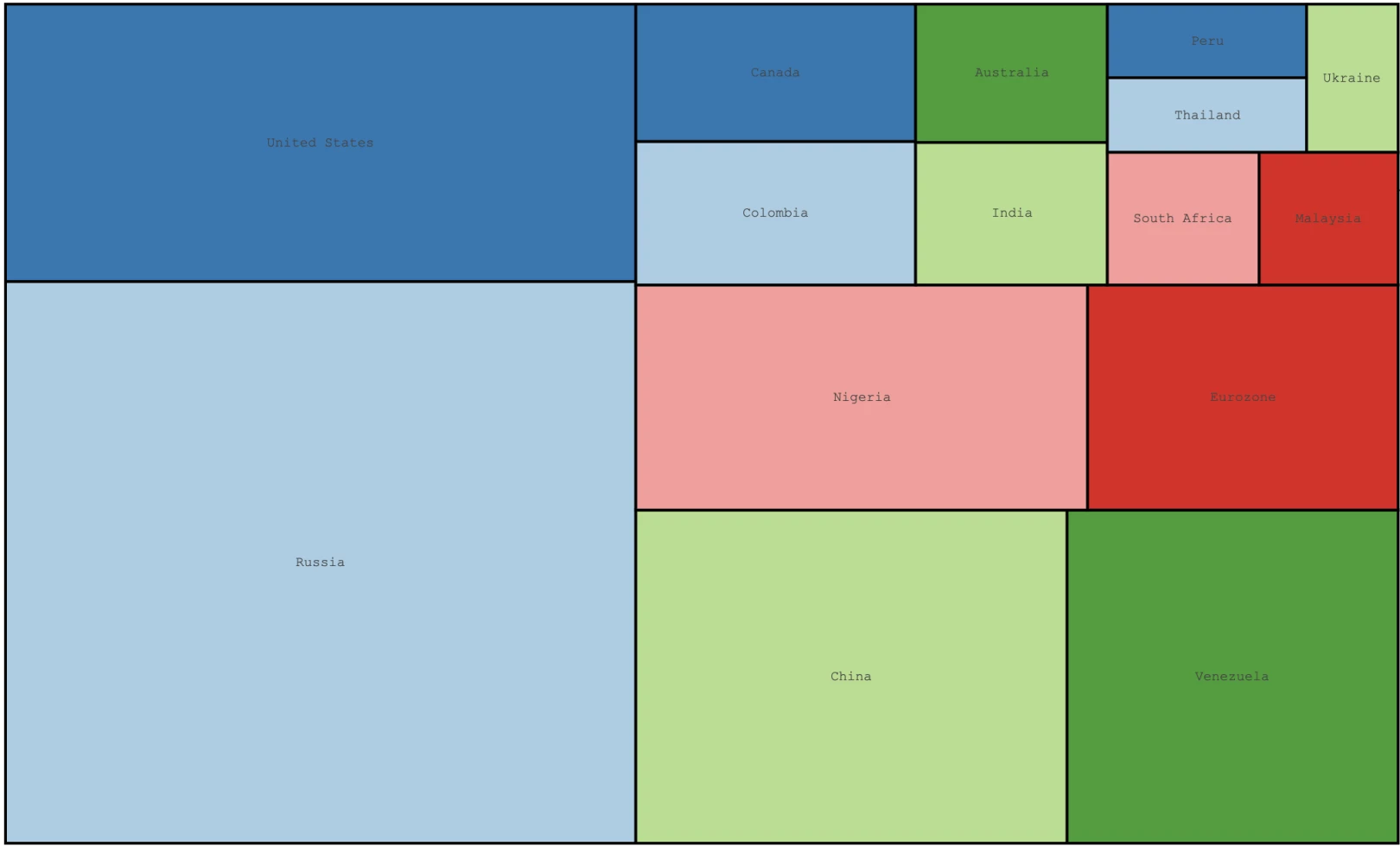
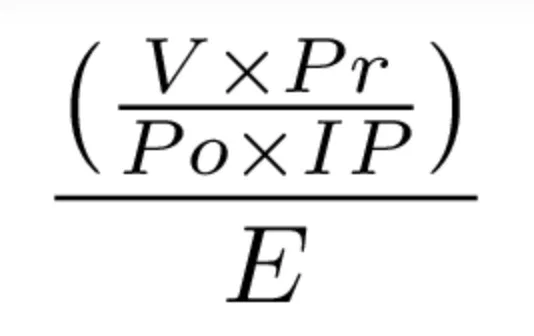
Security, Equity, Utility, Non-Fungible. They are all tokens, but what are they used for?
As per the title, there are various types of Tokens, each of which performs a certain function.
Before explaining what each category of token is used for, it's good to explain what is meant by Token.
**The Token**
The Token differs from cryptocurrency mainly because it does not have an own blockchain, but through smart-contracts, it originates on an existing blockchain.
I mentioned smart-contracts, so it immediately comes to mind that the main blockchain is that of Ethereum.
Another very important difference is that a token is used to represent (always digitally) rights.
These rights can be of ownership or access to a particular service.
Through ICOs (Initial Coin Offering) against a funding from a party, the company would provide a certain number of Tokens.
These tokens can be used to pay for services or to have access of various kinds, but only within the company that had provided them.
In order for the token to become a Coin, to all intents and purposes, it is necessary for the company to execute a Mainnet; that is, to establish its own blockchain, with all the necessary conditions.
The best example is for TRX. It was born as a ERC-20 token (Ethereum Blockchain resident) and then TRX created its own blockchain, moving all TRX from the ETH to the Tron Blockchain. This movement is called Mainnet Swap.
**Security Token**
The security token is a measure of a company's robustness; drawing a parallel with the real world, a security token could represent one of these 3 possibilities:
A share of the company
A security token against a government agency
A property rights
This type of token gives a certain security as they make the company that issues them responsible.
In addition, Security Tokens are regulated by the Local Financial Authority and after the strange affair of DAO, to protect companies and investors, the SEC had to draw up a regulation and a "register" where companies must register to certify their reliability and security.
**What happened?**
In 2016-2017, DAOs (Decentralized Autonomous Organization) was a suburban progress fund created on Ethereum.
As of April 2016, the ICO had raised about 150 million in Eth, with more than 10,000 investors under its belt.
Due to a flaw in the code, some hackers managed to get hold of about 60 million in Eth.
This left many investors with empty pockets!
**Equity tokens**
This type of token is part of the security tokens but works as a real traditional equity asset.
Holders of this type of token, can represent one of the following categories:
- Stocks
- Futures
- Option contracts
- Token Ownership
- Tokenized companies
It is no coincidence that Equity tokens have been named as "the stock of the 21st century"; in fact, if you use a token to identify a company's stock, the holder of this token can participate in the company's profits and voting rights.
In this case, it differs from a traditional stock in that it is registered on the blockchain, and therefore indelibly.
Being a type of security token, equity is also regulated by the country of issue and can be distributed through an IPO (Initial Public Offering).
Regarding the tokenization I refer you to this video for an in-depth study.
https://youtu.be/G3N3RkXoy-8
**Utility token**
This type of token is going into disuse as it has been used for all ICO (Initial Coin Offering) with bad consequences for investors in the case of unfeasible projects.
As everyone knows the ICO are called by the developer of the project that provides a certain number of tokens at a set price that can allow him, through the sale, to reach the two stages defined on the road map: The Soft cap (initial phase and activation of the implementation of the project) and the Hard cap (final phase of the project and activation of all stages of the project).
As usual, ICOs are executed on the Ethereum blockchain as it is technically more complete and easier to create tokens.
Among the examples of utility tokens, we can include BAT (Basic Attention Token) which is widely used by the decentralized browser Brave.
**Non-Fungible Token (NFT)**
The last token on the list is the non-fungible token, i.e., the "non-exchangeable" token.
Non-fungible token doesn't mean it can be sold; non-fungible token means it can't be replaced with another token: NFT is a unique token in the world.
That's why in this period they got all the limelight in the crypto scene, as they can perfectly reproduce what are the copyrights!
Speaking of which, I refer you to this video I created to clarify some basic points about this token.
If you have followed a little 'publications on youtube you will certainly have noticed a long list of tutorials that explain how to create a NFT, but given its importance is not so much to explain how to create it as why to create it and the importance of what it must contain in itself: something unique, unrepeatable and content.
I leave you with the video, enjoy and I look forward to your comments.
https://youtu.be/WafHbtLUcEY
Is Bitcoin the most legal "Ponzi"?
**The fact**
The other morning I was lazing with the "infernal machine" (the smartphone) and my astonished gaze was kidnapped by an article in a well-known newspaper.
He talked about Bitcoin defining it as a ponzi scheme ... while reading the gaze has undergone some metamorphoses: from intrigued to a lottonito to become disconcerted.
Yes, as you have read, Bitcoin has been compared to a ponzi scheme.
With lots of data in hand.
**Practically**
The article clearly states that the major holders of BTC, having arrived first and having a certain amount of it, have left only the crumbs to those who arrive now, not to mention those who will arrive.
So this "infamous" Bitcoin in addition to being called a "financial bubble" for some, has now also become a Ponzi scheme
So far nothing serious in fact each of us has his own point of view and it is more than legitimate ...
Exactly, now I'll explain mine, POV (Point Of View, which in this case has nothing to do with the famous song by D.A.D.).
**The Genius of Evil**
The Ponzi scheme owes its name to an Italian named Charles Ponzi who immigrated to the United States, where he implemented a pyramid system, based simply on nothing (no product, much less a service): he recruited people at a cost of 2 dollars with the promise of becoming millionaires.
With his pyramid he managed to defraud about 40,000 people (including the Italian community in the US and also native Americans) and total about 15 million dollars.
As you can easily understand, the ponzi scheme relies on the greed of people who are seduced by easy and substantial earnings, with expertise presented by histrionic characters.
This system is based solely and exclusively on the recruitment (and consequent scam) of as many people as possible, so it is easy to understand that sooner or later it is destined to disintegrate due to the impossibility of recruiting, or for the intervention of the police that they block and hopefully bring evildoers to justice.
**Multilevel**
A digression is necessary, as we must not confuse a ponzi scheme with the noble sales art of Multi Level Marketing, in fact in the multilevel the gains are there and can also be important, but the profitability is based only on the sale of products (and therefore a real turnover generated) and not on recruiting people like the ponzi scheme. It should be noted that, in all ways, there are shrewd and unscrupulous people who in no time at all transform the Multilevel into a Ponzi.
**How?**
Very simple, Multilevel is famous for being a mobile job and without any initial investment. If the sales rep wants to learn about the products so that they can explain them later, they can get them when and how they want and there are no predefined packages for accessing the code.
**The parallel**
As most of us know, Bitcoin is a Cryptocurrency, and it is based on a public Blockchain. So if one wants to buy a BTC or part of it, it is sufficient to register in an Exchange and proceed with the purchase using fiat currency.
Obviously, the purchase can have two directions: either you proceed to the trade in order to make this sum yield, or you rely on the market rules and expect the price to rise.
In the latter case it is advisable to transfer the sum to a Wallet which is much safer.
From the 4 lines I just wrote it is clear whether the title equation is correct.
**Then?**
BTC is an electronic currency, and it little differs, in use, from the "visa" or "maestro" that each of us jealously keeps in our wallets.
In fact, some structures accept it as a normal legal tender currency.
So what does buying BTC or buying dollars change? Absolutely nothing: in one case I transformed euros into BTC, while in the second I transformed them into dollars.
Does anyone see a ponzi scheme in this? Personally I don't see it, I just see a currency purchase.
And again: if the first buyers of BTC (I am connecting to what is asserted in the article) had had strong earnings, was it thanks to those who buy BTC now?
**I do not think so!**
A clarification: being BTC regulated by market laws, clearly the price increases because the demand grows, but the offer always remains the same. So, absurdly, my purchase also contributes to raising the price.
If we want a "Pontian transposition" of the reasoning, it is easy to do, but the reasoning does not hold up as the percentage of "gain" of the former is the same as the last one who bought BTC !!!
And the same quantity, not the crumbs that the author of the article is advertising.
In conclusion, it is clear that the equation of the title is not proven as the BTC (as well as all the altcoins) cannot be a ponzi scheme, there are no prerequisites.
We could define it (and here people who are truly prepared in financial matters could contradict me) a digital gold, almost like a safe haven.
So we can loudly say that Bitcoin is NOT a Ponzi scheme!
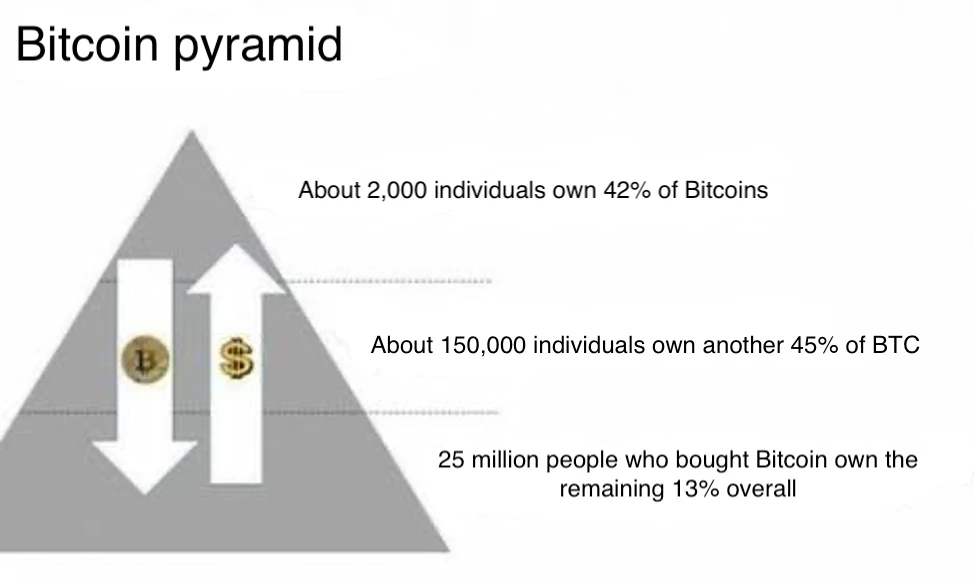
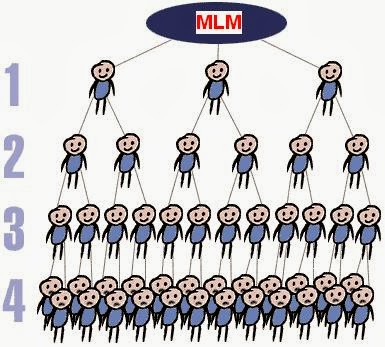
Token Review: Polkadot
Hello everybody and welcome back in this third token review of my new Token Review.
Today I will introduce Polkadot to you.
Polkadot is a revolutionary blockchain infrastructure designed to enable the next generation of Web where users control their own data and identity. It creates this infrastructure by providing a way to connect different and independent blockchains together in a single network, allowing them to interoperate, exchange data, and process transactions with the benefit of shared security provided by the Polkadot Relay Chain. It also allows interaction with non-blockchain systems and established blockchains such as Bitcoin and Ethereum.
Founded by some of the main figures in the sector, around the project we find Gavin Wood, co-founder and CTO of Ethereum as well as developer of the most famous language for Smart Contract Solidity, and Peter Czaban, technological director of the Web3 Foundation. Polkadot is therefore not one of the many new projects in the crypto sphere but it is one of the protocols that aims to solve one of the biggest problems of cryptography, namely scalability.
Polkadot team proposed a solution: create parallel chains capable of communicating with each other to avoid clogging a single chain of blocks. These chains are called Parachain and have different characteristics from each other: the computation of transactions is distributed among the various Parachains, allowing a large number of them to be processed very quickly.
Let’s talk about DOT!
DOT is the internal token of the Polkadot network. This token allows users to vote on potential code changes, which then automatically update across the network if a consensus is reached.
Polkadot currently has an allocation of 1 billion DOT tokens, following the network’s renaming from an initial maximum supply of 10 million in August 2020. The renaming was undertaken purely to avoid the use of small decimals and make calculation easier. While all balances were increased by a factor of one hundred, this did not impact the distribution of DOT or holders ’proportional share.
One of the most interesting features of Polkadot is the ability to transfer any type of data on public, open and authorization-free Blockchains, as well as on private (or DLT) Blockchains through authorization. This therefore makes it possible to develop applications that obtain data from DLT and use them on public Blockchains capable of demonstrating the certainty of the data but not the data itself.
Polkadot, at an operational level, is made up of 3 fundamental parts:
Relay Chain
Parachain
Bridges
I do not want to stop too long to explain these points at the moment, in the second article dedicated to Polkadot, which I will publish next week, I will go on to explain in detail these terminologies and many other technical curiosities.
So keep following me to stay updated!
Another very important point to fully understand Polkadot is represented by the consensus rules to manage the huge amount of data that the protocol has to deal with. Here too there are different types of "nodes", each with a specific task:
Nominators
Validators
Fisherman
Collators
Polkadot plays the role of guarantor in the world of Blockchains involved in the network, allowing transactions to be carried out safely, cross-chain and with high stability.
In addition to having a complex consensus algorithm and not simple operation at first glance, this digital currency also has tokens useful for staking and for the security of the protocol.
The Polkadot network and cryptocurrency looks to be a rising star in the cryptocurrency industry.
I said that Polkadot is a revolutionary blockchain infrastructure designed to enable the next generation of Web where users control their own data and identity.
Then I talked about 3 fundamental parts:
Relay Chain
Parachain
Bridges
Let’s get into it!
**Relay Chain** is the heart of Polkadot, responsible for the network’s security, consensus and cross-chain interoperability.
The relay-chain will likely be a chain broadly similar to Ethereum and it is mapping addresses to account information such as balances and a transaction counter to prevent replays. Placing accounts here fulfils one purpose: **to provide accounting for which identity possesses what amount of stake in the system.**
**Parachains** sovereign blockchains that can have their own tokens and optimize their functionality for specific use cases. To connect to the Relay Chain, parachains can pay as they interoperate or they lease a slot for continuous connectivity (this is pretty similar to the Lightning Network).
Each parachain is defined in the **Parachain Registry**. It is a relatively simple database-like construct and holds both static and dynamic information on each chain. Static information includes the chain index (a simple integer), along with the validation protocol identity, a means of distinguishing between the different classes of parachain so that the correct validation algorithm can be run by validators consigned to putting forward a valid candidate.
**Then Bridges** are special blockchains that allow Polkadot shards to connect to and communicate with external networks like Ethereum and Bitcoin.
Source: https://polkadot.network/
Just above I talked about these tasks:
Nominators
Validators
Fisherman
Collators
let's look at them specifically:
A **nominator** is a stake-holding party who contributes to the security bond of a validator. They have no additional role except to place risk capital and as such to signal that they trust a particular validator (or set thereof) to act responsibly in their maintenance of the network. They receive a pro-rata increase or reduction in their deposit according to the bond’s growth to which they contribute. Together with collators, nominators are in some sense similar to the miners of the present-day PoW networks.
A **validator** is the highest charge and helps seal new blocks on the Polkadot network. The validator’s role is contingent upon a sufficiently high bond being deposited, though we allow other bonded parties to nominate one or more validators to act for them and as such some portion of the validator’s bond may not necessarily be owned by the validator itself but rather by these nominators.
**Fisherman** are not directly related to the block-authoring process and they can be independent “bounty hunters” motivated by a large one-off reward. Due to the existence of fishermen, we expect events of misbehavior to happen seldom, and when they happen, it is just a matter of personal secret key security, rather than other malicious intent.
The name comes from the expected frequency of reward, the minimal requirements to take part and the eventual reward size. Fishermen get their reward through a timely proof that at least one bonded party acted illegally. Illegal actions include signing two blocks each with the same ratified parent or, in the case of parachains, helping ratify an invalid block.
Transaction **collators** are parties who assist validators in producing valid parachain blocks. They maintain a “full-node” for a particular parachain; meaning that they retain all necessary information to be able to produce new blocks and execute transactions in much the same way as miners do on current PoW blockchains. Under normal circumstances, they will collate and execute transactions to create an unsealed block, and provide it, together with a zero-knowledge proof, to one or more validators presently responsible for proposing a parachain block.
Source: https://polkadot.network/
So there you have it. These unique features are partly why many consider Polkadot to be one of the most promising and well thought-out projects in the blockchain space.
The underlying technology makes its case as one of the most important and eye-grabbing projects out there. It will be interesting to see what Polkadot does in the future.
Polkadot definitely has some potential. How this potential will develop in the next months and (hopefully) years, may become a revolution in the consensus mechanisms.
Polkadot describes itself as a next-gen blockchain protocol that connects several specialized blockchains into one unified system/network.
**What is your idea about Polkadot?**
Keep following me to find out the next coin I'm going to analyze.
Do you have other coins that you would like to see analyzed? Leave a comment here and your desire may find fulfillment!
Are You In The Top 1%?
The concept of "1%" has captured the American public's imagination over the past few years. The phrase is everywhere, from presidential debates to protest signs. But as precise as the sentence seems, it's a vague term. So, let's clarify today with this article.
**Who is in the top 1% of net worth in America?**
According to a survey conducted on one thousand Americans aged between 24 and 74 years, from the annual Modern Wealth Survey 2021, to be considered wealthy it is necessary to have a net worth close to 2 million dollars, to be precise 1.9 million dollars, which corresponds in euros to 1.55 million. This figure is lower than that declared for the year 2020, during which it was found that Americans considered themselves rich with a net worth equivalent to or greater than 2.6 million dollars.
Certainly, there are many who aspire to become part of the 1% club, but for many the pandemic has had quite a few repercussions, with a consequent drop in wealth expectations. In fact, out of one thousand respondents, 53% said they had experienced negative consequences due to the pandemic situation. Many have suffered job loss, been furloughed, or had their wages reduced.
**The average net worth of Americans is currently around $748,800**, far from what one would need to achieve to be considered wealthy. In addition, the average U.S. household net worth in 2019 was lower still, at just $121,700.
However, wealth expectations are not considered the same for everyone, but vary by age, with young people being satisfied with even lower figures. People between the ages of 24 and 39, known as **Millennials**, are on **the $1.4 million mark**. **Gen X**, or those between the ages of 40 and 55, are at **$1.9 million**. Finally, people between the ages of 56 and 74, known as **Baby Boomers**, would have to own **$2.5 million** in assets to be considered wealthy. On the other hand, **in order to be able to succeed in the top 1% ranking of the richest people, you need to own a net worth that exceeds $11 million.**
**How many are in the top 1%?**
Depending on your preference, the top 1% of households have approximately 1,286,000 households or 1,762,000 workers.
**Are millionaires in the top 1%?**
No. By net worth, **millionaires are slightly above the top 10%** of U.S. net worth, but nowhere near the top 1%. A household with $1,000,000 in net worth would need roughly 11 times as much wealth to be in the top 1%.
Discovering these numbers, it's really curious how much wealth an American must have to be considered in the top 1%. We often believe that "simple" millionaires are already among the wealthiest people in the nation. Instead, we find that, proportionate to the top 1%, they still have a long way to achieve the top 1%.


Inflation or Deflation/Recession?
The Covid-19 virus pandemic seems to be coming to an end.
On the "battlefield" there are a lot of deaths, but this pandemic has extremely serious repercussions especially in the economic sector of all nations involved.
As we know, last year, in order to face this financial cyclone, the FED printed dollars as if they were Monopoly money.
This factor increased the liquidity of money, at the same time it gave a boost to inflation.
**What do we mean by inflation?**
Inflation means the prolonged and generalized increase in prices of goods and services confined to a well-defined territory (region, nation, etc.) in a given period of time.
In order to make the calculation of this variable reliable and standardized, a list of representative goods or services has been drawn up.
After this operational definition we can say, briefly, that inflation indicates the percentage of devaluation of the currency.
So with the same amount of money it is no longer possible to buy the same good or service.
In this video I talk about it
https://youtu.be/uGxkb_JT8bI
As opposed to inflation, deflation.
The "antagonist" of inflation is deflation more correctly called recession.
In a recession there can be two triggers:
Production (always relative to a defined territorial area) slows down and there is an increase in unemployment.
The prices of goods/services undergo a drop, for two reasons: drop in raw material prices and drop in production costs.
Decline in demand. With the decline in demand, producers begin a race to the bottom in order to re-establish the supply-demand curve.
Unfortunately this race to the bottom causes a drop in wages and consequently there is, also in this case, an increase in unemployment.
In both cases there is a negative influence on the markets with a consequent loss of confidence in other economic areas.
**The corona virus**
At the same time, we can very well say that we are in the second situation and therefore in recession.
This is why the trillions of dollars printed by the FED did not make the world become a "second Venezuela".
Because of the forced closures of all nations, the demand for goods/services fell off.
Of course, businesses have also had setbacks as production has stopped.
Or, for reasons of anti-epidemic protocol, production slowed: staffing levels were cut in half.
Contrary to what could be an "after war" the end of Corona Virus cannot be defined a priori with an armistice.
Economically speaking a certainty of dates would have had a corroborating effect for the various nations.
**Why?**
Because everyone would be aware of a certainty: everything would return to normal.
With the due times, but without uncertainties.
In the current situation we do not have the certainty of a safe end of the pandemic: there could be another wave, and then everything would return as before.
Today everyone is extremely uncertain about the future of themselves, of the company they work for and of a potential new wave.
At this precise moment we are in the second situation that causes recession: a drop in consumption due to uncertainty about the future.
**In both cases, is the situation desperate?**
Absolutely, we have all the tools to exploit situations in our favor.
In this moment of recession, since the fiat currency is gaining purchasing power, we can start a phase of medium-term provision and foresee, subject to a strict money management, the purchase of cryptocurrency.
In this way we can preserve the purchasing power of the legal currency, taking advantage of a period not exactly rosy for the whole world!
The purpose of my articles is to make people aware of all the economic and financial aspects that underlie certain situations in order to manage them in the best possible way and make a profit.
This post is not a financial advice, nor an investment suggestion.
The NFT coming from the Moon. Literally
Yeah, the title told you exactly what will be going on in April in Modena, Italy.
But let’s start from the beginning, so I can explain you what leads me talking about this!
It was June 2020 when Rossano Ferrari, an important Italian painter contacted me to “tokenize” his paintings. It was a moment when I was getting really deep into the tokenization of companies, assets but for a purpose of investment. And the cost for such tokenization was really high: we are talking of tens of thousands of USD.
Anyway, Rossano got my attention, thanks to several solo exhibition that he made in Russia, USA, Italy, San Marino and so on.
He also managed to send one of his paintings into the International Space Station. Here a picture of the floating “Venere in the Space”, the painting that has been on the ISS.
Venere in the space from Rossano Ferrari
He also painted with his art important privees of restaurants in San Marino.
You can check all Rossano’s work directly from his website https://rossanoferrari.art/
Later on, the wave of NFTs started growing and many different platforms became widely available. Among the others I evaluated Nifty Gateway, Portion, OpenSea and Rarible. We went for Rarible because it allowed us to make a “verified profile” of the artist, something that on Opensea was not yet available.
And there started Rossano’s journey into NFT art. You can check Rossano’s NFTs here https://rarible.com/rossanoferrari
Rossano works with Sergio Bevilacqua, an international art-sociologist that has defined Rossano’s art as a chromatic double mosaicist, and here is what Mr. Bevilacqua thinks about artistic NFTs:
“Art collection is well-known from the Bronze Age with ancient forms of jewels.
So, why art can be collected also through NFTs?
Since some years, our life is running more and more into the "Infosphere", reducing the time spent into the "Real Life".
Our environment has to be reconsidered: some years ago what was virtual had a definite position and role into our life and the Real Life was more powerful than now. Now the mind presence into Real Life has decreased down to 1/20th if compared to one decade ago.
Virtual habits have now permeated all aspects of Real Life, making it a Matrix, where many traditional pleasures have changed shape and manifestation.
A couple of decades ago we lived into the infosphere for up to 15% of our time. Now we are at 70% taking into account the attention drainage caused by smartphones and other wearables. Among these pleasures that are now happening into the infosphere, we have to mention art collections, that was earlier related to just the "Real Sphere". Now artworks are taking part also into the Infosphere.
These NFT-artworks can be shared, through the infosphere, with our guests, with our friends across the world, creating a new form of art collecting, strongly related (as always!) to this dimension of the personality of the collector. Each individual, with its own personality will have its own form of pleasure, that have increasing representations into the infosphere: so, it goes further the real creation proper of the collection, that lives today more and more in the infosphere, and, then, on NFT-artworks.”
Boom! From Rossano Ferrari
Publishing NFTs is not just a matter of drag and dropping some image into the Blockchain. It’s a matter of capitalization of the painting, of number of tokens.
We started from a parameter that is typical of each artist: in particular, calling “K” that parameter, the internationally recognized price for a painting is:
Price (in €) = K x length (in centimetres) x height (in centimetres) x 10
The result of this calculation leads to the price in Euro.
Starting from the official price, we then calculate the order of amplitude that NFTs can bring to the author and to its creations.
NFTs bring the possibility of the creation of a high number of certified copies, creating liquidity into a illiquid market by definition. Furthermore, the creation of a number of certified copies of the same painting allows several different owners, that according to the Metcalfe Law, makes the value of the item increase with the number of users. Metcalfe Law was created for phones so it was talking about users. In this case we are talking about owners.
NFT art-accessibility increases the capitalization that the NFT are worth: in that case, we decided what
Coming to the big news, the ones that I can tell you, Rossano is drawing a lot of astrological constellations since weeks to be ready for the 12th February 2022 exhibition.
There will be 12 constellations, representing the 12 zodiac sign, plus a 13th constellation. What will it be and where will it be represented?
Every constellation will be projected into the planetary in Modena and every painting will be also tokenized into NFT.
If you have already checked Rossano’s NFT profile you will see that some NFTs have a high number of copies.
Due to the exclusiveness of this event and to the relevancy of the subjects of the paintings, these NFTs will have a much lower number of copies, making them very exclusive.
I will be the one that will create those NFTs, so I am sharing with you this insight. I am not saying that they will be sold in a few minutes. I am not that kind of “marketeeeeeeer”. I am not a marketeer at all. I just feel that those NFTs may have great success, since some other solo Exhibitions have been already planned both in Japan and in San Marino.
See ya!
 @MikeZillo