Writing Music on a Grand Staff, for Piano, Other Keyboards and Pipe Organ
This is a beginning tutorial for the music notation software called *MuseScore 3* [download here], which is useful for writing and printing songs and music parts for various instruments, in score form. Here I show you how to set up a music notation document with a Grand Staff, which is used for writing music for the piano, ... https://musescore.org/en
... and other keyboards, even for this giant Pipe Organ:
Screenshots of the *MuseScore* software are included within this essay, and I also plan to post a link to a video tutorial based on this same essay.
**Warning**: In this presentation, I make a distinction between the familiar *computer* keyboard generally used for inputting alpha-numeric characters, and the *piano* or *musical* keyboard, which may be onscreen, or a separate electronic keyboard having piano-type keys, and interfaced with a computer workstation. Do not confuse these two types of keyboards!
**Here are the steps:**
Open MuseScore 3 on your computer. In the Start Center box, select Create New Score. (If the Start Center box is not visible, you can make it appear by tapping the F4 function key.)
Enter any title, fill out any other fields if you like – information can be added and changed later – and click Continue.
With the left mouse button, select the template file for this tutorial. Under General, Select “Grand Staff,” then Continue.
The C Major Key Signature is probably already selected, but if not, select that. The keys of C major and A minor have no sharps or flats (also called “accidentals”). Then, click Continue.
Choose the Time Signature of 4 /4, Enter Number of Measures (8), leave unchecked the Pickup Measure and Tempo boxes, for now, and click Done. This would be a good time to save your work, giving the file you just created an appropriate name.
There you have it! A lot of music for many instruments and voices can be written on the Grand Staff (above), which supports music writing on both Treble and Bass clef staves.
Going forward: On the computer keyboard, the letter “I” is a shortcut that stands for “Instruments.” So I can get more specific with what I am writing by tapping the letter “I” on the computer.
I locate Keyboards in the left panel; sometimes it’s necessary to scroll down passed the other instruments on the list. Under Keyboards, I select either Organ or Pipe Organ, click Add to Score (center column), and OK.
Notice that the Organ part has a third staff added below the bottom of its grand staff. This extra staff is for the pedalboard bass notes that organists play with their feet. When I’m writing for a large theater or church organ having a pedalboard, I may want to add that additional staff.
I’ve removed the piano part. To do this, I hit “I” again, selected “Piano” on the right panel, then in the center column, “Remove from score” clicked OK, and we’re left with these three staves for Organ. Also, using the left mouse button, we select the first measure of the treble (top) staff of the organ part. You see it's highlighted with a blue square around the measure.
The letter “N” is the shortcut key used to start writing musical “Notation," or "Notes.” So I tap “N” on the *computer* keyboard. Also on the computer keyboard, the letter “P” is a shortcut to bring up the *onscreen* piano keyboard. After these two shortcut keys (N and P), …
... I then click the note C4 of the onscreen keyboard. As you see above, this writes the middle C note on a short horizontal line placed in the space between the treble and bass staves. We should also hear the sound of a pipe organ playing that C tone!
Incidentally, if your clicking C4 on the onscreen piano doesn’t write the note C on the grand staff, try selecting the first measure of the treble staff, tap “N” on your computer again, then tap the C4 on the *onscreen piano*. You should see the Middle C as a quarter note positioned on a ledger line between the Treble and Bass staves.
Finally, here is a simple exercise to try. On the *computer* keyboard, tap the alphabet letters in this order: Continuing from the C (previously entered), E D F E G F A G B A C B D C. Don’t worry, but if you end up with something like the staff above, you’re doing very well!
In this tutorial I presented a way of setting up *MuseScore 3*, for writing music parts for various keyboard instruments, in score form. I began by setting up a Grand Staff, used for writing music for the Piano and other musical keyboards. Some keyboard instruments, such as the Organ, may require the addition of a third staff, in order to write notes for the pedalboard of that instrument. Hopefully, no one got confused between the *computer* keyboard, and the *piano* or *musical* keyboard!
Click here to watch the video tutorial based on this essay. https://odysee.com/@BrokeNGlass:e/GrandStaff_tutorial:8?r=A9pw7oV7d3DMX2jhXNwox5YgaJ6kLzy2
**Flickr Photo Credits - All Creative Commons, Commercial Use Allowed:**
Petrof Grand Piano, by Daryl Durand - Link: https://flic.kr/p/9A8XSa
Thomas Appleton Pipe Organ, by Ron - Link: https://flic.kr/p/4FM9Hj
Cantus Firmus, Part 4: Modal Jazz, and Early Music
**Links to related essays:** **Part 1** **|** **Part 2** **|** **Part 3** **| and** **Modal Music Explained** https://read.cash/@Majokdit/the-game-of-counterpoint-a-tutorial-on-cantus-firmus-d56008f4 https://read.cash/@Majokdit/the-counterpoint-game-part-2-37d5e44d https://read.cash/@Majokdit/the-counterpoint-game-part-3-2d97f84a https://read.cash/@Majokdit/modal-music-explained-36353997
**Modal jazz, and early music origins**
Today we discuss literally the ups and downs of modal “scales” as they relate to a *cantus firmus*. There is a lot to the concept of modes that we will not go into here. If you’re curious, the Wikipedia article on “Mode (music)” is a good read for your inner musicologist. You may also like to read or review my earlier essay on the topic of Modal Moods. https://en.wikipedia.org/wiki/Mode_(music) https://read.cash/@Majokdit/modal-moods-dorian-mode-e5fda14a
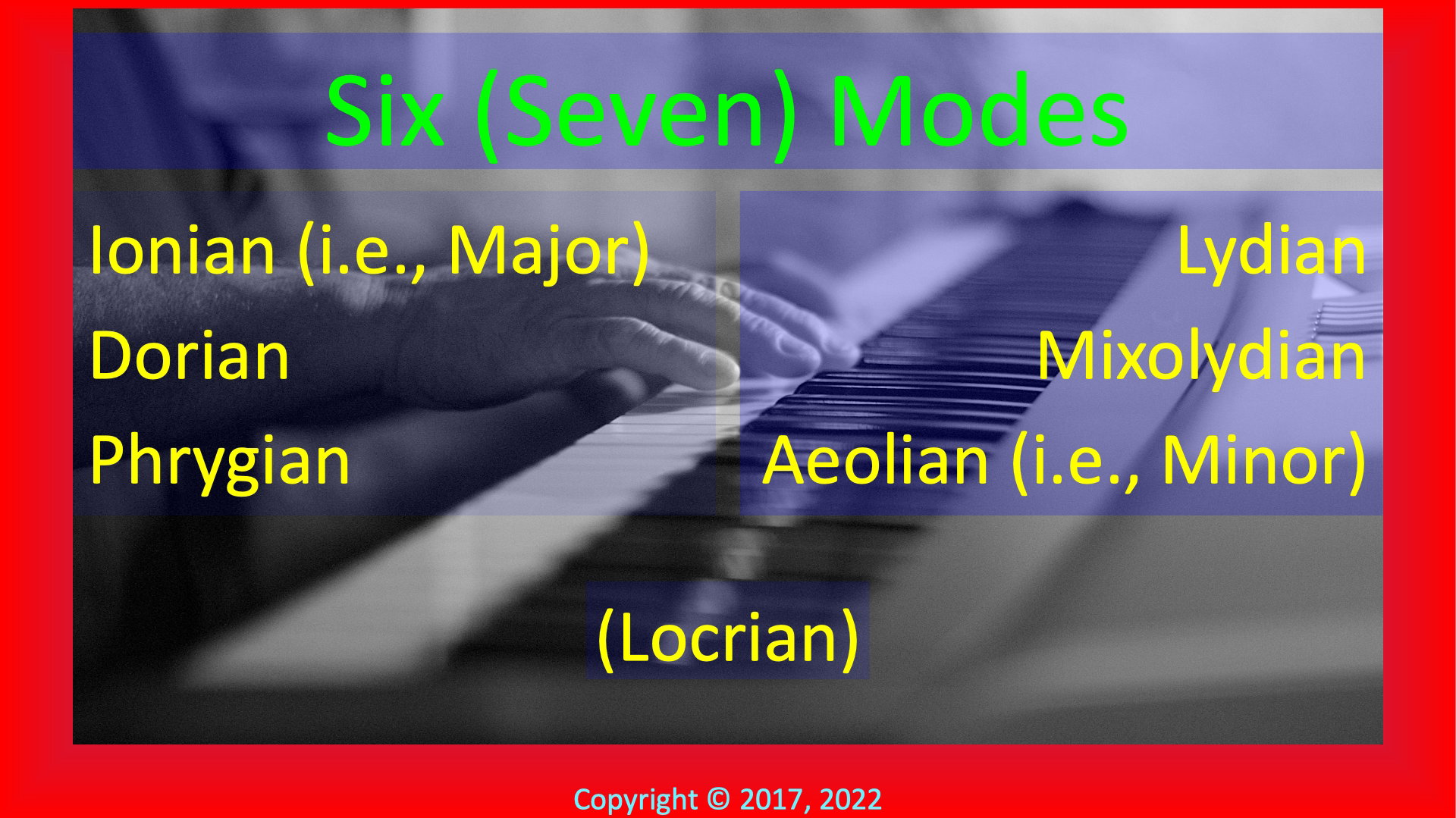
As to the familiar applications of mode today, jazz and popular musicians conceive of six, or perhaps seven modes derived from the series of seven tones of the Major Scale. Here is a list: Ionian Mode (Major), Dorian, Phrygian, Lydian, Mixolydian, Aeolian (Minor), and a theoretical mode called “Locrian.” As mentioned elsewhere, we will leave aside Locrian Mode for now.
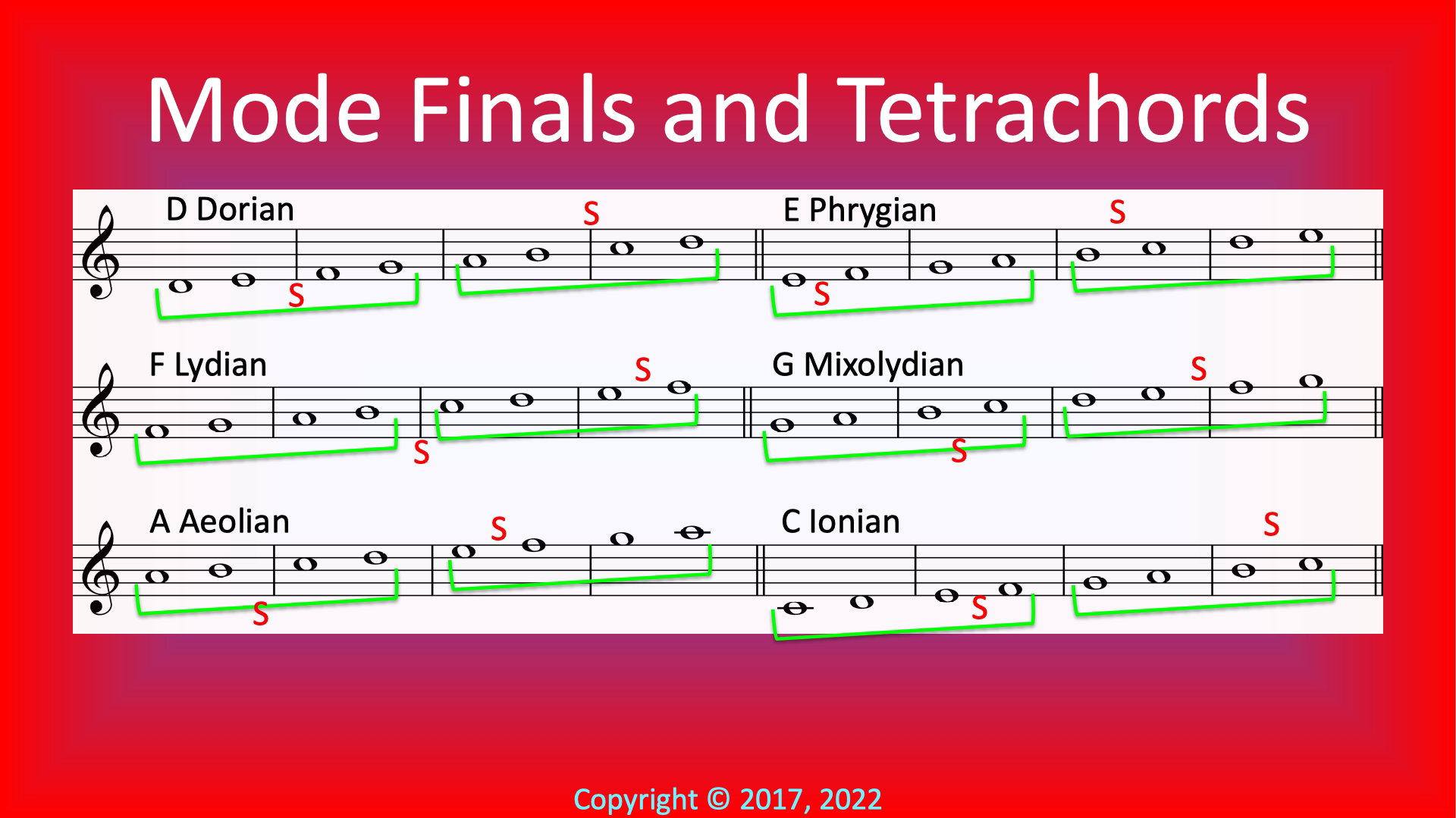
Notice the Final and starting tones of the six modes, also the position of the *semitone* in each tetrachord; the semitones are marked with an “S.” Such factors determine the individual character or “sound” of each mode. We encourage students to sing and play up and down the six modes, and their tetrachords: Dorian mode on D, Phrygian on E, etc.
Today, when a Major and Minor scale share the *same key signature*, we say that they are ***relatives***. As you see above, the six modal scales that share the same key signature are all *related* to each other. Furthermore, by the extension of this principle, all modes can be transposed to other keys.
The two *tetrachords* of each mode are bracketed. For our study of *voice leading*, we separate the six modes into two categories, depending on whether the tonic triad of the mode and the first (the lower) tetrachord, are Major or Minor. Students should practice playing these chords on a piano-keyboard while singing the ascending notes of the two tetrachords of each mode.
Venturing deeper, we can also pair Major/Minor “Dyads” that are a minor third apart, in a manner similar to the way we match up the modern Relative Major and Minor Scales: Ionian Mode pairs with Aeolian (same as Major/Minor), Lydian w/ Dorian, and Mixolydian w/ Phrygian. You may better hear the close audible connections of the pairs by playing the chords and singing the tones of each mode above. – See Cormier, in the *References* below.
We can treat C Ionian and A Aeolian much like the modern day Major and Minor scales; the Final note of C Major is DO, A minor is LA, and in the Aeolian mode, the sixth and especially seventh degrees can be raised and lowered as voice leading demands it. Here at least, nothing in the old is new to us, though it would be beneficial for students to play and sing the above examples as prescribed.
As shown above, F Lydian mode occasionally introduces the B-flat tone, usually in the descending direction. Thus, F Lydian is often the same as Ionian mode transposed to F, and the solfège for singing this mode is treated in the following way: The note F being the “DO,” when the B-flat appears, it is sung as “FA,” but if it is B-natural it is sung as “FI.” The reader should try playing this Lydian mode on a piano-keyboard, experimenting with those two choices of ancient *musica ficta*.
The present essay does not discuss the even older “medieval polyphony” though perhaps that will be of interest in the future. Essentially, the earlier Medieval-Renaissance concept of Authentic and Plagal modes relates mainly to the singing voice ranges [SATB] – the Final being the *lowest* tone of an Authentic Mode, but the *fourth* tone of a Plagal Mode. No hurry, no worry. Let’s move forward!
So for the rest of this discussion, we really only need to concentrate on these three modes: D Dorian, G Mixolydian, and E Phrygian (untransposed). The reader should try to sing and play these three modes on a piano-keyboard, paying attention to the audible differences.
By the way, did you notice the odd accidental signs placed *above* certain notes? Continue reading to find out what they represent!
**D Dorian – Ascending:** The lower tetrachord and tonic triad of Dorian mode are minor, but when a Leading Tone is required, the seventh degree *can be and often is raised* a chromatic semitone. The solfège for D is sung as “LA," B is “FI" (“fee”), and C-sharp is "SI" (“see”). To show that this is optional, we added a special accidental called a *musica ficta* **above** the 7th tone:
Play and Sing LA, TI, DO, RE, MI, FI, ***SI***, LA, ascending.
**D Dorian – Descending:** For a *descending* line, the sixth degree note B *can be and often is* *lowered* a chromatic semitone, to B-flat. This now becomes like the natural or descending version of the Melodic Minor scale: The Final D is the LA, C is SOL, and B-flat is FA:
Play and Sing LA’, SOL, ***FA***, MI, RE, DO, TI, LA, descending.
**G Mixolydian – Ascending:** The lower tetrachord and tonic triad are now Major. When *ascending*, the seventh degree note F of Mixolydian Mode may be raised, to create the artificial Leading Tone F-sharp, when the voice leading requires it. G is now the “DO,” and F-sharp is “TI”:
From G, Play and Sing DO RE MI FA SOL LA ***TI*** DO, ascending.
**G Mixolydian – Descending:** When *descending*, the seventh degree returns to the subtonic status of the degree (i.e., F = “TE” pronounced "tay"), and the third degree B is occasionally lowered a chromatic semitone as well, to B-flat (“ME”), creating a very "bluesy" mood, to modern ears. The Final G is sung as “DO,” F as “TE,” and the optional B-flat as “ME”:
From G, Play and Sing DO’ TE LA SOL FA ME RE DO, descending.
**E Phrygian – Ascending:** Phrygian is a *minor* mode, like Dorian and Aeolian. So the note E may be sung as “LA,” since the tonic triad and lower tetrachord of E Phrygian feature a minor third, and the second degree tone F is "TE" (rhymes with "DAY"):
Ascending from E, Play and Sing LA TE DO RE MI FA SOL LA’.
(LA TE? Would you like sugar for your LA TE? How about a croissant?) … (humor)
**E Phrygian – Descending:** The raised *seventh* degree is rare In Phrygian Mode, however, the *second* degree of E Phrygian, F, is only a semitone above the Final:
Descending from E, Play and Sing LA’ SOL FA MI RE DO TE LA. So this *second* scale degree (the "TE") in Phrygian mode functions as a *de facto* “Leading Tone” (LT), wanting to resolve down to the tonic E, or LA. How does it sound to you?
For your listening practice, here are a few examples of *cantus firmi* to play and sing, in the Dorian, Mixolydian, and Phrygian modes. See Johann Joseph Fux, also Salzer and Schachter in the *References* below.
That’s all for now on the topic of *cantus firmus*, but it’s enough of a groundwork for us to get started with studies in actual counterpoint writing. An introduction to counterpoint writing techniques and principles will be covered in a future essay.
Summary
Above is a condensed summary (epitome) of the Guidelines on *Cantus Firmus* that we covered in these four essays. Feel free to take a selfie with it....
LIBRARY REFERENCES IN ALPHABETICAL ORDER BY AUTHOR
Cormier, Stephen M. *Modal Music Composition*. Arlington: Inman & Artz, 2004.
Jeppesen, Knud. *Counterpoint: The Polyphonic Vocal Style of the Sixteenth Century*. New York: Dover, 1992.
Mann, Alfred. *The Study of Counterpoint,* from *Johann Joseph Fux’s* Gradus ad Parnassum*.* New York: Norton, 1965.
Salzer, Felix and Carl Schachter. *Counterpoint in Composition: The Study of Voice Leading*, pp. 3-12. New York: McGraw-Hill, 1969.
Schubert, Peter. *Modal Counterpoint, Renaissance Style*, First Edition, p. 18. New York: Oxford, 1999.
Wikipedia article, “Mode (music)”: **https://en.wikipedia.org/wiki/Mode_%28music%29**
IMAGES from Flickr, in Order of Appearance; please take a moment to visit a few contributors’ image links – awesome, free material!
Solar System Transits, by Giuseppe Donatiello: **https://flic.kr/p/JXQovz**
Medieval Stairway - Sabugal Castle, by Teves Costa: **https://flic.kr/p/nmsMTV**
Jazz Piano - 2010/365/181 Fingers in Motion, by Alan Levine: **https://flic.kr/p/8eWcRQ**
Lydian – Sardis Artemis Temple, by Turkey Vision: **https://flic.kr/p/ccASBj**
Early Music FAQ on the 12 Medieval Modes: **http://www.medieval.org/emfaq/misc/modes.html**
Vianden Castle, by Alun Salt: **https://flic.kr/p/b43U6**
Valleys of Crete – Good Morning, by Nelo Hotsuma: **https://flic.kr/p/rT1VpT**
Coffee Break, by LWYang: **https://flic.kr/p/4TPU2B**
Hierapolis, Phrygia, Turkey, by Carole Raddato: **https://flic.kr/p/QKdid1**
Creative Commons Legal Code for commercial use and mods of above images. “Mods” used (if any), are minor adjustments to image size, transparency, cropping, and/or front-to-back position in slide): **https://creativecommons.org/licenses/by-sa/2.0/legalcode**
The Counterpoint "Game" - Part 3
CANTUS FIRMUS: PART 3 - Link to Part 4 https://read.cash/@Majokdit/cantus-firmus-part-4-modal-jazz-and-early-music-9e70f33b
Balance, Melodic Tension, Repetition, Beginnings and Endings: This is a continuation of the **two previous essays** [see link one and link two], and an ongoing tutorial in the fundamentals of musical counterpoint. https://read.cash/@Majokdit/the-game-of-counterpoint-a-tutorial-on-cantus-firmus-d56008f4 https://read.cash/@Majokdit/the-counterpoint-game-part-2-37d5e44d
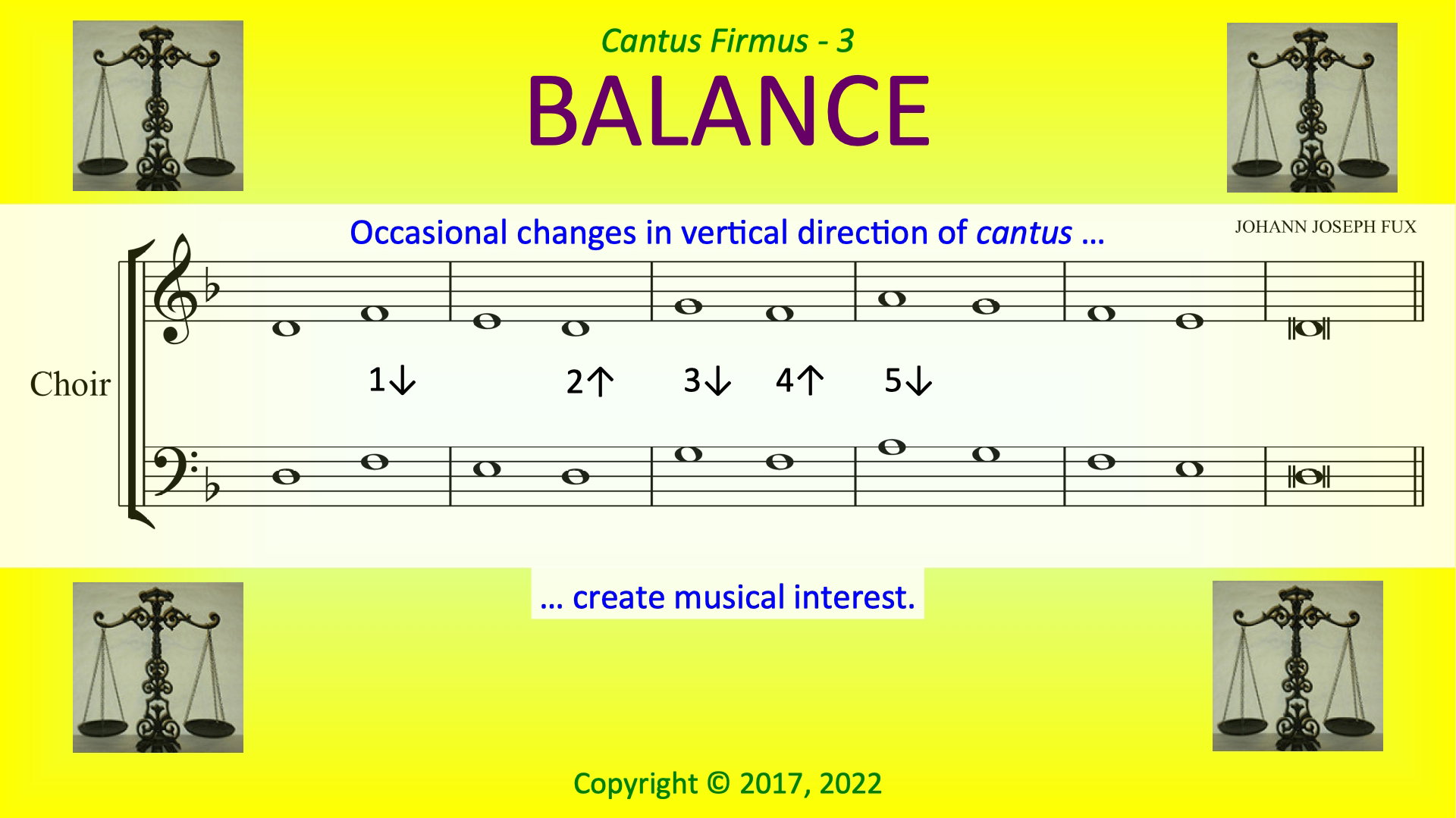
BALANCE – You will recall that the word *cantus firmus* means “fixed song” and refers to a set melodic line, devoid of dissonant intervals and stripped of rhythmic emphasis. A *cantus firmus* (abbreviated CF) is used as a scaffolding for added counterpoint. As you can see above, an occasional change in the vertical direction of a *cantus firmus* creates musical interest, because *BALANCE*. Note: You should always try to sing, and play these examples on a musical instrument.
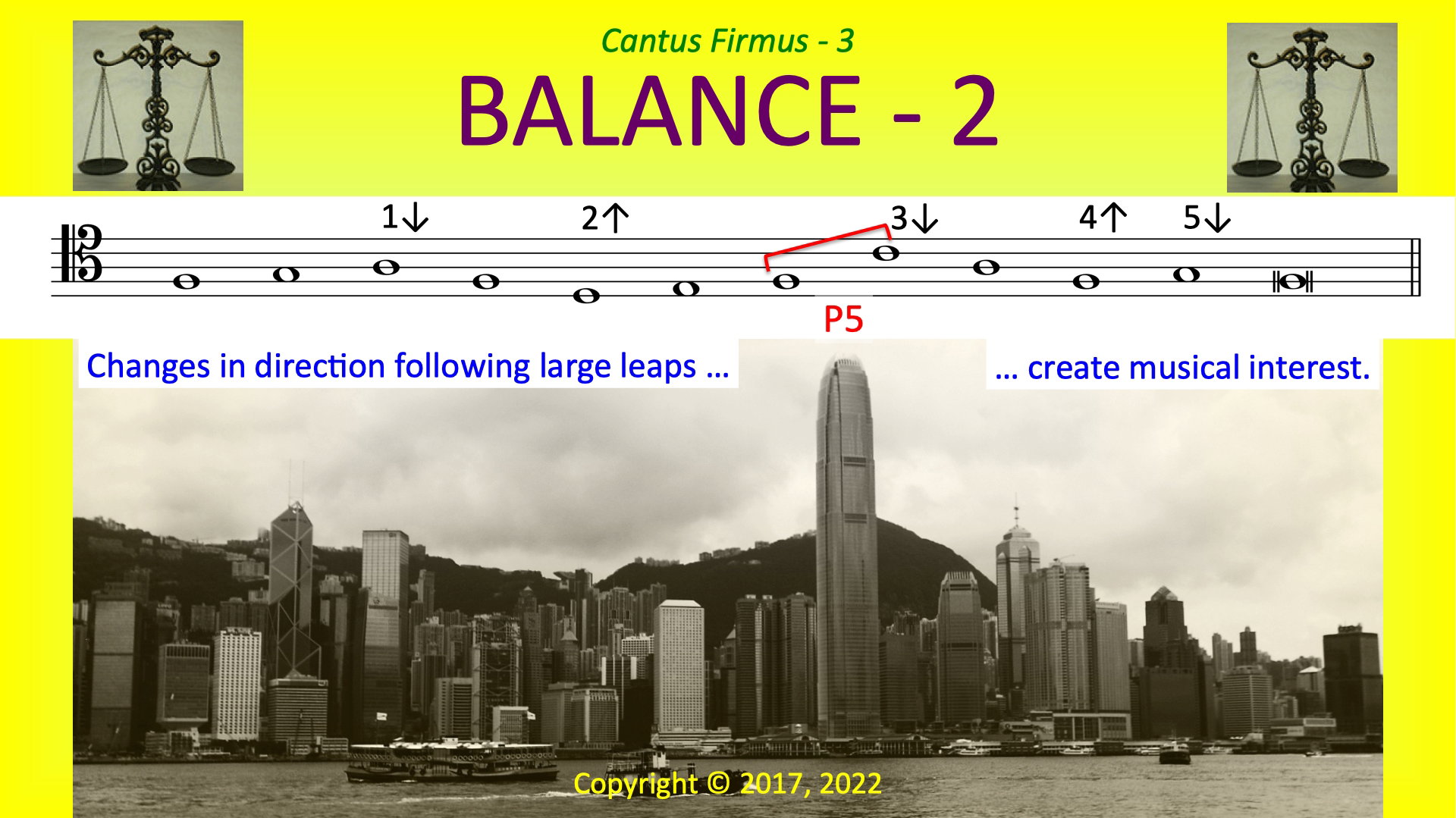
BALANCE 2 – Following a leap, particularly after a leap of a Fifth (or larger), reversal of direction creates musical interest. Again, because BALANCE.
FYI the C-Clef (Tenor Clef) in the above staff tells us that the fourth line, counted up from the bottom, is the note C, or “DO.” Thus, this example begins and ends on the note F, or “FA.”
BALANCE 3 – It has been said that unidirectional motion in a CF should be limited to five tones, but this is relative to the total length of the line. As we see here, the longer CF on the top staff tolerates a six-tone one-way motion at the end better than the shorter line underneath it.
Even when we “season” a long, unidirectional line with a few skips, it is better to break it up with brief changes in vertical direction. Because BALANCE. Play/sing and compare the bland sound of #1 with the more satisfying line #2 beneath it. Are you getting the idea?
Before going on, try to play on a piano-keyboard and listen to some of the DISSONANT MELODIC INTERVALS of a Scale: DO-TI, RE-DO’, MI-RE’, FA-TI, FA-MI’, SOL-FA’, LA-SOL’, TI-FA, and TI-LA’.
The dissonances shown above were listed among the melodic intervals declared **unacceptable** in the Rules for writing a *cantus*, remember? No melodic 7ths of any kind, and no chromatic, diminished, augmented, or compound intervals. The implications are extensive.
HIDDEN DISSONANCE – A mostly conjunct segment that happens to be bounded by the endpoints of one of these dissonant intervals also creates unresolved tension, which for now, by means of these exercises, we are disciplining ourselves to avoid. Can you *hear* the hidden dissonances outlined by the brackets above? The C-Clef in examples #1, 2, 3 has moved to the third, or middle line of the staff; the Alto Clef position. Play/sing these three examples, and listen for the forbidden hidden dissonances.
The strong pull of the Leading Tone (abbreviated LT), in Major or Minor, can create imbalance. As seen above, the line ascends to the 7th scale degree – the "TI" – but never completes its journey all the way to the tonic. Play and sing the line. In other words, in a CF, the LT should not be written as the “last stop,” the high point – the climax – of an ascending line.
NO REPEATS – We want all the tones of a CF to be of EQUAL duration and emphasis; no tones may stand out. Because repeating the same tone two times in succession not only gives it more emphasis than the others, but effectively doubles the duration of the sound.
The only “breve” allowed is the Final! – See Salzer & Schachter in the *References* below.
NO REPEATS 2 – We know not to repeat the climax note. We know that only the first and final tones occur twice. As for the rest of the “story,” NO single tone should receive more emphasis than the others – repeating any tone several times throws off the **balance** of the CF – See Salzer & Schachter, p. 8.
NO REPEATS 3 – In the little game of species counterpoint, and even tinier mini-game of *cantus* writing, there is no room for repetition of an isolated group of tones – in music we call this a *motive*. Play/sing the above example and listen carefully. Repetition of *motives* is a tool of composition; later on we will go into the application of repetition. (But not yet.)
NO SEQUENCES – For similar reasons, no *sequences* are permitted here, though we will deal with both repetition and sequences further down the road. Again, the *repetition of recognizable groups of notes* – as shown here – this is NOT permitted in a CF! See Salzer & Schachter, p. 9.
Note: A musical sequence is in some ways similar to a repeating "loop" used in popular music today, but occurring at higher or lower pitch levels with each repetition.
Beginning of *Cantus Firmus* – We mentioned already that the *cantus* must begin and end with the chosen tonic. After the initial tone, the line may proceed by step, skip, or leap (as long as we reverse direction after a big jump). To reiterate: The CF must end on the same tone with which it began.
Ending Descending – Most cantus firmi conclude with a descent to the tonic pitch. Why a descent?
Because a rising line builds up tension, and we want a *cantus* with a relaxed ending. No tension.
The final tonic of most historical CF is approached **from above**.
The penultimate tone just before the Final may be approached by step, or skip (no larger than a third), from either direction, but the final note itself may be approached only by step. While playing or singing the two lines above, notice how abrupt a leap on the end sounds. That leap to the Final tone leads us to expect the *cantus* to continue, because it wants to fill in the leap – because BALANCE! For that reason, the second line sounds more stable, relaxed. See Salzer and Schachter.
Incidentally, the above staves feature the “Soprano Clef,” which places Middle C or “DO” on the bottom, or first line of the staff.
Finally, we do encounter a few *cantus firmi* that approach the final tonic from below, for the sake of … variety! When such a CF is in a minor mode, it resorts to a raised 7th and possibly raised 6th scale degrees, to avoid that augmented 2nd interval (A2) we know is lurk lurking just below the minor tonic. This is one example of *musica ficta* mentioned in a previous essay. https://read.cash/@Majokdit/modal-moods-dorian-mode-e5fda14a
For completeness, a subsequent essay will talk a bit about the various **modes** that can be used in writing a *cantus firmus.* But in this and the previous two parts, you already know the essentials of how to play the cantus firmus game.
Incidentally, the ending tone in modal counterpoint, is actually called THE “FINAL” (and that is no fantasy!).
So, we’ve refined some of the Rules for writing a musical line called a *cantus firmus*, Latin for “fixed song.” Our objective is to create a scaffolding which we will later use for learning to write musical *counterpoint*, a technique of adding additional melodies above and below the CF. #Counterpoint writing requires a comprehension of the same Rules used CF, for achieving Balance, pertaining to melodic dissonance (tension), change of direction, leaps, number and repetition of tones, climaxes, beginnings and endings. #CantusFirmus #MusicTheory
Tap here for Link to Part 4 https://read.cash/@Majokdit/cantus-firmus-part-4-modal-jazz-and-early-music-9e70f33b
**REFERENCE WORKS CONSULTED**
Salzer, Felix and Carl Schachter. *Counterpoint in Composition: The Study of Voice Leading*, pp. 3-12. New York: McGraw-Hill, 1969.
Mann, Alfred. *The Study of Counterpoint,* from *Johann Joseph Fux’s* Gradus ad Parnassum*.* New York: Norton, 1965.
Schubert, Peter. *Modal Counterpoint, Renaissance Style*, First Edition, p. 18. New York: Oxford, 1999.
Jeppesen, Knud. *Counterpoint: The Polyphonic Vocal Style of the Sixteenth Century*. New York: Dover, 1992.
**PRIMARY SOURCE OF MISCELLANEOUS CANTUS FIRMI**
*Gradus ad Parnassum*, by Johannes Fux (reprint of original, in Latin, published in 1725). Public Domain: **http://imslp.org/wiki/Gradus_ad_Parnassum_****(Fux,_Johann_Joseph**) http://imslp.org/wiki/Gradus_ad_Parnassum_(Fux,_Johann_Joseph
**FLICKR IMAGE CREDITS, in Order of Presentation:**
Balance, by Natalie Lucier: **https://flic.kr/p/6HBN2C**
Vintage balance scale, by Colleen Smith [mods and commercial use allowed]: **https://flic.kr/p/aGSh8r**
HK Harbour, by Chor lp: **https://flic.kr/p/8duFKv**
Eagletail Mountains Wilderness, by Bureau of Land Management [AZ?]: **https://flic.kr/p/fkKUrx**
Stairway to nowhere, CA, by Delaney Turner: **https://flic.kr/p/aRQBqP**
Arboga river, by Arvid Rudling: **https://flic.kr/p/84BSQ7**
Cliffs of Moher, by Stephen Carter: **https://flic.kr/p/9xSAX1**
Minky Whale, by William Warby: **https://flic.kr/p/dtS35s**
Otakuthon 2014 – Final Fantasy VII, by Pikawil: **https://flic.kr/p/oCitN9**
The Counterpoint "Game" - Part 2
**Tempo, Direction, Conjunct vs. Disjunct, Skips and Leaps - Variety!**
The following material is the second pictorial essay which, like the first essay, has been repurposed from and largely based on a scripted slide show I researched, wrote and presented in video form, approximately five years ago. As mentioned before, a good comprehension of how to create a short *cantus firmus* is basic to mastery of the twin arts of counterpoint and harmony. https://read.cash/@Majokdit/the-game-of-counterpoint-a-tutorial-on-cantus-firmus-d56008f4
Therefore, I deem this material to be of sufficient value to not leave sitting idly on a computer storage drive, and have modified and adapted that material to this pictorial essay form. Unfortunately, I have not as yet worked out an efficient way to provide audio examples, so the reader is advised to personally play (and perhaps sing) the notated examples. Please comment below, and share a link if you like.
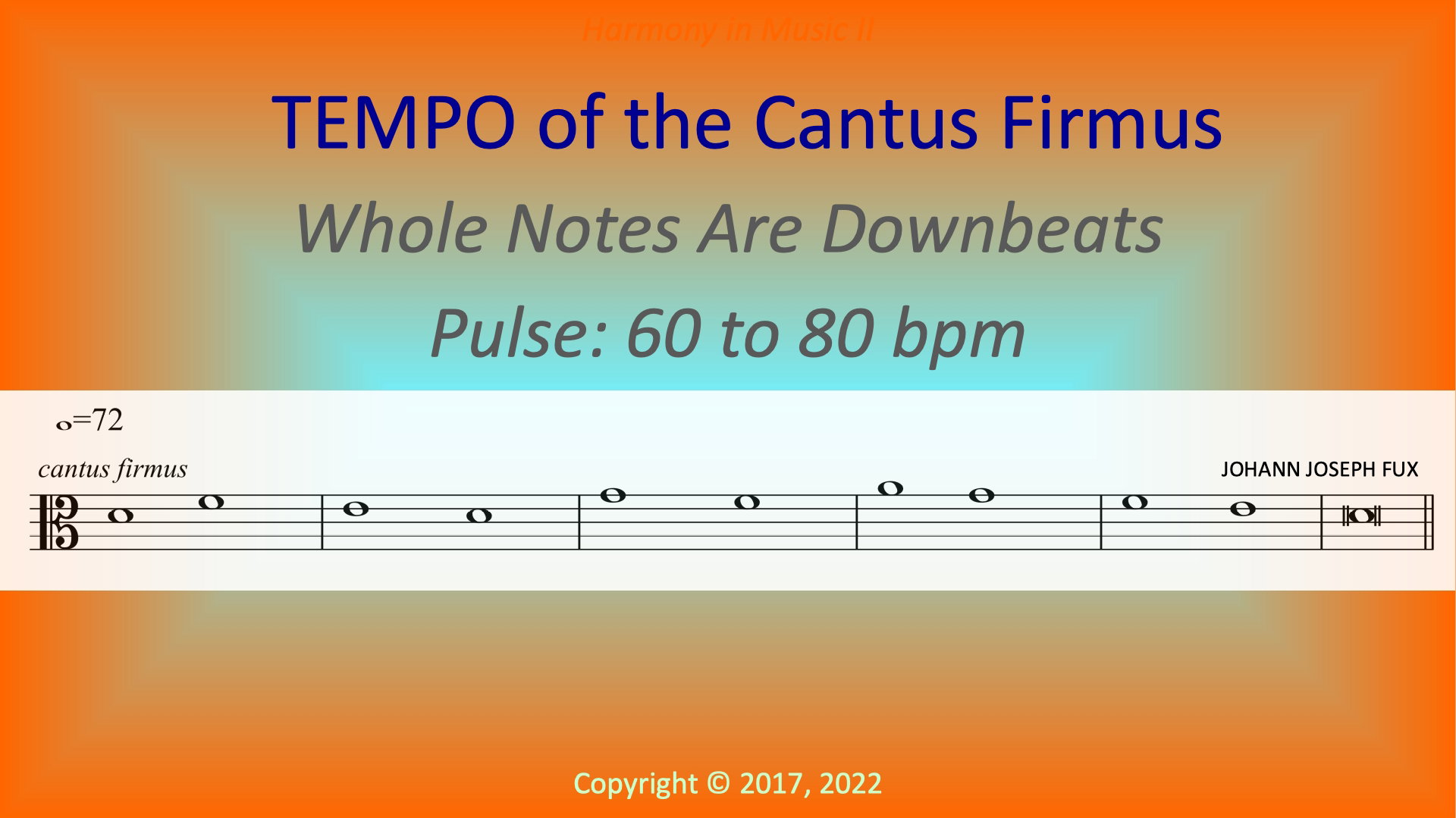
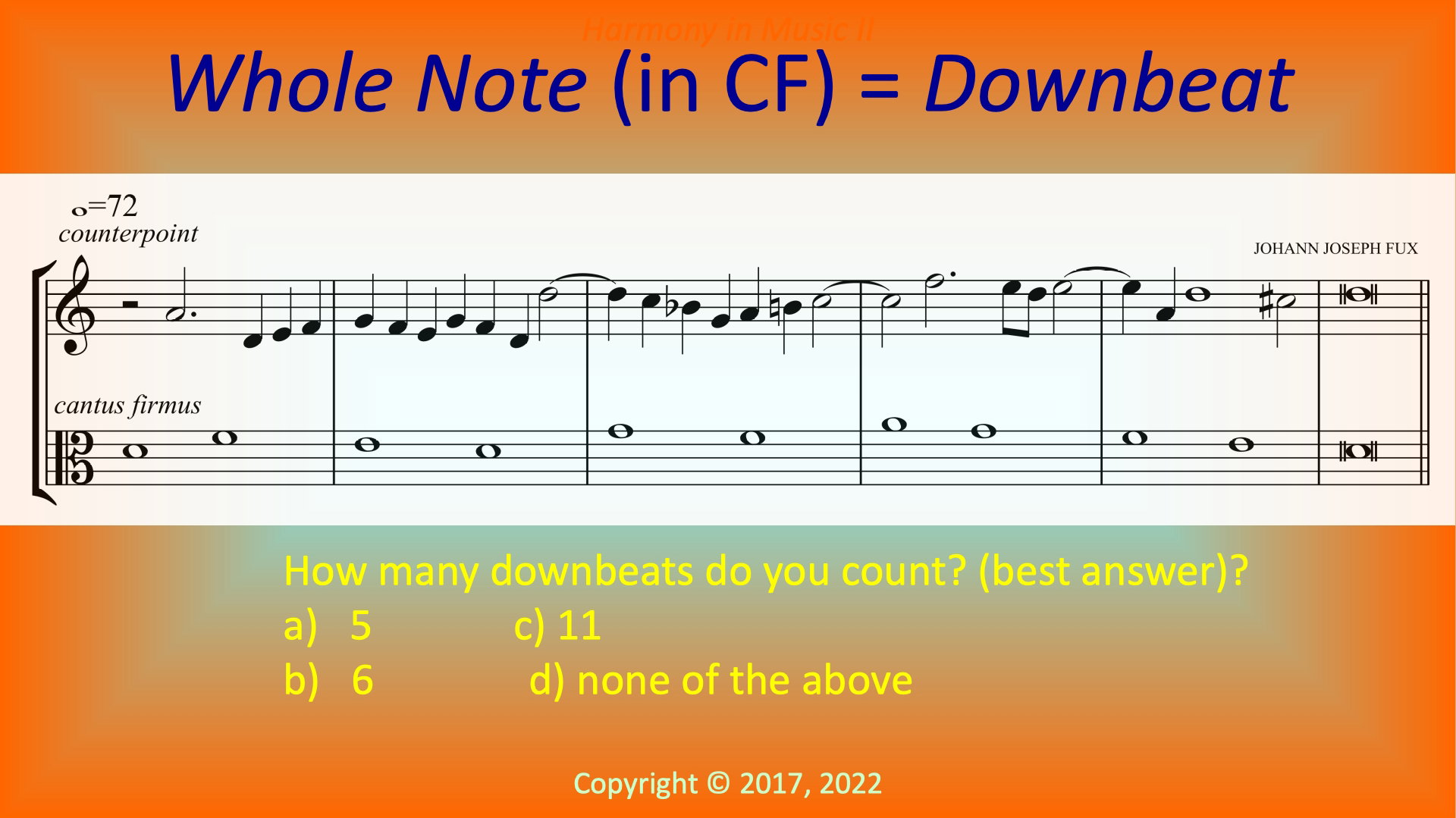
TEMPO – As seen above, and suggested by musicologist Peter Schubert (see ***References*** below), whole notes mark the downbeats of the *cantus firmus*, or *CF*. In our counterpoint exercises, whole notes represent the basic pulse. In this game, the *whole notes* move along at **60 to 80 bpm**.
Do not forget! Each whole note in the CF above represents a DOWNBEAT, regardless of how many there are between the bars – in fact, there may not be ANY bar lines at all! As you see above, counterpoint lines of shorter note values will eventually be added and synchronized to the whole notes of the CF. You can hear this synchronization by playing and/or singing the above two lines together.
Look at how every cantus firmus has *only one high point*, an unrepeated climax. That single highest tone functions both as a **goal** to ascend to, and as the start of a descending curve back to the tonic. Oh, by the way, the answer to the earlier multiple choice question is **c) 11**.
CONJUNCTIVE VS. DISJUNCTIVE MOTION – The current example features mostly “conjunct” motion, which means “stepwise” motion. In this CF, there are two skips, and a single leap of a P4. The rest of the line walks along on adjacent scale degrees.
SKIPS AND LEAPS – For instructional purposes here, we’ll restrict the meaning of a “SKIP” to a diatonic 3rd – **skipping over one** scale tone – whereas a “LEAP” refers to a diatonic 4th or larger – because of **leaping over two (or more)** scale degrees.
SPICE – In themselves, leaps and skips are not bad. In fact, a totally conjunct or "stepwise" line gets boring pretty quick. The addition of one or more leaps and/or skips raises the melodic interest quotient. However, …
IF there are *too many* leaps, each tone becomes an island unto itself; in this line, there is no horizontal continuity. That’s too much spice, too much disjunctive motion, and all those melodic gaps won't make a smooth *cantus* – which literally means “song,” something to be sung with the human voice.
STEPS AND SKIPS – It follows that smaller intervals are less disruptive to song-flow than large intervals. After a **step**, or a diatonic **skip** of a 3rd, it is okay for the line to keep going in the *same* direction, as does this CF *after* the first skip of a third.
**The Leap of a 4th** – Following a leap of a 4th (P4) it is advisable to reverse direction, but as can be seen in this CF (the top line) a continuation in either direction is still feasible if by a diatonic step or a skip of a diatonic 3rd (but not another 4th!).
Leaps larger than a 4th tend to disrupt song-flow, even when restricted to the **Acceptable Intervals** (mentioned in Part 1). A line containing three or more large leaps – P5s, 6ths, or octaves – is NOT usually acceptable. This otherwise interesting line won’t work well as a *cantus firmus*, due to the many large leaps. https://read.cash/@Majokdit/the-game-of-counterpoint-a-tutorial-on-cantus-firmus-d56008f4
CHANGE OF DIRECTION AFTER LARGE LEAPS – It is best to change direction after a large leap – i.e., leaps of a 5th, 6th, or Octave – then continue in that reverse direction by steps or skips, which means by a diatonic 2nd or 3rd. In bars 7-9 of the CF line above, note the *change of direction* after a leap of a P5.
SUMMARY – Only two to four **leaps** ARE allowed in a *cantus firmus* of eight to 16 tones. Never leap three times in a row in a CF, and never leap even twice in the same direction. A change of direction *should* follow any leap of a 4th. After larger leaps – a 5th or more – the change of direction ought to be stepwise.
Now, with something like the blank staves above, you may try your hand at creating a couple of your own *cantus firmi*, eight or more bars in length (but no more than 16 bars each). You are welcome to refine the CF you experimented with from the previous essay in this series. Choose the clef and tonic key of your choice (add words if you like, one syllable per downbeat), and be sure to use pencil!
REVIEW of Cantus Firmus Rules (thus far) – Above, you can see there is a summary of the Counterpoint Game Rules of Parts 1 & 2, which we have examined, for reference. You may want to take a screenshot (tips are optional, but appreciated!).
If you decide to post your original *cantus firmus* on this platform, please share your link to it in the comment box below! Looking forward to seeing and hearing your work!
Tap/Click here to Read Part 3 https://read.cash/@Majokdit/the-counterpoint-game-part-3-2d97f84a
********
REFERENCES CONSULTED
Salzer, Felix and Carl Schachter. *Counterpoint in Composition: The Study of Voice Leading*, pp. 3-12. New York: McGraw-Hill, 1969.
Mann, Alfred. *The Study of Counterpoint,* from *Johann Joseph Fux’s* Gradus ad Parnassum*.* New York: Norton, 1965.
Schubert, Peter. *Modal Counterpoint, Renaissance Style*, First Edition, p. 18. New York: Oxford, 1999.
Jeppesen, Knud. *Counterpoint: The Polyphonic Vocal Style of the Sixteenth Century*. New York: Dover, 1992.
LINKS AND CREDITS
Link to Part 3: https://read.cash/@Majokdit/the-counterpoint-game-part-3-2d97f84a
*Gradus ad Parnassum*, by Johann Joseph Fux, (reprint of original edition, in Latin, pp. 94, 92, 110. This is a Public Domain work, published in 1725. Downloaded from the following link:
**http://imslp.org/wiki/Gradus_ad_Parnassum_****(Fux,_Johann_Joseph**) http://imslp.org/wiki/Gradus_ad_Parnassum_(Fux,_Johann_Joseph
FLICKR IMAGE CREDITS, in Order of Appearance (commercial use allowed):
Spice jar labels, by Ben Ramirez: **https://flic.kr/p/7Amfpu**
Island, by Hector Garcia: **https://flic.kr/p/JtG3w**
The "Game" of Counterpoint: A Tutorial on CANTUS FIRMUS
The following material is repurposed and largely extracted from a scripted slide show I researched, wrote and presented in video form, approximately five years ago. A comprehension of how to create a short *cantus firmus* line is basic to mastery of the twin arts of counterpoint and harmony. So, I deem this material to be of sufficient value to not leave sitting idly on a computer storage drive, and have modified and adapted that material to this pictorial essay form. Unfortunately, I have not as yet worked out an efficient way to provide the brief audio examples on this site, so the reader is advised to also personally play the notated examples on a piano-type keyboard. Please feel free to comment and share suggestions below.
Before you play the game of chess (or any other game), you must first learn the Rules, then apply those Rules every time you play the game. From then on, *mastery* is a matter of forethought, application, practice, mentoring perhaps, and time.
"Come, Watson, come! The game is afoot,” exclaimed the great fictional detective, Sherlock Holmes. Our investigation of musical harmony leads us to the topic of *counterpoint*, which requires our learning a set of game Rules. So, “Come,” let’s begin!
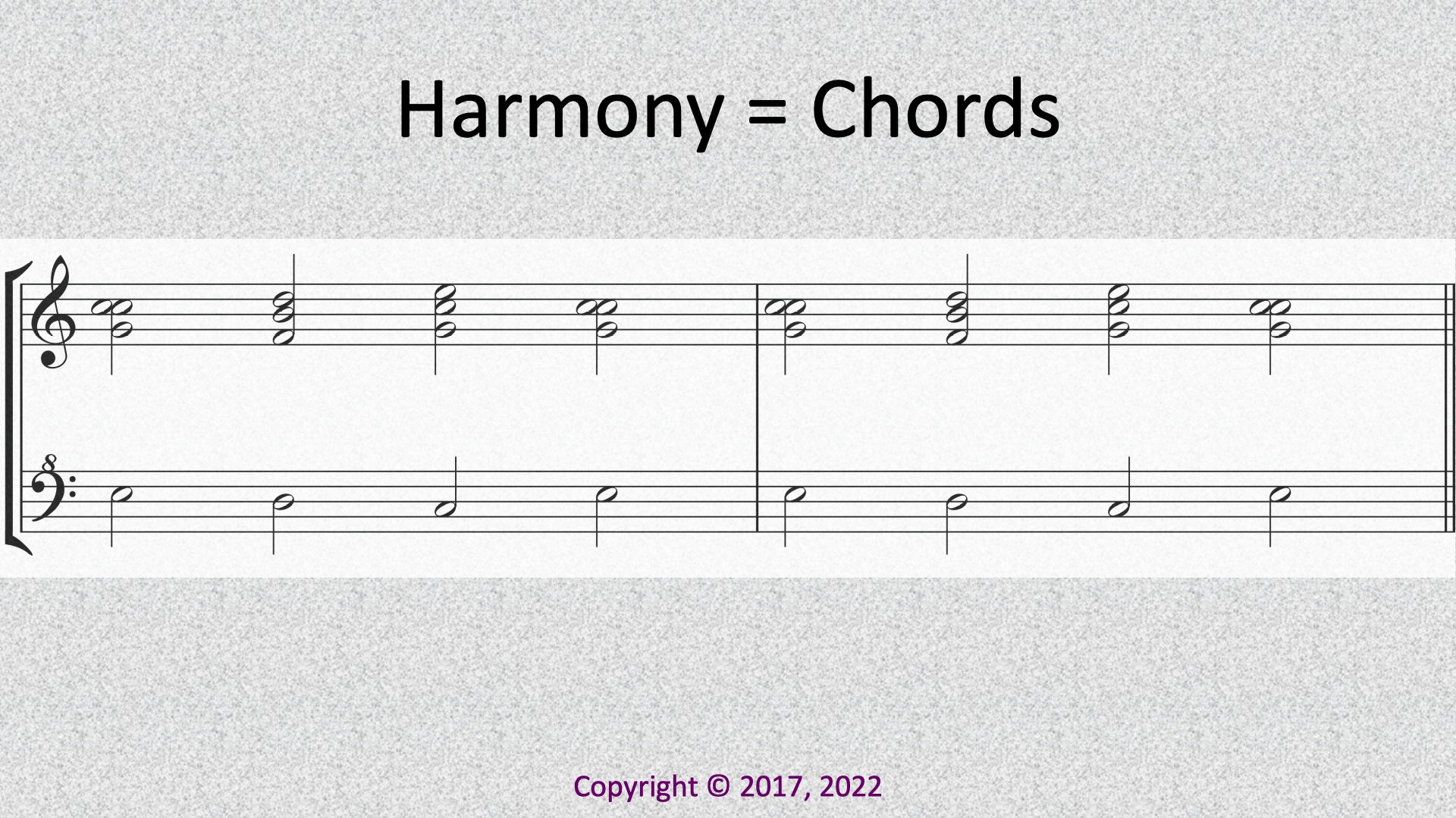
W hat is the result of playing or singing two or more musical tones simultaneously? Harmony. Chords! Like those written above. Try playing them on your piano-keyboard.
Next, what happens when we play or sing two or more *melodies* at the same time?
Hopefully, harmony again! Above, we have divided up the same previous chords into four separate voices. Now, try playing them again! We today may not think of a chord progression as being a synthesis of separate musical lines – or melodies – but centuries ago, such a horizontal, or “linear” view was the original concept of harmony and the generator of many of the Rules we meet in music theory class.
Our “Rule Quest” begins with a serious look at linear things: MELODY, and VOICE LEADING. The ancient concept of harmony was NOT the modern view – i.e., not *vertical* stacks of notes – but *horizontal*, *linear*. Therefore, WHAT IS this “voice leading” all about?
As you see above, Voice Leading, a.k.a. counterpoint, is a scientific approach to the *vertical* relationships between multiple *horizontal* lines. We may say that a bass line ACCOMPANIES the melody of a song. That means there are TWO independent lines – melody, and bass – and when properly synchronized, they imply chords. To experience this phenomenon, play and listen to the above example on your piano.
Like an architectural structure, each musical line, whether melody, or bass, has a design. We can analyze structures in theoretical terms. First, we’ll study guidelines for making a simple, coherent, no-frills, musical line, called a CANTUS FIRMUS, which means “fixed song.”
For learning purposes, we’ll treat *cantus firmus* as a “mini-game” within the larger context of the game of counterpoint. A *cantus* functions as a **scaffolding** for synchronizing other voice lines in counterpoint. All writers of melody will benefit from understanding the basic principles of *cantus firmus* construction.
A *cantus firmus (CF)* is a meaningful series of tones with **no** accompanying **chords**, and **no** distinctive **rhythm**. Two modern music theorists and authors, Felix Salzer and Carl Schachter, have said that CF is an “abstraction from melody in which the *linear* element is separated from the other aspects of melodic design.” – p. 3; italics mine. – *See references below.*
**Ground Rules**
First and most important, the individual tones of a CF are all the **same duration**; there is no metric emphasis – no downbeats or upbeats – and no memorable rhythm. As above, our first *cantus firmi* (pronounced “fear + my”), will only have notes of equal rhythmic duration, e.g. all whole notes, a.k.a. semibreves.
NUMBER OF NOTES – A proper CF is like a little story, having three arbitrary segments: “Once upon a time,” “this happened,” and “The End.” According to Salzer and Schachter, a practical CF of between eight and 16 tones will suit our work here just fine.
VOICE RANGE – So, do we just “toss together” any old series of eight to 16 whole notes? Well, no. We must think in terms of being able to SING the CF within the range and capacity of someone’s voice, either our own or that of another singing being.
SPAN – Most examples of actual *cantus firmi* lie within the span of one octave. Regardless of voice range, our studies will limit the span of each CF to between a Fifth (smallest), and a Tenth (octave + third), from lowest pitch to highest pitch.
**Intervals - Acceptable and Unacceptable**
The human voice is not a mechanical musical instrument. Instruments are machines and usually have no trouble playing large leaps, dissonant intervals, and chromatic intervals. These are not easy for voices to sing, and must NOT be included in our *cantus firmi*. So, …
There (above) are THE ONLY ACCEPTABLE INTERVALS, according to the Rules of our “Cantus Firmus Mini-Game”: Perfect Octaves, Fifths and Fourths, Major and Minor Sixths and Thirds, Diatonic Whole- and Semitones (i.e., Major and Minor Seconds). Abbreviated: Diatonic P8, P5, P4, M6, m6, M3, m3, M2, m2.
UNACCEPTABLE INTERVALS – Unacceptable are Compound Intervals (those larger than an octave), Any Seventh, Any Diminished or Augmented Interval – including the Augmented Second – and the Chromatic Semitone (i.e., Augmented Prime).
**Analysis of Melodic Intervals in a** ***Cantus Firmus***
Now let’s analyze the short CF above. After a leap of a P4 at the beginning, the line descends a m2, then a P5. Climbing a M2, a m2, another M2, it skips down a m3 to the LT “B,” then rises a m2 to cadence on the final, the tonic.
For your information, the example above is written with a “C-Clef” and the first note is Middle C. So to sing or play it, you begin with the middle C, or “DO,” and play or sing the correct intervals from that note on. We'll save a discussion of the use and usefulness of C-Clefs in another essay.
Incidentally, that funny-looking note in the last bar is called a “breve.”
The same *cantus* is shown above. Are there any “Unacceptable Intervals” in it? Any 7ths, diminished, augmented, or chromatic half-step intervals? Not at all! By the way, the breve is the same duration as two whole notes, or two semibreves.
In another article, we’ll provide more information on the science behind *cantus firmus* and this game of counterpoint. If you have any questions, by all means post a comment! If you like this material, be sure to say so and also share the link with a friend.
**Food for Thought –** Though we have more Rules to learn, you should begin experimenting now. You may write in whatever mode, key and clef are appropriate.
Here is a summary of things to do, as covered in this essay:
Choose a tonic key; start and end with the tonic pitch.
Create one or more brief *cantus firmi*, based on the Game Rules regarding Number of notes, Range, Span, and Acceptable Intervals.
Practice playing and singing your original CFs for friends, family, and other students. If you are curious about how to add words to your cantus, consider using the one-syllable-per-note approach, and have fun with it!
Tap/click here to Read Part 2 https://read.cash/@Majokdit/the-counterpoint-game-part-2-37d5e44d
REFERENCES CONSULTED
Jeppesen, Knud. *Counterpoint: The Polyphonic Vocal Style of the Sixteenth Century*. New York: Dover, 1992.
Mann, Alfred. *The Study of Counterpoint,* from *Johann Joseph Fux’s* Gradus ad Parnassum*.* New York: Norton, 1965.
Salzer, Felix and Carl Schachter. *Counterpoint in Composition: The Study of Voice Leading*, pp. 3-12. New York: McGraw-Hill, 1969.
Schubert, Peter. *Modal Counterpoint, Renaissance Style*. New York: Oxford, 1999.
FLICKR IMAGE CREDITS, all commercial use and mods allowed, in order of appearance:
Glass Chess Pieces 8-26-09, by Steven Depolo: **https://flic.kr/p/6Tbyvm**
Sherlock Holmes, by Mark Hillary: **https://flic.kr/p/76VNKG**
Cougar Looking Serious, by Eric Kilby: **https://flic.kr/p/q6SZSC**
Mackinaw Bridge, by Srinivas Anupoju: **https://flic.kr/p/8eeSGP**
Cantus Firmus (screenshot), p. 2 of *Manual of Counterpoint*, by Salomon Jadassohn: **https://archive.org/details/manualofsingledo00jadaiala**
Cantus Firmus (screenshot), p. 45 of *Gradus ad Parnassum*, by Johannes Fux (reprint of original, in Latin):
Wiener Sangerknaben (Vienna Boys Choir), by My Past: **https://flic.kr/p/wJWEy**
Modal Moods: Dorian Mode
Back in the 1950s the British musicologist Deryck Cooke wrote a book about musical expression and communication, in which he presented many fascinating details about how music functions as a universal language. Music is a communicator of feelings, whether or not words are included. I don’t know if other writers have already discussed the application of the principles expounded in his book, *The Language of Music*, as applied to modally-conceived music, so the following is a result of my own meditations on the topic.
Music students and musicians with a grounding in music fundamentals and who can grasp basic principles of musical harmony will be familiar with the topic presented and developed in this essay. Personal acquaintance with how accompanying music functions to create a “mood” in a dramatic movie scene, video game, or live stage performance also helps. A knowledge of scale construction, intervals, and chord progressions, provides a starting point for understanding my development of these points.
Cooke’s theory describes how, by musically emphasizing certain notes and patterns in a passage of tonal music, specific feelings can be generated in the heart or mind of the listener. He does not, however, establish a set of “rules” or “prescriptions” on how to write music, but presents evidence illustrating how these principles manifest themselves in different lands and times. Since every culture’s unique musical heritage grows up from its roots – is “cultured” in its own unique soil – none is inherently “superior” or “inferior” to another. In a sense, national or “ethnic” music is like food, cooked and seasoned, and served in a particular way, but most anyone can eat and derive nourishment from it! For example, morning coffee brewed in South Sudan (with added ginger) wakes me up at least as well as coffee served in the Caribbean, or in New York City, though the flavors are not identical! So, musical examples illustrating the theoretical concepts in this essay could be drawn from literature, songs and drama of many cultures, past and contemporary. Perhaps I will do just that in another article. But for now, let’s consider the topic at hand.
THE MODES https://read.cash/@Majokdit/modal-music-explained-36353997
Let’s review and expand on what was earlier presented about the old musical modes. There are six basic modes, each possessing its own unique character, sitting on a continuum that runs from musically “bright” to “dark.” For the sake of clarity in this series, we will use the following ancient Greek terminology to designate these six modes: Lydian, Ionian, Mixolydian, Dorian, Aeolian, and Phrygian.
The seventh mode, called Locrian, is mainly theoretical, rarely used in actual music, but we may refer to it from time to time, for purposes of comparison and contrast with the six practical modes.
For simplicity here, we restrict our focus to the key signatures having zero sharps and flats, which are comparable to the familiar C major and A minor keys. Therefore, the finals (root notes, or tonics) of the seven modes with no sharps or flats are, respectively:
**F Lydian, C Ionian, G Mixolydian, D Dorian, A Aeolian, E Phrygian, and B Locrian modes.**
We should always associate the alphabet names of the notes with the solfège system, so that all of the ancient modes can be transposed to any other key signature and staff. Transposition is easily accomplished by moving the solfège syllables to the corresponding notes of each tonality and key signature.
**FA Lydian, DO Ionian, SOL Mixolydian, RE Dorian, LA Aeolian, MI Phrygian, and TI Locrian modes.**
D (RE) DORIAN MODE
Moving forward: With all the above in mind, we will stay with Dorian mode for the remainder of this essay. Dorian is a good place to start, because on the light-dark continuum, Dorian sits in the exact center of the mode list. The solfège syllables for the Dorian mode, in order from lowest to highest tones, are always as follows: RE MI FA SOL LA TI DO RE’. Descending: RE' DO TI LA SOL FA MI RE.
Correspondingly, the unaltered or natural notes of the D Dorian mode are, in order from lowest to highest, D E F G A B C D’, and descending, D C B A G F E D. To taste the musical “flavor” of this D Dorian mode, the reader is advised to practice playing and hearing the notes on a piano keyboard or other musical instrument. It’s also good to sing the indicated solfège tones, up and down the mode.
Supplementary: There are additional “rules” and techniques for systematically altering the tones of Dorian and the other modes, such as raising or lowering one or more of the notes by a chromatic semitone – called *musica ficta* - but we shall merely mention the *musica ficta* technique in this essay, without going into detail. How we incorporate such fancy embellishments of the musical line can be cleared up at another time, but first we have to master the modal basics!
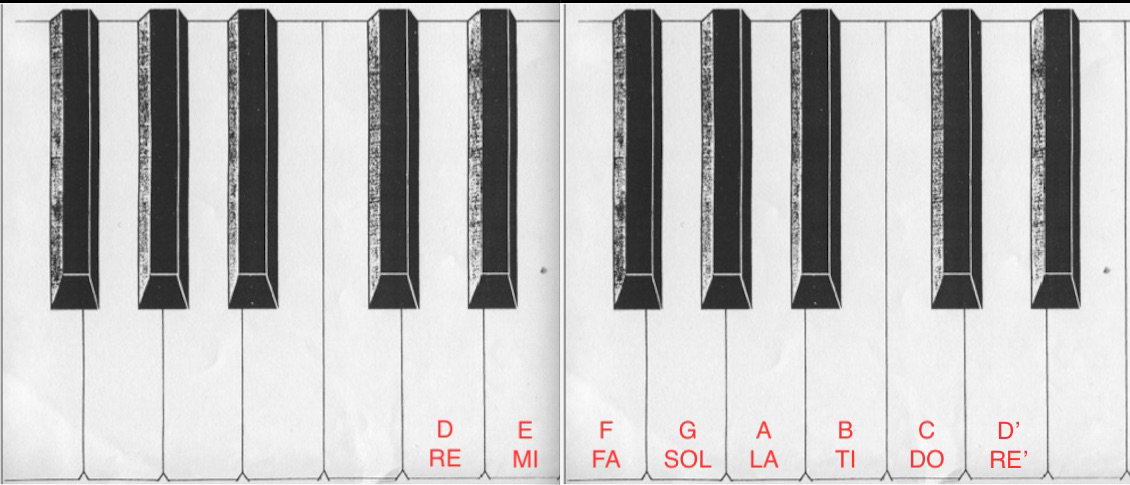
All modal scales consist of consecutive tones that are either a semitone or a whole tone apart. When there are no flats or sharps, the natural *semitones* occur between MI-FA, and TI-DO. Take a look at the natural (white) keys of this piano keyboard, these two pairs of notes are E/F, and B/C. Notice that there are *no* sharp or black keys between these pairs of notes, whereas all the other adjacent tones in the scale are arranged in *whole tone* pairs: RE-MI, FA-SOL, SOL-LA, and LA-TI, and DO-RE’. Or, D-E, F-G, G-A, A-B, and C-D’; note that there *is* a sharp, or black key, separating the notes of each of those latter pairs.
(FYI the apostrophe on the D’ or RE’ simply means the note of the same name, but one octave higher than D and RE.)
So in the Dorian mode the half-step pairs are always the second and third tones, and the sixth and seventh tones. Applying this formula to D Dorian, we see that the half-steps are again between E and F, and between B and C. The reader’s mental awareness of the position of these half-step pairs – E/F and B/C, or MI/FA and TI/DO – is important while considering Deryck Cooke’s ‘basic tonal components of expression’, as discussed in *The Language of Music*.
In addition, measuring the distance up from the tonic or “final” of the mode is equally important. When we count the tones ascending *from the root, or tonic note*, the vertical intervals of Dorian mode are as follows: Perfect Unison (Tonic), Major Second, Minor Third, Perfect Fourth (Subdominant), Perfect Fifth (Dominant), Major Sixth, Minor Seventh, and of course, the Perfect Octave. In abbreviated nomenclature, we will call these P1, M2, m3, P4, P5, M6, m7, and P8, with the “P” meaning “Perfect,” upper case “M” indicating the “Major,” and lower case “m” designating the “Minor” intervals. Most music students are already aware of this terminology.
How does all the above translate to D Dorian mode? The notes of the eight intervals listed in the previous paragraph and ascending melodically, are D-D, D-E, D-F, D-G, D-A, D-B, D-C’, and D-D’. To hear and relate each tone to the tonic note, the reader should practice playing all these note pairs on a piano keyboard. Even better, sing the second tone of each pair while repeating and sustaining the “D” note sound on the piano!
MUSICAL EXPRESSIVENESS OF D DORIAN MODE
The Cooke book (!) goes on to describe the musical expressiveness of each of these tones sitting at basic (diatonic) intervals above a tonic note, in the usual tonal system. However, now we will extract and apply some of his descriptions to the notes of D Dorian mode. The following is our application of these descriptions to the modal scale that includes the consecutive diatonic notes running from D to its octave D’, Dorian mode. The reader is also advised to try out the ‘sing or play’ instructions:
Perfect Unison & Octave (D Tonic): Emotionally neutral; context of finality, “the end” of a song-piece section or entire song-piece: A common example is when somebody sings out “Ta Dah!” and takes a mock final bow, usually in a humorous context. They sing the Tonic note, twice. In this mode, S**ing or Play D D, then RE RE. The reader should try doing this now!**
Major 2nd, D-E, RE-MI: Emotionally neutral as a passing tone between D and F (RE and FA, 1 and 3). As a whole-tone tension down to the tonic – E down to D, MI down to RE – this Major second (M2) above the tonic is heard in a context of finality, signifying the ending of a song section or song-piece. **Sing or Play D E D, RE MI RE, D E F, RE MI FA, then F E D, FA MI RE, D E D, RE MI RE.**
Minor 3rd,D-F, RE-FA: Concord, but since the minor third (m3) is a lowering or ‘depression’ of the more natural Major third (M3), the m3 always seems to express a “stoic” acceptance, tragedy (Cooke’s description). **Sing or Play D F, RE FA, then F D, FA RE.**
Perfect 4th, D-G, RE-SOL: As a passing note, the perfect 4th (P4), a G note, between F and A, bridging FA and LA, seems emotionally neutral. **Sing or Play D G D, also F G A A G F D, then RE SOL RE, also FA SOL LA LA SOL FA RE.**
Perfect 5th (the Dominant, at a P5), D-A, RE-LA: Also emotionally neutral, now in a context of flux, intermediacy. **Sing or Play D A D, then RE LA RE.**
Major 6th (M6), D-B, RE to TI: Emotionally neutral as a passing tone bridging A and C (LA and TI). As a whole-tone tension pulling down to the dominant (B down to A, TI to LA). This recalls the major (Ionian) context, a pleasurable longing in a context of flux. **Sing or Play D B D, then RE TI RE, also D B A, then RE TI LA.**
Minor 7th, D-C’, RE-DO’: Semi-tonal tension down to the Major 6th (C’ down to B; DO’ down to TI). Feels unsatisfactory, wants to continue resolving down yet another step to the dominant; this is a tone that feels “lost,” emotion of mournfulness. **Sing or Play D C’ B D C’ B A, then RE DO’ TI RE DO’ TI LA.**
Now that was a lot of information to digest. And there remain at least five more modes that we have not even discussed! Rather than going further with application to all the modes in this already long essay, however, readers are encouraged to first experiment with hearing, singing (solfège), or playing these various tones and intervals on a piano keyboard, to get them fully nested in the inner ear. There will be differences in the emotional affect when applying these principles and techniques to the other five or six modes, because the actual tones of each mode are slightly altered. So we can refer to these in future installments.
Finally, here are a few other factors to bear in mind: Dynamics (volume, the continuum of loud and soft musical sounds), time (relative duration of individual tones), and direction (whether tones are moving up or down, in relation to each other) will either emphasize or dampen the expressive impact of each of the tones at the specified distances from the tonic, whether M2, m3, P4, and so forth. In addition, the tone coloring (which musical instrument or singing voice is used to perform the music) as well as the Texture (such as monophonic, homophonic, polyphonic) also play roles in characterization of a tune, further influencing the expressive impact of everything we’ve presented above.
SUMMARY
So what ground have we covered so far? Most music is rooted in and grows out of the soil of its time and culture, but the principles of musical communication are similar, as expounded on by musicologist Deryck Cooke in his classic text, *The Language of Music*. The ancient Greek modes can be used as examples to illustrate the application of these principles, as each mode is based on specific intervallic relationships, the distances between the tones making up the mode.
This essay zeroed in on the Dorian mode in D, to illustrate some concepts. There are slight variations when these principles are applied to the other modes, when utilizing the results of Cooke’s research, but it is best to confront these details in a later installment (and is less tedious for the patient reader!).
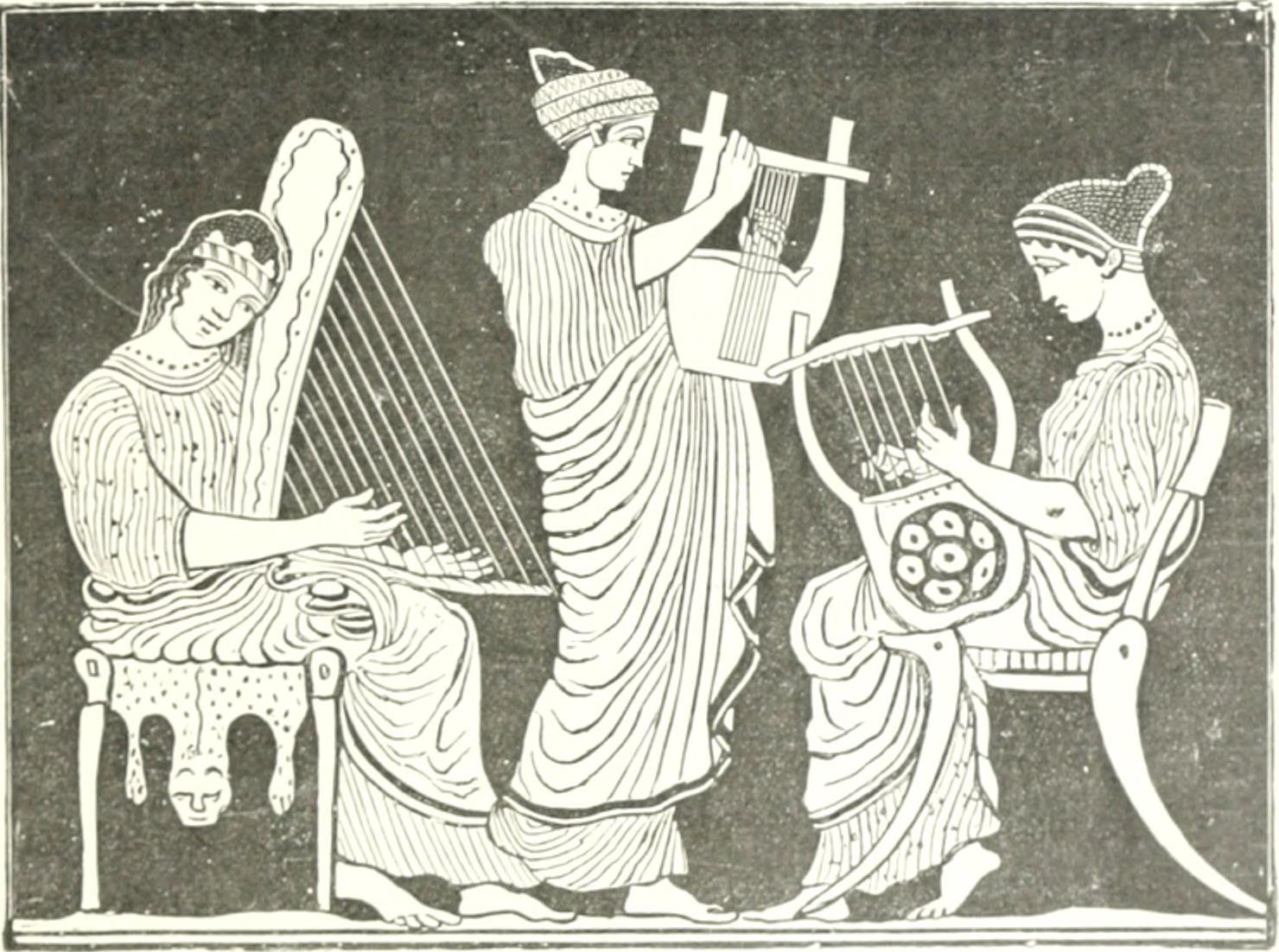
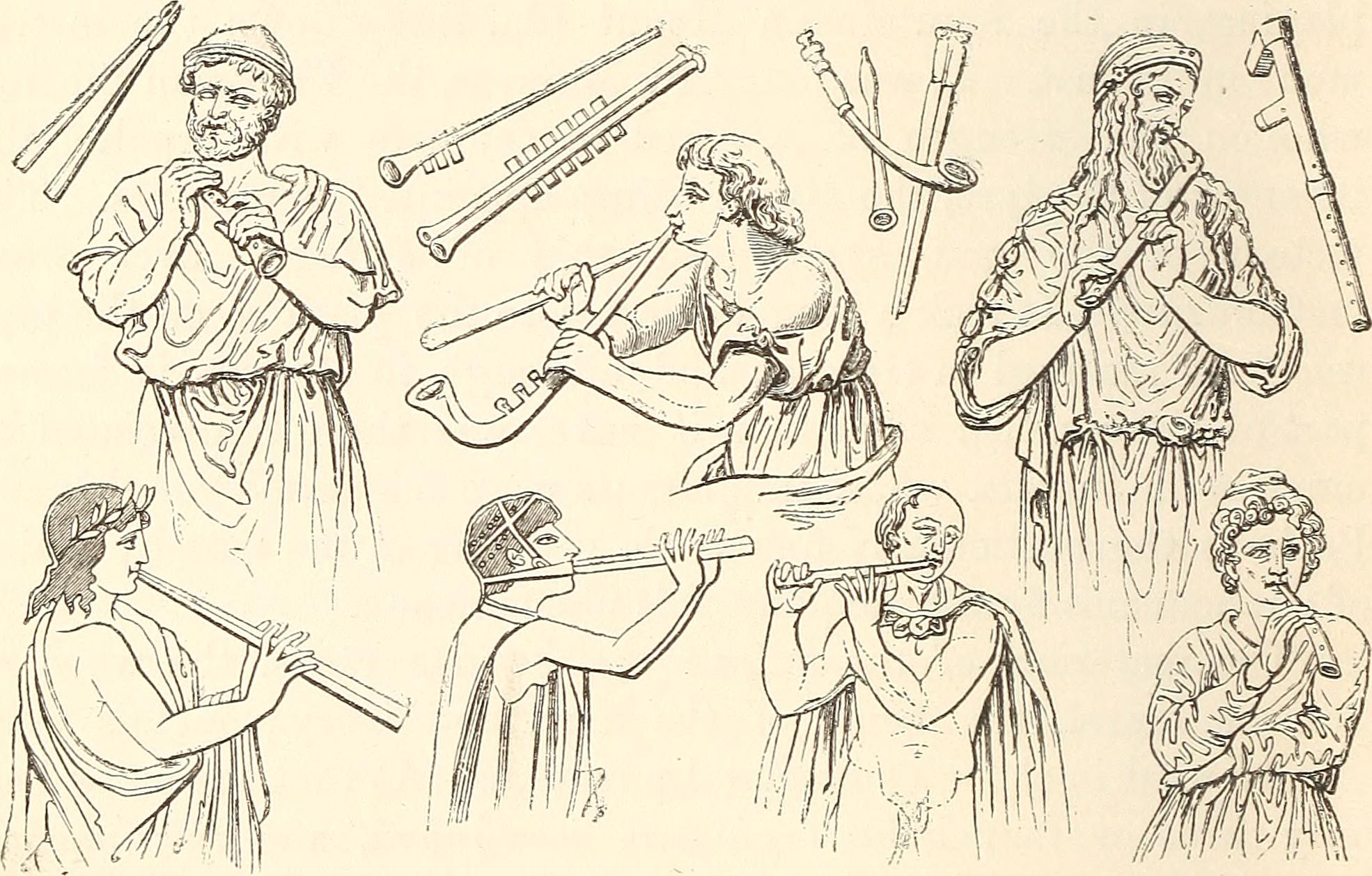
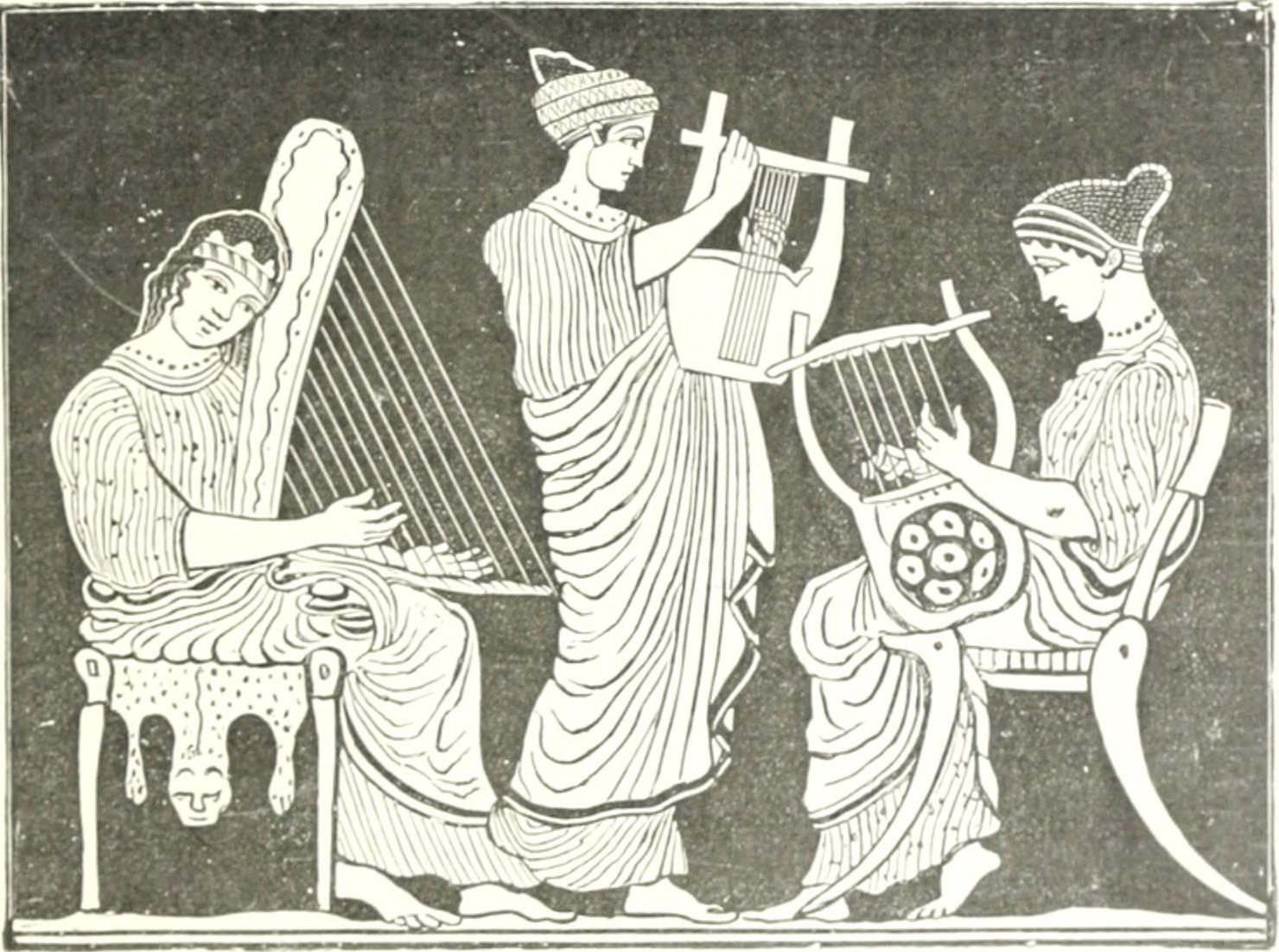
IMAGE CREDITS: All images of ancient Greek instruments shown in this essay were free and in the Public Domain (searchable and downloadable from Flickr.com and the Internet Archive site). Commercial use is permitted.
Modal Music Explained
“DO RE MI FA SOL LA TI DO” (sung ascending)
“DO TI LA SOL FA MI RE DO“ (sung descending)
In much music, the “DO” note is placed at the top and bottom of the seven-note scale from which are derived the basic notes of melody and harmony of a song, or of a section of a larger work.
Modal composition simply repositions the same scale, allowing one of the other tones to receive all the glory and attention usually accorded the “DO” note by putting this tone at the top and bottom of the scale. E.g., by placing the scale so that the “RE” pitch lands at both ends:
“RE MI FA SOL LA TI DO RE” (sung or played ascending)
“RE DO TI LA SOL FA MI RE“ (sung or played descending)
You will notice that it is still the same set of seven notes; all that is changed is the final, or “bookends,“ the resting point of melody, harmony and rhythmic emphasis. In modern terminology, this tone would be called the “Tonic” or “key note” of the music.
Theoretically, since there are seven basic pitches in this ladder of tones, a mode may be derived from any one of the seven:
“MI FA SOL LA TI DO RE MI,” etc. Or, “FA SOL LA TI DO RE MI FA,” and so forth.
Music educators and composers, through the course of the past two millennia, have developed systems of effectively classifying these seven modes. Often, various ancient Greek names are used to classify and label the seven possible modes, so the historical roots of modal composition go very deep. To illustrate:
The “DO” mode is also called **Ionian**. This closely resembles the familiar Major scale. Continuing,
“RE,” **Dorian**, is still popular among knowledgable modern jazz musicians,
“MI,” **Phrygian**, also familiar,
“FA,” **Lydian**,
“SOL,” **Mixolydian**,
“LA,” **Aeolian**. From this mode is derived the modern “Minor” scale, though it is handled in a slightly different manner. And lastly,
“TI,” **Locrian**. This mode is hardly found in ancient music, so is mainly theoretical. Locrian is based on the “leading tone” and for harmonic reasons – lack of a dominant tone - is not very common even in modern music.
Furthermore, each mode may be described subjectively as having unique musical characteristics, exhibiting varying levels of “brightness” in mood. The progressively “brighter” modes are the Mixolydian, Ionian, and Lydian. Those with successively “darker” effect are the Dorian, Aeolian, Phrygian, and Locrian modes. These characteristics can be and are exploited effectively by composers.
In both formal and informal settings, hearing is believing. For some examples, listen to the evil or “Dark Side” themes used by composer John Williams in the various *Star Wars* films, or the “shark motif” of *Jaws* (Phrygian, one of the darkest modes). Then note the opening of the slow second movement of Johannes Brahms’ Third Symphony (also Phrygian). Lydian, the “brightest“ of the modes, is used in the musical motif of *The Jetsons*, a futuristic television cartoon series, the *Back to the Future* films’ main title theme, and also in the Shepherd’s Song at the opening of Act III of Puccini’s opera, *Tosca*.
The musical characteristics of these modes is due in part to the relationship between the tonic of the mode and all the other tones. Especially is this true in relation to the “Dominant” or fifth step of each modal ladder.
The word “dominant” contains the element “dom” which goes back to ancient Latin roots, words such as “dominus” “dominate”, meaning lord, master. The aristocratic prefixes “Don” and “Donna” also come from the same origin. Recall the literary characters and legends of Don Carlos, Don Juan, Don Quixote, et al. With the exception of the theoretical Locrian, the fifth step or degree of each mode is the dominant.
Finally, the consecutive steps or degrees of each modal ladder are at calculable distances from each other, either a whole tone or whole step apart, or a half step apart (called a semi-tone). For example, in the Dorian mode, the semi-tones are between the second and third degrees of that mode, and also between the sixth and seventh degrees. Whereas in the Phrygian, there are half steps between the Tonic and second degree, and also between the Dominant (Fifth) and sixth degrees. The position of the half steps really influences the emotional affect of music composed in each mode.
So, in this short write up, we touched on some of the main characteristics of the so-called “Greek” modes, though they are found in music of many different different cultures in the world, and still used today. Whether Dorian, Phrygian, Lydian, Mixolydian, Aeolian, or Ionian (even Locrian!) mode, with practice and listening, we will be better able to identify their individual modal qualities in the music in our environment.
That said, music theories such as this do help us to describe and analyze various musical characteristics, and eventually associate them with sound qualities – what we are hearing in actual music based on diverse modes – but these theoretical concepts are not “rules” or commands dictating to us how we ought to write our own compositions! We learn by doing, so the reader is advised to practice playing each of the seven modes on a piano keyboard, then listen for examples of each mode in the folk songs, traditional music, and even in classical music composers; as alluded to above, even Ludwig van Beethoven and Johannes Brahms were known to incorporate specific modes in their greatest musical works. So, why not us today!
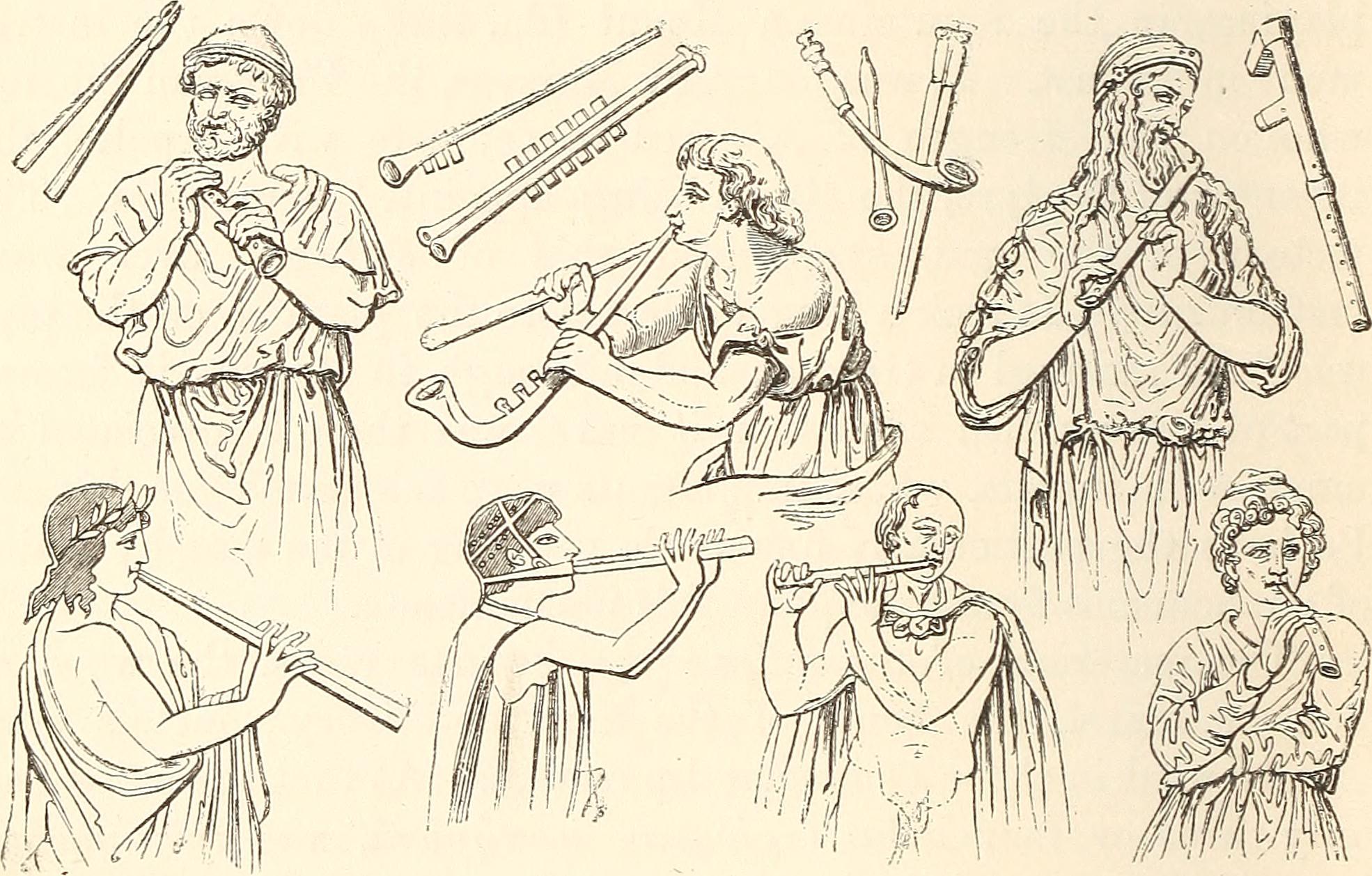
IMAGE CREDITS: All images of ancient Greek instruments shown in this essay were free and in the Public Domain (searchable and downloadable from Flickr.com and the Internet Archive site). Commercial use is permitted.
"It's an Amazing Psychological Phenomenon"
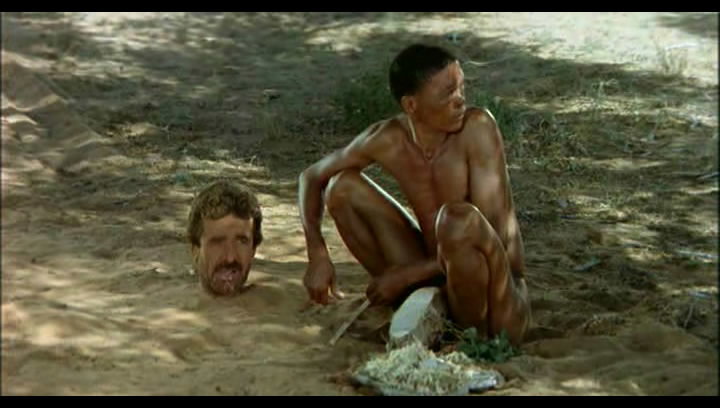
If you've ever enjoyed watching and laughing at the 1980s films "The Gods Must Be Crazy" (I and II), set mostly in the South African country of Botswana, you may recognize the quote in the title. The film calls into question the sanity of the "gods" who rule so-called "civilized society," and with good reason: They're not really "gods" at all, and their often foolish actions demonstrate this.
To illustrate ...
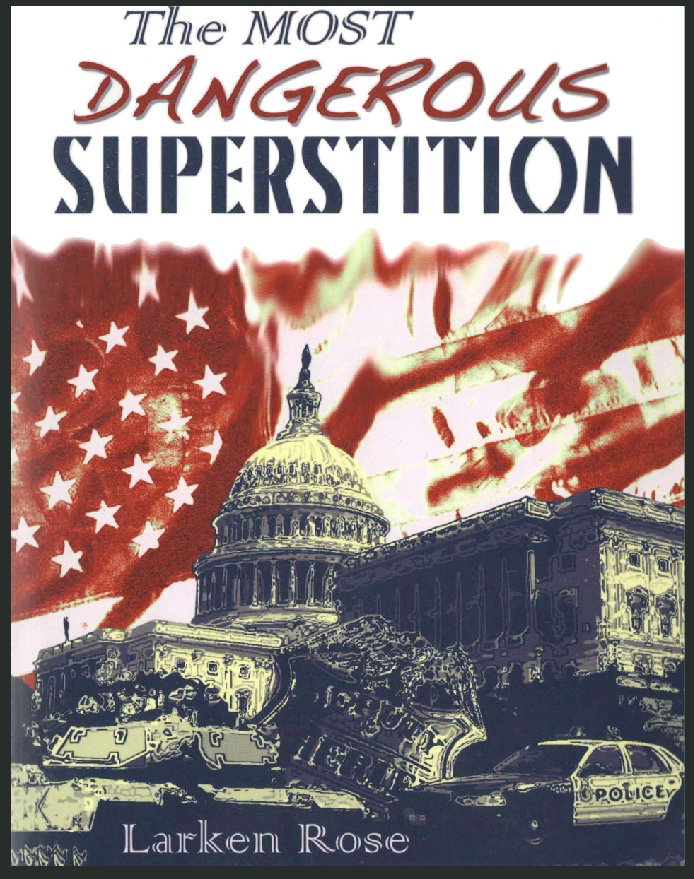
"...if even 10% of the population wanted no 'taxation' at all and had escaped the myth of “authority” (including the 'democratic' kind), they could achieve their goal easily by simple non-compliance." - Larken Rose, The Most Dangerous Superstition
Compliance to the taxation "law" is psychological.
For example, the USA is about 335,000,000 (335 million folks). Let us arbitrarily estimate the number of actual taxpayers in the USA at 170 million, or slightly more than half of population.
Thus, if only 15,000,000 (15 million), which is less than 10 percent of American "taxpayers", simply refused to comply with the taxation laws, the less than 100,000 (100k) Internal Revenue Service (IRS) workers would have a very difficult time keeping up. If so many hard-working people felt they did not have to pay taxes any more and refused to cooperate, there would be no way for the IRS to force them; they simply do not have the man power, and they know it.
They don't have the budget to do this. Obedience to tax "laws" is purely psychological, base on a superstitious belief in supposed "right" of an "authority" to appropriate your earnings and spend it however it sees fit, without you having any say in the matter.
The principle applies to the enforcement of ANY OTHER "laws," if and when a similar percentage of the population merely feels no obligation, "no shame or guilt" about obeying the authority that legislated them.
"They" simply cannot force 10% of the population to go against what they believe in their hearts and minds, and "they" know it.
Thus, your own obedience to an impotent "authority," intent on extorting you, is purely psychological, an illusion inculcated into your mind from infancy (parents, relatives, church, friends, mainstream media exposure), and reinforced through government (taxpayer-funded) schooling.
You would not willingly obey a neighborhood street gang member, a "thug," who threatened violence while telling you to hand over your paycheck to him, would you?
Our inculcated habits of not questioning, of blind obedience to "authority," of "just following orders," are something everyone sane should rightly contemplate, seriously.
Think of your average annual tax "refund" from your employer's withholding from your paycheck, over the past 10-years. You are happy to receive back some of the money you had worked hard for during the previous year, right? Suppose that amounted to several thousand dollars per year. After 10-years, that would be several tens of thousands of dollars, maybe even in the six figure range by now.
Just imagine if you had been able to invest those previous 10-years of tax "withholdings" into a cryptocurrency such as Bitcoin? Where would you be today, hypothetically- and financially-speaking? #BCH
Do you see what you've been doing? You may now resume laughing.
Flickr Image Credits, In Order - All Commercial Use Allowed
Coca Cola Bottle, by ben dalton, commercial use allowed: https://flic.kr/p/6Mag5Q
drmvm1 "the Gods Must Be Crazy" - commercial use allowed: https://flic.kr/p/4NtPdt
Kamil Antosiewica Monika... "Jamie Uns - The Gods Must Be Crazy II" - commercial use allowed: https://flic.kr/p/9eN1WV
An Empire Striking Back?
As I have been thinking about these two kings this holiday weekend, I thought to share my musings with readers on this site. The two kings I have in mind are 1) King Kong, the “Eighth Wonder of the World,” and 2) King Jesus. Here are a few small bites I chewed on for a while:
King Kong, in the old movie, was killed high up on what looks like a giant stake. That “stake” was the Empire State Building (*King Kong*, 1933 film, music by Max Steiner).
King Jesus, was likewise killed on a “stake,” or cross (year 33). Incidentally, the biblical Greek word “*stauros*”, according to Greek-English lexicons, can mean either cross or stake. I will not be arguing that point in this write up.
But all this makes for a fascinating mental juxtaposition and interpretation of the original 1933 movie, *King Kong*!
Finally, another brain baker:
King Kong was born on the fictitious **Skull Island**, and dies (was executed) at the top of the **Empire State Building** during the last five minutes of the film. Notice also that the word “Empire” also links with rulership, an emperor being essentially a king of kings. (Alluding to my otherwise dishonest clickbait title; but it got you to read this much, so …!)
Jesus was executed on **Golgotha**, which means *skull*. That place is also called Calvary, a word that comes from the Latin word *calva*, which can also mean *skull*. Golgotha, or Calvary, is an actual skull-shaped hill in ancient Jerusalem, where Jesus was executed for saying he was a king. Essentially, a “king of kings.”
In the early days of Hollywood film-making, therefore, Kong was, in a subtle way made into an allegory of Jesus. And both Kong and Jesus were promoted as “kings.”
**Symbolic Numbers**
The numbers and other symbolisms are also of interest: For example the years 33 and 1933. The number thirty-three is called a “master number” in numerology, it represents pure love, and is also the number of the highest degree – the 33rd degree – in masonic lodge (free masonry) beliefs. Jesus evidently died in the year 33, and the film *King Kong* was released in the year 1933.
Disclaimer: I am not now and have never been a member of a masonic lodge.
Three (!) of my varied interests include filmmaking, film music, and psychology, so I simply thought it interesting when I noticed, while coincidentally watching a DVD of the old black and white *King* Kong film a couple of weeks ago, and made the mental connections between SKULL Island, SKULL Place, King Kong and King Jesus.
Side chiller: The secret student group at Yale University known as "Skull and Bones" is called The Brotherhood of Death, and The Order 322.
Now, all the bunnies and egg-painters can enjoy their holiday weekend with a little more historical knowledge. #KingKong #Easter
**Flickr Images**, in order of appearance – commercial use allowed
Empire State Building Day and Night, by John Cunniff: https://flic.kr/p/yY2zGy
Empire State Building à la Sironi, by Strolicfurlan: https://flic.kr/p/23vgbpW
Golgotha, by upyernoz: https://flic.kr/p/5iceDd
Kong at top of Building, by iznogoodgood: https://flic.kr/p/ezVyeG
 @Majokdit