 @Majokdit
Cantus Firmus, Part 4: Modal Jazz, and Early Music **Links to related essays:** **Part 1** **|** **Part 2** **|** **Part 3** **| and** **Modal Music Explained** https://read.cash/@Majokdit/the-game-of-counterpoint-a-tutorial-on-cantus-firmus-d56008f4 https://read.cash/@Majokdit/the-counterpoint-game-part-2-37d5e44d https://read.cash/@Majokdit/the-counterpoint-game-part-3-2d97f84a https://read.cash/@Majokdit/modal-music-explained-36353997
**Modal jazz, and early music origins** Today we discuss literally the ups and downs of modal “scales” as they relate to a *cantus firmus*. There is a lot to the concept of modes that we will not go into here. If you’re curious, the Wikipedia article on “Mode (music)” is a good read for your inner musicologist. You may also like to read or review my earlier essay on the topic of Modal Moods. https://en.wikipedia.org/wiki/Mode_(music) https://read.cash/@Majokdit/modal-moods-dorian-mode-e5fda14a
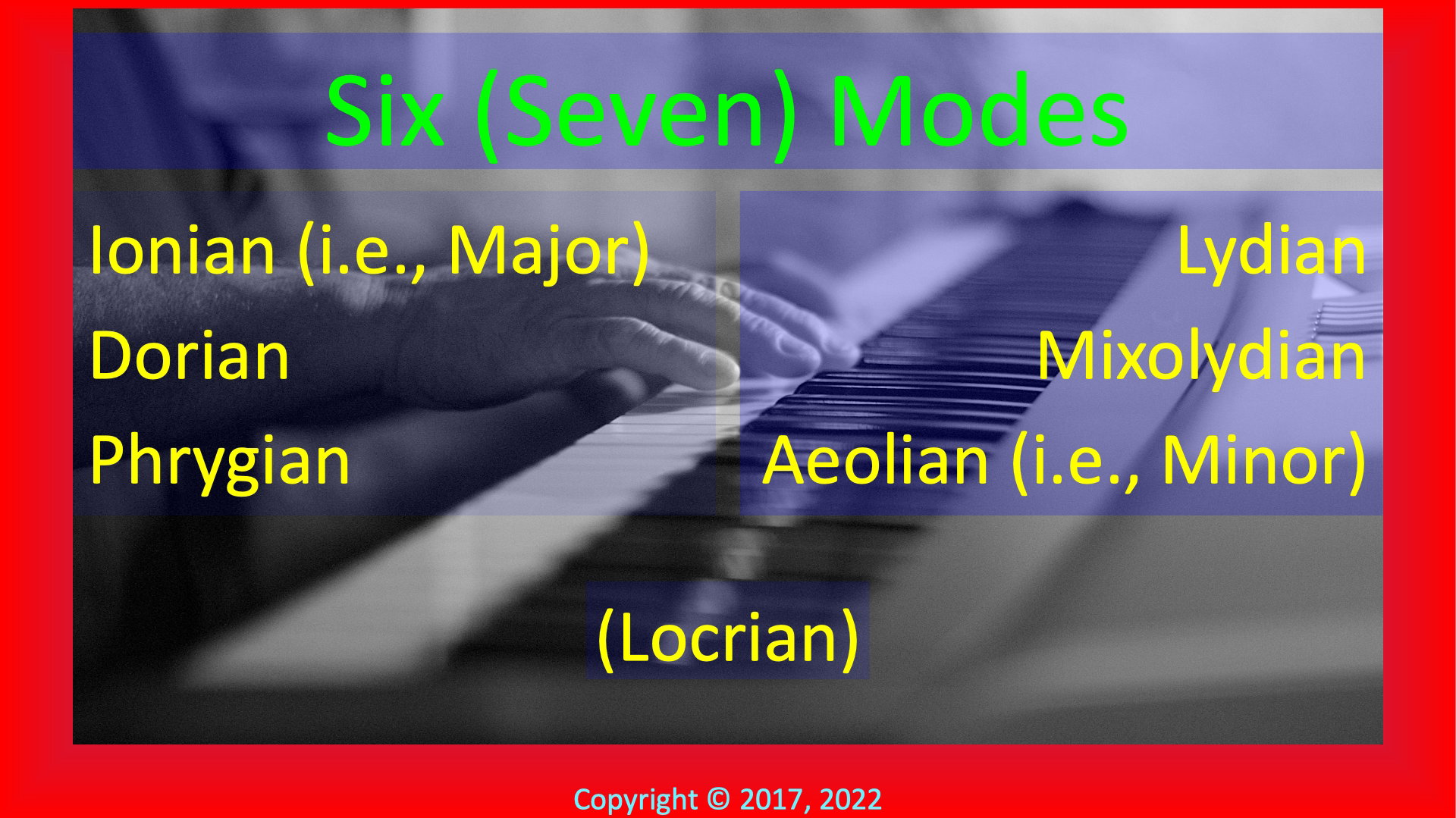
As to the familiar applications of mode today, jazz and popular musicians conceive of six, or perhaps seven modes derived from the series of seven tones of the Major Scale. Here is a list: Ionian Mode (Major), Dorian, Phrygian, Lydian, Mixolydian, Aeolian (Minor), and a theoretical mode called “Locrian.” As mentioned elsewhere, we will leave aside Locrian Mode for now.
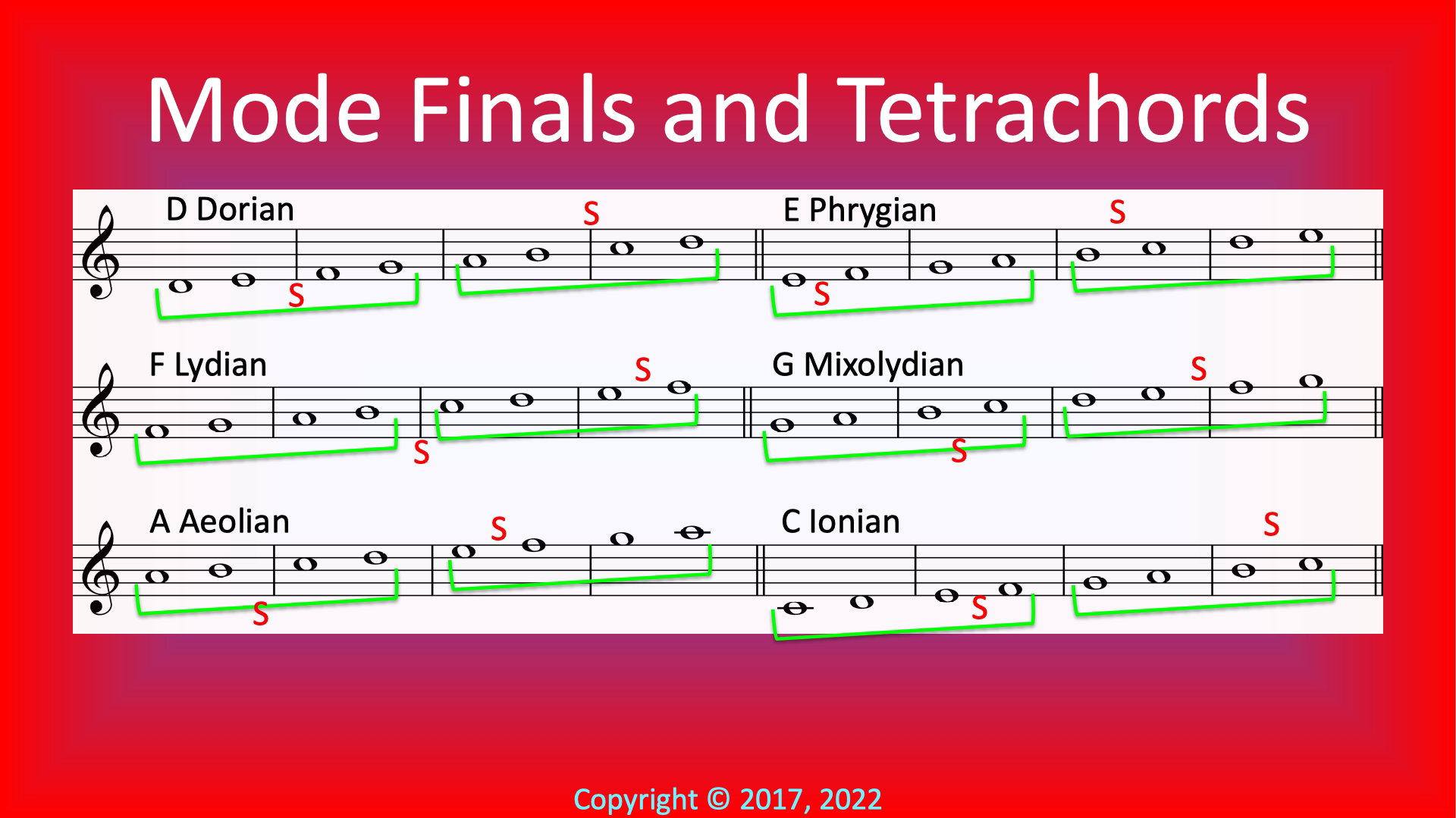
Notice the Final and starting tones of the six modes, also the position of the *semitone* in each tetrachord; the semitones are marked with an “S.” Such factors determine the individual character or “sound” of each mode. We encourage students to sing and play up and down the six modes, and their tetrachords: Dorian mode on D, Phrygian on E, etc.
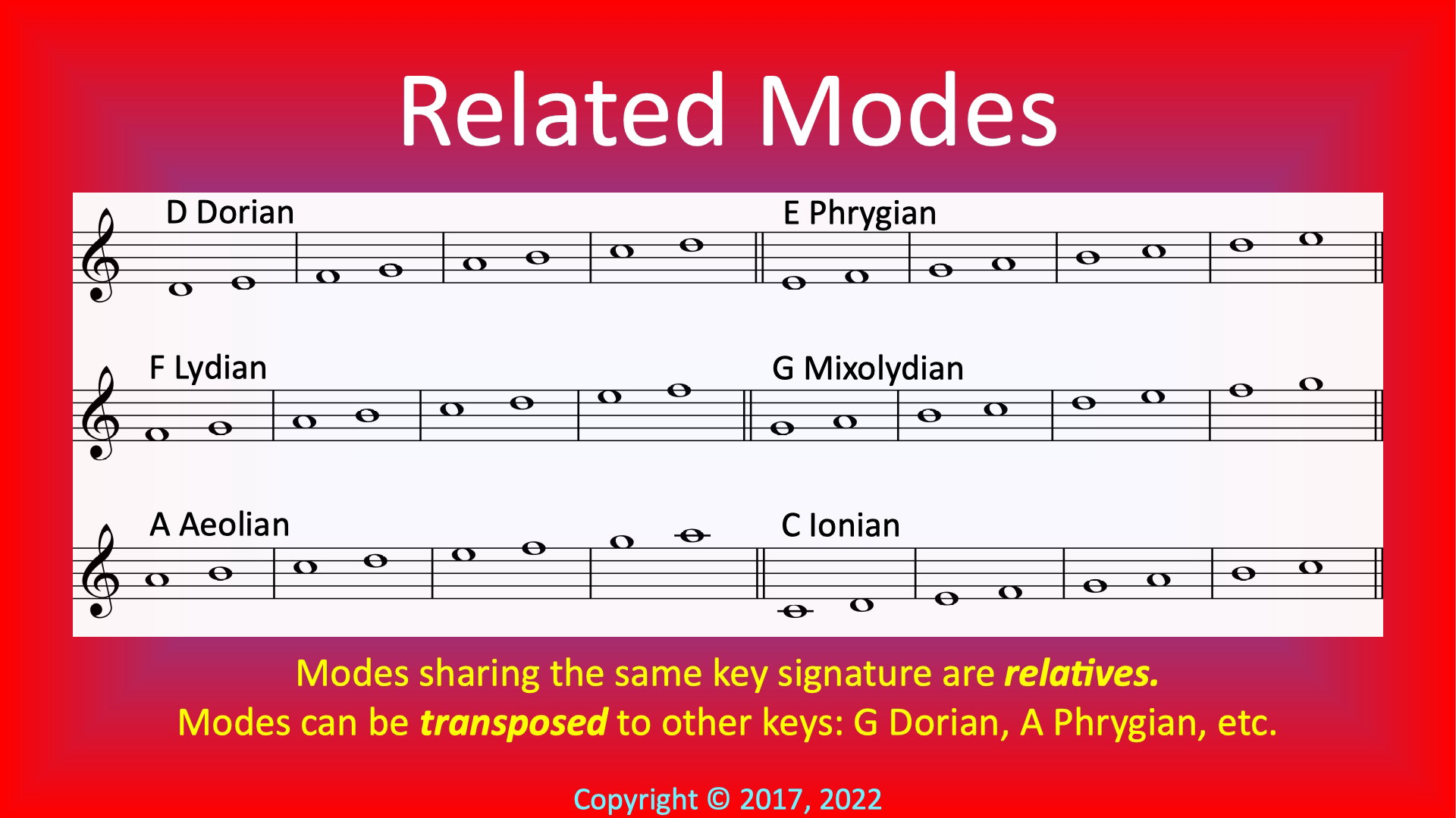
Today, when a Major and Minor scale share the *same key signature*, we say that they are ***relatives***. As you see above, the six modal scales that share the same key signature are all *related* to each other. Furthermore, by the extension of this principle, all modes can be transposed to other keys.
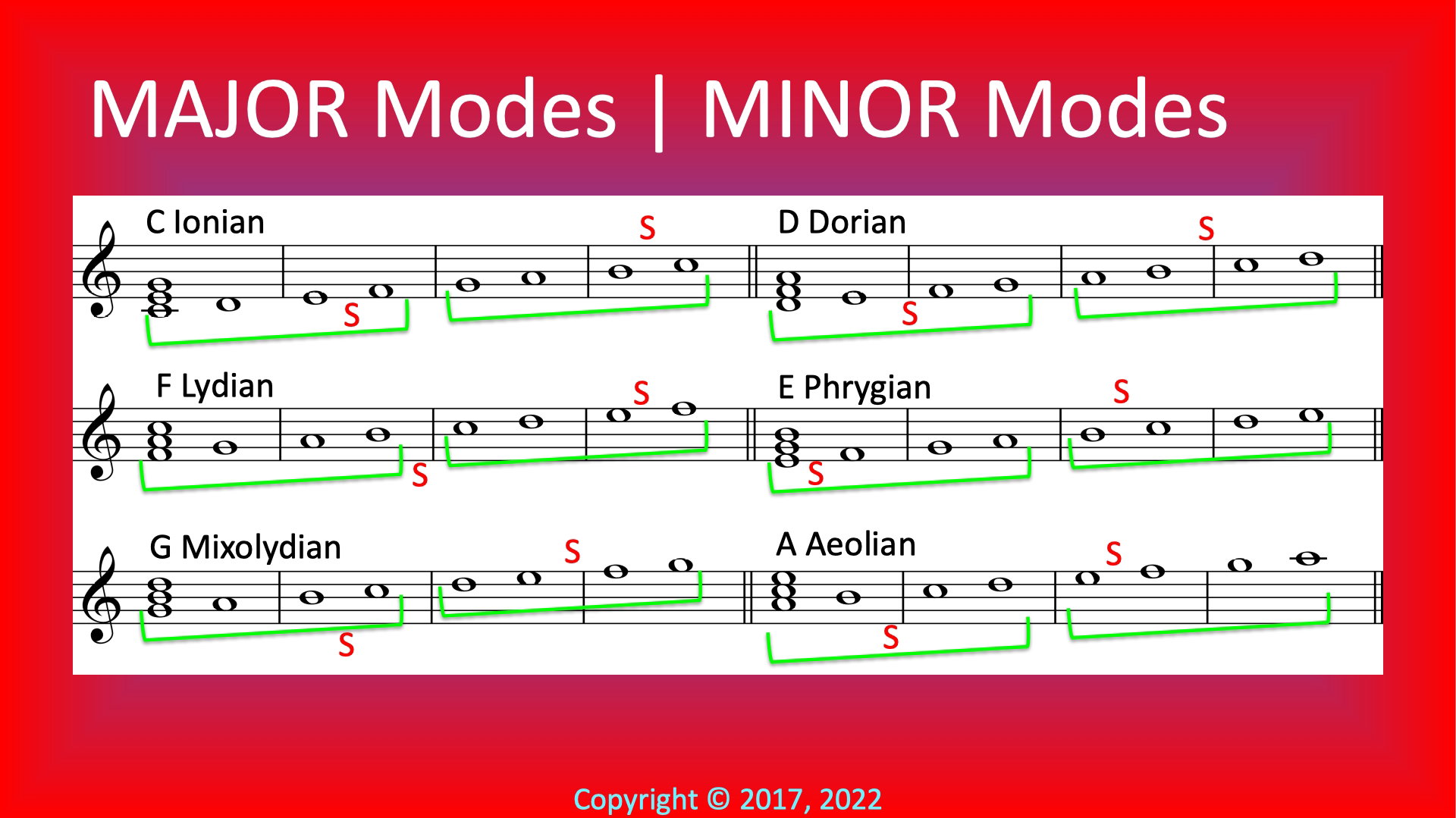
The two *tetrachords* of each mode are bracketed. For our study of *voice leading*, we separate the six modes into two categories, depending on whether the tonic triad of the mode and the first (the lower) tetrachord, are Major or Minor. Students should practice playing these chords on a piano-keyboard while singing the ascending notes of the two tetrachords of each mode.
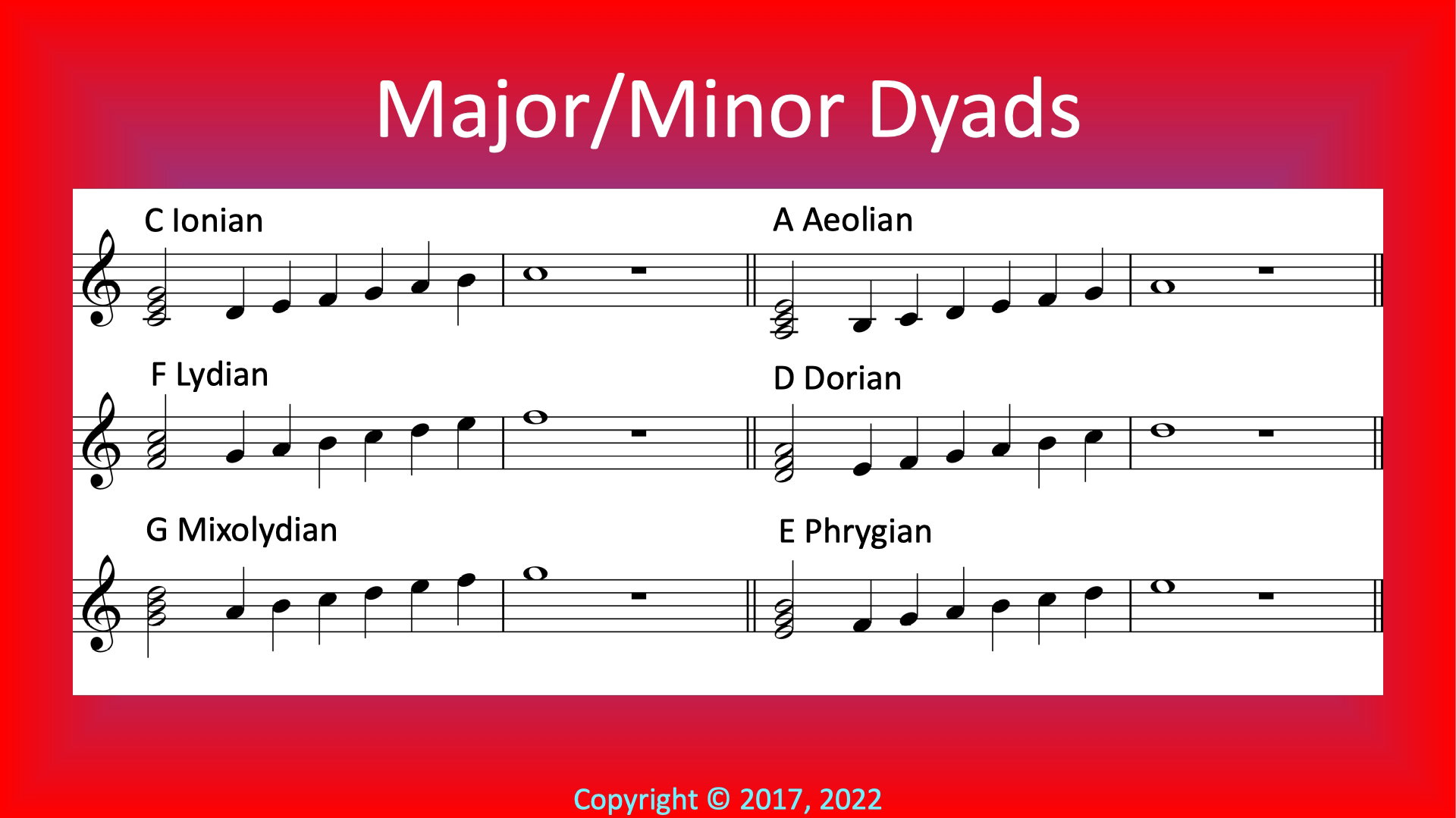
Venturing deeper, we can also pair Major/Minor “Dyads” that are a minor third apart, in a manner similar to the way we match up the modern Relative Major and Minor Scales: Ionian Mode pairs with Aeolian (same as Major/Minor), Lydian w/ Dorian, and Mixolydian w/ Phrygian. You may better hear the close audible connections of the pairs by playing the chords and singing the tones of each mode above. – See Cormier, in the *References* below.
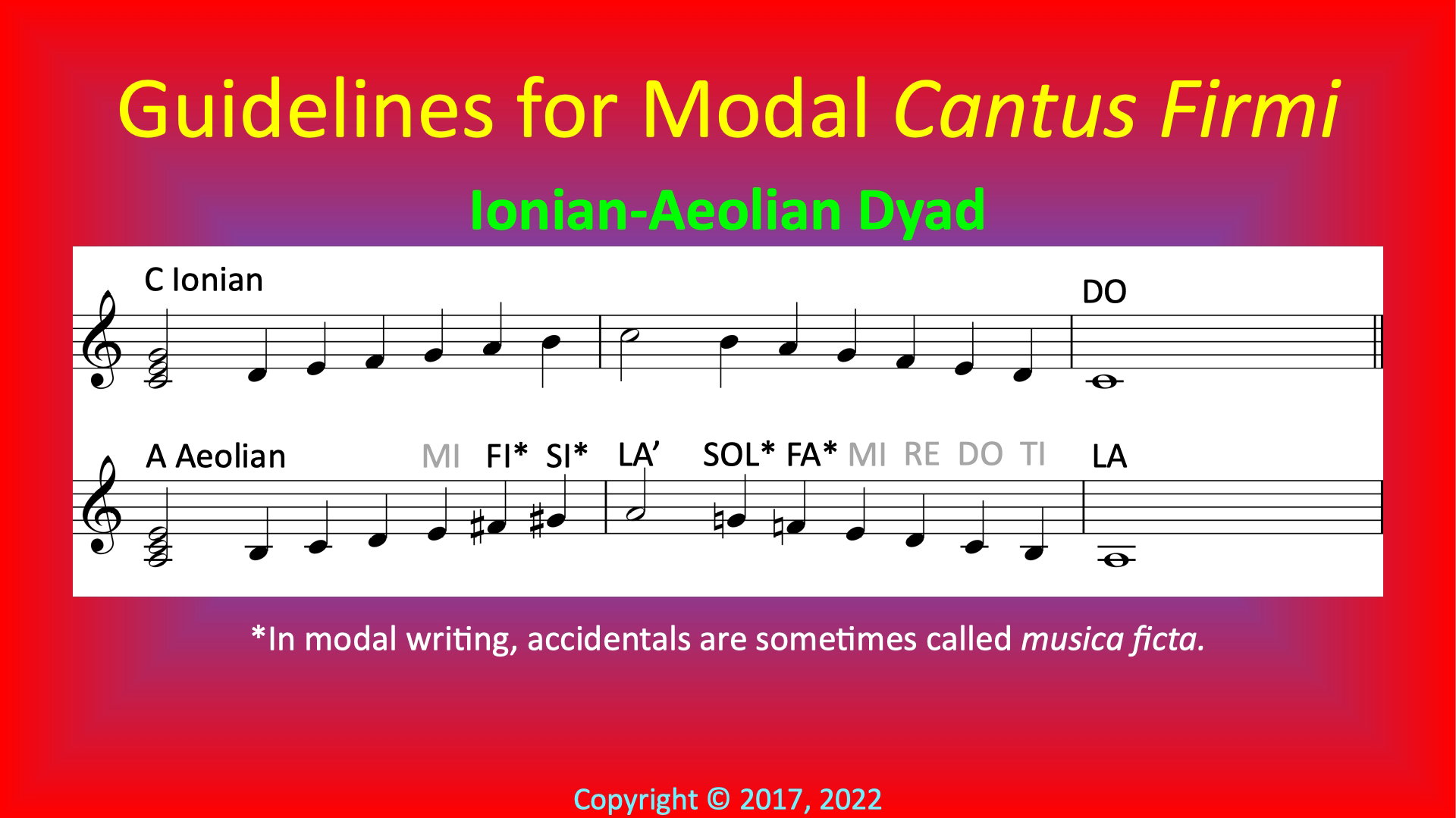
We can treat C Ionian and A Aeolian much like the modern day Major and Minor scales; the Final note of C Major is DO, A minor is LA, and in the Aeolian mode, the sixth and especially seventh degrees can be raised and lowered as voice leading demands it. Here at least, nothing in the old is new to us, though it would be beneficial for students to play and sing the above examples as prescribed.
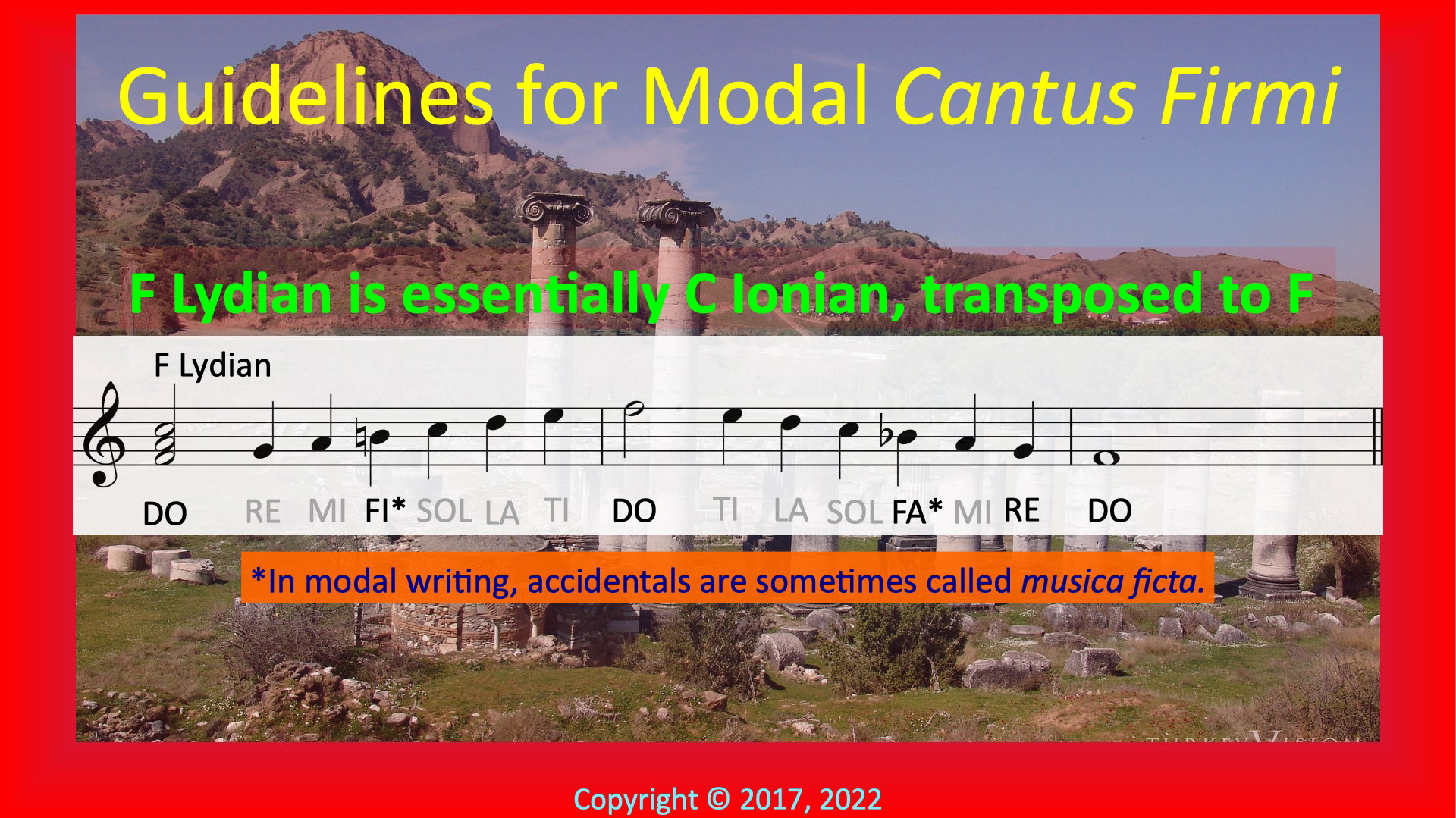
As shown above, F Lydian mode occasionally introduces the B-flat tone, usually in the descending direction. Thus, F Lydian is often the same as Ionian mode transposed to F, and the solfège for singing this mode is treated in the following way: The note F being the “DO,” when the B-flat appears, it is sung as “FA,” but if it is B-natural it is sung as “FI.” The reader should try playing this Lydian mode on a piano-keyboard, experimenting with those two choices of ancient *musica ficta*.
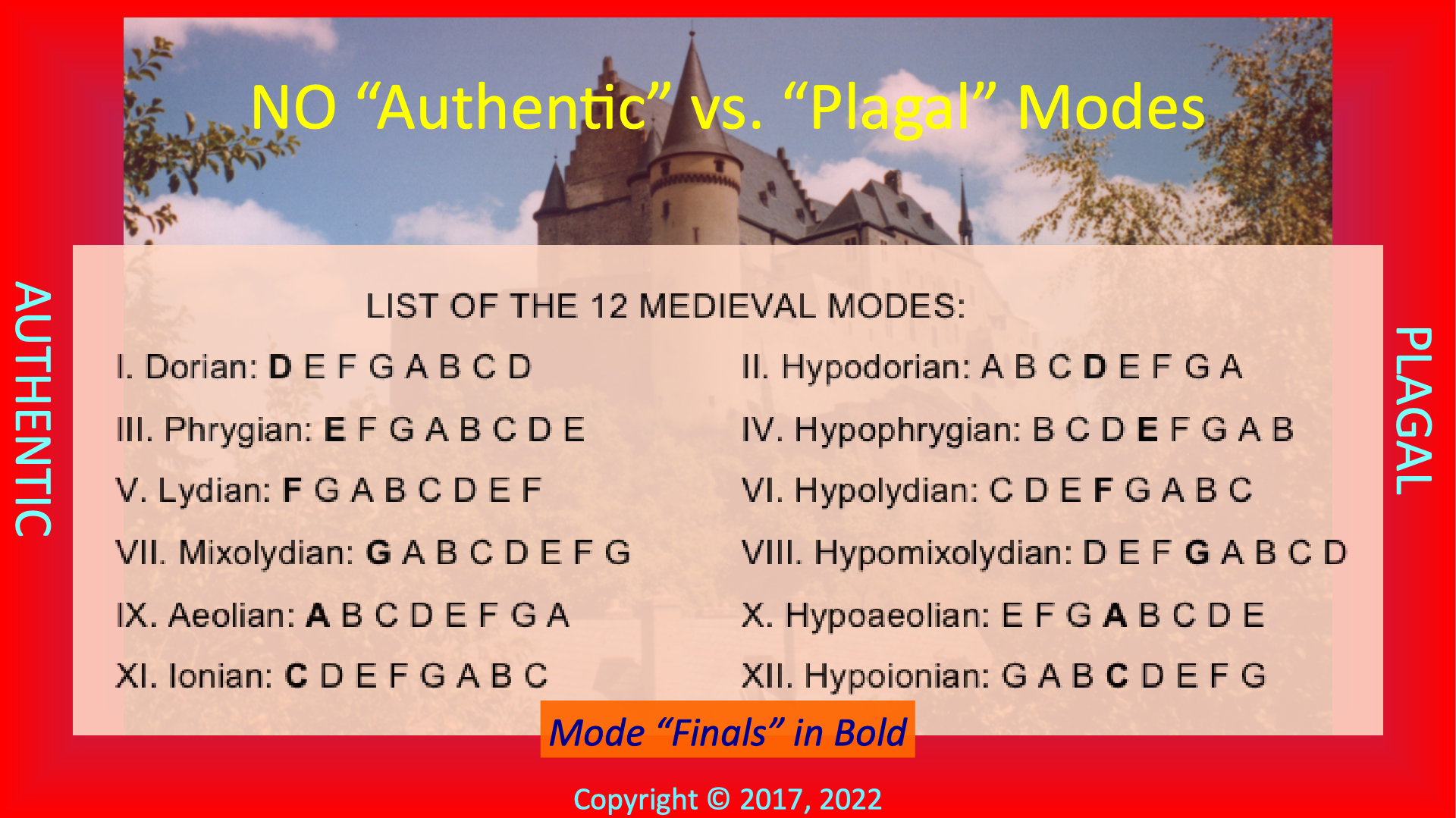
The present essay does not discuss the even older “medieval polyphony” though perhaps that will be of interest in the future. Essentially, the earlier Medieval-Renaissance concept of Authentic and Plagal modes relates mainly to the singing voice ranges [SATB] – the Final being the *lowest* tone of an Authentic Mode, but the *fourth* tone of a Plagal Mode. No hurry, no worry. Let’s move forward!
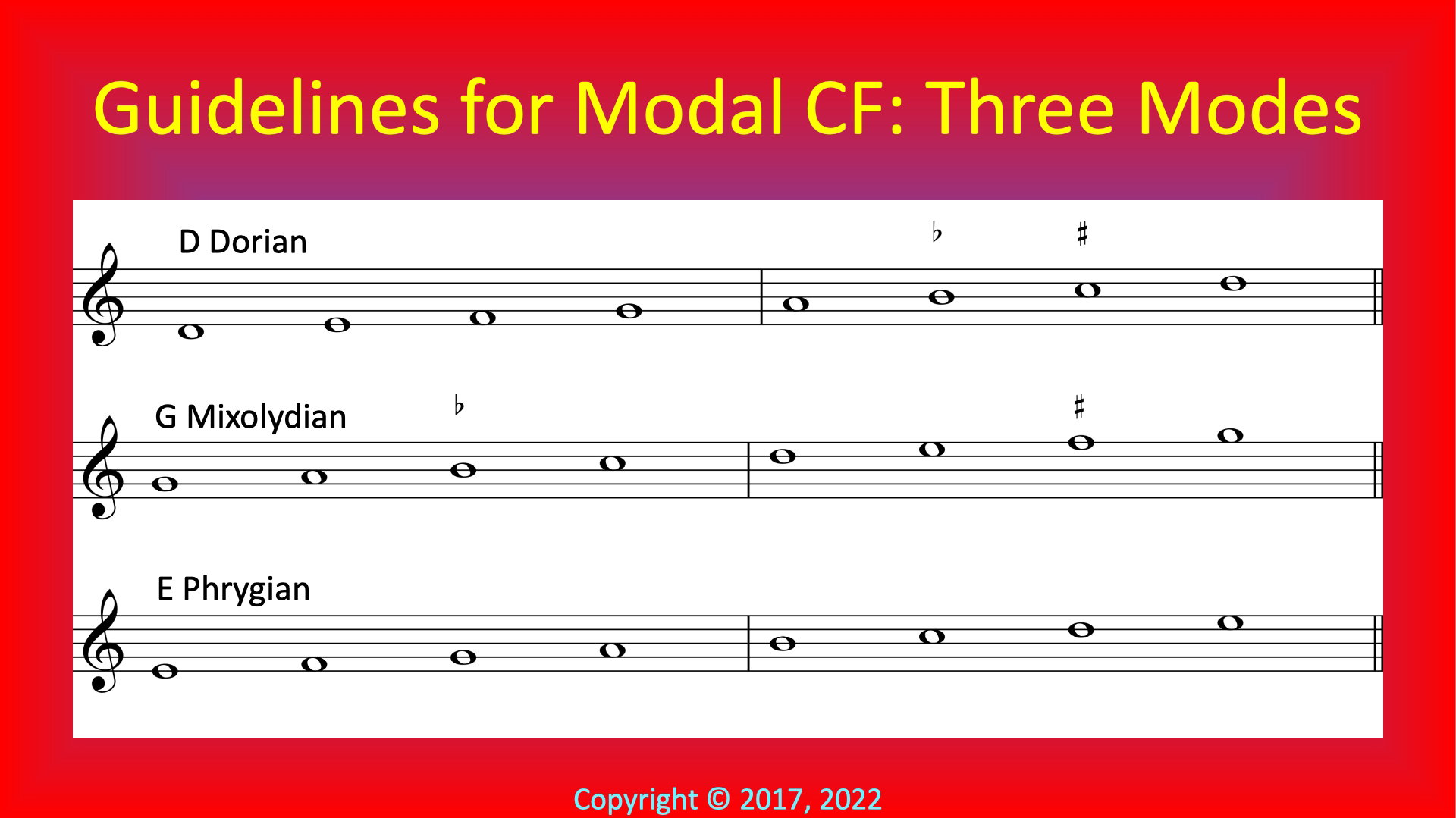
So for the rest of this discussion, we really only need to concentrate on these three modes: D Dorian, G Mixolydian, and E Phrygian (untransposed). The reader should try to sing and play these three modes on a piano-keyboard, paying attention to the audible differences. By the way, did you notice the odd accidental signs placed *above* certain notes? Continue reading to find out what they represent!
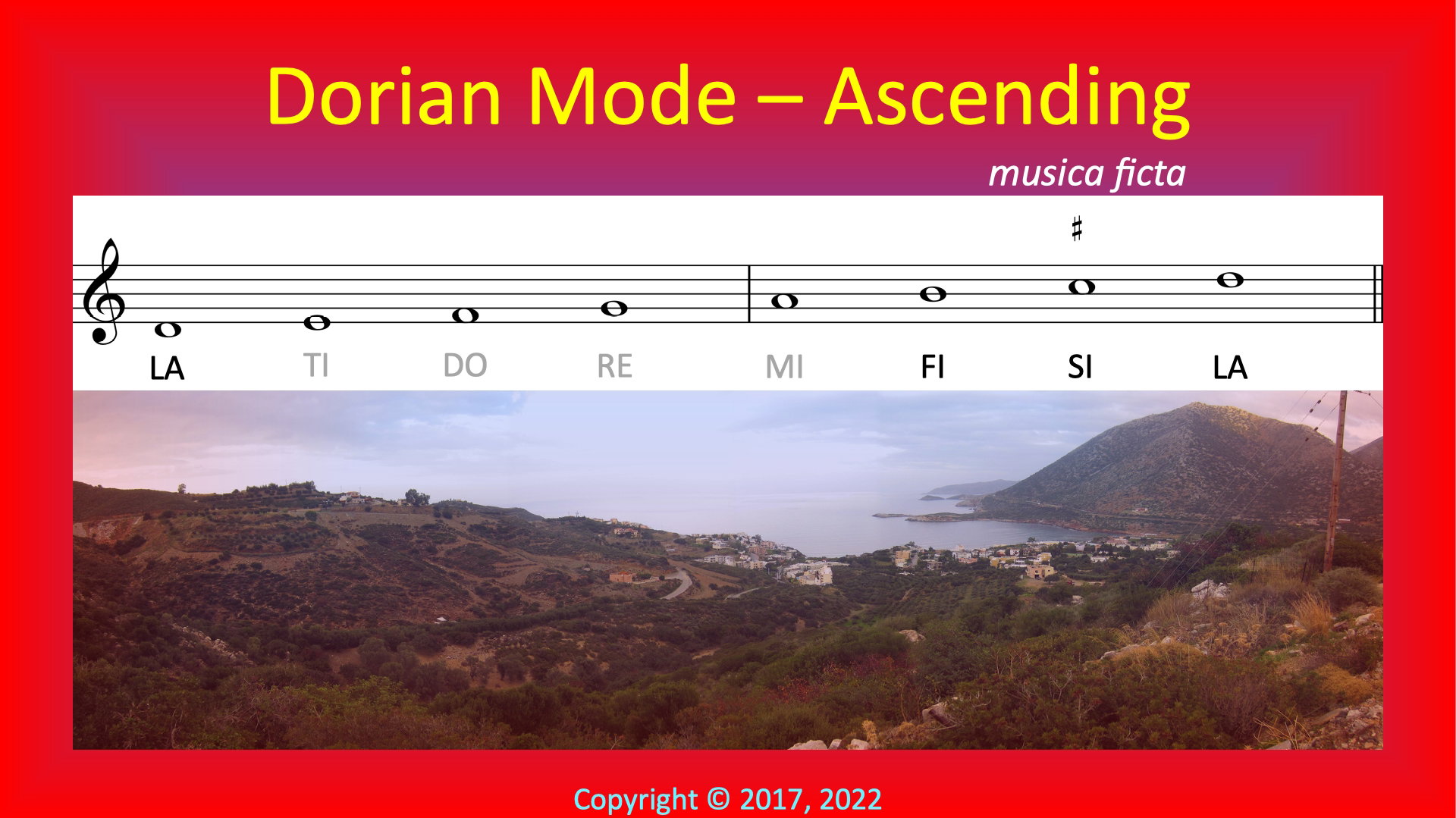
**D Dorian – Ascending:** The lower tetrachord and tonic triad of Dorian mode are minor, but when a Leading Tone is required, the seventh degree *can be and often is raised* a chromatic semitone. The solfège for D is sung as “LA," B is “FI" (“fee”), and C-sharp is "SI" (“see”). To show that this is optional, we added a special accidental called a *musica ficta* **above** the 7th tone: Play and Sing LA, TI, DO, RE, MI, FI, ***SI***, LA, ascending.
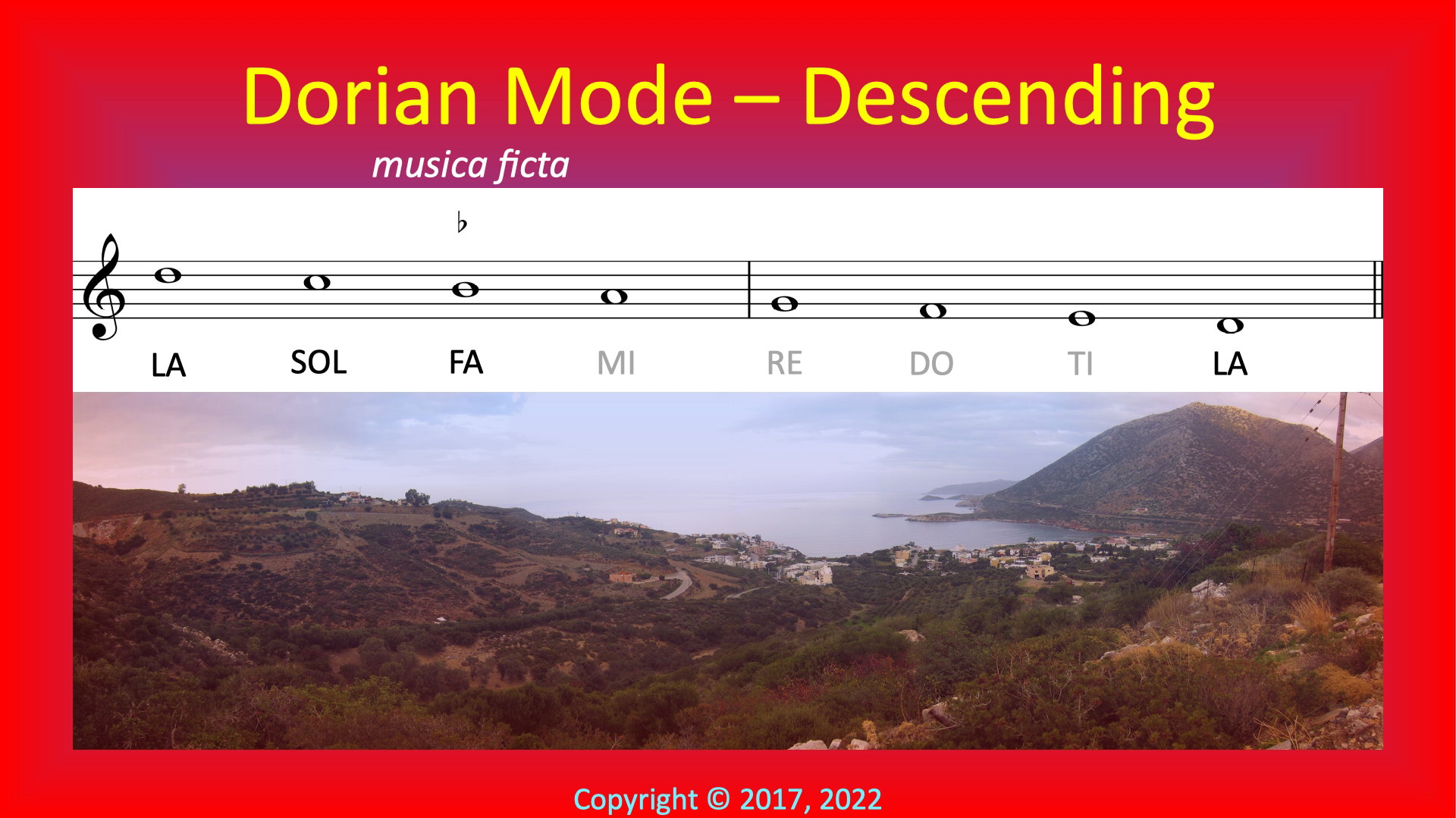
**D Dorian – Descending:** For a *descending* line, the sixth degree note B *can be and often is* *lowered* a chromatic semitone, to B-flat. This now becomes like the natural or descending version of the Melodic Minor scale: The Final D is the LA, C is SOL, and B-flat is FA: Play and Sing LA’, SOL, ***FA***, MI, RE, DO, TI, LA, descending.
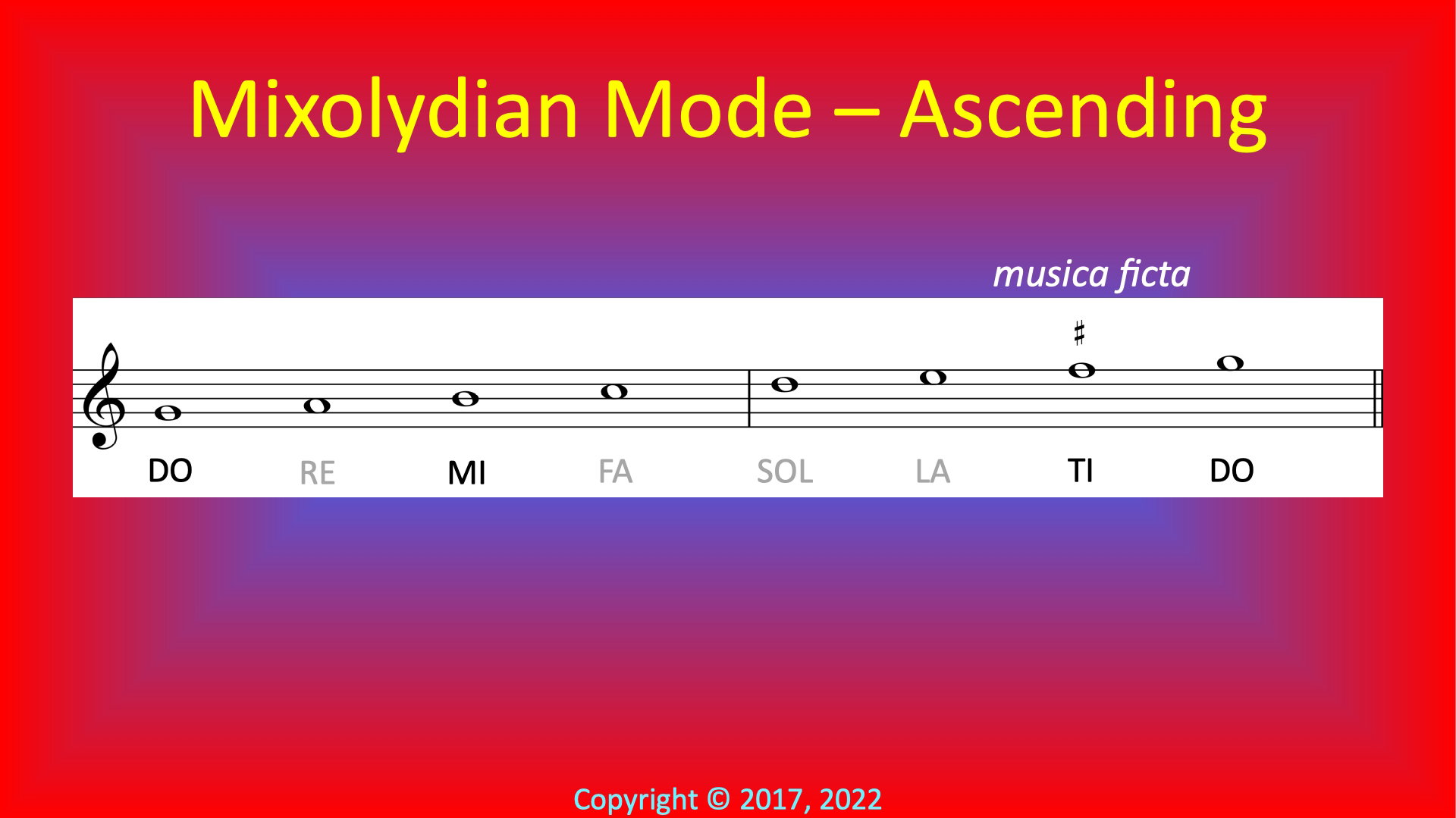
**G Mixolydian – Ascending:** The lower tetrachord and tonic triad are now Major. When *ascending*, the seventh degree note F of Mixolydian Mode may be raised, to create the artificial Leading Tone F-sharp, when the voice leading requires it. G is now the “DO,” and F-sharp is “TI”: From G, Play and Sing DO RE MI FA SOL LA ***TI*** DO, ascending.
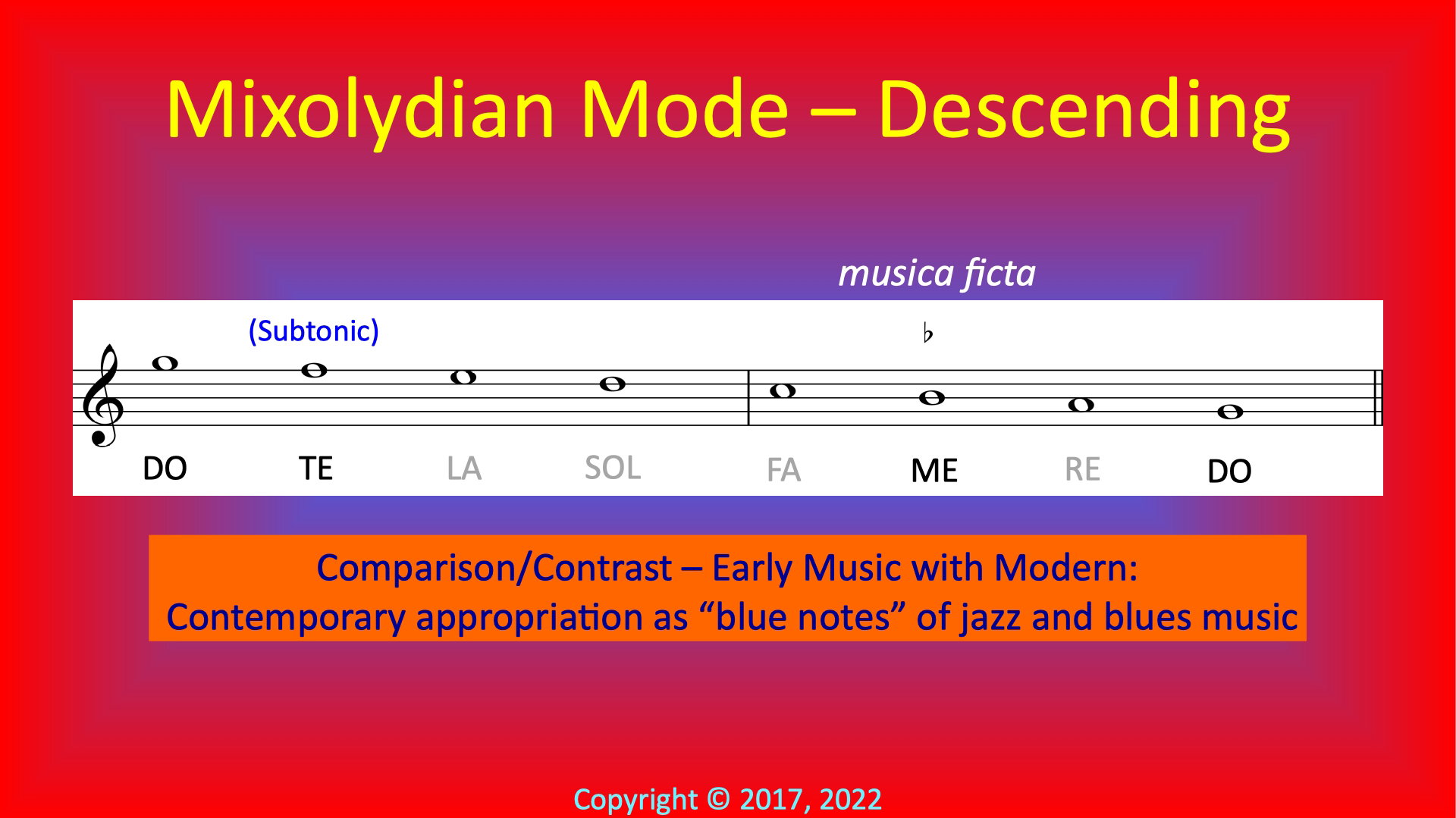
**G Mixolydian – Descending:** When *descending*, the seventh degree returns to the subtonic status of the degree (i.e., F = “TE” pronounced "tay"), and the third degree B is occasionally lowered a chromatic semitone as well, to B-flat (“ME”), creating a very "bluesy" mood, to modern ears. The Final G is sung as “DO,” F as “TE,” and the optional B-flat as “ME”: From G, Play and Sing DO’ TE LA SOL FA ME RE DO, descending.
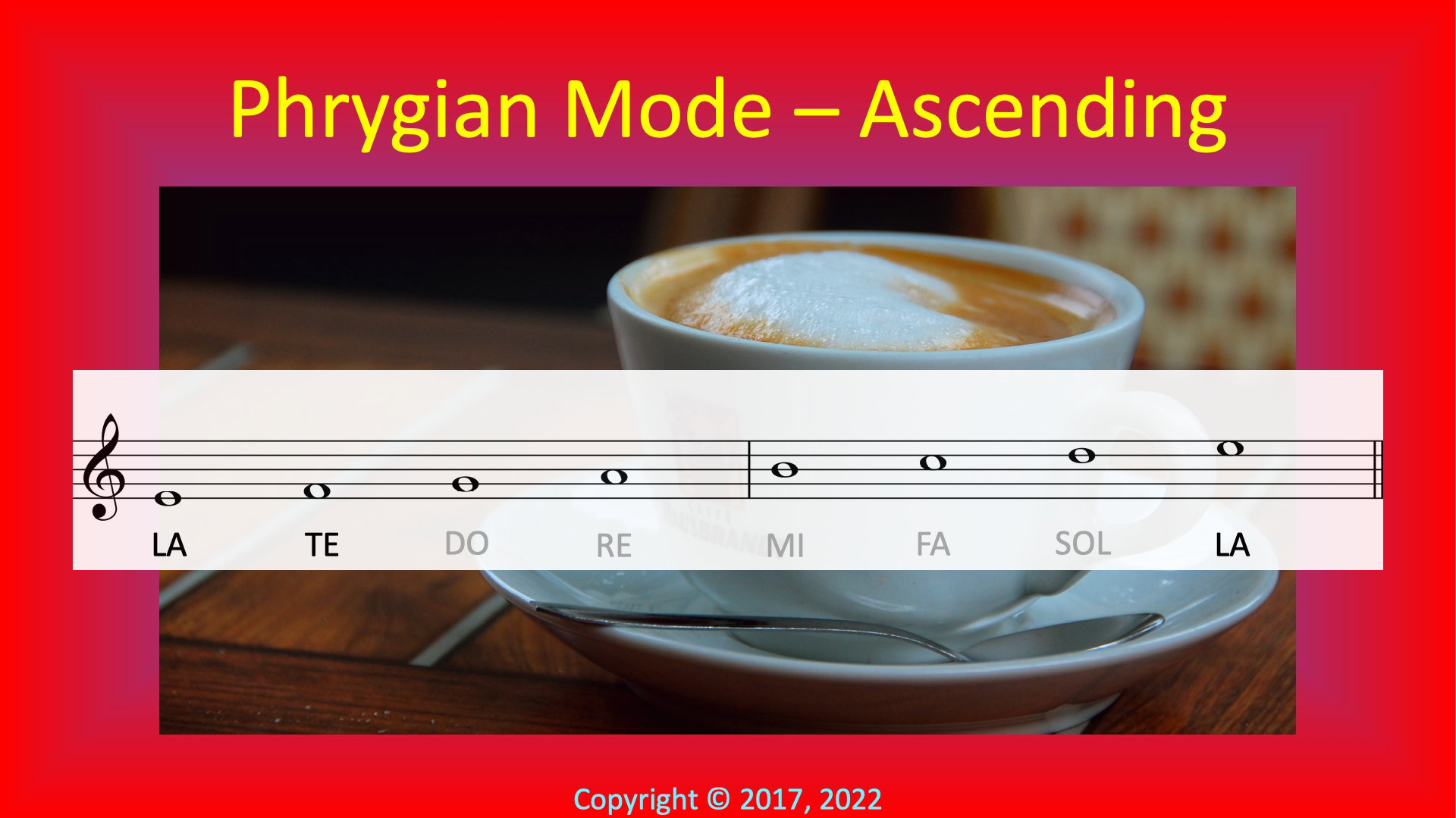
**E Phrygian – Ascending:** Phrygian is a *minor* mode, like Dorian and Aeolian. So the note E may be sung as “LA,” since the tonic triad and lower tetrachord of E Phrygian feature a minor third, and the second degree tone F is "TE" (rhymes with "DAY"): Ascending from E, Play and Sing LA TE DO RE MI FA SOL LA’. (LA TE? Would you like sugar for your LA TE? How about a croissant?) … (humor)
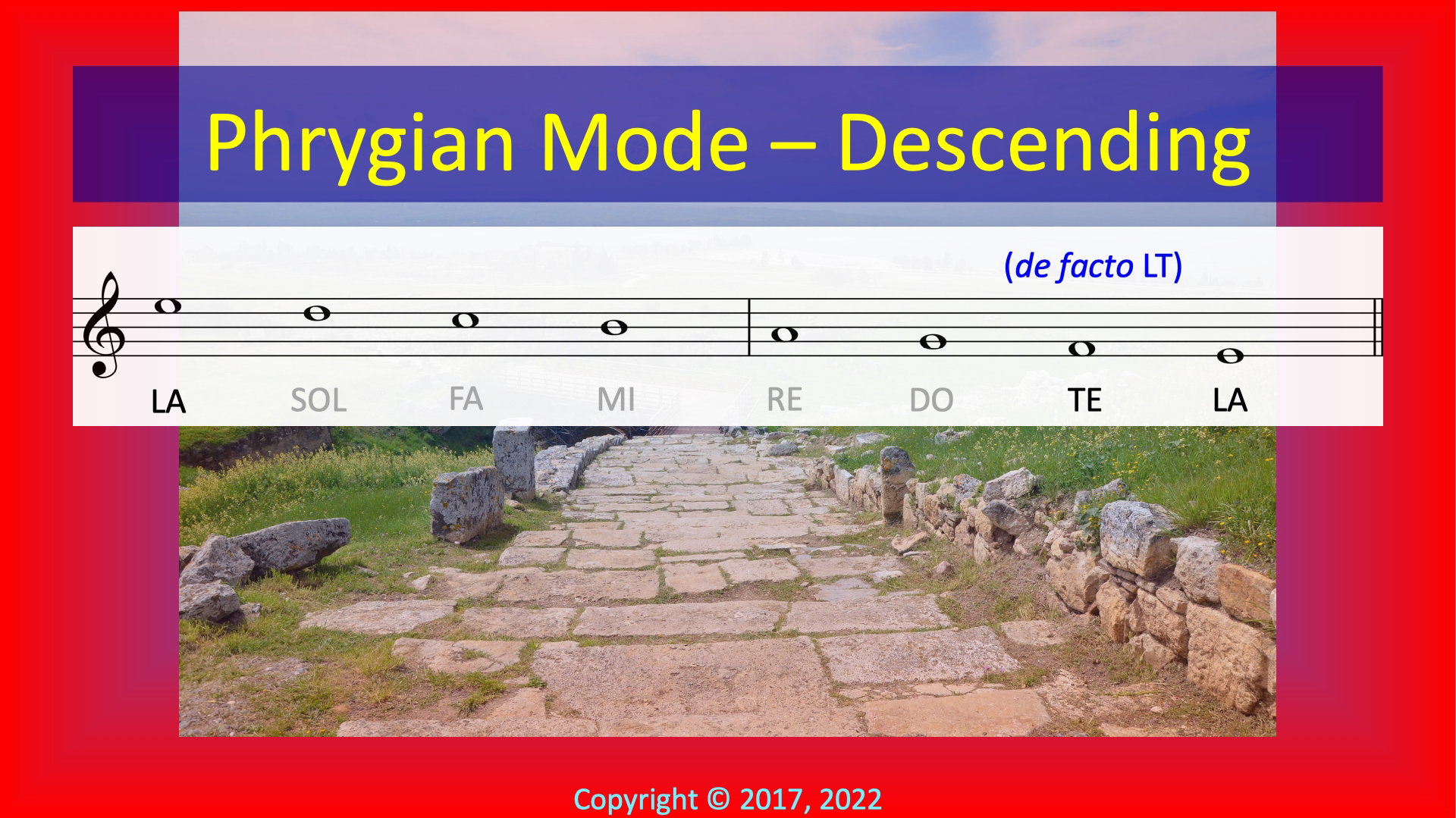
**E Phrygian – Descending:** The raised *seventh* degree is rare In Phrygian Mode, however, the *second* degree of E Phrygian, F, is only a semitone above the Final: Descending from E, Play and Sing LA’ SOL FA MI RE DO TE LA. So this *second* scale degree (the "TE") in Phrygian mode functions as a *de facto* “Leading Tone” (LT), wanting to resolve down to the tonic E, or LA. How does it sound to you?
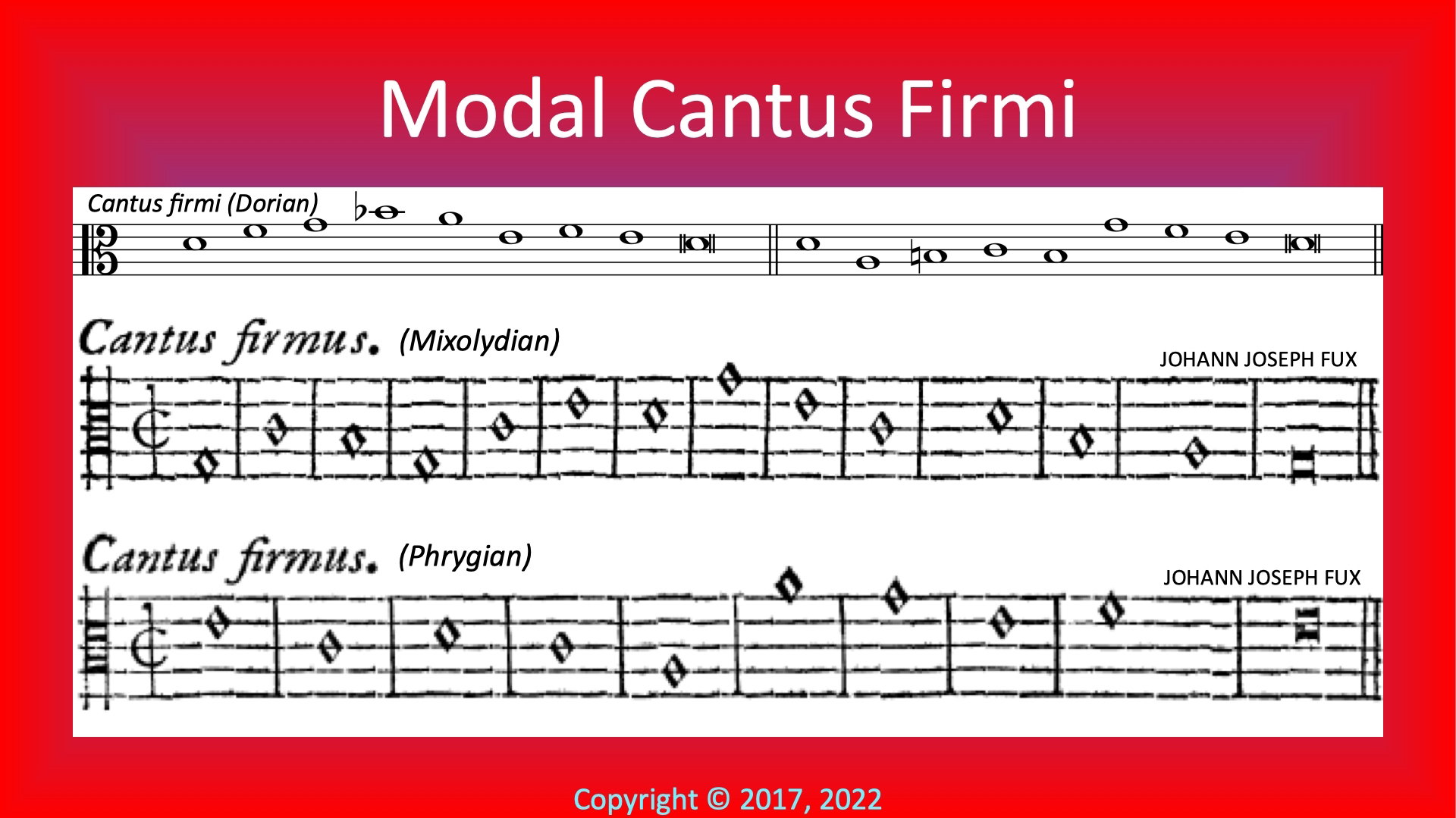
For your listening practice, here are a few examples of *cantus firmi* to play and sing, in the Dorian, Mixolydian, and Phrygian modes. See Johann Joseph Fux, also Salzer and Schachter in the *References* below. That’s all for now on the topic of *cantus firmus*, but it’s enough of a groundwork for us to get started with studies in actual counterpoint writing. An introduction to counterpoint writing techniques and principles will be covered in a future essay. Summary
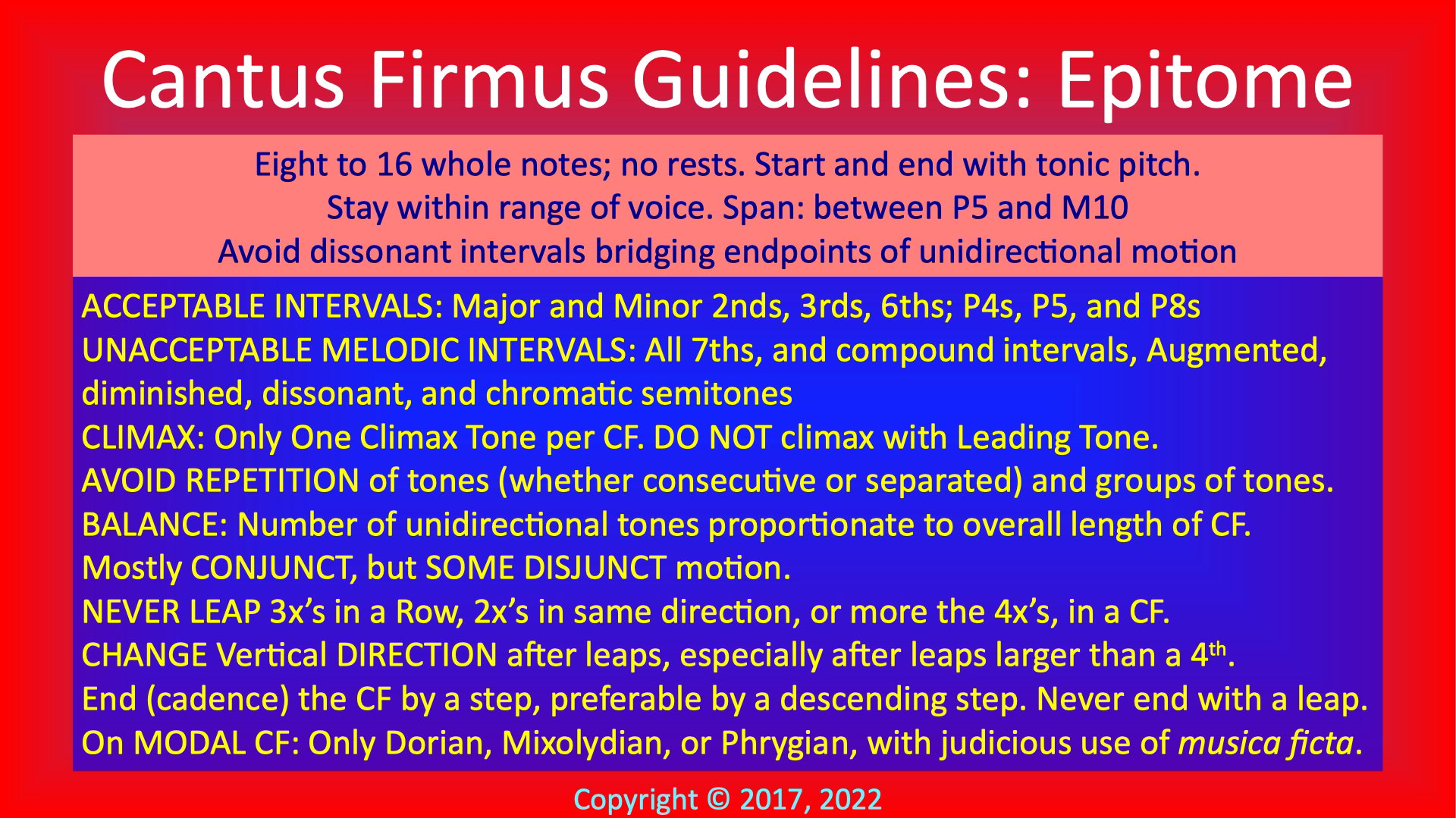
Above is a condensed summary (epitome) of the Guidelines on *Cantus Firmus* that we covered in these four essays. Feel free to take a selfie with it.... LIBRARY REFERENCES IN ALPHABETICAL ORDER BY AUTHOR Cormier, Stephen M. *Modal Music Composition*. Arlington: Inman & Artz, 2004. Jeppesen, Knud. *Counterpoint: The Polyphonic Vocal Style of the Sixteenth Century*. New York: Dover, 1992. Mann, Alfred. *The Study of Counterpoint,* from *Johann Joseph Fux’s* Gradus ad Parnassum*.* New York: Norton, 1965. Salzer, Felix and Carl Schachter. *Counterpoint in Composition: The Study of Voice Leading*, pp. 3-12. New York: McGraw-Hill, 1969. Schubert, Peter. *Modal Counterpoint, Renaissance Style*, First Edition, p. 18. New York: Oxford, 1999. Wikipedia article, “Mode (music)”: **https://en.wikipedia.org/wiki/Mode_%28music%29** IMAGES from Flickr, in Order of Appearance; please take a moment to visit a few contributors’ image links – awesome, free material! Solar System Transits, by Giuseppe Donatiello: **https://flic.kr/p/JXQovz** Medieval Stairway - Sabugal Castle, by Teves Costa: **https://flic.kr/p/nmsMTV** Jazz Piano - 2010/365/181 Fingers in Motion, by Alan Levine: **https://flic.kr/p/8eWcRQ** Lydian – Sardis Artemis Temple, by Turkey Vision: **https://flic.kr/p/ccASBj** Early Music FAQ on the 12 Medieval Modes: **http://www.medieval.org/emfaq/misc/modes.html** Vianden Castle, by Alun Salt: **https://flic.kr/p/b43U6** Valleys of Crete – Good Morning, by Nelo Hotsuma: **https://flic.kr/p/rT1VpT** Coffee Break, by LWYang: **https://flic.kr/p/4TPU2B** Hierapolis, Phrygia, Turkey, by Carole Raddato: **https://flic.kr/p/QKdid1** Creative Commons Legal Code for commercial use and mods of above images. “Mods” used (if any), are minor adjustments to image size, transparency, cropping, and/or front-to-back position in slide): **https://creativecommons.org/licenses/by-sa/2.0/legalcode**
No comments yet