English, Filipino, or both?
Teachers shall use Filipino as a medium of instruction in teaching the subjects Filipino, Araling Panlipunan, and ESP; while English should be used in teaching the subjects English, math, science, TLE, ICT, MAPEH, and CLE, but should there be an observation that the learners have difficulty in understanding the content presented in the English language, the teacher should present the content using the Filipino language as his last resort.
Or teachers should be required to come up with two ways of presentation of content. The learners will choose which language do they want to learn the content with.
Reasons:
a. Filipino and English language should be used as a medium of instruction because these two are nationally known and understood in the Philippines and even around the world. Students find it easier to speak the language which is understood by many.
b. Learners are exposed to media and technology, and Filipino and English are used as a medium of instruction in these areas. They watch television and browse websites that are using these two languages that is why they, more often than not, acquire the languages.
c. Socialization. Honestly speaking, everything should be aligned with what is in or trend here in the Philippines and it’s funny that even language is used as a measurement of why they will make you their friend. Since Filipino and English are nationally understood here in the Philippines, people see these two languages as tickets to unity.
d. Some people view code-switching as a negative habit of a teacher, especially of an English teacher, but I don’t see any problem with that. Comprehension is one of our major goals as literature teachers and we are aware that our students are not all capable, so if we noticed already that a student cannot understand the English content, are we going to force him to understand it? Of course not. We exhaust all means but if the only way for him to understand what we are teaching is by code-switching, so be it.
e. For subjects that focus on values formation, though teachers usually present the content in the English language, understanding should be of utmost importance. If the learners can understand it in English, then present it in English, but if they will understand it better in Filipino, give them what they deserve.
f. Students should be given a choice on how they want to learn content. If schools can hire teachers who can present the content in Filipino or in English, it will be more helpful. It will also form part in developing their decision-making skills and staying faithful to the decision they made.
This is based on my encounters in my four years of teaching. I know that these are just a few of many chambers that teaching has and I know that there is still a lot to learn. I wrote this with all humility and I am open to any comments.

Beauty and Challenge in Diversity
Of all the innumerable factors that we can think of, personality, I think, is the one of most influential when it comes to the learning of a child. This factor has become very influential because it either causes a big help or a big dilemma in learning.
As teachers who interact with students with different personalities, we should be in the front line in knowing our learners. Personality enters here as a dilemma if we don’t know our learners, how they learn and how we can teach them. I am not an expert with regard to personality issues, but I think everybody agrees that in a class of 50, there are more or less 100 personalities, and these 100 personalities need more than 100 strategies to learn. This is just the superficial dilemma in our classrooms, because when we delve deeper, we will find bulks of reasons and factors on why our learners choose the personalities that they have. We, teachers, should not let these factors hinder their learning, but rather redirect these factors to help them.
Looking at some of the personality factors in language learning, choosing just three from them is difficult since all are really influential; so I have to reflect and force myself to reminisce the past when I had headaches and heartaches caused by my students who did not understand what I was teaching.
First is motivation.
Hall (2011) suggests that motivation is a key factor in order to accomplish a particular activity. He states, “It is difficult to imagine anyone learning a language without some degree of motivation” (ibid: 134). Moreover, teachers often ascribe that language learners’ achievements or disappointments mostly depend on the absence or presence of motivation.
While it’s true that our learners go after extrinsic rather than intrinsic motivation, we cannot still erase the fact that learners learn because of such reward. I would often hear my students say “may plus points sir?” whenever I remind them to bring their e-books or books the next day; and it might be insulting on my part for them to always ask for something in return for doing something that would benefit them, but I still take that chance as an opportunity for them to learn.
In teaching writing (feature, news or editorial), it has always been a puzzle for me to let them realize its value at the moment, because I observed that students are more engaged in doing tasks which are of immediate use than doing tasks which they can still use in the future.
It’s good that our department head shared to us that we can present their articles in our school paper for publication. The tasks or projects that we give them should be used after they make it. Slogans should be posted, artworks should be exhibited/displayed, and articles or writings should presented in school publication or put in the library for them to see. These may be simple things to us but for our students, these are already what they call success.
Second is anxiety.
We were once learners and we are still learners even up to these days. As learners we always encounter this feeling, when given a task that involves a certain degree of challenge can expose us to feelings of self-doubt, uneasiness or fear. Behind these emotions lies the question: shall I succeed? As second language learning is a highly demanding task, it is very likely to raise anxiety in the learner. Anxiety can be considered a negative factor in language learning, and several teaching methodologies in modern approaches indicate that anxiety should be kept as low as possible.
An example of negative use of anxiety is when you have the right answer in mind but you don’t want to speak it, because of fear that there is grammatical error or that it is not the correct answer. This often happens to our learners and even to us. Now we think, how can we let students learn if there are unattended anxieties as such?
There are lots of studies regarding anxiety issues in language learning and while reading some of them, I had a funny reflection when I found out that teachers too sometimes contribute to our students’ anxiety; I asked myself, “am I a contributor of anxiety to my students?” I hope not.
Anxiety cannot be removed from our students anymore, so we try to teach them how to use this anxiety to become a better language learner. We teach them of facilitative anxiety or what we call positive use of anxiety. If students use these lots of anxieties as driving force to learn better, then there will be a clear possibility that language learning becomes easier for them.
The third is introversion vs. extroversion.
Second language acquisition may be more difficult for some people due to certain social factors. One highly studied social factor impeding language development is the issue of extraverts versus introverts. Studies have shown that extraverts (or unreserved and outgoing people) acquire a second language better than introverts (or shy people)
According research, personality traits, and in particular extroversion and introversion have a major effect on second language acquisition process. It seems obvious that extroverted learners, who use the second language to interact without inhabitation, talk more fluently, tend to take actions with less reflection, work better in groups and excel during classes with high levels of activity. It is to accommodate their need to communicate outside of class time without the pressure of the classroom. Extroverted students easily communicate in the second language even though they might not produce accurate output. These characteristics influence their ways of learning in the second language so it is believed that extraverts are more successful in communication. On the other hand, introverts tend to be exerts talk less and reflect more before acting, like to be quiet, like to work independently or with one or two other people.
They tend to be more passive rather than actively social. In addition, many introverted students have an obsession with producing accurate grammatically sentences with native-like accent.
Since many studies have shown that extroverts or unreserved and outgoing people acquire a second language better than introverts or shy people, it seems also important for second language learners to develop personality. That is to say, they should try their best to be extroverts to acquire the second language effectively. It is believed that individuality is one thing and personality is another. Personality is built after one is born.
With all these in mind, (we could say that the job of a teacher is really out of this world) we could say that understanding personality types is helpful for appreciating that while learners are different, everyone has a value, and special strengths and qualities, and that everyone should be treated with care and respect. They just behave differently because they are unique.

Thoughts on this Pandemic
This pandemic has taken so much from us.
It has turned our world into a disturbing pause, where silence is the only noise we can hear.
It has introduced us to this so-called new normal where nothing is normal at all.
People have been obliged to work from home, while some have been forced to leave their jobs.
Stores and big establishments have been closed for some were labeled as unnecessary. They have stopped earning and so were their people.
Problems on mental health have started to rise and the effect is nothing to be happy about, scary.
The colorful and noisy cities and rendezvous have lost their colors, lifeless.
National examinations and other opportunities have been postponed putting the dreamers' dreams on hold.
Waves of laughter have turned into fear and people are have been left with no options.
Millions and thousands of people of different races, ages, and status grieve for their loved ones who have lost their lives mostly out of sacrifice.
The effects have become worse and it seems like the virus has won against us.
This has to stop, but how?
How do we find solutions in this time of different problems?
How do we keep our faith in these trying times?
How do we become brave when fear has started to conquer us?
How do we provide help if we, ourselves, need help?
How do we compose ourselves when the enemy targets not only physical but also mental health?
How do we stay positive if we don't want to be tested positive?
How do we fight an enemy that is out of sight?
Lastly, how should we live our lives if this pandemic has taken so much of us?
I don't have the answers to these loads of questions, but I know, we will win this battle.

Accommodation Theory in Teaching
They say that a teacher’s first year in teaching is like passing a needle’s hole. We have to think of all the possibilities. We think that we are more advanced because we are the youngest and that we have all the energy and fresh ideas to survive it. We think that there will be no bends along the way. We think that there will be no frowns or that there will be a bed of roses waiting for us, but we’ll soon realize that these are just ideals.
As we start working, we hold a jar full of idealism. We realize that as we go on and pursue this so-called passion, our jar of idealism is becoming lighter and lighter, losing a drop every step of the way. Every drop falls because of adjustments. We start to encounter things and these open our eyes the real structure of our educational system. Don’t get me wrong, there are good days of course, but the bad days make us reflect. This is comparable to language teaching as it offers good points for reflection.
Accommodation Theory (Giles, 1973) describes how people adjust their language and communication patterns to those of others. Since its emergence in the 70’s, the theory has been used in the fields of social psychology and sociolinguistics.
The Accommodation Theory by Howard Giles draws attention to the roles of socio-psychological attitudes, motivation, formal instruction, and larger community or environment in L2 learning. And, the important features of this theory are embedded in the preceding variables. First, the roles of socio-psychological attitudes and motivation in second language acquisition (SLA). Just basing on my first year of teaching, positive reinforcements makes a learner think. Students nowadays are in so much problems and troubles. Sometimes, they go to school not because they want to study hard but because they just want to escape or forget their problems at home. As teachers, giving them their deserved comfort is the least thing that we can help them. That comfort that we give them will serve as their motivation to at least be listeners. I think that to be able to learn, we should start as listeners. We just listen and think on our own. When teachers have already established the comfort that students need, these students will start reacting, asking and answering during discussions. If we consider the feelings of our learners, if we realize that there’s always a reason for their attitude, we can find a way to make them learn the target language. http://en.wikipedia.org/wiki/Communication_accommodation_theory http://homepage.ntlworld.com/vivian.c/SLA/L2_learning_strategies.htm http://en.wikipedia.org/wiki/Second-language_acquisition
Second, the role of formal instruction in SLA is a sensitive issue. Many language teachers fail to consider the importance of an accommodating lesson plan. Formal instruction means the L2 is taught under the supervision of an institution (public, private and language school) and it is learned under prescribed conditions. Meaning, the second language learners are taught by a qualified language teacher and uses books, manuals and other supplementary materials to ease L2 learning. To me, the success of classroom learning is manifested through the activities done by the students in an untutored setting. We try to see to it that the tools that we use in the classroom as our partners in teaching our learners should really help them. These instructions should be aligned with their level of competence or something that will really be beneficial to them.
Third, the role of larger community or environment in L2 learning is imperative. When there’s high exposure to the target language community, high proficiency also transpires. When there’s no opportunity to mingle with the target language community, there’s low proficiency and the second language learners are not motivated at all. Interaction as said by Vygotsky is an important key to second language learning. In cases that we cannot immerse our learners to the second language community, for example an English-speaking community, we can do artificial immersion. We can let students watch English movies for them to be exposed and let them talk about the issues if the movie with English as their medium.
There are many possibilities and so are points of reflection, we have to be smarter and be better than when we were in our first year of teaching.

How do we really learn a Language?
I have to admit, all the theories on the acquisition of first language are very much convincing since they all have language experts and researchers as their support systems. I am already convinced with one theory, then here comes another theory and my brain processes it and it also makes sense. Delving deeper into what these theories really imply, I can say that there are some commonalities despite the bulk of different information these three hold on to.
Today, I am a linguist; an expert. For what I say is what I will become. But since that is what I will still become, I have to depend on other experts regarding the theory I am taking a stand for. Though there are a lot of underlying theories on first language acquisition, I still believe that language develops from the interaction of biological, cognitive and environmental influences. The understanding of how language is acquired and the role the brain plays in the language acquisition process are crucial because the development of language is one of the most important factors in human development. The analysis of language development is intrinsically connected with one's awareness of how human beings or human brains perceive, learn, control, and coordinate elaborate behavior.
Vygotsky created a model of human development now called the sociocultural model. He believed that all cultural development in children is visible in two stages:
•First, the child observes the interaction between other people and then the behavior develops inside the child. This means thatthe child first observes the adults around him communicating amongst themselves and then later develops the ability himself to communicate.
•Vygotsky also theorized that a child learns best when interacting with those around him to solve a problem. At first, the adult interacting with the child is responsible for leading the child, and eventually, the child becomes more capable of problem solving on his own. This is true with language, as the adult first talks at the child and eventually the child learns to respond in turn. The child moves from gurgling to baby talk to more complete and correct sentences.
I think I am one of the living testaments to Vygotsky’s model. My maternal and paternal grandparents are Igorots so that means us and our parents basically share the same blood as that of them. They speak Kankanaey because they live in a Kankanaey dominated barangay. Though we share the same blood as that of our grandparents, I and my siblings were raised by our parents in an Ilokano dominated barangay in our place. Therefore, we grew up knowing only a few Kankanaey words because even our grandparents talk to us in Iloko. While it’s true that I was in the womb of my mother while she speaks kankanaey, there was that stage where I did not know anything about kankanaey, I only have known some, as far as I can remember, when we visit our grandparents in their place and some natives there speak to us in Kankanaey.
The following major themes presented by Vygotsky would also support this situation.
1. Social interaction plays a fundamental role in the process of cognitive development. Vygotsky felt social learning precedes development. He states: “Every function inthe child’s cultural development appears twice: first, on the social level, and later, on the individual level; first, between people (interpsychological) and then inside the child (intrapsychological).” (Vygotsky, 1978).
2. The More Knowledgeable Other (MKO). The MKO refers to anyone who has a better understanding or a higher ability level than the learner, with respect to a particular task, process, or concept. The MKO is normally thought of as being a teacher, coach, or older adult, but the MKO could also be peers, a younger person, or even computers.
3. The Zone of Proximal Development (ZPD). The ZPD is the distance between a student’s ability to perform a task under adult guidance and/or with peer collaboration and the student’s ability solving the problem independently. According to Vygotsky, learning occurred in this zone.
Many schools have traditionally held a transmissionist or instructionist model in which a teacher or lecturer ‘transmits’ information to students. In contrast, Vygotsky’s theory promotes learning contexts in which students play an active role in learning. Roles of the teacher and student are therefore shifted, as a teacher should collaborate with his or her students in order to help facilitate meaning construction in students. Learning therefore becomes a reciprocal experience for the students and teacher.
Discourse theory in Language learning
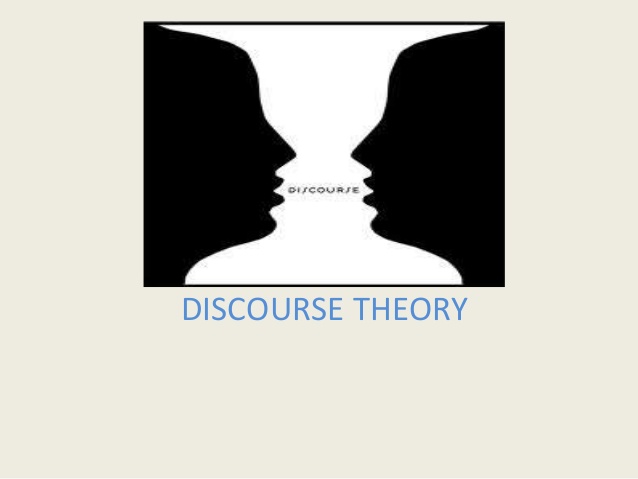
Linguists traditionally define a sentence as the basic unit of expression. A sentence is defined as a group of words that makes sense. Most utterances and texts are in fact more than a sentence. The surrounding texts of the sentence gives it a deeper meaning. Subsequently, it gives validity and depth of meaning to a discourse. To understand the meaning of a sentence in its full meaning, the reader is helped by the surrounding text to get clarity of thought and meaning.
Discourse theory states that all the relevant text around a message should be considered to understand it clearly and universally, instead of viewing it as a stand alone sentence. Discourse theory has received prominence in social sciences. Discourse theorists challenge rationalist and individualist approaches in many fields. The discourse theory has great implications in an educational context. It shows how written, visual and oral texts give more depth to the texts when the context is understood.
Interaction and categorization between teachers and students can be understood more deeply in the relevant circumstance in the social context. Instructional dialogue should be closely linked to the particular scenario in a classroom. The thoughts and connections between teachers and students during the process of teaching and language acquisition develop the rigorous nature of pedagogy. In this scenario, ideas and concepts will be mutually understood. It calls for a variety of teaching methods and teaching conditions specific to that classroom.
Meanwhile, in teaching, language teachers must always bear in mind the importance interaction among learners. Participation must be of great value since it is one of the keys to language learning. Teachers should realize that discourse theory is very useful for learners .Learners have some specific mental structure to acquire the language very hastily, and when learners are involved or are participating activities with different language learners, they can get better mastery over the language. They interact better. They have very less chance to make mistake at any cost. They enjoy to interact without any hesitations .Hatch shows that in learners’ discourse, conversations typically competence with attempts by the child to open the channels by calling for other learner’s attentions. The other then responds by identifying the object that appears to have attracted the learner’s attention and the learner repeats the name of the objects.
Discourse theory has a very important role in second language teaching. There are so many methods and techniques that we use for teaching and learning the target language in language classroom. Discourse theory is one of the very effective method for learning the target language. Teachers should create an interactive environment in language classroom. They try to make them involve in discussion in target language. In recitations for example, teachers are very much aware that most of our learners know the answer to the questions but hesitate to raise their hands. And there are lots of reasons for these hesitation that impede interaction and one of which is fear.
Learners’ monitor, especially younger ones, are very much active during those stages. They are afraid to commit mistakes that’s why they prefer not answering at all. In these cases, the aim to let the learner be conversant and learn more of the language is not achievable anymore. Teachers must exhaust all means. Rephrase questions from “What can you do to show your pride as a Filipino?” to “Who has the pride of being a Filipino, the person who works as an OFW abroad, or the person who stays in our country?” The first question does not let the learner think anymore, we all know the answers to that and these answers are clichés already. The second question on the other hand stimulates critical thinking. It will let students think and reflect especially if they have family members abroad. It can also create debate and that creates interaction.
As teachers, we always want perfection from our students. Perfect grammar, intonation, sentence and the like without realizing that too much monitor of these things actually impede the learning of the child. Loosen up but always keep in mind our purpose. Let them converse in a way that they will learn a language properly.
https://pennyspoetry.fandom.com/wiki/Sentence_(linguistics)
http://myweb.facstaff.wwu.edu/karlberg/articles/DiscourseTheory.pdf
https://www.sciencedirect.com/topics/social-sciences/discourse-theory
About Read.cash
Read.cash is an online platform for writers, photographers and artists of any age and experience. It is a site for self expression. You can be accepted if have something to share or even if you just want to learn. Communities with varied interests are available for you to join and to submit articles to, that's how you start to earn Bitcoins. If you want to increase your earnings, based on my experience, write as many articles as you can. It could be anything the rays of the sun can and cannot reach, anything that can be held or not, or it could be creative or technical. Literally anything you can think of. You have to make sure that you have joined to several communities. If you think that your article is appropriate to what the community is trying portray, submit it to them, otherwise they will not approve it. You can also gain points by liking and commenting on the articles of others. The longer the comments, the more points to be gained. These are where I think I gained most of my points from. You can converse or debate about any topics in the comment section. Short posts or questions in the communities are also accepted. Other authors or readers can upvote your articles, this means that they loved your article and that they want you to write more. Upvoting is a very good motivation to any writer so you can also give this to articles you like. Finally, the more articles you write, the more earnings you get, but I suggest that you use this platform more so for self expression and appreciation to art. Hope to see more of your writings in read.cash. Happy writing!

A Research Journey
I am a researcher from the Philippines. For the last three years, I have been working as a research teacher. Since English is not my native tongue, I found it challenging to facilitate research since the topics of my students were not only in English, but also varied.
At first, I was hesitant to accept my school’s offer to teach research, but took it up nonetheless – I realized that I wouldn't know if I enjoyed it or not if I didn't try. Sleepless nights and really bad headaches became my life due to all the readings and revisions I had to do, but despite these, being a research teacher was one of the most fulfilling jobs of my life—I can attest to that.
I felt that I am one with my students and felt their hardships and pain when they had to revise their papers or start things from scratch. But I was the happiest when they were learning and were able to defend their dissertations, or got to learn more about people and essential communication by conducting qualitative and quantitative research. I knew how they felt when they made an exciting discovery, developed a new perspective, or achieved something new through their researcH. I was such a proud, happy teacher!
So much for my journey as a research teacher. Today, I am pursuing a master’s degree that involves research and I am enrolled at a state university in a town near my home. I am working on my thesis and it feels like the tables have turned. From identifying a problem to the gathering of data and from figuring out the statistics to the final defense and finishing touches, indeed, research is more than a challenging task—it’s a tough and uphill journey.
I am specializing in language teaching and my study focuses on challenges in research writing.
With the busy schedule at work and home, I have been progressing at a slow pace. My writing keeps getting delayed. What's funny is that some of my students now coax and encourage me to finish my research. But in spite of the delays and challenges, I am happy that apart from my family and friends, the students whom I always guide and help are also the ones who guide and help me with my study. I thank God for the opportunity to be a researcher and a guide for researchers. I am grateful to be able to share a part of my research journey here.
NOTE: Posting this from my account in the a research website in the internet. Hope it can help people here.
You can Visit https://www.editage.com/insights/i-am-guided-on-my-research-journey-by-my-former-students

Long queues: A test in life
Long queues are not just long queue. They are more than that.
They're a test of patience, of whether we should still wait or not.
They are a test of love, of whether the reason for being there is important to us or not.
They are a test of decision making, of whether we should stay longer or not.
They are a test of perseverance, of whether we should still continue or not.
They are a test of temper, of whether we stay cool of not.
They are a test of personality and social skills, of whether you gain friends or not.
They are a test of self love, of whether we deserve to wait very long or not.
Long queues are tests in life.
When do you know when enough is enough?
How do you know when enough is enough?
How do you know when enough is enough?
Did you say it?
Did you say it?
'I love you '
Did you say that her/his smile makes you smile?
Did you say that her/his laugh makes you laugh?
Did you say that her/his presence makes you feel alive?
Did you say it?
'I love you'
Did you say that she/ he gives you chills?
Did you say that she/ he brightens your day and gives light to your night?
Did you say that she/he takes your breath away?
Did you say it?
'I love you'
Did you say that you miss her/him when she's/he's not around?
Did you say how precious she/ he is to you?
Did you say she/he is the love of your life?
Did you say it?
'I love you!'
Say it before she leaves and you will never hear her
I love you too!
How do you do it mate?
How do you do it mate?
How do you sleep at night feeling all right?
How do you wake up in the morning with a good mindset?
How do you maintain your composure during pressure test?
How do you stay okay during trying times?
How do you do it mate?
How do you still laugh amid your suffering?
How do you still provide help for the suffering?
How do you still relax in your leisure times?
How do you still enjoy when everyone is going wild?
How do you do it mate?
You inspire and motivate us.
You give us smile and make us laugh.
You keep us safe and relaxed.
How do you do it mate?
You are doing a really great job!
'til the last until
'til our smile slowly fades
'til we get tired of reality
'til we try not to care too much
'til we serve our purpose
'til we find ourselves again
'til our genuine smile sprouts
'til we cry out of laughter
'til we love and be loved
'til the last until
First line of Defense
We are surrounded by people whom we don't know if they are going to cheer for us or bash us. Friends and acquaintances alike, how sure are we that they mean good for us?
There were also times where our family, especially our parents, became our enemy in a sense that they would scold us, don't allow us to to go out and talk us out from something we thought would make us happy. For some time, we pass by this stage where our trust for our family slowly fades, But I tell you, they are all that we've got in highs and lows.
Nothing and no one beats how family cares and protects. We get saturated by the unending and tight protection but I'm sure they always mean good for us. Well, that's for me and I hope you have the same family relationship as mine.
This is a shoutout to the loyalty and genuine love we receive from our families. May they be our family by blood, friends, neighbors, schoolmates, workmates, and pets, may we all enjoy the blessings and goodness or family. 👨👩👦👦👨👩👦👦👨👩👦👦👨👨👧👧👨👨👧👧👩👧👧👩👧👧👩👩👧👩👩👧

Cheers to both the good and bad days👌👌👌
We all have our good days and bad days. Well, for me, the good days were when I was enjoying the fantasies and magics of my childhood decades ago. When my only responsibility were to sleep in the afternoon, to take a bath well, and to finish my meal without leftovers.
The bad days were when I started Paying my own bills, living in a boarding house away from home, and those days when I was not able to attend special occasions because time and money does not permit. These were bad days for me until I realized that these are actually preparing me for to have good days.
I've learned to look at the brighter side of every bad day. I've learned and I am learning.
Good days gave me smile, but bad days made me stronger.
This is a shoutout to you who is reading this, be stronger everyday. Time will come where you will savor the goodness of your good days.
 @Lawrence