 @Jane
more from that month
@Jane
more from that month
What Represents Your Johari's Window? **October 26, 2020** Have you ever heard about Johari's Window? **Johari's Window** was developed by psychologists Joseph Luft and Harrington Ingham in 1955 and named the model from combining their first names. The method commonly used for **self-discovery** and also used in self-help groups a **heuristic exercise**. It helps in enhancing the ***self-awareness of a person and understanding relationships with yourself and others***. It is also said that Johari's Window can help ***improve communication skills***. It is important to develop the perception of individuals to improve communication within the group. This technique of discovering oneself was introduced to us by our instructor during our Caregiving Psychology-related lesson in 2014. The Johari window is composed of four panes, and each pane has a significant idea behind it.
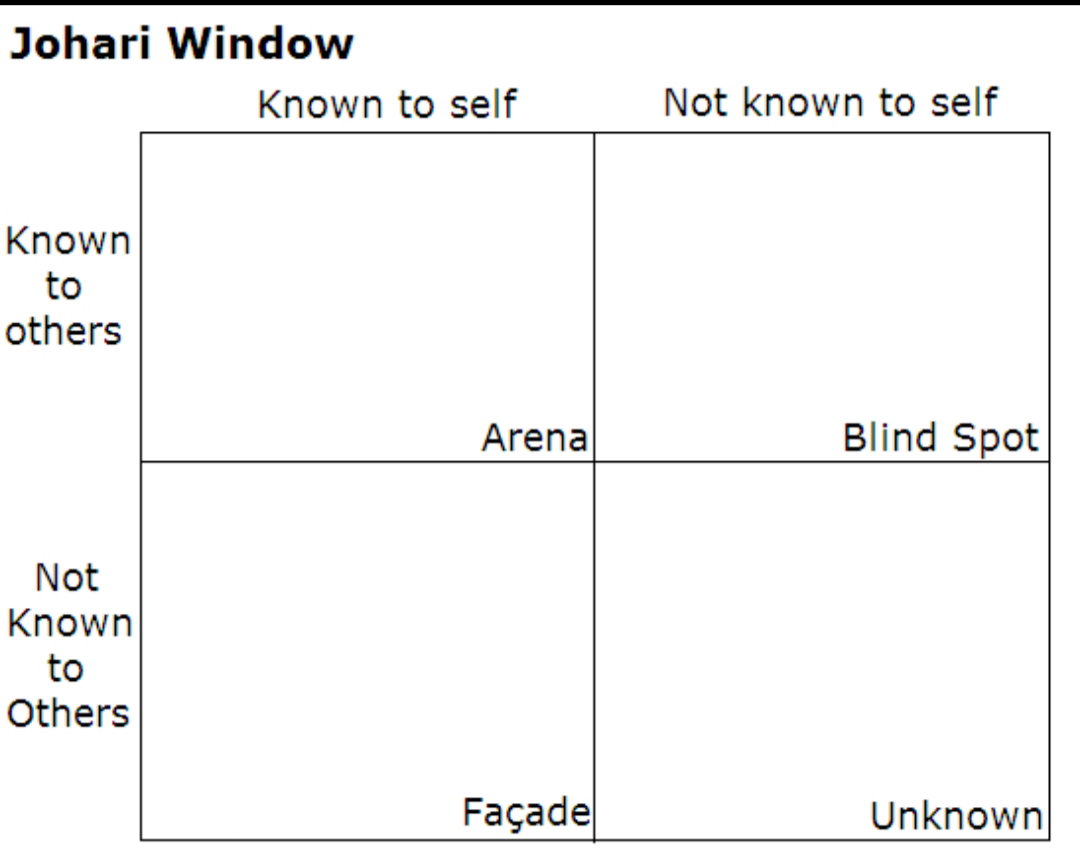
As you can see in the photo, there are four panes in the window. The two panes ***signify your true self*** while the other two panes ***signify the part that is known to others but unknown to oneself***. The **first pane** is the *characteristic that we and others know.* The **second pane** contains qualities that *we are unaware of but others can see*. The **third pane** is the *private space that ourselves are the only ones who know about it but hide from others.* The **fourth pane** is the *unknown part of us that neither ourselves nor others see.* During our class activity, our instructor told us to get a sheet of paper and write down our names on it. Afterward, we have instructed to pass around our sheets of paper. Then each student in our class should write something about the person who owns the name on that certain paper. We have told to write down adjectives that will describe the personality of each student in our class. The last part was placing each adjective to corresponding window panes. The results surprised us, especially the described characteristics which are known to others but unknown to ourselves. To make you understand better about the four different panes of Johari's Window, here are the explanations about how compromises in these panes. **Window One: Open Area or Arena** This area is called Open because it is about your ***characteristics, feelings, and emotions perceived by ourselves as well as others.*** In our Caregiving classes, students have known each other for almost six months. Therefore, our Open Space characteristics have already revealed to one another. There were times that we revealed feelings and emotions towards each other, especially the moments when we were hanging out to unwind, revelations take place. Through interacting with each other, we easily wrote down the characteristics that represent window one. The blindspot or unknown areas are reduced once we reveal our feelings or emotions towards each other. **Window Two: Blindspot or Blindself** This area represents what ***others perceived about you, but those characteristics are not known to yourself***. It only means that other people may define your personality different from your expectations. I remember during our experiment, some of our classmates wrote something that were unknown to me. The same thing happened to my other classmates. We were surprised by the fact that we have those kinds of characteristics. We received both negative and positive feedback according to our perception of each other. This blindspot can also be hard to manage, which might cause others to put you on the spot. It is because they see certain things about you that you are unaware of. **For example, during our class activity:** We have a classmate that has a body perspiration odor. Those who have the gut to reveal it wrote it down on her paper. We all were actually aware of the matter. During that revelation, that classmate of ours finally understood why we were sometimes pulling our noses. The reason was actually that she was still young and that she said she was not using any deodorant. The activity helps her realized that she needs to apply some deodorant and improve her hygiene. Although it was humiliating, however, with the help of one of our classmates, she was able to change her hygiene and finally solved the issue. This process will also help us ***determine the aspects of our lives that need to improve or to change.*** And the unexpected revelations will help us discover the other side of our personality. **Window Three: Hidden Area or Hidden Self (Façade)** These are things about you that are ***unknown to others***. This area represents the information or characteristics that you hide from others. The reasons for hiding information might be personal that you are reluctant to share with others. Many of us keep some of our information private that we do not want to share it with others, even with our own family and friends. It can be about our secret, our past adverse experiences, hidden feelings towards others, and more. Some of us want a private life that is why we do not want to reveal important or sensitive information to others. It will remain hidden until the moment that you are ready to unconcealed it and share it with others. Not unless other people accidentally or intentionally unmask your hidden information. By then, it will no longer belong to window three, but window one. **For example:** One of our classmates was an introvert person. She is the so shy-type person to the point that we did not expect her to marry a foreigner. She doesn't even want to talk unless you will approach her first. Just a year later, we received an invitation from her to attend her engagement party with her Australian boyfriend. That was truly surprising for us. **Window Four: Unknown Area or Unknown Self** This area represents the ***characteristics or information that is unknown to you and others*****.** It is either because you do not apply or because of collective unawareness of these traits. Certain feelings, hidden talents, unrevealed information, behavior, and others, fall in this window. An example of this is a traumatic experience from the past about a particular incident that might be unknown to you. You might be unaware of a certain aspect until you discover it. Until now, I still didn't discover an unknown part of me yet. But hoping it to be positive that will help me grew as a person. **The Importance of Johari's Window** Everyone has a different style of interacting with others, different attitudes and behavior, different characters and stressors, different beliefs and secrets, that are often excluded from personal life. Most people commonly use Open Arena. Hidden feelings and thoughts from others can also create misunderstandings and criticism due to misconceptions towards you. If a person is open to criticism, positive interaction can take place. The information will then moved from Blindspot to Open Arena. The Johari's Window is significant in ***helping to understand the relationship between you and other people around you***. It also serves as ***self-awareness towards aspects that you need to improve in your life***. It represents your characteristics, behavior, skills, beliefs, experiences, and motivation in life. At the same time, Johari's Window will ***improve your communication skills*** by interacting with a group of people and will increase respect for each other’s opinions. It is now your turn to know what aspects of your life represents on each pane of Johari's Window. You can practice this by encouraging your peer to participate in filling out your Johari's Window. It would be a better way to discover more about yourself and to know things that you need to change or improve for a better life. **Written by: @Jane**
19 comments
this is a good method to help one grow if he's a positive person just like the one's you cited as an example.. self check and realization arises.
If i were on her shoe, I'll get embarrassed.. Luckily she had surpassed it and even make her better.
oo, khit sino mahihiya tlga.. good na tinake nyang positibo., kya dpat open tau sa criticism lalo na pag maganda ang aproach at direct kesa ung pinag-uusapan n lng nila sa iba
The article is very informative, and I wish I had taken this test with my friends in school. Although, we once went for a camping/hiking leadership training course and there was something like this. All our answers as a group contributed to who got medals as good leaders and who didn't. Luckily I got >< Facing the reality of one's blindspot may be harsh, but it will help us grow.
True..revealing our blindspot will make us grow. So far, during our activity, all I have received are positive adjectives that belongs to blindspot. But maybe, they just didn't write down the negative ones lol
I heard about this johari window before..but doesn't really know much infor bout it
Never heard of this before but we always have that adjective writing activity in class eith that paper that gets passed around. The adjectives i always get are rather rude
Haha.. They envy you I guess . or it's how perceived about your personality 😅
Nahh it's always weirdo, the quiet one and if one of my friends get the paper they'd write "stay away from this human" but i don't think I'm that scary
Haha.. Lol.. Its like you're a monster in your class 🤣
But i wasn't :"" it's just that i was pretty blunt and.. savage? Sometimes or so they say? That's why some people stay away?
Maybe because you are a threat to them when to comes to academic stats 😅
Nahh we all know I'm only good as far as concepts and theories go. I cannot compute for sh*t
So what do you think the reason why they call you names,? Insecure?
Hmm... because i always try to make quick sketches of them in the corner of the room? Not sure, really
You're like a nerd and a weirdo 😅 sorry
I have long accepted my fate 😂😂
Ngayon ko lang to narinig ah, I mean mabasa, may ganito pala ano 🤔, basahin ko ilut mejo hindi nagana utak ko ngayin 😫
Haha. Cge basahin mo