Effective techniques for time management
The concept of time is a very important concept. It is the only concept that has been distributed equally (democratically) to people since the history of the world. The concept of time cannot be replaced, returned, stored or purchased. For effective time management, it is necessary to use time as effectively and effectively as possible.
Time management is necessary to eliminate inefficiency, to provide career development, to achieve set goals and to fulfill task requirements. By using this concept correctly, the stress experienced in business life can be alleviated to a great extent. There are those who see it as one of the ways to cope with stress and stress. Time is very valuable. Today, there are popular time management techniques developed for this.
**Pomodoro Technique**
The Pomodoro technique is one of the most well-known time management techniques. The Pomodoro technique is also used in the difficulties experienced in the concentration processes. The Pomodoro technique was developed by the Italian Francesco Cirillo in the late 1980s.
The Pomodoro technique involves breaking down the working hour as the main idea and completing it with regular breaks. All you have to do is work for 25 minutes, then take a break for 5 minutes. These 25-minute periods are called Pomodoro in Italian. It means tomato in Turkish. The Pomodoro technique requires a 15-minute break after the fourth 25-minute period.
At this point, the most important point is not to interrupt the ongoing 25-minute Pomodoro. The Pomodoro technique has a simple philosophy behind it. The breaks given in each period increase the agility of the individual. It also makes the individual feel more energetic. It makes the individual feel renewed and ready to achieve new things. The point is, this keeps distractions to a minimum. A notification to your mobile phone, a message from Facebook, etc. It helps reduce the distraction that can be brought to a minimum.
Reducing distraction and increasing concentration means higher productivity to finish your work. So you have more time to do your work. This is the most important feature we are looking for. We defined the Pomodoro technique as 25 minutes of work and 5 minutes of rest. We said that because it goes on like this in periods and there should be a break of 15 minutes in the fourth period.
This is how the Pomodoro technique has been adopted. However, according to your concentration threshold or working status, you can set the period as 30 minutes or 35 minutes according to you. You can increase the period according to your own focus and work situation. But remember that the Pomodoro technique is essentially 25-minute periods.
**Pareto Analysis**
Pareto analysis is also known as the 80-20 rule. It is among the popular time management techniques. Pareto analysis is based on the idea that 80% of the tasks to be done can be completed in 20% of the time. The remaining 20% of tasks take 80% of the time. In other words, 20% of your work is 80% of your success. Jobs falling under the previous category are therefore given more priority. Therefore, there will be an increase in productivity.
Pareto analysis is used today to analyze where you spend your time. It is known to work quite well. One of the most important features in Pareto analysis is that it ensures that you understand later where you should spend your time in order to use it effectively. Pareto analysis also has great effects on completing tasks. Pareto analysis leads employees to look for simple and easy ways to complete their tasks and spend less time.
**Eisenhower Matrix**
The Eisenhower Matrix is a technique developed by US President Dwight David Eisenhower between 1953 and 1961. It is used quite frequently among the time management techniques and is well known by many people. The Eisenhower matrix is based on a very simple logic. You need to create a coordinate system. You need to divide this coordinate system into four quadrants. It is necessary to categorize the works that need to be done as urgent-not urgent and important-not important. The Eisenhower matrix helps determine an order of priority.
The order of the tasks to be done in time management is very important. If you do not have a priority in the work you will do, inefficient methods such as disconnecting while doing the work, trying to deal with many things at the same time emerge. In addition to these, there is also the situation of wasting a lot of time by dealing with unnecessary work. At this point, the Eisenhower matrix comes into play and the works that are considered to be done are divided into four categories.
**Urgent-Important:** Must be at the top of the priority order. You need to do the jobs in this category right away.
**Not Urgent-Important:** It is defined as the region where you have long-term plans that make a difference in your future, and which you really determine in line with your own wishes.
**Not Important-Urgent:** In this category, you usually receive e-mails, phones that don't shut up, jobs that others want from you, etc. enters. If you can, try to delegate the work in this category to someone else.
**Not Important - Not Urgent**: The works in this category are defined as the ones that you'd better do, but you won't notice much if you don't. If you want to get things done that are more important to you, you can eliminate such tasks.
Among the time management techniques, the Eisenhower matrix will enable you to get your work done by arranging your work in order of importance. We mentioned that there are four categories in the Eisenhower matrix. In the first category, your motto should be "do it now".
The second category should be “deciding when to do it”. The third category should be “transfer the work to someone else who can do it”. Your motto in the last category should be "do it later". The Eisenhower matrix gives you the opportunity to do something easy. You can easily handle your work by arranging the Eisenhower matrix according to you.

How to Be Happy?- What Is Happiness?
Happiness that some people have been looking for all their lives and some people cannot even find the opportunity to seek in the rush of life. So what is this happiness? For happiness; There are definitions such as reaching all wishes and aspirations of a person completely or the joy felt when reaching the desired phenomenon. In fact, many definitions of happiness can be made. Because everyone's happiness, or rather the concept of happiness, is different. For this reason, it is very normal to get different answers to the question of what is happiness. For example, science; He can summarize happiness with a hormone called serotonin. In other words, an action that is good for you triggers the secretion of serotonin and you are happy.
**The Secret of Happiness; Success and Money?**
Are we happy when we are successful? Yes. What about when you make money? Yes. Are successful and wealthy people then the happiest people in the world? No. Then we can say that working hard and making money does not lead to permanent happiness. So you will understand; The philosophy of work hard, be successful, earn money and be happy is not true. Correct order; be happy so you can work more efficiently, be successful and earn money. Studies have proven that positive thinking increases the energy and endurance of the mind, which increases the efficiency of work.
Since many institutions and schools have adopted the formula of "if I am successful, I will be happy", we have adopted this as a society. With every success we achieve, we have taught our minds to be unhappy together, which decides that achieving the next success is necessary for happiness. We postponed happiness and tied it to the results of many things. Then we complained of unhappiness. Happiness and unhappiness are learnable concepts. And they are closely related to whether the thought is positive or negative. For this reason, we must break the chain of happiness that society and life conditions teach us. And we shouldn't wait for something to happen in order to be happy.
Some sources divide happiness into two; on a short-term and long-term basis. I think it's a fair point. I'm talking about situations that develop on their own and make us smile, you know, events that make the world beautiful for a second on social media. Here they are short-term happiness.
There is also a long-term one. The number of people who reach it is thought to be very few in the world. Because this is directly proportional to self-actualization. Unfortunately, studies show that the number of self-actualized individuals is also low. But these results should not lead us to unhappiness. Everyone's life can be very different because of the steps leading to happiness. Let's take a look at the joint actions we can take to achieve our own happiness.
Denmark, which is the happiest country in the world almost every year, has the Happiness Research Institute. The Danes have a philosophy they call the philosophy of happiness. The name of the philosophy: "HYGGE". So; what is happiness, the answer to the question is HYGGE in Denmark. “The art of creating intimate environments.”, “Feeling warm in the soul.”, “The state of being away from all trouble, distress and frustrating.”, “Enjoying things that relax and bring happiness.” It is said to mean something like. In fact, these are the things you know. Being happy with the little things, knowing how to be content, spending time with loved ones... We are the only difference from the Danes. This is because we can't make a habit of what we know. Then we can start by caring about these simple rules that we actually know.
In order to be happy, you must first accept yourself as you are in order to remove the obstacles to happiness. This includes your life. For some, it can be quite difficult to reconcile with their past. If necessary, you should seek professional help and manage to get out of the depressive mood that drives happiness away from you. It doesn't matter where you come from, it matters who you choose to be. You shouldn't take the past too seriously, and you shouldn't be deceived by the future. In fact, the most real moment you have; now.
You should focus on personal development and first of all, you should do the self-knowledge step by facing yourself honestly. Who are you really and what kind of person are you? You should boldly ask yourself questions such as how they see you from the outside. Personal development books and personal development movies can help you in this regard.
You should look at life on the bright side. Of course, this is a very familiar and clichéd suggestion, perhaps. But I think it is one of the most important points. The goal here is to see the whole picture, but also to recognize the bad, but choose to focus on the good. Even if we can't do this for every event, adapting it to most situations will keep you from worrying about trivia.
You should prioritize your personal care. Stay away from social media trends that are suffocating you as if you have to be the most beautiful or handsome in the world to be happy. Pay attention to your appearance first for yourself, not for others. Do this regularly and without losing the naturalness. After days, you will notice that you feel happier.
Scientific research says that happiness is a choice. Man probably prefers to think about negative things because of the instinct of self-preservation. In this way, he tries to take precautions against dangers. This brings unhappiness. Focus on positive thoughts, choose to be happy. Focusing on positive thinking can help you turn happiness into a habit.

You have to stop doubting yourself.
Self-doubt can be an uncomfortable and persuasive situation that keeps you behind. When this happens, it is possible to miss out on various opportunities. Starting or finishing work becomes much more difficult than it should be.
Of course, sometimes there are points where it is useful. But in general, starting to have self-doubt has damaging consequences. So how can you overcome this? How can you stop doubting yourself? Of course, you can achieve this by finding something to give you direction.
First of all, you should try to act quickly when you have a doubt. Getting it out of control means taking over his mind. You soon begin to hear various whispers and discouraging remarks. All you have to do to prevent this is to stop it.
To stop him, all you have to do is say "no, no, no" three times. You have to convince yourself not to follow the path of that voice or that feeling. When you say "no" three times in a row, you break the thought pattern that has formed in your mind. So you can stop doubting yourself, even for a while.
You have to be realistic with yourself. You simply have to start asking yourself questions. For example, you should consider how many of the thoughts that come to mind when you doubt yourself actually come true. Most likely, the answer you will get is obvious. Doubts are not very likely to come true.
Doubting yourself represents a monster living in your mind. This beast keeps you from making changes and getting out of your comfort zone. You may question how many times your doubts have turned into reality. Thus, it becomes more possible to take action and focus on positive results.
Yes, you must be aware, but for what? People don't care what you do or say. That's what you should be aware of. Self-doubt will be an inevitable experience for you if you think about what someone else is going to say and say while trying to do something.
When faced with this kind of situation, you should immediately remember that people don't really care about what you do or don't do. The problems in each person's own life take up enough space. People don't care if you do or not. Because they think about their own problems.
When someone criticizes you, you start to doubt yourself. At least you'll have cleared the way for this beast. Criticism is often passed on through feedback. But everyone's criticism may not be about you. You have to consider this possibility.
Let's say you asked someone out. Your offer was rejected. Then some time passed and you started to get on well with that person. You made another offer and again unexpectedly got a negative response. Is it time to bury your head in the sand?
Not until he found out why his offer was turned down. Why did the other person reject your offer to go out a second time? Why did he do this when he was having a good time with you? Maybe he got back together with his ex and wanted to give her a new chance. You don't know until you know it.
You can't know everything that happens in another person's life. The world doesn't revolve around you. That's why you have to be careful. You should avoid misinterpreting the situation or events. It's very easy to start blaming someone. But the easiest thing is to start doubting yourself.
More than words: saying 'thank you'
Giving thanks is a very valuable habit. However, many of us, myself included, are not able to benefit from this habit as much as we should. “Thank you” is an expression that can be used in many situations. There can be an answer in almost any circumstance.
Another reason we give thanks in general is to show that we value what the person has done for us. On the other hand, you can better harness the power of this word and attitude if you learn when and why to give thanks.
Compliments aren't easy to get. We often try to devalue the compliments given to us. Alternatively, by being overly modest, we suddenly make them worthless. Naturally, behind this behavior is not to appear arrogant. However, our approach may not always reflect what we want to reflect. That's why we need to respond to compliments properly.
Because there is a very fundamental problem here. You may have to inadvertently turn down a genuine compliment. This is something that could mean you don't understand the person giving you the compliment. That's why simply saying "thank you" is the most accurate statement to show that you fully understand the person giving the compliment. So you can make the person who complimented you happy with their behavior.
Understanding people is not always easy. Being closed to criticism means closing all avenues for self-improvement. For this reason, you should try to approach the criticism you receive in the right way. Your approach to criticism should be very different. Generally, the first thing you do when criticism comes from somewhere is to get defensive.
For example, when you receive criticism from your supervisor at work, your teacher at school, or a client, you shouldn't use the defensive as the standard response. This is extremely unnecessary. All you have to do is simply “thank you” and evaluate the information presented to you to improve your performance.
***Why is it important to say thank you?***
Thank you is actually a sign of satisfaction. If you want more from life, you must have the habit of being able to give thanks. You will need satisfaction for more happiness, a healthier life, better relationships, and a more productive life. When you manage to say thank you, you are halfway to happiness.
Emotional
Better feelings.
More relaxation.
More flexibility.
Less jealousy.
Happier memories.
Personality
Less materialism.
Less egocentric.
More optimistic approach.
More self respect.
More spirituality.
Social
More sociability.
Happier marriage.
More helpfulness.
More friendships.
deeper relationships.
Health
Better sleep.
Less disease.
Longer life.
More energetic life.
More exercise.
Career
Better management.
Better networking.
Better goal attainment.
Better decision making.
Higher productivity.
Even five minutes of satisfaction during the day can make you happier and healthier in the long run. Just five minutes of satisfaction will help you improve your health, relationships, emotions, personality and career. Of course, having more money can be pretty great, but due to the adaptation phase, the happiness we get from it is not always at the same level.
Satisfaction brings us more satisfaction. That's why five minutes of gratitude a day can make you happier than you could ever imagine. The genuine gratitude produced during these five minutes, however small, activates what has been accumulated. Thank you is an important sign of satisfaction. Satisfaction makes you happier by supporting every positive feedback.
Find your peace in yourself.
How do I find inner peace? No matter how you ask the question, what you want to achieve is clear. Now you want your mind and soul to reunite. For this, you can be sure that you are after the right target. Inner peace is a good quality that can give you what you want.
Attaining inner peace becomes something that every person wants to achieve after a certain period of time. The main reason why it is always at the top of the to-do list is that it is so valuable. If you are feeling overly tired, overly stressed and extremely helpless, you should be aware that you need to find inner peace now.
If your life is too full, you may need to set limits on certain things. So one of the least important things is to honestly stop doing the things that are that important. For example, if you have a habit that no longer works for you, you might consider quitting it.
On the other hand, the most important area where you can save money is definitely the digital environment. Twitter, Instagram etc. You can set a limit to the time you spend on platforms. For example, you can set a limit on viewing such profiles. Your time is valuable. You don't need to spend it that way.
Unfortunately, people like to make small things big into a big problem. This is an unnecessary step. Because it is a situation that can create a lot of unnecessary stress. When there is a tiny hill in front of you, you have to get rid of the perspective that will make you see it like a mountain.
If you have such an approach, you may now consider changing your perspective. You can simply think of people who are worse off than you are right now. You have to think about how important your life will be in the next 5 years. They will assist you in the relevant matter.
The way apps work is slightly different. They don't work retroactively, but it's possible that various emotions from behind can accumulate and turn into a big problem. You will feel less stressed if you take care to move slowly while walking, moving your body or talking.
Slowing down to relieve stress is something you need in almost every aspect of life. It may be possible for you to get stressed just while doing your work. I can say that there are people who get stressed while eating. Considering all this, it is very valuable to act slowly when necessary.
Right now is just now. If a negative situation from the past is still on your mind, you should accept it and go your own way. People often want to ignore such thoughts. Trying to ignore it means that such thoughts are more visible.
When you accept the negative situation, you kill its power. Negative thoughts in the head become weaker. At this point, you should get rid of these thoughts. You should focus your attention on the present moment and try to think of more positive things.
Small Things Successful People Do Every Day
What are the things successful people do often? By learning various behaviors, you can add yourself to the caravan of successful people.
Almost everyone wants to be successful. But some people underestimate success or overestimate it. It is not always enough to look for shortcuts. You may need to watch your behavior for success.
To be successful, it's good to use a variety of tactics and follow certain tried-and-true strategies. But simple mistakes people make often cause all workable tactics to fail. That's why you need to learn about the things successful people often do.
If you want to be successful by changing your habits and improving your behaviors, you should try to evaluate the following items. Each of these items is a summary. If you want to know more, you should keep reading the article:
If you want to be a successful person, you have to stay busy all the time.
Successful people know how to say no when necessary.
If you want to be successful, you have to know yourself.
You should be together with people who can support you.
To be successful, you must create your own luck.
You must know that you have to be brave.
You shouldn't be afraid to make mistakes.
You have to find yourself pioneers.
**Stay busy all the time**
The most important feature that distinguishes successful people from unsuccessful people is their busyness. Successful people get busy sooner or later. These people never stop working. They manage to fill every minute with the best things.
Successful people are those who keep up with the "60-65 hours" weekly working tempo. This is a situation that requires working for about 10 hours a day. Successful people try to use their energies in the best way to gather their strength for this process.
***Learn to say no***
You should know that there is no exception in this regard. You have to be convinced that you have no chance of succeeding by accepting everything. Successful people are those who take the approach of saying no to 80% of the ideas presented to them.
As Eric Barker talks about this subject, like Warren Buffet, "The difference between successful people and very successful people is that very successful people can say no to almost everything." The word is most applicable here.
Learning to say no means giving yourself the opportunity to devote more time to the tasks or projects at hand. In other words, you need to say "no" to anything that confuses you. You must keep going without gathering distractions around you.
***You should know yourself***
If you want to be successful, you have to know yourself. You can take many different steps to get to know yourself. But basically, success requires identifying your weaknesses and focusing on your strengths. Thus, you will have the mindset to do whatever you are good at.
If you are planning to set out for anything, you should definitely know yourself. You should know what kind of person you are, what kind of person you are. You have to make a simple connection between your personality and your goal and use it as a driving force towards the goal.
***Be brave***
Intelligence and creativity are really important qualities. But without courage they are useless. You must be brave. You have to prove your perseverance, especially in the face of great difficulties. Perseverance is one of the most important factors for success.
If you want to be successful, you should consider taking the mistake as an experience and taking a bold step forward instead of complaining or giving up when you make a mistake. In other words, you should consider every mistake as an opportunity.
Reasons to Watch Less Television
“I don't watch much TV.” If you are someone who says, I want him to calculate a week like this. I am sure that this number will go up with the news and the series that follow. Pretty surprising isn't it? Are you ready to learn the reasons why you should stop watching TV?
Don't be surprised by the numbers, but you may spend an average of 30 hours a week in front of the TV. In addition, if you include the videos you watch on your phone or computer, the size of the job is much different. So what should you do? If you want to be productive, you have to keep distance.
You don't care about anything else while watching TV. Even if you watch TV with family members, nothing changes. Your mind and focus are there. The problem is, I can say exactly this: While watching TV, you are mortgaging a certain part of your time.
Let's do a simple calculation. If you prefer to watch TV between 19:00 and 23:00, that means you mortgage 4 hours a day. 8 hours of sleep and 4 hours of television is a total of 12 hours. Sleep is a basic need. But you can consider the remaining 4 hours as a waste.
*****Loss of social interaction*****
For every hour you spend in front of the TV, you give up a part of your life. You cannot use these hours well. Moreover, during these hours, you will be as far away from social interaction as possible. You throw away something much more happy and enjoyable, like socializing.
You can have social interaction by spending time with your family, hanging out with your friends or doing something different that you enjoy. Connecting with people is something we all need. This need cannot be met by television.
You may be watching television programs that are very important in terms of information. But in every television show, a lot of things are built on negativity. Your chances of getting positive messages from programs, TV shows or movies are low.
Of course there are exceptions. But if you choose to spend the time you need to spend with your family watching the news, you need to know what you're giving up and getting. You may encounter tons of negative, bad, frustrating and pessimistic things. You should consider whether you deserve it.
News, television shows, serials and movies each have a subtext. Each one is based on something and that thing is usually a problem in life. Intervention of the viewer's thoughts is the basic criterion in order to maintain an emotional bond.
As Craig Dewe puts it, we actually laugh at “stupid, overweight and socially different people” in TV shows and movies. In stories filled with pain, suffering and death, we are drawn into a great drama. All of these are powerful factors that can affect our entire outlook on life.
Anger Management
Anger is a normal and healthy emotion. It is neither good nor bad. It is an expression that conveys the message that a situation, like any emotion, is upsetting, unfair, or threatening. However, if you experience an outburst as a reaction to anger, the chance of that message being transmitted is almost non-existent.
If your anger is constantly too hot, you may think it's out of control. There is little you can do to tame the beast inside you. But you have much more control over anger than you think. You can get an idea about anger and anger management and reduce its effects on your life.
It's perfectly normal to feel angry when you've been mistreated or wronged. Anger becomes a problem if you hurt others while expressing yourself. Anger can be a very serious problem in your life if you constantly flare up and get out of control.
***How does anger management help you?***
You may think that it is healthy to project anger, that the people around you are very sensitive, that your anger is justified, or that you need to show your anger to get respect. I must say these are normal thoughts, but I cannot say they are true.
Anger is much more likely to damage your relationships, destabilize you, annoy you on your path to success, and negatively affect how people view you. This is exactly where anger control and anger management are effective.
***Main purpose of anger management***
Many people think that anger management is about learning to suppress your anger. But never getting angry is not a healthy goal. Anger is normal and has the potential to arise no matter how hard you push. The main purpose of anger management is not to suppress anger.
The purpose of anger management is to understand the message behind the emotions and express them in a healthy way without losing control. When you do this, you'll feel better and are much more likely to strengthen your relationships.
Anger management is a job that requires experience. But the more you practice, the easier it gets. Anger management pays off enormously. Learning to control your anger and express it appropriately will help you build better relationships and live a healthier life.
***You must uncover the real reason behind your anger.***
Anger problems often stem from what they learned as a child. If you've ever watched someone in your family hit someone or throw something, you may have defined anger this way. Traumatic events and high stress levels make you more susceptible to anger.
To express your anger in appropriate ways, you need to know how you really feel. Your anger may be masking other emotions such as shame, insecurity, pain, shame, or vulnerability. In most cases, if you're responding with anger to giving up, you may be covering up your true feelings.
This may be an indication that he grew up in a family where expressing emotions was decidedly discouraging, especially. As an adult, you may find it difficult to acknowledge feelings other than anger. Anger can also be a symptom of problems such as depression, trauma, or chronic stress.
*****You shouldn't ignore anger*****
Knowing exactly how to let go of anger and resentment can be difficult. In general, we take approaches such as immediate forgiveness and release. Honestly, you need to know what you need to do to completely overcome anger. But first you have to understand it. You may be angry or angry because it is an inner feeling.
Improve your mental energy
Studies have revealed that people have a limited amount of mental energy that they can expend each day. Therefore, you have to be very careful how you use your own mental energy. Because mental energy is one of the most valuable resources you have.
So what is mental energy? It is the principle that powers mental processes involving perception, remembering, and thinking. Our brain is constantly working on many levels. Every time we use our minds, we consume some of our mental energy. Of course there are various ways to improve it.
****You should try new things****
If you stay too close to the same routine, your brain will soon put itself on "autopilot". In this case, there is no arousal. At the same time, you do not need to think too much. As stated above, mental stimulation is essential for energy.
You should try to break your routine. You should learn something new. As Mike Fishbein said, to gain new perspective, you must try to embark on new adventures. It might be a good idea to take a different route. The easiest is to read something different from the type of book you normally read.
****You should focus on one job.****
By doing one thing at a time, you will not only be more productive; at the same time, you conserve the energy consumed while refocusing. Multitasking really comes at a huge metabolism-related cost. It is important to be aware of this.
Identifying their most important activities and focusing most of their mental strength on them is what is required for success. You have to devote your mental energy to the 20% that really matters. Then focus on the other 80% that is still important but doesn't have much of an impact on your success.
You might consider applying Brian Tracy's method, summed up as "eating the frog." What is referred to here as a frog is nothing more than "the most important task". You have to eliminate the big target first and then think about the aftermath.
****Develop habits and routines****
Routines are critical to being productive and doing more. They are also important for conserving and maximizing energy. When we repeat the same task enough times, we expend minimal energy to perform it.
Let him do this unconsciously in many areas of his life. You do this while showering, eating, commuting, and more. The best practice for healing mental energy is to pay attention to what works for you and internalize it.
****You have to stay connected with great people****
People are naturally social. Building relationships makes us happy and energizes us. You should spend time with people who think positively and have a lot of energy. You should also be accustomed to speaking in a positive tone. So thinking more positively will give you energy.
Who in your life is extremely negative? How much time do you spend with them? What kind of people would you like to spend more time with? You should create the most suitable plan for you to meet or spend time with these people.
****You should think positively****
Positive thoughts make you more positive. Being more positive and optimistic means increased mental energy. If you have a sluggish or somewhat reluctant mood, you need to force yourself to think positively.
The key is to gain momentum. Catching momentum will have a profound effect on your energy level. The energy will come out by itself. If your mental energy level drops, it becomes harder to develop it. On the other hand, if your mental energy level is rising, it becomes easier to maintain it.
In any situation, you should focus on the positive. You should try to take advantage of the opportunities that the positive situation offers you. Instead of thinking about what might be wrong, you should try to think about what might be right. You should also set your expectations accordingly.

Most distinctive features of Unhappy people
Even if most people say they really want to be happy, they say it without looking in the mirror. It is inevitable that they will be unhappy when their characteristics are similar to the distinctive features of unhappy people. Therefore, you must give up habits and traits that, no matter what, cause unhappiness.
Unhappiness is an emotion that can easily affect people. It gnaws at you and can easily infect people around you. Therefore, unhappiness does not only affect the person himself. Sometimes it depends on certain conditions. But unhappiness largely comes from our own thoughts, behaviors, and habits.
Do you think life has to be perfect before you can be happy? Being perfect and trying to act perfect doesn't mean you will get perfect results. Because from this point of view, it is almost impossible to find happiness.
Happiness isn't easy to find if you're chasing perfection. The bar in your performance will be very, very high. So you have low self-esteem. This may cause you to think that you are not good enough even though you are getting excellent results.
No matter what you do, the outcome won't please you unless you think it's perfect. To be happy, you need to get rid of this habit.
-You should see enough of what you've done
-You shouldn't stray from the truth
***Clinging to the future or the past***
If you spend most of your time sticking to what you've done in the past, you'll constantly think about your past hurts, conflicts, obsessions, and missed opportunities. You relive them. This can be a very painful experience for you. So you need to get rid of it.
Spending most of your time in the future has you constantly thinking about how things will go wrong at work and in your relationships. You cannot think clearly when such dreams, doubts and nightmare scenarios surround your life. All scenarios are replayed in your head, one by one.
As always, you have to make an effort to live in the moment. If you don't, you're missing out on the wonderful experiences life has to offer. If you have a goal of becoming a happier person, this approach won't do much for you. You have to make an extra effort to change it.
***Comparing yourself to others***
It's okay to say that I don't really like it at all. This is a very common practice. It has quite devastating effects. You don't get anything when you compare yourself to other people and their lives. You're just daydreaming maybe for things that are hard to reach.
Thinking about someone else's car, thinking about home, thinking about work, obsessed with shoes, being obsessed with money, being jealous of your social popularity, etc. Every single one of your actions hurts you. It makes you miserable and lowers your self-esteem. Therefore, you constantly create negative emotions.
***Seeing life too complicated***
Life can be really complicated. But the reason for this stressful complexity is actually the person himself. As Henrik Edberg said, you will have big problems because you stay away from habits that simplify your own life.
Dividing your focus in daily life: Doing one thing at a time throughout the day is much less effective than following a to-do list with 2-3 important items. So you should make creating a to-do list a priority.
Focusing on too many things: When considering my previous suggestion, you shouldn't make the mistake of focusing on too much. You will have real problems when you use it.
Creating persistent relationship problems: Mind reading is hard work. Therefore, instead of making preliminary decisions, you should ask questions and communicate. This will avoid unnecessary conflicts, misunderstandings and negatives.
Disappear: Checking email or perusing smartphone notifications is something we all do. You should not lose yourself while doing this. You should waste less time reviewing emails and unsubscribe as needed.
Dealing with Stress: When you're stressed, it's very easy to be hostile when faced with a problem. In such situations, you should try to breathe calmly for a few minutes. This approach will help you stay in the present moment rather than get lost in the scenarios you create.
***Constantly complaining***
It's perfectly natural to complain and grumble once in a while. You naturally complain when things don't go as you expected. But unhappy people always complain about everything. They are not satisfied with just seeing the negative in every situation. They also like to talk about them.
If you don't want to join the caravan of unhappy people, you should give up this habit. You should think about how you can get out of the situation you are complaining about. To break this habit, you need to be aware of what you are doing. In other words, you must learn to monitor your thoughts.
You have to catch yourself before you drown in your thoughts. You should consider whether complaining and grumbling will do you any good. Sometimes, when you get service from a place, your expectations may not be met. In this case, it is correct to voice your complaint. But you don't need to dwell too much on it.
Benefits of reading aloud
Reading aloud? Silent reading? You can find the answer to this question yourself by knowing the effects of reading aloud on reading. What exactly comes to mind when you think of reading aloud? When it comes to books, I'm sure most of us, if not all, come to mind to read the words aloud as we read the lines.
This behavior is common to most people. So how true is this behavior? Should we read the books aloud or silently? Actually, there is no clear answer to this. In other words, there is no answer that we can say that it should be like this.
What is reading aloud? First, let's answer this question simply. Reading aloud means pronouncing words aloud while trying to read a text. However, some of us can read the book by moving our lips, even if we do not speak the words out loud. This reading technique can also be included in the scope of reading aloud.
We acquire this reading technique in the first years when we start learning to read. In general, it turns into a habit over time, as we say out loud what we read as a result of suggestions. If we go back to our childhood and remember, our main behavior in the days when we learned to read is to read something aloud to our acquaintances.
This behavior, which seems to be a kind of proof of reading at first, turns into a reading technique that travels with us over time. In later times, it is reflected as a positive or negative effect on the reading. They differ completely according to the situation, or rather the purpose.
As you read aloud, you'll find it becomes easier to put all your energies into the task at hand without distractions. As Stephanie Ciccarelli said, you won't even be aware that your mental skills are improving during this focus.
If we think about it, the mind is like a muscle. When you make it work, you give it power. When you read aloud, you make full use of the connection between your mind and your voice. This results in greater focus and consistency.
I don't know how true that is. In fact, I find it more appropriate to pose this to you as a question. Do you really believe that reading aloud will increase your reading speed? Do you think there is such a thing?
According to some, people's reading speed is lower than their speaking speed. As a result of this, these people see the person's vocalization of words while reading, that is, his speech, as a factor that increases his reading speed.
I really don't know what the truth is. As someone who reads aloud from time to time, I paid no attention to this. More precisely, I did not seek such a positive effect. My goal when reading aloud was always to benefit from the other positive effect that I will talk about below.
There is a concept that can be easily expressed about the negative effects of reading aloud: Reading aloud reduces the reading speed. Contrary to the above positive effect, some people argue that the number of words a person can read in a minute will be less if the reading aloud technique is used.
When you take some time to think about it, you may come to the conclusion that this may be true. I think it's possible that there is some truth to this. However, the results may vary from person to person and according to the language of the text read.
As a matter of fact, those who think that reading aloud is effective in comprehending what is read agree with me. According to them, when we read aloud, we actually read the words twice. The first is the moment of seeing the word while following it with the eye, and the second is the moment of hearing when we say it out loud. As a result, we will have a better chance of understanding it.
Reading aloud helps you tremendously in being aware of what you are reading and hearing. In addition, it allows you to define more closely the topics such as grammar and sentence structure of the language you are reading. Reading aloud works well to shape your interpretation of what has been said.
You can have a more productive, more efficient and richer reading experience. You can expand your literary horizons by reading aloud. You can also try many ways to interpret the written word. You can then try to communicate your findings through verbal expression.

How To Be More Productive?
When it comes to productivity, you can come across countless suggestions. Many of these suggestions renew each other, but it is difficult to find useful ones among them. Successful people easily eliminate this problem by creating a system, namely a calendar.
What kind of calendar do successful people use? There is only one clear answer to this question. You need to go the right way to equate the energy you have with the work you have to do. So you can be more productive by feeling in control.
Now I will introduce you to a very big secret. Almost all people who have achieved great success have routes to start their day. In other words, you should be on your way before nonsense occurs.
Whatever you do in your job, someone will definitely have various demands from you. In trying to meet these demands, you actually add something additional to your core goals. So you find yourself in a swirl of clustered targets. You need to act before goals compete with each other and get caught up in a mix of priorities.
If you want to balance your work and life, you need to know what is important to you and focus on them. Having clear goals will increase your self-confidence. Most importantly, you start to feel in control and open the door to productivity.
***Do the important work first***
Many people tend to immediately check their email and meeting schedule as soon as they arrive at work. In other words, they have made the biggest mistake of the day. Instead of following this path, you should follow the path you will find here for yourself.
According to the scientific data cited by Eric Barker, the brain's sharpest moment is "2.5-4 hours after waking up". You would be making a mistake if you spent this time doing mundane work. Instead, you should do your most important work and most important work within 2.5-4 hours of waking up.
If the situation at work won't allow you to do this, you can develop an alternative way. You can eliminate this disadvantage by doing the most important thing you need to do before you leave the house. If you do this, you will also be able to develop a sense of responsibility.
***Gather your energy***
People actually move according to a natural rhythm. You can think of this rhythm as an oblique "S" or a straight "U".
At 06:00, the human brain begins to act in the sense of arousal.
At 09:00, the arousal level reaches its maximum level.
Towards 12:00, the arousal level begins to decrease.
Towards 15:00, the arousal level decreases to the average level, but starts to rise again.
At 18:00, the arousal level reaches the maximum level again.
After this time, the arousal level of the human brain gradually decreases and decreases to a minimum level until 06:00. This cycle happens every day and this cycle is a natural cycle.
You can do much better at being productive if you keep up with the natural rhythm. For this reason, there is a term called lunch break in many countries. If you want to get the maximum efficiency from your lunch break, you should think about sleeping for a short time and collecting your energy in this interval.
If you think that successful people work hard and act without rest, I must say that you are wrong. Successful people devote their evenings to rest. However, I must point out that some people misinterpret this resting phase.
When evening comes, people usually try to relax by watching TV, playing games or eating. This is not a useful method of rest. Because these are all passive activities.
If you want to reduce stress to a minimum and relax in the evenings, you should head towards active activities. For example, you can meet your friends or go to the gym. If you can't do anything, you should spend time with your family or listen to music.
You can exercise.
You can devote time to worship.
You can listen to music.
You can spend time with your friends or family.
You can have a massage.
You can go for a walk.
You can meditate.

4-7-8 technique to fall asleep instantly
The 4-7-8 technique is a method used to reduce anxiety and improve sleep. You can learn how to do it and how to apply it right away.
The 4-7-8 technique is also a breathing technique known as “relaxing breathing”. This technique includes inhaling for 4 seconds, holding the breath for 7 seconds, and exhaling for 8 seconds. When you repeat them one after the other, your body will relax. Thus, you will have a lighter and more ready body to fall asleep.
Sleep is essential for maintaining energy, balancing emotions, improving work and fitness performance, as well as overall health. Most people don't know what to do about coping with sleep problems. Sleep patterns have the effect of disrupting the general structure of the body, including weight gain. As Zoe Drewett points out, sleeping less than 5 hours a day is as unhealthy as smoking.
This breathing pattern aims to help people sleep by reducing anxiety. Some people using the technique argue that a person can fall asleep in just 1 minute. There is not much scientific research to support this method. However, there are many studies that support that deep and rhythmic breathing is relaxing.
The 4-7-8 breathing technique requires a person to take long, deep breaths and focus. Rhythmic breathing relaxes the person by promoting relaxation. This method is actually a core part of many meditation and yoga practices. One of the best explainers of the 4-7-8 technique is Dr. Andrew Weil. According to him, this technique is very useful for reducing anxiety, facilitating sleep and controlling anger.
The 4-7-8 technique is quite simple to implement. If you simply follow the steps below, you will have successfully applied this technique. You must remember that for the technique to work, it is important to perform it repeatedly. All you have to do is apply the technique correctly and be patient until you get the benefit.
You should find a place where you feel comfortable.
You should put your tongue where your palate starts, just behind your upper teeth.
You must expel the air in your lungs and keep your mouth closed.
You should start breathing through your nose and count to 4 as you inhale.
You have to hold your breath for 7 seconds.
You should exhale through the mouth for 8 seconds.
You have to do this 4 times in one try.
If you want the 4-7-8 technique to work, you need to repeat it at least 2 times a day. You should perform this technique a maximum of 4 times at a time. Unfortunately, too much will force you in the beginning and will cause stress rather than relaxation. When you use this technique, you become lighter. There is also a short version of this technique for those who can't hold their breath too long.
You should find a place where you feel comfortable.
You should put your tongue where your palate starts, just behind your upper teeth.
You must expel the air in your lungs and keep your mouth closed.
You should start breathing through your nose and count to 2 as you inhale.
You have to hold your breath for 3.5 seconds.
You should exhale through the mouth for 4 seconds.
You have to do this 4 times in one try.
When you perform the 4-7-8 technique twice a day, you can start to see all the benefits in about 1 week. As noted on Medical News Today, there is very little scientific research to support this technique. However, the positive results of the users in falling asleep by making use of the technique has been accepted as an indication that it works.
As Annie Hartman points out, the 4-7-8 technique is actually related to the nervous system. Stressful situations can trigger other automatic reflexes, such as an increase in heart rate and the release of stress hormones. However, since breathing is part of the automatic system, consciously slowing down your breathing may cause other stress reactions to slow down.
The 4-7-8 technique helps slow breathing. This will help you fall asleep faster and sleep longer through the night. The fact that the technique works should therefore not be seen as a coincidence. In fact, everything happens according to the order of the body. All you do is ensure that certain conditions are met for better sleep.
What is Quantum Field Theory?
At the beginning of the 20th century, physics underwent a serious change. Two very unorthodox big fields emerged, Relativity and Quantum, and their implications were very foreign to classical physics.
Remember the Particle-Wave duality; Isn't it quite surprising that the photon and electron in some cases behave like waves, but in other cases act like particles? You can put it aside now. Actually there are no particles or waves; there are only fields that cover the whole universe. Particles and waves are actually just different faces that these quantum fields show us at certain points.
Quantum Field Theory; A mathematical field of study in theoretical physics, created for the identification and analysis of fundamental particles such as quarks, photons, electrons, bosons in physics. It is also famous among physicists for being quite difficult to learn and master.
We will abbreviate Quantum Field Theory as ‘’QFT’’ in some parts of the article.
Paul Dirac's famous article "Quantum theory of emission and absorption of radiation" written in 1927 is considered the beginning of Quantum Field Theory. Dirac talks about something called Quantum Electrodynamics in this article, which is the first part of QFT to be developed. He gives a theoretical explanation of how photons are quantized in the electromagnetic field, and this procedure of Dirac becomes a model to be used for other fields to be quantized as well.
Then Pascual Jordan introduces generator operators for fields and Heinsenberg and Pauli form the main structure of QFT in 1929. These methods are applicable to the equations of elementary particles such as electrons in quantum mechanics.
It is a specific theory of quantum mechanics that obeys all postulates (principles) of quantum mechanics. Its main advantage is that it says that instead of particles as fundamental components, there are fields that give rise to these particles.
There is a field for each particle type. In other words, there is actually a single field (photon field) for all photons in the universe, and a different field (electron field) for all electrons in the universe, which covers them all… and these fields are everywhere. While particles are only found at certain points in the universe, for example, they are not found in vacuum, these fields are spread over every point of the universe.
These areas represent the lowest energy levels. Just as there are certain energy levels for the electrons in the orbit of an atom, if the lowest energy level is in the 1st orbit and when we give energy to that electron, it can go to higher orbits, in fact, in Quantum Field Theory, the lowest energy levels represent the fields themselves, that is, the situation where there is no particle.
For example, if there is no electron at a selected point in the universe, that is the lowest energy level for the electron. If the electron field has enough energy at that point, the field transitions to a higher energy level at that point, and we call it a particle (in this example, an electron). The point in the field where we give the energy looks like a particle, and as this energy travels through the field, we see this particle as moving. So particles are a special case of Fields.
Some areas need more energy to produce particles than others. We relate the amount of energy required for the particle to emerge with the mass of that particle. So the more mass the particle has, the more energy it needs to appear.
If we give an example of the Higgs Boson; The mass of this particle is quite high, such as 125GeV (Giga Electronvolt). Therefore, it is much more difficult to detect this particle than an electron with a mass of 0.51MeV (Mega Electronvolt).
In order to produce an electron-positron particle pair from the electron field, it is necessary to direct a photon with at least 2 times the energy of the electron, namely 1.02MeV, towards it, passing near the nucleus of an atom. As this photon passes by the nucleus of the atom, it interacts with the electron field with its effect, producing an electron and a positron with a mass of 0.51MeV. The photon, on the other hand, loses this energy. This process is called double generation and is an example of the conversion of energy into mass.
This transformation was introduced by Dirac in the 1920s, and the concept of antimatter in it managed to anger many physicists in these years following the refutation of the ether hypothesis. But in 1932 Carl Anderson conducted an experiment that proved the accuracy of the positron, an antimatter, for which he received the Nobel Prize in 1936.
Standard quantum gravity, quantum loop gravity and string theory are the most important areas that are dealt with under quantum gravity. The approach followed in standard quantum gravity is to briefly preserve the main structure of QFT and try to add gravity to it by quantizing it. The other two, quantum loop gravity and string theory, do not try to unify quantum theory and general relativity by trying to reach QFT, but in a way that changes QFT itself.
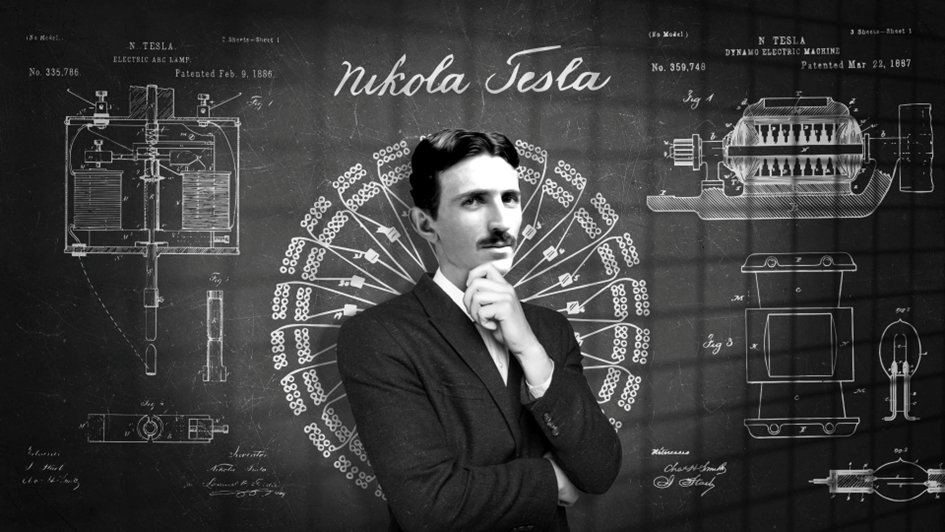
Nikola Tesla a genius ?
With its incomprehensible claims, ideas that are pregnant with great discoveries, obsessions, successes, failures, but most of all, with countless claims and conspiracy theories in which the main character is himself, he attracts people's attention and allows us to step into his life story in a way; Let's get to know the inventor, electrical engineer, mechanical engineer and futurist Nikola Tesla a little more closely.
It is extremely difficult to remain impartial and completely factual, whether writing or reading about Tesla. Any source you draw on may make you a Tesla fanatic who can see lightning flash before your eyes, while another source may be hugely disappointed with it.
The bottomless adventure of science, scattered in the emptiness of space, which Tesla was always curious about; It begins when he was born on July 10, 1856, in a town in Croatia, as the fourth child of a family of five children. Despite his father, who wanted to raise his son as a religious man like himself; His mother had endowed Tesla with his inventive mind and supported him in developing fields such as physics and mathematics.
With the advantage of having a strong memory just like her mother, her ability to store everything she read and see in her extraordinary mental memory is on the lips of many people. Tesla was a bright student in high school, and his interest in physics and mathematics began to increase day by day.
He completed his education in three years, then his life was interrupted for a while with the cholera disease he caught in 1873. He soon ran away from home due to his compulsory military service and threw himself into a more free and peaceful life. It was during this period that he met the works of Mark Twain, whom he admired. In his later years, he would have the opportunity to meet Mark Twain personally and even establish a close friendship.
In 1875 he started the Polytechnic school in Graz. He continued his success as in his previous student years. However, the end of the thread seemed a little off. He studied more than a normal student, slept much less than a normal person would need. So much so that he continued to do this all his life, enough to cause him to have seizures because he slept so little. However, the scholarship he lost in his second year of school and the gambling pit he became involved in cast a shadow over Tesla's bright student life.
He could not complete his schooling and could not return to his family. Thus, he completely ended his relationship with the house where he was born, which formed the basis of his various obsessions and psychological problems, in 1878. He could not hold on to Prague University, which he started in 1880, after his father's death, and he was taking a step into a new life while his student life was over.
His career took off when he moved to Budapest in 1881 to work for the telegraph company, the Budapest Telephone Exchange, which was still under construction. He started the company as an electrical engineer, also worked as a draftsman and made the company functional. He has increased his position with his success in the company where he contributed in many developments.
Subsequently, he was awarded a new job by Tivadar Puskás, for whom he worked. He was working for the Continental Edison Company, now located in Paris. The opportunity to develop and gain experience in the field of electrical engineering made him realize his talent.
He began designing dynamo engines and built the first examples, but had no one to support him financially. Unaware that he would encounter this situation again and again in his later life, he turned to the job offer he received from New York. In 1884, he had started working for Thomas Edison at Edison Machine Works. This is where the famous Edison-Tesla feuds and the $50,000 promise event took place.
Edison, who respected his knowledge and working discipline, and the biggest disagreement between the two during the period he worked with was undoubtedly on alternating current and direct current. While Edison was defending the direct current that he was working on and that enables it to deliver electricity to homes; Tesla advocated alternating current, which he believed would operate more efficiently than direct current.
This conflict of the two ended with Tesla parting ways. Later, Tesla invented the alternating current induction motor at the center of his own ideas. With this invention, which he justified his arguments, he made an invention that enables them to obtain electrical energy more efficiently and to transmit it farther with less expense. Of course, this wasn't Tesla's only success. His mind was like an ocean floating outdated ideas.
This work, which aims to deliver wireless electricity to cities, is Tesla's best-known work. When we enter the story of a success and failure that follows; The Tesla Coil, which he patented in 1891, transmitted electricity over a short distance. Wireless transmission of electricity was an exciting invention. Tesla, who was now obsessed with wirelessly transmitted energy, would have bigger plans in the next step.
Wardenclyffe Tower was his biggest dream. For this work, which is basically a huge model of the Tesla Coil, a huge tower was built using coils at a height of meters and a diameter of 15 meters. If everything were to work according to the plans in Tesla's mind, this tower would be able to carry an incalculable amount of electricity many kilometers away and finally give humanity wireless electricity.
This is where the failures started. In a world where even wired electricity was considered a great blessing, pursuing wireless electricity and trying to achieve it with extremely weak foundations and unsound foundations was now revealing Tesla's evolution from science to a passionate dreamer. This study was disappointing from the very beginning and was at the top of the list of works that were not completed due to the withdrawal of the investors with their pockets burning.
While some sources put all the responsibility on the investors who do not make the necessary investment and do not provide the opportunity, some sources claim that the world is not ready for such an outdated invention and remains in the shadow of capitalism. However, studies examined from a realistic point of view today show that; The Wardenclyffe Tower is simply a failed study.
As stated earlier, Tesla's mind was a vast ocean, and in the depths of this ocean; lay great ideas, studies and passions. A few of them are:
*****Tesla Turbine:***** Compared to the piston engines used from those times until today, the Tesla Turbine provided more efficient fuel consumption. However, forgetting that he is not a capitalist businessman, Tesla learned later that this work would not be accepted.
*****Remote Control*****: In 1898, Tesla gave people a surprising and quite intriguing demonstration. Standing in a pond in Madison Square Garden, he remotely controlled the one-metre ship. He called this invention the Teleautomaton.
*****Shadowgraph:***** Inspired by Wilhelm Conrad Röntgen's X-ray studies, he invented his own X-ray machine, the Shadowgraph, which proved its success by first taking an X-ray of his foot.
*****Radio:***** The patent of the radio, whose original inventor is still being debated, belongs to Tesla today. Since the patent for the important foundations used in the invention of the radio belongs to Tesla, it does not seem wrong to show Tesla as the inventor of the radio.
With his unorthodox idealism, his stance completely against the businessman portrait of many inventors, and his exciting outdated ideas, Tesla has undoubtedly always been a curious and respected scientist. His supporters, who today claim him not only with his great achievements, but also with his strange obsessions and preposterous claims, were unfortunately not with him with such strong feelings when he was alive.
He was alone in his room at the New Yorker Hotel on January 7, 1943, when he died of heart failure. However, he did not complain much about his loneliness. The important thing for him was hard work, new ideas. It is possible to understand Tesla, who does not allow the slightest roughness in his life to undermine his work, with these words: "Be alone. The secret of discovery is being alone. Only when you are alone can you come up with new ideas.”
Now, the number of those who try to understand and support him is quite high. Perhaps what we need most these days is Tesla ethics; striving for social gain that precedes individual gain. The Tesla love that overflows from people is very likely to derive its source from this character stripped of individuality.
What is Probability?
The human community cannot know what will happen in the future, events such as the explanation of coincidences. Making comments about the future is among the character traits of a person.
It is not possible to make a decision with the results of the observation in the events that occur by chance and in some previously unknown events. The word probability is historically written in Latin as probabilitas. This concept is the opposite of the concept of certainty.
Probability is the expression of the result obtained as a result of random effects by measuring the risk with mathematical values. The outcome of an event that takes place cannot be predicted, but it can be one of the outcomes. The actual result can be determined by chance. Luck is something that develops unpredictably. Probability, on the other hand, is a mathematical concept obtained by the realization of something.
Probability, with its earliest known statistical calculations, was developed and emerged by Arab mathematicians working on cryptography in the 8th and 13th centuries. Mere was a very wealthy and gambler person in the 17th century. He would bet on that one of every four dice he rolled would make a 6 for sure. However, when he rolled with two dice, his bets started to get bad results and he lost because a 6 number came out 24 times.
Mere asked his friend Pascal why this game was going bad. Pascal, on the other hand, started the birth of this theory as a result of correspondence with his friend who works on mathematics like himself.
To begin with, probability was developed to study generally discrete events. At the same time, the methods are often based on integrated mathematics. However, over time, the analysis views outweighed. It was decided to add constantly changing ones to probability theory.
When we look at the definition of probability, we come across with many definitions. Probability can be grouped into two broad classes. These are objective opinions and another subjective opinion.
**Objective view;** Probability as the main feature emerges as the best method to describe physical behavior. Those who hold this view think that the probability of an event occurring is that the outcome of the event will occur with the repetition of the event. Frequencyism is among the best examples to be given to this objective view.
If we look at the concept of frequency, it evaluates according to the frequency of events after many trials. The best example that can be given to this is the game of tails and tails.
Subjective opinion; approaches probability from a personal perspective of what will happen and how it will happen in the future. On the one hand, the subjective view looks at probability differently from others by reflecting their personal feelings and beliefs. Thinkers who have a subjective view are used in events that are not equally likely and cannot be repeated to obtain new results. The best example of the subjective view is the Bayesian probability.
It includes expert knowledge and personal experiment results in Bayesian probability. It is based on a mathematical theorem that states how we should update our beliefs as we gain new information. Advocates of this theory think that rational creatures can continue on their way with whatever beliefs they can think of if they do not have knowledge about a subject. They assume that their knowledge is constantly updated as they acquire new information.
If we look at probability in mathematics, it is a measure of the occurrence of an event. Probability is always measured between 0 and 1. The number 0 indicates the impossibility of the probability, and the number 1 indicates the certainty of the event. The higher the probability of an event, the higher the chance of it happening. For example, when a coin is flipped, heads or tails indicate that it has the same probable rank on both sides.
Maths,
Physics,
Finance,
Artificial intelligence,
Mathematical probability is widely used in many fields such as games.
In the rapidly increasing population of the world, predicting the needs of the next year economically enables the development of mathematics and probability. Mathematics and probability play an important role in our daily life. Even if we are not aware of it, many events taking place around us take place with probability theory.
In determining the burning time of traffic lights in the city
How often will the buses we take in the city tour?
Forecasting oil, gold and currencies
With the data obtained, we can sort events such as weather forecasts. These events occur by evaluating the obtained data in terms of probability.
Probability is the basis of many branches of science, as it is used in many branches of science. This whole idea of multiple worlds may sound unnecessary and unappealing, but it is not something to be thrown back. In the multi-world interpretation, it is possible to evaluate the wave function in a deterministic way. Because there is nothing that is unknown or unpredictable.
What Did Albert Einstein Invent?
To summarize Albert Einstein's life in its most general form, he is a German physicist and mathematician of Jewish origin. He is a Nobel Prize winning scientist. Albert Einstein was born on March 14, 1879 in Ulm, Germany. Albert Einstein's life did not start so well. He was born a big and fat baby. Albert Einstein lagged behind his peers and siblings in speaking. He also had problems with this. His fondness for science started at the age of 4-5. His interest in science was discovered with the magnetic compass his father gave him. In the following periods, he would talk about the effects of this compass.
Albert Einstein's life progressed in parallel with science from an early age. He stated that there is a lot to be discovered in this world from an early age. Albert Einstein was raised as a lover of art at a young age while his life progressed along with science. Albert Einstein was an amateur violinist. It is said that he had difficulties in his education life.
The most successful courses were stated as Latin, Physics and Mathematics. He showed moderate success in other subjects. He received a good religious education at a young age and lived accordingly. Then, in the following years, when he became too involved with science, he withdrew from the religious field, never to return.
He achieved great success in algebra, geometry, analytical geometry. He started his university education in Switzerland. During their university years, they met with their friends and pondered on various subjects, especially in the fields of mathematics and philosophy. He was unemployed for 2 years after his university life ended. Then he worked as an inspector in the patent office. Albert Einstein's life began to progress nicely.
After Albert Einstein, he published 4 articles and these articles made a big splash. Then he worked as an academician at universities. He gained world fame with his work. He won the Nobel Prize in Physics in 1921. He immigrated to America because of the war in Germany. He received invitations from many countries. He invited Albert Einstein in our country.
Finally, in a letter he wrote to the US president, he warned the US against the danger of atomic bombing from the Germans. After this letter, the USA started to work to be the only country to have an atomic bomb and it was successful. Albert Einstein was known throughout his life as a peaceful person. He expressed his regret that he had given the idea of an atomic bomb to the USA in the later stages. Albert Einstein's inventions affected the whole world. It can be said that it is the inventions of Albert Einstein that have made it so widely known and known today.
Albert Einstein is recognized as one of the greatest geniuses in history. As I have stated from the beginning of the article, he is a great physicist and mathematician. That's why Albert Einstein inventions Nikola Tesla, Alexander Graham Bell, Edison etc. It does not contain tangible objects such as Albert Einstein's inventions are mostly about space, mass, time, energy, gravity, etc. contains topics. There are also concrete inventions on a scale that will surprise us, albeit a little. Thanks to the theories developed by this scientist, space exploration, atomic energy, application areas of light, etc. used in many subjects.
***Theory of Relativity (Special Theory of Relativity):*** The theory of relativity is known as a theory put forward by considering the gravitational force. The theory of relativity was proposed in 1905. The theory of relativity, body with time, time with body, motion with space, space with motion, that is, all of them are in a connection with each other. The theory of relativity states that the speed of light is the same everywhere. The theory of relativity states that there can be no object faster than the speed of light. It suggests that once the speed of light is reached, time must stop. In short, the theory of relativity argued that time and motion are not independent of each other. It means that there cannot be an object faster than the speed of light and when this speed is reached, time stops. He argues that accelerating objects shorten in length and time begins to move more slowly for accelerating objects. The theory of relativity is a great discovery of Einstein, whose effects are still talked about.
***General Theory of Relativity:*** In this theory, information about the structure of space has been put forward. Newton's gravitational law and special relativity are taken into account in the general theory of relativity. According to the general theory of relativity, space; It is defined as a four-dimensional structure that includes time, curved under the effect of dense mass. Many experiments have been done for this theory and this theory has been confirmed. An example for this theory is the collapse of a star that has completed its life, forming black holes. It is the idea that gravity bends due to the presence of mass in the space-time continuum.
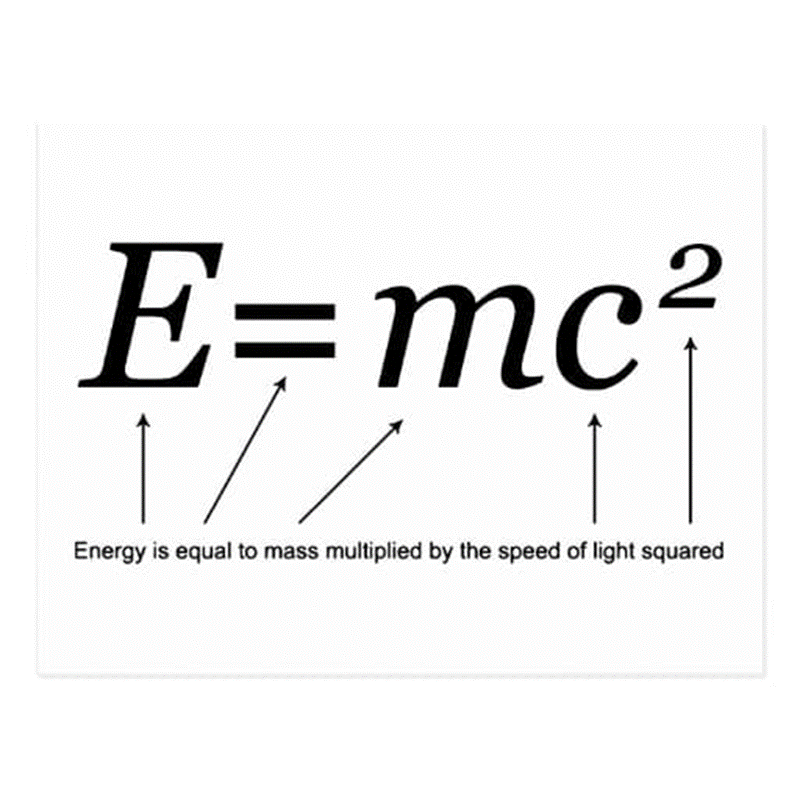
Mass Energy Equivalence: He found the formula E=mc2. There is almost no one among us who read this article and does not know this formula. So what is this formula? Einstein argued that the bond he established between mass and energy is equal to the product of the mass of matter and the square of the speed of light. It is claimed that thanks to this formula, the foundations of modern science were laid. With this formula, he established a link between mass and energy that could not be established before. This formula shows the connection between mass and energy, which paves the way for nuclear energy today.
***Brownian Motion and Statistical Physics*****:** This invention was made to clarify Robert Brown's observation. Brown had observed with his microscope that the pollen was in motion with random splashes in the water. However, he was unable to offer any explanation on this matter. Albert Einstein determined the mathematical relationship between molecular size and motion. Thanks to his invention, he made it possible to calculate the size of atoms and molecules. This invention is seen as one of Albert Einstein's greatest inventions in his lifetime.
***Photoelectric Effect:*** Photoelectric effect emits electrons when light or electromagnetic waves emitted from a particular source fall on the surface of a substance. The emitted electrons are called photoelectricity.
***Einstein's Refrigerator:*** One of the famous genius's least known inventions. Einstein invented a refrigerator that needed no other energy to work. He designed a refrigerator that required ammonia, water, and butane, and virtually no other energy to operate. When he learned that there were refrigerators that leaked toxic fumes and killed people, he worked on this invention with his student. They focused on an idea that operated at constant pressure and eliminated the risk of toxic fumes.
What is Surrealism?
The First World War, which started in Europe in 1914 and spread to the whole world, was a very important turning point in which the destinies of countries changed. It triggered great changes in political, social and economic fields. On the humanitarian scale, it caused great destruction. After the "Great War" that lasted until 1918, humanity, which started to build a new world with the breakthroughs made in the fields of industry, technology and science, began to clearly feel the emptiness and hunger that it was exposed to spiritually.
People who fell into depression and searched for new meanings began to create new literary and artistic movements that would feed their souls. Humanity sought to heal their souls and psychology and to repair the spiritual collapse caused by the war with currents such as futurism, dadaism and cubism.
French André Bréton, the founder of the surrealism movement, was a writer trained in medicine and psychiatry. He first got together with the literati of the period, Louis Aragon and Philippe Soupault, and published a magazine and laid the foundations of the surrealism movement. In 1920, they collaborated with Tristan Tzar, the founder of the dadaism movement, which has an understanding of art against logic. After a while, he left the dadaists and published the first manifesto of the surrealism movement in 1924 with a different stance from them. French literary figures René Crevel, Benjamin Péret, Robert Desnos, Georges Sadoul, Paul Éluard and Antonin Artaud became the first members of this new movement.
Surrealism; It is an art movement that allows the subconscious and the spirit to reveal themselves, without being subject to the interference of mind and thought and without being bound by any rules, values or traditions, through writing, poetry, verbal or other different expression methods such as painting and architecture. It is a kind of psychic automatism.
The word surrealism is derived from the combination of the French words “super” and “réel”.
In his first manifesto, Breton, the father of the Surrealism movement, presented a new writing technique that he found based on the work of Sigmund Freud in the field of psychoanalysis. This technique, called "automatic writing", was invented so that the subconscious can bring itself to the surface by deactivating the conscious.
In this writing technique, the writer takes the paper and pen in his hand and closes his thoughts, what he has learned so far, his judgments and consciousness as much as possible. So he pulls himself out of the way. That is, he puts his consciousness into a passive state. He quickly writes everything that comes to the tip of his pen without thinking. He writes without thinking, without editing, and without stopping. He completes his article by avoiding the control of the mind, completely away from worries and thoughts such as what I wrote, what kind of sentence did I make, did I follow the spelling rules. It never uses punctuation marks. Because all kinds of thoughts and the desire to obey the rules will activate the consciousness and prevent the subconscious from revealing itself.
The result is a surreal work.
The articles written with this technique are not subject to criticism of logic, accepted traditions in society, aesthetic or moral evaluations. The first book that Breton wrote using this technique was "Magnetic Meadows".
In Breton's "second surrealism manifesto" published in 1929, he criticized his current friends who advocated the necessity of being involved in political actions, and argued that artistic creativity should be original and free from ideologies.
With the outbreak of the second world war, many artists went to New York from Europe, so the surrealism movement migrated to America. Although the opinion that the organized surrealism movement in Europe ended as of the second world war is common, it is still possible to see its continuing influence in areas such as fashion, decoration, cinema, architecture, illustration, photography, advertising and marketing.
In the surrealism movement;
It is the most basic writing technique to write with free association as much as possible by disabling the consciousness as much as possible.
Artists were influenced by Freud's psychoanalytic work.
The unknown aspects of human existence have been tried to be revealed. According to this current, reality is much deeper than what the human senses can perceive.
Reason is opposed, it is argued that the subconscious mind actually dominates the conscious.
It is aimed to reflect the complex and mysterious world of the subconscious to life and art.
The real reality was questioned, and methods such as dreams, hypnotism, and drunkenness were used to reach the undiscovered parts of reality.
Punctuation marks are not used in literature. Surrealism is against all rules.
Surrealists are against other literary movements and all traditional art rules. They make fun of these rules.
According to the Surrealism movement, the artist is not a "creator". It is just an automatic tool that reaches your own self and reflects the realities there.
According to the Surrealism movement, art is not a method of showing one's skills, but a game played by adults.
How does the Scientific Research Process progress?
Curiosity is the basis of the emergence of scientific research. People's efforts to understand the changes, events and phenomena in their environment trigger the desire to research. Scientific research preparations begin with the excitement created by this sense of meaning and learning curiosity. Since the research to be conducted is scientific, there are certain stages that need to be implemented. These studies, which are carried out according to a plan, are also called scientific study methods.
Determining the problem about the subject to be researched
Obtaining information by making observations about the identified problem
Data collection as a result of observations and experiments
Determination of tentative hypotheses presented for the solution of problems
Making predictions about solving the problem based on hypotheses
Conducting controlled experiments in accordance with the hypotheses put forward
Analyzing the data obtained as a result of the experiments
Obtaining and reporting the facts as a result of data analysis
To present general theories that explain the causes and consequences of the problem.
Revealing generally accepted laws about how the problem occurs
Scientific research processes are generally carried out according to the processes listed above. However, the type of data to be used in the stages of data collection, observation and experimentation, according to the purpose of the research, makes a difference in the research process. Which scientific field the subject of the research will be covered by, the research process should be determined accordingly. At this point, two different research processes emerge as quantitative and qualitative data.
Quantitative research is based on observations or experiments, according to the numerical research approach in which measurements can be repeated. While collecting and analyzing data in the scientific research process, statistical methods are used without adding personal comments. Results are expressed numerically. For example, in a study to investigate how many books people read on average in a year, these data are obtained numerically by using the survey method. Then, with the help of these numerical data, it can be revealed with various tables that how many books per year are read by individuals according to age groups and gender.
Those who do research in certain scientific disciplines have to use more quantitative methods. Especially the researches in the field of science are mostly carried out using quantitative research processes. Quantitative research is work carried out on a more objective basis. Therefore, the impartiality of the researcher in the process is important in terms of objectivity. At the beginning of the quantitative research, planning is done in advance and all stages of the research are implemented according to the predetermined plan. Since the research is based on the pre-established process, the testing of the determined hypotheses starts from the beginning of the research.
The next step is the creation of categories. It can be planned in advance to divide the groups on which scientific research will be conducted into categories determined according to the purpose of the research. Thus, it is easier to group and evaluate the numerical data to be obtained. For example, when it is desired to measure different effects of the same variable on young and old people, categories can be determined according to age group.
In the quantitative research measurement process, the research environment is carried out in a controlled manner. According to the purpose of scientific research, it is possible to use a limited number of variables and to examine events and phenomena in certain parts. By predicting which variable is effective on which variable, it is ensured that this effect is measured in a controlled manner. Then, the data is obtained by these measurements and expressed numerically.
As a result of obtaining measurements and data, research reports are created by evaluating numerical data. The data in the research report is usually explained with the help of tables and diagrams. These methods are more effective and understandable in the explanation of numerical data.
Qualitative research is a research process in which qualitative data collection methods such as observation, interview and document analysis are used. It is a form of research in which events and phenomena are followed in their natural environment as a whole and realistically. The nature of the research problem determines the selection of the qualitative research process in scientific research.
In the qualitative research process, there is no experimental environment that the researcher can directly control. While determining the research environment during the research process, each event is examined in its natural environment. Qualitative research requires in-depth and detailed studies by making direct contact with people. According to the data obtained, the course of the research may change or it may be necessary to go back to the beginning.
The structuring of scientific research requires the collection of data from a wide variety of types and sources. It is important to carefully evaluate, organize and interpret the data. Findings should be explained in detail, either orally or in writing. In order to decide on the type of data suitable for the research before proceeding to the data collection stage in the quantitative research process; It should be determined for whom the data will be collected and by whom it will be used. It should be decided what type of information is needed and how the information will be evaluated.
When it comes to the data collection stage in scientific research, there are three different data collection methods used in qualitative research; interviewing, observing, examining records and written documents. Data about people's experiences, thoughts and opinions can be obtained by having open conversations with people about the identified research topic. In the observation method, data is obtained by directly observing the activities of people related to the subject and the way of interaction between people.
Examining records and written documents is a longer time-consuming and labor-intensive process. Data is obtained by examining official documents, records, reports, personal documents. The analysis of these data is based on interpretation and critical approach. The researcher becomes a part of the research in qualitative research. The knowledge and experiences of the researcher are also effective in evaluating the data obtained during the research process.

What is Meteor, How Is It Formed?
With the development of technology and the increase in the possibilities of observation and investigation, it has been understood that this event, which could not be understood, is actually an event experienced when solid and small masses moving in space enter the earth's atmosphere, and that even the visible ones are not stars. What people saw and watched was not a shooting star, but a meteor, also known as a meteorite.
Meteor comes from the Latin word 'meteoron', meaning an extraordinary event in the sky. Meteor is the name given to the fact that the substances in the solar system become incandescent as a result of friction with the air at high speed while falling into the earth's atmosphere, and are seen from the earth as a short-term light line, especially at night. In other words, it is the general name of the stones and rock pieces that fall to the earth from space.
The meteor, also known as a meteorite among the people, falls on the earth very rarely. On average, several thousand meteorites fall on the earth's surface annually. However, only about 500 of these stones reach the earth without evaporation. Some scientists say the number is even higher. Since most of the Earth's surface is covered with water, most of the meteorites that can reach the Earth fall into the oceans or lakes. For this reason, the number of meteorites falling on the earth is much more than is known.
According to scientists doing research on how the meteor was formed, the Earth, which revolves around the Sun on a large ellipse at a speed of 30 km per second, occasionally encounters some stones and rock fragments of various sizes circulating in space during this wandering. The speed of these rock and stone pieces is approximately 30 km per second. During the movement of the Earth around the Sun, the stones that are close enough to the Earth gain a high velocity by the gravity of the Earth and enter the Earth's atmosphere.
The walnut or chickpea-sized ones burn in the air and become dust by drawing a light line. This is what people call a 'star falling' or 'star falling'. The larger pieces, on the other hand, are burnt to pieces by the frictional heat created by the first velocity and spilled on the earth. Stones made of iron and nickel among the spilled parts do not crumble. They hit the ground hard and fast like a cannonball. Thus, meteor stones, which are classified as very precious stones and which are even collected today, are formed.
Meteorites are very similar to some rocks on Earth. In order to distinguish meteorites from other rocks, thin sections should be made and examined with a polarizing microscope. Thus, it turns out that the crystallization and menerological compositions of metallic meteorites with a very high density are very different from the materials found in the world.
Very old meteorites were formed 4.5 billion years ago. The study of meteorites helps us understand how the solar system came to be, and also gives information about the materials inside the planets.
Meteorites are divided into 4 basic classes according to their structure and composition. These:
Glassy Meteorites: Glassy meteorites, which are very rarely found on earth, have a glass-like structure.
Stone-like Meteorites (Aerolite): Composed of iron, silicon, carbon, aluminum, oxygen and magnesium.
Stone Iron Sky Stones (Siderolite): It is composed of an almost equal structure with metal and silica-layer ratio.
Ferrous Meteorites (Siderite): It has more iron and nickel in its structure. Apart from that, there are gallium, nickel, germanium and iridium.
Although most of the meteors disappear in the atmosphere, meteorites that bypass the atmosphere barrier and fall to the earth can be small in size and sometimes huge in size. These gigantic meteors can open craters of the same size. The 10 big craters opened by meteorites that have fallen to the earth so far are as follows:
Barringer Crater, Arizona, USA
Bosumtwi, Ghana
Deep Bay, Canada
Aorounga Crater, Chad, Africa
Gosses Bluff, Australia
Lake Mistastin, Canada
Clearwater Lakes, Canada
Kara-Kul, Tajikistan
Manicouagan, Canada
Chicxulub, Mexico
The largest meteorite that has fallen to the earth to date is the Goba Meteorite in Namibia.
Thousands of meteors can be seen together in the sky, moving in one and certain direction. While some meteorites are as small as a pinhead, some meteorites can weigh many tons. When a meteorite reaches the earth's surface, it is called a 'meteroid'.

Century of Progress 1800 – 1900
-1800 - Astronomer William Herschel discovers infrared radiation.
-1803 - John Dalton introduces the idea of atomic weight.
-1811 - Mary Anning finds the first known ichthyosaur skeleton on the Lyme Regis cliffs.
-1820 - Hans Christian Orsted discovers that a nearby compass needle vibrates when a current circuit is opened.
-1821 - Michael Faraday discovers the principle behind the electric motor.
-1837 - Louis Agassiz describes the ice age.
-1842 - Christian Doppler explains why binary stars are colored.
-1845 - German explorer Alexander von Humboldt presents his idea of ecology.
-1859 - Charles Darwin explains his theory of evolution in The Origin of Species.
-1859 - Louis Pasteur refutes the spontaneous generation of life.
-1865 - August Kekule explains the chemical structure of the benzene molecule.
-1866 - Gregor Mendel publishes his work on pea genetics.
-1869 - Dimitri Mendeleev prepares the periodic table of the elements.
-1873 - James Clerk Maxwell publishes the laws of electromagnetism.
-1895 - Wilhelm Röntgen discovers X-rays.
-1898 - Marie Curie insulates radioactive polonium.
The invention of the electric battery in 1799 opened up entirely new areas of scientific research. In Denmark, Hans Christian Orsted accidentally discovered a connection between electricity and magnetism. At the Royal Institution in London, Michael Faraday envisioned the shape of magnetic fields and invented the world's first electric motor. In Scotland, James Clerk Maxwell took Faraday's thoughts and unearthed the complex mathematics of electromagnetism.
Invisible forms of electromagnetic waves were discovered without knowing what they were or uncovering the laws governing their behavior. German astronomer William Herschel, working in Bath, Britain, used a prism to separate the various colors of daylight and probe their temperatures;
He noticed that his thermometer showed a higher temperature beyond the red end of the visible spectrum. Herschel had encountered infrared radiation, and ultraviolet radiation was discovered the following year. It has been proven that there is more than visible light in the spectrum. Likewise, later Wilhelm Conrad Röntgen accidentally discovered X-rays in his laboratory in Germany. British physician Thomas Young devised a clever double-slit experiment to determine whether light is actually a wave or a particle.
The discovery of the wave interference seemed to settle the debate. In Prague, Austrian physicist Christian Andreas Doppler used the idea that light is a wave with a spectrum of various frequencies, explaining the color of binary stars, clarifying what is now known as the Doppler Effect. Meanwhile, in Paris, French physicists Hippolyte Fizeau and Leon Foucault measured the speed of light and showed that it travels more slowly in water than in air.
British meteorologist John Dalton hesitantly suggested that atomic weight might be an important concept to chemists, and he attempted to calculate the weight of a few atoms. Fifteen years later, Swedish chemist Jöns Jakob Berzelius compiled a more complete list of atomic weights. His student, German chemist Friedrich Wöhler, converted an inorganic salt into an organic compound, refuting the notion that living chemistry worked according to separate rules.
In Paris, Louis Pasteur showed that life was not created by itself. The inspiration for the new ideas was diverse. The structure of the benzene molecule came to the mind of German chemist August Kekule when he was going to bed; Russian chemist Dmitry Mendeleev used a deck of playing cards to solve the periodic table of elements problem. Marie Curie was the first to isolate polonium and radium and win the Nobel prize in both chemistry and physics.
The century saw nothing but a revolution in the understanding of life. On England's south coast, Mary Anning has documented a series of fossils of extinct creatures she dug up from cliffs. Soon after, Richard Owen coined the word "dinosaur" to describe the "terrible lizards" that once roamed the planet. Swiss geologist Louis Agassiz further developed the idea that Earth has experienced very different conditions throughout its history, arguing that much of the Earth was once covered with ice.
Using interdisciplinary insights, Alexander von Humboldt uncovered the connections in nature and initiated ecology studies. In France, Jean-Baptiste Lamarck outlined a theory of evolution; He mistakenly believed that the transfer of acquired traits was the driving force of evolution. Then in the 1850s the British naturalists Alfred Russel Wallace and Charles Darwin thought of evolution by natural selection. Thomas Henry Huxley showed that birds may have evolved from dinosaurs, and the evidence supporting evolution has increased.
Meanwhile, a German-speaking Silesian priest named Gregor Mendel studied thousands of pea plants, revealing the basic laws of genetics. Mendel's work would be neglected for several decades, but his rediscovery would provide the genetic mechanism of natural selection.
Touching the Spring of the Air
In the 17th century, many scientists in Europe investigated the properties of air, and their work led the Irish-British scientist Robert Boyle to deduce the mathematical laws that explain the pressure in a gas. This work was associated with a broader discussion of the nature of space between stars and planets. To the "atomists" there was empty space between the celestial bodies; For the Cartesians (following the French philosopher Rene Descartes), the space between particles was filled with an unknown substance called ether, and it was impossible to generate a vacuum.
In Italy, mathematician Gasparo Berti conducted experiments to understand why a suction pump could not lift water above 10 meters. Berti took a long pipe, closed one end and filled it with water. Then he put his mouth in a tub of water and turned it upside down. The water level in the tube dropped until the column rose about 10 meters.
In 1642, her compatriot Evangelista Torricelli, aware of Berti's work, built a similar device, but used mercury instead of water. Mercury is 13 times denser than water; so the liquid column was only 76 centimeters high. Torricelli's explanation for this was as follows: the weight of the air above the mercury in the bowl was pushing the mercury down, balancing the weight of the mercury in the column. He said that the area above the mercury inside the tube is a vacuum. This situation is explained by pressure (force over a certain area) today, but the basic idea is the same. Torricelli had invented the first mercury barometer.
Blaise Pascal's barometer experiments showed how air pressure changes with altitude. Pascal made important contributions to mathematics as well as physics.
French scientist Blaise Pascal became aware of Torricelli's barometer in 1646 and immediately began to conduct his own experiments. One of these experiments, carried out by his brother-in-law, Florin Perier, would show that air pressure varied with altitude. A barometer was placed on the floor of a monastery in Clermont and was observed by a monk during the day. Perier took another barometer to the top of Puy de Dôme, about a thousand meters above the town. The mercury column at the top of the mountain was 8 cm shorter than the one in the monastery garden. Since the amount of air above the mountain was greater than that above the valley below, the weight of the air indeed held the liquid in the water or mercury tubes there. Because of this and other studies, the modern unit of pressure is called Pascal.
– If you take a barometer to the top of a mountain, the height of the mercury in the barometer will decrease.
– This is because the air pushing the mercury down is less at the top.
– When the receiver is evacuated in a barometer, the level of mercury drops.
– That is, the less air in the receiver, the lower the pressure.
– The smaller the mass of the air, the smaller the “spring of air”.
Experimental Results
Boyle conducted many different experiments with the air pump and described them in his 1660 book New Experiments Physico-Mechanicall, Touching the Spring of the Air and its Effects. In the book, he tried to point out that all the results described were the product of experimentation, at a time when even famous experimenters such as Galileo often announced the results of "thought experiments."
Boyle's Law
According to Boyle's law, the pressure of a gas multiplied by its volume was a constant as long as the amount of gas and temperature were kept the same. In other words, if you decrease the volume of a gas, its pressure increases. It is this increased pressure that produces the air spring. On a bicycle pump, you can feel the effect if you cover the end of the pump with one finger and push the pump handle in.
Although this law was named Boyle, it was not Boyle's first proposed it, but English scientists Richard Towneley and Henry Power, who conducted a series of experiments with the Torricelli barometer and published their results in 1663. Boyle saw the first draft of the book and discussed the results with Towneley. He verified the results by experiment and published "Mr Towneley's Hypothesis" in 1662 as part of a response to criticism of his early experiments.
Boyle's work on gases was particularly important because of his careful experimental technique and because he fully reported his experiments and possible sources of error, whether they yielded the expected results or not. For this reason, many sought to expand his work. Today Boyle's Law is combined with laws uncovered by other scientists to form the "Ideal Gas Law", which approximates the behavior of real gases under changes in temperature, pressure, or volume. His thoughts eventually led to the development of kinetic theory as well.
**Who is Robert Boyle?**
Robert Boyle was born in Ireland, the 14th child of the Earls of Cork. He was tutored at home before attending Eton College in England and later traveled around Europe. In 1643, his father died, leaving enough money for him to devote all his time to science. Boyle moved back to Ireland for two years; but from 1654 to 1668 he lived in Oxford in order to carry out his studies more easily, then moved to London.
Discover yourself
The cornerstone of starting any kind of development is self-knowledge. We cannot be in a development process without being aware of our shortcomings and discovering what our talents are. We must begin by analyzing ourselves. We should ask ourselves questions such as what are my strengths and weaknesses, what do I want to do. And we should give honest answers to these questions and compare ourselves to others when appropriate. Because human being is a social creature by nature, he can affect or be affected by his environment. At this point, what I mean by comparison is a positive situation in the form of taking an example, envy and being inspired by these people. People always want to be the best, but they miss a point. Today, people who have proven their existence in a certain area and whose name is identified with their work did not come to their position with the touch of a magic wand by a fairy. Recognizing their personalities, they climbed over the obstacles and difficulties that stood in their way on the path they believed in.
You cannot change your feeling without changing your mind. Since I am aware of my shortcomings, "What can I do?" We have to make certain changes by questioning. Then there is the stage of acceptance, in this stage we know our weaknesses and are ready to accept them. This is the most important stage because at this point the person can give up, constantly criticize himself and adopt this dissatisfaction as a lifestyle. Right here, it is important to remember that “Nobody is perfect”.
Once we start accepting where we want to start and accepting ourselves, we have to move on to the planning phase. Whatever our goal, our plan, the point we want to reach, we should focus on it as much as possible. We should not be afraid of failure, we should know that we cannot discover ourselves without trying. Personal development is a lifelong process. Patience is the biggest weapon in this process. There is no end to development, strive for the better whatever you are, and as time goes by, you will realize that you are more than you want to be. You don't have much time to be yourself.
Write down your goals and dreams and attach these objects where you can see them in your home or workplace. In this way, it will motivate you by constantly communicating. Dream big, let the sky be your limit. Spend time with people in the same lane who aim for similar things as you. Look for ways to communicate with people you take as an example, ask what you are curious about. Don't be afraid to learn from your past mistakes and make new ones. I am one of those who believe that one misfortune is better than a thousand advices. Read books that you think will be effective in getting you to your goals. Education is the best way to improve ourselves.
Take up certain hobbies and rest your mind from time to time. Reward yourself first for your achievements. Keep your network wide, every person you know will add something to you. You can't please everyone, remember that the work you do must first get you through. Our desire to achieve something consists of 3 steps. To wish, to ask, to devote. Ask a lot.
Personal development allows us to look at things positively, losing is not the end of the world, if necessary, we can get up and try again and lose again, but we must never give up. Being friends with people you walk on the same path ensures that you don't get lost. It enables us to be self-confident individuals. Self-confident individuals are highly motivated and attract attention in their environment. They do great things because they have big goals and there is no end to the struggle to be the best.
But without knowing who you are, you cannot love yourself without being aware of who you are. Never stop trying to get to know yourself. Only by knowing yourself can you realize your full potential. Never lose your self-respect, remember you are the only one. And you only have one life to live. Finally, don't tell him according to your head, not to try to win, but to walk, to be happy before making you happy, not because of what anyone says, but because you chose, just be you with your mistakes, truths and contradictions, reject everything and follow your dreams.
Personal development allows us to look at things positively, losing is not the end of the world, if necessary, we can get up and try again and lose again, but we must never give up. Being friends with people you walk on the same path ensures that you don't get lost.Personal development is a lifelong process. Patience is the biggest weapon in this process. There is no end to development, strive for the better whatever you are, and as time goes by, you will realize that you are more than you want to be.
How was plastic invented?
The discovery of synthetic plastic in the 19th century paved the way for the creation of a mass material unlike any previously known – lightweight, rust-free, and can be molded into any imaginable shape. Plastics can occur naturally; but all plastics in common use now are fully synthetic.
In 1907, Belgian-born American inventor Leo Hendrik Baekeland created one of the first commercially successful plastics, now known as bakelite. What gives plastic its special character is the shape of its molecules. With only a few exceptions, plastics are made up of long organic molecules known as polymers made up of many small molecules, or monomers. Few polymers occur naturally, like cellulose, the main woody substance in plants.
Although natural polymers were too complex to be prepared in the 1800s, some scientists began investigating ways to create them synthetically from chemical reactions. In 1862, British chemist Alexander Parkes created a synthetic form of cellulose that he called Parkesine.
A few years later, American John Wesley Hyatt developed another form of cellulose, referred to as celluloid.
After Baekeland developed the world's first photographic paper in the 1890s, he sold the idea to Kodak and bought a house with his own laboratory equipment. Here he experimented with creating synthetic shellac.
Shellac is a resin secreted by the female lac beetle. It is a natural polymer used to give furniture and other objects a resistant, shiny shell.
Baekeland realized that by treating phenol resin from coal tar with formaldehyde, he could produce a type of shellac. In 1907 he added various powders to this resin and found that it could create a remarkably hard, formable plastic. This plastic is known chemically as polyoxybenzylmethyleneglycolanhydride, but Baekeland simply called it Bakelite.
Bakelite was a "thermoset" plastic, a plastic that retains its shape after heating. Due to its resistance to heat and non-conductivity, Bakelite was soon used in the manufacture of radios, telephones and electrical insulators. It was quickly used for other purposes as well.
There are thousands of synthetic plastics available today, including plexiglass, low-density polyethylene, and cellophane. The majority are based on hydrocarbons (chemicals made from hydrogen and carbon) derived from petroleum or natural gas. However, in recent decades, carbon fibers, nanotubes, and other materials have been added to create super-light, super-strong plastic materials like kevlar.
Leo Baekeland was born in Ghent, Belgium, and studied at the university there. He became associate professor of chemistry in 1889 and married Celine Swarts. While the young couple were on their honeymoon in New York, Baekeland met Richard Anthony, the president of a famous photography company. Anthony was so impressed with Baekeland's work on photographic processes that he hired him as his chemistry consultant. Baekeland moved to the USA and soon started his own business.
Baekeland invented the first photographic paper known as Velox, before developing the Bakelite that enriched it.
He has many inventions other than plastic and has registered more than 50 patents in total. Toward the end of his life he became a strange recluse who ate only canned food. He died in 1944 and is buried in Sleepy Hollow Cemetery in New York.
**Notable Works:**
1909 – Paper on Bakelite read to the American Chemical Societ
Historical Developments About Plastic
1839 – Berlin pharmacist Eduard Simon distills styrene resin from Anatolian sweetgum tree. A century later this was developed by the German company IG Farben and converted into polystyrene.
1862 - Alexander Parkes develops the first synthetic plastic Flooring.
1869 - American John Wesley Hyatt creates celluloid, which is used as a substitute for ivory to make billiard balls.
1933 - British chemists Eric Fawcett and Reginald Gibson of the ICI company create the first practical polyethylene.
1954 - Italian Giulio Natta and German Kari Rehn invent polypropylene, the most widely used plastic today, without knowing each other.

Immanuel Kant-Critique of Pure Reason
Famous German philosopher who lived between 1724-1804. His main works are: Kritik der Reinen Vernunft (Critique of Pure Reason), Kritik der Pratischen Vernunft (Critique of Practical Reason), and Kritik der Urteilkraft (Critique of Judgment).
Fundamentals: Kant, who brought epistemology to the fore in accordance with the development course of modern philosophy, was primarily influenced by Hume. In his own words, Hume was the philosopher who woke him from his dogmatic sleep and gave a new direction to his research in the field of speculative philosophy. On the other hand, he determined that Descartes' rationalism also contained some positive aspects, and was almost fascinated by the way our minds worked when dealing with mathematics. Kant was further influenced by science, especially physics, which made spectacular developments in the seventeenth and eighteenth centuries. For Kant, science is a universal discipline whose premises are precise and whose methods can only be questioned when a philosophical skepticism like Hume's is adopted.
According to Kant, a scientist, on the one hand, accepts the conclusions of his predecessors; Again, when a scientist engages in new research in addition to these accepted results, he uses experimental methods. Science is unbiased and objective. On the other hand, the method of science, especially modern physics developed by Newton, which had very successful results, developed, according to Kant, by surpassing both rationalism and empiricism. In other words, physical science continues its development by falsifying both the results of rationalism and the results of empiricism. Accordingly, rationalism, which takes mathematics, which is considered to be the most solid knowledge model, as an example, reaches a priori conclusions about the things themselves, without turning to the things themselves, without making contact with the things themselves, only by connecting the thoughts to each other.
However, physics, using mathematics, turns to the things themselves, and successfully establishes the contact with the things themselves, which cannot be established by rationalism. According to Kant, the empiricism of the English philosopher Hume took a skeptical view of causality, arguing that we can never know with certainty that the same effect will always follow from a given cause. However, the science of physics, which has achieved very successful results, is almost entirely based on the principle of causality. In this context, Kant thought that his task was to ground science, especially physics, which could not be explained and justified by either rationalism or empiricism, and to find out how the human mind works when he thinks scientifically. In other words, he believed that his first and fundamental mission in philosophy was to ground science and then to defend the rationality of morality and religion. However, this is not an easy task at all, because science and religion have been in a relentless struggle against each other for centuries, and science has embarked on an absolute victory over the authority of religion.
According to Kant, this victory, while good and positive from the point of view of science, is a disaster from the point of view of morality and religion. There is no doubt that it is a good thing that science gains its autonomy from the interventions of religion, but the victory of science is a real disaster from the point of view of humanity, from the point of view of religion, if this means that all non-scientific beliefs, religion and morality are groundless and meaningless. Kant, then, has not only had to ground religion, science, and morality, but has had to show what it means to be a rational being. In order to realize this aim, he developed his own epistemological idealism, known as transcendental epistemological idealism, by taking the elements that he deems important from both Descartes' rationalism and Hume's empiricism, and after showing the philosophical foundations of ascendant science, he became a Christian based on the idea of freedom and duty. He made an effort to defend his morality. Views of Knowledge: Immanuel Kant, who made a synthesis of rationalist philosophy and empiricist philosophy in his thought, argued that the contribution of both experience and mind in knowledge is inevitable. He first showed that even the simplest experience, sense impressions, contains an a priori element, an element which cannot derive from experience, but creates and enables experience. Kant, who named the time and space corresponding to the a priori elements in question, the transcendental conditions of the experiment, thus found the opportunity to reveal the synthetic nature of the judgments of mathematics about space and number, against Hume's view that mathematical sciences have a purely analytical structure. In other words, according to Kant, who defines the basic, separating activity of the mind in knowledge as synthesizing the raw and unprocessed material coming from experience and combining this material and giving it a unity, the mind first of all integrates our various experiences into certain patterns of intuition. by placing it. The said patterns of intuition are time and space.
Accordingly, we perceive things as necessarily occurring in time and space. However, time and space are not ideas, impressions, or concepts derived from sense-experience. According to Kant, time and space are encountered directly and unmediated in intuition. These are the a priori patterns of intuition, that is, prior to any experience, and which are the indispensable conditions of any experience. That is, these are the glasses through which we always perceive the objects in the sense-experience. After giving the name of transcendental aesthetics to this teaching of time and space, he moved on to transcendental analysis, the doctrine of categories, and showed that just as sensibility or experience contains a priori forms of perception, research and knowledge of nature include a priori principles such as relevance, substance, and causality. .
Existing in an unsystematic way, even in the most ordinary thought, these categories emerge as essential elements of a mathematical-mechanical natural science and make a rational conception of nature possible. In other words, according to Kant, who states that there are certain categories related to the thought or the human mind's bringing a unity to the material coming from the sense-experiment or putting the material in question through a synthesis, according to Kant, the mind uses the said synthesis or combining activity to make various judgments. so that these judgments form the essential components of our interpretation of the world.
In order for appearances and phenomena to be understood in some way, they must be given a structure through the categories of understanding. What does not fit into the categories of understanding cannot be known by the human mind. According to Kant, our sense-experience exhibits a certain structure and unity. This structure and unity exhibited by sense-experience can only be explained by the activity of the understanding, which organizes appearances according to their own categories. However, since categories are subjective conditions of thought or knowledge, the question arises how they can have objective validity, that is, provide the conditions under which our knowledge of objects is possible. According to Kant, the objective validity of categories as a priori concepts rests on the fact that human sense-experience with objects is possible only thanks to these categories. An object of sense-experience can be thought of only in these categories. A thought about an object, all judgments about it, and therefore knowledge about it, is possible only within the conceptual framework provided by the categories. The most important results of this understanding of knowledge of Kant, who said that the human mind can only know the phenomena to which it has given a structure through its categories, that things cannot know themselves by going beyond this, that objects in sense experience can only be known because they conform to the functioning of the human mind, and that all empirical laws are reduced to the laws of the human mind, an absolute determinism, the limitations of knowledge and the impossibility of metaphysics. Our knowledge is limited in two respects. Knowledge is, above all, confined to the world of sense-experience.
Second, our knowledge is constrained by the ways in which our perceptive and thinking faculties process and organize the raw material of experience. Kant, of course, does not doubt that the world that appears to us is not the ultimate and highest reality. Indeed, he made a distinction between phenomenal reality, that is, the non-sensuous and intelligible world. What is it when something is not detected? What does the thing itself mean? Metaphysics: of course we cannot know what we do not perceive. The things we know are not the noumena, the things themselves, but the phenomena, the appearances of things. The objects that we know are those that are perceived through the senses. We also know that the sensory world is not created by our mind.
Light Travels Slower in Water
In the 17th century, scientists began to investigate whether light has a finite and measurable speed. In 1690 Christiaan Huygens thought of light as a longitudinal wave and predicted that the wave would travel more slowly in glass or water than in air. In 1704, Isaac Newton published his theory of light as a "particle" or stream of particles. Newton's explanation of refraction – the bending of a light beam as it passes from one transparent material to another – assumed that light travels faster as it travels from air to water.
Calculations of the speed of light were based on astronomical facts showing how fast light travels through space. The first terrestrial measurement was made in 1849 by the French physicist Hippolyte Fizeau. A beam of light was held at a tooth pitch of a rotating gear wheel. Then this light was reflected by a mirror placed 8 km away and passed again through the next tooth gap of the wheel. Taking time and distance, as well as the precise speed of the spin that made this possible, Fizeau calculated the speed of light at 313,000 km/s.
***Conflict with Newton***
In 1850, Fizeau collaborated with his physicist friend Leon Foucault; Foucault adapted Fizeau's device and made it smaller by reflecting the beam of light from a rotating mirror instead of passing it through a cog. The light turned into the rotating mirror would be reflected on the far mirror only when the rotating mirror was at the right angle. The light returning from the fixed mirror was reflected again by the rotating mirror; but since this mirror moves as the light travels, it would not reflect directly back to the source.
In Foucault's experiment, the speed of light was measured from the angle difference created when a beam of light was reflected from a rotating mirror to the stationary mirror and back to the stationary mirror.
The speed of light could be calculated from the angle between the light traveling to and from the rotating mirror and from the rotational speed of the mirror.
The speed of light in water could be measured in the device by placing a water tube between the rotating mirror and the stationary mirror. Using this device, Foucault determined that light travels more slowly in water. According to him, light as such could not be a particle, and this experiment was seen at the time as a refutation of Newton's theory of particles. Foucault further developed his device and in 1862 measured the speed of light in air at 298,000 km/s; very close to today's 299,792 km/s.
****Who is Leon Foucault?****
Born in Paris, Leon Foucault was primarily homeschooled before entering medical school, where he took lessons from bacteriologist Alfred François Donne. Unable to tolerate the sight of blood, Foucault soon dropped out of school, became Donne's laboratory assistant, and found a way to take pictures with a microscope. Later, he worked with Hippolyte Fizeau and took the first photograph of the Sun.
Besides measuring the speed of light, Foucault is famous for showing experimental evidence of the Earth's rotation in 1851 using a pendulum and later a gyroscope. Although he had no formal scientific training, Foucault was given a chair at the Imperial Observatory in Paris. He also became a member of many scientific societies and is one of the 72 French scientists whose name is inscribed on the Eiffel Tower.
****Historical Developments About the Speed of Light****
-1676 – Ole Rømer makes the first successful measurement of the speed of light using the eclipses of Jupiter's moon Io.
-1690 - Christiaan Huygens publishes Treatise on Light, which argues that light is a type of wave.
-1704 - Isaac Newton's Opticks proposes that light is a stream of "particles".
-1864 - James Clerk Maxwell, the speed of electromagnetic waves is so close to the speed of light that he realizes that light must be an electromagnetic waveform.
-1879-83 - German-born US physicist Albert Abraham Michelson develops Foucault's method and achieves the speed of light very close to today's value.
Space-Time
In the 1970s, physicists Stephen Hawking and Jacob Bekenstein noticed a connection between the surface area of black holes and the microscopic quantum structures that determine their entropy. This was recorded as the first link established between Einstein's general relativity and quantum mechanics.
Nearly 30 years later, theoretical physicist Juan Maldacena observed another connection between gravity and the quantum world. This connection led to the development of a model that suggests that space-time can be created or destroyed by varying the amount of entanglement between different surface regions of an object. In other words, this model proposes that space-time is a product of entanglement between objects.
To delve deeper into this idea, ChunJun Cao and Sean Carroll of the California Institute of Technology (Caltech) set out to see if they could derive the dynamic properties of gravity (which we are familiar with from general relativity) using the structure in which space-time consists of quantum entanglement. They published their work on the online platform arXiv.
With the help of an abstract mathematical concept called Hilbert space, Cao and Carroll were able to find similarities between the equations governing quantum entanglement and Einstein's equations of general relativity. This supports the idea that space-time and gravity arose from entanglement.
Today, nearly everything we know about the physical properties of our universe can be explained by either general relativity or quantum mechanics. General relativity does a good job of explaining movements at the very large scale, such as galaxies and planets, while quantum mechanics helps us understand the world at the very small scale, such as atoms and subatomic particles. However, these two theories do not seem very compatible with each other. This has led physicists to seek a "theory of everything," an elusive theory that explains everything, including the nature of space and time.
Since gravity and space-time are such important parts of "everything," their work could advance the search for a theory that reconciles general relativity with quantum mechanics, according to Carroll. However, he also points out that his work is open to discussion and narrow in scope. “Our work doesn't say much about other forces of nature, at least for now. That's why we're still a long way from integrating 'everything',” adds Carroll.
Still, if we can find such a theory, we may find answers to some of the biggest problems scientists face today. For example, we can understand the true nature of dark matter, dark energy, black holes, and other mysterious cosmic objects.
Researchers are already taking advantage of the quantum world to develop computing technologies, and a theory of everything can accelerate this process by bringing new perspectives to issues that continue to confuse people.
While the process of theoretical physicists' search for a theory of everything is still somewhat "ragged", each new piece of research, debatable or not, brings us one step closer to that theory and to leading a new era in humanity's understanding of the universe.
Two researchers have discovered a potential bridge between general relativity, one of the leading theories in physics, and quantum mechanics, which could require physicists to rethink the nature of space and time.
*Albert Einstein's* general theory of relativity defines gravity as a geometric property of space and time. The greater the mass of an object, the greater the bending of space-time, and this bending is felt as gravity.
Garden of the Mind
The bee's body contains both poison and honey. The bee in the same body does not confuse the two. While the same bee honey heals one, the poison hurts and even kills another. The bee does not take honey from the flower, the pollen it takes from the flower is pollen. It transforms this pollen into honey with the feature that exists in its own system in its own body. The system called human is the same when you look at it. The difference between the bee and the bee program has been completed. He unconsciously does this transformation work in his body with the program coded into him unconsciously. Man has willpower. He creates the transformation in his system only with the choices he will make according to his own level of consciousness.
In the human system, positive and negative emotions such as anger, love, fear, trust, courage are all together. The human system determines which emotion it will use, depending on the level of development, level of consciousness and belief it has, which of these emotions will be dominant and will be active. The emotion he determines creates his thoughts, his thoughts, his behavior, his behavior, his character, and therefore his life style and quality.
So where does one get the information that determines consciousness? where it stores it and how it transforms it into consciousness so that it can make choices in its feelings with this consciousness. A person begins to receive this information in the mother's womb. After birth, parents continue to receive from the environment and then from teachers. This information is constantly recorded in your subconscious. The subconscious mind is the garden of the mind. Yes, man has a mind garden, and this garden is constantly recorded. These records are most intense between the ages of 0-6. Recordings of this period continue unconsciously until adolescence, and then continue as conscious recordings. Families are the first gardeners of this mind garden. The second gardeners are the teachers. Every thought seed that is planted in our mind garden through words or events without being aware of it before turns into belief. These beliefs determine our choices. I feel very sorry for the comments made by mothers whose children are in the first grade of basic education, especially in the first grade, on the platforms they create on social media. I feel sorry for these kids.
It is very sad that these mothers, being unaware of the harm they cause to their children and to themselves, can actually experience the beauty of their children's first steps in education, which they can spend with excitement and joy, but it is very painful to turn this into a nerve wrath...
There are all kinds of emotions in the system called human. Which of these emotions he will use will depend on the knowledge he has acquired and the level of consciousness he has reached. The basic knowledge that will turn into that consciousness will be formed by the seeds of positive or negative thoughts that we plant in their minds. Just like Edison's mother did to her child...
“When Thomas Edison came home one day, he gave his mother a piece of paper and said, “My teacher gave it to me and only told me to give it to you.” "We don't have a teacher. Please train him yourself." When Edison's mother passed away many years later, he was one of the greatest scientists of the century and one day, while going through old family belongings, he suddenly found a folded paper in the corner of a drawer and opened it. He is a child. We don't let him come to our school anymore…” was written. After hours of crying, Edison wrote the following lines in his diary: Thomas Alva Edison was a “confused” child, turned into the genius of the century by a hero mother. If the mother had read that letter as it was, the child would have been There would be belief in failure, and he would not be able to set the limits of reading and learning, and he would not be able to deal with it at all, and he would not be the genius of the century.
In the human system, positive and negative emotions such as anger, love, fear, trust, courage are all together. The human system determines which emotion it will use, depending on the level of development, level of consciousness and belief it has, which of these emotions will be dominant and will be active.
A person begins to receive this information in the mother's womb. After birth, parents continue to receive from the environment and then from teachers. This information is constantly recorded in your subconscious. The subconscious mind is the garden of the mind.
Consciousness and Mind
Although consciousness is defined as a concept with different features by different branches of science, it all means that the individual is aware of his own existence (interpreting his awareness). In order to talk about the ability to reach this state of interpretation and awareness, it is necessary to talk about the existence and importance of the mind. Consciousness and mind are shown as synonyms and concepts in some sources, but it should be said that they are not. The mind can be described as a skill/process that we can define as the stream of consciousness and includes all the conscious processes of the brain. The mind, which is especially described by modern views, is a state of thought or a state of being conscious. In this case, it can be said that the concept of mind is a broader concept that includes the concept of consciousness or the state of being conscious. This idea, which is closer to the concept of consciousness used in biology or philosophy, allows to accept the concept of consciousness as a physical function, a function of the brain. The concept of consciousness in the field of psychology, which states that the state of mind and mood affect consciousness, can be explained as the combination of the state/reaction formed in the mind, which we can define as 'spiritual consciousness', with the concept of consciousness formed by the mind and physical processes.
The concept of consciousness used in biology and medicine can be explained as a function of the brain and other parts of the central nervous system. It is accepted as consciousness that various stimuli are perceived by the sense organs and transmitted to the brain by the nervous system, and that the obtained information is sorted and processed in the brain and then reacts. Therefore, any situation that disrupts/changes this process can make a difference in the outcome of the process. For example, a person with hearing impairment cannot reach the conclusion that other individuals reach because they cannot receive auditory stimuli. Similarly, the deterioration/slowing down of the mental functions of the person who drinks alcohol will result in different reactions resulting from the procedure and results such as imbalances in movements. The concept of consciousness used in psychology and psychiatry considers the interaction between the individual and the environment as a much more complex process. He thinks that besides physical stimuli, mood also changes consciousness, perception and response. The individual, who is not able to perceive all stimuli, may reach different levels of consciousness and show different reactions when his mood is bad or distressed. Similarly, the level of consciousness between an individual with an assertive personality and another individual with an embarrassed, self-conscious personality may be different. The concept of consciousness in philosophy differs depending on the philosophical system advocated. Consciousness, which is accepted as a function of the brain by positivist philosophies, was accepted as a separate ability different from the phenomena that make up the physical world in previous philosophical systems.
The concept of consciousness, which is evaluated in terms of sociology, shows that the individual living in different human groups shows different characteristics and has different levels of consciousness. A person who manifests himself as an individual who does not abide by the rules under the influence of the groups he is in during adolescence, and exhibits appropriate behavior patterns, may appear as a person who adheres to the rules and is compatible with the contributions of the group/groups he is in during his adulthood. Therefore, the social groups/environments that the individual is in lead to different levels of consciousness in different periods and places. Considering political or religious structures, examples suitable for this idea can be multiplied.
**Generating thoughts**
The appearance of conscious awareness gives the impression of diffuse and homogeneous spread to the brain. The forebrain lobes functionally organize inputs, formulate and plan temporally forward behavioral strategies, organize and analyze outputs and put them in correct chronological order; they are believed to fulfill these functions, at least with the available data. The cerebral cortex areas, which we call the prefrontal region and located in the forebrain lobe, use this information to help with advanced recollection research and the fulfillment of advanced movement management and planning functions. In case of damage to the prefrontal cerebral cortex in the frontal lobe, significant losses are observed in the patient's social self-limiting and supervisory control mechanism and the ability to discover something new.
Quantum Jump (Leap) Technique
There is an intense energy flow in the universe we live in. According to quantum logic, human thinks and transfers energy to the universe in direct proportion to his thoughts. This energy, which it transmits through cosmic consciousness, is included in the flow of life.
Our subconscious shapes our lives. Negative thoughts chain us at the very beginning of the road, before we even take our steps. Positive thoughts motivate us and feed our self-confidence. The person using the quantum philosophy consciously clears his negative thoughts from his subconscious. It strengthens positive feelings and thoughts. It changes the perspective. This conscious effort spreads happiness and positive energy around the person. The high energy emitted attracts success and happiness. Our consciousness is the center of our senses and perceptions. Whatever we record there flows into our minds and comes to us as a thought. If we explain it in one sentence and based on the law of attraction: “What we think we live, what we think we become.
**What is Quantum Leap?**
Quantum leap is a complex concept. Therefore, I think it will be more useful for you to understand with an example. Water is in liquid form. When we boil water, that is, when we apply heat, it evaporates and turns into a gas. Likewise, when the temperature drops to minus, it turns into ice. It becomes solid. All of these changes are qualitative. This qualitative change is actually the product of quantitative changes. The change of state of water, which we perceive as a liquid, arouses admiration and is considered as a splash.
The same is true for humans. People unconsciously develop patterns of thought and behavior for themselves. Going out of these patterns and moving to a different pattern is a kind of leap. The beautiful thing about jumping is that people get what they dream of.
It is through the development of awareness that one can realize one's own quantum leap. Whatever we aim at, we can think of as our destination. In order to reach our goal, we must first get rid of our prejudices. We can see it as a kind of road clearing, road clearing and removing obstacles from the road. Then we can move on by removing our inhibiting beliefs and replacing them with empowering ones. When we achieve this, we can achieve our goals at the right time. Our quantum leap leads us to our dreams.
**Quantum Leap Principles**
The quantum leap is an understanding that overturns the classical understanding of fatalism. It rejects all the reasons we seek for our failures. It removes negative attributes such as bad luck and misfortune as much as possible.
There is a wonderful balance in the universe. We want it to give us what we want. However, what we experience is what we actually feel. So we have to be more aware of our emotions. Our emotions ignite the quantum leap.
According to the laws of physics, a substance can only exist in one medium. Quantum physics talks about the concept of parallel universe. According to this concept, a person can have another life as a result of his choices. It is enough to get out of thought patterns. He can lead the life he wants in a different universe. Starting from this point, let's summarize the principles of quantum leap if you wish.
**Desire and decide**
To believe that what we want will happen and to detail whatever we want as much as possible. For example, if we want to buy a house, we need to imagine how many floors and in which district. We strengthen our faith by detailing from wall paint to furniture, from curtains to carpets and even to accessories.
Using the power of imagination
To gather information
To believe that we deserve what we want and to be motivated.
Being determined and not giving up.
Trust your intuition and strengthen your intuition.
Instead of questioning how it would be, “How would it be faster?” focus on the question.
To appreciate yourself.
Not to lower the energy when faced with obstacles and to try different ways.
What Does the Quantum Leap Technique Bring to Us?
Quantum philosophy, put forward by the German physicist Werner Heisenberg, shook people's worldviews to their foundations. Undoubtedly, the concrete traces of the reflections of the quantum way of thinking on life were important. In this section, I will try to detail the effects of quantum thinking on our lives.
Our thoughts directly affect our actions. Quantum thinking forms the basis of both our physical and mental health. We are born with a high and perfect flow of energy. The anger, guilt, anxiety and fears we experience afterwards lower our energy.
The most important thing that quantum thinking brings to us is the opportunity to know ourselves. As soon as we know ourselves well, we discover our problems without an intermediary. Then we learn to manage our thoughts. We focus on solving it permanently. It is possible for us to solve our problems if we apply the right quantum leap techniques. Likewise, we begin to understand others and unravel the complexity of the universe. The quantum leap technique allows us to communicate deeply and effectively beyond what we know.
Our trapped energies try to make their voices heard in the physical dimension. It is necessary to find and confront the underlying problem. Afterwards, the treatment process is started with a positive suggestion. In this way, our physiological problems and stress are reduced. Inner peace, happiness and success are not presented to us on a gold platter. For this, we need to strive in a disciplined way. When we can control our thoughts, our mind map starts to paint the perfect picture for us. Reflections of this picture would also be desirable. In a sense, we use gravitational force. A power that filters out negative thoughts attracts our desires more strongly. Change-transformation-development takes place by applying quantum leap principles.

 @Greyy