Mother's love ♥️💞
Mother, the ultimate human creation by god is not only an ordinary woman but a super woman in herself. She cares for her child throughout her life without any expectations but just have one hope that her child gets all the happiness and his dreams come true.
***Mother’s Love: Nice and Warm***
Fragrance of a mother can easily be recognised by her new born child. Since the birth a child is being observed by his mother. For providing child all comforts she does all needful. All mothers are pure by heart and want all best things in their child’s life whether it is any toy, clothing, education and the values.
Definition of mother is something like sweet and innocent, caring and loving, nice and warm. Everyone who has mother is the luckiest person in world as he or she knows what mother’s love and its importance. A mother is that special gift which a person gets directly by god. It is only the relation which can’t be replaced by any other relation. Sometime a mother becomes strict to her child only for their better future which shows the hidden love behind her anger. This is another sweetness of mother’s love.
***Every Day is a Mother’s Day***
Though a day has been set for celebrating mother’s day but we need to celebrate it any time any day as her efforts are priceless which helps us in being a successful and gentle person in life. No one in whole word is our true well-wisher except our parents and the mother is connected with us through the heart. She teaches us those moral values which always help us in the journey of life.
Motherhood is the best part of life a lady can have. It is a full time job without any salary but it worth’s a lot for a child. Mother’s love is something that can feel, mothers love is like blessing by god, mothers love is everything. People who escape from love of their mothers are really very unfortunate.
***Without Mother Life is Empty***
As we know both parents are important in life but the role of mother is all time superior. She wakes up early in the morning and till midnight she keeps fulfilling all family members’ requirements including other house hold works. Mother’s love for us is unlimited, unconditional and unforgettable for a child which gives him power to face each tough situation which comes in life. Mother’s love is so sweet that desire only her child’s happiness no matter what her age and what her child’s age.
***Conclusion***
We as a child always take our mother for granted but without her our life becomes worthless. She is the one who always keeps her eyes on us that we don’t get involved in any bad habit or troubled by anyone. First teacher is mother for any child and if he keeps learning life’s lessons under her guidance nothing can stop him in achieving the heights of success.
@David_BCH
14-1-2022👍👍
Lv u guys 😘😘😘
Knowledge is power 💪
Knowledge is power is the most famous and true proverb said by the famous personality named, Francis Bacon. Knowledge helps to differentiate between human beings and animals. Man has mind and ability to use the power of knowledge accordingly, that’s why man is called as the most powerful and intelligent creature on the earth by the nature. Knowledge helps in improving the personality of man; it creates self confidence and brings lots of patience to do most difficult tasks in the life. We can say godmother to the knowledge because it gives ways to all the discoveries, inventions, and explorations.
Knowledge gain is not limited to anything; it can be gained by the person all through the life of any age. Knowledge gain is a long process of dedication, patience and continuity. It is like unlimited money which can never be finished, however the level of knowledge of a person increases with the distribution among needy people. A person can gain some new knowledge through the regular observation and experimentation. Every person take birth with same quality, mind and power, however when he/she grows develops different quality, mind and power; all differences are just because of the knowledge level of every person. For example, Newton discovered theory of gravitation and there are other many famous scientists who have been discovered amazing things in life involving in making life easy and advance on the earth. All have been possible because of the power of knowledge.
All the modern technologies discovered in many countries individually have made countries so powerful economically and militarily than other countries, all are based on knowledge. The underlying secret of every success is the power of knowledge which ultimately gives a person name, fame and money. India has also done a lot in the field of science, research, medicine, education, etc; still developing continuously in various fields to be a powerful country on the basis of knowledge. The progress of human beings or any country is completely depends on the growth of knowledge in various fields in the positive and constructive ways. Use of knowledge in destructive and negative ways may hugely disturb the life existence on the earth.
Francis Bacon has said that knowledge is itself a power, having ability to change everything. Knowledge gives way to handle situation, to make plan, the way to implement plan and make impossible things possible. If one has complete knowledge, he/she is the luckiest and richest person in the world because knowledge can never be stolen or plundered and does not decrease even when it is given to others. In fact, knowledge is a power and we can say that the strongest power in the world is knowledge.
@David_BCH Thanks for reading ✔️✔️✅☑️
11-1-2022🤷🤷🤷
How important is discipline in your life?
The creation or development of self-esteem is the motivation behind discipline, whether self-imposed or not. Pride is the main factor impelling us to make the most of our lives and to fulfill our perceived actual or potential role in society. Thus, discipline makes for self-respect. Most of us are naturally lazy and selfish. Parents and dormitory prefects had to drag me out of bed. Schoolmasters begged me to try to use my brains a little more. My school peers ragged me unmercifully as I stuffed chocolates and sweets into my mouth and therefore put on fat. However, by my early teens, two factors-conscience and outside pressures, caused me to review my life-style. I was letting down parents and school. I decided to do some academic work, to lose some weight, and to build some muscle.
A minority of people seem to be born with a single-minded motivation which leads them to achieve, irrespective of outside pressures. Most of us grudgingly accept discipline exerted from outside. This tends to sharpen our perception of what we could achieve and to appreciate its value. So, a decision is reached, or not, as the case may be. Imposed discipline becomes increasingly unnecessary as it is replaced by self-discipline. We begin to set ourselves standards well beyond the minimum expected by others.
So discipline becomes important in three contexts. First, young people are inclined to emulate a role model either in sport or academics, or even the pop scene. Second, there is a realization that we owe something to the aspirations of parents, whose expectations spring from love. Third, we are all the products of the society in which we live, and there is a case for saying that we should try to put something back. Unfortunately, in some western countries, many young people became the victims of drug and anarchic manipulators, and chose to opt out of responsibility. In the 60s these people formed an alternative culture, and are now the parents of some of the worst elements in the younger generation. In Britain, four out of five crimes today are committed by teenagers. There is also a large body of so-called new age travelers who cause nuisance all over Britain and refuse all dealings with normal society, except insofar as they expect to live on state handouts, funded of course by the taxpayer. Since 1960, part of the problem has been the steady erosion of the nuclear family. Another part has been the absence of moral training in the state school system. A third factor has been urban deprivation and unemployment. The old saying "example speaks louder than words" has much truth in it, and the exceptions prove the rule. Self-discipline involves taking decisions. Where there is innate weakness, however, the factors mentioned above will tip the scales in the wrong direction. Even when the background is unexceptionable, there are isolated cases where young people go the wrong way. This could be due to genetic weakness.
Many activities are personal rather than communal. The artist, the writer, the solo musician, the athlete, must all set themselves targets. To achieve these means self-imposed discipline. However, this self-discipline becomes a pleasure the more it is practiced. The novelist Trollope earned his living in the postal service. However, his ambition was to become the most prolific writer of the 19th Century. He achieved this by getting up early and writing 2,000 words every day before he went off to work. He did this for most of his life.
Most people have a religion, and discipline has its relevance here, not only in the context of regular prayer and scripture reading. Our faith is often tested by disappointment, failure, or loss of a loved person. So there are dark periods when only discipline can save us from apostasy. Mention must also be made of the armed services. Here, the same principle of an external discipline designed to lead to self- discipline also applies. An obligation to national service is usually resented by young people at the time. However, its value is nearly always appreciated in later life, for two reasons. It will carry a person through hard as well as good times. It will instill a sense of obligation to other people.
Moderation in all things, however. If discipline is important in your life, so be it. It is when discipline becomes obsessive that it has real dangers. A slimming campaign may be good. When it becomes obsessive, it may lead to anorexia. The psychological dangers of obsessive discipline are inflexibility, serious-mindedness, pomposity, lack of humor and the loss of a sense of fun and enjoyment. No workaholic can ever be a good family man or woman. And alienation from others may lead to severe nervous disorders.
@David_BCH 🎂🎂🎂
8-1-2022😘😘😘😘😘
*End of year apology*
🏻 Those who think I am proud... I apologize. Pls forgive me.
🏻 Those who think I've ignored them... I apologize. Pls forgive me.
🏻 Those who felt offended by my attitude or character... I apologize. Pls forgive me.
🏻 Those who I didn't visit or call during this year... I apologize. Pls forgive me.
🏻 Those who I hurt by words or action... I apologize. Pls forgive me.
🏻 Those whose promises I didn't fulfill... I apologize. Pls forgive me.
🏻 Those who felt I am too serious or not serious at all and not friendly... I apologize. Pls forgive me.
I don't want to enter 2022 with baggage of hurts and bitterness. I want to be better than I was yesterday; I want to be better in 2022 than I ever was.
Note:
Unforgivingness can block you from receiving God's blessings... Be blessed in 2022
🏿 I love you all.
@David_BCH
Happy New year Bitcoin Cash all over the world 💯💯
Childhood memories😆
Man is fond of turning back from the present to the past again and again. The present may be good but the past is golden. Nothing is more pleasant to him than the memories of his childhood, the memories of my childhood haunt me like a passion. Whenever I am sick of the present, I try to get relief in the past days of my childhood. A man cannot remember everything that happened in his childhood. But certain events are stored in the sub-conscious mind. They sometime peep through mind’s eye. I spent my childhood in my native village. When I was six, my father got me admitted into our village primary school where I spent four years. On the first day when I entered the school –compound with my father, the children were enjoying here and there.
My mind was troubled with fear, but the warmth with which my classmates received me dispelled all my fears. My heart words put me at ease. The teachers were very helpful. From the very childhood I was extrovert. So I could easily cope with all types of situation. I have so many sweet memories in my early life. My playground was the bank of the mighty Teesta. In all the seasons this river had great attraction for me. Whenever I was not at home, I could be found on its bank. I was very fond of stealing mangoes, lichies, black berries and other fruits in the company of friends in summer. Sometimes we would forget to eat our midday meals. Another interesting memory is the village hat. The hat used to sit twice a weak near a river. I usually went there with some other children. But happy days did not last long.
My father got an appointment in a town school and moved there immediately with all the members of the family. The leaving of my native village is the bitterest experience of my life. Though I am now a young man, I still cherish the sweet memories of my happy childhood days spent in the charming environment of my village 🙄🙄
@David_BCH
28-12-2021💪💪💪💪💪💪
9:10am🌻🌻🌻🌻🌻
Happy Christmas to (BCH)
**Introduction:**
**Christmas** is an annual festival celebrated in remembrance of the birth of Jesus Christ. It is a major Christian Festival. Though in some places, Christmas is also celebrated by Non-Christians.
**Why do we celebrate Christmas?** The birthday of Jesus Christ, the great founder of the Christian faith, falls on 25th of December. Christians believe Jesus Christ to be the son and messenger of God. He is the light of the world. Christians believe that if they follow Jesus, then he will remove all the darkness of their life with his light. Hence, we celebrate Christmas Festival on this day.
**How do we celebrate Christmas?** December is considered a great season of goodwill and merriment. So Christmas is greeted with special merriment and rejoicing everywhere. It is an occasion for happy family gatherings and festivities. The Christians all over the world decorate their homes. They cheerfully wear new clothes, make special cakes and share feasts with others.
Christmas has always been very much a time of family reunion. Today it is also a children's festival. They sing Christmas carols in memory of Christ's birth. The children are given various presents and Santa Claus or Father Christmas visits as the friend and protector of Children. The Christmas tree, with its beautiful decorations, lights and its shining star at the top is a great attraction of the Christmas.
**Celebration:** Christmas is an occasion for great joy and happiness. It is important to mention that, though it is a Christian festival, it is widely celebrated by people belonging to all faith. People enjoy the festival of Christmas in the following manner:
Christmas Trees are decorated.
Children believe that Santa Claus would come and give gifts to them. Hence, they early wait for Santa Claus.
People wish 'Merry Christmas” to each other.
People sing Christmas carol. Christmas carol is a song that is theme widely sung by people on the day of Christmas. Its theme is based on Christmas festival.
Cultural and religions functions are held in many places.
Christmas cakes are very popular in many countries.
A public holiday is observed in many countries.
**Conclusion:** Jesus is believed to be the son of God. He is equally loved by all men. On the occasion of Christmas, people purify their soul and seek blessings of God. It is a great time for self healing.
But today, Christmas is not only a festival of the Christians. The Hindus, the Muslims and people of other faiths also celebrate this occasion and share the merriment with the Christians.
@David_BCH
25-12-2021🌻🌻🌻🌻
12:26am🥰🥰🥰🥰

Love matters
What is love??✋✋
According to Thompson he defines love as a strong affection that is shared between two or more persons either sexually or mutually
According to him we have many types of love
Which is 👇👇👇👇👇👇👇👇
****1.Eros (passionate love)****
Eros is all about romance, passion, and attraction. It describes the intoxicating and thrilling emotions that the initial stages of a relationship can induce. "Relationships often begin with passion, including infatuation and attraction," marriage therapist Jason B. Whiting, Ph.D., LMFT, tells mbg. "As exciting as this is, it is mostly a fusion element, designed to draw people together."
****2.Pragma (enduring love)****
Pragma is sometimes translated to practical love, referencing the kind of love grounded in duty, commitment, and practicality. While this might apply well to the type of love that blossoms in an arranged marriage, this is also the love you see in long-standing relationships and life partnerships—like when you see an old couple that's been together for decades and decades. These are couples who find a way to make it work over time.
****3.Ludus (playful love)****
Ludus is very flirtatious and fun, without the strings that come with eros or pragma. It can be seen in the very early stages of relationships, when two people are flirting, courting each other, and crushing on each other. It often involves laughing, teasing, and feeling giddy around a person. It's very childlike in that way, though it can certainly evolve.
****4.Agape (universal love)****
Agape is selfless love, like the kind you might associate with saintly figures like Mother Teresa or activists like Malala. Hallett describes this love as a compassionate love for everyone, also known as universal loving-kindness. It's the love you feel for all living things without question, that you extend knowingly without expectations for anything in return. It's a very pure and conscious love. It's similar to what we sometimes refer to as unconditional love.
****Philia (deep friendship)****
Philia is the love that develops over a deep, long-lasting friendship. It's platonic, but nevertheless, you feel very close to those you have philia toward and can confide in them, trust them, and respect them on a very personal level. And according to Hallett, these friendships can be just as impactful as romantic relationships. "People may be surprised by the depth of pain and loss related to a long-standing friendship," she says. "Often the loss or 'breakup' of a friendship is as painful and challenging as the loss of a romantic relationship."
****6.Philautia (self-love)****
Philautia has actually been having a bit of a moment lately—and rightly so! This love is all about self-love and self-compassion. It may seem obvious, but the relationship we have with ourselves is very important, and yes, it needs to be nurtured. Philautia is important for our own confidence and self-esteem, and it will also influence how we interact with the world. More love of self equals more love to offer. You can't pour from an empty cup, after all.
****7.Storge (familial love)****
Storge is the love shared between family members (typically immediate family), and sometimes close family friends or friends from childhood. It differs from philia in the way that it's reinforced by blood, early memories, and familiarity. There's a reason people say "friends are the family you choose." You don't choose your family, and whether they actually like your family members or not, many people often do love them instinctually. Storge is compassionate, protective, and deeply rooted in memory.
****8.Mania (obsessive love)****
While some might argue this isn't really "love," the Greeks did have a word for "obsessive" love, and that's mania. This is what we would describe as a toxic relationship or codependent relationship, where there's usually some imbalance of affection causing one person to become overly attached. It can be hard to come back from mania, but if you can, there will need to be a healthier balance of affection.
Thanks for reading 👍👍👍
@David_BCH
22-12-2021👍👍👍
3:18pm✋✋✋
Living life like money
You probably wonder what living life like money relates to don't you? It is not about having a significant amount of money, and it isn't about having a great big bank account either so you can do whatever you want.
***Value Beyond Crumpled And Wrinkled***
Instead, life is like money because, barring destroying it with fire, it always has value no matter how crumpled it is, used, or if it is stained with coffee or magic marker or crayons used by a child thinking it is something to draw on.
Life is something like money in that you still have value no matter how many times you have been down trodden, or how often you have failed in your attempts to excel at a certain sport, or how many times you have failed to succeed in starting a successful business.
***Who You Are Matters More***
The bright spot here is that your value does not come from what you have or what you own or how many estates you have around the world or any of these materialistic things. Your value is who you are not what you have.
***Value Behind Bars***
I often saw this value in people who ended up behind bars when I worked in the correctional system as a classification officer, something like a social worker but not really. To me, it didn't matter what criminal activity brought you to prison but it was more about the value of the person within.
For a lot of prisoners, even when they were released, they wore the stigma of being a convict for the rest of their life because they saw no value in themselves.
***Failure Does Not Diminish Value***
Many people who have failed often devalue themselves thinking that their failure demonstrated that they should never think of having more than they have had in the past.
Unfortunately, these types of people did not learn the most valuable lesson there is and that is failures are your best teacher.
The point is to learn from mistakes, take out what was done right, and then incorporate that planning and thinking into the next business. I always recount the story of a friend of mine who started a small pre-cooked meal business hoping to move away from their current job that they loathed.
When this business did not produce the results he wanted, he just plain and simple gave up trying or even thinking of another business he could start that would move him to where he wanted to be. Would you say that this person devalued their ability to succeed?
***Seeing Beyond The Present***
On the other hand, I have a friend who started out in a small way in the craft business and took their crafts to a local farmers' market. And, while the first year did not produce a huge profit barely covering costs, they kept at it learning from mistakes and moving forward with better products and more of them.
This friend also wanted to move beyond working for someone else and learned that determination and the stick to it strategy paid off even though times were tough. In this case, this friend valued themselves and their ability and saw beyond their current situation even though success came only in very small increments.
To date, this friend has left their minimum wage job and is a full-time crafter selling products across the province.
***Real Value Established Through Living To The Fullest***
The value is in the person; the value is in the quest to move beyond that which comes easy; the value is who they are through hard times; the value is also who you become having surpassed ones own expectations.
***Do you want to be more like money?***
@David_BCH
21-12-2021🖐️🖐️🖐️
10:20pm🛌🛌
A review of a book I have read
Jean Webster's novel, "Daddy-Long-Legs" is one of those rare books which live for ever. First published in 1912 it has run into numerous editions. Recently I came across an edition of the sixties while browsing in an old book-shop. It takes one back to less hectic times when there was a chance to live and learn, when people had the leisure to give expression to their benevolent instincts, to cultivate personal relationships and nurture them into enduring ones. But more than all this, it is the story of a young innocent romance between a foundling and a millionaire without the sullying touch of money anywhere.
One is not allowed to forget that Jerusha Abbott is a foundling, an orphan who does not know who her parents are and what her origins may have been. The girl doesn't allow herself to forget it in her long road to self-discovery. In fact the small world of the orphanage is so cramped that she cannot help remembering it when she finds herself in the big, wide world. And she can never bring herself to go back to the world of the John Crier Home. She, however, is uninhibited in her expression of loath to return. Her attitude is in contrast to the attitude of Jane Eyre in Charlotte Bronte's novel of that name just as the world of the Home for orphans is different from that of Oliver Twist's world of hunger and scolding in Dicken's "Oliver Twist".
Another factor which is the life and breath of the novel is Jerusha's character: hers is a quicksand character. That is her moods of depression are short-lived she is by nature a ..sunny soul", and able to see the funny side of things. At the age of seventeen her future is decided and she is to be sent to college at the expense of an unknown benevolent trustee who prefers to be called by the name of John Smith and wants only a regular report about her progress. It is these letters that form the body of the novel. Jerusha, who later abbreviates her name to Judy, used these letters for expressing her heartache, her contentment, her gratitude, her loneliness and also her liveliness. The unknown benefactor is a much hyphenated man, a "Kind-Trustee-who-sends-Orphans-to-College", and because the only thing Judy knows about him is his height she labels him Daddy-Long-Legs. Her letters are marked by candor and honesty. she does not hesitate to admit her ignorance. She tries to treat her unknown benefactor like a living person and entreats him to take up various roles in order to fulfill her longing for a family. One Christmas she buys herself seven presents with the five gold coins she receives from him and pretends that they are from her parents, her grandmother, brother Harry, Aunt Susan, Uncle Harry and sister Isabel. On another occasion she entreats him to be a grandmother.
It is not a fairy tale though it reads very much like it; it is not a mystery though there is the right amount of narrative suspense. It is a natural story about natural emotions. Judy is jealous and lonely; she has brilliant success and also fails in two of her examinations. She writes stories but most of them are rejected. Her mysterious benefactor does not disclose his identity but we learn that he is Julia's Uncle Jervie, and as the young uncle of her flat-mate he treats her to an opera, manages to spend a holiday with her on Lock Willow. a farmhouse, and begins a correspondence with her. In the capacity of her benefactor he instructs his secretary to forbid her from holidaying with the Mc Brides. There is the right degree of impertinence in their relationship. The discovery that Uncle Jervie and Daddy- Long-Legs are one and the same comes right at the end of the novel. It is both a surprise and a very pleasant attachment.
The letters carry the narration forward; they have a touch of humor and of satire. Judy avails of every occasion to dig at families and family pride at silk stockings and frivolous hats and at education. It is Julia Pendleton's family tree which infuriates her and she writes, "on the topmost branches of her family there's a superior breed of monkeys with very fine silky hair and extra long tails".
Another attraction besides Judy's endless chatter, are the sketches accompanying her letters. The book has a nostalgic touch and is very human in its approach. It is realistic and the descriptions are lively and amusing. It is worthwhile to spend an afternoon or an evening with it.
@David_BCH
20-12-2021🍸🍸🍸🍸
8:25pm🛌🛌
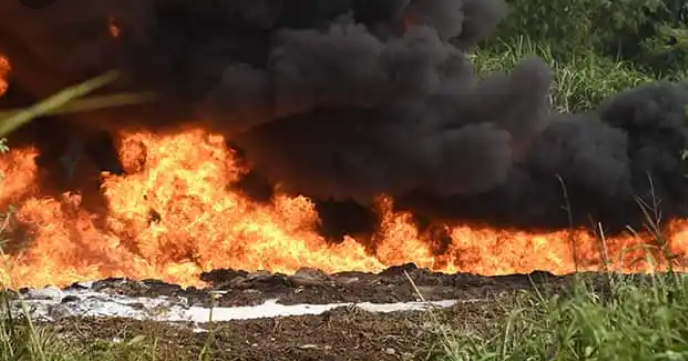
Fire
Fire is one of the four basic elements believed to be composing the universe and necessary to human life and the continuity of human existence. The simple word 'fire' has, over the years, acquired a large number of connotative meanings and seems to envelop the whole area of human life ranging from its daily needs like the cooking of meals, and the heating of rooms to emotional and poetical meanings. Fire is required for the purposes of war and peace, for the performance of many religious ceremonies, and for the continuation of civilization. Yet. it is one of the most primitive forces present.
One can only guess how man learnt to ignite a fire. Perhaps the use of fire preceded this knowledge of the method of lighting a fire. Primitive man, when he chanced upon a burning fire, kept it burning for long periods. It gave him light and offered him protection from wild animals. Later he learnt that tools could be hardened, metals melted, and food cooked. Gradually he also learnt that fire could be lit in a number of ways - by knocking two stones together or pieces of broken pottery or bamboo sticks. He was later to learn the use of matchsticks. gas lighters and electric lighters. Fire held him in awe. This was partly due to the mysterious origins of fire. And in most of the ancient. pre-Christian religions, fire had a place of worship. The Hindus worship it and it is necessary for the performance of a "Yagna" or a religious offering of prayers and for the performance of a marriage ceremony. The funeral pyre is also consumed by fire. The Parsis worship fire and have Fire Temples where they offer their devotion. Coal. oil. wood. gas and electricity are used to keep a fire going. They are all sources of energy and each has its own utility. The steam engine and the early industrial gadgets were dependent on the steam produced from coal. Now oil in the form of diesel and petrol has got an equally important part to play. Central heating and railway services, cold storage and many medical facilities depend upon electricity. But there is nothing to beat a good, warm fire in winter for creating good will and friendly feeling. Civilization has brought in many changes and has almost driven the simple wood fire out. Yet Gypsies and other tribal people still continue to gather around a communal fire and sing songs and dance to their heart's content. Most camps end in a camp bonfire.
In literature, fire has a dual role to play, as it has in real life. It symbolizes both creation and destruction: it is both a cleansing and an annihilating agent. Robert Burns wrote in a poem "Epistle to John Lapraik', "Gie me ae spark o'Nature's Fire. That's a' the learning I desire". He meant by this that he wanted to feel intense passion and ardor and out of this all good is born, all creative activity takes place. Yet fire also destroys. The Great Fire of London burnt away huge sections of the city. a napalm bomb when it explodes causes burns and loss of life and an immense amount of destruction. A forest fire, as dwellers in the tropics know, is disastrous. Fire destroys and when it dies down. it kills something in man and turns him into a cold, callous human being.
It is said that the gods did not wish to share this gift with mankind and Prometheus stole fire from heaven for the use of mankind. Though he was punished for this act, the rest of mankind has benefited from his act. It is a divine quality not to be idled with. A fire accident can be a gruesome affair. There has developed the idiom "He has come through fire" and also the proverb "It is foolish to play with fire". Man must take it in its proper measure: creation not destruction.
@David_BCH
17-12-2021☝️☝️
11:20pm♥️
Walking 🚶🚶🚶
*"Walking"*
is the best exercise!!!
🚶🏽
🚶🏽
🚶🏽
🚶🏽
🚶🏽
🚶🏽
🚶🏽
🚶🏽
*Walk Away* 🚶🏽 from
Arguments that leads you to nowhere but anger.
*Walk Away* 🚶🏽 from
people who deliberately put you down.
*Walk Away* 🚶🏽 from
any thought that reduces your worth.
*Walk Away* 🚶🏽 from
failures and fears that stifle your dreams.
*Walk Away* 🚶🏽 from
people who do not care for you and who are opportunistic.
The more you
*Walk Away* 🚶🏽 from
things that poison your soul, the happier your life will be.
*Give Yourself A Walk*🚶🏽
Towards love, peace, kindness and goodness
*Give Yourself A Walk*🚶🚶 to God's house and worship Him in Truth and in Spirit. May God help us daily to walk in the right direction, to walk towards Him and with Him.
🙏🏾🙏🏾🙏🏾
*Let's do more walking*
*Good 🌃 night 🛌 🛌
Still me @David_BCH ♥️💜 u all
15-12-2021👈👈👈👈
7:00pm♥️♥️♥️
Are you for or against zoos??
Until recently the case for zoos was never questioned. They are accepted as useful and entertaining amenities which were also educational. Children love seeing animals, and a visit to the zoo has always been a treat.
Gradually however unrest has grown about the morality of keeping animals, reptiles and birds in captivity, though not on grounds of ill-treatment, lack of hygiene or incorrect feeding.
The concept of confining them in cages became suspect. More than fifty years ago a wildlife park was established at Whipsnade in Bedfordshire, UK, and since the Second World War in the grounds of large houses such as Longleat. The major-attraction types of animals such as lions, tigers and elephants thus have room to move freely and to set up their own social structures. They are fenced off from the public except in safari parks where people can see them at close quarters from rover type vehicles.
There are four points in favor of zoos, and arguments against them all. The first is conservation. Due to over shooting and deforestation in Africa, India and elsewhere, many species are endangered or becoming extinct. The koala bear, some types of deer and the Arabian oryx are examples. Attempts to mate these in captivity have been successful, with the result that their natural habitats have been re-stocked. This process is expensive and time-consuming, however.
Sometimes it is unsuccessful. Sometimes animals bred in captivity cannot adapt to the wild, and either die or fall prey to predators. The fact is that only 5% of endangered species are to be found in zoos, so the whole concept may be wrong. These arguments do not of course apply to bird sanctuaries, where the birds are encouraged to frequent natural but protected habitats, and are never confined.
The main argument against is that available money should be put into the saving of natural habitats. Realistically, this is totally impracticable overseas, and difficult enough in the country concerned.
Point two is that zoos are educational. Seeing and touching animals means much more to a child than any number of good books or pictures. Children have a chance to touch, groom and ride on animals in a modern zoo. Some zoos specialize in activity centers which generate love of animals, understanding and enjoyment. The counter to this argument is that animals dislike being domesticated for any reason, and that in the strict sense the zoo does not further education. Zoology is best learnt in the classroom, in the laboratory, and from the text-book. Another counter-argument is that for close contact, visual or actual, cages must be small. This inhibits exercise, and worse, prevents the putting together of enough animals to allow for natural social behavior, i.e. the setting up of families and clans. However it is conceded that given large enough cages or confined areas with sufficient animals these defects can be largely overcome. It has to be said that zoos are constantly improving their facilities and bringing them into line with the animal's natural surroundings as far as possible. The polar bear house in London Zoo is currently being remodeled in this way.
If the wishes of the public are to be considered, zoos as recreational amenities have a large following, and should be kept. Children have been mentioned, but the informative booklets, scripts and tapes available in a modern zoo attract the adult also. Entrance takings are high, and money becomes available for research as well as improvement. Some agree; others ask why animals should be made a peepshow.
The fourth argument for zoos is that they not only allow for research but also finance it. This again is not considered a valid argument by the opponents. What kind of research ? people ask. In the case of the London Zoo the answer is that they have an Institute of Zoology. This produces comparative surveys, statistics for analysis, and data bases. The veterinary branch learns how best to keep animals and treat them when sick. Animal nutrition is studied. Problems of re-introduction into the wild are studied. Animal behavior is studied. Nothing was known about the social habits of the rhinoceros until specimens were brought into captivity and observed in suitable surroundings.
What of the future ? Despite all arguments to the contrary, the continued development of zoos seems to be a valid policy. The old defects will be overcome. Surroundings will be made larger and more natural. There is also a strong case for the specialized zoo or sanctuary, such as the woolly monkey sanctuary at Looe, in Cornwall, UK. This provides conservation, education about their kinship and social life in natural colonies, plus personal contact, with opportunities to touch and groom; also lectures. The future may lie in this direction.
@David_BCH
14-12-2021👍👍👍
5:27pm♥️💜♥️💜♥️💜♥️
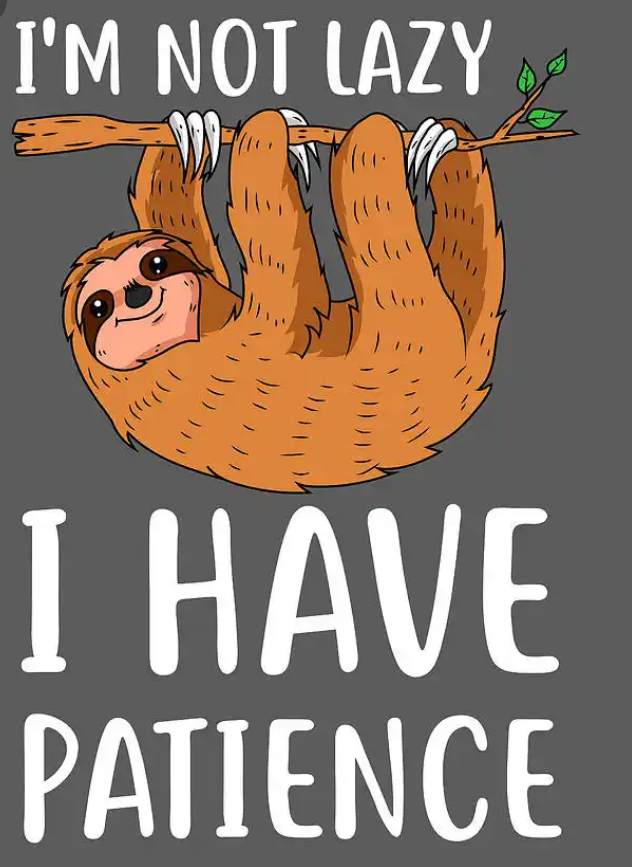
Laziness is Not patience
Happy Sunday friends,✋✋
Let's read 👇👇👇🏼👇👇👇👇🏼👇👇👇👇🏿
There are those who hold to an interesting definition of patience. To them, patience means something that says you should wait until the time is just right before you do something. Take this example; it is about a man who has a family with a wife and two very small children. He has known for some time that he is going to lose his job, a job that has been hanging by a thread for over the last year.
This is a job that has no medical benefits or pension; it is only a contract position. It has absolutely no security. But, it is a job that pays well unlike some other jobs in the same kind of area of expertise. And, he gets to work at home.
When approached about his concerns for his family's security, his standard reply is that he isn't worried about their security. He must not be because he has yet to apply for one job, or, for that matter, hasn't even looked in a newspaper help wanted section, or on the Internet that lists jobs available in his area. When pushed a little harder about what he is going to do his response is only that he is going to have to have patience and ride the job to the bitter end.
What I find so unusual is that he knows his job is coming to an end; he known this for some time but believes that all will be well - that patience must be exercised to see whether he will get another offer from another contractor in the same area. He isn't very busy any longer either with his current contract. In reality, he only spends no more than two hours day actually performing any functions. So, what does he do for the rest of the time?
Instead of using his time to look for work, or rewrite his resume, he plays online computer games - that all.
Is this patience to see what will happen to his job with the hope that he will be offered another contract or is this laziness?
Sad. There seems to be no sense of urgency; no sense that he is putting his family in jeopardy not to mention the real possibility that he could lose his house. He has no money saved and if he is out of work longer than one month, the mortgage and the rest of his obligations will not be met.
As the old saying goes, Patience is a virtue, but laziness is not associated with patience in any form whatsoever.
There is one thing about patience that should be clarified. Patience is a great quality when it means that you can wait for the right moment to speak, or when you are confronting a rebellious child, or when you are thrust into a situation that means that cool heads will win the day where overreaction would cause grief, upset, or a major mistake. But, laziness means nothing of the aforementioned - it is the lack of responsibility, will or determination to act when even simple action could make a huge difference.
@David_BCH 💜💜💜💜 u all
12-12-2021💜💜💜💜👍
12:51pm
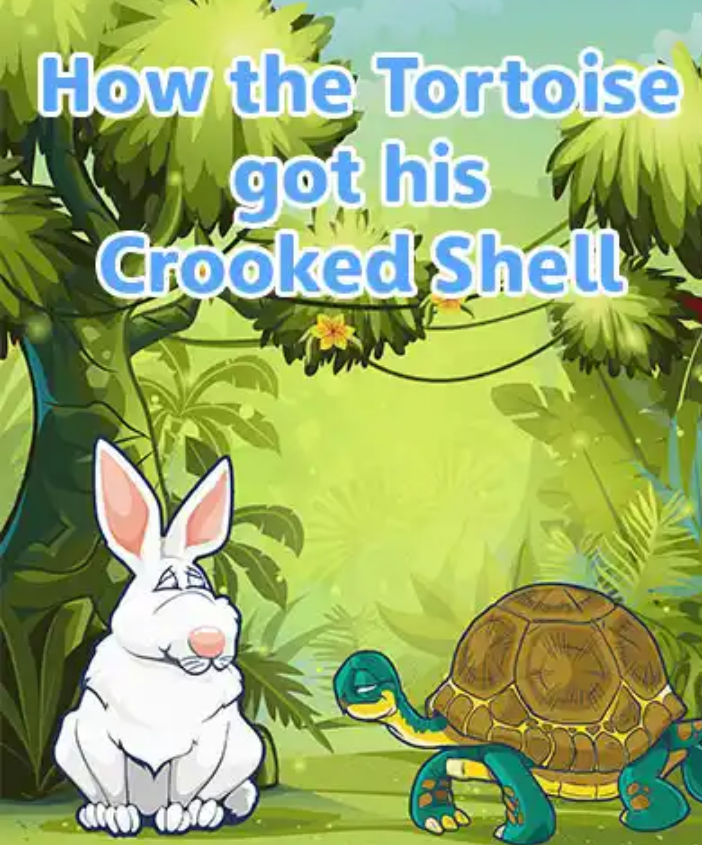
How the tortoise get his crooked 🐚 shell.
Let's read 👇👇👇🏽👇
A long time ago, a terrible famine hit an ancient animal kingdom.
It had not rained for two whole years and all of the crops were dying.
The animals hoped and prayed for an end to the terrible drought, but the sky was no longer able to gather enough clouds, and the rains did not come. Ijapa, the cunning tortoise, lived on the outskirts of the village with his wife and two sons. The famine was very bad and was already having a devastating effect on all the animals, so Ijapa could no longer trick them into parting with what little rations of food they possessed. One morning, very tired and hungry, Ijapa left his house with the intention of searching the marketplace for scraps of food, but there was no food in the market, and so the tortoise remained as hungry as ever. However, just as the tortoise was about to return home he saw Ehoro, the rabbit, hopping towards the marketplace.
There was something strange about Ehoro.
He looked radiant, well fed, and full of exuberance.
Ijapa was curious.
‘Why is Ehoro looking so well and I am so hungry?’ he thought.
So he approached the rabbit with his head bowed as if he were in mourning.
Then he began to cry. When Ehoro saw Ijapa, he rushed to meet him.
‘What is it, my friend?’ asked the kindly rabbit. Ijapa answered, ‘My father is ill in hospital.
My wife is expecting our third child but she is so hungry that I fear for her health.
And only last night I heard that my mother-in-law is dying of starvation because she does not have enough food to eat! I feel terrible because there is nothing I can do!’ Ehoro was suspicious because it was well known that the tortoise was very sly and could not always be trusted.
But Ijapa was an excellent performer and soon won the rabbit’s sympathy. ‘Meet me at Ore Brook after dark,’ said Ehoro.
‘I will help you in spite of my doubts.
I just hope that I do not regret this.’ Soon it was night, and Ijapa set out into the darkness to find Ehoro waiting at the brook.
Once they had said their hellos, both animals made their way into the deep forest: the rabbit leading the way while the tortoise followed closely behind. Before long, they came to a narrow path that led to an open clearing among the trees in the middle of the forest.
The rabbit stopped and pulled the tortoise to his side.
‘What you are about to see must be kept a secret, do you understand?’ The tortoise nodded in agreement and the rabbit cupped his hands around his mouth and began to sing... ‘Iya, iya ta’kun wale o CHORUS: Alu jan jan ki jan ‘Iya, iya ta’kun wale o CHORUS: Alu jan jan ki jan Suddenly, a long, white rope descended from the sky.
Ehoro grabbed the rope and began to climb.
After hesitating for just a moment, Ijapa also took a hold of the rope and followed the rabbit up into the night sky.
The rabbit and the tortoise climbed and climbed until they got to the very top of the rope where there was a magnificent, fluffy cloud shaped like a door.
The door opened, and there stood a kindly old rabbit with a smile upon her face. ‘Mother!’ exclaimed Ehoro in a joyful voice as he embraced the old rabbit.
‘This is my friend Ijapa who has come for supper.’ Ehoro’s mother held out her hand and gave the tortoise a warm handshake.
‘Come in and eat with us.
I have just set the table.’ The sight that met Ijapa’s eyes made him gasp.
There was a large table laden with the most sumptuous foods he had ever seen.
There were exotic fruits and fresh fish of all types marinated and cooked with herbs.
There was also rice and yam and mouth watering soups.
The hungry tortoise dug in immediately and ate everything that he could get his hands on.
‘Don’t eat too much,’ Ehoro cautioned, ‘or you will not be able to climb back down the rope and walk back to the village.’ The tortoise continued to eat until eventually he slumped back in his chair and gazed sheepishly around the room, his belly protruding like a huge balloon. After they had rested for a while, Ehoro decided that it was time to return home.
Ijapa rubbed his large belly, got to his feet very slowly, and made his way to the door. ‘Aren’t you going to take some food back home for your family?’ Ehoro’s mother asked Ijapa. ‘No thank you,’ replied Ijapa, ‘I am too full in my belly to carry any food with me.’ And so Ehoro’s mother let down the rope and the rabbit and the tortoise descended back into the forest and went their separate ways home. When Ijapa got home his family were still sleeping, so he crept into his bed, covered himself up with his blanket, and fell into a deep sleep for twelve hours. When he eventually awoke, Ijapa was very hungry.
‘I need food,’ he thought to himself.
‘I need food and I need it now.’ It was then that Ijapa had an idea.
‘I will go back to Ehoro’s house while he is still at work.
I will think of some lies to tell his mother when she let’s down the rope, and I will fill my belly once again.’ When Ijapa arrived at the open space in the forest, he cleared his throat and began to sing the same song that Ehoro had sung the previous night... ‘Iya, iya ta’kun wale o CHORUS: Alu jan jan ki jan ‘Iya, iya ta’kun wale o CHORUS: Alu jan jan ki jan’ The trouble was, Ijapa had a rather husky voice and the song did not sound as beautiful or as heartfelt as when it was sung by Ehoro. ‘That does not sound like my son,’ thought Ehoro’s mother.
The old rabbit hesitated for a moment, but eventually she decided to let down the rope.
‘Perhaps he has caught a cold,’ she thought, as she lowered the rope into the clearing below.
The mischievous tortoise was delighted to see the rope fall to the ground and he quickly grabbed it with both hands and began to climb as fast as he could. Ijapa was half way up the rope when he heard a voice shouting from the forest below. ‘Hey, where do you think you’re going? Come back down at once!’ It was Ehoro, and he sounded very angry.
‘Mother, we’ve been tricked!’ shouted the rabbit.
Still Ijapa continued to climb the rope, his mind full of thoughts of the feast awaiting him above. Ehoro called out to his mother again, but again nothing happened.
And so the tortoise continued to climb up the rope into the clouds. Ehoro cleared his throat, took a very deep breath, and began to sing to his mother up in the clouds... ‘Iya, iya ta’kun wale o CHORUS: Alu jan jan ki jan ‘Iya, iya ta’kun wale o CHORUS: Alu jan jan ki jan When Ehoro’s mother heard her son’s voice she exclaimed, ‘now that is my son! But who was the first caller?’ The old rabbit peeped through the clouds to see what was happening below.
That was when she saw the tortoise climbing up the rope towards her. Mother,’ shouted Ehoro from far below, ‘cut the rope!’ The old rabbit fetched a large carving knife and began to cut at the rope.
At first it seemed as if the rope was made of iron and that the knife would have no effect at all.
But Ehoro’s mother continued to hack at the rope with all her might and soon there was only a very thin strand left for the tortoise to hang onto.
Then the old rabbit gave the rope a final hack with the knife and whooooaaaahhhh! Ijapa went tumbling down towards the forest below. The winds carried Ijapa back and forth, tossing him around in the sky until he landed heavily on his back in the forest.
Unfortunately for him, the only thing to cushion his fall was a big rock that was sitting on the forest floor.
When he landed on the rock, Ijapa’s shell cracked in so many places that it ended up looking like a jigsaw puzzle. The tortoise awoke many hours later.
He was very dazed, but he was able to move and found that he was not in very much pain after all.
But his shell remained like a jigsaw puzzle and would never again return to the lovely, smooth, round shape it was before.
**The End**
Thanks for reading this wounderful story
Hope you guys enjoyed it,💜💜
11-12-2021✋✋✋
8:10pm
Health or wealth, which one is better??
"Look to your health: and if you have it, praise God, and value it next to a good conscience: for health is the second blessing that we mortals are capable of. a blessing that money cannot buy". - lzaak Walton
These are words of wisdom and none would question their validity. But there are times when people do value money over health. When a person has been deprived of a thing for too long, he longs for it: and as money is the commodity most in demand people want money to fulfill their needs. It can help rent or build a house. It can buy medicines, clothes, fruit and food: it can pay for the small pleasures of life as well as the big ones - from a cup of tea to a holiday abroad. Aesthetic and cultural enjoyment - tickets for the latest play, an evening at the opera, an expensive book, the latest L.P. - all these money alone can buy. There are far too many things which are out of the reach of the middle and the working classes. A good education, expensive sports and games like skating and golf, traveling in comfort, owning the gadgets which add comfort to life - these are things which people with limited incomes cannot buy. The unprecedented unemployment of the thirties was responsible for a great deal of human misery and resulted in the loss of self-respect and dignity. It also forced people to recognize the worth of money and resulted in a disproportionate attachment to the material world.
There is no denying the value of money and the pleasure of enjoying it: but there are basic issues involved. If money can be got only after a huge amount of sacrifice, is it worth it? Is it really necessary for human beings to go on increasing their needs and temporary pleasures? Or would it be wiser to impose a self-restraint on one's needs? People get so busy in getting money that they forget how to enjoy it. Engaged in getting money, man has no time for his family or his friends and at times no time even for his health. On the other hand, the pursuit of money may adversely affect both his physical and spiritual health. He may overcome his initial scruples in his desire for power and money. The question then is how much evil is justified to get to the good.
If one has to choose and even if there is no choice, health is better than wealth. A healthy person can look after not only himself but also others. He can be a useful member of society and of a family. He can be generous and sympathetic and be constructive in his thinking. An ailing person whether man or woman is a drain on others. And money can buy medicines, pay for a visit to a health resort or long hospitalization but it can neither buy health nor happiness. It is immaterial that a man can buy an expensive pair of shoes, if he has no shoes. Ultimately it is equally irrelevant whether a man is dressed up in the most expensive clothes, or drives the latest model of an expensive car. What is important is how good a human being he is. And for this he needs health. If he is healthy, his whole approach to life will be governed by this factor. Ask a man who has been through a long illness and an equally long spell of poverty and he will chose health. Money is the value of the man-made world - not of the world God created. Health is a god-given grace and let us be grateful for it.
8-12-2021♥️♥️
9:44pm👍👍👍
@David_BCH


History
History, in the present century, has migrated from the sphere of humanities to that of social sciences. This itself speaks for the new look which it has acquired and the change in the study and the use of history. Men, in the past, have limited its scope and have derided it. People like Carlyle and Emerson have considered history to be nothing more than biographies put together, and Gibbon viewed history as a register of crimes, follies and misfortunes of mankind. Henry Ford once referred to it as bunk, and Carlyle called it a "dust heap". Yet history is a part of our world.
It is not possible to have objective historical records for human preferences and views are bound to creep in. But it is possible to arrive at what is generally true by comparing versions, records, letters and interviews. Thus the scope of history is not a mere record but much more. They may or may not be an eye witness account and even if there is it may not be objective. The numerous accounts of a war in holding times make this abundantly clear. Therefore, a historian has to find out as much as possible of the truth by referring to various records which may include economic data, memoirs and speeches. All these go to make history.
It was believed till a few years ago that history was related only to the past and has no utility for the future. At best it is a record of human achievements and at worst it may make interesting reading. This, however, is not the case any more. History has its own utility. It provides an insight into human nature both individually and collectively. it makes it possible to view the mistakes of the past and to try to avoid them in the present. It is also possible to make political predictions on the basis of past behavior for nations and countries normally follow a pattern. It is also possible to study the psychology of a people and to analyze the factors which may have influenced their behavior, at times it may also be possible to artificially recreate these factors.
It would be wrong to think that history can only be used for the purposes of exploiting past knowledge. History can also inspire, for it is men who are the makers of history. If they are ruthless and cruel, they are also honest and patriotic, capable of making immense sacrifices and capable of intense suffering. They are people of heroic courage and valor. To read about them, to know about them is an ennobling experience.
Just as other disciplines throw light on historical facts. the study of history helps us to understand literature better. It becomes clear what the writer had in mind, what factors molded his personality and what the prevalent conditions of his time were. Poets, philosophers and theorists can be better understood if their work is studied in a historical perspective. History is the philosophy drawn from experience. As long as there is a sense of time and we all do not become transcendentalists, history will continue to have importance. Though in the present century a disproportionate place has been taken up by wars and revolutions, this does not form the totality of history. it also embraces the creative and constructive forces. As H.G. Wells wrote in 'The Outline of World History", that human history becomes more and more a race between education and catastrophe. It is a struggle between good and evil, between the life force and the death wish.
@David_BCH
3-12-2021♥️
9:20pm

Being a good parent
**A good parent** is someone who looks after their children well. Being a good parent involves numerous different skills.
There is no single way to be a good parent, as all individuals are unique - both parents and children. But, there are certainly some key qualities of good parents like below are some characteristics of a good parent listed below 👇👇👇👇👇
**1. Unconditional Love and acceptance.**
Love is absolutely fundamental to good parenting. A good parent will surround their children with unconditional love and will act in a loving way towards them at all times. If we do not act with love, then we cannot possess the other qualities of a good parent that are listed below.
**2. Celebrate the uniqueness of every child.**
A truly good parent appreciates their child for who they really are. They do not just love their child for themselves, but they celebrate that uniqueness and support their child to help them to become whoever they want to be. Sometimes, you hear parents saying that they want their child to be a doctor or a lawyer when they grow up - before their child can even speak - and then they try their hardest to make their child follow that career path whether the child wants to or not. This can lead to a child that feels unhappy and resentful. A good parent, though, will let a child discover for themselves what they want to be, and will support them on that all important journey of discovery.
**3. Practical and Moral Education.**
A good parent will educate their children - both about practical things and about what is right and what is wrong. In order to be a good parent, then, we must take care to always give our children correct information about the world.
**4. Material and Financial support.**
Good parenting is not just about emotions, it is also about providing the material things that a child needs. Food, clothing and shelter are all essentials that no child can live without. Moreover, parents will often continue supporting their children financially as they grow up and head off to study at university or college.
**5. Fairness.**
Good parents are always fair. They praise their children when they have done well and discipline them without being severe when they have done something wrong. If a parent has more than one child, they will treat all of their children fairly and will not pamper one child over and above the others or treat one child as if it is more important than the others.
**Conclusion.**
Good parenting is so important because it can have such a huge impact on a person's happiness when they grow up to be an adult. The foundation of all good parenting is love, and all of the qualities of a good parent flow from this foundation. Is there anything that you would add to the above list of characteristics of a good parent? Perhaps you have children yourself and have found the above qualities of a good parent to be vitally important to your relationship with them?
@David_BCH♥️♥️♥️♥️
2-12-2021🤸🤸🤸🤸
7:52pm😒😒😒😒
Thanks for reading 🙏🙏🙏🙏
.
All work and no play makes a full life
Happy New month friends. Welcome to December month last month of the year 2021📝📝💜♥️
My new article here on read cash posted 👍
Imagine a world without leisure and enjoyment! We would all be drudges and consequently would be no better than animals. I can only imagine people with bowed shoulders and lowered eyes, people who have no light in their eyes and no hope in their world. As it is. things are pretty had. People are always busy - busy with work and busy with idleness. No - No. I'm not trying to be witty but people are busy with nothing to do because they do not know how to make use of their leisure. But of that later, for the time being let me stick to the point - all work and no play would he a monotonous existence.
Man has always been busy with the effort of fulfilling his needs. In the early stages man spent his time hunting and then ploughing. but these activities did not fill up his whole day. Today man is busy keeping up with the Joneses. he is the company of his kind in the rat race that he runs. It is no longer a question of survival but a question of acquisition - acquiring more worldly goods, having more money to hoard and to spend.
Most of us do not feel happy when there is nothing to do. Those who are able to enjoy what they do and those who are able to do what they enjoy are indeed very lucky. But even these people need a change. A person who is doing an office job or busy with books welcomes a walk in the evening, half an hour in the garden, a drink with a friend. And a person who has been working in a factory or in a field would definitely enjoy a visit to a restaurant, an hour to go through the newspaper. watch television. It is not only the nature of one's work which conditions one's choice of recreative activity; intellectual and cultural development is also an important factor.
Those people who do not know how to enjoy their leisure and do not allow themselves to recoup lose their efficiency. No one can continue at the same rate of efficiency over an indefinite period. Just as the body needs sleep, the mind needs rest and change. That is why the hobbies which one cultivates and the activities which keep one busy are referred to as recreative; they help to recreate something which has been spent and utilized. People who only know about their work and are perpetually engrossed in it do not recreate that part of themselves which is spent. Thus they either break down under the strain or merely tag along automatically. They make very poor conversationalists and do not have well-integrated personalities. Over the years they lose their mental alertness and become confined to the narrow limits of their jobs. This is not to decry hard work. Work is necessary and only those who work hard are able to achieve something. But at the same time one must know how to relax no matter for how short a period. Relaxation does not mean only sleeping or idling; it also means finding something satisfying and meaningful to do. Otherwise life becomes monotonous and dull.
@David_BCH ☝️☝️☝️
1-12-2021💜💜💜💜💜💜💜💜
9:46am📝📝📝📝📝📝📝
Have a great day today we are heading to Christmas 👏👏👏👏
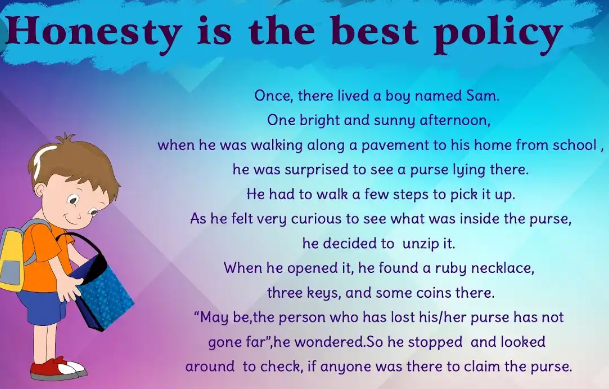
A moral story on honesty
Chi chi and Banti were good friends. They had great confidence in each other. Banti was very honest boy. Once they decided to enjoy their holidays together. They went out to a hill station for week.
Both enjoyed their stay at the hill station. After seven days, they planned to return. When they reached the station to board the train, they found a bag lying at the station platform.
Chi chi noticed it first and picked it up. He opened it and saw that it contained a lot of cash and jewellery in it.
Chi chi tried to hide it in his suitcase. But Banti suggested, 'Chi chi, we are honest people. We should not keep it with us. Somebody has missed it. We should ask people at the station. If someone claims and is able to tell the exact details, we shall handover this bag to him”.
'No, No, you are a fool. Everybody will come to claim it as his own bag. I have fond it, so this is mine”, Chi chi, said.
Banti said, 'What are you talking? In case you do not want to give it to its owner, we should divide it into two equal parts. Both of us have found it. We have shared every moment, every food, and every joy here together. Therefore, we should divide the cash and jewellery also into two parts to enjoy together”.
'I don't agree with you. I saw it first, and so it is mine”. Saying so Chi chi kept the bag in his possession.
Meanwhile the train arrived at the station. Chi chi and Banti boarded it. Once they occupied their seats, they were at ease and began talking to each other. Time was rolling on. When the night fell, they began feeling sleepy.
After sometime the train halted at the next station. Suddenly they saw some policemen entering their compartment. Chi chi was frightened to see them. He tried to put his suitcase behind his back.
Chi chi whispered in Banti's ear, 'We are in great trouble. The police have come. They would arrest us and put us behind bars. You know, we have not stolen the bat”.
Banti said in a low voice, 'Why do you say - 'us' - and not - 'me'? Please don't try to involve me. I have got nothing to do with the bag. You did not listen to me when I asked you to find out the owner and hand over the bag to him far from handing it over to the real owner, you even refused to share it with me., and now when you feel that you are going to land in an unpleasant situation, you want to share the unpleasantness with me. Very clever”!
The police saw lines of terror in Chi chi face and became suspicious about him. They searched his belongings and found the bag. This was the bag they had come searching for. They arrested him and sent him to jail.
Now Chi chi was repenting that he should have listened to his friend's advice.
The Moral of the Story is 'Honesty is the Best Policy”. Thanks for reading and always try to be honest ✋✋
@David_BCH 🤝🤝🤝🤝🤝
30-11-2021🙆🙆🙆🙆🙆
7:00am👍👍👍👍👍
Why children disobey their parents
**What are the causes that lead a child to disrespect and disobey their parents?**
1. Thoughtlessness: At first, it is thoughtlessness, which soon develops into deliberate attempts to tell lies and escape punishment for bad conduct.
2. Bad company: Bad company tells imperceptibly on the child's character, until he becomes decidedly averse to submit himself to home-control, unless great care and rigid means are taken at the very outset to check the evil influences.
3. False sense of superiority over others: In after years there is developed in many person a false sense of intellectual or other superiority over their elders, breeding in consequence a lack of reverence for them.
4. Selfishness: Selfishness also often asserts itself at a very early age in wicked boys, and the world weans them more and more away from their duty to their best kith and kin.
**Solution**
The only way to mend such tendencies is to make the hearts of young child feel early how much they owe to their parents. If one is ungrateful to one's own father or mother, how can one be true to others or be trusted by them?
Life is a course of discipline in which we are trained to make sacrifices for those who are dear to us. And who can possibly be dearer than those who have given birth to us, tended us with unbounded affection, watched us day and night, who have prayed and wept for us, who give us everything worth having in this life, who, in short, live and are prepared to die for us?
**Conclusion:** Our parents are Gods on earth to us. Blessed are the children who never cause grief to the hearts of their parents.
@David_BCH
Thanks for reading ☝️☝️☝️
Happy Sunday all ✋✋✋✋
28-11-2021♥️♥️💜💜
3:57pm🤸🤸🤸
Reasons why life is beautiful
This word 'life' can also refer to the 'state of being alive'. In this article, by the term 'life', we mean the human lifespan.
Beauty can mean different things to different people. For some, life is beautiful will mean that life is enjoyable. For others, it will mean that life is good. Yet others will interpret it as meaning that life is aesthetically pleasing.
What is common to all of these definitions is that the phrase life is beautiful indicates something positive about life.
Reasons why life is beautiful.
**1. Love:** Even a barren, desert place can become beautiful with the presence of love. Indeed, many people would argue that life cannot be truly beautiful in the absence of love and that by loving, we help to fulfil our purpose on earth. Love is something that all people can experience, regardless of their age, location or socioeconomic background. This arguably makes it one of the most beautiful aspects of life, because it is free and open to all and this in itself is something beautiful.
**2. The people we share life with:** Our friends, family and other loved ones enrich our lives with their uniqueness and their support. So can strangers that we meet along the way. Life is even more beautiful when it is shared with those that we love, and this experience of sharing and interacting with others is a beautiful one in its own right.
**3. Fulfilling our goals:** We all have talents, and we all have things that we are passionate about. One of the things that can make life especially beautiful is pursuing those dreams and following our passions. By so doing, we often gain a profound sense that our life is worthwhile, which can make life much more beautiful. This is because for many people, true beauty is linked to a sense of purposefulness, and particularly with having a good purpose in life.
**4. Being alive is a privilege:** When you think about all of the odds that have been overcome for life on earth to develop and when you consider all the human beings who have not lived to the same age that you are at now, it is clear that you are in possession of a fantastic privilege simply by being alive. Any biologist will tell you that there are many billions and trillions of ways in which DNA can combine in order to create a unique human being. And yet, only a small fraction of possible human beings have ever been born. That makes you very special, just by virtue of your existence - and everyone else is very special too, for the same reason.
**5. The ability to make a change:** We should all try to leave the world a better place than we found it. This is another one of the beauties of life - that we can use the time that we have to improve the world for other people and to make life even more beautiful in the process. We can all agree that doing good deeds is a beautiful thing - and something that has beautiful results as well.
**6. Surprises:** Life is full of surprises. Whether it is a new perspective on the world that an acquaintance or a book introduces you to, or whether it is just a new culinary dish that you sample for the first time, life always has new things for us to discover. There is something beautiful in this endless variety. Moreover, the versatility of life means that we can all find something beautiful in it regardless of our tastes: there is something here for everyone. Some people find solving math problems beautiful whilst for others the highest beauty is to be found in gardening and watching things grow. The world caters for all tastes, and lets us all live side by side and enjoy our own ideals of beauty peacefully without encroaching on other people's.
**7. Art and culture:** We are born into a world that is rich in culture, history and creativity. Delve into the history of human civilizations, experience artworks by visiting a gallery or just by viewing them online or lose yourself in amazing stories and poems from writers all across the globe. For millennia, other human beings have been working hard to make life even more beautiful and something as simple as a trip to the cinema or to a bookshop will enable us to partake of that beauty.
Conclusion.
Wake up and take a look around you: life is beautiful. There is beauty all around us: in logic, in the natural world and in our relationships with others. What is more, we can make life even more beautiful by virtue of our actions. Considering how lucky we all are to be alive, it definitely makes sense for us to make the most of the beauty of life - and to help other people to discover it as well.
@David_BCH
Thanks for reading 🙏🏼🙏🏼🙏🏼
26-11-2021
A rainy day
Good morning my friends. This is my school time story when I was In SS1 in school. I woke up at the usual time for school that Tuesday morning When I was still going to school. When I looked out the window, the day looked cheerful and the sky was bright and sunny.
I grabbed my towel and headed for the bathroom. When I emerged from the bathroom some twenty minutes later, I saw that the day had transformed and dark clouds looked ominously up in the sky.
Mother advised me to bring an umbrella, but I declined saying that the school was only a short walking distance away and that I would be in class before it began to rain. I ate the two slices of buttered toast Mother had made for me and drank a glass of chocolate milk. Then, I gathered my school bag and walked briskly in the direction of my school. Just as I reached the school gates, hard drops of rainfall pelted my head and body. I dashed inside the school building just in time to escape the downpour that had begun.
In class, we had to shut all the windows and switch on the lights for the day had grown very dark. There was also a constant strong wind that threw the raindrops onto the closed windows causing a continual patter.
I thought that the rain would cease by the time school dismissed. I was wrong. The rain was still pouring relentlessly when it was time to go home and it looked as if it would carry on throughout the day and night. I decided to walk in the rain.
When I reached home. I was soaked to the bone. Mother made me take off my wet clothes and take a warm shower. Then, we ate a nice hot dish of fish and prawns for lunch.
The rain had somewhat subsided to a slight drizzle by the time Father returned home. We had dinner together and then I did some homework given to me at school. I went to bed early that night. The rain had brought down the temperature by a few degrees Celsius and I was grateful for the cool and cozy atmosphere after so many warm and sweaty nights.
@David_BCH ♥️💜♥️💜
26-11-2021♥️♥️♥️
8:52am🤸🤸🤸🤸
Thanks for reading 🙏🏼🙏🏼
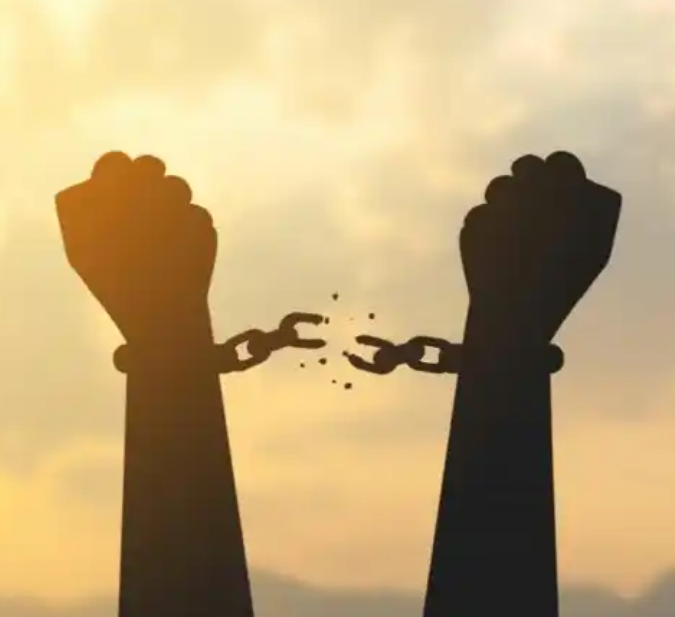
Freedom
Freedom, is a privilege that every person living in a democratic country is proud to possess, and in many constitutions, the freedom of the individual is guaranteed. The word "freedom" is a general word, which means three different things, freedom of speech, freedom of the person and freedom of assembly.
We deal firstly with freedom of speech, a most important right since, if a country is to be run on democratic lines, every individual should be allowed to say publicly what he thinks. In England, no such specific right is laid down in the constitution specifically, thought here are many ways in which the law can be broken. Defamation is not allowed, and can take the form of libel or slander. defamatory matter is matter which causes some other person to be brought into ridicule, hatred or contempt, and if it is written down, it is libel, whereas, if it is spoken, it is slander. Genuine criticism made in good faith is quite acceptable, however. Sometimes, it becomes difficult to determine what constitutes libel or slander, and as a famous writer on English law, Professor Dicey, once wrote "freedom of discussion consists in the right to write or say anything which a jury, consisting of twelve shopkeepers, think it expedient should be said or written." Freedom of speech also includes the freedom to worship as one pleases, a most important RIGHT. However, it is against the law to publish blasphemous material, which is defined as material which reviles God and religion. Clearly the right to speak freely does not include the right to publish obscenity, and the law is naturally strict on this subject. Finally, under freedom of speech, we must consider the position of the press, and in general, it can be said that press writers stand in the same position as letter writers, in that they are free to print what they like, provided that it is not libelous. However, if a newspaper libels someone, it is usually a defence to say that the libel was not intended or malicious, and that a full apology should be inserted at the earliest opportunity.
The next aspect of freedom is freedom of assembly, and since one man is legally allowed to publish his views, it follows that a hundred or more can meet together to do the same thing. However, form the point of view of public safety, meetings should be subject to some form of official control, and the police in many countries are vested with a number of powers. If a policeman suspects that a public meeting is likely to cause a breach of the peace, he can break it up as the community's safety is at stake. In addition, if something illegal is going on at the meeting, it can be broken up. The law with regard to processions is similar: they are not against the law, but if a procession is obstructing the highway, it can be broken up, and the authorities can lay down the route for a procession, so as to avoid troublesome or congested areas.
The last important aspect of freedom is freedom of the person. While it is true to say that in this country, every person is liable to be arrested for his criminal acts, there are important safeguards for the individual which ensure speedy trial or release if the charge is wrong. This right is laid down in the Habeas Corpus Procedure. Habeas Corpus (meaning "you have the body") is a procedure, whereby the prisoner or his friend demands a writ from a judge, which is then served upon the gaoler who has to show good cause why the particular person has been arrested. If he cannot do this, the prisoner must be released. even if, the arrest is proved to be correct, the Habeas corpus writ ensures a speedy trial and right to bail. Though nobody can be arrested without good cause, certain countries authorize the temporary detention of political suspects.
In conclusion, two important points should the stressed. Firstly, the government should not curtail the individual's freedom too strictly, and that this can have disastrous consequences, is well illustrated by the French Revolution of 1889. Here, the people rebelled against a government which applied the law too strictly and unfairly against the lower classes and which completely restricted personal freedom. The government was over-thrown and a period of social disorder resulted as there were no laws nor central administration left, any tyranny was replaced by another. Secondly, for society's sake, freedom should not be abused by the people and law should be observed.
Man is primarily a member of society and of a community rather than an individual, and though his freedom is important, it must be limited to conform tot he well-being of other members of the same society. freedom, which is not subject to some form of control is of no value at all 📝📝📝📝👍.
Thanks for reading 🙏🙏🙏
24-11-2021📝📝📝
10:30am ✋✋✋✋
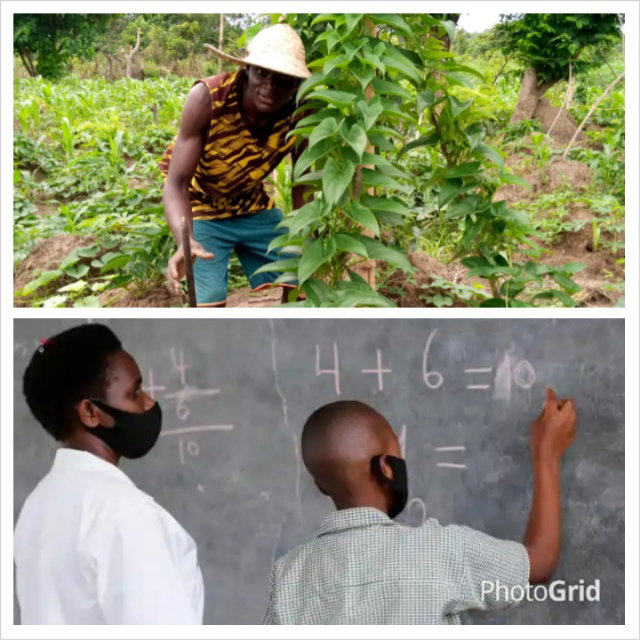
Who makes a greater contribution to the country, the teacher or the farmer ?
This is a very interesting question indeed. It is something like asking which of the two eyes serves better. As there is nothing to chose between the two eyes, so too in the case of the teacher and the farmer. Each of them contributes to the welfare of the society.
Now, let us see how each one serves the society. Let us take the case of the farmer first. The farmer feeds the country, with different kinds of foods. He is held in respect in literature, as others are dependent on him. This is really true. Whether the farmer works for his own selfish ends or for the market it is ultimately the society that gains.
The farmer's lot is a humble one. His difficulties are many. The place he works in is always dirty. He has to spend long hours tilling the soil, looking after his animals and tending to his vegetables, fruits and crops. He may not be an intellectual but he is a student of nature. He knows the weather conditions, the history of his plants and the diseases of his animals. He knows how to raise a good stock. He keeps the machinery of life and industry in the land going. He has to feed the industrial centers with raw materials like cotton, jute, wool and so on. In short, he is a mighty contributor to the welfare of the society.
The teacher contributes in an intellectual way. If food is essential, knowledge is even more vital. Without knowledge, man cannot progress. So the progress of a nation depends on her teachers. They carry the torch of knowledge and culture to inspire and educate the young of our country. In ancient societies the teacher was held in very high esteem and regard. They were given high positions in the ministry. The future of a nation depends on her teachers. Modern and advanced countries pay great attention to education which means their teachers do great help in nation building. So the teacher also serves the nation and if his contributions are not so tangible as that of the farmer nevertheless his contributions are really lasting and enduring 📝📝📝
Thanks for reading
@David_BCH
22-11-2021👽👽
6:45pm
A classless society 👽
Good evening friends, happy Sunday to you all, hope you guys are doing good✋✋am here with a topic that says ***classless society.*** Whichever country one goes to there are class divisions. These classes are based on many factors, like religion, wealth, caste and colour. Even habits have created classes. In certain countries they speak of the Northerner and Southerner. Even in the major religions of the world we find class distinctions. Among the Christians for example, there are the Catholics and the Protestants; and there again they are divided into a number of denominations. There are also divisions among the Muslims and Hindus. Wealth naturally, divides man into two classes namely, the 'haves' ant the have-nots'. In certain religions, notably among the Hindus, the caste System is very rigid. There is colourbar even in an advanced country like U.S.A. So we find the society, perforce has been divided into a number of classes.
To have a classless society is a modem idea. Thanks to the Communist philosophy the idea. of a classless society is being talked of, and in some cases, even worked out. To understand what it is a few words about the Communists Society will not be out of place. There they deny the existence of any religion. For them the State is the religion and the ultimate authority. Production and distribution are completely controlled by the government but, in fact, by the Communist Party. They see to it that no other party raises its head. All the needs the people are looked after by the government and so there is no need for class.
But ideals apart, in practice, it is rather the party than the government that controls everything. Party bosses are like demi-gods. When they deny to accept any religion, communism has become their religion, the Communist Manifesto their bible and Lenin, their Saviour. The party men control everything and highly technical people are in the good books of the party. The peasant continues to be poor in spite of so much propaganda. So in the communist country, the party is the monolith with its own high priests and people as serfs. So one can conclude that a classless society is impossible in the near future. Man with his difference in talent, intelligence, efficiency and health are bound to be divided by class.
In a classless society there should be an attempt to abolish all classes. Classes should not exist. Society must be conducted in such a way that the evils of classes are liquidated. Privileges should be enjoyed by everyone. Society must aim at social justice where all will enjoy the equality of opportunity and will be equal before law. By wisely handling taxation laws the accumulation of wealth by certain individuals can be avoided. Thus the evils of classes can be overcome.
It is clear a classless society is only an Utopian dream which can never be achieved.
Thanks for reading my article 🙏🙏
21-11-2021 (happy Sunday)
8:01pm ✋✋✋
Reasons why healthy breakfast is important 🍜
You may have heard that 'breakfast is the most important meal of the day', and by the end of this article you may well believe that phrase to be more true than ever! Here are **some reasons why healthy breakfast is important** 🍉🍱🥙🌮
**1. It wakes you up.** Sitting down to some healthy food helps to shake off the last of that desire to stay in bed.
**2. It helps you to focus.** Tea and coffee improve your concentration: ideal if you need to head off to work.
**3. Stable blood sugar levels.** Healthy food stablizes your blood glucose levels, setting you up for the day.
**4. Good digestion.** A fiber packed breakfast will get that digestive system working properly from the word 'go'.
**5. Vitamins and minerals.** Get a hit of vitamins and minerals when you have fruit and whole grains for breakfast and your body will thank you all day.
**6. Avoiding distractions.** Slow release energy from whole grains stops you being distracted by hunger pangs later in the day.
**7. Energy.** A healthy breakfast gives you all the energy that you need for a successful day.
**8. A calcium hit.** A yoghurt, glass of milk or other calcium packed item for breakfast is great for your teeth and bones.
**9. Avoiding snacks.** Avoid sugary snacks in the mid morning by satisfying yourself at breakfast time.
**10. Part of a workout regime.** A healthy breakfast helps you to make the most of your morning workout.
**11. A morning perk.** It's always good to treat yourself.
**12. A taste sensation.** Healthy food is delicious.
**13. Establishing a routine.** A good morning routine is great for keeping organized.
**14. Good mental health.** Keep your brain chemistry balanced with the right vitamins and minerals.
**15. Essential for schooling.** Kids need a healthy breakfast so they can do well at school.
**16. Setting the standard for the day.** Start the day as you mean to end it: the healthy way!
**17. Bringing families together.** Spend some quality time together over healthy breakfast foods.
**18. Peace and relaxation.** Begin your day with a moment of peace and culinary pampering.
**19. Fresh colors and flavors.** Brightly colored fresh fruits are so uplifting!
**20. Being a good role model.** Teach your kids good breakfast habits.
**21. Being kind to yourself.** Healthy eating is an important form of caring for yourself.
**22. Staying hydrated.** Healthy breakfasts should include hydrating water or juice - essential for good brain and body function throughout the day!
**23. Kick starting the immune system.** Wake up that immune system with a vitamin boost.
**24. An adventure.** Be adventurous with new and different healthy foods.
**25. An education.** Learn about your body and its needs as you prepare breakfast.
Conclusion
There are so many reasons to enjoy a healthy breakfast. Healthy breakfasts are important for mind, body and soul.
@David_BCH ✋✋✋✋✋
Thanks for reading 🤝🤝🤝🤝
19-11-2021
11:11am 🍱🍱🍱🍱
"Friends should never hide anything from each other."
Do u agree on this statement?
No man is an island. Everyone depends on his friends to a certain extent. Ever since man formed a system of verbal communication, all people have been in constant chatter with one another. Relationships are important to man, so much that people may shape their entire lifestyles simply to find favor with their clique or circle of friends. Therefore, much caution must be applied when dealing with our friends, especially in our speech. So then, must we always tell our friends the whole truth and nothing but the truth or is it sometimes simply none of their business?
One thing is clear: finding out that your friend has lied to you always hurts. In cases where lies have been told to hurt you or other parties on purpose, the friendship will never be the same. If the lie caused you great damage, the friendship will not be salvageable. Who would want a treacherous person for a friend? Yet, even when the matter is not of great importance, little lies can lead to the spoiling of relationships. I have a friend who often tells little untruths. Sometimes, he exaggerates circumstances a little, just to impress others, sometimes he tells half-truths to get out of trouble, sometimes, he makes up stories just to entertain his friends. Personally, I just do not feel comfortable with him. You see, I just never know whether he is telling the truth or one more of his little lies.
Apart from the question of maintaining credibility, sharing one's problems and joys with a friend can also be helpful as we deal with the problems of daily living. As the saying goes, shared joy is double the joy and shared sorrow is half the sorrow. Sharing the good times can brighten up a friend's day if he feels down. Sharing one's problems and despairs with a friend will bring forth the encouragement and advice we need to hear. Sometimes simply having an ear to hear our heart's cries and knowing that someone understands us will make us feel better. People have been saved from suicide just by having a friend to listen to their troubles.
It is clear, then, that some things need to be said to our friends without any twisting of the truth. However, there are times when telling a friend too much can also lead to problems. An all-too-common example of such a time is when one hears rumors. Gossip can start simply because someone thought a rumor was true and shared all her thoughts on the rumor with a friend. The friend, who actually had no real knowledge of the matter, passed all her thoughts and ideas to another friend and so on and so forth. The final result can be a mangled product which could really hurt the parties involved. The thing to do about rumors is not to spread them, even if you have strong opinions, about them.
Another noteworthy fact is that sometimes, telling the truth may be worse than saying nothing. If an ugly girl with an inferiority complex were to ask you if she was unattractive, it would be a very bad idea to tell her just how unattractive she was. One must use his discretion in such situations, stressing on her good qualities, of course. Telling the whole truth in this case would destroy her remaining shreds of confidence.
In conclusion, I feel that friends, even the closest of friends, need not tell each other everything they know or feel. Some matters, of course, should be discussed with friends, while some others should be hidden. We have to balance our love for truth with the practicalities of the situation. Not being perfect, we are bound to make mistakes, of course. So, one must then be prepared to make up with our friends, apologizing for our verbal blunders and forgiving them for theirs. Well, that's what friendship is really about -- accepting people for what they are, imperfections and all 📝📝.
Thanks for reading
@David_BCH ♥️♥️♥️U ALL 💋💋
18-11-2021 📝📝📝
8:38am🤝🤝🤝
Today's teaching cont'd
What else can cause bad breath??🤷🤷
Good morning ✋✋ Greetings from my side. Am here again to conclude my teachings on health matters if you have not been following.
Please🙏🏼🙏🏼 kindly click the links for more information and understanding.
https://read.cash/@David_BCH/todays-teaching-7db0ef63
https://read.cash/@David_BCH/todays-teaching-part-2-0de5c41b
Kindly read 🤝🤝
♥️ U all @David_BCH
Bacteria
Your mouth is warm and wet — ideal conditions for breeding bacteria. Over 500 different strains of bacteria can be found in your mouth, mostly on the top surface of your tongue and in the crevices between your teeth.
These bacteria cause the release of volatile sulfuric compounds (VSCs), gasses that make your breath foul.
Smoking
Smoking itself can cause bad breath, and smoking can also cause mouth and gum diseases that worsen breath.
Dey mouth
Saliva breaks down food and helps manage bacterial growth in your mouth. If your salivary glands don’t make enough saliva, your mouth dries out — a condition called xerostomia. Xerostomia can lead to gum disease, cavities, and other odor-causing problems.
**Some medications can also dry out your mouth, including:**
antidepressants
antipsychotics
diuretics
blood pressure medications
some cancer medications
In rare cases, a disorder in the salivary gland can interfere with saliva production. 🙆🙆🙆
**How to treat (or better yet, prevent) bad breath smells**
Because bad breath can make you feel self-conscious, make u loose ur confidentiality,make you isolate ursef from people there are numerous remedies on the market to correct it.
**Here are some steps you can take to eliminate bad breath and keep your mouth healthy.**
**Practice good dental hygiene**
The American Dental Association recommends brushing twice daily for at least 2 minutes not sharp sharp you have finished brushing. Daily flossing is also important because food particles can get stuck in places a toothbrush can’t easily reach.
If you have dental appliances, a device that uses water to jet away food, like a Waterpik, might work better than floss or tape. Some mouthwashes kill bacteria as they freshen your breath, and many contain fluoride to protect your teeth and gums from decay.
**Get regular dental checkups**
Seeing a dentist twice a year is an important preventative measure. Regular cleanings can remove stubborn plaque buildup that can be hard to get rid of on your own.
Your dentist or hygienist can also show you techniques and devices for making sure you follow the most effective at-home dental hygiene practices. Because bad breath is most often caused by something going on in your mouth or throat, a dentist can help isolate the cause.
**Talk to a healthcare professional**
If a health condition is causing your bad breath, you’re probably also experiencing other symptoms besides bad breath. Treating the smell of your breath may require getting the medical condition under control. If one of your medications is causing dry mouth, talk to your healthcare professional about alternatives that won’t cause this problem.
**Stop using tobacco products**
Smoking cigarettes and using chewing tobacco or snuff can increase your risk of many serious health conditions, including:
***lung cancer***
***mouth cancer***
***throat cancer***
***periodontal disease 🙆🙆🙆***
Not only will quitting tobacco improve your breath, but it may also reduce your risk of many other health problems.
***Use products that help with dry mouth***
It’s important to stay well-hydrated, especially if you often experience dry mouth. You may also want to consider sleeping with a humidifier in your room if your dry mouth tends to be caused from sleeping with your mouth open.
Limiting caffeine, antihistamines, and alcohol may also help. Also, try not to use an oral rinse or mouthwash that contains alcohol. There are a number of products on the market to moisten your mouth, including rinses, chewing gums, and mouth sprays that can help replenish fluids.
The bottom line
Most bad breath issues are caused by what’s happening in your mouth or throat due to daily intake and consumption
Bacteria, gum disease, cavities, dry mouth, poorly fitting dental devices, and infections are among the leading causes of bad breath. Sometimes problems in the intestinal tract, liver, and kidneys are at the root of the problem.
To prevent or treat bad breath, practice good dental hygiene and be sure to get regular dental checkups. If your dentist can’t pinpoint the cause of your bad breath, talk to your doctor. They can help determine if your breath odor is caused by an underlying health😤😤 with this few knowledge I hope a message is passes to somebody son or daughter 🤜🤛 always stay safe because like no dey two oooo 🤣🤣🤣🤣🤣.
Still my humble self 👨🦰👨🦰
@David_BCH
16-11-2021
7:46am📝📝📝

Three characters from history whom I would like to meet
Hi, friends.
Happy new week ♥️♥️
I have come again with my interesting article which I know you may like.
@David_BCH welcome to my blogging site 🤝🤝🤝✍️✍️
my father always tells me many things about history. when he was alive 😤😤 and was made to know that In the "Time Machine" we have a contrivance that H.G.. Wells imagined would enable its owner to travel up and down the corridors of time, jumping from one age to another, witnessing perhaps one event of history on one occasion, meeting a hero of the past or another. If, I had such wonderful machine, I would use it to meet these three fascinating characters from history : Alexander the Great, Alexander the Great, Alexander the Great, Alexander the Great, William Shakespeare and Mahatma Gandhi.
Picture to yourself a vista of rugged, rocky mountains whose inhabitants have been made hardy by their environment. in a city among these Macedonian highlands, a wedding east was held or two thousands years ago. Philip, the king was celebrating his daughter's marriage. The occasion was, however, marked by tragedy. In the midst of the revelries, Philip was assassinated. Philips' place was taken over not without a struggle -- by his son Alexander. The latter was determined to carry on his father's work of conquest. Phillip had unified Greece. he had welded all the various, loosely-knit Greek armies into powerful fighting force. Alexander was to use this force to conquer the world. Within two years of his father's death, Alexander was on the march. In eleven years, he had won for Greece, the mighty Persian Empire, conquered Egypt and led his armies to the banks of the Indus. on his way back to Greece with his armies, Alexander contracted a fever in Babylon, and died. The fragmentation of Alexander's empire followed swiftly on the conqueror's death -- testifying to the extraordinary personality of the one man who could hold such vast and various territories in unity.
The greatness of Alexander lay in his tremendous vision of world unity -- unity under the influence of Greek arms, but primarily under the influence of Greek language, Greek thought, Greek culture. Alexander deliberately tried to make West and East one. He adopted Persian symbols of grand kingship, trained Persian officials for entry into administrative offices, encouraged inter-marriage between Greeks and Easterners, and tried to establish commerce on an international scale by facilitating communications between the Nile, the Tigris, and the Indus on the one side, and the Mediterranean on the other.
Alexander's work was cut short by his death. History shows us that until today, men have continually striven to establish world unity. If Alexander has failed, none others have so far succeeded after him.
However divided men may be , the desire for entertainment knows no boundaries. Russian ballet troupes have performed in England, and American symphony orchestras have traveled the east. A few years ago, a Chinese film was played to capacity houses in Singapore and its run lasted some months -- a record for this city. The film was based on Shakespeare's "Romeo and Juliet." Its popularity should not be surprising. Shakespeare commands an audience anywhere. That his plays are acclaimed with enthusiasm, both beyond the bamboo and beyond the iron curtains, is a comforting indication of a universal instinct in man.
Shakespeare's themes are universal. This striking quality of his success is an inspiration to those who feel too conscious of their literary shortcomings because of a lack of higher education. Shakespeare came skimpily through a grammar school -- what there was of it at that time. In dramatic lusture, his plays outshone those of the so-called "University Wits" of his day.
Shakespeare probably saw that there was no substitute for real hard work. He pitted strenuous labor and skilled enterprise against the academic training of his theater rivals. when Shakespeare was not engaged in touching up old plays or writing new ones, he found himself producing them or acting them or seeing to the business management of a theater or of a theatrical troupe. Shakespeare won popularity through hard work at giving the people what they wanted -- entertainment; at the same time, he confirmed his successes by giving his audiences what was wholesome and thought-provoking. To entertain and to teach was Shakespeare's aim : he was not unconscious of his social environment. Shakespeare's comedies still make us laugh at human follies; his tragedies show how human weakness may lead to disaster. in all cases, his stories leave us with a sense of satisfaction and peace.
It is a far cry from Shakespeare to Gandhi-ji. But India's humble saint knew Shakespeare well and admired him. Shakespeare would have reciprocated Gandhi's sentiments, if he could have met him. Gandhi's life amply illustrates the importance of peace and a balanced outlook in life. A fighter in the campaign to bring peace and justice in human relations to India. Gandhi's weapons were not the bomb and the bullet, but peaceful though determined resistance to arrogant and deluded men. He fought against man's inhumanity to man. He laid down his life in the struggle. No greater love could any other man show for the principles Gandhi held so dear.
Gandhi's example bore fruit -- even with his death. India, today plays a leading role in attempting, on a firm basis of reason and negotiation, to secure peace between contending factions in the world today. There is not other figure in modern times, which has given mankind such an example of humility, patience and charity in the practical business of day-to-day living as Gandhi's had. Millions in India have become disciples of peace and advocates of considerate living through the example precept of the great Gandhi. Gandhi's good teaching transcends the boundaries of religion and the barriers of race. All may learn from Gandhi. If his principles, which are simply the practical reiteration of the principles of the great world religions, are not accepted by the world's great men, then civilization is certainly facing a bleak prospect. An irrefutable conclusion is that civilization has to learn such lessons as Gandhi taught.
Alexander dreamed of world unity; Shakespeare appealed universally to the hearts of men; Gandhi showed how right thought and good feeling may be translated into common action. With such tutors, the lesson can surely be learnt ✍️✍️✍️ @David_BCH
Thanks for reading
15-11-2021
9:55am
Leisure 🤸⛹️🤾
13th November 2021✍️✍️✍️✍️
The word 'leisure' means time at one's own disposal or free time which is not filled by work, whether it is by a paid job or by schoolwork or by housework. It is, in fact, 'time on our hands' when we can do exactly what we want to do. It is, therefore, one of the pleasures of life to have leisure and to be able to use it intelligently because, however old we are, or young, we have only one life, and time is most precious to all of us. It cannot be wasted.
If we are wise, therefore, we do not think of leisure as time to do absolutely nothing, because to do nothing is, for most intelligent people, the most boring thing of all. "Sometimes I sit and think and sometimes I just sit !" is a European saying not to be put into practice ! On the other hand, all of us sometimes, need to relax completely. "What is this life if, full of care, we have no time to stand and stare ?" Leisure, then, is time to be filled in congenial ways which differ with each individual, but it is wise to fill leisure hours with activities which are different from our main occupation. Thus, we have a change. for the indoor worker, perhaps a bank-clerk or a copy-typist, to spend leisure hours poring over books or cryptic puzzles would constitute no change, whereas, for a gardener or a farmer to do something like this, would provide the contrast needed for relaxation. Indoor workers are better served by doing outside activities and vice-versa.
But again, how we use our leisure depends entirely on our own individual tastes and talents. Here, hobbies and leisure are closely connected. The game lover will spend every available fee hour playing the game at which he excels or of which he is fond. The book lover will spend hours poring over books and will be a frequent visitor to the local library. Many people, including Britain's famous Winston Churchill, find relaxation in painting. He even found it in brick-laying ! A music lover will either play his favorite instrument or visit a concert. Television supplies the leisure needs of many.
The more varied the interests of each individual, the more varied, of course, will be his use of leisure. Wise people try to do many different things with their leisure hours, so that indoor and outdoor activities are included, as also are passive ones (like watching television) and active ones (like gardening or knitting). In this connection, it is wise for young people to try to develop many interests outside their regular work, some sedentary and some active, so that later on they will not be forced to lead too narrow a life. A criticism, and rightly so, of many universities in both the East and West is that students have to concentrate so had on their studies that they do not have time to develop interests and liking for subjects and activities outside their own. This is a pity and the lack of suitable interests for leisure is perhaps most of all felt when, men retire from the occupation which has filled their life-time. Then, at the age of sixty or sixty-five, they find themselves with the rest of life on their hands -- all of it leisure. There is a vacuum indeed for the man who is unable to fill any of it with interest and occupation.
Nowadays, it is not only for the old, but for all of us that the problem of how to use leisure usefully and well arises. With increased automation, labor-saving devices and precooked food, the housewife has more leisure than ever before. With shorter working hours and holidays with pay, people all over the world have more free time. A hundred years ago, a man was lucky if he had one half day a week 'off'. Today, t is a five-days working week for most people, with two or three weeks holiday with pay every year. This is right and proper, but there are pitfalls which a modern society must avoid. Boredom is one of them and this affects all age groups from the suburban housewife, to the old man who seems to fade out of life, because he does not know what to do with it. Teenage crime, juvenile delinquency, and the 'antics' of "Mods and Rockers" are attributed by many social workers to boredom which arises out of having nothing to do. 'Satan finds some mischief still for idle hands to do !'
The most important point of all, therefore, is to be educated for leisure so that however much free time we may have, and at whatever age, we may always be able to fill it happily and well, thus developing our fullest possible personalities 🤔🤔🤣🤣.
@David_BCH 💋♥️♥️♥️
13-11-2021 ✍️✍️✍️✍️✍️
2:35pm🤝🤝🤝🤝
Thanks for reading ✋✋✋
 @David_BCH