Plato's Euthydemus | Chapter Two
The following is Chapter Two of the translation and commentary of Plato's Euthydemus, by the fictional author Justus Shepherd. You can find the first few installments here:
Foreword by the Editor https://beta.cent.co/+atk5jp
Chapter One https://beta.cent.co/+oozuoi
. . .
“What followed, Crito, how do I narrate?” Socrates paused from his story. “It is no small task describing the infinite wisdom of the two brothers. Now Euthydemus, if I remember right, began nearly as follows.”
“Oh, Clinias,” Euthydemus had said, “are those who learn the wise or the ignorant?
Clinias, being overpowered by the question, blushed. He gave Socrates a puzzled looked.
“Take courage,” Socrates had said, “and answer like a man whichever you think. I believe that you will derive the greatest benefit from their questioning.”
“Whichever he answers,” said Dionysodorus, leaning into Socrates’ ear, and his face beaming with laughter, “I prophesy that he will be refuted.”
While he had said this, Cleinias gave his answer before Socrates had time to warn him of the predicament in which he was placed. He answered, “those who learn are the wise.”
Euthydemus proceeded, “There are some whom you would call teachers, are there not?”
Clinias agreed.
“And they are the teachers of those who learn? The grammar teacher and the music teacher used to teach you and the other boys, and you were the learners?”
“Yes.”
“And when you were learners you did not as yet know the things which you were learning?”
“No,” he said.
“And were you wise then?”
“No, indeed,” he said.
“But if you were not wise, you were unlearned?”
“Certainly.”
“You then, learning what you did not know, were unlearned when you were learning?”
Clinias nodded.
“Then the unlearned learn, and not the wise, Clinias, as you imagine.”
The followers of Euthydemus laughed and cheered in a chorus. Then, before the boy had time to catch his breath, Dionysodorus took him in hand, and said, “Yes, Clinias, and when the grammar teacher dictated anything to you, were they the wise boys or the unlearned who learned the dictation?”
“The wise,” replied Clinias.
“Then, after all, the wise are the learners and not the unlearned, and your last answer to Euthydemus was wrong.”
Once more, the admirers of the two heroes, in ecstasy at their wisdom, gave way to another peal of laughter, while everyone else stood silent and amazed. Euthydemus, observing this, determined to
persevere with the boy. To heighten the effect, he went on asking another similar question. Like double turn of an expert dancer, he said, “Do those who learn, learn what they know, or what they do not know?”
Dionysodorus whispered to Socrates again, “That, Socrates, is just another of the same sort.”
“Good heavens, Socrates said, “and your last question was so good!”
“Like all our other questions, Socrates,” he replied.
“I see the why you have such a good reputation among your disciples.”
Meanwhile, Clinias had answered Euthydemus, “Those who learn, learn what they do not know.”
“Do you not know letters?”
Clinias nodded.
“All letters?”
“Yes.”
“But when the teacher dictates to you, does he not dictate letters?”
Clinias assented.
“Then if you know all letters, he dictates that which you know?”
Clinias hesitated but agreed.
“Then,” Dionysodorus jumped in, “you do not learn that which he dictates, but only he who does not know letters learns?”
“No,” said Clinias, “but I do learn.”
“Then,” Euthydemus continued, “you learn what you know if you know all the letters?”
Clinias agreed.
“Then you were wrong in your answer.”
The word was hardly out of his mouth when Dionysodorus took up the argument, like a ball which he caught, and had another throw at the boy. “Clinias,” he said, “Euthydemus is deceiving you. For tell me now, is not learning acquiring knowledge of that which one learns?”
Clinias agreed.
“And knowing is having knowledge at the time?”
He agreed.
“And not knowing is not having knowledge at the time?”
He admitted that.
“And are those who acquire those who have or not have a thing?”
“Those who do not have.”
“And have you not admitted that those who do not know are of the number of those who have not?”
He nodded.
“Then those who learn are of the class of those who acquire, and not of those who have?"
He agreed.
“Then, Clinias, he said, those who do not know learn, and not those who know.”
Euthydemus was about to give the boy a third fall, but Socrates knew that he was in deep water, and he wanted to give him a respite.
Socrates took him aside and said, “You must not be surprised, Clinias, at the singularity of their mode of speech. I say this because you may not understand what they are doing with you. They are only initiating you. Now, they are just prancing and dancing about you, and will next proceed to initiate you; imagine then that you have gone through the first part of the sophistical ritual, which, as Prodicus says, begins with initiation into the correct use of terms. The two foreign gentlemen, perceiving that you did not know, wanted to explain to you that the word "to learn" has two meanings, and is used, first, in the sense of acquiring knowledge of some matter of which you previously have no knowledge, and also, when you have the knowledge, in the sense of reviewing this matter, whether something done or spoken by the light of this newly-acquired knowledge. The latter is generally called knowing rather than learning, but the word learning is also used. And you did not see, as they explained to you, that the term is employed of two opposite sorts of men – of those who know, and of those who do not know. There was a similar trick in the second question, when they asked you whether men learn what they know or what they do not know. These parts of learning are not serious, and therefore I say that the gentlemen are not serious, but are only playing with you. For if a man had all that sort of knowledge that ever was, he would not be at all the wiser; he would only be able to play with men, tripping them up and over setting them with distinctions of words. He is like a person who pulls away a chair from someone when he is about to sit down, and then laughs at his friend overturned and laid on his back. You should regard all that has passed between you and them as merely play. But in what is to follow I am certain that they will exhibit to you their serious purpose."
Socrates then turned back to the brothers. “And now, Euthydemus and Dionysodorus,” he said, “I think that we have had enough of this. Will you let me see you explaining to the young man how he is to apply himself to the study of virtue and wisdom? And I will first show you what I conceive to be the nature of the task, and the sort of a discourse I desire to hear. If I do this in a very inartistic and ridiculous manner, do not laugh at me.”
The Somber Wisdom of Marcus Aurelius
Lord Acton famously wrote in a letter to an Anglican bishop, “Power tends to corrupt, and absolute power corrupts absolutely. Great men are almost always bad men.” That generalization proves to be true of about every person who finds themselves in politics, except for perhaps Marcus Aurelius. Marcus Aurelius, as a ruler of the Roman Empire, had absolute power. Unlike for all the other Roman emperors, who lived scandalous lives and disgraced themselves, absolute power did not corrupt Aurelius, but rather showed us the depth and complexity of this poor soul who was reluctantly thrust into such power.
Imagine a man for whom all the constraints of the laws and mores, and even practical constraints, were taken away. If a man under these circumstances manages to behave well, you know it is his character driving this behavior because there are no external constraints making him do what he is doing. Marcus Aurelius is an example of an absolute ruler which power did not corrupt.
Put yourself in your shoes. Imagine what it must be like to be able to have all the money in the world, to have sex with whoever you fancied, or to have anything at all that the desiring, emotional part of your soul wants. Imagine having this power at your disposal for two decades of your life as Aurelius had. What sort of man would it take to bear those circumstances and not disgrace himself?
I hardly know a single person who doesn’t lie to themselves when this question is posed to them. We all consider ourselves to be particularly wise and upright and we condemn politicians for having such moral failings when they occur. Quite a few of us get a rise out of criticizing politicians for embezzling millions of dollars and having affairs with hookers. I guarantee that if you're the kind of person who can't resist the temptation of a second piece of cake, then you're also one to embezzle millions of dollars and sleep with hookers. The only thing that appears to be stopping you is your lack of power to do so.
We fail and give in to such tiny temptations – to eat an extra slice of cake, to cheat on our taxes for a thousand extra bucks, and so on. Such tiny, pathetic little temptations we give ourselves to compared to those Aurelius faced daily.
Marcus Aurelius had these temptations magnified by a thousandfold, and he consistently does good. This is no common man like the rest of us. His principal aim was to live a life in which he would not have to be burdened by guilt for anything. And fortunately for us, a bookkeeper who went against his wishes after his death and published a private journal we now know as his Meditations.
Marcus Aurelius was the loneliest man in the world, so much so that he wrote this book to himself – never intended to be seen by anyone else – and he ordered that it be burned after his death. He was so lonely because everyone he talked to wanted something from him. He had no equals – not because he was better than everybody by convention, but because no one he knew had a love for wisdom and a longing for virtue on the level he did. Everyone around him wanted something material for themselves.
All Marcus ever wanted was to live a genuinely philosophical life, but he happens to have had the terrible misfortune of being born the emperor of the world as we know it. So pitiful. The weariness of it all grinds down on him after a while.
His Meditations is a little over 100 pages of him telling himself the same basic advice over and over again. He says to himself, look, Marcus, I know the people around you are corrupt and cattle-like, and they care more about money and wealth than they do seeking wisdom and living virtuously, but you have to excuse them for that. It’s your job to teach them and morally improve them, but if they cannot grasp what true virtue is, you must put up with them. That’s life, Marcus, get over it.
To Aurelius, there are two sorts of circumstances in life: those you can’t control and those you can. If you can’t control them, then it is a waste of your energy to complain about them and get upset. But if you can control them, say factors of your mood and your intentions and what is within the realm of your capability, then it is entirely your responsibility to do something about them, and not anyone else’s – either way, there is nothing you get to complain about and Marcus doesn’t want to hear you complain. If only you knew how bad you could have had it by being born in his position.
After all, Marcus doesn’t really want any of that wealth and power he has, but he knows that if he stepped down, as Plato warned, only a worse ruler would step in and take control. And they would be motivated by their own desire for comfort and satisfaction. They would be more motivated by making a living than they would by pursuing wisdom and virtue and leading others to more virtuous lives. If he had a choice, he would go home and read his books, but against what he really wants to do, he, unfortunately, has to take up his responsibility of being the wealthiest and most powerful man in the world. We can all learn something from the somber wisdom of this great man.
Buddhism, on Suffering and the Force
There’s an old story in the Buddhist canon about a student who asks his master, “It is terribly hot, how can we escape the heat?”
“Go right down into the furnace,” replied the master.
“But in the furnace,” said the student, “how do we escape the scorching fire?”
“No further pains will harass you.”
Of course, it wasn’t the heat that was bothering the student, and the master knew this. His master knew that his dissatisfaction was a symptom of his dissatisfaction with life in general. Inherent to existence is a process of hunger, disease, and death, and any pleasure that comes along is only transient. It’s too hot. It’s too cold. You crave pleasure and become acclimated to it when you get it, and that pleasure doesn’t suit you anymore. Everything always returns to the nagging emptiness. The only way to overcome the nagging emptiness, according to the master, is to kill yourself.
Er, to kill your ‘self’, i.e. the ignorant and self-absorbed part of you that demands that life be more accommodating to your needs and wants. Buddha taught that you are the cause of your own suffering, and if you seek deliverance from suffering it is entirely your responsibility. If you do not want to suffer, you must recognize that suffering is inextricably linked to your pursuit of pleasure. This noble truth has been absorbed into the Code of the Jedi, which states:
There is no emotion, there is Peace
There is no Ignorance, there is Knowledge
There is no Passion, there is Serenity
There is no Chaos, there is Harmony
There is no Death, there is the Force
These five statements map onto a more precise 12-link chain in the Buddhist doctrine which identifies the origin of and the possibility of the cessation of suffering. Briefly, the doctrine states that when you pursue pleasures like food and sex, you are trapped in an endless cycle of hunger and cravings that always comes back around to suffering, dissatisfaction, and emptiness. It begins to feel that you are trapped in a body with insatiable desires that you can never satisfy, and you are passively driven about by the cravings of this body. To break out of this cycle you must do the unthinkable. Kill your *self*.
There are two ways to kill your *self*. The first is the way of the ascetic, in which you deny your *self* the pleasures you crave until they no longer control you. Then, there is the active way as prescribed by the master in the opening story and practiced by the Jedi. That is, to stand upright in the face of suffering and choose to suffer. To be willing to choose pain over pleasure, and to always be ready for death. In both cases, when you are willing to suffer you are no longer corruptible to the promises of pleasure and satisfaction that lead you directly into suffering.
[sponsors]
This is Why You Suck at Trading
Most deaths in the United States are from diseases of abundance – from the consequences of an easy, sedentary life with immediate access to your any and every craving. Yet, if you only ever see the world as generated by the pixels on your screens, you get an inverted world full of shootings and is constantly on the verge of collapse. Across the globe, deaths at the hands of communicable diseases, by accidents, and by violence are going down. You are more likely to die of a lifetime of personally mistreating your own body and mind than anything else
Humans are just terrible with risk assessment. Here’s an example. 1.3 million people die each year from traffic accidents, but imagine that we completely transitioned to autonomous vehicles. Because no technology is perfect, 300,000 people will still die each year in the transition due to computer error. Despite traffic deaths going down by 1 million, the New York Times will publish an article saying that "since self-driving cars have become the norm, we’ve seen an explosion of 300,000 deaths related to computer error. This is a tragedy.”
That being said, if you are the one behind the wheel of your crypto trading, you are going to make the same proportion of human error in your decisions. You’ll be driven by emotion, the speculation of anonymous morons, etc. Just like driving though, you will get away with making dumb errors most of the time. This doesn’t mean you’re not dicking around like an idiot. You just don’t see how poorly you’re managing your portfolio until you suffer some terrible errors.
My first experience with crypto was when I got my first payment for some work I did in the form of Ethereum. This was in September last year just before that huge selloff. I got pulled in and invested more, trading my way back up with the rebound. Along the way, I was reading and studying investing strategies from traditional stock market trading sources. Eventually, I found that the best strategy that is available to crypto trading is to get rid of your own human error altogether and use automated and algorithmic trading software.
They are worth the investment, because I guarantee you that on your own you are already pissing away the cost of that software with your own stupid human-brained decision making. The barrier to entry for crypto trading is so low compared to traditional stock trading. No minimum balances, no experience necessary. Just swing away, kids!
**Postscript:** you will also save yourself so much more time knowing you can just ignore all the chatter and speculation of those anonymous morons online. You can spend this time reading, writing, and exercising more. And all around living a lifetime of treating your body and mind well. But if that doesn’t suit you because you want to be personally in charge of your trading, and experiencing the thrills of triumph and tragedy, I totally get that. I understand that thrill of gambling.
Vicious Feedback Loops | Thinking about thinking
You know that sound when you hold a microphone to the speaker it’s hooked up to? That’s feedback. In electronics-speak, they say the input from the mic is its own output from the speaker—the sound of recording sound. The sound that came in through the mic comes out the speaker and back into the mic again. It goes on like this until those frequencies build up into a scream.
Our brains experience the same feedback phenomena. For the most part, our bodies respond unconsciously to the stimuli around us; however, when we put our attention on our sense impressions, including the sense impressions coming from our own body (heartbeat, etc.), we generate second and third-order impressions called “thinking” and “thinking about thinking.”
Those second and third-order impressions are useful in developing and modern societies. The more complicated daily life becomes, the more the society will need its individuals to think about the complexity going on around them. They will need to manage their way around a complex array of sense impressions. The problem going on in the background of these systems is that individuals are generating a lot of nervous energy in the privacy of their own minds.
A person who spends all day thinking about his sense impressions and thinking about his thoughts will have nothing left to think about but thoughts. The chatter in his skull will get noisier with time. Some people are a little more tolerant of it. For the most part, a great many people develop anxiety disorders. They get caught up in compulsive and recursive strings of words, those strings of words become ruminations, those ruminations then become neurotic fantasies, illusions, and high-frequency chatter. It goes on like this until those frequencies build up into a scream.
This is what’s behind the success of Netflix and Youtube. It’s what drives the sales of earbuds. Entertainment becomes necessary. After long days of thinking and thinking about thinking, people need a lot of external input to drown out the feedback.
Introducing the Traditionalist School
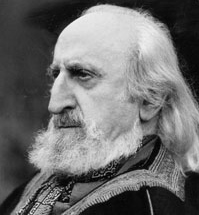
The idea of progress, that ideas and material culture accumulate in a manner that improves the lives of people across time, is one that is taken for granted. Even those students who have not taken philosophy in college have at least heard the name Hegel, and some of them might even know the crude formulation of his idea that history moves towards some final realization. Very few of those students would recognize the name Frithjof Schuon, or the ideas associated with him.
Schuon, by the way, is a member of the Traditionalist school I am sharing with you today. What usually marks someone as a member of this school of thought is the shared belief that all the world’s major religions may have superficially distinct traditions, iconography, and metaphysics, but at the heart of each of them is a common capital-T truth. This truth is called *Sophia Perennis*, or the Perennial Philosophy. Just like a perennial plant which comes back every year, the capital-T truth has manifested itself again and again throughout history in the blooming of new religions, cultures, and philosophies.
Another mark of the Traditionalist school is the rejection of the progress narrative and the whole Enlightenment project which took root in the 18th century. Perennialist authors describe modern civilization as decadent, and this decadence is usually the marker of a society which has reached its peak bloom and will begin to senesce. Drawing on a strong background in Hinduism, Islam, and Sufism, the Traditionalists describe modern Western society as having entered what is called the Kali Yuga; or, the final stage in a series of transitions in which esoteric religion has been replaced by a scholarly religion, the scholarly religion fell to a practical and commercial culture, and finally the degeneration collapses into hedonism.
To the Perennialist authors (René Guénon (1886-1951), Ananda Coomaraswamy (1877-1947) and Frithjof Schuon (1907-1998)), modernity has cut off access to the *Sophia Perennis* by a cynical critique of the silly and superstitious elements of the world religions and traditional societies. What is truly great and true and beneficial to society is derived by the intellect, according to the modern formulation. Tradition is derided. The lineages of ideas and wisdom that are transmitted via tradition get pruned back.
It is the traditions that transmit the *Sophia Perennis* in each culture and historical period, according to the Perennialist writers. The Islamic civilization, for example, is the material manifestation and the institutions that spring up around the transmission of the Quran from generation to generation. Within the Quran is a set of propositions and concepts that are said to have arrived to someone via “revelation”. Modern life mostly does not allow for revelation to be a valid form of knowledge or epistemology. This makes practical sense in most areas of life, like the court of law in which you do not want to be convicted of a crime in which the evidence of your wrongdoing came via a divine inspiration of your accuser.
What this way of thinking gets wrong is that all those silly superstitions and scientific inaccuracies of traditional religions are distractions. I always said that the blind adherent to a faith and the intellectual critic are making the same error – they can’t see the message through the words. The words themselves, the mere symbols, are taken too seriously, too literally, so the blind adherent is led to believe silly things while the intellectual critic who pats himself on the back for not being a moron fails to penetrate deep enough into the text to find the wisdom that those ancient authors were transmitting. Modern man is so scholarly and intellectual that he never does much more than mere symbol manipulation when reading and writing. And therefore it is much too difficult for him to encounter any genuine wisdom in his life.
The Love of Conquest
The first thing I do each morning when I wake up is go for an all-out heavy workout. No dicking around. No breakfast. Just get up and go. Some mornings it’s a 3-mile run, others it’s weightlifting. I love the feeling of the hot, rich blood coursing through my body. A couple of nights a week I go to the boxing gym and work on my striking precision and hitting harder than I have before. It’s in these moments of fully exerting myself that I feel I’ve reached the highest pleasure possible – that I am using my body in the manner it was built for.
Why does exercise have this effect? If you were to ask me, my best guess is that exercise is a modern surrogate for our love of conquest. In the words of one of ancient history’s greatest moral philosophers, Genghis Khan, “The greatest joy a man can know is to conquer his enemies and drive them before him. To ride their horses and take away their possessions, to see the faces of those who were dear to them bedewed with tears, and to clasp their wives and daughters in his arms.”
This is where I lose the average reader. Humans are prosocial and rational creatures, my detractors say, they are most fulfilled doing activities like caring for others and critically examining their lives and the world around them. They are not apex predators, and therefore do not derive their highest pleasure acting barbaric and predatory.
For close to 2000 years now, it has been the consensus that man is the rational animal, the social animal, etc. In modern biology, we have named ourselves *Homo sapiens*, which roughly translates as “wise guy”. Since Plato’s day, we tend to think of ourselves as a rational spirit trapped in a body. The body is something lesser than the mind. I believe this hierarchy has it backward. We are a body that contains a brain, which is meant to serve the body.
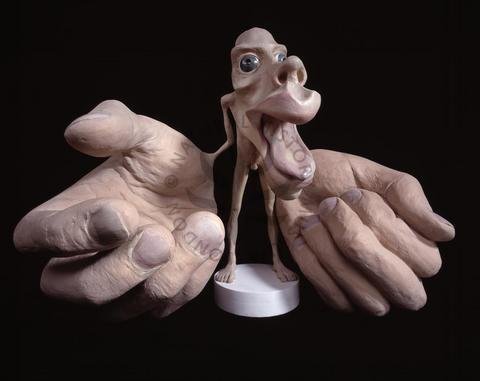
Below is an image of the motor homunculus. It represents how the human body would be proportioned as a 1-to-1 correspondence to how much cortical area in the brain is devoted to that body part. Notice that each hand is larger than the rest of the body. As far as the brain is concerned, all that so-called intellect of Linnaeus’s “wise guy” is wired for the fine motor control of his hands. Perhaps a better name for us is *Homo manus*. In fact, have you noticed how people sometimes “talk with their hands”? The way they gesture towards nothing at all or use articulate hand movements to illustrate even the most abstract concepts? The circuits involved in thinking about geometry and politics, or telling others what his plans are for tomorrow are reapportioned from areas in the brain that existed long before man was doing any of these things.
Brains and central nervous systems are built in the service of coordinating the movements of bilaterally symmetric and other higher-order creatures. It is only in the last hundred thousand years that the superficial regions of the brain have been swelling. A little bit of extra growth in the cortex was helpful to us in the struggle for our existence. More recently, about the last few thousand years, the growth continued unchecked as a species-wide cerebral edema. It continued as we successively divorced ourselves from the struggle for our existence.
The brain – moreso the intellect – developed well beyond what was necessary for the aid of our survival and became a parasite. It now uses our bodies as a host for achieving its own desires – desires for stimulation, experience, for solving abstract problems in philosophy and politics thanks to the absence of any substantial concrete problems we may face.

This Post has been Brought to You by the Acorns Investment App
When I decided it was time to start saving for my future, I did the idiot boomer thing and significantly limited my consumption and saved greater portions of my paychecks each week. Once I had a few months of rent saved up, I took the excess and started direct stock purchasing plans with various companies. For almost two years I invested 50 to 200 dollars per month building a portfolio of high yield dividend stocks. It took some trial and error, and a lot of research and self-discipline.
This post had been brought to you by Acorns. Acorns is an investment app that makes it so you don’t have to do what I did. No thinking. No discipline. You just consume and spend like you normally do. Acorns rounds off your purchases and invests that difference for you. This is the beginning of a brave new era in which we are free to be the impulsive creatures we are, and companies will give back to us a tiny fraction of a percent of the profits they make off our mindless consumption. What used to be our vices are now our assets. The artificially intelligent demigods will set the parameters that will protect us from ourselves as we return to nature as the animals we are.
Sign up for acorns today and take part in the posthuman future! https://www.acorns.com/
Or, if that doesn't sound appealing to you, you can round off some of your purchases and use them to sponsor my content here on read.cash.
[sponsors]

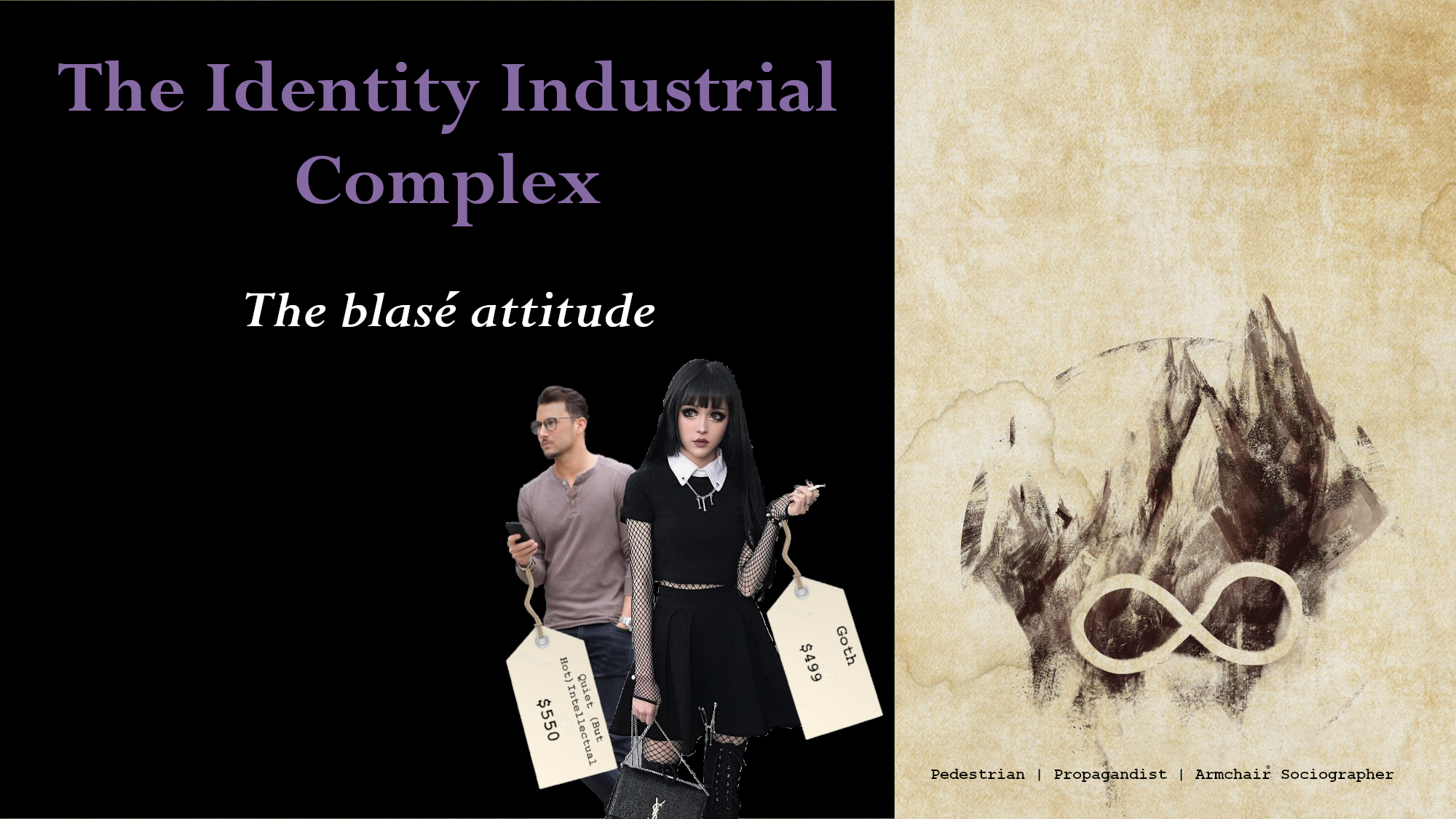
The Identity Industrial Complex | the blasé attitude
Last week, I introduced a piece called “The Identity Industrial Complex”, which laid out the broad themes of Simmel’s essay on the sociology of metropolitan life. Simmel focuses his analysis of modernity on the city because we can see all the characteristics of modern life – all its peculiarities and neuroses – in their most concentrated and crystalline forms. This essay examines a few key points of Simmel’s sociology at a finer resolution: specifically, that there are strong interrelationships among living in urban environments, the development of the intellect, and the money economy. Simmel spends the early part of his essay comparing city life to life in rural areas to illustrate what is unique about the environment that produces what we’ll call the metropolitan personality type. https://www.publish0x.com/crap-commentary-rhetoric-and-prose/the-identity-industrial-complex-introducing-simmels-the-metr-xmlpzl
The rhythm of rural life is much slower than in the metropolis. It’s circadian, habitual, and the chance for sensory overload is almost nonexistent. It is easier for those brought up in rural environments to have more intense reactions to stimuli. Those brought up in the metropolis, on the other hand, are bombarded with rapid changing sense impressions – traffic noise, 24-hour streetlights, advertisements coming to them from every direction, people shouting… Simmel describes it, “The metropolis exacts from man as a discriminating creature a different amount of consciousness than does rural life.” The metropolitan personality relies more on the intellect to direct itself and manage the cacophony of sense impressions it must live through.
This isn’t to say that the farmer doesn’t necessarily use his intellect – he puts it into his craftmanship, say, if he were to build furniture – but that he does not need to use it to fare well in his environment. The metropolitan man, according to Simmel:
*“develops an organ protecting him against the threatening currents and discrepancies of his external environment which would uproot him. He reacts with his head instead of his heart. In this an increased awareness assumes the psychic prerogative. Metropolitan life, thus, underlies a heightened awareness and a predominance of intelligence in metropolitan man.”*
The metropolitan personality is sufficiently hardened to the onslaught of stimuli. It is difficult to emotionally move this person. They develop what Simmel calls the “blasé attitude”. The blasé person’s nervous system is already so deadened that they get caught up in a pursuit of novel experiences, especially those that stimulate their swelled-up intellect. When sudoku puzzles don’t satisfy the blasé intellectual anymore, he moves on to less trivial pleasures like arguing about politics.
Money becomes a significant element of the way life in the city operates. Economic activity in the metropolis is based on production for the market – for purchasers who do not have any relationship with the producers. Money is essential in this sort of system because it serves as a medium to sync up the transactions between people who would otherwise not have a relationship with each other. The money economy supports a larger network of relationships that a barter economy could not. “ Through this anonymity the interests of each party acquire an unmerciful matter-of-factness,” Simmel says, “… The matter-of-fact attitude is obviously so intimately interrelated with the money economy, which is dominant in the metropolis, that nobody can say whether the intellectualistic mentality first promoted the money economy or whether the latter determined the former.”
Money is useful to the blasé intellectual because it converts disparate qualities of objects, experiences, and so on to a single quantitative measure: how much? All the transactions of city life are abstracted, making life in the city run more rational, more exact, more punctual.
“Punctuality, calculability, exactness are forced upon life by the complexity and extension of metropolitan existence and are not only most intimately connected with its money economy and intellectualist character,” he writes. “These traits must also color the contents of life and favor the exclusion of those irrational, instinctive, sovereign traits and impulses which aim at determining the mode of life from within, instead of receiving the general and precisely schematized form of life from without.” He goes on to say that “sovereign types of personality” – personalities that will not change or compromise their distinctive attitudes, behaviors and desires – are opposed to city life and must be resisted and detested so as to keep the machine running predictably and rationally.
This brings us right back around to that ultimate problem that Simmel says is central to modern life. Individuals want to feel as though they are distinct. How can one be special in a way that does not attract the negative response of those from everyone around them? The answer, according to Simmel, is fashion. Fashion is how modern people play out their individuality without disrupting the forces of rationalization and social equalization going on around them. As I explained in the previous post, fashion isn’t just about clothes. It’s about how we use every other material and immaterial (ideas, political views, entertainment) artifact that our culture provides us with to dress ourselves up. We are free to be as individualistic as we desire within the parameters that our society has set.
Gradually, this becomes not very satisfying to the individual. He always finds himself bumping up against the parameters his society has set. A conservative fellow who only has liberal friends does not simply state his ideas directly and risk losing all his personal relationships. He rounds off the edges of what he believes and presents himself as what he believes is more palatable to others. This, combined with the growing impersonal character of modern life generates a chasm between one’s personal experience and what Simmel has described as “the hypertrophy of objective culture.” More on that in the next essay.
[sponsors]
How Network Analysis Fits into My Research
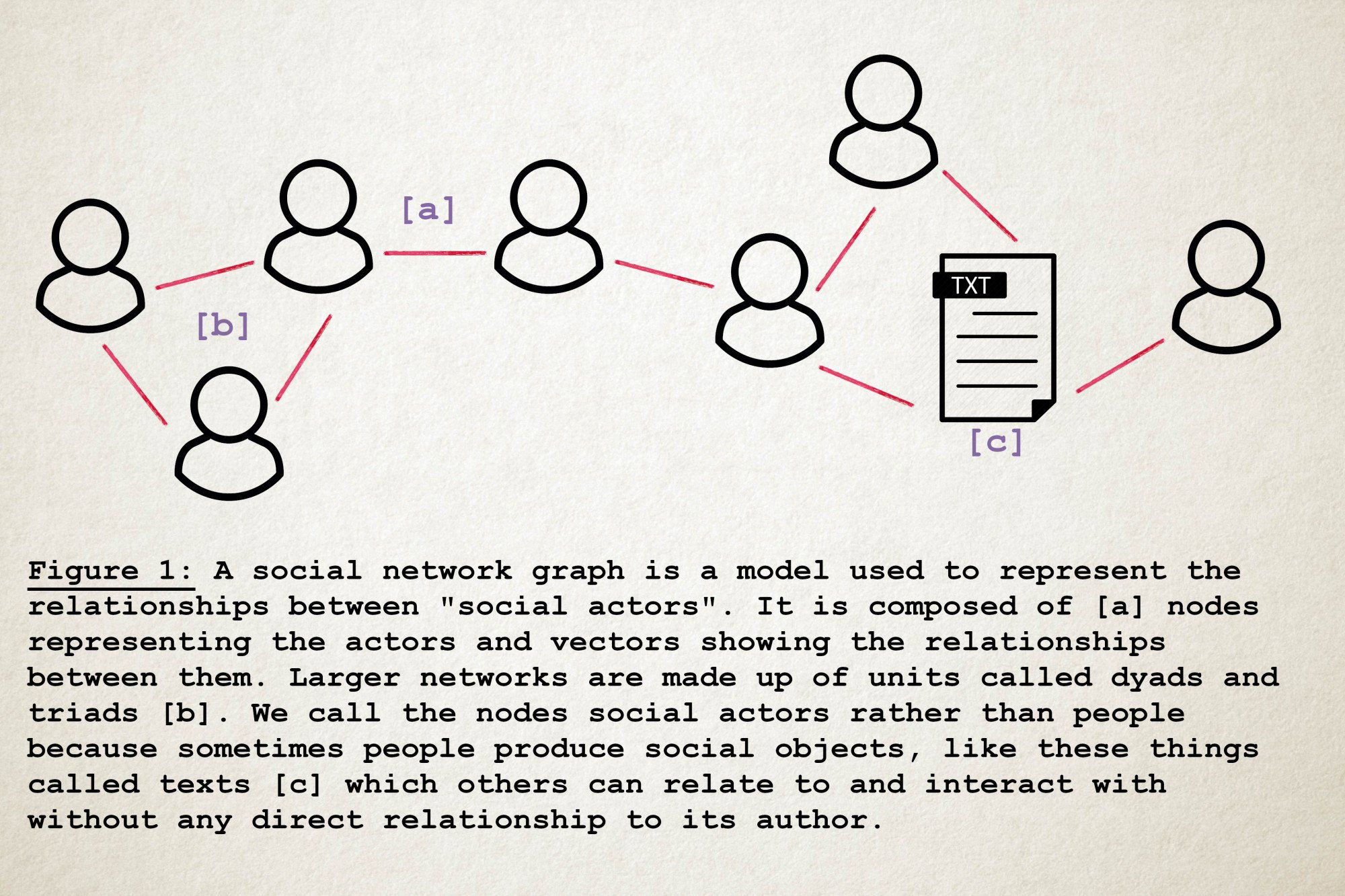
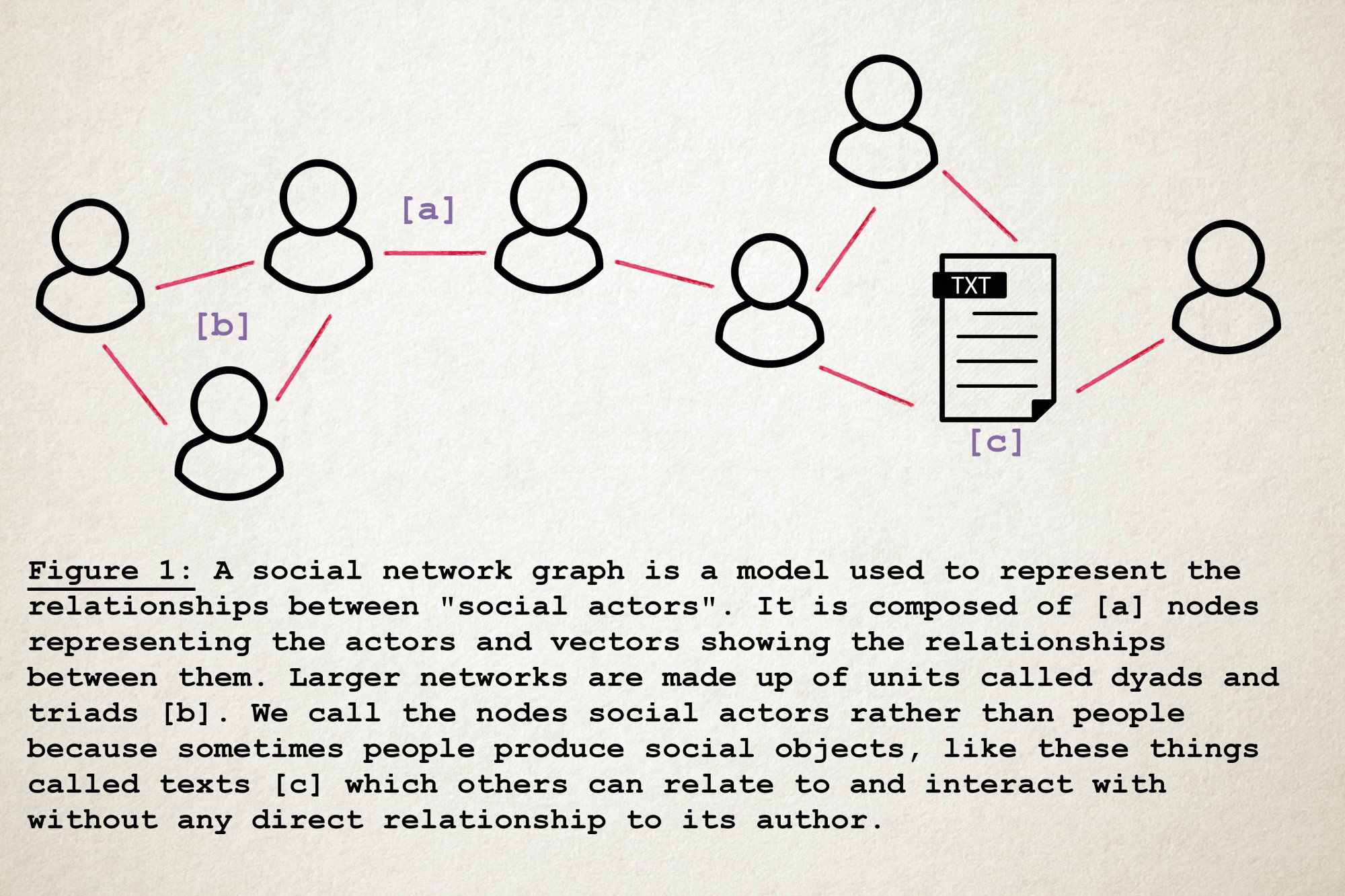
Network analysis is a part of graph theory and is useful to sociologists for modeling the relationships between social actors. Networks are composed of nodes representing the actors and vectors representing the relationships between them. We’re careful not to call the nodes “people” because not all of them are human actors. Some of these nodes we can call “texts”. A text can be anything that is created by an author (a book, a video, a song, etc.). People can interact with the texts an author produces without having any direct relationship with that author, and in a sense, those texts are their own separate entity.
Figure 1 below shows an example of a social network below and includes a text.
The thing about texts is that they always used to need human actors to produce them. A human actor receives a text, interacts with it, and can either convey that information directly to another human actor or produce a new text. The human intermediary between texts is gradually becoming unnecessary. Here’s a great example: I took an excerpt from a recently published paper in *Nature* and fed it into a text generating neural network. Here are the original and three generated texts that come after the following input I took from that paper:
*“Magnetococcus marinus (MC-1) is a magnetotactic, spherical bacterium that is capable of swimming extremely fast (Zhang et al., 2014; Fenchel and Thar, 2004; Bazylinski et al., 2013; Garcia-Pichel, 1989). MC-1 as well as the closely related strain MO-1 (Ruan et al., 2012) are equipped with two bundles of flagella on one hemisphere (bilophotrichous cells).”*
How is your background knowledge in biology? Are you able to tell apart the original from nonsense?
*(a) They produce two domains of their virulence factor (VF), mainly composed of SPE1 (Sporcine electrokinetic protein 1) that acts to protect MC-1 against RMI/UV (Zhang et al., 2014) and AP1 that promotes virulence.*
*(b) Biochemical studies of the MC-1 genome reveal a double bioluminescence signal. MC-1 displays both membrane and protein biosynthesis, each presumably involved in the efficient preparation of biochemically active substances for packaging to the flagellum.*
*(c) The bacterium also features a magnetosome chain, which imparts the cell with a magnetic moment (‘magnetotactic’ cell). They are assumed to swim with the cell body in front of both flagella bundles, which synchronously push the cell forward (Zhang et al., 2014).*
*(d) The whole flagellum contains only 3200 ATP-binding helices and a tail of 50–100 (Aiken and Loew, 2002). One ionic bond is made between the tail and the distal portion of the helix.*
Chairman Zuckerberg and his elite cabal of factcheckers are trying to protect you from encountering the above problem. There’s a lot of misinformation and disinformation out there, and word on the street is that Putin’s been gaming the results of the last several seasons of America’s Got Talent. Lucky for us, Chairman Zuckerberg will ensure that all the information that reaches us is authentic and all the nodes that share it are acting in good faith. There will be a biologist on site to tell us which of the above four utterances is authentic and scientifically accurate.
My question, though, is who fact checks the factcheckers? But that’s a separate post coming later. Back to networks.
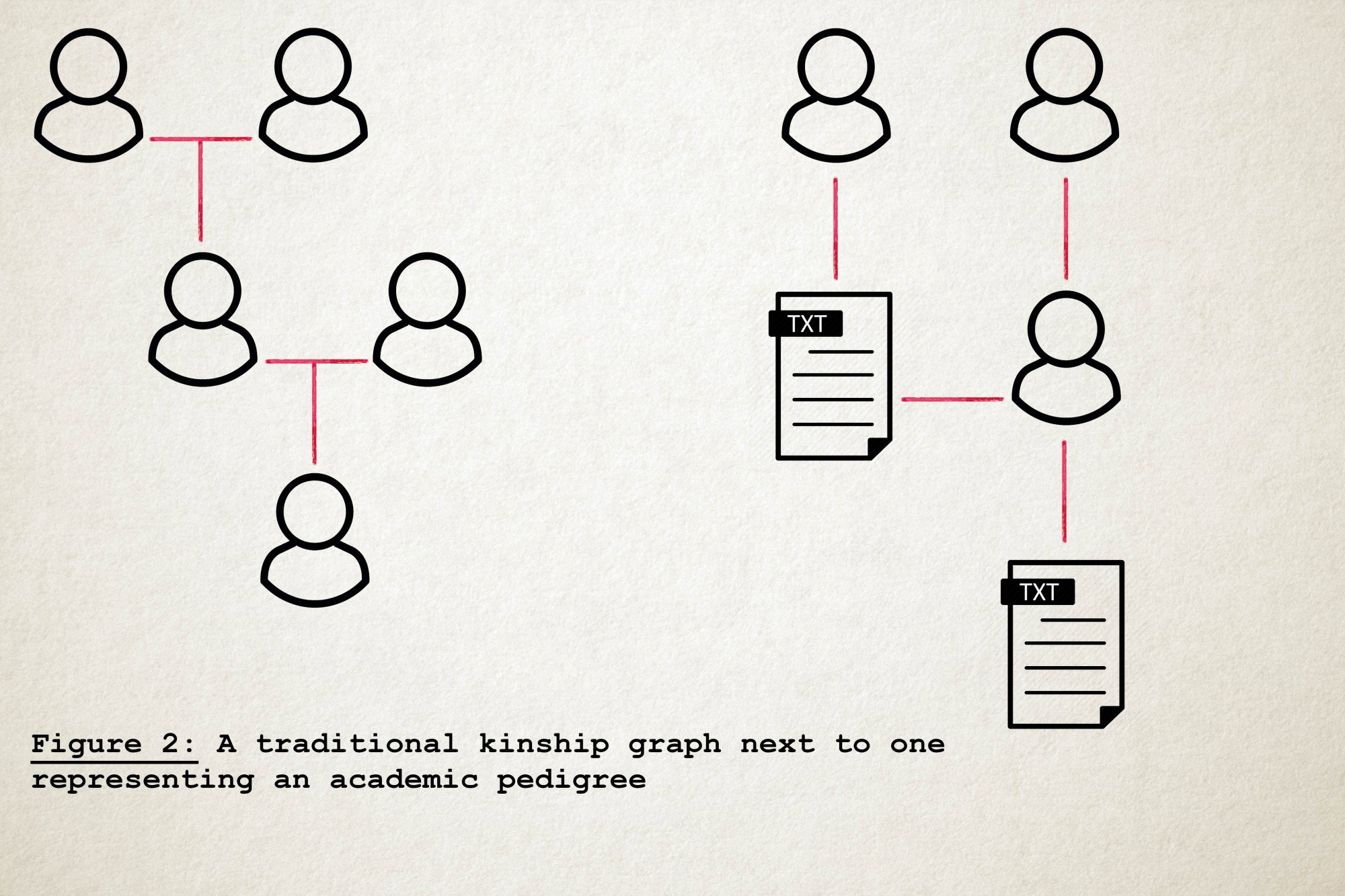
I’m working on modeling the networks of old school university researchers and people like DIY biologists who do research outside of academia. Figure 2 below gives an example of a lineage that is typical to universities. Students have advisors who instruct them to be a certain kind of scientist, those scientists grow up to be advisors, and the lineage goes on in the same way that is represented by pedigree/kinship graphs. What’s different about academic pedigrees is that they include lineages of authors and texts.
It’s only a useful fiction that we classify these things called “sciences” with clearly defined boundaries and universally standardized methodologies. Don’t get me wrong, sociology is sociology and biology is biology, but the character of, say, the sociologists produced by the University of Chicago is quite a bit different from that of the sociologists that the University of Wisconsin-Madison puts out. Each school has its own lineage of advisors who train their students to be a certain sort of scientist, who then become advisors passing on their unique composition of theory, methodology, and texts. There’s substantial overlap and if you trace their lineages back far enough, you’ll find that many of these advisors are direct descendants of some big names like Weber and Durkheim. But it’s at the level of the species (the specific academic institution) where you will find significant family resemblances to their overall approach to sociology.
The Chicago School of sociology, for example, passes on to its scientists an emphasis on the study of urban life, grounded in a strong background of symbolic interactionism and ethnographic fieldwork. Many other schools are best known for their emphasis on quantitative methodologies or critical theory and so on.
If we back up and look at all these institutions in the aggregate, we can say that they all fall into a genre of institutional science. There is another genre called citizen science. The work that I do falls into this latter domain. While I did go to university and left after getting my bachelor's, many of the people we call citizen scientists were not produced in that academic pedigree that is central to institutional science.
After my first year out of college, I had the opportunity to meet with people called DIY (do it yourself) biologists. The work they do falls outside of the university system and often takes place inside their own garages and kitchens. Public reaction to DIY biology oscillates between not taking it seriously to taking it too seriously. One day they are just hobbyists playing with toys and the next they are bad faith actors engineering the next global pandemic. There are, however, some credentialed biologists who so welcoming to this community that they’ve taken to building DIY bio labs in their garages as well and inviting aspiring citizen scientists to teach them.
In the past few years, I visited these communities of scientists the way that the old anthropologists used to visit distant tribes. I’m learning about their ways of life and modeling their networks and lineages. I do this to help me better understand citizen scientists and pedigreed scientists tend to have the distinct worldviews and practices they do.
The Identity Industrial Complex | Introducing Simmel's "The Metropolis and Mental Life"
*It isn’t just that the winners write history, but that they always portray themselves as the underdogs. History looks to us like one long David and Goliath story. And so will the “Mayor Pete: America’s Mayor” Netflix original docuseries accompanying his election victory.*
One of the central problems of modern life, as Georg Simmel sees it, is that the will of the individual to assert himself is resisted by the social forces exerted back on him by the “social-technological mechanism”. He is free to be himself only to the extent that his uniqueness has a useful function in his society.
The problem was just the same in the state of nature. He was totally free to be his unique self so long as his uniqueness aided in his physical survival. His species then reaped from him his advantageous distinctiveness and spread it into successive generations until it was no longer his own. His traits become standard by virtue of their success. This phenomenon takes on a new form in modern life.
Modern man’s will to assert himself is leftover from his days of having to outwit his predators. What he has available to him as an outlet for it is the markets and the cultures surrounding them. They provide him with the resources he needs to compete with others in games of status and shame. Everyone is free to assert their worth by acting out their identity within the parameters set by the markets. Look at this formula for the typical ad on television to see what I mean:
The ad starts off reminding you that you are a strong/confident/interesting/etc. person
It tells you this company happens to make a product for strong/confident/interesting/etc. people
It then suggests you ought to buy this product because you are strong/confident/interesting/etc.
If you were compelled by the ad, then you choose to buy the product. For their sale, the advertising department gets a nice bonus at the end of the year and you get a marker of your worth in the games of status and shame. Everybody wins.
You might see through its bullshit if you weren’t compelled by the ad. The fools who buy these products are little more than actors on a stage, you think, their shirts are costumes and their coffee makers are props they use to act out their identity. You must think you’re smarter than them. Unfortunately for you, the Identity Industrial Complex’s tentacles run deep and they got a hold of you too. These markets don’t just sell you physical objects. Beyond your style of dress and how expensive your coffee is, you assert your status through your taste in music and by having more interesting opinions about politics than the next guy over. Somebody somewhere is going to make a buck off your will to assert how much smarter you are than the cretins who buy t-shirts to communicate their identity. You can’t escape it.
The remark about politics is especially true today, since the 2010s when people started saying unironically, and without any indication of feeling shame about it, “I only get my news from The Daily Show.” The boundary between politics and entertainment dissolved away at this point (the United States has a Reality TV star president!) and now one’s political orientation has become a taste in entertainment for those who are the most self-important among us. Increasingly, your utterances about political matters become a significant part of the script you recite as you play your public character.
In the same way that the species reaps the advantageous distinctiveness from its organisms, the society reaps the best memes from its individuals. The games of status and shame have us running on a hamster wheel that generates an indefinite supply of profit out of our will to assert ourselves. Once we finally feel that we have established what makes us individually significant – we have the best style of clothes, the best taste in music and coffee, and the most interesting and informed political opinions – we start noticing more people around us are wearing the same clothes, drinking the same coffee, and uttering those brainless talking points you’ve moved on from in 2018. When will it end? When will these inauthentic zombies stop copying me? You think to yourself as you read an ad for a new social media site for the small number of people who are only as interesting as you.
The task of asserting yourself is an eternal effort. The Identity Industrial Complex has its markets rooted deep in this never-ending cycle. It makes its money mass producing unique identities for its consumers. Simmel doesn’t describe the situation in quite this language. He wrote his essay “The Metropolis and Mental Life” in 1903, but everything he describes in that essay is salient to the contemporary problem I just described. When he opens his essay saying that this will for the individual to assert himself pitted against the social forces which flatten out individuality is a fundamental issue to society, we can see that it still holds true today. I’m going to spend a few essays dissecting “The Metropolis and Mental Life” and finally return to explaining that little quip I made about Mayor Pete in the opening of this essay. Once we lay out the background of ideas that are embedded in Simmel’s essay, we can talk more about the relationship between politics and the Identity Industrial Complex. https://www.blackwellpublishing.com/content/bpl_images/content_store/sample_chapter/0631225137/bridge.pdf
On Retreating into the Wilderness
When someone pursues a goal with a high enough risk for failure, and especially one with high energy costs, their body gives them a little biochemical boost in the form of adrenaline, endorphins, and anandamide. All the best research on exercise consistently demonstrates that physical exertion is followed by improved affect, sense of wellbeing, anxiety reduction, post-exercise calm, etc. When you consider the sort of lifestyle that man has lived in the first few hundred thousand years of his infancy – all the famines and the predators – you start to look at this knowledge with the impression that the human body was not just forged in a state of constant conflict, but is at its best and most fulfilled in such a state.
Very recently in his development, in only the last 10,000 years, man started living in cities. In just the blink of an eye, he was removed from the horrors of nature, no longer having to fight and kill his rivals over barely enough food to survive. The city provided him with enough food, comfort, and security to satisfy his every need. Conversely, as the world around him became more consistently safe and orderly, he grew more agitated, more anxious, and less satisfied.
Finally, one day 2000 years ago one man was so fed up that he up and left society to live in the wilderness for 40 days. He starved himself to the point that on the 40th day he hallucinated the patron saint of Rock n’ Roll, who came to him and offered him food, security, and power in exchange for his allegiance. For whatever reason, his little cynical publicity stunt led him down a path of self-discovery and he refused the offer. He believed he had everything he already needed while living in the wilderness.
It’s difficult to understand what his insight was all about unless you try it yourself, so men all around the world emulate his retreat into the wilderness each year by going the entire month of November without rubbing one out.
[sponsors]
If you would like to know more about the wisdom that the ancient world has for modern life, consider subscribing to me and sponsoring my content.

The First Step to Developing Your Writing Voice - The Audience
I was an assistant to a philosophy professor for 6 years and helped many students clarify and better articulate their arguments. I’ve also helped proofread and edit original work for that professor, including one piece submitted to a refereed journal. Since that time, I’ve taken to proofreading and editing papers and master’s theses for international students.
I’m always thinking about the difficulties that international students have in articulating their thoughts in their second language, and one problem many wonder about is developing something called their “writing voice”. This problem is interesting to me because the writing voice is something that many Native speakers don’t quite grasp. To me, this is something that is built on top of already mastering the basics of good writing habits.
While voice is one of those terms that gets tossed around a bunch, it doesn’t have a concise definition - some people refer to it as “style” or “persona”. The best way to think about it is to compare it to your speaking voice. Your speaking voice has its own tone and cadences that makes it easy to tell your speaking apart from someone else’s. Someone can know it is you speaking just by the sound of your voice. In principle, if you work at developing it, the same can be said about reading your writing. In the business world, you could call your unique writing voice your brand
Most of the writing you find online falls into two categories. The first I call space food writing. It has all the components of writing, but it’s lifeless. It needs something. The other kind is overflowing with a little too much something – it puts too much effort into style that it distracts from the content of the writing. I call it hipster writing. A lot of this has to do with the fact that online writing is alien compared to the communication that takes place between two individuals who presumably understand what each other knows and doesn’t know.
Online writing, however, is more abstract than that. The writer is often trying to capture the largest possible audience, and so he can’t quite picture in his mind who this audience is. Space food writing and hipster writing happen because the writer has no concrete connection to his audience.
Let’s consider an exercise. Take your profession, whatever it is, and think about how you would explain it to different people. Take a moment now to write out how you would explain what you do to another expert in your field. Now, take a moment to write out how you would explain it to your grandma, or someone else you are close to. Write out how you would explain it to a child next.
In each of these exercises you are writing to people who are different from each other with respect to what they know and how personally close they are to you. In each of these cases, you explain something you know about in different ways – your wording changes, your tone is different, etc. This is the first step to establishing your writing voice. When you write online, rather than appeal to a generic, abstract audience, think about who will read it. What is their age range? Their professions? Be as concrete as possible so you know how to tailor your message.

My Small Volume Trading Results this Weekend
It’s been a shaky few days in the crypto market. I noticed last week there was a lot of hubris going around, but the technical charts didn’t show any good opportunities for trading for me. My strategy is conservative. I prefer to get in and out of a trade in less than a day and scrape the excess into a high-interest account. Just before the selloff last week when most of the top currencies lost between 5 and 13% in value, I decided to lock in about 60% of my portfolio as stablecoins. Compared to the market, my portfolio lost only 2% of its value.
I figured as the market recovered, I could easily make that value back with a few small volume trades. But the trades haven’t yet presented themselves. I made 3 trades on Friday (see below). Litecoin (LTC) was the only currency that had a recognizable buy setup pattern – so I took it. The thing about the crypto markets is that most assets reinforce each other’s behavior. If ETH starts to have a good day, you’ll soon see LTC or BTC’s technicals start to take on the same pattern. So even though it wasn’t very wise, I ran the same trades with BTC and ETH despite how weak the signals were. I swung $100 at each trade.
It took 36 hours for my trades to follow through (longer than I like). I usually like my risk-to-reward ratio to be 1:2 or 1:3, meaning that if I swing a $100 bat at a trade and aim to make 3 to 6 bucks on that trade, but it drops below $98, then I’m out of the trade and move on. If this happens, I take the loss and move on. I have no interest in being a long-term investor so I’m not going to risk a significant loss and be forced to stay in a trade for weeks, or even months, in hopes of making my money back.
Luckily for me, my trades were all positive, however weak (see below).
And here’s my chart with my total profits on the trades. I made my money back and decided to hold on to the excess to put into my BlockFi account where I gain interest on my coins.
Litecoin was the only one to reach its target, but ETH and BTC were still in the positive at the time so I pulled out of those trades at the same time. Overall, I netted some pocket change. It’s easy to see how in hindsight I could have swung bigger bats for more profit, but the signals at the time were not clear enough. As the market corrects itself, I ought to be able to start hitting home runs once or twice a week again.
How I Hedge My Portfolio with Stablecoins
I started January of this year by rounding off $500 from what I earned last year to start a new crypto portfolio. The idea behind it was to be conservative about what went into it and the strategies I used to build its value. You see those ads on YouTube all the time about a guy who starts off with $321.48 and turns that shit into a lambo. The thing about markets is.. they’re gonna get their money back from most people. Speaking of, have you seen the 24-hour price change of most of the cryptocurrencies? Ouch!
Losses in the last 24 hours are ranging from 5 to 13%. Luckily for me, I’ve picked up some good habits. When things are going well, I lock in some of that value by trading for stablecoins. Stablecoins will comprise 40 to 60% of my portfolio value depending on how volatile things get. When I check the other day, my portfolio value was $606.48, or 21% growth since January. Most of that value came from hubris, so I began trading it for stablecoins.
A little over 50% of my portfolio was USDC just before the drop off yesterday. My portfolio value fell to $591.51, or a loss of 2.5% when most currencies were losing between 5 to 8% at that time. Over the next few hours it fluctuated between 593.79 back down to 591.41 earlier today. Throughout the next week I plan to buy back some of that crypto and grow it more.

Do Male Social Scientists Have "Female Brains"?
Beginning in May 2019, I ran the first iteration of a survey of university professors across the United States about their research interests, their methods, and their individual temperaments. My goal is to measure whether certain personality types tend to cluster into some disciplines more often than other fields; for example, do highly extraverted people tend to go into the social sciences at a higher rate than into the natural sciences? This survey was the pilot test of one an updated version I will run again this year.
The second half of the survey asked 59 questions that measured traits of neuroticism, moral intuitions, and systemizing quotients (SQ) and empathizing quotients (EQ). This article compares the SQ and EQ between 17 social scientists and 17 natural scientists in that survey. The SQ and EQ scales were developed by Sacha Baron-Cohen’s brother, Simon. Dr. Baron-Cohen uses these scales as part of his research on the “extreme male brain” theory of autism. The theory comes from the observations of data that male brains are much more “front-to-back” connected and female brains are more bilaterally connected, accounting for a whole myriad of facts including why female children learn language sooner than males and why males more easily grasp mechanical reasoning or “intuitive physics”. https://www.ncbi.nlm.nih.gov/pmc/articles/PMC4553147/
Baron-Cohen’s research discovered that both male and female children with autism have brains with an exaggerated male profile, leading them to score lower in EQ and higher in SQ. I repurposed these scales in my study to find if there were similar discrepancies between professors in the social sciences and natural sciences. My original hunch was that both fields would have relatively equal SQ scores (because scientists in general are more systematic than the average of the population). I figured the key difference between the two would be that social scientists have above average EQs and that would explain why they are more interested in going into fields studying people. It turns out the reverse was true. Both groups had similar EQ scores and social scientists had significantly below average SQ scores. Natural scientists were relatively balanced with their SQ and EQ being roughly equal.
It's not merely that these results were unexpected, but after accounting for sex differences, my data shows that social scientists have a similar discrepancy between their EQ and SQ scores as people diagnosed with autism, but in the opposite direction. Here is a breakdown of the scores.
Social scientists scored 0.88 in EQ (on a scale from -2.0 to 2.0) and natural scientists scored 0.79. With respect to sex differences within and between the fields, there was virtually no difference between male and female natural scientists (females scored 0.7875 and males scored 0.7889). In the social sciences, this discrepancy was 0.98 for females vs 0.83 for males. As you can see in the table of p values below (the likelihood that these differences are due to random chance), there are no significant differences in EQ scores in any direction as far as the data is concerned. In other words, most professors score about the same in EQ, regardless of sex or discipline.
The data gets interesting when we look at SQ, however. Social scientists scored 0.02 in SQ vs 0.56 for natural scientists. This is where sexual differences start to really shape the scores. Females and males in the natural sciences scored 0.29 and 0.81, respectively. This is a similar pattern of SQ scores to what we find between females and males in the general population. And social scientists follow it too, females scoring -0.18 and males scoring 0.38. As you can see in the table of p values below, the differences in SQ between disciplines and between the sexes are significant – except for between females, and we’ll return to this and explain why later.
The most surprising result from all this is that male social scientists scored over twice as high in EQ than SQ, and their SQ scores were below what is typical of males. Males in the general population tend to score a third of a standard deviation above in SQ and score lower in EQ. This sample of males is the only that I can find that inverts this trend. I am going to add more questions to these instruments in the next few iterations of this survey and collect larger samples to find out if this trend continues. If it does, what it shows is that this population has an inverted pattern of the “extreme male brain” archetype from Baron-Cohen’s research. Do male social scientists have “female brains”? https://en.wikipedia.org/wiki/Empathizing%E2%80%93systemizing_theory#Research
I’m interested in finding out because it would add to our understanding of something called the “male variability hypothesis”. The reason I figured to test for sexual differences in my data because of data like this below, taken from the paper “Gender differences in individual variation in academic grades fail to fit expected patterns for STEM” published in Nature in 2018. This illustrates the male variability phenomenon. If you look at any distribution such as IQ or grades, women will have a slightly higher mean score than men. Men, however, have a wider and flatter distribution, which means you will more likely find men occupying the extremes while the average female outperforms the average male. https://www.nature.com/articles/s41467-018-06292-0
We should then, if this model is consistent across many more domains, expect to find a similar sort of male variability in SQ and EQ scores. What I found surprising in my data was that I wouldn’t have originally expected the specific extreme of low SQ and high EQ in men to consistently pool up in the social sciences. As I said above, I predicted the reverse – consistent SQ scores across the board with variability in EQ predicting which fields people would fall into.
[sponsors]
The next iteration of my survey will cover 4 traits including SQ and EQ, the other two being extraversion and neuroticism. I also added a questionnaire on three factors of disgust (sexual, hygienic, and moral disgust) to measure whether similar discrepancies show up in these across the disciplines. If you would like to support this research, considering sponsoring my content here on read.cash. My long-term goal is to demonstrate how quality independent science and research can be done without being affiliated with a university or taking on unmanageable amounts of debt thanks to blockchain technology, decentralization, and affordable information technology.
The Election Day Holiday Season
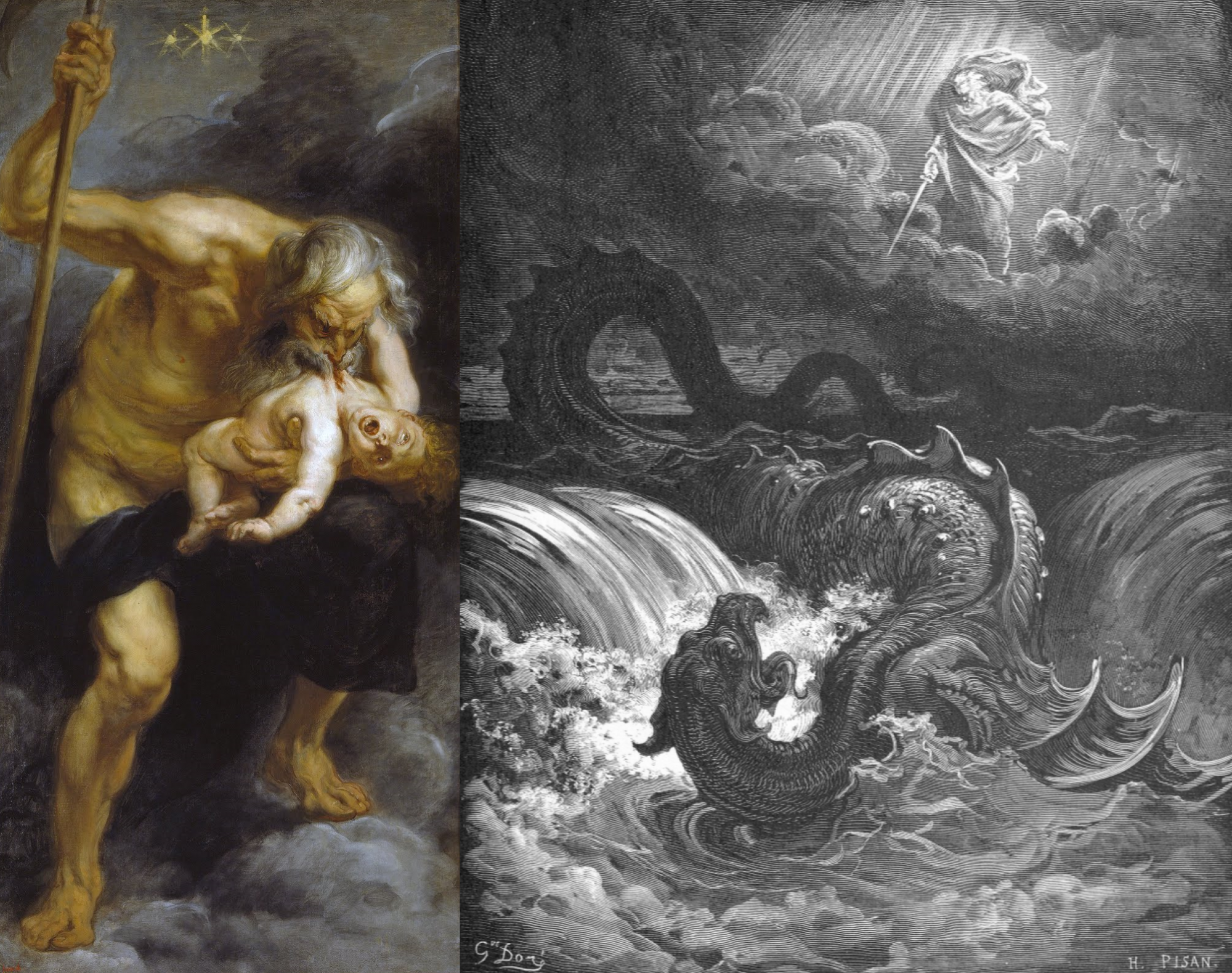
Currently in America, where I am writing from, we are celebrating the holiday season leading up to Election Day. This is a special holiday to us because it’s a cathartic experience in which we act out one of the two oldest mythological stories: either (1) we continue the tradition of Kronos killing his father Uranus, and Zeus killing his father Kronos, ad infinitum, or (2) we act out the story of the Hebrew God killing the Leviathan.
Our Election Day holiday is a blend of both these two stories because our culture is a combination between the culture of Athens and of Jerusalem. The resulting marriage of the two has led this special holiday to oscillate between two major themes.
When we act out the first story, we overthrow the tyranny of the father (patriarchy) so that we may become free. With freedom comes chaos, however, so the freer we become, the more disorderly the world becomes. This goes on for some years and we decide to act out the story of God killing the Leviathan. We rescue individuals from the tyranny of their own self-destructive, animalistic desires; we regiment their lives and give them discipline and order. With order comes a loss of freedom… and so the cycle goes forever…
The Vinegar Tasters
Three men named Alex, Bernard, and Wayne went on vacation in China to celebrate the New Year. They got lost while site seeing one afternoon, and came upon a barrel of vinegar. They decided to rest there.
Alex stuck his finger in the vinegar, pulled it out, and had a taste. “Yuck! It's sour.”
The taste reminded him of how life today seems out of step with the way things used to be. No one respects the old traditions anymore, he thinks, and the people in charge are running everything into the ground.
Next, Bernard had a taste. “Hrmph! It's bitter.”
It reminded him of how life is just one big disappointment after the next. He can't enjoy himself because everything always seems unfair, and no matter how good things get there are plenty more bad things going on as well.
Wayne had a taste. “Mmm. It's sweet!”
The vinegar reminded him of how everything in life turned out the way it was supposed to. Actually, it wasn't going to turn out any other way. To Wayne, the more you try too hard to make things go one way or the other, the more resistance you'll feel. Wayne isn't fatalistic about this. He's learned to relax and let things unfold as they do.
Alex and Bernard weren't in the mood for Wayne's bullshit. It was time to pack up and start moving again.

Academic Turing Tests | How to fool the experts with nonsense
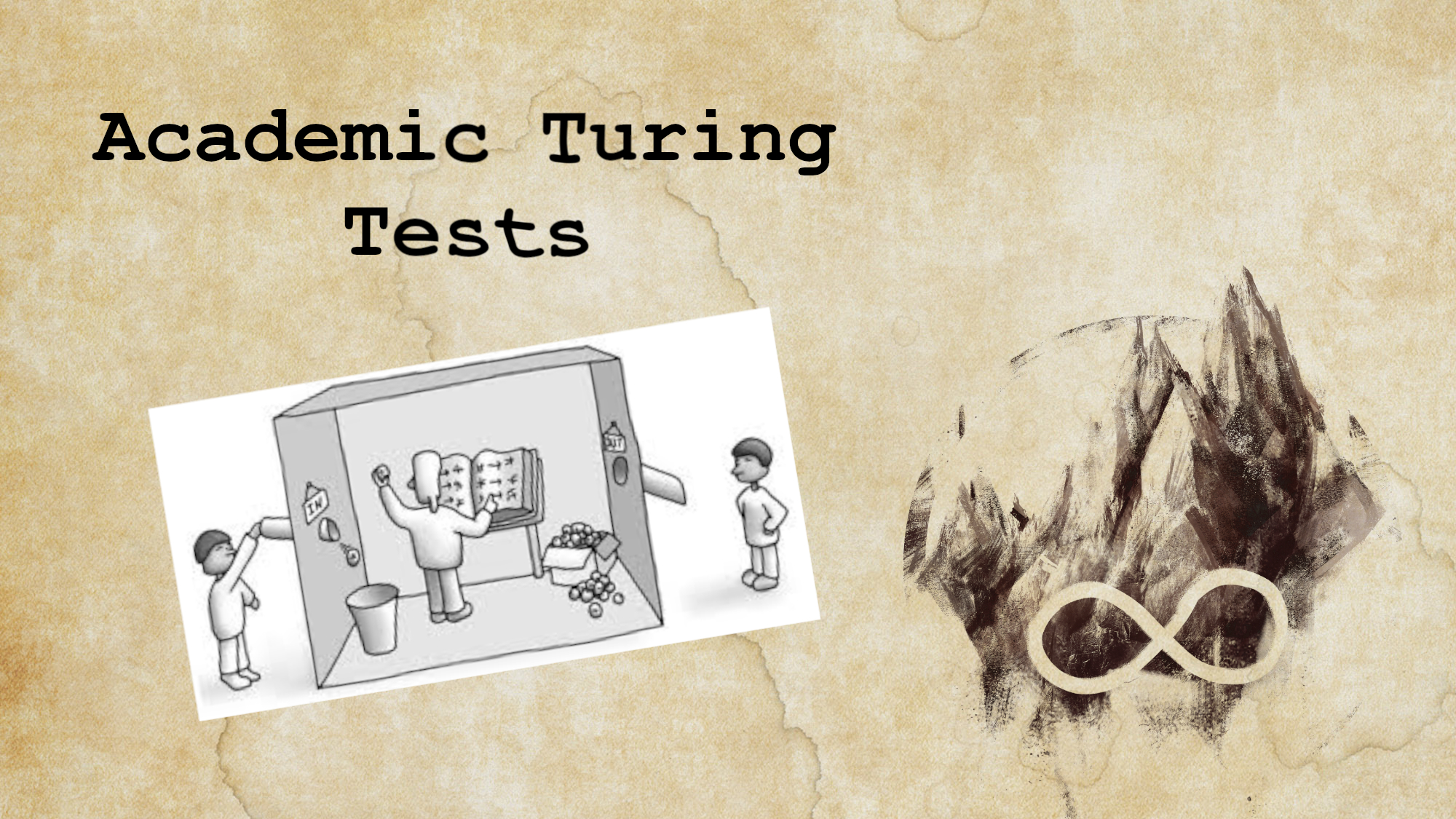
The Turing test is a set of criteria used to determine if machines can “think”, or exhibit signs of intelligence. If a computer can reliably convince interrogators that they are communicating with another human, it passes the Turing test. John Searle, philosopher of language and mind, claims this test misses an obvious point about language and communication. He illustrates the test’s problem with the Chinese room experiment. https://plato.stanford.edu/entries/chinese-room/
Imagine an English speaker is placed in a room with a slit from which pieces of paper with Chinese writing are passed to him. In the room he has an instruction manual to help him create responses to pass back through the slit. Suppose this instruction manual is comprehensive and he learns to use it create elaborate responses. If native Chinese speakers outside the room are convinced that they are communicating with another Chinese speaker, does this mean the person inside the room understands Chinese?
This example makes it easy for us to understand why not. When the English speaker looks at a Chinese character, he does not form in his mind the image of what the symbol refers to. It doesn’t have any meaning to him. He is given symbols and a set of instructions for how to manipulate those symbols. This is precisely what computers are doing.
***There is a similar sort of symbol manipulation going on in academia.***
As a student and an assistant for a philosophy professor, I was forced to write out and articulate arguments and beliefs I disagreed with. Not as a method of indoctrination, but because we were graded on how well we understood an argument or worldview, regardless of what we thought about it. There is a time and place for commentary and criticism, but professors don’t care about your comments and criticisms until you can demonstrate the rudimentary skills of working with ideas first. There is plenty to disagree with Aristotle on, but if you don’t understand what he’s arguing, you are wasting everyone’s time telling people what you think of his philosophy.
My last year in school I took one of those [Insert Subject] Studies courses and once again I had to articulate thoughts I disagreed with. This time it was easy to do. In previous courses, we looked at evidence to understand how it refutes or confirms competing theories, but this time we were given the correct way to think at the beginning. Rather than weighing ideas against the evidence, we were given an algorithm through which to filter information.
I understood by the end of the first week that because I knew the algorithm, I was going to get an A in the class. So, I showed up every class period hungover, feeling ill, irritable, and I just processed the information through the algorithm. I have very few memories of that class because I was rarely ever conscious. You don't need a mind to run an algorithm.
The final for that course was something of a Turing test: can you generate text with the algorithm? Not literally asked like this, but you get it. The course looked just like any other. We were given material to study and that material was on the test. I didn’t have to study though, because I went through each question and filtered it through the algorithm. The truth was taken to be self-evident. All I was doing was taking symbols and manipulating them to create a response, rather convincingly too.
Maybe you think I’m exaggerating? ***What if we were to simulate a Turing test on academics to find out?*** It would work like this: we take two fields – say embryology and women’s studies – and submit 20 bullshit articles each to the highest impact journals in those fields. We get a bunch of non-experts in these fields to help generate text that appears to look like authentic research in those fields. Do a little editing to make it as convincing as possible. Then, we compare the rates of which each field can filter out bullshit.
In 2018 three academics successfully got 7 purposefully nonsensical papers accepted into peer-reviewed journals, with another 13 in the review process before they were found out. They were discovered by a journalist, of all people, who couldn’t believe that one of their published papers was real. https://www.theatlantic.com/ideas/archive/2018/10/new-sokal-hoax/572212/
“While I closely and respectfully examined the genitals of slightly fewer than ten thousand dogs, being careful not to cause alarm and moving away if any dog appeared uncomfortable, there is some relevant margin of error concerning my observations about their gender in some instances,” they wrote in a paper describing rape culture at an urban dog park. Did the reviewers not suspect this was an elaborate prank? Academic writing is always on the margins of our knowledge and sensemaking. Reviewers ought to be hypercritical and hyperconscious when they are reading this type of writing – not asleep at the wheel.
The reason why they were able to fool the reviewers is because they knew the script. They knew the conclusions and the jargon the reviewers wanted, and from there reverse engineered the papers. It’s noteworthy that all these papers were in the social sciences and humanities – and specifically in fields like critical theory, gender theory, etc. etc. I have a hunch that you couldn’t pull this off in the field of embryology. Much of the theoretical jargon is built on top of empirical rigor. BUT – I don’t know this for sure, so I propose the above test.
This essay by Jordan Hall helps to explain why the reviewers were so easily duped. It introduces the concept of “simulated thinking” by comparing it to two modes we oscillate between in our ordinary lives. The first is **exploratory mode**. It’s an awkward, self-conscious, and clumsy sort of way of going about learning a new skill or studying new material. Eventually, as you become more competent, you shift into **habit mode**. In habit mode, you can drive your car without consciously narrating to yourself, “there is a red light, I should put on the break.” Instead, you run a bunch of unconscious scripts that allow you to drive while you pay attention to the radio or carry a conversation. https://medium.com/deep-code/on-thinking-and-simulated-thinking-5e434e92cf86
There are two possible errors here. We know the first pretty well, called overthinking, when we put too much conscious effort into mundane things. The other, call simulated thinking, occurs when we use unconscious scripts when we should be in exploratory mode, say when driving around in a new and unfamiliar city looking for a specific spot.
Simulated thinking is more advantageous than exploratory mode in the short term. When it works, it’s quicker and more efficient than exploratory thinking; and because it works, it doesn’t matter whether it has any consistent relationship to reality. In the long term, however, the liabilities add up, and things line up for a monumental systemic failure – say, a car crash, or an entire academic discipline getting built up on the tastes and sensibilities of the academics rather than on reason and facts.
[sponsors]
On Being Stunning and Brave
When we look up at the antics of the celebrities on stage, we often give the more eccentric of the lot the benefit of being “ahead of their time.” The window of what is appropriately ahead of our time is very brief, though. I’d say only about 2-3 years. Five years? Now that’s bordering on lunacy.
Imagine that Kanye West waited five years to jump up on stage and interrupt Taylor Swift’s acceptance speech at the VMA’s. It would have been 2014 then. He would’ve said his spiel, “Yo Taylor, I’m happy for you. I'mma let you finish, but Beyoncé had one of the best videos of all time!” And how would people have reacted? He would’ve only received half the backlash he got in 2009, but many other cultural commentators would’ve written a different sort of article: “Kanye West Stands Up for Women of Color, Who are Notoriously Overlooked at Awards Shows.” That’s the sort of chatter that was taking root in 2014, and the chatter of time is what frames the meaning of what you do whether you like it or not.
Now, I think Kanye is a bright guy. And he is immersed in this celebrity culture, so he ought to easily know what things to say and do that everyone around him will applaud as stunning and brave. Yet he has one of the most consistent track records for upsetting people. That’s not very stunning or brave, now is it? What’s he up to?

Don't Write for Money, Write for Power
This isn’t going to be a guide for turning your passion into yet another soul crushing pursuit for income. By now, you should’ve seen enough bad poetry on WordPress sites to figure out that any idiot can make a living writing online. Everything I’m about to tell you assumes you are already making enough money to pay your bills. If not, my advice to you is to go out and get yourself a soul crushing job. Then come back to this article.
In her book *The Human Condition*, Hannah Arendt laid out three distinct categories of activity that comprised life in the Greek *polis*. The first was labor. Labor is that work you do to secure your material existence – to feed and clothe yourself. Before man congregated in cities, much of his life consisted of labor. The other two activities, work and (political) action, came about from city life. Work is something very different from labor. Whereas the products of one’s labor was immediately consumable, his work produced something that lasted, sometimes well beyond his own lifetime – things like monuments, instruments, art, etc. His action is that activity in which he exercises his freedom to its fullest.
Modern life has blurred the distinction between labor and work. “Find a job you are passionate about, and you’ll never work a day in your life” is an ethic that perfectly captures our boneheaded ignorance of this distinction. The motivation behind writing a piece is the greatest determinant of the final product. Writing done to capture the largest income is often so superficial, quasi-artistic and “artful”, that it comes off to the reader with the same monotone voice as the young aspiring actor’s “acting voice” – you know, that exaggerated Shakespearean gaudiness.
I don’t advise violating anyone’s privacy, but if you ever get the chance to peer into someone’s private diary you will find the purest form of writing. What is the motivation behind this writing? It is to speak to oneself. This sort of writing is about articulating one’s thoughts and feelings to themselves, to structure and clarify their thinking. Often, it becomes something masturbatory – the writer explores their fantasies, innocent or not. The inversion of this that we find everywhere online is writing that is much like masturbating for an audience. The ego takes over and becomes the driving force throughout the writing. The motivation becomes about displaying the writing.
THOTs make a lot of money, though, so it’s an easy trap to fall into. And the good question you are about to ask next: what then should be the motivation behind writing to an audience? Writing to an audience is a strange sort of act. It impresses into its readers ideas and structures of thought which they would not otherwise hold. See, we all have our own temperaments, vocabulary, and habits of thought which makes it so nothing you write will ever be integrated into someone else’s mind the way you intended it to be understood – not without a little force. Sometimes what you write is so foreign compared to the web of ideas and facts in the reader’s head that they will outright reject it.
Writing to an audience, even if you think you are merely writing to inform or entertain, is an inherently political act. You are deliberately trying to colonize someone else’s mind.
The narrative we hear about Galileo and his little skirmish with the Catholic Church is portrayed as a battle between reason and faith. The Catholic Church lashed out against the heretical heliocentric model of the solar system. While there was a religious element to this divide in worldviews, it was also a contentious issue within science. In its infancy, the heliocentric model was refuted by all the best evidence of the day. A hallmark example was a phenomenon called parallax. If it were true that the Sun was the center of the solar system, according to the model, we ought to notice that the position of stars one night of the year will be different 150 nights later when the Earth is on the other side of the Sun, because the light from those stars will reach us at a different angle than before.
Telescopes in Galileo’s day were not sensitive enough to detect this phenomenon, which was damning evidence against heliocentrism. Paul Feyerabend makes an example of Galileo in his book Against Method, in which he argued that the great moments in scientific history did not come from obedient scientists following “the scientific method”, but from those who outright violated the standards it codified. Galileo did not win hearts and minds with irrefutable evidence for heliocentrism, but with rhetorical devices. How he wrote about and argued for heliocentrism subtly reshaped the assumptions we made about the world. “He introduces a new observation language,” writes Feyerabend, or, in other words, he alters the way we describe the facts we are arguing about. No one noticed the drip drip drip of his rhetoric until one day we woke up in the world that had once only existed in a few men’s minds. In other words, Galileo is by far the greatest propogandist who ever lived.
The fact that modern scientific instruments can detect parallax, and many other phenomena predicted by heliocentrism, is beside the point. It’s difficult for us to see in posterity why geocentrism was so obviously true in Galileo’s day. We don’t talk about the world the way people did back then. Our children learn language by joining in on the conversations going on around them, and so they adopt the assumptions, morals, and models codified in those words and syntax. Modern language codifies concepts like ‘frames of reference’ and ‘relativism’ that Galileo first introduced. Prior to those concepts, the children in his day grew up in a geocentric universe—geocentric because the language they knew interpreted their experiences as such. Children today grow up in a heliocentric solar system inside of an even greater void because the language they learn processes their experiences as such.
Whether you like it or not, your writing is attempting to have this impact on people’s minds. If it doesn’t, then it fails as writing. Instantly forgettable. Just a little more noise in the explosion of information we are going through in the internet age. Writing that doesn’t colonize another person’s mind dies out of its own irrelevancy.

Whose Problem is Disinformation Anyway?
Check out this article published by the UK Independent last February. It’s written by an alleged comedian named Liam Evans who criticizes other comedians for telling jokes he thinks should be considered hate crimes. Now, after you’ve read it, go through the article again and look at the fourth letter of every sentence. It spells out: TITANIA MCGRATH WROTE THIS YOU GULLIBLE HACKS. https://www.independent.co.uk/voices/comedy-stand-up-sexism-racism-metoo-free-speech-ricky-gervais-dave-chappelle-a8796341.html
Titania McGrath is a parody twitter account of a 24-year-old "radical intersectionalist poet committed to feminism, social justice and armed peaceful protest". McGrath is the pseudonym of formerly gay comedian Andrew Doyle; formerly, because the woke community has since declared him a straight white conservative for his antics. Months after this article was published, Doyle cryptically revealed his stunt to prove “that a major publication is happy to publish any old nonsense so long as it is sufficiently ‘woke.’ The social justice ideology has infected our mainstream media and irrevocably degraded its standards. That’s what theses hoaxes reveal."
I want to emphasize “irrevocably degraded its standards.” I have to take a lot of editing and proofreading gigs to support my lavish lifestyle, and every time I find work with a new company, I have to edit a test sample. The point of these is that they slip in intentional errors because they want editors and proofreaders with enough sense to google unfamiliar information as they work. The fact that the “Titania McGrath wrote this you gullible hacks” line is preserved tells us they didn’t even do so much as fix for style, flow, and repetition. Just ctrl+c, ctrl+v, and finished!
The information ecosystem is evolving towards an equilibrium between information, misinformation, and disinformation. It’s survival of the wittiest out there. These elite publications are pushing for crackdowns on disinformation yet can’t spot it as it goes across their desks. The reason for how this is able to happen so often has to do with how primal disinformation is. Venomous snakes and camouflaged animals disinform each other every day. If you misread a venomous snake as one of its benign cousins and it strikes you, that’s your problem bruh.

The Social Justice Hash Function
Today, I am going to teach you about the Social Justice Hash Function. A hash function is something that takes input(s), applies a mathematical transformation, and spits out an output, or digest. The SJHF is a specific type of hash function which takes any social stimuli (a poster, a gesture, or an idiotic remark) and generates a particular kind of output (“You know, sitting with your legs like that just reinforces men’s dominance in society”). While the number of inputs is theoretically infinite, the hash function produces fixed digests – the output can only be so many things.
The SJHF is used to generate a currency called Woke Bucks™. People who run the SJHF software mint Woke Bucks through something called a Proof of Work consensus protocol. The way it works is that everyone running the SJHF software is competing to produce the next output with the hash function. Say the input is some actor’s Golden Globes acceptance speech. Everyone scrambles to generate the hash function’s output. Someone generates the output “His acceptance speech was transphobic.” For this work, they get their Woke Bucks and set the precedent for the next round of computations.
Because the output value of the SJHF is fixed, there is only a finite number of Woke Bucks that can be minted. I predict that the last Woke Buck will be minted within the next 10 years. By that time, just about all social stimuli will be processed through it and just about every woke utterance than can be made will be made.
There is another currency called TrumpCoin, which is a reaction to the Woke Buck and uses a similar kind of algorithmic transformation of social stimuli; however, the average IQ of those running TrumpCoin’s hash function is lower than those running SJHF, making its utterances less computationally interesting.

Thesis Draft: Preface | An Open Letter to the Intellectuals of Both Parties
***[The following is the most recent incomplete draft of a chapter of a thesis I am writing about my own independent research. I've been doing this research for two years now, and I'm doing it completely independently of any institution. Over the next few months I will be putting together this thesis and sharing drafts as I go.]***
**Preface**
*An Open Letter to the Intellectuals of Both Parties*
Dear Intellectuals of Both Parties,
The following manuscript functions in much the same way as a master’s thesis. If it were not for its deliberate attempt to offend academic sensibilities, it might actually meet all the criteria of dryness, one-paragraph subchapters, and intellectual posturing to actually be a master’s thesis. Rather than submit it to a committee in exchange for credentials, I am writing directly to laymen about the results of a national level survey of university professors I conducted. I’m sharing this with them because I believe it helps to answer a burning question they and I both have; namely, what is it about intellectuals that makes them so damn insufferable?
Before I get into how I went about answering this question, I need to make clear the distinction between the intellectual temperament and the intellectual profession.
If you have an intellectual temperament, you likely get pleasure out of raising speculative problems for the sole purpose of resolving them. Maybe you get your fix solving sudoku puzzles or solving the New York Times crossword puzzle. Or, if you’re particularly self-serious, you might enjoy arguing about politics. I also like arguing about politics. Moreso than I like solving crossword puzzles, but that is a matter of taste for me – not because I’m so self-serious as to believe that arguing about politics is any different than solving a crossword puzzle. As a self-aware red-blooded American hedonist, I know that at the end of the day, whether you argue about politics, solve puzzles, play video games, or masturbate, you do it to pleasure yourself. Which of these activities gives you more pleasure is a matter of your individual temperament.
As an occupational category, an intellectual is someone who makes a living raising speculative problems (usually about society), which only they conveniently have the expertise to solve. You usually find these people working for universities, NGOs, or the New York Times. When asking the question “what is it about intellectuals that makes them so damn insufferable?”, I am referring primarily to this latter category. The extent to which I am talking about someone with an intellectual temperament only goes as far as describing the fact that folks with particular tendencies go into some fields moreso than others.
Here’s what I mean. I divided my survey into three sections. In the first section I asked for demographic information such as sex, age, and ethnicity, as well as for professorship status, field of research, and two open ended questions asking about the content and the methodologies of their research. From there, the following section asked them 40 questions that measured their temperaments along 4 dimensions: extraversion and neuroticism, and systemizing and empathizing quotients. With this information, I was able to test several hypotheses about whether some fields tended to attract certain temperaments. As an example, one hypothesis was *professors whose research is something to the tune of “dismantling systems of oppression” tend to be more neurotic than other professors and the general population.*
I’ll go into more detail about this survey and the results in the thesis. Here, I want to speak directly to the population I sampled from.
It may often appear that I levy criticisms against the political left throughout this work. This is only incidental. I am attempting to build a case against intellectualism, and it only just so happens that most self-serious people who identify as intellectuals also overwhelmingly identify with the left. I am trying to offend and arouse the intellectuals, not the left.
More generally, I am addressing all the professions which arise out of a certain sort of space – the *polis*. The polis produces all sorts of professions from government officials, to activists, journalists, media personalities, and academics. What they all have in common is that the polis has impressed upon them a personality type that many of us outside their institutions and outside the polis find insufferable.
Georg Simmel was among the first to identify this phenomenon in his *The Metropolis and Mental Life*. “There is perhaps no psychic phenomenon which has been so unconditionally reserved to the metropolis as has the blasé attitude,” Simmel writes. “The blasé attitude results first from the rapidly changing and closely compressed contrasting stimulations of the nerves.” The city life leads people into the pursuit of new pleasure – including intellectual pleasures.
Children born into metropolitan environments and children born into rural environments grow up into very different creatures. The metropolitan child is constantly exposed to diverse sensations without so much as enough time to take a breath before being exposed to the next new stimulus. The metropolitan child born with the intellectual temperament develops an insatiable lust for new ideas. She inevitably grows up into a career intellectual.
While rural children are born with the intellectual temperament at a comparable rate, they do not grow up into career intellectuals unless their craving for the stimulation of problems and ideas is strong enough to pull them into the city where those careers exist. You’ll never know that the farmer tilling the field has an IQ of 130 because his profession doesn’t require him to make much use of that trait. His IQ is some small, insignificant part of his identity, while the identity of the career intellectual is mostly reduced to her IQ. In the words of Simmel,
*“The metropolis has always been the seat of the money economy. Here the multiplicity and concentration of economic exchange gives an importance to the means of exchange which the scantiness of rural commerce would not have allowed. Money economy and the dominance of the intellect are intrinsically connected.”*
There is yet another distinction to be made here. It does not appear that all university professors are insufferable intellectuals. Most of those who are the most insufferable tend to cluster in certain fields. Let’s illustrate this with a little experiment.
Go ask your local electrician and a Harvard electrical engineering professor how you might go about replacing your house lighting with remote controlled dimmer switches. Each has the same theoretical knowledge about circuits and will give you nearly identical advice on how to go about your project. Now, ask both your local electrician and the Harvard electrical engineering professor how we ought to reorder society to make it more just.
If either of them has any humility, they’ll tell you you’re asking the wrong person. That kind of thing is outside of their area of expertise. But if they had to answer, their answers would likely be divergent and a matter of personal taste.
Now, go visit Noam Chomsky and perform the same experiment on him. Ask him a question about linguistics and then ask him how we ought to reorder society. Chomsky does not have any humility. He will answer both your questions with the same degree of self-seriousness. It does not occur to him that he is not an expert in rearranging societies. Tell him that his answer is different from the electrician and the engineer and he will say with a straight face, ‘but they are not experts in rearranging societies.’ Unlike the electrician and engineer, Chomsky can arrive at the nature of the ideal society through his careful application of Reason-with-a-capital-R.
Let’s return to our concern that I will be misusing the results of my research to berate the political left. It’s common for academics and popular TV personalities like Noam Chomsky and John Oliver to claim that the reason why they and their academic and TV personality colleagues are overwhelmingly left-leaning and progressive is because they are smart. No, really! They state it in a simple syllogism:
*Premise one: If you’re a college professor, you’re probably pretty smart*
*Premise two: A lot of probably pretty smart college professors have a left-leaning political disposition*
*Conclusion: Therefore, if you yourself don’t hold those same views, then you’re a knuckle-dragging moron*
And that is the setup and punchline to every joke John Oliver ever told on his show widely enjoyed by super smart people. Fellow probably pretty smart college professor, Pierre Bourdieu, has a different explanation for this phenomenon.
The assumption I mentioned, that smart people use the one and true Reason-with-a-capital-R leading them to recognize that liberal and progressive thinking is objectively correct, overlooks something very important, according to Monsieur Bourdieu, Ph D in Sociology; namely, that academic reasoning takes place exclusively in academic spaces because it is a product of the economic and historical developments of those specific spaces.
“The scholastic point of view is inseparable from the scholastic situation,” says M. Bourdieu, Ph D in Sociology, “a socially instituted situation in which one can defy or ignore the common alternative between playing, [or] joking, and being serious by playing seriously and taking ludic things seriously, busying oneself with problems that serious, and truly busy, people ignore. *Homo scholasticus* or *homo academicus* is someone who can play seriously because his or her state assures her the means to do so, that is, free time, outside the urgency of a practical situation, the necessary competence assured by a specific apprenticeship based on *skholè*, and, finally but most importantly, the disposition (understood as an aptitude and an inclination) to invest and to invest oneself in the futile stakes, at least in the eyes of serious people, which are generated in scholastic worlds.”
There is no Reason-with-a-capital-R, but various modes of thinking that have emerged from and are adapted to living in different environments. One of these ways of thinking is native to a privileged group of people who are divorced from the struggle for existence. As such, large academic spaces have separated some people from such a struggle allowing them to engage in an entirely new way of thinking, that is, to “to raise speculative problems for the sole pleasure of resolving them.”
Academics and John Oliver alike are the product of a situation in which they are removed from the problems they take pleasure in solving. Take for example the way mere comedian, Mr. Oliver gets to enjoy playing seriously, or raising serious political and social problems every Sunday night with the dual pleasure of making a punchline, and then solving those problems from his desk chair.
M. Bourdieu, Ph D in Sociology, goes on to say, “to truly enter these universes where context-free practices or utterances are produced, one must dispose of time, of skholè, and also have this disposition to play gratuitous games which is required and reinforced by situations of skholè.” Because these people are unburdened and have limitless free time to think and be smart, they unwittingly drop unnecessary things such as the element of time from their thinking. The concepts they imagine are eternal, perfect and unchanging.
Furthermore, the reason why intellectuals are so delightfully charming and progressive is because their environment determined that they couldn’t have been any other way. M. Bourdieu, Ph D in Sociology, uses the expression “nobility obliges”—an expression of the inferred duty that people in privileged positions have towards those less fortunate—to illustrate.
*“The expression ‘noblesse oblige’ clearly states the logic of the disposition: the noble’s habitus directs his practices and thoughts like a force ("it is stronger than I"), but without mechanically constraining him; it also guides his action like a logic of necessity ("there is nothing else I can do," "l can do no differently"), but without imposing it on him as if it were a rule or as if he were submitting to the verdict in a sort of rational calculation.”*
If it happened to be the case that most intellectuals were conservative – if they could have been no other way – I would certainly still mock your politics. The point of the mockery – the mockery of all your sensibilities, not just your politics – is to shake you out of your self-seriousness long enough to hold your attention for at least a few moments.
That is, if you decide to read the whole thesis. As I said, its audience is the laymen. While you folks were the population I sampled from for my study, it was only to illustrate to my audience how the forces of status and shame move us through our social systems like how physical forces move objects through natural systems.
The answer to the question of why intellectuals are so damn insufferable is because they are compelled by the forces of status and shame to behave no other way. It boils down to a product of their temperaments (measured in this study by extraversion, neuroticism, and systemizing and empathizing quotients) and the environments in which they live and work.
One’s sensitivity to incentives, positive and negative emotion, and threats (measured here via extraversion and neuroticism) determines how much the forces of status and shame can push them around – to compel them to do things they would not do otherwise. In the good ol’ days, the days of Genghis Khan’s Mongolia, it took the promise of physical violence to force people to behave in ways they would otherwise not. the more abstract forces of status and shame were mere collateral forces. Today, that hierarchy is inverted.
Classrooms in the Underground
Ian Marcus Corbin's essay “Losing the Class” tries to console his colleagues in academia about the disengagement they’re feeling from their students. He describes the scene as he sees it from his side of the classroom: https://americanmind.org/essays/losing-the-class/
*“If you were to ask them about their views on shareholder capitalism, transgender bathrooms, hormone therapy for children, religious pluralism, or any other heavy-freighted question, nine times out of ten the only—and I mean the* only*—consideration on their minds will be to quickly scan their memories for the correct position on this matter. The talented ones will express the same conclusions but with an appropriate quantity of emotional emphasis. Correct answer accessed and retrieved, “discussion” is ended and they return to checking their emails and social media notifications.”*
Corbin learned to outgrow his overly sentimental view that his job is to “lead them toward any beautiful thing, any richer way of life.” He is a descendent of the Old University. The one that didn’t have any relationship to the economy because it was for those already so well-off they could pursue knowledge out of genuine curiosity. His modern students are clients. The administrators take students’ money, pay the professors, and stick the two in the same room together. He “holds the key to professional success, to good salaries, respectability, and—perhaps above all—**to not being perceived as failures in the game of life**.”
In the good ol’ days, the days of Genghis Khan’s Mongolia, it took the tangible force of violence to get masses of people to behave in ways they would otherwise not, and the more abstract forces of status and shame were mere collateral forces. Today, that hierarchy is inverted. Nobody is holding a gun to his students’ heads. They’re being pushed around by the forces of status and shame. And they wouldn’t be there in Corbin’s classroom if it were otherwise. Corbin tells his colleagues they are like “conveyor belts of information” and that their students:
*“simply ingest the teachings on hand and emerge from the chrysalis of college as absolutely immaculate Deloitte consultants, Google programmers, and Financial Analysts forged in the womb of the meritocracy, shimmering and slick—young, wide-eyed, open-minded, inoffensive Jamie Dimons. Leaning way the fuck in. Beautiful.”*
Overly sentimental professors get concerned about this because they still think their job is to make some heartfelt case to their students as to how the value of education is much deeper than that. The Old University was like this because it was only for those already born into economic security. The New University is a service that sells its clients credentials and economic security (at least in principle), but still retains the imagery and seriousness of the Old University for branding purposes.
Corbin tells his colleagues not to worry that their students are reducing open-ended classroom to a fact-finding exercise. The good news is, he says, “They don’t believe a word they’re saying.”
Students are having open-ended discussions, reading, exploring, and laughing at ideas; just not so much in classrooms anymore. After all, classrooms are training grounds for future careers. They are no longer safe spaces to express ideas that people tend to lose their careers over these days. Corbin goes as far as alluding to *samizdat*, the production and distribution of dissident literature under Soviet communism.
“In this contemporary case, there is no concerted program developing yet, no new fleshed-out ethos to counter the dominant narrative,” he writes, “It’s mostly just skepticism and alienation, the sense that whatever is really, deeply true and important, this isn’t especially it.” He believes that “meme culture” is the new samizdat, and he’s not completely wrong. Corbin overemphasizes one aspect of memes. That they often resonate with the observer, making them feel understood and not isolated. Many of the memes he describes highlight they kind of despair and exhaustion, and fetishization of death that his students feel playing the status-seeking game at university. This is only one face of it, however. The reason why memes do resonate with their observers is because they act like compressed files that store so much more information than what's on the surface. Cliches, chants, slogans, and Trump Tweets™ are memes in this way. They convey another layer of information to those who are “in on the joke.”
However, there is perhaps one or two spaces producing a coherent counternarrative, and this space happens to produce a lot of memes. But the memes are just the static – the noise. Corbin doesn’t see it because lots of other spaces also produce memes, so what he calls “meme culture” doesn’t exist. He’s distracted by the noise, and conflating multiple things that have nothing to do with each other.
Out of all the spaces which produce memes, there is one space we can refer to as “the Antiversity”, and in addition to its memes, it produces entire texts. You can read one of those texts here, an essay called “The Mandate of Heaven”, written in 2009 and already addresses the themes Corbin claims to privy to 10 years later. https://www.unqualified-reservations.org/2009/10/gentle-introduction-to-unqualified/
It's part of a genre called Neoreaction, or the Dark Enlightenment - sort of an homage to the original counter-Enlightenment that took place alongside the Enlightenment-Enlightenment. If you read these texts, you might notice another resemblance to the "meme culture" which Corbin refers to; namely, that they often appear to say outrageous things for the shock value. It's often a protective mechanism for when these writers tell us outrageous things they believe in earnest - the kind of thing you might find in the genuine samizdat of its day. You might need professionally calibrated irony detectors to avoid both the false positives and false negatives in this regard.
On Narratives, Models, and Theories
Take a moment to think back to your 4 or 5 earliest memories.
Have them in mind? Good. Now, is there a common thread that runs through them? A theme? Maybe if you had difficulty finding five memories at first, there might be a theme because you based your retrieval of the next memory by branching off the one you just thought of. Perhaps try comparing these memories by their continuity to each other.
Here’s what I mean. Say I asked you to recall your 4 or 5 most recent memories. Well, those are going to be things that happened today, maybe some spillover into yesterday. Then I ask, okay can you go back just a little further and retrieve five more? One more time. Can you give me your 25 most recent memories this week?
We’re going to continue this experiment for the rest of the afternoon, okay? Five memories at a time, going back in time little by little. We’re eventually going to get to a point where your accuracy starts to waver. We are back three years now, and you told me about that cute girl you dated for a few weeks back in August of that year – but wait – now you’re telling me that before that you got into cooking. I’ve been comparing your recalling of your memories to the data spit out by this omniscient machine over here, and it tells me you started getting into cooking in September of that year. AFTER you met that girl.
Your ability to recall the correct order of events is getting fuzzy. As we go further back in this experiment, your accuracy is rapidly falling. You are starting to recall the past about as accurately as you can predict the future. We haven’t even gotten into the details that you fudged, edited, and rewritten. This experiment is about continuity. As far as evolution is concerned, your memories aren’t about cherishing treasured moments – it doesn’t give a shit. It just needs useful information. That sense of continuity you feel in the time surrounding the immediate present is for the purposes of moving your organism in time and space for its survival. The further back in time, the less useful it is for your survival; the further forward in time you go, the less crucial it is to make predictions [for your survival].
Here’s what memoirists do that I find annoying. They take some of their earliest memories and they project a significance onto them that isn’t there. The memoirist takes these distant memories, which are isolated from each other and from the strand of continuity that runs through their life, and fills those gaps with total bullshit. I’m not saying they are making up facts, just that they are trying to simulate there being one continuous narrative.
Let’s say we tried our experiment forward in time. We would start in our early childhood with a handful of isolated memories. And no clear indication of where they stand against each other in the passage of time. Then, we start to get the occasional dyad, or triad, of a few connected memories. A few isolated memories here, three connected memories there, and suddenly we start to see strings of 4 or 5 continuous memories. Before we know it, there are long stretches of time that appear lucid to us. A summer camp here, our senior year of high school over there.
The glue that holds our recent memories together is a narrative. While narratives are useful for ordering and structuring our memories, they are good at distorting them too. You misremembered when you started getting into cooking because of a narrative: that chick you were dating was really into cooking and so you remembered, “Oh yeah! I’m totally into cooking, too.” And you weren’t lying to her. There were enough examples in your recent memory of you enjoying cooking to convince even yourself. This whole time, you were totally into cooking.
You were just doing what the memoirist does. They aren’t telling a factual account of their life so much as they are using facts to tell you a narrative. Sometimes narratives are outright lies, sure, but the point is that even with 100% verified facts, the narrative that strings them together is always outside the realm of facts. It’s fact independent.
Journalists do this too, and it’s even more frustrating than when memoirists do it. They sincerely believe their job is to give you the facts. They say so all the time. Yet they never just give us a table of data. If they do, it’s only collateral to the story they are telling us. Scientists are just a little bit better at this. Many of them understand that their job is to produce a model or a theory – which is similar in nature, but different in structure, to a narrative. Science still has its bozos, though; the moron who yells at you, “I’m a scientist! I’m just here to give you the facts!!” He doesn’t know what he’s talking about. No one has ever won a Nobel Prize for producing a table of data.
All the highest honors in science go to the guy who produced the most interesting models and theories. Sometimes to the guy who created a cure for a disease. In either case, they’re for things that go beyond the realm of facts. Sometimes those cures are produced by accident by a bad a theory, or a good theory with some bad data. Those cases are a rare, but the point is that even when a theory is formulated from a set of 100% verified facts, it is conceivable to have produced the same theory (its structure and its nature) from pure falsehoods. Theories – like narratives – are in fact, fact independent.
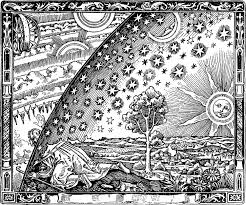
Two Brief Essays on Mind Viruses
[1] Back in 2012-3, a mind virus called “The Pixar Timeline Theory” spread through the writers’ rooms at Buzzfeed, The Verge, and Screenrant. Patient zero was a writer named Jon Negroni who contracted the virus from a website called Cracked. The original strain of the virus was a fan theory that all the Disney Pixar Films tell one long story of an apocalypse where animals and toys become sentient while humans were gradually destroying the planet. Patient zero popularized the theory after he meticulously processed all the Pixar Films through the algorithm his mind virus was running.
The Pixar mind virus had its highest morbidity rates among the cultural critics and aspiring intellectuals at Buzzfeed, The Verge, and Screenrant because these communities are especially vulnerable. Intellectuals are the perfect hosts for mind viruses because (1) they only read and replicate each other’s work—cutting themselves off from the herd immunity of the idiot masses—and (2) they derive their status by having more novel ideas than their colleagues. Once a mind virus infects its host, it starts running a script that processes all incoming information according to the algorithm. Everyone infected with the virus runs the same script but processes different information though it. It evolved several strains including the theory that All Quentin Tarantino films take place in the same universe, and the theory that all of Joss Whedon shows take place in the same universe. Different content, same script.
A similar mind virus called “intersectionality” broke out in the 1990s in academia. Just like the Pixar virus, it has a contrapositive nature to the scientific method, meaning you start with the theory and filter facts though it. It has a basic script that isn’t difficult to run, so it spreads easily from person to person. Its association with academia gives it the added advantage of being much more infectious to status-seeking individuals than its Pixar cousin.
. . .
[2] Between September 2001 and July 2015 was a period in history called the New Atheism movement. The period was benchmarked by two pivotal events; the first being the September 11 attacks and the latter being the cathartic ruination of an innocent dentist from Minnesota after his hunting guides led him to mistakenly shoot the wrong lion. Prior to the death of Cecil the Lion but after the September 11 attacks, a series of writers concluded that there was something uniquely parasitic about religious thinking that leads people to think and behave in irrational and maladaptive ways.
Richard Dawkins wrote a book called The God Delusion in 2006 illustrating this claim. The central argument of the book was that religion is a memeplex (a network of ideas), and at the center of that memeplex was the God delusion. The God delusion is like a mind virus and it transmits itself across time by occupying the minds of people and adapting to fit into the worldview of each new generation. The problem is that what is beneficial for the memeplex is not necessarily beneficial to its host. (Consider the celibate priest who spreads Christianity, but never bears any children sharing his genes.)
The following year, a blogger named Mencius Moldbug responded in a series of essays titled How Dawkins Got Pwned. He was mostly in agreement with this model and expanded on the metaphor between genes and memes. Moldbug outlined several mechanisms for how memeplexes can get people to act against their interests. The God delusion, says Moldbug, “is alien to reason – no sensible person would accept it, but by accepting nonsensical doxology you demonstrate your loyalty to the group.”
Moldbug’s essays argue that Dawkins is infected by the meme he argues against. He has a strain of “nontheistic Christianity.” Using the parasite metaphor, he says, “He thinks he is attacking superstition on behalf of the armies of reason. In fact, he is attacking M.41 on behalf of the armies of M.42.” M.41 is the old Christianity that still believes in the God delusion, and M.42 is the new mutation for the nontheistic strain.
Moldbug calls this strain “universalism”, and its hosts tend to believe in the “fair distribution of goods, the futility of violence, the universal brotherhood of man, and the reification of community.” Nontheistic Christianity is just as morbid as theistic Christianity, according to Moldbug, but the evidence for this wasn’t widely available until mobs of people infected with strain M.42 got their first taste of blood from that dentist from Minnesota (Rest in Peace).
M.42 is a pathological memeplex like its predecessor Christianity. It largely infects upper middle-class whites who believe they are marked with an original sin (read [category] privelage). Just like they’re puritanical ancestors, they self-flagellate and apologize for the sinfulness they inherited from generations past. They are very evangelical, the end of the world is near <insert AOC soundbite/> and they restlessly pursue saving the souls who have not yet repented for their ancient sins.

How the Internet Made Our Cruelty more Sustainable
Spend enough time watching the animal planet and you'll eventually see a chimpanzee bite his rival's testicles off, and you'll say to yourself, "I'm definitely more evolved than that guy." You're not. You and that chimpanzee are cut from the same cloth. Equally evolved, but under different circumstances. As a standard ape, you have the same instinctive craving for cruelty that he does, but being much weaker, you have to find more creative ways to inflict it.
Along our evolutionary trajectory, we found that grouping into parties to murder the biggest, strongest person was the most effective way to simulate and distribute the pleasure of sinking our teeth into our rival's sack and ripping it clean off. This worked for quite a while, except for one problem: We were self-domesticating. We were removing large, powerful people from the gene pool and making the overall population more docile. With each new generation there were fewer powerful men to gang up on and murder. Fewer chances for groups to satisfy that craving for violence. This is a typical consequence of such trophy hunting behavior.
For a while, it didn't seem there would be a solution to this problem. Then one day on the internet an innocent dentist would pay the ultimate sacrifice. Due to the poor reading comprehension of armchair activists, a minor controversy about a trophy hunt was overshadowed by a made up version of the story. He killed an allegedly beloved lion, their misunderstanding of the story went. The details were never important, though. All that mattered was that circumstances lined up so that millions of people could act out a revenge fantasy that satisfied their primitive desire to destroy another person. This was the first time that the taste of blood reached so many people simultaneously. Thanks to the internet and viral social media, millions of people can sustainably destroy a new person each day, effectively simulating the sweet pleasure of gnashing a juicy pair of balls between their teeth. https://en.wikipedia.org/wiki/Killing_of_Cecil_the_lion

Organic Bots and Authenticity
For a few years now, human traffic has made less than 50% of total internet traffic. This is annoying for people and companies who run websites trying to attract authentically human traffic to translate into views, customers, and sales. We have useful tools to manage this for now, but those days are numbered. Experts at Google forewarn about a day called “the inversion”, when human internet users are falsely flagged for being bots more often than bots, and bots behave more convincingly as humans than humans do – as far as the bot-detecting algorithms are concerned.
Google, Facebook, and Youtube determine which clicks, shares, and views are human by sampling from past human behavior, and they train their algorithms to recognize which is human and non-human. Some bots are easily detected, for example, because they don’t use on-page elements as much as humans do. There’s an arms race, however, and some folks are designing bots that can access all website content and simulate human clicks.
Sometimes the bots fool the algorithms. They slip past undetected and their behavior is taught to the human-detecting bots as human behavior. The sample of “human data” is tainted, more bots pass as humans, and the effects compound on each other until authentic human web traffic does not pass the “human test”.
We organic humans aren’t making things any easier, either. Our online media behavior is reinforced by likes and engagement from our friends and followers. We modify our behavior continuously to maximize our rewards. Take the collateral damage that comes with incentivizing comments on posts by offering rewards, points, etc. You get some of the most bot-like comments by people who are only commenting to catch that coin. Websites like Cent have a pretty decent sorting procedure to overcome this, and I’m most impressed with the site for this. But sometimes those organic bots slip by and get rewards. I’ve taken to seeding comments directly on Cent to reward the most thoughtful. In general, what we post and share on most sites (even Facebook) becomes more calculated, more predictable, … more bot-like.
I bring this up as a follow up to a previous post, “To Be a Better Writer, Don’t Identify as a Writer”. While the advice is specific to writing, it describes in the abstract a kind of inauthentic posturing that we all do in some way or another. Existentialists call it acting in “bad faith”, Erving Goffman described it as being on a stage, and superficially acting out our identities in the presence of others. The clothes we wear are costumes, the products we buy are props and our interests reveal our character traits to the audience. https://read.cash/@CotyReh/to-be-a-better-writer-dont-identify-as-a-writer-0eb2fcc3
Once I understood this, I spent the year of 2017 playing a character I named Justus Shepherd. I kept a journal owned by Shepherd and I recorded my experiences as if I were really him. He processed my experiences much differently than Coty would have because Justus is a much different character than Coty is.
Justus is a disgraced social sciences professor who lost his job after using his data to “perpetuate dangerous stereotypes about sex and gender,” as described by his university's termination order. One of his subjects reported him after learning that the survey data she submitted was used in a report that made conclusions she disagreed with. She felt that his research misrepresented her, and she raised a social media campaign to expose him. His university fired him without an appeal process and issued the following public statement:
“We greatly regret having approved Dr. Shepherd’s study without carefully considering the impact his results would have on marginalized communities. Our university is committed to training socially conscious scientists and his research does not represent our values. Although our Institutional Review Board rigorously evaluates the studies of our researchers to protect the individual participants from damaging or unethical conduct, we recognize the need to ensure that members of marginalized communities are protected from harmful stereotypes. We will work harder to evaluate all proposed studies with new guidelines to make sure all future research findings align with our values.”
Dr. Shepherd was barred from ever doing research again – at least in a professional capacity. I spent the year fleshing out this character and went back to being Coty again sometime in 2018. I started doing my own independent research under the occasional supervision of Dr. Shepherd. We would exchange letters and he advised me to organize a study to find out “what is it that makes intellectuals so damn unbearable?”
I did three small studies under this advice. In one, I modelled the evolutions of biological theory and sociological theory decade by decade starting in 1890 to the present. From 1890 to 1929, the sociological literature was focused on concrete problems pertaining to social organizations and a fair bit of self-reflection on its methods. The literature primarily focused on problems of war and peace and social cohesion starting in the 1930s to 1959—which makes sense considering there were two world wars up to that point. From that point on, gender theory, critical theory, and identity theory started to reach critical mass in the field. Much of the sentences that the scientists in these fields wrote reminded my of a sentence of Noam Chomsky’s I’ve read: “Colorless green ideas sleep furiously.”
Chomsky’s sentence was a proper and understandable English sentence, as far as grammar is concerned. It’s completely untethered to reality as far as its content goes, however. A good example of this from my sample, from “Bringing Identity Theory into Environmental Sociology” published in Sociological Theory in 2003, goes, “We conceptualize the environment identity as a person identity.” (I’ve made sure that my sample contains only journals with high impact factors to minimize what experts within the field would call, “a total bullshit paper.”)
The problems the researchers were addressing were less concrete, less empirical, and increasingly analytical. The theories in themselves are internally consistent and logically rigorous, but they lack what Chomsky’s sentence lacks: they don't bare any consistent relationship to reality. They describe relationships between elements of the theory that don’t necessarily represent anything outside of the theory. They are recursive.
I find it interesting that most of the analytically pure, empirically-detached statements are primarily coming from the identity theory crowd. It reminds me of Kierkegaard’s definition of “the self” as “a relation which relates itself to its own self, or it is that in the relation that the relation relates itself to its own self; the self is not the relation but that the relation relates itself to its own self.”
I’ll talk more about the methodology and the data of this study, and the others in their own separate posts, but I’ll pause here and hear what you have to say. Do you think we are becoming more bot-like? Do you have any experiences recognizing your own inauthenticity, and what did you do about it?

Scientists are Cracking the Code to Industrial Protein Production
Until now, it has been difficult to control the amount of protein that can be produced from a given gene. We have been using model bacteria organisms as tiny little factories for while not to produce medicines such as insulin for diabetes and clotting factors for hemophilia; the problem was that it is difficult to get control for producing large amounts of the desired protein product. Protein synthesis is pretty variable - lots of stutters and stalls along the way.
Due to an accident in the lab at Washington University School of Medicine in St. Louis, researchers have discovered a way to supercharge protein production up to a thousandfold. The scientists changed the the sequence of amino acids (the building blocks of proteins) in positions 3, 4, and 5 of the chain for an unrelated study. These spots usually don't have any significance to the structure of the proteins themselves – except for now we know that what amino acids fill those slots dictate how efficient protein production is. https://medicine.wustl.edu/news/scientists-find-way-to-supercharge-protein-production/
The team used Green Fluorescent Protein (GFP) and tinkered with the amino acids at the head of the sequence. The results, published in *Nature*, show that the different versions of green fluorescent protein varied a thousandfold from the dimmest to the brightest, the researchers found, indicating a thousandfold difference in the amount of protein produced. This is the beginning of our understanding in how we can produce organic compounds (say, insulin) at an industrial scale inside of an organism. https://www.nature.com/articles/s41467-019-13810-1#Abs1
The ability to ramp up protein production has a lot of potential applications. According to one author of the study, “In the biomedical space, there are many proteins used in drugs, vaccines, diagnostics and biomaterials for medical devices that might become less expensive if we could improve production. And that’s not to mention proteins produced for use in the food industry – there’s one called chymosin that is very important in cheese-making, for example – the chemical industry, bioenergy, scientific research and others. Optimizing protein production could have a broad range of commercial benefits.”
*Image courtesy of* *Wikimedia Commons* https://commons.wikimedia.org/wiki/File:Fluorescence_from_Fluorescent_Proteins.jpg

 @CotyReh