 @tired_momma
Transport at Work
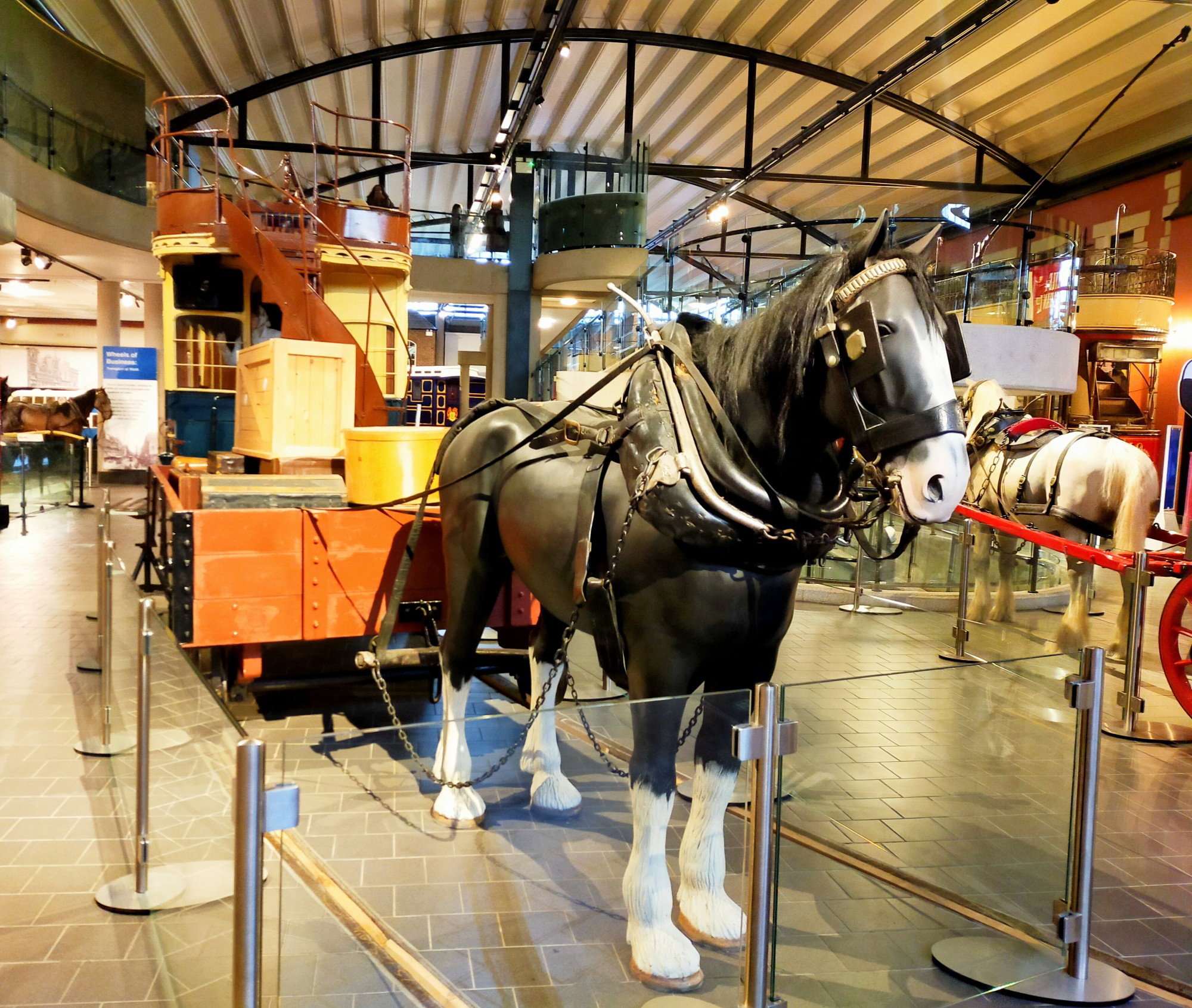
It's amazing how people have invented vehicles. For over hundreds of years, it serves different working purposes. Without vehicles, the potential of any business is limited. In the days before large shops and supermarkets, people could expect nearly all of their food and other supplies to be delivered direct to their door. Businesses tended to specialise in a particular product, such as bread, coal or milk. Each business would have had a local depot, from which drivers collected the goods to deliver to customers. Today local delivery is used mainly for heavy services such as furniture removals. Up to the late 1990s, there had been a gradual decline in deliveries from business to home, with most deliveries requiring long-distance transportation between major shops and industries. However, with the introduction of internet shopping, a form of "door to door" delivery has again become common. Here are some of the early transport vehicles that you will see in the Ulster Transport Museum: Inglis Bakery Horse-drawn Bread Van (c. 1890)
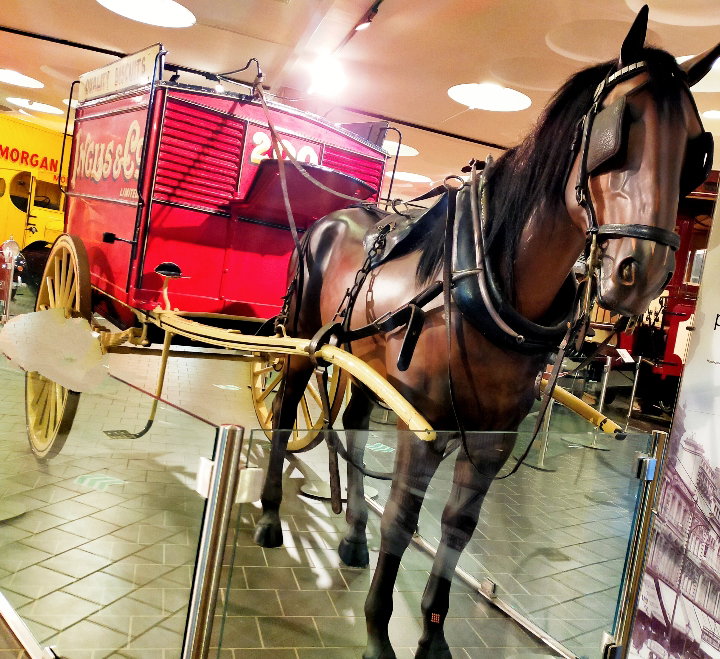
**Duties** Inglis Bakery used both two and four-wheeled horse-drawn vans to deliver bread and cakes to shops and homes. This two-wheeled van is fitted out with shelves and drawers to hold the produce and the sliding latch on the rear doors could be locked to prevent people from making off with the treats! **Drivers** In the 1930s, Inglis Bakery took over a number of smaller bakeries and required many drivers for its fleet of over 100 vehicles. **Destinations** In 1890, Inglis Bakery was on Eliza Street in Belfast. Horse-drawn bread vans were used for deliveries around Belfast and its suburbs, with trains carrying huge quantities of bread across the whole of the North of Ireland. Ice-cream Van (1889)
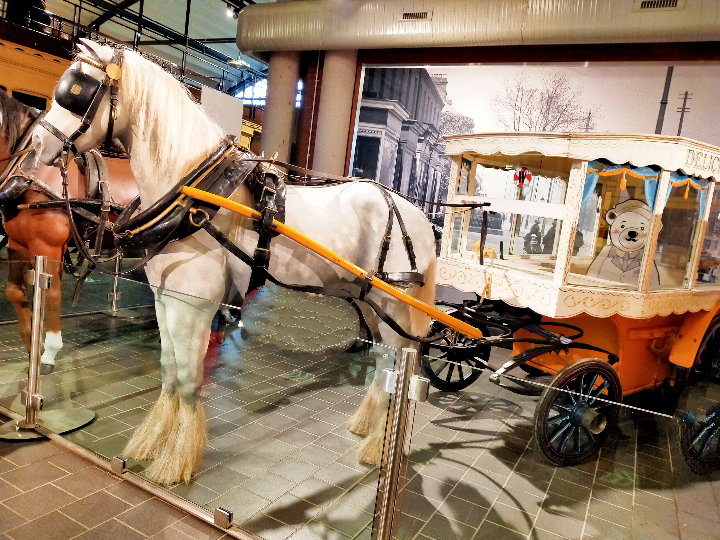
**Duties** This horse-drawn van is a rare survivor which found a new life at the Ulster Folk and Transport Museum in the 1960s. Using cork-insulated boxes and dry ice, the ice cream would have been kept cold on this van. **Drivers** Ice-cream sellers in Northern Ireland are often of Italian origin, and family names such as Morelli and Cafolla are well-known. When on the road, the sellers often sounded a bugle to attract. customers. **Destinations** Ice-cream vans were, and still are, mainly used in popular seaside towns and outdoor events in Northern Ireland, they are particularly in towns such as Donaghadee, Newcastle and Portrush. Clonlee Dairy Horse-drawn Milk Float (c.1920)
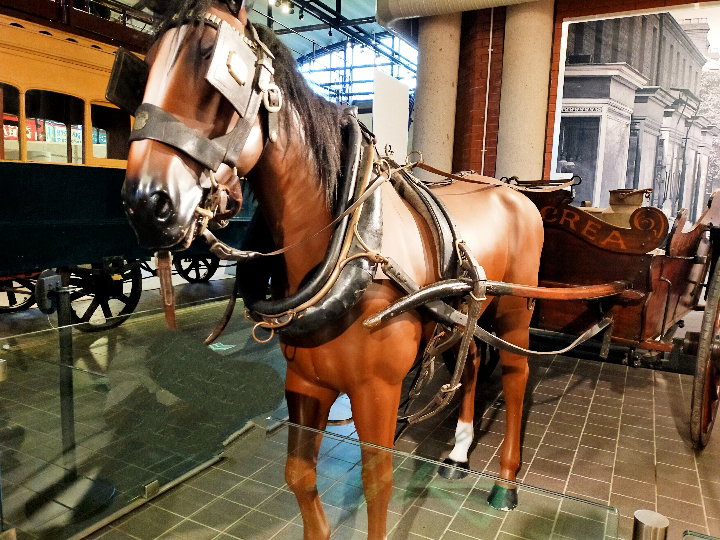
**Duties** Milkman William McCrea made daily rounds with this cart, carrying large chums of milk to make deliveries to people's homes. He used jugs to measure out the amount the customer required and poured it to their own jug or basin. The floor of the float is lower than on a normal cart making it easier for the milkman to load the full chums of milk at the start of the round. **Drivers** One horse pulled the float with Mr McCrea driving and serving his customers. He lived in Sandown Road, East Belfast from the 1930s and ran his dairy business from 1948 to 1963. **Destinations** Clonlee Dairy delivered milk to homes in the Ballyhackamore and Belmont areas of East Belfast. Bernard Hughes Bread Delivery Van (1948)
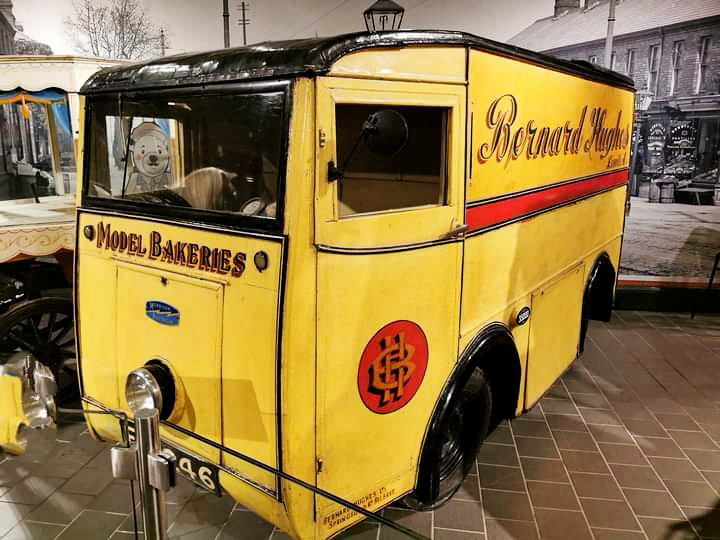
**Duties** This battery-electric delivery van was one of the fleets of vehicles used by Bernard Hughes Bakery to deliver bread door-to-door. Larger vehicles with petrol engines were used for deliveries to shops. The bakery affectionately referred to as *"Barney Hughes's Baker"* invented the famous *"Belfast Bap" -* a round and floury bread bun. **Drivers** As the vans could not travel over long distances, drivers had a regular, short route. The batteries became less reliable with age. And it was fairly common, the to see a battery-powered van being towed back to the depot. **Destinations** The Original Bernard Hughes Bakery was on the corner of Fountain Lane in Belfast. In 1884, a larger bakery was built on the Springfield Road. The company delivered throughout Belfast. Co-op Milk Float (1954)
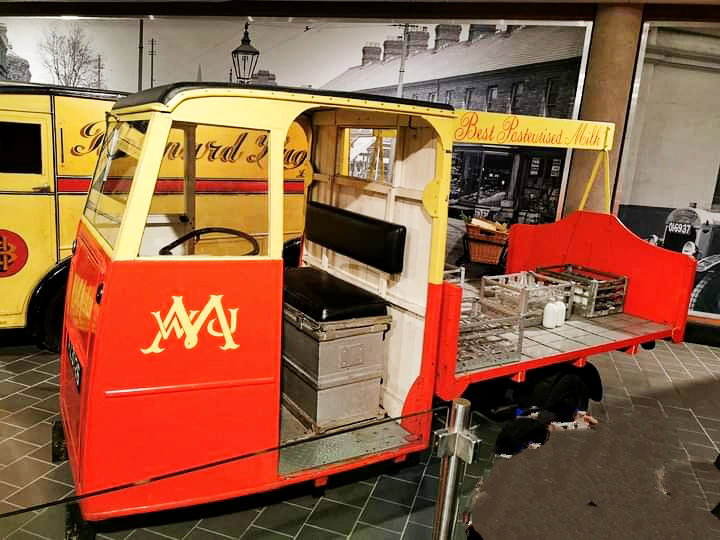
**Duties** From 1954 until 1986, this battery-electric vehicle delivered milk for the Co-operative Society Ltd. This was also being used in the 1970s to deliver yoghurt, cream and fruit cordials. **Drivers** It was a slow but simple task to drive the milk float. It had an electric motor, powered by batteries. The batteries were charged each night at the front for the next day's milk round. The maximum speed at the float was 30 mph (48.3 km/h). **Destinations** This milk float delivered to homes in the Lower Newtownards Road and Connsbrook Avenue areas of East Belfast. It could travel up to 64 km (40 miles) before it needs to charge its batteries. Belfast Telegraph Van (1952)
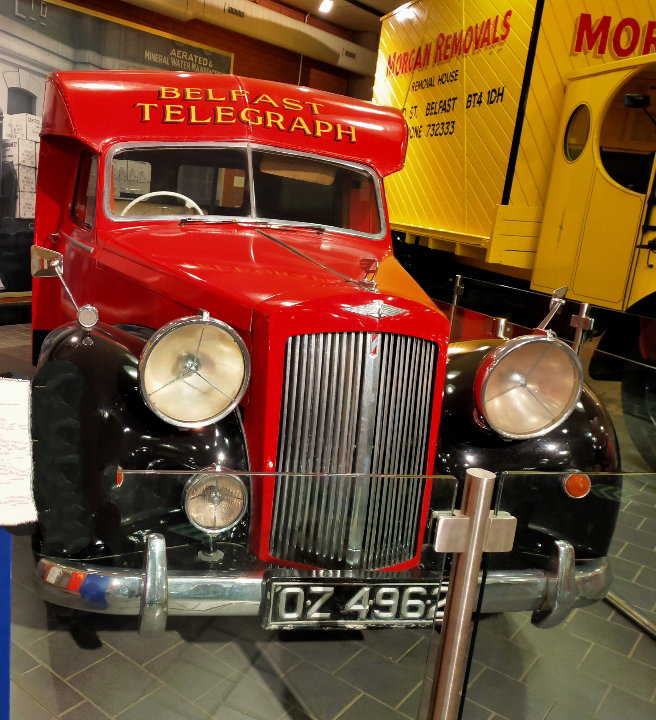
**Duties** The Belfast Telegraph originally used a fleet of pony carts to deliver the evening papers around Belfast. Motor vans gradually replaced these carts. This large **Austin A125 Sheerline van** was chosen because it was fast, sturdy and reliable. **Drivers** Drivers Stewart Duffin and Jack Armstrong drove this van from Belfast to Londonderry along the Glenshane Pass. They enjoyed the long run more than the usual "stop-start" delivery journeys and would make to turn you whatever the weather. **Destinations** From the late 1940s, The Belfast Telegraph began to be dispatched beyond Belfast to the rest of Northern Ireland. This can be used on the Derry run, making one round trip six days a week. This meant that it travelled over 1000 miles each week, so maintenance was very important. ***It's unbelievable how massive the contribution of transport to our economy -past, present and future.***

This is the part 1 of transport at work. I hope you like seeing some of these early vehicles that is the start of a tremendous transformations in our transport history. Check out my other related articles. Thank you so much. ❤❤❤

Related Articles: https://read.cash/@tired_momma/ulsters-early-motoring-c571c23f#related-articles Early Cars at Ulster Transport Museum https://read.cash/@tired_momma/early-cars-at-ulsters-transport-museum-more-b21a0e9b **Ballooning in Ulster** https://read.cash/@tired_momma/ballooning-in-ulster-75c9d847 **The Early Cars** https://read.cash/@tired_momma/the-early-cars-38b95b5a **Ulster's Early Motoring** https://read.cash/@tired_momma/ulsters-early-motoring-c571c23f **Rail Gallery at Ulster Transport Museum** https://read.cash/@tired_momma/rail-gallery-at-ulster-transport-museum-6947dffc **The Beginning of Railways** https://read.cash/@tired_momma/the-beginning-of-railways-7687404c **Ulster's Fire Fighting History** https://read.cash/@tired_momma/ulsters-fire-fighting-history-ec41dc5a




24 comments
Woah, cool seeing these early vehicles in a museum. 👍 What country is this located?
Yes, I feel same. Love all of it! This is in Ulster Transport Museum here in Northern Ireland, dear.
Oh, i see, it's ireland then... Do you live there?
No dear, Northern Ireland. Ireland is the Republic of Ireland. Yes, we live here. Are you back home or in other country?
ooooh, my geography knowledge is lacking sorry haha ___ nasa philippines padin po 💪 but english is my first language since i was born overseas to OFW parents 😝
I love horses very much. Today, the attraction is to see and ride in a horse-drawn carriage. There are them in my city. They are rented for some festivities. Even some modern newlyweds go to a wedding in a carriage. For Christmas Day this year, they passed by horses. They went to cut down the Christmas tree. Here’s the link, they filmed them walking the streets. https://www.facebook.com/bojan.pusinic/videos/3593290014083307
Wow! That's wonderful. I would love to see that! I don't know why but the video doesn't play dear. Although I can see the horse. 🤩
I don't know why he won't see. It may not support a link from Facebook. It is on my Facebook profile.
Nice one, as always. I'm always amazed at how much you know about the different topics you write about. By the way, I wanted to read the mRNA article, but I cannot find it. Did you take it down?
Thank you @MoreGainStrategies. That's my Mum's time so while writing she's telling me many stories about it. I'm sorry about that. Sadly it has some facts that I can't change in my own words that the system detected as plagiarism and I will not bother for now as I am fully loaded with homeschooling works 🙈 I hope I can share and ask for help with that. 😅 What are you up to these days?
Oh, I see. That's too bad that it thought the article is plagiarised. I have just finished my entry into the AMPL writing contest on Publish0x. That was a lot of work. 😅But it turned out quite nicely, I believe. 😊It basically aims at explaining crypto in general and AMPL in particular so easy that children understand it, too. Unfortunately, I probably cannot publish it here. I had to publish it there first and then I cannot copy it here, because the bot thinks that I plagiarise myself. 😂 Will you write an article about your experience with homeschooling? 😊
Yes. I see the rules now. It's still plagiarism to repost an article even you're the author. And editing wasn't easy. 😅 Good luck to the contest! I hope you win! 🤩🤩🤩 Homeschooling 🙄 I have two. And I cannot do both at the same time. So it's one at a time. It's like whole day teacher and other household chores. Do you see the gap of my articles? Like after 4 days. I take it easy. Haha 😄
Yes, I can imagine it's hard. I'm surprised that they don't have online classes for the children. Thank you very much. I hope I win something, too. 😊
Statue na yung horses madam ano? Hehe. Or real yan sila? 🙈😆
Hihi, madam any calling not makatotohanan. 😂 Baka maanimal rights sila pag totoo to. 🙈
Aw gani man. Hahaha. 😆
Car lover knarn ata 😁 gaganda tlga ng nga old na sasakyan
Truth. Love ko na simula first car show namin. 😅
It is nice seeing how people transporting stuff in past.History is very interesting subject.Your photos are great dear.I saw some of transporting at work vehicles in western movies.I like how you all explained in article.Hardly wait for continue.
How are you doing Beauty? Thank you for your nice words. Love this old stuff. 🥰
I am great dear.Thank you for asking.I love old stuff too .
Pangarap ko talagang makasakay sa kabayo, iniimagine ko pa yan lagi with my knight in shining armor, lol. Pero seriously ang astig kasi pag marunong kang mag horse riding, hangang hanga ako sa marunong nyan. Pero parang diko maabot yang kabayo, sa pandak ko baga naman na areh 😂. Nakakita naman na din ako ng kabayo dito samin kaso di pa talaga ako nakasakay.
Uyy oo all din! So Cojuanco ba yun yung magaling maghorseriding. Ang astig! Tapos my jowaers ka ring hacienderong nakakabayo ano? Hihihi
Yes yes, sya lumalaban din ata un sa karera ng kabayo ee ang galing non babaeng rider. Bet na bet ko yamg mga hecienderong may ibat ibatng breed ng mga kabayo, sa pocketbook ko nalang nababasa yang mga ganyan ah 😂