Thoughts on Crypto
It can be nice to keep a certain cryptocurrency for a long time while still earning a substantial regular income. So which cryptocurrency should you choose for this? We know the Steem option. Bitcoin and Ethereum are two excellent cryptocurrencies, but their regular income is low. Beyond all these cryptocurrencies, Cake seems like a good choice to me. The “buy and win” advice about cake-like cryptocurrencies is repeated a lot. This may be true for most DEX coins, but not Cake.
I planned the article to consist of random thoughts on crypto. Without deepening the issue too much, I would like to point out that Pancakeswap has 7 times more customers than its closest competitor, with a daily number of 430 thousand customers in the DEFI area. Pancakeswap has the advantage of scale and uses it to the advantage of its investors. Congratulations Pancaswap! Just keep going!
One of the things I love about the crypto world is the lack of movement. Almost every day, a new project with a reasonable story emerges. I'm busy with Robiniaswap, which is a clone of about Pancakeswap. Thanks to Robiniaswap, which bridged Steem and BSC, I had the opportunity to watch the price movements of a DEX on the first day of its release and after. It was quite an exciting process, I really liked it.
I have invested in so many places as if I have a million dollars that if something happens to me, it is not possible for my relatives to collect my crypto money. How many networks do I have invested in? Steem, Hive, Tron, BSC, Polygon and Solana. Maybe another day I'll write a post comparing these networks.
Those who are closely interested in crypto must know, but I recommend you to watch the channel https://www.youtube.com/channel/UCqK_GSMbpiV8spgD3ZGloSw. The founder of the channel, Guy, may be the person who contributed the most to my education after my mother and primary school teacher.
It would be nice if there was someone to explain blockchain technologies in language that we mortals can understand. I learned a lot from the https://www.youtube.com/c/Finematics channel on this subject, but the channel content consists of 47 videos. Maybe there is such a source, but I don't know yet.
What would happen if the money flowing into the crypto world suddenly stopped? Do they praise crypto immeasurably now and continue to feel the same enthusiasm? Especially if they have invested, do they bring remorse? Don't let these words mean that I expect a collapse in the market. What I want to emphasize is that the flow of money has an important place in this order. Crypto creates value and the flow of money makes that value evident.
The future is long; Let's see what else we can see in this environment.
Thank you for reading.
What is the NFT version worth?
As of late I turned into a workmanship vendor, or … possibly … a jpeg merchant, assuming you need to consider it that. What I'm discussing is, I have as of late printed my first NFT. What would i be able to say, I got snared quickly!
Presently, when you're new to NFTs, a sensible inquiry you may pose to yourself is: "The reason would anyone pay thousands, if not large number of dollars for a jpeg?"
A typical reply by fanatic jpeg followers is "The reason would anyone pay a large number of dollars for a material with some oil on it?" And that is a sensible inquiry also, taking everything into account.
This makes esteeming a NFT a closely resembling issue to esteeming a composition, or a craftsmanship object, all the more as a rule. Concerning workmanship objects, I read a fascinating book two or three years prior called "What's it Worth?" by a person called Lucien Papouchado. In this article I need acquaint you with Papouchado's rules for esteeming workmanship protests and apply his rules to NFTs.
The four components of worth
There are four measurements to the worth of a workmanship object: characteristic, inborn, attributional, and venture.
The inherent worth of an item is the worth of the materials it's made of.
Also, that is actually the point traditionalist individuals get irritated by.
The inherent worth of a NFT is essentially zero. It has no material structure. It is unadulterated data.
However, that is less significantly additionally valid for costly works of art. The worth of its material and the shadings utilized are amazingly unbalanced to the genuine costs paid for such artistic creations.
To a considerably lesser degree, this additionally holds for models, for instance, whose material may have generous worth yet is as yet unbalanced to the cost of the article all in all.
The most characteristic worth is held by articles, for example, complex gems or the notable Fabergé eggs.
The innate worth of an article is the worth made by the craftsmanship of the craftsman shaping the unrefined substances.
This worth is generally low for most of late NFT projects.
Yet, then again, the NFT space is regarding where the customary workmanship space was the point at which our predecessors drew figures of creatures on dividers in France 17.000 years prior. Those drawings are not especially modern.
I'm certain someone would follow through on a significant expense for those drawings.
The attributional worth of an article is the worth added to the item by being significant to it's proprietors.
This is the measurement which is hardest to comprehend. Since it is fairly ambiguous. How gives affecting one individual probably won't offer importance to another. Yet, we as a whole need significant things in our lives to support ourselves profoundly.
Certain individuals may esteem crafted by a notable craftsman most noteworthy, in light of the fact that it gives them saw status according to other people.
Certain individuals may zero in on objects due to their chronicled, public or strict significance. It gives them a feeling of having a place with a local area.
Others should claim a piece of something the first of it's sort. It is a physical, or computerized, portrayal of the legend's excursion. Someone had a go at a new thing, despite the fact that the chances were stacked vigorously against them. Also, that is valid on the grounds that having a go at something new will quite often fall flat. Yet, they succeeded, despite everything. They branched out into the obscure and were successful. Who wouldn't have any desire to claim a piece of that?
The venture worth of an article is the worth added to the item by financial backers and theorists, expecting an expansion in the articles' worth later on.
That is the more noteworthy bonehead hypothesis. Individuals purchase certain articles fully expecting another person addressing a much greater expense, attempting to benefit simultaneously.
That is the thing that makes for the greatest piece of most NFT venture's costs to date.
Furthermore, there is consistently a more prominent dolt out there, until there isn't. And afterward cost breakdowns.
Most NFT tasks will go to zero at last, many say. What's more, that likely could be valid. I'm absolutely eager to perceive what occurs straightaway.
Can Twitter foresee cryptographic money value changes
Its an obvious fact that Twitter is an amazing vehicle of correspondence in the digital currency field. Ongoing instability in the altcoin space driven by tweets from incredible forces to be reckoned with like Elon Musk, Kim Kardashian, and surprisingly the Faze Clan have made a few champs and numerous failures in the unregulated money market. As it should be, many have provided reason to feel ambiguous about the aggregate of the digital money field utilizing the disappointment of alt-coins as a way of summing up all coins as extremely unstable to be a real mode of trade. As a crypto fan, I can't disregard the proof of bad behavior in the space. Such unpredictability makes it inconceivable for a cash to be of any functional use. By and large, it appears as though altcoins are simply being made to improve the author and advertisers to the detriment of credulous devotees. However, as an adherent of the space, I know the distinct contrast between alt-coins and the "backbones" like Bitcoin, Ethereum, and Litecoin. This provoked my interest on whether the primary cryptos could likewise be liable to Twitter-driven swings.
Utilizing opinion examination on 1500 tweets day by day for 45 days I endeavored to foresee Ethereum every day value changes. My code represents lengths of tweets, measure of extremity and subjectivity, force, and mathematical help for particular kinds of tweets. Every single copy tweet, including retweets, were erased from the dataset to keep away from slanted information. Adding these elements together my code gauges each factor dependent on its overall significance and makes a recipe that appoints mathematical qualities to each factor. Assuming the joined worth of all variables is over a specific number, my code would foresee that the cost of Ethereum would rise the following day. On the off chance that the qualities are underneath, the inverse would happen and the cost would be anticipated to fall.
Perhaps the greatest problem I anticipate individuals having with my assortment strategy is the moderately modest number of information. 1500 tweets may possibly cover a ten-minute time frame on twitter while looking for a specific watchword like Ethereum. At the point when I was making my program, I tried different lengths to perceive what a bigger informational index would mean for the program's outcomes. I tried a limit of 10,000 tweets and at least 500 tweets and thought about outcomes for the different information focuses in the middle to track down a sensible harmony among execution and exactness. 1500 tweets for the most part have comparative outcomes to the bigger informational indexes making it ideal for the reasons for this program.
Another potential issue I anticipate being raised is the circumstance of the assortment of the tweets. While testing my program I tried gathering the tweets during the morning, evening, and night yet didn't track down any huge distinction. To normalize my outcomes I chose to gather information at around 5 pm consistently.
The last point I need to explain is the general significance of each factor. The factor I decided to esteem the most was normal extremity and opinion. As I would like to think, extremity and feeling is the most solid factor as it can normalize assessment. The following most gauged factor was the measure of positive or negative tweets. The explanation I decide to gauge this not exactly normal extremity, was on the grounds that an enormous number of tweets with little power isn't probably going to change market costs, though a little gathering with huge force would. The quantity of tweets possibly really can be considered when representing normal extremity. The factor I gauged the least was the normal length of tweets. While the length of tweets is a decent way of measuring an individual's force and exertion set into a tweet it is too temperamental to even consider being weighed all the more vigorously.
Since I have clarified my assortment strategy, how about we get to the outcomes. In the multi day time frame, my code was precisely ready to foresee the value change in Ethereum for 25/45 days. This ascertains to approximately 55% exactness. Taking into account that my code is foreseeing one of two alternatives these outcomes don't show extraordinary exactness. Consistently if you somehow managed to pick haphazardly one of the two choices you would by and large have a 50 percent shot at picking the ideal decision. To just be 5% over the standard shows one of two choices: my code is erroneous or Twitter is certifiably not an incredible instrument to anticipate value changes in digital forms of money. My Github repo is connected here for everybody to look at and alter.
Presently thinking about that my code is exact, then, at that point, we can presume that Twitter is anything but an extremely productive method for controlling crypto costs for grounded coins. This bodes well as greater coins have bigger client bases making wide-scale plans to blow up or flatten costs less inclined to be successful. These outcomes show the potential crypto can have as a real money, an opponent to the dollar or pound, yet in addition shows the work the crypto field has ahead in uncovering altcoins who are siphoned through web-based media.
Strategies for Making Cryptocurrency
I began selling NFT's last week.
That is on the grounds that I discovered that you all know precisely what they are.
Regardless of whether you don't know precisely how they're characterized.
Yet, somebody disclosed it to me like I was in the 3rd grade, and I got it.
Or then again I figure I did.
Possibly.
It resembles gold.
What amount is gold worth?
Shouldn't something be said about a precious stone?
They're gleaming rocks and metal.
Be that as it may, 1,000 years prior, we chose gleaming rocks had esteem and started exchanging them.
Here, need some fish? Give me a sparkling stone.
We even jumped in mythical serpent boats and cruised the uneven Northern Sea to plunder sparkly metal from Churches.
Wars were battled, individuals obliterated, entire developments gone.
All since we thought of a thought that sparkly things have esteem.
Quick forward to now.
Presently we as a whole concur that electrons have esteem.
Enough worth to do battle over, to destroy individuals, and to gather.
I'll utilize me for instance.
I get compensated by Amazon, however I don't contact the cash. One time per month, it goes into a record.
Simply numbers on a screen. Discernible, Anchor, Adsense and Affiliate all do likewise.
I might concur that income sources that beginning with the letter An are imperative to me!
However, I never get cash. I don't contact anything.
Cash never changes hands, simply electronic signs.
We have developed over gleaming rocks to electrons.
I'm alright with that.
When was the last time you got compensated in paper cash?
Mine was yesterday, since I auctions something off Craigslist. The person game me two bits of paper, cash, and we concurred that the sum was that specific worth.
Fortunate for us, the bank concurred as well, as did the store where I gave that cash to purchase stuff.
Be that as it may, it was simply material paper with a picture imprinted on it.
We as a whole concur that it has a worth.
I was talking about this with a Dad, and he asked the number of books I sell and in case they were completely printed.
Which caused me to acknowledge something.
The beginning of something at any rate.
Digital books resemble a NFT. They live on an electronic gadget, and are exchanged for electrons.
We concur on the worth trade.
At times we differ on the worth trade as well, despite the fact that I think .01 for every word is a reasonable worth.
This is the beginning of understanding NFT's and how they will develop throughout the following decade.
Or on the other hand could develop.
I feel that legislatures will get involved on the grounds that they will fear passing up their slice of the pie.
Unofficial law may choke the NFT and digital money markets.
But I don't figure they will.
The futurist in me says the pony is out of the stable. No compelling reason to close the entryway.
I own Shiba and Dodge and Bitcoin so I'm riding that pony.
I've likewise begun making NFT craftsmanship from unique photos to sell in a web-based workmanship display, and prints of those workmanship pieces in an actual exhibition.
Here is its rub and I think how to get it.
Who claims the Mona Lisa?
In the event that you snap a photo of the well known composition with your computerized camera, who possesses the advanced print?
You don't claim the first composition, yet you have your duplicate.
The Louver claims the Mona Lisa.
In any case, a large number of individuals have an image of the composition on their telephone.
Millions more have an imitation of the composition.
At the point when you purchase a NFT, you own the first.
However, there are much more uses of the blockchain tech.
Shrewd agreements. Envision purchasing a house directly from the merchant and saving thousands in shutting costs in light of an agreement on the blockchain.
It's problematic, which is the reason such countless people are attempting to hurl a great deal of disarray around it.
I'm doing whatever it takes not to age myself here, however I read about Bill Gates and Steve Jobs and home PCs in the mid 80's and individuals contending that nobody could at any point need a "PC" in their home.
Presently you convey one of the most impressive frameworks in your reality in your pocket.
So NFT and crypto with it are not disappearing.
I'm accepting it. The workmanship exhibition for one. (I do nurture a mysterious any desire for discovering a benefactor in NYC who raves over my fashion awareness, ha!)
Also, something new that I've been playing with.
You've seen some of it. Tennessee Trash Pandas. Boston Banjo Kitties.
More are coming. IP groups, however players and a title. Group Owners. Prize Money. More.
I'm fully exploring it, and my cerebrum is spinning with the conceivable outcomes.
It began with a thought for a book.
A book around a 9 year old ball club settling Hardy Boy type secrets.
It developed into a small time player who addresses secrets and plays baseball.
Also, it will transform into a major internet game, exchanging cards, group proprietor gatherings, made up players with details and midpoints and possibly mullets.
Mullets give player's additional force. I've seen it in real life in Oklahoma.
You'll need to trust me on that.
Possibly it's something we can concede to.
How does artificial intelligence inspire NFT?
What happens when Artificial Intelligence and NFTs meet up? It opens up a totally different measurement for NFTs with capacities that you would've never envisioned.
NFTs, in their way, are a reformist method of bringing an incentive for the computerized collectibles. With AI showing up in this industry of collectibles, it takes its worth and significance a level higher.
NFTs or Non-fungible Tokens have ascended to notoriety over the most recent a year with record deals in the past quarter. An ever increasing number of makers are attempting to carry their computerized collectibles to take them to a higher level.
A few makers and firms have as of now stepped up to the plate in this road with improvement began on making AI-mixed NFTs that would acquire a higher degree of advancement.
American extremely rich person business visionary supported Alethea AI, Fetch.ai — a computerized workmanship producing AI and advances in suggestive craftsmanship AI with Aiko are coming out on top.
**The allure of NFTs**
NFTs have been engaging since it was presented, yet the most recent a year have been huge. The computerized type of workmanship that depends on blockchain innovation is a thrilling venture prospect and a collectible in the new age.
With their uniqueness and the capacity to protect esteem, NFTs have likewise re-stirred new expectation for makers who were left in obscurity with robbery and copyright issues.
What's more, NFTs aren't simply restricted to pictures, delineations however incorporate a ton of things. Current NFTs can be pictures, recordings, records, spaces, or even sound documents — whatever is computerized.
In this inventive environment, the expansion of man-made reasoning is the new period of NFTs. Man-made intelligence has a few functional abilities with regards to NFTs.
The improvements can imply that AI could offer life to the NFTs and make them 'keen,' or clients can utilize this tech to produce novel NFTs.
These AI-imbued NFTs have acquired enormous web-based media foothold across the web with their interesting worth, with everybody tensely sitting tight for the following huge thing that takes the commercial center forward.
Here, we check out three basic undertakings at present being developed and utilize that coordinate AI with NFTs.
**1 Alethea AI**
American tycoon business visionary Mark Cuban is one of the significant financial backers wagering their cash on Alethea AI, a Singapore-based startup making insightful NFTs.
In August, the organization reported that it raised $16 million through a private and confined symbolic deal to carry advancement to NFTs.
Alethea AI is playing to the developing necessities of NFTs in the commercial center with the slogan "Give your NFT superpowers."
With Alethea AI, they have had the option to join the AI-Powered motor into computerized workmanship. As it were, you will rejuvenate the workmanship you make with the AI associations with movements, cooperations, and voice amalgamation abilities.
In different terms, the organization is making a totally different age of living, talking, and insightful fine arts.
Alethea AI is intensely keen on rejuvenating existing NFTs in the commercial center — foster them and transform them into something considerably more than just craftsmanship. One of the potential future undertakings that the Singapore-based organization is checking out is offering life to CryptoPunk with capacities to rap.
**2 Fetch AI**
Get AI is one more decentralized AI machine that dispatched a NFT token to empower content makers to create computerized resources through AI. The AI makes one of a kind bits of workmanship joining crafted by more than 100 distinct craftsmen.
The new stage — labeled as Colearn Paint gets these conceivable outcomes, and in three stages, a NFT is produced. The initial step of the cycle begins at the offering stage, where gatherers should partake.
The triumphant bidder will find the opportunity to include a 'irregularity design' and select workmanship from the coordinated choices.
The NFTs that Fetch AI would create will all be novel and hold an incentive for the longest of times. The AI will alter your composition at each endeavor to win the bartering, and you will open yourself to gather distinctive theoretical artworks that hold esteem.
The AI mix with computerized workmanship is moderately new, and Fetch AI's Colearn paint learns new examples and designs.
**3 Aiko**
Aiko is the subsequent stage in the AI market that interfaces the sensual craftsmanship specialty. Sexual craftsmanship has existed from the most punctual of times and is something that we can't disregard.
With Aiko, the makers are hoping to associate with the sensual craftsmanship fan base who need to possess a collectible.
From the start, Aiko is a plain symbol with no customizations. When you place your offer and get the triumphant match, the Aiko (symbol) will begin visiting with you to know a couple of your inclinations.
Then, when you produce the NFT, you will get an altered NFT blend of 10,000 distinct layers.
This is the initial 10,000 assortment by Aiko, through their "I'M AIKO" assortment, an assortment of various skin layers, facial layers, and so forth Aiko's uniqueness go a level further with choices like hairdos, body parts, and tatoo, piercings, and some more.
The makers of Aiko expect to bring back the dream craftsmanship darlings and the sexual workmanship lovers in a manner where they are given the decision of creating their own Aiko.
Essentially endeavor you will discover a totally arbitrary Aiko created. These Aiko will be uncommon since these will likewise be exceptional.
The main assortment of 10,000 Aiko will advance toward the Solana blockchain, and gatherers have the decision of making their offers on the Solana NFT commercial centers — Solanart.io, Digitaleyes.market and Solea.io.
Computer based intelligence NFT — the subsequent stage in computerized content proprietorship
With steps previously made in the road of AI, this pattern will proceed, and more ventures are relied upon to show up dependent on this guarantee. To learn, Fetch AI's is an innovative method to draw out the computerized works of art — each unique in relation to another.
Essentially, what Alethea AI is attempting to construct is a higher level from the current particular type of NFTs in representation and picture structure.
Aiko's AI motor requests to an entirely different crowd. Its inventive AI will make a totally new area associating the dreamland with NFTs, alongside AI.
Return Risk Optimization in Liquidity Pool Investments
Investing in the liquidity pools of swap applications has become an important trend recently. So much so that crypto investors are closely following swap applications such as Uniswap and Pancakeswap and are almost competing with each other to invest in the liquidity pools of new cryptocurrencies that will be the subject of trading.
So what are liquidity pools and where does their attraction come from? Liquidity pools are created by bringing together a pair of cryptocurrencies of equal monetary value to be exchanged with each other. Let's say we have $1000 and we want to invest in the Ethereum-Bitcoin liquidity pool. We buy Bitcoin with $500 of our money and Ethereum with $500 and add them to the liquidity pool. The related swap application gives us a large portion of the commission income from the trading of the Ethereum-Bitcoin pair as returns. Trading commissions in swap applications range from 25 per thousand to 30 per thousand. Based on this income, the swap application provides liquidity pool investors with annual returns ranging from 10% to 500%. Therefore, those who invest in these pools benefit from both the possible increase in the value of the relevant crypto currency pair and the return of the liquidity pool.
The average return of liquidity pools varies according to the reliability of the platform where the investment will be made, as well as the cryptocurrencies to be invested in. In the selection of the swap applications that I will invest in, criteria such as the total monetary value locked, the number of users, whether the application has passed the security check, whether the application has a unique side, and the speed of implementing innovations. I take it into account. For beginners, it would be a wise choice to choose swap applications such as Uniswap, Pancakeswap, Sushiswap, Mdex, whose crypto money is in the top 100. As can be easily predicted, swap applications with fewer users and locked totals have higher average pool returns.
It is possible to express the risks of investing in the liquidity pool under three headings.
Cryptocurrency price risk: It refers to the decrease in the value of the cryptocurrencies you will invest. Pools of unpopular cryptocurrencies have higher returns, but are equally at risk of dramatically falling in value.
Risk of temporary depreciation: I mentioned that we invest in liquidity pools through a cryptocurrency pair. If one of the cryptocurrencies we invest in has a dramatic decrease in value, this causes the value of the other crypto currency to melt. Although the word 'temporary' is used in the name of the risk, the losses are mostly permanent. You can calculate the risk of temporary depreciation using this calculator: To give two examples; If the value of one of the two cryptocurrencies in the pool remains the same while the value of the other is halved, the temporary loss rate is 5.72%. If the value of one of the two cryptocurrencies in the pool remains the same and the value of the other drops to a quarter, the temporary loss is 20%. These rates represent the extra monetary losses caused by the cryptocurrencies being in the pool.
Smart contract risk: It refers to the risk that the swap application invested in the liquidity pool will be hacked or abused by its employees. Usually, either insiders steal the platform's cryptocurrency and sell it on the market, or there is a flash loan attack. In both cases, the cryptocurrency of the respective platform suffers great losses. In any case, it is beneficial to work with swap applications that have passed the control and obtained security certificates.
Return on investment in liquidity pools is measured by two metrics called APR and APY. Annual Percentage Return (APR) refers to the annualized estimated return on investment. APR is an estimate based on the assumption that the return on the investment in the previous few days will continue for one year. Annual Percentage Yield (APY), on the other hand, expresses the annual return calculated by taking into account the additional income to be obtained by adding the returns obtained during the period to the principal. In APY, the rates are higher because compound interest is involved. I think looking at the daily rate of return instead of these metrics and making a comparison on this daily return will give a healthier result. Assuming an annual return seems a bit of a stretch to me because of the variability of rates of return.
Investing in liquidity pools just with the expectation of high APR or APY is not the right choice in my opinion. Because the price changes of the invested crypto currency pair are more decisive on the return of the investment. My humble advice is to invest in pools containing cryptocurrency pairs that you already find attractive and believe in the potential for return.
It would also be appropriate to consider the current state of the crypto market when investing in liquidity pools. During bull market times, it is possible to invest in pools of relatively high-risk cryptocurrencies. Or, if investments are made in several pools, some of them can be selected from high-yield pools. In bear market times, it would be more appropriate to prefer pools of well-known and reliable crypto currency pairs. In fact, it is possible to make the investment more defensive by choosing one of the crypto currencies such as USDT, USDC, BUSD indexed to the dollar.
Liquidity pools have become very important investment instruments. I am of the opinion that those who can create a suitable portfolio where risks and returns are balanced will have an efficient passive income source that they can benefit from for a long time.
The Most Important Question of the Crypto World
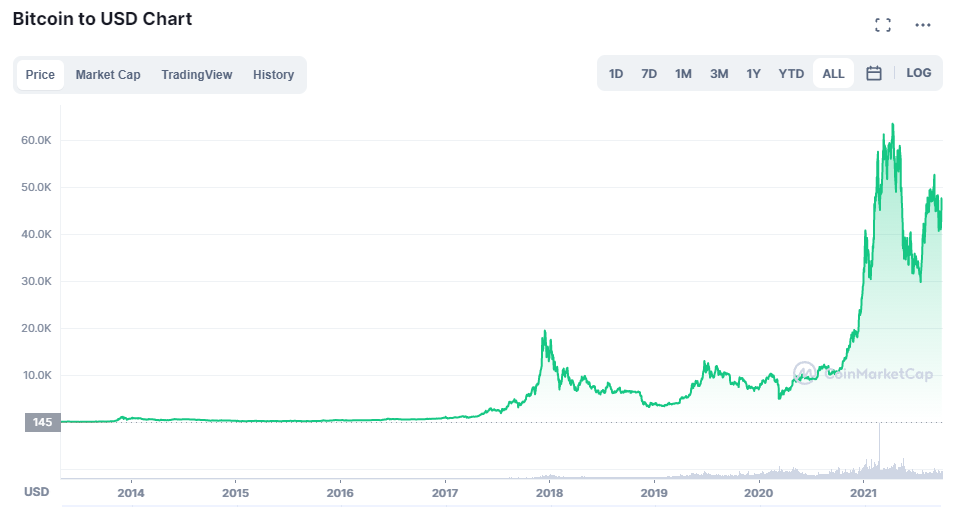
Cryptocurrencies have a significant difference from other investment instruments. Prices are rising so fast that we cannot represent them on a linear scale. As an example, I would like to give the price chart of Bitcoin in 2013 to today.
Due to the scale problem, the prices before 2017 are shown in a straight line on the chart. However, when we show prices on a logarithmic scale, the picture becomes clearer.
Of course, not only cryptocurrencies are subject to exponential growth. The price of all kinds of financial assets increases exponentially, creating a compound interest effect. The difference of cryptocurrencies is that the speed of exponential growth is quite high. To give an example, the price of Bitcoin is increasing approximately twice on average every year, and this has been the case since the day Bitcoin was released.
There is a more dramatic increase coefficient for Ethereum, but let's continue our explanation based on Bitcoin. We are facing an unprecedented situation in the history of world finance. Despite going through periods of extreme enthusiasm and pessimism, the price of an asset doubles on average every year, and this has been going on for over a decade.
The most important question of the crypto world is how long this upward trend can continue. In addition, we can ask whether the strength of this upward trend will decrease over time. But that would be of secondary importance to our discussion, because even though Bitcoin's value does not double rather than double on average every year, crypto will remain the most attractive investment.
We encounter long-lasting strong exponential increases in microscopic living things in nature. As long as the amount of food in the environment supports their population, their numbers can multiply exponentially. How long can the exponential increase in the market last, since the food of cryptocurrencies is the flow of funds?
Currently, the total market of cryptocurrencies is $2.3 trillion. The estimated size of the world financial system is around 400 trillion dollars. What percentage can cryptocurrencies get from the world financial system? Even with a conservative estimate of 10 percent, it reaches $40 trillion, and we see a long way to go.
Bitcoin is often referred to as digital gold. Currently, the total market cap of Bitcoin is $941 million, while the total market value of gold is $11.5 trillion, according to https://companiesmarketcap.com/. Here, too, there is a difference of about 12 times. Of course, when making this comparison, we need to keep in mind that Bitcoin is stored and transferred more easily.
This is not the first time we have encountered strong exponential increases in the world of technology. Moore's law has been valid for over 50 years in computing technologies. We can also attribute the exponential price development seen in cryptocurrencies to the exponential development in computing technologies. Costs in areas such as processing, memory and data transmission have been falling exponentially over the years.
Distributing data and transactions to hundreds of computers instead of keeping them on one server becomes more feasable as the years progress. As such, the real-life application areas of blockchain technologies are also expanding.
Various analyzes have been put forward over the years regarding the exponential increase in Bitcoin price. One was to buy Bitcoin when it was near the 200-week simple average price and sell when it was well above the 200-week average.
According to the famous stock-to-flow model, the price of Bitcoin was closely related to the amount of Bitcoin produced annually. When Bitcoin inflation receded every 4 years, Bitcoin was entering a strong upward trend.
If we go back to the most important question of the crypto world; I think that the exponential increase in crypto prices will continue in the next five years. Benjamin Cowen, in his evaluations on the Youtube channel Into The Criptoverse, expresses the opinion that the Bitcoin price increase coefficient has been decreasing over the years. Although I do not agree with his view, I recommend you to follow his analysis.
Finally, I would like to make a brief assessment on the impact of Bitcoin price developments on altcoins. We all know that altcoin prices are closely related to Bitcoin price. Unfortunately, many altcoins have regularly lost value against Bitcoin and Ethereum over the years. In times like today, when Bitcoin is in an upward trend, it is possible to make serious profits on alt coins. However, when the weather turns bad, the price drops become quite dramatic.
As a result, cryptocurrencies are likely to remain unique investment vehicles for a longer period of time. As long as there is no bubble in prices similar to the end of 2013 or 2017.
Applications That Find The Most Appropriate Cryptocurrency Price For Me
In this article, I would like to talk about the applications called Dex-Aggregator in English. These applications aggregate and list the price data of decentralized exchanges and allow us to buy cryptocurrencies at the most affordable price. I have been using them constantly, as they provide significant savings compared to trading on a particular exchange, and I wanted to talk to you about alternatives in this area.
I found the 1inch application sympathetic because of its name, logo and the flame image that appeared while trading. Considering the obvious benefit it provides and the fact that it is the only one in its class, I even invested in the 1inch coin. Later, other applications appeared that did the same job. I still keep my 1inch coins staked on the site.
1inch works across the Ethereum, Binance Smart Chain, and Polygon ecosystems. We connect our wallet to the app to make transactions. We select the coin pair we will trade and press the "Swap Token" button. It is possible to use the application in a way that provides the lowest transaction fee, the lowest commission, or the highest return consisting of a combination of both.
The second application I want to talk about in this area is DeBank. DeBank, which I use to see and monitor my DeFi portfolio on different applications, also finds the most suitable exchange by considering parameters such as liquidity, transaction cost and commission. Unlike 1inch, it also shows which exchange will be where the transaction will take place. However, DeBank often finds the best prices in the 1inch app.
Specializing in finding the most suitable swap price, Paraswap can apply strategies such as dividing the transaction amount into parts when necessary and combining different currency pair combinations. Supporting Ethereum, BSC and Polygon, the application is getting more and more popular day by day.
There is also a swap menu inside the Metamask wallet that compares the trading pairs on different exchanges and finds the best price. I also benefit from this feature from time to time, which is supported on Ethereum and BSC networks.
Applications that find the most suitable crypto price and enable us to perform the relevant transaction instantly are important examples that show the potential of DeFi. In fact, there are many more examples of applications like them in the DeFi universe. I plan to cover other types of applications that I find interesting in my future articles.
Thanks for taking your time to read.
Is Crypto Attractive To The Average Investor?
The word altcoin is used in English to refer to the remaining coins other than Bitcoin. Considering that the alt phrase is an abbreviation of the word alternative, we understand that other coins initially emerged as an alternative to Bitcoin. Although hundreds of alternatives have emerged over time, Bitcoin maintains its weight in the crypto world. For more than 10 years, it continues to please its investors with its value doubling every year on average.
When it comes to altcoins, the issue gets more complicated. Because there are thousands of them and how they will perform cannot be predicted as easily as Bitcoin. Last night, I sat down and made an analysis on the total values of altcoins.
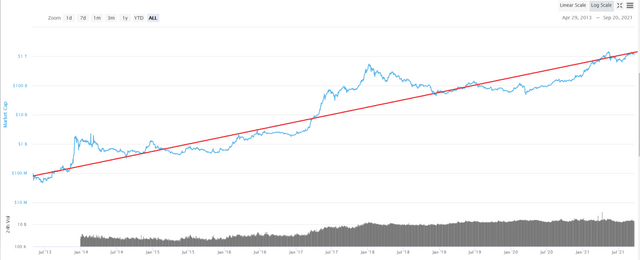
The chart below shows how the total value of cryptocurrencies other than Bitcoin has evolved from April 2013 to the present. Values are shown on a logarithmic scale in the chart.
I drew the red trend line on the chart. During the drawing, I observed that the areas above and below the trend line were equal. What the chart tells us:
• The total value of alt coins has increased nearly 20,000 times in the last 8.5 years.
• The total value has moved in a predictable direction, although it has moved away from the trend line from time to time.
• In 2021, prices followed a closer course to the trend line.
• Current prices are reasonable according to the model.
The model seen above shows that altcoin prices are increasing an average of 3.26 times each year. This means that those who invest in altcoins and hold them for a long time have achieved an unprecedented return in history in the last 8 years. There is no sign that this trend will change in the coming period. On the contrary, as the years progressed, crypto became a concept that was partially accepted by official authorities and large companies.
So despite all this huge return potential, why don't we see tens of crypto millionaires around us?
Crypto is an area that requires a lot of knowledge compared to other investment alternatives. It contains many pitfalls that can be deducted when invested unconsciously.
The vast majority of small investors enter the market when crypto prices are at their peak. For example, I made my first crypto investment in the first half of 2018, when prices were extremely inflated. Moreover, it didn't occur to me to diversify my crypto portfolio in the beginning.
On the other hand, it is necessary to take security-related issues seriously. Many people lost their savings due to corruption in the central stock exchanges.
Moreover, these thefts can also occur on metamask wallets, which are a safer alternative. Recently, a significant amount of Ethereum was stolen from my metamask wallet. If this is what happens to the former banker who is aware of fraud, what would happen to the average citizen? (It happened because I was a little too confident and connected my wallet to a site I didn't know)
Taking a short-term view, using excessive leverage, chasing tips are other mistakes that individual investors make.
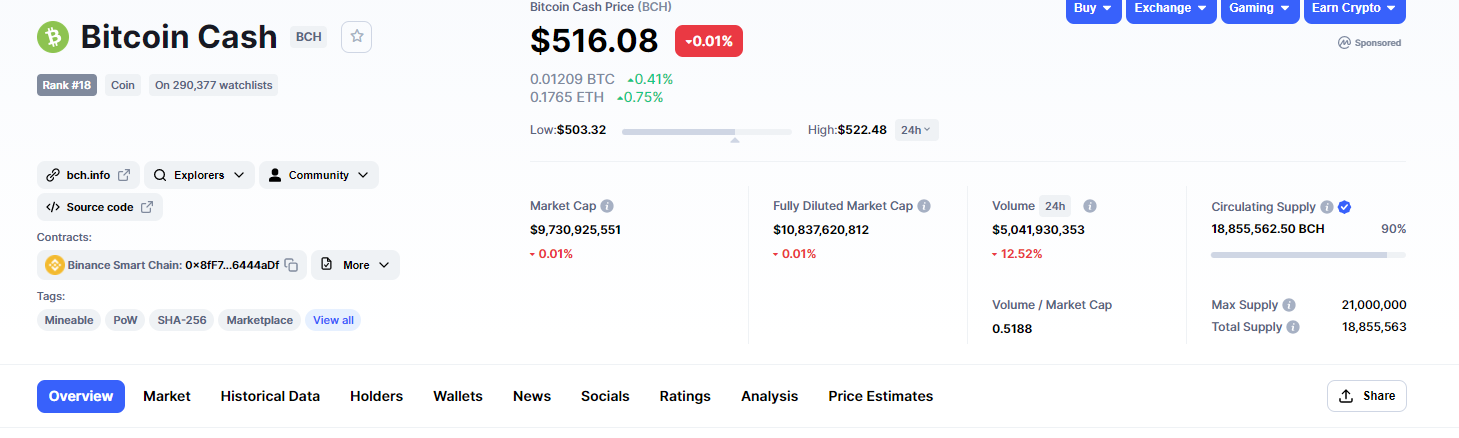
However, individual investors can earn a serious income from this market by making long-term investments in proven crypto currencies such as Bitcoin and Ethereum. Of course, it wouldn't be bad to have some Bitcoincash in the portfolio.
Thank you for reading.
My Thoughts on the Secret of Cryptocurrencies
Cryptocurrencies may be the most mysterious asset class to emerge in the history of world finance. Although many things have been said about them, there is no clear definition of what they are. There are those who claim to be currencies, commodities or securities. Since public authorities do not know which asset class to include cryptocurrencies in, it is difficult to regulate.
The story of cryptocurrencies began in a mysterious way from the very beginning. In 2008, Satoshi Nakamoto invented a cryptocurrency called Bitcoin, made possible by a new technology called the blockchain. However, although 13 years have passed since this invention, it is unknown who Satoshi Nakamoto is. Those who research the subject are talking about 3-4 candidates associated with this name and the early period of Bitcoin. However, these candidates do not reveal the identity of Satoshi Nakamoto. Among the explanations brought to the subject, the hypothesis that Satoshi Nakamoto collectively represents the creators of Bitcoin stands out.
We can ignore the mystery of Bitcoin's beginnings by adopting the adage "eat your grapes and don't ask your vines". Since Bitcoin emerged just after the 2008 crisis as a reaction to the current financial order, its creators obviously resorted to such a way of protecting themselves. Maybe they are people who are uncomfortable with the public interest, or they do not want to make a statement about it before cryptocurrencies gain full legal legitimacy.
The mystery that prompted me to write this post, beyond the creator of Bitcoin, was how cryptocurrencies could gain value so quickly. Although crypto prices are currently declining, we know that Bitcoin is gaining an average of two times a year in dollar terms. When we evaluate cryptocurrencies other than Bitcoin on a total basis, we encounter an annual average price increase of 3 times since 2013.
I remember that the increase in the value of cryptocurrencies was explained with the "pyramid chain" theory in 2018. As we all know, the Ponzi scheme is a system in which the money of those who join the system later is transferred to those who have entered before. When there is no new participation in the system, the chain breaks down and the system crashes. However, no known Ponzi scheme has survived for more than 10 years. In addition, unlike the Ponzi schemes, cryptocurrencies generate economic benefits beyond the transfer of funds from person to person. Today, blockchains have numerous uses such as value storage, value transfer, trading, credit transactions, rewarding content, registration of digital assets.
The works I have listed above can also be done using digital systems that do not contain blockchain. What additional benefit do blockchains and the cryptocurrencies connected to them provide that attract so much attention?
We know that blockchains essentially solve the problem of trust between parties. In this way, individuals can collaborate without the need for a third party such as banks, giant technology companies or governments. The fact that a system is built on the blockchain does not de facto prevent the concentration of power in one hand. In addition to the blockchain, a widespread ownership structure is also needed.
Thanks to their decentralized structure, blockchains give power to individuals rather than institutions. There is no similar situation in the content published in any media or in the books published.
Networks created using blockchain technology have some characteristic features.
Anyone can open an account on any network without permission. For this, it is enough to have an internet connection and an account/crypto wallet:
Crypto projects are often written in open code and are easily imitated.
Transactions taking place on the networks can be monitored transparently.
Thanks to their decentralized nature, they cannot be stopped by states or participants.
Applications on the same network work in integration with each other.
Assets on decentralized applications cannot be transferred without the consent of the person.
As you can see, the crypto world has many characteristic features. Also, I find it important that those who are included in this world are people who are open to innovations.
Despite all the explanations I have brought, I do not think that I fully grasp the essence of the crypto world. Over time, the stones will probably fall into place.
Stress of Crypto Investors
Recently, I learned on a YouTube channel that individual investors use leverage upwards to earn high profits, while institutional investors use downwards. While the motivation of institutional investors is usually to hedge their positions, individual investors are trying to earn more with less capital.
I made my first use of leverage in my life by shorting Ethereum in April. The result was not bright, as it coincided with the period when Ethereum had a breathless rally. Despite this negative experience, I occasionally use leverage when I believe the market will move in a certain direction. Since the volatility is very high in the crypto world, the maximum amount is small. So that I do not experience much stress.
On the other hand, I can't help but ask myself the questions whether leverage is good or bad, in which situations and to what extent it should be used. The conclusion I have reached is that the leverage should not be used more than 2 or 3 times the crypto. In fact, it's not even required.
Another question on my mind is to what extent I should diversify my investments. Not putting eggs in the same basket and diversifying investments are among the first recommendations that come to mind about investment. Others argue that making a basket of various investment vehicles lowers potential returns. Moreover, diversifying the portfolio makes it difficult to follow up. Perhaps a middle way must be found in this regard.
When it comes to crypto investment, it is possible to talk about a HODL approach, and an approach such as buying low and selling high. Here's another dilemma. Here too, I think the ideal method is to apply the HODL approach flexibly. In other words, always carrying a certain amount of portfolio, but shrinking the portfolio when the market is very high, and growing it when the coins get cheaper.
Finally, the question comes to my mind, is there any need to invest in other coins when there is Bitcoin and Ethereum? Although some of the altcoins sometimes make crazy leaps, the majority of them lose value over time against Bitcoin and Ethereum. Of course, it is possible to invalidate the dilemma on this subject by taking a little of that and a little of that.
Perhaps the most important of all is to have a savings to invest. That's why you have to earn more and spend less. Easy to say, hard to do. I think it's a good thing that krypton is conducive to such a thing.
China's Pressure on Crypto and Pricing in the Market
One of the things that surprised me when I started to get interested in crypto was the Chinese government's moderate approach to crypto. Because although trade and politics are intertwined in eastern countries, traders have limited power. However, in western countries, capital owners dominate the state in many issues.
In this respect, cryptocurrencies are not tools that violent states would like. Because the state can easily block a citizen's money in any bank for a legal reason, but the same is not true for cryptocurrencies. As far as I can perceive, the sensitivity of the US government is more about income taxation and investor protection. Although there are still gray issues, the USA and many European states have legalized crypto in a sense by taxing it.
If we go back to China; The communist party must have a problem with controlling the rising Chinese bourgeoisie. And cryptocurrencies are extremely powerful tools that can be used on the path to financial freedom. As such, the measures taken by China to restrict cryptocurrencies seem reasonable. China banned Bitcoin mining activities in the country in May, citing excessive energy consumption.
Today, Chinese public institutions have declared all transactions with crypto illegal. In addition, it was announced that a permanent structure will be established for the coordinated implementation of the measures taken against crypto. Upon hearing these news, Bitcoin lost 8% of its value and fell to $ 41,000. Other cryptocurrencies also lost value in parallel with Bitcoin.
In fact, China's stance towards crypto was known to the market. In this regard, this statement can be considered as a declaration of the known.
The impact of such news is greater as there is a weakness in technical indicators in the crypto market.
Bitcoin's third Fibonacci retracement is likely to drop to $37,500 as a result of a 61.8% pullback. During this retracement, serious depreciation will occur in altcoins. Because when Bitcoin declines by 5%, altcoins lose value by 8-9%. Of course, similarly, lower cions rise faster in ascensions.
The seniors of the crypto world are saying, "Let this September pass, we have a clear path." And I say to myself, I guess they know something.
Thank you for taking the time to read and see you in my next post.
My Preferred Bitcoin Cash
Hello, As of yesterday, I signed up for this system. Since I am a bit of a crypto enthusiast, I will try to share with you the reasons why I generally prefer bitcoin cash in this article. Personally, I try to ensure that my content educates the reader - according to their abilities - for the words and concepts of this amazing world of cryptocurrencies. In this context, I invite you to read my article.
**Why have various investors preferred BCH to Bitcoin (BTC) lately?**
**Let's start with the basics:**
Transaction fees. High bitcoin transaction fees do not represent an option to reduce transaction costs for online payments, which negatively impacts a large portion of the market.
On the other hand - and this is important if we take into account the large audience of BTC users - in terms of the common user dealing with small amounts of satoshi - I'm talking about Juan del Pueblo looking for extra money via taps. or low resources, etc. due to low deposits - many of these small amounts are not available (i.e. they are not mobile because transaction fees are higher than what you want to transfer). I think this leaves a negative impression on Bitcoin.
To the above, let's add the backlog of bitcoin transactions currently on the blockchain network. There is a rule that does not fail in this sense; The higher the backlog, the higher the estimated fee to confirm your transaction and skip the queue. Results: Incoming transactions are delayed for hours or even days to be confirmed in a block. For this reason, sometimes days pass before we see satoshi credited to our wallets (unless, for example, we pay high fees for deposits in less than 4 hours).
In this regard, it is clear that BCH works with better benefits. They can send and receive fast and best of all for low fees (about $0.019). BCH works ideally for microtransactions as opposed to BTC, whose current average transaction fee is around $24. As I mentioned earlier, it's important to note that these rates are constantly changing depending on how busy the network is.
Results: Speed, reliability, low fees, simplicity, stability and security make BCH stand out. It is only a matter of time before this cryptoactive is fully consolidated as an alternative project to other altcoins we know. In fact, some people are wondering if Bitcoin Cash can dethrone Bitcoin. I don't know how far Bitcoin Cash can go in your expectations, but I can assure you; If BCH is an optimized version of the leading Bitcoin, they can compete to replace it, no matter how complex your goals may seem.
I hope my article was useful and informative for you. Hope to meet you in my next post.
I want to introduce myself
Hello dear beautiful people. First of all, I am very happy to be a part of this community and to be here. I want to introduce myself.
My oldest brother in my family, one of my nephews, told me about this platform. That's why I'm trying to write about myself here, something I've never done before. My name is Tiana and I live in Texas, I am 36 years old. I am currently a 3rd grade teacher. Due to the pandemics we are working online, I have a little more free time so I am trying to find new things in the internet world. I have been a primary school teacher for 8 years, I love my job very much. Currently, there are 17 students in my class.
**My Experience with Crypto**
It's been almost five months since I started with cryptocurrencies and blockchain to understand how they work and what their purpose is. First, I started writing different articles on several platforms. But I researched this platform, I see it as a more serious platform. I definitely see a better experience here compared to other platforms. I also tried some tools under the guidance of my nephew, which is walnut mine. So it's been five months but it will definitely go on for longer.
**My Hobbies and Passion**
As I mentioned, I am a teacher, besides seeing teaching as a job, I see it as a hobby, I love my job and I do it with love. Besides the teacher, I like to spend time with children, children, reading to them while reading to them, I also read different things. I love reading books and I try to be active and healthy by playing football as much as possible.
What I don't like is the lies of people who lie. Unfortunately I am allergic to plants, I hate some plants because of allergies, now spring is starting so it's hard for me in the coming weeks.
I'll be posting about my region, mostly about education, kids, some ICOs I'm following, and I'm trying to buy in the first steps because ICOs can be profitable from what I've seen. I will also share with cryptocurrencies because I love this new trend, I want to read and know more about new projects emerging. I'm also interested in learning more about new projects here. Meeting more people and being part of the community.
As mentioned earlier, my niece helped me become a part of this platform, so I am writing about myself here. Sorry if I made some grammatical mistakes. Nice to to meet you.
 @tianapickett