How is Yield Farming and Liquidity Mining today?
***Important notes and disclaimers***
*The content does not constitute investment, financial, legal, or tax advice: none of the information contained on this post constitutes a recommendation, solicitation, or offer to buy or sell any digital assets, securities, options, or other financial instruments or other assets, or to provide any investment advice or service.*
Remember the time when it was possible to get insanely high yield farming (300+%) on the DeFi protocols just by locking your tokens on an Automated Market Making protocol like Uniswap?
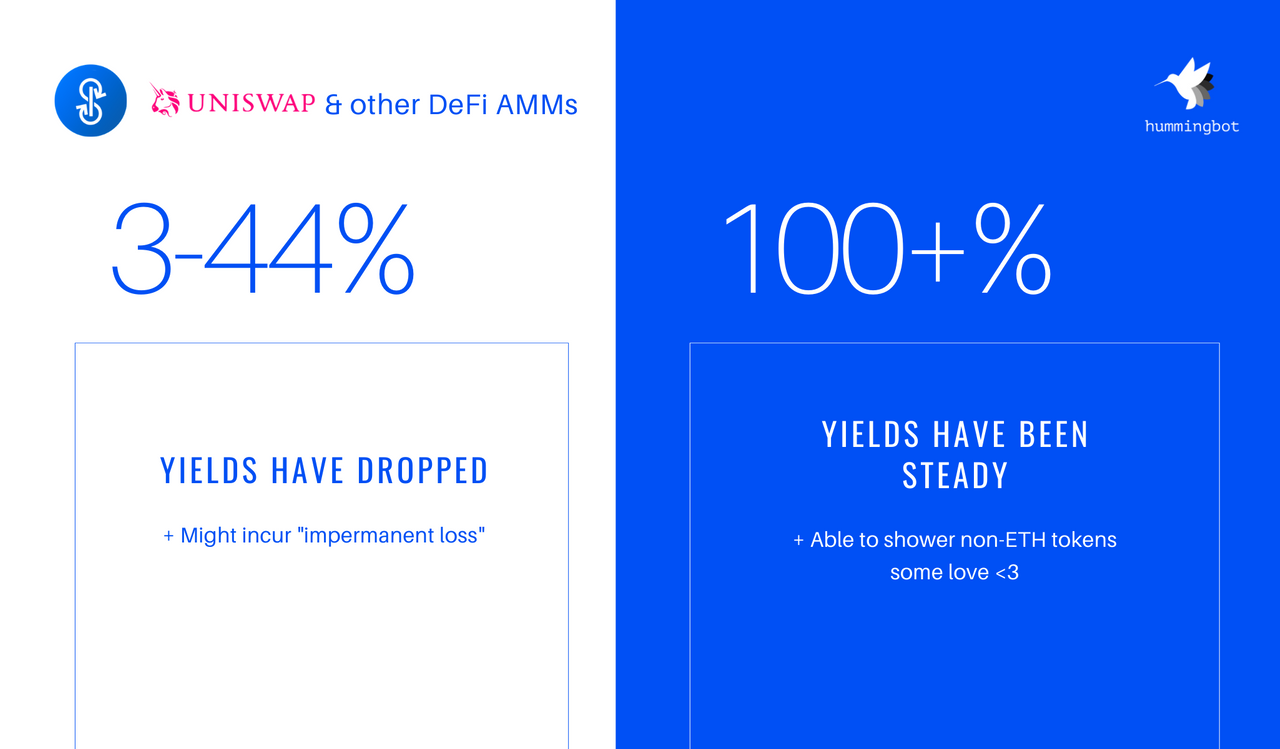
Looking at how much yield the AMMs protocols are generating for the liquidity providers nowadays, it seems that the DeFi summer is over, and you might ask yourself, “Where did that high yield go?”
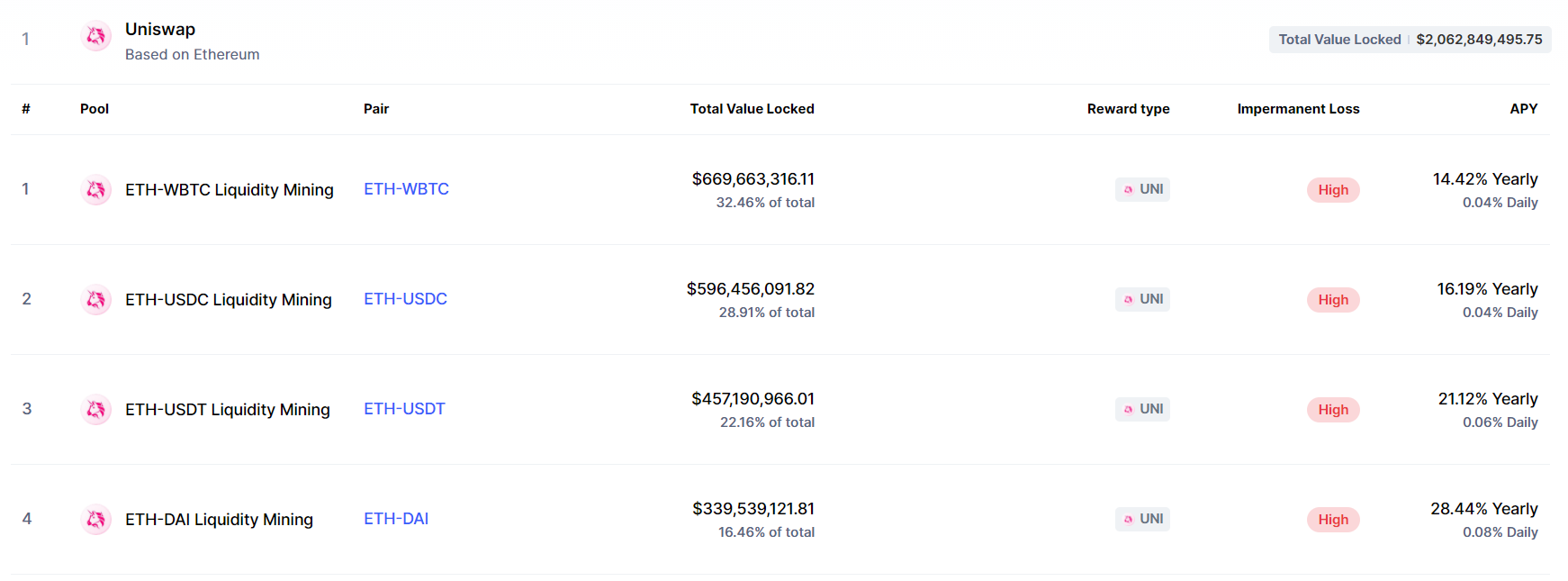
If we take a look at Uniswap pools that reward liquidity providers with UNI tokens, we can see that the APY reduced a lot since they launched the token.
There are two main reasons why this happens:
1 - The token rewarded by the Liquidity Mining has its own market value, and lately, DeFi tokens prices went down by a lot.
2 - It’s really easy to participate in Liquidity Mining on AMMs, and because of that, there is a lot more people competing for these rewards.
Hummingbot Liquidity Mining is very similar, but with some key differences: https://miner.hummingbot.io/
1 - You don’t have to spend a lot of money on transaction fees to lock or withdraw your funds;
2 - There is no “impermanent loss”;
3 - With a good market making strategy, you will also profit from your trades, increasing the effective Yield;
4 - Some Liquidity Minining campaigns are paid in USDT, which also helps to reduce the possible loss due to the value depreciation of tokens rewarded;
5 - More possibilities! Our Liquidity Mining campaigns aren’t limited to Ethereum Tokens. If you look at the current campaigns, you will see the tokens ALGO, COTI, XEM and HARD along with the ERC-20 tokens RLC and MFT.
You can learn even more about it reading Hummingbot Miner vs. DeFi Liquidity Mining Part 2: Considerations for Market Makers/Liquidity Providers https://hummingbot.io/blog/2020-10-liquidity-mining-hummingbot-defi-automated-market-maker-impermanent-loss/
But what about the Yield?
You might argue that you can still find 200+% yield on smaller and new AMMs protocols, but you should really consider the risks before locking your funds on a new protocol. Remember the smart contract exploitation that happened to FARM protocol a few weeks ago, or the (in)famous Sushiswap rug pull? https://www.coindesk.com/defi-platform-harvest-finance-exploit https://www.coindesk.com/sushiswap-liquidation-weekend
Won’t the Yield from Hummingbot Liquidity Mining also go down over time?
A predetermined fixed reward amount is distributed every day, and if the competition increases (more Liquidity Miners), it is possible that each miner’s share goes down.
But take a look at what happened this week, when a new campaign was launched with KAVA for their new HARD token, adding an amazing **10k USDT to the reward pool for the first week alone**, and 30k USDT in the following 11 weeks! https://hummingbot.io/blog/2020-11-kava-liquidity-mining-campaign/
Decentralized Exchanges and DeFi projects are an innovative step towards building a better and more accessible financial system. Hummingbot Liquidity Mining Campaigns are our contribution to help improve the crypto space, allowing anyone to support the projects they like through Market Making. But if your favorite project isn't listed as one of our campaigns, stay tuned because new campaigns are coming!
Happy Liquidity Mining!
What is cross-exchange market making
*(This article was originally published on* *hummingbot.io**)* https://hummingbot.io/blog/2020-09-what-is-cross-exchange-market-making/
Welcome to the Hummingbot Academy!
Welcome back to our Educational Center, where we aim to help you to learn more about market making, arbitrage, and everything related to algorithm trade. https://hummingbot.io/blog/2020-09-what-is-market-making/ https://hummingbot.io/blog/2020-09-what-is-arbitrage/
Today we will talk about a different strategy that can be used with hummingbot: **Cross-Exchange market making**. https://hummingbot.io/
The objective of this article is to help you understand:
**What is the cross-exchange market making strategy?**
**What is the difference between cross-exchange market making and arbitrage?**
**How is cross-exchange market making different from pure market making?**
**Why and when should I use this strategy?**
If you already understand how arbitrage and pure market making work, cross-exchange market making (XEMM) becomes really simple: all you have to do is to combine both operations in one. https://hummingbot.io/blog/2020-09-what-is-arbitrage/ https://hummingbot.io/blog/2020-09-what-is-market-making/
So what is cross-exchange market making?
Here's a simple explanation of the concept of cross-exchange market making:
My friend Alice wants to sell her guitar and she's offering it for $100.
I go around to all of my other friends and tell them that **I **am selling** **a guitar for *$110*.
If one of my friends, say Bob, agrees, I immediately buy the guitar from Alice for $100 and sell it yo Bob for $110.
Pretty neat right? I made $10 of profit selling something I didn't own by simply doing a back-to-back, simultaneous buy and sell of the guitar.
***Wait... that sounds a lot like arbitrage, so what's the difference?***
OK, here's how this situation would be for arbitrage:
My friend Alice wants to sell her guitar and she's offering it for $100.
I go around and try to find if someone, anyone, **is offering to buy** a guitar for some price higher than $100. After looking around, I find an ad posted by my other friend Carol; **she wants to buy** a guitar and is willing to pay $110.
Great, I immediately buy the guitar from Alice for $100 and sell it Carol for $110.
Did you notice the subtle difference? For step #2 in cross-exchange market making, I was the one proactively telling people **I had something to sell** and **I was setting my price**. Does this concept sound familiar? **In the transaction with Bob, I was the maker** and Bob was the taker.
On the other hand, for step #2 in arbitrage, I was simply going around and searching to find if *someone else* had already said they wanted to buy a guitar at a higher price. In the arbitrage scenario, **Carol was the maker**, and **I was the taker**.
In my transaction with Alice in both scenarios, I was a taker: I accepted her offer for a guitar and her price.
An arbitrageur acts as "**taker/taker**"; he is the taker on the buy *and* the sell transaction. Arbitrage is more *passive* because an arbitrageur just monitors prices and searches for opportunities to act on. On the other hand, a cross-exchange market maker acts as "**maker/taker**"; he proactively tries to create trade opportunities by creating maker orders on one side of the trade.
What does this have to do with market making?
In our previous article on pure market making, we explained that a market maker is someone who places both bid and ask orders in order to facilitate trading. You can see that in the cross-exchange market making example above, I am acting as a **maker**, offering a guitar to sell and specifying a price. So that's one half of what a market maker does. https://hummingbot.io/blog/2020-09-what-is-market-making/
But I can also do the same transaction for the buy side. I have another friend, Dave, who wants to buy a guitar, but he is only willing to pay $95. At this price, he and Alice can't trade, because his budget of $95 is below Alice's asking price of $100. Since I know that I can sell a guitar to Dave, at the same time I'm going around trying to sell Alice's guitar, I can go around offering *to buy* another guitar that I can sell to Dave.
Now I have both sides: I can offer to buy a guitar for $85 and sell a guitar for $110. I am now acting as a market maker. The interesting thing about **cross-exchange market making** that you may have noticed is:
I don't even own a guitar in the first place; if someone wants to buy a guitar from me, I just buy the one from Alice to sell them and,
I don't even need to have the money to buy a guitar on the buy side; if someone wants to sell me a guitar for $85, I can pay for that purchase by selling that same guitar immediately to Dave!
In **cross-exchange market making**, a trader acts as a normal market maker on one exchange (the "*maker exchange*"), creating buy and sell orders. However, the trader eliminates the inventory risk usually associated with market making by using another exchange (the "*taker exchange*") to simultaneously offset (or "*hedge*") any trades filled on the maker exchange.
That is why we mentioned earlier that cross-exchange market making kind of looks like **a combination of pure market making + arbitrage**.
So how does this translate to order book markets?
A financial environment where the same asset is traded in different marketplaces is susceptible to what is known as **market inefficiency**, where the information about the value of the asset takes some time to dissipate to all the exchanges.
This can be easily noticed by looking at the differences between bid and ask prices offered on each order book, as can be seen on the screenshot of the BTC/USDT order book on two different exchanges at the moment in time:
*(continue reading on* *hummingbot.io**)* https://hummingbot.io/blog/2020-09-what-is-cross-exchange-market-making/

What is Market Making
*This article was originally written by me and published on the* *Hummingbot Blog* https://hummingbot.io/blog/
**Welcome to Hummingbot Academy!**
If you reached this page, there is a high probability that you have been asking one of these questions:
- **What is a market maker?**
- **What do market makers do?**
- **How can I become a market maker?**
- **How do I create a market making robot?**
Then you are on the right place!
Here at Hummingbot Academy, our goal is to help you learn more about market making and how to use our free open-source robot to implement your own strategy. https://hummingbot.io/ https://hummingbot.io/download/
But what is a Market Maker?
`A market maker (MM) is a firm or individual who actively quotes two-sided markets in a security, providing bids and offers (known as asks) along with the market size of each.` source https://www.investopedia.com/terms/m/marketmaker.asp
If the above quote didn't made any sense for you, imagine a pawnshop:
Image credit: Steve Sutherland https://www.flickr.com/photos/96510847@N06/10432305044
Let's say that Susan has an old guitar, doesn't have much time to play anymore, and can use some cash; meanwhile, Mike has been learning to play his friend's guitar and now thinks that he is good enough to invest some cash to buy his own, but a brand new one might be too expensive.
Although we have two people that could close a deal, it might be difficult for them to find each other, or even to agree on a reasonable price for that guitar.
This is where the pawn shop enter the picture:
Instead of looking around for someone that wants to buy a guitar, Susan could sell her guitar to the pawnshop, and Mike could go there knowing that he would find one.
The pawnshop owner is providing a **service** to both Susan and Mike. He offers an easy way to sell/buy what they want (**providing liquidity**) and a fair price, based on the demand for used guitar in the town (**spread reduction**).
The pawnshop will be paid for this service by the difference in price he paid to Susan and the price he received from Mike (**spread size**).
A **market maker,** like a pawnshop owner, provides the same kind of service in financial markets. He provides **liquidity** and helps to **reduce bid-ask spread sizes**, taking his profits from the difference between his buy and sell orders (**spread**).
How does market making happen in financial markets?
A financial market isn't much different from the real economy open markets. Every day, millions of people access some kind of trading platform, looking to close deals among a wide range of assets, including company shares, bonds, oil, gold, contracts, and **cryptocurrencies**.
But instead of thousands of people gathering in the same place, holding signs and/or screaming for how much they are buying or selling something, **financial assets markets** use an **order book,** where all **buy and sell offers** are aggregated in the same place:
Source: Bittrex
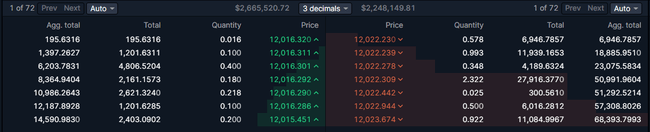
The order book is nothing more than a list of all buy and sell offers (with quantities and prices) available across all market participants.
In the picture above, we can see the BTC/USD pair **order book.** If someone is looking to **buy** Bitcoin right now, he/she will have to pay $12,022.230 (the lowest ask price) and there is 0.578 BTC available at that price.
But if someone wants to **sell** Bitcoin immediately, he/she will have to accept the price of $12,016.32 (the best bid price) for up to 0.016 BTC.
The difference between the lowest of offer prices and the highest of demand prices for a good or asset is called **spread.**
Technically, any person that posts a buy or sell offer on the **order book** is acting as a market **maker**, while those who are accepting the prices offered on the **order book** is called a market **taker**.
Acting as a **market maker** is conceptually similar to participating in the market as the "pawnshop owner", creating offers to buy an asset at a low price, and selling it at a higher price **as fast as possible** and **as many times as possible**.
While the most common trading/investing strategy looks to profit from big price changes, a professional market maker is trying to capitalize on smaller but more consistent price swings between two price levels.
Most **traders and investors** want to see the market moving like this:
While **market makers** love to see market prices moving like this:
The price of an asset doesn't change at a constant flow but as waves, and while traders and investors are trying to find out if the sea is moving towards high or low tide, the market maker is watching the smaller waves on the beach.
Bid-ask spread vs market maker spread
*(To keep reading this article visit the* *Hummingbot blog**)* https://hummingbot.io/blog/2020-09-what-is-market-making/
Launching My Cryptocurrency Fund on Genesis Vision that anyone can join
*Disclaimer: This is not a investment advice. As always, do your own research on topics related to anything written on this article before putting your money anywhere*
Hello Cash readers (and anyone that find this article around)!
It's been a while since the last time i wrote around here, i know, but i have been working on some projects, but mostly using this pandemics time to improve my knowledge about financial markets in general (soon to be a certified investment advisor).
One of these projects i have been working on is related to an older article i wrote about a platform/project called Genesis Vision, that allows anyone to use cryptocurrencies (BTC, ETH, USDT, and GVT) to create a cryptocurrency fund and/or invest in other people funds/trading. https://peakd.com/hive-175254/@phgnomo/how-investment-funds-work-and-how-to-use-your-cryptocurrency-to-invest-in-one-of-them https://genesis.vision/?ref=729626
I think this concept is really amazing, because usually, to join a good investment fund you need a non-negligible amount of cash, a bank account, KYDC and some extra bureaucracy.
With Genesis Vision you can see the whole history of an user created fund, what is the asset composition, it's past profitability, and risk/reward indicators (Sharpe ratio, Calmar ratio and Sortino ratio), and **you can withdraw your investment at any moment you want to**. https://genesis.vision/?ref=729626
**And you can join one that you like with the minimum investment of only 5 USD!**
Also, it is important to notice that this isn't a type of DeFi system, and you will have to deposit the cryptocurrency into your account on the platform, wich you don't have access to the private keys. As any other investment on the cryptocurrency world, only use funds you are comfortable in risking.
How Genesis Vision Work
After creating an account on the Genesis Vision platform, you will be able to see 3 types of investments: https://genesis.vision/?ref=729626
**Follow**
`Leverage the expertise of seasoned traders while keeping control of your capital. Just choose a program and Genesis Vision will automatically copy the trades from your account. You will be able to withdraw your investment or exit trades at any point in time.`
Here you can subscribe and follow the exact trades some else do on the platform.
Every time a position is opened by the user that created the follow program, your account will automatically execute the same trade from your account, with your own funds.
The creators of these programs will receive a percentage (set by them) for each profitable trade and/or for each opened position.
**Program**
`Invest your money with the peace of mind of knowing that a manager’s track record is stored on the blockchain. Select investment programs that suit your personal profile and let the manager do the work for you. You will be able to withdraw your investment or profits only at the predefined intervals.`
Programs are a bit similar from **Follow**, but instead of making trades with the money from your own account, you add your money to a "pool" where the manager of the program will use to the total amount of money to trade.
The manager of the program will have that total amount of funds to trade for a set period of time, after wich, all investors can take their money back.
When, during the set period, the program closes at a profit, a percentage of the total profit (not the total funds) is paid to the program manager.
If there is a loss, the manager don't get anything.
Also, it is interesting to notice that, while the manager is using other people assets to trade, he isn't able to freely move these assets, and can only use them to trade inside the Genesis Vision trading platform. https://genesis.vision/?ref=729626
**Funds**
`Diversify your capital across hundreds of cryptocurrencies in one click. Select a fund with a composition that matches your opinion on the market and let the manager readjust while the market evolves. You retain full control of your investment. You can withdraw your capital at any time.`
With this option, with only 5 USD, you can join a fund, where the total amount of money on the fund will be distributed among a basket of cryptocurrencies defined by the fund manager.
You can find all types of funds here, from one that is 100% on only one coin, to others that focus on one specific "area" of cryptocurrency solutions, life DeFi coins for example.
It is a good options for those who want to have an exposition to cryptocurrencies beyond bitcoin, but don't want to take a lot of time to resarch all of the options that exist.
An important part (beyond understanding how the assets are allocated on each fund) is that you can view the whole performance history of the fund, includind how the coins were distributed, and their risk/reward indicators.
Here is an example from a fund i created (more about it down below): https://genesis.vision/invest/funds/3month-horizon-10alt?ref=729626
The cost of the fund is also set by it's manager, where he can define a % on the invested value to be charged from the investor by joining and/or exiting a fund.
This varies a lot from fund to fund, some can even be free to join or to exit.
Different from the programs, you can enter and exit any fund at any time.
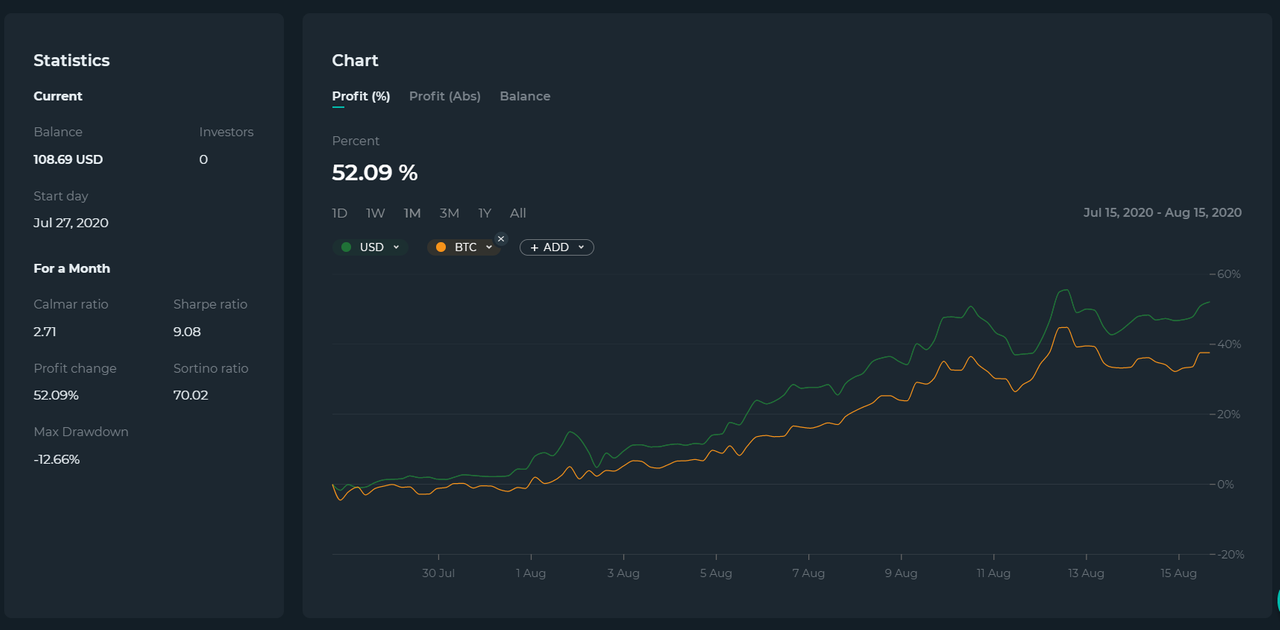
3Month Horizon 10Alt Fund https://genesis.vision/invest/funds/3month-horizon-10alt?ref=729626
After using the platform since the end of the last year, on the day 07-27 i finally created my own fund.
At first, is mostly an experiment, but also a way for me to learn a bit more about how funds can be managed.
Fortunately, it is having a pretty good start, with a 52% profit on 20 days as can be seen on the picture above (or check here if you want to see an updated situation) https://genesis.vision/invest/funds/3month-horizon-10alt?ref=729626
But what this fund is about? As any good investment fund that exists, there must be some fundaments that glue together the reasoning behind each coin chosen for the assets distribution.
Basically, the concept of this fund is to look for 10 altcoins with the best growth potential for the next 3 months.
I use a mix of fundamentals and technical analysis to chose what coins will be featured on the fund, and every month i reevaluate the assets and rearrange them as needed.
Zcash(ZEC) - 39%
Compund(COMP) - 21%
Crypto.com(MCO) - 8%
Aave(LEND) - 7%
Band Protocol(BAND) - 7%
Chromia(CHR) - 5%
THETA(THETA) - 4%
ICON(ICX) - 3%
Kava(KAVA) - 3%
Ankr(ANKR) - 2%
Genesis Vision Token(GVT) - 1%
In two weeks, i will be reevaluating this composition and realocating as indicated by my personal analysis.
Anyway, this post got already a bit too long, but my idea is to create a weekly report here, so i can measure how good my strategy is, and even hear from any of you opinions about that i should look at the next relocation (wich will happen in two weeks)
See you ppl around!
Interests and Staking in Crypto #2 - BLOCKNET
*(Note: This article cover a lot of details about the blockchain i am talking about. If you are only interested on how to Stake/earn interest, just jump to the end of the article)*
As i wrote on my previous article about how some ways to increase your BTC holdings, the possibility of receiving interests on whatever crypto you hold/like is a really interesting prospect that is on a rising trend on the cryptocurrency world. https://read.cash/@phgnomo/receiving-interests-and-staking-in-crypto-1-btc-3ba6408a
Besides lending crypto, i dare to say that the first step toward this this new wave of crypto-investment was the start of proof-of-stake models https://peakd.com/hive-175254/@phgnomo/what-is-proof-of-stake-and-how-can-you-receive-blockchain-transaction-rewards-even-with-a-low-amount-of-coins
And as anything else on the cryptosphere, there is a lot of projects and options and they all have similarities and differences.
Therefore, i am going to explore some of these coins, trying to understand what is the project about, and how profitable it can be to invest, and how you can do it.
And again, a warning: Cryptocurrency investments is a high risk business, so don't put your money anywhere, unless you know what you are doing, and have a high risk tolerace.
----------------------
The Project
- Website: https://blocknet.co/
- Whitepaper: https://docs.blocknet.co/project/blocknet-whitepaper.pdf
- Twitter: https://twitter.com/The_Blocknet
- Start Date: 20 October 2014
- Development status: On-going
- Consensus Mechanism: Proof-of-Stake
- Algorithm: Quark https://en.bitcoinwiki.org/wiki/Quark_Algorithm
- Token: BLOCK
- Blockcain Explorer: cryptoID https://chainz.cryptoid.info/block/
Opensource
The creation of Bitcoin opened a door that probably won't ever be closed:
After Bitcoin reached some popularity, we all know the results: Thousands of projects were created aiming to bring decentralization and blockchains to every kind of economic activity.
But this direction created a new problem: **With thousands of different blockchain protocols trying to achieve a different objective in different ways, how would be possible to make a fully functional economy based on blockchain?**
This situation created a race (among others) to create a product that allow all the different blockchains to interact between each other, while still being totally independent.
And this is where BLOCKNET project comes in. As described in their own website: https://blocknet.co/
`Blocknet is a blockchain interoperability protocol that enables communication, interaction, and exchange between different public and private blockchains, as well as on-chain access to off-chain data, APIs, and services via oracles.`
You can read their very detailed whitepaper, whare you can find how they plan to achieve this idea, including all the technical details about how their project would work. https://docs.blocknet.co/project/blocknet-whitepaper.pdf
Project Status and Products
With 5 years of existance, BlockNet already have working product, with it's open source code available on their github page. https://github.com/BlocknetDX/blocknet
Working on a Service-based model, they have 3 main components to keep it all together: https://www.investopedia.com/terms/b/blockchainasaservice-baas.asp
- **XRouter**: Allows applications to interface with blockchains
- **XBridge**: Allows any application to perform decentralized exchanges
- **XCloud**: Allows applications to run entirely decentralized by enabling onchain use of off-chain data, APIs and services.
BLOCK DX - Decentralized Exchange
But the main working product the BlockNet Project have right now is its DEX (Decentralized Exchange).
On a centralized exchange like Binance, you allow a centralized entity to have custody of your funds, which goes a bit agains the concept created by the cryptocurrency tecnology that you are the only one that can move your funds (as long as you are the only one holding the private keys). https://www.binance.com/en/register?ref=H1EGTGP8
Therefore, there is a lot of projects trying to create a decentralized exchange, where the users can trade their assets directly from thier personal wallets.
There is a lot of options and models available these days, and each of them have their own issues, and Block DX is aiming to solve them, creating, as they describe, a "4th generation DEX — Currency Agnostic / Fully Decentralized — Protocol Based: Not limited to specific blockchains." Check this article where they explain more about this concept. https://blocknet.co/the-evolution-of-the-decentralized-exchange-a-brief-history/)
One of their main sell points is that their protocol allows anyone to trade their crypto assets directly from their personal wallets, without the need to do any extra action, like "wrapping" a token.
Their app work as a point of network connection, where market users put their orders on the book, but the settlement happens directly between the traders wallets.
Another really interesting feature is the possibility to create any trading pair order, as long as they are listed on the platform (here is all the supported assets). Want to trade LYNX/LBC? Sure. How about GALI/DGB? Yes you can. https://blockdx.com/listings/
You can check all the features their DEX offer here. https://blockdx.com/
My personal opinion is that, so far, this is one of the best decentralized exchanges concepts i have stumble upon, but there is still a lot to improve.
There is two main issues i think are big problems to reach a mass adoption:
1 - It's a bit complicated to start using
In theory, it is easy, but there is a lot of steps you need to go throught to install and start using the exchange, as you can see on the video below.
https://www.youtube.com/watch?v=aFSl60KcaCk
2 - You need to have the full wallet of the asset you want to trade on your computer
That means that you must have the full core wallet, and the whole blockchains data stored on your computer. This make thing a bit hard for traders, because they will need a lot of storage space to be able to trade a lot of assets (for example, the whole BTC blockchain is 280GB).
And less traders/market makers means a lower liquidity on the market.
The token and it's uses
- Ticker: BLOCK https://www.coingecko.com/pt/moedas/blocknet
As any other blockchain, BlockNet uses it's own token to process transactions, rewarding those that have implemented nodes to secure the blockchain.
Besides that, the token is also used to pay the trading fees of the BLOCK DX exchange:
Maker Fee (Creating an order on the book): free
Taker Fee (Accepting an order from the book): 0.015 BLOCK
100% of the trade fees generated on BLOCK DX are distributed to the network Service Nodes
But keep in mind that, since the settlement of the trades happens through directly transfers between users wallets, there is also the network fee of each cryptocurrency you trade.
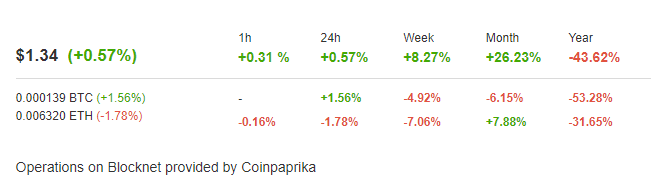
Market Overview (05/19/2020)
Price Overview
Source: Coinpaprika https://coinpaprika.com/coin/block-blocknet/
YTD returns
(Blue: BLOCK;Red: BTC)
#### Exchanges
STAKECUBE https://stakecube.net/?team=phbr
BLOCK DX https://blockdx.com/
Altilly https://www.altilly.com/
VCC Exchange https://vcc.exchange?ref=nVsawm
Algorithm Forecasts
There is a few websites that provide a price prediction of an asset using algorithms based on past movements of the price.
While they provide an interesting information, it is always advised to use this information with care, mostly because past behavior doesn't guarantee future results.
Here is some of these predictions.
Wallet Investor https://walletinvestor.com/forecast/blocknet-prediction
**1 year forecast**
**7 day forecast**
Coinpredictor https://coinpredictor.io/blocknet
Cointobuy https://cointobuy.io/blocknet
Staking/Interest
As a proof-of-stake coin, BLOCK allows it's users to participate on the network securit by staking the coins, for a chance o being selected to proccess a transaction and be rewarded for it, increasing the amount of coins you own. There some possible ways to do it, each with it's pros and cons.
Here is how you can Stake BLOCK
Wallet Staking
It is pretty simple. Deposit BLOCK on your wallet, and activate the staking. Here is a complete guide. https://docs.blocknet.co/wallet/staking/
When you stake directly in your wallet, every time a new block is created on the blockchain, everyone that is participating on the staking have a probability of being selected based the size of the stake proportional to the total coins staked.
For example, if you are staking 100 coins, and there is 10000 coins in total staked on the network, your chance of being selected to process the block is:
(100/10000)*100 = 1%
Now, the only problem is: Your wallet must be open everytime you want to stake your coins. If the wallet is closed, you won't be connected to the BlockNet network, and won't have a chance at being selected as block validator.
Minimum funds to Stake
There is no minimum. But the more you have, the better your chances
Expected Profitability
It's a bit tricky to calculate the Profitability/ROI, because you need to know how much time your wallet will be open and connected to the network.
Here is how you calculate it:
ROI = ( (Total Blocks recognized) / (total block staked on the network) ) * 100
For reference, we will be using a full year where the wallet would be connectec 24 hours every day.
The network produces 1 BLOCK every minute, therefore:
1 BLOCK/min * 1440 min/day * 365 days/year = 525600
Checking on the blockchain explorer you can see how much BLOCKs is being staked on the network. https://chainz.cryptoid.info/block/#!extraction
Right now, there is 2881856.3844 BLOCKs being staked
So, the ROI will be:
ROI = (525600 / 2881856.3864)*100 = 18.23%
What this means is that for each 1000 staked BLOCK, you would receive 182.3 BLOCK every year of staking.
If you want to have a better estimate, use this calculator https://www.stakingrewards.com/asset/blocknet
Service Nodes (Masternodes)
Services nodes is a bit more technical to implement, and you can check here how to do it. https://docs.blocknet.co/service-nodes/setup/
I won't be covering in details here, because besides the technical side of setting up a masternode, you must also consider the costs of doing so.
But here are the basic requirements:
- 5000 BLOCK as collateral
- 2 computers
- Internet connection
The advantage of setting up a service node is that you can still Stake the 5000 BLOCK used as collateral, and also can receieve a payment of 0.015 BLOCK payment for each trade settled on the BLOCK DX exchange.
These fees are distributed at random to all active Services nodes.
Staking Pools
Now here is where things get interesting for those that don't have the technical knowledge, nor the possibility of have a computer turned on 24 hours per day to have a good chance at staking directly on their wallet.
Some sites provides what is called Staking Pools, where a central entity set up a staking wallet or masternode, and anyone can get a "share" of the staking/masternode.
There is a lot of Staking Pools around for every coin, and before trusting your money to any of them, be sure to check around to see if the pool can be trusted, after all, you are putting your funds under that entity custody.
The pools also collect a fee for the service provided, which means that you will always have a lower return than staking directly on your personal wallet.
On the other hand,the big advantage of being part of a staking pool is that usually, due to the size of the stake these pools hold, a daily staking return is almost guaranteed.
Also, you don't have to have a computer on 24 hours per day to receive the staking rewards.
Related to BLOCKNET staking, my preferred Staking pool is STAKECUBE, which doesn't require any minimum amount to start staking and have an integrated exchange. https://stakecube.net/?team=phbr
The expected Annual ROI of BLOCKNET on STAKECUBE is 4.64% https://stakecube.net/?team=phbr
Conclusion
As a project, i see a lot of potential on BlockNet, specially because the interoperability of blockchains and decentralized exchanges will be a major factor that will play a big role on the evolution of anything related to crypto.
While there is a lot of competition on this area, BlockNEt development seems to be going at full force, and the model of decentralized proposed by the project, in my opinion, is one of the best i have ever seen so far. The only problem is the same as any other crypto project: It's hard to understand and use.
If the team are able to make big improvements on the user experience area, they might have a really awesome product in hands.
See ya!
BILLIONS is a must watch TV series to anyone that is involved in financial markets
https://www.youtube.com/watch?v=-ydcNX8kszs
So, while i was looking for something new to watch on this quarantine season i stumbled upon this series called BILLIONS.
Looked interesting and the kind of well thought plot that i like.
But what i great surprise i had!
The main plot revolves around the U.S. Attorney Chuck Roades building a case to prosecute the most successful hedge fund manager of the country Bobby Axelrod based on illegal trading practices.
It is a great show even to those not that involved in trading or financial markets, with an interesting plot and great acting.
But for the traders out there, there is something more...
There is a lot of lessons you can learn from it.
The lessons
1 - Information is the most important asset any trader can have
Sure, there is no such a thing like predicting the future, and to know for sure if the price of an asset will go down or up.
While no one can predict the future, having the right information can increase the chance of being right by a lot.
And the information is out there. Everywhere we look, be it a graphic, a newspaper, a company balance sheet... Everything is around us.
But the key to be successful as a trader is to know what the piece of information means, and how it fits on a bigger picture.
You can be an awesome technical analysis trader, but if you don't understand how the screen information fits with other things outside the graphic, you might become a good trader, but you will never be a great trader.
Information is everything.
2 - The whales and sharks rules the markets seas
Doesn't matter the asset or the market. With enough money any market can be manipulated.
And that manipulation comes in different forms.
It can be buying or selling with the right timing and volume, or providing pieces of information to some specific market players to improve the chances that they will act in a predictable way.
We, the small fish, can't do much about it, and even if all retail traders got together, it wouldn't be possible to 'fight back' what the big players do.
Unless you are a big player, you have to accept that you can't fight the market. All you can do is understand how these big players think and act, and try to follow their moves as soon as possible to grab some scraps along the way.
3 - Inside trading and other manipulations are illegal, but not until they are proven
Don't be an innocent fool.
Sure, there is a lot of laws and regulations trying their best to keep the markets fair for every participant, but how can we be 100% sure that no foul play happens if we don't hear about it?
Undercover deals might not happen because everyone could be afraid of going to jail, but...
Something not being seen on the light doesn't mean it doesn't happen.
And since information is the key to everything, i wouldn't be surprised to know that there is a lot of illegal activities happening on all the financial markets.
We just don't hear about it because no one can prove it.
4 - Working on the financial sector can break your mental health
An interesting part of the show is that there is a psychiatrist working for Axelrod (the fund manager), and her job is to keep the traders from losing their minds.
Imagine how stressful it might be, when overnight, you lose 8 to 20 million dollars in a bad trade.
To work on the markets, you have to work hard to keep your sanity. Even if you are really good at the job, bad swings will eventually happen, and you will lose. That is a fact.
Even big players lose sometimes.
The key to this is to know if you can handle the pressure of a losing situation and keep a clear mind to make a plan to recover your losses.
If you can't deal with this situation, DON'T TRADE. You can go insane, and lose even more because you will stop thinking clearly.
-------------------
Anyway, it is a good show, but if you are working in some way on financial markets, it becomes a great show, and you should definitely watch it.
See ya.

Receiving Interests and Staking in Crypto - #1 BTC
As i started to discuss here i am diving a bit deeper on the new (kind of) world of accruing yield with your criptocurrencies. https://peakd.com/hive-175254/@phgnomo/trading-stake-able-coins-as-a-strategy
And nothing better than start this exploration with the king of the cryptos: **Bitcoin**
It is well knows that you can only generate more Bitcoin if you mine it (validating blockchain transactions), and the Bitcoin you have on your personal wallet just sits there, doing nothing, until you spend it.
But on the latests years, a lot of financial products were created that allow the "normal" people (those not interested on mining) to get some returns over the Bitcoin you have acumulated.
We could say that today we have financial products that are like savings accounts, where you will get paid for holding your funds and a specific account.
**Risks**
But before i dive deeper on the options that exists today, is never too much to remind you about the risks of having your cryptocurrencies on third-party custody.
As always: **Not your keys, not your cripto.**
Unlike the "normal world" economic system, is always good to remember that this is a totally unregulated market, and if something happens to your funds, there is no official entity that will enforce any kind of insurance or guarantee over the companies that provide these financial services.
If you are willing to take some risks to try to increase your cryptocurrency funds, i suggest that you never put all your eggs on the same basket, and only use these financial products with funds you won't bother too much if you lose it.
With that said, all the companies/sites recommendations that will follow on this article and on the future ones have been used by me, and so far, i didn't have any kind of problem with my funds, be it depositing or withdrawing.
But as always, do your own research before investing in anything. Cryptocurrency still is a wild world.
How Bitcoin yield works
As i said before, Bitcoin doesn't have a staking mechanic (recieving rewards for validating transactions based on your stake), so the only possible way to accrue interests is very similar to the "normal economy" model:
**You lend your funds to someone, and receive an interest tax in return**
There is a lot of ways that this can be achieved, but in all of them, the principle is the same, be it a yield paying website, a DeFi protocol, or exchange margin trading lending.
Why risk it?
I see two main reasons to take the risk of trying to increase your Bitcoin holdins
1 - HODL for life
Not much to say, but if you are going to not spend your bitcoin for a while, accruing interests is a good way to increase your profits when the price rises, or mitigate the losses, when the price fall
2 - Await for trading oportunities
Sometimes, the best trade move is to not trade at all.
But what happens to you funds? Nothing. They just sit there.
But with the idea of savings and lending, your funds will grow a bit more while you wait for a better trading opportunity.
Where and how to start receiving interest
Below is a list of all the services i found and already used/still use to increase my bitcoin holdings.
At the end of the article, i will put a resume, to make it easier to compare all the options.
--------------
freebitco.in https://freebitco.in/?r=10515249
Description
The site freebitco.in is one of the oldest faucets still working today, and i use it daily to get some free satoshis. https://freebitco.in/?r=10515249
But adding to the free BTC you can get from the faucet every 1 hour, there is a lot of extra features on the site.
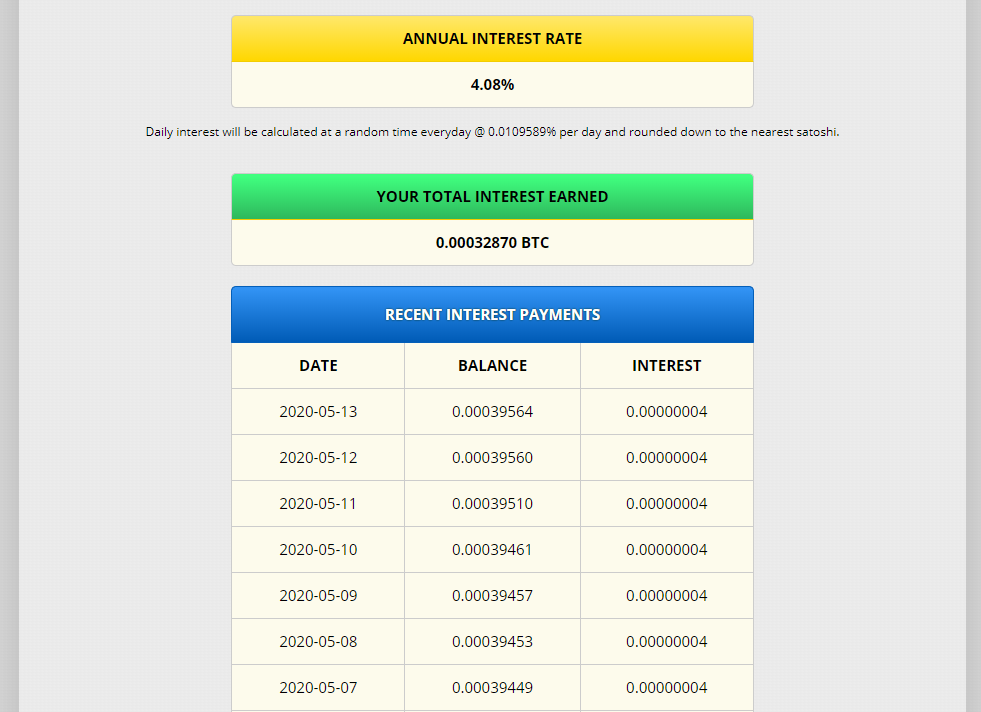
The most important for the article sake is that you can receive daily interest on the BTC you have on the site, no matter if you deposited the funds or earned it only by using the faucet.
Values
Annualized return rate: 4.08%
Minimum Balance: 0.0003 BTC
Payments: daily
How to
Hold the minimum balance on your account.
------------
Stakecube https://stakecube.net/?team=phbr
Description
Stakecube is a staking pool and exchange, where you can buy and sell cryptos while receiving rewards for staking them. https://stakecube.net/?team=phbr
There is a lot of staking cryptocurrency options (44 so far) to choose from, and more are added every month based on community vote.
Also, users have the option to buy a "share" of a Master Node for coins that are stakable this way.
But the interesting part is that they pay interests to the Bitcoin you have deposited there (and also to LTC, DASH and DOGE), so you can recieve some yield while choosing which coin you will stake.
Adding to that, if you register a SCC (Stakecubecoin) masternode, you get a bonus on the paid interest rate.
Values
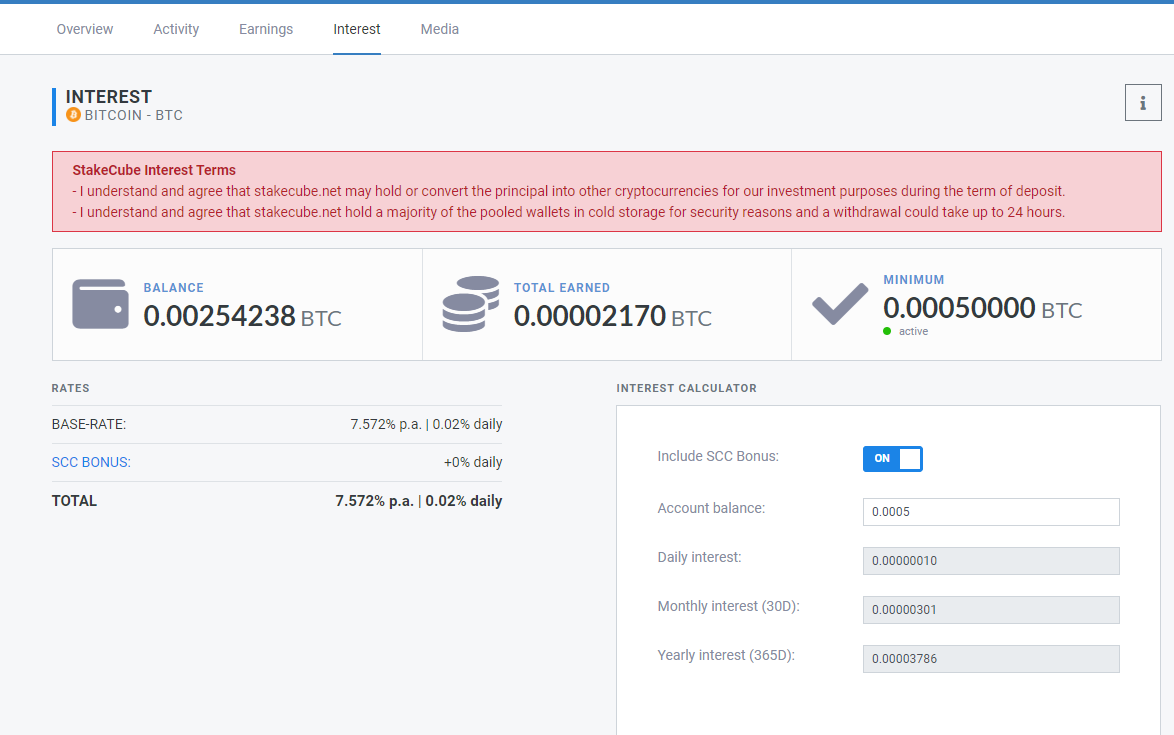
Annualized return rate: 7.572%
Minimum balance: 0.0005 BTC
Payments: daily
How to
Hold the minimum balance on your account
-----------------
Binance https://www.binance.com/en/register?ref=H1EGTGP8
Description
The biggest exchange on the crypto world allows you to put your Bitcoin on a savings state where you will receive daily interest.
There is two kind of savings product that Binance provide to its users: *Flexible savings* and *Locked Savings*. https://www.binance.com/en/register?ref=H1EGTGP8
*Flexibe savings* pay less interest, but you can withdraw the invested value at any time, and the cumulative interest is paid daily to your Binance account. Also, there is max value that can be put into savings (5000 BTC). https://www.binance.com/en/register?ref=H1EGTGP8
*Locked Savings* pay a better interest rate, but it you must wait a defined time period before receiving the payment. Also, this product isn't always avaiable, and are offered on specific times, at Binance discretion. https://www.binance.com/en/register?ref=H1EGTGP8
Values
**Flexible Savings**
Annualized return rate (expected): 0.65% (latest: 0.80%)
Minimum Balance: 0.01 BTC
Payments: daily
**Locked Savings**
*(Based on the latest products that were offered)*
Annualized return rate: 3%(14 days), 3.25%(28 days)
Minimum balance: 0.01 BTC (Fixed lot)
Payments: at the end of the period
How to
On the Binance page, use the menu **Finance**, then Savings. https://www.binance.com/en/register?ref=H1EGTGP8
From there, you click on **Products** and choose if you want **Flexible Savings** or **Locked Savings**
----------------------
Kucoin https://www.kucoin.com/ucenter/signup?rcode=8uKyhe
Description
Kucoin is a korean exchange where you can lend your BTC to margin traders. https://www.kucoin.com/ucenter/signup?rcode=8uKyhe
Different from the options above, there is no fixed rate, but a market where you can define the rate and for how long (7, 14 or 28 days) you will be lending your BTC.
The downside of this (besides the minimum of 7 days) is that your order might not be filled, or someone else might add an order with a lower rate.
On the other hand, sometimes, your might be paid a really high rate if the demand for margin trade grows.
Values
Annualized return rate: variable depending on the market demand
Minimum Balance: 0.0001 BTC
Payments: at the end of the period
How to
On the Kucoin site, go on the *Earn* menu and click *Lend*.
There you can set the amount you will lend, how many days you will be lending, and the daily interest rate you want.
Also, there is a feature called *Auto-Lend*, where you can set a reserved amount of BTC, and everything above that value on your account will be put on the Funding market automatically
-------------------------------
Bitfinex https://www.bitfinex.com/?refcode=LSbUKZpq8
Description
Here we have the same system and Kucoin. There is a Funding market, where you set the amount you want to lend, and for how long.
There is three main differences:
1 - The minimum period is 2 days
2 - Borrowers (not only lenders) can also place orders on the book, so they might try to get a better deal.
3 - There is a graph showing the historical accepted rates.
There is also an auto-renew where you can set so your funds will go to the book as soon as they are avaiable.
Values
Annualized return rate: variable depending on the market demand
Minimum balance: equivalent to 50 USD (+- 0.00515 BTC at the writing of this article)
Payments: At the end of the chosen period
How To
Go to the Funding option on Bitfinex screen and on the the Funding Form add your parameters for the funding offer.
Conclusion and Resume
There is a lot of other options out there where you can lend your BTC to recieve some interests while you don't spend it (BlockFi, Nexo.io, Saltlending, CoinLoan, etc), but so far, i can't say much about them because i haven't tested them yet, and i am mostly interested on platforms that allow me to trade cryptocurrencies while still recieving some yield while holding some of them.
In the future i might test some of them, and i will update this list if that happens.
Meanwhile, choose wisely.
And here is the resume of the platforms mentioned on this article:
Good day and good trading!
 @phgnomo