Old tips on capital management.
Source of image https://www.iberlibro.com/servlet/BookDetailsPL?bi=21946252788
Preamble
I was recently cleaning and I found an old book in one of the drawers where I keep things from years ago, it was a book of the last century (1999), you can even say with a touch of humor that is from the last millennium , which had been given to me by one of my uncles: "The Richest Man in Babylon" by George Clason.
The edition I had in my hand was in Spanish and it was fine in general terms, I tried to remember and I think the book was about transmitting a set of tips on money management and the growth of own capital through a series of stories short that fulfilled the role of parables.
It is a style of self-help books that I still find today, although I have memories of books in that style that were from the 70s of the 20th century inclusive.
Initial Advice
In the first story that gives advice, I found some very simple:
Remember that part of what you earn is yours to save.
When you already have a capital that you can dispose of without affecting your living expenses: Use it in investments that multiply your money.
When you invest or ask for advice to invest, refrain from doing so with people who do not know the businesses in which you want to get involved.
They are simple, you can say that the first thing is not to spend more than you spend and adjust your budget to be able to save a portion, either 10% or 20%, that is of an amount that does not make your life miserable, but you allow you to set a savings goal for later use.
That leads to the second advice, although saving is the basis to start, then you have to use capital as a seed to germinate new projects, market products or any other activity that can generate a profit. The way your money grows is to make it circulate. You may well use it for personal pleasure, but out of momentary satisfaction I would not leave you anything else.
But it is noticed in the third advice that it is not simply to go on a crazy adventure of placing money in the hands of anyone who promises you incredible things, because you are much more likely to lose yourself than profits. What the author recommended was to seek the advice of experts in their fields who already had recognition for their achievements, or professionals who could give a work plan to use your investment in a realistic way, but in any case, it is about investing intelligently, studying and evaluating the options.
Questioning
There is a fragment in the first story that caught my attention and gave me reason to write the post:
... "often, youth believes that old age knows only the wisdom of the days that have gone by and therefore does not benefit them. But remember this: the sun that shines today is the sun that shone when your father was born and it will still be shining when your last grandson passes into darkness. The thoughts of youth are bright lights that flash like the meteors that make the sky shine; but the wisdom of old age is like the fixed stars that shine so constantly that the sailors can depend on them and govern their course. "
So: what do you think about that idea that the old councils can remain useful in today's times?
Resources
https://steempeak.com/administration/@pedrobrito2004/old-tips-on-capital-management
https://www.iberlibro.com/servlet/BookDetailsPL

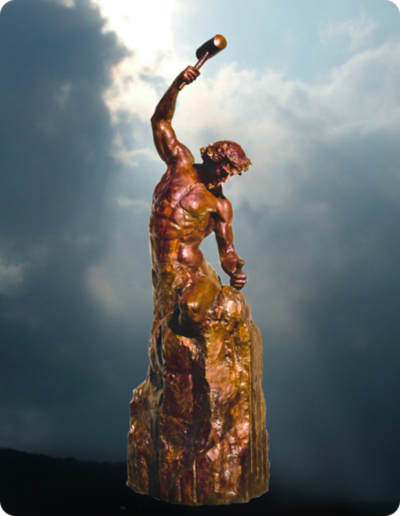
"Self Made Man" of Bobbie Carlyle
Source http://bobbiecarlylesculpture.com/SelfMadeMan.php
A few days ago Crypto.Piotr had recommended me to review some blogs that might be of interest to me, among them, I reached the one of of @fredrikaa where I found a post that caught my attention and commented: Determination and confidence comes easily when you've defined what you really care ... https://steempeak.com/@crypto.piotr/ https://steempeak.com/@fredrikaa https://steempeak.com/appics/@fredrikaa/alpha-kw-8-appics-im-38179
Among the different comments that were, he highlighted, from my point of view one written by @yahialababidi in https://steempeak.com/appics/@yahialababidi/pziv5x https://steempeak.com/@yahialababidi
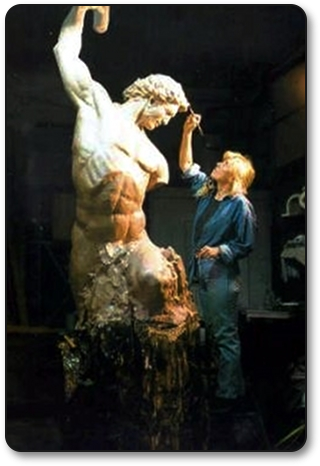
There was the image that I am sharing at the beginning of this post and I was so attractive and direct the message of self-creation by the sculpture that I asked about the origin of the work, which I responded with kindness and I knew that it was a Bobbie Carlyle's work.
Reviewing the site of this sculptor, I could find that she also has one of the same type but with a female character that emerges while sculpting herself. You can visit his site and see his gallery of works in http://bobbiecarlylesculpture.com/
There is certainly an attraction for me in these images, they remind me of the idea of an entrepreneur, of "making themselves", but it also reminds me of what were the first great entrepreneurs and capitalists of the early twentieth century in America, people who some cases began in low-level positions and were forging their own destiny until they managed to exceed their goals and go much further than anyone would have bet in the beginning.
I definitely like the underlying message quite a bit.
Source http://bobbiecarlylesculpture.com/
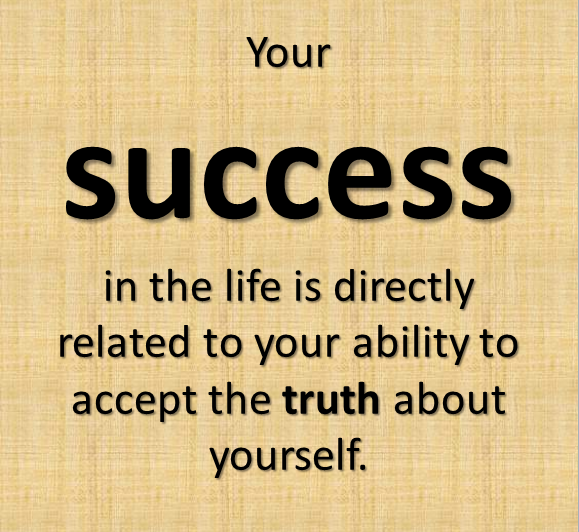
Your Success & Your Truth.
Recently I was reviewing some of my accounts in different social networks and I found that one of my contacts had shared this image that I share in the post, I kept it, but by mistake I did not write down who it was that published it, shortly after I wanted to look for it again to thank, but it seems that the publication had been deleted or I simply was not able to find it.
The message is simple:
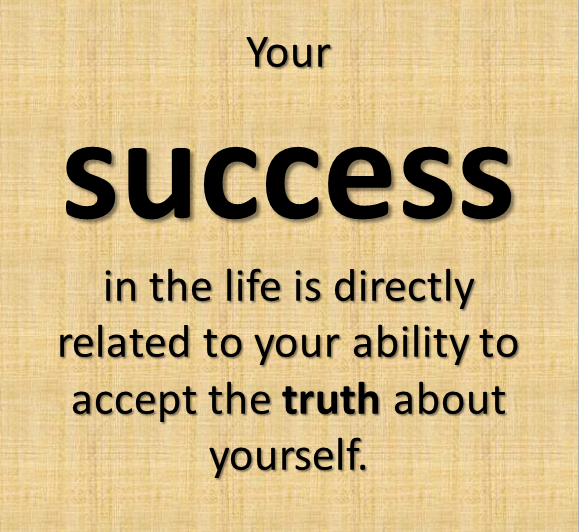
Your success in the life is directly related to your ability to accept the truth about yourself.
Well, that of direct and inverse proportions led me to my memories of basic mathematics and childhood, when I was in primary education, it caused me a soft smile. Now, entering into what I want to address, the phrase was simple and made me remember that maxim of the book "The Art of War" that recommends knowing yourself to avoid defeats in battles, even better if you also know very well your opponent, that knowledge of yourself and the other would make you virtually invincible.
But I noticed that it is not about knowing about myself, but about the "Truth" of myself, these are two different things. I enter a subject that has always aroused interest in me, "Truth" is different from truths, almost as much as "Reality" is different from realities. All this looks like a pun, but I will try to explain calmly and in detail.
The "Truth" as an idea is pure and absolute, it could be said that it is something that exists by itself and does not require anything outside itself, it is not necessary to defend it because it is impossible to attack it, it is independent of any questioning, because its own essence is unquestionable, so why the difference of truths? Or, why do I mention truths in lowercase and plural?
While the "Truth" in its ideal is perfect, I begin to believe that each person has their version of it, so it is also with societies, countries and nations of different types, then, each bias or human group will say that its truth it is the "Truth", but basically no party involved in the discussion will want to accept that they are only versions of this great thing that is ideally the "Truth" in its pure form. It may be impossible for humans to have access to perfect and pure truth, but if we came into contact with such a thing it could be an almost mystical experience that would cause the person to change too much, almost as if it were to become something beyond of the human
So then, your truth will not be my truth and what you consider correct will not necessarily be considered that way by other people, the more we separate from each other by our cultures, personal stories and ideals, then, the more different our truths will be.
Despite all that, I think what I rescue from the message I received was that if I can be clear about what I believe, accepting that it is simply my truth, but not the "Truth" (ideal, perfect and universal), then satisfaction With myself it is a sure thing and the feeling of success would be nothing strange. After all, it may not be about having more than anyone, but about being happier than anyone with what you have.
Perhaps the greatest success is to be happy and that that is the basis of your own truth
Remembering the Bushido, the Samurai Code and its value today
Some time ago, I had made and shared a summary of a text that I found interesting about a code of conduct that was used by the Samurai of Japan, I had found it interesting and it seemed to me that it was worth buying it, I published it in my blog on Steem and You could see it HERE. https://steempeak.com/bushido/@pedrobrito2004/summary-of-the-abc-of-samurai
I have remembered it, because today I saw an article entitled "Can a Businessman be a Samurai? What Bushido Can Do for the Modern Man" and I wanted to take back what I had written, share it and raise an idea at the end. http://foundersguide.com/bushido-entrepreneur/
"... Samurai means who serves, the service in question is none other than the military. The emblem of the samurai was the cherry blossom, for its brief, ephemeral and beautiful life, generously offered to man. The samurai always dedicated their lives to the service of their daymo or shogun (lord), who was their boss (at the same time responsible for lives and haciendas around them), should be worthy of that fidelity, so he should direct them with benevolence fatherly and intelligence. "
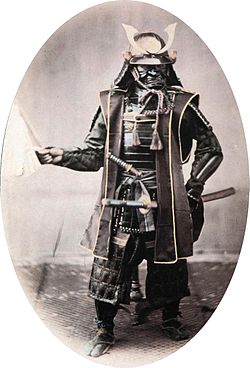
Samurai Code
Source of image https://en.wikipedia.org/wiki/Bushido
... its main maxim is ...: SHI MON YORI IRITE SEI MON NIIRU, which could be translated as "through the door of Death you come to true Life" ... In addition, the samurai followed the philosophy muga, that is, the absence of ego.
Miyamoto Musashi (1584-1640) reflects in the Dokko-do (The Life of the one who goes alone, very appropriate for a samurai) the following points:
Man should not feel attachment for anything in life.
Man should respect the gods and the Buddhas, but not abandon themselves completely to them.
Man must always train his spirit in strategy and tactics.
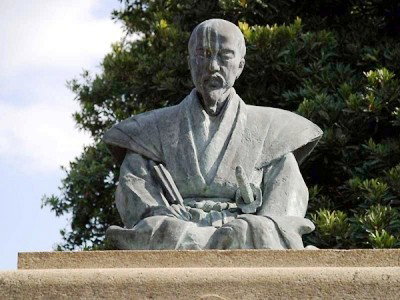
Yamaga Soko (1622-1685), well-known thinker and Confucian, proposes:
Innate nature of respect for the law.
Fulfill all your social obligations.
Concern adequately with their role
Conserve a noble and elevated spirit
Maintain a generous and tolerant attitude.
Source of imgage http://www.agoravox.fr/culture-loisirs/culture/article/soko-yamaga-le-guerrier-philosophe-159389
Apart from the maxims to follow, the samurai must have certain basic virtues. According to Koyo Gunkan these virtues are: generosity and tolerance (ounce), magnanimity (doryo), gallant attitude (fudo) and resolution (shiki).
For Nitobe Inazo, the virtues of the samurai must be:
Justice. His conduct must always be based on honor and justice.
Serenity as a basis for moral and physical courage. Even to the point of not fearing death.
Benevolence, understood as the tenderness of the Warrior (bushi no nasake). Thus showing affection, piety and magnanimity.
Courtesy. It is the discipline of the soul, harmonizing body and spirit.
Truthfulness The word of a warrior is enough (bushi no ichi gon), his law, his life and his work are one with his word
Honor It will keep you safe, even, if necessary, perform the Seppuku (harakiri). Honor not only affects the warrior but all those who are related to him, if he loses his life it is no longer valid and endangers the life and honor of others, so to save them he has to sacrifice himself.
Show loyalty, devotion and self-denial towards your Sensei until death, in exchange for your affection.
During the Tokugawa period, ideas of the Samurai class were included in the code of honor behavior, known as the Bushido (The Way of the Warrior). The martial arts already go back to the tenth century, but it was during the period of the Japanese civil wars (1482-1558) that the guidelines that a warrior should adopt to deserve the name of being human and be considered a warrior knight began to take hold. . Bushido indicates what is the attitude of every budoka. In the Tokugawa Era, it happened to be rather well (Way of the educated Man), where poets and literati appeared, without ceasing to be experts in the handling of weapons, seeing in them the means to perfect themselves through skill which involves training with weapons. After the famous Meiji revolution, the code of honor merged with the nationalism that had just appeared as sentiment in the Land of the Rising Sun.
Bushido shows a great influence of Zen Buddhism, from which concepts of:
appeasement of feelings
calm attitude in the face of the inevitable
the domain of oneself before any event
present more proximity with the idea of death than with that of life and,
absolute poverty.
Bushido has 7 Fundamental Principles:
Gi: truth, justice, fair and correct decision.
Rei: fair behavior.
Yu: bravery that leads to heroism.
Meiyo: honor and glory.
Jin: love and benevolence towards humanity.
Makoto: total sincerity.
Chugi: devotion and loyalty.
Source of image https://thecomicvault.wordpress.com/2019/02/19/bushido-the-way-of-the-samurai-review-learning-how-to-be-a-warrior-in-japan/
Final Words
What motivated me to share this content again has to do with the idea that although each epoch has its values and principles, there is certainly a strong influence that comes from each past epoch and shapes part of the present, allowing although everything changes , the essence of each people or culture remains. This may explain Japan's peculiar combination of tradition and technology, but I believe that other cultures can also take advantage of the ideas and virtues present in this Samurai warrior philosophy.
I understand that for each people, what is understood by virtue and by default may be variable, but I believe that those embodied in the Bushido are broad enough to be usable with a few cultural adaptations.
In addition, the idea of applying these principles and virtues of the code to professional life can have positive effects on the sense of accomplishment and the achievement of a better quality of work life.
What do you think?
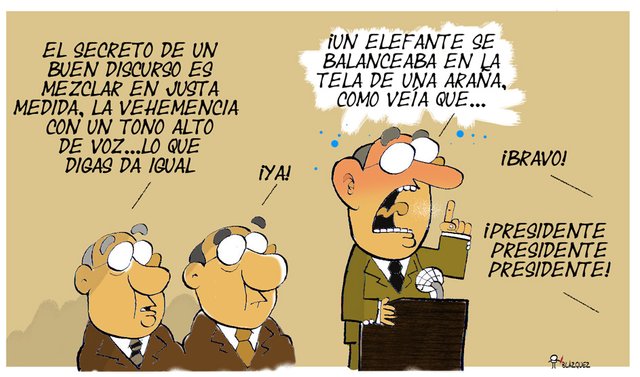
Discurso Político y el Absurdo
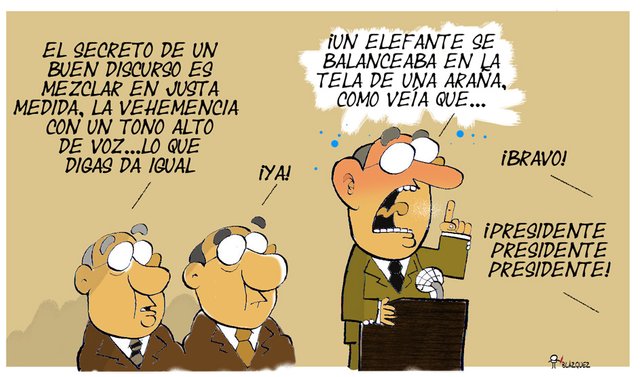
Fuente de imagen http://minuevotallerparacomunicarme2-618.blogspot.com/2012/03/segunda-unidad-tipologia-de-los.html
Estaba buscando una información en la web cuando de pronto me encontré con esta caricatura y (además de reírme un buen rato) quedé pensativo sobre como es una realidad que los discursos políticos que he escuchado recientemente no son grandes piezas de oratoria, destinadas a marcar la historia, sino mas bien una gran cantidad de absurdos muchas veces sin sentido y llenos de falsedades que me impresionan, no tanto porque se atrevan a decirlas, sino porque logran arrancar aplausos apasionados de los receptores de este discurso político.
No es la situación que esperaba encontrarme, pero con el auge de la anti-política durante la última década del Siglo XX, la postura postmoderna de ambivalencia entre la verdad y la mentira de los grandes discursos, la demagogia desbocada y el Populismo del Siglo XXI y otras cosas más, dan como resultado que necesito refrescar lo que se esperaría que fuera un discurso político.
Discurso político. Trata tres factores: las formas de organización del poder, la obediencia y el dominio. La política puede ser analizada mediante una serie de categorías, conceptos y sistemas de medición de la realidad.
El Discurso Político, es una práctica política, importante para la creación de consenso para la argumentación. El desarrollo del discurso político tiene que ver con la cultura política del país, pues condiciona al discurso y se adapta a los cambios de la sociedad.
Fuente de la cita http://minuevotallerparacomunicarme2-618.blogspot.com/2012/03/segunda-unidad-tipologia-de-los.html
Ya con el segundo párrafo de la cita me puedo dar todo un rato de golpes de la cabeza contra la pared, quiero decir, es suficiente para estar decepcionado y tener deseos de golpearme la cabeza a ver si es que soy yo el que está mal y necesita un golpecito para entender, como si fuera un televisor o radio de la época de los abuelos. Pero no, creo que no soy yo.
Se supone que los discursos debería servir para argumentar y así lograr dirimir las diferencias entre las facciones presentes en cualquier grupo humano de una manera que no necesite llegar a la violencia física, psicológica o de ningún tipo, per lo que tengo que escuchar en varios casos recientes es algo cercano a falacias, mentiras descaradas y proclamaciones de ignorancia peligrosa...
Y aún así, mis queridos conciudadanos eligen a estas gentes para cargos de poder... para luego quejarse y decir que no es su culpa, que fueron engañados, que les mintieron... Pero, si hubieran prestado un mínimo de atención a lo que les estaban diciendo habrían sabido que les mentían descaradamente. No recuerdo quien fue el que dijo que los que eligen ladrones para que los gobiernen no son victimas sino complices, pero cada vez creo que su frase es muy acertada.
Ante todo esto, me encuentro con el absurdo de que los discursos políticos banales y vacíos siguen y la población continua dando su pleno apoyo. ¿Es acaso todo esto un absurdo?
Esta publicación fue publicada también en mi blog en Steem https://steemit.com/spanish/@pedrobrito2004/discurso-politico-y-el-absurdo
Much more than a browser. Enjoy private, secure and fast browsing with Brave https://brave.com/met490
Artificial Intelligence for photometric analysis in Archeology: New Discoveries in Nazca.
Recently I was reviewing news about the application of Artificial Intelligence to different fields, I could find news about its use in medicine, engineering, planning and management and even in possible uses in the evaluation of Human Resources within companies, but it called me the attention a news about its application in an old field of work that, as I recall, has always been good in using its auxiliary disciplines and supporting sciences to get new discoveries: The Field of Archaeological Research.
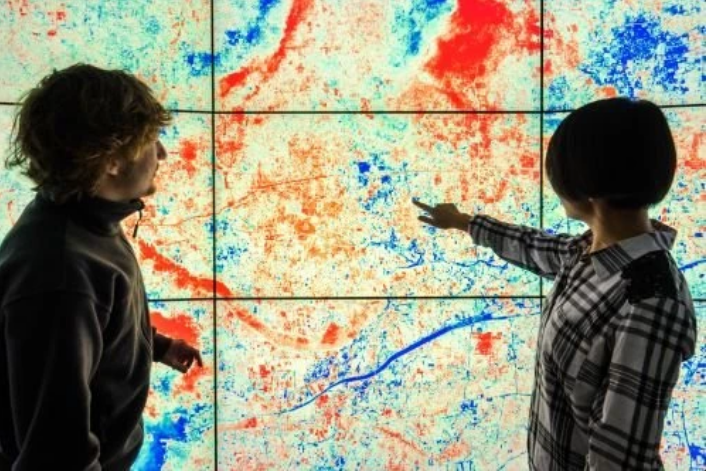
Source https://andina.pe/agencia/noticia-asi-se-utilizo-inteligencia-artificial-para-descubrir-nuevos-geoglifos-nasca-777206.aspx?fbclid=IwAR2YgMhqKktAeW1lCgiXqj5uDUkBHo0ZH0AAjutd-LCk1ukxrtQhtvj5-ck
I wrote about this topic in another blog that I publish on the Steem Blockchain, in the post: AI and Archeology: Making new discoveries in old research fields. Although I certainly wrote it with a somewhat more humorous introduction in that post. https://steempeak.com/hive-175254/@pedrobrito2004/ai-and-archeology-making-new-discoveries-in-old-research-fields
Come on now with the central theme
Well, the news I saw was several, in different places (all in Spanish), but in general they were the same news:
Andina - Agencia Peruana de Noticias: Así se utilizó inteligencia artificial para descubrir nuevos geoglifos en Nasca https://andina.pe/agencia/noticia-asi-se-utilizo-inteligencia-artificial-para-descubrir-nuevos-geoglifos-nasca-777206.aspx?fbclid=IwAR2YgMhqKktAeW1lCgiXqj5uDUkBHo0ZH0AAjutd-LCk1ukxrtQhtvj5-ck
IA Latam - Así se utilizó inteligencia artificial para descubrir nuevos geoglifos en Nasca https://ia-latam.com/2019/12/23/asi-se-utilizo-inteligencia-artificial-para-descubrir-nuevos-geoglifos-en-nasca/
El País - La inteligencia artificial ayuda a descubrir 142 nuevos geoglifos en Nazca https://elpais.com/elpais/2019/11/18/ciencia/1574088166_364459.html
The news was under the signature of Harold Moreno Luna.
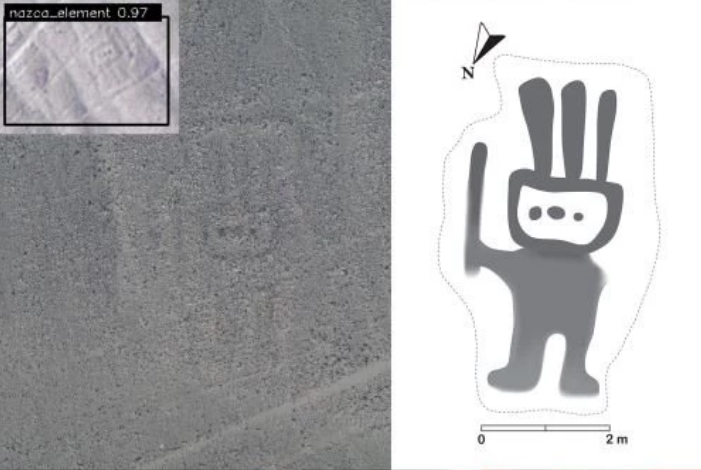
In a way of summary, what was reported was that 143 new geoglyphs were discovered in the territory of the Pampas of Nasca thanks to a study by the University of Yamagata (Japan) applying IBM artificial intelligence (AI) technology. Akihisa Sakurai, an IBM engineer and member of the IBM Academy of Technology (IBM Research - Tokyo), stated:
“It is the same hardware technology behind the world's most powerful supercomputers, such as the Summit of the United States Department of Energy (which, since June 2018, is considered the fastest in the world, with a speed of 200 billion billions. of operations per second) or Sierra (of the National Nuclear Safety Administration, with a speed of 125 billion operations per second), ”he said.
Sakurai explained that they used Deep Learning or deep learning algorithms to detect figures on the ground. This technique uses several layers of information analysis, in which the ‘output’ information of one is the same as that of ‘input’ of another, allowing complex analysis and pattern recognition.
“Learning emulates the structure of the brain with neural networks implemented between‘ input ’and‘ output ’(information) of the Deep Learning model. By repeating this process several times, neural networks learn how they should connect to each other, based on learning parameters such as the lines that are part of the geoglyphs, ”he added. **(Translated by my account)**
The images captured by satellites, drones, aircraft and others were used to then confront any anomaly of the images and ensure that the system learned to differentiate the geographical accidents that had a human cause, that is, unnatural alterations of the anthropogenic type.
Source https://ia-latam.com/2019/12/23/asi-se-utilizo-inteligencia-artificial-para-descubrir-nuevos-geoglifos-en-nasca/
The use of this technology demonstrated its usefulness by making dozens of new discoveries and giving information that was not available, thanks to the analysis and its subsequent verification in the field, the efficiency of the procedure could be evidenced and progress was made in the knowledge of this set of lines that make up the Nazca Lines, although we are still far from understanding the real meaning or meaning that this heritage of humanity has.
It's a good thing, but ...
Well, those who already know me, know of my tendency to be interested in technologies, but always keep in mind that one of the first fields of application of these are military and arms fields in general. So what could worry me about this news that is so academic?
The answer is simple, the AI system learns to interpret objects or landforms from a means to differentiate those that are created by humans from those that are due to natural causes. I see it as obvious that if I place this AI in a satellite surveillance system, it could have a significant advantage in a war field where each side tries to hide its positions and the movements of its forces.
But also, if you load the AI into a missile system and shoot them with the prerogative of modifying their targets if the information obtained on the ground flight allows them to identify a higher priority target than the one set at the time of launch.
All this and more are things that are already already under test or even already being implemented in the field, after all, I am used to the fact that every technology that reaches the civil world has been known and used by the military world for many years of advantage.
Post published also in the @project.hope community of Steem - Project #HOPE Community https://steempeak.com/@project.hope https://beta.steemit.com/created/hive-175254
Project HOPE community https://steempeak.com/c/hive-175254/created
Project #HOPE Website https://www.projecthope.pl/
Much more than a browser. Enjoy private, secure and fast browsing with Brave https://brave.com/met490
Resources
https://steempeak.com/hive-175254/@pedrobrito2004/ai-and-archeology-making-new-discoveries-in-old-research-fields
https://andina.pe/agencia/noticia-asi-se-utilizo-inteligencia-artificial-para-descubrir-nuevos-geoglifos-nasca-777206.aspx
https://ia-latam.com/2019/12/23/asi-se-utilizo-inteligencia-artificial-para-descubrir-nuevos-geoglifos-en-nasca/
https://elpais.com/elpais/2019/11/18/ciencia/1574088166_364459.html
Proposing a format for software evaluation like Beta Tester
I recently shared a proposal for the writing of a report of the results of a Beta test to which I was invited, I present it on my blog in: Preparing a format for software evaluation https://steempeak.com/hive-175254/@pedrobrito2004/preparing-a-format-for-software-evaluation
But it is a message that I want to spread as much as possible, after all, I need to review a bit the opinions and comments that may present an end to improve the final product.
Preliminaries
Recently I was invited to a beta test of an application, as I am not a professional in the area of computer science or computing, I thought I could give my point of view as an "end user", after all, for application designers it is always useful "to design for the most awkward and dumb of possible users" ... ok, I do not fall so low on the scale of appreciation, but well, I am not an expert in these things and although I try to understand them, of Surely there are a lot of things that escape my understanding.
Well, returning to the subject, the issue is that I used the application and reviewed all the options that I was able to find, I think I used it enough to consider myself an "average user", but now I had the need to submit in writing the results of my experience with software, such a thing may not be a problem for those who are responsible for these tasks in the field of software engineering or application design, but for a "Digital Immigrant" like me, who still remembers his Early times with black screen computers with green letters, it is a task that I am not used to.
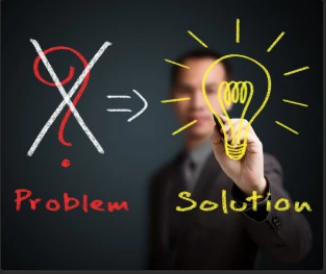
Problem: I don't know how these reports are made?
Solution: Seek online help and find the indications and, if possible, a format to serve as a guide.
Source https://myjobadvice.wordpress.com/2017/03/09/problem-show-your-skills-solve-it/
Remembering a nickname they gave me
Source http://uncle-grandpa.wikia.com/wiki/Nickname
When I was looking for a guide to fulfill my task, I remembered an event from my past, in which I had to be an evaluator in a course taught by the University where I worked, in it the teachers work in groups of three people to evaluate each participant.
One of the evaluators, in each group, was a teacher of the students in some of the subjects or sections, the other two had nothing to do with their academic training processes and we could be considered as external observers who would be impartial.
Taking into account that the evaluation work always runs the risk of being affected by the subjective preferences of the evaluator and finding that they did not give me any list of parameter points, beyond the examination agenda (which implies that my subjective assessment could be which will guide the result of the score), because then I quickly decided to elaborate a set of minimum things that the presentation, the handling of the topic and the techniques-resources used by the student should have. I organized them quickly and prepared a Checklist to use at the time of evaluating the presentation and responses of each student.
This seemed the right thing to me, but I found that my attitude was considered in very bad taste by the student teacher and also by the other colleague who was an evaluator in my group, they were of much more "artistically free" criteria and they saw in my normative formalization a suffocating behavior of creativity and of the "expressive richness of presentations" ... Ok, I hadn't expected that.
I earned a nickname that they considered would offend me a little, in which they mixed my last name with a term they didn't like: "Baremo-Brito"
Source https://www.spigglelaw.com/employment-blog/the-law-does-not-require-work-life-balance-but-millennials-are-expecting-it/
Just in case it is not clear, a definition of Baremo is:
... table of calculations, which avoids the activity of carrying out these calculations to the common public or to a specific public, which is used to establish a set of rules set by an institution to assess personal merits, it is important to establish a position ordered by merits, is what justifies an acknowledgment or an achievement that explains a failure and the capacity of companies, the admission rules are a set of partial scores, analysis results, list of index numbers, etc. ***(Original in Spanish, translation on my own)***
Source https://conceptodefinicion.de/baremo/
The matter did not bother me and I went ahead with the evaluations, with the advantage that I could justify each of the scores assigned in previously established criteria and that diminished the effects of my subjective assessment. I was never selected as an evaluator again, but I learned something interesting from all that.
It must be accepted that by my character, I may seem easy to deal with, but my "normative mania" makes me a "Bizarre Bug" in many ways, I am in favor of establishing formats, following action protocols and evaluating with clear scales. So before a task that I have never done, it seems normal to find a guide and see how much I can use it to fulfill my task.
A guide or model for writing a software evaluation report
I found on the site of Software Testing Help a post that I think is what I was looking for: How To Write An Effective Test Summary Report [Sample Report Download] https://www.softwaretestinghelp.com/ https://www.softwaretestinghelp.com/test-summary-report-template-download-sample/
In general, it gave me an idea of what I needed to do, but since it is not my area and I need to report it is my result as a user of the Beta, because I set out to prepare it as a list of points to follow to write my material, using the one provided by Software Testing Help as inspiration for that.
Now, what should I contemplate in my report? According to what I reviewed, the sections of the report they present are:
Purpose
Application overview
Scope of proof
Metrics
Types of tests performed
Test environment and tools
Lessons learned
Recommendations
Best practices
Exit criteria
Conclusion / Logout
Definitions, acronyms and abbreviations.
Some of the sections are quite specialized and when reading the descriptions I did not feel sure that I could fully comply with the technical knowledge to perform such an exhaustive software evaluation, so I had to choose the points that I could use to prepare my own test report Beta from the point of view of an end user. they looked like this:
**Purpose:** Brief description of the purpose of the report.
**General description of the application:** Brief description of the tested application.
**Scope of the tests:** Explains the functions and sections that underwent the tests. It also indicates what could not be proved by not having the user level or by other restrictions.
**Types of tests performed:** Describe the various types of Tests performed. For my case they would have to cover: Charging time, usability of the user interface, selection of color palettes, availability of communication channels, purchase-sale functions within the application, and customization options for each user.
**Environment and devices for testing:** Provides details about the test environment in which the evaluation is conducted, indicating the characteristics and devices.
**Recommendations:** Any solution or suggestion to improve the application can be mentioned here
**Best practices:** Identification of situations, conditions and other elements that could provide an advantage when doing the evaluation work, this information could be useful for future tests.
**Conclusion:** In this section the verdict is given, if the results of the evaluation allow to agree and give a "green signal" (approval) for the application or if the application does not meet the expected and touches say "It is not suggested that the application be implemented in its current state." As a Betatester, this is only a suggestion and it must be the superiors of the software company who make the decision.
Concluding the topic
So far, all this is just to be able to write a software evaluation report as a user of the Beta, surely it can be improved in many ways, but I wanted to share it and leave open the possibility that other colleagues could point out weaknesses and ways to improve this for some future use.
Resources
https://steempeak.com/hive-175254/@pedrobrito2004/preparing-a-format-for-software-evaluation
https://www.softwaretestinghelp.com/
https://www.softwaretestinghelp.com/test-summary-report-template-download-sample/
http://www.teenlibrariantoolbox.com/2015/10/video-games-weekly-video-games-101-beta-games/
https://conceptodefinicion.de/baremo/
https://myjobadvice.wordpress.com/2017/03/09/problem-show-your-skills-solve-it/
http://uncle-grandpa.wikia.com/wiki/Nickname
https://www.spigglelaw.com/employment-blog/the-law-does-not-require-work-life-balance-but-millennials-are-expecting-it/
 @pedrobrito2004