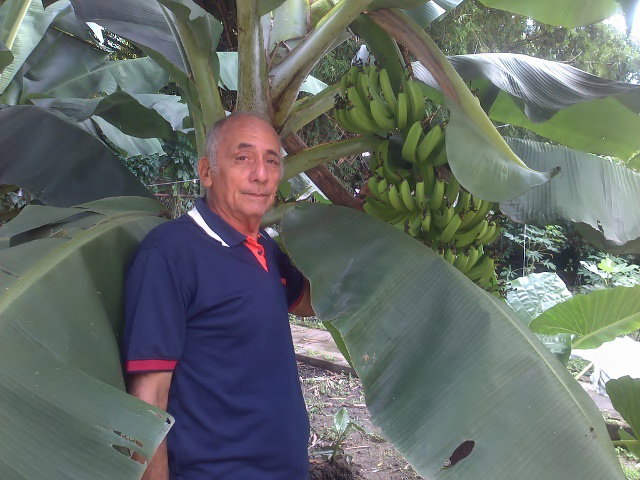
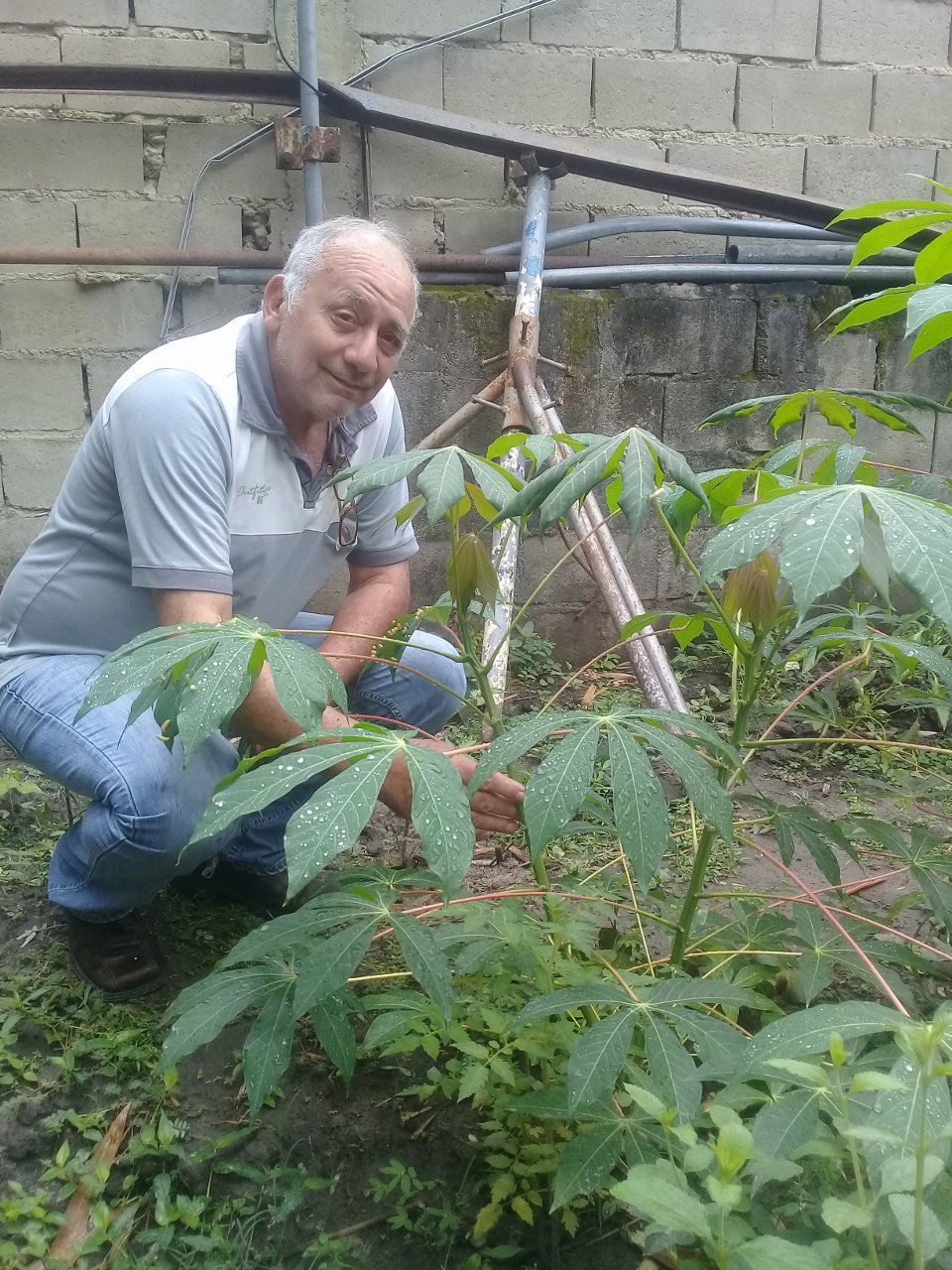
Dear friends, through this space I want to apologize to my followers and friends of Read.Cash in general for the lack of publications.
I have had health problems that take away my concentration to write.
I have problems with my little computer, it's already as "used" as I am...
And finally the big problem we have in our country, Venezuela, with the electric service.
The second part is in the process of being solved, my children will soon give me a computer...God willing.
Greetings and my affections to all...and, please DON'T FORGET ME!
A hug
Oiza
Oizaguirres in noise.cash
Translated with www.DeepL.com/Translator (free version)
Weather and Agriculture Delving into my Notes 11 The Vine, A Culture
Cultivated since the Bronze Age, the grape is one of the most widespread fruits in the world, indispensable in the manufacture of wine.
Since ancient times, this beverage has been traded, especially in the Mediterranean basin.
***The Fruit of the Vine: The Grape***
The cultivated vine (Vitis vivifera) is a climbing shrub belonging to the vitaceae family. Its stems can reach 20 m in length and 30 cm in diameter. The fruit is a juicy berry, round or oval, purplish blue or yellowish white.
The grape, rich in sugar, is particularly well suited to the manufacture of wines and juices. The seeds are seeds of variable size and shape are used for the manufacture of grape seed oil, used in cooking and cosmetics. There are a large number of varieties; some (the so-called vines) are used for wine making, others are used for fruit production, but most are used for winemaking.
***5500 Years Traveling in History:***
The cultivated vine is very similar to the wild vine, which grows throughout the Mediterranean basin, from the Atlantic coast to the vicinity of the Himalayas.
Viticulture settled in the Nile Valley, spread in parallel to Persia, Georgia and Greece, and was introduced by the Romans in Gaul.
Its expansion in South Africa in 1684, Australia 1788 and California 1875, was due to the settlement of European colonizers.
***From Vine to Wine***
Most cultivated vines come from a single selected seedling and are multiplied by cuttings. In reality, only generally identical clones are cultivated. This particularity had disastrous consequences in the 19th century, when French vines were attacked by PHILOXERA, an aphid-like insect imported from the United States, and half of the vineyards were destroyed. Today, American vine species that are resistant to Phylloxera (Vitis riparia) are used as rootstocks for European vines.
*Wine and the Bible*
Since ancient times, the vine and wine have received all the attentions of man. Complement of bread, wine is the emblem of life. In mythology, the God of wine and the vine, Dionysus among the Greeks and Bacchus among the Romans, were the object of an important cult.
The Christian Bible tells that after the flood, Noah's first gesture when he descended from the ark was to plant a vine.
And in the New Testament, Jesus' first miracle was to transform water into wine at the wedding at Cana.
In the Koran, which nevertheless forbids its consumption, wine is immortal and has a divine origin.
*Grapes in Venezuela.*
In my country, Venezuela, in the western states of Lara and Zulia is where the largest amount of grapes is produced and in Zulia is the Centro Viticola.
Anecdote. It was precisely from Zulia that we were donated 20 plants that we planted in the Presidential Residence of La Casona in 1985, during the government of Dr. Jaime Lusinchi, at that time I was assistant to the Director of the Ministry of Agriculture and Breeding of Aragua state, Eng. Romulo Sucre and Romulo was the nephew of Dr. Gladys Castillo de Lusinchi, first lady of the country and Mrs. Gladys wanted to have some table grape plants in that residence.
That certainly has been my only experience in the field with grapes, but I do love to consume them and also to taste a good wine from time to time, well in the Venezuela of yesteryear!
To close, a few days ago I was saddened by the news of the damage caused to the vineyards by the hail storms that occurred in Spain, practically two years of production were lost and the economic consequences are very substantial.
Dear readers, I invite you to continue accompanying me in my trips to my trunk of memories or to Rummage in My Notes.
Best regards.
Photographic support and writing by Oizaguirres for read.cash
Rummaging in My Notes 10: Oiza and The Birth of The Orchards.
Huerto Familiar
The beginnings of agriculture correspond to the early days of horticulture. Before cultivating large fields, men grew plants around their homes.
***Fields and Orchards***
The first to practice horticulture were the men and women of the Neolithic (between 6000 and 3000 BC which follows the Mesolithic and precedes the Metal Age, and is characterized by the development of the productive economy, implementation of agriculture and animal husbandry). At the beginning, orchards were limited to small plots of edible plants around inhabited water points. As the population increased, each civilization that emerged from the different sources of agricultural irradiation developed its own culture, beliefs and technology. Thus, the Mesopotamian civilization, between 3500 and 2000 B.C., invented the first irrigation of the fields, which allowed farmers to dominate the arid land and exercise their agricultural activity over large areas.
***The Flowers in the Cultures***
In all civilizations, the cultivation of plants became the symbol of life, as well as a source of power. The kings, often assimilated to gods, lived in splendid places planted with flowers, fruit trees and water surfaces.
Considered one of the seven wonders of the world, the hanging gardens of Babylon are proof of the power of King Nebuchadnezzar II. were the property of the king. The main use of pottery, that of storing food and drink, was quickly diverted to the cultivation of flowers. Already in ancient Egypt, pots embellished gardens; just as in China growing flowers was considered an art, even endowed with a mystical importance, so the flowering of peach trees symbolizes spring; the lotus symbolizes summer; the chrysanthemum symbolizes autumn and the narcissus symbolizes winter. Also in Central America, with the Aztecs and their God of flowers, Xochipilli, and a Goddess of flowers and fertility Xochiquetzal.
FUENTE: https://curiouswilliam.newtumbl.com/ Italian farmers
In the Middle Ages, horticulture developed around abbeys and castles. Enclosed orchards, hortus conclusus, were created where fruit trees, vines, medicinal herbs and other ornamental plants were grown. In the Renaissance, horticulture was transformed by the introduction of plants from the Middle East and the New World, following the great discoveries. But what is Horticulture? The term horticulture dates back to the 19th century and comes from the Latin hortus "orchard". Horticulture is the cultivation of gardens, whether ornamental or food. It includes the cultivation of ornamental and fruit trees (arboriculture), as well as aromatic and medicinal plants, vegetables and flowers. In Venezuela and certainly in many Latin countries, the planting of small spaces near the houses is called conucos, which to tell the truth this practice has diminished a lot, probably due to the insecurity and even the abandonment of rural areas.
Oiza and his Family Vegetable Garden Nowadays, horticulture has experienced a great advance, crops are becoming more and more specialized and more resistant to pests and diseases. The economic situation of the country, the low food production and the low purchasing power of the currency is forcing Venezuelans to plant small spaces, especially with horticultural products such as tomatoes, peppers, peppers, cassava, bananas, among others. There are also spaces for ornamental plants since they fulfill a double function, in addition to the ornamental they produce a humanistic effect to the environment. We have flowering plants such as the Emperor's cane, Alpineas, palms, low ornamental plants and also medicinal plants such as aloe vera, oregano, pennyroyal!
***1.-Original photographic support and writing by Oizaguirres for read.cash***
**2.-(not own photos indicated in the writing)**
Picking My Mind on a Trip to Rancho Grande Biological Station
Friends. The Rancho Grande or Dr. Alberto Fernández Yepez Biological Station is located inside the Henri Pittier National Park, my neighbor. Colloquially we call neighbor to "someone" who lives next to you or very close and then we talk about the neighborhood, in this opportunity it is not "someone", my neighbor is "something" and that something is very famous in my country, it is the Henri Pittier National Park, my neighbor has to his credit that it was the first place decreed as a National Park in Venezuela.
I am going to talk very briefly about its history.
Henri Pittier Park is located in the coastal mountain range, in the central zone of the country, it occupies mainly the north of Aragua State in both slopes, that includes the Mario Briseño Iragorri municipality, where I live, and the Girardot and Mariño municipalities. It was created during the government of General Eleazar López Contreras in 1937, when it was named Rancho Grande. Later, during the government of General Marcos Pérez Jiménez, it was renamed Henri Pittier.
El parque se compone de dos sistemas geográficos: uno montañoso abrupto donde habitan más de 500 especies de aves y 22 especies endémicas. En el parque existen nueve ríos principales y una gran diversidad en flora y vegetación. https://es.wikipedia.org/wiki/Aves
El segundo sistema es el de la zona costera con bahías, playas y balnearios de un potencial turístico enorme. https://es.wikipedia.org/wiki/Bah%C3%ADa_(geograf%C3%ADa) https://es.wikipedia.org/wiki/Playa https://es.wikipedia.org/wiki/Balneario
Además de su importancia ecológica, también constituye una importante fuente de agua para las ciudades y pueblos que lo circundan y es también la tierra donde se cultiva uno de los mejores cacaos del mundo, especialmente en el pueblo de Chuao y su famosa ruta del cacao. Para el año 1974 durante el gobierno de Carlos Andrés Pérez se le anexan al parque 17.800 ha para llegar a la superficie actual de 107.800 ha. https://es.wikipedia.org/wiki/Agua https://es.wikipedia.org/wiki/Cacao https://es.wikipedia.org/wiki/Chuao
To access the park, there is a rubber road that connects El Limón (where I live) to the coastal zone, that is, this road crosses the entire park. Approximately 10-12 km from El Limón is the Doctor Alberto Fernández Yépez Biological Station, which is part of the Universidad Central de Venezuela (UCV) Faculty of Agronomy, Maracay Campus. It works together with INPARQUES (National Parks Institute), the governing body of the national parks throughout the country.
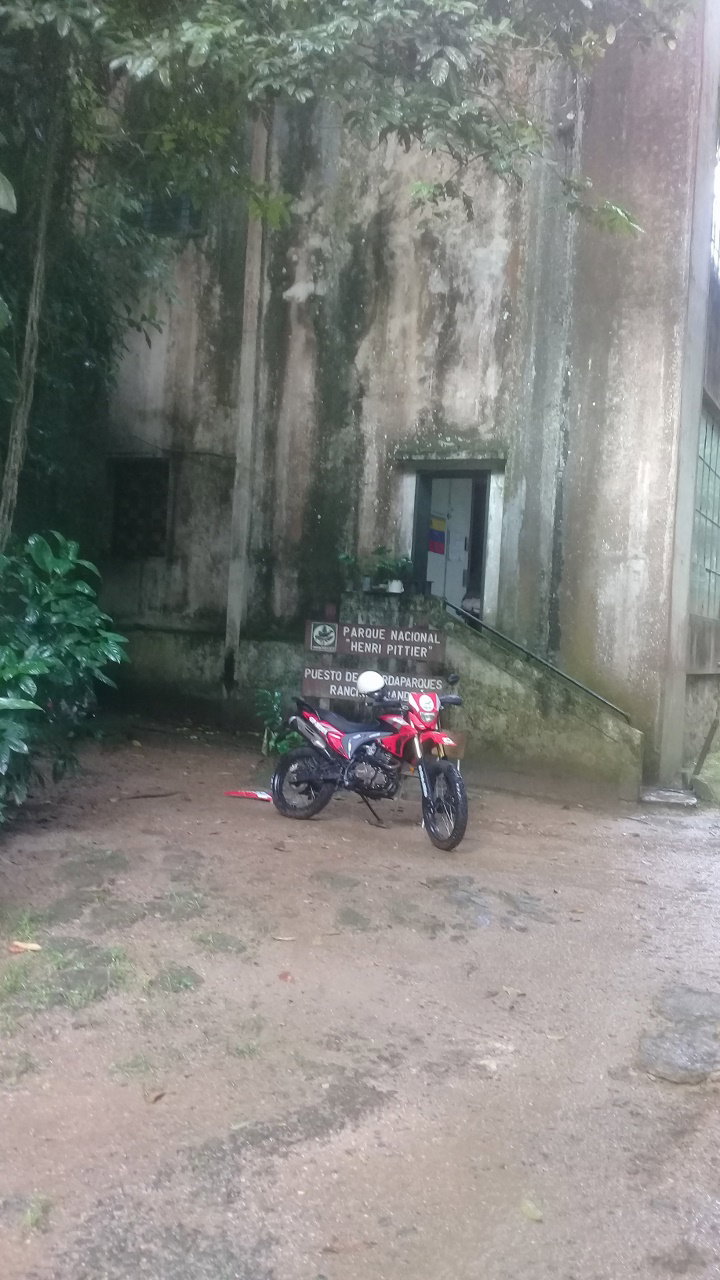
This is the entrance to the Biological Station, approximately 200 m away is the building initially built as a hotel and named Rancho Grande. Initially attached to the Ministry of Agriculture and Breeding and later to the Ministry of Environment and Renewable Natural Resources.
(In the photo Yasmin, my wife)
The Station was used by several visiting naturalists and entomologists who stayed at the annex of the Central University of Venezuela, taking advantage of the opportunity to collect insects in the place. Since the nineties the station was baptized as "Dr. Alberto Fernández Yepez" Biological Station, in honor of this distinguished naturalist and educator, being opened for scientific, educational and nature tourism projects.
There was a period of time in which the building was practically abandoned when the custody of the facilities was partially withdrawn, which was taken advantage of by friends of the outside world (bandits and thieves), to unbalance the facilities. Recently, the Universidad Central de Venezuela, through the Council of the Faculty of Agronomy, decided to appoint the engineers José Yamarte and Daniel Izaguirre as Director and Deputy Director of the Biological Station. These young professionals are activating operations and actions to recover the facilities and their original objectives of Research, Education and Guided Nature Tourism.
I am going to show through a set of photographs aspects that have caught my attention, such as.
The glass frogs, Vitreorana antisthenesi, a group of anuran amphibians, translucent green in color, arboreal in habit and laying their eggs out of the water.
Vegetation formations typical of the Cordillera de La Costa, such as cloud forest, deciduous and gallery forest. Among them are species such as
Bird of the name Conoto aceituno, (Psarocolius angustifrons), with its characteristic hanging nest in the shape of a sleeve.
Main external façade of the original Rancho Grande Building
There are orchids, bromeliads, palms and large trees such as Gyranthera Caribensis, known as "El niño" or "cucharón", which average approximately 40 m in height. There are also mangroves in La Ciénaga and Turiamo Bay.
Very soon I will continue to tell you how the spaces are recovered for the good of nature, the space itself and the use of its integral use, including tourism.
Original photographic support and writing by Oizaguirres for read.cash
Weather and agriculture Delving into my Notes 09 Stimulating Plants
Dear readers, if you are reading this writing it is because you have accepted my invitation to read about stimulating plants.
Coffee, Tea and Cocoa are plants that stimulate the nervous system. They activate alertness and allow to resist drowsiness.
***The coffee tree***
***The coffee tree,*** also called the African Cherry, is a shrub that belongs to the Rubiaceae family. There are three main groups or varieties: Arabica coffee (Coffea arabica), originally from Ethiopia; Robusta coffee (Coffea canephora) and the Libery coffee (Coffea liberica).
The fruit is a drupe that turns red when ripe, like a cherry. The drupe contains two seeds that are the coffee beans. Its origin is not clear, but it is believed to have originated in Ethiopia, Africa, where the Gauls (tribe) consumed it as a legume, this tribe still continues to roast the beans that are then consumed boiled. It was the Arabs who began to cultivate coffee in the XI century, but it was not until the XVII century that it was introduced in Europe, Italy, France and England, but it did not reach fame until a century later. The Dutch colonizers introduced it to Suriname and from there to Brazil where it managed to acclimatize perfectly. Brazil is currently the world's leading coffee producer and South America as a whole is responsible for 40% of world production, with the Scandinavian countries and Costa Rica being the largest consumers!
In Venezuela the coffee harvest generally takes place from September to December. The average yield is 2,500 kg/ha. It must be harvested completely ripe and must be de-pulped the same day; if it cannot be de-pulped, it should be left in water for the following day. Then comes the fermentation that lasts between 18 to 24 hours, then it is washed with water and spread out in the drying patios, where it lasts 6 to 8 days (there are also drying machines). Once dry it goes to the threshing and polishing machine, being ready for marketing.
Nowadays, coffee has an infinite number of uses, in liquors, confectionery, ice cream and cosmetology. I am a regular coffee drinker, especially black coffee with little sugar.
***Cocoa (Theobroma cacao)***
My wife planting a small Cacao tree
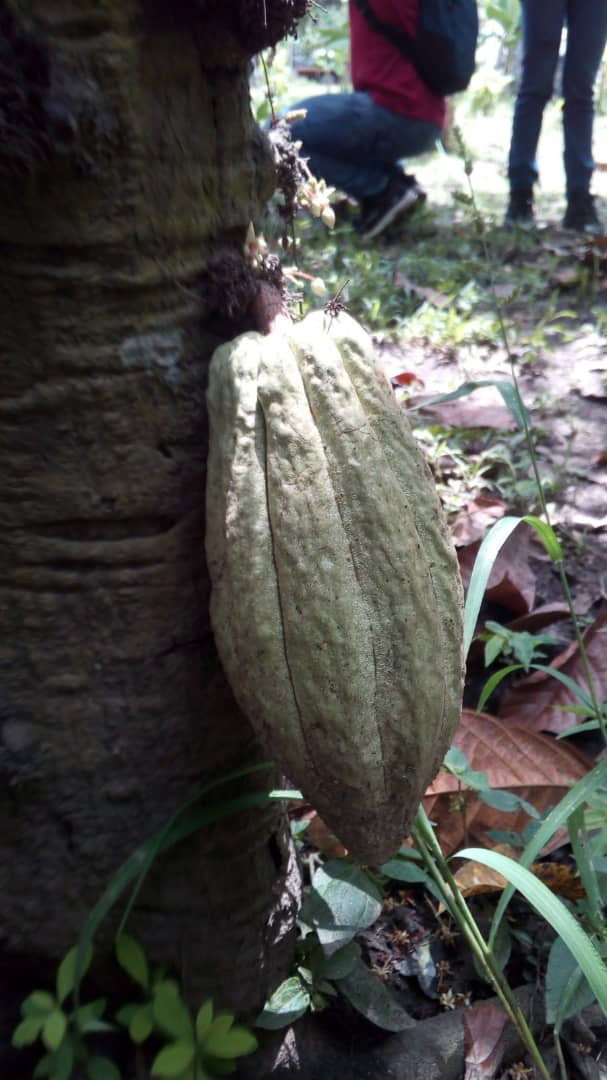
Cacao (Theobroma cacao) belongs to the sterculiaceae family. Its flowers develop from buds located on the trunk. The cocoa pods, which are reddish-brown when ripe, measure 12 to 20 cm and contain about forty very bitter seeds. The tree commonly measures 8 m in plantations, but can reach up to 15 meters in the humid undergrowth of the Amazon where it originates. The Mayan tribes of Central America began cultivating cocoa for its seeds, which provided them with oil and powder. Several centuries later, with the arrival of the first colonizers, they became true currencies of exchange, and the drink called xocoatl, from which the word chocolate comes from, became a sign of nobility.
The success of cocoa is due to Mexican nuns from Oaxaca, who had the idea of mixing it with cane sugar. At the end of the 16th century, this beverage crossed the Atlantic and conquered Europe. Today, Africa is responsible for 75% of the cocoa produced in the world.
Handmade cocoa paste
I particularly love chocolate, in any of its presentations, I consume it as a candy and also in confectionery, I usually buy the cocoa paste and from there I produce my chocolate!
I am currently working with the use of Copoazú, Copoazú is a fruit native to the eastern Amazon from the tree Theobroma grandiflorum, which belongs to the same family of cocoa (Theobroma cacao) in fact it is also known as white cocoa, its flavor has some similarity with this fruit, although with a peculiar touch that makes it a little similar to pineapple.
***Tea (Camellia sinensis and Thea assamica)***
Tea (Camellia sinensis and Thea assamica) is a shrub cultivated for its young aromatic leaves. Although it can reach up to 20 m in height in the wild, in plantations they are kept at 1.50 m. Tea originated in Asia (China and India) but its origin as a crop is unknown. It seems that the emperor Chen Nong already made infusions with its leaves in the 3rd century BC. Tea was introduced in Arab countries in the 13th century, before being brought to Europe, where it was quickly adopted by England and Russia. Still today, more than 65% of production comes from Asia, with China and India being the first producers. Tea is less tonic than coffee because the infusion of the leaves dilutes the caffeine it contains. After water and milk, it is the most consumed beverage in the world
Oizaguirres' original photographic and written support for read,cash
Weather and Agriculture Delving into my Notes 08 The Tropics and Their Flavors
As usual, I begin this writing by complying with the invitation I made in chapter 07 of my Notes.
***Tropical Fruits***
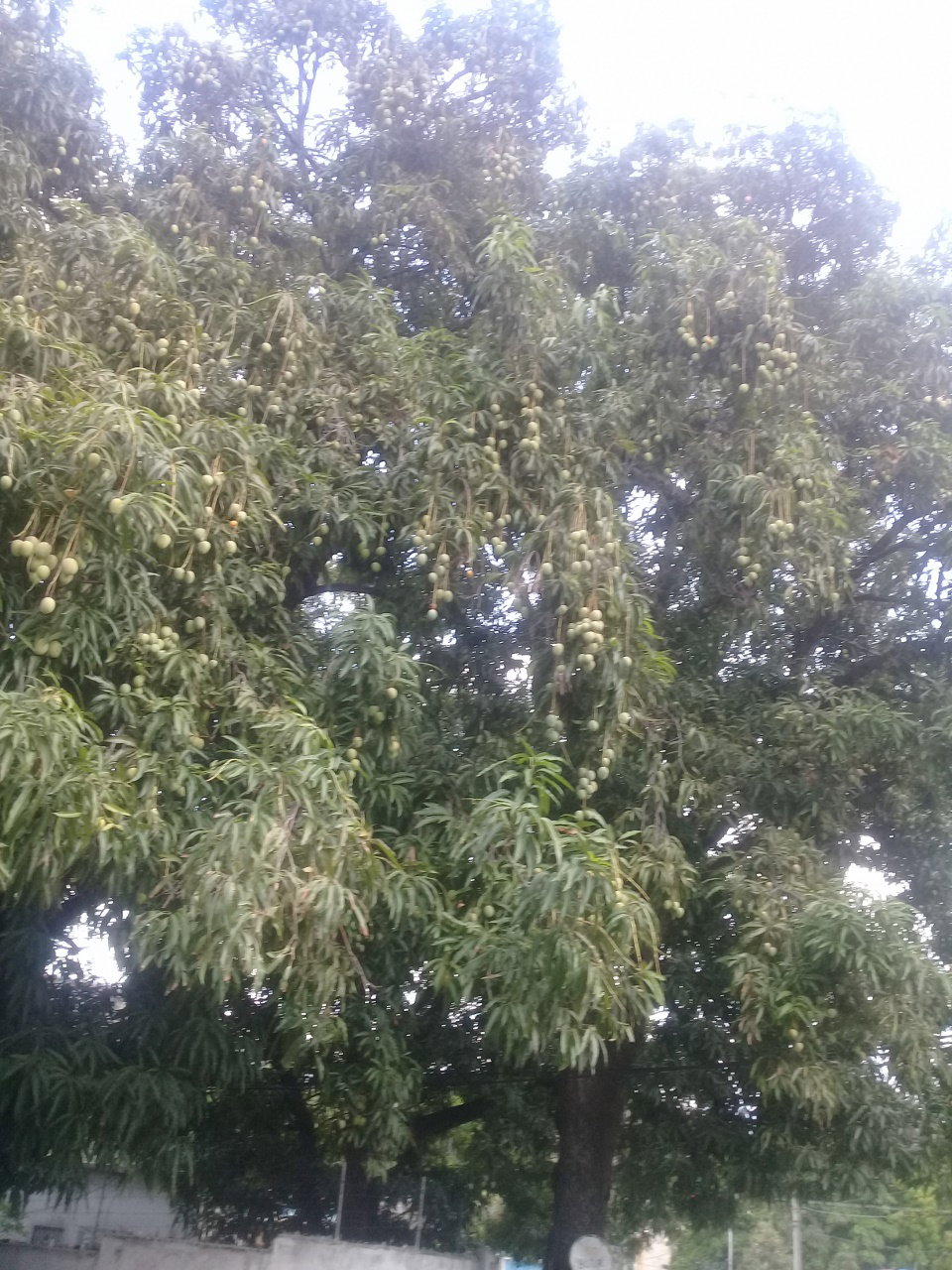
Bocado Mango Tree
The tropics were blessed by nature to give us a great variety of fruit plants. These fruits, with their subtle and varied flavors, are attracting increasing interest worldwide.
***Fruits of the World***
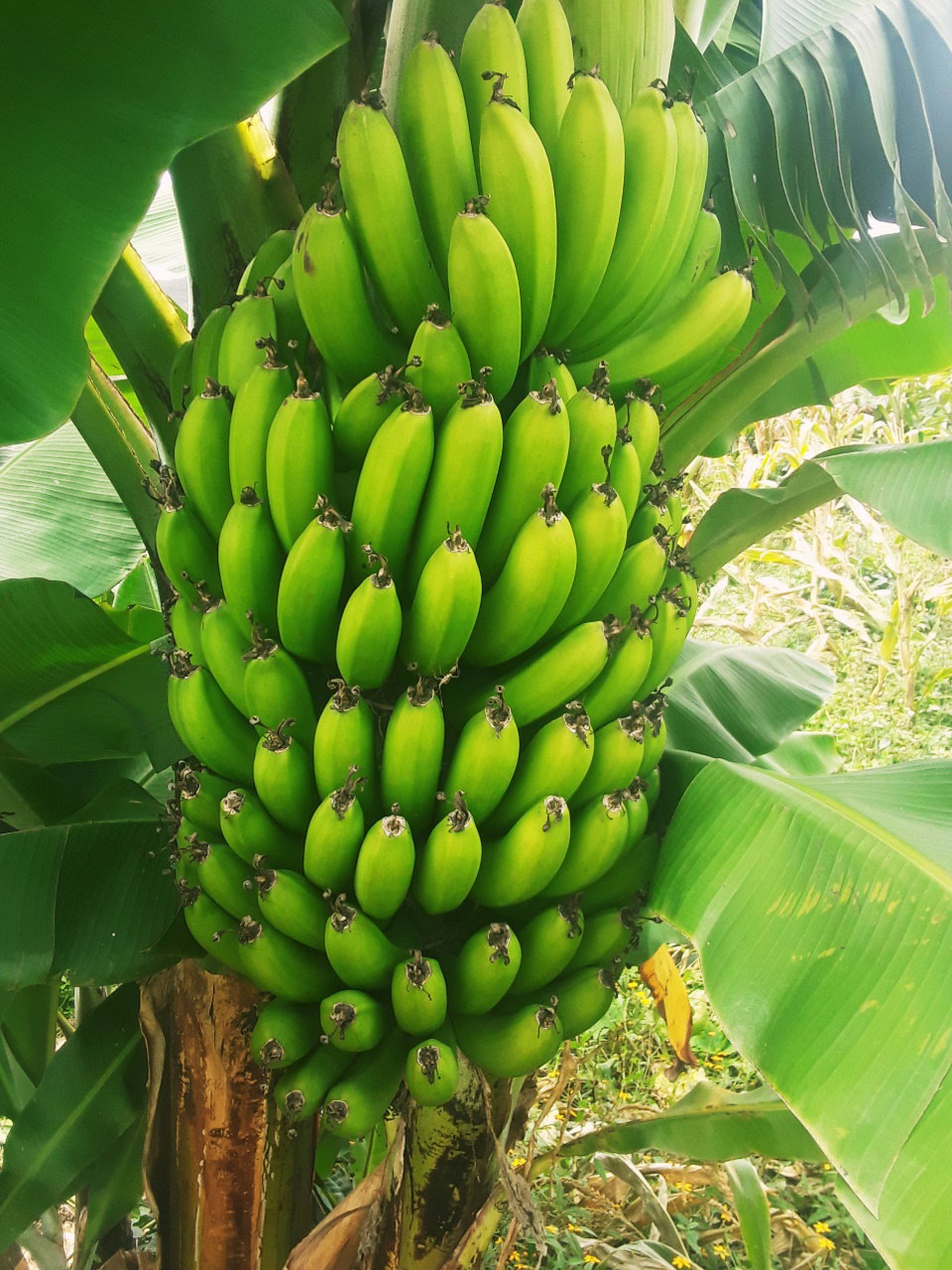
I am going to start with one of the most popular fruits that is cultivated in all tropical regions, ***the banana (Musa sp)***, a herbaceous plant of the musaceous family. Everyone knows its elongated, slightly curved fruit with smooth, yellow skin that is consumed as fresh fruit. There are many varieties of bananas and their size ranges from 5 to 30 cm long.
The banana, which is very rich in sugar and potassium, originated in Indonesia. Its cultivation spread rapidly, by 1000 BC, it was already known in Africa.
The fruits are harvested before ripening, when they are still green, and can be brought to maturity with the use of a natural gas called ethylene.
India is the world's leading producer, the second and first in America is Ecuador.
In my house we eat bananas every day, fried, baked, as fresh fruit. I also use their peels as a source of potassium (K) for garden plants and our family garden.
***Soursop (Annona muricata)*** is large, green in color and with soft spikes, its pulp is white, cottony in texture, sweet in taste and with black seeds.
It is a broad-leaved tree, evergreen, native to tropical America, belongs to the Annonaceae family.
It is widely consumed as fresh fruit, but also in milkshakes, ice cream and in confectionery where it is used to make a rich cream for filling cakes and other delicacies.
Soursop leaves are attributed medicinal properties such as anti-carcinogenic and anti-inflammatory, although scientifically this is not proven.
Its production and consumption is considered rather local, i.e. there are no statistical records of production by country.
***Watermelon (Citrullus lanatus)*** is an annual herbaceous and creeping plant. It produces dark green to light green spherical fruits, these fruits can measure up to 60 cm in diameter and weigh up to 10 kg, its pink or red pulp is very juicy and has a pleasant taste, it is my favorite fruit to take to the beach because it transmits freshness!
This plant was cultivated in Egypt, in the Nile valley about 4000 years BC. China is the world's largest producer, while the United States of America is the second largest producer in the world and the first in America.
***The mango (Mangifera indica),*** a tree that belongs to the family of cashew trees, is a popular fruit all over the world. Oval in shape, its yellow to orange flesh is fibrous, juicy and sweet.
It is rich in vitamins A and C, and offers a pleasant shade during the hottest hours of the day. Although originating in India, which is the world's leading producer, the mango is found in all tropical regions of the world.
In Venezuela, due to the difficult economic-food situation, its consumption has become so popular that they call it ***"the chicken of the poor"***. I particularly like to eat it directly as a fruit, in meringues and I also prepare the so-called "mango jelly" made with green mangoes.
In our country some grafted varieties are cultivated that are large in size and used to be exported especially to the Dutch Antilles.
***The coconut palm*** is a palm tree native to Southeast Asia that can reach up to 20 - 30 m in height. It grows on tropical coasts, where it is cultivated for its fruit, the coconut.
This fruit is a large oval drupe of a single oval seed, inside it a white pulp rich in lipids, copra, is consumed fresh, as is the water it contains which is very refreshing.
The dried almond is called copra and coconut oil is obtained, before reaching this state the almond can be grated and used in confectionery; I prepare what I call ***"coconut canned oriental"***, the oriental is for the region where I learned to make the canned.
The Philippines is the world's leading producer of coconut, along with Indonesia. It is believed that the great spread of coconut in all these islands and coasts in general was due to the particularity of the fruit to float on water.
***The Lechosa (Carica papaya)***, is of the family of the caricáceas, in many places it is as popular as the mango or the banana. It is recognized by its naked stem and ornamented by foliar scars, its fruits hang from the trunk. The lechosa, also called Papaya, is native to Central America, but still grows and is produced in all tropical regions; It has a pulp ranging from yellow to orange with abundant grayish seeds.
Brazil is the world's largest producer, with Nigeria in Africa being the second and India in Asia the third largest producer.
Milkweed contains an enzyme called Papain which has anti-inflammatory properties and many other uses.
I also use it in its green state as a meat tenderizer. Among many other uses.
The seeds contain the enzymes ***papain and chymopapain***, which has the ability to eliminate intestinal parasites. My friend Trina Esparza, Agronomist Engineer, did her thesis on this subject.
Dear readers I invite you to join me in my next writing where I will be dealing with stimulant plants and Spices.
Original photographic supports and writing by Oizaguirres for read.cash.
Traveling to the World of BeesFrom My Notes.
When I was a student there was a subject in the curriculum that encompassed three completely different areas and that the only possible relationship could be in the economic aspect, that subject was Bird-Cuni and Beekeeping and was dictated by Professor Galindez, that was 55 years ago. His classes were a bit annoying with the exception of Apiculture, that is to say the world of the bees, because it was like that, the way Galindez described that exciting world, he moved us mentally to the beehive, where everything revolves around the Queen, the work of the Workers and the presence of the Drones or males, tremendous sluggish that are only there waiting for a nuptial flight, where only one can cover and fertilize the Queen, and then die in immense joy!
A few days ago, May 20th, I commemorated the World Bee Day, in a chat I made a comment about the importance of this insect in our ecosystems and how deserved they are if each one of us would honor them by writing or publishing about them.
***The Bee***
SOURCE: Zoologia General de Storer et al. by Oizaguirres
The bee, Apis mellifera, of the order Hymenoptera, i.e. an insect that can fly, has mouthparts adapted for sucking and chewing, undergoes a complete metamorphosis process, from a larva, through a pupal stage, to a flying adult.
It feeds on nectar and pollen and lives socially in a permanent colony formed by numerous individuals belonging to three castes or types mentioned above, the queen, the drones and the thousands of workers, or infertile slaves, who are responsible for building, preserving the hive, collecting food and feeding all the castes, taking care of the queen and young individuals.
Wild bees live in natural cavities in trees or among rocks, but this species has been partially domesticated by man who houses them in wooden boxes.
Colonies live in wax honeycombs containing small cells where they store honey, wax and care for the young.
What we call honey is the nectar of the flowers chemically transformed into a syrupy, hydrocarbon solution. They also collect pollen, which we call "bee bread" with which they feed their larvae.
And as a curious fact, bees collect resins from the buds of plants, which in the form of propolis are used to cement and varnish the cracks of the hive and protect themselves from wind and water, that is to say, they waterproof their house!
***Let's talk about The Hive: (The house)***
(Image by David Hablützel on Pixabay)
[SOURCE](https://pixabay.com/es/photos/miel-colmena-panal-cera-de-abejas-3216984/)
Each honeycomb of the hive is a vertical blanket of wax, attached to the top and sides of a cavity and lined with hexagonal cells....
There are 3 types of cells:
The 5 mm worker cells where workers brood and store pollen and honey.
The drone cells, about 6 mm, are used for storage and to raise the drones.
The large, vertical, peanut-shaped queen bristles, which are open at the bottom, are built in the lower part of the comb and are intended for queen rearing.
Bees are able to maintain or modify the internal climate of the hive by applying movements to their wings. If the internal temperature is low, as in the winter season, they are able to swarm together to produce heat, even if the outside temperature is quite low.
***Reproduction***:
The reproductive system in workers is rudimentary but highly developed in queens. A week after emergence, the young queen mates with a drone in the air, known as nuptial flight. The copulatory organs of the drone detach and remain in the queen's genital sac until it returns to the hive, where the worker bees remove it. The sperm received in the spermatheca should be used to fertilize all the eggs she will lay throughout her life.
The queen has the ability to control fertilization, so that unfertilized eggs produce males or drones and fertilized eggs produce females.
She can also control the number of eggs depending on the amount of nectar. When nectar is abundant, the queen can lay up to 1000 eggs per day, each of which she deposits at the bottom of a cell.
The incubation time or formation of each caste, from egg, through larva, pupa and adult is different, so for a queen is 16 days; the workers are 21 days and drones 24 days.
https://www.youtube.com/watch?v=RWyTOH0cnjs&t=39s
***Nectar and Pollen Collection***
When a worker bee discovers a place in the field where there is food, she fills her stomach with nectar, returns to the hive and deposits the collected nectar or feeds the young bees.
When you see a bee on the ground not moving, she is not necessarily dead, she is probably just dead from exhaustion from carrying a lot of pollen and needs to energize herself. So if you mix some water with a little sugar and let it drink it will give it the boost it needs to continue on its way. Today I found a powdered bee, I mixed some water with sugar, gave it a drink and watched it gulp and gulp, suddenly it came back to life. It was amazing! We have to take care of the bees, remember that the pollination of our flowers, fruits, vegetables and trees depends on them. In other words, our own life depends on them.
When you see a bee on the ground not moving, she is not necessarily dead, she is probably just dead from exhaustion from carrying a lot of pollen and needs to energize herself. So if you mix some water with a little sugar and let it drink it will give it the boost it needs to continue on its way. Today I found a powdered bee, I mixed some water with sugar, gave it a drink and watched it gulp and gulp, suddenly it came back to life. It was amazing! We have to take care of the bees, remember that the pollination of our flowers, fruits, vegetables and trees depends on them. In other words, our own life depends on them.
I feel internally satisfied to present this writing as a recognition to the bees, which are a symbol of hard work and cooperation in the food chain and balance of ecosystems.
Long live the bees, now more than ever we must preserve their existence.
***Photographic support***
Photo #1 Taken from my General Zoology text.
Photo #2 Taken from Pixabay
Video and other photos of my property
Translated with www.DeepL.com/Translator (free version)
Weather and Agriculture Digging into my Notes 07 "The Fruits"
Dear readers, fulfilling my offer of continuity with my writings related to agriculture, that magical world that takes us from a piece of land and a tiny or small element that we call seed to...
***The Fruits***
Photo #1 Cherry Tree
Contrary to the word vegetable, the word fruit has a specific meaning in botany, which defines it as a vegetable organ characteristic of the reproduction of flowering plants.
There are two main categories of fruit.
The dry fruits, whose cover is thin and hard at maturity and,
The fleshy fruits in which the cover is filled with juices, for which they are called succulent, and which are easily removed by animals, which once eaten contribute to the dispersion of the seeds.
***The Fruit and Seed Relationship***
The fruit comes from the evolution of the fertilized flower, that is to say the ovary with the ovules in its interior that develops. The fruit presents the envelope, the flesh and the seed. The cover is called Epicarp, which is the external part and we call skin, the Endocarp, which is the inner part and between both the Mesocarp, or tissue that forms the flesh of the fruit. Protected in the Endocarp, the fertilized ovules that are transformed into seeds.
***Types of Fruit***
When the endocarp is lignified, the fruit is said to be a drupe, which means a fruit with stone, otherwise we speak of berries, which are fruits with pips. Depending on the structure of the flower, we obtain single fruits like the mango or the peach, or multiple fruits like the blackberry and the raspberry.
The Strawberry has a fleshy receptacle on which are the achenes, which are the fruits themselves.
And finally the compound fruits that are derived from several flowers like the Pineapple and the Fig.
***How important are they as a nutritional source?***
There are more than a hundred species of fruits and tens of thousands of varieties for consumption. They offer an immense variety in terms of colors, flavors, shapes and consistency. Many of them are available all year round, such as oranges and bananas, others are subject to the seasons.
While it is true that they are poor in proteins and fats, the fruits contain between 5 and 25% sugars. They also provide us with minerals such as potassium and iron, as well as various vitamins such as the important vitamin C.
***Fruits and their World Production***
I am going to mention in this journey through the world of man's food the countries that occupy the first place of the species, so we have to...
***China*** once again emerges as the first great producer of
Peach; Cherry; Pear; Plum; Apple and Watermelon.
***India:*** Mango and Banana
***Philippines:*** Coconut
***Thailand:*** Pineapple
***Egypt:*** Date
***Russia:*** Raspberry
***Italy:*** Kiwi
***Turkey:*** Fig
And in our American continent ...
***U.S.A.:*** Strawberry
***Mexico:*** Avocado and Lemons
***Brazil:*** Orange and Milk
***Some examples of fruit trees***
The pear tree (Pirus) is native to Asia Minor and has been cultivated for 3,000 years for its juicy and aromatic flesh, especially appreciated by the ancient Egyptians, Greeks, Romans and Chinese.
Photo #2
The peach (Prunus pérsica) is native to northern China and Mongolia, its fruit, the peach tree, is fleshy, velvety skin, juicy yellow flesh and aromatic.
In 500 BC, the peach was already known in China, today the world's largest producer, where it was known as the fruit of fertility.
The fig tree (Ficus carica) is a member of the moraceae family and was one of the first trees cultivated in the Mediterranean basin. The fig is not a true fruit, it is actually a receptacle for a large number of seeds called achenes, which are the true fruits. The fig contains a large amount of mineral salts such as calcium and potassium, Turkey is the world's leading producer.
Citrus fruits
Ornamental and rich in vitamin C, they are obtained medicinal and aromatic essences, citrus fruits are the most consumed in the world. They constitute a very wide family, the Rutaceae and under the same genus Citrus, among the cultivated varieties include: Tangerines, Oranges, Grapefruits and Lemons.
It is given as the Southeast Asia (India) its origin, the first citrus was the Citrus aurantium or bitter orange, but the most cultivated are oranges and tangerines. The sweet orange, (Citrus sinensis), was introduced to Europe by the Arabs in the 15th century. There are many varieties of the sweet orange, both for juice and table. Brazil is the world's leading producer!
***Red Fruits***
Preferably produced in temperate countries, these fruits have rounded shape and are small in size, among them we have
Strawberry, like the rose, raspberry and blackberry, belongs to the family of rosaceae. It is a creeping plant that spreads by stolons, is a fleshy receptacle and rich in water, covered with small yellow nuts called achenes. In Venezuela, one of the most important production centers is located in my state, Aragua, in the agricultural-tourist town called Colonia Tovar.
Photo #3
Cherry (Prunus avium)Cherry trees are large, upright trees, reaching heights of 11m. The sour cherry tree is usually smaller and rarely exceeds 5 meters. Under optimal conditions and only in certain regions they can reach up to 30 meters. Its fleshy fruits are bright red drupes, with a sweet sugary flavor.
(Photo 1; 2; 3 and 4 provided by my friend Luisa Rodriguez Acebal from Asturias Spain)
Dear friends, as usual I invite you to join me in the next chapter where I will be talking about tropical fruits.
(Photo 1; 2; 3 and 4 provided by my friend Luisa Rodriguez Acebal from Asturias Spain)
The rest of the photographic and written support are original from Oizaguirres for read.cash.
During the publication process I had two internet interruptions, I apologize for any mistakes.
Translated with www.DeepL.com/Translator (free version)
Weather and Agriculture Delving into my Notes 06 Vegetables Part II
Yes, you are reading right, this is the same title but the continuation, that is the second part of the wonderful world of vegetables in agriculture, its role in the food of man and its historical process, so without further ado...
***Vegetables Part II***
I pointed out in the previous article the great benefits of vegetables, and now we will deal with those that being poor in calories at the same time are rich in minerals, vitamins and fiber, thus becoming foods that can be consumed freely and among them we have...
***Cabbage (Brassica oleracea and Brassica rapa)***
Truly a large family that represents 10% of the total production of vegetables. It is a vegetable plant belonging to the cruciferous family, and in which cabbage, cauliflower and broccoli stand out. The literature indicates that it is native to Europe and was widely consumed by Greeks and Romans.
Like everything in nature, man has created various forms of cabbages that are distinguished by the color of their leaves, the shape of these and their size, in green cabbages such as cabbage all the leaves fit inside each other and are smooth, in others their leaves are curly like the Savoy cabbage. We also talk about colors because in addition to green cabbages there are red and purple ones.
These vegetables are highly appreciated in Eastern European countries such as Poland, Ukraine and Russia, but cabbages are also widely consumed in Asia and China is the world's leading producer, being the best known variety Brassica rapa pekinensis.
I love raw cabbage salad chopped into thin strips and mixed with grated carrots, about two tablespoons of mayonnaise and salt to taste.
I have been doing a test with dehydrated cabbage leaves to control bachaco, I will keep you posted on the results. My wife works in gardening and bachacos are a real pest.
***Lettuce***
**Lettuce (Lactuca sativa)** is a biennial plant that belongs to the asteraceae family, the same as the daisy, but in lettuce it is not allowed to reach the inflorescence. The literature says that it is native to Europe and that a wild variety known as Escarole still persists. Among the most famous or most consumed varieties is the Romaine.
Lettuce, besides being grown in the open air, is widely cultivated in greenhouses or cultivation houses and also under the hydroponic system. It is very rich in potassium (K) and a large amount of water.
In the photo lettuce cultivar at the Experimental Station of Bajo Seco of the Central University of Venezuela.
***Spinach***
**Spinach (Spinacia oleracea)**, from the same family as chard, belongs to the chenopodiaceae family. It is cultivated for its leaves rich in minerals, especially iron, and is Popeye's vegetable. This plant is native to Persia (now Iran), was brought to Europe, Spain in the twelfth century by the Arabs. China is currently the world's leading producer, accounting for up to 75%.
I like to eat it with a "sin", that is to say I parboil the leaves with a chicken cube!
But there is more
In addition to consuming fruits and leaves for our food, vegetables also provide us with flowers, stems and roots, so we have for example...
***Asparagus***,
**Asparagus (Asparagus officinalis)**, native to southern Europe and East Asia, is grown for its shoots, shoots that emerge as vertical stems from its rhizomes.
It is these young shoots that are consumed, they are green when exposed to light. In Europe and in the Mediterranean regions they grow spontaneously, there are numerous families of asparagus, predominantly green, although there are white and purple ones.
China is also the world's leading producer, with Peru in South America being the first in our continent and second worldwide.
***Carrot***
**The carrot (Daucus carota)** is a herbaceous root plant with a striking orange color, like celery (Apium graveolens), belongs to the apiaceae family. It is native to Europe and although it was widely consumed in ancient times by Greeks and Romans, its cultivation did not spread in Europe until the 18th century.
China is the first producer worldwide, in our continent the United States is the first producer and second in the world.
Although I have not cultivated it, it is a vegetable that we consume a lot in our family for its culinary versatility, especially in cooked or raw salads.
Dear readers, with this chapter I close the cycle of vegetables and I invite you to join me in my next writing where I will talk about Fruits.
I apologize to my readers if there are any errors in the publication of the article, which is sometimes interrupted by problems in my country with the electric service.
Original photographic support and writing by Oizaguirres for read.cash.
Today I woke up somewhat fatigued, with difficulty breathing. In September I had been diagnosed with COVID 19 Antisomatico, apparently that sequel remained. Staff from the Red Cross Aragua Section came and did an Oxygen Saturation test, I came out well with a value of 96... We will see
Weather and agriculture Delving into my Notes 05 Vegetables
One more chapter on the history of agriculture and man. We have already talked about Cereals, Feculent Plants, Legumes and now fulfilling the invitation I made in the previous chapter we will talk about...
***Vegetables***
https://youtu.be/ySuz7uCuxJs
These are my friends from Colonia Tovar preparing the products to take them to the market.
From the colorful tomatoes, peppers, eggplants, pumpkins or pumpkins sometimes of immense sizes; onions, cabbages, lettuces of various types but always green, its regular consumption is highly recommended.
***But what is a Vegetable?***
They are plants traditionally grown in gardens, vegetables embrace a huge and varied range that provide us with fresh products for our food.
Depending on the species, they can be roots or tubers (carrot, turnip, celery), stems (asparagus, radish), bulbs (garlic, onion), fruits (tomato, eggplant, bell pepper, squash, zucchini), set of leaves or their petioles (lettuce, spinach, cabbage, chard) and even flowers or inflorescences (cauliflower, broccoli).
Vegetables, being basically perishable products, have traditionally been grown near large consumption centers and are considered elements for self-sufficiency.
However, due to demographic expansion and pressure for space (areas), growers have had to migrate to more remote areas within rural sectors. This results in additional value for the consumer, who ultimately pays the cost of transportation.
Horticulture has benefited from technological advances in aspects such as irrigation and farms under controlled conditions, i.e. greenhouses or grow houses.
World vegetable production should be in the order of one million tons per year.
China, the Asian giant, is the leading producer of practically all vegetables in the world with the exception of the artichoke produced by Italy and the chymombo produced in India. Of the rest tomato, bell pepper, eggplant, cucumber, asparagus, onion, pumpkin, carrot, garlic, spinach, cabbage, are from China and of course it is related to its very high population.
In the Americas, the United States is the second largest producer of tomatoes and carrots. Mexico is the second largest producer of peppers and Peru is the second largest producer of asparagus.
***Tomatoes, Eggplants and Peppers***
Photo of Vegetables in local market stall - Maracay
The tomato (Lycopersicon esculentum), is a bushy plant, it is cultivated for its fruit, it can be consumed as a fresh or cooked vegetable, it is the most cultivated vegetable, it is a berry generally red or orange color, it is very rich in vitamin C and potassium (K). Although China is the world's largest producer, its origin is located in the Andean highlands where it was cultivated by the Incas. It arrived in Italy in the 16th century, but its true propagation in Europe did not take place until the 19th century. As a curious fact, it was in the 19th century, 1812, when it reached the United States and today it is the second largest producer in the world.
The Eggplant (Solanum melongena), is a shrub that can reach up to 2 meters high, its fruits have a spongy flesh and a soft and thin skin, usually violet or deep purple. Its origin is in India. China is the first producer with an estimated 50% of world production and has been cultivated for 2,500 years. Eggplant has few calories but is rich in fiber, the way to consume it is very varied, fried, baked, mashed etc..
The bell pepper (Capsicum annuum), originally from Central America, has been cultivated for 9,000 years, its root is located in Cuba where it was discovered by a doctor of Christopher Columbus in 1494.
Of varied colors, it is rich in vitamins A and C. There are sweet, hot and very hot varieties of peppers.
Mexico is the world's second largest producer and Spain is the first European producer, I have already said that China is the first with 40% of world production.
Together with tomatoes, it is the two crops that I produce the most in our family garden.
***Cucurbitaceae***
Among the vegetables are the largest, they are cucumbers, melons, pumpkins. Their fruits represent 20% of the world's vegetable production.
The cucumber (Cucumis sativus) is an annual plant that can climb thanks to tendrils called shoots. It was cultivated in India until it was brought to the Mediterranean area where it was highly appreciated by the Greeks and Romans for its refreshing flesh. It has a very high water content, 95%, and yet the best soils are dry!
China is the world's largest producer, accounting for 60% of the world's production.
The candied pumpkin (Cucurbita maxima) is the largest of the vegetable kingdom, are round and flattened at both poles and covered by a thick rind of a color ranging from cream to deep green, its flesh is a yellow-orange and a semi-sweet taste.
It is native to Central and South America.
I use pumpkin in soups, puree and also in cakes, but many producers use it for animal feed.
***An Aromatic Family (Garlic, Onion, Poro)***
Garlic (Allium sativum) has an inimitable aroma, which is given by Alina, a sulfur compound that when in contact with air is transformed into Allicin; it is a plant about 40 to 60 cm high. It is a bulb that is also called head that in turn is divided into numerous segments which we call teeth. It is thought to be native to central Asia or northern India, the truth is that its history begins with the Sumerians who cultivated it 5,000 years ago, in China and India there are records of 3,000 years ago.
Medical fact, in 1858 Pasteur demonstrated the antibacterial activity of garlic, today it is proven that it has antifungal properties.
China accounts for 70% of the world's production.
I use garlic cloves as a seasoning in almost all the savory foods I prepare.
I have never had the opportunity to grow it, just as I have never grown ...
Onion: (Allium cepa) is a widely cultivated vegetable, the plant grows as a single bulb with long hollow green leaves. The onion has become an irreplaceable element in the kitchen for the pleasant flavor it provides to meals.
It is native to Asia and China is the world's leading producer for a change.
Well dear readers, with all due respect, I am going to divide in two the writing of the vegetables, the next chapter I will talk about leafy vegetables (spinach, lettuce, cabbage, carrots, asparagus and artichokes).
Photographic support and original writing by Oizaguirres for read.cash.
The video was filmed with my grower friends from Colonia Tovar - Aragua - Venezuela.
Weather and Agriculture Digging In My Notes 04 Legumes
***Continuing Our Journey Through Time And Agriculture***
***Digging In My Notes 04 The Legumes***
In this journey through the history of Agriculture, where we have already dealt with Cereals and Feculent plants, it is our turn to write about the other great giant in the feeding of man and animals, I am referring to...
***Legumes***
In this writing we are going to deal with legumes, that is to say any member of the Fabaceae, by extension vegetables that we take advantage of their grains, such as Peas, Lentils, Chickpeas, Beans and Soybeans.
Legumes have been the eternal companions of cereals, man has cultivated them for their protein-rich seeds since the early days of agriculture.
Let's start with that round bean known as chicharo (Pisum sativum), considered perhaps the oldest to be cultivated. The chicharo is an annual, shrubby, creeping plant that can climb thanks to its leaf tendrils. The fruit is an elongated pod containing numerous round seeds. When eaten fresh they are vegetables, this is the famous pea or Petits Pois, used in our chicken salad, or in Russian salad!
History tells us that it is the companion of cereals, it has been cultivated for about 10,000 years in the Middle East and around 4,500 - 4,000 BC it appeared in Egypt, in the Nile valley.
I have consumed it on countless occasions, but I have never cultivated it.
***Lentil, (Lens culinaris)***, Lentil is a nice flat seed, similar to a flying saucer, according to history in inhabited fields in Syria archaeologists found seeds from the first millennium BC.
I have never had the opportunity to grow it, but I do eat it at least twice a month and it is a grain rich in protein, 25%.
What I have prepared with lentils is a rooting agent, thanks to a hormone or phytohormone called auxin that regulates plant growth and lentils have a high auxin content.
To prepare or obtain from lentils a preparation containing this hormone is very easy, just put to germinate 100 grams of lentil grains and when the radicle sprouts, it is liquefied in water, it will form a milky liquid, this liquid is rich in auxins. Also the remaining solid product, we put it to dry in the sun and this powder can be used to impregnate the seeds of the crops that we want to propagate and this will help in the vigorous rooting of the new seedlings.
***Dry beans*** are the most cultivated and consumed legumes in the world, I will quote...
***Black Caraota*** (Phaseolus vulgaris;), native to America, is part of the food consumption of many countries in America, in my country Venezuela is the basis of the national dish known as "Pabellon Criollo".
I have worked with Phaseolus vulgaris; at experimental level in cultivars under irrigation, to determine irrigation cycles, specifically in studies of "Irrigation in Phaseolus vulgaris; from the change of coloration of the leaf".
The carota is a shrubby plant, with erect growth, very branched, its vegetative cycle is quite short, at 75 - 80 days it is ready to harvest.
***Bay Beans (Phaseolus leptostachyus)***
>The Bayo bean is a native food of Venezuela, so its presence is frequent in different dishes of the national gastronomy. Among its benefits, we can consider the following:
- It is a very nutritious food since it provides about 5% of vegetable proteins, 6 to 7% of iron and 8% of vitamin B1, which are available for human consumption.
- It also provides calcium, phosphorus, magnesium and zinc, as well as vitamins: thiamine, niacin and folic acid.
- Due to its high fiber composition, it improves the digestive process and prevents constipation episodes.
- It helps lower triglyceride and cholesterol levels, which leads to a healthier heart.
- It contains a high level of lysine, an amino acid needed by living beings for growth. Therefore, a diet rich in legumes and supplemented with cereals can satisfy the requirements of essential amino acids for humans.
I have had the opportunity to plant this crop, both in Guárico and Falcón, and it is the primary food of our rural areas.
[FUENTE](https://pixabay.com/es/photos/soja-frijoles-los-alimentos-granos-182294/)
***Soybeans (Glycine max)***, is a legume similar to the Chicharo but brown, its fruits are pods containing 3 or 4 rounded grains of cream color, very rich in protein, is considered the queen legume for its various properties and uses.
Vegetarians consume it as "vegetable meat".
Vegetable milk is extracted from it, for infants and lactose intolerant people.
It is rich in vegetable oil, soybean oil is commercialized.
Its flour is an important part in the production of concentrated foods.
There are varieties of Soya poor in oil, which is the Soya radiata, cultivated in Asia for human consumption as any other legume. Soy milk is extracted from it. It is highly consumed in China. But the largest producer of soybean oil is the United States of America, followed by the South American monster, Brazil.
I, Oizaguirres, was responsible in the field for the first commercial planting of soybeans in Venezuela, (1,000 ha), this planting was done in Yumare - Yaracuy, in 1970 through an agreement between PROTINAL C.A. - Department of Agronomy and the National Agrarian Institute (IAN), I was providing my professional services to PROTINAL C.A.
Dear readers, this is how we are advancing in the productive processes of agriculture in the world and its relationship with man.
As usual I will invite you to read my next article where I will be talking about the world of vegetables.
With the exception of the cited sources, the photographic and written support are original from Oizaguirres for read.cash.
Translated with www.DeepL.com/Translator (free version)
Traveling with agriculture, digging into my notes 03 Feculent Plants.
It fascinates me to be able to write about this topic of agriculture and to travel through the world of it. Today I present for the eternity of the letters through read.cash the group of plants that along with cereals formed the basis or first stages for human food, I refer to the starchy plants and receive this name because of the concentration of starch they contain and are so named because starch is starch.
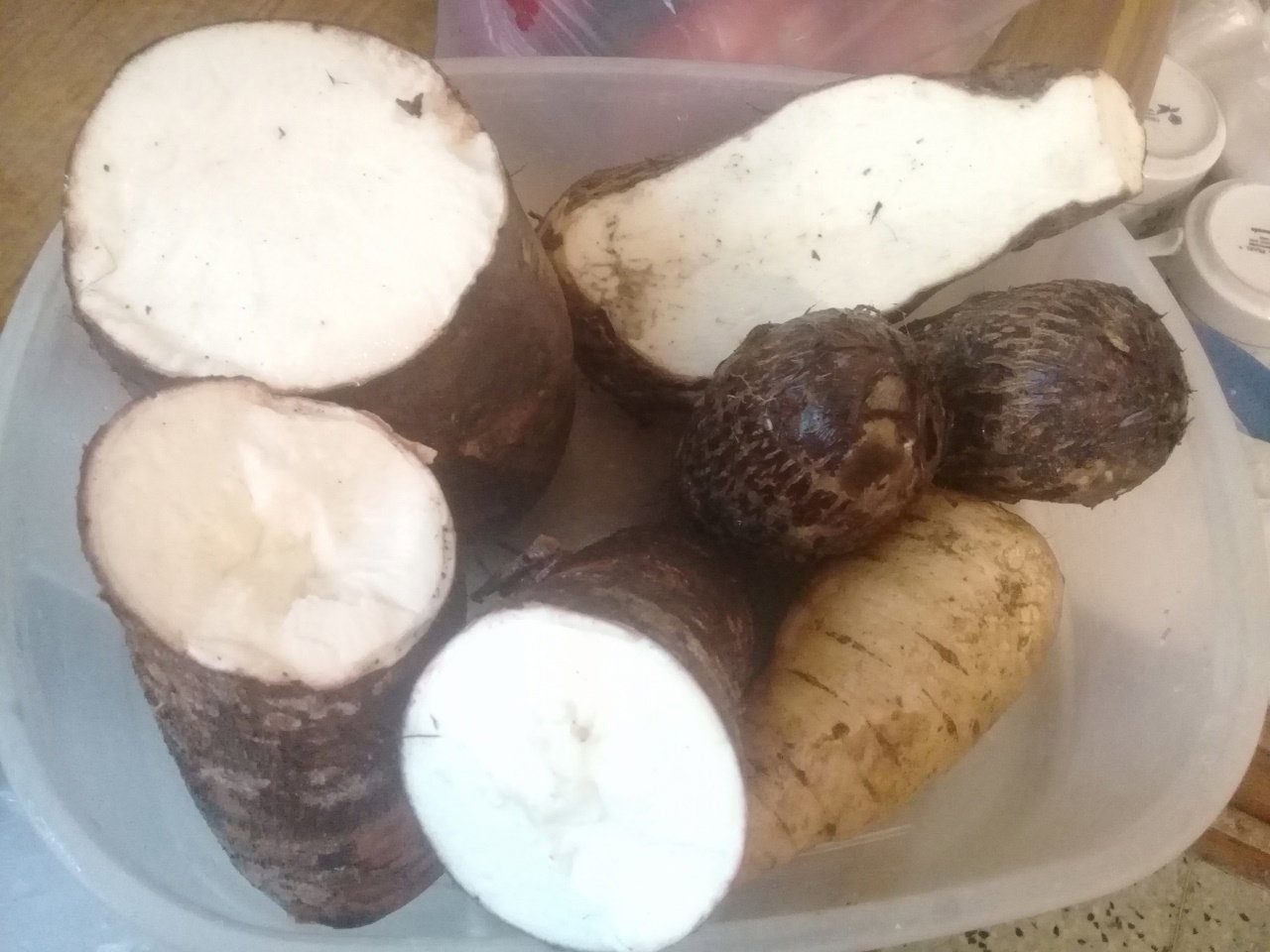
This group or category includes roots such as cassava (Manihot esculenta) and sweet potatoes (Ipomea batatas), tubers such as potatoes (Solanum tuberosum), yams (Dioscorea alata) and/or fruits such as bananas (Musa balbisiana).
Also among this category are one of the broadest categories such as legumes, whose seeds are harvested for food, including lentils, chickpeas, beans and soybeans...
But let's go to the definition and development of this interesting topic and start with the question: What is a Feculent plant?
In this concept are grouped species of plants other than cereals that provide starch for human nutrition.
Thus we have that...
*Roots rich in sugars*
The main sugar found in vegetables is starch, already mentioned that it is found in cereals and also in the grains of leguminous plants, but roots such as cassava and sweet potato and tubers such as yam, ocumo and potato are also sources of reserves.
These foods have not had the preponderance of cereals in the world, but there are regions where their importance is of first order as they are the basis of their diet, as is the case of African countries.
***Cultivation of Feculent Plants in the World***
China is the leading producer of potato and sweet potato.
Africa is the leading producer of cassava, yam and togo (rhizome) and fruit such as plantain (green banana).
In America, Brazil stands out as the world's second largest producer of cassava.
We are going to write a little about some of the starchy plants and we will start with ...
***The Potato (Solanum tuberosum)***
It is a vegetable of the same family as the tomato! That is to say, it is a Solanaceae. It is the tuber that is consumed that has the highest amount of starch. Its fruit is a berry very rich in sugars but poor in proteins and has no fat in its composition. It contains some vitamins B and C located in the skin. The potato, which is native to the Andean countries (South America), has spread all over the world, being the fourth most cultivated plant in the world and as I have pointed out China is its first producer.
The story goes that countries like Ireland came to depend almost exclusively on its cultivation and that their fields were devastated by an attack of mildew, a fungus that attacks its leaves causing the death of the plant, this situation was the cause of a great famine of the Irish people between 1845 and 1851 and it is said that they lost up to 2 million of their inhabitants.
Now it is the turn of the...
YUCA
Cassava, also known as manioc (Manihot esculenta), this plant that belongs to the family of euphorbiaceae is a shrub that can reach up to 2.5 m in height, but its importance is stored in its roots which are very rich in starch, can measure up to 50 cm and weigh up to 5 kilos per plant. Its roots can remain in the soil for a long time, but lose their condition as a food plant when the roots become fibrous. Normally its extraction should be done within the first 8 months, for fresh consumption and up to 24 months if the objective is the source of starch, of course it will always be necessary to consider the variables of variety, soil, climate. For its consumption it should always be kept in mind that it requires cooking to eliminate through heat a toxic substance (cyanide or hydrocyanic acid) found in it.
A way to consume it in many rural areas that make it the daily bread is the so-called cassava.
I particularly prepared a small cookie, whose recipe I inherited from my mother, which is made with starch and is called Ahogagatos.
Sweet potato
The sweet potato, (Ipomea batatas), a creeping plant, from the same family of creepers, is cultivated for its roots in the form of tubers; its most practical propagation is based on cuttings that are obtained by sectioning the creeping stems, in small cuttings that are buried and from them sprouts the new plant from which you can extract its roots in the next 5 - 7 months.
In addition to the starch it contains, estimated at 30% of its composition, the sweet potato provides vitamin A and up to 10% sugar, hence its characteristic sweet taste. China contributes 85% of the world production, but it is basically used as cattle feed, in the rest of the countries its production is self-sufficient.
I consider it a very versatile crop because of the different ways it can be consumed in soups, mashed, canned and alone with butter and cheese!
***The yam.***
It is a climbing plant with elongated stems and rhizomes that form tubers with high starch content. The yam is of great importance in the diet of countries on the African continent where up to 90% of the world's production is produced.
In the next chapter I will write about this other component of the world's diet, legumes.
I apologize to my readers for the interruptions caused by power failures in my country and the consequences on the Internet.
Original photographic and written support by Oizaguirres for read.cash.
Translated with www.DeepL.com/Translator (free version)
A Journalist interviews Oiza Oiza's Life Journey
Many times I have talked to people in the news media and this time I wanted to conduct a self-interview to bring it to the friends of read.cash. It's like talking to the mirror or when you interview a politician and he already knows what you are going to ask him!
So ....
Good morning dear journalist, I will try to answer your interesting questionnaire in the same order of the questions to make it easier to develop it.
- Tell us what you are currently doing and in what area you work or have worked?
R. 1.- At the present time I am "unfortunately" unemployed, it is difficult for a "used" person to get a job, my last work activity related to the productive field ended in May of last year (2020), I managed a farm in Capadare, Acosta Municipality in the State of Falcon. Falcon, unfortunately I was affected by the Zica, that generated a rest and my subsequent retirement (I retired) from work, the main reason was the situation of the country in terms of security, problems to get food and in the farm the lack of water resources and a persistent drought.
That farm, My Legacy, with an area of 140 hectares, but without groundwater or surface water and to maintain or try to maintain a livestock farm by dint of ponds is a fantasy.
Tagetes sp, a research crop during my professional practice
* Tell us about your experience in life and with Venezuelan agriculture, when did you start?
R.2.- I have worked in the Guárico River Irrigation System, as Technical Advisor of a subsidiary of Agro Islander called "TODO PARA EL AGRICULTOR" (ALL FOR THE AGRICULTOR).
I was in charge of the Arrocera Calabozo, (BANCO AGRICOLA Y PECUARIO).
In charge of the production of corn seeds, Hacienda Durigua, Acarigua, Edo Portuguesa.
In charge of Los Mereyes Herd, Via Cabruta, Guárico State.
In 1970, he entered the Agronomy Department of PROTINAL C.A.
Prepared in experimental field for the cultivation of Soybean.
Responsible for the First Commercial Soybean Seeding, PROTINAL - IAN agreement. Yumare State. Yaracuy
In charge of fodder pelletizing plant for raw material San Carlos - Cojedes.
Exploitation of 60 hectares of Philippine Rice; 60 hectares of cut pasture and experimental field of species such as:
Gliricidia Sepium (Mouse kill).
Tagetes spp (dead carnation).
As a source of carotene in substitution of alfalfa.
Implementation and research on the use of agricultural limestone in peanuts and soybeans.
Head of the Agricultural Nucleus 5 Chaguaramas, Guárico State. Guárico, sowing of Corn, Sorghum; Experimental Field for the obtaining of national sorghum varieties Chaguaramas I; Chaguaramas II and Guárico I, as assistant of the Genetic Engineer Mauricio Ricelli (PROSECA).
Assistant to the Management for the promotion of sorghum cultivation in Guárico state and southern Anzoátegui state (Mesa de Guanipa).
In charge of the San José Farm, Sanare, Falcón State.
Livestock exploitation with Carora type cattle, implementation of the Silvo Pastoril-intensive system (1ha paddocks).
MAC Experimental Station under Irrigation - Santa Cruz de Aragua
Design and experimentation of irrigated crops; soil management.
Field Manager and Administrator of the Santa Cruz de Aragua Experimental Station. Cruz
Administrator of the Directorate of Agroeconomic Development of the General Directorate of Irrigation, Ministry of Agriculture and Farming.
Technical Advisor, Los Charales Sector, Sabaneta Barinas Irrigation System.
Head of Credit Department Sabaneta Irrigation System.
Social Conservationist Social Program Ministry of Environment Watershed Management
Reforestation and Recovery Projects of Micro Basins and Watersheds of Aragua State.
Head of the Department of Goods and Services Ministry of the Environment Aragua State
BANCALES Agricultural Research Project on Heavy Soil Management for Cojedes and Portuguesa States CONICIT
Assistant Regional Director of MAC Aragua- Carabobo-Cojedes
Assistant General Director of Irrigation MAC
of intake, diversion and canalization Small Irrigation System Dos Montes - Gavilanes Camatagua Edo Aragua
Land Movement Housing development Los Angelinos, San Mateo, Aragua State.
Construction of 50 housing solutions in Punta de Piedra Nueva. Esparta
Construction of 86 housing solutions in Caripito, Monagas State.
Construction of a high school in Rio Seco, Yaguaraparo State. Sucre
Repair and adaptation of 1.5 km of Cariaco Irrigation System, Cariaco State. Sucre
Demolition and repair of main irrigation canal, Cariaco Irrigation System.
Advisor and Project Elaboration for INDER-ARAGUA
(National Institute of Rural Development)
Construction of Australian tanks of different capacities
Design and construction of dike for water intake for irrigation Socorro IAN Settlement, El Consejo, Edo. Aragua
Coordinator of Civil Works for the Gran Misión Vivienda Venezuela for the company INVERSIONES PEÑATE C.A.
General Manager of the Mi Legado Farm in Capadare, Falcón State.
These are my movements and my life experience.
- What is your most rewarding experience working in the agricultural sector?
R.2 . -My first experience with agriculture comes when I was very young, my father who was a doctor always had as a hobby the agricultural production, and generally his companion "to the mountain" was me, almost all the family, as good caraqueños, saw the field "as a mountain", almost all the family, as good caraqueños, saw the countryside "as mountain and snake" and did not stay more than a weekend, at most 1 week for any holiday, but I loved that savannah, the smell of dung, mastranto, the singing of the milker, riding on horseback that on my father's side, for my mother IS A STORY OF ITS OWN!
Every experience has its positive side and even the negative ones, if you do not live them, you simply CANNOT CONSIDER THEM EXPERIENCES, they just happen!
Undoubtedly it was rewarding:
To see Guárico turned into a granary
To have had the responsibility of directing the first commercial planting of soybeans in the country.
To turn the San José Farm into a nucleus of breeders and mothers of the Carora type, to obtain prizes and recognitions in fairs.
Finally, later on we will be able to review the GOOD, REGULAR AND... unpleasant events.
* Which is the one that has left you the most unpleasant?
R.-3 When my father sold Finca San José. I felt something of my being was leaving.
*-4-How do you see the current situation of Venezuelan agriculture?
R.-4 I would not like to use pessimistic words, when in fact the situation should be taken advantage of to "finally" do something truly positive and lasting in terms of PRODUCTION AND PRODUCTIVITY.
Unfortunately, a country adrift, where a state (I am talking about state), has the luxury of appointing an aviator Minister of Agriculture with no policies for the sector (there have never been any, with 2 exceptions in my point of view): Gustavo Pinto Cohen and Felipe Gómez Álvarez), with a body that is an appendix of all AGROPATRIA, which is Agronada; with IMMENSE INVESTMENTS without follow-up or answers, the Greenhouses, sprinkled all over the country, as crop houses and are shade roofs for lazy and vagabonds, if I continue I will get a headache from so much misery that my eyes see and feel the impotence of not being able to solve.
But as long as there is no management at the highest levels, we will only be able to produce corruption and negligence.
- 5. What was done wrong?
R.- I think it was born wrong, let's see:
The countryside is abandoned because of the oil boom, neither you nor I were born.
A man came up with a phrase that 72 years after having pronounced it STILL REMAINS IN THE EARS of those of us who in some way are related to the countryside "WE HAVE TO SEED OIL", Arturo Uslar Pietri...Now we are trying to give careers, as if we are understanding it, laugh it up, vertical chicken coops; family gardens; URBAN CONUCOS, for GOD FORGIVE THEM, THEY DO NOT KNOW WHAT THEY ARE DOING.
b) Nefarious implementation of an AGRARIAN REFORM that IMPLANTED A MAN IN THE FIELD; DEFORTED HIM; SEEDED HIM; CONTROLS CREDIT AND LIQUID SEEDING, that man felt he was the guachiman of a plot NOT A SMALL PRODUCER, there was NO SENTIMENT OF POSITION.
c) The horrible RECRUITMENT for the FAN, they brought to the big cities THE RELEVANT GENERATIONS, the young farmer no longer wanted to return to his land.
d) The traditional irresponsibility or NEGLIGENCE OF THE POWER for NOT DOING, not delivering inputs on time, Lack of timely credits; Delay in the payment of harvests.
e) Abandonment or non-existence of agricultural roads or access roads to the production centers.
f) Disrupting Private Property; Destroying Legal Security
- 6. What was done well?
R.- 6.- What was done well WAS TO TRY TO DO IT, if it had been done well WE WOULD NOT BE AS WE ARE.
- 7.- How can we rescue Venezuelan agriculture?
A.-7 Generating TRUST, RESTORING PRIVATE PROPERTY; CREATING AGRICULTURAL POLICIES CONCERTED BETWEEN GOVERNMENT AND PRODUCERS.
Secure input supplies
Efficiently activate credit lines
Recognize, support, instill that the way out is to PRODUCE -PRODUCE, there is no other.
- 8 -What would be your advice for the generation of relief in agriculture?
R.-8 Generating Trust, Restoring Private Ownership; Create Agricultural Policies Concerted Between Government and Producers.
Secure input supplies
Efficiently activate credit lines
Recognize, support, instill that the way out is to Produce -Produce, there is no other way.
To have faith in the country, the conditions exist and have existed, to fight for the future of the country, to move away from the Destructive Politics of the Primary sector.
It is inconceivable that in the Faculty of Agronomy of the UCV-Maracay, currently only 400 young people have opted or taken Agronomy Engineering as a life alternative.
This is the journey of my life in agriculture and other managerial activities that I have had to live, in broad strokes.
Thank you for joining me and reading this writing.
We continue fighting!
Original photographic and written support by oizaguirres for read.cash.
My apologies for the interruptions that affect me when I write, internet and electricity are lost all the time.
Traveling with Agriculture, Digging into My Notes 02 Cereals
In the first part I indicated that in this second chapter I would be writing about .....
*The Cereals*
**Cultivation of Rice and Oiza**
Cereals are conceptualized as staple foods, the daily bread of man's diet.
Among them, the following stand out
* Wheat
* Corn
* Rice.
It is estimated that these three cereals represent more than 85% of world cereal production. Of course there are others that are very important in the food culture of some peoples and others that are grown almost exclusively for animal feed.
Cereal grains became the main source of food for the first civilizations, such as rice in Asia, corn in America and wheat in the Middle East and the Mediterranean basin.
Cereals have a very high nutritional value, they provide us with starch and sugars, proteins, vitamins and are an important source of essential minerals for our diet.
I am going to mention the type of cereal and the first producer in the world of that cereal so we have to...
Corn and Sorghum correspond to the United States of America.
Oats and Barley to Russia
Wheat and Paddy Rice to China
Millet in India.
As far as the Americas are concerned, the following stand out...
Brazil as the world's third largest corn producer
Mexico as the world's fourth largest corn and sorghum producer.
***Wheat***
Wheat is considered the universal cereal, having started its cultivation in the Middle East region, it is the first nutritional resource in the world, being the most consumed cereal and of course the most traded internationally. In my country, Venezuela, wheat is not produced and is imported for the production of flour and our daily bread.
The world's largest producer is China, a country where its consumption is only surpassed by paddy rice. The most cultivated varieties are the so-called naked wheat, especially Triticum aestivum and Candeal wheat with floury grains that fall from the ear during threshing. For the production of pasta and semolina, the hard wheat variety Triticum durum is preferred.
***Corn***
Practice on corn cultivation with a group of UCV - FAGRO students.
From Asia we move to the American continent to talk about corn, this cereal, more than eight thousand years ago corn was cultivated by the Indians of Central America, today the United States is the country where it is most cultivated, covering almost 50% of world production. Corn can be considered the crop of two socioeconomic worlds, in developing countries, not to say third world countries, corn is a source of first order in human food, while in countries like the United States its use is mainly for animal consumption.
In my country corn, as I said before, is our daily bread, with which the traditional arepa is made, it is very difficult that in a Venezuelan home is not consumed at any time an arepa. In the past, after a celebration, or after a baseball game, it used to end up in an arepera to finish off the night!
Corn arrived in Europe thanks to Christopher Columbus and from the 15th century it spread throughout the world. It is said that in addition to feeding man, it feeds poultry, contributes to the yellowing of egg yolks and fattens cattle!
But corn goes beyond that; edible oil is extracted from it, and it is used as a base for making sauces, sweets and cakes. It is also used in the paper and pharmaceutical industries. In Brazil, a few years ago (2017) the first plant to produce Ethanol, a biofuel based on corn, was inaugurated.
***Rice***
*UCV-FAGRO students practice in rice cultivation Calabozo - Venezuela*
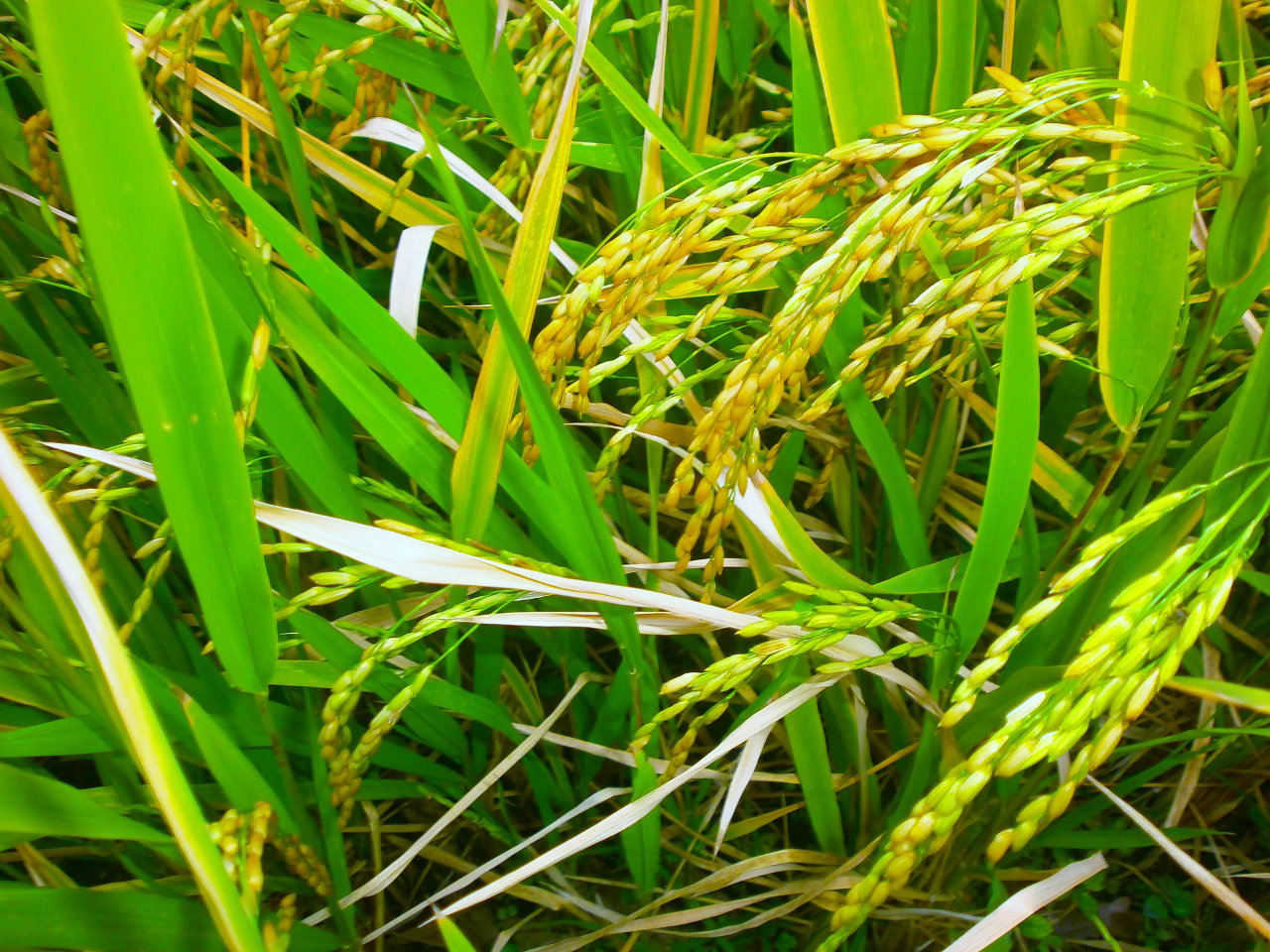
Rice, a cereal native to Asia, is responsible for feeding more than half of the human population and alone represents 30% of the cereal production.
Rice is rich in starch and is highly nutritious, however it is considered the poor relative of cereals because it does not contain vitamins, which it loses in the glumella when the rice is threshed.
Rice cultivation requires special soil and water conditions because it demands a large amount of this element and its vegetative cycle develops practically submerged in water. This condition requires constant vigilance by the farmer and easy access to the water source, generally large reservoirs, rivers or deep wells.
The rice is mainly used for human consumption, either as a main dish or in the preparation of noodles and alcohol. Oil and a flour rich in protein can be obtained from the milling residues.
***The next chapter will be dedicated to the Feculent plants!***
**Original photo and writing support by oizaguirres for read.cash**
***My thanks to the students of the last semester of Agricultural Engineering UCV - FAGRO - Maracay.***
***Translator DeepL Free.***
Traveling With Agriculture Digging in My Notes 01
I have already indicated in other opportunities my intimate relationship with the countryside, it began when I was nine (9) years old, by that time I used to travel with my grandfather Pablo Izaguirre from Caracas to a small town called San Casimiro, located in the state of Aragua - Venezuela, there my grandfather had a pig farm.
Then my father bought some land, 2,500 hectares in the state of Guárico, the largest plains state in the center of the country.
At the age of 16 I said goodbye to my beloved Caracas, the city where I was born, and moved to Maracay where I came to study Agronomy. I have never left Maracay, I have traveled almost all over my country and I keep my family residence in this city.
Let's talk about Agriculture
Agriculture is the relationship between man and nature, it is man's dominion over the earth and that dominion begins when he changes his way of obtaining food sustenance, when he moves from hunting, fishing and gathering fruits to planting or cultivating plants.
According to the subject studied, General Agriculture, the beginning of this is located between 4 and 10 thousand years between New Guinea and the Middle East, where the cultivation of cereals and leguminous plants was known.
The history of agriculture then points to other important points of development, such as China and the Americas, all of which are independent, that is to say, unrelated to each other.
What is certain is that man learned to select the type of plants that could be collected and save their seeds, becoming the first step in what is today the selection and production of seeds.
The matter indicates us that probably the first plant cultivated by the man was the Taro, Colocasia esculenta, in New Guinea, it is known in our country as Chinese Ocumo, I learned to eat it during my stay in the eastern states of Monagas and Sucre.
In the Middle East, from present-day Israel to Iran, barley, wheat, chickpeas and lentils are grown. (Cereals and Legumes)
In Europe, Oats and Rye were established; in Africa, Okra, ***Sorghum*** and Yam.
Then, about 500 years later, that is, about 8,500 years ago, a diversity of crops were established in China, such as Millet, Lentils, Cabbage, Turnip, ***Rice***, Mandarin, Beans, Sugar Cane and Banana.
Around the same period of time, in what is now Central America, man cultivated ***Avocado***, peppers, corn and beans.
Thus, our history of agriculture shows us that in our South America the crops of sweet ***potato***, cassava, pineapple, ***potato*** and quinoa (Chenopodium, chile) were established. Potato and Quinoa (Chenopodium quinoa), or false cereal.
Thus we arrive to our North America where the ***Sunflower*** and the Pumpkin are established. We were far from imagining that with the passing of time this area would become an immense food production machine.
***Diffusion of Agriculture around the World***
Man in his transit and constant migration brings with him agriculture to new regions, this movement is more significant in the East-West direction than in the North-South direction. The clearest example is the movement of crops such as ***Corn*** and potatoes in our continent, which was very slow. The opposite of the other axis or direction, whose dispersion was favored by the processes of conquests and wars.
*In the next writing I will be talking about cereals and other things.*
***I will always be grateful to my first professor of Agriculture, Dr. José Vicente Agüero.***
**Original photographic support and writing by oizaguirres for read.cash.**
A Project Called My Legacy
***A few months earlier or a bit of history.***
By the end of 2015, providing my services as a civil works coordinator for a company that worked for PDVSA in the Gran Misión Vivienda Venezuela, specifically in the popular neighborhoods of Valencia-Venezuela and in the program of Replacement of Ranch for House, I receive a call from the Superintendent of PDVSA responsible for the program throughout the state of Carabobo and in this communication he participates or alerts me that I should not present myself to the neighborhood Buen Samaritano, because there is information that my person was going to be kidnapped to demand ransom from the company.
***Who knows!***
But it turns out and it happens that at the same time they had also communicated with the company and when I arrived at the office I received the notification...
Get ready to issue the directives from the office for the conclusion of the activities at the Good Samaritan, do not return to the site.
Thus the instruction was fulfilled and between conversation and conversation between the President of the company and myself, the idea of preparing a project for...
***MY LEGACY FARM***
The farm Mi Legado, under the tenancy of the Lawyer Neibi Romero, and whose lands belong to the Venezuelan state under the administration of the National Land Institute, is located in the parish of Capadare, in the municipality of Acosta, Falcon state - Venezuela.
Cesar, that is the name of the president of the company and Neibi's husband, suggested me the possibility of taking the reins of the farm and consequently to elaborate a project to put to produce the referred property, we planned to make some previous visits and everything was left to my acceptance or not.
***First Visit.***
When I was a boy my father always told me, when you want to sell a farm or make a good visual impression of it, be sure to take visitors in winter, of course because of the rains, everything looks green" and exactly that first visit took place in November and by chance two or three downpours had fallen and the areas that were not mountainous were greening.
We could not enter the grounds by car, the soil is clayey and there were no defined internal roads to venture a tour, so we walked for a while but not enough to get a broad enough idea of the terrain.
Second visit.
A week later I requested a four-wheel drive vehicle and scheduled a visit with an overnight stay for at least 3 days. I also downloaded Google eart to see the space where I could locate the farm and I could clearly see the divisions of the paddocks or spaces. I was accompanied by 4 agronomy students, among them my son Daniel, and I set up or requested the corresponding logistics to perform a soil sampling and subsequent soil laboratory analysis with their respective recommendation by the soil department of INIA (National Institute of Agricultural Research).
**Calicata excavation for soil profile study.**
Results.
1.-We were able to make an important tour of the property and the respective soil sampling.
We confirmed that the existing water source consisted of 9 (nine) small artificial lagoons, there was no river or deep well, then in conversations with a company specialized in drilling wells, with which I had worked, they confirmed that in that area there was no history of wells or record of aquifers, so I had to rule out that possibility
.
**Ponds scattered throughout the farm**
Of the area declared and later verified by topographic survey, of 140 hectares, about 30 hectares were deforested or in low stubble conditions, the rest was high stubble or mountain.
That I did not observe the presence of artificial pasture, only the presence of natural pasture known as "cabezona" (Paspalum virgatum) could be verified.
5.-The perimeter fence with barbed wire was in regular condition and the northern boundary facing the national highway was being dangerously invaded by locals.
There were approximately 100 animals on the farm, of which only 10 belonged to Neibi, the others to one of César's brothers. The presence of these animals generated an extra exhaustion of the farm, since in reality it was not in conditions to support even the load of the 10 own animals.
The existing infrastructure did not go beyond an old but solid corral of heartwood, a cattle wharf with a regular driving and vaccination chute and a small roofed space that was used as a calf pen, in it two concrete feeders in regular to good condition of use. An open space divided into 3 sections called milking corrals and apart, also here there were 3 feeding troughs in regular condition.
***Existing corrals***
Two previous points.
San Juan de los Cayos is called the population center that is the capital of the municipality, it is a tourist town with little commercial activity beyond the importance of agriculture, fishing and coconut, but in that town Cesar has a "modest but comfortable" home and we stayed there and I was going to live there.
I brought up the existence of this house because I had at my disposal the services of the Architect of the company and between the conversations of use and enjoyment arose the idea of the PROJECT AGROECOTURISTICO MI LEGADO.
***Premises of the Project:***
Between 1973 and 1976 I had elaborated a Livestock Project for the San José Farm, located in the Silva district of Falcón state, so I relied on that previous experience to project Mi Legado.
Cesar expressed his agreement to the original approach and even in the line or selection of the cattle to use and that conversation coincided with the proximity of the Carora livestock fair and his immediate desire to attend these, I made contact with acquaintances in the area and the livestock sector, Cesar attended the fair and made the first two mistakes.
First mistake:
He acquires 10 heifers and a bull.
The heifers were not heifers, they were mautas, if anything they would reach a little more than a year old and their weight was not more than 12 arrobas (@).
The Torete, in terms of phenotypic conformation, did not represent that of a reproductive bull either.
When acquiring heifers, the ideal is to negotiate them in pregnancy conditions and if it is the last trimester, the better.
When you are going to acquire a reproductive bull, the ideal is to do it with a proven male, that is to say, an animal with proven offspring, that is called "Proven Bull", not a maute that is going to finish being formed.
Second Mistake:
If you are going to re-found or found a farm, the ideal is not to have animals but you can guarantee their feeding, good feeding, consequently instead of taking out animals in a farm that was being over exploited you added to it.
Third Error:
He insists on working on the basis of his own capital and no matter how much I advised him on the convenience of resorting to credits from the state or even private banks, it was not possible.
Now we will see what is the development
The project starts from the basis of intensive rational exploitation known as Voisin system, which combines wooded areas and intensive pasture system.
As I pointed out before, a good part of the farm is located in tree or semi-mountainous conditions and the state does not give deforestation permits for more than 20 ha, which would take at least 3 years to efficiently adapt the farm to this type of project. Since by law 30% of the total area must be kept under the mountain condition. Something with which I agree 100% to maintain a minimum ecological balance between the needs of man to produce food and the requirements of nature or ecosystem.
Previous paddock distribution plan
Of the paddocks:
I am going to point out a situation that is practically a constant in my country (Venezuela), which is to exploit livestock under extensive, inefficient and irrational systems. Grazing is carried out on large areas, let's say 10 hectare paddocks and an excessive number of animals grazing in that area, until the grass is exhausted, or losses due to overgrazing.
The Voisin Rational Grazing system, on the contrary, suggests the establishment of paddocks of smaller surface where a number of animals will not remain more than 2 days, being the ideal that this rotation is made in 30 paddocks of 2 hectares and with a load of 80 U.A.
This means that after 60 days the batch of cattle returns to the first paddock and in this way the rotation begins. Each paddock will have to be designed so that at least a quarter of it contains trees.
I had already applied this system in the San José farm, but unfortunately the country's economy suffered such a deep and pernicious turn that made it impossible to apply the system due to its high cost, adding to this the difficulty to obtain the materials to carry out the fencing work. Even buying diesel fuel became a corruption scheme sponsored by security agencies.
Everything came to a standstill waiting for better times, both in terms of legal security, personal safety and economic stability.
We will continue waiting, I will continue dreaming.
Original photographic and written support by oizaguirres for read.cash.
My Plains The Venezuelan Plains
Although I was born in Caracas - Venezuela, a good part of my maternal family is from the Guaraní plains, I have been married twice and it has been to llaneras, a great part of my life has been spent in the plains so...
I write about the llano because I have lived it,
I write of the llano because I feel it,
I write about the llano because I carry it inside me!
***The Plains***
View of the Apureña plains - Venezuela
A good portion of the Venezuelan territory is considered plains or plains. From the eastern plains, south of the states of Monagas and Anzoátegui, continuing through our central western plains with the states of Apure, Cojedes, Portuguesa, Barinas and my beloved Guárico!
An immense plain whose horizon is lost from sight, a plain that is traveled by the man, who is called "llanero", on horseback in the summer that sometimes changes for a curiara or canoe in the summer. Yes, because it is perhaps the region of the country where the break of the seasons of drought or rain is most felt and this happens because in our plains are the most abundant rivers, all born in the Andean foothills and are tributaries of the largest of the rivers in Venezuela, the majestic Orinoco. Among these rivers we have: Apure River; Portuguesa; Santo Domingo; Masparro, Boconó and Guárico being this last one the one that is not born in the Andean mountains, since its source occurs in the central highlands area of Belén, Carabobo state.
The rivers overflow flooding the savannah.
But in addition to these large rivers, in the plains we have springs such as the Cunaviche, Capanaparo, Guariquito, as well as large and small springs called Morichales that meander between the large palm trees that give rise to that name, the Moriche palm.
In our plains are located the great centers of agricultural production, reason why it is considered the Granary of Venezuela. The plains are home to reservoirs that allow agricultural production under irrigation, such as the SRRG (Guárico River Irrigation System) where the largest rice production in the country is obtained. Las Majaguas Reservoir, located in Portuguesa State, has a more diversified production of rice, sugar cane, corn and livestock. The Guanare - Masparro system, which includes the states of Portuguesa and Barinas, also has diversified production.
***UCV - Agronomy students in a rice field in Guarico.***
But outside the large irrigation systems, these states are also responsible for the production of other cereals such as sorghum, basically as raw material for the production of concentrated animal feed. Cotton, for the decadent textile industry, sunflower, sesame and some soybean as oleaginous products.
***Grain sorghum crop***
And of course, an important area in cattle breeding that supplies meat, milk and by-products to the central states, Capital District, Miranda, Aragua and Carabobo, where a very high percentage of the Venezuelan population is concentrated.
***Llaneros making cheese***
Having described our plains in broad strokes, let's talk about ....
***Llanero. Man of the Country***
***Plainsmen on Horseback***
There is a popular saying that says "The "llanero" is the size of the commitment that is presented to him", when I speak of the "llanero" I mean the tough man on horseback, courageous, generous and hospitable who performs hard work and generally begins early in the morning with the milking of the cows and the tour of the paddocks (internal divisions of land lots).
***In milking work to obtain the milk***
He drives the cattle, cures them of worms, or other parasites and diseases. He is in charge of repairing the perimeter and internal fences.
***Working on the internal fencing of the farm.***
The llanero is famous for his song to the savannah, to the beautiful women, to the improvisation of his singing in what is known as contrapunteo, which is like a "give and take" in a sung or musical fight. It is impressive how he enjoys the sound of the "pata" of a harp, cuatro and maracas, but he also sings to the cows during milking to distract them, calm them down and make them settle the milk so they produce more, that is his belief!
The llanero is famous for his song to the savannah, to the beautiful women, to the improvisation of his singing in what is known as contrapunteo, which is like a "give and take" in a sung or musical fight. It is impressive how he enjoys the sound of the "pata" of a harp, cuatro and maracas, but he also sings to the cows during milking to distract them, calm them down and make them settle the milk so they produce more, that is his belief!
Our plain, by its own natural condition and amplitude, shelters an infinity of fauna.
***Anaconda and UCV Students - Agronomy - Maracay***
***Capybaras in Hato El Cedral - Apure Venezuela***
***Caiman in Hato El Cedral - Apure - Venezuela***
When the drought is severe, the alternative are the "prestamos", which are rectangular boxes that are left at the margin of the embankments when earth is extracted for the construction of these (embankments) or the construction of artificial lagoons for the cattle to drink water or from the lagoons to pump water to the corrals or paddocks.
***Artificial lagoon for animal consumption***
There are so many things to enjoy, from the early morning milking, with the singing supporting the head of the cow's flank. Taking the calves away from the cows to take them to the small paddock. Driving the cows to the chute that takes them to the paddocks.
***Cowboy leading herd to the paddocks.***
Two of our great writers were inspired by our llano for their famous works, Don Rómulo Gallegos and his famous Doña Barbará, a tough woman of the llano only "tamed" by Santos Luzardo and El poema al Apure by our poet of the people Andrés Eloy Blanco.
Doña Barbará has been taken to the movies on several occasions, as well as in novels for Spanish-language television.
Our second national anthem is a song from the plains to Venezuela with our "Alma Llanera", by our famous composer
by our famous composer Don Pedro Elías Gutiérrez.
https://www.youtube.com/watch?v=Mn18PNake8A
***If there is a world language, it is music!***
***For me it was an immense pleasure to write about our plain***
***Original photographic support and writing by oizaguirres.***
Translated with www.DeepL.com/Translator (free version)
My Tourist Venezuela. East Coast 1st part
The story of God's creation says that "God created the heavens and the earth" and God planted an orchard in what he called Venezuela, a paradise full of mineral wealth and abundant natural riches.
In Venezuela we have sea, an area of maritime coast of about 3,700 km and 1,700 of them cover our north from east to west, bathed by the Caribbean Sea as a great blue carpet that gives entrance to our visitors.
Here we find beautiful beaches and islands that resemble paradises floating in the sea, such as the archipelago of Los Roques, Nueva Esparta (Margarita, Coche and Cubagua).
From Margarita I will show the example of El Tirano beach, located in the municipality of Antolín del Campo, east of the state of Nueva Esparta, it offers sun and beach, fishing and river crafts.
Young member of the community cleaning the beaches.
For this time of the year its population would be cleaning its beach to receive tourists, but due to the COVID19 pandemic and the recent executive order to radicalize quarantine measures, this activity by the state has been suspended.
I will talk about Laguna La Restinga National Park in a separate chapter, anyway, our friend Francyrios presented an excellent article about this impressive and beautiful place that is like a marine Eden between the two peninsulas that make up the state of Nueva Esparta.
We will now take a tour of our beaches in our eastern states such as ...
Rio Caribe beach, the population and tourists come to the fishermen's boats to buy the fresh product (fish) obtained from their fishing work.
Rio Caribe;, Pui pui; Playa Medina; Playa Colorada; Arapito, Los Hicacos, Mochima, with its beach Saco; all beaches located within the geography of the state of Sucre. Between the states of Monagas and Sucre I stayed a little more than 2 years in civil constructions.
***Tourist Culture:***
Our country is an immense mixture of cultures, as is our racial mix. We speak Spanish, our mother tongue.
The natural beauty can be enjoyed from luxurious hotels to modest inns and / or tent camps that can be located in areas close to the attractions of tourist importance.
The mobilization is relatively good, allowing the vehicular displacement in practically the totality of the coastal extension, clear there is always some caveat since the mountain range or mountain range of the coast crosses the whole north of the country...
Tourism was also affected by the rentier mind and behavior of our economy as an oil state and we did not give enough support to this important aspect as a generator of foreign exchange or enjoyment and enjoyment of Venezuelan families in domestic tourism.
It is for this reason that many of our tourist centers present problems with public services such as electricity, drinking water, sewage and final disposal of solid waste.
In the next chapter I will be writing about our paradise in the central-western zones and don't think I'm forgetting about our wonders in National Parks and our beloved, beautiful and productive plains.
Of course, I will never leave out our people, kind, receptive and warm in the treatment.
We will continue to read each other, we will continue to support each other.
***Original writing and media by oizaguirres for read.cash***
**Thanks to the translator DeepL free**
That Trip I Took To Margarita
First I will describe what Margarita is.
Venezuela has a state located in the east of the country called Nueva Esparta and this state is made up of 3 islands Coche, Cubagua and Margarita, being the last one the biggest one the seat of the capital of the state, La Asunción and a city with many stores called Porlamar.
In Margarita there is a market system known as Puerto Libre, that is, you can buy imported goods duty free, so you can buy brand name items, electrical appliances, household goods, well just close your eyes and think about what you need and you can get it in Margarita!
Of course, besides the commercial aspect, Margarita has always been a tourist center par excellence, not in vain is it called the Pearl of the Caribbean.
This name also comes from the fact that Margarita was famous for its pearls and its fishermen and / or growers. But well, having said that, let's tell you what I have come to tell you!
*That Trip We Took To Margarita*
Irma, my first wife, and my children Omar and Karina.
I had been to Margarita on two or three occasions but always under my father's tutelage, that is to say, my father took me there. This time I was the one who invented the trip. I wanted to take my family on vacation somewhere and Margarita was the chosen place... So....
. My love, we are going to Margarita on Thursday, organize everything and invite Freddy, my younger brother-in-law with whom I got along very well.
Said and done on Thursday at 5 o'clock in the morning we left Maracay via Puerto La Cruz, that's 8 hours of road, time that went by let's say fast because of the excitement and the expectation of the trip itself.
We arrived in Puerto La Cruz at the ferry station, those big boats that take you with car and everything and here the problem began!
That day the tickets for vehicles were sold out, so we had to get in line, a huge line, to buy tickets for the next day.
Well, we got in line, and .... where we were going to sleep, especially Irma, my wife, Omar Jose and Karina, our children, we looked in 5 or 6 hotels nearby and there was no room. What a setback!
We were parked, in the queue, at the level of a famous place called Paseo Colon, there we ate and the night began to pass, Irma and the children to sleep in the car, a Caprice, two doors and Freddy and I to lie down on the benches that there are for quantities.
**Paseo Colon**
[SOURCE]https://upload.wikimedia.org/wikipedia/commons/b/b2/Paseo_Colon_en_2013.jpg)
That's how we spent that night, it was a beautiful oriental dawn, but with pains in the bones due to the bad sleep on the bench in the square. I talked to the manager of a business and paid to allow us to use the bathrooms, you know to clean ourselves and excrete what we all do every day.
Well, it was not until 2 o'clock in the afternoon that we could board the blessed ferry, that trip was endless, they are 4 long hours, so at 6 o'clock in the afternoon we were stepping on port in Margarita, a port called Punta de Piedras and a few minutes later we were entering Porlamar.
**Ferry to take us to Margarita**
We arrived in Porlamar and started looking for a hotel, well there was not a single hotel with a room available, after asking around and asking around, already getting desperate, we found a shabby pension and I proceeded to pay for 2 rooms.
I found it strange that the manager gave me 2 pots of Baygon, insecticide spray and told me, throw it in the room just in case and some pest, go out for a while, walk around and return to your rooms.
Well so we did, at about 8 pm we got back to our rooms, had a good bath and went to SLEEP!
That's what I thought! I felt super tired, surely when I turned off the light I would go into a quiet and peaceful sleep until the next day and tomorrow, I would calmly resolve the hotel!
But, nothing could be further from the truth, when I turned off the light I heard some strange buzzing sounds, I turned on the light and they were cockroaches flying!..... At that moment there was a knock on the door of our room and it was Freddy, my brother-in-law, horrified, he is terrified by the blessed cockroaches, so we had no choice but to leave the pension with all our clothes and go to sleep in the Plaza Bolivar in Por la Mar, well the same situation Irma and the children in the car and Freddy and I on the benches.
The next day very early we went to the room to wash, do what is always done in a bathroom and went to Conejero, the popular market and where they prepare super delicious breakfasts.
From there we went to the boulevard and the 4 de mayo avenue famous for its stores, we did some shopping, then we took the road to Juan Griego always consulting the possibility of getting another lodging, we passed by several beaches including
**Parguito Beach Nueva Esparta**
We also passed by La Asunción, capital of the state of Nueva Esparta and where the Catholic Church of the Virgin of the Valley is located, a very beloved, venerated and miraculous patron saint, according to her fervent believers.
**Virgen del Valle Sanctuary La Asunción**
Since we did not find a hotel where to stay, we decided to head back home. That means that a trip scheduled for 5 days of vacation turned into a round trip. At 11 o'clock at night we were boarding the ferry to Puerto la Cruz, to return to the tranquility of our home in Maracay.
After this bad experience, which I lived and made my family live, I never again went anywhere trusting in the good services and spaces in our tourist Venezuela.
In another post I will tell you about two occasions when I was in Margarita, but working. Stay tuned dear readers.
Original photo and writing support by oizaguirres for read.cash.
(Photo of Paseo Colón taken from Google free)
Thanks to
for supporting me in the translation of the text.
Translated with www.DeepL.com/Translator (free version)
Between Maracay and Valencia Part IV Roads or Paving
***The End and the Beginning***
The happy end of this story, final because it was possible to change the life, a better life, to about 400 families of low economic resources, which were in a high state of unhealthiness.
In the previous written chapter we dealt with gasification and aqueduct. In this post, the last of the series, I will tell you about...
***Roads, Curb and Gutter and Paving***
Once defined the trunk, in the case of a new urbanism, we proceed to the reconsideration of the activities to make concrete the urbanism or to consolidate the services in the neighborhood.
The topographic survey is carried out, to register elevations and slopes for the respective designs of pans, channels and drains, as well as the measurements supported by an odometer to calculate the volume of concrete to be used.
***Procedure***:
The first activity consists of conforming what will be the total space of the street, this includes:
1. Sidewalks
2. Removal for green areas
3. 3. Curbstone
4. Gutter.
5. Roadway
**Sidewalk**: The sidewalk is the space where pedestrians move, the width of these will be considered within the project, in my opinion it should not be less than 0.70 m. and its finish is in rustic pavement and must include ramp type spaces for vehicular parking access, as well as ramps for easy access for disabled people (wheelchairs example).
**Green areas:** It is the space left between the sidewalk and the curb, it allows a simple ornamentation such as grass, the placement of electrical system, either subway or with poles if the wiring is aerial (it is practically not used anymore).
**Curb:** The curb is the edge that delimits the roadway on the outside and the sidewalk or green area on the back.
**Gutter:** It is the space of about 30 - 40 cm located between the curb rim and the roadway, it is the element used to carry surface water or runoff, it is made of concrete.
**Roadway:** The roadway is the space between the edges of the curbs, of variable width depending on the vehicular flow, and the physical space for its development, usually called avenues (the main ones), streets and even alleys. The road body or roadway is paved in concrete or asphalt. This considering a consolidated neighborhood, there are in our country many spaces in earth or gravel.
***Paving***:
Having pointed out the elements that make up the whole of the road network , I will bring some moments and activities that in some cases I have had the opportunity to perform, coordinate or simply supervise.
In the plan you can see a main road, sufficiently spacious, avenue of access to the urbanism, which joins the main street of the sector La Democracia to the street that we will call circumvallation because it joins at the bottom the street 1, Avenue and street 3.
In this example we can see the sidewalk, the space for green areas, the curb, the gutter and the roadway.
In the photo on the left side we can see the construction of the curb and gutter and the roadway still in dirt.
The compaction of the sidewalk space, the space of green areas and the head of the curbstone can be appreciated.
In this photo I show the initial state of most of the streets of the neighborhoods, where you can see the sewage and drinking water in the streets.
The concrete for the paving of the roadways, sidewalks and curbs was supplied entirely by PDVSA. The company INVERSIONES PEÑATE C.A., to which I provided my services, was responsible for supplying equipment, tools and labor.
In the photo the premixed unit advancing and the personnel doing their work of placement.
Sometimes we lost material as a result of the rains, especially due to the topography of the area, which is very steep and when it rained the cement was washed away.
You can see the presence of the aqueduct pipe behind the curbstone and also the electricity poles in the green areas.
Current photos of the streets of Buen Samaritano.
Thank you very much friends for joining me in this first series of articles that I will soon extend to other states of the country, where I have had the opportunity to go to work and bring hope for a better life.
Oiza with leaders of the Buen Samaritano community, at the moment of receiving a plaque of recognition for work accomplished in support and improvement of their community.
***Original writing and photographic support by oizaguirres for read.cash.***
Translated with www.DeepL.com/Translator (free version)
Between Maracay and Valencia Part III Services
This was my invitation, thanks for coming!
I invite you to read the third installment that I will be publishing soon. And where I will address the issues of Aqueduct, Gasification, Electricity and Paving in streets.
I was telling that in the trunk, space that forms the street, called road body, between curbstone and curbstone is an interesting swarm of pipes and pieces, which ultimately lead the services that provide comfort, safety and welfare.
Thus, for example, we have:
**1. Direct gas**
2. **Aqueduct**
3. Electricity
4. Paving
***Gas Directo:***
This is one of the activities in which I found myself more uncomfortable despite how interesting it is to do it, but I had never had the opportunity to work with direct gas and neither had our staff, so it was necessary to take a brief introductory and intensive course for 1 week with the technical staff of PDVSA - GAS (Eng. Omar Lujano and technical support staff), then Eng. Lujano would be my inspector on site.
Our installer and on the right, Eng. Omar Lujano, PDVS-GAS inspector.
My country, Venezuela, is a founding member of OPEC, Organization of Petroleum Exporting Countries and is among the first in gas reserves. Recently there have been problems with the distribution and supply to the people with the traditional system of gas cylinders, in my house is the type of gas we use.
Oiza waiting for gas!
But the state has been working for the direct gas supply and this is the alternative with which we work in the neighborhoods mentioned above, Democracia A - B; Buen Samaritano; Próceres de la Florida and Bolivariano.
Plan of direct gas distribution in popular neighborhoods
***Materials***:
In the construction of distribution network to the neighborhoods, the connection to the mother pipe is executed by PDVSA-GAS, we ( Inversiones Peñate C.A), we start from that point and it is done with the 110 mm pipe, and we call it main branch, this pipe is made of HDPE (High Density Polyethylene), yellow color of 5 mm thick and comes in rolls of 100 mt. And it extends longitudinally through the main road arteries of the urbanism, from which the netting of the distribution system in the neighborhood is conformed.
The other components are:
1. -Pipelines 90, 63 and 32 mm.
2. Supply valves, bypass, sectioning or shut-off valve for maintenance and shut-off valves for the customer or F4 - F5.
3. Transitions, transition from 30 bar to 0.05 bar pressure.
4. Connections: Elbows; Rings; Clamps, Tee, Valves was what we use.
5. Spy Cable TTU12
6. Sifted sand
7. Mortar Rcc150 kg/cm2
8. Safety tape.
9. Heavy galvanized iron pipe
10. Heavy galvanized iron quick closing valves.
***Execution of the Gas Network Enclosure Work***
In the road body that has all or most of the utilities the distribution is done as follows:
A. - In the axis of the roadway is placed the sewage pipe (A.N), it is the deepest and has the largest diameter.
B. To one side of this pipe and with a minimum separation of 30 cn in all directions is placed the GAS pipe, it must be at a minimum depth of 1 mt.
C. The aqueduct pipe is installed 25 cm from the curbstone and at a depth of 70 cm, it must also have a minimum separation of 30 cm from the gas pipe.
***Equipment:***
1. Backhoe machine with 30 cm tuff.
2. Electrofusion equipment
3. Recorder equipment
4. Minor tools
5. Trench
***Work execution.***
We proceed to stake out the section to be worked on, followed by the excavation of the main pipe. The location of the sewage pipes, which is the initial network installed, must be observed,
Once the main branch with the 110mm pipe is in place, the installation of the bypass valves, sectioning valves or maintenance valves is done, at the end of the branch a closing plug is placed.
At the end of the branch, a closing plug is placed at the end of the branch. In the bypass valves, the pipe diameter of 90 or 63 mm will be mounted, in these branches will be installed the transitions that will make the transition from the operating pressure to the pressure of use in our case 30 psi and 0.05 psi.
Pressure change point transition
Once the excavation is done, a 20 cm thick sifted sand base will be placed to protect the pipeline, it will also be covered with a 30 cm thick layer and on this layer a yellow tape with the danger sign will be placed, with the objective that if the area is ever intervened, when the tape and the sand lens are seen, the proximity of the pipeline will be known.
A base is built on the sidewalk to support the house containing the stopcock and the house installation.
At pavement level, the points of the valves and also the route of the entire pipeline are marked with plates embedded in the concrete.
Spy Cable TTU-12 It is a very important element as far as security is concerned, this CABLE is twisted to the pipe and with an electromagnetic detector.
Pressurized Test: The pressurized test is performed in stages and preferably before plugging the pipe or always leaving the space where the high points are uncovered. This test consists of filling the pipe up to 110 psi and leaving everything closed for 24 hours, (there is a machine with a disk) that together with a manometer will indicate if there is a leak in the sector.
House and home supply: Once the gas is in the house, the connection is made with a 3/8" pipe that is embedded in the floor and wall and is placed 1m away from the kitchen, with a stopcock that allows the gas to be shut off immediately.
***Aqueduct***:
**It is the third of the services placed in the roadway, the biggest job is to connect to the main branch due to the diameter of the pipe. In this case we did it using a metallic piece conformed by two shells and capable of wrapping a 20 inches pipe, this piece is called "cachicamo". One of the shells has a 4-inch nipple welded to it with a flange to which a 4-inch flanged stopcock is connected. Once the tap is made, we work with adapters to work with 110 mm HDPE (high density polyurethane) pipe and we build, similar to the case of gas, the aqueduct meshing. And for this we need:**
Materials:
1. Piece to embrace 20 inch pipe (cachicamo) 2.
2. Pipe
100 mm HDPE pipe, main branch.
HDPE pipe 63 mm secondary branch
3" internal stopcock
Accessories
***Execution***:
Once the connection to the pipe has been made, the excavation is made, the depth of which does not exceed 70 cm and at 25 30 cm separated from the curbstone, in the roadway,
The pipe of the main branch, in this case of 110mm, is extended on a 15cm thick sifted sand base and the secondary branches are connected by means of clamps.
This operation is repeated with the secondary branches, but the clamps will be to feed the house outlets.
Working with this type of piping has greatly simplified the construction of aqueducts for these types of urban developments.
Stopcocks inside the urban development
Household outlets
Household stopcock for access to the aqueduct.
*It became very extensive the writing, without wanting to abuse my readers I invite you to read the next writing and end of this series, where I will present Electricity and Roads.*
***Original photographic support and writing by oizaguirres for raed.cash.***
Translated with www.DeepL.com/Translator (free version)
Between Maracay and Valencia Part II Urban Planning
Continuing with my daily trip, for 5 years, of approximately 160 km, which takes me from my residence in Maracay - Aragua, to the popular neighborhoods of Valencia - Carabobo - Venezuela.
In the first part of this series, I pointed out that our service was working in the section Replacement Of Ranch For House, here we are going to do it in an urbanism, that is to say, we are going to develop a set of houses inside virgin land, we are going to start from scratch!
First I am going to define what urbanism means to me.
***Urbanism***: Practice (projects) that considers the application of regulations for a development or establishment of a city, community, being the settlement of people (houses) with the essential public services incorporated, in an organized way.
In Valencia, capital city of the state of Carabobo, which is located in the center of the Venezuelan territory. A group of 41 low-income families were affected by the flooding of the Cabriales river. The national government ceded a piece of land of a little less than 1 hectare to develop the "La Democracia A - B" housing development (those nomenclatures due to the existence of 2 Community Councils where the beneficiaries come from).
The urbanism was developed under a scheme elaborated by Inversiones Peñate C.A., from the hands of Architect Hildemaro Meneses, as a contribution to PDVSA, under a simple concept consisting of the construction of 5 terraces (4 of them double).
Terraces 4 and 5
In each terrace 8 houses were built and in terrace one (1) 9 houses, for a total of 41 houses, of the Petrocasas type.
Petrocasa beneficiary Felipe Arias
The internal roads consisted of 3 longitudinal streets, two lateral ones of 6 meters wide and a central one of 9 meters wide, with a length of 80 meters. And a transversal street, at the end of the small urbanism of 77 meters that joins the three streets.
Cleaning of the land: Being an abandoned land, it was full of debris and medium-sized bushes, once the land was cleaned, we proceeded to remove the surface layer, which we call disposable soil and then proceeded to the construction of the road trunk.
Construction of Terraces: Once the land was cleaned up and the topographic survey was carried out, we proceeded to raise, build and shape the terraces on which the houses will be built. These terraces were built with fill material transported in dump trucks of up to 24 m3.
Vibro-compaction machine for terrace construction
***Roadway:*** The roadway is going to become the body of the road or streets, on its sides are the sidewalks and on its edges the curb and gutter, the latter allows the collection of runoff water.
Under this trunk are embedded the public services, starting in order of depth with.
1. -Sewage or sewage network
2. -Direct gas
3. -Aqueduct
4. -Rainwater surface drainage network.
5. -Anchored between the sidewalk and the curb, the poles of the electrical connection.
***Sewage or sewage network:*** It begins in the internal environment of the house with what we call "A.R. spider", a pipe that collects the water used in the house, it is conducted to a tank or register, very close to the house. From there it goes to what we call "cachimbo" which is located on the sidewalk, generally 6 inches in diameter and is connected to the main pipe or main sewage network of the urbanism, in this case HDPE pipe of 10 inches in diameter. In its route, every 25 meters there is a manhole (B.V), this element fulfills the functions of:
1. directing the branches,
2. network maintenance,
3. Slope changes.
4. Changes in pipe diameter.
Base Construction B.V
It consists of a concrete base, with its respective reinforcing steel, leveling rings, a 1.20 high cone, and a heavy metal cover.
In the last B.V., the 40-inch diameter pipe is installed, which will carry the water to the large main collector of larger diameters.
Base Construction B.V Connection of 40-inch pipe to the main sewage collector.
Machine excavation: Generally a backhoe excavator is used, but depending on the depth and type of soil, a larger excavator called a Jumbo can be used. This is an equipment with a longer reach in its arm and also higher performance.
The pipe is placed at the base of the trench, previously leveled with topography, and covered with a layer of sifted sand for its protection and at the time of any mishap, when reaching the sand lens the proximity of the pipe is known.
Sewage pipe in the trench
I invite you to read the third installment that I will be publishing soon. And where I will address the topics corresponding to Aqueduct, Gasification, Electricity and Paving in streets.
Original photographic and written support by oizaguirres submitted to read.cash.
Translated with www.DeepL.com/Translator (free version)
Between Maracay and Valencia - Venezuela
Between Maracay and Valencia - Venezuela
In 2011 I received a job proposal to be in charge of the execution of civil works in Valencia - Carabobo - Venezuela.
After agreeing on the working conditions, which included a transportation unit with driver for our daily transportation, approximately 80 km from my home to the most remote neighborhood, I agreed to join the company as Civil Works Coordinator.
The work with PDVSA (Petróleos de Venezuela) consisted, in this first phase, of complying with the popular housing program established by the national government through what is called GMVV (Gran Misión Vivienda Venezuela). It is well known that there is a great housing deficit in Venezuela and this program, which is strongly charged with a political-social aspect, was aimed at alleviating this situation.
The GMVV had or has 3 vertexes.
1. Construction and Allocation of Housing
2. Expansions and Improvements in existing Housing
3. Replacement of Ranch for House
And we had to start in the program ....
**Replacing Ranch for House**
From my point of view the program with the greatest social impact, due to the circumstances surrounding it, as ....
A. Direct and daily contact with community leaders.
B. Contact with the beneficiary
C. Permanence in the community and its problems.
D. Others.
**Women leaders of the El Buen Samaritano Community**
As in any community or social group, there are those who in one way or another stand or are elected as standard bearers, heads or spokespersons of these communities. In this case, I could only accept or recognize the leadership of the so-called Communal Council and, with its main spokesman, make decisions or accept its proposals, with the exception of those of my exclusive competence from the technical point of view. I explained them, ordered their execution and watched over their correct fulfillment.
**Bases or Scope of the Program**
1. Selection of the beneficiary (No competition).
2. Beneficiary's site visit (My competence)
3. Request for eviction from the ranch (Shared Competence)
**Example of beneficiary family**
**Demolition of the Ranch**
Once the ranch is vacated, the beneficiary is in charge and has the right to remove all his belongings, I issue the order for the machines to proceed to demolish, pile, load and dump the debris resulting from the demolition.
**Machine in the middle of demolition**
What is the socio-economic situation?
The beneficiary must completely vacate the plot, the construction of some kind of provisional annex is not allowed, this obliges him to: 1:
1. move temporarily to a family member's house.
2. Rent temporarily (1 month)
3. Move in with a neighbor.
Any of these aspects generate expenses and inconveniences and it is NOT possible to guarantee that in 30 days you will receive your new home.
Stakeout of the Work
The work is cleaned up and staked out, with the respective movement of earth, discarding inappropriate material and cutting or filling with suitable material, duly compacted, in order to level the plot.
**Backfill material**
**Pouring of the floor slab:**
Once the ground is prepared, we proceed to the placement of the reinforcing steel (infrastructure), excavation in trenches for the placement of service pipes, placement of ½" steel rods of starter for the reinforcement of the type of housing with prefabricated polyurethane panels. Anchoring system to support the metal structure. Next, the concrete is poured with ready-mixed concrete of Rcc250 strength.
**Assembling the house**
Once the floor slab is ready, it is delivered to the assemblers, an activity that is generally subcontracted to cooperatives that were formed by PDVSA - PETROCASA. The assembly and pouring is done in 3 days, then 3 days of work by the blacksmiths to install the columns and roof structure, all metallic.
Then the roof, doors and windows installers intervene.
Once these steps have been completed, the PDVSA Engineer Inspector draws up the certificate of reception of the houses (this is the extent of my responsibility), it is handed over to the Community Council and they in turn hand it over to the beneficiary.
I was responsible for the development of five (5) popular neighborhoods in the southern area of Valencia, namely:
El Buen Samaritano 186 beneficiaries
Democracia A and B 41 beneficiaries
Próceres de la Florida 35 beneficiaries
Bolivariano 35 beneficiaries.
Curiosities or Observations:
It is surprising that our popular communities are something like "gynecocracy", in all the neighborhoods where I was working the leadership was assumed by women, from the most important decision making, to the simplest errand!
They all know each other perfectly, at the time of making the selection of the people to benefit from the program at no time I did not deprive any political condition, although in private they told me of their tendency.
In the first 6 months the Good Samaritan Community Council appointed a security commission that constantly accompanied me throughout the neighborhood to provide me with personal safety, I felt like Jupiter and his ring.
Social - Human Aspect:
Interviewing each one of the beneficiaries becomes a unique experience, in other opportunities I have worked in social programs, but I had never felt the impact as deeply as in this opportunity.
The type of problems are so varied, some to sit down and cry and others to be surprised by the illogical, like seeing children sleeping on a cot on the floor, in a state of incredible overcrowding and yet to see that they have a 32" TV and cable TV system, the antenna alone has more value than the boards and sheets that make up the hut!
**Even my buttons were pending!**
**Members of the community pending of the works (Social Controllership).**
This writing will be the first chapter of a series of 3, in the second one I will talk about Urbanism in Los Barrios and in the third one about the security within the community, mine and that of the company and my workers.
**Photographic support and original writing by oizaguirres.**
***Original writing for read.cash***
Translated with www.DeepL.com/Translator (free version)
My Son In China
Father, I am going to China!
These were the words of my son Daniel, that afternoon in August 2019. Daniel, the youngest of my 6 children, followed in my footsteps and studied Agronomy at the UCV. He works as a professor at FAGRO (Faculty of Agronomy), in the Coordination of Distance Studies and is the Director of the Experimental Station Experta, in Maracay - Aragua - Venezuela.
With these words full of joy, he began the corresponding explanation about the agreement between the Republic of China and the Venezuelan government and this in turn with the Universities through the Ministry of Foreign Affairs.
Daniel was selected to represent the UCV (Universidad Central de Venezuela), along with two other colleagues, with the good fortune that those selected are also professors and from the same graduating class of Agricultural Engineers. The total group of Venezuelans was 9 members.
My son (center) and Josmer and Jean
***THE TRIP***
When the day of departure arrived, we took them to the university headquarters in Maracay, from there they would be transferred to Caracas and thus began their journey.
But...
I also began to worry about knowing that I had been riding for so many hours in airplanes, with transfers and different weather conditions. I am a regular, or rather I was a consistent viewer of a series called S.O.S. Air Catastrophes, so you can imagine how fruitful the human mind is to think bad things!
We had agreed that whenever I had the opportunity to communicate we would do so, taking advantage of the technological advances in telephony.
France: Their first disappointment, they had hoped to visit some emblematic site in Paris, such as the Eiffel Tower, Avenue des Champs Elysees, etc., but the time spent at the airport was less than they had thought, due to not having a European Union passport.
They arrive in China, Beijing, are accommodated in a luxurious 5 star hotel,
and the people in charge of the program give them 2 options, basically about food...
1. International food and accommodation
2. Accommodation, per diem payment.
Daniel and his 2 companions opted for the 1st option and without wanting to bother it was a very wise decision. What he could not get used to during his stay was that all drinks, including water, are hot!
***The Course Beijing***
It is extremely interesting the topics discussed on the progress and investment of the Chinese state in order to improve agricultural production in their country and it is understandable, a nation with the largest number of inhabitants in the world, has to generate food and guide its agricultural development to ensure food sovereignty and that situation is coordinated by ....
In China they research and work to optimize crop yields, consequently they invest in genetic research or transgenic agriculture.
In our country, Venezuela, there is still a ban on the transgenic manipulation of seeds; however, foodstuffs derived from this practice have been imported. In other words, consumption is allowed but not production!
Sample of transgenic potato research.
Rice management (Oryza sativa)
Sample of transgenic corn cobs
Cucurbita moschata
Helianthus annuus, transgenic sunflower.
But they also had the opportunity to visit emblematic sites such as:
My son at the Chinese Wall
Olympic Stadium The BIRD'S NEST
Many other places they visited, unfortunately they could not access the Lost City because they were remodeled.
I thank Daniel for the opportunity he gave me to accompany them.
Photo of the Airplane taken from Pixabay Free
The rest of the pictures belong to my family album and were authorized by my son Daniel Izaguirre protagonist of this trip!
Original writing of my property and exclusive for read.cash
Translated with www.DeepL.com/Translator (free version)
Something Short
Friends
Since writing about what I know, or I think I half know, is not read, I will mention something different to see if you read me!Something Short
Friends
Since writing about what I know, or I think I half know, is not read, I will mention something different to see if you read me!
About 20 years ago a Venezuelan president expressed....
About 20 years ago a Venezuelan president expressed....
you cannot punish someone who steals because of hunger!
Of course you can imagine how the underworld was unleashed in the country. Loaded with difficulties that undoubtedly produce socio-economic crises.
We were (or are?), a rich country where the petrodollar (not the current Petro) abounded, and suddenly we became a poor and super indebted nation.
Quickly:
1. Industrial Complex semi paralyzed or closed.
2. Minimum wage that does not reach one dollar ($).
3. Critical poverty
4. Very high unemployment rate
5. A painful and gigantic diaspora.
6. Student dropout or desertion at all levels, but super catastrophic at the higher level...we will pay for it in the not too distant future.
7. Agricultural production by the soil due to legal insecurity (tenure-ownership; expropriations and invasions).
8. Lack of inputs, machinery and spare parts.
9. Personal insecurity.
Conclusions:
1. As our oil production capacity decreases - less foreign currency income.
2. Industrial production decreases, we have to import, and if we do not have foreign currency, we have to go into debt.
3. If we cannot produce our own food, we cannot speak of "food security", therefore we are a colony of hunger.
4. Serious indications and/or denunciations of scandalous corruption.
But...
What a relief, I was able to let off steam!
A hug to all.
Translated with www.DeepL.com/Translator (free version)
My Plants After September 9th In Photos
After the landslide caused by my neighbor Corral de Piedras river, I thought I would lose all our plants, but thank God we were able to recover them.
Our plants are the biggest focus of attention I can have in these times of pandemic, time in which I am imprisoned by fear of my family because I am a vulnerable person, due to my age (74) and having suffered from pneumonia.
***I present a first part of my garden.***
Aglaonema pink, also known as pink Chinese, is a very showy plant because it presents a beautiful mixture between the pink color and the traditional green chlorophyll of the plants.
It can remain in outdoor or shaded spaces, it is considered as an air purifying plant. Its leaves are slightly toxic.
***Begonia spp***
Begonia is an ornamental plant of which it is estimated that there are about 1500 species. Its roots are tuberous, it stays in bloom almost all year round and its flowers hang like a bouquet. I keep it outdoors.
***Dwarf*** Calla (Zantedeschia aethiopica)
The calla is another of our ornamental plants, it is native of South Africa, that is to say of tropical climate. It is a perennial herbaceous plant.
***Emperor's cane (Etlingera elatior)***
It is the most beautiful flower that I have in the garden, it is the termination of its scape of about 1,20 m. It develops through its bulbous root. It develops through its bulbous root from where its leaves and also the floral scape are detached.
As extra information I will tell you that this plant is rich in flavonoids (phytonutrients), which according to the literature are beneficial because they protect against cancer and cardiovascular diseases.
>CHLOROGENIC ACID OR CGA ALSO PRESENT WHICH ACCORDING TO THE LITERATURE IS BENEFICIAL BECAUSE IT IS.
a natural regulator of glucose, that is why consuming it is advisable for a patient with Diabetes mellitus type 2. It influences in the reduction of cholesterol by its direct intervention in the metabolism and saturated fats.
In the case of a patient with hypertension, chlorogenic acid helps to stabilize blood pressure. However, it should be consumed from a food that does not contain caffeine.
It reduces the possibility of having cholelithiasis due to its antibiotic and anti-inflammatory properties. It also has the property of being an antioxidant preventing the effect of free radicals.
[SOURCE]( https://www.myfitbody.es/nutricion-deportiva/acido-clorogenico/)
Alpinia spp
Alpinia, which we have in our garden as an ornamental plant with showy "flowers", belongs to the ginger family (Zingiberaceae). It is an herbaceous plant. From it are the "flowers" that my neighbors request the most and every month I prepare a bouquet of them to send to my mother-in-law's grave.
This is a first presentation of our plants, I invite you to join us in future presentations.
**Original photographic support and writing by oizaguirres exclusively for read.cash.**
**Photos taken with my Samsung J2 Prime cell phone.**
How to Produce Compost in 5 Steps
Hello friend, come and I will tell you how to produce compost in 5 easy steps, but first in case you don't know, let's define what compost is or means.
Compost: It is the product of the decomposition of material of plant or organic origin thanks to the intervention of organisms or microorganisms that decompose it and are known as decomposing elements, including bacteria, fungi and / or macro organisms such as earthworms!
Sample of Compost
That said, let's look at the five steps:
1. Collection of plant material
2. Spread on a layer of soil
3. Moisten the soil with sufficient water
4. Cover with tarpaulin
5. Stir with soil and turn over
***Collection of plant material:***
As we work in gardening I usually make sure to bring home some of the plant material from the cutting of the grass clippings or pruning of shrubby plants. You can also take advantage of the vegetable waste that is generated daily in our kitchen, such as vegetable shells, but whose decomposition is slower. I do not recommend the use of food leftovers, their decomposition can generate unpleasant odors!
Collection of plant material:
***Spread on a layer of soil:***
When you prepare the composter the first layer is constituted by a base of about 15 cm of normal soil, you moisten it and on it you place and spread the material to vegetable.
Apply enough water:
It is necessary to moisten the compost soil to ensure the action of microorganisms, which will act in the decomposition of the plant material, the plant material will remain with its own moisture.
It is important to make sure not to have excess moisture because it could go to a state of putrefaction and that is not what we want.
Spread on a layer of soil
***Covering with tarp..:***
We cover the original material to accelerate the decomposition process as we consider the action of microorganisms, called mesophiles, is facilitated. The heat that generates the decomposition of the vegetables is the beginning of the disintegration and formation of what we are looking for: Compost.
After this first phase that can last about 8 - 10 days, I usually stir the plant material with the soil and turn it, this is a slow process that can and should last for months. It is a lie that by piling residues around a plant it has the capacity to absorb them and use them immediately, as many say or call "serum for the plants".
When the compost is ripe or ready comes the great satisfaction of harvesting it,
Harvesting
We use it in gardening, in ornamental plants, in bags for the propagation of ornamental, fruit or forest plants.
***Original photographic and written support by oizaguirres***
When Nature Visits Us
A day in 1981
My mind is torn between the bitter memory and my desire to forget the bad moments of the recent September 9th. In 1981, while rendering my professional services to the then Ministry of the Environment and Renewable Natural Resources, specifically in the Watershed Management Division, this same river caused material damage that I had to report and walk to the middle part of the basin to observe the behavior of the Corral Piedras river, get an idea of the probable causes of its behavior downstream and report it all in the description of a few letters and support that writing with the coldness of numbers.
**September 09, 2020**
Oiza
It was about 3 o'clock in the afternoon of that Wednesday, when they came to tell me that the river was rising, it was not raining in the lower part, but it was raining in the mountainous area of Henry Pittier National Park. I immediately stopped what I was doing and went to the bridge of "my friend and neighbor THE RIVER".
Certainly, my friend had grown up, roaring with the force of a wild beast and wallowing as I had never seen him before.
https://youtu.be/LJG_bNa8G_Y
A few minutes later, but no more than ten, my wife told me that the river was overflowing and that I had to get the truck out of the house, which I could not do, as something jammed the rear wheel.
The river was beginning to reach the entrance of our house and we proceeded to get on the roof.
https://youtu.be/CZRYsWTWo3U
I was afraid, in these cases it is impossible to determine the consequences, I was afraid for everything, my family, my neighbors, the house, etc.
I saw how the water entered the house, until three or four trees were crossed at the entrance of my house and the speed of the water slowed down.
trees that protected my house
**My thanks to God and the trees**
After a while and after the rain stopped, we came home and, of course, everything was in total chaos, women and children crying, curious people walking the street, friends and other neighbors who came to ask about our condition and to tell us about their own experience.... terrible and if the moment was terrible, the recovery was no less so....
**Work crews**
For 3 days crews of volunteers from the state government worked on the cleaning and recovery of our house. Something that we as a family group would not have been able to face, neither physically nor economically.
Work crews
At times you could only hear the sound of the river water confused with the noise of the machinery and people working, my mind was scattered thinking of countless things, some good, thankful and others bad, like the great concern to face the economic needs.
The chaos of services, drinking water, gas, intermittent electricity, telephone failures, not to mention internet!
I have always heard and even read on occasion that natural events are cyclical, well, this Corral de Piedras river, I will keep it in mind for the next 40 years, then I will be 114 years old, God willing!
**Original photographic support and writing**
**by @oizaguirres. Written for read.cash**
**Translated with Deepl Pro for free**
Sweet Or Canned Coconut
The coconut fruit that comes from the coconut palm (Cocos nucifera) is one of my favorite fruits, besides being a very complete food I enjoy preparing for my family and friends a delicious sweet or preserve that I learned to make in a small eastern town called Caripito, Monagas state of my beloved Venezuela.
**I wanted to bring this delicious delicacy taking advantage of the days off for the celebration of the carnival festivities and since I am not allowed to go out because of the COVID19 pandemic and my age, I am looking for something to distract me, so...**
Oiza And Her Coconut Preserve
**Let's start at the beginning of the matter....**
**Ingredients: .**
3 dried coconuts
1 kg of sugar
6 spoonfuls of powdered milk
**The step by step:**
1) The first thing is to remove the coconut cover, which is very hard, I help myself by hitting it with a hammer. Once the almond is extracted, proceed to remove the brown coating that surrounds it.
2) The next step is to proceed to grate the coconut (almond), I do it by the intermediate space, which gives as thin strips, when you grate, are leaving small pieces that later I will tell you what I do with them.
3) Before breaking the coconut, you must remove the little bit of water it contains and reserve it, since we are going to use it to hydrate the candy and blend the coconut pieces that you cannot grate because of their size.
4) You take the coconut to the fire, add the sugar and the liquefied product, that is to say the water with the coconut pieces:
5) And now all that is left is to stir with a wooden paddle until the product comes off the pot. This process takes approximately one (1) hour.
6) When it is ready to be cooked, it is emptied into a tray and when it has reached room temperature, it is taken to the refrigerator.
Here I show you my first ration of the sweet or preserve, I am presenting it in a blue plate so that there is contrast of colors between the sweet and the bottom of the plate.
Of course, I am aware of the situation in my country and the lack of gas for cooking, but I make a sacrifice in order to give myself a treat for the whole family. Until this week we were 8 months without gas and I had to cook with firewood or with an external stove, thank you and I have a patio!
Let's talk about direct cost, that is, only contemplating the ingredients:
3 coconuts 1,23$ 1,23
1 kg sugar 0,83$ 0,83
Milk 0,85$ 0,85
Cost in ingredients .................................................. 2,91$
I can only do it with the help of my son, because my income as a pensioner is 0,82$ per month...Believe it or not!
I hope you like the recipe and that you can someday enjoy this delicious candy.
**Original photo and writing support by @oizaguirres for read.cash**
 @oizaguirres