My Music Workflow with Ableton Live and Push
I am a musician. I try to make music. It gets a bit frustrating sometimes. It's a challenge. I have some useful resources, instruments and tech gear and learning materials all very accessible. In the last year I've invested quite a bit in Ableton Live so I have the full package and the latest model of their MIDI controller called Push to work with. All of this is pretty good and learning to use Push is helping me move forward but still something is missing. I just wondered if it might be helpful to me (and readers?) to write a more detailed review of my music making workflow.
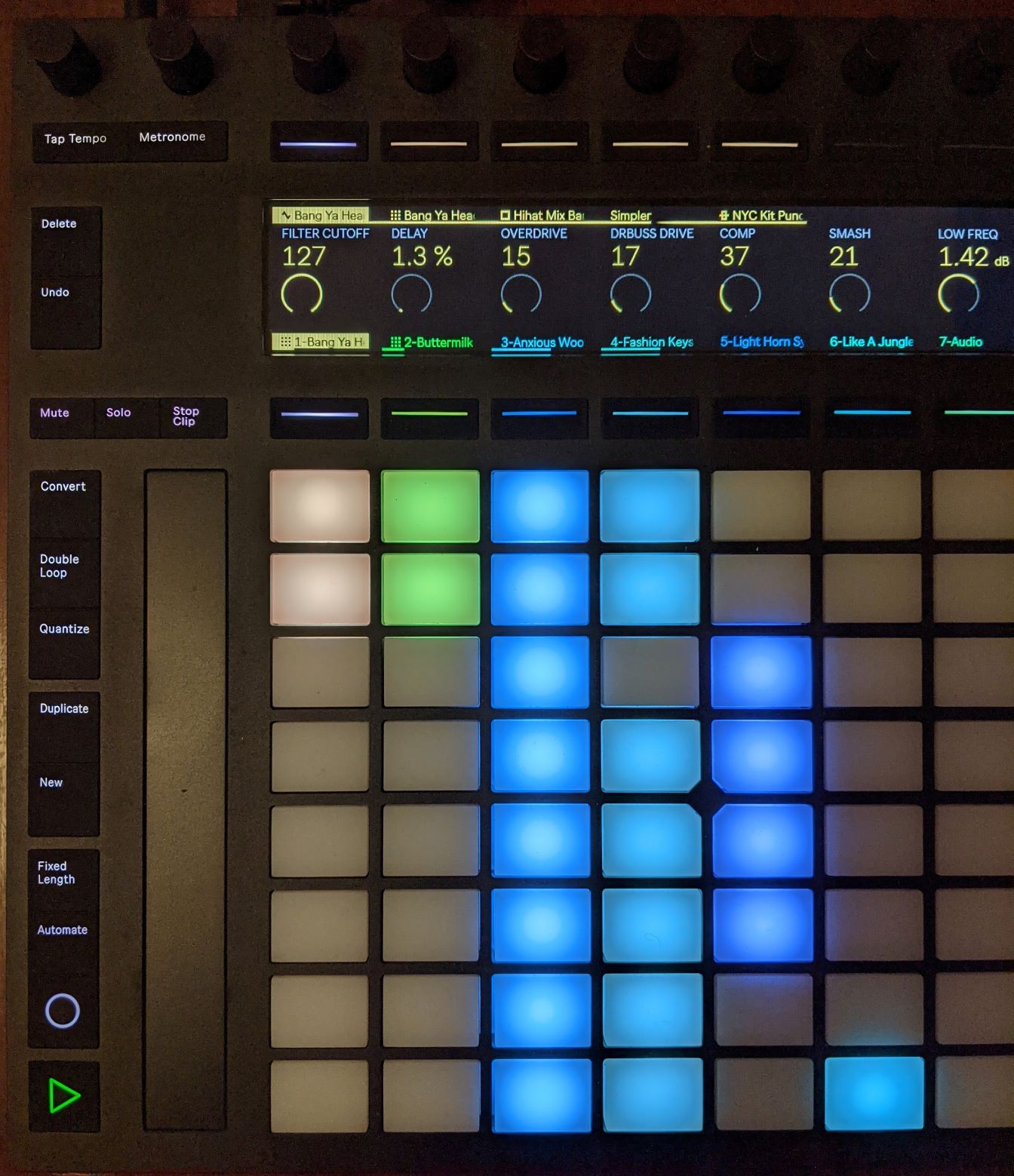
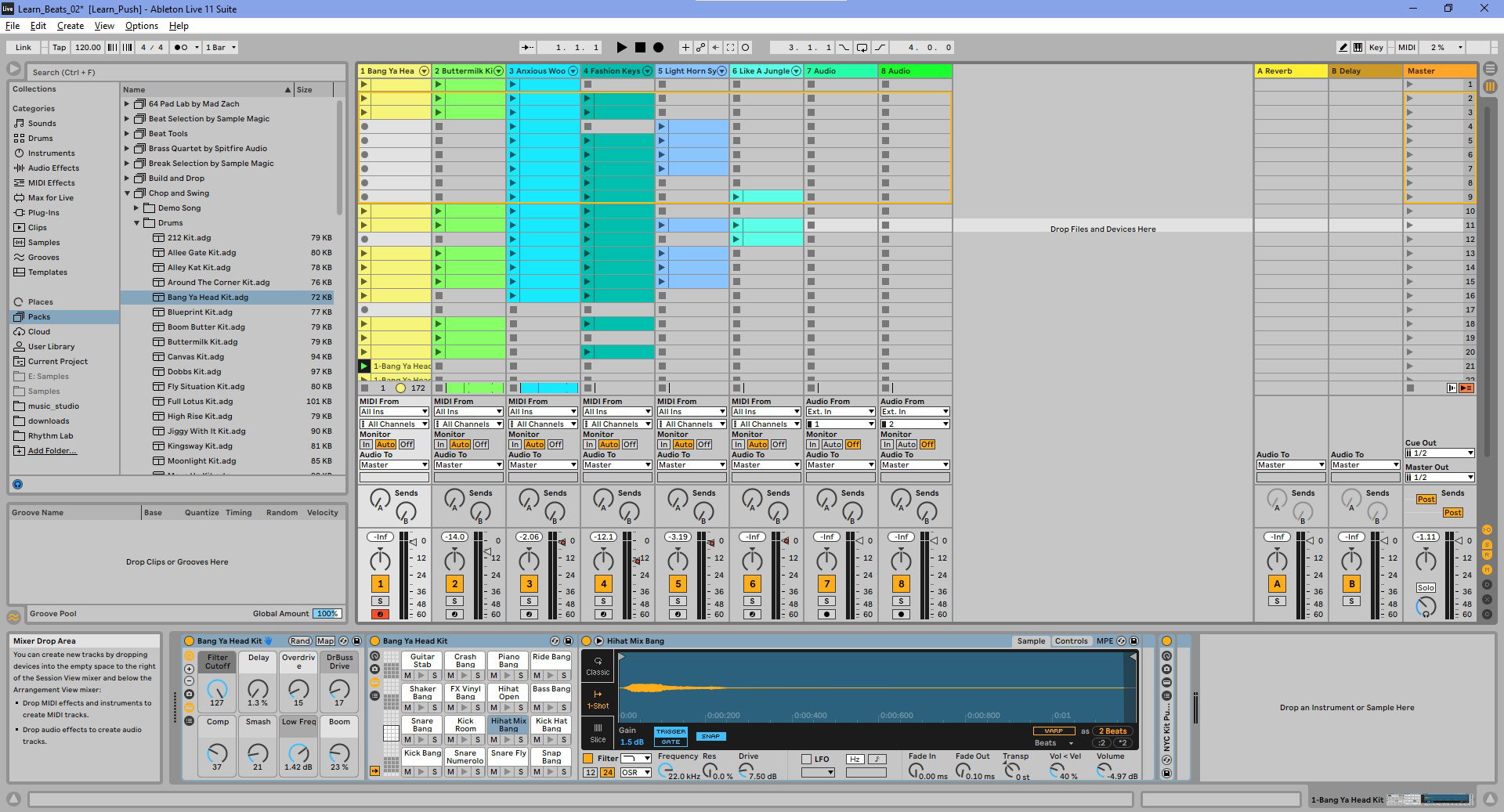
I boot up Windows, switch on Push and load a new session (Live set) of Ableton. Packs are helpful because they are made up of sounds that have been crafted to work together well so I'll quickly choose a Live Pack to focus on and load a drumkit onto Track 1 (I'm in Session View). Start the metronome, press play and quickly set the tempo. Play a few pads to audition the 16 different sounds of the drumkit. See if I can come up with a drumbeat or groove, probably just two bars long. I can quickly record a few variations and I'll often load up a further drumkit on track 2 and add some hi-hats probably there.
My music is lacking cohesion, focus and direction. The tracks just meander through different parts without really sticking with or expanding on musical ideas. Maybe.
Is groove the problem? My beats are rudimentary things that don't really get me tapping my feet. So maybe I could study drum patterns a bit more.
Let's move on now, anyway, to Track 3 where I'll probably add a Bass sound from the same Pack. So down to a low octave and I'll just play in a few ideas. The bass usually sounds pretty cool. I'll probably set the length of these ideas to four bars.
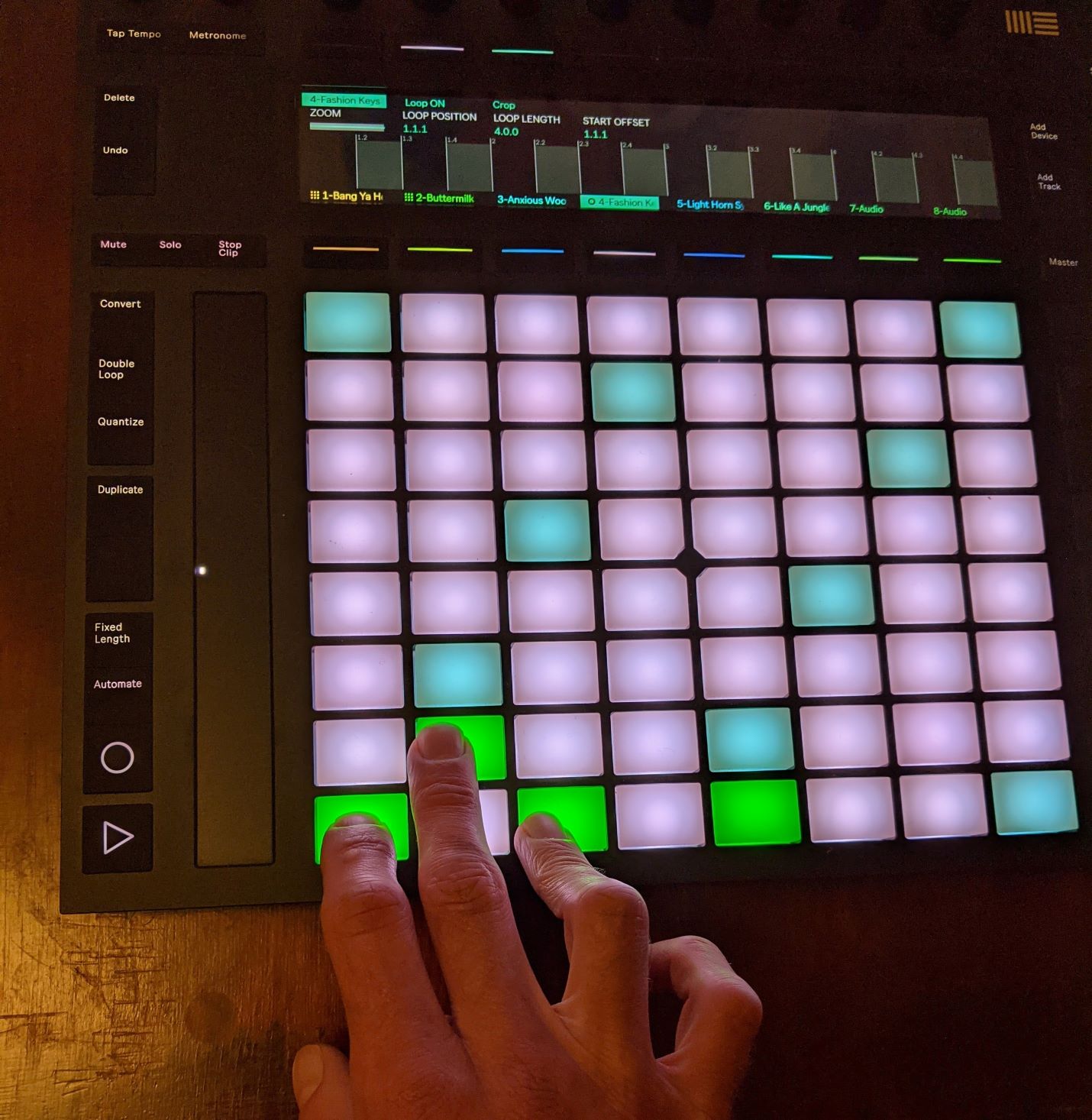
I don't know what notes I'm playing really. Well, I do a bit. I have a vague understanding of the seven harmonic notes in a major scale (is that the right phrase? Possibly not). Push is nice in that it lets me stick to the harmonic (I mean in key) notes of a scale. Ah... now I'm thinking that was probably a problem last night, in that I was working again in C Dorian (I don't really know what that means) and so it came out with the same very dark vibe as the previous track I worked on. I basically didn't change the (weird) scale (C Dorian) I was playing in. So that's a breakthrough then - an insight - that has come from writing this article.
I'll reach an end to this stage by adding musical parts with various synth sounds on tracks 4, 5 and 6. Something to work with the bass a bit - chords. I have to say I don't really know what I'm doing with this aspect of Push. I'll have to learn a bit more. I know a major chord - first, third and fifth intervals (ah, intervals - there are seven harmonic intervals in a major scale? Perhaps that's it.) - on Push is a little triangle shape. Totally different shapes (and much easier to play) than on a piano keyboard. I need to learn some other chord shapes rather than just guessing but I've always guessed pretty much (with little success) when it comes to choice of chords to follow each other. Which is a problem. Maybe back to some chord theory? I don't know. I have a problem here. It's like I still don't (and I've been trying to be musical for years) quite understand how chords work.
I can noodle away with lead notes pretty fine and I do this too up in higher octaves. It's very similar to how I'd play guitar. So this is great and each bit sounds musical enough on its own but they don't altogether match up so well (lacking that direction I mentioned earlier) in a complete track.
But there we are. I've put down my parts now (and this has taken an hour I imagine). I could learn how to duplicate, copy and move clips and scenes about with more ease on Push (or do this in Live maybe).
Ableton Live is all about clips and scenes (borrowed from the language of film editing I guess). Sorry, not knowing Live you'll be lost with these terms. So then I'll arm all the tracks and play through the scenes one by one with a little back and forth to globally record all this to an arrangement - an arrangement in Live meaning a musical arrangement (the whole track or song). I can tamper with the volume knobs as I do this. This is all really rough and ready and just loosely gets a draft of a track/song down for me, pretty much so I can decide do I want to put in further work on this project or not. I export the whole track to MP3, boil the kettle, sit down with a cup of coffee and listen back.
That's my musical process right now. I can see lots of points in this workflow where I could do with taking a bit extra care. And, as ever, lots more learning.
Remember to choose the musical scale I'm playing in (or was it just C Major - the default? I'll have to check that out).
Drums and groove. Study here? Try to get something my foot taps along to.
Learn the chord shapes on Push.
Study chord theory a little more? (I'm pretty doubtful this will help).
Learn how to duplicate, copy and move clips and scenes on Push.
Ok, cool, that's some stuff for me to look at, learn and integrate into my current workflow. I hope it has been an interesting read. It's not a How-To guide at all but it is a look at an approach to working with Ableton Live and Ableton's Push 2 controller. I'm really impressed with the Push which I haven't had very long. Ableton Live takes a lot of learning and Push too. Don't go out and buy them both after reading this article! There's so much helpful music technology available on the internet, much of it free, but these are quite complicated software applications which take a lot of study to use.
Since I've been discussing my music workflow especially in relation to Live I'll add a link to a book which explores the many approaches, possibilities and challenges that can be explored in terms of making electronic music. Making Music: 74 Creative Strategies for Electronic Music Producers by Dennis DeSantis is a fascinating and quite useful text, and something quite a bit different to the average music making guide. You can purchase a hardback copy from Ableton online in Berlin or read a PDF version on the website. https://makingmusic.ableton.com/
https://makingmusic.ableton.com/
For readers interested in my set-up here are some links to Ableton Live (the digital audio workstation) and Ableton Push (the MIDI controller to work with Live). Thank you for reading. https://www.ableton.com/en/live/ https://www.ableton.com/en/push/
The Art and Science of Financial Prediction: A Reading List
*Contents: Book reviews. Useful ideas for prospective traders on making predictions and data analysis. A little bit of politics but no horse racing.*
While I enjoy the idea of reading a little more than the practice, I am a big reader. My first two articles here on read.cash were on the subject of horse racing and, while I've read many books in that field, I thought I'd devote this article to the theme of books on finance, particularly data analytics and a couple of related themes. Science-y, tech stuff...
The History of Finance
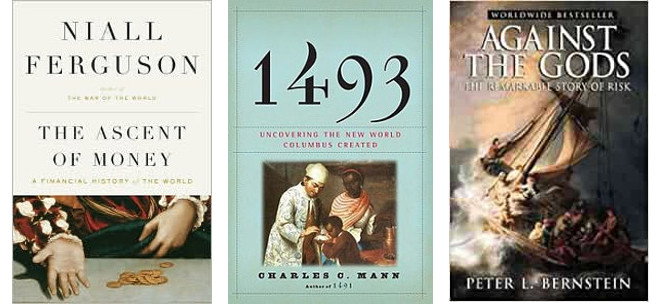
Niall Ferguson's **The Ascent of Money: A Financial History of the World (2008)** is a good account of the development of merchant banking in Europe, mostly, and its role in some of the awful crimes committed in the name of empire for the benefit of colonial trade. We can move on and cherish greater human ideals like equality between people of all races but we can also be wary of capital as it pertains to power and bear in mind that financial systems have long been associated with inequality and enslavement. Ferguson’s The Ascent of Money is not told like this but it probably should be.
**1493: How Europe's Discovery of the Americas Revolutionized Trade, Ecology and Life on Earth (2011)** by Charles C. Mann is no radical polemic but it adopts a very different approach to history, focusing crucially on the interaction of two ecosystems. The Spanish conquest of the Americas initiated by Columbus brought widespread disease to the New World. The impact of these diseases was so devastating on local populations that the colonial invaders imported slaves from the African continent to take on the workload of farming and mining. Mann is a fascinating writer with a fresh yet holistic take on history.
**Against the Gods: The Remarkable Story of Risk (1996)** by Peter L. Bernstein receives my highest recommendation in this category. Bernstein focuses on the crucial role that uncertainty regarding the future has played in the development of modern finance. Some security in trade can be purchased by the buyer of a price-guaranteed contract (hence insurance, hedging and derivatives trading) while traders taking big risks on low prices can make large profits. Bernstein's focus on risk helps elucidate much that is confusing about the modern trading system. Highly informative.
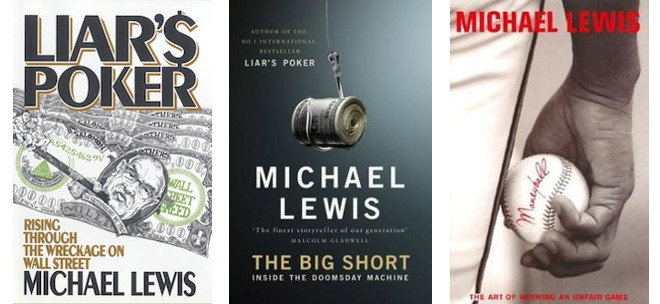
Michael Lewis is a very different sort of writer but another who sees the fundamentals at work in the financial system and where they might be lacking. He discovered his writing voice in 1989 with **Liar's Poker** having voluntarily quit work as a bond salesman on Wall Street. Most noteworthy about this funny book, written in Lewis's trader slang, is how it foreshadows his later work, **The Big Short (2010)**. Having read **Liar's Poker** again recently, I was left with the strong impression that the disaster of the US housing bubble was near unfolding in 1989 - Lewis completely identifies the ill-measured economic risks being taken - and that it just took a further twenty years for a few big banks to fall.
Data Analytics: The Art and Science of Prediction
Between these two works Lewis writes **Moneyball (2003)**, a nicely told tale of baseball manager Billy Beane ploughing his own furrow and applying data analytics to a sport strongly prone to traditional hearsay when scouting for talent. **Moneyball** is a great read, perhaps less successful on the screen than **The Big Short** (which is an excellent movie). It probably works best as a book if you know something about baseball and sabermetrics (baseball stats), which I don't.
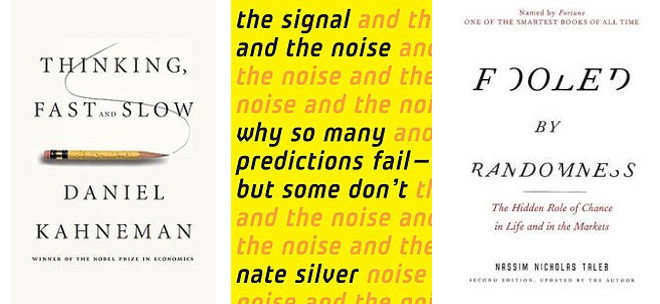
Still, it was an easier read than **Thinking, Fast and Slow** by Daniel Kahneman. This summary of many years' academic work by Kahneman and fellow researcher Amos Tversky has been a consistent bestseller in the popular science field since its publication in 2011. It's an important work, especially for people focused on prediction markets in their work, though clearly it has much of interest to a casual reader, especially one looking to improve their methodical and analytical mindset. I found it a bit too dry and academic but it's a worthy read, necessary for bettors and prospective traders alike.
I enjoyed Nate Silver's **The Signal And The Noise: Why Some Predictions Fail But Some Don't (2012)** more. In some ways it's more of an applied text as it draws many of its examples from the author's website FiveThirtyEight. The original sales line was something to the tune of 'this is how FiveThirtyEight forecasted the correct election result from every US state in the 2012 presidential election'. Which was great, only next time up (at Trump's surprise electoral win in 2016), FiveThirtyEight predicted an overall win for Hillary Clinton. The subtitle of the book perhaps says it all. https://fivethirtyeight.com/
Nassim Taleb's **Fooled By Randomness: The Hidden Role of Chance in Life and in the Markets (2001)** and **The Black Swan (2007)** are worth mentioning here. I'm not sure if Trump's electoral win could quite be construed as a black swan event (defined by Wikipedia as a "high-profile, hard-to-predict, and rare event... beyond the realm of normal expectations in history, science, finance, and technology") but it certainly came as a surprise to many. Even and especially with AI systems deep learning our every move, our ability to make the wrong predictions and fool ourselves when making quite basic forecasts (which way will the US nation vote, for example) is sometimes pretty staggering. With Taleb I preferred the earlier work, **Fooled By Randomness**. The author is quite the intellectual of the markets. This book was more oriented towards technical analysis with less exposition on Ancient Greek philosophy.
This article is now deep into predictive data analytics theory. I think our ability to misjudge how events will turn out has a lot to do with our tendency to adjust our perceptions based on what other people think. Daniel Kahneman probably has a name for this heuristic (he talks of the 'priming effect' of media). This sheep-like mentality (the tendency to herd together when forming opinions) is not a bad thing per se.
James Surowiecki looks in detail at how this phenomenon can often achieve magically accurate predictions in **The Wisdom of Crowds: Why the Many Are Smarter Than the Few and How Collective Wisdom Shapes Business, Economies, Societies and Nations (2004)**. Maybe this is true so long as the individuals who make up the prediction market are not all being swayed by some (media?) bias. **The Wisdom of Crowds** is a fairly short, very readable text and another that's highly recommended.
Cryptocurrency
It's been a long article but there's much to fit in. On cryptocurrency I preferred Dominic Frisby's **Bitcoin: The Future of Money (2014)** to Nathaniel Popper's **Digital Gold (2015)**. Both are fairly basic introductions to readers seeking to understand blockchain finance. **Blockchain Revolution: How the Technology Behind Bitcoin Is Changing Money, Business, and the World (2016)** by Don and Alex Tapscott is a strange thing. Go along with the Tapscotts for a bit and you can easily start to think 'Wow, this is going to change the world.' The altruistic take is laudable but the book lacks much stylistic colour, its prose quite formulaic, standard web 3.0 stuff.
**The Secret Life: Three True Stories of the Digital Age (2017)** by Andrew O'Hagan is a collection of three gripping tales from real life. O'Hagan is concerned with the ambiguous zone where real life and virtual identities become blurred. In one tale he adopts the identity of a long-deceased man and builds an online identity anew. The other two pieces are close-up profiles of Craig Wright, making his claim to be Bitcoin founder Satoshi Nakamoto, and Julian Assange, who O'Hagan had been helping to write an autobiography. Suspense, intrigue, paranoia and USB sticks; this fairly short read has it all.
Tech Culture
**The Code: Silicon Valley and the Remaking of America (2019)** by Margaret O'Mara is a history of Silicon Valley. Technical developments by companies located in the San Francisco Bay Area have, of course, had a huge impact on computers and online culture across the world. The book is comprehensive and good on the influence of politics, venture capital and military technology in the development of the tech industry in this region of Northern California. I haven't read the much earlier **Hackers: Heroes of the Computer Revolution (1984)** by Steven Levy but it covers similar themes and is regarded as a classic in this genre. **Where Wizards Stay Up Late: The Origins of the Internet (2003)** by Katie Hafner & Matthew Lyon is a little more animated than O'Mara's text. It focuses on ARPANET and the work of the early scientists behind the internet.
The book that deserves a push here is Paulina Borsook's fantastic **Cyberselfish: A Critical Romp Through the Terribly Libertarian Culture of High Tech (2000)**. Wonderfully told in a deadpan tone, former Wired journalist Borsook looks back sadly on what might have been; or how money has sometimes kept ethics down in the not-all-that-modern-really white male dominated world of tech culture. Especially good on US taxation and its role in fostering, not hindering, the development of corporate tech America.
**Big Data: A Revolution That Will Transform How We Live, Work and Think (2013)** by Viktor Mayer-Schonberger & Kenneth Cukier is a work that remains unread on my shelf. **The Numerati (2009)** by Stephen Baker was good enough, I think, on what was coming with big data and AI analytics. On the dangers not from AI so much as from big datasets in the hands of giant tech corporations, I did try **The Age of Surveillance Capitalism: The Fight for a Human Future at the New Frontier of Power (2019)** by Shoshana Zuboff but it was too dull for me (which is saying something actually!) and unfocused. I'd watch Netflix documentary The Social Dilemma (2020) instead. https://www.netflix.com/gb/title/81254224
Programming
I've never regretted choosing Python as my first programming language to learn. It is often cited as the most used coding language for quantitative analysis in finance. I started out learning Python with the website How To Think Like A Computer Scientist. The roots of this site stretch back to a 2002 Allen Downey work of the same title originally teaching Java code to students. **Think Python: How to Think Like a Computer Scientist (2015)** is Allen Downey's most recent version but there are many spin-offs of this guide now available for learning Python 3 (advised) in free PDF or book format. http://openbookproject.net/thinkcs/python/english3e/
One of those that never gets the credit I think it merits is Charles R. Severance's **Python for Everybody: Exploring Data in Python 3 (2016)**. It’s an easy, readable and practical introductory text which I often find myself going back to. Dr. Chuck (as he’s monikered) has a Py4E website with a PDF copy of the book and relevant materials online. https://www.py4e.com/
Oh and I should add, if you're getting into the data analysis side of Python programming, **Python for Data Analysis: Data Wrangling with Pandas, Numpy, and Ipython (2nd Ed, 2017)** by Wes McKinney. McKinney is the author of Pandas, a very useful code library for Python. In actuality, if you're learning to code, the freely available online resources are often quite sufficient.
A Choice Selection
**Against The Gods**, **1493**, **The Secret Life** and **Cyberselfish** were very readable texts that stand out particularly. These books are all highly original and insightful. They do have an advantage on some of the more technical texts above in being free to approach their subjects from a more literary angle.
I'm not widely read in any of these study fields but my central focus has been on data analysis and prediction. For some insight into the techniques and theories of data forecasting, I'd recommend beginning with **The Signal and the Noise** and **The Wisdom of Crowds**.
Most of the above books come in a number of editions and all are widely available from internet retailers. I hope this article has been illuminating. Thank you for reading. What have I missed here and what should I read next?
The Economics of UK Horse Racing
**Handicap Races**
The majority of horse races in the UK are handicaps. An official handicapper studies past results (horse racing form) and comes up with an official rating for each horse. This rating determines the weight the horse will carry in its next race, depending on the conditions of the event. Extra weights may be added to the saddle to ensure that the weight of jockey plus saddle combined equals the allotted weight.
The handicapper's aim is to allot weights which counter the racehorse's ability. Ideally and hypothetically the handicapper is looking to see all the horses cross the finishing line at the same time. Handicapping by weight plays a central role in horse racing and much form study is similarly focused around weights and ratings.
**Non-Handicap Races**
The very top races in the horse racing calendar (class 1 events) are usually not handicaps. The best horses compete on their own terms at level weights. Racehorses, at any level, also start their careers in non-handicap contests known as maiden races. Once a horse wins a maiden race it is no longer entitled to run in maidens and is given an official rating by the handicapper. In certain other (usually low grade) selling races or claimers the connections of a horse (trainer and owner) get to stipulate what weight their horse will carry in a race, thereby giving it a better chance of success.
**Codes of Racing**
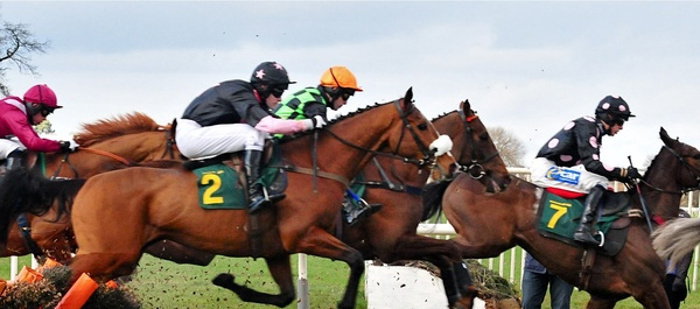
There are two codes of racing in the UK: Flat racing and NH (National Hunt) racing. Flat racing is racing over a prescribed distance without obstacles. NH racing usually involves obstacles a horse must jump - either hurdles (light brush panels which are easier to knock over without a horse falling) or chases (bigger fences made of birch or spruce that a horse must jump well to clear).
The weight a horse carries in a flat race tends to range between 8 and 10 stone. In the NH code (jumping) horses carry between 10 and 12 stone on their back. Horses can and sometimes do race in both codes. Flat races are run at distances of up to two miles and racehorses are consequently bred for speed in this code. The jumping game (which originally comes from the domain of hunting and is much more particular to the UK than flat racing, which takes place around the world) rewards stamina, with horses running over a distance between 2 miles and 4.5 miles. The Grand National Steeplechase is a handicap jumps race run over the extensive 4.5 miles trip with 30 big fences to be jumped along the way.
So that's all pretty factual information pertaining to the conditions of horse racing in the UK. You don't need to know any of the above when you place a bet on a horse race but it's the way in, I think, to understanding what the game is all about. It's a bit of a dry read so for those of you who have made it this far through the article I'll add a few more piquant deductions of my own.
**Owners, Trainers and the Betting Market**
The prospective bettor might do well to imagine themselves in the position of an owner of a racehorse or perhaps the trainer of a racehorse who is looking to keep the owner paying stable fees. How can they make a handsome living through horse racing?
Prize fees for winning a race are, for all but the best races, relatively low. A horse that wins one race a year and places in a couple of others might earn £10,000 in prize-money. It certainly helps and it might be enough to satisfy an owner who doesn't seriously expect to make money from horse racing. But into this situation we must factor in the possibility that you can bet on horse races. Wild sums of money aren't going to go unnoticed in the betting market but still... there are potentially some lucrative opportunities here.
So the obvious idea is to run your horse in a few races perhaps just a little short of peak fitness. You make it look like the horse is a fairly run-of-the-mill sort, apparently lacking in speed. The handicapper rates the horse accordingly with a low weight rating. You enter the horse in a race slightly below the actual ability you expect them to attain. The students of form in the racing press and, more importantly, the bookmakers look at the horse's poor form and price them up accordingly, perhaps offering good odds for a win. Depending on a few factors, but crucially this is going to include the racehorse's recent form, the horse could be priced up as big as 20/1, maybe even 33/1...
If you've got this far you are probably cottoning on and getting the drift of this thread. The rules of racing officially preclude trainers and jockeys from betting on the racehorses they are involved with. The owner is most welcome to gamble funds on the basis of their horse's ability.
**Framing**
When I assess and analyse horse races I'm to some extent always approaching racing from this perspective. It is contextual but essentially this is my take on the economics of the horse racing industry. It doesn't always add up but to approach horse racing from this somewhat Marxian analysis makes sense as it does when analysing other industries or economic situations.
Horse racing is a sport and love of the sport is, for most people involved, tied up intimately with their hopes to win money from it. Further, and importantly, the BHA rules of racing "require that every horse must run and be seen to be run on its merits (to achieve the best possible placing)." Consequently you don't hear a trainer say "oh, we ran him a little short of a gallop in order that connections could obtain a better price next time out." In short, what I am hinting at here is against the rules of racing.
This take on horse racing is not as blatantly addressed by the racing press as it is here but it is subtly alluded to. In betting shops up and down the land and on unofficial racing forums it's widely portrayed as a full-blown conspiracy. These different approaches add up to a very coded set-up which everyone in the racing world gets in line with really. There are ways of framing discussion of horse racing. I will probably revert to a more subtle code when I next return to the subject of horse races and handicapping.
Horse Racing: An Introduction
New to this platform, I know bits and bobs from a few fields of interest and one of these is horse racing. A good number of people uninitiated in 'the turf' say to me "You can't win at gambling can you?"
"The bookies always win" is quite a mantra among non-gamblers. Have I disproved this theory? No... but I've got quite close.
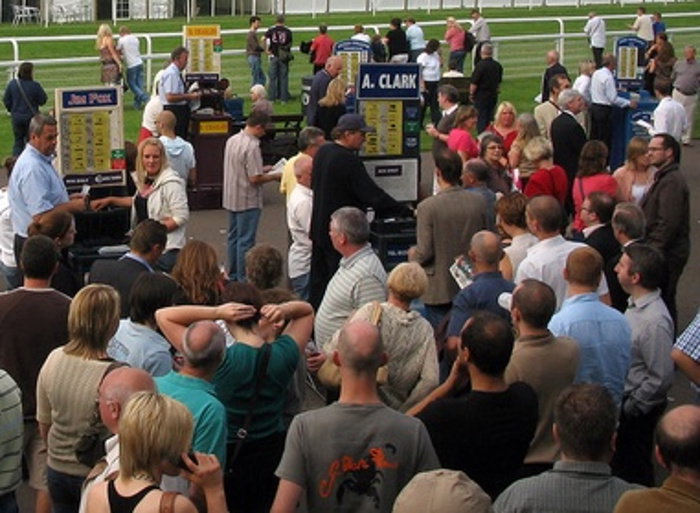
A few things have changed to how it was years ago, especially with the advent of the internet. Digital exchanges for trading between individuals certainly livened the game up, causing some serious concerns for the big bookmaking operations (Hills, Ladbrokes, Corals, Bet365).
Betfair was the exchange to revolutionise betting on horse racing. It enabled individuals to request prices and bet against each other through an anonymised exchange system. Betfair, unlike many big name bookies, doesn't close winning accounts. And by betting with Betfair you generally get access to the most competitive prices. https://www.betfair.com/exchange/plus/
On Betfair, as with bookmakers, you can of course bet on football, golf, snooker, election results and much else. This article is about horse racing so I'll stick with that. It's my specialist betting field and (outside crypto) it's really all I bet on.
Aside: I did give it up for 18 months actually after reading Rebecca Cassidy's magnificent sociological study 'The Sport of Kings'. The book lays bare the extreme class and gender prejudices that the horse racing industry, more than many other sports, tends to reinforce. It's not a modern sport. It doesn't really much try to move into the modern age, probably because there's a cruelty in running horses against one another as sport or for profit. Anyway, I don't wish to dwell long on these aspects any more than they want to discuss what crispy pork crackling really is on Masterchef.
I'm passionate about horse racing. I really enjoy the thrill of a winner. Watching a race is always a thrilling experience and it can be quite beautiful to watch the landscape roll by and see horses stride out and boldly jump fences.
Studying (as opposed to watching) racing is a different matter. It has been compared to the challenge of a cryptic crossword. It reminds me more of computer programming actually. Even if you're just scanning a race quickly from the newspaper you're dealing with methods and variables, working algorithmically; problem-solving. Form study or handicapping (both terms are used to mean studying an upcoming horse race and trying to pick the winner) is data analysis at any level. There are mysterious teams (known as syndicates) of many numbers of people employed to run major data analytical operations on horse racing form (the records of previous races).
You can find any amount of information online regarding handicapping. I'll recommend a couple of books beginning with 'How To Win At Racing' by Spectator, a slim guide which Raceform published for many years. This contains the basic fundamentals of handicapping and opens with a great quote from the late Aga Khan:
"If the punter takes the trouble, he certainly will win... he must work very hard; look it up, follow form, follow form, follow public form."
A more modern text that I highly recommend is Nick Mordin's 'Winning Without Thinking: A Guide to Horse Race Betting Systems.' This is the best of a lot of books I've read on the subject of horse racing. It's particularly good on approaching the sport from a modern perspective, utilising databases and letting a computer do the hard work for you.
If you're interested but concerned about losing money I'd also suggest OLBG, a fantastic website where you can learn your trade and pick winners and earn prize-money in leagues (a bit like fantasy football) without risking a penny. https://www.olbg.com/
OLBG is made up of a friendly, cheerful community of horse racing fans who will welcome a newcomer in. You can study Horse Racing 101 or their similar start-up guide to betting on horse racing.
With all this preamble over I hope you'll join me for my next article which will cover the fundamentals of studying horse racing form.
 @ohdearcrypto