 @mc5punk
more from that month
@mc5punk
more from that month
Short story: The Tent that Held Out (Chapters 1 and 2)
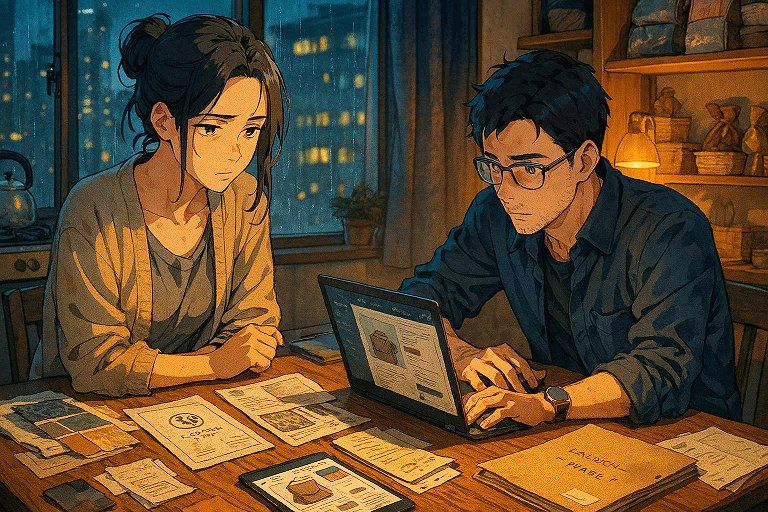
Chapter 1 — Faint Lights The night spread over the city with a bloodless clarity, as if the day had exhaled its last breath and only a weak glow remained to recall it. Streetlights poured a pale light that trembled on the wet sidewalks; the air smelled of recent rain and distant combustion. On the third floor, behind the fogged glass of a small apartment, Marina Soler let the virtual shutter of her shop slide down with the same contained calm with which she closed the memories that still hurt: each item withdrawn from the window was a promise she sealed, a gesture with an edge that left a salty aftertaste on the tongue. The screen returned her image like a distracted mirror: skin slightly weary, eyes marked by weeks of continuous work, hands that no longer felt the cold because fatigue had numbed them. At thirty-two, she carried on her shoulders a mixture of pride and exhaustion typical of someone who had tended a tiny dream until it became something tangible. She had loved that idea with the stubborn tenderness of someone who cannot conceive surrender: sleepless nights, calculations, calls to artisans, label corrections under the kitchen lamp. She was not a businessperson willing to sacrifice principles for profit; she was, rather, a guardian of good practices. From the moment she turned an intuition into a catalog, Marina had imposed rules that sounded to many like luxury or naivety: certified materials that would not compromise ecosystems, localized production that dignified manual labor, sustainable packaging that reduced waste. She did not seek fame or expansion at any cost; her aim was another, humbler and more demanding: to guarantee dignified conditions for the hands that manufactured, to give continuity to a project with meaning and, privately, to have her shop serve as a beacon—however dim—for those who valued the same care. That honesty showed in each product entry: next to the photo appeared the artisan’s name, the hours invested, the details of the process and the real cost itemized. The transparency filled her with satisfaction, but it also confronted her with concrete limits: by breaking down prices and fair compensation, the final value rose, and with it grew the uncertainty over whether enough customers would be willing to pay a little more for a story. That night, as she closed the virtual shop, she thought of the calls she had postponed during the afternoon: a supplier with delays, a return that required more time than expected. She allowed herself a moment to review the list of orders still open, feeling numbers on the screen like someone measuring distances in the dark. Outside, the neighborhood breathed slowly: the light of a nearby shop flickered; a car passed, leaving a sound trail that soon faded. Inside the apartment, the silence had the texture of a question: would that conviction alone be enough to sustain the project? Would it be possible to continue preserving principles without turning them into a financial prison? Marina lowered her gaze to her desk, piled with papers and fabric samples in an order only she understood. In that disarray there was a map of her work: labels still to check, budgets to adjust, customer messages requiring answers given with patience. She touched with a fingertip a label printed with recycled ink and felt a slight relief; it was the material proof of her effort. At the same time, a subtle anxiety tightened her throat: the accounts did not always balance and cold, exact bookkeeping demanded attentions that never ended. She remembered Ana, the weaver from the highlands who had sent a packet of samples the previous week: weathered hands, measured movements, laughter that came through voice messages. She had uploaded a photo of a finished blanket and the credit for the work was ready on the product page. Small gestures like that comforted her, restoring the meaning of the effort. She also remembered Martín, the carpenter who complained about rising wood prices, and how, facing adversity, both appealed to creativity to adjust designs without losing their essence. Those names and faces were, for Marina, more than suppliers: they were accomplices in a vision that aspired to a different economy, less voracious and more humane. She turned off the living-room light and was left only with the screen’s glow, which outlined her silhouette against the window. Outside, the city lights twinkled, and the distant murmur of a television traced a sound line that referenced other lives. Marina allowed herself a sip of cold coffee, ran through the plan for the coming week: launch a new line of woven accessories, prepare a small virtual event with a guest artisan, restructure shipping to save costs. Each decision carried the weight of a double demand: to maintain the project’s integrity and to guarantee its economic viability. Meanwhile, in the silence, a mix of pride and fear emerged. Pride for having built something with her own hands; fear that the requirement of transparency and justice would soon meet the market’s harshness. She closed the virtual shutter completely and, before collapsing onto the sofa, pressed the palm of her hand against the glass as if to give thanks and say goodbye at once. Outside, the faint lights kept their slow pulse; inside, Marina turned on a small lamp next to the worktable and opened a notebook where she wrote, in firm handwriting, three urgent tasks: adjust margins, contact a new supplier, and prepare the launch campaign. That list was, in that moment, the only compass offering certainty. The city continued its nocturnal transit, indifferent and constant. Marina, in her corner, restored meaning to the day with modest acts: sorting samples, replying to messages, caring for the narrative of each product. That care, though almost imperceptible to many, was the root of her project and the act by which, despite everything, she continued to believe in the possibility of commerce with a soul. Chapter 2 — The Rational Shadow Diego Ríos was the shadow that accompanied her, but a shadow with straight, measured edges: not the hand that pushed forward, but the one that probed the ground for cracks; not the flash of intuition, but the cold calculus of foresight. Technical by training and by impulse, Diego had learned to translate uncertainty into spreadsheets and scenarios: the payment gateway, server infrastructure, shipping times, logistics costs and potential returns were, for him, a mountain range of numbers in which any fissure could, with a little rain, turn into an avalanche. His nights filled with contingency maps and his days with lists, and when he spoke he did so with the voice of someone who proposes levees before bridges. That way of thinking seemed unromantic to many; to Marina it sometimes provided the security she needed and at other times gave her the feeling that an entire life could be measured in thin margins. They did not share the same language because she spoke in possibilities and he in probabilities, but they had built a professional coexistence that balanced — not always without friction — those poles. One afternoon, the dining table—converted into an improvised desk—was littered with papers, invoices and an open laptop. Diego rested his elbows on the wood and let his fingers drum on the computer's edge before speaking. "If the payment gateway fails on day one, we lose our reputation and a large part of the stock," he said, flat and without drama, as if stating a law of thermodynamics. Marina fixed her gaze on the screen where an email confirmed an eco-lot offer and felt her jaw tighten. "And if we don't buy now, Omar raises the price and the eco lot is gone," she answered, with some sharpness. "I can't sell less out of fear. If we don't have product, there is no story to tell." Diego frowned and slid a document toward her: a sheet with cash-flow scenarios. "This is not fear, it's survival. Look at this: if the gateway crashes and we can't process orders, refunds and returns put us in the red in two weeks. We can design mitigations, but we need a plan B: gateway insurance, sales limits or even a staging before the launch." Marina took the sheet and looked at it, then crossed the room to turn on the small lamp by the sample shelf. Returning, she set the supplier file on the table and sat across from Diego. "And I ask you: what if plan B makes us lose the opportunity?" she said more quietly. "Omar won't wait. If he raises the price, the hands that wove that batch lose income. It's not just business; there are faces behind it." Diego was silent for a second, studying his hands. He had learned not to react harshly; he knew Marina's veiled reproach always hid something more than business: moral urgency. "Then we do both," he finally proposed. "We buy a reduced lot now to guarantee continuity with the artisans and we activate a technical plan with limits. If traffic is higher than expected, we scale in phases. I don't like risk, but I also don't like the idea of leaving people waiting." Marina let out a short, almost incredulous laugh. "And you're going to tell me an intermediate solution isn't dying slowly?" she asked. "I want impact. I want the artisans to receive enough orders to cover their season." Diego moved closer, rested a hand on the table and looked Marina in the eye with contained firmness. "Impact, yes, but sustainable. If we burn out now, there won't be future orders. If this anguish eats at you every time we must choose big or small, we'll be stuck on that wheel forever. We need a roadmap that lets us grow without breaking." Then a more intimate tone entered the conversation, less technical; the one that appears when numbers touch everyday life. "What if we split the launch into two waves?" Marina suggested, surprised by the words that came out of her mouth. "A small one to guarantee payments to the artisans and another, a month later, with the rest if everything works." Diego regarded her with a mixture of approval and relief. "That works," he said, adding a new column to the sheet. "We adjust inventory, run a stress test on the gateway and prepare transparent communication for customers. If something fails, we can contain it without collapsing." They fell silent for a moment, each thinking through the implications. From the kitchen came the sound of the kettle, a domestic reminder that reality was not just figures but also cold coffee and hands that needed rest. Marina stretched and, for the first time that afternoon, let her voice soften. "Thanks for not always discouraging me," she said simply. "And thanks for not letting me leap without a net." Diego offered a small, rare smile. "And thank you for reminding me that behind the tables there are stories," he replied. "If we do this right, both things can go together: dignity and viability." The contrast between them resembled, in a way, the relationship between terrain and map: Marina pointed out possible routes with enthusiasm; Diego traced the contour lines so they wouldn't get lost. It wasn't a relationship of symmetry, but of complementarity: her intuition, tempered by his caution, shaped decisions that once would have seemed impossible. That same night, as they wrapped up the day's work, they revisited other details: insurance, payment terms, alternatives if the supplier failed to deliver. They exchanged positions, some tense, others joking. At one point Marina burst out laughing at a misspelled name on an invoice. "Who billed 'Marina Soles'?" she asked, amused. "Probably someone who thinks we have a sun guardian looking after the shop," Diego replied sarcastically. "Or someone who should check the Excel before sending it." They laughed and the atmosphere, though heavy, lightened. Outside, the city kept its indifferent rhythm; inside that small space of decisions and affections, something more than a business was being woven: a way of understanding risk that did not exclude humanity. When they finished, Marina gathered the papers and placed them in a folder labeled "Launch — Phase 1." Diego closed the laptop and slid it into its case. Before turning off the light, they looked at each other without words and, in that brief exchange, recognized themselves as partners in an enterprise that demanded as much calculation as faith. Source of the images. Image created with Bing.
No comments yet