 @mc5punk
Short story: The Mosquitoes of Memory
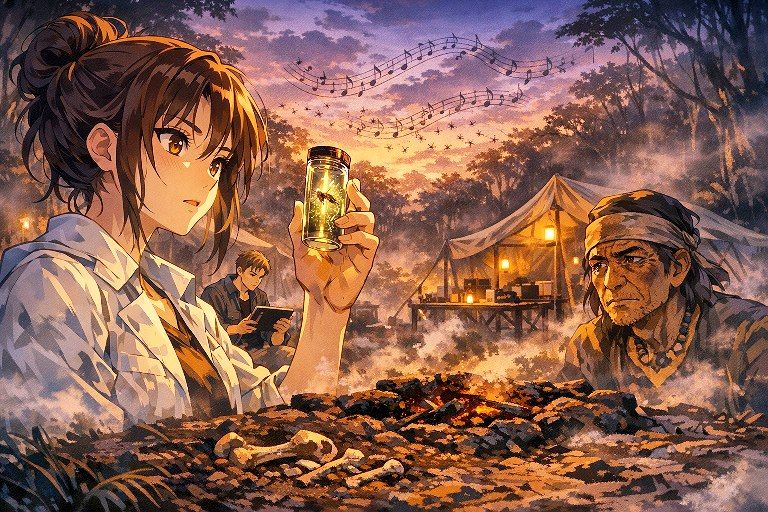
Sundaland breathed in layers. At dusk, the jungle folded over itself: glossy leaves collected recent raindrops, lianas hung like black ropes, and the air, thick and warm, carried a scent of resin and wet earth. Against that landscape, a small group of scientists had set up an improvised camp by a slight clearing: canvas tents, silent generators, folding tables with equipment and a lamp that cast a white beam over a small glass vial where, like a reliquary, a mosquito was preserved. It was not any insect: it was one of the specimens whose genetic sequence promised to rewrite, or at least nuance, chapters of human history. Dr. Maia Ríos held the vial with fingers that trembled barely perceptibly. She was a woman with a sharp gaze and her hair tied in a messy bun; her reputation came from years of digging into ancient genetic archives, extracting voices from molecules many considered mute. Beside her, Liam Kwan, an ethnoarchaeologist, skeptical by nature and always ready to question certainties, reviewed maps, comparisons, and field notes on his tablet. Asha, the local guide, listened in silence; her face weathered by sun and rain seemed to hold stories that were not found in books. “If the genome dates are correct,” Maia said, her voice contained but firm, “these mosquitoes began to prefer human blood between 2.9 and 1.6 million years ago.” Liam looked at her with the mixture of incredulity and curiosity characteristic of him. “That’s a dangerous window,” he replied. “Fossil evidence is sparse, and ancient DNA interpretations can lend themselves to misunderstandings. Why assume that a change in preference means hominins were here en masse? It could be ecological convergence: an adaptation to a new available prey, without necessarily implying sustained human presence.” Maia shook her head, as if she had expected that reply. “Because the patterns in the genetic material don’t speak of a fleeting adaptation. We see haplotypes fixed in local mosquito populations in Southeast Asia, sensory variants that enable detection of specific human sweat compounds, changes in olfactory receptors… It’s not a matter of chance: it’s an evolutionary response to selection pressure. And that pressure needs a source; the most plausible are hominins who settled or passed through here repeatedly.” Asha stepped forward. Her voice, low and steady, blended with the night whisper of the jungle. “My grandmother used to say the forest remembers,” she murmured. “That people’s paths are impressed in the roots. If these insects changed, perhaps the jungle simply confirms something we always knew.” The team did not argue further aloud. Separated by the night, each of them reviewed the implications. The sequencing machine, with its intermittent silence, left patterns on the screen that at first glance looked like dust: thousands of variations aligned like a microscopic constellation. For Maia, every mutation was a word. For Liam, it was a clue that needed to be cross-checked against the material record. For Asha, it confirmed oral tales no one in her academic field had deemed relevant. That night, as rain drummed rhythmically on the canvas and the camp reverberated with the distant sounds of nocturnal animals, Maia dreamed. It was a vivid dream, so real that when she woke she felt the buzzing in her ears. In the dimness of her tent she heard what sounded like a tiny chorus, voices without human words but conveying structure. Voice of the Mosquitoes (in the dream, almost musical): We were not always into human blood. Before, the forest offered other mouths: birds, amphibians, reptiles. But when certain upright walkers began to move through the clearings, their habits created a new olfactory landscape. Heat, sweat, fire, sleeping in fixed places; those rhythms became maps for us. Maia woke with her heart racing. The sequencer screen still flickered on the table, and the vial seemed heavier under the cold light. The dream persisted: what if mosquitoes had not been mere followers but actors in a coevolution that influenced hominin decisions? The next day, the team pushed deeper into the clearing where, according to early inferences, primitive settlements might have existed. The vegetation parted into a small amphitheater where the ground was less tangled, as if ancient activity had prevented natural growth. There, buried in the dark topsoil, they found charred remains: bone fragments with cut marks, stones with flaked edges, ash distributed in a circle that suggested hearths. Liam crouched, picked up a fragment and gently blew to remove clinging dirt. His experience let him read those marks: not just remnants of food but constant alterations of space. “There was repeated occupation here,” he said quietly. “It’s not a casual camp. It’s a site used, reused, and possibly avoided for periods. If human presence was intermittent, mosquitoes could have found windows of opportunity, increasing their contact with us.” Maia approached, taking a handful of soil. The sediment samples they had collected for analysis showed layers of pollen and spores indicating changes in vegetation: cleared areas for fires, alterations in canopy cover. “Think of the consequences,” she said. “A vector that learns to prefer humans can become an agent of selection: human populations subjected to disease, differential mortality, pressure to move. It’s not just death; it's cultural learning: better practices, abandonment of plains, seeking higher, cooler areas or places with fewer vectors. That can alter migration routes.” Asha, who since childhood had heard tales about “places that return what they take,” rested the stick she’d used to stir the soil on the ash. “The ancestors knew where to stay and when to leave,” she said. “They learned with time, with fire, with clothing, with mosquito nets made from leaves. The forest teaches those who listen.” That afternoon, as the camp sank into a twilight that stained the foliage golden, something tightened the atmosphere: a different buzz rose at the edge of the clearing, softer and more precise, seeming to come from the periphery. It wasn’t the scattered hum of night; it was a coordinated movement, a symphony of wings folding and unfolding in unison. The researchers froze. Monkeys in the distance fell silent. Even the generator seemed to lower its volume so nature could speak. Voice of the Mosquitoes (in chorus, as if from the undergrowth): They came long ago. Upright walkers who smelled of salt and grease, who lit fires and slept in the same places. We learned their routes, their refuges. We became their shadows: where they settled, we grew. “Did you hear that?” Liam whispered, breath constricted. “Listen: it’s not just genetics. It’s behavior on both sides. If such an adaptable vector stabilizes, the consequences are huge: local epidemics, demographic losses, abandoning territories.” Maia was silent a moment, watching the vial reflect the lamp’s glow. The vision in her mind began to shape itself into a dynamic map: lines representing human routes with currents of vectors superimposed, acting as friction or impetus depending on their preferences. “Imagine,” she said finally, “that we’re reconstructing history not only with tools and bones but with the agents that influenced which places were inhabitable. Mosquitoes don’t just tell a passive narrative; they write parts of it by changing the viability of settlement in certain areas.” The distant insect chorus faded with the night, but the unease remained. The feeling of having discovered a key that opened moons of new—and dangerous—questions settled into the team’s bodies. Weeks later, back at the lab, they worked with demographic models. Maia and Liam fed simulations parameters that included vector-induced mortality, cultural adaptation (use of fire, shelter), and population movements in response to infestation peaks. The results were disturbing but consistent: models that included pressure from a vector preferring humans showed migratory pulses, relocation to higher altitudes, and temporal fragmentation of settlement in areas that, without that pressure, would have been stable. “Look at this curve,” Maia said, pointing to a graph on the screen. “Each time a mosquito variant preferring humans becomes fixed, there’s a drop in local population density. Then, in the re-expansion, new routes and settlements appear in adjacent areas. It’s a repeated pattern.” Liam ran a hand through his hair, thoughtful. “That suggests mosquitoes acted as catalysts of demographic movements,” he conceded. “They didn’t force the entire human migration, but they could have pushed or triggered decisions. In some cases, pressure favored groups with protective practices; in others, it caused exoduses.” On the lab wall a phylogenetic tree spread out with branches that crossed and reconnected, representing mosquito lineages that in their DNA held temporal and geographic signals. Looking at it, Maia felt a mix of fascination and chill. The branches were not just evolutionary relationships: they were chapters of long cohabitation. One night, while they worked, a monitor flickered and showed an anomaly: a mutation peak localized in a population of mosquitoes from a high region—a summit not marked as particularly hospitable on topographic maps. The samples came from a remote site sent by Asha, who had climbed a hill no one else on the team had visited. Asha called from the field; her voice over the line trembled with a mix of excitement and something like fear. “I found ancient villages on the summit,” she said. “They aren’t modern: covered hearths, bones buried in a different way, low stone structures. And the mosquitoes up there are legion, but they’re different. They don’t bite like the plain mosquitoes. It’s as if they mark people.” Mark. The word echoed in Maia’s mind as something transcending strict biology. It could be read literally: genetic marks favoring certain hosts. But it also suggested behavior that had somehow shaped human-environment relations. “What do you mean by ‘mark’?” Maia asked, controlling the rising anxiety. “I don’t know how to explain it,” Asha replied. “I found a house whose walls had a black patina, like they’d been coated with resin to repel insects. In another, people left small offerings, as if they knew something on the hill demanded a response. The elders in the nearby village say that up there the mosquitoes chose who stayed and who left.” Maia and Liam fell silent. The lab, with its fluorescent lights, felt colder than usual. Between them a discussion opened that touched on the ethics and responsibility of turning scientific findings into historical narratives. “If this is true,” Liam said, “what we present to the world won’t be a mere technical datum: it will be a reinterpretation of why certain human groups settled where they did, why others migrated, who survived which diseases and who didn’t. It’s putting insects at the center of our genealogy.” Maia took a breath, eyes fixed on the screen where the phylogenetic branches wove like a web of memory. “It’s true,” she answered. “But we can’t deny it out of fear. Science isn’t neutral, and yet it must be honest. If mosquitoes were agents that pushed human decisions, telling it is reconstructing the complexity of our history. It means recognizing that human expansion was co-produced by the environment and its small inhabitants.” The study’s publication provoked, predictably, mixed reactions. Some colleagues celebrated it as an innovative piece of paleoecology: a way to use vector genetic records to infer human dispersal. Others criticized it: to what extent is it legitimate to attribute to an insect the responsibility for moving entire societies? Wasn’t that anthropomorphizing ecological processes? But far from academic offices, in the high communities of Sundaland, things took a different course. In ceremonies sheltered from the monsoon, elders gathered around fires. Many nodded with wet eyes when a young regional museum researcher read excerpts of the study. For them, the story Maia and her team had pieced together brought no surprise, but validation of stories whispered for generations. One morning Maia returned alone to the clearing where they had first found the ashes. The jungle was quiet; a light mist climbed among the roots. She carried the vial in a small padded case. She knelt where the ancient hearth had once been, carefully turned the soil and placed the little box there. “Sorry,” she murmured toward the forest. “Sorry for digging into your secrets without permission. And thank you for keeping them.” She sought neither punishment nor redemption; she sought ritual and recognition: the feeling of belonging not only to the cold quadrant of the lab but also to that living fabric that had preserved history. In the silence, the buzzing returned; this time it was not threatening but faint, like an observation. The tiny chorus seemed to say the research was only one interpretation among many. Voice of the Mosquitoes (in the final scene, serene): We will remain witnesses. We will keep in our sequences what people did. Where there was blood, routes remained. Where there was custom, something lingers. We are neither executioners nor benefactors: we are memory with wings. The study’s publication opened new lines of inquiry. Paleopathologists sought traces of infections in ancient remains; ethnographers revisited oral traditions seeking correlates with biological events; ecologists modeled how vectors could generate selection pressures that, over time, changed human landscapes. Debates, conferences, and sensationalist headlines followed—“mosquitoes that directed humanity,” read some of them. Maia and Liam were forced repeatedly to nuance their claims: their conclusion was not that mosquitoes decided human destiny, but that they acted as one more force, sometimes small, sometimes decisive, in the complex choreography of hominin expansion. But in the villages, the tales continued as always: people said the forest had memory and that insects knew who was careful and who was not. Some elders added a new nuance to their stories: they now spoke of “the little voices that mark,” and on moonlit nights they sometimes sat to listen to the buzzing from the mangroves and recounted, with pauses and silences, why their ancestors had climbed the hills or abandoned certain valleys. Years later, Maia walked through that clearing once more. There was now a discreet plaque—not for showing off, but to remind that science must walk with respect. She stopped in front of it, closed her eyes and, on impulse, spoke softly as if addressing the progeny of those tiny insects. “Thank you for speaking,” she said. “Thank you for wanting to tell us something.” A buzz passed over her head, so faint she barely heard it. She did not expect an answer. She knew the relationship between humans and mosquitoes was ancient and would remain a long conversation, with words distributed between genetic codes, oral accounts and the materiality of buried sites. The research had opened a path: tools and bones were no longer enough to tell human expansion. One also had to listen to those who bit in the dark, who preferred some blood and avoided others, who, with their small evolutionary decisions, had signed their names on humanity’s map. The jungle, patient and ancient, kept all of that in its memory. And the mosquitoes—small units of history—continued living and mutating and, as they had for millions of years, recording in their code the steps of those who, beside them, once learned to light fires, sew skins and follow routes that, almost without knowing it, had been guided by a hum. Source of the images. Image created with Bing.
No comments yet